““The use of analogy, which is so wise and necessary a thing in historical judgment, has a knack of slipping into the falsest forms.” (273) We must therefore be careful with our application of compressed metaphors and likewise preserve a just sense of proportion. For, analogy itself means proportion (analogia).”

Ordo Dei

A site about matters of the Catholic Church, history, philosophy, and literature

Hilaire Belloc’s “The Barbarians” (1912) and the Analogy of a Self-Sabotaging Cultural Immune System

hicksonfamilyCatholic ChurchHeresiesSecond Vatican CouncilUncategorized  June 22, 202016 Minutes

(Author’s note: this essay was first published in 2017, and we hereby reprint it in light of current events.)

Dr. Robert Hickson                                                                                                8 August 2017

Saint John Marie Vianney (d. 1859)

Epigraphs

“The Barbarian….will consume what civilisation [hence sacred tradition] has slowly produced after generations of selection and effort but he will not be at…pains to replace such goods nor indeed has he a comprehension of the virtue that has brought them [such goods] into being. Discipline seems to him irrational, on which account he is for ever marvelling that civilisation [especially Christian civilisation, Christendom] should have offended him with priests and soldiers….In a word, the Barbarian is discoverable everywhere [even as a Caudillo Churchman] in this that he cannot make;that he can befog or destroy, but he cannot sustain; and of every Barbarian in the decline or peril of every civilisation [to include, even now, what remains of “the great and ancient body of Christendom”] exactly that has been true.” (Hilaire Belloc, “The Barbarians,” pp. 281, 282-283—my bold emphasis added; italics in the original)

***

“Upon the model of this conception men, watching the dissolution of our own civilisation to-day [before World War I, in 1912], or at least its corruption, have asked themselves whence those Barbarians would come that should complete its final ruin [as was once the case in North Africa and in Asia Minor, also with the Faith].” (Hilaire Belloc, “The Barbarians,” pp. 273-274—my emphasis added)

***

“But the truth is that no such [mere] mechanical explanation will suffice to set forth the causes [not just the symptoms] of a civilisation’s decay. Before the barbarian in any form can appear [also inside the Church], it [the civilisation] must already have weakened. If it cannot absorb or reject an alien element [such as a doctrinal heresy] it is because its organism [thus its immune system] has grown enfeebled, and its powers of digestion and excretion are lost or deteriorated; and whoever would restore any society which menaces to fall, must busy himself about the inward nature of that society [to include its composite and intimately religious society] much more than about its external dangers or the merely mechanical and numerical factors of peril to be discovered within it.” (Hilaire Belloc, “The Barbarians,” pp. 274-275—my emphasis added)

***

After recently re-reading after some years Hilaire Belloc’s 1912 essay, entitled “The Barbarians,” I have thought to apply a few of his keen insights about both ancient and modern civilisation to the current Catholic Church and her own “cultural immune system,” as it were.1 This limited analogy may also thereby allow us to consider the additional phenomenon of “auto-immune diseases,” whereby an immune system comes to sabotage itself—sometimes swiftly, sometimes slowly.

Belloc begins his own searching essay with an aptly cautionary sentence: “The use of analogy, which is so wise and necessary a thing in historical judgment, has a knack of slipping into the falsest forms.” (273) We must therefore be careful with our application of compressed metaphors and likewise preserve a just sense of proportion. For, analogy itself means proportion (analogia).

To help us understand his caution, Belloc gives an illustrative example:

When ancient civilisation broke down its breakdown was accompanied by the infiltration of barbaric auxiliaries into the Roman armies, but the settlement of Barbarians…, upon Roman land, …, in some provinces [was accomplished], by devastatingirruptions of barbaric hordes.

The presence of these foreign elements, coupled with the loss of so many arts, led men to speak of “the Barbarian invasions” as though these were the principal cause of what was in reality no more than the old age and fatigue of an antique society. (273—my emphasis added)

In this context, we might also helpfully recall what the Roman historian, Livy, had earlier (and very trenchantly) written, even back in 19 B.C., and in the general introduction to his own multi-volume history of Rome. Livy had then said that Rome had so degenerated and come down in those times even to such a point where “we can tolerate neither our vices nor their remedies” (“donec ad haec tempora quibus nec vitia nostra nec remedia pati possumus peruentum est”).2 This compact insight about cumulative decadence is certainly “a terrible thing to think upon” (in the words of Father François Rabelais). Into such a weakened culture—to include a fatigued and weakened culture and immune system of the Catholic Church—there will come various parasites and barbarians. They should be expected (and firmly resisted). For, a certain kind of weakness constitutes a “provocative weakness” (in the memorable words of Dr. Fritz Kraemer)—“for it is so weak that it is provocative to others.”

But, in the face of certain threats, there is also a dangerous progression: from denial to indifference to despair. Some have even colloquially referred to the three sequenced tricks often employed by the Prince of this World: “I don’t exist”; “I do exist but it makes no difference”; “I do exist and that’s all that exists, the reality of evil; goodness is an illusion.” We might also call it a slothful mental or spiritual movement from “What’s the difference?” to “What’s the use?”—an expression of the despairing sense of futility. From denial to presumptuous sloth to despair.

Father Enrique Rueda’s 1982 book—The Homosexual Network: Private Lives and Public Policy3—illustrated for me such an enervating psychological pattern unto futility, if not, after all, despair. Father Rueda had told me that three-fifths of the specific evidence and other materials he had assembled he had cautiously “sent to Rome, and confidentially”: inasmuch as he did not want to scandalize the vulnerable faithful.4 His published Homosexual Network already had 680 pages of evidence and argumentation, and that was only two-fifths of the evidence he had produced. Even in 1982—during the reign of Pope John Paul II—there was already a grave problem of homoeroticism in the Catholic Seminaries in the United States, and also in some of the Catholic clergy. Father Rueda himself had, in his careful research, first discovered the meaning of “gay” which was an intentionally used ideological and meliorative word. For, he discovered, “gay” meant that both “being homoerotic” and “also acting out such a yearning disposition” were, in themselves, “good” and, conversely, “being straight was bad.” However, now in 2017—35 years later—Catholics so nonchalantly use the word “gay,” thereby appropriating (perhaps unknowingly) the soiled language of their own enemy or adversary or opponent.

Hilaire Belloc illustrated this same linguistic and essentially moral phenomenon back in 1912. Let us consider this matter now, especially the implications of an attenuated language concerning Marriage:

It is certain that if the fundamental institutions of a polity are no longer regarded as fundamental by its citizens, that polity is about to pass through total change which in a living organism we call death.

Now the modern attack upon property and upon marriage (to take but two fundamental institutions of the European [at least as of 1912]) is precisely of this nature. Our peril is not that certain men attack the one or the other and deny their moral right to exist. Our peril rather is that, quite as much as those who attack, those who defend [marriage and property] seem to take for granted the relativeness, the artificiality, the non-fundamental character of institution which they are apparently concerned to support. (278-279—my emphasis added)

Belloc then considers the purported defence of marriage more specifically:

See how marriage is defended. To those who would destroy it under the plea of its inconveniences and tragedies, the answer [especially in England as of 1912] is no longer made that, good or ill, it is an absolute and is intangible. The answer made is that it [marriage] is convenient, or useful, or necessary, or merely traditional.

Most significant of all, the terminology of the attack [such as “gay” in another “marital” context] is on the lips of the defence, but the contrary is never the case. Those opponents of marriage who abound in modern England will never use the term “a sacrament,” yet how many for whom marriage is still a sacrament [such as Roman Catholics] will forego the pseudo-scientific jargon[e.g., “sustainable developments in and among the gay, single-sex civil partnerships”] of their opponents? (279-280—my emphasis added)

Adopting the categories and undefined equivocal language of one’s opponents is, indeed, a recurrent peril and often a sophistical trap. Much alertness is required to detect and resist sufficiently such ensnaring sentimentalism or subtle humbug based on false premises.

Belloc will now introduce us to one such unprincipled form of the “strutting Barbarian”:

The [presumptuous] Barbarian, when he had graduated to be a “pragmatist,” struts like a nigger in evening clothes [sic—as in Fats Domino’s own singing of “The Darktown Strutters’ Ball”!], and believes himself superior to the gifts of reason [and to “the accuracy of mathematics” (280)], or free to maintain that definition, limit, quantity and [the law of] contradiction are little childish things which he [the strutter as well as the dialectical Hegelian] has outgrown….

The Barbarian hopes—and that is the very mark of himthat he can have his cake and eat it tooHe will consume what civilisation [or our sacred tradition] has slowly produced after generations of selection and effort [as in the cultivated vineyards!] but he will not be at… pains to replace such goods nor indeed has he a comprehension of the virtue that brought them [such goods] into being. Discipline seems to him irrational, on which account he is for ever marvelling that civilisation should have offended him with priests and soldiers.

The Barbarian wonders what strange meaning may lurk in that ancient and solemn truth, “Sine Auctoritate nulla vita” [“Without Authority there is no life”]. (281-282—my emphasis added)

Belloc concludes with some candor that should make us more attentive and more wholeheartedly resistant now to the ongoing subtle, and also the crude, subversion of our Catholic Faith:

The real interest in watching [and then resisting] the Barbarian [within the gates and even within the walls] is not the amusement derivable from his [often perverse] antics, but the prime doubt [i.e., “dubium”] whether he [perhaps even as a crude lout or Caudillo leader] will succeed or no, whether he will flourish. He is, I repeat, not an agent, but merely a symptom, yet he should be watched as a symptom. It is not he in his [unmanly] impotence that can discover the power to disintegrate the great and ancient body of Christendom [and the Faith], but if we come to see him [that same Barbarian] triumphant we may be certain [“sine dubio”] that that [corrupted] body, from causes must vaster than such as he could control, is furnishing him with substance and forming for him a congenial soil—and that is as much as to say that we [and thus our sustaining culture of the Faith] are dying. (282-283—my emphasis added)

CODA

Hilaire Belloc’s fresh insights about the Barbarian and about his recurrent qualitative conduct throughout history will now also prepare us, I hope, to ask with integrity certain candid questions about our own “fundamental convictions” and, thus, about some “fundamental institutions,” especially the sacred and enduring institution of the Mystical Body of Christ (the Corpus Christi Mysticum), also known as the Catholic Church—to include the threefold interdependence and interrelationship of the Church Militant, the Church Suffering, and the Church Triumphant. My observations and questions propose to cover the interval of time beginning mainly in October of 1962 (or a little before) and continuing until today. When the Second Vatican Council formally began on 11 October 1962, I was still nineteen years of age, and very young.

By slightly introducing some autobiographical evidence as a witness, beginning with my time as a West Point cadet (5 July 1960-3 June 1964), I hope thereby to make more pertinent, even more trenchant, some of my own searching and specific questions as a Catholic layman down the years, and amidst many intellectual, spiritual, and moral challenges. For, some of the things I first heard or read in my callowness and considerable theological ignorance later became much clearer, and, for me personally, even momentous. However, I early on was reliably led to understand that the deepest ongoing revolution was about the very nature of the Church, de Ecclesia. The subtle revolutionaries, striving to bypass and offset Pope Pius XII’s own doctrinal distinctions, attempted to say that “the Mystical Body of Christ” was larger than the Catholic Church, and thus more “inclusive” and much more “ecumenical.”

Professor Roberto de Mattei has just recently made me understand this larger matter freshly and still more deeply than ever before. His brief 2 August 2017 article on Corrispondenza Romana5 said the following, for example:

On the historical level, however,Vatican II constitutes a non-decomposable block [sic]: It has its own unity, its essence, its nature. Considered in its origins, its implementation and consequences, it can be described as a Revolution in mentality and language, which has profoundly changed the life of the Church, initiating a moral and religious crisis without precedent. If the theological judgment may be vague and comprehensive, the judgment of history is merciless and without appeal. The Second Vatican Council was not only unsuccessful or a failure: it was a catastrophe for the Church….

When Vatican II opened in October 1962, Catholics from all over the world were waiting for the disclosing of the Third Secret [of Fatima] and the Consecration of Russia to the Immaculate Heart of Mary….What better occasion for John XXIII (died 3rd June 1963), Paul VI and with circa 3000 bishops gathered around them [at the ongoing Second Vatican Council still in Rome], in the very heart of Christendom, to meet Our Lady’s requests in a solemn and unanimous way? On February 3rd1964, Monsignor Geraldo de Proença Sigaud, personally delivered to Paul VI, a petition signed by 510 prelates from 78 countries, which implored the Pontiff in union with all the bishops, to consecrate the world and, in an explicit manner, Russia, to the Immaculate Heart of MaryThe Pope and most of the Council Fathers ignored the appeal….

The failed consecration allowed Russia to continue spreading its errors throughout the world and these errors conquered the highest ranks of the Church, inviting a terrible chastisement for all humanity. Paul VI and the majority of the Council Fathers assume an historical responsibility for which today we gauge the consequences. (by Roberto de Mattei ) (My bold emphasis added to the text itself.)

It was sometime in early 1963—a year, more or less, before the 4 February 1964 Marian Petition to Pope Paul VI—that our two West Point Catholic Chaplains (Monsignor Moore and Father Mc Cormick) said something unforgettable in a conversation. Speak of the Vatican Council, they said: “They have now asked the Blessed Mother to leave the Marriage Feast of Cana.” (It was only many years later—in the early 1980s—that I learned of a French priest who seems to be the first one to have written those piercing and sad words, namely L’Abbé Berto, himself a peritus at the Council: Victor-Alain Berto (1900-1968).) Quoting Our Lady, he also poignantly wrote: “Vinum non habent” (“They have no wine.”). Perhaps in her dismissal she still had time to tell them that. About Grace, too.

Some twenty years later, in the 1980s—while he was visiting my home in Front Royal, Virginia for the evening and for some deep historical and theological discourse—the learned Jesuit priest, Father Robert I. Bradley, S. J., unexpectedly told me a related story from back in 1965 and from inside Saint Peter’s, concerning Our Lady’s newly proposed title as the Mother of the Church (Mater Ecclesiae).

Father Bradley’s careful historical recollection of these 1965 events—where he was personally present—had to do with the audible unsettling reaction to Pope Paul VI’s new proposal, which he made in Saint Peter’s Basilica at the end of the Second Vatican Council. (And he actually proposed it after the formal close of the Council itself, as Father Bradley himself said from his first-hand experience there.) It came to pass that Pope Paul’s somewhat weak and shaky voice publicly proposed to the larger Assembly to restore an older title of Our Blessed Lady and Blessed Mother, and thus to address her once again as the “Mater Ecclesiae.”

Immediately after that Papal proposal, as Father Bradley earnestly acknowledged, there came an audible hiss throughout Saint Peter’s—a rudely disapproving and an unmistakably audible and permeating hiss inside the Papal Basilica of Saint Peter in the Vatican.

It was only after this shocking report that I told Father Bradley about Abbé Berto’s own 1963 words about Our Lady’s being asked to leave the Marriage Feast of Cana. It both cases, she seemed to be an unwelcome barrier to Ecumenism, the new coalescent ecumenism or syncretism. Father Bradley and I then considered together whether or not to use, without scandalizing others, an evocative and reality-revealing formulation: “The Theological Journey from Our Lady’s Being Asked to Leave the Marriage Feast of Cana to Her Being Crudely Hissed At in Saint Peter’s.” It was, moreover, a weakening and self-sabotaging Journey of only two years: from 1963 to 1965. The Church’s immune system was thereby further weakened. There are also signs of auto-immune reactions and disorders, or self-sabotaging actions (or evasions), whereby one actually subverts one’s own protective immune system.

We may now incorporate these events and implications into what we have already considered concerning Our Lady of Fatima and her entire Message of Mercy and Warning—to include the already mentioned (and ignored) 3 February 1964 Petition to Pope Paul VI from 510 Prelates during the Vatican Council who were asking for the special and specific consecration of Russia to the Immaculate Heart of Mary. Not consecrating Russia then also may have weakened the Church’s immune system.

In this context, we should ask a few other questions. For example:

To what extent were all—or selectively only some—of the Council Fathers informed about the the content and resolutions of the secret meetings held in Strasbourg, France and in Metz, France prior to, or slightly after, the October 1962 opening of the Council—those meetings being respectively held with Moscow and with certain representatives of the modern Jews? (The great Catholic scholar and French layman, Jean Madiran (1920-2013), wrote extensively and reliably about these matters.6)

To what extent did Cardinal Tisserant (after Metz) and Father Yves Congar, O.P. (after Strasbourg) make known the existence of their own individual private meetings and, especially, the content of their binding “ecumenical” decisions and agreements, to include any “secret accords” and hence their promised “self-censorship” henceforth about certain strategic and contested topics at the Ecumenical Council? Were most of the Council Fathers intentionally kept in the dark about such matters of secret diplomacy, and was this thought to be a sign of integrity and pastoral and ecumenical forthrightness? Were the leaders of the Council “playing with a full deck of cards”?

And how many of the more progressive (or purportedly “liberal”) Council Fathers and their own Periti may very well have gravely perjured themselves at the Council? For, they had all by then taken themselves the solemn Anti-Modernist Oath, which was only later withdrawn—after the Council–and then made non-binding and was even effectively, but quite quietly, revoked by Pope Paul VI himself, in July of 1967.

We wonder how such things affected the larger deliberations at the Council—especially their deliberations about the unique doctrines of the Catholic Faith, such as the matter of Supernatural (and Sanctifying) Grace and the specific Seven Sacraments and the Two Deadly Sins against the Virtue of Hope (Presumption and Despair), i.e., against the Infused Virtue of Hope.

Does it not seem that even the proposed Gospel of Life—as in Evangelium Vitae—is essentially (if not entirely) about Natural Life, not Supernatural Life?

Moreover, how are we to understand that a Pastoral Ecumenical Council would not want to know more fully—and with a provision of Strategic Intelligence—at least two major adversarial groups (or combatant ideologies): Communism; and both the Range and the Substantive Content of Modern Judaism?

That is to say, what do we need to know about the Political Action of Communist Forces? What do we need to know about the Cultural Action of Communist Forces?

Likewise, what do we need to know about the Political Action of Jewish Forces, and also especially about the Cultural Action of Jewish Forces?

A wise French mentor [Arnaud de Lassus], recently deceased, said to me years ago (in the 1980s) two especially memorable and reality-illuminating things:

“As I look back at the Council and the cumulative Aftermath, I see, on several fronts, the Attenuation of Sacrificium, Sacramentum, and Sacerdotium—and of Grace!

Secondly, he said:

“Our great challenge in this situation today is ‘How do we properly resist the Corruptions of Authority without thereby subverting the Principle of Authority?’”

My beloved mentor saw and sensed so well the ongoing weakening of the Church’s cultural immune system and its sometimes inattentively careless (and delusional) resort to self-sabotaging actions, to “auto-immune disorders and diseases,” as it were. He also knew that such enervating conduct would more and more provoke the barbarians unto further-sapping, or conquering, actions.

Like Hilaire Belloc and Jean Madiran, Arnaud de Lassus (R.I.P.) was a very great man of integrity, and graciously modest, as well. He was invariably charitable, but always after the truth.

–FINIS–

© 2017 Robert D. Hickson 

1Hilaire Belloc, “The Barbarians,” to be found in his own Anthology of Essays, entitled This and That and The Other (Freeport, New York: Books for Libraries Press—Essay Index Reprint Series, 1968—an exact reprint of the original 1912 edition), pp. 273-283. Further page references to this reprinted text will be placed above, in parentheses, in the main body of this essay.

2See Titus Livy, Titi Livi Ab Urbe Condita—Oxford Classical Texts (Oxford, England: Clarendon Press—Oxford University Press, 1974, reprinted in 1979), p. 2—Praefatio(Preface)—my emphasis added.

3(Reverend Father) Enrique Rueda, The Homosexual Network: Private Lives and Public Policy (Old Greenwich, Connecticut: Devin-Adair Company, 1982), 680 pages.

4Father Rueda also told me that, in his confidential report to Rome, he earnestly, and even insistently, recommended that the problems with homoeroticism should be dealt with on a “one-to-one basis, individually,” and “not at all with group dynamics” or with more collective “consciousness-raising sessions,” both of which would only exacerbate the situation and the disordered (or worse) affliction. He later told me that his recommendation was ignored and effectively rejected “because the problem is also in Rome.” These words were spoken to me by Father Rueda in 1982, while I was on the Faculty of Christendom College in Front Royal, Virginia.

5See the 2-page English translation of Professor de Mattei’s own article,“The Second Vatican Council and the Message of Fatima,” which is now to be found conveniently on the website of Professor de Mattei himself: http://www.robertodemattei.it/en/2017/08/03/the-second-vatican-council-and-the-message-of-fatima/. Professor de Mattei’s original article was in Italian.

6See Jean Madiran, “Rome’s Secret Accord with Jewish Leaders,” (10 pages), first published in French in Itinéraires in 1986—and it was translated into English for Apropos, in Issue 9 (1990). The journal is printed in Scotland. This earlier article (with four others) is still to be seen on the Apropos website on 29 July 2013. Until his sudden death on 28 August 2014 the Editor was Anthony S. Fraser (R.I.P.). See www.apropos.org.uk (Archives), also Approaches: issues 84, 85, 86, 88, and 93-94 for additional writings by Jean Madiran. Approaches was Hamish Fraser’s earlier magazine, later re-titled.

Share this:

Related

Robert Hickson: Sentimentalists and Barbarians — Contrasting Thoughts of Hilaire Belloc in 1912 and G.K. Chesterton in 1934In “Catholic Church”

An Introduction to Hilaire Belloc’s The Servile State (1912)In “Catholic Church”

Hilaire Belloc’s 1910 Reflective Essay “On Sacramental Things”In “Catholic Church”

Published by hicksonfamily

Robert Hickson graduated from the U.S. Military Academy, West Point, New York, in June 1964, and was assigned to Southeast Asia. After one year, he became a U.S. Army Special Forces Officer and earned his “3-prefix” as a “Green Beret,” after having already completed Parachute School and Ranger School and certain forms of Naval Commando Training. After tours in Viet Nam and elsewhere in Asia, he taught at the J.F. Kennedy Special Warfare Center as the Head of the East Asian Seminar and Instructor in Military History and Irregular Warfare. He acquired his Ph.D. in Comparative Literature and Classics (Greco-Roman) at the University of North Carolina at Chapel Hill, with an emphasis on Ancient Philosophy and Medieval Literature (to include Theological Literature). For seven years, he was Professor and Chairman of the Literature and Latin Department at Christendom College, leaving shortly thereafter to return to Military and Strategic-Cultural Studies. He was a Professor at the Joint Military Intelligence College (former Defense Intelligence College), a graduate school in the U.S. Intelligence Community at the Defense Intelligence Agency (D.I.A.) in Washington, D.C. Among other things, he taught Foreign Area and National Security Studies, Military History and Strategy, as well as Moral Philosophy. He was then invited to the Air Force Academy for four years as a Professor in the William Simon Chair of Strategy and Culture, teaching in several academic departments. He concluded his Federal Service as a Professor of Strategic and Cultural Studies, as well as Military History and National Security Studies, at the Joint Special Operations University in Florida, a part of the U.S. Special Operations Command. Comparative cultural and strategic-historical studies constituted a unifying theme in these various forms of teaching over the years. Dr. Maike Hickson was born and raised in Germany. She holds a PhD from the University of Hannover, Germany, after having written in Switzerland her doctoral dissertation on the history of Swiss intellectuals before and during World War II. She now lives in the U.S. and is married to Dr. Robert Hickson, and they have been blessed with two beautiful children. She is a happy housewife who likes to write articles when time permits. Dr. Hickson published in 2014 a Festschrift, a collection of some thirty essays written by thoughtful authors in honor of her husband upon his 70th birthday, which is entitled A Catholic Witness in Our Time. Hickson has closely followed the papacy of Pope Francis and the developments in the Catholic Church in Germany, and she has been writing articles on religion and politics for U.S. and European publications and websites such as LifeSiteNews, OnePeterFive, The Wanderer, Rorate Caeli, Catholicism.org, Catholic Family News, Christian Order, Notizie Pro-Vita, Corrispondenza Romana, Katholisches.info, Der Dreizehnte, Zeit-Fragen, and Westfalen-Blatt. View all posts by hicksonfamilyPublishedJune 22, 2020

Post navigation

Posted in Uncategorized | 1 Comment

SCHISM IS SPELLED G E R M A N Y

ro Magister 15 giu 

The Synod of Germany Has At Least Three Antecedents. All Ended With a Schism

Germania

> Italiano
> English
> Español

> Français

> All the articles of Settimo Cielo in English

*

The “Synodale Weg” underway in Germany is revealing itself more each day as a serious risk for the “path” of the Catholic Church, not only German but universal.

To realize this, just browse the documents it has produced so far:

> Sex, Women, Power. The Three Challenges Germany Is Issuing To the Church

And also note the concerns it has engendered in an otherwise pro-German pope like Francis:

> Francis and the Schism of Germany. History of a Nightmare

On Settimo Cielo, Professor Pietro De Marco has repeatedly criticized the theological and ecclesiological configuration of the assembly:

> The Synod of the German Church Under the Analyst’s Lens. A Revolution That Self-destructs
> From the Synod of Germany To the Monastery of Bose. Anatomy of the Catholic Revolutions

But at the same time an analysis of  an historical character is more illuminating than ever. And this is what is outlined below by Roberto Pertici, professor of contemporary history at the University of Bergamo and a specialist in relations between Church and state.

The agenda and objectives of today’s German synod, in fact, have striking similarities with the reforming demands of three currents of nineteenth-century German Catholicism, all three of which later resulted in a schism.

With a difference, however, that Pertici points out. While those three currents found only minimal support in rare and isolated representatives of the German episcopate, today it is almost all the bishops of Germany who have taken sides in support of reckless synodal reforms.

And what unites them is the purpose of leading the Catholic Church to a separation from its “Roman-ness,” with a process of “deconfessionalization” already largely carried out by the Protestants, as Pertici himself argued in a contribution to Settimo Cielo two years ago:

> Bergoglio’s Reform Was Written Before. By Martin Luther

In a timely coincidence, last  Pentecost Sunday 30 German Catholic and Protestant theologians – with Johanna Rahner as their spokesman  – signed an appeal for the revocation of both the Catholic excommunication of Luther and the Lutheran designation of the pope as “Antichrist”:

> Theologin über Luther-Bannbulle: Aufhebung wäre “ökumenisches Zeichen” 

Enjoy the read!

*

The German Church between “national appeal” and Roman primacy

by Roberto Pertici

The contributions from Sandro Magister and Pietro De Marco on the “Synodale Weg” underway in Germany and on the possible schismatic drift of the German Church are of great interest for those who seek to understand the relationship between the Catholic Church and contemporary society.

And yet the historian, even if not a specialist on Germany’s highly intricate religious history, has the impression of “déjà-vu.” Although with partially new contents, imposed by the sociocultural development of the last fifty years, we are faced with yet another attempt by individuals and groups – today, it seems, the majority – of German Catholicism to establish a sort of national Church, with the aim of putting back together in the medium to long term the religious unity of Germany, and of putting it back together with a substantial protestantization of its theology, liturgy, and internal structure.

If one does not keep in mind this national aspiration – others would say this national temptation – there is the risk of reducing everything to a theological drift, to a struggle between orthodoxy and heterodoxy, to an intra-ecclesial conflict: all things that are there, but that perhaps are not enough to fully explain the phenomenon we have before our eyes.

German Catholicism has often oscillated between this “national appeal” (in practice an attraction, perhaps unconfessed, to Protestantism, with which – it should not be forgotten – it lives in symbiosis) and the recognition of Roman primacy: an oscillation made even more painful and dramatic by the fact that from Luther and Ulrich von Hutten onward, the Germanic identity was formed precisely in opposition to the Roman “Babylon.” Can one be a “good German” and at the same time a Catholic, meaning obedient to a distant power hated by so many compatriots? This question has unfolded over the centuries of German history, up to Bismarck’s Kulturkampf and the religious policy of the Third Reich.

In the early nineteenth century, the most eminent figure of this “national appeal” and of the theological-educational proposal underlying it was Heinrich Ignaz von Wessenberg (1774-1860), vicar general and bishop’s administrator of the diocese of Konstanz, who proposed and defended his program of a German national Church at no less than the Congress of Vienna. He had behind him the classic anti-Roman theses of the “Febronian” tradition (the reduction of papal prerogatives to a simple primacy of honor and not of jurisdiction; greater importance given to the episcopal body; the supremacy of the council over the pope; the right of state prerogatives against the interference of the papal see) and the struggle of Enlightenment Catholicism against the mania of pilgrimages, the cult of relics, the authoritarianism of ecclesiastical structures.

Franz Schnabel, the great historian of nineteenth-century Germany, summarizes Wessenberg’s religious ideas like this: the susbtitution of rationalistic science for scholastic science; the institution of ecclesiastical parliaments in dioceses; the formation of the clergy according to the most modern science; the questioning of ecclesiastical celibacy; the reform of liturgical life, making preaching “the most important part of caring for souls”; the introduction of the Mass in German and the germanization of the breviary, of singing, and of devotional books; hostility toward pilgrimages and mendicant orders; the reform of ecclesiastical architecture according to Protestant or Puritan use, as austere and gray as possible (for the main altar no one but Christ was admitted, images of saints were avoided, except for church patrons, which however had to be placed only by the side altars “as long as these remained”). One of his ordinances on marriages allowed the blessing of inter-confessional marriages, provided that the sons followed the confession of the father and the daughters that of the mother.

Without making historical short circuits, isn’t there a certain family resemblance with respect to the theses of the current “Synodale Weg”?

Another sensational example of the “national appeal” was the schism of the Silesian priest Joahannes Ronge in the mid-1840s, when three decades had passed since the Congress of Vienna, decades in which German national consciousness had been enormously developed and overexcited, while ultramontanism had dominated papal politics.

Ronge as well had the “Febronian” tradition behind him, still alive in Silesia. In October of 1844 he wrote an open letter to Trier bishop Arnoldi to denounce the ostentation he attributed to a famous relic, the “Tunic of Christ,” to which half a million pilgrims had come running. Ronge accused Arnoldi of consciously manipulating the unwary Catholic faithful through “non-Christian theatrics” for the sake of fattening ecclesiastical coffers and promoting the “material and spiritual slavery of Germany” to Rome. The Silesian priest was addressing two different audiences, providing each with a specific target: he invited the rationalists present in the Catholic clergy to oppose theological conformism, and the “German compatriots, both Catholic and Protestant” to overcome the confessional division of Germany. Following excommunication in December of 1844 he announced the establishment of a separate “German General Church” (see Todd H. Weir, “Secularism and Religion in Nineteenth-Century Germany: The Rise of the Fourth Confession,” Cambridge University Press, 2014).

Like many followers of Wessenberg after 1830, Ronge also radicalized his political and religious positions: he participated in the events of the Frankfurt parliament of 1848-49, then went as an exile to Great Britain, where he became a champion of “secularism” and free thought.

A schism of professors and intellectuals – even if the adhesion of an illustrious prelate and historian like Ignaz von Döllinger was not lacking – was that of the Altkatholiken, the Old Catholics, in 1871, in opposition to the proclamation of the dogma of papal infallibility approved by Vatican Council I on July 18 1870. According to one of their leaders, the great canonist Johann Friedrich von Schulte, that dogma changed the nature of the Church and its apostolic constitution and posed a threat to states, because it would have given the Holy See enormous possibilities of intervention in their internal life, demanding the blind obedience of episcopate, clergy, and faithful. This danger was particularly evident for the new Germanic Empire founded on January 18 1871, in which there was a strong Catholic presence, particularly influential in some states, and a new Catholic party, the Zentrum, which risked becoming the Vatican’s “longa manus” in German politics.

Dogmatic and religious concerns, therefore, and national and anti-Roman concerns coexisted in Schulte and in the Altkatholiken, in the illusion of finding support in the German episcopate, which instead – with very few exceptions – joined the infallibilist majority. Then the Altkatholiken sought an interlocutor at the top of the new Reich, in particular in the prince of Bismarck, and it is known that this alliance was then one of the bases of the subsequent Kulturkampf.

These three attempts met with the firm condemnation of the Holy See, with canonical trials and excommunication, and had little follow-up in the clergy and the laity, even though the Ronge sect, that of the Deutschkatholiken, survived for several decades and the Old Catholic Church still exists today. Without – I repeat – exaggerating in the historical parallels, it seems instead that the “synodal journey” undertaken today (the radicality of which would certainly have amazed Wessenberg and perhaps also the first Ronge and Döllinger) has conquered the hierarchy of Germany in its entirety.

I believe that the underlying philosophy of today’s “Synodale Weg” was indicated years ago by such an eminent German churchman as Cardinal Walter Kasper. I have already had occasion to point out to the readers of Settimo Cielo a conference on Luther held on January 18 2016 (W. Kasper, “Martin Luther. An ecumenical perspective,” Brescia, Queriniana, 2016) and the proposal contained therein for a “deconfessionalization” of both the Protestant confessions and the Catholic Church: a kind of return to the “status quo ante” the outbreak of the religious conflicts of the sixteenth century. Since such a “deconfessionalization” has already largely taken place in the Lutheran field, it is the Catholic world that would have to proceed with greater courage in this direction: Kasper speaks of a “rediscovery of original catholicity, not restricted to a confessional point of view.” It is clear that Kasper’s proposals are addressed to the universal Church, but their German roots are equally evident.

The “synodal journey” that the German Catholic hierarchy proposes is precisely in view of this “deconfessionalization” and therefore also of an encounter with the other components of Germanic Christianity. It certainly has behind it the theological paths clearly indicated by Pietro De Marco, but it seems rather a classic historical process “by exhaustion.” The impression is that the classical reasons and motives of Catholic theology and ecclesiology that De Marco recalls no longer truly interest anyone in the majority of the hierarchy and the German Catholic world, which now has an approach that is more “political” – as De Marco also warns – than “theological” to fundamental questions, in line, moreover, with the ever greater centrality of politics in Catholic discourse. If the “synodal journey” continues and is accomplished, what will really be missing for putting back together the religious unity of Germany, at least in the lives of the faithful who remain?

What about Rome? “L’intendance suivra!” I have the impression that this is what the German bishops think: that even Rome, with its convoys, sooner or later will come along.

Posted in Uncategorized | Comments Off on SCHISM IS SPELLED G E R M A N Y

“Consecrate yourselves to My Heart by dying to yourself and coming to live in Me. Then shall you be comforted in the perilous times ahead, and grace in abundance will cover you. And your names will be written in My Heart.”


Words of Christ

June 26 – 28, 2019

I have poured out My love for mankind, but they have rejected My love. I have invited them to dwell in My wounds so that they might know the depth of My pain and so that they might see how they continue to wound Me. But they turn their faces from Me for they desire comfort instead.

I cry unto My people to return to their first love, to the One who loved them first, even before they were created. I loved them not because of who they are, but because of who I am, and therefore My love is secure and unconditional. I love because I choose to love, and I choose to love because I am love. And I invite men unto My wounds so that they might know My love. Behold My Sacred Heart, pierced by the sins and the ingratitude of men.

Today I look with sorrow upon My wounded Church. My Church flows forth as living water from My Sacred Heart. If My people will return to My Sacred Heart and dwell therein, then shall My Church be healed. I call to My people to offer prayers and to offer penance for the evil that has been allowed to infiltrate My Church. I am a merciful God, but I am also a just God, and the blood of your brothers cries out to Me. Shall you turn your head and close your eyes and ears while they perish?

I cry to My Church. I cry to the world. 

I came into the world and took on flesh that I might cover your humanity with My divinity. This could only be accomplished by One who was fully man and fully God. Therefore, I loved the world as both man and God. In My humanity, I loved you with a human heart. But in My divinity, that human heart is a saving heart. Therefore the heart I offer you is a Sacred Heart, fully human and fully divine, and if you will come unto Me, I will cover you with My Sacred Heart.

My Church came forth from My Heart of love. The world was consecrated to My Sacred Heart, and My Church was called to turn to My Sacred Heart. If My Church will offer prayers and penance to My Sacred Heart for the evil that has penetrated her halls then shall I pour out grace upon My people. I will cleanse My Church, and holiness will be restored to the halls.

The burning rays of My Heart will warm hearts that have become cold and will rekindle the faith of My people. My Heart shows the love that I share with the Father and the Holy Spirit and that love flows out onto mankind. My Heart proclaims this love and is a witness of the redemption of man which is a testimony of this love.

My Mother spoke to you of the moment when My Heart stopped beating and then beat again. But never was My Divinity interrupted for I am the Lord, and I took on humanity and laid down My life for the

salvation of man, and I alone could take it up again at will, ensuring that you also would live again.

Consecrate yourselves to My Heart by dying to yourself and coming to live in Me. Then shall you be comforted in the perilous times ahead, and grace in abundance will cover you. And your names will be written in My Heart.

-S

Posted in Uncategorized | 2 Comments

Consecrate yourselves to the sacred heart of Jesus Christ by dying to yourself and coming to live in Him. Then shall you be comforted in the perilous times ahead, and grace in abundance will cover you. And your names will be written in His heart.


Words of Christ

June 26 – 28, 2019

I have poured out My love for mankind, but they have rejected My love. I have invited them to dwell in My wounds so that they might know the depth of My pain and so that they might see how they continue to wound Me. But they turn their faces from Me for they desire comfort instead.

I cry unto My people to return to their first love, to the One who loved them first, even before they were created. I loved them not because of who they are, but because of who I am, and therefore My love is secure and unconditional. I love because I choose to love, and I choose to love because I am love. And I invite men unto My wounds so that they might know My love. Behold My Sacred Heart, pierced by the sins and the ingratitude of men.

Today I look with sorrow upon My wounded Church. My Church flows forth as living water from My Sacred Heart. If My people will return to My Sacred Heart and dwell therein, then shall My Church be healed. I call to My people to offer prayers and to offer penance for the evil that has been allowed to infiltrate My Church. I am a merciful God, but I am also a just God, and the blood of your brothers cries out to Me. Shall you turn your head and close your eyes and ears while they perish?

I cry to My Church. I cry to the world. 

I came into the world and took on flesh that I might cover your humanity with My divinity. This could only be accomplished by One who was fully man and fully God. Therefore, I loved the world as both man and God. In My humanity, I loved you with a human heart. But in My divinity, that human heart is a saving heart. Therefore the heart I offer you is a Sacred Heart, fully human and fully divine, and if you will come unto Me, I will cover you with My Sacred Heart.

My Church came forth from My Heart of love. The world was consecrated to My Sacred Heart, and My Church was called to turn to My Sacred Heart. If My Church will offer prayers and penance to My Sacred Heart for the evil that has penetrated her halls then shall I pour out grace upon My people. I will cleanse My Church, and holiness will be restored to the halls.

The burning rays of My Heart will warm hearts that have become cold and will rekindle the faith of My people. My Heart shows the love that I share with the Father and the Holy Spirit and that love flows out onto mankind. My Heart proclaims this love and is a witness of the redemption of man which is a testimony of this love.

My Mother spoke to you of the moment when My Heart stopped beating and then beat again. But never was My Divinity interrupted for I am the Lord, and I took on humanity and laid down My life for the

salvation of man, and I alone could take it up again at will, ensuring that you also would live again.

Consecrate yourselves to My Heart by dying to yourself and coming to live in Me. Then shall you be comforted in the perilous times ahead, and grace in abundance will cover you. And your names will be written in My Heart.

S

Posted in Uncategorized | Comments Off on Consecrate yourselves to the sacred heart of Jesus Christ by dying to yourself and coming to live in Him. Then shall you be comforted in the perilous times ahead, and grace in abundance will cover you. And your names will be written in His heart.

THE VIRUS OF MENTAL ILLNESS HAS SPREAD TO THE United States Supreme Court

TRANSATLANTIC BLOG

The Supreme Court’s transgender ruling undermines the rule of law

BY TREY DIMSDALE, J.D. • JUNE 17, 2020

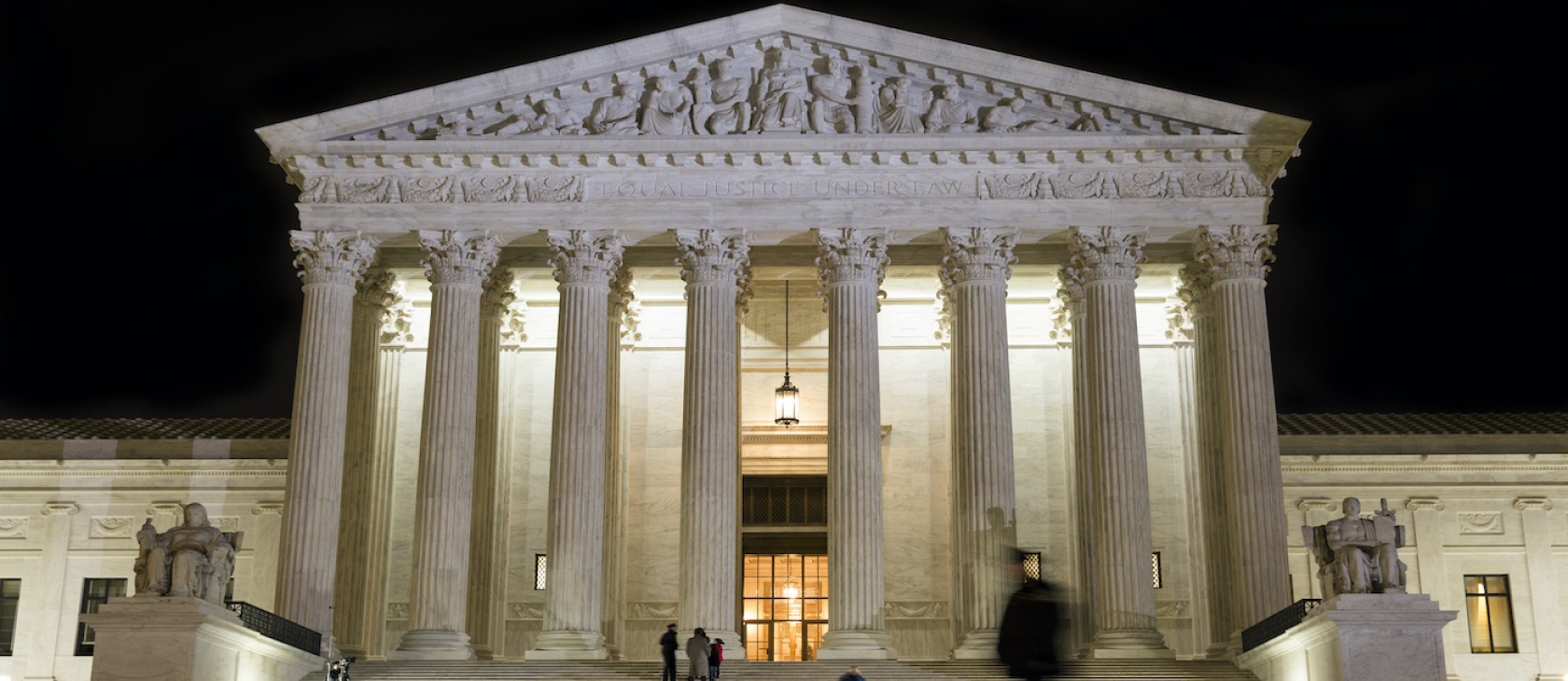
The U.S. Supreme Court at night. (Photo credit: Lorie Shaull. This photo has been cropped and modified for size. CC BY-SA 4.0.)Share this article:  

Bostock v. Clayton County is the first U.S. Supreme Court decision that directly addresses the issue of transgender rights. At issue is the meaning of the word “sex” in the Civil Rights Act of 1964 and, specifically, whether the word “sex” encompasses sexual orientation and gender expression/self-identity. Policy questions aside, the Supreme Court has once again proven an unsettling enthusiasm for enacting laws without Congressional approval or the president’s signature. Led by Justice Neil Gorsuch, the majority of the Court ignored canons of statutory interpretation and decades of legislative history in order to read a meaning into the law that was never intended. This decision is celebrated by activists as a victory that they have continuously been denied by the deliberative and democratic legislative process, but it represents a significant blow to authentic diversity, the separation of powers, and the rule of law.

The plaintiffs in these cases include a transgender funeral home worker, a homosexual skydiving instructor, and a homosexual government employee. All three lost employment due to their status as homosexual or transgender and sued to recover damages, claiming they were fired because of their “sex.” The Court decided to combine all three cases, and this week the nation learned that lurking beneath the plain meaning of the text of the 1964 Civil Rights Act is an expansive definition heretofore undiscovered.

Acts of jurisprudential sleight-of-hand like this one are far too common. It is likened to a “pirate ship” sailing under a “textualist flag” in Justice Samuel Alito’s masterful and devastating dissent.

Most significant is the case of Harris Funeral Homes, which fired a transgender employee who was hired as a man and who initially wore men’s clothing but later decided to dress and present as a woman. Gorsuch found that in this case the employer’s decision was bound up with the employee’s sex. A man would never be fired for dressing like a man, so a woman could never be fired for dressing like a woman. Any disparity would be impermissible under the law. Gorsuch has assumed, however, a subjective answer to the question, “What is a woman?” Up until very recently, this question has had an obvious and objective answer that would almost certainly be the type of fact ripe to be considered by way of judicial notice, a legal procedure that admits “notorious or well known” facts into evidence. The answer is now a topic for strenuous debate.

This decision contains significant implications for the nation’s democratic self-determination and Americans’ unalienable rights. The Court has pledged that there was never a consideration of religious freedom in this case, so neither the Religious Freedom Restoration Act (RFRA) nor the exclusive rights of churches to consecrate their own clergy as recognized by the Court in Hosanna-Tabor Evangelical Lutheran Church & School v. EEOC is in peril. It is hard, however, to place much stock in this assurance given the ease with which six justices undermined the constitutional order and effectively rewrote the Civil Rights Act of 1964.

The Gorsuch majority opinion has ignored the clear separation of powers and claimed even more ground for the courts to shape public life without regard to the democratic process.

What remains unclear, however, is how women (as society has traditionally understood the category) will ever enjoy protection against discrimination under this new scheme. A person who is male in all ways other than self-identification is free to compete in women’s sports, seek admission to a battered women’s shelter, or gain access to locker rooms and restrooms that are segregated by biological sex. How can anyone demand to hear women’s voices on corporate boards or see them represented even on the Supreme Court if the only prerequisite to being a woman is a self-declaration completely disconnected from any objective standard? Authentic diversity, which is already difficult to realize, has just become more elusive.

The most alarming part of Bostock, however, is not those implications, as serious as they are. The most dangerous aspect of this decision is the precedent for the blatant rewriting of the law. The Constitution vests the legislative power of the United States in the Congress. Legislatures are elected from communities and, more than any other part of the government, they are most responsive to the popular will. Of the available options, it is in the legislature that policy decisions are most fruitful and most authoritative, even if the process itself is flawed and corrupted by special interests and often self-serving politicians. And, as Justice Alito points out in his dissent, there is a long history of Congress indicating time and again that “sex” in the Civil Rights Act of 1964 sought to protect people from discrimination on the basis of their biological sex. The relative wisdom of the various answers to the policy question is irrelevant: The law simply does not support the decision in Bostock, especially in light of overwhelming evidence that the rightful promulgators of law have been aware that “sex” does not and has never encompassed sexual orientation or gender self-identity. The Gorsuch majority opinion has ignored the clear separation of powers and claimed even more ground for the courts to shape public life without regard to the democratic process.

It is decisions like this one that undermine the rule of law.

The U.S. Constitution is the oldest written constitution in the world in large part because it has given the people democratic control over the divided and balanced powers of government. While the constitutional structures of the system have steadily eroded, the system has cultivated a stable society with predictable laws and legal processes. This is the very heart of rule of law, which is dependent upon consistency and clarity. Members of a society must have assurances that the law that they read today will not change in ways that alter their standing before the law, their contracts, the claims to property, and any other right protected or recognized by law. It is decisions like this one that undermine the rule of law by subverting the system that has given rise to it.

Reckless jurisprudence like that on display in Bostock is often defended, because some argue that it is not the role of the judge to look ahead to the social or legal chaos that may ensue because of a particular ruling. The duty of a court is a duty to the law. It is not a duty to activism nor to innovation. In fact, the judicial branch should be the least innovative branch of government and a safe harbor for consistency and restraint. Six justices of the United States Supreme Court have betrayed that duty this week and, in the process, dealt a significant blow to a system that has—despite its imperfections—provided the space for economic, cultural, and even moral growth. It remains to be seen just how significant the damage will be.

(Photo credit: Lorie Shaull. This photo has been cropped and modified for size. CC BY-SA 4.0.)


Trey Dimsdale is a Texas-based attorney and an associate fellow at the Centre for Enterprise, Markets, and Ethics, a free-market think tank in Oxford, England. He holds a law degree from the University of Missouri-Kansas City, as well as degrees in ethics and political science.  tdimsdale@firstliberty.org

Posted in Uncategorized | 2 Comments

DEFUND THE USCCB?

JUNE 19, 2020

Defund the USCCB

FRANCIS LEE

“Judas was the first Catholic Bishop to accept a government grant.” — Peter Kreeft

An integral part of Pope Paul VI’s vision of a more “synodal” Church, his muto proprio Ecclesiae Sanctae called for the establishment of national bishops’ conferences. These conferences would advise the Holy See with mundane administrative tasks (e.g., determining priests’ salaries) as well as more spiritual matters, such as recommending episcopal appointments and determining diocesan boundaries.

Ecclesiae Sanctae was promulgated in 1966. Later that year, the American bishops formed themselves into the National Conference of Catholic Bishops. In 2001, the NCCB changed its name to the U.S. Conference of Catholic Bishops.

Today, according to its website, the USCCB’s mission statement is “to promote the greater good which the Catholic Church offers humankind, especially through forms and programs of the apostolate fittingly adapted to the circumstances of time and place.” The Conference employs over three hundred souls; laymen, deacons, priests, and religious staff the various departments, which include Migration and Refugee Services, Cultural Diversity in the Church, Domestic Social Development, International Justice and Peace, Resettlement Services, and Customer and Client Relations—to name just a few.https://secureaddisplay.com/i/view/js/?Viewable=1&isMobile=0&AULU=31049420180502T2200289306460AB42454C400A8A16937CB3EB93D7&cb=1592576199992&ccvid=826575645&pvid=1693662447https://secureaddisplay.com/i/view/js/?Viewable=0&isMobile=0&AULU=31049420180502T2200289306460AB42454C400A8A16937CB3EB93D7&cb=1592576199992&ccvid=826575645&pvid=1693662447https://secureaddisplay.com/i/t/js/?ALU=145120200524T1502214706E99A53F262F41E79574DF000EA8EE90&AULU=31049420180502T2200289306460AB42454C400A8A16937CB3EB93D7&cb=1592576199992&ccvid=826575645&pvid=1693662447

The daily operations of any vast bureaucracy require enormous sums to continue its mission and remain active in the public square, and the USCCB is no exception. In the latest financial report (which dates to only 2018), the audit disclosed total assets of the USCCB and its affiliates of $365 million, with “total operating revenues, gains, and other supports” of $203 million.

As listed previously, there are many offices—a grand total of thirty-three—which make up the Bishops’ Conference. It can be said that certain departments require more funding than others, as determined by forecasted operating budgets, but as the most recent financial report suggests, the institution is financially stable and even prosperous. Yet the Conference has in recent years sought out and successfully received millions in federal funds.

By far the largest recipient of taxpayer money within the USCCB is the umbrella of the “Resettlement Services” office. According to usaspending.gov, the USCCB received over $2 billion from the federal government between 2008 and 2015 for the purpose of refugee resettlement. The U.S. Conference of Catholic Bishops was one of nine major recipients to have been contracted by the federal government to “resettle refugees and asylums,” as stated by James Simpson of Foundation Watch in a piece for the Capital Research Center.

Speaking on the perhaps distorted nature of these massive funding recipients (designated as NGOs), Mr. Simpson further commented: “While six of the nine contractors are affiliated with religious groups, the false notion that they are charitable organizations just doing the Lord’s work needs to be corrected. They are federal contractors, relying on the government for most, and sometimes most all, of their income. This is big business. They do the government’s bidding, whether it honors religious principles or not.”

Deal W. Hudson, former Crisis editor and advisor to President George W. Bush on Catholic policy issues, expressed his own concerns in an interview with LifeSiteNews. “How can either institution call itself ‘Catholic’ when they have created financial dependency of the federal government?” Mr. Hudson asked. “Doesn’t this level of funding make the USCCB hesitant to publicly criticize the Congress and the administration on abortion, same-sex marriage, fetal stem cell research, and euthanasia?”

In response to several questions he received regarding whether the Acton Institute would apply for the small business administration loans under the paycheck protection program during the pandemic, Father Robert Sirico—a parish priest and founder of the Acton Institute for the Study of Religion and Liberty—gave much-needed advice on “the dangers of accepting government money, even in crisis.” Father Sirico said, “What is pertinent here, and what is of great concern to me, is the way in which government money can cause a mission shift or a mission drift.” He spoke of “the distinct possibility of government intervention that could shift our focus into a different direction than the mission with which we began our endeavors.”

Likewise, we have seen the “mission drift” of the USCCB over the years. The organization seems to be principally a social justice advocacy group—not an instrument for the salvation of souls. The millions in government funding practically forced the Catholic Church to endorse an open border policy on the issue of immigration with virtually none of the nation’s 267 active bishops willing to criticize the government-funded Groupthink.

We are exposed once again in full force to the radical “mission drift” of the Catholic Church hierarchy in recent days. On June 8, Archbishop Gregory of Washington urged his priests to “assemble at Lafayette Park,” emphasizing the importance of the clergy and religious to “please wear cassock,” for a protest near the White House. Many Catholic protesters, including clergy, were seen carrying signs displaying solidarity with Black Lives Matter, an organization which aims to “disrupt the Western-prescribed nuclear family structure” requirement and “demand reproductive justice that gives us autonomy over our bodies,” as stated in bold, large-font letters on their website.

Yet liberating the U.S. bishops from the federal government’s purse will not be enough. The decisive action which will guarantee the Church’s full autonomy and sovereignty would be for the USCCB to forfeit its tax-exempt status.

Under the Internal Revenue Service, all Catholic parishes in the United States are classified as tax-exempt and attain recognized 501(c)(3) status since their parent organization, the USCCB, falls under a group exemption status. For the Bishops’ Conference and its subordinate parishes to qualify for its monetary dispensation, they are required by the IRS to “not be an action organization,” which forbids attempts “to influence legislation as a substantial part of its activities” and to “participate in any campaign activity for or against political candidates.” 501(c)(3) organizations are also “restricted in how much political and legislative (lobbying) activities they may conduct.”

These binding rules, enforced by the federal government or diocesan bishops, altogether restricts the Catholic Church from professing the totality of the Christian faith in the public square. The fundamental mission of the Church is to save souls, and this requires a public voice, either from the pulpit or on the streets, on subjects ranging from religion to economics and politics. For every debate concerning an objective good or evil, the Church has a definitive answer as taught by Our Lord Jesus Christ and the Church’s centuries-old tradition. But due to its tax-exempt status, the clergy is prohibited from proclaiming this truth. When parishioners seek answers from their pastors in political affairs, their questions remain unanswered, and they instead turn to the various hyper-sensational biased media platforms.

During his brief tilt at the Democratic nomination for president last year, Beto O’Rourke spoke on the issue of churches and mosques opposing same-sex marriage. Mr. O’Rourke insisted, “There can be no reward, no benefit, no tax break for anyone or any institution or organization in America that denies the full human rights, and the full civil rights, of everyone in America.” He later rescinded that comment and clarified that “a church would put its tax-exempt status at risk for practices found to be discriminatory when delivering public services, such as adoption services, based on sexual orientation or gender identity, and for engaging in unequal treatment based on sexual orientation or gender identity.”

What seemed an empty threat is now a plausible likelihood with the recent Supreme Court ruling of Bostock v. Clayton County, where Justice Neil Gorsuch—bypassing the legislative process—in his majority opinion declared that Title VII of the 1964 Civil Rights Acts, which “outlawed the discrimination in the workplace on the basis of race, color, religion, sex, or national origin,” must be extended to include sexual orientation and gender identity. In fact, Justice Gorsuch declared that it is “a necessary consequence of that legislative choice” that “an employer who fires an individual merely for being gay or transgender defies the law.”

To object to this ruling and any slight deviation from its full implementation, primarily in employment practices, would most likely entail swift removal of the Church’s tax-exempt status. This day has not arrived yet, though it is a matter of when and not if. The majority opinion stated, “How the doctrines protecting religious liberty interact with Title VII are questions for future cases.”

In his blunt, straightforward response to Bostock v. Clayton County on the Senate floor, Senator Joshua Hawley urgently reminded people of faith that “it’s not time for religious conservatives to shut up. No, we’ve done that for too long. No, it’s time for religious conservatives to stand up and speak out.” The extent to which the USCCB will take heed of this call to duty remains questionable. Will the Church be forced by the federal government to give up its tax-exempt status, as first proposed by Beto O’Rourke, or will it rescind its tax-exempt status out of free will, realizing that the current political reality poses a grave threat to Catholic social doctrine?

To rescue the remnants of the USCCB’s integrity, the time has come for the bishops institution to end their submissive relationship with the federal government.

Once their taxpayer-subsidized budgets are lost, the current number of thirty-three offices will decrease to the basic number required to evangelize. Bishops will be forced to give up their mansion homes and lavish lifestyles and live in solidarity with the brother priests in their charge. In return, our pastors will not be hindered from speaking the truth of Our Lord Jesus Christ out of fear of the federal government.

Given the high probability that our shepherds will not initiate the divorce, it is now incumbent on the government to do so. A friendly president—Donald Trump, for instance—would be doing the Church a great service by ending its 501(c)(3) status. He could, for instance, point to the bishops’ extensive lobbying for open borders immigration. (Of course, religious leaders “preaching politics” is perfectly acceptable to the Left, provided it’s their politics being preached.) Such a landmark decision will serve as a reality check to the institution which has suffered a massive “mission drift” and free its lungs so that it may breathe the full truth of the Gospel once again.

Photo credit: AFP via Getty Images

Tagged as Bostock v. Clayton CountyDonald J. TrumpFr. Robert SiricoJosh Hawley,Neil GorsuchPope Paul VIsynodalityUSCCBhttps://www.facebook.com/v2.10/plugins/like.php?action=like&app_id=485814248461205&channel=https%3A%2F%2Fstaticxx.facebook.com%2Fx%2Fconnect%2Fxd_arbiter%2F%3Fversion%3D46%23cb%3Df368a89b64e32ee%26domain%3Dwww.crisismagazine.com%26origin%3Dhttps%253A%252F%252Fwww.crisismagazine.com%252Ffd180ac7c00ad6%26relation%3Dparent.parent&container_width=660&href=https%3A%2F%2Fwww.crisismagazine.com%2F2020%2Fdefund-the-usccb&layout=button_count&locale=en_US&sdk=joey&share=true&show_faces=false34Francis Lee

By Francis Lee

Francis Lee is a graduate of the United States Naval Academy. He has served on two deployments in the South China Sea as part of Forward Deployed Naval Forces-Japan. His writing has appeared in The Imaginative ConservativeCatholic World Report, and OnePeterFive. The views expressed are those of the individual only and not those of the Department of Defense (DoD).

Posted in Uncategorized | 1 Comment

JUSTICE NEAL GORSUCH’S FLAWED ANTHROPOLOGY

ANTHROPOLOGY

CATHOLIC LEAGUE: GORSUCH’S FLAWED ANTHROPOLOGY

FROM ROME EDITOR2 COMMENTS

The Catholic League

OFFICIAL PRESS RELEASEJune 17, 2020Catholic League president Bill Donohue comments on the majority opinion rendered this week by the U.S. Supreme Court on sexual orientation and gender identity:There are many problems with the majority opinion written by Justice Neil Gorsuch on workplace discrimination, sexual orientation and gender identity, but none is more important than the flawed anthropology upon which the ruling rests. In fact, it is pivotal.“An individual’s homosexuality or transgender status is not relevant to employment decisions.” This sweeping statement, which will be cited in every lawsuit on this subject, is manifestly false.If a man volunteers to be a Big Brother, working with fatherless boys, and decides to “transition” to a woman, he cannot reasonably be expected to do the job he was hired to do. He deliberately changed the required profile. This should clearly be grounds for termination.The next sentence written by Gorsuch explains his anthropological flaw. “That’s because it is impossible to discriminate against a person for being homosexual or transgender without discriminating against that individual based on sex.” He is wrong again.Take the case just cited. The employee should be terminated not because of his assigned sex—indeed he was hired precisely because he was a man—but because he is no longer capable of offering the kind of paternal counseling that only a man can provide.In other words, it is entirely possible to discriminate against a transgender person without discriminating against his sex, as assigned at birth.Gorsuch concedes, as he must, that sex, sexual orientation, and gender identity are not the same. “We agree that homosexuality and transgender status are distinct concepts from sex.” But he no sooner states the obvious when he falls back on his remarkable claim that to discriminate against a person based on his sexual orientation or gender identity is to discriminate against him on the basis of his sex. As Justice Samuel Alito aptly put it, “repetition of an assertion does not make it so, and the Court’s repeated assertion is demonstrably untrue.”Gorsuch tries hard to persuade by offering several hypothetical examples, all of which Alito seizes upon to great effect. For example, he says that if a female staffer, who was rated a “model employee,” were to bring her same-sex partner to a holiday party, and was subsequently fired because she is a homosexual, it would mean she was treated that way because of her sex, not just her sexual orientation.Alito devastates Gorsuch’s scenario. “This example disproves the Court’s argument because it is perfectly clear that the employer’s motivation in firing the female employee had nothing to do with that employee’s sex. The employer presumably knew that this employee was a woman before she was invited to the fateful party. Yet the employer, far from holding her biological sex against her, rated her a ‘model employee.’ At the party, the employer learned something new, her sexual orientation, and it was this new information that motivated her discharge.”Here is where Gorsuch’s problem lies. Sex is a biological attribute that is not identical to sexual orientation or gender identity. Let’s start with sexual orientation.The sex of a child can be known before he is born. But his sexual orientation cannot. The former requires no volition; the latter does. They are therefore not identical.Being a male or a female is similar to being black or white: sex and race have no inherent normative content. That’s because they are fixed properties and do not speak to behavior, which has moral consequences.The key to understanding the difference between sex and sexual orientation is made plain by the word “orientation.” Sex, or being male or female, is behaviorally neutral; it is not oriented toward anything. Sexual orientation is: it is oriented behaviorally towards either heterosexuality or homosexuality.Notice that Gorsuch does not speak about homosexual persons, but about homosexuality, as being a distinct concept from sex. He is right about that. Homosexuality is a behavioral attribute: it speaks to men having sex with men or women having sex with women. It is therefore not behaviorally neutral. It is normative.Indeed, it is precisely because homosexuality is not identical to sex that virtually all of the world’s great religions, in western and eastern civilization, have passed judgment on its practice, without passing judgment on the sex of the participant. The two concepts are distinct and do not ineluctably bleed into each other, despite what Gorsuch claims.Similarly, gender identity is a behavioral concept that is quite independent of one’s sex. Anatomical surgery and hormone therapy are chosen, unlike one’s sex. They are undertaken because the person elects to change his sex (which he cannot do in any real sense—no one can change his chromosomal makeup). It is done because the person does not like what nature has ordained, therefore making it erroneous to conflate sex with gender identity.Consider the language chosen by Alito and Gorsuch to refer to a newborn’s sex. The terminology is not only different—it explains why their legal reasoning differs.At four different junctures, Alito speaks about an individual’s “sex assigned at birth.” Gorsuch, on six occasions, speaks about an individual “who was identified” as male or female at birth.Gorsuch refuses to employ “assigned at birth” because it would undercut his conviction that sex is a fluid concept. He wants to advance the notion that our sex is a matter of identity, which is a psychological construct, and not a matter of human nature, which of course it is. He is the one conflating sex, sexual orientation, and gender identity. This represents his personal conviction and in no way should be treated as if it were a truism.Trying to minimize, if not deny, the existence of human nature necessarily yields bad outcomes, both in terms of law and public policy. Most Americans want separate sports teams and restroom facilities for men and women. They understand basic differences based on sex and do not appreciate elites who say they are wrong. They also understand how unjust and indecent it is for men to compete in women’s sports and shower in women’s locker rooms simply because they believe they are female.It is never helpful when the courts seek to solve problems that barely exist, especially those that touch on the moral order. To cite one example, there are no known cases where a Catholic school has fired a teacher because he happens to be a homosexual. But there are many cases where a homosexual teacher has been fired after it was publicly disclosed—often by the teacher—that he is married to his boyfriend. Activist lawyers will now test the limits of this Supreme Court decision.Gorsuch’s majority opinion, which is based on bad anthropology, makes for bad law and will now make for bad public policy. Had it been a more narrow ruling, tailored to specific instances of workplace discrimination, there would be no tidal wave of lawsuits. But now that the moral order has been further diced and spliced by the courts—thanks to this classic case of judicial overreach—it is a sure bet there will be.

Posted in Uncategorized | Comments Off on JUSTICE NEAL GORSUCH’S FLAWED ANTHROPOLOGY

HERE IS MORE BAD NEWS FROM THE SUPPOSED CONSERVATIVE JUSTICES OF THE United States Supreme Court. SOME LAWYERS ARE GOOD AT HIDING THEIR SPOTS PRIOR TO THEIR CONFIRMATION AS A JUSTICE ON THE Supreme Court. WE THE PEOPLE ARE THE LOSERS.

News & Commentary
The Supreme Court’s transgender ruling undermines the rule of lawBy Trey Dimsdale, J.D. • June 18, 2020
The US Supreme Court building at night
Bostock v. Clayton County is the first U.S. Supreme Court decision that directly addresses the issue of transgender rights. At issue is the meaning of the word “sex” in the Civil Rights Act of 1964 and, specifically, whether the word “sex” encompasses sexual orientation and gender expression/self-identity. Policy questions aside, the Supreme Court has once again proven an unsettling enthusiasm for enacting laws without Congressional approval or the president’s signature. Led by Justice Neil Gorsuch, the majority of the Court ignored canons of statutory interpretation and decades of legislative history in order to read a meaning into the law that was never intended. This decision is celebrated by activists as a victory that they have continuously been denied by the deliberative and democratic legislative process, but it represents a significant blow to authentic diversity, the separation of powers, and the rule of law. What was at stake? The plaintiffs in these cases include a transgender funeral home worker, a homosexual skydiving instructor, and a homosexual government employee. All three lost employment due to their status as homosexual or transgender and sued to recover damages, claiming they were fired because of their “sex.” The Court decided to combine all three cases, and this week the nation learned that lurking beneath the plain meaning of the text of the 1964 Civil Rights Act is an expansive definition heretofore undiscovered. Acts of jurisprudential sleight-of-hand like this one are far too common. It is likened to a “pirate ship” sailing under a “textualist flag” in Justice Samuel Alito’s masterful and devastating dissent. Most significant is the case of Harris Funeral Homes, which fired a transgender employee who was hired as a man and who initially wore men’s clothing but later decided to dress and present as a woman. Gorsuch found that in this case the employer’s decision was bound up with the employee’s sex. A man would never be fired for dressing like a man, so a woman could never be fired for dressing like a woman. Any disparity would be impermissible under the law. Gorsuch has assumed, however, a subjective answer to the question, “What is a woman?” Up until very recently, this question has had an obvious and objective answer that would almost certainly be the type of fact ripe to be considered by way of judicial notice, a legal procedure that admits “notorious or well known” facts into evidence. The answer is now a topic for strenuous debate. Obfuscating true diversity This decision contains significant implications for the nation’s democratic self-determination and Americans’ unalienable rights. The Court has pledged that there was never a consideration of religious freedom in this case, so neither the Religious Freedom Restoration Act (RFRA) nor the exclusive rights of churches to consecrate their own clergy as recognized by the Court in Hosanna-Tabor Evangelical Lutheran Church & School v. EEOC is in peril. It is hard, however, to place much stock in this assurance given the ease with which six justices undermined the constitutional order and effectively rewrote the Civil Rights Act of 1964. What remains unclear, however, is how women (as society has traditionally understood the category) will ever enjoy protection against discrimination under this new scheme. A person who is male in all ways other than self-identification is free to compete in women’s sports, seek admission to a battered women’s shelter, or gain access to locker rooms and restrooms that are segregated by biological sex. How can anyone demand to hear women’s voices on corporate boards or see them represented even on the Supreme Court if the only prerequisite to being a woman is a self-declaration completely disconnected from any objective standard? Authentic diversity, which is already difficult to realize, has just become more elusive. The dangers of a “living constitution” The most alarming part of Bostock, however, is not those implications, as serious as they are. The most dangerous aspect of this decision is the precedent for the blatant rewriting of the law. The Constitution vests the legislative power of the United States in the Congress. Legislatures are elected from communities and, more than any other part of the government, they are most responsive to the popular will. Of the available options, it is in the legislature that policy decisions are most fruitful and most authoritative, even if the process itself is flawed and corrupted by special interests and often self-serving politicians. And, as Justice Alito points out in his dissent, there is a long history of Congress indicating time and again that “sex” in the Civil Rights Act of 1964 sought to protect people from discrimination on the basis of their biological sex. The relative wisdom of the various answers to the policy question is irrelevant: The law simply does not support the decision in Bostock, especially in light of overwhelming evidence that the rightful promulgators of law have been aware that “sex” does not and has never encompassed sexual orientation or gender self-identity. The Gorsuch majority opinion has ignored the clear separation of powers and claimed even more ground for the courts to shape public life without regard to the democratic process. The U.S. Constitution is the oldest written constitution in the world in large part because it has given the people democratic control over the divided and balanced powers of government. While the constitutional structures of the system have steadily eroded, the system has cultivated a stable society with predictable laws and legal processes. This is the very heart of rule of law, which is dependent upon consistency and clarity. Members of a society must have assurances that the law that they read today will not change in ways that alter their standing before the law, their contracts, the claims to property, and any other right protected or recognized by law. It is decisions like this one that undermine the rule of law by subverting the system that has given rise to it. The consequences of this decision Reckless jurisprudence like that on display in Bostock is often defended, because some argue that it is not the role of the judge to look ahead to the social or legal chaos that may ensue because of a particular ruling. The duty of a court is a duty to the law. It is not a duty to activism nor to innovation. In fact, the judicial branch should be the least innovative branch of government and a safe harbor for consistency and restraint. Six justices of the United States Supreme Court have betrayed that duty this week and, in the process, dealt a significant blow to a system that has—despite its imperfections—provided the space for economic, cultural, and even moral growth. It remains to be seen just how significant the damage will be. (Photo credit: Lorie Shaull. This photo has been cropped and modified for size. CC BY-SA 4.0.)
Posted in Uncategorized | Comments Off on HERE IS MORE BAD NEWS FROM THE SUPPOSED CONSERVATIVE JUSTICES OF THE United States Supreme Court. SOME LAWYERS ARE GOOD AT HIDING THEIR SPOTS PRIOR TO THEIR CONFIRMATION AS A JUSTICE ON THE Supreme Court. WE THE PEOPLE ARE THE LOSERS.

Pope Benedict TRAVELS TO GERMANY TO VISIT HIS SICK BROTHER, GEORGE

NEWS

BREAKING: POPE BENEDICT XVI LEAVES THE VATICAN FOR GERMANY

FROM ROME EDITORLEAVE A COMMENT

by Br. Alexis Bugnolo

CNA German edition is reporting moments ago that Pope Benedict XVI has left the Vatican. The reason for his visit is officially to visit his sick brother Georg, who is said to be in a bad state of health.

According to the report, the Pope visited his brother this morning.

In the last seven years since his renunciation of ministry, he has rarely left the Vatican precints, and then only for a visit no further than Castle Gandolfo.

The momentous decision to travel to Germany shows at least the very great love he has for his only surviving sibling.

It is presumed that Pope Benedict XVI is residing in Regensberg in the vicinity of his brother. And, no need to say it, but if the world is still sane, there will be a mob of reporters and photographers descending upon the city as we speak.

It was long suspected that Pope Benedict XVI was motivated to consent to the pressures of the St. Gallen Mafia out of fear for his brother’s safety. If that assertion is correct, we might see the Holy Father begin to say things quite unlike what he was permitted to say or alleged to say from the Vatican.

Posted in Uncategorized | 3 Comments

A MESSAGE FROM THE PUBLISHER

Dear Relatives, Friends and Loyal Readers of abyssum.org.

As some of you know, I am going to have an operation to replace my right hip.

Because of my age, 97 years, there has been a certain extra amount of caution being manifested by the medical profession.  I have been having a series of consultations with my doctors.

I am neutral about whether or not to have the operation although I recognize that my activity, including publishing abysum.org daily is becoming more difficult with each passing week.  Therefore I place my trust totally in the will of Our Lord which he will surely reveal to me.

Because of my age and because I have a slight problem with the left ventricle of my heart I suspected that my cardiologist would rule out ether and would favor a spinal block for the anesthetic for the operation.

I had a consultation with my cardiologist yesterday and he ruled out a spinal block because of the the three metal devices my spine surgeon implanted in my spine to cure spinal stenosis which was causing sciatica in my right leg.

So my understanding is that I will be given a light dose of ether; perhaps I will be able to listen in as the doctors perform the operation.

I have my next consultation with the surgeon on June 23 and I will learn more about what he will do after he has reviewed the recommendation of my cardiologist.

I will continue to post on Abyssum up until the day of the operation, if there is going to be an operation. If there is to be an operation there will necessarily be a period of silence on abyssum.org which may last as long as a week (or permanently if it be God’s will).

Your prayers for the success of the surgery will be most appreciated.

Yours in Jesus Christ our Lord,

+Rene Henry Gracida

Posted in Uncategorized | 89 Comments