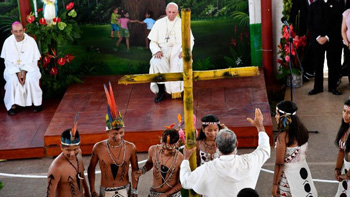
“It is to be stated now with insistence that the Instrumentum Laboris contradicts the binding teaching of the Church in decisive points and thus has to be qualified as heretical” – -Cardinal Walter Brandmueller

Settimo Cielodi Sandro Magister 27 giu 

Heretical and Apostate. Cardinal Brandmüller Excommunicates the Amazon Synod

Amazzonia

> Italiano
> English
> Español
> Français
> Deutsch

> All the articles of Settimo Cielo in English

*

Since it was made public on June 17, the base document – or “Instrumentum laboris” – of the synod for the Amazon has received many critical reactions, for the anomaly of its framework and proposals, with respect to all the synods that preceded it.

But as of today there is more. Accusing the document of nothing less than heresy and apostasy is a cardinal, the German Walter Brandmüller, 90, an illustrious Church historian, president of the Pontifical Committee for Historical Sciences from 1998 to 2009, and coauthor, in 2016, of the famous “dubia” on the correct interpretation and application of “Amoris Laetitia” to which Pope Francis has always refused to respond.

The following is his “J’accuse,” made public today simultaneously in multiple languages.

*

A Critique of the “Instrumentum Laboris” for the Amazon Synod

by Card. Walter Brandmüller

Introduction

It can truly cause astonishment that, in opposition to earlier assemblies, this time the Synod of Bishops is exclusively to deal with a region of the earth whose population is just half of that one of Mexico City, that is to say, 4 million. This is also a cause for suspicion concerning the true intentions which are to be implemented in a clandestine fashion. But one has especially to ask what is the understanding of religion, of Christianity, and of the Church, which is the basis of the recently published Instrumentum Laboris. This shall be examined with the help of individual elements from the text.

Why a Synod on this region?

One has to ask in principle why a Synod of Bishops should deal with topics, which – as is now the case with ¾ of the Instrumentum Laboris – have, at the most, marginally anything to do with the Gospels and the Church. Obviously, there takes place here on the part of the Synod of Bishops an aggressive intrusion into the purely worldly affairs of the state and society of Brazil. One asks oneself: what do ecology, economy, and politics have to do with the mandate and mission of the Church?

And most of all: which professional expertise authorizes an ecclesial Synod of Bishops to make statements in these fields?

Should the Synod of Bishops truly do this, this would be a stepping over bounderies and a clericalist presumption, which the state authorities would then have to reject.

On Natural Religions and Inculturation

A further aspect is being added, which is to be found throughout the whole Instrumentum Laboris: namely, the very positive assessment of natural religions, to include indigenous healing practices and the like, yes, even mythical-religious practices and forms of cults. In the context of the call for harmony with nature, there is even talk about the dialogue with the spirits (no. 75).

It is not only the ideal of the “noble savage” as presented by Rousseau and the Enlightenment that is being contrasted with the decadent European. This line of thought goes further, up to the turn to the 20th century, when it ends in a pantheistic idolatry of nature. Hermann Claudius (1913) created the hymn of the Socialist Worker’s Movement, “When we walk side by side…,” a stanza of which reads: “Birches’ green and the green of seeds, how the old Mother Earth extends her full hands, with a pleading gesture, that man may become her own…” It is remarkable that this text was later copied into the song book of the Hitler Youth, probably because it corresponded to the National-Socialist blood-and-soil myth. This ideological proximity is remarkable. This anti-rational rejection of the “western” culture which stresses the importance of reason is characteristic for the Instrumentum Laboris, which speaks in no. 44 of “Mother Earth” and of the “cry of the earth and of the peoples” (no. 101) respectively.

Accordingly, the territory – that is to say, the forests of the Amazon region – is even being declared to be a locus theologicus, a special source of Divine Revelation. Here are places of an epiphany where the planet’s reserves of life and wisdom show themselves, which speak of God (no. 19). The anti-rational rejection of the “western” culture which stresses the importance of reason is characteristic of the  Instrumentum Laboris.  Meanwhile, the subsequent regression from Logos to Mythos is being raised to a criterion of that which the Instrumentum Laboris calls the inculturation of the Church. The result is a natural religion with a Christian masquerade.

The notion of inculturation is here virtually being perverted, since it really means the opposite of what the International Theological Commission had presented in 1988 and of what the Second Vatican Council’s Decree on the Church’s Missionary Activity,  Ad Gentes, had earlier taught.

On the Abolishment of Celibacy and the Introduction of a Female Priesthood

It is impossible to conceal that the “synod” is especially to help implement two most cherished projects that heretofore have never been implemented: namely, the abolishment of celibacy and the introduction of a female priesthood – starting first with female deacons. In any event, it is about “accepting the role, the leadership of the woman inside the Church” (129a3). In a similar manner, there now “open up new spaces for the creation of new ministries, as this historic moment calls for it. It is time to listen to the voice of the Amazon region…” (no. 43).

But here the fact is omitted that, lastly, John Paul II also stated with highest magisterial authority that it is not in the power of the Church to administer the Sacrament of Holy Orders to women. Indeed, in two thousand years, the Church has never administered the Sacrament of Holy Orders to a woman. The demand which stands in direct opposition to this fact shows that the word “Church” is now being used purely as a sociological term on the part of the authors of the Instrumentum Laboris, thus implicitly denying the sacramental-hierarchical character of the Church.

On Denying the Sacramental-Hierarchical Character of the Church

In a similar manner – though expressed rather in passing – no. 127 contains a direct attack on the hierarchical-sacramental constitution of the Church, when it is being asked as to whether it would not be opportune “to reconsider the notion that the exercise of jurisdiction (power of government) must be linked in all areas (sacramental, judicial, administrative) and in a permanent way to the Sacrament of Holy Orders.” From such a wrong view stems then (in no. 129) the call for the creation of new offices which correspond to the needs of the Amazonian peoples.

The liturgy, the cult, however, is the field in which the ideology of a falsely understood inculturation finds its expression in an especially spectacular manner. Here, certain forms from the natural religions shall be positively adopted. The Instrumentum Laboris does not hold back from demanding that the “poor and simple peoples” may express “their (!) faith with the help of pictures, symbols, traditions, rites, and other sacraments” (!!) (no. 126e).

This certainly does not correspond to the precepts of the Constitution “Sacrosanctum Concilium,” nor to the ones of the Decree on the Church’s Missionary Activity, Ad Gentes, and it shows a purely horizontal understanding of liturgy.

Conclusion

Summa summarum: The Instrumentum Laboris burdens the Synod of Bishops, and finally the Pope, with a grave breach with the depositum fidei, which in its consequence means the self-destruction of the Church or the change of the Corpus Christi mysticum into a secular NGO with an ecological-social-psychological mandate.

After these observations, of course there are questions: is there to be found, especially with regard to the sacramental-hierarchical structure of the Church, a decisive breach with the Apostolic Tradition as it is constitutive for the Church, or do the authors rather have a notion of the development of doctrine which is theologically presented in order to justify these above-mentioned breaches?

This seems to be indeed the case. We are witnessing a new form of the classical Modernism of the early  20th century. At the time, starting with a decisively evolutionary approach, one presented the idea that, in accord with the continuous higher development of man, are found also higher levels of consciousness and of culture, whereby it can turn out that that which had been false yesterday, can be true today. This evolutionary dynamic then applies to religion, as well, that is to say, to the religious consciousness with its manifestations in doctrine and in cult – of course also in morality.

However, the understanding of the development of dogma presupposed to this view is sharply opposed to the genuine Catholic understanding. The latter understands development of dogma and of Church, not as a change, but, rather, as an organic development of the subject which remains true to its own identity.

That is what the two Vatican Councils teach us in their Constitutions “Dei Filius,” “Lumen Gentium,” and “Dei Verbum.

It is to be stated now with insistence that the Instrumentum Laboriscontradicts the binding teaching of the Church in decisive points and thus has to be qualified as heretical.

Inasmuch as even the fact of Divine Revelation is here being questioned, or misunderstood, one also now has to speak, additionally, of apostasy.

This is even more justified in light of the fact that the Instrumentum Laborisuses a purely immanentist notion of religion and that it considers religion as the result and form of expression of man’s own spiritual self-experience. The use of Christian words and notions cannot conceal that these are being merely used as empty words, despite their original meaning.

The Instrumentum Laboris for the Amazon Synod constitutes an attack on the foundations of the Faith,  and in a way that has not heretofore been thought possible. Thus it must be rejected with all decisiveness.

(Translated by Maike Hickson for LifeSite News)
Posted in Uncategorized | 1 Comment

THE Catholic Church WILL NO LONGER BE RECOGNIZABLE AS THE CHURCH ESTABLISHED BY Jesus Christ AND THE TWELVE APOSTLES AFTER THE AMAZON SYNOD

Amazonia Synod – Part I

Revolutionary Agenda of the Amazonia Synod

Marcos Munhoz, BrazilIn October 2019, the Pan-Amazonia Synod will be held in Rome, bringing together Bishops and laity from nine countries whose territories include parts of this immense geographical region. 

The Preparatory Document for this Synod – released June 8, 2019 – deals with the following points of interest:

  1. New pathways for the Church and an integral ecology;

  2. A “deep crisis” triggered by prolonged human interference in the Amazon jungle, a matter of “vital importance for the planet Earth”;

  3. The “vital importance” for the universal Church to listen to the indigenous peoples and communities living in the Amazon;

  4. New paths for an evangelization that will shape “a Church with an Amazonian face,” which will emerge from a “culture of the encounter” in daily life, “a multifarious harmony” and “happy sobriety.”

Internet news sources emphasize that the Synod’s dominant note will be its “horizontal character,” that is, its radical egalitarianism. 

These sources also stress that the meeting aims to achieve a “pastoral and ecological conversion” to this new pan-religiosity. In other words, the Conciliar Church intends to “sacralize” the “ecological liberation” of the Amazon by presenting it as a religious obligation. It is an old tactic of Liberation Theology, now being applied by the Pope and the Vatican. 

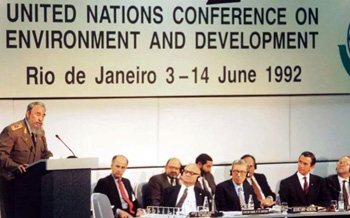
Comments by Prof. Plinio Corrêa de Oliveira on ECO ’92, or RIO ’92, hosted by the United Nations in Rio de Janeiro on June 3-14, 1992, to discuss the environment and development, were published in the monthly magazine Catolicismo

On that occasion, Prof. Plinio denounced the exaggerated concern for ecology as being a pretext to present false notions of justice and the rights of the people. That analysis today sheds a blazing light on the reality of the Synod on the Amazon that will be held in October 2019. 

For this reason, we will comment on some excerpts from that analysis. 

Eco ’92: Appearance & deeper reality 

Based on documents and supporting evidence, Prof Plinio distinguished two aspects at the ECO ’92 Congress: appearance and reality, 

In appearance, the message to the public was that the scientists concluded that the earth is seriously threatened by the brutal, anti-scientific, predatory abuses made against it by man. Therefore, all governments must pass legislation to ensure that the earth can continue to be used by men: It is a life or death situation. 

However, to understand what really happened in ECO ’92 – the deeper reality – other important aspects must be taken into account. 

An ecumenical & universal Tribalism 

Addressing an emerging tribalism, Prof. Plinio stated: “There is a current of thinkers who affirm that it is necessary for the Indian to be taken as the model for human behavior. It is understood that civilization depredates the earth and that the tribe is the ideal toward which man must walk. 

“This current goes further and asserts that reasoning is a flawed instrument to know the truth. Therefore, we must discard science and progress because they are based on reasoning. It is also necessary to do away with Theology, since it is the application of the intelligence to the data of Revelation. Therefore, no Church, no Theology, no State. Everything must be loose, ungoverned and uncoordinated, following the ways of the Indians.” (Catolicismo, n. 501, September 1992)

eco92

At Eco 92, The UN took the role of leader; today’s Synod shifts the role to the Pope & Conciliar Church 

At the meeting, the UN presented itself as the world super-authority: “This meeting of heads of State was a first step towards the constitution of a global ecological authority, under which all nations would disappear to form a single universal magma.” 

ECO ’92 was also symbolic in another respect: “The general view expressed at the NGO meetings was that all religions are the same. To be Catholic, Buddhist, Brahmanist, a sun worshiper – everything is the same thing. It is the most radical ecumenism, condemned many times by the Holy See. “(ibid)

In summary: “The Revolution wanted to overthrow ecclesiastical authority by means of Protestantism; temporal authority through the French Revolution; and economic and social inequalities through Communism. Now, all these attempts come together: Doesn’t this pantheistic attitude, which demands that man serve the earth, transform the king into the lackey’s footman?” (ibid

These were the general lines of RIO ’92, which fit like a glove to the goals of the Amazonia Synod. There is, however, a fundamental difference. In 1992 the propelling revolutionary forces were the UN and the NGOs. Today, these organizations have lost much of their prestige. So, we are seeing the Catholic Church, or rather the Conciliar Church – defined as the Catholic Church as usurped by Progressivism – driving the Revolution. 

In addition to promoting tribalism and ecumenism and encouraging a global ecological authority, the Conciliar Church seems to want to use the next Synod to destroy priestly celibacy and establish the female priesthood. 

‘Nothing will be the same in the Church after the Amazon Synod’ 

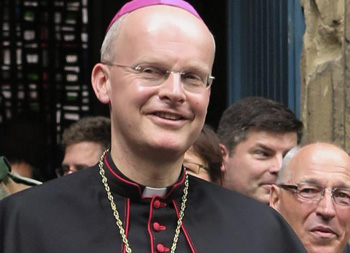
Bishop Franz-Josef Overbeck, the pro-LGBT Bishop of the German Diocese of Essen, has predicted that the October Synod will cause a “rupture” in the Church and that “nothing will be as it was before,” according to Katholische.de, official website of the German Bishops.

Overbeck

Bishop Overbeck proclaims nothing will remain the same after the SynodHe stated that the hierarchical structure of the Church, its sexual morality, and the general picture of the priesthood would be thoroughly scrutinized and that the role of women in the Church would also be reconsidered. 

Overbeck reported that the decline in the number of the Catholic faithful in Europe and Latin America would be on the agenda, along with the topic of the “immense exploitation” of the environment and the violations of human rights. 

The Synod will take place from October 6 to 27 and among its main themes are ecology, theology and pastoral care, the concerns of indigenous peoples and human rights. 

Overbeck praised Francis who, with his South American perspective, guarantees keen “awareness of these challenges.” The “Eurocentric structure” of the Church, he emphasized, “is about to be extinguished.” 

“The face of the local church is feminine,” he added.

new face

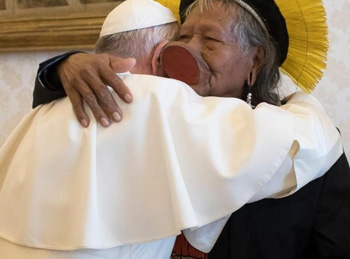
New face of the Church: The Pope embraces self-disfigured Brazilian tribal chief RaoniThe statistics cited by the German Bishop are quite expressive of the decreased influence of the Catholic Church in countries like Brazil: Catholics, who used to make up 90% of the population, now total only 70%. The Prelate said that the Church must address this situation and seek answers. 

So then, what will come from this Synod? Speculations speak of a tremendous change in the doctrine of the Church, the celibacy of priests, and even in the manner of the consecration of bread and wine at the Holy Mass.

The aim of this supposedly “missionary” Synod seems to be to establish a new egalitarian global order in human society. 

To be continued

Posted in Uncategorized | 2 Comments

One statement from Pete Buttigieg crept by relatively unnoticed in the calmly delivered words of the unassuming Harvard- and Oxford-educated mayor of South Bend, Indiana, received a moment of applause, but then slipped into obscurity beneath waves of absurd sound bites and radical promises. When analyzed in isolation, it’s clear that his words are dripping with the sort of virulent anti-Christian bigotry that has permeated even the highest levels of the American Left:

Is Pete Buttigieg An Anti-Christian Bigot?

South Bend, Indiana Mayor Pete Buttigieg delivers a keynote address at the Human Rights Campaign's (HRC) 14th annual Las Vegas Gala at Caesars Palace on May 11, 2019 in Las Vegas, Nevada.
Ethan Miller / Staff / Getty Images 

By IAN HAWORTH July 1, 2019 

THE BEN SHAPIRO SHOW

Political commentators certainly had their work cut out for them in the aftermath of the two Democratic Party presidential debates last week. Many moments received public scrutiny, as the 20 candidates jostled for support. Kamala Harris’ assault on Joe Biden dominated the headlines, with other areas of focus including heavy support for gun control, the effective removal of American borders, and the blatant attempt to pander to various voting groups with promises of duplicity and insincerity.

However, one statement from Pete Buttigieg crept by relatively unnoticed. The calmly delivered words of the unassuming Harvard- and Oxford-educated mayor of South Bend, Indiana received a moment of applause, but then slipped into obscurity beneath waves of absurd sound bites and radical promises. When analyzed in isolation, it’s clear that his words are dripping with the sort of virulent anti-Christian bigotry that has permeated even the highest levels of the American Left:

The Republican Party likes to cloak itself in the language of religion. We should call hypocrisy, and for a party that associates with Christianity to say it is OK to suggest that God would smile on the division of families at the hands of federal agents, that God would condone putting children in cages has lost all claim to ever use religion language again.

Interestingly, Buttigieg doesn’t mention specific religious sects, organizations, or even individuals. The reason for this is that no such mainstream Christian sects, organizations, or individuals exist. It is willingly ignorant to argue that Christians believe that God endorses general child separation or detention, and lazily over-simplistic to claim that Christians who support various levels of immigration control are religious hypocrites who are in favor of such suffering.

Buttigieg’s attempt to slander Christian conservatives was a smoothly delivered example of a standard Democratic strategy. They present every societal issue as a false dilemma, where the only two choices are to either maintain the current situation or to fully accept and embrace their proposed solution. Then, if you dare to disagree with even the smallest element of their suggested policies, you are labeled as an uncaring, uncompassionate bigot who is solely motivated by a certain amount of schadenfreude.

The Democratic Party’s 2020 platform is rife with similar examples. If you don’t agree with Democrats’ views on abortion-on-demand, it’s because you hate women and want to see them as sexual slaves. If you don’t agree with their views on universal public healthcare, it’s because you want the poor to die. If you don’t agree with their views on open borders and the removal of the very notion of “illegal immigration,” it’s because you want migrant children to suffer. Pete Buttigieg applied this strategy, adding the false, anti-Christian argument that conservative Christians believe that the suffering of migrants is sanctioned by God.

The Democrats claim to be the party of unity, inclusivity, and diversity, yet they regularly exclude others based on their religion, gender, or political ideology. From a position of theological ignorance, using the most derisive and divisive language, they often cite Scripture in an attempt to uncover hypocrisy and thereby undermine religion itself.

Pete Buttigieg, himself an Episcopalian, seems to be trying to split the religious baby as he openly demonizes the entire American religious Right. He must remain attractive to the religious or pseudo-religious American Left — who themselves attribute their leftist viewpoints to their faith — while pandering to the Democrats’ anti-religious base. In this case, he failed in his attempt.

Unless Buttigieg is able to provide an actual example of a conservative Christian who celebrates the suffering of migrants as a religious good sanctioned by God, he has shown us that beneath his inoffensive, reasoned, and calm facade lies either an unabashed anti-religious bigot, or someone who is willing to politically profit from the betrayal of his supposed faith.

Posted in Uncategorized | 2 Comments

“LIBERALISM” HAS BECOME A BAD WORD, BUT NOT ALL FORMS OF LIBERALISM ARE BAD


Three Liberalisms: The Good, the Bad, the Disastrous

Michael Pakaluk

THE CATHOLIC THING

THURSDAY, JUNE 27, 2019

One liberalism is a personal style and way of life.  It means favoring strong-mindedness and independence of thought.  These require good education and, especially, a good culture.  It means aiming to be genial, frank, and magnanimous – traits that I see especially among good businesspersons today (not academics, alas!).   I embrace liberalism in this sense, and I suspect you do too. Before the French Revolution, the word “liberal” was used exclusively in this sense. Thus, people sometimes call it the “classical” meaning of liberalism.

Another liberalism is an approach to institutions.  You can call it a “philosophy,” if you wish, but only in the sense in which an intuitive rule of thumb is a philosophy.  To be a liberal in this second sense is to be implicitly against centralization and absolutism, and in favor of pluralism of power, shared governance, and persuasion and cooperation as modes of social order. You favor anything that disperses power.  Thus, competition is favored; also, “spontaneous order.”  Monopolies are disfavored, including monopolies of preference, such as ranking systems or uniformity of products.

On this second conception, you also instinctively side with the little guy.  Something is gravely wrong when “flyover country” counts as nothing. Domestic life and cultivating one’s garden look good, in contrast, as a protest against the large-scale.  Small is beautiful.  The “ordinary” is, after all, God’s standard intention.

The American founding was profoundly liberal in this second sense.  Federalism and the separation of powers work to disperse authority.  Republicanism makes persuasion and compromise necessary.  The recognition of religious freedom opens up entire spheres of human life where human government has no competence.  An agrarian society, so dependent on variations in land and climate, has a naturally diverse economy.

Obviously, these first two liberalisms go together.  The independence of thought and good education required by the first are necessary for the practical realization of the second.  But “liberal” institutions in the second sense also tend to produce citizens with “liberal” characters – think of Norman Rockwell’s painting, Freedom of Speech– a working man standing up at a small-town public meeting (independence of thought), who has some kind of folded document in his pocket, which he has studied (education), and who addresses his peers face-to-face (geniality and frankness).

As a Catholic who is an American I heartily embrace liberalism in this second sense too, and I suspect you do as well.

Liberalism in both these senses never “failed.”  Rather, they “succeeded” quite stupendously for three centuries in our nation’s history.  They succeed today handsomely, for example, in home-schooling households and associated institutions.

But they depend upon liberalism in a third sense.  If this third kind fails, or more precisely is abandoned, or not cultivated, then all three will eventually go down – not in the manner of an inevitable working out of an implicit logic, but in the manner of a communal collapse.

The popes have told us this.  They gave a simple and clear diagnosis. And I am astonished that in discussions of “liberalism” among Catholics these important teachings are ignored.

*

Liberalism in the third sense is a firm conviction of human freedom as rooted in the authority of God, and of nature as an expression of God’s purpose in creation.  It claims that human practical reason is already imbued with a lawfulness, having the character of something set down from above (so-called “natural law”).  We do not construct this law, but find it.  It claims that all authority capable of binding the conscience derives ultimately from God.

This third liberalism regards God, the good angels, and the saints as exemplars of freedom.

Hence freedom does not include, but strenuously excludes, doing evil.  Hence the most serious attack on freedom comes from sin. “Liberation is first and foremost liberation from the radical slavery of sin,” wrote Cardinal Ratzinger about theologies of liberation, one type of false liberalism.  And Pope Leo XIII in Libertas, his encyclical on liberalism, quotes Our Lord, “Everyone who commits sin is a slave to sin.” (Jn 8:34)

As a Catholic, I embrace this third liberalism.  As an American, too, I embrace it.  To refer to God as “nature’s God” is to suppose that God’s purposes can be discerned in creation, and that our manners and institutions should honor and express these rather than attempt to negate them.

Likewise, the doctrine that we are endowed by God with natural rights, logically unfolded, affirms that practical intelligence is already bound by limits not its own, and that human authority is both secondary and derivative.

Generally, a liberalism that encompasses all three varieties I’ve mentioned, especially the third, is good and cannot “fail.”   But any putative liberalism that rejects the third is bad and will inevitably fail.  Indeed, such “liberalism” holds out a false promise and will inevitably turn into totalitarianism.

When did the fatal turn take place in our society?  Was it the secularization of universities that originally had a religious foundation?  Was it the influence of the jurisprudence of Oliver Wendell Holmes (as Fr. John C. Ford believed)?  Or was it when Hiroshima and Nagasaki convinced Americans of the godlike powers of “science”?

“What naturalists or rationalists aim at in philosophy, that the supporters of liberalism, carrying out the principles laid down by naturalism, are attempting in the domain of morality and politics,” Leo XIII wrote in Libertas: “The fundamental doctrine of rationalism is the supremacy of the human reason, which, refusing due submission to the divine and eternal reason, proclaims its own independence, and constitutes itself the supreme principle and source and judge of truth. Hence, these followers of liberalism deny the existence of any divine authority to which obedience is due, and proclaim that every man is the law to himself; from which arises that ethical system which they style independent morality, and which, under the guise of liberty, exonerates man from any obedience to the commands of God, and substitutes a boundless license. The end of all this it is not difficult to foresee.”

*Image: “The Committee of Five” [detail] from The Declaration of Independence by John Turnbull, 1818 [U.S. Capitol Rotunda, Washington, DC]. Presenting the Declaration [to John Hancock, not shown here] are John Adams on the left, Thomas Jefferson in the center, and Benjamin Franklin on the right, with Roger Sherman and Robert Livingston behind.

Share this:

© 2019 The Catholic Thing. All rights reserved. For reprint rights, write to: info@frinstitute.orgThe Catholic Thing is a forum for intelligent Catholic commentary. Opinions expressed by writers are solely their own.

Michael Pakaluk

Michael Pakaluk

Michael Pakaluk, an Aristotle scholar and Ordinarius of the Pontifical Academy of St. Thomas Aquinas, is acting dean of the Busch School of Business at the Catholic University of America. He lives in Hyattsville, MD with his wife Catherine, also a professor at the Busch School, and their eight children. His latest book, on the Gospel of Mark, The Memoirs of St Peter, is now available from Regnery Gateway.

Posted in Uncategorized | Comments Off on “LIBERALISM” HAS BECOME A BAD WORD, BUT NOT ALL FORMS OF LIBERALISM ARE BAD

FATHER JOHN ZUHLSDORF ON Cardinal Cupich


Eviscerate bishops – one in particular – who won’t apply law
Posted on 15 June 2019 by Fr. John Zuhlsdorf

Right away go over to canonist Ed Peters’ place and read his vivisection of Card. Cupich.It’s not just Cupich whom he has eviscerated.  It’s all the bishops who refuse to implement the Church’s Canon Law.   I believe bishops take oaths when they are consecrated and when they take an office.   Am I wrong?Since he doesn’t have a combox, and he doesn’t mind reposting of text with attribution…Cupich’s rationales for not taking canonical action against prominent pro-abortion Catholic politicos are as unconvincing as ever.

No one thought that Chicago’s Blase Cdl. Cupich would follow Springfield’s Bp. Thomas Paprocki’s example in calling upon Catholic state legislators, who had supported Illinois’ express attack on the basic rights of pre-born babies, to refrain from holy Communion until they repented of their evil deed (Canon 916), further directing that his ministers withhold holy Communion from two specific legislators based on their protracted and public support of such measures (Canon 915), so no one was surprised when Cupich didn’t.

But, if only ‘for the record’, some replies to Cupich’s rationales for not following Paprocki’s example are in order.1. Cupich claims that “it would be counterproductive to impose sanctions”. This misrepresents a crucial point: withholding holy Communion under Canon 915 is not the application of canonicalsanction but rather the observance of a sacramental disciplinarynorm. Casting the operation of Canon 915 as a sanction (implying thereby proof of canonical crimes upon the observance of special penal procedures) is a straw-man frequently posed by prelates skirting the plain provisions of Eucharistic discipline. 

2. Cupich claims that “sanctions [sic] … don’t change anybody’s minds”. This misrepresents the two-fold purpose of withholding holy Communion, namely to prevent the scandal to the faith community that arises from the administration of holy Communion to Catholics who obstinately persist in manifest grave sin (say, by their formally depriving innocent human beings of any protection under civil law) and to prevent sacrilege from being committed against the august Sacrament. ‘Changing people’s minds’ has nothing to do with either goal. 

3. Cupich claims that, when confronted with prominent Catholics who formally and actively cooperate in depriving innocent human beings of their right to life, his “primary responsibility is to teach”. This misrepresents the fact that bishops have not one but three primary responsibilities, namely, to teach, to sanctify, and to govern the People of God (Canon 375, emphasis added). Preserving sacramental discipline in the Church entrusted to him is a crucial part of a bishop’s governing duty (Canon 392). A bishop cannot therefore point to his admittedly sound teaching in regard to the right to life as if that satisfies his duty of governing his Church in support of that teaching, any more than a father can excuse sitting by while members of his household act against the common good, by saying, “Well, I told them what was right and wrong.” 

4. Cupich might (it is not clear from the CNA article) claim that Paprocki’s action was taken in response to legislators “who championed the law”, referring only to the awful bill passed in Illinois a couple weeks ago. But if this is Cupich’s claim it would be factually wrong, for Paprocki, in invoking Canon 915 against two named politicos, expressly underscored their repeated and prominent role in advancing pro-abortion state legislation over a period of time and in multiple ways. Paprocki did not act upon news of a single bad act (although he might have been justified in doing so on these facts). 

5. Finally Cupich claims that “an elected official has to deal with the judgment seat of God” adding that God’s judgment will be “much more powerful” than any here on earth. In that regard Cupich is certainly correct. Elected officials will be answerable to God for their acts and omissions. As will bishops. And cardinals. 

Posted in Uncategorized | 1 Comment

GEORGE ORWELL SAW IT COMING AND IT IS HERE !!!

CRISIS MAGAZINE

JULY 2, 2019

Orwell’s Nineteen Eighty-Four and Abortion Newspeak

K. V. TURLEY

Seventy years ago in June 1949 George Orwell’s dystopian novel Nineteen Eighty-Four was published.

On June 7, 2019, the day prior to Nineteen Eighty-Four’s 70th anniversary, The Guardian, the United Kingdom’s leading socialist newspaper, announced: “Why the Guardian is changing the language it uses to describe abortion bans.”

What follows in this pronouncement would have shocked even Orwell.

The Guardian claims that its “new style guidance encourages editors to avoid medically misleading terms like ‘heartbeat bill’ in reference to restrictive abortion laws sweeping the US.” The Guardian statement—it is not a report by any measure—goes on to inform us that: “editors and reporters are encouraged to use the term ‘six-week abortion ban’ over ‘fetal heartbeat bill,’ unless they are quoting someone.”

So far, so bad. But The Guardian’s U.S. editor-in-chief, John Mulholland, then went further: “We want to avoid medically inaccurate, misleading language when covering women’s reproductive rights.” Probably, like me, you had to read that statement a couple of times. No doubt like me, it still doesn’t make sense. I mean what could be less misleading than a heartbeat? There is a heartbeat or there isn’t; a heartbeat denotes life—surely a fair assumption to make? Not according to The Guardian it seems.

Speaking of the fetal heartbeat bills, Mulholland writes: “These are arbitrary bans that don’t reflect fetal development—and the language around them is often motivated by politics, not science.” The paper then goes on to remind readers that: “The Guardianstyle guide already encourages editors to use ‘anti-abortion’ over ‘pro-life’ for clarity, and ‘pro-choice’ over ‘pro-abortion’.” I suspect there are few regular readers of that media outlet who were not already aware of this exercise in linguistic bias. Nonetheless, the paper felt it necessary to restate their position—just in case anyone doubted its concern for “women’s reproductive rights” and its total lack of concern for the unborn child, male or female. On that subject it is science that The Guardian and its readers dare not investigate. If they did, the reality of abortion could no longer be denied.

1984 first edition.

On a recent late-night radio call-in show here in London, there was a rare discussion of abortion. Fearing the worst, and the all too usual treatment of the subject, I was about to change channels. Before I could do so, however, I heard the first speaker begin. It turned out she was pro-life and proceeded to give a no-holes barred description of what takes place during a surgical abortion, namely the mutilation of an unborn child. The frankness and precision with which she described the procedure shocked the male host who, struggling for a comeback, said that the guest had used language that was “vile and explicit.” He turned swiftly to the show’s pro-abortion guest for solace. To her credit, if with some reluctance, when asked, that woman confirmed what had just been described was indeed what took place during an abortion—the description was medically accurate. Thereafter, the discussion, such as it was, quickly moved on to the matter of a “woman’s right to choose,” and as far away as possible from what those “rights” actually entailed and what it was she was choosing to do and, most important of all, to whom.

There was a video circulating after the 2018 Irish abortion referendum. In it women in Dublin were told what was now to take place in Irish hospitals at the Irish taxpayers’ expense as a consequence of the recent vote. All the women, many of whom had voted to repeal the Irish Constitution’s legal protection for the unborn, were shocked and then—and here’s the thing—said they were mystified as to how such things could be taking place in Irish hospitals. Incredibly, all the women described themselves as “pro-choice” but had not found out what that choice entailed, or, more significantly, what that choice would mean for an unborn child. During the 2018 referendum debate the Irish media made sure that any discussions stayed firmly on the subject of “women’s health” so that the debate could be kept deliberately vague and as far away as possible from the reality of abortion, just as the radio host did on the London late night call-in program.

It is ironic that such statements like those of The Guardian come from the free press on the anniversary of a book that is synonymous with all that is opposed to journalistic freedom. For it is from Nineteen Eighty-Four that certain phrases have entered into our common parlance: newspeak, Big Brother, the thought police, Room 101, the Two Minutes Hate, doublethink, unperson, memory hole, telescreen, 2+2=5, and the ministry of truth. The novel’s bleak commentary on mid-twentieth century totalitarianism is set alongside an even bleaker prediction of how future technology and its manipulation would enslave not just our bodies but our minds and, with that, our ability to critically evaluate what is going on around us. Nowhere today is this demonstrated more than on the subject of abortion, but it seems this is not something you’ll be reading about in The Guardian.

Editor’s note: Pictured above, protesters hold up placards as they take part in the March for Choice, calling for the legalizing of abortion in Ireland after the referendum announcement, in Dublin on September 30, 2017. (Photo credit: PAUL FAITH/AFP/Getty Images)

Tagged as 1984abortionacademic / political jargonGeorge OrwellNewspeak,political rhetoricPoliticization of LanguageThe Guardian (UK)30

K. V. Turley

By K. V. Turley

K. V. Turley is a London-based freelance writer and filmmaker.

Posted in Uncategorized | Comments Off on GEORGE ORWELL SAW IT COMING AND IT IS HERE !!!

ALL WHO LOVE ARCHBISHOP FULTON SHEEN SHOULD WATCH THIS VIDEO

Posted in Uncategorized | 1 Comment

PART III OF STEVEN O’REILLY’S ANALYSIS OF THE 2013 CONCLAVE THAT GAVE US FRANCIS THE MERCIFUL

Roma Locuta Est
Bergoglio and Tornielli together on conclave eve – what was that about?by Steven O’ReillyJuly 1, 2019 (Steven O’Reilly) – This article is part III of an examination of events leading up to the 2013 conclave which elected Cardinal Bergoglio. Part I on Roma Locuta Est explored the enigmatic “influential Italian gentleman”  who visited then-Cardinal McCarrick. Part II raised various questions regarding this mysterious visitor (see Questions Regarding the “Influential Italian Gentleman”). The questions posted in Parts I and II mostly focused on events which transpired between February 11, 2013 through March 4, 2013, with particular focus on the February 27-March 2nd time period.As I looked into the case of the mysterious “influential Italian gentleman,” my research raised a number of additional questions for me. This research surface some other facts, which were touched upon briefly in the notes section in Part I.  Here, in part III, I will focus more on these questions in light of the papal legislation governing conclaves (i.e., Universis Domenici Gregis,and Normas Nonnullas).The Two Secrecy Oaths of Universis Domenici GregisPer Universis Domenici Gregis (modified in part by Normas Nonnullas), the Cardinal-electors take an oath of secrecy upon entering the conclave. In the case of the 2013 conclave, the following oath would have been taken by all Cardinal-electors on March 12 per UDG 53 (emphasis added):53. In conformity with the provisions of No. 52, the Cardinal Dean or the Cardinal who has precedence by order and seniority, will read aloud the following formula of the oath:We, the Cardinal electors present in this election of the Supreme Pontiff promise, pledge and swear, as individuals and as a group, to observe faithfully and scrupulously the prescriptions contained in the Apostolic Constitution of the Supreme Pontiff John Paul II, Universi Dominici Gregis, published on 22 February 1996. We likewise promise, pledge and swear that whichever of us by divine disposition is elected Roman Pontiff will commit himself faithfully to carrying out the munus Petrinum of Pastor of the Universal Church and will not fail to affirm and defend strenuously the spiritual and temporal rights and the liberty of the Holy See. In a particular way, we promise and swear to observe with the greatest fidelity and with all persons, clerical or lay, secrecy regarding everything that in any way relates to the election of the Roman Pontiff and regarding what occurs in the place of the election, directly or indirectly related to the results of the voting; we promise and swear not to break this secret in any way, either during or after the election of the new Pontiff, unless explicit authorization is granted by the same Pontiff; and never to lend support or favour to any interference, opposition or any other form of intervention, whereby secular authorities of whatever order and degree or any group of people or individuals might wish to intervene in the election of the Roman Pontiff.Each of the Cardinal electors, according to the order of precedence, will then take the oath according to the following formula:And I, N. Cardinal N., do so promise, pledge and swear. Placing his hand on the Gospels, he will add: So help me God and these Holy Gospels which I touch with my hand.The oath above, as noted, pertains to secrecy regarding the actual conclave. However, in addition to this oath, both Cardinal electors and those Cardinal ineligible to vote took a separate oath of secrecy nearly a week before the conclave.This oath, per UDG 12, is to be taken at the outset of the General Congregations, or preparatory meetings for the conclave. Following the resignation of Pope Benedict XVI in 2013, these preparatory meetings began on the morning of March 4, 2013. Thus, it was at this time (or at least no later than March 6th, 2013 (see here)) that this first secrecy oath would have been taken by all cardinals participating in these meetings — almost a full week before the conclave.  This first oath is similar to the one taken on entrance into the conclave (i.e., UDG 53). UDG 12 and its oath reads as follows [emphasis added]:12. In the first General Congregations provision is to be made for each Cardinal to have available a copy of this Constitution and at the same time to have an opportunity to raise questions about the meaning and the implementation of its norms. The part of the present Constitution regarding the vacancy of the Apostolic See should also be read aloud. At the same time the Cardinals present are to swear an oath to observe the prescriptions contained herein and to maintain secrecy. This oath, which shall also be taken by Cardinals who arrive late and subsequently take part in these Congregations, is to be read aloud by the Cardinal Dean or by whoever else presides over the College by virtue of No. 9 of this Constitution, in the presence of the other Cardinals and according to the following formula:We, the Cardinals of Holy Roman Church, of the Order of Bishops, of Priests and of Deacons, promise, pledge and swear, as a body and individually, to observe exactly and faithfully all the norms contained in the Apostolic Constitution Universi Dominici Gregis of the Supreme Pontiff John Paul II, and to maintain rigorous secrecy with regard to all matters in any way related to the election of the Roman Pontiff or those which, by their very nature, during the vacancy of the Apostolic See, call for the same secrecy.Next, each Cardinal shall add: And I, N. Cardinal N., so promise, pledge and swear. And, placing his hand on the Gospels, he will add: So help me God and these Holy Gospels which I now touch with my hand.While the oath of UDG 12 taken by all Cardinals is a little different from the one taken by cardinal-electors (UDG 53) in some respects, it is explicitly stated each Cardinal from the outset of the General Congregations (March 4, 2013) swore they would (emphasis added):  “maintain rigorous secrecy with regard to all matters in any way related to the election of the Roman Pontiff or those which, by their very nature, during the vacancy of the Apostolic See, call for the same secrecy.“The scope of the oath is quite broad. Any matter “in any way related” to the election of the Roman Pontiff.Two Separate Gatherings on the Eve of the ConclaveHaving noted the scope of this secret, let us consider two separate gatherings on the eve of the conclave and ponder whether there are implications related to the oath of secrecy taken per UDG 12.The first gathering we will consider is discussed in LifeSiteNews article from April 15, 2019. This article is Maike Hickson’s book review of Gerald O’Connell’s book, The Election of Pope Francis. We pick up Ms. Hickson’s article (“New book on Pope Francis’ election reveals the main kingmakers“) where she writes about events that transpired on the eve of the conclave, quoting O’Connell in part as well (emphasis added):”But let us now also return to the above-mentioned “crucial meeting” at Cardinal Nicora’s apartment on the eve of the conclave, on 11 March. Nicora himself had been for many years the auxiliary bishop of the Diocese of Milan before coming to Rome, so he worked many years with Cardinal Martini. At this gathering, there were “around fifteen or more [cardinals] from many countries and different continents, including Roman Curia cardinals and Italians,” O’Connell explains. “All, it turned out, were supporting Bergoglio’s candidacy,” he adds. Among them were Cardinals Coccopalmerio, Nicora, Kasper, Murphy-O’Connor, Maradiaga, Turkson, Gracias, and Tauran. The author continues saying: “During the meeting, each one confirmed or revealed that he had decided to support Bergoglio on the first ballot, and also mentioned other cardinals that he believed were thinking along the same lines and could vote for him then.” Coccopalmerio, keeping a tally of the promised votes, came up with “at least twenty-five votes” for Bergoglio.” (Source: LifeSiteNews: “New book on Pope Francis’ election reveals the main kingmakers” by Maike Hickson, April 15, 2019)We see here from O’Connell’s account, a group of Bergoglian Cardinals met on the eve of the conclave. At this meeting Cardinal Coccopalmerio kept a tally of the votes for Bergoglio, and came up with “at least twenty-five votes.” [NBI would suppose in the midst of their strategizing and vote tallying that they likely would have made an estimate of how many votes the other top contenders, such as Cardinals Scola and Oullet, might have as well.]So, this group of Bergoglianistas met, plotted and planned for the conclave. They tallied twenty-five votes for Bergoglio. One obvious question is, what did they then do with this information? The obvious course of action, it seems to me, would be to tell Cardinal Bergoglio how the campaign for his election was shaping up.  We may dismiss any suggestion, later put about by his supporters, that Bergoglio was surprised by his election. Cardinal Bergoglio well knew there was an ongoing campaign for his election. Cardinal Murphy-O’Connor had approached him at least several days earlier to seek his consent and to tell him to “watch out.”However, this portrayal paints Cardinal Bergoglio as something of a passive creature in this whole affair, which seems to me improbable. It is evident Bergoglio knew what Benedict XVI’s resignation likely meant for him, as was clearly outlined in Henry Sire’s The Dictator Pope (see Note 1). Bergoglio’s actions upon reaching Rome suggest he was an active agent for his election from the moment of his arrival. For example, Cardinal Bergoglio met and had dinner with Andrea Tornielli the day he arrived in Rome (February 27) for the papal resignation (see The “Influential Italian Gentleman”), and he met with Cardinal Murphy-O’Connor on March 1st, the day after the effective date (February 28, 8pm — Rome time) of Benedict’s resignation. The very next morning (March 2), the famous phrase “Four years of Bergoglio would be enough to change things” appears as the very first sentence of Andrea Tornielli’s Vatican Insider article.  In addition, this same line appears to have been something of a talking point/elevator pitch used by at least twocardinals (e.g., one of them being Murphy-O’Connor who dined with Bergoglio the night before!) with three different journalists (see here). Also, a quite similar line was used on McCarrick the very same day (March 2nd) it appeared in Vatican Insider, or certainly no later than March 3rd (see “influential Italian gentleman“) [NBMcCarrick might have been visisted by the “influential Italian” as early as March 1].In sum, I am of the opinion the active campaign for Bergoglio started no later than March 1, and that he was a far more active participant in its planning and execution than his acolytes suggest. Given Cardinal Bergoglio’s interest in the papacy (per Sire’s book), it seems a reasonable hypothesis to suppose he’d request and expect Cardinal Murphy-O’Connor, or perhaps Cardinal Coccopalmerio to update him on the eve of the conclave, i.e., bring him news of the latest and last vote tally going into the conclave the next day.I do believe this a reasonable hypothesis. But, did one of the Cardinals either stop by or perhaps call Bergoglio by telephone with the tally results on the eve of the conclave? At this point, I don’t think we know. But, we do know who was with Cardinal Bergoglio on the eve of the conclave. Returning once again to Maike Hickson’s review of Gerald O’Connor’s book, we do know at least one person who was with Cardinal Bergoglio on the eve of the conclave — Andrea Tornielli.  Ms. Hickson writes (emphasis added):”Another person playing a somewhat important role in this time period ought to be mentioned here, as well. Andrea Tornielli – today the Pope’s editorial communications director – met Bergoglio the day the prelate arrived in Rome – 27 February – for dinner at the house of some friends, as well as on the eve of the conclave, 11 March.”(Source: LifeSiteNews: “New book on Pope Francis’ election reveals the main kingmakers” by Maike Hickson, April 15, 2019)Andrea Tornielli (see Note 2) has popped up a few times, as noted by Ms. Hickson, and observed over the last couple articles (see The “Influential Italian Gentleman” . Questions Regarding the “Influential Italian Gentleman”). His presence, as I noted in one of the earlier articles, forms something of bookends around Cardinal Bergoglio’s time in Rome.  Tornielli met and had dinner with Bergoglio the day of his arrival in Rome (February 27), and now again — per O’Connell — on the eve of the conclave.Questions for Pope Francis and Andrea TornielliAs we’ve seen, Cardinal Murphy-O’Connor and about 15 cardinals met on the eve of the conclave and tallied the potential votes for Bergoglio. Also on the eve of the conclave, Andrea Tornielli is at some point with Cardinal Bergoglio.  It seems to me, if only for historical purposes, at least a couple of questions naturally arise. The questions here are:Did Cardinal Bergoglio receive the results of Cardinal Coccopalmerio’s vote tally on the eve of the conclave or on the morning of March 12?And, if so, did Andrea Tornielli who was with Cardinal Bergoglio on the eve of the conclave — per O’Connell’s book — learn the results of the tally from Bergoglio and or some other Cardinal?These seem to me to be obvious and fair questions, suggested by the publicly available time line. Yet, considering these fair questions, we must also recall our earlier discussion of the secrecy oath taken by all cardinals before the outset of the General Congregations — and thus before the eve of the conclave.  Each Cardinal swore to “…maintain rigorous secrecy with regard to all matters in any way related to the election of the Roman Pontiff or those which, by their very nature, during the vacancy of the Apostolic See, call for the same secrecy.”I am not a canonist. However, if the answer to #2 above is “yes,” i.e., Cardinal Bergoglio or some other Cardinal shared the vote tally results with Andrea Tornielli, this seems to pose a problem. Certainly on the face of things, this appears to be a violation of the oath (UDG 12) to maintain secrecy on all matters “in any way related to the election of the Roman pontiff.”  It seems to me that sharing even an informal tally of Bergoglian votes is a matter in some way related to the election of the Roman pontiff. A tally is in someway related, therefore it falls into the category of something which is in fact “any way related” — and this is prohibited.  But, I am not a canonist.But did Andrea Tornielli actually learn this vote tally? I certainly don’t know. Certainly  it is a fair and reasonable question to ask. However, there is this curious post-conclave analysis by Fr. Mark Drew of the Catholic Herald entitled “Did the pundits get this year’s conclave spectacularly wrong?” Fr. Drew comments in part (emphasis added):”In fact, some of the best-informed Italian journalists had noticed that his name (NB: Bergoglio’s) was recurring in the talk during the final days of the build-up. Andrea Tornielli, that oracle among vaticanologists, not only mentioned him on the morning the conclave began, but later the same day brazenly offered his own version of the state of the deliberations still under way among the sequestered cardinals.As all know, the participants in a conclave are vowed to the strictest secrecy. Nonetheless, once it is over the details usually come out in dribs and drabs until something like a clear picture can be formed. It is now known that Bergoglio was the only other serious contended to rival Ratzinger in 2005. Tornielli, however, seemed to have inside information even as the voting proceeded. Perhaps this was merely a priori calculation on the basis of information obtained beforehand, but in any case, Tornielli’s analysis proved remarkable prescient. He averred confidently that there was a deadlock in the conclave, but he mentioned Bergoglio, along with Scola and Ouellet, as one of the three front-runners.” (Source: Catholic Herald. “Did the pundits get this year’s conclave spectacularly wrong?”  by Fr. Mark Drew, March 25, 2013).Was it prescience or did Tornielli, who met Bergoglio the day he arrived in Rome (February 27), and was with him on the eve of the conclave know something of what was going on?  For example, did Tornielli have inside knowledge of the Cardinal Coccopalmerio vote tally from the eve of the conclave?And if a Cardinal (such as Bergoglio) passed this information to Tornielli, did that Cardinal violate the oath (UDG 12) in which he swore to “…maintain rigorous secrecy with regard toall matters in any way related to the election of the Roman Pontiff or those which, by their very nature, during the vacancy of the Apostolic See, call for the same secrecy”?Comments on Universis Domenici GregisStill, even if Tornielli had such knowledge, would a Cardinal have violated the oath (UDG12) in sharing with him an informal vote tally from a group Bergoglio supporters? I am not a canonist, and cannot state what “the” answer is with certainty. But, I can say from a plain, layman’s reading of the text, it would appear to be a violation of the oath because an informal vote tally it is in ‘some way related‘ to the election of the Roman pontiff.Okay, let us assume it was a violation. What if Bergoglio did tip off Tornielli with regard to the conclave-eve vote tally? What if such a tip violated the oath, what would be the penalty? Again, I am not a canonist. But, reading through the text of UDG, it appears to me that UDG only explicitly applies a penalty of excommunication latae sententiae with regards violations of the oath (UDG 12) to various staff surrounding the Conclave (see UDG 58) — but, strangely enough, not explicitly to Cardinals.What about UDG 76 which states (emphasis added):  “Should the election take place in a way other than that prescribed in the present Constitution, or should the conditions laid down here not be observed, the election is for this very reason null and void, without any need for a declaration on the matter; consequently, it confers no right on the one elected“? Yet, again, I am not a canonist. But, I suspect this section applies to the election proper, and not to violations of conditions (e.g., UDG 12) laid down for the General Congregations.ConclusionsAs I’ve said a few times already, I am not a canonist.  While it does appear to me (as a layman) some Cardinal may have violated the oath of UDG 12, there does not appear to be a punishment for such an act in UDG, or any impact on the election results. If an actualcanonist happens upon this article, I welcome your comments and analysis (see my contact info below).The above said, while it may have to wait for a future Pope, I do think there is enough smoke here that the events surrounding the 2013 conclave should be investigated more thoroughly by appropriate Church authorities. In the meantime, perhaps some reporter could begin by clarifying the historical record. Questions he/she might ask might include:Did Andrea Tornielli receive information on any vote tallies made by pro-Bergoglio Cardinals on or before March 11, the eve of the 2013 conclave (or even as late as March 12)? For that matter, did Tornielli receive any information from any Cardinal on any informal vote tallies related to Cardinals Scola or Oullet?Did Andrea Tornielli ever meet with then-Cardinal McCarrick between February 11 and March 11, 2013? Did Andrea Tornielli ever meet with then-Cardinal McCarrick on either March 1st, 2nd or 3rd of 2013 at the North American College?Steven O’Reilly is a graduate of the University of Dallas and the Georgia Institute of Technology. A former Intelligence Officer, he and his wife, Margaret, live near Atlanta with their family. He has written apologetic articles and is working on a historical-adventure trilogy, entitled Pia Fidelis, set during the time of the Arian crisis. The first book of the Pia Fidelis trilogy. The Two Kingdoms, should be out later this summer or by early fall 2019 (Follow on twitter at @fidelispia for updates). He asks for your prayers for his intentions.  He can be contacted at StevenOReilly@AOL.com (or follow on Twitter: @S_OReilly_USA).Notes:Note 1:February 11 — Pope Benedict announced his intent to resign the papacy, as of February 28, 2013. Henry Sire’s book, The Dictator Pope, reports that when Pope Benedict XVI publicly announced on February 11, 2013 his intent to resign, the news “took almost the whole world by surprise; not Bergoglio and his associates, however, as eyewitnesses discovered” (p.46). Sire’s book reports Cardinal Bergoglio received “calls of personal congratulations” (p.46) and he was said to be “exultant.” As the author’s source reported (emphasis added):“One Argentinian friend, however, less well informed than the others, rang up to ask about the extraordinary news, and Bergoglio told him: “You don’t know what this means.” (Source: “The Dictator Pope: The Inside Story of the Francis Papacy.”  Marcantonio Colonna. Regnery Publishing. Washingon, DC. 2017, p. 46)It seems rather evident from the evidence that an “exultant” Cardinal Bergoglio desired to be elected pope, and believed Benedict’s resignation meant just that.  Apparently, so did those who called him with “personal congratulations.”Therefore, claims that Bergoglio was surprised by his election are utter bunk. He clearly knew others thought he could be pope, and it is evident he wanted to be pope. Therefore, it is improbable he was passively waiting for others to act on his behalf in the time between Benedict’s resignation (February 11) and the conclave (March 11).Note 2Tornielli’s Vatican Insider has long been close to Pope Francis, and has defended him all things Francis-related, whether it be Amoris Laetitia or the accusations of Archbishop Vigano. Edward Pentin named Tornielli as being one of three of Pope Francis’ “unofficial spokesmen” (see here). The Vatican Insider has defended all things Bergoglio since day one. Torniellia even developed something of a Bergoglian enemies list (see here and here), and he is known for his attack on Archbishop Vigano (see here).Tornielli avid defender of Bergoglio in the face of the Vigano charges (e.g.,  here). He appears to share Pope Francis’ high opinion of the late Cardinal Martini, writing a book of him (see here) published in September 2012 after the Cardinal’s death. Seems close to Francis (see here).Steven O’Reilly | July 1, 2019 at 9:27 pm | Categories: Archbishop ViganoBenedict resignationCurrent Events in ChurchInfluential italian gentlemanMcCarrickPope FrancisScandalUncategorized | URL: https://wp.me/p7YMML-5SD
Posted in Uncategorized | Comments Off on PART III OF STEVEN O’REILLY’S ANALYSIS OF THE 2013 CONCLAVE THAT GAVE US FRANCIS THE MERCIFUL

ILLEGAL POEM


 Illegal POEM  
By Illegal Immigrants
 

I cross river,  
Poor and broke,

Take bus, 
See employment folk. 

Nice man 
Treat me good in there,
Say I need 
Go see Welfare.

Welfare say, 
‘You come no more,

We send cash 
Right to your door.

Welfare checks, 
They make you wealthy,
Medicaid 
It keep you healthy!

By and by, 
Got plenty money, 

Thanks to you; TAXPAYER dummy.

Write to friends 
In motherland,

Tell them 
“come, fast as you can” 

They come in buses 
And Chevy trucks,

I buy big house 
With welfare bucks.

They come here,
We live together,

More welfare checks,
It gets even better!

Fourteen families,
They moving in,

But neighbor’s patience
Wearing thin.

Finally, white guy
Moves away
..  
I buy his house,
And then I say,

“Find more aliens 
For house to rent.”

In my yard
I pitch a tent.

Send for family
They just trash,

But they, too,
Draw welfare cash!

Everything is
Very good,
Soon we own
Whole neighborhood.

We have hobby
We call it breeding,

Welfare pay
For baby feeding.

Kids need dentist?
Wife need pills?

We get free!
We got no bills!

TAXPAYER crazy!
He pay all year,
To keep welfare
Running here.

We think  America 
Darn  good place! 
Too darn good 
For white man race.

If they no like us,
They can go,
Got lots of room
In Mexico.

SEND THIS TO EVERY TAXPAYER YOU KNOW

Thank you Dems/ Liberals 

Posted in Uncategorized | Comments Off on ILLEGAL POEM

AFTER THE PAN-AMAZON SYNOD IN OCTOBER THE Catholic Church WILL BE UNRECOGNIZABLE AS THE CHURCH EXTABLISHED BY Jesus Christ

PAN-AMAZON REVOLT IS COMING

NEWS:COMMENTARY

L’Osservatore Romano Vatican Media/Pool Photo via AP

by Bradley Eli, M.Div., Ma.Th.  •  ChurchMilitant.com  •  July 1, 2019    30 Comments

Bishop Overbeck: ‘Nothing will be the same’

You are not signed in as a Premium user; we rely on Premium users to support our news reporting. Sign in or Sign up today!

Both good and bad bishops are saying the upcoming Pan-Amazon Synod will be revolutionary in its attempts to change the priesthood for the entire Church.

Last week’s Instrumentum Laboris, or working document, for October’s Pan-Amazon Synod is calling for female deacons and married priests and was thus condemned on June 27 as “heretical” by Cdl. Walter Brandmüller, who added that it was a sign of “apostasy”:

It is impossible to conceal that the “synod” is especially to help implement two most cherished projects that heretofore have never been implemented: namely, the abolishment of celibacy and the introduction of a female priesthood — starting first with female deacons.

Liberal German prelate Bp. Franz-Josef Overbeck of Essen spoke last month on the synod, saying the changes coming from it would forever change the Church in drastic ways. Overbeck foresees the synod bringing the Catholic Church to a “point of no return,” saying in its wake “nothing will be the same as it was.”

Free clip from CHURCH MILITANT PremiumWATCH THE FULL EPISODE

Following last week’s secretive pre-synod planning meeting in Rome, a report summing up the meeting was published June 26 opening up the question of female deacons. This topic was definitively closed as heretical by Pope John Paul II in his 1994 apostolic letter Ordinatio Sacerdotalis:

Wherefore, in order that all doubt may be removed regarding a matter of great importance, a matter which pertains to the Church’s divine constitution itself, in virtue of my ministry of confirming the brethren (cf. Lk 22:32) I declare that the Church has no authority whatsoever to confer priestly ordination on women and that this judgment is to be definitively held by all the Church’s faithful.

Cardinal Joseph Ratzinger, as prefect of the Congregation for the Doctrine of the Faith, officially confirmed in 1995 that John Paul II meant for his statement, discrediting the validity of female ordinations, to be taken infallibly. After meeting with the Holy Father, Ratzinger spelled this out in his following response addressed to those who were questioning this very point:

This teaching requires definitive assent, since, founded on the written Word of God, and from the beginning constantly preserved and applied in the Tradition of the Church, it has been set forth infallibly by the ordinary and universal Magisterium. … Thus, in the present circumstances, the Roman Pontiff … has handed on this same teaching by a formal declaration, explicitly stating what is to be held always, everywhere, and by all, as belonging to the deposit of the faith.

The sacramental priesthood is not a matter that can be decided upon — or re-defined — in the Amazon region.Tweet Holy orders is the three-fold sacrament by which men become deacons, priests and bishops. They all partake of the one priesthood of Christ but in varying degrees. The Catechism of the Catholic Church in paragraph 1536 teaches, “Holy Orders is the sacrament through which the mission entrusted by Christ to his apostles continues to be exercised in the Church until the end of time: thus it is the sacrament of apostolic ministry. It includes three degrees: episcopate, presbyterate, and diaconate.” The day after Cdl. Brandmüller condemned the October synod as heretical, Bp. Marian Eleganti also slammed the synod for broaching the subject of female deacons. The auxiliary bishop of Chur, Switzerland, on June 28 wrote:

The sacramental priesthood is not a matter that can be decided upon — or re-defined — in the Amazon region. … The question of women may not be abused as leverage in order to depart from it and to create new offices for women. The hierarchical-sacramental structure of the Church is not up for consideration. It is not possible … to start a laboratory experiment in the Amazon region, which in turn then will contaminate the whole Mystical Body of the Church — and gravely damage it.

Watch the panel discuss the apostasy brewing in South America in The Download—October Revolution.

Posted in Uncategorized | Comments Off on AFTER THE PAN-AMAZON SYNOD IN OCTOBER THE Catholic Church WILL BE UNRECOGNIZABLE AS THE CHURCH EXTABLISHED BY Jesus Christ