TWO PLUS TWO EQUALS FIVE IF YOU ARE A JESUIT AND SOMETIMES EQUALS TWENTY-TWO IF YOU ARE A NOT WELL EDUCATED LIBERAL/PROGRESSIVE

THEOLOGY ISN’T MATH; BUT IT IS THEOLOGY

FIRST THINGS
by

{Abyssum}


During the heyday of the Solidarity movement, a famous Polish slogan had it that, “For Poland to be Poland, 2 + 2 Must Always = 4.” It was a quirky but pointed way of challenging the communist culture of the lie, which befogged public life and warped relationships between parents and children, husbands and wives, colleagues and neighbors. For Poland to be something other than the claustrophobic Soviet puppet-state it had been since 1945—for Poland to be itself, true to its character and history—Poland had to live in the truth: It had to be a country in which 2 + 2 always equaled 4.

That Solidarity slogan harkened back to George Orwell’s Nineteen Eighty-Four. In Orwell’s dystopian novel, a totalitarian state maintains social control by obfuscating reality, using what the British author called “Newspeak” and “doublethink” to compel its subjects to acknowledge as true what they know is false. Thus one of the more odious characters in the novel, a regime stooge whose job is to break the will of “thought criminals,” explains that if Big Brother and the omnipotent Party say so, two plus two doesn’t necessarily equal four: “Sometimes they are five. Sometimes they are three. Sometimes they are all of them at once.”

Which brings us to a tweet earlier this month from Father Antonio Spadaro, S.J., a prominent figure on the current Roman scene {and a special friend/confidant of Francis the Merciful.}

I don’t use Twitter, so its syntactical wonderland is a bit foreign to me. And having had previous experience of Father Spadaro’s capacity for provocation-via-Twitter, I’m prepared to think that, in this case, he may have been trying to say something other than what he seemed to be saying. But as his tweet rang ominous bells for anyone familiar with Orwell or Solidarity, it’s worth reflecting upon.

Here’s what Father Spadaro tweeted (in linear, rather than Twitter, format): “Theology is not Mathematics. 2 + 2 in Theology can make 5. Because it has to do with God and real life of people.”

Now that was not, so to speak, a tweet in a vacuum. It was a message projected into an already overheated Catholic conversation about the proper interpretation of the apostolic exhortation Amoris Laetitia. In that context, the charitable reading of the tweet is that Father Spadaro was reminding us of the obvious—that pastoral care is an art, and that the priest dealing with complicated and messy human situations is not like a first-grade teacher drilling six-year olds in addition.

But then the question inevitably arises, what is the relationship of truth to pastoral care? And why suggest, even in Twitter-world, that there are multiple “truths”—a convention of the post-modern academic playpen that leads by a short road to the chaos of “your truth” and “my truth” and nothing properly describable as the truth?

As for theology, the word means speaking-of-God, which in Christian terms means speaking of the One who is Truth—the Truth Who makes us free in the deepest meaning of human liberation. There are many ways of doing theology, and not all of them are strictly syllogistic; St. Ephrem the Syrian and St. Thérèse of Lisieux, Doctors of the Church, were not logicians. But if theology decays into illogical forms of Newspeak, it is false to itself.

It was providential that Christianity had its first “inculturation” in a milieu—Greco-Roman antiquity—where the principle of non-contradiction was well-established and something couldn’t “be” and “not be” simultaneously. That cultural environment was where Christianity found the conceptual tools to turn confession and proclamation—“Jesus is Lord”—into catechesis and Creed. Suppose the first “inculturation” had been in a setting where it made perfect sense to say “Jesus is Lord” and “Jesus is not Lord” at the same time—like the culture of India two millennia ago? It made a great deal of difference that the first formative centuries of Christianity took place in a culture where 2 + 2 always equaled 4.

Applying the truths of the faith to the complexities of life is not a matter of logic alone. But if attempts to do so are illogical, in that they stretch truth to the breaking point, they’re unlikely to be pastorally effective. Because the soul needs truth to be free.

George Weigel is Distinguished Senior Fellow of Washington, D.C.’s Ethics and Public Policy Center, where he holds the William E. Simon Chair in Catholic Studies.

++++++++++++++++++++++++++++++++++++++++++++++++++++++++++++++++++++++++++++

Be sure to watch to the end  Here’s an example of what teacher’s might experience in this age of, “All participants receive a trophy.”

 Click below on the words: new math 


Posted in Uncategorized | Comments Off on TWO PLUS TWO EQUALS FIVE IF YOU ARE A JESUIT AND SOMETIMES EQUALS TWENTY-TWO IF YOU ARE A NOT WELL EDUCATED LIBERAL/PROGRESSIVE

WORDS OF WISDOM FROM FORREST GUMP: “STUPID IS AS STUPID DOES”

Emiliano Fittipaldi: ‘Para Francisco, a pedofilia é uma questão secundária’

Emiliano Fittipaldi: ‘For Francisco, pedophilia is a secondary issue’
by Journal i October 20, 2017 in Society
Emiliano Fittipaldi: ‘For Francisco, pedophilia is a secondary issue’
The Rotary Investigator of the Catholic Church Emiliano Fittipaldi has a new book. After Corruption , it is dedicated to the Vatican’s lack of action against pedophilia.

The Vatican put him in court because of his latest book Avarice. What about this, do you think they will complain about you again?

I do not think because the Vatican’s choice was a stupid choice, apart from being against press freedom. But what bothered them most was that when they made me risk a prison sentence they turned my book into a worldwide success and this time with Lust they did not make the same mistake again and the political and strategic choice they made was to shut up, the The problem is that, so everything I wrote here, which is much worse than I wrote in Avarice, turns out to be automatically confirmed.

But the Pope should not be very pleased with you?

[laughs] I do not know: the journalist’s job is to see the difference between what power tells through advertising and reality. For me, the Pope is one of the most powerful in this world, I respect the faith and the religious role he has, but as a journalist I have to evaluate his leadership. In Avarice and Lust I try to explain the scandals in the Vatican that he could not or did not want to explain. I am not very interested in what the Pope thinks about me, my interest is for readers to be educated about what the Vatican and the Pope do or do not do to end pedophilia and in this case the Pope was not able to alert the public about what happened.

He portrays him as a person who speaks publicly against pedophilia, but does not do enough or does nothing within the Catholic Church to eradicate this type of behavior.

Yes, I think that Pope Francisco said very important words against pedophilia, he said that pedophiles are like the Black Masses, which are against God and close to the Devil, but it is normal for a Pope to say these things, it would be very strange if he said the contrary. It bothers me, also in our profession, that whatever charismatic, political, or religious leaders say, it is soon thought of as relevant words and undeniable truths. This is propaganda and journalism has to be very careful about advertising.

Then I went to see what he had done beyond words. And the Pope promoted to Cardinal C9, which is the group that runs the Catholic Church, three cardinals who in the past tried to hide the story of pedophile parents. A few months ago Cardinal Müller was removed from the Congregation for the Doctrine of the Faith and Cardinal Ladaria was put in his place. In only three days I discovered that this cardinal, two years ago, had dismissed a pedophile priest [Gianni Trotta], but when sent the letter to the Bishop of Foggia to give the news, told him not to tell anyone to avoid a scandal among the faithful. This former priest became coach of a children’s soccer team and raped half of the team.

These raped children are a burden in Ladaria consciousness. This man, who is the most powerful man in the Vatican together with the Pope today, three years ago sent a letter equally bad to a bishop regarding a pedophile priest named Bernard Preynat, my feeling is that even today in the Vatican there are letters that say ‘keep quiet’. This is not only an immoral matter, but a legal and criminal matter, because in these scandals not only will the victims not have their justice, but pedophiles who are still at liberty will have the possibility of making new victims.

There is something in the Church, that silence that reminds us of omertà, the law of silence of the Mafia. Is there such an omertà in the Church?

I do not like scandalous statements, like saying that the Church is like the Mafia, because it is not true. However, even today in the Church with Pope Francis it is necessary to wash the dirty clothes inside the Vatican, without anyone seeing. If it’s a mafia attitude, I do not know, but it’s certainly a disgusting attitude, especially when we’re dealing with children’s lives.

He quotes in the book that in May 2015, the Pope was inadvertently recorded to say that he felt that the denunciations against the new bishop of Osorno, in Chile, that he had appointed had been a montage of the left because they did not like the appointment. He even says that ‘Osorno suffers, that’s right, because he’s stupid.’ Do you think this is what Francis thinks about pedophilia scandals?

What happened in Osorno was something incredible, because the new bishop was one of the students of Father Karadima.  The new bishop is one of the most famous bishops in Santiago de Chile, accused of mishandling multiple cases of pedophilia. This bishop, Barros is his name, knew all that Father Karadima did with the children, and Pope Francis decided to appoint him bishop, even though the whole city was against it. There was almost a revolution against the decision.


Translated from the Portuguese original by Google

Posted in Uncategorized | 1 Comment

HERE IS YOUR LITTLE DOSE OF SATIRE TO HELP YOU COPE WITH STUPIDITY ESPECIALLY WHEN STUPIDITY COMES DRESSED IN SCARLET AND COMES OUT OF THE MOUTH OF A PREFECT OF THE VATICAN

Eccles and Bosco is saved


“Jesus has no credibility” says Cardinal Farrell

Posted: 15 Jul 2018 09:20 AM PDT

{COMMENTARY BY ABYSSUM}

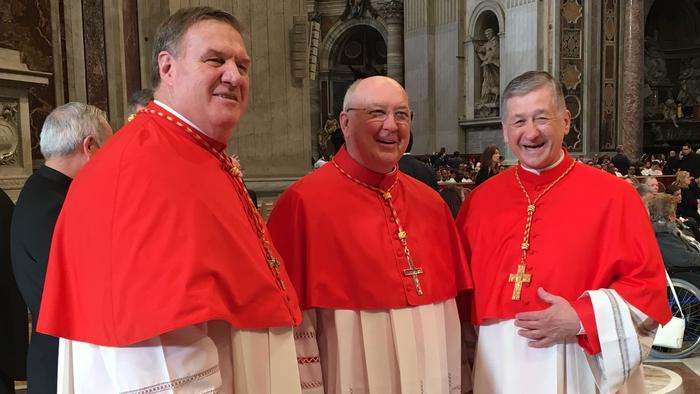
“Jesus is not the best person to advise people on marriage,” explained Cardinal Kevin Farrell, Prefect of the Dicastery for Laity, Family and Life. “He has no credibility, He never lived the experience; He may be the Son of God, but to go from there to putting His Power into practice every day – He doesn’t have that experience.”Some will find Cardinal Farrell’s words controversial, although it is unlikely that Pope Francis will take any notice of them, let alone correct them. Cardinal Farrell (70) was appointed by Francis, along with Cardinal Tobin (66) and Cardinal Cupich (69), as one of a team of “Bright Young Cardinals” whose job was to drag the Catholic Church into the 1960s.

Tobin, Farrell, Cupich

The Three Musketeers (or do we mean Stooges?)

Jesus’s views on marriage – broadly speaking, that it is an institution that involves one man and one woman for life – have already been much criticised, especially by fans of Amoris Laetitia, but Kevin Farrell is the first person to come out and explain how He could have got things so badly wrong.

“It is better if people being prepared for marriage ignore all that pre-Vatican II Biblical stuff,” he continued, “and it is therefore more appropriate if they are prepared by someone who has been married before – perhaps several times – and preferably both to people of the same sex and the opposite sex. That way they can benefit from a full range of experiences.”   {THIS IS TRULY MADNESS, INSANITY !!!}

Henry VIII

“Now take Henry VIII. The Anglicans have benefited from his wide experience of marriage!”

Cardinal Farrell went on to criticise the Ten Commandments, explaining that God had been “rather new at that game” when He drafted them, and had not committed any sins. “It would have been better if He had left things to Satan, who, after all, had much more personal experience of evil.”  {HOW IS IT POSSIBLE THAT THS MAN IS THE PREFECT OF THE DICASTERY FOR LAITY, FAMILY, AND LIFE???  THERE IS ONLY ONE EXPLANATION, HE WAS APPOINTED BY FRANCIS THE MERCIFUL.}

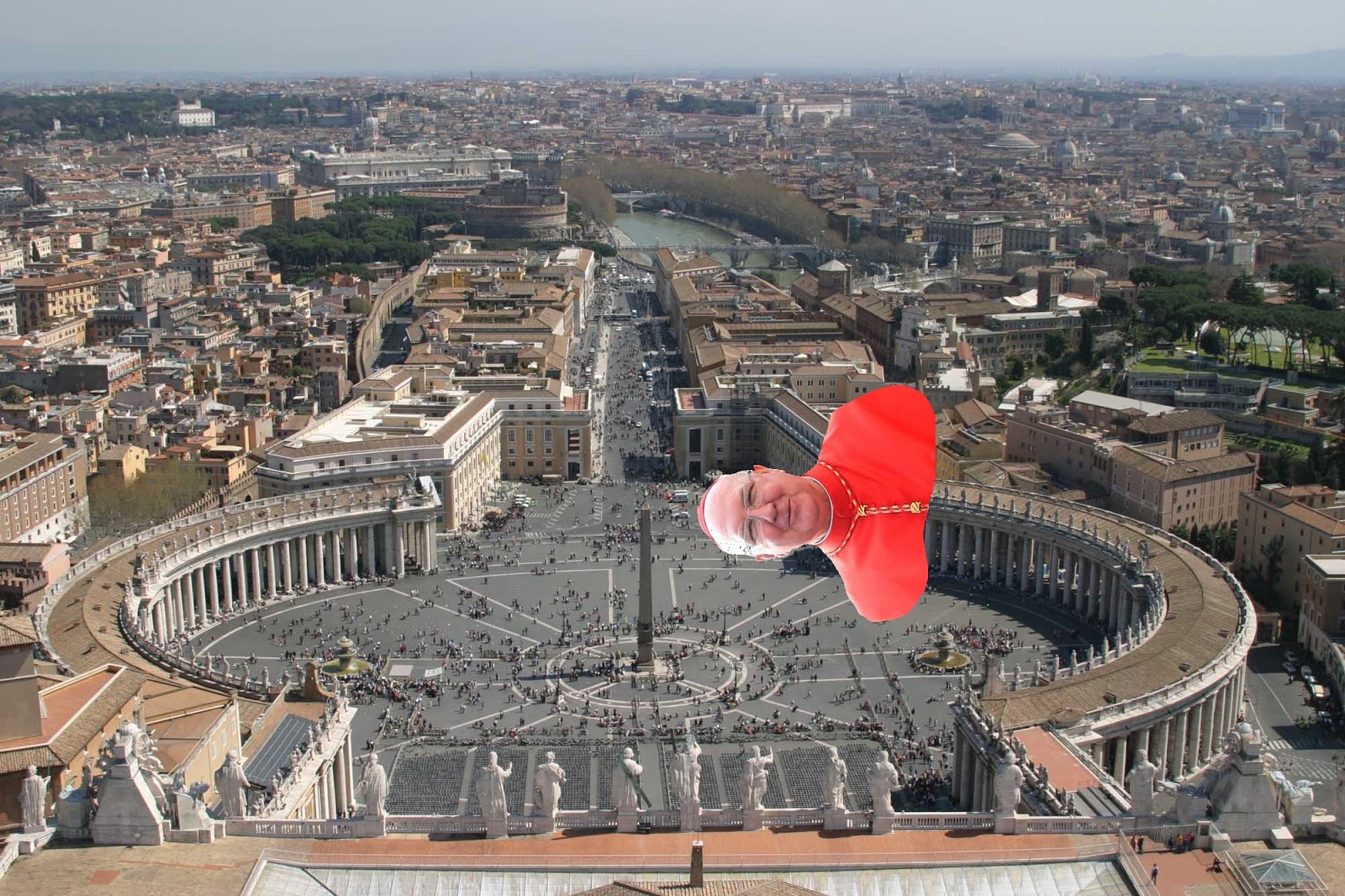
Many Catholic priests have been disturbed (not to say furious) at Kev the Rev’s comments, asking themselves exactly what experience of marriage the good cardinal has himself had, to be able to speak out so authoritatively. As a result, they have constructed a giant balloon (blimp) in the form of Farrell, which is now flying above Rome, this being the “modern” way to express political disagreement.

Farrell blimp

The Farrell blimp watches over St Peter’s Square.

Posted in Uncategorized | 2 Comments

DO NOT GROW WEARY AND FAINT, REMAIN VIGILANT, PRAY AND LOVE JESUS CHRIST AND OTHERS AS HE TAUGHT US

Where is the Church?

Yesterday, I asked a question on my Facebook page that has been on my mind:

Does the proposition, “The Catholic Church as we know it no longer exists” seem like an overreach? I think we’ve reached a point where we have to re-define our terms.

Dozens of comments later, I can’t say that I have an answer I’m satisfied with.

As I explained in a followup to my post, the reason I’m asking is because of the dawning realization I’ve been coming to that reporting on this or that scandal in the Church is not simply a case of exposing corruption or documenting outliers but merely observing the day-to-day status quo.

Only holiness and positive developments are outliers now. Bad stories are the norm; good stories are much harder to find.

The actual Catholic Church — the one that leads people to eternal salvation and nourished countless saints — is in what appears to be a devastating retreat. Go the average traditional chapel and — if they’re an Ecclesia Deicommunity, at least — you’ll often hear that they just can’t pay attention to what’s going on in Rome. It’s counterproductive, they’ll tell you. And that’s probably true. But the bunker mentality leads, in a way, to isolation and atomization.

Meanwhile, reports filter in about orthodox Bishops and Cardinals who have been forbidden to speak in various dioceses or who think that what is happening in Rome has become severe to the point of apostasy. Yet these same men will not allow any of these reports to be put on the record, such is the obsequiousness cultivated toward the papacy.

And through it all, the laity are left perusing the headlines, trying to find the proper mental gymnastics to explain things away. Each day’s news is like a renewed assault on the Catholic sensibility. I’ll give you a taste of what I have open in my internet browser at the moment.

From Phil Lawler, quoting the pseudonymous priest “Diogenes” circa 2005:

The Washington Times reports that “the U.S. Catholic bishops will sidestep the issue of whether gay men should become priests at their semiannual meeting,” which began today at the Chicago Fairmont.

And why, boys and girls, was it a foregone conclusion that the bishops would “sidestep” the issue? Because the question of whether gays should be ordained cannot be addressed without first addressing a considerably more explosive question: the number of bishop-disputants who are themselves gay and have a profound personal interest that there be no public examination of the connections between their sexual appetites, their convictions, and their conduct of office.

Thirteen years later, as the fallout from the McCarrick scandal continues to unfold, we’re left to wonder why nothing has changed.

From Rod Dreher, at The American Conservative:

One former priest who left the priesthood in disgust over the constant gay sex among other priests, and the adamant refusal of his bishop — who is today a cardinal — to do anything about it, wrote me, using his name, and providing details. He says this cardinal was part of a gay clique before he became a bishop, and therefore had no reason to act on the information he (this priest) and others provided him — including information about a gay priest whose sexual crimes landed him behind bars. I’m going to ask that former priest if he’s willing to go public, and name names. I’ve heard rumors about this cardinal, but never details like this. He needs to have a #MeToo moment.

From Julia Meloni, at LifeSiteNews:

October’s youth synod is about finishing the old business of the St. Gallen mafia. It will mark four years since Archbishop Bruno Forte crafted a manipulated synodal report on the “precious support” found in same-sex relationships – released the very day that two Italian political parties backed homosexual unions.

Pope Francis approved the text before it was published, and his homily that day excoriated” doctors of the law” – an “evil generation” – for resisting the “God of surprises.” Archbishop Forte, meanwhile, declared to the media that “describ[ing] the rights of people living in same-sex unions” is a matter of “being civilized.”

From Diane Montagna, at LifeSiteNews:

The demographic collapse of the West in recent decades was planned in order to create the necessary conditions to usher in a New World Order, and the authors of this collapse are now influencing the Vatican at the highest levels, the former president of the Vatican bank has said.

Speaking at the first international conference of the John Paul II academy for human life and the family, Italian economist and banker Ettore Gotti Tedeschi said efforts to decrease the world’s population by globalist elites have set in motion a series of predictable and intended economic, geo-political, and social catastrophes meant to “persuade” people around the world to accept a global “political vision” that would eliminate national sovereignty and institute “gnostic environmentalism” as its “universal religion.”

[…]

According to Gotti Tedeschi, the “greatest enemy” of the New World Order is the family because it provides “education, autonomy and independence” from the state. Its second enemy is the Catholic Church, he said, and yet these gnostic prophets are “rewriting genesis in the halls of the Vatican.”

From Dorothy Cummings McLean, at LifeSiteNews:

The Vatican has dropped a criminal investigation against Libero Milone, a Catholic layman they hired to audit their finances. This despite the fact that in September the Vatican chief of police, Domenico Giani, told Reuters that there was “overwhelming evidence” against the former Auditor General.

Now, however, Edward Pentin of the National Catholic Register has reported that “the separate inquiry conducted by the Vatican promoter of justice with Milone’s lawyers came to the conclusion that no evidence existed to support the accusations that had been lodged against him.”

Pentin also cited an unnamed source who had told the Register on July 5 that Milone had “apparent apparently stumbled upon certain and clear abuses of funds, and they could no longer wait to remove him.”

How about this, from Matthew Cullinan Hoffman, also at LifeSiteNews?

A group of Catholic clergy and theologians, including two bishops, have signed an ecumenical declaration with Anglican clergy published on the Vatican website that affirms the possibility that the Catholic Church might create a “female diaconate” in the future, which would imply a contradiction of Catechism of the Catholic Church and the Church’s 2000-year tradition.

Or this, from Andrea Tornielli at Vatican Insider, confirming (in my mind anyway) a report we made last year about the re-visitation of Humanae Vitae in the hopes of finding loopholes:

Paul VI, in October 1967, during the first Synod of Bishops held in the Vatican, had the Cardinal Secretary of State ask for an opinion on contraception in view of the publication of the encyclical. Only 26 of the 200 bishops present produced a written response. Of these, most said they were in favor of some opening to the pill, while 7 were against. But Pope Montini, who had already removed the subject from the Council discussion and had listened to the opinions of a commission of experts (the majority of whom were in favor), did not believe that there was any reason to change the position held up to that moment by his predecessors and promulgated a few months after his Humanae vitae, which came out in July – fifty years ago – lacking however the chrism of infallibility, as some would have liked.

This is one of the new elements that emerges from the research of Monsignor Gilfredo Marengo, author of the book “La nascita di un’enciclica. Humanae vitae alla luce degli Archivi Vaticaniˮ (Birth of an encyclical. Humanae vitae in the light of the Vatican Archives) published by Libreria Editrice Vaticana; a search in the light of never consulted before documents, which allowed to reconstruct the genesis of the encyclical, its various drafts, the corrections made by Paul VI.

[…]

The news of the Pope’s desire to consult all the members of the synodal assembly is very important – Marengo points out- because one of the most repeated accusations, after the publication of Humanae vitae, was that the Pope had decided in solitude, in a non- collegial way”.

Perhaps most striking, among the assortment of stories in front of me, are the words of Michael Brendan Dougherty, who writes in the pages of National Review:

There is an undeniable psychological tension between my religious belief that I cannot have hope for salvation outside the visible, institutional Church and my honest conviction that of all the institutions and societies that intersect with my life, the Church is by far the most corrupt, the most morally lax, the most disillusioning, and the most dangerous for my children. In that tension, personal prayer will dry up like dew at noon. [emphasis added]

This cross-section of ecclesiastical news, and the reaction to it, is far from comprehensive, but it tells us a great deal.

In the Facebook discussion, some mentioned the notion of a faithful “remnant”, as so often comes up in conversations like these. My response was to say: talking in vague terms about a Remnant is fine, but what does that mean? Where is it? How does that play out in the lives and families of those trying to simply stay on the path to salvation? How do we raise kids in this without them becoming bitter or giving up on what seems a quixotic refusal to let go of something dying?

How do we boil down what the Church truly is, in her essence, and separate that from what we get in almost every parish we walk into? Just saying “I’m Catholic” could mean virtually anything in 2018, and that’s a problem for us.

So I ask again: where is the Church? What does it consist of when 95% of parishes and bishops and priests and laity are actually not, in any substantive sense, Catholic?

What does it mean when the handful of orthodox bishops in the Church — those very few who give us hope — would prefer to endure unjust persecution rather than stand their ground and fight on behalf of the faithful?

I think paring down the bloat and getting to the lifeblood of what the Church is, and where we find it, is actually where people are going to find some hope. It may feel like going through the motions for a while. But as Michael Dougherty also writes:

Where do I find hope? I find it in the faces of other young Catholics. The families at my parish who make real sacrifices for the Faith. I find it in the young writers such as Sohrab Ahmari , B. D. McClay, and Matthew Schmitz who still convert and fall in love as I did. … Even if sometimes my personal piety dries into dust and nothingness, the bell rings at Mass, my knee drops to the floor, and if nothing else, this gesture testifies objectively to the reality that Christ is present in the Eucharist, that Christ is Lord. Hopefully for now, that’s all I need to know.

This, as the interminable winter in the Church stretches on, is where I think more of our time could be well spent. Preserving the beloved things. Finding green shoots poking up through the ice. Reminding each other that despite all appearances, hope is not lost.

I plan to dedicate more of my time in the coming months to such pursuits.

I will spend more time with books. I will attempt to find more time for prayer, and in gratitude. I will seek out the true, the good, and the beautiful. I will, I hope, find a way to recharge somewhat, and seek healing for my battle-weary soul.

This means that you may see a bit less of me here for a while, or that my contributions will take different forms, as I seek to prioritize quality over quantity. In the mean time, the work we do here will continue with the help of those capable soldiers ready to carry the standard.

We know that the Church continues, but she is being reduced to a fraction of what she once was. This is a hard truth, but one we must come to terms with. What choice have we but to press on?

Where is the Church? Its treasures are scattered, but they are present in those who hold to and keep the faith. We need to find each other in the darkness, and gather our light.

“Lord, to whom shall we go? thou hast the words of eternal life.” (John 6:69)

{Steve Skojec has written yet another excellent post on his excellent website OnePeterFive.  This, his latest post, is however negative to a fault.  

If we only focus on the corruption extant in the hierarchy and in the Curia in Rome we cultivate a myopia that prevents us from seeing the Church in all of her wondrous aspects, the Church is after all a Divine Mystery.

To maintain our sanity and better understand the reality of what we are experiencing these days in the reign of Francis the Mercyfull we must not loose sight of the invisible Church, the completely spiritual Church, that is alive in the hearts and minds of millions of people around the earth.  If we focus only on the institutional Church, the Church of dioceses, archdioceses, ecclesial provinces, national episcopal conferences, and the Vatican Curia we are certainly suffering from myopia.  The scandals and corruption that are all to evident in the daily reports in the media distract us from the reality that the Church lives on in the hearts and minds of those millions of Catholics who love Our Lord Jesus Christ and his Blessed Mother.

There are two historical examples I can cite  to prove the validity of what I assert above.

First, the case of Japan.  From the New Advent Catholic Encyclopedia:

“There is not in the whole history of the Church a single people who can offer to the admiration of the Christian world annals as glorious, and a martyrology as lengthy, as those of the people of Japan. In January, 1552, St. Francis Xavier had remarked the proselytizing spirit of the early neophytes. “I saw them”, he wrote, “rejoicing in our successes, manifesting an ardent zeal to spread the faith and to win over to baptism the pagans they conquered.” It was not until 1587, when there were 200,000 Christians in Japan, that an edict of persecution, or rather of prescription, was passed to the surprise of everyone, at the instigation of a bigoted bonze, Nichijoshonin, zealous for the religion of his race. Twenty-six residences and 140 churches were destroyed; the missionaries were condemned to exile, but were clever enough to hide or scatter. They (the lay catechists) never doubted the constancy of their converts; they assisted them in secret and in ten years there were 100,000 other converts in Japan.”The astonishing fruit of the generous sacrifice of our 26 martyrs” (wrote a Jesuitmissionary) “is that the Christians, recent converts and those of maturer faith, have been confirmed in the faith and hope of eternal salvation; they have firmly resolved to lay down their lives for the name of Christ. The very pagans who assisted at the martyrdom were struck at seeing the joy of the blessed ones as they suffered on their crosses and the courage with which they met death”.When in 1854, Commodore Perry forced an entry to Japan, it was learned that the Christian faith, after two centuries of intolerance, was not dead. In 1865, priests of the foreign Missions found 20,000 Christians practising their religion in secret at Kiushu. Religious liberty was not granted them by Japanese law until 1873. Up to that time in 20 provinces, 3404 had suffered for the faith in exile or in prison; 660 of these had died, and 1981 returned to their homes. In 1858, 112 Christians, among whom were two chief-baptizers, were put to death by torture. One missionary calculates that in all 1200 died for the faith.

The reality is that for several centuries the Church existed in Japan without priests, bishops, archbishops, cardinals or any contact with the Vatican Curia or a pope.  It isn’t that those representatives of an institutional Church are not important, it is simply that the Church, the Mystical Church that lives in the spiritual life of ordinary lay Catholics, can manage to survive for centuries on its own by the grace of Jesus Christ.

The second example is that of England.  From the New Advent Catholic Encyclopedia:

By a series of statutes, successive sovereigns and Parliaments from Elizabeth to George III, sought to prevent the practice of the Catholic Faith in England. To the sanguinary laws passed by Elizabeth further measures, sometimes inflicting new disqualifications and penalties, sometimes reiterating previous enactments, were added until this persecuting legislation made its effects felt in every department of human life. Catholics lost not only freedom of worship, but civil rights as well; their estates, property, and sometimes even lives were at the mercy of any informer. The fact that these laws were passed as political occasion demanded deprived them of any coherence or consistency; nor was any codification ever attempted, so that the task of summing up this long and complicated course of legislation is a difficult one. In his historical account of the penal laws, published at the time when partial relief had only just been granted, the eminent lawyer, Charles Butler, the first Catholic to be called to the Bar after the Catholic Relief Act of 1791, and the first to be appointed King’s Counsel after the Catholic Emancipation Act, thought it best to group these laws under five heads:

  • those which subjected Catholics to penalties and punishments for practising their religious worship;
  • those which punished them for not conforming to the Established Church (Statutes of Recusancy.
  • those regulating the penalties or disabilities attending the refusal to take the Oath of Supremacy (1559; 1605; 1689), the declarations against Transubstantiation(Test Act, 1673) and against Popery (1678);
  • the act passed with respect to receiving the sacrament of the Lord’s Supper;
  • statutes affecting landed property.

For the present purpose, however, it seems preferable to adopt a chronological arrangement, which more clearly exhibits the historical development of the code and the state of the law at any particular period.

The Penal Laws began with the two Statutes of Supremacy and Uniformity by which Queen Elizabeth, in 1559, initiated her religious settlement; and her legislation falls into three divisions corresponding to three definitely marked periods:

  • 1558-70 when the Government trusted to the policy of enforcing conformity by fines and deprivations;
  • 1570-80 from the date of the excommunication to the time when the Government recognized the Catholic reaction due to the seminary priests and Jesuits;
  • from 1580 to the end of the reign.

To the first period belong the Acts of Supremacy and Uniformity (I Eliz. 1 and 2) and the amending statute (5 Eliz. c. 1). By the Act of Supremacy all who maintained the spiritual or ecclesiastical authority of any foreign prelate were to forfeit all goods and chattels, both real and personal, and all benefices for the first offence, or in case the value of these was below 20 pounds, to be imprisoned for one year; they were liable to the forfeitures of Praemunire for the second offence and to the penalties of high treason for the third offence. These penalties of Praemunire were: exclusion from the sovereign’s protection, forfeiture of all lands and goods, arrest to answer to the Sovereign and Council. The penalties assigned for high treason were:

  • drawing, hanging and quartering;
  • corruption of blood, by which heirs became incapable of inheriting honours and offices; and, lastly
  • forfeiture of all property.

These first statutes were made stricter by the amending act (5 Eliz. c.1) which declared that to maintain the authority of the pope in any way was punishable by penalties of Praemunire for the first offence and of high treason, though without corruption of blood, for the second. All who refused the Oath of Supremacy were subjected to the like penalties. The Act of Uniformity, primarily designed to secure outward conformity in the use of the Anglican Book of Common Prayer, was in effect a penal statute, as it punished all clerics who used any other service by deprivation and imprisonment, and everyone who refused to attend the Anglican service by a fine of twelve pence for each ommission. It should be remembered that the amount must be greatly multiplied to give their modern equivalent.

Coming to the legislation of the second period, there are two Acts directed against the Bull of Excommunication  (issued by the Pope against Henry VIII and Elizabeth).:

  • 13 Eliz. c.1, which, among other enactments, made it high treason to affirm that the queen ought not to enjoy the Crown, or to declare her to be a heretic or schismatic, and
  • 13 Eliz. c. 2, which made it high treason to put into effect any papal Bull of absolution, to absolve or reconcile any person to the Catholic Church, or to be so absolved or reconciled, or to procure or publish any papal Bull or writing whatsoever.

The penalties of Praemunire were enacted against all who brought into England or who gave to others Agnus Dei or articles blessed by the pope or by any one through faculties from him.

A third act, 13 Eliz. c. 3, which was designed to stop Catholics from taking refuge abroad, declared that any subject departing the realm without the queen’s licence, and not returning within six months, should forfeit the profits of his lands during life and all his goods and chattels. The third and most severe group of statutes begins with the “Act to retain the Queen’s Majesty’s subjects in their obedience” (23 Eliz. c. 1), passed in 1581. This made it high treason to reconcile anyone or to be reconciled to “the Romish religion”, prohibited Mass under penalty of a fine of two hundred marks and imprisonment for one year for the celebrant, and a fine of one hundred marks and the same imprisonment for those who heard the Mass. This act also increased the penalty for not attending the Anglican service to the sum of twenty pounds a month, or imprisonment till the fine be paid, or till the offender went to the Protestant Church. A further penalty of ten pounds a month was inflicted on anyone keeping a schoolmaster who did not attend the Protestant service. The schoolmaster himself was to be imprisoned for one year.<hardpoint=”ad-cathen-middle” categories=”4674472789+2853081454+1750546940″></hardpoint=”ad-cathen-middle”>

The climax of Elizabeth’s persecution was reached in 1585 by the “Act against Jesuits, Seminary priests and other such like disobedient persons” (27 Eliz. c. 2). This statute, under which most of the English martyrs suffered, made it high treason for any Jesuit or any seminary priest to be in England at all, and felony for any one to harbour or relieve them. The penalties of Praemunire were imposed on all who sent assistance to the seminaries abroad, and a fine of 100 pounds for each offence on those who sent their children overseas without the royal licence.

So far as priests were concerned, the effect of all this legislation may be summed up as follows: For any priest ordained before the accession of Elizabeth it was high treason after 1563 to maintain the authority of the pope for the second time, or to refuse the oath of supremacy for the second time; after 1571, to receive or use any Bull or form of reconciliation; after 1581, to absolve or reconcile anyone to the Church or to be absolved or reconciled. For seminary priests it was high treason to be in England at all after 1585. Under this statute, over 150 Catholics died on the scaffold between 1581 and 1603, exclusive of Erizabeth’s earlier victims.

The last of Elizabeth’s laws was the “Act for the better discovery of wicked and seditious persons terming themselves Catholics, but being rebellious and traitorous subjects” (35 Eliz. c. 2). Its effect was to prohibit all recusants from removing more than five miles from their place of abode, and to order all persons suspected of being Jesuits or seminary priests, and not answering satisfactorily, to be imprisoned till they did so. The hopes of the Catholics on the accession of James I were soon dispelled, and during his reign (1603-25) five very oppressive measures were added to the statute-book. In the first year of his reign there was passed the “Act for the due execution of the statute against Jesuits, seminary priests, etc.” (I Jac. 1, iv) by which all Elizabeth’s statutes were confirmed with additional aggravations. Thus personsgoing beyond seas to any Jesuit seminary were rendered incapable of purchasing or retaining any lands or goods in England; the penalty of 100 pounds on everyone sending a child or ward out of the realm, which had been enacted only for Elizabeth’s reign, was now made perpetual; and Catholic schoolmasters not holding a licence from the Anglican bishop of the diocese were fined forty shillings a day, as were their employers. One slight relief was obtained in the exemption of one-third of the estate of a convicted recusant from liabilities to penalties; but against this must be set the provision that retained the remaining two-thirds after the owner’s death till all his previous fines had been paid. Even then these two-thirds were only to be restored to the heir provided he was not himself a recusant.

The carefully arranged “discovery” of the Gunpowder Plot in 1605 was followed by two statutes of particularly savage character. These were “An Act for the better discovering and repressing of Popish Recusants” (3 Jac. I, iv) and “An Act to prevent and avoid dangers which may grow by Popish Recusants” (3. Jac. 1, v). The first of these two wicked laws enacted that all convicted recusants should communicate once a year in the Anglican church under penalties of 20 pounds for the first omission, 40 pounds for the second, and 60 pounds for the third. Moreover the king was to be allowed to refuse the penalty of 20 pounds per month for non-attendance at the Anglican church, and to take in its place all the personal property and two-thirds of the real property of the offender. But the main point of this Act was the new Oath of Allegiance which it prescribed, and which was subsequently condemned by the Holy See. Yet all who refused it were to be subjected to the penalties of Praemunire, except married women, who were to be imprisoned in the common jail. Finally, every householder of whatever religion was liable to a fine of 10 pounds a month for each guest or servant who failed to attend the Anglican church.

The second Act was even worse, and the Catholic historian Tierney justly says of it that it “exceeded in cruelty all that had hitherto been devised for the oppression of the devoted Catholics“. It prohibited recusants from remaining within ten miles of the city of London, a provision which it was impossible to carry out; or to remove more than five miles from their place of residence till they had obtained licence from four magistrates and the bishop of the diocese or lieutenant of the county. They were disabled from practising as lawyers, physicians, apothecaries; from holding office in any court or corporation; from holding commissions in the army or navy, or any office of emolument under the State; from discharging the duties of executors, administrators, or guardians. Any married woman who had not received the sacrament in the Anglican church for a year before her husband’s death forfeited two-thirds of her dower, two-thirds of her jointure, and was debarred from acting as executrix to her husband or claiming any part of his goods. Husbands and wives, if married otherwise than by a Protestant minister in a Protestant church, were each deprived of all interest in the lands or property of the other. They were fined 100 pounds for omitting to have each of their children baptised by the Protestant minister within a month of birth. All Catholics going or being sent beyond the seas without a special licence from the king or Privy Council were incapable of benefitting by gift, descent, or devise, till they returned and took the oath of allegiance; and in the meantime the property was to be held by the nearest Protestant heir. And, lastly, every convicted recusant was excommunicated from the Established Church, with the result that they were debarred from maintaining or defending any personal action or suit in the civil courts. Their houses were liable to be searched at any time, their arms and ammunition to be seized, and any books or furniture which were deemed superstitious to be destroyed.

As was the case with the faithful Catholics in Japan, so also in England for almost three centuries the Church in England consisted of only lay Catholic with bishops, archbishops, cardinals or contact with the Vatican Curia in Rome although a few heroic priests did slip into England, such a Saint Edmund Campion, but they were all sooner or later discovered and put to death.

The Church has entered into a period of time when almost certainly, if the present course of events continues into the next popes reign, the Mystical Church, the Church that lives in the heart and mind of Catholics who remain faithful to the Gospel and the Magisterium revealed in the Catechisim of the Catholic Church, will function not as an institutional Church such as exists now but rather as a Church made up of communities of believers, some with the benefit of priests and bishops and some without even those to minister to them.

I for one am certainly saddened by what is happening to the institutional Church, but I am consoled that even without a pope or the Vatican Curia, Our Lord Jesus Christ can keep his Church alive until either a reform of this revolution takes place or Our Lord comes again.

+Rene Henry Gracida


Posted in Uncategorized | 3 Comments

CORPUS CHRISTI, TEXAS IS THE LARGEST CITY IN THE UNITED STATES WITHOUT AN ABORTION CLINIC OR A DOCTOR WHO PERFORMS ABORTIONS. IF THERE ARE ABORTIONS IN CORPUS CHRISTI THEY ARE SELF-INDUCED USING ABORTIFACIENTS

unnamed-27

This City of Over 324,000 People is the Largest Abortion Free City in the U.S.

A new abortion report that was meant to induce fear over the diminishing number of abortion facilities in the U.S. actually gives pro-life supporters a reason for hope.

The study, which was conducted primarily by the University of California San Francisco, identified 27 cities as “abortion deserts” with the nearest abortion facility over 100 miles away.

What these abortion promoters call ‘abortion deserts,’ we call ‘Abortion Free Communities,’” said Operation Rescue President Troy Newman. “These cities prove that women do not need abortion and can get along just fine without it. In cities where there are no clinics marketing abortions to women, abortions decrease – sometimes dramatically — meaning more babies have a fighting chance at life. That should be good news to everyone.”

Newman and his associate, Cheryl Sullenger co-authored the 2014 book Abortion Free: Your Manual for Building a Pro-Life America One Community at a Time, which details steps pro-life supporters can take to made their communities abortion free.

The study identified Corpus Christi, Texas, a city with a population of over 324,000, as the largest abortion free community in the U.S. without an abortion facility within 100 miles.

This is followed by the second largest abortion free community, Fort Wayne, Indiana, with a population of 260,326. Three Texas cities round out the top five. They include Laredo, Lubbock, and Amarillo.

“The truth is that these cities do not have abortion facilities for two reasons. First, there is not the demand for abortion to support a facility. Secondly, many of the 27 communities have active and determined pro-life activists who have worked tirelessly to pass pro-life legislation and educate the communities about the horrors of abortion. Their work has saved countless lives, and they should be commended,” said Newman.

Abortion-free cities with successful pro-life campaigns to end abortion have included Corpus Christi, Texas; Fort Wayne, Indiana; and Chattanooga, Tennessee, among others.

Due to Operation Rescue’s work, Wichita, Kansas, remained abortion-free for four years and saw statewide abortion numbers drop by 12% in the first year Wichita was without an abortion clinic.

Posted in Uncategorized | 4 Comments

SUICIDE IS EASY COMPARED TO THE LIFE ONE IS DOOMED TO LIVE AFTER THE TRANSGENDER ‘DOCTORS’ USE YOU AS THEIR GUINEA PIG TO PROVE GOD KNOWS WHAT !!!

caitlyn-jenner-bruce-jenner

Pity The Child Of Transgenderism Theory

The Rheimer twins were born minutes apart.  Later, David, had received a a botched circumcision surgery at 7 months of age. The Doctor had used an electric cautery machine with a sharp cutting needle to sever the foreskin.  Bad choice of instrument  in my opinion, as retired RN, for it severed  the tiny penis of the little baby. A clamp and a scalpel would have held all steady, and, is the usual choice . The Canadian family, seeking help, saw an American, Doctor Money, (appropriate name)  on television. They were impressed and desperate and wrote to  him, and, he accepted them as clients.

David Reimer was born on August 22, 1965, 12 minutes before his twin brother.  His parents named him Bruce and his brother Brian.  Both babies were healthy and developed normally until they were seven months old, when they were discovered to have a condition known as phimosis, a defect in the foreskin that makes urination difficult..

The Reimers were told by their Doctor that the problem was easily remedied with circumcision.  During the procedure at the hospital, a doctor who did not usually perform such operations was assigned to the Reimer babies.  He chose to use an electric cautery machine with a sharp cutting needle to sever the foreskin. “The electrical equipment had malfunctioned and the surge in current had obliterated the tiny penis” was their ‘story.’ The Doctor was inexperienced and the instrument of choice was wrong.

Anyway:

At eight months of age, David became the unwitting subject of “sex reassignment.”  His grieving parents, too trusting in the words of Doctors, heard of an American Doctor named Money, who advised them that it would be better to raise him as a girl.  Dr. Money was experimenting with sex conversion at the time.  He recommended castration and hormone treatments. He was a psychologist.  Not a Doctor. Canada was suffering under some form of socialized medicine at this point in time.  I have personal knowledge of friends there who suffered, including one man who died in the emergency room of a massive heart attack … after he had told them about chest pain several times with nothing having been done. No Cardiac Testing.

This sad story was known as the “John/Joan” case and was widely publicized, giving credence to arguments presented in the 70’s by feminists and others that humans are sexually neutral at birth and that sex roles are largely the product of social condition

“Doctor Money was a psychologist specializing in sex change. He believed that it wasn’t biology that determines whether we are male or female, but how we are raised.

For Doctor Money, David was the ideal experiment.  Here was a child he believed should be brought up as the opposite sex, who even brought his own control group with him – an identical twin.

If it worked this would provide irrefutable evidence of Dr. Money’s theory.

When Bruce (later David) was 17 months old, he became Brenda.  Four months later, on July 3, 1967, the first surgical step was taken – castration. (Surgical removal of the tiny delicate testicles of this poor baby boy.

Dr. Money stressed, post surgery,  that, if they wanted the sex change to work, the parents must never let Brenda or her twin brother know that she had been born a boy.

From now on the Reimers had a boy and a ‘girl’

For several years Doctor Money (his real name) reported on Reimer’s progress, describing apparently successful female gender development and using this case to support the feasibility of sex reassignment. He wrote his paper and made his case!

Mrs. Reimer reported that the child was very rebellious and acted very masculine.  “I could not persuade her to do anything feminine” she once said.  Brenda had no friends.

She did not like wearing dresses.  She loved to play with her brothers toys, and, be with his friends. She was lonely and a sad child.  Doctor Money, at this time, had been pressuring the family to bring David in for surgery during which “a vagina” would be constructed.  Estrogen was given during adolescence to induce breast development.  From the age of 22 months into his teen aged years, Reimer had urinated through a hole that surgeons had placed in the abdomen. What a tragedy for a little boy.

The parents, after these stressful years, had decided against any more surgery and told Brenda, in opposition to Dr. Money’s advice, that she had been born a boy.


  download.jpg

“I could see that Brenda wasn’t happy as a girl”  Janet Reimer recalled.

Brenda soon decided that she wanted to be what she was supposed to be … a boy, and, she chose the name of

Reconstructive surgery was done, as it should have been.  Too late for David though. He did eventually marry and although  he couldn’t have children, the girl he married had three and David was happy for a time as a Father.

But …  the effects of the hormone treatments given to a little boy to change him into a girl had taken their toll and he developed a form of schizophrenia.

Hormone Treatments are given to some children.  They are called ‘Puberty Blockers’

Slowly, David went into a deep depression.  He had lost his job, and, become separated from his wife.

In 2002, his brother died from a drug overdose.

Two years later, David committed suicide …

No one should have to live a life like these two … the abuse of Dr. Money had taken its toll.

No One.

Los Angeles Times Saturday May 15, 2004 Home Edition Main News Part A Page 2


In this writer’s opinion, David could have had reconstructive surgery, rather than a castration,  and, his parents should have brought a medical malpractice action against the Doctor who did the surgery.  The money they won would have helped these two working class parents through their terrible struggle.

About Doctor Money:                                                                                                                             Much information can be found on the internet about him as he was one of the early advocates of transgender ideology and therapy, and, greatly revered by the feminist movement.  There are accounts of how the two Reimer brothers suffered sexual abuse on their frequent “visits to the Doctor” in many places. What I read of it was terrible.

David Reimer went public with his story, and, John Colapinto published a widely disseminated and influential account in Rolling Stone Magazine December 1997.

John Colapinto eventually wrote a book ‘As Nature Made Him:  The Boy Who was Raised as a Girl’


God Himself “from the beginning made man male and female” (Matthew 19:4) “and He blessed them saying, “Increase and multiply” (Gn 1:28). Thus it is that the things that in this respect are naturally found in man are also good and proper., as the Church has often stated in order to proclaim the sanctity and dignity of marriage.”      Draft of a Dogmatic Constitution on Chastity, Marriage, The Family, and Virginity:  A portion of the Discarded Schemas of Vatican II.

Posted in Uncategorized | Comments Off on SUICIDE IS EASY COMPARED TO THE LIFE ONE IS DOOMED TO LIVE AFTER THE TRANSGENDER ‘DOCTORS’ USE YOU AS THEIR GUINEA PIG TO PROVE GOD KNOWS WHAT !!!

It is hard to distiguish the evil between the Revolution of the Guillotine and the Revolution of Discernment. The first ends suffering quickly and the latter prolongs it for all eternity.

Fr. Rutler’s Weekly Column

July 15, 2018
   It may be the seasonal heat that incubates revolutionary sentiments, since both Independence Day and Bastille Day occurred in the feverish days of July. One admires the temperance of our Founding Fathers meeting in Philadelphia in un-airconditioned rooms. The other revolution unleashed more violent passions against a devout monarch who, like Charles I and later Nicholas II, inherited the consequences of less benign forebears. There were excesses in the American colonies, but pulling down the statue of George III was unlike the French actually beheading their king and queen.

Inasmuch as the “infamy” that excited the tarring and feathering by Americans was a matter of parliamentary representation and taxation, it was genteel compared to the “infâme” in Paris which meant destruction of the Christian social order. In Philadelphia, no Goddess of Reason was enthroned on the communion table of Christ Church, nor was George Washington drenched in blood when he prayed in Saint Paul’s Chapel before his inauguration. I say this not in a pejorative spirit, for I think many Frenchmen would agree with me, and I have been exhilarated by several Bastille Day celebrations in Paris, with their unsurpassed elegance, albeit absent the concomitant enormities of the Reign of Terror.

What differentiates the two revolutions, is the invocation versus the rejection of God. In one sense, the American Revolution was not a revolution at all, for it asserted the historic claims of citizens as Englishmen mantled with the protestations of the Magna Carta, which had been neglected by more recent German occupiers of the throne. My prejudices are compromised by the fact that my French paternal antecedents were compatriots with Rochambeau and Lafayette, and my English maternal ancestors in their Cheshire regiment may even have taken aim at the Massachusetts militiaman who fired the shot heard round the world.

In America, there were fanatics like Sam Adams, whose eponymous beer should be a caution to God-fearing men, and Tom Paine, who disdained religion. But many more thoughtful American patriots invoked John Locke and, with a few unmeasured exceptions, would have found zealots like the Jacobins ridiculous.

French Revolutionaries tried to substitute the Catholic Church with a mockery of it, rather like what is going on in today’s China. The Constitutional Church would have no pope and its clergy would be compliant state agents, and so forth. The Devil knows how to choreograph religious anarchy. Because Washington did not contradict divine order, he did not end up on the chopping block like Robespierre.

All of that pales in comparison with the only revolution that truly counts, for it changed the world permanently: when Christ rose from the dead, he set free vital germs of human rights, social progress, philanthropy, the philosophical matrix for science, universities, the consciousness of a Creator who made the world a channel of grace strengthened by moral order, and, finally—shown by a mercy divine—the prospect of life eternal.

Posted in Uncategorized | Comments Off on It is hard to distiguish the evil between the Revolution of the Guillotine and the Revolution of Discernment. The first ends suffering quickly and the latter prolongs it for all eternity.

ALL AMERICAN MEN, BOYS AND BABIES . ARE UNDER ATTACK. IT IS WAR! NO, ITS NOT POISON GAS THE ENEMY IS USING, IT IS ESTROGEN. IT IS IN THE TAP WATER. WHEN MY VOICE STARTED CHANGING FROM BASS TO TENOR I STARTED DRINKING DISTILLED WATER AND NOW I AM A BARITONE !!!

Human-Animal-Hybrid-Monsters%20chimeras%20alien

“I used to not pay too much attention to the whole gender-mix up issue because I know from my science training that there are a certain number of humans born with the sex chromosomes of both genders.  They may be true hermaphrodites or just mosaics who look like one gender but feel the feelings of the other.  I always felt sorry for them, knowing that the road they were about to go down would be difficult, confusing, and sad – not of their own making but rather a result of mixed-up genes.  But they were, by far, in the minority.

So it’s with a lot of curiosity that I watch the unfolding of this issue in the media.  Every day it seems we have another celebrity with a trans-child or a sad story of a person who falls under one of the letters of the LGBTQ (have I left any letters out?) acronym, the poor victim of heartless right-leaning  (of course!) friends and family members.  And I have to ask myself, are there really that many kids who struggle with this issue or is it just the latest “cause célèbre” of the more left-leaning of us?  As this article points out, are we actually fostering the creation of MORE mixed-up kids in the attempt to be kind-hearted?

The thoughts in this article also fall into line with something my late husband used to complain about:  the feminization of the American male.  He was a medical researcher at a leading research institute, and even though this was not his area of investigation, he was quite concerned about it.  When our first son, now in his 30’s, went to school and encountered a bully, the headmaster taught him how to box and told him that the only way to stop a bully was to stand up to him.  My son did stand up to him and the bully backed down, leaving school, in fact.  Good riddance!  Two decades before, two other students with a long-standing feud were given boxing gloves and told to go settle their differences in the courtyard, with their parents’ blessing.  It worked and they finished with bloody noses and a new-found respect for each other.  Do you think that would EVER happen today.  Never!

Our good friend, who worked for the state version of the EPA, concurred with my husband from a environmental point-of-view.  She tested the water we drank and swam in and admitted that it was virtually impossible to remove all of the estrogen, that women urinated out after taking the Pill, from our drinking water .  She looked at the amphibians in the streams and estuaries downstream from water treatment plants and found that they were either outright females or at least hermaphrodites.  There were fewer and fewer males.  I asked what will happen in the long-term when the levels of estrogen keep coming in above “safe” levels.  She just shrugged and said, “Oh they’ll eventually just raise the level that’s considered “safe”.  Do you really think the Big-Pharma PACs are going to allow the state to do anything to actually solve the problem?”  I actually downloaded the last report of the water testing in my local area and the estrogen level was not even tested.  It gave me the chills.

So folks, it’s only going to get worse.  Our males are under attack, both societally and environmentally, and who knows what the outcome is going to mean for our nation?”
– A. Gellerman
Posted in Uncategorized | 3 Comments

Trans activists are waging a war for the hearts and minds of the next generation. Don’t fool yourself: That means your children, too.

JONATHON VAN MAREN

From the front lines of the culture wars

Featured Image

BLOGS, ,

In their own words – What transgender activists have in store for your children

July 12, 2018 (LifeSiteNews) — I’m often told, when I address the transgender ideology, that it is an exaggeration to claim that trans activists actually wish to impart their ideology to children. Surely, people say, all trans activists really want to do is help teenagers who are grappling with genuine issues of gender identity and confusion—and thus to claim that trans activists wish to impart or apply their ideology to young children is simply fear-mongering. I wish that were the case, but a survey of the evidence indicates that this analysis is about facts, not fearmongering.

To illustrate just how radical the transgender ideology is, consider some advice given to parents at a 2016 conference (attended by over 400) people by Dr. Diane Ehrensaft, who is a developmental psychologist and the author of The Gender Creative Child. She is one of the key proponents of determining a child’s gender through careful observation, followed by affirmation of whatever the child says or acts upon—including very early transition, if that happens to be the case. She is a very influential figure within the trans movement, sitting on the board of directors of Gender Spectrum, a San Francisco trans advocacy organization, as well as serving as the director of the University of California-San Francisco children’s hospital gender clinic.

If you would like to understand what the transgender movement is all about, you can watch the 2016 Jon E. Nadherny/Calciano Memorial Youth Symposium in its entirety. The guest speakers bluntly lay out their agenda and explain how they are capturing the hearts and minds of the next generation, resulting in both sky-rocketing numbers of trans-identified youth as well as young people supportive of the trans ideology. One speaker showed a cartoon that had one parent asking another parent who was pushing a stroller whether her child was a boy or a girl. “I don’t know,” the mother replied. “It can’t talk yet.” It wasn’t meant as a joke.

After Ehrensaft’s presentation, one mother stood up to ask how best to “explain gender to a three, for, and five-year-old? My daughter asks a lot of questions about gender expression and identity without knowing what she’s asking, but I don’t quite have the language to talk to her about it…Is that a boy, is that a girl, what does it mean to be a boy, what does it mean to be a girl? Is it because they have a penis? Is it because they have a vagina? And I don’t quite know how to use language to talk about gender…” Dr. Diane Ehrensaft’s answer gives a clear picture of how trans activists wish to impart the ideology of gender fluidity to children:

First of all, in terms of the question is that a boy or is that a girl, I would say we don’t know—we’ll have to ask them. So that would be the start, that only they know for sure. Some people like to be asked and some people don’t. I’d say you know, some people think (because by three you’re learning) that if you have a penis you’re a boy and if you have a vagina or a vulva you’re a girl, but actually it’s not like that. It’s not like that at all. If you’re a boy it’s because your mind is telling you I’m a boy. If you’re a girl it’s because your mind is telling you you’re a girl. Some girls like to wear dresses and some girls like to dress as Darth Vader—that’s a people thing, but there are some people where we live who think one thing is a boy thing and one thing is a girl thing. So there is a teaching moment there. Kids by three know their culture. Remember I said gender socialization starts at two? So we have to sometimes unsocialize those messages with new messages. Then the next thing is: Some people think there is only two genders. But there is lots and lots of genders—it’s just like a rainbow. It has all different colors. And then I’d stop there because that’s almost way too many words already for a three-year-old.

There you have it, in her own words: Children must be “unsocialized” out of antiquated beliefs such as the idea that men have penises and women have vaginas, or that there are only two genders. Instead, children as young as three years old are to be told that you can be whatever you decide to be, regardless of biological reality. When children meet adults who have not yet relinquished common sense, they will be gently introduced to the concept of transphobia.

Ehrensaft’s views do not simply extend to children between the age of toddler and kindergarten, either. A father stood up to ask her another question: “A very strong message people have been talking about this morning is listening to the child, and letting them tell us. I’m just wondering if there are recommendations for pre-verbal children, so between the ages of one and two, suggestions for how to approach the topics that we’re talking about today?” Unsurprisingly, Ehrensaft had advice regarding “pre-verbal children” who can’t talk yet, too:

So the question is, what about the kids between one and two who are just developing language, or may not have it yet? They’re very action-oriented. This is where mirroring is very important, and listening to actions. So let me give you an example. I have a colleague who is transgender, and there is a video of him as a toddler—so he was assigned female at birth—there is a video of him as a toddler tearing barrettes out of then-her hair and throwing them on the ground and sobbing. That’s a gender message! And when it happens not just once or twice or three times, that’s a gender message. Sometimes kids between the age of one and two with beginning language will say “I boy!” when you say girl. Those two words: “I boy.” That’s not a pre-verbal, but an early verbal message. Sometimes there is a tendency to say, well honey, no, you’re a girl, because little girls have vaginas and you have a vagina so you’re a girl. And then when they get a little older you’ll hear them say: Did you not listen to me? I said I was a boy with a vagina. But they can’t say that between one and two, but they can show you by what they want to play with, and if they feel uncomfortable about how you are responding to them and their gender if you are misgendering them. So you look for those kinds of actions, like tearing a skirt off. There was one, I think this was in the Barbara Walters special, where this child wore the little onesies with snap-ups in between the legs, and at age one would unsnap them to make a dress and have the dress flow. This was a child who was assigned male. That’s a preverbal communication about gender, and the message back should not be to negate any of those expressions, but to go with them and see where they go. So that’s my sense about the one to two-year-olds. Children will know as early as the second year of life. They probably know before, but they’re pre-pre-verbal.

In Ehrensaft’s view, a child throwing a tantrum and pulling out her barrettes, or a boy opening his onesie, or children simply playing make-believe—these are all reasons to believe that your child may not be the gender they were “assigned.” Despite evidence telling us that up to 80% of children who genuinely do struggle with gender dysphoria will later grow out of it, and the incredible danger that physical and chemical mutilation poses to the physical and mental well-being of children who decide to transition at a young age (which is already giving birth to the phenomenon of “detransitioning”), Ehrensaft advises parents to be on the lookout for signs that their child might actually be of the opposite gender—or any of an assortment of different genders, some of them yet unnamed and presumably undiscovered.

Trans activists are especially focused on young people because they rightly feel that indoctrination is more effective at a younger age. The fact is that experts like Ehrensaft are the ones informing new sex-ed curriculum for schools, new governmental policies, and new social responses to the transgender ideology. In her view, her ideology applies even to children under the age of five, including those who are “preverbal.” Most parents are unaware of what activists like Ehrensaft believe and teach, but it is incredibly important for people to be aware of what this ideology constitutes, and to find out whether it has infiltrated the curriculum of your local schools, as well.

Trans activists are waging a war for the hearts and minds of the next generation. Don’t fool yourself: That means your children, too.

Posted in Uncategorized | 1 Comment

BEHOLD THE GOOD WORK THAT FRANCIS THE MERCIFUL HATH WROGHT

German Dioceses Respond to ‘Give Protestants Communion’ Guidelines. It’s Not Good.

At an astonishing pace, one third of the 27 German dioceses have already now come out with statements concerning the recently published controversial intercommunion guide of the German Bishops’ Conference. Only one diocese has, so far, declared that it will hold back on implementing the new guide allowing, in individual cases, Protestant spouses of Catholics to receive Holy Communion on a regular basis, and without converting to the Catholic Faith, and even without a prior sacramental confession.

The most troubling message came out just last week from the bishop of Würzburg, Franz Jung, who invited, for the weekend of 5 and 6 July, all Protestant spouses of Catholics to Holy Communion who celebrated their wedding anniversary (of 50 to 60 years) with him at his cathedral of St. Kilian. As he said during his homily on 6 July, every Protestant spouse was invited to Holy Communion. He added only these qualifying words: “when they feel disposed to do so.” No earlier pastoral conversation prior to that event was required. Bishop Jung, moreover, had the backing of the diocesan council for this permissive approach.

As the German Catholic newspaper Die Tagespost now reports in its new edition, the Diocese of  Würzburg responded to the paper’s request for further information with the statement that this unusual move is “in accordance with the precepts of the Church’s law.” No further information to justify that claim was given.

The journalist Peter Winnemöller, writing for the Austrian news website Kath.net, comments on this episcopal initiative in Würzburg as follows:

Here, Holy Communion therefore was a reward on a special occasion. That is to say, in light of a long-lasting marriage. This is strange insofar as canon law still clearly rules that Catholic ministers validly administer the Sacraments only to Catholic recipients.

He concludes his commentary with the words: “The question that remains to be answered is, to put it briefly: whether a schism is already at hand.”

Christoph Ohly, a priest and canon law professor who writes for Die Tagespost, regrets this decision by the bishop of Würzburg and makes it clear that “there exists no law for such an approach of a general invitation to receive Holy Communion to which the bishop could refer.” Such an initiative on the side of the bishop, Father Ohly adds, “contradicts the decisive precepts and convictions of the Church and it creates the impression that the reception of the Sacraments merely depends upon the current will of a bishop.” Thus, this episcopal invitation to Holy Communion contradicts “canon law with its theological implications.” Father Ohly sees that “the essential interdependency between Faith and Sacrament is in danger.” The sacraments then might “become mere rituals of communal closeness,” the canon lawyer warns. He insists that the German bishops should wait for clarifications coming from the Apostolic See, clarifications that would then be applicable for “the whole Church.” “Only then could there be built something fruitful and enduring.”

The German bishops’ website, Katholisch.de, gives in an article a good overview of the responses of different German dioceses to the new 27 June intercommunion guide as published by the German Bishops’ Conference.

Hans-Josef Becker, Archbishop of Paderborn, was the first to declare, only three days after the publication of the controversial intercommunion document allowing some Protestant spouses of Catholics to receive Holy Communion, that he was to follow the guide in his diocese. Stefan Heße, archbishop of Hamburg, handed the intercommunion guide to his priests and recommended it to them “as a possibility as to how there could be the reception of Holy Communion in individual cases.” Bishop Gerhard Feige, of Magdeburg, who is known to have co-authored the controversial document, also sent it out to all of his priests.

Additionally, Bishop Ulrich Neymeyr (Erfurt), Bishop Franz-Josef Overbeck (Essen), and Bishop Karl-Heinz Wiesemann(Speyer) have all approved of the new approach to Communion for Protestant spouses of Catholics for their own dioceses.

As was to be expected, Cardinal Reinhard Marx, the president of the German bishops, also announced that he will implement the intercommunion guide for his own Diocese of Freising-Munich.

Thus, it can be seen that many German bishops already treated this new “guide” as if it were a fully official and authoritative document.

Bishop Franz-Josef Bode (Osnabrück) let it be known that he wishes his diocese to act “according to the direction of the guide,” but he will wait until after further discussions with in the German Bishops’ Conference until its final implementation.  The Diocese of Münster wishes, too, to await the autumn assembly of the German bishops and its discussions of this pastoral guide.

Of the seven opposing German bishops, so far, only two of them have made it clear where they now stand. Bishop Rudolf Voderholzer, of Regensburg, said that he will not implement the new intercommunion guide and will await further clarifications from Rome as to what these “emergency situations” are that are mentioned in canon 844§4, which allows Communion for non-Catholic Christians in rare cases. Unfortunately, his colleague, Archbishop Ludwig Schick, of Bamberg, now joins the supporters of the intercommunion guide, thus abandoning his former resistance, and he now allows now some Protestant spouses to receive Holy Communion. He merely added a few more conditions with regard to that permitted reception – for example, that the Protestant spouse has to accept the Catholic Profession of Faith, the Seven Sacraments, the Catholic understanding of the Holy Eucharist, and the Church’s hierarchy under the Pope. As Katholisch.de comments, “such a pluralism is foreseen in the orientation guide” of the German Bishops’ Conference.

In the middle of this new German “pluralism,” Father Stefan Jürgens, a priest of the Diocese of Münster, made headlines by commenting in his own parish bulletin on the intercommunion debate with these words: “In our parish, all those baptized who are admitted to the last supper in their own churches may come to Holy Communion. For that, one does not have to live in a mixed marriage, but simply has to be a Christian.” In this same bulletin, this priest also claims that, “unfortunately, nobody anymore listens to the bishops; for that to happen, it might already be too late.” It is not known whether, in any way, Father Jürgens has been reprimanded by his own bishop. OnePeterFive has reached out to Bishop Genn, asking him for comment, and we shall update the report should he respond.

In the meantime, this crisis in the Catholic Church in Germany has also brought forth some encouraging news. First, there came a statement published by a group of diocesan priests of the Archdiocese of Paderborn. The group calls itself Communio veritatis and has called “unacceptable” the new decision of its archbishop to admit Protestant spouses, in individual cases, to Holy Communion.  With reference to several magisterial and canonical texts, these priests make it clear that such an initiative on the side of their bishop is not right. They also say that “no diocesan bishop may declare the situation in a mixed marriage to be a grave emergency situation, in order to make possible the intercommunion,” and they point out that in Germany, where there are many Protestant associations, each Protestant spouse has access to his own minister. Therefore, the condition as mentioned in canon 844 that one’s own Protestant minister cannot be called and reached is not met. Communio veritatis concludes its statement with these words: “The circle of priests Communio veritatis remains determined to serve Jesus Christ loyally in everything, also, accordingly, the continuous Magisterium of the Catholic Church – for the salvation of souls.”

Next to this courageous act on the part of the priests in Paderborn, there comes the voice of a priest from another German diocese. Father Hartmut Constien of Regensburg, a convert from Protestantism who recently was ordained a Catholic priest, has just given an interview to Die Tagespost’s journalist Regina Einig, in which he made it clear that he sees many dangers in the recent decision to promote intercommunion on the part of the Catholic Church in Germany. “When we put first the Eucharistic community, above the ecclesial community, it [ecumenism] is really not worth much anymore,” Father Constien explains. He refers back to some earlier discussions and to an agreement made among Protestant denominations in 1973 – the so-called “Leuenberger Konkordie” – which essentially elided over their differences concerning the understanding of the Last Supper. As a consequence, Constien says, “the faith concerning the sacrament of the altar does not play any role anymore.” Otherwise, “the fundamental decision of the common document would be put into question.”

When asked by Einig what he fears, Father Constien answered “that we put to rest the question of faith in order to celebrate together the last supper [sic]. But that is not the path which the Church has taken so far with regard to questions of faith.”

“One always first sought to get clarity,” the priest explains. He fears that otherwise, “unity is being lost out of sight.” A certain suffering concerning the [current] splits among Christians is helpful, the priest adds, because “it is a wound in the Body of Christ.” “But if I simply ignore the pain, that is not healthy and it does not lead to a healing.”

Posted in Uncategorized | 1 Comment