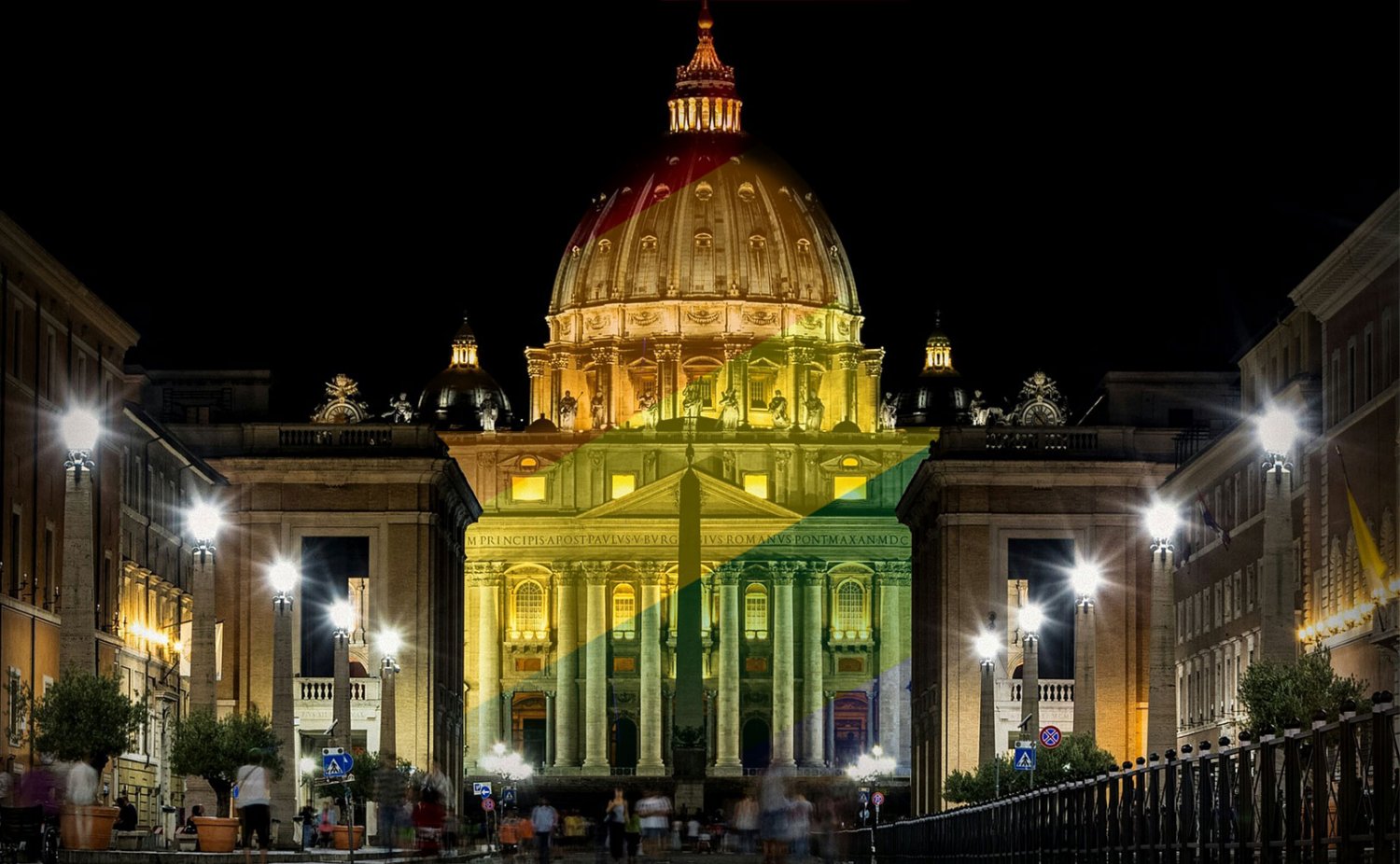
BIRDS OF A FEATHER FLOCK TOGETHER

Saturday, June 23, 2018

Pope Francis’s McCarrrick-like #HIMTOO Closest Confidants & Collaborators

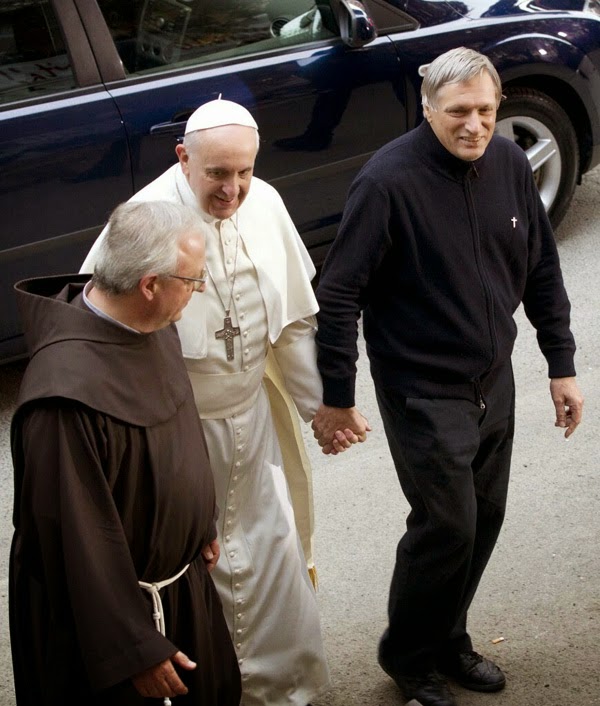
Pope Francis strolls hand in hand with the anti-gangster and gay rights advocate Fr. Luigi Ciotti.

Who has left a more suspicious #HimToo trail: Cardinal McCarrick or Pope Francis?

Pope Francis’s McCarrrick-like #HimToo inner circle:

Business Standard, September 19, 2017:

Francis’s Congregation for the Doctrine of the Faith perfect Archbishop Ferrer will go to trial for “complicity in alleged cover-up” of paedophile priest.

The Telegraph, July 19, 2013:

“Pope’s [Francis’s] ‘eyes and ears’ in Vatican bank ‘had string of homosexual affairs’… [Battista] Ricca is a trusted confidante of the Pope”

LifeSiteNews, March 7,2018:

Francis’s closest advisor in the C9 papal inner circle Cardinal Oscar Rodriguez Maradiaga left in charge of his Honduras archdiocese his close confidant Bishop Juan Pineda “accused of ‘abusing seminarians, having a string of male lovers.'”

National Catholic Reporter, April 29, 2014:

Francis’s close advisor in C9 papal inner circle Cardinal “Errazuriz [and his]… successor… [Cardinal] Ezzati” “Chilean cardinals close to pope stained by abuse cover-ups” of priest sex abuser of Juan Carlos Cruz.

The Remnant, September 12, 2017:

Francis’s confidant Cardinal Francesco Coccopalmerio’s Secretary has homosexual orgy in Vatican:

“Secretary to the powerful Cardinal Francesco ‘Positive Realities of Homosexuals’… [Coccopalmerio’s Secretary] Capozzi was arrested for hosting a raucous drug fueled homosexual orgy.”

New York Times, April 30, 2018:

“Cardinal George Pell, the [Francis] Vatican’s third-highest-ranking official, will stand trial… of sex abuse.”

BBC, August 29, 2010 & LifeSiteNews, September 16, 2017:

Francis collaborator invited by Pope to be number two representative in family synod “Belgian Cardinal Danneels condoned sex-abuse silence.”

The Week, January 3, 2017:

“Pope Francis and his cardinal allies… known to interfere…  on abuse cases… Consider case of [serial sex-abuser] Fr. Mauro Inzoli… Francis returned him to the priestly state.”

Vebuumdei.blogspot, June 23, 2014 & Catholic Monitor, April 18, 2017:

Francis strolled hand in hand down the street with gay rights advocate Fr. Luigi Ciotti at a anti-gangster event.

Chiesa, December 16, 2016:

Vatican expert Sandro Magister said Francis has a “number of homosexual priests in the inner circle of his closest collaborators and confidants.”

Caucus99percent.com, 02/02/2018:

“Pope Francis’ continuous aiding and abetting of sexual predators and his officials who protect them.”

“Although he was personally informed of the accusations against them, Pope Francis protected these sexual predators: Fr. Mauro Inzoli (the pope later defrocked Inzoli but he is still a free man) Luis Fernando Figari, Archbishop Anthony Apuron, Auxiliary Bishop Gabino Miranda Melgarejo, Fr. Don Corradi and Archbishop Josef Wesolowski.”

“After Pope Francis did nothing to stop Corradi, the priest and four others were arrested in November 2016 and charged with raping and molesting at least 22 children. More reports poured in and ‘it’s now thought that as many as 60 children fell victim to abuse.’”

“Wesolowski was put under Vatican house arrest 14 months after the pope judged him to be guilty only after ‘there was a serious risk that [he] would be arrested on Italian territory at the request of the Dominican Republic authorities and then extradited,’ as reported by Corriere della Sera. The archbishop was found with more than 100,000 computer files of child pornography, a “key ingredient” in sex trafficking. Wesolowski continued to possess child pornography even under Vatican house arrest.”

“Kamil Jarzembowski, a former student at the Vatican’s preseminary, wrote a letter about the sexual abuse of minors in the school and handed it directly to Pope Francis. The pope did nothing to stop it.”

“Pope Francis had ordered an investigation of Honduran Bishop Juan José Pineda by an Argentine bishop who was “shocked” by “accounts of sexual abuse perpetrated against priests and seminarians …. So far the only action that has been taken has been to send Bishop Pineda to stay with Jesuits in Madrid on a short retreat,” wrote veteran Vatican reporter Edward Pentin.”

“Pope Francis promoted Archbishop Luis Ladaria Ferrer as prefect of the Congregation for the Doctrine of the Faith, the Vatican department that judges cases of clergy sexual abuse. While Ladaria held the second highest position in the CDF, he found Fr. Gianni Trotta guilty of sexually abusing minors in 2012 but failed to inform the Italian authorities. Trotta, already convicted of sexual violence against an 11-year-old and sentenced to eight years in prison by a civil court, is now standing trial for nine other alleged cases of sex abuse against boys that occurred in 2014. Ladaria, himself, will stand trial in April, accused by French authorities of “complicity in the alleged cover-up” of Fr. Bernard Preynat.”

“A month after his election, the pope appointed a Council of Cardinals to help him govern the Church. Three of the eight initial members had protected pedophile priests: George Pell, Francisco Javier Errázuriz Ossa, and Oscar Rodriguez Maradiaga who he named as head of the council.”

“Pope Francis promoted to cardinal Archbishops Gerhard Ludwig Müller and Ricardo Ezzati who had covered up for pedophile priests.”

“Pope Francis has taken no action against any of the 14 other bishops accused of complicity with abusive priests. A recent investigation in France exposed five additional pedophile-protecting bishops still in office.”

“(Pope Francis has no problem taking action against people for reasons other than sex abuse. He removed Cardinals Gerhard Müller and Raymond Burke from their Vatican positions. He removed Fra’ Matthew Festing as Grand Master of the Knights of Malta, a position equal in status to cardinal in the Catholic Church. He removed the “Bishop of Bling.” He ordered that three priests be fired from the Congregation of the Doctrine of the Faith without explanation. Giulio Mattietti, deputy director of the Vatican Bank, was fired with no reason given.  Although religious orders usually select their own superiors, the pope dismissed the head of the Order of the Franciscans of Immaculata. Pope Francis excommunicated Fr. Greg Reynolds for advocating for women’s ordination. He excommunicated Martha Heizer, head of the reform international movement We Are Church, and her husband, Gert Heizer, for celebrating Mass in their home with a small group of friends.)”

“…Criticism of the pope has been limited to admitting that child sex abuse is merely a ‘blindspot.’”

“It was the same when, this past June 29, Cardinal George Pell was charged with “historic sexual abuse” and left for his native Australia. Pope Francis’ first ‘reform’ of the Vatican had been to create a Secretariat for (his) Economy, and give Pell ‘authority over all economic and administrative activities within the Holy See and the Vatican City State.’”

“Yes, some coverage has been more critical of late, especially Francis’s handling of the sexual abuse scandals in the wake of the criminal indictment of one of his top aides, Cardinal George Pell, in Australia. Even then the tone tends to be, ‘Francis is such a great guy, so why is this area lagging behind?’ observed the experienced Catholic reporter, John L. Allen Jr.”

It was reported with little, if any, criticism of Pope Francis by the mainstream American media.”

“… Again, when Pope Francis gave Cardinal Bernard Law a benediction at Law’s Dec. 21 funeral mass, there was little, if any, criticism. The Boston cardinal had been forced to resign after he had reassigned and covered-up for rape and sexual assaults of children by scores of priests for years without informing the public or the police.”

“Unfortunately for the world’s children, the U.S. mainstream media did not report that ‘There are still bishops who have chosen to protect the Church and their priests more than children” who ‘make Law look like an amateur,as declared by Fr. Thomas Doyle, a well-known author and victims’ advocate for over three decades.” [https://caucus99percent.com/content/us-media-pope-aiding-and-abetting-torture-moral-leader]

Pray an Our Father now for the restoration of the Church .

Image result for Fr. Luigi CiottiImage result for Fr. Luigi Ciotti

Posted in Uncategorized | 2 Comments

WILL WE SOON SAY GOOBYE TO ORDERS OF CONTEMPLATIVE WOMEN RELIGIOUS THAT ARE IN DANGER OF BEING SUPPRESSED AS THE FRANCISCAN FRIARS AND SISTERS OF THE IMMACULATE WERE SUPPRESSED ???


Another Evil Spirit of Vatican II

Pope to Purge What’s Left of Catholic Nuns

by Hilary White

More evidence keeps pouring into my email inbox that the current administration of the Congregation for Religious1 is planning on using the provisions of Cor orans to totally rewrite the nature of contemplative women’s religious life, particularly the “conservative” and traditional communities, in the name of the “New Paradigm” of VaticanTwoism. [

Editor’s Note:” Cor Orans” (“Praying Heart”) is

1 Formally, the “Congregation for Institutes of Consecrated Life and Societies of Apostolic Life” whose acronym, CICLSAL is unironically nicknamed “sickle cell,” after the blood disease, by some religious.

the title of an April 1, 2018 document that Implements instructions on how to apply Pope Francis’ 2016 Apostolic Constitution – “ Vultum Dei Quaerere” (“Seek the Face of God”) addressed to Catholic women religious in contemplative communities.

MJM] As I have written many times elsewhere, the one uniform characteristic of the current pontificate is the purge. It is clear now that Jorge Bergoglio was elected by a group of 1960s progressives

to bring about the final removal of the last elements within Catholicism that have resisted the Vatican II revolution. After 50 years of ambiguity, of the two implacably opposed “paradigms” living in an uneasy truce within the same institution, those few recalcitrants left who refused to accept the new liturgical forms, new theological “formulations,” the new disciplines are being forced either to conform or leave.

In all Catholic institutions the so-called “conservative” middle ground, the safe and reasonable compromise position that was allowed to exist under the last two pontificates has evaporated. As Amoris Laetitia will have the effect of forcing out priests and seminarians who refuse to desecrate the Holy Eucharist by giving it to unrepentant adulterers, so Cor orans will be used to remove “conservative” contemplative nuns who have refused to adopt the full Vatican II programme of “renewal” of religious life.

We must never forget the appeasement of LCWR by the Congregation for Religious after Pope Francis’ election. The new prefect1, Cardinal Joao Braz de Aviz, effectively apologised to the world’s most notoriously heretical organisation of modernist religious, soothing feathers that had been ruffled by his predecessor’s abortive attempt at bringing them back to Catholicity. Contrast this with the ruthless suppression by that office of the Franciscan Friars and Sisters of the Immaculate at the same time, and the programme becomes obvious.

This week I received another a document that included extensive quotes from a 2015 speech given by the Congregation’s Secretary, Jose Rodrigues Carballo, in which he darkly implied that traditional forms of Catholic religious life had “served their purpose” and must be allowed to die out so that something as yet undefined, but assuredly new and wonderful, could replace them.

At a meeting of religious formators in April 2015 in Rome, Carballo said quite clearly that it is Vatican II that must take precedence over the classical charisms of religious life. “With this explicit reference to the Second Vatican Council, we point to our profound conviction that the council is the point of reference, non-negotiable, in the formation to the consecrated life.”

In his speech in Avila2, Spain a month later, Carballo spoke even more plainly, denouncing the “many fundamentalist groups” in the religious life, saying, “This is not of the Spirit.” “Vatican II is our compass” he said, adding that the pope “takes his lead from Vatican II.”

Carballo said that with the collapse of vocations over the last 50 years, it is clear that the forms of religious life that have been known through the last 20 centuries have “done their task in the Church.” This, he said is a time of “purification” for the religious life. He called “some forms” of religious life “antiquated” and claimed that they “say hardly anything to people

1. Appointed by Benedict XVI, not Francis.

2. It’s maybe worth noting that Carballo’s speech was reportedly three hours long.

today.” These, he said “will not remain even though they have [had] a certain success.” [emphasis added.] “As with the Gospel,” Carballo said, the charisms of religious life “are on-going,” they “develop” and “continue to grow over time.” He said, “Some forms are dying out. But new forms are rising.”

With regard to the living of their charism, “The church asks us not only for fidelity but for creative fidelity,” he said.

He asked the assembled Carmelites, friars and nuns, “What does Teresa want now?”

and “we don’t want to walk as we did 500 years ago.” The charism “goes forward.”

He denounced those who respond “We have always done it this way,” saying that “even good people need changes,” and being “faithful does not mean staying the same.”

As is usual with Catholic progressives, he went on to spin the total collapse of religious life since Vatican II as a positive, comparing the current “chaos” in religious life with the conditions before Creation, urging those present to “think of Genesis” and to imagine “a new creation” that is coming soon.

Speeches and documents from the Congregation for Religious often employ the phrase “creative fidelity” or “dynamic fidelity” when speaking of the ancient orders or charisms. At this meeting, Carballo clarified this, saying it means that being “faithful does not mean staying the same.

This “updating”, he said, will be brought about through formation. “Only formation transforms the heart and mind.”

Given these hints, what Cor orans tells us is that with regard to the female contemplative life, the progressives, who expected the “chaos” of the post-conciliar upheaval they engineered to bring to birth a “new church,” are tired of waiting.

https://www.youtube.com/embed/ ETV1DXQk_Gk

With this pope they have been given a mandate to crush the remaining hold-outs and, instead of “singing,” to bluntly force “the new church into being.” Cor orans’ language, put together with Carballo’s clear messages in his various speeches, has made it unmistakable; this is a purge.

And the document is equally clear about its status as a piece of legislation. It isn’t a suggestion; superiors are already reporting receiving messages from Rome, and the existing federations and associations, that they are to implement it “immediately”.

It mandates membership in a federation, with that body’s president and council having unprecedented powers over finances, new foundations, formation and, crucially, decisions about the suppression of monasteries.

And the religious orders themselves are already on board. A document from the same meeting, the 2015 General Chapter of the Discalced Carmelites, blamed the imminent collapse of the order on the failure of the religious to get with the Vatican II programme.

“Despite the renewal required by Vatican II, our place in society has remained essentially unchanged compared to fifty years ago: we cater for the same people, we use roughly the same methods of communication, and our clerical-religious status is the very same. During these fifty years, however, society has changed dramatically at every level, economic, social, cultural, moral and religious. the consequence is that our ‘ecological niche’ has been progressively reduced,” the

Chapter’s final document said.

“The freedom to change…really is the first thing we stand in need of, and it is the condition needed to undertake a new route: to be free, detached from the structures and from the habits of the past but searching for new wineskins that can hold new wine.”

I think most faithful laypeople don’t have a very firm idea of what cloistered monastic religious life is like in our time.

We tend to develop a romantic and rosy picture, mostly derived from hagiography, movies and photos, and assume that a cloistered nun is someone who doesn’t go out of the monastery for any reason other than medical appointments, or perhaps to vote. We believe this is, at least, the ideal which cloistered nuns are aiming for.

Most of us assume that monastic cloister is taken seriously, that formation of nuns carries on serenely in-house, organised by the monastery’s council, approved by the abbess and guided by a mistress of novices according to the community’s constitutions, who takes loving charge of postulants after they enter. We picture classes that include reading from the writing of the foundress, Biblical studies and the theology of prayer, study of Patristics and the ancient sources. We picture silence, steady and calm labour about the house and garden and happy hours of recreation together. Above all, we think of it being separate from the outside world, a place where concentration on prayer – the communing with the Beloved Spouse – is not subject to external interference.

And I expect most people who love the cloistered, contemplative religious life, who consider it the highest expression of Catholic life in this world and an absolute necessity for the Church’s survival, also consider a return to this ideal as the way forward, perhaps, indeed, its only hope3.

But if we think that the people currently in charge of the religious life in Rome share this opinion and have the slightest interest in preserving religious life as we have known it, we are failing to grasp the current realities.

The information I’ve been receiving from all around the US and Europe is

3. It is.

that the image we have of cloistered life is almost extinct already. Perishingly few monasteries of any charism are even trying to retain it. Nearly all monastics – most of whom are governed by superiors formed in the 1970s-‘90s – have already fully internalized the foundational ideas of the Cor orans New Paradigm.

Most monasteries are already governed by federations and associations, all of which expect their members to attend meetings and formation sessions outside the monastic enclosure. The mandate of Cor orans for shared “ongoing formation,” programmes – that Carballo above made clear was the means by which the New Paradigm would be imposed – have already been adopted by the majority of monasteries and cloistered convents.

And the pressure on the few remaining holdouts who prefer to form their own novices and junior professed, is reportedly intense and constant.

The emphasis of the federations and associations is for more and more interconnectedness – in reality, more and more centralisation and dependence on the association. Shared formation programmes, as Cor orans mandates, are prepared not by the monasteries’ own novices mistresses, but by “professionals” chosen by the association leadership.

These “experts” are people with university degrees in “pastoral psychology” and the like. And this has been going on for decades4.

Nuns, even those who might be considered “conservative,” in full habits etc., routinely leave their monasteries, often traveling great distances to attend meetings of their Associations. Novices and juniors are expected to attend these “formation courses,” and pressure is put on a monastery that declines to participate.

These courses appear to be structured like an academic conference at which the novices from many monasteries gather at a hotel conference room to hear speakers and then “break into small groups” to talk about what they’ve heard. It seems that the techniques of modern corporate

4. I recall visiting a Poor Clare monastery near Vancouver in the early ‘90s and discovering that they do not receive postulants directly from the world at all. A young woman showing an interest in joining was sent across the country to spend a year or two living in Madonna House, a strange lay community in the woods near Combermere Ontario. Even at the time – I was 23 – I thought this shipping off of potential candidates was bizarre and I couldn’t understand how it would help prepare someone for the specific life of a Poor Clare.

They know not what they do…


management have become the working model for monastic life, with very little resistance.

And it’s not just novices. All nuns in “initial formation” are expected to attend, which includes those in temporary vows.

And they don’t leave you alone to get on with your monastic life in peace even after final vows. The “invitation” to attend these ongoing formation sessions is extended to novice mistresses and prioresses, as well as any nun who has made her vows within the last ten years. One nun wrote to me, “It’s as if they think just living the life isn’t sufficient formation.”

I asked her why she thought the nuns are being particularly targeted. She said, “As you well know, we are dealing with a lot of [Spanish] European and South American and Mexican men.” Due to her location, she said, she has dealt with such men most of her religious life and has “experienced their lack of respect (this is an understatement) toward women.”

“The men in Rome have always had the attitude that the male religious orders can take care of themselves because they are men. We need a lot of help and rules because we are women. This is the South American dictator mentality.”

This tone indeed came out in Carballo’s talk in Avila, when he chastised the religious for their fears that the Congregation was going to impose unwanted changes, particularly to their enclosure. “The church loves your life. If we promote change it is for your good.”

He added that he would not consider issuing another questionnaire, saying only “I ask you to have trust and pass along this trust in the Church. The Congregation is not going to destroy but to promote religious life in an adequate renewal fitting with today’s circumstances.”

My nun-correspondent added: “We do not mind having rules. We need rules. We do not need 289 rules. The Carmelite Rule is one of the simplest in the Church, yet it contains everything necessary. This life is very simple. Cor orans will strangle Carmel to death. We just want to focus on our Spouse.” ■

Cor Orans:

Posted in Uncategorized | 3 Comments

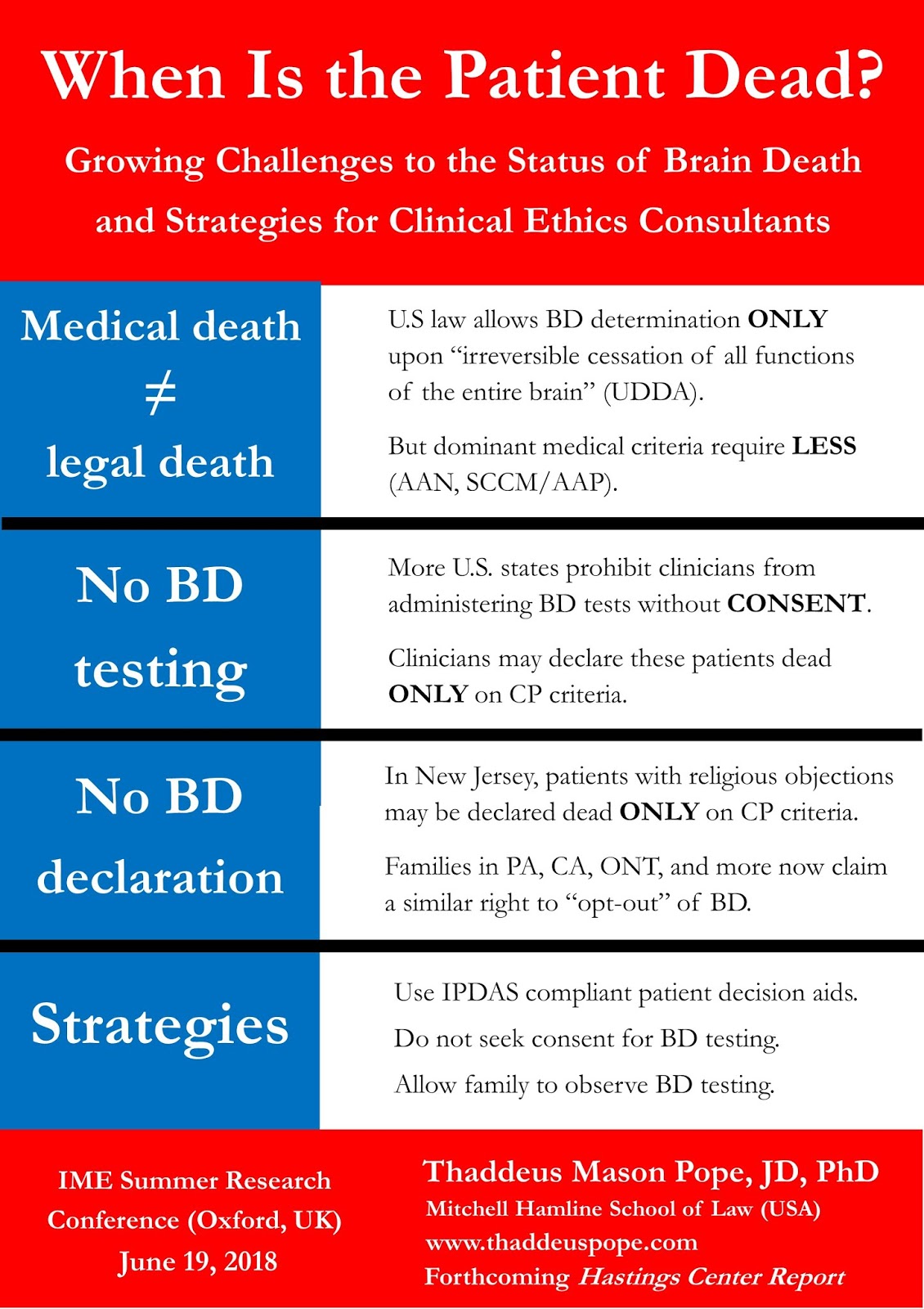
WHEN IS A PATIENT REALLY DEAD????


A LEXICON OF WORDS AND PHRASES TO BE USED BY THE MEDICAL AND LEGAL PROFESSIONS IN DEFINING AND DISCUSSING DEATH

DEATH is the total permanent loss of circulation of blood leading to the cessation of vital functions dependent on such circulation such as pulsation, respiration, brain activity leading in turn to the destruction of these vital systems and organs necessary for the preservation of human life.  Death is not an instantaneous phenomenon, it is a process.
PROCESS means the successive occurrence in time of the physiological changes named above in parts of the human body.
CHANGES described above causing death can be measured in nano-seconds, seconds, minutes, hours, days, weeks or longer. 

+++++++++++++

Imagine two deaf persons trying to communicate with each other each one using a different system of signs they learned in different schools for the deaf where they teach different systems of sign language.  That is crazy you would say, it is impossible for them to communicate since the signs each of them would be making with their hands would be meaningless to the other.

The same problem exists for all of us who are not deaf and who communicate verbally with words.  Words are signs.  Words communicate meaning given to them by common agreement by persons who belong to the same language group.  But even in the same language group there can be problems when idiomatic speech peculiar to one country is used in another country of the same language group, e.g. England and the United States.

The problem gets worse when people deliberately apply different meanings to words in order to advance a political or social agenda.  Abortion is a good example.  For most people the child-in-utero is a person, that displays all the attributes of personhood but cannot yet speak.  To those persons who promote abortion the child-in-utero is not a person because he cannot speak,to another he is not a person until he is born, to another he is not a person until he can reason at around seven years of age, and to reduce it to the absurd, to some he is probably not a person until he is 21 years old.

Words are signs to which society, by common consent, assigns meaning.  When people are consumed with a desire to promote some political, social or economic agenda they assign meaning to words that the great majority of other persons in the same society reject.

Such is the case with death.

To persons with a Malthusian or racist obsession, death is not longer a word describing a natural event.  It is a political or social or economic means to an end and natural death becomes irrelevant if hastening or causing the death of another person promotes some arbitrary good such as alleviating suffering, reducing world population, eliminating undesirable individuals or groups from society.

Since Doctor Christiaan Barnard in 1967 first successfully transplanted a human heart, the medical profession has ceased to be a profession and has become an industry.  The transplantation of organs from the human body of one person to the body of another person has become BIG BUSINESS.

The problem faced by the medical industry was the problem of death.  It is not possible to successsfully transplant human organs from a cadaver to a living person.  In order to transplant organs successfully they must be taken from the body of a living  person and transferred to the body of another living person and that procedure was illegal in practically every country in the western world up until the 21st Century.

How to solve that problem if the medical business was to reap the potential huge financial rewards of organ transplantation.  Simple.  Change the definition of death in the law.

A group of doctors met at Harvard University in 1972 and came up with the idea of defining death solely on the basis of the activity in the human brain.  Their proposal has come to be known as brain death.  Subsequent to the Harvard meeting the law was changed in all 50 states of the United States.  Now, the absence of the signs of brain activity in certain parts of the brain allows doctors to declare a patient “brain dead” and they can leglly proceed to extract all the organs of the patient for transplantation into another person even though blood is still coursing through the veins and arteries of the patient and with the aid of a ventilator pushing air into the lungs of the patient (the body of the patient will reflexively push the air out of the lungs) while the other organs are being removed.

Voila, the medical business now can remove the organs of everyone who enters a hospital as a patient.  All that is necessary is that the doctors induce coma.

How big is the organ transplantation business?  The Milliman Corporation does an actuarial study of all medical billings in the United States once every three years.  They have identified every organ transplantation that occurred in the United States in 2014.  They have identified every billing from the preparation for the operation for removal of an organ to the transportation to the donor to the placing of the organ in the recipient and the compensation of everyone involved until the recipient is declared well months after the transplantation.  How much money was involved in all of the transplantations in 2014?  Brace yourself !!!  The total amount of money changing hands in the medical business of organ transplantation in the United States in 2014 was:   $28,761,129,500.00.

Words are symbols with meaning.  We must fight to have the law in every state redefine death using the words I have written at the beginning of this post.

The Catholic Church is not opposed to organ transplantation, but insists that persons must not be harmed, much less killed, in order to procure organs for transplantation.  Here are some magisterial statements on the subject.

Pope John Paul II to the Participants of the 1989 Pontifical Academy of Sciences stated:

“The problem of the moment of death has serious implications at the practical level, and this aspect is also of great interest to the Church. In practice, there seems to arise a tragic dilemma. On the one hand there is the urgent need to find replacement organs for sick people who would otherwise die or at least would not recover. In other words, it is conceivable that in order to escape certain and imminent death a patient may need to receive an organ which could be provided by another patient, who may be lying next to him in hospital, but about whose death there still remains some doubt. Consequently, in the process there arises the danger of terminating a human life, of definitively disrupting the psychosomatic unity of a person. More precisely, there is a real possibility that the life whose continuation is made unsustainable by the removal of a vital organ may be that of a living person, whereas the respect due to human life absolutely prohibits the direct and positive sacrifice of that life, even though it may be for the benefit of another human being who might be felt to be entitled to preference.”9

In the same Address Pope John Paul II stated:

“Death can mean decomposition, disintegration, a separation (cf. Salvifici Doloris, n. 15; Gaudium et Spes, n. 18). It occurs when the spiritual principle which ensures the unity of the individual can no longer exercise its functions in and upon the organism, whose elements left to themselves, disintegrate.”10

Pope John Paul II in Evangelium Vitae, (n. 15), stated:

“Nor can we remain silent in the face of other more furtive, but no less serious and real, forms of euthanasia. These could occur for example when, in order to increase the availability of organs for transplants, organs are removed without respecting objective and adequate criteria which verify the death of the donor.”11

Incredibly, some jurisdictions are moving to make the donation of organs automatic, that is, there is a presumption in law that a person is willing to have his organs removed for transplantation.  Truly, we are rapidly moving into a dystopian future.

Posted in Uncategorized | 1 Comment

JUSTICE? SOME CARDINALS AND BISHOPS DO NOT KNOW THE WORD !!!

LIBERTY DEPENDS UPON VIRTUE
www.RestoreAmericanLiberty.com
America Cannot Remain Free Unless Her Citizens Are Governed by Virtue


ALERT:
Father C. Frank Phillips Found Innocent —- But Still Barred From Public Ministry?


We were just notified that Father C. Frank Phillips will not be permitted to return as Pastor of St. John Cantius Church in Chicago, Illinois, and as Superior of the Canons Regular which he founded.  This decision was handed down by the Archdiocese of Chicago (Cardinal Cupich), in spite of the fact that Fr. Phillips was found by the Review Board of the Congregation of the Resurrection to be completely innocent of any alleged misconduct.

Refer to the email cited below from www.ProtectOurPriests.com, which confirms that Fr. Phillips was cleared of all charges in the investigation.  The Review Board concluded that Fr. Phillips had not violated any criminal, civil or canon law.  Fr. Phillips was fully exonerated, and this in turn was confirmed by the votum of the Rt. Rev. Gene Szarek, C.R., Ph.D. Provincial Superior of the Congregation of the Resurrection upon receipt of the Review Board Report.

But apparently Cardinal Cupich, of the Archdiocese of Chicago, has a political axe to grind.  In over-ruling the verdict of the Congregation of the Resurrection, he has instructed that Fr. Phillips not be reinstated.  The attached PDF is the written statement from the Congregation of the Resurrection, which states that the Archdiocese of Chicago (Cardinal Cupich) will not allow Fr. Phillips to return to public ministry.

WHY is this?  I have several thoughts on the matter.

I believe it was a setup from day one.

This was a raw political move, by a cunning, crafty man, who happens to be the Cardinal of the Archdiocese of Chicago, made against a saintly man, who is a major leader in the restoration of the Traditional Latin Mass and Catholic culture.  Cupich has a long history of anti-traditional sentiment and related actions; his naked politics are hard-ball Progressivism.  The timing for the removal of Fr. Phillips was also coordinated just prior to Holy Week 2018, in order to provide cover and a distraction for pro-homosexual Fr. James Martin to speak to a youth group at Holy Name Cathedral in Chicago.

I could cite many other examples of his crimes against the Catholic faith, but the conclusion is clear:  Cupich is an anti-Catholic, and I would contend that he’s likely a card-carrying Marxist, one of the Communist Party members disclosed to Bishop Fulton Sheen to have been planted in the Catholic Church with the mission of destroying it from the inside.  How else to explain the pattern of destruction left in his path?

I have personally known Fr. Phillips for 25 years; he’s a good man, and I’m certain that he’s not going to take this unacceptable injustice lightly.  All of his life he has fought for the faith and worked tirelessly to restore all that is Sacred and Holy in the Catholic Church.  I do not expect him to throw in the towel now because too much is at stake.

Therefore, while we continue to pray for this situation to be resolved favorably, we need to seriously take the advice of St. James:  “Faith without works is a dead faith.”

Further legal action will be required in this matter to restore Fr. Phillips to his rightful duties.

I ask everyone to continue to donate to his Legal Defense Fund so that together, we can take this fight to the next level.  The current legal bill is north of $30,000, and I anticipate that a great deal more will need to be spent in the coming weeks and months to clear the good name of Fr. Phillips and to restore his ministry.

PLEASE be generous, and also kindly continue to help us promote the fundraising campaign via social media and especially via personal contacts.  This will help us to widen our base of support for Fr. Phillips.

Regards,

James Michael Francis Komaniecki, P.E.
President, CEO
www.RestoreAmericanLiberty.com, Inc.
LIBERTY DEPENDS UPON VIRTUE

630-302-9570
jmk@RestoreAmericanLiberty.com

Social Issues ARE Fiscal Issues
Aborted Future Taxpayers & Sterile Homosexual “Marriages” Undermine Our Prosperity

Posted in Uncategorized | 3 Comments

The Modernism of today is subtle, more camouflaged, more penetrating, and more hypocritical than the modernism of Pius X time. It does not want to stir up another tempest; it desires that the entire Church will find that it has become Modernist without noticing it. (…) Thus the Modernism of today saves all of Christianity, its dogmas and its organization, but it empties it completely and overturns it. It is no longer a religion which comes from God, but a religion which comes directly from man and indirectly from the divine which is within man.


The Roots and Historical Consequences of Modernism

OnePeterFive
{Emphasis by Abyssum in red type}

Translator’s Note: Roberto de Mattei’s paper, presented today in Rome, is entitled “The roots and historical consequences of Modernism”. It provides a detailed study of the origin of the present theological confusion in the Church in the ideas embraced at the time of the so-called “Modernist crisis” of the early 20th century. The teaching of Maurice Blondel that experience is the criteria of truth spread to influential theologians such as Alfred Loisy, George Tyrrell, and Ernesto Buonaiuti, who all affirmed in various ways that truth is not immutable, rather it evolves as man evolves. These writers in turn influenced Teilhard de Chardin, Henri de Lubac, and Karl Rahner, all of whom were extremely influential on the work and teaching of the Second Vatican Council. This “Neo-Modernism” subtly tried to influence the Church without revealing its agenda of dismantling the philosophical foundation of the immutable nature of Truth and the theological foundation of the unchanging character of Divine Revelation. Through a “revolution of language,” one of the key principles of Marxism, those who seek to foment revolution in the Church have used words such as “renewal,” “aggiornamento,” and “accompaniment” to radically change the Church’s praxis, falsely setting up a separation between doctrine and praxis. The writings and statements of contemporary churchmen such as Walter Kasper, Bruno Forte, and Jorge Bergoglio are imbued with this same thinking. Bergoglio is clearly a disciple of Blondel. The only effective way to combat the present culmination of the “Modernist crisis” is to embrace the immutable Tradition of the Church.


The roots and historical consequences of Modernism

Prof. Roberto de Mattei


 Conference on the occasion of the Study Day on

“Old and new Modernism: The Roots of the Church’ s Crisis”

Rome – June 23, 2018


            The origin of the term “Modernism”

It seems that the term “Modernism” was coined by the Belgian Catholic economist Charles Périn in his volume dedicated to Le modernisme dans l’Eglise[1] to indicate, under this name, a complex of errors which were penetrating the Church through the liberal Catholicism of Lamennais. In 1883 Padre Matteo Liberatore developed this theme with a series of articles in “Civiltà Cattolica[2].

The one, however, who gave the word “Modernism” its historical significance in the sense in which we still use it was Saint Pius X, who first used the term in the decree Lamentabili[3] of 3 July 1907 and in the encyclical Pascendi[4] of 8 September 1907. With this name Pius X wanted to define the united nature of the theological, philosophical and exegetical errors which had been spreading within the Catholic Church during the decades prior to his pontificate.

When he published Pascendi, Pius X had been reigning for only four years, whereas Modernism had had a long period of incubation. In order to trace its origins one must trace a genealogy of errors which took root above all within German philosophy in the 19th century. In fact, Modernism is derived from two lines of thought stemming from Lutheranism: the rationalism of Kant and Hegel, which reduced religion to philosophy, and the irrationalism of the “philosophers of feeling,” Jacobi and Schleiermacher, who identified religion with a feeling (sentiment) of the divine.

But Modernism is more than a doctrine: it is a new psychological attitude in the face of the modern world which can be linked to Americanism, a complex of new theories proposed by Fr. Isaac Hecker (1819-1888), a Protestant convert who became the founder of the Paulist congregation, who proposed the idea of a general evolution of faith and an accommodation of the Church to the exigencies of modernity.

This change of mentality developed above all during the pontificate of Leo XIII. On the philosophical level, the thought of Leo XIII was categorically opposed to modernity. In this sense, the encyclical Aeterni Patris of 4 August 1879 was a true manifesto against the errors of modern philosophy, in which the Pope affirmed that the great way for recovering lost truth was a return to to the philosophy of St. Thomas Aquinas. It was no coincidence that Pius X, in an Apostolic Letter written to the Roman Accademia of St. Thomas, affirmed that one of the principal titles of glory of Leo XIII was having sought “first and foremost and with all his strength to restore the doctrine of St. Thomas Aquinas.”[5]

On the political and pastoral level, however, Leo XIII sought to reconcile with the modern world which he fought on the philosophical level. This spirit of compromise was principally expressed in the idea of ralliement[6], or in the politics of rapprochement with the masonic and secularist Third Republic in France as endorsed by the encyclical Au milieu des sollicitudes[7] of 16 February 1892.

Modernism presented itself, purely arbitrarily, as the transposition of ralliement from the political to the theological and philsophical level. Ralliement actually encouraged numerous members of the clergy (not only in France) to extend an openness to the modern world beyond the political level to include the theological level. Leo XIII, it was said, had opened the way to a more modern and scientific teaching in which exegesis and history ought to accompany theological and philosophical research.[8] The Institut Catholique of Paris showed itself to be a “laboratory” of new tendencies. It was here that Msgr. Louis Duchesne (1843-1922) taught Church History and, under his guidance, Alfred Loisy (1857-1940) was formed as a docent of exegesis. It was Loisy who carried the “historical-critical” method of his teacher to extreme consequences. A third personality, Abbé Marcel Hébert (1851-1916), translated the ideas of Loisy and Duchesne into the philosophical realm. According to Abbé Barbier, these three priests, two of whom ended up in apostasy, exercised a decisive influence on the orientation of young clergy and young lay Catholics during the years 1880-1893.[9] 

This “Neo-Christianity” also spread rapidly outside the walls of the Institut Catholique. On 7 June 1893, the young Maurice Blondel (1861-1949), defended his doctoral thesis at the Sorbonne entitled L’Action: Essai d’une critique de la vie et d’une science de la pratique.[10] In this work which was destined to be widely acclaimed, he proposed that the human spirit is led by an internal dynamism to seek God in the immanence of action. Blondel’s new “philosophy of immanence” sought to substitute “intellectualism” with the aspirations of the heart and the exigencies of life, seeking the roots of the supernatural within man’s own nature. Based on this premise of immanentism, modern thought derived the idea that man, by following his desire for the infinite, can participate in the divine infinity in his identity. What united the philosophical method of Blondel to the scientific method of the new historians and exegetes was the primacy of place given to experience as the ultimate criteria of all certainty and truth.

Leo XIII began to take account of the danger represented by these new exegetical and philosophical doctrines. After the Apostolic Letter Testem Benevolentiæ[11] against Americanism on 22 January 1889, he published on 8 September 1899 his letter to the clergy of France Depuis le jour,[12] with which he reaffirmed the urgency of returning to the philosophy and theology of Saint Thomas. But the new philosophical and exegetical tendencies were still spreading.


St. Pius X and Modernism

        The spark that would set off the Modernist controversy was the polemic initiated by the appearance in 1902 of the essay by Abbé Alfred Loisy L’Evangile et l’Eglise,[13] written in response to the interpretation of Christianity which had been given by the Protestant exegete Adolf von Harnack (1851-1930) in his lectures at the University of Berlin. Loisy, applying the new “historical-critical” method to the exegetical field, denied or nullified the revealed nature of the Old and New Testament, the divinity of Christ, the institution of the Church, the hierarchy, and the sacraments. In a retrospective analysis of his work, he declared that he had wanted “an essential reform of Biblical exegesis, of all of theology, and finally of Catholicism in general.”[14]

The debate was further extended to the philosophical field by the Oratorian Lucien Laberthonnière (1862-1932), director of the “Annales de philosophie chrétienne,” in which he laid out the argument for the necessity of separating Christianity from Thomistic Aristotelianism, and also by Edouard Le Roy (1870-1954), the successor of Bergson at the College de France, for whom dogmatic truth was only an element giving orientation to praxis and which could not be demonstrated to be true in itself, but rather could only be translated into ethical action.

The two principal theologians of the movement were two priests, George Tyrrell of Ireland (1861-1909) and Ernesto Buonaiuti of Italy (1881-1946). Tyrrell converted from Calvinism to Anglicanism and then to Catholicism (1879) and then entered the Society of Jesus, identifying Revelation with “religious experience,” which is accomplished in each individual conscience, through which the lex orandi dictates the norms of the lex credendi, and not vice-versa. In fact, this Revelation-experience, “cannot come to us from outside; the teaching can be the occasion, not the cause.”[15]

Buonaiuti was professor of Church history at the Seminario dell’Apollinare and the author of Programma dei modernisti, which appeared anonymously in Rome in October 1907. This work constituted an attempt to make an organic response to Pascendi and was praised by the chief propoents of the Modernist movement like Tyrrell, who translated it into English.

Modernism finally found, according to the expression of Loisy, an important “agent of connection” in the figure of Baron Friedrich von Hügel (1852-1925). The son of an Austrian father and a Scottish mother, by means of his social prestige and his cosmopolitan status, von Hügel was “the intermediate link between German-English and Italian society, between the ideas of the philosophy of action and those of historical immanence.”[16] Paul Sabatier (1858-1928), defined von Hügel as the “lay bishop of the Modernists,”[17] but Tyrrell presented him to Abbé Henri Brémond (1865-1933) as their “lay Pope.” Our program, he wrote with sarcasm, “is a religion made perfectly acceptable and which will be received with open arms by the major part of the Anglican and Protestant confessions; and when the papacy will be completely confounded and discredited, we will march on the Vatican and we will install the Baron [von Hügel] on the Chair of Peter as the first lay Pope.”[18]

Faced with this aggressive and underground movement, Pius X reacted with the publication of a prophetic document, the encyclical Pascendi.

The nucleus of Modernism for St. Pius X did not consist only in opposition to one or another of the revealed truths, but in the radical transformation of the whole notion of “truth” itself, through the acceptance of the “principle of immanence” which is at the foundation of modern thought, as is summed up in proposition 58 condemned by the Decree Lamentabili: “The truth is no more immutable than man himself, for it evolves with him and for him.”

Immanence is a philosophical conception which assumes experience as an absolute and excludes all transcendent reality. For the modernists, it is born from a religious feeling, which by not placing itself on any rational foundation is in reality fideism. Faith is thus not an adhesion of the intelligence to a truth revealed by God, but a religious exigency which springs from the obscure foundation (the subconscience) of the human soul. The representations of the divine realities are reduced to “symbols,” whose “intellectual formula” changes according to the “interior experience” of the believer. The formulas of dogma, for the Modernists, do not contain absolute truths; they are images of the truth which ought to adapt themselves to religious feeling.

In the final analysis religious truth resolves itself in the self-conscience of the individual faced with the individual problems of faith. In this sense there is a return to the tendency of Gnosticism to embrace all truths by means of one principle, the subjectivity of the truth and the relativity of all of its formulas.[19] For St. Pius X, “in fact the immanence of the Modernists desires and admits that each phenomenon of conscience is born from man in each man. Therefore as a legitimate consequence we may deduce that God and man are the same thing: it is therefore pantheism.[20]

Pascendi may be considered to be a fundamental document of the Magisterium of the Church, and among all the acts of Pius X it remains, as Padre Cornelio Fabro wrote, “the most distinguished monument of his pontificate.”[21] In turn the historian Emile Poulat emphasizes that Pascendi is the logical outcome of the direction affirmed by Pius IX a half-century earlier in the Syllabus of Errors (1864): “Pius IX denounced errors ad extra (outside the Church) which were running through the world; Pius X, in contrast, condemned a phenomenon ad intra (inside the Church), condeming these same errors which were infiltrating the Church, where they had taken form and root.”[22]


From Modernism to Nouvelle théologie

Saint Pius understood that he was dealing not with a philosophical school but with a [political] party, and in the Motu Proprio Sacrorum Antistitum[23] of 1 September 1910 with which he imposed the anti-Modernist oath, he also advanced the hypothesis that Modernism formed a true and real “secret society” within the Church.[24] A witness from “within” the movement like Albert Houtin describing the level of Modernism foresaw that the innovators would not leave the Church, not even even if they would lose their faith, but that rather they would remain within the Church as long as possible so as to propagate their ideas.[25] “Up until now,” explained Buonaiuti, “they wanted to reform Rome without Rome, or perhaps against Rome. There is a need to reform Rome with Rome; to make the reform pass through the hands of those who need to be reformed. Behold, this is the true and infallible method; but it is difficult. Hic opus, hic labor.”[26] Modernism proposed, in this perspective, to transform Catholicism from within, leaving intact, as far as possible, the external trappings of the Church.

How is it possible to imagine that such a vast and complex movement would have surrendered after being condemned? In the years following the death of Pius X, the strategy of the Modernists was to declare Modernism inexistent and to strongly condemn the anti-Modernist movement. The tendencies of the innovators in the Biblical, liturgical, theological, and ecumenical fields continued to develop within the Church in an apparently spontaneous manner without any order or direction, as had already taken place under Leo XIII. In reality Modernism was circulating, not only in books, but throughout the entire body of the Church, poisoning every aspect. This allowed the “nouvelle théologie” which was just emerging to present itself as a “living” theology and philosophy, linked to history, in opposition to the bookish abstraction of the Neo-Scholastic school.

In Belgium, at Tournai, stood the Dominican convent of Le Saulchoir, where, beginning in 1932, Pere Marie-Dominique Chenu (1895-1990) was “regent of studies.” In 1937 there appeared his wise proto-manuscript, entitled Une école de théologie, Le Saulchoir,[27] which wanted to be a “methodological” program for the formation of Dominican students. Chenu criticized anti-Modernist theology in the name of a “Christ of faith” who can be known (as the Modernists wanted) in the “Christ of history.” In the measure in which historicity is the condition of the faith and of the Church, the theologians ought to be able to read “the signs of the times,” or the manifestation of faith in history.

The “manifesto” of the French Dominican was placed on the Index by a decree of the Holy Office on 4 February 1942, and Chenu was removed from his position. But his disciples, like Pere Yves Congar (1904-1995), were more convinced than ever that their generation ought to “recover and transfer into the patrimony of the Church any element of value which could emerge from embracing Modernism.”[28]

What the school of Le Saulchoir was for the Dominicans, the university institute of Fourvière near Lyon was for the Jesuits. This school was influenced above all by the teaching of Pere Auguste Valensin (1879-1953), a disciple of Blondel and close friend of another leading personality, the Jesuit Pierre Teilhard de Chardin (1881-1955), who was suspended from his teaching position in 1926 and condemned by the Holy Office in 1939. The most direct continuer of the work of Blondel and Teilhard was Pere Henri de Lubac (1896-1991), who had known Teilhard at the beginning of the 1920s, and was profoundly influenced by him.

Corresponding to the “nouvelle théologie” was the idea of a “nouvelle chrétienté” elaborated in the same years by the French philosopher Jacques Maritain (1882-1973). His work Humanisme intégral[29] (1936) exercised an influence no less than that of Blondel’s Action, above all on the laity[30]. Despite Maritain’s declared adherence to the principles of Thomism, his philosophy of history and his sociology converged with the Neo-Modernism which was flourishing among the young religious of the Jesuit and Dominican orders.

In 1946 there appeared an important article by Pere Réginald Garrigou-Lagrange (1877-1964), one of the most acute theological minds of his time, on the theme La Nouvelle Théologie où va-t-elle?[31]. The Dominican theologian affirmed that the nouvelle théologie comes from Modernism and leads to complete Apostasy. “In place of the philosophy of being or ontology there is substituted the philosophy of action, which defines the Truth as a function, not of being, but of action. Thus one returns to the Modernist position: ‘The truth is not any more immutable than man, because it evolves with him, in him, and through him’ (Denz. 2058).For this reason Saint Pius X said of the Modernists: ‘They pervert the eternal notion of truth’ (Denz. 2080).”

The Nouvelle Thélogie was thus condemned by Pius XII on 12 August 1950, with the encyclical Humani Generis.[32] The Pope denounced the “poisonous fruits” produced by “novelties in almost every field of theology” and condemned, without naming them, those who made their own the language and mentality of modern philosophy and who attempted “to be able to explain dogmas with the categories of contemporary philosophy, whether of immanentism, idealism, existentialism, or whatever other system.”[33] The principal error condemned by the encyclical was relativism, according to which human knowledge never has a real and immutable value, but only a relative value.

The encyclical Humani generis did not succeed in stopping the advance of the Nouvelle Théologie, which in the final years of the pontificate of Pius XII extended itself to the field of moral theology. The primary subverters of traditional morality were the German Jesuit Josef Fuchs (1912–2005), the Italian Redemptorist Domenico Capone (1907-1998), and above all the German Redemptorist Bernard Häring (1912-1998). The Nouvelle Thèologie, daughter of Modernism, supported the principle of the evolution of dogmas. The new moralists extended this principle to the moral realm, substituting in place of the absolute and immutable natural law a new moral law which was affective, personal, and existential. The individual conscience became the sovereign norm of morality.


The anthropological shift of Vatican II 

Writing to Cardinal Ottaviani on 9 May 1961, Cardinal Ernesto Ruffini (1888-1967) expressed himself without using half-measures: “I have said it other times and I repeat it: Modernism, condemned by St. Pius X, today has become freely spread in aspects even more serious and deleterious than it was then!”[34] The same Cardinal Ruffini, together with Cardinal Ottaviani, had suggested to John XXIII, who succeeded Pius XII in 1958, to convoke an ecumenical Council, thinking that such a council would have condemned the errors of the time in a definitive manner. But John XXIII, in his allocution which opened Vatican II on 11 October 1962, explained that the Council had been launched not to condemn errors or formulate new dogmas, but rather to propose, with language adapted to new times, the perennial teaching of the Church.[35] What actually happened was that the primacy attributed to the pastoral dimension effected a revolution in language and in mentality. It was this new mode of expressing itself which, according to the Jesuit historian Father John W. O”Malley, “signaled a definitive rupture with the preceding Councils.”[36]

The Council Fathers were surrounded by “experts,” or “periti,” charged with revising and re-elaborating the schemas and, often, preparing the interventions of the Council Fathers. Many of these theologians had been suspected of heterodoxy during the pontificate of Pius XII. The first objective they achieved was that of rejecting the conciliar schemas written by the preparatory commissions. The rejection of these schemas which, according to council regulations, were supposed to form the basis for the discussion, signaled a capital turning point in the history of the Second Vatican Council.[37]

An Italian bishop, Msgr. Luigi Borromeo (1893-1975), even in the very first session of the Council, wrote in his diary, “We are in full Modernism. Not the naive, open, aggressive and combative Modernism of the time of Pius X, no. The Modernism of today is more subtle, more camouflaged, more penetrating, and more hypocritical. It does not want to stir up another tempest; it desires that the entire Church will find that it has become Modernist without noticing it. (…) Thus the Modernism of today saves all of Christianity, its dogmas and its organization, but it empties it completely and overturns it. It is no longer a religion which comes from God, but a religion which comes directly from man and indirectly from the divine which is within man.”[38]

Msgr. Borromeo intuited the “anthropological shift” of the Second Vatican Council which translated Modernism’s philosophical principle of immanence to the theological level. The major interpreter of this shift was the Jesuit Karl Rahner (1904-1984) [39],  the theologian who exercised the greatest influence on the Second Vatican Council and on the post-conciliar period. The conservative Council Fathers had a clear awareness of the errors which snaked their way into the heart of the Church, but they overestimated their own strength and underestimated the strength of their adversaries. The Nouvelle théologie was not only a theological school, but an organized party, with a precise objective and strategy. The voice of Msgr. Antonino Romeo (1902-1979), who at the beginning of January 1960 had launched in the journal “Divinitas” a deep attack against the Biblical Institute,[40] denouncing the existence of an articulated conspiracy on the part of the neo-Modernists who were working within the Church, remained an isolated one.[41]

The epoch of the Council was also the epoch of the greatest diffusion of communism, the principal error of the twentieth century, which Vatican II ignored. It is not difficult to see in the “primacy of the pastoral,” which made great strides in those years, the theological transposition of the “primacy of praxis” enunciated by Marx in his Thesis on Feuerbach, with these words: “It is in praxis that man ought to demonstrate the truth, that is, reality and power, the coming down to earth [mondano] of his thought,”[42] and “the philosophers have only interpreted the world in diverse ways; now however they try to change it.”[43]

The liberation theology of Latin America, in its different versions, was the point of confluence between progressive theology and the Marxist thought of the twentieth century[44]. The encounter betweeen these two currents was precisely in the affirmation of the primacy of praxis, that is, in the idea that what is more important than the truth is the experience that is drawn from action. Thus a communist theorist of the 1980s, Lucio Lombardo Radice (1916-1992), wrote that the essence of liberation theology is in “a reversal of the theology-praxis relationship. Not a praxis of theology, but rather a theology taken from a praxis of faith.”[45]

In accord with this perspective, Giuseppe Alberigo, who wanted to make the school of Bologna the continuation of that of Le Saulchoir, entrusts to the field of history the task of the “ecclesiological reform” advocated by the “nouvelle théologie” and, before that, by Modernism.

In the post-conciliar period, historical praxis became a “locus theologicus.”[46] The truth-history relationship was reformulated following the thought of Cardinal Kasper, in the form of a “critical theory of Christian and ecclesial praxis.”[47]The theology which developed in the reception of Vatican II is thus characterized by its peculiar historicity,”[48] wrote Msgr. Bruno Forte, echoing the “manifesto” of Le Soulchoir. It is in this perspective that it is necessary to place key words of the conciliar epoch such as “pastoral,” “aggiornamento,” “signs of the times,” which in recent years have effected a true and proper cultural revolution by means of language.[49]


Neo-Modernism in the Church today 

How extensive is the presence of Neo-Modernism in the Church today? It is difficult to find a seminary or a Catholic university that is immune from it. The question ought to be turned around: Which seminary or Catholic university is faithful to the Magisterium of the Church? Unfortunately, it is not difficult to answer this question. Modernism pervades the Church, even if few explicitly claim it. Among those who do is Cardinal Gianfranco Ravasi, who in an article which appeared in the newspaper Sole-24 Ore affirmed that the intuition at the foundation of modernism “was linked to the necessity of a cultural and systematic ‘aggiornamento’ of the analysis and communication of the Christian message” and that “in itself this undertaking was not only legitimate but necessary.” In Ravasi’s interpretation, Loisy, Tyrrell, and Buonaiuti were “theologians of great intellectual quality who were attacked by the anti-Modernist repression of the Church.”[50]

Furthermore, Cardinal Ravasi, affixed his preface to La vita di Antonio Fogazzaro[51], a book by Tommaso Gallarati Scotti (1878-1940) which was placed on the Index of Forbidden Books (9 December 1920), for its apologia of an author who had been repeatedly placed on the Index, the Vicenzan author Antonio Fogazzaro (1842-1911). The names of Fogazzaro and Gallarati Scotti accompany each other in the pages of Cardinal Ravasi along with other Modernists, such as Tyrrell, Loisy, Murri, Buonaiuti, all of whom were excommunicated and all of whom are remembered by Ravasi as interpreters “of the ferment that was then developing in society and culture.”[52]

Cardinal Kasper does not claim Modernism as explicitly as Ravasi does, but his philosophical and theological vision is imbued with the same errors. His teachers are Schelling and Hegel, Heidegger and Rahner. From these authors he takes up the idea of a “renewal of the theological method” in which becoming prevails over being, time over space, history over nature, Scripture over Tradition, praxis over doctrine, life over truth.

In the presentation with which Cardinal Kasper opened the the work of the Extraordinary Consistory on the family on 20 February 2014, Christianity is transformed into life without truth, or better still into life which produces the truth in the “becoming” of experience. Praxis becomes the measure of value, and since the life of many Christians today is immersed in sin to the point that they no longer consider it to be sin, the Church ought to adapt her doctrine to these lived convictions, negating the very concept of sin itself, deprived of any ontological significance. The ultimate criteria of truth becomes sociological reality.

The good rapport between Pope Francis and Cardinal Kasper is well-known, but despite the fact that Padre Bergoglio spent a period of study in Germany, it is difficult to imagine that he had the intellectual tools to understand the most cryptic passages of Rahnerian-Kasperian theology. The culture of Bergoglio, more than it is indebted to his Jesuit brother Rahner, is indebted to another Jesuit brother, Father de Lubac, and through de Lubac, it is linked to Blondel, as many exegetes of Bergoglian thought assure us.

Among those who would attempt to exonerate Pope Francis from every stain of heterodoxy is Professor Massimo Borghesi; however, he contradicts himself when he assures us that Pope Francis is Blondelian, through father Gaston Fessard (1897-1978).[53] Maurice Blondel was in fact a Modernist because he created his philosophical method out of the principle of immanence, as Fathers Tonquédec[54], Réginald Garrigou Lagrange[55] and  Cornelio Fabro[56] have demonstrated in numerous writings. In 1924 the Holy Office condemned twelve propositions taken from the philosophy of Blondel, among which was the one concerning his notion of truth as “conformity of mind and life” and no longer as rational conformity of the intellect with the thing being inverstigated (adaequatio rei et intellectus).

The relationship of Blondel with Papa Bergoglio was brought to light by another one of his Argentine Jesuit brothers, Padre Juan Carlos Scannone, who in his volume François philosophe[57] dedicates many pages to the parallel between Bergoglian philosophy and “la dialectique blondélienne de l’action.”[58]

Francis and Blondel are united in their anti-intellectual conception of knowledge and in the reduction of truth to method or language. The formula, “God is not an equation”[59] expresses this conception, which Professor Gian Enrico Rusconi defines as “narrative theology.”[60] Rusconi recognizes that Pope Francis claims to change the paradigm of Catholic theology, from systematic theology to narrative theology, from argumentation to narration, in the attempt to redefine the very identity of Catholicism with new mythical or metaphorical semantic codes.

Pope Francis affirms in “Evangelii gaudium” (nn. 231-233) and in “Laudato si’” (n. 201) that “the reality is more important than the idea.” Padre Scalese has observed that the postulate “the reality is more important than the idea” has nothing to do with the ‘adaequatio intellectus ad rem.’ “Rather, it means we must accept reality as it is, without attempting to change it based on absolute principles, for example moral principles, which are only abstract ‘ideas,’ which most of the time risk becoming ideologies.”[61]

Papa Bergoglio is neither a theologian nor a philosopher, but the phrase which says that the reality counts more than the idea is a philosophical affirmation which overturns the primacy of being and contemplation which is the basis for all of Western and Christian philosophy. The contraposition between the theologian pope and the pastor pope signifies the end of dogmatic and moral theology as norms of action for the Christian person. Pastoral ministry, without theology, loses the absolute references of metaphysics and of morality and offers us instead an ethics of “day by day and case by case.” Human action is reduced to the choice of the individual conscience, based not in the objectivity of the divine and natural law, but in the “becoming” of history. But because every idea has consequences in reality, we must also resort to history to demonstrate the catastrophic consequences of these errors.

Just as it would be wrong to combat the symptoms of a revolution without addressing the ideological causes, it would also be erroneous to attempt to abstractly refute errors without considering their concrete consequences. Today we are facing a revolutionary process which ought to be evaluated at the level of thought, of action, and of deeper tendencies. This is one of the teachings which I owe to Professor Plinio Correa de Oliveira, author of a book which appeared in 1943, Em defesa de Ação Catolica,[62] which constitutes one of the first wide-ranging refutations of the modernist deviations within Catholic Action in Brazil and in the world.

The problem which we are confronting is not an abstract question, but rather it touches concretely the way in which we live our faith at an historic moment described by Benedict XVI on the eve of his renunciation of the papacy in these words: “As we know, in large areas of the world the faith is in danger of being extinguished like a flame which no longer has any fuel. We are facing a profound crisis of faith , a loss of the religious sense, which constitutes the greatest challenge for the Church of today.[63]

I believe that at the roots of the abdication of Pope Benedict there may be also the awareness of having lost this challenge as a result of the inadequacy of the “hermeneutic of continuity,” a theological approach which makes the very same error which it wants to combat. It is necessary to oppose neo-Modernism, which presents itself as a changeable and subjective interpretation of Catholic doctrine, not with a contrary hermeneutic, but rather with the fullness of Catholic doctrine, which coincides with Tradition, maintained and transmitted not only by the Magisterium but by all the faithful, “from the bishops to the last layperson,” as expressed by the celebrated formula of Saint Augustine.[64] The sensus fidei impels us to refute every hermeneutical deformation of the truth, supported by the immutable Tradition of the Church[65].

At any rate, it is not enough to limit oneself to affirming that the doctrine of the Faith is immutable, it is also necessary to add to this that the Faith is not impractical and it does not admit of exceptions on the level of praxis. It is necessary to reintegrate the disassociation which the neo-Modernists have created between doctrine and praxis, restoring to Truth and to Life the inseparable unity expressed in those words of Jesus Christ which show us the only possible Way in the darkness of the present moment (Gv 14, 6).


Translated by Giuseppe Pellegrino


NOTES:

[1] Charles Périn, Le modernisme dans l’Eglise. D’après des lettres inédites de Lamennais, Victor Lecoffre, Paris, 1881.

[2] Matteo  Liberatore, S. J., Il naturalismo politico, introduction and editing by Giovanni Turco, Rispostes, Giffoni Valle Piana 2016.

[3] Decr. S. Officii Lamentabili, 3 July 1907 in AAS, vol. 40 (1907), p. 470-478; Denz-H, nn. 3401-3466.

[4] Pius X, Enciclica Pascendi dominici gregis, 8 September 1907 in AAS, vol. 40 (1907), p. 596-628; Denz-H, nn. 3475-3500.

[5] S. Pius X, Lett. Apost. In praecipuis laudibus, 3 January 1904, in AAS, 36 (1903-1904), p. 67.

[6] Roberto de Mattei, Il Ralliement di Leone XIII. Il fallimento di un progetto pastorale, Le Lettere, Firenze 2015.

[7] Leo XIII, Enc. Au Milieu des sollicitudes, 16 February 1892, in AAS 24 (1891-1892), pp. 519-529.

[8] Cfr. F. Laplanche, La crise de l’origine. La science catholique des Evangiles et l’histoire du XXème siècle, Albin Michel, Paris 2006; id., La Bible en France entre mythe et critique, XVI-XIX siècles, Albin Michel, Paris 1994.

[9] Emmanuel Barbier, Histoire du catholicisme libéral et social en Francedu Concile du Vatican à l’avènement de SS. Benoit XV (1870-1914), Cadoret, Paris 1923-1924, vol.  III, p. 199.

[10] Maurice Blondel (1861-1949), L’Action. Essai d’une critique de vie et d’une science de pratique, Alcan, Paris 1893. This work was reprinted on the occasion of its centenary by Presses Universitaires de France, Paris 1993.

[11] Letter Testem benevolentiae de americanismo, 22 January 1899, in ASS, 31 (1898-99), pp. 470-479.

[12] Leone XIII, Depuis le jour, to the Archbishops, Bishops, and Clergy of France, 8 September 1899, in AAS, 32 (1899-1900), pp. 193-213.

[13] This essay, published by the editor Picard on 17 January 1903, was placed on 23 December 1903 on the Index of Forbidden Books together with four other works of Loisy, who was personally excommunicated on 7 March 1908.

[14] Alfred Loisy, Choses passées, Nourry, Paris 1913, p. 246.

[15] George Tyrrell, Through Scylla and Charydbis, London, Green and Co. 1907, pp. 305-306.

[16] Giuseppe Prezzolini, Cos’è  il modernismo, Treves, Milano 1908, p. 75.

[17] Paul Sabatier, Les modernistes, Fischbacher, Paris 1909, p. LI.

[18]Lettres de Georges Tyrrell à Henri Bremond, Aubier-Montaigne, Paris 1971, p. 280.

[19] Cornelio Fabro, Modernismo, in Enciclopedia Cattolica, vol. VIII, col 1191.

[20] S. Pius X, Pascendi, n. 228.

[21] C. Fabro, Modernismo, col. 1190.

[22] Emile Poulat, Modernistica. Horizons, Physionomies Débats, Nouvelles Editions Latines, Paris 1982, p. 25.

[23] Motu proprio Sacrorum antistitum of 1 September 1910, in AAS, 2 (1910), p. 669-672 ; Denz-H, nn. 3537-3550.

[24] Pius X, Motu proprio Sacrorum Antistitum, p. 655.

[25] A. Houtin, Histoire du Modernisme catholique, published by the author, Paris 1913., pp. 116-117.

[26] Ernesto Buonaiuti, Il modernismo cattolico Guanda, Modena 1943. p. 128.

[27] Marie-Dominique Chenu, Le Saulchoir. Una scuola di teologia, preceduto da una nota introduttiva di G. Alberigo, Marietti, Casale Monferrato 1982.

[28] Aidan Nichols, Yves Congar, San Paolo, Cinisello Balsamo 1991, p. 12.

[29] Cfr. Jacques Maritain, Humanisme intégral. Problèmes temporels et spirituels d’une nouvelle chrétienté, Aubier-Montaigne, Parigi 1936, now in Jacques and Raissa Maritain, Oeuvres complètes, Editions Universitaires, Fribourg 1984, vol. VI, pp. 293-642.

[30] Cfr. Jean-Hugues Soret, Philosophes de l’Action catholique: Blondel-Maritain, Cerf, Parigi 2007.

[31] Réginald Garrigou-Lagrange, O.P., La nouvelle théologie où va-t-elle?, in “Angelicum”, n. 23 (1946), pp. 126-145.

[32] Pius XII, Enciclica Humani Generis del 12 agosto 1950, in Discorsi e Radiomessaggi, vol. XII, pp. 493-510.

[33] Ibid., p. 499.

[34] Letter of Cardinal Ernesto Ruffini to Cardinal Alfredo Ottaviani of 9 May 1961, in Francesco Michele Stabile, Il Cardinale Ruffini e il Vaticano II. Lettere di un “intransigente”, in “Cristianesimo nella Storia”, n. 11 (1990), p. 115.

[35] John XXIII, Allocution Gaudet Mater Ecclesiae of 11 October 1962, in AAS, 54 (1962), p. 792.

[36] John W. O’Malley, Che cosa è successo nel Vaticano II, Italian translation, Vita e Pensiero, Milano 2010, p. 47; cfr. Enrico Maria Radaelli, Il domani-terribile o radioso? – del dogma, Milano 2013.

[37] Michael Davies, Pope John’s Council, Augustine Publishing Company, Chawleigh, Chulmleigh (Devon) 1972; Roberto de Mattei, Il Concilio Vaticano II. Una storia mai scritta, Lindau, Torino 2011; Paolo Pasqualucci, Il Concilio parallelo. L’inizio anomalo del Vaticano II, Fede e Cultura, Verona 2014.

[38]Il Concilio Vaticano II attraverso le pagine del diario di Luigi Carlo Borromeo, vescovo di Pesaro, in “Rivista di Storia della Chiesa in Italia”, 52 (1998), 3 December 1962.

[39] On Rahner cfr. The critical studies of C. Fabro, La svolta antropologica di Karl Rahner, Editrice del Verbo Incarnato, Segni 2011; Karl Rahner: un’analisi critica. La figura, l’opera e la recezione teologica di Karl Rahner (1904-1984), edited by P. Serafino M. Lanzetta; Giovanni Cavalcoli o.p., Karl Rahner: il Concilio tradito, Fede e Cultura, Verona 2009; Fra Tomas Tyn, OP (1950-1990), Saggio sull’etica esistenziale formale di Karl Rahner, Fede e Cultura, Verona 2011; Jaime Mercant Simó, Los fundamentos filosoficos de la teologia trascendental de Karl Rahner, Leonardo da Vinci, Roma 2017.

[40] Cfr. Antonino Romeo, L’Enciclica “Divino Afflante Spiritu” e le “opiniones novae”, in “Divinitas”, n. 4 (1960), pp. 385-456.

[41] A documented reconstruction of the polemic in Anthony Dupont e Karim Schelkens, Katholische Exegese vor dem Zweiten Vatikanischen Konzil (1960-1961), in “Zeitschrift für katholische Theologie”, n. 1 (2010), pp. 1-24.

[42] Karl Marx, Tesi su Feuerbach (1845), in Feuerbach-Marx-Engels, Materialismo dialettico e materialismo storico, a cura di Cornelio Fabro, Editrice La Scuola, Brescia 1962, pp. 81-84, II Tesi, p. 82.

[43] Ivi, XI Tesi, p. 84.

[44] Cfr. Julio Loredo, Teologia della liberazione. Un salvagente di piombo per i poveri, Cantagalli, Siena 2015.

[45] Lucio Lombardo Radice, Cristianesimo e liberazione. Il caso dell’America latina in “Critica marxista” n. 5 (sett.-ott. 1981), p. 97.

[46] See, among others, Il Concilio vent’anni dopo. L’ingresso della categoria “storia”, edited by Enrico Cattaneo, Ave, Roma 1985, pp. 419-429.

[47] Walter Kasper, La funzione della teologia della Chiesa, in Avvenire della Chiesa. Il libro del Congresso di Bruxelles, Queriniana, Brescia 1970, p. 72.

[48] Bruno Forte, Le prospettive della ricerca teologica, in Il Concilio Vaticano II. Recezione e attualità alla luce del Giubileo, edited by Rino Fisichella, San Paolo, Cinisello Balsamo 2000. p. 424.

[49] Guido Vignelli, Una rivoluzione pastorale. Sei parole talismaniche nel dibattito sinodale sulla famiglia, with a preface by His Excellency Msgr. Athanasius Schneider, Tradizione, Famiglia, Proprietà, Roma 2016.

[50] Gianfranco Ravasi,  Sguardo moderno sul Modernismo, in Il Sole 24 Ore, 22 February 2015.

[51] Tommaso Gallarati Scotti, La vita di Antonio Fogazzaro , Morcelliana, Brescia 2011).

[52] Card. G. Ravasi, preface to T. Gallarati Scotti cited, p. 6.

[53] Massimo Borghesi, Jorge Mario Bergoglio. Una biografia intellettuale, Jaca Book, 2017.

[54] Joseph de Tonquédec, Immanence. Essai critique sur la doctrine de Maurice Blondel, Beauchesne, paris 1913.

[55] R. Garrigou-Lagrange, Vérité et option selon M: Maurice Blondel, in “Acta Pontificiae Academiae Romanae S. Tomae Aquinatis, Marietti, Roma 1936, pp. 146-149.

[56] C. Fabro, Dall’essere all’esistente, Morcelliana, Brescia 1957, pp. 425-489.

[57] Juan Carlos Scannone, La philosophie blondélienne de l’action et l’action du papa Francois, in E. Falque, L. Solignac (under the direction of), François philosophe, Salvator, Paris 2017. The volume gathers the contributions of seven Catholic intelectuals at the symposium  “Philosophie du papa François” held 18 October 2016 through the initiative of the Institut Catholique of Paris. Cfr. the recension made by Don Samuele Cecotti, La praxis-philosophie bergoglienne. Sources et portée, in “Catholica” 138 (2018), pp. 13-24.

[58]François philosophe, pp. 41-65.

[59] Papa Francesco, Discourse at Santa Marta of 21 May 2016.

[60] Gian Enrico Rusconi, La teologia narrativa di papa Francesco, Laterza, Bari-Roma 2017.

[61]Giovanni Scalese, I quattro chiodi a cui Bergoglio appende il suo pensiero, in http://chiesa.espresso.repubblica.it/articolo/1351301.html

[62] Plinio Correa de Oliveira, Em defesa de Ação Catolica, with the preface of the Nuncio Benedetto Aloisi Masella, Ave Maria, São Paulo 1943.

[63] Benedict XVI, Discorso ai partecipanti alla plenaria della Congregazione per la Dottrina della fede, January 27, 2012.

[64] S. Augustine, De Praedestinatione sanctorum, 14, 27, in PL, 44, col. 980.

[65] Cfr. R. de Mattei, Apologia della Tradizione, Lindau, Torino 2011.

Posted in Uncategorized | 2 Comments

HERE IS YOUR LITTLE DOSE OF SATIRE TO HELP YOU COPE WITH THE QUESTION OF JUST WHO IS POPE


Eccles and Bosco is saved


Francis admits “I didn’t know I was the Pope.”

Posted: 21 Jun 2018 05:26 AM PDT

After denying receiving any complaints about the activities of Bishop Barros in Chile, and now, most recently having denied receiving the five Dubia from Cardinal Burke and colleagues, Pope Francis has finally come up with a convincing explanation.”Until I read the news in the paper,” he explained, “I did not realise I was the Pope. They told me that, since I was so unpopular in Argentina, I should take a sabbatical in Rome, but I never imagined that I held the top job. Imagine my surprise when the Tablet announced that I was the Pope!”

Pope Francis covered up

“Dubia? I see no Dubia.”

Apparently there was a large pile of unanswered letters of complaint, demands for clarification, and more, all addressed to “THE POPE”, and Francis had been wondering for five years why nobody had opened them. “The same goes for electricity and gas bills,” he added. “We’ve been sitting in the dark for several years, and living on takeaways, since the electricity and gas were turned off. Whenever the Pope, whoever he is, turns up, I hope he will take some action, such as excommunicating members of the Rome Power Company.”

The Pope’s admission has at least quelled suspicions that Cardinal Baldisseri, the well-known collector of other people’s books, had been suppressing the Pope’s post. Baldisseri himself admitted that he was too busy manipulating the forthcoming Synod on Yoof in Rome. “I’ve already worked out what the young people will decide,” he explained, “and I haven’t even had to meet any. How would I possibly have had time to look at the Pope’s correspondence?”

Posted in Uncategorized | 1 Comment

THE STATUS OF THE POPE BY RICHARD STOKES


The Status of the Pope

Richard Stokes

Jun 23, 2018, 4:58 AM

Dear Bishop Gracida
If Pope Benedict has delegated only the administrative functions of his position as Bishop of Rome, this raises two questions.
1  Does Cardinal Bergoglio have right to the title ‘Pope Francis’?  Or should he be called Bishop of Rome?  And should the election of a bishop require a conclave?
2  If the full office of Pope is retained by Pope Benedict, does it follow that the documents of Pope Francis lack the force of infallibility, even when he proclaims them so (definitively, for the whole Church)?And does not primacy go inseparably with infallibility?
I believe that Rome owes us a clarification.  It would appear a matter of justice that people know exactly where they stand with the highest office on earth.
Richard
The vocation he received from Christ to the primate Petrino, to be his vicar on Earth, is simply indispensable “he is always also a forever, there is no more a return to the private.” So he wanted to do it, and so he did.

¿Por qué Benedicto XVI sigue siendo el Vicario de Cristo?
Why is Benedict XVI still the Vicar of Christ?
Pope Benedict XVI did not renounce the divine charge which in 2005 made him the Vicar of Christ, but only the Ministry of Bishop of Rome and the administrative posts of the Papacy, declaring (speech of February 27, 2013) that he would maintain the “primate Petrino” , so he let him see that he continues to carry the burden and the vocation of being the Vicar of Christ on his shoulders. To that cannot be renounced, it is a quality “ad vitam” given by Christ to Peter and his successors.
Pope Ratzinger pronounced, one day before taking the helicopter to retire temporarily to Castel Gandolfo, a speech that clarifies the situation that the two “popes” who currently live in Rome Keep.
In that address he referred to the invitation he received from God when he was elected successor of St. Peter on April 19, 2005. On that occasion he said (paragraph 23) that the vocation he received from Christ is ad vitam (for all life) and that, therefore, he will never be able to renounce it (as all the popes in the history of the Church always understood): “He is always also a forever , there is no more a return to the private. ” “My decision to waive the active ministry exercise does not revoke this (the primate Petrino).”
In addition, Benedict established, before the legal organs of the Church, that he would retain the white cassock, maintain the nickname “His Holiness”, retain the keys of Peter in his shield, and remain pope, simply adding the epithet “emeritus.” The latter is very significant because, when Pope Gregory XII resigned, he became a cardinal again, and when Pope Celestino V resigned, he became a monk again. It was not established by Pope Benedict XVI. He established that he would remain pope, a case completely unpublished in the history of the church.
That discourse clearly expresses the conviction that he would remain the Vicar of Christ and the spiritual head of the church, and that he was only giving up the administrative posts of the papacy. In his mind, one thing is the Ministry of the Bishop of Rome, and another thing is the primate Petrino, which is ad vitam and which cannot be renounced. Sic et simpliciter.
The valid resignation of the Papacy requires the resignation of the Munus (charge of the Office of Peter) as expressed in the Code of Canon law (CDC Canon 332.2), not ministerium, as Pope Benedict XVI did.
Let’s look at the literal tenor of the CDC Canon 332.2:
“Si contingat ut romanus Pontifex muneri suo renuntiet, ad validitatem requiritur ut renuntiatio free Fiat et rite Manifestetur, non vero ut a quopiam acceptetur”. (“If the Roman pontiff renounces his charge, it is required, for validity, that the resignation be free and formally manifest, and that it is not accepted by anyone.”
Reading the text of Benedict XVI’s resignation it is observed that the pope did not renounce the Munus Petrino but only the Ministerium as Bishop of Rome: “I declare ministry Episcopi Romae… Commissar Renuntiare.”
A person as wise as Benedict XVI understood perfectly that the resignation of the papacy, to be valid, required to renounce the Munus, not only the exercise of the same (Ministerium). It does not fit here to plead ignorance. Not in him, who is one of the most learned and knowledgeable people of ecclesiastical affairs. So that difference in the formula used wanted to mean something. Something like: “I am still the Vicar of Christ, even if I renounce the executive government of the church. I cannot say it openly, but here I will continue, dressed as a pope, living in the Vatican and calling me “His Holiness”, for those who want to understand. “
Benedict XVI is still the Vicar of Christ, because he never renounced such a charge but, for clarity, explicitly tells us that he only renounced the ministerium.
Remember that the papacy is a charge, as the dogmatic Constitution reminds us Lumen Gentium: “Because the Roman Pontiff has on the church, by virtue of his office (Munus) as Vicar of Christ and Pastor of the whole church, full, supreme and universal authority, that can always exercise freely. ” This was also declared by the Vatican Council I in 1870, repeating the previous magisterium, in particular, that of the Council of Florence of the fifteenth century.
In the papacy, the Munus is received with the election in the conclave and is lost with the death, and the Ministerium, which is consubstantial to him and inseparable, is equivalent to the juridical exercise of the Bishopric of Rome, today head of all the episcopates. Having separated them, Benedict XVI is launching a very fine and delicate message to the world and to the church.
The famous words of Monsignor Gänswein, German archbishop, jurist, personal secretary of Benedict XVI and Prefect of the Pontifical House of “Francisco”, on an “extended ministry” (with two members) confirm in a forceful way the same conclusion: Benedict XVI continues to maintain the investiture or Munus, then Francis is not really the Vicar of Christ.
Monsignor Gänswein recalled that Benedict XVI did not renounce his name or his white talar habit: “He did not retire to an isolated monastery, but continues within the Vatican, as if he had just stepped aside, to give room to his successor and to a new stage in the story of the papacy. “
That is why Benedict XVI is still dressed in white, with his solidity, the fisherman’s ring, his pope’s title and His Holiness’s nickname. He did not become Cardinal Ratzinger again, as with Gregory XII, who was once again Cardinal Angelo running after resigning. Benedict is still in the Vatican and has not returned to his beloved Bavaria or to some distant monastery, and is not Cardinal Ratzinger.
Nor does it need to be said that Monsignor Gänswein did not make these serious statements without the support of Benedict XVI himself. It was only an explicitation of the conclusions in his farewell of February 27, 2013.
In fact, Benedict XVI did not use the formula of resignation established by Bonifacio VIII. The express rule regulating the discipline on papal resignation is found in the Apostolic Constitution Quoniam Aliqui, which was fixed in the Code of Canon Law of 1917, and currently in the canon already quoted from the CDC of 1983, the #322.2.
Let us see the text of that decree of Bonifacio VIII:
“Decree of Bonifacio VIII (in 6 °), 1.1, T. 7, chap. 1: De Renunciatione:” Renounce valeat Papatui, Eiusque oneri, et Honori… “. In other words, it is stated that he must explicitly renounce his position and all his honors.
Nor did he use the formula used to resign used by the only pope who did before him, Celestino V: «I cede Papatui, et expresse i renounce loco, et Dignitati, Oneri, and Honori» («I withdraw from the papacy and, expressly, renounce the place and its dignities, burdens and Honors»).
On the contrary, Benedict XVI uses for the first and only time the explicit and clear formula “Episcopi Ministry Romae… Commissar Renuntiare” (I renounce the Ministry of Bishop of Rome).
At the age of 90, on April 16, 2017, Pope Benedict XVI was photographed in the Vatican gardens.
Monsignor Gänwein shows smiling that His Holiness continues to carry the fisherman’s ring, the sign of papal authority.
Conclusion: In the declaration of resignation read by Benedict XVI on February 27, 2013, there is no allusion to the Canon 332.2 of the CDC, which seems strange coming from someone so knowledgeable and thorough theologian. Neither did he use the formula of the decree of Bonifacio VIII (Renuntiare Paptui) nor the formula used validly by Celestino V (Oneri et Onori). Great message for the church and for the world:
The vocation he received from Christ to the primate Petrino, to be his vicar on Earth, is simply indispensable “he is always also a forever, there is no more a return to the private.” So he wanted to do it, and so he did.

la vocación que recibió de Cristo al primado petrino, a ser su Vicario en la tierra, es simplemente irrenunciable “El siempre es también un para siempre, no hay más un retorno a lo privado”. Así lo quiso hacer, y así lo hizo.

la vocación que recibió de Cristo al primado petrino, a ser su Vicario en la tierra, es simplemente irrenunciable “El siempre es también un para siempre, no hay más un retorno a lo privado”. Así lo quiso hacer, y así lo hizo.

Posted on June 21, 2018 by abyssum

¿Por qué Benedicto XVI sigue siendo el Vicario de Cristo?

misa

El Papa Benedicto XVI no renunció al cargo divino que en 2005 lo convirtió en Vicario de Cristo, sino solamente al ministerio de obispo de Roma y a los cargos administrativos del Papado, al declarar (discurso del 27 de febrero de 2013) que él mantendría el “primado petrino”, por lo cual dejó ver que sigue llevando sobre sus hombros la carga y la vocación de ser el Vicario de Cristo. A eso no se puede renunciar, es una cualidad “ad vitam” otorgada por Cristo a Pedro y sus sucesores.

El Papa Ratzinger pronunció, un día antes de tomar el helicóptero para retirarse temporalmente a Castel Gandolfo, un discurso que aclara la situación que guardan los dos “Papas” que actualmente viven en Roma.

En esa alocución se refirió a la invitación que recibió de Dios cuando fue electo sucesor de San Pedro el 19 de abril de 2005. En esa ocasión dijo (párrafo 23) que la vocación que recibió de Cristo es ad vitam (para toda la vida) y que, por ello, nunca podrá renunciar a ella (como siempre lo entendieron todos los Papas en la historia de la Iglesia): “El siempre es también un para siempre, no hay más un retorno a lo privado”. “Mi decisión de renunciar al ejercicio activo de ministerio no revoca esto (el primado petrino)”. 

despedida

Además, Benedicto estableció, ante los órganos jurídicos de la Iglesia, que él conservaría la sotana blanca, mantendría el apelativo “Su Santidad”, conservaría las llaves de Pedro en su escudo, y seguiría siendo Papa, añadiendo simplemente el epíteto “emérito”. Esto último es muy significativo pues, cuando el Papa Gregorio XII renunció, volvió a ser cardenal, y cuando el Papa Celestino V renunció, volvió a ser monje. No lo estableció así el Papa Benedicto XVI. Él estableció que seguiría siendo Papa, caso totalmente inédito en la historia de la Iglesia.

Ese discurso expresa claramente la convicción de que él seguiría siendo Vicario de Cristo y cabeza espiritual de la Iglesia, y de que solamente estaba renunciando a los cargos administrativos del papado. En su mente, una cosa es el ministerio del obispo de Roma, y otra cosa es el primado petrino, el cual es ad vitam y al que no se puede renunciar. Sic et simpliciter.

La válida renuncia al papado exige renunciar al munus, (cargo del oficio de Pedro) como expresa el Código de Derecho Canónico (CDC canon 332.2), no al ministerium, como hizo el Papa Benedicto XVI.

Veamos el tenor literal del canon 332.2 del CDC:
“Si contingat ut Romanus Pontifex muneri suo renuntiet, ad validitatem requiritur ut renuntiatio libere fiat et rite manifestetur, non vero ut a quopiam acceptetur”. (“Si el Romano Pontífice renunciase a su cargo se requiere, para la validez, que la renuncia sea libre y se manifieste formalmente, y que no sea aceptada por nadie”.

Leyendo el texto de la renuncia de Benedicto XVI se observa que el Papa no renunció al munus petrino sino solo al ministerium como obispo de Roma: “declaro me ministerio Episcopi Romae… commisso renuntiare”.

Una persona tan sabia como Benedicto XVI entendía perfectamente que la renuncia al papado, para ser válida, requería renunciar al munus, no solo al ejercicio del mismo (ministerium). No cabe aquí alegar ignorancia. No en él, quien es una de las personas más doctas y conocedoras de los asuntos eclesiásticos. Por tanto, esa diferencia en la fórmula empleada quería significar algo. Algo así como: “Sigo siendo el Vicario de Cristo, aunque renuncie yo al gobierno ejecutivo de la Iglesia. No lo puedo decir abiertamente, pero aquí seguiré, vestido de Papa, viviendo en el Vaticano y llamándome “Su Santidad”, para quien lo quiera entender”.

Benedicto XVI es aún el Vicario de Cristo, porque nunca renunció a tal cargo pero, para mayor claridad, nos dice explícitamente que solo renunciaba al ministerium.

Recordemos que el papado es un cargo, como nos recuerda la Constitución Dogmática Lumen Gentium: “Porque el Romano Pontífice tiene sobre la Iglesia, en virtud de su cargo (munus) como Vicario de Cristo y Pastor de toda la Iglesia, plena, suprema y universal potestad, que puede siempre ejercer libremente”. Así lo declaró antes también el Concilio Vaticano I en 1870, repitiendo el magisterio anterior, en particular, el del Concilio de Florencia del siglo XV.

En el papado, el munus se recibe con la elección en el cónclave y se pierde con la muerte, y el ministerium, que es consustancial a él e inseparable, equivale al ejercicio jurídico del obispado de Roma, hoy cabeza de todos los episcopados . Al haberlos separado, Benedicto XVI está lanzando un mensaje muy fino y delicado al mundo y a la Iglesia.

Las famosas palabras de monseñor Gänswein, arzobispo alemán, jurista, secretario personal de Benedicto XVI y prefecto de la Casa Pontificia de “Francisco”, sobre un “ministerio alargado” (con dos miembros) confirman de manera contundente esa misma conclusión: Benedicto XVI sigue manteniendo la investidura o munus, luego Francisco no es realmente el Vicario de Cristo.

Monseñor Gänswein recordó que Benedicto XVI no renunció ni a su nombre ni a su hábito talar blanco: “Él no se retiró a un monasterio aislado, sino que continúa dentro del Vaticano, como si hubiese dado apenas un paso al costado, para dar espacio a su sucesor y a una nueva etapa en la historia del papado”.

Por eso Benedicto XVI sigue vestido de blanco, con su solideo, el anillo del pescador, su título de Papa y el apelativo Su Santidad. No volvió a ser cardenal Ratzinger, como sucedió con Gregorio XII, quien volvió a ser el cardenal Angelo Correr después de renunciar. Benedicto sigue en el Vaticano y no se ha vuelto a su querida Baviera o a algún monasterio lejano, y no es cardenal Ratzinger.

Ni hace falta decir que monseñor Gänswein no hizo estas gravísimas declaraciones sin contar con el apoyo del propio Benedicto XVI. No fue más que una explicitación de las conclusiones en su despedida del 27 de febrero de 2013.

De hecho, Benedicto XVI no usó la fórmula de renuncia establecida por Bonifacio VIII. La norma expresa que regula la disciplina sobre la renuncia papal se encuentra en la Constitución Apostólica Quoniam aliqui, que fue fijada en el Código de Derecho Canónico de 1917, y actualmente en el canon ya citado del CDC de 1983, el #322.2.

Veamos el texto de esa Decretal de Bonifacio VIII:
“Decretal de Bonifacio VIII (in 6°), 1.1, T.7, cap. 1: De Renunciatione: «renunciare valeat Papatui, eiusque oneri, et honori…”. Es decir, se establece que debe renunciar explícitamente a su cargo y a todos sus honores.

Tampoco usó la fórmula empleada para renunciar usada por el único Papa que lo hizo antes que él, Celestino V: «cedo Papatui, et expresse renuncio loco, et dignitati, oneri, et honori» («me retiro del Papado y, expresamente, renuncio al lugar y a sus dignidades, cargas y honores»).

Por el contrario, Benedicto XVI usa por primera y única vez la fórmula explícita y clara “ministerio Episcopi Romae… commisso renuntiare” (renuncio al ministerio de Obispo de Roma).

fchiz64w8x00mepvqfx55zxv3mepvqfx55zxy

Al cumplir sus 90 años, el 16 de abril de 2017, el Papa Benedicto XVI fue fotografiado en los jardines vaticanos.

Monseñor Gänwein muestra sonriente que Su Santidad sigue llevando el anillo del pescador, signo de la autoridad papal.

Pescador


Conclusión: en la Declaración de renuncia leída por Benedicto XVI el 27 de febrero de 2013, no hay alusión alguna al canon 332.2 del CDC, lo que parece extrañísimo viniendo de alguien tan conocedor y minucioso teólogo. Tampoco usó ni la fórmula de la Decretal de Bonifacio VIII (renuntiare Paptui) ni la fórmula usada válidamente por Celestino V (oneri et onori). Gran mensaje para la Iglesia y para el mundo:

la vocación que recibió de Cristo al primado petrino, a ser su Vicario en la tierra, es simplemente irrenunciable “El siempre es también un para siempre, no hay más un retorno a lo privado”. Así lo quiso hacer, y así lo hizo.


 Benedicto XVI Magno: ¡Grande entre los Grandes!

Sobre el Autor

  • Autor

Sigue a Alberto Villasana en Twitter

Posted in Uncategorized | Comments Off on THE STATUS OF THE POPE BY RICHARD STOKES

POPE BENEDICT XVI DID NOT RENOUNCE THE DIVINE OFFICE OF VICAR OF CHRIST

664d4-20101201cnsbr03656

Pope Benedict XVI did not renounce the divine office that in 2005 made him Vicar of Christ, but only to the ministry of Bishop of Rome and to the administrative offices of the Papacy, by declaring (speech of February 27, 2013) that he would maintain the ” petrino primacy “, for which he showed that he still carries on his shoulders the burden and the vocation of being the Vicar of Christ. That can not be renounced, it is a quality “ad vitam” granted by Christ to Peter and his successors.

Pope Ratzinger pronounced, one day before taking the helicopter to temporarily retire to Castel Gandolfo, a speech that clarifies the situation that keep the two “Popes” who currently live in Rome.

In that speech he referred to the invitation he received from God when he was elected San Pedro’s successor on April 19, 2005. On that occasion he said (paragraph 23) that the vocation he received from Christ is ad vitam (for life) and that, for that reason, he will never be able to renounce it (as all Popes always understood in the history of the Church): “He is always also a forever, there is no more a return to the private”. “My decision to renounce the active exercise of ministry does not revoke this (the Petrine primacy).”

In addition, Benedict established, before the legal organs of the Church, that he would keep the white cassock, keep the name “His Holiness”, keep the keys of Peter on his shield, and continue to be Pope, simply adding the epithet “emeritus”. The latter is very significant because, when Pope Gregory XII resigned, he was again a cardinal, and when Pope Celestine V resigned, he became a monk again. This was not established by Pope Benedict XVI. He established that he would continue to be Pope, a case totally unprecedented in the history of the Church.

That speech clearly expresses the conviction that he would continue to be Vicar of Christ and spiritual head of the Church, and that he was only resigning from the administrative offices of the papacy. In his mind, one thing is the ministry of the bishop of Rome, and another thing is the Petrine primacy, which is ad vitam and can not be renounced. Sic et simpliciter.

The valid renunciation of the papacy requires renunciation of the munus, (office of Peter’s office) as expressed in the Code of Canon Law (CDC canon 332.2), not the ministerium, as Pope Benedict XVI did.

Let’s see the literal tenor of Canon 332.2 CDC:
“If contingat ut Romanus Pontifex muneri suo renuntiet, ad validitatem requiritur ut renuntiatio libere fiat et rite manifestetur, non vero ut a quopiam acceptetur”. (“If the Roman Pontiff renounces his office, it is required, for validity, that the resignation be free and be formally manifested, and that it be accepted by no one.”

Reading the text of the resignation of Benedict XVI it is observed that the Pope did not renounce the Petrine munus but only the ministerium as bishop of Rome: “I declare to me the ministry of Episcopi Romae … commisso renuntiare”.

A person as wise as Benedict XVI understood perfectly that the renunciation of the papacy, to be valid, required to renounce the munus, not only to exercise it (ministerium). It is not possible here to claim ignorance. Not in him, who is one of the most learned and knowledgeable of ecclesiastical matters. Therefore, that difference in the formula used meant something. Something like: “I am still the Vicar of Christ, even if I renounce the executive government of the Church. I can not say it openly, but here I will continue, dressed as a Pope, living in the Vatican and calling me “His Holiness”, for those who want to understand it “.

Benedict XVI is still the Vicar of Christ, because he never resigned to such a position but, for clarity, he explicitly tells us that he only renounced the ministerium.

Remember that the papacy is a charge, as the Dogmatic Constitution Lumen Gentium reminds us: “Because the Roman Pontiff has on the Church, by virtue of his office (munus) as Vicar of Christ and Pastor of the whole Church, full, supreme and universal power, which can always exercise freely. ” This was also stated by Vatican Council I in 1870, repeating the previous Magisterium, in particular, that of the Council of Florence of the fifteenth century.

In the papacy, the munus is received with the election in the conclave and lost with death, and the ministerium, which is inseparable to him, is equivalent to the legal practice of the bishopric of Rome, today head of all episcopates. Having separated them, Benedict XVI is sending a very fine and delicate message to the world and to the Church.

The famous words of Monsignor Gänswein, German archbishop, jurist, personal secretary of Benedict XVI and prefect of the Pontifical House of “Francis”, on a “long ministry” (with two members) strongly confirm that same conclusion: Benedict XVI continues maintaining the investiture or munus, then Francisco is not really the Vicar of Christ.

Monsignor Gänswein recalled that Benedict XVI did not renounce either his name or his white talar habit: “He did not retire to an isolated monastery, but continues inside the Vatican, as if he had only stepped aside, to give space to his successor and a new stage in the history of the papacy. ”

That is why Benedict XVI is still dressed in white, with his skullcap, the fisherman’s ring, his title of Pope and the name of His Holiness. He did not become Cardinal Ratzinger again, as happened with Gregory XII, who once again became Cardinal Angelo Correr after resigning. Benedict remains in the Vatican and has not returned to his beloved Bavaria or to some distant monastery, and is not Cardinal Ratzinger.

Needless to say that Monsignor Gänswein did not make these very serious statements without the support of Benedict XVI himself. It was only an explanation of the conclusions in his farewell of February 27, 2013.

In fact, Benedict XVI did not use the resignation formula established by Boniface VIII. The norm expresses that regulates the discipline on the papal renunciation is found in the Apostolic Constitution Quoniam aliqui, which was fixed in the Code of Canon Law of 1917, and currently in the aforementioned canon of the CDC of 1983, # 322.2.

Let’s see the text of that Decretal by Boniface VIII:
“Decree of Boniface VIII (in 6 °), 1.1, T.7, chap. 1: De Renunciatione: “resignare valeat Papatui, eiusque oneri, et honori …”. That is to say, it is established that he must explicitly renounce his position and all his honors.

Nor did he use the formula used to resign used by the only pope who did it before him, Celestino V: “cedo Papatui, and expresse resignation loco, et dignitati, oneri, et honori” (“I withdraw from the papacy and, expressly, I resign to the place and its dignities, burdens and honors »).

On the contrary, Benedict XVI uses for the first and only time the explicit and clear formula “Ministry Episcopi Romae … commisso renuntiare” (renounced the ministry of Bishop of Rome).

Conclusion: in the Declaration of renunciation read by Benedict XVI on February 27, 2013, there is no mention of canon 332.2 of the CDC, which seems strange coming from someone so knowledgeable and thorough the theologian. Neither did he use the formula of the Decretal of Boniface VIII (renuntiare Paptui) nor the formula validly used by Celestino V (oneri et onori). Great message for the Church and for the world:

Sheepdog

Posted in Uncategorized | 11 Comments

la vocación que recibió de Cristo al primado petrino, a ser su Vicario en la tierra, es simplemente irrenunciable “El siempre es también un para siempre, no hay más un retorno a lo privado”. Así lo quiso hacer, y así lo hizo.

¿Por qué Benedicto XVI sigue siendo el Vicario de Cristo?

misa

El Papa Benedicto XVI no renunció al cargo divino que en 2005 lo convirtió en Vicario de Cristo, sino solamente al ministerio de obispo de Roma y a los cargos administrativos del Papado, al declarar (discurso del 27 de febrero de 2013) que él mantendría el “primado petrino”, por lo cual dejó ver que sigue llevando sobre sus hombros la carga y la vocación de ser el Vicario de Cristo. A eso no se puede renunciar, es una cualidad “ad vitam” otorgada por Cristo a Pedro y sus sucesores.

El Papa Ratzinger pronunció, un día antes de tomar el helicóptero para retirarse temporalmente a Castel Gandolfo, un discurso que aclara la situación que guardan los dos “Papas” que actualmente viven en Roma.

En esa alocución se refirió a la invitación que recibió de Dios cuando fue electo sucesor de San Pedro el 19 de abril de 2005. En esa ocasión dijo (párrafo 23) que la vocación que recibió de Cristo es ad vitam (para toda la vida) y que, por ello, nunca podrá renunciar a ella (como siempre lo entendieron todos los Papas en la historia de la Iglesia): “El siempre es también un para siempre, no hay más un retorno a lo privado”. “Mi decisión de renunciar al ejercicio activo de ministerio no revoca esto (el primado petrino)”. 

despedida

Además, Benedicto estableció, ante los órganos jurídicos de la Iglesia, que él conservaría la sotana blanca, mantendría el apelativo “Su Santidad”, conservaría las llaves de Pedro en su escudo, y seguiría siendo Papa, añadiendo simplemente el epíteto “emérito”. Esto último es muy significativo pues, cuando el Papa Gregorio XII renunció, volvió a ser cardenal, y cuando el Papa Celestino V renunció, volvió a ser monje. No lo estableció así el Papa Benedicto XVI. Él estableció que seguiría siendo Papa, caso totalmente inédito en la historia de la Iglesia.

Ese discurso expresa claramente la convicción de que él seguiría siendo Vicario de Cristo y cabeza espiritual de la Iglesia, y de que solamente estaba renunciando a los cargos administrativos del papado. En su mente, una cosa es el ministerio del obispo de Roma, y otra cosa es el primado petrino, el cual es ad vitam y al que no se puede renunciar. Sic et simpliciter.

La válida renuncia al papado exige renunciar al munus, (cargo del oficio de Pedro) como expresa el Código de Derecho Canónico (CDC canon 332.2), no al ministerium, como hizo el Papa Benedicto XVI.

Veamos el tenor literal del canon 332.2 del CDC:
“Si contingat ut Romanus Pontifex muneri suo renuntiet, ad validitatem requiritur ut renuntiatio libere fiat et rite manifestetur, non vero ut a quopiam acceptetur”. (“Si el Romano Pontífice renunciase a su cargo se requiere, para la validez, que la renuncia sea libre y se manifieste formalmente, y que no sea aceptada por nadie”.

Leyendo el texto de la renuncia de Benedicto XVI se observa que el Papa no renunció al munus petrino sino solo al ministerium como obispo de Roma: “declaro me ministerio Episcopi Romae… commisso renuntiare”.

Una persona tan sabia como Benedicto XVI entendía perfectamente que la renuncia al papado, para ser válida, requería renunciar al munus, no solo al ejercicio del mismo (ministerium). No cabe aquí alegar ignorancia. No en él, quien es una de las personas más doctas y conocedoras de los asuntos eclesiásticos. Por tanto, esa diferencia en la fórmula empleada quería significar algo. Algo así como: “Sigo siendo el Vicario de Cristo, aunque renuncie yo al gobierno ejecutivo de la Iglesia. No lo puedo decir abiertamente, pero aquí seguiré, vestido de Papa, viviendo en el Vaticano y llamándome “Su Santidad”, para quien lo quiera entender”.

Benedicto XVI es aún el Vicario de Cristo, porque nunca renunció a tal cargo pero, para mayor claridad, nos dice explícitamente que solo renunciaba al ministerium.

Recordemos que el papado es un cargo, como nos recuerda la Constitución Dogmática Lumen Gentium: “Porque el Romano Pontífice tiene sobre la Iglesia, en virtud de su cargo (munus) como Vicario de Cristo y Pastor de toda la Iglesia, plena, suprema y universal potestad, que puede siempre ejercer libremente”. Así lo declaró antes también el Concilio Vaticano I en 1870, repitiendo el magisterio anterior, en particular, el del Concilio de Florencia del siglo XV.

En el papado, el munus se recibe con la elección en el cónclave y se pierde con la muerte, y el ministerium, que es consustancial a él e inseparable, equivale al ejercicio jurídico del obispado de Roma, hoy cabeza de todos los episcopados . Al haberlos separado, Benedicto XVI está lanzando un mensaje muy fino y delicado al mundo y a la Iglesia.

Las famosas palabras de monseñor Gänswein, arzobispo alemán, jurista, secretario personal de Benedicto XVI y prefecto de la Casa Pontificia de “Francisco”, sobre un “ministerio alargado” (con dos miembros) confirman de manera contundente esa misma conclusión: Benedicto XVI sigue manteniendo la investidura o munus, luego Francisco no es realmente el Vicario de Cristo.

Monseñor Gänswein recordó que Benedicto XVI no renunció ni a su nombre ni a su hábito talar blanco: “Él no se retiró a un monasterio aislado, sino que continúa dentro del Vaticano, como si hubiese dado apenas un paso al costado, para dar espacio a su sucesor y a una nueva etapa en la historia del papado”.

Por eso Benedicto XVI sigue vestido de blanco, con su solideo, el anillo del pescador, su título de Papa y el apelativo Su Santidad. No volvió a ser cardenal Ratzinger, como sucedió con Gregorio XII, quien volvió a ser el cardenal Angelo Correr después de renunciar. Benedicto sigue en el Vaticano y no se ha vuelto a su querida Baviera o a algún monasterio lejano, y no es cardenal Ratzinger.

Ni hace falta decir que monseñor Gänswein no hizo estas gravísimas declaraciones sin contar con el apoyo del propio Benedicto XVI. No fue más que una explicitación de las conclusiones en su despedida del 27 de febrero de 2013.

De hecho, Benedicto XVI no usó la fórmula de renuncia establecida por Bonifacio VIII. La norma expresa que regula la disciplina sobre la renuncia papal se encuentra en la Constitución Apostólica Quoniam aliqui, que fue fijada en el Código de Derecho Canónico de 1917, y actualmente en el canon ya citado del CDC de 1983, el #322.2.

Veamos el texto de esa Decretal de Bonifacio VIII:
“Decretal de Bonifacio VIII (in 6°), 1.1, T.7, cap. 1: De Renunciatione: «renunciare valeat Papatui, eiusque oneri, et honori…”. Es decir, se establece que debe renunciar explícitamente a su cargo y a todos sus honores.

Tampoco usó la fórmula empleada para renunciar usada por el único Papa que lo hizo antes que él, Celestino V: «cedo Papatui, et expresse renuncio loco, et dignitati, oneri, et honori» («me retiro del Papado y, expresamente, renuncio al lugar y a sus dignidades, cargas y honores»).

Por el contrario, Benedicto XVI usa por primera y única vez la fórmula explícita y clara “ministerio Episcopi Romae… commisso renuntiare” (renuncio al ministerio de Obispo de Roma).

fchiz64w8x00mepvqfx55zxv3mepvqfx55zxy

Al cumplir sus 90 años, el 16 de abril de 2017, el Papa Benedicto XVI fue fotografiado en los jardines vaticanos.

Monseñor Gänwein muestra sonriente que Su Santidad sigue llevando el anillo del pescador, signo de la autoridad papal.

Pescador


Conclusión: en la Declaración de renuncia leída por Benedicto XVI el 27 de febrero de 2013, no hay alusión alguna al canon 332.2 del CDC, lo que parece extrañísimo viniendo de alguien tan conocedor y minucioso teólogo. Tampoco usó ni la fórmula de la Decretal de Bonifacio VIII (renuntiare Paptui) ni la fórmula usada válidamente por Celestino V (oneri et onori). Gran mensaje para la Iglesia y para el mundo:

la vocación que recibió de Cristo al primado petrino, a ser su Vicario en la tierra, es simplemente irrenunciable “El siempre es también un para siempre, no hay más un retorno a lo privado”. Así lo quiso hacer, y así lo hizo.


 Benedicto XVI Magno: ¡Grande entre los Grandes!

Posted in Uncategorized | 8 Comments

Homosexuality must be defined in terms of attraction. It is the condition of being chronically or periodically sexually attracted to the same-sex, along with rudimentary or reduced heterosexual interest, and this after adolescence, say 17-18 years.

TwitterEmailPocketGoogle+

Homosexuality in the Church, Cardinal McCarrick, and the Internal Ecclesial Attack on Humanae Vitae

OnePeterFive
7

In light of the revelations about the secret life of Cardinal Theodore “Uncle Teddy” McCarrick — a man who has been described with alarming frequency over the years (even though these warnings have gone largely unheeded) as a homosexual predator who took advantage of vulnerable seminarians under his spiritual authority — we wish to present to our readers a talk by Dr. Gerard van den Aardweg, a member of the newly formed John Paul II Academy for Human Life and the Family, which was given at their recent conference in Rome. Dr. Aardweg has has written extensively on the topics of homosexuality and pedophilia, and is considered one of Europe’s foremost experts on these topics — as well as gays within the Catholic priesthood.

In his talk, given earlier this year, van den Aardweg points out that gay ideology includes a hatred of natural marriage, and sees Humanae Vitae (HV)as its primary obstacle, which must be defeated. When one considers the number of bishops and priests who have opposed HV over the past 50 years — or even the current push to re-evaluate its lessons on the occasion of its anniversary year — the accusation that gay ideology sees this encyclical as its enemy brings certain developments in the ecclesiastical sphere into sharper focus.

Dr. van den Aardweg’s talk deserves to be read in full, and we have included the complete text of it at the conclusion of this commentary. But it seems opportune, given the events of the past few days, to highlight certain important points deserving of special consideration by our readers.

First, Dr. van den Aardweg makes an important observation regarding the approach one may take to his homosexual attraction:

It is crucial whether or not a person normalizes his attractions. Doing this, he suppresses his reason and conscience, for the inner perception that homosexual activities are contra naturam is inborn and universal. Starting thus to lie to himself, he must suppress his awareness of the normality of man-woman love and of normal marriage with its fertility, and is forced to cling desperately to rationalizations that justify his choice to see himself as normal, healthy, and morally good. Thus he alienates himself from reality, locks himself up in wishful thinking and, not willing to seek the truth about himself, wants to change the natural feelings and opinions about homosexuality of 98% of mankind which he feels as hostile to him. In reality, it is not society, culture, or religion that persecute him but his own conscience.

On the nature of “gay ideology,” Dr. van den Aardweg states:

The gay ideology proclaims that gay sexuality, including its inherent polygamy, is a natural instinct, that faithful non-contraceptive marriage is unnatural, and so is diametrically opposed to Humanae Vitae. It hates marriage, out of jealousy and rebellion. Insofar as it has infiltrated in the Church, which is rather far, it is out to eliminate its main obstacle, Humanae Vitae.

In a section directly relevant to the abuse of minors by clergy, Dr. van den Aardweg informs us that:

Homosexual pedophiles on their part likewise childishly idealize man-boy love. Same-sex sexual feelings are pubertal: 40% of male homosexuals are (whether or not exclusively) attracted by adolescents, and for two-thirds of homosexual men the ideal partner may be under 21 years. Thus pederasty, contact with minors, has always been one of the most common expressions of homosexuality. (By the way, the priest scandals overwhelmingly concern pederasty, these priests are ordinary homosexuals.)

And what of the ideological alignment of some of our progressive prelates? Could homosexuality play a role?

Activist homosexuals and lesbians have played key roles in the sexual reform movement. Understandably, because they are animated by deep-seated anti-marriage sentiments. Homosexual organizations have always been adamantly pro abortion, sterilization and contraception; no pro-life manifestation or a horde of screaming, provoking gays and lesbians try to disturb it. That is one reason why Planned Parenthood and the Population Movement “encourage increase of homosexuality”[xvi] and why the hostility of Freemasonry to normal marriage has been powerfully instrumental in the legalization of both contraception and homosexual “marriage”.[xvii] And so we see Hirschfeld, an effeminate, very polygamous homosexual, act as the leader of the International Congress for Sexual Reform in Vienna, 1930, where he “pathetically exclaimed: ‘Better a love without marriage than a marriage without love!’ (‘Lieber eine Liebe ohne Ehe, als eine Ehe ohne Liebe!’).”[xviii] He was quite aware that “free love“ implies contraception, and that contraceptive habits erode the resistance to homo-sex.

As pertains to the directly preceding passage, I note that one of the things I’ve come across in my research on McCarrick was the way he “failed to inform the bishops about Ratzinger’s letter authorizing them to refuse Communion to pro-choice congregants or politicians.”

That was the New Yorker‘s take. Phil Lawler was a bit more acrid in his assessment:

In 2004, then-Cardinal Joseph Ratzinger wrote to the American bishops, advising that prominent Catholics who “reject the doctrine of the Church” should not receive the Eucharist. That statement was clearly addressed to the situation of politicians who supported legal abortion: politicians like Ted Kennedy, in fact. But Cardinal McCarrick, to whom the Ratzinger letter was addressed, did not convey that message to his brother bishops in the US; instead he presented them with a bowdlerized version of the letter, carefully vetted to suggest that the Vatican had not recommended withholding Communion from abortion advocates.

On the occasion of Kennedy’s funeral, however, Cardinal McCarrick did not censor a letter from the Vatican. Quite the contrary. The cardinal read a letter from the Vatican Secretary of State, creating the impression that it was a friendly personal letter from the Pope. Yet again, the net result of the cardinal’s action was to suggest that the Church– in this instance the Pope– retained a warm sympathy for Senator Kennedy despite his support for the Culture of Death.

On the matter of the gay subculture — which, if some reports are to be believed, is less a subculture than a superculture — in the priesthood, Dr. van den Aardweg says:

There has been subversive gay networking within the Church, even on high levels, to normalize homosexuality. Moral theologians provide the arguments, some openly, like Charles Curran: “The Church should accept the normal value and goodness of same-sex relationships”. In general, gay or pro-gay priests dissent to Humanae Vitae, and conversely, many dissenters to Humanae Vitae are pro-gay, although they do not show their colors.

Dr. van den Aardweg points again to the enmity between clerical homosexuals and the Church’s moral teaching, as exemplified in HV — and shows why they feel the need to attack it:

As a matter of fact, from what happened in the world, we can learn that the promotion of contraceptive sex has for a large part been the work of people driven by the wish to normalize their own abnormality and impose their immorality on the society at large. Now it is rather probable that the existing attempts within the Church to amend the doctrine of Humanae Vitae is likewise strongly motivated and orchestrated by gay priests. Not out of compassion with parents, for whom observing Humanae Vitae would be too difficult. Because gay men, having little affinity with and understanding of adult marital love, are motivated in this issue by more ego-centered feelings: Humanae Vitae stands in the way of their own, dubious ideals.

And what of McCarrick? After examining a number of places in official Church documents — including the Catechism of the Catholic Church — where homosexual behavior is not placed in the moral context it demands, the elephant in the room is at last acknowledged. This week, everyone is asking the question of how a man who had a history of financial settlements over encounters with adult men during his tenure as a bishop wound up appointed to one of the most important sees in the United States and given a red hat. But Dr. van den Aardweg has already provided the answer:

It is not amazing that so much subtle and less subtle gay propaganda is echoed in Church documents. Since the priest scandals, the reality that, at least since the 1950s, a disproportionally high percentage of seminarians and priests are homosexual has surfaced. Many of them must have “normalized” their feelings for themselves. And many of them must have arrived at the higher echelons in the Church, also because many homosexual priests tend to ambitiously strive after ecclesiastical careers and are successful in that.

And now, without further preamble, we present the full text of the talk of Dr. Gerard van den Aardweg on these questions the Church must grapple with if she wants the scandals we face to come to and end.


THE “NORMALIZATION” OF HOMOSEXUALITY AND HUMANAE VITAE

Dr. Gerard van den Aardweg

Homosexuality must be defined in terms of attraction.(i) It is the condition of being chronically or periodically sexually attracted to the same-sex, along with rudimentary or reduced heterosexual interest, and this after adolescence, say 17-18 years. According to the best estimates less than 2% of men have these attractions, and less than 1.5% of women.[ii]

The term “gay” I shall use for those who choose to declare their tendency normal and live it out; that is the majority today; however about 20% do not want to identify themselves as gay and to live that way. This group has no public voice and is discriminated against by the gay establishment. It is crucial whether or not a person normalizes his attractions. Doing this, he suppresses his reason and conscience, for the inner perception that homosexual activities are contra naturam is inborn and universal.[iii] Starting thus to lie to himself, he must suppress his awareness of the normality of man-woman love and of normal marriage with its fertility, and is forced to cling desperately to rationalizations that justify his choice to see himself as normal, healthy, and morally good. Thus he alienates himself from reality, locks himself up in wishful thinking and, not willing to seek the truth about himself, wants to change the natural feelings and opinions about homosexuality of 98% of mankind which he feels as hostile to him. In reality, it is not society, culture, or religion that persecute him but his own conscience.[iv] Gay normalization turns things upside down; not I am crazy, but the rest of you are. The gay ideology proclaims that gay sexuality, including its inherent polygamy, is a natural instinct, that faithful non-contraceptive marriage is unnatural, and so is diametrically opposed to Humanae Vitae. It hates marriage, out of jealousy and rebellion. Insofar as it has infiltrated in the Church, which is rather far, it is out to eliminate its main obstacle, Humanae Vitae.

The gay ideology propagates various justifications, all of them falsehoods. It thrives on the dogmas of biological causation, or of being born-that-way, and of the immutability of the disorder. In fact, the biological theory was never proved. Since the gay ideology began to tyrannize the scientific establishment after the gay putsch in 1973, when the American Psychiatric and Psychological Associations gave up their scientific integrity, renewed efforts have been made, and mostly by activist gay investigators, to finally detect some biological cause. But interestingly, precisely the opposite result was obtained. The biological myth is exploded. Homosexuals have normal hormones, genes, and brains.[v] Even the pro-gay British Royal College of Psychiatrists declared in 2014 that homosexuality is not an inborn variant of sexuality.[vi] But this reality hardly penetrates. Also the dogma of unchangeability is fiercely upheld, for the possibility of change not only threatens a key argument of the normalizers but also a necessary argument for many to justify their personal lifestyle. Due to the political and social advance of the gay ideology, change-directed homosexuality treatment and counseling have increasingly become tabooed; yet psychological counseling and Christian self-help initiatives outside the mainstream continued and demonstrated the viability of such approaches. Just a short note: overcoming these tendencies is mainly a battle with oneself,[vii] but a major, and even radical and lasting change has been resulted in many cases,[viii] mostly with the support of a sustained religious inner life.[ix] The gay-promoting political establishment tries to stamp out these activities and publications. Hence, for instance, the actual Bill of Prohibition of homosexuality treatment in Ireland. Surely, a homo-tyranny is upon us. In 2003, prof. Spitzer of Columbia University, the same psychiatrist who had managed the surrender of the APA to the militant gay lobby, published his study on the effects of sane counseling of 200 homosexuals, male and female. A minority changed profoundly, most others improved, both as to sexual orientation and overall emotional balance. No signs of harm, but a noticeable decrease of depressions.[x] A hurricane of hatred from the gay establishment fell over him, with such violence that he felt a broken man who (some months later) assured me he would never, never again involve himself with that terrible subject of homosexuality.

One classical rationalization is the idealization of gay love as superior to “vulgar” hetero-love: it would be more tender, refined, noble, creative, progressive, etc. This betrays the childish naivety of these people, who are emotionally fixated to their teens, when normal sexual love between adults is yet outside the scope of the youth. Homosexual pedophiles on their part likewise childishly idealize man-boy love.[xi] Same-sex sexual feelings are pubertal: 40% of male homosexuals are (whether or not exclusively) attracted by adolescents, and for two-thirds of homosexual men the ideal partner may be under 21 years.[xii] Thus pederasty, contact with minors, has always been one of the most common expressions of homosexuality. (By the way, the priest scandals overwhelmingly concern pederasty, these priests are ordinary homosexuals[xiii].)

***

Now, to give you a general idea of what follows, I want to give you some key psychological facts and insights. I must restrict myself to male homosexuality, but most of it also applies to lesbianism with this difference that “father” must be substituted for “mother”, “girlish” for “boyish”.

Same-sex feelings usually arise in adolescence, in boys who are wanting in boyishness or manliness, more specifically, in daring and fighting spirit. They lack boyish firmness and tend to be overly soft to themselves. This character trait, which in pronounced form appears as “sissiness” or effeminacy, makes them feel uncomfortable among their same-sex companions and inferior as to their manliness. This trait is not inborn, but the effect of upbringing, parent-child interactions and habit formation. In a nutshell: frequently, the prehomosexual boy’s underdeveloped or suppressed masculinity results from some combination of a mother who overly dominated his emotional life, in some way or other, while the masculinity-encouraging influence of the father was insignificant or negative. Variations of this pattern occur in at least 60% of cases of male homosexuality. (Other factors of importance can be physical defects or handicaps, exceptionally young or old parents, upbringing by grand-parents, sibling relationships.) Very often, the boy was unhealthily attached to and dependent on his mother, while the bond with his father was defective. He may have been overprotected, babied, adored as mother’s favorite, over-indulged; or over-“domesticated”, treated with too much maternal coercive interference; but not as “a real boy”, sometimes in a feminizing way. There is no doubt that these parent-child interactions factors are well-established.

Yet more closely correlated with later homosexual attractions is the factor of maladjustment to the same-sex world of boyhood and adolescence, the factor of “peer isolation”. Feeling the outsider, inferior in manliness, is traumatic. This feeling of not belonging may animate passionate longings for friendship and idolization of youths who in the eyes of the boy possess the sort of manliness he feels he has not. During puberty such longings may engender erotic fantasies about physical affection from some adored but inaccessible comrade. Such daydreams are pathetic, they spring from self-pity or self-dramatization about being lonely, having no friends, not being “one of the other boys”. Especially when accompanied by habitual masturbation, they reinforce the boy’s yearnings and nourish his self-pity and feeling the tragic outsider. These feelings are addictive. In short, homosexual partner seeking is an anxious chasing after impossible pubertal illusions. It is fully self-centered: the other one is totally claimed, he must be totally for ME; it is begging for love, demanding love, not loving. When this craze is not outgrown before adulthood, it may take control of the person’s mind, so that it becomes an autonomous drive. As a result, he partly or even largely remains emotionally the teenager in much of his thinking and feeling, his personality habits, relationships with his parents and others, his feelings with respect to his own sex and the opposite sex. He never becomes mature and is dominated by immature self-love, excessive self-centeredness, especially in his same-sex cravings. Film maker Pasolini was one of numerous examples; of himself, he said he had “an infinite hunger for the love of bodies without souls.“ A German gay fashion designer called it an enslavement to drinking salt water, the more you drink, the greater your thirst. Anyway, gay relationships are exercises in “selfism”. “I lived with a succession of roomates, some of whom I professed to love”, said a middle-aged gay man. “They swore they loved me. But homosexual ties begin and end with sex. … After the first passionate fling, sex becomes less and less frequent. The partners become nervous, want new thrills, begin to cheat each other.” His summary of the average gay life is sobering, the realistic truth devoid of pubertal idealizations and propaganda lies: “Gay life … is a rough world, I wouldn’t wish it on my worst enemy.”[xiv]

Don’t believe the propaganda for the noble, faithful, loving gay “marriage” of devote Catholics. It is a trick to sell acceptance of gay sex.[xv]

Otherwise, the just quoted gay man illustrates the fact that treatment, or self-education no doubt must fight the sexual addiction, but above all the person’s generalized infantile self-seeking, self-love and self-pity. Fighting the vices, exercising the virtues; above all the virtues of sincerity, loving, responsibility, and fortitude or character strength. Homo-sex is neurotic sex. Homosexuality and pedophile homosexuality a sexual neurosis, but also a sickness of the soul.

***

I return to the main theme. The advocacy for homosexuality-normalization began in the second half of the 19th century when contraceptive sex became acceptable through the propaganda for free love, sexual reform and divorce. It was sponsored by all Malthusian movements: the socialists, Marxists, freethinkers, humanists and feminists. In 1897 the Marxist physician Magnus Hirschfeld founded the Scientific Humanitarian Committee, and in 1917 the first Institute for Sexology in Berlin. The motto of his enterprise was per scientiam ad justitiam, through science to justice, which expressed the eternal falsehoods of the gay normalization ideology, then as now. Namely, the normality view is based on science, and homosexuals and lesbians are denied their natural sexual rights. Society and religion must change their attitudes.

Activist homosexuals and lesbians have played key roles in the sexual reform movement. Understandably, because they are animated by deep-seated anti-marriage sentiments. Homosexual organizations have always been adamantly pro abortion, sterilization and contraception; no pro-life manifestation or a horde of screaming, provoking gays and lesbians try to disturb it. That is one reason why Planned Parenthood and the Population Movement “encourage increase of homosexuality”[xvi] and why the hostility of Freemasonry to normal marriage has been powerfully instrumental in the legalization of both contraception and homosexual “marriage”.[xvii] And so we see Hirschfeld, an effeminate, very polygamous homosexual, act as the leader of the International Congress for Sexual Reform in Vienna, 1930, where he “pathetically exclaimed: ‘Better a love without marriage than a marriage without love!’ (‘Lieber eine Liebe ohne Ehe, als eine Ehe ohne Liebe!’).”[xviii] He was quite aware that “free love“ implies contraception, and that contraceptive habits erode the resistance to homo-sex.

The by far most influential sexual reformer after the war, the father of the sexual revolution of the 50s and 60s was also a sex-enslaved homosexual, (and probably a pedophile homosexual, too): Alfred Kinsey, the founder of the institute of sexology named after him, and the mastermind behind the de-humanizing sexual education of today. Like Hirschfeld, he was obsessed with the wish to abolish society’s moral standards based on normal marriage and to normalize homosexuality, pedophilia, and incest. To him, faithful marriage was unnatural, homosexuality and all sexual abnormalities natural; abortion should be legitimized; masturbation, contraceptive sex, adultery, prostitution were healthy. Also Kinsey posed as a great scientist, but his intensively propagated books were gay propaganda based on fraudulent research.[xix]

A third example: Simone de Beauvoir, Jean-Paul Sartre’s companion, the mother of radical feminism and of the gender theory. Her influence in France directly led to the foundation of the Ministry of Women’s Rights and the De Beauvoir Commission on Women. Her book The second sex,[xx] touting the puerile slogan that one is not born but made a woman through cultural and familial coercion, “the Bible of the Women’s Movement, set in motion an unstoppable train”.[xxi] She was a lesbian, who, which is frequent among lesbians, “had never felt the wish to have a child, [and] could not imagine what impels a man and woman to wish for it”.[xxii] She was animated by “disgust, fear, hatred of motherhood”.[xxiii] “Babies filled me with horror”, she said. “The sight of a mother with a child sucking the life from her breast … it all filled me with disgust.”[xxiv] The disturbed femininity underlying her lesbianism made her a passionate rebel against marriage and motherhood, a fierce propagandist of contraceptive sex and abortion with a destructive impact.

Militant homosexuals and lesbians, although they certainly do not represent even the 2% of the population with homosexual tendencies, have tremendously contributed to the present contraceptive mentality and habits through their influence in the sexual reform and feminist movements. But not less through the successful normalization of their own lifestyle. This success has still further obscured the perception of many, especially in the younger generations, of the moral and psychological degeneracy of contraceptive relationships in contrast to the beauty of faithful, child-directed marital love. For, if sexual relations involving the disgusting genital contacts between two men or women are officially celebrated and such liaisons, which are inherently not even monogamous and most neurotic, are given the status of “marriage”, then any sterile heterosexual relation becomes normal by comparison. A study on the effects of gay “marriage“ in Scandinavia concluded that it had “driven home the message that marriage itself is outdated and that virtually any family form … is acceptable.”[xxv] This necessarily means increased contraception.

***

In sum, any approval or suggestions of approval of the falsehoods of the gay ideology undermine the teachings of Humanae Vitae. Yet for about half a century such suggestions are to be found in important documents of the Catholic Church. Let us see:

In 1975, the Declaration on certain questions of sexual ethics of the Congregation for the Doctrine of the Faith wrote that “A distinction is made, and it seems with some reason, between homosexuals whose tendency … is transitory or at least not incurable, and homosexuals who are definitively so because of some innate instinct … judged to be incurable.” At the time, the distinction between so-called “nuclear” and superficial homosexuality was a favorite pseudo-scientific contention among the gay normalizers in professional circles. It was shortly after the gay lobby in the American Psychiatric Association had “normalized” the definition of homosexuality from “disturbance” to “condition”. The Vatican Declaration uncritically gave authority to the gay dogmas “born that way” and “immutable”. Perhaps sheer naivety, but in any case blameworthy ignorance and incompetence. The “born that way” statement has been followed in several later Church documents.[xxvi]And with serious consequences. Instead of opposing the secular world’s fatalist gay propaganda that homosexual inclinations had to be accepted as a fact of nature, the authority of the Church poured some more oil on the flames. Instead of helping parents to prevent a homosexual orientation in their children, of teaching parents the wisdom about natural femininity and masculinity both in their marriage relations and educational roles of father and mother, they came with the passive and hope-less message of acceptance and “nothing can be done about it”.[xxvii] But In fact, also in 1975 the biological theory had not a leg to stand on, as there was not a single bit of solid evidence for it, while there was ample evidence for the psychological causation.

Really troubling are the statements on homosexuality in Nrs. 2357 and 2358 of the Catechism of the Catholic Church of 1992. They create the false impression of homosexuality as a complex, profound mystery of nature, which view is one of the trump-cards of the gay normalizers. The mystery view is emphasized in the puzzling affirmation: “Its psycho-genesis remains largely unexplained.” Is this meant to support the myth of biology? At any rate, it is conform to the gay policy to totally ignore the psychological approach, representing it as unscientific and insignificant. It is highly misleading and incorrect. Correct would have been a text in the sense that the psychological causation had the most convincing and scientifically best arguments. But apart from this, the “largely unexplained” contention is a (mis-) judgment that lies out of the domain of theologians. It belongs to that of the human sciences. (Remember the Galileo lesson). In truth, all non-morality statements on homosexuality must be removed from the Catechism. Like in the parable, they are weeds, sowed among the wheat of sound doctrine when some people were asleep.

Another dubious statement speaks of the “not negligible number of men and women [with] profound homosexual tendencies.” In 1992, this was support for the Kinsey propaganda that 10% of the male population was homosexual, which would indicate how “normal” it was. And then we read this simplistic half-truth: “They do not choose their condition … [which] is an ordeal for most of them.” Very dubious, furthermore, is the melodramatic representation of homosexual people as innocent victims of discrimination, as is suggested in the following admonition: “…they must be treated with respect, compassion, delicacy. Every mark of unjust discrimination against them must be avoided.” This over-dramatization is grist to the mill of the gay propaganda. Precisely the massive public indoctrination with the image of the homosexual as the victim of social oppression, in combination with the born-that-way fallacy, has been devastatingly effective in overcoming public resistance to the gay claims to “equal rights” for their sexuality. Why not a sober reminder of the normal duty of charity?

Anyway, the rhetoric of compassion and melodrama has been fully developed in subsequent Church documents to create an atmosphere where objection to homosexual practices begins to feel as unchristian. A case in point is the “Message” of the American Bishops to parents of (allegedly) homosexual children, Always Our Children (1997). It is all pastoral unction, dramatization, and psycho-babble about: “Accepting and loving your child as a gift of God”, “sexual identity helps define the unique person we are”, “chastity means … integrating one’s thoughts etc. … in a way that values and respects one’s dignity and that of others”, “All homosexual persons have a right to be welcomed in the community”, “A shocking number of homosexual youth end up on the streets because of rejection by their families…”, “Accept and love yourselves as parents … do not blame yourselves for a homosexual orientation.” The Interim Report of the Vatican’s Synod on the Family in 2014 continues in the same whining style that is typical of the gay propaganda about the victimhood of the repudiated homosexual, but now its intention to legalize homosexual relations and to tinker with Humanae Vitae is more evident. “Homosexuals”, it says, and it clearly does not exclude practicing and self-normalizing homosexuals, “have gifts and qualities to offer to the Christian community”; the faithful must “provide them a place of fellowship in our communities” because they “oftentimes want to encounter a Church which offers them a welcoming home.” Thus they are poor outcasts; but with a right to be warmly accepted in the Church. It are the faithful must be educated, who are lectured for their mercilessness, not those who live immorally: “Are our communities capable of … accepting and valuing their sexual orientation?” The gay union is presented as respectable love: “…there are instances where mutual assistance to the point of sacrifice is a valuable support in the life of these persons.”

***

To conclude, it is not amazing that so much subtle and less subtle gay propaganda is echoed in Church documents. Since the priest scandals, the reality that, at least since the 1950s, a disproportionally high percentage of seminarians and priests are homosexual has surfaced. Many of them must have “normalized” their feelings for themselves. And many of them must have arrived at the higher echelons in the Church, also because many homosexual priests tend to ambitiously strive after ecclesiastical careers and are successful in that.[xxviii] There has been subversive gay networking within the Church, even on high levels, to normalize homosexuality. Moral theologians provide the arguments, some openly, like Charles Curran: “The Church should accept the normal value and goodness of same-sex relationships”. In general, gay or pro-gay priests dissent to Humanae Vitae, and conversely, many dissenters to Humanae Vitae are pro-gay, although they do not show their colors.

As a matter of fact, from what happened in the world, we can learn that the promotion of contraceptive sex has for a large part been the work of people driven by the wish to normalize their own abnormality and impose their immorality on the society at large. Now it is rather probable that the existing attempts within the Church to amend the doctrine of Humanae Vitae is likewise strongly motivated and orchestrated by gay priests. Not out of compassion with parents, for whom observing Humanae Vitae would be too difficult. Because gay men, having little affinity with and understanding of adult marital love, are motivated in this issue by more ego-centered feelings: Humanae Vitae stands in the way of their own, dubious ideals.


Dr. Gerard van den Aardweg is a member of the newly formed John Paul II Academy for Human Life and the Family. He has written extensively on the topics of homosexuality and pedophilia, including The Battle for Normality: Self-Therapy for Homosexual Persons and Homosexuality and Hope: A Psychologist Talks About Treatment and Change. Dr. and Mrs. van den Aardweg have seven children and seventeen grandchildren.

This post has been updated.

Posted in Uncategorized | 1 Comment