THE “PASTORAL” VATICAN II COUNCIL HAS MADE POSSIBLE THE DEVELOPMENT OF DOCTRINE THAT HAS PRODUCED HETERODOXY AND HERESY, UNINTENDED CONSEQUENCES FOR MOST OF THE COUNCIL MEMBERS BUT WHAT WAS HOPED FOR BY THE PROGRESSIVES.

15816-pope-francis-swedish-girl

The interpretation of Vatican II and its connection with the current crisis of the Church.


The current situation of the unprecedented crisis of the Church is comparable with the general crisis in the 4th century, when the Arianism had contaminated the overwhelming majority of the episcopacy, taking a dominant position in the life of the Church. We must seek to address this current situation on the one hand with realism and, on the other hand, with a supernatural spirit – with a profound love for the Church, our mother, who is suffering the Passion of Christ because of this tremendous and general doctrinal, liturgical and pastoral confusion.

We must renew our faith in believing that the Church is in the safe hands of Christ, and that He will always intervene to renew the Church in the moments in which the boat of the Church seems to capsize, as it is the obvious case in our days.

As to the attitude towards the Second Vatican Council, we must avoid two extremes: a complete rejection (as do the sedevacantists and a part of the Society of St. Pius X (SSPX) or a “infallibilization” of everything the council spoke.

Vatican II was a legitimate assembly presided by the Popes and we must maintain towards this council a respectful attitude. Nevertheless, this does not mean that we are forbidden to express well-founded doubts or respectful improvement suggestions regarding some specific items, while doing so based on the entire tradition of the Church and on the constant Magisterium.

Traditional and constant doctrinal statements of the Magisterium during a centuries-old period have precedence and constitute a criterion of verification regarding the exactness of posterior magisterial statements. New statements of the Magisterium must, in principle, be more exact and clearer, but should never be ambiguous and apparently contrast with previous magisterial statements.

Those statements of Vatican II which are ambiguous must be read and interpreted according to the statements of the entire Tradition and of the constant Magisterium of the Church.

In case of doubt the statements of the constant Magisterium (the previous councils and the documents of the Popes, whose content demonstrates being a sure and repeated tradition during centuries in the same sense) prevail over those objectively ambiguous or new statements of Vatican II, which difficultly concord with specific statements of the constant and previous Magisterium (e.g. the duty of the state to venerate publicly Christ, the King of all human societies, the true sense of the episcopal collegiality in relation to the Petrine primacy and the universal government of the Church, the noxiousness of all non-Catholic religions and their dangerousness for the eternal salvation of the souls).

Vatican II must be seen and received as it is and as it was really: a primarily pastoral council. This council had not the intention to propose new doctrines or to propose them in a definitive form. In its statements the council confirmed largely the traditional and constant doctrine of the Church.

Some of the new statements of Vatican II (e.g. collegiality, religious liberty, ecumenical and inter-religious dialogue, the attitude towards the world) have not a definitive character, and being apparently or truly non-concordant with the traditional and constant statements of the Magisterium, they must be complemented by more exact explications and by more precise supplements of a doctrinal character. A blind application of the principle of the “hermeneutics of continuity” does not help either, since thereby are created forced interpretations, which are not

1

convincing and which are not helpful to arrive at a clearer understanding of the immutable truths of the Catholic faith and of its concrete application.

There have been cases in the history, where non-definitive statements of certain ecumenical councils were later – thanks to a serene theological debate – refined or tacitly corrected (e.g. the statements of the Council of Florence regarding the matter of the sacrament of Orders, i.e. that the matter were the handing-over of the instruments, whereas the more sure and constant tradition said that the imposition of the hands of the bishop were sufficient, a truth, which was ultimately confirmed by Pius XII in 1947). If after the Council of Florence the theologians would have blindly applied the principle of the “hermeneutics of the continuity” to this concrete statement of the Council of Florence (an objectively erroneous statement), defending the thesis that the handing-over of the instruments as the matter of the sacrament of Orders would concord with the constant Magisterium, probably there would not have been achieved the general consensus of the theologians regarding the truth which says that only the imposition of the hands of the bishop is the real matter of the sacrament of Orders.

There must be created in the Church a serene climate of a doctrinal discussion regarding those statements of Vatican II which are ambiguous or which have caused erroneous interpretations. In such a doctrinal discussion there is nothing scandalous, but on the contrary, it will be a contribution in order to maintain and explain in a more sure and integral manner the deposit of the immutable faith of the Church.

One must not highlight so much a certain council, absolutizing it or equating it in fact with the oral (Sacred Tradition) or written (Sacred Scripture) Word of God. Vatican II itself said rightly (cf. Dei Verbum, 10), that the Magisterium (Pope, Councils, ordinary and universal Magisterium) is not above the Word of God, but beneath it, subject to it, and being only the servant of it (of the oral Word of God = Sacred Tradition and of the written Word of God = Sacred Scripture).

From an objective point of view, the statements of the Magisterium (Popes and councils) of definitive character, have more value and more weight compared with the statements of pastoral character, which have naturally a changeable and temporary quality depending on historical circumstances or responding to pastoral situations of a certain period of time, as it is the case with the major part of the statements of Vatican II.

The original and valuable contribution of the Vatican II consists in the universal call to holiness of all members of the Church (chap. 5 of Lumen gentium), in the doctrine about the central role of Our Lady in the life of the Church (chap. 8 of Lumen gentium), in the importance of the lay faithful in maintaining, defending and promoting the Catholic faith and in their duty to evangelize and sanctify the temporal realities according to the perennial sense of the Church (chap. 4 of Lumen gentium), in the primacy of the adoration of God in the life of the Church and in the celebration of the liturgy (Sacrosanctum Concilium, nn. 2; 5-10). The rest one can consider to a certain extent secondary, temporary and, in the future, probably forgettable, as it was the case with some non-definitive, pastoral and disciplinary statements of various ecumenical councils in the past.

The following issues – Our Lady, sanctification of the personal life of the faithful with the sanctification of the world according to the perennial sense of the Church and the primacy of the adoration of God – are the most urgent aspects which have to be lived in our days. Therein Vatican II has a prophetical role which, unfortunately, is not yet realized in a satisfactory manner.

Instead of living these four aspects, a considerable part of the theological and administrative “nomenclature” in the life of the Church promoted for the past 50 years and still promotes

2

ambiguous doctrinal, pastoral and liturgical issues, distorting thereby the original intention of the Council or abusing its less clear or ambiguous doctrinal statements in order to create another church – a church of a relativistic or Protestant type.

In our days, we are experiencing the culmination of this development.

The problem of the current crisis of the Church consists partly in the fact that some statements of Vatican II – which are objectively ambiguous or those few statements, which are difficultly concordant with the constant magisterial tradition of the Church – have been infallibilisized. In this way, a healthy debate with a necessarily implicit or tacit correction was blocked.

At the same time there was given the incentive in creating theological affirmations in contrast with the perennial tradition (e.g. regarding the new theory of an ordinary double supreme subject of the government of the Church, i.e. the Pope alone and the entire episcopal college together with the Pope, the doctrine of the neutrality of the state towards the public worship, which it must pay to the true God, who is Jesus Christ, the King also of each human and political society, the relativizing of the truth that the Catholic Church is the unique way of salvation, wanted and commanded by God).

We must free ourselves from the chains of the absolutization and of the total infallibilization of Vatican II. We must ask for a climate of a serene and respectful debate out of a sincere love for the Church and for the immutable faith of the Church.

We can see a positive indication in the fact that on August 2, 2012, Pope Benedict XVI wrote a preface to the volume regarding Vatican II in the edition of his Opera omnia. In this preface, Benedict XVI expresses his reservations regarding specific content in the documents Gaudium et spes and Nostra aetate. From the tenor of these words of Benedict XVI one can see that concrete defects in certain sections of the documents are not improvable by the “hermeneutics of the continuity.”

An SSPX, canonically and fully integrated in the life of the Church, could also give a valuable contribution in this debate – as Archbishop Marcel Lefebvre desired. The fully canonical presence of the SSPX in the life of the Church of our days could also help to create a general climate of constructive debate, in order that that, which was believed always, everywhere and by all Catholics for 2,000 years, would be believed in a more clear and in a more sure manner in our days as well, realizing thereby the true pastoral intention of the Fathers of the Second Vatican Council.

The authentic pastoral intention aims towards the eternal salvation of the souls — a salvation which will be achieved only through the proclamation of the entire will of God (cf. Act 20: 27). The ambiguity in the doctrine of the faith and in its concrete application (in the liturgy and in the pastoral life) would menace the eternal salvation of the souls and would be consequently anti- pastoral, since the proclamation of the clarity and of the integrity of the Catholic faith and of its faithful concrete application is the explicit will of God.

Only the perfect obedience to the will of God — Who revealed us through Christ the Incarnate Word and through the Apostles the true faith, the faith interpreted and practiced constantly in the same sense by the Magisterium of the Church – will bring the salvation of souls.

+ Athanasius Schneider,
Auxiliary Bishop of the Archdiocese of Maria Santissima in Astana, Kazakhstan

 

Posted in Uncategorized | 1 Comment

PAROLIN MAKES A PARODY OF PAPAL POLICY

Settimo Cielodi Sandro Magister

Zen: “The Vatican Secretary of State Is Wrong”

Zen

*

The following is a complete translation from the Chinese of the statement published February 5 on his blog by Cardinal Joseph Zen Zekiun, bishop emeritus of Hong Kong.

Zen responds here to the Vatican reactions to this previous statement of his:

> Peligro de cisma en China. El cardenal Zen: “El Papa me dijo…”

Which was indeed followed by a statement from the director of the Vatican press office, an interview with cardinal secretary of state Pietro Parolin, and intimations of an imminent accord between the Holy See and China.

*

FOUR REMARKS

by Cardinal Joseph Zen Zekiun

A few persons who care about me have advised me to pray more and not to talk too much. Of course it is right to pray more, because the Lord is our hope and we have confidence in the intercession of Our Lady, the Mother of God.

They have probably advised me in this way out of the fear that if I talk too much, I will be more easily attacked. But I am not afraid of this, because my words are correct and helpful. At my age I don’t care whether I gain or lose.

I want to keep talking because I have the impression that in a little while I will not be able to talk anymore. For this I ask your pardon.

1. In the reading at Mass this Sunday, Job has to endure the long night of suffering, in which he laments that he no longer sees happiness with his eyes. But Psalm 146 invites us to praise the Lord, who heals the brokenhearted. In recent days, the brothers and sisters living on the Chinese mainland have learned that the Vatican is ready to surrender to the Chinese communist party, and therefore they feel uneasy. Seeing that the illegitimate and excommunicated bishops will be legitimized, and the legitimate ones will be forced to retire, it is logical that the legitimate and clandestine bishops should be concerned about their fate. How many nights of suffering will the priests and laity endure, to think that they will have to bow down to and obey those bishops who are now illegitimate and excommunicated, but tomorrow will be legitimized by the Holy See, supported by the government. All the more so in that a disaster has already begun, without waiting for tomorrow. As of February 1, new government rules on religious activity have gone into effect. The clandestine priests of Shanghai have asked the faithful not to go to their Masses anymore, because those who persist in doing so will be arrested! But do not be afraid, because the Lord heals the brokenhearted.

2. The Holy See secretary of state has said that “we know the sufferings endured yesterday and today by the Chinese brothers and sisters.” But does this man of little faith know what true suffering is? The brothers and sisters of the Chinese mainland are not afraid of being reduced to poverty, of being put in prison, of shedding their blood: their greatest suffering is to see themselves betrayed by “family.” Parolin’s interview is full of wrong opinions (hoping that his speech is in keeping with his thoughts). But it is not worthy of a high official of the Holy See to manipulate the letter [to Chinese Catholics] of a pope, even if he is already retired, citing passage (4.7): “The solution to existing problems cannot be pursued via an ongoing conflict with the legitimate civil authorities,” concealing the fact that the letter immediately continues by saying that “at the same time, though, compliance with those authorities is not acceptable when they interfere unduly in matters regarding the faith and discipline of the Church.”

During World Youth Day in Korea, the pope told the Asian bishops that “the prerequisite of dialogue is consistency with one’s own identity.” Well-informed persons un the upper ranks of the Holy See are now saying with regret that “we are like birds in a cage, but the cage can become larger, we are asking for all the room possible.” But the real problem is not whether the cage is small or large, but who is in this cage. The clandestine believers are not in it. But now they want to force them as well to enter it, in such a way that they too may be “reconciled” with those who are already inside! Of course, in the cage are persons who find themselves trapped there, but also servile and overbearing persons who find themselves inside quite willingly. (I was the first to say that in China there is only one Church and that all believers, both of the official Church and of the clandestine, love the pope; but now I no longer dare to say this).

Since I have decided to let truth and justice prevail (everything I say starts from the principle of preserving the pope’s reputation and setting the Church’s doctrine in clear light), I have no difficulty in saying that I reported these opinions of mine on “dialogue” to Pope Francis when he received me in private audience three years ago. The pope listened to me attentively for forty minutes, without interrupting me. When I told him that, objectively speaking, the official Church of the Chinese mainland is schismatic (in that it has an autonomous administration independent of the Holy See and dependent on the government), the pope replied: “Of course!”

3. Yesterday not a few persons came to see me or telephoned me to give me some comfort, following the accusation made against me by the spokesman of the Vatican. But they misunderstood, because I do not need to be comforted. It would have been better for them to have gone to comfort that spokesman. He is the one who is a bird in a cage, forced to carry out such an embarrassing function (and he was certainly reading what had been written by others). One may recall that more than a year ago, before the 9th Congress of Representatives of the Chinese Catholic Church, he was the one who said that “the Holy See will make a judgment based on proven facts.” A year later, they are still waiting to come up with judgments.

4. Also deserving of pity is that commentator of the “South China Morning Post” who finds something every day to criticize and lampoon: he must be an expert who knows everything and could have his say on all the programs “de omnibus et aliquibus aliis.” This person has written that I love politics more than religion. I want to wake him up a bit: “Where angels fear to tread, the fools rush in.” Does he know what religion is, what faith is? He has said that I have decided to make the believers of the Chinese mainland suffer. But does he understand what the real suffering is for persons of faith? Nonetheless, the last thing he said was right: “The Vatican has to readjust its worldly diplomacy, whatever its spiritual preferences.” But they are not only preferences, they are nonnegotiable principles!

(English translation by Matthew Sherry, Ballwin, Missouri, U.S.A.)

Posted in Uncategorized | 1 Comment

NOW THAT WE SEE THE FRUITS OF THE MODERNIZERS OF VATICAN II MENTALTY IT IS TIME FOR US TO RETURN TO THE STABILTY, OTHODOXY AND ORTHOPRAXIS OF TRADITION AS EXPRESSED IN THE TEACHING OF ALL THE PREVIOUS COUNCILS OF THE CHURCH

{Abyssum}

FacebookEmailPinterestPocketGoogle+

Several months back Father Hugh Somerville-Knapman, OSB wrote a must read article over at his blog, Dominus mihi adjutor. For those not familiar with Fr. Hugh, a Benedictine monk and priest of Douai Abbey in Berkshire, U.K., he is no liturgical bomb thrower. His arguments are always well reasoned and thoughtful, which is why it’s worth revisiting.

“Vale Vatican II: Moving On” verbalizes what a growing number of the faithful are finally coming to grips with. In the words of Fr. Hugh: “it is time now to let go of the Council.” While I encourage everyone to read the full article, there are several points worth highlighting here.

Fr. Hugh begins by making the (obvious) acknowledgement that the world has changed greatly since the 1960’s. This would hardly matter if the Council  had sought to clarify doctrine and timeless truths, but it is relevant for a Council claiming to be pastoral in its scope and very purpose. As Father writes:

It described itself as a pastoral council, and it sought to repackage the teaching, life and worship of the Church to suit a world in flux. For this very reason the Council was necessarily going to have a best-before date. That date has been passed. The sad thing is that its milk turned sour very soon after packaging.

Fr. Hugh rightly notes that “Catholic vitality has plummeted” in the post-conciliar years, at least when measured by weekly Mass attendance and vocations. There is no need to restate the dire data here. If one still disputes this they cannot be taken seriously and should step away from the grown up table; these discussions aren’t for you.

Father continues with an assessment of the ecclesial landscape of the last five decades:

By any reasonable standard of judgment the application of the Council failed, miserably, to achieve the Council’s aims. This statistical revelation of decline is quite apart from the decline experienced by Catholics as they have seen dogmas, doctrines, morals and many other elements of Catholic life thrown into chaos in the wake of the Council.

Acknowledging that the Church is indeed growing in much of the developing world (think Africa and Asia), Fr. Hugh notes that its growth in the west is only occurring in certain places:

But here’s the rub: it is growing precisely where much of what was discarded by the post-conciliaristas is slowly and sensibly being reclaimed and integrated into the world of 2017 rather than the mid-1960s. What they are reclaiming is essential, timeless Catholicism rather than the tired mantras and shibboleths of the “Vatican II Church”. The young have discovered, and many of the older re-discovered, that there was a Church before Vatican II, and it was healthy, vital and beautiful.

Fr. Hugh then states his simple, clear, and polemic free conclusion: it’s time to move on from the Council and (instead) to reclaim what the Church always was:

Thus it makes no sense to be constantly referencing every contemporary initiative to Vatican II, for justification or acceptance-value. It is time to move from a post-conciliar Church to a post-post-conciliar Church; which is to say, it is time to reclaim the Church as She has always been in her essence and her stable form, which has been able to function viably and vitally in every age and circumstance since the time of Christ.

A growing number of the faithful have indeed moved on from post-conciliarism. Among many Catholics, particularly the young, the sentiment and conclusions of Fr. Hugh are being realized. Our point of reference and foundation is the Church’s history and tradition, not simply the most recent Council in the history of the Church.

Sadly, it would seem few bishops have connected the dots yet. May thoughtful articles by thoughtful men, such as Fr. Hugh Somerville-Knapman, help them to finally move on (and move forward) as the Church reclaims “essential, timeless Catholicism.” For the sake of the salvation of souls, pray that it happens soon.

Originally published at LiturgyGuy.com

Posted in Uncategorized | 3 Comments

Should this process of deformation of the Church continue long enough, an informal web of dioceses and parishes would emerge without any definite territorial boundaries, without defined teachings and without defined faith.

Approval of Blessings for Homosexual Couples Equivalent to Founding a New Church

OnePeterFive

{Abyssum}

FacebookEmailPinterestPocketGoogle+

Cardinal Reinhard Marx, Archbishop of Munich-Freising, Chairman of the German Bishops’ Conference and Commission of the Bishops’ Conferences of the European Community (ComECE), was well aware that with his “yes” to blessings of homosexual couples, he had crossed a red line.

In contrast to the proposal of Bishop Franz-Josef Bode at the beginning of the year, according to Marx’s view, there should be no general regulation. Rather, it should be checked in the parishes themselves, whether such blessings “in individual cases” may be possible.

But this limitation is a mere tactical window dressing. Cardinal Marx paves the way for any progressivist parish priest to make such blessings without having to justify himself theologically with a document and exposing himself to criticism. Whether different arrangements are made from parish to parish does not change the fact that Cardinal Marx considers (practiced) homosexuality to be harmless, at least under certain conditions.

With this step, Cardinal Marx basically intends to found a new Church. For the following reasons:

  1. Catholic sexual morality clearly states that the sexual act is morally licit only within a validly contracted marriage between a man and a woman. A Catholic is required to agree to this principle, even if he does not comply with it. With the de facto legalization of practiced homosexuality by Cardinal Marx, this principle is cancelled, in general and not only with regard to homosexuality. The binding Catholic sexual morality is being (largely) abolished by Cardinal Marx. Therefore, a Church that follows Cardinal Marx’s instructions would no longer be a Catholic but a new church.
  2. Whether blessings for homosexual couples take place or not should be made at the local level, i.e. in the parishes. But because the admission of these blessings implies a completely new moral theology, different parishes would have different moral theologies. The moral teaching is derived from the Faith. Marx’s acceptance of homosexual blessings leads to a condition where different “Catholic” parishes would follow a different faith and a different morality, which is not possible from the Catholic point of view. The unity of the Church would obviously be destroyed at parish level.
  3. If one goes to the level of the Universal Church, it becomes even more obvious that Marx’s proposal is anti-Catholic. Does he believe that other bishops or bishops’ conferences will follow his suggestion? Probably not. By adopting a new morality, a new faith, and new rites for the blessings, (at least part of) the Catholic Church in Germany would be separated from the ecclesial world community.
  4. Cardinal Marx still owes an explanation as how he wants to make his project attractive to the so-called “mother-tongue” Catholics. These are the Catholics with a migration background, i.e., Poles, Croats, Portuguese, etc. that live in Germany. They are not only more conservative than the average Catholic of German descent, but in many places, specially big cities, they already make up the majority of the faithful.

One can hardly imagine that Cardinal Marx did not think about the above mentioned points in moral-theological and ecclesiological terms.

Most likely, these objections do not bother him because he is already seeking to form a new kind of Church. This was made clear in an interview in early 2015 with the American journal of the Jesuits, America.

In that interview, Cardinal Marx shows understanding for homosexual partnerships, for “wild marriages”, for remarried divorcees, and for the demands to change the doctrine of the sacraments. Already at that time it was obvious that Cardinal Marx sought a comprehensive reform of the Church’s teaching on sexual morality.

In his interview with America, Cardinal Marx even goes much further.

He advocates also a declerization of power at the Roman Curia. Lay people should assume important ministries, even presidencies of councils, congregations (i.e., the Vatican ministries) and other administrative units. Women should be favored as part of these structural reforms. It must finally be recognized that one of the “signs of the times” is the “emancipation of women.” The Church must now accomplish this. (The term “emancipation of women” comes from the conceptual arsenal of left-wing social policy and is based on the ideology of the class struggle.)

These statements make it clear that the Church is not perceived by the liberal reform Catholics primarily as the guardian of the truth, but as a meeting place where all people, no matter what they believe in, gather. This can only work, if the Church adapts herself to the spirit of the times and has borders as open as possible. The boundaries between Catholic and non-Catholic are blurred as much as possible (but not so much that it could jeopardize Church Tax revenues). To achieve this a weakening of the priestly and episcopal ministry is necessary.

In such a Church, truth or fidelity to the Gospels can not be at the center of attention. That is not explicitly stated in the interview, but that is the inevitable consequence. For the truth to be armed against constant attacks, it must be hierarchically constructed on the basis of the Sacrament of Holy Orders.

Should this process of deformation of the Church continue long enough, an informal web of dioceses and parishes would emerge without any definite territorial boundaries, without defined teachings and without defined faith. Pseudo-democratic bodies and charismatic figures would dictate a way of life that wiould replace moral teachings and which is no longer bound to fixed religious truths. The Church would then not look much different from the utopian post-structuralist society of the sixty-eight revolutionaries.

+++++++++++++++++++++++++++++++++++++++++++++++++++++++++++++++++++++++++

Cardinal Marx promotes false news about blessings and “homosexual unions”

Will Pope Francis correct the German Cardinal, who has stated that Catholic priests can conduct blessing ceremonies for homosexual couples and says “we have no sets of rules”?

Cardinal Reinhard Marx of Munich-Freising, president of the German bishops’ conference. (CNS photo/Sascha Steinbach, EPA)

While reading the news that Cardinal Reinhard Marx, the president of the German Bishops’ Conference and one of the nine members of Council of Cardinal Advisers, had recently “declared that, in his view, Catholic priests can conduct blessing ceremonies for homosexual couples,” a couple of things came to mind.

First, a short message I received in 2014 from someone who was very familiar with the daily workings of the Vatican and had first-hand experience with many of the key cardinals, bishops, and other “players” in Rome. The gist of the note was simple: those clerics with a pro-homosexual agenda see this pontificate as “their chance” to clear the way for acceptance of homosexuality as not only normal, but even good and healthy. And they will do everything they can to make such acceptance a reality. In pondering that sad fact, one recalls the words of then-Joseph Cardinal Ratzinger in 2005, in his meditation on the Ninth Station of the Cross: “How much filth there is in the Church, and even among those who, in the priesthood, ought to belong entirely to him!”

Secondly, I recalled my April 2014 editorial titled “Welcome to the Reign of ‘Gay’,” in which I recounted my experience in the 1990s working in Portland, Oregon, with some homosexual men, one of whom insisted, “We don’t have any interest in being married. We just want the same civil rights. Anyone who thinks that gays will try to change marriage is paranoid and stupid.” That, in short, is a howler; in fact, those of us who thought homosexuals really were trying to “change marriage” were far more prophetic than paranoid, and much more perceptive than stupid. And it should be emphasized that prophecy, at least in biblical terms, is not so much the divining of specific events as it is following the internal logic of good and evil actions and intentions to their inescapable ends.

Now, back to the report on Cardinal Marx:

Cardinal Reinhard Marx told the Bavarian State Broadcasting’s radio service that “there can be no rules” about this question. Rather, the decision of whether a homosexual union should receive the Church’s blessing should be up to “a priest or pastoral worker” and made in each individual case, the German prelate stated.

Notice that, according to the report, the blessing is not of a person but of a “homosexual union”. Of course, in the eyes of the Church, natural law, and common sense, there is no such thing. As Cardinal Ratzinger, when Prefect of the CDF, stated in the 1986 Letter to the bishops on the pastoral care of homosexual persons:

To chose someone of the same sex for one’s sexual activity is to annul the rich symbolism and meaning, not to mention the goals, of the Creator’s sexual design. Homosexual activity is not a complementary union, able to transmit life; and so it thwarts the call to a life of that form of self-giving which the Gospel says is the essence of Christian living. This does not mean that homosexual persons are not often generous and giving of themselves; but when they engage in homosexual activity they confirm within themselves a disordered sexual inclination which is essentially self-indulgent. (Emphasis added)

There is also the Catechism, which continues to put matters rather forthrightly, despite those who would like to rewrite it:

Basing itself on Sacred Scripture, which presents homosexual acts as acts of grave depravity, tradition has always declared that “homosexual acts are intrinsically disordered.” They are contrary to the natural law. They close the sexual act to the gift of life. They do not proceed from a genuine affective and sexual complementarity. (CCC, 2357)

Since homosexual acts are intrinsically disordered, sterile by their very nature, and contrary to sexual complementarity, they cannot result in “unions”. Period. Thus, right from the start, Cardinal Marx begins by assuming and embracing a falsehood—one that is not just about sexual activity but about what it means to be human. After all, the big battle of our time, in so many ways, is anthropological, as St. John Paul II constantly emphasized. Moving on:

Speaking on Feb. 3, on the occasion of his 10th anniversary as Archbishop of Munich and Freising, Cardinal Marx was asked why “the Church does not always move forward when it comes to demands from some Catholics about, for instance, the ordination of female deacons, the blessing of homosexual couples, or the abolition of compulsory [priestly] celibacy.”

The question is misleading, perhaps intentionally so, because it confuses matters of discipline with matters of doctrine and morals. Married men are allowed to be priests in the Eastern Churches (and some are allowed in the West, in certain cases); but no Catholic can commit homosexual acts and say in truth and good conscience, “This is good and morally upright.” And yes, again, that is the clear implication of what Cardinal Marx says, if one follows the simple logic involved: only that which is good and proper can be blessed, so to bless a homosexual “union” is to say, quite openly, that it is good and proper.

More:

Marx said that, for him, the important question to be asked regards how “the Church can meet the challenges posed by the new circumstances of life today – but also by new insights, of course,” particularly concerning pastoral care.

Describing this as a “fundamental orientation” emphasized by Pope Francis, Marx called for the Church to take “the situation of the individual, … their life-story, their biography, … their relationships” more seriously and accompany them, as individuals accordingly.

Ever since the two Synods of 2014 and 2015, it has been obvious many in the Church think that at some point in 2013 or so modern life suddenly became so complex, so complicated, and so bewildering in its “newness” and “circumstances” that suddenly many of the Church’s teachings on morality, sexuality, and marriage had to be either reconsidered or shelved altogether. That was bad enough, but then we are told, in various ways, that the Church must look to the secular world—a world almost entirely bereft of sanity, sensibility, humility, propriety, or any sense of objective telos—for answers! It’s as if a man who is struggling with his marriage vows suddenly hits upon a novel solution: he will seek the advice of Charlie Sheen! What could go wrong? The Church, once said to be “an expert in humanity,” is now supposed to accept being a dumb disciple sitting at the feet of an ideological giant that preaches the gospel of the dictatorship of relativism—a dictatorship that builds a culture of death and actively promotes the reign of gay. It boggles the mind.

And:

Marx has recently called for an individualized approach to pastoral care, which, he has said, is neither subject to general regulations nor is it relativism.

Such “closer pastoral care” must also apply to homosexuals, Cardinal Marx told the Bavarian State Broadcaster: “And one must also encourage priests and pastoral workers to give people in concrete situations encouragement. I do not really see any problems there.”

As one commentator at CWR dryly remarked: “It must be exhausting to have to juggle so many ‘concrete situations’ at once.” With so much juggling going on, one can be forgiven for thinking he’s watching a circus. It is readily evident that Marx and Company, as they demonstrated at the Synods and beyond, want to do away with objective norms that apply to all situations, as well as the traditional belief there are, in fact, intrinsic evils. Is it any coincidence that just this past week a German moral theologian who is a member of the Pontifical Academy of Life, proposed that the term “intrinsically evil” is “outdated”? It is, I am convinced, just the latest attempt to undermine the clear moral teachings of the Church, especially as articulated by St. John Paul II in Veritatis Splendor:

 Reason attests that there are objects of the human act which are by their nature “incapable of being ordered” to God, because they radically contradict the good of the person made in his image. These are the acts which, in the Church’s moral tradition, have been termed “intrinsically evil” (intrinsece malum): they are such always and per se, in other words, on account of their very object, and quite apart from the ulterior intentions of the one acting and the circumstances. Consequently, without in the least denying the influence on morality exercised by circumstances and especially by intentions, the Church teaches that “there exist acts which per se and in themselves, independently of circumstances, are always seriously wrong by reason of their object”. (VS, 80)

In other words, no matter how sincere or likable a person might be, the intrinsic nature of certain acts he commits cannot be dismissed or denied. And, by the way, don’t miss the footnote (#131) given by St. John Paul II, which is a citation from Pope Paul VI, who stated in 1967, not long before issuing Humanae Vitae:

Far be it from Christians to be led to embrace another opinion, as if the Council taught that nowadays some things are permitted which the Church had previously declared intrinsically evil. Who does not see in this the rise of a depraved moral relativism, one that clearly endangers the Church’s entire doctrinal heritage?

This moral relativism is especially evident in the realm of sexual morality. And Cardinal Ratzinger, in 1986, was mindful of this fact, stating:

In the discussion which followed the publication of the [1975] Declaration [on sexual ethics], however, an overly benign interpretation was given to the homosexual condition itself, some going so far as to call it neutral, or even good. Although the particular inclination of the homosexual person is not a sin, it is a more or less strong tendency ordered toward an intrinsic moral evil; and thus the inclination itself must be seen as an objective disorder. (emphasis added)

But Cardinal Marx, who is one of Pope Francis’ close advisers, thinks “homosexual unions” are neutral or even good. And that they somehow fall into a category beyond rules, solutions, regulations, which is simply his way of avoiding words such as “truth” and “morality” and “reality”:

Asked whether he really was saying that he “could imagine a way to bless homosexual couples in the Catholic Church,” Marx answered, “yes” – adding however, that there could be “no general solutions.”

“It’s about pastoral care for individual cases, and that applies in other areas as well, which we can not regulate, where we have no sets of rules.”

Ah, “other areas”. And “no rules.” Well, why even bother being Catholic? Seriously: why? If what was once intrinsically evil is now to be blessed, and there are no objective rules or truths that apply to all situations and people (save, perhaps, truths about global warming, immigration, and the “terrorism of gossip”), and everything is now “pastoral” and thus freed from any regulation or rules, why bother?

Fortunately, what Cardinal Marx says is nonsensical. Actually, it is far worse than nonsensical: it is falsehood parading as tolerance and love. It is a destructive lie. And now, once again, the ball is in Francis’ court, just as the lie comes from one who spends much time in that same court. Put another way, Cardinal Marx is spreading false news; he is going contrary to the Good News. What now?

Posted in Uncategorized | 4 Comments

HERE IS YOUR LITTLE DOSE OF SATIRE TO HELP YOU COPE WITH THE INSANITY OF SOME OF THE LEADERS OF THE CHURCH

Eccles and Bosco is saved


The Destruction of Swedom and Germannah

Posted: 04 Feb 2018 02:13 AM PST

1. And the people of Swedom and Germannah did great evil in the sight of the Lord.2. Now some of them were Lutherans, but the Lord said “I shall not destroy them by fire, for they know no better.”

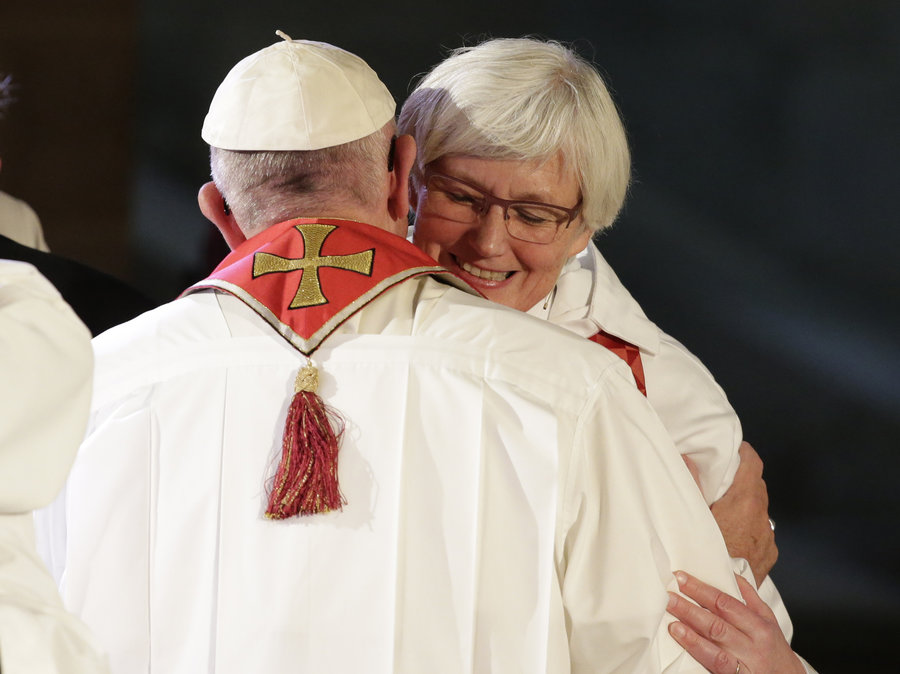
Pope and Antje Jackelen

“How nice of you to come and celebrate 500 years of heresy!”

3. However, the Catholics of Germannah had no such excuse, and the Lord was grievously offended by their deeds.

4. For there was a man named Rhino Marx, who had been set up as a leader of the Catholics of Germannah.

5. He came of a noble lineage, for his father was Karl, and his brothers included Groucho, Chico and Harpo.

Rhino Marx

Rhino, the last of the Marx brothers.

7. And in Germannah Rhino had decreed that there was only one possible sin.

8. Thus the man who committed adultery, the thief, the murderer, the bearer of false witness, and he who coveted his neighbour’s ox were all deemed to be righteous.

9. But woe unto him who paid not his church taxes, for he would be excommunicated.

10. And Rhino Marx had a bed of iron, like unto that of Og of Bashan. For he had grown so fat by spending his church taxes on fatted calves and beer, that no wooden bed could support him.

Marx and Francis

“Guess what the Church is going to do next, Holy Father!”

11. Then one day Rhino spake out, saying, “Let us bless the unions of man with man, and woman with woman, which are very common in the lands of Swedom and Germannah.”

12. “For there can be no evil in this if they have paid their church taxes.”

13. And the Lord was exceeding wrathful, and said “I have made enough allowances for this fat buffoon.”

14. “The time cometh soon when I shall rain brimstone and fire down on the land of Germannah.”

15. And it was so.

Posted in Uncategorized | 2 Comments

THE SURVIVAL OF OUR DEMOCRATIC REPUBLIC DEPENDS ON A HEALTHY TWO PARTY SYSTEM OF GOVERNMENT IN WHICH THE MINORITY PARTY WORKS WITH THE MAJORITY PARTY IN CONSTRUCTIVE WAYS. WHAT WE HAVE NOW IS POLITICAL SUICIDE FOR THE NATION. DEMOCRATS NEED PSYCHIATRIC HELP.

The Night the Democratic Party Committed Political Suicide
Townhall.com 

February 1, 2018

Wayne Allyn Radix

Before I get to the embarrassment of the nasty, bitter State of the Union display by the Democratic Party, let me lead with great news.
First, the jobs front. Wednesday morning saw the release of ADP/Moody’s Analytics private payrolls report. New job creation exploded once again under President Trump. Businesses added 234,000 jobs in January versus an expected 185,000. Manufacturing added 12,000 jobs and construction 9,000 new jobs – in a traditionally slow month. WOW.

Secondly, the numbers from Trump’s State of the Union. Fox News had the biggest audience for a State of the Union in the history of cable news. The old record of 6.5 million viewers was smashed by smithereens by Trump with an astonishing 11.7 million viewers. It was also the highest rated presidential address of any kind in the history of cable news.

Now to the reaction from viewers. CBS took an instant YouGov poll. Here are the amazing results:
97 percent of Republican viewers liked Trump’s speech.
72 percent of independents liked it.
Amazingly, 43 percent of Democrats liked it.
Overall 75 percent of Americans approved of the speech. And a shocking 8 out of 10 felt President Trump was trying to unite the nation, rather than divide it. Two-thirds reported the speech made them feel proud.

All of which means anyone who isn’t a bitter, nasty, arrogant, hateful, Kool-Aid drinking socialist loved what they saw. Unfortunately, that leaves the entire Democrat Congress.

That’s why I report the Democratic Party committed political suicide on Tuesday night. Their response to Trump’s speech was out of bounds. It wasn’t normal. It was hateful. It was bizarre. Actually, in a word, it was “foreign.” The Democratic Party is now a foreign party in their own country.  They no longer have any understanding of what people born in America think or feel.  It’s perfectly fine to be respectfully opposed to the politics of one party or president. That’s acceptable. That’s as American as apple pie. But that’s not what happened on Tuesday night.

Democrats were outed as the party that is rooting for America’s failure. Rooting against a booming economy. Rooting for misery, instead of prosperity. Rooting against job creation. Rooting against a booming stock market. Rooting against employee bonuses. Angry about the lowest black unemployment ever. Angry about the lowest Hispanic unemployment ever. Angry at the lowest female unemployment in 18 years.  They openly
frowned, grimaced, groaned and looked sick to their stomachs when President Trump celebrated the American flag…the national anthem… American freedom… and American opportunity. Bizarre. Self-destructive behavior.

But wait it gets worse. Democrats appeared to be on the side of murderous MS-13 gangs. When Trump touted legislation to help stop gang violence, drug dealing and murder by vicious MS-13 gangs…and when Trump introduced the parents of two young girls murdered by MS-13 killers…Democrats booed and groaned.  Democrats clearly believe discussing murders by illegal aliens is “racist.” Democrats clearly believe Trump has to be Hitler or KKK to publicly admit there are people of color (gasp) murdering innocent Americans. This was the second worst moment of disconnect in American political history.

Now to the single worst disconnect ever. Amnesty-loving Democratic Congressman Luis Gutierrez WALKED OUT upon hearing chants of “USA, USA!” It was too much for him. He appeared to be on the verge of tears. Democrats consoled him. To Democrats, it’s now “racist” to love your country.

The Democrats’ performance at the SOTU was shocking. Because if they had an ounce of common sense they could at least act like they love America, act like patriots, act respectful to parents of kids murdered by illegal alien gangs. Any sane politician would have acted civil – just to fool enough voters to win elections. Not these Democrats. They suffer from TID – “Trump Insanity Disorder.” They are on tilt. Trump triggers them to acts of self-destruction. They’ve lost their minds.

Turn out the lights. There is no one left to support the Democratic Party we saw on Tuesday night, except for illegal aliens, radicals, Marxists, felons and welfare addicts.  A booming economy is a step backwards to this group. The American flag is something to be ashamed of. God is a curse. And job creation is a sin. It’s clear they are the party that wants to “MAKE AMERICA MISERABLE AGAIN.”
This was the night the Democratic Party committed political suicide.

Posted in Uncategorized | 1 Comment

IT IS NOT TAUTOLOGICAL TO SAY THAT IF YOU LOVE JESUS YOU LOVE THE EUCHARIST AND IF YOU LOVE THE EUCHARIST YOU LOVE JESUS, IT IS THE REALITY OF BEING A CATHOLIC

Ten Ways to Fall in Love with the Eucharist

The saints are the great lovers of Jesus; they were on earth and now are in heaven loving God for all eternity.  In this article, we will give a list of what some saints have said in an excess of love for the most Holy Eucharist. Then we will give ten keys to unlock the gems to help you love the Eucharist even more! Let us read and meditate on the fire of the saints and the Eucharist:

  •  “Holy Communion is the shortest and the safest way to Heaven.” (St. Pius X)
  •  “If the angels could be jealous of men, they would be for one reason: Holy Communion.” (St. Maximilian Kolbe)
  •  “In one day the Eucharist will make you produce more for the glory of God than a whole lifetime without it.” (St. Peter Julian Eymard)
  •  “How I love the feasts!… I especially loved the processions in honor of the Blessed Sacrament. What a joy it was for me to throw flowers beneath the feet of God!… I was never so happy as when I saw my roses touch the sacred Monstrance.” (St. Therese the Little Flower)
  •  “When you look at the Crucifix, you understand how much Jesus loved you then. When you look at the Sacred Host you understand how much Jesus loves you now.” (Blessed Mother Teresa of Calcutta)
  •  “From the Eucharist comes strength to live the Christian life and zeal to share that life with others.”  (St. John Paul II)
  •  “This is the bread of everlasting life which supports the substance of your soul.” (St. Ambrose)
  •  “The longer you stay away from Communion, the more your soul will be weak, and in the end you will become dangerously indifferent.”  (St. John Bosco)
  •  “The Eucharist is the consummation of the whole spiritual life.” (St. Thomas Aquinas)

Now let us dive into ten golden keys that can open up the infinite treasure house of jewels so as to derive countless graces and blessings from Jesus’ greatest Gift to the entire world: Holy Mass and Holy Communion, His Body, Blood Soul and Divinity!

1. Faith

Beg the Lord for a greater faith in the sublime mystery of the most Holy Eucharist. Let us say with the Apostles Saint Thomas: “My Lord and my God.” Let us also so the prayer of the man of the Gospel: “Lord I believe but strengthen my faith!”

2. Visit

Make it a habit to visit the most Blessed Sacrament as often as is possible. Hopefully when we die Jesus will not reproach us with these words: “Whenever I see a church I stop to make a visit so that when I die the Lord will not say: ‘Who is it!’” Friends meet to chat, talk, and enjoy each other’s company; so should we, in visiting and talking frequently to Jesus.

3. Spiritual Communion

Highly recommended by St. Alphonsus Liguouri as well as Pope Benedict XVI in his document “Sacramentum Caritatis” is the frequent practice of the Spiritual Communion.   It can be done in a simple manner and as often as your heart desires.   You can say the simple prayer:  “Jesus I believe that you are truly present in the Tabernacle in your Body, Blood, Soul, and Divinity. Now I cannot receive you sacramentally but come at least spiritually into my heart.”  Then enter into your heart and thank, praise and love the Lord who has come spiritually into your soul.  This can fan the flame of love for our Eucharistic Lord.

4. Read John 6

The Gospel of John, chapter six has three parts: Jesus multiplies the loaves, walks on water, and then He gives a sublime discourse related to the Eucharist; actually it is a Eucharistic prophecy. Best known as the “Bread of life discourse”, Jesus promises to give us the Bread of Life. Also Jesus points out in no unclear terms that our immortal salvation depends upon our eating His Body and drinking His Blood, which obviously refers to Holy Communion. Read and meditate on this powerful chapter!

5. Fifteen Minutes

Years ago there was published a small booklet with the title “The fifteen minutes”.  It is a little gem where Jesus encourages the reader to enter into simple but profound conversation with Him. Basically Jesus wants to be our Best Friend and challenges us to open up the secret mysteries of our heart to Him and only He can truly understand the inner secrets, wounds and mysteries in our heart.   Read and pray through this booklet if possible in front of the Blessed Sacrament!

6. Holy Hour

Get into the habit of making a daily Holy Hour in front of the most Blessed Sacrament. It will transform your life if you persevere in the practice. The Great Servant of God, Archbishop Fulton J. Sheen, who made his Holy Hour faithfully for more than fifty years, called it The Hour of Power.

7. Adorn and Embellish Churches & the Eucharist

The woman lavished her expensive nard on the feet of Jesus; she wept and her tears came pouring forth on the feet of Jesus; finally she wiped Jesus’ feet with her hair (Lk. 7:36-50).  Fulton Sheen points out that this is symbolic of the gestures of love and attention we should manifest in the way we adorn, embellish and beautify the Churches and tabernacles where Jesus abides.

Known for his spirit of penance, fasting, and sacrifice, the Cure of Ars would travel long distances and expend big sums of money to purchase the best for his little Church. Why? For the simple reason that Jesus—the King of Kings and the Lord of Lords—abides in the tabernacle and descends from heaven in the hands of the priest in every consecrated Host. “O come let us adore Him!”

8. Holy Mass and Holy Communion

Of course, the greatest act is the celebration of the Holy Sacrifice of the Mass. The greatest gesture any human being can accomplish is to assist at Mass and to receive Holy Communion with faith, devotion, reverence and awe but especially with a passionate love.

Whenever possible, go to daily Mass. Arrive early to prepare yourself. Offer your own private intentions. Participate in Holy Mass fully, actively and consciously. Receive Holy Communion as if it were your first Holy Communion, last Holy Communion, and only Holy Communion. Be exceedingly thankful for your faith in such a sublime and august mystery! Do not rush out of the Church after Mass, as if your pants were on fire!  Rather, spend some time after Holy Mass to render abundant thanks to Jesus for such a sublime gift. Actually the word “Eucharist” means Thanksgiving.  What a sublime gift, free of charge. The only condition is lively faith and a heart overflowing with love for Jesus the greatest of all lovers!

9. A.C.T.S

Remember the four principal ends or purpose of the Holy Sacrifice of the Mass—A.C.T.:

A—stands for adoration.  The primary purpose of Holy Mass is to offer adoration to God the Father, by the offering of Jesus the Victim and through the power of the Holy Spirit.

C—stands for contrition Our hearts should be contrite, humble, and repentant of our many sins. It is a great practice to offer our Mass and Holy Communion in reparation for our sins, the sin of our families as well as in reparation for the sins of the whole world.  “For the sake of His sorrowful passion, have mercy on us and on the whole world.”

T—stands for thanksgiving.  Everything that we have in this life—with the exception of our own sins—is a pure gift from God. Therefore we should be overflowing and abounding in the thanksgiving. “With the Psalmist let us pray: ‘Give thanks to the Lord for He is good; his love endures forever.’”

S—Stands for supplication; in other words we should offer prayers of fervent intercession and petition for the many needs of the world: the world at large, the Church, the conversion of sinners, the sick, the dying, our own personal family needs, the souls in purgatory, and much more.

10. Eucharistic Missionary.

As Mary received Jesus in the Annunciation and promptly and quickly brought Jesus to her cousin Elizabeth, so should we bring Jesus to others, and others to Jesus.   This can be done in a very concrete manner by encouraging Catholic lost sheep wandering in the wilderness back to the fold.  The second largest religious group in the United States are non-practicing Catholics.

Find the time, manner, effort and initiative to invite some lost soul back to Church. Hopefully he or she can make a good confession and return to the reception of Holy Communion and to the loving embrace of God the Father. All this might take place if you simply trust God and take the initiative to welcome them back! God is so loving and good!  Share the Good News to the entire world!

image: Fr. Lawrence Lew, O.P. / “O Sacrament Most Holy” via FlickrCC BY-NC 2.0. Learn about Fr. Lew’s ministry and photography at his blog, Releasing the Arrow. 

Fr. Ed Broom, OMV

By

Father Ed Broom is an Oblate of the Virgin Mary and the author of From Humdrum to Holy, which offers more words of wisdom for how to become a saint today. He blogs regularly at Fr. Broom’s Blog.

Posted in Uncategorized | 2 Comments

BAD NEWS: GEORGE SOROS IS MAKING PROGRESS UNDERWRITING WORLD REVOLUTION 0F TRADITIONAL VALUES

Sunday, February 4, 2018

MOLOCH SMILES: Women March & Babies Die

Written by 

THE REMNANT

New from The Remnant Underground…

YouTubeThumb


In the spirit of Madame Defarge: Michael Matt takes a hard look at the George Soros-backed Women’s March in D.C., New York, London, Rome and all around the world–and asks the question: What are they really protesting and what does it mean for our country and for all of us?

What happens if Trump loses in 2020?  And what’s with the little reddish hats? Do these not harken back to “les bonnet rouges”–the red “liberty hats” worn by the terrorists who beheaded Catholic France back in 1789? What’s the connection? Why do these women hate us President Trump? Why do they hate pro-lifers?


Plus, what does their rabid defense of partial-birth abortion reveal about the end of our civilization?


Michael Matt | Editor

Michael Matt has been an editor of The Remnant since 1990. Since 1994, he has been the newspaper’s editor. A graduate of Christendom College, Michael Matt has written hundreds of articles on the state of the Church and the modern world. He is the host of The Remnant Underground and Remnant TV’s The Remnant Forum. He’s been U.S. Coordinator for Notre Dame de Chrétienté in Paris–the organization responsible for the Pentecost Pilgrimage to Chartres, France–since 2000.  Mr. Matt has led the U.S. contingent on the Pilgrimage to Chartres for the last 24 years. He is a lecturer for the Roman Forum’s Summer Symposium in Gardone Riviera, Italy. He is the author of Christian Fables, Legends of Christmas and Gods of Wasteland (Fifty Years of Rock ‘n’ Roll) and regularly delivers addresses and conferences to Catholic groups about the Mass, home-schooling, and the culture question. Together with his wife, Carol Lynn and their seven children, Mr. Matt currently resides in St. Paul, Minnesota.

Posted in Uncategorized | 1 Comment

BETTER LATE THAN NEVER


Father Rutler’s Weekly Column

Sunday, February 3, 2018
As a demographic cohort, “Millennials” are the last generation to have been born in the twentieth century. By conventional assessment, they are agile with technology, shaped by social media, self-absorbed, fixed in the moment and ignorant of history, morally immature and unaware that they have been shortchanged by inadequate and polemical educators. They are as vulnerable as Shakespeare’s “wealthy curlèd darlings of our nation.” Their lack of reason and their subservience to political correctness, can be astonishing. But these are generalizations, and one can be just as astonished by the integrity and spiritual vigor of many who are lumped together with their superficial contemporaries.

There has been a big drop in religious commitment among the Millennials, but youths predictably assert their independence and return to serious thoughts about God later on. What seems to be an abandonment of faith, may largely be due to the delay in maturation and marrying and the assumption of other responsibilities. Of those who lack a religious outlook, nearly ninety percent were never reared in a stable environment. The large number of Millennials who embrace Christianity are outnumbering the “Baby Boomers” who were warped by the trauma of the psychedelic 1960’s. They react against the moral chaos they have lived through in their own broken homes and decaying culture.

Many so-called mainline denominations are collapsing, but these almost invariably are those that have tried to “keep up with the Spirit of the Age” rather than with the Holy Spirit. Quoting one sociologist: “When the so-called ‘progressive’ churches question the historicity of Jesus, deny the reality of sin, support abortion, ordain clergy in same-sex relationships and perform their marriages, people desiring real Christianity head elsewhere.”

A joint study by researchers at Indiana and Harvard universities contradicts the impression that religion is in decline. The number of Americans who are the most vigorous in prayer and worship is actually increasing, from 39 percent in 1989 to 47 percent today. And another study estimates that the percentage of Americans who attend church regularly is four times greater today than it was in 1776.

Young people who engage in healthy friendships and religious worship, and who work responsibly, are far happier than those who spend a lot of time on the Internet. For Socratic philosophers before Christ, the goal of life was eudaimonia, or “happiness of soul.” Virtue alone could not attain that. “Fullness of joy” (Psalm 16:11) is to be found in Christ (John 17:13; 1 Peter 1:8-9).

Saint Augustine said that “happiness is itself a joy in the truth, and this is a truth in you, God, who are the truth . . .” For the Christian, happiness is not an option; it is an obligation. In some ways the young Augustine—like many Millennials—had been absorbed in himself,  but divine grace pulled him out of that, and none too soon: “Late have I loved thee, beauty ever ancient ever new.”

Posted in Uncategorized | 1 Comment

The institutional Church in Germany continues its death march, pity the poor sheep who are being lead by wolves clothed in purple and scarlet.

Cardinal Marx Opens the Door to Blessing Homosexual Unions

OnePeterFive
{Abyssum}
FacebookTwitterEmailPinterestPocketGoogle+

Today, 3 February, Cardinal Reinhard Marx — the President of the German Bishops’ Conference — suggests a further opening with regard to the idea of establishing a  blessing from the German Catholic Church to be given to homosexual couples. In an interview with the Bavarian radio station Bayerischer Rundfunk BR, Cardinal Marx refers to Pope Francis’ call of accompanying people more closely in their individual lives, and Marx calls for more pastoral care for homosexuals. When asked about the question of a blessing for homosexual couples, Marx thus proposes “that we be pastorally closer to those [such as homosexuals] who are also in need of that pastoral care and who also desire it.” He continues, saying:

There we also have to give encouragement that the priests and pastoral caretakers also give words of encouragement to the people in concrete situations. I really do not see there any problems.  {He “does not see any problems” and so it is truly a case of the blind leading the blind.  The biggest problem he and others face is diving revelation.}  Another question is how this would be done publicly, in a liturgical form, that is where one has to be reticent and also reflect upon that in a good way.

When asked whether he could imagine such a blessing for homosexual couples, Cardinal Marx answers: “There are no general solutions; I do not consider it [such a general solution] to be right, because it is about the pastoral care for individuals.” These are cases “where we do not have a rule,” { we do not have a rule ???} he explains. “And that does not mean that there is nothing happening.”

Cardinal Marx adds:

This I really have to leave up to the local pastor and the accompaniment {“discernment” and “accompaniment”, two favorite words from the lexicon of heresy that the Jesuits have given such importance to in any debate over doctrine} of that person. One can think about this in a dialogue — and right now, there is taking place such a discussion [raised by the Vice President of the German Bishops’ Conference, Bishop Franz-Josef Bode] — that is to say, about how we could deal with this matter, but I would say I would leave this strongly in the hands of the local pastor, in a very concrete situation, and not to demand rules in this matter. There are things that cannot be regulated.

With these still somewhat vague words (which seem to be a characteristic of Cardinal Marx’ public speech) — and in light of a more decentralized approach — Cardinal Marx opened up to the idea of priests giving, in certain individual cases, a blessing to homosexual couples. These words come in the wake of a recent call for such a blessing as proposed by the Vice-President of the German Bishops’ Conference, Bishop Franz-Josef Bode. He said in January of 2018, when discussing the idea of a blessing of homosexual couples: “We have to reflect upon the question as to how to assess in a differentiated manner a relationship between two homosexual persons.” “Is there not so much positive and good and right so that we have to be more just?”

Moreover, Cardinal Marx had recently claimed that it is hard to determine whether someone is living in the state of mortal sin. {Yes that is true with regard to the subjective element of sin, but only self-inflicted blindness prevents one for seeing the objective element of sin.} He applied this question also to homosexual couples. He also called for “a respect for a decision made in freedom” and for one’s “conscience.”

Mathias von Gersdorff — German pro-life activist and book author — comments today on Cardinal Marx’s proposal of more private individual blessings of homosexual couples with the following words:

That is nothing but a fig leaf. When it is acceptable to bless homosexual couples in individual cases, then that means that (practiced) homosexuality is no obstacle any more.

In the wake of these prominent and high-ranking encouragements with respect to homosexual couples, a German diocese now proposes  even more concrete steps for the establishment of an official liturgical blessing for homosexual couples. With the explicit encouragement of the Bishop of the Diocese of Limburg, Johannes zu Eltz — a high-ranking priest, canon, and Dean of the City of Frankfurt (with a responsibility for around 150,000 souls) — has now made a public proposal to have a “theologically justified blessing” for those couples who are either homosexual, “remarried,” or who for other reasons do not feel “sufficiently worthy” for the Sacrament of Matrimony.

Zu Eltz now proposes a “liturgical celebration” that “omits the exchange of rings or the utterance of a marital vow.” Rather, one could, “with respect for a reliable partnership,” ask for God’s blessing “for a successful future of something that already exists.” {What already exists is an objectively sinful relationship that cannot be blessed by the Church.  The Church can minister to and assist the couple but it cannot bless the relationship.}

Posted in Uncategorized | 2 Comments