ENDING THE YEAR 2017 IN THIS MANNER DOES NOT GIVE ONE MUCH HOPE FOR 2018, BUT THEN, OUR LORD JESUS CHRIST IS IN CHARGE SO THERE IS HOPE

Featured Image
The Holy Family is a very minor part of the overall Vatican Nativity this year Diane Montagna, LifeSite
Diane MontagnaDiane MontagnaFollow Diane

NEWS,

Vatican’s ‘sexually suggestive’ nativity has troubling ties to Italy’s LGBT activists

ROME, December 20, 2017 (LifeSiteNews) — The Vatican Nativity scene featuring a naked man, a corpse, and no sheep or oxen is the artistic offering of an abbey which is the focus of Italian LGBT activists, it has emerged.

Enquiries by LifeSiteNews have revealed that the Abbey of Montevergine, which donated the innovative ‘Nativity of Mercy,’ houses the Marian image that has been adopted as patroness by LGBT activists in Italy. The abbey shrine is the annual destination of a sort of sacred and profane “ancestral gay pride” pilgrimage which, according to one LGBT activist, in recent years has gained the “active, political participation of the LGBT community.”

An official of the Vatican’s Governorate has told LifeSiteNews that the abbey of Montevergine initially proposed the original idea for the ‘Nativity of Mercy.’ The Vatican discussed and developed a more detailed design with the abbey, then submitted final plans to the Secretary of State and Pope Francis for approval, which was duly granted.

“The presence of the Vatican Nativity Scene for us is a reason to be even happier this year,” Antonello Sannini, president of homosexual activist group Arcigay Naples, told LifeSiteNews on Tuesday. “For the homosexual and transsexual community in Naples, it is an important symbol of inclusion and integration.”

Fury over the Christmas crèche

The Christmas crèche fury blew up on Twitter last week, when photos of a virtually nude male figure representing the corporal work of mercy ‘to clothe the naked’ made the rounds on social media, sparking sharp criticism and debate.

Image
Vatican Nativity: nude male representing the corporal work of mercy to ‘clothe the naked’ Diane Montagna / LifeSiteNews

Viewers lamented the figure’s “prominent placement and languid pose,” according to Breitbart, which reported that the figure’s pose “led many on social media to suggest that there is a vaguely homoerotic tone to the scene.”

Facebook, adding to the fury, rejected the photo referencing its policy against “sexually suggestive or provocative” images.

One observer remarked, regarding the poor man in need of clothes: “I’ve worked with a personal trainer. That guy’s been in the gym two hours a day, six days a week.”

“This horrendous exhibit, a sacrilegious, highly deceitful and malevolent attempt to turn the holy innocence of the manger in St. Peter’s Square into a lobbying tool for the homosexual rights movement, is just the latest fiendish act, but one that’s symptomatic of this entire pontificate,” one source close to the Vatican told LifeSiteNews.

Meanwhile, the Neapolitan artist who crafted the crèche, Antonio Cantone, appeared to suggest that he intended it to be provocative.

“It is not a camp nativity; it is particular and makes you think,” he said. “It leaves no one indifferent; there are provocations.”

Enter a Marian Icon

This year’s Christmas crèche also features a reproduction of the ancient and beautiful icon of Our Lady of Montevergine. The original icon, housed in a chapel of the mountain shrine, measures 12 feet high and six feet wide, and depicts the Blessed Virgin seated on a throne with the divine Infant Jesus seated on her lap.

Image
A reproduction of the Icon of Our Lady of Montevergine featured on the left side of the Vatican Nativity Diane Montagna / LifeSiteNews

The Marian image is dark, and so the icon is often referred to as one of the “Black Madonnas.” Among local Italians, her dark complexion made them believe she was part of the serving class and so she came to be affectionately known by the faithful as “Mamma Schiavano” or “Slave Mama.”

Each year, Our Lady of Montevergine is honored through two pilgrimages to her mountain shrine: one on February 2, the feast of the Purification of the Blessed Virgin Mary, or Candlemas; and the second on September 12, the feast of the Holy Name of Mary, which is preceded by a three-day festival.

On the night before the feast pilgrims are hosted by Ospedaletto d’Alpinolo, the nearest town to the abbey, before making the “sagliuta” or “juta” (from the Italian “salire,” i.e. ascent) on foot to the shrine of Our Lady of Montevergine early the next morning. The three-day celebration is a mix of sacred and profane, and features dances and songs accompanied by large tambourines.

The “juta dei femminielli”

Our Lady of Montevergine has a particular significance for homosexuals and transgenders in Italy.  According to a legend, Our Lady of Montevergine saved two homosexuals from death in the winter of 1256. The couple had been beaten and driven by night from their city and brought to the mountain where they were tied to a tree and left to die of the cold or be eaten by wolves. According to the legend, Our Lady of Montevergine had pity on them and ‘miraculously’ freed them. In 2017, La Repubblica called it “the progressive miracle of a gay friendly Madonna.”

More commonly, she is known as the mother “who grants everything and forgives everything.”

The “juta dei femminielli” [ascent of the femminielli] is therefore held each year on Candlemas Day to recall the legend through song and dance. Femminielli is a term used to refer to a population of homosexual males with markedly feminine gender expression in traditional Neapolitan culture.

Image
The angel on this year’s Vatican Nativity Scene Diane Montagna / LifeSiteNews

The LGBT community also looks to Our Lady of Montevergine because she sits on the ancient temple site where the pagan goddess Cybele was once worshiped. In a 2014 article entitled “the procession of the femminielli,” La Repubblica noted that the eunuch priests of Cybele ritually castrated themselves “to offer their sex as a gift to their goddess in order to be reborn with a new identity.”

Antonello Sannino, the president of Arcigay Naples, told LifeSite that the “juta dei femminielli” involves a “mix of the sacred and profane.” Admitting his own distance from the Church, Sannino said “there is a strong popular devotion among believers” but for others represents entrusting oneself to a non-Christian divinity.

The annual Candlemas pilgrimage is a kind of “ancestral gay pride,” he said, and has been a “way to welcome into the culture of the city [of Naples], the figure of the femminiello which is disruptive in a binary ‘masculine-feminine’ society.”

Montevergine politicized

In 2002, the pilgrimage made the papers when the then abbot of Montevergine, Tarcisio Nazzaro, expressed his displeasure at the presence of the Neapolitan ‘femminielli.’

According to La Repubblica, during Holy Mass, Nazzaro told them: “Your prayers aren’t prayers but a clamor that Our Lady is not pleased with and so does not welcome. You are like the merchants that filled the temple until Jesus threw them out.” Allegedly, he later confided to the Sacristan: “I don’t have anything against anyone and I didn’t wish to offend anyone, much less these individual faithful. But what’s too much is too much. We need a little respect for the sacred place, and the dignity of the shrine has to be preserved.”

The Catechism of the Catholic Church states in paragraphs 2358-2359, that although homosexual inclinations are “objectively disordered,” men and women who suffer this trial “must be accepted with respect, compassion, and sensitivity” and “every sign of unjust discrimination in their regard should be avoided” but like all Christians they are “called to chastity” and to Christian perfection.

Image
A corpse being pushed into a place of burial on this year’s Vatican Nativity representing the corporal work of mercy ‘to bury the dead’ Diane Montagna / LifeSiteNews

Sannino didn’t berate the abbot but thought the presence at the abbey in 2002 of Vladimir Luxuria, Italy’s first transsexual parliamentarian, precipitated the dispute. “It was too political in 2002,” he said.

That incident galvanized the LGBT movement, Ottavia Voza, president of Arcigay Salerno, told LifeSite. Another minor incident followed in 2010, but the “active, political participation of the LGBT community” began after the dispute in 2002.

A new abbot and a new approach

In September 2014 under Pope Francis, a new abbot of Montevergine was elected, Dom Riccardo Luca Guariglia. Earlier that year, Luxuria wrote a letter to Pope Francis on behalf of the LGBT community, and publicly presented it at the Candlemas pilgrimage at the Shrine of Montevergine. No one is aware of a response to that letter. An English translation can be read here.

Image
The naked man dominates the scene from this angle. Diane Montagna / LifeSiteNews

In 2017, leaders of the LGBT community met Abbot Guariglia. Voza said the relations are now “excellent” and this year they “had an opportunity for dialogue with the abbot.” Voza told LifeSite that Vladimir Luxuria was there and the abbot “stopped to speak with us.” It wasn’t a private meeting but “in essence, he gave us his blessing,” Voza continued, adding that the incident in 2002 “was completely overcome.”

“He welcomed us,” Voza said, “and understood the importance of the presence of the community.”

Matters also intensified politically in 2017 when LGBT activists inaugurated Italy’s first ever “no gender” bathroom in Ospedaletto d’Alpinolo during the February 2 pilgrimage, and a civilly ‘married’ homosexual couple was given honorary citizenship by Ospedaletto d’Alpinolo’s civic authorities. Together with the LGBT activists, the civil authorities also unveiled a plaque at the entrance of the town, reading “Ospedaletto d’Alpinolo is against homotransphobia and gender violence.”

At the ceremony, Vladimir Luxuria said the small town of Ospedaletto d’Alpinolo should serve as a model for the rest of Italy.

Abbot Guariglia was interviewed about the ‘juta dei femminielli’ in 2017, saying: “St. Benedict tells us that guests are to be welcomed as Christ himself” and the abbey has “this peculiarity, that of being welcoming every type of pilgrim who comes to the shrine, first, to give homage or to entrust themselves to the Mother of God, and then also to celebrate the Sacraments.”

Descent into neo-paganism

Sannino welcomed the Vatican Nativity Scene, saying he believes it is an “important symbol of inclusion and integration,” but whether it signifies greater openness by the Church depends on “how conscious” Vatican officials were of the connection with LGBT activists in making the decision. “We hope that the Church will finally develop a real sense of openness in the wake of the Pope’s words,” he said, referring to Francis’ “Who am I to judge?” comment. “The Church is extremely slow in its transformations,” he believes, and is fairly confident “this will also happen.”

Image
Infant Jesus covered until Christmas surrounded by what appear to be Cherub Diane Montagna / LifeSiteNews

But people in Rome are wondering how Pope Francis will respond. As in past years, Pope Francis is expected to spend time before the crèche in silent prayer on December 31 after Vespers and the chanting of the Te Deum prayer of thanksgiving in St. Peter’s Basilica. The concern is that the optics of his silent prayer before the icon of Montevergine and the naked man, positioned on either side of the Nativity Scene, will send a signal, or be used by the more politically motivated in the LGBT community, to push their agenda.

Image
Close-up of 2 of the cherub Diane Montagna / LifeSiteNews

Officially, the Vatican isn’t commenting on the Nativity scene, so it’s unclear how aware those who made the decisions are of its connections to Montevergine abbey and its associations with Italy’s LGBT activists. LifeSite contacted Vatican spokesman Greg Burke but he declined to answer.

Italian Church historian Roberto de Mattei of the Lepanto Foundation sees this as the latest attempt to “paganize Italy and Europe” through indirect means, in what he calls “soft neo-paganization.”

This involves choosing places of Christian worship “to return them to their pagan origins,” De Mattei explained, sending Christianity back into the age of catacombs where it was persecuted by the pagans. The LGBT movement is not only political or cultural but a “religious movement” with pagan characteristics, he added. “This should not surprise us, because sex was also at the center of many pagan cults,” De Mattei said. “This therefore portends a new neo-pagan persecution of those who remain faithful to Catholicism.”

Image
Visit the imprisoned scene Diane Montagna / LifeSiteNews

De Mattei noted that next year marks 50 years since the cultural, or sexual, revolution of 1968, and he believes it is now being “transformed into a religious revolution” where sex is still at the center, but being “transformed into a divinity intended to replace Christianity.”

Posted in Uncategorized | 1 Comment

THE COMING SYNOD ON YOUNG PEOPLE WILL SURELY SEE MORE PRELATES URGING THE ADOPTION OF THE ‘SUCCESS’ OF THE MEGA-CHURCHES IN ATTRACTING YOUTH

BURKE COM

Thursday, December 28, 2017

TRADITIONAL CATHOLICISM: International Youth Movement

Written by  RTV

New from REMNANT TV….

When even more conservative bishops such as Alexander Sample find it necessary to partner with Evangelical outfits such as the ‘non-denominational’ ministry, ‘Young Life, to try to get disenfranchised Catholic kids to come back to the Church, it’s obvious there’s a big problem.

Just 50 years after Vatican II the Catholic world has lost its Catholic identity to such an extent that the bishops are reduced to consulting non-Catholic ministries to help them stop the hemorrhaging of Catholic young people out of the Church.

One wonders if a non-denominational Protestant partnership can help resolve problems caused by a largely Protestantized Catholic liturgy.

But there is a Catholic alternative that is working and that is taking root all over the world.

What is it? It’s called going back to the future, and it’s an international Catholic youth movement based on the Traditional Latin Mass.

Posted in Uncategorized | 1 Comment

WHY WOMEN WEAR MANTILLAS IN CHURCH


Why Women Wear Mantillas In Church

CAHOLICISM PURE AND SIMPLE BLOG

Young women wearing mantillas

Chapel veils, or mantillas (which comes from the word manta, meaning cape) are typically circular or triangular shaped pieces of black or white lace that are draped over a woman’s head when attending Mass, or in the presence of the Blessed Sacrament. Traditionally, the black veils were worn by married or widowed women, while the white veils were worn by young girls, or unmarried women, but there are no hard and fast rules about this.

“Therefore ought the woman to have a power over her head, because of the angels.” (1 Corinthians 11:10)

St. Paul reminds us that as Christ did the will, and sought the honour of God the Father, so the Christian should avow his subjection to Christ, doing His will and seeking His glory. We should seek a fitting demeanour in our dress and habit, avoiding everything that may be dishonourable before the Throne of God. By covering her head with a veil (or mantilla) the woman is agreeing to her beautiful and unique feminine status. She is showing respect and reverence for the holy angels too, always invisibly present before the Blessed Sacrament, who will come to her side in love and protection. This veiling of the woman before the Lord Our God, may also be a humble imitation of the angels’ behaviour, who when they sang the praises of God, and adored and glorified his perfections, covered their faces and their feet with their wings. (Isaiah 6:2)

From the very earliest days of Christianity, wearing chapel veils as head coverings when entering a Church to pray and adore God, was a common practice among faithful women. Since the Second Vatican Council this practice has no longer been requisite for women attending the Novus Ordo Mass, yet contrary to what many believe, it is still very much supported and encouraged by the Church. Many Catholic women of all ages are now rediscovering this beautiful, age-old tradition. At Latin Masses, and in particular at the celebration of the Tridentine Mass, generally all the women in the congregation can be seen with their heads veiled as a sign of reverence, modesty and piety in their recognition that they are praying in the Sacramental Presence of God.

This act of partially concealing a woman’s physical beauty (especially her lovely hair) is so that the beauty of God may be glorified instead. A veil is both a symbol and a mystical sacrifice that invites the woman wearing it to ascend the ladder of sanctity. It is also a way of emulating the Blessed Virgin Mary, in her humility, purity and submissiveness.

Moreover, the mantilla, or chapel veil, signifies the role of women as a life-bearing vessel. The chalice holding the blood of Christ is veiled until the Preparation of the Gifts, and the tabernacle veiled between Masses. Both of these vessels hold the Eucharist – the very life of Christ. In a similar fashion, woman was endowed with the gift of bearing human life.

“This is why the female body should be veiled, because everything which is sacred calls for veiling. When Moses came down from Mount Sinai, he veiled his face. Why did he veil his face? Because he had spoken to God, and at that very moment there was a sacredness that called for veiling. Now… feminists after Vatican II suddenly discovered that when women go to Church veiled, it is a sign of their inferiority. The man takes off his hat and woman puts on a veil. My goodness, how they have lost the sense of the supernatural! Veiling indicates sacredness and it is a special privilege of the woman that she enters church veiled.” Dr. Alice Von Hildebrand

 “Reclaiming the Sacred” has three articles giving some deeply insightful thoughts about women who wear mantillas, using the captivating comparison and metaphor of the crown jewels in the Tower of London! http://reclaimingthesacred.com/2013/12/26/unwrapping-a-veil-of-mystery-the-mantilla/

Here, with a H/T to “ragazzagallese”, are some of the many websites where beautiful mantillas and veils may be purchased: Zelie’s Roses and Loving Mantillas. And this one:   http://rosamysticamantilla.com/

+++++++++++++++++++++++++++++++++++++++++++++++++++++++++++++++++++++++++++++

{ I am reposting this from the Catholicism Pure and Simple Blog because I have just received six black Mantillas from Amazon that I ordered  and put in the kneelers of my chapel so that any woman who does not own a mantilla and wants to wear one at my Mass (it is not obligatory) can easily do so.  

I got the idea to purchase the mantillas and make them available to women at my Masses after one of the women who occasionally comes to my Mass asked about wearing a mantilla.  I replied that I would encourage the custom but not require it.

I subsequently  had a discussion about the wearing of a mantilla at Mass with several of the women who frequently come to the 11:30 Sunday Mass in the private chapel in my residence  and found that they were in favor of wearing a mantilla.  Since none of them owned a mantilla I decided that I would purchase six mantillas and put them in the kneelers of my chapel and any woman who wants to wear one at my Mass (it is not obligatory) can easily do so. – Abyssum,}

Posted in Uncategorized | 4 Comments

TWO QUEENS. SAME NAME BUT WHAT A DIFFERENCE.

14189-2

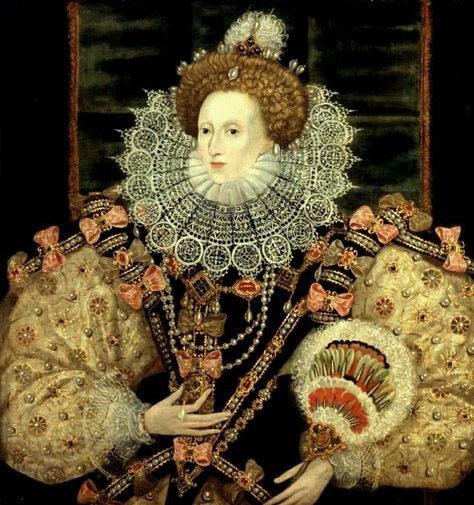
Elizabeth I Queen of England

Elizabeth I was Queen of England and Ireland from 17 November 1558 until her death on 24 March 1603. Sometimes called The Virgin Queen, Gloriana or Good Queen Bess, Elizabeth was the last monarch of the House of Tudor. Wikipedia
Reign: 17 November 1558 –; 24 March 1603
I know I have the body of a weak and feeble woman, but I have the heart and stomach of a king, and of a king of England too.
All my possessions for a moment of time.
Though the sex to which I belong is considered weak you will nevertheless find me a rock that bends to no wind.

Each day of Christmas week we celebrate feasts of martyrs beginning with Saint Stephen and then Saint John the Evangelist, The Holy Innocents and Saint Thomas Becket.  The last, Thomas Becket was killed not by order of King Henry II of England but as a result of his expressed wish, “Will no one rid me of this priest!,” and then there are all the Catholic Martyrs who died at the direct order of King Henry VIII and his daughter, Queen Elizabeth I.

+++++++++++++++++++++++++++++++++++++++++++++++++++++++++++++++++++++++++++++

What a contrast between Queen Elizabeth I and  Queen Elizabeth II.  Queen Elizabeth delivered her annual Christmas message to the British Commonwealth today and it is worth hearing and watching.

Elizabeth II and I share a life in common:  I was born in the year 1923 and she was born in the year 1926.  I have always felt a certain admiration for Elizabeth II because of her dignity and the way she conducted herself in the midst of all the scandals being perpetrated by the other members of her family.

Her Christmas message below is worth watching.

+++++++++++++++++++++++++++++++++++++++++++++++++++++++++++++++++++++++++++++
Elizabeth II
Elizabeth II has been Queen of the United Kingdom, Canada, Australia, and New Zealand since 6 February 1952. Wikipedia
Born: April 21, 1926 (age 91), Mayfair, London, United Kingdom
Full name: Elizabeth Alexandra Mary
Did you know: Elizabeth II is the oldest current serving state leader by age (91 years, 241 days).wikipedia.org

Posted in Uncategorized | Comments Off on TWO QUEENS. SAME NAME BUT WHAT A DIFFERENCE.

HERE IS A LITTLE DOSE OF SATIRE TO HELP YOU PREPARE FOR WHAT IS COMING IN THE NEW YEAR OF 2018

Eccles and Bosco is saved


“Stop correcting me,” says Pope Francis

Posted: 27 Dec 2017 03:17 AM PST

“These days I can’t say anything at all without some fool trying to correct me,” said Pope Francis in his annual Odi et Omnes (“and I hate you all”) address to Catholics worldwide.A voice behind him immediately piped up, “Oh yes you can!”

Pope Francis and Spadaro

“Holy Father, I should point out that 2+2=5.”

“It’s getting very irritating,” continued the Pope. “Letters, phone calls, e-mails, texts, faxes, tweets, bricks flying through the window with little notes attached, drums tapping out ‘corrections’ in Morse code, … and all with the same message, that I got something wrong. I received five huge sacks of correspondence this morning.”

Tee-shirt

A sell-out at Gammarelli’s.

“I mean, this morning at breakfast I said ‘It looks like rain later’, and five minutes later Spadaro rushed in…”

Ten minutes later.”

Ten minutes later, with a filial correction giving me the weather forecast for Rome.”

doves, crow, seagull

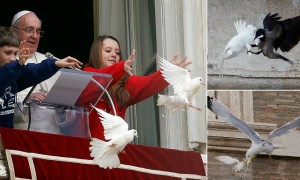
“Now is not the time for peace.” A crow and seagull join in the attack on the papal doves in the small photo next to the photo of Francis and the children releasing the doves.  Saint Francis who loved birds is shocked, shocked !!!

“Of course I have been used to receiving green-ink corrections from people like Sosa, Martin, Faggioli, etc. for years. For example, I said something in my sermon about Jesus being the Messiah, and Fr James Martin sent me a text explaining that ‘Many New Testament Scholars’ now believe that John the Baptist was the Messiah. But I am used to that.”

At that moment an arrow flew up into the Vatican balcony and impaled the arm of the Pope’s Master of Ceremonies Guido Marini. Attached to it was a note, “Don’t say something infallibly, you’re bound to get it wrong.” Guido Marini, a man used to crises, calmly removed the arrow from his arm and said, “I think this is for you, Holy Father,” before slumping to the ground.

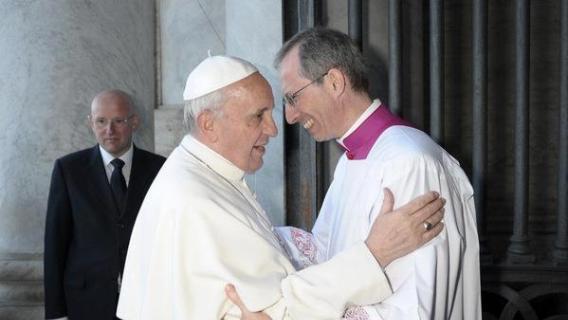
Pope and Guido Marini

“‘Tis but a scratch, Holy Father.”

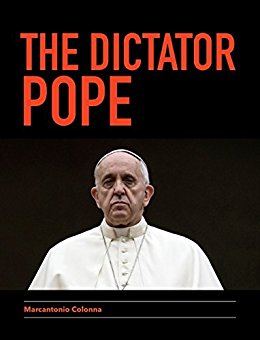
“It’s been an odd year,” commented the Pope. “Cardinals sending Dubia, wall posters in Rome, filial corrections, that book The Dictator Pope, … anyone would think they were trying to tell me something.”

Posted in Uncategorized | 3 Comments

A LITTLE DOSE OF SATIRE TO HELP YOU FORGET ABOUT THE VATICAN’S CRECHE IN THE PIAZZA OF SAINT PETER

Eccles and Bosco is saved


The Dictator Santa

Posted: 25 Dec 2017 02:32 AM PST

The scandals surrounding Santa Claus show no signs of ending, and this week children were horrified to see that “Santa’s Grotto” in the Rome branch of VaticoTMfeatured a nude elf. Moreover, there were allegations of corruption at the North Pole, where Maradona the Gnome was rumoured to have had his hand of God in the till.

Did Santa really slap the heretic Fr James Arius SJ?

The public image of Santa Claus is of a perpetually cheerful man, and his recent exhortation Amo Risi Laetitiam (“I like the joy of laughter”) contains many cheerful passages such as “Ho ho ho, ho ho ho” (ARL 1) and “I know if you’ve been bad or good, but if you’ve been bad don’t worry, you’ll still get Christmas presents” (ARL 351, Footnote). However, a new book The Dictator Santa suggests that behind his public image there lies a bad-tempered old curmudgeon who torments his reindeer and shouts at his elves.

How did Rudolph’s nose get so red? Did Santa punch him?

At this most holy time of Santa Mass, we don’t forget that the season has one true meaning – eat and drink too much, buy lots of expensive presents, and have a good time. So it seems churlish to attack the Holy Father Christmas, who symbolises everything that is important about December 25th.

Still, we should warn the faithful that questions are being raised about the leadership provided by the big man, and that something is rotten at the heart of the North Pole. Some say that the man who came down your chimney last night and kicked your cat is not to be trusted.

The College of Cardinals meets to elect a new Santa.

A happy Christmas to both my readers. 

+++++++++++++++++++++++++++++++++++++++++++++++++++++++++++++++++++++++++++++

{ DID YOU KNOW THAT THE VERY FIRST CRECHE/NATIVITY CRIB SCENE WAS CREATED BY SAINT FRANCIS OF ASSISI?  I WONDER IF FRANCIS (JORGE BERGOLIO) KNOWS THAT?  IF SAINT FRANCIS WERE STILL IN HIS GRAVE HE WOULD BE TURNING OVER LIKE A TOP, BUT THANKS BE TO GOD HE IS ENJOYING ETERNALLY THE BEATIFIC VISION.  STILL, WHAT MUST SAINT FRANCIS THINK ABOUT THE BLASPHEMOUS CRIB/CRECHE JORGE BERGOLIO HAS PLACED IN THE PIAZZA OF SAINT PETER??????  – Abyssum }


Posted in Uncategorized | 6 Comments

CHRISTMAS

25594306_1836005350023023_8483937689404910360_n

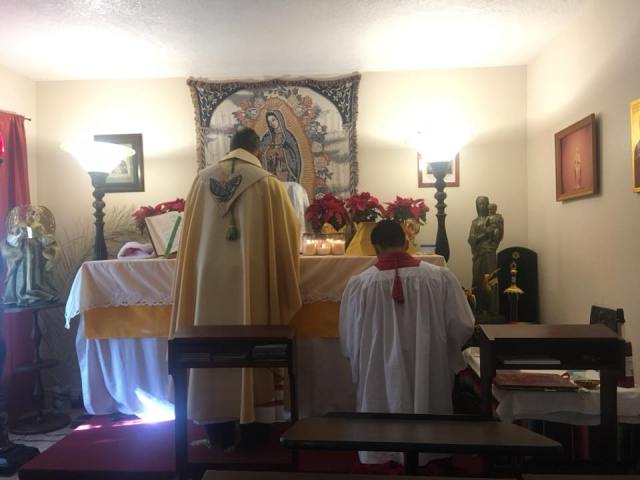
+RHG celebrating the Third Mass of Christmas in my private chapel in my residence this morning; the Traditional Latin Mass.

Posted in Uncategorized | 6 Comments

I WISH YOU A BLESSED, HOLY, HAPPY, MERRY CHRISTMAS

 03c94-mary2band2bjesus2b4

YouTube: Bach – Christmas Oratorio [1-3] Harnoncourt


There is an eerie resemblance between the eye of a hurricane and the present sense of calm in the Church and the world that is the result of the subconscious awareness that the liturgical and social celebrations surrounding the Nativity of our Lord Jesus Christ in 2017 have a deep spiritual significance for us all.  The New Year of 2018 may well usher in changes that will please some people but unsettle and dismay others.

My hope and prayer is that you will so take advantage of the Advent and Christmas Seasons by deepening your faith, love and hope in Jesus Christ and that Our Savior will bestow on you a lasting peace.  That will be my special intention for you in all of my Masses this Holy Season.

Wishing you a truly blessed Christmas and a Happy New Year, I remain

Yours in Jesus Christ Our Lord,​

+Rene Henry Gracida

Bishop Emeritus of Corpus Christi

Posted in Uncategorized | 9 Comments

EVIDENCE OF CORRUPTION NOW AFFECTS THE CARDINAL WHO IS THE HEAD OF FRANCIS’ COUNCIL OF CARDINAL ADVISORS

Francis and Maradiaga
ENGLISH VERSION

35 thousand euros a month for the Cardinal: the new scandal that shakes the Vatican

Francesco’s friend and adviser, Oscar Maradiaga, preached pauperism but received half a million a year from a University of Honduras. Bergoglio also wanted an investigation on millionaire investments and on the inappropriate behavior of Bishop Pineda, a loyalist of the cardinal

DI EMILIANO FITTIPALDI

When he finished reading the inquiry drafted by the apostolic envoy he himself had sent to Honduras last May, Pope Francis’ hands went up to his skullcap. He had just found out that his friend and main councilor — powerful cardinal Oscar Maradiaga, a staunch supporter of a poor and pauperist Church and coordinator of the Council of Cardinals after he appointed him in 2013 — had received over the years from the Catholic University of Tegucigalpa around 41,600 US dollars a month, with an additional 64,200 dollars bonus in December.

Bergoglio had yet to learn that several witnesses, both ecclesiastical and secular, were accusing Maradiaga of investments in some companies in London topping a 1,2 million dollars that later vanished into thin air, or that the Court of Auditors of the small Central American nation was investigating a flow of large sums of money from the Honduran government to the Foundation for Education and Social Communication and to the Suyapa Foundation, both foundations of the local Church and therefore depending on Maradiaga himself.

“The Pope is sad and saddened, but also very determined at discovering the truth,” people of his entourage at Santa Marta, his residency, explain. He wants to know every item of the investigation Argentine bishop Jorge Pedro Casaretto conducted in Honduras, on top, of course, of the final destination of the jaw-dropping sums of money obtained by the cardinal. Just in one year, 2015, as shown in an internal university report L’Espresso obtained, the cardinal {Maradiaga} received almost 600,000 dollars, a sum that according to some sources he collected for a decade in his capacity as “Grand Chancellor” of the university.

However, some other rather unpleasant items account for the rest of the sums he received according to Bishop Casaretto’s report. The pope’s trustworthy person put down on paper the serious accusations many witnesses brought forward (the audits totaled around fifty witnesses and included administrative staff of the diocese and of the university, priests, seminarians and the cardinal’s driver and secretary) also against the Auxiliary Bishop of Tegucigalpa, Juan José Pineda, among the most loyal in Maradiaga’s inner circle and de facto his deputy in Central America.

VEDI ANCHE:

ESPRESSOMUNAFO-20171221113916406-jpg

Il cardinale da 35 mila euro al mese: in Vaticano scoppia un nuovo scandalo

L’amico e primo consigliere di Francesco, Oscar Maradiaga, predicava il pauperismo ma riceveva mezzo milione l’anno da un’Università dell’Honduras. Bergoglio ha voluto un’inchiesta anche su investimenti milionari e sui comportamenti inappropriati del vescovo Pineda, fedelissimo del porporato. E proprio oggi il papa parla di «traditori e approfittatori nella Chiesa». L’inchiesta completa sull’Espresso in edicola da domenica

After receiving all the evidence against Maradiago Francis reserved to himself any action on the scandal.  {Will Francis ignore the whole mess like he has ignored the sex-scandal involving Cardinal Copopalmiero’s secretary.}

Maradiaga, of the Salesian order like the Vatican’s former Secretary of State Tarcisio Bertone, was born in Honduras 75 years ago. His birthday falls on 29 December, around the time he will be handing down his resignation on Francesco’s desk, who will then decide whether or not to confirm his duties. A primary school teacher before becoming a middle school math professor, the cardinal is a highly cultivated person ​​fluent in five languages, an expert in moral theology and philosophy and a great lover of music. He became very well-known in Latin America as a sworn enemy of corruption and a strong defender of the very poor. That is why, in 2013, Francesco, who appreciated his intellectual and government skills, called him to head the group of advisors currently developing the reform of the Roman curia.The accusations are many: “Some expenses go to close friends of Pineda, like a Mexican who calls himself ‘Father Erick’, but who never took his vows,” said a missionary. “The real name of the man is Erick Cravioto Fajardo. He lived for years in an apartment adjacent to that of the cardinal at Villa Iris. Pineda, who lived with him under the same roof, recently bought him a downtown apartment and a car. The money, we fear, came from university funds or from the diocese. We denounced this close and unseemly relationship also to the Vatican. The pope knows everything”.

The witnesses envoy Casaretto audited talked also about investments to the tune of millions gone catastrophically sour: Maradiaga supposedly transferred large amounts of the diocese’s funds to some financial companies in London, like Leman Wealth Management (whose owner is one Youssry Henien, as the registers of the Company House of England and Wales show). Now part of the money entrusted (and deposited in accounts in German banks) seem to have vanished.

There is more to the story. Casaretto’s report also hints to likely huge flows of money from the media empire the archbishopric set up and Suyapa Foundation, which manages the newspapers and televisions of the diocese, controls. As to Bishop Pineda, local newspapers pinpointed him recently as being the man who orchestrated reckless financial operations and the recipient of public funds (for as much as 1,2 million dollars) allegedly destined to obscure projects aimed at “training of the faithful to the values ​​and understanding laws and social life”. According to the accusers, these expenses were never supported by valid documentation.

The Vatican is worried also about the Court of Auditors of Honduras’ launching of an accounting probe on the Catholic diocese there between 2012 and 2014. The prosecutors at the Tribunal Superior de Cuentas want to see clear about the lawfulness of the projects for which the government transferred every year tens of millions of lempiras to the Foundation for Education and Social Communication, whose official representative is still Maradiaga. As of the time of writing — so in a letter from the prosecutors L’Espresso obtained — the church did not produce the records on assets and liabilities and expenditure documentations.

We will know soon if Bergoglio will consider the serious accusations credible or not.

translation by Guiomar Parada

+++++++++++++++++++++++++++++++++++++++++++++++++++++++++++++++++++++++++++


Top Papal Adviser & Critic of Wealthy Embroiled in Allegations of Financial Misconduct

163
Shares

Facebook163TwitterEmailPinterestPocketGoogle+

A top papal adviser known for his tirades against capitalism and the wealthy is under investigation by the Vatican after reports that he has been receiving over $40,000 US per month from the Catholic University of Tegucigalpa and had allegedly invested amounts of over $1 million in companies in London that “later vanished into thin air.” According to Di Emiliano Fittipaldi of Italy’s L’Espresso, Cardinal Oscar Rodriguez Maradiaga of Honduras — the coordinator of the pope’s C9 council — has fallen under the scrutiny of the pope himself since the allegations have surfaced – allegations that implicate him in the receipt of nearly $600,000 a year for up to a decade from the university at which he holds the title of “Grand Chancellor.” Despite his advocacy for the poor at the expense of the rich, when asked in a 2014 interview about the wealth of the German Church — also closely tied to the Francis pontificate — Maradiaga responded that “helping the poor does not mean being poor”. In that same interview, he nevertheless blamed the wealthy in America and Europe for the 2008 financial collapse.

Of all the members of the pope’s inner circle, it has been Maradiaga who stood out as the most enthusiastic proponent and enforcer of the pope’s agenda. He identified himself early on in his role in the papacy as a staunch progressive force, and has continued to make public statements that reinforce that impression. In a talk given in October, 2013, he claimed that the Second Vatican Council “meant an end to the hostilities between the Church and modernism, which was condemned in the First Vatican Council.” He was acting president of Caritas Internationalis when it was first reported that the international Catholic relief organization held a seat on the board of a pro-communist, pro-abortion, pro-homosexual organization known as the World Social Forum — but he nevertheless took no action. In 2014, he publicly chastised Cardinal Gerhard Müller, who at the time served as prefect of the Congregation for the Doctrine of the Faith, as inflexible, calling him “a professor of German theology” who “sees things in black and white terms.” In the same interview, he said that the Church reforms championed by Pope Francis had “reached a point of no return”; a theme he reiterated in a 2015 talk in which he claimed that the pope “wants to take this Church renovation to the point where it becomes irreversible.”

He was also a point man in the attacks on the dubia cardinals, accusing them of not having read Amoris Laetitia before commenting on it and of “pharisaism” in their response to it.  He took things a step further with Cardinal Burke, the de facto leader of the dubia effort, saying that he “is a disappointed man, in that he wanted power and lost it.”

But now, it seems that the tables have turned against the brutally candid Honduran cardinal. His role as leader of the pope’s hand-picked men is now in doubt as reports of his extravagant income threaten the image of the pope’s commitment to “a poor Church for the poor.” Sources cited by L’Espresso said that Francis is “sad” about the allegations against Maradiaga, “but also very determined at discovering the truth”:

He wants to know every item of the investigation Argentine bishop Jorge Pedro Casaretto conducted in Honduras, on top, of course, of the final destination of the jaw-dropping sums of money obtained by the cardinal. … However, some other rather unpleasant items account for the rest of the sums he received according to Bishop Casaretto’s report. The pope’s trustworthy person put down on paper the serious accusations many witnesses brought forward (the audits totaled around fifty witnesses and included administrative staff of the diocese and of the university, priests, seminarians and the cardinal’s driver and secretary) also against the Auxiliary Bishop of Tegucigalpa, Juan José Pineda, among the most loyal in Maradiaga’s inner circle and de facto his deputy in Central America.

[…]

The accusations are many: “Some expenses go to close friends of Pineda, like a Mexican who calls himself ‘Father Erick’, but who never took his vows,” said a missionary. “The real name of the man is Erick Cravioto Fajardo. He lived for years in an apartment adjacent to that of the cardinal at Villa Iris. Pineda, who lived with him under the same roof, recently bought him a downtown apartment and a car. The money, we fear, came from university funds or from the diocese. We denounced this close and unseemly relationship also to the Vatican. The pope knows everything”.

In addition to unaccounted-for investments “to the tune of millions” discovered in the audit performed by Bishop Casaretto, there are possible indications of “huge flows of money” from a diocesan “media empire” and a related foundation called Suyapa. Additionally, every year, according to L’Espresso, the the government of Honduras was also transferring “tens of millions of lempiras” ($1 = 23.56 L) to the Foundation for Education and Social Communication, a second institution related to the Honduran Church which Maridaga represents. There are concerns that the Honduran Court of Auditors will launch its own probe into the finances of the diocese of Tegucigalpa.

It is unclear how much Pope Francis knew about Maradiaga’s financial activities when he was brought on board as an adviser. The pope was given a dossier on the matter six months ago, and has reserved to himself the right to make all ecclesiastical decisions as a consequence of the investigation. The question remains, however, whether the pope will take action. In the past, he has received criticism for his handling of several cases of clerical misconduct among his friends, the most significant case being that of the Belgian Cardinal Godfried Danneels, a member of the so-called “St. Gallen Mafia” who claims to have participated in a conspiracy to elect the Argentinian pope. Danneels was caught on tape attempting to silence a victim of clerical sexual abuse in his diocese; the book The Dictator Pope alleges that Danneels was also implicated in some way in nearly 50 of 475 dossiers on allegations of clerical sexual abuse that ultimately went missing after having been seized as evidence by Belgian police and subsequently deemed inadmissible in court for unknown reasons. Danneels was nevertheless present with Pope Francis on the loggia of St. Peter’s Basilica on the evening of his election, and was personally invited by the pope to attend the Synod on the Family, despite his advocacy for abortion and homosexual “marriage” in his home country.

Posted in Uncategorized | 2 Comments

For Francis, the suspension of disproportionate medical treatments is no longer merely optional, but “requisite,” “obligatory” hence: euthanasia.


Settimo Cielodi Sandro Magister

Pope Francis, Euthanasia, and the Exegesis of “La Civiltà Cattolica”

{ Abyssum }


On the same day, December 14, on which the Italian parliament approved a law on living wills, which act as a prelude to euthanasia, “La Civiltà Cattolica” – the magazine of the Rome Jesuits that is inspected by the pope in draft form before it is printed – came out with an important article dedicated precisely to the “innovations” introduced by Francis on how to “live death,” innovations that have been greeted favorably as a pro-euthanasia “turning point” by secular public opinion:

> Vivere il morire con umanità e solidarietà

The new law was approved by a large majority of parliamentarians, including a good number of Catholics. One of these, Mario Marazziti, a leading figure of the Community of Sant’Egidio in addition to being the president of the commission for social affairs of the chamber of deputies, commented on its approval in exclusively positive terms for the viewers of TV 2000, the television channel owned by the Italian episcopal conference.

Naturally, there has been no lack of criticism of and resistance to this law on the part of circumscribed sectors of the Church and of the political world, both before and after its approval. There has been a stir over the “conscientious objection” that the celebrated Cottolengo Catholic hospital in Turin will put up against the application of the law to its patients, with the immediate support of the city’s archbishop, Cesare Nosiglia. Other bishops have raised protests as well. And there is talk that in January the Italian episcopal conference will do the same in a more unified form.

It must be noted, however, that from the see of Peter there has come not a single word of criticism. On the afternoon of December 14, a few hours after the approval of the law, “L’Osservatore Romano” covered the news with a few aseptic, purely descriptive lines. And then nothing else.

Not only that. Among the secular supporters of the law are some who have attributed its success precisely to the message that Pope Francis had addressed in mid-November – his most recent statement on the subject – to participants at the Vatican for a conference of the World Medical Association on the theme “End-of-life questions.”

And it is precisely this speech by Francis that “La Civiltà Cattolica” reissued on the day the law was approved, reinforcing as a result the idea that the law had received the go-ahead from this very speech by the pope.

The author of the commentary is a top-ranking Jesuit, Carlo Casalone (in the photo), 61, a professor at the Pontifical Theological Faculty of Southern Italy and a specialist in bioethics, who earned a degree in medicine before studying philosophy and theology and was the provincial of the Society of Jesus in Italy from 2008 to 2014.

In his message to the conference of the World Medical Association, Francis even cited a bygone speech of Pius XII to demonstrate the continuity of the Church’s magisterium on the subject of euthanasia.

Fr. Casalone immediately emphasizes, however, “how Pope Francis makes innovative clarifications and emphases.”

From Pius XII until today, in fact – he points out – much has changed about the ways in which people die. Today “together with life there is also an extension of coexistence with illness. The danger is that of concentrating on the prolongation of vital functions, pursuing partial objectives and losing sight of the overall good of the person.”

It is the danger of what is called “futile medical care,” which Fr. Casalone would prefer to call medical “excess” or “obstinacy” and is made up of the use of “disproportionate treatment,” judged as such both by the physician and above all by the patient.

The Catechism of the Catholic Church, in paragraph 2278 – the Jesuit recalls – says that the interruption of these disproportionate treatments “can be legitimate.” The same is written in the encyclical “Evangelium Vitae” of John Paul II.

But here comes the innovation that Fr. Casalone highlights. For Pope Francis, the suspension of these disproportionate treatments is no longer merely optional, but “requisite,” “obligatory.”

After carefully pondering, in fact, all the “circumstances” and the “context,” meaning both “the inner resources” of the patient and “the competing values of health and family and social relations,” then “one arrives at a concrete final imperative” that – Fr. Casalone writes – is connected “with the common and constant patrimony of the Catholic moral tradition on the obligatory value of the judgment of conscience.”

In the concluding part of the article, the Jesuit also highlights that passage of the papal speech which garnered the greatest enthusiasm among the supporters of the law approved by the Italian parliament.

It is the passage in which “Pope Francis reserves a thought for the necessary mediation that in democratic societies is required to reach shared positions, even on the normative level, to promote the common good. That means on the one hand recognizing the legitimate differences, and on the other not eroding the core values that guarantee coexistence in society, based on mutual recognition as equals of all those who belong to it.”

Interviewed for the leading newspaper of Italian secular opinion, “la Repubblica,” a few hours after the approval of the law, Cardinal Camillo Ruini called it a “stretch” to interpret the words of Francis as “approval” of a law “that opens to doors for euthanasia without calling it by name.”

But the exegesis of it that was made by “La Civiltà Cattolica” and above all the timing and context of its publication give free rein to the secular supporters of euthanasia. Who in fact are falling over themselves to thank, in their own way, Pope Francis.

(English translation by Matthew Sherry, Ballwin, Missouri, U.S.A.)

Posted in Uncategorized | 3 Comments