BURKE ON FAITH AND TRADITION

EXCLUSIVE INTERVIEW WITH CARDINAL RAYMOND BURKE (1) — Faith And Tradition

Aurelio Porfiri

O CLARIM

One of the most prominent Cardinals in today’s Church is Cardinal Raymond Leo Burke. He was bishop of Lacrosse and Saint Louis, in the United States. It was Pope Benedict who called him to Rome to serve in the curia. Today he still resides in the Eternal City, serving the Church in different ways.

He has published a book called Hope for the World. To Unite All Things in Christ, a long interview (published originally in French) with Guillaume D’Alançon (2016 Ignatius Press). It is a very interesting read, where the Cardinal tells the story of his life, but also address some very important and cogent issues for the life of the Church: “We must return to our roots, to the foundations of our being, and therefore to metaphysics. It is good to go back and reflect again on the meaning of existence, of family life, of life in society and in the world. The human mind needs a realist philosophy to serve as a basis for its understanding of the mysteries of the faith. God alone is the goal of our quest, and everything must lead to Him. Contemporary man will recover from the current situation only with this theocentric perspective. And to arrive at this perspective, we must get rid of all the forms of narcissistic individualism that come from the secularized world. A life that is fruitful, renewed, and converted can be sustained only by the Sacred Liturgy, celebrated with dignity, for it offers us the riches of centuries of Church life.”


For many, the crisis in the life of the Church is principally a crisis of the liturgy. What do you think about the situation?


I am convinced of it, because as we know the liturgy is the highest and most perfect expression of our life in Christ and in the Church. Because of the liturgical crisis we have suffered after the Council, there has also been a doctrinal crisis and a disciplinary crisis, but I believe that the restoration of liturgical life will also involve a reform, a full adherence to the doctrine of the Church, and at the same time, a moral life that is more deeply Christian.


What aspect of the liturgy, according to you, is in greatest crisis?


For me the aspect most in crisis is sacrality itself, the transcendence of the liturgical act, the encounter of heaven and earth and the action of Christ himself, through the priest who offers the Eucharistic Sacrifice. That has been cast into doubt after the Council by anthropocentrism, a concept of the liturgy not as a gift of God to us, which we must respect and honor, but as a creation (or invention) of our own. And so all these harmful experiments that we suffer have entered into the liturgy, along with a very worldly vision of the liturgical action, a secular vision that is antithetical to the liturgy and extremely harmful.


I’d like to ask: what is your opinion about liturgical music, which is also going through a terrible crisis?


In a certain sense, perhaps, the crisis has manifested itself more strongly—at least with regard to the English-speaking world—in the domain of sacred music, because very quickly after the Council Gregorian Chant was abandoned, the music proper to the Church, and also the organ, which as the same Council says is the instrument most adapted to divine worship. Secular songs were introduced with texts that were not doctrinally sound, and in some cases containing error: a worldly form of secular music that—as St Pius X taught (Motu Proprio Tra le Sollecitudini)—excites the emotions but does not elevate the soul to offer true worship to God. I see that in the English-speaking world there are strong movements developing to restore sacred music: this is so necessary, because the situation in the last decades has become steadily worse.


You are often labeled as a “traditionalist cardinal.” What do you think about this label?


I am very content to be recognized as a traditionalist because our faith reaches us through Tradition, in the sense that the faith is transmitted to us by means of the Apostolic Ministry in an uninterrupted line that reaches back to the Apostles. For that reason I am delighted to be called a traditionalist, because I hope I am able to serve Tradition in my thought and in my priestly ministry. Tradition is Christ Himself. He comes to us through Tradition, as Pope Saint John Paul II said so beautifully in the letter written after the Great Jubilee of the Year 2000, Novo Millennio Ineunte.

More and more, I notice in the Church the tendency to identify people with labels, supposing that She is composed of various factions in conflict with one another. But this is not the Catholic Church: we have one faith, one sacramental life, and one governance. I don’t like these labels and don’t want to be part of such an opposition, which has nothing at all to do with the Church, in which we are now experiencing a great confusion. The fruit of this confusion is precisely such divisions.


Many writers—even those considered progressive—say they are inspired by the “true tradition.” If you had to define Tradition, what would you say?

Tradition is the doctrine defined in the chief magisterial texts of the Church, the Sacred Liturgy just as it has been transmitted to us from the time of Our Lord and the Apostles. They constitute the uninterrupted discipline of the Church. It is possible to serve Tradition only through obedience, obedience to that which has been transmitted to us. Many people say that they are serving Tradition in the “spirit of the tradition”: this is a false reading of the magisterial texts, a false interpretation of the Sacred Liturgy, meant to pander to contemporary ideas that are in contrast with the Sacred Liturgy and the practice of the faith.


In your experience and opinion, who are the Catholic intellectuals that every Catholic ought to read?


There are many authors today who are exemplary. For example, I find that two newspapers in Italy are very strong: the first is a blog, La Nuova Bussola Quotidiana, with its director Riccardo Cascioli, a faithful representative of the Church, and Il Timone, which I highly esteem, along with its founder Gianpaolo Barra.

In America, there is a weekly called The Catholic Register, with an Englishman named Edward Pentin, a very faithful and profound writer. Then there are the authors of the past: Chesterton, Newman, Columba Marmion, Guéranger…. in the domain of Gregorian Chant there is all the work done by the Abbey of Solesmes. Regarding the Sacred Liturgy, there is The Spirit of the Liturgy by Joseph Ratzinger/Benedict XVI.


Posted in Uncategorized | 2 Comments

AND ITS NOT EVEN HALOWEEN YET

“Open the door; trick or treat !!!”

“Is that you Francis?

“Open the door and find out !!!

ACDF3E5F-D2E9-408A-827B-1A31BF04B256


Hat Tip: Thomas Mills

Posted in Uncategorized | 1 Comment

IT IS WONDERFUL TO BE MODERN IN SCIENCE AND TECHNOLOGY; NOT SO WONDERFUL TO BE ‘MODERN’ IN DOCTRINE AND MORALITY

POPE SAINT PIUS X

Second Vatican Ecumenical Council Was About Modernization

My people have been a lost flock: their shepherds have caused them to go astray

and have made them wander in the mountains. They have gone from the mountain

to the hill: they have forgotten their resting place.” (Douay-Rheims translation, Old

Testament, Jeremiah 50:6)


By John J. Aréchiga


“When I was in the seminary in the 1950’s I was puzzled by the lack of focus on the condemnation of Modernism by the popes of the first quarter of the 20th Century because I had reacted instinctively against such condemnation just as I had reacted negatively against the earlier condemnation of Americanism.  I did not understand why the Church should be against the wonderful American experiment and the tremendous scientific and technological progress that was being made after the Second World War.  What is wrong with being “modern” I thought?  After the Humanae Vitae dissent broke out in the Church I began to understand the wisdom and the prescience of those popes.  Now that we are reaping in the present pontificate the harvest of the seeds of liberalism and progressivism that were planted in the 20th Century we know that that is what the popes were condemning.  In a time when oaths and vows are becoming increasingly meaningless, John J. Arechiga has written an excellent article examining the disastrous effects that the disregard for the Oath Against Modernism has had and is still having in the Church.” 


+Rene Henry Gracida, Bishop Emeritus of Corpus Christi


Let there be no doubt – in the words of Pope John XXIII the Second Vatican Ecumenical Council was about the conditions and modernization of the Church after twenty (20) centuries of life:


“The ecumenical council will reach out and embrace under the widespread wings of the Catholic Church, the entire heredity of Our Lord Jesus Christ. Its principal task [ecumenical council] will be concerned with the conditions and modernization (emphasis supplied) of the Church after 20 centuries of life.” [His Holiness Pope John XXIII, addressing a group of Blessed Sacrament Fathers, on or before July 7, 1961.]


This is confirmed by Pope John XXIII’s October 11, 1962, opening speech for the Second Vatican Ecumenical Council. The English translation of Pope John XXIII’s opening speech makes eight (8) references to modern times (three references), modern life, modern world, modern theologians, modern thought, and modern expectations. The Spanish translation of Pope John XXIII’s opening speech also makes eight (8) similar references to época moderna, modernas condiciones, tiempos modernos, mundo modern, vida moderna, teólogos modernos, pensamiento moderno, and moderación en los proyectos.


Also let there be no doubt – Pope John XXIII’s promotion of modernization flies in the face of The Oath Against Modernism required of him. The same can be said about all clergy advanced to major orders, pastors, confessors, preachers, religious superiors, and by professors of philosophy and theology in seminaries that disregarded their Oath Against Modernism and directly or indirectly participated in the Second Vatican Council.


Pope John XXIII (Angelo Giuseppe Roncalli) was ordained in 1904; taught apologetics, church history, and patrology; and most probably took The Oath Against Modernism on September 10, 1910, or very shortly thereafter.


It also cannot be argued that Pope John XXIII had little or no knowledge of modernism or The Oath Against Modernism. Pope John XXIII (Angelo Giuseppe Roncalli) lived through the pontificate of Pope Saint Pius X (August 4, 1903, through August 20, 1914) – and Pope Saint Pius X was author of several anti-modernist church documents:


  • Lamentabili Sane, Syllabus Condemning the Errors of the Modernists, Pope Saint Pius X, July 3, 1907. [See also Denzinger, 30th Edition, 2001-2065a]


  • Pascendi Dominici Gregis, On the Doctrines of the Modernists, Encyclical of Pope Saint Pius X, Given at St. Peter’s, Rome, on the 8th day of September, 1907.


  • Praestantia Scripturae, Motu proprio of Pope Saint Pius X on the Decisions of the Pontifical Commission on the Bible and on the Censures and Penalties Against Those Who Neglect to Observe the Prescriptions Against the Errors of the Modernists, Given by Pope Saint Pius X on November 18, 1907. [Denzinger, 30th edition, paragraphs 2113-2114]


  • Notre Charge Apostolique, Our Apostolic Mandate (the theories of the Sillon and the Sillonist movement), Given by Pope Saint Pius X to the French Bishops, August 15, 1910.


  • Sacrorum Antistitum, The Oath Against Modernism, Motu proprio of Pope Saint Pius X, given September 1, 1910. [Denzinger, 30th edition, paragraphs 2145-2147]


The Oath Against Modernism was a solemn declaration against Modernism issued by Pope Saint Pius X (September 10, 1910) and required to be taken on oath by all clergy to be advanced to major orders, pastors, confessors, preachers, religious superiors, and by professors of philosophy and theology in seminaries. The first part of the oath is a strong affirmation of the principal Catholic truths opposed to Modernism: the demonstrability of God’s existence by human reason, the value of miracles and prophecies as criteria of revelation, the historical institution of the Church founded by Christ, the invariable constancy of the essentials of Catholic tradition, and the reasonableness and supernaturality of the Christian faith. The second part of the oath is an expression of interior assent to the decree Lamentabili and the encyclical Pascendi. Particular modernist errors are singled out for censure and rejection. In 1967 the Sacred Congregation for the Doctrine of the Faith issued a new Profession of the Faith to replace the longer Oath against Modernism. [Essentially Verbatim: Hardon, Modern Catholic Dictionary, a post Second Vatican Council modernist definition of Oath Against Modernism, page 383.]


Also given that Pope John XXIII (formerly Father Angelo Giuseppe Roncalli) also taught apologetics, church history, and patrology [the study of the writings of the Fathers of the Church], it is very likely he was also familiar with earlier anti-modernism church teachings:


  • Sanctissimus Dominus, Condemning sixty-five propositions which favored laxism in moral theology, Papal Bull issued by Pope Innocent XI on 4 March, 1679. [Denzinger, 30th Edition, 1151-1216]


  • Mirari Vos, On Liberalism, Encyclical Letter of Pope Gregory XVI, dated August 15, 1832.


  • Quanta Cura, On Current Errors, Encyclical letter of Pope Pius IX, December 8, 1864.


  • Syllabus of Errors Condemned by Pope Pius IX, Syllabus was attached to Quanta Cura, given on December 8, 1864. [Denzinger, 30th Edition, 1700-1780]


  • Diuturnum Illud, On the Origin of Civil Power, Encyclical Letter of Pope Leo XIII, June 29, 1881.


  • Humanum Genus, On Freemasonry and Naturalism, Encyclical letter of Pope Leo XIII, April 20, 1884.


  • Libertas, On the Nature of Human Liberty, Encyclical letter of Pope Leo XIII, June 20, 1888. [Note: Also known as Libertas Praestantissimum, Sobre La Libertad y El Liberalismo (About Liberty and Liberalism)]


  • Rerum Novarum, On Capital and Labor, Encyclical letter of Pope Leo XIII, May 15, 1891.


  • Graves de Communi Re, On Christian Democracy, Encyclical of Pope Leo XIII, given in Rome on January 18, 1901. (Note: Defines and compares Social Democracy and Christian Democracy)


Finally, you would think that Pope John XXIII was familiar with the anti-modernism promulgations by his more immediate predecessors:


  • Bonum sane, On Saint Joseph, Motu Proprio proclaimed by His Holiness Pope Benedict XV on July 25, 1920. [Note: The title does not indicate contemporary socio-economic and family relevance. First, Benedict takes notes of the economic hardship and moral laxity occasioned by the recent World War, and cautions about “the advent of a universal republic, which is based on the absolute equality of men and the communion of goods, and in which there is no longer any distinction of nationality, does not recognize the authority of the father upon the children, nor the public authorities and citizens, nor of God on the men in civilian consortium. All things which, if implemented, would lead to terrible social convulsions, like what was then happening in Europe. Second, Pope Benedict emphasized that the family is the “core and basis” of human society, and encouraged families to be guided by the example of the Holy Family. Benedict affirmed that strengthening the domestic society with purity, harmony and fidelity, would not only effect an improvement in private morals, but also in the life of the community.]


  • Quas Primas, On the Feast of Christ the King, Encyclical of Pope Pius XI, Given at Rome on December 11, 1925; established the feast of Christ the King in response to the world’s increasing secularization and nationalism;


  • Mortalium Animos, On Religious Unity, Encyclical of Pope Pius XI given at Rome on the 19th of March, 1937;


  • Humani Generis, On Certain False Opinions Threatening to Undermine the Foundations of Catholic Doctrine, Encyclical Letter of Pope Pius XII, August 12, 1950.


The evidence is overwhelming. Pope John XXIII had to know about modernism and the many anti-modernist objections of his many predecessors. Pope John XXIII clearly disregarded traditional anti-modernism teaching when he tasked the Second Vatican Ecumenical Council to focus on the conditions and modernization (emphasis supplied) of the Church after 20 centuries of life. In so doing, it can be argued that Pope Saint John XXIII’s position on modernism was heretical. In so doing, it can be argued that Pope John XXIII factionalized (traditional versus modernist) the Roman Catholic Church. In so doing, it can also be argued that Pope John XXIII created a schism (Traditional Catholics versus modernist Catholics) within the Roman Catholic Church.


At the risk of being redundant, the same can be said about all clergy advanced to major orders, pastors, confessors, preachers, religious superiors, and by professors of philosophy and theology in seminaries that disregarded their Oath Against Modernism and directly or indirectly participated in the Second Vatican Council.


That being said, Pope Saint Pius X also promulgated censures and penalties against those who neglect to observe the prescriptions against the errors of the modernists. These censures and penalties included excommunication. In Praestantia Scripturae Pope Saint Pius X wrote in pertinent part:


“Moreover, in order to check the daily increasing audacity of many modernists who are endeavoring by all kinds of sophistry and devices to detract from the force and efficacy not only of the decree “Lamentabili sane exitu” (the so-called Syllabus), issued by our order by the Holy Roman and Universal Inquisition on July 3 of the present year, but also of our encyclical letters “Pascendi dominici gregis” given on September 8 of this same year, we do by our apostolic authority repeat and confirm both that decree of the Supreme Sacred Congregation and those encyclical letters of ours, adding the penalty of excommunication against their contradictors (emphasis supplied), and this we declare and decree that should anybody, which may God forbid, be so rash as to defend any one of the propositions, opinions or teachings condemned in these documents he falls, ipso facto, under the censure contained under the chapter “Docentes” of the constitution “Apostolicae Sedis,” which is the first among the excommunications latae sententiae (emphasis supplied), simply reserved to the Roman Pontiff. This excommunication is to be understood as salvis poenis, which may be incurred by those who have violated in any way the said documents, as propagators and defenders of heresies, when their propositions, opinions and teachings are heretical, as has happened more than once in the case of the adversaries of both these documents, especially when they advocate the errors of the modernists that is, the synthesis of all heresies.” [Fourth unnumbered paragraph]


“All these things we will and order to be sanctioned and established by our apostolic authority, aught to the contrary notwithstanding.” [Sixth and last unnumbered paragraph]


Deal with it. We must come to terms with the reality of today’s situation. The Latin rite of the Roman Catholic Church is in schism – a schism brought on by modernist schismatic mutineers.


The difference between this schism and other schisms is that in recent history Traditional Catholics (faithful to the Traditional magisterium) remained at the helm and the modernist schismatic mutineers (i.e, Martin Luther (about 1517), Huldrych Zwingli (about 1525), John Calvin (about 1530), John Knox (about 1546), etc.) were cast off to find their own way. This time around the modernist schismatic mutineers took control of the Vatican and Traditional Catholics were left to find their own way.


That being said, on October 31, 2017, the modernist schismatic mutineers, at the helm of the Vatican, announced the Vatican will be issuing a special postage stamp, depicting Martin Luther at the foot of the Cross, to commemorate the 500th anniversary of the Protestant Reformation.


The article announcing the special Martin Luther postage stamp also reminded us that, “Exactly one year ago today, on October 31, 2016, Pope Francis journeyed to Sweden for the Joint Catholic-Lutheran Commemoration of the Reformation, and to celebrate Mass with Swedish Catholics on the November 1 Solemnity of All Saints.”


Let us also recall that it was modernist Pope Francis that canonized Pope Saint John Paul II and Pope Saint John XXIII.


Enough about today’s modernist schismatic mutineers and their adulation of the protestant reformation – back to the original thesis that the Second Vatican Council was about modernization


Let there be no doubt – Pope John XXIII’s Second Vatican Council promotion of modernization flies in the face of The Oath Against Modernism required of him.


But there is more to consider…


On July 17, 1967, the Sacred Congregation for the Doctrine of the Faith replaced Pope Saint Pius X’s comprehensive Oath Against Modernism with a tepid Profession of the Faith.


The July 17, 1967 Profession of Faith does not include a declaration by the oath taker that he or she is completely opposed to the error of the modernists. In effect the tepid Profession of Faith reopened the modernist floodgates on July 17, 1967.


Replacement of the comprehensive 1910 Oath Against Modernism with the tepid 1967 Profession of Faith raises a collateral issue.   Can the Sacred Congregation for the Doctrine of the Faith replace a requirement established by Pope Saint Pius X in a pontifical document (Sacrorum Antistitum)? This smacks of modernist obfuscation. This is an issue best left to canon lawyers and Cardinals.

It should also be noted that the Vatican’s online full text of Sacrorum Antistitum (Oath Against Modernism) is available in Latin only – and the Vatican’s online full text of Praestantia Scripturae (Censures and penalties against those who neglect to observe the prescriptions against the errors of the modernists) is only available in Latin and Italian.


English translations of the Oath Against Modernism (not full text of Sacrorum Antistitum) were available online (at EWTN and Papal Encyclicals) and in print (Denzinger, 30th edition, paragraphs 2145-2147). It should be noted that the gist of these translations is the same – but there are minor differences in the English translations by EWTN, Papal Encyclicals and Denzinger.


English translations of the Praestantia Scripturae (Censures and penalties against those who neglect to observe the prescriptions against the errors of the modernists) were available online (at EWTN and Papal Encyclicals) and in print (Denzinger, 30th edition, paragraphs 2114). Again it should be noted that the gist of these translations is the same – but there are again minor differences in the English translations by EWTN, Papal Encyclicals and Denzinger.


By comparison, the Vatican provides full text English, Spanish, French, Italian, Portuguese, and Latin translations of Pascendi Dominici Gregis, On the Doctrine of the Modernists. You have to wonder whether someone in is trying to make research of the Oath Against Modernism difficult.

Finally, you also have to wonder whether the post Second Vatican Council Novus Ordo Mass, Ottaviani Intervention, today’s alignment of the Catechism of the Catholic Church with modernism, today’s recent Dubia, and today’s even more recent Filial Correction would have become an issue if The Oath Against Modernism had been taken to heart – by all clergy advanced to major orders, pastors, confessors, preachers, religious superiors, and by professors of philosophy and theology in seminaries that directly or indirectly participated in the Second Vatican Council.

Posted in Uncategorized | 2 Comments

THREE WISE MEN FROM THE EAST OFFER THE NEWBORN CHRIST CHILD A PRECIOUS GIFT: A STATEMENT CONTRA AMORIS LAETITIA UPHOLDING THE TRADITIONAL MORAL TEACHING OF THE CHURCH

Kazakhstan Bishops Call Communion for Remarried “Alien to the Entire Tradition of the Catholic and Apostolic Faith”

PinterestPocketGoogle+

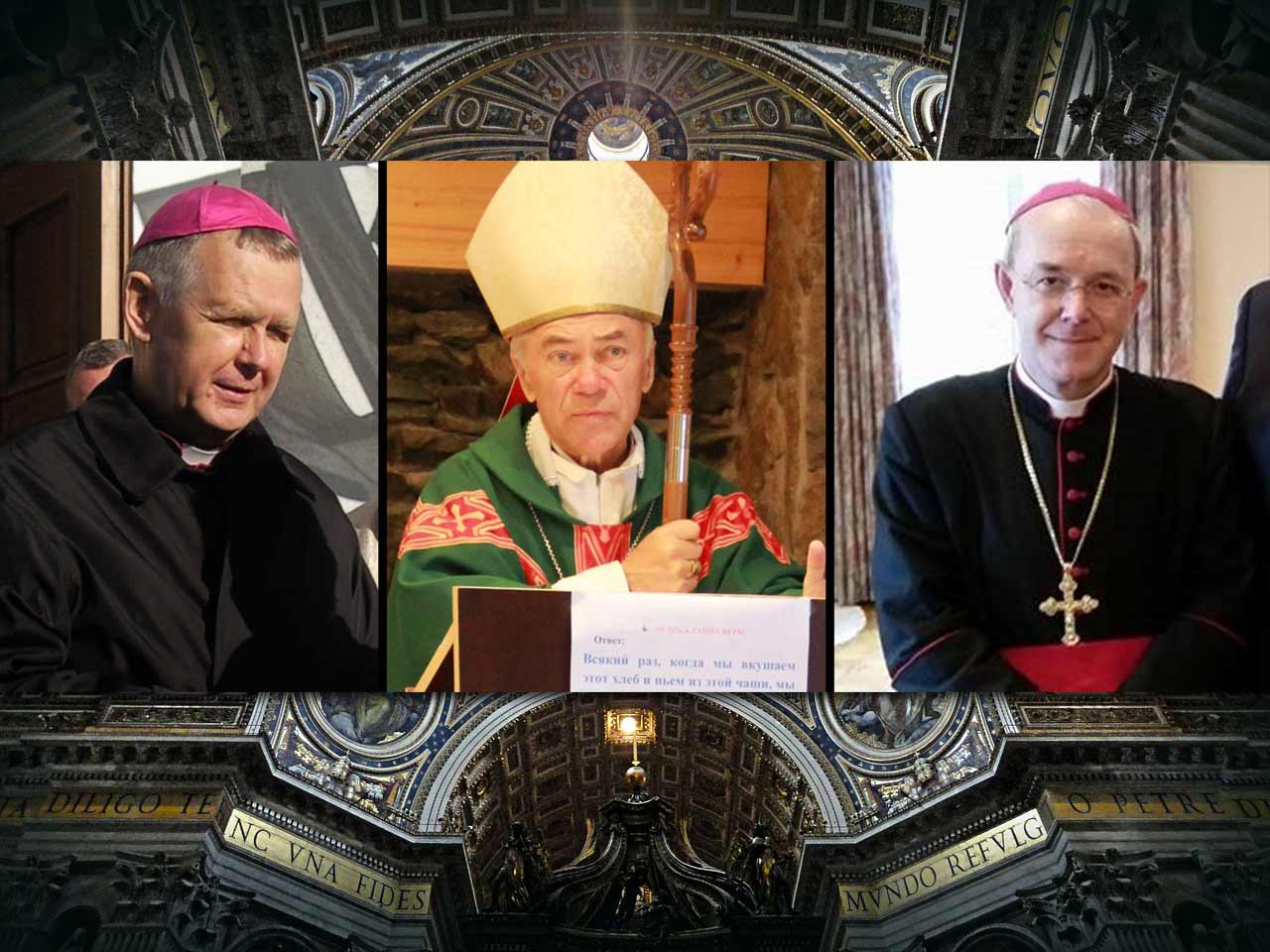
Almost exactly a year after they issued a call for prayer that the pope would uphold Catholic teaching on marriage, three bishops from Kazakhstan — Tomash Peta, Metropolitan Archbishop of the archdiocese of Saint Mary in Astana, Jan Pawel Lenga, Archbishop-Bishop emeritus of Karaganda, and Athanasius Schneider, Auxiliary Bishop of the archdiocese of Saint Mary in Astana — have issued a new statement, saying that any change in sacramental discipline that would allow Catholic divorcees living in new sexual unions to receive Holy Communion is “alien to the entire Tradition of the Catholic and Apostolic faith”.

One year ago this month, these same bishops issued a joint statement urging the faithful to pray that Pope Francis would “confirm the unchanging praxis of the Church with regard to the truth of the indissolubility of marriage.”

As 1P5 reported last January:

The statement, issued on January 18th, the Feast of the Chair of St. Peter, is much more than a solicitation to storm heaven. The bishops document their concerns with “published norms” for the “application and interpretations” of Amoris Laetitia “whereby the divorced who have attempted civil marriage with a new partner, notwithstanding the sacramental bond by which they are joined to their legitimate spouse, are admitted to the sacraments of Penance and the Eucharist without fulfilling the duty, established by God, of ceasing to violate the bond of their existing sacramental marriage.”

The bishops assert that “Pastors of the Church who tolerate or authorize, even in individual or exceptional cases,  the reception of the sacrament of the Eucharist by the divorced and so-called “remarried,” without their being clothed in the ‘wedding garment,’… are complicit in this way with a continual offense against the sacramental bond of marriage, the nuptial bond between Christ and the Church and the nuptial bond between Christ and the individual soul who receives his Eucharistic Body.”

Making mention of particular churches that have issued pastoral guidelines for the implementation of Amoris Laetitia along such lines, the bishop say that such guidelines “contradict the universal tradition of the Catholic Church, which by means of an uninterrupted Petrine Ministry of the Sovereign Pontiffs has always been faithfully kept, without any shadow of doubt or of ambiguity, either in its doctrine or its praxis, in that which concerns the indissolubility of marriage.”

Pope Francis did not, however, respond to their insistence that “only the voice of the Supreme Pastor of the Church can definitively impede a situation where in the future, the Church of our time is described with the following expression: ‘all the world groaned and noticed with amazement that it has in practice accepted divorce’”. Instead, he chose to add his confirmation of the permissive interpretation in the guidelines of the bishops of Buenos Aires to the official acts of the Holy See — a decision that Cardinal Coccopalmerio, President of the Pontifical Council for Legislative Texts, saidmakes it a part of the pope’s “authentic magisterium.”

In their new statement, issued on the Feast of the Holy Family (Dec. 31), the Kazakhstani bishops do not specifically mention the recent actions of the pope, but nevertheless warn that “The admission of so-called ‘divorced and remarried’ faithful to Holy Communion, which is the highest expression of the unity of Christ the Spouse with His Church, means in practice a way of approving or legitimizing divorce, and in this meaning a kind of introduction of divorce in the life of the Church.” Further, they say, the new norms being implemented by bishops in various parts of the world (in line with the pope’s support of the Buenos Aires bishops) represent “a matter of spreading the ‘plague of divorce’ even in the life of the Church, when the Church, instead, because of her unconditional fidelity to the doctrine of Christ, should be a bulwark and an unmistakable sign of contradiction against the plague of divorce which is every day more rampant in civil society.”

The bishops go on to explain the gravity of the shift in direction from the Vatican:

Unequivocally and without admitting any exception Our Lord and Redeemer Jesus Christ solemnly reaffirmed God’s will regarding the absolute prohibition of divorce. An approval or legitimation of the violation of the sacredness of the marriage bond, even indirectly through the mentioned new sacramental discipline, seriously contradicts God’s express will and His commandment. This practice therefore represents a substantial alteration of the two thousand-year-old sacramental discipline of the Church. Furthermore, a substantially altered discipline will eventually lead to an alteration in the corresponding doctrine.

The constant Magisterium of the Church, beginning with the teachings of the Apostles and of all the Supreme Pontiffs, has preserved and faithfully transmitted both in the doctrine (in theory) and in the sacramental discipline (in practice) in an unequivocal way, without any shadow of doubt and always in the same sense and in the same meaning (eodem sensu eademque sententia), the crystalline teaching of Christ concerning the indissolubility of marriage.

Because of its Divinely established nature, the discipline of the sacraments must never contradict the revealed word of God and the faith of the Church in the absolute indissolubility of a ratified and consummated marriage. [emphasis added]

In support of their position, the Kazakhstani bishops make ample reference to teaching and thought not just of the Second Vatican Council, but also of the conciliar and post-conciliar popes and other Vatican dicasteries, making it difficult for papal defenders to dismiss their claims as a solely traditionalist critique.

They then invoke their obligation as bishops, who have a “grave responsibility” and “duty before the faithful who await from us a public and unequivocal profession of the truth and the immutable discipline of the Church regarding the indissolubility of marriage.”

“For this reason,” they say, “we are not allowed to be silent.”

They go on:

We affirm therefore in the spirit of St. John the Baptist, of St. John Fisher, of St. Thomas More, of Blessed Laura Vicuña and of numerous known and unknown confessors and martyrs of the indissolubility of marriage:

It is not licit (non licet) to justify, approve, or legitimize either directly or indirectly divorce and a non-conjugal stable sexual relationship through the sacramental discipline of the admission of so-called “divorced and remarried” to Holy Communion, in this case a discipline alien to the entire Tradition of the Catholic and Apostolic faith.

By making this public profession before our conscience and before God who will judge us, we are sincerely convinced that we have provided a service of charity in truth to the Church of our day and to the Supreme Pontiff, Successor of Saint Peter and Vicar of Christ on earth. [emphasis in original]

The full text of the Kazakhstani bishops’ statement is below:


Profession of the Immutable Truths About Sacramental Marriage

After the publication of the Apostolic Exhortation “Amoris laetitia” (2016) various bishops issued at local, regional, and national levels applicable norms regarding the sacramental discipline of those faithful, called “divorced and remarried,” who having still a living spouse to whom they are united with a valid sacramental matrimonial bond, have nevertheless begun a stable cohabitation more uxorio with a person who is not their legitimate spouse.

The aforementioned rules provide inter alia that in individual cases the persons, called “divorced and remarried,” may receive the sacrament of Penance and Holy Communion, while continuing to live habitually and intentionally more uxorio with a person who is not their legitimate spouse. These pastoral norms have received approval from various hierarchical authorities. Some of these norms have received approval even from the supreme authority of the Church.

The spread of these ecclesiastically approved pastoral norms has caused a considerable and ever increasing confusion among the faithful and the clergy, a confusion that touches the central manifestations of the life of the Church, such as sacramental marriage with the family, the domestic church, and the sacrament of the Most Holy Eucharist.

According to the doctrine of the Church, only the sacramental matrimonial bond constitutes a domestic church (see Second Vatican Council, Lumen Gentium, 11). The admission of so-called “divorced and remarried” faithful to Holy Communion, which is the highest expression of the unity of Christ the Spouse with His Church, means in practice a way of approving or legitimizing divorce, and in this meaning a kind of introduction of divorce in the life of the Church.

The mentioned pastoral norms are revealed in practice and in time as a means of spreading the “plague of divorce” (an expression used by the Second Vatican Council, see Gaudium et spes, 47). It is a matter of spreading the “plague of divorce” even in the life of the Church, when the Church, instead, because of her unconditional fidelity to the doctrine of Christ, should be a bulwark and an unmistakable sign of contradiction against the plague of divorce which is every day more rampant in civil society.

Unequivocally and without admitting any exception Our Lord and Redeemer Jesus Christ solemnly reaffirmed God’s will regarding the absolute prohibition of divorce. An approval or legitimation of the violation of the sacredness of the marriage bond, even indirectly through the mentioned new sacramental discipline, seriously contradicts God’s express will and His commandment. This practice therefore represents a substantial alteration of the two thousand-year-old sacramental discipline of the Church. Furthermore, a substantially altered discipline will eventually lead to an alteration in the corresponding doctrine.

The constant Magisterium of the Church, beginning with the teachings of the Apostles and of all the Supreme Pontiffs, has preserved and faithfully transmitted both in the doctrine (in theory) and in the sacramental discipline (in practice) in an unequivocal way, without any shadow of doubt and always in the same sense and in the same meaning (eodem sensu eademque sententia), the crystalline teaching of Christ concerning the indissolubility of marriage.

Because of its Divinely established nature, the discipline of the sacraments must never contradict the revealed word of God and the faith of the Church in the absolute indissolubility of a ratified and consummated marriage. “The sacraments not only presuppose faith, but by words and objects they also nourish, strengthen, and express it; that is why they are called “sacraments of faith.” (Second Vatican Council, Sacrosanctum Concilium, 59). “Even the supreme authority in the Church may not change the liturgy arbitrarily, but only in the obedience of faith and with religious respect for the mystery of the liturgy” (Catechism of the Catholic Church, 1125).

The Catholic faith by its nature excludes a formal contradiction between the faith professed on the one hand and the life and practice of the sacraments on the other. In this sense we can also understand the following affirmation of the Magisterium: “This split between the faith which many profess and their daily lives deserves to be counted among the more serious errors of our age.” (Second Vatican Council, Gaudium et Spes, 43) and “Accordingly, the concrete pedagogy of the Church must always remain linked with her doctrine and never be separated from it” (John Paul II, Apostolic Exhortation Familiaris Consortio, 33).

In view of the vital importance that the doctrine and discipline of marriage and the Eucharist constitute, the Church is obliged to speak with the same voice. The pastoral norms regarding the indissolubility of marriage must not, therefore, be contradicted between one diocese and another, between one country and another. Since the time of the Apostles, the Church has observed this principle as St. Irenaeus of Lyons testifies: “The Church, though spread throughout the world to the ends of the earth, having received the faith from the Apostles and their disciples, preserves this preaching and this faith with care and, as if she inhabits a single house, believes in the same identical way, as if she had only one soul and only one heart, and preaches the truth of the faith, teaches it and transmits it in a unanimous voice, as if she had only one mouth”(Adversus haereses, I, 10, 2). Saint Thomas Aquinas transmits to us the same perennial principle of the life of the Church: “There is one and the same faith of the ancients and the moderns, otherwise there would not be one and the same Church” (Questiones Disputatae de Veritate, q. 14, a. 12c).

The following warning from Pope John Paul II remains current and valid: “The confusion, created in the conscience of many faithful by the differences of opinions and teachings in theology, in preaching, in catechesis, in spiritual direction, about serious and delicate questions of Christian morals, ends up by diminishing the true sense of sin almost to the point of eliminating it” (Apostolic Exhortation Reconciliatio et Paenitenia, 18).

The meaning of the following statements of the Magisterium of the Church is fully applicable to the doctrine and sacramental discipline concerning the indissolubility of a ratified and consummated marriage:

  • “For the Church of Christ, watchful guardian that she is, and defender of the dogmas deposited with her, never changes anything, never diminishes anything, never adds anything to them; but with all diligence she treats the ancient doctrines faithfully and wisely, which the faith of the Fathers has transmitted. She strives to investigate and explain them in such a way that the ancient dogmas of heavenly doctrine will be made evident and clear, but will retain their full, integral, and proper nature, and will grow only within their own genus — that is, within the same dogma, in the same sense and the same meaning” (Pius IX, Dogmatic Bull Ineffabilis Deus)
  • “With regard to the very substance of truth, the Church has before God and men the sacred duty to announce it, to teach it without any attenuation, as Christ revealed it, and there is no condition of time that can reduce the rigor of this obligation. It binds in conscience every priest who is entrusted with the care of teaching, admonishing, and guiding the faithful “(Pius XII, Discourse to parish priests and Lenten preachers, March 23, 1949).
  • “The Church does not historicize, does not relativize to the metamorphoses of profane culture the nature of the Church that is always equal and faithful to itself, as Christ wanted it and authentic tradition perfected it” (Paul VI, Homily from October 28, 1965).
  • “Now it is an outstanding manifestation of charity toward souls to omit nothing from the saving doctrine of Christ” (Paul VI, Encyclical Humanae Vitae, 29).
  • “Any conjugal difficulties are resolved without ever falsifying and compromising the truth” (John Paul II, Apostolic Exhortation Familiaris Consortio, 33).
  • “The Church is in no way the author or the arbiter of this norm [of the Divine moral law]. In obedience to the truth which is Christ, whose image is reflected in the nature and dignity of the human person, the Church interprets the moral norm and proposes it to all people of good will, without concealing its demands of radicalness and perfection” (John Paul II, Apostolic Exhortation Familiaris Consortio, 33).
  • “The other principle is that of truth and consistency, whereby the church does not agree to call good evil and evil good. Basing herself on these two complementary principles, the church can only invite her children who find themselves in these painful situations to approach the divine mercy by other ways, not however through the sacraments of penance and the eucharist until such time as they have attained the required dispositions” (John Paul II, Apostolic Exhortation Reconciliatio et Paenitentia, 34).
  • “The Church’s firmness in defending the universal and unchanging moral norms is not demeaning at all. Its only purpose is to serve man’s true freedom. Because there can be no freedom apart from or in opposition to the truth”(John Paul II, Encyclical Veritatis Splendor, 96).
  • When it is a matter of the moral norms prohibiting intrinsic evil, there are no privileges or exceptions for anyone. It makes no difference whether one is the master of the world or the “poorest of the poor” on the face of the earth. Before the demands of morality we are all absolutely equal” (emphasis in original) (John Paul II, Encyclical VeritatisSplendor, 96).
  • “The obligation of reiterating this impossibility of admission to the Eucharist is required for genuine pastoral care and for an authentic concern for the well-being of these faithful and of the whole Church, as it indicates the conditions necessary for the fullness of that conversion to which all are always invited by the Lord“ (Pontifical Council for Legislative Texts, Declaration on the admissibility to the Holy Communion of the divorced and remarried, 24 June 2000, n. 5).As Catholic bishops, who – according to the teaching of the Second Vatican Council – must defend the unity of faith and the common discipline of the Church, and take care that the light of the full truth should arise for all men (see Lumen Gentium, 23 ) we are forced in conscience to profess in the face of the current rampant confusion the unchanging truth and the equally immutable sacramental discipline regarding the indissolubility of marriage according to the bimillennial and unaltered teaching of the Magisterium of the Church. In this spirit we reiterate:
  • Sexual relationships between people who are not in the bond to one another of a valid marriage – which occurs in the case of the so-called “divorced and remarried” – are always contrary to God’s will and constitute a grave offense against God.
  • No circumstance or finality, not even a possible imputability or diminished guilt, can make such sexual relations a positive moral reality and pleasing to God. The same applies to the other negative precepts of the Ten Commandments of God. Since “there exist acts which, per se and in themselves, independently of circumstances, are always seriously wrong by reason of their object” (John Paul II, Apostolic Exhortation Reconciliatio et Paenitentia, 17).
  • The Church does not possess the infallible charism of judging the internal state of grace of a member of the faithful (see Council of Trent, session 24, chapter 1). The non-admission to Holy Communion of the so-called “divorced and remarried” does not therefore mean a judgment on their state of grace before God, but a judgment on the visible, public, and objective character of their situation. Because of the visible nature of the sacraments and of the Church herself, the reception of the sacraments necessarily depends on the corresponding visible and objective situation of the faithful.
  • It is not morally licit to engage in sexual relations with a person who is not one’s legitimate spouse supposedly to avoid another sin. Since the Word of God teaches us, it is not lawful “to do evil so that good may come” (Romans 3, 8).
  • The admission of such persons to Holy Communion may be permitted only when they with the help of God’s grace and a patient and individual pastoral accompaniment make a sincere intention to cease from now on the habit of such sexual relations and to avoid scandal. It is in this way that true discernment and authentic pastoral accompaniment were always expressed in the Church.
  • People who have habitual non-marital sexual relations violate their indissoluble sacramental nuptial bond with their life style in relation to their legitimate spouse. For this reason they are not able to participate “in Spirit and in Truth” (see John 4, 23) at the Eucharistic wedding supper of Christ, also taking into account the words of the rite of Holy Communion: “Blessed are the guests at the wedding supper of the Lamb!” (Revelation 19, 9).
  • The fulfillment of God’s will, revealed in His Ten Commandments and in His explicit and absolute prohibition of divorce, constitutes the true spiritual good of the people here on earth and will lead them to the true joy of love in the salvation of eternal life.

Being bishops in the pastoral office, who promote the Catholic and Apostolic faith (“cultores catholicae et apostolicae fidei”, see Missale Romanum, Canon Romanus), we are aware of this grave responsibility and our duty before the faithful who await from us a public and unequivocal profession of the truth and the immutable discipline of the Church regarding the indissolubility of marriage. For this reason we are not allowed to be silent.

We affirm therefore in the spirit of St. John the Baptist, of St. John Fisher, of St. Thomas More, of Blessed Laura Vicuña and of numerous known and unknown confessors and martyrs of the indissolubility of marriage:

It is not licit (non licet) to justify, approve, or legitimize either directly or indirectly divorce and a non-conjugal stable sexual relationship through the sacramental discipline of the admission of so-called “divorced and remarried” to Holy Communion, in this case a discipline alien to the entire Tradition of the Catholic and Apostolic faith.

By making this public profession before our conscience and before God who will judge us, we are sincerely convinced that we have provided a service of charity in truth to the Church of our day and to the Supreme Pontiff, Successor of Saint Peter and Vicar of Christ on earth .

31 December 2017, the Feast of the Holy Family, in the year of the centenary of the apparitions of Our Lady at Fatima.


+ Tomash Peta, Archbishop Metropolitan of the Archdiocese of Saint Mary in Astana

+ Jan Pawel Lenga, Archbishop-Bishop of Karaganda

+ Athanasius Schneider, Auxiliary Bishop of the Archdiocese of Saint Mary in Astana

Posted in Uncategorized | 1 Comment

THIS LITTLE BIT OF SATIRE WILL HELP PREPARE YOU FOR WHATEVER FRANCIS WILL SAY WHEN HE VISITS THE SACRILEGIOUS NATIVITY CRECHE IN ST. PETER’S PIAZZA LATER TODAY

Eccles and Bosco is saved


The mystery of the shepherds

Posted: 30 Dec 2017 03:00 AM PST

Many writers have speculated about the identities of the Magi, most recently Fr Dwight Longenecker. Clearly, many questions are still to be answered, of which the key ones are:

  • were there three of them?
  • were they wise?
  • were they men?

Indeed, next Christmas’s blockbuster by Fr James Martin SJ is expected to reveal that they were five women deacons wearing dalmatics.traddy creche

A traddy nativity scene, unsuitable for modern use.

Traditionally, at least, there were three wise men, called Kasper, Müller and Baldisseri, but nobody know how many shepherds there were, nor any of their names.

My own detailed research suggests that there were three shepherds (because Biblical stuff comes in threes, sevens, twelves and forties). I thought at first that Baa-lamb was a shepherd, but many scholars now say that he kept a donkey, and was nothing at all to do with the first Christmas.

Balaam and the angel

Shepherds only! Clear off!

A study of the Archers, a long-running religious radio programme broadcast by the BBC, suggests that one of the shepherds might be called Walter Gabriel, originator of the phrase, “Me old pal, me old beauty”, although Gabriel is also the name of an angel, so one cannot be sure.

The Tony Hancock character Joshua Merryweather (another Biblical name!) is also a possibility, with his classic hymn of praise (now available in The Graham Kendrick Book of Hymns for Today):

I've got mangel wurzels in my garden, 
I've got mangel wurzels in my shed,
I've got mangel wurzels in my bathroom,
And a mangel wurzel for a head.

Tony Hancock et al

Were these the three shepherds?

Well, it’s all very mystifying. Also, why did the angels summon shepherds to the manger? Why not celebrities – by which we mean actors, footballers, comedians, politicians, professors of zoology, professors of human flourishing, etc.? Or even celebrity clerics, bloggers, and professors of theology, who could have explained what was going on? It all sounds like an almighty mix-up.

Massimo Faggioli

“There will be a time for the canonization of King Herod,” explains a distinguished professor.

Note: “While shepherds washed their socks by night / All seated round the tub” is © The Graham Kendrick Book of Hymns for Today. 

Posted in Uncategorized | 1 Comment

HERE IS A BOOK THAT EVERY PERSON WHO IS NOT A LIBERAL/PROGRESSIVE SHOULD READ. ON SECOND THOUGHT, HERE IS A BOOK THAT EVERY LIBERAL/PROGRESSIVE SHOULD READ.


I am currently reading the book, SCALIA SPEAKS, sent to me as a Christmas present by Edward Whelan who, with Christopher Scalia, the son of Justice Antonin Scalia edited and published the book (New York, Crown Forum, 2017).

I am having trouble putting the book down; it is a fascinating read.  But then anyone who has read a SCOTUS Dissent written by Justice Antonin Scalia knows that aside from their judicial merit they are classics of English prose.  His speeches are the closest thing to the wit and wisdom of G.K. Chesterton you will ever find.  Buy it; read it, save it for frequent future reference

EPPC President Ed Whelan, a former law clerk to Justice Scalia, co-edited the New York Times bestselling collection of Justice Scalia’s speeches, Scalia Speaks: Reflections on Law, Faith, and Life Well Lived.
Scalia Speaks collects dozens of Justice Scalia’s best speeches on topics as varied as the law, faith, virtue, pastimes, and heroes and friends. A New York Times review called Scalia Speaks a “marvelous collection,” while a review in the Washington Post hailed it as a “magnificent volume that should be on the bookshelf of every educated American.”

Scalia Speaks includes a beautiful foreword by Justice Ruth Bader Ginsburg and a poignant introduction by co-editor Christopher J. Scalia, the eighth child of Justice and Mrs. Scalia.

In addition to his work on Scalia Speaks, Mr. Whelan was a leading proponent of the confirmation of Justice Neil Gorsuch, both in television and radio appearances and in his writings at National Review. In an article published immediately upon the announcement of the Gorsuch nomination, Mr. Whelan called him “a brilliant jurist and dedicated originalist and textualist” and “a fit successor to Justice Scalia.”

Posted in Uncategorized | 4 Comments

DIETRICH VON HILDEBRAND, “THE TWENTIETH CENTURY DOCTOR OF THE CHURCH”

Monday, June 23, 2014

Dietrich Von Hildebrand on Vatican II: a ‘Great Misfortune’

Written by  By Michael Davies, RIP

Dietrich von HildebrandDietrich von Hildebrand

Reprinted from The Remnant 2004…

The following letter from Dietrich Von Hildebrand, who was described by Pope Pius XII as the 20th century Doctor of the Church, is not without interest in view of the recent critiques appearing in The Remnant of the article “Why Vatican II was Necessary”, which appeared in the March 2004 issue of Crisis magazine.

In view of my almost totally negative attitude to the Council set out in my book Pope John’s Council, I felt very uneasy some years ago when reading certain enthusiastic remarks concerning Vatican II in Dietrich Von Hildebrand’s Trojan Horse in the City of God. Compared with Dr. Von Hildebrand I am an intellectual pygmy, and I wrote to him explaining the fact that I was very unhappy about our disagreement, particularly with regard to such instances as his praise for the official documents and “the greatness of the Second Vatican Council” found on page 1 of his book. He replied as follows in a letter, dated 22 April 1976:


Dear Friend in Christ:

I was delighted in reading your letter to Bishop Donohue of Fresno in “The Remnant.” This letter is a masterpiece. The repetition of “My Lord” is delightful. Thank you for writing it.

I was very pleased about your words concerning my position toward the documents of Vatican Council II. I consider the Council—notwithstanding the fact that it brought some ameliorations—as a great misfortune. And I stress time and again in lectures and articles that fortunately no word of the Council—unless it is a repetition of former definitions de fide—is binding de fide. We need not approve; on the contrary we should disapprove. Unfortunately Maritain said in his last book: the two great manifestations of the Holy Spirit in our times are Vatican Council II and the foundation of the state of Israel.

I read the chapter of your book and I am completely satisfied. Hoping to meet you some day, I am united with you in caritate Christi and in the fight against Modernism.

Yours affectionately,

Dietrich von Hildebrand


So that readers may have the benefit of placing all this in context, I’m including the original letter from Bishop Donohue and my response to him, which was published in the 1976 issues of The Remnant. Perhaps the exchange will serve to illustrate anew that the more things change the more they stay the same.


Diocese of Fresno

Chancery Office

1550 North Fresno St.

Fresno, CA

Dear Monsignor/Father:

It has come to my attention that the Tridentine Mass has been more common in the Diocese of Fresno than I had reason to suspect.

I wish you to make it a matter of conscience to discover if such a Mass is being celebrated in any hall, house or wherever within the confines of your parish.

If so, I wish you to definitely confront the priest if possible and tell him he has no faculties of permission in this Diocese to offer any Mass. If any of his followers are present tell them that the Mass is gravely illicit and that they are gravely sinning through destroying the unity of Faith by their disobedience.

If such a practice continues I will be forced to use the ultimate decision of declaring them contumacious and excommunicated.

Sincerely in Christ,

Hugh A. Donohoe, Bishop of Fresno


Open Letter to Bishop Donohoe


Most Rev. Hugh A. Donohoe, Bishop of Fresno, California

February 23, 1976

My Lord Bishop:

A friend who lives in your diocese has sent me a copy of your letter (see Remnant, March 6th, for full text) stating that you are prepared to declare that priests who celebrate, and the faithful who attend, the Tridentine Mass are ‘contumacious’ and will be ‘excommunicated’. We had begun to believe that, in the era of the “spirit of Vatican II,” no one could be excommunicated; but now we know: there is one crime in the “open Church” that will not be tolerated, at least in the Diocese of Fresno, the crime of worshipping as our forebears worshipped; the crime of using that form of Mass which Fr. Fortescue, the greatest liturgist historian of my own country, tells us ‘goes back without essential change to the age when it first developed out of the oldest liturgy of all. It is still redolent of that liturgy of the days when Caesar ruled the world and thought he could stamp out the faith of Christ, when our fathers met before dawn to sing a hymn to Christ as God”.

Clearly, my Lord, you think that you can succeed where Caesar could not.

Crammer too thought he could stamp out the traditional Mass. When he replaced it with a new English Communion Service in 1549, the peasants of the west rose up against him and demanded the right to worship once more with the same Latin Mass that their fathers had used. I would suggest, my Lord, that if you study Crammer’s methods you could improve upon excommunication. Priests were hung from the church towers in their Mass vestments for the very act for which you now threaten to excommunicate them; humble peasants were hung in the hundreds because they assisted at the Mass which you, like Cranmer, condemn as “gravely illicit”. But Cranmer could not stamp out the traditional Mass – and you think that you can succeed where he failed.

With the reign of Elizabeth came the rack, the hanging, the drawing and quartering – but the reply of the faithful was always the same: “We will have the Mass.” And the Mass they would have was the one codified by Pope Pius V in 1570, but not a new form of Mass like that promulgated in 1969, but the Mass of the ages codified, as Pope St. Pius V intended, for all eternity. No priest could ever be made to say any other form of Mass, he insisted. But now if a priest uses that Mass in the diocese of Fresno, he will be “excommunicated”.

My Lord, forgive me if I seem impertinent, but in my country we have a great devotion to our martyrs; we also know our history. When I read your letter, I could not believe that it was not written by an English bishop of the sixteenth century. “I wish you to make it a matter of conscience to discover if such a Mass if being celebrated in any hall, house, or wherever within the confines of your parish”. Those are your exact words.

My Lord, have you no more urgent business to employ your priests upon? Have you, for example, ordered them, as a matter of conscience, to go into their parish schools to discover whether the faith of the children, for whom you are responsible before God, is being corrupted by inadequate or even heretical textbooks? Have you ordered your priests to discover, as a matter of conscience, whether secularist-humanist sex-education programmes are being used to corrupt the morals of the children in any of your parochial schools? Have you, my Lord, as a matter of conscience, ever attempted to discover whether what few liturgical laws remain are being flouted in your diocese – is Communion being given in the hand? Are unauthorized Eucharistic prayers being used? If you discovered such abuses, would you excommunicate those involved? I wonder…

I am quite certain, my Lord, that in a spirit of ecumenism, you would not only NOT excommunicate members of your diocese who take part in Protestant services, but probably encourage them to do so. Can you see no incongruity? You must surely be aware that the Secretariat of Christian Unity issued an Ecumenical Directory in 1967. This Directory not only authorized Catholics to take part in the liturgy of the Orthodox Church on Sundays, but said that this satisfies their Sunday Mass obligation. Yes, my Lord, to take part in the worship of schismatics fulfills our Sunday obligation, but to worship in the manner which has inspired so many saints and has been sanctified by the blood of martyrs – this must be punished by excommunication.

My Lord, unless your diocese is unique in the western world, the introduction of the new Mass for pastoral reasons will have been followed by a serious decline in Mass attendance. Thousands of your flock, who assisted at Mass each Sunday before, no longer do so – but they will not be excommunicated. Oh no, my Lord. Better no Mass at all than the Mass of our fathers.

And please, my Lord, do not say that you have no alternative. Do not say that you are only obeying orders. One thing which has become clear since Vatican II is that the clergy in general and the Bishops in particular take the laity for fools. Not all the clergy, of course. There are some who are determined to remain true to the Faith into which they were baptized and to the Mass which they were ordained to offer. Fr. Henri Bruckberger to mention but one, has written: “Do our Bishops take us for idiots? We are as familiar with the relevant documents as they are. We know that the new Mass has simply been authorized and has not been made mandatory”. Fr. Bruckburger was Chaplain General to the French Resistance, my Lord. He has had ample experience with men who were only obeying orders. I would also remind you, my Lord, that here in England the Tridentine Mass is not absolutely prohibited. It is, of course, celebrated all over the country, in houses and halls, whether the bishops like it or not – but it is also celebrated on occasions in churches and in Cathedrals, with their blessing, and, I might add, with the full knowledge and consent of Pope Paul VI. What is permitted in Britain could certainly be permitted in the United States.

My Lord, once more without wishing to be impertinent, I would ask you whether you are really clear as to what the word “pastor” means. If you have not forgotten the Parable of the Good Shepherd, you will remember that in the east a shepherd leads his sheep; he not only leads them, but he loves them; and because he loves them he leads them to green pastures. My Lord, because some of your flock wish to take their spiritual refreshment from the pastures they have always known and loved, you threaten to cast them out from the sheepfold. My Lord, this is not the action of a good shepherd but a bad bureaucrat, a man who believes that the reason for our existence is to be made to obey regulations and that his vocation is to use any means to ensure that this is done.

My Lord, do the basic principles of moral theology no longer apply in the renewed Church? You will certainly have been taught as a seminary student that a legislator should not simply refrain from demanding something his subjects will find impossible to carry out, but that his laws should not be too difficult, too distressing or too disagreeable, and should take account of human frailty. A law can cease to bind without revocation on the part of the legislator when it is clearly harmful, impossible, or irrational. If forbidding faithful Catholics to honour God by worshipping Him in the most venerable and hallowed rite in Christendom does not meet these conditions, it would be hard to imagine anything that did. For a Catholic to contemplate disobedience to his bishop is a terrible thing, but Fr. Bruckberger has reminded us of Montesquiew’s dictum: “When one wants only good slaves one ends up with only bad subjects.”

My Lord, as a postscript to your letter, you add a suggested petition on behalf of the Jews in Syria, a petition to be used on March 14 in the parishes of your diocese. Might I suggest a similar petition which Catholics elsewhere could use – for, after all, charity begins at home. “That there be an alleviation of the suffering experienced by the Catholics living in the Diocese of Fresno and that they may be free to worship God according to the traditions of their fathers as they desire, let us pray to the Lord.”

I remain, my Lord Bishop, Yours in Domino,

Michael Davies

London, England


Posted in Uncategorized | 1 Comment

AN EXCELLENT BOOK REVIEW

c0e0c-spadaro-pope

IT’S TRUE:  TWO PLUS TWO EQUALS FIVE

Lost Shepherd: How Pope Francis is Misleading His Flock – A Book Review by Karl Keating

http://cal-catholic.com/karl-keating-on-phil-lawlers-pope-book/


The following is from a December 23 Facebook posting by Karl Keating, the founder of Catholic Answers and author of Catholicism and Fundamentalism (among other books). Links inserted by California Catholic Daily. Philip Lawler, the editor at Catholic World News, has a new book coming out February 26: Lost Shepherd: How Pope Francis is Misleading His Flock (On December 19 I critiqued the book’s cover in a Facebook post. KK)


In the introduction Lawler says that, over the course of several years, “I did my best to provide assurance—for my readers and sometimes for myself—that despite his sometimes alarming remarks, Francis was not a radical, was not leading the Church away from the ancient sources of the Faith. But gradually, reluctantly, I came to the conclusion that he was.”


Lost Shepherd

Unlike some of the most vocal critics of this pope, Lawler took his time and gave him the benefit of every doubt. The result is 256 pages that lay out recent history well, without exaggeration or histrionics and with enough to substantiate Lawler’s reluctant conclusions.


Toward the end of the introduction he says, “I found I could no longer pretend that Francis was merely offering a novel interpretation of Catholic doctrine. No, it was more than that. He was engaged in a deliberate effort to change what the Church teaches.”


Lawler cautions against following the logic of certain Traditionalists who came out against Francis almost before the new pope stepped out on the balcony to give his first greeting. “Francis is not an anti-pope, much less the Antichrist. The see of Peter is not vacant, and Benedict is not the ‘real’ pontiff.” All such notions are nonsense, says Lawler, and not one of them helps to understand the reality of the situation. In fact, they do nothing but obscure.


The middle half of the book concerns the development and meaning of some of Pope Francis’s writings. Much space is given to “Amoris Laetitia.” Lawler says it “is not a revolutionary document. It is a subversive one. Francis has not overthrown the traditional teaching of the Church, as many Catholics hoped or feared that he would.” The document gives wide pastoral latitude, enough so that, in practice, in certain areas the traditional teaching of the Church can be set aside while not being denied.


To me the most interesting parts of the book concern Francis’s background in Argentina, his personal style (preemptory, conniving, sometimes even using low language), and his very “Jesuitical” machinations before and after becoming pope. In these regards he is quite unlike his predecessors—at least unlike all the other popes of my lifetime.


Perhaps most noticeably, Francis has been a scold.


“His rhetoric was radically at odds with his pulpit statements about the need to ‘accompany’ sinners, to tolerate disagreements, to reach out to new constituencies,” says Lawler. “In his own preaching he hectored his listeners, denouncing more than encouraging.”

The result—especially in consequence of preachings and talks he has given to Vatican officials and staff—has been a plummeting morale and a not unjustified fear of accusations of disloyalty.


Some Vatican staff members, even prominent members of prominent dicasteries, have been removed without a fare-thee-well, without explanation. Apparently phones have been tapped, conversations overheard. The result has been a widespread fear to say anything critical about anything, lest one lose one’s job. It is then not surprising to learn that “the pope selects his associates on the basis of personal loyalty rather than theological acumen or pastoral performance,” concludes Lawyer.


I can’t help thinking that in certain respects Pope Francis is much like President Trump. Each places more emphasis on loyalty than on skill. Each has gone through lots of aides and associates. The turnover rate at the Vatican, as at the White House, has been high.


What about the vaunted “Francis revival” around the world? There hasn’t been one, says Lawler. For example, worldwide the number of seminarians was increasing for years, up through 2012. The number has been in decline since then. Ditto for attendance at the pope’s Wednesday audiences.


At the beginning of his reign it was common to see 40,000 people or more in St. Peter’s Square. Now it’s not uncommon to see fewer than 15,000. Francis’s two immediate predecessors usually spoke to colonnade-to-colonnade audiences, but something has changed. The enthusiasm has waned.


Did the Holy Spirit goof at the conclave? No, as then-Cardinal Ratzinger noted in 1990: “Thus the Spirit’s role should be understood in a much more elastic sense, not that he dictates the candidate for whom one must vote. Probably the only assurance he offers is that the thing cannot be totally ruined.”


But “the thing” has been damaged, insists Lawler. “The damage done by Francis cannot be repaired unless it is recognized. Denying problems and papering over the differences only amplifies the confusion.”


As for the pope’s signature piece, Lawler says, “Yes, there are some fine passages in ‘Amoris Laetitia.’ But on the whole it fails as a teaching document because, as the saying goes, what is good is not new, and what is new is not good.” That said, “Pope Francis has not taught heresy, but the confusion he has stirred up has destabilized the universal Church.”


Lawler thinks it could take a long time for the Church to find its equilibrium again. One hopes not. One hopes for a successor who can right the Barque of Peter quickly, before too many passengers lose hope or abandon ship.


One way to minimize that is to read Lawler’s book and to understand how a conscientious and well-connected writer came to the conclusions he did.


Cal Catholic post script: In 1986 Lawler was hired by Cardinal Law as editor of the Boston Archdiocese paper, the Boston Pilot. Lawler resigned a year later. In 2008 he published The Faithful Departed about the collapse of Catholic culture in the wake of the pedophile scandals.

Posted in Uncategorized | Comments Off on AN EXCELLENT BOOK REVIEW

A LIST OF WHO IS WHO IN THE CRISIS OF THE CHURCH

211ce-pope-francis-waves-from-the-balcony-of-st-peter-s

Pete Baklinskiand Claire Chretien

NEWSCATHOLIC CHURCHThu Mar 9, 2017 – 10:00 am EST

 The full list of Catholic bishops and cardinals ‘for and against’ the dubia as of March 16, 2017

Amoris Laetitia , Dubia , Four Cardinals Letter , Pope Francis

Updated March 16, 2017: Bishop Rene Henry Gracida supports dubia. Archbishop Bruno Forte opposes. 

Update March 10, 2017: Archbishop Tomash Peta, Archbishop Jan Pawel Lenga, and Cardinal Wim Eijk support. Cardinal Donald Wuerl and Cardinal Orlando Quevedo oppose. 

Editor’s Note: LifeSiteNews brings you a list of bishops and cardinals who have publicly indicated their support or opposition to the September 2016 “dubia” submitted to Pope Francis by the four cardinals. This list includes high-ranking prelates whose comments relate directly to the dubia after their public release on November 14, 2016. The list does not include prelates who have merely made statements supporting or opposing the writings, decisions, and actions of Pope Francis, but haven’t commented directly on the dubia. The list will be updated. 

Cardinals who signed the dubia

Cardinal Walter Brandmüller

Cardinal Raymond Burke

Cardinal Carlo Caffarra

Cardinal Joachim Meisner

READ: Who are these four cardinals who wrote the ‘dubia’ to the Pope?

Bishops and cardinals who support the dubia

Archbishop Luigi Negri: March 06, 2017 – “Amoris Laetitia needs clarification, unfortunately, the current leader of the Church still remains silent. […] I think that the Holy Father should respond.”

Archbishop Charles J. Chaput: March 03, 2017 – John Allen: “Do you want the pope to answer the dubia?” Chaput: “Yes. I think it’s always good to answer questions, clearly.”

Cardinal Joseph Zen: February 16, 2017 – “It is a very respectful request by those bishops and cardinals to have a clear statement. I think they are right to have an answer.”

Bishop Rene Henry Gracida (Emeritus, Diocese of Corpus Christi, Texas): February 07, 2017 – “The longer Francis remains silent on the dubia the worse things will get in the Church.”

Archbishop Tomash Peta: January 18, 2017 – “Only the voice of the Supreme Pastor of the Church can definitively impede a situation where […] the Church […] has in practice accepted divorce.”

Archbishop Jan Pawel Lenga: January 18, 2017 – “We are forced to make this urgent appeal to prayer” given the “ineffectiveness of numerous appeals made privately and in a discreet manner to Pope Francis both by many faithful and by some Shepherds of the Church.”

Cardinal Wim Eijk: December 23, 2016 – “You cannot change doctrine with footnotes or a loose statement in an airplane interview. I would like [Amoris] to be clarified. […] Prolonged lack of clarity may result in undesirable practices to arise.”

Bishop Andreas Laun: December 23, 2016 – “I have read the concerns of the four cardinals, and I agree with them!”

Cardinal Renato Raffaele Martino: December 16, 2016 – “It is legitimate in terms of doctrine to turn to the pope and express an opinion – and it is also just that he would respond.”

Cardinal Paul Josef Cordes: December 12, 2016 – “With an objective tone, the four cardinals have asked for the removal of doubts about the text [Amoris Laetitia].”

Bishop James D. Conley: December 5, 2016 – “The questions being posed to the Holy Father are intended to help achieve clarity.”

Cardinal George Pell: November 29, 2016 – “How can you disagree with a question?”

Bishop Athanasius Schneider: November 23, 2016 – “The four cardinals only did their basic duty as bishops and cardinals.”

Bishop Jan Watroba: November 23, 2016 – “I myself have now been overwhelmed with many similar questions.”

Bishop Józef Wróbel: November 22, 2016 –  “The four cardinals did well in asking for clarification about Amoris Laetitia.”

Bishops and cardinals who oppose the dubia

Archbishop Bruno Forte (Chieti-Vasto, Italy): March 10, 2017 – “The doubts that were raised present doubts on who has raised them.”

Cardinal Vincent Nichols: February 23, 2017 – “I think the Pope’s patience and reserve about this whole matter is exactly what we should observe.”

Cardinal Donald Wuerl: January 30, 2017 – “A very small number of people, whose voices have been amplified by some of the Catholic media, have challenged the integrity of Pope Francis’ post-synodal apostolic exhortation, Amoris Laetitia […] It seems that a part of the distress evident in what has been described as a ‘tempest in a teapot’ is the fact that Pope Francis is challenging all of us to move into a far more Gospel-identified mode of living and being Church than we may have been comfortable with.”

Cardinal Orlando Quevedo: January 19, 2017 – “It’s clear enough that the Pope is holding on to doctrine [in Amoris]. I cannot understand the justification that the pope has to clarify his position. [Challenging the Pope is] divisive of the Church.”

Cardinal Gerhard Müller: January 8, 2017 – “The Pope is basically forced to answer with ‘yes or no.’ I don’t like that.”

Cardinal Walter Kasper: December 22, 2016Amoris Laetitia is “clear. … These dubia … do not exist.”

Cardinal Reinhard Marx: December 21, 2016 – “The document [Amoris] is not as ambiguous as some people claim.”

Cardinal Fernando Sebastian Aguilar: December 11, 2016 – “Some honorable men suffer because they do not understand what Francis wanted to say in Amoris Laetitia.”

Archbishop Mark Coleridge: December 9, 2016 – Pope Francis “wants a genuine clarity” while the four cardinals are seeking a “false clarity.”

Monsignor Pio Vito Pinto: December 1, 2016 – “They gave the Pope a slap in the face.”

Cardinal Wilfrid Fox Napier: November 30, 2016 – “Jesus also chose not to answer certain questions.”

Cardinal Claudio Hummes: November 25, 2016 – “We are 200, they are only four.”

Bishop Frangiskos Papamanolis: November 20, 2016 – They have committed the “two very serious sins” of “apostasy” and “scandal.”

Cardinal Blase Cupich: November 19, 2016 – “It’s up to those who have doubts and questions to have conversion in their lives.”

Cardinal Joseph Tobin: November 18, 2016 – “Just to simply reduce [Amoris] to a ‘dubium’, I think it is at best naive.”

Cardinal Christoph Schönborn: November 18, 2016 – This is an “attack against the pope.” The cardinals “must be obedient to the pope.”

Indeterminate

Cardinal Angelo Amato: November 24, 2016 – “The debate must be continued in reciprocal respect and above all by using the talents of the respective positions [in order to arrive at a] more integrated and improved positions.”

Note to readers: Send tips with links to evidence of cardinals and bishops who support or oppose the dubia to Pete Baklinski, pbaklinski@lifesitenews.com.

Posted in Uncategorized | 3 Comments

PRAY THAT 2018 WILL BRING A REFORM OF THE REFORM OF THE VATICAN PROMISED BY FRANCIS IN 2013

Settimo Cielodi Sandro Magister

Vatican Without Peace. Money, Sex, and an LGBT Crèche

Presepe

*

A stormy Christmas, this year at the Vatican. Just when Pope Francis, in his Christmas greetings to the curia, was going after those he called “traitors” and “opportunists” – after having already “delicately” fired the former and threatened to fire the latter – he was hit with sensational new own goals. At least three of them.

*

The first own goal comes from Honduran cardinal Óscar Rodríguez Maradiaga, 75, archbishop of Tegucigalpa but much more famous abroad than at home, so highly favored by Francis that he made him coordinator of the “C9,” the council of nine cardinals who help the pope in the reform of the curia and in the governance of the universal Church.

The issue of “L’Espresso” that came out on newsstands Christmas Eve – but was posted online at the same time as the pope’s speech to the curia – has published under the byline of Emiliano Fittipaldi a very aggressive investigative report not only against the cardinal, accused of appropriating and squandering enormous sums, but also against his closest associate and friend, Tegucigalpa auxiliary bishop Juan José Pineda Fasquelle, 57, a Claretian:

> L’ultimo scandalo vaticano: 35 mila euro al mese per il cardinale Maradiaga

Maradiaga reacted by asserting that the sums indicated were available not to him personally but to the diocese, for the needs of the Honduran Church, and that the accusations now leveled against him are more than a year old and have already been contested in a legal action.

His reply appeared first on “Catholic New Agency” and then, in a more detailed form, in the Italian Catholic newspaper “Avvenire,” with the additional news – released by Vatican Radio – that “on December 26 the cardinal spoke by telephone with pope Francis, who expressed to him his displeasure ‘over all the evil they have done against you. But don’t you worry’”:

> Rodríguez Maradiaga: “Falsità sui fondi”. E il papa lo rincuora

In replying, however, the cardinal avoided coming to the defense of his auxiliary bishop, Pineda. On the contrary, he confirmed that an investigation on him was carried out by an apostolic visitor sent in by the pope, the Argentine Alcides Jorge Pedro Casaretto, 80, bishop emeritus of San Isidro.

The report of the apostolic visitor is now on the desk of Francis, who is believed to have commandeered all decisions for himself. The only measure taken so far has been that of sending Pineda to Madrid for a spiritual retreat with the Jesuits.

The investigation on the auxiliary and friend of Maradiaga concerned accusations both of embezzlement and unjustified use of huge sums, and of favors in money and kind for a circle of male friends of dubious morality, against a backdrop of corruption and sexual abuse, as brought to light by Edward Pentin in the “National Catholic Register”:

> Cardinal Maradiaga Denies Financial Allegations, But Questions Remain Unanswered

“I don’t know the results of the apostolic visit,” Maradiaga stated. “L’Espresso says half truths, that are in the end the worse lies.”

“Half truths” that in any case cannot be reassuring for either the cardinal or the pope.

*

The second own goal has to do with Argentine bishop Gustavo Óscar Zanchetta, appointed by Pope Francis on December 19 as assessor of the Administration of the Patrimony of the Apostolic See, APSA.

A surprising appointment, because at APSA the position of assessor did not exist and was invented for the occasion. But even more surprising because of the profile of the appointee.

Zanchetta, 53, made the news last July when out of the blue he abandoned the diocese of Orán, for which Pope Francis had destined him in 2013. He justified the desertion with an unspecified “health problem” for which, he said, he had to get urgent treatment elsewhere. And he established himself for a while in Corrientes, 500 miles away, only to turn up even farther away, in Madrid, apparently in good physical shape.

At the time of his desertion, promptly made official by the pope, the Argentine media described the disastrous state in which Zanchetta had left the diocese of Orán from an administrative perspective, on a par with what had happened in the diocese of which he was previously vicar, that of Quilmes. Moreover, news went around of his refusal, asserting his “status as bishop,”  of a search of his vehicle by the police, who were looking for drugs.

This is the man to whom Francis has entrusted such an important role in the curia, in close contact with the president of APSA, Cardinal Domenico Calcagno, who meets regularly with the pope and is a tenacious opponent of the drastic reorganization of the Vatican finances attempted without success by Cardinal George Pell, prefect of the secretariat for the economy.

Now Cardinal Pell is on leave and has gone back to Australia, with his position in the curia remaining vacant. Also remaining empty is the key post of auditor general, after Libero Milone was brusquely removed from it on June 19.

If this is the state of affairs, Zanchetta’s appointment is doing nothing but increasing the confusion in which the much-vaunted reform of the Vatican curia finds itself.

*

But as if that were not enough, here comes the third own goal, centered on the nativity scene set up this year in Saint Peter’s Square (see photo).

There is neither ox nor ass, neither sheep nor shepherds. Jesus, Joseph, and Mary can be spotted with some effort, against the backdrop of a dome of Saint Peter’s in ruins. It is a nativity scene without grace and without poetry, the intention of which is rather to depict one by one the seven corporal works of mercy.

The offer of such a nativity scene to the pope was made by the abbey shrine of Montevergine, which stands on a mountain above Avellino, not far from Naples. At the governorate of Vatican City they say that the project, realized afterward by the Neapolitan artisan Antonio Cantone, was submitted beforehand to the judgment of the secretary of state and of Pope Francis, receiving their approval.

But even more enthusiastic was the approval of Arcigay of Naples and of its president, Antonello Sannino, who told the American journalist Diane Montagna of LifeSite News: “The presence of the Vatican Nativity Scene for us is a reason to be even happier this year,. For the homosexual and transsexual community in Naples, it is an important symbol of inclusion and integration.”

The shrine of Montevergine, in fact, hosts an image of the Blessed Mother – reproduced in the nativity scene of Saint Peter’s Square – that was adopted some time ago as patroness by a vast LGBT community (lesbian, gay, bisexual, transexual), which once a year, on February 2, the feast of the presentation of Jesus at the temple, popularly called “Candlemas,” makes a festive climb of the sanctuary by foot, called “juta dei femminielli,” the climb of the effeminates.

It is a “mix of the sacred and profane,” a sort of “ancestral gay pride,” Sannino explained. In 2002 the  abbot of Montevergine at the time, Tarcisio Nazzaro, protested against the political spin being given to that the pilgrimage, which was joined this year by the transexual parliamentarian Vladimir Luxuria.

But at the “Candlemas” of 2014 Luxuria appeared at the shrine reading a letter that he had written to Pope Francis in the name of the LGBT community.

In 2017 an LGBT group, again with Luxuria, met with new abbot Riccardo Luca Guariglia, who – they later reported – gave them his blessing in an “atmosphere of dialogue.”

The town of Ospedaletto d’Alpinolo, from which the climb to the shrine departs, this year gave honorary citizenship to a married couple of homosexuals, inaugurated for the “femminielli” a “no gender” bathroom and put up a sign at the entrance to the town saying: “Ospedaletto d’Alpinolo is against homotransphobia and gender violence.”

It comes as no surprise, therefore, that Sannino should say he is convinced that a greater openness of the Church on the subject of homosexuality also depends on “how conscious” Vatican officials are of the connection between the nativity scene in Saint Peter’s Square and the LGBT community. “The Church is extremely slow in its transformations,” he added. “But we hope that the Church will finally develop a real sense of openness in the wake of the pope’s words: ‘Who am I to judge?’”.

Meanwhile, in this Christmas season, pilgrims and tourists who have come to Rome from all over the world are looking with visible bewilderment at the nativity scene set up in the middle of Bernini’s colonnade, and especially its chiseled “nude” who seems to be longing after something other than being dressed mercifully.

Like every year, on the evening of December 31, after the “Te Deum” Pope Francis will also appear before the nativity scene in Saint Peter’s Square, although it is not known “how conscious” he will be of the mess he has gotten himself into. And the LGBT community will certainly be very attentive to scrutinizing and interpreting every one of his gestures and expressions.

For a complete reconstruction of the incident, here is a link to the article by Diane Montagna:

> Vatican’s “sexually suggestive” nativity has troubling ties to Italy’s LGBT activists

(English translation by Matthew Sherry, Ballwin, Missouri, U.S.A.)

Condividi:
Posted in Uncategorized | 3 Comments