IT IS SIMPLY INCREDIBLE THAT FOR DECADES THERE HAS BEEN EVIDENCE THAT THE CAMPAIGN FOR HUMAN DEVELOPMENT OFFICE OF THE UNITED STATES CONFERENCE OF BISHOPS HAS BEEN ENGAGED IN QUESTIONABLE AND IMMORAL ACTIVITIES AND STILL THE CARDINALS AND BISHOPS ALLOW THIS SITUATION TO CONTINUE

Image: FarragutfulUSCCB offices, Added Graphics & Blur, CC BY-SA 3.0


Did CCHD Attempt to Pay Off Investigative Reporters Exposing Anti-Catholic Grant Recipients?

OnePeterFive
{ Abyssun }


Which makes the story he shared today about Catholic Campaign for Human Development Executive Director Ralph McCloud look like one of the most egregious examples of miscalculation I’ve ever come across. In a blog post, Hichborn says that in a recent email, McCloud sought to discredit his investigative findings into some of CCHD’s grant recipients — recipients Hichborn reported last month were engaged in pro-abortion and/or pro-homosexual activities. Hichborn’s report didn’t just include information on one or two such recipients, but a full dozen. Nevertheless, McCloud was dismissive of the report:

[A]ll credible allegations are thoroughly investigated by CCHD in partnership with the local diocese, and all of the Lepanto allegations cited have been previously investigated. However, in the case that any group engages in activities contrary to Catholic teaching, the situation will be rectified quickly, responsibly, and charitably in deference to the local ordinary.

McCloud also stated that

In years past, CCHD staff met with Mr. Hichborn of the Lepanto Institute with no positive results. Additionally, the CCHD Subcommittee asked that we not meet with him since there seems to be no amicable resolution.

In response, Hichborn sought to provide his own recollection of a meeting he had with McCloud and another high ranking USCCB official in 2011:

I have a witness to this account, who can testify that what I am about to say is completely true.

In the fall of 2011, a colleague of mine and I went to the USCCB offices in Washington, DC to meet with John Carr (then the USCCB’s director of Justice and Peace) and Ralph McCloud about our recent investigation into CCHD grants.  Before discussing our findings and the report we were preparing to publish, Carr and McCloud indicated that they wanted to address a few matters first.  I expected to be met with the same old list of excuses CCHD gives every time it is caught providing grants to organizations that act against the Church’s teaching.  What I did not expect was to be told that instead of meeting and discussing our research into CCHD grants, the CCHD would rather provide us with a grant to create a group that would organize low income people against the pro-abortion and anti-family movements.

Several times throughout the conversation, we were presented with an “appeal” to take a grant from the CCHD in lieu of the research we were conducting into CCHD grantees.

In addition to telling us that they (Carr and McCloud) were “violating their own rules” by offering to provide us with a grant if we were to create such an organization, we were told that the CCHD’s definition of “low income” was more expansive than it was in the past.  The suggestion was simply that we could pay ourselves fairly well and still qualify for the grant.  Amazingly, after offering us a grant and telling us that doing so was a violation of their rules, they went on to specify that they weren’t supposed to solicit grant applications and help people through the grant process.  But this is precisely what they were offering to do.  And it was done specifically in the context of moving us away from the ongoing investigations we were conducting into CCHD grantees.

However, as the saying goes, if the carrot doesn’t work, try the stick.

Once it became clear that we weren’t going to take the bait to accept a grant from the CCHD, and that we still intended to publish our report on 54 CCHD grantees, the conversation moved from the offer to a threat.  In stating our intention to publish this report, we made it clear that the reason for publishing was simply this: we believed that pew-sitting Catholics deserved to know what sort of organizations the CCHD was funding so they could determine on their own if this was the sort of thing they wanted to contribute to.  Despite our promise not to editorialize the information, it was made abundantly clear to us in that if we published the report on those 54 grantees, the CCHD would characterize it as an “attack” and that they would spend time trying to discredit it.  In fact, we were specifically told what a shame it is that the CCHD would be forced to waste time discrediting our report instead of providing us with a grant.

From where I sit, that sounds mysteriously like a payoff. Like putting lipstick on a bribe.

McCloud’s email this week also confirms the “threat” portion of Michael’s recollection of events. As Hichborn was told by McCloud in 2011, “it was made abundantly clear to us in that if we published the report on those 54 grantees, the CCHD would characterize it as an ‘attack’ and that they would spend time trying to discredit it. ”

And in McCloud’s email, we find the following sentence:

It is important to note that, throughout its history, CCHD and CCHD grantees have been subject to organized, exploitative attacks. Although sometimes these attacks originate due to a misperception of the mission of CCHD (To empower communities in their work, to overcome injustice and economic marginalization), at times they derive from opposition to the Church’s teaching and work in the field of charity and justice.

Did anyone else have a little chuckle at the accusation of “attacks” motivated by “opposition to the Church’s teaching”? I mean, from a guy who spent his first year at the USCCB moonlighting as the treasurer for the Wendy Davis campaign? Yeah. That Wendy Davis. The one who became famous for unseating a pro-life incumbent in the Texas state senate and running an 11-hour filibuster in that state’s legislature to stop a bill that would restrict abortion regulations.

Hichborn has more on his interactions with McCloud (and the cessation thereof) in his post today, and it’s not endearing stuff. I’ve also written about McCloud here before, as has practically everyone else in the Catholic world who gives a damn about Church teaching on defined, non-negotiable issues like abortion — not esoteric and often distorted questions of “charity and justice”. Nothing has ever been done.

Isn’t it interesting how our bishops spare no time forcing the resignation of Fr. Weinandy at the first sign of inconvenient orthodoxy, but McCloud is apparently untouchable, no matter how far off the Catholic reservation he goes?

As Antonio Socci said in the essay we published earlier today: “Are there still any Catholic bishops and cardinals left? They ought to know that God will demand an account from them for their complicit silence. And in case they might have forgotten, we must remind them of it.”

+++++++++++++++++++++++++++++++++++++++++++++++++++++++++++++++++++++++++++++


Michael Hichborn: CCHD Offered Me a Grant, Hoped I would Stop Investigating Other Grantees

CCHD bribeYesterday, someone forwarded to the Lepanto Institute an email from Ralph McCloud, the Executive Director for the Catholic Campaign for Human Development (CCHD).  McCloud’s email was written to address recent concerns raised by the Lepanto Institute regarding CCHD grants.  You can read McCloud’s email here.

mccloud2In typical fashion, McCloud never actually addressed any specific concerns, but stressed the CCHD’s procedure for allegedly ensuring a high standard of accountability.  At the beginning of the letter, McCloud said the following:

In years past, CCHD staff met with Mr. Hichborn of the Lepanto Institute with no positive results.  Additionally, the CCHD Subcommittee asked that we not meet with him since there seems to be no amicable resolution.

Since McCloud decided to claim in this email that his meetings with Hichborn had no “positive results,” it’s important to put this claim into context.  In a meeting Hichborn had with McCloud in 2011, CCHD offered to provide a grant to him and a colleague … an offer they flatly refused.

Hichborn recounts what happened in this meeting:

I have a witness to this account, who can testify that what I am about to say is completely true.

In the fall of 2011, a colleague of mine and I went to the USCCB offices in Washington, DC to meet with John Carr (then the USCCB’s director of Justice and Peace) and Ralph McCloud about our recent investigation into CCHD grants.  Before discussing our findings and the report we were preparing to publish, Carr and McCloud indicated that they wanted to address a few matters first.  I expected to be met with the same old list of excuses CCHD gives every time it is caught providing grants to organizations that act against the Church’s teaching.  What I did not expect was to be told that instead of meeting and discussing our research into CCHD grants, the CCHD would rather provide us with a grant to create a group that would organize low income people against the pro-abortion and anti-family movements.

Several times throughout the conversation, we were presented with an “appeal” to take a grant from the CCHD in lieu of the research we were conducting into CCHD grantees.

In addition to telling us that they (Carr and McCloud) were “violating their own rules” by offering to provide us with a grant if we were to create such an organization, we were told that the CCHD’s definition of “low income” was more expansive than it was in the past.  The suggestion was simply that we could pay ourselves fairly well and still qualify for the grant.  Amazingly, after offering us a grant and telling us that doing so was a violation of their rules, they went on to specify that they weren’t supposed to solicit grant applications and help people through the grant process.  But this is precisely what they were offering to do.  And it was done specifically in the context of moving us away from the ongoing investigations we were conducting into CCHD grantees.

However, as the saying goes, if the carrot doesn’t work, try the stick.

Once it became clear that we weren’t going to take the bait to accept a grant from the CCHD, and that we still intended to publish our report on 54 CCHD grantees, the conversation moved from the offer to a threat.  In stating our intention to publish this report, we made it clear that the reason for publishing was simply this: we believed that pew-sitting Catholics deserved to know what sort of organizations the CCHD was funding so they could determine on their own if this was the sort of thing they wanted to contribute to.   Despite our promise not to editorialize the information, it was made abundantly clear to us in that if we published the report on those 54 grantees, the CCHD would characterize it as an “attack” and that they would spend time trying to discredit it.  In fact, we were specifically told what a shame it is that the CCHD would be forced to waste time discrediting our report instead of providing us with a grant.

Despite the failed attempt to pull Hichborn and his colleague into a financial relationship in 2011, and even though the report on CCHD grantees was subsequently published, CCHD continued to meet with them.  However, in the fall of 2012, McCloud unexpectedly canceled the last scheduled meeting they were to have just two days before the appointed time.  Though McCloud claims in the email mentioned above that the meetings ceased because “there seems to be no amicable resolution,” it is far more likely that the meetings were ended because Hichborn sent in proof that the CCHD’s largest network of grantees lied to McCloud and sent falsified information to him.

Briefly, here’s what happened.  In the summer of 2012, Hichborn submitted evidence to the CCHD that the Gamaliel Foundation was a member of an organization which took official positions in favor of homosexuality.  So, the CCHD contacted Gamaliel to ask about this membership.  Gamaliel responded by claiming to have ended its relationship with the organization in question in May of 2010.  As evidence of this, Gamaliel sent the CCHD the copy of a letter it allegedly wrote to the organization in May of 2010, terminating their relationship.  If this was true, this would have been the end of the discussion.  But not only was this claim NOT true, Hichborn subsequently discovered document files on Gamaliel’s own website which indicated that it was a member of this organization through 2011, and into 2012.  In other words, Gamaliel lied directly to the CCHD and provided them with a falsified document.

Oddly enough, seven days after Hichborn sent proof of Gamaliel’s lie to the CCHD, McCloud canceled the appointed meeting with a single-line email: “We see no reason to meet at this time.”

This video report Hichborn produced gives the details about Gamaliel’s lie to the CCHD:

While this information is six years old, it remains relevant to the current situation in the CCHD.  The attempt to persuade Michael Hichborn from conducting research into CCHD grantees by offering him a CCHD grant was not made public in 2011 because he was not at liberty to do so.  The only reason this is being made public now is to put into proper context what is meant when McCloud says that previous meetings with Hichborn yielded “no positive results.”  And while McCloud claims that he was asked to stop meeting with Hichborn because “there seems to be no amicable resolution,” the fact that their last appointed meeting was canceled just after Hichborn provided the CCHD with proof that the Gamaliel Foundation lied to them is beyond suspicious.  More to the point, the alleged “amicable resolution” would have required the CCHD to disqualify its favorite grantee network from all funding.

 

Posted in Uncategorized | 1 Comment

TODAY’S LITTLE DOSE OF SATIRE TO HELP YOU GET THROUGH ANOTHER DAY OF THE MADNESS OF THE WORLD AROUND YOU

Eccles and Bosco is saved


What do you know about Christmas?

Posted: 09 Dec 2017 07:23 AM PST

Our attention has been drawn by Archdruid Eileen to an article showing that 9 out of 10 Independent journalists know nothing about Christmas.The problem, of course is that 99% of them haven’t been in a church for more than 20 years (“Is it that big building with the minarets?”) and 85% of them have never spoken to a Christian (“They’re the ones in the turbans, aren’t they?”)

The Gherkin

This is probably not a church.

Although we haven’t even got to the 2nd Sunday in Advent, it was clear to the Independent editor that we must already be on about the 35th Day of Christmas, which traditionally starts when Bonfire Night is over, and it was time for a “What we don’t know about Christmas” piece.

Shockingly, when asked to name the 12 Apostles – not that they have much to do with Christmas – the Independent“Staff and Agencies” (a term they use when they can’t find anyone prepared to take responsibility for an article) came up with the following list:

Matthew, Mark, Luke, John, Acts, Adam, Eve, Esau, Jacob, David, Goliath, Pontius Pilate,

and as, mentioned on the Archdruid Eileen blog, they narrowly avoided naming Dasher and Dancer and Prancer and Vixen, Comet and Cupid and Donner and Blitzen (or possibly Kasper and Cupich and Farrell and Tobin).

John Arnold being silly

Christians – except for “Jihadi John” Arnold – do not celebrate Mohammed’s birthday.

Clearly, it is difficult to find the traditional Christmas story – either you need to find a Bible, and then it’s a long wade through from Genesis until you get to the bit about Bethlehem, or else you need to do “research” (probably Google), and that sounds too much like hard work. Indeed, if you use traditional Christmas keywords such as “snowman”, “robin” and “mince pie”, you may never stumble across the story at all.

The Easter story is equally hard to pin down, and even a Biblical concordance won’t help you if you type in keywords such as “egg”, “bunny” and “chocolate”. We Christians know that these are key parts of the Easter narrative, but traditionally these bits aren’t even read out in church.

I don’t think we can blame Pope Francis, who, when he has finished rewriting the Lord’s Prayer, is definitely expected to introduce that beautiful old Christmas hymn “We all like figgy pudding” into the liturgy for Christmas Day.

snowman dressed as a priest

“And there came three snowmen unto Bethlehem…”

When asked what languages Jesus spoke, 80% of Independent staff said that, although of course He normally spoke in English (see the King James Bible for proof of this), he must also have understood Gaelic (the language of St Andrew), and probably also spoke whatever it is that Jews speak – probably Yiddish. Anyway, there’s clearly no point praying to God (an obscure ritual that some traditional Catholics perform) in languages such as French and German, as HE WON’T UNDERSTAND YOU.

The journalists had heard of the Turin shroud, but most associated it with Alan Turing, the computer chappie, rather than Jesus. “Anyway, wherever Jesus’s body is buried, He’s probably still wearing the shroud.”

Well, with this level of ignorance – and the Guardian is worse – we have a long way to go before we see surveys asking people to explain the Hermeneutic of Continuity, the difference between Modern Reformed Baptists and Reformed Modern Baptists, or the meaning of Eschatology. Let’s start with something simpler, such as explaining the Gospels to Fr James Martin SJ.

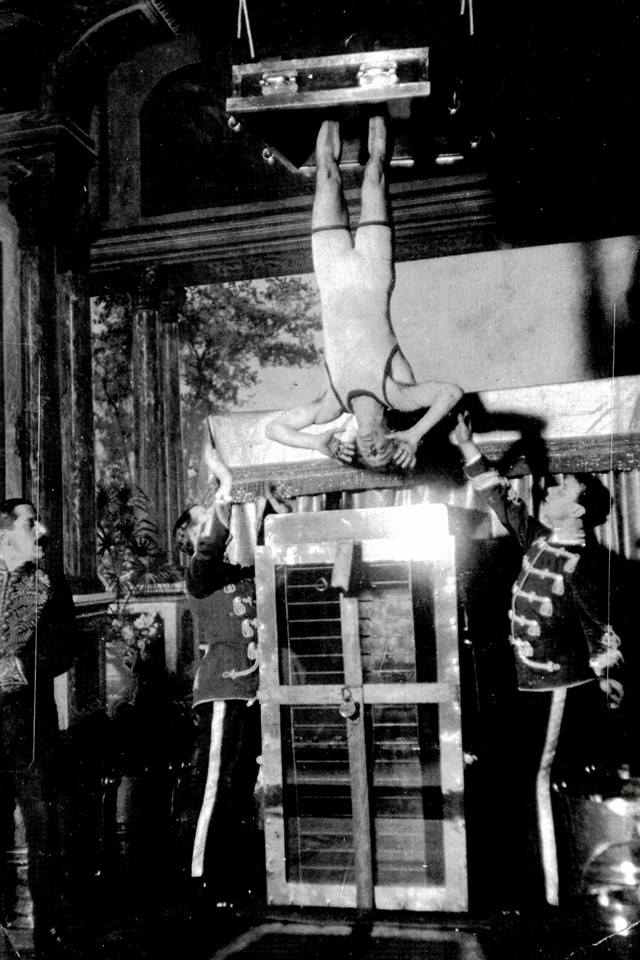
Houdini

Harry Houdini – a master of eschatology. 

Posted in Uncategorized | 2 Comments

HERE ARE SOME CLUES TO THE ORIGIN OF THE CONFUSED THINKING OF JORGE MARIO BERGOLIO, AKA FRANCIS

Settimo Cielodi Sandro Magister

All Bergoglio’s Teachers, Even Though He Goes His Own Way

Borghesi

*

After the many narrative biographies of Pope Francis, here is the first one that rightly bears the title of “intellectual biography.” Its author, Massimo Borghesi, is professor of moral philosophy at the University of Perugia and has been very close to Jorge Mario Bergoglio since long before he was elected pope, on a par with that circle of friends whose best-known name is that of the vaticanista Andrea Tornielli, all of them belonging to the Roman branch of Communion and Liberation that was headed by the priest Giacomo Tantardini.

But in addition to coming from Borghesi’s pen, this book is also the offspring of the spoken word of Pope Francis himself, who on four occasions – the two most recent being on March 13, 2017, the fourth anniversary of his pontificate – sent to the author audio recordings that are repeatedly cited in the text and all aimed at identifying the sources of his formation.

It is a biography, therefore, that is in part an autobiography as well. And it is motivated precisely by a revelation made here for the first time by Bergoglio himself, according to whom at the origin of his thought is the French Jesuit theologian Gaston Fessard – a brilliant scholar of Hegel without being a Hegelian – with his 1956 book on the “dialectic” of the “Spiritual Exercises” of Saint Ignatius.

It is in fact above all from Fessard – as Borghesi confirms and substantiates – that Bergoglio got his markedly antinomian thinking, so fond of contradictions. But then came other prominent authors to reinforce this way of thinking, Erich Przywara and Henri de Lubac, both of them also Jesuits, Alberto Methol Ferré, an Uruguayan philosopher, and above all, but belatedly, Romano Guardini, with his youthful 1925 essay entitled “Der Gegensatz,” “Polar opposition,” on which Bergoglio wanted to base his doctoral thesis during the few months he spent studying in Germany in 1986, a thesis that was quickly dropped and never written.

Borghesi deftly illustrates the thinking of these great theologians and philosophers. To them he adds, among the inspirations to whom Bergoglio himself says he is a debtor, other first-rate stars like Michel de Certeau and Hans Urs von Balthasar. And he does all he can to demonstrate how in the writings of Bergoglio both far and near in time, before and after his election as pope, the genius of his teachers lives again.

But it is precisely in this transition from the teachers to their disciple that Borghesi’s reconstruction is most debatable.

It is truly arduous, for example, to identify the mature fruit of Fessard’s “dialectic” or Guardini’s “polar opposition” in the four “postulates” that Pope Francis placed at the center of the agenda-setting text of his pontificate, the exhortation “Evangelii Gaudium,” and reissued in the encyclical “Laudato Si’” and at the beginning of that other exhortation of his which is “Amoris Laetitia.”

It is true that Francis himself revealed three years ago, to the Argentine authors of another biography of his, that the chapter of “Evangelii Gaudium” with the four postulates is the transcription of a piece of his uncompleted doctoral thesis on Guardini.

But to see how this student exercise of his – an exercise now upgraded as pontifical magisterium – inevitably falls apart if its is subjected to the slightest elementary analysis, one gets the impression that the gap between Bergoglio and his celebrated teachers is truly very profound:

> The Four Hooks On Which Bergoglio Hangs His Thought
> Bergoglio Too Has His Nonnegotiable Principles

The first of the four postulates, in fact, the one according to which “time is greater than space,” simply means that Pope Francis wants the evolutionary “processes” dear to him to win over the static apparatus of power, ecclesiastical and not.

While the third postulate, according to which “realities are greater than ideas,” is nothing other than a repackaging of the pseudoconciliar commonplace stating the primacy of orthopraxy over orthodoxy, or in other words of the priority of the “pastoral” over doctrine.

As for the nature of the Church as “complexio oppositorum,” meaning a combination of institution and event, of mystery/sacrament and word, of individuality and community, of interiority and public worship, the pontificate of Francis shows how he does not at all love this reciprocal enrichment between opposites, but on the contrary wants to suppress or disregard that which in one or the other opposition he sees as static or obsolete. His coldness toward the liturgy is plain for all to see, as is his insensitivity to the category of the beautiful and his underappreciation of doctrine and institution.

It must be said – and Borghesi recognizes this – that Bergoglio has never studied and assimilated the entire work of his teachers, but has only read a few isolated things, taking pointers from them in his own way.

And this explains the nonhomogeneity of his writings, magisterial as well, in which he combines the most diverse materials.

But it explains even more the gaping discrepancy between his illustrious teachers and the concrete figures of whom Pope Francis avails himself as his confidants and ghostwriters: from the Jesuit Antonio Spadaro, a rhetorical yarnspinner, to the Argentine Víctor Manuel Fernández, a theologian with a less than mediocre reputation, who revealed himself to the world with a first work entitled “Sáname con tu boca. El arte de besar,” and yet was encouraged by his friend who had become pope to go so far as to transcribe into “Amoris Laetitia” whole sections of his confused articles from a dozen years before, on family morality.

Another sign of confusion is the equal “preference” that Francis reserves for the two French theologians dearest to him, de Lubac and de Certeau, showing that he is unaware that de Lubac broke with de Certeau, his former pupil, and leveled harsh criticism against him: he accused him of being a “Joachimite” infatuated, like the visionary medieval friar, with a presumed golden age of pure spirit, free from any constraint of the ecclesiastical institution.

Moreover, in the “intellectual biography” of Bergoglio written by Borghesi, there are glaring omissions. There is total silence on Walter Kasper, in spite of the fact that Francis declared himself to be a reader and admirer of his from his first “Angelus” after being elected pope, and then rewarded him with boundless praise – for knowing how to do “theology on one’s knees” – and also promoted him as theologian-guide of the turning points on the matters of marriage and divorce and the primacy of the local Churches over the universal Church.

Nor is there so much as a word on Rodolfo Kusch, the Argentine anthropologist whose concept of people Francis recently said he had assimilated. And this in spite of the fact that in Borghesi’s book there are many pages on Bergoglio’s “populism.”

And naturally there stands out by his absence, among Bergoglio’s readings, of Joseph Ratzinger as theologian, not even as the author of the books on Jesus. But this is a vacuum that makes matters even clearer.

(English translation by Matthew Sherry, Ballwin, Missouri, U.S.A.)

Posted in Uncategorized | 1 Comment

PETER KWASNIEWSKI GUIDES US THROUGH THE HOLY SACRIFICE OF THE MASS


Time for the Soul to Absorb the Mysteries — Part 1: From the Entrance to the Interlectional Chants

[
The season of Advent has always felt to me as if it is, and should be, a time of quiet meditation. Moving in a direction contrary to that of secular society in its frenzied rush towards Christmas exhaustion, a Catholic ought to be able to push away the distractions and focus on preparing inwardly for the mystery of the coming of Christ — the One who has come into the world as Savior, the One who will come at the end of time as Judge, the One who comes into my soul by His grace. And the sacred liturgy, it seems to me, ought to help us to be still, to be receptive, to be attuned to His voice. Ideally, it should immerse us in an expectant silence from which true and redemptive joy can proceed.

As the liturgy developed historically and its ritual and aesthetic elements became more fully developed, it seems that the Christian clergy and people followed an unerring instinct towards the creation of prayers, chants, and ceremonies that allow TIME for the soul to absorb the meaning of what is happening.

This psychological-spiritual opening up of space and time for the soul’s growth is accomplished in many ways in different rites or rituals. It is done through repetitious prayers, as in the Byzantine litanies, many of them redundant, though always eloquently worded; it is done through periods of silence in between periods of proclamation; it is done through motions, processions, non-verbal actions; it is done most of all through meditative chants that do not seem to be in any hurry to be finished, and which allow the mind a certain holy leisure or rest. There are repetitions, gaps, spaces, pauses, and visual signs that do not demand of the mind the constant tackling of new ideas or concepts, but permit it to dwell or linger somewhere before moving on.

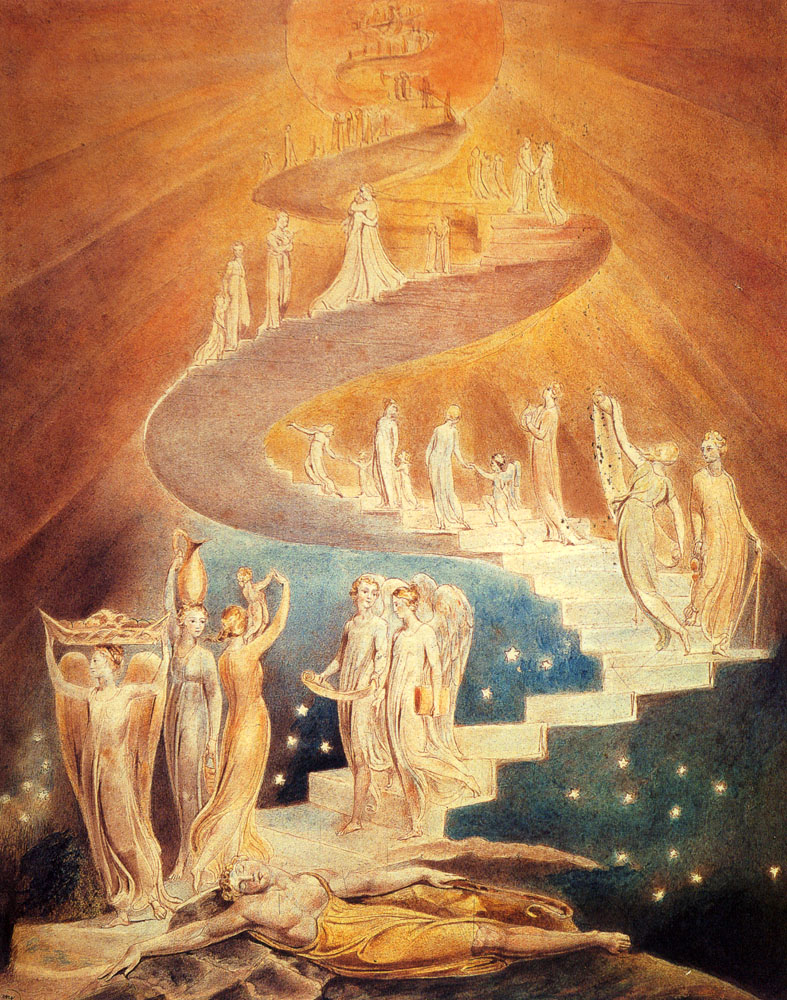
The liturgy is like a winding path up a steep mountain, with open ledges on which one can rest before continuing. In this way, it emulates the spiral motion, the combination of the straight and the circular, that Pseudo-Dionysius envisages as the soul’s path into God. There is a forward progression, yes, but it takes its time winding around, in order to move up at a human pace. Attempting to go straight up or straight in would defeat us.

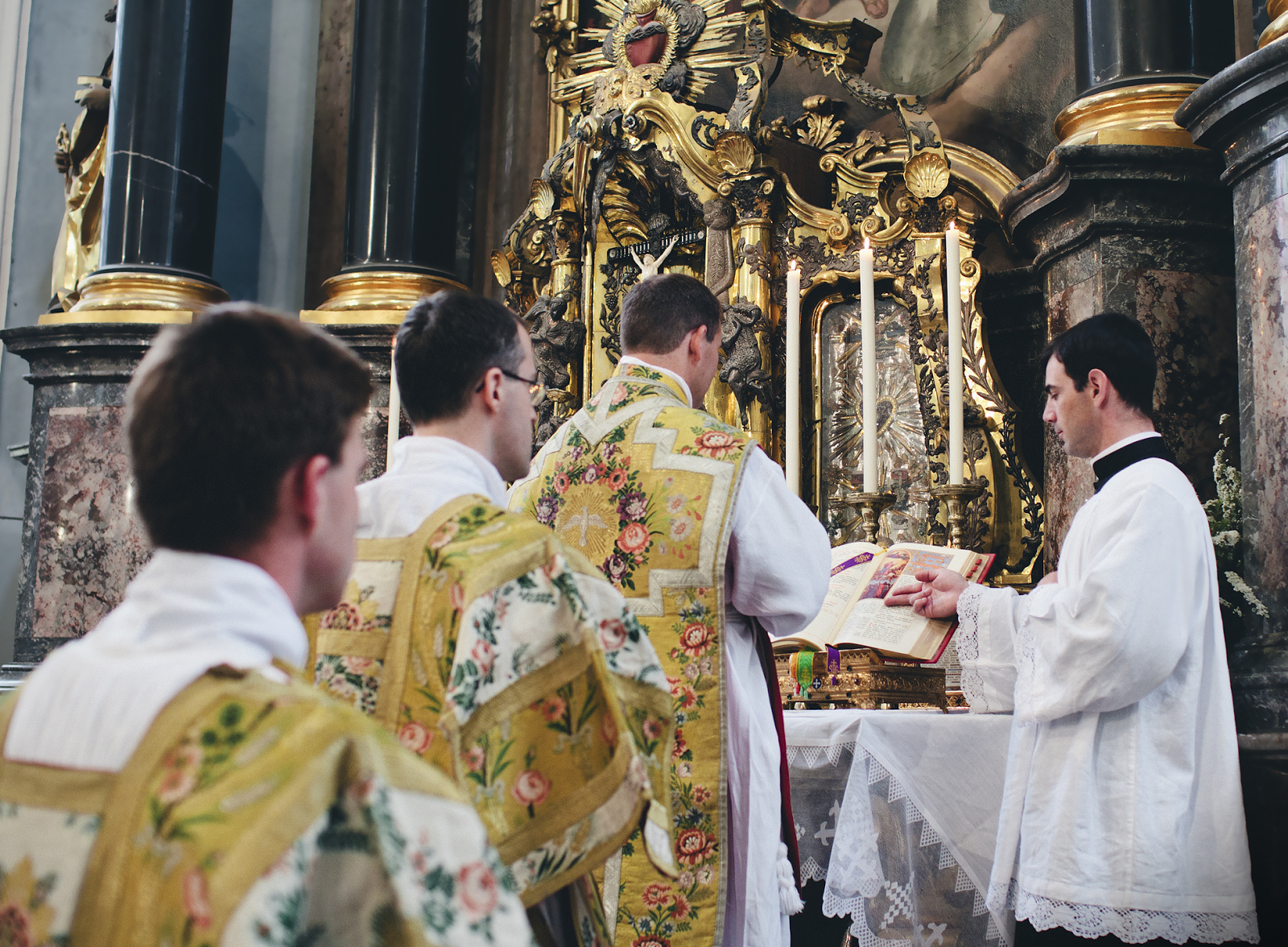
The classical Roman Rite of Mass, particularly in the form of the High Mass or Solemn Mass, admirably displays the spiritual pedagogy of the spiral motion, the frequent ledges, the moments of prayerful repose before continuing on with our climb up Mount Calvary, Mount Tabor, Mount Sion. In contrast, the Novus Ordo is designed in a manner contrary to this spiritual pedagogy, and thwarts the soul’s ascent up the holy mountain.

The Processions

Traditional liturgical rites of East and West are fertile in processions. We are pilgrims and we act out our condition. A town, the grounds of a church, the church building inside, offer a symbolic geography to be covered and converted as we move from point to point. The time it takes for a leisurely procession is one of the most important “burnt offerings” we can raise up, since our time is, in a way, our life and energy.

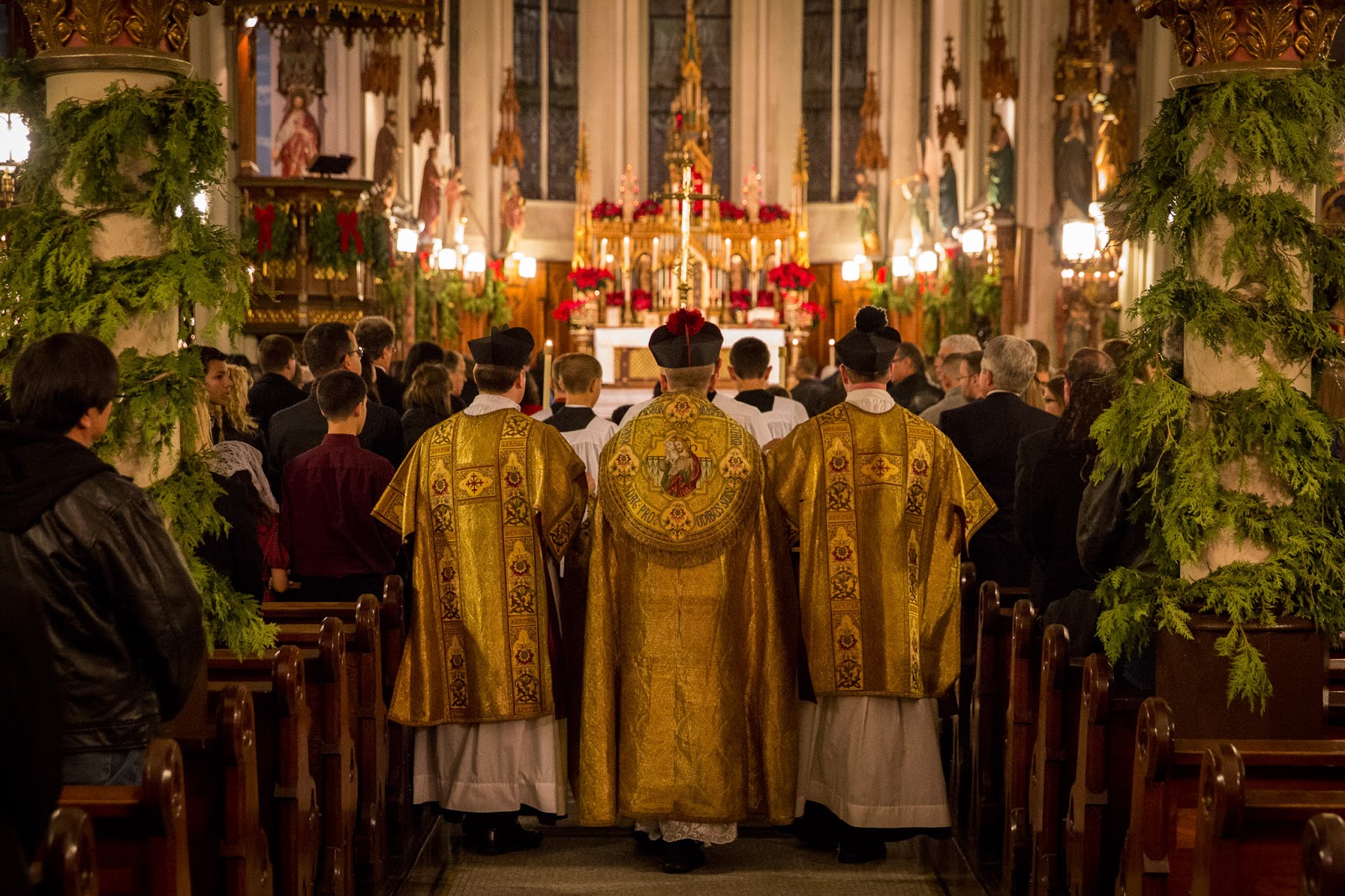
The Holy Sacrifice of the Mass, in particular, should open with a stately, unrushed procession of splendidly vested ministers towards the sanctuary, accompanied by grand music (instrumental or choral or both). Those ministers represent us, and we are walking with them towards the Holy of Holies. This is a solemn and wonderful moment, with its own distinctive meaning and satisfaction. Why do we completely spoil the effect by asking people to put their noses in a hymn book? The choir or schola should be lifting up our minds to God and allowing us to experience this procession as a procession, with all our senses in act. Where the procession is well done, it becomes one of these occasions of journeying without the baggage of the nagging necessities of the workaday world.

The Prayers at the Foot of the Altar

Then we come to those marvelous preparatory prayers, which I always miss so much in any Novus Ordo Mass, where we suddenly start BANG!, without taking time to prepare well for what is to come. The traditional liturgy pauses for a breath at the end of the procession and, rather than rushing into the sanctuary, recites Psalm 42, the Confiteor (twice), and versicles and prayers expressive of the forthcoming sacrifice. We are suspended between the entrance and the commencement, the intention and the execution, and our souls can expand, adjust, collaborate, get ready to move on. It reminds me of the process whereby one’s eyes adjust themselves to the indoors when one enters a dark room from a bright sunny day outside. Our spiritual sight is accustomed to the garish day, with its obvious objects and confident navigation. At divine worship we are being drawn into the interior, the innermost, the mystery that is luminously dark, caliginously blazing, and we do not know our way. We need some time to adjust. What blessed minutes, which carry us so gently and yet so irresistibly into the sphere of the divine!

From the Introit to the Lesson

Whether we are at a Low Mass or a High Mass, one of the greatest blessings of the TLM is that, on the one hand, we are gently drawn into prayer, as if by an invisible hand nudging us forward, and, on the other hand, we are not immediately talked to and expected to talk back. We are surely participating in the unfolding drama, but we are not targeted and harried; the activity does not get bogged down in a closed circle, like a boring classroom. The liturgy seems to be going on over our heads or around us or in front of us, and we can relate to it all the more deeply because it is outside our grasp, beyond what we can access, with no possible illusions that we are the ones driving it forward. Of course we have a role to play, and this will sometimes include verbal responses; but the overall effect is one of a giant motion that we can join, if we will, that will take us somewhere our own resources could never get us. The unfailing Introit, announcing the day’s mystery, throws down a sort of spiritual gauntlet: “Friend, wherefore art thou come?” (Mt 26:50).[1] The cascading Kyries, the exultant Gloria, the richly compact Collect, the apt Lesson, invite us to come deeper and deeper into worship, putting on the mind of Christ.

The Interlectional Chants

If the preparatory prayers seal the door to the world and habituate us to the new climate of worship, and if the subsequent prayers and lesson demand of us the exercise of our spiritual capacities, it is the interlectional chants, sung in full, that have the special power to plunge us into meditation and even contemplation.[2] At other points in the Mass, multiple things can be happening at once (the peculiar perfection called “parallel liturgy”), but here, during the Gradual and Alleluia  —  or the Gradual and Tract in Lent, or the double Alleluia in Paschaltide  —  the ministers take their seats, the people are seated. A restfulness descends with the sound of the chant; time stands still. The melismatic melodies draw out lovingly, syllable by syllable, the exquisitely beloved words of God, so that we cannot rush past them, or treat them in a utilitarian way, or think of them as mechanical responses made to a dreary rehearsal of psalms. They exist in and for themselves, living monuments of God’s faithfulness and love, and we are permitted to have them on our lips, in our ears, in our hearts. They are a ladder let down from above on which we are bidden to climb up. In this way, the Lesson and all that has come before has a chance to sink in, and the soil is plowed with deep furrows for the Gospel and all that will come after.

I shall continue next week with the Offertory and the Canon of the Mass.

NOTES

[1] Interestingly, St. Benedict cites this verse in chapter 60 of his Rulewhen speaking about a priest who desires admission into the monastery. He says that the priest may be admitted only on condition of agreeing to abide by the entire rule, as if to say: Why are you coming here, unless to embrace and benefit from the monastic discipline? The liturgy, too, is something we should approach only if we are ready to embrace its discipline, which is the only way to obtain its benefits.

[2] I am indebted to Dr. William Mahrt for opening my eyes and ears to the theological and liturgical significance of the interlectional chants (Gradual, Tract, Alleluia). They are the contemplative and musical high-point of the Gregorian Mass prior to the consecration.

Posted in Uncategorized | 2 Comments

“Just stay quiet and you’ll be okay.” That’s what Mohamed Atta told the passengers on American Airlines flight 11 shortly before it flew into the World Trade Center


On Moving the American Embassy to Jerusalem

When President Donald Trump announced that the United States would move its embassy from Tel Aviv to Jerusalem, the Muslim world reacted with outrage and threats. Palestinian Authority President Mahmoud Abbas warned of “dangerous consequences.” The spokesman for Turkish president Erdogan warned that the move was a “grave mistake” because “Jerusalem is our red line.” Bekir Bozdag, the Deputy Prime Minister, said the move would plunge the world “into a fire with no end in sight.” And Saudi Arabia’s King Salman warned that the move “would constitute a flagrant provocation of Muslims all over the world.”

The leaders of the Western world reacted in similar fashion. Pope Francis, British Prime Minister Theresa May, German Chancellor Angela Merkel, and French President Emmanuel Macron all criticized Trump’s announcement. Meanwhile, the patriarchs and heads of the local churches in Jerusalem sent a letter to President Trump warning that the transfer of the embassy “will yield increased hatred, conflict, violence, and suffering in Jerusalem.”

But there is an obvious contradiction here. As Jihad Watch editor Robert Spencer points out in a recent column, these leaders have a record of defending Islam as a religion of peace and tolerance, which is being perverted by only a handful of extremists. Pope Francis, for example, has said that “authentic Islam and the proper reading of the Koran are opposed to every form of violence.” On another occasion he drew a moral equivalence between Islam and Catholicism, saying, “If I speak of Islamic violence, I must speak of Catholic violence.” For over a decade now, various Church leaders and secular leaders have assured us that violence has nothing to do with Islam.

But if that’s what they really believe, why should they worry that moving an embassy would create – to quote from the letter of the church leaders in Jerusalem – “hatred, conflict, violence, and suffering.”

By assuming that Muslims would riot over the announcement, says Spencer, the pope and other leaders are inadvertently admitting the truth about Islam: “that the numerous incitements to violence and hatred in the Quran and Sunnah do tend to lead to Muslims behaving violently at the drop of a hat, or the move of an embassy.”

After all, we are not talking here about a tiny minority whose actions would be rejected by the great majority, but about widespread rioting and violence on a global scale – “plunging the region and the world into a fire with no end in sight,” as Turkey’s Deputy Prime Minister put it.

And, apparently, the “fire” would be justified because, as King Salman said, the move “would constitute a flagrant provocation of Muslims all over the world.” It’s a safe bet that King Salman understands Islam better than do Merkel, Macron, May, and the Holy Father. Yet he is even more concerned than they.

He seems to assume that Muslims are highly prone to violence. He understands that they are easily provoked because their religion and their religious leaders tell them to be. Moreover, as he must know, almost anything might be considered provocative. Last July, a “day of rage” resulting in the murder of an Israeli family was called because metal detectors had been installed on the Temple Mount as a security measure. Even Pope Benedict’s measured address to an academic gathering at the University of Regensburg led to global rioting and killing.

There is no end to the number of things that offend Muslims. This, along with numerous other differences, should lay to rest the quaint notion that there is a moral equivalence between Islam and Catholicism. They are very different faiths. No one worries about global rioting should Catholics be offended by a slight to their faith. Yet if any group has cause to riot, it is Catholics and other Christians. Christians in many parts of the Islamic world face daily persecution and even extermination. They are beaten, raped, and decapitated, and their churches are burned to the ground.

So on the one hand, Muslim believers are ready to commit mayhem over an academic talk or the moving of an embassy, and on the other hand, Christians remain peaceful even though their brethren are being slaughtered and burned alive. How much longer, one wonders, will Church leaders collaborate in the false assertion that Islam and Christianity are equally peaceful faiths?

Religious and secular leaders are caught in a flagrant contradiction. They tell us that Islam is a religion of peace and justice, yet they warn us not to provoke its followers in any way. Don’t recognize Jerusalem as Israel’s capital. Don’t draw cartoons that might offend Muslims. Don’t wear religious symbols that might provoke them. Cover your women and your statutes. Don’t ring church bells in the vicinity of Muslims. Don’t criticize them for persecuting Christians because, as Ahmed al-Tayeb, the Grand Imam of Al-Azhar University told Pope Francis, such criticism is a “red line” that must not be crossed.

Just stay quiet and you’ll be okay.” That’s what Mohamed Atta told the passengers on American Airlines flight 11 shortly before it flew into the World Trade Center. It wasn’t good advice then. And it’s not good advice now. As Islam expands its global reach, it’s becoming increasingly evident that the “don’t-do-anything-to-provoke-them” policy isn’t working, and never will.

William Kilpatrick

William Kilpatrick

William Kilpatrick is the author of Christianity, Islam and Atheism: The Struggle for the Soul of the West, and a new book, The Politically Incorrect Guide to Jihad. For more on his work and writings, visit his website, The Turning Point Project

Posted in Uncategorized | 2 Comments

PROFESSOR ROBERTO DE MATTEI OFFERS US CLARIFICATIONS AND GOOD ADVICE AS WE MOVER CLOSER TO A FORMAL CRISIS IN THE CHURCH

Interview – Roberto de Mattei Discusses the Escalating Church Crisis

Editor’s note: Last month, Dr. Maike Hickson began a correspondence with Catholic historian, author, and speaker Professor Roberto de Mattei on the nature of the escalating crisis in the Church. Although her husband’s recent sudden illness has necessitated that she take a leave of absence from her work here at OnePeterFive, she and her husband both asked that we proceed with the publication of this important and timely interview.


Maike Hickson (MH): Many Catholics around the world had hoped that the Dubia Cardinals would publish their public correction of Pope Francis concerning his Post-Synodal Exhortation, Amoris Laetitia. What would you tell those among the faithful who are now disappointed and even discouraged in the face of the silence of the princes of the Church? With which words would you try to encourage these faithful to persevere in their hope and in their Faith? 

Roberto de Mattei (RDM): The present crisis in the Church did not originate with Pope Francis, and it is not focused in one single person; rather, it dates back to the Second Vatican Council, and, going back even further, to the Modernist Crisis [of the early twentieth century]. Today a large part of the college of cardinals, of the college of bishops, and of the clergy in general, are infected with modernism.3 The few cardinals, bishops and priests who resist ought to take account of this situation, and it is our job to help them. But above all one must not imagine that a single act by one of these players, for example a correctio fraterna of the Pope announced by Cardinal Burke, can, by itself, resolve the crisis. What is needed is a convergence and focus of action by diverse groups of both clergy and laity, each one at their own level and according to their own capability. The sensus fidei can guide the cardinals, bishops, religious, and simple laity how to react [to the present crisis]. The importance of the correctio filialis, signed by 250 scholars, both religious and lay, was that it expressed this sensus fidei. The reaction may be different from one country to another, from one diocese to another, but its characteristics are always those of a profession of the truth and a denunciation of the errors which are opposed to this truth. 

MH: But how can this situation be resolved?

RDM: It will not be men who save the Church. The situation will be resolved by an extraordinary intervention of Grace, which however must be accompanied by the militant commitment of faithful Catholics. In the face of this present crisis there are some who think that the only thing to do is to wait for a miracle in silence and prayer. But it is not like this. It is true that we need a divine intervention, but grace builds on nature. Each of us ought to do the maximum that we can according to our ability. 

MH: The 2016 letter with which Pope Francis gave his approval to the guidelines laid out by the pastors of Buenos Aires was published in Acta Apostolicae Sedis, with a note written by the Secretary of State, Cardinal Parolin, according to which the Pope himself wanted the two documents – the guidelines and the letter – published in AAS.

RDM: The fact that the guidelines of the Argentine bishops and the approval of the Pope have been published in AAShas made it official that “no other interpretations are possible” of Amoris Laetitia other than that of the Argentine bishops, which authorizes communion to be given to those divorced and remarried people who are in an objective state of mortal sin. The letter was private, but the publication in AAS transforms the position of Pope Francis into an act of the Magisterium. It seems to me that this confirms the thesis expressed by Fr. Giovanni Scalese in his blog, according to which we are entering into a new phase of the pontificate of Pope Francis: moving from a pastoral revolution to the open reformulation of doctrine.3 Pope Francis’ discourse of October 11 [2017], on the occasion of the 25th anniversary of the promulgation of the new catechism, seems to call for the beginning of a reinterpretation of the Catechism of the Catholic Church in the light of Evangelii Gaudium and Amoris Laetitia.

MH: In a recent essay, in light of how Luther is now being reinstated within the Catholic Church, you stated: “In short, every Catholic is called upon to choose whether to side with Pope Francis and the Jesuits of today, or be alongside the Jesuits of yesterday and the Popes of all time. It is time for choices and to meditate precisely on St. Ignatius’ two standards (Spiritual Exercises, n. 137)* which will help us make them in these difficult times.” Would you explain these words a little more to our readers, not only in light of the question of Luther, but also in light of Amoris Laetitia?

RDM: There are moments in our life and in the history of the Church in which one is obligated to choose between two sides, without ambiguity and compromise. The Spiritual Exercises of Saint Ignatius and theology of history of Saint Augustine in The City of God do nothing other than emphasize the Gospel maxim according to which “no one can serve two masters; either he will hate the one and love the other or love the one and hate the other” (Matthew 6:24). Seen in this light, the recent publication in AAS of the letter of Pope Francis to the bishops of Buenos Aires reduces the matter to two diametrically opposed positions. The line of thinking of those cardinals, bishops, and theologians who maintain that it is possible to interpret Amoris Laetitia in continuity with Familiaris Consortio 84 and other documents of the Magisterium has been reduced to dust.3 Amoris Laetitia is a document which serves as a litmus test: it must be either accepted or rejected in toto. There is not a third position, and the insertion of Pope Francis’ letter to the Argentine bishops [into AAS] has the merit of making this clear.

MH: There are those who deny that the publication of the letter to the Argentine bishops is an act of the Magisterium, because it proposes an erroneous, if not heretical, position. 

RDM: Whoever thinks this, it seems to me, begins with a false premise: the idea that the pontifical Magisterium can never err. In reality the guarantee of inerrancy is reserved to the Magisterium only in specific conditions, which are clearly spelled out in the Dogmatic Constitution Pastor Aeternus of Vatican I. The existence of errors in the non-infallible documents of the Magisterium, including the pontifical Magisterium, is possible, above all during periods of great crisis. There can be an act of the Magisterium which is both authentic and solemn, but erroneous. This was the case, for example, in my opinion, with the declaration Dignitatis Humanae of Vatican II, which, apart from its pastoral character, is undeniably a Magisterial act and almost certainly contradicts the doctrine of the Church on religious liberty, in at least an indirect and implicit way.

MH: Do you see a formal schism coming, and what would it practically look like? Who would be the creator of that schism, and what would it mean for simple lay people? 

RDM: A schism is an internal division of the Church, such as happened in Europe for forty years between 1378 and 1417, when it seemed that one could not identify with absolute certainty where the [legitimate] authority of the Church was to be found. This tearing apart known as the “Great Western Schism” was not a matter of heresy. Generally however, heresy follows schism, as occurred in England at the time of Henry VIII. Today we find ourselves in an unprecedented situation in which heresy, which in itself is more grave than schism, precedes it rather than following it. There is not yet a formal schism, but there is heresy in the Church. It is the heretics who are promoting schism in the Church, certainly not faithful Catholics. And the faithful Catholics who want to separate themselves from heresy certainly cannot be defined as schismatics.1

MH: You seem to suggest that the Pope may be promoting schism and heresy in the Church. What would be the consequences of this most grave situation? Would not the Pope lose his authority as Pope? 

RDM: One cannot sum up such an important and complex problem in a few words. On this point it is necessary to have a theological debate, on which topic one may refer to the volume True or False Pope by Robert J. Sisco and John Salza, to the writings of Abbott Jean-Michel Gleize in [the French journal] Courrier de Rome and above all to the study of Arnaldo Xavier da Silveira, Ipotesi teologica di un Papa eretico [Theological hypotheses about a heretic Pope], the Italian edition of which I edited in 2016 and also the next edition in English. The author, whose basic position I share, develops the thesis of the medieval decretists, of St. Robert Bellarmine, and of modern theologians like Pietro Ballerini, according to whom, while there is a basic incompatibility between [holding] heresy and [holding] papal authority, the Pope does not lose his office until his heresy becomes apparent to the entire Church. 

MH: And finally, what would your outlook and encouragement be for our readers, at the end of the 100thAnniversary year of the apparitions of Our Lady of Fatima? 

RDM: Discouragement is a sentiment which the militant Catholic cannot permit himself. The first weapon to employ against enemies who attack the Church is the use of reason, in order to demonstrate the contradictions in which these enemies live, and by which they necessarily die. Then we need to turn to the invincible help of Grace. One hundred years ago Our Lady of Fatima foresaw the crisis of our time. She announced a chastisement for humanity if it was not converted, but she also made an unconditional and irreversible promise: the triumph of her Immaculate Heart. For his part, Our Lord has promised us to be with us always, until the end of the world (Matthew 28:20). What more can we ask for?

Posted in Uncategorized | Comments Off on PROFESSOR ROBERTO DE MATTEI OFFERS US CLARIFICATIONS AND GOOD ADVICE AS WE MOVER CLOSER TO A FORMAL CRISIS IN THE CHURCH

WILL HE NEVER STOP ???


11 December 2017

  1. 11 December 2017

    Will he never stop … (2) Pope Francis, the Our Father, and the next Conclave

    Lead us not into temptation. It is unlikely that the Greek and Latin words translated by temptation meant the sort of thing we mean by ‘temptation’ in the confessional … the ‘temptation’ to steal something, or to speak uncharitably, or to suspend the Custody of the Eyes. Peirasmos has been thought to refer much more probably to the time of testing, that is to say, of being tortured or intimidated to give up our Faith. Scripture teaches us that the End Times will indeed be marked by just such testings or persecutions. It is natural to ask God, whose providence disposes the times, to spare us this. [See for example Mt 26:41; Luke 8:13; Apocalypse 2:10 and 3:10.]

    (And, by the way, Evil could be either masculine or neuter (tou ponerou). Many, probably most,  people think it refers to the Evil One.)

    So, in my opinion, PF is proposing a revision which is not, as he appears to have been told, a revised translation but a radical change in the meaning of the Greek original. With sorrow, I have to say that this new example of his gigantic self-confidence does not surprise me.

    What repeatedly … it seems, almost daily !! … irritates me about PF is his endless propensity to treat the Depositum Fidei, the Universal Church and what she has inherited from the Apostles or from the generations since, as something which is at his disposal to change, to criticise, or to mangle in any way that appeals to his personal whimsy at any particular moment. He is like a toddler who has been given toys to play with … a big, boisterous and wilful child who likes to play with them rather roughly; whose commonest phrase is “I want …”. If anyone suggests that he should perhaps handle them rather more gently, he throws a tantrum. I am immensely sorry to have to write like this about Christ’s Vicar but, ever since his election, PF has appeared to me to want attention to be drawn particularly to those parts of his personal ‘style’ which mark him as most radically different from his predecessors. A pope who disliked close scrutiny and the consequent criticism would keep the journalists and cameramen at a distance, say a very great deal less, and speak only after taking competent advice. An ecclesiastic who deliberately sollicits attention is ill-placed to complain if he gets it, nor can his sycophants plausibly do so on his behalf. This pontificate did not invent the unfortunate modern phenomenon of the celebrity pope, but it has shown how very dangerous and divisive that cult is.

    PF’s election was, I suppose, the responsibility of the Cardinal Electors … to whom one has to add such Cardinal non-Electors as Murphy O’Connor, who, we are told, dinnered his way around Rome encouraging his friends, and the other Anglophone Cardinals, to vote for Bergoglio (as he had every right to do). But there are also perhaps systemic problems here too. I do not think that even those whose analysis of this pontificate is totally different from mine will wish to disagree with much in what follows. Firstly

    Time was when the Church was blessed with perhaps a dozen or two cardinals, pretty certainly not more than seventy; so that, in a conclave, each elector was more likely to know something about at least the more prominent and papabili of his brethren. If there are 120 or more electors, you are inevitably going to have the sort of situation in which an Eminent Father “from the peripheries” who knows next to nobody, will be open to be influenced by fellow electors who appear knowledgeable and who combine to assure him that Cardinal X is a Splendid Fellow. Additionally, PF has (significantly) suppressed the open discussions which the Cardinals used to be allowed to have with each other when they met formally in consistories. His once-claimed passion for parrhesia did not survive his experiences in his two ‘synods’.

    Secondly, it has come to be felt that it is edifying … that the World will be impressed … if a pope is elected within a couple of days. Almost as if it would be dangerous if the electors got to know each other, or if it became apparent to the waiting Press that there were deep divisions inside the Sistine Chapel. Even those simple souls (Ratzinger and I think they are misguided) who believe that the Holy Spirit chooses the pope, might have trouble giving a plausible theological explanation as to why the Holy Spirit should be so keen to operate through a quick-fire conclave rather than through a more lengthy and carefully considered one.

    And, thirdly, PF will bequeath to the next interregnum a Church … and a Sacred College … much more deeply and ideologically divided than has been true for a very long time, possibly for ever.

    I pray that the next conclave may be very, very, lengthy, even if that does encourage the Vatican press corps endlessly to lecture the watching World on such arcane mysteries as Blocking Thirds. Surely, their Eminences will have learned the lessons of the last five disastrous, destructive, divisive years?

Posted in Uncategorized | 1 Comment

FRANCIS, LEAD US NOT INTO TEMPTATION TO CHANGE THE WORDS OF JESUS CHRIST !!!

Pope stare

Friday, December 8, 2017

Pope Francis: The Our Father “Induces Temptation”

Written by  David Martin

{ ABYSSUM }

 Pope Francis has said that the Lord’s Prayer should be changed, arguing that the translation used in many parts of the world, including the Italian and English versions, go against the teachings of the Church and Bible.

In the centuries-old recited prayer, followers of the Christian Faith call on God to “lead us not into temptation, but deliver us from evil.”

Speaking to Italian broadcasters on December 7, Francis argued this was incorrect, saying, “It is not a good translation because it speaks of a God who induces temptation.”

To think that the Messiah’s instruction to mankind on how to pray—as penned by the evangelists as the infallible Word of God and as followed for 2000 years by all the saints and members of Christ—is now incorrect. By this latest stunt, it is the pope who is leading us into temptation.

Francis purports to criticize the English and Italian translations of the Our Father, when he knows very well that it is the original manuscript he is criticizing. The original text from the Lord’s Prayer, as taken from the Latin Vulgate, reads, “et ne inducas nos in temptationem sed libera nos a malo,” which translated is, “lead us not into temptation, but deliver us from evil.” (Matthew 6:13)

Hence this is not a translation issue, but a scriptural issue. The English translations of the Our Father as recited today are correct, because they are taken from the Vulgate, which is the official version of Holy Scripture—the source from which all authentic translations must directly or indirectly be taken.

Even so, Francis thinks that the Our Father should be changed, and during his interview with the TV2000 channel, he even said he has approved a modified version in France.

Christ’s instruction should be simple enough to understand. When we say, “lead us not into temptation,” we’re simply asking God to help us choose right from wrong, good from bad, God from Satan. It is God, our leader, who leads this enterprise, therefore we ask him to “lead us” thus. A seven-year-old CCD student can understand this perfectly, yet the leader of the world’s Catholics can’t seem to get it!

Thomas A. Kempis would tell him, “Consider thy motives.” Francis is apparently upset over the idea of being led away from temptation, since he is led by the temptation of globalism and change. The Bible threatens him to give up his change, so instead of humbly admitting that scripture is correct, he judges that it is incorrect, in the same way he has denied the miracle of the loaves and has judged that evangelization is “solemn nonsense.” http://www.ncregister.com/blog/edward-pentin/pope-gives-new-interview

Nay, the mission of the Church is to convert all peoples to the Catholic Faith. God in his mercy wants us all to know that this world is not our common home, but rather a quagmire of temptation, and that our true home is in Heaven with God and the saints who said the unrevised Our Father.

Therefore, as children of God who obey the Father’s commands, we take the Father’s hand and ask him to lead us not into temptation, but away from all evil, because if we chase after temptation—especially the temptation to change the Bible and the doctrines of the Faith—God will let go of our hand, and in His permissive will, He will allow us not only to fall into temptation, but into the very fires of Hell. And by the way, Papa, condemnation is forever.

Christ warns of the dire consequences of changing but one word of Holy Scripture. He says to St. John in the Apocalypse, “If any man shall add to these things, God shall add unto him the plagues written in this book.” (Apoc. 22:18)

Let us therefore reverence the words of Christ in the Gospel, remembering all scripture as it is “inspired of God.” (2 Timothy 3:16) “Neither let us tempt Christ: as some of them tempted, and perished by the serpents.” (1 Cor. 10:9)

+++++++++++++++++++++++++++++++++++++++++++++++++++++++++++++++++++++++++++

{ After Jesus was baptized by John, he was led by the Holy Spirit into the wilderness to be tempted of the devil (Matt. 4:1; Mk. 1:12; Lk. 4:1). The exact location of the temptation scene is unknown. What is significant is that the Lord was alone, fasting, tempted, and tested. Jesus’ total submission to the will of God was tried from the very beginning of his ministry. How necessary this must have been for the difficult years of ministry and the cross that lay before him (cf. Lk. 12:50). }

{The temptations of Christ are recorded by three sacred historians, Matthew, Mark (who gives a summary), and Luke. Christ and the Holy Spirit were the only two sources from which the narrative could originate, and these divine persons would agree in every respect. The minor variations in the gospels can easily be accounted for since different writers, by inspiration, often related different details. These never amounted to contradictions between them.}

Saint Thomas Aquinas: “But does God lead one to evil, that he should pray: “Lead us not into temptation”? I reply that God is said to lead a person into evil by permitting him to the extent that, because of his many sins, He withdraws His grace from man, and as a result of this withdrawal man does fall into sin. Therefore, we sing in the Psalm: “When my strength shall fail, do not Thou forsake me.” God, however, directs man by the fervor of charity that he be not led into temptation.” Aquinas, Expositio in orationem dominicam, art. 7 (petition 7)

 
Posted in Uncategorized | 4 Comments

MAYBE IN THE MIDST OF ALL THIS CHAOS IN THE CHURCH AND IN THE WORLD YOU ARE NOT SUFFICIENTLY ANTSY


This one is a little different …….
Two Different Versions …..
Two Different Morals
OLD VERSION:
The ant works hard in the withering heat all summer long, building his house and laying up supplies for the winter.
The grasshopper thinks the ant is a fool and laughs and dances and plays the summer away.
Come winter, the ant is warm and well fed.
The grasshopper has no food or shelter, so he dies out in the cold.
MORAL OF THE OLD STORY: Be responsible for yourself!
MODERN VERSION:
The ant works hard in the withering heat and the rain all summer long, building his house and laying up supplies for the winter. 
The grasshopper thinks the ant is a fool and laughs and dances and plays the summer away.
Come winter, the shivering grasshopper calls a press conference and demands to know, why the ant should be allowed to be warm and well fed while he is cold and starving. 
CBS, NBC , PBS, CNN, and ABC show up to provide pictures of the shivering grasshopper next to a video of the ant in his comfortable home with a table filled with food.
America is stunned by the sharp contrast. 
How can this be, that in a country of such wealth, this poor grasshopper is allowed to suffer so? 
Kermit the Frog appears on Oprah with the grasshopper and everybody cries when they sing, ‘It’s Not Easy Being Green..’
ACORN stages a demonstration in front of the ant’s house where the news stations film the group singing, We shall overcome.
Then Rev. Jeremiah Wright has the group kneel down to pray for the grasshopper’s sake. 
President Obama condemns the ant and blames  President Bush, President Reagan, Christopher Columbus, and the Pope for the grasshopper’s plight 

Nancy Pelosi & Harry Reid
  exclaim in an interview with Larry King that the ant has gotten rich off the back of the grasshopper, and both call for an immediate tax hike on the ant to make him pay his fair share. 

Finally, the 
EEOC drafts the Economic Equity & Anti-Grasshopper Act retroactive to the beginning of  the summer. 
The ant is fined for failing to hire a proportionate number of green bugs and, having  nothing left to pay his retroactive taxes, his home is confiscated by the  Government  Green Czar and given  to the grasshopper.
The story ends as we see the grasshopper and his free-loading  friends finishing up the last bits of the ant’s food while the government house he is  in, which, as you recall, just happens to be the ant’s old house, crumbles around them because the grasshopper doesn’t maintain it. 
The ant has  disappeared in the snow, never to be seen again.
The grasshopper  is found  dead in a drug related incident, and the house, now  abandoned, is taken over  by a gang of  spiders who terrorize and ramshackle, the once prosperous and peaceful, neighborhood.
The entire Nation collapses bringing the rest of the free world with it. 

MORAL OF THE STORY:
  Be careful how you vote in 2018 and 2020

I’ve sent this to you because I believe that you are an ant!
You may wish to pass this on to other ants, but don’t bother sending it on to anygrasshopper’s because they wouldn’t understand it, anyway.
From: Manuel Rodriguez
The ANT AND THE GRASSHOPPER
GOD BLESS AMERICA & YOU !
Posted in Uncategorized | Comments Off on MAYBE IN THE MIDST OF ALL THIS CHAOS IN THE CHURCH AND IN THE WORLD YOU ARE NOT SUFFICIENTLY ANTSY

Islam a religion of peace, as Francis asserts? Not if you move from Mecca to Medina as Mohammed did.

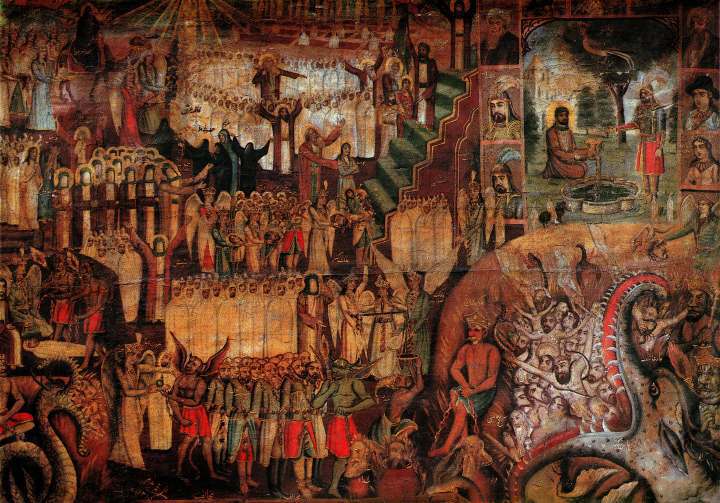
The Day of the Last Judgment by Mohammad Modabber, 1897 [Reza Abbasi Museum, Tehran]


The Two Religions of the Koran

These days it’s urgent for Christians to read and understand the Koran in order to get a better handle on a religion that is so much in the headlines. But that asks a lot, because the Koran is a hodgepodge of early and later chapters, arranged in order of length from longer to shorter chapters, thus intermingling the early thoughts of Muhammad from Mecca with the very different sayings after the flight to Medina.

In A Simple Koran, Bill Warner helps to overcome the confusion by rearranging the Koran into chronological order over the twenty-three years in which Muhammad propagated his new religion. This approach, consisting almost entirely of texts from the Koran, with occasional subtitles or explanations, offers a good introduction to how Islam evolved during Muhammad’s life, as well as insights into the crucial division between whatAayan Hirsi Ali has called “Mecca Muslims” and “Medina Muslims.”

The early sections of the Koran, from Mecca, stem from Muhammad’s conversion to monotheism from the multiple polytheistic religions prevailing around the Meccan shrine of the Kaaba. Some sources say that there were as many as 360 deities worshiped in Mecca. Muhammad preached subjection to the one and only God, Allah.

But there was a slip-up: Muhammad seemed to allow three goddesses to share veneration with Allah. According to ‘Ali Dashti’s biography, Twenty-Three Years two verses in Sura 2:19-22 originally said, Have you thought about Lāt and ‘Ozzā? And Manāt, the third one, the other one? Those are the cranes aloft. So their intercession may be hoped for.

This passage seemed to recognize the divinity of the three goddesses, along with Allah. But Allah eventually reprimanded Muhammad for these “Satanic Verses,” which in later versions of the Koran were corrected. Strict monotheism was preached thereafter. (Salman Rushdie wrote a novel involving this passage and is still under the Ayatollah Khomeini’s fatwa calling for his death.)

The early parts of the Koran re-write the Old Testament, telling stories about how Abraham, Lot, Moses, etc. were all actually Muslims, and how those who rejected Islam ended up in hell. Numerous imaginative stories about Moses appear – usually having little to do with the Biblical version.

Such Islamic revisions of Old Testament histories were accompanied with constant warnings of eternal torture in hell for Kafirs (non-Muslims) who do not convert. This begins a constant theme throughout the Koran, which contains 290 verses about Hell, and over 300 references to the fear of Allah, to whom slavish Islam (“submission”), as to a Master, is required. For example, The Kafirs among the People of the Book and the idolaters will burn for eternity in the Fire of Hell. Of all the created beings, they are the most despicable. (98:6)

In contrast, those who accepted Muhammad’s message were promised a heavenly reward in which they would be “on decorated couches,” waited on by “immortal young boys” bringing fruits and wine and the “flesh of birds,” as well as the amorous attentions of virginal houris.

The people of Mecca, doubting Muhammad’s prophetic credentials, asked him for signs that he was an authentic prophet. Muhammad cited a litany of things as signs – “the succession of night and day,” “the rain which Allah sends,” “lightning,” “the changing of the winds,” “green foliage and grain,” “your slumber during the night and day,” “your quest for Allah’s bounties,” “the ships in the sea like mountains,” etc. Exasperated by the persistent requests for clear signs, Muhammad responds, The signs are in the power of Allah alone. I am only a plain warner. Is it not enough for them that We have revealed to you the Book to be recited to them? (29:48) In other words, the Koran itself is a sufficient miracle confirming him as a prophet.

Muhammed didn’t have much success in Mecca; he ended up with only 150 converts. But he had some followers in Medina, and he fled there when the situation became dangerous in Mecca.

The Hegira (emigration) of Muhammad and his disciples to Medina took place in 622. Medina was half Jewish and half Arabian. The Jews, the wealthy class, were largely farmers and craftsmen. They had allies among the Arabs, but an atmosphere of animosity and jealousy prevailed. Some Arabs believed that a prophet would come and lead them to victory over the Jews. Muhammad very soon seemed the one. They took an oath of loyalty to Muhammad, and offered to protect him with arms, if necessary.

Muhammad eventually began to function as a warlord, and started sending fighters on armed raids against trade caravans coming to Mecca. Over nine years, he carried out sixty-five raids (in twenty-seven he was personally present), as well as various assassinations, and executions.

The threats of hell for rejecting Muhammad now became graphic – Allah will “destroy your faces and twist your heads around backwards” (4:47), give unbelievers “clothing of fire,” “pour boiling water on their heads,” “scald their insides and their skin,” and beat them with “iron rods” (22:19).

For Muhammad himself, Allah began to grant special privileges: The spoils of war (limited to one-fifth of the totals), and wives and slave-girls beyond the limits applied to others (Muhammad’s amorous retinue eventually included nine wives and several slave-girls).

A new wave of violence began when the Jews of Medina and even many Arabs rejected Muhammad’s claim to be a prophet sent by Allah. Islamic jihad became essential to spreading Islam in Arabia and elsewhere. A quarter of the verses at Medina are exhortations to jihad, and promises about the rewards not only for the Muslim community but for individual warriors.

In his final years, Muhammad began acting like a prophet/king. Every aspect of life came under his control – times of prayer, food and drink prohibitions, the wearing of veils, inheritance, wills, punishments for crimes, distribution of taxes, etc. – all specified as Allah’s mandates.

In sum, a chronological/biographical reading of the Koran brings out the tremendous differences between the earlier and later parts. There is no jihad in the Meccan Koran, no anti-Semitism, only peaceful calls for conversion. But in Medina, we have the gradual formation of a veritable army, inspired to literally conquer the world for Islam.

The “religion of peace,” therefore, does have some Koranic foundation, but as Islamic history and contemporary events make clear, there is perhaps even greater Koranic justification for violent jihad.

Howard Kainz

Howard Kainz

Howard Kainz is emeritus professor of philosophy at Marquette University. His most recent publications include Natural Law: an Introduction and Reexamination (2004), Five Metaphysical Paradoxes (The 2006 Marquette Aquinas Lecture), The Philosophy of Human Nature (2008), and The Existence of God and the Faith-Instinct (2010).

+++++++++++++++++++++++++++++++++++++++++++++++++++++++++++++++++++++++++++

Where inconsistent, the Medinan revelations in the Qur’an abrogate the Meccan revelations (the doctrine of naskh (نسخ), thus further emphasizing the violent over any peaceful verses, something Kainz fails to mention.

Posted in Uncategorized | 1 Comment