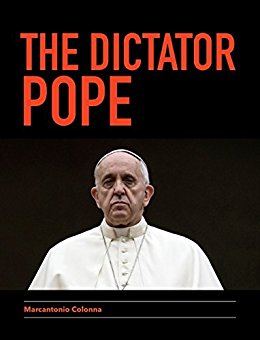
ROBERT ROYAL’S TAKE ON “THE DICTATOR POPE”


“The Dictator Pope”

Note: This is an all too brief account of a remarkable new book on the pope, which is making waves in Rome and around the world. Fr. Gerald Murray, Raymond Arroyo, and I will discuss this and other matters in greater detail tomorrow evening on EWTN’s “The World Over,” 8 PM East Coast time (Check local listings for rebroadcasts and postings on YouTube). We began our year-end funding drive on November 8, and I’d like to end it this Friday, December 8, the Feast of the Immaculate Conception. You’ve already heard more than enough on this from me. There’s still time to click the button. Just do it and do your bit for The Catholic Thing. – Robert Royal


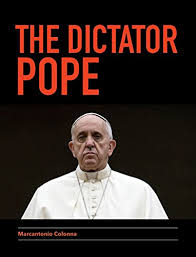
The title above is the name of a book that appeared Monday in English (after earlier publication in Italian) by a writer who has assumed a grand Renaissance pseudonym: Marcantonio Colonna (an admiral at Lepanto). He evidently could not publish under his real name, for fear of reprisals. But the case he lays out is largely convincing: that Pope Francis has carefully cultivated an image in public as the apostle of mercy, kindness, and openness; in private, he’s authoritarian, given to profanity-laced outbursts of anger, and manipulative in pursuing his agenda.

This is hardly news, least of all in Rome. This volume, however, is far more probing and detailed than anything that has previously appeared. It sometimes stretches evidence, but the sheer amount of evidence it provides is stunning. About 90 percent of it is simply incontrovertible, and cannot help but clarify who Francis is and what he’s about.

The parts of this story I know best – the Synods on the family that I reported on daily from Rome for TCT – are absolutely reliable. We know, for example, that Pope Francis was quite willing to openly manipulate the Synods by personally appointing supporters of the Kasper Proposal and that he even intervened personally at key points, changing procedures and instructing the bishops about where their deliberations should start – and end.

When Francis cares about something – as Colonna shows – he makes it happen, whatever the opposition (at the Synods, it was considerable). There’s a clear pattern of behavior, whatever uncertainties remain. On the divorced and remarried, the environment, immigrants, “Islamophobia,” the poor, the pope is relentless. But he was not elected to revolutionize marital doctrine or “discipline.” Nor was he chosen to be a player in international politics. He was elected to be a “reformer” who would mainly clean up Vatican finances and deal with the gay lobby, two things that played a role in Benedict’s resignation.

On the financial front, there was a strong start: The council of cardinals, Cardinal Pell’s effort to inject Anglo-Saxon transparency, a new special secretariat on the economy, hiring PriceWaterhouseCoopers to do an external audit. The momentum stalled as the old guard slowly regained control over Vatican finances – and oversight. A series of Vatican Bank presidents, officials, accountants, etc. – probably getting too close to the truth – have been fired without good explanations. (Something similar played out in the Knights of Malta controversy.) Pell had to return to Australia to deal with sexual abuse charges from forty years ago that, suspiciously, resurfaced after being earlier examined and dismissed.

And where was the pope during all of this? He didn’t seem very interested. If he had been, he’d be at least as dogged in dealing with financial reform as he is, say, about global warming. Austen Ivereigh, a British writer and papal fan, entitled his biography The Great Reformer, in part because of Jorge Bergoglio’s alleged role in curbing abuses in Buenos Aires. Colonna doubts the truth of that account, and not only because of Francis’s lack of action in Rome. He thinks the Argentinian stories should be re-examined.

Then there’s the gay mafia. People forget that the occasion for Francis’ famous remark “Who am I to judge?” was not a general comment about homosexuality. It was in response to a question about Msgr. Battista Ricca, who was involved in several notorious homosexual scandals, some right across the river from Buenos Aires in Uruguay. Nonetheless, right after the 2013 papal election, he became the pope’s “eyes and ears” at the Vatican Bank and director of the Casa Santa Marta, where Francis resides.

And then there’s the troubling, casual resurrection of figures like Cardinal Gottfried Daneels, once thoroughly discredited for his support for contraception, divorce, gay marriage, even euthanasia and abortion – and outrageous mishandling of priestly abuse. But he stood with Francis on the balcony of St. Peter’s right after the conclave and read the prayer for the new pope at his inauguration. He was also one of the ringers Francis personally invited to bolster his case at the Synods.

Then there’s the appointment of another radical, Archbishop Paglia, to head the “reformed” John Paul II Institute on Marriage and the Family. In a remarkably naked authoritarian move, the pope substituted himself for Cardinal Sarah for the institute’s opening academic address in 2016, and spoke of “a far too abstract and almost artificial theological ideal of marriage.” You have to believe that Cardinal Marx was expressing the truth when he said, at the end of the synods, that it was just the beginning.

The least satisfactory part of this book for me is the account of how the “St. Gallen Group” – one of its own members called it a “mafia” – which met to plan opposition to St. JPII and Joseph Ratzinger, identified Jorge Bergoglio as a future papal candidate. He had no global visibility until he gave the concluding address at the 2001 Synod on the role of bishops. NYC’s Cardinal Edward Egan was supposed to do that but stayed home because 9/11 had just happened. The address impressed the synod fathers for its fairness to both sides. Colonna reveals, however, that it was entirely the work of a Synod secretary/speechwriter, Msgr. Daniel Emilio Estivill. We need to know more about how things went, from then to now.

Colonna also weakens his credibility somewhat by repeating rumors that Vatican Secretary of State Cardinal Parolin convinced Francis to use money from Peter’s Pence to support Hillary Clinton’s presidential campaign. No footnotes appear to support this claim, nor does Colonna offer a plausible account of how and why Rome would think Mrs. Clinton – Hilary Clinton? – worth such a risky bet and potential scandal.

Despite a few lapses, the most disturbing element remains: the abundant evidence – confirmed by many particular instances now over years of this papacy – that the pope has little use for established procedures, precedents, even legal structures within the Church. These are not mere trivial rules, Pharisaic legalism, resistance to the Holy Spirit, etc. They are the means by which the Church seeks to be clear, fair, and orderly – and to address unjust actions or abuses by those in power.

When the head of the Church himself does not much feel bound by the tradition or impartial laws he has inherited, what then? That the question even has to be asked is disturbing. Any answer will have to reckon with the eye-opening material in this compelling book.


Robert Royal

Robert Royal

Robert Royal is editor-in-chief of The Catholic Thing, and president of the Faith & Reason Institute in Washington, D.C. His most recent book is A Deeper Vision: The Catholic Intellectual Tradition in the Twentieth Century, published by Ignatius Press. The God That Did Not Fail: How Religion Built and Sustains the West, is now available in paperback from Encounter Books.

Posted in Uncategorized | 1 Comment

AN ADVENT MEDITATION


AN ADVENT MEDITATION

ON

WEDNESDAY OF THE FIRST WEEK OF ADVENT

BY ABYSSUM

Great Commandment. … The Lord our God, The Lord is One; Thou shalt love the Lord thy God with all thy heart, and with all thy soul, and with all thy mind”, before also referring to a second commandment, “Thou shalt love thy neighbour as thyself.”

1 Corinthians 13:4-8

Love is patient, love is kind. It does not envy, it does not boast, it is not proud. It does not dishonor others, it is not self-seeking, it is not easily angered, it keeps no record of wrongs. Love does not delight in evil but rejoices with the truth. It always protects, always trusts, always hopes, always perseveres.

Love never fails. But where there are prophecies, they will cease; where there are tongues, they will be stilled; where there is knowledge, it will pass away.

13 If I speak in the tongues[a] of men or of angels, but do not have love, I am only a resounding gong or a clanging cymbal.

If I have the gift of prophecy and can fathom all mysteries and all knowledge, and if I have a faith that can move mountains, but do not have love, I am nothing. If I give all I possess to the poor and give over my body to hardship that I may boast,[b] but do not have love, I gain nothing.

Love is patient, love is kind. It does not envy, it does not boast, it is not proud. It does not dishonor others, it is not self-seeking, it is not easily angered, it keeps no record of wrongs. Love does not delight in evil but rejoices with the truth. It always protects, always trusts, always hopes, always perseveres.

Love never fails. But where there are prophecies, they will cease; where there are tongues, they will be stilled; where there is knowledge, it will pass away. For we know in part and we prophesy in part, 10 but when completeness comes, what is in part disappears.

11 When I was a child, I talked like a child, I thought like a child, I reasoned like a child. When I became a man, I put the ways of childhood behind me.

12 For now we see only a reflection as in a mirror; then we shall see face to face. Now I know in part; then I shall know fully, even as I am fully known.

13 And now these three remain: faith, hope and love. But the greatest of these is love.

Eros and agape.

Love and marriage go together like a horse and carriage.

How can we love someone who is totally transcendant, immaterial.

That was man’s problem until the Nativity of Jesus Christ.

That was Geoge Harrison’s problem after he deserted Jesus Christ and pursued Krishna.

“My Sweet Lord.”

Why did you choose Saint Paul as your Saint when you were confirmed?

Because of his ‘sword.’

Why did you choose to be ordained/consecrated on January 25, 1972, The Feast of the Conversion of Saint Paul?

Because of “Caritas Christi Urget Nos.”

You cannot love what you do not know!

God’s great gift to us:

someone we can love who is both human and divine.

The way to know Jesus Christ is not to get a Doctorate in Sacred Theology or Philosophy.

“It is better to get your head in heaven than to get heaven in your head!”

You cannot love the Summa and get to heaven; you must love Him who moved Saint Thomas to write the Summa.

Who can look into the face of a baby in the crib and not experience an upwelling of eros/emotion;

and who can look at the face of a baby in the crib, recognize the infant Jesus and not exerience an upwelling of agape.

Lord, help me to love you as one who is loved by you should love


Posted in Uncategorized | 1 Comment

IN CELEBRATION OF THE ORDINATION OF FATHER HUNWICKE

hunwicke_this-700x500

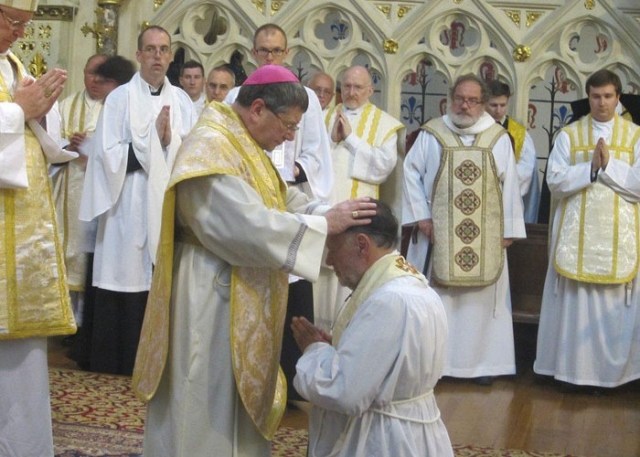
Ordination of Father Hunwicke

06 December 2017

Magisterial??

{ Hat Tip: Andrew Greenwell }

So PF’s letter to a bishop in Argentina has been published in the AAS. Naturally, people are worried about the status which this might confer on it. Does it turn the letter concerned into a Magisterial document to which we are obliged to exhibit respect (obsequium)? And all that.

I am not going to get into questions such as the different weight to be accorded to different levels of papal documents; or how to construe a papal document which either obviously or apparently contradicts another document of the same Magisterial level. You can find that sort of stuff elsewhere. And the great Father Zed has done the Church Militant another immense service by printing a detailed analysis of the situation by a noted canonist. The gist is: even an Apostolic Letter printed in AAS does not cancel Canon 915 (unless it explicitly and in due form says that it does).

We are in a new situation under PF, and new hermeneutical methods are both needed and implied. I offer some thoughts … you might call them the tentative reactions of a Plain Simple Man.

It is an objective and undeniable fact that Amoris laetitia has been interpreted in diametrically  contradictory ways. Some bishops, some conferences, take the view that it has changed nothing of the teaching contained in previous Magisterial documents. Some bishops, some conferences, believe that it has opened up the possibility of giving the Sacraments to unrepentant public adulterers. A sound and common sense principle is A doubtful Law is no Law.  As Cardinal Mueller has pointed out, in a very grave matter a change can only be made in law or doctrine by an explicit statement, with accompanying reasoning, making clear beyond all doubt that a change is being made. Sending Von Schoenborn down to a Vatican News Conference to smile sweetly at Diane Montagna and say “It’s a Development!! Read Newman!!!” hardly meets this criterion.

If Amoris laetitia itself is of no effect, clearly a letter (even if it subsequently appropriates to itself the grandiose term ‘Magisterial’) which purports to interpret AL, can hardly rise much above the level of nugacitas.

Vatican I defined that ex cathedra statements of the Roman Pontiff are irreformable ex sese and not e consensu Ecclesiae. By implication: it has not been defined that lesser papal statements are ex sese irreformable. Thus, it is lawful to take into account what conferences and individual bishops say in interpreting Amoris laetitia. That document is reformable and any force it may eventually after a few decades acquire will depend on the consensusof the Church.

A fortiori, the same is true of the note that Cardinal Parolin has so unwisely attached to the text of “the Argentine letter” in AAS. One of the cheapest and nastiest tricks of the current regime is its facile habit of plastering labels reading “Holy Spirit” or “Magisterium” onto any ill-considered novelty it wants to force down the throats of its unwilling fellow Christians.

Another objective and undeniable fact: although instructed by his Employer to “strengthen your brethren”, PF has not replied to Dubia, even when submitted by patres purpurati. Quite obviously, it cannot be argued that he has taught, clearly, explicitly, and as definitivetenendum, any of those contents of the document Amoris laetitiawhich have caused such puzzlement.

In other words, the Petrine Ministry appears currently to be in the state which Blessed John Henry Newman neatly described as Suspense. I suggest that a general pastoral conclusion to be drawn from all this is that ordinary straightforward Christians have better things to do with their time than worrying about the precise status of ambiguous statements. Better, richer, more God-given things. Qualia essent …

Open a bottle of wine.

Compose a limerick in English about Cardinal Kasper.

Do the Times Latin Crossword in under five minutes.

Play forfeits with your wife/husband.

Incorporate into a ‘Vergilian’ eclogue (with goats and shepherdesses galore) Cardinal Mueller’s recent brilliant apercu that the Church is not a Field Hospital but a Silicon Valley.

Recite the Quicunque vult and make an Act of Faith.

Cram yourself full of baklava and/or halva.

Listen to the Kyries of the Missa Papae Marcelli.

Go to Ashmole and commune with Menander or Benedict XIV or both.

Walk down the river from Sandford Lock to Abingdon and count the species of waterfowl.

Convert the encyclical Pascendi Dominici gregis into Homeric hexameters.

Shoot a magpie or two or three or four.

Find a priest who will take a stipend to offer the Mass Salus populi for the Ecclesia Dei adflicta.

Kai, as Aristotle might have put it, ta loipa panta.


9 comments:

  1. Dear Father, it has been a long time since you shared an encounter with Benedict XIV. Perhaps soon…?

    Reply

  2. Brilliant Father brilliant.You have helped me to cope with the bewildering antics of this Regime-and not to worry too much.Thanks!

    Reply

  3. Ne negligatis Patris Hunwicke blogum legere
    singulis diebus mane aut vespere
    Oh quanto ille verborum lepore,
    disserendo de liturgico decore,
    demonstrat quomodo oportet errores corrigere

    Reply

  4. Thank you, Father, for giving me something productive to do. The first two assignments are complete and I offer the result of the second. If it isn’t perfect, I can only offer the excuse of the first.

    Cardinal Kasper in God’s Providentia
    Wrote books cum doctrina absentia.
    Though the Pope praised his thoughts,
    Four Cardinals had doubts
    They were eodem sensu eademque sententia.

    Reply

  5. Attend the Divine Liturgy in an Eastern Catholic Church (during which, Francis, the Pope of Rome, will be commemorated several times) and read the holy Fathers.

    Reply

  6. But also, dear Father, if the Pope is the supreme law giver ( on earth), is not his determination, as expressed by his, er, henchman, that the document is magisterial, of legal effect?

    Now, back to the Fathers.

    Reply

  7. I would probably go the Baklava route, except that whereas when we lived in Pennsylvania there was a talented Greek Pastry Lady down the street, here in Maine there is a lack of Graeciae domina opus pistorium valentissimum so I may have to find an alternative.

    To this simple minded non canon lawyer not versed in the Magasterialness of various documents, seems to me that Mt 5:31-32 still applies as well as 1 Cor 11:27 so that seems to settle it in my mind, unless the Vatican has repealed the authority of scripture.

    Reply

  8. There once was a Cardinal named Kasper
    Who elicited an Ecclesial gasper
    He claimed matrimony
    Was near-half baloney
    So a wife’s straying man might unclasp her

    Reply

  9. All of this “mess” created by Francis results in diminishing respect for the CHURCH, which diminishes respect for the papacy.

    Which is why I see Pope Francis as the first “Sedevacantist” Pope; that is, a Pope who by his stress on “synodalism” and “decentralization” {all imposed on the Church using a centralized, dictatorial, autocratic authority, naturally!} allows chaos to reign and by flippantly and cynically using disingenuous methods {e.g. the current AAS issue} to effectively change Church teaching {and thus destroy respect FOR Church teaching and the papacy as well}, he will leave a gutted papacy after his reign is over. The Pope who leaves the See effectively empty of respected authority, devoid of integrity and power: A “Sedevacantist” Pope. This may be intentional or not. THAT I am not sure of. but the results cannot be denied; Francis is crushing the integrity of the papacy and creating a vacuum of serious leadership.

    I believe it could all backfire, tho, if one, single, good, CATHOLIC man {yes, an actual Catholic, fancy that…} is elected Pope either immediately after him or at some point down the line.

    Of course the Church will break up because the heretics won’t stand for a non-Lutheran running the show, but that will only formalize what already exists inside the Church today; internal, informal schism with heretics likely the majority.

    Who gets the buildings is anybody’s guess.

    Reply

Posted in Uncategorized | 1 Comment

WHO IS CARDINAL MUELLER, I MEAN REALLY ????


By David Kurrasch

06 December 17

What exactly does it mean “I remain with Bergoglio”??? This is a profoundly odd statement to make from the former Prefect of the Doctrine of the Faith, especially under the present circumstances. It is a statement void of any discernible context, and frankly strikes me as cowardly. At best, naive. “There is a risk of separation, which could become a schism.” Are you kidding me? This cannot be taken seriously. The statement itself acknowledges the very schism he seems to fear, but does not recognize: “I remain with Bergoglio.” This substantiates that others do not remain with Bergoglio. I REMAIN + I DO NOT REMAIN = SCHISM.

Whether we will admit it or not, the Schism is more than official! What is now unfolding is the situation that every single priest and Bishop must face precisely because Bergoglio, playing the role of pope, has declined to clarify it. They individually must answer the question because he refuses to: “Dear Father, at what point does a mortal sin dissipate into thin air, as if it never existed? Is it a function of time, dear Father? A function of my own conscience? Can it be wiped away as long as I vigorously defend the theory of climate change? Help a wounded bird?

I will say it again. The CONFUSION itself which has been created, nurtured, and allowed to remain under the reign of Bergoglio IS THE SCHISM!!!! We need not look for a headline in the Times screaming “EXTRA!!! EXTRA!!!! “The Schism has now officially arrived!!” If that’s what we are waiting for….some official announcement…we will have missed the boat.

He has DIVIDED the Church, and is not going to turn back. There is no other way to look at it. And, as I have said before, Benedict XVI is the only man on Earth who has the authority to correct the confusion. And mark my words, he will.

Take Courage and Pray with Confidence. Father, Son, and Holy Spirit are with us. Trust.


Posted in Uncategorized | Comments Off on WHO IS CARDINAL MUELLER, I MEAN REALLY ????

TODAY’S DOSE OF SATIRE TO CURE WHAT AILS YOU SPIRITUALLY

Eccles and Bosco is saved


The Dictator Pope

Posted: 05 Dec 2017 06:28 AM PST

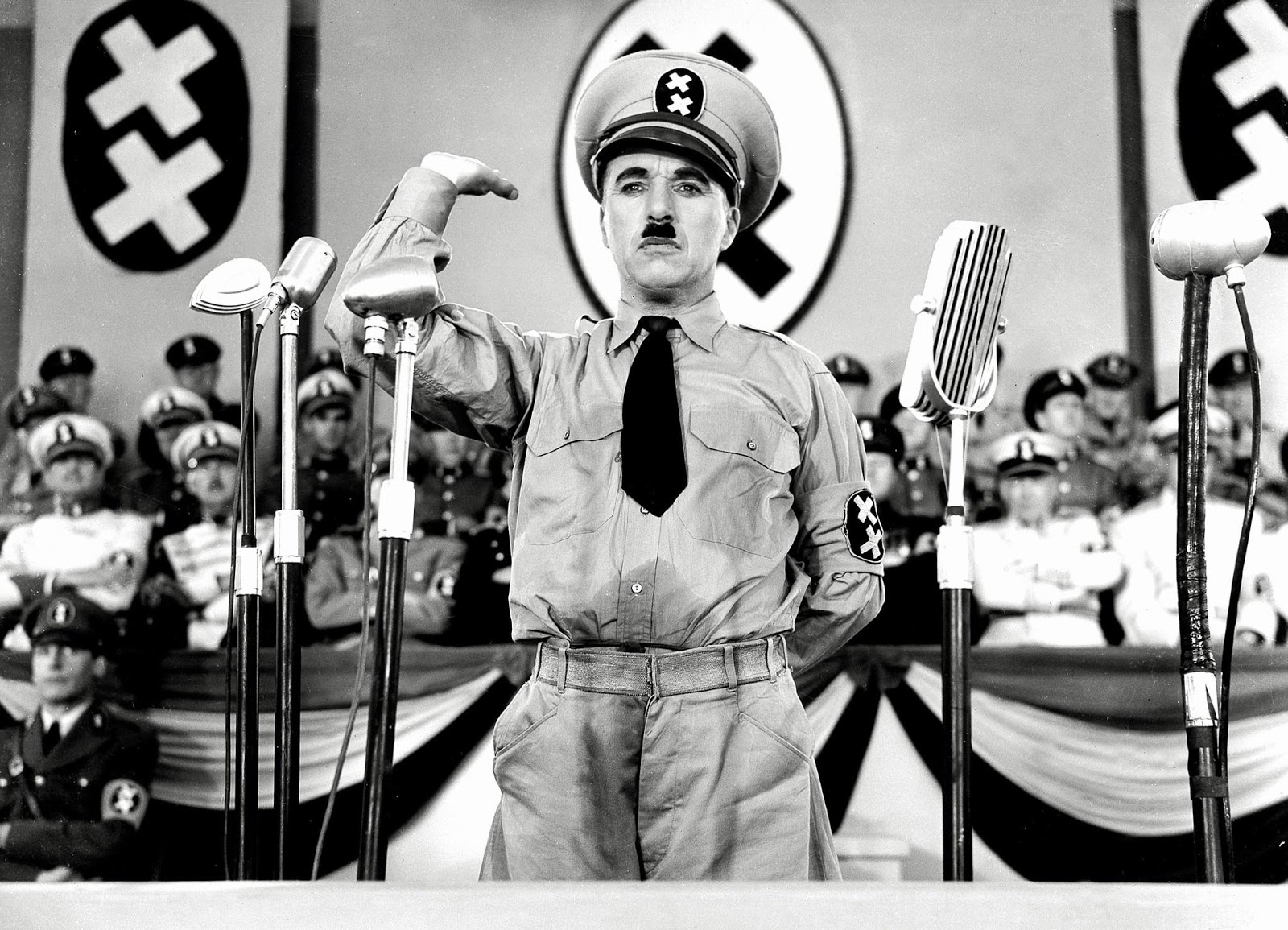
A new book by Marcantonio Colonna has revealed that behind the image of Pope Francis as a humble, merciful, foot-washing, baby-kissing uncle there lies the heart of a fiend.Charlie Chaplin

A chaplain who once mocked Pope Francis disappeared without trace.

Amongst the revelations in this startling book are the following:

* General Galtieri never wanted to invade the Falkland Islands in 1982, but simply wished to devote himself to breeding llamas. However, the rector of the Philosophical and Theological Faculty of San Miguel, one Jorge Bergoglio, pushed him into a costly war.

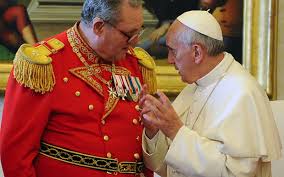
Pope Francis and Matthew Festing

Francis issues threats against Fra’ Matthew Festing’s pet hamster.

* Pope Francis very humbly refuses to allow his friends to call him “Holy Father”, preferring the term “Generalissimo”.

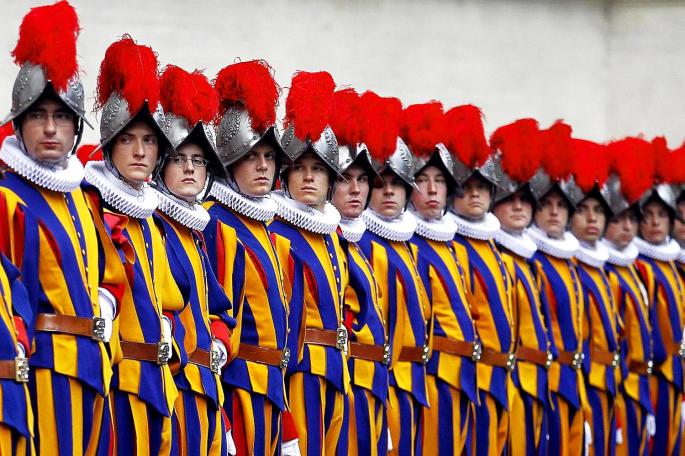
* Pope Francis refers to his Swiss Guards as the “Stormtroopers”: there is a secret elite corps in the Swiss Guard that is responsible for assassinations.

Swiss Guard

Everyone fears the SG.

* The original title of Amoris Laetitia was Liber Terrae Dominationis – a manual of world domination – but the Pope was persuaded that this was too obvious.

* Two of the cardinals who submitted the Dubia to Pope Francis have died – as Oscar Wilde (or possibly Agatha Christie) put it, to lose one might be a misfortune, to lose two looks like a remarkable stroke of luck for someone.

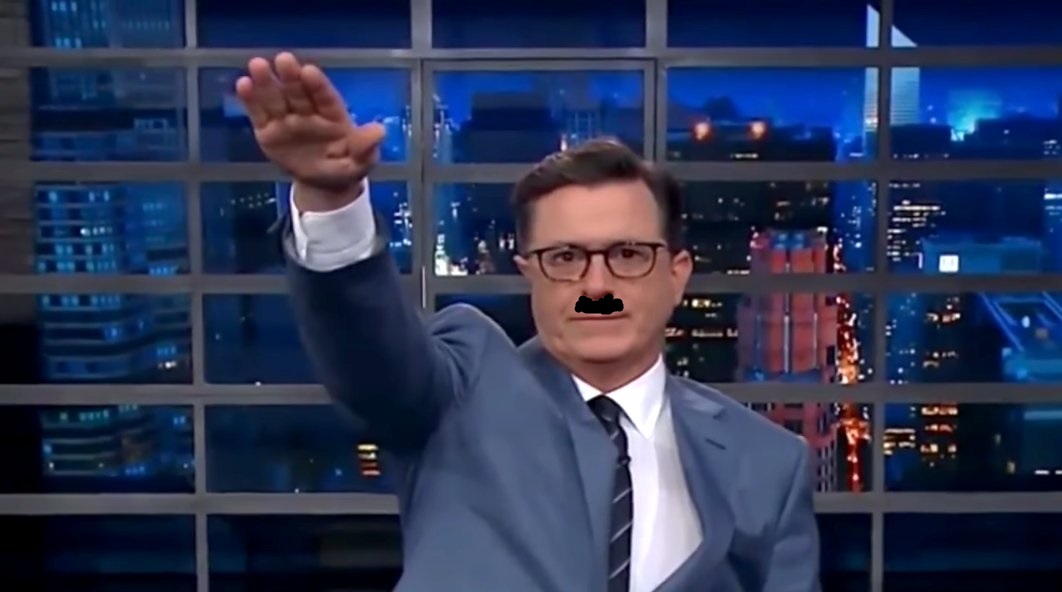
Steve Colbert

Alt-comedian Steve Colbert swears allegiance to the Pope.

* All Jesuits are Licensed to Kill.

* Pope Benedict is being kept prisoner in an underground cell in the Vatican, emerging only for photo-opportunities with glasses of beer.

* The name “Francis” was chosen as a tribute to Francis Ford Coppola, the producer of the Godfather films.

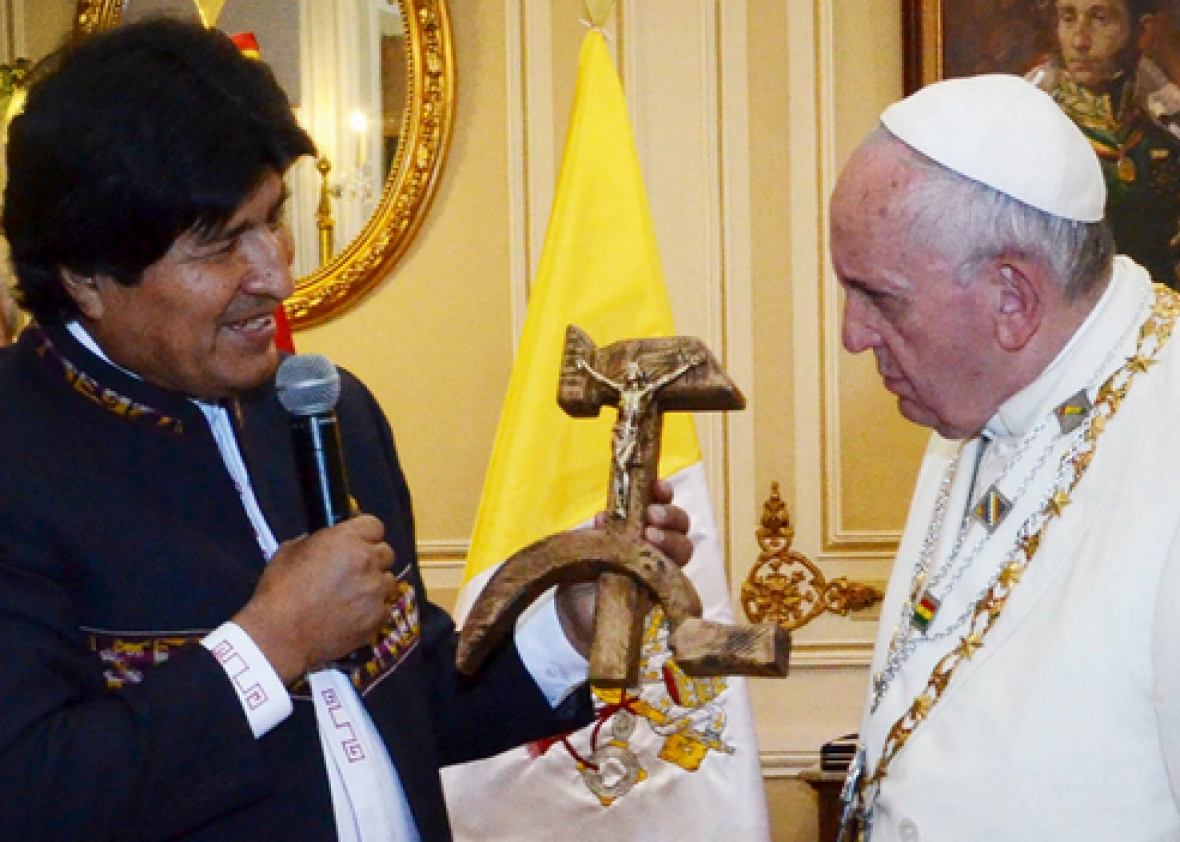
Pope and Evo Morales

“I like the hammer and sickle, but could you remove the religious bits?”

Of course, I haven’t read the book yet, and it may be about something else entirely.

Posted in Uncategorized | Comments Off on TODAY’S DOSE OF SATIRE TO CURE WHAT AILS YOU SPIRITUALLY

“Frequently, when I talked to Pope Francis, I called him a revolutionary and one day, in one of our telephone conversations, he answered my ‘hello’, ‘This is a revolutionary’.”

Thursday, November 30, 2017

New Scalfari Interview: Pope Francis Really is a Revolutionary

(Rome) Is Pope Francis a Marxist? Or Communist? Who knows, but certainly he is a “revolutionary,” as his friend and avowed atheist Eugenio Scalfari explained in the recent editorial of his La Repubblica, the only daily newspaper that is said to be regularly read by Francis.
Questions about the pope’s political convictions have cropped up since the pontificate began. The starting point was in autumn 2013 with the publication of Evangelii gaudium. At the time, critics in the United States called Francis a Marxist.

Is the pope a Marxist? A communist?

From the left side it was first mentioned particularly clearly in connection with the visit of the Greek Prime Minister Alexis Tsipras.
Tsipras, a representative of the radical left, which emerged from the former Communist Party of Greece, was received in September 2014 by Pope Francis in Santa Marta. The meeting came about through the mediation of Walter Baier, former president of the Communist Party of Austria (KPÖ). Following the meeting, Tsipras said:
“The Pope is not a leftist, but he talks like a leftist”.

At the same time, he emphasized the importance of dialogue with the head of the church, which should be continued.

On March 13, 2015, the Marxist philosopher Gianni Vattimo called on a left-wing public in Buenos Aires to stand behind Pope Francis to form a new Communist International, which he called the Papist International. Besides Vattimo, Curial Bishop Marcelo Sanchez Sorondo, the political arm of Pope Francis, sat by the podium.
Following the electoral defeat of the US left in the 2016 presidential election, The Wall Street Journal wrote:
“Pope Francis is the leader of the global left”.
When Francis was approached directly by journalists, he replied indirectly.
When asked by his house Vaticanist Andrea Tornielli in December 2013 how he felt being described as a Marxist, he said he was “not offended” by it.
When he was asked in June 2014 by a Messaggero journalist if he felt he was a Communist – The Economist had written at the time that the Pope was a Communist and spoke like Lenin – Francis said:
“All I’m saying is that the Communists stole the flag. The flag of the poor is Christian. Poverty is at the heart of the gospel. […] The communists say that everything is communist. Yes, 20 centuries later. If they talk like that, you could say to them, “You are Christians.”

Is the pope a revolutionary? “Yes, he really is.”

Many Bergoglians have called the Pope a “revolutionary” in the past. The term seems to have been used more fashionably and coquettishly, but when specifically addressed,  such a papal revolution was denied by the just the same opinion makers.
But now the pope described himself as a revolutionary.
Herald of the news is his friend Eugenio Scalfari, who likes to put words in Pope Francis’ mouth.  The idiosyncratic method of Scalfari’s Pope interviews, he reported himself in November 2013. Since the avowed atheist has not been denied by the Vatican since then, instead getting new interviews with the Pope and presenting these interviews to the Vatican in book form, the reproductions of papal statements by the doyen of leftist journalism must be taken seriously.
On November 26, Scalfari published a new editorial in which he reported on a telephone conversation with Pope Francis. From the context it can be seen that Francis was the one who called Scalfari.
“Frequently, when I talked to Pope Francis, I called him a revolutionary and one day, in one of our telephone conversations, he answered my ‘hello’, ‘This is a revolutionary’.”
Scalfari continues:
“He said it jokingly, but it is him, and what he said on this recent occasion confirms it.”

The future: immigration and EU

The content of the editorial briefly outlined:
Scalfari attests to the Pope being the “only voice” that “describes the situation of the whole world” and shows the way “to overcome selfishness and indifference”. What is this about? Concerning immigration and the EU, which Scalfari equates with Europe, as is common among his peers. A ridiculous thing, considering that the EU has only existed since 2009.
Scalfari stresses that Pope Francis has hesitated for a short time because of the imminent demand from Africa, but now again pleads for an unrestricted immigration, because “whoever comes from Hell, can not be treated to another Hell.”
As immigration from Africa mainly affects the countries bordering on the Mediterranean and means “a not insignificant economic burden”, “all the states of Europe” and North America would have to bear the “economic burden that immigration produces.”
“In short, a social revolution of the rich world towards the poor world.”
Scalfari, who proudly refers to pictures of his grandfather and father in his house, who were Masons, and even as such, adds a detail, after all, in 2017 the lodges are celebrating the founding of Freemasonry 300 years ago.
For Scalfari (“as a non-believer is it allowed”) it is clear that Pope Francis is a revolutionary. And he is happy. For the “future of another world,” Scalfari sees in the context of unrestricted immigration to the EU will be founded on the “fundamental values” of “freedom, social justice and brotherhood.”
“Thus the church will also be modernized, and the best of secularism, created three centuries ago, supports the same values ​​that Francis remembers and supports.”
Text: Giuseppe Nardi
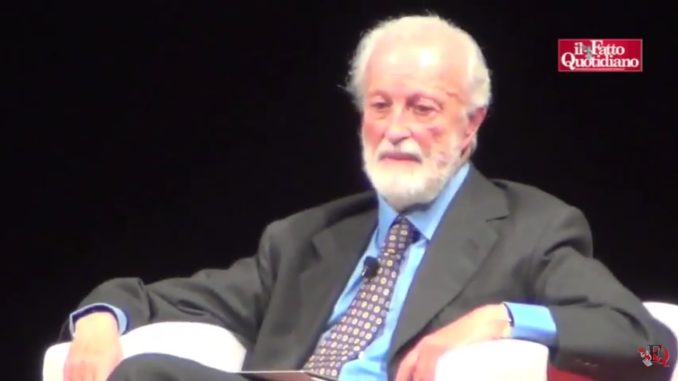
Image: Youtube (screenshot)
Trans: Tancred vekron99@hotmail.com
AMDG
Posted in Uncategorized | Comments Off on “Frequently, when I talked to Pope Francis, I called him a revolutionary and one day, in one of our telephone conversations, he answered my ‘hello’, ‘This is a revolutionary’.”

To what extent, and to what point, is it possible to publicly cooperate in works of social justice and solidarity with those who practice esoteric and Gnostic rituals, which are very probably open to the influence of superhuman or preternatural influences?

A Call for Cooperation between Catholicism and Freemasonry?

FacebookEmailPinterestPocketGoogle+

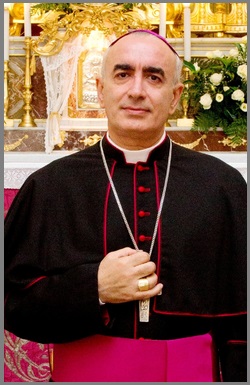
On November 12 in Syracuse, Sicily, the Grand Masonic Lodge of Italy, Palazzo Giustiniani (GOI), sponsored the conference “The Church and Freemasonry: So Close and yet So Far?” The presenters at the conference included the theologian Msgr. Maurizio Aliotta; Bishop Antonio Staglianò of Noto, Sicily; and Sergio Rosso and Santi Fedele, adjunct grand masters of the Grand Masonic Lodge of Italy.

Why was the conference held? According to an interview given to Avvenire on November 1, 2017, Fr. Ennio Stamile (parish priest of Cetraro, Italy) explained that “[n]otwithstanding our differences,” it is good “to undertake authentic paths of service for the common good and for a responsible and transparent commitment to social justice.”

Are we talking about a Catholic-Masonic connection on the level of social justice and solidarity? Let’s see what the principal speakers had to say about it.

1) In his eleven-minute talk, Msgr. Aliotta demonstrated a good knowledge of Freemasonry, indicating several elements that make it incompatible with the Church: anthropocentrism, religious elements and “super-denominational” initiation rites, and a spirit of relativistic tolerance. Aliotta, while aware of the danger of this dialogue being exploited, seemed to favor “collaboration around projects that help us to walk together toward an ever greater humanization.”

2) Sergio Rosso, who spoke for nearly nineteen minutes, illustrated the philanthropic work of the Grand Masonic Lodge of Italy and gave great praise to the charitable action of the Catholic Church in the world. Rosso attempted to distinguish and separate Masonic “secularism” from “anti-Catholicism.” He also recommended Catholic-Masonic cooperation on the level of solidarity in order to “revive an era of the Spirit who is near to us.” Which Spirit?

3) The conference of Bishop Staglianò, the longest, lasted about fifty minutes. His remarks demonstrated only an incomplete knowledge of Freemasonry. He admitted that he has declared in an interview that he doesn’t know anything about Freemasonry.

At the beginning, Staglianò quoted some words from The Magic Flute, the famous opera of the Catholic-Masonic composer, Wolfgang Amadeus Mozart (1756-1791). He cited and praised the theologian Hans Urs von Balthasar, who declared The Magic Flute “an opera of divine traits” (words of Staglianò). His Excellency also reported the judgment of Hans Küng on Mozart’s membership in Freemasonry: Mozart became a Mason because only there did he find embodied the Enlightenment ideals of equality, fraternity, and freedom, which he did not see in the Catholic hierarchy of Salzburg.

Perhaps the speaker would have done well to underscore the fact that, already in the 18th century, membership in Freemasonry (including that of Mozart’s time) was incompatible with the Catholic faith due to Freemasonry’s religious indifferentism, relativism, rationalism, esoterism, and Masonic oaths (with cruel punishments threatened for those who betray Masonic secrets). While it’s true that Bishop Staglianò then said that one cannot be both Catholic and Mason, he did not explain or develop the reasons for this incompatibility. Instead, he pointed out (accurately) that Msgr. Aliotta really deserved much more time to speak.

However, Bishop Staglianò was not “soft” with the Masons. He said several times that they are excommunicated, with confirmation from 1983 by Cardinal Ratzinger, then prefect of the Congregation for the Doctrine of the Faith. Therefore, Staglianò said, between Catholics and Freemasons there is “an abyss-like distance”; there is “excommunication in action.” “You are totally thrown out, truly out,” the bishop said, directly addressing the Masons who were present.

Bishop Staglianò even mentioned the “rumor” according to which there are even priests and bishops who are Masons. If that were true, he emphasized, those priests and bishops are also excommunicated and have “problems with their identity.”

Unfortunately, Bishop Staglianò did not say, or did not say clearly, why Masons are excommunicated, nor why Freemasonry is incompatible with the Church. In that regard, I would like to make a clarification. Canon 2235 of the 1917 Code of Canon Law, which imposed the penalty of excommunication latae sententiae on Catholics who join Freemasonry, was not renewed in the new Code of Canon Law in 1983 (in effect since November 27, 1983). By virtue of Canon 2235 of the 1917 Code, any Catholic was ipso facto excommunicated by the act of his adherence to, or initiation into, Freemasonry. In its declaration of November 26, 1983, the CDF simply reiterated the incompatibility between Freemasonry and the Church, specifying that Catholic members of Freemasonry are in a state of grave sin and cannot receive Holy Communion. Period. It did not speak of excommunication. For reference, I have several articles on this subject.

Thus, it seems that in reality, from a canonical point of view, Catholic Masons are not excommunicated ipso facto by the act of adhering to, or being initiated into, Freemasonry (in the first degree of Apprentice). However, if in the course of their Masonic formation they embrace and manifest heterodox doctrines, or fall into apostasy, then they incur the excommunication foreseen for the delict of heresy or apostasy (cf. Canon 1364, 1983 Code).

It is also worth noting that Bishop Staglianò lashed out at those Catholics who were perplexed by his participation in the conference. He stigmatized them as Catholics who consider themselves “true” and “pure” and who are instead abysmally “distant.” (From whom? From the Church? From Christ?) Staglianò scolded them for having problems with their Catholic identity. He then said to the Masons in attendance that if there are “urgent, shall we say, anthropological matters” (matters Masons could address in union with Catholics) and if they also want to raise their voice to defend human dignity and religious liberty, then they ought to “show” their true face (as people concerned for the true good of humanity) so that those who have excommunicated them (the Holy See) may come to realize that they have excommunicated “something that does not exist.” He exhorted the Masons: “Let’s walk together in that direction.”

But now, let’s ask ourselves: What would it mean for the Masons to show their true face? Also, would the excommunication or “distancing” of the Masons truly be less only if they “show their face”? If, on the one hand, Bishop Staglianò energetically wants to blame the “distancing” between us on the Catholic side (on “pure” Catholics – does that include Catholic-Masons?), on the other hand, he seems too vague in his hypothesis that there really is a “closeness” in our distance.

In fact, Bishop Staglianò insisted strongly on the right of conscience, saying to the Masons that he did not wish to measure their distance or closeness, but that they must be true in their conscience, in their anthropology, to say that they are not thieves, nor corrupt, nor creators of plots (against the Church), etc. But by speaking in this way, how are the Masons not left in their subjectivism? In effect, those Catholics who adhere to Freemasonry already do follow their consciences.

Therefore, the appeal to conscience is not sufficient; rather, one must also give clear and definite directions. For example: Tell the Masons of the Grand Lodge of Italy they must renounce esoterism, Gnosticism, secularism, and their aversion to dogmas of faith and morals if they wish to draw closer to us Catholics.

Perhaps somewhat irritated by the words harsh words of Bishop Staglianò, the grand master, Santi Fedele, spoke for 18 minutes defending the Grand Lodge of Italy, its public “transparency,” and its right to privacy. Fedele defined the Honorable Rosy Bindi (an Italian politician) as a “Catholic communist.” He denied that Freemasons perform “strange magic rituals in the Temple.” (Even on this point, I would have to object.) He exalted the “secular morality” of Freemasonry and admitted that the “Great Architect of the Universe” of James Anderson’s book  Freemasonry (1723) is Deist. Finally – replying again against Staglianò – he declared proudly that he has a “serene awareness” of being “outside the community of believers.”

Permit me to refer to some of my articles, here and here, in which, on the basis of Masonic texts, I underline the essential identity of the Freemasonry of the Grand Lodge as esoteric and based in initiation rituals. Initiation and esoterism (Gnosticism) – here is the true “heart” of Freemasonry, far beyond rationalism, secularism, and humanitarian activity.

Therefore, let’s ask ourselves: To what extent, and to what point, is it possible to publicly cooperate in works of social justice and solidarity with those who practice esoteric and Gnostic rituals, which are very probably open to the influence of superhuman or preternatural influences?

The above article is written by Fr. Paolo M. Siano. It is published here, translated by Giuseppe Pellegrino, with the author’s permission. The original appeared in Corrispondenza romana.

Posted in Uncategorized | Comments Off on To what extent, and to what point, is it possible to publicly cooperate in works of social justice and solidarity with those who practice esoteric and Gnostic rituals, which are very probably open to the influence of superhuman or preternatural influences?

ALESSANDRO M. MINUTELLA, MARTYR IN THE MAKING

"Resist, Resist, Resist": CFN Exclusive Interview with Fr. Alessandro M. Minutella
DEC 5

“Resist, Resist, Resist”: CFN Exclusive Interview with Fr. Alessandro M. Minutella

{ Abyssum }

“I am dumbfounded that in Italy, I am still the only one.”

Suspension and Double-Excommunication: “These are medals of honor”

“Resist, resist, resist!”

Editor’s Note: Father Alessandro Maria Minutella is an Italian priest of the Archdiocese of Palermo. Born in 1973 and ordained in 1999, he became known in the past month to English speakers around the world thanks to a Youtubevideo about resisting Pope Francis and Amoris laetitia. Catholic Family News is happy to present this exclusive interview with Don Minutella, (to our knowledge) the first such interview in English.

CFN: Father Minutella, thank you for your availability. Until a few weeks ago, you were essentially unknown outside of Italy. However on November 16, 2017, you were suddenly and universally introduced to the English-speaking world. A translation of your video, “The Courage of [the] Truth” – itself released on November 9, 2017 on Radio Domina Nostra’s Youtube channel – appeared with the title “Don Minutella and the Pope Francis Regime.” At the end of November, it has over 29,000 views. Can you please introduce yourself: tell us when and where you were born, your date and place of ordination, what were your priestly assignments like?

Don Minutella: Firstly, I would like to thank you for this opening to the English-speaking world (which I was not looking for, so it’s decidedly Providential). Certainly the number of views have started to become considerable in your part of the world, but for some time already in Italy, television networks have labelled me a “web star,” specifically due to the number of hits. One sees how Our Lord always loves to reveal His plans using small instruments, in the manner of the Blessed Virgin.

I was born in 1973 in Palermo, the city of a thousand contrasts, known throughout the world only for the Mafia, a multifaceted and multiformed city of a thousand cultures, the masterpiece of the Mediterranean. In the Gospel of John we read how when Nathaniel was told by Phillip that the Messiah had come from Nazareth, he responded laconically: “Can anything of good come from Nazareth?” (John 1:46). My formation so far has been truly enriching. I have had as spiritual fathers the blessed martyr, Fr. Giuseppe (Pino) Puglisi [beatified May 2013] and Fr. Gabriele Amorth, SSP, the world-famous exorcist [died September 2016]. I entered the seminary in Palermo in October, 1992 and was ordained there on December 27, 1999, at the hands of Salvatore Cardinal De Giorgi.

I obtained my first doctorate in Systematic Theology in 2002, and a second doctorate in the History of Dogma and Spiritual Theology in 2007, from the Pontifical Gregorian University. I have published different works, one of which (on St. Gregory the Great) was reviewed in L’Osservatore Romano.

And yet, I never had the role of academic teacher (I have always thought this was due to my fierce fidelity to Tradition), while in these eighteen years I was a pastor three times, in three different working-class parishes on the peripheries. These were always full – even during the week – with many souls. When in the videos even speaking of theology, I am able to make myself understood by simple people, it’s not without irony that I say one can smell like the sheep on the peripheries of the Church, even in a cassock and with the rosary in hand, without giving in to the excesses of what I call today the “false church.”

CFN: You did not study in a traditionalist seminary, you weren’t ordained, for example, for the Society of Saint Pius X or even an Ecclesia Dei community like the Fraternity of Saint Peter or the Institute of Christ the King Sovereign Priest. Would you call yourself a “traditionalist priest”? Do you reject the Second Vatican Council, or the Novus Ordo Mass?

Don Minutella: I have great respect and gratitude for the groups you mentioned. As a student in Rome I was able to visit one of these traditionalist groups, savoring their love for the ancient liturgy, decorum, the spirit of authentic fidelity to sound doctrine. In particular, I was able to keep in contact with the Institute of Christ the King, Sovereign Priest founded by Monsignor [Gilles] Wach, a priest who emits Catholic authenticity.

If today I find myself, let’s say persecuted, it is because I have indeed proven to be a traditionalist priest. Not only because I celebrate the Old Rite daily, but I would say more deeply in the spirit of Tradition: Eucharistic worship, Marian devotion, priestly spirituality, and -on a wholly-theological level – firm opposition to pastoral and doctrinal novelties.

In truth, I know that I am considered a bit excessive in tone (Cardinal Burke and Bishop Schneider have asked me to use greater moderation!), { Being a Sicilian that is probably very difficult for him to do.}  yet I have found full solidarity and support from the traditionalist world, regarding [my message’s] content. The question you asked me merits a deep reflection, however, briefly, I’ll tell you what I think. Vatican II created not a few ambiguities, which in the current progressivist establishment are “straddled,” [in order to] to change the sound Catholic spirit. In my book which was just published (and which will be translated into English), called The false church and its destiny, I stress above all the liturgical and ecumenical question; I hold that in the future (when our prayers and sacrifices will obtain for us a Pope who will be Catholic again), a correction of the Council – which was pastoral and not dogmatic – will have to be made, and I believe the whole Church will return to the Old Rite.

CFN:How did you arrive at the point of making your “Appeal to Pope Francis” of March 26, 2017 (20,000+ views on Youtube.) And then, your “Historic Homily” of March 31, 2017? (43,000+ views.)

Don Minutella: My appeals were made driven by love for the Church and the sound Catholic spirit which, in in these times as never before, risks arriving – on a theological, liturgical and pastoral level – at the very real danger of schism. In my catechesis on the web, I never neglect referring to the Third Secret of Fatima. You in the USA have had the testimony of Archbishop Fulton Sheen who, in a precise way, described the characteristics of an anti-church governed by a Judas Iscariot who would betray the Catholic Faith. For me, the supernatural reference is crucial. So, I wanted to “play my cards” to the fullest, even though I’m paying dearly for it. The stakes are high: the very survival of Catholic Tradition and the sound Magisterium.

Obtaining a clarification regarding the so-called “openings” of Amoris laetitia was the objective of my appeals. Too much confusion [has been] caused by a lack of clarity. The Church can never allow a divorced and “remarried” couple to receive Holy Communion. It is a doubly-grave profanation: both of the Eucharist and of matrimony. I have found that the clergy in Italy are too afraid to react, and so, asked directly by the Blessed Virgin (in intimate and personal ways)* I wished to expose myself.

CFN:Can you explain your sudden removal as pastor of St. John the Baptist Parish in Palermo’s Romagnolo neighborhood, on June 27, 2017?Didn’t the Archbishop of Palermo, Corrado Lorefice, insist that you were not suspended?

Don Minutella: The possibility of a removal was already in the air. In the meantime, in Italy, I had become the most embarrassing “spokesman” in the face of the “openings.” However, the removal was carried out as a sort of pastoral “coup.” I had to leave my beloved parish on the very day of the removal letter’s delivery. Many souls suffered and were disheartened by the methods of “the church of mercy. It seemed like the cleansing of a regime. Whoever doesn’t think like the establishment has to be marginalized and pushed out.

Archbishop Lorefice is, without a doubt, one of the youngest and most-promising representatives of this merciful church, so I couldn’t expect anything other than a condemnation. In the meantime, the national media with trashy programs (although highly watched) launched a defamatory campaign about me, even involving the State TV network, Rai 1, which aired a trial without an opposing opinion, where I was presented as the founder of a “sect.”

It’s like this! The person who decides to remain steadfastly Catholic, Apostolic, Roman, is now a sectarian: one has to adhere to the Lutheran, neo-modernist new church! And so I, who for nine months kept silent through obedience to my bishop, understood clearly that it was all an unworthy maneuver to get me out. So I returned to defend, usque ad mortem [until death] sound Catholic doctrine. On the other hand, as a proverb states, “the devil puts the pots [on the stove] but forgets the lids.” Prominence due to State TV station Rai 1, brought me to the attention of ordinary people.

CFN: You wrote a letter on September 21 to your Archbishop, copying also the Congregation for the Clergy, during your canonical recourse. You confirmed holding all the doctrines of the Church, as well as the submission of will and intellect to the Roman Pontiff. The Prefect of the Congregation, Cardinal Beniamino Stella replied, telling you that the recourse was suspended until December 8. An unprecedented request followed, “suggested” by the Cardinal: that you publicly profess fidelity to Pope Francis on social media. You then asked for his reasoning in this regard, noting that you had already affirmed your fidelity to the Pontiff in a previous letter. On November 9, 2017, after waiting, and no response, you were suddenly summoned to the Archdiocesan Chancery. What did the Archbishop tell you?

Don Minutella: In reality, the Archbishop never made himself present following my forced removal as pastor. He was completely uninterested in one of his priests, despite having come to the Archdiocese shortly beforehand with the promise of being “a father to all.” I maintain that he was forced to meet with me, due to pressure from the Holy See. The Archbishop knows well that I am not in fact a heretic. My upstanding priesthood is noted in the Archdiocese, it’s clear how I’ve acted in eighteen years of priesthood. Many of the faithful from all parts of Italy were on his case in supporting me, so I believe that he really wasn’t happy to meet with me. In any case, he informed me that two latae sententiae excommunications were ready for me, if I didn’t publicly declare fidelity to Pope Francis on the web. I had 48 hours available. In the meantime I made the decision to go online, where I made it known that I had already pledged fidelity to the Roman Pontiff through the appropriate channels and with the expected criteria, and furthermore, that this request seemed to me to be unacceptable blackmail. We know how things went.

CFN: Why did you refuse to write or sign another letter?

Don Minutella: Blessed John Henry Cardinal Newman wrote that he would drink freely to his own conscience, and then to the Pope. Everyone can see that the current pontificate is more or less ambiguous, regarding the divorced and “remarried,” but not only in this regard. So as a Catholic priest, considering, too, the heroic testimony of St. Athanasius or St. Catherine of Siena, I didn’t hesitate in remaining firm in having already made a profession of fidelity to the Roman Pontiff; without giving in, in any way, to the unacceptable blackmail of Cardinal Stella. I am dumbfounded that in Italy, I am still the only one. But I have souls and the defense of the Faith at heart. Defensor Fidei: how I am moved by this label!

CFN: Yet in the past year, Martin Luther has been effectively rehabilitated. In fact, the Italian Bishops Conference’s Secretary General, Bishop Nunzio Galantino, recently called the Protestant revolt “an event of the Holy Ghost.” We learned last month that there exists a petition, on the part of the Pontifical Council for Culture to Pope Francis, to remove the Holy Office’s 1962 doctrinal monitum against modernist-evolutionist Teilhard de Chardin. Despite all the ecumenism, the de facto permissiveness, and the “mercy” of the present Pope and his bishops, you were threatened with two excommunications. How is this possible? For what canonical offenses, or delicts? Is this something like serving prison sentences for different crimes, concurrently? Why the discrepancy: Luther is praised but you are to be punished?

Don Minutella: I deal with these themes extensively in my just-published book, which will be released soon in English. Luther constitutes, overall, the worst snare for the Catholic spirit. Bringing him back, if not actually canonizing him, is demonstrative of a philo-heretical direction.

Sister Lucy of Fatima said in the 1960’s that if Heaven’s appeals weren’t heard and it was decided not to obey the requests of the Blessed Virgin at Fatima, this would be considered by God a sin against the Holy Ghost, which is unforgivable. The punishment for this would be the blinding of the Bishops and of the highest levels of the hierarchy. When in Italy, the Bishops Conference’s secretary Bishop Galantino spoke of Luther as moved by the Holy Ghost, when a statue of Luther was exhibited at the Vatican, the anniversary [of the Lutheran revolt] was celebrated with a commemorative stamp: these are decisive symptoms of the blindness underway, foreseen by Sr. Lucy.

I would not be surprised if I am excommunicated, even with a further excommunication than Luther received. Today’s false church (increasingly neo-modernist and Lutheran every day) can’t help but rid itself of a poor priest steadfastly determined to remain Catholic. What was heresy yesterday is magisterium today, and what was Magisterium yesterday has become heresy today.

CFN: What would you ask [of] Pope Francis?

Don Minutella: I find this question to be a bit surreal. It seemed in the beginning [of this Pontificate] that the Church would become more open, instead it’s closed-off today more than ever before. If you don’t think the same way, you’re marginalized and condemned. In any case, I would beg the Pope to give absolute first place to the subject of the Holy Eucharist. Jesus gave us Himself in the Eucharist. In the present magisterium, it seems that the Eucharistic question (always so central in the Catholic Magisterium) has become irrelevant. This forgetfulness corresponds to an unbearable [nagging, annoying] appeal to social themes; especially the generic one regarding the poor, which in reality, risks transforming the Church into an international organism in favor of the wealthier classes. Jesus is at the center of the life of the Church. Some questions, such as that of Communion in the hand (as Bishop Schneider has commendably emphasized) are decisive.

And then the subject of the reform of the reform; the liturgy, and in particular the Mass, merits greater pastoral care. I believe an appeal to rediscover the Old Rite is urgent, as is a guarantee of greater protection of the Novus Ordo from the creative experimentalism which has brought about enormous abuses. Further, I would ask [Pope Francis] to espouse a clear and spotless language – not an ambiguous one – regarding Amoris laetitia and Communion for the divorced and “remarried.” The subject of the Dubia presented by the four Cardinals (two of which have since died), and the fact that in Poland one thing is said while in Germany another is said, is a worrying warning of a drift that risks bringing about an internal schism.

The recent statements of Russian patriarch Kirill, according to which we have decisively entered those times foreseen by the Apocalypse which only the blind cannot see, and also those of Cardinal Burke which more or less repeat the same thing (linking, however, in a significant way to the Third Secret of Fatima) confirm this. I personally hold, though, that things will only worsen until the promise of Our Lady of Fatima is fulfilled: “in the end, My Immaculate Heart will triumph” which means that the Catholic, Apostolic, Roman Church; the one, true Church which confesses the only Savior of the world, Jesus Christ, her Spouse and Founder, will triumph.

In the meantime I believe that we will witness, as already happened to the Second Vatican Council (as Ratzinger said), the manipulation of the Catechism and the insurgence of thinking that is no longer Catholic, unfortunately [on a] official and dominating [level]. Catholics remaining such, throughout the world, will have to leave the official structures and descend once more into the “catacombs.” Perhaps they will have to accept excommunication and interdict, but they will be witnesses of a new burst of Pentecost. Holy Mother Church will come out of this stronger and brighter, since the persecution will provide a necessary purification. I also believe that Our Lord will give us a strong shepherd solid in the Faith, like Pope Saint Pius X, who in the manner of a “Marian lion” will lead the small, Catholic remnant to victory.

CFNWe have examples of resistance in the Church throughout history: of St. Paul to St. Peter (Galatians 2:11), St. Athanasius contra mundum, those who corrected Pope John XXII in the 1300’s, etc. Aren’t we also to resist the innovations of Pope Francis and other prelates, today?

Don Minutella: I believe I’ve already responded to this in the preceding questions. I am amazed when people make a point of my courage, because I hold that a priest has the duty and the grace of state to confront the present deception. I believe the moment has come, in which the emphasizing [exposing] of heresies, which Blessed Anne Catherine Emmerich saw as the “strange church,” is no longer sufficient. We need an across-the-board movement of Catholic resistance which – attention! – has the Marian dimension as its first reference. The Rosary will save the Church. In this sense, I have been covering the whole Italian peninsula for some time already, to sustain Catholic circles all associated by a great devotion to Our Lady. Perhaps the moment has come for this movement (lacking strong powers, money and worldly alliances) to reach Catholics on the other side of the ocean.

CFNHow do you see the situation in the Catholic Church today, especially in light ofAmoris laetitia?

Don Minutella: There is total confusion. I see an increasingly-widespread apostasy, a magisterium parallel, if not directly counterpoised – as in the case of Amoris laetitia – to the Catholic patrimony of the ages. The upcoming Pan-Amazon Synod, as well as the Synod for the Youth can be dangerous platforms for reinforcing the identity of the false church, in the manner of the preceding Synod on the Family.

CFN: How do you view your penalties of (de facto) suspension, or excommunications?

Don Minutella: For me these are medals of honor, like when a simple soldier carries out meritorious actions, and the commander rewards him. I hope, however, that one of the Cardinals who remain Catholic, will recognize it. I’ll need this [support], even though Cardinal Burke and Cardinal Sarah have already encouraged me privately. The best spoils for the priest are souls. Saint John Bosco told Our Lord: Da mihi animas et coetera tolle“Give me souls, and take the rest!” It is said of St. John of the Cross that Jesus appeared to him, saying: Ioanne, quid vis pro laboribus? “John, what would you like [as a reward] for your labors?” The Spanish saint responded: Domine, pati et contemni pro te, meaning “Lord, to suffer and to be despised for Thee.” It is something that I have expected since my time in the Seminary, and despite the heavy weight of suffering, I experience the supernatural joy of the Cross.

CFN: What practical suggestions do you have for Catholics throughout the world, wanting to resist these novelties? Do you have a parting word, especially for the English-speakers reading this interview?

Don Minutella: Here is my answer: resist, resist, resist! There is a formula, which I wrote recently, where I say: Ego sum famulus tuus Maria, Mater mea! Ego sum famulus tuus Maria, Regina mea! Ego sum famulus tuus Maria, Domina mea! “I am Thy servant, Mary my Mother! I am Thy servant, Mary my Queen! I am Thy servant, Mary my Lady!”

I would recommend to all my dear American Catholic friends a few things: Eucharistic and Marian devotion, adherence to the sound Catholic Magisterium, daily recitation of the Rosary, use of sacramentals during this time in which satan – as Pope Leo XIII was given to see – is launching his last and most decisive attack on the Catholic Church. Because of this, the Blessed Virgin has taken the field. Recently, She has willed to tell me: “Do not fear, My son, where you go, others will see My maternal footsteps.”*

I leave you with this fiery auspice of St. Louis Marie de Montfort: Adveniat Regnum tuum Domine, adveniat per Mariam! “Lord, may Thy Reign come, may it come through Mary!”

*CFN does not express judgement regarding any locutions or other supernatural activity reported on Don Minutella’s part, described online in various places and mentioned in passing in this interview. We focus instead, on the priest’s recent dealings with the Roman and local hierarchy.

Posted in Uncategorized | 2 Comments

DO NOT LET THE SIMPLICITY OF THE PRESENTATION OF THE FAITH BY THE COUNCIL OF TRENT LEAD YOU TO DISMISS IT !!!

TRENT ON THE HOLY EUCHARIST

“Everyone who divorces his wife and marries another commits adultery, and he who marries a woman divorced from her husband commits adultery.”—St. Luke 16:18

“For anyone who eats and drinks without discerning the body eats and drinks judgment on himself.”—1 Cor 11:29

“For no crime is there heavier punishment to be feared from God than for the unholy or irreligious use of the Eucharist.”—Council of Trent, Chapter 6 on the Eucharist

The Nine Ways of Being an Accessory to Another’s Sin:

  1. By counsel
  2. By command
  3. By consent
  4. By provocation
  5. By praise or flattery
  6. By concealment
  7. By partaking
  8. By silence
  9. By defense of the ill done
Posted in Uncategorized | Comments Off on DO NOT LET THE SIMPLICITY OF THE PRESENTATION OF THE FAITH BY THE COUNCIL OF TRENT LEAD YOU TO DISMISS IT !!!

By baptism or confession, Jesus could have easily forgiven the sins of Hugh Hefner, even though Hefner corrupted literally the whole world with pornography, abortion and abuse of women.

HUGH HEFNER PART II

Padre Peregrino Blog

My last blog post called How Many Will Be Saved?  had a lot of shares but also a lot of critique.  This makes for good Catholic dialogue.  I want to respond in a short blog post to a few objections.

St. Augustine wrote: “There are two things that kill the soul: Despair and false hope.”—St. Augustine, Sermo 87.8. Another word for “false hope” is presumption. The reason I included in my blog post all the saints’ quotes on hell was not to judge Hugh Hefner but to show how many American Catholics live in presumption of last-minute imperfect contrition. So, if someone were to read those saints’ quotes about hell and subsequently scamper from false hope to despair, it’s is proof that the third way has not been tried, namely, a realistic but supernatural hope in salvation. Roughly summarized from St. Thomas Aquinas, supernatural hope is the reliance on God to attain the rigorous good of heaven. Rigorous does not mean heaven is painful, but that it is a big deal for a human to be plugged into an infinite power pack of love forever, that is, the Blessed Trinity. Such is heaven, a supernatural good beyond even the best human abilities.

Comments about my article that spanned much farther on the internet than just my Facebook page have tried to make me feel guilty or judgmental for my blog post. I’m not going to feel guilty, for their response actually reveals to me how many American Catholics have put a false-hope in family members dying in imperfect contrition without the sacraments.  It’s important to teach your children that the Council of Trent teaches that death-bed imperfect contrition (accepting Jesus as Lord and Savior with sorrow for sins but without perfect love of God or sacramental confession) is actually not enough for salvation.  It is the teaching  of the Church we need the sacraments, so don’t kill the messenger who loves you enough to tell you.

But now I will say a word about my thoughts on Hugh Hefner. First, I can’t judge him and I don’t know where he is now, but please realize that I am a priest, and I go to many death beds of  Catholics who are dying without any contrition, perfect or otherwise. How do I know this? Because most death-bed events I have gone to has a patient who has not been to confession for 20 years…and they refuse it with me too.   (Not to toot the horn of Latin Mass Catholics, because they know I can be a harsh preacher against the sins of traditionalists, but almost all traditional Latin Mass Catholics go to confession on their death beds.  This says something about the lost catechesis of the past 50 years.)

So, why do most normal baby-booming Catholics refuse confession?  Is it because they don’t actually believe in sin. Let that sink in: Most dying baby boomers I have been to as a priest really believe they are dying without any sin on their soul, for they don’t believe that sin is an actual reality.

To be saved from mortal sin on your death bed, you would need to believe that sin actually exists in order to accept either the gift of imperfect contrition with the sacraments or perfect contrition without the sacraments (the latter being much more rigorous to attain, not easier.) To attain heaven, we should be using the means of the Catholic Church, not Protestantism that believes that a single mental act at the end of life is enough for salvation. No, I don’t know for sure that Hugh Hefner was not the recipient of perfect contrition, but if I see people his age constantly refuse the simple gift of imperfection contrition, this is proof to me how few of my critics really have any wisdom about how rare and astronomically soul-changing the gift of perfect contrition is upon the soul.  Christ coming to Hugh Hefner by means of perfect contrition is the only thing that could have saved him, and there is no evidence of it.

So, the reason so many people got up in arms against me reveals to me how many people needed to hear this truth about what to do before your deathbed begins: Go to baptism or confession. That way, Jesus can forgive you ten times the life of sin of the orgy-throwing, abortion-promoting pornographer Hugh Hefner. If you think I’m going to feel guilty about warning Catholic Americans against presumption for helping people to interpret sacramental imperfect contrition (not to mention perfect contrition!) you are wrong. I would be the first priest in the world to go to the bedside of a Hugh Heffner and hear his confession.

And I would even hope in his salvation.

So, if you have a relationship with Christ and you are going to the sacraments, please stop whining about my saints’ quotes.

But if you are an amateur theologian who thinks God in His love must surely grant perfect contrition to all public pornographers and abortion-promoters, see here:

Do not be deceived: God is not mocked, for whatever one sows, that will he also reap. For the one who sows to his own flesh will from the flesh reap corruption, but the one who sows to the Spirit will from the Spirit reap eternal life.—Galatians 6:7

Having come from medicine, I believe the sacraments are like medicine, really necessary for our salvation to move us from a life of the flesh to the Spirit.  This is real stuff in the soul and body.  I don’t have much time for high-minded, Pharisaical loopholes about most of the world fitting into the extremely rare grace of perfect contrition at a legalistic level.  For example, as an ex-paramedic, what do you think I would think of a trauma surgeon who would say “Yeah, room one is a gun shot wound to the chest, but there is a chance he will live…yeah, patient in Trauma 2 has a critical closed head injury from a high-speed motor cycle accident, but there is a chance he will live…yeah, patient in room 3 has a disecting aortic aneurysm but there is a chance she will live without surgery.”

You see, we are not Protestants who believe salvation is a chance mental act that happens without the surgery of the sacraments.  We are Catholics who know that salvation requires baptism by water or baptism by blood (martyrdom before water baptism could be given) or baptism by desire, in this case, the extremely rare case of perfect contrition like the thief on the cross next to Christ.  But because few of our souls have the capability for so much love to be poured into it as the thief on the cross did in perfect contrition, God has given us the means of salvation that I have seen so many people reject: The sacraments.

By baptism or confession, Jesus could have easily forgiven the sins of Hugh Hefner, even though Hefner corrupted literally the whole world with pornography, abortion and abuse of women. Yes, I believe one single confession to a priest would have still forgiven even Hugh Hefner: Such are the depths of God’s untrackable, unspeakable, unfathomable mercy upon even the worst of sinners (like me.)  And so, let’s talk about hope not in last-minute, legalistic, Protestant mind games, but let’s be covered with the all powerful blood of Jesus in the sacraments, and get those sacraments to as many people as possible.

Posted in Uncategorized | 2 Comments