NOTRE DAME UNIVERSITY, THAT UNIVERSITY LOCATED IN SOUTH BEND INDIANA FORMERLY FAMOUS FOR ITS FOOTBALL AND THE CATHOLIC FAITH CANNOT MAKE UP ITS MIND WHAT IT NOW IS; CATHOLIC IT IS NOT !!!!!!!!!!!

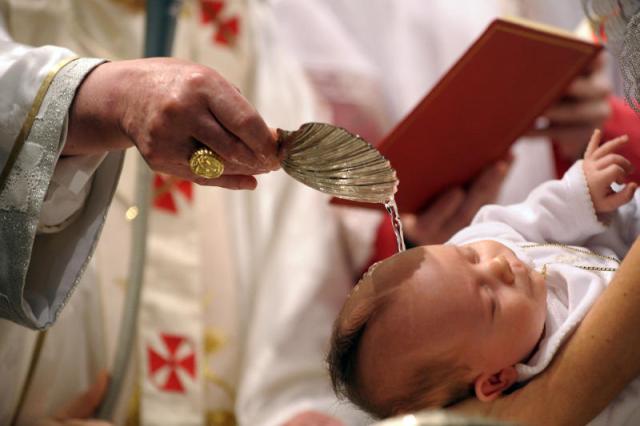
Pope Celebrates Baptism Of Children At The Sistine Chapel

VATICAN CITY, VATICAN – JANUARY 10: Pope Benedict XVI baptises a newborn baby in Michelangelo’s Sistine Chapel on January 10, 2010 in Vatican City, Vatican. Held on the same day as the Baptism of the Lord and started by John Paul II, this annual event celebrates the baptism of children and marks the end of the Christmas season. (Photo by L’Osservatore Romano-Vatican Pool via Getty Images)

Doug Mainwaring

Wed Nov 8, 2017 – 5:49 pm EST

Notre Dame flip-flops on birth control coverage, makes it free again

Birth Control , Catholic , Contraception , Obamacare , Religious Liberty , Trump Administration , University Of Notre Dame

SOUTH BEND, Indiana, November 8, 2017 (LifeSiteNews) — In a stunning about-face, the University of Notre Dame reversed its decision to halt free birth control coverage for employees.

The Catholic university had issued a statement weeks earlier saying in response to the Trump administration’s recent rollback of the Obamacare contraceptive mandate that it would no longer provide free birth control coverage through the University’s health insurance plans.

Earlier in the month, the White House, in what was hailed as a victory for religious liberty, announced that effective immediately, all for- and nonprofit employers and insurers could choose to ignore the contraceptive mandate on moral and religious grounds, no questions asked.

Notre Dame’s pro-life, pro-religious liberty decision lasted about a week

On Tuesday, employees received an email saying “The University of Notre Dame, as a Catholic Institution, follows Catholic teaching about the use of contraceptives and engaged in the recent lawsuit to protect its freedom to act in accord with its principles.”

The email continued, “Recognizing, however, the plurality of religious and other convictions among its employees, it will not interfere with the provision of contraceptives that will be administered and funded independently of the University.”

It remains unclear what prompted the reversal.

Perhaps it was to avoid future litigation. The South Bend Tribune reported that when the university announced it would discontinue free contraception, “Two national advocacy groups filed a federal lawsuit Oct. 31 challenging the Trump administration rule change. The suit was filed on behalf of five women who say they will be denied birth control coverage, including three Notre Dame students.”

According to the Associated Press, “The lawsuit was filed by the National Women’s Law Center and Americans United for Separation of Church and State.”

Negative press coverage and statements issued by liberal organizations may have also played a role.

The Los Angeles Times published a headline blaring, “Ending birth control coverage, Notre Dame abandons its progressive legacy on women’s rights.”

Refinery 29 interviewed Notre Dame students after the University announced the discontinuation of free birth control coverage.

“I felt like we had been going on the right direction in campus,” she said. “And then, to have the university come out and say they won’t cover contraception is a regressive standpoint on women’s healthcare.”

“For me, if you’re preventing students from having access to contraceptive care because you’re trying to make everyone adhere to your religious beliefs, that’s incompatible with your commitment to diversity.”

Time Magazine published an opinion piece by two Notre Dame students who said, “Catholicism is not an excuse to ransack our healthcare.” They continued, “We merely want Notre Dame to respect our bodily autonomy and not hinder our access to reproductive healthcare. We don’t think that’s too much to ask.”

Reaction to the reinstatement

NARAL Pro-Choice America applauded the move to reinstate free contraception, saying, “Freedom of religion is not the freedom to impose your beliefs on others.  Big win for Notre Dame faculty & students.”

Pro-Life America reacted differently.

“Public policy can deliver on protecting rights of conscience, as it has here, but it can’t supply the fortitude to act,” said Chuck Donovan, president of the Charlotte Lozier Institute and a Notre Dame graduate. “Notre Dame has now accepted the Obama ‘accommodation’ when it was fully entitled to an exemption from this onerous law covering abortion-inducing drugs, sterilization and other drugs and devices to which it has faithfully and historically objected.”

“The government is a jealous taskmaster and its impositions, though blocked for a time under the Trump exemptions, are likely to return with even greater force and wider application, including to elective abortion,” Donovan continued. “Notre Dame still has time to strengthen its hand today and in future struggles by abandoning the Obama accommodation and insisting on the full exercise of conscience as a Catholic institution.  I pray it will do so, and soon.”

Sean Gallagher, reporter and columnist for the Archdiocese of Indianapolis’ The Criterion, said in a social media posting, “After winning its case and having the mandate rewritten, (Notre Dame) decided to change its policy to be in conformity with Church teaching. Now it’s walked back that change and is going to provide abortifacients, sterilizations and contraceptives to its employees. Religious liberty — who needs it? Very sad.”

Posted in Uncategorized | Comments Off on NOTRE DAME UNIVERSITY, THAT UNIVERSITY LOCATED IN SOUTH BEND INDIANA FORMERLY FAMOUS FOR ITS FOOTBALL AND THE CATHOLIC FAITH CANNOT MAKE UP ITS MIND WHAT IT NOW IS; CATHOLIC IT IS NOT !!!!!!!!!!!

A ROSE IS A ROSE IS A ROSE UNLESS IT HAS BEEN BLOCHED


unnamed-2

OUR SECULAR THEODICY

by

First Things


live in Berkeley, one of the most religious cities in America. Its churches are being              converted into mosques and Buddhist temples, but its one true faith endures. A popular yard sign states its creed: “In This House, We Believe: Black Lives Matter, Women’s Rights are Human Rights, No Human is Illegal, Science is Real, Love is Love, and Kindness is Everything.” The sign is both profession and prophecy. Like the biblical Joshua whose promise it echoes (“As for me and my house, we will serve the Lord”), my neighbors are in a holy vanguard. They have seen the future America, have identified its present enemies, and are leading us into a promised land.

The biblical politics of my secular neighbors would not have been lost on Ernst Bloch. Bloch was an atheist who believed Jesus was the Messiah, a Stalinist who disagreed with Marx, and a materialist who embraced natural law theory. For the moment you will have to take my word that this can make sense and that it is worth the modest effort to understand how. You would be within your rights to be skeptical. No doctrine has been refuted so often as Marxism, and the debates that consumed Bloch’s long life are dead. Yet the utopian spirit to which he gave original, sometimes brilliant, and more often bizarre expression has never been more alive, and to visit his work is to witness a moment when Christian faith began to transmute itself into the progressive creeds of today.

In a series of books beginning in 1918 and ending shortly before his death in 1977, Bloch proposed that the central category for understanding politics is eschatology—our anticipation of a future society that will reveal the meaning of human history and redeem its fallen state. He named this kingdom “utopia” and argued that its arrival is the object of every human hope and the justification of every human suffering. Bloch lived under Hitler, Vichy, and the gaze of Walter Ulbricht, the Stalinist leader of East Germany, making his work an anguished commentary on the darkest moments of the twentieth century. But his millennial hopes, expressed in critical dialogue with Christian theology, continue to inspire many.

Bloch is a guide into the concealed theology of contemporary liberalism, whose outlook remains profoundly, if paradoxically, biblical in one respect. Having rejected a Christian understanding of nature, it retains an intensely Christian understanding of history. It sees human history as goal-oriented and our advancement as a series of conversions and liberations, the outcome of which is the creation of a community that can redeem our fallen history. Bloch appreciated, as deeply as any modern thinker, that this is not a secular understanding of time. It is a biblical story, told in the misleading language of progressive politics. But how can history have a moral direction at all? And how did Christianity come to be placed on the wrong side of it? Bloch offers a fascinating explanation of this theological reversal, showing us how a politics Christian in origin could become anti-Christian in intention.

The Principle of Hope is the greatest defense of Marxism ever attempted. Bloch wrote it during a decadelong exile in New York and Cambridge, completing it shortly before accepting a university appointment at Leipzig in 1948. It is, by unanimous consent, a repellently written book, composed of three volumes and 1,500 punishing pages of Marxist analysis. I do not casually recommend reading it. But for those with a tolerance for inscrutable syntax, opaque jokes, and clumsy neologisms, it is a work of extraordinary ambition.

Bloch seeks to explain all of reality. And his message is simple. He tells us what human beings are: They are hope. Hope is not something human beings do. Hope is what human beings are. For what do we hope? For Christians, hope strengthens the will to seek and attain happiness in union with God. It is a theological virtue that judges the promise of eternal life with Christ as more trustworthy than the plain observation that death is more powerful than life. “Although He shall kill me,” says Job, “I should trust in Him.” The Latin word for hope (spes) is related etymologically to its word for foot (pes). Christians live in hope because they are on a journey, finding no permanent home during their pilgrimage on earth.

(THIS IS THE FIRST OF YOUR THREE FREE ARTICLES FOR THE MONTH.)
Posted in Uncategorized | Comments Off on A ROSE IS A ROSE IS A ROSE UNLESS IT HAS BEEN BLOCHED

Maike Hickson’s interview with Josef Seifert offers an amazing insight into the real nature of the dispute between the critics and the supporters of Amores Laetitia

Interview: Josef Seifert on the Amoris Laetitia Debate with Rocco Buttiglione

OnePeterFive

Google+PinterestPocket

As Professor Claudio Pierantoni recently stated, there is an ongoing debate between himself and Professor Josef Seifert on one side and Professor Rocco Buttiglione on the other as pertains to the apostolic exhortation Amoris Laetitia. Buttiglione, who is known as an early defender of the exhortation, has also publicly criticized the recent Filial Correction of Pope Francis. All three philosophers — each a man of standing in his own right — have known each other for years. Seifert and Buttiglione worked together for two decades at the International Academy of Philosophy (IAP) in Liechtenstein. For his part, Professor Pierantoni was a student at the IAP’s Chile campus (IAP-IFES, 2004-2012) and was a student of Professor Seifert. The following interview is aimed at gaining a better understanding of the theological and philosophical discourse between these three men. This time, it is Professor Seifert who explains his position.


Maike Hickson:How would you generally describe the line of disagreement concerning Amoris Laetitia between you and Prof. Pierantoni on the one hand and Prof. Buttiglione on the other?

Josef Seifert: I do not think there exists any disagreement between Prof. Pierantoni and me. And I believe that, until he should protest, in what I am going to state as my position, I will also speak for him, but I do not dare to attribute my answers explicitly to Pierantoni, since I do not know whether he will agree with all of them. Instead, I will speak of the disagreement that arose between myself and Prof. Buttiglione, my very close friend. (Buttiglione translated and introduced, most generously, my largest philosophical book, which soon will be published in English and Spanish, Essere e Persona, Being and Person, into Italian and worked for almost two decades with me as Professor and Prorector of the International Academy of Philosophy in the Principality of Liechtenstein, of which I am the Founding Rector. I have also worked with Buttiglione for years on the defense of Humanae Vitae and the Magisterium of Pope John Paul II on the family and human life and we have agreed for two and a half decades on almost everything, except on Machiavelli, whom I consider, with Jacques Maritain, the “Doctor of the Damned,” while he defends him in a book we want to publish jointly but of which he has lost the original of his part. But since the publication of AL, a deep rift between our views has risen).

From many writings and a personal letter Buttiglione has recently written me, I conclude that our disagreement on Amoris Laetitia is to a large extent dependent on two contradictory basic assumptions that underlie our disagreement.

(1) Buttiglione holds that as Catholics, we have to believe to be true whatever the Pope says in the exercise of his Ordinary Magisterium, while I agree that, yes, we have an obligation to look first for the truth contained in a magisterial document and to try to interpret it in the light of the truth expressed in the tradition, but do not have any absolute obligation whatsoever to believe that every part of a pronouncement of the ordinary papal magisterium is true or compatible with the perennial teaching of the Church.

Moreover, we have an obligation NOT to believe it to be true if we see that it clearly contradicts a) perennial Church teaching or b) evident moral truth accessible to human reason, or c) both. (Incidentally, Buttiglione and I also disagree as to whether what the Pope says in Amoris Laetitia is an exercise of his Ordinary Magisterium, which Buttiglione holds to be unquestionable, while I will explain four reasons why I do not believe so). But even if we were to agree that AL is an exercise of the Ordinary Papal Magisterium, I think it is clear that statements made in it (let alone only in a footnote) are not infallible, and therefore are not subject to an obligation to consent to them. Pope Francis himself confirmed this in even allowing the SSPX to dissent from significant documents of the Second Vatican Council, and, unlike the two preceding Popes, not making their consent to them a condition for their reintegration in the Catholic Church. On this I agree entirely with Pope Francis, who said (very well, I believe) that one cannot oblige any Catholic to consent to non-dogmatic documents of the Ordinary Magisterium of the Church, even when the magisterium is exercised in Council documents approved by the Pope, which certainly have a much higher magisterial rank and authority than mere footnotes in a post-synodal exhortation. The mere fact that AL would be founded on a majority consensus of bishops (which is disputed by a Cardinal who was present at the synods and remarked that a consensus with the novelties of AL did not actually exist in the two synods on the family), this is not enough to make its acceptance obligatory. Even if a clear exercise of the Papal Magisterium is present in given documents, their content, as long as it is not pronounced as a dogma, can be false. This was clearly the case with Pope John XXII who himself revoked his own heresy in a bull he wrote on the day before his death (and his teaching was also declared heretical by his successor), and with Pope Honorius I, all of whose works were condemned posthumously by a Council as heretical and have been burnt. Thus I am certain that on this first “disagreement of principle” I am right, and Buttiglione is wrong: We do NOT have to believe whatever a Pope writes in the exercise of his “ordinary Magisterium.”

(2) The second fundamental disagreement of principle between us concerns the respective role of “unity with the Pope” and of truth, in the hierarchy of values we have to respect. Buttiglione insisted repeatedly that for him the most important goal is “unity with the Pope,” while I think that the question of truth has an absolute priority. Therefore if, as I propose as a question to the Pope in my latest article on AL[1], pure logic shows that from one affirmation of AL, cited below, one can deduce the negation of intrinsically evil acts and this affirmation contradicts natural law and the entire Catholic Moral Teaching, especially Veritatis Splendor, then this affirmation is evidently false and this must be stated clearly and the affirmation ought to be retracted. To agree with the Pope, have unity with the Pope, on an error is of no value whatsoever. On the contrary: as Saint Thomas and the Acts of the Apostles stated clearly, in such a case the subordinate has an obligation to criticize his superior, even publicly, as St. Paul criticized St. Peter. Against my insistence on the absolute priority of truth over unity, Buttiglione wrote me that I am wrong in my short second article on AL even if I were right — meaning by this puzzling assertion either that “unity with the Pope” is more important than truth, or that we must not say the truth if truth endangers our unity with the Pope — a position with which I absolutely disagree, or that the statement from which devastating consequences logically follow could be truly false, as I suggest, while the main content of AL would not be touched by this error, because this error would refer only to a reason for the teaching of Al, not to that teaching itself (I will return to this second point).

Hickson: More specifically, what is the disagreement with Prof. Buttiglione with regard to the question of the magisterial weight of Amoris Laetitia?

Seifert: Buttiglione and I disagree as to whether what the Pope says in Amoris Laetitia is an exercise of his Ordinary Magisterium, which Buttiglione holds to be unquestionable, while I doubt it seriously for four (in my opinion decisive) reasons:

  1. Because the decisive new points of AL are chiefly found in mere footnotes that cannot reverse the sacramental discipline of the Church of 2000 years, solemnly reconfirmed by the apostolic exhortation Familiaris Consortio of Saint Pope John Paul II. Such footnotes cannot be considered an Exercise of the Ordinary Magisterium, as also Cardinals Brandmüller and Burke as well as the other dubia Cardinals and many others noted.
  2. Moreover, the Pope explicitly says in Ch. III of Amoris Laetitia that he does not want to settle the decisive novelty in AL through his magisterium, but leaves it open to decide by the various national and culturally different and decentralized bishops’ conferences.
  3. He confirmed this position by approving both the decision of the Polish Episcopate to follow FC entirely and not to admit any divorced and civilly remarried or active homosexuals who do not want to change their lives, to the sacraments, and by confirming and praising at the same time also the opposite position: the pronouncement of the Argentinian Bishops of the Buenos Aires area, which coincides with that of many other bishops, including the archbishop of Granada. These bishops adopted the exactly opposite interpretation. The Pope even praised the far more radical pronouncement of the Bishops of Malta on AL, who proposed a completely situation-ethical interpretation of AL. Thus, Pope Francis follows the idea he proposes of a “decentralized magisterium” or different “magisteria” in the Church — all of which he approved — an idea which I heard Karl Rahner express in Munich half a century ago. Now, pure logic tells us that the position of the Bishops of Buenos Aires or Malta and that of the Polish Bishops’ Conference, which is diametrically and contradictorily opposed to that of the bishops of Buenos Aires (defended by Buttiglione), and both of which are admitted and approved by the Pope in his new “magisterial pluralism”, cannot both correspond to the “ordinary Magisterium of the Pope”. Hence the novel teachings of AL (, i.e., the Buenos Aires reading) cannot be the “Magisterium of the Pope”.
  4. The novelties of AL are not primarily doctrinal but pastoral and thus more subject to categories of prudence or imprudence than of truth and falsity; for example, if Popes in the past have asked in the Exercise of their ordinary Magisterium in papal bulls or encyclicals that heretics, magicians, and witches should be burnt at the stake, or when they excommunicated in bulls entire cities because their prince led a war against the Vatican, I am certainly not obliged to believe that this was a prudent pastoral decision. Buttiglione himself, somewhat contradictorily, says that the new teaching of AL is a purely pastoral one and he also stated, at least in letters to me, that we are not bound to agree with the wisdom of a pastoral decision of a Pope that is not per se true or false, but can be prudent or imprudent. But in that case I am not at all obliged to agree with AL (according to logic being applied to Buttiglione’s admission), nor to agree that its new Pastoral guideline is wise.

(I differ regarding this in another respect with Buttiglione: in that I hold that the novel teaching of AL is not only pastoral but also doctrinal.)

Inasmuch as it is pastoral, however (and therefore not true or false, but prudent or imprudent), Buttiglione and I differ, at least so it seems, in that Buttiglione does not criticize the new Pastoral Guideline of AL and tries to explain its compatibility with the opposite Pastoral Guideline of FC, stated to be rooted in the Gospel itself by Pope John Paul II. I, however, even prescinding from any doctrinal question, find the new pastoral guideline of AL not only imprudent, but entirely inapplicable. In my first article on AL,[2] I gave, I believe, cogent arguments for the practical impossibility of “discerning” between adulterers who may and others who may not receive the sacraments without changing their lives. My argument coincides wholly with an argument given by the Polish Episcopate for their decision to abide by FC: it is impossible for a priest in 5 minutes’ conversation in the confessional to determine that an unrepentant sinner is invincibly ignorant and in the state of grace, even though he intends to keep committing what are, objectively speaking, grave sins. From this practical impossibility of applying discernment which can hardly fail to end in a general opening of Confession and the Eucharist to unrepentant adulterous and homosexual couples, the imprudence of the decision of admitting the “irregular couples” to the sacraments immediately follows.

Hickson: Could you explain to us here the question of the infallible extraordinary magisterium and the infallible universal ordinary magisterium?

Seifert: I think that the infallible Extraordinary Magisterium only applies to such central matters of doctrine and faith that either the Pope defines “ex cathedra” (which happened only two or three times in the history of the Church) or which a Council, in union with the Pope, defined as being a dogma and de fide in such a way that anyone who contradicted it was declared “anathema”. The infallible Ordinary Magisterium of the Church is present only in teachings of the ordinary magisterium that coincide with what the Church has taught always and everywhere, not with entirely novel teachings. Neither one of these criteria of infallibility applies to the novelties of AL.

Hickson: Is Amoris Laetitia of such magisterial weight that one may not disagree with its teaching without falling into the category of being disobedient, heretical, or schismatic, at least in spirit?

Absolutely not, for the reasons given. Therefore, to treat Catholics who dissent from AL as heretics, schismatics in fact or in spirit, or disobedient to the Pope, is a grave injustice.

Hickson: In this context, is it more important that we follow the pope and his new teaching for the sake of obedience (which is in itself a great good) or that we preserve the traditional teaching of the Church?

Seifert: I think that as soon as we find that a new teaching is false, we are obliged, not to obey it. And as soon as we find a new pastoral decision of the Pope inapplicable in good conscience, such as giving the sacraments to unrepentant sinners on the basis of an (impossible for us) “discernment” of whether their sin is compatible with their being in the state of grace for subjective reasons, we are likewise morally obliged NOT to obey it under the principle St. Peter formulated and Robert Spaemann recently called to mind, that we have to obey God more than men. This applies even more when we are convinced that giving absolution and the holy Eucharist to public sinners (even if they were in the state of grace) is, notwithstanding their personal innocence, wrong, as is implied in Familiaris Consortio 84. FC speaks of an objective disharmony of adulterous relations with the law of Christ and with the meaning of matrimony — and of the deep analogous and symbolic signification of marriage in relation to the relationship between Christ and the Church as a reason why a couple who lives in discord with the divine commandments should not receive the sacraments. This objective discrepancy is enough for the judgment of the Church that they must not be given access to the sacraments. (On this point, I made some incorrect concessions to Buttiglione in letters and my previous writings on AL). FC and Church tradition do not require that sinners who gravely deviate from divine law have to live “subjectively in mortal sin” (which God alone knows) for being denied access to the sacraments. If this were otherwise, we would also have to admit abortionists, first degree murderers, etc. to the sacraments because we can never know with certainty that they have lost sanctifying grace.

Hickson: You yourself, in your own polite criticism of Amoris Laetitia, pointed especially to Paragraph 303* of this papal document, highlighting the potential danger of making irrelevant any absolute moral norms. How did you and Prof. Buttiglione discuss this aspect of the debate?

Seifert: Prof. Buttiglione said about my second article, Does Pure Logic Threaten to Destroy the Entire Moral Doctrine of the Catholic Church?, that “I am wrong even if I am right” for the reasons of (1) having an obligation of consenting to anything the Ordinary Papal Magisterium is telling us (to which I have responded), (2) that a reason offered by the Pope for a teaching may be erroneous while the teaching itself is correct. In other words, Buttiglione believes that the assertion “that we can know in our conscience that God himself wants us to consider continuing to live in adultery the best and most generous response we can give him in our situation” is not the teaching of Pope Francis that we have to believe (according to Buttiglione). Rather, we would only have to believe the real teaching of AL, namely, that after proper discernment, unrepentant adulterous and homosexual couples may be admitted to the sacraments. I think, on the contrary, that what No. 303* says (and many other parts of AL imply) is the most significant doctrinal content and the main reason for the pastoral teaching of AL, which (for the reasons explained in my answer No. 1, 2 and 3, to your second Question), cannot be regarded as a “magisterial teaching” at all.

Hickson: In this context of some sinner who might be pleasing to God even though he still remains in his sin: is it Catholic to maintain a position that God might be pleased with us, perhaps because we mended some sin in our lives, while however still remaining in another grave sin? That is to say, could it be sufficient in God’s eyes to return to the state of Sanctifying Grace by making a sign of good will while yet still maintaining, for example, a sinful relationship?

Seifert: I think that God could of course be pleased by us, after a divorce from our sacramental wife, for stopping to beat up and to calumniate our only civilly married second wife or our children, even if we continue in a sinful relationship. But he cannot ever will or be pleased with the fact that we continue to live in adultery, for example. It is certainly possible that invincible ignorance or weakness of will does not make a person lose the state of sanctifying grace, even if that person lives objectively in grave sin. But I think that a) this is very rare, especially if the priest in confession discharges himself his obligation to tell the sinner the truth, and 2) that nobody can be sure of that, and 3) that to live in the state of grace is not enough to receive worthily the sacraments while living objectively in grave sin, as I have explained.

Hickson: Would God ask of any sinner at some point in his life to remain in his sin? How would you comment on this claim in light of the Council of Trent?

I think that this clearly impossible and declared dogmatically as a heresy by the Council of Trent.

Hickson: Where does Prof. Buttiglione, in your eyes, leave the solid foundation of the Catholic moral teaching, perhaps in order to maintain loyalty toward Pope Francis?

I think (1) with respect to his “two principles” that separate us, they do not correspond to sound Catholic teaching because it is Catholic teaching (and the basis for all condemnation of heresies in the history of the Church) that a) truth has priority over unity and b) that no Catholic has an absolute duty to accept everything a Pope or Council are saying if it is not dogmatic and de fide, and if he has good reason to believe that it is contrary to natural or revealed truth or to both (to claim otherwise would be papolatry). Besides, (2) I  believe that Professor Buttiglione’ s concrete and brilliant but unsuccessful efforts to reconcile the novelties of Amoris Laetitia with Familiaris Consortio, Veritatis Splendor, Evangelium Vitae, Humanae Vitae, and the Tradition of the Church all fail and put him at the risk of using overcomplicated and sophistical reasons and of contradicting dogmas of the Church such as (a) that God never commands things which we cannot obey, with the help of grace (a Lutheran heresy denied this and was condemned in the Council of Trent), or (b) that extramoral evils (such that the partner of a second “marriage” will leave me) can never be greater evils than a sin and the intention to prevent them can never justify committing a sin (VS and Trent affirmed this and condemned its negation as heretical), or (c) that weighing good versus bad effects of any action can never justify committing one of the many intrinsically evil acts (Veritatis Splendor made this very solemnly clear).

Hickson: Could you comment on the following words as expressed by Buttiglione himself? “The Pope does not say that God is happy with the fact that divorced-and-remarried continue to have sexual intercourse with each other. The conscience recognizes that it is not in conformity with the law. However, the conscience also knows that it has begun a journey of conversion. One still sleeps with a woman who is not his wife but has stopped taking drugs and going with prostitutes, has found a job and takes care of his children. He has the right to think that God is happy with him, at least in part.” [Emphasis added].

Seifert: Certainly God can be happy that a man “stopped taking drugs and going with prostitutes, has found a job and takes care of his children,” but He can never be happy with him doing this, “still sleeping with a woman who is not his wife” or agree that continuing committing what Christ himself calls adultery is the “most generous response” an adulterer can give to God in his situation. To claim this this would a) either deny the dogma that God does not command anything impossible to fulfill, or b) deny the dogma that God never wants us to sin, or both.

Hickson: Did not Martin Luther, too, teach that man sometimes has to sin? Would you discuss this matter in light of Buttiglione’s own words?

Seifert: Yes, I believe that in Buttiglione’s defense of AL there is a great danger of falling into the Lutheran heresy of the simul iustus et peccator in the sense that grace alone justifies us and that we can remain in sanctifying grace while committing mortal sins. And the recent celebration of the Luther-fest in the Vatican, the statement of high-ranking prelates that “Luther was right” and was a “gift of the Holy Spirit” to the Catholic Church, the rumor that a Catholic-Lutheran joint “mass” is being discussed, the placing of Luther’s statue in the Vatican, etc. are alarming signs that it is not only Buttiglione who starts flirting with some of Luther’s errors. This heresy is closely related to Luther’s teaching that grace is not a principle that truly transforms us morally, and allows us to “become perfect like our father in heaven is perfect” which Christ and Holy Scripture tell us is God’s will. This error is linked also to Luther’s rejection of the veneration, canonization, and invocation of Saints to intercede for us in prayers and in the liturgy, masses in their honor, etc. I do not claim of course that my friend Rocco holds these errors, but some of his remarks, for example, interpreting the story of Nero’s Christian prostitute as having been in a situation in which she was not free to refuse to have sex with Nero, and that her consent to have sexual relations with Nero allowed her to save many Christians (Buttiglione even called her a Saint for his reason), give at least the impression that Buttiglione flirts with some of Luther’s views on freedom and grace. Or that he even accepts them. The same holds true for his description of situations in which nobody can expect that adulterers can decide either to live together in abstinence, or to separate, and thus “have to sin”.

Hickson: Could you also present to us that part of the debate with Buttiglione where you deal with the question as to whether divorced and “remarried” couples, in light of the prescribed process of discernment, would still be less culpable because they might have a defectively formed subjective conscience?

Seifert: A person who suffers from invincible ignorance or an innocently deformed conscience, believing or “feeling” that his adultery is OK, of course may be less guilty than one who acts directly against the voice of his conscience. But we must never forget that the wrongness of adultery is part of the natural law written into every man`s heart, as the Apostle Paul says, such that it is extremely improbable that somebody has no knowledge whatsoever of the sin of adultery or homosexual activity. The pagan Cicero calls the person who denies that adultery is always and everywhere a grave sin “a madman”. But above all, we must understand that ethical value blindness is, more often than not, itself sinful or the consequence of sin, because we have become dull to the voice of conscience because of repeated sin, or because we make a foul compromise between our pride and concupiscence, on the one hand, and our limited will to do the good on the other hand, such that we do not see clearly the sinfulness of actions as soon as the moral law does not allow us to live out our passions or inclinations. (Dietrich von Hildebrand has analyzed these and many other forms of “guilty forms of moral value blindness” and deformation of conscience in an admirable book unfortunately not yet published in English but announced for immediate publication by the newly founded Dietrich von Hildebrand Press as Morality and Ethical Value Knowledge). A general attitude of being prone to give into the attractions of what satisfies us subjectively, while still not wanting to sin consciously and openly, will easily obscure our moral judgment, either in partial moral value blindness or in blindness of subsumption, i.e., of not subsuming our behavior under the category of “adultery”. In these and many other cases of moral value blindness we are fully responsible for the deformation of our conscience and thus the absence of consciousness that we commit a mortal sin does not make us innocent because we are guilty for our blindness itself.

Hickson: How, thus, could there be any “mitigating factors” that would render a relationship of a divorced and “remarried” couple sinless?

Seifert: Even if there could be mitigating factors that would make a relationship of divorced and remarried couples completely sinless, we must note:

(1) As soon as an adulterous couple speaks with a priest who should “discern”, this priest has a duty of telling them that their relation is objectively sinful; in that moment, however, they cease to commit adultery “completely innocently”;

(2) As long as they continue to do what is objectively gravely sinful, it does not seem possible for them or for any priest to judge that their relation is “sinless”, which would presuppose an ability to look into the depth of a soul, which we never have with respect to ourselves and even less with other persons;

(3) It is unreasonable to expect that a priest is able to judge this after a few minutes talking in the confessional;

(4) It is intolerable and would create private and public scandal if priests started to create two groups of sinners: those adulterers and homosexuals who are innocent and can receive the sacraments and those who know better and must be excluded;

(5) In praxis, the failing attempt to separate these “good” and “bad” grave sinners will inevitably lead to admitting every adulterer and homosexual to the sacraments, and many sacrileges will be committed;

(6) As Familiaris Consortio teaches, receiving worthily the sacrament of Confession or the Eucharist has objective and not merely subjective conditions. It requires that a couple does not live objectively in adulterous relations, and not only that the sinner “does not feel that this is sinful” or even not only that the sinner is not personally “losing sanctifying grace” (because God, who sees his heart, knows that he is not sinning mortally).

Hickson: Should this whole debate be led only among experts and not in public?

Seifert: Since the question of the worthy reception and dispensation of the sacraments is of crucial importance for each priest and faithful – their eternal salvation may depend on this – the claim that this matter should not be discussed publicly is absurd. Moreover, Amoris Laetitia is published and its very different and contradictory interpretations have been published. Thus the debate should be conducted publicly.

Hickson: Should we all be silent in this situation for the sake of keeping peace and unity in the Catholic Church?

I think I have answered this question already, but I wish to re-emphasize that truth has not only priority over unity and peace, but is the condition of authentic unity and peace. I might here quote Blaise Pascal, the great French philosopher whom Pope Francis apparently wants to beatify, and who expressed this in his marvelous French language that translates a bit less beautifully into English thus:

“It is as much a crime to disturb the peace when truth prevails as it is to keep the peace when truth is violated. There is therefore a time in which peace is justified and another time when it is not justifiable. For it is written that there is a time for peace and a time for war and it is the law of truth that distinguishes the two. But at no time is there a time for truth and a time for error, for it is written that God’s truth shall abide forever. That is why Christ has said that He has come to bring peace and at the same time that He has come to bring the sword. But He does not say that He has come to bring both the truth and falsehood.”  — (Blaise Pascal, June 19, 1623 – August 19, 1662)

Hickson: What would you say to people who now claim that those who oppose Pope Francis with regard to some of his public statements (even if they are not explicitly magisterial, but still have an influence on Catholic faithful) have the intention to break up the Catholic Church?

Seifert: It is of course possible that some critics of the Church have such an intention, but it is certainly absolutely false and would be calumny if it were said of the four dubia Cardinals, of Father Weinandy, of Bishop Athanasius Schneider, of Prof. Claudio Pierantoni, Prof. Carlos Casanova, and of many other persons who raised their critical voices or signed the correctio filialis. (It would also, even if my archbishop of Granada thought, said, or wrote so, be untrue of myself, I might add, who would be willing to die for “the unity of the Church in the truth” and has absolutely no intention to break up the unity of the Church). John-Henry Westen (editor of LifeSiteNews) recently pointed out in an excellent speech in Rome, on Oct. 28, in a Conference on Humanae Vitae sponsored by the “Voice for the Family,” that (1) the pope himself exhorted us to criticize him freely and not to be concerned with what the “pope would think” and (2) that the true friends of the pope and of the Church are those who are vigilant and do not praise the pope by flatteries and adulation, of which the successor of St. Peter, destined to be The Rock, has no need whatsoever.

To hold the contrary, that anyone who criticizes a word spoken by the Pope “has an intention to break up the Catholic Church” or just does break up the unity of the Church, would be to judge that the Apostle Paul had the intention to disrupt the unity of the Catholic Church when he criticized the first Pope, instituted by Christ Himself, openly and sharply during the first Council of the Apostles.

Hickson: What do you think about Cardinal Müller’s Foreword to Rocco Buttiglione’s new book, Friendly Replies to the Critics of Amoris Laetitia?

I cannot answer this question thoroughly before having seen the full text of the new book and of Cardinal Müller’s Foreword, of which I have only read a few fragments that left me pretty much perplexed. His praise of Buttiglione’s new book on Amoris Laetitia has astonished me very much: (1) first of all, because Cardinal Müller published recently a book in Spanish, in which he affirmed that no Pope or Council could change the sacramental discipline of the Church, which is, as FC 84 says, founded on Sacred Scripture itself. For writing this, the archbishop of Madrid called Cardinal Müller’s book anti-Pope and forbade him to present it in the Catholic University and Seminary San Dámaso in Madrid. The Cardinal presented it at another Catholic University in Madrid, saying that AL did not change or intend to change anything of the teaching and sacramental discipline expressed in FC 84, which is, Müller said, inseparable from perennial Church teaching. Don Livio Melina, a former student of mine in the John Paul II Institute for Marriage and Family and until recently President of the John Paul II Institute for Marriage and Family in Rome, gave the same interpretation. Our archbishop of Granada, Don Francisco Javier Martínez, sent the statement of Melina to all the clergy of Granada, obviously in agreement with it (but he later changed and espoused the Buenos Aires Interpretation of AL and first suspended me from teaching his seminarians, and then fired – forcefully retired – me from my chair of the IAP-IFES, when I published my second article on AL). I thought from the beginning that Cardinal Müller’s judgment was quite correct as far as perennial Church Teaching is concerned, but incorrect as an interpretation of AL. On this merely hermeneutical question I agreed with Buttiglione who saw from the beginning that AL says something very different than FC, but tried to explain this as purely pastoral and “complementary”: Pope John Paul II would have just spoken on the “objective side” of adultery being gravely disordered, while AL Laetitia takes into account the classical subjective conditions of mortal sin and imputability. Thus both Popes are right although they propose opposite pastoral decisions of the Church. Saint John Paul II forbids divorced and remarried Catholics (outside the Church) access to the sacraments except if they live in complete abstinence, because he just speaks of the objective sinfulness of adultery; Pope Francis allows their receiving sacramental absolution and Eucharist even if they have no intention to change their life, because he asks to discern and recognize the possible state of grace in such “good adulterers and homosexuals”.

Now, I gather from the published fragments of his Preface accessible to me that Cardinal Müller:

(1) completely switched to the Buttiglione-Buenos Aires interpretation of the text of AL being “hermeneutically correct” (on this I agree now with both; they interpret AL textually correctly).

(2) That he now also thanks Buttiglione and defends AL wholesale like Buttiglione, by not only accepting access to the sacraments of couples of whom he said a few months back that no council or pope can authorize them to receive the sacraments because the prohibition taught by FC belongs to, or is the logical consequence of, perennial Church teaching. Thus, Cardinal Müller seems now to contradict likewise his previous strong doctrinal assertion that the sacramental discipline affirmed by Pope John Paul II — namely, that nobody who lives in objective contradiction to the Church’s teaching on the indissolubility of marriage can be admitted to the sacraments is a part and perpetual logical consequence of the teachings on Christ and of the Church.

(3) Thirdly, Cardinal Müller seems to deny now as well that in AL there is (a) any trace of teleological ethics and situation ethics. Thus he answers my question: “Does pure Logic threaten to destroy the entire moral Doctrine of the Catholic Church?[3] in the negative. Hence Cardinal Müller seems to deny that the affirmation, “conscience can do more than recognize that a given situation does not correspond objectively to the overall demands of the Gospel. It can also recognize with sincerity and honesty what for now is the most generous response which can be given to God, and come to see with a certain moral security that it is what God himself is asking amid the concrete complexity of one’s limits, while yet not fully the objective ideal” [namely to continue to live in adultery or homosexual relations] logically implies that God can approve of us committing an intrinsically evil act such as adultery in some situations, and consequently there are no more any intrinsically wrong acts in any situation. In contrast to Cardinal Müller’s view that AL does not deny intrinsically evil acts nor claim that continuing an objectively gravely sinful act can correspond to God’s will for us, Father Spadaro, friend and authorized interpreter of AL, recently attributed to Pope Francis and AL the view that Francis negates “any general rule that would make a class of human actions morally wrong” (which means denying that any human action, as a class, is intrinsically wrong, regardless of circumstances and consequences).  Thus at this point, in view of this switch of Cardinal Müller’s position, the second and third points of which I consider false, I can only confess my complete perplexity about Cardinal Müller’s statements and keep hoping that reading the full text will shed some light on the puzzle of his joining his authority to Buttiglione.

END

*Paragraph 303 of Amoris Laetitia reads, as follows: “Naturally, every effort should be made to encourage the development of an enlightened conscience, formed and guided by the responsible and serious discernment of one’s pastor, and to encourage an ever greater trust in God’s grace. Yet conscience can do more than recognize that a given situation does not correspond objectively to the overall demands of the Gospel. It can also recognize with sincerity and honesty what for now is the most generous response which can be given to God, and come to see with a certain moral security that it is what God himself is asking amid the concrete complexity of one’s limits, while yet not fully the objective ideal.”

[1]Does pure Logic threaten to destroy the entire moral Doctrine of the Catholic Church?“ Aemaet, Wissenschaftliche Zeitschrift für Philosophie und Theologie http://aemaet.de, Bd. 6 (2017), 2-9.

[2] “Amoris Laetitia. Joy, Sadness and Hopes”. Aemaet Bd. 5, Nr. 2 (2016) 160-249, http://aemaet.de urn:nbn:de:0288-2015080654.

[3] Aemaet, Wissenschaftliche Zeitschrift für Philosophie und Theologie http://aemaet.de, Bd. 6 (2017), 2-9.
Posted in Uncategorized | Comments Off on Maike Hickson’s interview with Josef Seifert offers an amazing insight into the real nature of the dispute between the critics and the supporters of Amores Laetitia

IS THE CONGREGATION GROWING OR SHRINKING AT THE CHURCH WERE YOU WORSHIP EVERY SUNDAY?


Declining Sunday Mass Attendance & Fallen-away Catholics

By Deacon John Lorenzo

In a recent article concerning the July 2017 Orlando Bishop’s Convocation, a topic was brought up in a morning plenary session: Former and fallen-away Catholics. At that session, a very revealing comment was made:   “The millions who are not active, that is a real concern.”

I believe the person who made that comment must have been inspired by the Holy Spirit to expose a dilemma in the Catholic Church, millions of fallen-away Catholics; that is rarely discussed. Sunday Mass attendance has steadily declined from 80% in 1950 to 20% today.

Before the next generation is lost and/or given a chance to stop the decline, its cause and solution must be determined and addressed. In addition, the solution must include the focus on saving souls, getting from this life to the next, eternal life in Heaven. The solution must also be practical, measurable, being able to deal with thousands of souls simultaneously, the participation of all parishioners who attend Sunday Mass every week, cooperation from the Clergy and Providential, to be successful.

The solution must be addressed as a twofold dilemma. First, in stopping the exodus from the Church and secondly, being able to save the souls of those who have already left the Church. The most serious problem revolves around disobeying God’s 4th Commandment, to keep holy the Sabbath Day. This is causing many parishioners to commit a mortal sin that they believe is not mortal. The Church surely knows of this false belief and rarely, if ever, says anything. 

There are many reasons why Catholics leave the Church and because of this phenomenon, it tells us that there is a core reason why so many are leaving the Church. I believe, the overall cause  for leaving the Church lies in flawed faith formation; from when an infant is Baptized and through the formation years of primary and secondary schooling in a Catholic School and CCD Programs. Part of this formation to be successful must include, for all school children, weekly Sunday Mass attendance and reception of the Eucharist. In addition, some form of adoration of the Blessed Sacrament must be provided for the children to be taught and understand the real presence of Jesus in the Blessed Sacrament.

The foundation of the Church lies in the hands of the children whose Catholic identity must not be flawed to stop the exodus. Today’s children are not being given a fair chance of becoming true believers of the Church because those who control their destiny, their parents, the clergy and the school/CCD teachers compromise what is necessary to develop true believers in Jesus Christ and His Church.

The Catholic path to Heaven and Eternal Life is attending Sunday Mass every week and receiving the Eucharist. If this Catholic practice is not adhered to during a child’s life, the tendency will be to consider the Church or the Eucharist not important or necessary when they are adults.

The Church tells parents the obligation of having their children attend Sunday Mass every week. Since this obligation is not normally enforced by the Church, most children do not attend Sunday Mass regularly or at all. This one flaw in a child’s faith formation, if not corrected, will probably result in a fallen away Catholic even though the child receives the sacraments of Reconciliation, Communion and Confirmation. The sad fact is that the child’s best chance of getting to Heaven was taken away without their comprehending the importance of Sunday Mass and the Eucharist; or their parents knowledge of its need and benefit for their child’s eternal life with God.

Since the Church cannot force the parents to take their child to Church every Sunday, the obligation must be addressed by the Church on behalf of the child’s spiritual benefit. The Church must at least speak to the parents of the consequences of the child possibly losing their gift of inheritance to Heaven given at Baptism.

In addition to teaching the importance of Sunday Mass attendance and receiving the Eucharist,  the Church must review all aspects of faith formation being used to assure all teaching leads to a personal relationship with Jesus Christ.

The children, by obeying God’s 3rd commandment “To keep holy the Sabbath Day” and receiving the body and blood of His Son will eventually stop the exodus from the Church because of the love and influence of God.

Considering all the above, what must be taught, preached and made clear to all children, their parents and all the faithful by the Church, is the consequence of intentionally not attending Sunday Mass every week because it is a grave sin that must be confessed to a priest to receive absolution. This sin is grave even if it is not believed to be grave.

Because of God’s love for us, He gave us a free will to accept what the Church teaches or we can do what we believe is the truth. We can believe that our God is so merciful, that He would never send a soul to Hell for intentionally not attending Sunday Mass. But what if you’re wrong in what you believe and not what the Church teaches and you end up in Hell? Why would anyone risk losing their inheritance to heaven and eternal life with its Creator because of not wanting to spend one hour a week with the one who gave us life? The Devil is cunning and deceiving and this is exactly what he wants us to believe. Percentage wise, there are probably more souls in Hell who believed that sinning against God’s 3rd commandment is not mortal. Just think of what is happening in the Catholic Church today, 80% of those who were baptized choose to separate themselves from their God and the Eucharist on the Sabbath day.

The following article describes a serious problem:

Souls Perish for Lack of Knowledge!

From Courageous Priest – Posted: 13 Oct 2017 04:35 AM PDT

The Church is Ready to Capsize!

By Fr. Daniel Doctor,

The Roman Catholic Church, that is the One, Holy, Catholic, and Apostolic Church is the Bride of Jesus Christ.  This Church was established by Christ Himself to be the sole means of salvation for all of humanity. As Catholics, we know of no other way to salvation except through the sacramental system established by Christ and given to His Apostles.

Why is the Catholic Church in Near Chaos and Confusion?

Careful analysis of recent studies and polls taken among Catholics reveals that an overwhelming majority of U.S. Catholics simply do not believe in the Devil, or sin, or it’s logical consequences – eternal damnation in hell.  As we can see, with any kind of a reasonable observation of that, the outcome is that the Church is in a state of near chaos and confusion over what She teaches and what She does not teach.  The overriding reason for this is because bishops, the clergy, teachers and parents, have completely failed in their duties to transmit the Faith to each of the successive past four generations.  And there are huge consequences for this failure.


Posted in Uncategorized | 3 Comments

WORSHIP IN THE TRADITIONAL LATIN MASS, YOUR ETERNAL LIFE DEPENDS ON IT.

Western Civilization Exists for the Mass


Many are stunned today at the speed in which western civilization is collapsing. Coinciding with this is the post-conciliar crisis within the Church, the fourth great crisis of Christendom as it has been described by that great defender of orthodoxy, Bishop Athanasius Schneider of Kazakhstan. What may not be as clear too many is the connection between the destruction of the Mass and of the collapse of the Christian west.

One man who understood this connection was Dr. John Senior, professor of English, Literature, and Classics and co-founder of the very successful Integrated Humanities Program at the University of Kansas. Dr. Senior taught for decades at the university level. He was also a convert to the Catholic faith, devoted to the traditional Mass and an attendee of Immaculata Chapel (SSPX) in St. Mary’s, Kansas.

Senior has been credited with inspiring a generation of young men and women who, having studied under him at Kansas, converted to Catholicism. As Michael Matt of the Remnant has noted, “under his tutelage, (his students) had learned to love the old Faith as he did and thus desired to serve the Church as loyally as had their revered teacher.”

Early in his book The Restoration of Christian Culture, John Senior speaks to the inseparable nature of civilization and the Holy Sacrifice of the Mass:

Whatever we do in the political or social order, the indispensable foundation is prayer, the heart of which is the Holy Sacrifice of the Mass, the perfect prayer of Christ Himself, Priest and Victim, recreating in an unbloody manner the bloody, selfsame Sacrifice of Calvary. What is Christian culture? It is essentially the Mass. That is not my or anyone’s opinion or theory or wish but the central fact of 2,000 years of history. Christendom, what secularists call Western Civilization, is the Mass and the paraphernalia which protect and facilitate it. All architecture, art, political and social forms, economics, the way people live and feel and think, music, literature ―all these things when they are right are ways of fostering and protecting the Holy Sacrifice of the Mass.

Understanding this, is it any wonder why a growing number of Catholics today (sometimes derisively dismissed as ‘radical traditionalists’) speak of the need for liturgical restoration? Is it any surprise that we are seeing a cultural collapse in the west considering the anthropocentric and profane Masses offered for much of the last fifty years?

Reading the above quote by Senior recently I was immediately reminded of another occasion when esteemed laity highlighted the inseparable connection between the Mass and civilization.

On the eve of the implementation of Pope Paul’s new Mass in the U.K. back in 1971, a group of learned English signatories wrote the Holy Father a letter, an appeal. Many of the distinguished signers were not even Catholic. They included such artists and thinkers as Agatha Christie, Graham Greene, Robert Graves, Ralph Richardson, Kenneth Clark, Malcolm Muggeridge, and Yehudi Menuhin to name just a few. In total nearly sixty people signed.

Their letter today, and the subsequent response of Rome, are referred to as the Agatha Christie indult, named after its most prominent signer. Put simply, the letter argued for the preservation of the Roman Rite as the jewel of western civilization. They began:

If some senseless decree were to order the total or partial destruction of basilicas or cathedrals, then obviously it would be the educated -whatever their personal beliefs- who would rise up in horror to oppose such a possibility.

Now the fact is that basilicas and cathedrals were built so as to celebrate a rite which, until a few months ago, constituted a living tradition. We are referring to the Roman Catholic Mass. Yet, according to the latest information in Rome, there is a plan to obliterate that Mass by the end of the current year.

Next, the signatories argued (as John Senior did) that the traditional Mass is foundational to, and inseparable from, western civilization:

We are not at this moment considering the religious or spiritual experience of millions of individuals. The rite in question, in its magnificent Latin text, has also inspired a host of priceless achievements in the arts -not only mystical works, but works by poets, philosophers, musicians, architects, painters and sculptors in all countries and epochs. Thus, it belongs to universal culture as well as to churchmen and formal Christians.

The implication is clear. If the “rite in question” has inspired the culture and lifted the human spirit in such a manner “in all countries and epochs”, then what happens when it is distorted and diminished. If western civilization exists for the Mass, then what happens when the Mass is changed? Consistently profaned? Modernized?

The letter concludes with both an appeal, and a filial warning, to the Holy Father:

The signatories of this appeal, which is entirely ecumenical and nonpolitical, have been drawn from every branch of modern culture in Europe and elsewhere. They wish to call to the attention of the Holy See, the appalling responsibility it would incur in the history of the human spirit were it to refuse to allow the Traditional Mass to survive…

Cardinal Heenan delivered the letter to Pope Paul VI, resulting in the granting of the Latin Mass indult for England and Wales in November 1971.

What is sad today, nearly fifty years after the “reform” of the Roman Rite, is that many within the Church still do not see what John Senior and the signatories of the Agatha Christie letter so clearly recognized. History has proven them to be truly prophetic. We can view these last fifty years as our Babylonian exile. Our captivity, merited through pride and disobedience.

Surveying the ecclesial and cultural landscape near the end of his life, Senior held nothing back in his assessment:

The crisis is over; we have lost. This is no longer just a prediction, it is a simple observation: Rome has been desecrated. We are in the age of darkness. Triumphalist reactions are in vain. The modern world and the Church deserve the punishment that God is raining down on us.

Despite this current punishment we cannot despair. In the end, we know Who is victorious. We do not, however, participate in this victory if we fail to reassert the fundamental connection between the Mass and western civilization.

The Mass must first be the foundation of the family before it can be the foundation of the culture. All of life must flow from Our Eucharistic Lord, present in our churches, on the altars, in the hands of our priests. The Social Kingship of Christ must once again be proclaimed as well.

We must also reject the nonsensical notion of the Mass as an ecumenical experiment. As a laboratory for innovation. As an expression of the secular instead of an encounter with the eternal. This must all be rejected. It is offensive and it is not Catholic.

Western civilization, or more accurately Christendom, exists for the Mass. We have seen the fruits of secularism, of rejecting this fundamental truth. We have seen both the culture and the Church teeter (and in some places fall) due to the loss of understanding of this foundational truth. Even where the culture fails to grasp this notion, it is still true never the less.

In the end this is why so many fight for the liturgy, despite the scorn of some and the indifference of many. This truth compels us. Father John Zuhlsdorf (Fr. Z) likes to say, “Save the Liturgy, save the World.” Indeed.

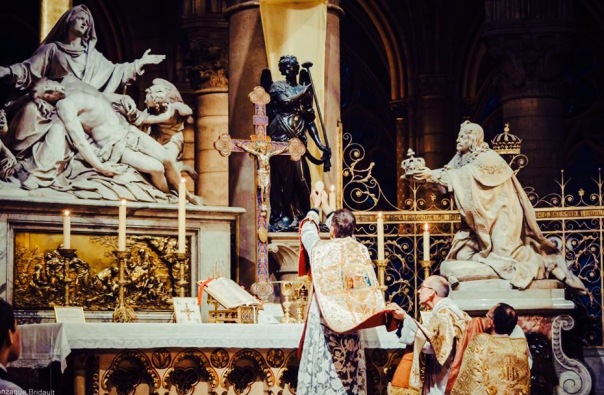
Photo credit: Gonzague Bridault


Posted in Uncategorized | Comments Off on WORSHIP IN THE TRADITIONAL LATIN MASS, YOUR ETERNAL LIFE DEPENDS ON IT.

FEAR IN THE CHURCH IS PALPABLE: PRIESTS FEAR THEIR BISHOP, BISHOPS FEAR THE MAN WHO SITS IN THE CHAIR OF PETER, THE LAITY FEAR THE OUTCOME OF THE PRESENT CRISIS IN THE CHURCH

On Pastoral Fear

OnePeterFive

TwitterFacebookPocket

St. Thomas Aquinas wrote that servile fear is of the kind that a servant feels before his master — essentially, a fear of punishment. “Accordingly, ” St. Thomas writes, “if a man turn to God and adhere to Him, through fear of punishment, it will be servile fear; but if it be on account of fear of committing a fault, it will be filial fear, for it becomes a child to fear offending its father.” Elsewhere, servile fear is defined as “Selfish fear based on dread of pain to oneself that would follow if another were offended. It is the fear of punishment for wrongdoing, without being motivated by honor or a sense of duty, and least of all by love.” While servile fear “may co-exist with filial fear,” — and indeed, St. Thomas argues that “servile fear is from the Holy Ghost” — it is to be remembered that “purely servile fear, with no love of God but only self-love that fears the divine punishments, is at least in theory, inconsistent with the true love of God.”

In practical terms, servile fear is that fear which is primarily motivated by self-love. It seeks to avoid the loss of some good or goods, position, or status, or even the loss of Heaven out of the love of self — not the love of God.

It is of this species of fear to which many Catholic faithful, exasperated by the failure of leadership they perceive among their priests and bishops, accuse the clergy of falling prey. However, one thing is often overlooked when people discuss “fearful” shepherds — especially when they are quick to call them cowards — is that their first duty — after Loving God above all things and obeying Him no matter the consequences to themselves — is to love their neighbor as themselves, by forming, nourishing, and protecting the spiritual children of their particular flock.

One of the things I have spent much time on as a pastor is giving council to parents over their legitimate fears for their children (and their fears are legion.) Every good pastor has many of the same fears for his spiritual children that biological parents have for their children, and the primary fear is that they will be led astray.

There are, consequently, many pastors who may not speak out publicly in such a way that they are openly challenging the problems in the Universal Church, but this does not mean that they are not speaking out in their parishes — from their pulpits, in the confessional, or in the spiritual counsel they give to the members of their flock. They try to nourish and guide the souls entrusted to their care according to the fullness of the Catholic Faith even when their own bishops — or even the pope himself — are not, and they do so as a direct response to what those bishops and the pope are doing and saying.

They do this in order to keep their spiritual children safe from spiritual harm. And many of them have a legitimate concern that if they raised their voices in protest outside the parish walls, they might well be removed in retribution. The question that haunts them is, “If such a thing were to happen, who would be sent to replace me?” They know that the wolves and hirelings far outnumber the faithful shepherds and that if they are removed for speaking the truth to the whole world, those who would likely take their places would be chosen because they will not speak the truth to the parish, let alone to the world.

It is for this reason — a concern for what will become of their spiritual children — that many pastors of souls remain silent in the ‘press’, while they are anything but silent from the pulpit, the classroom, or the tables of the parishioners who invite them into their homes.

When I reflect on the fears that I have about being removed, excommunicated, or laicized for speaking the truth, I cannot deny that the questions of, “What shall I do? How will I live?”, arise in my mind. These are natural fears, but they are not the most pressing; these are the “servile fears”, and they are usually immediately quelled upon recourse to prayer and an act of spiritual abandonment to God. The fear that isn’t quelled so easily, is: when I am gone, what shall happen to my spiritual children?

Just recently I had several parishioners, at different times, express to me how they hoped that I would be able to stay here past the time of my current assignment because they have grown in their faith and know the wasteland that surrounds them in the various parishes in my small deanery. Their concerns were not because they thought I might be removed for speaking the truth, even though I have told the parishes I serve that this is a real possibility (I have spoken the hard truth several times at diocesan meetings with the bishop, and even with members of the laity present.) They were simply aware that even in the normal course of events, a pastor who gives bread instead of stones has become a rarity.

A priest — especially a parish priest, and most especially a pastor — is, as his title aptly suggests, a father. Thus, his natural place is in his home with his spiritual family. This is why the post-conciliar practice of shuffling the pastoral deck every few years is often so destructive to parish life. What would we say about a natural family that got a ‘new’ father every six or twelve years? Why is it considered a tragedy when an orphan is moved from foster home to foster home? This constant change in the paternal relationship is often a recipe for disaster that often begets chaos and ruin. I have expressed this concern to my bishop, and requested to be allowed to remain in my little parishes until I die, because they are my family and I am a father to them. That is not to say that tending to my spiritual family is always a picnic! Even so, I love them and desire to remain with them so that I can lead as many of them to Eternal Salvation as is possible by the Grace of God.

I have been in my assignment for several years and from the beginning had a parishioner who attacked my character and made life difficult. I prayed for him often and even rebuked him publicly and warned him of hell. After almost eight years he came to me and repented, and I absolved him and he died in a state of grace. Being a priest is the greatest blessing there is, and being separated from one’s flock, even the difficult ones, is the greatest suffering there is for a priest. This is what many of them fear because they know Hell is real and that many of their children will end there if they are not constantly guided and nourished with the Saving Truth of Jesus Christ.

What I always tell parents is what I must hear myself: God is in charge and if your children refuse your good council you must continue to pray, fast and do penance for them to merit actual graces for them so that they may repent and be saved. The vast majority of Faithful Catholics are so, because of Faithful Parents: naturally and spiritually. The fact that there are Faithful Catholics is due to the fact that there are Faithful Shepherds who taught them and nourished them with the Holy Catholic Faith, and much of that was face to face in a parish setting or at a conference or a retreat — in other words, through personal encounters, not through strongly worded essays in the paper or online. There is much to be gained through the Catholic Internet, but the people of God need shepherds of flesh and blood who will feed them the True Faith in their parishes, or they will perish.

It is my plea to you, therefore, that you resist rash judgment when it comes to the priests whom you wish would break their silence and shout the truth about the emperor’s wardrobe malfunction from the rooftops. Do not assume that their public reticence equals cowardice or consent. Please pray for the good shepherds that even now work amongst the Lord’s sheep. Pray that they are not inhibited by servile fear, and that that they will be governed instead by the Fear of the Lord and His Love above all things, but also remember that this does not necessarily mean that all of them need to preach to the whole world via the internet or the media. If, however, that is what God is calling them to, pray that they are able to discern it, and do so with Holy Boldness.

When the time comes for the majority of the good shepherds to be driven into exile — and that time seems to have already begun in some quarters — they will need to be supported by you, the faithful laity. They will need you to take them into your homes, to be succored and sheltered. They will need help with their debts and obligations, as many of them are too old or limited to be truly gainfully employed elsewhere. And they need to hear from you, the faithful laity, those face to face reassurances that, should the day come, you will support in this manner. Without such support, then the message being sent to these priests by the laity who most ardently desire their boldness is that they must go to Calvary alone.

Even Jesus went to Calvary with a faithful few who accompanied Him and remained with Him in His Holy Agony.

It seems to me that the Church at this time finds herself mystically within the following verses of Revelation (12:13-17):

So when the dragon saw that he had been thrown down to the earth, he pursued the woman who had given birth to the male child. But the woman was given the two wings of the great eagle, so that she could fly from the serpent into the wilderness, to her place where she is nourished for a time, and times, and half a time. Then from his mouth the serpent poured water like a river after the woman, to sweep her away with the flood. But the earth came to the help of the woman; it opened its mouth and swallowed the river that the dragon had poured from his mouth. Then the dragon was angry with the woman, and went off to make war on the rest of her children, those who keep the commandments of God and hold the testimony of Jesus.

The woman, of course, is Mary. But Mary is also the archetype of Holy Mother Church, who has been and is being persecuted by the dragon, who will make war upon the faithful until Our Lord Jesus Christ comes again in glory.

Print Friendly, PDF & Email
Posted in Uncategorized | 1 Comment

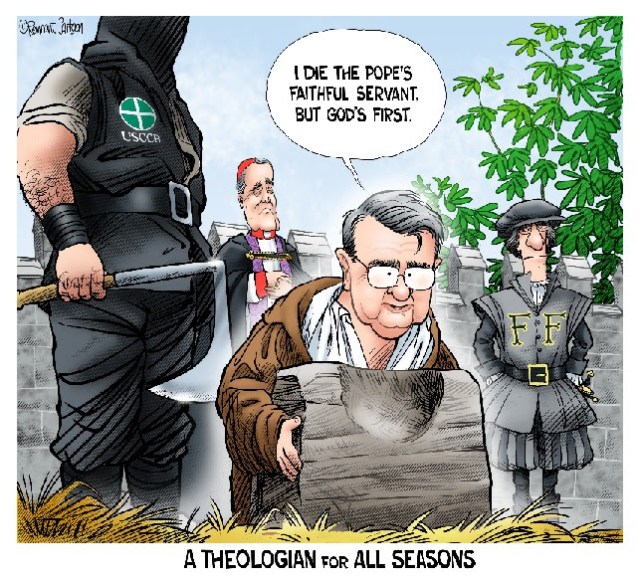
A THEOLOGIAN FOR ALL SEASONS

unnamed-31

Posted in Uncategorized | Comments Off on A THEOLOGIAN FOR ALL SEASONS

PARENTAL RIGHTS, FORGET ABOUT THEM, AN ELEVEN-YEAR-OLD GIRL CAN DECIDE (WITH THE HELP OF HER PUBLIC SCHOOL) THAT SHE SHOULD BE A BOY, WITHOUT NOTIFYING HER PARENTS

Featured Image
Shutterstock.com
Lianne LaurenceLianne Laurence

School helped 11-year-old girl ‘transition’ to boy, hid from parents

CALGARY, Alberta, November 7, 2017 (LifeSiteNews) — A legal group is speaking out after learning that a school facilitated an 11-year-old girl’s “gender transition” behind her family’s back, and only informed them when she had become suicidal.

The girl told her teachers at age 11 she wanted to be a boy but didn’t want her parents to know. She became suicidal after a year of living a double life as a boy at school and a girl at home.

Only when she told her guidance counsellor she was depressed and wanted to kill herself did the school inform her parents, says lawyer John Carpay, director of the Calgary-based Justice Center for Constitutional Freedoms (JCCF).

The parents knew their daughter, who is moderately autistic, was struggling, but had no idea the school was facilitating her “transition” to a “boy,” Carpay said.

Carpay believes this is proof — if any were needed — that the Alberta NDP government’s radical bill forbidding schools from telling parents if their child joins a gay-straight alliance without the child’s consent will harm vulnerable children.

“Apart from the actual cases, it’s something common sense would tell you: If parents are pushed out, then you’re pushing out the greatest sources of love and the greatest source of protection that children have,” he told LifeSiteNews.

“The law doesn’t seem to recognize that the political activists don’t love these children anywhere nearly as much as their parents do,” he said.

“There’s an underlying assumption that political activists are 100 per cent trustworthy and can have access to kids without parental supervision, which is outrageous.”

Bill will keep parents in the dark

NDP Education Minister Dave Eggen introduced Bill 24 or “An Act to Support Gay-Straight Alliances” last Thursday, claiming it was necessary to prevent schools “outing” same-sex attracted students to their parents.

Critics of the clubs say GSAs are far from neutral, but are means to promote homosexuality and transgenderism to impressionable children and adolescents.

In the case Carpay highlighted in a JCCF statement opposing Bill 24, at the onset of puberty at age 11, the girl “wanted to identify as a boy socially, i.e. boy’s name and pronouns, boys bathroom/change room, and boys sports teams.”

The school “indulged her” in these requests without telling her parents, and “without any evidence that the parents were in any way abusive.”

But when the student admitted being depressed and suicidal, the school did inform the parents, who promptly pulled her out.

The principal was “apologetic and contrite,” consulted with superiors, and told the parents the school would abide by their direction if their daughter returned, the JCCF statement related.

That included not attending GSA meetings, being referred to by a boy’s name and male pronouns, or joining boys’ activities.

The principal also verbally agreed the school “would inform the parents immediately of anything to do with their daughter’s gender identity, or her attempts to attend a GSA meeting or otherwise attempt to go against her parents’ wishes.”

UCP Jason Kenney hears similar case

Carpay says the JCCF heard from another couple with an autistic daughter, and knows of other cases where schools had initially kept parents in the dark.

Indeed, newly elected United Conservative Party leader Jason Kenney heard a similar story while on the campaign trail.

“A mother approached me in January after a public town hall,” he told Global Newsin March.

“She was quite distraught, and she told me that her 12-year-old autistic daughter had been put into counselling and referred to as a boy, given a boy’s name in school. But none of this information had been shared with the parents,” Kenney related.

“So, for months, the child was being treated as a boy in school and as a girl at home, creating even more problems, confusion and tension.”

“I think generally speaking, parents have a right to know what their kids are doing in school,” Kenney added.

“If there’s evidence that the parents are abusive, then they shouldn’t be involved.”

Carpay echoed Kenney’s concerns.

Alberta’s current laws authorizes teachers to “deal with the rare individual situations of actual or suspected” parental abuse, and grants them discretion to withhold information to parent if the situation calls for it, notes the JCCF statement.

“Replacing this discretion with a law that requires secrecy is harmful to children,” it says.

“Absent exceptional circumstances, to prohibit parents from being informed violates parents’ legal rights and responsibilities for their children.”

JCCF released a policy paper Monday documenting how Bill 24 is unconstitutional.

UCP will oppose Bill 24

Meanwhile, the NDP has branded Kenney as an extremist, and Eggen mentioned the UCP leader to reporters after tabling Bill 24.

“Jason Kenney suggested earlier this year that schools should be able to out LGBTQ students to their parents, and that is dangerous,” he said.

Kenney has dismissed the NDP as playing “wedge politics,” and has said he supports policies that safeguard the child’s best interests.

And he announced the UCP will oppose the bill in a news conference before the bill’s second reading debate Tuesday, the CBC reported.

He said the UCP supports keeping the status quo.

“Teachers, not politicians, should decide when it makes sense to engage parents,” Kenney said. “The unique circumstances of each child should be the key factor, not the blunt instrument of law.”

He also said the UCP does not favour mandatory parental notification, and that he supports Bill 10, the law passed in March 2015 making GSAs obligatory in schools on student request.

The UCP caucus supports GSAs, Kenney said, but he pointed out some GSAs engage in political activism.

“The NDP is trying to do indirectly, what it cannot do directly,” he said.

“That is teaching sensitive subjects that would normally require parental notification.”

To suggest UCP MLA’s wanted to “out” same-sex attracted students was “offensive and dishonest,” Kenney said.

Posted in Uncategorized | 2 Comments

MARGARET SANGER, THE RACIST FOUNDER OF PLANNED PARENTHOOD, MUST BE REJOICING WHEREVER SHE IS; IT IS PROBABLY NOT HEAVEN

Featured Image
J. Bicking / Shutterstock.com
Victoria Garaitonandia Gisondi

Planned Parenthood tells Blacks: You’re better off aborting your babies

November 7, 2017 (LifeSiteNews) – In what has to be the most shameless marketing strategy in recent history, a Planned Parenthood Twitter account called PP Black Community, tweeted a “scary stat” on Halloween morning: “If you’re a Black Woman in America, it’s statistically safer to have an abortion than to carry a pregnancy to term or give birth. #Scary Stats.”

What’s truly scary is that an organization that prides itself on its message of empowerment and inclusion is fear mongering young minorities with the exact opposite message of empowerment and inclusion. Planned Parenthood is convincing young Black women that they are not equipped to give birth. They are telling them that abortion is a safer option. They are saying if they choose to be mothers, they will most likely die.

Interestingly, this message is coming from the nation’s largest abortion business.  It’s an obvious and malicious hard sell to minorities whose neighborhoods are already invaded by abortion clinics. They may as well push them over the edge.

If Planned Parenthood’s intent was to bring attention to the disproportionate amount of maternal deaths and the lack of quality healthcare for Blacks compared to Whites, then they failed bigtime. Instead their message sounded something like, “Let us kill your baby before your baby kills you”.

Ironically, they take zero responsibility for any inequality of healthcare despite the fact the Planned Parenthood clinics abound in minority neighborhoods and that abortion clinics in general are notoriously under or unregulated. Look no further than convicted murderer and former abortionist Kermit Gosnell in West Philadelphia as an example of unregulated abortion clinics in Black neighborhoods.

Evangelist Alveda King, Director of Civil Rights for Unborn Children and niece of Martin Luther King, had something to say about the Planned Parenthood Black Community message to young women.

“Mother Teresa saw abortion as the greatest example of poverty.  ‘It is a poverty,’ she said, ‘to decide that a child must die so that you may live as you wish.’ Abortion is a civil wrong. The pro-life movement stands for justice and is ‘the new civil rights movement.’ What ‘Blacks’ were for the Civil Rights Movement of the 60s, the unborn are for the Civil Rights Movement of today.”

She was not alone in her condemnation. Twitter blew up with backlash from people who saw right through the condescending message disguised as concern to black women.

But PP Black Community simply doubled down.

I am not sure what the image of female rapper, Cardi B, saying, “I feel so damn powerful.” was supposed to convey. But, those who promote the message of abortion through the use of fear are not promoting anything at all that empowers women. In fact, it is quite the opposite. Hopefully most people will be “woke” enough to realize that it’s not compassion or concern for minorities that motivates Planned Parenthood to “help” women.

Victoria Gisondi is Public Outreach Associate for Priests for Life, the world’s largest Catholic organization focused exclusively on ending abortion.

Posted in Uncategorized | 1 Comment

BRAVO BISHOP ROBERT MORLINO, BISHOP OF MADISON, WISCONSIN, MAY YOUR TRIBE INCREASE

Featured Image
Bishop Robert Morlino of Madison, Wisconsin
Doug BeanDoug Bean

Second USA bishop to adopt ‘ad orientem’ position for Mass

MADISON, Wis., September 7, 2016 (LifeSiteNews) — A U.S. bishop turned heads toward the “east” last weekend in his diocese and around the world with his announcement that he would be celebrating Mass ad orientem.

Bishop Robert Morlino told parishioners at St. Patrick Church during his homily on Sunday that he would begin in October to offer Novus Ordo Masses facing the altar when he is town. The Diocese of Madison uses St. Patrick and two other parishes as a substitute for the cathedral that burned down 10 years ago. “I’m planning for us in accord to the mind of God,” he said.

The local ordinary is one of the first bishops in the Church to respond after a call by Cardinal Robert Sarah, prefect for the Congregation for the Divine Worship in Rome, for Masses celebrated in the ancient tradition of facing toward God along with the congregation to become the norm beginning in Advent. That form of worship had been the “common orientation” in Catholic liturgy for more than 1,500 years until the Second Vatican Council in the 1960s, when many priests took it upon themselves to turn around to face the people.

“The bishop’s announcement at the Cathedral Parish was well received by the congregation there (his intended audience),” diocesan spokesman Brent King told LifeSiteNews in an email. “And with others finding out about it, we have received numerous notes of encouragement both from within and outside the diocese.

“As for now, the bishop is not going have any other public comments about this, as he wishes to speak with his priests about his decision, in person, very soon.”

Bishop Morlino interjected humor into his homily while revealing his intentions, saying he knew the parishioners in attendance would be supportive, but “I say this a few other places I’ll  have to take both my hats off and duck” referring to other churches in his own diocese.

But that will not stop him from encouraging the priests of his diocese to consider an ad orientem posture, and he hopes his example will prompt other bishops around the world to do the same.

Bishop Morlino already requires seminarians in formation in his diocese to learn to celebrate the Extraordinary Form of the Mass. In January, he ordered all of the diocese’s parishes to put the tabernacle back in the center of the Church, affecting nearly half of the parishes that had moved it to a side altar or separate room.

“Please lead your priests and people towards the Lord in this way,” Cardinal Sarah asked. “Please form your seminarians in the reality that we are not called to the priesthood to be at the center of liturgical worship ourselves but to lead Christ’s faithful to him as fellow worshippers. Please facilitate this simple but profound reform in your dioceses, your cathedrals, your parishes and your seminaries.”

Reaction from prelates to Cardinal Sarah’s preference for ad orientem has been mixed. Cardinal Sarah initially said Pope Francis had offered his support, but then the Vatican walked back that go ahead by making a “clarification.” In a statement, the Vatican press office said, “New liturgical directives are not expected from next Advent, as some have incorrectly inferred from some of Cardinal Sarah’s words, and it is better to avoid using the expression ‘reform of the reform’ with reference to the liturgy, given that it may at times give rise to error.”

Some prelates immediately announced that they had no intention of adopting an ad orientem posture. Among them were English Cardinal Vincent Nichols and American Bishop Anthony Taylor of Little Rock, Arkansas.

Meanwhile, Bishop Dominique Rey of the Diocese of Frejus-Toulon in France announced that he would adopt the ad orientem position by Advent. Bishop James Conley of the Diocese of Lincoln, Neb., already is offering Mass facing the altar.

“Cardinal Sarah and Cardinal (Raymond) Burke for years, and Pope Benedict XVI have made the point over and over again that according to God’s mind that His plan is that at the end of history He will come from the East like the rising sun, as we see in the Magnificat, as we see in the Psalms, as we see in the scriptures,” Bishop Morlino said in his homily. “God’s plan is at the end of history He will come from the East from the rising sun. And when the priest stands together with the congregation, not with his back toward them, that’s not the point. The point is that the priest stands together with the congregation and he faces symbolically at least the East. We become a mighty army marching toward the place of the rising sun to meet the Lord lead by the priest.  That’s who we really are.”

+++++++++++++++++++++++++++++++++++++++++++++++++++++++++++++++++++++++++++++


U.S. bishop doubles-down on refusing funerals to non-repentant gays

MADISON, Wisconsin, November 3, 2017 (LifeSiteNews) – Catholic Bishop Robert Morlino is defending his diocese’s recent guidelines to priests about denying funerals for non-repentant homosexuals, saying it’s the “straightforward teaching of the Church.” He clarified in the face of an ugly campaign to have him removed as bishop that such guidelines in no way indicate that “we don’t care about homosexual people”

Morlino, the bishop of the Diocese of Madison, Wisconsin, has come under fire because his priests received a guidance reminding them of what the Code of Canon Law says about Catholic funerals for unrepentant “manifest public sinners,” such as people who publicly entered a same-sex “marriage.”

Media in his state that are sympathetic to the homosexual cause have attacked him, as have dissenting “Catholic” groups that reject Church teaching on sexual morality.

“The context” of the diocesan guidelines is “important,”  Morlino told EWTN’s Raymond Arroyo on The World Over.

“We have regular questions coming to us from individual pastors or from the priest counsel about these matters,” he explained. “And we have a regular way of communicating with priests – the Saturday mailing to priests from the vicar general – which addresses simply the answer to their questions in shorthand.”

“I did not out of a clear blue sky decide to speak out about this,” said Morlino. He noted that the guidance to priests from his vicar general “is the straightforward teaching of the Church of which I approve and very much want to promote.”

“The problem is that when people are tuned in three-quarters of the way through a conversation, which has been going on, and they get shorthand bottom lines,” said Morlino. “Then we got a problem.”

“A misinterpretation is created that we don’t care about homosexual people, that we want to have nothing to do with them,” he explained. This isn’t true at all, Morlino said.

Morlino said that those with same-sex attraction “who want to follow Christ” have a “particularly heavy cross to carry.”

Morlino reiterated this in a Nov. 02 column for the Diocese of Madison’s newspaper, writing:

It is our duty, as Christians, to approach such individuals and to act as Simon of Cyrene to them, helping to carry their cross, and never kicking them while they struggle under its weight. So much of what has been misinterpreted in this whole affair is a sense that we desire to have nothing to do with those who face this road of discipleship.

By all means, as the saying goes, “come as you are.” But, be aware that Jesus Christ loves each of us far too much to leave us as we are. He wants far more for you and for me. Be aware that he says to us all, “If anyone wishes to come after me, he must deny himself and take up his cross daily and follow me (Lk 9:23).” Following Jesus involves a decision to take up a cross and to follow in His footsteps toward Calvary. But we do not do so alone. Jesus, by His grace and through His living body, the Church, will make that burden light — insofar as we (every individual disciple) allow.

If a “manifest public sinner” shows even the slightest sign of repentance, he is eligible for a Catholic funeral, Morlino said.

He noted that when pro-abortion Sen. Ted Kennedy received a Catholic funeral, many faithful in his diocese were scandalized. Kennedy definitely was a manifest public sinner. But Morlino said he assumes the churchmen involved with the funeral knew something he didn’t about Kennedy showing signs of repentance.

The Code of Canon Law says that three conditions must be met for someone to be denied a Catholic funeral: he must be a manifest public sinner, he must have shown no signs of repentance, and giving him a Catholic funeral would cause scandal to the faithful.

“The slightest sign of repentance means they get a Catholic funeral,” said Morlino. He noted repentance is the end goal for everyone.

Morlino also lamented that people wrongly think he doesn’t care about those with same-sex attraction.

“I feel terrible about that,” he said.

Morlino also clarified why if a person who entered a public same-sex union is given a Catholic funeral, his partner is not allowed to do a reading at the service or be mentioned as surviving him.

It would lead Catholics into sin, he said, by giving them the impression same-sex unions are okay or would at the very least lead to them “getting them all confused.” Catholics have a right “not to be confused,” he added.

Morlino also briefly weighed in on the unfolding drama surrounding the U.S. Catholic bishops’ sacking of Father Thomas Weinandy as a consultant after he published a letter he wrote to Pope Francis raising concerns about the “confusion” that is a hallmark of his papacy.

“Father Weinandy is an extremely reputable scholar and in fact, a friend of mine,” Morlino told Arroyo. “A very good theologian and a friend of mine, truth be told. I cannot make judgments about Father Weinandy and his relationship to the USCCB because I am far away from all of that.”

Morlino chuckled at the assertion from dissenting Catholics that he’s not “welcoming” and should be removed by Pope Francis.

“I wake up every morning convinced that ‘God’s will’ will be done for the world and my life that day,” he said. “And knowing that. I just proceed with serenity and a good smile.”

Posted in Uncategorized | 2 Comments