Evelyn Waugh was a brilliant yet difficult man. But in 1930, he was a changed man. With wit and honesty, he once claimed, “You have no idea how much nastier I would be if I was not a Catholic. Without supernatural aid I would hardly be a human being.” Waugh, the modernist writer and darling of the literary social scene, came to understand the blackness of sin and brilliance of redemptive Grace embodied by Christ and made tangible in the Sacraments in the Catholic Church.

Christianity or Chaos: The life-changing choice of Evelyn Waugh

Share

2k
ALETAEIA

“[Europe] came into being through Christianity, and without it has no significance or power to command allegiance.”

It was considered scandalous. Inexplicable. What was he thinking? How could he do it? Enlightened opinion-makers and fashionable friends were apoplectic. Evelyn Waugh, England’s darling modernist writer and amusing cynic, had become a Catholic.

But why?

Immediately upon hearing the news, the gossip industry caught fire. How had the “ultramodernist become an ultramontanist”? How could the shocking wit who fathered novels such as Decline and Fall and Vile Bodies fall sway to the stiff and stultifying orthodoxy of the Catholic Church? Shortly thereafter, London’s Daily Express devoted several sensational disquisitions on the topic leading with the splashy:

“Another Author Turns to Rome, Mr. Evelyn Waugh Leaves Church of England, Young Satirist of Mayfair

And so, weeks later, afforded a full page in the October 20, 1930 Daily Express, Evelyn Waugh would answer. His essay was titled, Converted to Rome: Why It Has Happened to Me.”

At first, Waugh shrugged off three assertions leveled by his detractors:

1) The Jesuits have got hold of him,

2) He is captivated by the ritual, 

3) He wants to have his mind made up for him.

And then, he said this,

I think one has to look deeper before one will find the reason why in England today the Roman Church is recruiting so many men and women who are not notably gullible, dim-witted or eccentric.

It seems to me that in the present phase of European history the essential issue is no longer between Catholicism, on one side, and Protestantism, on the other, but between Christianity and Chaos…

Today we can see [the loss of Christian faith]…as the active negation of all that western culture has stood for. Civilization – and by this I do not mean talking cinemas and tinned food, nor even surgery and hygienic houses, but the whole moral and artistic organization of Europe – has not in itself the power of survival. It came into being through Christianity, and without it has no significance or power to command allegiance. The loss of faith in Christianity and the consequential lack of confidence in moral and social standards have become embodied in the ideal of a materialistic, mechanized state… It is no longer possible, as it was in the time of Gibbon, to accept the benefits of civilization and at the same time deny the supernatural basis upon which it rests…

That is the first discovery, that Christianity is essential to civilization and that it is in greater need of combative strength than it has been for centuries.

The second discovery is that Christianity exists in its most complete and vital form in the Roman Catholic Church. I do not mean any impertinence to the many devout Anglicans and Protestants who are leading lives of great devotion and benevolence; I do find, however, that other religious bodies, however fine the example of certain individual members, show unmistakable signs that they are not fitted for the conflict in which Christianity is engaged. For instance, it seems to me a necessary sign of completeness and vitality in a religious body that its teaching shall be coherent and consistent. If its own mind is not made up, it can hardly hope to withstand disorder from outside…

Another essential sign one looks for is competent organization and discipline. Obedience to superiors and the habit of submitting personal idiosyncracies to the demands of office seems to be sure signs of a real priesthood…

Most important of all, it seems to me that any religious body which is not by nature universal cannot claim to represent complete Christianity…

No one visiting a Roman Catholic country can fail to be struck by the fact that the people do use their churches. It is not a matter of going to a service on Sunday; all classes at all hours of the day can be seen dropping in on their way to and from their work…

The Protestant attitude seems often to be, ‘I am good; therefore I go to church,’ while the Catholic’s is, ‘I am very far from good; therefore I go to church.”

Evelyn Waugh was a brilliant yet difficult man. But in 1930, he was a changed man. With wit and honesty, he once claimed, “You have no idea how much nastier I would be if I was not a Catholic. Without supernatural aid I would hardly be a human being.” Waugh, the modernist writer and darling of the literary social scene, came to understand the blackness of sin and brilliance of redemptive Grace embodied by Christ and made tangible in the Sacraments in the Catholic Church.

Evelyn Waugh made a choice between Christianity and Chaos.

Have you?

Posted in Uncategorized | 1 Comment

THERE ARE LIMITS TO THE EXTENT TO WHICH “MUTUAL ENRICHMENT” CAN BE INTRODUCED INTO LITURGICAL REFORM. EXCEEDING THOSE LIMITS INTRODUCES THEOLOGICAL/DOGMATIC ERROR INTO THE CHURCH’S LITURGY

Report: Summorum Pontificum 2017 – Can Mutual Enrichment “Heal the Rift”?

NOVEMBER 01, 2017
BY DISTRICT OF THE USA
news-header-image
Procession towards St. Peter’s Basilica on the occasion of the Summorum Pontifcorum conference.

Supporters of Benedict XVI’s call for “mutual enrichment” featured prominently at the Summorum Pontificorum conference and pilgrimage.

Cardinal Robert Sarah, head of the Congregation of Divine Worship, was among the speakers in Rome on September 14-17, 2017, as was Archbishop Pozzo, Secretary of the Pontifical Commission Ecclesia Dei, which has charge of groups linked with the Traditional Mass such as Fraternity of St. Peter and the Institute of Christ the King.

Archbishop Pozzo stated in his address:

I think it necessary to return to a fundamental aspect of Summorum Pontificum, namely, the desire to heal the rift, not just liturgical, but ecclesiological, between the old and the new….I believe that the old rite, with its patrimony of faith and holiness, can greatly enrich the new; while the new, in its turn, can represent that rightful aspiration for theological and liturgical development in continuity and fidelity to tradition.

What is “Mutual Enrichment”?

The expression “mutual enrichment” famously occurs in Pope Benedict XVI’s words in his Letter to the Bishops of the World to Present the “Motu Proprio” on the Use of the Roman Liturgy prior to the Reforms of 1970, when he stated, “The two forms of the usage of the Roman Rite can be mutually enriching.”  In this letter he sought to allay fears that, first, the freeing of the Traditional Mass would call the authority of the Second Vatican Council into question, and secondly, that use of the traditional rite would cause division within the Church.

In this same letter, Benedict XVI provided examples of the mutual enrichment he envisaged: minor adjustments to the old Missal, such as insertions of “…new Saints and some of the new Prefaces…” and greater sacredness, reverence and obedience to rubrics in the celebration of the New Mass: “The celebration of the Mass according to the Missal of Paul VI will be able to demonstrate, more powerfully than has been the case hitherto, the sacrality which attracts many people to the former usage.”

The expression quickly became a catch-phrase, in particular for those who longed for the Old Mass, but who, for various reasons, shrank from open opposition to the Novus Ordo or the Second Vatican Council. It fit in well with Benedict XVI’s notion of “the hermeneutic of continuity,” the idea that the Second Vatican Council and any ambiguities it contains can be interpreted in the light of tradition.

At the London Sacra Liturgia conference in July 2016, Cardinal Robert Sarah made headlines when he called for priests to return, wherever possible, to an ad orientem celebration of the New Mass, something that Benedict XVI had called for in his work The Spirit of the Liturgy. This was met with an outcry from progressive Catholics and the Vatican distanced itself from his remarks. Cardinal Sarah also called for more silence in the New Mass, greater reverence towards the Eucharist (including keeping the fingertips together after the Consecration), and a more generalized use of Latin.

news-image-2
Cardinal Robert Sarah offers Mass at London’s ‘Sacra Liturgia’ conference, 2016.

Could a New Common Rite “Heal the Rift?”

As Fr. Raymond de Souza wrote in the Catholic Herald in July 2017, “Over the past 10 years, it [mutual enrichment] has been interpreted in EF circles in a mostly unilateral way: the OF ought to adapt the practices of the EF.” Hence many supporters of mutual enrichment were startled to read an article published in French journal La Nef’s July-August 2017 issue, in which Cardinal Sarah, in keeping with Benedict XVI’s vision, called for improvements to the Vetus Ordo as well. He proposed, among other things, a “harmonization of the liturgical calendars” and an eventual “convergence” of lectionaries.

Most shocking to lovers of the Traditional Mass was his suggestion:

it is a priority that, with the help of the Holy Spirit, we examine through prayer and study how we can return to a common reformed rite, always with the final goal of reconciliation within the Church…

This suggestion was decried by supporters of the traditional Mass, most publicly by Joseph Shaw, Chairman of the Latin Mass Society of England and Wales, in the Catholic Herald, liturgist Gregory Di Pippo on his blog New Liturgical Movementand Fr. John Zuhlsdorf.

Cardinal Burke, in 2011, had already suggested that a common reformed rite would be in keeping with Benedict XVI’s vision. In a November 2011 interview published by Catholic News Agency, he stated:

It seems to me that is what he [Benedict XVI] has in mind is that this mutual enrichment would seem to naturally produce a new form of the Roman rite – the ‘reform of the reform,’ if we may – all of which I would welcome and look forward to its advent.

At the September 2017 Summorum Pontificorum conference held in Rome, Cardinal Sarah denied that he had intended to call for a “hybrid rite” which would please nobody. According to an unofficial transcript of his address published on the blog New Liturgical Movement, he told his audience:

In July I spoke of a possible future reconciliation between the two forms of the Roman rite. Some have interpreted this expression of personal opinion as the announcement of a programme that would end up in the future imposition of a hybrid rite which would bring about a compromise that would leave everybody unhappy and would abolish the usus antiquior by stealth, as it were. This interpretation is absolutely not what I intended.

However, in Archbishop Pozzo’s address at the same event, there was another reference to a possible convergence between rites:

…In the future, there may arise a convergence in a single common form. However, this will be the result of a process of growth within the Church, not a bureaucratic or formal imposition from above.

Do the Two Forms of Mass Express the Same Theology?

Fundamental to the notion of “mutual enrichment” is the idea, formulated by Benedict XVI, that there is no opposition between the Novus and the Vetus Ordo. He says in the Letter to the Bishops of the World which accompanied Summorum Pontificorum, “There is no contradiction between the two editions of the Roman Missal. In the history of the liturgy there is growth and progress, but no rupture…”

Cardinal Sarah, in his La Nef article, declared:

It would be therefore erroneous to consider that the two liturgical forms are founded on two opposing theologies. The Church has only one truth to teach and to celebrate: Jesus Christ, and Jesus Christ Crucified!

There is evidence Benedict XVI believed that a focus on the liturgy could draw traditionalists to overlook their doctrinal concerns with the Second Vatican Council. As early as 1999, then-Cardinal Ratzinger wrote to a theologian critical of his stance on the Traditional Mass, “I am sorry that you did not perceive in my speech the invitation to the “traditionalists” to be open to the Council and to reconcile themselves to it in the hope of overcoming one day the split between the two Missals” (Letter to Fr. Matias Augé, February 18, 1999).

This idea is consistently upheld by those who support Benedict XVI’s liturgical thought. In his address to the 2017 Summorum Pontificorum conference, Archbishop Pozzo said:

The motu proprio, therefore, does not aim for liturgical uniformity, but rather for reconciliation within the Church, bringing the two Forms, Ordinary and Extraordinary, to live together beside each other, respecting their specific characteristics….

Progressive Position: Two Masses, Two “Different” Theologies

Voices from both sides of the spectrum have contradicted this thesis, however. More recently, on July 8, 2017, progressive theologian Fr. Matias Augé, professor of liturgy at the Pontifical Liturgical Institute of Sant’ Anselmo’s comments on Cardinal Sarah’s La Nef article were published on progressive Catholic blog Pray Tell. He believes strongly that the theologies expressed in the Novus and Vetus Ordos are not the same. Fr. Augé writes:

Sarah argues that it is ‘incorrect to hold that the two forms of liturgy express opposing theologies. The Church has a single truth which she teaches and celebrates.’ Again, I must say: two ‘opposing’ theologies, no; but ‘different,’ certainly. … The post-Tridentine theology of the sacraments is one thing, and the sacramental theology inspired by Vatican II is another.

Taking issue with Cardinal Sarah’s suggestion that the priest’s fingers be kept joined after the Consecration, Fr. Augé says, “This last proposal reflects a Eucharistic theology which is no longer viable.” Anthony Ruff, OSB, who translated Fr. Augé’s remarks from the original Italian, comments:

The Council affirmed the Real Presence, of course. But it never used the term ‘transubstantiation’ once. Coincidence? Oversight? Irrelevant detail? No. Rather, perfectly emblematic of an entire way of thinking which informs the Council’s documents…

Traditionalist Position: The Ottaviani Intervention

Among traditional literature analysing the theology on which the New Mass is founded and how it differentiates from that which produced the Tridentine Mass, two works of particular note are the Ottaviani Intervention, notable for its concision and clarity, and Michael Davies’ three-part Liturgical Revolution.

In a letter dated September 25, 2017, Cardinal Ottaviani, head of the Holy Office (now the Congregation of the Doctrine of the Faith), and Cardinal Bacci wrote to Paul VI, presenting the results of a theological study of the New Mass and the new General Instruction.

“The Novus Ordo represents, both as a whole and in its details, a striking departure from the Catholic theology of the Mass as it was formulated in Session XXII of the Council of Trent,” the letter states.

The Ottaviani Intervention presents a step-by-step analysis of why this is so, citing firstly a change in the definition of the Mass, formerly the unbloody Sacrifice of the Cross; now “The Lord’s Supper,” and “a sacred meeting or assembly of the People of God, met together under the presidency of the priest, to celebrate the memorial of the Lord.”

The document goes on to list other major discrepancies. The ends of the Mass are changed in the New Rite by the removal of distinctions between the human and the Divine sacrifice, and the change in the bread and wine is “spiritual” and not “substantial.” There is a lack of any allusions to the Real Presence and it is implicitly repudiated. The roles of both priest and people are falsified, misrepresenting the nature of the Church and turning the priest into a Protestant minister. The unity of the Church is attacked by the abandonment of Latin, a lack of unity in language likely to translate to a lack of unity in doctrine. To this is added the danger of alienating the liturgically conservative Eastern Orthodox and an abandonment of the protections to the doctrines of the faith enshrined in the Tridentine Mass.

On this last point, the Intervention states:

It was precisely in order to ward off the dangers which in every century threaten the purity of the deposit of faith (‘depositum custodi, devitans profanes vocum novitates’ (Tim. 6:20) that the Church has had to erect under the inspiration of the Holy Ghost the defenses of her dogmatic definitions and doctrinal pronouncements. These were immediately reflected in her worship, which became the most complete monument of her faith.

Posted in Uncategorized | 1 Comment

Elements compose organic bodies, including tissues (homogenous bodies) and organs (heterogeneous bodies), and in so doing are for the sake of the whole organism of which they are the transformed parts. But the starting point for the explanation of living things is the identification of its functions: nutrition and reproduction for plants, perception and locomotion for animals, and virtue and intelligence for humans. Since the functions of plants are fundamental to all other living things, the vegetative functions are the primary ones in biological explanation. Thus, the survival and reproduction of each species is the basis for its explanation, and these are represented as goods for it. But although goods come first in the order of explanation, they come last in the order of development of the organism. Thus, intelligence is the last thing developed by a human, even though everything else has come to be for the sake of this.

The Oddity of the LGBT Alliance

David Carlin: Why are homosexuals so intimately connected with transgenders? Because both embrace the anti-nature movement.

There is something puzzling about the LGBT (lesbian-gay-bisexual-transgender) alliance: Why is T connected so intimately with LGB?  Why do LGB people rage against injustice when T people are not allowed to use the bathroom of their choice or are not allowed to serve in the military?

It is easy to understand why people belonging to one category of homosexual persons (gays or lesbians or bisexuals) would get upset when discrimination is directed at another category of homosexual persons. After all, all three are in the same homosexual boat – even though bisexuals sometimes prefer to travel in the heterosexual boat.

But a transgender person isn’t homosexual, at least not necessarily so; and at all events it is not his/her sexual orientation that qualifies him/her as transgender. So why should a homosexual person feel personally offended when a transgender person is banned from certain bathrooms and showers, or is kicked out of the army or navy?

Why do LGB people feel so close to T people? Is their alliance simply a matter of political convenience, the way LGB people have political alliances with Black Lives Matter or feminists or environmentalists or gun control advocates?

            No, it is much closer than that. The trans person is felt to be one of their own. But why?

If the sexual revolution, of which the gay rights movement has been a major part, has been the great anti-Christianity movement of the last half-century or so (and it has been), there is another great anti-Christianity movement that has also been taking place. This second movement is an anti-nature movement, a movement that promotes the idea that things that have been considered unnatural from time immemorial should now be thought of as quite unobjectionable.

For some time now these rejections of nature have been celebrated, or at least condoned, on TV, in movies, in classrooms, in legislative chambers, and in law courts.

For some time now these rejections of nature have been celebrated, or at least condoned, on TV, in movies, in classrooms, in legislative chambers, and in law courts. What in particular?

  1. Homosexuality. It used to be called “the unnatural vice.” Now, according to the masters of our popular culture, it is a perfectly respectable form of love.

  2. Child abandonment. It used to be thought that only an unnatural parent would abandon his/her children, the parent-child bond being the most fundamental of all human connections. But for decades now American society has allowed fathers (though not yet mothers) to beget children and then walk out on them.

  3. Bodily mutilation. If you spend a lot of time among young people (as I myself do in my capacity as a community college professor), you will observe the relatively new fashion of making nickel-or-quarter-size holes in ear lobes or cheeks or elsewhere. That’s minor-league mutilation. More advanced advocates of mutilation (I have not, thank God, come across any of these at my college) go further, defending the amputation of fingers, hands, and limbs – either as a way of being “different” or as a way of maintaining solidarity with disabled (differently abled) persons.

  4. Suicide. It used to be that suicide was thought of as the most unnatural thing in the world. What could be more unnatural than to renounce life itself, the most fundamental of all natural goods? But now suicide or voluntary euthanasia is considered by truly “progressive” people to be a fine thing. To be sure, they don’t consider all suicide to be good. It is good that suicide or euthanasia should be chosen by very old people who are now (allegedly) incapable of getting any significant enjoyment out of life; or by terminally ill people who wish to shorten life by a few weeks or a few months; or by people whose life involves severe physical or mental suffering; or by mature (but not necessarily old) people who now find life boring. But it is not good (not yet, but stay tuned) if a 17-year-old girl commits suicide because her boyfriend dropped her.

  5. Transgenderism. In the other cases listed, nature gives us strong hints as to the correct way to proceed – e.g., “have sex with persons of the opposite sex only,” “don’t abandon your children,” “don’t mutilate your body,” and “don’t kill yourself.” But in the case of sexual/gender identity, what nature gives us is something more than a hint. It used to be thought that the question of whether a newborn is a boy or a girl could be answered by taking a quick glance at the baby’s genitalia. Now we are told that the question shouldn’t be answered by other persons (doctors, nurses, mothers, fathers) who “assign” a gender to the child.

No, it should be answered by the child itself when it grows old enough to make up its own mind. In the old days, the doctor would say to the new mother, “Congratulations, it’s a boy” or “Congratulations, it’s a girl.” Nowadays a truly up-to-date doctor will say, “Congratulations, it’s a human baby of some sort – but of course we won’t really know till the child gets older and can decide for itself.”

It used to be thought that nature was the creation of God and that God, speaking through nature, gave us certain very strong hints as to how we should behave (these hints were often called “natural law”). By rejecting these hints, which is what popular philosophy is now doing, we are rejecting nature; and by rejecting nature we are rejecting God.

So if you wonder: why is the pro-gay movement so intimately connected with the transgender movement? The answer: Because they are both parts of the anti-nature movement.

This allows us to appreciate how especially dangerous to Catholicism the pro-gay movement is. It lies at the intersection of the sexual revolution and the anti-nature movement. As part of the sexual revolution, it is anti-Christianity. And as part of the anti-nature movement, it is anti-God. It is, therefore, a double threat to Catholicism.

Yet some Catholics believe we need to “build a bridge” to this movement.

David Carlin

David Carlin

David Carlin is professor of sociology and philosophy at the Community College of Rhode Island, and the author of The Decline and Fall of the Catholic Church in America.

Posted in Uncategorized | Comments Off on Elements compose organic bodies, including tissues (homogenous bodies) and organs (heterogeneous bodies), and in so doing are for the sake of the whole organism of which they are the transformed parts. But the starting point for the explanation of living things is the identification of its functions: nutrition and reproduction for plants, perception and locomotion for animals, and virtue and intelligence for humans. Since the functions of plants are fundamental to all other living things, the vegetative functions are the primary ones in biological explanation. Thus, the survival and reproduction of each species is the basis for its explanation, and these are represented as goods for it. But although goods come first in the order of explanation, they come last in the order of development of the organism. Thus, intelligence is the last thing developed by a human, even though everything else has come to be for the sake of this.

On the surface, great designs and an antagonism to Heaven which involved the fate of worlds: but deep within, when every veil had been pierced … nothing but a black puerility, an aimless empty spitefulness content to sate itself with the tiniest cruelties, as love does not disdain the smallest kindness.

Image: “The Dragon Transmitting Power” Master of Sarum, c. 1250.

Insane Times: Matricide and Martin Luther

Sometimes, it’s hard to find words. This is one such occasion.

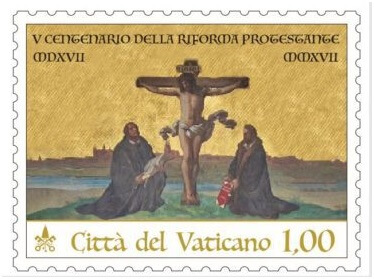
What can be said to explain the Vatican’s decision to issue a stamp with a reverential image of one of the most notorious heretics in history, to “mark the 500th anniversary of the Protestant Reformation”?

Note the piety. Note the “golden and timeless view.” This is a devotional work.

The Vatican goes on to insist in a Pontifical Council statement that “we are very thankful for the spiritual and theological gifts received through the Reformation.”

Really? Who is “we”?

Is “we” the Catholic martyrs of the Wars of Religion? Is “we” the Catholic faithful still pained by the rending of Christ’s Mystical Body yet continuing from Luther’s revolt? Is “we” the countless souls led into damnable errors on faith, grace, justification, and the Sacraments propagated by heresiarch Martin Luther, a man who called pope and bishops “a brothel-keeper and the devil’s daughter in hell,” penning such niceties as Against the Roman Papacy, An Institution of the Devil?

Is Holy Mother Church here made to give thanks for this matricide and “the gifts received through” his errors?

Yes, and not only must she be thankful; she is made, together with the Lutheran World Federation, to have “begged forgiveness for our failures and for the ways in which Christians have wounded the Body of the Lord and offended each other.” One could scarcely believe it, were it not for the prophetic words of Pope Pius XII in 1933:

I am concerned about the messages of the Virgin to the little Lucia of Fatima. This persistence of the Good Lady in face of the danger that threatens the Church is a divine warning against the suicide that the alteration of the Faith, in its liturgy, its theology, and its soul, would represent. I hear around me innovators who wish to dismantle the Sacred Chapel, destroy the universal flame of the Church, reject her ornaments, and make her remorseful for her historical past.

And find the Vatican speaking of Pope Francis standing with “Bishop Munib A. Younan” (except he’s not a bishop) and declaring “the commitment to continue the ecumenical journey together towards the unity that Christ prayed for” (except that unity abides in the Church alone). And perhaps most troubling:

Many members of our communities yearn to receive the Eucharist at one table, as the concrete expression of full unity. We experience the pain of those who share their whole lives, but cannot share God’s redeeming presence at the Eucharistic table. We acknowledge our joint pastoral responsibility to respond to the spiritual thirst and hunger of our people to be one in Christ. We long for this wound in the Body of Christ to be healed. This is the goal of our ecumenical endeavors, which we wish to advance, also by renewing our commitment to theological dialogue.”

Now, we know as a matter of faith that the only way for such a “concrete expression of full unity” to be realized is by the return of any separated member to Catholic faith and life. But with plans for an “Ecumenical Mass” apparently in the works, one is tempted to dread what further violence the future may hold.

And what of all the missed opportunities to evangelize? If anybody lives in a diocese where a bishop is taking the opportunity of this “500th anniversary” to do anything but the kind of things detailed above, I’d love to hear about it. It’s likely we can only imagine such a scenario these days.

But let’s do that for a moment.

Just imagine for a second what would happen if your bishop stood up at that ecumenical conference or dialogue session or joint prayer service or whatever, and rather than reflecting on what might have been or affirming all that unites us, he instead invited our erring brethren, in a charitable, heartfelt manner (you know, the kind of manner he might have if he truly loved them and was concerned for their salvation), to return to the one true Church established by Christ.

I mean, seriously, what would happen?

Insanity

Given the above nonsense and other increasingly strange and even irrational goings-on amid the hierarchy of late, I wonder if a particular preternatural enemy may be afflicting the Church at present. I am reminded of something from the writings of the Church Fathers about the spirit of insanity. 

This passage is from St. Hippolytus of Rome, preaching in the early 3rd century to invite non-Catholics of his day to abjure their errors and enter the Church:

[F]ly to the water, for this alone can extinguish the fire. He who will not come to the water still carries around with him the spirit of insanity for the sake of which he will not come to the living water for his own salvation. (Homilies 11:26)

Perhaps this is the name of a particularly nefarious agent currently at work, of a piece with that “smoke of Satan” Pope Paul VI lamented in 1972 as having penetrated the Church. It calls to mind a passage from C.S. Lewis’s Perelandra, when the protagonist faces the principal agent of Satan, and finds:

On the surface, great designs and an antagonism to Heaven which involved the fate of worlds: but deep within, when every veil had been pierced … nothing but a black puerility, an aimless empty spitefulness content to sate itself with the tiniest cruelties, as love does not disdain the smallest kindness[.]

Perhaps the inconceivably complex machinations of an angelic super-intelligence bent on the destruction of the Church finally reduce to a base, mindless gibbering.

Perhaps Christ the Logos, Divine Reason par excellence, is opposed by an Anti-Logos that must needs be Un-Reason itself.

Perhaps the Man of Sin is an idiot.

Originally published at Whispers of Restoration. Reprinted with permission.

Posted in Uncategorized | Comments Off on On the surface, great designs and an antagonism to Heaven which involved the fate of worlds: but deep within, when every veil had been pierced … nothing but a black puerility, an aimless empty spitefulness content to sate itself with the tiniest cruelties, as love does not disdain the smallest kindness.

Contraception is a worse attack on human life than abortion: while, in fact, the latter deprives the child of temporal life on earth, the former denies to it “existence in all eternity”. Now, one may object that we do not have moral obligations towards hypothetical future subjects. However (if I did not get it wrong), the point is that, once the “first step in the direction of the existence of the child has already been taken” (via sexual intercourse), contraception means saying ‘No’ to life not only in its biological sense, but, more gravely, in its metaphysical dimension (the immortal soul God would have infused in the baby, were He not prevented from doing this by the spouses’ opposition).

Humanae Vitae at 50: Setting the Context. A Conference in Rome

21
Shares

Facebook21TwitterGoogle+PinterestPocket

Voice of the family, a coalition of twenty-five pro-life and pro-family associations, held an international conference in Rome on October 28th, hosted by Pontifical University of St. Thomas Aquinas, to celebrate the fiftieth anniversary of Pope Paul VI’s encyclical Humanae Vitae. Among the speakers, His Eminence Cardinal Walter Brandmüller; Professor Roberto De Mattei and Professor Josef Seifert; Father Serafino Lanzetta from University of Lugano; Jean-Marie Le Méné from Foundation Lejeune; Dr. Thomas Ward, President of the National Association of Catholic Families in the UK; Doctor Philipphe Schepens, Secretary General of the World Federation of Doctors Who Respect Human Life, Belgium; and John-Henry Westen, editor-in-chief of Lifesitenews, Canada. The morning session was chaired by John Smeaton, chief executive of the Society for the Protection of Unborn Children in the UK, while the afternoon session was chaired by Father Shenan Boquet, President of Human Life International. The closing address was delivered by His Excellency Luigi Negri, Archbishop of Ferrara.

As Dr. Smeaton emphasized, the conference intended to remind that by the infallible doctrine of the encyclical Humanae Vitae, Pope Paul VI reaffirmed the Catholic “unchangeable teaching” on sexual morality; a teaching which today is facing, as Cardinal Brandmüller remarked, “unprecedented attacks” not only from without, but also from within the Church. In a sense, the effort to alter such millennial doctrine, undertaken today under the aegis of Pope Francis’s Apostolic exhortation Amoris Laetitia, is not new. As both His Eminence and Professor De Mattei recalled, immediately before and after the Second World War, straight to the Second Vatican Council, and until the publication of Humanae Vitae in July 1968, numerous and fierce were those exponents of the ‘progressive’ Church who strove to relinquish the traditional teaching on marriage, sex, and birth control, which dated back to the earliest centuries of Christianity, too often in the name of ideologies that were sharply divergent from the Catholic faith.

In particular, Professor De Mattei insisted on the role of the nouvelle théologie, condemned by Pius XII in the encyclical Humani Generis, but prompted by the University of Leuven especially through the works of the personalist theologian Louis Janssen. The trick was to substitute the concept of ‘person’ for the concept of human nature. As De Mattei explained:

“Human nature is in fact man’s essence, what he is before being a person. Man is a subject of rights and duties because he is a person, but he is a person because of his human nature. If the person precedes nature, man is founded on his self-conscience and his own will. Moral rules are no more objective, rational, but rather affective, personal, existential. Human conscience becomes the sovereign norm of morality”.

One cannot ignore here the impressive link that ties together the approach criticized by De Mattei, Protestant ethics (the primacy of individual conscience), and the exaltation of Lutheranism we are witnessing in today’s Church.

But another, even more worrisome aspect comes through: the connections between Catholic reformism on sexual morality and the movements for sexual liberation, feminism, evolutionism, Malthusianism, Marxism, and obviously the Freemasonry, which developed in the English-speaking world, on both sides of the Atlantic Ocean, from the early 18th century onwards. Such tendencies were backed by wealthy financiers (like the Rockefeller Foundation) and by influential political advocates, like the Society of Nations and, later on, the UN. It is somewhat unsettling that today Pope Francis would be so acquiescent towards global institutions which hinder freedom of education, and try to impose the LGBT agenda to national legislatures and schools.

For instance, Dr. Ward alarmingly reported that the Synod of the Family explicitly contested the exclusive role of parents in the education of children, de facto justifying “indoctrination by the birth control and homosexual lobby”. He also recalled that the Vatican hosted in 2016 a workshop “to promote the Strategic Development Goals which include compulsory sex education and the universal provision of contraception and abortion”. It is as if the Church, which was formerly well equipped to counter the international influence of radicalism (e.g.: Prof. De Mattei stressed how the Vatican was constantly monitoring feminist theorist Margaret Sanger’s activities in the Twenties), is now gradually embracing its enemies’ cause.

De Mattei explained that the Commission which worked on sexual morality and contraception during the Second Vatican Council devoted major efforts not only to manipulate the decisions assumed by the Council Fathers, but also to rebuff the explicit re-instantiation of the unchanged doctrine on sexuality, contraception, and abortion by Pius XII’s Casti Connubii, and to pressure Paul VI in the years before the promulgation of Humanae Vitae, an encyclical which was vehemently contested by the dissenters. The reformers denied that a single, universal moral law could rule the faithful’s behaviour; in their view, sins like contraception and abortion could become permissible, if not advisable, depending on the circumstances. After Humanae Vitae, these ‘innovators’, who longed for the infiltration, as denounced by Cardinal Brandmüller, of “situational ethics” in “Catholic moral theology”, felt they had only lost a battle, not the war. But, as Prof. De Mattei underlined, and as it is important to keep in mind in these years, “from the viewpoint of the doctrine of the faith the case is closed, and no commission of studies, although nominated by the papacy, has the right to reopen it”.

It is due to mention here Prof. Seifert’s brilliant speech as well. As usual, indeed, his contribution stood out for its philosophical and theological profundity, and the effectiveness with which it was capable of engaging the contemporary academic debate, offering a precious source of arguments to counter the dominance of nihilism, consequentialism, and other anti-life ethical positions. That particularly a consequentialist approach may threaten the doctrine of Humanae Vitae was in fact also acknowledged by Fr. Lanzetta, who identified in the teleological background of Amoris Laetitia, which points to the intentions and the purposes of actions rather than on the rightness per se of those acts, a perilous “change of paradigm”.

Prof. Seifert’s intervention was focused on providing a set of specific reasons to account for the immorality of contraception. The first reason was the “inseparable bond between the unitive and procreative meaning of the marital act”, an inseparability which is not merely a matter of fact, but entails a moral obligation not to divide and isolate “the spousal act and procreation”. Marriage ought to be open towards conception, and the spouses are forbidden from manipulating its sacramental substance.

The second reason related to the violation of the “superabundant” finality between spousal love and procreation. Here, the key point is the gift of fruitfulness “for the purpose of procreation” with which God endowed marriage, a finality Prof. Seifert qualified as ‘superabundant’. On this view, the “immorality of contraception lies in the separation of what is or should be the expression of spousal love from its fruitfulness”.

A third argument stemmed from Pope John Paul II’s reflections on the gift of spousal love as involving the integral gift of feminity and masculinity, which includes “potential paternity and maternity”. Accordingly, Prof. Seifert contended that is not permissible to sever these components of the gift of spousal love.

The fourth reason was the inviolable ‘vertical’ bond between human and divine act in procreation. As Prof. Seifert argued, “in procreation a unique cooperation occurs between God and man in the fruitful marital community”. Therefore, retaining the self-proclaimed right to break this tie amounts to an act of hubris by the spouses, man’s pure “rebellion against his own creatureliness”.

But one of the most interesting passages of Seifert’s lecture was probably the one in which he employed an argument defended by our beloved, dearly departed Cardinal Carlo Caffarra in 1988, and lately by theologian John Finnis. The idea is that contraception is a worse attack on human life than abortion: while, in fact, the latter deprives the child of temporal life on earth, the former denies to it “existence in all eternity”. Now, one may object that we do not have moral obligations towards hypothetical future subjects. However (if I did not get it wrong), the point is that, once the “first step in the direction of the existence of the child has already been taken” (via sexual intercourse), contraception means saying ‘No’ to life not only in its biological sense, but, more gravely, in its metaphysical dimension (the immortal soul God would have infused in the baby, were He not prevented from doing this by the spouses’ opposition).

Prof. Seifert concluded by underscoring that, in Veritatis Splendor, St. John Paul II had already guarded against the errors of situational ethics, utilitarianism and consequentialism, which obscure the “fundamental truth” in virtue of which we can claim that “there can be no grounds whatever for permitting an act that is morally evil in itself”. And while Seifert did not patently expose Pope Francis’s views, it is evident that anxiety is increasing due to Amoris Laetitia’s approach. And in fact, in his closing remarks, Archbishop Negri hinted at the difficulties the Church is facing in this phase of its existence, urging Catholics to be “missionaries of the truth” on Humanae Vitae. Undoubtedly, this may entail forms of ‘filial corrections’ of the most controversial statements by the current papacy. The problem has been openly addressed by Prof. De Mattei.

One may note, indeed, that the measures undertaken by present-day traditionalists are similar to the dissenters’ in the years before and after the promulgation of Paul VI’s encyclical. The point is not to contest or endorse the authority of the Pope; the point is to remind that such authority is not absolute, in the literal sense of being free from any external bond (ab-soluta). Over and above it, there lies the authority of Tradition, the “living magisterium” which allows us to discriminate between Catholicism and papolatry. Such permanent teaching of the Church does not belong “in usufruct to the living”, to use Thomas Jefferson’s famous quotation. To the contrary, as Benedict XVI contended, what counts for the Church “is never only the currently present society. For the Church, the dead are not dead: as a Communion of Saints it oversteps the limits of present time. The past is not past, and for this reason the future is already present. In other words: in the Church there can be no majority against the saints, the great witnesses of the faith […]. They will always belong to the present, and their voice cannot be put in the minority”.

Posted in Uncategorized | Comments Off on Contraception is a worse attack on human life than abortion: while, in fact, the latter deprives the child of temporal life on earth, the former denies to it “existence in all eternity”. Now, one may object that we do not have moral obligations towards hypothetical future subjects. However (if I did not get it wrong), the point is that, once the “first step in the direction of the existence of the child has already been taken” (via sexual intercourse), contraception means saying ‘No’ to life not only in its biological sense, but, more gravely, in its metaphysical dimension (the immortal soul God would have infused in the baby, were He not prevented from doing this by the spouses’ opposition).

PRAY FOR GOOD BISHOP ROBERT MORLINO OF MADISON, WISCONSON; THE CRAZIES ARE OUT TO GET HIM LIKE THEY GOT BISHOP FINN OF KANSAS CITY

broomstick_witch_by_jakobhansson-d4tafr1

Protest becomes self-parody: the jihad against @BishopMorlino

FATHER Z’s BLOG

I’ve been watching tweets against Bp. Morlino as part of the ongoing jihad against him here in Madison.

These poor people.

Ultra-liberal Madison, by the way, was once described by a former governor of Wisconsin as “30 square miles surrounded by reality”, although it has grown to some 77 by now and the phrase has undergone revision.

Someone here who truly detests the Bishop – no one hates like a committed liberal, with all their self-righteous and humorless moral superiority – started an online petition to have him removed.

Its hostility is ironically relieved by its over-the-top rhetoric which unintentionally involves self-parody.

CLICK

I admit that the first time I read the petition, I almost laughed aloud.

As I reread it, it became even more amusing, a surprise considering how far off the mark it is.

Nothing, especially the truth, facts, will deter these folks from their objective: to hurt someone.

They aim at the bishop, but they are really hurting each other.

I weighed whether or not to give this flicker any oxygen.  It’ll die soon under the burden of its own eccentricity, especially because the people who made and signed it have not the slightest clue as to what they are talking about.

However, it is also exemplary in how cliché it is.  That’s why it deserves some attention now.  It can teach us how the Left thinks and works.   Reading it is rather like… an autopsy.  It’s not pleasant, but it’s instructive.  And it’s sorta funny, in a black, morbid way.

Here is the text – try reading it aloud! – with my emphases and comments:

We are asking that His Holiness Pope Francis PP remove Robert C. Morlino from his role as Bishop of the Madison Diocese.
Bishop Morlino exerts a corrosive and corrupt [!] influence over the Diocese through his transparent attempts to influence the voting habits of its members. [If they are “transparent”, then how have they been seen?  No.. no.. I’m reading with reason.  Make popcorn and then read on!] His threats to priests amount to a violation of the Constitutional separation of church and state. [LOL!] Furthermore, he is an open and practicing bigot whose attitudes and opinions about the LGBTQI [“I”? Not sure what that is.  But wouldn’t such a limited acronym have left out some group or other?] members of his Diocese (and our beloved families) are nothing short of inhumane. His hatred and discrimination are undoubtedly a violation of Christ’s admonition to love thy neighbor. [I think she meant “our” neighbor.]
He supports guidelines instructing priests to consider whether or not[“or not”] to withhold last rights or include the life-parter [sic] of the deceased at any ecclesiastical funeral rite or service in order to minimize “the risk of scandal and confusion” when asked to conduct the funeral service of someone who is in a “notorious homosexual relationship”. [So, the writer is against “considerations”.  Only absolute, unquestioning conformity to her will is acceptable. Typical.] He encourages priests to invasively inquire into the deceased’s “gay lifestyle” and whether or not the deceased repented prior to death. He seeks to obliterate evidence of any love created in the light of Christ that does not fit into his parochial, backward, hateful mold. He cannot be a shepherd to his flock if he does not love all his sheep equally the way Christ would have. […]
Finally, it is apparent that Bishop Morlino does not have the love in his heart nor the strength of character to stop his hate-filled fixation on the intimate livesof consensual and committed adults. He tries to disguise this obsession under a veil of discrimination[… ? What does that even mean?] and deploys it at a time when loss leaves loved ones most vulnerable and in need of support. This is nothing short of eviland we’ve had enough.
Bishop Morlino’s 14 year pattern and practice of abusing his power through hateful behavior has no place in Madison, WI let alone the Catholic church.

It is for this reason that we are asking his Holiness Pope Francis PP remove Robert C. Morlino from his role as Bishop of the Madison Diocese.

This petition will be delivered to:
Pope of the Catholic Church
His Holiness, Pope Francis PP (Pope of the Catholic Church)
Archbishop of Saint Paul and Minneapolis
Most Reverend Bernard A Hebda
Bishop of Portland ME
Most Reverend Robert P. Deeley

Honestly!

Look, friends, matters of death and loss of loved ones, of funerals and obsequies are serious business.  So, too, is the salvation of souls, which is the daily absorbing care of the Catholic clergy.

All of these situations are difficult. One size does not fit all situations, which is was the substance of the original guidelines sent out which sparked the controversy.  Bp. Morlino’s – and the Church’s – detractors do a grave disservice to the whole community they think they are defending when the reduce them all to a stereotype, as if they came from a mold.

Every situation deserves individual consideration rather than the thoughtless neglect which – ironically – the backers of that petition seem to advocate.

That petition….  You’ve gotta admit that, even with its ugly and vindictive intent, with its purple prose it rapidly devolves into self-parody.

That petition might have been more effective accompanied by a video of a dramatic reading of the text with simultaneous interpretive dance.

Meanwhile…

Hordes of protesters – supporters of the petition – descended on a downtown Madison church to files their grievances.  They were, of course, covered by a full camera crew from a local TV station:

Yes, that’s all of them. But they are, to be fair, representative of the folks who are so lathered about Bp. Morlino right now.  I am deeply grateful for the coverage by the TV station!  Otherwise, we might have missed it!

What can you do?

  • There is an online petition in SUPPORT of B. Morlino… HERE
  • There is also a brand new petition at the same site as the anti-Morlino petition…. HERE  I think The Remnant started it.
  • Also, let Bishop Morlino know of your support: officeofbishop@madisondiocese.org
  • Finally, let deeds speak louder than words.  With your words of support, add a donation to the Diocese, especially for the support of priestly vocations.  HERE  – NB: Look for St. Joseph Fund

About Fr. John Zuhlsdorf

Fr. Z is the guy who runs this blog. o{]:¬)

This entry was posted in Lighter fare and tagged , , . Bookmark the permalink.

12 Responses to Protest becomes self-parody: the jihad against @BishopMorlino

  1. rdb says:

    I am so happy that you shared this. The commentary in red was the cake but the picture of the protestors was the icing!

  2. KT127 says:

    I is Intersexual. I don’t know what that means, I don’t want to know what that means.

    I only know that because my niece decided she was gender fluid and was DFAB (designated female at birth) and gave me a list of gender neutral words to use instead of niece like sibkid (sibling’s kid) which caused my husband to muse our kids should just call her Cousin It. Which I found hilarious but told our child she couldn’t and she needed to respect her cousin’s dignity, even if her cousin didn’t.

    Her family started using “their” in place of “her” which made the family’s Christmas newsletter very confusing.

    You can’t make this stuff up……

  3. Sawyer says:

    The most current politically correct iteration of LGBTQWERTY is “LGBTQIA+”. As KT127 pointed out, the “I” stands for “intersex”, which means not being strictly male or female: perhaps androgynous, perhaps alternately identifying as one or the other sex, perhaps non-gendered (all of which are preposterous). “A” stands for “advocate” and includes those who support the other letter-identifiers but don’t identify with the other letters themselves (e.g., cisgender heterosexuals who support “marriage equality” and “gay and trans rights” — sheesh, keeping up with the ever-changing terminology is wearying). The plus sign is to include anyone who doesn’t fit the panoply of letters already in the set. Soon enough more letters will be added. I’m betting that “P” will be added someday, if the “intergenerational love” advocates and NAMBLA have their way; it’s already on its way to being changed from a disorder to a sexual orientation among mental health professionals. All society has to do is get over the ick factor, as has happened with homosexuality, and then it will be the next cause celebre, and then you’ll see TV and movie characters featured as P’s sympathetically and heroically, and then all sorts of new civil rights and laws will be created to protect and promote the special class of P’s with their “differently ordered” sexuality.

  4. byzantinesteve says:

    Ha!

    “Last rights” ?

    What exactly are those?

  5. VeritasVereVincet says:

    Intersex is specifically used for people with physical sexual abnormalities–e.g. people who look like women but have male genitalia, people who look like men but have a female reproductive system, Klinefelter syndrome (XXY men), Turner syndrome (X women), and so on. People who cannot be clearly described as strictly male or female, thus between (inter) the sexes. They used to be called hermaphrodites. It’s quite a different issue than the rest, and I don’t really know why they’re included.

    If there’s only one A, it’s usually for Asexual–though I hear their inclusion in the community is hotly debated.

  6. Benedict Joseph says:

    God preserve Bishop Morlino.
    Surely I hope your estimation of the situation proves correct, but in a Church where James Martin SJ walks with pride of place with episcopal movers and shakers while an accomplished and faithful friar theologian who speaks the truth clearly and with respect is consigned to the corner I no longer rely on reason to assume the future course of events.
    Nor have I for four years.
    Faithful Roman Catholics know themselves to be marginalized by the contempt of many of their bishops while those who hold the faith to be an impediment to their “self-actualization” are pandered to.
    Mine is merely an observation, not the verdict, but has not much of our pastoral leadership consigned itself to be less worthy of attention than their office would require?
    What indeed is one to do when the salt has lost its savour?

  7. Josephus Corvus says:

    That fact that they are going after the “Extraordinary Ordinary” at all is ridiculous. He is a person of integrity who definitely thinks things through and gives consideration to all sides. I remember a few years ago he was actually on Cardinal O’Malley’s side during the Senator Chappaquiddick Showcase…I mean funeral.

    The sad part is that he seems to be one of the few that are taking any of this seriously, since he is in a relatively small diocese. I would ask where the figurative (at least) leader of the Church in the US is, but unfortunately I already know as he was once my archbishop.

  8. EcclesialKnight says:

    LGBTQIA+. The new pantheon of the false gods of self.

  9. Rob in Maine says:

    I wonder why a copy is being sent to my Bishop in Maine?

  10. Archlaic says:

    Benedict Joseph‘s thoughts echo my own. The first thing I thought of was the (ultimately successful) campaign against Bishop Finn in KC, then the recent flurry of dismissals of eminent and qualified individuals simply for expressing concerns about the confusing (and concerning) Magisterium of the present Holy Father.
    The sad thing is that this crackpot petition will probably be reported in the MSM as a serious endeavor by balanced, practicing Catholics; who will be portrayed as reluctant heroes for taking on their Openly(Practicing)BigotedInhumaneParochialBackwardHatefulObliteratingLoveless-heartedWeak-characteredObsessiveFixator of a bishop, and efforts will be made to fan this into a major scandal so that by the time the dossier reaches the Holy Father’s desk it will contain echo-chamber reporting from the major (remaining) dailies and other MSM outlets; this in turn will provide the HF with any needed justification for sending a trusted henchmanemissary to Madison to “make him an offer he can’t refuse”.
    With the target frozen and polarized, the narrative will shift to: “a diocese paralyzed”, “a scandal-laden bishop without credibility”, “a shepherd unable to lead”, etc…
    I hope I am wrong, but if not I hope the Extraordinary Ordinary turns out to be… really extraordinary!

  11. chantgirl says:

    Are we sure this isn’t a Monty Python skit?

    Seriously, though, just because the petition is ridiculous, that doesn’t mean that this won’t be used as justification to punish the good bishop. Prayers for him.

  12. TonyO says:

    LGBTQI”

    I have settled on my own system of letter reference for these people: KGB-NKVDQTLX. The KGB part is obvious, and appropriate insofar as these people are dictatorial totalitarians. The NKVD is less obvious but just as suitable, the NKVD was the predecessor Russian secret police before the KGB, because these types will never go away, they will just change their colors. The other letters can be anything you wish, as long as Q is in there. I sometimes wonder whether it would be even more offensive to leave out the L, but I guess it’s a toss up, as hardly anyone will actually get that far anyway.

    I would take it kindly if you were to borrow this and spread its use. Thank you.

    life-parter [sic]

    I don’t know, Father, maybe this isn’t a mistake after all. Seeing as how mortal sin destroys the life of the soul, maybe “life-parter” is actually correct! ? You never know what these people might think up.

    Hordes of protesters – supporters of the petition – descended on a downtown Madison church

    Fr. Z, you almost had me fall off my chair laughing at that picture! The hordes! Aaaiiii! Run! Run away! Well, no, walk away. Or, at least saunter casually through the area keeping an eye out for something that might trip you, and don’t stop to chat with them, anyway.

    Can I just add that these people clearly are displaced cast members of Garrison Keilor’s “Lake Wobegon”, where even the crazies are clean, groomed, and somewhat prosperous, (and, probably, Lutherans of Northern European descent). A whole different kettle of fish from crazies in NYC or LA. Or San Fran.

Posted in Uncategorized | Comments Off on PRAY FOR GOOD BISHOP ROBERT MORLINO OF MADISON, WISCONSON; THE CRAZIES ARE OUT TO GET HIM LIKE THEY GOT BISHOP FINN OF KANSAS CITY

ONE MAN’S OPINION, IS IT ALSO YOURS ???


Rod Dreher

Trump Is Right About Visa Lottery

Donald Trump, in his rough way, is right:

President Donald Trump<, during a White House Cabinet meeting Wednesday, said he wants to terminate the Diversity Visa Lottery, a program that distributes around 50,000 visas to countries where there is a low rate of immigration to the US.

“I am, today, starting the process of terminating the diversity lottery program,” Trump said, seated next to Secretary of State Rex Tillerson and Defense Secretary Jim Mattis. “I am going to ask Congress to immediately initiate work to get rid of this program, diversity lottery, diversity lottery. Sounds nice, it is not nice, it is not good. It hasn’t been good and we have been against it.”

He added: “We’re going to quickly as possible get rid of chain migration and move to a merit-based system.”

Trump added that based on preliminary information, the attacker in New York “was the point of contact, the primary point of contact for, and this is preliminarily, 23 people, that came in or potentially came in with him and that is not acceptable.”

Gov. Andrew Cuomo said that the alleged Manhattan attacker, Sayfullo Saipov, became radicalized after he got to the US. Okay, but why was he here in the first place? As a reader of this blog put it to me in an e-mail,”How does giving permanent citizenship to an uneducated, unmarried, 20-something Uzbek man benefit the U.S.?”

I’d prefer that the United States not become Merkelized, wouldn’t you?

Posted in , . Tagged , .
Posted in Uncategorized | Comments Off on ONE MAN’S OPINION, IS IT ALSO YOURS ???

BRAVO FATHER THOMAS G. WEINANDY MAY YOUR TRIBE INCREASE

Fr. Thomas G. Weinandy explains his critical letter to Pope Francis

“First,” says the noted Capuchin priest and theologian, “I decided to write Pope Francis a letter, which I intended then to publish unless he adequately addressed the issues I raised.”

INSIDE THE VATICAN

Editor’s note: Fr. Thomas G. Weinandy, O.F.M., Cap., is a highly regarded and accomplished American theologian who is former chief of staff for the U.S. Bishops’ Committee on Doctrine and a current member of the Vatican’s International Theological Commission. His fields of academic specialty include Christology, Trinitarian theology, soteriology, and philosophical notions of God. He has taught at several American universities and for twelve years at the University of Oxford. The author of several books and numerous articles for both academic and popular publications, he is the current President of the Academy of Catholic Theology, and a member of the Catholic Theological Society of America, the Fellowship of Catholic Scholars, the Catholic Theological Society of Great Britain, the North American Patristics Society, and the Association Internationale D’Etudes Patristiques.

Fr. Weinandy recently made public a three-page letter he had sent to Pope Francis on July 31, 2017. The letter, posted in full below, expresses Fr. Weinandy’s concerns about several aspects of the current pontificate, including the much-debated Chapter 8 of Amoris Laetitia, the Holy Father’s apparent low regard for Church doctrine, and the clear sense that many bishops “fear that if they speak their mind” about their concerns, “they will be marginalized or worse.”

I spoke for a few minutes this morning with Fr. Weinandy, and he told me that since the letter’s publication, he has received many positive and encouraging notes from theologians, priests, and lay people. However, the USCCB asked him to resign from his current position as consultant to the bishops, and he has submitted his resignation. In making such a request, the USCCB, it would appear, reinforces Fr. Weinandy’s very point about fearfulness and lack of transparency.

Fr. Weinandy has graciously allowed CWR to publish both his letter and an explanation of how he came to write his letter; both are reprinted in full below.


Fr.Weinandy’s note of explanation:

At the end of this past May I was in Rome to attend a meeting of the International Theological Commission, of which I am a member.  I stayed at Domus Sanctae Marthae.  Since I arrived early, I spent most of the Sunday afternoon prior to the meeting on Monday in Saint Peter’s praying in the Eucharistic Chapel.  I was praying about the present state of the Church and the anxieties I had about the present Pontificate.  I was beseeching Jesus and Mary, St. Peter and all of the saintly popes who are buried there to do something to rectify the confusion and turmoil within the Church today, a chaos and an uncertainty that I felt Pope Francis had himself caused.  I was also pondering whether or not I should write and publish something expressing my concerns and anxiety.  On the following Wednesday afternoon, at the conclusion of my meeting, I went again to St. Peter’s and prayed in the same manner.  That night I could not get to sleep, which is very unusual for me.  It was due to all that was on my mind pertaining to the Church and Pope Francis.  At 1:15 AM I got up and went outside for short time.  When I went back to my room, I said to the Lord: “If you want me to write something, you have to give me a clear sign.  This is what the sign must be.  Tomorrow morning I am going to Saint Mary Major’s to pray and then I am going to Saint John Lateran.  After that I am coming back to Saint Peter’s to have lunch with a seminary friend of mine.  During that interval, I must meet someone that I know but have not seen in a very long time and would never expect to see in Rome at this time.  That person cannot be from the United States, Canada or Great Britain.  Moreover, that person has to say to me in the course of our conversation, ‘Keep up the good writing’.”

The next morning I did all of the above and by the time I met my seminarian friend for lunch what I had asked the Lord the following night was no longer in the forefront of my mind.  However, towards the end of the meal an archbishop appeared between two parked cars right in front of our table (we were sitting outside).  I had not seen him for over twenty years, long before he became an archbishop.  We recognized one another immediately.  What made his appearance even more unusual was that because of his recent personal circumstances I would never have expected to see him in Rome or anywhere else, other than in his own archdiocese.  (He was from none of the above mentioned countries.)  We spoke about his coming to Rome and caught up on what we were doing.  I then introduced him to my seminarian friend.  He said to my friend that we had met a long time ago and that he had, at that time, just finished reading my book on the immutability of God and the Incarnation.  He told my friend that it was an excellent book, that it helped him sort out the issue, and that my friend should read the book.  Then he turned to me and said: “Keep up the good writing.”

In the light of Jesus fulfilling my demanding “sign,” I want to make two comments.  First, I decided to write Pope Francis a letter, which I intended then to publish unless he adequately addressed the issues I raised.  Almost two months after having received my letter, I did receive an acknowledgement from Vatican Secretariat of State informing me that the letter had been received.  This was simply an acknowledgement and not a response to my concerns.  Second, I find it significant that not only did the Lord fulfill my demand for a sign, but also did so in, what I believe, a very significant manner.  He accomplished it through an archbishop.  By utilizing an archbishop, I believe, that Jesus’ fulfillment of my request took on an apostolic mandate.


Fr.Weinandy’s letter to Pope Francis:

Your Holiness,

I write this letter with love for the Church and sincere respect for your office.  You are the Vicar of Christ on earth, the shepherd of his flock, the successor to St. Peter and so the rock upon which Christ will build his Church.  All Catholics, clergy and laity alike, are to look to you with filial loyalty and obedience grounded in truth.  The Church turns to you in a spirit of faith, with the hope that you will guide her in love.

Yet, Your Holiness, a chronic confusion seems to mark your pontificate.  The light of faith, hope, and love is not absent, but too often it is obscured by the ambiguity of your words and actions.  This fosters within the faithful a growing unease.  It compromises their capacity for love, joy and peace.  Allow me to offer a few brief examples.

First there is the disputed Chapter 8 of “Amoris Laetitia.”  I need not share my own concerns about its content.  Others, not only theologians, but also cardinals and bishops, have already done that.  The main source of concern is the manner of your teaching.  In “Amoris Laetitia,” your guidance at times seems intentionally ambiguous, thus inviting both a traditional interpretation of Catholic teaching on marriage and divorce as well as one that might imply a change in that teaching.  As you wisely note, pastors should accompany and encourage persons in irregular marriages; but ambiguity persists about what that “accompaniment” actually means.  To teach with such a seemingly intentional lack of clarity inevitably risks sinning against the Holy Spirit, the Spirit of truth.  The Holy Spirit is given to the Church, and particularly to yourself, to dispel error, not to foster it.  Moreover, only where there is truth can there be authentic love, for truth is the light that sets women and men free from the blindness of sin, a darkness that kills the life of the soul.  Yet you seem to censor and even mock those who interpret Chapter 8 of “Amoris Laetitia” in accord with Church tradition as Pharisaic stone-throwers who embody a merciless rigorism.   This kind of calumny is alien to the nature of the Petrine ministry.  Some of your advisors regrettably seem to engage in similar actions.  Such behavior gives the impression that your views cannot survive theological scrutiny, and so must be sustained by “ad hominem” arguments.

Second, too often your manner seems to demean the importance of Church doctrine.  Again and again you portray doctrine as dead and bookish, and far from the pastoral concerns of everyday life.  Your critics have been accused, in your own words, of making doctrine an ideology.  But it is precisely Christian doctrine – including the fine distinctions made with regard to central beliefs like the Trinitarian nature of God; the nature and purpose of the Church; the Incarnation; the Redemption; and the sacraments – that frees people from worldly ideologies and assures that they are actually preaching and teaching the authentic, life-giving Gospel.  Those who devalue the doctrines of the Church separate themselves from Jesus, the author of truth.  What they then possess, and can only possess, is an ideology – one that conforms to the world of sin and death.

Third, faithful Catholics can only be disconcerted by your choice of some bishops, men who seem not merely open to those who hold views counter to Christian belief but who support and even defend them.  What scandalizes believers, and even some fellow bishops, is not only your having appointed such men to be shepherds of the Church, but that you also seem silent in the face of their teaching and pastoral practice.  This weakens the zeal of the many women and men who have championed authentic Catholic teaching over long periods of time, often at the risk of their own reputations and well-being.  As a result, many of the faithful, who embody the “sensus fidelium,” are losing confidence in their supreme shepherd.

Fourth, the Church is one body, the Mystical Body of Christ, and you are commissioned by the Lord himself to promote and strengthen her unity.  But your actions and words too often seem intent on doing the opposite.  Encouraging a form of “synodality” that allows and promotes various doctrinal and moral options within the Church can only lead to more theological and pastoral confusion.  Such synodality is unwise and, in practice, works against collegial unity among bishops.

Holy Father, this brings me to my final concern.  You have often spoken about the need for transparency within the Church.  You have frequently encouraged, particularly during the two past synods, all persons, especially bishops, to speak their mind and not be fearful of what the pope may think.  But have you noticed that the majority of bishops throughout the world are remarkably silent?  Why is this?  Bishops are quick learners, and what many have learned from your pontificate is not that you are open to criticism, but that you resent it.  Many bishops are silent because they desire to be loyal to you, and so they do not express – at least publicly; privately is another matter – the concerns that your pontificate raises.  Many fear that if they speak their mind, they will be marginalized or worse.

I have often asked myself: “Why has Jesus let all of this happen?”   The only answer that comes to mind is that Jesus wants to manifest just how weak is the faith of many within the Church, even among too many of her bishops.  Ironically, your pontificate has given those who hold harmful theological and pastoral views the license and confidence to come into the light and expose their previously hidden darkness.  In recognizing this darkness, the Church will humbly need to renew herself, and so continue to grow in holiness.

Holy Father, I pray for you constantly and will continue to do so.  May the Holy Spirit lead you to the light of truth and the life of love so that you can dispel the darkness that now hides the beauty of Jesus’ Church.

Sincerely in Christ,

Thomas G. Weinandy, O.F.M., Cap.

July 31, 2017
Feast of St. Ignatius of Loyola

Posted in Uncategorized | 1 Comment

RACISM REVEALED REPEATEDLY IN REPRESENTATIVE STEVE COHEN’S REPUGNANT REMARKS AND REPREHENSIBLE REACTION TO THE FACTS RELATED BY A REPUTABLE BLACK WITNESS

Featured Image
U.S. Rep. Steve Cohen of Tennessee
Claire ChretienClaire ChretienFollow Claire

NEWS,

Democrat Steve Cohen shouts down black pro-life woman at House hearing, accuses her of ‘ignorance’

WASHINGTON, D.C., November 1, 2017 (LifeSiteNews) – Rep. Steve Cohen, D-Tennessee, yelled at an African-American woman today, accusing her of “ignorance,” after she testified before a Congressional committee about abortion being the “leading cause of death in the black community today.”

Star Parker, founder and president of the Center for Urban Renewal and Education (CURE), suggested it’s disingenuous to conflate abortion with social ills. Parker was testifying before the House Judiciary Committee’s Subcommittee on the Constitution and Civil Justice as it discussed legislation banning abortions on babies with beating hearts.

Parker said:

“In fact when you put the Dred Scott decision next to the Roe v Wade decision, they read almost verbatim. I’d like to also address something that was brought up earlier…when it comes to mixing the abortion issue with the challenges that we face in many of our hard-hit communities. I feel it disingenuous that the issues of Medicaid would come up, and other opportunities for us to re-address what has happened in…our most distressed zip codes. The way that Planned Parenthood targets these particular zip codes with abortion. Abortion is the leading cause of death in the black community today. Since roe v wade was legalized, 20 million humans have been killed inside of the womb of black women. And then on Halloween, Planned Parenthood tweets out that the black women are safest if they abort their child rather than bring it to term. To the gentleman from Texas who brought up Margaret Sanger, the founder of Planned Parenthood, I think that is important that we put in record that the needs of those that are most vulnerable in society cannot be addressed with abortion. Abortion feeds a narrative that women are victims, that they have no control over their sexual impulses. And the result of this narrative being forced down into our hardest-hit communities – we are seeing now recklessness in sexual activity and marriage has collapsed. In the 50s, 70% of black adults were married. Today, that number is 30 percent. This is causing a lot more social pathologies that have to be addressed in different types of legislation, not the Heartbeat Bill. The Heartbeat Bill is to protect the innocent.”

Cohen retorted that he would “like to say that I am not disingenuous about anything I say about Medicaid, or Medicare … or SNAP programs.”

Then, raising his voice, he continued, “And to suggest I’m disingenuous shows your ignorance or your absolute inability to deal with Congresspeople the way they should. I believe in those issues and I think they’re proper, and to say I’m disingenuous is just wrong and I expect an apology.”

Rep. Louie Gohmert, R-Texas, immediately quipped, “I would ask for an apology from the gentleman from Tennessee (for) calling our witness ignorant when it seems to me she has a whole lot more knowledge and wisdom” than he does.

Chairman Rep. Steve King, R-Iowa, then ended the hearing, citing the “lack of civility before this committee.”

Image
Star Parker Claire Chretien / LifeSiteNews

“I would not have used those words” that Cohen did, Rep. Pramila Jayapal, D-Washington, told LifeSiteNews. Jayapal supports abortion and defended that position during the hearing.

She blamed Cohen’s reaction on the way Republicans were acting.

“I know Steve Cohen” and “I think … he’s a wonderful man,” Jayapal told LifeSiteNews. “I think that he was worked up about it because frankly the way the Majority conducted that hearing was outrageous.”

“I mean, 80 percent of the time was controlled by them,” she continued. “It is supposed to be an equal amount of time and that was not the case. He kept using filler time, he wouldn’t give time to me – I’m a member of Congress, and it is up to the Chair to recognize a sitting member of Congress. They can decide not to do that. They allowed me to speak but only if I was yielded time. So I didn’t get my five minutes. I only got, you know, two minutes, and so I think that it was in reaction to this constant sort of push from the Majority to take over these issues and not allow for a real debate on the questions.”

During the Heartbeat Bill hearing, members of Congress and a room packed with pro-life and pro-abortion advocates watched and listened to an 18-week-old baby’s heart beating on an ultrasound. The ultrasound was taken this morning.

MacKenzie Miller, whose baby in the womb moved and sucked his thumb on the ultrasound video, was present at the hearing and spoke at a press conference afterward.

There is a “great need” for this bill protecting babies with beating hearts from being aborted, Parker testified. She shared stories of abortion regret from people around the country.

“I pray that this Heartbeat Protection Act of 2017 will unanimously pass this committee,” she said.

Posted in Uncategorized | 1 Comment

“Why has Jesus let all of this happen?” Father Weinandy said he often asks. “The only answer that comes to mind is that Jesus wants to manifest just how weak is the faith of many within the Church, even among too many of her bishops.”  “Ironically,” he told the pope, “your pontificate has given those who hold harmful theological and pastoral views the license and confidence to come into the light and expose their previously hidden darkness.”

Featured Image

Capuchin Father Thomas Weinandy

.

.

Lisa BourneLisa Bourne

BREAKING: U.S. bishops ask theologian to resign after letter criticizing Pope

November 1, 2017 (LifeSiteNews) – A former doctrine chief for the U.S. Bishops was asked to resign as their consultant after telling Pope Francis in a letter his papacy is marked by “chronic confusion,” and that the pope teaches with “a seemingly intentional lack of clarity.”

That lack of clarity “inevitably risks sinning against the Holy Spirit, the Spirit of truth,” the priest wrote.

Capuchin Father Thomas Weinandy said as well the pope’s manner “seems to demean the importance of Church doctrine.”

And he told Francis that believers are scandalized – not just by his appointment of bishops who not only “hold views counter to Christian belief but who support and even defend them” – but also by the fact he seems “silent in the face of their teaching and pastoral practice.”

As a result, Weinandy told Pope Francis, many among the faithful “are losing confidence in their supreme shepherd.”

Because of the letter, “the USCCB asked him to resign from his current position as consultant to the bishops, and he has submitted his resignation,” Catholic World Report (CWR) revealed.

“In making such a request, the USCCB, it would appear, reinforces Fr. Weinandy’s very point about fearfulness and lack of transparency” in the Church, CWR noted.

Weinandy, a current member of the Vatican’s International Theological Commission, also criticized Francis, along with some of the pope’s advisors, for calumny against those attempting to interpret Chapter 8 of his controversial exhortation Amoris Laetitia in accord with Church tradition, and also for the pope’s resentment of criticism – and the fear that has created within the episcopate.

He also told Francis his papacy has given “license and confidence” to those with “harmful theological and pastoral views,” inviting them to emerge from their previous cover of darkness.

In recognizing the darkness, Weinandy wrote, “the Church will humbly need to renew itself, and so continue to grow in holiness.”

Father Weinandy’s letter is dated July 31, the feast of St. Ignatius Loyola, founder of the pope’s Jesuit order, CRUX reports, and made public Wednesday.

After receiving a response to the letter in mid-October from Holy See Deputy Secretary of State Archbishop Giovanni Angelo Becciu, the reply dated September 7 and confirming Weinandy’s letter had made it to Pope Francis, Weinandy provided the text to Crux and other media outlets.

Weinandy was the United States Conference of Catholic Bishops’ Executive Director of the Secretariat for Doctrine and Pastoral Practices from 2005 to 2013.

He had a hand in the 2011 USCCB review of Fordham theologian Sister Elizabeth Johnson’s book Quest for the Living God, which condemned the book as “undermin[ing] the Gospel” and misrepresenting “authentic Catholic teaching on essential points.”

Pope Francis named Father Weinandy to the International Theological Commission in 2014. The Commission is the primary advisory body for the Vatican’s Congregation for the Doctrine of the Faith. Francis also awarded Weinandy the Pro Ecclesia et Pontifice medal in recognition of service to the Church in 2013.

Weinandy told CRUX he did not write his letter in any official capacity and that he alone is responsible for it. He did not want the letter associated with the USCCB or the American bishops, saying “its publication will be news to them.”

He was somewhat critical of the filial correction of Pope Francis issued in late September by a group of Catholic clergy and lay scholars.

The correction charges the pope with “the propagation of heresies effected by the apostolic exhortation Amoris Laetitia and by other words, deeds and omissions.”

Weinandy said he was not invited to sign the letter, had only heard rumors about it, and he wouldn’t have signed it if he’d been asked, stating, “I don’t think it was theologically helpful, or presented in an effective manner.”

Still, after telling the pope his July 31 letter to him was written “with love for the Church and sincere respect for your office,” and recognizing him as the Vicar of Christ, Weinandy first addressed the “chronic confusion” of the Francis pontificate, citing “the disputed Chapter 8 of Amoris Laetitia.”

“The Church turns to you in a spirit of faith, with the hope that you will guide her in love,” Weinandy told the pontiff.

“Yet, Your Holiness, a chronic confusion seems to mark your pontificate,” he said. “The light of faith, hope, and love is not absent, but too often it is obscured by the ambiguity of your words and actions.” 

“I need not share my own concerns about its content,” Father Weinandy said of the exhortation’s eighth chapter. “Others, not only theologians, but also cardinals and bishops, have already done that.

“The main source of concern is the manner of your teaching,” he said. “In Amoris Laetitia, your guidance at times seems intentionally ambiguous, thus inviting both a traditional interpretation of Catholic teaching on marriage and divorce as well as one that might imply a change in that teaching.”

“To teach with such a seemingly intentional lack of clarity inevitably risks sinning against the Holy Spirit, the Spirit of truth,” he wrote. “The Holy Spirit is given to the Church, and particularly to yourself, to dispel error, not to foster it.”

Weinandy protested Pope Francis’s proclivity for insulting his critics, denouncing this as unbecoming for the pope.

“You seem to censor and even mock those who interpret Chapter 8 of Amoris Laetitia in accord with Church tradition as Pharisaic stone-throwers who embody a merciless rigorism,” he said. “This kind of calumny is alien to the nature of the Petrine ministry.” 

Weinandy also made note of the fact that Francis’s closest allies also partake in this behavior, and how this suggests that his teaching does withstand examination.

“Some of your advisors regrettably seem to engage in similar actions,” added Weinandy. “Such behavior gives the impression that your views cannot survive theological scrutiny, and so must be sustained by ad hominem arguments.”

Francis’s manner  “seems to demean the importance of Church doctrine,” Weinandy said, writing to the pope, “Again and again you portray doctrine as dead and bookish, and far from the pastoral concerns of everyday life.”

“But it is precisely Christian doctrine,” he said, listing a number of the Church’s central beliefs, “that frees people from worldly ideologies and assures that they are actually preaching and teaching the authentic, life-giving Gospel.”

He went on to state, “faithful Catholics can only be disconcerted by your choice of some bishops, men who seem not merely open to those who hold views counter to Christian belief but who support and even defend them.”

“What scandalizes believers, and even some fellow bishops, is not only your having appointed such men to be shepherds of the Church, but that you also seem silent in the face of their teaching and pastoral practice,” he continued. “This weakens the zeal of the many women and men who have championed authentic Catholic teaching over long periods of time, often at the risk of their own reputations and well-being.

“As a result,” Weinandy stated, “many of the faithful, who embody the sensus fidelium, are losing confidence in their supreme shepherd.”

He told the pope his actions and words too often seem intent on weakening the unity of Body of Christ.

The final concern Weinandy addressed was transparency, reminding the pope that he’d frequently encouraged people, in particular bishops at the two Synods on the Family from which Amoris Laetitita generated, to speak their mind without fear of what the pope may think.

“But have you noticed that the majority of bishops throughout the world are remarkably silent?” Weinandy questioned. “Why is this?”

“Bishops are quick learners,” he stated, “and what many have learned from your pontificate is not that you are open to criticism, but that you resent it.”

“Many bishops are silent because they desire to be loyal to you,” Weinandy told the pope, “and so they do not express – at least publicly; privately is another matter – the concerns that your pontificate raises. Many fear that if they speak their mind, they will be marginalized or worse.”

He attributed the current climate of confusion and chaos in the Church ultimately to Christ’s desire to expose the lapse in faith within the Church at all levels.

“Why has Jesus let all of this happen?” Father Weinandy said he often asks. “The only answer that comes to mind is that Jesus wants to manifest just how weak is the faith of many within the Church, even among too many of her bishops.”

“Ironically,” he told the pope, “your pontificate has given those who hold harmful theological and pastoral views the license and confidence to come into the light and expose their previously hidden darkness. In recognizing this darkness, the Church will humbly need to renew herself, and so continue to grow in holiness.


The full text of Father Weinandy’s letter to Pope Francis

July 31, 2017
Feast of St. Ignatius of Loyola

Your Holiness,

I write this letter with love for the Church and sincere respect for your office.  You are the Vicar of Christ on earth, the shepherd of his flock, the successor to St. Peter and so the rock upon which Christ will build his Church.  All Catholics, clergy and laity alike, are to look to you with filial loyalty and obedience grounded in truth.  The Church turns to you in a spirit of faith, with the hope that you will guide her in love.

Yet, Your Holiness, a chronic confusion seems to mark your pontificate.  The light of faith, hope, and love is not absent, but too often it is obscured by the ambiguity of your words and actions.  This fosters within the faithful a growing unease.  It compromises their capacity for love, joy and peace.  Allow me to offer a few brief examples.

First there is the disputed Chapter 8 of Amoris Laetitia.  I need not share my own concerns about its content.  Others, not only theologians, but also cardinals and bishops, have already done that.  The main source of concern is the manner of your teaching.  In Amoris Laetitia, your guidance at times seems intentionally ambiguous, thus inviting both a traditional interpretation of Catholic teaching on marriage and divorce as well as one that might imply a change in that teaching.  As you wisely note, pastors should accompany and encourage persons in irregular marriages; but ambiguity persists about what that “accompaniment” actually means.  To teach with such a seemingly intentional lack of clarity inevitably risks sinning against the Holy Spirit, the Spirit of truth.  The Holy Spirit is given to the Church, and particularly to yourself, to dispel error, not to foster it.  Moreover, only where there is truth can there be authentic love, for truth is the light that sets women and men free from the blindness of sin, a darkness that kills the life of the soul.  Yet you seem to censor and even mock those who interpret Chapter 8 of Amoris Laetitia in accord with Church tradition as Pharisaic stone-throwers who embody a merciless rigorism.   This kind of calumny is alien to the nature of the Petrine ministry.  Some of your advisors regrettably seem to engage in similar actions.  Such behavior gives the impression that your views cannot survive theological scrutiny, and so must be sustained by ad hominemarguments.

Second, too often your manner seems to demean the importance of Church doctrine.  Again and again you portray doctrine as dead and bookish, and far from the pastoral concerns of everyday life.  Your critics have been accused, in your own words, of making doctrine an ideology.  But it is precisely Christian doctrine – including the fine distinctions made with regard to central beliefs like the Trinitarian nature of God; the nature and purpose of the Church; the Incarnation; the Redemption; and the sacraments – that frees people from worldly ideologies and assures that they are actually preaching and teaching the authentic, life-giving Gospel.  Those who devalue the doctrines of the Church separate themselves from Jesus, the author of truth.  What they then possess, and can only possess, is an ideology – one that conforms to the world of sin and death.

Third, faithful Catholics can only be disconcerted by your choice of some bishops, men who seem not merely open to those who hold views counter to Christian belief but who support and even defend them.  What scandalizes believers, and even some fellow bishops, is not only your having appointed such men to be shepherds of the Church, but that you also seem silent in the face of their teaching and pastoral practice.  This weakens the zeal of the many women and men who have championed authentic Catholic teaching over long periods of time, often at the risk of their own reputations and well-being.  As a result, many of the faithful, who embody the sensus fidelium, are losing confidence in their supreme shepherd.

Fourth, the Church is one body, the Mystical Body of Christ, and you are commissioned by the Lord himself to promote and strengthen her unity.  But your actions and words too often seem intent on doing the opposite.  Encouraging a form of “synodality” that allows and promotes various doctrinal and moral options within the Church can only lead to more theological and pastoral confusion.  Such synodality is unwise and, in practice, works against collegial unity among bishops.

Holy Father, this brings me to my final concern.  You have often spoken about the need for transparency within the Church.  You have frequently encouraged, particularly during the two past synods, all persons, especially bishops, to speak their mind and not be fearful of what the pope may think.  But have you noticed that the majority of bishops throughout the world are remarkably silent?  Why is this?  Bishops are quick learners, and what many have learned from your pontificate is not that you are open to criticism, but that you resent it.  Many bishops are silent because they desire to be loyal to you, and so they do not express – at least publicly; privately is another matter – the concerns that your pontificate raises.  Many fear that if they speak their mind, they will be marginalized or worse.

I have often asked myself: “Why has Jesus let all of this happen?”   The only answer that comes to mind is that Jesus wants to manifest just how weak is the faith of many within the Church, even among too many of her bishops.  Ironically, your pontificate has given those who hold harmful theological and pastoral views the license and confidence to come into the light and expose their previously hidden darkness.  In recognizing this darkness, the Church will humbly need to renew herself, and so continue to grow in holiness.

Holy Father, I pray for you constantly and will continue to do so.  May the Holy Spirit lead you to the light of truth and the life of love so that you can dispel the darkness that now hides the beauty of Jesus’ Church.

Sincerely in Christ,

Thomas G. Weinandy, O.F.M., Cap.

Posted in Uncategorized | 1 Comment