A SIMPLE SOLUTION

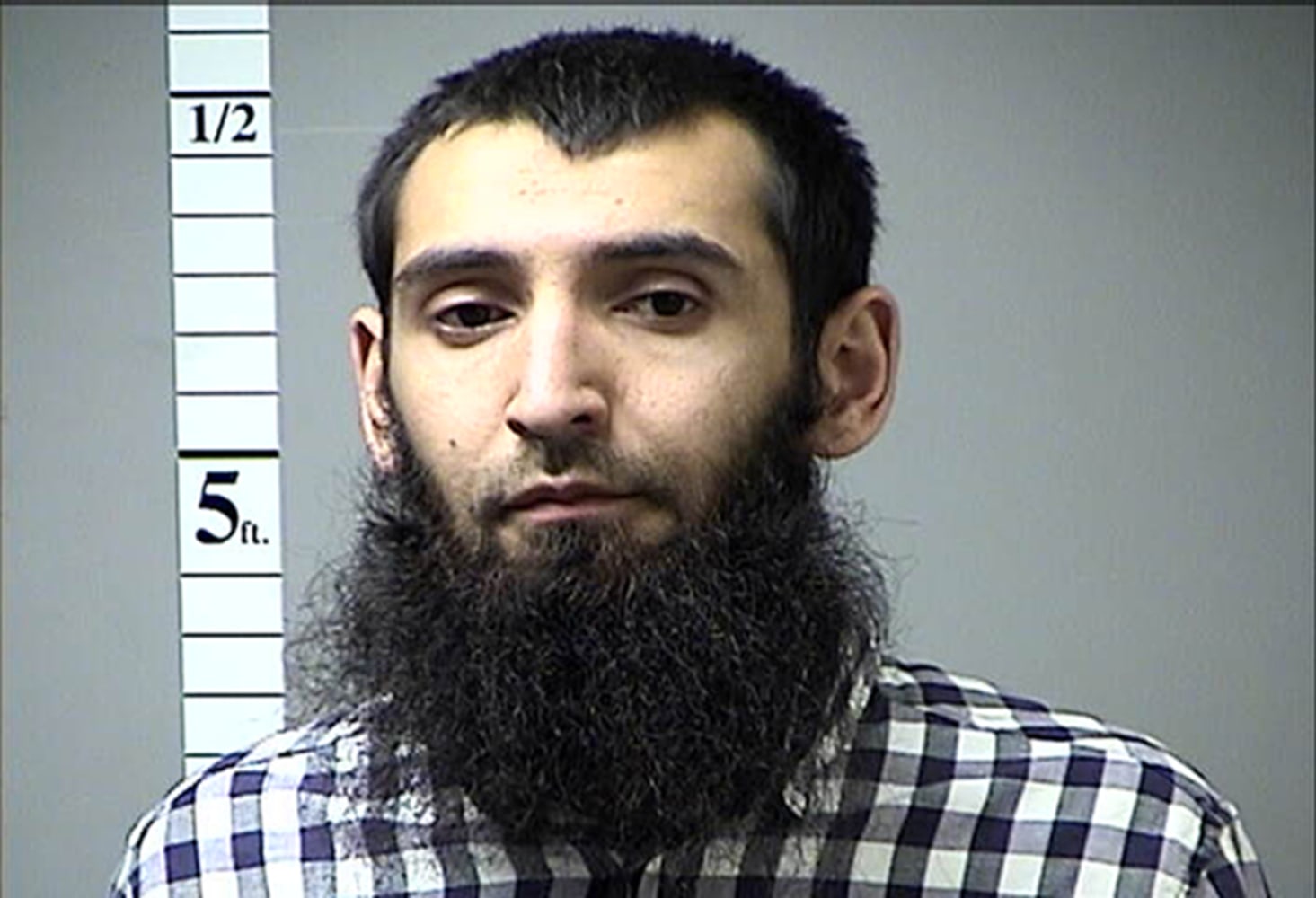
Image: Sayfullo Habibullaevic Saipov
Sayfullo Habibullaevic Saipov. St. Charles, Missouri, Corrections Department


It is plain to see that prelates, politicians and journalists are falling all over themselves to avoid being accused of islamophobia by refusing to identify the Muslim guilty of the atrocity in New York City yesterday as a “Muslim terrorist.”

So I offer the following solution to these cowards.

Simply call the terrorist a “Follower of Mohammed, The Terrorist” avoiding any reference to race, religion or national identity or his role as a prophet.  Before all else  Mohammed was a terrorist.

  • Abyssum
Posted in Uncategorized | 1 Comment

ARCHBISHOP ROBERT CARLSON SHOULD REJOICE THAT IN HIS ARCHDIOCESE THERE ARE CATHOLICS WITH REAL COURAGE, WOULD THAT EVERY DIOCESE WERE SO BLESSED


Saint Louis Catholic


Posted: 31 Oct 2017 12:06 PM PDT
[Luther] has now been declared a heretic; and so also others, whatever their authority and rank, who have cared nought of their own salvation but publicly and in all men’s eyes become followers of Martin’s pernicious and heretical sect, and given him openly and publicly their help, counsel and favour, encouraging him in their midst in his disobedience and obstinacy, or hindering the publication of our said missive: such men have incurred the punishments set out in that missive, and are to be treated rightfully as heretics and avoided by all faithful Christians, as the Apostle says (Titus iii. 10-11).
Our purpose is that such men should rightfully be ranked with Martin and other accursed heretics and excommunicates, and that even as they have ranged themselves with the obstinacy in sinning of the said Martin, they shall likewise share his punishments and his name, by bearing with them everywhere the title “Lutheran” and the punishments it incurs.
 
–from Decet Romanum Pontificem, Papal Bull of Excommunication of Martin Luther, Pope Leo X, 1521.

Posted in Uncategorized | 2 Comments

IF IT IS POSSIBLE TO BE HAPPY IN HELL, MARGARET SANGER IS HAPPY IN HELL BECAUSE PLANNED PARENTHOOD WHICH SHE FOUNDED FOR RACIST REASONS IS SUCCEEDING IN KILLING BLACK BABIES AT A RATE HIGHER THAN THE RATE OF LIVE BIRTHS

Planned Parenthood Encourages ‘Black Women in America’ To Choose Abortion Over Pregnancy

Jennifer Graylock/WireImage

On Tuesday, just in time for Halloween, the Planned Parenthood 501(c)4 “Black Community” account tweeted out this delightful thought:


If you’re a Black woman in America, it’s statistically safer to have an abortion than to carry a pregnancy to term or give birth

In other words, that baby might kill you, so go ahead and kill it pre-emptively. Abortion advocates say that abortion is less likely to kill you than going through pregnancy and childbirth. These statistics are dicey at best — the Centers for Disease Control has stated that such statistics aren’t actually comparable, because we measure deaths per live birth, not deaths per pregnancy not terminated via abortion. Furthermore, those statistics don’t take into accountother damage via abortion, from physical to psychological.

But even by their statistics, it’s extraordinarily rare to die from pregnancy in the United States overall: the mortality rate among women “who delivered live neonates was 8.8 deaths per 100,000 live births” from 1998-2005. The mortality rate among women who induced abortion was 0.6 deaths per 100,000. But as Dr. Anne Davis, scholar of obstetrics and gynecology at the Columbia University Medical Center in New York stated, “We wouldn’t tell people, ‘Don’t have a baby because it’s safer to have an abortion’ — that’s ridiculous.”

But that’s exactly what Planned Parenthood is selling: kill your baby if you want to live. And they’re doing it specifically for minority women. Which is egregious, given the fact that there are more black babies aborted in New York City every year than born.

But at least Planned Parenthood can sleep well at night knowing that more minority babies will be thrown in waste bins. {AND MARGARET SANGER CAN BE HAPPY IN HELL, IF THAT IS POSSIBLE !!!}

Posted in Uncategorized | 1 Comment

A chronic confusion seems to mark the present pontificate.  The light of faith, hope, and love is seemingly absent, too often it is obscured by the ambiguity of Francis’ words and actions.  This fosters within the faithful a growing unease.  It compromises their capacity for love, joy and peace. 

Weinandy

Settimo Cielodi Sandro Magister

A Theologian Writes To the Pope: There Is Chaos in the Church, and You Are a Cause


[ EMPHASIS AND {COMMENTARY} IN RED TYPE BY ABYSSUM ]*

Thomas G. Weinandy is among the most eminent theologians and lives in Washington at the College of the Capuchins, the Franciscan order to which he belongs. He is a member of the international theological commission, the commission that Paul VI set up alongside the congregation for the doctrine of the faith so that it could avail itself of the cream of the crop among the world’s theologians. He has been a member of this commission since 2014, having been appointed to it by Pope Francis.

Last May, while he was in Rome for a meeting of the commission, he got the germ of the idea to write an open letter to Francis, in order to confide to him about a disquiet that is not only his own but shared by many, over the growing chaos in the Church that he saw as having been caused to a large extent by none other than the pope.

He prayed for a long time, including at the tomb of Peter. He asked Jesus to help him decide whether or not to write the letter, and to give him a sign… And the sign came the next day, identical to the one he had asked for in prayer, as he explains here:

> “There was no longer any doubt that Jesus wanted me to write…”

So bolstered by Heaven, Fr. Weinandy wrote the letter. He sent it to Pope Francis in the middle of summer. And today, on the feast of All Saints, he is making it public, on the American religious information portal Crux and right afterward in Rome, in four languages, on Settimo Cielo.

Padre Weinandy, 71, has taught at numerous universities in the United States, at Oxford for twelve years, and in Rome at the Pontifical Gregorian University.

He was for nine years the executive director of the secretariat for doctrine at the episcopal conference of the United States.

*

Your Holiness,

I write this letter with love for the Church and sincere respect for your office.  You are the Vicar of Christ on earth, the shepherd of his flock, the successor to St. Peter and so the rock upon which Christ will build his Church.  All Catholics, clergy and laity alike, are to look to you with filial loyalty and obedience grounded in truth.  The Church turns to you in a spirit of faith, with the hope that you will guide her in love.

Yet, Your Holiness, a chronic confusion seems to mark your pontificate.  The light of faith, hope, and love is not absent, but too often it is obscured by the ambiguity of your words and actions.  This fosters within the faithful a growing unease.  It compromises their capacity for love, joy and peace.  Allow me to offer a few brief examples.

First there is the disputed Chapter 8 of “Amoris Laetitia.”  I need not share my own concerns about its content.  Others, not only theologians, but also cardinals and bishops, have already done that.  The main source of concern is the manner of your teaching.  In “Amoris Laetitia,” your guidance at times seems intentionally ambiguous, thus inviting both a traditional interpretation of Catholic teaching on marriage and divorce as well as one that might imply a change in that teaching.  As you wisely note, pastors should accompany and encourage persons in irregular marriages; but ambiguity persists about what that “accompaniment” actually means.  To teach with such a seemingly intentional lack of clarity inevitably risks sinning against the Holy Spirit, the Spirit of truth.  The Holy Spirit is given to the Church, and particularly to yourself, to dispel error, not to foster it.  Moreover, only where there is truth can there be authentic love, for truth is the light that sets women and men free from the blindness of sin, a darkness that kills the life of the soul.  Yet you seem to censor and even mock those who interpret Chapter 8 of “Amoris Laetitia” in accord with Church tradition as Pharisaic stone-throwers who embody a merciless rigorism.   This kind of calumny is alien to the nature of the Petrine ministry.  Some of your advisors regrettably seem to engage in similar actions.  Such behavior gives the impression that your views cannot survive theological scrutiny, and so must be sustained by “ad hominem” arguments.

Second, too often your manner seems to demean the importance of Church doctrine.  Again and again you portray doctrine as dead and bookish, and far from the pastoral concerns of everyday life.  Your critics have been accused, in your own words, of making doctrine an ideology.  But it is precisely Christian doctrine – including the fine distinctions made with regard to central beliefs like the Trinitarian nature of God; the nature and purpose of the Church; the Incarnation; the Redemption; and the sacraments – that frees people from worldly ideologies and assures that they are actually preaching and teaching the authentic, life-giving Gospel.  Those who devalue the doctrines of the Church separate themselves from Jesus, the author of truth.  What they then possess, and can only possess, is an ideology – one that conforms to the world of sin and death.

Third, faithful Catholics can only be disconcerted by your choice of some bishops, men who seem not merely open to those who hold views counter to Christian belief but who support and even defend them.  What scandalizes believers, and even some fellow bishops, is not only your having appointed such men to be shepherds of the Church, but that you also seem silent in the face of their teaching and pastoral practice.  This weakens the zeal of the many women and men who have championed authentic Catholic teaching over long periods of time, often at the risk of their own reputations and well-being.  As a result, many of the faithful, who embody the “sensus fidelium,” are losing confidence in their supreme shepherd.

Fourth, the Church is one body, the Mystical Body of Christ, and you are commissioned by the Lord himself to promote and strengthen her unity.  But your actions and words too often seem intent on doing the opposite.  Encouraging a form of “synodality” that allows and promotes various doctrinal and moral options within the Church can only lead to more theological and pastoral confusion.  Such synodality is unwise and, in practice, works against collegial unity among bishops.

Holy Father, this brings me to my final concern.  You have often spoken about the need for transparency within the Church.  You have frequently encouraged, particularly during the two past synods, all persons, especially bishops, to speak their mind and not be fearful of what the pope may think.  But have you noticed that the majority of bishops throughout the world are remarkably silent?  Why is this?  Bishops are quick learners, and what many have learned from your pontificate is not that you are open to criticism, but that you resent it.  Many bishops are silent because they desire to be loyal to you, and so they do not express – at least publicly; privately is another matter – the concerns that your pontificate raises.  Many fear that if they speak their mind, they will be marginalized or worse.

I have often asked myself: “Why has Jesus let all of this happen?”   The only answer that comes to mind is that Jesus wants to manifest just how weak is the faith of many within the Church, even among too many of her bishops.  Ironically, your pontificate has given those who hold harmful theological and pastoral views the license and confidence to come into the light and expose their previously hidden darkness.  In recognizing this darkness, the Church will humbly need to renew herself, and so continue to grow in holiness.

Holy Father, I pray for you constantly and will continue to do so.  May the Holy Spirit lead you to the light of truth and the life of love so that you can dispel the darkness that now hides the beauty of Jesus’ Church.

Sincerely in Christ,

Thomas G. Weinandy, O.F.M., Cap.

July 31, 2017
Feast of St. Ignatius of Loyola

Posted in Uncategorized | 1 Comment

Here we stand, before an obvious example of a pope the Holy Spirit would not have picked — except, perhaps, to help bring this Modernist crisis at last to a close by exposing it for the fraudulent Christianity it is. So no, we will not be silent. We will not give in to despair. We will, like the Vendeeans before us, stand firm against overwhelming odds, shouting our battle cry: Dieu, le Roi!  God, the King!

The Temptation to Despair & The Spirit of the Vendée

OnePeterFive
Google+PinterestPocket

As I was reading through a backlog of articles and news stories in preparation to write this reflection, I received a phone call from one of my oldest friends. After referencing all that is transpiring in the Church, he asked with a nervous laugh how it is that I’ve not yet fallen into despair.

“To be honest,” I said, “I’m not sure. It’s tempting.”

On a recent visit to the confessional, I mentioned this temptation, and how it can affect my resistance to other sins. “I know it’s not an excuse, Father,” I said, “but sometimes when I look at the state of the Church, and see heretics running everything, and there are no consequences for any of it, I can’t help thinking, why do I have to follow all the rules and try so hard if they don’t?” His advice to me, among other things, was to be careful how many websites I read about what is happening in the Church, so I can avoid becoming overwhelmed. Under the anonymity of the confessional, he didn’t know who I was, and I wasn’t inclined to tell him that I’m in charge of one of those websites. And we don’t even publish half of what is newsworthy in that regard.

As I continued my conversation with my friend, I said something I’ve been saying a lot lately — to friends, to family, even to some of you who have written to me recently. “I’m seeing this despair spreading everywhere. Christ made promises about His Church, and they’re being broken. And while I think the way people are feeling is a natural consequence of that situation, I also strongly suspect that there is a profound spiritual component at work. The enemy is spreading the lie: ‘See? Look what is happening in the Church! Why do you stay? Why are you so naive that you continue to believe it could be true?’”

And then, as I was saying it, I was struck by a parallel I hadn’t considered. A week or so ago, as I was praying a decade of the rosary with my children, I decided to read a reflection on the mystery we were about to contemplate — the Agony in the Garden. The reflection was taken from Blessed Anne Catherine Emmerich’s The Dolorous Passion of Our Lord Jesus Christ, and one aspect in particular came back to me as I discussed the situation with my friend:

[Jesus] fell on his face, overwhelmed with unspeakable sorrow, and all the sins of the world displayed themselves before him, under countless forms and in all their real deformity. He took them all upon himself, and in his prayer offered his own adorable Person to the justice of his Heavenly Father, in payment for so awful a debt. But Satan, who was enthroned amid all these horrors, and even filled with diabolical joy at the sight of them, let loose his fury against Jesus, and displayed before the eyes of his soul increasingly awful visions, at the same time addressing his adorable humanity in words such as these: ‘Takest thou even this sin upon thyself? Art thou willing to bear its penalty? Art thou prepared to satisfy for all these sins?’

Satan knows better than anyone how to cause us to doubt. How to point to the deepest flaws and most egregious obstacles in even the most faithful plan, and to use them to trip up our resolve.

The Revolution Shall Not be Televised

In the midst of this weakness, in this moment of doubt, we see a growing backlash against those intrepid few who are standing firm against error in the winds that now blow through the Church. Today I read a new article by Robert Mickens, a papal fanboy and English Editor of La Croix International. Entitled, Opposition to Pope Francis: It’s time to call off the dogs, the piece seeks to break the spirit of papal critics by enlisting the Pope Emeritus to distance himself from their critiques. He is, of course, mistaken in his impression that Pope Benedict is a hero of the traditionalists — after all, it is he who left his post and in so doing, abandoned us to the wolves — but he drives home certain points worth noting.

His primary tactic is to minimize the scope of the opposition:

The good news is that, as best one can tell, those who are rowing against the current helmsman of the Barque of Peter are part of a very tiny, if noisy, minority.

The bad news is that they are mostly found among the Church’s ordained workforce – men who serve as priests and bishops.

The most recent Vatican statistics claim that there are some 1.285 billion members of the worldwide Catholic community. Among them nearly 416,000 are priests and another 5,300 are bishops – only about .03% of all baptized Catholics.

And even in this subset, the number of those who actively oppose the pope is most likely marginal. It is a minority within a minority.

It is impossible to state the exact numbers. However, we can identify certain discernible traits and trends. For example, opposition to Francis is emanating most energetically from the English-speaking world, certain parts of Europe and in areas of Africa where the pope’s critics tend to be younger (under the age of 50), doctrinally rigid and liturgically “retrodox” members of the clergy.

People in the anti-Francis camp also show tendencies toward a very narrow understanding of the application of Canon Law, a slavish devotion to liturgical rubricism and an outdated Euro-centric view of the world that is rooted in classical Greco-Roman philosophical systems.

Mickens goes on to explain that it is not only clergy who oppose the pope, but

also small groups of the baptized faithful that are also highly critical and even disparaging of him. They demonstrate similar characteristics of the rebellious clergy. They, too, tend to be younger, fundamentalists when it comes to church teaching and promoters of a pre-Vatican II liturgy and ecclesiology.

These papal critics are loud and disruptive. They are also organized and tenacious. But let’s get something straight – they are also minorities within both the clergy and the laity. [emphasis added]

His observations immediately call to mind the recent words of His Eminence Cardinal Burke, who, in recounting St. Thomas More’s opposition to King Henry VIII, said:

“In the Church now, even as then, where people argue about, ‘many people want this, and not many bishops are speaking up to correct this confused idea about the indissolubility of marriage, and that the Church has to change and so forth,’ and St. Thomas More is a sign for us that the truth never changes, and that it doesn’t matter how many people are in favor of a lie, it doesn’t make it the truth.” [emphasis added]

But Mickens, it seems, is attempting to plead with the Vatican apparatus — whom inside sources have told me have absolutely no concept of how to gauge the influence of Internet opposition — to downplay the influence of blogs and social media:

But they’ve [papal critics] made themselves seem more representative of the overall Catholic population by capitalizing on social media and using the large megaphone that cyberspace provides. In this way, they have successfully deceived far too many people (especially in the mainstream media) into believing that the Church is equally divided into two groups – one that loves Pope Francis and one that cannot stand him.

I won’t deny the truth of this statement. We are in the minority. There’s no question about that. But we are a vocal and energized minority, and I can tell you that in the past month, we’ve logged 325 visits from The Holy See — a city state with a population of only 1,000 people.

They know we are watching. And they are watching the watchers.

The Spirit of the Vendée

In a 2004 review of two books on the Vendee, Anne Barbeau Gardiner offered a succinct summary of this incredible 18th Century story:

Given the growth of militant anti-Catholicism in the West, these two books are highly recommended. The authors prepare us for what lies ahead if this juggernaut proceeds unchecked. In western France in the 1790s a similar state of affairs led to the persecution of the Church under color of law, and then when Catholic peasants in Vendée dared to resist this persecution, the ruling atheists ordered the entire population of that region to be exterminated — men, women, and children. They sent out the army in “infernal columns” to “depopulate the Vendée.” [Reynald] Secher says the minimum number of casualties is around 118,000, while [Michael] Davies thinks the number is closer to 250,000. The genocide of the Vendeans is not well known outside of France, but it truly deserves to be. It teaches a valuable lesson, that visceral hatred of Catholicism, left unchecked, can turn to genocide.

Eerily enough, those who carried out the genocide in Vendée gave glimpses of that perverse mentality later found among the Nazis. They cast women and children into ovens, made use of human skin for clothing, and burned women to collect their fat. The gruesome details of these atrocities are attested facts. Indeed, the atrocities were often recorded by agents of the government.

The suffering and death of the Catholics in Vendée was not in vain. They achieved a glorious victory. In the end, because of their heroic example, the anti-Catholic persecution of the 1790s was a failure. The Church in France was supposed to have been eradicated. Instead, she rose to new life. As Tertullian said, “the blood of martyrs is the seed of the Church.” In 1801, when Napoleon granted freedom of worship to all the Catholics of France, it was seen as the victory of the Vendée.

In a talk given this past August in the Vendée region of France, Cardinal Robert Sarah said that the Frenchmen of the Assocation of Puy du Fou — who keep the memory of the Vendeeans alive — must continue their work, because

In the face of the dictatorship of relativism, in the face of thought terrorism which – once more – wants to tear God out of the hearts of the children, we need to find again the freshness of spirit, the joyful and ardent simplicity of these saints and of these martyrs.

Sarah continued:

My brothers, we Christians need this spirit of the Vendeans! We need this example! Like them, we need to leave our sowing and our furrows in order to fight – not for mere human interests, but for God! Who still today will rise up for God? Who will dare to confront the modern persecutors of the Church? Who will have the courage to rise up without weapons except the rosary and the Sacred Heart in order to face the death columns of our time which are relativism, indifferentism, and the disdain for God?

Today, as we see our beloved Catholic Church joining in joint celebrations with Lutheran Protestants of the 500th anniversary of The Reformation — one of the most damaging events to have ever befallen mankind — we can see that the spirit of the Vendée is indeed alive and well to this day in the Church. Yesterday in Brussels, a group of young men (and one young woman) knelt in the Catholic Cathedral of St. Michael and St. Gudula to pray the rosary in protest of a service “with the United Protestant Church in Belgium, the country’s largest Protestant denomination.” They continued to pray as the pastor attempted to preach his sermon until they were physically removed by police.

You heard that correctly: Catholic young people were removed from a Catholic Cathedral for praying the rosary in protest of an ecumenical service that brought Protestants into the church to celebrate anniversary of the Reformation — and specifically, the anniversary of Martin Luther’s publication of his “95 Theses”. Recall what Pope Leo X said about Luther’s theology in his condemnation, Exsurge Domine, written in 1520:

[B]ecause the preceding errors and many others are contained in the books or writings of Martin Luther, we likewise condemn, reprobate, and reject completely the books and all the writings and sermons of the said Martin, whether in Latin or any other language, containing the said errors or any one of them; and we wish them to be regarded as utterly condemned, reprobated, and rejected. We forbid each and every one of the faithful of either sex, in virtue of holy obedience and under the above penalties to be incurred automatically, to read, assert, preach, praise, print, publish, or defend them.

And it is in this spirit that these young protesters came. It is in this spirit that they handed out a leaflet explaining the reason for their protest:

“Our Cathedral of St Michael and St Gudula is a Catholic building built by our fathers to be a House of God, for the celebration of the holy Mass, for the praise of God and the saints.

“The occupation of our cathedral by Protestants to commemorate the 500th anniversary of the Reformation is therefore a profanation.

“Indeed, the so-called Reformation was really a revolt: under the pretext of combating abuses, Luther rebelled against the divine authority of the Catholic Church, denied numerous Truths of the Faith, abolished the Sacrifice of the Mass and the Sacraments, rejected the necessity of good works and the practice of Christian virtues. Finally, he attacked the veneration of the Virgin Mary and the saints, the religious life and monastic vows.

“This terrible revolution was a great tragedy for Christian society and for the salvation of souls. And the Lutheran errors are still heresies today because the Truth is eternal.”

You can see the video of their protest here:

The group consisted of 11 young people in a cathedral where hundreds, if not thousands, were gathered to honor the memory of one of the most tragic events in all of Christendom. They were, as Robert Mickens would say, “a minority within a minority”. And yet they brought that service to a stand still. They continued praying as the organist and the congregation attempted to drown them out. And in virtue of their protest ending in forcible removal from the church at the hands of the police, it was their story — their message — and not that of the celebrators of the Reformation that caught international attention.

Dieu, le Roi!

Mickens hints, in his attack on faithful protesters, that a central problem is their attachment to the Church’s ancient liturgy:

Most of the opposition to Pope Francis is coming from Catholics who are devoted to celebrating the Tridentine Mass. And many of them are from fringe groups that Benedict, first as a cardinal and then as pope, moved persistently to bring into the mainstream of the Church.

His most monumental act was to issue a papal “motu proprio” in 2007 to normalize the pre-Vatican II liturgy. He said part of the reason he did so was to bring about “an interior reconciliation at the heart of the Church”. Francis has shown no attachment to the Old Mass, but he has done nothing to restrict it.

Members of these reconciled groups of Tridentine Mass enthusiasts, however, have betrayed Benedict’s intention to “regain reconciliation and unity” in a divided Church. And, instead, by their attacks on the current pope, they have intensified the divisions.

Mickens isn’t the first to make such comments about the liturgy in recent days, and I take them as a threat. But as Pope Benedict told us, the ancient Mass was never abrogated, and “What earlier generations held as sacred, remains sacred and great for us too, and it cannot be all of a sudden entirely forbidden or even considered harmful.”

Mickens goes on to say that Benedict should “break his silence once more” and remind the critics of Francis — as he said to the cardinals upon his resignation in 2013 — to “be completely docile to the action of the Holy Spirit in the election of the new pope”.

But as we all know, the Holy Spirit does not choose the pope. Ratzinger himself once admitted before his own election to the papacy, when he said:

“I would not say so, in the sense that the Holy Spirit picks out the Pope…I would say that the Spirit does not exactly take control of the affair, but rather like a good educator, as it were, leaves us much space, much freedom, without entirely abandoning us. Thus the Spirit’s role should be understood in a much more elastic sense, not that he dictates the candidate for whom one must vote. Probably the only assurance he offers is that the thing cannot be totally ruined.”

He continued:

There are too many contrary instances of popes the Holy Spirit obviously would not have picked!

And here we stand, before an obvious example of a pope the Holy Spirit would not have picked — except, perhaps, to help bring this Modernist crisis at last to a close by exposing it for the fraudulent Christianity it is. So no, we will not be silent. We will not give in to despair. We will, like the Vendeeans before us, stand firm against overwhelming odds, shouting our battle cry: Dieu, le Roi!  God, the King!

Print Friendly, PDF & Email
Posted in Uncategorized | 2 Comments

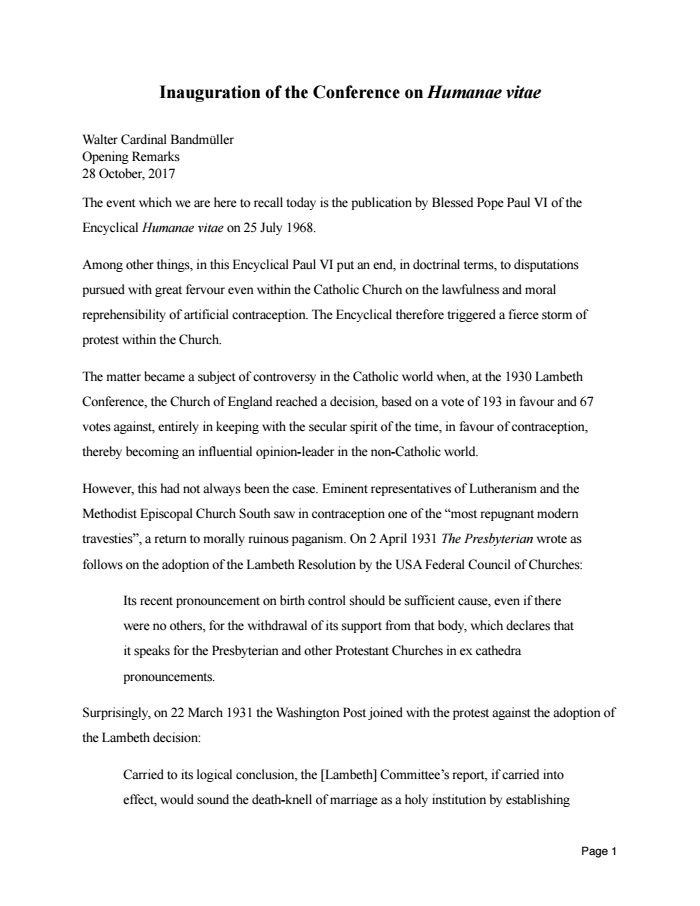
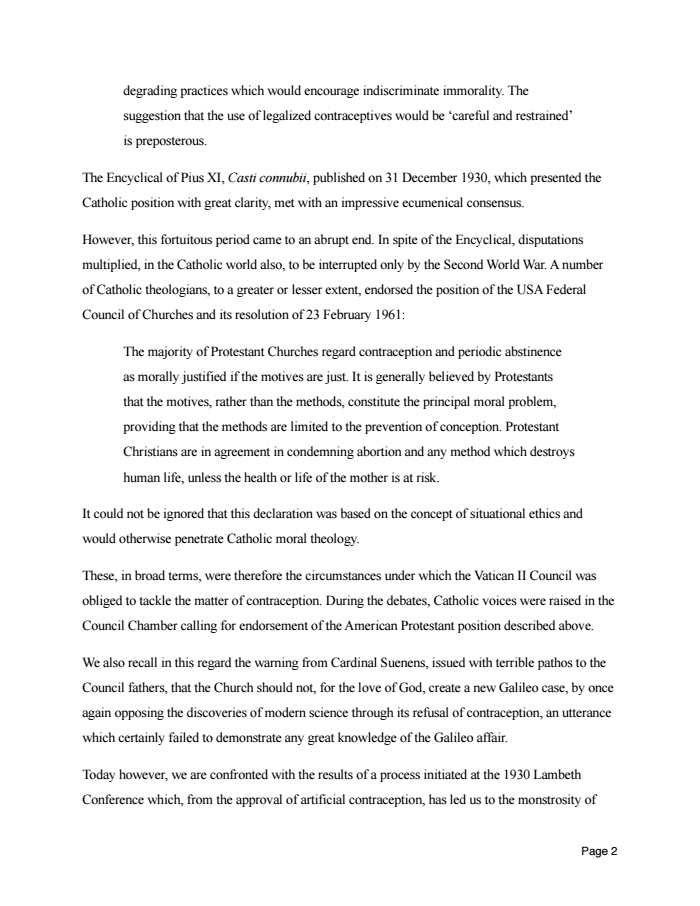
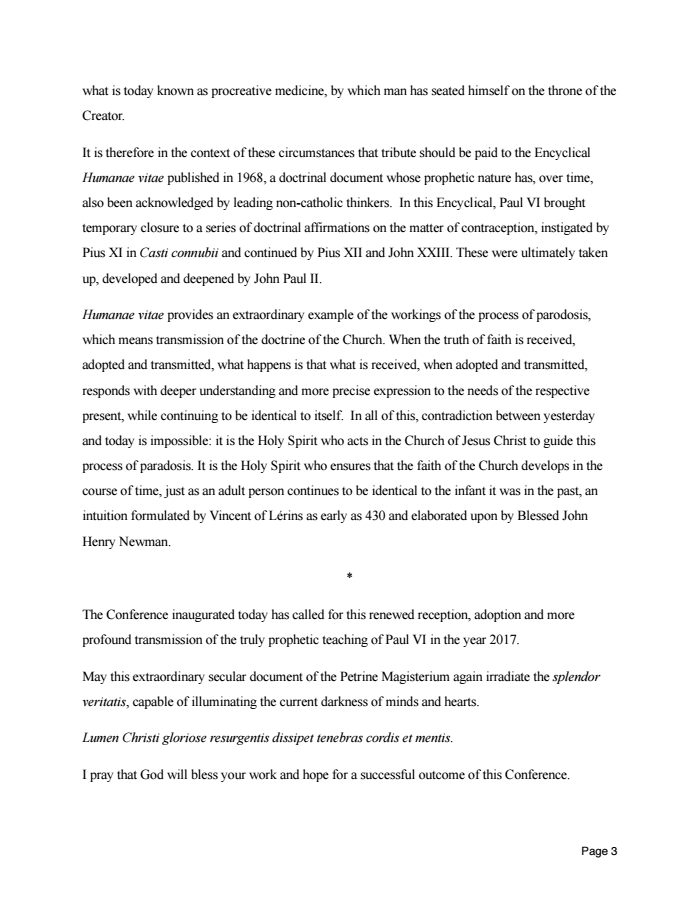
Cardinal Brandmüller says that it is “impossible” for the Catholic Church to change it’s teaching in Humanae Vitae, what he referred to as a “doctrinal document” that was “truly prophetic.” 

Featured Image

Cardinal Walter Brandmuller Jan Bentz / LifeSiteNews
Pete BaklinskiPete Baklinski

NEWS,

It’s ‘impossible’ to change Catholic teaching against contraception: Cardinal

ROME, October 28, 2017 (LifeSiteNews) — The Church’s teaching against contraception as expressed in Humanae Vitae is an “extraordinary example” of how the “truth of faith” deepens and develops while “continuing to be identical to itself,” Cardinal Walter Brandmüller stated at a conference in Rome today.

Brandmüller made his remarks as he opened a conference titled Humanae Vitae at 50: Setting the Context that was organized by Voice of the Family. The conference took place at the Pontifical University of St. Thomas Aquinas.

Image
Cardinal Brandmüller addressing the ‘Humanae Vitae at 50’ conference in Rome, Oct. 28, 2017. Diane Montagna / LifeSiteNews

German Cardinal Brandmüller is a world renowned-scholar of church history, having published numerous books on the Crusades, the Spanish Inquisition, and the Reformation. He holds a doctorate in theology and is the former President of the Pontifical Commission for Historical Sciences. He is one of the four Cardinals who signed the dubia [questions] to Pope Francis asking if the Pope’s 2016 exhortation Amoris Laetitia conforms to perennial Catholic teaching.

Pope Paul VI’s Encyclical Humanae Vitae [Of Human Life] celebrates its 50th anniversary next year. Catholic academics including Josef Seifert and Father George Woodall have outlined how Pope Francis’s teaching on marriage and family, especially as expressed in Amoris Laetitia [Joy of Love], could be used to overturn Catholic teaching against contraception.

Brandmüller told conference attendees that it is “impossible” for the Catholic Church to change it’s teaching in Humanae Vitae, what he referred to as a “doctrinal document” that was “truly prophetic.”

The Encyclical states that “each and every marriage act must remain open to the transmission of human life” and calls the use of contraception (including the pill, condom, withdrawal, and other methods) “intrinsically wrong.”

“Humanae Vitae provides an extraordinary example of the workings of the process of parodosis, which means transmission of the doctrine of the Church. When the truth of faith is received, adopted and transmitted, what happens is that what is received, when adopted and transmitted, responds with deeper understanding and more precise expression to the needs of the respective present, while continuing to be identical to itself,” he said.

“In all of this, contradiction between yesterday and today is impossible: it is the Holy Spirit who acts in the Church of Jesus Christ to guide this process of paradosis. It is the Holy Spirit who ensures that the faith of the Church develops in the course of time, just as an adult person continues to be identical to the infant it was in the past, an intuition formulated by Vincent of Lérins as early as 430 and elaborated upon by Blessed John Henry Newman,” he added.

The Cardinal said that the Catholic Church must withstand pressures from Protestant churches and from the world that want to see the Church use “situation ethics” to accept contraception as morally legitimate.

Instead, he said, “tribute should be paid” to the “doctrinal document whose prophetic nature has, over time, also been acknowledged by leading non-catholic thinkers.”

“In this Encyclical, Paul VI brought temporary closure to a series of doctrinal affirmations on the matter of contraception, instigated by Pius XI in Casti connubiiand continued by Pius XII and John XXIII. These were ultimately taken up, developed and deepened by John Paul II,” he said.

“The Conference inaugurated today has called for this renewed reception, adoption and more profound transmission of the truly prophetic teaching of Paul VI in the year 2017,” he added.

Brandmüller’s full address.

DOCUMENT
PAGES
Zoom

Posted in Uncategorized | 1 Comment

There have been credible reports that large numbers of Muslims have been quietly  (for good reason) converting to the true religion of “peace” which is Christianity. Francis strongly opposes proselytism or actively leading non-Christians to experience the profound, life-changing gifts that come from giving one’s life to Jesus Christ and his true Church.

Featured Image

Robert Spencer (right) meeting with Secretary-General of World Muslim Leagues linked to financing Jihad terror

STEVE JALSEVAC

BLOGS,

Pope Francis is ‘the Pope of Islam’: Islam expert

October 28, 2017 (LifeSiteNews) – Before anyone starts accusing Lifesite of “attacking the Pope” for presenting this video and article, let me provide context. Also, I must add that the opinions expressed in the video are those of Robert Spencer. They do not necessarily represent the views of LifeSiteNews.

However,  Spencer is no “Islamophobe” or hater of Muslims or of Pope Francis and the Catholic Church. He is a Christian who was a Eastern Melkite Catholic, but has recently converted to Eastern Orthodoxy.

More than that, however, Father John McLosky has written in the National Catholic Register that Robert Spencer is “perhaps the foremost Catholic expert on Islam” in the United States and he has written in many Catholic and non-Catholic Christian publications and programs. Therefore, what Robert Spencer has to say in relation to Islam should at least be given serious consideration.

Robert Spencer presents well-researched, verifiable facts to help readers and listeners learn the truth about the great danger of Islamic jihadists and Sharia Law to the world. There is incredible ignorance and naivete about this in the West. Spencer has been attempting, at great risk to his own personal safety, to remedy that lack of public awareness on rapidly expanding, diabolical Islamist Jihadism.

In the case of this video, Spencer calmly presents legitimate concerns about what he believes would be the logical implications or real world perceptions by Islamists of Pope Francis’ statements and actions regarding Islam and the unchecked massive invasion of Islamist young men into non-Islamic nations. Given how deeply he is immersed every day in reporting on Islamist mass slaughters, violations of women and children and many other Jihadist depravities, it is no wonder that Spencer can seem rather harsh or blunt when discussing the pope and Islamism.

A must-read is the “About Robert Spencer” page on his Jihad Watch website which Spencer describes as “an attempt to raise awareness about the activities of the global jihadists.”

Spencer does not condemn all Muslims. On the contrary, as noted in Wikipedia,

“Spencer does not believe that traditional Islam is “inherently terroristic” but says he can prove that “traditional Islam contains violent and supremacist elements”, and that “its various schools unanimously teach warfare against and the subjugation of unbelievers”.[16] However, he rejects the notion that all Muslims are necessarily violent people.[16] He has said that among moderate Muslims, “there are some who are genuinely trying to frame a theory and practice of Islam that will allow for peaceful coexistence with unbelievers as equals.”

The Robert Spender About page presents a very impressive, lengthy list of his past, high-level U.S. Military and government consulting and speaking engagements. Also listed are the numerous mainstream publications which have publiched articles by him and a long list of mainstream media on which he has appeared.

Here is just one paragraph,

Spencer has led seminars on Islam and jihad for the FBI, the United States Central Command, United States Army Command and General Staff College, the U.S. Army’s Asymmetric Warfare Group, the Joint Terrorism Task Force (JTTF), the Justice Department’s Anti-Terrorism Advisory Council and the U.S. intelligence community. He has discussed jihad, Islam, and terrorism at a workshop sponsored by the U.S. State Department and the German Foreign Ministry. He is a consultant with the Center for Security Policy.

To provide more necessary context for Spencer’s comments in this video, I have also added a series of past LifeSite articles, also based on credible research. The emphasis is on facts, not bias, prejudice or unjust discrimination.

Considering how rapidly violent Jihadism has been spreading in the world and into Europe and North America, it is crucial that LifeSite readers take the time to become aware of this information. Ignorance of the realities of Islam could lead to catastrophic loss of freedoms and even of many lives in Western nations.  Moderate, Sharia opposing Muslims, would be threatened at least as much as non-Muslims who refuse to “submit” to the jihadists.

I add a caution not to condemn all Muslims, as some have wrongly been prone to do. That kneejerk reaction can only create enemies of those who would much rather be allies in efforts to reform Islam.

There are many Muslims who have fled oppressive, authoritarian and backward Islamist nations. They have sought to raise their families within the freedom, safety and opportunities of the nations to which they emigrated.

Not only must we not lump them in with the violent Islamists, they need our friendship and help to resist the intimidation and threats they often experience from Jihadist Muslims who are also moving into the nations to which they fled.

Lastly, there have been credible reports that large numbers of Muslims have been quietly  (for good reason) converting to the true religion of “peace” which is Christianity. Francis strongly opposes proselytism or actively leading non-Christians to experience the profound, life-changing gifts that come from giving one’s life to Jesus Christ and his true Church.

This is apparently quietly happening in very large numbers thanks to the loving evangelizing efforts of courageous Catholic and non-Catholic Christians relying on the power and grace of the Holy Spirit. That will be the ultimate solution to the world-threatening surge of militant Islam.

Posted in Uncategorized | Comments Off on There have been credible reports that large numbers of Muslims have been quietly  (for good reason) converting to the true religion of “peace” which is Christianity. Francis strongly opposes proselytism or actively leading non-Christians to experience the profound, life-changing gifts that come from giving one’s life to Jesus Christ and his true Church.

A ‘palace revolution’ occurred in Rome in 2013 that has sent earthquake tremors throughout the worldwide Church and has seriously altered the way in which the Magisterium is functioning in practice. To put it simply, the Vatican scenario in 1990 was the time-honored one in which the chief exponents of the Church’s teaching office, the Pope and the CDF, were the conservatives, and those resisting their strictures were the innovators. Now, the tables have been turned so dramatically that the supreme teaching office itself is in the hands of an energetic and authoritarian innovator!

Featured Image
Shutterstock.com
Diane Montagna

NEWS

It’s not ‘dissent’ to criticize ‘confusing cascade of papal novelties’: theologian

Theologian Fr. Brian Harrison responds to critics of the Filial Correction and provides guidelines to help Catholics navigate Pope Francis’ challenging papacy.

ROME, October 31, 2017 (LifeSiteNews) — Earlier this year, a group of over 60 scholars issued an almost unprecedented ‘filial correction’ to Pope Francis, charging him with permitting the spread of seven heresies. This measure, unseen since the fourteenth century, has generated controversy around the world, while the number of signatories has risen to 250 professors and priests since it was made public on September 24.

Some writers, however, have accused the signatories of the Filial Correction of transgressing the requirement of a 1990 document of the Congregation for the Doctrine of the Faith — Donum Veritatis — which lays down the circumstances in which scholars might legitimately draw the attention of the Holy See to “deficiencies” in an official teaching document. On this basis, these critics accuse the authors and signatories of the Filial Correction of being ‘dissenters.’

We spoke to renowned theologian Father Brian Harrison, who himself declined to sign the Filial Correction, about the merits of this accusation. In this interview, Fr. Harrison says he is far from convinced such accusations are legitimate. He says they betray a conception of the doctrine of papal infallibility that “exaggerates to the point of absurdity the authority of papal pronouncements,” and maintains that contemporary theologians are faced with an almost unprecedented “nightmare” situation (wholly unforeseen in 1990) in which “an energetic and authoritarian innovator” has taken possession of the throne of St. Peter.

Here below is our interview with Fr. Harrison.

LifeSite: Fr. Harrison, can you please explain to our readers the nature and purpose of Donum Veritatis? Can you offer an example of a prominent case of theologians dissenting from Magisterial teaching that DV would address? Would it have applied to the dissenting response to Humanae Vitae, for instance?

Fr. Harrison: Yes, it certainly did apply to that, and to other widespread dissent from Catholic doctrines.

The Instruction ​Donum Veritatis was published by the Congregation for the Doctrine of the Faith (CDF) in 1990 with the general purpose of explaining the relationship between the theologian’s vocation and the role of the Magisterium; but the particular historical context in which it was issued is very important in understanding and applying its more specific norms. The two decades following Humanae Vitae (1968) witnessed an outburst of sustained dissent against the Church’s perennial teaching about human life and sexuality from very prominent theologians such as Charles Curran, Richard McCormick, Bernard Haering, Joseph Fuchs, and many others. They wanted the Church’s perennial teaching to change substantially so as to admit not only unnatural birth control, but also, at least in some cases, direct sterilization, masturbation, homosexual acts, pre-marital sex, women’s ordination, and Communion for divorced and invalidly remarried Catholics. At a more basic level, these dissident theologians were denying the very existence of intrinsically evil acts — acts that can never be justified under any circumstances — and pushing for the replacement of this fundamental doctrine by the pernicious alternatives known as consequentialism and proportionalism. These challenges led to a series of strong responses from the CDF under Paul VI and John Paul II, and then the latter’s encyclicals Veritatis Splendor and Evangelium Vitae in the 1990s.

Does a Catholic have to give religious submission of mind and will to the teachings of his diocesan bishop?

Vatican Council II answers this question affirmatively in Lumen Gentium #25, but the preceding sentence makes it clear that this presupposes that the diocesan bishop is “teaching in communion with the Roman Pontiff.”

But a diocesan bishop can err?

Certainly, and in the event that his teaching is at variance with the papal magisterium, then according to Vatican II it does not require this religious submission of mind and will. In earlier times when there was mass illiteracy, few or no newspapers, and no radio, television or internet, this norm of submission to the local bishop’s teaching probably had greater practical relevance than it does today, because he was the only representative of the magisterium to whose teaching most Catholics had access — usually via their parish priest. But today, except in very poor countries, Catholics can readily find out with their smart-phones or lap-tops, and from the Catechism of the Catholic Church, what the Roman Pontiff himself teaches about almost any given doctrinal issue.

So religious submission of mind and will does not in itself presuppose the soundness of the teaching in question?

It does presuppose that the teaching is sound — or at least, very probably sound. But as I’ve said, the duty of submission simply doesn’t apply in regard to a particular doctrinal issue on which one’s diocesan bishop is himself not “teaching in communion with the Roman Pontiff.” (Actually, very few bishops openly and explicitly teach heterodox doctrine. If they are dissenters they are much more likely to undermine orthodoxy indirectly, by failing to teach it clearly, failing to correct abuses, promoting dissenters to key positions, firing or marginalizing those who are outspokenly orthodox, and screening out orthodox candidates for the priesthood on the pretext of their alleged “rigidity”.)

But what should a Catholic do if the Roman Pontiff himself teaches something contrary to sound doctrine? Is that even possible?

It is possible, but throughout most of church history it has been rare. The famous examples of Pope Honorius’ letter supporting the Monothelite heresy and John XXII’s homilies teaching an error about the beatific vision were often quoted as evidence that not everything popes say about faith and morals is infallible. But unfortunately, Pope Francis has already in his first four years made many statements that do not sit well with the doctrine of his predecessors — for instance, his recent speeches and letters asserting that capital punishment is as such always “a mortal sin,” and is “in itself contrary to the Gospel.”

This confusing cascade of papal novelties is of course the context of the Filial Correction we’re discussing in this interview. Fortunately, the magisterium itself gives us some helpful guidelines in evaluating the greater or lesser degree of authority of different papal statements on faith and morals (which sometimes are basically just expressions of opinion). Vatican II says that in order to understand the mind and intention of the Pope, we have to take into account “the character of the documents in question, the frequency with which a certain doctrine is proposed, and the manner in which the doctrine is formulated” (Lumen Gentium, 25). So, for instance, when Pope Francis said in an airplane interview that a husband may use a condom to prevent the transmission of the Zika virus to his wife, that kind of spontaneous, informal comment cannot override our duty to assent to the much more authoritative contrary teaching of the encyclical Humanae Vitae, wherein Paul VI teaches that each and every marriage act “must per se be open to the transmission of life” (no. 11).

What do you think of the claim made in the recent article by Emmett O’Regan that Donum Veritatis “illegitimatizes” the Filial Correction?

First, I should mention that although I was invited to sign the Filial Correction (FC) addressed to Pope Francis in response to Amoris Laetitia, I declined to do so. For while I agree for the most part with FC’s content, and am happy that its authors’ cri-de-coeur has rapidly gained worldwide attention, I think some of their complaints about the Holy Father’s words, deeds and omissions are overstated and not entirely fair. If Mr. O’Regan, in the October 3 Vatican Insider posting you refer to, had limited himself to pointing out such defects in FC, I would have no quarrel with him. However, he goes much further, and brings charges against the authors that I think are not well-founded.

For instance, he exaggerates to the point of absurdity the authority of papal pronouncements which, like Amoris Laetitia, do not contain any ex cathedra(infallible) definition. He accuses the FC authors of denying “one of the essential truths behind the teaching authority of the Roman Pontiff, who is granted Divine assistance which prevents him from erring in matters of faith and morals, even when teaching non-infallibly.” The words I have italicized in that sentence are not found in the relevant magisterial documents (cf. Donum Veritatis, #17, Catechism of the Catholic Church, #892). By adding them, Mr. O’Regan in effect makes the nonsensical, self-contradictory claim that when popes speak about faith and morals, they teach infallibly even when they teach non-infallibly. In fact, the limited “Divine assistance” given to the pope in his non-infallible ordinary magisterium does not necessarily “prevent” him from erring; it only makes it very unlikely that he will err. That’s precisely why such teaching requires only a “religious assent of mind and will,” and not the absolute, irrevocable assent due to infallible teaching.

In the same article, Mr. Emmett argues that: “Since the authors of the Filial Correction have turned directly to the mass media in order to present their dissent to Amoris Laetitia (which is part of the Ordinary Magisterium of Pope Francis), this action was made in direct contravention of the guidelines for dissenting theologians outlaid in Donum Veritatis (DV), and should therefore be considered illicit.” However, the authors did not turn directly to the Mass media, but delivered the Filial Correction to the Pope’s residence at Santa Marta on August 11, 2017. Did their act contravene the guidelines for dissenting theologians outlaid in DV?

You’re right that the FC authors didn’t “directly,” in the sense of “immediately,” post their submission on the Internet. But they eventually took that step, thereby opening the FC up for mass media publicity. And I think that’s the main thing that Mr. O’Regan thinks “illegitimizes” their action. Dr. Robert Fastiggi, an old friend of mine, and Dawn Eden Goldstein (whom I have also met, and admire) have co-authored another critique of the FC that makes much the same claim. But whether these and other like-minded critics are substantially right will I think depend on further considerations, notably, whether the FC authors can be fairly called “dissenters,” and just how relevant and applicable DV is to the kind of submission they have made now, in 2017, in a very different historical and ecclesial context to the one in which DV was promulgated more than a quarter-century ago.

Can you say a little more, then, about that original purpose of Donum Veritatis?

This CDF document reaffirms some well-known doctrinal teachings about faith and reason, and the authority of the magisterium; but I understand its primary purpose to be that of providing pastoral, prudential norms as to how Catholic theologians, in carrying out their scholarly role, should – and should not – interact with the Church’s pastors, who are her official teachers. DV neither enacts new legislation nor hands down new doctrinal decisions on points of faith and morals.

As regards its historical context, you’ve raised the question as to how much its disciplinary norms are applicable to the Filial Correction in a new situation that has arisen twenty-five years later. Can you elaborate on this?

Well, as I mentioned at the beginning of this interview, DV came out in response to the post-Vatican II epidemic of dissent against many authentic or even infallible Catholic doctrines, especially moral teachings. And that context has influenced the content of the document and the assumptions that underlie it. Again and again DV makes clear the CDF’s fundamental, ‘goes-without-saying’ premise the that teachings of the popes and bishops at that time (1990) are, as always, in continuity with what has been handed down from the past, while the divergent theological opinions it is concerned about are not. On the contrary, the latter are avowedly innovative in nature – they’re prodding the Church to “correct” her “outdated” doctrine in line with supposed modern ‘insights’ and public opinion.

Can you quote some examples of that from DV?

Sure, there are plenty of them. I’ll place in italics the words that bring out the way in which the CDF takes for granted that those teaching with magisterial authority are upholding Catholic tradition while the theologians causing concern are advocates of novelty and change:

  • In article 11 we read that theologians must offer the People of God “a teaching which in no way does harm to the doctrine of the faith. . . . Thus, while the theologian might often feel the urge to be daring in his work, this will not bear fruit or ‘edify’ unless it is accompanied by that patience which permits maturation to occur.”
  • Theology is “a rational discipline whose object is given by Revelation, handed on and interpreted in the Church under the authority of the Magisterium” (art. 12).
  • (The following opening sentence in DV’s section on the role of the Magisterium cites Vatican II’s Constitution on Divine Revelation): “God graciously arranged that the things he had once revealed for the salvation of all peoples should remain in their entirety, throughout the ages, and be transmitted to all generations” (art. 13, citing Dei Verbum, 7).
  • “By its nature, the [Magisterium has the] task of religiously guarding and loyally expounding the deposit of divine Revelation (in all its integrity and purity)” (art. 16).
  • “The pastoral task of the Magisterium is one of vigilance. It seeks to ensure that the People of God remain in the truth which sets free” (art. 20).
  • “The living Magisterium of the Church and theology, while having different gifts and functions, ultimately have the same goal: preserving the People of God in the truth which sets free” (art. 20).
  • In rebuking “public opposition to the Magisterium of the Church, also called ‘dissent’,” DV identifies as one of its major contributing factors “the ideology of philosophical liberalism, which permeates the thinking of our age…. [and according to which] freedom of thought comes to oppose the authority of tradition which is considered a cause of servitude. A teaching handed on and generally received is a priori suspect and its truth contested” (art. 32).
  • “[Among dissenters] the view is particularly promoted that the Church should only express her judgment on those issues which public opinion considers important and then only by way of agreeing with it. The Magisterium, for example, could intervene in economic or social questions but ought to leave matters of conjugal and family morality to individual judgment” (art. 32).

Isn’t it true, however, that at the time DV was issued there also existed ‘anti-liberal’ dissent from certain magisterial teachings? For instance, Archbishop Lefebvre and the Society of St. Pius X were claiming that some teachings of Vatican Council II contradicted traditional doctrine.

That is certainly true, but such anti-Vatican II traditionalists are not mentioned at all in Donum Veritatis. After all, they were (and still are) a tiny minority – maybe 1% of all Catholics – while the tsunami of liberal, novelty-pushing dissent the CDF is tackling in DV had deeply permeated our theological faculties, seminaries, chanceries and catechetical programs throughout the world, and was corrupting sound faith and morals among hundreds of millions of Catholics. In any case, the CDF has always rejected accusations that some Vatican II documents and the post-conciliar liturgy are in conflict with the Church’s traditional doctrine.

So why is that historical context of DV and its overwhelmingly anti-liberal emphasis relevant for evaluating the recent Filial Correction?

I’d say it’s very relevant because, frankly, a ‘palace revolution’ occurred in Rome in 2013 that has sent earthquake tremors throughout the worldwide Church and has seriously altered the way in which the Magisterium is functioning in practice. To put it simply, the Vatican scenario in 1990 was the time-honored one in which the chief exponents of the Church’s teaching office, the Pope and the CDF, were the conservatives, and those resisting their strictures were the innovators. Now, the tables have been turned so dramatically that the supreme teaching office itself is in the hands of an energetic and authoritarian innovator! There’s no time or space here to begin citing the long and ever-growing list of Pope Francis’ anti-traditional statements, gestures and decisions that have deeply shocked so many faithful Catholics. For starters, readers can take a look here at your recent LifeSiteNews piece, the “A to Z” of concerns about the present Holy Father.

When they promulgated Donum Veritatis in 1990, St. John Paul II and then-Cardinal Ratzinger would never in their worst nightmares have dreamed that a man would soon ascend the throne of Peter who, as an archbishop, had already shown his colors by actively promoting dissent and disobedience to their magisterial insistence that Catholics living publicly in illicit sexual relationships may never be given Holy Communion. (Buenos Aires priests have testified that then-Cardinal Bergoglio authorized them to do this when celebrating Mass out in the poor ‘peripheries’ of the archdiocese.) Now, it seems to me that this radically new situation casts doubt on the present-day applicability of DV’s norm that those disagreeing with papal teaching should not make their concerns known to the mass media, as the authors of the Filial Correction have done. The time-honored principle of epikeia in Catholic moral theology allows that a norm of human law does not necessarily have to be obeyed in exceptional circumstances that were not envisaged by the legislator. Obedience to a higher law can then take precedence; and it seems to me that would include the right and duty of priests and theologians to openly defend the perennial magisterial teaching that Pope Francis’ has effectively called into question via Amoris Laetitiaand its aftermath. The FC authors themselves rightly appeal to St. Thomas Aquinas’ teaching in the Summa that subjects can and should correct their superiors even publicly when the faith itself is in danger. And c. 212 §3 of the Code of Canon Lawallows competent members of the faithful to respectfully make known their views regarding the good of the Church not only to “the sacred Pastors” but also “to others of Christ’s faithful” – which would include the public diffusion of those views.

So if, as you say, the FC authors are actually striving to defend traditional, orthodox doctrine, is it accurate to depict them, as Emmett O’Regan does, as being “dissenters”?

No, I think such criticism is inaccurate and unfair. After all, the very idea of doctrinal dissent presupposes, first, a clear teaching of the Magisterium, and secondly, an equally clear disagreement with it. But that clarity seems to me lacking, both in Pope Francis’ language in Amoris Laetitia and in one of the propositions the FC authors accuse him of “upholding” and “propagating” (they don’t say “teaching”).  I agree that those seven propositions contradict infallible Catholic doctrines (assuming that in no. 2 the word “nature” is taken to mean “grave sinfulness”) so that if Pope Francis did clearly teach them, he would be the one guilty of public dissent, not his FC critics. In any case, theirs is a sort of ‘umbrella’ complaint: they make no claim that he formally and unambiguously enunciates any of these heterodox propositions; rather, he “propagates” them “directly or indirectly” and “by words, deeds and omissions”. (My parenthetical comment in answering Q. 4 above seems relevant here.) I think for the most part this complaint is justified, though not entirely.  But while I can therefore give only give a qualified support to the FC authors’ initiative, I do think Mr. O’Regan is quite unjustified in labelling them as the kind of “dissenters” who are rebuked by Donum Veritatis.

Posted in Uncategorized | 1 Comment

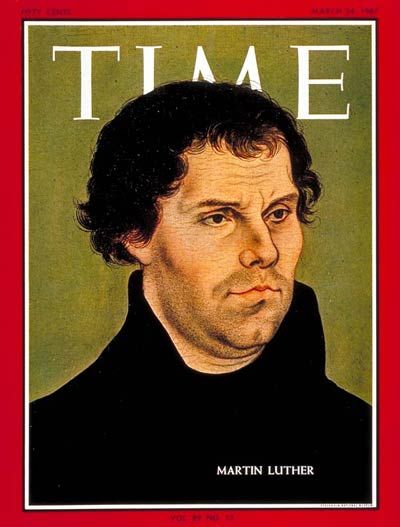
I feel some sort of ecumenical obligation today to say something nice about Martin Luther. The trouble is: it’s hard to think of anything. You don’t have to subscribe to “Young Man Luther”-style armchair Freudianism to conclude that Luther was a mess. He was arrogant, self-absorbed, self-dramatizing – and thought the world revolved around him personally because he was smarter than and spiritually superior to everyone else.


Lamenting Luther’s Reformation

Today marks the five-hundredth anniversary of Martin Luther’s (alleged) nailing of his ninety-five theses onto the church door of the castle at Wittenberg, setting off the Reformation. In 1999, Catholics and Lutherans passed the theological peace pipe, issuing a joint declaration stating that the two Christian branches actually agreed on the very point over which Luther had broken with the Catholic Church: that “justification” – that is, the forgiveness of human sins through Christ’s saving power, is attainable solely through God’s grace, not through human merit as some Catholics had argued (or seemed to argue). Then, on Oct. 19 of this year, Italian Bishop Nunzio Galantino, secretary-general of the Italian bishops’ conference, took it another step and declared that Luther wasn’t even a heretic and that the Reformation was the “work of the Holy Spirit.” Now, I wouldn’t go that far – but I feel some sort of ecumenical obligation to say something nice about Martin Luther.

The trouble is: it’s hard to think of anything. You don’t have to subscribe to Young Man Luther-style armchair Freudianism to conclude that Luther was a mess. He was arrogant, self-absorbed, self-dramatizing – and thought the world revolved around him personally because he was smarter than and spiritually superior to everyone else.

He spent his young adulthood dithering about what to do with himself (and wasting his father’s university tuition money) in an age – the late Middle Ages – when young adults couldn’t afford to dither because most of them didn’t make it much past age 40. Then, when he finally entered an Augustinian monastery (in one of his typical melodramatic gestures: You will “not ever” see me again), he wallowed in misery for a decade because he couldn’t get a guarantee that his soul would be saved – a sin against the Christian virtue of hope.

When it came to “reforming” the Church after 1517, what Luther really wanted wasn’t, say, getting rid of selling indulgence or “not ever” being seen again. Luther was seen. Everywhere: hobnobbing with powerful German princes who had beefs against the Holy Roman Emperor, helping them confiscate monasteries right and left (didn’t Luther have one single fond memory of the Augustinians he’d lived with those many years?), and viciously persecuting the Anabaptist ancestors of those nice Amish ladies who sell heirloom tomatoes at my local farmers’ market.

Luther preached sola scriptura, but he freely messed around with the Bible when it didn’t suit his theology. He inserted the word “alone” after the word “faith” into his German translation of Paul’s Letter to the Romans and tried to relegate the Letter of James to second-class status because it mentioned good works. When it came to getting married, he couldn’t just settle for a nice German burgher’s daughter. He had to marry an ex-nun, Katharina von Bora, whom he had personally lured out of her convent.

How in-your-face against the Catholic Church could you get? The two of them moved into a confiscated monastery, which was like evicting your neighbor so you could grab his house. Luther was single-handedly responsible for the wholesale destruction of priceless medieval art, as countless brand-new Lutherans gleefully whitewashed over the frescoes in their formerly Catholic churches and threw images of the saints into the fire. Fortunately, Luther wasn’t an Italian, so we still have some Giottos around.

He also had a weird scatological fixation, with quite the bathroom mouth when it came to insulting his enemies, which he did frequently because he made a lot of them. And to top it off, he was ferociously anti-Jewish. Granted, medieval Catholics were no great shakes when it came to treatment of the Jews, but at least at least none of them wrote a tract titled On the Jews and Their Lies that was one of Julius Streicher’s favorite books.

And Martin Luther did not invent the Christmas tree. He did not write “Away in a Manger.” He did, however, all but succeed in wrecking Halloween, renaming it Reformation Day. What a killjoy. Couldn’t he have nailed up those ninety-five theses on October 30 instead?

In all fairness, there actually are a few good things to be said about Martin Luther. I’m listing them here:

  • Selling indulgences really was a bad idea. If only he had stopped there.
  • He was devoted to his children. That’s nice.
  • Katharina von Bora was said to brew excellent beer – but I bet she picked up that skill in the nunnery.
  • “A Mighty Fortress Is Our God” (which Luther did write) is a terrific hymn.
  • J.S. Bach was the greatest composer who ever lived. Søren Kierkegaard was one of the greatest theologians. Dietrich Bonhoeffer was one of the noblest Christian martyrs.
  • The present-day Lutherans who have made the Midwest a bastion of social conservatism (and excellent public schools) are the salt of the earth – although those cream-of-mushroom casseroles and Jell-O salads they serve at church suppers leave something to be desired.

At this point, my Protestant and evangelical readers might be thinking that I’m simply a latter-day Father Feeney, railing indiscriminately against “our separated brethren,” as we Catholics call them nowadays. Not so. My husband is a Prot! And my hat is off to the Wesley brothers, William Wilberforce, C.S. Lewis, Billy Graham, evangelical Anglican biblical scholar N.T. Wright, and many, many other witnesses to vibrant Christian faith outside the Catholic Church. I don’t agree with their vision of what Christ’s church is or should be, but I resonate profoundly to their intense relationship with Christ himself.

I just wish the whole thing hadn’t been started by . . . Martin Luther.

Charlotte Allen holds a doctorate in medieval studies from the Catholic University of America and is the author of The Human Christ: The Search for the Historical Jesus. She is a columnist for First Things and writes regularly for the Weekly Standard, Acculturated, and the Wall Street Journal.

Charlotte Allen

Posted in Uncategorized | 3 Comments

One has to wonder why so many modern clerics are intent on drawing a moral equivalence between Christianity’s life-giving faith and Islam’s life-denying, rule-bound system. Perhaps they should read the Koran. Or, better yet, perhaps they should re-read the Gospels.

Islam: A Giant Step Backwards for Humanity

Crisis Magazine

One of the big mysteries of our day is how so many supposedly enlightened Catholics have managed to get it so wrong about Islam for so long. It’s understandable that in the 1960s, when the Islamic world was relatively quiescent, Catholics might entertain the high hopes for Islamic-Catholic relations expressed in Nostra Aetate. But this is 2017 and in the intervening half century a lot of water has passed under the bridge.

Given all that has transpired in the interim—9/11, daily terror attacks, the accelerating Islamization of Europe, and the development of nuclear weapons by Pakistan and Iran—it seems that Catholics deserve to know more about Islam than the brief treatment presented in Nostra Aetate or the even briefer treatment in the Catechism of the Catholic Church. The Catechism’s forty-four words on the subject end with the reassurance that “together with us they [Muslims] adore the one, merciful God, mankind’s judge on the last day” (842). Unfortunately, that has been interpreted by a good many clergy and laymen to mean “go back to sleep and don’t worry about a thing.” To get an idea of how nonchalant the Church leadership has been about providing guidance on Islam, consider that the Catechism devotes about five times as much space to a discussion of man’s relationship with animals than it does to the Church’s relationship with Muslims.

It’s not just that many clergy and lay Catholic leaders fail to appreciate the deep differences in theology between Islam and Christianity, they fail to grasp the deep cultural and human differences that flow from the theological differences. To put the matter bluntly, Christianity is a humanizing religion and Islam is not. That statement needs some qualifying, of course; but there is enough difference between the Christian vision of the human person and the Islamic vision, that Catholic leaders should be extremely careful before declaring common cause with Islam. The many declarations of commonality and solidarity with Islam that now routinely issue from the lips of Church leaders only serve to confuse and mislead Catholics.

Theologically, the most significant fact about Islam is that it is an anti-Christian movement. That’s one of the main themes in Nonie Darwish’s book, Wholly Different. Darwish who grew up in an Islamic society and subsequently converted to Christianity, contends that Islam is a counter-revolutionary faith: a rejection of core Bible beliefs. As she puts it:

[Muhammad] didn’t just quietly reject the Bible. Instead, he launched a ferocious rebellion against it… Islam is a negative religion, consumed with subversion. It is a rebellion and counter-revolution against the Biblical revolution.

The Biblical revolution was not only a revolution in our thinking about God, but also a revolution in our thinking about man. The most revolutionary moment occurred when God took on our humanity and became one of us. As Pope St. John Paul II observed, the Incarnation not only reveals God to man, it reveals man to himself.

In rejecting the Incarnation, Muhammad also rejected the heightened status of humanity that flows from it. This is not to say that this was his intention from the start. Islam didn’t begin as an anti-Christian theology, but it was almost inevitable that it would develop that way. Muhammad considered himself to be a prophet, and he wanted very much to be recognized as such. The trouble is that a prophet has to have a prophetic message. And, after Jesus revealed himself as the Son of God and the fulfillment of all prophecy, there wasn’t much left to say in that line.

Realizing this, Muhammad set about to retell the story of Jesus, recasting him not as the Son of God but as another—and lesser—prophet. This demotion of Jesus thus cleared the way for Muhammad’s claim to prophethood. (Faced with a similar problem, the Reverend Sun Myung Moon, the founder of the Unification Church, came up with a similar solution. In his telling, Jesus failed in his assigned task of marrying and creating a perfect family, thus leaving it up to Moon to carry out the unfinished mission.)

Jesus is in the Koran, but he has, in effect, been neutralized. He is not divine, he was not crucified nor resurrected, and he plays no role in the redemption of the human race. In fact, there is no suggestion in the Koran that mankind needs to be redeemed. One has to believe in Allah and his messenger (Muhammad) and obey Allah and his Messenger, and Allah will probably (there is no certainty) admit him to paradise. But one does not have to be born again.

We talk about “radical” Islam, but, in a sense, there is nothing radical about Islam. It does not require a radical transformation of the self as does Christianity. In Islam, man is not made in the image of God. Consequently, there is no call to holiness, no requirement that “you … must be perfect, as your heavenly Father is perfect” (Mt. 5:48). The radical transformation in Christ which prepares one for communion with God is not necessary since man’s destiny is not union with God, but union with maidens in paradise. There is no need of spiritual transformation because heaven is simply a better version of earth.

That’s one way of looking at human destiny. But the Christian view is altogether different. Saint Paul wrote “we … are being changed into his likeness from one degree of glory to another” (2 Cor. 3:18), and “though our outer nature is wasting away, our inner nature is being renewed everyday … preparing us for an eternal weight of glory beyond all comparison” (2 Cor. 4:16-17). Whatever one may think of the truth of the Christian message, the message is that humans have a very high calling. The difference between this vision of man and the rather low estimate of human potential contained in the Koran is profound. It’s a wonder that so many Catholics are willing to dilute that vision for the sake of creating an illusory moral parity with Islam.

Islam’s lack of interest in human transformation begins with the lack of human interest in the Koran. Although it was composed some 600 years after the Gospels, it contains none of the drama of the Gospels—no divine drama and no human drama. Instead, it is a collection of disconnected statements, warnings, and curses, interspersed with Muhammad’s own versions of stories borrowed from the Bible.

Even when he retells these stories, Muhammad seems largely incapable of infusing the prophets and heroes of the Bible with personality. Indeed, the only character in the Koran that Muhammad seems truly interested in is himself. In order to emphasize his humility, Islamic apologists like to say that Muhammad is only mentioned four times in the Koran. I haven’t counted but that seems about right. Nevertheless, Muhammad manages to mention himself on nearly every page—sometimes as the “Messenger,” sometimes as the “Apostle,” sometimes as the “Prophet,” and nearly always as the indispensable intermediary between Allah and men. This repeated emphasis on his role as a prophet is also found in the hadith collections. For example, “I have been sent to all mankind and the line of the prophets is closed with me” (Sahih Muslim, book 004, number 1062).

Other than Allah, Muhammad is the main person of interest in the Koran. Which brings us back to the place of Jesus in the Koran. The truth is, he plays only a minor role. He is mentioned as one of the prophets on several occasions, and on a few other occasions he is given some lines to speak. On one of these occasions he assures Allah that he did not ever claim to be God: “I could never have claimed what I have no right to” (5:116).

Jesus has a place in the Koran, but only because he knows his place. His role is to remove the main obstacle to Muhammad’s claim of prophethood. Who better than Jesus to renounce Jesus’ claim to Sonship and thereby clear the way for Muhammad to be the seal of the prophets?

But, in stripping Jesus of his divinity, Muhammad also managed to strip him of his humanity. The Jesus of the Koran is simply not an interesting person. Indeed he hardly qualifies as a person. He seems more like a disembodied voice. When Christians hear that Jesus is in the Koran, they assume that he must be someone like the Jesus of the Gospels. Thus they can reassure themselves that although Muslims don’t accept Christ’s divinity, they will at least become familiar with his life. Anyone who bothers to read the Koran, however, will be quickly disabused of that notion. There is no life of Jesus in the Koran. There is no slightly altered version of the gospel story. Indeed, there is no story at all—just a few brief appearances in order to make the point that Jesus is only a man, not the Son of God.

This abbreviated treatment of Jesus in the Koran is matched by a diminished view of the human person. In Islam, man is little more than a slave of Allah. He can achieve paradise, but paradise is essentially a heavenly harem. According to the Christian vision, man’s destiny is union with God. According to the Islamic vision, man’s destiny is to copulate.

In rejecting the Christian doctrine of the Incarnation, Muhammad also rejected the Christian vision of a redeemed humanity. The fact of the Incarnation raised the status of man immeasurably—“no longer a slave but a son, and if a son then an heir” (Gal. 4:7). That’s why Christmas carols are so full of joy. As one hymn reminds us, the night of our Savior’s birth becomes the moment at which “the soul felt its worth.” Thanks to Muhammad’s dismal vision, however, all this is missing in Islam—no “joy to the world,” no “hark the herald angels sing,” no “ding-dong merrily on high.”

In light of the comparative bleakness of the Islamic vision, it is difficult to understand why so many Catholic prelates and theologians insist on identifying Islam as a fellow faith with which we have much in common. Likewise, it’s not easy to comprehend why so many of them want to declare their solidarity with Islam.

Theologically and humanly, Islam represents a giant step backwards. It would take us back to a time when the idea of human dignity was considered laughable—to a time when slavery was unremarkable and women were valued less than men and sometimes less than animals.

In a sense, Muhammad’s rejection of the Incarnation is a replay of a primal story. In Milton’s Paradise Lost, Lucifer’s rebellion is brought on by God’s announcement that he had begotten a Son. Lucifer, who ranked very high among the angels, was nothing if not prideful. In modern terms we might say that he couldn’t stand the competition. Neither, it seems, could Muhammad—a man so obsessed with pride of place that he identifies himself as Allah’s close confidant on nearly every page of the Koran.

Like Lucifer, Muhammad rebelled against the Sonship of Christ. For if Christ is the Son of God, Muhammad is out of a job. Consequently, there are numerous passages in the Koran that deny the Trinity and the Sonship of Christ, and that curse those who do believe.

The price that the followers of Muhammad incurred was the loss of the heightened sense of humanity that the Incarnation brings. The central dramatic event in history is the birth of a baby boy who also happened to be the Author of life. He came so that we might have life and have it more abundantly.

But why did Muhammad come? He reveals nothing that hadn’t already been revealed in the Old Testament. In almost all respects, the Koran is simply old news. The only new element is the “revelation” that Muhammad is God’s final prophet. The good news of the Gospels is that God had become one of us; the big news of the Koran is that Muhammad has become a prophet.

Compared to the tremendous and wondrous revelations in the New Testament, that’s small potatoes. Again, one has to wonder why so many modern clerics are intent on drawing a moral equivalence between Christianity’s life-giving faith and Islam’s life-denying, rule-bound system. Perhaps they should read the Koran. Or, better yet, perhaps they should re-read the Gospels.

William Kilpatrick

By

William Kilpatrick taught for many years at Boston College. He is the author of several books about cultural and religious issues, including Why Johnny Can’t Tell Right From Wrong; and Christianity, Islam and Atheism: The Struggle for the Soul of the West and The Politically Incorrect Guide to Jihad. His articles have appeared in numerous publications, including Catholic World Report, National Catholic Register, Aleteia, Saint Austin Review, Investor’s Business Daily,and First Things. His work is supported in part by the Shillman Foundation. For more on his work and writings, visit his website, turningpointproject.com

Posted in Uncategorized | 1 Comment