

|
|
Cardinal Jozef De Kesel, Archbishop of Mechelen-Brussels, participated in this ceremony with other religious leaders and laity.
This initiative was not to everyone’s taste. A group of young Catholics disrupted the ceremony by reciting the Rosary [in reparation] , preventing Pastor Steven Fuite from beginning his preaching.
That lasted 40 minutes: it was only after the intervention of the police and the expulsion of the young people, that the ceremony could continue.
http://voxcantor.blogspot.com/2017/10/catholics-arrested-in-brussels-cathedral.html
 |
T hese things have I spoken to you, that you may not be scandalized. They will put you out of the synagogues: yea, the hour cometh, that wh…
|
|
https://www.youtube.com/watch?v=RxfWn_j8iwQ
 |
Ce samedi 28 octobre 2017 à 16h, avait lieu dans la Cathédrale Saints-Michel-&-Gudule une cérémonie protestante en commémoration du 500e anniversaire de la R…
|
|


*
The letter with which Francis recently contradicted and humiliated Cardinal Robert Sarah, prefect of the congregation for divine worship, is the latest proof of how this pope exercises his magisterium.
When Francis wants to introduce innovations, he never does so in clear and distinct words. He prefers to open discussions, to set “processes” in motion, within which the innovations are gradually affirmed.
The most glaring example is “Amoris Laetitia,” for which contrasting interpretations and applications are in fact given, with entire episcopates lining up on one or the other side.
And when he is asked for clarification, he refuses. As in the case of the five “dubia” submitted to him by four cardinals, not deemed worthy of so much as a reply.
But when a cardinal like Sarah, an authority by role and responsibilities, weighs in to give a papal motu proprio on the liturgy the only interpretation he sees as correct and therefore to be implemented by the congregation of which he is prefect, Francis does not remain silent but reacts with harshness, in defense of those passages of the motu prorio – which in effect are anything but clear – that contain the liberalizations dear to him.
This is just what has happened in recent days.
Let’s recapitulate. On September 9 Francis publishes the motu proprio “Magnum Principium” concerning the adaptations and translations into contemporary languages of the liturgical texts of the Latin Church.
In defining the role of the congregation for divine worship concerning the adaptations and translations of the liturgical texts prepared by the national episcopal conferences and submitted for the approval of the Holy See, the motu proprio distinguishes between “recognitio” and “confirmatio,” between review and confirmation.
But the distinction is by no means explained with clarity. And in fact, two sides took shape immediately among the experts.
There are those who maintain that the “recognitio,” meaning the advance review by Rome, concerns only the adaptations, while for the translations the Holy See need give simply a “confirmatio,” its approval.
And there are those who instead maintain that on the translations as well Rome must carry out a careful review, before approving them.
In effect, this is what was done before and it is why various new translations of the missals have had a troubled life – like those of the United States, Great Britain, and Ireland – or are still waiting for approval from Rome: like those of France, Italy, and Germany.
In particular, the new translation of the missal in German was an object of criticism by Benedict XVI himself, who in 2012 wrote a letter to his fellow countrymen bishops to convince them to translate with more fidelity the words of Jesus at the last supper, at the moment of consecration:
> Vatican Diary / “For many” or “for all”? The right answer is the first
Getting back to the motu proprio “Magnum Principium,” it must be noted that when this was drafted it was kept in the dark from Cardinal Sarah, prefect of a dicastery whose middle management has long been rowing against him.
On September 30, Sarah wrote to Pope Francis a letter of thanks accompanied by a detailed “Commentaire”, aimed at a correct interpretation and application of the motu proprio, one that was rather restrictive concerning its multi-purpose formulations.
In Sarah’s judgment, “recognitio” and “confirmatio” are in reality “synonymous” or in any case “interchangeable at the level of responsibility of the Holy See,” whose task of reviewing translations before approving them remains intact.
A couple of weeks later the cardinal’s “Commentaire” appeared on various websites, leading to the conclusion – given the position of the author of the “Commentaire” – that in Rome the congregation for divine worship would act according to its guidelines.
And this greatly irritated Pope Francis, who on October 15 signed a letter harshly repudiating Cardinal Sarah.
A letter in which the pope assigns the national episcopal conferences the liberty and authority to decide on translations themselves, on the sole condition of the final “confirmatio” from the Vatican congregation.
And in any case – the pope writes – without any “spirit of ‘imposition’ on the episcopal conferences of a given translation made by the dicastery” in Rome, even for “significant” liturgical texts like the “sacramental formulas, the Credo, the Pater noster.”
The conclusion of the pope’s letter to the cardinal is barbed with venom:
“Considering that the ‘Commentaire’ in question has been published on a number of websites, and erroneously attributed to your person, I graciously ask you to see to it that this response of mine be released on the same sites as well as being sent to all the Episcopal Conferences, to the Members and Advisors of this Dicastery.”
There is an abyss between this letter from Francis and the warm words of esteem expressed in writing to Cardinal Sarah a few months ago by “pope emeritus” Benedict XVI. Who said he was sure that with Sarah “the liturgy is in good hands,” and therefore “we should be grateful to Pope Francis for appointing such a spiritual teacher as head of the congregation that is responsible for the celebration of the liturgy in the Church.”
Needless to say, the object of the clash between Francis and Cardinal Sarah is not a marginal one, but touches the foundations of the Church’s life, according to the ancient maxim: “Lex orandi, lex credendi.”
Because the “process” that Francis wants to set in motion is precisely that of changing, through a devolution of liturgical adaptations and translations to the national Churches, the overall structure of the Catholic Church, turning it into a federation of national Churches endowed with extensive autonomy, “including genuine doctrinal authority.”
These last words come from “Evangelii Gaudium,” the agenda-setting text of Francis’s pontificate.
These words too were enigmatic when they were published in 2013. But now a bit less so.
(English translation by Matthew Sherry, Ballwin, Missouri, U.S.A.)

Amoris laetitia
The wide-ranging essay written by Cardinal Gerhard Ludwig Müller as a preface to the book that collects the lectures and reflections of Professor Rocco Buttiglione on the exhortation Amoris laetitia (editions Ares, in bookshop on November 10) marks an important step in the not always calm discussion that followed the publication of the papal document. As it can be read in the long excerpt previewed by Vatican Insider, the German cardinal definitely distanced himself from the contents of the Correctio filialis, which attributes alleged “heresies” to the Pontiff and de facto answers to the five dubia made public by the four cardinals a year ago.
First of all, Müller believes that Buttiglione, whom he calls “an authentic Catholic of proven competence in the field of moral theology”, has offered with his recent lectures and essays “a clear and convincing answer” to some passages included in the eighth chapter of Amoris laetitia. The following words are even more challenging, “ On the basis of the classical criteria of Catholic theology, he offers a reasoned and not controversial answer to the cardinals’ five dubia” and shows that the reproaches of those who affirm that the Pope does not present the doctrine correctly do not correspond to the reality of the facts.
The cardinal reiterates that there are “different levels of gravity according to the type of sin”. Not always – let us add – this awareness appears widespread in those who have devoted themselves to examining the Pope’s doctrine. One just need to recall, for example, those sins, cited in the Catechism of Saint Pius X, which “cry out revenge before God” (in the new Catechism of the Catholic Church it is said that they “cry out to heaven for revenge”) which are: “voluntary homicide”; the “impure sin against the order of nature”; the “oppression of the poor”; “defrauding a laborer of his just wage.” Müller reminds us, as a useful warning to those who appear “monomaniac” about the sins related to the sexual sphere (it just takes to browse certain sites to realize it), that “Spirit’s sins can be more serious than flesh’s sins. Spiritual pride and avarice introduce into religious and moral life a more profound disorder than impurity resulting from human weakness”. Likewise, with an abundance of quotations from Saint Thomas, he affirms that “ adultery among married people weighs more than among the unmarried and, the adultery of the faithful, who know God’s will, weighs more than that of the unbelievers”.
This does not mean that “due to mitigating circumstances, an objectively bad act can become subjectively good”. It means instead – as Buttiglione has repeatedly pointed out – that “In the assessment of guilt, however, there may be mitigating circumstances and the ancillary elements of an irregular cohabitation similar to marriage can also be presented before God in their ethical value in the overall assessment of judgment (for example, the care for children in common, which is a duty deriving from natural law).”
It is not a question here of falling into the “casuistry”, i.e. in precisely defying the cases and circumstances in which there could be an admission to the sacraments, and place them in specific manuals, suitable for lifting the great and arduous responsibility of discernment to which both penitents and their confessors are called. Nor is it a question of claiming communion as a right, participation in the Eucharist as something due, regardless of a path of penance and awareness of one’s own state. Nowhere in Amoris laetitia is stated something similar to “everyone is free” to approach the Eucharistic table whenever one wants to.
Müller points out something that unfortunately seems to escape those who considered the Synods on the family to be useless, given that St. John Paul II had already expressed himself on this subject with the exhortation Familiaris consortio (an argument adopted by some ecclesiastical opponents of the Pontiff and not without humorous consequences: if it were always made valid, then why was there a Vatican Council II, given that there had already been Vatican Council I, etc.). The cardinal recalls in fact the context in which we find ourselves living, which has profoundly changed precisely in recent decades, “The existential situations are very different and complex and the influence of ideologies enemy of marriage is often overbearing”.
Müller explains, “Individual Christians can find themselves without their own fault in the harsh crisis of being abandoned and of not being able to find any other way out than entrusting themselves to a person of good heart, and the result is a marriage-like relationship. A special spiritual discernment of the confessor’s internal forum is needed to find a path of conversion and reorientation towards Christ that is right for the person, going beyond an easy adaptation to the relativistic spirit of time or a cold application of dogmatic precepts and canonical dispositions, in the light of the truth of the Gospel and with the help of the previous grace”. No relativism, no slapdash attitude. But not even that “cold application of dogmatic precepts” that arouse so much those examining even the Popes’ doctrine, ending up being incapable of distinguishing and discerning: the stories, the lives of people are not all equal and difficult to match to some notes in the manuals of morals.
This is why the cardinal shows that “in the global situation in which virtually there are no longer any more homogeneously Christian environments”, there is the serious problem – already strongly highlighted by Benedict XVI – of the validity of the first marriage, which perhaps was lacking one of its constitutive elements, a circumstance that occurs in our times. It was precisely these considerations that prompted Francis to reform and simplify the rules to declare a marriage null.
In the case of a conversion in mature age (of a Catholic who is such only on the certificate of baptism) – Müller clearly writes in the preface of Buttiglione’s book – one can say that a Christian is convinced in conscience that their first bond, even if it took place in the form of a marriage in the Church, was not valid as a sacrament and that their current marriage-like bond, prized by children and with a living relationship matured over time with their current partner is a true marriage before God.
And he adds, “Perhaps this cannot be canonically proven because of the material context or because of the culture of the dominant mentality. It is possible that the tension that occurs here between the public-objective status of the “second” marriage and subjective guilt can open, under the conditions described, the way to the sacrament of penance and Holy Communion, passing through a pastoral discernment in internal forum”.
When in the famous note 351 of paragraph 305 of Amoris laetitia – where it is said, referring to the attenuating circumstances for those living in “irregular” situations, that “in certain cases “, there could be” also the help of the Sacraments “- Müller explains that “If the second bond were valid before God, the marriage relationships of the two partners would not constitute a serious sin but rather a transgression against ecclesiastical public order for having irresponsibly violated the canonical rules and therefore a minor sin.”
Finally, the cardinal recalls how often one does not understand “the pastoral meaning” of Amoris laetitia and the difficulty of “applying in practice with tact and discretion” the “law of gradualness”. It is obvious that here “This is not a hardened sinner, who wants to assert before God rights that he or she does not have. God is particularly close to the person who sets out on the path of conversion, who, for example, assumes responsibility for the children of a woman who is not his legitimate bride and does not neglect the duty to take care of her. This also applies in the case in which he, because of his human weakness and not for the will to oppose grace, which helps to observe the commandments, is not yet able to satisfy all the requirements of moral law”.
In this case, the cardinal recalls,” An action in itself sinful does not become legitimate and not even pleasing to God”, However, “its imputability as guilt can be diminished when the sinner turns to God’s mercy with a humble heart and prays “Lord, have mercy on me a sinner”. Here pastoral accompaniment and the practice of the virtue of penance as an introduction to the sacrament of penance has a special importance.”
“Risposte amichevoli ai critici di Amoris laetitiaˮ (Friendly answers to the critics of Amoris laetitia E.d.) (Edizioni Ares, pp. 208) by Rocco Buttiglione will be in bookstores on November 10.
The Italian philosopher responds to the criticism directed at Pope Francis, the “dubia” and the “correctio filialis”. The book opens with an extensive introductory essay by Cardinal Gerhard Ludwig Müller, Prefect Emeritus of the Congregation for the Doctrine of the Faith.

Pictured above is a painting of the trial of Martin Luther at the Diet of Worms.
The Protestant Reformation’s 500th anniversary is likely to inspire the usual appraisals of where Protestants and Catholics have lingering disagreements and where there is now common ground. In the former category are the Eucharist, Mary, and the pope, among other areas. In the latter often goes the doctrine of justification.
It shouldn’t. The agreement over justification—that is, how we are “saved”—is an illusory bridge over an enormous chasm in both doctrine and practice.
First, a clarification is in order. The historic debate over justification is commonly stated in terms of faith alone, the Protestant position, and faith plus good works, the alleged Catholic doctrine. This dichotomy plays into a Protestant narrative that Catholics believe that our salvation involves a combination of faith in God and hard “work” on our part. The obvious worry here is that our good works diminish the efficacy of the cross and give us cause to glory in ourselves rather than in Christ.
I carried this false assumption with me in the early stages of my conversion to Catholicism. I soon learned just how untrue it is. Yes, good works matter, but the Church teaches that any good we do is really through the grace of God “working” through us. (See Philippians 2:12-13.) Well, if it’s God’s grace that produces our good works then there is no reason for us to boast in ourselves and still every reason to glory in the cross, so at least I reasoned.
But this wasn’t my biggest revelation. Instead, it was the primacy of the virtue of love in Catholicism. This was everywhere I looked—in the lives of the saints, the theology of the body, the explanation for the difference between moral and venial sin, The Divine Comedy, and the then-new encyclical Deus Caritas Est. (Here I am using “love” and “charity” interchangeably, with the understanding that charity is the more technically accurate term.)
What the Church Teaches: Faith and Charity
It took many years, but I gradually came to the realization that the true dichotomy is not one of faith alone versus faith and good works but faith alone versus faith and love. One need look no further than the Council of Trent’s decree on Justification to see that this is the clear Catholic teaching. For example, here are Canons 9 and 11:
Canon 9. If anyone says that the sinner is justified by faith alone, meaning that nothing else is required to cooperate in order to obtain the grace of justification, and that it is not in any way necessary that he be prepared and disposed by the action of his own will, let him be anathema.
Canon 11. If anyone says that men are justified either by the sole imputation of the justice of Christ or by the sole remission of sins, to the exclusion of the grace and the charity which is poured forth in their hearts by the Holy Ghost, and remains in them, or also that the grace by which we are justified is only the good will of God, let him be anathema.
One can clearly trace this line of thinking back through the doctors of the Church. St. Thomas Aquinas summed up the traditional teaching succinctly in the Summa Theologica, “The movement of faith is not perfect unless it is quickened by charity; hence in the justification of the ungodly, a movement of charity is infused together with the movement of faith” (ST, II-I, q. 113, a. 4, ad 1). (A similar conjunction of faith and love in justification also occurs in the first article of Question 113.)
Good works, of course, still belong to the economy of salvation. But they are not ‘signs’ of faith, as Protestants today claim. Instead they are expressions of charity. This is reflected in Aquinas’s own divisions in the Summa, in which he distinguishes between charity itself and acts of charity, both interior and exterior, such as doing good and giving alms.
Aquinas’s explanation of the relationship among faith, love, and good works is consistent with Augustine’s, which is clearly stated in the Handbook on Faith, Hope and Love. Citing Galatians 5:6, where St. Paul declares that faith works through love, Augustine elaborates, “Wherefore there is no love without hope, no hope without love, and neither love nor hope without faith.” (Note that as Augustine indicates here hope plays a role in justification as well.) As Aquinas after him, Augustine associates good works with love:
Thus every commandment harks back to love. … Love, in this context, of course includes both the love of God and the love of our neighbor and, indeed, “on these two commandments hang all the Law and the Prophets”—and, we may add, the gospel and the apostles.
How the Reformers Minimized Charity
Recent ecumenical dialogues convey the impression that at least some Protestants have finally come around to the Catholic position, accepting the necessity of faith and love in justification. But whether there has been any significant resolution of these issues is questionable.
Consider the Joint Declaration on The Doctrine of Justification, issued with the Lutheran World Federation in 1999, which declares: “The justified live by faith that comes from the Word of Christ (Rom. 10:17) and is active through love (Gal. 5:6), the fruit of the Spirit (Gal. 5:22f).” ‘Active in love’ or a variant is repeated three times. It is also used in a key U.S. ecumenical statement, Evangelicals and Catholics Together in 1994.
Is such language really progress? Out of context, it seems so. But now hear what Luther says about faith and love in his seminal work, On the Freedom of a Christian:
This is a truly Christian life. Here faith is truly active through love [Gal. 5:6], that is, it finds expression in works of the freest service, cheerfully and lovingly done, with which a man willingly serves another without hope of reward; and for himself he is satisfied with the fullness and wealth of his faith.
And also John Calvin, one of the most influential Protestant Reformers today: “We, indeed, acknowledge with Paul, that the only faith which justifies is that which works by love” (The Institutes of Christian Religion, 3.11.20).
The problem with the phrase should now be obvious. That Luther and Calvin were comfortable with the expression is a warning sign—for surely neither one considered their views on justification compatible with Catholicism. Cleary the expression ‘faith active in love’ is subject, to potentially widely different interpretations by Protestants and Catholics.
Here, for example, is Calvin’s full quotation: “We, indeed, acknowledge with Paul, that the only faith which justifies is that which works by love (Gal. 3:6); but love does not give it its justifying power. Nay, its only means of justifying consists in its bringing us into communication with the righteousness of Christ.” In this scheme, love is more of an outcome of faith. This is confirmed in Calvin’s own commentary on Canon 11, of Trent’s Decree on Justification:
It is therefore faith alone which justifies, and yet the faith which justifies is not alone: just as it is the heat alone of the sun which warms the earth, and yet in the sun it is not alone, because it is constantly conjoined with light. Wherefore we do not separate the whole grace of regeneration from faith, but claim the power and faculty of justifying entirely for faith, as we ought (Acts of the Council of Trent with the Antidote).
In Calvin’s view, love is a byproduct of faith, much the same as oxygen is a byproduct of photosynthesis or fizz and alcohol is of fermentation. This builds upon Luther, who viewed love as a mere “tool” of faith:
He makes love the tool through which faith works. Now who does not know that a tool has its power, movement, and action, not from itself but from the artisan who works with it or uses it? For who would say that an axe gives the power and motion of cutting to a carpenter, or that a ship gives power and motion of sailing to a sailor? (Lectures on Galatians).
Where the Protestant Reformers Erred
This completely reverses Aquinas’s own treatment of the topic. In the above excerpt from the Summa, Aquinas presents charity as that which “quickens” faith. Elsewhere he says charity is the “form”—or animating principle—of faith. Luther not only had it backwards but his figurative paradigm was wrong. Rather than thinking in terms of instrumentality and tools, a better analogy seems to be that of a filament in a light bulb and electricity. Just as it is “electricity” that makes bright metal shine, so also it is charity that makes our faith shine before others. To take another: the relationship could be likened to the water which powers a mill wheel.
As the above examples illustrate, the relationship between faith and love is a complex one, and this is reflected in Aquinas’s extensive discussion of it in the Summa. In terms of the order of generation—which comes first?—Aquinas places faith first, followed by hope, then love. We must first know God by faith before we can love him, Aquinas says. (This point is also a constant refrain of Augustine in De Trinitate.) But in the order of perfection, love is foremost.
This teaching merely restates in distinctly Thomistic terms what Paul says in 1 Corinthians 13 in which Paul enumerates spiritual gifts that are “nothing” without love. Significantly, this includes “faith that could move mountains.” Paul spells out all that love does winding up to this pronouncement: “So faith, hope, love remain, these three; but the greatest of these is love.”
This statement presents obvious difficulties for Protestant interpreters who would make love a mere “tool” or byproduct of faith. Calvin resolves this by simply imposing a completely contrary meaning on the text: “For if we single out the particular effects of faith, and compare them, faith will be found to be in many respects superior. Nay, even love itself, according to the testimony of the same Apostle, (1 Thessalonians 1:3), is an effect of faith. Now the effect is, undoubtedly, inferior to its cause.” (1 Thessalonians 1:3, by the way, does not at all say what Calvin claims it does.)
Luther likewise struggles mightily with the passage. “How is it, then, Paul speaks as if faith without love were possible? We reply, this one text cannot be understood as subverting and militating against all those texts which ascribe justification to faith alone,” Luther declares in a sermon. He then muddles his way through three possible explanations—Paul is not talking about true Christian faith, or he is talking about true Christian faith but has in mind those who lost it, or he is postulating an impossible scenario to highlight the inseparability of love and faith. In the latter Luther comes closest to the Catholic doctrine, but remember, he considers love to be a “tool” of faith that has no power of its own—a position that completely misses the whole point of 1 Corinthians 13.
Luther alludes to “all those texts” which limit justification to faith. But the word “alone” is in none of the verses he cites. Luther had to add it. The only place ‘faith alone’ appears in the New Testament is in James 2, where it is described as dead if it lacks “good works” (the expression of charity). Catholics can welcome any verse on justification by faith, because we absolutely hold that faith is essential to justification. But Protestants will struggle with any verse that insists on the primacy and power of love. And there are many more than the few that are identified above (omitted due to space constraints). One thinks especially of 1 John 4:8, which declares that those who do not love do not know God.
Five hundred years after the Reformation, some Protestant and Catholics may have found common wording to describe the doctrine of justification but they are still worlds apart in meaning. Only a culture built on a deep understanding that love is even greater than mountain-moving faith could produce saints like St. John of the Cross, who wrote passionately about the wound of divine love and his mystical longing for God. Think also of stigmatics like St. Francis of Assisi, Eucharistic fasters like St. Catherine of Siena, and visionaries like St. Catherine of Genoa, who described purgatory as a “fire of divine love.” Such saints, whose lives were one long act of radical, otherworldly love, are inconceivable in a faith-alone culture.

Stephen Beale is a freelance writer based in Providence, Rhode Island. He is a former news editor at GoLocalProv.com and was a correspondent for the New Hampshire Union Leader, where he covered the 2008 presidential primary. He has appeared on Fox News, C-SPAN and the Today Show and his writing has been published in the Washington Times, Providence Journal, the National Catholic Register and on MSNBC.com and ABCNews.com. A native of Topsfield, Massachusetts, he graduated from Brown University in 2004 with a degree in classics and history.

*
October 31 marks precisely five hundred years since the symbolic beginning of the Protestant Reformation. And on the part of the highest officials of the Catholic Church, the celebrations so far have been practically a one-way street: a chorus of praise for Martin Luther. “A medicine for the Church,” Pope Francis said of him in taking stock of his ecumenical journey in Swedenexactly one year ago.
“L’Osservatore Romano,” however, or “La Civiltà Cattolica” have been cautious not to republish what Jorge Mario Bergoglio wrote about Luther and Calvin before he was elected pope.
Only one of his texts on the Protestant Reformation has been preserved, from about thirty years ago. But it was republished in 2014 with a preface by the Jesuit Antonio Spadaro, director of “La Civiltà Cattolica” and one of Pope Francis’s closest confidants, without the slightest disclaimer of the crushing anti-Protestant invectives contained in it.
When the text came back to light, in fact, the eminent Protestant theologian Paolo Ricca, a Waldensian, expressed his consternation in an editorial for the magazine “Riforma”:
“I ask myself how it is possible to have still today, or even thirty years ago, such a deformed, distorted, mistaken, and substantially false view of the Protestant Reformation. It is a view with which it is impossible to begin a dialogue, or even an argument, it is so far and divergent from reality.”
Going so far as to doubt whether the anniversary of the Reformation could be celebrated together with the current pope.
“One thing is certain: on the basis of such a view, an ecumenical celebration of the five hundredth anniversary of the Reformation, in 2017, appears to be literally impossible.”
However, as is well known, Pope Francis has succeeded and then some in retying the threads of dialogue and in establishing in public opinion the image of a Catholic Church friendlier than ever with Luther and grateful for what he did.
Naturally, setting aside entirely that text of his. Which it could be useful to read and is linked here:
> Luther At the Stake. No, At the Altars. The Double Vision of the Jesuit Pope
*
But this censure of the anti-Lutheran Bergoglio is not the only one of this season of ecumenism. To it can be added another: on an author who is among the most prominent writers for “L’Osservatore Romano,” Marco Vannini, a renowned expert on theology and mysticism, especially that of Germany, and a scholar of Luther.
Vannini published a book this year that says right from the title what side he takes: “Against Luther and the false Gospel.”
Vannini calls himself “perhaps heretical but Roman Catholic,” although in an article in 2004, under the reign of pope Karol Wojtyla, “La Civiltà Cattolica” adjudged that he “excludes transcendence, suppresses the essential truths of Christianity, and by way of Neoplatonism inexorably arrives at a modern Gnosticism.”
The fact remains that with Pope Francis he has become a regular writer for “L’Osservatore Romano.”
But not this time. Not even one line on his erudite book against Luther. Curiously, it was noted in Italy only by the magazine “Il Regno,” an authoritative voice of progressive Catholicism, with an interview of the author.
An interview in which Vannini begins like this:
“My familiarity with the texts of Luther dates back to my youth; then I moved on to my predominant interest, German mysticism before and after the Reformation. The controversy over Luther is certainly ‘outdated’, because in my view the Catholic or ex-Catholic world has incorporated ideas, tendencies, and ways of being from the Lutheran Protestant world. Lutheranism and the Reformation in general are responsible for one of the gravest evils of our world: individualism, the primacy of the subject who centers himself on self-love, which is ‘radix omnis mali et peccati’, the root of all evil and sin, as Saint Augustine said and Meister Eckhart often repeated. This is the reason for my hostility toward Lutheranism. It is no coincidence that Luther is so beloved by self-proclaimed secularists who have no affection for Christ or Christianity.”
Further on in the interview Vannini doubles down on his criticism. Both against the use that Luther makes of Sacred Scripture:
“I really do not forgive the use that Luther makes, at his pleasure, of Scripture, for example when he defines one text as absolutely the word of God, separating it from all the rest, or when he takes what he needs from Scripture and throws away what doesn’t work. Years ago, when I edited the prefaces for Luther’s Bible, his manipulations against the pope seemed intolerable to me.”
And against his rejection of the philosophy of Plato and Aristotle:
“The authentic Gospel consists in the fact that the light of God, the eternal light, is always and no matter what on every man. In Luther I find instead something diabolical, there is a spirit of deceit that contrasts with the nobility of the spirit, with the truth and with the profound honesty that one experiences in reading the great philosophers. When Luther lays into philosophy, calling it a ‘prostitute of dialogue’, I perceive a radical hostility: here his false Gospel is going strong. It is false because it does not arise from the universality of reason, which is the most precious thing we possess, but is the fruit of his particular decisions.”
Vannini goes so far as to sweep away, together with Luther, even the apostle Paul:
“The Christian faith without the lesson of ancient philosophy would be defunct. Today perhaps it could be a form of gnosticism or one sect among the many if it had not met on its way those great and honest philosophers who were also Christians, and whom Luther insults and despises. Christianity would not have survived with Paul alone, whom Luther however loves so much. On this it would be necessary to read Nietzsche, a powerful psychologist who unmasks the profound self-affirmation of Paul, who begins the letter to the Romans by shamelessly insulting the classical world: something that is absolutely dishonest.”
Ideas worthy of discussion, as can be seen, all the more so at a commemoration like the present one. But the official Vatican organs have carefully held back from commenting on them, as if the only applicable watchword were to say that the Protestant Reformation was “an event of the Holy Spirit.”
In fact, poor Cardinal Gerhard L. Müller, the ousted ex-prefect of the congregation for the doctrine of the faith, has no platform left but a “foreign” blog to repeat the elementary and enduring differences that divide the Catholic Church from Protestantism:
> Quella di Lutero? Non fu riforma, ma rivoluzione
(English translation by Matthew Sherry, Ballwin, Missouri, U.S.A.)

NEWSCATHOLIC CHURCHSat Oct 28, 2017 – 7:00 am EST

ROME, October 28, 2017 (LifeSiteNews) — Catholic academics have banded together to form a new laity-led Academy for Life after Pope Francis re-constituted the original Pontifical Academy for Life and brought in abortion supporters and a new mandate that included immigration and the environment.
Called the John Paul II Academy for Human Life and the Family (JAHLF), the new academy will serve the same goals as the original Pontifical Academy for Life, founded by Pope Saint John Paul II in 1994. This consists of the “interdisciplinary study and defense of human life in all its stages” and the “study of marriage and the human family.”
It is geared to be a lay non-governmental organization that will remain independent of civil and religious organizations. The Academy intends to offer the Church studies and explanations of the “most important anthropological and ethical truths about human life, human death, and about the family.”
News of the Academy was announced today at a conference in Romecommemorating the upcoming 50th anniversary of Humanae Vitae, the Church’s teaching on the immorality of contraceptive use.
Dr. Josef Seifert, the Academy’s first President, outlined in a speech the reasons the new Academy was founded. Seifert is an Austrian Catholic philosopher and close friend of the late Pope St. John Paul II. He was recently removed from a Catholic university in Spain by a local archbishop after publishing a critique of Pope Francis’ exhortation on marriage and family.

Seifert specifically stated that the new Academy would adhere to the “eternal truths” about human life and marriage discovered by reason and enlightened by faith, and would not give into the “false teachings” of the age.
“One hears these days many voices that claim that the actual situation of human society has so profoundly changed that many actions that have been called intrinsically evil or gravely sinful by Familiaris Consortio or Humanae Vitae can no longer be called so,” he told conference attendees.
“These voices pretend that the times of the old rigid moral rules are over, [that] we cannot claim anymore that adultery, homosexual relations, contraception, abortion or euthanasia are intrinsically wrong under all circumstances…Saint Pope John Paul II has condemned this view as a grave error and has defended anew forcefully the 2000 years old teaching of the Gospels and of the tradition of the Church, that there are many intrinsically bad acts such as contraception, abortion, or euthanasia,” he continued.
“Thus, against all social or historical pressures of the spirit of our time that wants us to water down or to deny entirely the truth that there are intrinsically evil acts, we in JAHLF never want to give in to such pressure and false teachings,” he added.
Seifert said that the academy would focus on changing people’s hearts and minds to accept eternal truth, not changing the truth to adapt to people.
“We know even more certainly that we must never compromise the truth by adapting our moral judgments to the ethical opinions dominant today, if these are false. Rather we should do everything in our power that a society that deviates most grievously from the eternal moral truth adapts itself to truth,” he said.
“For us, taking into account the change of social climate in which we live can only mean that we must seek new ways to make men understand and live the same old, nay eternal truths, that can never change. We must adapt people to the truth, not the truth to people,” he added.
Seifert said the main task of the Academy is to “reject the horrible evils and errors which shape modern society and have even entered the doors of the sanctuary of the Church by the clear exposition of, and by living, the truth about human life and the family.”
“This entails also calling abortion murder and not ‘interruption’ or ‘termination of pregnancy,’ abstaining from dishonest names that obscure the truth. Acting and speaking in this way, whether a member is a medical doctor, a philosopher, a psychiatrist, a journalist, or a priest, he or she will elevate himself or herself and their profession to that eminence and moral standard for which God has designed them. Our task, yes, is to speak the truth to a very changed society, but the truth remains exactly the same,” he said.
While the Academy welcomes theologians, priests, bishops, and Cardinals, it is also open to non-Catholics.
Founding members include former members of the Pontifical Academy for Life who were not invited back to the Pontifical Academy when Pope Francis restructured it last year.
OnePeterFive is reporting the names of some of the new Academy’s members, including:
Professor Roberto de Mattei; Professor Claudio Pierantoni; former members of the Pontifical Academy for Life including president of the American Life League Judie Brown; National Association of Catholic Families founder Dr. Thomas Ward; Family of the Americas president Mercedes Wilson; Latin American Alliance for the Family president Christine Vollmer; World Federation of Doctors Who Respect Human Life General Secretary Dr. Philippe Schepens; and Professor Luke Gormally. Additional members of the new Academy include Professor Carlos A. Casanova of Universidad Santo Tomás de Chile and LifeSiteNews’ John-Henry Westen.
Seifert’s full address:


|
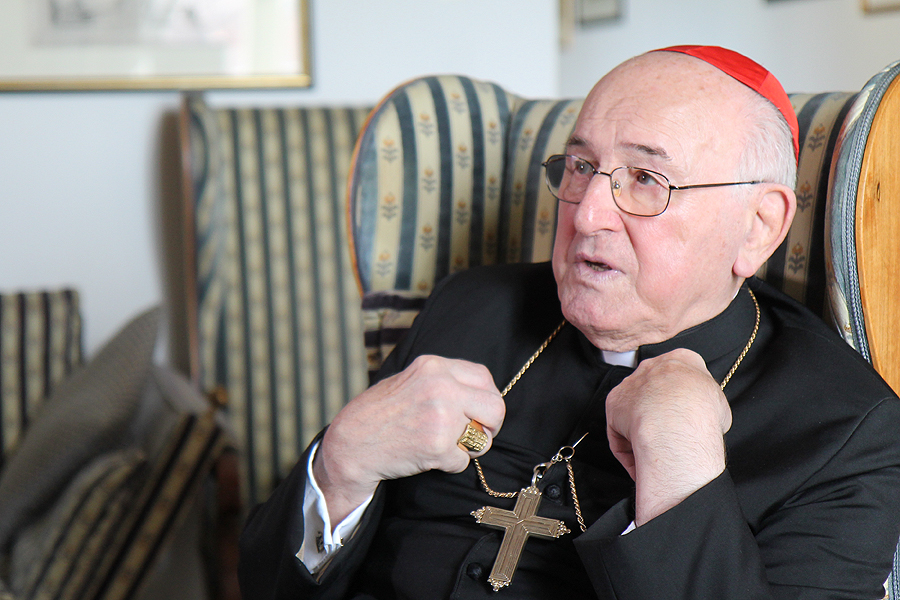


One of the two remaining dubia cardinals, Cardinal Walter Brandmüller, has just given an interview to the prominent German newspaper Frankfurter Allgemeine Zeitung (FAZ) which has been published today, 28 October. In this lengthy interview, the 88-year old German prelate explains once more the fundamental teaching of the Catholic Church on marriage, as it has been laid out by Jesus Christ Himself, in its sacramental and indissoluble character. Cardinal Brandmüller – who is known for his courageous outspokenness – made some remarks that might be of special interest to our readers. That is to say, he made it clear that one may not change that teaching on marriage:
That is to say, he who claims that one may enter a new relationship while one’s own lawful wife is still alive is excommunicated because this is an erroneous teaching, a heresy. Whoever does make such a claim [is excommunicated]. And he who simply practices it [adultery] is gravely sinning. And then there is added that whoever is conscious of a grave sin may only go to Communion if he previously has done penance, has confessed his sins, and has been absolved. Thus, if someone thinks he can contradict the defined Dogma of a General Council [Council of Trent], then that is indeed quite vehement. Exactly that is what one calls heresy – and that means exclusion from the Church – because one has left the common foundation of Faith. [emphasis added]
When asked about a German progressive theologian – Magnus Striet – who recently claimed that the papal document Amoris Laetitia does indeed change the Church’s teaching, and not, as some claim, merely deepen it, Cardinal Brandmüller confirms this opinion and line of argument, saying:
He is of course right. There are indeed still people who can think. I have the great concern that something is going to explode. People are not stupid. Alone the fact that a request for clarification addressed to the pope, with 870,000 signatures, [and also] that 50 scholars with international reputation have remained without answer, does raise indeed some questions. That is really hard to understand.
The journalists of the Frankfurter Allgemeine Zeitung also raise the issue of the changed and somewhat fearful atmosphere in Rome under the Francis papacy (as it has been recently discussed by Cardinal Gerhard Müller himself), to include the tense atmosphere during the “rigged” family synods. Cardinal Brandmüller himself also indirectly confirms such matters by saying: “Yes, such criticism is being increasingly expressed – even in Ross Douthat’s articles in the New York Times.” And the German prelate continues, saying:
There are journalists who say that the atmosphere has totally changed in the Vatican. One speaks only any more with his closest friends. If one speaks over the phone, one prefers to use the cell phone. What shall I say about that?
The German cardinal is also once more being asked to explain the major concerns of the dubia as put forth to the pope by him and the other three dubia cardinals. He explains that to pose such dubia in the case of a lack of clarity is a normal process within the Catholic Church. Cardinal Brandmüller then adds some specific words about the current dubia concerning Amoris Laetitia:
To put it simply, it is here about the question: Can today something be good which has been a sin yesterday? Additionally, the question is being presented as to whether there are truly – as the continuous teaching says – acts that are always and under all circumstances morally reprehensible? Such as in the case of the killing of an innocent person – or also adultery, for example? That is where it leads to. Should the first question now indeed be answered with “yes” and the second question with a “no”, then this would be a heresy and consequently a schism. The split of the Church. [emphasis added]
When asked whether a schism really is now thinkable or likely, the German cardinal replies: “May God forbid it.”
These piercing statements of Cardinal Brandmüller are coming to us in the wake of another German interview, in which the Protestant theologian and general secretary of the World Evangelical Alliance – Professor Thomas Schirrmacher – who is a friend of Pope Francis announced that the group of Catholics who resist the papal reforms “is not a minority.” As Schirrmacher said to the German newspaper Die Zeit‘s subsection Christ&Welt on 26 October about Pope Francis:
He has made himself immense enemies in the Vatican and he is taking a great risk. Loud voices in his Church are already denying that he is still pope. […] Today, there is open talk about what kind of means of resistance against the pope exist. For a Protestant, this does not sound very Catholic any more. The Vatican still pretends as if this is only a small minority which seeks this confrontation. But this [resistance] is not any more a minority. [emphasis added]





You must be logged in to post a comment.