OK, SO NOW WE KNOW THAT THE PILL KILLS, SO WHAT ELSE DOES IT DO? WELL, THERE IS EVIDENCE IT MAY MAKE YOUR GRANDCHILDREN HOMOSEXUALS

American Thinker

Birth Control and Homosexuality: Unintended Consequences

In the 1980s, I had a boss who had gotten a masters degree in psychology from New York University. He was a brilliant man; could have been a doctor. He told me a story that explains much of what we see in society today.

It seems that while doing his graduate work in the early 1960s, he had to do research on lab rats, which were given the synthetic hormones used in the then new birth control pills. The results, he told me, showed that the grandchildren of these lab rats would have high rates of homosexual behaviors. From what he told me, the findings were suppressed. Apparently, the powers that be wanted “the pill” to pass muster. What happened to the second generation of rats that followed was of no consequence to them.

Then my boss told me: The first generation of kids born to mothers using the pill have already arrived. But we should expect in another generation a noticeable increase in homosexual behavior, as they would be the second generation. As that was then still in the future, I was shocked.

This was told me in the mid ’80s. By his reckoning, we should have seen a societal explosion of homosexuality starting around 2000, and subsequently. And, of course, we have seen such an explosion. His prediction came true.

Now, to many classic conservatives – whether religious or merely social – homosexuality is a choice, something which can be learned and/or unlearned.  The problem is: There is a degree of evidence that it may be contrariwise in some individuals.

I invite one to look at this short CBS 60 Minutes documentary about what happens to lab rats treated with sex hormones early on their development. There is a body of evidence that early hormonal manipulation can have horrific consequences.

We have to ask ourselves, what happens to all those women using hormonal contraceptives when they stop their pills in anticipation of wanted pregnancy. Does the normal human cycle return immediately, or is there a rebound effect where, even if ovulation occurs, the ambient hormonal background in the womb is screwed up? This article addressed the question of whether gonadal steroid exposure during prenatal development is one of the factors, in at least one of the pathways, that lead to variability in sexual orientation outcomes. Based on the compelling evidence that prenatal testosterone exposure influences children’s sex-typical play behavior, on the well-established links between childhood play interests and adult sexual orientation, and on the evidence showing altered sexual orientation in women exposed to high levels of androgens prenatally, because of CAH, the answer appears to be “yes.” – National Institutes of Health

This next quote seems to confirm what my boss told me that the effect will skip a generation to the grandchildren.

According to a newly released hypothesis, homosexuality might not lie in DNA itself. Instead, as an embryo develops, sex-related genes are turned on and off in response to fluctuating levels of hormones in the womb, produced by both mother and child. This benefits the unborn child, however if these epigenetic changes persist once the child is born, and has children of its own, some of these offspring may be homosexual. – SciTechDaily

There you have it. The anecdote related to me 30 years ago, by my boss, has some scientific merit.

There is a Catholic order of nuns, the Children of Mary, which in 2012 distributed information about this connection – which caused quite some controversy. To be honest, Catholicism’s insistence on clerical celibacy sort of undercuts their concern with reproductive health; but the nuns may have a point.

Contraception Video, Produced By Children Of Mary Order, Links Homosexuality With Birth Control – Huffington Post

The Video – (Click Here)

I do not agree with Catholicism’s ban on artificial contraception. As long as it is non-abortifacient, I cannot see how it poses a moral issue among married couples.  To be fair, it is not just a Catholic issue any more. Some classic Protestants have adopted similar views, such as with the Quiverfull movement.

There is also the secondary issue that hormonal pills can lead to chemically induced miscarriages/abortions, even if that is not the intent of the user. The hormones can prevent a fertilized egg from implanting in the uterus. I do agree with those who see problems in altering the hormonal balance in a woman’s body, which leads to this abortifacient action.

So while I would take exception to the Catholic/Fundamentalist Quiverfull prohibition against condoms, I would agree with their condemnation of hormonal birth control pills.

But this poses a tertiary issue.

There is a body of evidence – apparently being suppressed by the popular media – that these convenient chemical alterations of women’s bodies is part of the reason for the increase in Western homosexuality. The media now shows homosexuality as a heroic choice. Do they ever admit that it might be a chemically induced aberration?

We were taught in school that our makeup was determined by our DNA; but there is a new science called epigenetics which is indicating that environmental effects may alter how our genes are expressed. While conservatives deny that there is a gay gene, per se, they may have to admit that there may be an epigenetic trigger.

Normal DNA, in a normal fetus, subjected to unstable hormonal fluctuations in a womb, which until recently had been subjected to artificial hormones, may express itself in developing a child given to homosexual tendencies. The child’s DNA may not be unusual, but the chemical bath under which the child developed may have set off triggers which led to an altered orientation or proclivity.

New Clues That Sexual Orientation Could Be Epigenetic

In addition, evidence has shown that women who are exposed to androgen early in life are more likely to identify as homosexual or bisexual. – Medscape (2015)

This leads to a further issue. It is the province of moralists and many conservative Christians to dismiss, as hogwash, the claim of homosexuals that they were born that way. The inability to isolate a gay gene is proof that it is not genetic. However, it may be epigenetic.

This further introduces more moral issues, particularly to those who would decry homosexuals as willfully degenerate. It may not be a much of a choice as classic moralists might want to think.

Now, I happen to think homosexuality will destroy any society where it is unchecked. I am opposed to gay marriage, because it violates biology. I am also opposed to the media’s glorification of homosexuality as the equivalent of normal orientation. It is not.

However, a considerable portion of the blame may be with the pharmaceutical companies which push these pills. Initial tests, done 50 years ago, seem to have shown what problems would arise. My boss’ fearful predication told to me 30 years ago has come true.

No doubt, our culture and media compound the problem by encouraging homosexual behavior in individuals who might be easily persuaded to revert back to normal proclivities. However, we may have to address a frightening problem that even were we to re-Christianize our societal worldview – highly unlikely – there will be a considerable swath of individuals who were irrevocably damaged in utero; and who may be beyond complete re-adjustment.

The best that can be suggested is that women be fully informed of the dangers of taking hormonal birth control; and a certain degree of Christian charity – by which I do NOT mean approval – be tendered to those individuals who say they cannot change. In plain terms, society should not allow gay marriage, but should make provisions for individuals who cannot change.

Ideally,  the withdrawal of hormonal birth control from the marketplace would be a solution, forcing women to revert to older barrier and prophylactic methods. However, our social engineers would remind us that this would result in poorer women – code word for blacks and minorities – having more unwanted babies, as they are too “uneducated” to know how to use simpler birth control methods which require a few seconds of extra effort.

And that is the real issue. Social engineers will continue to sacrifice generations of children to the moloch of gender dysphoria to keep the unwanted subterranean Morlocks of society at bay. The unintended consequence is that quite often the individuals hurt will not be in the poorer classes, but in the sections of society they would want to see reproduce.

Mike Konrad is the pen name of an American who wishes he had availed himself more fully of the opportunity to learn Spanish in high school, lo those many decades ago. He writes on the Arabs of South America at http://latinarabia.com. He also just started a website about small computers at http://minireplacement.com.


Posted in Uncategorized | Comments Off on OK, SO NOW WE KNOW THAT THE PILL KILLS, SO WHAT ELSE DOES IT DO? WELL, THERE IS EVIDENCE IT MAY MAKE YOUR GRANDCHILDREN HOMOSEXUALS

OBFUSCATION: to make something less clear and harder to understand, especially intentionally:

The refined, problematic casuistry of Abp. Fernández’s defense of chapter 8 of “Amoris Laetitia”

Archbishop Fernández’s essay on the controversial eighth chapter of Amoris Laetitia attempted to dispel doubts about that papal document’s orthodoxy but has only raised more questions and created further confusion.

INSIDE THE VATICAN REPORT

Archbishop Victor Fernandez, rector of the Catholic University in Argentina, talks with Jesuit Father Antonio Spadaro, editor of La Civilta Cattolica, as they leave a session of the Synod of Bishops on the family at the Vatican Oct. 14, 2015. (CNS photo/Paul Haring)

Editor’s note: This is the second of two essays by Fr. Twomey on Amoris Laetitia. The first article, Amoris Laetitia and the chasm in modern moral theology,” was posted on September 1st.

Recently, Archbishop Victor Manuel Fernández published an article in Medelin, the theological periodical of the Latin-American Bishops’ Conference. It is entitled: “Chapter VIII of Amoris Laetitia: What is left after the storm” (translated into English by Andrew Guernsey) It is a long, rather diffuse commentary on the Pope Francis’s Letter to the Bishops of the Region of Buenos Aires approving their interpretation of the Apostolic Exhortation, Amoris Laetitia. The letter itself was only recently put up on the Vatican website. The author is the titular Archbishop and Rector of the Pontifical Catholic University of Argentina. He is known to be a confidant of Pope Francis, and may indeed have been the ghostwriter of the Exhortation or part of it. For this reason alone, his essay deserves serious attention.

What is most striking about the essay is its methodology. It is, on the one hand, an attempt to prove the orthodoxy of what Archbishop Fernández claims to be the “novelty” of Amoris Laetitia Chapter 8 by showing how it fits into the pattern of former changes in Church teaching and discipline, such as happened to St Cyprian’s soundbite, “no salvation outside the Church”, or to the right to religious freedom. Even more striking is the number of times Archbishop Fernández attempts to show different nuances in sayings of Pope John Paul II and Pope Benedict XVI, whose orthodoxy is above reproach, to bolster his cause. This would seem to be an implicit admission that the orthodoxy of Pope Francis is not evident.

The trouble with the Archbishop’s examples of earlier developments in Church teaching/discipline”—”novelties,” in the language of Archbishop Fernández— is that they are treated in an a-historical way; that is, no attention is paid to the changing social and cultural developments that lead, for example, to the changes regarding the teaching on religious freedom (condemned by the Papal Magisterium in the 19th century and embraced by the Second Vatican Council in the 20th century), or the centuries-long theological developments that lead to a new understanding at Vatican II of St Cyprian’s teaching about no salvation outside the Church.

Refined casuistry and questionable circumstances
By way of contrast, the profound moral and sacramental theological issues involved in the Church’s teaching (and corresponding discipline) have been singularly constant since the early Church, even allowing for disciplinary developments over time, such as separation (from bed and board), nullity procedures, etc., all of which were responses to complex pastoral situations while remaining faithful to the teaching of Christ thanks to a more profound theological grasp of the issues involved. None of this, it seems to me, applies to what Archbishop Fernández describes as the “novelty” of Pope Francis.

On the other hand, when the Archbishop comes to deal with the actual content of the Pope’s “novelty”, his methodology is that of the refined casuistry characteristic of the proportionalist school of moral theology. That casuistry can be reduced to the moral principle that hard cases should allow exceptions to the norm. Fernández is an exegete by training, not a moral theologian, but evidently was, as a seminarian, schooled in the post-Vatican II legalistic tradition that became known as proportionalism. The latter was developed in reaction to the legalism of the pre-Vatican II manualist tradition, which tended to rigorism. There is an irony in the fact that both moral-theological traditions echo the casuistic schools of the ancient scribes and Pharisees in their treatment of divorce; neither is rooted in the classical New Testament approach to morality in terms of virtue, developed especially by St Thomas Aquinas and those scholars who have recovered his approach, such as Servais Pinckaers, OP, the principal author of the fundamental theology section of the Catechism of the Catholic Church.

Archbishop Fernández is, in effect, a casuist, the mindset of which is legalistic or rule-based. It is, I suggest, seriously inadequate to the task at hand.

Opening the most controversial section of Amoris Laetitia, Pope Francis affirms: “If we consider the immense variety of concrete situations such as those I have mentioned, it is understandable that neither the Synod nor this Exhortation could be expected to provide a new set of general rules, canonical in nature and applicable to all cases (#300).” However, when one reads Archbishop Fernández’s essay, one gets the impression that the Pope has in fact created a new general rule applicable in certain cases. This new rule could be so formulated “someone in an irregular marriage situation may in certain circumstances be admitted to the sacraments though they are living more uxorio in a second union.”

And this is the crux of the matter: under what circumstances?

The Archbishop speaks about the “novelty” of Pope Francis’s teaching, which, it is claimed, “does not imply a rupture, but rather a harmonious development and a creative continuity with regard to the teaching of previous Popes.” This demands a different way of thinking, Fernández claims, about the consequences of the [absolute] norm, namely “discernment with regard to its disciplinary derivations“. Those disciplinary derivations, he claims, hinge on the traditional distinction between objective sin and subjective guilt. Someone cohabiting in a second union who recognizes that this is gravely wrong but is unable to avoid living more uxorio due to his or her circumstances may, after due process of discernment with his or her confessor, be considered to be subjectively without guilt, or at least with diminished guilt, and so can be admitted to the sacraments.

Such would appear, prima vacie, to be in fact a novelty in the strict sense of what in the early Church was termed a novum, namely a teaching that contradicts the thrust of traditional teaching. In other words, a heresy. This is because the traditional teaching on those factors that diminish subjective guilt apply to offenses committed in the past. They do not apply in anticipation of doing something in the future that one knows to be objectively wrong. The only way this supposed “novelty” of Pope Francis, if such it is, can be understood is in terms of persons living in an irregular situation having a firm purpose of amendment, as tradition teaches. This is a point I developed in my previous article, leaving aside the question as to where this possibility is realistic (many would say it is not).

And indeed, Fernández seems to affirm this very interpretation when he writes: “Francis recognizes the possibility of proposing perfect continence to the divorced in a new union, but admits that there may be difficulties in practicing it (cf. footnote 329). Footnote 364 gives a place to administering the sacrament of Reconciliation to them even when new falls are foreseeable. There, Francis calls into question priests who ‘demand of penitents a purpose of amendment so lacking in nuance that it causes mercy to be obscured by the pursuit of a supposedly pure justice’ (AL 312). And there he takes up an important statement of St. John Paul II, who held that even the anticipation of a new fall “should not prejudice the authenticity of the resolution” (Letter to Cardinal W. Baum, 03/22/1996, quoted in the footnote).”

A problematic thesis
If he left it at that, it would be fine, but Archbishop Fernández seems to imply more than that that, which makes his thesis problematic.

Fernández quotes Rocco Buttiglione with approval: “Pope Francis sets himself on the ground, not of the justification of the act, but of the subjective attenuating circumstances that diminish the agent’s responsibility. This is precisely the balance of Catholic ethics and distinguishes the realistic ethics of St. John Paul II from the objectivistic ethics of some of Pope Francis’s opponents. … Familiaris Consortio, moreover, when it formulates the rule, does not tell us that it does not tolerate exceptions for a proportionate reason.”

But Pope John Paul II in Veritatis Splendor #56 expressly rules out any such “exceptions for a proportionate reason”!

Without the firm purpose of amendment, the Pope’s new general rule—or novelty—could be seriously misunderstood. One respected blogger accuses Archbishop Fernández of defending adultery. I don’t think that such an accusation is justified. And here I find myself in agreement with the Archbishop that the terms “adultery” and “fornication” should not be used with the abandon practiced by some commentators critical of the Apostolic Exhortation. And yet, both terms refer to gravely serious sins, both are offenses against not only against chastity but also against justice, both are intrinsically evil. And both are trivialized today in our highly promiscuous culture, which culture itself is a factor in marriage breakdown and a mitigating factor at the subjective level. But, nonetheless, those terms cannot be entirely avoided.

(As an aside, it is worth mentioning that one indispensible antidote to this profoundly negative, post-1960s culture is a serious study of Amoris Laetitia, chapters 4 and 5, and the Pope’s rich teaching on love and fertility, the core of the Exhortation; which indeed is, it seems to me, a synthesis and an enrichment of the previous Papal Magisterium.)

From the above, one can see how the ambiguity of Archbishop Fernández’s interpretation of Chapter 8 could be understood to justify the worst fears of the renowned philosopher, Josef Seifert, who claimed recently that Pope Francis in AL #303 in effect teaches that “we can know with ‘a certain moral security’ that God himself asks us to continue to commit intrinsically immoral acts such as adultery or homosexuality” (Aemaet, 2017). I don’t think that this is what Pope Francis is teaching, but the ambiguity of the text does allow for such an interpretation. That possibility alone makes it imperative that the dubia of the Four Cardinals are addressed by the CDF, since the implications for the whole or moral theology are indeed enormous, if such were the case. It was precisely to counter characteristic thesis of the Proportionalist school of moral theology that Pope John Paul II wrote the encyclical, Veritatis Splendor, the first ever on fundamental moral theology.

The question of authority and binding force
Which brings us to the question of the nature of the authority (and so the binding force) of Amoris Laetitia as well as that of the Letter of Pope Francis to the Bishops of the Region of Buenos Aires. Archbishop Fernández is under the impression that Amoris Laetitia is an encyclical; that is the term he himself uses to describe it. But it is not an encyclical. It is a post-Synodal Apostolic Exhortation, and so does not carry the same weight.

Fernández compares the Pope’s Letter endorsing the interpretation given to Amoris Laetitia by the Argentinean Bishops with Pope Pius IX’s Letter approving the German Bishops’ interpretation of the teaching of Vatican I on Papal Jurisdiction in response to Bismark’s misunderstanding of same. The comparison limps. The latter letter dealt with a misunderstanding of a clear dogmatic definition by an Oecumenical Council and was addressed to those outside the Church (the German Chancellor). The Argentinean Bishops give their interpretation of an ambiguous chapter of a hotly contested post-Synodal Apostolic Exhortation to the faithful within the Church.

Be that as it may, the essential question is: To what extent is Amoris Laetitia an expression of the Papal Magisterium and so binding on conscience?

My own studies into the nature of the Primacy of the Bishop of Rome led me to recognize that the Petrine authority is based on conscience, the Pope’s own conscientious judgement before God, which makes it binding on the conscience of the faithful. Cor ad cor loquitur, as Newman put it.  This was exemplified, for example, in the way Humanae Vitae was written. After Blessed Pope Paul VI had received the conflicting reports of the Birth Control  Commission,  he retired to Castel Gandolfo to study them, together with other opinions, before he made his own conscientious judgement fully aware of his own unique responsibility as Bishop of Rome. This the Pope himself expressly affirmed in HV #6. He had rejected the opinion of the Majority Report submitted to him by the Birth Control Commission: a clear example of judgement made in obedience only to God’s truth after he had sifted the various opinions.

Humanae Vitae is an encyclical. So too is Veritatis Splendor.  As already mentioned, Amoris Laetitia is but an Apostolic Exhortation. Granted that Veritatis Splendor was not entirely from the pen of St Pope John Paul II, it can be assumed that not one word was published that he did not examine and personally approve, given the gravity of the issue: the very nature of morality. He was, after all, a moral philosopher who was sure of his ground, and he was acutely aware of the threat of Proportionalism.  For this reason, Veritatis Splendor is binding in a way that AL cannot be.

This is important since Cardinal Christopher Schönborn, OP is on record as claiming that all previous teaching of the Magisterium must be interpreted in the light of Amoris Laetita. In an interview with Father Spadaro, he said: “AL is an act of the magisterium that makes the teaching of the church present and relevant today. Just as we read the Council of Nicaea in the light of the Council of Constantinople, and Vatican I in the light of Vatican II, so now we must read the previous statements of the magisterium about the family in the light of the contribution made by AL.” Here I should beg to differ from my colleague and old friend—or rather I beg to distinguish. It might be possible to make such a comparison (which nonetheless seems exaggerated to me) with regard to Chapters 4 & 5 (which is a synthesis of previous teaching on conjugal love and fertility that yet goes beyond the former teaching), but not with regard to the controversial Chapter 8 (as compared with the previous teaching of Paul VI, John Paul II, and Benedict XVI).

Perhaps Cardinal Schönborn was simply referring to the teaching of Familiaris Consortio. Like Amoris Laetitia, Familiaris Consortio is also a post-Synodal, Apostolic Exhortation dealing with the family. But even here, Familiaris Consortio is the teaching of a Pope who had written extensively on the philosophy and theology of marriage and conjugal love. It expresses with great clarity his own conscientious judgement. And so it carries a binding force, I suggest, which is stronger than Amoris Laetitia, the crucial chapter of which does not have the hallmarks of coming from the pen of Pope Francis (unlike Chapters 4 and 5) and is anything but clear. Evidently Pope Francis approved the text of Chapter 8, for which reason it does have a magisterial weight. But since Amoris Laetitia differs in some important aspects from Familiaris Consortio (mostly by way of omission), then the weight to be given to the one or the other depends on the extent to which either document is in harmony with the encyclical Veritatis Splendor. The reason for this hermeneutical rule is that Veritatis Splendor is an encyclical that addressed those issues in fundamental moral theology which are at the core of the present controversy about the interpretation of Amoris Laetitia, Chapter 8.

I have my own reservations as to the modus operandi of the Four Cardinals. For example, I don’t think they should have published their letter to His Holiness, Pope Francis (and to the Prefect of the Congregation for the Doctrine of the Faith). But now it is public, and the issues they raise are legitimate concerns, and so their letter cannot be ignored.

Equally serious are the implications for the Primacy of the Bishop of Rome and his authority, should the orthodoxy of the Pope himself be left in doubt. Archbishop Fernández’s essay attempted to dispel that doubt but, in my opinion at least, has only exacerbated it.

About Fr. D. Vincent Twomey, SVD 7 Articles
Fr. D. Vincent Twomey, S.V.D. holds both a Ph.D. in Theology and is Professor Emeritus of Moral Theology at the Pontifical University of St. Patrick’s College, Maynooth, Ireland. A former doctoral student under Joseph Ratzinger, Twomey is the author of several books, including The End of Irish Catholicism?, Pope Benedict XVI: The Conscience of Our Age (A Theological Portrait), and Moral Theology after Humanae Vitae. In 2011, Benedict XVI awarded the Pro Ecclesia et Pontifice medal to Fr. Twomey for outstanding services rendered to the Church and to the Holy Father.
Posted in Uncategorized | Comments Off on OBFUSCATION: to make something less clear and harder to understand, especially intentionally:

THE CHICKENS (THEY RESEMBLE VULTURES MORE THAN CHICKENS) ARE COMING HOME TO ROOST, IT IS TIME SOMEONE CLEANED OUT THE HENHOUSE, THERE IS A FOUL (NOT FOWL ODOUR IN IT)

OnePeterFive
Google+PinterestPocket

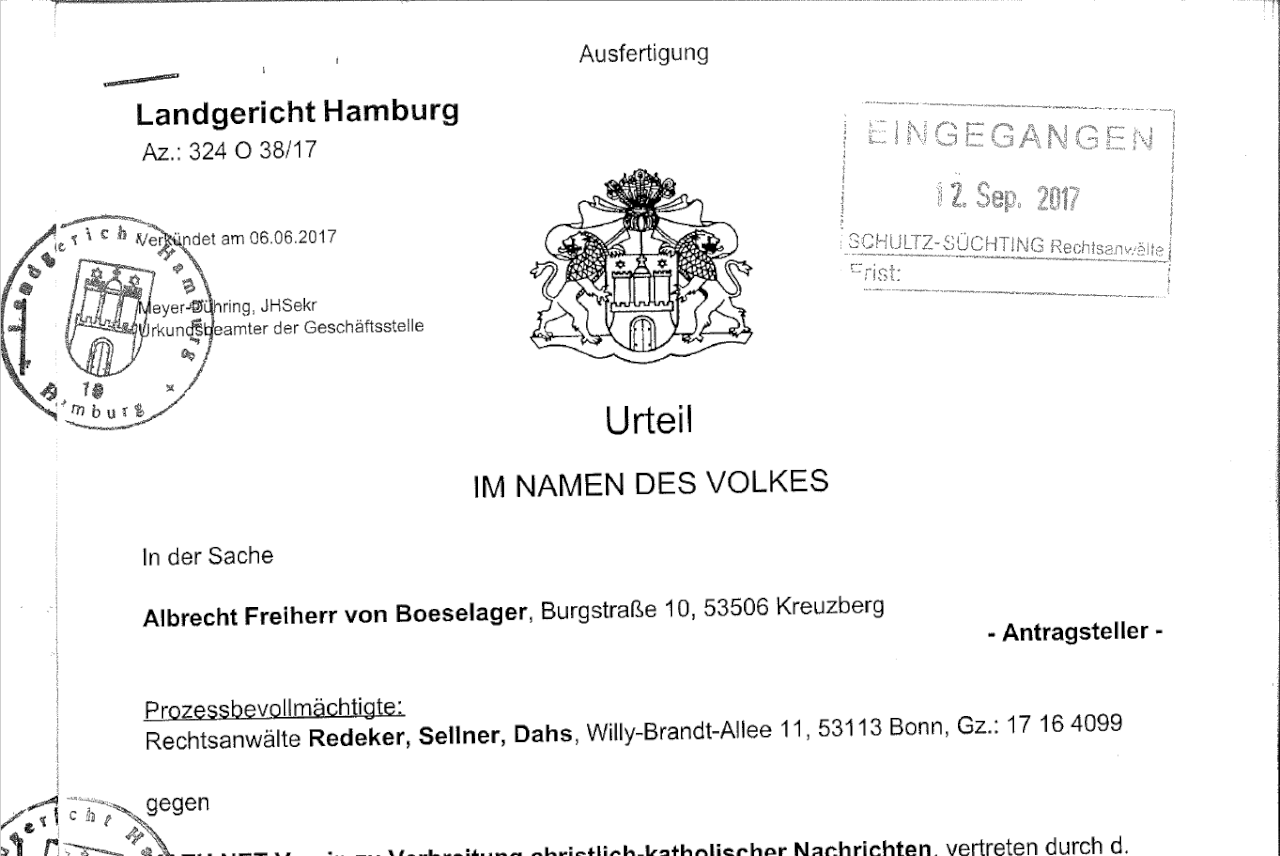
“There is a new turn in the criminal mystery story concerning the Order of Malta and its current Grand Chancellor, Albrecht von Boeselager.” So begins a story today at the Austrian Catholic website Kath.net*. “Boeselager,” the report continues, “had started legal proceedings against the Catholic internet newspaper kath.net. The district court of Hamburg has decided in the decisive point that the compelling impression from this article – namely, that Albrecht von Boeselager ‘is himself responsible for the above-mentioned accusations, which necessarily also include his knowledge of all relevant circumstances’ – is true.”

Readers will recall that in November, 2014, Cardinal Raymond Burke was removed from his position as Prefect of the Apostolic Signatura — the Church’s highest canonical court — and re-assigned as Cardinal Patron of the Sovereign Military Order of Malta. As we reported in our synopsis of the Knights of Malta story in January, 2017:

Somewhere around the same time — near the end of 2014 — the Grand Master of the Knights of Malta, Fra’ Matthew Festing, was made aware of charges of impropriety in the conduct of one of his senior officers, Albrecht von Boeselager — this according to the National Catholic Register‘s Edward Pentin. Boeselager, then the Grand Chancellor of the Knights of Malta, had for decades overseen Malteser International — the “worldwide humanitarian relief agency of the Sovereign Order of Malta” — in his previous position as Grand Hospitaller, a post he held from 1989-2014. During his tenure, it had been alleged, Malteser International had been involved in the distribution of thousands of condoms and oral contraceptives through some of their international programs.

On November 10, 2016, Cardinal Raymond Burke, Cardinal Patronus of the Sovereign Military Order of Malta, met with Pope Francis in a private audience to discuss these allegations. According to Pentin, 

During that meeting … the Pope was “deeply disturbed” by what the cardinal told him about the contraceptive distribution. The Pope also made it clear to Cardinal Burke that he wanted Freemasonry “cleaned out” from the order, and he demanded appropriate action. [emphasis added]

What followed was a major power struggle within the Order — with external pressures applied by the Vatican itself — resulting first in the removal of von Boeselager from the Order (and thus, his position on the Sovereign Council) in December, 2016, by direct action of the Order’s then-Grand Commander, Fra’ Matthew Festing. This did not sit well, however, with the Holy See, and on January 24, 2017, Festing was called to a private meeting with Pope Francis in which he was asked by the pope to resign. He agreed. According to Pentin, “the Pope then had Fra’ Festing include in his letter of resignation that the Grand Master had asked for Boeselager’s dismissal under the influence of Cardinal Raymond Burke, the patron of the Order.” (It is noteworthy that by January, word of the dubia, of which Cardinal Burke was the most visible signatory, had already spread around the world.) On January 28, 2017, the Order’s Sovereign Council officially accepted Festing’s resignation, and “annulled the decrees establishing the disciplinary procedures against Albrecht Boeselager and the suspension of his membership in the Order.” Albrecht von Boeselager was thus immediately reinstated — through the intervention of Pope Francis and Cardinal Secretary of State Pietro Parolin — the same day Festing’s resignation was made official.

And it didn’t end there. By February of 2017, Cardinal Burke — alleged to have been falsely implicated in Festing’s resignation letter at the pope’s request — found himself again in the crosshairs. The Order’s Grand Commander (and, at the time, acting Grand Master), Fra’ Ludwig Hoffman von Rumerstein, claimed in an interview that it was Burke who had personally requested the resignation of von Boeselager — an allegation Burke described as “calumny”. Nevertheless, though Burke retained his titular role as Cardinal Patron of the Order, Archbishop Angelo Becciu, the pope’s delegate to the order, was announced by the newly-reinstated von Boeselager as having “the full confidence of the Pope and is his spokesman.” Von Boeselager went on to say, “That means that Cardinal Burke as Cardinal Patron of the Order is now de facto suspended.”

When new elections were held in Rome in April, 2017, they provided the Order with a temporary government after the election of Fra’ Giacomo Dalla Torre as Lietenant of the Grand Master — an interim leadership position for the period of one year. As we reported at the time:

During that year, the Vatican plans to reform the Order fundamentally, including changes to the governance requirements that would open the role of Grand Master to those not among the ranks of the professed Knights (who take vows of poverty, chastity and obedience), but instead from a larger pool of candidates within the Order.

One of the lesser-known aspects of this troubling saga in the thousand-year-old chivalric order was the use of legal threats on the part of certain parties to silence the Catholic Press in their coverage of some of the unflattering details of this story. In March, 2017, the Austrian Catholic website Kath.net received the aforementioned cease-and-desist orderfor their reporting on Albrecht von Boeselager’s financial dealings in his role of Grand Chancellor of the Order. From their own report on the action at the time:

This week, kath.net has been confronted with a judicial cease-and-desist order initiated by the Order of Malta, and this was done with regard to a report of the BILDnewspaper. The BILD newspaper had reported that Grand Chancellor Boeselager accepted a donation of 30 million Swiss Francs, the origin of which is dubious; kath.net merely quoted from the report of the BILD newspaper.

A spicy detail: the BILD newspaper itself has so far not been confronted with possible legal actions because of its report, as Kath.net was able to learn after contacting the newspaper. The editor of Kath.net, Roland Noé, interprets this as an intentional “strategy of intimidation” against Catholic media. It started already at the end of 2016, when Kath.net reported in an article about the distribution of condoms by some charitable organizations of the Order of Malta. Also in that case, there then came an immediate letter from a lawyer and, subsequently, an injunction and restraining order. Juridical steps on the side of Kath.net are currently being considered as well. The possibilty to publish a statement, as offered by Kath.net, has not been accepted [by the other side]; a direct communication without a laywer — as is the usual procedure among Christians — has so far also not yet been accepted by the responsible persons of the Order of Malta.

Now, with this week’s ruling by the Hamburg court, it appears that a critical blow may have been struck against attempts to control the public narrative about what has transpired within the Order in the past few years — and in particular, since December, 2016. From today’s story at kath.net:

The court thus has recognized the fact that Malteser International continued this aid program for a couple of months still after the distribution of relief goods together with condoms in one project in Myanmar had become public, and that this happened also with the knowledge and willingness of Mr. von Boeselager. With this decision, the interim injunction – which Boeselager issued after the publication of a report of kath.net – has been rescinded in the decisive point.

[…]

With the court order of Hamburg, now this development of events is de facto being called into question. Was the pope wrongly informed? Was Festing right and thus unjustly forced to resign? Is Boeselager as Grand Chancellor of a Catholic order still tenable?

In the judgment of the Hamburg court, which was sent to kath.net this week in a written form, it is now written, with reference to a December 2016 article of kath.net, against which Boeselager had legally intervened: “The whole third paragraph of the article deals critically with different aspects of the work of the claimant (Editor: Albrecht von Boeselager!) as Hospitaller, in order to prove the thesis which was stated at the beginning, namely, that a small circle from the German-speaking realm wants to preserve the advantages of the exclusivity and sovereignty [of the Maltese Order], but wishes to loosen the bonds to Catholic teaching and to the pope, which are in its [the group’s] eyes too tight. For the reader, the compelling conclusion is, in the conviction of the chamber [of the court], that the claimant is himself responsible for all above-mentioned accusations, which necessarily also involves his knowledge of all the relevant circumstances. This impression however is to be regarded as procedurally true, after the result of this opposition hearing.”

Boeselager, on the contrary, had publicly and also in court argued that he had no immediate operative influence upon the aid program of Malteser International and that the events were not in the realm of his responsibility, and that he, as soon as he learned of the abuse, nevertheless acted immediately acted to stop it. It is notable that, in the meantime, all statements and links with regard to the matter have disappeared from the official homepage of the Order of Malta in Rome.

It is impossible to say how the story will develop from here, but it seems far from over.

(*Translation by Maike Hickson)

Posted in Uncategorized | Comments Off on THE CHICKENS (THEY RESEMBLE VULTURES MORE THAN CHICKENS) ARE COMING HOME TO ROOST, IT IS TIME SOMEONE CLEANED OUT THE HENHOUSE, THERE IS A FOUL (NOT FOWL ODOUR IN IT)

THE PILL KILLS, SO WHAT ELSE IS NEW? WHAT IS NEW IS THAT HUMANAE VITAE IS “UNDER REVIEW” – YOU CAN GUESS WHAT THAT MEANS

Blessed Paul VI issued his encyclical in 1968.
Blessed Paul VI issued his encyclical in 1968. (U.N. photo via CNA)
VATICAN  |  SEP. 11, 2017
Humanae Vitae Comes Under Fire
COMMENTARY: Recent developments in Rome indicate a campaign is underway to challenge the encyclical’s prohibition against artificial contraception.

VATICAN CITY — Half way through the first synod on the family, when it was becoming clear that heterodox agendas were being pursued in heavy-handed and deceptive ways, a well-respected Church figure took me aside at a reception with a pained expression on her face.

“Of course, you realize this is all about Humanae Vitae,” she said. “That’s what I think they’re after. That is their goal.”

What she meant was that the many dissenters of Blessed Paul VI’s 1968 encyclical wanted the Church’s ban on artificial contraception — which Humanae Vitae (The Regulation of Birth) reaffirmed — softened and ultimately undermined.

At the time, her prediction seemed plausible, but too speculative. The synod participants didn’t seem too exercised by the issue, and Humanae Vitae was largely left alone, at least directly. German-speaking prelates, who took a leading role in the controversies during both synods on the family, even spoke warmly of the encyclical at a closing press conference of the second synod.

But as the Church prepares to commemorate the 50th anniversary of Humanae Vitae in 2018, the recent revelation of a four-member stealth commission to study the document — and other subtle and less subtle attempts to weaken the Church’s moral teaching — are making the concerns of the Church figure at the 2014 synod look ominously prescient.

In his encyclical, Paul VI re-affirmed the Church’s prohibition of artificial contraception, approved natural family-planning methods, and upheld the Church’s teaching on conjugal love and responsible parenthood.

It caused a sensation when published: In the wake of the sexual revolution — when much of the world had accepted birth control — and after a five-year study by a pontifical commission that appeared to be vying for the Church to also approve it, Paul VI’s reaffirmation that contraceptive use is “intrinsically wrong” made it one of the most controversial encyclicals in Church history. Immediately, many clerics and academics outright rejected Humanae Vitae’s teachings.

And yet many, particularly those who have devoted their lives to defending life, vigorously uphold Humanae Vitae as prophetic. They argue that the widespread acceptance of artificial birth control, revolutionized by the contraceptive pill for women, has separated the unitive and procreative purposes of sexual relations. This, in turn, has fueled the sexualization of culture and promiscuity now prevalent in the West, precipitating legalized abortion, the collapse of marriage, and inflicting deep harm on the family.

By contrast, the encyclical’s dissenters have pressured the Church for its teaching on artificial contraception to be loosened, arguing it is unrealistic, out of touch with people’s lives, and needs “updating.” A 2014 poll of Catholics in five countries by left-leaning broadcaster Univision found that 78% supported artificial contraception.

Now, dissenters — who today hold positions of influence and enjoy support from some in the highest ranks of the Church — appear to be viewing the upcoming anniversary as a golden opportunity, half a century in the making. Evidence to show that efforts are underway to exploit this opportunity is not hard to discover. One of the most visible has been the creation earlier this year of the four-member commission, quietly established by the Vatican with the Pope’s approval, to study Humanae Vitae.

The commission was never formally announced: The veteran Vatican correspondent Marco Tosatti first reported rumors of it, and the Vatican only confirmed its existence after the Italian website Corrispondenza Romana was able to verify the rumors in June, after it obtained a classified memorandum, circulated by Archbishop Giovanni Becciu, the sostituto or deputy, secretary of state.

The memorandum states that the commission is to “promote a comprehensive and authoritative study” of the encyclical to coincide with the anniversary and listed its four members. They include Msgr. Gilfredo Marengo, the commission coordinator who is professor of theological anthropology at the Pontifical John Paul II Institute for Studies on Marriage and Family, and Msgr. Pierangelo Sequeri, appointed dean of the Pontifical John Paul II Institute last year.

Archbishop Vincenzo Paglia, president of the Pontifical Academy for Life, was the first to publicly defend the commission’s work after news of it was leaked, telling Catholic New Agency that the initiative aimed at “studying and deepening” the encyclical. But he denied it was a “commission” whose purpose was to “reread or reinterpret” the document.

Msgr. Marengo further played down its influence, explaining its purpose is simply to carry out a “work of historical-critical investigation,” reconstructing the “whole process of composing the encyclical.”

But added to its unannounced beginnings, the mere existence of such a commission has left many suspicious and asking: Why make all the effort to deepen and study something that will not fundamentally change?

Also viewed as suspect is the unprecedented level of access given to the commission members. According to the memorandum, the Pope has given the scholars permission to view the relevant historical archives not only of the Secretariat of State, but also the Vatican Secret Archives and that of the Congregation for the Doctrine of the Faith.

Msgr. Marengo insisted such access was relevant, given the document’s importance and the debates it unleashed. Humanae Vitae, he said in a July 25 interview, “must be placed in the context of everything important and fruitful the Church has said on marriage and family during these last 50 years.” But such privileges haven’t even been awarded to researchers of Venerable Pius XII’s pontificate during World War II, despite years of lobbying for the archives to be opened.

All of which amounts to a concern that the commission is being used as a cover: to look at the scientific and historical character of the document, but with the ultimate goal of presenting the Pope with enough information for the encyclical’s dissenters to say: “Times have changed — Humanae Vitae needs to be interpreted in the light of conscience, according to the complexity of people’s lives today.”

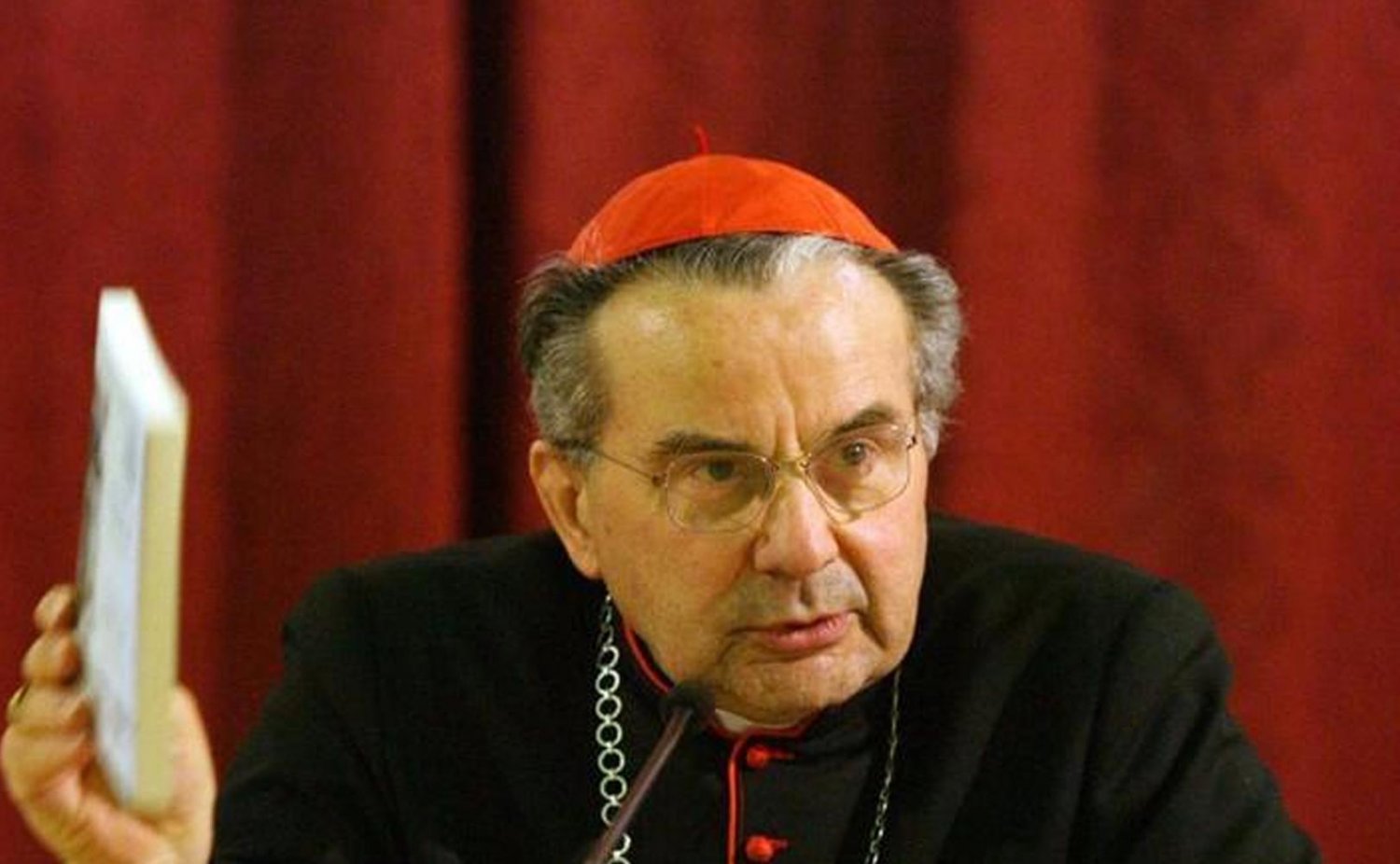
Before his death on Sept. 6, Cardinal Carlo Caffarra had privately expressed similar grave concerns about the commission. Like others, he believed the opening of the archives was a ploy to obtain selected findings and then present them to show that Paul VI’s commission was moving in the direction of loosening the Church’s teaching on contraception, but undue pressure was placed on the Pope to reassert the doctrine.

Another expected strategy by commission members and other “revisionists” is to present any re-interpretations as part of a “change in paradigm” in moral theology, just as was achieved with Amoris Laetitia (The Joy of Love) in allowing for some civilly remarried divorcees to receive Holy Communion. The emphasis is expected to be on changing pastoral practice to make it more applicable to today — a tactic, say critics, to alter and soften Church teaching by finding exceptions, while all the time insisting the doctrine won’t be changed.

Msgr. Marengo has firmly denied such an intention, insisting that “the issue of a conciliation between Amoris Laetitia and Humanae Vitae is not in the agenda.” But in an article in March for Vatican Insider — headlined, “Humanae Vitae and Amoris Laetitia: Parallel Histories” — he warned that the Church’s moral teaching can be too abstract and detached for people to follow and asserted that “responsible creativity” should be risked in pastoral care. He also quoted Pope Francis’ address to the John Paul II Institute in October, in which Francis warned against presenting “a theological ideal of marriage that is too abstract, almost artificially constructed, far from the concrete situation and of effective possibilities of families as they are.”

But the commission is not the only means to maximize this long-awaited opportunity to change Humanae Vitae. Further evidence can be seen in what appears to be a four-year concerted attempt to marginalize the teachings of Pope St. John Paul II, who led the resistance to a relativistic interpretation of the encyclical.

As archbishop of Krakow, Poland, Karol Wojtyla contributed to the commission that drafted the document (although he was unable to take part personally due to the communists’ travel restrictions) and strove to uphold the Church’s teaching in the document by emphasizing personalism (seeing man as a person rather than an object) with the natural law.

His teachings ever since formed a bulwark against the dissenters. Most notably they include his 1981 apostolic exhortation Familiaris Consortio (The Role of the Christian Family in the Modern World) and his theology of the body catecheses — both attempts to provide an anthropological foundation and explanation for the encyclical’s teaching. Perhaps even more significant was his 1993 encyclical Veritatis Splendor (The Splendor of Truth), which for the first time presented Catholic moral doctrine in a systematic and formal way, firmly rejecting any relativist interpretation of an intrinsically evil act (an action that is always morally wrong, regardless of its particular circumstances), such as use of artificial contraception.

The operation to marginalize John Paul II ahead of next year’s anniversary has been visible in two primary ways: First, by largely ignoring his teachings during the previous two synods to allow the kind of “paradigm shift” in the Church’s moral teaching that found its way into Amoris Laetitia.

Second, by overhauling the leadership of the Pontifical John Paul II Institute for Studies on Marriage and Family, respectively replacing its chancellor and dean with Archbishop Paglia and Msgr. Sequeri. Both are known supporters of softening the teaching of Humanae Vitae.

Msgr. Sequeri, who is not a moral theologian, but a specialist in aesthetic theology and musicology, has written the introduction to a new book entitled, Amoris Laetitia: A Turning Point for Moral Theology, edited by Stephan Goertz and Caroline Witting, in which it is argued that Amoris Laetitia represents a paradigm shift for all moral theology, and especially in interpreting Humanae Vitae.

For his part, Archbishop Paglia was unable to give a clear answer when I asked him in early July if he agreed with the encyclical’s teaching against use of artificial contraception. The document “must be studied and more fully appreciated, particularly in the light of the challenges we face every day,” he said, highlighting the “negative consequences of gender ideology, the de-population crisis in the West, the omnipresence and invasiveness of technology, and mankind’s inability to hold on to its own humanity.”

Another reason for concern about Archbishop Paglia’s position with respect to Humanae Vitae is a document he circulated privately among family synod participants, advocating “the gift” of reception of Communion for divorced-and-civilly-remarried Catholics who request such permission from their bishops. In light of that synodal intervention, as well as a corresponding approach in a Vatican-published book he edited in 2015 with Msgr. Sequeri entitled, Church Family — An Indissoluble Bond, evidence of Archbishop Paglia’s support for a similar softening of Church teachings on artificial contraception appears solid.

In addition to marginalizing John Paul II, further evidence of moves to undermine the encyclical can be seen in new members chosen for the Pontifical Academy for Life — also since last year placed under the leadership of Archbishop Paglia. Several of them have gone on the record to voice their dissent from Humanae Vitae, in particular Father Maurizio Chiodi, who uses arguments to justify contraception that critics say are condemned in Veritatis Splendor, and Jesuit Father Alain Thomasset, who wants to see the term “intrinsically evil” removed.

Finally, there are Pope Francis’ own comments regarding the encyclical’s teaching. Asked in 2014 if the Church should revisit the issue of contraception, he replied: “It all depends on how the text of Humanae Vitae is interpreted. Paul VI himself, toward the end, recommended that confessors show great kindness and attention to specific situations.”

He added it is not a question of “changing doctrine, but to go into the depths, and ensuring that pastoral [efforts] take into account people’s situations, and that, which it is possible for people to do.”

The Pope also last year praised one of the most prominent dissenters of Humanae Vitae, the German moral theologian Bernard Häring. And speaking to reporters in February last year, Francis cited favorably a mythological story of Paul VI allowing nuns in the Congo to use contraception for cases of violence. The case has historically been used by dissenters as a means to circumvent the encyclical’s teaching. The Pope is also sympathetic to the vision of the Church of the late Jesuit Cardinal Carlo Martini, who was very vocal in his opposition toHumanae Vitae.

So what is likely to happen? The commission will have no authority to enact changes, and, already, there are reports of divisions among them that will weaken its purpose. But some cardinals, bishops and theologians, as well as elements of the media, will use this opportunity to try to persuade Francis to modify Humanae Vitae using the strategies outlined above as well as others. From the other side, pressure will be exerted to leave the encyclical alone on the grounds that it has proven so prophetic and that the Church’s teaching on artificial contraception is based on her infallible moral teaching.

Debates will, therefore, deepen over the coming months, as the document considered the lynchpin of the Church’s resistance to the collapse in sexual morality in the West comes under intensified attack, directed not from the secular world or a few dissenting theologians and bishops this time, but from some of the most senior figures in the Church.

Edward Pentin is the Register’s Rome correspondent.

Also see moral theologian Father George Woodall’s concerns about Msgr. Marengo’s commission here.

Posted in Uncategorized | Comments Off on THE PILL KILLS, SO WHAT ELSE IS NEW? WHAT IS NEW IS THAT HUMANAE VITAE IS “UNDER REVIEW” – YOU CAN GUESS WHAT THAT MEANS

LIKE SAINT ATHANASIUS WE MUST HAVE FAITH, HOPE AND FORTITUDE IN THE FACE OF THE GREAT HERESY OF OUR OWN TIME

In recent years, many Catholics have looked to Cardinal Caffarra as one of the few lights in the present darkness.

A priest confided to me that in the past few days, he went to tell the Cardinal of his distress over the disasters that he endures in the Church every day, mentioning some incidents to him.

The cardinal burst into tears, saying:

“The Lord will not abandon His Church. There were twelve apostles, so the Lord will start again with a few. Imagine the suffering of Saint Athanasius, who was left alone to defend the truth for the love of Christ, of the Church and of men. We must have faith, hope and fortitude.”

The priest confided in me: “The cardinal was very sorrowful, but he conveyed to me so much courage and love for the Church.”

Caffarra’s reference to St. Athanasius refers to the darkest moment in Church history, when the Arian heretics took control of the Church in the fourth century.

Almost alone, Bishop Athanasius’ voice rose to the defense of Catholic truth. He was excommunicated by the pope and suffered exile four times.

But shortly thereafter, the Church returned to true faith and subsequently canonized Athanasius by proclaiming him Father and Doctor of the Church.

The priest that spoke with the cardinals repeated that he was very sorrowful. One might perhaps think that he died of a broken heart. Certainly in the secrecy of prayer, he had offered God his life for this poor, lost Christianity.

He was certain that in the world and in the Church, the Lord will win in the end. Thus, in recent years, he was found to be the protagonist of a powerful defense of the Catholic Faith and of the sacraments in the face of Pope Bergoglio’s Amoris Laetitia.

In this testimony, he was comforted by the prophetic words which he had received years ago from Sister Lucia of Fatima in a letter in which she wrote to him that “the final battle between God and Satan will be about marriage and the family”.

This story – in addition to revealing to everyone his wisdom, his faith, and his courage – also shed light on his deep humanity.

I have a personal memory of this. It was August 15, 2010, the feast of the Assumption. My daughter Catherine had just awoken from a coma and was admitted to the “House of Awakenings” in the Bolognese hills.

To our surprise, that day, we saw Cardinal Carlo Caffarra, Archbishop of Bologna, arrive in the intense heat, in his own humble and simple way.

He had come to see Catherine, whose plight he had followed, (we were in indirect contact) and he stayed with us the entire day.

He was dressed like a simple priest. He also went to greet everyone who was sick, as well as their relatives. A true man of God.

Up until then, I knew him as a very robust theologian, friend and collaborator of John Paul II and Benedict XVI who appreciated him so much.

But that day – in that place of pain and hope – I found him to be a true father. His humanity and his paternal wisdom struck me, and I found them all again in his last mission for the Church.

(Translated by Matthew Mangiaracina)


Originally published at AntonioSocci.com. Reprinted with permission.

Print Friendly, PDF & Email
Posted in Uncategorized | 1 Comment

THE TRADITIONAL LATIN MASS, THE SOURCE OF GRACE FOR THE CHURCH FOR ALMOST TWO MILLENNIA

OnePeterFive

FacebookTwitterGoogle+PinterestPocket

Editor’s note: This article is Part II of a series. For Part I, click here.

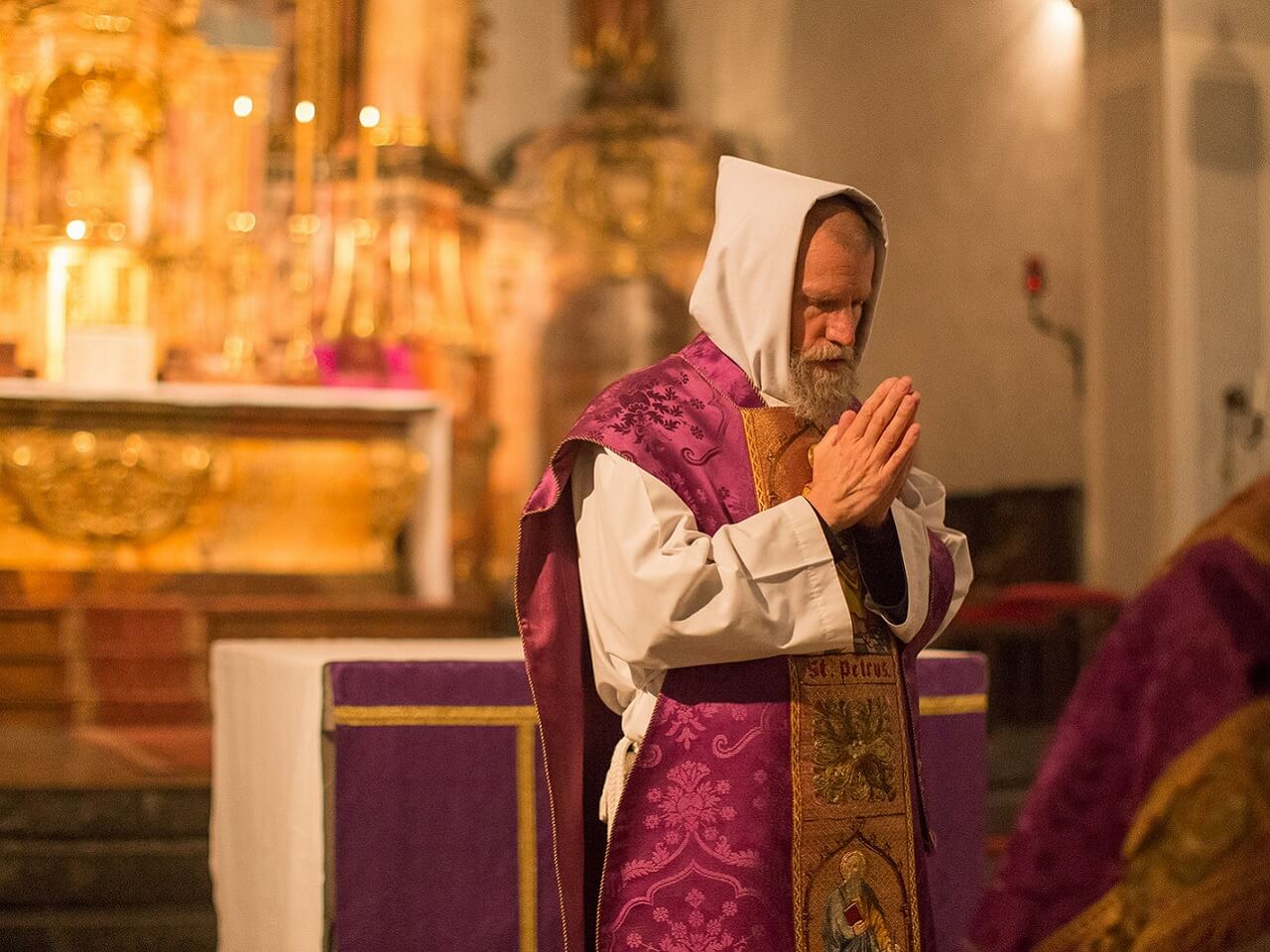
The traditional Mass can be compared to a tournament. At the beginning of a High Mass, the priest (knight) processes in with the deacon and sub-deacon (squires) and all the acolytes, torchbearers, and other servers (pages). The priest is arrayed in glorious attire, as are his assistants according to their rank. The choir is singing for its champion, who represents the king (Christ). The congregation bows to him. Coming to the foot of the altar, he does battle with his sins, backed with the beauty of the prayers. He proclaims the truth of the cosmic battle to all assembled (epistle and Gospel). He fights for his lady, the Church. Acting in the person of the king, he renews the great victory over death that Christ won for us on the Cross. The priest then strengthens all the people by helping them partake of the victory through Communion, so that all may depart to fight their own faults and win heavenly glory.

The priest is a powerful warrior; a custodian of secret truths and words; and, in a wondrous and mystical way, a father to all under his care. He is a champion for his people: he guards and nourishes them with the food of true doctrine; good example; and, most especially, the Eucharist.

All that I am saying may sound rather like a fairytale of King Arthur and the Holy Grail, or a Lord of the Rings rip-off.

Yet I find it extremely interesting that The Lord of the Rings, and books like it, suddenly became immensely popular just as “modern man” was supposed to have grown out of medievalistic symbolism (as the liturgists of the ’60s and ’70s would have us believe). Gandalf: Who does not love, admire, want to be like him? And yet what qualities of his are to be found lacking in St. Benedict? If we want spiritual protection, fatherhood, and angelic power over life and death, wisdom beyond that of mortals, we can find it all in Saint Benedict. Even if one looks purely for visual satisfaction, one finds a old man in flowing robes with a staff and long beard. This in not by accident. What JRR Tolkien shows his readers in the character of Gandalf is but a transposition of the qualities of any holy man of God.

What is there in Aragorn that cannot be found in St. Louis IX? In Galadriel that is not to be found in St. Hildegard of Bingen? All of the qualities people are attracted to in the genre of “fantasy” are to be found in the Catholic Church [1]. This present obsession with C.S. Lewis and Tolkien shows that people have a great hunger for true heroism.

It used to be the case that, instead of obsessing with the world of Tolkien’s Middle Earth through their teenage years, people had already seriously thought about or already entered into the religious or married state – and this even in the last century, not the middle ages. St. Thérèse of Lisieux entered the Carmel monastery when she was 15. At the same age, St. Padre Pio became a Capuchin. St. Peter Julian Eymard (my own patron) firmly decided to become a priest when he was 17. At the age of 16, St. Maximilian Kolbe received the Franciscan habit [2].

This is not to say there is anything wrong with, or not to be learned from, fiction – quite the contrary. Nonetheless, the disintegration of minds from reality has come to a point where young men and women no longer realize that the beautiful things in, for example, a book by Lewis or Tolkien are actually pointers to spiritual realities. Since the changes to the liturgy and the whole approach to the divine as advocated by the liberals during and after Vatican II, the identity of the church as “One, Holy, Catholic, and Apostolic” is lost [3]. The Catholic identity has largely been lost, giving rise to a need for an alternative.

Having lost their identity via liturgical lobotomy, people don’t realize (or are incapable of realizing) that we can be just as cool as any of Tolkien’s characters – much more, in fact. We need only to remember that the Catholic priesthood and consecrated life still exist, and that it is the reality of which wizards and wise men, beautiful and happy kings and queens, good and evil magic are but a faint shadow. These fictional things depict the spiritual economy of the priesthood, the Mass, and the sacraments darkly, as through a glass.

* * *

At the altar, time stands still. As the Canon begins, the priest approaches T.S. Eliot’s “still point,” where “time past and time present are both perhaps present in time future” – that is, where the sacrifice of Calvary is made present for us all, making time eternally redeemable. Silence and adoration are the only fitting things to do now; this immense, incomprehensible mystery is fittingly shown to us and emphasized in the Holy Sacrifice of the Mass. At the altar, “You are not here to verify, / Instruct yourself, or inform curiosity / Or carry report. You are here to kneel / Where prayer has been valid” [4].

The New Mass is not this way. The priest is there to “mediate religion to the people” [5], to preside over a horizontal community gathering (as Cardinal Ratzinger said). He is there not to intercede to God on their behalf. Having separated from the Mass any sacrificial character, the Mass no longer has the ability to reward and fulfill the priesthood. Now that priesthood is no longer a great good to be assiduously striven after, men quite naturally gave up seeking it. For no reward, why make any effort?

* * *

It is time for men to remember that the apostle closest to our Lord was the beloved disciple. They will not lose anything by becoming close to our Lord. In fact, they will gain beyond their wildest expectations.

Pope Benedict XVI, in his inaugural address in 2005, said this:

Are we not perhaps all afraid in some way? If we let Christ enter fully into our lives, if we open ourselves totally to him, are we not afraid that He might take something away from us? Are we not perhaps afraid to give up something significant, something unique, something that makes life so beautiful? Do we not then risk ending up diminished and deprived of our freedom? And once again the Pope [ John Paul II] said: No! If we let Christ into our lives, we lose nothing, nothing, absolutely nothing of what makes life free, beautiful and great. No! Only in this friendship are the doors of life opened wide. Only in this friendship is the great potential of human existence truly revealed. Only in this friendship do we experience beauty and liberation. And so, today, with great strength and great conviction, on the basis of long personal experience of life, I say to you, dear young people: Do not be afraid of Christ! He takes nothing away, and he gives you everything. When we give ourselves to him, we receive a hundredfold in return. Yes, open, open wide the doors to Christ – and you will find true life. Amen.

If the religious life is to be attractive, it has to be – some might find this surprising – attractive! For men to see the priesthood as a comparable to – in fact, much greater, more demanding, and more rewarding a gift of self than – the married life, they must be gotten out of the ordinary – that is, the Ordinary Form, with its ordinary time, intelligibility to ordinary Catholics [6], and ordinary language and expectations.

If the priesthood is seen by our young boys as noble, honorable, and something special  –  a transformation of the man who is ordained by a power given by God that can only be wielded by the ordained  –  they will be drawn to it once more. Yes, the priesthood is a calling, but to make it possible for those called to answer, their intellects and wills must be given every opportunity to see the beauty of such a sacrifice and joyfully embrace it. And to complete their journey, seminarians must be allowed to act the part. They should be reminded that they are in training for something that transcends the lay state, and exhorted to act accordingly. Only then can they truly begin to entertain the sublime idea that they may, if God wills it, someday become Christ’s priests – and forever, sacerdos in æternum, be able to live the part! [7]

Service, Sacrifice, Fulfillment, Reward – these are inseparable from the priesthood’s success, its attraction, and its reward. It is not too late. Traditional monastic communities like the monks of Norcia, Silverstream, Clear Creek, and the Wyoming Carmelites prove this to be true. Traditional orders that serve in parishes, like the FSSP, the Institute of Christ the King, and the Transalpine Redemptorists prove this to be true. Communities of Canons, like the Canons Regular of Saint John Cantius and the Servi Jesu et Mariae prove this to be true.

The greatest men of all time undertake the hardest and most rewarding work of all time. Who were they, and what were they doing? They were the saints, and they were celebrating the Mass.

[1] I have no problems with The Lord of the Rings and JRR Tolkien. In fact, I love them. I am just pointing out that what is appealing in his stories actually exists.

[2] I am not suggesting that anyone should try to force a vocation or try to enter religious life before he is ready. In many ways, it takes longer for people to mature now than it did even 50 years ago. But I am pointing out that people need to realize that they have a duty to consider consecrated and married life in a much more serious way than they do right now.

[3] Not that Vatican II was the cause of all these problems, but it is a reference point and even dividing line between sanity and its alternative.

[4] T.S. Eliot, “The Four Quartets,” Little Guigding, line 45.

[5] Fr. Bryan Houghton, Mitre and Crook (New York: Arlington House, 1979),  43-45. This an excellent book – it wittily describes a fictional English bishop in the ’70s who decided to reverse the reforms of Vatican II in his diocese and how his clergy, laity, and fellow ecclesiastics react.

[6] A type of person that never existed, by the way.

[7] “The Identity Crisis in the Priesthood: Diminution by Design?” OnePeterFive by José Miguel Marqués Campo.

Posted in Uncategorized | 1 Comment

FRANCIS HAS PLANTED AN IED IN THE ROAD LEADING TO THE REFORM OF THE REFORM

The New Motu Proprio: the Antithesis of Authentic Liturgical Development

OnePeterFive

FacebookGoogle+PinterestPocket

A new papal motu proprio letter on the liturgy was released today. It’s called Magnum Principium, and in my opinion, it’s a ticking timebomb.

But to better understand it, we must first have something to contrast it against.

If you’ve ever read Pope St. Pius V’s famous apostolic constitution on liturgy, Quo Primum (1570), you know that the Tridentine liturgical reforms were focused on the unification of the Latin Rite of the Mass, in order that the same Missal would be used everywhere throughout the universal Church. Some highlights:

[B]esides other decrees of the sacred Council of Trent, there were stipulations for Us to revise and re-edit the sacred books: the Catechism, the Missal and the Breviary. With the Catechism published for the instruction of the faithful, by God’s help, and the Breviary thoroughly revised for the worthy praise of God, in order that the Missal and Breviary may be in perfect harmony, as fitting and proper – for its most becoming that there be in the Church only one appropriate manner of reciting the Psalms and only one rite for the celebration of Mass – We deemed it necessary to give our immediate attention to what still remained to be done, viz, the re-editing of the Missal as soon as possible.

Hence, We decided to entrust this work to learned men of our selection. They very carefully collated all their work with the ancient codices in Our Vatican Library and with reliable, preserved or emended codices from elsewhere. Besides this, these men consulted the works of ancient and approved authors concerning the same sacred rites; and thus they have restored the Missal itself to the original form and rite of the holy Fathers. When this work has been gone over numerous times and further emended, after serious study and reflection, We commanded that the finished product be printed and published as soon as possible, so that all might enjoy the fruits of this labor; and thus, priests would know which prayers to use and which rites and ceremonies they were required to observe from now on in the celebration of Masses.

Let all everywhere adopt and observe what has been handed down by the Holy Roman Church, the Mother and Teacher of the other churches, and let Masses not be sung or read according to any other formula than that of this Missal published by Us. This ordinance applies henceforth, now, and forever, throughout all the provinces of the Christian world, to all patriarchs, cathedral churches, collegiate and parish churches, be they secular or religious, both of men and of women – even of military orders – and of churches or chapels without a specific congregation in which conventual Masses are sung aloud in choir or read privately in accord with the rites and customs of the Roman Church. This Missal is to be used by all churches, even by those which in their authorization are made exempt, whether by Apostolic indult, custom, or privilege, or even if by oath or official confirmation of the Holy See, or have their rights and faculties guaranteed to them by any other manner whatsoever.

[…]

We specifically command each and every patriarch, administrator, and all other persons or whatever ecclesiastical dignity they may be, be they even cardinals of the Holy Roman Church, or possessed of any other rank or pre-eminence, and We order them in virtue of holy obedience to chant or to read the Mass according to the rite and manner and norm herewith laid down by Us and, hereafter, to discontinue and completely discard all other rubrics and rites of other missals, however ancient, which they have customarily followed; and they must not in celebrating Mass presume to introduce any ceremonies or recite any prayers other than those contained in this Missal. [emphasis added]

Magnum Principiumon the other hand, is not concerned at all with the “original form and rite of the holy Fathers”. Instead, it references the “great principle” (from which the name of the letter is taken) of the Second Vatican Council “according to which liturgical prayer be accommodated to the comprehension of the people so that it might be understood”. This means, of course, to the liturgical revolutionaries (then and now) “the weighty task of introducing the vernacular language into the liturgy and of preparing and approving the versions of the liturgical books, a charge that was entrusted to the Bishops.”

I do not plan here to offer an in-depth analysis of the new motu proprio. I have no doubt that others far more qualified than I will come forward soon, taking the letter apart piece by piece. My purpose here is instead to leave you with my sense of what it will mean for the Church.

The upshot of this letter — clearly not written in the pope’s usual meandering, loquacious, and incomprehensible language, and therefore, almost certainly the work of someone else’s hand — is that the pope is ordering canon law be amended as follows:

Can. 838 – §1. The ordering and guidance of the sacred liturgy depends solely upon the authority of the Church, namely, that of the Apostolic See and, as provided by law, that of the diocesan Bishop.

§2. It is for the Apostolic See to order the sacred liturgy of the universal Church, publish liturgical books, recognise adaptations approved by the Episcopal Conference according to the norm of law, and exercise vigilance that liturgical regulations are observed faithfully everywhere.

§3. It pertains to the Episcopal Conferences to faithfully prepare versions of the liturgical books in vernacular languages, suitably accommodated within defined limits, and to approve and publish the liturgical books for the regions for which they are responsible after the confirmation of the Apostolic See.

§4. Within the limits of his competence, it belongs to the diocesan Bishop to lay down in the Church entrusted to his care, liturgical regulations which are binding on all.

As some noted very early in this papacy, one of its key themes was an abuse of the principle of subsidiarity — the otherwise laudable notion that matters should be decided by the lowest or least central authority competent to do so. But the key word here is “competent.” Bishops’ conferences, which have never had real authority, have demonstrated anything but competence over the past half century. Of course, this isn’t the sense of the word used when examining subsidiarity – it instead refers to the question of whether the body making the decisions has the legal qualifications and authority to do so. When it comes to the liturgy of the Universal Church, episcopal conferences are quite simpy out of their depth.

It should be noted that this false subsidiarity has been a feature of the present pontificate from its earliest stages. Bishops’ conferences were identified by Francis almost immediately as a means of decentralizing the power rightly concentrated in the Apostolic See.  See, for example, Evangelii Gaudium 32:

The papacy and the central structures of the universal Church also need to hear the call to pastoral conversion. The Second Vatican Council stated that, like the ancient patriarchal Churches, episcopal conferences are in a position “to contribute in many and fruitful ways to the concrete realization of the collegial spirit”.[36] Yet this desire has not been fully realized, since a juridical status of episcopal conferences which would see them as subjects of specific attributions, including genuine doctrinal authority, has not yet been sufficiently elaborated.[37] Excessive centralization, rather than proving helpful, complicates the Church’s life and her missionary outreach.

We saw this again, in a more concrete and damaging way, in Amoris Laetitia 3:

Since “time is greater than space”, I would make it clear that not all discussions of doctrinal, moral or pastoral issues need to be settled by interventions of the magisterium. Unity of teaching and practice is certainly necessary in the Church, but this does not preclude various ways of interpreting some aspects of that teaching or drawing certain consequences from it. This will always be the case as the Spirit guides us towards the entire truth (cf. Jn 16:13), until he leads us fully into the mystery of Christ and enables us to see all things as he does. Each country or region, moreover, can seek solutions better suited to its culture and sensitive to its traditions and local needs. For “cultures are in fact quite diverse and every general principle… needs to be inculturated, if it is to be respected and applied”.3

This is moral relativism, plain and simple.

And we have seen how well it has worked out for the faithful, haven’t we? With the decision on whether it is permissible to offer the sacraments to the divorced and remarried becoming the purview of individual bishops’ conferences, local ordinaries, and even parish priests, chaos has ensued. What is permitted in Poland is forbidden in Germany. And so on. The fundamental moral teachings of the Church were never intended to be relativized and parceled out through delegation. The Church is One, Holy, Catholic, and Apostolic, and this perversion of subsidiarity dangerously erodes in an obvious way both her unity and Catholicity, while at the same time undermining her holiness and her apostolic charge.

And now we are witnessing the delegation of authority over liturgical texts to groups of bishops that are all too often morally compromised or otherwise unwilling to prioritize the Divine Will, and thus, the good of the Church and the souls entrusted to her care. The accretions and substitutions and variations that Quo Primum sought to definitively end through the enforcement of a single liturgical missal for the Church’s primary and most ancient rite are now being willfully re-introduced. Only this time, they almost certainly won’t be well-meaning but misguided manifestations of regional piety, but rather a competitive race to the bottom to banalize and desacralize the Mass. What the Second Vatican Council did to the liturgy was bad enough, by giving license to the consilium to dissolve its structure and form and to replace its magnificent prayers with ersatz fabrications, ecumenical and interfaith gestures, and an overarching diminution in sacramental theology. But at the very least, one could say that the Novus Ordo had a singular missal, and a general instruction on how it should be followed. It was still possible for liturgical reformers to argue that what had been happening in so many parishes around the world were abuses, because they could point to texts from Rome indicating the way Mass should be offered if one wanted to incorporate reverence (which has always been, alas, only an option in the new rite, not a requirement).

Now, however, these abuses can become a true grassroots effort. Think globally, abuse locally — with ecclesiastical approval! Does anyone really believe that the completely gutted Congregation for Divine Worship and Sacraments won’t put its stamp of approval on any changes submitted? I don’t know if it’s standard practice for the secretary of the CDW to add the explanatory note on a papal motu proprio on liturgy, but the prefect of that congregation’s name — Cardinal Robert Sarah — was conspicuous by its absence. And it is hard not to wonder if it is because he wanted nothing to do with its contents.

Some are already speculating that the battle over “pro nobis” and “pro multis” in the words of the Consecration will come back with gusto, with individual conferences potentially allowing even more substantive changes to this most important prayer of the Mass — changes significant enough that the validity of the sacrament could be called into question. How naive must we be to hope that the damnable scourge of inclusive language won’t rear its ugly head after we thought it had breathed its last? It takes only a little imagination to envision just how unpleasant things might become.

Nevertheless, let it not be said that Catholics are not optimists. I have also already seen arguments that nothing of substance has really changed here. This delegation of the translation of texts is still supposed to be faithful to the originals, and still has to be approved by Rome, so why are people worried? This argument sounds strikingly similar to the one advanced by those who said that Amoris Laetitia didn’t change doctrine. The truth is, it didn’t. And that has done nothing to slow down the devastation to praxis that has followed in its wake.

And so it will be with the liturgy.

There is, however, a hopeful note in all this mess. The intentional balkanization of the Church’s “ordinary form” of the liturgy will undoubtedly only weaken it further. It will become harder and harder to sustain. It will create preferences and peculiarities, potentially pit diocese against diocese, and cost the Novus Ordo what little integrity it yet retains.

Perhaps this is the intention. Perhaps knowing that the vast majority of Catholics attend the so-called “ordinary form” of the Mass, the forces hell-bent on the deconstruction of the Catholic faith think this will “lay the axe not to the branches and shoots, but to the very root, that is, to the faith and its deepest fires.” But as my friend Hilary White has so often said, “The Church couldn’t have survived another ‘conservative’ pope.” Francis has woken people up, and they will never be able to sleep again. And once they began to evaluate why what he was doing was wrong, many began examining with a more critical eye all that has happened since the council that made the present moment possible.

The same may be true of the liturgy: the Church could not survive this ongoing divide between two forms of the same rite, expressing two discordant visions of liturgical theology and anthropology. I’ll never forget speaking with someone who only attends the Novus Ordo, and he surprised me by saying, “The future of the Church is the old Mass.” He hadn’t made the change in his own life, but he saw the handwriting on the wall.

And so, as these changes begin rolling out, more people will be turn their eyes to the Traditional Latin Mass. And while the fear exists — and I see it growing — that Summorum Pontificum will be revoked, I do not believe this is truly possible. Because as Pope Benedict XVI said, “What earlier generations held as sacred, remains sacred and great for us too, and it cannot be all of a sudden entirely forbidden or even considered harmful.”

For those of us who have found the Mass of the Ages, there is no turning back. And if they try to take it from us, they will fail. If they remove us from the churches, we will have Masses in schools, in auditoriums, in fields, in people’s homes.  We will do so with the confidence that others have trod this via dolorosa before us:

Matters have come to this pass: the people have left their houses of prayer and assembled in the deserts, — a pitiable sight; women and children, old men, and men otherwise infirm, wretchedly faring in the open air, amid most profuse rains and snow-storms and winds and frosts of winter; and again in summer under a scorching sun. To this they submit because they will have no part of the wicked Arian leaven.

– St. Basil the Great; Epistulae 242, 376 AD.

I, for one, will not go back. The ancient liturgies of the Church nourish and sustain us. They are our armor and armament. And if they come for them…Molon Labe!

Posted in Uncategorized | Comments Off on FRANCIS HAS PLANTED AN IED IN THE ROAD LEADING TO THE REFORM OF THE REFORM

DR. ROCK’S LITTLE PILL INDIRECTLY BROUGHT ON THE AIDS EPIDEMIC AS WELL AS THE ABORTION PLAGUE

Featured Image
John-Henry WestenJohn-Henry Westen

NEWS,

Discoverer of HIV said the pill led to the AIDS epidemic

September 9, 2016 (LifeSiteNews)Luc Montagnier was not a conservative by any stretch of the imagination. In 2008, he won the Nobel Prize in Physiology or Medicine for his discovery of the human immunodeficiency virus. He worked at the time at the World Foundation for AIDS Research and Prevention in Paris, France.

Years before, in 1986, when AIDS first became known and was still popularly called “the gay cancer,” Montagnier, recently famous for his discovery, was speaking at a press conference in Caracas, Venezuela, during which he was deluged by reporters eager to learn more of the new killer virus. He was first asked by a reporter if the virus had been manufactured by the superpowers (the cold war was still on at the time) for bacteriological warfare, a popular theory at the time.

“No,” Montagnier replied, “it’s very old; we have blood samples from the 30s.”

How then do we explain that it is now so suddenly an epidemic? he was asked as a follow-up. “The pill” was his simple response. Silence ensued.

Christine Vollmer, the California-born daughter of a French anthropologist and an English mother, was acting as interpreter for the French-speaking Montagnier. Vollmer, a founding member of the Pontifical Academy for Life and a member of the Pontifical Council for the Family, spoke with LifeSiteNews about the incident. Vollmer was involved because the Nobel Laureate was invited to Caracas to speak about AIDS by the association that she heads.

When the media present asked how the pill related to AIDS — which was mainly found among men who had sexual relations with other men — Montagnier replied that the pill had the effect of causing a surge of promiscuity from the 60s to the 80s and promiscuity quickly leads to “these things” (by which he meant homosexual sexual practices).

In private conversation with Montagnier after the press scrum, Vollmer wondered aloud if he thought that perhaps the depopulation of Rome, which went from nearly two million in 200 AD to only about 30,000 in the span of little more than two centuries, was related to AIDS. “It is entirely possible,” he replied.

During other meetings organized by the Asociacion Provida de Venezuela for Montagnier with medical and university authorities, the theory was also discussed that the virus perhaps originated as a kind of autoimmune response caused by the unnatural absorption of male gametes by men through the unprotected rectum, bringing on a process of rejection and immune confusion. This theory had neither been proved nor disproved at the time.

Posted in Uncategorized | Comments Off on DR. ROCK’S LITTLE PILL INDIRECTLY BROUGHT ON THE AIDS EPIDEMIC AS WELL AS THE ABORTION PLAGUE

ARE JEWS IN THE U.S. CONGRESS SEEKING TO GET REVENGE ON THE CATHOLIC CHURCH FOR THE SPANISH INQUISITION PERSECUTION OF JEWS ???

Democratic demagogue Sen. Al Franken interrogates Catholic law prof (via YouTube screen grab)

Rod Dreher

THE AMERICAN CONSERVATIVE

Democratic McCarthyites

The behavior of Sen. Al Franken in this exchange with a Catholic nominee for a judgeship is breathtakingly bigoted. Frighteningly so. Using the slanderous characterization by the Southern Poverty Law Center, Franken called the religious liberty legal organization Alliance Defending Freedom a “hate group,” and compared it to Pol Pot and the KKK. The nominee, law professor Amy Barrett, once gave a lecture to a summer training program for young Christian lawyers. In the clip, Franken demagogues her as a careless dupe of the crypto-Kluckers.

It is outrageous, truly outrageous. You have to watch the whole thing to appreciate how low-down and unprofessional this inquisition is. Sen. Franken once said this about the Council On American-Islamic Relations (CAIR):

“I thank you for your efforts to not only promote political engagement and protect civil liberties, but to further our national dialogue.”

The US Government once named CAIR an “unindicted co-conspirator” in a fraudulent scheme to fund the Islamist terrorist group Hamas. CAIR has concrete links to a number of truly nasty Islamists. As the Anti-Defamation League notes:

The Federal Bureau of Investigation has distanced itself from CAIR over the years. In an April 2009 letter to the Subcommittee on Terrorism, Technology, and Homeland Security, the FBI explained that it suspended contact with CAIR because of evidence introduced during the Holy Land Foundation (HLF) trial, demonstrating that CAIR and its founders were part of a group set up by the Muslim Brotherhood to support Hamas. The trial ended with guilty verdicts on all charges against HLF and five of its officers, including a 65 year sentence for Ghassan Elashi, the founder of CAIR’s Dallas chapter.

“Until we resolve whether there continues to be a connection between CAIR or its executives and Hamas, the FBI does not view CAIR as an appropriate liaison partner,” the letter read. In September 2013, the U.S. Department of Justice issued a review of the FBI’s interactions with CAIR to reaffirm the FBI policy prohibiting non-investigative cooperation with the group.

Now, imagine if Al Franken were up for a federal appointment, and he had to submit to a demagogic interrogation by a Republican jerk who was trying to turn him into an Islamist terror sympathizer. Or imagine that a Muslim law professor nominee for a federal judgeship had given a scholarly speech on sharia law and Western civil codes at a CAIR-sponsored conference. To attack her as an closet ISIS supporter would be outrageously offensive, and if it happened, the media would be all over it.

But this? Crickets.

In truth, these aren’t even legitimate comparisons. Alliance Defending Freedom, whose 2016 annual conference I attended, is a perfectly mainstream Christian organization. I don’t know all of their policy positions, or every case they’ve defended. Maybe I would agree with them, or maybe not. But they are on the right side of issues of central importance to religious liberty for Christians (and, by implication, others). I’ve spent time with ADF lawyers and staffers. These are deeply good people doing critically important work. It infuriates me to see a US senator smear them, and anyone associated with them.

This is McCarthyism. And Al Franken is not the only Democratic senator guilty of it. In the same hearing, Sen. Dianne Feinstein laid into Prof. Barrett over Barrett’s Catholic faith:

What on earth does that mean? Do Catholic judicial nominees who dissent from official church teaching have to put up with that kind of grilling? Would Sen. Feinstein subject an Orthodox Jew to that kind of questioning? I think we all know the answer to that.

A reader writes:

There’s a tidbit from the Feinstein/Durbin/Barrett kerfuffle that I think is highly illustrative of the problem that religious people have of being understood in our secularizing culture.

Feinstein’s office responded to a request National Review made for clarification; the response can be found in the update at the bottom of this post:

http://www.nationalreview.com/corner/451137/dianne-feinstein-amy-coney-barrett-senator-attacks-catholic-judicial-nominee.

I was astounded by the quotes they chose to bolster their contention that “Professor Barrett has argued that a judge’s faith should affect how they approach certain cases.” The first one, for instance, is:

“Your legal career is but a means to an end, and . . . that end is building the kingdom of God. . . . [I]f you can keep in mind that your fundamental purpose in life is not to be a lawyer, but to know, love, and serve God, you truly will be a different kind of lawyer.”

It would appear that secular people in our society are increasingly unable (or unwilling) to see an individual’s commitment to Christian discipleship as anything other than a commitment to exert political power on behalf of their religion. If that is the case, then of course we cannot be anything other than a threat to them, because our faith–as expressed in statements like the above–means nothing more or less than a desire to impose our values on them.

I don’t know how familiar you are with “Critical Legal Theory” and its various outgrowths; but I certainly see its fingerprints here. If one does not see anything in the world but the raw exercise of power–if one insists that principles and doctrines and ideals (“the rule of law!”
“diversity and tolerance!”) are nothing but fine language used to dress up and disguise the will to power–then of course one will have no grasp of what religious people are all about. One will see them just as opposing players in the same ruthless game, fighting by the same tactics–including insincere but pretty-sounding slogans–towards the same single objective: bending society to their will.

(It must be admitted that religious hypocrites are of great help in buttressing this world-view, as there are far more of them to be found than confirmation bias strictly requires.)

As bad as Trump often is, can there be any doubt but that the Democrats and their ideological allies wish to impose a religious test for public life? No conservative Evangelical or orthodox Roman Catholic may participate.

Look at what the Tory MP Jacob Rees-Mogg, a Catholic, had to endure on UK morning television. It’s quite extraordinary:

He carried it off unflappably, but it was shocking to me that a politician had to sit there and be harassed by journalists for his moral and religious beliefs about abortion and gay sex — even though he repeatedly said that there is a difference between what he holds to be true privately and what he would push for if he were the Conservative Party leader. In other words, Rees-Mogg failed to say what these journalists wanted him to say: that he is a Taliban papist.

If you don’t have time to watch the 12-minute inquisition, here’s a transcript.

Naturally the British media are stripping Rees-Mogg’s hide bare. From the Catholic Herald:

The Catholic MP was subject to vilification from a number of commentators.

Writing in the Guardian, Suzanne Moore called Rees-Mogg a “thoroughly modern, neoconservative bigot” adding that his Catholic views have “no place in public life”.

“As usual, Rees-Mogg’s religious faith is used to excuse his appalling bigotry, she said. “He is a Catholic and this kind of fundamentalism is always anti-women, but for some reason we are to respect it. I don’t. It has no place in public life.”

“Views that verge on fascistic are fine if dressed up in tweed with a knowledge of the classics thrown in. What a laugh!” she added.

In the Telegraph, Channel 4 News presenter Cathy Newman claimed that “anti-abortion” Rees-Mogg could “set the Tories back decades” with his views.

“Should he really be handed the leadership of a country whose majority views differ so entirely from his own?” she asked, adding: “That’s my business and yours.”

She hinted that if Rees-Mogg were ever to take the party leadership, it would represent the Tories returning to being the “nasty party”.

And look at this cartoon that appeared in the Times Of London:

//platform.twitter.com/widgets.js

The UK blogger Archbishop Cranmer writes:

Don’t you see? If you oppose same sex marriage, you’re a homophobic bigot. If you oppose abortion, you’re a misogynistic bigot. If you oppose uncontrolled immigration, you’re a racist bigot. If you’re concerned about what Muslims get taught in Wahhabi-funded mosques, you’re an Islamophobic bigot. If you support Brexit, you’re a xenophobic bigot.

Bigot, bigot, bigot…

It has become the cry of the secular sharia: the infallible law of the illiberal liberals who seek to crush all dissent and censor every utterance of Christian orthodoxy from the public sphere. It is designed to silence dissonance: there is simply no debate to be had if it might incite hate or hurt feelings. The only views which are worthy of broadcast airtime are those which don’t offend against the zeitgeist: the objective is to elevate sexual equality and human rights to suppress unaccommodating religious orthodoxy and oppress the recalcitrant religious conscience. “Socially conservative moral views are now teetering on the edge of criminality,” observed Charles Moore a few years ago. It has become unthinkable that a committed Christian (ie one of devout faith and orthodox morals) could ever again become Prime Minister of the United Kingdom.

And soon, no doubt, it will not be possible for one to be selected even as a Conservative Party candidate. All MPs and everyone in public life will be sifted by the emerging new Test Act and required to assent to the precepts of the new secular sharia, swearing fidelity to its immutable creed of sexual uniformity and gender equality. This is the new quasi-religious truth: heretics will not be tolerated. So, sadly, Jacob Rees-Mogg must ultimately go to the stake.

God bless him, along with all loyal and faithful Christian bigots everywhere.

Indeed.

They will say — they do say — that it won’t happen here, that Christians who say it is happening and that it will get worse are alarmists. And then when it does happen, they will say we deserve it, bigots that we are. The LGBT activist troll Zack Ford this week said that Bethany Shondark Mandel, an observant Orthodox Jew, doesn’t have the right to her beliefs. No, really, he said that:

//platform.twitter.com/widgets.js

//platform.twitter.com/widgets.js

And:

//platform.twitter.com/widgets.js

You know what they’ll say? “Zack Ford is on the fringes.” “Zack Ford speaks for nobody but Think Progress.” Well, guess what: Think Progress and its parent organization, the Center For American Progress, are funded heavily by George Soros and are close to the Democratic Party establishment (John Podesta founded CAP). You watch Feinstein and Franken, and you realize that they are not so far from Zack Ford.

Posted in , , , , , , , . Tagged , , , , , , , .
Posted in Uncategorized | Comments Off on ARE JEWS IN THE U.S. CONGRESS SEEKING TO GET REVENGE ON THE CATHOLIC CHURCH FOR THE SPANISH INQUISITION PERSECUTION OF JEWS ???

If you are a social or religious conservative who thinks somehow that the same-sex revolution is going to pass you by, and leave your kids and your church and your kids’ school alone, so you don’t have to worry about it, well, what is wrong with you?

Lactatia, the 8 year old drag queen, the Pavlik Morozov of Post-Christian America (YouTube)

Rod Dreher

THE AMERICAN CONSERVATIVE

The Fruits Of Same-Sex Marriage

Australia is about to have a plebiscite over whether or not to have same-sex marriage. Writing in the Spectator‘s Australian edition, David Sergeant asks readers to consider what has happened in Britain since same-sex marriage became the law of the land. If it had been only marriage law that changed, it might have been tolerable. But of course there has been much more — as we’ve seen in the US, though not (yet) to the extent Britain has. Among the results:

Much was made in the UK, about supposed exemptions, designed to ensure that believers would always be allowed to stay true to their convictions.

Four years later, the very same people who made ‘heartfelt promises’, now work tirelessly to undermine them.

Equalities minister Justine Greening, has insisted that churches must be made to: ‘Keep up with modern attitudes. Likewise, the Speaker of the House of Commons, a position supposedly defined by its political neutrality, had this to say: I feel we’ll only have proper equal marriage when you can bloody well get married in a church if you want to do so, without having to fight the church for the equality that should be your right’.

It became clear, during this year’s general election, just how militant the LGBT lobby have become, following marriage redefinition.

I’ll say. You’ve got to read this. And, Sergeant says the gay marriage movement, and its second-generation SOGI (Sexual Orientation and Gender Identity) offshoots, have moved into education too:

Across the UK, ‘sex education’ has been transformed and disfigured. TV programmes, aimed at children as young as three, promote ‘gender fluidity’, as an enabler of thoughtfulness and individuality.

At the same time, Ministers have denied worried parents the right to withdraw their children from primary school classes. Meanwhile, ‘outside educators’ teach children about sex positions, ‘satisfying’ pornography consumption and how to masturbate. Concerns regarding STI’s and Promiscuity, are derided as ‘old-fashioned’.

Independent religious schools are under intense scrutiny. Dame Louise Casey, a senior government advisor, recently insisted that it is now: ‘Not Ok for Catholic schools to be homophobic and anti-gay marriage’.

Ofsted, the body responsible for school-assessment, has been wildly politicised. In 2013, Prior to the redefinition of marriage, Ofsted visited Vishnitz Jewish Girls School. They passed the school with flying colours. In fact, they went out of their way to highlight the committed and attentive approach to student welfare and development. Four years later, Ofsted returned. This time, they failed the school on one issue alone. While again, noting that students were ‘confident in thinking for themselves‘, their report, pointed to the inadequate promotion of homosexuality and gender reassignment. As such, it was failing to ensure: ‘a full understanding of fundamental British values’. It is one of an initial seven faith schools that face closure.

But those men and women who ought to have spoken out against this madness, and who ought to be speaking out now, to save what’s left, lack all conviction. Sergeant:

I mentioned that I was writing this article to a good friend in the Conservative Party, back at home. He expressed his genuine concern. Had I not considered the consequences? Did I not realise that what I said in Australia could be found when I returned to the UK? ‘LGBT progress is an unstoppable tide’. He assured me, that it was ok for me to ‘privately’ believe that marriage was between one man and one woman. He even privately agreed, that the stuff being taught in primary schools was too much.

But to say it out loud? To actually have it in print? It would blight my career and my personal relationships.

Good God. How much more important the institution of marriage and freedom of thought, religion and speech. How much more important the future of our children, than any naïve career ambitions I might harbour.

I urge every Aussie to examine the evidence, analysis the results and be clear about what you’re voting for. If it was solely marriage, it would worth preserving.

It’s infinitely more.

Read the whole thing. This is a clear manifestation of the Law of Merited Impossibility (“It will never happen, and when it does, you bigots will deserve it.”) It is now perfectly clear that those American activists and allies who said that changing marriage law would not be a big deal, and would only mean allowing same-sex couples to marry, were lying — either by intention, or by naively assuming that the juggernaut would stop right there and go no further. A friend of mine told me a couple of weeks ago that two second graders in his kid’s school are “transitioning,” and that his high school daughter came home from school to inform her parents that believing in “the gender binary” is tantamount to racial hatred.

As the SOGI phenomenon achieves cultural hegemony, orthodox Christians are going to be marginalized and scapegoated more and more. If you are a pastor or some kind of church leader, and you aren’t mobilizing your congregation to understand the times and get active to resist this, what is wrong with you? If you are a social or religious conservative who thinks somehow that this is going to pass you by, and leave your kids and your church and your kids’ school alone, so you don’t have to worry about it, well, what is wrong with you?

We have to fight in politics, we have to fight in the courts, but none of those battles will be worth winning if we haven’t fought in schools, churches, families, and elsewhere in the culture to defend our convictions. And note well, it cannot simply be a matter of saying what we are against; it must also, and even more strongly, be a matter of saying what we are for — and then doing what we must to live those things out, as well as to build the institutions, networks, and cells within which to build resistance.

Everybody else, say hello to Lactatia, the eight-year-old drag queen, in this clip from Elle magazine. That’s what Weimar America’s betters think of as a child hero and role model. The Soviets had Pavlik Morozov, the child hero who denounced his father to Stalin’s agents. We’ve got Lactatia.

Posted in , , , , , , . Tagged , , , .
Posted in Uncategorized | Comments Off on If you are a social or religious conservative who thinks somehow that the same-sex revolution is going to pass you by, and leave your kids and your church and your kids’ school alone, so you don’t have to worry about it, well, what is wrong with you?