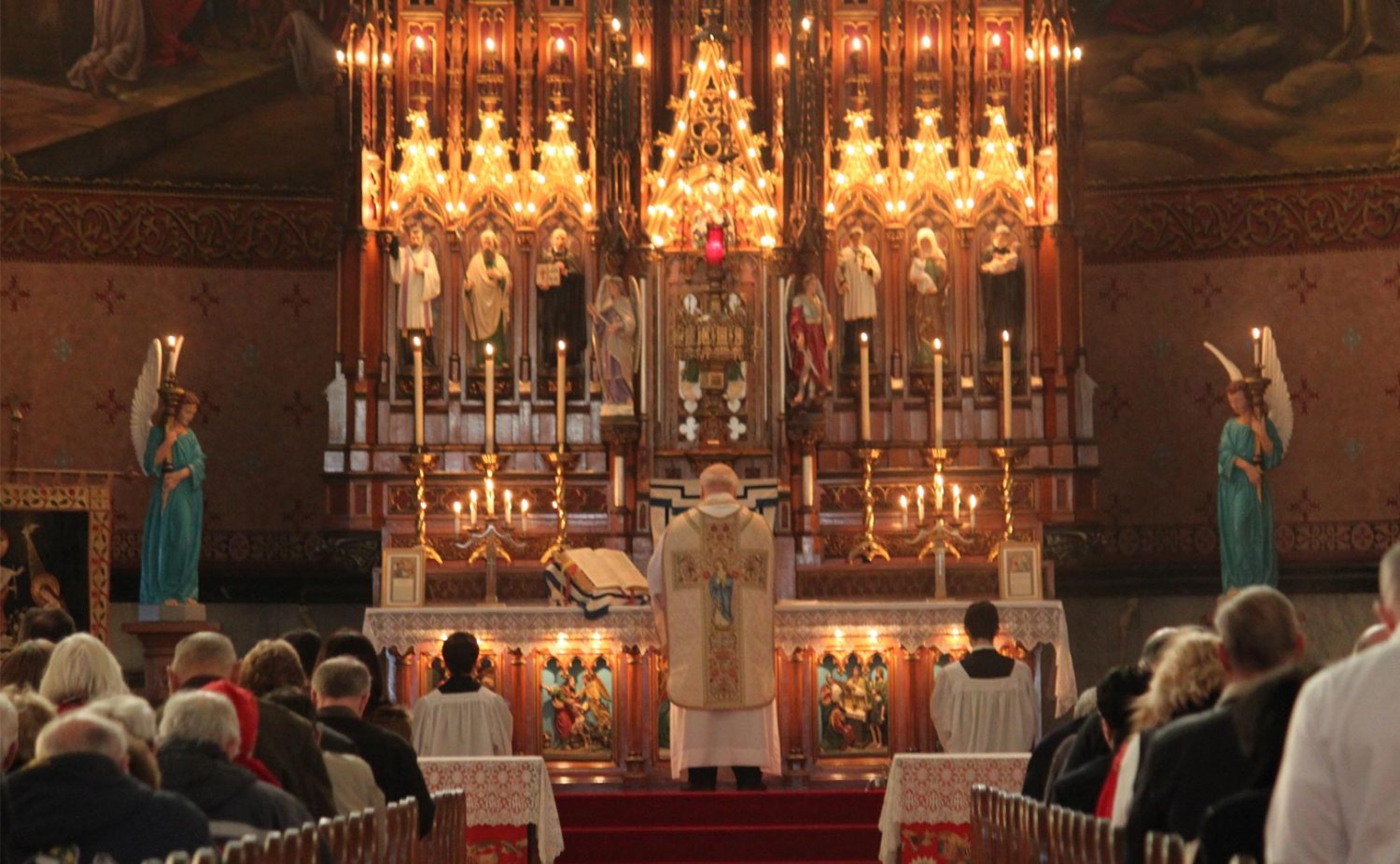
YOU DO NOT “GO TO ANYONE” YOU REMAIN IN JESUS AND BECOME A REMNANT CATHOLIC AND YOU LIVE AND ACT JUST LIKE THE REMNANT CATHOLICS DID IN ENGLAND UNDER HENRY VIII AND ELIZABETH I


‘To Whom Shall We Go?’: On Being 70 and Catholic

One/Peter/Five

What if you are in your seventies or older and feeling abandoned by the Roman Catholic Church? Nope. We do not seem to have a program, project, or ministry for that. We’ve got bereavement support, suicide prevention, and depression assistance, but not a Crisis of Faith Hotline for the Elderly.

Such a ministry is urgently needed. The group in need is getting to the end. We want – no, we need – to get this right. How we spend eternity hangs in the balance. But there’s a problem: we’re just not sure anymore.

What’s the big deal? you say. If you are so concerned about this heaven and hell thing, just go to Mass every Sunday and Confession at Easter, and you’re good. If you’re lucky, they’ll give you the Last Rites just before you die.

I wish I could believe that it is that easy.

Our Generation’s Catholicism Has Never Been Easy

Our generation’s Catholicism always has required effort – effort to understand its teachings, effort to assist at Mass, effort to live up to the Church’s requirements. But not so much effort that you couldn’t do it with the help of the grace of God. Although it took effort to be a Catholic, we knew there was no other means of salvation. We knew this was true because the One True Church said it was true, and we had confidence in what the Church said.

At the beginning, we were told that nothing was being changed. We have been told for fifty years that nothing has changed. People like me believed it. Maybe our generation believed it because we were too busy to pay much attention. We were just starting out in life. Our families and our careers commanded most of our time. So what if the Mass used to be in Latin and now it’s in English? How is that a problem? Was not the first Mass offered in Aramaic? Besides, we are talking about the Catholic Church here, not Flip Wilson’s “Church of What’s Happenin’ Now.”

Things have slowed down enough in retirement that I have had time to look around and see what’s been going on while I was busy living my life. The first thing I noticed was that most of my friends and relatives no longer go to Sunday Mass. Some have even quit the Church and joined another religion. Some say they really don’t need any church; they have a direct and personal relationship with God.

Too bad for them, I say. Having once had the Faith and then rejecting it is worse than never having had the Faith at all. I may not have been paying close attention to the Faith, but at least I’m still Catholic.

The Liturgy

Ah, but what does it mean to still be Catholic? In 2010, I found myself attending Mass in a suburb of Rochester, N.Y. It was Trinity Sunday. I remember that it was Trinity Sunday because the deacon read the Gospel and preached on “God the Creator, God the Redeemer, and God the Sanctifier.” Ouch. No wonder pastors joke that this Sunday should be called “Heresy Sunday.”

Another memory of that Mass is that the Consecration passed almost unnoticed. No bells, no special reverence from the celebrant, barely any elevation of the host and chalice. The congregation seemed unaware of what was happening at that particular point in the Mass.

Then came the Our Father. Oh, brother!  The celebrant was animated, the people were loud, and (almost) everyone was holding hands and raising them in unison to heaven. This was the high point of the liturgy.

After receiving (what I hoped was) Communion, I prayed silently that God would forgive that pastor for what he was doing. I also prayed that my attendance at Mass that day satisfied my Sunday obligation.

This was my first realization that the Catholicism of the people in that church, their Catholicism, was not the same as my Catholicism.

Seven years later, summer 2017, I had another experience at Mass. Again it was in upstate New York, this time at a resort community in a non-denominational building that is used for concerts and lectures as well as Protestant, Catholic, and other religious services.

A family came in and sat on the bench in front of me. Over the years, I’ve gotten used to people coming into church and continuing to chit-chat until the Mass begins. So their doing so this day did not bother me. Besides, this was not a church. Other than the rustic altar with a couple of flickering candles on the stage facing us, there was nothing that would put one in a proper frame of mind for what was about to take place.

Mass began, and the woman in front of me took one final swig of coffee from her Yeti thermal tumbler. I was immediately concerned. Mass in this venue takes half an hour – forty minutes, tops. Communion happens about twenty-five minutes in. She had started the one-hour clock on the Eucharistic fast. There was no way she was going to be able to make it.

It probably goes without saying that she did, in fact, receive Holy Communion. And immediately upon returning to her bench, she took another swig of coffee and washed it down!

The Eucharistic fast is not the point. The point is that this woman manifested no awareness whatsoever of the real presence of Jesus Christ in the Holy Eucharist. My God, the surveys are right.

The Mass is the clearest and most obvious manifestation of the change from Catholicism as I learned it to Catholicism as it is practiced today. And it is more than just the language of the liturgy.

It used to be “The Holy Sacrifice of the Mass.” Today, the Mass is a communal meal. Don’t worry about that old “state of grace” requirement for partaking in the meal. Today, the Eucharist is food to accompany us on the journey. All are welcome to share in the meal, regardless of the presence or absence of sanctifying grace in their souls. There is no mortal sin; there is only falling short of the ideal.

It used to be that the priest offered the Perfect Sacrifice on our behalf in worship of God. The Mass was complete even if there was no “people’s communion.” Today, the priest is there to lead us in prayer and song. Today, the Mass is for and about us. If the priest is a poor homilist, we “don’t get anything out of it.”

Abandonment of Dogma

The Mass is not the only manifestation of the transformation that I now realize has taken place in the Catholic Church. Each day, it seems, there is a new contradiction or a new ambiguity regarding what I had learned as fixed, firm, unchangeable dogma. Take, for example, interfaith initiatives.

In my Catholicism, the Catholic Church is the one, true church. Outside the Church there is no salvation. There were rules against attending the services and ceremonies of other religions. Missionaries went out with zeal to every corner of the world so that all people could hear the Gospel and be saved. The Catholic Church, by definition, was and is open to all of humanity.

Now one religion is pretty much as good as any other. Priests, ministers, rabbis, imams, gurus – they can all offer their own brand of worship in each other’s buildings. It’s unity that is important, not those inconvenient statements still contained in the Catechism of the Catholic Church and not some notion of the necessity for valid, sacramental holy orders.

The rationale for these interfaith initiatives seems to be that “we all pray to the same God, even if we refer to God by different names.” Really? The God of my Catholicism is a Trinity, three distinct Persons, one divine nature. I’m quite certain that devout Jews, Muslims, Hindus, and Buddhists are not worshiping that God.

It’s that Second Person of the Trinity, Jesus Christ, that seems to be the impediment to unity. The other two Persons are so – what’s the word? – abstract that it is easy to relate to Them (or not) in your own particular way. But that Second Person, who dwelt among us with an in-your-face message, who created for us a Church as the means of eternal salvation, and who was the embodiment of the Divine – that’s where the problem lies.

My generation’s Catholicism reveled in the knowledge of Jesus Christ and all that He did and all that He taught. Today’s Catholicism seems to be running from Jesus Christ.

Just as the Church abandoned its liturgy, it is abandoning its dogma. Do not tell me that it is not happening and that nothing is changing. You got that by me once, when I was not paying close attention. Now I am fully alert, and I can see for myself that it is indeed happening.

As the Church abandons its dogma, it abandons me and my generation. The priests and nuns of our youth did a good job of teaching us our faith. You might call us the Bishop Sheen Catholics. We bought in early. Many of us have stayed in for fifty years. It is terrifying to think that we still have it right and it is the Church that is getting it wrong.

My generation needs a ministry of reassurance. When the Church gets it wrong, to whom shall we go?

{ To whom should you go?  If you have not already done so, by placing ALL of your trust in Him, you go to Jesus Christ as though your very life depends on it, because it does.  I am not being facetious; it really does depend on him.  


Don’t you realize that you have become part of the Remnant?

Your situation, our situation, is analogous to the situation in which Catholics found themselves in 16th Century England.  All of a sudden Catholics woke up and found that the Church in which they had grown up had changed.  The head of the Church in England, the Archbishop of Canterbury had come under the influence of liberals and progressives live Martin Luther and John Calvin.  Worse, the King, Henry VIII, had become a serial adultlerer and he felt it was ok for him to ‘re-marry’ and still receive Holy Communion while living in an adulterous relationship because the good of the Nation required it.  And to put a proper face on it the King declared himself the Head of the Church, the Liturgy of the Mass changed with the genius of Archbishop Cranmer and all of a sudden Catholics in England woke up and found that they had become Anglicans.  

Well, not ALL Catholics.  Some, like the author of the above article still considered themselves to be Catholics, not Anglicans and because they now constituted a small number of people compared to their Anglican neighbors they became a Remnant of the Catholic Church.

That is what you are.  That is what many of us are.

And as a consequence, we are going to experience persecution.  Not the same kind of persecution that English Catholics experienced under Henry VIII and Elizabeth I. You will cherish the Traditional Latin Mass when you can find it and you will learn to avoid the absurdities liberal priests and bishops introduce into the Novus Ordo Masses.

Just as English Catholics learned to avoid Anglican Masses celebrated by priests who were ordained not to offer the sacrifice of Jesus Christ but to set the table for a community meal, you will seek out priests, bishops (yes, and even popes) who manifest their belief in the Incarnate Lord Jesus Christ who suffered and died for us and who revealed his plan for us in the 2000 year magisterium of the Church we have possessed up to the present pontificate.}

Posted in Uncategorized | 2 Comments

CORRECTIO FILIALIS DE HAERESIBUS PROPAGATIS

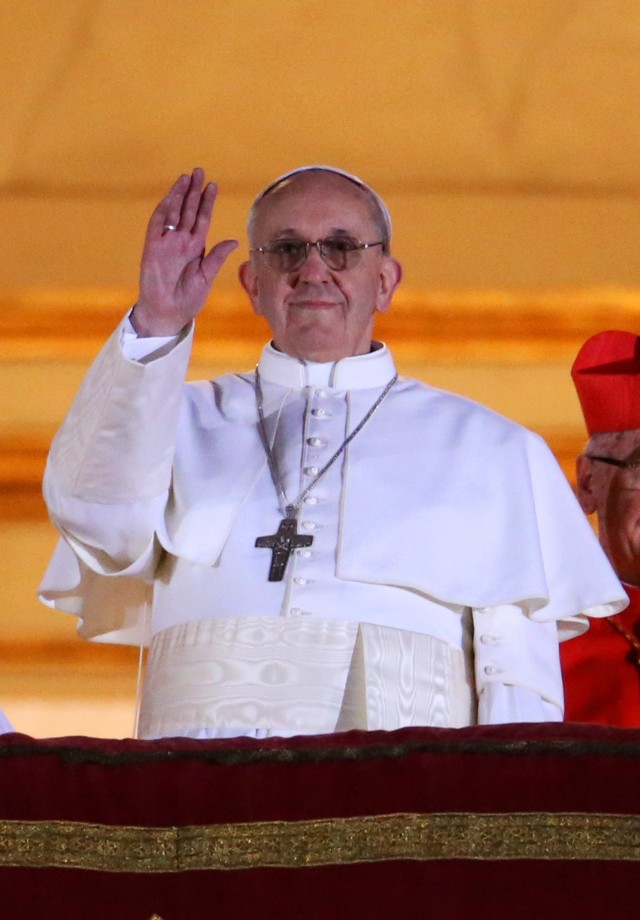
The Conclave Of Cardinals Have Elected A New Pope To Lead The World's Catholics

VATICAN CITY, VATICAN – MARCH 13: Newly elected Pope Francis I appears on the central balcony of St Peter’s Basilica on March 13, 2013 in Vatican City, Vatican. Argentinian Cardinal Jorge Mario Bergoglio was elected as the 266th Pontiff and will lead the world’s 1.2 billion Catholics. (Photo by Peter Macdiarmid/Getty Images)

http://www.correctiofilialis.org

© [all rights reserved]

Correctio filialis de haeresibus propagatis

July 16th, 2017 Feast of our Lady of Mt Carmel

With profound grief, but moved by fidelity to our Lord Jesus Christ, by love for the Church and for the papacy, and by filial devotion toward yourself, we are compelled to address a correction to Your Holiness on account of the propagation of heresies effectedbythe apostolic exhortation Amoris laetitia and by other words, deeds and omissions of Your Holiness.

We are permitted to issue this correction by natural law, by the law of Christ, and by the law of the Church, which three things Your Holiness has been appointed by divine providence to guard. By natural law: for as subjects have by nature a duty to obey their superiors in all lawful things, so they have a right to be governed according to law, and therefore to insist, where need be, that their superiors so govern. By the law of Christ: for His Spirit inspired the apostle Paul to rebuke Peter in public when the latter did not act according to the truth of the gospel (Gal. 2). St Thomas Aquinas notes that this public rebuke from a subject to a superior was licit on account of the imminent danger of scandal concerning the faith (Summa Theologiae 2a 2ae, 33, 4 ad 2), and ‘the gloss of St Augustine’ adds that on this occasion, “Peter gave an example to superiors, that if at any time they should happen to stray from the straight path, they should not disdain to be reproved by their subjects” (ibid.). The law of the Church also constrains us, since it states that “Christ’s faithful . . . have the right, indeed at times the duty, in keeping with their knowledge, competence, and position, to manifest to the sacred pastors their views on matters which concern the good of the Church” (Code of Canon Law 212:2-3; Code of Canons of Oriental Churches 15:3).

Scandal concerning faith and morals has been given to the Church and to the world by the publication of Amoris laetitia and by other acts through which Your Holiness has sufficiently made clear the scope and purpose of this document. Heresies and other errors have in consequence spread through the Church; for while some bishops and cardinals have continued to defend the divinely revealed truths about marriage, the moral law, and the reception of the sacraments, others have denied these truths, and have received from Your Holiness not rebuke but favour. Those cardinals, by contrast, who have submitted dubia to Your Holiness, in order that by this time-honoured method the truth of the gospel might be easily affirmed, have received no answer but silence.

Most Holy Father, the Petrine ministry has not been entrusted to you that you might impose strange doctrines on the faithful, but so that you may, as a faithful steward, guard the deposit against the day of the Lord’s return (Lk. 12; 1 Tim. 6:20). We adhere wholeheartedly to the doctrine of papal infallibility as defined by the First Vatican Council, and therefore we adhere to

http://www.correctiofilialis.org

© [all rights reserved]

the explanation which that same council gave of this charism, which includes this declaration: “The Holy Spirit was not promised to the successors of Peter that they might, by His revelation, make known some new doctrine, but that, by His assistance, they might religiously guard and faithfully expound the revelation or deposit of faith transmitted by the apostles” (Pastor aeternus, cap. 4). For this reason, Your Predecessor, Blessed Pius IX, praised the collective declaration of the German bishops, who noted that “the opinion according to which the pope is ‘an absolute sovereign because of his infallibility’ is based on a completely false understanding of the dogma of papal infallibility.”

1 Likewise, at the 2nd Vatican Council, the Theological Commission which oversaw the Dogmatic Constitution on the Church, Lumen gentium, noted that the powers of the Roman pontiff are limited in many ways.2

Those Catholics, however, who do not clearly grasp the limits of papal infallibility are liable to be led by the words and actions of Your Holiness into one of two disastrous errors: either they will come to embrace the heresies which are now being propagated, or, aware that these doctrines are contrary to the word of God, they will doubt or deny the prerogatives of the popes. Others again of the faithful are led to put in doubt the validity of the renunciation of the papacy by Pope Emeritus Benedict XVI. Thus, the Petrine office, bestowed upon the Church by our Lord Jesus Christ for the sake of unity and faith, is so used that a way is opened for heresy and for schism. Further, noting that practices now encouraged by Your Holiness’s words and actions are contrary not only to the perennial faith and discipline of the Church but also to the magisterial statements of Your predecessors, the faithful reflect that Your Holiness’s own statements can enjoy no greater authority than that of former popes; and thus the authentic papal magisterium suffers a wound of which it may not soon be healed.

We, however, believe that Your Holiness possesses the charism of infallibility, and the right of universal jurisdiction over Christ’s faithful, in the sense defined by the Church. In our protest against Amoris laetitia and against other deeds, words and omissions related to it, we do not deny the existence of this papal charism or Your Holiness’s possession of it, since neither Amoris laetitia nor any of the statements which have served to propagate the heresies which this exhortation insinuates are protected by that divine guarantee of truth. Our correction is indeed required by fidelity to infallible papal teachings which are incompatible with certain of Your Holiness’s statements.

As subjects, we do not have the right to issue to Your Holiness that form of correction by which a superior coerces those subject to him with the threat or administration of punishment (cf. Summa Theologiae 2a 2ae, 33, 4). We issue this correction, rather, to protect our fellow Catholics – and those outside the Church, from whom the key of knowledge must not be taken away (cf. Lk. 11:52) – hoping to prevent the further spread of doctrines which tend of themselves to the profaning of all the sacraments and the subversion of the Law of God.

W

***

e wish now to show how several passages of Amoris laetitia, in conjunction with acts, words,

and omissions of Your Holiness, serve to propagate seven heretical propositions.3

http://www.correctiofilialis.org

© [all rights reserved]

The passages of Amoris laetitia to which we refer are the following:

AL 295: ‘Saint John Paul II proposed the so-called “law of gradualness” in the knowledge that the human being “knows, loves and accomplishes moral good by different stages of growth”. This is not a “gradualness of law” but rather a gradualness in the prudential exercise of free acts on the part of subjects who are not in a position to understand, appreciate, or fully carry out the objective demands of the law.’

AL 296: “There are two ways of thinking which recur throughout the Church’s history: casting off and reinstating. The Church’s way, from the time of the Council of Jerusalem, has always been the way of Jesus, the way of mercy and reinstatement. The way of the Church is not to condemn anyone for ever.”

AL 297: ‘No one can be condemned for ever, because that is not the logic of the Gospel!’

AL 298: ‘The divorced who have entered a new union, for example, can find themselves in a variety of situations, which should not be pigeonholed or fit into overly rigid classifications leaving no room for a suitable personal and pastoral discernment. One thing is a second union consolidated over time, with new children, proven fidelity, generous self-giving, Christian commitment, a consciousness of its irregularity and of the great difficulty of going back without feeling in conscience that one would fall into new sins. The Church acknowledges situations “where, for serious reasons, such as the children’s upbringing, a man and woman cannot satisfy the obligation to separate [footnote 329: In such situations, many people, knowing and accepting the possibility of living “as brothers and sisters” which the Church offers them, point out that if certain expressions of intimacy are lacking, “it often happens that faithfulness is endangered and the good of the children suffers”.] There are also the cases of those who made every effort to save their first marriage and were unjustly abandoned, or of “those who have entered into a second union for the sake of the children’s upbringing, and are sometimes subjectively certain in conscience that their previous and irreparably broken marriage had never been valid”. Another thing is a new union arising from a recent divorce, with all the suffering and confusion which this entails for children and entire families, or the case of someone who has consistently failed in his obligations to the family. It must remain clear that this is not the ideal which the Gospel proposes for marriage and the family. The Synod Fathers stated that the discernment of pastors must always take place “by adequately distinguishing”, with an approach which “carefully discerns situations”. We know that no “easy recipes” exist.’

AL 299: ‘I am in agreement with the many Synod Fathers who observed that “the baptized who are divorced and civilly remarried need to be more fully integrated into Christian communities in the variety of ways possible, while avoiding any occasion of scandal. The logic of integration is the key to their pastoral care, a care which would allow them not only to realize that they belong to the Church as the body of

http://www.correctiofilialis.org

© [all rights reserved]

Christ, but also to know that they can have a joyful and fruitful experience in it. They are baptized; they are brothers and sisters; the Holy Spirit pours into their hearts gifts and talents for the good of all. … Such persons need to feel not as excommunicated members of the Church, but instead as living members, able to live and grow in the Church and experience her as a mother who welcomes them always, who takes care of them with affection and encourages them along the path of life and the Gospel.”’

AL 300: ‘Since “the degree of responsibility is not equal in all cases”, the consequences or effects of a rule need not necessarily always be the same. [footnote 336] This is also the case with regard to sacramental discipline, since discernment can recognize that in a particular situation no grave fault exists.’

AL 301: ‘It is [sic] can no longer simply be said that all those in any “irregular” situation are living in a state of mortal sin and are deprived of sanctifying grace. More is involved here than mere ignorance of the rule. A subject may know full well the rule, yet have great difficulty in understanding “its inherent values, or be in a concrete situation which does not allow him or her to act differently and decide otherwise without further sin.”’

AL 303: ‘Conscience can do more than recognize that a given situation does not correspond objectively to the overall demands of the Gospel. It can also recognize with sincerity and honesty what for now is the most generous response which can be given to God, and come to see with a certain moral security that it is what God himself is asking amid the concrete complexity of one’s limits, while yet not fully the objective ideal.’

AL 304: ‘I earnestly ask that we always recall a teaching of Saint Thomas Aquinas and learn to incorporate it in our pastoral discernment: “Although there is necessity in the general principles, the more we descend to matters of detail, the more frequently we encounter defects… In matters of action, truth or practical rectitude is not the same for all, as to matters of detail, but only as to the general principles; and where there is the same rectitude in matters of detail, it is not equally known to all… The principle will be found to fail, according as we descend further into detail”. It is true that general rules set forth a good which can never be disregarded or neglected, but in their formulation they cannot provide absolutely for all particular situations.’

AL 305: ‘Because of forms of conditioning and mitigating factors, it is possible that in an objective situation of sin – which may not be subjectively culpable, or fully such – a person can be living in God’s grace, can love and can also grow in the life of grace and charity, while receiving the Church’s help to this end. [footnote 351: In certain cases, this can include the help of the sacraments. Hence, “I want to remind priests that the confessional must not be a torture chamber, but rather an encounter with the Lord’s mercy. I would also point out that the Eucharist “is not a prize for the perfect, but a powerful medicine and nourishment for the weak.”]’

AL 308: ‘I understand those who prefer a more rigorous pastoral care which leaves no room for confusion. But I sincerely believe that Jesus wants a Church attentive to

http://www.correctiofilialis.org

© [all rights reserved]

the goodness which the Holy Spirit sows in the midst of human weakness, a Mother who, while clearly expressing her objective teaching, “always does what good she can, even if in the process, her shoes get soiled by the mud of the street”.’

AL 311: ‘The teaching of moral theology should not fail to incorporate these considerations.’

The words, deeds and omissions of Your Holiness to which we wish to refer, and which in conjunction with these passages of Amoris laetitia are serving to propagate heresies within the Church, are the following:

– Your Holiness has refused to give a positive answer to the dubia submitted to you by Cardinals

Burke, Caffarra, Brandmüller, and Meisner, in which you were respectfully requested to confirm

that the Apostolic Exhortation Amoris laetitia does not abolish five teachings of the Catholic

faith.

– Your Holiness intervened in the composition of the Relatio post disceptationem for the

Extraordinary Synod on the Family. The Relatio proposed allowing Communion for divorced-

and-remarried Catholics on a “case-by-case basis”, and said pastors should emphasize the

“positive aspects” of lifestyles the Church considers gravely sinful, including civil remarriage

after divorce and premarital cohabitation. These proposals were included in the Relatio at your

personal insistence, despite the fact that they did not receive the two-thirds majority required by

the Synod rules for a proposal to be included in the Relatio.

– In an interview in April 2016, a journalist asked Your Holiness if there are any concrete possibilities for the divorced and remarried that did not exist before the publication of Amoris laetitia. You replied ‘Io posso dire, si. Punto’; that is, ‘I can say yes. Period.’ Your Holiness then stated that the reporter’s question was answered by the presentation given by Cardinal Schönborn on Amoris laetitia. In this presentationCardinal Schönborn stated:

My great joy as a result of this document resides in the fact that it coherently overcomes that artificial, superficial, clear division between “regular” and “irregular”, and subjects everyone to the common call of the Gospel, according to the words of St. Paul: “For God has consigned all to disobedience, that He may have mercy on all” (Rom. 11, 32). … what does the Pope say in relation to access to the sacraments for people who live in “irregular” situations? Pope Benedict had already said that “easy recipes” do not exist (AL 298, note 333). Pope Francis reiterates the need to discern carefully the situation, in keeping with St. John Paul II’s Familiaris consortio (84) (AL 298). “Discernment must help to find possible ways of responding to God and growing in the midst of limits. By thinking that everything is black and white, we sometimes close off the way of grace and of growth, and discourage paths of sanctification which give glory to God” (AL 205). He also reminds us of an important phrase from Evangelii gaudium, 44: “A small step, in the midst of great

http://www.correctiofilialis.org

© [all rights reserved]

Your Holiness amplified this statement by asserting that Amoris laetitia endorses the approach to the divorced and remarried that is practised in Cardinal Schönborn’s diocese, where they are permitted to receive communion.

– On Sept. 5th 2016 the bishops of the Buenos Aires region issued a statement on the application of Amoris laetitia. In it they stated:

human limitations, can be more pleasing to God than a life which appears outwardly in order but moves through the day without confronting great difficulties” (AL 304). In the sense of this “via caritatis” (AL 306), the Pope affirms, in a humble and simple manner, in a note (351) that the help of the sacraments may also be given “in certain cases”.4

6) En otras circunstancias más complejas, y cuando no se pudo obtener una

declaración de nulidad, la opción mencionada puede no ser de hecho factible. No

obstante, igualmente es posible un camino de discernimiento. Si se llega a reconocer

que, en un caso concreto, hay limitaciones que atenúan la responsabilidad y la

culpabilidad (cf. 301-302), particularmente cuando una persona considere que caería

en una ulterior falta dañando a los hijos de la nueva unión, Amoris laetítía abre la

posibilidad del acceso a los sacramentos de la Reconciliación y la Eucaristía (cf. notas

336 y 351). Estos a su vez disponen a la persona a seguir madurando y creciendo con

la fuerza de la gracia. …

9) Puede ser conveniente que un eventual acceso a los sacramentos se realice de

manera reservada, sobre todo cuando se prevean situaciones conflictivas. Pero al

mismo tiempo no hay que dejar de acompañar a la comunidad para que crezca en un

espíritu de comprensión y de acogida, sin que ello implique crear confusiones en la

enseñanza de la Iglesia acerca del matrimonio indisoluble. La comunidad es

instrumento de la misericordia que es «inmerecida, incondicional y gratuita» (297).

10)

El discernimiento no se cierra, porque «es dinámico y debe permanecer siempre

abierto a nuevas etapas de crecimiento y a nuevas decisiones que permitan realizar el

ideal de manera más plena» (303), según la «ley de gradualidad» (295) y confiando en

la ayuda de la gracia.

[6) In other, more complex cases, and when a declaration of nullity has not been

obtained, the above mentioned option may not, in fact, be feasible. Nonetheless, a

path of discernment is still possible. If it comes to be recognized that, in a specific

case, there are limitations that mitigate responsibility and culpability (cf. 301-302),

especially when a person believes they would incur a subsequent wrong by harming

the children of the new union, Amoris laetitia offers the possibility of access to the

sacraments of Reconciliation and Eucharist (cf. footnotes 336 and 351). These

sacraments, in turn, dispose the person to continue maturing and growing with the

power of grace. …

http://www.correctiofilialis.org

© [all rights reserved]

9) It may be right for eventual access to sacraments to take place privately, especially

where situations of conflict might arise. But at the same time, we have to accompany

our communities in their growing understanding and welcome, without this implying

creating confusion about the teaching of the Church on the indissoluble marriage.

The community is an instrument of mercy, which is “unmerited, unconditional and

gratuitous” (297).

10) Discernment is not closed, because it “is dynamic; it must remain ever open to

new stages of growth and to new decisions which can enable the ideal to be more

fully realized” (303), according to the “law of gradualness” (295) and with

confidence in the help of grace.]

This asserts that according to Amoris laetitia confusion is not to be created about the teaching of the Church on the indissolubility of marriage, that the divorced and remarried can receive the sacraments, and that persisting in this state is compatible with receiving the help of grace. Your Holiness wrote an official letter dated the same day to Bishop Sergio Alfredo Fenoy of San Miguel, a delegate of the Argentina bishops’ Buenos Aires Region, stating that the bishops of the Buenos Aires region had given the only possible interpretation of Amoris laetitia:

Querido hermano:

Recibí el escrito de la Región Pastoral Buenos Aires «Criterios básicos para la

aplicación del capítulo VIII de Amoris laetítia». Muchas gracias por habérmelo

enviado; y los felicito por el trabajo que se han tomado: un verdadero ejemplo de

acompañamiento a los sacerdotes… y todos sabemos cuánto es necesaria esta

cercanía del obíspo con su clero y del clero con el obispo . El prójimo «más prójimo»

del obispo es el sacerdote, y el mandamiento de amar al prójimo como a sí mismo

comienza para nosotros obispos precisamente con nuestros curas.

El escrito es muy bueno y explícita cabalmente el sentido del capitulo VIII de

Amoris Laetitia. No hay otras interpretaciones.

[Beloved brother,

I received the document from the Buenos Aires Pastoral Region, “Basic Criteria

for the Application of Chapter Eight of Amoris laetitia.” Thank you very much for

sending it to me. I thank you for the work they have done on this: a true example of

accompaniment for the priests … and we all know how necessary is this closeness of

the bishop with his clergy and the clergy with the bishop. The neighbor ‘closest’ to

the bishop is the priest, and the commandment to love one’s neighbor as one’s self

begins for us, the bishops, precisely with our priests. The document is very good and

completely explains the meaning of chapter VIII of Amoris laetitia. There are no

other interpretations.]

5

– Your Holiness appointed Archbishop Vincenzo Paglia as president of the Pontifical Academy

http://www.correctiofilialis.org

© [all rights reserved]

for Life and grand chancellor of the Pontifical Pope John Paul II Institute for Studies on

Marriage and Family. As head of the Pontifical Council for the Family, Archbishop Paglia was

responsible for the publication of a book, Famiglia e Chiesa, un legame indissolubile (Libreria Editrice

Vaticana, 2015), that contains the lectures given at three seminars promoted by that dicastery on

the topics of ‘Marriage: Faith, Sacrament, Discipline’; ‘Family, Conjugal Love and Generation’;

and ‘The Wounded Family and Irregular Unions: What Pastoral Attitude’. This book and the

seminars it described were intended to put forward proposals for the Synod on the Family, and

promoted the granting of communion to divorced and remarried Catholics.

– Guidelines for the diocese of Rome were issued under Your Holiness’s authority permitting the

reception of the Eucharist under certain circumstances by civilly divorced and remarried

Catholics living moreuxorio with their civil partner.

– Your Holiness appointed Bishop Kevin Farrell as prefect of the newly established Dicastery for

Laity, Family and Life, and promoted him to the rank of cardinal. Cardinal Farrell has expressed

support for Cardinal Schönborn’s proposal that the divorced and remarried should receive

communion. He has stated that the reception of communion by the divorced and remarried is a

‘process of discernment and of conscience.’

6

– On January 17th, 2017, the Osservatore Romano, the official journal of the Holy See, published

the guidelines issued by the archbishop of Malta and the bishop of Gozo for the reception of

the Eucharist by persons living in an adulterous relationship. These guidelines permitted the

sacrilegious reception of the Eucharist by some persons in this situation, and stated that in some

cases it is impossible for such persons to practise chastity and harmful for them to attempt to

practise chastity. No criticism of these guidelines was made by the Osservatore Romano, which

presented them as legitimate exercises of episcopal teaching and authority. This publication was

an official act of the Holy See that went uncorrected by yourself.

Correctio

His verbis, actis, et omissionibus, et in iis sententiis libri Amoris laetitia quas supra diximus, Sanctitas Vestra sustentavit recte aut oblique, et in Ecclesia (quali quantaque intelligentia nescimus nec iudicare audemus) propositiones has sequentes, cum munere publico tum actu privato,propagavit, falsas profecto et haereticas:

  1. (1)  “Homo iustificatus iis caret viribus quibus, Dei gratia adiutus, mandata obiectiva legis divinae impleat; quasi quidvis ex Dei mandatis sit iustificatis impossibile; seu quasi Dei gratia, cum in homine iustificationem efficit, non semper et sua natura conversionem efficiat ab omni peccato gravi; seu quasi non sit sufficiens ut hominem ab omni peccato gravi convertat.”
  2. (2)  Christifidelis qui, divortium civile a sponsa legitima consecutus, matrimonium civile (sponsa vivente) cum alia contraxit; quique cum ea more uxorio vivit; quique cum plena intelligentia naturae actus sui et voluntatis propriae pleno ad actum consensu eligit in hoc rerum statu manere: non necessarie mortaliter peccare dicendus est, et gratiam sanctificantem accipere

et in caritate crescere potest.”

http://www.correctiofilialis.org

© [all rights reserved]

  1. (3)  “Christifidelis qui alicuius mandati divini plenam scientiam possidet et deliberata voluntate in re gravi id violare eligit, non semper per talem actum graviter peccat.”
  2. (4)  “Homo potest, dum divinae prohibitioni obtemperat, contra Deum ea ipsa obtemperatione peccare.”
  3. (5)  “Conscientia recte ac vere iudicare potest actus venereos aliquando probos et honestos esse aut licite rogari posse aut etiam a Deo mandari, inter eos qui matrimonium civile contraxerunt quamquam sponsus cum alia in matrimonio sacramentali iam coniunctus est.”
  4. (6)  “Principia moralia et veritas moralis quae in divina revelatione et in lege naturali continentur non comprehendunt prohibitiones qualibus genera quaedam actionis absolute vetantur utpote quae propter obiectum suum semper graviter illicita sint.”
  5. (7)  “Haec est voluntas Domini nostri Iesu Christi, ut Ecclesia disciplinam suam perantiquam abiciat negandi Eucharistiam et Absolutionem iis qui, divortium civile consecuti et matrimonium civile ingressi, contritionem et propositum firmum sese emendandi ab ea in qua vivunt vitae conditione noluerunt patefacere.”7

These propositions all contradict truths that are divinely revealed, and that Catholics must believe with the assent of divine faith. They were identified as heresies in the petition concerning Amoris laetitia that was addressed by 45 Catholic scholars to the cardinals and Eastern patriarchs of the Church.8 It is necessary for the good of souls that they be once more condemned by the authority of the Church. In listing these seven propositions we do not intend to give an exhaustive list of all the heresies and errors which an unbiased reader, attempting to read Amoris laetitia in its natural and obvious sense, would plausibly take to be affirmed, suggested or favoured by this document: a letter sent to all the cardinals of the Church and to the Eastern Catholic patriarchs lists 19 such propositions.Rather, we seek to list the propositions which Your Holiness’s words, deeds and omissions, as already described, have in effect upheld and propagated, to the great and imminent danger of souls.

At this critical hour, therefore, we turn to the cathedra veritatis, the Roman Church, which has by divine law pre-eminence over all the churches, and of which we are and intend always to remain loyal children, and we respectfully insist that Your Holiness publicly reject these propositions, thus accomplishing the mandate of our Lord Jesus Christ given to St Peter and through him to all his successors until the end of the world: “I have prayed for thee, that thy faith fail not: and thou, being once converted, confirm thy brethren.”

***

We respectfully ask for Your Holiness’s apostolic blessing, with the assurance of our filial

devotion in our Lord and of our prayer for the welfare of the Church.

http://www.correctiofilialis.org

© [all rights reserved]

Elucidation

In order to elucidate our Correctio, and to put forward a firmer defence against the spread of errors, we wish to draw attention to two general sources of error which appear to us to be fostering the heresies that we have listed. We speak, firstly, of that false understanding of divine revelation which generally receives the name of Modernism, and secondly, of the teachings of Martin Luther.

A. The problem of Modernism

The Catholic understanding of divine revelation is frequently denied by contemporary theologians, and this denial has led to widespread confusion among Catholics on the nature of divine revelation and faith. In order to prevent any misunderstanding that might arise from this confusion, and to justify our claim about the current propagation of heresies within the Church, we will describe the Catholic understanding of divine revelation and faith, which is presumed in this document.

This description is also necessary in order to respond to the passages in Amoris laetitia where it is asserted that the teachings of Christ and of the magisterium of the Church should be followed. These passages include the following: “Unity of teaching and practice is certainly necessary in the Church” (AL 3). “Faithful to Christ’s teaching we look to the reality of the family today in all its complexity” (AL 32). “The teaching of the encyclical Humanae Vitae and the Apostolic Exhortation Familiaris Consortio ought to be taken up anew” (AL 222). “The teaching of the Master (cf. Mt 22:30) and Saint Paul (cf. 1 Cor 7:29-31) on marriage is set – and not by chance – in the context of the ultimate and definitive dimension of our human existence. We urgently need to rediscover the richness of this teaching” (AL 325). These passages might be seen as ensuring that nothing in Amoris laetitia serves to propagate errors contrary to Catholic teaching. A description of the true nature of adherence to Catholic teaching will clarify our assertion that Amoris laetitita does indeed serve to propagate such errors.

We therefore ask Your Holiness to permit us to recall the following truths, which are taught by Holy Scripture, Sacred Tradition, the universal consensus of the Fathers, and the magisterium of the Church, and which summarise Catholic teaching on faith, divine revelation, infallible magisterial teaching, and heresy:

  1. The gospels of Matthew, Mark, Luke, and John, whose historical character the Church unhesitatingly asserts, faithfully hand on what Jesus Christ, while living among men, really did and taught for their eternal salvation until the day He was taken up into heaven.9
  2. Jesus Christ is true God and true man. In consequence, all his teachings are the teachings of God Himself.10

http://www.correctiofilialis.org

© [all rights reserved]

  1. AllthepropositionsthatarecontainedintheCatholicfaitharetruthscommunicated by God.11
  2. In believing these truths with an assent that is an act of the theological virtue of faith, we are believing the testimony of a speaker. The act of divine faith is a particular form of the general intellectual activity of believing a proposition because a speaker asserts it, and because the speaker is held to be honest and knowledgeable with respect to the assertion he is making. In an act of divine faith, God is believed when he says something, and he is believed because he is God and hence is knowledgeable and truthful.12
  3. Beliefindivinetestimonydiffersfrombeliefinthetestimonyofhumanbeingswho are not divine, because God is all-knowing and perfectly good. In consequence, he can neither lie nor be deceived. It is thus impossible for divine testimony to be mistaken. Because the truths of the Catholic faith are communicated to us by God, the assent of faith that is given to them is most certain. A Catholic believer cannot have rational grounds for doubting or disbelieving any of these truths.13
  4. Human reason by itself can establish the truth of the Catholic faith based on the publicly available evidence for the divine origin of the Catholic Church, but such reasoning cannot produce an act of faith. The theological virtue of faith and the act of faith can only be produced by divine grace. A person who has this virtue but then freely and knowingly chooses to disbelieve a truth of the Catholic faith sins mortally and loses eternal life.14
  5. The truth of a proposition consists in its saying of what is, that it is; scholastically expressed, it consists in adaequatio rei et intellectus. Every truth is as such true, no matter by whom or when or in what circumstances it is considered. No truth can contradict any other truth.15
  6. TheCatholicfaithdoesnotexhaustallthetruthaboutGod,becauseonlythedivine intellect can fully comprehend the divine being. Nonetheless every truth of the Catholic faith is entirely and completely true, in that the features of reality that such a truth describes are exactly as these truths present them to be. There is no difference between the content of the teachings of the faith and how things are.16
  7. ThedivinespeechthatcommunicatesthetruthsoftheCatholicfaithisexpressedin human languages. The inspired Hebrew and Greek text of the Holy Scriptures is itself uttered by God in all of its parts. It is not a purely human report or interpretation of divine revelation, and no part of its meaning is due solely to human causes. In believing the teaching of the Holy Scriptures we are believing God directly. We are not believing the statements made by God on the basis of believing the testimony of some other, non-divine person or persons.17
  8. When the Catholic Church infallibly teaches that a proposition is a divinely revealed part of the Catholic faith and is to be believed with the assent of faith, Catholics who assent to this teaching are believing what God has communicated, and are believing it on account of His having said it.18
  9. The languages in which divine revelation is expressed, and the cultures and histories

http://www.correctiofilialis.org

© [all rights reserved]

that shaped these languages, do not constrain, distort, or add to the divine revelation that is expressed in them. No part or aspect of the Holy Scriptures or of the infallible teaching of the Church concerning the content of divine revelation is produced only by the languages and historical conditions in which they are expressed, but not by God’s action in communicating truths. Hence, no part of the content of the teaching of the Church can be revised or rejected on the grounds that it is produced by historical circumstances rather than by divine revelation.19

  1. The magisterial teaching of the Church after the death of the last apostle must be understood and believed as a single whole. It is not divided into a past magisterium and a contemporary or living magisterium that can ignore earlier magisterial teaching or revise it at will.20
  2. The Pope, who has the supreme authority in the Church, is not himself exempt from the authority of the Church, in accordance with divine and ecclesiastical law. He is bound to accept and uphold the definitive teaching of his predecessors in the papal office.21
  3. A heretical proposition is a proposition that contradicts a divinely revealed truth that is included in the Catholic faith.22
  4. The sin of heresy is committed by a person who possesses the theological virtue of faith, but then freely and knowingly chooses to disbelieve or doubt a truth of the Catholic faith. Such a person sins mortally and loses eternal life. The judgement of the Church upon the personal sin of heresy is exercised only by a priest in the sacrament of penance.23
  5. The canonical crime of heresy is committed when a Catholic a) publicly doubts or denies one or more truths of the Catholic faith, or publicly refuses to give assent to one or more truths of the Catholic faith, but does not doubt or deny all these truths or deny the existence of Christian revelation, and b) is pertinacious in this denial. Pertinacity consists in the person in question continuing to publicly doubt or deny one or more truths of the Catholic faith after having been warned by competent ecclesiastical authority that his doubt or denial is a rejection of a truth of the faith, and that this doubt or denial must be renounced and the truth in question must be publicly affirmed as divinely revealed by the person being warned.24

(The above descriptions of the personal sin of heresy and of the canonical crime of heresy are given solely in order to be able to exclude them from the subject of our protest. We are only concerned with heretical propositions propagated by the words, deeds and omissions of Your Holiness. We do not have the competence or the intention to address the canonical issue of heresy.)

B. The influence of Martin Luther

In the second place, we feel compelled by conscience to advert to Your Holiness’s

http://www.correctiofilialis.org

© [all rights reserved]

unprecedented sympathy for Martin Luther, and to the affinity between Luther’s ideas on law, justification, and marriage, and those taught or favoured by Your Holiness inAmoris laetitia and elsewhere.25 This is necessary in order that our protest against the seven heretical propositions listed in this document may be complete; we wish to show, albeit in summary form, that these are not unrelated errors, but rather form part of a heretical system. Catholics need to be warned not only against these seven errors, but also against this heretical system as such, not least by reason of Your Holiness’s praise of the man who originated it.

Thus, in a press conference on June 26th, 2016, Your Holiness stated:

I think that the intentions of Martin Luther were not mistaken. He was a reformer. Perhaps some methods were not correct. But in that time, if we read the story of the Pastor, a German Lutheran who then converted when he saw reality – he became Catholic – in that time, the Church was not exactly a model to imitate. There was corruption in the Church, there was worldliness, attachment to money, to power… and this he protested. Then he was intelligent and took some steps forward justifying, and because he did this [sic]. And today Lutherans and Catholics, Protestants, all of us agree on the doctrine of justification. On this point, which is very important, he did not err.26

In a homily in the Lutheran Cathedral in Lund, Sweden, on Oct 31st, 2016, Your Holiness stated:

As Catholics and Lutherans, we have undertaken a common journey of

reconciliation. Now, in the context of the commemoration of the Reformation

of 1517, we have a new opportunity to accept a common path, one that has taken

shape over the past fifty years in the ecumenical dialogue between the Lutheran

World Federation and the Catholic Church. Nor can we be resigned to the

division and distance that our separation has created between us. We have the

opportunity to mend a critical moment of our history by moving beyond the

controversies and disagreements that have often prevented us from

understanding one another.

Jesus tells us that the Father is the “vinedresser” (cf. v. 1) who tends and prunes the

vine in order to make it bear more fruit (cf. v. 2). The Father is constantly

concerned for our relationship with Jesus, to see if we are truly one with him (cf.

v. 4). He watches over us, and his gaze of love inspires us to purify our past and

to work in the present to bring about the future of unity that he so greatly

desires.

We too must look with love and honesty at our past, recognizing error and

seeking forgiveness, for God alone is our judge. We ought to recognize with the

same honesty and love that our division distanced us from the primordial

http://www.correctiofilialis.org

© [all rights reserved]

intuition of God’s people, who naturally yearn to be one, and that it was

perpetuated historically by the powerful of this world rather than the faithful

people, which always and everywhere needs to be guided surely and lovingly by its

Good Shepherd. Certainly, there was a sincere will on the part of both sides to

profess and uphold the true faith, but at the same time we realize that we closed

in on ourselves out of fear or bias with regard to the faith which others profess

with a different accent and language.

[…]

The spiritual experience of Martin Luther challenges us to remember that apart from God we can do nothing. “How can I get a propitious God?” This is the question that haunted Luther. In effect, the question of a just relationship with God is the decisive question for our lives. As we know, Luther encountered that propitious God in the Good News of Jesus, incarnate, dead and risen. With the concept “by grace alone”, he reminds us that God always takes the initiative, prior to any human response, even as he seeks to awaken that response. The doctrine of justification thus expresses the essence of human existence before God.27

In addition to stating that Martin Luther was correct about justification, and in close accordance with this view,Your Holiness has declared more than once that our sins are the place where we encounter Christ (as in your homilies of September 4th, and September 18th, 2014), justifying this view with St Paul, who in fact glories in his own “infirmities” (“astheneìais”, cf. 2 Cor. 12:5, 9) and not in his sins, so that the power of Christ may dwell in him.28 In an address to members of Communion and Liberation on March 7th, 2015 Your Holiness said:

The privileged place of encounter is the caress of Jesus’ mercy regarding my sin.

This is why you may have heard me say, several times, that the place for this, the

privileged place of the encounter with Jesus Christ is my sin.29

Furthermore, in addition to other propositions of Amoris laetitia which have been listed in the

letter sent to all the cardinals and Eastern Catholic patriarchs, and which have been therein

qualified as heretical, erroneous, or ambiguous, we read also this:

We should not however confuse different levels: there is no need to lay upon two limited persons the tremendous burden of having to reproduce perfectly the union existing between Christ and his Church, for marriage as a sign entails ‘a dynamic process…, one which advances gradually with the progressive integration of the gifts of God’ (AL 122).

While it is true that the sacramental sign of matrimony entails a dynamic process holiness, it is beyond doubt that by the sacramental sign the union of Christ with his Church is perfectly reproduced by grace in the married couple. It is not a question of imposing a

toward

http://www.correctiofilialis.org

© [all rights reserved]
tremendous burden on two limited persons, but rather of acknowledging the work of the

sacrament and of grace (res et sacramentum).

Surprisingly we notice here, as in several other parts of this Apostolic Exhortation, a close relationship with Luther’s disparagement of marriage. For the German revolutionary, the Catholic conception of a sacrament as effective ex opere operato, in an allegedly ‘mechanical’ way, is unacceptable. Although he maintains the distinction of signum et res, after 1520, with The Babylonian Captivity of the Church, he no longer applies it to marriage. Luther denies that marriage has any reference to sacramentality, on the grounds that we nowhere read in the Bible that the man who marries a woman receives a grace of God, and that neither do we read anywhere that marriage was instituted by God to be a sign of anything. He claimed that marriage is a mere symbol, adding that although it can represent the union of Christ with the Church, such figures and allegories are not sacraments in the sense we use the term (cf. Luther’s Works {LW} 36:92). For this reason, marriage – whose fundamental aim is to conceive children and to raise them up in the ways of God (cf. LW 44:11-12) – according to Luther belongs to the order of creation and not to that of salvation (cf. LW 45:18); it is given only in order to quench the fire of concupiscence, and as a bulwark against sin (cf. LW 3, Gen. 16:4).

Moreover, beginning with his personal vision about how human nature is corrupted by sin, Luther is conscious that man is not always anxious to respect God’s law. Therefore, he is convinced that there is a double manner by which God rules over mankind, to which corresponds a double moral vision about marriage and divorce. Thus divorce is generally admitted by Luther in the case of adultery, but only for non-spiritual people.

His reasoning is that there are two forms of divine government in this world: the spiritual and the temporal. By his spiritual government, the Holy Spirit leads Christians and righteous people under the Gospel of Christ; by his temporal government, God restrains non-Christians and the wicked in order to maintain an outward peace (cf. LW 45:91). Two also are the laws regulating moral life: one is spiritual, for those living under the influence of the Holy Spirit, the other is temporal or worldly, for those who cannot comply with the spiritual one (cf. LW 45:88-93). This double moral vision is applied by Luther to adultery in reference to Mt 5:32: hence, Christians must not divorce even in the case of adultery (the spiritual law); but divorce exists and was granted by Moses because of sin (the worldly law). The permission to divorce is thus seen as a limit put by God upon carnal people to restrain their misbehaviour and prevent them from doing worse on account of their wickedness (cf. LW 45:31).

How can we not see here a close similarity with what has been suggested by Your Holiness in Amoris laetitia? On the one hand marriage is supposedly safeguarded as a sacrament, while on the other hand divorce and remarriage are regarded ‘mercifully’ as a status quo to be – although only ‘pastorally’ – integrated into the life of the Church, thus openly contradicting the word of our Lord. Luther was led to an acceptance of re-marriage by his identification of concupiscence with sin; for he recognized marriage as a remedy for concupiscence. In reality, concupiscence is not as such sinful, just as re-marriage when one has a living spouse is not a status, but a privation of truth.

http://www.correctiofilialis.org

© [all rights reserved]

However, Luther’s self-contradiction, generated by his two-fold view of marriage – itself seen as something that pertains properly to the Law and not to the Gospel – is then supposedly overcome by the precedence of faith: a “cordial trust” in order to adhere subjectively to God. He claims that faith justifies man insofar as the punishing justice withdraws into mercy and is changed permanently into forgiving love. This is made possible out of a “joyful bargain” (fröhlicher Wechseln) by which the sinner can say to Christ: “You are my righteousness just as I am your sin” (LW 48:12; cf. also 31:351; 25:188). By this “happy exchange”, Christ becomes the only sinner and we are justified through the acceptance of the Word in faith.

In Your pilgrimage to Fatima for the beginning of this providential centenary, Your Holiness clearly alluded to this Lutheran view about faith and justification, stating on May 12th, 2017:

Great injustice is done to God’s grace whenever we say that sins are punished by

his judgment, without first saying – as the Gospel clearly does – that they are

forgiven by his mercy! Mercy has to be put before judgment and, in any case,

God’s judgment will always be rendered in the light of his mercy. Obviously,

God’s mercy does not deny justice, for Jesus took upon himself the consequences

of our sin, together with its due punishment. He did not deny sin, but redeemed

it on the cross. Hence, in the faith that unites us to the cross of Christ, we are

freed of our sins; we put aside all fear and dread, as unbefitting those who are

loved (cf.

4:18).30

1Jn.

The gospel does not teach that all sins will in fact be forgiven, nor that Christ alone experienced the ‘judgement’ or justice of God, leaving only mercy for the rest of mankind. While there is a ‘vicarious suffering’of our Lord in orderto expiate our sins,there is not a ‘vicarious punishment’, for Christ was made “sin for us” (cf. 2 Cor. 5:21) and not a sinner. Out of divine love, and not as the object of God’s wrath, Christ offered the supreme sacrifice of salvation to reconcile us with God, taking upon himself only the consequences of our sins (cf. Gal. 3:13). Hence, so that we may be justified and saved, it is not sufficient to have faith that our sins have been removed by a supposed vicarious punishment; our justification lies in a conformity to our Saviour achieved by that faith which works through charity (cf. Gal. 5:6).

Most Holy Father, permit us also to express our wonderment and sorrow at two events occurring in the heart of the Church, which likewise suggest the favour in which the German heresiarch is held under Your pontificate. On January 15th, 2016, a group of Finnish Lutherans were granted Holy Communion in the course of a celebration of Holy Mass that took place at St Peter’s basilica. On 13th October, 2016, Your Holiness presided over a meeting of Catholics and Lutherans in the Vatican, addressing them from a stage on which a statue of Martin Luther was erected.

***

http://www.correctiofilialis.org

© [all rights reserved]

1 Denzinger-Hünermann {DH} 3117, Apostolic letter Mirabilis illa constantia, March 4th, 1875.

3 This section therefore contains the Correctio properly speaking, and is that to which the signatories intend principally and directly to subscribe.

4 https://press.vatican.va/content/salastampa/en/bollettino/pubblico/2016/04/08/160408a.html

5http://en.radiovaticana.va/news/2016/09/12/pope_endorses_argentine_bishops_document_on_amori s_laetitia/1257635

6 https://www.ncronline.org/news/vatican/new-cardinal-farrell-amoris-laetitia-holy-spirit-speaking

7By these words, deeds, and omissions, and by the above-mentioned passages of the document Amoris laetitia, Your Holiness has upheld, directly or indirectly, and, with what degree of awareness we do not seek to judge, both by public office and by private act propagated in the Churchthe following false and heretical propositions:

1). ‘A justified person has not the strength with God’s grace to carry out the objective demands of the divine law, as though any of the commandments of God are impossible for the justified; or as meaning that God’s grace, when it produces justification in an individual, does not invariably and of its nature produce conversion from all serious sin, or is not sufficient for conversion from all serious sin.’

2). ‘Christians who have obtained a civil divorce from the spouse to whom they are validly married and have contracted a civil marriage with some other person during the lifetime of their spouse, who live more uxorio with their civil partner, and who choose to remain in this state with full knowledge of the nature of their act and full consent of the will to that act, are not necessarily in a state of mortal sin, and can receive sanctifying grace and grow in charity.’

3). ‘A Christian believer can have full knowledge of a divine law and voluntarily choose to break it in a serious matter, but not be in a state of mortal sin as a result of this action.’

4). ‘A person is able, while he obeys a divine prohibition, to sin against God by that very act of obedience.’

5). ‘Conscience can truly and rightly judge that sexual acts between persons who have contracted a civil marriage with each other, although one or both of them is sacramentally married to another person, can sometimes be morally right or requested or even commanded by God.’

6). ‘Moral principles and moral truths contained in divine revelation and in the natural law do not include negative prohibitions that absolutely forbid particular kinds of action, inasmuch as these are always gravely unlawful on account of their object.’

2Relatio of the Theological Commission on n. 22 of Lumen gentium, in Acta Synodalia, III/I, p. 247.

http://www.correctiofilialis.org

© [all rights reserved]

7). ‘Our Lord Jesus Christ wills that the Church abandon her perennial discipline of refusing the Eucharist to the divorced and remarried and of refusing absolution to the divorced and remarried who do not express contrition for their state of life and a firm purpose of amendment with regard to it.’

8 Here are, for these seven propositions, the references that were included in the letter to the cardinals and patriarchs:
1. Council of Trent, session 6, canon 18: “If anyone says that the commandments of God are impossible to observe even for a man who is justified and established in grace, let him be anathema” (DH 1568).

See also: Gen. 4:7; Deut. 30:11-19; Ecclesiasticus 15: 11-22; Mk. 8:38; Lk. 9:26; Heb. 10:26-29; 1 Jn. 5:17; Zosimus, 15th (or 16th) Synod of Carthage, canon 3 on grace, DH 225; Felix III, 2nd Synod of Orange, DH 397; Council of Trent, Session 5, canon 5; Session 6, canons 18-20, 22, 27 and 29; Pius V, Bull Ex omnibus afflictionibus, On the errors of Michael du Bay, 54, DH 1954; Innocent X, Constitution Cum occasione, On the errors of Cornelius Jansen, 1, DH 2001; Clement XI, Constitution Unigenitus, On the errors of Pasquier Quesnel, 71, DH 2471; John Paul II, Apostolic Exhortation Reconciliatio et paenitentia 17: AAS 77 (1985): 222; Veritatis splendor 65-70: AAS 85 (1993): 1185-89, DH 4964-67.

2. Mk. 10:11-12: “Whosoever shall put away his wife and marry another, committeth adultery against her. And if the wife shall put away her husband, and be married to another, she committeth adultery”.
See also: Ex. 20:14; Mt. 5:32, 19:9; Lk. 16:18; 1 Cor. 7: 10-11; Heb. 10:26-29; Council of Trent, Session 6,

canons 19-21, 27, DH 1569-71, 1577; Session 24, canons 5 and 7, DH 1805, 1807; Innocent XI, Condemned propositions of the ‘Laxists’, 62-63, DH 2162-63; Alexander VIII, Decree of the Holy Office on ‘Philosophical Sin’, DH 2291; John Paul II, Veritatis splendor, 65-70: AAS 85 (1993): 1185-89 (DH 4964-67).

3. Council of Trent, session 6, canon 20: “If anyone says that a justified man, however perfect he may be, is not bound to observe the commandments of God and of the Church but is bound only to believe, as if the Gospel were merely an absolute promise of eternal life without the condition that the commandments be observed, let him be anathema” (DH 1570).

See also: Mk. 8:38; Lk. 9:26; Heb. 10:26-29; 1 Jn. 5:17; Council of Trent, session 6, canons 19 and 27; Clement XI, Constitution Unigenitus, On the errors of Pasquier Quesnel, 71, DH 2471; John Paul II, Apostolic Exhortation Reconciliatio et paenitentia 17: AAS 77 (1985): 222; Veritatis splendor, 65-70: AAS 85 (1993): 1185-89, DH 4964-67.

4. Ps. 18:8: “The law of the Lord is unspotted, converting souls.”

See also: Ecclesiasticus 15:21; Council of Trent, session 6, canon 20; Clement XI, Constitution Unigenitus, On the errors of Pasquier Quesnel, 71, DH 2471; Leo XIII, Libertas praestantissimum, ASS 20 (1887-88): 598 (DH 3248); John Paul II, Veritatis splendor, 40: AAS 85 (1993): 1165 (DH 4953).

5. Council of Trent, session 6, canon 21: “If anyone says that Jesus Christ was given by God to men as a redeemer in whom they are to trust but not also as a lawgiver whom they are bound to obey, let him be anathema”, DH 1571.

Council of Trent, session 24, canon 2: “If anyone says that it is lawful for Christians to have several wives at the same time, and that this is not forbidden by any divine law, let him be anathema”, DH 1802.

Council of Trent, session 24, canon 5: “If anyone says that the marriage bond can be dissolved because of heresy or difficulties in cohabitation or because of the wilful absence of one of the spouses, let him

http://www.correctiofilialis.org

© [all rights reserved]

be anathema”, DH 1805.
Council of Trent, session 24, canon 7: “If anyone says that the Church is in error for having taught and for still teaching that in accordance with the evangelical and apostolic doctrine, the marriage bond cannot be dissolved because of adultery on the part of one of the spouses and that neither of the two, not even the innocent one who has given no cause for infidelity, can contract another marriage during the lifetime of the other, and that the husband who dismisses an adulterous wife and marries again and the wife who dismisses an adulterous husband and marries again are both guilty of adultery, let him be anathema”, DH 1807.

See also: Ps. 5:5; Ps. 18:8-9; Ecclesiasticus 15:21; Heb. 10:26-29; Jas. 1:13; 1 Jn. 3:7; Innocent XI, Condemned propositions of the ‘Laxists’, 62-63, DH 2162-63; Clement XI, Constitution Unigenitus, On the errors of Pasquier Quesnel, 71, DH 2471; Leo XIII, encyclical letter Libertas praestantissimum, ASS 20 (1887-88): 598, DH 3248; Pius XII, Decree of the Holy Office on situation ethics, DH 3918; 2nd Vatican Council, Pastoral Constitution Gaudium et spes, 16; John Paul II, Veritatis splendor, 54: AAS 85 (1993): 1177; Catechism of the Catholic Church, 1786-87.

6. John Paul II, Veritatis splendor 115: “Each of us knows how important is the teaching which represents the central theme of this Encyclical and which is today being restated with the authority of the Successor of Peter. Each of us can see the seriousness of what is involved, not only for individuals but also for the whole of society, with the reaffirmation of the universality and immutability of the moral commandments, particularly those which prohibit always and without exception intrinsically evil acts”, DH 4971.

See also: Rom. 3:8; 1 Cor. 6: 9-10; Gal. 5: 19-21; Apoc. 22:15; 4th Lateran Council, chapter 22, DH 815; Council of Constance, Bull Inter cunctas, 14, DH 1254; Paul VI, Humanae vitae, 14: AAS 60 (1968) 490-91; John Paul II, Veritatis splendor, 83: AAS 85 (1993): 1199, DH 4970.

7. 1 Cor. 11:27: “Whosoever shall eat this bread, or drink the chalice of the Lord unworthily, shall be guilty of the body and of the blood of the Lord.”
Familiaris consortio, 84: “Reconciliation in the sacrament of Penance, which would open the way to the

Eucharist, can only be granted to those who, repenting of having broken the sign of the Covenant and of fidelity to Christ, are sincerely ready to undertake a way of life that is no longer in contradiction to the indissolubility of marriage. This means, in practice, that when, for serious reasons, such as for example the children’s upbringing, a man and a woman cannot satisfy the obligation to separate, they ‘take on themselves the duty to live in complete continence, that is, by abstinence from the acts proper to married couples’.”

2nd Lateran Council, canon 20, DH 717: “Because there is one thing that conspicuously causes great disturbance to holy Church, namely false penance, we warn our brothers in the episcopate, and priests, not to allow the souls of the laity to be deceived or dragged off to hell by false penances. It is certain that a penance is false when many sins are disregarded and a penance is performed for one only, or when it is done for one sin in such a way that the penitent does not renounce another”.

See also: Mt. 7:6; Mt. 22: 11-13; 1 Cor. 11:28-30; Heb. 13:8; Council of Trent, session 14, Decree on Penance, cap. 4; Council of Trent, session 13, Decree on the most holy Eucharist, DH 1646-47; Innocent XI, Condemned propositions of the ‘Laxists’, 60-63, DH 2160-63; John Paul II, Catechism of the Catholic Church, 1385, 1451, 1490

9 Clement VI, Super quibusdam, to the Catholicos of the Armenians, question 14, DH 1065: “We ask whether you have believed and do believe that the New and Old Testament, in all their books, which the

http://www.correctiofilialis.org

© [all rights reserved]

authority of the Roman Church has handed down to us, contain undoubted truth in all things.”
2nd Vatican Council, Dei verbum 18-19: “What the Apostles preached in fulfilment of the commission of Christ, afterwards they themselves and apostolic men, under the inspiration of the divine Spirit, handed on to us in writing: the foundation of faith, namely, the fourfold Gospel, according to Matthew, Mark, Luke and John. Holy Mother Church has firmly and with absolute constancy held, and continues to hold, that the four Gospels just named, whose historical character the Church unhesitatingly asserts, faithfully hand on what Jesus Christ, while living among men, really did and taught for their eternal salvation until the day He was taken up into heaven.”

See also: Lk. 1:1-4; Jn. 19:35; 2 Pet. 1:16; Pius IX, Syllabus, 7; Leo XIII, Providentissimus Deus, ASS 26 (1893- 94): 276-77; Pius X, Lamentabili sane, 13-17; Praestantia scripturae, ASS 40 (1907): 724ff.

101 Jn. 5:10: “He that believeth in the Son of God has the testimony of God in himself. He that believeth not the Son, maketh him a liar.”

Council of Chalcedon, Definition, DH 301: “Following the holy fathers, we all with one voice teach the confession of one and the same Son, our Lord Jesus Christ: the same perfect in divinity and perfect in humanity, the same truly God and truly man, of a rational soul and a body; consubstantial with the Father as regards his divinity, and the same consubstantial with us as regards his humanity.”

2nd Vatican Council, Dei verbum 4: “After speaking in many and varied ways through the prophets, ‘now at last in these days God has spoken to us in His Son’. For He sent His Son, the eternal Word, who enlightens all men, so that He might dwell among men and tell them of the innermost being of God. Jesus Christ, therefore, the Word made flesh, was sent as “a man to men’. He ‘speaks the words of God’.” See also: Mt. 7:29; Matt. 11:25-27; Mk. 1:22; Luke 4:32; John 1:1-14; Pius X, Lamentabili sane, 27.

111st Vatican Council, Dei Filius, cap. 3: “Faith, which is the beginning of human salvation, the Catholic Church professes to be a supernatural virtue, by means of which, with the grace of God inspiring and assisting us, we believe to be true what He has revealed.”
Pius X, Lamentabili sane, 22 (condemned proposition): “The dogmas that the Church holds out as revealed are not truths which have fallen from heaven.”

See also: 1 Thess. 2:13; Pius X, Lamentabili sane, 23-26; Pascendi dominici gregis, ASS 40 (1907): 611; Paul VI, Declaration Mysterium Ecclesiae of the Congregation for the Doctrine of the Faith, DH 4538.

12Jn. 3:11: “Amen, Amen, I say to thee, that we speak what we know and we testify what we have seen, and you receive not our testimony.”

Jn. 14:6: “I am the way, the truth, and the life”

1 Jn. 5:9-10: “If we receive the testimony of men, the testimony of God is greater. For this is the testimony of God, which is greater, because he hath testified of his Son. He that believeth in the Son of God has the testimony of God in himself. He that believeth not the Son, maketh him a liar.”
1st Vatican Council, Dei Filius, cap. 3, can. 2: “If anyone says that divine faith is not distinct from the natural knowledge of God and of moral truths; that, therefore, for divine faith it is not necessary that the revealed truth be believed on the authority of God who reveals it, let him be anathema.”

Pius X, Lamentabili sane, 26 (condemned proposition): “The dogmas of the faith are to be held only according to their practical sense; that is to say, as preceptive norms of conduct and not as norms of believing.”
Piux X, Oath against the errors of Modernism, DH 3542: “I hold with certainty and I sincerely confess that faith is not a blind inclination of religion welling up from the depth of the subconscious under the

http://www.correctiofilialis.org

© [all rights reserved]

impulse of the heart and the inclination of a morally conditioned will, but is the genuine assent of the intellect to a truth that is received from outside by hearing. In this assent, given on the authority of the all-truthful God, we hold to be true what has been said, attested to, and revealed, by the personal God, our creator and Lord.”

See also: Jn. 8:46, 10:16; Rom. 11:33; Heb. 3:7, 5:12; Pius IX, Qui pluribus, Acta (Rome, 1854) 1/1, 6-13; Syllabus, 4-5; Pius X, Lamentabili sane, 20; Pascendi dominici gregis, ASS 40 (1907): 604ff; John Paul II, Declaration Dominus Iesus on the Unicity and Salvific Universality of Jesus Christ and the Church, 7.

13Num. 23:19: “God is not a man that he should lie.”

Pius IX, Qui pluribus, DH 2778:“Who is or can be ignorant that all faith is to be given to God who speaks and that nothing is more suitable to reason itself than to acquiesce and firmly adhere to what it has determined to be revealed by God, who can neither deceive nor be deceived?”
1st Vatican Council, Dei Filius, cap. 3: “Faith, which is the beginning of human salvation, the Catholic Church professes to be a supernatural virtue, by means of which, with the grace of God inspiring and assisting us, we believe to be true what He has revealed, not because we perceive its intrinsic truth by the natural light of reason, but because of the authority of God himself, who makes the revelation and can neither deceive nor be deceived.”

1st Vatican Council, Dei Filius, cap. 3, can. 6: “If anyone says that the condition of the faithful and those who have not yet attained to the only true faith is alike, so that Catholics may have a just cause for calling in doubt, by suspending their assent, the faith which they have already received from the teaching of the Church, until they have completed a scientific demonstration of the credibility and truth of their faith: let him be anathema.”

2nd Vatican Council, Lumen gentium, 12: “The entire body of the faithful, anointed as they are by the Holy One, cannot err in matters of belief.”
Paul VI, Declaration Mysterium Ecclesiae of the Congregation for the Doctrine of the Faith, DH 4538: “All dogmas, since they are divinely revealed, must be believed with the same divine faith.”

See also: Ap. 3:14; Innocent XI, Condemned propositions of the “Laxists”, 20-21, DH 2120-21; Pius IX, Syllabus, 15-18; Pius X, Lamentabili sane, 25.

14Mk. 16:20: “They going forth preached everywhere, the Lord working withal, and confirming the word with signs that followed.”
2 Cor. 3: 5: “Not that we are sufficient to think anything of ourselves, as of ourselves: but our sufficiency is from God.”

1 Pet. 3:15: “Sanctify the Lord, Christ, in your hearts, being ready always to satisfy everyone that asketh

you a reason of that hope which is in you.”

Tit. 3:10-11: “A man that is a heretic, after the first and second admonition, avoid: knowing that he, that is such an one, is subverted, and sinneth, being condemned by his own judgement.”

Apoc. 22:19: “If any man shall take away from the words of the book of this prophecy, God shall take away his part out of the book of life and out of the holy city.”

1st Vatican Council, Dei Filius, cap. 3: “In order that the submission of our faith should be in harmony with reason, it was God’s will that there should be linked to the internal assistance of the Holy Spirit external indications of his revelation, that is to say divine acts, and first and foremost miracles and prophecies, which clearly demonstrating as they do the omnipotence and infinite knowledge of God, are most certain signs of revelation and are suited to the understanding of all people. Hence Moses and the prophets, and especially Christ our Lord himself, worked many manifest miracles and delivered

http://www.correctiofilialis.org

© [all rights reserved]

prophecies […] So that we could fulfil our duty of embracing the true faith and of persevering unwaveringly in it, God, through his only begotten Son, founded the Church, and endowed her with clear notes of his institution to the end that she might be recognised by all as the guardian and teacher of the revealed word. To the Catholic Church alone belong all those things, so many and so marvellous, which have been divinely ordained to make for the manifest credibility of the Christian faith.”

1st Vatican Council, Dei Filius, cap. 3: “Although the assent of faith is by no means a blind movement of the mind, yet no one can accept the gospel preaching in the way that is necessary for achieving salvation without the inspiration and illumination of the Holy Spirit, who gives to all facility in accepting and believing the truth. And so faith in itself, even if it does not work through charity, is a gift of God, and its operation is a work belonging to the order of salvation.”

See also: 2nd Council of Orange, can. 7; Innocent XI, Condemned propositions of the “Laxists” 20-21; Gregory XVI, Theses subscribed to by Louis-Eugène Bautain, 6, DH 2756; Pius IX, Syllabus, 15-18; Pius X, Pascendi dominici gregis, ASS 40 (1907): 596-97; Oath against the errors of Modernism, DH 3539; Pius XII, Humani generis, AAS 42 (1950): 571.

152nd Vatican Council, Gaudium et spes, 15: “Man judges rightly that by his intellect he surpasses the material universe, for he shares in the light of the divine mind. [. . .] His intelligence is not confined to observable data alone, but can with genuine certitude attain to reality itself as knowable.”

John Paul II, Fides et Ratio, 27: “Every truth, if it is authentic, presents itself as universal and absolute, even if it is not the whole truth. If something is true, then it must be true for all people and at all times.”

John Paul II, Fides et Ratio, 82: “This prompts a second requirement: that philosophy verify the human capacity to know the truth, to come to a knowledge which can reach objective truth by means of that adaequatio rei et intellectus to which the Scholastic doctors referred.”
See also: Pius XII, Humani generis, AAS 42 (1950): 562-63, 571-72, 574-75; John XXIII, Ad Petri cathedram, AAS 1959 (51): 501-2; John Paul II, Fides et Ratio, 4-10, 12-14, 49, 54, 83-85, 95-98.

161 Cor. 2:9-10: “As it is written: ‘That eye hath not seen, nor ear heard, neither hath it entered into the heart of man, what things God hath prepared for them that love him.’ But to us God hath revealed them, by his Spirit.”

1 Cor. 2:12-13: “We have received not the spirit of this world, but the Spirit that is of God; that we may know the things that are given us from God: which things also we speak.”

Pius XII, Humani generis, DH 3882-83: “Some hold that the mysteries of faith are never expressed by truly adequate concepts but only by approximate and ever changeable notions, in which the truth is to some extent expressed, but is necessarily distorted. Wherefore they do not consider it absurd, but altogether necessary, that theology should substitute new concepts in place of the old ones in keeping with the various philosophies which in the course of time it uses as its instruments, so that it should give human expression to divine truths in various ways which are even somewhat opposed, but still equivalent, as they say. […] It is evident from what We have already said, that such efforts not only lead to what they call dogmatic relativism, but that they actually contain it.”

Paul VI, Declaration Mysterium Ecclesiae of the Congregation for the Doctrine of the Faith, 5, DH 4540: “As for the meaning of dogmatic formulas, this remains ever true and constant in the Church, even when it comes to be expressed with greater clarity and to be more fully understood. The faithful therefore must shun the opinion, first, that dogmatic formulations, or some category of them, cannot signify the truth in a determinate way, but can only offer changeable approximations to it, which to a certain extent distort or alter it; and secondly, that these formulations only express the truth in an indeterminate way, and that one must continue to seek this truth by further approximations of this kind.”

See also: Pius X, Lamentabili sane, 4.

http://www.correctiofilialis.org

© [all rights reserved]

171 Thess. 2:13 “We give thanks to God without ceasing: because, that when you had received of us the word of the hearing of God, you received it not as the word of men, but (as it is indeed), the word of God.”

1 Tim. 3:16: “All scripture, inspired of God, is profitable to teach.”

2 Pet. 1:20-21: “No prophecy of scripture is made by private interpretation. For prophecy came not by the will of man at any time; but the holy men spoke, inspired by the Holy Ghost.”

Pius XII, Divino afflante Spiritu AAS 35 (1943): 299-300:“It is absolutely wrong and forbidden ‘either to narrow inspiration to certain passages of Holy Scripture, or to admit that the sacred writer has erred,’ since divine inspiration ‘not only is essentially incompatible with error but excludes and rejects it as absolutely and necessarily as it is impossible that God Himself, the supreme Truth, can utter that which is not true. This is the ancient and constant faith of the Church.’ This teaching, which Our Predecessor Leo XIII set forth with such solemnity, We also proclaim with Our authority.”

2nd Vatican Council, Dei verbum, 11: “Holy mother Church, relying on the belief of the Apostles, holds that the books of both the Old and New Testaments in their entirety, with all their parts, are sacred and canonical because written under the inspiration of the Holy Spirit, they have God as their author and have been handed on as such to the Church herself. In composing the sacred books, God chose men, and while employed by Him they made use of their powers and abilities, so that with Him acting in them and through them, they, as true authors, consigned to writing all and only those things which He wanted.”

See also: Jn. 10:16, 35; Heb. 3:7, 5:12; Leo XIII, Providentissimus Deus, DH 3291-92; Pius X, Lamentabili sane, 9-11; Pascendi dominici gregis, ASS 40 (1907): 612-13;Benedict XV, Spiritus Paraclitus, AAS 12 (1920), 393; Pius XII, Humani generis, DH 3887.

181 Thess. 2:13 “We give thanks to God without ceasing: because, that when you had received of us the word of the hearing of God, you received it not as the word of men, but (as it is indeed), the word of God.”

1st Vatican Council, Dei Filius, cap. 3: “Faith, which is the beginning of human salvation, the Catholic Church professes to be a supernatural virtue, by means of which, with the grace of God inspiring and assisting us, we believe to be true what He has revealed, not because we perceive its intrinsic truth by the natural light of reason, but because of the authority of God himself, who makes the revelation and can neither deceive nor be deceived. […] Further, by divine and Catholic faith all those things are to be believed which are contained in the word of God as found in scripture and tradition, and which are proposed by the Church as to be believed as divinely revealed, whether by her solemn judgment or in her ordinary and universal magisterium.

See also: Jn. 10:16; Heb. 3:7, 5:12; Pius XII, Mystici corporis Christi, AAS 35 (1943): 216.

19Pius XII, Humani generis, DH 3883: “The Church cannot be tied to any and every passing philosophical system. Nevertheless, those notions and terms which have been developed though common effort by Catholic teachers over the course of the centuries to bring about some understanding of dogma are certainly not based on any such weak foundation. They are based on principles and notions deduced from a true knowledge of created things. In the process of deduction, this knowledge, like a star, gave enlightenment to the human mind through the Church. Hence it is not surprising that some of these notions have not only been employed by the Ecumenical Councils, but even sanctioned by them, so that it is wicked to depart from them.”

Paul VI, Declaration Mysterium Ecclesiae of the Congregation for the Doctrine of the Faith, 5, DH 4540:

http://www.correctiofilialis.org

© [all rights reserved]

“As for the meaning of dogmatic formulas, this remains ever true and constant in the Church, even when it comes to be expressed with greater clarity and to be more fully understood. The faithful therefore must shun the opinion, first, that dogmatic formulations, or some category of them, cannot signify the truth in a determinate way, but can only offer changeable approximations to it, which to a certain extent distort or alter it; and secondly, that these formulations only express the truth in an indeterminate way, and that one must continue to seek this truth by further approximations of this kind.”

John Paul II, Fides et Ratio, 87: “One must remember that even if the statement of a truth is limited to some extent by times and by forms of culture, the truth or the error with which it deals can nevertheless be recognised and evaluated as such, however great the distance of space or time.”
John Paul II, Fides et Ratio, 95: “The word of God is not addressed to any one people or to any one period of history. Similarly, dogmatic statements, while reflecting at times the culture of the period in which they were defined, formulate an unchanging and ultimate truth.”

John Paul II, Declaration Dominus Iesus on the Unicity and Salvific Universality of Jesus Christ and the Church, 6: “The truth about God is not abolished or reduced because it is spoken in human language; rather, it is unique, full, and complete, because he who speaks and acts is the Incarnate Son of God.”
See also: Jn. 10:35; 2 Tim. 3:16; 2 Pet. 1:20-21; Apoc. 22:18-19; Leo XIII, Providentissimus Deus, DH 3288; Pius X, Lamentabili sane, 4; John Paul II, Fides et Ratio, 84.

20Gal. 1:9: “If anyone preach to you a gospel, besides that which you have received, let him be anathema.”

1st Vatican Council, Dei Filius, cap. 4, can. 3: “If anyone says that it is possible that at some time, with the progress of knowledge, a sense should be assigned to the dogmas propounded by the Church which is different from that which the Church has understood and does understand: let him be anathema.”
Pius X, Oath against the errors of Modernism, DH 3541: “I sincerely hold that the doctrine of faith was handed down to us from the apostles through the orthodox Fathers with the same sense and always with the same meaning. Therefore, I entirely reject the heretical fiction that dogmas evolve and change from one meaning to another, different from the meaning which the Church held previously. I also condemn every error that substitutes for the divine deposit which has been given to the spouse of Christ to be carefully guarded by her, some philosophical invention or product of human reflection, gradually formed by human effort and due to be perfected in the future by unlimited progress.”

See also: 1 Tim. 6: 20; 2 Tim. 1:13-14; Heb. 13:7-9; Jude 3; Pius IX, Ineffabilis Deus, DH 2802; Pius X, Lamentabili sane, 21, 54, 50, 60, 62; Pascendi dominici gregis, ASS 40 (1907): 616ff.; Pius XII, Humani generis, DH 3886; Paul VI, Declaration Mysterium Ecclesiae of the Congregation for the Doctrine of the Faith, DH 4540.

211st Vatican Council, Pastor aeternus, cap. 4: “The Holy Spirit was promised to the successors of Peter not so that they might, by his revelation, make known some new doctrine, but that, by his assistance, they might religiously guard and faithfully expound the revelation or deposit of faith transmitted by the apostles. […] This gift of truth and never-failing faith was therefore divinely conferred on Peter and his successors in this see so that they might discharge their exalted office for the salvation of all, and so that the whole flock of Christ might be kept away by them from the poisonous food of error and be nourished with the sustenance of heavenly doctrine.”

2nd Vatican Council, Dei verbum ̧ 10: “The task of authentically interpreting the word of God, whether written or handed on, has been entrusted exclusively to the living magisterium of the Church, whose authority is exercised in the name of Jesus Christ. This magisterium is not above the word of God, but serves it. It teaches only what has been handed on, listening to it devoutly, guarding it scrupulously and

http://www.correctiofilialis.org

© [all rights reserved]

explaining it faithfully in accord with a divine commission and with the help of the Holy Spirit. It draws from this one deposit of faith everything which it presents for belief as divinely revealed.”

See also: Matt. 16:23; Gratian, Decretum, Part 1, Distinction 40, Chapter 6; Innocent III, 2nd sermon ‘On the consecration of the supreme pontiff’, ML, 656; 4th sermon ‘On the consecration of the supreme pontiff’, ML 670;Pius IX, letter Mirabilis illa constantia to the bishops of Germany, DH 3117 (cf. DH 3114).

22Cf. John Paul II, 1983 Code of Canon Law, 751; Code of Canons of Oriental Churches, 1436.
23 Cf. Mk. 16:16; Jn. 3:18; Jn. 20:23; Rom. 14:4; Gal. 1:9; 1 Tim. 1:18-20; Jude 3-6; Council of Florence,

Cantate Domino, DH 1351; Council of Trent, Session 14, can. 9.
24Cf. Matt. 18:17; Tit. 3:10-11; Pius X, Lamentabili sane, 7; John Paul II, Code of Canon Law, 751, 1364; Code

of Canons of Oriental Churches, 1436.

25The signatories do not intend in this section principally to describe the thought of Martin Luther, a subject concerning which all of them do not have the same expertise, but rather to describe certain false notions of marriage, justification and law which appear to them to have inspired Amoris laetitia.

26 armenia-45222/

27http://w2.vatican.va/content/francesco/en/homilies/2016/documents/papa- francesco_20161031_omelia-svezia-lund.pdf

28http://en.radiovaticana.va/news/2014/09/04/pope_recognize_your_sins_and_be_transformed_by_ch rist/1105890; http://en.radiovaticana.va/news/2014/09/18/pope_at_santa_marta_the_courage_to_admit_we_are_sin ners/1106766

29 http://www.news.va/en/news/the-pope-on-the-sixtieth-anniversary-of-communion 30 http://www.news.va/en/news/pope-francis-in-fatima-greetings-at-chapel-of-appa

Posted in Uncategorized | 2 Comments

IF ONLY EVERY HOSPICE COULD BE LIKE THIS

CreditGetty Images

The rain was coming down in torrents and my shoes were not up to the job. Nevertheless, I pressed forward along the soggy blocks. My 91-year-old patient and I had been together for some 20 years — honestly I’d lost count — so this was the least I could do.

Fibrotic lungs and a weak heart set in a 4-foot-5 frame of osteoporotic bones would not seem the stuff of stamina, but until recently, she was still making the grueling 20-hour plane trip back to the Philippines every autumn. She had bounced back from several stays in the I.C.U. even well into her 80s.

My patient’s daughters took exquisite care of her. It was clear that every medical issue was rigorously attended to, but it was also clear that she was abundantly steeped in love. It’s hard for me to remember a time when she wasn’t smiling.

Even as her body and mind grew more frail, she was unfailingly cheerful. At one visit to our clinic, I asked about her hobbies. She told me that she liked to sing along with hymns on the stereo. She sang one for me, easily the most mellifluous sound ever to traverse our hospital’s halls.

Eighteen months earlier, I had raised the issue of hospice care. The family was hesitant — they were very private people and didn’t want anyone in their home. But I suspected that they were also put off by their associations with hospice. For most people, the word hospice means “game over.

But hospice should actually be thought of as “game on” — now it’s time to really start taking care of the patient. And contrary to the assumption that hospice equals death, data show that early referral to hospice actually improves life expectancy.

My patient and her family agreed to give hospice a try. Within weeks, they were singing its praises. The hospice nurse visited weekly and whenever a clinical situation arose — a fever, pain, trouble breathing, a fall, — the nurse texted me and we could quickly figure out what needed to be done, and how to do it with the least hassle for the patient. Even though we weren’t pursuing “curative therapy” — her cardiac and respiratory disease were grave and irreversible — we were able to put out the little fires before they became big fires. The goal was always maximizing comfort.

In some ways, hospice care struck me as the original “concierge medicine,” where a whole team of players dedicated itself to the patient’s every need. This was the closest we could get to ideal medical care.

It didn’t escape me, though, that this level of care could only be feasible for a handful of patients. If every one of my hundreds of patients had my cellphone number and texted every time something came up, the system would collapse under its own weight.

Still, I was intensely grateful that this patient remained comfortable, happy, pain-free and able to remain in her home with her loving family. Just as the data predicted, she was living far longer than any of us would have expected, given her congestive heart failure and her severe respiratory disease. It was now 18 months since we started the hospice care.

The paradox is that a patient can qualify for hospice care only if he or she has a life expectancy of six months or less, if the disease runs its normal course. My patient certainly fit that definition, but as we focused intensely on making her more comfortable, she was living longer. Every six months I recertified that my patient indeed had end-stage cardiac and respiratory disease. And although she was clearly frailer at each certification, she remained comfortable and pain-free.

Most patients, sadly, get referred to hospice only in the very last days or weeks of their illness, which explains the misperception that “nothing” is done for the patient other than fluff the pillows on the way to death. Even for patients with end-stage cancer, the earlier they are referred to palliative care (care focused on patient comfort), the longer they usually live.

These thoughts circled in my head as I slogged through the torrential rain toward my patient’s home. I’d asked her daughter if maybe we could reschedule for the next day, when it would be less monsoon-like. “I think you should probably come today,” her daughter replied. Her voice was straightforward and unhurried, but as soon as she said that I angled my umbrella into the downpour and didn’t lift it until I arrived at her building, 20 sopping blocks later.

Their apartment was brimming with ferns, vines and succulents. It was almost as if they’d recreated the jungle of their home country in the concrete of New York City. In the midst of this verdant lair, my patient reclined comfortably on the couch, her face radiating warmth and welcome amid the greenery and medical equipment surrounding her. She gave me a big hug and invited me onto the couch next to her. A breathing mask from a nearby BiPAP machine covered her mouth and nose, but she could still talk. It was obvious how proud she was of her two daughters who sat nearby.

Sitting there, it dawned on me that my patient had won the lottery. She’d lived a long and happy life, with a loving extended family in two countries. Her final days were being spent on her own couch, among her plants and family, her favorite TV shows and music.

After 45 minutes visiting, I kissed her goodbye and shared hugs with the daughters. I headed back out into the rain, nursing a sadness and a relief at the same time.

That evening her daughter called me. Her mother had died peacefully on the couch, just hours after I’d left. The moment froze as the solemnity of her words sank in. Yes, we’d been expecting this for more than a year, but now it had actually happened. Even as we spoke, the hospice team was taking care of the logistics so that the family — and I — could focus on the emotions of the moment, and not the overwhelming details.

“I think she needed one more visit from her doctor before she could go,” her daughter said. We both exhaled long sighs — we’d been taking care of her mother together for two decades and now she had quietly bowed out. Once again, I felt the strange churning of melancholy and joy.

We rarely think of death as a moment of joy, but this was certainly one. Even in my sadness, I could feel the warmth of happiness for my patient that she’d been able to end her life cradled in love and comfort. She certainly did win the lottery.

I hope we all have that chance.

Posted in Uncategorized | 1 Comment

IS IT POSSIBLE FOR A MAN TO BE ELECTED POPE WHILE HE IS IN THE STATE OF BEING AN EXCOMMUNICANT? THIS IS MORE THAN A HYPOTHETICAL QUESTION.

El_Greco_021-large

Election of Pope Francis Pursuant to Universi Dominici Gregis

My people have been a lost flock: their shepherds have caused them to go astray and have made them wander in the mountains.  They have gone from the mountain to the hill: they have forgotten their resting place.”  (Douay-Rheims translation, Old Testament, Jeremiah 50:6)


According to the knowledge, competence, and prestige which they possess, they [i.e., Christian Faithful] have the right and even at times the duty to manifest to the sacred pastors their opinion on matters which pertain to the good of the Church and to make their opinion known to the rest of the Christian faithful, without prejudice to the integrity of faith and morals, with reverence toward their pastors, and attentive to common advantage and the dignity of persons.”  (1983 CIC 212 §3)


By John J. Aréchiga


27 March 2017


The March 13, 2013, papal election of Jorge Mario Cardinal Bergoglio (Pope Francis) is arguably a high point in an ongoing MODERNIST conspiracy and this commentary will establish that Bergoglio’s (Pope Francis) papal election is invalid.   


On March 12, 2013, the Papal conclave of 2013 convened to elect a pope to succeed Benedict XVI – following the resignation of Benedict XVI on 28 February 2013.


On March 13, 2013, the College of Cardinals elected Jorge Mario Cardinal Bergoglio, SJ, an Argentine cardinal and Archbishop of Buenos Aires as pontiff.  He selected the name of Francis. 


Jorge Mario Cardinal Bergoglio (Pope Francis) celebrated his inauguration on March 19, 2013, and installed as Bishop of Rome on April 7, 2013. 


The 1917 Pio-Benedictine Code of Canon Law, Canon 160, makes clear that only an apostolic constitution governs the election of the Roman Pontiff. 


“The election of the Roman Pontiff is guided SOLELY (emphasis supplied) by the constitution of [Pope] Pius X Vacante Sede Apostolica of December 1904; in other ecclesiastical elections, the prescriptions of the canons that follow are to be observed [as well as] those special ones, if there are any, that are established for individual offices.”


In this regard, The 1983 Johanno-Pauline Code of Canon Law, Canon 349, is consistent with the  1917 Pio-Benedictine Code of Canon Law.  In pertinent part:  


“The cardinals of the Holy Roman Church constitute a special college which provides for the election of the Roman Pontiff according to the norm of special [not canonical] law [Apostolic constitution].”


On February 22, 1996, His Holiness John Paul II, Supreme Pontiff, published Universi Dominici Gregis, Apostolic Constitution, On the Vacancy of the Apostolic See and the Election of the Roman Pontiff.  Pope John Paul II declared abrogated all Constitutions and Orders issued in this regard by the Roman Pontiffs, and at the same time declared completely null and void anything done by any person, whatever his authority, knowingly or unknowingly, in any way contrary to Universi Dominici Gregis.   


The election of Jorge Mario Cardinal Bergoglio (Pope Francis) was therefore pursuant to Universi Dominici Gregis, Apostolic Constitution, On the Vacancy of the Apostolic See and the Election of the Roman Pontiff, Given in Rome, at Saint Peter’s, on February 22, 1996, by His Holiness John Paul II, Supreme Pontiff.   


That being said, it is very important to note that this author is NOT a canon lawyer.  The author used English translations of both the  1983 Johanno-Pauline Code of Canon Law and the 1917 Pio-Benedictine Code of Canon Law to develop this commentary. 


In moving forward one must first understand the relevance of Universi Dominici Gregis before discussing relevant allegations and arguments. 

Promulgation of Universi Dominici Gregis

In promulgating Universi Dominici Gregis His Holiness Pope John Paul II wrote:


“Wherefore, after mature reflection and following the example of my Predecessors, I lay down and prescribe these norms and I order that no one shall presume to contest the present Constitution and anything contained herein for any reason whatsoever (emphasis supplied).  This Constitution is to be completely observed by all, notwithstanding any disposition to the contrary, even if worthy of special mention.  It is to be fully and integrally implemented and is to serve as a guide for all to whom it refers.  As determined above, I hereby declare abrogated all Constitutions and Orders issued in this regard by the Roman Pontiffs, and at the same time I declare completely null and void anything done by any person, whatever his authority, knowingly or unknowingly, in any way contrary to this Constitution (emphasis supplied).  Given in Rome, at Saint Peter’s, on 22 February, the Feast of the Chair of Saint Peter, Apostle, in the year 1996, the eighteenth of my Pontificate.  [Universi Dominici Gregis, Promulgation].” 


An Apostolic Constitution, absent specific reference to a specific canon, takes precedence over canon law.  Therefore, Canon Law did not have any bearing on the papal conclave election. 


Interjecting canon law into the papal election of Jorge Mario Cardinal Bergoglio (Pope Francis) only serves to distract, confuse, and obfuscate relevant criteria:  Universi Dominici Gregis. 

Powers of the College of Cardinals during the Vacancy of the Apostolic See

In promulgating Universi Dominici Gregis His Holiness Pope John Paul II made clear the powers of the College of Cardinals during the vacancy of the Holy See, and the election of the Roman Pontiff.  Paragraphs 4-6 state: 


“During the vacancy of the Apostolic See, laws issued by the Roman Pontiffs can in no way be corrected or modified, nor can anything be added or subtracted, nor a dispensation be given even from a part of them, especially with regard to the procedures governing the election of the Supreme Pontiff.  Indeed, should anything be done or even attempted against this prescription, by my supreme authority I declare it null and void (emphasis supplied).”  [Universi Dominici Gregis, paragraph 4] 


“Should doubts arise concerning the prescriptions contained in this Constitution, or concerning the manner of putting them into effect, I decree that all power of issuing a judgment in this regard belongs to the College of Cardinals, to which I grant the faculty of interpreting doubtful or controverted points.  I also establish that should it be necessary to discuss these or other similar questions, except the act of election, it suffices that the majority of the Cardinals present should concur in the same opinion.”  [Universi Dominici Gregis, paragraph 5]


“In the same way, should there be a problem which, in the view of the majority of the assembled Cardinals, cannot be postponed until another time, the College of Cardinals may act according to the majority opinion.”  [Universi Dominici Gregis, paragraph 6] 


Arguably, Universi Dominici Gregis, paragraph 5, also rendered Normas Nonnullas superfluous, unnecessary, and moot. 

Determining Validity of the Papal Election

A valid papal election depended on the compliance with Universi Dominici Gregis, Apostolic Constitution on the Vacancy of the Apostolic See and the Election of the Roman Pontiff.  


Should the election take place in a way other than that prescribed in the present Constitution, or should the conditions laid down here not be observed, the election is for this very reason null and void, without any need for a declaration on the matter; consequently, it confers no right on the one elected.”  [Universi Dominici Gregis, paragraph 76]  


I decree that the dispositions concerning everything that precedes the election of the Roman Pontiff and the carrying out of the election itself must be observed in full (emphasis supplied), even if the vacancy of the Apostolic See should occur as a result of the resignation of the Supreme Pontiff, in accordance with the provisions of Canon 333 § 2 of the Code of Canon Law and Canon 44 § 2 of the Code of Canons of the Eastern Churches.”  [Universi Dominici Gregis, paragraph 77]  


Universi Dominici Gregis paragraph 76 essentially references the Matters to be Observed or Avoided in the Election of the Roman Pontiff as prescribed by paragraphs 78-86; paragraph 77 emphasizes that the dispositions concerning everything that precedes the election of the Roman Pontiff and the carrying out of the election itself must be observed in full, even if the vacancy of the Apostolic See should occur as a result of the resignation of the Supreme Pontiff.  


In pertinent part Universi Dominici Gregis, paragraph 76, states: 


“The [Papal] election is for this very reason null and void”  


As written, “for this very reason” refers to “election take place in a way other than that prescribed in the present Constitution, or should the conditions laid down here not be observed.”


As written, “the [Papal] election” infers there was an election – and that the Church moved on. 


In pertinent part Universi Dominici Gregis, paragraph 76, also states: 


“Without any need for a declaration on the matter;”


As written, there is no need for adjudication by anyone.  This includes the Magisterium and the College of Cardinals.  This is both a logical and critical concept.  It would be illogical to take the evidence of an invalid papal election to the invalidly elected pope or his appointees.  It would also be a conflict of interest to take the evidence of an invalid papal election to the invalidly elected pope or his appointees. 


The inference is that all that is required is for one or more responsible parties step forward with evidence that the papal election took place in a way other than that prescribed in Universi Dominici Gregis.  This includes members of the laity.


In pertinent part Universi Dominici Gregis, paragraph 76, also states: 


“Consequently, it confers no right on the one elected.”


As written, paragraph 76 infers that an invalidly elected pope does not speak infallibly on matters of Church faith and doctrine; cannot convene Church councils, synods, etc.;  cannot lawfully reassign, appoint, or consecrate bishops, archbishops, or cardinals; cannot lawfully reorganize or restructure the Roman Rota; etc. 


As written, paragraph 76 infers it may be minutes, hours, days, weeks, months, years, even decades, before it is discovered “the election” took place in a way other than that prescribed by Universi Dominici Gregis.


As written, paragraph 76 infers it may be days, weeks, months, years, even decades, before it is discovered “the election” took place in violation of the Matters to be Observed or Avoided in the Election of the Roman Pontiff as prescribed by Universi Dominici Gregis, paragraphs 78-86. 


Given the preceding discussion of Universi Dominici Gregis, paragraphs 76 and 77, it is very important to note that paragraphs 76 and 77 were not addressed by Pope Benedict XVI’s February 22, 2013, Apostolic Letter, in the form of a Motu Proprio, that addressed specific issues concerning the election of the Roman Pontiff.  


Given the preceding discussion of Universi Dominici Gregis, Matters to be Observed or Avoided in the Election of the Roman Pontiff, it is also very important to note that paragraphs 78-86 were not addressed by Pope Benedict XVI’s February 22, 2013, Apostolic Letter, in the form of a Motu Proprio, that addressed specific issues concerning the election of the Roman Pontiff.  


It bears repeating:  A valid papal election depended on the compliance with Universi Dominici Gregis, Apostolic Constitution on the Vacancy of the Apostolic See and the Election of the Roman Pontiff.  


“Should the election take place in a way other than that prescribed in the present Constitution, or should the conditions laid down here not be observed, the election is for this very reason null and void, without any need for a declaration on the matter; consequently, it confers no right on the one elected.”  [Universi Dominici Gregis, paragraph 76]  


“I decree that the dispositions concerning everything that precedes the election of the Roman Pontiff and the carrying out of the election itself must be observed in full, even if the vacancy of the Apostolic See should occur as a result of the resignation of the Supreme Pontiff, in accordance with the provisions of Canon 333 § 2 of the Code of Canon Law and Canon 44 § 2 of the Code of Canons of the Eastern Churches.”  [Universi Dominici Gregis, paragraph 77]  


Matters to be Observed or Avoided in the Election of the Roman Pontiff

The Matters to be Observed or Avoided in the Election of the Roman Pontiff are enumerated in Universi Dominici Gregis, Part II, The Election of the Roman Pontiff, Chapter VI, Matters to be Observed or Avoided in the Election of the Roman Pontiff, paragraphs 78-86.  These are the “conditions laid down” referenced by paragraph 76:


“Confirming the prescriptions of my Predecessors, I likewise forbid anyone, even if he is a Cardinal, during the Pope’s lifetime and without having consulted him, to make plans concerning the election of his successor, or to promise votes, or to make decisions in this regard in private gatherings.”  [Universi Dominici Gregis, paragraph 79]  Arguably, this is a polite way of saying “thou shalt not conspire with others” concerning the election of a pope’s successor. 


“In the same way, I wish to confirm the provisions made by my Predecessors for the purpose of excluding any external interference in the election of the Supreme Pontiff…. I intend this prohibition to include all possible forms of interference, opposition and suggestion whereby secular authorities of whatever order and degree, or any individual or group, might attempt to exercise influence on the election of the Pope (emphasis supplied).”  [Universi Dominici Gregis, paragraph 80]  Arguably, this is a polite way of saying “thou shalt not conspire with others” concerning the election of a pope’s successor. 


In pertinent part:  “The Cardinal electors shall further abstain from any form of pact, agreement, promise or other commitment of any kind which could oblige them to give or deny their vote to a person or persons.  If this were in fact done, even under oath, I decree that such a commitment shall be null and void and that no one shall be bound to observe it….  It is not my intention however to forbid, during the period in which the See is vacant, the exchange of views concerning the election.”  [Universi Dominici Gregis, paragraph 81]  Arguably, this is a polite way of saying “thou shalt not conspire with others” concerning the election of a pope’s successor. 


“I likewise forbid the Cardinals before the election to enter into any stipulations, committing themselves of common accord to a certain course of action should one of them be elevated to the Pontificate.  These promises too, should any in fact be made, even under oath, I also declare null and void.”  [Universi Dominici Gregis, paragraph 82]  Arguably, this is a polite way of saying “thou shalt not conspire with others” concerning the election of a pope’s successor. 


In pertinent part:  “With the same insistence shown by my Predecessors, I earnestly exhort the Cardinal electors not to allow themselves to be guided, in choosing the Pope, by friendship or aversion, or to be influenced by favour or personal relationships towards anyone, or to be constrained by the interference of persons in authority or by pressure groups, by the suggestions of the mass media, or by force, fear or the pursuit of popularity (emphasis supplied).”  [Universi Dominici Gregis, paragraph 83] 


Arguably, these “matters to be observed or avoided in the election of the Roman Pontiff” are a polite way of saying “thou shalt not conspire with others” concerning the election of a pope’s successor:   


Pursuant to Universi Dominici Gregis, paragraph 76, and to the extent there is credible evidence, “should the conditions laid down here [paragraphs 78-86] not be observed, the [papal] election is for this very reason null and void, without any need for a declaration on the matter; consequently, it confers no right on the one elected.” 

Relevant Allegations and Arguments

In recent days, weeks, and months allegations have surfaced that the papal  election of Jorge Mario Cardinal Bergoglio (Pope Francis) was in violation of Universi Dominici Gregis, Part II, The Election of the Roman Pontiff, Chapter VI, Matters to be Observed or Avoided in the Election of the Roman Pontiff, paragraphs 78-86.  For example: 


  1. October 1, 2015, Kindle eBook published Cardinal Godfried Danneels authorized biography; and published the hardcover edition in Dutch on September 22, 2015.  

The authorized biography of Cardinal Godfried Danneels is documentary evidence.  Pertinent parts of the authorized biography focus on the matters to be observed or avoided in the election of the Roman pontiff, (paragraphs 78-86).


  1. In a September 23, 2015, article Karim Schelkens, co-author of Cardinal Danneels authorized biography, reportedly said: “The election of Bergoglio was prepared in Sankt-Gallen, without doubt….”   

Arguably, in private gatherings the Sankt-Gallen Group, and others, during Pope Benedict XVI’s lifetime and without having consulted him, made plans (conspired) concerning the election of his successor, in violation of Universi Dominici Gregis, paragraph 79.  


Arguably, in private gatherings the Sankt-Gallen Group, and others, conspired, individually and as a group, to exercise influence on members of the College of Cardinals regarding the election of Jorge Mario Cardinal Bergoglio (Pope Francis) – in violation of Universi Dominici Gregis, paragraph 80.    


Arguably, in private gatherings the Sankt-Gallen Group, and others, formed a pact, agreement, promise or other commitment (i.e., conspired) which obliged them to give their vote to Jorge Mario Cardinal Bergoglio (Pope Francis) – in violation of Universi Dominici Gregis, paragraph 81.   

  1. On September 24, 2015, the National Catholic Register published an article about Cardinal Godfried Danneels authorized biography that suggested the violation of “Matters to be Observed or Avoided in the Election of the Roman Pontiff”– and [arguably] compromised the election of Pope Francis.      


  1. On September 24, 2015 Father John (“Z”) Zuhlsdorf commented on the National Catholic Register’s article about the authorized biography of Cardinal Godfried Danneels.  Father Zuhlsdorf essentially confirmed that Cardinal Danneels acknowledges the existence of a “mafia” club that bore the name of St. Gallen; that the group wanted a drastic reform of the Church (“to make it “much more modern”); and for Cardinal Jorge Bergoglio to head it [the Church].


  1. On September 25, 2015, Life Site News published an article (Cardinal Danneels admits being part of clerical ‘Mafia’ that plotted Francis’ election) about the authorized biography of Cardinal Godfried Danneels.    


Reportedly, Cardinal Godfried Danneels publicly and good-humoredly admitted he was a regular member of a secret pressure group of Churchmen that met in the Swiss town of Sankt-Gallen.   


Reportedly, Cardinal Godfried Danneels said that [the official report discreetly labeled “the Sankt-Gallen group” by its members as “the Mafia” and that they aimed to counter the growing influence of Cardinal Ratzinger under the pontificate of Saint John Paul II.    


Reportedly, “The election of Bergoglio was prepared in Sankt-Gallen, without doubt.  And the main lines of the program the Pope [Francis] is carrying out remain those that [Cardinal] Danneels and Co [Company] discussed more than ten years ago.”                                                         


Reportedly, “They wanted Church reform, they wanted to bring the Church closer to the hearts of people; they moved forward by stages,” commented Mettepenningen.  “At the beginning of the year 2000, when John Paul II’s end was becoming more foreseeable, they thought more strategically about what was going to happen to the Church after John Paul II.  When Cardinal Silvestrini joined the group it took on a more tactical and strategic character.”  

Arguably, in private gatherings the Sankt-Gallen Group, and others, during Pope Benedict XVI’s lifetime and without having consulted him, made plans (conspired) concerning the election of his successor, in violation   Universi Dominici Gregis, paragraph 79.   


Arguably, in private gatherings the Sankt-Gallen Group, and others, conspired, individually and as a group, to exercise influence on the election of Jorge Mario Cardinal Bergoglio (Pope Francis) – in violation of Universi Dominici Gregis, paragraph 80. 


Arguably, in private gatherings the Sankt-Gallen Group, and others, formed a pact, agreement, promise or other commitment of any kind (conspired) which obliged them to give their vote to Jorge Mario Cardinal Bergoglio (Pope Francis) – in violation of Universi Dominici Gregis, paragraph 81.  

Arguably, in private gatherings the Sankt-Gallen Group, and others, over a period of ten years, entered into stipulations, committing themselves of common accord to a certain course of action should one of them be elevated to the Pontificate – in violation of Universi Dominici Gregis, paragraph 82. 


  1. A September 23, 2015, short online video, in Flemish, featuring Cardinal Godfried Danneels, appears to corroborate both the September 24, 2015, National Catholic Register article and the September 25, 2015, Life Site News article.    

A literal English translation of the text immediately below the video reads:  “A new official biography gives more insight into the life of Cardinal Danneels.  Tells the Cardinal that he was in a secret club of cardinals which opposed Joseph Ratzinger.  He calls it a mafia club and bore the name of St. Gallen.  It wanted a drastic reform of the Church, much more modern and current Pope Francis to the head.  That is ultimately successful.”  

  1. On September 26, 2015, Father John Zuhlsdorf (“Father Z”) inquired about the validity Pope Francis’ election.   


  1. On September 29, 2015, Life Site News published an article that further substantiates the existence of the “shadow council” referenced in Cardinal Godfried Danneels authorized biography.  Swiss bishops essentially confirmed the existence of Cardinal Danneels’ ‘mafia’ against Benedict XVI.   


  1. On September 29, 2015, Life Site News published a second article that further substantiates the existence of the “shadow council” referenced in Cardinal Godfried Danneels authorized biography.  The article references the release of a new book, by German bishops, about the controversial ‘Shadow Council’ in Rome.     

In this context it is important to understand that Canon law, albeit inapplicable to papal elections, provides for and defines an extrajudicial confession:  “A confession, whether in writing or orally, that is made outside the trial to the adversary himself or to others is called extrajudicial:  it is for the judge having admitted to the trial and weighing the circumstances of all things, to decide what is to be made of it.”  [1917 CIC 1753]  [See also 1983 CIC 1537] 


Why is it important to understand that Canon law, albeit inapplicable to papal elections, defines and provides for an extrajudicial confession?  Arguably, the authorized biography of Cardinal Godfried Danneels and the September 23, 2015, short online video, in Flemish, featuring Cardinal Godfried Danneels, are extrajudicial confessions. 


Are these extrajudicial confessions credible?  Yes.  Recent reports (May 25, 2015) of a recent private (“shadow council”) meeting are consistent with the extrajudicial confessions.  Recall that on May 25, 2015, a private meeting, reportedly held at the Pontifical Gregorian University, the Jesuit University under the Holy See, convened by the presidents of the German, Swiss, and French bishops’ conferences, in anticipation of the Synod on the Family slated for October. Reportedly, the meeting’s objective was to push for modernist changes in “pastoral practice” as regards Communion for the divorced and “remarried,” as well as the welcoming of Catholics living in “stable” same-sex unions.   


Arguably, given the above referenced extrajudicial confessions, articles, interviews, and videos, there is cause to conclude that the papal election of Jorge Mario Cardinal Bergoglio (Pope Francis) was in violation of Matters to be Observed or Avoided in the Election of the Roman Pontiff, paragraphs 78-86.  Arguably: 


In private gatherings the Sankt-Gallen Group, and others, during Pope Benedict XVI’s lifetime and without having consulted him, made plans (conspired) concerning the election of his successor, in violation   [Universi Dominici Gregis, paragraph 79] 


In private gatherings the Sankt-Gallen Group, and others, conspired, individually and as a group, to exercise influence on the election of Jorge Mario Cardinal Bergoglio (Pope Francis) – in violation of Universi Dominici Gregis, paragraph 80.    


In private gatherings the Sankt-Gallen Group, and others, formed a pact, agreement, promise or other commitment of any kind (conspired) which obliged them to give their vote to Jorge Mario Cardinal Bergoglio (Pope Francis) – in violation of Universi Dominici Gregis, paragraph 81.   


The Sankt-Gallen Group, and others, in private gatherings before the election, probably entered into stipulations; committing to a common accord and certain course of action should Jorge Mario Cardinal Bergoglio (Pope Francis) be elevated to the Pontificate – in violation of Universi Dominici Gregis, paragraph 82.  Many of the previously enumerated allegations relevant to Canon Law evidence this.   


Arguably, the Sankt-Gallen Group- and others- allowed their mutual friendships, aversions, personal relationships, pressure groups, interference of persons in authority, suggestions by the mass media, force, fear, and/or popularity- to choose Jorge Mario Cardinal Bergoglio (Pope Francis) in violation of Universi Dominici Gregis, paragraph 83.

Many of the previously enumerated allegations relevant to Canon Law also evidence this.   


There are undertones of braggadocio arrogance throughout the allegations; it is as if there is no fear of repercussion. 


That being said, and to the extent there is credible evidence of these allegations, the 2013 papal election of Jorge Mario Cardinal Bergoglio (Pope Francis) is, pursuant to Universi Dominici Gregis, paragraph 76, therefore INVALID.  

Counterarguments

Laity Have No Standing On Issue Of Papal Election – At the risk of being redundant:  Some might incorrectly argue that the Christian Faithful (i.e., laity) have no standing with regard to whether the 2013 papal election of Jorge Mario Cardinal Bergoglio (Pope Francis) was valid. Their argument fails to take into consideration relevant canon law:  


“According to the knowledge, competence, and prestige which they possess, they [i.e., Christian Faithful] have the right and even at times the duty to manifest to the sacred pastors their opinion on matters which pertain to the good of the Church and to make their opinion known to the rest of the Christian faithful, without prejudice to the integrity of faith and morals, with reverence toward their pastors, and attentive to common advantage and the dignity of persons.”  [1983 CIC 212 §3]  


Issues We Must Avoid – Some, out of fear of failure, might incorrectly argue that the chaos produced by invalidation of a papal election would bring more spiritual harm than good; that we must avoid certain issues at all costs: Excommunication, Sedevacantism, Schism, and the Indefectibility of the Church.  Fear of failure is often associated with a mindset:  Playing not to lose.  This brings to mind a familiar saying:  “Winning isn’t everything; it is the only thing.”  That being said, the stakes are high.  We are playing for eternal life.  Winners go to heaven and losers go to hell.  


Have faith!  We have nothing to fear but fear itself.  It is Christ’s Church – and the powers of death shall not prevail against it (Douay-Rheims Bible, Matthew 16:18).  


A Matter of Priorities – Some will incorrectly argue we have a pope. That is not the issue.  The primary issue is whether a valid election occurred.  The relevance of secondary and collateral issues – Dubia, fraternal correction (Matthew 18:15-18), Excommunication, Sedevacantism, Schism, Indefectibility of the Church, etc., is predicated on whether we have a validly elected pope.  


We Must Be Patient – Some might incorrectly argue that we must give the recent Dubia and fraternal correction (Matthew 18:15-18) time to resolve the many recent doctrinal and moral conflicts.  History tells us this course of action may take years and years – and even then we still may not have an answer.  In the interim we will lose many souls to Lucifer.  Time is therefore of the essence.  We must put ALL the issues on the table – including the validity of the papal election of Jorge Mario Cardinal Bergoglio (Pope Francis) – or we must also assume responsibility for the delay and responsibility for the many souls we will lose to Lucifer.  


The underlying issue is scandal – especially scandal of the weak.  We remain just as responsible as the person(s) causing scandal if we do not pursue fraternal correction consistent with our knowledge and abilities.  Our souls depend on whether we are part of the problem or part of the solution.  


Argument Lacks Foundation – Some will incorrectly counter by asserting that the argument (invalid papal election) lacks the deeper vision that the Church is a divine institution.  They might incorrectly argue, for example, that:  


“Your thesis (invalid papal election) cannot be convincingly sustained, because it lacks the foundation. Your approach is too human and lacks the deeper vision of the fact, that the Church is ultimately a Divine institution, of course she is also a human, a juridical reality with the importance of Canon or positive law. In the discussed theme of the alleged invalid election of Pope Francis, the positive, human law (Universi Dominici Gregis) becomes the absolute criterion.”  


The preceding does not take into consideration that the Roman Catholic Church is Christ’s Church (Matthew 16:18) and that Christ set the example for us.  It was so bad during Christ’s public life that Christ found it necessary to drive the money-changers out of the temple: 


“And they came to Jerusalem. And when he was entered into the temple, he began to cast out them that sold and bought in the temple, and overthrew the tables of the moneychangers, and the chairs of them that sold doves.  And he suffered not that any man should carry a vessel through the temple; And he taught, saying to them: Is it not written, My house shall be called the house of prayer to all nations? But you have made it a den of thieves. Which when the chief priests and the scribes had heard, they sought how they might destroy him. For they feared him, because the whole multitude was in admiration at his doctrine. And when evening was come, he went forth out of the city.”  [Douay Rheims, Mark 11:15-19; see also Matthew 21:10-14, Luke 19:45-48, and John 2:13-16]  


The argument (invalid election) has a vision that focuses on the example that Christ set for us.  


Straw Man Argument – Some will incorrectly counter with a straw man argument.  They might incorrectly argue, for example, that:  


“Let us imagine the following hypothetical and maybe exceptional scenario: before a conclave there is a real danger that a completely liberal candidate would be elected as pope even though under scrupulous observance of the electoral law and this candidate would bring an immense damage to the Church, but a group of good cardinals in order to save the Church from such a catastrophe, would undertake some steps, which would be formally contrary to the human papal law of the election (and therefore with invalidating character), in order to elect a notorious holy, strong and orthodox candidate, and in deed that candidate will be elected pope. This new Pope (juridical maybe elected invalidly) would save the Church from a real disaster, and he will issue then strong doctrinal statements, restore the dignity of the liturgy, restore the doctrinal chaos, appoint new saintly and orthodox bishops and cardinals. Would you start a campaign and discussion in order declare such a Pope an invalid Pope, even though he will renew the Church with his holy life and with his strong and wise government, rescuing thereby the Church from the domination of liberal bishops and cardinals, who were appointed by his former validly elected predecessor?”  


A “straw man” is a common form of argument and is an informal fallacy based on giving the impression of refuting an opponent’s argument, while refuting an argument that was not advanced by that opponent.  One who engages in this fallacy is said to be “attacking a straw man”.  The typical straw man argument creates the illusion of having completely refuted or defeated an opponent’s proposition through the covert replacement of it with a different proposition (i.e. “stand up a straw man”) and the subsequent refutation of that false argument (“knock down a straw man”) instead of the opponent’s proposition.  

This technique has been used throughout history in polemical debate, particularly in arguments about highly charged emotional issues where a fiery “battle” and the defeat of an “enemy” may be more valued than critical thinking or understanding both sides of the issue.  [Essentially Verbatim:  Wikipedia, online article about Straw man]  


The above cited straw man argument does not refute or defeat the proposition that the March 13, 2013, papal election of Jorge Mario Cardinal Bergoglio (Pope Francis) was invalid.  

Sedevacantism – Some will incorrectly argue that questioning the validity of the papal election of Jorge Mario Cardinal Bergoglio (Pope Francis) is an act of sedevacantism.  Sedevacantism is the position, held by a minority of traditionalist Catholics that the alleged present occupant of the Holy See is not truly pope due to the mainstream church’s espousal of the heresy of modernism and that, for lack of a valid pope, the Holy See has been vacant since the death of Pope Pius XII in 1958.  Questioning the validity of a specific papal election of Bergoglio (Pope Francis) has nothing to do with whether the Holy See has been vacant since the death of Pope Pius XII in 1958.  There was an actual vacancy of the Holy See (i.e., resignation of Pope Benedict XVI) at the time of the papal election.  The issue is not Sedevacantism, but whether or not the College of Cardinals followed or violated Universi Dominici Gregis.  Clearly, the evidence and corroborated facts indicate that a significant number of cardinals violated the norms listed in Universi Dominici Gregis.  


Normas Nonnullas – Some will incorrectly argue that Pope Benedict XVI’s Normas Nonnullas, On Certain Modifications to the Norms Governing the Election of the Roman Pontiff, was a factor in the election of his (Benedict XVI’s) successor.  

Normas Nonnullas is of no value.  Pope Benedict XVI promulgated it on February 22, 2013, only six days before his resignation on February 28, 2013, and in anticipation of his resignation.  When Pope Benedict XVI published Normas Nonnullas (February 22, 2013) the Apostolic See was, (for all intents and purposes), vacant pending the official resignation of Pope Benedict XVI six days later (February 28, 2013).  Recall that, while the Apostolic See was vacant, anything done “with regard to the procedures governing the election of the Supreme Pontiff” no value pursuant to Universi Dominici Gregis, paragraph 4.  


Normas Nonnullas is also a moot point.  Normas Nonnullas may have referenced quite a few paragraphs in Universi Dominici Gregis – but it did not abrogate or otherwise reference the Universi Dominici Gregis paragraphs critical to determining the validity of the papal election of Jorge Mario Cardinal Bergoglio (Pope Francis); it did not abrogate or otherwise reference Universi Dominici Gregis paragraphs 76-77 or paragraphs 78-86. 


Finally, one can also argue that Pope Benedict XVI published Normas Nonnullas (six days before his resignation) so that he might influence the selection of his replacement.  This issue is outside the scope of this commentary.  


Relevance of Universi Dominici Gregis Paragraphs 76 and 77Some will incorrectly argue that Universi Dominici Gregis paragraphs 76-77 do not apply to paragraphs 78-86 (The Matters to be Observed or Avoided in the Election of the Roman Pontiff).  Simply stated, there would be no need for paragraphs 78-86 if it were not for paragraphs 76-77 – and vice versa.  The Matters to be Observed or Avoided in the Election of the Roman Pontiff (paragraphs 78-86) are central to determining whether the papal election is null and void without any need for a declaration on the matter (paragraph 76).  


The conditions laid down referenced by paragraph 76 are the Matters to be Observed or Avoided in the Election of the Roman Pontiff pursuant to paragraphs 78-86.  


The dispositions concerning everything that precedes the election of the Roman Pontiff and the carrying out of the election itself referenced by paragraph 77 are also the Matters to be Observed or Avoided in the Election of the Roman Pontiff pursuant to paragraphs 78-86.  


Resignation of Pope Benedict XVI – Some say that “behind the scenes” coercion came into play with Pope Benedict XVI’s resignation.  This issue is outside the scope of this commentary.  The focus of this commentary is whether the papal election of Jorge Mario Cardinal Bergoglio (Pope Francis) was valid.  


Conclusion

To the extent there is credible evidence of the above referenced allegations, the 2013 papal election of Jorge Mario Cardinal Bergoglio (Pope Francis) is INVALID pursuant to paragraph 76 of Universi Dominici Gregis.  


Recall that paragraph 76 infers it may be minutes, hours, days, weeks, months, years, even decades, before it is discovered “the election” took place in a way other than that prescribed by Universi Dominici Gregis;


Also recall that paragraph 76 infers it may be minutes, hours, days, weeks, months, years, even decades, before it is discovered “the election” took place in violation of the Matters to be Observed or Avoided in the Election of the Roman Pontiff as prescribed by Universi Dominici Gregis, paragraphs 78-86. 


To whom do we look for resolution?  The College of Cardinals.  Recall that in Universi Dominici Gregis, paragraph 5, His Holiness Pope John Paul II, in pertinent part, wrote:  “Should doubts arise concerning the prescriptions contained in this Constitution (emphasis supplied), or concerning the manner of putting them into effect, I decree that all power of issuing a judgment in this regard belongs to the College of Cardinals, to which I grant the faculty of interpreting doubtful or controverted points.”  


Clearly, the issue is not sedevacantism, schism, or the indefectibility of the Church.  The primary issue is fraternal correction (Matthew 18:15-18) of scandalous Catholic Modernists – prodigal sons – that elected Pope Francis.  To what end fraternal correction?  Preferably return of the prodigal sons – else excommunication. 


Therefore, the proper ecclesiastical authorities must expeditiously investigate and adjudicate the allegations subject to Canon Law before the College of Cardinals takes up the issue of the papal election of Jorge Mario Cardinal Bergoglio (Pope Francis). 


Why?  Expeditious canonical investigation and adjudication will root out and identify those Cardinals – prodigal sons – that must recuse themselves when the College of Cardinals takes up the issue of the papal election of Jorge Mario Cardinal Bergoglio (Pope Francis). 


Parting Thought

It is written in the Old Testament prophecy of Isaias: 


“And I heard the voice of the Lord, saying:  Whom shall I send, and who shall go for us?  And I said:  Lo, here am I.  Send me.”  (Douay-Rheims, Old Testament, Isaias 6:8)  


Today we must ask who will go forward, who will also raise the issue of the election of Pope Francis Pursuant to Universi Dominici Gregis.  Who of you will say:  


Lo, here am I.  Send me.”


Speak now or forever hold your peace! 

Posted in Uncategorized | Comments Off on IS IT POSSIBLE FOR A MAN TO BE ELECTED POPE WHILE HE IS IN THE STATE OF BEING AN EXCOMMUNICANT? THIS IS MORE THAN A HYPOTHETICAL QUESTION.

SILENCE AND THE PRIMACY OF GOD IN THE SACRED LITURGY

THURSDAY, SEPTEMBER 14, 2017

“Silence and the Primacy of God in the Sacred Liturgy”: Address by His Eminence Card. Sarah

We are extremely grateful to His Eminence Robert Cardinal Sarah, prefect of the Congregation for Divine Worship and the Discipline of the Sacraments, for sharing with New Liturgical Movement the text of the address which he delivered today to the Fifth Roman Colloquium on Summorum Pontificum, held at the Pontifical University of St Thomas (Angelicum). The talk is entitled “Silence and the Primacy of God in the Sacred Liturgy”; His Eminence wishes it to be understood that this is a provisional text, which will be revised for publication later.

I would urge our readers to take note of several points of this excellent talk. Card. Sarah speaks eloquently against the idea of an anthropocentric liturgy, and the necessity of giving back to God His rightful place at the center of our worship, and against liturgy as “theatre” and “worldly entertainment”, and the noise that “kills” the liturgy, as he also wrote in his fine book, “The Power of Silence: Against the Dictatorship of Noise.” In the final section, under the heading “Some Reflections on the 10th Anniversary of Summorum Pontificum” he states unequivocally that “(t)he usus antiquior should be seen as a normal part of the life of the Church of the twenty-first century.” He also speaks with praise of those communities which celebrate the traditional Mass, and reassures us No one will rob you of the usus antiquior of the Roman rite.” (This is a particularly important in light of some highly tendentious and pastorally uncharitable declarations about liturgical reform made in recent days.) We are indebted to His Eminence for these words of encouragement, and his exhortation to share with the whole Church “the profound formation in the faith that the ancient rites and the associated spiritual and doctrinal ambience has given you.”

Cardinal Sarah introduced by Fr Vincenzo Nuara, O.P., at today’s conference in Rome.
The first sentiment that I would like to express, ten years after the publication of the motu proprio Summorum Pontificum, is that of gratitude to Almighty God. In fact, with this text Benedict XVI wanted to establish a sign of reconciliation in the Church, one that has brought much fruit and which has been continued in the same manner by Pope Francis. God wants the unity of His Church, for which we pray in every Eucharistic celebration: we are called to continue to pursue this path of reconciliation and unity, as an ever-living witness of Christ in today’s world.

This initiative of Pope Benedict XVI finds it full explication in an important work of Cardinal Ratzinger. Writing less than a year before his election to the Chair of St Peter, Joseph Cardinal Ratzinger took issue with “the suggestion by some Catholic liturgists that we should finally adapt the liturgical reform to the ‘anthropological turn’ of modern times and construct it in an anthropocentric style.” He argued:

If the Liturgy appears first of all as the workshop for our activity, then what is essential is being forgotten: God. For the Liturgy is not about us, but about God. Forgetting about God is the most imminent danger of our age. As against this, the Liturgy should be setting up a sign of God’s presence. Yet what happens if the habit of forgetting about God makes itself at home in the Liturgy itself and if in the Liturgy we are thinking only of ourselves? In any and every liturgical reform, and every liturgical celebration, the primacy of God should be kept in view first and foremost.”

“Forgetting about God is the most imminent danger of our age.” My brothers and sisters these words, utterly true when they were written in July 2004, have become more and more poignant with each passing year. Our world is marked by the blight of Godless terrorism, of an increasingly aggressive secularism, of a spirit of individualistic consumerism in respect of creation, material goods and even human relationships, and of an advancing culture of death which endangers the right to life of the most vulnerable of our brothers and sisters: the unborn, the unhealthy and the elderly.

In the face of this increasing godlessness we, Christ’s holy Church, are called by virtue of our baptism and of our own particular vocation to announce and proclaim that “Christ is the Light of nations” (Lumen Gentium, 1), and “to call the whole of mankind into the household of the Church” (Sacrosanctum Concilium, 1). For the way of Christ and His Church is the path of Truth, Beauty and Goodness, the ultimate consummation of which is unending life in communion with God and all the saints in heaven. Whereas those who choose to walk according to the route laid down by the Prince of Lies risk hell: that ultimate fruit of the free, knowing and willing choice of sin and evil—eternal separation from God and the saints.

My brothers and sisters, we must never forget these eternal verities! Our world has most probably forgotten them. Indeed, particularly in the affluent West, our society seeks to hide these truths from us and to anaesthetise us with the apparent goods it offers to us in its unending cacophony of consumerism, lest we find the time and space to call into question its godless assumptions and practices. We must not succumb to this. We must be untiring in announcing the good news of the Gospel: that sin and death have been conquered by our Lord Jesus Christ whose sacrifice on the Cross has enabled us to gain the forgiveness that our sins demand and to live joyfully in this world and in the sure hope of life without end in the next.

The Church is called to announce this good news in every possible way, to every human person in every land and in every age. These essential missionary and apostolic endeavours, which are nothing less than an imperative given to the Church by the Lord himself (cf. Mt 28:19-20), are themselves predicated on a greater reality: our ecclesial encounter with Jesus Christ in the Sacred Liturgy. For as the Second Vatican Council so rightly taught: “the liturgy is the summit toward which the activity of the Church is directed; at the same time it is the font from which all her power flows” (Sacrosanctum Concilium, 10).

We might ask: if the Church’s missionary vitality has diminished in our time, if the witness of Christians in an increasingly godless world has become weaker, if our world has forgotten about God, is this perhaps because we who are supposed to be “the light of the world” (Mt 5:14) are not approaching the summit toward which the activity of the Church is directed as we should, or not drawing sufficiently deeply from the font from which all her power flows so as to bring all to enjoy that “spring of water welling up to eternal life”? (Jn 4:14)

For Pope John Paul II, these were not questions but tragic results of the crisis of faith and of our betrayal of the Second Vatican Council. He said, in fact:

In this “new springtime” of Christianity there is an undeniable negative tendency, and the present document is meant to help overcome it. Missionary activity specifically directed “to the nations” (ad gentes) appears to be waning, and this tendency is certainly not in line with the directives of the Council and of subsequent statements of the Magisterium. Difficulties both internal and external have weakened the Church’s missionary thrust toward non-Christians, a fact which must arouse concern among all who believe in Christ. For in the Church’s history, missionary drive has always been a sign of vitality, just as its lessening is a sign of a crisis of faith.

If this is indeed so, if the Church of our day is less zealous and efficacious in bringing people to Christ, one cause may be our own failure to participate in the Sacred Liturgy truly and efficaciously, which is perhaps itself due to a lack of proper liturgical formation—something that is a concern of our Holy Father, Pope Francis, who said:

A liturgy detached from spiritual worship would risk becoming empty, declining from its Christian originality to a generic sacred sense, almost magical, and a hollow aestheticism. As an action of Christ, liturgy has an inner impulse to be transformed in the sentiments of Christ, and in this dynamism all reality is transfigured. “our daily life in our body, in the small things, must be inspired, profuse, immersed in the divine reality, it must become action together with God. This does not mean that we must always be thinking of God, but that we must really be penetrated by the reality of God so that our whole life…may be a liturgy, may be adoration.” (Benedict XVI, Lectio divina, Seminary of the Diocese of Rome, 15 February 2012)

It is necessary to unite a renewed willingness to go forward along the path indicated by the Council Fathers, as there remains much to be done for a correct and complete assimilation of the Constitution on the Sacred Liturgy on the part of the baptized and ecclesial communities. I refer, in particular, to the commitment to a solid and organic liturgical initiation and formation, both of lay faithful as well as clergy and consecrated persons.

It may also be because too often the liturgy as it is celebrated is not celebrated faithfully and fully as the Church intends, effectively ‘short-changing’ or robbing us of the optimal ecclesial encounter with Christ that is the right of every baptised person.

Many liturgies are really nothing but a theatre, a worldly entertainment, with so many speeches and strange cries during the mystery that is celebrated, so much noise, so many dances and bodily movements that resemble our popular folk events. Instead the liturgy should be a time of personal encounter and intimacy with God. Africa, above all, and probably also Asia and Latin America, should reflect, with the help of the Holy Spirit, and with prudence and with the will to bring the Christian faithful to holiness, about their human ambition to inculturate the liturgy, in order to avoid superficiality, folklore and the auto-celebration of their culture. Each liturgical celebration must have God as its centre, and God alone, and our sanctification.

Today, the 10th anniversary of the coming into force of the Motu Proprio Summorum Pontificum of Pope Benedict XVI, also raises the question of the implementation of the liturgical reform called for by the Second Vatican Council and of what one might call the liturgical and pastoral ‘fallout’ of those years. They are not peripheral questions of importance only for liturgical specialists or of interest solely for so-called “traditionalists,” for, as Cardinal Ratzinger wrote in 1997, “the true celebration of the Sacred Liturgy is the centre of any renewal of the Church whatever.”

THE PRIMACY OF GOD IN THE SACRED LITURGY

In the citation from Cardinal Ratzinger with which I opened this address, the Cardinal asks: “What happens if the habit of forgetting about God makes itself at home in the Liturgy itself and if in the Liturgy we are thinking only of ourselves?” This may seem to be a strange question, but it arises out of a real tendency in recent decades to plan and hold liturgical celebrations where the focus is mostly on the celebrating community, almost at times to the apparent exclusion of God. I say “apparent” because I do not wish to judge the intentions of those who promote or celebrate such anthropocentric liturgies: they themselves may be the victims of a poor or even deficient theological and liturgical formation.

Nevertheless, such celebrations are unacceptable because they reduce something which is of its very essence supernatural to the level of merely the natural, contrary to the teaching of the Second Vatican Council’s Constitution on the Sacred Liturgy (and before that of the Encyclical Mediator Dei of the Venerable Pius XII), that:

The liturgy is considered as an exercise of the priestly office of Jesus Christ. In the liturgy the sanctification of the man is signified by signs perceptible to the senses, and is effected in a way which corresponds with each of these signs; in the liturgy the whole public worship is performed by the Mystical Body of Jesus Christ, that is, by the Head and His members.

From this it follows that every liturgical celebration, because it is an action of Christ the priest and of His Body which is the Church, is a sacred action surpassing all others; no other action of the Church can equal its efficacy by the same title and to the same degree (Sacrosanctum Concilium, 7).

As I said in my 2016 address to Sacra Liturgia in London, England:

Catholic liturgy is the singularly privileged locus of Christ’s saving action in our world today, by means of real participation in which we receive His grace and strength which is so necessary for our perseverance and growth in the Christian life. It is the divinely instituted place where we come to fulfil our duty of offering sacrifice to God, of offering the One True Sacrifice. It is where we realise our profound need to worship Almighty God. Catholic liturgy is something sacred, something which is holy by its very nature. Catholic liturgy is no ordinary human gathering.

…God, not man is at the centre of Catholic liturgy. We come to worship Him. The liturgy is not about you and I; it is not where we celebrate our own identity or achievements or exalt or promote our own culture and local religious customs. The liturgy is first and foremost about God and what He has done for us. In His Divine Providence Almighty God founded the Church and instituted the Sacred Liturgy by means of which we are able to offer Him true worship in accordance with the New Covenant established by Christ.

Therefore, God must come first in every element of our liturgical celebration. It is for love of Him and so as to worship Him all the more fully that we set aside and consecrate people, places and things specifically for His service in the Sacred Liturgy. Our desire to “dare to do as much as we can” (cf. St Thomas Aquinas, Sequence of the Feast of Corpus Christi) in praising and adoring God the Father, the Son and the Holy Spirit in the Sacred Liturgy, is itself an interior act of worship. It follows naturally that this disposition should be given external expression. And so our churches should be beautiful expressions our love of God, our liturgical ministers—ordained and lay—should expend time in training and preparation; all their liturgical actions, including their dress, should radiate reverence and awe for the divine mysteries which they have the privilege to serve and minister.

The ‘things’ we use in the liturgy should similarly tell of the primacy of God: nothing is too good, beautiful or precious for His service. Howsoever humble they must be according to the means at our disposal, our liturgical vessels, vestments and other items should be things of quality, worth and beauty that bespeak both the love and sacrifice we offer to Almighty God by means of them. So too our chant and music should raise our hearts and minds to Him, and not—as has happened altogether too frequently—merely reflect the human sentiments or mores that predominate in our society or culture.

You are aware that in recent years I have spoken often of the importance of the restoration of the priest and people facing East, of turning ad Deum or ad orientem during the Eucharistic liturgy. This posture is almost universally assumed in celebrations of the usus antiquior—the older form of the Roman rite—made freely available to all who wish to benefit from it by Pope Benedict XVI by means of Summorum Pontificum. But this ancient and beautiful practice, which speaks so eloquently of the primacy of Almighty God at the very heart of the Mass, is not restricted to the usus antiquior. This venerable practice is permitted, is perfectly appropriate and, I would insist, is pastorally advantageous in celebrations of the usus recentior—the more modern form of the Roman rite—as well.

Some may object that I am paying too much attention to the small details, to the minutiae, of the Sacred Liturgy. But as every husband and wife knows, in any loving relationship the smallest details are highly important, for it is in and through them that love is expressed and lived day after day. The ‘little things’ in a marriage express and protect the greater realities. So too in the liturgy: when its small rituals become routine and are no longer acts of worship which give expression to the realities of my heart and soul, when I no longer care to attend to its details, when I could do more to prepare and to celebrate the liturgy more worthily, more beautifully, but no longer want to, there is a grave danger that my love of Almighty God is growing cold. We must beware of this. Our small acts of love for God in carefully attending to the liturgy’s demands are very important. If we discount them, if we dismiss them as mere fussy details, we may well find, as sometimes very tragically happens in a marriage, that we have ‘grown apart’ from Christ—almost without noticing.

Cardinal Ratzinger insisted that “in any and every liturgical reform, and every liturgical celebration, the primacy of God should be kept in view first and foremost.” If we apply this principle in liturgical matters great and small God shall indeed have the primacy that is rightly His in the Sacred Liturgy. And he will enjoy the same primacy in our hearts and minds. Both our liturgical celebrations, and we ourselves, shall become the beautiful icons of His saving presence through which those who do not know Christ and His Church can find the beautiful path to salvation.

THE LITURGY IS SACRED

This ‘setting apart’ of created realities for the worship of Almighty God was something demanded of our Jewish ancestors by the Lord God Himself and was appropriately adopted by the Church in her earliest centuries as she came to enjoy the freedom to worship in public. We use the term “consecrated,” from the Latin verb sacrare—to make holy or to dedicate to a particular service—to describe the persons, places and things set apart for the worship of Almighty God.

Once these goods of God’s creation are thus consecrated they are no longer available for ordinary or profane use; they belong to God. This is true of the monk and the nun, of the deacon, priest and bishop and it is (or it should be) reflected in their very dress and comportment even when they are not ministering in the Sacred Liturgy. It is also true of all the various things, great and small, used for liturgical worship. One of the treasures of the usus antiquior is the large corpus of blessings and consecrations for items destined for liturgical use given in the Rituale Romanum and in the Pontificale Romanum. How moving it is to see the revival of the custom of a soon-to-be-ordained priest bringing his chalice and paten to a bishop for consecration before his ordination. And what a beautiful expression of faith and love it is when new items are generously offered for the worship of Almighty God and are brought to the priest to be given the Church’s blessing before they are used.

These small and too often forgotten rites and customs teach us eloquently that the liturgy is, as a whole, something essentially sacred, something set apart from our ordinary, day to day way of acting. Indeed, they remind us that in the Sacred Liturgy, as the Second Vatican Council teaches, it is God who is acting—not us (cf. Sacrosanctum Concilium, 7, cited above).

It is He who blesses us with his grace, with salvation, in our very midst in the Sacred Liturgy. As the Council teaches: “every liturgical celebration, because it is an action of Christ the priest and of His Body which is the Church, is a sacred action surpassing all others; no other action of the Church can equal its efficacy by the same title and to the same degree” (Sacrosanctum Concilium, 7).

And so when a celebration corresponds to what it must be constitutively, that is, to the “whole public worship” and to a “sacred action surpassing all others” (SC n ° 7), it can only manifest and promote the adoration of the One and Triune God, shine in the majesty of gestures and signs, express how it is not a mere human action, but “action of Christ the priest and of His Body which is the Church” (SC n. 7), educate man to true life, which is fundamentally ordered to God (ordo ad Deum). This Primacy of the Absolute, of the Eternal, is found only in the humble awareness of priests and lay people that the liturgy is not the place for creativity or adaptation but the place of that which has been ‘already given’, where past, present and future touch each other in an instant that is in reality timeless.

Before the theophany of the burning bush the Lord instructed Moses: “Do not come near; put off your shoes from your feet, for the place on which you are standing is holy ground” (Ex. 3:5). The same injunction applies even more to the ongoing theophany of God made man for our salvation that takes place every day throughout the world when the Sacred Liturgy is celebrated faithfully, according to the norms laid down by the Church.

But there is one important difference from the burning bush: we are invited to “come near”, we are invited to feast at the sacred sacrificial banquet of the Lord’s Body and Blood. This unprecedented invitation should not breed over-familiarity in us! Profound humility and awe before God are required if we are to participate fruitfully in the life-giving Supper of the Lamb, the fount of life (cf. Rev. 19:9).

This invitation should, however, bring forth our generosity. In response to the invitation to the Supper of the Lamb we are called to offer the Lord nothing less than our “first fruits” (cf. Prov. 3:9) both materially and spiritually. We can all contribute, according to our means and God-given talents, to the material of the liturgy. But let us never forget the teaching of the Sermon on the Mount that we must first be reconciled and liberated from all resentment by God before offering our gift at the altar (cf. Mt. 5:24). Indeed, all our external offerings, including what we give through any liturgical ministry we exercise, must be a reflection of our internal relationship with the Lord. They should arise in humility from the “acceptable sacrifice” of a “broken and contrite heart” of which the psalmist sings (cf. Ps. 50[51]:19). Otherwise there can be the danger of hollow ritualism, even of a form of ‘liturgical materialism’ or Phariseeism. What we give to God for the Sacred Liturgy, what we do in public service in His Church, must be the best that is possible, certainly, but they must be in complete harmony with our Christian life and mission so that our external liturgical actions are imbued with an integrity which is itself something holy, something sacred, and which itself sings of the glory of God alive and working in His Church in our day.

OUR RESPONSE TO ENCOUNTERING THE SACRED: SILENCE AND AWE

In the Book of Revelation we read that when the Lamb opened the seventh and final seal on the scroll, “there was silence in heaven for about half an hour” (Rev 8:1). Why this silence, coming after the cosmic upheaval ushered in by the opening of the sixth seal? Scholars tell us that this is the silence of expectation, of the anticipation of God’s vindicating judgement for the martyrs throughout Christian history. It is the silence of awe, of adoration, in the silent presence of Almighty God who is present and who is about to act.

When we encounter the sacred, when we come face to face with God, we naturally fall silent and kneel in adoration. We kneel in humble awe and in submission to our creator. We await His Word, His saving action, in awe and anticipation. These are fundamental dispositions for how we approach the Sacred Liturgy. If I am so full of myself and of the noise of the world that there is no space for silence within me, if human pride reigns in my heart so that it is only myself of whom I am in awe, then it is almost impossible for me to worship Almighty God, to hear His Word or to allow it space to take root in my life.

As Romano Guardini says: “If someone were to ask me what the liturgical life begins with, I should answer: with learning stillness. Without it, everything remains superficial, vain.” But what is silence? Silence is the calm of inner life, the depth of a hidden stream, it is the gathering presence, openness and availability. Only silence can build up what will support the sacred celebration, that is, the liturgical community, and create the space in which this celebration will come to fruition: the Church. It can be said without exaggeration that silence is the first act of sacred service.

Now, however, let us consider it from another point of view; silence involves a close relationship with the verbal act and with the Word itself. A word does not acquire the importance and the power that are proper to it unless it comes from silence, but the opposite is also true in this case: for silence to be fruitful and to acquire its creative power, it is necessary for the word to be expressed in a spoken word. Although much of the liturgy consists of words spoken by God or addressed to Him, it is always necessary to practice silence for the benefit of the word and to hush the noise in any liturgical celebration. Noise in fact kills the liturgy, kills prayer, tears us and exiles us far away from God, who does not speak at all in the impetuous wind and in the earthquake, whose force and violence break the mountains and break the rocks, but speaks with the voice of a subtle silence (cf. 1 Kg 19:12). The importance of silence for the sacred celebration cannot be underestimated, whether it is during its preparation or during its function. Silence reveals the inner source which begets the word that becomes prayer, praise and silent adoration.

Silence is the key: the silence of true humility before my Creator and Redeemer which expels false pride and shuts out the clamour of the world. The demands of my vocation may require much activity from me and even mean that I am surrounded by worldly noise from day to day. The gifts given to me by Almighty God may mean that I receive just praise for what I have been able to do in His service. But even in these circumstances it is possible to preserve the silence of true humility before the Lord. Indeed, this approach is absolutely necessary if I am to worship Him and not myself, or even no one at all.

Our liturgical rites themselves, as the Church’s realisation and celebration of the most sacred realities we shall encounter in this life, must be themselves imbued with this silence and awe of God. I speak more of their having texture of the numinous, of the transcendent than of imposing specific periods of silence, which can at times be artificial. For I can be silent of heart and mind and body and yet be caught up in the awe of God at the Sacred Liturgy: provided that is celebrated optimally with that ritual multivalency which facilitates this so well. The solemn celebration of the Holy Mass in the usus antiquior is an excellent paradigm for this, with its layers of rich content and the many different points of connectivity which the action of Christ affords us, and which allows us to achieve this silence of heart, mind and body. This is certainly a treasure with which it can enrich some of the more horizontal and noisy celebrations of the usus recentior.

So too, liturgical ministers must approach the liturgical rites they celebrate with the dispositions of awe, of reverence and of silence. We must be humble and show profound respect for the Sacred Liturgy as the Church has given it to us. The Second Vatican Council insists that, apart from duly constituted authority, “no other person, even if he be a priest, may add, remove, or change anything in the liturgy on his own authority” (Sacrosanctum Concilium, 22 §3). It is not for us to rewrite the liturgical books out of our own pride or that of others who think they can do better than the Church. It is unfortunate that this temptation can be found amongst those who use the older liturgical books as well as the new. Unauthorised liturgical practices strike discordant notes in the symphony of the Church’s rites and produce a noise which disturbs souls. This is not creativity, nor is it truly pastoral. No: a fidelity grounded in humility, awe and silence of heart, mind and soul are what is required from each of us in respect of the Church’s rites. Let not the sin of liturgical pride take root in our souls!

When the prophet Elijah was called to meet the Lord at Horeb, “a great and strong wind rent the mountains, and broke in pieces the rocks before the LORD, but the LORD was not in the wind; and after the wind an earthquake, but the LORD was not in the earthquake; and after the earthquake a fire, but the LORD was not in the fire; and after the fire a still small voice” (1 Kg 19:11-12). And it was in this still, small voice that Elijah encountered the Lord. My brothers and sisters, it is imperative that we attend to this small voice as it speaks quietly, calmly and lovingly to us the Sacred Liturgy of the Church with that humility, silence and awe of God which will enable us to hear it and to live more fruitfully from His Word.

SILENCE OF THE HEART, MIND AND SOUL: THE KEY TO PARTICIPATION IN THE LITURGY

Silence of heart, mind and soul: are these not they key to achieving the great desire of the twentieth century liturgical movement and the Fathers of the Second Vatican Council: the full, conscious and actual participation in the Sacred Liturgy? (cf. Sacrosanctum Concilium, 14) For how can I truly participate fruitfully in the Sacred Mysteries if my heart, my mind and my soul are blocked by the obstruction of sin, clouded by the commotion of this world, and burdened with things that are not of God?

Each of us needs the interior space into which to welcome the Lord who is at work in the rites of His holy Church. In the modern world this requires effort on our part. In the first place I must cleanse my soul, or rather to allow Almighty God to cleanse it, through the Sacrament of Penance celebrated frequently, integrally and in all humility. I cannot hope to draw deeply from “the primary and indispensable source from which the faithful are to derive the true Christian spirit” (Sacrosanctum Concilium, 14) when sin reigns in my heart.

Secondly, I must—somehow—manage to put aside, even if this must be temporary, the world and its constant demands. I cannot participate fully and fruitfully in the Sacred Liturgy if my focus is elsewhere. We all benefit from the advances of modern technology, but the many (maybe too many?) technological devices upon which we rely can enslave us in a constant stream of communication and demands for instant responses. We must leave this behind if we are to celebrate the liturgy properly. Perhaps it is very practical and convenient to pray the breviary with my own mobile phone or tablet or another electronic device, but it is not worthy: it desacralizes prayer. These apparatuses are not instruments consecrated and reserved to God, but we use them for God and also for profane things! Electronic devices must be turned off, or better still they can be left behind at home when we come to worship God. I have spoken previously of the unacceptability of taking photographs at the Sacred Liturgy, and of the particular scandal that this gives when it is done by clergy vested for liturgical service. We cannot focus on God if we are busy with something else. We cannot hear God speaking to us if we are already occupied communicating with someone else, or behaving as a photographer.

Nor can we attend to the voice of God, or properly prepare to do so, if our brothers and sisters in the church are themselves distracted, busy and noisy. This is why silence and calm is so important in our churches before, during and after liturgical celebrations. What hope have we of an interior focus on God if what we experience in our churches is yet more distraction and noise? I do not mean to exclude appropriate organ or other music, which can be an aid to silent prayer and contemplation and which can serve to ‘cover-up’ the incidental noise of people arriving, etc. But I do think that we need to make an effort so that our churches, and indeed the sacristy and the sanctuary of the church, are not places of chatter, rushing about in last minute preparation, or simply a social area. These are privileged loci where all our focus should be on what we are about to celebrate. We can (and rightly do) socialise afterwards, elsewhere. The prayerful silence of a church or sacristy should itself be a school of participatio actuosa, drawing all who enter it into that silence of heart, mind and soul which is so necessary if we are to receive all that Almighty God wishes to give us through the Sacred Liturgy. If some communication is truly necessary it should be done with awe and respect for where we are and for what we are about to do.

When I prepare to approach the altar of God, before I get there, I have to leave aside my preoccupations, howsoever heavy and worldly they may be. This is primarily an act of faith in God’s power and grace. It may be that I am utterly exhausted and distracted by the worldly duties I must perform. It may be that I am profoundly troubled for myself or for someone else. Perhaps I am suffering deeply from temptation or doubt, or are wounded by evil or injustice perpetrated against me or against our brothers and sisters in the faith. It is right that I persevere in bearing these burdens, certainly—that is an important part of my Christian vocation. But when I come to the Sacred Liturgy I must place them at the foot of the cross in faith, and leave them there. God knows the burdens I bear. He appreciates more than I do myself what it costs to shoulder them. And, in the silence of soul that placing my burdens at His feet creates, He wishes to communicate His love to me through the rites in which I am about to participate. He wishes to renew, even re-create, me so that I can fulfil the demands of my vocation with new strength and evangelical vigour.

Full, conscious and actual participation in the Sacred Liturgy is predicated on our capacity to participate, on our receptivity and acceptance to what Almighty God wishes to give to us. Our receptivity depends upon our docility, on our silence of heart, mind and soul. Achieving this personally, and in the places where we celebrate the Church’s rites, requires effort and discipline on our own part individually and on the part of pastors and rectors of churches. If we do not make this effort the Council’s desire for fruitful participatio actuosa will be frustrated. But when we are silent, when our hearts, minds and souls are humbly attuned to the work of the Lord that is the Sacred Liturgy, our encounter with Him shall enjoy an intimacy which cannot but bear fruit in our Christian lives and mission to the world.

SOME REFLECTIONS ON THE 10TH ANNIVERSARY OF SUMMORUM PONTIFICUM

Before concluding I wish to offer some specific reflections on today’s 10th anniversary of the coming into force of the Motu Proprio Summorum Pontificum.

The legislation governing the use of the usus antiquior of the Roman rite laid down by Pope Benedict XVI, in the Motu Proprio Summorum Pontificum, declares that the ancient form of the Mass was never “abrogated,” and states in the Letter to the Bishops on the occasion of the publication of the same document:

In the history of the liturgy there is growth and progress, but no rupture. What earlier generations held as sacred, remains sacred and great for us too, and it cannot be all of a sudden entirely forbidden or even considered harmful. It behooves all of us to preserve the riches which have developed in the Church’s faith and prayer, and to give them their proper place.

This has as its principal motivation the “matter of coming to an interior reconciliation in the heart of the Church.” (Benedict XVI, Letter to the Bishops on the Occasion of the Publication of Summorum Pontificum, 7 July 2007)

Certainly, Summorum Pontificum’s establishment that the older rites of the Mass and the sacraments are to be freely available to all of Christ’s faithful who request them—laity, clergy and religious—was intended to, and has done much to end the scandal of the divisions in the Body of Christ on earth which had arisen because of the liturgical reform following the Council. As we know, there is more to do to achieve the reconciliation Pope Benedict XVI so desired, and which work Pope Francis has continued, and we must pray and work so to achieve that reconciliation for the good of souls, for the good of the Church and so that our Christian witness and mission to the world may be ever stronger.

Pope Benedict XVI’s letter to the bishops accompanying Summorum Pontificum noted another phenomenon: “Young persons too have discovered this liturgical form,” he wrote. They have “felt its attraction and found in it a form of encounter with the Mystery of the Most Holy Eucharist, particularly suited to them.” This is increasingly true around the world. It is a phenomenon which some of my own generation find very hard to understand. Yet I know and can personally testify to the sincerity and devotion of these young men and women, priests and laity. I rejoice in the numerous and good vocations to the priesthood and the religious life that arise from communities who celebrate the usus antiquior.

To those who have doubts about this would say: visit these communities and come to know them, most especially their young people. Open your hearts and minds to the faith of these young brothers and sisters of ours, and to the good that they do. They are neither nostalgic nor embittered nor encumbered by the ecclesiastical battles of recent decades; they are full of the joy of living the life of Christ amidst the challenges of the modern world. For those who still find this reality difficult, I would like to recall the advice of Gamaliel, the “teacher of the law, held in honour by all the people,” given to the Council of the High Priest when the Apostles were being persecuted: “…let them alone; for if this plan or this undertaking is of men, it will fail; but if it is of God, you will not be able to overthrow them. You might even be found opposing God!” (Acts 5:38-39)

I would like to add an appeal to pastors of souls and in particular to my brother bishops: these people, these communities have great need of our paternal care. We must not allow our own personal preferences or past misunderstandings to keep people attached to the older liturgical rites at a distance. We priests and bishops are called to be ministers and instruments of reconciliation and communion in the Church for all of Christ’s faithful, including those who desire to celebrate according to the older form of the Roman rite. Dear brother priests, dear brothers in the episcopate, I ask you humbly and in our common faith, following the words of Pope Benedict XVI, “Let us generously open our hearts and make room for everything that the faith itself allows” (Letter to the Bishops on the Occasion of the Publication of Summorum Pontificum, 7 July 2007).

The usus antiquior should be seen as a normal part of the life of the Church of the twenty-first century. Statistically it may well remain a small part of the Church’s life, as foreseen by Pope Benedict XVI, but it is not in any way inferior or ‘second-class’ because of that. There should be no competition between the more recent rites and the older ones of the one Roman rite: both should be a natural element of the life of the Church in our times. Christ calls us to unity, not division! We are brothers and sisters in the same faith no matter which form of the Roman rite we celebrate!

But there can be a relationship of mutual enrichment between the two forms. The issue of a more faithful implementation of the liturgical reform desired by the Fathers of the Council, about which I spoke in London last year, remains. This is sometimes called the question of a ‘reform of the reform,’ although that term scares some people. Whilst recognising the need to study and address the underlying issues, I prefer to speak of “positive enrichment” whereby positive elements in the older rites could enrich the new, and vice-versa.

For example, the silent praying of the offertory prayers and of the Roman canon might be practices that could enrich the modern rite today. In our world so full of words and more words more silence is what is necessary, even in the liturgy. The ritual silence at these parts of the Mass in the older rites is fecund: people’s spirits are able to soar heavenward because there is space which allows them so to do. The discipline of verbal and ritual ‘silence’ with which the usus antiquior rite is imbued and which enables the Lord to be heard more clearly is a treasure to be shared and valued in our manner of celebrating the usus recentior also. So too, the older missal may well profit from the addition of ferial Masses in Advent and the expansion of its lectionary on ferias, not by way of an imposition of the new upon the old so as somehow to ‘score points,’ but as a genuine enrichment and organic development of the rite for the glory of Almighty God and the good of souls.

I am aware that in this area there are many sensibilities and that we must not cause any further pastoral harm by making liturgical changes without careful study and due preparation and formation. I raise these simply as possibilities for consideration: there are many others that could be discussed.

In July I spoke of a possible future reconciliation between the two forms of the Roman rite. Some have interpreted this expression of personal opinion as the announcement of a programme that would end up in the future imposition of a hybrid rite which would bring about a compromise that would leave everybody unhappy and would abolish the usus antiquior by stealth, as it were. This interpretation is absolutely not what I intended. What I do wish to do is to encourage further thought and study on these questions in peace and tranquillity and in a spirit of prayerful discernment. There are improvements which can be made to both forms of the Roman rite in use today, and both forms can contribute to this in due course. Whether one prefers to speak of a reform of the reform, a positive enrichment or a liturgical reconciliation, the underlying realities remain and must be addressed calmly and in all due charity. No one, however, should fear that anything will be lost for, as Pope Benedict XVI insisted in his letter accompanying Summorum Pontificum, “What earlier generations held as sacred, remains sacred and great for us too, and it cannot be all of a sudden entirely forbidden or even considered harmful.”

Let me also be very clear on another matter: in speaking of liturgical enrichment the Prefect of the Congregation for Divine Worship and Discipline of the Sacraments is not advocating, let alone authorising, an à la carte approach to any liturgical books, old or new. Far from it! We must all have great patience whilst the Church considers what is best in these questions of future development and we must wait for authoritative rulings. As I noted above, we are not free to make decisions or to take action ourselves by changing what the liturgical books provide.

I would like to address a paternal word to all those attached to the older form of the Roman rite. It is this: some, if not many, people, call you “traditionalists.” Sometimes you even call yourselves “traditional Catholics” or hyphenate yourselves in a similar way. Please do this no longer. You do not belong in a box on the shelf or in a museum of curiosities. You are not traditionalists: you are Catholics of the Roman rite as am I and as is the Holy Father. You are not second-class or somehow peculiar members of the Catholic Church because of your life of worship and your spiritual practices, which were those of innumerable saints. You are called by God, as is every baptised person, to take your full place in the life and mission of the Church in the world of today, not to be shut up in—or worse, to retreat into—a ghetto in which defensiveness and introspection reign and stifle the Christian witness and mission to the world you too are called to give.

If ten years after coming into force Summorum Pontificum means anything, it means this. If you have not yet left behind the shackles of the ‘traditionalist ghetto,’ please do so today. Almighty God calls you to do this. No one will rob you of the usus antiquior of the Roman rite. But many will benefit, in this life and the next, from your faithful Christian witness which will have so much to offer given the profound formation in the faith that the ancient rites and the associated spiritual and doctrinal ambience has given you. As the Lord Himself teaches us in the Sermon on the Mount: “Nor do men light a lamp and put it under a bushel, but on a stand, and it gives light to all in the house” (Mt 5:15). This, my dear friends, is your true vocation. This is the mission to which, by bringing forth the Motu Proprio Summorum Pontificum in due time, Divine Providence calls you forth.

CONCLUSION

“Forgetting about God is the most imminent danger of our age” Cardinal Ratzinger wrote. My brothers and sisters, as we celebrate the 10th anniversary of Summorum Pontificum and give thanks for the freedom and new life that it has brought to the Church’s worship and mission in the past decade, let us be in no doubt that we do indeed live in a godless age.

“As against this, the liturgy should be setting up a sign of God’s presence,” the Cardinal continued. There can be no doubt that the tangible sacrality of the usus antiquior of the Roman rite serves do this very well today, most particularly in its sung and solemn celebration. Additionally, its disciplined silent sacrality also serves to remind us that in every liturgical celebration of whatever use “the primacy of God should be kept in view first and foremost.”

Today, as we celebrate the most beautiful feast of the exaltation of the Holy Cross, and tomorrow as we kneel silently at the foot of the Cross with Our Lady of Sorrows, let us implore the Lord who mounted the Cross in sacrificial love for us that His Church may enjoy a profound and authentic renewal in her life of worship so that she may go forth from that sacred encounter into the world with renewed vigour to announce the good news that sin and death have been conquered by our Lord Jesus Christ, whose sacrifice on the cross has obtained for us the forgiveness of our sins and the hope of eternal life.

I thank you for your kind attention. I bless each one of you and your different apostolates, and I humbly ask your prayers and those of your communities for myself and for my ministry.

© Robert Cardinal Sarah
Prefect, Congregation for Divine Worship and the Discipline of the Sacraments

Posted in Uncategorized | Comments Off on SILENCE AND THE PRIMACY OF GOD IN THE SACRED LITURGY

UNIVERSI DOMINICI GREGIS

4846d-031b7-jpii-2

JOHN PAUL II
SUPREME PONTIFF
APOSTOLIC CONSTITUTION
UNIVERSI DOMINICI GREGIS
ON THE VACANCY
OF THE APOSTOLIC SEE
AND THE ELECTION
OF THE ROMAN PONTIFF


JOHN PAUL, BISHOP
SERVANT OF THE SERVANTS OF GOD
FOR PERPETUAL REMEMBRANCE


Apostolic Letter issued “Motu Proprio” on certain modifications to the norms governing the election of the Roman Pontiff (22 February 2013)
[English, French, Italian, Latin, Portuguese, Spanish]Apostolic Letter issued “Motu Proprio” reinstating the traditional norms for the majority required to elect the Supreme Pontiff (June 11, 2007)
[French, Latin]


The Shepherd of the Lord’s whole flock is the Bishop of the Church of Rome, where the Blessed Apostle Peter, by sovereign disposition of divine Providence, offered to Christ the supreme witness of martyrdom by the shedding of his blood. It is therefore understandable that the lawful apostolic succession in this See, with which “because of its great pre-eminence every Church must agree”,1 has always been the object of particular attention.

Precisely for this reason, down the centuries the Supreme Pontiffs have deemed it their special duty, as well as their specific right, to establish fitting norms to regulate the orderly election of their Successor. Thus, also in more recent times, my Predecessors Saint Pius X,2 Pius XI,3 Pius XII,4 John XXIII 5 and lastly Paul VI,6 each with the intention of responding to the needs of the particular historical moment, issued wise and appropriate regulations in order to ensure the suitable preparation and orderly gathering of the electors charged, at the vacancy of the Apostolic See, with the important and weighty duty of electing the Roman Pontiff.

If I too now turn to this matter, it is certainly not because of any lack of esteem for those norms, for which I have great respect and which I intend for the most part to confirm, at least with regard to their substance and the basic principles which inspired them. What leads me to take this step is awareness of the Church’s changed situation today and the need to take into consideration the general revision of Canon Law which took place, to the satisfaction of the whole Episcopate, with the publication and promulgation first of the Code of Canon Law and subsequently of the Code of Canons of the Eastern Churches. In conformity with this revision, itself inspired by the Second Vatican Ecumenical Council, I then took up the reform of the Roman Curia in the Apostolic Constitution Pastor Bonus.7 Furthermore, Canon 335 of the Code of Canon Law, restated in Canon 47 of the Code of Canons of the Eastern Churches, makes clear the need to issue and constantly update the specific laws regulating the canonical provision for the Roman See, when for any reason it becomes vacant.

While keeping in mind present-day requirements, I have been careful, in formulating the new discipline, not to depart in substance from the wise and venerable tradition already established.

It is in fact an indisputable principle that the Roman Pontiff has the right to define and adapt to changing times the manner of designating the person called to assume the Petrine succession in the Roman See. This regards, first of all, the body entrusted with providing for the election of the Roman Pontiff: based on a millennial practice sanctioned by specific canonical norms and confirmed by an explicit provision of the current Code of Canon Law (Canon 349), this body is made up of the College of Cardinals of Holy Roman Church. While it is indeed a doctrine of faith that the power of the Supreme Pontiff derives directly from Christ, whose earthly Vicar he is,8 it is also certain that this supreme power in the Church is granted to him “by means of lawful election accepted by him, together with episcopal consecration”.9 A most serious duty is thus incumbent upon the body responsible for this election. Consequently the norms which regulate its activity need to be very precise and clear, so that the election itself will take place in a most worthy manner, as befits the office of utmost responsibility which the person elected will have to assume, by divine mandate, at the moment of his assent.

Confirming therefore the norm of the current Code of Canon Law (cf. Canon 349), which reflects the millennial practice of the Church, I once more affirm that the College of electors of the Supreme Pontiff is composed solely of the Cardinals of Holy Roman Church. In them one finds expressed in a remarkable synthesis the two aspects which characterize the figure and office of the Roman Pontiff: Roman, because identified with the Bishop of the Church in Rome and thus closely linked to the clergy of this City, represented by the Cardinals of the presbyteral and diaconal titles of Rome, and to the Cardinal Bishops of the suburbicarian Sees; Pontiff of the universal Church, because called to represent visibly the unseen Pastor who leads his whole flock to the pastures of eternal life. The universality of the Church is clearly expressed in the very composition of the College of Cardinals, whose members come from every continent.

In the present historical circumstances, the universality of the Church is sufficiently expressed by the College of one hundred and twenty electors, made up of Cardinals coming from all parts of the world and from very different cultures. I therefore confirm that this is to be the maximum number of Cardinal electors, while at the same time indicating that it is in no way meant as a sign of less respect that the provision laid down by my predecessor Pope Paul VI has been retained, namely, that those Cardinals who celebrate their eightieth birthday before the day when the Apostolic See becomes vacant do not take part in the election.10 The reason for this provision is the desire not to add to the weight of such venerable age the further burden of responsibility for choosing the one who will have to lead Christ’s flock in ways adapted to the needs of the times. This does not however mean that the Cardinals over eighty years of age cannot take part in the preparatory meetings of the Conclave, in conformity with the norms set forth below. During the vacancy of the Apostolic See, and especially during the election of the Supreme Pontiff, they in particular should lead the People of God assembled in the Patriarchal Basilicas of Rome and in other churches in the Dioceses throughout the world, supporting the work of the electors with fervent prayers and supplications to the Holy Spirit and imploring for them the light needed to make their choice before God alone and with concern only for the “salvation of souls, which in the Church must always be the supreme law”.11

It has been my wish to give particular attention to the age-old institution of the Conclave, the rules and procedures of which have been established and defined by the solemn ordinances of a number of my Predecessors. A careful historical examination confirms both the appropriateness of this institution, given the circumstances in which it originated and gradually took definitive shape, and its continued usefulness for the orderly, expeditious and proper functioning of the election itself, especially in times of tension and upheaval.

Precisely for this reason, while recognizing that theologians and canonists of all times agree that this institution is not of its nature necessary for the valid election of the Roman Pontiff, I confirm by this Constitution that the Conclave is to continue in its essential structure; at the same time, I have made some modifications in order to adapt its procedures to present-day circumstances. Specifically, I have considered it appropriate to decree that for the whole duration of the election the living-quarters of the Cardinal electors and of those called to assist in the orderly process of the election itself are to be located in suitable places within Vatican City State. Although small, the State is large enough to ensure within its walls, with the help of the appropriate measures indicated below, the seclusion and resulting concentration which an act so vital to the whole Church requires of the electors.

At the same time, in view of the sacredness of the act of election and thus the need for it to be carried out in an appropriate setting where, on the one hand, liturgical actions can be readily combined with juridical formalities, and where, on the other, the electors can more easily dispose themselves to accept the interior movements of the Holy Spirit, I decree that the election will continue to take place in the Sistine Chapel, where everything is conducive to an awareness of the presence of God, in whose sight each person will one day be judged.

I further confirm, by my apostolic authority, the duty of maintaining the strictest secrecy with regard to everything that directly or indirectly concerns the election process itself. Here too, though, I have wished to simplify the relative norms, reducing them to their essentials, in order to avoid confusion, doubts and even eventual problems of conscience on the part of those who have taken part in the election.

Finally, I have deemed it necessary to revise the form of the election itself in the light of the present-day needs of the Church and the usages of modern society. I have thus considered it fitting not to retain election by acclamation quasi ex inspiratione, judging that it is no longer an apt means of interpreting the thought of an electoral college so great in number and so diverse in origin. It also appeared necessary to eliminate election per compromissum, not only because of the difficulty of the procedure, evident from the unwieldy accumulation of rules issued in the past, but also because by its very nature it tends to lessen the responsibility of the individual electors who, in this case, would not be required to express their choice personally.

After careful reflection I have therefore decided that the only form by which the electors can manifest their vote in the election of the Roman Pontiff is by secret ballot, in accordance with the rules set forth below. This form offers the greatest guarantee of clarity, straightforwardness, simplicity, openness and, above all, an effective and fruitful participation on the part of the Cardinals who, individually and as a group, are called to make up the assembly which elects the Successor of Peter.

With these intentions, I promulgate the present Apostolic Constitution containing the norms which, when the Roman See becomes vacant, are to be strictly followed by the Cardinals whose right and duty it is to elect the Successor of Peter, the visible Head of the whole Church and the Servant of the servants of God.

+++++++++

CHAPTER VI

MATTERS TO BE OBSERVED OR AVOIDED IN THE ELECTION
OF THE ROMAN PONTIFF

78. If — God forbid — in the election of the Roman Pontiff the crime of simony were to be perpetrated, I decree and declare that all those guilty thereof shall incur excommunication latae sententiae. At the same time I remove the nullity or invalidity of the same simoniacal provision, in order that — as was already established by my Predecessors — the validity of the election of the Roman Pontiff may not for this reason be challenged.23

79. Confirming the prescriptions of my Predecessors, I likewise forbid anyone, even if he is a Cardinal, during the Pope’s lifetime and without having consulted him, to make plans concerning the election of his successor, or to promise votes, or to make decisions in this regard in private gatherings.

80. In the same way, I wish to confirm the provisions made by my Predecessors for the purpose of excluding any external interference in the election of the Supreme Pontiff. Therefore, in virtue of holy obedience and under pain of excommunication latae sententiae, I again forbid each and every Cardinal elector, present and future, as also the Secretary of the College of Cardinals and all other persons taking part in the preparation and carrying out of everything necessary for the election, to accept under any pretext whatsoever, from any civil authority whatsoever, the task of proposing the veto or the so-called exclusiva, even under the guise of a simple desire, or to reveal such either to the entire electoral body assembled together or to individual electors, in writing or by word of mouth, either directly and personally or indirectly and through others, both before the election begins and for its duration. I intend this prohibition to include all possible forms of interference, opposition and suggestion whereby secular authorities of whatever order and degree, or any individual or group, might attempt to exercise influence on the election of the Pope.

81. The Cardinal electors shall further abstain from any form of pact, agreement, promise or other commitment of any kind which could oblige them to give or deny their vote to a person or persons. If this were in fact done, even under oath, I decree that such a commitment shall be null and void and that no one shall be bound to observe it; and I hereby impose the penalty of excommunication latae sententiae upon those who violate this prohibition. It is not my intention however to forbid, during the period in which the See is vacant, the exchange of views concerning the election.

82. I likewise forbid the Cardinals before the election to enter into any stipulations, committing themselves of common accord to a certain course of action should one of them be elevated to the Pontificate. These promises too, should any in fact be made, even under oath, I also declare null and void.

83. With the same insistence shown by my Predecessors, I earnestly exhort the Cardinal electors not to allow themselves to be guided, in choosing the Pope, by friendship or aversion, or to be influenced by favour or personal relationships towards anyone, or to be constrained by the interference of persons in authority or by pressure groups, by the suggestions of the mass media, or by force, fear or the pursuit of popularity. Rather, having before their eyes solely the glory of God and the good of the Church, and having prayed for divine assistance, they shall give their vote to the person, even outside the College of Cardinals, who in their judgment is most suited to govern the universal Church in a fruitful and beneficial way.

84. During the vacancy of the Apostolic See, and above all during the time of the election of the Successor of Peter, the Church is united in a very special way with her Pastors and particularly with the Cardinal electors of the Supreme Pontiff, and she asks God to grant her a new Pope as a gift of his goodness and providence. Indeed, following the example of the first Christian community spoken of in the Acts of the Apostles (cf. 1:14), the universal Church, spiritually united with Mary, the Mother of Jesus, should persevere with one heart in prayer; thus the election of the new Pope will not be something unconnected with the People of God and concerning the College of electors alone, but will be in a certain sense an act of the whole Church. I therefore lay down that in all cities and other places, at least the more important ones, as soon as news is received of the vacancy of the Apostolic See and, in particular, of the death of the Pope, and following the celebration of his solemn funeral rites, humble and persevering prayers are to be offered to the Lord (cf. Mt 21:22; Mk 11:24), that he may enlighten the electors and make them so likeminded in their task that a speedy, harmonious and fruitful election may take place, as the salvation of souls and the good of the whole People of God demand.

85. In a most earnest and heartfelt way I recommend this prayer to the venerable Cardinals who, by reason of age, no longer enjoy the right to take part in the election of the Supreme Pontiff. By virtue of the singular bond with the Apostolic See which the Cardinalate represents, let them lead the prayer of the People of God, whether gathered in the Patriarchal Basilicas of the city of Rome or in places of worship in other particular Churches, fervently imploring the assistance of Almighty God and the enlightenment of the Holy Spirit for the Cardinal electors, especially at the time of the election itself. They will thereby participate in an effective and real way in the difficult task of providing a Pastor for the universal Church.

86. I also ask the one who is elected not to refuse, for fear of its weight, the office to which he has been called, but to submit humbly to the design of the divine will. God who imposes the burden will sustain him with his hand, so that he will be able to bear it. In conferring the heavy task upon him, God will also help him to accomplish it and, in giving him the dignity, he will grant him the strength not to be overwhelmed by the weight of his office.

+++++++++


PROMULGATION

Wherefore, after mature reflection and following the example of my Predecessors, I lay down and prescribe these norms and I order that no one shall presume to contest the present Constitution and anything contained herein for any reason whatsoever. This Constitution is to be completely observed by all, notwithstanding any disposition to the contrary, even if worthy of special mention. It is to be fully and integrally implemented and is to serve as a guide for all to whom it refers.

As determined above, I hereby declare abrogated all Constitutions and Orders issued in this regard by the Roman Pontiffs, and at the same time I declare completely null and void anything done by any person, whatever his authority, knowingly or unknowingly, in any way contrary to this Constitution.

Given in Rome, at Saint Peter’s, on 22 February, the Feast of the Chair of Saint Peter, Apostle, in the year 1996, the eighteenth of my Pontificate.

1 Saint Irenaeus, Adversus Haereses, III, 3, 2: SCh 211, 33.

2 Cf. Apostolic Constitution Vacante Sede Apostolica (25 December 1904): Pii X Pontificis Maximi Acta, III (1908), 239-288.

3 Cf. Motu Proprio Cum Proxime (1 March 1922): AAS 14 (1922), 145-146; Apostolic Constitution Quae Divinitus (25 March 1935): AAS 27 (1935), 97-113.

4 Cf. Apostolic Constitution Vacantis Apostolicae Sedis (8 December 1945): AAS 38 (1946), 65-99.

5 Cf. Motu proprio Summi Pontificis Electio (5 September 1962): AAS 54 (1962), 632-640.

6 Cf. Apostolic Constitution Regimini Ecclesiae Universae (15 August 1967): AAS 59 (1967), 885-928; Motu Proprio Ingravescentem Aetatem (21 November 1970): AAS 62 (1970), 810-813; Apostolic Constitution Romano Pontifici Eligendo (1 October 1975): AAS 67 (1975), 609-645.

7 Cf. AAS 80 (1988), 841-912.

8 Cf. First Vatican Ecumenical Council, Dogmatic Constitution on the Church of Christ Pastor Aeternus, III; Second Vatican Ecumenical Council, Dogmatic Constitution on the Church Lumen Gentium, 18.

9 Canon 332 § 1 C.I.C.; Canon 44 § 1 C.C.E.O.

10 Cf. Motu Proprio Ingravescentem Aetatem (21 November 1970), II, 2: AAS 62 (1970), 811; Apostolic Constitution Romano Pontifici Eligendo (1 October 1975), 33: AAS 67 (1975), 622.

11 Code of Canon Law, Canon 1752.

12 Cf. Code of Canon Law, Canon 332 § 2, Code of Canons of the Eastern Churches, Canon 47 § 2.

13 Cf. AAS 80 (1988), 860.

14 Cf. AAS 69 (1977), 9-10.

15 Cf. Apostolic Constitution Vicariae Potestatis (6 January 1977), 2 § 4: AAS 69 (1977), 10.

16 Cf. No. 12: AAS 27 (1935), 112-113.

17 Cf. Art. 117: AAS 80 (1988), 905.

18 Cf. AAS 80 (1988), 864.

19 Missale Romanum, No. 4, p. 795.

20 Cf. Apostolic Constitution Vacante Sede Apostolica (25 December 1904), 76: Pii X Pontificis Maximi Acta, III (1908), 280-281.

21 Cf. Apostolic Constitution Vacantis Apostolicae Sedis (8 December 1945), 88: AAS 38 (1946), 93.

22 Cf. Apostolic Constitution Romano Pontifici Eligendo (1 October 1975), 74: AAS 67 (1975), 639.

23 Cf. Saint Pius X, Apostolic Constitution Vacante Sede Apostolica (25 December 1904), 79: Pii X Pontificis Maximi Acta, III (1908), 282; Pius XII, Apostolic Constitution Vacantis Apostolicae Sedis (8 December 1945), 92: AAS 38 (1946), 94; Paul VI, Apostolic Constitution Romano Pontifici Eligendo (1 October 1975), 79: AAS 67 (1975), 641.

+++++++++

APOSTOLIC LETTER
ISSUED MOTU PROPRIO

NORMAS NONNULLAS

OF THE SUPREME PONTIFF
BENEDICT XVI

ON CERTAIN MODIFICATIONS TO THE NORMS
GOVERNING THE ELECTION OF THE ROMAN PONTIFF


With the Apostolic Letter De Aliquibus Mutationibus in Normis de Electione Romani Pontificis, issued Motu Proprio in Rome on 11 June 2007, the third year of my Pontificate, I established certain norms which, by abrogating those laid down in No. 75 of the Apostolic Constitution Universi Dominici Gregis, promulgated on 22 February 1996 by my Predecessor Blessed John Paul II, reinstated the traditional norm whereby a majority vote of two thirds of the Cardinal electors present is always necessary for the valid election of a Roman Pontiff.

Given the importance of ensuring that the entire process of electing the Roman Pontiff is carried out in the best possible way at every level, especially with regard to the sound interpretation and enactment of certain provisions, I hereby establish and decree that several norms of the Apostolic Constitution Universi Dominici Gregis, as well as the changes which I myself introduced in the aforementioned Apostolic Letter, are to be replaced by the following norms:

No. 35. “No Cardinal elector can be excluded from active or passive voice in the election of the Supreme Pontiff, for any reason or pretext, with due regard for the provisions of Nos. 40 and 75 of this Constitution.”

No. 37. “I furthermore decree that, from the moment when the Apostolic See is lawfully vacant, fifteen full days must elapse before the Conclave begins, in order to await those who are absent; nonetheless, the College of Cardinals is granted the faculty to move forward the start of the Conclave if it is clear that all the Cardinal electors are present; they can also defer, for serious reasons, the beginning of the election for a few days more. But when a maximum of twenty days have elapsed from the beginning of the vacancy of the See, all the Cardinal electors present are obliged to proceed to the election.”

No. 43. “From the time established for the beginning of the electoral process until the public announcement that the election of the Supreme Pontiff has taken place, or in any case until the new Pope so disposes, the rooms of the Domus Sanctae Marthae, and in particular the Sistine Chapel and the areas reserved for liturgical celebrations are to be closed to unauthorized persons, by the authority of the Cardinal Camerlengo and with the outside assistance of the Vice-Camerlengo and of the Substitute of the Secretariat of State, in accordance with the provisions set forth in the following Numbers.

During this period, the entire territory of Vatican City and the ordinary activity of the offices located therein shall be regulated in a way which permits the election of the Supreme Pontiff to be carried out with due privacy and freedom. In particular, provision shall be made, also with the help of Prelate Clerics of the Apostolic Camera, to ensure that no one approaches the Cardinal electors while they make their way from the Domus Sanctae Marthae to the Apostolic Vatican Palace.”

No. 46 § 1. “In order to meet the personal and official needs connected with the election process, the following individuals must be available and therefore properly lodged in suitable areas within the confines mentioned in No. 43 of this Constitution: the Secretary of the College of Cardinals, who acts as Secretary of the electoral assembly; the Master of Papal Liturgical Celebrations with eight Masters of Ceremonies and two Religious attached to the Papal Sacristy; and an ecclesiastic chosen by the Cardinal Dean or by the Cardinal taking his place, in order to assist him in his duties.”

No. 47. “All the persons listed in Nos. 46 and 55 § 2 of this Constitution who in any way or at any time should come to learn anything from any source, directly or indirectly, regarding the election process, and in particular regarding the voting which took place in the election itself, are obliged to maintain strict secrecy with all persons extraneous to the College of Cardinal electors: accordingly, before the election begins, they shall take an oath in the form and using the formula indicated in the following number.”

No. 48. “At a suitable time before the beginning of the election, the persons indicated in Nos. 46 and 55 § 2 of this Constitution, having been duly warned about the meaning and extent of the oath which they are to take, shall, in the presence of the Cardinal Camerlengo or another Cardinal delegated by him, and of two Pronotaries Apostolic de Numero Participantium, swear and sign the oath according to the following formula:

I, N.N., promise and swear that, unless I should receive a special faculty given expressly by the newly-elected Pontiff or by his successors, I will observe absolute and perpetual secrecy with all who are not part of the College of Cardinal electors concerning all matters directly or indirectly related to the ballots cast and their scrutiny for the election of the Supreme Pontiff.

I likewise promise and swear to refrain from using any audio or video equipment capable of recording anything which takes place during the period of the election within Vatican City, and in particular anything which in any way, directly or indirectly, is related to the process of the election itself.

I declare that I take this oath fully aware that an infraction thereof will incur the penalty of automatic (‘

latae sententiae’) excommunication reserved to the Apostolic See.

So help me God and these Holy Gospels which I touch with my hand.”

No. 49. “When the funeral rites for the deceased Pope have been celebrated according to the prescribed ritual, and everything necessary for the regular functioning of the election has been prepared, on the day appointed in accordance with the provisions of No. 37 of the present Constitution for the opening of the Conclave, the Cardinal electors shall meet in the Basilica of Saint Peter’s in the Vatican, or elsewhere, should circumstances warrant it, in order to take part in a solemn Eucharistic celebration with the Votive Mass Pro Eligendo Papa. This celebration should preferably take place at a suitable hour in the morning, so that in the afternoon the prescriptions of the following Numbers of this Constitution can be carried out.”

No. 50. “From the Pauline Chapel of the Apostolic Palace, where they will assemble at a suitable hour in the afternoon, the Cardinal electors, in choir dress, and invoking the assistance of the Holy Spirit with the chant of the Veni Creator, will solemnly process to the Sistine Chapel of the Apostolic Palace, where the election will be held. The Vice-Camerlengo, the Auditor General of the Apostolic Camera and two members of each of the Colleges of Protonotaries Apostolic de Numero Participantium, of Prelate Auditors of the Roman Rota and of Prelate Clerics of the Apostolic Camera will take part in the procession.”

No. 51 §2. “It will therefore be the responsibility of the College of Cardinals, operating under the authority and responsibility of the Camerlengo, assisted by the Particular Congregation mentioned in No. 7 of the present Constitution, and with the outside assistance of the Vice-Camerlengo and of the Substitute of the Secretariat of State, to make all prior arrangements for the interior of the Sistine Chapel and adjacent areas to be prepared, so that the orderly election and its privacy will be ensured.”

No. 55 § 3. “Should any infraction whatsoever of this norm occur, those responsible should know that they will incur the penalty of automatic (latae sententiae) excommunication reserved to the Apostolic See.”

No. 62. “Since the forms of election known as per acclamationem seu inspirationem and per compromissum are abolished, the form of electing the Roman Pontiff shall henceforth be per scrutinium alone.

I therefore decree that for the valid election of the Roman Pontiff at least two thirds of the votes are required, calculated on the basis of the total number of electors present and voting.”

No. 64. “The voting process is carried out in three phases. The first phase, which can be called the pre-scrutiny, comprises: 1) the preparation and distribution of the ballot papers by the Masters of Ceremonies – they will have been readmitted in the meantime, together with the Secretary of the College of Cardinals and the Master of Papal Liturgical Celebrations – who give at least two or three to each Cardinal elector; 2) the drawing by lot, from among all the Cardinal electors, of three Scrutineers, of three persons charged with collecting the votes of the sick, called for the sake of brevity Infirmarii, and of three Revisers; this drawing is carried out in public by the junior Cardinal Deacon, who draws out nine names, one after another, of those who shall carry out these tasks; 3) if, in the drawing of lots for the Scrutineers, Infirmarii and Revisers, there should come out the names of Cardinal electors who because of infirmity or other reasons are unable to carry out these tasks, the names of others who are not impeded are to be drawn in their place. The first three drawn will act as Scrutineers, the second three as Infirmarii and the last three as Revisers.

No. 70 § 2. “The Scrutineers add up all the votes that each individual has received, and if no one has obtained at least two thirds of the votes on that ballot, the Pope has not been elected; if however it turns out that someone has obtained at least two thirds of the votes, the canonically valid election of the Roman Pontiff has taken place.”

No. 75. “If the balloting mentioned in Nos. 72, 73 and 74 of the aforementioned Constitution does not result in an election, one day shall be dedicated to prayer, reflection and dialogue; in the successive balloting, observing the order established in No. 74 of the same Constitution, only the two names which received the greatest number of votes in the previous scrutiny, will have passive voice. There can be no waiving of the requirement that, in these ballots too, for a valid election to take place there must be a clear majority of at least two thirds of the votes of the Cardinals present and voting. In these ballots the two names having passive voice do not have active voice.”

No. 87. “When the election has canonically taken place, the junior Cardinal Deacon summons into the hall of election the Secretary of the College of Cardinals, the Master of Papal Liturgical Celebrations and two Masters of Ceremonies. Then the Cardinal Dean, or the Cardinal who is first in order and seniority, in the name of the whole College of electors, asks the consent of the one elected in the following words: Do you accept your canonical election as Supreme Pontiff? And, as soon as he has received the consent, he asks him: By what name do you wish to be called? Then the Master of Papal Liturgical Celebrations, acting as notary and having as witnesses the two Masters of Ceremonies, draws up a document certifying acceptance by the new Pope and the name taken by him.”

All that I have laid down in this Apostolic Letter issued Motu Proprio I hereby order to be wholly observed, anything to the contrary notwithstanding.

This document will enter into effect immediately upon its publication in L’Osservatore Romano.

Given in Rome, at Saint Peter’s, on 22 February in the year 2013, the eighth of my Pontificate.

BENEDICTUS PP. XVI


© Copyright


Posted in Uncategorized | Comments Off on UNIVERSI DOMINICI GREGIS

THE SCHISM HAS BEGUN AND CANNOT BE DENIED

OnePeterFive
Google+PinterestPocket

On 11 September, Claudio Pierantoni – an Italian Catholic Church historian and philosopher from the University of Chile and an outspoken defender of Catholic orthodoxy – published an article in the German academic journal AEMAT; the title of his article – which is written in English – indicates its importance: “Josef Seifert, Pure Logic, and the Beginning of the Official Persecution of the Orthodoxy within the Church.” Sandro Magister, the well-respected Italian Vatican specialist, already published yesterday some excerpts of the article. Magister himself entitled his own post with the piercing words: “All the Reasons of Professor Seifert, Fired For Too Much Fidelity to the Church.” [my emphasis]

Since Professor Pierantoni’s essay is ten pages long, we thought to present to our readers some of his main thoughts that should be widely spread and discussed.

Let us first recall what Professor Seifert himself had pointed out in his recent essay. Professor Seifert had been dismissed by Archbishop Javier Martínez on 31 August 2017 from his position at the International Academy of Philosophy (IAP) in Granada, Spain, after he had published, in August, an essay where he pointed out the potentially dangerous teaching that can be found in paragraph 303 of Pope Francis’ Apostolic Exhortation, Amoris Laetitia. As Professor Seifert pointed out, that paragraph – which claims that, under certain circumstances, an objectively immoral situation can be “with a certain moral security” what “God himself is asking,” even if it is “yet not fully the objective ideal [according to the “overall demands of the Gospels”]” – could very well lead to moral relativism which would undermine the whole of the Church’s moral teaching.

Professor Pierantoni, in his own response, now praises Professor Seifert for exactly that analysis:

The whole of AL, and particularly Chapter viii, contains a number of discussed points, that many critics have even identified as heresies. However, in my view, the principal merit of Seifert’s short article has been to highlight, in this single sentence, what is by far its most profound weakness, a potential source of the destruction of the whole moral teaching of the Church and even of all natural Law. [my emphasis]

The conclusion of the argument of Amoris Laetitia would be that “God could be said to ask, under certain circumstances, any kind of evil action, thus contradicting all of his Ten Commandments and the whole of Natural Law.” As Pierantoni puts it:

It is a question of calling objectively good, (because God could certainly not ask something that is not objectively good) something that is objectively bad. [emphasis in the original]

Pierantoni himself adds that Amoris Laetitia introduces a direct contradiction into the “very foundations of Ethics,” namely by calling objectively good what it at same time calls objectively bad, “and thereby makes contradictory the relation between God and moral Law,” and “thus attacking the very notion of God Himself.” The Italian scholar takes his own moral stance and makes his own Catholic witness when he insists that, with Amoris Laetitia, “relativistic currents of thought and ‘situation ethics’, which the previous three Popes had tried hard to stop, have now surreptitiously entered the pages of an official papal document.” Professor Pierantoni also defends Professor Seifert by honoring him with the following words:

Things have thus reached the point that one of the most outstanding and lucid defenders of the previous Magisterium during more than three decades, personally supported and encouraged in his philosophical enterprise by St. John Paul II as one of his most precious allies in the defence of the infallible moral doctrine of the Church, Josef Seifert, is now dismissed and treated as an enemy of the communion of the same Church. [my emphasis]

Moreover, says Pierantoni, Seifert is not to be accused of “sowing distrust toward the successor of Peter” (in the words of Archbishop Javier Martínez), but it is the pope himself who is the cause of such distrust:

By allowing into an official document affirmations that are contradictory to essential points of the previous Magisterium, and of the millenary doctrine of the Church, Pope Francis has directly thrown upon himself the utter distrust of an immense number of faithful Catholics. The disastrous consequence is that distrust is thereby thrown, in the minds of many, upon the Papacy itself. [my emphasis]

Thus the problem is not “Seifert’s solid and consistent effort to oppose the error of situation ethics,” a work and commitment “to which he has devoted almost his entire life and that of the institution [IAP] he founded,” but “this very error, contrary to the whole Christian tradition” as it is to be found in Amoris Laetitia. As Professor Pierantoni argues, with reference to Pope Francis’ own words in paragraph 3 of Amoris Laetitia, this papal document has not issued a binding new doctrine. However, this does not mean that it does not contain a danger for the faithful. He says, as follows:

What we would like to add, however, is that although the true Magisterium of the Church can never itself be altered by what a Pope personally thinks and says, because it rests on Jesus Christ’s promise and protection, still, an erroneous personal opinion of the Pope can have devastating effects, mainly because many people, at all levels, will inevitably tend to make a confusion between “Magisterium” and “what the Pope says.” [my emphasis]

One of these devastating effects is the dismissal of Professor Seifert, as Professor Pierantoni points out: “Here, in fact, the Archbishop of Granada is officially persecuting a most orthodox Catholic thinker, precisely on the assumption that ‘what the Pope says’ in AL [chapter] viii is an act of the Magisterium.” He calls it an “official persecution based on a papal document.” While Pierantoni rebukes Archbishop Martínez for his “unjust punishment” of Professor Seifert, he also says that “we must in a sense be grateful to him.” Pierantoni adds the following trenchant words:

By officially punishing a Catholic thinker for the sole crime of being orthodox, he unwittingly confirms, and throws into clear relief, the practical schism we are suffering from in the Catholic Church, because of grave errors that have managed to creep into a papal document.[my emphasis]

It is now the situation, argues the author, that “a thinker who is a faithful defender of orthodoxy in Vaduz [Liechtenstein], can be punished in Granada as a menace to ecclesiastical communion and an enemy of the pope.” This situation “of course could not happen without the pope himself actively contributing to the confusion between the Magisterium and his private opinions.”

After these clear and strong words – and also after inviting our readers to savor Pierantoni’s essay as a whole – let us end this article with his own final words:

In the light of this, it is all the more necessary and urgent that some kind of “formal”, or, maybe better, “filial” correction to the Pope, finally appear. And may God grant the Holy Father an open heart to hear it.

This article has been updated.

c60af2a5166f1485871300-OnePeterFiveIcon-2015.png
Google+PinterestPocket
Posted in Uncategorized | Comments Off on THE SCHISM HAS BEGUN AND CANNOT BE DENIED

QUESTION: “HOW OFTEN HAS THE SOCIETY OF JESUS (THE JESUITS) BEEN SUPRESSED?” ANSWER: “NOT OFTEN ENOUGH!”

The Perfidious James Martin SJ

CRTISIS MAGAZINE


James Martin SJ gallivants around the country telling young men and women that their sexual lifestyles are acceptable to the Church, which is not true; that the Church welcomes them no matter what they may be doing, which is certainly true.

James Martin SJ tells them that the teachings of the Church will probably change to reflect such approval and that this is the best of all possible worlds, which is not true. None of this is clear in his much-discussed book in which he only calls for dialogue, but all of this is clear in his public pronouncements including at a recent appearance at Fordham University, discussed below.

In short, James Martin SJ is a liar leading these precious people to perdition.

If you do not know James Martin SJ, he is a lefty gadfly much admired in the lefty cocoon. A media priest, he’s written many books that lefty Catholics—such as the writers at National Catholic Reporter and comedian Steven Colbert—really really like. He serves on a Vatican communications committee. And he opines on sexual morality.

I recently ran into James Martin SJ on social media, and he made this exchange into something awful and viral, and this exchange reveals some pretty terrible things about this priest. Though I have been made out to be the goat, it has nonetheless afforded me and others to tell some home-truths about James Martin SJ.

What happened? There was an exchange between James Martin SJ and a Dominican priest, though I suspect it was entirely one-sided, as James Martin SJ rarely deigns to engage his critics. I suspect the Dominican merely corrected one of many errors of James Martin SJ. The good people at Catholic Vote then jumped in on Twitter and said that James Martin SJ has been “beaten like a rented mule.”

James Martin SJ then complained to Twitter that Catholic Vote had “urged violence” against him. Twitter believed him and suspended Catholic Vote from Twitter, and Catholic Vote was held up to public ridicule.

What will be obvious to any fair reader will be that Catholic Vote did no such thing; they did not urge violence; they used a metaphor about how the Dominican bested Martin in debate. What will be clear also is that James Martin SJ bore false witness; indeed, he lied. Moreover, he violated the right of the people at Catholic Vote to their good name. After all, inciting criminal violence against another person is a grave charge.

This is where I jumped in. I tweeted that what James Martin SJ had done—that is, run to teacher asking for a safe space—was “pansified,” that is, weak, something a teen girl or a college snowflake might do. But even worse than that, he lied.

Now I might have chosen a better word, one less freighted. Had I done so, James Martin SJ would not have engaged at all, even in the weak and cowardly way that he did. Similarly to what he did with Catholic Vote, he lied about what I said. He said on Facebook that I called him a “pansy.” I did not. I said what he did was “pansified” not that he himself was a “pansy.” There is a difference, and the difference is not a quibble.

Similarly to what he did to Catholic Vote, he held me up to public ridicule and harassment. James Martin SJ has a substantial following on social media, and he put up a thread on Facebook that unfolded with hundreds of comments, many of them attacking me as a “hater,” a “bigot,” and “un-Christian.” Many of them thought I should lose my job at C-Fam where I have worked for twenty years, and lose my column at Crisis. Many of them said as much to my board and to my Crisis editor. A few of them even called for my physical assault. All of this was fine with James Martin SJ, who said nothing to his flock about toning down their rhetoric. It seems no rhetoric is harsh enough for a hater like me. And that a hater like me should not have a job to support my family.

I have also heard from credible sources in recent days that Martin is seeking to silence his other critics, even those critics who have engaged him in a more measured and less confrontational way than I have. In a truly cowardly fashion, he refuses to engage his critics and seeks to silence them. This tells me he is rather thin-skinned and even minor criticism really gets to him. This is good.

I said on Twitter that I would not back down, and would not apologize, and I won’t. In fact, I will double down. James Martin SJ is a perfidious priest who refuses to engage his critics, who lies about his critics, lies about the faith, and is leading young men and women to perdition.

James Martin SJ complains about name-calling yet he quite eagerly even lustily calls names of his critics. If you disagree with him on sexual ethics, you are a “narrow-minded homophobe.” He said as much in a recent exchange he had at Fordham with J. Patrick Hornbeck II, chairman of that sorry “Catholic” university’s Department of Theology. “Narrow-minded homophobe” is one of Martin’s favorites. James Martin SJ has no principled ground upon which to complain about name-calling.

Moreover, James Martin SJ tells sexually confused or compromised men and women that there is nothing wrong with what they do. In fact, he says it is laudable. This proposition is false and against the clear teachings of the Church with antecedents in sacred scripture. James Martin SJ lies to them about this.

James Martin SJ says God made them same-sex attracted, that “God does not make junk.” Martin has no basis upon which to claim that same-sex attraction is inborn. Science does not show this and never has. In fact, the clear teaching of the Church, in the universal Catechism, is that homosexuality’s origin is psychological. Sometimes a psychological compulsion may feel inborn but that does not make it so.

{ FLASH:  go to this link on Abyssum.org and learn that God did not make the current crop of young homosexuals, their own grandmothers made them:

http://wp.me/px5Zw-7wl   }


James Martin SJ believes the teachings of the Church are incorrect when it states same-sex acts are “gravely depraved” and intrinsically disordered and that “under no circumstances can they be approved.” He wants Church teaching to change. He rejects the teachings of sacred scripture. In short, he dissents. He is a dissenter.

Understand that James Martin SJ is a slippery character. He would deny he wants to change Church teachings, he merely wants to change the language of the Catechism. Such change is language is precisely how Church teaching is changed. James Martin SJ tells these lies to young men and women trapped in morally compromised situations.

It is unfortunate that James Martin SJ has such an elevated platform, that he, as he likes to brag, is close friends with dozens of bishops and cardinals, and that he has a Vatican post. Sometimes heresy must be dealt with by laymen.

Martin says the teaching of the Church has not “been received.” It certainly has not been received by him. And one wonders why he does not use his elevated position to help laymen receive it. Except we know; he objects to it.

Martin’s supporters will challenge the notion that he wants Church teaching to change, all the while cheering the possibility that it will be changed. No need to read his book. As proof, all one needs to do is watch the exchange with Hornbeck at Fordham.

  • Martin speaks approvingly of his friend Mark who has been in a longtime and active homosexual relationship and says we should “reverence” the relationship.
  • Martin grimaces disapprovingly when describing a bishop who explained Church teaching on marriage at a confirmation service.
  • Martin applauds happily when Hornbeck describes the hearty support he received from the Fordham community when he married a man.
  • Martin describes Church teaching as making homosexuals “subhuman.”
  • He suggests updating the language of the Catechism where “objectively disordered” would become “differently ordered.” Differently ordered would mean homosexual sex would be the same as married intercourse ordered to unity and procreation.

In this video, his dislike for Church teaching and his dissent from it are on full display. How is it that bishops allow him to speak in their dioceses?

It should be noted that J. Patrick Hornbeck II is more honest than James Martin SJ. After all Hornbeck had the honesty to leave the Catholic Church and became an Episcopalian because he could no longer believe in Church teaching.

So, this is what must be done. James Martin SJ must be called out by the faithful for what he is: a liar leading the young to damnation and leading the Church into heresy. There must be some accountability for what he is doing. It is obvious the institutional Church will not hold him accountable. So, laymen must.

If you find out he is speaking in your diocese, you must complain, loudly, without fear. Knock on doors. Call the bishop. Demand meetings. If he is speaking near you, show up, ask hard questions, let your views be known, make him account for his dissent. Understand you do not need to use the dulcet tones and finely tuned arguments of our natural law philosophers. That is for them and it is good. Use your language and tone and don’t be intimidated. And understand, all along you are defending the true faith even if bishops and priests refuse to do so.

This Sunday at 6:45 PM James Martin SJ is speaking at a gay event at Blessed Sacrament Church on the Upper West Side of Manhattan. Faithful Catholics from New York, New Jersey and Connecticut should show up and hold him accountable. How? Ask hard questions. He hates that.

And, all the while, know this: you are doing God’s own work. This perfidious priest must be held accountable.

Austin Ruse

By

Austin Ruse is president of C-FAM (Center for Family & Human Rights), a New York and Washington DC-based research institute. He is the author of Fake Science: Exposing the Left’s Skewed Statistics, Fuzzy Facts, and Dodgy Data published by Regnery. He is also the author of the new book Little Suffering Souls: Children Whose Short Lives Point Us to Christ published by Tan Books. The views expressed here are solely his own.

Posted in Uncategorized | Comments Off on QUESTION: “HOW OFTEN HAS THE SOCIETY OF JESUS (THE JESUITS) BEEN SUPRESSED?” ANSWER: “NOT OFTEN ENOUGH!”

YOU REALLY NEED ONLY ONE REASON TO REGULARLY ATTEND THE TRADITIONAL LATIN MASS, BUT BECAUSE YOU ARE WEAK AND NEED ENCOURAGEMENT HERE ARE TEN REASONS TO REGULARLY ATTEND THE TRADITIONAL LATIN MASS

Ten Reasons To Attend The Traditional Latin Mass

OnePeterFive
Photo courtesy of Saint Ann’s Church and Shrine in Buffalo, New York.

By Peter Kwasniewski & Michael Foley

Given that it can often be less convenient for a person or a family to attend the traditional Latin Mass (and I am thinking not only of obvious issues like the place and the time, but also of the lack of a parish infrastructure and the hostile reactions one can get from friends, family, and even clergy), it is definitely worthwhile to remind ourselves of why we are doing this in the first place. If something is worth doing, then it’s worth persevering in—even at the cost of sacrifices.

This article will set forth a number of reasons why, in spite of all the inconveniences (and even minor persecutions) we have experienced over the years, we and our families love to attend the traditional Latin Mass. Sharing these reasons will, we hope, encourage readers everywhere either to begin attending the usus antiquior or to continue attending if they might be wavering. Indeed, it is our conviction that the sacred liturgy handed down to us by tradition has never been more important in the life of Catholics, as we behold the “pilgrim Church on earth” continue to forget her theology, dilute her message, lose her identity, and bleed her members. By preserving, knowing, following, and loving her ancient liturgy, we do our part to bolster authentic doctrine, proclaim heavenly salvation, regain a full stature, and attract new believers who are searching for unadulterated truth and manifest beauty. By handing down this immense gift in turn, and by inviting to the Mass as many of our friends and our families as we can, we are fulfilling our vocation as followers of the Apostles.

Without further ado, ten reasons:

1. You will be formed in the same way that most of the Saints were formed. If we take a conservative estimate and consider the Roman Mass to have been codified by the reign of Pope St. Gregory the Great (ca. 600) and to have lasted intact until 1970, we are talking about close to 1,400 years of the life of the Church—and that’s most of her history of saints. The prayers, readings, and chants that they heard and pondered will be the ones you hear and ponder. 

For this is the Mass that St. Gregory the Great inherited, developed, and solidified. This is the Mass that St. Thomas Aquinas celebrated, lovingly wrote about, and contributed to (he composed the Mass Propers and Office for the Feast of Corpus Christi). This is the Mass that St. Louis IX, the crusader king of France, attended three times a day. This is the Mass that St. Philip Neri had to distract himself from before he celebrated it because it so easily sent him into ecstasies that lasted for hours. This is the Mass that was first celebrated on the shores of America by Spanish and French missionaries, such as the North American Martyrs. This is the Mass that priests said secretly in England and Ireland during the dark days of persecution, and this is the Mass that Blessed Miguel Pro risked his life to celebrate before being captured and martyred by the Mexican government. This is the Mass that Blessed John Henry Newman said he would celebrate every waking moment of his life if he could. This is the Mass that the Fr. Frederick Faber called “the most beautiful thing this side of heaven.” This is the Mass that Fr. Damien of Molokai celebrated with leprous hands in the church he had built and painted himself. This is the Mass during which St. Edith Stein, who was later to die in the gas chambers of Auschwitz, became completely enraptured. This is the Mass that great artists such as Evelyn Waugh, David Jones, and Graham Greene loved so much that they lamented its loss with sorrow and alarm. This is the Mass so widely respected that even non-Catholics such as Agatha Christie and Iris Murdoch came to its defense in the 1970s. This is the Mass that St. Padre Pio insisted on celebrating until his death in 1968, after the liturgical apparatchiks had begun to mess with the missal (and this was a man who knew a thing or two about the secrets of sanctity). This is the Mass that St. Josemaría Escrivá, the founder of Opus Dei, received permission to continue celebrating in private at the end of his life.

What a glorious cloud of witnesses surrounds the traditional Latin Mass! Their holiness was forged like gold and silver in the furnace of this Mass, and it is an undeserved blessing that we, too, can seek and obtain the same formation. Yes, I can go to the new Mass and know that I am in the presence of God and His saints (and for that I am profoundly grateful), but a concrete historical link to these saints has been severed, as well as a historical link to my own heritage as a Catholic in the Roman rite.

2. What is true for me is even more true for my children. This way of celebrating most deeply forms the minds and hearts of our children in reverence for Almighty God, in the virtues of humility, obedience, and adoring silence. It fills their senses and imaginations with sacred signs and symbols, “mystic ceremonies” (as the Council of Trent puts it). Maria Montessori herself frequently pointed out that small children are very receptive to the language of symbols, often more than adults are, and that they will learn more easily from watching people do a solemn liturgy than from hearing a lot of words with little action. All of this is extremely impressive and gripping for children who are learning their faith, and especially boys who become altar servers.[1]

3. Its universality. The traditional Latin Mass not only provides a visible and unbroken link from the present day to the distant past, it also constitutes an inspiring bond of unity across the globe. Older Catholics often recall how moving it was for them to assist at Mass in a foreign country for the first time and to discover that “the Mass was the same” wherever they went. The experience was, for them, a confirmation of the catholicity of their Catholicism. By contrast, today one is sometimes hard pressed to find “the same Mass” at the same parish on the same weekend. The universality of the traditional Latin Mass, with its umbrella of Latin as a sacred language and its insistence that the priest put aside his own idiosyncratic and cultural preferences and put on the person of Christ, acts as a true Pentecost in which many tongues and tribes come together as one in the Spirit—rather than a new Babel that privileges unshareable identities such as ethnicity or age group and threatens to occlude the “neither Greek nor Jew” principle of the Gospel.

4. You always know what you are getting. The Mass will be focused on the Holy Sacrifice of Our Lord Jesus Christ on the Cross. There will be respectful and prayerful silence before, during, and after Mass. There will be only males serving in the sanctuary and only priests and deacons handling the Body of Christ, in accord with nearly 2,000 years of tradition. People will usually be dressed modestly. Music may not always be present (and when present, may not always be perfectly executed), but you will never hear pseudo-pop songs with narcissistic or heretical lyrics.  {And you will never witness a man and a woman dancing a Tango while the Archbishop seated on his throne looks on approvingly, }

Put differently, the traditional form of the Roman rite can never be completely co-opted. Like almost every other good thing this side of the grave, the Latin Mass can be botched, but it can never be abused to the extent that it no longer points to the true God. Chesterton once said that “there is only one thing that can never go past a certain point in its alliance with oppression—and that is orthodoxy. I may, it is true, twist orthodoxy so as partly to justify a tyrant. But I can easily make up a German philosophy to justify him entirely.”[2] The same is true for the traditional Latin Mass. Father Jonathan Robinson, who at the time of writing his book was not a friend of the usus antiquior, nevertheless admitted that “the perennial attraction of the Old Rite is that it provided a transcendental reference, and it did this even when it was misused in various ways.”[3] By contrast, Robinson observes, while the new Mass can be celebrated in a reverent way that directs us to the transcendent, “there is nothing in the rule governing the way the Novus Ordo is to be said that ensures the centrality of the celebration of the Paschal mystery.”[4] In other words, the new Mass can be celebrated validly but in a way that puts such an emphasis on community or sharing a meal that it can amount to “the virtual denial of a Catholic understanding of the Mass.”[5] On the other hand, the indestructibility of the traditional Mass’s inherent meaning is what inspired one commentator to compare it to the old line about the U.S. Navy: “It’s a machine built by geniuses so it can be operated safely by idiots.”[6]

5. It’s the real McCoy. The classical Roman rite has an obvious theocentric and Christocentric orientation, found both in the ad orientem stance of the priest and in the rich texts of the classical Roman Missal itself, which give far greater emphasis to the Mystery of the Most Holy Trinity, the divinity of Our Lord Jesus Christ, and the sacrifice of Our Lord upon the Cross.[7] As Dr. Lauren Pristas has shown, the prayers of the new Missal are often watered-down in their expression of dogma and ascetical doctrine, whereas the prayers of the old Missal are unambiguously and uncompromisingly Catholic.[8] It is the real McCoy, the pure font, not something cobbled together by “experts” for “modern man” and adjusted to his preferences. More and more Catholic pastors and scholars are acknowledging how badly rushed and botched were the liturgical reforms of the 1960s. This has left us with a confusingly messy situation for which the reformed liturgy itself is totally ill-equipped to provide a solution, with its plethora of options, its minimalist rubrics, its vulnerability to manipulative “presiders,” and its manifest discontinuity with at least fourteen centuries of Roman Catholic worship—a discontinuity powerfully displayed in the matter of language, since the old Mass whispers and sings in the Western Church’s holy mother tongue, Latin, while the new Mass has awkwardly mingled itself with the ever-changing vernaculars of the world.

6. A superior calendar for the saints. In liturgical discussions, most ammunition is spent on defending or attacking changes to the Ordinary of the Mass—and understandably so. But one of the most significant differences between the 1962 and 1970 Missals is the calendar. Let’s start with the Sanctoral Cycle, the feast days of the saints. The 1962 calendar is an amazing primer in Church history, especially the history of the early Church, which often gets overlooked today. It is providentially arranged in such a way that certain saints form different “clusters” that accent a particular facet of holiness. The creators of the 1969/1970 general calendar, on the other hand, eliminated or demoted 200 saints, including St. Valentine from St. Valentine’s Day and St. Christopher, the patron saint of travelers, claiming that he never existed. They also eliminated St. Catherine of Alexandria for the same reason, even though she was one of the saints that St. Joan of Arc saw when God commissioned her to fight the English.[9] The architects of the new calendar often made their decisions on the basis of modern historical scholarship rather than the oral traditions of the Church. Their scholarly criteria call to mind Chesterton’s rejoinder that he would rather trust old wives’ tales than old maids’ facts. “It is quite easy to see why a legend is treated, and ought to be treated, more respectfully than a book of history,” G. K. writes. “The legend is generally made by the majority of people in the village, who are sane. The book is generally written by the one man in the village who is mad.”[10]

7. A superior calendar for the seasons. Similarly, the “Temporal Cycle”—Christmastide, Epiphanytide, Septuagesimatide, Eastertide, Time after Pentecost, etc.—is far richer in the 1962 calendar. Thanks to its annual cycle of propers, each Sunday has a distinct flavor to it, and this annual recurrence creates a marker or yardstick that allows the faithful to measure their spiritual progress or decline over the course of their lives. The traditional calendar has ancient observances like Ember Days and Rogation Days that heighten not only our gratitude to God but our appreciation of the goodness of the natural seasons and of the agricultural cycles of the land. The traditional calendar has no such thing as “Ordinary Time” (a most unfortunate phrase, seeing that there cannot be such a thing as “ordinary time” after the Incarnation[11]) but instead has a Time after Epiphany and a Time after Pentecost, thereby extending the meaning of these great feasts like a long afterglow or echo. In company with Christmas and Easter, Pentecost, a feast of no lesser status than they, is celebrated for a full eight days, so that the Church may bask in the warmth and light of the heavenly fire. And the traditional calendar has the pre-Lenten season of Septuagesima or “Carnevale,” which begins three weeks before Ash Wednesday and deftly aids in the psychological transition from the joy of Christmastide to the sorrow of Lent. Like most other features of the usus antiquior, the aforementioned aspects of the calendar are extremely ancient and connect us vividly with the Church of the first millennium and even the earliest centuries.

8. A Better Way to the Bible. Many think that the Novus Ordo has a natural advantage over the old Mass because it has a three-year cycle of Sunday readings and a two-year cycle of weekday readings, and longer and more numerous readings at Mass, instead of the ancient one-year cycle, usually consisting of two readings per Mass (Epistle and Gospel). What they overlook is the fact that the architects of the Novus Ordo simultaneously took out most of the biblical allusions that formed the warp and woof of the Ordinary of the Mass, and then parachuted in a plethora of readings with little regard to their congruency with each other. When it comes to biblical readings, the old rite operates on two admirable principles: first, that passages are chosen not for their own sake (to “get through” as much of Scripture as possible) but to illuminate the meaning of the occasion of worship; second, that the emphasis is not on a mere increase of biblical literacy or didactic instruction but on “mystagogy.” In other words, the readings at Mass are not meant to be a glorified Sunday school but an ongoing initiation into the mysteries of the Faith. Their more limited number, brevity, liturgical suitability, and repetition over the course of every year makes them a powerful agent of spiritual formation and preparation for the Eucharistic sacrifice.

9. Reverence for the Most Holy Eucharist. The Ordinary Form of the Mass can, of course, be celebrated with reverence and with only ordained ministers distributing Holy Communion. But let’s be honest: the vast majority of Catholic parishes deploy “extraordinary” lay ministers of Holy Communion, and the vast majority of the faithful will receive Holy Communion in the hand. These two arrangements alone constitute a significant breach in reverence for the Blessed Sacrament. Unlike the priest, lay ministers do not purify their hands or fingers after handling God, thus accumulating and scattering particles of the Real Presence. The same is true of the faithful who receive Communion in the hand; even brief contact with the Host on the palm of one’s hand can leave tiny particles of the consecrated Victim.[12] Think about it: every day, thousands upon thousands of these unintentional acts of desecration of the Blessed Sacrament occur around the world. How patient is the Eucharistic Heart of our Lord! But do we really want to contribute to this desecration? And even if we ourselves receive communion on the tongue at a Novus Ordo Mass, chances are we will still be surrounded by these careless habits—an environment that will either fill us with outrage and sorrow or lead to a settled indifference. These reactions are not helpful in experiencing the peace of Christ’s Real Presence, nor are they an optimal way to raise one’s children in the Faith!

{ KNEELNG AND GENUFLECTNG 

Genuflexion

Help support New Advent and get the full contents of this website as an instant download. Includes the Catholic Encyclopedia, Church Fathers, Summa, Bible and more.


To genuflect [Latin genu flectere, geniculare (post-classic), to bend the knee; Greek gonu klinein or kamptein] expresses:

  • an attitude
  • a gesture: involving, like prostration, a profession of dependence or helplessness, and therefore very naturally adopted for praying and for worship in general.

“The knee is made flexible by which the offence of the Lord is mitigated, wrath appeased, grace called forth” (St. Ambrose, Hexaem., VI, ix). “By such posture of the body we show forth our humbleness of heart” (Alcuin, De Parasceve). “The bending of the knee is an expression of penitence and sorrow for sins committed” (Rabanus Maurus, De Instit. Cler., II, xli).

An attitude or posture at prayer

To kneel while praying is now usual among Christians. Under the Old Law the practice was otherwise. In the Jewish Church it was the rule to pray standing, except in time of mourning (Scudamore, Notit. Eucharist., 182). Of Anna, the mother of Samuel we read that she said to Heli: “I am that woman who stood before thee here praying to the Lord” (1 Samuel 1:26; see also Nehemiah 9:3-5). Of both the Pharisee and the publican it is stated in the parable that they stood to pray, the attitude being emphasized in the case of the former (Luke 18:11, 13). Christ assumes that standing would be the ordinary posture in prayer of those whom He addressed:” And when you shall stand to pray“, etc. (Mark 11:25). “And when ye pray, you shall not be as the hypocrites, that love to stand and pray in the synagogues”, etc. (Matthew 6:5). But when the occasion was one of special solemnity, or the petition very urgent, or the prayer made with exceptional fervour, the Jewish suppliant knelt. Besides the many pictorial representations of kneeling prisoners, and the like, left us by ancient art, Genesis 41:43 and Esth., iii, 2 may be quoted to show how universally in the East kneeling was accepted as the proper attitude of suppliants and dependents. Thus Solomon dedicating his temple “kneeling down in the presence of all the multitude of Israel, and lifting up his hands towards Heaven”, etc. (2 Chronicles 6:13; cf. 1 Kings 8:54). Esdras too: “I fell upon my knees, and spread out my hands to the Lord my God” (Ezra 9:5); and Daniel: “opening the windows in his upper chamber towards Jerusalem, he knelt down three times a day, and adored, and gave thanks before his God, as he had been accustomed to do before” (Daniel 6:10), illustrate this practice. Of Christ’s great prayer for His disciples and for His Church we are only told that “lifting up his eyes to heaven, he said”, etc. (John 17:1); but of His Agony in the Garden of Gethsemani: “kneeling down, he prayed” (Luke 22:41). The lepers, beseeching the Saviour to have mercy on them, kneel (Mark 1:40; cf. 10:17).

Coming to the first Christians, of St. Stephen we read: “And falling on his knees, he cried with a loud voice, saying”, etc. (Acts 7:59); of the Prince of the Apostles: “Peter kneeling down prayed” (Acts 9:40); of St. Paul: “kneeling down, he prayed with them all” (Acts 20:36; cf. 21:5). It would seem that the kneeling posture for prayer speedily became habitual among the faithful. Of St. James, the brother of the Lord, tradition relates that from his continual kneeling his knees had become callous as those of a camel (Eusebius, Church History II.23; Brev. Rom., 1 May). For St. Paul the expressions “to pray” and “to bow the knee” to God are complementary (cf. Philippians 2:10; Ephesians 3:14, etc.). Tertullian (To Scapula 4) treats kneeling and praying as practically synonymous. And when forgiveness of offences has to be besought, Origen (De Orat., 31) goes so far as to maintain that a kneeling posture is necessary.

It is remarkable that the “orantes” (praying figures) of early Christian art are in the catacomb frescoes invariably depicted as standing with arms extended. Some remarks of Leclercq(Manuel d’Archéologie chrétienne, I, 153 sqq.) suggest that a probable explanation may be found in the view that these “orantes” are merely conventional representations of prayer and of suppliants in the abstract. They are symbols, not pictures of the actual. Now, conventional representations are inspired as a rule in respect of detail, not so much by manners and customs prevalent at the date of their execution, as by an ideal conserved by tradition and at the place and time accepted as fitting. Ancient art has left us examples of pagan as well as of Christian“orantes”. The attitude (standing with arms extended or upraised) is substantially the same in all. This, then, is the attitude symbolical, among the ancients, of prayer.

In reality, however, suppliants have, as a matter of course, very generally knelt. Hence such classical phrases as: “Genu ponere alicui” (Curtius); “Inflexo genu adorare” (Seneca); “Nixi genibus” (Livy); “Genibus minor” (Horace). On the other hand, examples are not wanting of Christians who pray standing. The “Stans in medio carceris, expansis manibus orabat”, which the Church has adopted as her memory of the holy martyr, St. Agatha, is an illustration. And as late as the end of the sixth century, St. Gregory the Great describes St. Benedict as uttering his dying prayer “stans, erectis in coelum manibus” (Dial., II, c. xxxvii). Nor is it unlikely that since standing has always been a posture recognized, and even enjoined, in public and liturgicalprayer, it may have survived well into the Middle Ages as one suitable, at least in some circumstances, for even private devotion. Yet, from the fourth century onwards, to kneel has certainlybeen the rule for private prayer. Eusebius (Vita Constant., IV, xxii) declares kneeling to have been the customary posture of the Emperor Constantine when at his devotions in his oratory. At the end of the century, St. Augustine tells us: “They who pray do with the members of their body that which befits suppliants; they fix their knees, stretch forth their hands, or even prostrate themselves on the ground” (De curâ pro mortuis, v). Even for the ante-Nicene period, the conclusion arrived at by Warren is probably substantially correct: —”The recognized attitude for prayer, liturgically speaking, was standing, but kneeling was early introduced for penitential and perhaps ordinary ferial seasons, and was frequently, though not necessarily, adopted in private prayer” (Liturgy of the ante-Nicene Church, 145)

It is noteworthy that, early in the sixth century, St. Benedict (Reg., c. l) enjoins upon his monks that when absent from choir, and therefore compelled to recite the Divine Office as a private prayer, they should not stand as when in choir, but kneel throughout. That, in our time, the Church accepts kneeling as the more fitting attitude for private prayer is evinced by such rules as the Missal rubric directing that, save for a momentary rising while the Gospel is being read, all present kneel from the beginning to the end of a low Mass; and by the recent decreesrequiring that the celebrant recite kneeling the prayers (though they include collects which, liturgically, postulate a standing posture) prescribed by Leo XIII to be said after Mass it is well, however, to bear in mind that there is no real obligation to kneel during private prayer. Thus, unless conditioned on that particular posture being taken, the indulgence attached to a prayer is gained, whether, while reciting it, one kneel or not (S. Cong. of the Index, 18 Sept., 1862, n. 398). The “Sacrosanctæ”, recited by the clergy after saying the Divine Office, is one of the exceptions. It must be said kneeling, except when illness makes the doing so physically impossible. Turning now to the liturgical prayer of the Christian Church, it is very evident that standing, not kneeling, is the correct posture for those taking part in it. A glance at the attitude of a priest officiating at Mass or Vespers, or using the Roman Ritual, will be sufficient proof. The clergy in attendance also, and even the laity assisting, are, by the rubrics, assumed to be standing. The Canon of the Mass designates them as “circumstantes”. The practice of kneeling during the Consecration was introduced during the Middle Ages, and is in relation with the Elevation which originated in the same period. The rubric directing that while the celebrant and his ministers recite the Psalm “Judica”, and make the Confession, those present who are not prelates should kneel, is a mere reminiscence of the fact that these introductory devotions were originally private prayers of preparation, and therefore outside the liturgy properly so called. It must not, in this connexion escape attention that, in proportion as the faithful have ceased to follow the liturgy, replacing its formulæ by private devotions, the standing attitude has fallen more and more into disuse among them. In our own time it is quite usual for the congregation at a high Mass to stand for the Gospel and Creed; and, at all other times either to remain seated (when this is permitted) or to kneel. There are, nevertheless, certain liturgical prayers to kneel during which is obligatory, the reason being that kneeling is the posture especially appropriate to the supplications of penitents, and is a characteristic attitude of humble entreaty in general. Hence, litanies are chanted, kneeling, unless (which in ancient times was deemed even more fitting) they can be gone through by a procession of mourners. So, too, public penitents knelt during such portions of the liturgy as they were allowed to assist at. The modern practice of Solemn Exposition of the Blessed Sacrament for public adoration has naturally led to more frequent and more continuous kneeling in church than formerly. Thus, at a Benediction service it is obligatory to kneel from beginning to end of the function, except during the chant of the Te Deum and like hymns of Praise.

It has been remarked that penitents knelt during public prayer, the rest of the faithful standing. A corollary easily drawn from this was that in Lent and other penitential seasons, when all Christians without distinction professed themselves to be “penitents”, the whole congregation should kneel during the celebration of the Divine Mysteries and during other liturgical prayers. This has given occasion to the Missal rubric, requiring the clergy and by implication the laity, to kneel in Lent, on vigils, ember-days, etc., while the celebrant recites the collects and post-communions of the Mass, and during the whole of the Canon, that is, from the Sanctus to the Agnus Dei. In early times an attempt was made to insist yet more emphatically on the character of penitents as that most befitting ordinary Christians. A practice crept in of posing in church as penitents, that is, of kneeling, on all days alike. It was a principle akin to that which deemed it a great virtue to fast even on Sundays and feast days. In both cases the exaggeration was condemned and severely repressed. In the twentieth canon of the Council of Nicæa (A.D.325) the fathers lay down (the canon, though passed over by Rufinus, is undoubtedly genuine): —

Because there are some who kneel on the Lord’s Day and in the days of Pentecost [the fifty days between Easter and Whit-Sunday]: that all things may be uniformly performed in every parish or diocese, it seems good to the Holy Synod that the prayers [tas euchas] be by all made to God, standing.

The canon thus forbids kneeling on Sundays; but (and this is carefully to be noted) does not enjoin kneeling on other days. The distinction indicated of days and seasons is very probably of Apostolic origin. Tertullian, long before Nicæa, had declared kneeling on the Lord’s Day to be nefas (De Cor. Mil., c. iii). See also pseudo-Justin (Quæst. et Resp. ad Orthodox., Q. 115); Clement of Alexandria (Stromata VII); Peter of Alexandria (can. xv); with others. For post-Nicene times, see St. Hilary (Prolog. in Psalm.); St. Jerome (Dial. contra Lucif., c. iv); St. Epiphanius (Expos. Fidei, 22 and 24); St. Basil (On the Holy Spirit 27); St. Maximus (Hom. iii, De Pentec.); etc. Note, however, with Hefele (Councils, II, ii, sect. 42) that St. Paul is expressly stated to have prayed kneeling, during paschal time (Acts 20:36; 21:5). Moreover St. Augustine, more than fifty years after the Council of Nicæa, writes: “Ut autem stantes in illis diebus et omnibus dominicis oremus utrum ubique servetur nescio” (i.e. but I do not know whether there is still observed everywhere the custom of standing, whilst praying, on those days and on all Sundays). Ep. cxix ad Januar. By canon law (II Decretal., bk., IX, ch. ii) the prohibition to kneel is extended to all principal festivals, but it is limited to public prayer, “nisi aliquis ex devotione illud facere velit in secreto”, i.e. (unless anyone, from devotion, should wish to do that in private). In any case, to have the right to stand during public prayer was looked upon as a sort of privilege — an “immunitas” (Tertullian, loc. cit.).

On the other hand, to be degraded into the class of the “genuflectentes”, or “prostrati”, who (Fourth Council of Carthage, can. lxxxii) were obliged to kneel during public services even on Sundays and in paschal time, was deemed a severe punishment. St. Basil calls kneeling the lesser penance (metanoia mikra) as opposed to prostration, the greater penance (metanoia megale). Standing, on the contrary, was the attitude of praise and thanksgiving. St. Augustine (loc. cit.) considers it to signify joy, and therefore to be the fitting posture for the weekly commemoration by Christians of the Lord’s Resurrection, on the first day of the week (See also Cassian, Cobb., XXI). Hence, on all days alike, the faithful stood during the chant of psalms, hymns, and canticles, and more particularly during the solemn Eucharistic or Thanksgiving prayer (our Preface) preliminary to the Consecration in the Divine Mysteries. The diaconalinvitation (Stomen kalos, k.t.l.; orthoi; Arab. Urthi; Armen. Orthi) is frequent at this point of the liturgy. Nor have we any grounds for believing, against the tradition of the Roman Church, that during the Canon of the Mass the faithful knelt on weekdays, and stood only on Sundays and in paschal time. It is far more likely that the kneeling was limited to Lent and other seasons of penance. What precisely were the prayers which the Fathers of Nicæa had in view when insisting on the distinction of days is not at once evident. In our time the decree is observed to the letter in regard to the Salve Regina or other antiphon to Our Lady with which the Divine Office is concluded, and also in the recitation of the Angelus. But both these devotions are of comparatively recent origin. The term prayer (euche) used at Nicæa, has in this connection always been taken in its strict signification as meaning supplication (Probst, Drei ersten Jahrhund., I, art. 2, ch. xlix). The diaconal litany, general in the East, in which all conditions of men are prayed for, preparatory to the offering of the Holy Sacrifice, comes under this head. And in fact in the Clementine Liturgy (Brightman, 9; Funk, Didascalia, 489) there is a rubric enjoining that the deacon, before beginning the litany, invite all to kneel down, and terminate by bidding all to rise up again. It remains however unexplained why the exception for Sundays and paschal time is not expressly recalled. In the Western or Roman Rite, traces of a distinction of days still exist. For instance at the end of the Complin of Holy Saturday there is the rubric: “Et non flectuntur genua toto tempore Paschali”, which is the Nicene rule to the letter. The decree has likewise (though lightly varied in wording) been incorporated into the canon law of the Church (Dist. iii, De consecrat., c. x). It may be added that, both in the East and in the West, certainextensions of the exemption from the penitential practice of kneeling appear to have been gradually insisted upon. “The 29th Arabic Canon of Nicæa extends the rule of not kneeling, but only bending forward, to all great festivals of Our Lord” (Bright, Canons of Nicæa, 86). Consult Mansi, xiv, 89, for a similar modification made by the Third Council of Tours, A.D. 813. See also the c. Quoniam (II Decretal., bk. 9, c. 2) cited above.

To fix with some precision the import of the Nicene canon, as it was understood and reduced to practice by the ancients, the supplications, to which the name “bidding prayers” has sometimes been given, merit careful notice. They are the Western analogues of the Eastern diaconal litanies, and recur with great frequency in the old Gallican and Mozarabic uses. In their full form they seem peculiar to the Roman Rite. The officiating bishop or priest invites the faithful present, who are supposed to be standing, to pray for some intention which he specifies. Thereupon, the deacon in attendance subjoins: “Flectamus genua” (Let us kneel down). He is obeyed. Anciently a pause more or less long, spent by each one in private and silent prayer, ensued. This ended at a sign given by the celebrant, or for him by some inferior minister, who, turning to the people with the word “levate”, bade them stand up again. They having done so, the celebrant summed up, as it were, or collected their silent petitions in a short prayer, hence called a collect. “Cum is gui orationem collecturus est e terra surrexerit, omnes pariter surgunt” (Cassian, Instit., II, vii). The stress put in the early Church upon the due performance of this ceremonial explains why, before receiving baptism, a catechumen was required to rehearse it publicly. He is standing before the bishop who addresses him: “Ora, electe, fiecte genua, et dic Pater noster”. This is the “Oremus, flectamus genua” of the liturgy. The direction to say the Lord’s Prayer in preference to any other, or at least previously to any other, is very natural. A glance at the Roman liturgical books will show what other preces were usually added — Kyrie eleison (repeated several times) and certain Psalm verses concluding, as a rule, with “Domine exaudi orationem meam. Et clamor meus ad te veniat” (Psalm 101:1). Then the catechumen is told: “Leva, comple orationem tuam, et dic Amen“. The words of the prayer in which the officiating priest will collect his supplications and those of the rest of the faithful are omitted, as it is only the catechumen’s part in the common prayer which is being dealt with. The catechumen rises and says “Amen”. This is gone through three times and the catechumenhaving shown that he has learned how to comport himself during the “oratio fidelium” of the liturgy in which he will henceforth take part, the baptismal ceremony is proceeded with (See Roman Ritual, De Baptismo Adultorum; and Van der Stappen, IV, Q. cxvii).

Of silent kneeling prayer the characteristic example is the group of prayers for all conditions of men in our Good Friday liturgy. They have retained the name “Orationes solemnes” (usual prayers) because, in primitive ages, gone through in every public Mass. They are the Latin “Oratio Fidelium”, and their place in the daily liturgy is still marked by the “Oremus” invitation at the Offertory (Duchesne, Origines du culte chrétien, ch. vi, art. 5). The same form of prayer obtains at ordinations and in some few other rites. But it has long since been shorn of its most striking feature. The faithful are indeed bidden to kneel down; but straightway follows the order to stand up again, the impressive pause being suppressed. Again, nowadays, the object of the prayer is mostly no longer announced. The single word “Oremus’ uttered by the celebrant is followed immediately by “Flectamus genua”, with its momentary genuflexion, “Levate”, and the collect (see, in the Roman Missal, the ember-day Masses, etc.). The learned Bishop Van der Stappen (Sacra Liturg., II, Q. lxv) is of opinion that anciently on all days alike, there was a pause for silent prayer after every “Oremus” introducing a collect; and that on Sundays and other non-penitential days this same silent prayer was made by all standing and with hands raised to Heaven. The invitation Flectamus genua merely reminded the faithful that the day was one of those on which, by the custom of the Church, they had to pray kneeling. The rubricsfor the Pentecost ember-days which occur in paschal time, and that prefixed to the last collect in the blessing of candles on the feast of the Purification, strengthen this view. Another instance of kneeling prayer (probably replaced by one said standing, on Sundays and in paschal time) is that of the benedictions or short collects which, in early ages, it was usual to add after the recitation of each psalm, in public, and often in private, worship. The short prayers called “absolutions” in the Office of Matins are a survival of this discipline. (For a complete set of these prayers see Mozarabic Breviary in P.L., LXXXV. These collects were said kneeling, or at least were preceded by a brief prayer gone through in that attitude. They are probably the “genuflectiones”, the multiplicity of which in the daily life of some of the earlier saints astonishes us (see for instance the Life of St. Patrick in the Roman Breviary, 17 March). The kneeling posture is that at present enjoined for the receiving of the sacraments, or at least confirmation, Holy Eucharist, penance and Holy orders. Certain exceptions, however, seem to show that this was not always the case. Thus, the supreme pontiff, when solemnly celebrating, receives Holy Communion in both kinds, seated; and, remaining seated, administers it to his deacons who are standing. In like manner, should a cardinal who is only a priest or deacon be elected pope; he is ordained priest (if he has not yet taken the step) and consecrated bishop, while sitting on his faldstool before the altar. It seems reasonable to suppose that at the Last Supper the Apostles were seated round the table when Christ gave them His sacred Body and Blood. That, in the early Church, the faithful stood when receiving into their hands the consecrated particle can hardly be questioned. Cardinal Bona indeed (Rer. Liturg., H, xvii, 8) hesitates somewhat as to Roman usage; but declares that in regard to the East there can be no doubt whatever. He inclines moreover to the view that at the outset the same practice obtained in the West (cf. Bingham, XVI, v). St. Dionysius of Alexandria, writing to one of the popes of his time, speaks emphatically of “one who has stood by the table and has extended his hand to receive the HolyFood” (Eusebius, Church History VII.9). The custom of placing the Sacred Particle in the mouth, rather than in the hand of the communicant, dates in Rome from the sixth, and in Gaul from the ninth century (Van der Stappen, IV, 227; cf. St. Gregory, Dial., I, III, c. iii). The change of attitude in the communicant may perhaps have come about nearly simultaneously with this. Greater reverence was being insisted upon; and if it be true that in some places each communicant mounted the altar-steps, and took for himself a portion of the consecrated Eucharist(Clem. Alex., Stromata I.1) some reform was sorely needed.

A gesture of reverence

This is peculiar to the Roman Rite, and consists in the momentary bending of one or both knees so as to touch the earth. Genuflecting, understood in this sense, has now almost everywhere in the Western Church been substituted for the profound bowing down of head and body that formerly obtained, and that is still maintained in the East as the supreme act of liturgicalreverence. It is laid down by modern authorities that a genuflexion includes every sort of inclination, so that any bowing while kneeling is, as a rule, superfluous (Martinucci, Man. Sacr. Cærem., I, i, nn. 5 and 6). There are certain exceptions, however, to this rule, in the liturgical cultus of the Blessed Sacrament. The practice of genuflecting has no claim to antiquity of origin. It appears to have been introduced and gradually to have spread in the West during the later Middle Ages, and scarcely to have been generally looked upon as obligatory before the end of the fifteenth century. The older Roman Missals make no mention of it. Father Thurston gives A.D. 1502 as the date of the formal and semi-official recognition of these genuflexions. Even after it became usual to raise the consecrated Host and Chalice for the adoration of the Faithful after the Consecration, it was long before the priest’s preceding and following genuflexions were insisted upon (see Thurston in “The Month”, Oct., 1897). The genuflexions now indicated at such words as “Et incarnatus est”, “Et Verbum caro factum est”, and the like, are likewise of comparatively recent introduction, though in some cases they replace a prostration that was usual, in ancient times, when the same sacred words were solemnly uttered (see, for instance, in regard to the “Et incarnatus”, the curious passage in the work of Radulphus Tongrensis (De can. observ.). The Carthusian custom of bending the knee, yet so as not to touch the ground, is curious; and has interest from the historical point of view as testifying to the reluctance formerly felt by many to the modern practice of genuflecting. See also the Decree of the S. Cong. of Rites (n. 3402) of 7 July, 1876, insisting that women as well as men must genuflect before the Blessed Sacrament. The simple bending of the knee, unlike prostration, cannot be traced to sources outside Christian worship. Thus, the pagan and classical gesture of adoration consisted in the standing before the being or thing to be worshipped, in putting the right hand to the mouth (ad ora), and in turning the body to the right. The act of falling down, or prostration, was introduced in Rome when the Cæsars brought from the East the Oriental customof worshipping the emperors in this manner as gods. “Caium Cæsarem adorari ut deum constituit cum reversus ex Syria non aliter adire ausus esset quam capite velato circumvertensque se, deinde procumbens” (Suet., Vit., ii). The liturgical rules for genuflecting are now very definite.

  1. All genuflect (bending both knees) when adoring the Blessed Sacrament unveiled, as at Expositions.
  2. All genuflect (bending the right knee only) when doing reverence to the Blessed Sacrament, enclosed in the Tabernacle, or lying upon the corporal during the Mass. Mass-servers are not to genuflect, save when the Blessed Sacrament is at the altar where Mass is being said (cf. Wapelhorst, infra). The same honour is paid to a relic of the True Cross when exposed for public veneration.
  3. The clergy in liturgical functions genuflect on one knee to the cross over the high altar, and likewise in passing before the bishop of the diocese when he presides at a ceremony. From these genuflexions, however, an officiating priest, as also all prelates, canons, etc., are dispensed, bowing of the head and shoulders being substituted for the genuflexion.
  4. On Good Friday, after the ceremony of the Adoration of the Cross, and until Holy Saturday, all, clergy and laity alike, genuflect in passing before the unveiled cross upon the high altar.

IT SHOULD BE NOTED THAT IN THE TRADITIONAL LATIN MASS THE PRIEST IS DIRECTED BY THE RUBRICS TO GENUFLECT EIGHTEEN (18) TIMES DURING THE CELEBRATION OF THE MASS WHEREAS IN THE NOVUS ORDO MASS THE PRIEST IS DIRECTED BY THE RUBRICS TO ONLY GENUFLECT THREE (3) TIMES DURING THE CELEBRATION OF THE MASS.  IT IS REPORTED THAT FRANCIS NEVER GENUFLECTS DURING THE CELEBRATION OF THE NOVUS ORDO MASS (THE ONLY KIND HE EVER CELEBRATES) AND HE NEVER KNEELS IN THE PRESENCE OF THE BLESSED SACRAMENT EXPOSED, HE REMANS STANDING. }


Similar points could be made about the distracting “Sign of Peace[13]; or female lectors and EMHCs, who, apart from constituting an utter break with tradition, can be clad in clothing of questionable modesty; or the almost universal custom of loud chitchat before and after Mass; or the ad-libbing and optionizing of the priest. These and so many other characteristics of the Novus Ordo as it is all too often celebrated are all, singly and collectively, signs of a lack of faith in the Real Presence, signs of an anthropocentric, horizontal self-celebration of the community.

This point should be emphasized: it is especially harmfulfor children to witness, again and again, the shocking lack of reverence with which Our Lord and God is treated in the awesome Sacrament of His Love, as pew after pew of Catholics automatically go up to receive a gift they generally treat with casual and even bored indifference. We believe the Eucharist is really our Savior, our King, our Judge—but then promptly act in a way that says we are handling regular (though symbolic) food and drink, which explains why so many Catholics seem to have a Protestant view of what is going on at Mass. This unfortunate situation will not end until the pre-Vatican II norms regarding the sacred Host are made mandatory for all liturgical ministers, which is not likely anytime soon. The safe haven of refuge is, once again, the traditional Latin Mass, where sanity and sanctity prevail.

10. When all is said and done, it’s the Mystery of Faith. Many of the reasons for persevering in and supporting the traditional Latin Mass, in spite of all the trouble the devil manages to stir up for us, can be summarized in one word: MYSTERY. What St. Paul calls musterion and what the Latin liturgical tradition designates by the names mysterium and sacramentum are far from being marginal concepts in Christianity. God’s dramatic self-disclosure to us, throughout history and most of all in the Person of Jesus Christ, is a mystery in the highest sense of the term: it is the revelation of a Reality that is utterly intelligible yet always ineluctable, ever luminous yet blinding in its luminosity. It is fitting that the liturgical celebrations that bring us into contact with our very God should bear the stamp of His eternal and infinite mysteriousness, His marvelous transcendence, His overwhelming holiness, His disarming intimacy, His gentle yet penetrating silence. The traditional form of the Roman rite surely bears this stamp. Its ceremonies, its language, its ad orientem posture, and its ethereal music are not obscurantist but perfectly intelligible while at the same time instilling a sense of the unknown, even the fearful and thrilling. By fostering a sense of the sacred, the old Mass preserves intact the mystery of Faith.[14]

In sum, the classical Roman Rite is an ambassador of tradition, a midwife for the interior man, a lifelong tutor in the faith, a school of adoration, contrition, thanksgiving, and supplication, an absolutely reliable rock of stability on which we can confidently build our spiritual lives.

As the movement for the restoration of the Church’s sacred liturgy is growing and gaining momentum, now is not a time for discouragement or second thoughts; it is a time for a joyful and serene embrace of all the treasures our Church has in store for us, in spite of the shortsightedness of some of her current pastors and the ignorance (usually not their own fault) of many of the faithful. This is a renewal that must happen if the Church is to survive the coming perils. Would that the Lord could count on us to be ready to lead the way, to hold up the “catholic and orthodox faith”! Would that we might respond to His graces as He leads us back to the immense riches of the Tradition that He, in His loving-kindness, gave to the Church, His Bride!

It is no time to flag or grow weary, but to put our shoulders to the wheel, our hand to the plough. Why should we deprive ourselves of the light and peace and joy of what is more beautiful, more transcendent, more sacred, more sanctifying, and more obviously Catholic? Innumerable blessings await us when, in the midst of an unprecedented crisis of identity in the Church today, we live out our Catholic faith in total fidelity and with the ardent dedication of the Elizabethan martyrs who were willing to do and to suffer anything rather than be parted from the Mass they had grown to cherish more than life itself. Yes, we will be called upon to make sacrifices—accepting an inconvenient time or a less-than-satisfactory venue, humbly bearing with misunderstanding and even rejection from our loved ones—but we know that sacrifices for the sake of a greater good are the very pith and marrow of charity.

We have given ten reasons for attending the traditional Latin Mass. There are many more that could be given, and each person will have his or her own. What we know for sure is that the Church needs her Mass, we need this Mass, and, in a strange sort of way that bestows on us an unmerited privilege, the Mass needs us. Let us hold fast to it, that we may cleave all the more to Christ our King, our Savior, our All.


NOTES

[1] See “Helping Children Enter into the Traditional Latin Mass” (Part 1, Part 2); “Ex ore infantium: Children and the Traditional Latin Mass” (here).

[2] Chesterton, Orthodoxy (San Francisco: Ignatius Press, 1995), 132.

[3] Jonathan Robinson, The Mass and Modernity (Ignatius Press, 2005), 307.

[4] Ibid., 311, italics added.

[5] Ibid., 311.

[6] The same author, John Zmirak (who is sound on this issue), continues: “The old liturgy was crafted by saints, and can be said by schlubs without risk of sacrilege. The new rite was patched together by bureaucrats, and should only be safely celebrated by the saintly.” John Zmirak, “All Your Church Are Belong to Us.

[7] As documented in Peter Kwasniewski, Resurgent in the Midst of Crisis (Kettering, OH: Angelico Press, 2014), ch. 6, “Offspring of Arius in the Holy of Holies.”

[8] See, among Lauren Pristas’s many fine studies, her book Collects of the Roman Missal: A Comparative Study of the Sundays in Proper Seasons Before and After the Second Vatican Council (London: T&T Clark, 2013).

[9] Fortunately, acknowledging that this was a mistake, Pope John Paul II restored St. Catherine to the Novus Ordo calendar twenty years later, but what about all the other saints who got axed?

[10] Chesterton, Orthodoxy, 53.

[11] See, among the many who argue for this point, Fr. Richard Cipolla, “Epiphany and the Unordinariness of Liturgical Time.”

[12] See Father X, “Losing Fragments with Communion in the Hand,” The Latin Mass Magazine (Fall 2009), 27-29.

[13] The Novus Ordo “Sign of Peace” has almost nothing to do with the dignified manner in which the “Pax” is given at a Solemn High Mass, where it is abundantly clear that the peace in question is a spiritual endowment emanating from the Lamb of God slain upon the altar and gently spreading out through the sacred ministers until it rests on the lowliest ministers who represent the people

[14] For centuries, going all the way back to the early Church (and even, says St. Thomas Aquinas, to the Apostles), the priest has always said “Mysterium Fidei” in the midst of the consecration of the chalice. He was referring specifically to the irruption or inbreaking of God into our midst in this unfathomable Sacrament.


Originally published on July 9, 2015.

Posted in Uncategorized | 1 Comment

CAN YOU BE FIRED FOR BEING TOO LOYAL TO THE FAITH???

Settimo Cielodi Sandro Magister

All the Reasons of Professor Seifert, Fired For Too Much Fidelity to the Church

Seifert
*

The recent removal, by the archbishop of Granada, of the eminent 72-year old Austrian Catholic philosopher Professor Josef Seifert from the Spanish branch of the International Academy of Philosophy founded by Seifert himself in the Principality of Liechtenstein is perhaps the most dramatic legacy of “Amoris Laetitia.”

Because it is precisely for having dared to criticize a passage from this document of Pope Francis in the light of “pure logic” that Seifert has been banished.

The passage is the following, taken from paragraph 303 of the post-synodal exhortation:

“Conscience can do more than recognize that a given situation does not correspond objectively to the overall demands of the Gospel. It can also recognize with sincerity and honesty what for now is the most generous response which can be given to God, and come to see with a certain moral security that it is what God himself is asking amid the concrete complexity of one’s limits, while yet not fully the objective ideal.”

Seifert’s thesis is that according to the rigor of logic “Amoris Laetitia” here ends up maintaining that God can ask, in some circumstances, for any kind of evil action, like adultery, contradicting his own commandments.

With the result that such a “theological atom bomb” “threatens to topple the entire edifice of Catholic moral teaching.”

Seifert has published his critique in the German magazine of philosophy and theology “Aemaet”:

> Does Pure Logic Threaten to Destroy the Entire Moral Doctrine of the Catholic Church?

And it was also in this magazine that Professor Claudio Pierantoni, a professor of philosophy at the University of Chile in Santiago, recently published a biting commentary on the defenestration of Seifert, who in his judgment represents “the beginning of the official persecution of orthodoxy within the Church.”

Pierantoni is one of the six lay scholars gathered in Rome from every continent last April 22 for a study seminar on “Amoris Laetitia” with the significant title “To bring clarity,” recalled by Cardinal Carlo Caffarra in his last – and unheeded – letter to Pope Francis.

The complete text of his essay is available to all on “Aemaet” in English:

> Josef Seifert, Pure Logic, and the Beginning of the Official Persecution of Orthodoxy within the Church

The following are the central and final parts.

*

OFFICIAL PERSECUTION AND PRACTICAL SCHISM IN THE CATHOLIC CHURCH

by Claudio Pierantoni

[…] Notwithstanding the force and cogency of his argument, Josef Seifert does not draw himself apodictically the consequences (which would be equivalent to detect a material heresy), but rather leaves it to the Pope to reflect about such a grave matter. What could be thought of as more humble and respectful?

Now, precisely his article has led Archbishop of Granada Martínez to affirm that: “the article recently published by Professor Josef Seifert […] damages the communion of the Church, confuses the faith of the faithful, and sows distrust toward the successor of Peter, which, in the end, does not serve the truth of faith, but, rather, the interests of the world.”

With all due respect, I think that, by affirming this, Archbishop Martínez displays a truly surprising naiveté in his consideration of the present situation of the Church. Surprising, indeed, because he certainly is not only a high prelate, but also a highly educated person.

First of all, in order to affirm that someone is “damaging the communion of the Church” in some matter, one must previously assume that some kind of communion, regarding the subject we are discussing, actually exists in the Church. Now, what bishop, what priest, what educated and informed person in the Catholic Church today is unaware that there exists no subject at present more disputed and submerged in such horrifying confusion as this one? In which matter, I ask, is “the faith of the faithful” more confused by the most contradictory voices as a consequence of the publication of “Amoris Laetitia”?

Someone could object that the confusion already existed before AL: yes, but the huge problem with AL is that relativistic currents of thought and “situation ethics”, which the previous three Popes had tried hard to stop, have now surreptitiously entered the pages of an official papal document. Things have thus reached the point that one of the most outstanding and lucid defenders of the previous Magisterium during more than three decades, personally supported and encouraged in his philosophical enterprise by St. John Paul II as one of his most precious allies in the defence of the infallible moral doctrine of the Church, Josef Seifert, is now dismissed and treated as an enemy of the communion of the same Church.

Equally unjustified and naïve, I think, is the affirmation that Seifert “sows distrust toward the successor of Peter.” Archbishop Martínez seems to be unaware of what is as evident as what we said before: by allowing into an official document affirmations that are contradictory to essential points of the previous Magisterium, and of the millenary doctrine of the Church, Pope Francis has directly thrown upon himself the utter distrust of an immense number of faithful Catholics. The disastrous consequence is that distrust is thereby thrown, in the minds of many, upon the Papacy itself.

So, what is the real cause of this distrust? Can it really be Josef Seifert’s solid and consistent efort to oppose the error of situation ethics, a commitment to which he has devoted almost his entire life and that of the institution he founded, in faithful service to the Church and to the Word of God? Or must it not be due to the fact that this very error, contrary to the whole Christian tradition (a tradition so recently reaffirmed in an Encyclical as solemn and important as “Veritatis Splendor”) has now been allowed to creep into a papal document?

In the third place, we must make clear that AL’s suggestion on this topic (namely that objective adulterers could now in some cases not be considered objective adulterers) can in noway be considered true Magisterium, even though it appears on the pages of a magisterial document. To suppose that it could, I think, would be to assume a rather mechanical and oversimplified concept of the Magisterium: namely, that something is “being taught” by a Pope, only because it appears, in someway or other, in an Apostolic Exhortation.

In fact, there is clear evidence in the Exhortation itself and in the subsequent actions of Pope Francis, that this is not the case. At the very beginning, AL clearly states that “not all discussions of doctrinal, moral or pastoral issues need to be settled by interventions of the magisterium. Unity of teaching and practice is certainly necessary in the Church, but this does not preclude various ways of interpreting some aspects of that teaching or drawing certain consequences from it. […] Each country or region, moreover, can seek solutions better suited to its culture and sensitive to its traditions and local needs. For cultures are in fact quite diverse and every general principle… needs to be inculturated, if it is to be respected and applied” (AL 3, my emphasis).

Now, precisely since our topic is the crucial question which the Pope foresees is bound to be called into discussion, it is clear that in order to avoid discussion about the orthodoxy of his proposal, he presents it in an indirect and “discreet” way. This is so true, that he explicitly recognizes that what is here proposed may legitimately be substituted by “another way of interpreting some aspects of that teaching or drawing certain consequences of it”. Now, this is of course very different from anything that could be considered a “magisterial teaching”: not only does a statement like this preclude any attempt to considering AL’s doctrine an infallible teaching, but it also precludes considering it even as authentic magisterium, at least in those parts that present novelties or even contradictions to the previous Magisterium.

Consistently with this statement of AL 3, the Pope has not offered any objections to the declarations of those bishops who have pleaded their fidelity to “Veritatis Splendor” and “Familiaris Consortio”, as in Poland, USA, Canada and Argentina. Archbishop Martínez says that: “The Diocese of Granada has adopted, from the very beginning, the application of the pontifical text prepared by the Bishops of the Region of Buenos Aires, recognized by the Holy Father”. Very good: but this has been his decision: other bishops have made the opposite decision, and have not been censured by the Pope. It is true that in his letter to the bishops of Buenos Aires the Pope states that “there is no other interpretation”; but in fact he has accepted the existence of other interpretations and has not censured them, consistently with what he had affirmed in AL 3.

So, what we are witnessing here is an attempt to “magisterialize” the proposal of AL chapter VIII, which is contrary to the evidence offered by AL itself, and to the course of action of the Pope himself. It should be noted that Martínez is following here the course proposed by Argentinian Archbishop Víctor Manuel Fernández in his recent article: Archbishop Fernández assumes that this proposal is an act of the Magisterium, and tries to confirm this by quoting the same letter of the Pope to the Buenos Aires bishops, thus implicitly assuming that this letter is an additional act of the Magisterium.

I reply: a letter that merely confirms the reception of a proposal, that cannot in itself present the credentials of the magisterial, cannot, for the same reason, be magisterium. It is merely a confirmation of the mind of the Pope on this matter. But what the Pope thinks or says is very far from being, “ipso facto”, magisterial. There must be, clearly expressed, an intention of authoritatively teaching, and not of suggesting only one possible interpretation as is explicitly said in AL 3. Furthermore, there must also be, of course, a clear harmony and coherence with the rest of the Magisterium.

In this sense it is completely true to affirm, with the so-called “orthodox interpretation of AL”, that even suspending our judgement on whether the Pope as a person has fallen into error, no interpretation contrary to previous solemn and ordinary teaching of the Church may be correctly extracted from the document.

What we would like to add, however, is that although the true Magisterium of the Church can never itself be altered by what a Pope personally thinks and says, because it rests on Jesus Christ’s promise and protection, still, an erroneous personal opinion of the Pope can have devastating effects, mainly because many people, at all levels, will inevitably tend to make a confusion between “Magisterium” and “what the Pope says”.

This is precisely what is happening today with the dismissal of Prof. Seifert from the International Academy of Philosophy in Granada. Here, in fact, the Archbishop of Granada is officially persecuting a most orthodox Catholic thinker, precisely on the assumption that “what the Pope says” in AL chapter VIII is an act of the Magisterium. For, evidently, to criticize the Pope for something that he says as a private person could not in the least suffice for the accusation of “damaging the communion of the Church, confusing the faith of the faithful, and sowing distrust toward the successor of Peter”.

So, Josef Seifert is not simply one more of the list of orthodox thinkers discriminated against for their orthodoxy. Of such people we could find many examples in the Church, not only in the past four years, but also in the past decades. Rather we have here something more: not a simple discrimination (which would need some kind of pretext to hide its true motives), but an official persecution based on a papal document. It would be hard, in modern Church history, to find another example of this. We would have rather to go back to the ancient christological controversies, when entire and vital sections of the Church – sometimes including the Papacy – were captured by heresy and thus persecuted the orthodox.

In conclusion, even while we criticise Granada’s Archbishop for the unjust punishment he has inflicted upon Prof. Seifert, we must in a sense also be grateful to him. By officially punishing a Catholic thinker for the sole crime of being orthodox, he unwittingly confirms, and throws into clear relief, the practical schism we are suffering from in the Catholic Church, because of grave errors that have managed to creep into a papal document.

So, now, not only can someone who is a public adulterer in Philadelphia automatically become, having moved to Chicago, a good Catholic who does “what God asks of him”, but, as Pure Logic dictates in consequence, a thinker who is a faithful defender of orthodoxy in Vaduz, can be punished in Granada as a menace to ecclesiastical communion and an enemy of the Pope.

But this, of course, could not happen without the Pope himself actively contributing to the confusion between the Magisterium and his private opinions.

In the light of this, it is all the more necessary and urgent that some kind of “formal”, or, maybe better, “filial” correction to the Pope, finally appear. And may God grant the Holy Father an open heart to hear it.

Condividi:
  • Facebook
  • Twitter
  • Google Bookmarks
  • FriendFeed
  • LinkedIn

NESSUN COMMENTO 8

I commenti sono disabilitati.


Posted in Uncategorized | 2 Comments