IT IS BIZARRE THAT TRUTHFULLNESS IS A RARE COMMODITY IN ROME WHERE ONE WOULD EXPECT TO FIND TRUTH, ESPECIALLY IN THE VATICAN

But How Many Beautiful Denials in July!

Editor’s Note: In the following text, first published this morning at MarcoTosatti.com, veteran Vatican journalist Marco Tosatti reflects upon his own experience with the nature and credibility of Vatican denials at a time when they have become so prolific.

Food for thought as accusations of “fake news” are so casually tossed around. Our thanks to Marco Tosatti for graciously allowing us to share this, and for assisting with the translation.


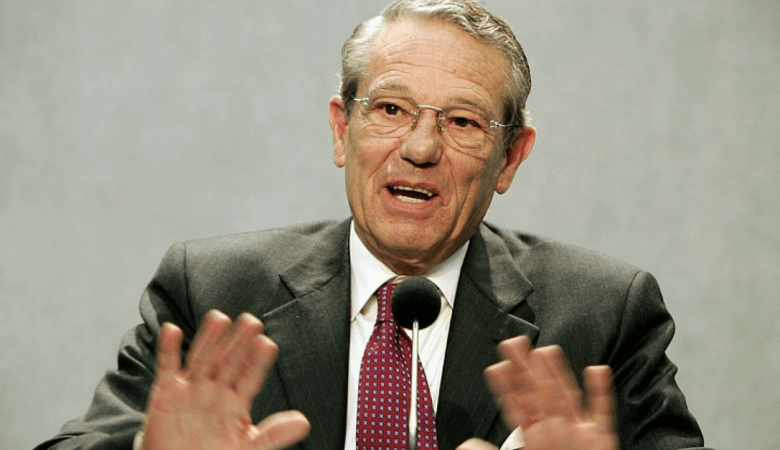
How many beautiful denials this July brings us! We had the yellow hearing (the audience, surrounded by mystery) in which Cardinal Müller was dismissed; a reconstruction probably defective in some details, but solid in substance, made by OnePeterFive, based on several German sources who met the Great Sacked [Müller] himself straight after the dismissal, during a trip to his homeland, which first found a blunt denial from the Vatican spokesman, Greg Burke. And then another denial, maybe a little more twisted, from Cardinal Müller himself. And in Germany, just to be sure they do not come out with news of the two days of the Cardinal at home, lawyers were put in play, with warnings and threats and penalties. How much effort and work for just some details! A nice cover on the story, reinforced by a hundred thousand euro of bolts. [One German Catholic has been threatened with a 100,000 Euro fine if he discloses, as he said he would, more information and sources about Cardinal Müller’s alleged conversations about his final meeting with the pope during his time in Mainz – Ed.]

Then there was the message of Benedict XVI for the funeral of card. Meisner. For those who do not remember, we quote: “What particularly impressed me from my last conversations with the now passed Cardinal was the relaxed cheerfulness, the inner joy and the confidence at which he had arrived. We know that this passionate shepherd and pastor found it difficult to leave his post, especially at a time  in which the Church stands in particularly pressing need of convincing shepherds who can resist the dictatorship of the spirit of the age and who live and think the faith with determination. However, what moved me all the more was that, in this last period of his life, he learned to let go and to live out of a deep conviction that the Lord does not abandon His Church, even if [sometimes] the boat has taken on so much water as to be on the verge of capsizing.”

I think almost everyone has read in these words a reference to the present. Myself included. On the contrary, we were all wrong. Benedict words were, as sources closely linked to the Third Loggia, and the penthouse in Santa Marta explain to us, a formal, normal reminder. A bit like — don’t laugh too much — Homeric places. Athena is always the “bright blue-eyed” for the blind Bard, and the Church is always at the mercy of the waves for the Pope Emeritus. How dare you imagine that he wanted to make a reference to the reigning Pontiff and to the actual situation of the Church. Benedict writes for history, not for the daily newspapers.

Of course this was followed by a denial. The heroic, faithful Msgr. Georg Gãnswein, said to the daily Il Giornale: “the pope emeritus was deliberately manipulated; with that sentence he was not referring to anything specific, but spoke of the situation of the Church today as in the past as a boat that does not sail in calm waters. Francis also says this. I understand that this may give rise to allusions or false impressions, but behind those words there is no attack.”

Far be it from me not to believe those denials. The above-mentioned persons are all men of honor, as (Marc) Antony spoke of the conspirators, in his speech over Caesar’s corpse. But I want to tell you why I retain some doubt, even offering all my trust and faith to the denials.

I remember how in September 1988, John Paul II was making a tour in Zimbabwe, Botwsana, Lesotho, Swaziland, and Mozambique. The latter was torn by civil war between Frelimo — the government — and the rebels of Renamo. We were based in Harare; the pope went too Bulawayo on a one day visit, and the majority of journalists, led by Vick Van Brantegen, followed him. There were many hours of travel by bus, in Shaka Zulu plains.

Some colleagues stayed in Harare. And the spokesman, [Joaquìn] Navarro-Valls, conversing with two excellent and experienced colleagues — Alceste Santini, from Unità and Federico Mandillo from ANSA — leaked big news. Cardinal Roger Etchegaray, who at the time served as unofficial ambassador of the Pope, was visiting the rebel leaders of Renamo. On the eve of John Paul II being in Maputo, such a visit constituted a diplomatic snub — and recognition for the rebels — of an incredibly strong nature. The colleagues wrote the news. There was an instant denial from the Holy See. I still remember that Federico Mandillo was playing his recorder, on which he had recorded the spokeman’s [Navaro-Valls] words the day before, saying: “But do you not hear? Listen, Gioacchino! It is your voice.” And poor Joaquìn denied and denied. He never said it, and Etchegaray had never gone to meet with Renamo.

Since then, I welcome with deep respect the denials. But I also wonder if the persons concerned could ever do anything but deny…

Posted in Uncategorized | Comments Off on IT IS BIZARRE THAT TRUTHFULLNESS IS A RARE COMMODITY IN ROME WHERE ONE WOULD EXPECT TO FIND TRUTH, ESPECIALLY IN THE VATICAN

IF YOU STAND ON THE SIDELINES THE LORD WILL HOLD YOU ACCOUNTABLE IF THE BERGOLIAN REVOLUTION IS SUCCESSFUL IN CAPSIZING PETER’S BARQUE

Are You In This Fight?

OnePeterFive

I had an exchange with someone in the comment box today about how exhausting the slog is right now. I know you know what I mean. Every day, you’re out there fighting for your faith. Every day, you’re reading the stories that make you want to tear your hair out, but you still share them with your family and friends, hoping you can convince the ones who haven’t woken up to get on board, hoping to provide encouragement and information to those already wide awake.

It’s an uphill battle, it’s often thankless, and you wonder sometimes if it’s really possible to ever get a “win”.

Here at 1P5, we put our shoulder to the task each day. We bring you not just the stories that matter to you, but the analysis that helps decode what’s really going on behind the scenes. Often, we take risks, going out on a limb for stories that we know nobody else will report, because the truth matters, and we can’t stand to see it hidden.

This doesn’t always make us a lot of allies. I can’t count the number of times I’ve seen people say they refuse to read a story from 1P5, dismissing what we have to offer before they even give us a chance. I’m sure you’ve experienced this too. The truth can make people very uncomfortable. It’s often easier for people to shoot the messenger than to deal with the message. It’s a good thing we aren’t in this for the accolades, because except for all of you, we don’t have a lot of friends.

And you shall be hated by all men for my name’s sake: but he that shall persevere unto the end, he shall be saved.  – Mt. 10:22

You read 1P5 because you’re not content to stay asleep. You share our stories because you believe that Catholics have the right — and even the obligation — to know what’s going on in the Church. You come back day after day because you take seriously your duty, imprinted upon you at confirmation, to be a soldier for Christ. And because of you, we’ve served 14 million pages of news and analysis to millions of readers around the world since we opened up shop just less than three years ago. We are the most widely-read traditionally-focused Catholic publication online. We are a voice that cannot be ignored, not at home, and not in Rome. They have gotten the message. They know that we are watching them, and that we won’t be dissuaded from defending Our Lord and His Holy Church.

And now, we need you to help keep that going. 

Over the course of this summer, our fundraising efforts have fallen consistently short of the mark. As it stands, we’ve brought in just $3,400 of our monthly $20,000 goal. In fact, we have yet to hit 100% of our monthly goal yet in 2017. We only have 13 days left in the month. We need to make up our shortfall, or we’re going to be in real trouble.

I’ll be completely up front with you: running 1P5 is my full-time job. I support a family of 10 people with this work. It is essential for me to be able to make ends meet so that I can continue to devote all my working (and sometimes, nearly all my waking) hours to this effort. Our staff has expanded to include Drew Belsky, our incredibly talented associate editor, who helps me to manage all of the incoming submissions and works with our many writers who contribute pieces you won’t find anywhere else. We do what we can to keep costs manageable. We work from home instead of having a fancy office. I manage all the technical and design and marketing tasks myself. I answer my own emails (usually late, but I try.) We also micro-fundraise, asking for manageable amounts on a monthly basis, rather than big quarterly goals like other publications. I know how hard it is to support a family and pay all the seemingly never-ending bills. I know that’s why the majority of our donors are only able to give a little each month. We have been incredibly blessed to receive a handful of large individual donations — sometimes by anonymous donors whom we wish we could thank — but the truth is, the majority of what we do here has been built and funded by people who give what little they can. Often, these are donations of $5, $10, or $20. Some give more. And the beauty of being 100% reader-funded is that we’re able to bring you stories most other outlets won’t touch, for fear of upsetting donors or damaging their relationships with powerful figures in the Church.

So today, I’m asking you: will you join us in this fight?

Before I go, I wanted to share one thing with you. There was a person earlier this week who made a donation of just 1 cent. They sent a message along with their donation that said, “I can’t afford any more than this, but as I know from personal experience, Every cent helps.” And you know what? They’re absolutely right. If every person who has visited 1P5 in the past 30 days gave just 25 cents, we’d go over our goal by $10,000. 

The point is: we’re all in this together, and no amount is too small, because we have strength in numbers.

Thank you to all of you who have given so much. And thank you to all of us who will continue to give. I say it so often it may sound like a cliche, but it’s true: we cannot do this without you. If you’d like to join us, just click the button below. You can make a tax-deductible donation without ever leaving this page.

I Want to Help! 

Be assured of our prayers, and remember, we have Masses offered for donors twice a month.

In Christ,
Steve Skojec
Publisher & Executive Director
OnePeterFive

Posted in Uncategorized | Comments Off on IF YOU STAND ON THE SIDELINES THE LORD WILL HOLD YOU ACCOUNTABLE IF THE BERGOLIAN REVOLUTION IS SUCCESSFUL IN CAPSIZING PETER’S BARQUE

ARE YOU AN ORTHOPHOBE? THIS VIRULENT VIRUS IS CAPSIZING THE BARQUE OF PETER


Orthophobia and the Marginalized QTBGL Catholic

CRISIS MAGAZINE


As I survey the current state of the Catholic Church, I believe I can no longer hold back. It is time for me to come out.

I am and have for some time identified as a member of the QTBGL community, and I need to explain why I call myself a QTBGL Catholic.

For those who may not know, “QTBGL” stands for “Quietly Totally Believing God’s Law” and is sometimes referred to more simply as “TBGL” (just Totally Believing God’s Law). Personally, I think the “Q” is an essential aspect of our community, since it’s important to recognize just how quietly we go about totally believing the fullness of truth of the Catholic faith in our daily lives.

Coming out at this moment is vitally important. Not only do I need to be utterly honest about who I really am, but the Church needs to do a better job ministering to the QTBGL Catholic in the pew, not to mention QTBGL clergy in the Church, like me. We are marginalized, unjustly discriminated against, and regularly face demeaning “orthophobia” (irrational hate for, and fear of, right-thinking Christians) not only from fellow Catholics but even from secular society.

The level of orthophobia is getting worse, in fact. Within the Church, we are called “haters” and “bigots” simply for accepting and affirming what the Church actually teaches us about liturgy, justice, virtue, and, of course, the human person and sexuality (natural law). Outside the Church, orthophobes everywhere are trying to curtail our religious liberty, take away our conscience rights, and subject us to ridicule and hate simply because of who we really are.

Yet many QTBGL Catholics really feel as though we were born this way. Or at least baptized this way. Even in the face of such orthophobic animosity and outright discrimination (some of us have even lost jobs after publicly coming out as QTBGL), we know we are being true to ourselves. We are resigned to a rather lonely life of quietly accepting each and every truth taught to us by the Church, often at great personal cost.

You may have heard that recently a bishop was heartlessly attacked by orthophobes for his faithful interpretation of canon law as it applies to reception of Holy Communion and to funerals. While this bishop has not overtly come out as a QTBGL Catholic, orthophobes everywhere treated him that way. He was vilified horribly, even threatened.

Despite this bishop’s brave example, however, we need to face it—QTBGL Catholics are under attack and often feel alienated from so many other leaders of the Church who are supposed to welcome, affirm, and accompany us with respect, compassion, and sensitivity.

Just think of how very few QTBGL-affirming parishes there really are in our local dioceses. When was the last time you saw a parish intentionally advertise something like, “At St. Fidelis Parish, ALL are really welcome—including QTBGL Catholics. Come as you are. Who am I to judge?”

It just doesn’t happen often enough. Sure, there may be some parishes that do what they can to minister to members of the QTBGL community and help us feel accepted for who we are. But more often than not, especially at the diocesan level, our needs are largely rejected and ignored.

For example, do our Church and parish leaders really not know the disheartening and isolating double standard that so many QTBGL Catholics experience? Too often, our leaders devote lots of time and energy ministering to orthophobic Catholics who reject us, offering them lavish attention, welcome, affirmation, and acceptance. Yet, many of these same leaders never seem to get around to teaching the orthophobic Catholics all those truths that we QTBGL persons accept unreservedly. We certainly don’t feel very respected in such unwelcoming parish environments.

My QTBGL community is starving for the nourishment that can only come from our pastoral ministers. It’s like a dagger in the hearts of marginalized QTBGL Catholics to know that we ourselves may rarely hear the fullness of truth in our parishes. But more than that, many of us “out” members of the QTBGL community have great concerns that orthophobic Catholics are not hearing those truths either. Often, when we approach parish and diocesan leaders with our concerns, mostly we are ignored outright—never hearing a word of affirmation or comfort. I can’t tell you how many times QTBGL Catholics have phoned or written their dioceses to ask for support when orthophobia rears its ugly head in our local parishes and even in our schools.

When we get no response, how can such silence be construed as respect, compassion, and sensitivity? How can it not be construed as a form of unjust discrimination against QTBGL Catholics?

By coming out, I am hoping to contribute to a culture of authentic “bridge building,” so to speak, between the institutional Church and the QTBGL community. And, I must say, the onus is really on the Church to take the first steps to eradicate orthophobia in all its forms and to reassure the QTBGL Catholic that, yes, we have just as much right to be part of the Church as even the pope does. QTBGL Catholics have real gifts to offer. We need to be permitted to share our God-given gifts. Particularly, our total acceptance of the truth is a great gift to the Church. Why don’t we hear this affirmed more in our churches?

Oddly, it’s a bit like the parable of the shepherd who goes after the one sheep but, in a twist of the parable, takes absolutely no precautions to meet the needs of the other 99 sheep while he is busy seeking and finding that one lost lamb. What shepherd, while seeking the one lost ewe, leaves 99 without food, water, protection, and guidance? What shepherd, after finding the lost sheep, brings it back and spends a huge amount of timecaring for it while ignoring the requests and needs of the other 99? Such a shepherd might say to that one lost sheep, “You know, it’s okay if you still want to identify as a ‘lost sheep’; I don’t want to make you feel unwelcome or judged just because you have no real interest in thinking of yourself as ‘found’ like these other 99.”

In the fractured parable I’ve penned, when the 99 see how little value the shepherd seems to place on staying “found,” they might feel a bit underappreciated.

With these things in mind, my coming out as a QTBGL Catholic will also help combat the “erasure” our community has experienced for too long. We exist. We are out. We’re in every parish, every pew. QTBGL pride should be proclaimed in every parish community.

I can’t begin to say what a relief it is to finally come out and embrace my QTBGL identity.

Just one more thing—maybe we could come up with a QTBGL-pride flag to inspire us. I mean, I think we have a real shot at eradicating orthophobia, even in my lifetime. But we will need the cooperation of all Catholics, and all Catholic leaders. Until then, those who do make the brave choice to minister to QTBGL Catholics and our families will likely face hate, persecution, discrimination, and outright rejection.

Even so, I’ve heard from those ministering to the QTBGL community that all the hateful comments they endure from orthophobic Catholics seem like nothing after meeting just one QTBGL person or parent who says “thank you.”

And so—as a newly out QTBGL Catholic, on behalf of our community, I say to all who choose to minister to our pastoral needs:

Thank you.

Editor’s note: Pictured above is a detail from “Holy C0mmunion” painted by Ariel Agemian.

Deacon Jim Russell

By

Deacon Jim Russell serves the Archdiocese of St. Louis and writes on topics of marriage, family, and sexuality from a Catholic perspective. He can be reached via e-mail at DeaconJimRussellSTL@gmail.com.

Posted in Uncategorized | 2 Comments

BRAVO CARDINAL SARAH, MAY YOUR TRIBE INCREASE

Cardinal Sarah’s challenge to traditionalists

Cardinal Sarah uses the term ‘reconciliation’ because moving towards his vision begins with a change of heart

The tenth anniversary of Summorum Pontificum – Pope Benedict XVI’s statute which granted priests the liberty to celebrate the “old Latin Mass”, now known as the Extraordinary Form (EF) – passed on July 7 as one would have expected. Traditional Catholics attracted to the EF were grateful for the more liberating posture of liturgical law and spoke, as they customarily do, about how the wider offering of the EF had a salutary effect on how the Novus Ordo, or Ordinary Form (OF), is celebrated.

The anniversary, though, did include an unexpected note from a most authoritative source. Cardinal Robert Sarah, prefect of the Congregation for Divine Worship, marked the anniversary with an article in La Nef, a French publication. Not available online, it has been reported on in English by the Tablet.

Cardinal Sarah wrote in favour of the “mutual enrichment” of the two forms of the Roman Rite, a phrase of Benedict XVI’s arguing that both forms have riches that would enhance the other if incorporated.

Over the past 10 years, this has been interpreted in EF circles in a mostly unilateral way: the OF ought to adapt the practices of the EF. Cardinal Sarah is certainly in favour of this – he has argued in the past for ad orientem celebration of the OF, greater use of Latin, and more periods of silence, including some of the priestly prayers. In La Nef, he goes further, recommending that Holy Communion be received kneeling and on the tongue; that the Prayers at the Foot of the Altar be restored at the beginning of Mass; and that the priests keep united after the consecration those fingers which have touched the sacred species.

All of which is music to the ears of those devoted to the EF. But the key concept Cardinal Sarah advanced may sound a challenge too. Sarah suggested that the expression “reform of the reform” be abandoned precisely because it has a unilateral connotation – the Novus Ordo ought to be enriched by the traditional liturgy only.

“ ‘Reform of the reform’ has become synonymous with dominance of one clan over the other,” the cardinal wrote in French. “This expression may then become inappropriate, so I prefer to speak of liturgical reconciliation. In the Church, the Christian has no opponent!”

Reconciliation means movement from both “clans”, as it were. That is likely to encounter opposition from some, perhaps many, traditionalist quarters.

Sarah proposes that efforts be made to have a shared calendar and a shared lectionary, so that both the EF and OF would celebrate more feasts together and have the same Scripture readings at Mass.

That poses a twofold challenge. First, it requires the EF community to acknowledge that some aspects of the OF, particularly its reformed calendar and its lectionary – which includes far more Scripture than the EF one – are actual improvements and possible enrichments for the EF.

There are certainly some in the EF community who are happy to acknowledge this and would be pleased to see a shared calendar and lectionary. But others, not an insignificant part, consider the entire OF to be an impoverishment with little, if anything, enriching to offer. In the background, of course, is the Society of St Pius X, which would be deeply suspicious of any talk of changing the EF Roman Missal, 1962 edition.

For example, EF devotees often speak about the simplified OF calendar as being too banal – “Ordinary Time” instead of Sundays after Pentecost – and consider it a mistake to have abandoned Passiontide and the octave of Pentecost. They are right about that, but thinning out the number of feast days of obscure saints and incorporating the more recently canonised is more controversial.

A shared lectionary would require a shared Sunday calendar at least, which could not be achieved without significant changes in both the current EF and OF calendars. And while there is wide consensus that the OF lectionary is superior, it is not universal, and any move towards it would encounter stiff opposition. Sarah knows of such positions, and warns us against treating the EF as a “museum object” locked forever in 1962.

Moving towards Cardinal Sarah’s vision begins, though, not with practicalities but with a change of heart. That is likely why he chose the term “reconciliation”. Reconciliation requires a change of heart, a willingness to see the good in the other, and an openness to make things different in order to accommodate that good.

For the 10 years since Summorum Pontificum, those who prefer the EF have expected such an attitude from the OF. Cardinal Sarah now suggests that it is required of both clans, united in one Church, around one altar.

Fr Raymond J de Souza is a priest of the Archdiocese of Kingston, Ontario, and editor-in-chief of Convivium.ca

This article first appeared in the July 21 2017 issue of the Catholic Herald. To read the magazine in full, from anywhere in the world, go here

Posted in Uncategorized | 1 Comment

BRAVO BISHOP ATHANASIUS SCHNEIDER, MAY YOUR TRIBE INCREASE

maxresdefault

 Bishop Schneider: The interpretation of Vatican II and its connection with the current crisis of the Church

Once again, we are honored to post this guest op-ed, submitted to us by His Excellency Bishop Athanasius Schneider. We not only allow but encourage all media and blogs to reprint this as well.

By Bishop Athanasius Schneider

Special to Rorate Caeli

July 21, 2017


The interpretation of Vatican II and its connection with the current crisis of the Church

The current situation of the unprecedented crisis of the Church is comparable with the general crisis in the 4th century, when the Arianism had contaminated the overwhelming majority of the episcopacy, taking a dominant position in the life of the Church. We must seek to address this current situation on the one hand with realism and, on the other hand, with a supernatural spirit – with a profound love for the Church, our mother, who is suffering the Passion of Christ because of this tremendous and general doctrinal, liturgical and pastoral confusion.

We must renew our faith in believing that the Church is in the safe hands of Christ, and that He will always intervene to renew the Church in the moments in which the boat of the Church seems to capsize, as is the obvious case in our days.


As to the attitude towards the Second Vatican Council, we must avoid two extremes: a complete rejection (as do the sedevacantists and a part of the Society of St. Pius X (SSPX) or a “infallibilization” of everything the council spoke.

Vatican II was a legitimate assembly presided by the Popes and we must maintain towards this council a respectful attitude. Nevertheless, this does not mean that we are forbidden to express well-founded doubts or respectful improvement suggestions regarding some specific items, while doing so based on the entire tradition of the Church and on the constant Magisterium.

Traditional and constant doctrinal statements of the Magisterium during a centuries-old period have precedence and constitute a criterion of verification regarding the exactness of posterior magisterial statements. New statements of the Magisterium must, in principle, be more exact and clearer, but should never be ambiguous and apparently contrast with previous magisterial statements.

Those statements of Vatican II which are ambiguous must be read and interpreted according to the statements of the entire Tradition and of the constant Magisterium of the Church.

In case of doubt the statements of the constant Magisterium (the previous councils and the documents of the Popes, whose content demonstrates being a sure and repeated tradition during centuries in the same sense) prevail over those objectively ambiguous or new statements of the Vatican II, which difficultly concord with specific statements of the constant and previous Magisterium (e.g. the duty of the state to venerate publicly Christ, the King of all human societies, the true sense of the episcopal collegiality in relation to the Petrine primacy and the universal government of the Church, the noxiousness of all non-Catholic religions and their dangerousness for the eternal salvation of the souls).

Vatican II must be seen and received as it is and as it was really: a primarily pastoral council. This council had not the intention to propose new doctrines or to propose them in a definitive form. In its statements the council confirmed largely the traditional and constant doctrine of the Church.

Some of the new statements of Vatican II (e.g. collegiality, religious liberty, ecumenical and inter-religious dialogue, the attitude towards the world) have not a definitive character, and being apparently or truly non-concordant with the traditional and constant statements of the Magisterium, they must be complemented by more exact explications and by more precise supplements of a doctrinal character. A blind application of the principle of the “hermeneutics of continuity” does not help either, since thereby are created forced interpretations, which are not convincing and which are not helpful to arrive at a clearer understanding of the immutable truths of the Catholic faith and of its concrete application.

There have been cases in the history, where non-definitive statements of certain ecumenical councils were later – thanks to a serene theological debate – refined or tacitly corrected (e.g. the statements of the Council of Florence regarding the matter of the sacrament of Orders, i.e. that the matter were the handing-over of the instruments, whereas the more sure and constant tradition said that the imposition of the hands of the bishop were sufficient, a truth, which was ultimately confirmed by Pius XII in 1947). If after the Council of Florence the theologians would have blindly applied the principle of the “hermeneutics of the continuity” to this concrete statement of the Council of Florence (an objectively erroneous statement), defending the thesis that the handing-over of the instruments as the matter of the sacrament of Orders would concord with the constant Magisterium, probably there would not have been achieved the general consensus of the theologians regarding the truth which says that only the imposition of the hands of the bishop is the real matter of the sacrament of Orders.

There must be created in the Church a serene climate of a doctrinal discussion regarding those statements of Vatican II which are ambiguous or which have caused erroneous interpretations. In such a doctrinal discussion there is nothing scandalous, but on the contrary, it will be a contribution in order to maintain and explain in a more sure and integral manner the deposit of the immutable faith of the Church.

One must not highlight so much  a certain council, absolutizing it or equating it in fact with the oral (Sacred Tradition) or written (Sacred Scripture) Word of God. Vatican II itself said rightly (cf. Verbum Dei, 10), that the Magisterium (Pope, Councils, ordinary and universal Magisterium) is not above the Word of God, but beneath it, subject to it, and being only the servant of it (of the oral Word of God = Sacred Tradition and of the written Word of God = Sacred Scripture).

From an objective point of view, the statements of the Magisterium (Popes and councils) of definitive character, have more value and more weight compared with the statements of pastoral character, which have naturally a changeable and temporary quality depending on historical circumstances or responding to pastoral situations of a certain period of time, as it is the case with the major part of the statements of Vatican II.

The original and valuable contribution of the Vatican II consists in the universal call to holiness of all members of the Church (chap. 5 of Lumen gentium), in the doctrine about the central role of Our Lady in the life of the Church (chap. 8 of Lumen gentium), in the importance of the lay faithful in maintaining, defending and promoting the Catholic faith and in their duty to evangelize and sanctify the temporal realities according to the perennial sense of the Church (chap. 4 of Lumen gentium), in the primacy of the adoration of God in the life of the Church and in the celebration of the liturgy (Sacrosanctum Concilium, nn. 2; 5-10). The rest one can consider to a certain extent secondary, temporary and, in the future, probably forgettable, as it was the case with some non-definitive, pastoral and disciplinary statements of various ecumenical councils in the past.

The following issues – Our Lady, sanctification of the personal life of the faithful with the sanctification of the world according to the perennial sense of the Church and the primacy of the adoration of God – are the most urgent aspects which have to be lived in our days. Therein Vatican II has a prophetical role which, unfortunately, is not yet realized in a satisfactory manner.

Instead of living these four aspects, a considerable part of the theological and administrative “nomenclature” in the life of the Church promoted for the past 50 years and still promotes ambiguous doctrinal, pastoral and liturgical issues, distorting thereby the original intention of the Council or abusing its less clear or ambiguous doctrinal statements in order to create another church – a church of a relativistic or Protestant type.

In our days, we are experiencing the culmination of this development.

The problem of the current crisis of the Church consists partly in the fact that some statements of Vatican II – which are objectively ambiguous or those few statements, which are difficultly concordant with the constant magisterial tradition of the Church – have been infallibilisized. In this way, a healthy debate with a necessarily implicit or tacit correction was blocked.

At the same time there was given the incentive in creating theological affirmations in contrast with the perennial tradition (e.g. regarding the new theory of an ordinary double supreme subject of the government of the Church, i.e. the Pope alone and the entire episcopal college together with the Pope, the doctrine of the neutrality of the state towards the public worship, which it must pay to the true God, who is Jesus Christ, the King also of each human and political society, the relativizing of the truth that the Catholic Church is the unique way of salvation, wanted and commanded by God).

We must free ourselves from the chains of the absolutization and of the total infallibilization of Vatican II. We must ask for a climate of a serene and respectful debate out of a sincere love for the Church and for the immutable faith of the Church.

We can see a positive indication in the fact that on August 2, 2012, Pope Benedict XVI wrote a preface to the volume regarding Vatican II in the edition of his Opera omnia. In this preface, Benedict XVI expresses his reservations regarding specific content in the documents Gaudium et spes and Nostra aetate. From the tenor of these words of Benedict XVI one can see that concrete defects in certain sections of the documents are not improvable by the “hermeneutics of the continuity.”

An SSPX, canonically and fully integrated in the life of the Church, could also give a valuable contribution in this debate – as Archbishop Marcel Lefebvre desired. The fully canonical presence of the SSPX in the life of the Church of our days could also help to create a general climate of  constructive debate, in order that that, which was believed always, everywhere and by all Catholics for 2,000 years, would be believed in a more clear and in a more sure manner in our days as well, realizing thereby the true pastoral intention of the Fathers of the Second Vatican Council.

The authentic pastoral intention aims towards the eternal salvation of the souls — a salvation which will be achieved only through the proclamation of the entire will of God (cf. Act 20: 7). The ambiguity in the doctrine of the faith and in its concrete application (in the liturgy and in the pastoral life) would menace the eternal salvation of the souls and would be consequently anti-pastoral, since the proclamation of the clarity and of the integrity of the Catholic faith and of its faithful concrete application is the explicit will of God.

Only the perfect obedience to the will of God — Who revealed us through Christ the Incarnate Word and through the Apostles the true faith, the faith interpreted and practiced constantly in the same sense by the Magisterium of the Church – will bring the salvation of souls.

+ Athanasius Schneider,

Auxiliary Bishop of the Archdiocese of Maria Santissima in Astana, Kazakhstan

Labels: Church of Vatican II, Guest op-ed, Schneider, The Church of Vatican II, Vatican II at 50

Posted by Adfero. at 7/21/2017 10:20:00 AM

Posted in Uncategorized | Comments Off on BRAVO BISHOP ATHANASIUS SCHNEIDER, MAY YOUR TRIBE INCREASE

FRANCIS’ FRIEND, FATHER SOSA, GENERAL OF THE JESUITS, “BAPTIZES HIMSELF A BUDDHIST”

Jesuit Website Refers to Fr. Sosa as the First Superior General to “Baptize Himself a Buddhist”


arturo-sosa-fb-2


OnePeterFive

FacebookPocket

 ‘It is not permitted to be present at the sacred rites of infidels and heretics in such a way that you would be judged to be in communion with them’.

St. Alphonsus LiguoriTheologia Moralis, Lib.5, Tract. 1, Cap. 3.

I don’t even know where to start.

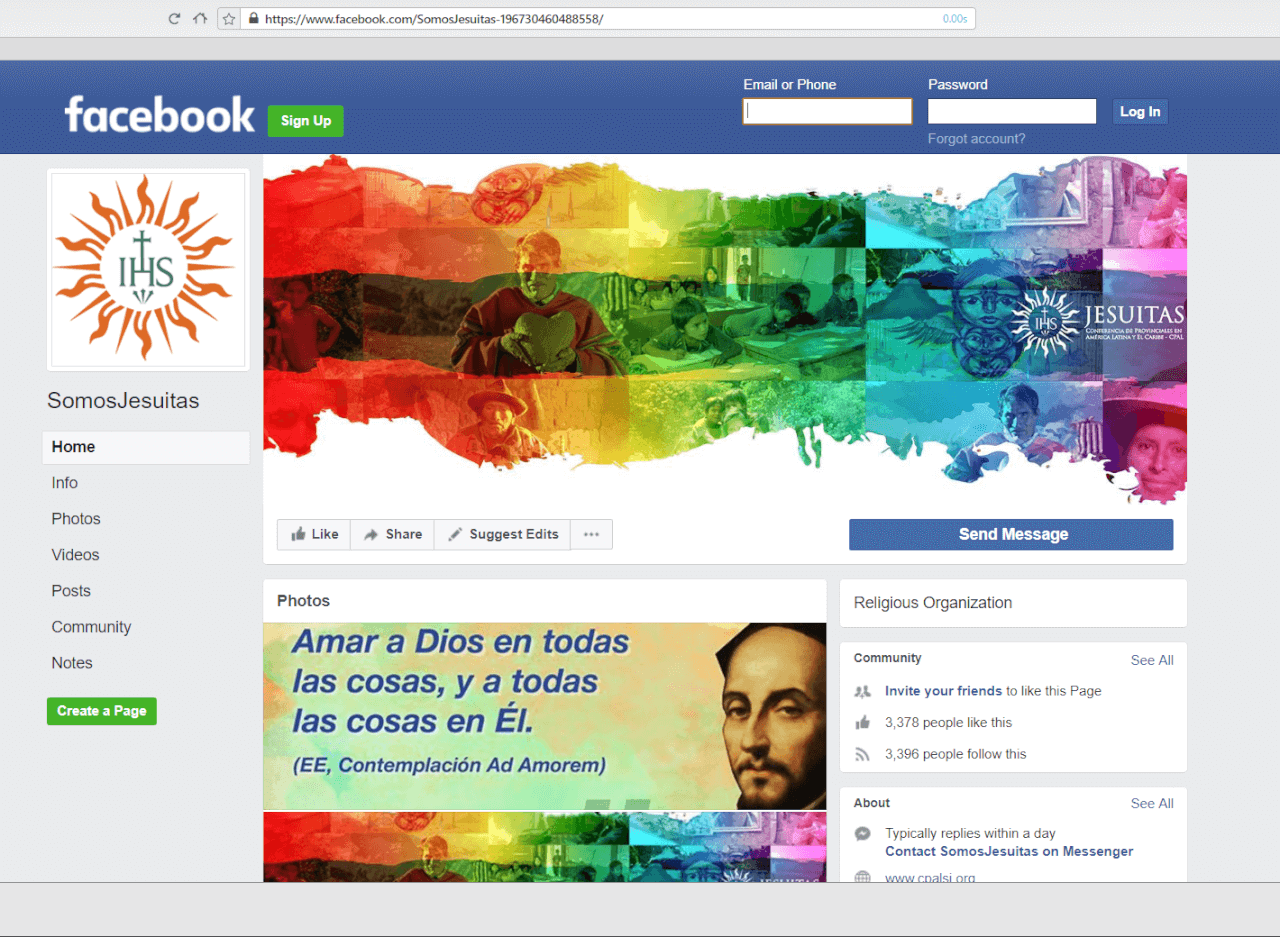
Thanks to a tip from a reader this morning, I headed over to the official website of the Conference of Jesuit Provincials in Latin America and the Caribbean.

While there, I did some looking around. I followed the link to their Facebook page. It’s colorful. Colorful in a way that carries its own possibly troubling meaning these days:

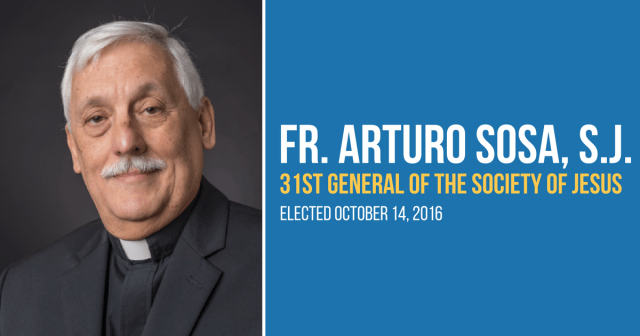
The specific article I was alerted to was this one, about Fr. Arturo Sosa, the alwayscontroversial new Superior General of the Jesuits, who recently participated in a conference in Cambodia “between Buddhists and Christians who work for peace.”

He gave a homily, according to the article, on the themes of diversity, fear of difference, the “building of walls” that results from fear, and violence.


He then visited a Buddhist temple, where he addressed the 80 monks gathered there as follows:

Thank you so much for your time and the wisdom you shared today.

I have learned many things from you, and you have given me many things to think about and pray about. It is deeply consoling to see how we are united in our desire to promote peace and reconciliation in our world. It is also comforting to see how we share the belief that the path to peace begins from within, from the deep transformation of the inner person, from growth into detachment and loving-kindness.

I am grateful for what my Jesuit brethren do to promote dialogue with Buddhism here in Cambodia, whether at the level of academic exchange, prayer together or in the shared standard of living and common action at the service of the poor. Thank you for the meaningful and inspiring testimony of how you live our Jesuit mission of reconciliation.

Among the many things I have learned from Pope Francis, one is his insistence on the importance of creating a culture of encounter. He uses this phrase all the time. He believes that in our divided world, where some want to build walls, what we must do is to promote the encounter, without fear and respect, people who meet people, listening deeply and respectfully to each other, building relationships and friendships.

Thank you for this meeting event this afternoon, which has enriched me, and I hope it will bear fruit in service.

[Translation by Google]

It was an entirely pedestrian address. Sanitized. No mention of Jesus Christ. No indication of Fr. Sosa’s desire to bring souls to the fullness of Truth, as so many of his forebears in the Society of Jesus were known for. As I finished reading through it, in fact, I couldn’t help but think of St. Francis Xavier, the apostle to Asia. One of the first Jesuits, he worked tirelessly in India, Malaysia, Japan, and had he not fallen ill before reaching the mainland, would have become a missionary to China as well. The Catholic Encyclopedia says of St. Francis Xavier:

It is truly a matter of wonder that one man in the short space of ten years (6 May, 1542 – 2 December, 1552) could have visited so many countries, traversed so many seas, preached the Gospel to so many nations, and converted so many infidels. The incomparable apostolic zeal which animated him, and the stupendous miracles which God wrought through him, explain this marvel, which has no equal elsewhere. The list of the principal miracles may be found in the Bull of canonization. St. Francis Xavier is considered the greatest missionary since the time of the Apostles, and the zeal he displayed, the wonderful miracles he performed, and the great number of souls he brought to the light of true Faith, entitle him to this distinction.

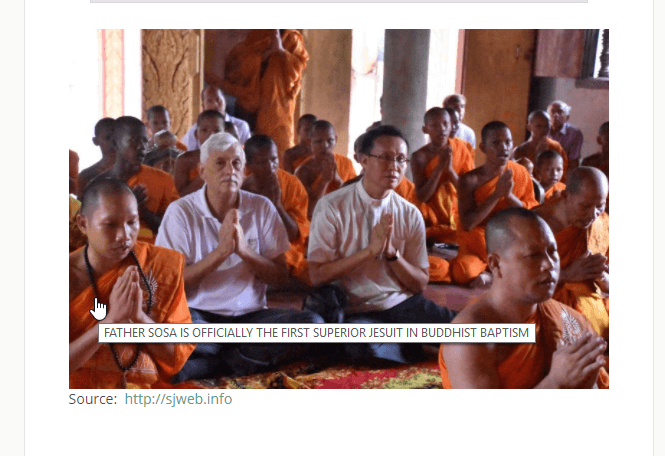
What the Jesuits of 2017 present us with instead in the example of their leader, Fr. Sosa, is the following image, with a bizarre caption that appears when one holds their mouse over the photo:

If you can’t read it, it says, “Father Sosa is officially the first Superior Jesuit in Buddhist Baptism.” This is a rough machine translation of the caption written into the code of the page, which reads, in Spanish, “Padre Sosa es oficialmente el primer Superior Jesuita en bautizarse budista.” More clearly put: “Father Sosa is officially the first Jesuit Superior to baptize himself Buddhist.” 

Now, I have no idea what it means to “baptize oneself Buddhist.” Probably because it doesn’t. Mean anything, that is. Buddhists don’t baptize. Buddhists don’t really even believe in God. As Carl Olson and Anthony Clark explained in this piece on Catholicism and Buddhism from Ignatius Insight:

It is sometimes said that Buddhism is atheistic. Yet Buddhism is not interested in the question of God, so it is more accurate to describe it as agnostic. Buddhism “works” whether or not there is a God. A Buddhist allows others to believe in a God or gods, but such beliefs are merely convenient means to the final end, which has nothing to do with a God or gods. “God is neither affirmed nor denied by Buddhism,” wrote Merton in Mystics and Zen Masters, “insofar as Buddhists consider such affirmations and denials to be dualistic, therefore irrelevant to the main purpose of Buddhism, which is emancipation from all forms of dualistic thought.”

It was the common teaching of the Church before the heady days of ecumenism and interfaith mania following the Second Vatican Council that Catholics were to avoid the majority of ecumenical prayer and of course, interfaith gatherings.

In the excellent catechetical text, My Catholic Faith: A Manual of Religion, we read:

How does a Catholic sin against faith?

A Catholic sins against faith by infidelity, apostasy, heresy, indifferent to them, and by taking part in non-Catholic worship.

We may lose our faith by: (a) not learning well the doctrines of the church; space (b) willfully doubting trues that have been revealed to the church; (c) reading books and other literature against our religion; space (d) space attending assemblies of people who are opposed to our religion; and space (e) space neglecting the practice of our religion.

And further:

Persons who do not believe in Christianity as a divinely revealed religion, whether they have been baptized or not, are commonly referred to as quote infidels”. Infidelity is refusal to believe in anything that cannot be perceived with the senses, or comprehended with the understanding.

But is it not utterly reasonable to have faith in Almighty God Who knows much more than we can ever hope to know and Who can do things beyond our understanding? It is necessary that we serve God in the way He requires, not in the way it pleases us to do so. For this reason we must practice the religion revealed by God, and avoid making up our own religions according to our wins and innumerable fancies. Buddhists, Mohammedans, Hindus, Jews, and pagans, are infidels. As explained, Christians can also become infidels.

[…]

Why does a Catholic sin against faith by taking part in non-Catholic worship?

A Catholic sins against faith by taking part in non-Catholic worship, because he thus professes belief in a religion he knows is false.

1.) It is wrong to be present at Protestant or Jewish services even when we do not participate in them, because such services are intended to honor God in a manner he does not wish to be honored in. If he instituted the church of his own he must wish to be honored in the ways of that church. In addition we then give bad example, and expose ourselves to the danger of losing our faith.

When necessary, for social obligations, a Catholic may be present at a non-Catholic wedding or funeral, but he must not participate in the services. In no case may he attend other services of non-Catholic churches, such as the installation of their ministers, sermons, etc.

Now, look again at the picture above. Does Fr. Sosa appear to be “taking part in non-Catholic worship”?

It certainly does.

And now the members of his own order see nothing wrong in saying that he has “baptized himself a Buddhist.”

Those of you who’ve been paying attention for a long time will no doubt be able to point to other similar examples in the not-too-distant past, perhaps most notably the so-called “ecumenical” prayer gatherings at Assisi, under the leadership of Pope John Paul II. Converts and those who’ve come recently to study the Church’s traditional teachings may not be aware of these things. For the sake of space, and my own sanity, I won’t begin listing them here. An exhaustive treatment would span many pages.

This kind of thing has to stop. As I’ve written before, as Catholics, we can’t be indifferent to indifferentism. And though we may be tempted to say, “What’s the big deal, this happens all the time now!”, we should resist that temptation. It’s always a big deal. It’s a big deal that we’ve become so cynical that it barely raises an eyebrow these days.

At times like these, I reflexively reach for the Act of Consecration of the Human Race to the Sacred Heart of Jesus (Pope Pius XI), which I’ve shared with you before:

Most sweet Jesus, Redeemer of the human race, look down upon us humbly prostrate before Thine altar. We are Thine, and Thine we wish to be; but, to be more surely united with Thee, behold each one of us freely consecrates himself today to Thy most Sacred Heart.

Many indeed have never known Thee; many too, despising Thy precepts, have rejected Thee. Have mercy on them all, most merciful Jesus, and draw them to Thy sacred Heart. Be Thou King, O Lord, not only of the faithful who have never forsaken Thee, but also of the prodigal children who have abandoned Thee; grant that they may quickly return to Thy Father’s house lest they die of wretchedness and hunger.

Be Thou King of those who are deceived by erroneous opinions, or whom discord keeps aloof, and call them back to the harbor of truth and unity of faith, so that there may be but one flock and one Shepherd.

Be Thou King of all those who are still involved in the darkness of idolatry or of Islamism, and refuse not to draw them into the light and kingdom of God. Turn Thine eyes of mercy towards the children of the race, once Thy chosen people: of old they called down upon themselves the Blood of the Savior; may it now descend upon them a laver of redemption and of life.

Grant, O Lord, to Thy Church assurance of freedom and immunity from harm; give peace and order to all nations, and make the earth resound from pole to pole with one cry: “Praise be to the divine Heart that wrought our salvation; to it be glory and honor for ever.” Amen.

And please pray for Fr. Sosa. He leads the deeply troubled order of which our own pope is a member.

Posted in Uncategorized | 2 Comments

TALE OF TWO LIBERAL CITIES, SO SIMILAR AND YET SO DIFFERENT; THE ONLY EXPLANATION IS THE EFFECT OF THE WEATHER ON THE POPULATION. HOUSTON’S HEAT VS CHICAGO’S COLD.

Tale of 2 Cities
CHICAGO
HOUSTON, TX
Population
2.7 million
2.15 million
Median HH Income
$38,600
$37,000
% African-American
38.9%
24%
% Hispanic
29.9%
44%
% Asian
5.5%
6%
% Non-Hispanic White
28.7%
26%
Pretty similar until
City
Chicago, IL
Houston, TX
Concealed CarryLegal
No
Yes
# of Gun Stores
None
184 Dedicated gun stores plus 1500 – legal places to buy guns–Wal-Mart, K-mart, sporting goods, etc.
Homicides, 2012
1,806
207
Homicides per 100K
38.4
9.6
Av. January high temp (F)
31
63
Conclusion: Cold weather causes murders. This is due to global warming.
Posted in Uncategorized | 1 Comment

WE MUST CHOOSE. BUT MAKE NO MISTAKE ABOUT IT, OUR CHOICES WILL LEAD US EITHER TO HEAVEN OR TO HELL. WE CAN’T HAVE IT BOTH WAYS.

Free Will, Fulfillment and Excommunication

Crisis Magazine
.
.


[ Emphasis and {Commentary} in red type by Abyssum ]


Recently, Bishop Paprocki releaseddecree on “same-sex ‘marriage’ and related pastoral issues.” Some Catholics interpreted it as an unjust singling-out (and rejection) of a specific group of persons. In terms of sin itself they do have a point—we are all sinners. However, some went as far as to interpret it as a form of excommunication. What seemed absent in the grievances I encountered was an understanding of a person’s specific choice to continually reject God. That’s significant because that’s where we enter the realm of excommunication, which is a serious matter worth exploring.

What does it mean to reject God?
We reject God anytime we willfully reject the Order of Creation, as revealed in nature.

This includes:

  1. Elevating finite creation above infinite Creator.
  2. Assuming that our Creator God isn’t capable of forgiving the sins of persons he created.
  3. Elevating temporal human experience to be of greater importance/value than objective truth itself.

When we choose to reject God (via our rejection of the Order of Creation), we are guilty of a sin of commission. However, if sin is perceived as being merely philosophical in nature (possibly invented by the Church), it can easily be (errantly) ignored. Thus, we might do well to re-introduce sin in terms of a concrete standard. In the eyes of the Church, that standard is the Order of Creation, as revealed in nature. This is the art of the Divine Artist, which encompasses both visible and invisible realms, and both intra-universal and extra-universal domains. It’s what the Church refers to as natural law, or what is revealed to be of nature, or natural (which is commonly misinterpreted to mean what “feels natural” or what comes easily).

A Matter of Approach
To better understand, it may be valuable for us to consider the following questions.

Do we see the Church as:

  1. The inventor of truth, or the upholder of truth?
  2. Merely “rules” to follow, or a mystery to pursue?
  3. A means of establishing social order and behavioral norms, or a means to draw persons into the most holy, virtuous, and intimate encounter with the Creator of our universe through the Sacraments instituted by Christ?

If the latter (of each) are not wholeheartedly embraced, then we are at greater risk of inaccurately perceiving excommunication as a “punishment” from the Church for “stepping out of line” behaviorally. However, it is the latter (of each) that draws us to shift our focus from behavior to holiness and virtue. Since excommunication is a matter of a person being unrepentantly attached to their chosen sin in their heart (which may drive certain behavioral choices), it follows that we ought to approach excommunication though the lens of holiness and virtue, for those are matters of the heart. Further, in addressing the attachments of our hearts (and the disposition of our hearts overall) above any notion of behavior, we not only elevate the conversation to be about one’s openness to growing in the fullness of virtue, but we also introduce an approach that discriminates against no one, for we all have been gifted with the fullness of free will over our hearts.

This approach also illuminates the joyful witness to the vocation of “Yes” (to holiness and virtue), which lifts us past the fixation on the (false) vocation of “No” (to behavior management based on having to deny our deepest desires “in order to be a good Catholic”). It’s virtue and holiness that challenge us to transform our hearts to desire something greater; a more complete unity with God, further aligned with his will. Virtue thus challenges us to die to ourselves and to our own attachments so that we may be more profoundly aligned with the truths of the Order of Creation, as revealed in nature.  {This beautiful paragraph really vitiates the current heterodoxy in Rome that law and the observance of law renders one “rigid”.}

The Influence of Experience
Many Catholics choose to endorse homosexual relationships because they see persons involved as happy, or even complementary (in terms of masculine/feminine interests/activities/tendencies, emotional state, and or even personality). They may also see a number of redeeming human qualities within such relationships—which of course may be present. However, these circumstances don’t undo the existence of the Order of Creation itself, or a person’s choice to reject it. Unfortunately, however, sentimentalism seems to be influencing people to ignore the Order of Creation in its fullness, in favor of personal experience.

Despite any positive reflection of humanity that may be present within a homosexual relationship, what remains is the commitment to utilize sexual faculties in a way that counters their purpose as structurally created. Further, this rejection of the Order of Creation is chosen with foreknowledge, and it continues in perpetuity for the length of the homosexual relationship itself. Thus, a person in such a relationship may be, dependent on degree of knowledge, in a state of excommunication in perpetuity, such as long as they choose to remain in that relationship.  {Wow!  That is really telling it as it truly is.  The perceived ‘good’ of an illicit relationship disguises the fundamental truth that the relationship is self destructive, and that is true whether the relationship is homosexual (which is the point of the author) or heterosexual (which is also true).}

Bound to a Journey?
Given that neuroscience, educational psychology, and even many contemporary gender ideology activists (never mind the Catechism itself) agree that it’s inaccurate to claim a person is “created that way by God,” and given that attractions experienced are not specifically chosen while our embraced identities are specifically chosen, it follows that no one is bound to any particular life trajectory along any orientation, and no one is bound to any particular identity or way of seeing themselves. Thus, no one is bound to any particular journey towards fulfillment.

This is relevant because many people in homosexual relationships believe that God created them that way and that it’s against their “nature” to deny themselves a homosexual relationship as a means of fulfillment. However, given that self-concept influences what we perceive to be fulfilling, we might do well to look at the bigger question of identity formation, alongside addressing one’s openness to growing in the fullness of virtue.

Perhaps it would be valuable for people to prayerfully consider how:

  1. Our brains are formed in the ways we use them.
  2. Our future desires are influenced by the desires we pursue today.
  3. We are subject to unintended after-effects of our choices, which subconsciously condition our brains to desire certain things more or less intensely.
  4. Continuously tasting the joy of holiness and virtue draws us to increasingly desire that which is holy and virtuous.
  5. The Church calls all people (regardless of attractions experienced) to holy, virtuous sexuality.

The fact is, by our own free will, we “become” an identity in as much as we choose that to be the case. As we wholeheartedly embrace identities (not just to describe but to define ourselves), we become more firmly entrenched within an idea of how we ought to pursue fulfillment. This greatly influences the types of behavioral choices we will make going forward, and those choices will reflect our decisions to reject or not reject the Order of Creation in its fullness. However, because of our free will, we can always choose to reject the rejecting of the Order of Creation, and return to a more complete union with God. Thus, with regard to excommunication, it means that no person is bound to stay excommunicated, unless they choose that to be the case by their continued choice to reject God with full knowledge of their circumstance. {This valuable paragraph adds to my campaign against pornography; when one willingly watches pornography one “becomes” addicted even as cocaine or other drugs cause one’s brain to shape the future choices one makes.}

For as long as we are in that state of awareness but are unwilling to turn away from this commitment (which indeed may involve great personal sacrifice), we are choosing to maintain our rejection of the Order of Creation, rejection of God as Divine Artist, and our state of self-imposed excommunication.  {Excommunication Latae Sentencia, i.e. self-imposed.}

In some cases, excommunication could be remedied via a sincere confession with a truly contrite heart, paired with a firm, authentic resolve to “go and sin no more,” or rather, “go and uphold nature and restore the Order of Creation.” Where an official excommunication decree has been issued {excommunication ferendae sententiae} (on account of a person’s refusal to repent of their rejection of the Order of Creation), there may be further action required before the decree is lifted.

Conclusion
The Church desires we all find joy and fulfillment, but the Church also knows that our Infinite Creator will provide joy and fulfillment to the greatest degree, especially through the Sacraments. Thus, it’s with a grieving heart that the Church is forced to deny persons certain sacraments, and or acknowledge excommunication, because she knows those Sacraments are able to draw us to that joy and fulfillment that we were created to enter. The Church longs for our return to God regardless of our journeys thus far, so that our hearts may become fully open to the graces that he is waiting to pour out onto us. These are the graces that allow us to live joyfully (even amid suffering) whilst being fed by the Creator of the Order of Creation, whose love and mercy is truly limitless.

Editor’s note: Pictured above is Bishop Paprocki of Springfield delivering a sermon in 2013.

Hudson Byblow

By

Hudson Byblow lives in the Midwest where he has a career in education. He has presented at several conferences for the Courage Apostolate and is often invited to share his testimony to clergy, schools and parishes. He consults for various Catholic agencies, speakers, and educators, in the United States and in Canada. His website is www.hudsonbyblow.com.


++++++++++++++++++++++++++++++++++++++++++++++++++++++++++++++++++++++++


COMMENTS TO THE CRISIS MAGAZINE ARTICLE


  • This from my treasured copy of Father Faber’s Spiritual Conferences from 1859. Yes EIGHTEEN FIFTY NINE and as with almost every piece in that book of his, it positively overflows holiness, mercy and truth. There is NO way to understand deep SSA without acknowledging his point:

    “It is taken for granted that every spiritual disease has a cure – not a partial alleviation, not a counterbalancing comfort, not a check which shall hinder its becoming fatal, but an absolute cure, a specific which shall end in a complete restoration to health. I get quite angry with books and sermons for the thoughtless things they say about this. Surely, it is a simple untruth. In the matter of bodily health, there are diseases which cannot be cured, wounds which will leave us maimed or lamed to the end of life, constitutional maladies which can be controlled and limited, yet never cured. With such evils, we have to content ourselves with medical superintendence, ceaseless physic, a dietary yoke and the like. Why should we be surprised at finding similar maladies in the spiritual life? Look at the absurdity of the opposite supposition. You do not surely believe in the perfectability of human nature on this side of the grave or that your corrupt natures shall become incorruptible while still mortal. Yet your vexation when you can not have a regular cure, cut and dried, for every spiritual disease implies that you have these monstrous expectations. Some spiritual maladies are incurable of themselves because of our nature. This is true of self-deceit and other forms of self-love. Others are incurable in the individual case; and this may arise from past sin or natural character or from unchangeable outward circumstances. In some cases the knowledge of the evil is all that we can attain to. In many cases the management of the mischief is our highest attainment. In others, the diminution of it is the utmost we can hope for. Surely this is common sense. The other doctrine, beside being nonsense, is a grand source of discouragement, while it also foments unreality and fosters delusions.”
    -Father Frederick Faber “THE MONOTONY OF PIETY”

    • Avatar

      Outstanding find Klos. Thank you.

      • Avatar

        Faber’s Spiritual Conferences are one of the treasures of Catholic faith. ‘On Kindness’ is the most tender and spiritually nourishing of all his works. His ‘On Self Deceit’ is one of the most terrifyingly expositions of fallen humanity ever put on the page – and yet it is exhilarating because TRUE. In the temperamental struggle between Newman and Faber, I have always been a ‘Faberite’.

    • Avatar

      Does he have a Cause yet – and if not, why not?

      • Avatar

        That would be a long, long shot.
        “In recent years, however, Faber’s reputation has suffered. Some
        Catholics have found him too Roman, too Marian, too exuberant in his
        piety. Some Newman scholars have sided with Newman in his quarrel with
        Faber and have written disparagingly of Faber. And even Faber’s classic
        hymn has been tampered with. In the 1990s, feminist-minded church
        musicians added a new stanza to “Faith of Our Fathers”:
        http://www.crisismagazine.c…

  • Avatar

    Revealed truth must be taught and defended especially under the regrettable pontificate of “who am I to judge”

  • Avatar

    Excellent article. Ex-communication is ontological first and ecclesiological second. The Church confirms the reality of a person’s self-imposed excommunication. One suggestion: we are all bound to a certain ontological trajectory…we are all called to live out the vocation of a Child of God. We can learn about this vocation by studying the saints, partaking of the sacraments, praying the Rosary, daily mass, and conforming our lives more and more to the life of that ultimate Child of God, the Son of God: Jesus Christ.

  • Avatar

    I’m printing Bishop Paprocki’s decree to study it, but at first glance I would say it deserves our applause and support. By contrast the protests recounted in the New Way’s Ministry report are ludicrous–including those of Fr. James Martin (again). I thought Jesuits were supposed to be brilliant. His criticism is fuzzy and disproportionate comparing what Hudson points out in his article as a deliberate and sustained rejection, explicit or implicit of God and the Order of Creation, with an occasional failure to care for the poor, or creation, or to be forgiving. Where is the rigour of thought that once characterized–so we are told–the Society of Jesus? How do Fr. James Schall and Fr. Mitch Pacwa and Fr. Fessio and others put up with this? Long overdue for a house cleaning and restoration.

    Christ is in our midst,
    rlb+

  • Avatar

    I loved this article! It was just brilliant!

  • Avatar

    Unfortunately, many peoples’ idea of what excommunication means is still colored by the medieval practice of barring such persons from even entering a church. That practice was long-abandoned; excommunication simply means that one is not admitted to Holy Communion. To sum it up, the purpose of excommunication is not and has never been punishment; it is meant to help the person avoid punishment, of the eternal variety.

  • Avatar

    It seems to me that many same-sex attracted men & women begin by insisting that “God made me this way”, proceed from there to an assertion of the unjustness or cruelty of God, and end up rejecting the notion of moral absolutes as a means of justifying their actions. I have never, ever met an active SSA man or woman who retained any belief in moral absolutes of any kind.

  • Avatar

    Excellent presentation, clear logic, undeniable truth. Thank-you.

  • Avatar

    Bishop Paprocki, is defending the Faith and not changing the image of the Church = Christ Truly a faithful Apostle. May the Holy Spirit daily fill his heart with the Fire that will spread the fulness of the Lord’s teachings.

    Present day Apostles and priests who change the Image of the Vatican

    Vatican cardinal
    — Cardinal Francesco Coccopalmerio:
    — ‘Amoris Laetitia’ allows some remarried to take Communion

    – Archbishop Vincenzo Paglia —Vatican Pro-Life Academy.

    NEWS ABORTION, CATHOLIC CHURCH, HOMOSEXUALITY Mon Jul 10, 2017 – 5:56 pm EST
    Vatican pro-life academy head defends pro-abortion member by saying he’s not pro-abortion

    Blaming “media misinterpretations,” Paglia said there is “practically nothing” accurate in allegations that Biggar is “in favor of abortion

    Paglia said this despite the fact that the University of Oxford professor stated rather unequivocally in that 2011 dialogue with pro-infanticide ethicist Peter Singer that a preborn baby is “not … the same kind of thing as an adult or a mature human being” and therefore does not deserve “quite the same treatment.”
    At that time, Biggar said, “I would be inclined to draw the line for abortion at 18 weeks after conception, which is roughly about the earliest time when there is some evidence of brain activity, and therefore of consciousness,” as reported by Standpoint Magazine.

    Archbishop Paglia also overlooked Biggar’s statement one year later when he was the keynote speaker for an event at the Mayo Clinic in Minnesota. “It is not true that all abortion is equivalent to murder,” Biggar said.

    —-Fr. Antoni Spadaro —(mouth piece of Pope Francis)
    Under Spadaro’s direction, La Civiltà Cattolica has consistently asserted during and after the Synod of the Family that the Church is evolving toward allowing Communion for the divorced and remarried.

    1 – Cardinal Reinhard Marx of Munich, Germany

    Cardinal Reinhard Marx, president of the country’s bishops’ conference, said, “We are not just a subsidiary of Rome,” and the synod on the family “cannot prescribe in detail what we have to do in Germany.” This is of particular concern, given that the majority of German bishops wish to allow holy Communion to remarried divorcees, a banned practice, but one bishops already turn a blind eye to, especially in many German dioceses, but also in others.

    2-Bishop Robert McElory — San Diego, California

    Calls upon his priests in his diocese to welcome the active LGBT community.
    Calls upon his priests to consider allowing divorced and remarried to approach Holy Communion.

    3-Cardinal Joseph W. Tobin – Newark,New Jersey

    Welcomes gay activists to his cathedral. Presents himself as their brother.
    Did not the Lord Jesus say that His brother, His sister, His mother is one who does the Will of the Father.

    The gay activists community are not doing the Will of the Father. If the Cardinal accepts them as they are, is he doing the Will of the Father? If not, then the Cardinal is falsely attributing his role as –brother.

    4-Bishop Patrick McGrath, Bishop of San Jose, Ca.

    He tells practicing homosexauls will not be refused the Sacrament of Holy Communion.

    He tells practicing homosexauls will not be refused a Christian burial as long as they request them in “good faith”. Is his notion of good faith in accord with the Lord Jesus who says to repent and go sin no more. Or is his notion that of “ones good conscience” that says if I believe it is okay, then I can do it”

    5-Cardinal Blasé J. Cupich – Archdiocese of Chicago

    He proposed a pathway based on “ones good conscience” homosexuals should receive Holy Communion based on —“they have to follow their conscience.”

    The Cardinal will host a Pro-gay journalist at the Chicago Theology on Tap – Summer 2017.

    6- Jesuit Fr. James Martin – Pro-gay – is named by Pope Francis as a consultant to the Vatican.

    July 6, 2017 (LifeSiteNews) – Jesuit Father James Martin, who Pope Francis recently made a consultant to the Vatican, said on Good Morning America that he likes the “born this way” message of Lady Gaga.

    The song “Born This Way” is widely used as an anthem for the LGBT lobby. It features lyrics like “No matter gay, straight, or bi / Lesbian, transgendered life / I’m on the right track baby / I was born to survive” and “a different lover is not a sin.”

    “I was born this way” is repeated about 30 times throughout the song.

    Archbishop Chaput’s words about Fr. Martin’s book

    “In his recent book Building a Bridge (HarperOne), Father James Martin, S.J., calls the Church to a spirit of respect, compassion and sensitivity in dealing with persons with same-sex attraction. This is good advice. It makes obvious sense. He asks the same spirit from persons in the LGBT community when dealing with the Church. Father Martin is a man whose work I often admire. Building a Bridge, though brief, is written with skill and good will.

    But what the text regrettably lacks is an engagement with the substance of what divides faithful Christians from those who see no sin in active same-sex relationships. The Church is not simply about unity – as valuable as that is – but about unity in God’s love rooted in truth. If the Letter to the Romans is true, then persons in unchaste relationships (whether homosexual or heterosexual) need conversion, not merely affirmation. If the Letter to the Romans is false, then Christian teaching is not only wrong but a wicked lie. Dealing with this frankly is the only way an honest discussion can be had.”

    (richardblanchard27@yahoo.com)

    see more

    • Avatar

      Some of your news is past-tense. For instance, that “Theology on Tap” session in Chicago, with Cardinal Cupich himself, Father Thomas Rosica, and pro-gay journalist Michael O’Loughlin as featured speakers, took place 10 days ago, on Monday, 10 July 2017.

      • Avatar

        I do not understand — “some of your news is past-tense.” Clarify?

        {The author of the previous comment merely meant that the examples he cited were recent and he was not implying that the scandal is continuing in Rome and everywhere else.}
  • Avatar

    “We are subject to unintended after-effects of our choices, which subconsciously condition our brains to desire certain things more or less intensely”

    Our delusions of predictability and control are just that.

  •  

  • Avatar

    This is a powerful article. And i am going to share something deeply personal, and i can not say it is even rational when placed in context with the rest of my beliefs.

    As a Christian, i followed the rules about sex. In fact, maybe i followed them too closely. I eventually found myself in a position where i could not engage in intimacy with a woman because dotting all the i’s, crossing all the t’s made it impossible to be intimate.

    I am now 45, and still single. And now too inflexible to adapt to co-habitation with any one.

    And there is a certain amount of derangement that i experience in this condition. I envy the homosexual, lesbian or queer that has a relationship, because i feel like my sin in not coupling, in not expressing that part of human growth, is so much greater than theirs in coupling errantly. I have still committed the greater sin by shutting my life off from any one who may have loved me.

    Does this make any sense?

    • Avatar

      Your fundamental mistake is believing that “my sin in not coupling”.. Jesus did not couple, nor did Paul. Virginity is holy and good. The fundamental evil belief in modernity is that one must have sex to experience human growth.
      God bless, Michael

      • Avatar

        Also, there is a movement called MGTOW (Men going their own way) who would love to be in your position considering that hundreds of thousands of men have been divorced rape by feminism in the court systems. God has saved you from much suffering. Be thankful
        God bless, Michael

  •  

    Posted in Uncategorized | Comments Off on WE MUST CHOOSE. BUT MAKE NO MISTAKE ABOUT IT, OUR CHOICES WILL LEAD US EITHER TO HEAVEN OR TO HELL. WE CAN’T HAVE IT BOTH WAYS.

    THE LAND O’LAKES BUTTER OF 1967 HAS TURNED RANCID AND ‘CATHOLIC’ EDUCATION HAS BECOME SERIOUS ILL, PERHAPS TERMINALLY ILL, e.g. MARYMOUNT COLLEGE

    The Idea of a Catholic University 50 Years After Land O’Lakes

    Crisis Magazine
    ..

    William Inge (1860-1954), Professor of Divinity at Cambridge University and Dean of Saint Paul’s Cathedral, was frequently in the literary crosshairs of G.K. Chesterton for his anti-Catholic polemics and strident promotion of eugenics. Fortunately, Chesterton also rejected his advocacy of nudism. Given Dean Inge’s eclectic version of progressivism, one is struck by his cynicism about faddish thinking: “Whoever marries the spirit of this age will find himself a widower in the next.”

    Exactly fifty years ago, fads ran wild at the “Land O’Lakes Conference” in Wisconsin organized by Father Theodore Hesburgh of the University of Notre Dame to update the culture of Catholic higher education. Its summary document was published on July 23, in a year when society seemed to be having a nervous breakdown. It was a time of Vietnam protest rallies, an exploding drug culture, the Cold War at fever pitch, and actual combat in the Six Days War. Instead of challenging the cultural neurosis, the Church succumbed to it, as theological and liturgical chaos disappointed what Joseph Ratzinger would call the Pelagian naivetés of the Second Vatican Council. The heads of Catholic colleges and universities who gathered at Land O’Lakes were fraught with a deep-seated inferiority complex, rooted in an unspoken assumption that Catholicism is an impediment to the new material sciences, and eager to attain a peer relationship with academic leaders of the secular schools whose own classical foundations were crumbling and whose presidents and deans were barricading their offices against the onslaught of Vandals in the guise of undergraduates.

    Like Horace’s mountains that gave birth to a ridiculous mouse, the 26 conference participants labored for three days and then declared portentously in the first line of their Statement: “The Catholic university today must be a university in the full modern sense of the word.” Then they rallied the rhetorical anesthetics at their disposal to call for “warm personal dialogue” and “a self-developing and self-deepening society of students and faculty in which the consequences of Christian truth are taken seriously in person-to-person relationships.” While these cadences anticipate the cobbling of what in our present time have come to be “safe spaces” for students and faculty fleeing from facts or ideas they find upsetting or offensive, the Statement then trumpeted its real message: “…the Catholic university must have a true autonomy and academic freedom in the face of authority of whatever kind, lay or clerical, external to the academic community itself.”

    What we see on college campuses today, to wit the defiant prohibition of any speech that contradicts secular orthodoxy, is rooted in that false conceit of intellectual freedom which in fact is an unthinking acceptance of the Kantian antimonies of will and reason. Twenty years after Land O’ Lakes, the first Jesuit president of the Catholic University of America, Father William Byron, wrote: “We have never said that a student coming here is going to be indoctrinated. Just as a Catholic hospital is, first of all, a hospital, a Catholic university is, first of all, a university.” In that same year, as this writer recalled in an essay published in 1995, the president of Marymount College in New York, Sister Mary Driscoll preened: “In the 1960s and early 1970s most Catholic colleges severed even tenuous ties to the Church… We became independent and named lay trustees because of accreditation, the increased sophistication of higher education as a major enterprise and because of demands of growth.” On the fortieth anniversary of the Land O’Lakes Conference, Marymount College was dissolved.

    The Land O’Lakes Statement was hardly innovative, save in its destructive influence on Catholic education, for it was in fact a reactionary return to the early nineteenth century materialist pedagogy in Prussia which developed after the shock of its defeat in the battle of Jena, and to the utilitarian syllabus of Jeremy Bentham in England.

    In many ways, John Henry Newman faced crises parallel with those of 1967, when he delivered his “Lectures on the Idea of a University” in 1854. He was founding the Catholic University of Ireland in Dublin when most of the Catholic bishops themselves were conflicted about what constitutes university education. Newman’s vision extended beyond their parochial borders and his genius was a perplexity to prelatical mediocrity. Newman saw even more clearly than those at Land O’ Lakes that there is a distinction between natural knowledge and revealed knowledge, and that indoctrination is malignant only when it does not see the difference. Orthodoxies should be thought out, lest they become independent of reason. The ambiguous Catholicism of Land O’Lakes invoked a phantasm guised as freedom for truth but which was nothing more than liberty to reject truth.

    Fifty years later, secular schools have their own orthodoxies, and there are inquisitors ready to arraign anyone who doubts the dogmas of global warming or “transgenderism.” Where there is no right learning there will be rote learning, be it that of the fideist or atheist, and the two in fact will become indistinguishable. Newman taught in the classical sense of liberal education, whose core curriculum is largely abandoned now in schools that have become training centers for future hedge fund managers and computer engineers. “The end … of a Catholic University or of any university is ‘liberal education’; though its ultimate end may be Catholicism.” This was not a declaration of independence from Catholicism, but very much a declaration of dependence on that rational thought which provides the system and structure for Catholic culture in all its aspects.

    Newman’s project in Ireland was by many accounts a failure and not the only one of his disappointments, as he had to contend with a defensive insecurity among the Catholic leaders of his generation as palpable as that of those who huffed and puffed at Land O’Lakes. The singular difference was that in 1854 they thought the life of the mind might wreck the Faith, while in 1967 they though that it was the Faith. In exasperation, Newman wrote to a friend in 1873: “The laity have been disgusted and become infidel, and only two parties exist, both ultras in opposite directions.”

    So Newman wrote in his journal in 1863 words which could apply equally to the bishops of his day in Ireland as to the signatories of the Land O’ Lakes Statement: “From their very blindness [they] cannot see that they are blind. To aim at improving the condition, the status, of the Catholic body, by a careful survey of their argumentative basis, of their position relatively to the philosophy and the characters of the day, by giving them juster views by enlarging and refining their minds, in one word, by education is (in their view) more than a superficiality or a hobby—it is an insult.”

    If I have belabored citation of Newman, it is because he is as grand in thought and expression, as those at Land O’Lakes were not. Newman still is, while Land O’Lakes never was. Their ideas of a university clash, but in the perspective of history, the meager ruminations and pompous assertions from that gathering in Wisconsin someday will be embarrassing curiosities more interesting to anthropologists than to theologians. As Dean Inge predicted, their marriage to the spirit of the age has left them as widowers. But the wreckage of Catholic education around us, notwithstanding the bright spots in places where classical liberal education is getting a second breath, witnesses to the harm that wrong thinking and limited imagination can do. Superficial thought can be deeply ruinous. The Land O’Lakes Conference was to higher Catholic education what the Yalta Conference was to Eastern Europe. I neither indulge pessimism nor tease gloom if I suspect that few students in academic institutions today have ever read Newman’s Idea of a University even though it may be the most sublime discourse on the art of learning since Aristotle. If there are pieces to be picked up and a new start made against all odds, it will be while heeding what Newman wrote by lamplight on a dim day in Dublin:

    Hence a direct and active jurisdiction of the Church over [the university] and in it is necessary, lest it should become the rival of the Church with the community at large in those theological matters which to the Church are exclusively committed, —acting as the representative of the intellect, as the Church is of the religious principle.

    Fr. George W. Rutler

    By

    Fr. George W. Rutler is pastor of St. Michael’s church in New York City. He is the author of many books including Principalities and Powers: Spiritual Combat 1942-1943 (South Bend, IN: St. Augustine’s Press) and Hints of Heaven (Sophia Institute Press). His latest book is He Spoke To Us (Ignatius, 2016).

    Posted in Uncategorized | Comments Off on THE LAND O’LAKES BUTTER OF 1967 HAS TURNED RANCID AND ‘CATHOLIC’ EDUCATION HAS BECOME SERIOUS ILL, PERHAPS TERMINALLY ILL, e.g. MARYMOUNT COLLEGE

    THERE IS MUCH MORE IN POPE BENEDCT’S MESSAGE RE CARDINAL MEISNER THAN MEETS THE EYE, IT IS WORTH READING AND RE-READING

    Updated: Pope Benedict’s Dramatic Telegram to a Dubia Cardinal (Original Translation + Commentary)

    13

    Cardinal Joachim Meisner’s funeral was celebrated today.

    CATHOLICVOTE

    Cardinal Meisner was one of the four Cardinals to submit a dubia to Pope Francis asking the pope to clarify several ambiguities raised by Amoris Laetitia.

    I will let Fidem in Terra blog set the scene for what happened:

    A message from Pope Francis was read out by Archbishop Nikola Eterović, Apostolic Nuncio to Germany. To the surprise of those present, Archbishop Georg Gänswein, Prefect of the Prefecture of the Papal Household, and Personal Secretary to Benedict XVI, read out a message by the Pope Emeritus.

    The message from Pope Benedict was greeted with a standing ovation, I am told.

    Here is what Pope Benedict wrote (I have asked someone I trust to create a translation based on the original German and Fidem in Terra’s English translation. If it is awkward it is because it is trying to stay extremely faithful to exactly what Pope Benedict wrote.) – emphasis mine:

    In this hour, when the church of Cologne and faithful from further a field gather to say goodbye to Cardinal Joachim Meisner,  I am also with you in my heart and thoughts, and therefore gladly follow the wish of Cardinal Woelki to address a word of remembrance to you.

    When I heard of the death of Cardinal Meisner last Wednesday, I did not first want to believe it. The day before we had talked with one another on the phone. His gratitude for the fact that he had been on vacation after he had participated in the beatification of Bishop Teofilius Matulionis in Vilnius on the previous Sunday (June 25) rang in his voice. The love for the Church in the neighboring countries in the East, which had suffered under the Communist persecution, as well as the gratitude for withstanding the sufferings of that time, shaped his life. And so is it is no coincidence that the last visit in his life was to a confessor of the Faith in those countries.

    What particularly impressed me in that last talk with the retired Cardinal, was the loosened happiness, the inner joy, and the confidence that he had found. We know that it was difficult for him, this passionate shepherd and pastor, to leave his office, especially in a time in which the Church especially needs convincing shepherds who resist the dictatorship of the Zeitgeist and quite decisively from the Faith live and think. But what moved me all the more was that, in this last period of his life, he had learned to let go and lived ever more out of the deep certainty that the Lord does not abandon His Church, even when sometimes the boat is filled almost to capsizing.

    Two things recently certainly made him always more happy:

    • On the one hand, he has always told me how deeply he in the Sacrament of Penance, how young people, especially young men, are experiencing the grace of forgiveness – the Gift, they have indeed found the life that only God can give them.
    • The other, that always touched him and gave him joy, was the quiet growth of Eucharistic Adoration. At the World Youth Day in Cologne this was a central point for him – that there was Adoration, a silence, in which only the Lord spoke to the heart. Some Pastoral and Liturgical experts were of the opinion that such silence in looking at the Lord can not be achieved with such a huge number of people. Some were also of the opinion that Eucharistic Adoration was overtaken as such, by the Mass, since the Lord would want to be received in the Eucharistic bread and not be looked at. But that this Bread can not be eaten like any food, and that the Eucharistic sacrament “welcomes” all dimensions of our existence – that reception must be worship, has now become very clear again. Thus, the time of Eucharistic Adoration at the Cologne World Youth Day has become an interior event, which remained unforgettable not only to the cardinal. This moment since then was always inwardly present to him and a great light for him.


    When, on his last morning, Cardinal Meisner did not appear at Mass, he was found dead in his room. His Breviary had slipped out of his hands: he had died praying, in the sight of the Lord, talking to the Lord. The kind of death that was given to him, shows once again how he lived: in the sight of the Lord and in conversation with him. So we can confidently recommend his soul to the goodness of God. Lord, we thank you for the testimony of your servant Joachim. Let him now be an intercessor for the Church of Cologne, and on the whole earth! Requiescat in pace!

    Now, here is what is significant, I believe:

    1) Pope Benedict must know that Cardinal Meisner was one of the dubia cardinals.

    2) Pope Benedict describes Cardinal Meisner as “this passionate shepherd and pastor” — many of the progressive interpreters of AL have falsely charged the dubia cardinals of being somehow lacking in compassion or being bad pastors and shepherds for holding to the Church’s perennial teaching.

    3) Pope Benedict paints a happy picture of Cardinal Meisner’s last days on this earth, which is perhaps surprising because, as Pope Benedict says, something has been upsetting Cardinal Meisner, namely the “dictatorship of the Zeitgeist(“spirit of the age”) which in Pope Benedict’s opinion, produces a) unconvincing shepherds, who b) go along with the spirit of the age and c) do not live and think “decisively” from a place of “faith“.

    … So if Cardinal Meisner was not such a person, but instead was someone who valiantly opposed the spirit of the age, and the Cardinal was known by Pope Benedict to have doubtsabout the majority interpretation of AL, doesn’t this present the conclusion that Pope Benedict shares Cardinal Meisner’s view? (More thoughts on this central question below)

    4) The progressive interpreters of AL have been careful to constantly claim that their interpretation of AL is being placidly received by the pastors and people of God around the world. Those who disagree have pointed to the dubia and contradicting promulgations of AL diocese-by-diocese and parish-by-parish. Moreover, many people feel (as I do) that the Church is in fact at a very serious point of doctrinal and historical crisis precisely because of AL and Pope Francis’ refusal to answer the dubia submitted by Cardinal Meisner. And here, Pope Benedict paints a very shockingly serious picture of the current state of the Church: “in this last period of his life, [Cardinal Meisner] had learned to let go and lived ever more out of the deep certainty that the Lord does not abandon His Church, even when sometimes the boat is filled almost to capsizing.

    … this biblical analogy is not a happy picture! Nor is “dictatorship” a word someone who survived the dictatorships of Hitler and Stalin would use lightly. Finally, Pope Benedict is not a man prone to exaggeration or hyperbole! Pope Benedict is painting a picture that, in fact, all is not well, and that Cardinal Meisner’s great faith allowed him to trust in God to protect His Church even when things look like they are almost the end.

    But of course, couldn’t Pope Benedict be more generally referring to all the troubles of the Church and the world? For some clarity, we need to understand what Pope Benedict means by the “dictatorship of the zeitgeist.”

    What does Pope Benedict mean by Zeitgeist?

    Pope Benedict’s most famous phrase of his theological life was the term “dictatorship of relativism” by which he means, “the falsehood, asserted with power, that says truth cannot be known”. It is one of the biggest post-modern fallacies. But the “dictatorship of the zeitgeist” is something slightly different, and even more pernicious: it is the effort to use the pressures of the progressive, secular establishment to force the Church to abandon the truth.

    John Allen in his biography of Pope Benedict (page 267) describes how Cardinal Ratzinger believes progressive theologians such as Charlie Curran and Hans Kung are guilty of being agents of the zeitgeist:


    Even more pointedly (Allen, page 262) :


    Therefore, when Pope Benedict says zeitgeist, he means something specific: the spirit of the age which attempts to change the Church’s teaching so that it mimics the shape of secular culture and loses its distinctive qualities, which are always traceable back to the biblical teaching of Christ and revelation itself.

    On the question of AL and its interpretation, it is simply a given fact that the progressive view has far more in common with the zeitgeist of the age than does the historical, perennial teaching. It is unquestionable that a church which allows more publicly divorced-and-remarried people to receive Communion is a church that looks less like the historical Catholic church and more like progressive, lower-c christian churches and … most notably, looks more like the German Catholic church.

    Remember  that the progressive interpretation of AL has its origin in the intervention of German Cardinal Water Kasper and the lobby of the German cardinals, and recall that the German church had already been practicing the progressive interpretation of AL even before AL was written! Pope Benedict is acutely aware of the situation of the church in Germany, and is conscientiously writing about how Cardinal Meisner stands out in contrast to its zeitgeist and Pope Benedict ends by thanking God not only for the Cardinal’s witness but for his “testimony” as well. (Meisner’s last testimony was the dubia.)

    Cardinal Meisner, in Pope Benedict’s view, was a German shepherd who resisted the predominant dictatorship of the zeitgeist in his country AND WE KNOW that Cardinal Meisner’s last days –literally his most famous and last major public act– was to submit a dubia to Pope Francis related to AL and to stand by it until his dying day, opposing the zeitgeist of the German church and the wider forces of this age.

    I share these thoughts because I continue to pray every day for pope Francis and pray that he will answer the dubia submitted to him.

    I also pray that Pope Francis does this while Pope Benedict is still living.

    Come, Holy Spirit.

    Update — a reader points out that Pope Benedict also underscores the need to respect the Eucharist, because it “cannot be eaten like any food” — and he explains how Adoration is properly worship, just as receiving the Eucharist should be an act of worship. In other words, Pope Benedict is reminding us that everyone is welcome at Adoration, even those in irregular or unresolved situations, or who are trying to live out their faith in obedience to the teachings of the Church. Again, a fascinating choice of topic for Pope Benedict to bring up in the midst of eulogizing one of the four dubia cardinals.

    The views expressed here are those of the author, and do not necessarily represent the views of CatholicVote.org

    SHARE.

    ABOUT AUTHOR

    Thomas Peters, 31, grew up in Southern California and attended college in Michigan. He has two graduate degrees in theology. He began his award-winning American Papist blog in 2006, which went on to become one of the most popular Catholic blogs in America. He was one of a handful of Americans invited to the Vatican’s first-ever Bloggers’ Meeting in Rome. Peters has appeared in dozens of TV, radio and online media outlets over the years discussing the intersection of Catholicism and political activism, debating topics related to life, family and religious freedom, in addition to writing and speaking about the future of social media and online organizing. Since 2010, he has served as an advisor to CatholicVote.org. He and his wife Natalie live in Washington DC. You can follow him on Twitter @AmericanPapist.

    Posted in Uncategorized | Comments Off on THERE IS MUCH MORE IN POPE BENEDCT’S MESSAGE RE CARDINAL MEISNER THAN MEETS THE EYE, IT IS WORTH READING AND RE-READING