THE TALLY TOTAL FOR TONTOS UTILES TRULY THREATENS OUR TRANQUILITY

Suppose You Were an Idiot: On the Importance of Acknowledging Incompetence
by Dylan Pahman
within Philosophy, Politics
May 31, 2017 07:00 am http://www.thepublicdiscourse.com/2017/05/19281/
Political theory typically attributes political action to one of two main motivations: idealism or self-interest. But incompetence plays a much larger role than many assume.
Share this article: Facebook Twitter LinkedIn
Despite their many differences, many theorists from Plato to John Rawls agree that one needs the right ideal of justice, and then a just society can be formed on that basis. In pop culture, we might call this the West Wing pole of politics. In that NBC drama, in spite of corruption, scandal, and stupidity, nobler forces ultimately prevail, and every episode ends with the philosopher king confidently asking, “What’s next?” In real life, we might think of Vermont Senator Bernie Sanders, who boldly ran for president as a self-identified socialist, or Congressman Justin Amash of Michigan’s third district (my own), who Reason dubbed “the last honest man in Congress.” These men certainly have their own interests, but their principles, however opposite, clearly animate their actions in significant ways.

At the other end of the spectrum, the American Founding Fathers, Frédéric Bastiat, and Public Choice theorists such as James Buchanan and Gordon Tullock all saw self-interest as one of the greatest motivators of human activity and explored ways to control and harness its power. I call this the House of Cards pole of politics, after the hit Netflix series. Sure, there are people in politics pursuing altruistic ends, but they are just chumps waiting to be exploited by more intrepid and cutthroat forces. The politician puts on a good face, but overtures to the common good merely mask the private interests that more accurately predict political action. Frank Underwood (Kevin Spacey), the show’s antihero, sums this up, “Shake with your right hand, but hold a rock in your left.” Whether it takes the form of cronyism or outright corruption, real-life examples of unchecked self-interest in politics are sadly numerous. From the paranoid self-preservation of Watergate to the Clinton campaign’s cooperation with the DNC and CNN to undermine Sanders’ presidential run, self-interest clearly drives much political action.

Yet these two poles alone cannot explain politics or the human nature from which it stems. There is truth to both, but if they are the only lenses we have, we will find ourselves too easily sliding into believing conspiracy theories. To be fair, sometimes such theories turn out to be true—there really was a secret war in Laos, after all, and Watergate did happen. But unless we add incompetence as a category of analysis, we will tend to view every victory for our own team as a triumph of justice or freedom or equality (idealism), and every failure the result of deep and convoluted corruption (self-interest). This is not a productive approach or an accurate reflection of reality. Whatever the relation between the Trump campaign and Russia, for example, no conspiracy caused Secretary Clinton to neglect Rust Belt states like Michigan. That was just incompetence. Adding incompetence to our analysis keeps it grounded in a constant of human nature and provides support for more limited government.

Even Our Intelligence Needs Intelligence

By way of illustration, and to further push back against conspiratorial thinking, incompetence even affects our intelligence agencies, which are so often the supposed masterminds of conspiracy theories. Federalist’s Ben Domenech pointed this out in late March with regard to (now former) FBI director James Comey’s use of social media. While his recent firing certainly serves the president’s self-interest, he didn’t always inspire the utmost confidence in the bureau:

Comey mentioned in passing at a public event the other day that he had to be on Twitter these days, and that he has an Instagram account but only follows his family and his daughter’s boyfriend. This was a very foolish thing to say, because it immediately set the internet sleuths going—and thanks to Instagram’s algorithm, it made it very easy to find Comey’s accounts. He even named the blasted thing after Reinhold Niebuhr—the subject of his college thesis. It took a lone Gawker writer four hours to find him.

We might wonder whether his account password is simply “password.” This is the same man who in October 2014 publicly confessed that the FBI was at the mercy of Apple programmers, complaining about new iPhone security features. Again, this is the FBI we’re talking about. They’re supposed to be hiding evidence of extraterrestrials and covering up assassinations, but it seems that they can’t even handle smartphones and social media.

All that is to say, the grand conspiracy theory of government has seen better days. What is at work here is profound incompetence. But what is incompetence?

Incompetence Defined

Incompetence is a popular explanation for human behavior, particularly the behavior of politicians, but it is rarely used with precision. It is not uncommon for people to complain about how stupid Trump or Obama (or whoever they don’t like) is. It makes us feel smart to call someone else—especially someone important—dumb. But offhand insults to other people’s intelligence do not provide a theory or a definition of incompetence.

The French literary critic Émile Faguet is one of the few to attempt a theory in his book The Cult of Incompetence, now over a century old. Faguet wrote, “That society . . . stands highest in the scale, where the division of labour is greatest, where specialisation is most definite, and where the distribution of functions according to efficiency is most thoroughly carried out.” But, according to Faguet, democracies are a form of government particularly ill-suited to such efficiency. Incompetence is a failure of the division of labor, and democracies demand and seek out such failure.

How so? On the whole, a democracy is a group of people with no relevant qualifications or experience for government claiming political sovereignty for themselves. Rather than choosing the most competent persons for any given public position, they often elect people who reflect their passions and prejudices, and those people appoint others who will further their political careers. I think Mark Twain understood this when he wrote, “Reader, suppose you were an idiot, and suppose you were a member of Congress; but I repeat myself.” This is not exactly a formula for competence.

Faguet explains this in terms reminiscent of Tocqueville, though he prefers to cite Aristotle and Montesquieu. It is the people’s passion for equality in everything that fuels the cancerous spread of incompetence throughout democratic societies: “Democracy is thus led quite naturally, irresistibly one may say, to exclude the competent precisely because they are competent, or . . . because they are unequal, or . . . because being unequal they are suspected of being opponents of equality.”

I call this the Veep theory of politics, after the HBO comedy, because the results are as comical as they are tragic—or perhaps they’re even comical because they are tragic, if one has a dark enough sense of humor. In Veep, Vice President Selena Meyer (Julia Louis-Dreyfus) and her staff fumble through life as the ultimate runners-up. They are eternally second-best, like an Aldi brand version of the American presidency. They would be corrupt, if they weren’t so bad at it. They’d pursue high ideals, if they could remember which ones they liked in the first place. They succeed most often by accident, and continually fail despite everyone’s best efforts.

In one typical scene, an eccentric reporter asks Meyer, “Why does God allow suffering?” In response, her press secretary turns away from the interviewer and whispers into his iPhone, “Siri, why does God allow suffering?” Meanwhile, Selena can be heard in the background beginning to answer by saying, “Um, well, I wouldn’t ever presume to know the mind of God, but that said. . . .” The reporter shouldn’t be asking the question, the press secretary shouldn’t expect Siri to have an answer, and Meyer shouldn’t attempt to answer anyway. Clearly, none of them are competent for the tasks at hand.

What to Do

If Faguet is right, incompetence is inherent to democracy. His own proposed solution, however admirable, turns out a bit vague on the practicalities. Despite all his criticisms, he supports democracy but thinks it insufficient on its own. What is needed is to combine a people of an aristocratic temperament with a “demophil” (people-loving) aristocracy. He cites the ancient Roman Republic as his prime example, but he gives little guidance for how to achieve this in modern times.

I would go further by insisting that incompetence is actually inherent to human learning. To some degree, it is unavoidable in any form of government or organization. All competence is learned, though different people have more natural aptitude at some skills than others.

It would be wrong, however, to conclude that the solution is simply education—at least not as it tends to function in modern democracies. As Faguet himself observes, “We search conscientiously for competence or efficiency, and we believe that we have found it when we find knowledge, but that is an error.” Competence is more a matter of know-how than knowledge.

Instead, my solution is to support limited government. It may be hard to achieve in practice, but we have recent historical examples (e.g., Ronald Reagan) of significant reigning in of the scope of the state. In Faguet’s words, the private sector is one of the “refuges of efficiency” in democratic societies due to market feedback. Expanding its scope by limiting the regulatory state in particular should help incentivize competence in society as a whole. In this, incompetence gives us further support for many of the measures recommended by self-interest theorists. However, it also gives additional caution against trying to make any dramatic changes sometimes recommended in those same circles, like amending the Constitution. What confidence do we have that the democratically elected members of an Article V Convention, for example, would be competent to the task?

Instead, knowing that it is, to some degree, natural and unpreventable, we should also acknowledge that sometimes incompetence is a feature, not a bug. Incompetence limits idealism when politicians accidentally overestimate the popularity of policies. Incompetence sometimes also exposes the self-interest that may lie beneath those who are popular, through slips of the tongue, the publication of private emails, sloppy financial records, and so on. Contra Faguet, incompetence may even be one of the strengths of democracy . . . as long as one has a dark enough sense of humor.

Dylan Pahman is a research fellow at the Acton Institute for the Study of Religion & Liberty, where he serves as managing editor of the Journal of Markets & Morality. He is also a fellow of the Sophia Institute: International Center for Orthodox Thought and Culture. Follow him on Twitter @DylanPahman.

Posted in Uncategorized | Comments Off on THE TALLY TOTAL FOR TONTOS UTILES TRULY THREATENS OUR TRANQUILITY

A TEN-STEP PROGRAM FOR LITURGICAL HEALTH

Bishop Schneider: 10 Elements of Renewal in the Liturgy
Steve Skojec Steve Skojec May 30, 2017

And why speak I of the world to come? Since here this mystery makes earth become to you a heaven. Open only for once the gates of heaven and look in; nay, rather not of heaven, but of the heaven of heavens; and then you will behold what I have been speaking of. For what is there most precious of all, this will I show you lying upon the earth. For as in royal palaces, what is most glorious of all is not walls, nor golden roofs, but the person of the king sitting on the throne; so likewise in heaven the Body of the King. But this, you are now permitted to see upon earth. For it is not angels, nor archangels, nor heavens and heavens of heavens, that I show you, but the very Lord and Owner of these.

– St. John Chrysostom, Homily on 1st Cor., as cited in Dominus Est, by Bishop Athanasius Schneider, p. 34

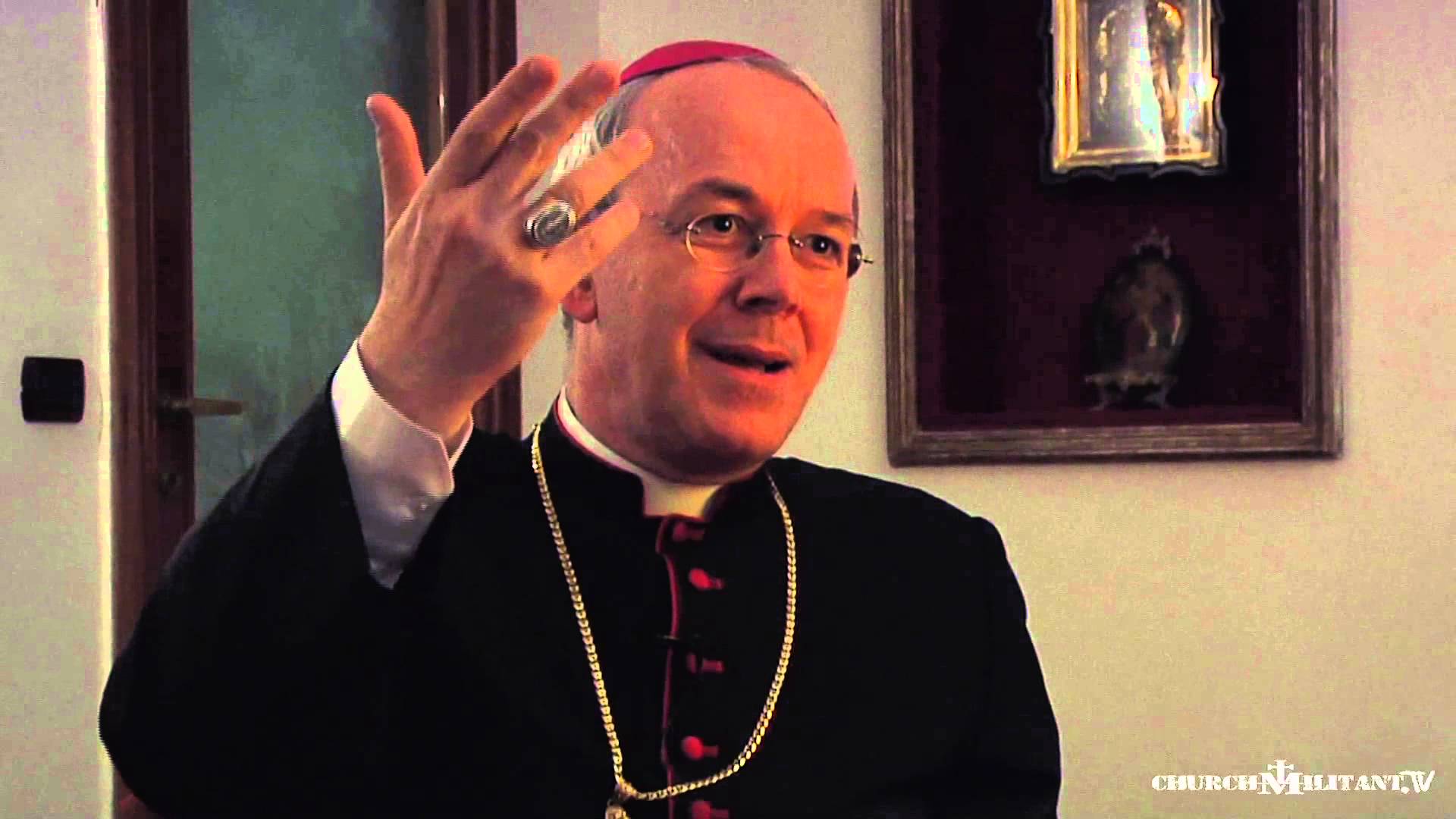
On February 14, 2015, Bishop Athanasius Schneider of Astana, Kazakhstan, was sponsored by the Paulus Institute to give a talk in Washington, DC. During the talk, he proposed concrete actions — ten essential elements — which should be implemented to accomplish liturgical renewal.

As an attendee, I was impressed once again by his excellency’s concern for reverence and piety in Catholic worship. Because of the deep value of the insights he presented, I would like to offer to you my own summary of his principle themes.

The bishop instructed that ever since apostolic times, the Church sought to have holy liturgy, and that it is only through the action of the Holy Spirit that one can truly adore Christ. Exterior gestures of adoration that express interior reverence are vital within the context of the liturgy. These include bowing, genuflections, prostrations, and the like. His excellency cited St. John Chrysostom’s writings on liturgy, particularly focusing on the following theme: The liturgy of the Church is a participation in and must be modeled upon the heavenly liturgy of the angels.

The notion of heavenly liturgy, and our participation in it at the Holy Sacrifice of the Mass, offers some perspective to those of us who may be tempted to take for granted the incredible miracle in our midst. The reality is that each Catholic church is, itself, a place wherein dwell angels, archangels, the kingdom of God, and God’s own Heavenly Self. If we were somehow able to be transported to the heavenly liturgy, we would not dare speak even to those we know and love. When we are within a Church, we should therefore speak reservedly, and then only of sacred things.

In the early church, the altar and other sacred items were veiled out of respect for the sacred mystery in which they played a role. There was not, contrary to popular belief in our present time, a versus populum celebration of Mass or even a widespread practice of communion in the hand. The priest and the people faced together towards God in the liturgical East.

When we celebrate liturgy, it is God who must be at the center. The incarnate God. Christ. Nobody else. Not even the priest who acts in His place.

It impoverishes the liturgy when we reduce the signs and gestures of adoration. Any liturgical renewal must therefore restore these and bring about a more Christocentric and transcendent character of the earthly liturgy which is more reminiscent of the angelic liturgy.

Ten Elements of Renewal

Bishop Schneider offered these 10 points of implementation which he views as fundamental for liturgical renewal (audio begins at 27 minutes):

1. The tabernacle, where Jesus Christ, the Incarnate God, is really present under the species of bread should be placed in the center of the sanctuary, because in no other sign on this earth is God, the Emmanuel, so really present and so near to man as in the tabernacle. The tabernacle is the sign indicating and containing the Real Presence of Christ and should therefore be closer to the altar and constitute with the altar the one central sign indicating the Eucharistic mystery. The Sacrament of the Tabernacle and the Sacrifice of the Altar should therefore not be opposed or separated, but both in the central place and close together in the sanctuary. All the attention of those who enter a church should spontaneously be directed towards the tabernacle and the altar.

2. During the Eucharistic liturgy – at the very least during the Eucharistic prayer – when Christ the Lamb of God is immolated, the face of the priest should not be seen by the faithful. Even the Seraphim cover their faces (Isaiah 6:2) when adoring God. Instead, the face of the priest should be turned toward the cross, the icon of the crucified God.

3. During the liturgy, there should be more signs of adoration — specifically genuflections — especially each time the priest touches the consecrated host.

4. The faithful approaching to receive the Lamb of God in Holy Communion should greet and receive Him with an act of adoration, kneeling. Which moment in the life of the faithful is more sacred than this moment of encounter with the Lord?

5. There should be more room for silence during the liturgy, especially during those moments which most fully express the mystery of the redemption. Especially when the sacrifice of the cross is made present during the Eucharistic prayer.

6. There should be more exterior signs which express the dependence of the priest on Christ, the High Priest, which would more clearly show that the words the priest speaks (ie., “Dominus Vobiscum“) and the blessings he offers to the faithful depend on and flow out from Christ the High Priest, not from him, the private person. Not “I greet you” or “I bless you” but “I the Lord” do these things. Christ. Such signs could be (as was practiced for centuries) the kissing of the altar before greeting the people to indicate that this love flows not from the priest but from the altar; and also before blessing, to kiss the altar, and then bless the people. (This was practiced for millennium, and unfortunately in the new rite has been abolished.) Also, bowing towards the altar cross to indicate that Christ is more important than the priest. Often in the liturgy — in the old rite — when a priest expressed the name of Jesus, he had to turn to the cross and make a bow to show that the attention should be on Christ, not him.

7. There should be more signs which express the unfathomable mystery of the redemption. This could be achieved through the veiling of liturgical objects, because veiling is an act of the liturgy of the angels. Veiling the chalice, veiling the paten with the humeral veil, the veiling of the corporal, veiling the hands of the bishop when he celebrates a solemnity, The use of communion rails, also, to veil the altar. Also signs – signs of the cross by the priest and the faithful. Making signs of the cross during the priest by the Eucharistic prayer and by the faithful during other moments of the liturgy; when we are signing ourselves with the cross it is a sign of blessing. In the ancient liturgy, three times during the Gloria, the Credo, and the Sanctus, the faithful made the sign of the cross. These are expressions of the mystery.

8. There should be a constant sign which expresses the mystery also by means of human language – that is to say, Latin is a sacred language demanded by the Second Vatican Council in celebration of every holy Mass and in each place a part of the Eucharistic prayer should always be said in Latin.

9. All those who exercise an active role in the liturgy, such as lectors, or those announcing the prayer of the faithful, should always be dressed in the liturgical vestments; and only men, no women, because this is an exercise in the sanctuary, close to the priesthood. Even reading the lectionary is directed towards this liturgy which we are celebrating to Christ. And therefore only men dressed in liturgical vestments should be in the sanctuary.

10. The music and the songs during the liturgy should more truly reflect the sacred character and should resemble the song of the angels, like the Sanctus, in order to be really more able to sing with one voice with the angels. Not only the sanctus, but the entire Holy Mass. It would be necessary that the heart, mind and voice of the priest and the faithful be directed towards The Lord. And that this would be manifested by exterior signs and gestures as well.

There is a great deal to reflect on here. Each of these ten points seems, to me at least, indispensable in our pursuit of truly reverent worship in our churches. None of these points is incompatible with either the Church’s ancient liturgy or, perhaps more importantly, with the liturgy envisioned by the Council Fathers in Sacrosanctum Concilium.

It would be a tremendous blessing if more bishops would take up these ten points as essential guidelines for liturgy in their dioceses. I encourage you to send them along to your own bishop for his consideration. There were more treasures in the Q&A, which I have elected not to transcribe due to the length. (If you are interested in the full audio of the talk, see below.)

I also had the opportunity to meet briefly with the bishop at the conclusion of his talk. When I thanked him for his leadership in a time where it seems so many of our shepherds are not speaking with clear voices for the teachings of the Church, he said to me, “It is you who must do this. You, the faithful, your families. You must be holy. You must teach the faith to your children. You must inspire the priests.” On the subject of vocations, he said that we must offer our children to God if we wish for them to receive a call. It would seem that with this advice — paired with the concrete suggestions he previously offered in his article published earlier this year — he is calling on us, the laity, to begin a holiness revolution if we wish to see reform the Church.

It seems we had better get started.

10959678_10155228956350615_4313266986992658750_n
His Excellency, Bishop Athanasius Schneider and Steve Skojec

Posted in Uncategorized | 1 Comment

THE NUMBERS GAME

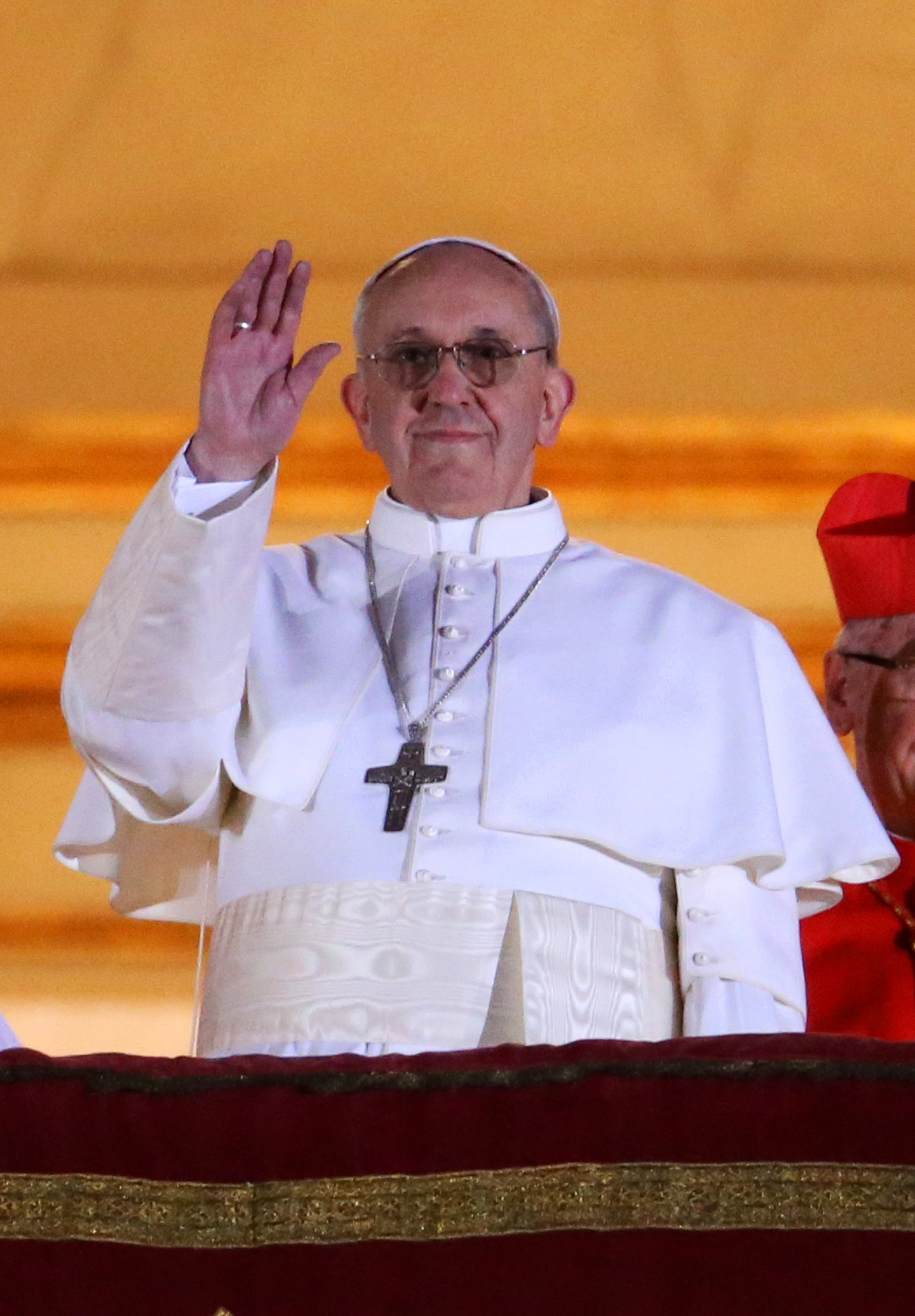
VATICAN CITY, VATICAN – MARCH 13: Newly elected Pope Francis I appears on the central balcony of St Peter’s Basilica on March 13, 2013 in Vatican City, Vatican. Argentinian Cardinal Jorge Mario Bergoglio was elected as the 266th Pontiff and will lead the world’s 1.2 billion Catholics. (Photo by Peter Macdiarmid/Getty Images)

MAHOUD’S PARADISE

TUESDAY, MAY 30, 2017

The Horrific Math of the Evolving Cardinalate

The following table shows the proportion of papal electors that will have been selected by Pope Francis, beginning on June 28th, when the five new designates will be confirmed, and extrapolating out, in case Pope Francis continues to occupy the chair in another one, two or three years. Since it’s probable that some cardinals under age 80 will die in the interim – to be replaced by Francis – the actual proportions will, of course, almost certainly be higher.

2017 – 4 years: 49 of 121 (40%)
2018 – 5 years: 53 of 120 (44%)
2019 – 6 years: 59 0f 120 (49%)
2020 – 7 years: 67 of 120 (56%)

At her blog, What’s up with the Synod, and in a recent article in The Remnant, Hillary White wonders whether Jorge Bergoglio might have already served his primary purpose for the Modernist revolution/demolition:
A while ago Mike Matt asked me how it could possibly be worse. I said, “Oh, I don’t know. How about someone smarter, more wiley and less obvious, more politically skilled and more plausible, and 20 years younger?”
“Has Bergoglio reached the end of his usefulness? And if so, what’s next on the agenda?” Broadly, he was to sever the connection of the Church’s power structures to her doctrines, most especially the doctrines that the secular world finds most objectionable; that is, on sex and marriage. He was to complete the desacralization of the Church as an institution and remove the last obstacles for a functioning union between Catholicism, “liberal” factions in other Christian confessions and other religions and the globalist, transnationalist elites in Brussels and New York.
All of these things he has accomplished, and the time has come for the Revolution to move on to the next phase.
[…]
The short version is that at the end of 4 years of Pope Francis Bergoglio, every bit of the power and money of the institutions of the Catholic Church is now in the hands of the completely triumphant post-Conciliar, secularist, globalist, neo-modernist Revolution. And that is why I think that Bergoglio’s reign will not last much longer. His purpose has been accomplished; Maradiaga’s “irreversible renovation” of the Church is done.
Bergoglio himself has been recorded saying that he thought his pontificate would last about 4 years. And here we are. We know that certain people put him in place for certain reasons. He was to accomplish some very particular tasks and I think he has done so. I think overall, his job was to complete the demolition project of the radical revolutionaries of the Vaticantwoist project; that is, the total reconstruction of the Catholic Church along the lines of their vision.
What I believe is that now that the Wrecking Ball has done his work, we will next have the Surgeon.
As Miss White mentions, one of the most important projects of Bergoglio was packing the voting-age cardinalate with the Modernists’s men.

Posted in Uncategorized | Comments Off on THE NUMBERS GAME

There is something demonic in the Russian soul, something that cannot be explained rationally.

Rod Dreher

Smerdyakovism

Fyodor Dostoevsky, diagnostician of the Russian soul ((Eugene Ivanov/Shutterstock)

A reader posted a link to this 2014 essay by Costica Bradacan, talking about how Russia can be understood through Dostoevsky’s great novel The Brothers Karamazov. Bradatan begins by saying that there is something demonic in the Russian soul, something that cannot be explained rationally. Excerpt:

Vladimir Putin’s sudden decision to start slicing up Ukraine must have reminded East Europeans of Russia’s traditional expansionism, but also of something else, something even worse. For there are still vivid in Eastern Europe’s collective memory episodes of Russian brutality so ferocious, so nightmarish that they can’t have anything to do with politics, not even with its most cynical variety. No matter how you look at them, even within a logic of repression, these acts just don’t make sense; they are too extreme to serve any punitive or preventive function — or any other rational purpose, for that matter.

One of those events was the great famine that Stalin imposed on Ukraine to punish it politically. Excerpt:

In a recent book, Bloodlands, Yale historian Timothy Snyder estimates that approximately 3.3 million people died then of starvation. (Some three millions were ethnic Ukrainians; the rest were Russians, Poles, Germans, and Jews.) How was this done? First, when the peasants could not meet the excessively high quotas of grain set by Moscow, all their food supplies were confiscated. “The authorities searched for that grain as if they were searching for bombs and machine guns,” writes Vasily Grossman, whose book Everything Flows offers one of the most compassionate accounts of the Ukrainian famine. Everything edible was taken away by party activists and OGPU (Soviet security services) officers. Their entire seed fund was seized; even cooked food, dinner already set on the table, was swept away.

Once that was done, people were left to die the slowest of deaths: “The village was left to look after itself — with everyone starving in their huts. […] And all the various officials from the city stopped coming.” To make sure nobody escaped, roadblocks were set up by the OGPU, and the railway stations were guarded by armed soldiers. Through Party and OGPU channels, Stalin was kept abreast of what was going on.

As an American, there is a lot that I admire about Russia. But if I were Ukrainian, I think I would hate Russia from the depths of my soul for this.

The other incident mentioned by Bradatan was the massacre at the Katyn forest of Polish army officers and soldiers who had been defeated by the invading Nazis, and surrendered to the Red Army rather than be taken by the Germans. They were slaughtered, every one of them:

The killings were performed individually: two NKVD officers would hold the victim by the hands, while a third would shoot him in the head, from behind. One victim at a time, some 21,892 times. Why did they kill unarmed, defenseless prisoners like this? Just because.

“Just because” — that’s what defines these episodes. They are enormously brutal, gratuitous, and incomprehensible. They seem to emerge from some dark corner of human nature: no matter how intently we scrutinize it, we cannot make anything out.

Russians have done this to themselves as well, of course. This is what the Gulag and the Great Terror essentially were: just because. Bradatan quotes the prosecutor at the end of The Brothers Karamazov, saying that the Russian character is stretched between “two abysses”: one abyss its lofty ideals, the other its foul degradation. Russia is capable of the highest highs and the lowest lows. Bradatan argues that the Russian soul was captured well by Dostoevsky in that novel, in his portrait of the brothers.

There is Ivan, who is relentlessly philosophical. Alyosha represents the heights of Russian spirituality. More:

Dmitri Karamazov is the face of ordinary Russia. The prosecutor who sends him to Siberia says as much. “She is here, our dear mother Russia, we can smell her, we can hear her!” As Russians, “we are lovers of enlightenment and Schiller, and at the same time we rage in taverns,” he says, “an amazing mixture of good and evil.”

Symbolically, the most important character is the bastard son Smerdyakov, who stands for the aspect of the Russian soul that nobody wants to recognize. He’s a nobody in the novel, though he ends up being very important because of his deeds. The most important thing about him, says Bradatan, is that he does evil for its own sake. “He kills just because.” More:

Smerdyakovism is an obscure, yet tremendous force that runs deep throughout Russian history. Its basic principle is formulated succinctly by the lackey himself: “The Russian people need thrashing.” Why? Just because. Smerdyakovism flares up especially in the form of leaders and institutions that rule through terror alone; repression for the sake of repression. Its impact is overwhelming, its memory traumatic, and its social effects always paralyzing. Joseph Conrad sees “something inhuman,” from another world, in these Smerdyakovian institutions. The government of Tsarist Russia, relying on an omnipresent, omnipotent secret police, and “arrogating to itself the supreme power to torment and slaughter the bodies of its subjects like a God-sent scourge, has been most cruel to those whom it allowed to live under the shadow of its dispensation.” And that was just the beginning.

It was Stalin who brought Smerdyakovism to perfection. Under his rule, Smerdyakov starved to death millions of Ukrainian peasants and killed tens of thousands of Polish prisoners. In Siberia he built a vast network of camps and prisons whereby a significant part of Russia’s population was turned into slave labor. All this for no particular reason — just because. In The Gulag Archipelago, Aleksandr Solzhenitsyn documents the whole thing in maddening detail. The Great Terror that Stalin orchestrated and put into practice with the help of the NKVD in the late 1930s is perhaps the most eloquent example of Smerdyakovism in 20th-century Russia. Without any trace of rational justification, the country’s artistic, scientific, political, and military elites were decimated within a few years. Some of its best writers, scientists, engineers, and generals received then a bullet in the head.

Bradatan goes on to say that Putin has to be understood as a manifestation of Smerdyakovism — not a Stalin-level example, but an example all the same. Read the whole thing. 

I defer to you readers who know something about Russia and/or Russian literature to comment on this essay. I found it fascinating, and am eager to hear what you have to say. To me, the most interesting aspect of the piece is its central claim that the greatness of Russia and Russia’s wickedness are all part of the same organic unity. Bradatan quotes from the prosecutor’s speech in The Brothers K:

“Two abysses, gentlemen,” says the prosecutor, “in one and the same moment — without that […] our existence is incomplete.”

This image of the two intertwined abysses can be said to be a picture of Russia itself. The basest and the highest, the most despicable and the noblest, profanity and sainthood, total cynicism and winged idealism, all meet here.

What do you think?

UPDATE: Occurs to me that something similar might be said of the American South. Minnesota is by most standards a better place to live than Mississippi, whose history includes great poverty and racist cruelty. But then again, Minnesota never produced a Faulkner, a Welty, or a Percy, and could not have done. I’m not putting Minnesota down over this. I’m just saying that Mississippi, and the American South in general, is abyssal in the same tragic way as Russia’s. Think about it: Flannery O’Connor’s Misfit is Smerdyakov.

UPDATE.2: OK, OK, Minnesota has produced some fine writers. I didn’t say they did not. I don’t think any of them come up to Faulkner’s status, but that’s me.

Posted in . Tagged .

80 Responses to Smerdyakovism

  1. bacon says:

    If nothing else, this post has shown that you have many followers in Minnesota, a relatively liberal state. Maybe you’ve stumbled on a new way to track readers – say something irritating about a state and sit back.

  2. Articuno says:

    Russia is gnostic. Maybe this came to them with the baptism from Byzantium. They perceive others to be like them, so they justify whatever they do. They speak of mysterious “russian soul” whenever they want to justify their wrongdoings and corruption, like Pobedonoscev or Tiutczew. They are also fatalistic and maybe this is why they don’t have moderate expectations from the state or neglect the well being of ordinary Russians. But this leads also to a constant fear among the elites that the people will murder them one day, and people fear brutal power. To me such culture is destined to fail somehow. Bolshevism was one indicator, now Islam is expanding. If you want to read more then obviously Letters from Russia of Custine are good and there’s an essay by Spengler about the Two Faces of Russia or something

  3. DocBroom says:

    Nice, Minnesota is nice in the same way C.S. Lewis’s N.I.C.E is nice, or Britain’s healthcare is N.I.C.E. I’m from Minnesota originally and quite happy to be as far from Minnesota as I am.

  4. La Lubu says:

    (Of course this is a matter of taste, but I’d personally take Prince over any musician that came out of Mississippi.)

    I love the hell out of Prince too, but:

    Robert Johnson
    B.B. King
    Muddy Waters
    Sonny Boy Williamson
    Albert King
    Howlin’ Wolf

    Had these fine Mississippi musicians not paved the way, Prince wouldn’t have been Prince.

  5. JonF says:

    Re: Why did they kill unarmed, defenseless prisoners like this? Just because.

    No, not “just because”. There was a logic to it, even if it is a gruesome one: the Russians were killing off Polish elite men, to better enable their own rule of the half of Poland they got under the Molotov-Ribbentrop Pact.

    The gulag by the way has its roots in the ghastly prison camps the Tsar maintained in Siberia. Nothing new under the sun.

  6. JonF says:

    John Gruskos,

    Rod may be a tolerant host, but you will many of us here do not look kindly on slanders directed at the people who gave us the Prophets, the Apostles, the Theotokos and Christ himself.

    [NFR: I missed his remark the first time around. I’m going to let it stand, but I agree with you, Jon. — RD]

  7. David Herwaldt says:

    TA wrote: (Of course this is a matter of taste, but I’d personally take Prince over any musician that came out of Mississippi.) So you’d take Prince over Muddy Waters, Howlin’ Wolf, B.B. King, Ike Turner, Elmore James, Sonny Boy Williamson, Robert Johnson, Johnny Shines, etc., etc. Without Mississippi, without the blues, there would be no Prince, nor would there be a Dylan. I write this as an Iowan at this moment, but a Minnesotan by birth.

  8. jsmith says:

    As always, the West has a short memory, but the Russians have not forgotten their humiliation.

    Nor did Hunter Strickland.

    Why is what is silly on an individual level not so for nation-states?

  9. Harvey says:

    Essentialism is a really bad idea, no matter whether it’s applied to Russians, MTDists, liberals, the Left or Trump supporters.

    The reason that it’s a bad idea is that it is a pure cop-out. Once something is ‘essential’, there’s no longer any reason to examine history, motivations, economic / cultural effects.

    (Just consider how many times, RD, that you used the word ‘enemy’ to describe Americans who disagree with you. We can’t simply have different points of view; we are reduced to caricatures with demonic souls.)

    [NFR: My “enemies” are not Americans who disagree with me. They are Americans who would punish me for my religious beliefs, and who would force me and my own to assent to lies. — RD]

  10. William Tighe says:

    Janwaar Bibi wrote:

    “Latvia for example is almost a quarter Russian, and they are concentrated in the Eastern part of the country.”

    This sounds like Estonia, although the figure I was given in 2001 for Estonia was 40% Russian, and it is true that they are concentrated in the Eastern part of the country. In Latvia, however, at that time – my wife’s parents were from Latvia and her late father was an historian – the figure was 50%/50% and the Russians were concentrated in Riga, the capital, and along the Gulf of Riga (a choice retirement area for Soviet-era military officers and bureaucrats for whom the Crimea was beyond their means), and not in one particular region of the country. In Lithuania, by happy contrast, Lithuanians amount to about 80% of the population, with about 20% Russians, Byelorussians, and some Poles and Ukrainians.

  11. Gus says:

    Oh, Rod. You will catch hell (and already have, it looks like) from Minnesotans. Like many Southerners we have a great inferiority complex. I take your point, though. New Orleans is an excellent example. Could jazz have been born in an orderly, well run city?

    [NFR: One thinks of Harry Lime’s remark in “The Third Man” about artistic greatness emerging out of chaotic and bloody Renaissance Italy, but Switzerland’s well-ordered society producing only the cuckoo clock. — RD]

  12. Gus says:

    We should probably also note the many atrocities committed by Americans against American Indians and African slaves. I don’t think Russia is unique in this regard.

  13. Wes says:

    Eugene Vodolazkin had a really good one on Russia/the West in this month’s FT’s.

  14. Paul Grenier says:

    I think some of the above posts are missing the point of Rod’s question.

    It is of course true, as Solzhenitsyn famously said, that “the line dividing good and evil cuts through the heart of every human being.” And no doubt through the heart of every nation as well, including the nation that fire-bombed Japanese cities (you know, just for starters).

    But I think Rod Dreher is asking whether there is in Russian culture and history a tendency for this inevitable human dualism to take on a particular form, one oriented either to the purity of self-effacing love, or to the abasement of pure cynicism.

    As my own most recent essay on TAC suggests, Chekhov, far from being a contradiction to Dostoevsky’s extreme contrasts, may well be a further confirmation of them.

    I have long felt that this line of reasoning, brought up by Dreher, needs to be explored in light of Fr. Alexander Schmemman’s thesis, expressed in his Journals, that Orthodox Russia (and Schmemann does suggest this applies also to Catholic cultures, but I would add that it applies to Russia ‘on steroids’) has a different eschatology compared to protestant America (or Switzerland): for a culture such as Orthodox Russia’s, the Kingdom of Heaven is already present, symbolically (which does not mean ‘as a pretense’!) here below. The world is therefore not merely a rational ‘rules-based’ place ordered to comfortable progress, but is instead a place where heaven itself may erupt — at least, in a certain sense. See the Orthodox liturgy! This idea, if corrupted, e.g. by communism as an atheistic ideology, Schmemman continues, does not simply eject the idea of perfection, but fatally distorts it. (I am writing this from memory, so sorry for the rough outlines here.)

    My other thought, Rod, is to try to find the book by the Southern Traditionalist and poet John Gould Fletcher, The Two Frontiers, which compares the psychology and spirit of Russia and the US. Have only seen excerpts, but it is suggestive and thoughtful at least in parts, and despite its being written in the 1920s. Fletcher suggests, among other things, that America is about constant busyness, Russia — cf. Oblomov! — about lethargy — except when animated by some exalted spiritual cause (at which point it is capable of a great deal indeed). As one might expect, Fletcher thinks these two opposites, America and Russia, need each other. (As in the cliche ‘If you two can’t stop arguing with one another I think I’ll make you get married.’)

    As regards the whole Ukraine situation, which continues to tragically unfold, I’ll only add that, were all sides to act with the good of the Ukrainian PEOPLE foremost in mind, Christian forgiveness would be a darn good place to start. Those who think politics needs to be walled off from ‘religion’ forget that politics becomes a kind of hell if it neglects the centrality of mutual forgiveness — something that a culture that has been repeating the Lord’s prayer for a thousand years is capable of — if we would just give it the opportunity.

  15. pbnelson says:

    q.v. Staggerford by Jon Hassler.

  16. Mel Profit says:

    This is why literary analysis in a vacuum is mischievous. The “Russian soul”, as evidenced by three hundred years of prison camps, gulags, Cossacks, Romanovs, and Bolsheviks, is indeed a dark and dangerous one. That said, even the worst of Russian tyrants have had real enemies, including Mr. Putin who watched Yeltsin get taken by the West and NATO creep up to his doorstep. Whatever the absolute morality and political wisdom of his actions in Crimea and the Donbass, they were in response to Western arrogance and provocation. It is also worth pointing out that Ukraine, with its large and influential Neo-Nazi faction, is hardly the Shining City on a Hill that neocons and other fabulists insist on seeing in every American protectorate.

    Finally, no less than the Ukrainians, the Russians have historical memories–and quite recent ones–that Americans can barely imagine. If Ukrainians are justified in hating and fearing Moscow, Russians should be apoplectic at the very mention of Germany. In a region as blood-soaked as Europe, there is plenty of culpability to go around, including souls Slavic, Gallic, Teutonic, and Red, White and Blue.

  17. Loudon is a Fool says:

    Sinclair Lewis + J.F. Powers + Prince + Charles Shulz + Judy Garland + Garrison Keillor + the Coen Brothers + Laura Ingalls Wilder < Walker Percy or William Faulkner or Flannery O’Connor or Robert Penn Warren or Cormac McCarthy or John Kennedy Toole

    This is just math, guys. I’ll give you F. Scott Fitzgerald but, given the amount of time he actually spent growing up in Minnesota, that’s kind of like Canada crowing about that little mechanical arm they made every time the space shuttle would launch. Which makes sense given that Minnesota is kind of like America’s Canada: “Yeah, uhh, really nice people. Great personality.”

  18. Zeno says:

    KansasM says: All you ever need to know about what it means to be human is found in “When Doves Cry.”

    That’s another good reason not to live in Kansas.

  19. I guess I can be glad you picked Minnesota and not Pennsylvania.

    Anyway–Next school year, I plan to teach Solzhenitsyn and a piece of the Brothers–“The Grand Inquisitor”–to my high school AP class. The lesson plan includes Solzhenitsyn’s One Day and his Harvard speech in which he told our elite graduates of 1978 that people in Russia suffered because “Men have forgotten God; that’s why all this happened.”

    The Harvard grads booed him off the stage.

    We seem even more reluctant to hear that message today.

  20. dfb says:

    Interesting that Professor Bradacan fails to note, in suggesting Smerdyakov is caught between “two abysses” that the one person who is certainly a parent of Smerdyakov – “Stinking” Lizaveta Smerdyashchaya – is specifically identified by Dostoevsky as a “holy fool.”

  21. Captain P says:

    Russia’s actions in Ukraine are entirely explainable based on ordinary geopolitical concerns. The US and and EU had fostered a coup that toppled a Russia-friendly Ukrainian government and replaced it with one that wanted to eventually join NATO, which Russia considers an anti-Russia alliance. If, someday, China were to become more powerful than the US, and support a coup in Mexico to replace a US-friendly administration with one that wanted to join a China-dominated mutual defense organization, the US might act in the same way.

    Furthermore, Ukraine has a crucial role in Russian national identity — Kievan Rus was the ancestor state of both Ukraine and Russia. It was a blow to Russian pride to see their “mother country” taken over by a faction hostile to Russia. Ergo, Putin shored up domestic support by intervening in Ukraine.

  22. Dana Ames says:

    I recently watched the lengthy “Andrei Rublev” (Tarkovsky, 1966) and found the same mishmash of situations and motives presented by a Russian in the midst of Communism. It also struck me to a lesser extent while reading “Echoes of a Native Land” by S. Schmemann. Yes, people are like that all over the world. I think each culture has a different “odor” about its mixture of sublimity and depravity, though.

    Dana

  23. bt says:

    “But then again, Minnesota never produced a Faulkner, a Welty, or a Percy, and could not have done.”

    Art tends to do quite well under conditions of duress or strain or pain. And yes, the south has always offered than in much larger helpings than in more kind and content places like Minnesota.

  24. Prof CJ says:

    1. More than anything else, Russia is a bloated colonialist
    country that’s still holding on to its colonies, namely
    Siberia and the Kaliningrad Oblast’. Another colony,
    Alaska, was sold to the U.S. Granted, much of Russia’s
    military expansionism occurred when Russia was ruled
    by a German, Catherine the Great. There is growing
    evidence that multiple acts of genocide took place as
    Russia was expanding from Muscovy toward the Urals
    and into Siberia (even Wikipedia mentions that). I wonder
    if Russia is going to repent the horrors it inflicted on the
    native population during its colonialist expansion or if that
    topic is even discussed in Russia. I may be wrong but I’m
    not aware of Tolstoy or Dostoevsky ever being critical of
    Russian colonialism.

    2. Some Ukrainians I know (I’m not Ukrainian) regret the
    fact that Eastern Orthodoxy was imposed on Rus’ . They
    are envious that Poland and Bohemia joined Western
    Christendom, i.e., Catholicism, because in purely secular
    terms Poland and Bohemia (now Czechia) got instant access
    to the cultural riches of France, Italy, and England. What did
    Rus’ get? Exposure to Byzantine despotism.

  25. Michelle says:

    As my husband always says, there’s a reason why he’s from there. Russian culture is dysfunctional, a dysfunction that originated long before communism.

    As for Faulkner–he’s highly overrated.

  26. Michelle says:

    because Russians had a tradition of self-critique, exemplified by Dostoevsky, which Jews lacked.

    What hogwash written by someone who obviously knows nothing of Jewish culture.

  27. John says:

    As mentioned above, the crimes you refer to are to be attributed not to Russians, but to Communism. Stalin was a Georgian not a Russian; the enforcers of the Ukrainian famine were to a great extent Ukrainian Communists. Similar crimes were repeated and even surpassed in the other countries that fell under Communist rule, such as China. I don’t know how you made this mistake.

  28. Wygrif says:

    Minnesota also produced Norman Baurlaug, who is one of the most important people of the twentieth century and in a wonderful, deeply Minnesotan way is almost totally unknown among the general public.

    So even if you were right about literature MN > MS

  29. Charles Cosimano says:

    All governments rule by terror to one degree or another. Stalin was just on the far end of the curve.

    Remember, Stalin did not do it by himself. There was an army that let him.

  30. Lllurker says:

    The (submissive?) culture of the Russian people may have made the country vulnerable to Communism/Stalinism but I’m not so sure that within Stalin’s own head and heart there was anything uniquely Russian going on. He grew up Georgian, in the Orthodox Church, he became a seminarian, and then IIRC for awhile he acted as a sort of Georgian/Marxist propagandist and revolutionary. All this before he had much involvement in Russian politics beyond Georgia itself. And later after he did seize power in Russia Stalin spent the rest of his life de-Russifying the place.

    As far as the 20th century monsters go, to me Stalin is the more straightforward actor, especially when compared to Hitler and some of the others . He seems to have decided that the key to power was to always be the most ruthless operator in the room, then later the most ruthless operator in the country. He had the cunning to know when to be discreet about it but he never seemed to waver much from this formula. (Nor apparently to suffer any guilt from it.)

    Viewed through this lens Stalin’s atrocities such as the liquidation of the Kulaks, the Holodomor, the massive purges and the Katyn Forest Massacre all consist of just so much more of the same. He held power by employing institutional campaigns of terror making it impossible for anyone else to develop a power base. I’m not sure there’s anything particularly Russian in that sort of Evil.

← Ol

Posted in Uncategorized | 1 Comment

IS THERE A ROLE FOR FUSIONISM IN A CONSERVATIVE CHRISTIAN FUTURE, ASSUMING THAT THERE WILL BE A FUTURE ???

The American Conservative
Fusionism & The Conservative Future
By ROD DREHER • May 30, 2017, 2:20 PM

Jim Larkin/Shutterstock)
Writing in the conservative journal Modern Age, Samuel Goldman counsels fellow conservatives to move with extreme caution in the Age of Trump:

Conservatism does have to adapt if it is to survive the Age of Trump. But a conservatism that panders to populist fantasies and embraces the morality of professional wrestling is not worth saving. One place to start rebuilding amid the ruins is a return to the blueprint developed by political theorist Frank Meyer as the modern conservative movement was first taking shape. “Fusionism” is part of the conservative past. But it may also be the future.

Fusionism, as you probably know, is the concept that united the libertarian Right and the traditionalist Right in the 1950s. It found a way to accommodate the small-government/pro-market beliefs of libertarians with the concern for virtue and social order among traditionalists. Ronald Reagan was the ultimate fusionist conservative candidate.

Goldman delivers a good basic explanation of fusionism (which readers new to the term will recognize as mainstream American conservatism of the last half-century), and contrasts it to Trumpian populism. He notes fusionism’s failures, and concedes that however crude Trumpism may be, it didn’t come from nowhere. Yet he believes that Trumpian populism does not provide any kind of solution to the problems fusionism has failed to resolve. Excerpt:

[T]he insufficiency of one solution does not necessarily mean that a better one is available. The midcentury industrial workplace really did provide a stable and dignified life, especially for men who took pride in their mastery of things rather than facility with numbers or words. Unfortunately, we have no idea how to bring it back.

We also have no idea how to restore a “thick” national identity without employing unacceptably coercive means. It is easy to forget that the common culture of fond memory was made possible by policies that included the legal suppression of America’s largest immigrant culture (the German-speaking Midwest) during the First World War, and mass conscription and a virtual takeover of the economy and media during World War II. The comfortable sense of belonging many Americans enjoyed half a century ago was also buttressed by the formal and informal exclusion of black people from the mainstream of American life. These were bad measures that no one seriously proposes to revive.

I think Goldman has hit on the very serious dilemma facing conservatives now. The old way of doing things — fusionism — has failed to address deep structural problems in American life. Populism, though, proposes solutions that are arguably unjust and unworkable. Giving the state more power does not bother traditionalists as much as it does libertarians, but only because traditionalists don’t mind using the state to achieve virtuous ends. But trads (like me) have to confront the fact that we are a post-Christian democratic nation, and that concentrating power in the hands of the state will in most cases be used against us.

Read Goldman’s entire essay. He contends that conservatives should abandon the idea that we will ever have a polity as unified as we once did, and that a reformed fusionism — reformed in light of the failures of the fusionist status quo that gave rise to Trumpist populism — still gives us the best principled hope for realizing conservative ends in this environment.

I guess I agree with this by default, if only because I see no prospect that Trumpism, for which I have a certain sympathy, can work. Even if Trump were to seek to empower and to encourage virtue — that’s okay, I can wait for you to stop laughing — the plain fact is that we are now too fissiparous a society even to agree on what virtue is. What fusionism works out to in practice, it seems to me, is business interests using traditionalists (chiefly Christian conservatives) as useful idiots to get what they want out of government. Do you see the Republican Party standing up for traditional values and virtues in the face of the LGBT juggernaut within corporate America? Of course not. And the truth is, traditional values on matters of sex and sexuality are increasingly unpopular. We really are a post-Christian nation.

That said, it still makes sense for trads to work within the Republican Party. If the GOP is not promoting our interests, at least it is not outright hostile to them, as the Democrats are. The long-term trend in our country, however, is running against traditionalist Christians. We cannot expect GOP politicians in a democracy to stand up for values that a diminishing number of American share. And we cannot expect politics to solve, or even adequately address, the core crises of American culture and society. We are much more likely to get the breathing space to work on our own localist solutions if Republicans (either populist or fusionist) are in power, but that’s about all we can hope for.

Despite what you’ve heard from some quarters, the Benedict Option does not call on Christians to abandon political involvement. Rather, it calls for Christians to re-prioritize their concerns. For too long, too many conservative Christians have acted as if the most important thing we can do for the country is to vote Republicans into office. Meanwhile, our churches have rotted from within. Massive numbers of Millennials are drifting away from the church, and those who stay are, like most of the older generations, really Moralistic Therapeutic Deists. As Robert Louis Wilken said back in 2004:

At this moment in the Church’s history in this country (and in the West more generally) it is less urgent to convince the alternative culture in which we live of the truth of Christ than it is for the Church to tell itself its own story and to nurture its own life, the culture of the city of God, the Christian republic.

This is not surrender. It is a strategy for facing our post-Christian reality. It is not a call for Christians to abandon politics entirely — I don’t believe we can or should do that — but it is a call to understand the nature of the times, and to commit our attention and our resources to building up the life of the church in truly countercultural ways. We cannot expect as much from Republican politicians or politics itself as many of us wish to think that we can. Continuing to respond as if we were in normal times in this regard amounts to a fruitless shoring up of the declining imperium, when what is most needed — not exclusively needed, but most needed — is what we have neglected among ourselves for far too long: building up the culture of the city of God, the Christian republic.

In his most recent column, Dennis Prager (who is Jewish) criticizes Trump-opposing conservatives:

I have concluded that there are a few reasons that explain conservatives who were Never-Trumpers during the election, and who remain anti-Trump today.

The first and, by far, the greatest reason is this: They do not believe that America is engaged in a civil war, with the survival of America as we know it at stake.

While they strongly differ with the left, they do not regard the left-right battle as an existential battle for preserving our nation. On the other hand, I, and other conservative Trump supporters, do.

Well, I wasn’t one of the Never-Trumpers, and I do believe that we are indeed engaged in a great battle in this country. The difference between Prager and me has to do with the nature of the war. The idea that Donald Trump is in charge of the forces of righteousness is farcical. And the idea that the line between the forces of good and evil in this war is drawn between conservatives and liberals, Republicans and Democrats, is delusional.

Prager also makes the shopworn “Georgetown cocktail party” criticisms, accusing Never-Trumpers of being too prissy and self-involved to embrace Trump:

They can join the fight. They can accept an imperfect reality and acknowledge that we are in a civil war, and that Trump, with all his flaws, is our general. If this general is going to win, he needs the best fighters. But too many of them, some of the best minds of the conservative movement, are AWOL.

I beg them: Please report for duty.

What, exactly, is Donald Trump fighting for? And why is the righteousness of that cause so overwhelmingly clear that it requires conservatives to abandon their principles for the sake of winning power? This is not clear at all to me. The Trump phenomenon is, to me, a sign that we traditionalist conservatives have already lost the war. The Benedict Option is the most important form of resistance open to us.

As I have written here, a conservative Evangelical friend who doesn’t like Trump told me that his crowd has gone all-in for him because “they don’t have a Plan B” — meaning that they have no idea what to do if they lose power. They don’t realize that they — that we — have already lost power, and if we keep telling ourselves that we can win it back, we will continue to neglect the most important work we can and should be doing right now.

We are not engaged in a battle to “preserve the nation”. We are engaged in a battle to save the church. It is entirely possible that we could preserve the nation, whatever that means, but lose the church. Both are important to me, but I know which one matters more.

UPDATE: Patrick Deneen has an essay about conservatism in the Age of Trump in the same issue. Excerpts:

In the roughly half century of political ascendancy of American conservatism, little was recognizably conserved. The economic landscape of America was remade not only by a series of free trade agreements that accelerated globalization and economic integration but also by internal policies, both federal and local, that favored large corporations over small business. The rise of big-box stores was coincident with the postwar creation of suburbia and settlement patterns that found Americans increasingly living often at vast distances from work, school, church, and commerce. Findings by social scientists, most prominently Robert Putnam, demonstrated a consistent and substantial decline in the associational life of Americans and the rise of forms of what Tocqueville predicted would be the dominant democratic ethic of individualism. Every religious tradition, with the notable exception of Mormonism, saw extensive losses in adherents, especially pronounced among the millennial generation whose commitments to “none” began approaching the 50 percent mark. Schooling increasingly emphasized both sensitivity and utilitarian skills, rejecting traditional efforts to steward history and perpetuate a culture. Universities, in turn, became dominated by left-wing identitarians and a bloated corporate administrative class that together eviscerated distinctive cultural and religious institutional traditions in a deracinated commitment to vague social justice and job preparation. The media became saturated with explicit sexuality, incessant sarcasm, and default mockery of traditionalist beliefs. Pornography went mainstream. Demonstrations of bathetic patriotism became obligatory at every public event even though a tiny minority of Americans would ever be directly affected by the inconveniences of military service. In nearly every aspect of American life, little worth conserving was conserved.

American conservatism was ultimately a failure because it advanced a liberalism that has now been visibly revealed to be fundamentally destructive of the fabric of lives of a wide swath of countrymen, particularly those who are in many respects by design the “losers” in the liberal order. The rejection of American conservatism was most fundamentally a rejection of American liberalism, and Trump was the carrier of anxieties not over the course of the Republican and Democratic parties but the American order itself. Yet, far from ensuring the rise of a new and more credible conservatism, the rise of Trump may signal that no conservatism arising from the morass of contemporary American anticulture is viable. [Emphasis mine. — RD]

More:

If nothing else, the exceedingly narrow victory of Donald Trump may be understood as the last gasp of a dying conservatism that has been destroyed by American liberalism. That “instinctive understanding of inherent limits” may be the animating attraction to a vision of Trump’s promises for a nation with a border and a common culture; a foreign policy largely defensive instead of a de facto empire; a capital drained of cronies and riggers; and the liberty to call things as they really are, including men, women, and children. Yet protection of this instinct was given to a man with no apparent conservative values or vision, less a sign of hope than desperation. Conservatism may have a future in America, but it will arise most likely from families and intentional communities that live as a counterculture to self-immolating American liberalism, and not as something that will be created in a political laboratory by the educated or from the wreckage of a Flight 93 administration in Washington, D.C.

Yes. This. Shore up the imperium if you like, but understand that in doing so you are conserving very little that matters, or should matter, to socially conservative religious traditionalists.

Posted in Christianity, Culture, Culture war, Decline and Fall, Benedict Option, Weimar America, All Things Trump. Tagged traditionalists, libertarians, Samuel Goldman, fusionism, Donald Trump, Dennis Prager.

MORE FROM THIS AUTHOR
Even More About Christians & Black Lives Matter
Country Kids
Hide 7 comments

7 Responses to Fusionism & The Conservative Future
Brendan says:
May 30, 2017 at 2:31 pm
I honestly think fusionism is as serious a mistake as populism is. Fusionism brought the libertarian vandals into the heart of conservatism, with their distaste for traditional morality and religion. It has had a disastrous impact on the conservative political movement, full stop. The conservatives should abandon the libertarians and let them swim on their own. Yes, it means neither would win politically on a NATIONAL level, but it’s likely that even a “united” conservative/libertarian coalition still will struggle nationally anyway.

Overall, the political situation is not winnable, in any meaningful sense, from the perspective of a social/religious conservative. Noone is on our side. So I don’t really care that much about what happens to “conservatism”, per se, because it certainly doesn’t have our backs. But if I were a tactician for “conservatism”, I’d dump the libertarians once and for all.

djc says:
May 30, 2017 at 2:38 pm
For the life of me I will never understand this hatred of Trump. He said he’d appoint conservatives to the SCOTUS and he did. He said he would begin to dismantle excessive regulations and he has. He said he’d appoint conservatives to prominent positions and he has.

He said he would attack abortion and his appointees have done so. He has done so himself as well.

He is trying to keep us out of wars in the Middle East and he is not backing down from building a wall, though who knows what it will look like, on the Southern border.

He has authorized the building of the pipeline in the Dakota’s.

What conservative could be against this?

As far as his sordid past—-well, it is what it is. Does anyone believe Obama’s past is substantially any better? I don’t.

If Trump ultimately fails, and he may, the biggest loser will be the Republican Party for being shown to be the hypocrites I’ve discovered them to be.

Rod, I love your blog but I will never understand, though I have read pretty much every post, why there is such a dislike of Trump.

PS I called every state except Wisconsin in the last election.

Caleb Bernacchio says:
May 30, 2017 at 2:44 pm
“That said, it still makes sense for trads to work within the Republican Party. If the GOP is not promoting our interests, at least it is not outright hostile to them, as the Democrats are. The long-term trend in our country, however, is running against traditionalist Christians. We cannot expect GOP politicians in a democracy to stand up for values that a diminishing number of American share. And we cannot expect politics to solve, or even adequately address, the core crises of American culture and society. We are much more likely to get the breathing space to work on our own localist solutions if Republicans (either populist or fusionist) are in power, but that’s about all we can hope for.”

I think you overlook the real issue here and thus grossly underestimate the conflict facing conservatives, in a way that is not unrelated to my criticisms of the BenOp. While you might be right about the relative indifference of the GOP when compared with the hostility of the Democrats what this analysis overlooks is just how harmful the neoliberal program initiated under Reagan and championed by the Republicans was to the American communities where traditional morality was nurtured. So there is in reality an equally asymmetric relationship between the Democrats and the GOP when it comes to neoliberalism, with the former acquiescing in what was championed by the latter and has now become the only game in town. Again, if MacIntyre is correct traditional morality needs precisely the types of communities where good work, flourishing local organizations, and relationships with neighbors are commonplace. Because of this, traditional conservatives are faced with something like a tragedy: support candidates who vehemently and militantly reject all of your ideals or vote for the friendly and sympathetic conservative who will give your job and community to the highest bidder.

In this situation why can’t a case be made for conservatives to work out a space within a coalition of supporters of Bernie Sanders, articulating clearly where there is common ground and where there are differences that must be respected?

DocBroom says:
May 30, 2017 at 2:45 pm
I think I’m a bit closer to abandoning all hope in the American imperium then you are Rod. If traditional Christians as a bloc are to remain engaged in the political arena, I think we need to put distance between ourselves and the Trumpistas, the Establishment GOP and the Democrats. Our votes and support ought to be earned rather than assumed. But I am more and more convinced that whatever hope we as traditional Christians have is to be the Church and change the culture by changing the allegiance toward the Kingdom, one person at a time. I’m still wrestling, after reading Benedict Option three times on how beyond myself I can get those around me to begin ‘building’ monasteries of the heart and mind in our neighborhoods, churches, and communities.

Lord Captain Cecil Harvey says:
May 30, 2017 at 3:07 pm
Rod, I don’t understand why you can’t see that we’ve already lost the cultural civil war. Badly lost. What’s left is negotiating the terms under which we conservatives will live under.

There is absolutely no political solution. Not stressing this enough is my biggest criticism of the Benedict Option. We *should* withdraw from the political arena, because we have zero hope there.

Our only options are those involving community and spirituality. Forming strong bonds, prayer, fasting, etc. — all things you recommend. We *should* be running for the hills — at least those of us with families. We should live good lives, and opportunistically look to convert others whenever we can, especially those of us that can still work in the world (we’ve got maybe 10 years left where traditionalists can work in corporate America). Every able-bodied Christian man should learn to shoot a rifle, because it will come to that if we live uncompromising lives.

But engaging in politics is a complete waste of time. It will accomplish nothing. If the majority of this country, both left and right, think Trump is conservative, what do they think of us?

Viriato says:
May 30, 2017 at 3:28 pm
I agree with this piece overall. Trump is clearly not one of us, as his well-documented support for transgenderism shows.

But I’m very skeptical about the desirability of any sort of return to fusionism, because fusionism is, as you write, fundamentally about “business interests using traditionalists (chiefly Christian conservatives) as useful idiots to get what they want out of government.”

For a coalition to be worthwhile, the parties to it need to have some fundamental values in common. For instance, in Francoist Spain, the regime was buttressed by four main forces: Falangists, Carlists, constitutional monarchists, and members of Opus Dei. There were many ideological differences between these groups, far too many to be summarized here. But they nonetheless had one value in common: a profound Catholic faith and a commitment to preserving Spain’s Catholic heritage and character. One can easily imagine why these groups were willing to tolerate each other’s idiosyncrasies for the sake of the greater good.

What do libertarians and traditionalist conservatives have in common, exactly?

What do we “get” out of a coalition with libertarians? Do libertarians ever have our back in the culture wars?

NO. As you’ve written about many times, free market types consistently align with big business interests against the interests of traditionalists.

Do libertarians and traditionalists even have a common enemy? I, for one, don’t see why I should regard the Democratic Party as any more of an enemy than… libertarians.

In contrast, many Trump supporters share with traditionalists an appreciation for traditional Christian culture and values (see, for instance, Pat Buchanan, or many of the pro-Trump commenters here on this blog).

In terms of economic and environmental regulation, the Trump movement is not as interventionist as I would like, and even seems aligned with the fusionists on getting rid of regulations and pulling out of the Paris climate accord. But at least Trump is in favor of protectionism, has killed TPP, and has signaled his intent to withdraw from NAFTA. It’s a start, and in any rate far better than the fusionist Republican vision.

So, given the choice between a fusionist GOP and a populist GOP, I’ll take the latter.

JZ says:
May 30, 2017 at 3:30 pm
I always chuckle a little bit when I hear people talk about Trumpism as if it’s some sort of coherent political philosophy. Rod writes two things:

“I see no prospect that Trumpism, for which I have a certain sympathy, can work”

and

“What, exactly, is Donald Trump fighting for? And why is the righteousness of that cause so overwhelmingly clear that it requires conservatives to abandon their principles for the sake of winning power?”

I suppose I agree with both statements, but I only believe in the first because of the second. Since Trump isn’t really fighting for anything, of course Trumpism (whatever that means) can’t work. One thing we do know is that globalism can’t work…at least not for the lower middle and working classes, so it’s hard to tell Trump supporters to toe the historic fusionist globalist line. Could somebody come up with a COHERENT political philosophy that includes most modern conservative ideas along with things like limited free trade, restricted immigration and limited foreign military involvement? I’m not sure, but I don’t think it would be necessarily more flawed that globalism.

I would suggest that Trumpism really comes down to “not the mainstream left”. That’s why it’s not coherent, and that’s why it can’t work. But that’s why folks like Prager accept it despite my guess that he knows there’s no there there. When your religion is politics, you’ll accept “not the devil” even when the other option is incoherent.

From my Christian world view, there’s no hope in Trump, and there’s very little hope in secular politics at all. I think I may be more cynical about politics than Rod. That said, while I didn’t vote for Trump, I find it easy to vote for Republicans knowing that the Dems pretty much hate my guts and see me as a deplorable.

Posted in Uncategorized | Comments Off on IS THERE A ROLE FOR FUSIONISM IN A CONSERVATIVE CHRISTIAN FUTURE, ASSUMING THAT THERE WILL BE A FUTURE ???

“Marriage is organically inscribed in this new sacrament of redemption, just as it was inscribed in the original sacrament of creation.” Adultery is Satan’s weapon to destroy it !!!

unnamed-13

Marriage in light of Creation, Fall, and Redemption
Eduardo J. Echeverria

TUESDAY, MAY 30, 2017

Friends: We’re into the stretch now and frankly I’m a little worried. Many of you have responded very generously to our current fundraising drive in these days before our anniversary on June 2. But we’re still $10,000 short at a time when we’re hoping to develop some new initiatives like Podcasts and TCT events in several parts of the country. We’ve been very successful in terms of outreach – not only has our readership grown in America beyond all reasonable expectation, our foreign readership is expanding as well. When I was in Hungary last week, we spoke to several publications about expansion there and other countries as well. Given America’s global reach and our profile, we have real possibilities to have an influence in the Catholic world no other publication has. Do you want to be part of that national and international work? It’s easy. Click on “Donate.” Invest in a better future for the Church and the world. – Robert Royal

The whole notion of marriage is so confused in our time, even among Catholics, that we desperately need to recover some basic and foundational truths. The mini-catechesis on the sacrament of marriage in the Catechism of the Catholic Church (¶1601-1617) proceeds in light of Creation, Fall, and Redemption. Marriage, it states, belongs to the order of redemption, is under the regime of sin, but is grounded in the order of creation.

John Paul II wrote regarding marriage: “Willed by God in the very act of creation, marriage and the family are interiorly ordained to fulfillment in Christ and have need of His graces in order to be healed from the wounds of sin and restored to their ‘beginning’ [back to creation], that is, to full understanding and the full realization of God’s plan.” (Familiaris consortio 3) This major claim, along with its undergirding theology of nature and grace, is developed throughout John Paul II’s Man and Woman He Created Them.

The Word of God teaches that the redemptive work of Christ reaffirms and simultaneously renews the goodness of creation – and hence of marriage, of the human body sharing in the dignity of the image of God, of the complimentary sexual differentiation of man and woman, and of a faithful, reciprocal, and fruitful love. Yes, in light of the redemptive work of Christ, the Catholic sacramental tradition teaches that the sacrament of marriage renews and restores the reality of marriage – given that it is savagely wounded by the fall and our own personal sin – from within its order.

Thus, the grace of marriage communicated by the sacrament has two main ends: first, that of healing, i.e., of repairing the consequences of sin in the individual and in society; and second – and above all – that of perfecting and raising persons and the conjugal institution. “According to faith the disorder we notice so painfully does not stem from the nature of man and woman, nor from the nature of their relations, but from sin. As a break with God, the first sin had for its first consequence the rupture of the original communion between man and woman.” (CCC 1607)

Gaudium et spes summarizes all of this: “This [marital] love God has judged worthy of special gifts, healing, perfecting and exalting gifts of grace and of charity.” (49)

This two-fold effect means that the grace of the “marital sacrament is not a ‘thing’ added to the reality of the couple from the outside; rather, the couple itself is and must become the living sign of an invisible reality of grace,” as Canadian Cardinal Marc Ouellet puts it. There is an intrinsic relationship between the natural order and the order of Christ’s grace such that grace renews the fallen order of marriage from within, orienting it to its proper ends.

The Marriage Feast at Cana by Bartolomé Esteban Murillo, c. 1672 [Barber Institute, Birmingham, England]
Grace penetrating fallen nature and renewing it from within (“gratia intra naturam”) means there is an essential continuity in man and a link between creation and redemption. “Endowment with grace is in some sense a ‘new creation’,” says John Paul.

“New creation” does not, however, mean that grace is a plus-factor, a superadded gift, to the order of creation. Rather, nature and grace, creation and re-creation, the sacrament of creation and redemption are united such that God’s grace affirms and simultaneously renews the fallen creation from within its own internal order. As the Catechism puts it, “Jesus came to restore creation to the purity of its origins.” (2336)

Elsewhere, the Catechism explains, “In his preaching Jesus unequivocally taught the original meaning of the union of man and woman as the Creator willed it from the beginning. . . . By coming to restore the original order of creation disturbed by sin, [Jesus] himself gives the strength and grace to live marriage in the new dimension of the Reign of God. ” (1614-1615)

This sacrament not only recovers the order of creation but also, while reaffirming this ordinance of creation, it simultaneously deepens, indeed, fulfills the reality of marriage in a reciprocal self-giving, a joining of two in a one-flesh union that is a visible sign of the mystery of the union of Christ with the Church. (Eph 5:31-32)

The unity attained in becoming “two-in-one-flesh” (Gen 2:24) in marriage is grounded in the order of creation, and it is affirmed and simultaneously renewed and restored in redemption. Since continuity exists between creation and redemption, we can understand why John Paul II sees marriage as “the primordial sacrament.”

When we look at the visible sign of marriage (“the two shall be one flesh”) in the order of creation from the perspective of the visible sign of Christ and the Church, which is defined in Ephesians as the fulfillment and realization of God’s eternal plan of salvation, we can see John Paul’s point. He says, “In this way, the sacrament of redemption clothes itself, so to speak, in the figure and form of the primordial sacrament. . . . Man’s new supernatural endowment with the gift of grace in the ‘sacrament of redemption’ is also a new realization of the Mystery hidden from eternity in God, new in comparison with the sacrament of creation. At this moment, endowment with grace is in some sense a ‘new creation’.”

Let’s be clear that he calls it a “new creation” in the specific sense that “Redemption means. . . taking up all that is created [in order] to express in creation the fullness of justice, equity, and holiness planned for it by God and to express that fullness above all in man, created male and female ‘in the image of God’.”

Thus, nature and grace, creation and re-creation, the sacrament of creation and redemption are united such that God’s grace affirms and simultaneously renews the fallen creation from within its own internal order. For JPII and the main Catholic tradition: “Marriage is organically inscribed in this new sacrament of redemption, just as it was inscribed in the original sacrament of creation.”

© 2017 The Catholic Thing. All rights reserved. For reprint rights, write to: info@frinstitute.org
The Catholic Thing is a forum for intelligent Catholic commentary. Opinions expressed by writers are solely their own.
About the Author
Latest Articles
Eduardo J. Echeverria

Eduardo J. Echeverria is Professor of Philosophy and Systematic Theology, Sacred Heart Major Seminary, Detroit. His publications include Pope Francis: The Legacy of Vatican II (2015) and Divine Election: A Catholic Orientation in Dogmatic and Ecumenical Perspective (2016).

Posted in Uncategorized | Comments Off on “Marriage is organically inscribed in this new sacrament of redemption, just as it was inscribed in the original sacrament of creation.” Adultery is Satan’s weapon to destroy it !!!

UNIVERSITIES ARE SLIDING DOWN THE SLIPPERY SLOPE OF LEFT/LIBERAL FASCISM

unnamed-14

Switchback Mountain, Tianman Hwy, China

The American Conservative
BLOGS POLITICS WORLD CULTURE REPOSITORY NEW URBANISM ABOUT DONATE

The Beltway Foreign-Policy ‘Blob’ Strikes Back

A Man Who ‘Stuck With Virtue’

How Tim Allen Became a Culturally Polarizing Figure

Trump’s New and Misguided Respect for NATO

How the Kushner Story Hurts U.S. Intelligence

Montana Race Shows Libertarians Can’t Be Ignored

Gianforte Body Slammed A Reporter. He Won Anyways.

Congressman Kinzinger’s American Mission

Review of ‘David Jones: Engraver, Soldier, Painter, Poet’

The University of Maryland’s Inappropriate Commencement Address on China

The Beltway Foreign-Policy ‘Blob’ Strikes Back

A Man Who ‘Stuck With Virtue’

How Tim Allen Became a Culturally Polarizing Figure

Trump’s New and Misguided Respect for NATO

How the Kushner Story Hurts U.S. Intelligence

Montana Race Shows Libertarians Can’t Be Ignored

Gianforte Body Slammed A Reporter. He Won Anyways.

Congressman Kinzinger’s American Mission
Rod Dreher E-mail Rod
Yale Rewards Student Thugs, Bullies
By ROD DREHER • May 27, 2017, 8:43 AM

Yale students happy to be graduating. Take the caps off, and it’s a Yale mob (f11photo/Shutterstock)
James Kirchick reports the jaw-dropping news in Tablet that Yale University has given an award for improving race relations on campus to Alexandra Zina Barlowe and Abdul-Razak Zachariah, two leaders of the 2015 mob that bullied Prof. Nicholas Christakis over his wife’s suggestion that Yale shouldn’t try to police Halloween costumes. Excerpts:

But Nicholas Christakis was doing more than just defending the honor of his wife that afternoon in the Silliman courtyard. As video of the several hours-long ordeal revealed, Christakis was defending the most fundamental principle of higher education: that the university should serve as a place of free inquiry where individuals can respectfully engage with one another in the pursuit of knowledge.

At least, that’s what places like Yale claim to stand for. Not anymore.

Of the 100 or so students who confronted Christakis that day, a young woman who called him “disgusting” and shouted “who the fuck hired you?” before storming off in tears became the most infamous, thanks to an 81-second YouTube clip that went viral. (The video also—thanks to its promotion by various right-wing websites—brought this student a torrent of anonymous harassment). The videos that Tablet exclusively posted last year, which showed a further 25 minutes of what was ultimately an hours-long confrontation, depicted a procession of students berating Christakis. In one clip, a male student strides up to Christakis and, standing mere inches from his face, orders the professor to “look at me.” Assuming this position of physical intimidation, the student then proceeds to declare that Christakis is incapable of understanding what he and his classmates are feeling because Christakis is white, and, ipso facto, cannot be a victim of racism. In another clip, a female student accuses Christakis of “strip[ping] people of their humanity” and “creat[ing] a space for violence to happen,” a line later mocked in an episode of The Simpsons. In the videos, Howard, the dean who wrote the costume provisions, can be seen lurking along the periphery of the mob.

More:

The Orwellian veneration of racial agitators as racial conciliators is the logical conclusion of Yale’s craven capitulation to the hard left forces of identitarian groupthink. From the very beginning of this ordeal, the Yale administration refused to state some simple but necessary truths: that the missive Erika Christakis wrote was entirely appropriate; that the “demands” issued by protesting students (such as an “ethnic studies distributional requirement”) were ridiculous; and, most important of all, that the rude and insubordinate treatment to which Nicholas Christakis was subjected rose to the level of a disciplinary offense. (It was not so long ago that mobbing a professor, physically threatening him, and screaming in his face, for hours, would result in expulsion).

But Yale’s spineless leaders were never willing to say these things.

Read the whole thing. Nicholas Christakis stepped down as master of Silliman College in the wake of the controversy, and his wife Erika resigned her position at the university.

Here’s a 12-minute documentary on the event that reveals the kind of man Yale allowed bratty students to intimidate. What you reward, you’ll get more of:

In November 2015, I wrote in this space:

If the Yale administration gives a single inch to these people, they will have disgraced themselves. Mark my words, though: these young left-wing, anti-liberal tyrants will move into elite positions in the American establishment, because Yale is a gateway to that kind of privilege. And when they do, they will exercise that power against anybody who doesn’t bow down to their radicalism.

Now Yale has honored two of the leaders of the mob for … leading the mob. This is what Yale University, one of this country’s most elite and influential institutions of higher education, values. Please take note of it.

Posted in Decline and Fall, Education, Weimar America, Social Justice Warriors. Tagged free speech, Yale, Christakis.

Posted in Uncategorized | Comments Off on UNIVERSITIES ARE SLIDING DOWN THE SLIPPERY SLOPE OF LEFT/LIBERAL FASCISM

THE VIRUS OF CLERICAL INSANITY IS SPREADING RAPIDLY

Featured Image
Matthew McCusker of the Society for the Protection of Unborn Children speaks at the Rome Life Forum on May 18, 2017. 
Matthew McCusker

OPINION

Catholic prelates are embracing the anti-family agenda. Here’s proof

Editor’s note: This address was given by Matthew McCusker, deputy international director of the Society for the Protection of Unborn Children, on May 18, 2017 at the fourth annual Rome Life Forum, organised by Voice of the Family.

May 29, 2017 (Voice of the Family) – On 25 September 2015 the member states of the United Nations approved the Sustainable Development Goals. These consist of 17 goals and 169 targets which nations have committed to achieving by 2030. The threat to the family that is most immediately apparent when reviewing the SDGs is the promotion of abortion and contraception. Goal 3 aims to:

“Ensure healthy lives and promote well-being for all at all ages.”

And target 7 of this goal calls on nation states to:

“ensure universal access to sexual and reproductive health care services, including for family planning, information and education, and the integration of reproductive health into national strategies and programs.”

Furthermore, goal 5 aims to:

“Achieve gender equality and empower all women and girls.”

Target 6 of this goal states that nations must:

“Ensure universal access to sexual and reproductive health and reproductive rights as agreed in accordance with the Programme of Action of the International Conference on Population and Development and the Beijing Platform for Action and the outcome documents of their review conferences.”

The definition of “sexual and reproductive health and reproductive rights” accepted by United Nations member states at the ICPD and at Beijing, with reservations from a number of nations, includes contraception, including forms with an abortifacient mode of action. The documents also consider “abortion” to be a “basic component of reproductive health care services” in jurisdictions where it is “not against the law” and it is stated that in some cases there may be a “need for abortion”.

And of course, in reality, “sexual and reproductive health” is almost universally considered to include much wider access to abortion. The World Health Organisation, for example, considers abortion to be an integral part of “sexual and reproductive health” and as part of its work to promote “reproductive health” is working to “improve access” to abortion in countries with very restrictive laws, such as Ireland.

All over the world national governments and powerful international organisations are aggressively promoting abortion and contraception under the banner of “sexual and reproductive health.”

The United Nations Sustainable Development Goals must be understood then as effectively calling on member states to secure universal access to abortion worldwide by 2030.

Join Cardinal Burke’s call for the Consecration of Russia. Sign the petition!

The threat posed by the SDGs extends also directly to the main theme of this year’s forum as well. As you will have noticed, goal 3 calls for “universal access to sexual and reproductive health care services, including for family planning, information and education”. Thus the SDGs promote sex education, which is one of the major battlegrounds at the United Nations and in other international institutions. A team from the Society for the Protection of Unborn Children was in New York during the Commission on the Status of Women in March and the Commission on Population and Development in April and during both sets of negotiations language regarding “comprehensive sexuality education” was among the most controversial issues.

The adoption of the SDGs will only further the expansion of damaging sex education programmes worldwide. Indeed such programmes are already in widespread use worldwide, including in Catholic schools. Before looking in more detail at the use of such programmes in Catholic schools I would like to show a brief video, produced by Family Watch International, which gives an excellent overview of what so-called “comprehensive sexuality education” generally entails.

https://player.vimeo.com/video/159811104

The information contained in this video is of course very disturbing, but if anything can be more disturbing it is surely that such programmes are not only in use in Catholic schools but are even being produced by Catholic authorities.

1. A case study: the Bishops’ Conference of England and Wales

I would like to look first at the situation under one particular bishops’ conference, that of England and Wales, and then expand our view to the universal church. I am going to look in particular at the policies and actions of the Catholic Education Service, which is the official agency of the Bishops’ Conference of England and Wales dealing with education. I am going to examine this in some detail in order to demonstrate just how far Catholic structures can become aligned to secular ideology.

From 1999 until 2008 the Chairman of the CES was Archbishop Vincent Nichols, then the Archbishop of Birmingham, and now the Cardinal Archbishop of Westminster. Under the chairmanship of Archbishop Nichols the CES developed a policy that resulted in providing children in Catholic schools, including adolescents under the age of consent, with access to abortion and contraception services without parental knowledge or consent, through a state run confidential advice agency, named Connexions.

Also under his chairmanship the CES joined the Sex Education Forum and agreed to policies directly contrary to Catholic teaching and the natural law. Membership of the forum required agreement with the Sex and Relationships Education Framework (2003, reissued 2005). By accepting the membership of the SEF the Catholic Education Service, with Archbishop Nichols as its Chairman, agreed, among other things:

  • to the “Forum’s aim” that sex and relationship education (SRE) should be given to “all children”
  • that sex education is “an integral part of the lifelong learning process, beginning in early childhood”
  • that they “welcome” the “diversity of society” in the area of “sexuality”
  • that sex education is “an entitlement for all boys as well as girls; those who are heterosexual, lesbian, gay or bisexual; those with physical, learning or emotional difficulties; and those with a religious or faith tradition – everyone whatever their background, community or circumstance”
  • to plan for “providing SRE before the start of puberty and sexual activity, and as an on-going programme”
  • that a “key element” of sex education “provide them with sufficient information and skills to resist pressure, have a sense of their own rights and protect themselves and their partner from unintended/unwanted conceptions or sexually transmitted infections”
  • that children should be given “relevant information” which “is accurate and non – judgmental” about “the potential consequences of unprotected sex” including “abortion”
  • that “advice and confidential support available to children and young people including leaflets, websites, help-lines and other health and support services.”

In April 2010 the CES, now under the chairmanship of Malcolm McMahon, then bishop of Nottingham, now Archbishop of Liverpool, appointed as deputy director, Greg Pope, a former Labour member of Parliament, who had an extensive anti-life, anti-family voting record. During his time as an MP he signed parliamentary motions praising:

  • a condom manufacturer for helping schools host “National Condom Week”
  • the All-Party Parliamentary Pro-Choice and Sexual Health Group
  • International Planned Parenthood Federation
  • Marie Stopes International, and the
  • United Nations Population Fund (UNFPA).

In 2004 he voted in favour of the Mental Capacity Act which legalised euthanasia by neglect and also in 2004 and in 2005 he signed parliamentary motions promoting homosexual unions.

Despite this voting record Greg Pope was considered to be an appropriate person to be placed in a position with great influence over the education of children in Catholic schools. He remained in that post until his promotion, earlier this year, to be the Assistant General Secretary of the Bishops’ Conference of England and Wales.

In 2010 the British government introduced legislation which would have made sex education compulsory in all state-funded schools, which includes the vast majority of Catholic schools in England and Wales.

On 23 February 2010, the relevant government minister, stated clearly in an interview on the BBC that:

“If you are currently at a Catholic school… you could choose to teach only to children that contraception is wrong, homosexuality is wrong. That changes radically with this Bill.”

“A Catholic faith school can say to their pupils: ‘We believe as a religion contraception is wrong.’ But what they can’t do is therefore say that they are not going to teach contraception to children, how to access contraception, or how to use contraception. What this changes is that for the first time these schools cannot just ignore these issues or teach only one side of the argument.”

“They also have to teach that there are different views on homosexuality. They cannot teach homophobia. They must explain civil partnerships. They must give a balanced view on abortion. They must give both sides of the argumentThey must explain how to access an abortion. The same is true on contraception as well.”

The minister also said:

“To have the support of the Catholic Church and Archbishop Nichols in these changes is, I think, very, very important, is a huge step forward.”

and

“[T]he Catholic Church, which I really welcome, is supporting, for the first time, compulsory sex education.”

Sure enough, shortly afterwards, both Archbishop Nichols and the CES portrayed the legislation in a positive light and claimed that Catholic schools would still be able to teach in accordance with the Catholic faith, despite the clear explanation of the bill by the education minister.

Fortunately, partly as a result of SPUC’s lobbying and the action of Catholic head teachers, Catholic priests and a number of individual bishops, those particular provisions failed to become law in 2010, though the threat has now once more become critical.

So what action, you may ask, has the Bishops’ Conference of England and Wales taken during the intervening period to protect parents and children? You might expect, or at least hope, that they might have used the time to mobilise parents and clergy against such threats. Quite the contrary, the CES has in fact used this time to produce a radical sex education curriculum of its own which essentially implements the legislation that was withdrawn in 2010. Rather than fight for the rights and wellbeing of parents and children they have in fact been preparing to implement the previous government’s radical legislation to the full, even without any legal requirement to do so.

To demonstrate this I wish to look briefly at the recently issued model curricula (see primary curriculum and secondary curriculum) for Catholic schools produced by the CES, the official education department of the Bishops’ Conference.

From the age of 3 to 7, children are to be taught, after the standard model of such programmes, “the name of external parts of the body” and “the similarities and differences between girls and boys”. Another part of the curriculum, for the same age group, says that pupils should be taught about “identifying and correctly name their ‘private parts’ for the purpose of safeguarding them from sexual exploitation.” Children in this age group, 3 to 7, are also to be directed towards outside agencies, rather than parents “if they are worried or need help”.

Children in the same age-group, 3 to 7, are to be taught that “there are different family structures and that these should be respected.” Such phrases as “different family structures” or, “various forms of the family” are, of course, widely used to promote homosexual unions and adoption. Language developed in order to promote this agenda, and which is therefore vigorously opposed by many nations at the UN for that reason, is being introduced into an educational programme for 3 to 7 year olds by the Bishops’ Conference of England and Wales. It should also be noted here that Pope Francis adopts the use of this seriously problematic language in paragraph 53 of Amoris Laetitia when he writes that:

“We need to acknowledge the great variety of family situations that can offer a certain stability.”

The CES guidance for children from ages 7 to 11 is of similar content, with many of the same themes being repeated. The advice for children from 11 to 14 however goes further. Children of this age-group are to be taught, and I quote:

“That certain infections can be spread through sexual activity, including HIV, and ways of protecting against sexually transmitted diseases, including abstinence.”

In other words, abstinence is to be presented in Catholic schools as just one of a range of possible options for protecting oneself against sexually transmitted diseases.

Children aged 11 to 14 must also be taught, according to this model curriculum, that “homophobic” and “transphobic” “language and behaviour” is “unacceptable” and that they must be taught about “the need to challenge it and how to do so.” So Catholic schools must not only buy into the false notions of “homophobia” and “transphobia”, which of course are used to pathologise those who defend the moral law, but must teach Catholic pupils how to oppose them, that is, effectively, to how oppose the Church’s own teachings. Furthermore they should be taught about “the concepts of sexual identity, gender identity and sexual orientation” and that “there is diversity in sexual attraction and developing sexuality”.

The guidance for the 14-18 age group restates many of the same points but some new problems are to be found. 14-18 year olds in Catholic schools are to be taught “the importance and benefits of delaying sexual intercourse until ready” – not until marriage – but until ready. They are merely to be taught “the idea of appropriateness” whatever that means and the “importance of marriage” – the importance, but not necessity of marriage as the only relationship in which sexual intercourse is morally licit.

Also of serious concern are those parts of the guidance which deal with abortion. 14-18 year olds are to be taught “About abortion, including the current legal position, the risks associated with it, the Church’s position and other beliefs and opinions about it”. They are to be told “Where and how to obtain sexual health information, advice and support” and “About who to talk to for accurate, impartial advice and support in the event of unintended pregnancy.”

So you can see here exactly what I mean by the CES effectively implementing the previous governments proposed legislation. Catholic teaching on abortion is to be presented as one opinion amongst many and children are to be given access to outside organisations who will help them to access abortion. Note also how they are to be told that “homophobic” and “transphobic” bullying are “completely unacceptable” but are to be taught that there are a range of views about abortion and are to be put in contact with those who will give so-called “impartial advice”.

Last week a new CES document entitled Made in God’s Image: Challenging homophobic and biphobic bullying in Catholic Schools was leaked. This document consists of 40 pages of guidance and lesson plans developed to tackle the alleged problem of homophobic bullying in Catholic schools.

I haven’t yet had opportunity to look at this document in detail but what is immediately apparent is the enthusiastic adherence of the guidelines to LGBT ideology rather than the teachings of the Catholic Church.

For example, the guidance states children must be taught to use “the correct terminology of LGBT”, and the definitions given are those of the LGBT movement. To give just two examples, children in Catholic schools are to be taught that the term “transgender” is “frequently used as an umbrella term to refer to all people who do not identify with their assigned gender at birth or the binary gender system. Some transgender people feel they exist not within one of the two standard gender categories, but rather somewhere between, beyond, or outside of those two genders.” They are taught that the word “ally” refers to “any non-LGBT person who supports and stands up for the rights of LGBT people, though LGBT people can be allies, such as a lesbian who is an ally to a transgender person.”

And this is, I feel necessary to repeat, is guidance produced by an official body of the Bishops’ Conference of England and Wales.

Sex education and the Holy See

Faced with such opposition to Catholic teaching by local churches it is natural of course for Catholics to turn to the official teachings of the Church, such as those defences of parental rights to be found in the teachings of popes including Leo XIIIPius IX and John Paul II or to the detailed treatment of sex education found in The Truth and Meaning of Human Sexuality produced by the Pontifical Council for the Family in 1995.

Tragically however clear adherence to the Church’s previous teaching on sex education is not to be found in the recent Apostolic Exhortation Amoris Laetitiawhich includes a section entitled “Yes to Sex Education”, translated in the English version as “The Need for Sex Education”. This section does not make any reference to the role of parents in educating their children in the area of sexuality but only makes reference to “educational institutions”. Yet, according to Catholic teaching, I’m quoting here from Familiaris Consortio, sex education is “a basic right and duty of parents” which “must always be carried out under their attentive guidance, whether at home or in educational centers chosen and controlled by them.” Amoris Laetitia does make brief reference to the general rights of parents in an earlier chapter but the omission of any reference to parental rights in the entire chapter on education, and in particular from a section dedicated to asserting a “need for sex education” is a grave omission. This whole section of Amoris Laetitia, by placing sex education in the context of educational institutions rather than of parents and the home stands in conflict with the Church’s traditional approach.

The Truth and Meaning of Human Sexuality taught, for example, that for education in “sexuality and chastity” “to correspond to the objective needs of true love, parents should provide this education within their own autonomous responsibility.” (No. 24)

And that

“Each child is a unique and unrepeatable person and must receive individualized formation. Since parents know, understand and love each of their children in their uniqueness, they are in the best position to decide what the appropriate time is for providing a variety of information, according to their children’s physical and spiritual growth. No one can take this capacity for discernment away from conscientious parents… Therefore, the most intimate aspects, whether biological or emotional, should be communicated in a personalized dialogue.” (No. 65)

And the Church upholds:

“… the right of the child and the young person to be adequately informed by their own parents on moral and sexual questions” (No. 119)

“Other educators can assist in this task, but they can only take the place of parents for serious reasons of physical or moral incapacity.” (No. 23)

The Pontifical Council for the Family, however, no longer abides by its own teaching. The Pontifical Council has, since the promulgation of Amoris Laetitia, published its own sex education programme, entitled The Meeting PointThis programme, which is intended to be taught in schools, in mixed classrooms, and not by parents, contradicts the teaching just quoted. It fails to adequately convey Catholic moral teachings, it adopts a secularised and secularising approach, and exposes children to obscene and pornographic images.

Serious questions about the programme have been raised by Dr Rick Fitzgibbons, a psychiatrist and adjunct professor of the Pontifical John Paul II Institute for Studies on Marriage and Family, at the Catholic University of America. I would like to read an abridged version of an analysis provided by Dr Fitzgibbons:

“As a psychiatrist, I have worked extensively with Catholic youth severely harmed psychologically by the divorce of their parents, frequently enabled by ‘easy’ annulments of their parents’ sacramental marriages, in disregard for justice, mercy and psychological science, and by the epidemics of narcissism, marijuana, pornography, and sexual hooking up (using others as sexual objects), and the enormous peer pressure to be sexually active, and suffering the psychological conflicts in their parents, siblings, and peers.

“However, in my professional opinion, the most dangerous threat to Catholic youth that I have seen over the past 40 years is the Vatican’s new sexual education program, The Meeting Point: Course of Affective Sexual Education for Young People.

“The Meeting Point was released at World Youth Day in Poland by the Pontifical Council of the Family then under the direction of Archbishop Paglia and is now available online, for free, in five different languages. …

“In a culture in which youth are bombarded by pornography, I was particularly shocked by the images contained in this new sex education program, some of which are clearly pornographic. My immediate professional reaction was that this obscene or pornographic approach abuses youth psychologically and spiritually.

“Youth are also harmed by the failure to warn them of the long-term dangers of promiscuous behaviors and contraceptive use. As a professional who has treated both priest perpetrators and the victims of the abuse crisis in the Church, what I found particularly troubling was that the pornographic images in this program are similar to those used by adult sexual predators of adolescents.

“The person primarily responsible for the development and release of this harmful program, Archbishop Paglia, the former leader of the Pontifical Council of the Family, should be required in justice to go through an evaluation by a review board as described in the Dallas Charter norms for placing youth at risk. Such a review is particularly important as he is now been put in charge of further teaching regarding sexuality and marriage at the John Paul II Institute for Family Studies.

“The Meeting Point program constitutes sexual abuse of Catholic adolescents worldwide and reveals an ignorance of the enormous sexual pressure upon youth today and will result in their subsequent confusion in accepting the Church’s teaching. It represents a grave future crisis in the Church and particularly for Catholic youth and families in far greater proportions than the scandalous sexual abuse crisis of youth recently so widely reported in the press.”

To summarise – there is a clear similarity between programmes such as those produced by the Catholic Education Service in England and Wales, the Pontifical Council for the Family in Rome and those materials examined in the video with which I began this presentation. We can see a clear convergence between the approach adopted by radical sexual rights activists and that adopted within the institutions and structures of the Catholic Church.

This convergence is perhaps nowhere clearer than in Pope Francis’s endorsement of the United Nations Sustainable Development goals.

On 1 September 2016 Pope Francis stated, in his message “For the celebration of the world day of prayer for the care of creation”, that he was “gratified that in September 2015 the nations of the world adopted the Sustainable Development Goals”.

He had previously stated, during his address to the General Assembly of the United Nations on 25 September 2015, that “The adoption of the 2030 Agenda for Sustainable Development at the World Summit, which opens today, is an important sign of hope”.

Join Cardinal Burke’s call for the Consecration of Russia. Sign the petition!

On 25 May 2016 Archbishop Jean-Marie Mupendawatu, of the Pontifical Council of Healthcare Workers, made an intervention at the World Health Assembly in Geneva in which he stated, without referring to any reservations, that the Holy See welcomes the SDGs. He specifically welcomed goal 3 and said that it “has 13 targets that are underpinned by universal coverage as the key to the achievement of all the others.” Goal 3, as I said earlier, includes a target calling for universal access to “sexual and reproductive health”, that is, abortion and contraception, and thus Archbishop Mupendwatu is essentially stating here, on behalf of the Pontifical Council of Healthcare Workers, that universal access to abortion and contraception is a key to the achievement of universal health.

Many of you will also be aware of other high-level collaboration between organs of the Holy See and the population control movement, particularly that by the Pontifical Academies of Science and Social Sciences, who recently held a seminar attended by leading population controllers including Paul Ehrlich. More information about this and similar events can be found in the briefing in your conference packs.

It is clear then that the crisis in the Church has reached its gravest point yet. Churchmen at every level of the hierarchy are embracing an agenda, which is radically destructive of human life and of the family, which is the very basis of human society. Pope Francis himself has professed to be “gratified” by, and considers “an important sign of hope”, goals which effectively call for universal access to abortion, contraception and sex education by 2030.

Let us pray with renewed hope and fervour to Our Lady of Fatima, in this centenary year, that she may crush the head of Satan and that we may soon witness the complete Triumph of Her Immaculate Heart.

Posted in Uncategorized | Comments Off on THE VIRUS OF CLERICAL INSANITY IS SPREADING RAPIDLY

IF YOU LOVE YOUR CHILDREN DO NOT TRUST ANY SCHOOL, CATHOLIC OR PUBLIC OR PRIVATE, TO MAKE ANY DECISIONS AFFECTING YOUR CHILD WITHOUT YOUR PERMISSION; COURTS WILL SIDE AGAINST YOU.


Fr. Mark Hodges

NEWSGENDERHOMOSEXUALITYFri May 26, 2017 – 1:41 pm EST

Mom loses lawsuit against school that secretly gave her son ‘transgender’ treatment

Anmarie Calgaro ,  Parental Notification ,  Parental Rights ,  Thomas More Society

  1. PAUL, Minnesota, May 26, 2017 (LifeSiteNews) — A mother’s lawsuit against a Minnesota school system for secretly helping her 15-year-old son “transition” to “female” was dismissed by a federal judge.

Anmarie Calgaro of Iron Junction discovered all too late last November that her son’s school was secretly giving him female hormone treatments with funding from the government. She sued the school district, the county health board, and a local health care entity for violating her rights as a parent.

But the school countered that the boy was “emancipated” from his mother because he had been living on his own, and was therefore legally able to make his own medical decisions.

The 15-year-old had previously moved in with his father — with the mother’s permission — to go to a better school (Calgaro is divorced from her husband). The boy then moved in with friends before eventually living on his own. The school interpreted the boy living on his own as “emancipation” from parental influence, determining that the minor teen could make his own elective medical decisions.

Unbeknown to the mother, the boy had also filled out an emancipation form and filed it with the help of a homosexual advocacy group.  {EMPHASIS BY ABYSSUM}

“If there had been a court order of emancipation, then Anmarie would have received notice and an opportunity to be heard,” Calgaro’s attorney Erick Kaardal of the Thomas More Society explained.

The mother says her son’s emancipation filing was filled with false information. For one thing, it claimed that the mother had surrendered her parental rights.

The boy’s emancipation filing also claimed that Calgaro failed to report him “as a runaway” and “made no attempt to bring him home,” concluding that she “no longer wishes to have contact with him.” But the mother denies these claims.

The mother’s defense team says the case is essentially about protecting parental rights.

“The U.S. Constitution says that parental rights are fundamental rights, that can’t be terminated without due process,” Kaardal told the local CBS affiliate.

Calgaro said she is suing not just for herself but “for the benefit of all parents and families who may be facing the same violation of their rights.”

Because of the assumption of emancipation, the school refused to give Calgaro her son’s medical or educational records, and the Department of Human Services refused to give Calgaro information about his “transition” treatments, including a “life-changing operation,” according to the Thomas Moore Society (TMS).

TMS even notes that ironically, the boy’s application for a name change was denied by the St. Louis County District Court because of the “lack of any adjudication relative to emancipation.”

This week District Judge Paul Magnuson dismissed Calgaro’s lawsuit. He admitted the boy was not legally emancipated, and so Calgaro’s parental right “remain intact.” Despite this, the judge nevertheless decreed that the school and health care facility “cannot be held liable … because they did not act under color of state law.”

In essence, the judge decided that the school and government agencies could only be held accountable if it acted against a law or a “policy or custom.”  Therefore, Calgaro had no legal claim, he argued.

The judge went so far in downplaying parental rights as to rule that a parent’s access to their child’s medical and education records is a question to be solved. He admitted in his ruling that he “explicitly left open the question ‘whether and to what extent the fundamental liberty interest in the custody, care, and management of one’s children mandates parental access to school records.’”

The mother’s defense team plans to appeal the ruling to the  U.S. Court of Appeals for the Eighth Circuit.

“Anmarie Calgaro is living a parent’s worst nightmare,” Kaardal of the Thomas More Society said. “Her minor child has been piloted by third parties through a life-changing, permanent body altering process by organizations that have no legal authority over him, and that have denied his own mother access.”

LGBTQ advocates supporting the boy’s “transition” outside parental knowledge say the boy’s mother proves her anti-trans prejudice by still referring to her biological son who now looks like a female as “he.”

David Edwards of the transgender group Transforming Families told NBC News that he took offense when Calgaro referred to her son in male pronouns. “Purposefully mis-gendering a transgender person is an act of violence,” Edwards claimed. “To continually do that to your child is not only insensitive but also really harmful,” he said.

Posted in Uncategorized | Comments Off on IF YOU LOVE YOUR CHILDREN DO NOT TRUST ANY SCHOOL, CATHOLIC OR PUBLIC OR PRIVATE, TO MAKE ANY DECISIONS AFFECTING YOUR CHILD WITHOUT YOUR PERMISSION; COURTS WILL SIDE AGAINST YOU.

WOULD YOU RECOGNIZE THE ODOR OF POT ? WOULD YOU RECOGNIZE THE ODER OF HERESY ?

CroniesNCReporter

BFP

Bishop McElroy: Francis “points to an understanding of pastoral theology which is far more robust”

Bishop McElroy: Francis “points to an understanding of pastoral theology which is far more robust”


{I would not recognize the odor of marijuana if I were exposed to it, never having  smoked it myself or even been in the presence of someone smoking it.  On the other hand,  I have no difficulty recognizing the odor of heresy having been exposed to it often in my 66 years monk, priest and bishop.  Reading this article about the Jesuit School of Theology at Santa Clara University in California I detect the strong odor of heresy. – Abyssum}


Francis “points to an understanding of pastoral theology which is far more robust” which is definitely far advanced in approval of mortal sin.

Pope Francis teaches us that theology must “attend to the concrete reality of human life and human suffering,” San Diego Bishop Robert McElroy told theology graduates at a commencement speech May 20.

“There has emerged in the last three years a vibrantly transformed branch of Catholic theology which is rightfully claiming its place as a central element of Catholic doctrine and practice: the pastoral theology which is contained in the teachings of Pope Francis,” he said.

McElroy addressed the 55 graduates earning master’s, doctorate and licentiate degrees from the Jesuit School of Theology of Santa Clara University. The school is a member of the Graduate Theological Union on Berkeley, California’s “Holy Hill.”

At the ceremony, the school awarded McElroy an honorary doctor of divinity degree, although he already has a degree from the Jesuit school: a 1985 licentiate in sacred theology.

“When I graduated from here, the bishops of the United States had just finished a pastoral letter on war and peace,” he said, noting that each generation faces its own set of challenges. “Thirty years from now, there will be new moments of opportunity and crises that you must face.”

McElroy has written and spoken frequently about economic and social inequality, and has advocated a stronger social justice role for the church. Earlier this year he condemned anti-Muslim prejudice in the United States.

McElroy was ordained an auxiliary bishop for San Francisco, his home diocese in 2010. He was named bishop of San Diego in 2015.

Jesuit Fr. Kevin O’Brien, dean of the school, introduced McElroy as “a model of scholarship and ministry for our students.”

“With a profound intellect and a pastor’s heart, you embody in many ways how Pope Francis calls us to live our faith thoughtfully and compassionately amid the complex realities of human life,” O’Brien said. “Your advocacy for migrants, undocumented persons and the working poor has been vital to our national dialog in a time of great change.”

In his address, McElroy noted that pastoral theology, a study of the biblical view of the pastor’s role, has only recently been considered a distinct branch of theology, though “there were splendid pastoral teachings in the Catholic theological tradition in every age.”

Pope Francis, he said, “points to an understanding of pastoral theology which is far more robust.”

“It demands that moral theology proceed from the actual pastoral action of Jesus Christ, which does not first demand a change of life, but begins with an embrace of divine love, proceeds to the action of healing and only then requires a conversion of action in responsible conscience.”

Noting that people are confronted with “overwhelming life challenges” that prevent them from following the Gospel, he added, “The pastoral theology of Pope Francis rejects a notion of law which can be blind to the uniqueness of concrete human situations, human suffering and human limitation.”

McElroy encouraged the school’s faculty to focus on the pope’s pastoral theology and to place it “at the very center and life of this institution.”

“It will be one of the greatest theological projects of our age to understand how this new theological tradition should be formed — how it can bring unity, energy and insight into the intersection of Catholic faith and the modern world.”

Read the full article atNC Reporter

Posted in Uncategorized | Comments Off on WOULD YOU RECOGNIZE THE ODOR OF POT ? WOULD YOU RECOGNIZE THE ODER OF HERESY ?