MODERN MAN CONCEIVED AND BORN INTO THE CACAPHONY OF THE MODERN WORLD CANNOT CONCEIVE OF THE VALUE OF SILENCE

DefendersFeaturedNational Catholic Register BFP

Cardinal Sarah: we must “be faithful to the doctrine, and to pray … confusion is not a good way to live”

“Silence isn’t just for the monastic life,” Cardinal Robert Sarah said yesterday at the launch in Rome of the German edition of his book, The Power of Silence — Against the Dictatorship of Noise. “We all need silence.”

After giving his presentation, the prefect of the Congregation for Divine Worship and the Discipline of the Sacraments briefly discussed with the Register his motivations for writing the book, and whether a loss of silence is a possible cause of the current crisis within the Church.

He also briefly shared his suggestions on how secularization within the Church — which he says causes him the most pain — can best be resolved, why Pope emeritus Benedict XVI wrote the afterword to his book, and how confident he is for a return to a more reverent liturgy, a wish he has clearly indicated over the past year.


Your Eminence, why did you write the book now, what were your reasons for writing it?

We need silence, not only regarding the liturgy but even to read a book, to listen to music. To have rest, you need silence, and silence helps one to see inside oneself. We are really in a very awkward situation: we never have silence in our lives, from the beginning to the last hours of the day. We listen to rumors, news, radio, the telephone. We need silence, anyway, to meet God and to have a very human life. Man needs to be silent.


You spoke in your speech this evening about how secularism has entered the Church. Are the roots of that basically a loss of silence, recollection and being in contact with God, not enough prayer for example?

We have seen we must talk, we must do something, we must act, but silence is an act of adoration, it is an act of goodness, so it’s not about doing something that is efficient. Silence is [in itself] very, very efficient. It gives you the opportunity to see yourself, to listen to yourself, to listen to God.


What is your view on the current crisis in the Church at the moment — the current confusion, loss of direction and so forth? How do you seeing it being resolved?

Well I say we must pray, [uphold the] family and doctrine, to be faithful to the doctrine, and to pray. God will give us the right way to walk, you know: [that] confusion is not a good way to live. If we see clearly the way, then we can walk with security. So I think we must hold firmly to the doctrine, and pray.


Benedict wrote an afterword to your book. What were his motivations for doing that?

After reading my book, he said: “It [silence] is a fountain for my spiritual life, so I propose to write a preface for the German edition.” I said: “I’m very honored, Holy Father, please do it.” It was his own initiative.


You’ve criticized aspects of the modern liturgy quite strongly over the past year or so. Do you see any change in that area, moving perhaps towards a restoration of the liturgy as you would like?

My hope is that many young priests are very much in this line. I’m very confident that in the future there will be a change and we will have many young priests willing to do that.


Maybe a return to celebrating the Mass ad orientem?

[Laughs] Well, I won’t talk about that!

Read the full article at National Catholic Register

Posted in Uncategorized | Comments Off on MODERN MAN CONCEIVED AND BORN INTO THE CACAPHONY OF THE MODERN WORLD CANNOT CONCEIVE OF THE VALUE OF SILENCE

THE KASPER HERESY MET ITS MATCH IN 2000 WITH CARDINAL RATZINGER, BUT IT HAS BEEN EMBRACED BY FRANCIS

May 27, 2017, Saturday
 

Universal or Particular?

The article below, by American Catholic writer Matthew Schmitz, originally published on May 22 (five days ago) in the important American journal of ideas First Things (link), is noteworthy. (The journal calls itself “America’s most influential journal of religion and public life.”)

It is an interesting and useful, though by no means comprehensive or exhaustive, summary of the theological debate between then-Cardinal Joseph Ratzinger (now the 90-year-old Emeritus Pope Benedict XVI) and Cardinal Walter Kasper.

And it explains, briefly and synthetically, how that debate is in some way “reopened” in the current debate over Amoris Laetitia.

So a theological debate that was important for about two years in around the year 2000, 17 years ago, remains important today, 17 years later.

At stake? In a profound way, the identity of the Church.

And that is why this article is worth reading.

The key question the debate around the year 2000 raised — and continues to raise in 2017 — is whether the Church, in being “one” and “catholic,” can also be, without contradiction, “many” and “particular.”

Yes, or no?

To phrase the question in the opposite way: can a Church that becomes “many” and “particular” still be the “one” and “catholic” Church of the Creed.

Or… does such a Church, or Churches, become… something else.

No longer the Church of the Creed.

So it is a quite serious matter.

We know from the Creed that the four attributes of the Church are that she is “one, holy, catholic and apostolic.”

And we know that the Church, due to human frailty and human sin, can always “fall away,” in one way or another, from these four “characteristics” — dividing into many denominations rather than remaining “one”; becoming, or wishing to become, profane, idolatrous, or sinful rather than remaining steadfastly and faithfully “holy”; becoming local or national, “particular,” rather than remaining universal, “catholic”; and, via new insights and innovative theological arguments, breaking with the apostolic tradition rather than remaining firmly dependent on what the apostles taught, and not on what any other teachers or gurus of subsequent centuries have taught, in this way remaining “apostolic.”

One, holy, catholic, and apostolic.

We profess that these are the qualities or characteristics of the true Church.

And the debate between Cardinals Kasper and Ratzinger in about the year 2000 brought into question whether the Church could remain one, and catholic, or whether it could be somehow “multiple,” or “many” while still being “one” or “local” and “particular” while still being “catholic.”

The article by Schmitz notes that some Catholic theologians in the post-conciliar period (after the 1962-65 Second Vatican Council) had agreed that “doctrine might be universal and unchanging,” but went on to argue, nevertheless, that doctrines “could be bent to meet discrete pastoral realities — allowing for a liberal approach, say, in Western Europe and a more conservative one in Africa.”

Schmitz writes: “In order to guard against this idea, Pope John Paul II and Ratzinger, then head of the Congregation for the Doctrine of the Faith, insisted that the universal Church was ‘a reality ontologically and temporally prior to every individual particular Church.’”

So, it was Ratzinger, evidently partly at John Paul’s behest, who argued for the “universal Church.”

And Cardinal Kasper, a leader of the theological school seeking to “bend” doctrine to meet “discrete pastoral realities,” argued for the ontological validity, for the acceptability, of something he called the “particular Church.”

Schmitz’s article notes that this debate, which seems to deal with abstract theological concepts, actually has an important role to play in other debates which seem to play a more important role in the daily lives of ordinary men and women.

And, in particular, in the matter of marriage, divorce, remarriage, and receiving the sacraments — the matter which has become so controversial in light of the Apostolic Exhortation Amoris Laetitia, issue in April 2016, a little more than one year ago.

Schmitz notes that Ratzinger once wrote: “The basic idea of sacred history is that of gathering together, of uniting human beings in the one body of Christ, the union of human beings and through human beings of all creation with God. There is only one bride, only one body of Christ, not many brides, not many bodies.”

The point is that, because the Church is this “bride,” the Church is in some way a “nuptial” reality, and likewise, human marriage is in some way a mirror of the relationship between Christ and his bride, the Church.

That is, the debates over the two questions intertwine.

Schmitz writes of the Kasper-Ratzinger debate: “Ratzinger cited 1 Corinthians, where Paul describes the unity of the Church in terms of two sacraments — communion and matrimony. Just as the two become one flesh in marriage, so in the Eucharist the many become one body. ‘For we being many are one bread, and one body: for we are all partakers of that one bread.’”

But then Kasper responded, appealing to “pastoral reality.”

Kasper, Schmitz notes, “laments that Ratzinger does not see things his way.” Kasper says: “Regrettably, Cardinal Ratzinger has approached the problem of the relationship between the universal church and local churches from a purely abstract and theoretical point of view, without taking into account concrete pastoral situations and experiences.”

Ratzinger argued during the debate with Kasper that Christian baptism is a truly trinitarian event; we are baptized not merely in but into the name of the Father, Son, and Holy Ghost.

We are not made members of one of various local Christian associations, but are united with God, Ratzinger stressed.

For this reason, he argued, “Anyone baptized in the church in Berlin is always at home in the church in Rome or in New York or in Kinshasa or in Bangalore or wherever, as if he or she had been baptized there. He or she does not need to file a change-of-address form; it is one and the same Church.”

And Ratzinger taught in this way during his papacy as Pope Benedict XVI.

Schmitz notes that the theological debate between Ratzinger and Kasper over “universal Church” vs. “particular Church” drew to a close in 2001, and that, after Ratzinger then became Pope in 2005 and up until 2013, when he resigned, he emphasized the ontological importance of the concept of the Church as “universal.”

But, Schmidt argues, since the election of Pope Francis in March 2013, and Francis’ public praise of the theology of Cardinal Kasper in his very first Angelus address, the pendulum has swung back again in favor the Kasper thesis of adapting doctrine, for pastoral reasons, to the situation of different “particular” Churches.

And for this reason, Schmitz argues, there has been a theological reversal over the past four years which has not been only about marriage, divorce and remarriage, but also about the very fundamental ecclesiological question of whether the Church is “one” and “universal” or “multiple” and “particular.”

To bring about this theological reversal, it has been necessary to downplay the theological arguments of Cardinal Ratzinger-Pope Benedict in favor of the “universal” Church, and to revisit Kasper’s arguments in favor of the “particular” church.

And that is why Schmitz, or his editors, gives a rather sensationalistic title to his essay: “Burying Benedict.”

So here we are… a 17-year-old theological debate of the most “abstract” sort that ends up having a very practical effect; a debate between theologians from about the year 2000 in different journals and magazines which ends up taking on new life 17 years later at the crossroads of many of the most critical theological and pastoral debates of our present time.

For this reason, the article is well worth reading.

Clearly, Schmitz’s position is polemical. He is attacking the position of Cardinal Kasper, and, by extension, of Pope Francis. He ends his article by saying: “For better or worse, Francis now seeks to reverse Ratzinger.”

But that very phrase “for better or worse,” reveals that Schmitz is allowing space for some sort of theological response from the Francis and Kasper camp. Such a response might argue that, in some way, the positions of Ratzinger and Kasper, though seemingly so different, are not in fact incompatible. And that is precisley, it appears, what they have argied.

But is that the case?

That is the question of the moment.

So it is a continuing debate.

With that as a preamble, the publication of this article is a welcome contribution to this continuing debate in the Church, a debate which, arguably, will have to be settled, for the sake of the Church, and to avoid continued confusion among the faithful, with considerably more clarity than up to now, in the months and years ahead…

Here is the text of the Matthew Schmitz article:


BURYING BENEDICT
by Matthew Schmitz
5 . 22 . 17


First Things
Though Benedict is still living, Francis is trying to bury him. Upon his election in 2013, Francis began to pursue an agenda that Joseph Ratzinger had opposed throughout his career. A stress on the pastoral over against the doctrinal, a promotion of diverse disciplinary and doctrinal approaches in local churches, the opening of communion to the divorced and remarried—all these proposals were weighed and rejected by Ratzinger more than ten years ago in a heated debate with Walter Kasper. For better or worse, Francis now seeks to reverse Ratzinger.


The conflict began with a 1992 letter concerning “the fundamental elements that are to be considered already settled” when Catholic theologians do their work. Some theologians had suggested that while doctrine might be universal and unchanging, it could be bent to meet discrete pastoral realities—allowing for a liberal approach, say, in Western Europe and a more conservative one in Africa.


In order to guard against this idea, Pope John Paul II and Ratzinger, then head of the Congregation for the Doctrine of the Faith, insisted that the universal Church was “a reality ontologically and temporally prior to every individual particular Church.” There would be no Anglican-style diversity for Catholics—not under John Paul.


Behind this seemingly academic debate about the local and universal Church stood a disagreement over communion for the divorced and remarried. In 1993, Kasper defied John Paul by proposing that individual bishops should be able to decide whether or not to give communion to the divorced and remarried. Stopping short of calling for a change in doctrine, he said that there ought to be “room for pastoral flexibility in complex, individual cases.”


In 1994, the Vatican rejected Kasper’s proposal with a letter signed by Ratzinger. “If the divorced are remarried civilly, they find themselves in a situation that objectively contravenes God’s law. Consequently, they cannot receive Holy Communion as long as this situation persists.” Kasper was not ready to back down. In a festschrift published in 1999, he criticized the Vatican’s 1992 letter and insisted on the legitimate independence of local churches.


Ratzinger responded in a personal capacity the following year. It is because of such responses that he gained his reputation as a rigid doctrinal enforcer, but this caricature is unfair. Benedict has always been a poet of the Church, a man in whose writing German Romanticism blooms into orthodoxy. We see it here in his defense of Christian unity. He describes the Church as “a love story between God and humanity” that tends toward unity. He hears the gospel as a kind of theological ninth symphony, in which all humanity is drawn together as one: “The basic idea of sacred history is that of gathering together, of uniting human beings in the one body of Christ, the union of human beings and through human beings of all creation with God. There is only one bride, only one body of Christ, not many brides, not many bodies.”
The Church is not “merely a structure that can be changed or demolished at will, which would have nothing to do with the reality of faith as such.” A “form of bodiliness belongs to the Church herself.” This form, this body, must be loved and respected, not put on the rack.


Here we begin to see how the question of the universality of the Church affects apparently unrelated questions, such as communion and divorce and remarriage. Ratzinger cited 1 Corinthians, where Paul describes the unity of the Church in terms of two sacraments—communion and matrimony. Just as the two become one flesh in marriage, so in the Eucharist the many become one body. “For we being many are one bread, and one body: for we are all partakers of that one bread.”


The connections Paul draws between marriage, the Eucharist, and Church unity should serve as a warning for whoever would tamper with one of the three. If the one body of the universal Church can be divided, the “one flesh” of a married couple can be as well. And communion—the sign of unity of belief and practice—can turn to disunion, with people who do not share the same beliefs joining together as though they did.


Kasper’s rejoinder came in an essay published in English by America. It is the earliest and most succinct expression of what would become Pope Francis’s program. It begins with a key distinction: “I reached my position not from abstract reasoning but from pastoral experience.” Kasper then decries the “adamant refusal of Communion to all divorced and remarried persons and the highly restrictive rules for eucharistic hospitality.” Here we have it—all the controversies of the Francis era, more than a decade before his election.


(It should be noted that overwrought terms like adamant and highly restrictive, for which Kasper has sometimes been criticized, were introduced by an enthusiastic translator and have no equivalent in the German text.)


Hovering in the background of this dispute, as of so many Catholic disputes, is the issue of liturgy. Ratzinger was already known as an advocate of the “reform of the reform”—a program that avoids liturgical disruption, while slowly bringing the liturgy back into continuity with its historic form.


Kasper, by contrast, uses the disruption that followed Vatican II to justify further changes in Catholic life: “Our people are well aware of the flexibility of laws and regulations; they have experienced a great deal of it over the past decades. They lived through changes that no one anticipated or even thought possible.” Evelyn Waugh described how Catholics at the time of the Council underwent “a superficial revolution in what then seemed permanent.” Kasper embraces that superficial revolution, hoping that it will justify another, profounder one.


He laments that Ratzinger does not see things his way: “Regrettably, Cardinal Ratzinger has approached the problem of the relationship between the universal church and local churches from a purely abstract and theoretical point of view, without taking into account concrete pastoral situations and experiences.” Ratzinger has failed to consult what Kasper calls the “data” of experience: “To history, therefore, we must turn for sound theology,” where we will find many examples of a commendable “diversity.”


Though Kasper’s language is strewn with clichés (“data,” “diversity,” “experience”), it has genuine rhetorical appeal. We want to believe that there can be peace, peace, though there is no peace between Church and world. Just as we can be moved by visions of unity, we can be beguiled by promises of comfort. The contrast between the two men is thus rhetorical as well as doctrinal: Ratzinger inspires; Kasper relieves.


America’s editors invited Ratzinger to respond, and he reluctantly agreed. His reply notes that baptism is a truly trinitarian event; we are baptized not merely in but into the name of the Father, Son, and Holy Ghost. We are not made members of one of various local Christian associations, but are united with God. For this reason, “Anyone baptized in the church in Berlin is always at home in the church in Rome or in New York or in Kinshasa or in Bangalore or wherever, as if he or she had been baptized there. He or she does not need to file a change-of-address form; it is one and the same church.”


Kasper closed the debate in 2001 with a letter to the editor, in which he argued that it “cannot be wholly wrongheaded … to ask about concrete actions, not in political, but in pastoral life.” There the controversy seemed to end.


Ratzinger became pope and Kasper’s proposal was forgotten.


Twelve years later, a newly elected Pope Francis gave Kasper’s proposal new life. In his first Angelus address, Francis singled out Kasper for praise, reintroducing him to the universal Church as “a good theologian, a talented theologian” whose latest book had done the new pope “so much good.” We now know that Francis had been reading Kasper closely for many years. Though he is usually portrayed as spontaneous and non-ideological, Francis has steadily advanced the agenda that Kasper outlined over a decade ago.


In the face of this challenge, Benedict has kept an almost perfect silence.


There is hardly any need to add to the words in which he resoundingly rejected the program of Kasper and Francis. And yet the awkwardness remains. No pope in living memory has so directly opposed his predecessor—who, in this instance, happens to live just up the hill. This is why supporters of Francis’s agenda become nervous whenever Benedict speaks, as he recently did in praise of Cardinal Sarah. Were the two men in genuine accord, partisans of Francis would not fear the learned, gentle German who walks the Vatican Gardens.


And so the two popes, active and emeritus, speaking and silent, remain at odds. In the end, it does not matter who comes last or speaks most; what matters is who thinks with the mind of a Church that has seen countless heresies come and go. When Benedict’s enraptured words are compared to the platitudes of his successor, it is hard not to notice a difference: One pope echoes the apostles, and the other parrots Walter Kasper. Because this difference in speech reflects a difference in belief, a prediction can be made.

Regardless of who dies first, Benedict will outlive Francis.


Matthew Schmitz is literary editor of First Things.


===================


Posted in Uncategorized | Comments Off on THE KASPER HERESY MET ITS MATCH IN 2000 WITH CARDINAL RATZINGER, BUT IT HAS BEEN EMBRACED BY FRANCIS

SAN DIEGO, THIRD LGBT DIOCESE IN THE UNITED STATES

CroniesLife Site News

Francis Appoints Pro-Sodomy Auxiliary Bishop in San Diego

Francis Appoints Pro-Sodomy Auxiliary Bishop in San Diego

Things continue to degrade under the False Prophet.

SAN DIEGO, California, May 29, 2017 (LifeSiteNews) – Last month, Pope Francis named the pastor of an avowedly pro-LGBT Catholic parish as San Diego’s newest auxiliary bishop, to serve under prominent liberal Bishop Robert McElroy.

Father John P. Dolan, 54, expressed his gratitude to Pope Francis in a statement to the Times of San Diego, and said he looked forward to “accompanying” Bishop McElroy in his ministry to the diocese.

In November 2016, Bishop McElroy praised Fr. Dolan’s parish, St. John the Evangelist in Hillcrest, for its “welcoming” attitude towards “LGBT worshippers.”

According to the Times of San Diego, Dolan will continue to serve as pastor at St. John the Evangelist. He will also continue to serve as Vicar for Clergy and as pastor of St. Vincent de Paul Parish.

In December, LifeSiteNews reported that the director of young adult ministry at the St. John the Evangelist was an openly gay man who worked for the radical dissident group Call to Action. At the time St. John’s pictured a cross superimposed on a rainbow flag in its social media pages.

The LGBT activist group New Ways Ministry celebrated Fr Dolan’s appointment on its blog on Wednesday. Associate Editor Robert Shine quotes the bishop-elect as saying, “There are two different forms of doing church… One is very dialogical, from a dialogical sense, and the other is from a monological sense. And we have dealt with that monological world: Things come from on high, they get shelved in some pastor’s corner, then there’s some thought that comes down, but ultimately it’s all ‘We’re going to tell you what to think…’”

“Young adults have an acceptance of the LGBT experience. It is simply a part of their world, and they look at us, and say, ‘What is the problem?’”

Bishop McElroy told the San Diego Herald Tribune that Dolan’s appointment is in line with Pope Francis’ emphasis on appointing “pastors” rather than theologians.

“Less abstraction, and more knowledge of the nitty, gritty of life,” McElroy said.

Fr. Dolan had the first clue to his appointment when he checked his cell phone in the confessional and saw that he had missed a call from the papal nuncio in Washington D.C.

“Then I heard, ‘Bless me, Father, for I have sinned,” Dolan told the Herald Tribune. “Let me just say, that was the longest hour of confessions I’ve ever had.”

A lifelong resident of San Diego, the future auxiliary bishop went to local Catholic schools before attending St. Francis Seminary and the University of San Diego. He earned both a Master of Divinity and a Master of Theology degree at St. Patrick’s Seminary in Menlo Park. He was ordained a priest in 1989 by Bishop Leo T. Maher.

Bishop Maher was an early critic of pro-LGBT Catholic “Dignity” and forbade his priests from celebrating Masses for the group.  Nevertheless during his episcopacy, San Diego was rocked by scandals, including allegations by former seminarian Mark Brooksof homosexual orgies in St. Francis Seminary and his own eventual rape in 1982 by Father Nicholas Reveles. Reveles, who left the priesthood, always denied the story.

According to New Ways Ministry, the “Francis Effect” can be seen in recent episcopal appointments: Francis appointee Bishop John Stowe of Lexington, Kentucky participated in the organization’s national symposium, and Francis appointee Cardinal Blase Cupich of Chicago has said both that LGBT people must “follow their consciences” and that the Church must be open to “new avenues and creativity when it comes to accompanying [non-traditional] families.”

Stating that “the pope’s influence on the U.S. episcopate is continuing to grow,” New Ways Ministry observes, hopefully, that “there are presently eight vacant dioceses, and several dozen bishops approaching the age of mandatory retirement.”

Read the full article at Life Site News

Posted in Uncategorized | 1 Comment

ETERNAL REST GRANT UNTO TO THEM O LORD, WE HUMBLY BESEECH YOU !!!

unnamed-12

Posted in Uncategorized | 1 Comment

HOMILY FOR THE SOLEMNITY OF THE ASCENSION OF OUR LORD JESUS CHRIST

image2

HOMILY FOR THE SOLEMNITY OF THE ASCENSION OF THE LORD

BISHOP RENE HENRY GRACIDA

THE READINGS

Lectionary: 58

Reading 1

ACTS 1:1-11

In the first book, Theophilus,

I dealt with all that Jesus did and taught

until the day he was taken up,

after giving instructions through the Holy Spirit

to the apostles whom he had chosen.

He presented himself alive to them

by many proofs after he had suffered,

appearing to them during forty days

and speaking about the kingdom of God.

While meeting with them,

he enjoined them not to depart from Jerusalem,

but to wait for “the promise of the Father

 about which you have heard me speak;

for John baptized with water,

but in a few days you will be baptized with the Holy Spirit.”

When they had gathered together they asked him,

“Lord, are you at this time going to restore the kingdom to Israel?”

He answered them, “Lord, are you at this time going to restore the kingdom to Israel?” “It is not for you to know the times and the seasons, but for my Father to make them known, he told them.  But you will receive power when the Holy Spirit comes upon you,

and you will be my witnesses in Jerusalem,

throughout Judea and Samaria,

and to the ends of the earth.”

When he had said this, as they were looking on,

he was lifted up, and a cloud took him from their sight.

  While they were looking intently at the sky as he was going,

suddenly two men dressed in white garments stood beside them.

They said, “Men of Galilee,

why are you standing there looking at the sky?

This Jesus who has been taken up from you into heaven

will return in the same way as you have seen him going into heaven.”

Responsorial Psalm

PS 47:2-3, 6-7, 8-9

R.  God mounts his throne to shouts of joy: a blare of trumpets for the Lord.

or:

R. Alleluia.

All you peoples, clap your hands,

shout to God with cries of gladness,

for the LORD, the Most High, the awesome,

is the great king over all the earth.

  R. God mounts his throne to shouts of joy: a blare of trumpets for the Lord.

or:

R. Alleluia.

God mounts his throne amid shouts of joy;

the LORD, amid trumpet blasts.

Sing praise to God, sing praise;

sing praise to our king, sing praise.

R. God mounts his throne to shouts of joy: a blare of trumpets for the Lord.

or:

R. Alleluia.

For king of all the earth is God;

sing hymns of praise.

God reigns over the nations,

God sits upon his holy throne.

R. God mounts his throne to shouts of joy: a blare of trumpets for the Lord.

or:

Alleluia.

Reading 2

EPH 1:17-23

   Brothers and sisters:

May the God of our Lord Jesus Christ, the Father of glory,

give you a Spirit of wisdom and revelation

resulting in knowledge of him.

May the eyes of your hearts be enlightened,

that you may know what is the hope that belongs to his call,

what are the riches of glory

in his inheritance among the holy ones,

and what is the surpassing greatness of his power

for us who believe,

in accord with the exercise of his great might,

which he worked in Christ,

raising him from the dead

and seating him at his right hand in the heavens,

  far above every principality, authority, power, and dominion,

and every name that is named

not only in this age but also in the one to come.

And he put all things beneath his feet

and gave him as head over all things to the church,

which is his body,

the fullness of the one who fills all things in every way.

Alleluia

MT 28:19A, 20B

R. Alleluia, alleluia.

Go and teach all nations, says the Lord;

I am with you always, until the end of the world.

Alleluia, alleluia.

+

Gospel

MT 28:16-20

  The eleven disciples went to Galilee,

to the mountain to which Jesus had ordered them.

When they saw him, they worshiped, but they doubted.

Then Jesus approached and said to them,

“All power in heaven and on earth has been given to me.

Go, therefore, and make disciples of all nations,

baptizing them in the name of the Father,

and of the Son, and of the Holy Spirit,

teaching them to observe all that I have commanded you.

And behold, I am with you always, until the end of the age.”

THE HOMILY

Gladden us with holy joys, almighty God,

and make us rejoice with devout thanksgiving,

for the Ascension of Christ you Son

is our exaltation,

and where the Head has gone before in glory

the Body is called to follow in hope.

Through 

our Lord Jesus Christ, your Son,

who lives and reigns with you in the unity of the Holy Spirit,

one God, for ever and ever. 

Amen.

(The Collect)

+

The first thing we must acknowledge about the Ascension of Our Lord Jesus Christ is that it is a mystery.  It is a mystery in the theological sense of that word, not in the popular sense.

In the theological sense the word mystery signifies a reality that is 99.99% beyond our human intelligence’s capability to understand it.

The .01% that we can understand is made possible by divine revelation, otherwise we could not even know that much.

Modern science and technology tell us something about a body “going up” into space.  An astronaut rides his rocket into space and into earth orbit.  As long as the flight capsule he is in has energy with

which to continue its orbit indefinitely he will continue to orbit the earth indefinitely.

But, of course it is not possible to have eternal energy and so eventually he will return to earth.

If our astronaut exits our earth gravitational field and exits his capsule he will  freeze solid and float in space until the gravitational pull of our sun pulls him into  the sun’s fire and incinerates him.

What was different about Jesus’s Ascension “into the clouds” is that he left the earth in his glorified body which, as we know from his having entered rooms after his resurrection by passing through closed doors (John 20:19) and was not subject to gravity.

(12)

This .01% helps us to understand somewhat the spiritual significance of the Ascension of the Lord.

For instance:

Had Christ remained on earth, sight would have taken the place of faith. In heaven, there will be no faith because His followers will see; there will be no hope, because they will possess; but there will be love for love endures forever!

(Archbishop Fulton Sheen)

Similarly, had Jesus remained earth, as we heard in the first reading of today’s Mass,

many people, including his own apostles and disciples were frequently urging him to assume the kingship of Israel.

“Lord, are you at this time going to restore the kingdom to Israel?” they asked. And he responded:

““It is not for you to know the times and the seasons, but for my Father to make them known, he told them.”

If Jesus had remained on earth after rising from the dead, the faith of His disciples would have still been focused on life in this world rather than on the next.

 There was a heresy in the early Church called Monophysitism. (This name came from two Greek words: mono = “one” and physis = “nature.”) This heresy held that once Jesus had accomplished the work of our salvation and returned to heaven, He cast off the human nature He took from the Virgin Mary, and retained only the divine nature He had from all eternity. If our Lord had done this, then He would not have had

a glorified humanity which would be the pattern for our glorified humanity in heaven. Furthermore, Jesus, keeping His human nature in heaven as the Son of Man along with His divine nature as the Son of God, retained the greatest sign of His incomparable love for us because He remains one of us, one of our human family, for all eternity.

+

Let us pray!

Almighty God,

Eternal Father,

by rising to you in his glorified body,

Your Son, Jesus Christ,

gave us the assurance that if we keep his commandments, the greatest of which is the commandment to love, we shall follow him in our own glorified bodies to share eternally in the life which unites You, Your Son and the Holy Spirit.

Grant that we may be helped by the Holy Spirit to so live our life here on earth as to merit that which Your Son has promised us.

This we ask through faith, hope and love.

Amen


Posted in Uncategorized | 1 Comment

TOMORROW YOU WILL HONOR OUR FALLEN SOLDIERS AND SAILORS IF YOU PRAY ALSO FOR PEACE


The White House
Office of the Press Secretary
For Immediate Release

President Donald J. Trump Proclaims Memorial Day, May 29, 2017, as a Day of Prayer for Permanent Peace

PRAYER FOR PEACE, MEMORIAL DAY, 2017

– – – – – – –

BY THE PRESIDENT OF THE UNITED STATES OF AMERICA

A PROCLAMATION

Memorial Day is our Nation’s solemn reminder that freedom is never free.  It is a moment of collective reflection on the noble sacrifices of those who gave the last measure of devotion in service of our ideals and in the defense of our Nation.  On this ceremonious day, we remember the fallen, we pray for a lasting peace among nations, and we honor these guardians of our inalienable rights.

This year, we commemorate the centennial anniversary of America’s entry into World War I.  More than 4.7 million Americans served during The Great War, representing more than 25 percent of the American male population between the ages of 18 and 31 at the time.  We remember the more than 100,000 Americans who sacrificed their lives during “The War to End All Wars,” and who left behind countless family members and loved ones.  We pause again to pray for the souls of those heroes who, one century ago, never returned home after helping to restore peace in Europe.

On Memorial Day we honor the final resting places of the more than one million men and women who sacrificed their lives for our Nation, by decorating their graves with the stars and stripes, as generations have done since 1868.  We also proudly fly America’s beautiful flag at our homes, businesses, and in our community parades to honor their memory.  In doing so, we pledge our Nation’s allegiance to the great cause of freedom for which they fought and ultimately died.

In honor and recognition of all of our fallen service members, the Congress, by a joint resolution approved May 11, 1950, as amended (36 U.S.C. 116), has requested the President issue a proclamation calling on the people of the United States to observe each Memorial Day as a day of prayer for permanent peace and designating a period on that day when the people of the United States might unite in prayer.  The Congress, by Public Law 106-579, has also designated 3:00 p.m. local time on that day as a time for all Americans to observe, in their own way, the National Moment of Remembrance.  


 I urge the press, radio, television, and all other information media to cooperate in thNOW, THEREFORE, I, DONALD J. TRUMP, President of the United States of America, do hereby proclaim Memorial Day, May 29, 2017, as a day of prayer for permanent peace, and I designate the hour beginning in each locality at 11:00 a.m. of that day as a time when people might unite in prayer. is observance.

I further ask all Americans to observe the National Moment of Remembrance beginning at 3:00 p.m. local time on Memorial Day.

{Emphasis by Abyssum} 

I also request the Governors of the United States and its Territories, and the appropriate officials of all units of government, to direct that the flag be flown at half-staff until noon on this Memorial Day on all buildings, grounds, and naval vessels throughout the United States and in all areas under its jurisdiction and control.  I also request the people of the United States to display the flag at half-staff from their homes for the customary forenoon period.

IN WITNESS WHEREOF, I have hereunto set my hand this twenty-fourth day of May, in the year of our Lord two thousand seventeen, and of the Independence of the United States of America the two hundred and forty-first.

DONALD J. TRUMP

Posted in Uncategorized | Comments Off on TOMORROW YOU WILL HONOR OUR FALLEN SOLDIERS AND SAILORS IF YOU PRAY ALSO FOR PEACE

GRILLO IS ‘TOASTED’ BY MARCO TOSATTI ON A VERBAL GRILL

Amoris LaetitiaRorate Caeli

Tosatti: “those who don’t agree with the boss [Francis] – off with their heads!”

By Marco Tosatti
May 20, 2017

Reading three news articles yesterday makes me think that someone is really “getting bent out of shape” and we are entering now a perilous phase of decline: those who don’t agree with the boss – off with their heads! An unprecedented populist degeneration in the life of the modern Church. I sincerely hope I’m wrong: I’m not just saying this, I really hope so. However we have signs that are anything but comforting.

The crux of the matter, it seems to me, is once again the Pope’s non-response (a year has now gone by) to the five questions asked by the four Cardinals on the controversial points of the Apostolic Exhortation, Amoris Laetitia. Questions made in a spirit of obedience, following the classical procedure of the Church, i.e. asking the Pontiff and the Congregation for the Doctrine of the Faith for a clarification. Two months after the questions had been made, when the Cardinals discovered that the Pontiff had no intention of responding, they made the questions public. These regard everyone and in substance can be reduced to one only: is it licit, in mortal sin and with no change to one’s life habits, to receive Holy Communion?  {Emphasis by Abyssum}
We don’t know the reason for the Pope’s non-response. We seem to recall that a certain Jesuit close to him had said that the reason was the fact that the questions were of an ideological nature. Forgive me, but this sounds a bit weak. It is the task of authorities to clarify their thoughts: and in doing so it will make clear whether a question is useless or has some point.  In the Church, especially, is an authority which doesn’t respond fulfilling its duties?

Instead of a response, there sparked never-ending attacks against the four Cardinals, and against anyone who shared their perplexity. We don’t wish to believe, as we have heard, that the Pontiff had encouraged or given “the green light”  for his followers to do this. However, there is no doubt that the only one of the four who still holds an office – Raymond Leo Burke, Patron of the Order of Malta – has entered and is still in, the firing range. As regards Malta you can find a summary here.  Perhaps in fact it was Burke’s parrhesia that was so irritating.

And so we come to the first of yesterday’s three episodes: the disconcerting personal attack by Cardinal Rodriguez Maradiaga on Cardinal Burke is unprecedented. Maradiaga in an interview-style book, written along with his Salesian confrere Antonio Carriero entitled “Only the Gospel is Revolutionary”,  with regard to the Dubia, writes about Burke in the preface: “The Cardinal who sustains this, is a disillusioned man, inasmuch as he wanted power and lost it. He thought he was the highest authority in the United States”. And he adds: “He is not the Magisterium: the Holy Father is the Magisterium, and it is he who teaches the entire Church. The other just states his own ideas, and they deserve no further comment.  These are the words of a poor man.” This is precisely the point though: he is asking for a clarification on the Magisterium which has not yet been given. However for Maradiaga, the Pope’s great sponsor, this is an insignificant detail and he also lashes out at a not-well-defined “Catholic right-wing” which wants “power and not truth.  If they say they find some “heresy” in Francis’ words, they are greatly mistaken, since they think like men and not as the Lord wills.”
The virulence of the words is staggering.  Where have the dialogue and mercy gone?
Now we come to the second episode, which is also significant. Its protagonist is a certain Andrea Grillo, layman, Professor of Theology at St. Anselm’s.  Grillo would be – according to what we are told – in the never –officially-announced and officially unknown to the Prefect of Divine Worship (i.e. the authority that should deal with this issue) commission to study ifand how to create a Mass in which Catholics and Protestants can participate together. This is a problem of no small consequence, seeing as the significance of the Eucharist is understood completely differently [in the two parts].  {Emphasis by Abyssum}
The Prefect of Divine Worship is the African Cardinal Robert Sarah, appointed by the Pontiff, and for reasons of reform, he had to move him from where he had been, i.e. Cor Unum. In the afterword of his book soon to be issued, Benedict XVI said that with Cardinal Sarah, the liturgy was in good hands.  This doesn’t appear to us to be a scandalous affirmation; it is only for those who hate Sarah.
This Andrea Grillo, whom we don’t have the misfortune of knowing personally, let it all loose:  “We need to consider well the rarity of the situation. A Pope abdicates the exercise of his Petrine Office. The procedure of succession is opened and his successor is elected. Normally this occurs “mortis causa”. When the reason is not the death of the predecessor, but the “resignation” thereof, this fact for the institution opens up a delicate case of possible conflict of authorities which should have been surmounted by the predecessor’s “consignment of silence”, and who, in the preface wherein he praises Cardinal Sarah’s accomplishments, cites a text by St Ignatius of Antioch saying: “It is better to remain in silence.”  If he not only speaks, but even praises a Prefect who has created continuous embarrassment to the Church and his successor, a perilous conflict opens up, which would require more prudent behavior and more responsible words. In future, norms which regulate the predecessor’s “institutional death” in a clearer and more certain way should be envisaged and the full authority of the successor, in the case of resignations”.
Along with other unpleasant and disrespectful things, Grillo also said: “There cannot be cohabitation. This is now completely evident. As is evident that the white garments, the loquacity and the residence, must be regulated in detail. The Emeritus Bishop must depart the Vatican and be silent forever.  Only under these conditions it is possible to give shape to a real ‘succession’.  The intentions of discretion and humility have been manifestly broken, in an almost scandalous way. I find it truly disconcerting that the Emeritus Bishop of Rome praises Francis for an appointment that he knows well he had strongly influenced in bringing about. To me this seems to be the most serious datum, a sign of clericalism and would say also of a certain hypocrisy”.
The solution we can suggest is that of Fumone, the castle in Ciociara where Celestine of Morrone ended his days! We know well at least one of the owners, and if necessary we can act as mediators! Joking aside, what is scandalous is this thuggery shown by the champions of the new course. [It is] malice on such a scale that someone at Santa Marta should perhaps be worried about it.
To conclude, we arrive at the third episode: the Pontiff’s words at Santa Marta. He was addressing the problem of pagans wanting to become Christians, and the discussion of this problem among the Apostles. The Pontiff describes the situation like this: “the group of Apostles who want to discuss the problem and others who go about creating problems, dividing, dividing the Church, they say that what the Apostles are preaching is not what Jesus said – that it is not the truth.”
In the end an agreement is reached and the pagans can enter [the Church] without physical circumcision.  The Pontiff affirms that “it is the Church’s duty to clarify doctrine” (Oh oh! The Dubia? Editor’s note!) until “what Jesus said in the Gospels is understood well – and is the Spirit of the Gospels”.
“But there have always been those [type of] people, who, with no office, go about troubling the Christian community with talk that throws souls into confusion: This one who said that is heretical, the one who says you cannot say that, this no, the doctrine of the Church is this… And they are fanatics of things that are unclear, like those fanatics who went about sowing discord to divide the Christian community.  And this is the problem: when the doctrine of the Church –  which comes from the Gospel, inspired by the Holy Spirit – because Jesus said: ‘He will teach you and will remind you what I have taught’ -, that doctrine becomes ideology. This is the great error of these people. “  
Let’s play a little game: in which of the two groups cited by the Pontiff would Maradiaga and Grillo be placed? And if the fanatics speculate on things that are unclear, why not clarify them, when one is asked about them, and so cut off ambiguity at the roots?
*https://en.wikipedia.org/wiki/Fumone
Source: click here.

Read the full article at Rorate Caeli

Posted in Uncategorized | 2 Comments

SOME OBSERVATIONS ON THE CARDINAL GERHARD MUELLER INTERVIEW WITH RAYMOND ARROYO ON EWTN

unnamed-11

Some Observations on the Cardinal Müller Interview

BFP


Yesterday, 25 May, the Catholic channel EWTN aired an interview of Raymond Arroyo’s The World Over which was conducted a week ago with Cardinal Gerhard Müller, the Prefect of the Congregation for the Doctrine of the Faith (CDF). In this interview – which was conducted in English – the German cardinal touches upon several important matters which are of interest to the larger Catholic world.

When Raymond Arroyo asks Cardinal Müller about the post-synodal exhortation Amoris Laetitia and the confusion stemming from it, the cardinal first states: “It is absolutely impossible that the pope, as the successor of St. Peter, the Vicar of Jesus Christ for the Universal Church, [would] present a doctrine which is plainly against the words of Jesus Christ.” The pope and the magisterium are “merely the interpreter” of the words of Christ, and the “doctrine on indissolubility of matrimony is absolutely clear,” explains the cardinal.

In Müller’s eyes, the pope intends with Amoris Laetitia “to help, to have in his sight,” all those people who live “in the secularized world” and “who do not have a full understanding what is a Christian life.” “He does not want to say: ‘Either you accept absolutely all from the beginning or you are absolutely out.’” The German cardinal explains that “we must lead them as good pastors until [up to] this point that they could accept completely the Christian doctrine and Christian life and our understanding.”

With regard to the famous footnote in Amoris Laetitia according to which it is possible to have, under certain conditions, access to the Sacraments while living together as a “remarried” couple, Cardinal Müller explains that this only applies to those “who live as brother and sister” after “a conversion of the heart, penitence” and the “intention not to sin again.” “It is impossible to live with two legal wives,” he adds. “We don’t accept polygamy!”

It is in this context – and after explaining that doctrine and pastoral care always go together – that Cardinal Müller makes a side remark about Father Antonio Spadaro’s recent tweet according to which, in theology, 2 and 2 does not need to make four, but can be five:

Some of those people who present themselves as a counselor of the pope, [saying] that the theology, the pastoral [care] for two and two can be five, that is not possible, because we have the theology.

When Raymond Arroyo, in his searching questions, raises the problem that Pope Francis himself has encouraged the Argentine bishops in their progressive understanding of Amoris Laetitia, Cardinal Müller responds that he is not glad “that the bishops interpret the pope, the pope interprets the bishops,” adding: “We have some rules how to act in the Church.”   {Emphasis by Abyssum}  The cardinal adds that, after two synods and a papal authoritative word in this matter, the discussion should be “finished.”

When asked about the dubia and whether they should be answered by the Holy Father, Cardinal Müller says that, with regard to the content of the dubia, these are “legitimate questions to the pope.” However, he regrets that “that it came out into the public,” causing “tensions between the pope and some cardinals.” “This is not good in our world of mass media,” concludes the cardinals, adding that “our enemies are glad to see our Church in a certain confusion.”

Moreover, Cardinal Müller distances himself from the misunderstandings on “both sides” or camps during the two family synods, saying that this had to do with “prejudices” and “an ideological view of things.” “Some argued too ideologically,” and thought that “we must fight for our ideas,” he explains, yet “we have the responsibility for the unity of the Church.” “It is not good to make a pressure group,” “to enter as a pressure group for one’s own ideas in the synod.” There are in the Church today “two wings, two ideological wing, extremes,” adds the German cardinal. “Everybody wants to win the battle against the other.” But, says Cardinal Müller, “the Revelation of God unites” and “it is not our task to unify in a totalitarian way.” It is wrong, according to Müller, to think “everybody must think like me.”

It seems that here, Cardinal Müller distanced himself, not only from the progressive camp, but also from those conservative prelates who tried to defend the traditional Catholic teaching on marriage during the two synods.

With regard to the question of the female deaconate, Cardinal Müller makes it clear that there cannot be a sacramental female deaconate and that Pope Francis established his study commission merely in order to find out more ways of participation in the Church for women.

Raymond Arroyo also asks the German cardinal whether the invitation of Paul Ehrlich and other progressive speakers at the Vatican is disturbing for him. In response, Cardinal Müller explains that, as a former academician, “I can discuss with everybody,” but “we must avoid the impression” of a relativization. “These people might be good scientists, but anthropologically, they [these secular academicians] have some lacks [deficiencies],” but we must “always have respect” for the natural law and the dignity of man, explains the cardinal. It is important to highlight the “right to life,” according to Cardinal Müller. “Overpopulation of the world could be a problem [sic], but we cannot resolve it with the killing of the half of mankind.”

When asked whether he is worried about giving moral credence to these speakers, Müller responds: “That could be the danger.” “Pope Francis was very clear against the gender ideology against transhumanism,” he adds. Pope Francis, in Müller’s eyes, “wants not to exclude these people” but wants them to learn from our “good anthropology” and have more “respect for human life.”

Moreover, Cardinal Müller confirms the idea that this approach is part of Pope Francis’ “evangelical hand held out to them,” as Arroyo puts it. The Church was once “a little bit separated from other groups,” seeming to be a little bit by itself, explains Cardinal Müller, and the pope wants now to reach out more to other groups in society.

With regard to the story about the three CDF priests who were dismissed around Christmas 2016 (as Marco Tosatti reported), upon the order of Pope Francis, Cardinal Müller makes it clear that he was opposed to the measure taken: “I am in favor of a better treatment of our officials in the Holy See because we cannot only speak about the social doctrine, we must also respect it.” The German distances himself “absolutely” from this dismissal which was not based on the fact that they committed a “mistake.” Müller does not want to participate in a form of a “court system”: “I am not a man of court [courtier].” For the employees of the Congregation for the Doctrine, orthodoxy and competence have to be the reasons for their employment, explains the cardinal.

When asked about the possible reconciliation with the Society of St. Pius X, Cardinal Müller responds with the words: “It needs time,” because it is not only about “signing a document” but also about the change of heart. Some of the members of the SSPX, he adds, think “we [ourselves] are the right Catholics.” They have to accept the “hierarchical communion” of the Church, as well as the creed, the pope’s authority and the councils. A “deeper reconciliation” is needed, according to Müller.

Cardinal Müller also explains to Raymond Arroyo that he generally agrees with Cardinal Robert Sarah’s claim that we have a “crisis of the liturgy,” but he insists that this crisis goes back to before the Second Vatican Council. The loss of the sense of the “mystery” at Holy Mass was a problem which already Romano Guardini discussed, says Cardinal Müller. It depends on the “inner attitude” as to whether one has a “life in God,” and not so much because of the “exterior forms.” The German cardinal states that, also with the traditional Latin Mass, one could celebrate Mass quickly – even in ten minutes – without entering into the mystery of the Mass.

His desire, Cardinal Müller says at the conclusion of the interview, is to “help to overcome secularization,” i.e., the “life without God.” In the face of his burdens as the Prefect of the CDF, Cardinal Müller insists that “with the help of Grace, we can confront all these questions.” In light of this new interview, it might be worthwhile considering what Professor Anna Silvas recently said at the Lay Conference on Amoris Laetitia in Rome:

There is one group however, whose approach I find very strange: the intentionally orthodox among higher prelates and theologians who treat the turmoil arising from Amoris Laetitia as a matter of ‘misinterpretations’. They will focus on the text alone, abstracted from any of the known antecedents in the words and acts of Pope Francis himself or its wider historical context. It is as if they interpose a chasm that cannot be crossed between the person of the Pope on the one hand, over whose signature this document was published, and the ‘text’ of the document on the other hand. With the Holy Father safely quarantined out of all consideration, they are free to address the problem, which they identify as ‘misuse’ of the text. They then express the pious plea that the Holy Father will ‘correct’ these errors.

No doubt the perceived constraints of piety to the successor of [Saint] Peter account for these contorted manoeuvres. I know, I know! We have been facing down that conundrum for a year or longer. But to any sane and thoughtful reader, who, in the words of the 45 Theologian’s Censures, is ‘not trying to twist the words of the document in any direction, but … take the natural or the immediate impression of the meaning of the words to be correct’, this smacks of a highly wrought artificiality.

Posted in Uncategorized | 1 Comment

THE CHURCH WILL LIVE ON IN ITS FAITHFUL LAITY, BISHOPS AND PRIESTS. BUT AS A BUREAUCRATIC INSTITUTION ?????

Settimo Cielodi Sandro Magister 

28 mag 

A Very Popular Pope, But Not Among the Bishops

vescovi


With the appointment as president of Cardinal Gualtiero Bassetti, after that of the secretary general three years ago, Pope Francis now has full control of the Italian episcopal conference, one third of whose bishops have been installed by him, even in dioceses of the first rank like Bologna, Palermo, the vicariate of Rome, and soon also Milan.

Appointments are a key element in the strategy of Jorge Mario Bergoglio. It should suffice to look at how he is reshaping in his image the college of cardinals, which in the future will elect his successor. After the latest batch of cardinals, announced one week ago for the end of June, chances are slimmer that the next pope could mark a return to the past.

Italy aside, however, winning the agreement of the bishops is anything but easy for Francis.

The only national episcopates that he can count on today are those of Germany, Austria, and Belgium, nations in which the Catholic Church is in the most dramatic decline.

While on the contrary the more vital Churches of Africa are those that stood together, in the two combative synods on the family, against the innovations desired by the pope.

If one then looks at the Americas, both North and South, the picture appears even more unfavorable for the pope.

In Canada, the six bishops of the region of Alberta have publicly taken a position against the go-ahead given by Francis to communion for the divorced and remarried, while in the United States the episcopal conference last November elected as its president Cardinal Daniel N. Di Nardo, precisely one of the thirteen cardinals of the memorable protest letter that infuriated Bergoglio at the beginning of the last synod.

In the American media, this election was covered as a referendum on Pope Francis, and there was reason for this. One year before, on a visit to the United States, Francis had ordered the bishops to change course and to get into step with him; and he had accompanied these commands with a series of appointments close to his mentality, in the first place that of Blase J. Cupich as archbishop of Chicago and as cardinal.

But if there was a referendum, Bergoglio lost it altogether. In the preselection for the appointment of the president, out of ten candidates elected only one to his liking made it in. And the elections of the vice-president – archbishop of Los Angeles José H. Gómez, a member of Opus Dei – and of the heads of the commissions were also contrary to the pope’s expectations.

Even in Latin America, Bergoglio has few admirers.

In Colombia the bishops did not like – and they let him know this – the prejudicial support that Francis gave for the “yes” in the referendum on an agreement with the guerrillas of the FARC, an agreement that many bishops judged as a surrender and that in effect was rejected by the popular vote.

In Bolivia the bishops simply cannot stand the blatantly friendly relationship between Bergoglio and “cocalero” president Evo Morales, their bitter enemy especially since they publicly accused the “high structures” of the state of connections with drug trafficking.

In a Venezuela plunged into catastrophe, there is sadness and anger every time President Nicolás Maduro lashes out against them while appealing to Pope Francis, whose support he boasts having. And unfortunately for the bishops, the words spoken by the pope in commenting on the Venezuelan crisis during his latest in-flight press conference, on the way back from Cairo, sounded too benevolent toward the president and malevolent toward the opposition.

An analogous sentiment of being betrayed by the pope had also arisen among the bishops of Ukraine after the embrace between Francis and Moscow patriarch Kirill in Havana, which they saw as the latest of many shows of “support of the Apostolic See for Russian aggression.”

Not to mention China, where Francis continues to say that “one can practice religion” precisely while some bishops, precisely those who most want to obey the pope, are persecuted and imprisoned.

(English translation by Matthew Sherry, Ballwin, Missouri, U.S.A.)
mailto:traduttore@hotmail.com

_________

This commentary was published in “L’Espresso” no. 21 of 2017 on newsstands May 28, on the opinion page entitled “Settimo Cielo” entrusted to Sandro Magister.

Posted in Uncategorized | Comments Off on THE CHURCH WILL LIVE ON IN ITS FAITHFUL LAITY, BISHOPS AND PRIESTS. BUT AS A BUREAUCRATIC INSTITUTION ?????

CARDINAL CAFFARA DISCUSSES SISTER LUCIA’S CORRESPONDENCE ABOUT THE FINAL BATTLE

May 27, 2017Saturday
“The final battle between the Lord and the reign of Satan will be about marriage and the family.” —Sister Lucia of Fatima, in the 1980s, in a correspondence with the then-monsignor Carlo Caffara. Caffara, now a 78-year-old cardinal, reveals and discusses the correspondence below


The Last Battle

THE MOYNIHAN REPORT

American journalist Diane Montagna published an interesting interview with Cardinal Carlo Caffara, 78, the now retired Archbishop of Bologna in central Italy, on May 19 on the website Aleteia.


At the same time, Caffara (photo) gave a very clear and powerful address on May 19 in Rome, against the attack on the traditional family, which is also published below, after the interview.


These two texts will give an insight into his mind, and that seems important, because Caffara is one of the four cardinals who signed the “dubia,” the five “doubts” (questions) regarding the text of the Apostolic Exhortation Amoris Laetitia submitted privately to Pope Francis and to the Congregation for the Doctrine of the Faith last September. After the dubiawere not answered, they were made public in November. They have still not been answered.


(Below, the four cardinals who posed the five questions, or “dubia” (“doubts”) to Pope Francis last September: from left, Cardinal Walter Brandmueller, Cardinal Carlo Caffara, Cardinal Raymond Burke, and Cardinal Joachim Meisner)
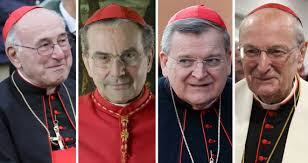


So who is Caffara?


He was the choice of St. John Paul II in 1981 to be the first head of the John Paul II Institute for Studies on Marriage and the Family in Rome. John Paul made him a bishop in 1995 and appointed him archbishop of Bologna at the end of 2003. Pope Benedict made him a cardinal in 2006. He retired in 2015. He will turn 79 on June 1in four days.


Caffara has spoken out on the immorality of contraception, and for this has been criticized by more progressive Catholic theologians. “Even the smallest moral wrong is so much greater than any physical wrong,” he has said. “I know this is hard for some to accept when the dangers are great, but the Church is here to combat moral wrongs.”


(Here, Caffara with Pope Francis)


Caffara in this interview goes into some detail about a correspondence in the early 1980s that he had with Sister Lucy, one of the three children to whom Our Lady of Fatima appeared in 1917. (The other two children, St. Jacinta and St. Francisco, both died very young, and were just canonized two weeks ago in Fatima, Portugal, by Pope Francis. Sister Lucia lived until February 2005, dying just before Pope John Paul II died.)


It is not new information. Some of the things Cardinal Caffara says were said already nine years ago, in 2008. He spoke on February 16, 2008, to the Italian radio station Tele Radio Padre Pio, after celebrating Mass at the shrine of Padre Pio in San Giovanni Rotondo, on the eastern coast of central Italy.


The interview was published in the Voce di Padre Pio bulletin in March of 2008.


And the Rorate Caeli website translated portions of the interview two years ago, in June of 2015, here.


“At the start of this work entrusted to me by the Servant of God (now St.) John Paul II,” Caffara said in 2008, “I wrote to Sister Lucia of Fatima through her Bishop as I couldn’t do so directly. Inexplicably however, since I didn’t expect an answer, seeing that I had only asked for prayers, I received a very long letter with her signature — now in the Institute’s archives. In it we find written: the final battle between the Lord and the reign of Satan will be about marriage and the family. Don’t be afraid, she added, because anyone who works for the sanctity of marriage and the family will always be fought and opposed in every way, because this is the decisive issue.”


Here is the text of Montagna’s May 19, 2017 interview with Caffara…

From Aleteia


(Exclusive) Cardinal Caffarra: “What Sr. Lucia wrote to me is being fulfilled today”
Diane Montagna | May 19, 2017
The Fatima visionary told him: “A time will come when the decisive battle between the kingdom of Christ and Satan will be over marriage and the family.”


VATICAN CITY — Sr. Lucia’s prophetic words that “the decisive battle” between the Lord and Satan would be over marriage and the family “is being fulfilled today,” Cardinal Carlo Caffarra has told Aleteia.


The Italian cardinal was speaking on Friday afternoon, May 19, at the fourth annual ‘Rome Life Forum,’ a gathering which brings together over 100 life and family leaders from over 20 nations to discuss how to defend and strengthen marriage and family life around the world.


Cardinal Caffarra is the Archbishop emeritus of Bologna and the founding president of the Pontifical John Paul II Institute for Studies on Marriage and the Family. He has also served as a Member of the Supreme Tribunal of the Apostolic Signatura, Member of the Presidential Committee of the Pontifical Council for the Family, and Member of the Pontifical Academy for Life.

He was created a cardinal by Pope Benedict XVI in March 2006. Cardinal Caffarra was one of Pope Francis’ 45 handpicked delegates chosen to attend the Ordinary Synod on the Family in 2015.


In this exclusive interview, given prior to his talk, Cardinal Caffarra also describes how Satan is attempting to destroy the two pillars of creation, so as to fashion his own “anti-creation”; and why, in this battle, woman is “the human being who must be defended the most.”
Your Eminence, what can you tell us about the letter you received from Sr. Lucia while you were working to found the Pontifical John Paul II institute for Marriage and Family in Rome?

Cardinal Carlo Caffara: In 1981 Pope John Paul II founded the Institute for Studies on Marriage and the Family. The first years (1983-1984) were very difficult. The Institute was not wanted.


Who didn’t want it?

Caffara: It was not wanted within and outside of the Church, because of the vision it was proposing. And so I was very concerned. Without asking anyone, I thought: “I will write to Sr. Lucia.”


How did that come to mind?

Caffara: Just like that. But as you know, from the beginning the patroness of the institute has been Our Lady of Fatima. It is contained in the Apostolic Constitution. There the pope places the institute under the patronage of the Blessed Virgin of Fatima. So much so — I hope it is still there — that when one enters the institute, at the end of the corridor there is a statue of Our Lady of Fatima, and the chapel of institute is dedicated to Our Lady of Fatima.

And so, I thought to write to her. So I wrote, but simply saying: “The pope wanted this Institute. We are going through a very difficult time. I ask you only to pray.” And I added: “I do not expect a reply.” Her prayers were enough for me.


As you know, in order to have any contact with Sr. Lucia, even by letter, one needed to go through her bishop. So I sent the letter to the bishop, and he passed it on to Sr. Lucia.


To my great surprise, after not more than two or three weeks, I received a reply. It was a hand-written letter and quite long. I have given sworn testimony of what the letter said. The letter ended, saying (in 1983 or 1984): “Father, a time will come when the decisive battle between the kingdom of Christ and Satan will be over marriage and the family. And those who will work for the good of the family will experience persecution and tribulation. But do not be afraid, because Our Lady has already crushed his head.”


This remained engraved on my heart, and amid all of the difficulties we have encountered — and there have been so, so many — these words have always given me a great strength.


When you initially read Sr. Lucia’s words, did you think she was speaking of that moment in history?

Caffara: I began thinking a few years ago, after almost thirty years: “Sr. Lucia’s words are taking place.” This decisive battle will be the thesis of my talk today. Satan is constructing an anti-creation.


An anti-creation?

Caffara: If we read the second chapter of Genesis, we see that the edifice of creation is founded on two pillars.


First, man is not something; he is someone, and therefore he deserves absolute respect. 


The second pillar is the relationship between man and woman, which is sacred. Between the man and the woman. Because creation finds its completion when God creates the woman. So much so, that after he created woman, the Bible says God rested.

{Emphasis added by Abyssum}

Today, what do we observe? Two terrible events. First, the legitimization of abortion. That is, abortion has become a subjective right of woman. Now, ‘subjective right’ is an ethical category and therefore we are here entering into the world of good and evil, and we say that abortion is a good; it is a right.


The second thing we see is the attempt to equate homosexual relationships with marriage. You see that Satan is attempting to threaten and destroy the two pillars so that he can fashion another creation. As if he were provoking the Lord, saying to Him: ‘I will fashion another creation, and man and woman will say: we like better here.’


The Scriptures say the devil is the father of lies, who presents himself as an angel of light…


In my talk, I will explain the words of Jesus, when he says of Satan: “When he lies, he speaks according to his own nature, for he is a liar and the father of lies.” (John 8:44).


And so in my opinion — and I do not know if John Paul II had already seen this — in this sort of situation the human being who must be defended the most is the woman. In fact, early on in his pontificate he wrote Mulieris Dignitatem (August 15, 1988, “On the Dignity of Women”). There he sought to develop a theology of femininity, because he understood that this was a delicate point.


Is woman the battlefield then?

Caffara: There is a detail in the Bible that has always struck me. After the original sin, God addresses the serpent and says: “I will place enmity between you and the woman.” That is, God puts a particular enmity between the woman and evil, as if woman had a kind of instinct for the good, because God has put this enmity between woman and evil. The text continues: ‘and between your seed and her seed,’ and here the theologians see the foretelling of the Son of Mary. Therefore, woman has a particular involvement that has consequences for culture, society, and the family.


We are commemorating the 100th anniversary of the apparitions of Our Lady to the children of Fatima. What is the message today?

Caffara: For me, the originality of Fatima is this: At Fatima, Our Lady prophesied. In other apparitions, she doesn’t prophecy; she exhorts. Like at Lourdes: do penance, pray, tell the priests to build a chapel in this spot. She exhorts and recalls the strong exhortations of Jesus to penance and prayer. But at Fatima she prophesies; that is, she enters into and interprets human events. She had never done this before.


Did Sr. Lucia also prophesy?

Caffara: Yes, she fully entered into [Our Lady’s prophecy] and has left her Memoires. Some are very impressive. She sensed that this was the task Our Lady had given her, that is, to hand on and interpret this prophecy.


And were Sr. Lucia’s words to you about the “decisive battle” also a prophecy?

Caffara: Yes, absolutely. What Sr. Lucia wrote to me is being fulfilled today.


==============


And here is the text of the address Cardinal Caffarra gave at the Rome Life Forum on May 19.


CARDINAL CAFFARRA: “WE ARE NO LONGER WITNESSES, BUT DESERTERS, IF WE DO NOT SPEAK OPENLY AND PUBLICLY”
May 19, 2017
This address was given by His Eminence Carlo Cardinal Caffarra on May 19, 2017 at the fourth annual Rome Life Forum, which is organized by Voice of the Family.


By Carlo Cardinal Caffara


“When I am lifted up from the earth, I will draw all people to myself” [John 12, 32]. “The whole world is under the power of the Evil One” [1 John, 5, 19].


Reading these divine words gives us perfect awareness of what is really happening in the world, within the human story, considered in its depths.


The human story is a confrontation between two forces: the force of attraction, whose source is in the wounded Heart of the Crucified-Risen One, and the power of Satan, who does not want to be ousted from his kingdom.


The area in which the confrontation takes place is the human heart, it is human liberty.


And the confrontation has two dimensions: an interior dimension and an exterior dimension. We will briefly consider the one and the other.


At the trial before Pilate, the Governor asks Jesus whether he is a king; whether – which is the meaning of Pilate’s question – he has true and sovereign political power over a given territory.


Jesus responds: “You say that I am a king. For this I was born, and for this I came into the world, to testify to the truth. Everyone who belongs to the truth listens to my voice” [John 18, 37].


“Jesus wants us to understand that his kingship is not that of the kings of this world, but consists of the obedience of his subjects to his word, to his truth. Although He reigns over his subjects, it is not through force or power, but through the truth of which he is witness, which ‘all who are from the truth’ receive with faith.” [Ignace De La Potterie].


Thomas Aquinas puts the following words into the mouth of the Saviour: “As I myself manifest truth, so I am preparing a kingdom for myself.”


Jesus on the Cross attracts everyone to Himself, because it is on the Cross that the Truth of which he is witness is resplendent.
Yet this force of attraction can only take effect on those who “are from the truth.” 


That is, on those who are profoundly available to the Truth, who love truth, who live in familiarity with it. 


Pascal writes: “You would not seek me if you had not already found me.”


He who holds the entire world under his sway, instead dominates through lies.


Jesus says of Satan: “He was a murderer from the beginning and does not stand in the truth, because there is no truth in him. When he lies, he speaks according to his own nature, for he is a liar and the father of lies.” [John 8, 44].


The wording is dramatic.


The first proposition – “He was a murderer from the beginning” – is explained by the second: “and he does not stand in the truth.”


The murder which the devil performs consists in his not standing in the truth, not dwelling in the truth. It is murder, because he is seeking to extinguish, to kill in the heart of man truth, the desire for truth. By inducing man to unbelief, he wants man to close himself to the light of the Divine Revelation, which is the Word incarnate. 


Therefore, these words of Jesus on Satan —  as today the majority of exegetes believe — do not speak of the fall of the angels. They speak of something far more profound, something frightful: Satan constantly refuses the truth, and his action within human society consists in opposition to the truth. Satan is this refusal; he is this opposition.


The text continues: “because there is no truth in him.” The words of Jesus go to the deepest root of Satan’s work. He is in himself a lie. From his person truth is completely absent, and hence he is by definition the one who opposes truth. Jesus adds immediately afterwards: “When he lies, he speaks according to his own nature, for he is a liar and the father of lies.”


When the Lord says “speaks according to his own nature,” he introduces us to the interiority of Satan, to his heart. A heart which lives in darkness, in shadows: a house without doors and without windows.


To summarize, this therefore is what is happening in the heart of man: Jesus, the Revelation of the Father, exerts a strong attraction to Himself. Satan works against this, to neutralize the attractive force of the Crucified-Risen One. The force of truth which makes us free acts on the heart of man. It is the Satanic force of the lie which makes slaves of us.


Yet, not being pure spirit, the human person is not solely interiority. Human interiority is expressed and manifested in construction of the society in which he or she lives. Human interiority is expressed and manifested in culture, as an essential dimension of human life as such. Culture is the mode of living which is specifically human.


Given that man is positioned between two opposing forces, the condition in which he finds himself must necessarily give rise to two cultures: the culture of the truth and the culture of the lie.


There is a book in Holy Scripture, the last, the Apocalypse, which describes the final confrontation between the two kingdoms. In this book, the attraction of Christ takes the form of triumph over enemy powers commanded by Satan. It is a triumph which comes after lengthy combat.


The first fruits of the victory are the martyrs. “The great Dragon, serpent of the primal age, he whom we call the devil, or Satan, seducer of the whole world, was flung down to earth… But they [= the martyrs] overcame him by the blood of the Lamb and by the word of the testimony of their martyrdom” [cfr. Ap. 12, 9.11].

{Glory and thanks be to God for the witness of the Christian Martyrs (Copts in Egypt  and Syria) who are giving this testimony through their martyrdom!!!       – Abyssum}

In this second section, I would like to respond to the following question: in our Western culture, are there developments which reveal with particular clarity the confrontation between the attraction exerted over man by the Crucified-Risen One, and the culture of the lie constructed by Satan? 


My response is affirmative, and there are two developments in particular.
The first development is the transformation of a crime [termed by Vatican Council II nefandum crimen], abortion, into a right. 


Note well. I am not speaking of abortion as an act perpetrated by one person. I am speaking of the broader legitimation which can be perpetrated by a judicial system in a single act: to subsume it into the category of the subjective right, which is an ethical category. This signifies calling what is good, evil, what is light, shadow. “When he lies, he speaks according to his own nature, for he is a liar and the father of lies.” This is an attempt to produce an “anti-Revelation.”
What in fact is the logic which presides over the ennoblement of abortion?


Firstly, it is the profoundest negation of the truth of man. As soon as Noah left the floodwaters, God said: “Whoever sheds the blood of a man, by a man shall that person’s blood be shed, for in his own image God made man” [Gen. 9, 6]. The reason why man should not shed the blood of man is that man is the image of God. Through man, God dwells in His creation. This creation is the temple of the Lord, because man inhabits it. To violate the intangibility of the human person is a sacrilegious act against the Sanctity of God. It is the Satanic attempt to generate an “anti-creation.”


By ennobling the killing of humans, Satan has laid the foundations for his “creation”: to remove from creation the image of God, to obscure his presence therein.


St Ambrose writes: “The creation of the world was completed with formation of the masterpiece which is man, which… is in fact the culmination of creation, the supreme beauty of every created being” [Exam., Sixth day, Disc 9, 10.75; BA I, page 417].


At the moment at which the right of man to order the life and the death of another man is affirmed, God is expelled from his creation, because his original presence is denied, and his original dwelling-place within creation – the human person – is desecrated.


The second development is the ennoblement of homosexuality. This in fact denies entirely the truth of marriage, the mind of God the Creator with regard to marriage.
The Divine Revelation has told us how God thinks of marriage: the lawful union of a man and woman, the source of life. In the mind of God, marriage has a permanent structure, based on the duality of the human mode of being: femininity and masculinity. Not two opposite poles, but the one with and for the other. Only thus does man escape his original solitude.


One of the fundamental laws through which God governs the universe is that He does not act alone. This is the law of human cooperation with the divine governance. The union between a man and woman, who become one flesh, is human cooperation in the creative act of God: every human person is created by God and begotten by its parents. God celebrates the liturgy of his creative act in the holy temple of conjugal love.


In summary. There are two pillars of creation: the human person in its irreducibility to the material universe, and the conjugal union between a man and woman, the place in which God creates new human persons “in His image and likeness.”


The axiological elevation of abortion to a subjective right is the demolition of the first pillar. The ennoblement of a homosexual relationship, when equated to marriage, is the destruction of the second pillar.


At the root of this is the work of Satan, who wants to build an actual anti-creation. This is the ultimate and terrible challenge which Satan is hurling at God. “I am demonstrating to you that I am capable of constructing an alternative to your creation. And man will say: it is better in the alternative creation than in your creation.”


This is the frightful strategy of the lie, constructed around a profound contempt for man. Man is not capable of elevating himself to the splendor of the Truth. He is not capable of living within the paradox of an infinite desire for happiness. He is not able to find himself in the sincere gift of himself.


And therefore — continues the Satanic discourse — we tell him banalities about man. We convince him that the Truth does not exist and that his search is therefore a sad and futile passion. We persuade him to shorten the measure of his desire in line with the measure of the transient moment. We place in his heart the suspicion that love is merely a mask of pleasure.


The Grand Inquisitor of Dostoevsky speaks thus to Jesus: “You judge of men too highly, for though rebels they be, they are born slaves… I swear to you that man is weaker and lower than You have ever imagined him to be! Man is weak and cowardly.”


How should we dwell in this situation? In the third and final section of my reflection, I will seek to answer this question.
The reply is simple: within the confrontation between creation and anti-creation, we are called upon to testify. This testimony is our mode of being in the world.


The New Testament has an abundantly rich doctrine on this matter. I must confine myself to an indication of the three fundamental meanings which constitute testimony.


(i) Testimony means to say, to speak, to announce openly and publicly. Someone who does not testify in this way is like a soldier who flees at the decisive moment in a battle. We are no longer witnesses, but deserters, if we do not speak openly and publicly. The March for Life is therefore a great testimony.


(ii) Testimony means to say, to announce openly and publicly the divine Revelation, which involves the original evidence, discoverable only by reason, rightfully used. And to speak in particular of the Gospel of Life and Marriage.


(iii) Testimony means to say, to announce openly and publicly the Gospel of Life and Marriage as if in a trial [cfr. John 16, 8-11]. 


I will explain myself. I have spoken frequently of a confrontation. This confrontation is increasingly assuming the appearance of a trial, of a legal proceeding, in which the defendant is Jesus and his Gospel. As in every legal proceeding, there are also witnesses in favor: in favor of Jesus and his Gospel.


Announcement of the Gospel of Marriage and of Life today takes place in a context of hostility, of challenge, of unbelief.


The alternative is one of two options: either one remains silent on the Gospel, or one says something else.


Obviously, what I have said should not be interpreted as meaning that Christians should render themselves… antipathetic to everyone.


St Thomas writes: “It is the same thing, when faced with two contraries, to pursue the one and reject the other. Medicine, for example, proposes the cure while excluding the illness. Hence, it belongs to the wise man to meditate on the truth, in particular with regard to the First Principle… and to refute the opposing falsehood.” [CG Book I, Chapter I, no. 6].


In the context of testimony to the Gospel, irenics and concordism must be excluded.


On this Jesus has been explicit. It would be a terrible doctor who adopted an irenical attitude towards the disease.


Augustine writes: “Love the sinner, but persecute the sin.” Note this well. The Latin word per-sequor is an intensifying verb. The meaning therefore is: “Hunt down the sin. Track it down in the hidden places of its lies, and condemn it, bringing to light its insubstantiality.”


I conclude with a quotation from a great confessor of the faith, the Russian Pavel A. Florenskij. “Christ is witness, in the extreme sense of the word, the witness. At His crucifixion, the Jews and Romans believed they were only witnessing a historical event, but the event revealed itself as the Truth.” [The philosophy of religion, San Paolo ed., Milan 2017, page 512].


“When I am lifted up from the earth, I will draw all people to myself.” [John 12, 32].


===================


Posted in Uncategorized | Comments Off on CARDINAL CAFFARA DISCUSSES SISTER LUCIA’S CORRESPONDENCE ABOUT THE FINAL BATTLE