ALL PRIESTS AND BISHOPS ARE TO BE REQUIRED TO WEAR THE NEW HIGH-TECH COLLARS

Monday, 12 June 2017

Pope Francis approves electronic tagging for clergy

As reported by Rorate Caeli, the Vatican is taking steps to keep its cardinals under control; if one of them is absent from Rome he is asked to let the Secretariat know where he is.

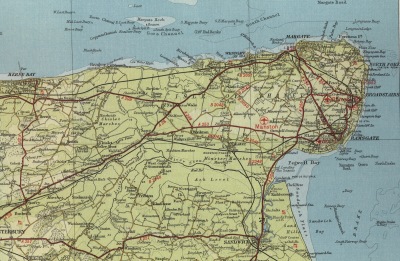
map of Kent
Sensors indicate that Cardinal Burke is hiding somewhere round here.
In phase 2, it is planned to extend this to all clergy, with the introduction of electronic tagging using the TAGLETM: this is a white collar worn round the neck, and if you see any priests so dressed, you can be sure that they are already under surveillance.
The Vatican’s main computer AMORIS (Analytical Machine for Organizing Radically Innovative Services) will process the data transmitted by priests and bishops worldwide, and flag up any signs of “rigid” practice. For example, the tag will be able to detect whether the priest is facing east for an extended period of time, and warn the Pope that an Extraordinary Form Mass may be taking place. In addition, a smoke detector fitted to the tag will record the excessive use of incense.
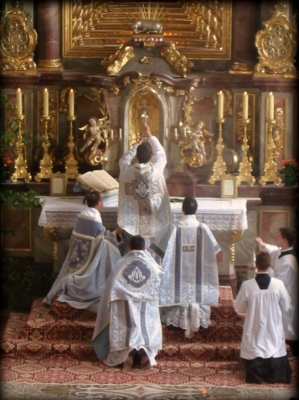
EF Mass
A rigid priest. No chance of promotion if this gets out!
Priests who wish their masses to find favour with the Pope are recommended to move around a lot, perhaps in some form of liturgical dance, as the tag will detect this and transmit a signal saying “It’s OK, this priest is one of us”. Also the tag will detect (and approve) the use of hymns with particularly banal rhythms and harmony, especially those containing clapping and words such as “Ch-ch”. On the other hand, sounds of Gregorian chant will set off a persistent high-pitched whistling from the tag. You have been warned, Father.
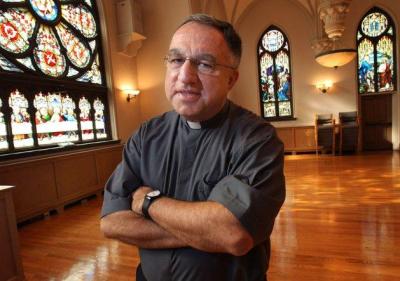
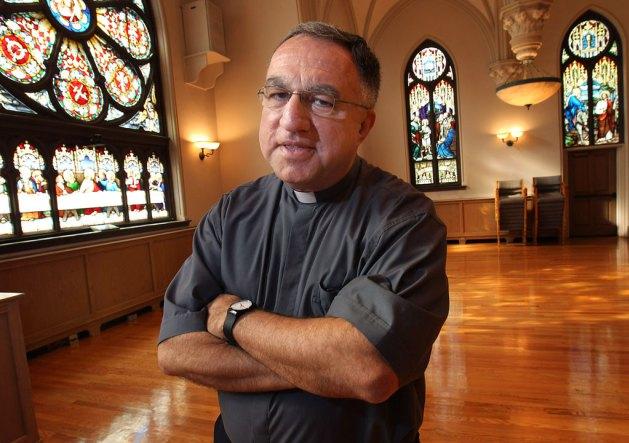
Fr Rosica
“Nothing can block the signal!” A model shows off the Rosica version.
HAT TIP:  Father Paul W.
Posted in Uncategorized | 5 Comments

10,000 FEWER CHURCHES IN ENGLAND – OF COURSE IT CANNOT HAPPEN HERE

Why the Odds Favor Islam

Crisis Magazine

On May 22, an Islamic suicide bomber detonated himself outside a pop concert in Manchester, England, killing and wounding dozens, many of them young children.

The terrorist was a 22-year-old named Salman Abedi. A few days after the attack, I was reading an article about the mosque he attended—the Didsbury Mosque. “That’s funny,” I thought looking at the accompanying photo, “that doesn’t look like a mosque, it looks like a church.”

Sure enough, as I discovered, the Didsbury Mosque was once the Albert Park Methodist Chapel. It had been bought by the local Syrian Muslim community and transformed into a Muslim place of worship.

Similar transformations have been taking place in other parts of the UK. St. Mark’s Church in London is now the New Peckham Mosque, St. Peter’s Church in Cobridge was sold to the Madina Mosque. The Brick Lane Mosque in London was originally a Methodist church. But church-to-mosque conversions are only part of a larger story. There are now 423 mosques in London, and the number is expected to grow. Meanwhile, 500 London churches have closed since 2001, and in all of England 10,000 churches have closed since 1960.

The transformation of the Albert Park Methodist Church to the Didsbury Mosque is emblematic of one of the most significant shifts in history: the transformation of Europe from a largely Christian continent to a largely Islamic one. The transformation is far from complete, and there’s an outside chance the process can be reversed, but time and demographics favor Islam.

In several of Europe’s cities, the Muslim population now hovers around the thirty percent mark. In ten years’ time, that will be forty percent. Of course that doesn’t mean 40 percent of highly committed Muslims facing 60 percent of deeply devout Christians. Both faiths have their share of half-hearted “nominals” for whom religion is more a cultural inheritance than a deeply held conviction. Still, the “nominal” problem is a much greater problem for European Christians than for European Muslims. In many European countries, Sunday church attendance is the 5-10 percent range whereas mosque attendance is very high in relation to the size of the Muslim population. In England, there are already more Muslims attending Friday prayers than there are Christians attending Anglican services on Sundays. A study by Christian Researchpredicts that by 2020 the number of Muslims attending prayer service in England and Wales will exceed the number of Catholics attending weekly Mass.

It’s also noteworthy that the expanding Muslim population in Europe is relatively young, whereas the declining “Christian” population is an aging one. Sixty-forty seems like good odds until you realize that the average age of the 60 percenters will be around 55 while the average age of the 40 percenters will be around 25.

You may object that if there is any fighting to be done, most of the fighting on the “Christian” side will be done by the army, not by citizens in walkers and wheelchairs. But keep in mind that the military draws its recruits from the ranks of the young. As the population of the people that Islamists refer to as “crusaders” ages, European governments will be forced to draw more of their new recruits from the Muslim population. The same goes for the police forces. Many Muslims will serve their country or their city faithfully, but many will have divided loyalties, and some will have signed up in the first place with mutiny in mind.

Most likely, however, the transformation will be effected without major battles. It won’t be a matter of numbers or of military strength, but of strength of belief. Those with the strongest beliefs will prevail. Those who are not sure what to believe will submit without a fight.

Will Europe Defend its “Values”?
That’s the theme of Michel Houellebecq’s Submission, a novel about the gradual Islamization of France. The protagonist, a middle-aged professor, has a number of qualms about the Islamic takeover of the university system, but nothing sufficient to resist it. The things he values most—literature, good food, and sex—are, in the end, no impediment to accepting Islam. True, he is offered several inducements to convert—career advancement, plenty of money, and several “wives”—but one gets the impression that, even without these incentives, he would still eventually convert. At one point prior to his submission, he thinks about joining a monastic order as his literary hero, J.K. Huysmans, had done, but he soon realizes that he lacks the necessary Christian conviction. Indeed, he has no strong convictions.

His plight is the plight of contemporary Europe in a nutshell. Many Europeans see no sense in resisting Islamization because they have nothing worth defending. To be sure, European leaders still talk about “our values,” but they can’t seem to specify what those values are, beyond appeals to “diversity” and “pluralism.” For example, after the Manchester massacre, British Prime Minister Theresa May stated that “our values—the liberal, pluralistic values of Britain—will always prevail over the hateful ideology of the terrorists.”

I’m not so sure of that. In an earlier era, Brits would have connected their values to God, country, family, and honor. In other words, things worth fighting for. But “liberal, pluralistic values”? That’s not very solid ground on which to take your stand. Who wants to die for diversity? Indeed, it can be argued that the worship of diversity for its own sake is what allowed terrorists to get a foothold in England in the first place. No one wanted to question all those diverse preachers spreading their diverse message about Jews, infidels, and homosexuals. The trouble is, unless there are higher values than diversity, there’s no way of judging between good diversities and bad diversities—between, say, honoring your wife and honor-killing her if she displeases you.

The same is true of freedom. Freedom is a fundamental right, but what you do with your freedom is also important. There has to be some higher objective value that directs our choices to good ends rather than bad ones. Otherwise, freedom becomes a license to do anything one pleases.

An Attack on Childhood
Here we touch on a very touchy subject. I would not like to be in Theresa May’s shoes when, after a horrifying attack, she has to come up with just the right words. But one thing she said struck me as not quite right. She said: “We struggle to comprehend the warped and twisted mind that sees a room packed with young children not as a scene to cherish, but as an opportunity for carnage.”

It’s possible to fully agree with May’s sentiments while, at the same time, noting that there once was a time when a room full of children watching an Ariana Grande concert would not be considered “a scene to cherish.” “Her dress, dancing, and song lyrics,” wrote one columnist, “are deliberately decadent and immodest.” And, after watching some YouTube clips of her performances, I would have to agree. I’m pretty sure that most of the parents I know would not want their children to attend one of her concerts.

While the world was justly outraged at Salman Abedi’s attack on innocent children, no one seems to notice the attack on childhood innocence that the typical pop concert represents. The two “attacks” should not be equated, of course. The producers of pop concerts are not the moral equivalents of a suicide bomber. Still, the fact that so many parents saw nothing wrong with dropping their children off at the Manchester concert suggests a great deal of moral confusion in the West.

Unfortunately, such moral confusion leaves people vulnerable to those who are absolutely certain about their beliefs. The moral relativism of the West is one of the chief reasons why the Islamic cultural jihad has been so successful. People who can’t see that the soft-porn style of Lady Gaga, Miley Cyrus, and Ariana Grande is not good for children will have difficulty seeing the problem with polygamy, child marriage, and other aspects of sharia law. In a relativistic society, the safest default position is “who’s to judge?”

Relativism Leads to Islamic Dominance
Earlier I said that Europe is being transformed from a Christian culture to an Islamic culture, but that’s not quite accurate because it’s actually a three-stage transformation. Much of Europe has already transitioned out of its Christian stage and into a post-Christian or secular stage. There are still many Christians in Europe, but Europe’s Christian consciousness has been largely lost. The next stage is the transition from secularism to Islam. That’s not inevitable, but it’s likely because without a framework of Judeo-Christian beliefs, secularism becomes relativism and relativism can’t offer much resistance to determined true believers.

Back in 2014, Theresa May said “we celebrate different ways of life, we value diversity, and we cherish our freedom to lead our lives as we choose.” But if your culture stands for nothing more than the freedom to shop for different lifestyles, it won’t last long. The contemporary Western fascination with pop culture highlights the problem. Pop culture is by its very nature a transient phenomenon. What is pop today won’t be pop tomorrow. Indeed, the popular culture of tomorrow may very well favor burqas, multiple wives, and male supremacy. There may still be a place for singer-dancers like Ariana Grande and Miley Cyrus, but that place would most likely be as a harem dancer in a Sultan’s palace or as entertainment for a Saudi prince who has bought up a country estate in Oxfordshire.

It’s hard to beat transcendent values with transient values. That’s especially the case when the transcendent crowd are willing to die (and kill you in the process) for their values. Most Brits, on the other hand, are not willing to lay down their lives for the sake of keeping bacon on the menu or porn on the telly.

Christianity vs. Two Forms of Totalitarianism
When I use the word “transcendent,” I refer only to a belief in an eternal life beyond this worldly existence. Quite obviously, as in the case of Salman Abedi, transcendent values can be twisted. The idea that God will reward you for murdering innocent young women in Manchester by furnishing you with virginal young women in paradise is a truly twisted concept. But apparently it is widely shared in the Muslim world. When, during a World Cup qualifier in Australia, a minute of silence was called to commemorate the London terror victims, the whole Saudi soccer team refused to observe it. As Sheik Mohammad Tawhidi later explained:

In their eyes the attackers are martyrs who are going to paradise. And if they stand for a minute of silence they are against their Muslim brothers who fought for jihad and fought the infidels.

As twisted as these values may be, it’s beginning to look as though secular values aren’t up to the job of opposing them. The trouble with secular values when they are cut off from their Judeo-Christian roots is that they are arbitrary. Autonomy? Dignity? Equality? Says who?

“If there is no God,” wrote Dostoevsky, “everything is permitted.” Secularism has no God and, therefore, no ultimate standard of judgment. The end result is that each man becomes his own god and does his own thing—even if that “thing” involves the exploitation of childhood innocence. Islam, on the other hand, does believe in God, but not the God Dostoevsky had in mind. The God of Islam is an arbitrary despot whose commands are not rooted in reason, love, or justice.

So we have two arbitrary systems vying for control of the West—the soft totalitarianism of secularism and the hard totalitarianism of Islam. Both are really forms of slavery. Muslims are slaves of a tyrannical God, and secular man becomes the slave of his own desires and addictions. It may seem unthinkable that the West will ever submit to Islam, but many Western citizens are already in submission mode. Submission to their desires has put them in a bad spot. As a result, they are looking for something bigger to submit to—something outside and above their own fragile selves. Some have already turned to Islam. Many more will unless…

Unless, that is, there is a recovery of the Judeo-Christian belief that God is a God of love, justice, reason, and goodness—and that we are made in his image (a concept which does not exist in Islam). In the context of that vision, belief in human dignity and the rights of man is thoroughly justified.

People who believe that they and their neighbor are made in the image of God will generally have a strong sense of their responsibility to act accordingly. Such people will be far from perfect, but they will at least realize that it is wrong to submit both to Islam’s warped image of God and to secularism’s degraded image of man.

In the end, the choice for the West is not between Islam and pluralistic secularism. A rootless secularism will almost certainly submit to Islam. The only real hope for the West is the recovery of the faith that once inspired Christians to build a beautiful church near Albert Park in West Didsbury, England.

(Photo credit: Associated Press)

William Kilpatrick

By 

William Kilpatrick taught for many years at Boston College. He is the author of several books about cultural and religious issues, including Why Johnny Can’t Tell Right From Wrong; and Christianity, Islam and Atheism: The Struggle for the Soul of the West and The Politically Incorrect Guide to Jihad. His articles have appeared in numerous publications, including Catholic World Report, National Catholic Register, Aleteia, Saint Austin Review, Investor’s Business Daily,and First Things. His work is supported in part by the Shillman Foundation. For more on his work and writings, visit his website, turningpointproject.com

Posted in Uncategorized | 2 Comments

“DO NOT BE AFRAID!” IN THESE TROUBLED TIMES BELIEFS MAY BE SHAKEN WHILE FAITH REMAINS FIRM


Santa Trinità by Masaccio, 1425 [Santa Maria Novella, Florence]


Faith, Belief, and the Trinity

Oblate Father Ronald Rolheiser is among the most respected and prolific writers on Christian spirituality. Though I have never met him, I have profited from his keen insights and captivating stories. In particular, I am indebted to two of his books: The Holy Longing (which I used with undergraduates) and Sacred Fire: A Vision for a Deeper Human and Christian Maturity.

However, a recent article of his, “When Does Faith Disappear?,” left me uneasy. It appears to reflect a trend in theology and spirituality (the two, of course, are inseparable) that is well meaning, but ultimately misleading.

It begins with alarming statistics. Not only has there been a precipitous decline in recent decades in the number of people who go to church regularly. There has been “an equally unprecedented spike in the number of people who claim to have lost their faith completely.” The latter add to the swelling ranks of so-called “Nones,” people without any religious affiliation. In the United States and Canada, “Nones” now comprise over 30 percent of the population!

But have many of them really lost their faith? Rolheiser offers a distinction that has become widespread in contemporary Catholic theology: he distinguishes “faith” and “beliefs.” He asks provocatively: “is ceasing to believe in something the same thing as losing one’s faith?” And responds, equally provocatively, “not necessarily.”

To unpack this assertion, Rolheiser turns to what is traditionally called the “apophatic” dimension of Christian theology and spirituality. He rightly declares: “God is beyond all conceptualization, beyond all imaginings, beyond being pictured and beyond being captured in any adequate way by language.”

In many ways, this recovery of the “apophatic” recalls what the Fathers of the Church and Thomas Aquinas affirmed. Recall Saint Augustine’s si comprehendis, non est Deus – “if you [presume to] grasp, it is not God.” A salutary rebuke to a too rationalistic appeal to propositions, as though they adequately circumscribed the content of faith. Karl Rahner’s insistence on the “mystagogic” nature of dogmatic statements was, therefore, a welcome counter to neo-scholastic overreaching (whatever else may be said of his work).

But I suggest the pendulum has now swung far in the opposite direction. We risk an equally unsatisfactory spurning of propositions. The danger is what I term “an empty apophaticism.” “Faith” with no distinctive and discernible content. This, unfortunately, abets the “I’m spiritual, but not religious” posture. Propositions can never fully articulate the Mystery, but they can point us in the direction where true Mystery lies and provide insight into its character.

Saint Paul insists that “eye has not seen, nor ear heard, nor the human heart conceived, what God has prepared for those who love him.” (1 Cor 2:9). That’s “apophatic.” But he immediately adds “these things God has revealed to us through the Spirit.” (1Cor 2:10)

Revelation is the rub! Christian faith is the loving response to God’s love revealed in Jesus Christ. Revelation perforce comes to expression in propositions, articles of belief: “that Christ died for our sins in accordance with the scriptures, that he was buried, that he was raised on the third day in accordance with the scriptures, that he appeared to Cephas, then to the twelve.” (1 Cor 15:3-5)

Statements of belief articulate the “cataphatic” dimension of revelation, its positive content. Without this dimension, Christian faith is empty and void. As Louis Dupré writes: “If we can assert nothing about God, then we can say nothing to God – and that marks the end of religion.”

I agree with Father Rolheiser that “many articles within our Christian creed. . .are images and words that point us towards something we cannot imagine because it is beyond imagination.” They are “mystagogic.” But pastors are called to be “mystagogues:” to probe wisely and reverently the Mystery of the faith. They are commissioned, according to their ability, to rekindle the religious imagination, to embrace the via pulchritudinis – the way of beauty – extolled by Pope Francis in Evangelii Gaudium. They ponder, with their people, the great truths of the faith, calling upon poets and artists for assistance.

An example: Rolheiser asks, “How can God, who is one, be three? This isn’t mathematics, it’s mystery, something that cannot be imaginatively circumscribed.” Yes, certainly. But ought it not be imaginatively evoked? As John Donne put it:

Batter my heart, three-person’d God, for you
As yet but knock, breathe, shine, and seek to mend;
That I might rise and stand, o’erthrow me, and bend
Your force to break blow, burn, and make me new.

We might then suggest, conceptually now, but still imaginatively, that the “three-personed God” bespeaks the fullness of personhood, the fullness of life-giving relations. That we, made in the image of this God, are not yet fully what God intends us to be. That we are called to grow, through grace, more and more into God’s likeness, to become sharers in the very life of the three-personed God.

The completed created likeness of the Trinity is the communion of saints: relationships redeemed and transfigured.

Dante is the supreme poet of the Catholic Tradition, the paladin of the Catholic imagination. The terza rima of the Divine Comedy attunes our every movement to the rhythm of Trinitarian life. And the deifying vision to which he and we are destined is the vision of the Triune God.

But such vision is never individualistic; it is fully personal and transpires only in communion. As Dante, draws close to his journey’s culmination, he sees more and more clearly that relationships, founded and transformed in Love, truly mirror the blessed Trinity. Not celestial mathematics; but wondrous mystery.

Because Christian faith is, of its essence, Trinitarian, there can be no dichotomy between faith and belief. Christian faith is not formless; its “logic” is Trinitarian. Indeed, the primacy of the cataphatic dimension in Christian theology and spirituality is on full display each time we begin our prayer by signing ourselves: “In the Name of the Father and of the Son and of the Holy Spirit.”

Fr. Robert P. Imbelli

Fr. Robert P. Imbelli

Robert Imbelli, a Priest of the Archdiocese of New York, is Associate Professor of Theology Emeritus at Boston College. He is the author of Rekindling the Christic Imagination: Theological Meditations for the New Evangelization.

Posted in Uncategorized | Comments Off on “DO NOT BE AFRAID!” IN THESE TROUBLED TIMES BELIEFS MAY BE SHAKEN WHILE FAITH REMAINS FIRM

HOW WILL THE FAITHFUL OF CORPUS CHRISTI CELEBRATE THE FEAST OF CORPUS CHRISTI?


Juliana of Liege, the 13th-Century Religious Woman Who Brought Us Corpus Christi

 ALETEIA

How she helped the Church focus on unity in the Body and Blood of Christ

This weekend Catholics in the United States and many other regions around the world celebrate the Solemnity of the Most Holy Body and Blood of Christ, the feast more familiarly known by its Latin name, Corpus Christi. Rome, and some regions that still follow the traditional calendar, celebrated on Thursday. The Feast of Corpus Christi is itself a transfer that hopped around a lot before settling into the Church’s universal calendar, so the timing of the feast is not something to argue about.

We owe this feast — and, by extension, Thomas Aquinas’s stunningly beautiful Office celebrating it — to a 13th-century Belgian nun named Juliana. Orphaned at the age of 5, she and her sister were housed on a small farm belonging to a double monastery of Norbertines (the French Augustinian canons known as Premonstratensians).

Public Domain

Juliana, who had a lifelong devotion to the Blessed Sacrament, entered religious life at the age of 13, serving in a hospice for lepers run by her community. From the age of 16 on she had a series of visions of the full moon obscured by a dark spot. At first fearing that her visions were of demonic origin, Juliana came to discern that instead the moon represented the Church’s liturgical year, and the dark spot a missing feast in honor of Christ present in the Sacrament. While Holy Thursday commemorates the institution of the Eucharist, the joyful mystery of the transubstantiation was, Juliana believed, overshadowed by the solemn events of Holy Week. Juliana thought her visions were telling her to promote such a feast, to be celebrated on the Thursday after Trinity Sunday.

There being no blogosphere or Twitter, of course, she had no real means by which to do the promoting, so at first Juliana shared her ideas only with a few sympathetic sisters and a holy anchoress named Eve who lived nearby. Eventually, after having been named prioress of the monastery, she told her confessor, who told his superior, who told a bishop, who told a cardinal, and so on up the line to the Holy Father. Everybody agreed it would be no problem to celebrate such a feast, at least on the local level. So Juliana and her confessor composed the first Office for the feast.

But it wasn’t smooth sailing for Juliana. She lived in a time of political and religious turmoil. The same Church-and-State, Guelph-and-Ghibelline squabbles that were giving Dante fits also reached Juliana’s convent. She had instituted reforms to bring the monastery back to its strict Augustinian rule, but the male cleric appointed to oversee her — a corrupt politician who had obtained his position by bribery — made her life so miserable with constant harassment and trumped-up charges of financial mismanagement that Juliana twice fled her convent. The first time she found shelter in her friend Eve’s anchorhold. Later, she found a home among the Cistercians, with whom she lived until her death.

It was the anchoress Eve who continued to push for a universal celebration of the Feast of Corpus Christi, and Pope Urban IV finally relented, commissioning his friend Thomas Aquinas to write the Office we know so well.

Tantum ergo Sacramentum
Veneremur cernui:
Et antiquum documentum
Novo cedat ritui:
Praestet fides supplementum
Sensuum defectui.

Approved first only for clergy, the Feast of Corpus Christi was later extended to the universal Church. Juliana was canonized in 1869, largely on the basis of the virtues recounted in the biography composed by her friend, the anchoress Eve. With all Juliana’s and her feast’s perambulations, it’s only fitting that the Eucharistic processions that once marked the celebration of Corpus Christi are coming back into fashion.

There’s much worth reflecting on in the story of Juliana at this moment in the Church, when Guelphs and Ghibellines are again fighting the battles of Church v. State, and Catholics on many fronts are in tension about where the line can be drawn between charism and heresy. It is Juliana’s vision of the moon, though, that carries the message about what was most important then and is most important now: the presence of Christ in the Eucharist binds us together, without which there is a dark spot, a shadow, on our unity.

Restoring the Eucharist to its central position in our lives is quite simply the only hope we have of getting through this particular dark night. I like to think that Juliana, like St Francis of Assisi, saw the Body of Christ—Corpus Christi—in the twisted and disfigured bodies of the lepers she served, letting faith supply where the senses fall short. If we can look beyond the accidents that divide and distort us and see the Most Holy Body and Blood of Christ present in the Church and in one another, with God’s grace our light will shine brighter than any super moon.

For a beautiful Corpus Christi soundtrack, immerse yourself in Adoration at Ephesus, the latest release from the Benedictines of Mary, Queen of Apostles, which features several settings of material from Thomas’s Office, along with other Eucharistic hymns ancient and not-so-ancient.

Posted in Uncategorized | 2 Comments

YOU ARE THE CHURCH

h5_1975


{Revised on Friday, June 9, 2017}


“The glory of God is man fully alive, and the life of man is the vision of God. If the revelation of God through creation already brings life to all living beings on the earth, how much more will the manifestation of the Father by the Word bring life to those who see God”.

Saint Irenaeus, ADVERSUS HAERESIS, IV, 20, 7


“A new commandment I give to you, that you love one another, even as I have loved you, that you also love one another. “By this all men will know that you are My disciples, if you have love for one another.”  John: 13:34-35


Jesus said to him (Thomas), “I am the way, and the truth, and the life; no one comes to the Father but through Me.” John 14:6


“If you love Me, you will keep My commandments.” John 14:15

Here are some of the commands of Christ:


  • Repent
    “From that time Jesus began to preach, and to say, Repent: for the kingdom of heaven is at hand” (Matthew 4:17).
  • Let Your Light Shine
    “Let your light so shine before men, that they may see your good works, and glorify your Father which is in heaven” (Matthew 5:16).
  • Honor God’s Law
    “Think not that I am come to destroy the law, or the prophets: I am not come to destroy, but to fulfill” (Matthew 5:17).
  • Be Reconciled
    “Therefore if thou bring thy gift to the altar, and there rememberest that thy brother hath aught against thee; leave there thy gift before the altar, and go thy way; first be reconciled to thy brother, and then come and offer thy gift”(Matthew 5:23–25).
  • Do Not Lust
    “But I say unto you, That whosoever looketh on a woman to lust after her hath committed adultery with her already in his heart. And if thy right eye offend thee, pluck it out, and cast it from thee: for it is profitable for thee that one of thy members should perish, and not that thy whole body should be cast into hell. And if thy right hand offend thee, cut it off, and cast it from thee: for it is profitable for thee that one of thy members should perish, and not that thy whole body should be cast into hell” (Matthew 5:28–30).
  • Keep Your Word
    “Let your communication be, Yea, yea; Nay, nay: for whatsoever is more than these cometh of evil” (Matthew 5:37).
  • Go the Second Mile
    “Ye have heard that it hath been said, An eye for an eye, and a tooth for a tooth: but I say unto you, That ye resist not evil: but whosoever shall smite thee on thy right cheek, turn to him the other also. And if any man will sue thee at the law, and take away thy coat, let him have thy cloak also. And whosoever shall compel thee to go a mile, go with him twain. Give to him that asketh thee, and from him that would borrow of thee turn not thou away”(Matthew 5:38–42).
  • Love Your Enemies
    “But I say unto you, Love your enemies, bless them that curse you, do good to them that hate you, and pray for them which despitefully use you, and persecute you; that ye may be the children of your Father which is in heaven: for he maketh his sun to rise on the evil and on the good, and sendeth rain on the just and on the unjust. For if ye love them which love you, what reward have ye? Do not even the publicans the same?” (Matthew 5:44–46).
  • Do Not Cast Pearls
    “Give not that which is holy unto the dogs, neither cast ye your pearls before swine, lest they trample them under their feet, and turn again and rend you”(Matthew 7:6).
  • Ask, Seek, Knock
    “Ask, and it shall be given you; seek, and ye shall find; knock, and it shall be opened unto you: for every one that asketh receiveth; and he that seeketh findeth; and to him that knocketh it shall be opened” (Matthew 7:7–8).
  • Do Unto Others
    “Therefore all things whatsoever ye would that men should do to you, do ye even so to them: for this is the law and the prophets” (Matthew 7:12).
  • Beware of False Prophets
    “Beware of false prophets, which come to you in sheep’s clothing, but inwardly they are ravening wolves. Ye shall know them by their fruits. Do men gather grapes of thorns, or figs of thistles?” (Matthew 7:15–16).
  • Be Wise as Serpents
    “Behold, I send you forth as sheep in the midst of wolves: be ye therefore wise as serpents, and harmless as doves” (Matthew 10:16).
  • Fear Not
    “Fear not them which kill the body, but are not able to kill the soul: but rather fear him which is able to destroy both soul and body in hell” (Matthew 10:28).
  • Hear God’s Voice
    “He that hath ears to hear, let him hear” (Matthew 11:15).
  • Take My Yoke
    “Come unto me, all ye that labor and are heavy laden, and I will give you rest. Take my yoke upon you, and learn of me; for I am meek and lowly in heart: and ye shall find rest unto your souls. For my yoke is easy, and my burden is light” (Matthew 11:28–30).
  • Honor Your Parents
    “For God commanded, saying, Honor thy father and mother: and, he that curseth father or mother, let him die the death” (Matthew 15:4).
  • Beware of Leaven
    “Take heed and beware of the leaven of the Pharisees and of the Sadducees”(Matthew 16:6).
  • Deny Yourself
    “If any man will come after me, let him deny himself, and take up his cross daily, and follow me. For whosoever will save his life shall lose it: but whosoever will lose his life for my sake, the same shall save it. For what is a man advantaged, if he gain the whole world, and lose himself, or be cast away?” (Luke 9:23–25).
  • Despise Not Little Ones
    “Take heed that ye despise not one of these little ones; for I say unto you, That in heaven their angels do always behold the face of my Father which is in heaven” (Matthew 18:10).
  • Beware of Covetousness
    “And he said unto them, Take heed, and beware of covetousness: for a man’s life consisteth not in the abundance of the things which he possesseth” (Luke 12:15).
  • Forgive Offenders
    “Then came Peter to him, and said, Lord, how oft shall my brother sin against me, and I forgive him? till seven times? Jesus saith unto him, I say not unto thee, Until seven times: but, Until seventy times seven” (Matthew 18:21–22).
  • Honor Marriage
    “And he answered and said unto them, Have ye not read, that he which made them at the beginning made them male and female, and said, For this cause shall a man leave father and mother, and shall cleave to his wife: and they twain shall be one flesh? Wherefore they are no more twain, but one flesh. What therefore God hath joined together, let not man put asunder” (Matthew 19:4–6).
  • Be a Servant
    “. . . Whosoever will be great among you, let him be your minister; and whosoever will be chief among you, let him be your servant: even as the Son of man came not to be ministered unto, but to minister, and to give his life a ransom for many” (Matthew 20:26–28).
  • Ask in Faith
    “Verily I say unto you, If ye have faith, and doubt not, ye shall not only do this which is done to the fig tree, but also if ye shall say unto this mountain, Be thou removed, and be thou cast into the sea: it shall be done. And all things, whatsoever ye shall ask in prayer, believing, ye shall receive” (Matthew 21:21–22).
  • Render to Caesar
    “Show me the tribute money. And they brought unto him a penny. And he saith unto them, Whose is this image and superscription? They say unto him, Caesar’s. Then saith he unto them, Render therefore unto Caesar the things which are Caesar’s; and unto God the things that are God’s” (Matthew 22:19–21).
  • Love the Lord
    “Jesus said unto him, Thou shalt love the Lord thy God with all thy heart, and with all thy soul, and with all thy mind. This is the first and great commandment” (Matthew 22:37–38).
  • Love Your Neighbor
    “And the second [commandment] is like unto it, Thou shalt love thy neighbor as thyself. On these two commandments hang all the law and the prophets”(Matthew 22:39–40).
  • Take, Eat, and Drink
    “As they were eating, Jesus took bread, and blessed it, and broke it, and gave it to the disciples, and said, Take, eat; this is my body. And he took the cup, and gave thanks, and gave it to them, saying, Drink ye all of it; for this is my blood of the new testament, which is shed for many for the remission of sins”(Matthew 26:26–28).
  • Be Born Again
    “Jesus answered, Verily, verily, I say unto thee, Except a man be born of water and of the Spirit, he cannot enter into the kingdom of God. That which is born of the flesh is flesh; and that which is born of the Spirit is spirit. Marvel not that I said unto thee, Ye must be born again” (John 3:5–7).
  • Keep My Commandments
    “If ye love me, keep my commandments” (John 14:15).
  • Watch and Pray
    “Watch and pray, that ye enter not into temptation: the spirit indeed is willing, but the flesh is weak” (Matthew 26:41).
 1 John 3 


1See how great a love the Father has bestowed on us, that we would be called children of God; and such we are.

2Beloved, now we are children of God, and it has not appeared as yet what we will be. We know that when He appears, we will be like Him, because we will see Him just as He is

.3And everyone who has this hope fixed on Him purifies himself, just as He is pure.

4Everyone who practices sin also practices lawlessness; and sin is lawlessness. 5You know that He appeared in order to take away sins; and in Him there is no sin.

6No one who abides in Him sins; no one who sins has seen Him or knows Him.

7Little children, make sure no one deceives you; the one who practices righteousness is righteous, just as He is righteous; 8the one who practices sin is of the devil; for the devil has sinned from the beginning. The Son of God appeared for this purpose, to destroy the works of the devil.

9No one who is born of God practices sin, because His seed abides in him; and he cannot sin, because he is born of God.

10By this the children of God and the children of the devil are obvious: anyone who does not practice righteousness is not of God, nor the one who does not love his brother.

11For this is the message which you have heard from the beginning, that we should love one another; 12not as Cain, who was of the evil one and slew his brother. And for what reason did he slay him? Because his deeds were evil, and his brother’s were righteous.

13Do not be surprised, brethren, if the world hates you. 14We know that we have passed out of death into life, because we love the brethren. He who does not love abides in death.15Everyone who hates his brother is a murderer; and you know that no murderer has eternal life abiding in him. 16We know love by this, that He laid down His life for us; and we ought to lay down our lives for the brethren. 17But whoever has the world’s goods, and sees his brother in need and closes his heart against him, how does the love of God abide in him? 18Little children, let us not love with word or with tongue, but in deed and truth. 19We will know by this that we are of the truth, and will assure our heart before Him 20in whatever our heart condemns us; for God is greater than our heart and knows all things. 21Beloved, if our heart does not condemn us, we have confidence before God; 22and whatever we ask we receive from Him, because we keep His commandments and do the things that are pleasing in His sight.

23This is His commandment, that we believe in the name of His Son Jesus Christ, and love one another, just as He commanded us. 24The one who keeps His commandments abides in Him, and He in him. We know by this that He abides in us, by the Spirit whom He has given us.

1 Answer

It’s from Jerome‘s Commentary on Galatians, 6:10:

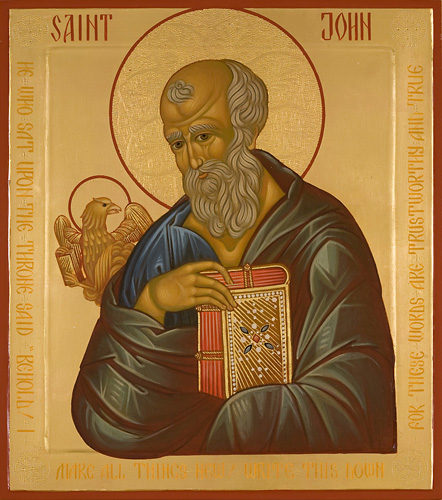
The blessed John the Evangelist lived in Ephesus until extreme old age. His disciples could barely carry him to church and he could not muster the voice to speak many words. During individual gatherings he usually said nothing but, “Little children, love one another.” The disciples and brothers in attendance, annoyed because they always heard the same words, finally said, “Teacher, why do you always say this?” He replied with a line worthy of John: “Because it is the Lord’s commandment and if it alone is kept, it is sufficient.”

Saint Jerome learned this explanation of what John said from the writings of Saint Irenaeus, who was a disciple of Saint Polycarp, who was a disciple of Saint John.

POPE JOHN PAUL ON THE CONTEMPORARY IMPORTANCE OF ST IRENAEUS
Mons. Philippe Delhaye
Secretary General of the International Theological Commission


What we would like to do as far as the great figure of St Irenaeus is concerned is taking as our point of departure the remarkable address of the Holy Father during his visit to the “Facultés Catholiques de Lyon”,1. The great figure of St IrenaeusFirst of all, who is Saint Irenaeus? What was the course of his life? What are his writings to which the Holy Father referred in particular?

Irenaeus was born in Asia Minor about the year 125. He was still a young man when he met Polycarp of Smyrna, who represented a generation which had known the Apostles chosen by Christ, especially Saint John. “He, the Lord’s disciple, the very one who had rested on his breast (Jn 13:23, 21:20), himself published a Gospel while he was living at Ephesus in Asia” (Adversus Haereses [AH] III, 1, 1). In the eyes of Irenaeus, this Gospel, like those of Matthew, Mark and Luke, is essentially a witness to the Paradosis, to the tradition which the Spirit had entrusted to the Apostles and their successors, the bishops. We shall speak of this again later, but for the moment, we most note that Irenaeus sees himself in continuity with Polycarp, John and the Apostles and with Jesus himself.

Irenaeus followed Polycarp to Rome in 154 or 155. There he met Pope Anicetus (155-166), the Christian philosopher Justin and Hermas the moralist. Irenaeus provides this testimony concerning the Roman apostolate of Polycarp: “When he had come to Rome under Anicetus, he turned a great number of people away from the heretics (Christian Gnostics) and led them back to the Church of God by proclaiming that he had received from the Apostles just one single and sole truth, that which had been transmitted by the Church” (AH III, 3, 4).

Who were these Christian Gnostics who were taking advantage of the Romans’ infatuation with Eastern religions? According to Valentinian, Basilides and Marcion the most extreme dualism was the truth of salvation. On the plane of sense experience, man is enclosed in the flesh and the cosmos which are evil creatures of the secondary god who is the “demiurge”. Fortunately, above this world of the “aeons” and of the cosmos, there is a Supreme God who is not a creator and who is purely spiritual. This Supreme God had sent the Saviour, Christ, who had not truly assumed a body of flesh or experienced death; all of that was a phantom appearance. On the contrary, the truth is that Christ has undertaken to save men by giving them a superior and secret knowledge (gnosis). The words attributed to Jesus apparently have only one single obvious meaning. In reality, they have another hidden meaning. Only those who have been initiated, the “spirituals”, are able to interpret them by bringing in from elsewhere other logia such as in the “Gospel of Thomas”. The essential point lies in the recognition of the inescapable struggle between evil and good, between matter and spirit. It is necessary to bring as many men as possible to the state of spirits divested of all contact with the flesh.

This philosophical-religious interpretation of Christianity had reached Vienne and Lyon, the first dioceses of Gaul, Greek in origin, where Irenaeus went and where he was ordained a priest. At the time when the persecution of 177 was preparing to break out, Irenaeus was sent on a mission to Pope Eleutherius (175-189) at Rome. It was there that he learned of the persecution at Vienne and Lyon, the memory of which—like that of so many other events concerning Saint Irenaeus—is preserved in the Ecclesiastical History (book V) of Eusebius of Caesarea (260-340).

It was necessary to rebuild the Church of God which was at Lyon. Irenaeus returned to Gaul where he succeeded Pothinus and thus became the second bishop of Lyon-Vienne. Not only did he assure the presence of Christ the preacher and shepherd at the crossroads of the Three Gauls, but at the same time he carried out the composition of his masterpiece which is cited today under the title of Adversus Haereses (Against the Heresies). The actual title expresses more clearly the double movement of Irenaeus’ theology and polemic. It is called Detection and Refutation of the False Gnosis. Local traditions mention the influence of Saint Irenaeus in the young Churches of Valence, Besancon, Autun, Dijon and Langres. Theodoret calls Irenaeus “the apostolic man who enlightened the West”, “the one who enlightened and educated the Celtic nations”.

Irenaeus’ final appearance on the level of the universal Church took place during the second phase of the controversy over the date of the celebration of the Christian feast of Easter. Certain Churches of the East had come to celebrate the Easter festival on the 13th of the month of Nisan. Polycarp had brought Pope Anicetus to tolerate this usage (155). Pope Victor was more rigid and wanted to bring the “Quartodeciman” Churches to observe the common practice. He excommunicated Polycrates of Ephesus, the leader of the movement. Irenaeus wrote to Pope Victor to champion the cause of diversity. As far as be was concerned, the Bishop of Lyon agreed with the Roman tradition, but he thought that a diversity of tradition did not endanger faith which, of itself, demanded unity.

How did the Bishop of Lyon’s earthly life end? It is generally held that Irenaeus was martyred in 202 during the persecution of Septimius Severus which was particularly severe in the area of Gaul around Lyon.

2. The great Tradition

We come now to Saint Irenaeus’ study and example of which the Holy Father spoke at Lyon. This method contains essentially two points (Pontifical Address, n. 3): respect for Apostolic Tradition and a knowledge of the doctrines of each age. In this, John Paul II has shown himself once again as the Pope of the Second Vatican Council. Indeed, the Council cites texts of Saint Irenaeus fourteen times. With the exception of Saint Augustine, this is the greatest frequency with which a Father of the Church is cited.

That which the Pope and the Second Vatican Council have asked first of all of Saint Irenaeus is a witness to the “great Tradition”, that which embraces both the Scriptures and the authentic teachings of the Magisterium (Dei Verbum, n, 9).

Many people were speaking of the “two sources of Revelation” and were not hesitating to tone down the testimony of Sacred Scripture. Today, the situation is rather the reverse. Some theologians are not far from the Scriptura sola and make light of the teachings of the Magisterium, even when they are expressed in the Ecumenical Councils. Nevertheless, Dei Verbum (n. 10) is as explicit as can be: “Sacred Tradition and Sacred Scripture constitute the sacred deposit of the Word of God entrusted to the Church”.

Saint Irenaeus was without doubt the first theologian to construct a system where the harmonization of the inspired written texts and the tradition of the Magisterium was explicitly and continually affirmed. For the Bishop of Lyon, it is the preaching of Christ which holds first place. He spoke openly without recourse to the secrets of gnosis. Christ taught all the mysteries of the Kingdom of God openly. The Apostles, the disciples and multitudes of listeners heard Christ and repeated his words and gestures. “To the Apostles and the disciples, Jesus has explicitly given the power to bring men to rebirth in God; he said to them, ‘Go, teach all nations, baptizing them in the name of the Father, and of the Son and of the Holy Spirit’ (Mt 28:18-19)” (AH III, 17, 1). A Church such as that of Rome was founded first of all by the preaching of the disciples, but more especially by that of Peter and Paul, who were for it the authentic witnesses of Tradition. Peter preached his gospel there; it is only after his death that Mark wrote it down. The same holds true for Paul, whose gospel teaching was taken down by Luke (AH, III, 1, 1). The witnesses of the second generation, viri apostolici, continued this transmission of the oral tradition in the office of episcopoiand presbyteroi (in the primary sense of the terms). The Tradition which comes from the Apostles is thus preserved in the Church through the “continuous line of bishops, their successors, to whom they passed on their own mission of teaching” (AH III, 3, 1; cf. Dei Verbum, n. 7). By his grace God accepts them and preserves them “perfect” and “without reproach in every instance” (AH III, 3, 1).

Thus it is that the Church is one by the faith proclaimed by the bishops, the successors of the Apostles (AH IV, 10, 1) as well as by the Eucharist which they celebrate in memory of the one Lord (AH IV, 17, 5). This unity could be demonstrated by taking up the succession of the legitimate bishops in each of the local Churches. Irenaeus outlines this demonstration for Smyrna, his native city. As we have said, he knew Polycarp (AH III, 3, 4). Polycarp “had been instructed by the Apostles—especially John and had lived with many of those who had seen Our Lord”; “it was furthermore by the Apostles that, in the Church of Smyrna and in Asia, Polycarp had been made bishop”. It is not necessary, however, to trace the universal apostolic succession to come to a realization of the primacy of the Church’s unity in one authentic faith. There is a shorter and surer way to reach the “great tradition” of the Apostles and bishops: It is that of the Church of Rome,

4. Fidelity to “Tradition”

In speaking as he did of Saint Irenaeus, the Pope did not only wish to celebrate a great personage of the Church if Lyon or merely to thank the scholars of Lyon who have made the author of Adversus Haereses famous* and have drawn inspiration from him for their own work, John Paul II also wanted to trace some lessons which concern all contemporary theologians.

The first of these instructions, it seems to me, concerns above all positive theology and the relations between exegesis and theology. It is not a question of history alone, but of the penetration of the profound inspiration of the Sacred Scriptures in the manner of Saint Irenaeus: “The exegete and the theologian must bring into play the clear relationship which extends from the Old to the New Testament. This relationship constitutes a deposit of the Christian faith” (Address, n. 4). The Pope ascertained with joy that “this theme is currently the object of a renewed consiousness” (ibid.). He desired new efforts in order better to grasp the continuity of the People of God, to understand the Gospels and Saint Paul, to contribute to a rapprochement between Christians and Jews. Another type of clear relationship desired by John Paul II is that which regards exegesis and Scripture: “Today as yesterday, exegesis must lead to theology and theology must take its point of departure from a continual and updated return to the Scriptures read in the Church” (Address, n. 4). In reading Adversus Haereses, a theologian of the 1950s was not too certain whether he was dealing with a study in theology or a work of exegesis. This is because the theology of the l6th and 17th centuries had separated exegesis and theology. This problem did not arise at the time of the Fathers nor in the glorious 13th century.

6. Seeking the truth everywhere

How does one approach the reading of contemporary authors? The Holy Father sanctioned several stages: Seeking the truth wherever it may be found, rectifying and perfecting it, being on guard for Christian authenticity.

According to John Paul II, in applying to our age the lessons of the life and the methods of Saint Irenaeus, “the theologian, faithful as he may be to Tradition, cannot however forget the world in which we live, its legitimate demands, the currents of thought abroad in it which often bear truths that must be recognized” (Address, n. 4). The Pope does not ignore the necessity of a critical reading demanded by the authenticity of the faith, but he emphasizes first of all that which draws together, the authentic institutions to be favoured and the need to correct.

Here likewise, we find again the spirit of Vatican II, notably of Gaudium et Spes and of Nostra Aetate. The Church does not forget that there are in the world before her very many errors and defects. She refuses, however, to be hypnotized by them. It is necessary also to consider what the Fathers have called the Semina Verbi, the Preparatio Evangelica, the traces of the grace which is active in every person (Gaudium et Spes, n. 22).

The Apostles, notably Saint Paul, had an acute awareness of Christian authenticity. Their vision above all was of Jesus, and of Jesus crucified (I Cor 1:23). This did not prevent Paul at the Areopagus from making use of the commonly held Greek religious sentiment. In the Letter to the Philippians (4:8-9) he does not hesitate to praise the moral values which the pagans recognized: “Everything which is true, everything which is noble, just, pure, worthy of love, of respect, everything which is virtuous and worthy of praise”. He sees in this, however, above all an authentic good of the Christian tradition preached by the Apostles and blessed by God.

Certainly it is very often necessary to correct the propositions which one encounters. To the extent possible, this will be done from within, as the example of Saint Irenaeus suggests. The papal address (n. 5) made a discreet allusion to the anthropological doctrines which the Gnostics borrowed from the major Greek philosophies. Through them there was spread the Platonic dualism which made the body the prison of the soul; a doctrine which is the distant ancestor of all the anti-humanism of certain schools of thought and spirituality, from Manichaeism to Jansenism. Saint Irenaeus (AH V, 6, 1), for all that, does not escape from the body-soul duality; he presents them as complementary elements of the Christian person, all the better unified to the extent that this person is governed by grace. “It is the mingling and union of all these things”, he writes, “which constitute the perfect man. That is why the Apostle, in explaining himself, clearly defined the perfect and spiritual man, the recipient of salvation when he wrote to the Thessalonians: ‘May the God of peace make you holy in such a way that you may reach full perfection and that you may be preserved whole and entire, spirit, soul and body, irreprehensible for the coming of the Lord Jesus’ (I Thess 5:23). They are thus perfect who at the same time have the Spirit of God always with them and keep themselves without reproach with regard to their souls and with regard to their bodies; that is to say, who keep faith with God and practise justice towards their neighbour”.

7. To be on guard for Christian authenticity

The theologian faithful to the Revelation of Christ transmitted by the Apostolic Tradition will not only have to correct the false interpretations which the people of his time give regarding the human vocation and divine love.

It will be necessary for him to find in the inexhaustible riches of Christ (cf. Eph 3:8) the means with which to promote an authentic encounter between God and man. The duty of the theologian is to be on guard for “Christian authenticity” as was Saint Irenaeus (Address. n. 5).

Indeed, “The Gnosis which Irenaeus had to combat appears to us today as a series of works which has already been overcome”, the Holy Father noted. But it remains a type of thought and deformation which is almost eternal. It can even be said that these processes of thought are found in a striking manner in certain intellectual tendencies of our time It was a “para-Christianity whose danger Irenaeus saw”. Then, as in our own day, it was a question of “using Revelation” and of “interpreting it from a very particular point of view”. In extreme cases, some people have recourse to the “familiar formulae of the Christian Creed in order to justify a doctrine contrary to the faith. In this sense, the Gnostic temptation is always an obstacle for the Church” (Address, n. 5).

The Pope immediately demonstrated what he had said by making use of two recent examples. True, he did it with his usual tact, but that did not impede either the firmness of his intention or the clarity of his exposition. The first example was taken from the “idealist Christology”, which has recently been the object of some remarkable critical studies.

John Paul II stated (Address, n, 5): “The attempt at an interpretation of Christianity by philosophers such as Hegel was indeed a manner of emptying the Christian faith of its substance by interpreting the humiliation of the Son of God as the loss of identity of God and the abolition of the abyss between God and his creature”.

The example which the Holy Father also drew from certain contemporary exegetical tendencies was obviously nor aimed at the great majority of Catholic scholars, This tendency is relatively limited. It nevertheless illustrates the danger which is always present of a certain Gnostic tendency which the Pope presented in this manner: “Today, too, there exists, in a manner widespread among certain Christians, the temptation to give an interpretation of the Bible determined by presuppositions foreign to the faith, which attempts to bend the faith to a system constructed outside it, all the while preserving the familiar formulae of the Bible or of Christian doctrine in support of those heterogenous ideologies” (Address, n. 5). How can one not think of certain politicized interpretations of the “Magnificat”, of the preferential choice in favour of the poor, the spirit of service is opposed to the libido dominandi, which have flourished in certain presentations of the “theologies of liberation”? In the background, can not an attentive reader find Marxism taken not only as a means of sociological analysis but as an ideology to be realized for rendering present and active the Kingdom of God? The two “Instructions” of the Congregation for the Doctrine of the Faith have fortunately opened many eyes. Once again, after the, example of Saint Irenaeus, sound theology has joined fidelity to Tradition to a sense of inventiveness.

In the name of the faith and of the message of the love of Tradition, in communion with the present difficulties of many thinkers and pastors in the face of a social injustice which is ever greater and better known, contemporary theologians understand better the human and Christian doctrine on the right use of material goods, on the duty of austerity for some and of non-violent struggle for others, Taken according to an authentic inspiration, “liberation theology” is united with the concern of Vatican II, of the Pope and of many other witnesses to Tradition for the necessity to understand “humanization”, development and human progress as elements of the redemptive work of Christ in the recapitulation of all things by Christ… Another lesson which Saint Irenaeus gives us.

8. The ‘value’ of man, the work of God

Once again, there is found in Saint Irenaeus the concern to bring to the fore and to bring together the greatness and the love of God and the dignity and potentiality of man. Moreover, here is perhaps the profound reason for the attention which has been given him for the past fifty years in theology as well as in spirituality. It is thus useless to oppose the Fathers of the Church to other Doctors. We have seen through the centuries the dangers which arise from the interminable battles between different theological schools. It cannot be denied, however, that the Church in our day has felt the need to react against the false interpretations of certain post-Augustinian elements which had developed through the course of history. The contempt for man, his incapacity to live an authentic dignity, the total weakness attributed to man, the obsession with sin and concupiscence were still deep-rooted tendencies at the beginning of this century against which many wished to react without knowing too well how to do so. How was it possible to attribute an authentic value to man, a just autonomy in the responsibilities which are his own without breaking the relation of the creature vis-à-vis God, without granting him a complete autonomy? Complete autonomy was the temptation of atheistic Marxism. Respect for God too often appeared as contempt for human existence, which was sacrificed to the purely eschatological aspect of the Kingdom of God.

In one sense, it can be said that the profound significance of the great conciliar documents such as Lumen Gentium and Gaudium et Spes is the will to overcome this false dilemma and to eliminate the last effects of Jansenism. It is not due to chance if each of these two conciliar Constitutions harks back to the doctrine of the recapitulation of human history in Christ. Certainly—and we shall say so—Saint Irenaeus is there, too, the witness of the Roman tradition of Saint Paul, and he is not the only one. This does not take away from the fact that historically he has given to this theological doctrine an importance and a sense which are his own. It is to Book III of the Adversus Haereses (16, 6; 22, 1-3) that Lumen Gentium (n. 13) refers in order to say: “This character of universality which adorns the People of God is a gift from the Lord himself whereby the Catholic Church ceaselessly and efficaciously seeks for the return of all humanity and all its goods under Christ the Head in the unity of his Spirit”. As for the Pastoral Constitution Gaudium et Spes (n. 57, 4), it refers to Adversus Haereses (111, 11, 8) in order to justify the promotion of culture in the general sense of the search for human values when it states: “As a consequence (of culture) the human spirit, freed from the bondage of material things, can be more easily drawn to the worship and contemplation of the Creator. Moreover, man is disposed to acknowledge, under the impulse of grace, the Word of God, who was in the world as ‘the true light that enlightens every man’ (Jn 1:9), before becoming flesh to save and recapitulate all things in himself”.

9. Recapitulation in Christ according to St Paul and St Irenaeus

Before the Council, Pius X’s pontifical motto, Instaurare omnia in Christo, was often cited according to the translation which the Tridentine Vulgate gave of this passage of the hymn which opens the Letter to the Philippians (1:10). The Neo-Vulgate has returned to a greater fidelity to the original text: recapitulare omnia in Christo. Many ideas and images come together under this presentation of Christ as the Head of humanity. For the sake of brevity, let us say that it is above all a question of two essential themes. For different reasons and, moreover, to different degrees, Christ is the Head of all men and of Christians in particular. He imparts to them the values of creation and of divine adoption. He is the Head who guides and directs, who causes humanity to live and develop. Under a second aspect, the image is concerned more with the idea of gathering, of joining together, of enrichment in universal fraternity.

In section 6 of his address at Lyon, the Holy Father presented a synthesis of this theology of recapitulation according to Saint Irenaeus. There is nothing to be added. I shall therefore content myself here with placing again before the eyes of the reader one of the expositions by which Saint Irenaeus demonstrates in the work of Christ, the Head of humanity, the redemption and the surpassing of all values and all hopes, the pardon of all failures and of all sins.

“The Word of God, the Only Son, has always been present to humanity. According to the Father’s pleasure, he has united and mingled himself with the work which he had formed. He became flesh. This Word made flesh is Jesus Christ, Our Lord. It is he who suffered for us, who has been raised for us, who will return in the Father’s glory in order to raise all flesh, to reveal salvation and to apply the rule of just judgment to all who will be subject to his power. There is, thus, only one God, the Father, as we have demonstrated; and one Christ Jesus, Our Lord, who has passed through all ‘economies’ and has recapitulated everything in himself (Eph 1:10). In this ‘everything’ man is also included, this work formed by God. He thus also recapitulated man in himself; invisible he became visible, indiscernible he became discernible, impassible he became passible, the Word made man. He recapitulated everything in himself in order that, just as the Word of God has the primacy over the supercelestial, spiritual and invisible beings, he might also have it over visible and corporeal beings, assuming this primacy in himself and setting himself up as Head of the Church (Eph 1:22) in order to draw all to himself at the proper time” (AH III,16, 6).

What paths for research are not to be found here for theologians rightly concerned to mark out better the harmony between the creation and the divinization of man, between the spiritual life and implantation in the cosmos and in time, between the Incarnation and the Redemption! We are far from the disharmony and the lack of consistency of numerous theological manuals of a former time.

10. Conclusion: man fully alive and turned towards God

It is not only in the doctrine of recapitulation by the grace of Christ that Saint Irenaeus wanted to situate the true value of man, which was denied by the Gnostics. He was careful to note the intrinsic dignity of man, let us even say the relative autonomy of the creature capable of freely orienting himself. Certain contemporaries of ours thirty years ago were gladly spreading about the ambiguous formula: “The glory of God is man fully alive”.

In fact, this formula was truncated and ended up making the Bishop of Lyon say the contrary of that which he had taught. Man’s life is for him the glory of God provided that man remains in contact with his Creator. Shortly after the Council, some theologians and some historians such as Père do Lubac had already protested against this false interpretation. The Holy Father did just as much with the tact which distinguishes him. In his address at Lyon (n. 2), he recalled the authentic and complete text of Saint Irenaeus: “The glory of God is man fully alive, and the life of man is the vision of God. If the revelation of God through creation already brings life to all living beings on the earth, how much more will the manifestation of the Father by the Word bring life to those who see God” (AH IV, 20, 7).

Thus the life of the Christian, in faith as in future vision, is essentially knowing and being known. This is one of the fundamental texts of Christian personalism. The disciple of Jesus is not an isolated being. In order to exist, in order to act, he must know the Christ and his Father and be known by them. Nothing is taken away from human values; they are merely taken up and transfigured. In this, Irenaeus, as the Holy Father said (Address, n. 2), “has been at the same time the theologian of God and of man”.

In order to grasp the profound sense of this personalism, it is perhaps necessary to note here the resonance of certain Johannine texts into which Irenaeus had been initiated in a special way by Polcarp who, as we have said, had known the Apostle himself. One would be tempted to say that there is a more profound sense of knowledge, gnosis in the primary sense of the word, in Johannine theology. May I, in conclusion, cite three texts of the Beloved Disciple which give us the full meaning of this Johannine knowledge? In Jesus’ farewell prayer are found these words addressed to the Father: “Give eternal life to all those whom you have given to me. Eternal life is this, that they may know you the only true God” (Jn 17:3): “I have made your name known to them and will make it known again, so that the love with which you have loved me may be in them and that I may be in them”. This love is a truly dynamic one as the First Letter of Saint John says (1 Jn 2:3): “by this we know that we have knowledge of him, if we keep his commandments”.

To the false Gnosis there is opposed the authentic knowledge of God and of man in the reciprocity of love. It is this which is the profound meaning of Saint Irenaeus’ message.

The Church is the Body of Christ/the Body of Christ is the Church.

The Body of Christ consists of all the faithful men and women joined together with the successor of Peter and the clergy.

The Vatican is a partial physical realization of the Church, but it is not of and in itself, the Church, it exists to serve the Body of Christ.

The clergy are a partial physical realization of Body of Christ, but they are not the Body of Christ, they exist to serve the Body of Christ.

The laity, saints and sinner combined, constitute the main part of the Body of Christ of which Christ is the Head.

Do not let what is happening within the Vatican, within chanceries, within the clergy, disturb you.

Live the faith, come alive in the faith, stay alive in the faith; do not let any pope or bishop or priest shake or disturb your faith.

(MORE LATER)

Posted in Uncategorized | 1 Comment

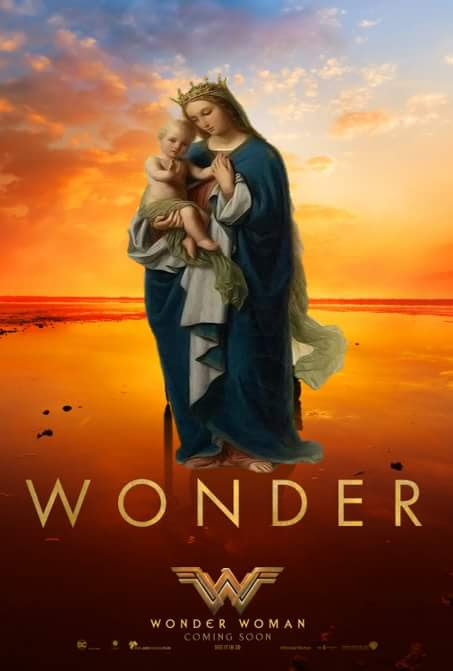
NOT “the” WONDER WOMAN, BUT THE WONDER WOMAN

unnamed-20

Posted in Uncategorized | 1 Comment

LITTLE CHILDREN, LOVE ONE ANOTHER

f62aab679d13423da814c8c439134191

Posted in Uncategorized | 1 Comment

YOU DEVIATE FROM THE PATH CHRIST PRESCRIBES AT YOUR OWN GREAT PERIL

unnamed-17

Posted in Uncategorized | 2 Comments

HOMILY FOR THE SOLEMNITY OF PENTECOST

Pentecost Was Not An Occasion for “Enthusiasm”
FR. GEORGE W. RUTLER, GUEST HOMILIST

The amiable classicist, John Bird Sumner, was the Protestant archbishop of Canterbury from 1848 to 1862. Amid theological controversies about baptismal regeneration and the like, his opposition to a parliamentary bill removing Jewish disabilities was unquestionably retrograde, but he assumed the progressive mantle in approving obstetric anesthesia which was opposed by some Christian fundamentalists, whose misogyny was not alien to current Muslim advocates of female circumcision. It will be allowed that he had little choice after Queen Victoria had been anesthetized for the birth of Prince Leopold. As a son of Cambridge rather than Oxford, his propensities were more Evangelical. Nonetheless, he is said to have blessed missionaries to India in the imperial radiance of the Raj with the counsel that they were to “convert the heathen and discourage Enthusiasm.”

Now, among the Anglo-Saxon race, one of the more sober insults was to label a man as “hearty.” But Enthusiasm understood with a capital E was Methodism and its ancillary non-conformist forms, which emphasized emotion over reason.

When the apostles and the women with them in the Upper Room received the Holy Spirit as promised by the Lord who never lies, they were filled with a power that has changed the world. It did not change their intellect. There is no literature in the classical corpus more replete with incontestable reason obedient to the divine Logic than the preaching of the apostles.

Our Lord promised that the Holy Spirit would lead into all truth. This activates the intellect and does not replace it. Enthusiasm is not spiritual zeal if it asks reason to move over so that emotion might take its place. The Enthusiasm that Dr. Sumner abjured displaced the Logos with the Ego. That of course is an old story, elegantly and eloquently documented in the masterwork of Monsignor Ronald Knox, Enthusiasm. While not unsympathetic toward the noble integrity of John Wesley, he holds up the spiritist movements from the second century Montanists to the latter day Quakers, Jansenists, and Quietists as examples of how people go to extremes to confuse themselves emotionally with the Holy Spirit.

At Pentecost, the Apostles spoke the languages of the far-flung regions of the Jewish diaspora. Modern “speaking in tongues” is not the equivalent of the manifestation of real languages. Even when there was such, Saint Paul diminished it, subordinating it to interpretation. Saint Irenaeus mentions contemporaries who spoke “through the Spirit in all kinds (pantodapais) of tongues. Saint Francis Xavier much later preached in tongues he had not learned, but they were real languages and, if one is willing to accept it, on only two occasions: in Travancor and again at Amanguci.

It is curious that the charismatic movements after the Second Vatican Council should have neglected the Latin of the Universal Church, before affecting exotic and unintelligible speech. As an inveterate and unapologetic New Yorker whose pastoral obligations require speaking various languages, it seems that a really miraculous gift of the Holy Spirit would enable people in Manhattan to speak grammatical English, the equivalent of the dialect of the Diaspora spoken at Pentecost, and the contradiction of faux glossolalia.

False Pentecostal enthusiasm tries to energize the emotions but not the intellect. It is a wise policy, issuing from experience, and one hopes not from cynicism, to distrust email messages that begin by saying that the writer is “excited to share” something. This inevitably includes an overuse of exclamation points. Mark Twain and F. Scott Fitzgerald equally disdained the use of exclamation points as a kind of laughter at your own jokes. Exclamation points signal a failure to get a sober point across, and are the grammatical equivalent of the vaudeville performers who waved the American flag and held a baby to prevent the bored audience from throwing objects at them.

In religion, various movements that in practice move nowhere, keep pumping themselves up with excited promises of something great about to happen, some new committee or rally or bureaucratic program for evangelization that blurs the distinction between the Good News and novelty.

Such was the case in Phrygia of Asia Minor in what is now Turkey during the second century a convert priest named Montanus stirred up a lot of excitement when he confused himself with the Holy Spirit and proclaimed various “prophecies: while in a trance like a sort of divine ventriloquist. In the manner of a typical fanatic so defined, he was confident that God would agree with him if only God had all the facts. In a languid and dissolute period, the local churches already having become formalistic and arid (contrary to romantic depictions of the uniform zeal of all early Christians, and not unlike the motivation of John Wesley to stir up the dormant Church of England), the ardor of Montanus attracted many as far as North African and Rome itself, not all of whom were innocent of neurosis. Even the formidable mind of Tertullian welcomed it. Sensational outbursts of emotion were thought to be divinely inspired, and the formal clerical structure of the Church was caricatured as the sort of rigidity that quenches the spirit. Avowing that prophecy did not end with the last apostles, new messages were pronounced, false speaking in tongues pretending to be actual languages was encouraged, and women like Priscilla and Maximilla leave their husbands and decided that they could be priestesses and prophetesses.

In the twentieth century, the Montanist heresy sprung up again. The Pentecostal sects, and even many Catholics were attracted to “re-awakenings” that gave the impression that the Paraclete promised by Christ who never lied had finally come awake having slumbered pretty much since the early days of the Church. While its extreme forms were bizarre, such as dancing in churches and uncontrolled laughter and barking like dogs while rolling on the floor, any quest for novelty quickly grows bored, for nothing goes out of fashion so fast as the latest fashion.

In preparing for the celebration of Pentecost the Church prays for a holy reception of the truth “ever ancient ever new” which comes not through a Second Pentecost or a Third Pentecost, but through an embrace of God’s timeless grace. Christ makes “all things new” and does not superficially make all new things (Rev. 21; 5).

Heresies are fads. The estimable Servant of God Father John Hardon, whose talks would never be called ecstatic, bluntly said that the modern Charismatics are Montanists. It is true that the Charismatic movement in the Catholic Church wisely was blessed insofar as it not denigrate from or add to authentic dogma. But in the second century the pope Eleutherius was inclined to condone the Montanists too, until the anti-Tertullian theologian Praxeas explained its problems.

Chesterton described the romance of orthodoxy whose Church is like a chariot “thundering through the ages, the dull heresies sprawling and prostrate, the while truth reeling but erect.” The truth needs no artificial excitement or orchestrated exclamation points, for when the mystery of God is revealed, all and every element in the cataract of creation collapses into silent awe (Rev. 8:1) and then … the Great Amen.

Christ promised that the Holy Spirit would enable human intelligence to embrace depths of reality beyond the limits of natural experience. Here at work is the principle of Saint Thomas Aquinas: “Grace does not destroy nature, but perfects it.” The apostles became more intensely human when they received the power of the Holy Spirit, to the extent that they traveled to lands beyond the limited environs of their early years, with a courage never before tested. They received the “glory” that Christ, on the night before he died, prayed that his disciples might share. Because that participation in the divine nature bridges time and eternity, there is an invigorating terror about it: not the dread of being diminished or annihilated, but the trembling awesomeness of breaking the bonds of death itself.

When the Holy Spirit moves a man from aimless biological existence to what Christ calls the “fullness” of life, the reaction is a little like that of someone who has heard simple tunes but then encounters a symphony. Simple pleasures may evoke smiles, but the deepest joys can move one to tears, and that is why there is that curious experience of not laughing for joy but weeping for joy, and the equally enigmatic experience of lovesickness. Oft quoted is the diary account by Samuel Pepys in the seventeenth century after attending a concert: “ …that which did please me beyond anything in the whole world was the wind-musique when the Angel comes down, which is so sweet that it ravished me; and indeed, in a word, did wrap up my soul so that it made me really sick, just as I have formerly been when in love with my wife.”

An admirer of Jascha Heifitz told him after a performance that his violin had such a beautiful tone. The maestro placed his ear against the Stradivarius and said, “I hear nothing.” By way of metaphor, it may be said that we exist biologically as wonderful instruments: the brain itself is the most complex organism in the universe. But we make celestial music, attaining the “tone” of virtue, only when the Holy Spirit conjoins our human nature with the Source of Life.

At Pentecost, all who worship God are transfigured by his holy light. No man-made enthusiasm can equal the transporting eloquence of the unutterable Logos. So spoke Saint Cyril of Jerusalem: “As light strikes the eyes of a man who comes out of darkness into the sunshine and enables him to see clearly things he could not discern before, so light floods the soul of the man counted worthy of receiving the Holy Spirit and enables him to see things beyond the range of human vision, things hitherto undreamed of.”

Editor’s note: Pictured above is a detail from”The Descent of the Holy Spirit” painted by Duccio di Buoninsegna, ca. 1308-1311.

Tagged as Charismatic Renewal, Enthusiasm (1950), Holy Spirit, Montanism, Pentecost, speaking in tongues

27
Fr. George W. Rutler
By Fr. George W. Rutler
Fr. George W. Rutler is pastor of St. Michael’s church in New York City. He is the author of many books including Principalities and Powers: Spiritual Combat 1942-1943 (South Bend, IN: St. Augustine’s Press) and Hints of Heaven (Sophia Institute Press). His latest book is He Spoke To Us (Ignatius, 2016).

Posted in Uncategorized | Comments Off on HOMILY FOR THE SOLEMNITY OF PENTECOST

AT LEAST THEY ARE NOT DECAPITATING CHRISTIANS IN EAST LANSING, MICHIGAN, BUT NONE THE LESS IT IS STILL PERSECUTION

Farmer wants to sell food to all people, but East Lansing won’t let him

ADF attorneys represent Michigan family farmer in challenge to city policy that ousted him from farmers’ market for his beliefs

LANSING, Mich. – Alliance Defending Freedom attorneys representing an organic farmer in Michigan filed a federal lawsuit Wednesday against the city of East Lansing after officials ousted his family business from the local farmer’s market, where he has done business since 2010, because city officials learned he believes marriage is the union of one man and one woman. The farmer wants to be able to sell food to all people, but the city is preventing him from doing so at the farmer’s market.

At issue is an unconstitutional, unlawful, and complex “sexual orientation” policy that city officials adopted specifically to shut out Steve Tennes and Country Mills Farms—his family’s fruit orchard—purely because he posted on Facebook his belief in biblical marriage. The city did this even though Tennes, his family, and the orchard are in Charlotte, 22 miles from East Lansing, well outside the city’s boundaries and beyond its jurisdiction.

“All Steve wants to do is sell his food to anyone who wants to buy it, but the city isn’t letting him,” said ADF Legal Counsel Kate Anderson. “People of faith, like the Tennes family, should be free to live and work according to their deeply held beliefs without fear of losing their livelihood. If the government can shut down a family farmer just because of the religious views he expresses on Facebook—by denying him a license to do business and serve fresh produce to all people—then no American is free.”

“Americans have always had the cherished freedom to believe and to express those beliefs. This lawsuit simply asks the court to uphold that freedom for a Catholic farmer, who should be free to sell his produce without coercion, discrimination, or intimidation by the government because of his beliefs about marriage,” added ADF Senior Counsel Jeremy Tedesco. “The city must respect Steve’s constitutionally protected freedom to express his religious beliefs on social media sites without being forced to surrender his right to participate in the marketplace.”

After seeing Tennes’ Facebook post from Aug. 24, 2016, city officials went to great lengths to force him out of the farmer’s market. First, they tried to pressure him, telling Country Mill they did not want the farm at the next scheduled Market that following Sunday, that they had received complaints about Tennes’ statement, and that there would be protests if Country Mill continued to participate in the Market. They urged Country Mill to withdraw immediately. Tennes persevered and continued to serve the market’s customers. No protests took place.

After the close of the Market season, when Tennes posted regarding his beliefs again in December 2016, the officials decided that his expression conflicted with East Lansing’s marriage views and its policy regarding sexual orientation. But because that policy is codified in the city’s Human Relations Ordinance, which cannot be enforced against Country Mill Farms, the officials crafted a new policy, bypassing its jurisdictional limits under Michigan law, to expel Tennes and his farm from the farmer’s market as punishment for his views.

The policy requires vendors to agree to and comply with the city’s “Human Relations Ordinance and its public policy against discrimination…while at the market and as a general business practice.” The ordinance makes it illegal for anyone to “make a statement which indicates that an individual’s patronage or presence at a place of public accommodation… is…unwelcome or unacceptable because of…sexual orientation, gender identity, or expression…,” among other designated classes. Yet it does not define “discriminate” or any of the key terms that would govern enforcement.

Based on the new policy, an official then informed Steve by letter that he was not in compliance and that Country Mill Farms was prohibited from participating in the upcoming 2017 market. The notice included an attachment of Steve’s December Facebook post as evidence, despite the fact that the post is constitutionally protected free speech and Country Mill Farms has never turned away a customer based on sexual orientation.

The complaint in Country Mill Farms v. City of East Lansing, which ADF attorneys filed in the U.S. District Court for the Western District of Michigan, explains how the city policy violated the Constitution’s guarantees of free speech, freedom of religion, and equal protection—in addition to other protections. It requests that the court restore Country Mill Farms’ constitutionally protected freedoms and prevent a violation of Michigan’s law governing cities.

The suit also asks the court to halt the discriminatory policy, declare it unlawful and unconstitutional, and award nominal and compensatory damages, so that Tennes and Country Mill Farms can once again serve all customers at the farmer’s market.

Alliance Defending Freedom is an alliance-building, non-profit legal organization that advocates for the right of people to freely live out their faith.

Posted in Uncategorized | 2 Comments