THE JESUITS STRIKE AGAIN !!! MAN THE BARRICADES !!! SOUND THE ALARM !!!

Settimo Cielodi Sandro Magister 

13 apr 17

Jesus Too Would Admit Divorce Today. So Says One of His Society

Reese


{Sowing seeds of doubt:  “But, WHAT did Jesus REALLY say ???” – Abyssum}

The instructions laid out two months ago by the general of the Society of Jesus, Fr. Arturo Sosa Abascal, on “what Jesus really said” regarding marriage and divorce have not fallen on deaf ears.

On the contrary, some among the Jesuits have been the first to apply them in full. To conclude that “once a marriage is dead” Jesus too would allow divorce today.

The Jesuit who has drawn this conclusion from the premises set up by his superior general is not a nobody. He is Fr. Thomas Reese, former editor of the magazine of the New York Jesuits, “America,” and a prominent writer for the “National Catholic Reporter.”

He has done so in this commentary published April 6 on NCR:

> “What God has joined together …”

But before presenting his argumentation, it is helpful to reread what Fr. Sosa said in the interview with the blog Rossoporpora last February 18, as well pondered as it was explosive, published only after he had reviewed it word by word.

In order to know “what Jesus really said,” the general of the Jesuits stated in that interview, it has to be kept in mind that “at that time, no one had a recorder to take down his words {in other words, if you cannot produce a video or tape recording of what Jesus said, then I am free to interpret his words any way I want to – Abyssum}. What is known is that the words of Jesus must be contextualized, they are expressed in a language, in a specific setting, they are addressed to someone in particular.”

Therefore – he continued – in order to understand what Jesus meant by his saying: “no human being must separate what God has joined together,” it is not enough to stop at the letter, but one needs to “bring [it] into discernment,” as Pope Francis does {yes, we must always “accompany” Francis in his discernment no matter where it leads us – Abyssum}, without becoming rigid over what in the Church has become doctrine, “because doctrine does not replace discernment.” {I prefer the inverse of this; discernment does not replace doctrine – Abyssum}

*

So then, Fr. Reese begins by citing the words of Jesus on marriage and divorce:

“Therefore, what God has joined together, no human being must separate. Whoever divorces his wife (unless the marriage is unlawful) and marries another commits adultery” (Mt 19:6,9).

“In the minds of the critics of Pope Francis” – he says – these words “are clear and definitive and end the discussion.”

Immediately afterward he writes that, however, “there are at least three reasons that these words from Jesus do not prove that Pope Francis is wrong in opening up the possibility of some divorced and remarried Catholics receiving Communion.”

– The first reason is that “Jesus said a lot of things that we do not observe literally without exception.”

And he gives numerous examples, such as never to swear by anything in heaven or on earth. And then he wonders:

“Why do we insist on enforcing the words of Jesus on divorce literally without any exception, when we find all sorts of wiggle room in many of his other sayings?”

The second reason is that “Jesus does not list any punishment for divorce and remarriage. He does not say such persons will be consigned to hellfire. He does not say they should be excluded from the Christian community. He does not even say they cannot go to Communion. He does not say they cannot be forgiven.”

While instead “he does list punishment for other sins,” in particular for those who do not give food to the hungry, do not give drink to the thirsty, etcetera. A sign that for him these sins are much worse than divorce, in spite of the fact that the Church sees it the other way around. And in any case, it is not a given that even the threat of hell should be taken “literally.”

– The third reason is “the historical context” of the words of Jesus. “Where Jesus lived and taught, divorce was only available to men,” so much so that in the Gospel of Matthew he speaks only of repudiation of the wife by the husband. And if he prohibits this, it is in order to no longer expose women to the ostracism that punished all the repudiated.

“It was not until the 19th Century,” Fr. Reese continues, “that divorced women began to get some protection from the civil law. As a result, divorce was clearly a devastating injustice to women for most of human history. Jesus quite rightly condemned it since practically all divorces were done by powerful men to powerless women.”

In parentheses, Fr. Reese points out that “Mark, whose gospel was used in Rome made the teaching of Jesus gender neutral,” having him pronounce also a condemnation of repudiation of the husband by the wife, and of her remarriage. And the evangelist did this “because in Rome upper-class wives could divorce their husbands.”

This observation should be enough to demolish his entire argument. But Fr. Reese drops it and arrives at this peremptory conclusion:

“Today we live in a different world. How can we be so certain that Jesus would respond in the same way to divorce today? True, most divorces involve sin, moral failure and great pain. True, in most divorces women get the short end of the stick. Divorce is not something to be shrugged off, but once it has happened and a marriage is dead, can there be a possibility for healing and life in the future? Francis thinks so. So do I.”

*

Not just communion for the divorced and remarried. Fr. Reese goes much further. In the name of Jesus, he liberalizes divorce and also has it liberalized by the pope.

Who, in effect, the only time he has commented on Jesus’ words on marriage and divorce in a homily of his, at Santa Marta last February 24, did not take them literally at all, but even went so far as to say that “Jesus does not respond whether [repudiation] is licit or not licit.”

If this is the “discernment” that the superior general of the Jesuits has said must be exercised over the words attributed to Jesus by the Gospels, it must be noted that not only Fr. Reese but also the Jesuit who has risen to the see of Peter have abided by it. With the conclusions that are plain to see.

To no use, evidently, have been the numerous criticisms (most recently by Cardinal Raymond L. Burke) of Fr. Sosa’s interview, including the in-depth “Memorandum” sent to the pope and to the prefect of the congregation for the doctrine of the faith, which Settimo Cielo covered at the end of March.

Fr. Sosa replied to these criticisms on April 9, in an appearance on TgCom24, reiterating “in toto” all of his ideas:

“No one has a written or recorded register of the words that Jesus said. The Christian communities wrote the Gospels to hand down his words, but a long time afterward and through different communities of reference. Moreover, the words of Jesus must be understood in their context, and the Church, understood in the broad sense, interprets. Doctrine emerges somewhat from this interpretation that the Church makes. When one interprets, it is in order to understand better what Jesus said directly. If we understand better what Jesus said, then we understand better how we should behave in order to be like him.”

But if, as Fr. Sosa says, it is the Church “understood in the broad sense” that “interprets” the words of Jesus, are a couple of Jesuits really enough – together with a confrere pope – to overturn what has been said for two millennia by the Fathers of the Church, the popes, the councils, and, before them, by the Gospels on the indissolubility of marriage?

(English translation by Matthew Sherry, Ballwin, Missouri, U.S.A.)

Posted in Uncategorized | Comments Off on THE JESUITS STRIKE AGAIN !!! MAN THE BARRICADES !!! SOUND THE ALARM !!!

NO MATTER WHETHER IS COPS, COPTS OR CRIPS – ALL LIVES MATTER

Copts are not a “casual” target

After attacking Berlin, London, St. Petersburg and Stockholm, last Palm Sunday ISIS decided to attack Egypt — specifically, two Coptic churches in Alexandria and Tanta. Dimitris Cavouras is a citizen of Alexandria, networks manager at the Anna Lindh Foundation, and a spokesperson for the Greek community of the city. When the attack occurred, he was barely 400 meters away from the Coptic Cathedral of St. Mark.

Why Egypt and why the Copts?

“They didn’t only attack the Coptic community, but also the Egyptian society,” Cavouras told Aleteia. For him, it is no coincidence that the attack had this very specific goal. “The Coptic community is the largest Christian minority in Egypt,” he said, explaining that in Egypt, interfaith relations have gone astray, also because of different geopolitical pressures.

Shrines and places of worship, whatever religion they may be, are a clear goal for terrorists, Cavouras points out. This has been the case since the revolutions of 2011. “Shrines and temples are indeed a weak point, where terrorism can do a lot of damage. In this case, the Copts have paid the highest price.”

But going beyond religious violence, as the spokesperson himself acknowledges, terrorists are looking to intimidate the Egyptian government and threaten the country’s unity. In fact, a few days before the attack, journalist and activist Mustafa Sinjar declared on the website of the Center for Religious Pluralism in the Middle East that “having the Copts as an objective is a measure of pressure, since it has local and international repercussions for the Egyptian regime.” According to Sinjar, ISIS intends to divide Christians and Muslims by attacking the Copts, thus demonstrating “the State cannot defend them.”

What has motivated these attacks right now? “Now two Coptic churches have been attacked, adding up to a great number of both dead and wounded Egyptian Christians,” explains Cavouras. “But this doesn’t mean the situation has exactly gotten worse, as it was already very deteriorated,” he claims.

In fact, on February 24, hundreds of Christians left the city of el-Arish, only 100 kilometers away from Cairo, after the Islamic State sent a threat. Seven citizens had already been killed a few days before, and ISIS issued a video confirming the Coptic community as a target. On February 28, Egyptian President Abdel Fattah al-Sisi declared that such threat was “a cowards’ plan to destabilize the government, break national unity and instigate conflict.”

“We will heal this wound and we will be more united than ever”

A few days after the Palm Sunday attack, the Egyptian citizens are still strongly shocked. “We feel fear, anguish and sadness,” says Cavouras. So far, the government has declared three days of mourning and a 3-month state of emergency, which is the maximum the country’s constitution allows.

In spite of everything, according to the spokesperson of the Greek community in Alexandria, “the Egyptian society is convinced that it will overcome this difficulty, and that it will indeed help us all to stay united and build stronger bonds.” He himself explains how many friends, both Muslim and Christian, called him to know if he was well. Also, people have flooded nearby hospitals in order to donate blood.

Pope Francis, hope for Egypt

According to Dimitris Cavouras, the coming visit of Pope Francis to Egypt will not be affected by the attack. In fact, he assures, “the organizing committee of the event received a message confirming the trip is maintained as planned.”

In this regard, the spokesman stresses the importance of the visit of the Pontiff, on April 28. Although he admits it may be considered a provocation for terrorists, “it is a great symbol of hope and strength for the Coptic community.”

Posted in Uncategorized | 2 Comments

THE CRISIS IN THE CHURCH IS DUE IN LARGE PART TO THE DISINTIGRATION OF THE CHURCH’S SACRED LITURGY

Cardinal Robert Sarah.

Cardinal Sarah: “No to the Self-Destruction of the Church”

April 20, 2017

Cardinal Sarah breaks his silence and points a finger at those trying to “fragment and demolish the sacred ‘Missale Romanum’”.

“The serious crisis of faith, not only at the level of the Christian faithful but also and especially among many priests and bishops, has made us incapable of understanding the Eucharistic liturgy as a sacrifice.” This severe observation has been made not just by Archbishop Lefebvre, nor by one of his successors in the episcopate, but by Cardinal Robert Sarah, Prefect of the Congregation for Divine Worship, in other words, one of the highest liturgical authorities in the Catholic hierarchy.

The Guinean prelate used the 18th Liturgical Meeting in Cologne that was held in the beginning of April to deliver a strong message on the theme: “Motu Proprio Summorum Pontificum: The Source of the Future”. Repeating an idea that Archbishop Lefebvre developed many times, Cardinal Sarah declared that there is indeed a “crisis of the Church” and that this “crisis is to a large extent due to the disintegration of the liturgy”.

A little further on, the high-ranking prelate quoted word for word a passage from L’hérésie du XXème siècle (The Heresy of the 20th Century), by Jean Madiran – an old companion in arms of the Society up until the consecrations in 1988 – in which he insisted upon the causes of the “liturgical war” begun in the 1960’s.

His position differs from that held by the Society of St. Pius X when analyzing the causes of this liturgical devastation: Cardinal Sarah, although he lucidly recognizes “the critical manifestations and liturgy wars that Vatican Council II led to”, seems to see them as more of a generalized post-conciliar deviation than as an ambiguity in the texts of the Council itself.

Nonetheless, the Guinean prelate’s judgment is unrelenting: “Many refuse to face up to the Church’s work of self-destruction through the deliberate demolition of her doctrinal, liturgical, moral and pastoral foundations”. Further on, he even goes so far as to praise the missal of St. Pius V, “which produced so many saints”, to quote his exact words.

Cardinal Sarah’s stance is anything but insignificant: several months ago, the Congregation for Divine Worship was deeply rearranged, and its most traditional members had to yield their places to men very involved in promoting the post-conciliar spirit denounced by Cardinal Sarah: thus, to quote only the best known example, Archbishop Piero Marini, a follower of Archbishop Bugnini – the architect of the New Mass – took Cardinal Raymond Burke’s place.

These statements written by Cardinal Sarah are his first stance since he was isolated within the congregation of which he is the prefect. The question now is whether for the cardinal it is a clear signal whose goal is to take the fight to a higher level, or whether it is his swansong. The future will tell.

Sources: L’homme nouveau/FSSPX.Actualités – 4/20/17

Posted in Uncategorized | Comments Off on THE CRISIS IN THE CHURCH IS DUE IN LARGE PART TO THE DISINTIGRATION OF THE CHURCH’S SACRED LITURGY

CHANGE THE LITURGY AND YOU CHANGE THE CHURCH; CORRUPT THE LITURGY AND YOU CORRUPT THE CHURCH

Featured
Pete Baklinski

NEWSCATHOLIC CHURCHWed Apr 19, 2017 – 4:42 pm EST

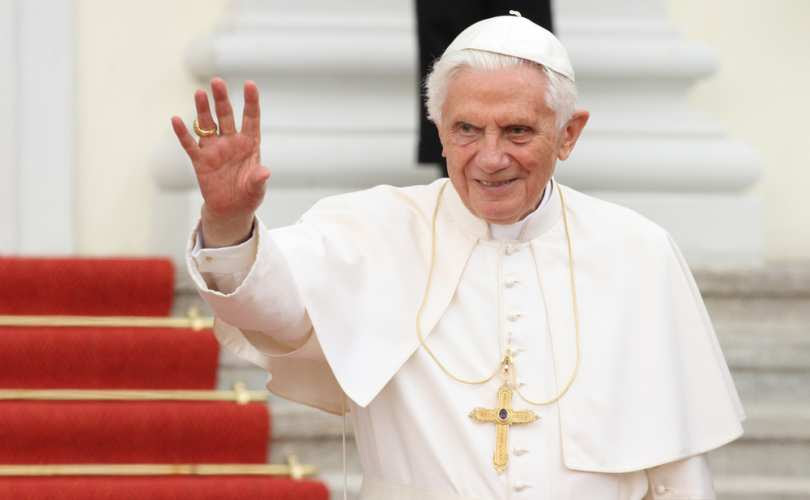
Benedict XVI: Erasing God from liturgy has put Church ‘in danger’

Benedict Xvi , Crisis In The Catholic Church , Liturgy , Summorum Pontificum , Vatican Ii

ROME, April 19, 2017 (LifeSiteNews) — A mistaken liturgical reform following Vatican II that emphasized human “activity and creativity” in place of giving “priority” to God has jeopardized the very existence of the Catholic Church, according to Pope Emeritus Benedict XVI.

“In such a situation, it becomes ever clearer that the existence of the Church lives on the just celebration of the liturgy, and that the Church is in danger when the primacy of God does not appear anymore in the liturgy, and therefore in life,” he wrote in the preface to the newly released Russian edition of the Opera Omnia (complete works) of Benedict XVI / Ratzinger.

“The deepest cause of the crisis that has subverted the Church is located in the effacing of the priority of God in the liturgy,” he added, according to a translation provided by Rorate Caeli.

Benedict, who just turned 90, said that the “absolute priority” that Catholics should give to attending mass over and above any other consideration has been lost.

“In the conscience of the men of today, the things of God — and with this the liturgy — do not appear urgent, in fact,” he said.

“There is urgency for every possible thing. The things of God do not ever seem urgent. […] If God is no longer important, the criteria to establish what is important are changed. Man, by setting God aside, submits his own self to constraints that render him a slave to material forces and that are therefore opposed to his dignity,” he added.

The Pope Emeritus said that he dedicated himself to the theme of the liturgy after witnessing after the Vatican II Council how a man-centered liturgy “led almost to forgetting of the presence of God.”

“I knew that the true renewal of the liturgy is a fundamental condition for the renewal of the Church,” he said.

It has now been 10 years since Benedict issued his motu proprio Summorum Pontificum, an edict that restored the use of the Traditional Latin Mass, allowing priests to use the ancient form without having to request permission from their bishop.

Cardinal Robert Sarah, prefect of the Congregation for Divine Worship, said in a March 31 address that Pope Benedict showed a path forward to rediscovering authentic liturgy by opening the door to the “extraordinary” form of the mass which he said the pope hoped would help “enrich” the ordinary form of the mass.

“Now, it is enough to pick up [Vatican II’s] Constitution on the Sacred Liturgy again and to read it honestly, without betraying its meaning, to see that the true purpose of the Second Vatican Council was not to start a reform that could become the occasion for a break with Tradition, but quite the contrary, to rediscover and to confirm Tradition in its deepest meaning,” Sarah said at that time.

“It must be reaffirmed that Vatican Council II never asked to make tabula rasa (blank slate) of the past and therefore to abandon the Missal said to be of Saint Pius V,” he added.

Sarah said that the liturgy called for by Vatican II has yet to be realized and many places in the world.

Following the lead provided by Pope Benedict in his Summorum Pontificum, Sarah said he would like to see the relaunch of a “liturgical movement.” Not one that is based on what he called the “ravings of some theologians who long for ‘novelties,’ but one based on a disposition towards discovering God in silence, adoration, and though a proper liturgical formation based on the teachings of the Church.

RELATED

Cardinal Sarah: Many Church leaders ‘underestimate the serious crisis that the Church is going through’​

Posted in Uncategorized | 1 Comment

MORE EVIDENCE POPE BENEDICT’S RESIGNATION WAS FORCED

WikiLeaks: Clinton, Obama, Soros Overthrew Pope Benedict In Vatican Coup
A GROUP OF CATHOLIC LAY LEADERS HAVE ASKED PRESIDENT TRUMP TO INVESTIGATE THEIR CLAIMS SOROS, OBAMA AND CLINTON ORGANIZED A VATICAN COUP TO INSTALL RADICAL LEFTIST POPE FRANCIS
February 1, 2017 Baxter Dmitry News, World 14
Soros, Obama and Clinton were behind a Vatican coup to remove conservative Pope Benedict and install radical leftist Pope Francis, claim Catholics leaders citing WikiLeaks and other evidence.

George Soros, Barack Obama and Hillary Clinton orchestrated a coup in the Vatican to overthrow the conservative Pope Benedict and replace him with radical leftist Pope Francis, according to a group of Catholic leaders citing evidence from various sources including WikiLeaks emails.

Pope Benedict XVI reigned as Pope of the Catholic Church from 2005 to 2013 before unexpectedly resigning in unusual circumstances. Becoming the first Pope to step down since Pope Gregory XII in 1415, Benedict is widely considered the first to do so on his own initiative since Pope Celestine V in 1294.

However the group of Catholic leaders cite new evidence uncovered in emails released by WikiLeaks to claim the conservative Pope Benedict did not actually resign on his own initiative, but was pushed out of the Vatican by a coup that the group of researchers are calling the “Catholic Spring.”

Soros, Obama and Clinton used the United States’ diplomatic machinery, political muscle, and financial power to coerce, bribe and blackmail “regime change” in the Roman Catholic Church in order to replace the conservative Benedict with the current Pope Francis – who has since become an unlikely mouthpiece for the international left, stunning Catholics around the world.

Now the group of Catholic leaders have sent a letter to President Trump urging him to launch an official investigation into the activities of George Soros, Barack Obama, Hillary Clinton (and others) who they allege were involved in orchestrating Catholic Spring that resulted in their goal of “regime change” in the Vatican.

The Catholic leaders cite eight specific questions they seek to have answered concerning suspect events that led to the resignation of Pope Benedict, the first papal abdication in 700 years.

“Specifically, we have reason to believe that a Vatican ‘regime change’ was engineered by the Obama administration,” say the petitioners, in their January 20 letter to President Trump.

“We were alarmed to discover,” their letter notes, “that, during the third year of the first term of the Obama administration your previous opponent, Secretary of State Hillary Clinton, and other government officials with whom she associated proposed a Catholic ‘revolution’ in which the final demise of what was left of the Catholic Church in America would be realized.”

The letter includes links to documents and news stories underscoring their claims. It first directs attention to the notorious Soros-Clinton-Podesta e-mails disclosed last year by WikiLeaks, in which Podesta and other progressives discussed regime change to remove what they described as the “middle ages dictatorship” in the Catholic Church.

Regarding the Podesta e-mails in question, The New American reported last October:

“Podesta, a longtime Clinton adviser/confidante and hand-picked top activist for left-wing funder George Soros, revealed in a 2011 e-mail that he and other activists were working to effect a “Catholic Spring” revolution within the Catholic Church, an obvious reference to the disastrous “Arab Spring” coups organized that same year by the Obama-Clinton-Soros team that destabilized the Middle East and brought radical Islamist regimes and terrorist groups to power in the region. The Podesta e-mail is a response to another Soros-funded radical — Sandy Newman, founder of the “progressive” Voices for Progress. Newman had written to Podesta seeking advice on the best way to “plant the seeds of the revolution” in the Catholic Church, which he described as a “middle ages [sic] dictatorship.”

In their letter to President Trump, the group of Catholics leaders write: “Approximately a year after this e-mail discussion, which was never intended to be made public, we find that Pope Benedict XVI abdicated under highly unusual circumstances and was replaced by a pope whose apparent mission is to provide a spiritual component to the radical ideological agenda of the international left. The Pontificate of Pope Francis has subsequently called into question its own legitimacy on a multitude of occasions.”

“We remain puzzled by the behavior of this ideologically charged Pope, whose mission seems to be one of advancing secular agendas of the left rather than guiding the Catholic Church in Her sacred mission,” they say, expressing the thoughts of millions of Catholics around the world stunned by Pope Francis’s left-wing ideology. “It is simply not the proper role of a Pope to be involved in politics to the point that he is considered to be the leader of the international left.”

They continue:

“With all of this in mind, and wishing the best for our country as well as for Catholics worldwide, we believe it to be the responsibility of loyal and informed United States Catholics to petition you to authorize an investigation into the following questions:

– To what end was the National Security Agency monitoring the conclave that elected Pope Francis?

– What other covert operations were carried out by US government operatives concerning the resignation of Pope Benedict or the conclave that elected Pope Francis?

– Did US government operatives have contact with the “Cardinal Danneels Mafia”?

– International monetary transactions with the Vatican were suspended during the last few days prior to the resignation of Pope Benedict. Were any U.S. Government agencies involved in this?

– Why were international monetary transactions resumed on February 12, 2013, the day after Benedict XVI announced his resignation? Was this pure coincidence?

– What actions, if any, were actually taken by John Podesta, Hillary Clinton, and others tied to the Obama administration who were involved in the discussion proposing the fomenting of a “Catholic Spring”?

– What was the purpose and nature of the secret meeting between Vice President Joseph Biden and Pope Benedict XVI at the Vatican on or about June 3, 2011?

– What roles were played by George Soros and other international financiers who may be currently residing in United States territory?”

The investigation the group of Catholic leaders is requesting of President Trump should be of interest to more than just Catholics. George Soros’s ability to co-opt leading political figures to assist his radical plans for nation states is well known; but his ability to force “regime change” in the Catholic church, an institution previously throught impenetrable from the outside, raises serious questions about his potential for global chaos. The investigation — and punishment — should begin at once.

About Latest Posts
Baxter Dmitry
Baxter Dmitry
Baxter Dmitry is a writer at Your News Wire. He covers politics, business and entertainment. Speaking truth to power since he learned to talk, Baxter has travelled in over 80 countries. Live without fear.
Email: baxter@yournewswire.com
Follow: @baxter_dmitry

Posted in Uncategorized | 1 Comment

THE MALTA MADNESS METASIZES

Pope Approves Order Barring Former Knights of Malta Grand Master From His Own Order’s Elections in Rome

FacebookGoogle+PinterestPocket

Over the past few months, we’ve covered the saga of the Sovereign Military Order of Malta rather extensively. If you’re unfamiliar with the main events surrounding this thousand-year-old chivalric Catholic order toppled by Pope Francis, this summary is probably the best place to start.

To recap: since that summary was written, several additional events of major significance have unfolded. In February, it was revealed that Cardinal Raymond Burke — who was appointed as Cardinal Patron of the Order in 2014 — found himself in the crosshairs of the same coup that ousted Grand Master Fra’ Matthew Festing and reinstated Albrecht von Boeselager. Boeselager was removed from the Knights of Malta at Festing’s command after an internal investigation reportedly determined that he was involved with the distribution of contraceptives through the Order’s international relief agency, Malteser International.

In an interview with an Austrian daily on February 15, acting Grand Master Ludwig Hoffman von Rumerstein blamed Cardinal Burke for Boeselager’s ouster — a charge which Cardinal Burke later referred to as “a calumny”.

It was also in February that we got the first official word that Archbishop Angelo Becciu, the pope’s newly-appointed delegate to the Order, would be taking over the duties of Cardinal Burke, supplanting (but not replacing) him as Cardinal Patron. It was the reinstated Grand Chancellor himself, Abrecht von Boeselager, who told the press that Becciu “has the full confidence of the Pope and is his spokesman … That means that Cardinal Burke as Cardinal Patron of the Order is now de facto suspended.” This suspension was confirmed by Burke himself earlier this month, when in an interview with Infovaticana he stated:

For the moment, I am completely removed from any involvement with the Order of Malta. While I retain the title of the Cardinal Patron, the Pope has made clear that the only person who can treat questions of the Order of Malta in the name of the Holy Father is Archbishop Becciu.

In March, an anonymous but allegedly highly-placed source within the Order of Malta sent a letter to Vaticanista Sandro Magister, detailing more of the possible financial motivations that may have been associated with the sudden and tumultuous change in power within the Order. Two days later, word it was revealed that the Austrian Catholic website Kath.net had received a cease-and-desist order in response to their reporting on the financial dealings of Albrecht von Boeselager as Grand Chancellor of the order. Although nothing else was made public, rumors of legal proceedings initiated against other members of the Catholic press by aggrieved members of the Order who appear not to want this story covered have also been circulating.

Also in March, our own Hilary White published a moving profile of the life of service of Fra’ Matthew Festing, the former Grand Master of the Knights of Malta. Around the same time, Festing granted an interview to Dan Hitchens of the Catholic Herald, in which he revealed part of a conversation he had with Pope Francis after he was asked by the pontiff to resign his position with the Order:

“I said, ‘Can I ask you a hypothetical question?’ He said yes. And I said, ‘Hypothetically, what would happen if I was re-elected?’ He thought for a moment and said, well, that would be all right.”

As the Herald reported at the time:

The Council Complete of State, comprising about 60 members, meets to elect a new grand master on April 29. It is not inconceivable that Festing could be re-appointed. He says he’s happy to do whatever the order asks of him: “If they want me, they want me, and if they don’t, they don’t.” He adds: “I have no intention of running a campaign. However, if they re-elect me, I would have to consider agreeing to it.”

But that was then. It would appear that certain factions within the Order — possibly the very same ones seeking to silence Catholic journalists poking around where they aren’t wanted — have managed yet another coup against Festing. From Edward Pentin at the National Catholic Register:

In a surprising move, Pope Francis’ special delegate to the Order of Malta has instructed Fra’ Matthew Festing, the Order’s former Grand Master, not to travel to Rome for the election of his successor.

In a letter dated April 15 (see below), Archbishop Angelo Becciu said that many of the Order had “expressed their wish” that Fra’ Festing not travel to Rome for the election on April 29 as they felt his presence would “reopen wounds” and prevent a return to harmony following the dispute earlier this year regarding the dismissal and later reinstatement of Albrecht von Boeselager as Grand Chancellor.

The archbishop said he had “shared the decision with the Holy Father” and that he should therefore forego his trip to Rome “as an act of obedience.”

Sandro Magister writes that the letter is “glaring proof of the exercise of” the “full powers” granted to Archbishop Becciu as Special Delegate and “exclusive spokesman” for the pope to the Order.

Festing, for his part, has yet to say a public word on the matter. As Hilary White’s profile of the man suggests, he is not now, nor has he ever been, interested in power. But he is a man dedicated to the service of the poor and the sick — as well as the teachings of the Church. If the former attribute seems as though it should have been certain to put him on the pope’s list of favored sons, the latter, sadly, may be the very thing that has seen him stricken from it.

Posted in Uncategorized | 4 Comments

EUROPE’S LONG SLOW DEATH BEGAN AT OSWIECIM AND IS IN ITS FINAL STAGES

Image result for photo of entrance to auschwitz

The Entrance Gate to the Auschwitz Extermination Camp

(Who and what really died at Auschwitz? Here’s an interesting
viewpoint. The following is a copy of an article written by Spanish writer Sebastian Vivar Rodriguez and published in a Spanish newspaper. It doesn’t take much imagination to extrapolate the message to the rest of Europe – and possibly to the rest of the world.)


Who Really died at Auschwitz?

by Sebastian Vivar Rodriguez

GENTIIUNO

11 November 04

Walking down the streets in Barcelona, I suddenly discovered a terrible truth
Europe died in Auschwitz . . .
We killed six million Jews and replaced them with 20 million Muslims. In Auschwitz we burned a group of people who represented culture, thought, creativity, talent. We destroyed the chosen people, truly chosen, because they produced great and wonderful people who made great contributions, and thus changed the world.

The contribution of today’s Jewish people is felt in all areas of life: science, art, international trade, and above all, as the conscience of the world. Look at any donors’ board at any symphony, art museum, theater, art gallery, science center, etc. You will see many many Jewish surnames. These are the people who were burned. Of the
6,000,000 who died, how many would have grown up to be gifted musicians, doctors, artists, philanthropists?

And now under the pretense of tolerance, and because we wanted to prove to ourselves that we were cured of the diseases of racism and bigotry, Europe opened our doors to 20 million Muslims, who brought us stupidity and ignorance, religious extremism and lack of tolerance, crime and poverty, due to an unwillingness to work and support their
families with pride.

They have blown up our trains and turned our beautiful Spanish cities into the third world, drowning in filth and crime. Shut up in the apartments they receive free from the government, they plan the murder and destruction of their naive hosts.

And thus, in our misery, we have exchanged culture for fanatical hatred, creative skill for destructive skill, intelligence for backwardness and superstition. We have exchanged the pursuit of peace of the Jews of Europe and their talent for a better future for their children, and their determined clinging to life because life is holy, for those who pursue death, for people consumed by the desire for death for themselves and others, for our children and theirs.

What a terrible mistake was made by a miserable Europe.

Recently, the UK debated whether to remove The Holocaust from its school curriculum because it ‘offends’ the Muslim population that claims it never occurred. It is not removed as yet, but this is a frightening portent of the fear that is gripping the world and how easily each country is giving in to it.

It is now approximately seventy years after the Second World War in Europe ended.
This e-mail is being sent as a memorial chain, in memory of the six million Jews, twenty million Russians, ten million Christians, and nineteen-hundred Catholic priests who were ‘murdered, raped, burned, starved, beaten, experimented on and humiliated. Now,
more than ever, with Iran, among others, claiming the Holocaust to be ‘a myth,’ it is imperative to make sure the world “never forgets.”

This e-mail is intended to reach 400 million people. Be a link in the memorial chain and help distribute this around the world.

How many years will it be before the attack on the World Trade Center ‘NEVER HAPPENED’ because it offends some Muslim in the United States? If our Judeo-Christian heritage is offensive to Muslims, they should pack up and move to Iran, Iraq or some other Muslim country

Posted in Uncategorized | Comments Off on EUROPE’S LONG SLOW DEATH BEGAN AT OSWIECIM AND IS IN ITS FINAL STAGES

ANTI-CATHOLIISM IS ALWAYS LURKING UNDER THE BLACK ROBES OF SOME SCOTUS JUSTICES, EVEN THE CINO’S

ANALYSIS

The Key Questions, Comments From Supreme Court Justices in Religious Liberty Case

The Supreme Court heard oral arguments on Wednesday in a religious liberty case between a Lutheran church and the state of Missouri. (Photo: iStock Photos)

On Wednesday morning, the Supreme Court heard oral arguments in Trinity Lutheran Church’s case against the state of Missouri—a case involving discrimination by the state in giving out publicly funded grants.

Missouri has a grant program to offset the cost of resurfacing playgrounds with rubber surfaces made from recycled tires. This helps the state reduce the number of tires in its landfills and make playgrounds safer for kids.

Trinity Lutheran Church applied for a grant to resurface its preschool playground. Though its application met all the neutral criteria and was rated highly, Missouri denied that application solely because it came from a church.

The state claims that its constitution required it to reject the church’s request because of a “no aid” provision that prevents public money from going to churches. More than three dozen states have similar laws (known as Blaine Amendments), which were enacted during the 19th century to single out Catholic immigrants for disfavored treatment.

Trinity Lutheran Church argues that using state funds to ensure its playground is safe for kids is a completely secular purpose and the state’s actions demonstrate a hostility to religion.

Courtroom Arguments

At the argument, lawyers for both sides faced a very active bench. The justices were talking over each other, trying to get in as many questions as they could in the allotted argument time.

It’s no wonder—the justices had a lot of time to think about this case, since they granted review in January 2016 and appeared to hold off in hearing the case until a ninth justice was confirmed.

Right off the bat, Justice Ruth Bader Ginsburg asked David Cortman, an attorney from Alliance Defending Freedom representing Trinity Lutheran, why a 1947 case saying states don’t have to fund the building of churches doesn’t dispose of this case.

Cortman answered that the court also said states cannot deprive churches of government benefits, and that’s just what Missouri did here. He explained that the justices should look at where the money would be going—to a secular activity.

When Justice Elena Kagan analogized this to a program to put computers in religious schools, Cortman said that this case is easier to decide because unlike computers, a playground doesn’t enable any religious activity.

Justice Sonia Sotomayor brought up the court’s recognition of space between the Establishment and the Free Exercise Clauses that allows states some “play in the joints.” She mentioned that Blaine Amendments—which she called an “admirable tradition” in our nation—prohibit public funds from going to churches.

Justice Samuel Alito asked Cortman if he agreed with Sotomayor that Blaine Amendments reflect an admirable tradition. Cortman emphatically said no, highlighting the anti-Catholic bigotry that animated the passage of many of these laws.

Kagan then asked if Missouri’s action falls within this space between the two clauses.

Cortman explained that while states have tremendous leeway in how they set up programs such as this (e.g. only for public schools), Missouri was clearly singling out churches for disfavored treatment—something the “play in the joints” does not allow.

Some of the justices were clearly concerned about how far states could take these “no aid” provisions. Justice Stephen Breyer repeatedly pressed the lawyer representing Missouri, James Layton, on whether states could decline to offer police and fire protection to churches.

Layton explained that since those benefits are offered to everyone, there wouldn’t be a concern about the state getting entangled in the business of a church or being seen as endorsing a church (both aspects of the Supreme Court’s convoluted Establishment Clause jurisprudence).

In selective programs, such as the recycled tire grant program, Layton maintained that the state could make the decision to exclude churches in order to sidestep any Establishment Clause concerns.

Breyer asked about crossing guards, since they aren’t placed everywhere, and Layton simply said this case is different because it involves physical improvement to the church’s property.

Alito asked whether the state could disqualify religious students from a scholarship program based on academic credentials after the fact if too many religious students were earning the scholarship. Layton admitted that would pose an equal protection problem.

Chief Justice John Roberts asked if the state could offer tours of its capitol building to student groups, but exclude groups from religious schools. Layton replied that this would be another example of a universal benefit, so the state’s concerns about entanglement with a church would not be valid.

Justice Neil Gorsuch came back to this universal/selective distinction later, asking why discrimination based on religious status is permissible in a selective program, but not in a universal program.

Layton fell back on the claim that since this involved a physical improvement to Trinity Lutheran’s property, it’s on the wrong side of the line and looks like state endorsement of religion.

Kagan pointed out that the state’s entanglement and endorsement concerns would need to rise to a high level in order to burden the constitutional rights of its citizens, as it did with Trinity Lutheran.

In his brief rebuttal, Cortman pointed out that there is no endorsement problem here because the state set out neutral, secular criteria for its grant program—criteria that Trinity Lutheran met.

He also took issue with the state’s characterization that giving a one-time grant to the church would constitute entanglement. He explained that entanglement requires the state’s ongoing, intrusive involvement with a church—something that simply would not occur if Trinity Lutheran received this grant.

An issue lingering in the background was the Missouri governor’s eleventh hour decision to announce on Facebook that going forward, he will not exclude churches from this grant program.

This would not, however, change the outcome for Trinity Lutheran. The church could apply for the grant a second time, but there are no guarantees that the governor won’t change his mind in the future.

So, that’s not enough for the Supreme Court to choose not to decide this case.

Next Steps

Now, the justices will deliberate and issue an opinion by the end of the court’s term in June.

Based on the questions at argument today, a number of the justices appeared to be concerned about the state’s lack of a limiting principle on excluding religiously affiliated groups from state grant programs.

If Trinity Lutheran wins the day, it will be a signal to states that they may not discriminate against churches under the guise of Blaine Amendments.

TRENDING

Powered by Revcontent
College May Punish Students Who Disrupted Conservative’s Speech
Conservatives Coalesce Around Obamacare Replacement Plan
Conservatives Are Flooding Town Halls, Too

https://googleads.g.doubleclick.net/pagead/viewthroughconversion/975702554/?random=1492697230433&cv=8&fst=1492697230433&num=1&fmt=1&guid=ON&u_h=1440&u_w=2560&u_ah=1338&u_aw=2560&u_cd=24&u_his=2&u_tz=-300&u_java=true&u_nplug=1&u_nmime=25&frm=0&url=http%3A%2F%2Fdailysignal.com%2F2017%2F04%2F19%2Fsupreme-court-hears-arguments-in-religious-liberty-case%2F&tiba=What%20Was%20Said%20in%20Religious%20Liberty%20Supreme%20Court%20Case

Posted in Uncategorized | Comments Off on ANTI-CATHOLIISM IS ALWAYS LURKING UNDER THE BLACK ROBES OF SOME SCOTUS JUSTICES, EVEN THE CINO’S

IN THE “YEAR OF LUTHER” A GERMAN EX-EVANGELICAL WARNS US


A Non-Catholic German Warns Against Protestantization of Catholicism

Google+PinterestPocket

In the wake of a recent critical overview of the four years of Pope Francis’ papacy as presented by the German Catholic journalist Matthias Matussek, another German journalist (who is not a Catholic) has now raised his voice of resistance with respect to Pope Francis. We speak here about Jan Fleischhauer, who is an editor of the influential secular weekly magazine Der Spiegel, and who, in 2009, wrote a book about his change of conviction away from a leftist to a more conservative viewpoint.

On 17 April, Fleischhauer published a column in Der Spiegel which is entitled “Self-Secularization: The Sponti-Pope [i.e., the spontaneous Leftie Pope] ” (“Selbstsäkularisierung: Der Sponti-Papst”). With its subtitle, the author already indicates what he criticizes the current pontiff for:

Among Church critics, Pope Francis is much appreciated due to his pandering to the zeitgeist. Unfortunately, he thereby repeats the mistakes which the evangelical church has already committed.

Fleischhauer himself knows what he is speaking of here, because he himself was for many years a member of the Evangelical Church in Germany – mainly for political reasons. However, he later left the Protestant church and now describes himself only as a conservative. But he now also shows some admiration for the unmodernized Catholic Church when he writes:

The only Church which one can take seriously is the Catholic Church. I know that this sentence is for many readers an imposition, and I am also sorry that, of all years, I have to write this sentence in the Luther Year [of 2017].

Especially because he has seen some of the gravely defective adaptations of the Protestant church to the zeitgeist of his time, Fleischhauer now regrets that Pope Francis is now leading the Catholic Church into a similar ethos and direction. First, he describes his own admiration for the Catholic Church when he says that

Everything that critics bemoan about the Catholic Church – the Marian devotion, the cult of the Saints, the priesthood, the liturgy – is what, in my eyes, speaks for Catholicism. In addition, of course, to the length of time: an institution which is 2,000 years old has to be taken more seriously than one, let’s say, that is only 500 years old. Whoever was there first as Church, clearly has, when one deals with the last questions, the first position. Everything that [innovatively] comes later is, up to a certain point, heresy.

When speaking about his own final leaving of the Evangelical Church in Germany – at the moment of his own analogous change of political views – Fleischhauer explains just how weak the spiritual roots of Protestantism actually are:

Since the spiritual roots of Protestantism are thin, there is little that holds one back if one changes one’s worldview. A church in which not even the very existence of Heaven and Hell is binding becomes – for everyone who could only be kept in [the church] with the help of faith – a lost cause.

It is here that Fleischhauer sees that Pope Francis is now committing a comparably grave mistake:

If I am not mistaken, then, the Catholic Church is right now repeating the mistake of the Protestants. At its peak stands a man who shows a strange disdain for everything gradually grown and rootedly traditional and who enjoys surprising the Church people with thrown-down follies and jokes.

The German journalist then makes the explicit reference to Matthias Matussek’s own recent “fulminating text” and says that the Catholic Matussek “understands much about the importance of Dogma as a dam against the relativizations of the zeitgeist.” Fleischhauer places Matussek next to the German author Martin Mosebach, “another great Catholic reactionary.”

It seems that Fleischhauer understands more about what has happened to the Catholic Church since the Second Vatican Council than many Catholics of today, as he attempts to explain:

One could, if one wishes, see in [Pope] Francis the perfecter of a development which started with the Second Vatican Council. The first blow was taken against the liturgy between 1962 and 1965 – not accidentally a decade in which everywhere in the world the iconoclasts leaped greatly forward.

Here we Catholics are being rightly instructed by a German journalist as to how the Catholic Church removed “important elements of the centuries-old rite” because “she wanted to adapt to the zeitgeist”: “Priests no longer stood before the altar, but behind it, like behind a moderator’s table of the “Tagesthemen” [a German TV news show].” He also mentions here the thorough removal of the Latin language and the dubious permission of Communion in the hand. Piercingly, Fleischhauer adds:

Where they also took it especially seriously with the change of times, the clergymen themselves dragged the altars into the fields and chopped the Saints’ statues into pieces. For those without faith, these things might appear to be minor things, but, of course, it is not. Whoever has once assisted at a Mass in the old Tridentine Rite knows what the Church has lost when she succumbed to the 68-rush [cultural revolution of the 1960s].

Fleischhauer makes a prediction for the future of the Catholic Church, namely: if she follows the road the Protestants have taken, she will lose Church members and, consequently, will then consider adapting even more so to the zeitgeist in order to be purportedly more attractive. In the end, says the German journalist, the Catholic Church will have the same dilemma as the Protestants: “If the Church dissolves that which differentiates her from those other secular offers professing to give life a meaning – why then is the church still needed?” It is in this context that Fleischhauer sees the growth of Islam in the world which seems to move into the vacuum and to “fulfill spiritual needs better than the Christian competitor.”

This article written by Jan Fleischhauer is an uplifting as well as sobering event. It shows to us how elements of truth will always find their way into the minds of honest people. We have seemingly come to a point where modern man is becoming tired of the pervasive relativism – and its accompanying ideologies – for, they do not correspond to reality. Man has a thirst for the true, the trustworthy binding, and the beautiful. The modern world has mostly produced ugliness, loneliness and a lack of love.

Is it not time for all of us – inside and outside the Catholic Church – to make an effort to free ourselves cooperatively, to come out from under the “rubble” and thereby to find the way back to the deeper sources of trust and joy which can only be found in and through Jesus Christ Our Savior – and in His Sacramental Church?

Print Friendly
Posted in Uncategorized | Comments Off on IN THE “YEAR OF LUTHER” A GERMAN EX-EVANGELICAL WARNS US

TILTING AT THE SOCIAL JUSTICE WINDMILL AT THE EASTER VIGIL

aka Catholic, Amoris Laetitia, Eyes Opened

Francis’ Easter Vigil Sermon: Forgetting the Supernatural as Usual

Francis’ Easter Vigil Sermon: Forgetting the Supernatural as Usual

This sermon is a prime example of the social justice platform.

As his sermon for the Easter Vigil makes plain, not even the Resurrection of Our Lord from the dead is capable of unmooring Francis’ thoughts from the temporal concerns of almighty mankind.

Commenting upon “Mary Magdalene and the other Mary” who went to Jesus’ tomb only to discover that He is risen, Francis saw fit to rattle off an all-too-familiar laundry list of social injustices:

“In their faces we can see reflected all those who, walking the streets of our cities, feel the pain of dire poverty, the sorrow born of exploitation and human trafficking.  We can also see the faces of those who are greeted with contempt because they are immigrants, deprived of country, house and family.  We see faces whose eyes bespeak loneliness and abandonment, because their hands are creased with wrinkles.  Their faces mirror the faces of women, mothers, who weep as they see the lives of their children crushed by massive corruption that strips them of their rights and shatters their dreams.”

Poverty, exploitation, human trafficking, immigration, loneliness, abandonment, corruption…  

Nowhere reflected in his sermon was even a modicum of concern for the supernatural ends for which man was created; much less any sense of the true significance of the Lord’s resurrection.

Francis went on to say:

“By daily acts of selfishness that crucify and then bury people’s hopes.  By paralyzing and barren bureaucracies that stand in the way of change.  In their grief, those two women reflect the faces of all those who, walking the streets of our cities, behold human dignity crucified.” [Emphasis added.]

How very clever; stealing words from the language of our Lord’s Passion for use as metaphorical expressions that seek to recast the meaning of Easter into the planks of a political platform; as if the Sacrifice of Christ is ordered toward nothing more than the elimination of social inequality.

I, for one, find this repulsive.

It sickens me in a way similar to those occasions when Barack Obama would cite Sacred Scripture; striking the image of a man treading on foreign soil, pretending to be a citizen, but only as a means to an end.

That is not to say that Francis is altogether unconcerned with Church related matters.

On the contrary, he is deeply concerned about such things; albeit in the manner of a politician.

And so he took the occasion of the Easter vigil to campaign against the opposition party:

“When the High Priest and the religious leaders, in collusion with the Romans, believed that they could calculate everything, that the final word had been spoken and that it was up to them to apply it, God suddenly breaks in, upsets all the rules and offers new possibilities.”

Can there be any doubt that Francis was speaking not of the Pharisees of old, but rather of those in our day who take the Divine Law, the immutable doctrines of the Faith and the bi-millennial practice of the Church seriously; i.e., rigid Catholics like us who believe that “the final word” has indeed been spoken in precisely those matters that the false “god of surprises” (aka Jorge Bergoglio) seeks to upset in Amoris Laetitia?

Truly, with every passing day it seems that the mountain of evidence attesting to the utter lack of Catholic faith in this man somehow manages to grow larger.

As the title to this post suggests, Francis is nothing if not clear and consistent.

Read the full article at aka Catholic

Posted in Uncategorized | Comments Off on TILTING AT THE SOCIAL JUSTICE WINDMILL AT THE EASTER VIGIL