GOD SAID TO ME: “RIGHT ARM !!!”


Way back in the 1960’s when I was a priest of the Archdiocese of Miami I would frequently go fishing with a friend in the Gulf Stream off of Miami Beach.

We would fish for dolphinfish aka mahi mahi aka dorado.

Comparison of a bottlenose dolphin, one of the most popular ocean animals, versus the similarly-named  dolphinfish, one of the most popular restaurant items, and the dolphinfish's closest relative, the Pompano dolphin. Images are not to scale.
Comparison of a bottlenose dolphin, one of the most popular ocean animals, versus the similarly-named dolphinfish, one of the most popular restaurant items, and the dolphinfish’s closest relative, the Pompano dolphin. Images are not to scale

We were trolling dead ballyhoo for bait:

Ballyhoo/Balao

Name
The ballyhoo or bally, Hemiramphus brasiliensis, is a baitfish of the halfbeak family (Hemiramphidae). It is similar to the Balao halfbeak. Ballyhoo are frequently used as cut bait and for trolling purposes by saltwater sportsmen.
Ballyhoo can also be seen above the waters skimming the surface to escape from their predators. The appearance is similar to skipping stones on the water.
 
Appearance
This fish is a species of Halfbeak and has a silver body with green and black on it back and darker fins. As you can see this fish has a “beak” that sticks out quite far. In fact, this “beak” can make up almost 20% of its total body length. This fish is often found in the Gulf of Mexico and will have a bit of red on its tail. It is used to catch all kinds of saltwater game fish including Mahi Mahi (Dolphin fish) Marlin,Sailfish, Mackerel, Tarpon and many others.
We had caught nothing but mackerel up to that point when my friends said: “With this next troll I am going to catch a marlin.”
I responded:  “Right on!”
He looked at me quizzically and asked:  “What about my right arm?”
I responded:  “I did not say anything about your right arm !!!”
He responded with a little annoyance:  “Yes you did.  I said I was going to catch a marlin and you said, ‘right arm’ ” !!!
Now you have to understand that in the 1960’s America was experiencing the revolutionary activities of the Black Panther Movement and the Weather Underground.  Because I have always been very interested in politics and political movements I was quite familiar with the slang or jargon that members of the Black Panther movement used when speaking among themselves.  Their use of the expression “right on” had been adopted by them as an expression of affirmation or agreement when speaking among themselves.  It was not long before black rap artists incorporated the expression in their music.

My friend was probably not as familiar with black sub-culture in our society as I was and so when I used the slang expression, “Right on,” he heard “Right arm”

After I explained all this to him we had a good laugh.
My friend and I have exchanged email messages almost weekly since email became popular as a means of communication.  Sometimes our email content is serious for frequently it is humorous.  Sometimes it is simply a cartoon or a video.  If we particularly like what was sent, we respond with just two words:  “Right arm !!!”
As I wrote in my post describing my meditation on Tuesday, April 11  http://wp.me/px5Zw-6bn  the Holy Spirit spoke shouted quite loudly in the ear of my soul a word, just one word.  That has happen to me on several occasions in the past three years and so I have learned to pay attention.
The word the Holy Sprit imprinted so forcefully in my conscious meditation was:
magnopere
I did not recognize the word.  It did have a certain Latin appearance and it invited a Latin pronunciation.
It was not until later, after my meditation that I had an opportunity to look up the word on Google.  I learned that it was indeed a Latin word, an adverb, which lent it self to a variety of uses as I reported on my April 11 post.  All of the citations given on Google basically used magnopere to express approval  and encouragement.
It seems to clear to me that was telling me “right arm” with regard to my intuition that I should in the future focus more on the unity between the institution of the Eucharist and the passion, death and resurrection of Our Lord Jesus Christ without downplaying in any way the redemption from sin which was accomplished on Calvary.
Not the Eucharist as the making present in the Holy Sacrifice of the Mass the Holy Sacrifice of Calvary, but the Eucharist as intrinsically united with the passion, death and resurrection in revealing to us
what we should love, who we should love, how we should love and why we should love.
At a time when mercy is being exalted as the end all and being all of the Incarnation of Jesus Christ, we must return to the clarity of the Gospel of Saint John:
God is love !!!


Posted in Uncategorized | 5 Comments

HOMILY FOR THE SOLEMNITY OF EASTER

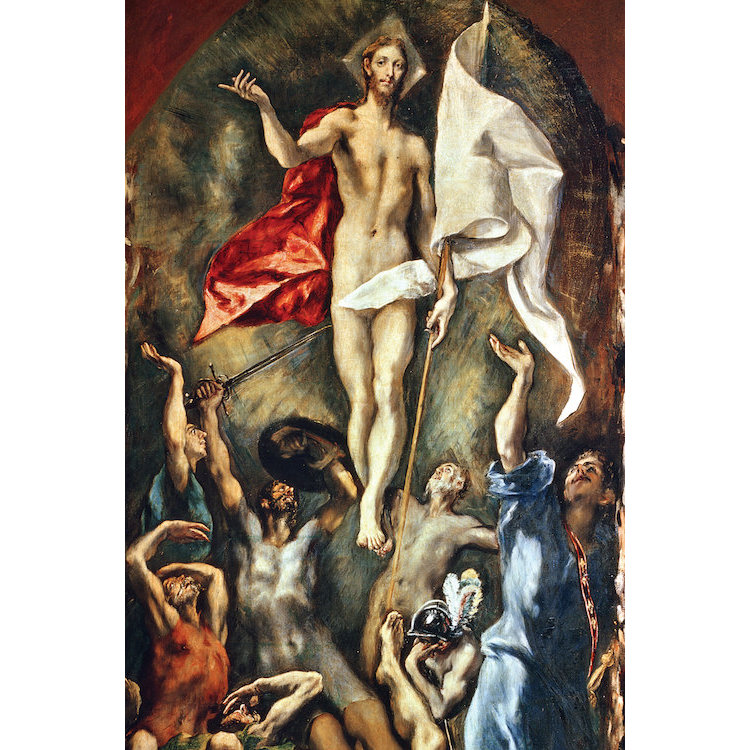
Image result for el greco painting the resurrection

The Resurrection by El Greco

HOMILY FOR THE SOLEMNITY EASTER

16 APRIL 17

BISHOP RENE HENRY GRACIDA

O God,

who on this day,

through your Only Begotten Son,

have conquered death
and unlocked for us the path to eternity,

grant, we pray, that we who keep

the solemnity of the Lord’s Resurrection

may, through the renewal brought by your Spirit,

rise up in the light of life.

Through our Lord Jesus Christ, your Son,

who lives and reigns with you in the unity 

of the Holy Spirit,

one God, forever and ever.

Amen!

(The Collect )

Pope Benedict XVI has provided me with the perfect introduction for this homily.

Faith in the Resurrection of Jesus says that  there is a future for every human being, the cry for unending life which is a part of the person is indeed answered.

Through Jesus we do know ‘the room where the exiled love lays down its victory’

He himself is this place, and he calls us to be with him and in dependence on him.  He calls us to keep this place open within the world so that he, the exiled love, may reappear over and over in the world…

God exists: that is the real message of Easter. Anyone who even begins to grasp what this means also knows what it means to be redeemed.


It is customary to keep the focus of Easter on this  truth:

Christ’s Resurrection =   Our Redemption.

But to keep the focus beyond Easter Sunday solely on redemption is to loose sight of the fundamental reason for Jesus’s act of redemption.

The fundamental cause was not sin.  Yes, it was sin that was erased, not only the sin of our first parents but ALL SIN that denies us the possibility of attaining eternal life with God.

But more than the erasure of sin was accomplished by Jesus in his passion, death and resurrection.

He, the ‘exiled love’, by his passion, death and resurrection showed us:

WHO to love, WHAT to love and HOW to love.

We know that what we are to love WHAT is good and what we are to avoid WHAT is evil. We can know what is good if we are guided by natural law given by God to every creature. It is more easily known by humans because our five senses are guided by our intellect and will.

We know what is evil in general but we do not know it  by natural law in specific instances unaided by our conscience.  As Saint John tells us in his gospel and epistle, Jesus Christ is the light that enlightens every man who comes into this world.  It is clear than many, if not most people have blinded themselves to the light that Jesus the creator has given to everyone who comes into this world.

It is that light that can show us what is good and what is evil.

Since man stands at the pinnacle of God’s creation because of his being in the image and likeness to God in his ability to know and to will with regard to what he knows, unlike the rest of creation which is governed by physical laws of nature and by instincts.

And finally, that light shows us who to love.   God created man so that the love which exists in the Trinity of Persons in God, which is the creative force bringing into existence a creature made in the image and likeness of God can love.  Man can radiate back to God that love which was the cause of man’s very existence.  Man does that by loving God and by loving other persons who are themselves sharing in God’s love.

So what is the problem?

The problem is that before the coming of Jesus Christ man seemed to fail more than succeed, man loved everything but God. Jesus Christ showed man who what and how to love!

In the Fifteenth Chapter of the Gospel according to Saint John, Jesus said to us:

“This is my commandment, that you love one another as I have loved you.  Greater love has no man than this, that a man lay down his life for his friends.”

There is a church tradition, which says, that when John was evidently an old man in Ephesus (93 years old?), he had to be carried to the church in the arms of his disciples.  At these meetings, he was accustomed to say nothing more than, “Little children, love one another!”  After a time, the disciples wearied at always hearing the same words, and so they asked John “Master, why do you always say this?” Saint John replied: “It is the Lord’s command; and if this alone be done, it is enough!”

So what is the problem?  Why don’t we love one another as Saint John commands us,     as Jesus commands us, as Jesus set the example himself for us to follow.

The problem begins with the way we love ourselves.  We cannot love others if we do not first love ourself in the right way.  One extreme example of the wrong way is the problem those have a narcissistic personality, characterized by excessive admiration for oneself.   Another bad example in the other extreme is the person who thinks himself to be worthless.

Another problem is the person who cannot forgive another person for real or imagined wrongs.  Children will not speak with siblings; husband and wife will not speak with one another.  One or the other will retaliate, sometimes for years by withholding tenderness and affection to their spouse.

It is hard to imagine how people can live for years estranged from those they have loved in the past and are bound to imitate Jesus Christ by the sacraments the have received.  Imitate Jesus Christ who died not only for our sins but to show us by example what love is really all about by forgiving those who crucified him.

It is hard to love a burning bush, a pillar of fire, a gentle breeze.  Perhaps that is why the Israelites strayed so often from the worship of the God of Abraham, Isaac and Jacob, because they yearned to see God but it was not until Jesus Christ came to them that they could see God because of, and in spite of, Jesus’ humanity

 Jesus Christ has given us something corresponding to our own humanity in his gift to us of his body and blood in the Eucharist. It is easier to love him since he does present himself to our human senses as a pure spirit.

Easter does not consist only of the Passion, Death and Resurrection of Jesus Christ.  Easter includes also the Last Supper and the institution of the Eucharist.                          Out of love for us Jesus Christ offers up himself on the Cross and he rises up from the dead.  But before he does this he give us Sacrament of his Body and Blood so that after he ascends to the Father, he will still be both physically and spiritually present to us and thus make easier for humans to love and be united with him in love, body, soul and divinity

 Almighty God,

Eternal Father, 

through the passion, death and resurrection of your Son,

Our Lord Jesus Christ, 

you restored the possibility of our gaining eternal life in you which was lost in the garden of Eden.

But in addition to that your Son taught us through that same passion, death and resurrection the divine nature of love and of  the necessity and possibility of our sharing in that love by doing as he commanded us.

Grant that we, who have participated in these holy mysteries this past week may receive and cooperate with the graces you give us to live and love in Christ.

Through the same Jesus Christ, your Son, who lives and reigns with you and the Holy Spirit, one God, forever and ever !

Amen !

Magnopere !

Posted in Uncategorized | 3 Comments

A HOLY SATURDAY REFLECTION ON GOOD FRIDAY


Good Friday Catholicism

 The sky was overcast, steel-gray clouds admitting only a few rays of light as I ascended the hill. It looked like rain, but none had yet broken loose. I walked slowly, uncertain of my destination, but somehow compelled to move forward.

It was then that I saw them: three crosses, aligned in silhouette at the crest of my path. As I approached, my focus narrowed to the center of the spectacle, the crucifix of Christ. His sacred body hung there, limp, apparently already dead. There was nobody else in sight. There wasn’t a breeze or the sound of a bird. Total stillness. Death hung heavy on that place.

As I drew close to the foot of the cross, looking up at my Lord, He pitched forward somehow, coming loose from the nails that bound Him there. As He fell, I rushed to catch Him, thinking only of preserving His precious body from touching the ground. I made it in time, and as I held Him cradled in my arms, He awoke, looking up into my eyes.

“You have to put me back.” He said.

And then I woke up.

I had this dream twenty-one years ago. I was just a teenager then, but I still remember it in fairly vivid detail, and even now while committing it to writing, I find that my eyes have filled with tears. It was a profound and moving experience. And it was the only dream I’ve ever had of its kind. I’ve always suspected that it was more than just a normal dream. That it was a prompting. I’ve spent a good portion of my life trying to understand what it means, and the only thing I can tell you for certain is this:

Christ without the cross is meaningless. So is the cross without Christ. Only together do they signify the true meaning — and cost — of our salvation.

As we processed around the parish yesterday, palms in hand, I realized I should make an explanation to my eight-year-old son why we have Palm Sunday. I whispered to him about Christ entering Jerusalem while the people threw down palms like a red carpet, welcoming Him to the city as a king. And how, less than a week later, they all called for Him to be crucified.

“But why?” He asked, a look of puzzlement on his face.

“I don’t know. Why do we commit the same sins right after we leave confession?” I asked him. People are sinful. Fickle. Ungrateful. Undeserving. All of us are Palm Sunday Catholics. We praise and welcome our Divine King. We celebrate Him and tell others of His glory.

And then we betray Him. Again. And again. And again.

We like being Palm Sunday Catholics. We like being Easter Catholics. We have, in many of our churches, replaced Christ on the cross with something strange and unnerving: the “resurrectifix” – an idol — for it is a graven image of something other than the true God — of a risen Christ coming forth from the wood of the cross as though we can skip through His Passion and Death on Good Friday and fast forward to Easter Sunday.

But Easter without Good Friday is a non sequitur. A God who did not suffer torments and endure a cruel execution has not conquered sin and death and has no reason to emerge, victorious, from the tomb. So we, too, cannot expect the glorious resurrection of our own bodies and our entry into eternal beatitude if we do not first embrace the painful wood of the cross. To conquer death, we must first endure it. First, death to self and to sin. Then, death to the world and even many of its legitimate pleasures. Finally, physical death, with all of its pains, temptations, and griefs. This tri-fold immersion in death is easy to write about, but far more difficult to bear. For those who take on suffering willingly, however, there is available a consolation – a deep and profound joy.

I enter Holy Week looking back on my Lent with shame. I have failed to keep my commitments. I have failed to accomplish the spiritual growth I set out to achieve. I had grand ideas of what I would do and how it would benefit me and please God, and instead I have nothing to offer Him but a handful of broken promises, like so much ash slipping through my fingers. The stresses and difficulties of every day life broke me down. The ideals of virtue and fasting and spiritual reading and prayer gave way instead to vices and hunger and distraction and acedia. Even in the disciplines of Lent, I have failed my Lord. In the preparation of His resurrection, I have balked at the carrying of my cross. It was too hard. I had other things to do. Life was difficult enough – why should I have to take on more?

In my excuses and failings, I have demonstrated an even greater need for His death and resurrection. In my aborted attempts to be a good Christian, I have demonstrated my need for the true goodness of Christ. In my exercise of Palm Sunday Catholicism, I have displayed my need to be a Good Friday Catholic.

I believe that the dream I had when I was sixteen was a divine imperative of some kind. I’ve long believed that it was a calling, a mission, to help the world remember that Christ without the cross is meaningless. But it’s possible, I must now concede, that it was meant mostly for me. It’s conceivable that it wasn’t a command to go out and teach others to remember the crucified Christ.

Maybe it was something else. Maybe it was a warning for the sake of my own salvation: “You – YOU! – have to put me back. In your own heart. In your own life. In your own difficulties. Do not run from the cross.”

Christ knew what He had to do to fulfill His mission and accomplish our salvation. Do we? Do we believe in Good Friday Catholicism?

If Christ without the cross is meaningless, we have no choice but to say the same about a crossless Christianity.

Originally published on March 30, 2015.

Posted in Uncategorized | Comments Off on A HOLY SATURDAY REFLECTION ON GOOD FRIDAY

HE SHALL REVEAL HIS TRUTH FROM THE MOUTHS OF BABES

Shaun and Rhys Scott

http://www.godvine.com/2-Adorable-Toddlers-Sing-He-Arose-For-Easter-1509.html?utm_source=Crosswalk%20eCard%20Update


Posted in Uncategorized | Comments Off on HE SHALL REVEAL HIS TRUTH FROM THE MOUTHS OF BABES

GLORY BE TO THE FATHER AND TO THE SON AND TO THE HOLY SPIRIT

Photo of the Host in Argentina that is being investigated as possibly being a miraculous manifestation and confirmation of the presence of Jesus Christ’s body and blood.

+++++++++++++++++++++++++++++++++++++++++++++++++++++++++++++++++++++++++++
{There have been an increasing number of instances around the world in recent years of a consecrated Host that has begun to bleed and in some cases to show the presence of human flesh.  Several such cases have been investigated by a local bishop and then the investigation report was sent to the Congregation for the Doctrine of the Faith and the miraculous nature of the change in the consecrated Host was confirmed by Rome.  The Church mandates that the local bishop preserve and protect the consecrated host that is being investigated while the Congregation of the Doctrine of the Faith reviews the investigation report.  
We will never know in this life the reasons why Our Lord Jesus Christ causes these miraculous changes in a consecrated Host to occur.  Perhaps they are occurring in this time of crisis in the Church because Our Lord desires to give us such signs in order to strengthen our faith, not just faith in his real presence in body, soul and divinity in every consecrated Host, but faith also in his real presence in his Church in spite of the doctrinal confusion resulting from so many of the strange and conflicting statements being made by Jorge Mario (Francis) Bergolio who occupies the See of Peter.  
This week, Holy Week, every Catholic who has not recently gone to confession should do so now and should receive Holy Communion on Easter Sunday.  Having physical contact with the body, blood, soul and divinity of Jesus Christ in Holy Communion is the most perfect act of love of which we humans are capable while we remain here on earth.
+Rene Henry Gracida
++++++++++++++++++++++++++++++++++++++++++++++++++++++++++++++++++++++++++++
Buenos Aires, Argentina, Apr 13, 2017 / 12:43 am (CNA/EWTN News).- A bishop in the Argentine province in Santa Fe is investigating a Eucharistic host that appeared to bleed during adoration at a drug rehabilitation home.

Bishop Luis Fernandez of the Rafaela diocese announced that an investigation will be carried out to examine what took place earlier this week, when a group of young people were in Eucharistic adoration and saw a substance in the consecrated host that appeared to be blood.

On April 11, Tuesday of Holy Week, a group of young people were praying before the Blessed Sacrament at the San Miguel drug rehabilitation home in the Guemes neighborhood, when they noticed a change in the Eucharist.

Juan Ternengo, coordinator of San Miguel house, said that there was a “deep red color, coming out of the host, while the young people were singing and praying.”

According to the AICA news agency, when he learned what happened, Bishop Fernandez and Fr. Alcides Suppo went to the site.

The bishop was the one who removed the host from the location in order to proceed with the investigation.

A statement from the Diocese of Rafaela notes that “the Church in these cases and other similar ones asks that with prudence and moderation, the event be judged with the aim of shedding light and making certain what occurred.”

“Throughout history, the Church has received the testimony of the real and substantial presence of Jesus Christ in the Eucharist, in this unique form of manifestation. These cases have been neither common nor simple to discern.”

Therefore, the text states, “following the procedure recommended by the Church, the Body of Christ, our bishop has removed the host in question from public exposition, reserving it in an appropriate manner. In this way, the path of necessary discernment is begun so that at the proper time, the right conclusions are reached.”

“Whatever the outcome of such an investigation may be, we must use this time to renew our faith and devotion to the greatest miracle, the Real Presence of Jesus Christ in each celebration of the Mass,” the statement emphasized.

Once the investigation is concluded, its conclusions will be known, the diocese said.

“Meanwhile, prudence and respect are recommended for the case, the place, the persons who witnessed such an event, especially taking into account that this is a place that requires silence and sobriety as an important part of the process of those who live and work there.”
Posted in Uncategorized | 1 Comment

BRAVO, BISHOP ROBERT MORLINO, BISHOP OF MADISON, MAY YOUR TRIBE INCREASE

Bishop Morlino Calls for all to Receive Communion on Tongue While Kneeling

BISHOP MORLINO CALLS FOR ALL TO RECEIVE COMMUNION ON TONGUE WHILE KNEELING

FacebookSumoMe

http://cvote.it/2o8zCUL

For I have learnt for a fact that nothing so effectively obtains, retains and regains grace, as that we should always be found not high-minded before God, but filled with holy fear. –St. Bernard of Clairveux

Last evening, April 11, 2017, the Diocese of Madison joined with Bishop Morlino at the Chrism Mass. It was a glorious evening, with many of our priests in attendance.

During Bishop Morlino’s homily, he alluded to a recent March 31 address by Cardinal Sarah, the “Vatican Liturgy Chief” (Prefect of the Congregation for Divine Worship and the Discipline of the Sacraments). In his address, Cardinal Sarah was forthright in calling for a recognition of “the serious and profound crisis” which, since the Council, has affected the liturgy by placing man and not God at the center of worship:

“The serious crisis of faith, not only at the level of the Christian faithful but also and especially among many priests and bishops, has made us incapable of understanding the Eucharistic liturgy as a sacrifice, as identical to the act performed once and for all by Jesus Christ, making present the Sacrifice of the Cross in a non-bloody manner, throughout the Church, through different ages, places, peoples and nations,” he said.


“There is often a sacrilegious tendency to reduce the Holy Mass to a simple convivial meal, the celebration of a profane feast, the community’s celebration of itself, or even worse, a terrible diversion from the anguish of a life that no longer has meaning or from the fear of meeting God face to face, because His glance unveils and obliges us to look truly and unflinchingly at the ugliness of our interior life. But the Holy Mass is not a diversion. It is the living sacrifice of Christ who died on the cross to free us from sin and death, for the purpose of revealing the love and the glory of God the Father,” he added.

The notion that the Church is in crisis is not new. Pope Benedict XVI wrote, “I am convinced that the crisis in the Church that we are experiencing today is, to a large extent, due to the disintegration of the liturgy.”

In his Chrism Mass homily, Bishop Morlino highlighted the fact that the Catholic Church is very good at social issues at every level – Catholic organizations, dioceses, parishes and individuals – but, ours is a crisis of faith, revealed by less than 25% of Catholics attending Mass any longer (less than 5% in many parts of Europe). Where we are failing is in a lack of fervor in our faith, Bishop stated. This is most evident in how we, as priests, are offering the Mass, and how the faithful are praying the Mass.

Bishop Morlino went on to speak about “actuosa participatio” as being more about “actual participation” than “active participation.” Bishop lamented that we seem to feel everyone needs to be busy “doing something” at the Mass, when it is more important that we are deeply contemplating what is being done at the Mass … that God is made Present – Body, Blood, Soul and Divinity. This should stir our soul and fill us with awe and wonder. But, are we too busy to take notice?

A year ago, Bishop called for all tabernacles to be in church and in the center of the sanctuary. Last Fall, as part of the Bishop’s overall plan to add sacred beauty and reverence to all Masses in his diocese, Bishop Morlino encouraged all of his priests to strongly consider Cardinal Sarah’s call to offer the Mass ad orientem. Bishop Morlino then announced he would, from now on, be offering all of his Masses ad orientem.

Now, during last evening’s Chrism Mass, Bishop Morlino concluded his homily by appealing to all of his priests in his diocese to strongly encourage their parishioners to begin receiving Communion on the tongue while kneeling, beginning this September.

Praise be Jesus Christ! Now and forever!

Posted in Uncategorized | 2 Comments

RANDOM THOUGHTS THAT PASSED THROUGH MY MIND THIS MORNING DURING MEDITATION

47400b6822f5090564c584418c42951c


WHAT IS LOVE?  HOW IS IT POSSIBLE TO LOVE GOD WHO IS PURE SPIRIT WHILE OUR SPIRIT IS DOMINATED AT TIMES BY OUR CARNAL NATURE?

This is not an essay.

This is not an organized investigation of a subject.

Then what is it?

It is a disorganized recollection of random thoughts that occurred during my meditation in chapel his morning.

It resembles the “stream of consciousness” notes that a psychiatrist might have written.

It all started when I began to meditate on the reasons why the Father would want the Son to undergo the terrible passion and death that occupies so much of our attention this week.

God is love.  St. John clearly reveals this in his Gospel and Epistle.

But then I remembered that Cardinal Kasper wrote in his book that God is mercy.  That is heresy.  Mercy can only exist where sin exists and sin does not exist in the Trinity of Persons in God.  Kasper’s heresy has infected Amoris Latitia and much that is causing the present crisis in the Church.

But that is not what I must think about.  I must reflect on the question why, if God so loves his Son he would want him to suffer his passion and death.

Which raises the question, what is love?

That is the $64,000 question.

St. Thomas Aquinas defines love as seeking the good of another.

That is good, but it is not enough; it is a partial definition.

Then I remembered reading one of the most important books I ever read.  It was the recently published book by the GOOD JESUIT philosopher-priest, Father Martin Cyril D’Arcy, The Heart and Mind of Love, that had just been published in 1945.

D’Arcy showed that love has two ‘polarities’ much like positive and negative polarities in quantum physics:  the intellect or mind and the appetite to enjoy, or in D’Arcy’s words:  agape and eros.

In God, surely these two ‘polarities’ are united in the relationship that the Father has with the Son and that relationship of perfect love has a name and is personified:  the Holy Spirit.

But in man, created in the ‘image’ and ‘likeness’ of God these two polarities are never perfectly united since the sin of our first parents and so we humans are constantly torn between the good which we perceive intellectually and the good which attracts us physically.

So why did God require his Son to become a human being and experience the passion and death we celebrate liturgically this week?

Perhaps the answer is that while Jesus cannot undo (because of the logical law of non-contradiction) what was tragically done to human nature by our first parents, he can and did offer us a means of repairing the damage we do to our relation to God through sin and that is what we mean by referring to his passion and death as an act of reparation.

There is a certain logical proportionality in this.  Jesus as man undid what man did to himself.  Or, as the Liturgy puts it:  Jesus on the wood of the cross undid what Adam and Eve did on the wood of the tree of knowlege of good and evil in the Garden of Eden.

But then I thought, there still remains the problem of love, a problem for you and me and for every human being individually.

How do we know that we love God, how do we experience love of God, how can we express our love for God?

Truly, in the light of the thoughts I have just had, it is love that makes the world go round.  Love of God, not of money and power.

That thought brought me back down to earth and I thought of how the apparent of love of money in the case of the $130,000,000 bequest by a Frenchman, much of it destined for the Order of the Knights of Malta, was responsible for the recent scandal of the destruction of the sovereign independence of that Order and the further demotion of Cardinal Burke.

Such is the problem of wandering thought and so I resisted thinking about that mess and refocused on how we are to love God.

It seemed clear to me that love is perfectly realized now between humans and God by the means Jesus Christ gave us through his passion and death.  Intellectually and spiritually we apprehend the goodness of God and we are drawn to physically experience contact with that goodness in the precious gift of Christ’s body and blood which he gave us, and continually gives us, in the Eucharistic banquet.  Eros and agape and perfectly satisfied if we have prepared ourselves spiritually through prayer, especially liturgical prayer to participate in that love feast.

It was at that point in my meditation that God spoke a word to me.  He did not speak it audibly.  But he impressed it so forcefully in my mind that I was startled.  It was a Latin word I was not familiar with and whose meaning was not clear to me.

The word was:  MAGNOPERE.

Later this morning I looked up the word on Google and this is what I found.

magnopere in English

translation and definition “magnopere”, Latin-English Dictionary  online

add translation

magnopere

Type: adverb;

<img data-fbimgid=”258802″ src=”/fb_img/hover-small/0a258802_lewis-and-shorts-latin-dictionary.jpg”/>pastedGraphic.pdfCharlton T. Lewis

greatly    { adverb }
to a great extent

<img src=”//media.glosbe.com/a/_source__93107@glosbe.com-64.png“/>pastedGraphic_1.pdfenwiki-01-2017-defs

earnestly, vehemently
greatly, exceedingly

<img data-fbimgid=”258802″ src=”/fb_img/hover-small/0a258802_lewis-and-shorts-latin-dictionary.jpg”/>pastedGraphic_2.pdfCharlton T. Lewis

earnestly    { adverb } 

<img data-fbimgid=”258802″ src=”/fb_img/hover-small/0a258802_lewis-and-shorts-latin-dictionary.jpg”/>pastedGraphic_3.pdfCharlton T. Lewis

exceedingly    { adverb } 

<img data-fbimgid=”258802″ src=”/fb_img/hover-small/0a258802_lewis-and-shorts-latin-dictionary.jpg”/>pastedGraphic_4.pdfCharlton T. Lewis

particularly    { adverb } 

<img data-fbimgid=”258802″ src=”/fb_img/hover-small/0a258802_lewis-and-shorts-latin-dictionary.jpg”/>pastedGraphic_5.pdfCharlton T. Lewis

vehemently  { adverb } 

<img src=”//media.glosbe.com/a/_source__70202@glosbe.com-64.png“/>pastedGraphic_6.pdfla.wiktionary.org_2014

very      { adverb } 

<img data-fbimgid=”258802″ src=”/fb_img/hover-small/0a258802_lewis-and-shorts-latin-dictionary.jpg”/>pastedGraphic_7.pdfCharlton T. Lewis

very much { adverb } 

<img data-fbimgid=”126294″ src=”/fb_img/hover-small/Xn126294_www.png“/>pastedGraphic_8.pdfPiotr Szelma

especially    { adverb } 

<img data-fbimgid=”258802″ src=”/fb_img/hover-small/0a258802_lewis-and-shorts-latin-dictionary.jpg”/>pastedGraphic_9.pdfCharlton T. Lewis

heartily   { adverb } 

<img data-fbimgid=”258802″ src=”/fb_img/hover-small/0a258802_lewis-and-shorts-latin-dictionary.jpg”/>pastedGraphic_10.pdfCharlton T. Lewis

urgently  { adverb } 

<img data-fbimgid=”126294″ src=”/fb_img/hover-small/Xn126294_www.png“/>pastedGraphic_11.pdfPiotr Szelma

with great effort

<img data-fbimgid=”258802″ src=”/fb_img/hover-small/0a258802_lewis-and-shorts-latin-dictionary.jpg”/>pastedGraphic_12.pdfCharlton T. Lewis

zealously { adverb } 

Show declension of magnopere

Automatic translation:

great

___________________________________________________________________________________________

Example sentences with “magnopere”, translation memory.

{In each of the english translations of these Latin quotations I have highlighted the word(s) which are a translation of the Latin word “magnopere.”}

__________________________________________________________________________________________


Communionis eucharisticae invitatio, ut liquet, Missa diei dominici aliorumque dierum festivorum contingente magnopere acuitur.

<img src=”//media.glosbe.com/a/_source__95096@glosbe.com-64.png“/>pastedGraphic_13.pdf

vatican.va

Obviously, the invitation to Eucharistic communion is more insistent in the case of Mass on Sundays and holy days.

___________________________________________________________________________________________


Sed tamen res est una reliqua, unde Indiarum salus magnopere pendet, ad quam rem vos, Venerabiles Fratres, et quotquot humanitatem diligunt nomenque christianum, volumus maiorem in modum attendere.

<img src=”//media.glosbe.com/a/_source__95096@glosbe.com-64.png“/>pastedGraphic_14.pdf

vatican.va

4. The preservation of the Christian faith among the Hindus will be precarious and its propagation uncertain as long as there is not a native clergy properly trained for priestly duties, not only to be of assistance to foreign priests, but also to be in rightful charge of the administration of the Christian Church in their cities.

____________________________________________________________________________

Itaque in nonnullis quaestionibus libet immorari, quae ad necessitudinem inter sacram Liturgiam et cultum Dei Genetricis spectant (I); considerationes et normas directorias proponere aptas ad legitimum eiusdem cultus progressum fovendum (II); quaedam denique cogitata subicere pertinentia ad recitationem Sacratissimi Rosarii alacriter et magis conscie instaurandam, de cuius usu Decessores Nostri instanter monuerunt, quodque apud populum christianum magnopere invaluit.

<img src=”//media.glosbe.com/a/_source__95096@glosbe.com-64.png“/>pastedGraphic_15.pdf

vatican.va

We therefore wish to dwell upon a number of questions concerning the relationship between the sacred liturgy and devotion to the Blessed Virgin (I), to offer considerations and directives suitable for favoring the development of that devotion (II) and finally to put forward a number of reflections intended to encourage the restoration, in a dynamic and more informed manner, of the recitation of the Rosary, the practice of which was so strongly recommended by our predecessors and is so widely diffused among the Christian people (III).

–––––––––––––––––––––––––––––––––––––––––––––––––––––––––––––––––––––––––––

Sed est etiam agnoscenda vis testimonii coniugum illorum, qui, quamvis essent ab altero conubii comparticipe derelicti, christianae fidei et spei virtute novam convivendi societatem non inierunt: hi quoque coniuges sincerum perhibent testimonium fidelitatis, quo mundus hodie magnopere indiget.

<img src=”//media.glosbe.com/a/_source__95096@glosbe.com-64.png“/>pastedGraphic_16.pdf

vatican.va

But it is also proper to recognize the value of the witness of those spouses who, even when abandoned by their partner, with the strength of faith and of Christian hope have not entered a new union: these spouses too give an authentic witness to fidelity, of which the world today has a great need.

___________________________________________________________________________

Quem ad modum christianae religionis sub initia magistratus ille Candacis Reginae Aethiopiae, laetatus magnopere quod per baptismum receperat fidem, iter suum persecutus est Christi testis effectus (Cfr.

<img src=”//media.glosbe.com/a/_source__95096@glosbe.com-64.png“/>pastedGraphic_17.pdf

vatican.va

Just as at Christianity’s beginning the minister of Candace, Queen of Ethiopia, rejoiced greatly at having received the faith through Baptism and went on his way bearing witness to Christ (cf.

____________________________________________________________________________

Caesar cum ab hoste non amplius passuum XII milibus abesset, ut erat constitutum, ad eum legati revertuntur; qui in itinere congressi magnopere ne longius progrederetur orabant.

<img src=”//media.glosbe.com/a/_source__60511@glosbe.com-64.png“/>pastedGraphic_18.pdf

latin-ancient

When Caesar was not more than twelve miles distant from the enemy, the embassadors return to him, as had been arranged; who meeting him on the march, earnestly entreated him not to advance any further.

_____________________________________________________________________________

Ad cuius incolumitatem virtutis illud etiam perutile, et magnopere consentaneum temporibus iudicamus, studium diligens, ut est facultas et captus singulorum, in christiana doctrina ponere, earumque rerum, quae religionem continent, quasque assequi ratione licet, maiore qua potest notitia mentem imbuere.

<img src=”//media.glosbe.com/a/_source__95096@glosbe.com-64.png“/>pastedGraphic_19.pdf

vatican.va

In order to safeguard this virtue of faith in its integrity, We declare it to be very profitable and consistent with the requirements of the time, that each one, according to the measure of his capacity and intelligence, should make a deep study of Christian doctrine, and imbue his mind with as perfect a knowledge as may be of those matters that are interwoven with religion and lie within the range of reason.

__________________________________________________________________________

Omnibus vero fidelibus magnopere commendatur, ut christiano paenitentiali sensu animum suum sincere imbuant, quo aptius ad paenitentiae et caritatis opera incitentur.

<img src=”//media.glosbe.com/a/_source__95096@glosbe.com-64.png“/>pastedGraphic_20.pdf

vatican.va

It is strongly recommended to all the faithful that they keep deeply rooted in their hearts a genuine Christian spirit of penitence to spur them to accomplish works of charity and penitence.

________________________________________________________________________

Qua de re, Conferentiae episcopales ulterius in plena sua capacitate existimandae sunt.263 Illae etenim « magnopere adoleverunt officiumque sustinuerunt praeoptati instrumenti alicuius nationis vel territorii, ut sententiae mutuaeque consultationes communicarentur ac cooperatio pro bono Ecclesiae communi ageretur: “ipsae his annis factae sunt solidum quoddam, vivum et efficax ubique terrarum institutum”.

<img src=”//media.glosbe.com/a/_source__95096@glosbe.com-64.png“/>pastedGraphic_21.pdf

vatican.va

Episcopal Conferences should therefore be used to their full potential.263 Indeed, ”they have developed significantly and have become the preferred means for the Bishops of a country or a specific territory to exchange views, consult with one another and cooperate in promoting the common good of the Church; ‘in recent years they have become a concrete, living and efficient reality throughout the world.’

__________________________________________________________________________

Quisque homo in quadam cultura illigatur, ex ea pendet, eandemque magnopere afficit.

<img src=”//media.glosbe.com/a/_source__95096@glosbe.com-64.png“/>pastedGraphic_22.pdf

vatican.va

All people are part of a culture, depend upon it and greatly shape it.

____________________________________________________________________________

Deinde vero in his privatis publicisque tantis necessitatibus, cum tota opes salutis utique in patrocinio tutelaque Patris caelestis consistat, magnopere vellemus, studium precandi constans et cum fiducia coniunctum reviviscere. — In omni magno christianae reipublicae tempore, quoties Ecclesiae usuvenit, ut vel externis periculis, vel intestinis premeretur incommodis, praeclare maiores nostri, sublatis in caelum suppliciter oculis, docuerunt, qua ratione et unde lumen animi, unde vim virtutis et apta temporibus adiumenta petere oporteret.

<img src=”//media.glosbe.com/a/_source__95096@glosbe.com-64.png“/>pastedGraphic_23.pdf

vatican.va

In the second place, as every hope of safety lies in the protection and succour of our Heavenly Father in the midst of so great private and public necessities, We would earnestly desire to see confidence united with the revival of an assiduous zeal in prayer.

_____________________________________________________________________________

Verum ad negotia publica accessuris duo sunt magnopere vitia fugienda, quorum alterum prudentiae nomen usurpat, alterum in temeritate versatur.

<img src=”//media.glosbe.com/a/_source__95096@glosbe.com-64.png“/>pastedGraphic_24.pdf

vatican.va

33. As to those who mean to take part in public affairs, they should avoid with the very utmost care two criminal excesses: so-called prudence and false courage.

___________________________________________________________________________

Aliud dein ius Leo XIII iuribus istius modi adiungit quod aequabiliter operariorum respicit condicionem. Cuius ob momentum Nobis memorare magnopere placet : ius id est libere religionis obligationes complendi.

<img src=”//media.glosbe.com/a/_source__95096@glosbe.com-64.png“/>pastedGraphic_25.pdf

vatican.va

To these rights Pope Leo XIII adds another right regarding the condition of the working class, one which I wish to mention because of its importance: namely, the right to discharge freely one’s religious duties.

_____________________________________________________________________________

Magnopere etiam suademus, ut, qui auditoriis hisce catholicis sunt praefecti, in collegia coeant — quemadmodum nonnullis in regionibus non sine assensu et probatione Nostra factum est — quo efficacius, praecepta et invitamenta Officiorum singulis in Nationibus constitutorum ad usum deducentes, communia commoda rationesque tueantur.

<img src=”//media.glosbe.com/a/_source__95096@glosbe.com-64.png“/>pastedGraphic_26.pdf

vatican.va

We especially advise those who control these Catholic halls, to group themselves together – as, with Our full approval and consent, has been done in a number of places – the more effectively to put into practice the recommendations of the respective National Offices, and support common advantages and policies.

______________________________________________________________________________

Cum enim superiore tempore catholica ab asseclis aliaram confessionum christianarum atque a non christianis loco quoque et finibus essent seiuncti, recentioribus tamen his temporibus non solum eiusmodi separatio est valde imminuta, sed etiam commercium inter hommes variarum regionum religionumque magnopere increbruit; quo factum est, ut mixta coniugia valde multiplicarentur.

<img src=”//media.glosbe.com/a/_source__95096@glosbe.com-64.png“/>pastedGraphic_27.pdf

vatican.va

In the past Catholics were separated from members of other Christian confessions and from non-Christians by their situation in their community or even by physical boundaries. In more recent times, however, not only has this separation been reduced, but communication between men of different regions and religions has greatly developed and, as a result, there has been a great increase in the number of mixed marriages.

____________________________________________________________________________

Novae videlicet Catholicorum aetatis iecit suo decreto solidissima fundamenta, unde est illa paulatim matura enata fidei et actionis catholicae soliditas quam iuvit magnopere Nos et praesentes coram experiri pastoralibus Nostris in salutationibus et absentes procul semper contueri iuvabit.

<img src=”//media.glosbe.com/a/_source__95096@glosbe.com-64.png“/>pastedGraphic_28.pdf

vatican.va

By his decision he laid the solid foundations of a new Catholic era, from which gradually grew that mature firmness of Catholic faith and action which I was delighted to experience firsthand during my Pastoral Visit and will always be pleased to observe from afar.

_____________________________________________________________________________

The impression on my consciousness of the word “MAGNOPERE” was no Sibylline prophecy.  God has given me words before that had profound significance for me.

I am sure that God was telling me that what I the thought that I had just arrived at in my meditation that the passion and death of his Son, Jesus Christ, was the means he gave to us in our humanity to love him most perfectly in our celebration and reception of the Eucharist.

The Church has always put he emphasis on the forgiveness and reparation for our sin by the passion and death of Jesus but now I see more clearly that in addition to that great truth, God has given us a way to love him that is in perfect conformity to our human nature.

++++++++++++++++++++++++++++++++++++++++++++++++++++++++++++++++++++++++++++

 “I worry some of you still have not really met Jesus—one to one—you and Jesus alone. We may spend time in the chapel—but have you seen with the eyes of your soul how He looks at you with love? Do you really know the living Jesus—not from books but from being with Him in your heart? Have you heard the loving words He speaks to you? Ask for the grace; He is longing to give it. Until you can hear Jesus in the silence of your own heart, you will not be able to hear Him saying ‘I Thirst’ in the hearts of the poor. Never give up this daily intimate contact with Jesus as the real living person—not just the idea.”
— St Teresa of Calcutta
++++++++++++++++++++++++++++++++++++++++++++++++++++++++++++++++++++++++++++
Posted in Uncategorized | 2 Comments

HERE IS A WORDLESS FOURTEEN MINUTE HOMILY FOR YOUR PRAYER AND MEDITATION THIS WEEK

Image result for painting of the crucifixion OF CHRIST BY CARRAVAGIO

Posted in Uncategorized | 2 Comments

HAVE A PASSIONATELY PURIFYING PASSIONTIDE, A HOLY HOLYWEEK AND AN ECSTATICALLY SPIRITUAL EASTER

Image result for HOLY FACE

Each year it has been my custom to withdraw from the world and its madness during Holy Week by engaging in a quasi retreat, i.e., by turning off my cellphone, my television and by greatly restricting the use of my computer.  I check my email twice a day for ‘urgent’ email.   I respond to all  email that I consider to be not truly urgent as rapidly as I am able after Easter.  Truly ‘urgent’ email receives my immediate attention whenever I read it.

This year, because of the present de facto schism crisis that exists in the Church, I am going to start my quasi-retreat today, Sunday, April 2, the 20th Anniversary of my retirement as Bishop of the Diocese of Corpus Christi.  

When a man is ordained a bishop he acquires two powers:  the Power of Jurisdiction  and the Power of Orders.  When a bishop reaches the age of 75 he is required by Canon Law to submit a letter of resignation to the Pope. When the Pope accepts the letter of resignation the bishop retires, becomes a “Bishop Emeritus”  and gives up the active exercise of the Power of Jurisdiction which is the power to govern a diocese or other part of the Church.   But a bishop can never lose the Power of Orders which is his power to preach, teach and sanctify.  Some bishops chose to never exercise their Power of Orders after they retire, perhaps because of mental ‘burn out’ or physical disability.  I have chosen to remain as fully active in the exercise of the Power of Orders as I am capable within the limitations of my growing physical disabilities at 93 years of age; I will be 94 next June.  God willing, I will resume publishing on Abyssum.org and The Huffington Riposte.com on Monday, April 17.  I ask for your prayers that in the time the Lord allows me here on earth, I may exercise my episcopal Power of Orders in a way that is truly pleasing to Him.      

God Bless You !!!

+Rene Henry Gracida

Posted in Uncategorized | 10 Comments

HOMILY FOR THE FIFTH SUNDAY OF LENT – CYCLE A

Image result for HOLY FACE

HOMILY FOR THE FIFTH SUNDAY OF LENT

Cycle A

Bishop Rene Henry Gracida

By your help,

we beseech you

Lord our God,may we walk eagerly in 

that same charity

with which, out of love for the world,

your Son handed himself over to death.

Through our Lord Jesus Christ,

your Son,

who lives and reigns with you

in the unity of the Holy Spirit,

one God,

forever and ever.

Amen! 

Today’s Gospel has a special meaning for me because on Tuesday of this past week

one of my nephews died of brain cancer after a heroic battle against the malignant cancer for the last three months.

During that long struggle he was a model  patient: loving, suffering, frequently smiling and always ready to amuse you with one of his atrocious puns.

John was not the only person to die on Tuesday.

Twelve members of a Baptist church in San Antonio were killed when a pickup truck inexplicably hit their mimi-bus head on.

Realizing the fragility of our own mortality today’s gospel narrative about the raising of Lazarus from the dead should help us reappraise our own mortality in relation to what awaits each of us after our own death.

The raising of Lazarus from the dead was the seventh miracle revealed in the Gospel of Saint John.

Here are the eight miracles or signs that Jesus Christ worked:

1. Who Turns Water into Wine? (John 2:1-11)

2. Who Heals the Sick? (John 4:46-53)

3. Who Heals on the Sabbath? (John 5:1-29)

4. Who Feeds the Multitude? (John 6:1-14)

5. Who Walks on Water? (John 6:16-24)

6. Who Heals the Blind? (John 9:1-12)

7. Who Raises the Dead? (John 11:1-44)

8. Who Raises Himself from the Dead?

All eight miracles or signs were worked by Jesus Christ so that those who witnessed the miracles, especially his disciples and apostles, and those who would later learn of them, that is you and me, might believe in him and have faith in his Gospel promise of redemption from sin and eternal life.

Pity poor Lazarus!In order for him to participate in his being raised from the dead for our sake, he had to die TWICE !!!  We only have to experience the passage from life in this world to life eternal once.

But it would not be possible for us to  make that passage successfully if it were not for the 8th sign or miracle narrated by Saint John: the death of Jesus Christ !!!

Of the 8 miracles or signs that Jesus worked so that we might have faith in him and in his Gospel three dealt directly with death. Lets look at each of the eight.

The first miracle was the changing of water into wine at Cana.

The second miracle was the restoration to full life of the son of the official.

Here is Saint John’s narrative:

“…at Capernaum there was an official whose son was ill.  When (the official) heard that Jesus had come from Judea to Galilee, (the official) went and begged (Jesus) to come down and heal his son, for he was at the point of death.  

Jesus therefore said to (the official), ‘Unless you see signs and wonders you will not believe.’  

The official said to (Jesus), ‘Sir, come down before my child dies.’

Jesus said to (the official), ‘Go; your son will live.’

(The official) believed the word that Jesus spoke to him and went his way.  As (the official) was going down, his servants met him and told him that his son was living. So (the official) asked them the hour when (the son) began to mend, and they said to (the official), ‘Yesterday at the seventh hour the fever left him.’  (The official) knew that that was the hour when Jesus said to him, ‘Your son will live’; and (the official) himself believed, and all his household.”

The third miracle or sign was the healing of the crippled man.

The fourth miracle or sign was Jesus feeding of the multitude.

The fifth miracle or sign was Jesus walking on water.

The sixth miracle or sign was Jesus healing the man born blind.

The seventh miracle or sign was the raising of Lazarus from the dead

And the 8th miracle or sign was the greatest of them all:  the death and resurrection of Jesus Christ himself.

Recall the words Jesus spoke to the official from Capernaum:

“Unless you see signs and wonders you will not believe.”

Recall also the words Jesus spoke to Martha, the sister of Lazarus:

“Did I not tell you that if you would believe you would see the glory of God?”

And St. John’s commentary:

“Many of the Jews therefore, who had come with Mary and had seen what (Jesus) did, believed in him.”

The old idiom “Seeing is believing” means “only physical or concrete evidence is convincing” can work in most cases (it worked in the case of the Apostle Thomas who doubted that the Lord had risen from the dead until he touched Jesus) can easily

lead to a sophistry which is that “seen evidence” can always be easily and correctly interpreted, when in fact, interpretation of visual evidence is sometimes very difficult.

For this reason the Church every year during the entire season of Lent, but especially during Holy Week gives us, through the Liturgy, the opportunity to renew and refresh our faith in Jesus Christ and his Gospel.

Almighty God,

eternal Father,

guide us with your love and grace as we progress through these final days of Lent.

Grant that through our reflection on the passion, death and resurrection of your Son, Our Lord Jesus Christ,

we may experience an increase in our understanding that he underwent such a terrible passion and death out of love for us and reciprocate that love by a commitment to reform our lives and live according to his Gospel.

This we ask through the same Jesus Christ, your Son, who lives and reigns with you in the unity of the Holy Spirit,

one God, forever and ever.

Amen!

Posted in Uncategorized | 3 Comments