BRAVO BISHOP TERRENCE PRENDERGAST, MAY YOUR TRIBE INCREASE

Featured Image

Ottawa Archbishop Terrence Prendergast John-Henry Westen / LifeSiteNews

Lianne Laurence

Tue Feb 28, 2017 – 2:21 pm EST

Ottawa archbishop upholds tradition: No Communion for Catholics living in adultery

Alberta Bishops ,  Amoris Laetitia ,  Communion For Remarried ,  Pastoral Accompaniment , Pastoral Practice ,  Terrence Prendergast

OTTAWA, February 28, 2017 (LifeSiteNews) — Ottawa’s Archbishop Terrence Prendergast has endorsed the Alberta bishops’ guidelines on Amoris Laetitia that call it “erroneous” for Catholics who are divorced and civilly remarried to receive Holy Communion at Mass.

The Archbishop endorsed the Alberta document on February 2, calling it “guidance on how to accompany families with compassion and care while also upholding the Church’s unchanging teaching on the Sacrament of Marriage and the Eucharist.”

The guidelines, released last September by the Alberta and Northwest Territory bishops, state that “every Catholic, prior to the reception of Holy Communion, must sacramentally confess all serious sins of which he or she is aware.” The guidelines add that such a confession “must be motivated by true contrition, which necessarily involves sincere repentance and renunciation of sin and a firm resolution to amend one’s life.”

“It may happen that, through media, friends, or family, couples have been led to understand that there has been a change in practice by the Church, such that now the reception of Holy Communion at Mass by persons who are divorced and civilly remarried is possible if they simply have a conversation with a priest. This view is erroneous,” states the guidelines.

Prendergast noted that while the Pope’s April 2016 Apostolic Exhortation “powerfully addresses the beauty and challenges of contemporary marriage and family life,” Chapter 8, however, “has drawn much attention.”

The Holy Father in Chapter 8 exhorts priests to accompany civilly-divorced-and-remarried couples who are currently living in adultery and to help them integrate into a Catholic life. The pope adds in what is now commonly referred to as the “smoking footnote” that this path to integration “can include the help of the sacraments.”

This ambiguous passage has caused a number of contradictory pastoral guidelines to emerge, some of which allow adulterers and even those living in cohabitation to receive Communion.

Prendergast said that the Alberta guidelines make it “possible to authentically receive the Holy Father’s message while remaining faithful to the Church’s teaching on the indissolubility of marriage and proper reverence for receiving the Holy Eucharist.”

“For those seeking easy answers to complex questions, this document, like Amoris Laetitia itself, will present a challenge. For Catholics looking to receive, appreciate and grow in their faith in their marriage and family life, however, it is a compassionate presentation of the truth and beauty of these sacraments and the joy and challenge of family life,” he wrote.

On top of the guidelines calling it “erroneous” for divorced-and-civilly-remarried Catholics to receive Holy Communion, the bishops urge couples to live according to the objective truth of their situation.

If a marriage tribunal “upholds the validity of the first union, obedience in faith to the indissolubility of marriage as revealed by Christ will make clear to [the couple] the actions that must follow,” states the bishops’ directive.

“They are bound to live with the consequences of that truth as part of their witness to Christ and his teaching on marriage,” it adds.

For example, if a couple is “unable to separate for the sake of the care of children, they will need to refrain from sexual intimacy and live in chastity ‘as brother and sister’ (cf. Familiaris Consortio, 84),” the guidelines state.

“Such a firm resolution to live in accordance with the teaching of Christ, relying always on the help of his grace, opens to them the possibility of celebrating the sacrament of Penance, which in turn may lead to the reception of Holy Communion at Mass.”

And if the marriage tribunal declares the previous marriage null, the pastor must help the couple understand the need to marry in the Church.

As some bishops use Amoris as grounds for giving Communion to those in objective situations of grave sin, the head of the Congregation for the Doctrine of the Faith has rebuked such bishops for “justify[ing] situations against the will of God.”

“Adultery is always a mortal sin and the bishops who create confusion about this must study the doctrine of the Church,” Müller stated. “We have to help the sinner overcome sin and convert.”

The Alberta bishops’ guidelines make a similar point.

Pastors must help couples “examine their conscience” according to the teachings of the Church. This could take “considerable” time over many meetings, during which the pastor must attempt “gently and progressively to lead them by stages to an understanding of their situation.”

The Alberta bishops reiterate that the Church’s teaching on marriage is based on Christ’s words: “Whoever divorces his wife and marries another commits adultery against her; and if she divorces her husband and marries another, she commits adultery” (Mark 10:2-12; cf. Matthew 19:2-9).

These words “posed challenges” and difficulties in Christ’s day and still do today, the guidelines state.


Posted in Uncategorized | Comments Off on BRAVO BISHOP TERRENCE PRENDERGAST, MAY YOUR TRIBE INCREASE

HERE IS A POST FOR OLD RETIRED GUYS LIKE ME

Image result for cartoon of old man in a rocking chair

Halfway Betwixt Worlds

Alfred is 95 years old, and sits quietly in his wheelchair, rocking back and forth.  His strength is gone, and his veins and tendons bulge through fair, translucent skin, stretched over muscles of long lost size and use.  His greatest foe is gravity, which holds his lithe, bird-like form in the chair enough to cause sores on his hips, but only barely.  It looks as if he might float away.

He remembers little, but smiles often.  And his simple joys are coffee and sweets, pecan pie, banana pudding, chocolate cake  These things, these beautiful, delicious gifts anchor pull him into in reality, and out of the reverie which possesses him for hours at a time as he stares out the window at passing seasons, and passing lives on the highway.

He is not bitter.  Sometimes he sings, and sometimes he laughs.  And she knows the name of his roommate, Jake, but forgets it weekly.  He kisses the hand of his nurse, Kendra, who loves him like a grandfather and sometimes reads the Bible to him, drawing from the well-worn and underlined pages in his copy, which his children brought years ago.  When the verses are read, he closes his bright, tired, grey eyes and leans back in repose, ready for the journey.  But he cannot recall a word that was said; there is no need, for the are well carved into the stone walls of his mind, whether he remembers or not.

Alfred dwells, it seems, betwixt worlds.  His muscles and bones, his frayed and frazzled nerves and short-circuited brain, his assorted plumbing and weary organs all remain in part, but not in youthful whole.  His thoughts so scattered, his memories like abstract art, known only to the painter.

Perhaps, Alfred has already begun the journey.  Maybe across the bar, there is a house where he lies asleep; or the beginnings of him, what will be fully Alfred.  His memories are traveling there like files being stored.  His wisdom and laughter, his busy hands, by which he farmed and worked, making and fixing, fathering and providing, and with which he cared for his dear Ruby before she went ahead.  All of these pieces surely precede him and are being assembled by God’s angels, guided by the King Himself.  Like bits of a great temple crossing the sea to be reassembled; but even better and more solid than before.

A shape is there, a form, a place prepared for him.  All that is strong and good and well is becoming more and more real as he, every day, becomes less and less real in his room, in his chair, in his world where he sweetly greets the strangers that are his own children and grandchildren, and hugs them and kisses them with tears he could not explain, his love deeper than breath even if he does not understand it.

Do not fear for Alfred.  He is, slowly and patiently, becoming more and more than we can possibly believe.  He only appears to be less.  He is, unseen by any of us, transforming before our eyes.

One day, Alfred will depart.  He will leave the broken, failing bits of form behind, an empty shell on a beach, a shed snake-skin, old antlers.  One day Alfred, finally and fully himself, will draw a deep, first, precious breath from air in a place he prayed to go, and open his new eyes on landscapes and visions and joys he could never in his best imagination hope to have.  He will touch his own arms, firm and strong, and new blood flow through vessels that will never narrow.  He will stand and be amazed. He will hear waves crash, or wind in trees, and the music of being truly alive at last.

And if all goes as he dreams (and it is likely his dreams are now visions), he will see God first, and his Ruby second and all the others who make the same trip and longed to see him again.  And then all the journey and trouble, all the wait for finality, all the pain and loss will not only make sense, but be irrelevant to his new, redeemed, perfect life.

Forever.

Posted in Uncategorized | Comments Off on HERE IS A POST FOR OLD RETIRED GUYS LIKE ME

YOU MAY SOON BE ABLE TO JOIN THE SOCIETY OF PIUS X WITHOUT VIOLATING THE CHURCH’S CANON LAW


February 28, 2017, Tuesday — 
“Francis received in audience this morning… – H. E. Abp. Guido Pozzo, Titular Archbishop of Bagnoregio, Secretary of the Pontifical Commission Ecclesia Dei…” —from the official Vatican Press Office Bulletin of February 27, 2017, that is, yesterday (link); Archbishop Guido Pozzo, the head of the Vatican’s Ecclesia Dei Commission, has said that Rome’s decision to offer a Personal Prelature to the Society of St. Pius X is imminent; it may be that the decision was discussed, and taken, yesterday by Pope Francis at this meeting; such an action, if accepted by the Society, would bring an end to the one official “schism” since the Second Vatican Council and bring back into full union with Rome a vigorous group of tradition-minded Catholics who number 3 bishops, some 600 priests, and an estimated 600,000 faithful worldwide (link). So, this small bit of “news” in the Vatican press bulletin could signal a landmark moment in Church history, and in the history of this pontificate


“Over the last few years defenders of life and family have tried to give Pope Francis the benefit of the doubt, but every new scandal raises further questions about the motivations of those who now hold key positions of power in Rome. In an interview with our news service, Population Bombauthor Paul Ehrlich told us he was ‘thrilled’ with the direction Pope Francis is taking the Catholic Church. Yet just a few years ago Ehrlich stated that ‘the Pope and many of the bishops are one of the truly evil, regressive forces on the planet’ because of the Church’s opposition to contraception. Ehrlich has changed none of his positions in that time.” —John-Henry Westen of LifeSiteNews.com, protesting the decision of the leadership of the Vatican’s Academy of Social Sciences to invite American author Paul Ehrlich to speak at a Vatican February 27-March 1 conference on biological extinction. Ehrlich spoke yesterday (link)
“The nuptial character of the usus antiquior [Editor’s note: the “older use,” meaning the old rite of the Mass] is manifest through the ‘lingering in love’ of the rich, sacred texts. Those who are in love desire to be together and do not want to leave each other’s company. In a similar way, when we attend the sacred liturgy, we should be ready and willing to lavish everything upon God and spend as much time with Him as possible.” —Veronica A. Arntz (link), essay on the Tridentine rite of the Catholic liturgy (the “old Mass” now called “the Extraordinary Form” though for centuries it was simply the ordinary Mass), posted on the Rorate Caeli website and scheduled to be published in the upcoming issue of Inside the Vatican magazine (which may be subscribed to here). If the Pope grants a Personal Prelature to the Society of St. Pius X, it seems likely that the old rite of the Mass — which the Society priests celebrate exclusively — will be far more visible in the universal Church. I will send the complete essay by Arntz in an upcoming email


“Perhaps it would be a good thing if every Christian, certainly if every priest, could dream once in his life that he were Pope, and wake from that nightmare in a sweat of agony.” — + Msgr. Ronald Knox


“For our wrestling is not against flesh and blood; but against principalities and powers, against the rulers of the world of this darkness, against the spirits of wickedness in the high places.” — St. Paul’s Letter to the Ephesians 6:12

Posted in Uncategorized | Comments Off on YOU MAY SOON BE ABLE TO JOIN THE SOCIETY OF PIUS X WITHOUT VIOLATING THE CHURCH’S CANON LAW

IF YOU ARE A CONVERT TO THE CATHOLIC FAITH, THIS ONE IS FOR YOU

Twenty Five Years Later, I Would Still Become Catholic

OnePeterFive

FacebookGoogle+PinterestPocket

I recently celebrated the 25th anniversary of my conversion to Catholicism. When I think back to the time of my conversion, I remember that it was a season of much optimism in the Church. Everyone seemed to feel that we had turned the corner from the unmitigated disaster that was the 1970’s and 80’s and that, under Pope John Paul II, we would soon see the Church restored to her former glory. Every week another Protestant minister was becoming Catholic. I felt I was joining a Church that would be a robust proclaimer and defender of Christian truth and values for the rest of my lifetime.

Now I’ve lived as a Catholic for a quarter of a century, including five years working for a diocese. It’s been an interesting ride, and not what I expected. I felt privileged to come into the Church under Pope John Paul II, and I was literally jumping for joy when Cardinal Ratzinger – my favorite theologian – was elected Pope in 2005. However, in that time I’ve also witnessed scandal after scandal: the priestly abuse crisis, unchallenged homosexuality among the clergy, lukewarm parishes as the norm, false teachings and cowardly actions emanating from all levels of the hierarchy…the list could go on. In many ways, things appear far worse now than at any time in my (admittedly short) lifespan as a Catholic. If I had foreseen 2017 in 1992, would I still have become Catholic?

It’s a legitimate question, and if I were to focus only on the human side of the equation, the honest answer is probably “no.” After all, one of the primary reasons I abandoned Protestantism was that I saw in the Catholic Church a dependable rock upon which I could safely and securely stand in the turbulent waters of modernity. One of my first steps toward Catholicism originated from my frustration with Protestantism’s moral teachings (or lack thereof). I was a member of the United Methodist Church, which endorsed both artificial contraception and abortion. As I surveyed other Protestant denominations, I found none that weren’t caught up in the winds of moral relativism that permeate our modern life. In the Catholic Church, however, I saw a bulwark of moral strength. I admired Pope John Paul II and his willingness to stand for timeless moral principles even in the face of much opposition. If you told me then that a quarter century later Roman synods would be debating non-negotiable issues like adultery under the approving gaze of the Roman Pontiff, I would have wondered if it was worth it to abandon the faith of my youth.

However, when I look at the totality of what it has meant to me to be Catholic, the answer to whether I would still have converted is an unequivocal “yes.”

I Would Still Become Catholic Because…

I would still become Catholic because of the promises of Christ to protect the Church. For me, witnessing the rancorous debates in the Catholic Church over what should be non-debatable topics has been very different than when I was witnessing similar debates inside the Methodist Church. As a Methodist, I was constantly worried that the denomination would continue to abandon traditional morality and embrace every aspect of the sexual revolution (spoiler: they did). I knew this was possible, because I knew Christ had made no promises to protect the Methodist Church from error. However, as a Catholic I’m less anxious. I’m still scandalized when Catholic leaders embrace falsehood and evil, and when they do so it causes untold harm to souls. Yet I know that the Catholic Church herself will not fail and will continue to be Christ’s Church. This reassurance shouldn’t be taken as an excuse to allow falsehood to spread (“It was just a remark on an airplane – what does it matter?”), but it does put things in proper perspective. If you follow the official teachings of the Catholic Church in their totality, you will be saved. Period. No other church, denomination, or religion can say that.

I would still become Catholic because of the Sacraments. Another aspect of the Catholic Church that can never be taken for granted or underestimated is the Sacraments. You could go to a clown Mass celebrated by a transvestite priest (please don’t tell me if this has actually happened), and you would still receive the Body, Blood, Soul, and Divinity of our Lord Jesus Christ in the Eucharist. Again, this is not to diminish the scandal involved, but to emphasize that Our Lord will not be denied in his quest for souls and desire to pour out his grace on the world. As a Catholic, I am privileged to encounter Christ regularly in Holy Communion and Confession. I am given graces every day through the Sacrament of Matrimony. These are gifts that infinitely surpass any scandals or weaknesses of Christ’s ministers.

I would still become Catholic because of the witness of the Saints. When I was Protestant, my knowledge of Christian history consisted of the 1st century, the 16th century, and a few people after that, like John Wesley. I didn’t know of the wonderful tapestry of the Saints – those who have testified to the truth of the Church in their lives. When I see the heights of sanctity the Church can produce, I know it must be divinely inspired – no human institution could include such luminous members. I want to be part of the Church that has included St. Peter, St. Athanasius, St. Benedict, Sts. Francis & Claire, St. Theresa of Avila, St. Thérèse of Liseiux, and St. Maximilian Kolbe. And I also note that it seems as if the greatest saints have been produced at times of greatest crisis in the Church or the world. They didn’t live in times of serenity and peace, so why should I expect to? And if the Church can produce such giants of the Faith during times of great scandal, maybe it can change me for the better too.

I would still become Catholic because it is true. I don’t join a religion or denomination or church to join a cult of personality around its leader or because it is scandal-free. I join it because it is true. The Catholic Church teaches truth, and is the only path to the Way, the Truth, and the Life. There is only one Church, and it is the Catholic Church. To be a follower of Christ means to be a member of the Catholic Church. To go anywhere else would be to abandon our Lord.

St. Peter said to Our Lord after Christ revealed his teaching on the Eucharist, “Lord, to whom shall we go? You have the words of eternal life; and we have believed, and have come to know, that you are the Holy One of God” (John 6:68-69). Likewise, when I’m frustrated or scandalized by what I see happening in the Church today, I can only exclaim, “Lord, where shall I go? You have established the Catholic Church as the path to eternal life; and I have believed, and have come to know, that she is the true Church of Christ.”

Posted in Uncategorized | Comments Off on IF YOU ARE A CONVERT TO THE CATHOLIC FAITH, THIS ONE IS FOR YOU

SOON EVERYONE WILL BE A ‘MEMBER’ OF THE ROMAN CATHOLIC CHURCH

Pope Francis visits All Saints Anglican parish in Rome Feb. 26.
Pope Francis visits All Saints Anglican parish in Rome Feb. 26. (Instagram.com/Franciscus)
VATICAN  |  FEB. 27, 2017
Pope Francis Visits Anglican Parish in Rome
Feb. 26 event was first time a Roman pontiff has set foot in an Anglican parish inside his own Diocese of Rome.

VATICAN CITY — During his Sunday visit to Rome’s Anglican parish of All Saints, Pope Francis voiced gratitude for the good relations Catholics and Anglicans now enjoy and said that on the path toward full communion, humility has to be the point of departure.

“(Humility) is not only a beautiful virtue, but a question of identity,” the Pope said in his Feb. 26 visit to All Saints.

He noted that in evangelizing the Christians in Corinth, St. Paul had to “grapple” with the fact that relations with the community weren’t always good. But when faced with the question of how to carry out the task despite ongoing tensions, “Where does he begin? With humility.”

“Paul sees himself as a servant, proclaiming not himself, but Christ Jesus, the Lord. And he carries out this service, this ministry according to the mercy shown him,” he said, adding that this ministry is done “not on the basis of his ability, nor by relying on his own strength, but by trusting that God is watching over him and sustaining his weakness with mercy.”

To become humble, he said, “means drawing attention away from oneself, recognizing one’s dependence on God as a beggar of mercy: This is the starting point so that God may work in us.”

Francis then quoted a former president of the World Council of Churches, who described Christian evangelization as “a beggar telling another beggar where he can find bread.”

“I believe St. Paul would approve,” he said, because “he grasped the fact that he was fed by mercy and that his priority was to share his bread with others: the joy of being loved by the Lord and of loving him.”

Pope Francis spoke to a crowd of both Catholic and Anglican faithful during his Feb. 26 visit, which marked the first time a Roman pontiff has set foot in an Anglican parish inside his own Diocese of Rome.

This visit coincided with the 200th anniversary of the foundation of the Anglican parish community in the heart of the Eternal City and consisted of a short choral Evensong service, during which the Pope blessed and dedicated an icon of “St. Savior” commissioned for the occasion.


Jesus, #PopeFrancis said, seems to ask, “Are you ready to leave evrythng frm your past for me? Do you want to make my love known, my mercy?” pic.twitter.com/lNAG2NmIZB

— Catholic News Agency (@cnalive) February 26, 2017


During the ceremony, the symbolic “twinning” of All Saints Anglican Church with the Catholic parish of “Ognissanti” — the only Catholic parish in Rome dedicated to All Saints — also took place, forming strong ecumenical ties between the two.

Ognissanti is the parish where Blessed Paul VI, on March 7, 1965, celebrated the first Mass in Italian following the liturgical reforms of the Second Vatican Council.

After his arrival, Pope Francis was greeted by the church’s pastor, Rev. Johnathan Boardman, and Rev. Robert Innes, bishop of the Church of England Diocese in Europe.

In his greeting, Innes thanked Pope Francis for his “global leadership and for the particular inspiration you have been to those of us in the Anglican Communion,” particularly when it comes to the issues of the poor, migrants, refugees and human trafficking.

“Within Europe and our diocese, you have challenged members of the European Union to rediscover their Christian heritage and values. Your published work speaks far beyond Rome in addressing difficult ethical issues that face us all,” he said.

Innes voiced his hope and prayer that the Pope’s visit would be “one more small step in further strengthening the unity between our Churches and in celebrating the deep bonds of Anglican-Roman Catholic friendship that we already enjoy.”

After singing Evensong, Pope Francis gave a homily, during which he noted that “a great deal has changed” both in Rome and in the world since the parish’s founding 200 years ago.

“In the course of these two centuries, much has also changed between Anglicans and Catholics,” he said, noting that while in the past the Churches viewed each other “with suspicion and hostility,” today we recognize one another as we truly are: brothers and sisters in Christ, through our common baptism.”

Francis pointed to the icon he blessed, noting that when looking at it, Jesus wants “to call out to us, to make an appeal to us: ‘Are you ready to leave everything from your past for me? Do you want to make my love known, my mercy?’”

“His gaze of Divine Mercy is the source of the whole Christian ministry,” the Pope said, and then turned to the ministry of St. Paul, particularly in the community of Corinth.

As the apostle’s letters show, he “did not always have an easy relationship” with the community in Corinth, the Pope said, noting that at one point there was even “a painful visit” during which “heated words” were exchanged in writing.

But by living his ministry in light of the mercy that he has received, St. Paul “does not give up in the face of divisions, but devotes himself to reconciliation,” Francis observed, explaining that Christians of different confessions must have the same attitude.

“When we, the community of baptized Christians, find ourselves confronted with disagreements and turn towards the merciful face of Christ to overcome it, it is reassuring to know that we are doing as St. Paul did in one of the very first Christian communities,” he said.

The Pope then noted how, at perhaps the most difficult moment, St. Paul canceled a trip he was planning to make and renounced the gifts he would have received.

However, while there were certainly tensions in their relationship, “these did not have the final word,” Francis said, explaining that the two communities eventually reconciled, and the Christians in Corinth eventually helped St. Paul in his ministry to the poor and needy.

“Solid communion grows and is built up when people work together for those in need,” he said, adding that, “through a united witness to charity, the merciful face of Jesus is made visible in our city.”

Pope Francis then voiced his gratitude that, after “centuries of mutual mistrust,” Catholics and Anglicans can now “recognize that the fruitful grace of Christ is at work also in others.”

“We thank the Lord that among Christians the desire has grown for greater closeness, which is manifested in our praying together and in our common witness to the Gospel, above all in our various forms of service,” he said.

Although the path to full communion can at times seem “slow and uncertain,” the Pope said the two communities ought to be encouraged by his visit to the Anglican parish and the joint prayer.

The visit, he said, “is a grace and also a responsibility: the responsibility of strengthening our ties, to the praise of Christ, in service of the Gospel and of this city.”

Francis closed his homily by encouraging both Catholics and Anglicans to work together “to become ever more faithful disciples of Jesus, always more liberated from our respective prejudices from the past and ever more desirous to pray for and with others.”

After his homily, Pope Francis took three questions from the congregation on the state of Catholic-Anglican relations today, his approach to relations versus that of his direct predecessor, Benedict XVI, and what Catholics and Anglicans can learn from the “creativity” of Churches in the global south, specifically Africa and Asia.

In his answer to the first question, the Pope noted that, despite a turbulent past, relations between Catholics and Anglicans today “are good. We see each other as brothers.” He added that monasteries and the Communion of Saints are two particular “strengths” the Churches have in common.

He also stressed the importance of not taking certain moments of history out of context and using them to damage current relations, saying “a historic fact must be read in the hermeneutic of that moment, not in another hermeneutic.”

The second question asked if Pope Francis, by emphasizing a strategy of “walking and working” together toward unity, was perhaps the opposite of Benedict XVI, who at one point warned that collaboration in social action shouldn’t take priority over theological matters.

Francis responded to the question with a joke told to him by Patriarch Bartholomew I of Constantinople, that while the different Churches work together on other things, the theologians “can go to an island” and have their discussions there.

Theological questions are important, he said, noting that there are “many things in which we still don’t agree.”

But having this discussion “can’t be done in a laboratory; it has to be done walking,” he said, explaining that “we are on a journey.”

It’s important to have these theological discussions, “but in the meantime, we help each other” though acts of charity, such as serving the poor, migrants and refugees, he said, adding that “you can’t have ecumenical dialogue that is stopped. … You have to do it walking.”

When responding to the third question, Pope Francis noted that “young Churches” in Africa and Asia do have “a different vitality because they are different, and they look for ways to express themselves differently.”

However, the “older Churches” in European countries also have their own benefits, he said, noting that they have had time to “mature” and deepen in many things, including theological and ecumenical questions.

The Pope acknowledged that young Churches “have more creativity,” just as the European Church did when it began, and said there is “a strong need” for the two, old and young, to collaborate together.

As an example, he revealed that he is considering a trip to South Sudan sometime this year and explained that the idea came from a recent visit of the heads of three major Christian churches in the country to Rome.

In October, Archbishop Paulino Luduku Loro of the Catholic Archdiocese of Juba traveled to Rome alongside Rev. Daniel Deng Bul Yak, archbishop of the Province of the Episcopal Church of South Sudan and Sudan, and Rev. Peter Gai Lual Marrow, moderator of the Presbyterian Church of South Sudan, to explain the dire situation of their country and their joint collaboration in working to quell the effects of the crisis.

Pope Francis noted that, during his Oct. 27, 2016,  meeting with the trio, they invited him to come, but told him, “Don’t do it alone” and requested that he make the trip alongside the archbishop of Canterbury, Justin Welby, primate of the Anglican Communion.

He said the trip hasn’t been confirmed, since the situation on the ground is so risky, but assured that it’s “being studied,” because each of the churches there “have the will to work for peace” together.

The Pope ended his answer to the question with the suggestion that, given the benefits of both the “old” and “young” Churches throughout the world, there be an exchange set up where priests from Europe travel to the “younger Churches” for a pastoral experience, rather than it always being the other way around.

“It would do us well,” he said. “You learn a lot.”

Posted in Uncategorized | 2 Comments

THE HIDDEN VALUE OF SUFFERING

Three Lessons from Lourdes

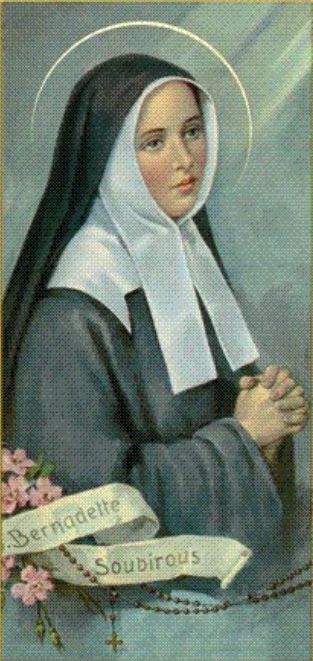
“Drink from the spring and wash in it,” said the beautiful Lady. At her command Bernadette Soubirous, the little shepherdess of Lourdes, looked around for a spring. There wasn’t one. So she scratched at the loose gravel. Then from the murky water that appeared she first drank and then washed her face. She must have looked ridiculous. But in the following days the puddle became running water and then a stream. Since that day in 1858 countless pilgrims have bathed in and been healed by the waters of that spring. These waters and their healing power (sixty-nine documented miracles) are some of the most immediate and enduring fruits of our Lady’s appearance at Lourdes.

So it is somewhat ironic that we observe the World Day of the Sick today, on the feast of Our Lady of Lourdes. After all, her apparitions are more renowned for healing than sickness! Likewise, there is an irony in the fact that Bernadette herself never benefitted from the healing waters she had uncovered. Always a sickly child, she was prevented from entering the Carmelites because of her weakness. Becoming a Sister of Charity instead, she died of tuberculosis at the young age of thirty-five. Nevertheless, the observation of the World Day of the Sick is well placed. Our Lady of Lourdes teaches – and Bernadette understood clearly – three lessons for the sick: presence, healing, and sacrifice {emphasis by Abyssum}.

First, presence. The first thing to note about our Lady’s appearance at Lourdes is that she appeared. She was present to that ignorant, poor shepherd girl who considered herself so unworthy of the visitor that she dared not call her Mary but always “the beautiful lady.” In the first apparition, nothing was said. Just Mary’s presence – a loving smile, an approving look. Likewise in other apparitions, either little or nothing was said. Presence was enough. Our Lady’s appearance in Lourdes is in the pattern of her Son’s public ministry. The solicitude she shows by her presence reflects that of her Son. He always gravitated towards the suffering – the blind, the lame, the sick, and so on.

The sick suffer not only physically but also emotionally, in the thought that they have been forgotten, become useless or, worse, a burden. We all like visitors when we are sick. We welcome that reminder that we are not alone, forgotten, or a burden. Likewise, we visit the sick – yes, to do good things for them, as we are able – but also to assure them of our love by our presence. His simple presence gave expression of that divine solicitude and care. Our Lady’s visit reminds us of that – and that we need to extend it.

Second, healing. In Lourdes’s miraculous spring, our Lady reminds us of her Son’s healing power. Saint Luke wrote of Him: “Everyone in the crowd sought to touch him because power came forth from him and healed them all.” (Lk 6:19) That healing power continues to break into the world. Not every instance of healing is cataloged as a miracle or announced to the world. But every one of us can point to some recovery or healing that requires more than man’s medicine to explain. Jesus continues to work little miracles of healing still. And He does so for the same reason as back then: not to entertain, not merely to astound, but to show that the kingdom of God has come upon the world.

Third, sacrifice. Our Lord did not heal everyone. Not everyone who prays for healing receives it. Not every visitor to Lourdes departs cured. This brings us to what are in many ways our Lord’s greater gift and more profound miracle: the ability to suffer with Him – that is, to sacrifice.

Suffering is not optional in a fallen world. In our fallen human nature, the body tends inevitably toward death and the sufferings that announce it. Everyone suffers. How we respond to our suffering makes all the difference. We can and should use the natural, medical means at our disposal to bring about some cure and relieve our suffering. But we know that those are limited and cannot grant perfect or permanent relief.

Everyone suffers. But not everyone sacrifices. Suffering is the simple experience of physical illness, injury, disease, and so on. We all encounter that. Sacrifice, on the other hand, is the offering of this suffering in union with Christ. Saint Paul was the first to articulate this theology of suffering: “Now I rejoice in my sufferings for your sake, and in my flesh I am filling up what is lacking in the afflictions of Christ on behalf of his body, which is the church.” (Col 1:24)

What has come to be called “redemptive suffering” begins with the awareness that Christ suffered first and most of all, that all our suffering must be seen in light of His. Then we recall that He is present to us in our suffering such that He shares our suffering and we share His. He is not a mere observer but has drawn close, taken our suffering upon Himself, and remains with us in the midst of it. Finally, our suffering becomes a sacrifice when, conscious of this union with Him, we offer it to Him.

As Saint Paul told the Colossians that he offered his sufferings “for your sake,” so also we should offer ours for specific intentions. As He hung upon the Cross, enduring the extreme of suffering, our Lord saw each and every one of us. . . every struggle. . . every wound. . .every hurt. . . .every need. . .and He offered His sufferings for us. Attaching to our offering a particular person, group, or situation helps to give meaning to our suffering and to unite it more perfectly to His. When we do so our suffering ceases to be merely that and becomes through, with, and in Christ an offering to the Father {emphasis by Abyssum}.

Fr. Paul Scalia

Fr. Paul Scalia

Fr. Paul Scalia is a priest of the Diocese of Arlington, Va. He serves as the Bishop’s Delegate for Clergy.

Posted in Uncategorized | 2 Comments

HAVE AN INFORMED CONSCIENCE AND LISTEN FOR THE PROMPTING OF THE HOLY SPIRIT IF YOU ARE CONFUSED

Conscience – the “Aboriginal Vicar of Christ”


FacebookGoogle+PinterestPocket

In light of the controversies surrounding chapter eight of Pope Francis apostolic exhortation Amoris Laetitia, the role of conscience has taken center stage. The questions for us are: what is conscience and how is it formed? Is it informed only by formal principles that permit exceptions in hard cases, or is it formed both by exceptionless negative precepts that bind every conscience and by affirmative precepts where conscience has more latitude? Quite possibly the future of Catholic moral theology and sexual ethics may hang on how these fundamental questions are resolved.[1]

Blessed John Henry Cardinal Newman saw conscience as “a connecting principle between the creature and his Creator.”  Today, in the confusion over Amoris Laetitia (AL) the notion of conscience, what it is, how is it to be formed, what does it hold a person to, if anything, are essential questions. Some see conscience as the invitation of God to embrace His law as a free person; others see it as a call to personal freedom.  For many, as evidenced by the present debate, the word “conscience” does not suggest law but the freedom to judge by one’s own personal resources and standards along with the right to act as one thinks best—a rejection, in other words, of the need for morality and creed; a claim that one should be allowed to live as one chooses.[2]

Newman on Conscience

“Conscience is not a longsighted selfishness, nor a desire to be consistent with oneself, but it is a messenger from Him (emphasis added), who, both in nature and in grace, speaks to us behind a veil, and teaches and rules us by His representative, a monarch in its peremptoriness. Conscience is the aboriginal Vicar of Christ, a prophet in its informations, a monarch in its peremptoriness, a priest in its blessings and anathemas, and, even though the eternal priesthood throughout the Church could cease to be, in the sacerdotal principle would remain and would have a say.”[3] (emphasis added)

The metaphor of “messenger” was a key idea for Newman. When we receive a message, we can’t change it to make it say what would please us. Newman interprets conscience as the advocate for truth in the innermost part of the human person. He would say that any difficulty with Church teaching should not be the end of the matter but the beginning of conversion, education, and quite possibly repentance. In a situation like this Newman’s advice would be to kneel and pray for God to lead weak steps and enlighten fragile minds.[4]

For Newman conscience signifies the perceptible and demanding presence of the voice of truth in a person (again, think “messenger”). A man must overcome mere subjectivity in an encounter with his own inferiority and the truth from God. Newman said: “I loved to choose and see my path; but now lead me on!”[5]

Saint Bonaventure’s view of conscience is akin to Newman. For St. Bonaventure “conscience is like God’s herald and messenger (emphasis added); it does not command things on its own authority, but commands them as coming from God’s authority, like a herald when he proclaims the edict of the king. This is why conscience has binding force.”[6]

An appreciation of the gravity of sin and the formation of conscience

Before looking at the proper formation of conscience, it may be well to call to mind what John Paul II taught in Reconciliatio et Paenitentia, of Reconciliation and Penance (RP). The pope reminded us that the synod called to study this issue not only reaffirmed the teaching of the Council of Trent concerning the existence and nature of mortal and venial sins, but also recalled that mortal sin is sin whose object is grave matter and which is also committed with full knowledge and deliberate consent {emphasis by Abyssum}. The Pope also added that some sins are intrinsically grave and mortal by reason of their matter. That is, there exist acts, which, per se and in themselves, independently of circumstances, are always seriously wrong by reason of their object. These acts, if carried out with sufficient awareness and freedom, are always gravely sinful.[7]

Loss of the sense of sin and its effect on the formation of moral conscience.

John Paul II taught that the “sense of sin” is rooted in man’s moral conscience and is as were its thermometer. The “sense of sin” is linked to the sense of God, since it derives from man’s conscious relationship with God as his Creator, Lord and Father. The pope goes on to say: “Is it not true that modern man is threatened by an eclipse of conscience? By a deformation of conscience? By a numbness or deadening of conscience? In this situation, it is then inevitable that there is an obscuring of the sense of sin, which is closely connected with the moral conscience, the search for truth and the desire to make a responsible use of freedom. When the conscience is weakened, the sense of God is also obscured, and as a result, with the loss of this decisive inner point of reference, the sense of sin is lost.[8]

What about the relationship between conscience and truth?

Newman believed that conscience and truth must form a partnership, that they must support and enlighten each other and that obedience to conscience leads to obedience to the truth. The relationship of conscience to truth is the fundamental element of Newman’s teaching on conscience. Any discussion of the rights of conscience has to take into account its duties as well and the duties of conscience lie in the responsibility of the creature towards its Creator. The right of conscience does not involve, in Newman’s words,

“the right of thinking, speaking, writing and acting, according to their (the individual person) judgment or their humor, without any thought of God at all…Conscience has rights because it has duties; but in this age, with a large portion of the public, it is the very right and freedom of conscience to dispense with conscience, to ignore a Lawgiver and Judge, to be independent of unseen obligations. It becomes a license to take up this or that and let it go again…Conscience is a stern monitor, but in this century it has been superseded by a counterfeit, which eighteen centuries prior to it never heard of, and could not be mistaken for it, if they had. It is the right of self-will” (emphasis added)[9]

Newman’s description seems to fit our day and age. Is it not clear that conscience today, in many cases, is confused with personal opinion, subjective feelings, and self-will under the guise of “discernment” and use of the “internal forum”? For many today, conscience no longer implies the responsibility of the creature towards its Creator, but independence, autonomy, subjectivity and arbitrariness {emphasis by Abyssum}.

What then constitutes a man or woman of conscience?

Newton would simply say that the answer to this question would be a perceptible and demanding presence of the voice of truth within a man or a woman. Newman’s conversion to Catholicism was not a matter of personal taste or of subjectivity. In 1844, just prior to this conversion he said: “No one can have a more unfavorable view than I of the present state of the Roman Catholics.” He was, however, much more taken by the necessity to obey recognized truth than with his own preferences. He emphasized truth’s priority over consensus and the accommodation of groups {emphasis by Abyssum}.[10]   

What about the relationship of conscience with God?

Vatican II teaches that, “Conscience is the most secret core and sanctuary of a man. There he is alone with God, whose voice echoes in his depths.”[11] For Newman, conscience is the way to come to recognize God. Conscience points to a God who has a personal relationship with every person, who addresses him, who directs and guides him, who rebukes and reprimands, who shows him his mistakes and calls him to conversion, who leads him to the perception of truth and who spurs him on to do good, who is his supreme Lord and Judge.[12]

Can conscience be wrong?

The Catechism, #1779, tells us it is essential for every person to be sufficiently present to himself in order to hear and follow the voice of his conscience. In #1782 we read that man has the right to act in conscience and in freedom so as personally to make moral decisions. Consider this warning from Cardinal Ratzinger in relation to an issue that has become pressing with regard Amoris Laetitia: “It is strange that some theologians have difficulty accepting the precise and limited doctrine of papal infallibility, but see no problem in granting de facto infallibility to everyone who has a conscience.”[13]

John Paul II made it clear that conscience, as the judgment of an act, is not exempt from the possibility of error, and that it is not an independent and exclusive capacity to decide what is good and what is evil. Conscience can be mistaken as a result of invincible ignorance, although it does not on this account forfeit its dignity; but this cannot be said when a person shows little concern for seeking what is true and good {emphasis by Abyssum}.

Proper formation of conscience

The words of the Lord in Mt 6:22-23 represent a call for us to form our conscience as the eye of our body and to make it the object of a continuous conversion to what is true and what is good. Cardinal Ratzinger tells us that conscience requires formation and education since it can be become stunted, stamped, or falsified so that it speaks in a distorted way. Included in the idea of conscience is an obligation to care for it, to form it, and to educate it. The right of conscience is the obligation of the formation of conscience. The magisterium of the Church bears the responsibility for correct formation. The teaching office of the Church should be accepted as the primary factor in the formation of conscience. The magisterium therefore has an obligation to speak its word in such a way that it will be understood in the midst of conflicts of values and orientations,[14]

In the formation of conscience, the Word of God is the light for our path. We must examine our conscience before the Lord’s Cross, assisted by the gifts of the Holy Spirit, aided by the witness and advice of others and guided by the authoritative teaching of the Church.[15] 

John Henry Newman’s Letter to the Duke of Norfolk: What can it say to us?

Newton’s Letter to the Duke of Norfolk[16] touches on the notion of conscience in Section 5 (247). The very first sentence of the letter written in the 19th Century was prescient: “It seems, then that there are extreme cases in which Conscience may come into collision with the word of a Pope, and is to be followed in spite of that word.”[17] In Newman’s discussion of conscience — when it seemingly runs counter to the words of the pope — he quotes Cardinal Jacobatis[18]:

“If it were doubtful whether a precept (of the Pope) be a sin or not, we must determine thus: that, if he to whom the precept is addressed has a conscientious sense that it is a sin and injustice, first it is duty to put off that sense; but, if he cannot, not conform himself to the judgment of the Pope, in that case it is his duty to follow his own private conscience, and patiently to bear it, if the Pope punishes him.”

Cardinal Raymond Burke comes to mind.

{This is a beautiful exposition on the role of conscience in the life of moral man.  What is lacking in this exposition (abstracting from the present crisis in the Church due to the discernment and accompaniments of Francis which seems to me to be the primary reason for this beautiful and valuable exposition) is the role of the Holy Spirit in the moral life of a baptized person who has received the Sacrament of Confirmation in the Holy Spirit.  Such a person encounters many situations in the course of a normal day in which it is possible to have a troubled conscience and it is imperative that a person through their prayer and sacramental life possess the ability to hear the whispered voice of the Holy Spirit in the ‘ear of their conscience’ (if they have a well-formed conscience) urging them to make the right decision.  Many individuals lack the courage at times to make difficult decisions in life’s many challenging situations and it is precisely at such times that their ‘spiritual hearing’ not be impaired by the cacophany society’s secular principles impacting their spiritual hearing so that they may hear the wee promptings of the Holy Spirit urging them to do good and avoid evil.    – Abyssum}

NOTES:

[1] Richard A. Spinello, Amoris Laetitia and the Post-Modern Papacy of Pope Francis Crisis Magazine, January 24, 2017., 

[2] George Cardinal Pell, The Inconvenient Conscience, First Things, May 2005.

[3] Fr. Hermann Geissler, FSO, Conscience and Truth in the Writings of Blessed John Henry Newman, p. 8. Catechism of the Catholic Church, No. 1778.

[4] George Cardinal Pell, First Things, May 2005.

[5] Joseph Cardinal Ratzinger, On Conscience, Ignatius Press, 2007, p. 25.

[6] Pope John Paul II, Veritatis Splendor, (58)

[7] Pope John Paul II, Reconciliation and Penance, 1984, (17).

[8] Ibid, 18.

[9] Hermann Geissler FSO, Conscience and Truth in the Writings of Blessed John Henry Newman, p. 7.

[10] Ibid, p. 25.

[11] Gaudium et Spes, 16.

[12] Geissler, pp. 9-10.

[13] Ibid, p. 59.

[14] Ratzinger, On Conscience, pp. 62-64.

[15] Catechism of the Catholic Church, 1785.

[16] Newman Reader – Works of John Henry Newman, Copyright 2007 by the National Institute for Newman Studies, Conscience, Section 5.

[17] Ibid, Section 246.

[18] Newman Reader, Letter to the Duke of Norfolk, 260.

Posted in Uncategorized | Comments Off on HAVE AN INFORMED CONSCIENCE AND LISTEN FOR THE PROMPTING OF THE HOLY SPIRIT IF YOU ARE CONFUSED

CARDINAL BURKE CLARIFIES HIS ROLE IN THE KNIGHTS OF MALTA SCANDAL

Cardinal Raymond Burke.
Cardinal Raymond Burke. (Bohumil Petrik/CNA)
.
.
FEB. 18, 2017
.
Cardinal Burke Firmly Rejects Account by Order of Malta’s Acting Head
The Cardinal Patron of the Order says he is “stunned” by Von Rumerstein’s account of Albrecht von Boeselager’s dismissal and considers it “a calumny”; also gives interview detailing his recent visit to Guam.
.

Cardinal Raymond Burke has firmly rejected an account given by the acting head of the Sovereign Military Order of Malta who said in an interview this week that the cardinal, and not the Order’s Grand Master, was the one who asked its Grand Chancellor to resign in December.

Here below are Cardinal Burke’s remarks in response to the account given by Fra’ Ludwig Hoffmann von Rumerstein, who is reportedly suffering from ill health and not in possession of all his faculties:  {emphasis by Abyssum}

“The account given by Fra’ Ludwig Hoffmann von Rumerstein is not accurate. I had no authority to ask the Grand Chancellor to resign. I simply stated that the person who knowingly permitted the distribution of contraceptives in the Order’s works should take responsibility, and then the Grand Master once again asked the Grand Chancellor to resign which he refused to do. Then the Grand Master proceeded to his dismissal without my involvement at all. The account of the Grand Master and myself stands.

To be frank, I am stunned by what Hoffmann von Rumerstein states in the article. I consider it a calumny.”

More on this story to follow next week.

***

Meanwhile, Cardinal Burke has given an interview to Italian television, giving details of his visit to Guam this week where he has been acting as presiding judge over a clerical sex abuse case dating back to the 1970s.

In the brief interview, the patron of the Order of Malta said the Congregation for the Doctrine of the Faith sent him on the mission as he serves as president of the Congregation’s apostolic tribunal, and that he has known about the assignment since last October.

The cardinal said his duty was to “deal with a delicate ecclesiastical penal trial”, and that the Pope had “never spoken to me about this task.” He added that he “dealt exclusively” with superiors of the CDF “which is the usual procedure in such cases.”

He further explained that the Pope had “entrusted the case to the Congregation, and the Congregation had proceeded according to the standard procedure for training the members of the Court.”

“In any case,”, he continued, “I think I’ve been chosen based on my study of canon law and my long experience in ecclesiastical trials.”

Earlier this week, the Vatican issued a statement saying the CDF constituted the tribunal on Oct. 5 2016. The tribunal is “autonomous and its work is separate from the Congregation,” the Vatican said, adding that in addition to Cardinal Burke as presiding judge, four other bishops are serving as judges on the case.

Asked how long the assignment will last, the cardinal said it will soon be completed (sources have told the Register this part of the assignment finished today and the cardinal returns to Rome Feb. 24). He added “it’s not clear” how long it will take to complete the entire case, but he hopes to “finish the job before the summer.”

When journalist Fabio Marchese Ragona asked if it was “punishment” from the Pope because he has questioned some of the Holy Father’s actions, the cardinal said: “No, I do not see this mission as a punishment of the Pope and certainly I’m not living it as a punishment!”

He said it is “normal for a cardinal, according to their preparedness and availability, to receive special assignments for the good of the Church.” He added he was “not surprised” by the CDF’s request and he accepted it, “conscious of the heavy responsibility that it involves, but without any thought of other motivations on the part of Pope Francis or the Congregation.”

Posted in Uncategorized | Comments Off on CARDINAL BURKE CLARIFIES HIS ROLE IN THE KNIGHTS OF MALTA SCANDAL

ARCHBISHOP MARCEL LEFEBVRE’S ADVICE ON HOW TO OBSERVE LENT

The Archbishop in St. Marys, KS at about the time this letter was written

A Lenten Message on Fast and Abstinence

My dear brethren:

According to an ancient and salutary tradition in the Church, on the occasion of the beginning of Lent, I address these words to you in order to encourage you to enter into this penitential season wholeheartedly, with the dispositions willed by the Church and to accomplish the purpose for which the Church prescribes it.

If I look in books dating from the early part of this century, I find that they indicate three purposes for which the Church has prescribed this penitential time:

  • first, in order to curb the concupiscence of the flesh;
  • then, to facilitate the elevation of our souls toward divine realities;
  • finally, to satisfy for our sins.

Our Lord gave us the example during His life, here on earth: pray and do penance. However, Our Lord, not having concupiscence nor sin did penance and made satisfaction for our sins, thus showing us that our penance may be beneficial not only for ourselves but also for others.

Pray and do penance. Do penance in order to pray better, in order to draw closer to Almighty God. This is what all the saints have done, this is that of which all the messages of the Blessed Virgin remind us.

Would we dare to say that this necessity is less important in our day and age than in former times? On the contrary, we can and we must affirm that today, more than ever before, prayer and penance are necessary because everything possible has been done to diminish and despise these two fundamental elements of Christian life.

Never before has the world sought to satisfy, without any limit, the disordered instincts of the flesh—even to the point of the murder of millions of innocent, unborn children. One would come to believe that society has no other reason for existence except to give the greatest material standard of living to all men in order that they avoid any privation of material goods.

Thus we see that such a society would be opposed to that which the Church prescribes. In these times, when even Churchmen align themselves with the spirit of the world, we witness the disappearance of prayer and penance—particularly in their character of reparation for sins and of obtaining pardon for faults. Few there are today who love to recite Psalm 50, the Miserere, and who say with the psalmist, “Peccatum meum contra me est semper—my sin is always before me.” How can a Christian remove the thought of sin if the image of the crucifix is always before his eyes?

At the Council, the bishops requested such a diminution of fast and abstinence that these prescriptions have practically disappeared. We must recognize the fact that this disappearance is a consequence of the ecumenical and protestant spirit which denies the necessity of our participation for the application of the merits of Our Lord to each one of us for the remission of our sins and the restoration of our divine affiliation [i.e., character as adoptive sons of God].

In the past the commandments of the Church provided for:

  • an obligatory fast on all days of Lent with the exception of Sundays, for the three ember days, and for many vigils;
  • abstinence was for all Fridays of the year, the Saturdays of Lent, and, in numerous dioceses, all the Saturdays of the year.

What remains today of these prescriptions?

  • the fast for Ash Wednesday and Good Friday,
  • abstinence for Ash Wednesday and the Fridays of Lent.

One wonders at the motives for such a drastic diminution.

Who are obliged to observe the fast? 
Adults from age 21 to 60.

And who are obliged to observe abstinence? 
All faithful from the age of 7 years.

What does the fast mean?
To fast means to take only one (full) meal a day to which one may add two collations (or small meals) one in the morning, one in the evening which, when combined do not equal a full meal.

What is meant by abstinence?
By abstinence is meant that one abstains from meat.

The faithful who have a true spirit of faith and who profoundly understand the motives of the Church which have been mentioned above, will wholeheartedly accomplish not only the light prescriptions of today but, entering into the spirit of Our Lord and of the Blessed Virgin Mary, will endeavor to make reparation for the sins which they have committed and for the sins of their family, their neighbors, friends and fellow citizens.

It is for this reason that they will add to the actual prescriptions, be it the fast for all Fridays of Lent, or abstinence from all alcoholic beverages or abstinence from television, or other similar sacrifices. They will make an effort to pray more, to assist more frequently at the Holy Sacrifice of the Mass, to recite the Rosary and not to miss evening prayers with the family. They will detach themselves from their superfluous material goods in order to aid the seminaries, help establish schools, help their priests adequately furnish the chapels and to help establish novitiates for nuns and brothers.

The prescriptions of the Church do not concern fast and abstinence alone but the obligation of the Paschal Communion [Easter Duty] as well.

Here is what the Vicar of the Diocese of Sion, in Switzerland, recommended to the faithful of that diocese on 20 February 1919:

  1. During Lent, the pastors will have the Stations of the Cross twice a week; one day for the children of the schools and another day for the other parishioners. After the Stations of the Cross, they will recite the Litany of the Sacred Heart.
  2. During Passion Week, which is to say, the week before Palm Sunday, there will be a Triduum in all parish churches. Instruction—Litany of the Sacred Heart in the Presence of the Blessed Sacrament—Benediction. In these instructions the pastors will simply and clearly remind their parishioners of the principal conditions to receive the Sacrament of Penance worthily.
  3. The time during which one may fulfill the Easter Duty has been set for all parishes from Passion Sunday to the first Sunday after Easter.

Why are these directives no longer useful today?

Let us profit from this salutary time during the course of which Our Lord is accustomed to dispense grace abundantly. Let us not imitate the foolish virgins who having no oil in their lamps found the door of the bridegroom’s house closed and this terrible response: “nescio vos“—”I know thee not.” Blessed are they who have the spirit of poverty, for theirs is the kingdom of heaven. The spirit of poverty means the spirit of detachment from things of this world.

Blessed are they who weep, for they shall be consoled. Let us think of Jesus in the Garden of Olives who wept for our sins. It is henceforth for us to weep for our sins and for those of our brethren.

Blessed are they who hunger and thirst for holiness, for they shall be satisfied. Holiness—sanctity is attained by means of the Cross, penance and sacrifice. If we truly seek perfection then we must follow the Way of the Cross.

May we, during this Lenten Season, hear the call of Jesus and Mary and engage ourselves to follow them in this crusade of prayer and penance!

May our prayers, our supplications, and our sacrifices obtain from heaven (the grace) that those in places of responsibility in the Church return to Her true and holy Traditions which is the only solution to revive and reflourish the institutions of the Church again.

Let us love to recite this, the conclusion of the Te Deum: In te Domine speravi, non confundar in aeternum—”ln Thee, O Lord, I have hoped. I will not be confounded in eternity.”:

†Marcel Lefebvre

Sexagesima Sunday
14 February 1982
Rickenbach, Switzerland

Posted in Uncategorized | Comments Off on ARCHBISHOP MARCEL LEFEBVRE’S ADVICE ON HOW TO OBSERVE LENT

WHEN YOU RECEIVE HOLY COMMUNION TODAY REMEMBER THIS

47400b6822f5090564c584418c42951c


“The Eucharist is alive. If a stranger who knew nothing about the Eucharist were to watch the way we receive, would he know this? When you and I approach the Eucharist, does it look like we believe we are about to take into our bodies the living person, Jesus Christ, true God and true man? How many times, Lord, have I forgotten that the Eucharist is alive! As I wait in line to receive you each day, am I thinking about how much you want to unite yourself with me? Am I seeing your hands filled with the graces you want to give me? Am I filled with awe and gratitude that you love me so much as to actually want to come to me in this incredibly intimate way? Or am I distracted, busy with other thoughts, preoccupied with myself and my agendas for the day? How many times, Jesus, have I made you sad, mindlessly receiving you into my body, into my heart, with no love and no recognition of your love? How many times have I treated you as a dead object? The Host that we receive is not a thing! It’s not a wafer! It’s not bread! It’s a person – He’s alive!”

Posted in Uncategorized | Comments Off on WHEN YOU RECEIVE HOLY COMMUNION TODAY REMEMBER THIS