HOMILY FOR THE EIGHTH SUNDAY IN ORDINARY TIME – CYCLE A

47400b6822f5090564c584418c42951c

HOMILY FOR THE EIGHTH SUNDAY IN ORDINARY TIME

Cycle A

Bishop Rene Henry Gracida

No one can serve two masters.

He will either hate one and love the other,

or be devoted to one and despise the other.

You cannot serve God  and mammon.

You recognize that as the beginning of today’s Gospel.

Who is this “mammon” to whom Jesus refers?

“Mammon” is the personification of whatever material possessions come to have an importance in one’s life that makes them be in opposition to God.

In the Jewish Talmud the term Mammon was used primarily to designate not only money but also any material possessions to which one attaches  excessive value.

Palestinian archeologists sometimes find hoards of coins in the ruins of ancient homes, or they find traces of the prior existence of such hoards.

You should remember that the living audience to which Jesus words were addressed was largely composed of peasants and laborers.  These persons had very little opportunity to possess hard cash and paper money did not exist.

So, when hard cash in the form of coins came into their possession the instinct of these people was to bury it rather than spend it.  As their cash hoard tended to increase in size over time there developed a tendency to become overly attached to it and to let its existence influence the their daily lives.

So here we have the radical teaching of Jesus on wealth and ownership of material possessions.  Excessive attachment to such possessions competed with the love and worship one owes to God and hence “Mammon” came to signify a false god who was alienating the affections of a person from the true God.

The radical teaching of Jesus on material possessions was expanded by his use of the word “worry.”  It means more than simple thought or planning, it means anxiety or preoccupation, even in extreme cases, obsession.

Here are some examples of inordinate desire for or love of money and material possessions which can lead to an obsession

It is one thing to occasionally purchase a lottery ticket, but it altogether another matter regularly to take a significant portion of one’s income to purchase a lot of lottery tickets or to make frequent trips to a casino.

It is said that Imelda Marquez, the wife of the president of the Phillipines had several hundred pairs of expensive shoes.  Collecting material things can be a hobby or it can become an obsession.

Next Wednesday is Ash Wednesday and we begin the Season of Lent.

Lent, unlike Advent, is a penitential season.   Many people thought that The Second Vatican Council, changed everything in the Catholic Church. I can assure you that Lent was not changed and is still a penitential season in which Catholics are urged to adopt one or more Lenten resolutions to forego something they would usually enjoy having or doing during the forty days of Lent.

In the light of todays Gospel I suggest that you take the time to reflect on your life and see if perhaps there is something you have inordinately enjoyed doing or having that might justifiably be considered mammon worship.

If you discover it,

GIVE IT UP !!!

If you discover that food is your mammon,

FAST !!!

If you discover that alcohol or drugs are your mammon,

GIVE THEM UP !!!

If you do, you will be better able to appreciate what Our Lord Jesus Christ

GAVE UP ON CALVARY THAT YOU MIGHT HAVE ETERNAL LIFE.

In the name of the Father

and of the Son

and of the Holy Spirit.

Amen!

Posted in Uncategorized | 2 Comments

POLYGAMY IS COMING; AMERICAN SOCIETY IS DECONSTRUCTING ITSELF. ANTONIN SCALIA WAS PRESCIENT

Rod Dreher

Polygamy: The Next Frontier

Here’s the jacket copy for a forthcoming book from the University Press of New England: Legalizing Plural Marriage: The Next Frontier of Family Law, by Emory law professor Mark Goldfeder. A law school librarian sent the link in, saying it was coming to her library:

Polygamous marriages are currently recognized in nearly fifty countries worldwide. Although polygamy is technically illegal in the United States, it is practiced by members of some religious communities and a growing number of other “poly” groups. In the radically changing and increasingly multicultural world in which we live, the time has come to define polygamous marriage and address its legal feasibilities.

Although Mark Goldfeder does not argue the right or wrong of plural marriage, he maintains that polygamy is the next step—after same-sex marriage—in the development of U.S. family law. Providing a road map to show how such legalization could be handled, he explores the legislative and administrative arguments which demonstrate that plural marriage is not as farfetched—or as far off—as we might think. Goldfeder argues not only that polygamy is in keeping with the legislative values and freedoms of the United States, but also that it would not be difficult to manage or administrate within our current legal system. His legal analysis is enriched throughout with examples of plural marriage in diverse cultural and historical contexts.

Tackling the issue of polygamy in the United States from a legal perspective, this book will engage anyone interested in constitutional law, family law, or criminal law, along with sociologists and those who study gender and culture in modern times.

Remember when all the Haters™ warned a decade or more ago that legalizing gay marriage required uncoupling marriage from procreation and basing it on expressive individualism, and that this would open the door to polygamy? Remember how they were all denounced as alarmist bigots?

Let us recall the Law of Merited Impossibility: It will never happen, and when it does, you bigots will deserve it. I think that the late Antonin Scalia is the patron saint of the Law of Merited Impossibility. In his 2003 Lawrence v. Texas dissent, he pointed out that the Court had opened the legal door to constitutionalizing same-sex marriage. He was right about that, as we saw in the majority ruling in Obergefell. In his Lawrence dissent, Scalia also said this:

The Court embraces instead Justice Stevens’ declaration in his Bowers dissent, that “the fact that the governing majority in a State has traditionally viewed a particular practice as immoral is not a sufficient reason for upholding a law prohibiting the practice,” ante, at 17. This effectively decrees the end of all morals legislation. If, as the Court asserts, the promotion of majoritarian sexual morality is not even a legitimate state interest, none of the above-mentioned laws can survive rational-basis review.

Polygamy is coming. American society is deconstructing itself.

Posted in , , , , , , . Tagged , , .
Posted in Uncategorized | Comments Off on POLYGAMY IS COMING; AMERICAN SOCIETY IS DECONSTRUCTING ITSELF. ANTONIN SCALIA WAS PRESCIENT

HI HO, SILVER !!! WHAT DID YOU SAY, KIMOSABE ???

RomaTre

Settimo Cielodi Sandro Magister 

25 feb 17

A Lone Man In Charge, To the Crowd’s Acclaim


[Emphasis and {commentary} in red type by Abyssum]

Popularity and solitude are the two faces of the current pontificate, contradictory only in appearance. {bipolar: relating to a major affective disorder that is characterized by episodes of mania and depression}

An umpteenth proof of the popularity of Pope Francis came on February 17 with his visit to the university of Roma Tre, amid the rejoicing of teachers and students (see photo), a spectacular comeback over the ban that in 2008 prevented Benedict XVI from entering and speaking at the other university of Rome, the more noble and storied, that of La Sapienza, for the crime of having wanted to bring God and faith into the inviolable temple of the goddess reason.

At Roma Tre Francis did speak, and did he ever, off the cuff and interrupted dozens of times by applause. He spoke about dialogue and multiculturalism, migration and youth unemployment, with what stems from it according to him: “They say that the true statistics about youth suicide are not published; something is published, but not the real statistics.”

But in the 45-minute speech not even once did he utter the words God, Jesus, Church, faith, Christianity.

It is the same neutrality that Francis adopts when he enunciates for the “popular movements” his alter-globalization and anti-globalization political vision. Because it is in the people – “a mystical category,” as he calls it – that he sees the genesis of redemption. And it is to the people, Christian or not, that the pope appeals when he denounces the misdeeds of the world markets, of the economy that kills, of the anonymous powers that foster wars, as also of the antiquated, sclerotic, merciless ecclesiastical institutions.

But his is precisely the popularity of a pope who isolates himself from the institutions in order to contest them better, a fan favorite. It is no coincidence that he praises Latin American populism, as he did in a recent interview with “El País,” he who as a young man was a Peronist.


However there are a few key points behind the ideology of Juan Peron himself and Argentina’s most political movement Peronism that can be gleaned.

Peron called his movement “Justicialism”, a blending of the Spanish words for social justice and this is also the name of the party of Argentina’s current president Cristina Fernandez.

It is an idea founded on Christian social values that has three basic principles: social justice, political sovereignty and economic independence. To do this Peron said his movement was in a “third position” which counterposed itself equally to capitalism and communism. He also aimed to create a social model of an organized community with direct state intervention to mediate between labor and capital. Although not the same as a traditional Scandinavian welfare state, the model has similarities in its mixed economy and a central role for Unions.

In a speech in the Congress in 1948, Peron himself said, “Peronism is humanism in action; Peronism is a new political doctrine, which rejects all the ills of the politics of previous times; in the social sphere it is a theory which establishes a little equality among men… capitalist exploitation should be replaced by a doctrine of social economy under which the distribution of our wealth, which we force the earth to yield up to us and which furthermore we are elaborating, may be shared out fairly among all those who have contributed by their efforts to amass it.”

The populist program of higher wages and better working conditions, which was actually developed by the Public Works minister Juan Pistarini could well be the classic ideological core of Peronism, but it was always dependent on the structural circumstance of Argentina.  For example, in the late 1940s, Peronism was more concerned with the women’s vote and the export market, and in the 1990s attempting to rebuild Argentina under a neo-liberal pro market guide.

Indeed, over time it has been an odd mix of socialism, liberalism and populism Peron himself, and therefore the movement became a symbol of and a champion of what he called the “shirtless ones,” (descamisados) appealing to the dispossessed, labor, youth and the poor.

Peronism accepts that the state should coordinate society for the common good and that it can do this without serving class interests.

Peron, and Peronism is hostile to many of the tenets of classic liberalism, although at times concedes such as considering that democratic and republican institutions are the only ones that can guarantee freedom and happiness for the people, and a political opposition is admitted as necessary. – teleSUR


At the Vatican Francis has taken up residence in Casa Santa Marta, which is a guest house, precisely in order to distance himself as much as possible from that curia which he has never loved and has very little interest in reforming organically.

He prefers to select his closest colleagues himself. And he has taken one of them from the Catholic university of Buenos Aires: Víctor Manuel Fernández, his favorite theologian. {Fernandez is the “l’Eminence Grise” to Francis.  He is a layman, and so he cannot replace Cardinal Mueller as Prefect of the Congregation for the Doctrine of the Faith.  Of course,  Francs could appoint him a Cardinal and then he could replace Mueller, but first he would have to be ordained a priest and then a bishop in quick succession.}   Another from “La Civiltà Cattolica”: Jesuit confrere Antonio Spadaro. Not to mention monsignors Konrad Krajewski, Fabián Pedacchio Leaniz, Battista Ricca, Marcelo Sánchez Sorondo: the first his “almoner” and the second his personal secretary.

Each one of them, however, involved in only a sliver of the pope’s heap of activities and none able to get an overall view. Jorge Mario Bergoglio has always kept a personal calendar of his own that only he compiles and consults.

When it works, the curia does not obstruct the popes, it helps them. It tempers their absolute powers with “checks and balances” analogous to those of the modern democracies.

The congregation for the doctrine of the faith, in particular, should guarantee that all the acts of the magisterium are impeccable, inspecting them in advance word for word. This was what happened between John Paul II and the prefect of the congregation of the doctrine of the faith at the time, Joseph Ratzinger.

But with Francis this balance has gone haywire.

The current pope increasingly shelves his written speeches and prefers to improvise. And when he has to write an encyclical or an exhortation, here too he goes his own way, {quizzas un camaleon?} with the help of his ghostwriters Fernández and Spadaro, assembling as he pleases the materials made available to him.

And then, as a matter of routine, he sends the draft of the document to the congregation for the doctrine of the faith, and this sends it back to him with dozens or even hundreds of annotations. But he systematically ignores these.

This is what happened with “Evangelii Gaudium,” the agenda-setting document of his pontificate, and with “Amoris Laetitia,” the exhortation on marriage and divorce that is dividing the Church on account of the conflicting interpretations that it has unleashed.

It has also been discovered that entire paragraphs of “Amoris Laetitia” were copied from articles published ten and twenty years ago by Fernández. In whom Francis has by no means lost faith.

On the contrary. None other than Fernández is the most ferocious critic of Cardinal Gerhard L. Müller, the sidelined prefect of the congregation for the doctrine of the faith, against whom he levels the unheard-of charge of wanting to “control” the pope’s theology.

———-

This commentary was published in “L’Espresso” no. 8 of 2017 on newsstands February 26, on the opinion page entitled “Settimo cielo” entrusted to Sandro Magister.

Here is the index of all the previous commentaries:

> “L’Espresso” in seventh heaven

———-

The speech of Pope Francis at the university of Roma Tre was not published – a rarity – in any official transcription. While on the contrary Benedict XVI made public the speech that he was not allowed to deliver at the university of Rome “La Sapienza” on January 17, 2008:

> Lecture by the Holy Father Benedict…

The complete visit of Francis is however available in a video produced by the Vatican Television Center:

> Visit to the University Roma Tre

For a more in-depth analysis of the singular character of this visit:

> Pope Francis and the University Visit that Benedict XVI Did Not Make

(English translation by Matthew Sherry, Ballwin, Missouri, U.S.A.)

Posted in Uncategorized | 2 Comments

INCREDIBLE: A BIT OF GOOD NEWS !!!

Pope Francis helps SSPX take over church, complex, in heart of Rome

Il Foglio today as a story about how Pope Francis was a decisive factor in handing over a neo-Gothic church in the center of Rome, Santa Maria Immacolata all’Esquilino, to the SSPX.

It is going to be a center for studies and, perhaps, their HQ.  It is a pretty large complex.

SM_Immacolata_all’Esquilino_01SM_Immacolata_all’Esquilino_02


About Fr. John Zuhlsdorf

Fr. Z is the guy who runs this blog. o{]:¬)

This entry was posted in SESSIUNC
Posted in Uncategorized | Comments Off on INCREDIBLE: A BIT OF GOOD NEWS !!!

THE VATICAN CIRCUS: A TIMELINE

unnamed-2

What’s Going On in the Vatican? A Timeline

February 24, 2017

What’s Going On in the Vatican? A Timeline

By Andrew Parrish
Pewsitter.com

The Vatican appears to be coming to a boil these days: the pace of strange and alarming announcements from Rome has increased ever since the release of Amoris Laetitia in April of last year. It is easy to lose sight of the overall trend of a news story as individual headlines are released; Pewsitter is releasing the below report, which is a timeline of most directly Vatican-related events since April 2016, in the belief that it clearly demonstrates the unusual nature of these continuing developments. This timeline will be periodically updated with new material.

We encourage other journalists to use this timeline as a resource and encourage the submission of any announcements we may have missed in the comments box below or via email.


April 2016: Amoris Laetitia, “The Joy of Love,” an apostolic exhortation on marriage and family life, is released.


July 12th, 2016: In a Motu Proprio statement, the Vatican financial accountability office is stripped of much of its power of oversight. The move is criticized as counterproductive in the ongoing effort to reform Vatican finances.

July 28th, 2016: In his remarks to those gathered for World Youth Day in Krakow, Poland, the Pope called on Poland to “open its borders to refugees” and declared that “religion has nothing to do with war.”


September 5th, 2016: An Argentinian blogger leaks the contents of a private letter sent by the Pope to the bishops of Buenos Aires, in which Pope Francis approves their take on Amoris Laetitia’s already-controversial Chapter 8: “There is no other interpretation.” The Buenos Aires bishops have approved communion for the divorced and remarried. The Vatican later confirms that this document is legitimate.

September 19th, 2016: The four cardinals privately send their “dubia” statement to the Pope.


October 4th, 2016: During trip to Republic of Georgia, Pope says it is a “very grave sin against ecumenism” for Catholics to try and convert the Orthodox.

October 6th, 2016: Theme for the 2018 Synod announced: Young people, faith and vocational discernment.

October 19th, 2016: Pope calls proselytism “poison” in meeting with Lutheran visitors. “It is not licit that you convince them of your faith,” he declares.

October 24th, 2016: Pope Francis praises the German theologian Bernhard Haering, a prominent dissenter from Humanae Vitae, saying that he found a way to “help moral theology to flourish again.”

October 25th, 2016: Pope is photographed in the Vatican with a chocolate statue of Martin Luther, while receiving an ecumenical delegation from Sweden. In this meeting, the Pope claims that “lukewarmness” is when Catholics “are keen to defend Christianity in the West on the one hand but on the other are averse to refugees and other religions.”

October 27th, 2016: Pope opens the JPII Institute for Studies on Marriage and the Family academic year himself, after announcing that Cardinal Sarah would not give the opening speech as planned.

October 31st, 2016: Pope Francis arrives in Malmo, Sweden, and “heaps praise” on Luther and the Reformation.

On this day the joint declaration is published, which says we must “cast off historical disagreements” and “transform our memory of the past.” Lutheran-Catholic intercommunion is explicitly declared to be the goal of dialogue.


November 2nd, 2016: On return flight from Sweden, Pope gives interview declaring that John Paul II had “the final word” on ordination of women.

In the same interview, the Pope takes a moderate position on immigration, saying that countries need to be “prudent” and avoid the danger of ethnic ghettos.

November , 2016: High-level, anonymous Vatican source alleges that Pope is “boiling with rage” over the public opposition to Amoris Laetitia.

November 10th, 2016: The Pope holds a private meeting with Cardinal Burke, the Vatican patron of the Sovereign Order of Malta, in which, it is later revealed, the Pope is “deeply disturbed” by Burke’s account of contraceptive distribution with the Order’s participation. The Pope orders Burke to “clean Freemasonry out of the Order.”

November 14th, 2016: The four cardinals, Burke, Brandmuller, Meisner, and Caffarra, release publicly their letter of September 19th, asking five yes/no questions about moral ambiguities raised in Amoris Laetitia’s wording, a letter which becomes known as “the dubia” or “the dubia statement.” The letter calls on either the Pope or Cardinal Mueller, head of the CDF, to respond publicly. The cardinals had previously received an acknowledgement of their letter but no answer from the Pope.

November 15th, 2016: Cardinal Burke gives interview with Edward Pentin in which he declares the possibility of a “formal act of correction” of the Pope if the letter is not formally answered.

November 18th, 2016: In interview with the Italian newspaper Avvenire, Pope criticizes the “legalism” of the four cardinals who have written a letter asking for clarification of Amoris Laetitia. In the meantime, Archbishop Chaput of Philadelphia has published guidelines declaring that the divorced and remarried cannot receive the Eucharist, and Cardinal-designate Farrell has publicly criticized these guidelines.

November 18th, 2016: Pope dismisses the entire staff of the Pontifical Academy for Life. Republished statutes for the organization indicate that the members will no longer be required to sign a declaration of their pro-life beliefs.

November 23rd, 2016: Cardinal Burke and Cardinal Pell officially removed from Congregation for Divine Worship.


December 1st, 2016: The Pope writes a letter to Cardinal Burke, in which he reiterates his concerns about the Order of Malta and Cardinal Burke’s duty to see to the “spiritual health” of the order.

December 6th, 2016: Albrecht Freiherr von Boeselager, grand chancellor of the Sovereign Order of the Knights of Malta, is ordered to resign his office at a meeting in which the Order’s head, Fra’ Matthew Festing, accused him of supervising the distribution of contraceptives in Malaysia. Von Boeselager refuses to step down at the meeting, breaking his vow of obedience.

December 7th, 2016: Pope Francis, in a widely publicized interview with a Belgian Catholic newspaper, alleges that media which spread misinformation are guilty of coprophagia, a psychological term for those who are sexually aroused by the act of eating excrement.

December 12th, 2016: According to inside Vatican sources, von Boeselager approaches Cardinal Parolin in the Vatican, and tells him that, according to Burke, the Pope had ordered von Boeselager to be fired. Cardinal Parolin writes a letter on this date to Fra’ Festing in the Pope’s name, saying that the Holy Father requests “dialogue” to resolve “methods and means contrary to the moral law.” Fra’ Festing requests a meeting with Cardinal Parolin; Parolin asks to institute a Vatican investigative committee and Festing refuses, citing the international sovereignty of the Order.

December 13th, 2016: In an internal announcement, von Boeselager is suspended of all his duties in the Order of Malta.

December 14th, 2016: Cardinal Walter Kasper, one of the Pope’s closest advisors, considers intercommunion with mixed-marriage Lutherans to be “inevitable.”

December 15th, 2016: Cardinal Parolin appoints von Boeselager’s brother to the board of the IOR, the “Vatican bank.”

December 16th, 2016: Co-founder of LifeSiteNews releases an editorial stating: “The climate of fear at the Vatican is very real”. This corroborates December reports from anonymous sources of Edward Pentin, Marco Tosatti, Steve Skojec, etc.

December 19th, 2016: In an interview with LifeSiteNews, Cardinal Burke, considered the “spokesman” of the four cardinals, claims there is a timeline for the “formal correction” of Pope Francis and that this will take place some time in January, 2017 (around the Feast of the Epiphany).

December 22nd, 2016: Pope gives customary Christmas address to the Roman Curia on reform, which has been the topic for three years running, and blasts “resistance” which hides behind “self-justification” and takes refuge in “tradition.”

December 22nd, 2016: An independent watchdog, the Lepanto Institute, releases compiled reports indicating that Malteser International, while under von Boeselager’s direct supervision, distributed more than 300,000 condoms in Malaysia as well as oral contraceptives, and was widely recognized by other NGOs for this accomplishment.

December 22nd, 2016: A letter to the Order of Malta, and Burke, indicates that the Pope has appointed a commission to investigate the removal of von Boeselager. The Pope’s instructions in his Dec. 1st letter are to be suspended.

Preliminary investigation into the five members of the committee, Archbishop Silvano Tomasi, Fr. Gianfranco Ghirlanda, Jacques de Liedekerke, Marc Odendall, and Marwan Sehnaoui, reveals that all five are known allies of von Boeselager and the “German wing” of the Order of Malta. Furthermore, Odendall, Sehnaoui and Archbishop Tomasi are, with Boeselager, connected to a mysterious donation from a French resident deposited in a Swiss bank account, worth at least $118 million. Cardinal Parolin is understood to have been aware of the bequest since at least March 2014.

December 23rd, 2016: Von Boeselager publishes a statement in which he declares his suspension violated the procedures of the Order, that no valid grounds existed for his suspension, and that Fra’ Festing’s attitude was “authoritarian.”

December 26th, 2016: Pope orders Cardinal Mueller to dismiss three priests at the CDF for unspecified reasons. In the leaked letter making this declaration, he states: “I am the pope and I do not need to give reasons… they have to go.”


January 3rd, 2017: Von Boeselager’s replacement, Fra’ John Chritien, writes a letter to the Knights of the Order telling them they cannot collaborate with the papal commission because its existence is a violation of the order’s sovereignty.

January 4th, 2017: Archbishop Tomasi, of the Malta investigative committee, responds to the previous day’s announcement and says that the question “is not the sovereignty of the order, but the reasonable claim of questionable procedures and lack of proven valid cause for the action taken,” echoing the statement of von Boeselager himself.

January 5th, 2017: A document is published by the Vatican Pontifical Council for Christian Unity and the World Council of Churches, commanding Catholics to “recognize Luther as a witness to the Gospel.”

January 10th, 2017: Knights of Malta again publicly defend their right to dismiss von Boeselager, for breaking his vow of obedience to Festing.

January 10th, 2017: In daily homily, Pope criticizes “doctors of the law” as incoherent, hypocritical, clericalist, and lacking in real authority.

January 12th, 2017: The Vatican invites notorious abortion extremist Paul Ehrlich, author of debunked 1970s book The Population Bomb, to Vatican conference on “Biological Extinction.”

January 17th, 2017: The Holy See issues a second statement in response, declaring its “faith” in the commission the Pope has appointed.

January 19th, 2017: Pope declares that it was “Luther’s intention to renew the Church, not divide her.”

January 20th, 2017: Pope declares that “every country has the right to defend its borders.”

January 20th, 2017: Pope, in morning homily, criticizes “lazy,” “egotistical,” “constantly condemning,” “parked Christians.”

January 21st, 2017: Pope gives an address to the Roman Rota in which he declares it is “urgent practically to implement that which was discussed in Familiaris Consortio.” The Holy Father calls for parishes to develop programs to help newlyweds grow in faith and remain attached to parish life.

January 24th, 2017: The Pope calls Festing to the Vatican to hold a secret meeting of which no one can know. In this meeting, the Pope tells Festing to write his resignation letter on the spot, and to explicitly declare in the letter that Cardinal Burke had asked for von Boeselager to be dismissed.

January 24th, 2017: Fra’ Festing resigns his position as Grand Master of the Maltese Order.

January 25th, 2017: Cardinal Parolin writes in a letter to the Maltese Order that the Pope has declared all of Fra’ Festing’s actions “null and void” since the Dec. 6th meeting where von Boeselager’s resignation was demanded. Parolin further announces that the Pope will appoint a “personal delegate” to the Order, with “powers that will be defined.” These actions are in violation of the legal sovereignty of the Order.

January 25th, 2017: Pope declares that ecumenism must look to the future, not “fixate” on the past.

January 25th, 2017: Archbishop Scicluna of Malta, infamous for the Communion guidelines he coauthored, declares in a homily that “anyone looking to discover what Jesus wants” should “look to the Pope. Not the previous Pope, not the one before that. This Pope.” He has previously stated that in his guidelines “we are following the Pope’s directives.”

January 26th, 2017: Pope orders review of Liturgiam Authenticam. The text of the current Latin-English Mass translation is alleged by certain bishops to be too “rigid” and “excessively centralized”, according to America Magazine.

January 27th, 2017: The Pope gives a lengthy homily at Santa Marta in which he states that those who focus too much on “obeying the commandments, all of them” commit the sin of “cowardliness”, and are unable to “take risks” and “move forward.”

January 28th, 2017: The Pope, according to a press release of the Knights of Malta, writes a letter to them “stressing their sovereignty.”

January 28th, 2017: The Council of the Knights of Malta votes to accept Festing’s resignation and the Pope’s declaration of nullity.

January 30th, 2017: The Pope, at the Angelus, says “voracious consumerism kills the soul.”

January 30th, 2017: The Pope meets with Heinrich Bedford-Strohm, the chair of the Council of Protestant Churches in Germany and with Cardinal Marx. In this meeting Bedford-Strohm expresses the importance of a common communion for interfaith couples.

January 31st, 2017: Cardinal Baldisseri, secretary of the Synod of Bishops, confirmsthat the female diaconate will not be discussed at the 2018 Synod on vocations.


February 1st, 2017: Pope calls on local Catholic churches to “mobilize” and fight climate change.

February 1st, 2017: Cardinal Mueller, head of the CDF, declares that Communion for the divorced and remarried is “against God’s law.” The Maltese bishops’ bombshellstatement that Communion is open to anyone who “feels at peace with God” was released twenty days prior. On this same day, the German council of bishops approves communion for the divorced and remarried.

February 2nd, 2017: The Pope calls on religious not to be “professionals of the sacred.”

February 2nd, 2017: Bishop Sorondo, chancellor of the Pontifical Academy of Sciences, defends the invitation of Paul Ehrlich by saying that the Vatican is interested in his scientific reputation and not his private opinions: “What matters is the conclusions we will draw.”

February 4th, 2017: Posters appear overnight in Rome naming a group of incidents, including the Maltese case, and asking, “Where is your mercy?” A picture of the Pope is included. The Vatican police, as well as the Roman police, open an investigation into this incident.

February 4th, 2017: The Pope names Archbishop Becciu of the Secretariat of State as his delegate to the Order of Malta.

February 7th, 2017: The Vatican hosts its Summit on Organ Trafficking and Transplant Tourism over two days, inviting the Chinese “organ czar” Huang Jiefu to speak despite ongoing and credible allegations that the Chinese government harvests organs from executed prisoners, and possibly others.

February 8th, 2017: A stunning editorial in La Civita Cattolica opines that ordination of women may be possible in the future. The paper is approved by the Vatican before publication and Fr. Antonio Spadaro, the Pope’s closest confidante, is the editor in chief.

February 8th, 2017: A 51-page booklet is published by Cardinal Coccopalmerio, purporting to explain definitively the meaning of Amoris Laetitia’s Chapter 8. Reviews of the book indicate that it defends an extremely permissive interpretation of the document.

February 9th, 2017: Pope meets with staff of La Civita Cattolica and praises their work, urging them to be “restless” and “stay out on the open sea.” Fr. Gioncarlo Pani, deputy editor and author of the women’s ordination piece, is present. No mention of the question is made.

February 12th, 2017: The Vatican announces its police force is investigating a satirical front page of the L’Osservatore Romano with the headline “Pope Answers the Dubia.” The satirical newsletter was widely circulated in the Vatican via email.

February 13th, 2017: Council of Cardinals issue statement declaring their total support for the Pope. Vatican sends email blast dedicated solely to this announcement.

February 14th, 2017: Cardinal Coccopalmerio, President of the Pontifical Council for Legislative Texts, the Vatican’s “legal theory” body, declares that a “desire to change” is enough for the valid reception of Communion.

February 14th, 2017: Cardinal Coccopalmerio fails to attend his own press conference for his booklet on Amoris Laetitia, which is generally understood to represent a chance for an official Vatican “answer” to the dubia statement. He states via social media that he had another engagement he had forgotten about. At the conference, the head of the Vatican publishing house says that the booklet is “not an answer” and the “still open debate is encouraged.”

February 15th, 2017: Cardinal Burke sent to Guam to supervise Vatican trial of Archbishop Apuron, involved in a clergy abuse scandal.

February 17th, 2017: Cardinal Mueller, head of the CDF, states that bishops cannot give “contradictory interpretations” of Amoris Laetitia.

February 17th, 2017: Pope releases a letter dated February 10th to the Meeting of Popular Movements in California, in which he says, among other things, that we must “defend Sister Mother Earth”, that “the ecological crisis is real… time is running out. We must act now”, “Muslim terrorism does not exist”, and that global capitalism is “gangrenous”.

February 18th, 2017: Speaking to the press about the “highly unusual” public vote of confidence in the Pope, Cardinal Marx says that the support for the Pope is “substantial.”

February 20th, 2017: Cardinal Mueller, head of the CDF, releases a new book on the Papacy. He declares that not even a pope is able to alter the “substance of a sacrament,” marriage being used as the example.

February 21st, 2017: Cd. Coccopalmerio announces that there is “no doctrinal confusion” over Amoris Laetitia in an interview with Crux. He also states that gay couples still cannot receive Communion.

February 21st, 2017: Pope declares it a “moral duty” to “welcome, protect, promote, and integrate” refugees. The opposition to this duty is “rooted chiefly in self-centeredness” and encouraged by “populist demagoguery.”

February 22nd, 2017: Parolin, Secretariat of State, announces that the Vatican will be using “systematic surveillance” to monitor misuse of the Pope’s image and the official Vatican symbols, “so that his message may reach the faithful intact.”

February 22nd, 2017: The Pope, in his daily remarks, says that “When human pride explodes, it destroys and exploits nature. Think of water.”

By Andrew Parrish

Andrew Parrish is a 2015 graduate of the Catholic University of Lublin in Poland. He holds a BA in Philosophy.

Posted in Uncategorized | Comments Off on THE VATICAN CIRCUS: A TIMELINE

PRE-VATICAN II CATHOLICISM WAS THICK AND HARD, WHILE PRESENT-DAY CATHOLICISM IS THIN AND EASY

CIRCA 1960

Religion: Thick and Thin

I am an old man – old enough to have vivid memories of what American Catholicism was like prior to the end of Vatican II (1965). If I were asked to give a very short summary of the differences between the pre-V2 and post-V2 versions of American Catholicism, I would say the former was a “thick” religion while the latter is a “thin” religion. And I would add that thick religions are “hard” while thin religions are “easy.” So pre-V2 Catholicism was thick and hard, while present-day American Catholicism is thin and easy.

To be sure, the pre-Vatican II religion wasn’t the thickest of American religions. The religion of the Amish was much thicker; and so was the religion of the Hasidic Jews. Nor is the post-Vatican II religion the thinnest of American religions. The religions of mainline Protestant denominations are thinner, and they grow thinner and thinner all the time as they grow more and more liberal.

What made Catholicism thick in the old days?

Doctrine. In the old days Catholics used to believe all the articles of the Nicene Creed plus a few other doctrines (for instance, the Real Presence of Jesus in the Eucharist). Now, it’s not that modern Catholics disbelieve in the Creed, and certainly the Church has not officially repudiated a single article of the Creed. But post-V2 American Catholics don’t think articles of belief are especially important. What’s important in religion is being good. As long as you’re good, it doesn’t really matter very much what you believe. And you can receive Communion on a weekly basis without troubling your mind about the vexed theological question of transubstantiation.

Morality. In the old days, a conscientious Catholic, when doing an examination of conscience, had to ask himself or herself questions about many topics. Am I chaste when it comes to sex? Am I temperate when it comes to drink? Do I give my employer an honest day’s work for an honest day’s pay? Am I honest in paying my taxes? Do I avoid profanity in speech? And more. Today’s Catholics make a much briefer examination of conscience, for there is only a single question: Do I love my neighbor as myself?

Polytheism (or something like it). Catholicism, of course, teaches that there is only one God, the Trinitarian God. But the traditional Catholic veneration of saints, above all the Virgin Mary, bears a resemblance to the polytheism of the ancient Greek and Roman world {this is too broad a generalization – Abyssum}  The official Catholic teaching has always been that all the saints can do for us is to pray to God on our behalf. But in practice pre-V2 Catholics often believed that saints, if prayed to in the right way and if in the right mood, could work miracles for us {perhaps there were some Catholics who slipped into the error of thinking that a saint could work a miracle, but the vast majority of Catholic understood that it was through the intercession of the saint with God that brought about a miracle worked by God, not the saint – Abyssum}; the saints were in effect minor gods. Post-V2 Catholics no longer have much interest in the saints – except of course for Mother Teresa and Francis of Assisi, who can serve as good examples to us even though they are not so godlike as to be able to make miracles.


c. 1960

Miracles. In the old days, Catholics readily believed in stories of miracles. And not just miracles that happened in famous places like Fatima and Lourdes, but miracles that happened in one’s neighborhood or in one’s family {it is wrong to imply that many Catholic do not still believe that this is possible – Abyssum}. And Catholics loved to be in close physical proximity to holy pictures, holy statues, holy candles, rosary beads, miraculous medals, holy water, etc.

Laws – lots of them that had to be obeyed, some of them God-made, some Church-made. You had to avoid meat on Fridays. You had to abstain from food and drink (even water) after midnight on a day in which you intended to receive Communion at Mass. You had to go to Confession before receiving Communion {only if one was conscious of having committed serious sin, otherwise the penitential rite at the beginning of Mass removed venial sin}.

Chastity. If unmarried, you had to abstain from fornication. If married, you had to abstain from contraception. Of course, the Catholic Church still officially considers fornication and contraception sins –mortal sins. But among younger American Catholics, fornication has been demoted from the rank of mortal sin to the rank of venial sin, if not non-sin. And among married Catholics contraception has been kicked out of the category of sin altogether. It is now a virtue {perhaps it is so considered by some Catholics, but the fact that many Catholics confess it would indicate that it is some kind of sin – Abyssum}.

Community. And then there was the importance of staying as much as possible inside the Catholic community – the “ghetto” as it was often called. You should go to a Catholic school and college. You should read Catholic magazines and books. You should join Catholic social clubs. Above all, you should marry inside the Church. Don’t marry Protestants or other non-Catholics. And if (God forbid) you do, the wedding won’t take place inside a church; and the non-Catholic will first have to promise to bring up the children as Catholic { there is some truth to this, but it is too broad a characterization – Abyssum}.

Well, those were the “good old days” – and now they are gone, gone with the wind. Will they ever return? It’s awfully hard to believe they will.

But unless it once again becomes something like the old thick religion, American Catholicism will continue to shrink and shrink and shrink. It will become less and less important in American life. A religion that was once on the verge of becoming the single most important religious factor in our national life will become little more than a hole-in-the-corner religion. It will never be able to flourish if it continues to be what it is now, a “thin” and “easy” religion. If it is ever to flourish in this country, it will once again have to become what all flourishing religions are, both “thick” and “hard.”

Am I hopeful? Yes. One must never give up hope.

Am I optimistic? No. One must be realistic.

{It would be more accurate to say that the Church may never again have such a high percentage of Catholics practicing the faith as described in the article as pre-Vatican II, but that there will always be a remnant strong in the practice of the faith is certain, until the Lord comes again. – Abyssum}

David Carlin

David Carlin

David Carlin is professor of sociology and philosophy at the Community College of Rhode Island, and the author of The Decline and Fall of the Catholic Church in America.


Posted in Uncategorized | Comments Off on PRE-VATICAN II CATHOLICISM WAS THICK AND HARD, WHILE PRESENT-DAY CATHOLICISM IS THIN AND EASY

MOTHERS, DON’T TRUST YOUR BABY TO BIG PHARMA

Why the Kennedy-De Niro Vaccine Challenge Matters

A presidential commission led by Robert Kennedy Jr. could raise uncomfortable questions about the incentives driving vaccination recommendations.

Robert Kennedy Jr. and Robert De Niro convened a news conference on Wednesday at the National Press Club to announce a $100,000 cash reward for anyone who identifies a peer-reviewed scientific study demonstrating that the mercury in vaccines is safe. Though the challenge was perhaps something of a stunt, the significance of the appearance was underscored by Kennedy’s confirming that President Trump may ask him to lead a commission on autism. The consequences of such a commission could extend beyond the narrow vaccine/autism debate. More significantly, the commission could expose the incentives driving vaccination policy, which, in the current political climate, could move mainstream opinion against vaccines and also bolster doubts about the integrity of the health-care system.

Since at least 2007, Trump has suggested that the recent “epidemic” of autism might be related to current immunization practices. He is not categorically against immunization—in fact, he is “totally in favor of vaccines,” as he says—but he suggests that the rate and quantity of injections given to infants, per the recommended immunization schedule, may contribute to incidents of autism. In Trump’s words, “massive combined inoculations” and “simultaneous vaccinations”may be producing a wave of “doctor-inflicted autism.”

Trump’s central point that diagnoses of autism have skyrocketed alongside an increase in childhood vaccination is not in dispute. The term “early infantile autism” was first introduced in 1943 based on clinical observations of eleven children. When Austrian pediatrician Hans Asperger published a groundbreaking paper on autism a year later, it drew little attention, and, indeed, was only translated and annotated into a widely-available English version in 1991. Possible links between immunization and autism did not draw much comment in subsequent years because mass vaccination itself was not yet a common practice. It wasn’t until 1949 that the combined diphtheria, pertussis, and tetanus (DPT) vaccine was licensed in the United States for pediatric use, and it was only around this time that large-scale vaccine production for public health became feasible.

The more salient question is whether vaccines are contributing to the wave of autism diagnoses since the 1980s, when major policy changes related to immunization were enacted. By 1981, under the Childhood Immunization Initiative, all 50 states instituted laws linking school eligibility to immunization—an effective mandate far more stringent than what is instituted in Canada and most European countries. A surge of lawsuits followed and, in a series of high-profile settlements, manufacturers of the whooping cough and polio vaccines were held liable for injuries in children. In response to warnings from pharmaceutical companies that they would cease producing vaccines amid such a precarious legal environment, President Reagan, in 1986, signed into law the National Childhood Vaccine Injury Act. The mandatory no-fault compensation system established under the new legal regime shields vaccine makers from civil product liability, as it forces victims to file initial claims under a federal vaccine compensation program in which awarded damages are paid by taxpayers.

The law was a boon to vaccine manufacturers. The vaccine business, as the Wall Street Journal reports, was “transformed from a risky, low-profit venture in the 1970s, to one of the pharmaceutical industry’s most attractive product lines.” From $500 million in 1990, vaccine-industry revenues have grown to $24 billion today, expanding the pharmaceutical industry’s ability to enter into public-private partnerships, lobby for lower licensing standards for vaccines, and advocate against vaccine exemption laws.

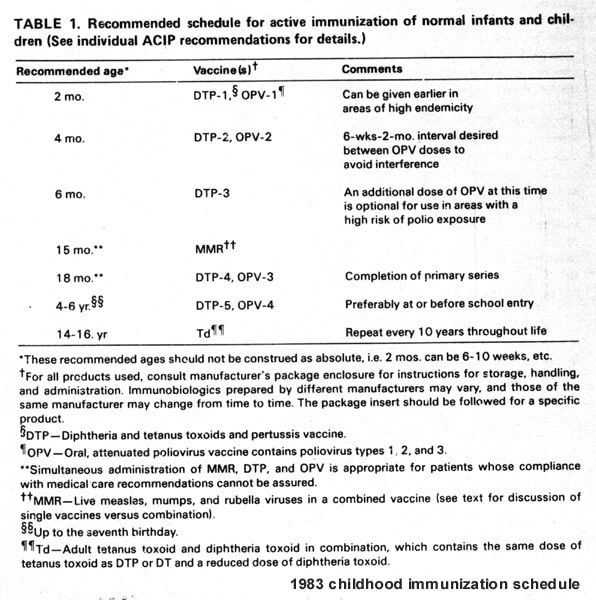
Both the rate of vaccination and the rate of autism have spiked over the past three decades. From 23 doses of seven vaccines in 1983, the recommended immunization schedule has tripled to 69 doses of 16 vaccines, and Americans are now “required by law to use more vaccines than any other nation in the world.” What fuels vaccine hesitancy is the fact that, for several decades through the 1970s, childhood autism remained at a steady rate of about four in ten thousand children. After three decades of steady increases since the 1980s, however, the childhood autism rate, according to the CDC, has climbed to 1 in 68 or 1.5 percent.

Although the American Academy of Pediatrics issued a rebuttal to Trump’s critique, Trump has said that he “couldn’t care less” about the “shills” of conventional medical wisdom, the pharmaceutical companies, and their “fudged up reports.” In typical fashion, he declares that “the doctors lied” and that he is “being proven right about massive vaccinations.”

More influential to Trump than the medical establishment, it seems, is a dissident group of health practitioners, experts, and advocates. Trump has praised the efforts of Bob Wright, the founder and former chairman of Autism Speaks. And as a candidate, he met with a group of vaccine skeptics including:

All of these experts either have children with autism or were drawn to the field after personal encounters with parents who are certain that their children suffered from vaccine damage. This, as Kennedy remarked today, has made an impact on Trump. Asked to explain his persistence on the issue, Trump has consistently cited the testimony of parents who attribute the onset of autism in their children to vaccines—parents, he suspects, who “know far better” than the experts who assert instead that autism is genetic or starts in utero. If Trump ultimately establishes a commission led by Kennedy, and the commission provides a platform for vaccine skeptics, millions of Americans would be exposed for the first time to counter-narratives in the vaccine/autism debate.

They would see that the very term “anti-vaxxer” is misleading. The voluminous writings of the “anti-vaxxers” in fact reveal little in the way of unified opposition to vaccines. Their views, to the contrary, are quite diverse in terms of which vaccines they endorse, the schedules they recommend, and their assessments of vaccine risk in relation to more natural alternatives. Kennedy himself is explicitly “pro vaccine,” had all six of his children vaccinated, and believes that “vaccines save millions of lives.’’ But he questions the safety of neurotoxins in vaccines, particularly the mercury-based preservative thimerosal, given its causative link to brain disorders.

The American people would also learn that the activists with whom Trump has associated are not all that different from vaccine skeptics generally. Numerous investigations suggest that “anti-vaxxers” hardly conform to the caricature of fringe, anti-science zealots. They are, for the most part, highly-educated, wealthy, and, in the assessment of pediatric infectious disease specialist Mark Sawyer, “mainstream upper class people who don’t reject modern medicine.” Steve Silberman observes in his award-winning NeuroTribes: The Legacy of Autism and the Future of Neurodiversity, that they are “generally better acquainted with the state of autism research than the outsiders presuming to judge them.”

Why then are vaccine skeptics treated with such contempt in establishment institutions? There are, it is true, growing numbers of writers such as the science journalist Maggie Koerth-Baker, who, after advancing the conventional narrative on vaccines, decided to study media reporting on the issue. She ultimately criticized her colleagues in Aeon for their failure to acknowledge that vaccine rejection can be a “rational choice.” Yet standard accounts, insofar as they even mention the genuine debate among experts on vaccine safety, often ignore the science informing these objections. Nor do they grapple with personalized approaches to vaccine decisions that, as Prof. Maya Goldenberg argues, are not ignorant per se but can produce cost-benefit analyses that depart, in individual cases, from public health orthodoxy.

In addressing this question, it’s important to consider what vaccine skeptics, including those in Trump’s orbit, do have in common. Rather than a doctrinaire view on vaccines, what unites vaccine skeptics is a suspicion that a corrupt regulatory system, driven by the “seamless marriage” between the health establishment and government agencies, is succumbing to the temptations of “bureaucratic preservation.” The consequence, they fear, is routine data manipulation and stifling of dissent. A legal paradigm—upheld by the Supreme Court’s 2011 decision in Breusewitz v. Wyeth—that does not permit class-action lawsuits or the checks and balances that prevail in almost every other industry, they argue, only exacerbates the risk.

Herein lies the problem. In a recent paper in the journal Science and Engineering Ethics, Prof. Brian Martin found evidence not of a conspiracy, but rather of a pattern of “suppression of vaccination dissent”—one that made Andrew Wakefield “subject to a degradation ceremony, a ritualistic denunciation casting him out of the company of honest researchers.” Martin argues that challenges to free inquiry, while prevalent throughout mainstream science, are particularly serious in the case of immunization. Because “vaccination is a signifier for the benefits of modern medicine,” questions about vaccination are treated as “a potential threat to the public perception that credentialed experts unanimously endorse vaccination.”

While Trump can be faulted for his simplistic rhetoric on the issue, his objections appear to stem from legitimate questions. At a moment when doubts about vaccines are growing and when the federal government, the big pharmaceutical combine, and health-care industries are the three least trusted institutions in America, a presidential commission would seem sensible.

Pratik Chougule is an executive editor at The American Conservative.

Posted in Uncategorized | 2 Comments

MOTHERS, DON’T LET YOUR SONS GROW UP TO PLAY VIDEO GAMES

Image result for PHOTO OF BOYS PLAYING VIDEO GAMES

The Sinkhole of Video Games
View 
THE SINKHOLE OF VIDEO GAMES:

Video games are better than real life. http://vlt.tc/2qh3  “I had bonded with Leon, a graphic designer, musician, and Twitter magnate, over our shared viewership of online broadcasts of the Street Fighter tournaments held every Wednesday night at Next Level. It was his first time attending the venue in person and his first time entering the tournament. I wasn’t playing, but I wanted to see how he’d do, in part because I had taken to wondering more about video games lately — the nature of their appeal, their central logic, perhaps what they might illuminate about what had happened the night before. Like so many others, I played video games, often to excess, and had done so eagerly since childhood, to the point where the games we played became, necessarily, reflections of our being.

“To the uninitiated, the figures are nothing if not staggering: 155 million Americans play video games, more than the number who voted in November’s presidential election. And they play them a lot: According to a variety of recent studies, more than 40 percent of Americans play at least three hours a week, 34 million play on average 22 hours each week, 5 million hit 40 hours, and the average young American will now spend as many hours (roughly 10,000) playing by the time he or she turns 21 as that person spent in middle- and high-school classrooms combined. Which means that a niche activity confined a few decades ago to preadolescents and adolescents has become, increasingly, a cultural juggernaut for all races, genders, and ages. How had video games, over that time, ascended within American and world culture to a scale rivaling sports, film, and television? Like those other entertainments, video games offered an escape, of course. But what kind?

“In 1993, the psychologist Peter D. Kramer published Listening to Prozac, asking what we could learn from the sudden mania for antidepressants in America. A few months before the election, an acquaintance had put the same question to me about video games: What do they give gamers that the real world doesn’t?

“The first of the expert witnesses at Next Level I had come to speak with was the co-owner of the establishment. I didn’t know him personally, but I knew his name and face from online research, and I waited for an opportune moment to approach him. Eventually, it came. I haltingly asked if he’d be willing, sometime later that night, to talk about video games: what they were, what they meant, what their future might be — what they said, perhaps, about the larger world.

“Yes,” he replied. “But nothing about politics.”

“In June, Erik Hurst, a professor at the University of Chicago’s Booth School of Business, delivered a graduation address and later wrote an essay in which he publicized statistics showing that, compared with the beginning of the millennium, working-class men in their 20s were on average working four hours less per week and playing video games for three hours. As a demographic, they had replaced the lost work time with playtime spent gaming. How had this happened? Technology, through automation, had reduced the employment rate of these men by reducing demand for what Hurst referred to as “lower-skilled” labor. He proposed that by creating more vivid and engrossing gaming experiences, technology also increased the subjective value of leisure relative to labor. He was alarmed by what this meant for those who chose to play video games and were not working; he cited the dire long-term prospects of these less-employed men; pointed to relative levels of financial instability, drug use, and suicide among this cohort; and connected them, speculatively, to “voting patterns for certain candidates in recent periods,” by which one doubts he meant Hillary Clinton.

“But the most striking fact was not the grim futures of this presently unemployed group. It was their happy present — which he neglected to emphasize. The men whose experiences he described were not in any meaningful way despairing. In fact, the opposite. “If we go to surveys that track subjective well-being,” he wrote, “lower-skilled young men in 2014 reported being much happier on average than did lower-skilled men in the early 2000s. This increase in happiness is despite their employment rate falling by 10 percentage points and the increased propensity to be living in their parents’ basement.” The games were obviously a comforting distraction for those playing them. But they were also, it follows, giving players something, or some things, their lives could not.

“The professor is nevertheless concerned. If young men were working less and playing video games, they were losing access to valuable on-the-job skills that would help them stay employed into middle age and beyond. At the commencement, Hurst was not just speaking abstractly — and warning not just of the risk to the struggling working classes. In fact, his argument was most convincing when it returned to his home, and his son, who almost seemed to have inspired the whole inquiry. “He is allowed a couple of hours of video-game time on the weekend, when homework is done,” Hurst wrote. “However, if it were up to him, I have no doubt he would play video games 23 and a half hours per day. He told me so. If we didn’t ration video games, I am not sure he would ever eat. I am positive he wouldn’t shower.”

—

—

Posted in Uncategorized | Comments Off on MOTHERS, DON’T LET YOUR SONS GROW UP TO PLAY VIDEO GAMES

STAY OUT OF MY BATHROOM !!!

http://www.virtueonline.org/straight-male-and-texas-bathroom

A straight male and the Texas bathroom
Common sense was thrown out the window

By Mary Ann Mueller
VOL Special Correspondent
www.virtueonline.org
February 23, 2017

I live in Texas, and I just returned from a trip a local store. While there nature called so I went in to use the Ladies’ Room. There was a woman who was having a medical emergency and her husband was patiently standing outside the door.

I heard him ask the attendant, who was assisting his stricken wife, if he could come in and help since he knew what to do for her. He was told “no” because it was the women’s restroom.

And the thought immediately flashed through my mind that if the husband was a transgendered something  (s)he would be welcomed with open arms into the Ladies’ Room, or the Men’s Room for that matter. Or if, were we down the street at the local Target, it would have been a nonissue.

Offering a short silent prayer, I left as the store was closing that particular restroom to all others to deal with the situation. I do not know if an ambulance came or not, nor the outcome of the unfolding medical emergency.

But in today’s crazy sexually-confused world, a husband was initially barred because he is a straight male — he’s not gay and he’s not transgendered. He is a married man who was simply concerned about his wife’s health. Common sense was thrown out the window.

It is not common sense for a man to put on a dress and spike heels to pretend that he is a woman. Regardless of what Bruce (Caitlyn) Jenner, Roderick (Levarne) Cox or PFC Bradley (Chelsea) Manning might have to say about it. To say “God made a mistake” when s/he was created and s/he is “trapped in the wrong body” is insane. Nor is it common sense to bar a spouse — regardless of sex — from helping their helpmate in a critical time of need.

The Episcopal Church is helping fuel this insanity as it champions this lunacy. TEC is fully embracing the pop culture instead of pushing against disordered societal norms and the church has been infected by the sexualized culture, rather than standing up for natural law and the clear teaching of Biblical truth.

Four times the Bible — in both the Old and New Testaments — reiterates that God created them “male and female.”

“Then God said, “Let us make man in our image, after our likeness; … So God created man in his own image, in the image of God he created him; male and female he created them. And God blessed them, and God said to them, “Be fruitful and multiply …” Gen. 1:26-28 (RSV)

“This is the book of the generations of Adam. When God created man, he made him in the likeness of God. Male and female he created them, and he blessed them and named them Man when they were created.” Gen. 5:1-2 (RSV).

“And Pharisees came up to Jesus and tested him by asking, “Is it lawful to divorce one’s wife for any cause?” He answered, “Have you not read that he who made them from the beginning made them male and female, and said, ‘For this reason a man shall leave his father and mother and be joined to his wife, and the two shall become one flesh’?” Matt. 19:3-5 (RSV)

“And Pharisees came up and in order to test Jesus asked, “Is it lawful for a man to divorce his wife?” He answered them, “What did Moses command you?” They said, “Moses allowed a man to write a certificate of divorce, and to put her away.” But Jesus said to them, “For your hardness of heart he wrote you this commandment. But from the beginning of creation, ‘God made them male and female.’ ‘For this reason a man shall leave his father and mother and be joined to his wife and the two shall become one flesh.’ So they are no longer two but one flesh.” Mark 10:2-8 (RSV)

Nowhere in the Bible does it say God made them male and female and transgendered. It just ain’t there.

In addition, the Holy Writ clearly says that a man and woman shall be joined together and become one flesh and be fruitful and multiply. There is no way that a man and a man, or a woman and a woman can become one flesh through the birthing of their child. Same-sex couples are not sexually compatible for the transmission of the God-given spark of life.

About six months ago a story broke in TIME about a transgendered male (biological female) “Evan” who wanted to have a baby.

The question was asked in the TIME article: “But what if you are born into a female body, know you are a man and still want to participate in the traditionally exclusive rite of womanhood? What kind of man are you then?”

“My sex is female, and my gender is male,” Evan says.

I figure that a transgendered person who feels that alien in their own body would not want to have anything to do with the natural functioning of their biological sex, much less keep their reproductive organs intact for procreation. So why would a transgendered male want to get pregnant, have a baby and nurse? Perhaps deep down inside “he” is still all female because of the natural God-given urgings  to experience pregnancy, feel the pangs of labor, and suckle that infant at the breast are  still there and they cannot be ignored. You can’t fool Mother Nature … s/he was born with ovaries, Fallopian tubes, a womb and the birth canal.

The desire for a transgendered male to bear children creates all sorts of medical problems. As a “transgendered male” Evan takes hormones to suppress normal femaleness and “he” binds “his” breasts rather than have a double mastectomy. So Evan had to stop taking testosterone so “he” could ovulate and get pregnant thorough artificial insemination and “he” also lets “his” chest fill out with breast milk. Eventually when “he” quits “chest-feeding” the fruit of his loins, a son, “he” will again start taking testosterone whereby “he’ll” lose “his” feminine curves and will again thicken into a short stocky bearded “male.”

That baby is going to grow up so confused since “Daddy doesn’t physically look like me” or “Mommy doesn’t look like other Mommies I know” or even “Are you my Mommy or my Daddy?”

And the world sees this as normal? The mainstream media endorses it while vilifying anyone who would use common sense to speak against this foolishness and thus it becomes a major TIME article. Then, finally, the courts enshrine this sort of madness in law with the US Supreme Court making “same-sex marriage” the law of the land.

This is schizophrenia, which is described as “a mental disorder characterized by abnormal social behavior and failure to understand what is real.”

The gay and transgendered lobby has been so aggressive that normal heterosexual people are afraid to do anything logical for fear of “discriminating” against a gay or transgendered person or a transgendered gay person. The LGBT alphabet soup gets muddled and confusing.

And TEC’s leadership comes out like a wounded mother bear if anyone should even suggest that something is amiss. How dare they?

So things like a transgendered male makes news because “he” has a baby and s/he can go into any bathroom s/he likes. Yet a straight man wanting to help his suddenly ill wife is barred from the women’s bathroom in Texas.

I am NOT advocating for transgendered rights. Bruce/Caitlyn, Roderick/Levarne, and Bradley/Chelsea, stay out my bathroom. You may not be embarrassed, but I am. Don’t my feelings count? I AM defending basic common sense, decency and dignity.

Mary Ann Mueller is a journalist living in Texas. She is a regular contributor to VirtueOnline

Posted in Uncategorized | 1 Comment

L’EMINENCE GRISE SINCE 2004 HAS BEEN VICTOR EMMANUEL FERNANDEZ

Libro

Settimo Cielodi Sandro Magister 

23 feb 17

Revisitations. Twelve Years Ago Bergoglio Did Not Have the Doubts of Today


[Emphasis and {commentary} in red type by Abyssum]


Of the five “dubia” submitted to Pope Francis and made public by four cardinals concerning the correct interpretation of “Amoris Laetitia,” three make reference to a previous papal document, the 1993 encyclical of John Paul II “Veritatis Splendor.” And they ask if three truths of faith forcefully reaffirmed by that encyclical still apply.

In doubt number two this is the truth for which the cardinals ask confirmation:

– the existence of absolute moral norms, valid without exception, that prohibit intrinsically evil acts (Veritatis Splendor, 79).

In doubt number four it is this other truth for which they ask clarification:

– the impossibility that “circumstances or intentions” may transform “an act intrinsically evil by virtue of its object into an act subjectively good or defensible as a choice” (Veritatis Splendor, 81).

And finally, in doubt number five it is this other truth for which they are awaiting illumination:

– the certainty that conscience is never authorized to legitimize exceptions to absolute moral norms that prohibit acts that are intrinsically evil by virtue of their object (Veritatis Splendor, 56).

None of these “dubia” has received a response from Jorge Mario Bergoglio so far. But if one goes back in time, to when he was archbishop of Buenos Aires, he would give the answers. Sure and reassuring.

In October of 2004 in Buenos Aires, on the occasion of the inauguration of the Cátedra Juan Pablo II at the Pontificia Universidad Católica Argentina, an international theological conference was held on none other than “Veritatis Splendor.”

Attention. “Veritatis Splendor” is not a minor encyclical. In March of 2014, in one of his rare and deeply pondered writings as pope emeritus, indicating the encyclicals out of the fourteen published by John Paul II that in his judgment are “most important for the Church,” Joseph Ratzinger cited four of these, with a few lines for each, but then he added a fifth, which was precisely “Veritatis Splendor,” to which he dedicated an entire page, calling it “of unchanged relevance” and concluding that “studying and assimilating this encyclical remains a great and important duty.”

In “Veritatis Splendor” the pope emeritus saw the restoration to Catholic morality of its metaphysical and Christological foundation, the only one capable of overcoming the pragmatic drift of current morality, “in which there no longer exists that which is truly evil and that which is truly good, but only that which, from the point of view of efficacy, is better or worse.”

In other words, the target of “Veritatis Splendor” was “situational” ethics {and its progeny: Proportionalism}, the permissive movement in favor among the Jesuits in the 17th century that never went away, but instead is even more widespread in the Church today.

So then, among the speakers at that conference the first was Bergoglio. And his talk can be reread in the proceedings published in 2005 by Ediciones Paulinas of Buenos Aires, in a volume entitled: “La verdad los hará libres.”

A talk, that of Bergoglio, of powerful, unquestionable adherence to the truths reaffirmed by “Veritatis Splendor” and in particular to the three mentioned above, or precisely the ones that seem to be wobbling today, after the publication of “Amoris Laetitia.”

For example, on page 34 of the book, the then-archbishop of Buenos Aires writes that “only a moral theology that recognizes norms that are valid always and for everyone, without any exception, can guarantee the ethical foundation of social coexistence, both national and international,” in defense of the equal rights both of the powerful and of the least of the earth, while the relativism of a democracy without values leads to totalitarianism.

And this would be a response to the second doubt of the four cardinals.

On page 32 Bergoglio writes that the understanding of human weakness “can never mean a compromise and falsification of the criterion of good and evil, with the intention of adapting it to the existential circumstances of human persons and groups.”

And this would be a response to doubt number four.

On page 30, finally, he rejects it as a “grave temptation” to maintain that it is impossible for sinful man to observe the holy law of God, and therefore to want to “decide for himself what is good and what is evil” instead of invoking the grace that God always grants.

And this would be a response to the fifth doubt.

But then what happened, after that 2004 conference in Buenos Aires?

What happened, among other things, is that in reaction to the conference an Argentine theologian named Víctor Manuel Fernández in 2005 and 2006 wrote a pair of articles in defense of situational ethics.

Image result for photo of victor emmanuel fernandez

Victor Emmanuel Fernandez

{What happened was, the pupil, Victor Manuel Fernandez, a protege of Bergolio, became the master and Jorge Bergolio became his pupil.  Incredibly Fernandez converted Bergolio.}  

Fernández was the pupil of Bergoglio, who wanted him as rector of the Universidad Católica Argentina and in effect was able to secure his appointment in 2009, overcoming the understandable resistance from the Vatican congregation for Catholic education.

Not only that. When in 2013 Bergoglio became pope, he immediately promoted Fernández as archbishop and wanted him to be part of the composition of the agenda-setting document of his pontificate, the exhortation “Evangelii Gaudium,” as also of other prominent speeches and documents of his.

With the effect that has been seen in “Amoris Laetitia,” thoroughly imbued with permissive moral theology and even with some paragraphs copied from previous writings by Fernández.

Copied in particular from his two articles of 2005 and 2006 cited above:

> “Amoris Laetitia” Has a Ghostwriter. His Name Is Víctor Manuel Fernández

As also from other articles of his of 1995 and 2001:

> Ethicist says ghostwriter’s role in “Amoris” is troubling

And “Veritatis Splendor,” which Bergoglio extolled so vigorously in 2004?

Forgotten. In the two hundred pages of “Amoris Laetitia” it is not cited even once.

{Mystery solved!!!  As I read “Amoris Laetitia” it was so obvious that it was written in opposition to “Veritatis Splendor” that I was puzzled that nowhere was there any justification for the contradictions with the clear principles set forth in Saint John Paul II’s greatest work and the most clearly magisterial of all his writings.  If Victor Manual Fernandez had indeed written the early drafts of  Francis’ Apostolic Exhortation those drafts would surely have reflected Fernandez’s rejection of “Veritatis Splendor.”

Situational ethics, developed by Jesuits in the 17th Century largely disappeared during the 18th Century but reappeared in Europe in the mid-Twentieth Century as “consequentialism.”   The American Jesuit, Father Richard McCormick, S.J. a professor of moral theology at Fordham University and other institutions, promoted it under the name of “proportionalism.”  At first, McCormick openly denied the existence of intrinsic evil, but later reluctantly conjectured that possibly it might exist.  Saint John Paul II condemned Proportionalism along with Consequentialism.

The rejection of the magisterial teaching of “Veritatis Splendor” is the root cause of the heresies of the progressive cardinals, bishops, priests and others who wrongly interpret “Amoris Laetitia” to permit the giving of Holy Communion to the divorced and remarried along with other errors.}

Image result for painting of  François Leclerc du Tremblay by Jean-Léon Gérôme

L’Eminence Grise, Francois Tremblay, descending the stairs.

Posted in Uncategorized | 1 Comment