Constitutional lawyer Scott Lively explains “WHY Trump Lost the White House”:
Yes, unprecedented election fraud explains HOW the Uniparty stole the presidency, but not WHY God allowed the deceivers to win. Before the Trump presidency, the hard-working patriotic common people of America who make up the bulk of the Trump base – the “silent majority” – were not generally politically-oriented. They pretty much minded their own business and adapted to the seasons of change in our society and culture without necessarily agreeing with it all. Things that didn’t affect them personally they ignored, and the rest they resisted quietly, inside their trusted social circles and family networks, limiting their push-back to grumbling complaints or anonymous warfare in the comments section of Internet media sites. As those cultural changes ratcheted farther and farther leftward into the realm of lunacy the common people grew increasing uncomfortable, until, under Obama, their discontent took a more overt political turn in the Tea Party movement. But, being political novices, they were easily manipulated by the Republican Establishment which used its skills and resources to entice them into its party machinery where they were easily diffused and neutralized as a political threat. Yet, being experts at “ostensible compliance” while silently dissenting, their movement languished but did not die. Like a smoldering forest fire starved for oxygen, it roared back to life bigger than ever when the Trump campaign came sweeping over the political landscape like hurricane. The rest is history. The greatest weakness of the Trump base, and of Trump himself – the real reason why we lost the election – is the continuing unnatural and self-deluding separation of “bread and butter” fiscal issues from “not my business” social issues. Trump tried to rectify this problem but was only partially successful because he followed the example of the corrupt Republicans who have always used the pro-life issue as a panacea to the working-class Christian right, while simultaneously pandering to the big-spending “gays.” Trump was vastly better for the pro-life cause, which he actually championed, than the continually head-faking Republicans, but in pretending that being more zealously pro-life could substitute for being pro-family in the broader, more fundamental meaning of the term, he undermined his own cause and lost the favor of God. Trump – and his base – lost the election because we did not fight the dragon at center of the Marxist agenda, but allowed that snake inside our own camp: homosexual perversion. On this score, billionaire Trump’s family had been undermined by the same Cultural Marxist social-engineering that infiltrated every poor and middle class home in America since the 1960s. His own daughter Ivanka was seduced by the allure of “Queer Theory” pop-culture propaganda in all of its insidious forms, becoming (apparently) the Eve in the garden of Trump’s own family, convincing him to eat the apple of pro-“gay” political correctness. Despite being a self-avowed Orthodox Jew, Ivanka persuaded her father to openly defy God’s unequivocal command in Leviticus 18:22 calling male homosexuality “toeva” (abomination) the harshest form of condemnation in Scripture, and expressly warning in verses 26-28 “you must not commit any of these abominations—neither your native-born nor the foreigner who lives among you. For the men who were in the land before you committed all these abominations, and the land has become defiled. So if you defile the land, it will vomit you out as it spewed out the nations before you.” If God had wanted Donald Trump to remain in the presidency, nothing in heaven or earth could have dislodged him. Instead, just as first Israel and then Judah were expelled from the Holy Land by wicked conquerors for ignoring Leviticus 18, God allowed Donald Trump to be expelled from the White House by obviously corrupt and senile Joe Biden and his sneering Jezebel side-kick, riding a tidal wave of insultingly blatant election fraud. Now, I’m not rejecting Donald Trump as a political leader as a result of this assessment. Despite his flaws he remains the single most potent human force for constitutionalism in America and I no longer subscribe to the Evangelical requirement of moral perfection in political leaders. Most importantly, I still believe Trump was God’s man in the White House during his term and that God is not done with him any more than he’s done maturing and shaping the rest of us to be more like Jesus Christ. However, to regain God’s favor, Trump must repent of his defiance of God, and toward that end I offer the following facts that he, and his well-intentioned but deceived daughter/advisor, should consider. Trump’s worst enemies are either homosexuals or their closest political surrogates. Obama is almost certainly a homosexual. Hillary, whom many believe is a lesbian, landed her hardest punch against Trump and his base – the “Deplorables Speech” – at a massive LGBT fundraising event. The Lincoln Project, the most effective anti-Trump effort in 2020 represents the homosexual core of the GOP establishment, co-founded by its most noxious agent Steve Schmidt – who followed his senior advisor role for uber-Rino John McCain (and “strategic communications” manager for George Bush’s installment of John Roberts to SCOTUS) pushing “gay marriage” in the GOP for the ACLU. Co-founders Ron Steslow and Mike Madrid are both open homosexuals. Co-founder Rick Wilson, lobbied the Supreme Court in favor of “gay marriage” (and is now bent on destroying Ted Cruz). The token woman in the group Jennifer Horn, was a board member of the openly homosexual Log Cabin Republicans (likely the source of the “Lincoln Project” name). The token “heterosexual happily married man with children,” co-founder John Weaver, recently resigned in shame after a sex scandal involving young men. More important is the fact that “Queer Theory” which insists – militantly — that DNA-based binary male/female gender is actually fluid and changeable (and not binary), while feelings-based and self-assessed “sexual orientation” is fixed and unchangeable, has always been the central core of progressivism – more foundational even than the “Critical Race Theory” of BLM (founded by a pair of Marxist lesbians). And anyone who claims to be “conservative” while normalizing false LGBT theories by claiming to be innately and proudly “gay,” (instead of telling people to mind their own business on all sexual privacy issues) is an intentional or self-deceived Trojan Horse for sexual anarchy, the most socially destructive force in human civilization. My advice to President Trump is to first apologize to God for defying His command and then, at minimum, pivot to a “Don’t Ask, Don’t Tell” philosophy, the only workable compromise between the secular society and the MAGA millions who rightfully insist that Christian family values and traditions MUST be protected for the survival of not just our nation, but humanity. [January 26, 2021, www.scottlively.net Observations and Action on Current Events, History and Theology. Subscribe by email request here scottlivelyministries@gmail.com .]
Francis Notes:
– Doctor of the Church St. Francis de Sales totally confirmed beyond any doubt the possibility of a heretical pope and what must be done by the Church in such a situation:
“[T]he Pope… WHEN he is EXPLICITLY a heretic, he falls ipso facto from his dignity and out of the Church, and the Church MUST either deprive him, or, as some say, declare him deprived, of his Apostolic See.” (The Catholic Controversy, by St. Francis de Sales, Pages 305-306)
– LifeSiteNews, “Confusion explodes as Pope Francis throws magisterial weight behind communion for adulterers,” December 4, 2017:
The AAS guidelines explicitly allows “sexually active adulterous couples facing ‘complex circumstances’ to ‘access the sacraments of Reconciliation and the Eucharist.'”
– On February 2018, in Rorate Caeli, Catholic theologian Dr. John Lamont:
“The AAS statement… establishes that Pope Francis in Amoris Laetitia has affirmed propositions that are heretical in the strict sense.”
– On December 2, 2017, Bishop Rene Gracida:
“Francis’ heterodoxy is now official. He has published his letter to the Argentina bishops in Acta Apostlica Series making those letters magisterial documents.”
Pray an Our Father now for the restoration of the Church by the bishops by the grace of God.
Pray an Our Father now for the grace to know God’s Will and to do it. Francis Notes:- Doctor of the Church St. Francis de Sales totally confirmed beyond any doubt the possibility of a heretical pope and what must be done by the Church in such a situation:, he falls ipso facto from his dignity and out of the Church, and, or, as some say,(The Catholic Controversy, by St. Francis de Sales, Pages 305-306)
“[T]he Pope… WHEN he is EXPLICITLY a heretic the Church MUST either deprive him declare him deprived, of his Apostolic See.”
Saint Robert Bellarmine, also, said “the Pope heretic is not deposed ipso facto, but must be declared deposed by the Church.” []https://archive.org/stream/SilveiraImplicationsOfNewMissaeAndHereticPopes/Silveira%20Implications%20of%20New%20Missae%20and%20Heretic%20Popes_djvu.txt”If Francis is a Heretic, What should Canonically happen to him?”:- http://www.thecatholicmonitor.com/2020/12/if-francis-is-heretic-what-should.html“Could Francis be a Antipope even though the Majority of Cardinals claim he is Pope?”:- http://www.thecatholicmonitor.com/2019/03/could-francis-be-antipope-even-though.html – LifeSiteNews, “Confusion explodes as Pope Francis throws magisterial weight behind communion for adulterers,” December 4, 2017: The AAS guidelines explicitly allows “sexually active adulterous couples facing ‘complex circumstances’ to ‘access the sacraments of Reconciliation and the Eucharist.'”
– On February 2018, in Rorate Caeli, Catholic theologian Dr. John Lamont:
“The AAS statement… establishes that Pope Francis in Amoris Laetitia has affirmed propositions that are heretical in the strict sense.”
– On December 2, 2017, Bishop Rene Gracida:
“Francis’ heterodoxy is now official. He has published his letter to the Argentina bishops in Acta Apostlica Series making those letters magisterial documents.”
Lines or Lies?By: Judd GarrettObjectivity is the ObjectiveJanuary 24, 2021 Since his inauguration, President Joe Biden has been actively overturning many of Donald Trump’s policies. On day one, he signed an executive order reversing Trump’s immigration policies and has not ruled out the possibility of tearing down the wall on our southern border. According to Biden, borders are not necessary. He fails to realize that if a country doesn’t have borders, it isn’t a country. It’s an amorphous landmass where citizenship becomes irrelevant. Many of the same politicians who want to tear down our nation’s borders live in gated communities behind 10-foot-high security walls. They sue states like Texas from deploying the National Guard to protect the southern border, yet they demand that the Texas National Guard be deployed to DC to protect the perimeter around the Capital. They like borders and guards only when they protect their own interests. The same politicians who believe the breach of the Capital crossed the line into a “violent insurrection” requiring the deployment of 26,000 National Guardsmen, drew much fuzzier lines when it came to the 157 straight days of BLM and Antifa riots this past year, that killed, injured, burned, and destroyed many of our major cities, referring to them as “mostly peaceful”, no need for police or National Guard support. Now, the Biden Administration is creating a task force to go after “domestic terrorists”.They are defining “domestic terrorists” only as the far-right groups such as “Proud Boys” and QAnon, but no mention of Black Lives Matter or Antifa. Setting 70 federal buildings on fire and fire-bombing police stations apparently does not cross the line into “domestic terrorism” according to Joe Biden. Only the groups who are responsible for about 2 riots over the last 4 years are the ones who crossed that line. To be clear, we should go after all domestic threats, not just those with a different political ideology. It’s strange that people who do not want to create a safe country by securing our borders, and are inconsistent when dealing with violence and rioting for political purposes, demand to have their own intellectual “safe spaces” forged within the country. They favor hard strict rules banning and censoring speech of people who have different ideas than they do. They draw clear and distinct lines around certain words or thoughts that are not allowed to enter their safe space, but anyone can enter our country, friend or foe, migrant worker or drug dealer, MS-13 gang member, or terrorist. All are welcome. And if you espouse the right politics, you can shatter windows, break down doors, loot store, and burn buildings. But if you espouse the wrong politics, your words cannot enter their safe space. These people spend more time protecting the country from “violent” words than violent people. The founders established clear hard lines about speech when they wrote, “Congress shall make no law abridging the freedom of speech.” Yet, these people want to create laws abridging speech. The same people who will fight to the death to allow the most vile and exploitative pornography to be widely disseminated on the internet will fight to ban the expression “Make America Great Again”. Twitter was so concerned about the safety of its users that they had to ban Donald Trump, yet Twitter is one of the leading platforms for the dissemination of child pornography and sex trafficking. Yet, they do little to ban or censor those users on their platform. They are blurring the lines of everything, right and wrong, good and bad, and even male-female. Biden recently signed an executive order allowing biological males to play on female high school sports teams, and enter female bathrooms and locker-rooms, regardless of what gender the scientific DNA says or the physical body presents. According to Biden, there is no line between male and female anymore. We’re supposed to celebrate when Sarah Thomas becomes the first woman to officiate a Super Bowl or when Kamala Harris becomes the first woman Vice President because they are breaking gender barriers, but then we are told that gender is a “social construct” and it is “fluid”. They are celebrating gender accomplishments while tearing down the concept of gender. At the same time, they are blurring the lines between male and female, they are reinforcing the lines that separate the races. Biden signed an executive order making the racially divisive Critical Race Theory which teaches people to judge each other based on race to be taught in federal government agencies and in public schools. They reject Martin Luther King Jr’s tired old line about, not judging people “by the color of their skin but by the content of their character.” When President Biden announced his Cabinet selections, he proclaimed he wanted a cabinet the “looks like America”.He said, “by the end of this process, this Cabinet will be the most representative of any Cabinet in American history. We’ll have more people of color… more women than any Cabinet ever. We’ll have a Cabinet of barrier breakers, a Cabinet of firsts… eight precedent-busting appointments.” Are these the most qualified? It’s hard to determine because when Biden announced these selections, he didn’t say, the smartest, the most qualified, the most capable. Intelligence and capability were secondary in making these selections. The priority was skin color, or gender, or lifestyle. These people may be qualified or they may not be qualified. But when the main characteristic for their appointment is skin color or gender or lifestyle, then the question of “qualified” remains. They may be qualified, but are they the most qualified? Do you want Patrick Mahomes or Ryan Tannehill as your quarterback? Both are qualified NFL starting quarterbacks. But the most qualified quarterback leads you to the Super Bowl. The other one only gets you so far. Do we want to be the Super Bowl Champs or an also-ran? The problem is not that people of different groups are in the Cabinet. The problem is that Joe Biden told us they were selected because of their group identity. He celebrated the fact. When you make decisions based on group identity, you divide people. If you hail diversity based solely on group identity, then you are claiming that there are inherent differences between people due solely to that different identity, which is, in fact, prejudice and discriminatory. Biden is prepared to draw another sharp line by rescinding the Mexico City Rule, as well as the Hyde Amendment regarding abortion. He is unilaterally drawing the line that says life begins at birth and birth alone. Don’t show me your beating heart, your functioning brain, your expanding lungs, your moving limbs, your eyes, ears, nose. I don’t want to see any of that. You are on the wrong side of the line I drew, so you’re dead. When it came to Covid, the lines were very clear; you must wear a mask, you must social distance, you must stay locked in your house. Those lines were strict, unequivocal, must never be crossed, unless you’re a BLM or Antifa rioter, or a Democratic politician, and then those strict unequivocal lines become very fuzzy or even unnecessary. Biden is continually erasing the lines which should be immutable, and drawing lines where none should be which is clearly a sign of an unprincipled soul. He is not a rudderless ship. He merely steers the ship solely in the direction that is most beneficial to him and his side. To these people, if you hold the approved political orthodoxy, there are no lines containing you, the rules do not apply, everything is shades of gray. If you do not hold that orthodoxy, then the strictest, harshest, most draconian rules are enforced.
Rip McIntosh
Posted inUncategorized|Comments Off on IT ALL DEPENDS ON WHOSE OX IS BEING GORED
JANUARY 24, 2021BY SAMUEL GREGGThe first of a projected two-volume biography of the theologian-pope underscores his thought’s consistency and how it was shaped by Germany’s twentieth-century traumas.
It is a dispiriting time to be Catholic. The sexual and financial scandals that have humiliated the Church have seriously compromised its ability to witness to truth. So too has the McCarrick Report’s evidence of widespread mendacity, cowardice, cronyism, and careerism among senior clergy over several decades. Then there is the fact that the words of some western European bishops, particularly German-speakers, indicate that they do not hold the fullness of Catholic faith. And who cannot be dismayed by the extent to which sentimental humanitarianism has become a de facto orthodoxy among many Catholics? Deliberate ambiguity and strongly felt feelings are in; clarity and reasoned faith are out.
In my experience, any conversation about why the Church finds itself in this position invariably gravitates to the topic of the Second Vatican Council. Fifty-six years after its closure, divisions persist concerning Vatican II’s meaning and its place in the controversies that have engulfed Catholicism since 1965.
One figure who played an important role at Vatican II was a young professor, then relatively unknown outside his native Germany. His time at the Council closes the first of a projected two-volume biography of this intellectual who eventually became pope. The book’s author, the German journalist Peter Seewald, has interviewed Joseph Ratzinger extensively since 1997. In Benedict XVI: A Life: Volume One: Youth in Nazi Germany to the Second Vatican Council 1927–1965, Seewald has penned a widely informed account of a man whose thought has shaped debates within the Church—and throughout the West—for decades.
Under the Swastika’s Shadow
Born in 1927, Ratzinger grew up in a Germany which was undergoing rapid political, economic, and cultural change. The habits and traditions associated with past monarchical authoritarianism, Seewald illustrates, clashed with new developments: the growth of mass culture, social emancipation, and the spread of racialist and Marxist ideologies that cloaked themselves in the garb of modern science.
Ratzinger’s youth was somewhat removed from these troubles. His youth was spent in pious and rural Bavaria, where the Church was omnipresent. In retrospect, Ratzinger described this atmosphere as a “Dreamland,” marked by Baroque architecture, monasteries, processions, Passion plays, and Mozart.
This perhaps romanticized world was gradually pulled into the conflicts that swamped Germany following the 1929 financial crash and the Great Depression. Millions of Germans started to look to radical solutions like National Socialism or Communism for salvation. Following World War II, many such Germans claimed to have always opposed the Nazi regime. In the case of Ratzinger’s family, Seewald provides plenty of evidence that they loathed National Socialism and its leader from the beginning and never wavered in their hostility.
Ratzinger later reflected at length upon the response of German Christians to Nazism, noting how many adapted their beliefs to the new circumstances. Many Protestants embraced “positive Christianity” (a form of “de-Jewified” Christianity) despite opposition from Confessing Church theologians like Martin Niemöller and Dietrich Bonhoeffer.
Among Catholics, the Nazis had a harder time making headway. Seewald points out, however, that although Germany’s Catholic bishops firmly condemned Nazism at first, after 1933 they sought a modus vivendi with the new rulers. This didn’t stop the regime from gradually tightening the screws on independent Catholic activities throughout Germany, or from putting loudly anti-Nazi priests in concentration camps. In these conditions, Ratzinger’s early decision to become a priest could only be interpreted by the authorities as dissent from Nazi ideology.
Ratzinger found a refuge from the madness surrounding him in Catholic liturgy. But he also saw the liturgy as an anticipation of a greater reality. That vision went together with his growing intellectual interest in the claims of religion. “From the beginning,” Ratzinger said, “everything that was said in religion also interested me rationally.”
Herein we find a pattern that would characterize Ratzinger’s life. He was deeply attached to the Church’s interior and devotional life, yet also determined to use reason to elucidate the truths of Revelation. He wanted to explain the import of faith for living a Christian life in the face of ideologies that constricted rationality. It is a way of thinking that didn’t—and doesn’t—fit contemporary conservative–progressive categories, whether in religion or politics.
Augustine and Physics
The horrors unleashed by Nazism became fully apparent to Ratzinger in the second half of World War II. Conscripted into the Wehrmacht as a teenager, he witnessed deportations of Jews and experienced the effects of saturation bombing upon Germany. Nor could he avoid noting how virtually all the country’s institutions and millions of individual Germans were morally compromised, even if most Germans wouldn’t admit it after 1945.
Remarkably, however, German Catholicism experienced a renaissance after Germany’s surrender, at least as reflected in noticeable upticks in Mass-attendance, conversions, and priestly vocations. Amid this “Catholic spring” the Church acquired considerable political clout via its influence upon Catholic-dominated Christian Democratic governments. Many Germans recognized that, despite its numerous and profound failures, the Church had been not completely suborned by National Socialism, and it had martyrs to prove it.
Yet as a seminarian and young priest, Ratzinger observed something else. Beneath the Church’s apparent institutional strength, Catholic faith was wilting. Twelve years of Nazi rule combined with the material and moral destruction of a savage world war had profoundly corroded religious belief. Ratzinger wasn’t the first to see the widening gap between German Catholicism’s organizational depth and the actual faith life of German Catholics. As early as 1946, the theologian Ida Friederike Görres noticed a silent disillusionment with the Church that bishops, priests, and theologians were failing to address.
This problem was at the forefront of Ratzinger’s mind during his seminary years, his service as a young curate, and his pre-Vatican II theological career. Along the way, three experiences particularly influenced him.
One was his reading of particular Catholic theologians who were under a cloud before Vatican II, including Hans Urs von Balthasar and, especially, Henri de Lubac, S.J. The latter’s 1938 book, Catholicisme, showed Ratzinger a way to think about renewing the Church in modernity through returning to the Scriptures and the Church Fathers.
A second key moment was Ratzinger’s encounter with that most dynamic of thinkers, Augustine of Hippo, and his Confessions. There, Seewald states, Ratzinger discovered “a true biography, a real person active in history [and] . . . aware of his intellectual power. Someone who thought about faith and lived it.” It’s not difficult to see how Ratzinger, like countless other Christians, would be attracted to this vivid and open personality. There was, however, something else that got Ratzinger’s attention: Augustine’s “passionate search for the truth.” What inspired that quest, Ratzinger realized, was faith in Christ. Far from constraining “his intellectual boldness,” Augustine’s desire to “know God and the soul” drove him, Ratzinger later wrote, along “the way of truth, which is a way of courage, humility, [and] constant clarification.”
Ratzinger’s third source of inspiration was more unexpected. Reading widely in the postwar period, he discovered that many natural scientists—those most modern of thinkers—were making their way back to God. Figures like the Munich physicist Aloys Wenzel, the astrophysicist Sir Arthur Eddington, and the Nobel laureate and theoretical physicist Werner Heisenberg were, Ratzinger realized, “suddenly talking about a ‘creator God.’” Ratzinger was struck by Albert Einstein’s insistence that “God does not play dice. Rather, he created the world according to an orderly plan. It is the scientist’s task to discover it.”
All this reinforced Ratzinger’s belief that the God found in the Scriptures was not a Kantian, capital-I Ideal, let alone the Hegelian Geist of capital-H History. Instead, he was the Creator Logos who stands at the beginning of time; who first revealed Himself to the Jewish people, before fully manifesting Himself in the person of Jesus of Nazareth. It was this Christ-Logos who allowed humans to fully comprehend reality, including those post-Enlightenment realities with which Catholics were wrestling. Expounding this outlook, Seewald holds, moved to the center of Ratzinger’s scholarship in the lead-up to Vatican II.
Contested Council
Ratzinger had no reason to assume that he would play a role at the Council which Pope John XXIII announced in 1959. The previous year, however, Ratzinger had captured the interest of German opinion outside academic circles by publishing an article entitled “The New Pagans and the Church.” Its theme concerned the emergence of “a Church of pagans, who still call themselves Christians, but actually have become pagans.”
This problem went beyond the emergence of large numbers of non-practicing Catholics or those who reduced the faith and sacraments to mere markers of cultural identity, rites of passages, networking opportunities, and bourgeois respectability. Many Catholics, Ratzinger argued, were making “a very subjective choice from the creed of the Church in order to shape their own world view.” In other words, the world was driving the content of Christian belief, not the other way around. For Ratzinger, the solution was clear: “In the long run the Church cannot escape having to dismantle bit by bit its semblance of worldliness, to become again what she is: a community of believers.”
At the time, these words identified Ratzinger as a “progressive.” Today they would be viewed as a “conservative” critique of the bureaucratization of Catholic life, exemplified by the contemporary German Catholic church. It has much wealth and many institutions, but very few actual churchgoers, and most of its bishops and theologians seem far more concerned about conforming to secularist expectations than the Gospel.
One bishop whom Ratzinger’s article impressed was Cardinal Josef Frings of Cologne. He subsequently attended one of Ratzinger’s lectures. In it, the theologian condemned both the application of secular political models to Church councils (widely interpreted as a criticism of the Swiss theologian Hans Küng) and intellectuals who despised “the day-to-day faith of simple people,” without which the Church would be “just a chattering, empty frame.” Frings latched onto Ratzinger as a theologian who would give voice to the direction in which he thought the Council should go and not simply rubber-stamp drafts of texts prepared by the Roman Curia.
From that point onwards, Ratzinger became a growing influence on global Catholicism. He drafted, for instance, Frings’s famous 1961 Genoa speech that helped set Vatican II’s agenda. During the Council itself, Ratzinger produced circumspect critiques of Curial texts and worked with de Lubac and others to draft crucial documents like Lumen Gentium (1964) and Dei Verbum (1965). Though Ratzinger’s influence at the Council has long been recognized, Seewald illustrates just how extensive and consistent it was. Ratzinger’s impact, he comments, owed much to his rare ability to combine intellectual clarity with depth, and his unwillingness to be intimidated, whether by rank, bluster, credentials, or demands to “be relevant.”
Two Ratzingers?
Ratzinger’s work was consistent not just in style and method, but also in content. Critics and admirers alike have long argued that his thought substantially changed after Vatican II, but Ratzinger maintains there was no change in his fundamental positions.
Seewald agrees with his subject. He points to Ratzinger’s emphasis on returning to the Scriptures and Church Fathers; on accuracy in the use of words; on using formulations that manifest the interconnections between Scripture, tradition, and magisterial teaching; a firm opposition to utopianism (here Ratzinger was much influenced by reading de Lubac but also the German-American political philosopher Eric Voegelin); a stress upon the Cross’s centrality to grasping reality; and an on-going attention to the idea of communio as a way of understanding the Church. These themes were firmly present, Seewald underscores, in Ratzinger’s pre-1965 way of thinking and acting.
Perhaps most significantly, Seewald demonstrates that Ratzinger resisted any attempt to prioritize concerns for tolerance over searching for and teaching the truth. For Ratzinger, tolerance was the context needed for pursuing the truth, not an all-consuming end in itself. Certainly, Ratzinger argued, the truth needed to be spoken with love. Nevertheless it had to be spoken—especially when the world didn’t want to hear it.
Ratzinger saw that the Church had to live this principle if it was not to become worldly. No doubt, his position also owed something to his awareness of the failure of most of his own people, including Catholics, to confront Nazism’s lies. As I suspect Seewald’s second volume will elucidate, it was a commitment that would propel Ratzinger forward as he confronted various pathologies of reason and faith in not just the world but the Church itself.
Republican Senator: Biden Cancelling Keystone Pipeline Means Oil Goes to China Now
(NewsReady.com) – On Wednesday, January 20, Joe Biden was sworn in as president and almost immediately started dismantling former President Donald Trump’s legacy. Specifically, he stopped construction on the Keystone XL pipeline and reentered the US in the Paris Climate Accord. Both policies are detrimental to energy sector jobs, but now one senator is arguing they also make America less safe.
On January 23, Senator Mike Rounds (R-SD) told Fox News the oil that was going to travel through the pipeline will now go to other countries like China. He said the oil will still have to move from one place to another and it will now “go to rail cars,” which isn’t as safe as the alternative.
Senator Rounds also pointed out that thousands of jobs could now be lost. So, not only did it make the transportation of oil less safe, he’s hurting the job market. That’s the worst decision Biden could have made during a time of so much economic uncertainty, and to do it right away leaves us to wonder what else he has in store for the country.
Posted inUncategorized|Comments Off on Joe Biden SERVES THE BEST INTERESTS OF RED CHINA NOT THE United States IN CANCELLING THE KEYSTONE PIPELINE WHICH MEANS THE OIL THAT WOULD HAVE PASSED THROUGH THAT PIPELINE TO REFINERIES IN THE United States WILL GO ACROSS THE PACIFIC IN TANKERS TO RED CHINA. PLEASE GOD, DO NOT LET THAT OIL FUEL RED CHINA’S WAR MACHINE AGAINST THE United States IN THE FUTURE
JANUARY 24, 2021BY SAMUEL GREGGThe first of a projected two-volume biography of the theologian-pope underscores his thought’s consistency and how it was shaped by Germany’s twentieth-century traumas.
It is a dispiriting time to be Catholic. The sexual and financial scandals that have humiliated the Church have seriously compromised its ability to witness to truth. So too has the McCarrick Report’s evidence of widespread mendacity, cowardice, cronyism, and careerism among senior clergy over several decades. Then there is the fact that the words of some western European bishops, particularly German-speakers, indicate that they do not hold the fullness of Catholic faith. And who cannot be dismayed by the extent to which sentimental humanitarianism has become a de facto orthodoxy among many Catholics? Deliberate ambiguity and strongly felt feelings are in; clarity and reasoned faith are out.
In my experience, any conversation about why the Church finds itself in this position invariably gravitates to the topic of the Second Vatican Council. Fifty-six years after its closure, divisions persist concerning Vatican II’s meaning and its place in the controversies that have engulfed Catholicism since 1965.
One figure who played an important role at Vatican II was a young professor, then relatively unknown outside his native Germany. His time at the Council closes the first of a projected two-volume biography of this intellectual who eventually became pope. The book’s author, the German journalist Peter Seewald, has interviewed Joseph Ratzinger extensively since 1997. In Benedict XVI: A Life: Volume One: Youth in Nazi Germany to the Second Vatican Council 1927–1965, Seewald has penned a widely informed account of a man whose thought has shaped debates within the Church—and throughout the West—for decades.
Under the Swastika’s Shadow
Born in 1927, Ratzinger grew up in a Germany which was undergoing rapid political, economic, and cultural change. The habits and traditions associated with past monarchical authoritarianism, Seewald illustrates, clashed with new developments: the growth of mass culture, social emancipation, and the spread of racialist and Marxist ideologies that cloaked themselves in the garb of modern science.
Ratzinger’s youth was somewhat removed from these troubles. His youth was spent in pious and rural Bavaria, where the Church was omnipresent. In retrospect, Ratzinger described this atmosphere as a “Dreamland,” marked by Baroque architecture, monasteries, processions, Passion plays, and Mozart.
This perhaps romanticized world was gradually pulled into the conflicts that swamped Germany following the 1929 financial crash and the Great Depression. Millions of Germans started to look to radical solutions like National Socialism or Communism for salvation. Following World War II, many such Germans claimed to have always opposed the Nazi regime. In the case of Ratzinger’s family, Seewald provides plenty of evidence that they loathed National Socialism and its leader from the beginning and never wavered in their hostility.
Ratzinger later reflected at length upon the response of German Christians to Nazism, noting how many adapted their beliefs to the new circumstances. Many Protestants embraced “positive Christianity” (a form of “de-Jewified” Christianity) despite opposition from Confessing Church theologians like Martin Niemöller and Dietrich Bonhoeffer.
Among Catholics, the Nazis had a harder time making headway. Seewald points out, however, that although Germany’s Catholic bishops firmly condemned Nazism at first, after 1933 they sought a modus vivendi with the new rulers. This didn’t stop the regime from gradually tightening the screws on independent Catholic activities throughout Germany, or from putting loudly anti-Nazi priests in concentration camps. In these conditions, Ratzinger’s early decision to become a priest could only be interpreted by the authorities as dissent from Nazi ideology.
Ratzinger found a refuge from the madness surrounding him in Catholic liturgy. But he also saw the liturgy as an anticipation of a greater reality. That vision went together with his growing intellectual interest in the claims of religion. “From the beginning,” Ratzinger said, “everything that was said in religion also interested me rationally.”
Herein we find a pattern that would characterize Ratzinger’s life. He was deeply attached to the Church’s interior and devotional life, yet also determined to use reason to elucidate the truths of Revelation. He wanted to explain the import of faith for living a Christian life in the face of ideologies that constricted rationality. It is a way of thinking that didn’t—and doesn’t—fit contemporary conservative–progressive categories, whether in religion or politics.
Augustine and Physics
The horrors unleashed by Nazism became fully apparent to Ratzinger in the second half of World War II. Conscripted into the Wehrmacht as a teenager, he witnessed deportations of Jews and experienced the effects of saturation bombing upon Germany. Nor could he avoid noting how virtually all the country’s institutions and millions of individual Germans were morally compromised, even if most Germans wouldn’t admit it after 1945.
Remarkably, however, German Catholicism experienced a renaissance after Germany’s surrender, at least as reflected in noticeable upticks in Mass-attendance, conversions, and priestly vocations. Amid this “Catholic spring” the Church acquired considerable political clout via its influence upon Catholic-dominated Christian Democratic governments. Many Germans recognized that, despite its numerous and profound failures, the Church had been not completely suborned by National Socialism, and it had martyrs to prove it.
Yet as a seminarian and young priest, Ratzinger observed something else. Beneath the Church’s apparent institutional strength, Catholic faith was wilting. Twelve years of Nazi rule combined with the material and moral destruction of a savage world war had profoundly corroded religious belief. Ratzinger wasn’t the first to see the widening gap between German Catholicism’s organizational depth and the actual faith life of German Catholics. As early as 1946, the theologian Ida Friederike Görres noticed a silent disillusionment with the Church that bishops, priests, and theologians were failing to address.
This problem was at the forefront of Ratzinger’s mind during his seminary years, his service as a young curate, and his pre-Vatican II theological career. Along the way, three experiences particularly influenced him.
One was his reading of particular Catholic theologians who were under a cloud before Vatican II, including Hans Urs von Balthasar and, especially, Henri de Lubac, S.J. The latter’s 1938 book, Catholicisme, showed Ratzinger a way to think about renewing the Church in modernity through returning to the Scriptures and the Church Fathers.
A second key moment was Ratzinger’s encounter with that most dynamic of thinkers, Augustine of Hippo, and his Confessions. There, Seewald states, Ratzinger discovered “a true biography, a real person active in history [and] . . . aware of his intellectual power. Someone who thought about faith and lived it.” It’s not difficult to see how Ratzinger, like countless other Christians, would be attracted to this vivid and open personality. There was, however, something else that got Ratzinger’s attention: Augustine’s “passionate search for the truth.” What inspired that quest, Ratzinger realized, was faith in Christ. Far from constraining “his intellectual boldness,” Augustine’s desire to “know God and the soul” drove him, Ratzinger later wrote, along “the way of truth, which is a way of courage, humility, [and] constant clarification.”
Ratzinger’s third source of inspiration was more unexpected. Reading widely in the postwar period, he discovered that many natural scientists—those most modern of thinkers—were making their way back to God. Figures like the Munich physicist Aloys Wenzel, the astrophysicist Sir Arthur Eddington, and the Nobel laureate and theoretical physicist Werner Heisenberg were, Ratzinger realized, “suddenly talking about a ‘creator God.’” Ratzinger was struck by Albert Einstein’s insistence that “God does not play dice. Rather, he created the world according to an orderly plan. It is the scientist’s task to discover it.”
All this reinforced Ratzinger’s belief that the God found in the Scriptures was not a Kantian, capital-I Ideal, let alone the Hegelian Geist of capital-H History. Instead, he was the Creator Logos who stands at the beginning of time; who first revealed Himself to the Jewish people, before fully manifesting Himself in the person of Jesus of Nazareth. It was this Christ-Logos who allowed humans to fully comprehend reality, including those post-Enlightenment realities with which Catholics were wrestling. Expounding this outlook, Seewald holds, moved to the center of Ratzinger’s scholarship in the lead-up to Vatican II.
Contested Council
Ratzinger had no reason to assume that he would play a role at the Council which Pope John XXIII announced in 1959. The previous year, however, Ratzinger had captured the interest of German opinion outside academic circles by publishing an article entitled “The New Pagans and the Church.” Its theme concerned the emergence of “a Church of pagans, who still call themselves Christians, but actually have become pagans.”
This problem went beyond the emergence of large numbers of non-practicing Catholics or those who reduced the faith and sacraments to mere markers of cultural identity, rites of passages, networking opportunities, and bourgeois respectability. Many Catholics, Ratzinger argued, were making “a very subjective choice from the creed of the Church in order to shape their own world view.” In other words, the world was driving the content of Christian belief, not the other way around. For Ratzinger, the solution was clear: “In the long run the Church cannot escape having to dismantle bit by bit its semblance of worldliness, to become again what she is: a community of believers.”
At the time, these words identified Ratzinger as a “progressive.” Today they would be viewed as a “conservative” critique of the bureaucratization of Catholic life, exemplified by the contemporary German Catholic church. It has much wealth and many institutions, but very few actual churchgoers, and most of its bishops and theologians seem far more concerned about conforming to secularist expectations than the Gospel.
One bishop whom Ratzinger’s article impressed was Cardinal Josef Frings of Cologne. He subsequently attended one of Ratzinger’s lectures. In it, the theologian condemned both the application of secular political models to Church councils (widely interpreted as a criticism of the Swiss theologian Hans Küng) and intellectuals who despised “the day-to-day faith of simple people,” without which the Church would be “just a chattering, empty frame.” Frings latched onto Ratzinger as a theologian who would give voice to the direction in which he thought the Council should go and not simply rubber-stamp drafts of texts prepared by the Roman Curia.
From that point onwards, Ratzinger became a growing influence on global Catholicism. He drafted, for instance, Frings’s famous 1961 Genoa speech that helped set Vatican II’s agenda. During the Council itself, Ratzinger produced circumspect critiques of Curial texts and worked with de Lubac and others to draft crucial documents like Lumen Gentium (1964) and Dei Verbum (1965). Though Ratzinger’s influence at the Council has long been recognized, Seewald illustrates just how extensive and consistent it was. Ratzinger’s impact, he comments, owed much to his rare ability to combine intellectual clarity with depth, and his unwillingness to be intimidated, whether by rank, bluster, credentials, or demands to “be relevant.”
Two Ratzingers?
Ratzinger’s work was consistent not just in style and method, but also in content. Critics and admirers alike have long argued that his thought substantially changed after Vatican II, but Ratzinger maintains there was no change in his fundamental positions.
Seewald agrees with his subject. He points to Ratzinger’s emphasis on returning to the Scriptures and Church Fathers; on accuracy in the use of words; on using formulations that manifest the interconnections between Scripture, tradition, and magisterial teaching; a firm opposition to utopianism (here Ratzinger was much influenced by reading de Lubac but also the German-American political philosopher Eric Voegelin); a stress upon the Cross’s centrality to grasping reality; and an on-going attention to the idea of communio as a way of understanding the Church. These themes were firmly present, Seewald underscores, in Ratzinger’s pre-1965 way of thinking and acting.
Perhaps most significantly, Seewald demonstrates that Ratzinger resisted any attempt to prioritize concerns for tolerance over searching for and teaching the truth. For Ratzinger, tolerance was the context needed for pursuing the truth, not an all-consuming end in itself. Certainly, Ratzinger argued, the truth needed to be spoken with love. Nevertheless it had to be spoken—especially when the world didn’t want to hear it.
Ratzinger saw that the Church had to live this principle if it was not to become worldly. No doubt, his position also owed something to his awareness of the failure of most of his own people, including Catholics, to confront Nazism’s lies. As I suspect Seewald’s second volume will elucidate, it was a commitment that would propel Ratzinger forward as he confronted various pathologies of reason and faith in not just the world but the Church itself.
Samuel Gregg is Research Director at the Acton Institute and a Fellow of the Center for the Study of Law and Religion at Emory University.
RELATED
Ratzinger’s Way
JANUARY 24, 2021BY SAMUEL GREGGThe first of a projected two-volume biography of the theologian-pope underscores his thought’s consistency and how it was shaped by Germany’s twentieth-century traumas.
It is a dispiriting time to be Catholic. The sexual and financial scandals that have humiliated the Church have seriously compromised its ability to witness to truth. So too has the McCarrick Report’s evidence of widespread mendacity, cowardice, cronyism, and careerism among senior clergy over several decades. Then there is the fact that the words of some western European bishops, particularly German-speakers, indicate that they do not hold the fullness of Catholic faith. And who cannot be dismayed by the extent to which sentimental humanitarianism has become a de facto orthodoxy among many Catholics? Deliberate ambiguity and strongly felt feelings are in; clarity and reasoned faith are out.
In my experience, any conversation about why the Church finds itself in this position invariably gravitates to the topic of the Second Vatican Council. Fifty-six years after its closure, divisions persist concerning Vatican II’s meaning and its place in the controversies that have engulfed Catholicism since 1965.
One figure who played an important role at Vatican II was a young professor, then relatively unknown outside his native Germany. His time at the Council closes the first of a projected two-volume biography of this intellectual who eventually became pope. The book’s author, the German journalist Peter Seewald, has interviewed Joseph Ratzinger extensively since 1997. In Benedict XVI: A Life: Volume One: Youth in Nazi Germany to the Second Vatican Council 1927–1965, Seewald has penned a widely informed account of a man whose thought has shaped debates within the Church—and throughout the West—for decades.
Under the Swastika’s Shadow
Born in 1927, Ratzinger grew up in a Germany which was undergoing rapid political, economic, and cultural change. The habits and traditions associated with past monarchical authoritarianism, Seewald illustrates, clashed with new developments: the growth of mass culture, social emancipation, and the spread of racialist and Marxist ideologies that cloaked themselves in the garb of modern science.
Ratzinger’s youth was somewhat removed from these troubles. His youth was spent in pious and rural Bavaria, where the Church was omnipresent. In retrospect, Ratzinger described this atmosphere as a “Dreamland,” marked by Baroque architecture, monasteries, processions, Passion plays, and Mozart.
This perhaps romanticized world was gradually pulled into the conflicts that swamped Germany following the 1929 financial crash and the Great Depression. Millions of Germans started to look to radical solutions like National Socialism or Communism for salvation. Following World War II, many such Germans claimed to have always opposed the Nazi regime. In the case of Ratzinger’s family, Seewald provides plenty of evidence that they loathed National Socialism and its leader from the beginning and never wavered in their hostility.
Ratzinger later reflected at length upon the response of German Christians to Nazism, noting how many adapted their beliefs to the new circumstances. Many Protestants embraced “positive Christianity” (a form of “de-Jewified” Christianity) despite opposition from Confessing Church theologians like Martin Niemöller and Dietrich Bonhoeffer.
Among Catholics, the Nazis had a harder time making headway. Seewald points out, however, that although Germany’s Catholic bishops firmly condemned Nazism at first, after 1933 they sought a modus vivendi with the new rulers. This didn’t stop the regime from gradually tightening the screws on independent Catholic activities throughout Germany, or from putting loudly anti-Nazi priests in concentration camps. In these conditions, Ratzinger’s early decision to become a priest could only be interpreted by the authorities as dissent from Nazi ideology.
Ratzinger found a refuge from the madness surrounding him in Catholic liturgy. But he also saw the liturgy as an anticipation of a greater reality. That vision went together with his growing intellectual interest in the claims of religion. “From the beginning,” Ratzinger said, “everything that was said in religion also interested me rationally.”
Herein we find a pattern that would characterize Ratzinger’s life. He was deeply attached to the Church’s interior and devotional life, yet also determined to use reason to elucidate the truths of Revelation. He wanted to explain the import of faith for living a Christian life in the face of ideologies that constricted rationality. It is a way of thinking that didn’t—and doesn’t—fit contemporary conservative–progressive categories, whether in religion or politics.
Augustine and Physics
The horrors unleashed by Nazism became fully apparent to Ratzinger in the second half of World War II. Conscripted into the Wehrmacht as a teenager, he witnessed deportations of Jews and experienced the effects of saturation bombing upon Germany. Nor could he avoid noting how virtually all the country’s institutions and millions of individual Germans were morally compromised, even if most Germans wouldn’t admit it after 1945.
Remarkably, however, German Catholicism experienced a renaissance after Germany’s surrender, at least as reflected in noticeable upticks in Mass-attendance, conversions, and priestly vocations. Amid this “Catholic spring” the Church acquired considerable political clout via its influence upon Catholic-dominated Christian Democratic governments. Many Germans recognized that, despite its numerous and profound failures, the Church had been not completely suborned by National Socialism, and it had martyrs to prove it.
Yet as a seminarian and young priest, Ratzinger observed something else. Beneath the Church’s apparent institutional strength, Catholic faith was wilting. Twelve years of Nazi rule combined with the material and moral destruction of a savage world war had profoundly corroded religious belief. Ratzinger wasn’t the first to see the widening gap between German Catholicism’s organizational depth and the actual faith life of German Catholics. As early as 1946, the theologian Ida Friederike Görres noticed a silent disillusionment with the Church that bishops, priests, and theologians were failing to address.
This problem was at the forefront of Ratzinger’s mind during his seminary years, his service as a young curate, and his pre-Vatican II theological career. Along the way, three experiences particularly influenced him.
One was his reading of particular Catholic theologians who were under a cloud before Vatican II, including Hans Urs von Balthasar and, especially, Henri de Lubac, S.J. The latter’s 1938 book, Catholicisme, showed Ratzinger a way to think about renewing the Church in modernity through returning to the Scriptures and the Church Fathers.
A second key moment was Ratzinger’s encounter with that most dynamic of thinkers, Augustine of Hippo, and his Confessions. There, Seewald states, Ratzinger discovered “a true biography, a real person active in history [and] . . . aware of his intellectual power. Someone who thought about faith and lived it.” It’s not difficult to see how Ratzinger, like countless other Christians, would be attracted to this vivid and open personality. There was, however, something else that got Ratzinger’s attention: Augustine’s “passionate search for the truth.” What inspired that quest, Ratzinger realized, was faith in Christ. Far from constraining “his intellectual boldness,” Augustine’s desire to “know God and the soul” drove him, Ratzinger later wrote, along “the way of truth, which is a way of courage, humility, [and] constant clarification.”
Ratzinger’s third source of inspiration was more unexpected. Reading widely in the postwar period, he discovered that many natural scientists—those most modern of thinkers—were making their way back to God. Figures like the Munich physicist Aloys Wenzel, the astrophysicist Sir Arthur Eddington, and the Nobel laureate and theoretical physicist Werner Heisenberg were, Ratzinger realized, “suddenly talking about a ‘creator God.’” Ratzinger was struck by Albert Einstein’s insistence that “God does not play dice. Rather, he created the world according to an orderly plan. It is the scientist’s task to discover it.”
All this reinforced Ratzinger’s belief that the God found in the Scriptures was not a Kantian, capital-I Ideal, let alone the Hegelian Geist of capital-H History. Instead, he was the Creator Logos who stands at the beginning of time; who first revealed Himself to the Jewish people, before fully manifesting Himself in the person of Jesus of Nazareth. It was this Christ-Logos who allowed humans to fully comprehend reality, including those post-Enlightenment realities with which Catholics were wrestling. Expounding this outlook, Seewald holds, moved to the center of Ratzinger’s scholarship in the lead-up to Vatican II.
Contested Council
Ratzinger had no reason to assume that he would play a role at the Council which Pope John XXIII announced in 1959. The previous year, however, Ratzinger had captured the interest of German opinion outside academic circles by publishing an article entitled “The New Pagans and the Church.” Its theme concerned the emergence of “a Church of pagans, who still call themselves Christians, but actually have become pagans.”
This problem went beyond the emergence of large numbers of non-practicing Catholics or those who reduced the faith and sacraments to mere markers of cultural identity, rites of passages, networking opportunities, and bourgeois respectability. Many Catholics, Ratzinger argued, were making “a very subjective choice from the creed of the Church in order to shape their own world view.” In other words, the world was driving the content of Christian belief, not the other way around. For Ratzinger, the solution was clear: “In the long run the Church cannot escape having to dismantle bit by bit its semblance of worldliness, to become again what she is: a community of believers.”
At the time, these words identified Ratzinger as a “progressive.” Today they would be viewed as a “conservative” critique of the bureaucratization of Catholic life, exemplified by the contemporary German Catholic church. It has much wealth and many institutions, but very few actual churchgoers, and most of its bishops and theologians seem far more concerned about conforming to secularist expectations than the Gospel.
One bishop whom Ratzinger’s article impressed was Cardinal Josef Frings of Cologne. He subsequently attended one of Ratzinger’s lectures. In it, the theologian condemned both the application of secular political models to Church councils (widely interpreted as a criticism of the Swiss theologian Hans Küng) and intellectuals who despised “the day-to-day faith of simple people,” without which the Church would be “just a chattering, empty frame.” Frings latched onto Ratzinger as a theologian who would give voice to the direction in which he thought the Council should go and not simply rubber-stamp drafts of texts prepared by the Roman Curia.
From that point onwards, Ratzinger became a growing influence on global Catholicism. He drafted, for instance, Frings’s famous 1961 Genoa speech that helped set Vatican II’s agenda. During the Council itself, Ratzinger produced circumspect critiques of Curial texts and worked with de Lubac and others to draft crucial documents like Lumen Gentium (1964) and Dei Verbum (1965). Though Ratzinger’s influence at the Council has long been recognized, Seewald illustrates just how extensive and consistent it was. Ratzinger’s impact, he comments, owed much to his rare ability to combine intellectual clarity with depth, and his unwillingness to be intimidated, whether by rank, bluster, credentials, or demands to “be relevant.”
Two Ratzingers?
Ratzinger’s work was consistent not just in style and method, but also in content. Critics and admirers alike have long argued that his thought substantially changed after Vatican II, but Ratzinger maintains there was no change in his fundamental positions.
Seewald agrees with his subject. He points to Ratzinger’s emphasis on returning to the Scriptures and Church Fathers; on accuracy in the use of words; on using formulations that manifest the interconnections between Scripture, tradition, and magisterial teaching; a firm opposition to utopianism (here Ratzinger was much influenced by reading de Lubac but also the German-American political philosopher Eric Voegelin); a stress upon the Cross’s centrality to grasping reality; and an on-going attention to the idea of communio as a way of understanding the Church. These themes were firmly present, Seewald underscores, in Ratzinger’s pre-1965 way of thinking and acting.
Perhaps most significantly, Seewald demonstrates that Ratzinger resisted any attempt to prioritize concerns for tolerance over searching for and teaching the truth. For Ratzinger, tolerance was the context needed for pursuing the truth, not an all-consuming end in itself. Certainly, Ratzinger argued, the truth needed to be spoken with love. Nevertheless it had to be spoken—especially when the world didn’t want to hear it.
Ratzinger saw that the Church had to live this principle if it was not to become worldly. No doubt, his position also owed something to his awareness of the failure of most of his own people, including Catholics, to confront Nazism’s lies. As I suspect Seewald’s second volume will elucidate, it was a commitment that would propel Ratzinger forward as he confronted various pathologies of reason and faith in not just the world but the Church itself.
Samuel Gregg is Research Director at the Acton Institute and a Fellow of the Center for the Study of Law and Religion at Emory University.
RELATED
Posted inUncategorized|Comments Off on IT IS MORE THAN DISCOURAGING TO MANY CATHOLICS THAT DELIBERATE AMBIGUITY AND STRONGLY FELT FEELINGS ARE SUCH A LARGE PART OF DISCOURSE WHILE CLARITY AND REASONED FAITH ARE OUT
Gateway Pundit: “Crackhead Hunter Biden Is Reportedly Advising Joe Biden on China — The Same Guy Who Got the Billion Dollar Infusion From the Chi-Coms”
Gateway Pundit said that “Hunter [Biden] is the last person you want close to an American president”:
Hunter Biden made an urgent request to Ye Jianming to wire him $10 million as seed money for a new venture, SinoHawk Holdings, according to an email obtained by The Post. In the missive he said he was extending “best wishes from the entire Biden family” and that “We are all hoping to see you here again soon, or in Shanghai.”
CEFC went bankrupt in March of 2020. We now know CFCE used a complex web of affiliated companies to facilitate fake deals, inflate trade figures and obtain bank loans to fuel its aggressive expansion. Recent reports show emails that tie Hunter Biden, Jim Biden and Joe Biden (the Big Guy) to payouts from CEFC before it went bankrupt. CFCE Chairman Ye disappeared in 2018 and has not been seen since.
We also know that Hunter Biden was concerned about going to jail, he sent an email to his accountant asking him in early 2017 how much money he would be making if he was in jail. Even Hunter knew he was involved in criminal activity.
– Doctor of the Church St. Francis de Sales totally confirmed beyond any doubt the possibility of a heretical pope and what must be done by the Church in such a situation:
“[T]he Pope… WHEN he is EXPLICITLY a heretic, he falls ipso facto from his dignity and out of the Church, and the Church MUST either deprive him, or, as some say, declare him deprived, of his Apostolic See.” (The Catholic Controversy, by St. Francis de Sales, Pages 305-306)
– LifeSiteNews, “Confusion explodes as Pope Francis throws magisterial weight behind communion for adulterers,” December 4, 2017:
The AAS guidelines explicitly allows “sexually active adulterous couples facing ‘complex circumstances’ to ‘access the sacraments of Reconciliation and the Eucharist.'”
– On February 2018, in Rorate Caeli, Catholic theologian Dr. John Lamont:
“The AAS statement… establishes that Pope Francis in Amoris Laetitia has affirmed propositions that are heretical in the strict sense.”
– On December 2, 2017, Bishop Rene Gracida:
“Francis’ heterodoxy is now official. He has published his letter to the Argentina bishops in Acta Apostlica Series making those letters magisterial documents.”
Pray an Our Father now for the restoration of the Church by the bishops by the grace of God.
Pray an Our Father now for the grace to know God’s Will and to do it.Pray an Our Father now for America.Pray an Our Father now for the restoration of the Church as well as the Triumph of the Kingdom of the Sacred Heart and the Immaculate Heart of Mary.
Posted inUncategorized|Comments Off on AS EXPECTED, Hunter Biden IS REPORTEDLY ADVISING HIS FATHER, JOE, ON CHINA. HE IS AN ‘EXPERT’ ON CHINA SINCE HE RECEIVED A BILLION DOLLARS FROM CHINA
Top White House advisor Peter Navarro “told former White House chief strategist Steve Bannon on his War Room show this past Wednesday” that “history will judge former Vice President Mike Pence harshly for his actions” according to the Blabber Buzz news outlet:
Was Pence a Deep State Judas even before January 6?
Did Pence, also, betray President Donald Trump and the country like Judas betrayed Jesus in the COVID hysteria lockdowns?
Judas handed Jesus over to His enemies to kill him.
Did Pence hand President Trump over to Dr. Anthony Fauci and his collaborators such as Dr. Anne Schuchat who were demonstrably wrong in their 2016 predictions on the so-called Zika virus crisis?
Remember that Trump entrusted Pence to put together the White House Coronavirus Task Force which for all intents and purposes is a mouthpiece for former Obama administration Zika hoax collaborator pro-abortion Fauci.
It seems that it is Pence who apparently was trusted by Trump who handed the president over to Fauci’s coronavirus predictions when it is a known fact that his exaggerated Zika virus predictions were wrong.
With Fauci’s track record in making wrong exaggerated predictions on the so-called Zika crisis, why must we place blind faith in him now when as Rush Limbaugh says he IS “NOT providing the underlying data so others can assess its reliability…. Some of President Trump’s top adviser have expressed doubts about the estimate [of Fauci’s predicted death tolls]”? (Rush Limbaugh Show, “Modelers Cast Doubt on Death Toll Projections they gave Trump!,” April 3, 2020)
Remember that Pence apparently gave control of the Task Force to Bill Gates operative Fauci who “has a multi-million dollar relationship with” Gates according to the BBC’s Yours News. (Your News (which according to Wikipedia “is a BBC News television programme”), “Fauci and Birx both have a Big-Money Bill Gates Conflict of Interest,” April 4, 2020)
World Net Daily (WND) contributor Lively said that Pence who says he is a Christian betrayed Christians when he was the Indiana governor:
“This brings me to Vice President Pence, and a worry I’ve had about him from the beginning. It was five years ago next month that Indiana Governor Mike Pence caved to the ‘gays’… [to] preserve free speech rights for Christians… I’ve never really trusted him on LGBT issues since.” (Scott Lively Ministries, “President Trump’s Most Dangerous Error,” February 25, 2020)
Did Pence betray General Michael Flynn?
It appears that General Flynn’s son Michael Flynn Jr. doesn’t think Pence can be trusted. On April 2018, Flynn Jr. Tweeted:
“American Patriot @GenFlynn did not lie to Pence… Why would a highly decorated military Intel officer lie about something legal?” (CNN, “Michael Flynn Jr. cryptically tweeted that ‘you’re going down.’ Um, what?,” May 22, 2018)
Moreover, General Flynn according to Reason is now saying he “never lied” to federal investigator and “alleges prosecutors threatened to indict his son.” (Reason, “Michael Flynn wants to Withdraw Guilty Plea, Alleges Prosecutors Threatened to Indict his Son,” January 30, 2020)
On December 21, 2017, the CBS News article gave the Pence counter claim against Flynn and his son in the piece titled “Pence weighs in on Flynn firing, says White House is ‘fully cooperating’ with special counsel [Mueller]”:
“‘[CBS News’ Margaret Brennan:] When he [Gen. Flynn] was fired, did you know he had lied to the FBI?’ Brennan asked Pence.”
“‘What I can tell you is that I knew he lied to me — and I know the president made the right decision with regards to him,’ the vice president replied.”
Were General Flynn and his son lying or was Pence lying?
Why didn’t Special Counsel Robert Mueller seek an “interview with Mike Pence” when he sought an interview with Trump? (Washington Examiner, “Bigger fish to fry’: Mueller never sought interview with Mike Pence,” April 19, 2018)
Why did Mueller give Pence a pass in his witch hunt against the president?
On April 12, 2018, the president implied Mueller was a “Deep State” operative as reported in the Newsweek article “Trump Promotes Hannity Show Likening Mueller To Mob Boss Of ‘Deep State’ Crime Family.”
Why did the Deep State apparently give Pence a pass in its witch hunt against the president?
If the Deep State had been able to take down the president then Pence, who the same Deep State apparently gave a free pass in their inquisition against Trump, would then have been the president.
President Trump and Americans who love the U.S. Constitution apparently cannot trust Pence?
Pray an Our Father now for the grace to know God’s Will and to do it.Pray an Our Father now for America. Pray an Our Father now for the restoration of the Church as well as the Triumph of the Kingdom of the Sacred Heart and the Immaculate Heart of Mary.SHARE
One Free Shave Is the Tradition For President BidenBy CONRAD BLACKJanuary 23, 2021
Some have been more vociferous in their criticism of Joe Biden than I have, but few have been more consistent. I’ve never forgiven him for what he did to my friend Robert Bork in 1987, a great man who would have been an outstanding Supreme Court justice. Mr. Biden, as chairman of the Senate Judiciary Committee, appeared to be ready to support the former solicitor general until Teddy Kennedy gave his infamous address, including his defamatory accusation that Robert Bork’s America would reduce American women to back-alley abortions, among other conjured degradations. It is hard to take seriously an incoming president when one of his previous campaigns for the Democratic presidential nomination folded before he reached the plateau of two percent support because he was caught red-handed cribbing from an absurd campaign platitude authored by one of 20th-century Britain’s least successful opposition leaders, Neil Kinnock. It is disconcerting that any president-elect manufactures his academic career and invents episodes of arrest in South Africa, especially in the context of attempting to visit Nelson Mandela 600 miles from where his brief alleged detention took place. In 50 years of public life, he has faced in all four directions on every issue and is not strongly identified with any particular major achievement. No one qualified to do so has contradicted former defense secretary and CIA director Robert Gates, who served presidents of both parties in high office, when he remarked, after writing that Joe Biden, although a pleasant and generous-hearted man, had been mistaken on every foreign and strategic policy subject of the last 30 years. I respect everyone’s religious views from committed atheism to fervent practice, and almost all sides of the abortion issue, apart from opinions that are insane or sociopathic, but as a devoted but tolerant Roman Catholic I find it annoying that Joe Biden has portrayed himself as a pious co-religionist, even as he approved the prosecution of the Little Sisters of the Poor for declining to pay for the abortions and other birth control requirements of those in their charge or employment. Before this column metamorphoses into one of goodwill and hopefulness for the president-elect, I must add that Mr. Biden can hardly be completely absolved from what I believe has been a scandalous but successful campaign for the presidency. The Democratic Party elders, to prevent a presidential candidacy of the unfeasibly and abrasively socialistic Senator Bernie Sanders, retrieved Joe Biden from the ditch where the early Democratic primary voters had left him, installed him as the candidate, and placed him, like the groom on the top of the wedding cake, atop a Sanders socialist platform. The Democratic strategists saw at once the potential to reverse President Trump’s clear lead in the polls after the impeachment fiasco almost a year ago by terrorizing the living Jehovah out of the entire population over COVID-19. President Trump’s tactical bungling of the public relations effort surrounding the virus made their task easier. But Mr. Biden’s masked self-captivity in his basement, his inarticulation contending with the background noise of what he called “Canadian geese,” while the Democrats’ lackeys in the national political media and the totalitarian czars of the Big Tech cartel conducted his campaign for him and silenced and defamed his enemies, and dismissed a grand jury investigation of the Biden family’s international financial activities as “Russian disinformation”was a shabby campaign. It was perhaps the least creditable Democratic presidential campaign since General George B. McClellan, whom President Lincoln had fired for his diffident performance as commander of the Army of the Potomac, ran against Lincoln on a defeatist Civil War platform in 1864, even as General Sherman occupied Atlanta and General Grant invested Richmond. Having got all that off my chest, it is time, while contemplating Lincoln, to “take increased devotion” from Herblock’s famous cartoon of Richard Nixon on the eve of his inauguration in 1969. The political cartoonist had been in the habit of portraying Nixon with a stubbly and rodentine face often emerging from under a manhole cover, because of Nixon’s former zeal as an anti-Communist congressman and senator. As his inauguration approached, and Tom Wicker wrote in the New York Times that the chances were 50-50 that Nixon would blow up the world, Herblock decided every new president of the United States should get a free shave. Everyone who wishes America well, and even those who only hope that America does well enough to spare the world the terrible challenge of having China as its most powerful nation — potentially the first one with no Judeo-Christian background nor any demonstrated respect for human rights or civil liberties since the rise of the nation-state — all must always hope that an incoming president of the United States is successful. In this case, there is no doubt that the new president is an amiable personality, a sincerely patriotic American, and fundamentally a man of moderation, ideologically more like President Clinton than President Obama; Vice Presidents Humphrey and Mondale more than Senator McGovern. He is a survivor, and that is a remarkable achievement: as Tennyson wrote, “old age hath yet his honor and his toil.” Joe Biden has persevered through long years of comparative obscurity, family tragedy, his full share of condescension, disparagement, and setbacks, and the American political system assures that no one moves into the White House without a considerable combination of perseverance, acuity, and good fortune. As Napoleon famously said, “The best generals are the luckiest generals.” There is some political symmetry in Mr. Biden’s elevation. The greatest single problem with the Trump Administration was the endless controversy; the president was constantly in the face of the public and of the world, all day every day, and all night on Twitter. (The czar of Twitter, Jack Dorsey, may have done Mr. Trump a favor dictatorially removing him from his platform — the outgoing president’s popularity will rise if the country can take a rest from him for a while.) America’s greatest political desire was greater quiet and “normalcy” in Washington. In this way, the system has worked, as we are moving from a human tornado to the most languid chief executive since Calvin Coolidge. Sometimes a change is as good as a rest. Although Joe Biden is a waffler and schmoozer, all indications are that he is a genuine man of the center comfortable and very competent at negotiating with reasonable people in both parties, and a capable judge of what can be achieved within the system where he has operated skillfully for many decades. Since he is unlikely to covet a second term, he can make arrangements with the Republican leaders in the Congress, most of whom are his friends, without feeling unduly threatened by the far Left within his own party. It was a terrible campaign following an awful summer of riots, hypocrisy, and fear-mongering, and concluding in the most suspect presidential election result in American history. In its ineluctable fashion, the system has produced the 44th direct successor to General George Washington in what has long been the world’s most influential office. Those who value freedom in every land will wish him well. Hail to the chief and may God renew His blessing on America.
January 16, 2021 So we are to imagine that those who objected to Biden’s having stolen the election are responsible for the violence at the Capitol? And that, going forward, any public official who questions Biden’s win should be removed from office, and that any corporate leader who objects should be fired? All this when the truth is that Trump in all likelihood won the election. It is a perfect example of Orwellian speech. In his classic essay Politics and the English Language, Orwell spoke of the condition where “words and meaning have almost parted company.” If that “almost” is a measure of Orwellian speech, then today’s Democrat leaders are beyond Orwellian. Their words and meaning have parted company entirely. As Orwell also stressed, the decline of language is both cause and effect of the decline of politics. When politicians and media begin speaking nonsense, it is the symptom of an underlying corruption of political thinking. The idea that the president should be removed from office for having defended the electoral process is truly bizarre, but it has been repeated throughout the liberal media and by most liberal politicians, and even by some conservatives. One might say progressives like Nancy Pelosi have become “unhinged,” but that would let them off the hook. It would suggest that they don’t quite realize what they are doing. But what they are doing is the result of crafty political calculation. They want to tie President Trump with the Capitol violence to the point that he can never run again. The same political deviousness lies behind suggestions that he should not be in control of the nation’s nuclear arsenal because of his supposed mental instability. None of these charges has anything to do with the truth. Those most responsible for the Capitol disturbance were those who rigged the presidential election, and certainly, these individuals and those who coordinated their efforts or knew in advance or concealed information afterward should be punished. One might say those who committed acts of violence on the Hill should be punished to the same extent that Antifa and BLM rioters were punished last summer. But the charges against President Trump are Orwellian in that they invert the truth. The president argued, as he had every right to do, that the election was rigged, and he urged peaceful protest to defend our republic. Even the president’s calming words on the afternoon of the Capitol break-in have been met with Orwellian reaction. When President Trump said, “Go home. Go in peace,” the media charged him with inciting further violence because he expressed his “love” for his supporters. That expression of love did more than anything to get them to go home. In a further Orwellian twist, Biden and his cronies appear to have adopted many of President Trump’s ideas for running the country, but they can’t admit where those ideas came from. Biden’s not entirely sure we can afford to forgive all student debt, and he now believes that the existing border policies are necessary for the time being. Gov. Cuomo now says we must “open things up,” just as President Trump and many conservative governors said we should. But he can’t admit that the idea came from conservatives — it’s his idea. None of these ideas was right when Trump was president — they’re right only after Biden takes office. The media will go along with this lie, in typical Orwellian fashion. The most important line in Orwell’s famous essay is this: “In our time, political speech and writing are largely the defence of the indefensible.” The progressive inversion of the truth is just that: an attempt to defend the indefensible. If progressives were honest and straightforward, they would be forced to state that they are radical environmentalists and socialists who want government to control the economy and equalize wages; who want socialized medicine for all; who think religious expression should be outlawed; who believe in a universal guaranteed income; who want to outlaw the use of fossil fuels; who want to expand affirmative action putting blacks and Hispanics farther ahead of whites; who believe that any reference to biological sex should be outlawed; who believe that America should be not a global superpower, but merely one nation among others; who believe that abortion at any stage is a universal right; who believe that American aid should go to the Palestinians and not to Israel; and so on. President Trump clearly stated his own beliefs on a thousand occasions — President Biden should do so as well, but he won’t. He uses the Orwellian tactic of disguising his beliefs in gibberish, and this is not because he’s going daft, as he well may be. He’ll speak of “expanding Obamacare” rather than socialized medicine. He’ll talk of “defense partnerships” rather than abandoning control of our military. And on the environment, it’s not even possible to tell what he wants, but he wants $400 billion to do it. Once again, “the defence of the indefensible.” The coordinated effort to impeach and convict the president is nothing less than a propaganda campaign, and the associated suppression of free speech on social media and elsewhere is the beginning of a dangerous national decline. It’s not possible to say where it will end, but we must be entirely clear about what is happening. A progressive government will attempt to further limit free speech, assembly, religious expression, gun rights, access to employment, and other basic liberties. Progressives have already threatened conservatives with prosecution and imprisonment for the “crime” of denying anthropogenic global warming and for questioning the result of the 2020 election. What’s next? The persecution of every American conservative in the same way that Gen. Flynn was persecuted? It’s a fine line between federal prison here in America and Dachau in Germany, and one can transform into the other in a matter of weeks. It did so in Germany in 1933, just five weeks after Hitler became chancellor. Don’t think it can’t happen here. It begins with “the defense of the indefensible” — and that is already well underway.


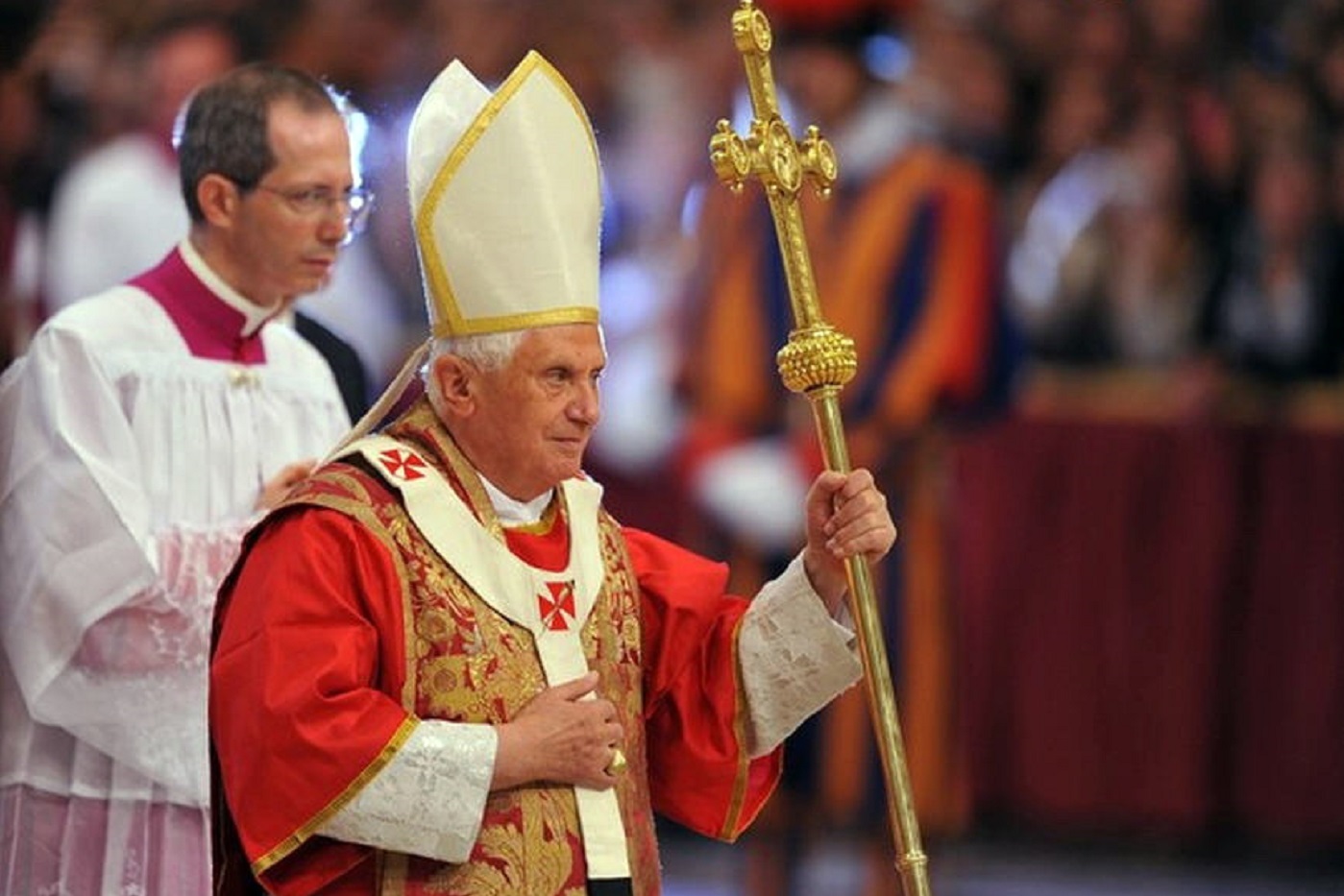


 ABYSSUS ABYSSUM INVOCAT / DEEP CALLS TO DEEP
You must be logged in to post a comment.