Another CliffhangerBy: Clarice FeldmanAmerican ThinkerNovember 8, 2020 A Little Civics LessonOn Saturday, when rallies were scheduled to take place in key battleground areas to demand only legal votes were counted, the major networks announced Biden-Harris were the winners. Apparently, they are under the impression that they decide election results. They don’t. On December 14, electors chosen by state legislators cast their votes. No one else but the state legislators have that right. (Article II, Sec. 1,§2 of the Constitution). Certainly not the press, nor state boards of elections, secretaries of state, governors, or courts. If they have reason to believe the elections in their states were unlawfully conducted and the results fraudulent, they can act to override them. (You can see a detailed history of this section of the Constitution in this fine article by Daniel Horowitz.) The Wisconsin, Michigan, Georgia, and Pennsylvania legislatures are majority Republican. At first glance these states — particularly the precincts in Milwaukee, Detroit, Pittsburgh, and Philadelphia — are the most suspect. Is there ample evidence of fraud sufficient to have altered the will of the legal voters in these states? It sure looks that way. Specific Evidence of FraudSaturday, Rudy Giuliani conducted a press conference in Philadelphia in which he brought forward some of the 50 Republican poll watchers who will testify in a civil rights suit to be filed in federal court tomorrow that despite state law and a court order, they were deprived of a right to observe the counting of the sea of late-coming absentee ballots which turned the tide against the President who had closed Tuesday night by a huge margin. Preliminarily, those were 500,000 mail-in ballots, the most fraud-susceptible kind. He indicated similar affidavits were being collected by Republican poll watchers in Pittsburgh involving an approximate 300,000 absentee ballots. He noted there was evidence of backdating of the ballots to meet a deadline, an utter lack of security for these ballots, and there were other infirmities as well — including votes by dead people (including Joe Frazier, who died five years ago), that the uniform votes in these batches for Biden was statistically impossible. Pennsylvania was not the only state in which the Trump team was receiving such information — he saw the same thing in Michigan, Georgia, and North Carolina and anticipated the challenge might well involve more than Pennsylvania as the evidence is coming in. Kyle Baker has tweeted a number of such anomalies:Swing state voting irregularities: Biden outperforms Senators in swing states, underperforms in VA, NH, RI Biden underperforms Hillary/Obama in cities, except in MI, PA, GA, WI Biden mail-in dumps with 100% margins GOP lose ZERO House races You can find more of his analysis here: While we are not privy to what steps the FBI is taking nationwide, there is confirmation that the FBI is investigating backdating of ballots in Detroit, and Attorney General William Barr has authorized deployment of armed agents to observe recounts. (The only time in the process agents can go in is after the voting when the votes are being canvassed and tabulated.) The Supreme Court has issued a temporary order to Pennsylvania requiring them to separate all ballots which arrived after Election Day. In October, the Pennsylvania Supreme Court granted a three-day extension for mail-in ballot counting. The decision was upheld by the U.S. Supreme Court in a 4-4 ruling, a vote shy of the five votes needed to grant a stay. The split ruling came just days before Justice Amy Coney Barrett joined the bench. The Pennsylvania Supreme Court ruling in October allows ballots to be counted as long as they are postmarked by Nov. 3 or in cases where the postmark isn’t legible. The Pennsylvania Supreme Court has also ruled that mail-in ballots cannot be thrown out when the signature on the ballot clearly doesn’t match the signature on the voter’s application. If the Court had applied the Constitution, then we wouldn’t have this mess, for it’s clear under Article 1 Sec. 4, cl 1–that the Pennsylvania court had no constitutional power to change the “times, methods, and procedures of elections.” (A full rundown of the already pending litigation authored by Hans von Spakovsky is valuable background for those who want an accurate state of the play as of November 6.) The willful deprivation and defrauding of state residents of a fair and impartially conducted election constitutes a criminal offense, but should Biden be declared winner, the U.S. attorneys in Philadelphia, Atlanta, Detroit, and Milwaukee thus have only about 10 weeks in which to initiate fraud cases that the attorney general could pass on to a special counsel he designates. Apart from federal litigation, investigations, and prosecutions, the states involved themselves can and should look into these claims of fraud and interference. In Wisconsin, the Speaker of the House has directed an investigation into mail-in ballot dumps and voter fraud. Pennsylvania has subpoenaed election officials. In Texas, a social worker has been charged with falsifying 134 votes of people in state hospitals. I’m sure there are other cases like this pending or of which I have no knowledge at this time. It is difficult to prove that the fraud you can find in such a short timeframe was sufficient to so substantially affect the election that it must be redone. I know, I was a member of the legal team that got the UMWA fraudulent election for Tony Boyle over Jock Yablonski thrown out and a new election ordered. It was a long battle and involved the work of countless volunteers throughout the country to document the fraud and intimidation. (All of this is well- documented in the recently released book Blood Runs Coal: The Yablonski Murders and the Battle for the United Mine Workers of America. ) So, it would be wonderful if there were a simpler way of documenting widespread fraud than these. I’ve seen two claims. The first is that the DHS printed all the ballots using a secret infrared watermark so all the manufactured ballots would be easily detected. Nonsense. This would be impossible, and DHS has already debunked it. Ballots carry not only the top of the ticket, but countless local candidates and initiatives and they are printed and distributed locally. The second claim was made on Friday by General Michael Flynn’s lawyer Sidney Powell on Lou Dobbs’s show that there is a likelihood that:“three percent of the vote total was changed digitally, by using the “Hammer” program and the software program “Scorecard.” That would have amounted to a massive change in the vote. [snip] In addition they ran an algorithm to calculate votes that they might need to come up with for Mr. Biden in specific areas.” It doesn’t seem that implausible when it was proven that a “computer glitch” in Michigan had switched thousands of Trump votes to Biden votes. The computers need to be checked in all the other districts in Michigan and in the disputed battleground states which all use the same program from an outfit called Dominion. Powell says this all can be documented and the case on the computer-falsifying results will be filed in federal court in multiple states to enjoin the certification of any election results. If the Trump team can prove the tallies were changed digitally, it has its easiest, fastest route to enjoin certification of the results. What if There’s no Winner Declared by Inauguration Day?I’ve seen lots of assertions that in such a case Nancy Pelosi will be the interim president. Nope. Should that eventuality occur, the House votes for an interim president and the Senate for an interim vice president. (The House votes are by state — one vote each — and the Republicans hold a majority of 26 states. Our founders were geniuses. Never forget that.) AftermathIowahawk who seemingly hates all politicians, is quite correct:Trump loses,Pelosi & Schumer face insurrection after election disaster,The Squad is now radioactive,Polling industry is dead,Silicon Valley torches $5 billion for absolutely nothing,Fox News beheaded by their own viewers.My God, it’s like the Red Wedding. Don’t give up. My friend “The Infamous Ignatz” shares my view about pessimism:Reality exists but we prioritize what parts of it we react to. However that is more to do with our prejudices and has little bearing on their real importance. Pessimism or optimism not only illuminates what we think the future holds it animates what we do to shape and alter [or not] the future and it influences those around us in the same way. Seems to me, in a realm with as long a time frame and as many variables and the unending tidal swings in public opinion and culture that politics feature and with as many opportunities for influence it presents, pessimism really not only makes no particular rational sense, it tends to the self-fulfilling prophecy end of things. And since it prophecies ruin, what rationale can be advanced that it presents any social utility? Personal pessimism, to the extent it isn’t “contagious” no doubt has considerably more utility, but as soon as it becomes a pathogen that infects others it has become a drag on whatever virtues and values it represents because it no longer is a private prudent guard against impending danger, but instead becomes disaster’s unintentional agent. So what is the point of it and somewhat in the manner of Pascal’s wager, how does it make sense to choose it? And I have good experience with why we have to remain optimistic. After Mr. Yablonski and his wife and daughter were murdered, we begged the FBI to come in and investigate. At the time, media outfits like Time, then a major influencer, suggested on no basis except perhaps disinformation from interested parties that the Mafia did it, while organized labor wanted this swept under the rug, as did politicians in big coal areas. Joe Rauh and I met with Attorney General John Mitchell, who told us he’d just been on a call with Secretary of Labor George Schultz who poo-pooed the idea of union involvement, saying Yablonski had lost, so the union had no motivation to kill him. I showed Mitchell our research that Boyle had lost among working coal miners and his victory had been because he’d rounded up the retired miners into separate locals and threatened them with loss of their pension and health benefits if they voted for Yablonski. I argued that Boyle couldn’t continue to run a union when his only support was among retired workers. The next day the FBI was ordered in. The roundup of all who participated took place bit by bit. Tony Boyle was convicted of murder and died in jail. The vote for Biden was made up of the dead and the nonexistent voters, so he won’t be able to do much. Only live voters count in real life. Never give up the good fight. Never hamstring your will to fight on with pessimism. Email link https://conta.cc/2GNcaMc
RIP MCINTOSH
Posted inUncategorized|Comments Off on YET ANOTHER CLIFFHANGER
The Disinformationists Pollsters were widely wrong in 2016, yet learned nothing about their flawed methodologies. So how do they remain credible after 2020? By VICTOR DAVIS HANSONNovember 5, 2020 A republic is not just a nation of laws. It also relies on its good-faith watchdogs, such as honest pollsters, the media, and bipartisan institutions. We still didn’t know the final result of Tuesday’s presidential election as of Wednesday night. But there are lots of reasons to worry that something in America has gone terribly wrong. Many of the mainstream pre-election polls predicted that Donald Trump would lose in a landslide. He did not — to the shock of a host of propagandists. A CNN poll had Trump down 12 percentage points nationally entering the final week before the election. An ABC News/Washington Post poll in late October claimed Biden was leading in Wisconsin by 17 points. That state’s voting ended up nearly even. YouGov’s election model showed Biden prevailing with a landslide win in the Electoral College. Progressive statistics guru Nate Silver had for weeks issued pseudo-scientific analyses of a Trump wipeout. Pollsters were widely wrong in 2016. Yet they learned nothing about their flawed methodologies. So how do they remain credible after 2020, when most were wildly off again? A cynic might answer that polling no longer aims to offer scientific assessments of voter intentions. Pollsters, the vast majority of them progressives, have become political operatives. They see their task as ginning up political support for their candidates and demoralizing the opposition. Some are profiteering as internal pollsters for political campaigns and special interests. Never again will Americans believe these “mainstream” pollsters’ predictions because they have been exposed as rank propagandists. That bleak assessment won’t make much difference to pollsters. They privately understand what their real mission has become and why they are no longer scientific prognosticators. Big liberal donors sent cash infusions totaling some $500 million into Senate races across the country to destroy Republican incumbents and take back the Senate. In the end, they may have failed to change many of the outcomes. But did they really fail? Democrats dispelled the fossilized notion that “dark money” is dangerous to politics. They are now the party of the ultra-rich, at war with the middle classes, whom they write off as clingers, deplorables, dregs, and chumps. In that context, the staggering amounts of money were a valuable marker. The liberal mega-rich are warning politicians that from now on, they will try to bury populist conservatives with so much oppositional cash that they would be wise to keep a low profile. Winning is not the only aim of lavish liberal campaign funding. Deterring future opponents by warning them to be moderate or go bankrupt is another motivation. Twitter co-founder and CEO Jack Dorsey seemed unapologetic that his company was systematically censoring and de-platforming conservative users. In a recent hearing he talked to members of the Senate as if he were a 19th-century railroad baron. Google has been accused of massaging its search results to favor progressive agendas. During the final weeks of the campaign, social-media platforms shut down accounts and censored ads and messages, providing an enormously valuable gift to Joe Biden. Silicon Valley, like the 19th-century oil, rail, and sugar trusts, sees no reason to hide its partisanship and clout. The media coverage of the election was unsavory. Journalists confirmed the findings of Harvard University’s Shorenstein Center, which in an assessment of news coverage of Trump’s first 100 days in office found that 80 percent of the coverage was negative. As in the fashion of the Russian collusion hoax, the media for weeks on end revved up their engines for a seemingly certain Biden landslide victory. They rarely cross-examined Biden on the issues. And they certainly stayed clear of the Biden family influence-peddling scandal. What do all these power players — big polling, big money, big tech, and big media — have in common other than their partisanship and their powerful reach? One, they stereotypically represent a virtue-signaling coastal elite that feels its own moral superiority allows it to destroy its own professional standards. Two, they worry little about popular pushback because they assume that their money, loaded surveys, and Internet and media cartels create, rather than reflect, public opinion. Three, while these elite cadres have enormous resources, they still are relatively unpopular. Despite being outspent 2 to 1, pronounced doomed by pollsters, often censored on social media, and demonized in print and on television, Trump was neck and neck with Biden — a fact that a few days ago was deemed impossible. If Biden wins, we should assume that in late January 2021, these same forces will regroup to frame a new post-election narrative. Expect our Big Brothers to instruct Americans that the COVID-19 pandemic is mutating into little more than a bad flu. The “Biden vaccine” and miraculous “Biden recovery” will have ended the need for Trump-era lockdowns. And the rioting, looting, and arson? They will all have miraculously disappeared because the disuniter and inciter Donald Trump is now gone. Email link https://conta.cc/2I1SwNc
How Francis Is Preparing the Conclave, With His Cardinal Favorites
*
It is no longer a hypothesis but a certainty. Now we know that Pope Francis “first of all” keeps his thoughts fixed “on what will come after me,” meaning on the future conclave, whether this is to come sooner or later. He said so himself in an interview a few days ago with the agency ADN Kronos. In which he also applied to himself the memorable “We’re on a mission from God” of the Blues Brothers, in these words:
“I fear nothing, I act in the name and on behalf of our Lord. Am I a madcap? A bit short on prudence? I don’t know what to say, my guide is instinct and the Holy Spirit.”
In effect, his latest promotions – and dismissals – of cardinals old and new seem to be aimed precisely at setting up a conclave to his liking.
*
To begin with, Francis has brutally sidelined – demoting him without a moment’s notice on September 24 – such a cardinal as Giovanni Angelo Becciu, who in a conclave, if not a candidate for succession, would surely have been a great elector capable of playing his own hand, thanks to his eight years as “substitute” at the secretariat of state, in daily contact with the pope and with a grip on the tiller of the worldwide Church.
Stripped of his “rights” as a cardinal, Becciu will not even be able to enter a conclave, even though a Church historian like Alberto Melloni maintains the contrary.
The reason for his fall from grace would be his misuse of the money of the secretariat of state and Peter’s Pence. But Becciu also knows that neither the pope nor his own direct superior, cardinal secretary of state Pietro Parolin, can claim to have nothing to do with the offenses being pinned on him. In fact, the public record now includes both a document of the Vatican magistracy indicating that Becciu informed the pope of his moves, even the most risky, and received his approval, and a very recent e-mail exchange between Cardinal Parolin and self-styled secret service expert Cecilia Marogna, recruited years ago by Becciu as one of the “public officials” of the secretariat of state and now accused of embezzlement and misappropriation of Vatican funds carelessly entrusted to her.
As proof of the close fiduciary bond that until very recently linked the pope to Becciu, it should also be noted that Francis had appointed him as his “special delegate” to the order of the Knights of Malta. And who has the pope now appointed in Becciu’s place? Another of his favorites, the new cardinal Silvano Tomasi, former Vatican representative at the United Nations but above all a party to the fratricidal clash within the order that in January of 2017 led the innocent Grand Master Fra’ Matthew Festing to forced resignation, imposed on him by none other than the pope.
Tomasi, very close to Cardinal Parolin, turns out to be one of the thirteen new cardinals that Francis will vest with the scarlet next November 28.
A list that is worth looking at not only for who is on it, but also for who is off.
*
Off it, for example, are two archbishops of the first magnitude: that of Los Angeles, José Horacio Gómez, who is also president of the episcopal conference of the United States, and that of Paris, Michel Aupetit.
Both are unusually gifted and enjoy wide esteem, but they have the disadvantage – in Francis’s eyes – of appearing to be too distant from the guidelines of the current pontificate. Aupetit even has experience as a physician and bioethicist, like the Dutch archbishop and cardinal Willem Jacobus Eijk. And it is no mystery that both Gómez and Aupetit, if made cardinals – which however will not happen – would in a conclave be on the shortlist of candidates alternative to Francis and of solid profile, a shortlist that already includes Eijk and the Hungarian cardinal Péter Erdô, well known for having led with wisdom and firmness, during the double synod on the family of which he was relator general, the resistance to the proponents of divorce and the new homosexual morality.
*
Among the newly appointed cardinal electors, all indebted to Jorge Mario Bergoglio for their respective careers, there are at least three who stand out.
In the United States there has been a stir over the promotion to the scarlet of Wilton Gregory, archbishop of Washington, the first African-American cardinal in history but also a bitter opponent of Donald Trump.
From the island of Malta comes another new cardinal, Mario Grech, a staunch supporter of synodality as a form of life for the Church and recently promoted by Francis as secretary general of the synod of bishops. The newly appointed Grech immediately made an appearance in an interview with “La Civiltà Cattolica” in which he accused of “spiritual illiteracy” and “clericalism” those Christians who are suffering from the lack of the Eucharistic celebration during the “lockdowns” and do not understand that the sacraments can be dropped because there are “other ways to engage in the mystery.”
But even more strategic, for Pope Francis, is the promotion of Marcello Semeraro, the new cardinal whom he has set in the place left empty by the defenestrated Becciu, that of prefect of the congregation for the causes of saints.
Semeraro has been a key element of Bergoglio’s court since his election as pope. Until a few weeks ago he was the secretary of the team of 8, then 9, then 6, and now 7 cardinals who assist Francis in the reform of the curia and the government of the universal Church.
From Puglia, age 73, Semeraro was professor of ecclesiology at the Pontifical Lateran University and then bishop, first of Oria and then of Albano. But the decisive turning point for him was his participation in the 2001 synod as secretary. It was there that he forged his ties with then-cardinal Bergoglio, suddenly charged with delivering the opening address to that assembly in the place of Cardinal Edward M. Egan of New York, forced to stay home because of the attack on the Twin Towers.
The ties between the two soon became quite firm and every time Bergoglio came to Rome he did not fail to make a trip to nearby Albano. Then came the 2013 conclave and the two – Semeraro likes to remember – met for a couple of hours the day before the voting, with Bergoglio “strangely silent.” The first bishop the new pope received in audience after his election was Semeraro, later appointed secretary of the newly formed team of cardinal councilors. When Semeraro turned 70 in December of 2017, Francis surprised him by appearing in Albano at lunchtime and celebrating with him (see photo).
But there is more. For years Gregory, Grech, and even more so Semeraro have been active supporters of a change in the Catholic Church’s doctrine and practice in the matter of homosexuality. In his diocese of Albano Semeraro hosts the Forum of Italian LGBT Christians every year. And he wrote the preface for the recent book “L’amore possibile. Persone omosessuali e morale cristiana,” by Fr. Aristide Fumagalli, professor at the theological faculty of Milan and Italy’s version of the American Jesuit James Martin, an even more famous pitchman of the new homosexual morality, for which Pope Francis as well did not fail to express his appreciation.
*
Attention must also be paid to the moves Francis has made in recent weeks on behalf of a few of the cardinals who are close to him.
The most startling came on October 5 with the appointment of Cardinal Kevin Farrell as president of a new Vatican organism that oversees “reserved matters,” meaning those falling outside of the ordinary norms and covered by the most rigorous secrecy.
Farrell, 73, born in Dublin and later a bishop in the United States, in his youth a member of the Legionaries of Christ, has been since 2016 the prefect of the Vatican dicastery for the laity, family and life, and since February 2019 also “chamberlain” of the college of cardinals, meaning the one assigned to manage the government of the Church in the period between the death of a pope and the election of a successor.
It is clear that with this series of promotions Pope Francis has endowed Farrell, evidently his pride and joy, with an unusual accumulation of powers.
And this has happened in spite of the shady spots in this cardinal’s biography, unclear to this day.
His most nebulous years are those in which, as auxiliary bishop and vicar general of Washington, he was the closest collaborator and trustee of the head of the archdiocese at the time, Cardinal Theodore McCarrick, with whom he also shared quarters from 2002 to 2006.
During those same years the two dioceses of Metuchen and Newark, of which McCarrick had previously been bishop, paid tens of thousands of dollars to settle lawsuits with former priests who had charged him with having sexually abused them. And McCarrick was already the target of far more widespread accusations of abuse, accusations that would keep building and gaining credence until his definitive censure and reduction to the lay state in 2018.
But in spite of his close proximity to McCarrick, Farrell has always maintained that during those years he never had “any reason to suspect” anything illicit in the behavior of the cardinal who was his boss, mentor, and friend.
In October of 2018 Pope Francis promised the publication of a report that would shed light on the coverup and complicity that McCarrick is though to have enjoyed in the ecclesiastical camp up to the highest levels.
But Farrell’s appointment as overseer of the most confidential matters does not ensure that this report – the publication of which has been announced for tomorrow, November 10 – will bring complete clarity.
As prefect of the dicastery for the family, Farrell also made his mark by picking as a speaker at the world meeting of families held in Dublin in 2018 the Jesuit Martin, for whose pro-LGBT book “Building a Bridge” he had written the preface.
*
Another move by Francis concerned what is referred to as the Vatican “bank,” the IOR, Institute for Works of Religion.
The IOR is supervised by a commission of cardinals, in which the pope made some changes on October 10.
Among the new members he added two of his proteges: Polish cardinal Konrad Krajewski, his industrious “almoner” in works of charity, and the Filipino cardinal – a bit Chinese on his mother’s side – Luis Antonio Gokim Tagle, prefect of “Propaganda Fide” and universally considered the man Francis would most like as his successor.
While among the members removed one name stands out, that of Cardinal Pietro Parolin. Which has led to thoughts of a downgrade, both of him and of the secretariat of state.
In reality his exit from the IOR commission is an advantage for Parolin. The cardinal is doing all he can to be seen as having no involvement in the misconduct that has ended up under scrutiny at the secretariat of state, and he therefore has an interest in keeping clear of a storm that could soon hit the IOR, accused by two Malta investment funds of having stuck them with a loss of tens of millions of euros as a result of the breaking of an agreement for the purchase and restoration of the former Stock Exchange Building in Budapest.
In the meantime, however, Parolin has suffered another and much tougher reversal: the Pope’s order that the secretariat of state divest itself of its assets and properties, all to be administered by the Vatican central bank, the APSA, and supervised by the secretariat for the economy, that very organism originally headed by Cardinal George Pell to which neither Parolin nor his deputy Becciu ever wanted to submit.
Parolin had long been classified among the “papabili” but can now be considered crossed off the list. But for at least two years the support for his candidacy had been in sharp decline. As a statesman, the misconduct of his subordinates in the secretariat of state weighed heavily against him. As a diplomat, there is no chessboard on which he has registered the slightest success, neither in the Middle East, nor in Venezuela, much less in China. And even his vaunted abilities to contain and adjust the state of confusion induced in the Church by Francis’s pontificate, when tested by the facts, have turned out to be too modest, if not non-existent.
*
In effect, pope Bergoglio shows that he prefers another cardinal as a statesman over Parolin, the Honduran Óscar Andrés Rodríguez Maradiaga, whom he reconfirmed in mid-October in the position of coordinator of the “C7,” his team of seven cardinals advisers.
How Francis can continue to rely on Maradiaga remains a mystery. In addition to having long been a target of serious accusations of financial misappropriation already investigated by an apostolic visitation in his diocese, Maradiaga had for years as his auxiliary bishop and protege Juan José Pineda Fasquelle, dismissed in the summer of 2018 due to ongoing homosexual activity with his seminarians.
Not only that. In that same summer of 2018 Francis appointed in the key role of substitute of the secretariat of state – in place of Becciu, who was made a cardinal – the Venezuelan archbishop Edgar Peña Parra, former councilor of the nunciature in Honduras between 2002 and 2005 and very close to Maradiaga and Pineda, whose appointment as auxiliary bishop of Tegucigalpa he backed, as well as being himself the target of accusations of misconduct never put under impartial investigation by the Vatican.
*
Does Tagle remain Francis’s true successor “in pectore,” favored all the more by the moves just described?
That the Chinese-Filipino cardinal is the “papabile” most dear to Bergoglio is beyond doubt. But that a future conclave would elect him pope is far from guaranteed. Precisely because he is too similar to Francis, it is easy to predict that Tagle will end up crushed by the many umbrages over the current pontificate.
So it cannot be ruled out that Bergoglio may have in mind another successor to his liking, perhaps one more apt to be elected. And this could be Bologna cardinal Matteo Zuppi, already with various arrows for his bow, but whose electoral strength would come above all from the Community of Sant’Egidio that he cofounded and is indisputably the most powerful, influential, and omnipresent Catholic lobby of recent decades, at the worldwide level, with extensive connections in the upper echelons of the Church.
With Bergoglio as pope, the Community of Sant’Egidio has also reached its apogee in the Vatican, with Vincenzo Paglia at the head of the institutes for life and the family, with Matteo Bruni at the head of the press office, with community supreme leader Andrea Riccardi in the director’s chair for the theatrical interreligious meeting for peace presided over by the pope last October 20, and especially with Zuppi made cardinal a year ago. A “street cardinal,” as he likes to be called, as well as the author of that golden ticket to Francis’s court which is the preface to the Italian edition of the pro-LGBT book by the Jesuit Martin.
Why Are The Catholic Bishops Congratulating Abortion Joe Biden?
YOU GOTTA BE KIDDING ME.
The United States Conference of Catholic Bishops (USCCB) just issued a statement congratulating Abortion Joe Biden.
For what?!?!
Is the USCCB going to congratulate the dead babies left behind as the Biden-Harris administration works with Planned Parenthood and Nancy Pelosi to kill more babies through abortion??
The USCCB has affirmed what many of us have suspected for many years, and that is that most Catholic bishops have no problem with a Catholic politician spitting in the face of Christ by supporting the vile murder of the preborn.
What a heartless and unfeeling thing for Archbishop Gomez to do!!!
Joe Biden is a man who claims to be Catholic, yet he gives 100 percent support for abortion every day of the week and in every manner of brutality against the innocent.
EVERY CATHOLIC IN AMERICA OUGHT TO BE ASHAMED OF THESE BISHOPS.
If we don’t make our outrage heard on this? The USCCB will learn the wrong lesson, namely that they can rub Christ’s nose in the dirt and get away with it — time and time and time again.
Yours in the LORD Who IS Life! Judie Brown President American Life LeaguePS: The Catholic bishops have erred, and as a Catholic, I am ashamed of them.
Maria Simma, the Souls in Purgatory, and Garabandal
“IT WILL BE SOMETHING FOR THE CONVERSION OF HUMANITY”
Maria Simma was born on February 2, 1915, in a small town in Austria called Sonntag. Since childhood, her dream was to surrender her life to God in a religious order, but due to her weak physical constitution, she was rejected by three different communities. At first, Maria did not understand why the Lord did not allow her to fulfill the desire He had stirred in her to consecrate herself. Over time, she gradually understood that the consecration the Lord asked of her would not take place in a religious community, but in a demanding service of charity toward the poorest souls in Purgatory.
She received the first “visit” from a soul in Purgatory one night in 1940 when she was 25 years old. During the first years, until 1953, only two or three souls visited her each year, usually during the month of November. In 1954 a Marian Year was proclaimed by Pope Pius XII on the occasion of the Proclamation of the Dogma of the Immaculate Conception. During that year the souls visited Maria every night. When the jubilee year ended, the visits became somewhat fewer, but normally they were not less than three or four visits a week. A few days before the Marian Year began, Maria Simma began to suffer mystical sufferings in expiation for the souls in Purgatory. At times, she felt as if her limbs were being pulled violently. Other times, it was as if she was being violently stabbed with sharp knives over her entire body. The sufferings in expiation for the pains caused by abortion or impurity consisted of terrible stomach pains and nausea. On other occasions, she felt as if she were lying among blocks of ice for hours. The cold penetrated her to the bone. These were the sufferings in reparation for lukewarmness and religious coldness.
However, neither her sufferings nor her extraordinary experiences made Maria withdraw into herself. On the contrary, all who knew her bore witness to the fact that Maria was always friendly to those who went to her to entrust all kinds of spiritual sufferings or trials until the day she died: March 16, 2004. She was exemplary in the practice of self-denial, with a spirit of sacrifice and poverty. When they asked her why God permitted the experiences she had, she replied, “God allows it so that, through my apostolate, other people may understand clearly that our time on earth is meant for gaining Heaven.”
There is an interesting book from 1993 entitled, Get Us Out of Here!! Maria Simma Speaks With Nicky Eltz, by Nicky Eltz. It is the finished product of over thirty interviews carried out during about five years. In this book, Maria Simma describes her experiences with candid simplicity and responds wisely to the interviewer’s countless questions. Certainly Maria Simma’s testimony must be studied and evaluated by the Church, and we remit it to the Church’s judgment. Nonetheless, I know several people who have read this book and I can assure that having read it has not left them indifferent. In the first place, it shows the souls in Purgatory as our real brothers and sisters who are in need of our help and compassion. It also spurs readers on to a greater love for God, helps one to understand how much is still left to give to God if we do not want to atone for our sins and omissions in Purgatory, and how to live the Eucharist with greater devotion. Moreover, in several moments and manners, this book touches on Our Blessed Mother’s messages and the warnings she gave in the apparitions in San Sebastian de Garabandal. I thought we could benefit greatly studying and reflecting upon them.
We find the first reference to Garabandal in Maria Simma’s words a few pages into the book. Nicky Eltz had not asked about Garabandal. His question was, “Do the holy souls in Purgatory know what is going to happen?” However, Maria responded by making reference to something that is very similar to what we know as the “Warning” in Garabandal,one of the prophetic events announced to the visionaries by the Virgin Mary. These are Maria Simma’s words: “Yes, they know something, but not everything. They told me that something very important is going to happen, and that it is approaching. For many years they said that it was “in front of the door,” but since May 1993 they used the expression “at the door.” It will be something for the conversion of humanity.”
Simma is conscious of the fact that it is difficult to believe such an answer. Therefore, to the souls and her own credibility, she points out two situations in which the souls warned her of things that shortly afterward were fulfilled: “On a smaller scale, they have told me about things that happened shortly afterwards. During the summer of 1954, they warned me about the floods that did so much damage to this region. On another occasion they also told me that there were still people under the snow after an avalanche. The rescue teams prolonged their search and sure enough managed to find and save those people two days after they were asked to please continue the search.” Some pages further along, the interviewer asks about upcoming events again. “Have the souls told you anything specific about their future?” Maria Simma responds, alluding once again to something that seems to have to do with the prophecies in Garabandal “Not in detail, but, on several occasions, they have said that something very important is at the door; it is right in front of us. But I do not know if I will still be here to see it. Like I said before, it will come from God and will be for the conversion of all. God will make his existence very clear, but even so, not everyone will convert his or her heart to Him.” Later on, Maria insists, “I think that God will reveal Himself very, very soon because we have gone too far away from Him.”
Nicky Eltz asks Maria Simma a very serious question, “What could you tell me about Satan and the activity he carries out currently?” to which she responds with an affirmation that should not surprise us too much, for we have the evidence right before us. “He has never been so strong or active as he is nowadays.” Eltz continues, “Why do you think that this is so?” Maria’s answer: “The 20th century is incomparable to any other insofar as apostasy, murder, greed for money and power, hatred, lack of mercy and prayer. It is his century! The fact that he has been so active is also due to Satan’s knowledge of a great event that is going to take place and that will be for the conversion of humanity. He knows that soon his strategy will be noticeably weakened, and he always shouts the loudest before being defeated.” Once again, Maria’s answer indicates something that is very similar to Garabandal’s Warning.
Finally, a point arrives in the conversation in which Maria explains what and where Garabandal is, and how she herself has gone on pilgrimage to it on several occasions:“Garabandal is a mountainous village in Spain where Our Blessed Mother appeared to a group of girls in the 60s. The following warning proceeds from there and is essentially: “A moment will come in which every person on earth will see the condition of his or her own soul, and many will die of fear upon seeing it.” It is the same thing that happens to everyone at the moment of his or her death, but this will happen to all simultaneously.”
To understand the connection between what the souls told Maria Simma and what the Virgin Mary told the girls in Garabandal, all you have to do is read the visionaries’ testimonies. Yet, the fact that each time the souls refer to things that are going to happen, according to Maria Simma’s testimony, it doesn’t fail to leave the impression that they could by referring to the Warning. It is as if they were insisting on the fact that there is nothing more important within our reach than that of the salvation of souls. This is certainly the case if we believe in Everlasting Life, taking our salvation into consideration with deep longings to go to Heaven.
The girls in Garabandal point out that before the Warning comes, the Church will have to go through a “great tribulation,” a difficult trial in which external and internal factors would be included: Persecution: “[The Church] would give the impression of being at the point of perishing,” and a faith crisis: “Many will have left the practice of religion.” The souls in Purgatory corroborate it. This is how Maria Simma describes it: “The souls in Purgatory commented to me that the Church is in the worst state of her history. They have also informed me, though, that the situation would improve and that we ought to have hope. Peaceful times will come. Nonetheless, before this happens, there will be a great storm, but which Our Blessed Mother does not want us to worry about, think of, or assume about. God always takes care of his children. This great storm will include the prophecies of La Salette, which announce that something that we have never seen before is drawing nearer to us. It will also include the prophecies of Fatima, the warning of Garabandal, and the secrets kept by the “children” in Medjugorje.” What we have to pray the most for is the United States. There, they have not suffered a war in their own nation during this century. Pride, greed, occultism, sects, abortion, and materialism abound there. According to what the souls say, what is at the door will affect the United States dramatically.”
Besides the prophecies regarding the Warning, Miracle, and Chastisement, in Garabandal the Virgin Mary gave two public messages. Among the topics that they concern, there as an important warning about the priestly crisis, which escapes the majority of the faithful’s notice, incubated in the heart of the Church: “Many cardinals, many bishops, and many priests are on the road to perdition and are taking many souls with them.” Maria knows that there are many priests, bishops, and cardinals in Purgatory. She also knows that some priests, bishops and cardinals have been lost forever in hell, and she certainly knows that those who are most responsible for the present situation in which the Church finds Herself, are priests. Maria Simma expresses it herself: “The souls in Purgatory told me that the Church today is in a worse state than it ever has been before. The sin of apostasy reigns all over, and priests are considered the most responsible for it. Instead of praying and teaching the Word, it seems as if they run from one place to another to study psychology, rhetoric, accounting, or whatever to learn how to get closer to their public. They are the ones who have to show people how to get closer to Jesus and Mary through prayer and should not try to be conformed or be “up to date” with this very secularized society.”
Before these declarations, Nicky Eltz dares to ask, “Should we be afraid of such warnings?” to which Maria responds, “Only if we are very far from God and full of sin will we have reasons to be afraid, but if we strive to be with Him constantly, we have nothing to fear… We should never, ever become anxious, because fear comes from Satan alone. If we sincerely try to live with God every day, He will protect us from all that is to come. The people who pray will be safe, but those who do not pray will be surprised with their guard lowered and thus unprotected. It is that simple: we have to trust in God and in his Mother with a childlike trust.”
As I said before, Maria Simma’s testimony include private revelations that are still being studied by the Church. Even if the Church came to see signs of the supernatural in Maria Simma’s experiences, they would continue to remain outside the Deposit of Faith. As the Catechism of the Catholic Church points out, the role of private revelations is not “to improve or complete Christ’s definitive Revelation, but to help live more fully by it in a certain period of history” (CCC 67). Such is the case. With this, Benedict XVI’s affirmation in the Post-Synodal Apostolic Exhortation, Verbum Domini, is also true. Private revelation “can have a certain prophetic character (cf. 1 Th 5:19-21) and can be a valuable aid for better understanding and living the Gospel at a certain time; consequently it should not be treated lightly.” Maria Simma’s declarations do not contradict the Faith of the Catholic Church. Moreover, they help us live it more intensely and wholeheartedly, and in this sense we ought to welcome them.
Posted inUncategorized|Comments Off on The sin of apostasy reigns all over, and priests are considered the most responsible for it. Instead of praying and teaching the Word, it seems as if they run from one place to another to study psychology, rhetoric, accounting, or whatever to learn how to get closer to their public. They are the ones who have to show people how to get closer to Jesus and Mary through prayer and should not try to be conformed or be “up to date” with this very secularized society.”
Election officials count ballots at the Allegheny County elections warehouse on Nov. 6 in Pittsburgh as Pennsylvania remains undecided. (Photo: Jeff Swensen/Getty Images)
Tom Ranieri is a lawyer who volunteered as a representative of President Donald Trump’s reelection campaign in Allegheny County, Pennsylvania, working at an Election Day hotline. He was there from Oct. 30 to Nov. 3 and joins “The Daily Signal Podcast” to share what he observed.https://player.acast.com/thedailysignal/episodes/tds_110620_special
Rachel del Guidice: I’m joined today on “The Daily Signal Podcast” by Tom Ranieri. He’s an associate attorney at Faughnan Mendicino. Tom, It’s great to have you with us on “The Daily Signal Podcast.”
Tom Ranieri: I am deliriously happy to be here myself.
The left is actively working to undermine the integrity of our elections. Read the plan to stop them now. Learn more now >>
Del Guidice: Well, thanks for making time to talk with us. First off, Tom, can you tell us where you have been working in Pennsylvania at the Election Day hotline and what you were observing?
Ranieri: Certainly. I was, as I would imagine many fellow people similarly situated to myself [were], watching with increasing concern as the Democrats attempted to change the rules of the election over the last year. Obviously, I think to make it more easy for them to pull the kind of tricks that I know that they’ve pulled in the past, having been from Pennsylvania.
I didn’t realize that they would be as brazen as they’ve been. And to a certain extent, as a Republican, you expect Democrats to cheat a little bit. And so you need to be on hand to make sure to hold them to account, make sure they follow the law because if left unobserved, they would just do whatever they wanted to do.
So I reached out to the Republican National Lawyers Association and volunteered my time. I told them anywhere they needed me [I’d go]—I’d be able to go to Florida, I’d be able to go to Pennsylvania. I’m from Virginia. I’d be happy to stay here. I just told them, “Send me where you want me and I will go and be content.”
And they got in touch with me a couple of weeks before Election Day and said, “We’ve decided that we really want you up in Pittsburgh. We have a bunch of people in Philadelphia, but we still need the Western Pennsylvania legal team to be bolstered, especially on Election Day.”
I said, “Absolutely, I’ll go.” So I drove up after work on Friday, October the 30th to the headquarters … in Allegheny County, which I’m not going to tell you where that is because I don’t want it to be targeted, but I went up there and we got plugged in.
And then for the first few days, what we did over that entire weekend to that Monday was we worked incredibly hard, getting poll watchers and canvas watchers signed up, trained and credentialed, so that they could legally observe the polls and legally observe the canvas locations.
On Election Day itself, I was asked to take the first shift. We had broken up the watching of the canvas into four shifts for that first day—from 7 to 11, 11 to 3, 3 to 7, 7 to 11—to have at least a couple of lawyers and several volunteers on hand to watch the pre-canvassers.
That is the people that are opening, verifying, and then counting the ballots that were sent absentee or mail-in, to watch to make sure that they followed the proper procedure in law and that everything was done above board.
Del Guidice: Tom, you were there, what did you see specifically on Election Day? Can you walk us through some of the things you observed as you were there?
Ranieri: Well, the first thing that happened was, I walked in to the pre-canvas location at 7 that morning, around 7:30, actually. And there was a line of people trying to get in to watch the pre-canvas. And this guard came up to me. This Allegheny County worker was manning the door and he was very agitated. I didn’t understand why, but he very much wanted to talk to me.
So he ended up talking to me for 15 minutes. And in the course of that 15 minutes, told me that he had observed them turning on the voting machine the day before, he had seen them running ballots through it. And when he asked them what they were doing, they told him that they were just removing deceased people, but you’re not supposed to do that until 7 a.m. on the day of the election. So, that was probably a lie.
So automatically, first thing I hear, eye witness testimony from a county worker that they had been tampering with the machine in Allegheny County before the day of the election and had been counting or otherwise using the machine to get votes or to do something before they were legally allowed to do so. So immediately, I’m thinking this is shady.
I try to get in, I see the canvas location. And then there are cameras in an entirely different section of the warehouse, pointed at where the canvas workers are working, but they are bad cameras. They’re not very good.
And there’s only a few of them and they are placed so far away that you can see the people who are counting the ballots, but you can’t see the ballots they’re counting, which is the whole purpose of having a canvas watcher. The canvas watcher is not there to watch people. He’s there to watch the ballots.
The reason it’s important is because the Pennsylvania law for absentee and mail-in ballots states very clearly that no mail-in ballot is valid where the outer envelope is noncertified by the elector, or as I say, the voter.
And if there is no secrecy ballot—that is to say, no secrecy envelope containing a ballot inside of the outer certifying envelope—it is not a valid ballot. It is called a naked ballot, and it should be put aside immediately.
And if the secrecy ballot inside of the outer certification ballot has any markings, which tend to identify the elector or his political preferences or in any way attempts to communicate to the person who’s looking at the secrecy ballot the preferences or desires of the elector, those are also immediately disqualified. They’re not valid votes and they should be put aside.
Now, as you can imagine, you need to be able to actually see the ballot for that to work. You have to see the certification. You have to see the signature. You have to see the date and the address. You have to see that there are no markings on the secrecy ballot, and you have to make sure there’s a secrecy ballot.
None of which you can do if there’s a camera put up 20 feet away from where the people are opening the ballots and you are put in another room inside of the canvas location, away from the canvassers, and given a couple of television screens with teeny-tiny pictures of these guys counting votes.
When asked, this guy I know, another attorney there, David, he asked—I think it was David, it may have been Kathy—asked, “Well, all of this seems odd. It seems like we can’t really observe the ballots. So there’s really no point in being here, right?”
And he goes, “Yeah, that’s the point.” He literally admitted that the whole purpose was to keep us from watching the people counting the ballots.
Del Guidice: And you should have been able to be in the room, but it sounds like you were not permitted, correct?
Ranieri: Oh, no. None of us were permitted to actually be in the same room as canvassers. And the fact of the matter is that that’s not what the rules say. And as a result, we have no idea how many ballots were improperly cast.
We saw them sorting and organizing ballots. We didn’t know—they were putting some ballots in one bin and other ballots in another bin. It’s not necessarily sinister, if you know what they’re doing and why, but if they are refusing to tell you or refusing to allow you to watch, they could be doing anything. And there’s no way of knowing.
Therefore, once the ballot is out of the envelope, that’s it. Right? That’s the whole reason it’s important to have pre-canvas watchers is because once the ballot is out of the envelopes, there’s no way of telling whether it’s a legitimate vote or not, because it’s just a ballot. So by doing that, they, in essence, were attempting to kind of present America with a fait accompli:
“Maybe we cheated, maybe we didn’t, but we have more votes.”
“Well, who watched you count them?”
“No one, but we did count them and, look, there are more of them.”
“Well, OK. But it’s not a real election. You did it unobserved. You could be lying about all of this and there’s no way for us to know. Because if you wanted to, you could just slip in a whole set of ballots that aren’t properly marked or certified or connected to any particular elector and count them and say, ‘Ah, look, [Joe] Biden won.’”
And that’s what I suspect they were doing.
They’ve been fighting us in our ability to watch the polls as well as the canvas and pre-canvas the instant we started the election. They kept us from trying to see.
Let me ask you, what kind of person tries to prevent you from watching people who are supposed to or who are supposedly doing their jobs in an ethical fashion? Why would you want to stop someone from seeing that? I don’t understand except if you’re trying to cheat, except if you’re not trying to be ethical.
My only concern is that it won’t matter because they have already counted so many of these ballots whose provenance or integrity is completely unknown.
And they’ll just say, “Ah, well, that’s just how it is.” And then the courts won’t want to overturn an election, even though it was stolen because it wasn’t an election. And that will cause all sorts of political problems for them.
So the Democrats just seem to be banking on the fact that no one’s going to want to make the necessary trouble to hold them to account.
Del Guidice: So, Tom, as Election Day progressed, can you tell us about what you observed during the day?
Ranieri: After leaving the pre-canvas, I went back to the law offices where the main place for Election Day operations, EDO, in Pittsburgh [was] with around 35 other volunteer attorneys from across the United States, and the firm had set up a hotline now.
We weren’t getting calls at first and the reason we weren’t getting calls was that apparently, I don’t know if this has been confirmed or not, but my understanding from the people in charge was that the switchboard had been hacked and that there were a bunch of problems with it and no calls were being routed to us. So that took several hours to address.
But during the course of the day, we received hundreds of calls from both voters and poll watchers reporting things such as, well, … Republican poll watchers were being consistently ejected or refused entry to poll locations.
In fact, one of the places, the person in charge of the poll said something along the lines of, … it uses a bad word, but he said something along the lines of, “Well, they’re on that Trump stuff. So we’re not going to let them in.” So there were things like that.
… In the Penn Hills, I know there were reports of poll watchers and workers wearing Black Lives Matter paraphernalia, which is a violation of electioneering law.
The HCLU along with Sunrise USA and several other leftist coalition organizations bound together to create something called, like, the Voter Protection Program, or I don’t know, some nonsense. Obviously designed to do something different than what it says it was designed to do.
So you had poll watchers wearing official lanyards that said like “Official Vote Protector” and were offering to help people cast ballots, which is, again, illegal.
You’re not allowed to see another person’s ballot and you’re also, unless under these very specific circumstances, you’re not allowed to be in a polling location. You’re not to be allowed to be in the same place where a ballot is being cast if you are not an authorized representative of the person casting the ballot.
But because they had these little lanyards, people were going up to them and they were helping them fill out ballots and they were helping them. They were talking to them about the election, all of which is just electioneering. It’s illegal.
You can put as much of an objective facade on it as you want to or say, “Oh, we’re just trying to keep voters protected,” but it’s not. You’re not doing that. You’re using it to influence the election. It’s obvious. Everyone sees what you’re doing.
So in the beginning, in the very beginning of Election Day, what you want to do is, the poll watcher needs to keep an eye out to make sure that the machine that counts the ballots is at what’s called zero. So that you know that the machine hasn’t been reset after the most recent election, has not been used to count anything, and that you’re starting from scratch.
Multiple poll watchers were prevented from verifying the vote total was at zero on machines at several locations. Which means, again, the counts cast that entire precinct’s voting into doubt because now we don’t know whether or not it had been pre-populated with votes.
Absence of evidence is not evidence of absence, of course. We don’t know one way or the other, but it certainly doesn’t increase our confidence in the vote totals for whatever precinct that prevented that from occurring.
There were some places where the number of people in the official voter rolls having been counted as having cast ballots was greater than the number of people who had been observed entering the polling location. That’s a problem because it indicates people were voting who didn’t actually come, which means that we don’t know who voted for them or if they even did vote themselves.
There were multiple reports of people who had already been counted as having voted, despite not having received an absentee ballot or having voted in the least even more egregiously. I understand that this is an orgy of bad news. Do you want me to continue or am I giving you—
Del Guidice: Oh, continue. Please continue.
Ranieri: OK. One of the biggest problems is that in Pennsylvania, anyone can cast a provisional ballot, even if that person is not eligible to vote.
Because … in case there is a problem, in case the elector had been lost in the shuffle of Election Day, whether he had just moved to the state or county, or it was his first time voting, or any number of things like that, he may be eligible to vote, she may not be eligible to vote. There’s no way of really knowing.
So we allow them to cast a provisional ballot and then check the legal status of the elector after the election if they assert their ballot as being true, genuine, and correct within three days of having cast it, which they should be informed of at the poll.
This is important because it preserves votes that might otherwise go uncounted, which would otherwise be legitimate votes. So it’s certainly something we would want to pay attention to and make sure that it was done correctly and honestly.
Now, many polling locations refused to give people provisional ballots and turn them away. That’s a real problem because, again, the understanding is that the Trump supporters were going to be coming out in force on Election Day itself.
So any attempt to prevent people from being able to vote provisionally is an attempt to suppress the vote because the likelihood that the person coming out to vote on Election Day itself is a Trump supporter. So you’re more likely than not to keep a Trump supporter from voting provisionally if you don’t give them a provisional ballot.
That happened a lot. There were chronic shortages of provisional ballots. They were turning people away. They were refusing to give people provisional ballots, and we had to send lawyers to several locations to force them to do it. And even then, once the lawyers leave, who knows if they continue to or not.
Another type of vote that matters is, oh, so you were allowed to vote on the machines in person because any in-person voting is different than pre-canvas.
You have essentially four different types of voting. You have your normal, in-person voting, which you fill a ballot out and then you cast a ballot and it’s counted when you cast it or … you’re marked as having voted and then it gets counted later.
Because those are all cast between 7 a.m. and 8 p.m. on Election Day itself, that’s very straightforward stuff. Those are good votes. And then you have your absentee and your mail-in ballots. Those are early voting. …
So the votes that you cast in person on the day, those votes get canvassed. Your absentee ballots and your mail-in ballots, those do not get canvassed.
Those get pre-canvassed because they were not voted on Election Day. They are considered to be an illegally inferior form of voting. It’s still acceptable, but it does not have the same legal strength or … reliability as in-person voting does.
And that’s why you have these outer certification envelopes, inner secrecy envelopes, and then the ballot, is to help bolster the credibility and security of mail-in voting. Those things are all pre-canvassed, again, starting on Election Day at 7 a.m.
Then you have the military and overseas ballots. Those are different. Those are given much more leeway … because they have a very special paper. They use a very special envelope. They’re just different in the way that they’re counted and we have it all really locked in because we know who’s in the military. We know who the overseas citizens are.
So those tend to be pretty reliable. Those get counted once they come in. And I’m not certain what they call that. I didn’t do a lot of research into it.
And then, finally, you have designated election officials who will bring votes in from drop box locations because early voting ended the Tuesday before the election in Pennsylvania, where people were still allowed to, in essence, drop off their Election Day ballot early at designated drop boxes, which would then be locked at 8 p.m. and brought down to the canvassing location to be canvassed, again, having considered it being voted on Election Day itself.
Now, if they aren’t postmarked, the law is very clear that they can’t be counted.
Of course, the Pennsylvania Supreme Court said that they can be. They are given the presumption of having been a valid vote, which is absurd, because it, in essence, makes the other team, as I say, anyone who wants to challenge the validity of a vote, into the unenviable position of having to argue in negative, this was not voted on election. There’s no way of proving that if there’s a presumption that it was.
That means that anyone could just gather up a whole bunch … of envelopes, thousands upon thousands of envelopes, [and] not worry about putting a postmark on.
And now it’s very clear that the secretary of state’s directive about how to handle mail-in and absentee ballots and other non-Election Day ballots is that they have to be delivered by the [U.S. Postal Service] and received by the canvas location that they’re destined for.
Now, if they don’t have a postmark, they are technically in violation of the Democratic secretary of state’s order regarding mail-in ballots, but no one seems to care about that in Pennsylvania. In fact, they pulled a dirty trick when the Supreme Court issued a stay.
One of the main reasons the Supreme Court issued a stay was that the secretary of state had sent the letter to the Supreme Court. The secretary of state of Pennsylvania sent a letter to the Supreme Court of the United States saying that:
Here’s what we’re going to do. We’re going to sequester ballots that are voted after 8 p.m. on Election Day. We’re going to sequester them, and we’re not going count them. And then once we deal with this whole trial, once we deal with the whole legal issue of whether or not these ballots can be counted, then if we’re allowed to, we’ll open them and count them.
And so the Supreme Court, based on that letter, gave that stay. That kind of led to the problems in Pennsylvania that we’re seeing now.
The day before the election, the secretary of state issued another directive saying that actually what they were going to do is … they would sequester everything received after 8 p.m., but they were going to open it, canvas it, count it. And since we’re not allowed to watch that process, they could do whatever they wanted to. And it’s a technical violation of the spirit.
If I’m the Supreme Court of the United States, I’m furious because the secretary of state in essence lied, right? She said that we would follow this procedure and then at the very last second changed the procedure, and so doing, changes the entire political landscape of the election, and there’s not a damn thing the Supreme Court can do about it.
Del Guidice: Is there any way that can be appealed?
Ranieri: Yes. I’m certain it will be appealed, but how much damage is going to be done and how …
The problem is that you already have news media people calling states for Biden and against [President Donald] Trump in which these abuses have occurred, and the popular perception of the legitimacy of one candidate or another is going to be affected by what the government officials say.
And we know that the news media has an ax to grind. So we know that they’re going to use any and everything to make their case that Biden won, regardless of any cheating, abuse, election interference by domestic actors, or any other illegal activity.
They’re going to ignore all that and they’re just going to make it sound like this was a democratic thing, a democratically elected president, and that President Trump is just sour grapes.
And so the real issue, and this is what they planned all along, was to basically just … cheat and then everyone’s going to cover for them and not everyone’s going to know about it, and that people will think that they didn’t steal the election when they did.
But the fact of the matter is that when you see the same kind of behavior across different states consistently—so if you see Wisconsin, Michigan, and Pennsylvania all were doing the same stuff, all the Democratic government officials, the governors and secretaries of state and attorneys general, were all pulling the same stuff at the same time, and they have all been fighting the ability of the Trump campaign to witness what’s happening, that is not something that happens by accident, that’s coordination.
They are coordinating and have been coordinating. And that coordination is malign. I mean, it’d be fine if they were just coordinating like anyone else coordinates, like, “We need to make this argument to the American people. We need to get these people out to vote.” … That’s all good stuff. That’s what you want to have happen.
But the coordination where you are deliberately trying to flout Election Day laws that ensure the integrity of elections, and then essentially just present everyone with a fait accompli, regardless of how true it is or not, a definitive statement, “Here’s who won and now shut up about it,” … I can’t interpret it as anything other than corruption.
Del Guidice: Well, Tom, given the fact that we’ve talked about how there have been so many people that have potentially voted illegally—I know that there are at least 21,000 dead people on the voter rolls in Pennsylvania—then given the fact that you talked about ballots are being counted days after the election ended, even though the Pennsylvania Supreme Court allowed that, how likely do you think that it is that this will be going to the Supreme Court?
Ranieri: I would give it a 90% certainty because I think we’re going to have a Bush v. Gore election. We’re going to have to listen to another four years of when Trump wins, which I do believe he will win if we’re successful in the courts, if we get these problems addressed, we’ll have to endure another four years of the left acting like he didn’t win the election properly.
First, it was election interference by Russia. Apparently now it’s, I guess, voter suppression. I know whatever it is, they’re not going to accept the result unless that’s what they want. It’s going to have to go to the Supreme Court.
I mean, listen, they have so exposed themselves at this point. The left has so exposed themselves, and the news media and academia and all of them, as the hacks, the partisan hacks, that they are completely incapable of objectivity. That if they don’t win, their entire world is going to crash.
That’s why they’re fighting so hard, is when Trump won, all of a sudden their little gravy train came to a halt and it wasn’t as easy for them to take money from China. It wasn’t as easy for them to do all the things they had been doing that kept America in decline.
I’m telling you why it’s going to go to the Supreme Court. It’s going to go to the Supreme Court because the fact of the matter is that for the past year, the news media and the Democrats have been lying to the American people about the polls and everything else.
They have been manipulating votes. They are clearly corrupt and are unafraid of misusing government resources for their own political aims.
Once you’ve revealed yourself to be power hungry and unprincipled, you don’t get to win elections again unless you force it down the throat, you brute force it in.
This entire election is an attempt by the establishment to brute force re-control over that federal apparatus. It has to go to the Supreme Court because they will not give in otherwise. Even then, I’m not certain they will.
Del Guidice: Well, we’re running out of time, but two more quick questions.
First off, we’ve been talking about litigation in Pennsylvania. There are several lawsuits currently in this state with the Trump campaign filing a new lawsuit against the Philadelphia election officials and Republican lawsuits that are basically alleging Deputy Election Secretary Jonathan Marks violated state code by notifying Democrat Party representatives of ballots that were rejected before the polls closed.
Do you have any perspective on these since you were on the ground in the state?
Ranieri: My perspective is, I mean, it should be unsurprising, of course, since I worked for the campaign, but my perspective is that they should win on the merits.
The stuff that I was seeing and hearing is utterly unacceptable and in direct contradiction to both federal election law as well as Pennsylvania election law, as well as several safeguards guaranteed by the Constitution.
Anything can happen in the courts. There are stupid judges and there are smart judges. This is another reason why a bunch of things are going to end up in the Supreme Court, because you’re going to get inconsistent rulings from lower courts who are frightened of losing their position, who are frightened of being targeted by the left, who are themselves malign or bad people who just want to give the election to Biden.
There will be some people who are the same way for Trump. I’m not going to say that there’s not bad people on both sides, but you’re going to get a bunch of inconsistent rulings from the lower courts. Then it’s going to get appealed to higher legal bodies because it’s much more difficult to pull fast ones in appellate courts.
I would imagine that a good number of them are going to end up in the Supreme Court, not least of all the fact that this Philadelphia judge, the GOP went to him.
This just happened recently, but this Philadelphia judge denied the Republicans, I think it was a motion for injunction, because they were let into the pre-canvassing place, but they still couldn’t see the ballots. They were being prevented from watching the ballots, which, as we’ve established, is the only important thing.
The guy was like, “Well, you’re let in, so what do you care?”
“Well, because we can’t see the ballots, man. I mean, that’s the whole point of us being there.”
Then you have this Philadelphia sheriff who refuses to follow the court’s order to let people in the canvassing locations.
I just think that there’s been so many abuses by so many government officials at this point that we’re going to need the input of some impartial arbiters in the form of the American appellate, the 3rd Circuit, appellate courts, and the United States Supreme Court.
Del Guidice: Well, lastly, Tom, this whole conversation in essence has been about potential fraud, but just to address it head-on, I know there are many voters throughout the country now who are concerned about fraud and how ballots are being counted, what’s going on in these canvasing areas.
Since you were there, I mean, do you have concerns about this election resulting in potentially being illegitimate or significant fraud occurring?
Ranieri: I’m deeply concerned that there is a pattern of widespread fraud and election abuse in Pennsylvania, which could have resulted in hundreds of thousands of ballots being improperly counted, basically hundreds of thousands of invalid ballots being counted as though they were valid.
Now, whether or not that means Biden gets those votes or Trump gets those votes, I don’t know. I mean, because they’re trying to hide it, I would say it’s probably Biden because they’re Democrats, but again, that would be supposition. I’m not certain about that. The only thing I know is I have a very low level of confidence in the integrity and credibility of the Pennsylvania voting results.
Del Guidice: Well, Tom, thank you so much for making time to speak with us today and to share all your eyewitness accounts of what you’ve been observing in Pennsylvania. It’s been great having you with us.
Ranieri: Thank you so much. I’ll be honest with you, I was worried that no one would listen to me. I was so upset by this that I tried to talk to several people and a lot of people just didn’t seem to think it was important. I don’t understand why.
But I thank you for taking the time to listen to me and for caring about what I saw because I felt so, I mean, honestly, I felt really alone. Now I feel much less alone. I’m grateful to you for that.
Del Guidice: Well, thanks for being with us.
A Note for our Readers:
Election fraud is already a problem. Soon it could be a crisis. But election fraud is not the only threat to the integrity of our election system.
Progressives are pushing for nine “reforms” that could increase the opportunity for fraud and dissolve the integrity of constitutional elections. To counter these dangerous measures, our friends at The Heritage Foundation are proposing seven measures to protect your right to vote and ensure fair, constitutional elections.
They are offering it to readers of The Daily Signal for free today.
Get the details now when you download your free copy of, “Mandate for Leadership: Ensuring the Integrity of Our Election System.” GET YOUR FREE COPY NOW »@LRacheldG
Rachel del Guidice is a congressional reporter for The Daily Signal. She is a graduate of Franciscan University of Steubenville, Forge Leadership Network, and The Heritage Foundation’s Young Leaders Program
Election officials count ballots at the Allegheny County elections warehouse on Nov. 6 in Pittsburgh as Pennsylvania remains undecided. (Photo: Jeff Swensen/Getty Images)
Tom Ranieri is a lawyer who volunteered as a representative of President Donald Trump’s reelection campaign in Allegheny County, Pennsylvania, working at an Election Day hotline. He was there from Oct. 30 to Nov. 3 and joins “The Daily Signal Podcast” to share what he observed.https://player.acast.com/thedailysignal/episodes/tds_110620_special
Rachel del Guidice: I’m joined today on “The Daily Signal Podcast” by Tom Ranieri. He’s an associate attorney at Faughnan Mendicino. Tom, It’s great to have you with us on “The Daily Signal Podcast.”
Tom Ranieri: I am deliriously happy to be here myself.
The left is actively working to undermine the integrity of our elections. Read the plan to stop them now. Learn more now >>
Del Guidice: Well, thanks for making time to talk with us. First off, Tom, can you tell us where you have been working in Pennsylvania at the Election Day hotline and what you were observing?
Ranieri: Certainly. I was, as I would imagine many fellow people similarly situated to myself [were], watching with increasing concern as the Democrats attempted to change the rules of the election over the last year. Obviously, I think to make it more easy for them to pull the kind of tricks that I know that they’ve pulled in the past, having been from Pennsylvania.
I didn’t realize that they would be as brazen as they’ve been. And to a certain extent, as a Republican, you expect Democrats to cheat a little bit. And so you need to be on hand to make sure to hold them to account, make sure they follow the law because if left unobserved, they would just do whatever they wanted to do.
So I reached out to the Republican National Lawyers Association and volunteered my time. I told them anywhere they needed me [I’d go]—I’d be able to go to Florida, I’d be able to go to Pennsylvania. I’m from Virginia. I’d be happy to stay here. I just told them, “Send me where you want me and I will go and be content.”
And they got in touch with me a couple of weeks before Election Day and said, “We’ve decided that we really want you up in Pittsburgh. We have a bunch of people in Philadelphia, but we still need the Western Pennsylvania legal team to be bolstered, especially on Election Day.”
I said, “Absolutely, I’ll go.” So I drove up after work on Friday, October the 30th to the headquarters … in Allegheny County, which I’m not going to tell you where that is because I don’t want it to be targeted, but I went up there and we got plugged in.
And then for the first few days, what we did over that entire weekend to that Monday was we worked incredibly hard, getting poll watchers and canvas watchers signed up, trained and credentialed, so that they could legally observe the polls and legally observe the canvas locations.
On Election Day itself, I was asked to take the first shift. We had broken up the watching of the canvas into four shifts for that first day—from 7 to 11, 11 to 3, 3 to 7, 7 to 11—to have at least a couple of lawyers and several volunteers on hand to watch the pre-canvassers.
That is the people that are opening, verifying, and then counting the ballots that were sent absentee or mail-in, to watch to make sure that they followed the proper procedure in law and that everything was done above board.
Del Guidice: Tom, you were there, what did you see specifically on Election Day? Can you walk us through some of the things you observed as you were there?
Ranieri: Well, the first thing that happened was, I walked in to the pre-canvas location at 7 that morning, around 7:30, actually. And there was a line of people trying to get in to watch the pre-canvas. And this guard came up to me. This Allegheny County worker was manning the door and he was very agitated. I didn’t understand why, but he very much wanted to talk to me.
So he ended up talking to me for 15 minutes. And in the course of that 15 minutes, told me that he had observed them turning on the voting machine the day before, he had seen them running ballots through it. And when he asked them what they were doing, they told him that they were just removing deceased people, but you’re not supposed to do that until 7 a.m. on the day of the election. So, that was probably a lie.
So automatically, first thing I hear, eye witness testimony from a county worker that they had been tampering with the machine in Allegheny County before the day of the election and had been counting or otherwise using the machine to get votes or to do something before they were legally allowed to do so. So immediately, I’m thinking this is shady.
I try to get in, I see the canvas location. And then there are cameras in an entirely different section of the warehouse, pointed at where the canvas workers are working, but they are bad cameras. They’re not very good.
And there’s only a few of them and they are placed so far away that you can see the people who are counting the ballots, but you can’t see the ballots they’re counting, which is the whole purpose of having a canvas watcher. The canvas watcher is not there to watch people. He’s there to watch the ballots.
The reason it’s important is because the Pennsylvania law for absentee and mail-in ballots states very clearly that no mail-in ballot is valid where the outer envelope is noncertified by the elector, or as I say, the voter.
And if there is no secrecy ballot—that is to say, no secrecy envelope containing a ballot inside of the outer certifying envelope—it is not a valid ballot. It is called a naked ballot, and it should be put aside immediately.
And if the secrecy ballot inside of the outer certification ballot has any markings, which tend to identify the elector or his political preferences or in any way attempts to communicate to the person who’s looking at the secrecy ballot the preferences or desires of the elector, those are also immediately disqualified. They’re not valid votes and they should be put aside.
Now, as you can imagine, you need to be able to actually see the ballot for that to work. You have to see the certification. You have to see the signature. You have to see the date and the address. You have to see that there are no markings on the secrecy ballot, and you have to make sure there’s a secrecy ballot.
None of which you can do if there’s a camera put up 20 feet away from where the people are opening the ballots and you are put in another room inside of the canvas location, away from the canvassers, and given a couple of television screens with teeny-tiny pictures of these guys counting votes.
When asked, this guy I know, another attorney there, David, he asked—I think it was David, it may have been Kathy—asked, “Well, all of this seems odd. It seems like we can’t really observe the ballots. So there’s really no point in being here, right?”
And he goes, “Yeah, that’s the point.” He literally admitted that the whole purpose was to keep us from watching the people counting the ballots.
Del Guidice: And you should have been able to be in the room, but it sounds like you were not permitted, correct?
Ranieri: Oh, no. None of us were permitted to actually be in the same room as canvassers. And the fact of the matter is that that’s not what the rules say. And as a result, we have no idea how many ballots were improperly cast.
We saw them sorting and organizing ballots. We didn’t know—they were putting some ballots in one bin and other ballots in another bin. It’s not necessarily sinister, if you know what they’re doing and why, but if they are refusing to tell you or refusing to allow you to watch, they could be doing anything. And there’s no way of knowing.
Therefore, once the ballot is out of the envelope, that’s it. Right? That’s the whole reason it’s important to have pre-canvas watchers is because once the ballot is out of the envelopes, there’s no way of telling whether it’s a legitimate vote or not, because it’s just a ballot. So by doing that, they, in essence, were attempting to kind of present America with a fait accompli:
“Maybe we cheated, maybe we didn’t, but we have more votes.”
“Well, who watched you count them?”
“No one, but we did count them and, look, there are more of them.”
“Well, OK. But it’s not a real election. You did it unobserved. You could be lying about all of this and there’s no way for us to know. Because if you wanted to, you could just slip in a whole set of ballots that aren’t properly marked or certified or connected to any particular elector and count them and say, ‘Ah, look, [Joe] Biden won.’”
And that’s what I suspect they were doing.
They’ve been fighting us in our ability to watch the polls as well as the canvas and pre-canvas the instant we started the election. They kept us from trying to see.
Let me ask you, what kind of person tries to prevent you from watching people who are supposed to or who are supposedly doing their jobs in an ethical fashion? Why would you want to stop someone from seeing that? I don’t understand except if you’re trying to cheat, except if you’re not trying to be ethical.
My only concern is that it won’t matter because they have already counted so many of these ballots whose provenance or integrity is completely unknown.
And they’ll just say, “Ah, well, that’s just how it is.” And then the courts won’t want to overturn an election, even though it was stolen because it wasn’t an election. And that will cause all sorts of political problems for them.
So the Democrats just seem to be banking on the fact that no one’s going to want to make the necessary trouble to hold them to account.
Del Guidice: So, Tom, as Election Day progressed, can you tell us about what you observed during the day?
Ranieri: After leaving the pre-canvas, I went back to the law offices where the main place for Election Day operations, EDO, in Pittsburgh [was] with around 35 other volunteer attorneys from across the United States, and the firm had set up a hotline now.
We weren’t getting calls at first and the reason we weren’t getting calls was that apparently, I don’t know if this has been confirmed or not, but my understanding from the people in charge was that the switchboard had been hacked and that there were a bunch of problems with it and no calls were being routed to us. So that took several hours to address.
But during the course of the day, we received hundreds of calls from both voters and poll watchers reporting things such as, well, … Republican poll watchers were being consistently ejected or refused entry to poll locations.
In fact, one of the places, the person in charge of the poll said something along the lines of, … it uses a bad word, but he said something along the lines of, “Well, they’re on that Trump stuff. So we’re not going to let them in.” So there were things like that.
… In the Penn Hills, I know there were reports of poll watchers and workers wearing Black Lives Matter paraphernalia, which is a violation of electioneering law.
The HCLU along with Sunrise USA and several other leftist coalition organizations bound together to create something called, like, the Voter Protection Program, or I don’t know, some nonsense. Obviously designed to do something different than what it says it was designed to do.
So you had poll watchers wearing official lanyards that said like “Official Vote Protector” and were offering to help people cast ballots, which is, again, illegal.
You’re not allowed to see another person’s ballot and you’re also, unless under these very specific circumstances, you’re not allowed to be in a polling location. You’re not to be allowed to be in the same place where a ballot is being cast if you are not an authorized representative of the person casting the ballot.
But because they had these little lanyards, people were going up to them and they were helping them fill out ballots and they were helping them. They were talking to them about the election, all of which is just electioneering. It’s illegal.
You can put as much of an objective facade on it as you want to or say, “Oh, we’re just trying to keep voters protected,” but it’s not. You’re not doing that. You’re using it to influence the election. It’s obvious. Everyone sees what you’re doing.
So in the beginning, in the very beginning of Election Day, what you want to do is, the poll watcher needs to keep an eye out to make sure that the machine that counts the ballots is at what’s called zero. So that you know that the machine hasn’t been reset after the most recent election, has not been used to count anything, and that you’re starting from scratch.
Multiple poll watchers were prevented from verifying the vote total was at zero on machines at several locations. Which means, again, the counts cast that entire precinct’s voting into doubt because now we don’t know whether or not it had been pre-populated with votes.
Absence of evidence is not evidence of absence, of course. We don’t know one way or the other, but it certainly doesn’t increase our confidence in the vote totals for whatever precinct that prevented that from occurring.
There were some places where the number of people in the official voter rolls having been counted as having cast ballots was greater than the number of people who had been observed entering the polling location. That’s a problem because it indicates people were voting who didn’t actually come, which means that we don’t know who voted for them or if they even did vote themselves.
There were multiple reports of people who had already been counted as having voted, despite not having received an absentee ballot or having voted in the least even more egregiously. I understand that this is an orgy of bad news. Do you want me to continue or am I giving you—
Del Guidice: Oh, continue. Please continue.
Ranieri: OK. One of the biggest problems is that in Pennsylvania, anyone can cast a provisional ballot, even if that person is not eligible to vote.
Because … in case there is a problem, in case the elector had been lost in the shuffle of Election Day, whether he had just moved to the state or county, or it was his first time voting, or any number of things like that, he may be eligible to vote, she may not be eligible to vote. There’s no way of really knowing.
So we allow them to cast a provisional ballot and then check the legal status of the elector after the election if they assert their ballot as being true, genuine, and correct within three days of having cast it, which they should be informed of at the poll.
This is important because it preserves votes that might otherwise go uncounted, which would otherwise be legitimate votes. So it’s certainly something we would want to pay attention to and make sure that it was done correctly and honestly.
Now, many polling locations refused to give people provisional ballots and turn them away. That’s a real problem because, again, the understanding is that the Trump supporters were going to be coming out in force on Election Day itself.
So any attempt to prevent people from being able to vote provisionally is an attempt to suppress the vote because the likelihood that the person coming out to vote on Election Day itself is a Trump supporter. So you’re more likely than not to keep a Trump supporter from voting provisionally if you don’t give them a provisional ballot.
That happened a lot. There were chronic shortages of provisional ballots. They were turning people away. They were refusing to give people provisional ballots, and we had to send lawyers to several locations to force them to do it. And even then, once the lawyers leave, who knows if they continue to or not.
Another type of vote that matters is, oh, so you were allowed to vote on the machines in person because any in-person voting is different than pre-canvas.
You have essentially four different types of voting. You have your normal, in-person voting, which you fill a ballot out and then you cast a ballot and it’s counted when you cast it or … you’re marked as having voted and then it gets counted later.
Because those are all cast between 7 a.m. and 8 p.m. on Election Day itself, that’s very straightforward stuff. Those are good votes. And then you have your absentee and your mail-in ballots. Those are early voting. …
So the votes that you cast in person on the day, those votes get canvassed. Your absentee ballots and your mail-in ballots, those do not get canvassed.
Those get pre-canvassed because they were not voted on Election Day. They are considered to be an illegally inferior form of voting. It’s still acceptable, but it does not have the same legal strength or … reliability as in-person voting does.
And that’s why you have these outer certification envelopes, inner secrecy envelopes, and then the ballot, is to help bolster the credibility and security of mail-in voting. Those things are all pre-canvassed, again, starting on Election Day at 7 a.m.
Then you have the military and overseas ballots. Those are different. Those are given much more leeway … because they have a very special paper. They use a very special envelope. They’re just different in the way that they’re counted and we have it all really locked in because we know who’s in the military. We know who the overseas citizens are.
So those tend to be pretty reliable. Those get counted once they come in. And I’m not certain what they call that. I didn’t do a lot of research into it.
And then, finally, you have designated election officials who will bring votes in from drop box locations because early voting ended the Tuesday before the election in Pennsylvania, where people were still allowed to, in essence, drop off their Election Day ballot early at designated drop boxes, which would then be locked at 8 p.m. and brought down to the canvassing location to be canvassed, again, having considered it being voted on Election Day itself.
Now, if they aren’t postmarked, the law is very clear that they can’t be counted.
Of course, the Pennsylvania Supreme Court said that they can be. They are given the presumption of having been a valid vote, which is absurd, because it, in essence, makes the other team, as I say, anyone who wants to challenge the validity of a vote, into the unenviable position of having to argue in negative, this was not voted on election. There’s no way of proving that if there’s a presumption that it was.
That means that anyone could just gather up a whole bunch … of envelopes, thousands upon thousands of envelopes, [and] not worry about putting a postmark on.
And now it’s very clear that the secretary of state’s directive about how to handle mail-in and absentee ballots and other non-Election Day ballots is that they have to be delivered by the [U.S. Postal Service] and received by the canvas location that they’re destined for.
Now, if they don’t have a postmark, they are technically in violation of the Democratic secretary of state’s order regarding mail-in ballots, but no one seems to care about that in Pennsylvania. In fact, they pulled a dirty trick when the Supreme Court issued a stay.
One of the main reasons the Supreme Court issued a stay was that the secretary of state had sent the letter to the Supreme Court. The secretary of state of Pennsylvania sent a letter to the Supreme Court of the United States saying that:
Here’s what we’re going to do. We’re going to sequester ballots that are voted after 8 p.m. on Election Day. We’re going to sequester them, and we’re not going count them. And then once we deal with this whole trial, once we deal with the whole legal issue of whether or not these ballots can be counted, then if we’re allowed to, we’ll open them and count them.
And so the Supreme Court, based on that letter, gave that stay. That kind of led to the problems in Pennsylvania that we’re seeing now.
The day before the election, the secretary of state issued another directive saying that actually what they were going to do is … they would sequester everything received after 8 p.m., but they were going to open it, canvas it, count it. And since we’re not allowed to watch that process, they could do whatever they wanted to. And it’s a technical violation of the spirit.
If I’m the Supreme Court of the United States, I’m furious because the secretary of state in essence lied, right? She said that we would follow this procedure and then at the very last second changed the procedure, and so doing, changes the entire political landscape of the election, and there’s not a damn thing the Supreme Court can do about it.
Del Guidice: Is there any way that can be appealed?
Ranieri: Yes. I’m certain it will be appealed, but how much damage is going to be done and how …
The problem is that you already have news media people calling states for Biden and against [President Donald] Trump in which these abuses have occurred, and the popular perception of the legitimacy of one candidate or another is going to be affected by what the government officials say.
And we know that the news media has an ax to grind. So we know that they’re going to use any and everything to make their case that Biden won, regardless of any cheating, abuse, election interference by domestic actors, or any other illegal activity.
They’re going to ignore all that and they’re just going to make it sound like this was a democratic thing, a democratically elected president, and that President Trump is just sour grapes.
And so the real issue, and this is what they planned all along, was to basically just … cheat and then everyone’s going to cover for them and not everyone’s going to know about it, and that people will think that they didn’t steal the election when they did.
But the fact of the matter is that when you see the same kind of behavior across different states consistently—so if you see Wisconsin, Michigan, and Pennsylvania all were doing the same stuff, all the Democratic government officials, the governors and secretaries of state and attorneys general, were all pulling the same stuff at the same time, and they have all been fighting the ability of the Trump campaign to witness what’s happening, that is not something that happens by accident, that’s coordination.
They are coordinating and have been coordinating. And that coordination is malign. I mean, it’d be fine if they were just coordinating like anyone else coordinates, like, “We need to make this argument to the American people. We need to get these people out to vote.” … That’s all good stuff. That’s what you want to have happen.
But the coordination where you are deliberately trying to flout Election Day laws that ensure the integrity of elections, and then essentially just present everyone with a fait accompli, regardless of how true it is or not, a definitive statement, “Here’s who won and now shut up about it,” … I can’t interpret it as anything other than corruption.
Del Guidice: Well, Tom, given the fact that we’ve talked about how there have been so many people that have potentially voted illegally—I know that there are at least 21,000 dead people on the voter rolls in Pennsylvania—then given the fact that you talked about ballots are being counted days after the election ended, even though the Pennsylvania Supreme Court allowed that, how likely do you think that it is that this will be going to the Supreme Court?
Ranieri: I would give it a 90% certainty because I think we’re going to have a Bush v. Gore election. We’re going to have to listen to another four years of when Trump wins, which I do believe he will win if we’re successful in the courts, if we get these problems addressed, we’ll have to endure another four years of the left acting like he didn’t win the election properly.
First, it was election interference by Russia. Apparently now it’s, I guess, voter suppression. I know whatever it is, they’re not going to accept the result unless that’s what they want. It’s going to have to go to the Supreme Court.
I mean, listen, they have so exposed themselves at this point. The left has so exposed themselves, and the news media and academia and all of them, as the hacks, the partisan hacks, that they are completely incapable of objectivity. That if they don’t win, their entire world is going to crash.
That’s why they’re fighting so hard, is when Trump won, all of a sudden their little gravy train came to a halt and it wasn’t as easy for them to take money from China. It wasn’t as easy for them to do all the things they had been doing that kept America in decline.
I’m telling you why it’s going to go to the Supreme Court. It’s going to go to the Supreme Court because the fact of the matter is that for the past year, the news media and the Democrats have been lying to the American people about the polls and everything else.
They have been manipulating votes. They are clearly corrupt and are unafraid of misusing government resources for their own political aims.
Once you’ve revealed yourself to be power hungry and unprincipled, you don’t get to win elections again unless you force it down the throat, you brute force it in.
This entire election is an attempt by the establishment to brute force re-control over that federal apparatus. It has to go to the Supreme Court because they will not give in otherwise. Even then, I’m not certain they will.
Del Guidice: Well, we’re running out of time, but two more quick questions.
First off, we’ve been talking about litigation in Pennsylvania. There are several lawsuits currently in this state with the Trump campaign filing a new lawsuit against the Philadelphia election officials and Republican lawsuits that are basically alleging Deputy Election Secretary Jonathan Marks violated state code by notifying Democrat Party representatives of ballots that were rejected before the polls closed.
Do you have any perspective on these since you were on the ground in the state?
Ranieri: My perspective is, I mean, it should be unsurprising, of course, since I worked for the campaign, but my perspective is that they should win on the merits.
The stuff that I was seeing and hearing is utterly unacceptable and in direct contradiction to both federal election law as well as Pennsylvania election law, as well as several safeguards guaranteed by the Constitution.
Anything can happen in the courts. There are stupid judges and there are smart judges. This is another reason why a bunch of things are going to end up in the Supreme Court, because you’re going to get inconsistent rulings from lower courts who are frightened of losing their position, who are frightened of being targeted by the left, who are themselves malign or bad people who just want to give the election to Biden.
There will be some people who are the same way for Trump. I’m not going to say that there’s not bad people on both sides, but you’re going to get a bunch of inconsistent rulings from the lower courts. Then it’s going to get appealed to higher legal bodies because it’s much more difficult to pull fast ones in appellate courts.
I would imagine that a good number of them are going to end up in the Supreme Court, not least of all the fact that this Philadelphia judge, the GOP went to him.
This just happened recently, but this Philadelphia judge denied the Republicans, I think it was a motion for injunction, because they were let into the pre-canvassing place, but they still couldn’t see the ballots. They were being prevented from watching the ballots, which, as we’ve established, is the only important thing.
The guy was like, “Well, you’re let in, so what do you care?”
“Well, because we can’t see the ballots, man. I mean, that’s the whole point of us being there.”
Then you have this Philadelphia sheriff who refuses to follow the court’s order to let people in the canvassing locations.
I just think that there’s been so many abuses by so many government officials at this point that we’re going to need the input of some impartial arbiters in the form of the American appellate, the 3rd Circuit, appellate courts, and the United States Supreme Court.
Del Guidice: Well, lastly, Tom, this whole conversation in essence has been about potential fraud, but just to address it head-on, I know there are many voters throughout the country now who are concerned about fraud and how ballots are being counted, what’s going on in these canvasing areas.
Since you were there, I mean, do you have concerns about this election resulting in potentially being illegitimate or significant fraud occurring?
Ranieri: I’m deeply concerned that there is a pattern of widespread fraud and election abuse in Pennsylvania, which could have resulted in hundreds of thousands of ballots being improperly counted, basically hundreds of thousands of invalid ballots being counted as though they were valid.
Now, whether or not that means Biden gets those votes or Trump gets those votes, I don’t know. I mean, because they’re trying to hide it, I would say it’s probably Biden because they’re Democrats, but again, that would be supposition. I’m not certain about that. The only thing I know is I have a very low level of confidence in the integrity and credibility of the Pennsylvania voting results.
Del Guidice: Well, Tom, thank you so much for making time to speak with us today and to share all your eyewitness accounts of what you’ve been observing in Pennsylvania. It’s been great having you with us.
Ranieri: Thank you so much. I’ll be honest with you, I was worried that no one would listen to me. I was so upset by this that I tried to talk to several people and a lot of people just didn’t seem to think it was important. I don’t understand why.
But I thank you for taking the time to listen to me and for caring about what I saw because I felt so, I mean, honestly, I felt really alone. Now I feel much less alone. I’m grateful to you for that.
Del Guidice: Well, thanks for being with us.
A Note for our Readers:
Election fraud is already a problem. Soon it could be a crisis. But election fraud is not the only threat to the integrity of our election system.
Progressives are pushing for nine “reforms” that could increase the opportunity for fraud and dissolve the integrity of constitutional elections. To counter these dangerous measures, our friends at The Heritage Foundation are proposing seven measures to protect your right to vote and ensure fair, constitutional elections.
They are offering it to readers of The Daily Signal for free today.
Get the details now when you download your free copy of, “Mandate for Leadership: Ensuring the Integrity of Our Election System.” GET YOUR FREE COPY NOW »@LRacheldG
Rachel del Guidice is a congressional reporter for The Daily Signal. She is a graduate of Franciscan University of Steubenville, Forge Leadership Network, and The Heritage Foundation’s Young Leaders Program
Posted inUncategorized|Comments Off on AN EYEWITNESS ACCOUNT OF THE CRIMINAL ACTIVITY OF DEMOCRAT POLL WORKERS IN PITTSBURGH
Months of lawlessness have left people on edge and anxious, and their anxiety is unlikely to be much abated by the outcome of the election. For either the party of lawlessness will win, or it will lose and manifest its fury in further rioting, looting, burning, hounding of political enemies, and attempted subversion of lawful authorities. There remains much to be anxious about either way, and there likely will be for some time.
But there is nothing to fear. Fear results from the prospect of losing what we love. Now, love is more perfect the more perfect its object and the more perfect the will’s fixity on that object. But the most perfect object of love is God, and the most perfect love for God is that which wills him above all else, to the point of forsaking all else if need be. And if we have this perfect love, we love that which cannot be taken from us. Hence we can be free from fear. “Perfect love casts out fear” (1 John 4:18).
But not only can we be free of it, we must strive to be free of it. For as St. Thomas Aquinas teaches:
Our Lord said (Matthew 10:28): “Fear ye not them that kill the body,” thus forbidding worldly fear… Worldly love is, properly speaking, the love whereby a man trusts in the world as his end, so that worldly love is always evil. Now fear is born of love, since man fears the loss of what he loves, as Augustine states. Now worldly fear is that which arises from worldly love as from an evil root, for which reason worldly fear is always evil. (Summa TheologiaeII-II.19.3)
Yet the flesh is weak and our nerves are understandably frayed, so that cold logic and bracing reproof oughtn’t to have the last word. Let us give that to Him who is the object of our love:
So you have sorrow now, but I will see you again and your hearts will rejoice, and no one will take your joy from you… I have said this to you, that in me you may have peace. In the world you have tribulation; but be of good cheer, I have overcome the world. (John 16:22, 33)
Election Fraud: Project Veritas Drops Bombshell Michigan USPS Whistleblower Video – Late Mail-In Ballots Back-Dated!InboxSMattacchione1:56 PM (26 minutes ago)to Election Fraud: Project Veritas Drops Bombshell Michigan USPS Whistleblower Video – Late Mail-In Ballots Back-Dated!by Kelen McBreenNovember 4th 2020, 8:55 pmGet this alarming report out to everyone you know to stop the steal before it’s too late.Project Veritasreleased a groundbreaking undercover report Wednesday night where a Michigan USPS whistleblower claims superiors instructed employees to back-date mail-in-ballots coming in after November 3rd.BREAKING: Michigan @USPS Whistleblower Details Directive From Superiors: Back-Date Late Mail-In-Ballots As Received November 3rd, 2020 So They Are Accepted
“Separate them from standard letter mail so they can hand stamp them with YESTERDAY’S DATE & put them through”#MailFraudpic.twitter.com/n7AcNwpq80— James O’Keefe (@JamesOKeefeIII) November 5, 2020The concerned citizen who contacted the undercover journalism networksaid he works for the Barlow branch of the Traverse City Post Office.Speaking with Project Veritas founder James O’Keefe, the anonymous individual explained, “We were issued a directive this morning to collect any ballots we find in mailboxes, collection boxes, just outgoing mail in general, separate them at the end of the day so they could hand stamp them with the previous day’s date. Today is November 4th for clarification.”In October, an appeals court ruled ballots received after 8 p.m. on Election Day in Michigan cannot be counted, so post-dating them would be a criminal offense.When asked by O’Keefe why he decided to come forward, the whistleblower responded, “That’s sketchy. I don’t like sketchy. It screams corruption. Also, knowing the post offices leanings politically, it didn’t seem right.”He also encouraged his fellow postal workers to join him in reporting any foul play the might encounter.O’Keefe reached out to the leaker’s supervisor who supposedly ordered employees to post-date late absentee ballots, but the man immediately hung up the phone when confronted.The Project Veritas founder tweeted earlier on Wednesday, announcing the upcoming bombshell story.ELECTION FRAUD UPDATE: @Project_Veritas to release bombshell whistleblower story in Michigan TONIGHT!
Thousands of tips have flooded into our inbox over the last 24 hours and we have teams in place following up with them accordingly.
ETA 30 minutes pic.twitter.com/aOFjPQboon— James O’Keefe (@JamesOKeefeIII) November 5, 2020O’Keefe announced that the video received over 600,000 views within 30 minutes of being released.Not shocking, and clearly another form of election interference, Twitter is blocking the video from hundreds of thousands of users.600,000+ views in 30 minutes and Twitter is displaying “Content Not Available” to likely hundreds of thousands of not millions of Twitter users!


 Why Are The Catholic Bishops Congratulating Abortion Joe Biden?

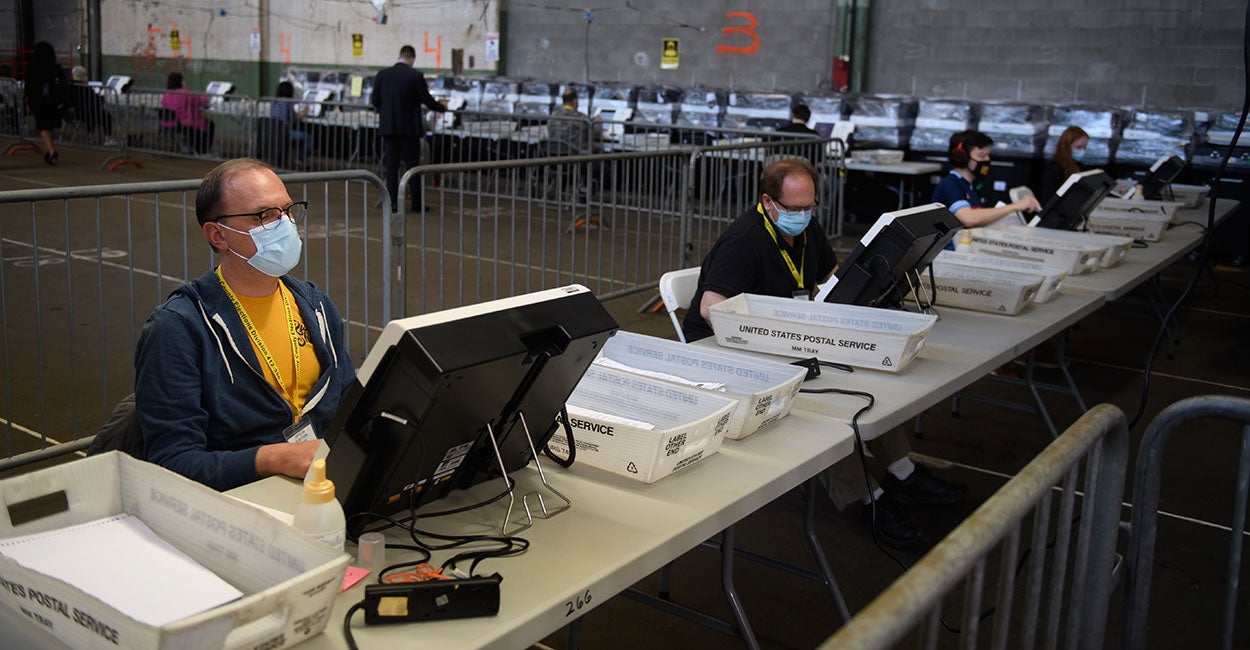
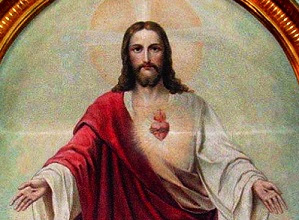

 SMattacchione1:56 PM (26 minutes ago)
 ABYSSUS ABYSSUM INVOCAT / DEEP CALLS TO DEEP
You must be logged in to post a comment.