ITALY HAS LOST 60 ITALIAN PRIESTS TO THE CORONAVIRUS PANDEMIC


Home
 » News » Europe

At least 60 Italian priests have died after contracting coronavirus

48.7K408Credit: Mazur/catholicnews.org.uk.Credit: Mazur/catholicnews.org.uk.By Courtney Mares

Rome, Italy, Mar 23, 2020 / 10:07 am (CNA).- In the past week alone, more than 3,000 people have died in Italy after contracting the coronavirus. Among the dead are at least 60 priests this month, according to local media reports.

“I pray to the Holy Spirit to give us the gift of light and strength. Everyday I do the Via Crucis asking the Lord … to carry this cross with us,” Bishop Gianni Ambrosio of Piacenza-Bobbio said in an Italian interview.

Avvenire, the newspaper owned by the Italian bishops conference, published the names of 51 diocesan priests who died after contracting COVID-19, and noted that religious communities in Italy had also reported nine coronavirus related deaths.

The majority of the deceased were over the age of 70 years old, and some of these priests had underlying health conditions.

The youngest priest to die from COVID-19 in Italy was Fr. Paolo Camminati, who died in the hospital on March 21 at age 53.

Fr. Camminati was known for his dynamic youth ministry, service to the poor, work with Catholic Action, and passion for the mountains. He was the parish priest of Our Lady of Lourdes in Diocese of Piacenza, where five other priests with COVID-19 have died.

Among the dead in Piacenza is Fr. Kidane Berhane, a Cistercian monk originally from Eritrea, who resided in the historic Chiaravalle Abbey in Lombardy. Also deceased are 87-year-old twin brothers, Fr. Mario Boselli and Fr. Giovanni Boselli, who died within a day of each other.

“It is a tough trial. We are dismayed. We feel great suffering,” Bishop Ambrosio told Avvenire.

“It is a darkness that we must face, but with the hope that God never abandons us, that he himself has gone through all the suffering to overcome it,” the bishop added.

Other priests who have died of COVID-19 in Piacenza include Fr. Giuseppe Castelli, 85, and Fr. Giovanni Cordani, 83.

The Diocese of Bergamo has reported the deaths of 20 diocesan priests and two religious. Fr. Fausto Resmini, a former prison chaplain and minister to the homeless, died on March 23 at the age of 67. He had been treated in intensive care since March 5.

“In these days I am listening to the voices of many people, feeling pain for the loss of their loved ones,” Bishop Francesco Beschi of Bergamo said March 19.

In response to this suffering, the Diocese of Bergamo has opened a telephone service that offers free psychological and spiritual counseling and support.

Other Italian dioceses that have lost priests to coronavirus include Parma, Cremona, Milan, Lodi, Brescia, Casale Monferrato, Tortona, Trento, Bolzano, Salerno, Ariano Irpino, Nuoro, and Pesaro.

Italy has the highest coronavirus death toll in the world. The Italian Ministry of Health reported March 23 that 5,476 people have died. More than 59,000 people have tested positive for COVID-19 in Italy since February.

The Bishop of Pinerolo has tested positive for COVID-19. Bishop Derio Olivero was hospitalized March 19 with breathing complications. He is 59 years old and remains in stable condition.

Bishop Antonio Napolioni of Cremona has recovered after being hospitalized for 10 days with severe respiratory symptoms after contracting COVID-19. He returned to his home March 16.

Four diocesan priests and one Passionist missionary, Fr. Edmondo Zagano, have died after contracting COVID-19 in the Diocese of Cremona.

“I experienced minute by minute the dramatic crescendo of problems in the situation and the workload on doctors, nurses and all the staff,” Bishop Napolioni recalled of his time in the hospital.

“It is an absurd Lent,” he said. “But in a certain sense perfect. Jesus is in the desert for forty days, fighting with the devil. Lent is not about the beauty of custom, but the profound mystery of the evil, death and despair that exist. But also of the Lord who is there. We must recognize His presence.”

Our mission is the truth. Join us!

As a CNA reader, you know our team is committed to finding, reporting, and publishing the truth. Like you, we know that Jesus Christ is the way, the truth, and the life.

Generous donors have given to make sure that all the news you read at CNA is always free of charge—not only for you, but for millions of readers each year. But this kind of support takes monthly, faithful contributors.

Will you consider joining them and becoming an ongoing supporter of CNA at just $5, $10, or $15 a month?

Your monthly donation will help our team continue reporting the truth, with fairness, integrity, and fidelity to Jesus Christ and his Church. Thank you.

Yours in Christ,

JD Flynn
CNA Editor-in Chief
Catholic News Agency

Posted in Uncategorized | 3 Comments

LENTEN READING, STUDY AND PRAYER

The Thomistic Institute

HOME STUDYDEGREE PROGRAMSCREDO RCIA PROGRAMRECOMMENDED READING EVENTSALL EVENTSBY REGIONCALENDARTHOMISTIC CIRCLES AT DHSCONFERENCE FOR PRIESTSSUMMER PROGRAMSCAMPUSESAQUINAS 101 PODCAST ABOUTTHE THOMISTIC INSTITUTESTORE – NEW!ORDER OF PREACHERSCONTACT USMAILING LISTDONATE

Neon Green Futuristic Twitch Banner (3).png

St. Thomas Aquinas teaches that God always brings good out of evil.

Here at the Thomistic Institute, we’re taking that to heart. That’s why we’re launching our live streaming Quarantine Lectures. We’ll keep it going until the quarantine is lifted! (Schedule and details below.)

Will you join us? Click below to sign up for real-time live streaming lectures that will elevate your extra time at home. You’ll love the perspective you gain because of what you learn.

Sign up below and you’ll:

  • Gain a spiritual perspective on your faith, aided by the wisdom of St. Thomas Aquinas 
  • Actively participate in each lecture: ask live questions by video or chat, join post-lecture discussion groups, and participate in instant polling, via Zoom.  (Or just watch on YouTube Live or Facebook Live) 
  • Get regular updates and links for all Quarantine Lecture events 
  • Be automatically registered for our live streaming Holy Week Retreat

If you register now, we’ll send you a free electronic copy of our new prayer book: Prayers in Time of Plague.  It’s a great spiritual aid for anyone looking for classic Catholic prayers from our long tradition of prayers in times of plague, sickness, and spiritual trials.  

Know that we at the Thomistic Institute are praying for all of you, every day.  (Please pray for us, too!)STUDENTS: CLICK HERE NON-STUDENTS: CLICK HERE

UPCOMING EVENTS IN THE QUARANTINE LECTURES SERIES

FeaturedMAR26Quarantine Lectures – Grace and Anxiety: Spiritual Growth in a Time of Turmoil

A live-streamed lecture by Fr. Dominic Legge, O.P.QUARANTINE LECTURESMAR31Quarantine Lectures – Plagues: What We Can Learn From the Bible 

A live-streamed lecture by Fr. Anthony Giambrone, O.P.QUARANTINE LECTURESAPR2Quarantine Lectures – The Presence of God in a Season of Solitude

A live-streamed lecture by Fr. James Brent, O.P.QUARANTINE LECTURESAPR6Quarantine Lectures – What is Health for the Soul? 

A live-streamed lecture by Fr. John Corbett, O.P.QUARANTINE LECTURESAPR7Quarantine Lectures: A Catholic Guide to Passing Through Death to Eternal Life 

A live-streamed lecture by Fr. Thomas Petri, O.P. QUARANTINE LECTURESDONATECAMPUS CHAPTERS

THE THOMISTIC INSTITUTE – 487 MICHIGAN AVE NE – WASHINGTON, DC – 20017  

202-495-3826

Powered by Squarespace

Posted in Uncategorized | Comments Off on LENTEN READING, STUDY AND PRAYER

PRIESTS WITHOUT PEOPLE / PEOPLE WITHOUT PRIESTS

Top Banner Image

Priests without People

Fr. Paul D. Scalia

SUNDAY, MARCH 22, 2020

The priest came in. . .and took out the altar stone and put it in his bag; then he burned the wads of wool with the holy oil on them and threw the ash outside; he emptied the holy water stoup and blew out the lamp in the sanctuary and left the tabernacle open and empty, as though from now on it was always to be Good Friday. 

Last Tuesday – the first day of no public Masses in our diocese – I was reminded of this scene from Evelyn Waugh’s novel Brideshead Revisited, when the priest came to close up the Marchmain family’s chapel.  That last line in particular rang in my mind: as though from now on it was always to be Good Friday.

Granted, the analogy is not perfect. Our situation is not exactly like Good Friday. The Mass is still being offered (albeit privately), our Eucharistic Lord is still present, and our churches are still open for people to come and pray. Still, although necessary, the suspension of public Mass does create a sorrow not unlike Good Friday’s. It is like being exiled from a loved one: you know where He is, but you cannot be with Him.

Here is another painful exile: that of the priest from his people. The faithful throughout the world suffer the pain of life without the Mass. Priests suffer the pain of life without their people. Those men have given their lives for Christ’s flock. Now they struggle to understand their lives apart from that flock. Tend the flock of God in your midst, Saint Peter exhorts the Church’s pastors. (1Pt 5:2) But what to do when the flock is no longer in your midst. . .and not allowed to be?

The whole situation sets in stark relief this truth about us parish priests: we are ordained propter homines – to serve the people of God. Our lives don’t make sense without a people to serve or a flock to tend. When asked what he thought about the laity, Saint John Henry Cardinal Newman famously observed that “the Church would look foolish without them.” As it turns out, it is we priests who look most foolish in that scenario.

We are painfully aware of what happens when a priest loses the supernatural outlook and sense of the sacred. He becomes not just useless but dangerous. A priest must be oriented toward and attentive to the divine first of all. But now we see the other part of the equation more clearly. The priest maintains an orientation toward and focus on the divine not for himself but for others. For every high priest chosen from among men is appointed to act on behalf of men in relation to God, to offer gifts and sacrifices for sins. (Heb 5:1) Without the presence of those for whom he acts, a priest can lose sight of his purpose.

*

The suspension of public Mass, like any cross we endure, can and should become an occasion for spiritual growth. We need to draw what good we can from this suffering. What might this mean for a priest?

Well, for starters, the absence of a congregation can remind priests that at Mass we stand before the Lord on behalf of our people. Of course, they are not there. But we are there in their place and on their behalf. This highlights the difference between a prayer-leader and a priest. The former simply coordinates and guides a communal action. All he needs is delegation, not divine sanction.

But a priest is appointed to act on behalf of men in relation to God. He stands before the Almighty as the embodiment of the prayers and sacrifices of his people – whether they are there or not. Their absence should increase our appreciation of this truth.

Another bright light is the evangelical generosity and ingenuity of so many flockless priests. During the bombing of England in World War II, Monsignor Ronald Knox retired to Mells to work on scripture translations. He suddenly found himself chaplain to a girls’ school that had been evacuated from London to that sleepy town. Not the best scenario for the bookish Knox. Not what he would have looked for. But his response was generous, innovative, and lasting. From that ad hoc chaplaincy come two of his best works: The Creed in Slow Motionand The Mass in Slow Motion.

So also, many priests apart from their congregations are making the most of things. The situation is sad, and not what they would have chosen. But they are not giving up. They are finding how to evangelize in other, unexpected ways. The Internet makes possible creative solutions, and many have found opportunities there to reach the flock no longer in their midst.

Further, this whole situation reveals the true nature of priestly ministry – that it is really a matter of spiritual fatherhood, of a father being present to his people. The inability to be present in that way painfully highlights the need to be.

This also reveals that all our technology, which we tend to see as the evangelical solution, is insufficient, just a stopgap. It is a fascinating paradox that in this situation we both depend more on our technology and more deeply know its limits. As useful as it is (email, live-streaming, posted videos, etc.), it cannot actually put us in touch with one another. It only tides us over until authentic human communication – unmediated, face-to-face, person-to-person – can be recovered.

There is no substitute for the shepherd’s presence among his people. And a priest’s heart cannot be content with a virtual connection. It longs for the real.

One last rose drawn from these thorns: an increased appreciation for our people’s devotion. The lack of a public Mass on Sunday will greatly impact the lives of all Catholics, whether they realize it or not. But many do realize it. They long for the Mass, they still come to the church to pray, and they desire to receive all that a priest desires to give. To see their pain and longing should encourage us to be worthy of them.

Ours is an unexpected advent in the midst of Lent. We are waiting – and thus preparing – for when the priest of Christ can again be with his people.

*Image: Jesus Goes Up Alone onto a Mountain to Pray by J.J. Tissot, c. 1890 [Brooklyn Museum]

© 2020 The Catholic Thing. All rights reserved. For reprint rights, write to: info@frinstitute.orgThe Catholic Thing is a forum for intelligent Catholic commentary. Opinions expressed by writers are solely their own.

Fr. Paul D. Scalia

Fr. Paul D. Scalia

Fr. Paul Scalia is a priest of the Diocese of Arlington, Va, where he serves as Episcopal Vicar for Clergy. His new book is That Nothing May Be Lost: Reflections on Catholic Doctrine and Devotion.

Posted in Uncategorized | 2 Comments

I INVITE YOU TO SIGN UP (ITS FREE) FOR THE DAILY POSTINGS OF THE INSTITUTE FOR MINISTRY FORMATION AT MY ALMA MATER, Saint Vincent SEMINARY IN LATROBE, PENNSYLVANIA. THE BROADCASTING OF A DAILY MASS BY THE INSTITUTE WILL BE A GODSEND FOR MANY CATHOLICS IN THIS TIME OF SPIRITUAL AND SACRAMENTAL DEPRIVATION

Watch Today’s MassAs we arrive at our first Sunday in the Diocese of Greensburg during which all public Masses have been suspended, we reflect on the man born blind in today’s Gospel reading.  Jesus went out of His way to encounter that man and bring him sight.  The man did not earn that healing.  It was a free gift.  We desperately need such acts of compassion in these dark and difficult days.  I have heard many reports of bishops and priests who are reaching out to their flocks.  I have heard reports of the lay faithful who are reaching out to those who are isolated.  Even a phone call can make such a difference. 

These unearned acts of kindness follow the example of Jesus who simply anointed the eyes of the man without his asking for it.  It is such acts of kindness that provide healing and help us to see again.  Above all, we want to see the eyes of Jesus.  We want to see the face of the one who is Love Incarnate.  We see Him by faith when we gaze upon Him in the Eucharist.  We also see Him when love is incarnated in His mystical Body.  In these days when we are increasingly blinded to His Presence in the Eucharist, let us seek out His Presence where we can still find Him in acts of selfless love.

We are grateful that so many bishops and priests are recording and livestreaming the Mass from their cathedrals and churches.  We decided to share the Mass of our Chief Shepherd in the Diocese of Greensburg each Sunday.  He makes the link available at 9am Sunday morning.  I hope you can pray along with him.  We are joining you as well.Follow Us on Vimeo!Our old Livestream account will be expiring soon. Follow us on Vimeo so you don’t miss a thing! You can also watch the recordings of daily Mass on Vimeo.Audio content shared by We Are One Body® (http://www.waob.org) radio:
Daily Mass:
https://weareonebodyradio.org/wp-content/uploads/2020/03/waobmass.mp3

Morning Meditation by Fr. Boniface
https://weareonebodyradio.org/wp-content/uploads/2020/03/morningmed.mp3

Evening Meditation by Fr. Boniface (updated after 6pm):
https://weareonebodyradio.org/wp-content/uploads/2020/03/eveningmed.mp3
Have a blessed day!

Institute for Ministry Formation at Saint Vincent Seminary
Posted in Uncategorized | 2 Comments

WHAT DOES THE WORD "TOTALITARIAN" MEAN???????????????

NEWS

NO GOVERNMENT HAS THE AUTHORITY TO SHUT DOWN A NATION

FROM ROME EDITOR1 COMMENT

by Br. Alexis Bugnolo

No government of men has the authority to shut down a nation. This is a common sense statement, which those too educated cannot understand. But I will try to explain it to them.

The state exists to serve the common good. The common good includes the whole of each individual, body and soul, being and action.

An influenza which will kill only 0.17% of the population is not a existential threat to a nation. And therefore it is not an existential threat to the common good. Therefore the common good remains more important. Therefore the Government must continue to serve the common good founded upon the rights of citizens to live and act freely.

If we start obeying insane political leaders we have opened pandora’s box. Germans decided to do that in 1932, and that lead to the deaths of 50 million human beings.

To entrust your mind, your soul and your obedience to an insane person is simply the penultimate step to suicide. To abandon reason itself is simply the choice to be insane.

Do not obey these idiots!

Keep your businesses open! Your schools open! Your factories open! Your stores open! Your restaurants open!

If you do get sick, stay at home. If you get very sick go to the hospital.

But the rest of us have the natural right to keep on living.

And no government of men can obstruct that right, because that right precedes the existence of the state, and comes from the Creator of Nature.

And those with a contrary opinion, are entitled to it, even though they are complete bozos.

___________

CREDITS: The Featured Image is a collage of photographs by Heinrich Hoffmann, Sept. 30 (Bundesarchiv, Bild 102-10460 ), depicting the German Reichchancellor of infamous name, and is used here in accord with a Creative Commons Share-Alike 3.0 Germany License, as described here.

Posted in Uncategorized | Comments Off on WHAT DOES THE WORD "TOTALITARIAN" MEAN???????????????

HERE ARE TWO VERY IMPORTANT ARTICLES WHICH YOU SHOULD READ IN THE LIGHT OF RECENT EVENTS IN THE CHURCH


This article raises some important canonical considerations regarding the abolition of ALL PUBLIC MASSES BY DIOCESAN BISHOPS IN THE FACE OF THE CORONAVIRUS PANDEMIC:


https://canonlawmadeeasy.com/2020/03/20/bishops-authority-cancel-masses/

Also, the homily below is from Pope Benedict XVI and based on an article he had written for the journal “Communio,” back in the early 90’s, entitled:  “The Meaning of Sunday”.


https://w2.vatican.va/content/benedict-xvi/en/homilies/2007/documents/hf_ben-xvi_hom_20070909_wien.pdf

He quotes the martyrs of Abitene:  Sine Dominico non possumus!

Posted in Uncategorized | Comments Off on HERE ARE TWO VERY IMPORTANT ARTICLES WHICH YOU SHOULD READ IN THE LIGHT OF RECENT EVENTS IN THE CHURCH

THE NEWS THAT TWO OF THE COUNTRIES IN THE WORLD HARDEST HIT BY THE CORONAVIRUS PANDEMIC ARE ITALY AND IRAN? IT IS NATURAL TO WONDER WHY THOSE TWO COUNTRIES? HERE IS THE ANSWER!

WHY ITALY AND IRAN?

MARCH 17, 2020

BY JOHN HINDERAKER

Italy and Iran have been two of the countries hardest hit by the Wuhan coronavirus, outside of China. Why?

Helen Raleigh explains at The Federalist:

The reason these two countries are suffering the most outside China is mainly due to their close ties with Beijing, primarily through the “One Belt and One Road” (OBOR) initiative.

OBOR is Beijing’s foreign policy play disguised as infrastructure investment. Here’s how it works: China and country X agree to do an infrastructure project in country X. Country X has to borrow from a Chinese bank to finance the project. A contract is always awarded to Chinese companies, which then bring supplies and Chinese employees to country X to build the project.

As a result of One Belt and One Road, there are more than 300,000 Chinese living in Italy.

Almost exactly a year ago in March 2019, against warnings from the EU and the United States, Italy became the first and only G7 country to sign onto OBOR. As part of the deal, Italy opened an array of sectors to Chinese investment, from infrastructure to transportation, including letting Chinese state-owned companies hold a stake in four major Italian ports. …

Lombardy and Tuscany are the two regions that saw the most Chinese investment. Nearly a year later, the first Wuhan coronavirus infection case in Italy was reported in the Lombardy region on Feb. 21. Today, Italy is experiencing the worst coronavirus outbreak outside China, and Lombardy is the hardest-hit region in the country.

The Iran case is interesting as well:

2019 was the year Iran officially signed up to OBOR. China sees Iran as a crucial player to this initiative because Iran is not only rich in oil but also lies in a direct path of an ambitious 2,000-mile railroad China wants to build, which will run from western China through Tehran and Turkey into Europe.

Today, Iranian health officials trace the country’s coronavirus outbreak to Qom, a city of a million people. According to the Wall Street Journal, “China Railway Engineering Corp. is building a $2.7 billion high-speed rail line through Qom. Chinese technicians have been helping refurbish a nuclear-power plant nearby.” Iranian medical professionals suspect either Chinese workers in Qom or an Iranian businessman who travelled to China from Qom caused the spread of the coronavirus in Qom.

News reports indicate that a number of high Iranian officials have contracted coronavirus, and I believe at least one or two have died. Raleigh explains:

Although on Feb. 1 the Iranian government banned its airlines from flying to China, it made an exception for Mahan Air, an unofficial airline for the Islamic Revolutionary Guard Corps.

The WSJ reported that Mahan Air “had carried out eight flights between Tehran and China between Feb 1 and Feb. 9 to transfer Chinese and Iranian passengers to their respective home countries.” This explains why so many high-level Iranian officials are infected by the coronavirus, including First Vice President Eshaq Jahangiri and more than 20 lawmakers.

Relying on China for economic development was never a good idea, but it turned out to be more dangerous than we knew.

Hat Tip: Jim D.

Posted in Uncategorized | 3 Comments

ANOTHER REPORT FROM NORTH ITALY

3/19/2020 Lessons From Italy’s Hospital Meltdown. ‘Every Day You Lose, the Contagion Gets Worse.’ – WSJ

https://www.wsj.com/articles/every-day-you-lose-the-contagion-gets-worse-lessons-from-italys-hospital-meltdown-11584455470

Lessons From Italy’s Hospital Meltdown.

‘Every Day You Lose, the Contagion Gets

Worse.’

The coronavirus is pushing a wealthy region with high-tech health care toward a humanitarian disaster

By Marcus Walker and Mark Maremont

March 17, 2020 1031 am ET

BERGAMO, Italy—Ambulances here have stopped using sirens. The frequent blaring only adds to local fears. Besides, there are few other vehicles on the road in Italy’s national lockdown.

Most are headed to the Papa Giovanni XXIII Hospital, a large, modern medical facility in a prosperous Italian city that has been overwhelmed by the coronavirus disease. There aren’t enough ventilators to intubate all patients with Covid-19 who have severe breathing trouble. The intensive-care unit is taking almost no patients older than 70, doctors said.

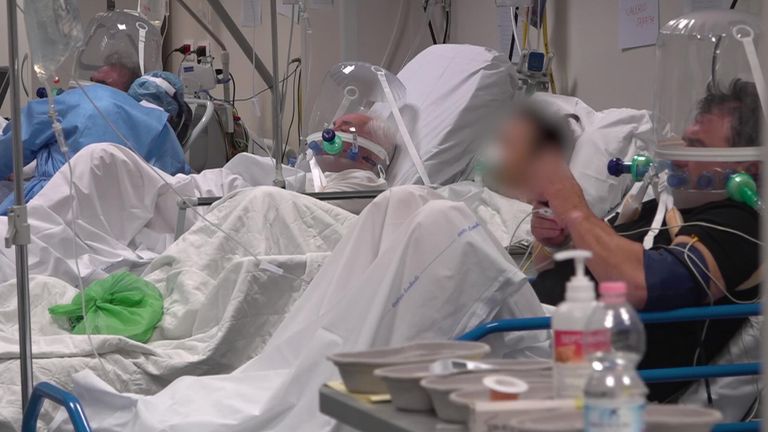
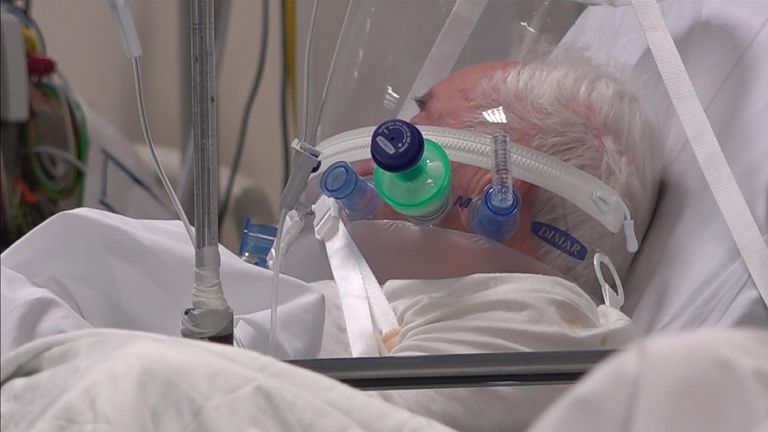
A normally disused section of the hospital is filled with the critically ill and the hissing sound of oxygen. Patients lie quietly, with worried or exhausted faces, visible to others in the series of half-open rooms. Each focuses on the struggle to breathe. There are patients with airtight oxygen helmets over their heads, like transparent buckets taped at the neck.

“Some of them would have needed intubation in intensive care,” anesthesiologist Pietro Brambillasca said. The rest ought to be better isolated, he said, where they can’t contaminate anyone.

The Looming Crisis for U.S. Hospitals

SUBSCRIBE

0000 / 2031page1image12463152page1image12463264page1image22445056

https://www.wsj.com/articles/every-day-you-lose-the-contagion-gets-worse-lessons-from-italys-hospital-meltdown-11584455470?mod=searchresults&p… 1/8

3/19/2020 Lessons From Italy’s Hospital Meltdown. ‘Every Day You Lose, the Contagion Gets Worse.’ – WSJ

That is no longer possible. The number of ill has outstripped the hospital’s capacity to provide

the best care for all.

The coronavirus is devastating Bergamo and pushing a wealthy region with high-tech health care toward a humanitarian disaster, a warning for the U.S. and other developed countries. The city’s experience shows how even advanced economies and state-of-the-art hospitals must change social behaviors and prepare defenses ahead of a pandemic that is upending the rules.

A passing ambulance in Bergamo, Italy. PHOTO: COZZOLIFOTOGRAMMAROPIZUMA PRESS

Some U.S. doctors are trying to understand how the coronavirus defeated all efforts so far to contain it in Lombardy, the Italian region that includes Bergamo and Milan. They seek lessons but don’t have much time, as the pandemic, now coming under control in China, takes off throughout the West.

Maurizio Cereda, an intensive-care doctor and anesthesiologist in Philadelphia, recently circulated a list of lessons from Italy to colleagues. Dr. Cereda, now at the Hospital of the University of Pennsylvania, trained in Milan and has been in close touch with Italian colleagues in Bergamo and elsewhere.

Many of the lessons relate to public health, to avoid overwhelming hospitals. “Mild-to- moderate cases should be managed at home, not in the hospital, and with massive deployment of outreach services and telemedicine,” he wrote. Some therapies could be delivered at home, he said, via mobile clinics.

Another lesson: Italian emergency-medical technicians have experienced a high rate of infection, Dr. Cereda said, spreading the disease as they travel around the community.

He also warned that smaller hospitals “are unprepared to face the inflow of patients” and are likely to collapse. He suggested admitting the sickest patients to bigger facilities and usingpage2image28330224

https://www.wsj.com/articles/every-day-you-lose-the-contagion-gets-worse-lessons-from-italys-hospital-meltdown-11584455470?mod=searchresults&p… 2/8

3/19/2020 Lessons From Italy’s Hospital Meltdown. ‘Every Day You Lose, the Contagion Gets Worse.’ – WSJ

dedicated ambulances for suspected coronavirus patients to avoid infecting the entire fleet.

Italy’s death toll from the coronavirus hit 2,158 on Monday, up 349 since Sunday. The country is on course to overtake China’s 3,099 deaths within days. Its large elderly population is especially vulnerable to Covid-19, the respiratory disease caused by the coronavirus.

About two-thirds of Italy’s dead, 1,420 people, are in Lombardy, the ground zero of Europe’s epidemic. It is where the virus is all the more deadly because hospitals in the worst-hit towns have reached their limits. Bergamo, in particular, has become Italy’s symbol of an epidemic spinning out of control.

Studying the dire turn of events in Italy has helped U.S. doctors better prepare, said Brendan Carr, chair of emergency medicine for The Mount Sinai Health System, a New York City hospital network.

SHARE YOUR THOUGHTS

Can U.S. hospitals prepare in time for the anticipated rush of patients? Join the conversation below.

Dr. Carr said he and other U.S. physicians have had informal calls with Italian doctors in recent weeks. “It’s terrible to hear them talk, but it benefits us to learn from it,” he said. One lesson, he said, is to build capacity for the expected influx of Covid-19 patients before it’s needed. Mount Sinai is clearing out space and creating new ICU beds, he said.

Bergamo shows what happens when things go wrong.

In normal times, the ambulance service at the Papa Giovanni hospital runs like a Swiss clock. Calls to 112, Europe’s equivalent of 911, are answered within 15 to 20 seconds. Ambulances from the hospital’s fleet of more than 200 are dispatched within 60 to 90 seconds. Two helicopters stand by at all times. Patients usually reach an operating room within 30 minutes, said Angelo Giupponi, who runs the emergency response operation: “We are fast, in peacetime.”

Now, people wait an hour on the phone to report heart attacks, Dr. Giupponi said, because all the lines are busy. Each day, his team fields 2,500 calls and brings 1,500 people to the hospital. “That’s not counting those the first responders visit but tell to stay home and call again if their condition worsens,” he said.page3image22540672page3image22541632page3image22541824

https://www.wsj.com/articles/every-day-you-lose-the-contagion-gets-worse-lessons-from-italys-hospital-meltdown-11584455470?mod=searchresults&p… 3/8

3/19/2020 Lessons From Italy’s Hospital Meltdown. ‘Every Day You Lose, the Contagion Gets Worse.’ – WSJpage4image28326736

Dr. Angelo Giupponi, head of the operations center at Papa Giovanni XXIII Hospital in Bergamo, which takes emergency calls and dispatches ambulances.
PHOTO: MARCUS WALKERTHE WALL STREET JOURNAL

Ambulance staff weren’t trained for such a contagious virus. Many have become infected and their ambulances contaminated. A dispatcher died of the disease Saturday. Diego Bianco was in his mid-40s and had no prior illnesses.

“He never met patients. He only answered the phone. That shows you the contamination is everywhere,” a colleague said. Mr. Bianco’s co-workers sat Sunday at the operations center with masks on their faces and fear in their eyes.

The Papa Giovanni XXIII Hospital, a 950-bed complex that opened in 2012, is among the most advanced in Italy. It treats everything from trauma and heart surgery to organ transplants for children.

More than 400 of the beds are now occupied by confirmed or suspected coronavirus patients. The intensive-care unit has swelled to around 100 patients, most of whom have Covid-19. New cases keep arriving. Three of the hospital’s four top managers are home sick with the virus.

https://www.wsj.com/articles/every-day-you-lose-the-contagion-gets-worse-lessons-from-italys-hospital-meltdown-11584455470?mod=searchresults&p… 4/8

3/19/2020 Lessons From Italy’s Hospital Meltdown. ‘Every Day You Lose, the Contagion Gets Worse.’ – WSJpage5image28716416

Dr. Mirco Nacoti of Papa Giovanni XXIII Hospital in Bergamo. PHOTO: MARTA PANZERA

“Until three weeks ago, we did everything for every patient. Now we have to choose which patients to put in intensive care. This is catastrophic,” said anesthesiologist and intensive-care specialist Mirco Nacoti.

Dr. Nacoti worked for Doctors Without Borders in Haiti, Chad, Kurdistan and Ivory Coast, and he is one of the few medics in Bergamo who has seen epidemics. Yet, those were diseases with vaccines, such as measles and rubella.

He estimated that around 60% or more of the population of Bergamo has the coronavirus. “There is an enormous number of asymptomatic people, as well as unknown dead who die in their home and are not tested, not counted,” he said. “The ICU is the tip of an iceberg.”

https://www.wsj.com/articles/every-day-you-lose-the-contagion-gets-worse-lessons-from-italys-hospital-meltdown-11584455470?mod=searchresults&p… 5/8

3/19/2020 Lessons From Italy’s Hospital Meltdown. ‘Every Day You Lose, the Contagion Gets Worse.’ – WSJ

Hospitals in the U.S. and across Europe must organize in advance, Dr. Nacoti said, and governments need community lockdowns early rather than late.

“An epidemic doesn’t let you proceed by trial and error,” he said. “Every day you lose, the contagion gets worse.”

Bergamo, a city of about 120,000 northeast of Milan, sits at the heart of one of Italy’s wealthiest regions. Companies nearby make San Pellegrino mineral water, luxury yachts, and brakes for Ferrari cars. The city’s hilltop core, a medieval citadel, is normally filled with tourists.

When Bergamo discovered a clutch of coronavirus cases in its outlying towns around Feb. 22, Dr. Giupponi of the Papa Giovanni hospital emailed Lombardy’s regional health authorities. He urged them to empty out some hospitals and use them exclusively for coronavirus cases.

Regional managers at the time were dealing with an outbreak south of Milan. “We haven’t slept for three days and we do not want to read your bullshit,” Dr. Giupponi recalled their reply.

Since then, Italy’s lockdown has turned Bergamo into a ghost town.

Death notices in the local newspaper, the Bergamo Echo, normally take up just over a page. On Monday, they filled nine pages. “And that’s just the ones that are in the paper,” Dr. Nacoti said.

A funeral this month in Bergamo.
PHOTO: COZZOLIFOTOGRAMMAROPIZUMA PRESS

Doctors taking a break at the Papa Giovanni swap stories of woe, including the call from an elderly care home reporting suspected virus sufferers who were over 80 years old. The hospital said the elderly residents had to stay put.

“None of us have ever seen such a thing,” trauma surgeon Michele Pisano said. “We’re trained for emergencies, but for earthquakes, not epidemics.” Dr. Pisano has little to do these days:page6image28349936

https://www.wsj.com/articles/every-day-you-lose-the-contagion-gets-worse-lessons-from-italys-hospital-meltdown-11584455470?mod=searchresults&p… 6/8

3/19/2020 Lessons From Italy’s Hospital Meltdown. ‘Every Day You Lose, the Contagion Gets Worse.’ – WSJ

Italy’s lockdown means there are virtually no car crashes, bicycle accidents or broken bones from skiing. He helps out in the coronavirus wards however he can.

In small towns around the province of Bergamo, the pressure on local hospitals is even greater.

Dr. Nacoti helps at a hospital in San Giovanni Bianco, located in the foothills of the Alps. On Sunday evening, the facility had around 70 coronavirus patients. The hospital, which specializes in outpatient surgery, normally has 20 beds.

Recently arrived patients lay on gurneys, filling the emergency room and a corridor while they wait for beds to become free.

Upstairs, more than 50 patients were administered oxygen through helmets or masks. Some were in critical condition, but the hospital has no intensive-care unit and no ventilators.

“We thought seven beds downstairs and seven upstairs would be enough,” senior nurse Fiorella Busi said.

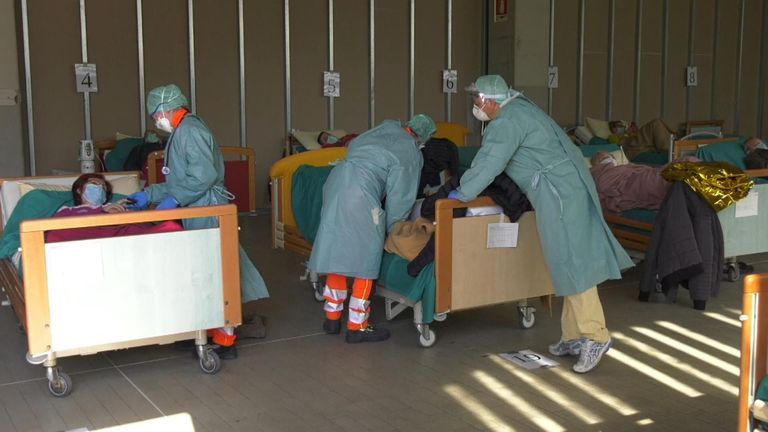
Medical personnel care for patients in temporary quarters at a hospital in Brescia, Italy. PHOTO: FRANCESCA VOLPIBLOOMBERG NEWS

The hospital had planned to send severe cases to Bergamo. “But we got indications that, if patients are over 65 or 70, they won’t get intubated,” said Davide Grataroli, one of the hospital doctors. “So, we’ve chosen to manage them here as best we can.”

That has been the situation for nearly three weeks. The patients know that the lack of intensive- care facilities dooms those not strong enough to survive the disease with limited help. “They accept it with resignation and no complaints,” said Ms. Busi, the nurse.

“The most devastating part is that they are dying alone,” she said. “Families see the patient for the last time at the emergency room. The next time is at the mortuary.”page7image28348896

https://www.wsj.com/articles/every-day-you-lose-the-contagion-gets-worse-lessons-from-italys-hospital-meltdown-11584455470?mod=searchresults&p… 7/8

3/19/2020 Lessons From Italy’s Hospital Meltdown. ‘Every Day You Lose, the Contagion Gets Worse.’ – WSJ

Such a lonely death is hard to take, the nurse said: “It’s not our culture. We’re very connected here.”

Write to Marcus Walker at marcus.walker@wsj.com and Mark Maremont at mark.maremont@wsj.com

Posted in Uncategorized | Comments Off on ANOTHER REPORT FROM NORTH ITALY

THINGS DO NOT LOOK GOOD IN ITALY

sky news logo

Coronavirus: Italy’s hardest-hit city wants you to see how COVID-19 is affecting its hospitals

The sheer numbers of people succumbing to the coronavirus is overwhelming every hospital in northern Italy.

Stuart Ramsay

Chief correspondent @ramsaysky

Friday 20 March 2020 12:18, UK

Sky's Stuart Ramsay was invited in to the scale of the crisis
At the centre of the COVID-19 crisis in Italy
  •  
  •  
  •  

Why you can trust Sky News 

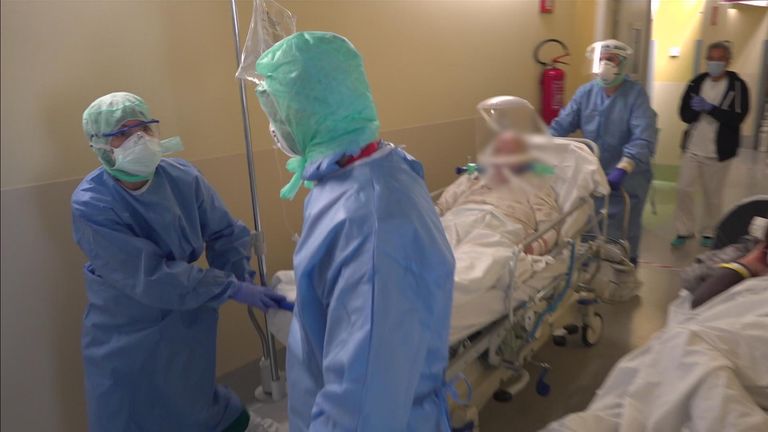
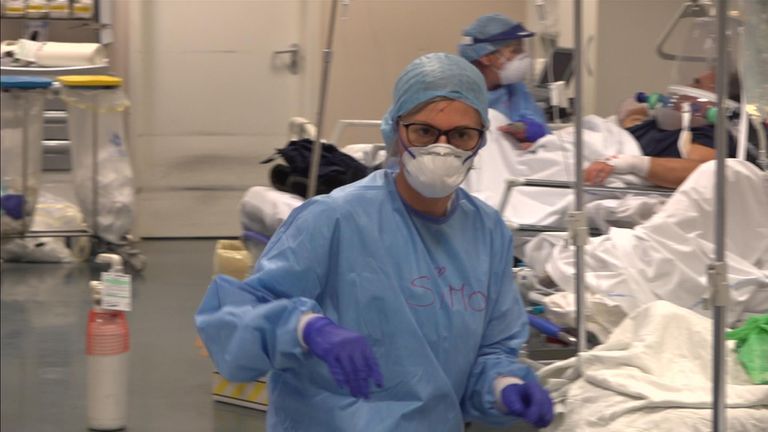
Staff frantically wave us out of the way, pushing gurneys carrying men and women on mobile respirators – it’s not chaos, but it is hectic. 

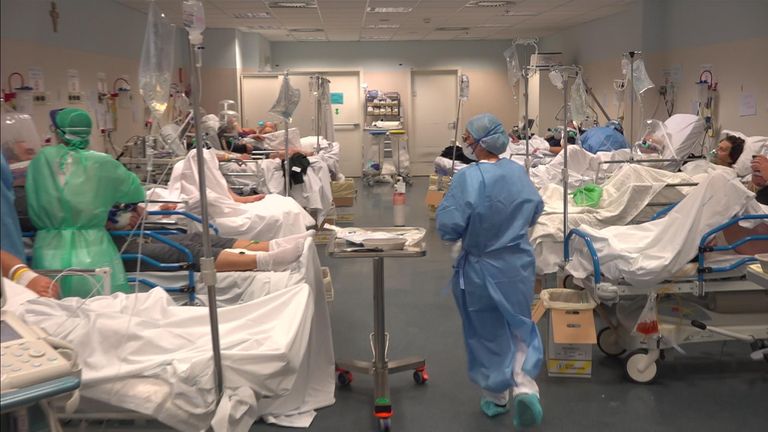
They rush past wards already rammed with beds all filled with people in terrible distress – gasping for air, clutching at their chests and at tubes pumping oxygen into their oxygen-starved lungs.Sponsored link

Recommended by

I’m in the main hospital in Bergamo, the hardest-hit hospital in Italyin the hardest-hit town in the hardest-hit province, Lombardy – and it’s just plain scary.

Bergamo is the new epicentre of the epidemic
The hospital is overwhelmed by patients
Image:Bergamo is at the epicentre of the epidemic

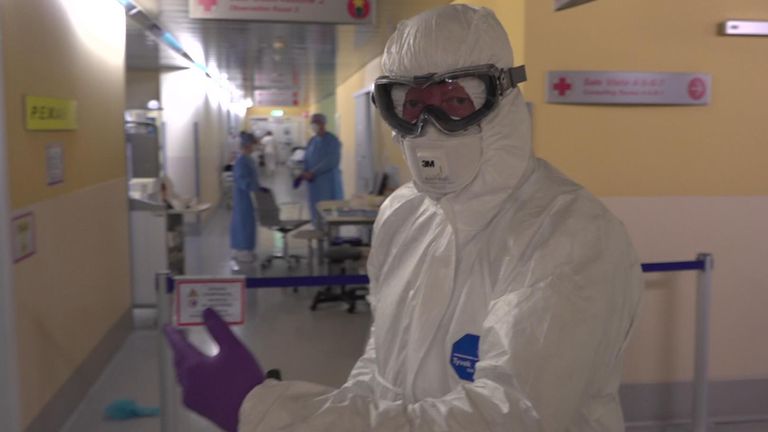
Masked, gloved and in a hazmat suit, my team and I are led through corridors full of gasping people who look terribly ill.

I ask what ward I am in.Advertisement

“This isn’t really a ward, it’s a waiting room, we just have to use every bit of space,” my guide, Vanna Toninelli, head of the hospital press office tells me.

The medical teams are fighting a war here and they are losing.

More from Covid-19

Italian coronavirus cases surpass China 427 more people have died in Italy, taking total deaths to 3,405

The sheer numbers of people succumbing to the coronavirus is overwhelming every hospital in northern Italy – and it could easily overwhelm the rest of the country as well.

The staff are working flat out trying to keep their patients from deteriorating further. They are trying to stop them from dying.

Staff are trying to keep patients from deteriorating further
Image:Hospital staff are trying to keep patients from deteriorating further

In groups they crowd around the latest patients. Attaching monitors, drips and most importantly respirators. Without them the patients will simply go downhill fast.

Really fast. Deadly fast.

Sky's Stuart Ramsay was invited in to the scale of the crisis
Image:Sky’s Stuart Ramsay was invited in to see the scale of the crisis
Hospital staff push a gurney carrying a man on a mobile respirator
Image:Hospital staff push a gurney carrying a man on a mobile respirator

It looks like an intensive care unit (ICU), but it is actually just an emergency arrivals ward. The ICU is full. The people being treated are new arrivals, but they look far worse than that.

Anywhere else in the world they would be intensive care cases but here, to qualify, you are actually on the point of death, not just gravely ill.

In this pandemic, gravely ill is considered a reasonable position. It really is that bad.

The arrival of people here is an absolute constant. This killer pandemic is virtually out of control.

We have all heard what has been going on here, but no journalist has been allowed in here to see it, until now.

The city of Bergamo invited us in to show everyone what a catastrophic emergency, that nobody has ever experienced before, looks like.

They want you to see it. They want the world’s population to question their own governments’ responses.

Because there can be no excuse anymore that nobody knew. Italy did not. Now everyone else does.

Staff are working flat out to help patients
Image:Staff are working flat out to help patients
Medical staff crowd around a patient

Through plastic bubbles that fit over the heads of the most ill, staff struggle to communicate with patients.

The weak can barely speak and above the noise of the ward and the constant bleep of heart monitors and breathing pumps, it’s almost impossible to make out what they are saying.

The bubbles are attempting to equalise the air pressure in the lungs.

Nobody expected this, nobody even imagined they would be treating so many so quickly.Italian army called in as crematorium struggles to cope with deaths

And for the record, it is NOT like flu, it is more often than not chronic pneumonia and it is killing hundreds here each day.

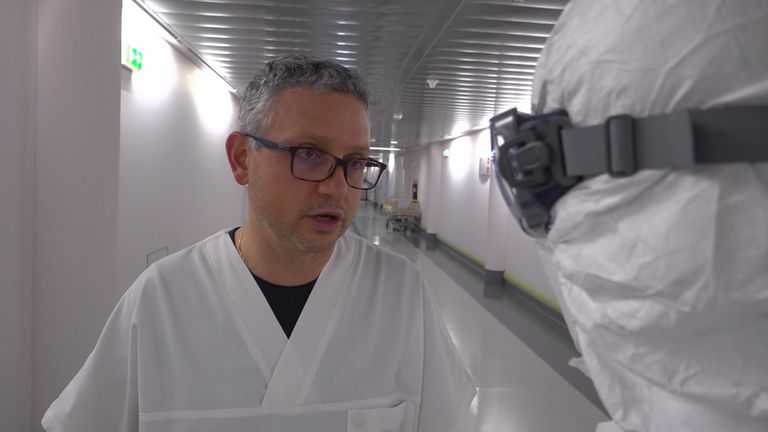
The head of emergency care, Dr Roberto Cosentini, says they have never seen anything like it, and he and his staff are warning other countries, especially the UK, that they will see it soon.

“It’s a very severe pneumonia, and so it’s a massive strain for every health system, because we see every day 50 to 60 patients who come to our emergency department with pneumonia, and most of them are so severe they need very high volumes of oxygen.

“And so we had to reorganise our emergency room and our hospital [to] three levels of intensive care.”

Virus in Italy
Virus deaths in Italy overtake China

The Papa Giovanni XXII hospital is one of the most advanced in Europe, but even this gleaming mega hospital is on its knees.

Bergamo is the absolute centre of this epidemic and the hospital is attempting to deal with a crisis that was never imagined.

Many of the medical staff have worked or trained in the UK. Dr Lorenzo Grazioli worked in Leicester for a year.

He says his friends have been ringing him constantly to get a sense of what it is like. He told me they are bracing themselves for the same and are very worried.

:: Listen to the Daily podcast on Apple PodcastsGoogle PodcastsSpotifySpreaker

He, like every other doctor and nurse I spoke to, urged the UK to follow the example of China and Italy, and lock down everything straight away.

It is, they say, the only way to slow the virus down: not beat it, slow it.

“I have never felt so stressed in my life, I’m an intensivist, and I am quite used to intense moments, and the choices, and people are critical and die without any treatment, and you [usually] make the difference,” he told me.

“But when you are at this point you realise that you are not enough.

“We are 100 anaesthetists, we are doing our best, but maybe it’s not enough.”

'When you are at this point you realise that you are not enough,' says Dr Lorenzo Grazioli
Image:’When you are at this point you realise that you are not enough,’ says Dr Grazioli 

In labs, staff are continuously testing for the virus and attempting to find something that can beat it. They say it’s a long way off.

The problem facing health services across the world is that when the infection curve goes up it rockets, and all resources, all testing, all supplies are used up instantly. Multiple hospitals all making the same demands at the same time.

It’s crippling – here they call it the apocalypse.

Bergamo wanted us to see this, as I have said, and they want to send a simple message: “Get ready.”

Posted in Uncategorized | 1 Comment

GOOD ADVICE !!!

It is Conchita’s own words (not from a heavenly source).  

MESSAGE FROM CONCHITA of GARABANDAL!

I asked Conchita if she would be kind enough to offer some words of advice to all of us, in this troubling times. Here is her words:

“God is detaching us from the securities of this world. In the silence of the Church or in our house, we are now able to make an examination of conscience so we can clean what prevents us from hearing the Voice of God clearly. With sincerity we can ask God to tell us what He wants of us today, and continue to do that every day. And spend as much time as possible with God at church or somewhere in your home or where you find the silence. He is all we need.”

Posted in Uncategorized | 5 Comments