I AM A FIRM BELIEVER THAT THE SINS OF A FATHER ARE NOT SHARED BY HIS SON BUT I AM MORE THAN A LITTLE UNCOMFORTABLE WITH THE REVELATION ABOUT THE NATURAL AND ADOPTIVE PARENTAGE OF San Francisco’s NEW DISTRICT ATTORNEY – I GREW UP IN THE ERA OF THE WEATHERMEN CRIME SPREE. MY OPINION OF SOTOMAYOR WAS ALREADY LOW, NOW IT IS UNPRINTABLE.

Justice Sotomayor Celebrates San Francisco’s New District Attorney Chesa Boudin

By ED WHELAN

https://mail.google.com/mail/u/0/?hl=en&shva=1#inbox/FMfcgxwGCkdSrtKZFPzVZwScTzxDghhV         

·          

January 9, 2020 2:32 PM

·          

·         I’ll leave it to others to debate the merits of San Francisco’s new district attorney Chesa Boudin, who (according to this San Franciso Examiner article) won election in the face of “intense opposition” from the city’s police union and political establishment and who has plans “to immediately begin reforming the criminal justice system.” I am very surprised, though, to learn that Justice Sotomayor somehow saw fit to send Boudin a video of ardent congratulations at his swearing-in yesterday.

In her video, Sotomayor tells Boudin that she is sending “this message to tell you how much I admire you” and that “you too [i.e., like Sotomayor herself, as the context makes clear] are an example that gives hope to so many.” (Sotomayor highlights here that Boudin, the son of Weather Underground criminals Kathy Boudin and David Gilbert—and the adoptive son of their Weather Underground cohorts Bill Ayers and Bernardine Dohrn—“spent his childhood visiting parents incarcerated for committing serious felonies.”)

Sotomayor praises Boudin’s “strength of character and moral composure” and declares:

Your personal strength and commitment to reforming and improving the criminal justice system is a testament to the person you are and the role model you will continue to be for so many.

Sotomayor calls Boudin “a great beacon to many” and expresses her belief that “the city of San Francisco will be so very well served by a man whose life creed is believing, as you told me, ‘We are all safer when we uplift victims, hold everyone accountable for their actions, and do so with empathy and compassion.’”

Perhaps I’m mistaken, but it strikes me as highly unusual that a sitting Supreme Court justice—or any federal judge, for that matter—would publicly lavish such praise on an elected official, especially in the absence of a previous working relationship or close friendship that would give her a special basis for offering insights into his character. In fact, the only similar example that comes readily to mind is the troublingly partisan public cheerleading that Sotomayor, then on the Second Circuit, engaged in over the election of President Obama. But if anyone thinks I’m overlooking other examples, please let me know. (Statements at retirement ceremonies would seem to be readily distinguishable, but I’d still be interested in them.)

I also don’t think the fact that Boudin’s position is legal or prosecutorial rather than purely political makes Sotomayor’s embrace of him okay. But if you’re inclined to disagree, consider a hypothetical in which, say, Justice Alito showered comparable public praise on a prosecutor who won election by promising to be tough on crime.

M. Edward Whelan III
President
Ethics and Public Policy Center
1730 M Street N.W., Suite 910
Washington, D.C. 20036
202-682-1200 
www.EPPC.org

Posted in Uncategorized | Comments Off on I AM A FIRM BELIEVER THAT THE SINS OF A FATHER ARE NOT SHARED BY HIS SON BUT I AM MORE THAN A LITTLE UNCOMFORTABLE WITH THE REVELATION ABOUT THE NATURAL AND ADOPTIVE PARENTAGE OF San Francisco’s NEW DISTRICT ATTORNEY – I GREW UP IN THE ERA OF THE WEATHERMEN CRIME SPREE. MY OPINION OF SOTOMAYOR WAS ALREADY LOW, NOW IT IS UNPRINTABLE.

I FIND IT HARD TO BELIEVE THAT THE House of Representatives WILL ADOPT THIS PROPOSAL BY Nancy Pelosi. IMHOP THIS IS AN INSANE PROPOSAL. SHOULD CONGRESS ADOPT IT WE ALMOST CERTAINLY WILL EXPERIENCE A RESUMPTION OF AGGRESSIVE MILITARY ACTIONS BY IRAN AGAINST AMERICA. IF YOU AGREE, MAKE YOUR OPINION KNOWN TO YOUR CONGRESSPERSONS TODAY.

Pelosi Statement on Vote on War Powers Resolution

JANUARY 8, 2020  PRESS RELEASE 

Washington, D.C. – Speaker Nancy Pelosi issued this statement announcing the upcoming vote on a War Powers Resolution to limit the President’s military action regarding Iran:

“Last week, the Trump Administration conducted a provocative and disproportionate military airstrike targeting high-level Iranian military officials.  The Administration took this action without consulting Congress.  This action endangered our servicemembers, diplomats and others by risking a serious escalation of tensions with Iran.  Since then, the President has made clear that he does not have a coherent strategy to keep the American people safe, achieve de-escalation with Iran and ensure stability in the region.

“Members of Congress have serious, urgent concerns about the Administration’s decision to engage in hostilities against Iran and about its lack of strategy moving forward.  Our concerns were not addressed by the President’s insufficient War Powers Act notification and by the Administration’s briefing today.

“Today, to honor our duty to keep the American people safe, the House will move forward with a War Powers Resolution to limit the President’s military actions regarding Iran.  This resolution, which will be led by Congresswoman Elissa Slotkin, will go to the Rules Committee this evening and will be brought to the Floor tomorrow.

“The House may also soon consider additional legislation on the Floor to keep America safe.  This legislation includes Congresswoman Barbara Lee’s resolution to repeal the 2002 Iraq Authorization for Use of Military Force (AUMF) and Congressman Ro Khanna’s legislation to prohibit funding for military action against Iran not authorized by Congress.  

“The Administration must work with the Congress to advance an immediate, effective de-escalatory strategy that prevents further violence.  America and the world cannot afford war.”

Posted in Uncategorized | 1 Comment

THE TRUTH ABOUT THOSE HUGE CROWDS “MOURNING” THE KILLING OF IRANIAN GENERAL Qassem Soleimani

Iranian Journalist Blasts Media’s Coverage of Soleimani, Says Don’t Believe It

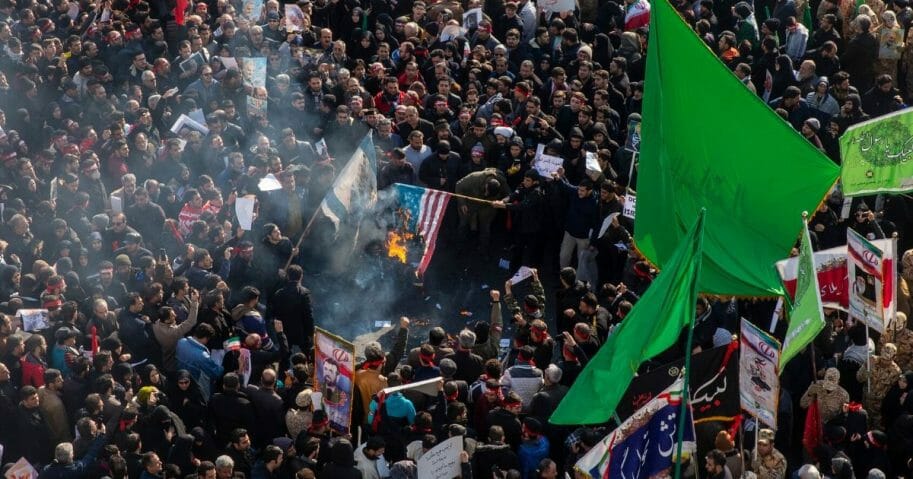
Mourners burn U.S. and Israeli flags during a funeral ceremony for Iranian Major General Qassem Soleimani and others who were killed in Iraq by a U.S. drone strike on Jan. 6, 2020, in Tehran, Iran.

In the wake of the airstrike President Donald Trump ordered to take out top Iranian Gen. Qassem Soleimani, some in the liberal media have gone over the top in attacking the president over the order while treating the murderous Iranian regime’s reaction to Soleimani’s death with deference.

Aside from largely downplaying and glossing over Soleimani’s indisputable history as a brutal thug enforcer for the repressive Iranian mullahs, the media has also seemed to take glee in highlighting the massive crowds that turned out — estimated to number in the hundreds of thousands, if not millions — for several days of funeral processions in honor of the general.

The media likely keyed in on the huge Iranian crowds as a juvenile way to take a shot at Trump in reference to his known attentiveness to crowd sizes, dating back to his inauguration but also whenever he holds a campaign rally.

But one Iranian journalist and women’s rights activist named Masih Alinejad wrote an Op-Ed in The Washington Post, published Monday, that contained a simple yet important message for the U.S. media and those who pay attention to it: “Don’t take what you’re seeing at face value.”

The main crux of Alinejad’s argument is that the Iranian regime is well known for its dishonest propaganda and that the American people — especially the media — should be skeptical of the notion that all of the people seen in the massive crowds were there of their own free will or were actually mourning the death of Soleimani.

“Without doubt, Soleimani had support among hard-liners and regime loyalists. The regime is not taking any chances, though,” she wrote, sharing anecdotal reports she had received from Iranian citizens of people being forced to attend the funeral processions, including government workers, students and others.

Alinejad said stores had been ordered closed by the government, free rides were provided to attend the processions and schoolchildren were being instructed to write essays in praise of Soleimani or were told to cry for his loss if they were unable to write yet.

Alinejad further noted that “the media in the Islamic Republic is heavily controlled. Public gatherings are allowed only if they are pro-regime. Critics are jailed or shot.”

She said she herself had received death threats for her coverage of Soleimani’s death from here in America, and added, “So it’s not hard to use all the tools and resources of the state to stage a funeral procession.”

Are you sickened by how the media has sided with Iran against President Trump?

While some, perhaps even the majority, of the Iranians making up those massive funeral procession crowds were surely mourning Soleimani’s loss, Americans should not be deceived into believing that all of the people there were supporters of the dead Iranian general or were saddened by his death.

Alinejad pointed out that Soleimani had played a role in the recent brutal crackdown on anti-regime protesters, in which at least 1,500 protesters were reportedly killed and more than 7,000 were arrested, which coincidentally occurred around the same time the internet was shut down across the country for five days.

Given the fact that even the Iranian government has yet to release official numbers for the dead, wounded and arrested at the protests, the numbers are actually probably higher than the aforementioned estimates.

On top of that, Soleimani also played a role in oppressive crackdowns against previous outbreaks of protest against the regime, such as in the late 1990s, 2009, 2017 and earlier in 2019. Furthermore, many Iranian protesters had expressly protested against Soleimani and his history of organizing and inflaming proxies around the Middle East, as they viewed it as a waste of government funds that should have been spent domestically.

The point? There is a substantial portion of the Iranian people who are pleased that Trump took out Soleimani but nevertheless felt pressured to attend his funeral processions.

Alinejad chastised the “Western media” for being properly skeptical of “state-organized events” in places like North Korea and Russia while at the same time displaying “unwarranted gullibility toward the official version of events” coming out of Iran.

She also lamented separately on social media how she herself has tried to inform her colleagues in the “Western media” — such as CNN, The New York Times and even The Washington Post itself — about the truth of what is occurring in Iran, to little avail. Yet, those same outlets have had no problem broadcasting all of the manufactured details of a state-run funeral procession for a mass-murdering terrorist.

To be sure, Alinejad’s report is her “opinion” and not necessarily “news,” per se, but given her credentials and experience, she has a voice that should be listened to. Unfortunately, her liberal comrades in the media would rather take shots at Trump using Iranian propaganda than provide a fair and unbiased assessment of what is really going on.

Ben MarquisContributor, CommentarySummary More Info Recent Posts ContactBen Marquis is a writer who identifies as a constitutional conservative/libertarian. He has covered current events and politics for The Western Journal’s Conservative Tribune since 2014. His focus is on protecting the First and Second Amendments.

Posted in Uncategorized | 1 Comment

IT SEEMS THAT FRANCIS THE MERCIFUL, IN HIS BELATED HASTE TO YIELD TO PUBLIC PRESSURE TO PUNISH Cardinal Theodore McCarrick, DECREED A FORM OF PUNISHMENT FOR McCARRICK WHICH THREATENS THE THEOLOGICAL BASIS FOR OUR UNDERSTANDING OF THE INDELIBLE CHARACTER OF THE SACRAMENT OF HOLY ORDERS

Settimo Cielodi Sandro Magister 07 gen 20

The Other Side of the McCarrick Case. The Vatican Supreme Court Against Trials Without Guarantees and Without Theology

Sciacca

*

After many unjustified postponements, the informative note on the case of Theodore McCarrick promised by Pope Francis in October of 2018 is perhaps close to being published, with the foreseeable fresh explosion of the controversies over the cover-up from which he is alleged to have benefited, at the highest levels of the Church hierarchy.

In the meantime, however, a prominent representative of the Vatican supreme court – very close to Benedict XVI but not devoid of criticism toward him – has raised very serious objections against the exclusion from the clerical state of the former cardinal archbishop of Washington, not for the reasons that led to this condemnation – which remain very grave, and this is a matter of sexual abuse committed over decades – but because of the dubious canonical and ecclesiological legitimacy, and in any case of the “overwhelming inadvisability,” of the reduction of a bishop to the lay state.

Raising the objections is the bishop Giuseppe Sciacca (in the photo), secretary of the Supreme Tribunal of the Apostolic Signatura, in the essay that opens the latest issue of “Jus – On Line,” the scholarly journal of legal studies of the faculty of jurisprudence of the Catholic University of Milan:

> Note sulla dimissione del vescovo dallo stato clericale

The fundamental objection from which Sciacca sets out is that the “clerical state” is strictly connected to the sacred order. While the former is typically used to indicate an essentially juridical condition, of belonging to a group, to a category, the latter is a sacrament which impresses on those who receive it an indelible, ontological character, like baptism and confirmation. So much so that even if a sacred minister were forbidden the exercise of sacramental acts, such as for example the celebration of Mass, such acts would still remain valid even if they were performed in contempt of the ban.

But that’s just it, Sciacca points out, especially for bishops “the discordance between ontological status and legal status induced by this situation is a manifest symptom of a pathology.”

In the Church, the awareness of this “pathology” has grown above all thanks to Vatican Council II, which powerfully brought to light the sacramentality of episcopal ordination – which confers the fullness of the sacrament of orders – and therefore also the theological and sacramental root of the bishop’s power of jurisdiction. One indication of this heightened awareness is in the new postconciliar code of canon law, which in canon 290 prescribes that dismissal from the clerical state can be granted “to deacons only for grave reasons” and “to priests only for the gravest of reasons,” without mentioning bishops.

It is only with the motu proprio “Sacramentorum sanctitatis tutela” of 2001 that dismissal from the clerical state is explicitly foreseen for bishops as well. And it is by virtue of this motu proprio that this penalty has been applied in three very recent cases: in addition to McCarrick, to the Chilean bishops Francisco José Cox Huneeus and Marco Antonio Órdenes Fernández.

But more than canonical, Sciacca insists, the problem is ecclesiological, even more so after the exploration of the nature of the bishop carried out by Vatican Council II.

He writes:

“In order for episcopal consecration to be not only valid but licit, hierarchical communion is required with the head of the apostolic college and with the members. Once this occurs, it is irreversible and produces the irreversible insertion of the subject into the college. And the college is not a metaphor, but rather an institutional and juridical reality.

“Therefore, it follows that the loss of hierarchical communion, through a criminal provision from the pontiff, cannot, acting retroactively, cause expulsion from the college, insertion within which is irrevocable by virtue of the sacramental consecration, but only inhibits the exercise of the corresponding ‘munera.’ Sacrament and law are here intimately interwoven.”

But to what extent is all of this understood?

Sciacca points out that public opinion – even that of the “holy faithful people” so dear to Pope Francis – interprets the dismissal of a bishop from the clerical state as proof that “the priesthood is a temporary function, conferred ‘ad tempus’ or ‘ad nutum,’ since it is susceptible to being revoked, albeit for very serious reasons. And if this appears problematic for priests, it can be paroxysmal and subversive for bishops, if we consider that the provision is taken by one who – holder of papal primacy and in the fullness of jurisdiction – is however still sacramentally their equal.”

The “devastating risk” of this mistaken perception – Sciacca continues – “is that it could be translated into a real and proper erosion of the sacrament of orders, which, instead, is mystically, supernaturally and also in a positively verifiable and verifiable historical manner the bond that connects the Church, through the uninterrupted apostolic succession, to its divine founder.”

It would therefore be good, in Sciacca’s judgment, that for a bishop guilty of serious crimes the punishment should be enforced from now on – all the more by a pope committed to the abolition of the death penalty and life imprisonment – in a form that is no longer “vindictive” but “medicinal,” according to “graduality” and “proportionality,” for “re-educational” purposes, in practice with fixed-term suspensions and other limitations such as the residence requirement, the ban on using the episcopal insignia, etc., such as occurred in 2019 for the archbishop of Agaña, Anthony Sablan Apuron.

Not only that. Sciacca insists on respect for the “fundamental guarantees without which the legal order ceases to be such, like the presumption of innocence, the right of defense, the non-retroactivity of positive penal law, the need for reaching moral certainty before issuing convictions and, certainly not least, prescription, as being rooted, albeit in a mediated way, in the natural law itself.” Entirely the opposite – he points out – of the hasty convictions by administrative decree issued in recent years by the Holy See against bishops and cardinals, as if they were company officials, therefore with the risk that the Holy See would also be called to answer for their faults, in contempt “of the indispensable principle of juridical civilization according to which criminal liability is personal.”

So far, in its substance, the essay by Sciacca on “Jus.”

To which, however, he adds, “almost by way of corollary, some reflections on the ‘Notes’ of Benedict XVI, published in April of 2019, on the phenomenon of pedophilia in the Church.”

The full text of those “Notes” or “Jottings” is on this other web page:
> The Church and the scandal of sexual abuse

And this, with minor cuts, is Sciacca’s commentary.

*

THE RISK OF A SUMMARY JUSTICE

by Giuseppe Sciacca

With due respect and affectionate filial gratitude to Benedict XVI, [in those “Notes” of his] there is a point, indeed in the judgment of the writer not secondary, where it is not possible to follow him, and it is when he says that there was – in the approach to cases of pedophilia in the clergy – an excess of garantismo [presumption of innocence, due process – tr].

“By now,” Josef Ratzinger writes, “what was considered ‘conciliar’ was only so-called ‘garantismo.’ This means that above all the rights of the accused had to be guaranteed, and this to the point of effectively ruling out a sentence.”

This was not at all a matter of garantismo – which is a category or, better, a way of being necessary for any sound, correct, evolved legal system – but the total culpable absence of any and all recourse to a legal remedy, notably within penal canon law, on account of the widespread, pervasive prejudice, or rather the complete anti-juridical and anti-Roman ostracism present in many authoritative protagonists of those years, […] a prejudice that essentially persisted until the promulgation of the Code of Canon Law by John Paul II in 1983. […]

To that heavy climate of authentic anti-juridical and anti-Roman intimidation some highly authoritative figures reacted. I am thinking of Hans Urs von Balthasar (“The anti-Roman complex”) and Ratzinger himself, who brought into being – but here we are on the explicitly theological and not the canonical side – the journal “Communio.”

So it was not a matter of excessive garantismo in favor of the guilty – “rectius” of the accused – but of the complete absence of an intervention of a juridical nature, and alas, it must be added that of guarantees […] no trace is to be found in the first legislative intervention on the subject – “Sacramentorum sanctitatis tutela” of 2001 – nor even less in the subsequent “Norms” of May 21, 2010, when not only the statute of limitations was bloatedly extended, even reaching the point of providing for the dispensation from limitations tout court (which would leave any person of average sensitivity and juridical-secular culture stunned), but no account was taken either of the principle of non-retroactivity of the positive penal law (with the significant exception of a subsequent law, if more favorable to the accused), or of the graduality of the sentence, immediately imposing dismissal from the clerical state, or the necessary exercise of the right of defense, since – contrary to the dictate of can. 1342 § 2, according to which a perpetual penalty can be imposed only in a process that is judicial and, therefore, adversarial – this, casually, is also applied, indeed almost always, by administrative decree.

Also revealing and dismal is what Ratzinger courageously confesses, which is that the wise and prudent proposal of the “Roman canonists” to impose the suspension of the guilty was replaced with that of dismissal from the clerical state, as this “could not be accepted by the American bishops, because in this way [that is, with suspension ‘a divinis’] the priests remained at the service of the bishop, thus being considered as figures directly linked to him.”

So, to avoid bureaucratic complications and financial consequences – “business is business” – there proceeded full speed ahead the imposition of a penalty, dismissal from the clerical state, which – as attempt has been made to demonstrate – is intrinsically problematic, since, if not correctly understood, as often happens, it conflicts with the doctrine and truth of the indelible character imprinted by the sacrament of orders.

The risk is that – albeit animated by the best intentions and with the sacrosanct duty to protect the victims, without minimizing what they have suffered, and to duly punish the guilty – matters will proceed to give rise to a summary justice, the fruit of rapid emergency legislative interventions – driven by formidable media pressure – from which, together with the summary justice just mentioned, de facto special courts could emerge, with all the consequences, sinister echoes and the sad memories that this entails. The danger is that – paradoxically in spite of the rediscovery and enhancement of episcopal collegiality – there could be the occurrence and repetition, to the detriment of the diocesan bishop, of that devaluation of his function in the Church which took place back when there was the desire, and rightly so, to protect the bishop from secular power in the feudal era and Roman centralization developed bloatedly, as Olivier Rousseau OSB acutely wrote back in the early sixties of the last century.

The above, not indeed with the presumption of having solved a problem, but with the intention of highlighting its existence and the desire for in-depth contributions from others.

*

(s.m.) Regarding the “so-called garantismo” denounced by Ratzinger in his “Notes” of 2019 and critically discussed by Sciacca, it must be noted that, as pope, Ratzinger also mentioned this in the important pastoral letter to the Catholics of the Ireland of 2010, in these words:

“The programme of renewal proposed by the Second Vatican Council was sometimes misinterpreted and […] in particular, there was a well-intentioned but misguided tendency to avoid penal approaches to canonically irregular situations […] resulting in failure to apply existing canonical penalties.”Condividi:

Posted in Uncategorized | 1 Comment

SURPRISE: Vice President Joe Biden INPLEMENTED PRESIDENT OBAMA’S PRO-IRAN POLICY BY HELPING IRAN GAIN MORE POWER IN IRAQ AND THE Middle East BY HELPING GENERAL SOLEIMANI

During Obama Years, Biden Reportedly Helped Soleimani, Iran Gain More Power in Middle East

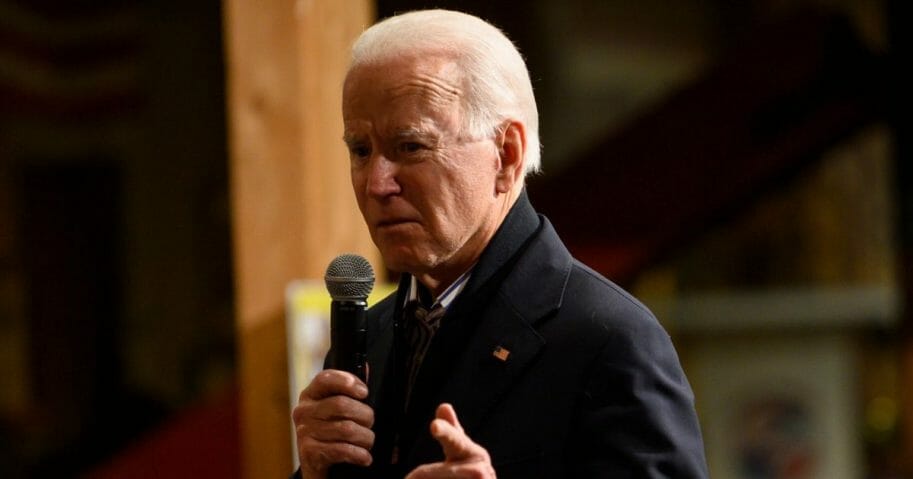
Democratic presidential candidate former Vice President Joe Biden speaks during a campaign event on Jan. 3, 2020, in Independence, Iowa.

Stephen Maturen / Getty ImagesDemocratic presidential candidate former Vice President Joe Biden speaks during a campaign event on Jan. 3, 2020, in Independence, Iowa.

(Stephen Maturen / Getty Images)By Ben Marquis

https://www.westernjournal.com/obama-years-biden-reportedly-helped-soleimani-iran-gain-power-middle-east/?utm_source=Email&utm_medium=CVBreaking&utm_campaign=wj-breaking&utm_content=libertyalliance
Published January 6, 2020 at 6:47pmShare on FacebookTweetEmailPrint

Following the targeted airstrike to take out top Iranian military commander Qassem Soleimani, prominent Democrats and establishment media figures criticized President Donald Trump for ordering the strike.

One of those critics of Trump’s justifiable killing of Soleimani was former Vice President Joe Biden, a top 2020 presidential candidate, who said in a statement that the president’s decision was akin to having “tossed a stick of dynamite into a tinderbox,” a move that threatened to escalate conflict and chaos in an already chaotic environment.

Obviously left unmentioned in Biden’s statement, however, was the particular role that he himself had played in helping to create the chaotic “tinderbox” that is Iraq, as reported by the Washington Free Beacon.

As it turns out, Biden played a significant role in the process that allowed Iran to more fully exert its influence on the Iraqi government and render that nation something of a puppet state to the Iranian regime in Tehran, which occurred around the time that then-President Barack Obama was precipitously withdrawing all U.S. forces from Iraq.

Biden is alleged to have urged a secular pro-America politician at the time to step aside and allow somebody else, a more religious and pro-Iran leader, to step up in his place.

That revelation was included in a lengthy and admittedly fascinating profile of Soleimani from 2013 in The New Yorker — which has received renewed attention in the wake of his death — that documented the Iranian general’s rise to power and the scope of his control over the broader Middle East through a host of interviews with a variety of current and former top officials in a number of different countries.

In 2010, pro-American Iraqi politician Ayad Allawi helped his party win a majority of seats in the Iraqi Parliament, but was forced to step down from a bid to become prime minister after allegedly being told to do so by Biden.

Allawi told The New Yorker that he would have had no problems building a majority government and being prime minister if he’d had the backing of the U.S. government. He claims that he was instead informed directly by Biden that “you can’t form a government” and was pushed aside in favor of Nuri Al-Maliki, who had essentially been handpicked during behind-the-scenes negotiations involving Soleimani.

A key sticking point of Soleimani’s negotiations that involved Iraqi Shiites and the Kurds was that “no Americans” could remain in the country. One unnamed former Iraqi politician told The New Yorker that Soleimani “completely outmaneuvered” the Americans, while “in public they were congratulating themselves for putting the government together.”

According to Allawi, the Americans only wanted to stay in Iraq if their involvement could be kept to a minimum, and the moves by Soleimani to install Maliki over Allawi seemed to provide an easy out for the Obama administration.

“I needed American support,” Allawi recalled. “But they wanted to leave, and they handed the country to the Iranians. Iraq is a failed state now, an Iranian colony.”

Which brings us back full-circle to today. Iraq became a puppet state of Iran in large part because of Biden and Obama’s refusal to back a pro-American leader, mostly because they didn’t want to deal with any potential trouble they might have encountered from continued Iranian-backed resistance from the Soleimani-organized Shiite militias.

Bear in mind also that all of this was occurring while the Obama administration was secretly negotiating the eventual Iran nuclear deal. Staying in Iraq and supporting a pro-America Iraqi leader would undoubtedly have made those negotiations far more difficult, if not impossible to advance to a conclusion.

In other words, this alleged instance of Biden and Obama bowing to the whims of the Iranian regime is but one example of many of how the last administration ceded influence and power to Iran.

Now that Iran has tacitly taken over Iraq, thanks in part to Biden and Obama, Biden wants to complain about how Trump has taken action to reduce that influence and power and protect our nation’s substantial investment in Iraq.

Don’t think for one moment that Trump will let this pass if Biden ultimately wins his party’s nomination in 2020, as what Biden and Obama did — and more to the point, did not do — in Iraq will become a weapon in Trump’s favor to be used against the former vice president.

W

Posted in Uncategorized | Comments Off on SURPRISE: Vice President Joe Biden INPLEMENTED PRESIDENT OBAMA’S PRO-IRAN POLICY BY HELPING IRAN GAIN MORE POWER IN IRAQ AND THE Middle East BY HELPING GENERAL SOLEIMANI

APPELLATE ATTORNEY KASSI MARKS BRINGS US UP TO DATE ON THE EFFORTS OF THE PARENTS OF BABY TINSLEE TO PROTECT THE LIFE OF THEIR DAUGHTER

https://mail.google.com/mail/u/0/?hl=en&shva=1#inbox/FMfcgxwGCkbBVJTNdGcTjQxKLsdSFVCV

Update on Baby Tinslee (Updated)Posted: 06 Jan 2020 03:25 PM PST


Updated to include an image of the press release by Protect TX Fragile Kids, below.

There was a press conference held today by Tinslee’s family, lead counsel, Joe Nixon, Texas Right to Life, and Protect TX Fragile Kids. The entire thing is embedded above. Expect to see clips of/quote from it on local and even national media.

There is great interest in this case for obvious reasons. Your right to determine your medical care, your rights as a parent, and even your right to live is at stake. Section 166.046 of the Texas Health & Safety Code, part of the Texas Advance Directives Act (“TADA”), is not a dispute resolution process. It is far from it.

As Joe Nixon said in the press conference:
We’re going to go to the end – not just for her but for you. For every patient in every Texas hospital, this fight needs to be resolved favorably. Not just for Trinity and Tinslee, but for you and your family as well. 
For her part, when asked what her greatest fear was, Trinity said:

I’m not going to say my biggest fear is losing her because I know that everybody has to pass away, but my fear is them pulling the without me… being able to make that decision for her.
Those of us who fight TADA are often accused of “not getting it” and of “not knowing when to let go.” Those are not the words of a mother who does not “get it” or “know when to let go.” Listen to the rest of the press conference and the hope that there is for this child. 

Regarding the press conference, I posted this about it on social media:
Trinity, Tinslee’s mother, along with her advocates and legal counsel (one of them anyway, ), just set the record straight. The audio is a little hard to hear, but you can make it out and this is the entire press conference. [NOTE: The video embedded here is a good version, easy to hear.]As I’ve indicated, things have not been accurately portrayed. Until now, we’ve remained quiet about it and worked as hard as we could behind the scenes on the legal and transfer issues. (Let me tell you, this has been hard for me in particular. As a pro-life activist and blogger, I like the record being clear and public, but that is not always appropriate once litigation starts and I’m involved as an attorney. So for those that have been asking me questions I cannot answer, this is why.) But some things needed to be made public today – by the family and their lead attorney – not through the press releases and conferences held by Cook, which does not have the permission of Trinity to discuss Tinslee’s case publicly (although it has, repeatedly). Listen to this carefully. An important highlight here is that Tinslee is a candidate for other procedures to treat her underlying conditions and other facilities if she had a trach. Cook has refused to trach her even before it invoked the statute to remove her life-sustaining care against Trinity’s wishes. (I understand that well before invoking the statute; it initially offered to do it then rescinded that offer almost immediately.) Efforts are ongoing – on our part – to find a doctor who will come here to do that. This child is not terminal, nor is she – as Cook has repeatedly said even under oath in court – “hopeless.” Our people have talked to physicians who have said this time and again – she is not hopeless or terminal, but does need a trach to make progress toward other things. There is more, so please listen to the entire thing. Now, please pray as those of us working on this case do our parts as well as we can to get this child transferred and fight this unconstitutional statute. As Attorney Joe Nixon said, this is not just for Tinslee but for all of you. As Trinity said, she wants to be the one to make the decisions for her child – as you should for you and your family.
Here is the press release from PTFK:


So, that’s where things are and what I can say publicly for now, except to add two things: First, the only ones with access to firsthand information and authority to discuss Tinslee’s medical condition in any detail are Tinslee’s legal team, especially Joe Nixon, Texas Right to Life, and Protect TX Fragile Kids (which is working on finding placement for Tinslee, among other things). Such information from any other “source” will not have firsthand information and/or authority to discuss the medical details of the case. Remember, there are HIPAA laws to protect unauthorized use and sharing of private medical information. Those are taken seriously. 
Second, in the press conference Joe Nixon gave an update on the status of the appeal, on which I am working as well, so I will not say more than that. Public filings are available here. He also mentioned the Dunn appeal
Please do continue praying for all involved – and I mean everyone involved. In Orthodoxy, we are constantly reminded that we must pray for everyone, including especially those with whom we disagree or…worse. It is a good lesson for us all and one I work very hard to adhere to myself. 
Pray also for others who may be or are in the crosshairs of TADA. Yes, there are others. It seems there are always others. 
Thanks for reading!
Posted in Uncategorized | Comments Off on APPELLATE ATTORNEY KASSI MARKS BRINGS US UP TO DATE ON THE EFFORTS OF THE PARENTS OF BABY TINSLEE TO PROTECT THE LIFE OF THEIR DAUGHTER

AS WE BEGIN THE FINAL YEAR OF THE REIGN OF FRANCIS THE MERCIFUL IS WOULD BE HELPFUL FOR US TO REVIEW THE SALIENT FEATURES OF HIS RISE AND REIGN

Here is a brief summary of documentation on the rise of Francis.  All Catholics should be aware of the activities of the enablers of Francis, as it will have grave effects on the eternal disposition of many souls.
Richard

Summary of the Connection between Francis and the St Gallen Mafia

1  The Church Forbids Collusion in Electing a Pope (Universi Dominici Gregis):

http://www.vatican.va/content/john-paul-ii/en/apost_constitutions/documents/hf_jp-ii_apc_22021996_universi-dominici-gregis.html

2  The St Gallen Mafia

St Gallen Mafia & Pope Francis: What is it? (Dr Taylor Marshall #154)

The Astonishing Connections between the St. Gallen Mafia and Major Church Events

The Saint Gallen Mafia and Major Church Events

St Gallen Mafia Cardinal Dies

Leader of St. Gallen ‘mafia’, “Ante-Pope” Martini prepared the way for Francis

St. Gallen Mafia | LifeSite

God Made You Like This

St. Gallen Mafia Archives – Crisis Magazine

St. Gallen mafia – Catholic World Report

What is the St Gallen Mafia?

3  The St Gallen Mafia and the Election of Francis

Cdl Kasper: Laity will ‘not accept’ future pope who doesn’t continue Francis’ legacy

The Gall of the St Gallen Mafia

The St. Gallen Mafia’s “LGBT” Youth Synod – Crisis Magazine

Swiss bishops confirm existence of Cardinal Danneels’ ‘mafia’ against Benedict XVI

Cardinal Mafia Against Benedict and for Bergoglio

The Soros Alliance Confirmed

The Strange Case of Austen Ivereigh

Francis Allies Reveal Their Plans for Revolutionary Change – Crisis Magazine

4  How Francis Arrived

Cutting the Crap: 32 Questions and Blunt Answers About The Catholic Church and Antipope Bergoglio | Barnhardt

Bergoglian Antipapacy

Antipope “Francis” Bergoglio: The Freemasonic Conspiracy to Destroy the Papacy

Bergoglian Antipapacy Video Transcript | Barnhardt

More Sound Reasoning on the Antipope Situation: Coercion and Lies | Barnhardt

Curial Bishops In Hiding, Priests Being Sent to Reprogramming Gulags, but DISCUSSION OF CANON 188 WILL NOT BE PERMITTED! | Barnhardt

The Bergoglian Antipapacy: How It Happened, and How To Fix It | Barnhardt

5  Francis, Sodomy and the Protection of Sodomites

Who is Francis the Merciful?

Francis is an Antipope

The Crisis of Confusion

Day of Reckoning

Bishop Gracida Against Francis

Francis Might be an Antipope

Call for New Conclave

Bishop Condemns Francis

Bishop Signs Correction of Francis

Bishop Joins Filial Correction
Attachments areaPreview YouTube video St Gallen Mafia & Pope Francis: What is it? (Dr Taylor Marshall #154)

St Gallen Mafia & Pope Francis: What is it? (Dr Taylor Marshall #154)Preview YouTube video The Astonishing Connections between the St. Gallen Mafia and Major Church Events

The Astonishing Connections between the St. Gallen Mafia and Major Church EventsPreview YouTube video Bergoglian Antipapacy

Bergoglian AntipapacyPreview YouTube video Antipope “Francis” Bergoglio: The Freemasonic Conspiracy to Destroy the Papacy

Antipope “Francis” Bergoglio: The Freemasonic Conspiracy to Destroy the Papacy

Posted in Uncategorized | 4 Comments

OUR CHRISTMAS JOY AS WE CELEBRATED THE BIRTH OF OUR LORD Jesus Christ WAS INCREASED BY OUR CELEBRATION OF HIS EPIPHANY IN THE WORLD BUT LESSENED BY THE PUBLICATION TODAY OF THE HORROR THAT PLANNED PARENTHOOD USA KILLED 345,672 INFANTS IN CALENDAR YEAR 2018. MAY GOD HAVE MERCY ON AMERICA !!!!!!!!!!!!!!!!!!!!!!!!!!!!!!!!!!!

Planned Parenthood Annual Report Shows It Killed 345,672 Babies in Abortions, More Than Ever Before

NATIONAL   

STEVEN ERTELT  

LIFESITE NEWS

JAN 6, 2020   |   10:09AM   

WASHINGTON, DC 

It was another record year for the abortion giant Planned Parenthood. Although Planned Parenthood bills itself as a woman’s health organization, in reality, it is little more than an abortion business.

Its 2019 annual report, released this week, shows it aborted 345,672 unborn babies — an increase of 3.88% over the abortions it did on unborn babies the year prior. Last year’s annual report showed Planned Parenthood killed 332,757 babies in abortions, which itself was an increase of 3.51% from the year prior.

That means Planned Parenthood killed almost 13,000 more babies in abortions than the past year and almost 25,000 more unborn babies than it did two years ago — even though the abortion giant claims it’s main focus is merely women’s health care.

Meanwhile, Planned Parenthood provided less contraception, sterilizations, cancer screenings, adoption referrals and other women’s health services than the previous year.

According to its own figures, Planned Parenthood contraception services decreased two percent from 2,620,867 in 2017 to 2,556,413 in 2018 and they have dropped 33% over the last ten years as more women are given abortion than pregnancy options.

Actual women’s health care services have dropped as well. Over the last 10 years, total services at Planned Parenthood have fallen 10 percent from 10,943,609 in 2008 to 9,82,1548 in 2018. Specifically, pap smears and tests decreased almost seven percent from 274,145 in 2017 to 255,682 in 2018. They have decreased 72 percent in the last 10 years.

SUPPORT LIFENEWS! If you want to expose and shut down Planned Parenthood, please help LifeNews.com with a donation!

Breast exams have dropped nearly 11% from 296,310 in 2017 to 265,028 in 2018 even as Planned Parenthood claims it’s helping women prevent breast cancer. The number of breast exams at Planned Parenthood, which women can do on their own or at any legitimate medical provider, dropped 68% from 826,197 in 2008 to 265,028 in 2018. An total cancer screenings have dropped almost 8% from the last annual report, 614,361 in 2017 to in 566,186 2018. In the last 10 years, cancer screenings have dropped 69% from 1,849,691 in 2008 to 566,186 in 2018.

The abortion business also does less prenatal care than it used to. While it killed 345,672 babies in abortions, it helped only 9,798 with prenatal care — killing over 35 babies for every woman it helped with prenatal care. And prenatal care has dropped 68% from its 2010 figures, when it claimed it helped 31,098 women in 2010.

The Planned Parenthood abortion company also helps few women with adoption referrals. While it killed 345,672 babies in abortions, it helped only 4,279 women with adoption referrals in 2018 — killing 80 babies for every woman it helped with adoption.

Finally, the number of well-woman exams Planned Parenthood did in 2018 dropped almost 2% from the prior year.

While Planned Parenthood kills more babies in abortions, the number of abortions in the United States is on the decline— making it so Planned Parenthood is doing a larger and larger percentage of all the abortions done on babies in the U.S. ever year. Although the data is incomplete, the CDC indicates 623,471 abortions in 2016, down about 13,000 from 2015. That means Planned Parenthood killed about 55% of all unborn babies who die in abortions in the United States. Assuming the realistic abortion number is closer to 900,000 a year, since the CDC doesn’t include California and a few other states, Planned Parenthood still kills approximately 38% of all babies.

In response to Planned Parenthood’s just released annual report, showing that their abortion business and booming, Students for Life of America President Kristan Hawkins told LifeNews, “Even as the abortion rate is reported to be falling, Planned Parenthood’s share of the abortion business is up, and of course given their political connections, so is their misappropriation of funds from taxpayers. Planned Parenthood should not be able to operate their deadly business on the taxpayers’ dime.”

Though leaders at Planned Parenthood claim their radical pro-abortion stance and business represents the majority view of Americas, polls show otherwise. According to a national poll by Marist University in January, three in four Americans (75 percent) say abortion should be limited to – at most – the first three months of pregnancy. This includes most Republicans (92 percent), Independents (78 percent) and Democrats (60 percent). Recent Gallup polling also found that 53 percent of Americans oppose all or most abortions.

A Politico/Harvard University poll in 2016 found that just 36 percent of likely voters supported taxpayer funding for abortions, while 58 percent opposed it.

**************************************************************

NEWS

Video of boy singing to baby brother with Down syndrome captures hearts, goes viral

Posted on Facebook on Monday, the video has now been seen over a million times.Fri Jan 3, 2020 – 7:56 pm EST 

Featured Image
NICOLE POWELL / FACEBOOK
Doug Mainwaring

By Doug Mainwaring
FOLLOW DOUG


Image
Rayce Grieves holds brother Tripp. Photo credit: WZZM13 SOURCE: WZZM13 screen shot

CABOT, Arkansas, January 3, 2020 (LifeSiteNews) — A video of a young boy singing to his newborn brother with Down syndrome is capturing hearts across the nation as it goes viral on social media.

Nicole Powell posted a short video on Facebook of son Rayce cradling his baby brother Tripp in his arms, singing “10,000 Hours” by Dan + Shay & Justin Bieber. 

In the video, Rayce can be heard singing:

I’d spend ten thousand hours and ten thousand more
Oh, if that’s what it takes to learn that sweet heart of yours
And I might never get there, but I’m gonna try
If it’s ten thousand hours or the rest of my life
I’m gonna love you.

Posted on Facebook on Monday, the video has now been seen over a million times.

“This is how Rayce bonds with Tripp,” wrote mom Nicole. “He sings to him all the time. He swears this song is about him and his brother.”

“Love doesn’t count chromosomes,” continued Nicole, “or as Rayce says, ‘Aren’t we all different?’”

“I didn’t want our boys to be ashamed of him,” explained Nicole in a local TV interview.  “He’s still their little brother regardless of what he has.”

Abortion was out of the question

JJ Grieves, the boys’ father, revealed that doctors had “recommended that we terminate the pregnancy.”  

Image
Parents JJ Grieves and Nicole Powell. Photo credit: WZZM13 SOURCE: WZZM13 screen shot.

His response: “I said absolutely not.”

“It takes a little bit longer to learn and a little bit more care and more loving,” he added, “but isn’t that what the world needs?”

Posted in Uncategorized | Comments Off on OUR CHRISTMAS JOY AS WE CELEBRATED THE BIRTH OF OUR LORD Jesus Christ WAS INCREASED BY OUR CELEBRATION OF HIS EPIPHANY IN THE WORLD BUT LESSENED BY THE PUBLICATION TODAY OF THE HORROR THAT PLANNED PARENTHOOD USA KILLED 345,672 INFANTS IN CALENDAR YEAR 2018. MAY GOD HAVE MERCY ON AMERICA !!!!!!!!!!!!!!!!!!!!!!!!!!!!!!!!!!!

Bishop Arrieta, Secretary of the Pontifical Council for Legal Texts — who is the top Vatican official for questions of legal interpretation — emphatically declares, that no one has the right to interpret a Papal Resignation. It must be clear in itself.This statement by Bishop Arrieta clears up the entire controversy over the renunciation of Pope Benedict. Because, it ends it. That is, since Pope Benedict XVI renounced the ministerium, not anything else, no one has the right to say that he renounced the Papal Office or petrine Munus or even power of governance.

Catholic Monitor

http://catholicmonitor.blogspot.com/2020/01/bp-gracida-if-pope-benedict-xvi.html

Sunday, January 05, 2020

Bp. Gracida: “[I]f the [Pope Benedict XVI] Renunciation is Doubtful, then in Virtue of Canon 332 §2, it is Invalid for lack of due Manifestation”

Bishop Rene Gracida summed it up best on the doubtfulness of the Pope Benedict XVI resignation: 

“[I]f the [Pope Benedict XVI] Renunciation is doubtful, then in virtue of canon 332 §2, it is invalid for lack of due manifestation”
[https://abyssum.org/ ]

Moreover, it appears that if someone has definite solid reasons from canon law to doubt the validity of Pope Benedict XVI’s resignation one can it appears possibly commit a sin if he doesn’t resolve that doubt before claiming Francis is definitely pope.

The important theological book “Rodriguez and the Confession of Doubtful Mortal Sins” in page 225 says:

“If one does not resolve the doubt and deliberately does the action anyhow, it means that he is willing to offend God gravely, and therefore he commits a mortal sin.”
(Google: Theological Studies -cdn- 1 PDF by U. Adelman – Cited by 1 Related articles)

Please read canon law expert Br. Alexis Bugnolo’s detailed thesis on why Pope Benedict’s resignation is doubtful from whom Bishop Gracida is quoting above:

https://fromrome.wordpress.com/2020/01/05/why-saint-alphonsus-dei-liguori-would-say-the-renunciation-was-invalid/

Why Saint Alphonsus dei Liguori would say the Renunciation was invalid

by Br. Alexis BugnoloThe Saints who have been canonized are already in the glory of Paradise, and so, baring an extraordinary grace, do not speak to us anymore. But those Saints who have fully explained their opinions or teaching on any point, can be said to speak to us today. This is especially true of Saints who have taught on questions of law and the principles to be followed in controversies.  Of which kind is Saint Alphonsus dei Liguori, Doctor of the Church on all questions of moral theology, and not a few questions of law.

No one has the right to interpret a Papal Resignation

As I reported in my notes for my meeting with Bishop Arrieta, Secretary of the Pontifical Council for Legal Texts — who is the top Vatican official for questions of legal interpretation — he emphatically declared, that no one has the right to interpret a Papal Resignation. It must be clear in itself.This statement by Bishop Arrieta clears up the entire controversy over the renunciation of Pope Benedict. Because, it ends it.  That is, since Pope Benedict XVI renounced the ministerium, not anything else. No one has the right to say that he renounced the Papal Office or petrine Munus or even power of governance.  Because to say that something else, requires an interpretation. And no one, not even the man who is the pope, has the right to interpret the act of renunciation.But the statement of Bishop Arrieta is not of his own making. It is the necessary conclusion of legal principles.  First, that a declaration made by the man who is the pope, inasmuch as he is the man, and not the pope, cannot be judged by anyone except according to the norm of law. And since a declaration by such man when regarding the renunciation of the Office regards the renouncing of the Office, one cannot appeal to the holder of the office to interpret it. Because if it was valid, then the holder is no longer the holder, and thus cannot receive appeals. If it was not valid, then appealing to the holder of the office is tantamount to declaring the renunciation in valid.

Any appeal to Pope Benedict XVI to clarify what he meant means that the Resignation is invalid

This is a very important point, which has been overlooked in this 7 year controversy.Anyone who appeals to anything which Pope Benedict said before or after Feb. 28, 2013, to explain that the Renunciation means the renunciation of the papacy, or of the petrine munus, or of the power of governance IS IMPLICITLY AFFIRMING THAT POPE BENEDICT IS STILL THE POPE AND THAT THE RENUNCIATION WAS INVALID, because they are trying to have recourse to an official interpretation. And if the act needs to be interpreted, then it is doubtful. And if the renunciation is doubtful, then in virtue of canon 332 §2, it is invalid for lack of due manifestation.

What Saint Alphonsus says about the interpretation of a law:

For those who have overdosed on the falsehood of universal acceptance, and quote Saint Alphonsus, let us see what the Saint would say about the games the authors of such sophisms play with the words “munus” and “ministerium,” to make the Resignation say what it does not say.  For this we must have recourse to the teaching of Saint Alphonsus, taken from his great work, Theologia Moralis, Bk. I, tract ii, p. 242, De interpretatio legis. I will first quote the Latin, for those who can read Latin, and then give an English translation:DE INTERPRETATIO LEGIS

200. Interpretatio alia est Authentica, alia Usualis, alia Doctrinalis. Authentica fieri potest vel ab ipso legislatore, vel ab eius successore, aut a superiore. Usualis est illa, quae ita ab usu est recepta. Doctrinalis autem est declaratio quaedam mentis legislatoris, quase a quocumque doctore fieri potest.

Hic dubitur an delcarationes, quae fiunt a Pontifice, vel a principe alicuius legis, indigeant promulgatione, ut obligent. In hoc distinguere oportet declarationes pure tales ab aliis quae sunt non pure tales, sed potius sunt merae interpretationes. Declarationes pure tales sunt, cum ab illis explicatur aliquis sensus, qui usque ab initio iam erat clare imbibitus in lege: ex. gr. si dubium sit, an sub verbo filii intelligatur solus legitimus aut eitam spurius, et legislator declarat intelligi etiam spurium, tunc verum fit quod sensus in lege erat clare imbibitus. Interpretatio autem, sive declaratio non pure talis est illa, cuius sensus non est clare imbibitus in lege, sed circa ipsum variae sunt opiniones, et tantum deducitur ex argumentis, v. gr. quod sub nomine patris intelligatur eitam avus, aut quod sub nomine moartis intelligatur etiam mors civilis, prout est carcer perpetuus, aut simile, recurrendo ad quamdam impropriam significationem.

His positis, dicimus cum Suarez, Castropal. Vasques, Sals, Salm. Holzaman, La-Croix, Supplet Sporger etc. quod declaratio sensus clare imbibiti in lege non requirit promulagationem, sed etiam obliget eos omnes qui illum noverint, cum talis declaratio non sit nova lex. Interpretatio vero alicuius sensus non clare, sed tantum obscure, sive improprie imbibiti in lege, quae est declaratio non pure talis (ut diximus) haec, quia habetur tanquam nova lex, ut obliget, necessario promulgationem requirit, sicut omnes aliae leges juxta dicta. n. 95 et 96. Hinc infertur cum Suar. de Leg. 1. 6. c. 1. n. 3 et Castrop. tr. 3. eod. tit. d. 5. p. 3. §. 1. n. 5 (qui citat pro se Bon. Salas, et Lorca) quod declaratio, quae fit a legislatore alicuius sensus clare in lege imbibiti (juxta exemplum adductum filii legitimi, et spurii) non requirit promulgatioem, ut obliget. Contra vero declaratio sensus obscure imbibiti (juxta exemplus avi sub nomine patris, vel mortis civilils sub nomine mortis) indiget quidem promulgatione; tunc enim ipsa novam constituit obligationem, quae per se non erat prius clare in lege imbibita. Et idem dicunt Suar. loc. cit. et Castrop. n. 2 de illis declarationibus, quae fiunt non ab eodem legislatore, sed ab eius successore, aut superiore; quia legislatoris mens nequit his esse ita cognita, ut erat ipsi legislatori; unde tunc, ut declaretur sensus (quamvis imbibitus in lege) alicuius obligationis, semper opus est recurrere ad argumenta, et interpretationes, quae novam legam constituunt, reddendo certum quod erat dubium; et ideo promulgatio requiritur, alias declaratio nunquam authentica, sed tantum doctrinalis repubabitur.

My English translation:On the Interpretation of Law
200. One interpretation is authentic, another customary, another academic.  An authentic (interpretation) can be made either by the legislator himself, and/or by his successor, or by a superior. A customary (interpretation) is that, which has been received thus by custom.  Moreover, an academic (interpretation) is a certain declaration of the mind of the legislator, which can be made by any professor.
Here, there is doubted whether declarations, which are made by the Pontiff, and/or by a prince for any law, are in need of promulgation, to oblige.  In this, it is necessary to distinguish those which are purely such from those which are not purely such, but rather mere interpretations.  Declarations are purely such, when by them there is explicated some sense, which was clearly incorporated in the law already from the beginning: e. g., if there be a doubt, whether under the term, “son” there be understood only a legitimate or even an illegitimate son, and the the legislator declares (the word “son” in the law”) is to be understood even as an illegitimate one, then indeed it becomes that (that) sense in the law was clearly incorporated in the law.  But an interpretation, or declaration which is not purely such, is that, the sense of which is not clearly incorporated in the law, but about which there are various opinions, and as much as is deduced through arguments, e. g., that under the term, “father”, there be understood also a grandfather, or that under the term, “death”, there be also understood a civil death, insofar as is perpetual incarceration, or the like, by recurring to a certain improper signification.
With these things posited, We say with Suarez, Castropal., Vasquez, Sals. Salimancans, Holzman, La-Croix, Supplet Sporget etc.., that the declaration of a sense clearly incorporated in the law does not require promulgation, but that it also obliges all those who know of it, though such a declaration is not a new law.  But an interpretation of some sense not clearly, but obscurely, or improperly incorporated in the law, which is not a declaration purely such (as we have said above), this (kind), because it is held to be a new law, to oblige, requires necessarily a promulgation, just as all other laws spoke of in nn. 95 and 96.  Hence, there is inferred with Suarez de Leg. 1. 6. c. 1. n. 3 and Castrop. tr. 3. eod. tit. d. 5. p. 3. §. 1. n. 5 (qui citat pro se Bon. Salas, et Lorca), that a declaration, which is made by the legislator of any sense clearly incorporated in the law (according to the example given above of the legitimate and illegitimate son) does not require a promulgation, to oblige. However, contrariwise, the declaration of a sense obscurely incorporated (according to the example given of a grandfather under the term of “father”, and/or of a civil death under the term of “death”) do indeed need a promulgation; for then it itself constitutes a new obligation, which per se was not beforehand clearly incorporated in the law. And the same is said by Suarez. loc. cit, and Castrop. n. 2, of those declarations, which are not made by the ssame legislator, but by his successor, or superior; because the mind of the legislator is never so known to other as it was to the legislator himself: on which account, then, to declare the sense (though incorporated in the law) of any obligation, it is always necessary to have recourse to arguments, and interpretations, which constitute a new law, by rendering certain what was doubtful; and for that reason a promulgation is required, otherwise the declaration is never an authentic one, but only is reputed to be a doctrinal one.Thus, Saint Alphonsus.

What the teaching of Saint Alphonsus on Legal interpretation means in regard to the Renunciation

From this text, we can glean three truths.

  1. When the meaning is clearly incorporated into the law, that meaning is the authentic one, and its sense is binding upon all, as for example, when Benedict says he renounces the ministry, all are obliged to understand that as a renunciation of ministry.
  2. When the word which is subject to a possible interpretation is a noun which includes all possible interpretations according to its essential signification, such as “son” includes natural and legal sons, not just legal sons, then the interpretation is a customary one and is obliging upon all, once the legislator declares that his mind was to include all such possibilities.  But before such a declaration it is not binding.
  3. When the word which is subject to a possible interpretation is a noun, which DOES NOT include the possible wanted interpretation, such as “ministerium” in the text of Pope Benedict’s resignation is wanted to mean “munus” or “officium” which are entirely other words, then the interpretation is NOT AUTHENTIC and is not binding upon anyone,and only can become binding, when promulgated by the legislator or his successors.

And thus one can conclude, from the testimony of Bishop Arrieta and Saint Alphonsus, that the interpretation of the Cardinals and Bishops that Benedict’s renunciation of ministry is equivalent in law, or signification, or intention, to a resignation of the Papal Office or Petrine Munus, is not only an illegitimate interpretation, but is an interpretation which is not binding upon anyone!Moreover, one can conclude, that even if hypothetically any successor of Pope Benedict XVI were to say that such a reading of the text (where ministerium = munus) is the one Benedict intended, then the act itself posited by Benedict was invalid as per canon 332 §2, since it was not duly manifest in itself, but required another promulgated interpretation to make it valid.And this means that the very existence of the plot to solve the Pope Emeritus problem is not only evidence that the resignation was invalid from the start, but is DOOMED TO FAILURE since as an interpretation of the act, its very promulgation will publicly testify to and canonically establish the invalidity of the renunciation!In other words, there is no way to fix the invalidity of the resignation by any subsequent act.And what the Cardinals and Bishops are doing is GRAVELY IMMORAL AND DISHONEST and, moreover, is a grave USURPATION OF RIGHT.One can also honestly say, therefore, that the usurpation of the Papacy by Bergoglio is a moral consequence of the usurpation of the right of interpretation by the Cardinals, and that Bergoglio’s bizarre moral character and state of mind is the perfect fruit of and punishment for their sin.Pray an Our Father now for the restoration of the Church as well as for the Triumph of the Kingdom of the Sacred Heart of Jesus and the Immaculate Heart of Mary.Posted by Fred Martinez at 4:30 PM Email ThisBlogThis!Share to TwitterShare to FacebookShare to Pinterest

Posted in Uncategorized | 1 Comment

Anyone who appeals to anything which Pope Benedict said before or after Feb. 28, 2013, to explain that the Renunciation means the renunciation of the papacy, or of the petrine munus, or of the power of governance IS IMPLICITLY AFFIRMING THAT POPE BENEDICT IS STILL THE POPE AND THAT THE RENUNCIATION WAS INVALID, because they are trying to have recourse to an official interpretation. And if the act needs to be interpreted, then it is doubtful. And if the renunciation is doubtful, then in virtue of canon 332 §2, it is invalid for lack of due manifestation.

Why Saint Alphonsus dei Liguori would say the Renunciation was invalid

Jan5by The Editor

https://fromrome.wordpress.com/2020/01/05/why-saint-alphonsus-dei-liguori-would-say-the-renunciation-was-invalid/

59df1d354eaef6243f7823c2_version_719

by Br. Alexis Bugnolo

The Saints who have been canonized are already in the glory of Paradise, and so, baring an extraordinary grace, do not speak to us anymore. But those Saints who have fully explained their opinions or teaching on any point, can be said to speak to us today. This is especially true of Saints who have taught on questions of law and the principles to be followed in controversies.  Of which kind is Saint Alphonsus dei Liguori, Doctor of the Church on all questions of moral theology, and not a few questions of law.

No one has the right to interpret a Papal Resignation

As I reported in my notes for my meeting with Bishop Arrieta, Secretary of the Pontifical Council for Legal Texts — who is the top Vatican official for questions of legal interpretation — he emphatically declared, that no one has the right to interpret a Papal Resignation. It must be clear in itself.

This statement by Bishop Arrieta clears up the entire controversy over the renunciation of Pope Benedict. Because, it ends it.  That is, since Pope Benedict XVI renounced the ministerium, not anything else. No one has the right to say that he renounced the Papal Office or petrine Munus or even power of governance.  Because to say that something else, requires an interpretation. And no one, not even the man who is the pope, has the right to interpret the act of renunciation.

But the statement of Bishop Arrieta is not of his own making. It is the necessary conclusion of legal principles.  First, that a declaration made by the man who is the pope, inasmuch as he is the man, and not the pope, cannot be judged by anyone except according to the norm of law. And since a declaration by such man when regarding the renunciation of the Office regards the renouncing of the Office, one cannot appeal to the holder of the office to interpret it. Because if it was valid, then the holder is no longer the holder, and thus cannot receive appeals. If it was not valid, then appealing to the holder of the office is tantamount to declaring the renunciation in valid.

Any appeal to Pope Benedict XVI to clarify what he meant means that the Resignation is invalid

This is a very important point, which has been overlooked in this 7 year controversy. Anyone who appeals to anything which Pope Benedict said before or after Feb. 28, 2013, to explain that the Renunciation means the renunciation of the papacy, or of the petrine munus, or of the power of governance IS IMPLICITLY AFFIRMING THAT POPE BENEDICT IS STILL THE POPE AND THAT THE RENUNCIATION WAS INVALID, because they are trying to have recourse to an official interpretation. And if the act needs to be interpreted, then it is doubtful. And if the renunciation is doubtful, then in virtue of canon 332 §2, it is invalid for lack of due manifestation.

What Saint Alphonsus says about the interpretation of a law:

For those who have overdosed on the falsehood of universal acceptance, and quote Saint Alphonsus, let us see what the Saint would say about the games the authors of such sophisms play with the words “munus” and “ministerium,” to make the Resignation say what it does not say.  For this we must have recourse to the teaching of Saint Alphonsus, taken from his great work, Theologia Moralis, Bk. I, tract ii, p. 242, De interpretatio legis. I will first quote the Latin, for those who can read Latin, and then give an English translation:

DE INTERPRETATIO LEGIS

200. Interpretatio alia est Authentica, alia Usualis, alia Doctrinalis. Authentica fieri potest vel ab ipso legislatore, vel ab eius successore, aut a superiore. Usualis est illa, quae ita ab usu est recepta. Doctrinalis autem est declaratio quaedam mentis legislatoris, quase a quocumque doctore fieri potest.

Hic dubitur an delcarationes, quae fiunt a Pontifice, vel a principe alicuius legis, indigeant promulgatione, ut obligent. In hoc distinguere oportet declarationes pure tales ab aliis quae sunt non pure tales, sed potius sunt merae interpretationes. Declarationes pure tales sunt, cum ab illis explicatur aliquis sensus, qui usque ab initio iam erat clare imbibitus in lege: ex. gr. si dubium sit, an sub verbo filii intelligatur solus legitimus aut eitam spurius, et legislator declarat intelligi etiam spurium, tunc verum fit quod sensus in lege erat clare imbibitus. Interpretatio autem, sive declaratio non pure talis est illa, cuius sensus non est clare imbibitus in lege, sed circa ipsum variae sunt opiniones, et tantum deducitur ex argumentis, v. gr. quod sub nomine patris intelligatur eitam avus, aut quod sub nomine moartis intelligatur etiam mors civilis, prout est carcer perpetuus, aut simile, recurrendo ad quamdam impropriam significationem.

His positis, dicimus cum Suarez, Castropal. Vasques, Sals, Salm. Holzaman, La-Croix, Supplet Sporger etc. quod declaratio sensus clare imbibiti in lege non requirit promulagationem, sed etiam obliget eos omnes qui illum noverint, cum talis declaratio non sit nova lex. Interpretatio vero alicuius sensus non clare, sed tantum obscure, sive improprie imbibiti in lege, quae est declaratio non pure talis (ut diximus) haec, quia habetur tanquam nova lex, ut obliget, necessario promulgationem requirit, sicut omnes aliae leges juxta dicta. n. 95 et 96. Hinc infertur cum Suar. de Leg. 1. 6. c. 1. n. 3 et Castrop. tr. 3. eod. tit. d. 5. p. 3. §. 1. n. 5 (qui citat pro se Bon. Salas, et Lorca) quod declaratio, quae fit a legislatore alicuius sensus clare in lege imbibiti (juxta exemplum adductum filii legitimi, et spurii) non requirit promulgatioem, ut obliget. Contra vero declaratio sensus obscure imbibiti (juxta exemplus avi sub nomine patris, vel mortis civilils sub nomine mortis) indiget quidem promulgatione; tunc enim ipsa novam constituit obligationem, quae per se non erat prius clare in lege imbibita. Et idem dicunt Suar. loc. cit. et Castrop. n. 2 de illis declarationibus, quae fiunt non ab eodem legislatore, sed ab eius successore, aut superiore; quia legislatoris mens nequit his esse ita cognita, ut erat ipsi legislatori; unde tunc, ut declaretur sensus (quamvis imbibitus in lege) alicuius obligationis, semper opus est recurrere ad argumenta, et interpretationes, quae novam legam constituunt, reddendo certum quod erat dubium; et ideo promulgatio requiritur, alias declaratio nunquam authentica, sed tantum doctrinalis repubabitur.

My English translation:

On the Interpretation of Law

200. One interpretation is authentic, another customary, another academic.  An authentic (interpretation) can be made either by the legislator himself, and/or by his successor, or by a superior. A customary (interpretation) is that, which has been received thus by custom.  Moreover, an academic (interpretation) is a certain declaration of the mind of the legislator, which can be made by any professor.

Here, there is doubted whether declarations, which are made by the Pontiff, and/or by a prince for any law, are in need of promulgation, to oblige.  In this, it is necessary to distinguish those which are purely such from those which are not purely such, but rather mere interpretations.  Declarations are purely such, when by them there is explicated some sense, which was clearly incorporated in the law already from the beginning: e. g., if there be a doubt, whether under the term, “son” there be understood only a legitimate or even an illegitimate son, and the the legislator declares (the word “son” in the law”) is to be understood even as an illegitimate one, then indeed it becomes that (that) sense in the law was clearly incorporated in the law.  But an interpretation, or declaration which is not purely such, is that, the sense of which is not clearly incorporated in the law, but about which there are various opinions, and as much as is deduced through arguments, e. g., that under the term, “father”, there be understood also a grandfather, or that under the term, “death”, there be also understood a civil death, insofar as is perpetual incarceration, or the like, by recurring to a certain improper signification.

With these things posited, We say with Suarez, Castropal., Vasquez, Sals. Salimancans, Holzman, La-Croix, Supplet Sporget etc.., that the declaration of a sense clearly incorporated in the law does not require promulgation, but that it also obliges all those who know of it, though such a declaration is not a new law.  But an interpretation of some sense not clearly, but obscurely, or improperly incorporated in the law, which is not a declaration purely such (as we have said above), this (kind), because it is held to be a new law, to oblige, requires necessarily a promulgation, just as all other laws spoke of in nn. 95 and 96.  Hence, there is inferred with Suarez de Leg. 1. 6. c. 1. n. 3 and Castrop. tr. 3. eod. tit. d. 5. p. 3. §. 1. n. 5 (qui citat pro se Bon. Salas, et Lorca), that a declaration, which is made by the legislator of any sense clearly incorporated in the law (according to the example given above of the legitimate and illegitimate son) does not require a promulgation, to oblige. However, contrariwise, the declaration of a sense obscurely incorporated (according to the example given of a grandfather under the term of “father”, and/or of a civil death under the term of “death”) do indeed need a promulgation; for then it itself constitutes a new obligation, which per se was not beforehand clearly incorporated in the law. And the same is said by Suarez. loc. cit, and Castrop. n. 2, of those declarations, which are not made by the ssame legislator, but by his successor, or superior; because the mind of the legislator is never so known to other as it was to the legislator himself: on which account, then, to declare the sense (though incorporated in the law) of any obligation, it is always necessary to have recourse to arguments, and interpretations, which constitute a new law, by rendering certain what was doubtful; and for that reason a promulgation is required, otherwise the declaration is never an authentic one, but only is reputed to be a doctrinal one.

Thus, Saint Alphonsus.

What the teaching of Saint Alphonsus on Legal interpretation means in regard to the Renunciation

From this text, we can glean three truths.

  1. When the meaning is clearly incorporated into the law, that meaning is the authentic one, and its sense is binding upon all, as for example, when Benedict says he renounces the ministry, all are obliged to understand that as a renunciation of ministry.
  2. When the word which is subject to a possible interpretation is a noun which includes all possible interpretations according to its essential signification, such as “son” includes natural and legal sons, not just legal sons, then the interpretation is a customary one and is obliging upon all, once the legislator declares that his mind was to include all such possibilities.  But before such a declaration it is not binding.
  3. When the word which is subject to a possible interpretation is a noun, which DOES NOT include the possible wanted interpretation, such as “ministerium” in the text of Pope Benedict’s resignation is wanted to mean “munus” or “officium” which are entirely other words, then the interpretation is NOT AUTHENTIC and is not binding upon anyone, and only can become binding, when promulgated by the legislator or his successors.

And thus one can conclude, from the testimony of Bishop Arrieta and Saint Alphonsus, that the interpretation of the Cardinals and Bishops that Benedict’s renunciation of ministry is equivalent in law, or signification, or intention, to a resignation of the Papal Office or Petrine Munus, is not only an illegitimate interpretation, but is an interpretation which is not binding upon anyone!

Moreover, one can conclude, that even if hypothetically any successor of Pope Benedict XVI were to say that such a reading of the text (where ministerium = munus) is the one Benedict intended, then the act itself posited by Benedict was invalid as per canon 332 §2, since it was not duly manifest in itself, but required another promulgated interpretation to make it valid.

And this means that the very existence of the plot to solve the Pope Emeritus problem is not only evidence that the resignation was invalid from the start, but is DOOMED TO FAILURE since as an interpretation of the act, its very promulgation will publicly testify to and canonically establish the invalidity of the renunciation!

In other words, there is no way to fix the invalidity of the resignation by any subsequent act. And what the Cardinals and Bishops are doing is GRAVELY IMMORAL AND DISHONEST and, moreover, is a grave USURPATION OF RIGHT.

One can also honestly say, therefore, that the usurpation of the Papacy by Bergoglio is a moral consequence of the usurpation of the right of interpretation by the Cardinals, and that Bergoglio’s bizarre moral character and state of mind is the perfect fruit of and punishment for their sin.

Posted in Uncategorized | 1 Comment