Note: Though “soon” seems to have an elastic meaning in the Vatican, it appears that we’re finally going to have something, at least, about the McCarrick scandal. That something, as Fr. Murray makes clear today, is likely to be even more disturbing than what we already know. We’re going to be here not only to cover the release of information but to make sure that the pressure stays on all involved in the abuse cases, whether in Rome or America or anywhere around the world. Painful as it all may be, only the truth – the full truth – now can set the Church on the right course again. We need your help in this pursuit, and in much, much more. Please click the button and contribute to The Catholic Thing. – Robert Royal
The news that the Holy See will publish the results of the internal investigation of files related to former cardinal Theodore McCarrick is welcome indeed. Cardinal Seán O’Malley informed the American bishops at their annual fall meeting that “[t]he intention is to publish the Holy See’s response soon, if not before Christmas, soon in the New Year.”
Recall that in October 2018, the Vatican announced that it would “in due course, make known the conclusions of the matter regarding Archbishop McCarrick. Moreover, with reference to other accusations brought against Archbishop McCarrick, the Holy Father has decided that information gathered during the preliminary investigation be combined with a further thorough study of the entire documentation present in the Archives of the Dicasteries and Offices of the Holy See regarding the former Cardinal McCarrick, in order to ascertain all the relevant facts, to place them in their historical context and to evaluate them objectively.”
The McCarrick case hangs over the Church like a poisonous cloud. When O’Malley was in Rome in October for the Ad Limina visit of the New England bishops, he told the Vatican Secretary of State, Cardinal Parolin, that the Church in America wants to know how McCarrick “could become an archbishop and cardinal, who knew what and when.”
As to the more than yearlong process, O’Malley commented: “The long wait has resulted in great frustration on the part of bishops and our people and, indeed, a harsh and even cynical interpretation of the seeming silence.”
Propers to him for prompting the Holy See to act. He told the National Catholic Registerthat “he was shown a ‘hefty document’ which is being translated into Italian for a presentation to Pope Francis, with intended publication by early 2020.”
We also await the publication of the reports of the dioceses where McCarrick served – New York, Metuchen, Newark, and Washington – which were sent to the Holy See. McCarrick’s victims and the public-at-large deserve to see them.
In August 2018, Cardinal Daniel DiNardo, then president of the U.S. Conference of Catholic Bishops, stated that the USCCB would “pursue the many questions surrounding Archbishop McCarrick’s conduct to the full extent of its authority; and where that authority finds its limits, the Conference will advocate with those who do have the authority. One way or the other, we are determined to find the truth in this matter.”
The truth, the whole truth and nothing but the truth, is precisely what needs to be made known. Following the first accusations, a flood of other accusations and evidence against McCarrick has become public. Fr. Boniface Ramsey, a former professor at the Newark Archdiocese seminary, Archbishop Carlo Maria Viganò, the former nuncio in Washington, and Msgr. Anthony Figueiredo, a former personal secretary to McCarrick, have all come forward with important information about McCarrick’s moral turpitude and the extent to which that was known in Rome and among certain U.S. bishops.
McCarrick by Patrick Hertzog/AFP
James C. Grein, who was born in 1958 and was baptized by McCarrick, came forward in July 2018 to reveal to the New York Times a horrid, personal history of sexual abuse by McCarrick, beginning when Grein was 11 years old.
Grein filed a lawsuit against the Archdiocese of New York in August of this year detailing multiple instances of abuse. The lawsuit also claims that “from about 1970 the then Archbishop of New York was aware of the then Monsignor McCarrick’s special relationship with the then minor Plaintiff.”
Grein’s lawsuit further claims that in 1988, he told John Paul II about the abuse in Rome: “At that time, no action by the Catholic Church was taken against Archbishop McCarrick; nor was any effort made at that time by the Defendants or the Catholic Church to mitigate or otherwise address Plaintiff’s injuries.”
McCarrick presently lives as a guest at a Franciscan friary in Victoria, Kansas. He continues to assert his innocence. He told a reporter in September: “I’m not as bad as they paint me. I do not believe that I did the things that they accused me of.” In response to Grein’s charge that he molested him during Confession: “I would never have done anything like that.”
He does not “believe”; he “never would have done”. If he did not do what he is charged with, he should have the courage to call all his accusers liars and sue them for defamation. Pretending that nothing really happened is one more instance of McCarrick’s attempts to manipulate people and create false impressions. It’s time to explode these monstrous pretensions and to make known the full story of who stood by and let this man pursue his evil course.
This spectacle of the former cardinal, defrocked by the Holy See for sexually molesting minors, calmly telling a reporter that he is not a bad guy, repeating his devious answers, demonstrates that the McCarrick matter is still a festering wound upon the Church. We await the truth about who knew what and when they knew it, and what they did or did not do about it.
There will likely be painful and shocking revelations. The Holy See acknowledged this in October 2018:
The Holy See is conscious that, from the examination of the facts and of the circumstances, it may emerge that choices were made that would not be consonant with a contemporary approach to such issues. However, as Pope Francis has said: ‘We will follow the path of truth wherever it may lead’ (Philadelphia, 27 September 2015). Both abuse and its cover-up can no longer be tolerated and a different treatment for Bishops who have committed or covered up abuse, in fact represents a form of clericalism that is no longer acceptable.
Faith and Reason, Saint John Henry Newman argues, are not opposed mental actions, but a similar intellectual act operating on different grounds. Faith reasons not from direct empirical evidence placed before us, nor from principles that the intellect has grasped on its own, but from grounds of trust or probability based on inclinations and dispositions of the heart.
Faith in God—or in anything else—is an act of trust that involves the will and intellect together. By faith the intellect accepts claims about truth that the intellect does not see by its own lights, which then form the foundation on which it can reason to new conclusions. Ordinarily faith is a conclusion that the intellect reaches by reasoning. The reasoning of faith proceeds from grounds different from those that strict rational deduction would demand. Although such reasons lack the clarity of, say, mathematical proof, the intellect can see their truth on different grounds. The best account I know of the interaction between faith and reason—of the way in which belief in God is rational, and of the way in which our hearts and minds arrive at their deepest convictions—is found in John Henry Newman’s Fifteen Sermons Preached before the University of Oxford between A.D. 1826 and A.D. 1843.
In the popular conceptions of faith and reason, Newman writes,
Reason requires strong evidence before it assents, and Faith is content with weaker evidence. . . . When, then, faith and reason are contrasted together, Faith means easiness, Reason, difficulty of conviction. Reason is called either strong sense or skepticism, according to the bias of the speaker; and faith, either teachableness or credulity.
Why does faith settle for evidence that does not meet the rigorous standards of reason? Because, Newman continues, “faith is influenced by previous notices, prepossessions, and (in a good sense of the word) prejudices; but Reason, by direct and definite proof.” This is not because faith is weak or foolish, but because “faith is a principle of action, and action does not allow time for minute and finished investigations.”
It may seem self-defeating for a religious person to argue that faith is based on presumption and not proof, Newman concedes, but isn’t it the case that “the great majority of those who have sincerely and deliberately given themselves to religion, who take it for their portion, and stake their happiness upon it, have done so, not on an examination of evidence, but from a spontaneous movement of their hearts towards it?” Their faith may be strengthened by apologetic arguments and reason, but it does not primarily depend on them; it is more personal and living than what arguments could create.
Newman makes this claim for religious faith, but I think it works for all forms of faith, as well. Collecting evidence, investigating claims, and weighing things are good, but at some point we have to get on with life. Since the Enlightenment, some in our society hold up reason as an exclusive ideal. The ideal human being must operate on reason alone, accepting only what he himself can prove from first principles or from his experience of the empirical (sensible) world. But of course, this is not how most human beings and rational arguments work. Faith lets us trust certain sources without thoroughly investigating or thinking through what they say ourselves.
Newman gives a fuller definition of faith in University Sermon 12, “Love the Safeguard of Faith against Superstiton.” Faith is distinguished from knowledge because we know something “when we have ascertained it by the natural methods given us for ascertaining it.” We know mathematical truths from proofs, material things from our senses, things we have not seen or experienced from the testimony of others. Newman confirms that “reason” most properly means “any process or act of the mind, by which, from knowing one thing it advances on to know another; whether it be true or false Reason, whether it proceed from antecedent probabilities, by demonstration, or on evidence.” Reason in this sense merely asserts x in light of y. When it is exercised rightly, it leads to true knowledge; when wrongly, to mere opinion and error.
Faith and reason, Newman continues, are not opposed mental actions, but a similar intellectual act operating on different grounds:
Faith, then, and Reason, are popularly contrasted with one another; Faith consisting of certain exercises of Reason which proceed mainly on presumption, and Reason of certain exercises which proceed mainly upon proof. Reason makes the particular fact which is to be ascertained the point of primary importance, contemplates it, inquires into its evidence, not of course excluding antecedent considerations, but not beginning with them. Faith, on the other hand, begins with its own previous knowledge and opinions, advances and decides upon antecedent probabilities, that is, on grounds which do not reach so far as to touch precisely the desired conclusion, though they tend towards it, and may come very near it. It acts, before actual certainty or knowledge, on grounds which, for the most part, near as they may come, yet in themselves stand clear of the definite thing which is its object. Hence it is said, and rightly, to be a venture, to involve a risk; or again, to be against Reason, to triumph over Reason, to surpass or outstrip Reason, to attain what Reason falls short of, to effect what Reason finds beyond its powers; or again, to be a principle above or beyond argument, not to be subject to the rules of argument, not to be capable of defending itself, to be illogical, and the like.
Here Newman is saying that reason is the exercise of the mind by which we move from x evidence to y conclusion. For reason broadly conceived, this means moving from some kind of proven evidence to a theoretical conclusion. However, faith reasons not from direct empirical evidence placed before us, but from grounds of trust or probability based on inclinations and dispositions of the heart. Thus faith might say something like: “I assent to this doctrine because people I trust taught it to me,” or “because good people think this way,” or “because this looks like a miracle and I have seen miracles before.”
It means moving from probabilities or likelihoods, inclinations and dispositions of the heart, to other conclusions that may not be as sure as a typical rational conclusion. Antecedent probabilities are a concept at the heart of Newman’s understanding of faith: “Given the trustworthiness of this source, or given the nature of x, it is likely that y is the case.” Probabilities are not reducible to a particular scientific standard, but to the moral temperament of each individual. You need to have a rightly disposed mind in order to judge them rightly.
Faith is therefore not something that people possess or lack because of happenstance or genetic makeup, but because of their likes and dislikes, their hopes and opinions. Faith is also a matter of action, and it requires action before all of its conclusions are proven to the same degree as rational conclusions—which they may never be. This is why faith can make conclusions that reason cannot, and why it is a risk, a risk that Newman will argue is an indicator of the state of our heart and an action for which we can be held accountable.
Faith as a kind of reasoning based on presumption makes sense of the fact that different people accept or reject the same fact when they hear it. Newman is not a relativist about religious truth, thinking that all religious claims are equally lacking in evidence that might make some more true than others. But, he argues: “Most men must and do decide by the principles of thought and conduct which are habitual to them; that is; the antecedent judgment, with which a man approaches the subject of religion, not only acts as a bearing this way or that, . . . but, further, it practically colors the evidence . . . and interprets it for him.” We may be rational actors, but the dispositions of our hearts govern our judgment.
Of course, Newman continues, the same is as true of unbelief as of faith, which is no less opposed to reason than faith is:
As Faith may be viewed as opposed to Reason, in the popular sense of the latter word, it must not be overlooked that Unbelief is opposed to Reason also. Unbelief indeed, considers itself especially rational, or critical of evidence; but it criticizes the evidence of Religion, only because it does not like it, and really goes upon presumptions and prejudices as much as Faith does, only presumptions of an opposite nature. . . .
Indeed, Newman continues, in some way, all natural reasoning requires an act of faith. You must build on a foundation and claim an x from which to infer a y:
However full and however precise our producible grounds may be, however systematic our method, however clear and tangible our evidence, yet when our argument is traced down to its simple elements, there must ever be something assumed ultimately which is incapable of proof, and without which our conclusion will be as illogical as Faith is apt to seem to men of the world.
The ordinary empiricist, for instance, proceeds from a strong antecedent probability that his senses are trustworthy; that the universe is constant; that the scientific method is reliable; and that certain instruments, scientists, and journals are trustworthy. He does not work out philosophical proofs for the accuracy of these presumptions every time he wants to draw a conclusion from them.
Therefore the question should be not whether we have faith, but in what or whom we have faith, and why. Why is one person persuaded of an argument from design or an argument for the possibility of miracles? The nexus and convergence of his other beliefs. Perhaps an argument can help shape and form those beliefs, but no apologetic argument can knock down or substitute for that complex of smaller reasons and loves, known and unknown, by which we believe what we believe.
If arguments have only so much persuasive power, what can keep our faith from going bad? If faith is a matter of presumption and prejudice (good or bad), as Newman himself has granted, it can easily become a matter of credulity, superstition, bad prejudice, and bigotry. There may be antecedent probabilities for what is true, but surely there are also antecedent probabilities for what is false. We need to have some kind of safeguard for faith, some kind of “corrective principle.”
Most of us instinctively follow John Locke and the thinkers of the Enlightenment in claiming that reason is that safeguard. We would say something like the following (as Newman puts it):
The young, the poor, the ignorant, those whose reason is undeveloped, are the victims of an excessive faith. Give them, then, education; open their minds; enlighten them; enable them to reflect, compare, investigate, and infer; draw their attention to the Evidences of Christianity. While, in this way, you bring them into the right path, you also obviate the chance of their wandering from it; you tend to prevent enthusiasm and superstition, while you are erecting a bulwark against infidelity.
However, the Bible does not counsel us to use only Reason to purify our faith. Jesus says he is the good shepherd, that he knows his sheep and they know him by his voice. But sheep are not known for using reason well, or at all. They respond not because of argument, but because of love. Thus, Newman argues:
The safeguard of faith is a right state of heart. . . . It is holiness, or dutifulness, or the new creation, or the spiritual mind, however we word it, which is the quickening and illuminating principle of true faith, giving it eyes, hands, and feet. It is Love which forms it out of the rude chaos into an image of Christ; or, in scholastic language, justifying Faith, whether in Pagan, Jew, or Christian, is fides formata charitate. . . . It is the new life, and not the natural reason, which leads the soul to Christ.
Saving faith is joined to the gift of love that comes from God. It comes from feelings enkindled by God’s grace that make us think that certain evidence is sufficient even though it falls short of a complete proof—feelings that move us to make an act of the will that trusts in God. Faith is the reasoning of a religious mind or what scripture calls a renewed heart, and the religious person feels its message to be probable because he has a strong love for it, even if he lacks rational proof of its conclusions. Thus, Newman concludes, faith proceeds from our moral state, not our intellectual state. It always remains an initial principle of action, but it becomes perfected “not by intellectual cultivation, but by obedience. . . . It acts, because it is Faith; but the direction, firmness, consistency, and precision of its acts, it gains from Love.”
Let me make a few observations in conclusion. If Newman is correct, we should be prepared to give an account of what we believe and why. But even more important than that, we should ask who or what we are obeying, what is forming our will, what we presume to be probable, what we love and worship—because those things shape our reasoning about religion and other matters more than rational argument. They provide the lenses through which we will rightly or wrongly see the world. Matthew Franck recently wrote that we need to examine our prejudices to make sure they are worth keeping. And as Thomas Norris put it, summarizing Newman’s view, “The kind of person one is determines what one seeks and accepts.”
We hear more and more about the “nones,” the young people who now say they belong to no religious group, that they are spiritual but not religious. Newman would balk at such a phrase. He would question whether many “nones” are committed skeptics or, more likely, atheists of convenience and apathy. He would think that being spiritual but not religious really means that you want to believe in a God of your own making on your own terms, a God who is more of an emotive forcefield than a lover and lawgiver. It does nothing to address the gravity and reality of evil; it merely anesthetizes us against the dilemmas of the human condition.
We should resist such moral numbness and strive toward a life of moral and spiritual greatness. This means we must follow the logic of arguments and antecedent probabilities to their conclusions and act on them, even if it costs us dear. The more John Henry Newman studied the history of the Christian Church, the more he came to conclude that its fullness lay in the Catholic Church. This journey “out of images and shadows, into the truth,” as he put it, meant giving up his work as an Oxford tutor and Anglican priest, sacrificing his respectability, and suffering the rejection of friends and family. It was a price worth paying for a life lived in the truth—a life of right faith, formed by right love.
This article is adapted from a talk given for the Thomistic Institute at the U.S. Military Academy.
Nathaniel Peters is Contributing Editor of Public Discourse and Executive Director of the Morningside Institute. He received his B.A. from Swarthmore College in linguistics, with a focus on French and Latin, his M.T.S. from the University of Notre Dame, and his Ph.D. in the… READ MORE
RELATED POSTS
Faith, Reason, and Leo StraussBoth believing and non-believing students of Strauss will find Leo Strauss and His Catholic Readers…
Posted inUncategorized|Comments Off on Faith and Reason, Saint John Henry Newman argues, are not opposed mental actions, but a similar intellectual act operating on different grounds. Faith reasons not from direct empirical evidence placed before us, nor from principles that the intellect has grasped on its own, but from grounds of trust or probability based on inclinations and dispositions of the heart.
The Associated Press’ Rome correspondent Nicole Winfield REALLY hates child molesters. Hence her relative zeal for reporting on Antipope Bergoglio’s corruption.
Today she has broken the completely not-shocking news that Antipope Bergoglio knew of the formally lodged complaints of sodmitical predation (complete with naked selfies!) of one of his very favorite Argentinian prelates, Gustavo Zanchetta, for YEARS. Of course he did. Antipope Bergoglio elevated Zanchetta to the episcopacy almost immediately upon usurping the Petrine See in ARSH 2013. And where did Antipope Bergoglio send his beloved Gustavo Zanchetta upon naming him a bishop? To Oran, a backwater diocese Northwest of Buenos Aires on the Bolivian border, nestled at the base of the Andes.
So? Antipope Bergoglio sent one of his pet sodomites to a backwater. Why is that of any significance?
Because, as I have reported here and tried unsuccessfully to get actual journalists to pick up, Jorge Bergoglio, through his very, Very, VERY intimate “friend” Gustavo Vera (it is widely known in Argentina that Bergoglio and Vera were sodomite lovers – hence Bergoglio’s installation of Vera in the luxury hotel that Bergoglio lives in in the Vatican – a choice made not out of “humility”, but in order to facilitate “encounters of exquisite tenderness and caressing”) is up to his eyebrows in the trafficking of child sex slaves. Gustavo Vera is known to essentially hold the monopoly on boy prostitutes working the gay bars of Buenos Aires. Vera uses his racketeering front of heading an NGO dedicated to – wait for it – fighting child traffficking, and his drifting in and out of government office to A.) protect his monopoly pimping boys to sodomites in the gay bars by cracking down on freelance rent boys working in the streets outside the bars and B.) facilitate running his pipeline of children which are essentially bought from destitute Bolivian Indian peasants living in remote, high Andean mountain villages in Bolivia.
The fact that Antipope Bergoglio IMMEDIATELY put the boy-chasing sodomite (but I repeat myself) Gustavo Zanchetta in Oran, the critical bordertown on the Gustavo Vera child trafficking pipeline between Bolivia and Buenos Aires, is no surprise whatsoever. The fact that there was a seminary there that Zanchetta was given license to use as his own personal harem/hunting ground was just a consolation for Zanchetta being sent to a backwater town.
Once Zanchetta’s flaming sodomite activities reached critical mass, with PHOTOGRAPHIC EVIDENCE, Antipope Bergoglio brought Zanchetta to Rome and installed him in a very plush position overseeing the Vatican’s massive real estate holdings in Rome. Zanchetta now lives a life of luxury and no doubt gets as much sodomy as he wants with whatever AGE he wants. Why? Because he could blackmail the crap out of Bergoglio.
Why don’t Zanchetta and all of the rest of the filth blackmail Bergoglio? Well, A.) in a sense, they already are. They live in protected luxury and get all the sodomy (and drugs) that they want, so why jeopardize this form of mutually agreeable blackmail/quid pro quo? And B.) Bergoglio is well-known in Argentina for enforcing his rule with contracted physical violence and being involved in political assassinations. In short, like Archbishop Viganò, they all know that to cross Antipope Bergoglio is to take your life in your own hands.
I spoke to some journalists about picking up the Argentinian aspects of Jorge Bergoglio’s criminality, but all declined giving the extremely weak excuse that the whistleblowers are people with morally dubious backgrounds. AS IF WHISTLEBLOWERS FROM THE CHILD PROSTITUTION SCENE IN BUENOS AIRES ARE GOING TO BE CLOISTERED CARMELITE NUNS????
The reason that Antipope Bergoglio has so very conspicuously NEVER traveled to Argentina as the “heroic son returning in glory” since usurping the papacy is because he is known as a wildly corrupt criminal and is HATED by the Argentinian people. Bergoglio’s criminal and sodomitical activity is discussed OPENLY on Argentinian television.
But, as with so much these days, the preferred way to deal with this is to TURN A BLIND EYE.
Turning a blind eye is one of the most ubiquitous manifestations of effeminacy today, because confronting sin is perceived to be something that would “reduce one’s own personal pleasure or comfort” even though it is the right thing to do. Turning a blind eye is also one of the NINE ways of cooperating in sin.
JUST DON’T TALK ABOUT IT. IGNORE IT, AND IT WILL GO AWAY. IT’S JUST A FEW AMERICAN CRANKS TALKING ABOUT IT. JUST DISMISS THEM AS “INSANE”, AND THEN WAIT FOR IT TO BLOW OVER. JUST KEEP SAYING, “THERE IS NO EVIDENCE”, EVEN WHEN THERE IS. THERE IS NOTHING WE CAN DO, ANYWAY. JUST WAIT FOR HIM TO DIE, AND THEN MAYBE SOMETHING CAN BE DONE, BUT NOT BY US.
Huh. I just noticed…. The talking points above are EXACTLY the same as those used by the people who refuse to acknowledge the substantially erroneous nature of Pope Benedict’s attempted partial abdication. EXACTLY. THE. SAME.
Funny, that.
Here is a short compendium of posts I made last year, all sourced from Argentine readers (“The Argentine Armada”) who desperately want the truth about Antipope Bergoglio, which is so widely known and discussed in Argentina, to make it into the English-speaking world.
An Arizona company described as a “human chop shop” must pay $58 million for illegally selling dead bodies for a profit.
On Tuesday, a Maricopa County Superior Court jury reached its decision against Biological Resource Center (BRC) of Phoenix, Arizona, ordering that it pay the $58 million to ten families that it deceived into donating the bodies of their family members, Breitbart reports.
Described as a “human chop shop,” BRC encouraged families to donate their loved ones’ bodies to medical research on Alzheimer’s disease and other disorders; but once the company received the bodies, it “chopped the bodies up and sold the parts to other body brokers for profit,” Michael Burg, a lead trial lawyer for the families, said in a statement.
The disturbing human body parts trafficking seems eerily similar to what undercover journalists with the Center for Medical Progress uncovered at Planned Parenthood. However, in that case, the journalists are the ones being punished for exposing the unethical and potentially illegal sales of aborted baby body parts at the largest abortion chain in America.
Linking to a Washington Post article about the jury decision, Live Action President and founder Lila Rose noted how differently the two cases have been treated.
“WaPo reports on a ‘chop shop’ selling human remains without consent that is being forced to pay $58 million in damages,” Rose tweeted. “Meanwhile, Planned Parenthood chop shops that kill babies & sell their body parts are funded daily w/ $1.4 million in taxpayer dollars.”
Concerns about the Phoenix company prompted a raid by the FBI in January 2014. FBI investigators made a number of gruesome discoveries, including “head sewn onto a mismatched body, a bucket of limbs” and a cooler filled with genitalia, according to AZCentral. Reuters reports BRC sold full bodies for $5,893.
David TeSelle, one of the attorneys for the families, warned that there is very little oversight of human body donations in the United States.
“What people don’t realize is that the illicit body broker trade is something going on right now across the nation,” TeSelle said. “Unlike organ transplant donation, which is heavily regulated, there is very little regulation or oversight – and in most states, none at all – into body donation at death, to ensure that the donors and their families’ wishes are being met.”
Planned Parenthood has not faced prosecution, though there is strong evidence that it may have violated several laws, allegedly putting women at risk by changing abortion procedures to better harvest intact aborted baby parts and allegedly selling the parts for a profit.
Keep up with the latest pro-life news and information on Twitter.
The expose videos catching Planned Parenthood officials selling the body parts of aborted babies have shocked the nation. Here is a list of all 14:
In the first video: Dr. Deborah Nucatola of Planned Parenthood commented on baby-crushing: “We’ve been very good at getting heart, lung, liver, because we know that, so I’m not gonna crush that part, I’m gonna basically crush below, I’m gonna crush above, and I’m gonna see if I can get it all intact.”
In the second video: Planned Parenthood’s Dr. Mary Gatter joked, “I want a Lamborghini” as she negotiated the best price for baby parts.
In the third video: Holly O’Donnell, a former Stem Express employee who worked inside a Planned Parenthood clinic, detailed first-hand the unspeakable atrocities and how she fainted in horror over handling baby legs.
In the fourth video: Planned Parenthood’s Dr. Savita Ginde stated, “We don’t want to do just a flat-fee (per baby) of like, $200. A per-item thing works a little better, just because we can see how much we can get out of it.” She also laughed while looking at a plate of fetal kidneys that were “good to go.”
In the fifth video: Melissa Farrell of Planned Parenthood-Gulf Coast in Houston boasted of Planned Parenthood’s skill in obtaining “intact fetal cadavers” and how her “research” department “contributes so much to the bottom line of our organization here, you know we’re one of the largest affiliates, our Research Department is the largest in the United States.”
In the sixth video: Holly O’Donnell described technicians taking fetal parts without patient consent: “There were times when they would just take what they wanted. And these mothers don’t know. And there’s no way they would know.”
In the seventh and perhaps most disturbing video: Holly O’Donnell described the harvesting, or “procurement,” of organs from a nearly intact late-term fetus aborted at Planned Parenthood Mar Monte’s Alameda clinic in San Jose, CA. “‘You want to see something kind of cool,’” O’Donnell says her supervisor asked her. “And she just taps the heart, and it starts beating. And I’m sitting here and I’m looking at this fetus, and its heart is beating, and I don’t know what to think.”
In the eighth video: StemExpress CEO Cate Dyer admits Planned Parenthood sells “a lot of” fully intact aborted babies.
The ninth video: catches a Planned Parenthood medical director discussing how the abortion company sells fully intact aborted babies — including one who “just fell out” of the womb.
The 10th video: catches the nation’s biggest abortion business selling specific body parts — including the heart, eyes and “gonads” of unborn babies. The video also shows the shocking ways in which Planned Parenthood officials admit that they are breaking federal law by selling aborted baby body parts for profit.
Unreleased Videos: Unreleased videos from CMP show Deb Vanderhei of Planned Parenthood caught on tape talking about how Planned Parenthood abortion business affiliates may “want to increase revenue [from selling baby parts] but we can’t stop them…” Another video has a woman talking about the “financial incentives” of selling aborted baby body parts.
The 11th video: catches a Texas Planned Parenthood abortionist planning to sell the intact heads of aborted babies for research. Amna Dermish is caught on tape describing an illegal partial-birth abortion procedure to terminate living, late-term unborn babies which she hopes will yield intact fetal heads for brain harvesting.
The 12th video in the series shows new footage of Jennefer Russo, medical director at Planned Parenthood in Orange County, California, describing to undercover investigators how her abortion business tries to harvest intact aborted babies’ bodies for a local for-profit biotech company and changes the abortion procedure to do so.
The 13th video: exposes a Planned Parenthood medical director admitting that babies born alive after abortion are sometimes killed.
The 14th video: catches Planned Parenthood executives discussing gruesome abortion procedures and the sale of body parts from aborted babies for profit.
Posted inUncategorized|Comments Off on A TALE OF TWO STATES: ARIZONA AND CALIFORNIA!
Did LifeSiteNews admit that Benedict’s Resignation could have been Invalid & Implicitly admit that an Imperfect Council is Needed?
On February 14, 2019, LifeSiteNews admitted that it is possible according to their quoted theologian that Pope Benedict XVI’s resignation could have been invalid. The LifeSiteNews theologian said the “abdication would be invalid only if he had in his mind the thought: ‘I only want to resign the ministerium if it is in fact distinct from the munus.’”
The “theologian who spoke to LifeSiteNews on condition of anonymity,” also, appeared to implicitly say the issue of the validity of the Benedict resignation could be solved by an imperfect council of cardinals or bishops to give a “judgement of the Church” on the matter. The LifeSiteNews theologian said “So even if someone is convinced that Benedict XVI is still Pope, he or she should wait for the judgement of the Church.”
Here is the essential part of the LifeSiteNews article:
“A theologian who spoke to LifeSite on condition of anonymity argued that supporters of this opinion need to show that Pope Benedict understood the munus and the ministerium as referring to two different realities. “If you think that ministerium means only acts of teaching and governance, then it would indeed seem to be different from the munus, which normally designates an office, that is, a kind of state,” he said.
“But ‘ministerium’ doesn’t have to mean acts,” he explained. “The first meaning given to it in the Latin dictionary (Lewis and Short) is ‘office.’ I would say that its basic meaning is ‘an office by reason of which one must perform acts to help others.’”
The theologian noted further that ‘munus’ doesn’t only mean a state. “According to the Latin dictionary, it can also refer to the performance of a duty,” he said. “It was used in this sense by Cicero and there is no more authoritative writer of Latin prose than him.”
“He said the main difference between the words appears to be simply that ‘munus’ connotes more “the burden which the office puts on its bearer,” and ‘ministerium’ connotes more “the reference to other people which the office establishes.”
“But that doesn’t prevent them from referring to one and the same office or state,” he added. Why then did Pope Benedict say munus at the start of his Latin declaration and ministerium at the end, if he understood them to refer to the same reality? The theologian suggested two possibilities. “One is simply that people who want to write elegant prose often avoid frequent repetitions of the same word,” he said. “Another is that the word ‘ministerium’ has perhaps a more humble sound to it, since it refers more directly to the papacy in its relation to other people, than as a charge placed on oneself. So having begun by using the official word, ‘munus,’ Benedict moved on to the more humble sounding word.”
The theologian went on to note that while Benedict was aware of theological writings from the 1970’s onward that proposed the Petrine munus could be divided, he is “not aware of any place where Joseph Ratzinger endorses this thesis.”
He said the lack of clarity about Ratzinger’s position is aggravated by the fact that translators have mistranslated Ratzinger and presented him as endorsing heterodox ideas when in fact he was reporting someone else’s thought rather than expressing his own.
The theologian acknowledged that it is possible that Pope Benedict thought there might be a real distinction between munus and ministerium but was unsure. In that case, he said, Benedict’s abdication would be invalid only if he had in his mind the thought: “I only want to resign the ministerium if it is in fact distinct from the munus.”
But he said it would be equally possible that, being unsure whether there was a distinction, Benedict could have had in mind the thought: “I want to resign the ministerium whether or not it is distinct from the munus.” In that case, the theologian said he believes the resignation would have been valid.” “In any case,” he said, “I don’t think there is convincing evidence that Benedict thought there was a real distinction between the two things.”
“Again,” the theologian continued, “since according to Canon 15.2, error is not presumed about a law, the presumption must be that he validly renounced the papacy.”
He said that people who insist Benedict’s resignation was invalid “therefore seem to be in a position similar to that of a Catholic spouse who is personally convinced that his or her Church marriage was invalid.”
“However convinced the person is of this, he or she is not free to marry again until an ecclesiastical court has declared that there was never a marriage,” he said. “So even if someone is convinced that Benedict XVI is still Pope, he or she should wait for the judgement of the Church before acting on this belief, e.g. a priest in that position should continue to mention Francis in the canon of the Mass.” As for the argument that Pope Francis can’t be Pope because he clearly has no graces of state, the theologian said this forgets that “grace is normally offered in such a way that it can be refused.”
“You might as well say that a man who beats his wife obviously can’t be validly married to her,” he said.
Other theologians see Benedict’s use of the title “Pope emeritus” as a point in favor of the resignation.
Can. 185 of the Code of Canon Law (on the loss of ecclesiastical office) says: “The title of emeritus can be conferred upon a person who loses an office by reason of age or of resignation which has been accepted.”
As one theologian explained, every bishop when he retires becomes bishop emeritus. He is the emeritus bishop of the last diocese of which he presided. By creating the “pope emeritus” title (it is argued), Benedict is saying “what every bishop does, I’m doing too.”
LifeSite also asked noted Catholic historian Roberto de Mattei for his thoughts on arguments invoking “substantial error.” Seconding the first theologian’s line of thought, Professor de Mattei noted that: “The Church is a visible society, and canon law does not evaluate intentions, but concerns the external behavior of the baptized. Canon 124, §2 of the Code states that: ‘A juridic act placed correctly with respect to its external elements is presumed valid.’”
“Did Benedict XVI intend to resign only partially, by renouncing the ministerium, but keeping the munus for himself? It’s possible,” he said, “but no evidence, at least to date, makes it evident.” “We are in the realm of intentions,” he added. “Canon 1526, § 1 states: “Onus probandi incumbit ei qui asserit” (The burden of proof rests upon the person who makes the allegation.) To prove means to demonstrate the certainty of a fact or the truth of the statement. Moreover, the papacy is in itself indivisible.” [https://www.lifesitenews.com/news/did-benedict-really-resign-gaenswein-burke-and-brandmueller-weigh-in]
Canon law expert Br. Alexis Bugnolo apparently disagrees with the LifeSiteNews theologian that Catholics need to “wait for the judgement of the Church.” He says that “the validity of a papal renunciation is determined by the law”:
“It is true regardless of who declares it or does not declare it, because the validity of a papal renunciation is determined by the law itself, not by the acceptance or rejection of anyone. Here many Catholics get confused and are being gaslighted by the lavender mafia. Because it is one thing that a canonical act is or is not, or is or is not valid, its another thing that it is judged to be valid or not, to be or not. In the case of matrimonial vows, the Church puts their validity under its judgement. But in the Case of a papal resignation, the Church does not put this under anyone’s judgement, because a papal act is what it is, there is no one who can judge it to be other than it is. So when the Pope says I renounce the Ministery, those who say that means he renounced the Papacy ARE ARROGATING JUDGEMENT over the Pope, and not only err but sin mortally and merit eternal damnation, because the Pope can only be judged by God. However, though we must recognize that He did renounce the ministry, we do not need authority to know whether that is or is not a papal resignation. We have Canon 332 §2, which says it is not. And to say that is simply to reiterate what the law says. That is why those who say Pope Benedict XV is still the pope not only do not err, but they neither sin or arrogate judgement to themselves, while those who say he is not pope, do both, and thus must attack either the Law or those who uphold the law.’ [https://fromrome.wordpress.com/2019/11/24/will-the-mafia-of-st-gallen-triumph/]
Journalist and Vatican expert Antonio Socci in his new book presents the case that Francis may have implicitly confirmed that Benedict’s “resignation is invalid, because doubtful and partial” by saying “Benedict… has opened the door of popes emeriti”:
Socci wrote that Benedict XVI’s personal secretary Georg Ganswein said:
“He [Benedict] has not abandoned the office of Peter.”
And thus according to Benedict’s closest collaborator Ganswein Benedict became a pope emeritus which has never existed except for retired bishops who still held the munus or office of bishop.
An unexpected thing happened when Team Francis went into “damage control” and denied there could be a emeritus “to the office of Peter.”
Unexpectedly, Francis at some point in time contradicted the “ultra-Bergoglians” assertion that that there couldn’t be a emeritus “to the office of Peter.”
Socci’s book says after Ganswein made the above statement in 2016 the “ultra-Bergoglian website Vatican Insider” went into “damage control” by interviewing Team Francis canonist Monsignor Giuseppe Sciacca who said emeritus “regards only the ‘episcopal office'” and “‘cannot be applied to the office of the Pontiff.'”
The book quotes Francis contradicting the Bergoglians or Team Francis by saying:
“Benedict… has opened the door of popes emeriti.”
Socci explains the predicament that Team Francis is in:
“The dilemma which the Bergoglians find themselves in is without solution: if, in fact, they recognize the title of ‘pope emeritus,’ they must recognize that Benedict XVI is still pope; but if they deny this title and contest the declared intention of the ‘resignation’ (which was not a resignation of munus , but only of the active ministry), it means that they would have to hold that the resignation is invalid, because doubtful and partial.” (The Secret of Benedict XVI, Pages 92-94)
In 2016, One Peter Five publisher Steve Skojec actually defended Ann Barnhardt’s integrity in it appears saying the “abdication would be invalid… if he… resign[ed] the ministerium [which is]… distinct from the munus” against a statement from pro-life attorney Chris Ferrera in the comment section of that website.
In response, Ferrara appeared to agreed with the LifeSiteNews theologian who said “So even if someone is convinced that Benedict XVI is still Pope [or if someone is convinced that Francis is a manifest heretic], he or she should wait for thejudgement of the Church.” Moreover, the attorney called for a “conclave” or imperfect council to judge if Francis is a manifest heretic who has deposed himself and, also, apparently to judge the validity of the Benedict resignation:
” Chris Ferrara: To declare that Francis is not the Pope… make[s] for good click bait…”
“… Steve Skojec: “Ann writes things that certainly come across as sensationalist… This is who she is. I don’t believe she ever publishes something she doesn’t truly believe in. I don’t think it’s fair to call this clickbait… “
“…. Chris Ferrera: “My only objection is any of us making final forensic determinations based on ‘overwhelming evidence’ and then announcing our verdict of one. It’s a rather silly exercise.”
“Perhaps a better approach is to amass the evidence and send it to every cardinal, demanding they convene [an imperfect council] and issue the kind of judgement Bellermine contemplated in this situation: not that the Pope is deposed, but that he has deposed himself. Such a hypothetical conclave would offer the Pope an opportunity to explain himself.” (One Peter Fives’ comment section, “If Francis is an Antipope, We Can’t know it Yet,” June 21, 2016)
The only prelate in the world to take attorney Ferrara’s legal advice was Bishop Rene Gracida who “amass[ed] the evidence” and wrote a Open Letter to all the cardinals “demanding they convene [an imperfect council].”
Pray an Our Father now for the restoration of the Church and demand that the cardinals convene an imperfect council.Fred Martinez at 4:37 PM
For the last five years, we’ve been warning that scientists are using the climate change hoax to pursue a planetary depopulation agenda that aims to eliminate billions of humans from planet Earth. The assertion has been predictably mocked by the CIA-run fake news media as a “conspiracy theory,” even as those same media outlets fabricate their own baseless conspiracies about Russia, Trump and the 2016 election.
Today, the media is once again eating crow as a new science paper, reportedly signed by 11,000 scientists, demands the world’s governments take action to eliminate billions of humans from our planet. (“Democide” is the term describing mass genocide carried out by governments, by the way. In the last century or so, governments of the world have already mass murdered 262 million people. Apparently, that’s not nearly enough, according to genocidal climate scientists.)
Authored by William J. Ripple, Christopher Wolf and other colleagues, the paper declares that “planet Earth is facing a climate emergency” which must be addressed by making sure human populations to plummet.
Humans are bad, the paper argues, because they eat meat and engage in transportation. Seriously. This is part of their argument.
As one of the vocal skeptics of the climate change agenda, I have recorded a lecture series, now published at OblivionAgenda.com, which explains exactly why globalists are using the climate change hoax to decimate humanity and “cleanse” the planet from all humans. Now we finally have a clear, unequivocal admission from the scientific community that mass genocide against human beings is, indeed, their final solution.
All the science is faked, and even the charts are faked (but journalists don’t understand them anyway)
The science paper published in BioScience is, of course, entirely based on wildly false quack science conclusions such as claiming, “greenhouse gas (GHG) emissions are still rapidly rising, with increasingly damaging effects on the Earth’s climate.” In truth, carbon dioxide is actually re-greening the Earth, even according to a NASA paper based on comprehensive satellite imagery. Rising CO2 levels, in other words, are healing planet Earth, not damaging it.
Yet somehow, the simple chemistry of carbon dioxide and photosynthesis now escapes 11,000 scientists who have declared that CO2 — the single most important nutrient for plant life on our planet — is somehow a pollutant or poison.
The paper also rolls out a series of incomprehensible graphs, each of which is carefully selected to narrow the lines and dots to a specific time window that exaggerates observed reality and tries to convince people to be very afraid of lines and dots:
And yet, the paper readily admits all the charts are completely bogus, consisting of pure scientific fraud. For example, one explanation below the charts says, “Forest gain is not involved in the calculation of tree cover loss.”
Huh? Tree cover loss calculations don’t consider trees growing back?
What that sort of logic, you could make any scenario look catastrophic. And that’s exactly what these researchers did.
If you want to see some truly, really, really scary climate charts, check these out:
The problem is too many humans (and livestock), claim researchers
The root of all these scary graphs, warn the quack scientists, stems from, “sustained increases in both human and ruminant livestock populations.” They go on to explain that people are eating too much meat, taking too many airplane flights (Al Gore, anyone?) and releasing too much CO2 per person. But remember, since CO2 is actually a nutrient that re-greens the planet and boosts food crop production, these scientists are arguing that sustainable food production is bad for the planet.
By the way, nobody has a larger CO2 footprint than the jet-setting globalists and demented Hollywood celebrities like Leonardo DiCaprio, who demands everyone else lower their CO2 consumption while he flies a private jet everywhere.
In pointing out what they see as GOOD things for planet Earth, the scientists cite the success of “decreases in global fertility rates,” which is of course the entire agenda behind vaccines, transgenderism, 5G EMF exposure and pesticide contamination of the food supply. It’s all about causing spontaneous abortions and infertility as a means to eliminate humans from planet Earth. (Yes, the globalists truly hate any human who is living, and they are trying their best to carry out mass death and genocide.)
The paper goes on to claim that ocean sea levels are “trending upward” but fails to point out that the increases are so tiny, there isn’t a single city that has been inundated under 20 meters of ocean as has been repeatedly (and absurdly) predicted by climate lunatics like Al Gore. Despite all the failed warnings that a “tipping point” would be reached many years ago, these scientists now argue about “irreversible climate tipping points” that will spell disaster, causing a “catastrophic ‘hothouse Earth’ beyond the control of humans.”
But wait, aren’t these authors claiming it’s humans who controlled the entire climate to ruin it in the first place? Somehow, humans are said to be in control of the climate, yet the climate is out of control of humans. This self-contradictory junk science smacks of the very kind of irrational lunacy we repeatedly hear from climate change alarmists, none of whom can honestly be called “scientists” in the first place, since they have abandoned the very process of scientific thinking.
Their solution? Collapse all plant life on planet Earth by eliminating CO2 from the atmosphere
The solution to all these “climate emergency” fears centers around annihilating life as we know it on the planet. It’s all based on demonizing — and the eliminating — CO2 from the atmosphere, which would collapse food crop production and plant life across the entire planet (including rainforests).
The paper quite literally demands the removal of the CO2 nutrient from the air — “carbon extraction from the source and capture from the air” — as a way to starve plants to death and collapse the global food supply, killing off humans. This process of altering the atmosphere to prepare a planet for occupation by a completely different species is, of course, called terraforming. And that’s exactly what’s being done to Earth.
It makes you wonder how crops are going to grow at all, and since these 11,000 scientists also demand an end to livestock, claiming “reducing the global consumption of animal products” is absolutely necessary to save the planet, they never answer the question of how will all their genetically modified soybeans grow at all when CO2 is removed from the atmosphere, since soybeans require photosynthesis.
Similarly, the stratospheric pollution initiatives now being pushed by Bill Gates and others — under the “Project SCoPEx” moniker — will dim the sun, shutting down photosynthesis and robbing food crops of the cellular energy they need to produce food in the first place.
If anything, this science paper reads like a suicide wish list for the complete extermination of humankind… all run by mad scientists who seem to despise the very idea of humans surviving on this planet much longer.
The climate change Final Solution? Kill billions of people: GEO-GENOCIDE
As we’ve known all along, this entire climate change hoax has always been about justifying depopulation schemes that are nothing short of genocide.
And while the Holocaust of World War II killed a reported six million people, today’s mad climate scientists say they want to eliminate six BILLION people (or more), making the geo-genocide literally one thousand times larger than the Holocaust.
Notably, just as the Holocaust participants threw Jews into concentration camps and starved them to death, today’s proposed eco/geo-genocide would collapse the global food supply and lead to mass starvation, famine, pestilence and basically every nightmare occurrence mentioned in the Book of Revelation.
“The world population must be stabilized — and, ideally, gradually reduced,” claim the 11,000 scientists. Then they talk about ways to “strengthen human rights while lowering fertility rates,” obviously with mandatory (gunpoint) vaccines, a deliberately contaminated food supply, the ongoing exposure to hormone-disrupting food supply chemicals and the mass cancer wave caused by 5G exposure that increases free radicals in the bloodstream, leading to mass death via inflammation that causes heart attacks, cancer and neurological malfunctions.
This mass genocide of human beings will, claim the scientists, “honor the diversity of humans” … “within a framework that ensures social integrity.” Whatever that means. It’s all just doublespeak for an authoritarian, Orwellian society where no one is allowed to question the climate lunacy without being censored, de-platformed, fired from your job and blackballed from science altogether.
To these lunatic scientists, “diversity” means that people of all color will be bulldozed into mass graves in the name of saving the planet. Genetically engineered, weaponized viral strains will be released to murder people of every nationality, too, in the name of “tolerance.” Mass starvation will not discriminate, since the collapse of global food crops will impact every human being. This is how “diversity” is achieved by the very same lunatic scientists who are now poised to turn the entire planet into a deadly gas chamber. But instead of gassing everyone with Zyklon B — the Holocaust gas created by Big Pharma scientists, by the way — they will deplete the atmosphere of the entire planet, starving plants for food and leading to the deliberate collapse of human civilization.
If you thought the Nazis were mass murderers, just wait until you see what Bill Gates and Harvard scientists have in mind.
Indeed, they have found a way to eliminate six billion people from planet Earth: It’s called geo-genocide, and it means billions of humans starving, suffering and dying so that a small number of delusional nut jobs who falsely claim to be “scientists” can inherit the (dead) planet.
Or at least that’s what they think they’re doing. In reality, they are inadvertently working under non-human influenceto annihilate the planet, exterminate humankind and prepare Earth for a post-human future. I cover this in an extensive video lecture series at OblivionAgenda.com. (More videos are coming, the lecture series is not complete yet.)
Here’s how this will all be achieved: Abortions, forced vaccinations, denial of health care services, forced euthanasia, mass poisonings and mass executions of “climate deniers”
You might be wondering, then, how exactly the tyrannical governments of the world are planning on achieving the extermination of six billion people.
First, there’s the planned collapse of the global food supply caused by the removal of carbon dioxide from the atmosphere. But that’s going to take decades to achieve. In the short term, they have far more vicious, violent plans to carry out. Those include:
Ramping up abortion propaganda and legalizing the murder of children that have already been born, up to any age. (Infanticide)
Mandatory (gunpoint) vaccinations for everyone, using vaccines that are intentionally laced with infertility chemicals to help collapse the population.
The ramping up of forced euthanasia. “The case for killing granny.” Anyone who isn’t working and actively paying taxes will be targeted for termination.
– Cellular DNA damage – Lowered sperm count / infertility – Neuropsychiatric effects (driving people insane) – Apoptosis / cell death – Calcium overload at the cellular level – Endocrime system disruption – Oxidative stress and free radical damage to all cells
Learn about “voltage-gated ion channels” in the paper linked above to understand why 5G and Wi-Fi exposure causes calcium overload of the body’s cells.
In essence, you are going to be targeted for termination via multiple vectors of toxicity, infertility, neurological damage, etc., and it will all be delivered via food, medications and EMF exposure.
As all of this is happening, the globalists will be blocking the sun and shutting down photosynthesis planet-wide through chemtrails / geoengineering which also, by the way, will sharply reduce the energy production capacity of solar panels across the globe. (So much for the “green energy” myth.)
In all, it’s a geo-genocide plan to kill human civilization and “reboot” the entire planet without humans surviving at all.
By the way, all these very same scientists proposing this geo-genocide are utterly ignorant of the existence of geoengineering schemes, 5G health risks, the spiking of vaccines with infertility chemicals, the deliberate mass poisoning of the food supply with pesticides and heavy metals, the ongoing development of engineered bioweapon viral strains, the censorship of natural cures that promote longevity, the chemtrailing of food crops and more. Many of today’s scientists are, laughably, the most un-informed people on the planet when it comes to real events that are threatening human civilization.
Imagine their shock when they find themselves being terminated by the same mass death they are demanding being unleashed upon the world. No one is safe — not even the scientists themselves — when fake climate science is allowed to dictate global government policy.
Read the real science about climate and carbon dioxide at Climate.news.
Money Wars At the Vatican. With the Pope Among the Belligerents
*
During the same days in which Pope Francis is in Thailand and Japan to preach peace, at the Vatican there is a war of all against all, on questions of money.
Before departing, the pope had announced two key appointments. The one and the other, however, anything but pacifying.
PELL’S SUCCESSOR
The first appointment, made public on November 14, is that of the new prefect of the secretariat for the economy, in the person of the Spanish Jesuit Juan Antonio Guerrero Alves, with a background as treasurer in the Society of Jesus.
The position of prefect had in fact been vacant since Cardinal George Pell, its previous officeholder, had left Rome for Australia, hammered with accusations of sexual abuse for which he is now in prison, but which the supreme court has recently decided to take under reexamination, seeing their doubtful reliability.
It must however be noted that the powers of the secretariat for the economy, which were very strong at the time of its foundation in 2014, had already been gutted by Pope Francis well before Pell left Rome, to the great satisfaction above all of the secretariat of state and of the APSA, Administration of the Patrimony of the Holy See, the one and the other intolerant of any supervision and external control of their respective financial operations.
It is not known, therefore, what actual powers the new prefect will have. There is skepticism even among the most ardent supporters of pope Jorge Mario Bergoglio. One of them, the Jesuit Thomas Reese, has written that “in order to succeed, Guerrero will need four things, which the pope will probably not give him.”
BRÜELHART’S RESIGNATION
The second key appointment, announced on November 18, is that of the new president of the AIF, Financial Information Authority, the institute that oversees the correctness of Vatican financial operations, with respect to the international norms and in contact with the “intelligences” of numerous other states.
In making the announcement, the Vatican press office cautioned that the new president has already been designated but his name will be made public only after the pope returns from Japan.
But what about the outgoing president, the Swiss René Brüelhart, in office for five years? The Vatican statement of November 18 says that he had come to “the expiration of his mandate.” But that same day, Brüelhart told Reuters that his role did not have any temporal expiration at all, and that he had been the one to resign.
Not only that. With him there also resigned one of the four members of the board of directors, the Swiss Marc Odendall, who told the Associated Press that as of October 1 the AIF has now been reduced to “an empty shell.”
October 1 is the day on which, on orders from the tribunal of the Holy See, the Vatican gendarmerie under the command of Domenico Giani made a surprise search of the offices of the AIF and of the secretariat of state to confiscate documents, computers, and telephones. And the next day, five Vatican officials were suspended from service, including Tommaso Di Ruzza, director of the AIF.
The result was that the Egmont Group – the network of financial “intelligences” of 164 states, including the Holy See, that with the confidential exchange of information combat money laundering and other financial crimes – excluded the AIF from this circuit, not tolerating that confidential information in its possession, originating from other states, might fall into the hands of the Vatican gendarmerie or others, as took place with that search.
Over the following days, the AIF released a statement to reiterate the correctness of its operations, and in particular of its director, Di Ruzza. Meanwhile, however, the judicial investigation opened by the Vatican magistracy moved forward.
What started this investigation – as made known by a Vatican statement of October 1 – were the “charges made at the beginning of last summer by the Institute for the Works of Religion and by the Office of the Auditor General, concerning financial operations carried out over time.”
There has already been one victim of these charges, and it is the AIF, reduced indeed to “an empty shell” and mutilated of its key men.
But under fire is above all the secretariat of state, the main target of the charges of the IOR.
THE POPE’S BANK
In the IOR, Pope Francis has two men under strict obedience to him, in two crucial rules, both of them placed there personally by him: director general Gian Franco Mammì, former head of client relations for the Vatican “bank” in Latin America and close to Bergoglio since then, and the “prelate” Battista Ricca, a former career diplomat called back to Rome on account of his homosexual excesses but publicly absolved by Pope Francis at the beginning of his pontificate with the famous phrase: “Who am I to judge?”
It is unthinkable, therefore, that the charges of the IOR were made, in the summer, without the pope’s assent.
But what are the”financial operations” that have ended up under investigation, not specified in the Vatican statement of October 1?
It is well known by now that among these operations the main one concerns the purchase, on the part of the secretariat of state, of a large building in a prestigious neighborhood in London, at no. 60 Sloane Avenue. A very extravagant purchase carried out through convoluted means of dubious integrity by the first section of the secretariat, the one directed by the “substitute,” who until a year ago was Giovanni Angelo Becciu, now a cardinal, while currently it is the Venezuelan Edgar Peña Parra. In November 2015 Cardinal Pell, at the time still in Rome, made known to Becciu his complete opposition to the operation, but this was not even taken into consideration.
To close the deal, at the beginning of 2019, Becciu’s successor as head of the first section of the secretariat of state asked the IOR for another large amount. And it was there that the disagreement broke out that led to the blitz of the gendarmerie on October 1. The IOR not only refused to furnish this sum, but it judged the entire operation as improper, on which it filed charges with the Vatican tribunal, also involving the AIF, accused of neglectful oversight. CLASH AT THE TOP OF THE SECRETARIAT OF STATE
But more than Peña Parra, the one who ended up in the eye of the hurricane was Becciu, under whose authority and at whose prompting the main part of the London operation developed. It is no coincidence that among the officials suspended from service on October 2 was also Monsignor Mauro Carlino, head of the information office of the secretariat of state and previously secretary to Becciu.
Becciu immediately and forcefully defended, in various public statements, the propriety of his operations. Bt on October 30 cardinal secretary of state Pietro Parolin, who until then had kept himself out of the fray, also took the field against him, calling “opaque” the operation to purchase that building and leaving to the Vatican magistrates the task of bringing clarity.
Becciu’s reaction was immediate and furious. “There was nothing opaque,” he said, and these accusations are only “mudslinging against my person.” Meanwhile, however, another intricate Vatican operation came to the attention of the media, this one also attributed primarily to him: the purchase by the secretariat of state of a substantial share in a specialized hospital in Rome, the Dermatopathic Institute of the Immaculate, IDI, owned by a religious order and ultimately bankrupt.
For this purchase Becciu had asked in 2015 for a large loan from the IOR, which had refused to give it to him in the conviction that the loan would never be repaid. And Cardinal Pell had also said he was against it.
Becciu then switched the request for money to the APSA, at the time headed by a cardinal who had entered into the good graces of Pope Francis, Domenico Calcagno. And this time the money came. But with a subsequent precautionary move. To protect itself from the foreseeable failure to repay the loan, the APSA asked for a donation of 25 million dollars from the Papal Foundation in the United States. And to overcome the foundation’s reluctance over the expenditure two cardinals swung into action, Donald Wuerl and Theodore McCarrick, this latter still going strong at the time. In 2017, the foundation released 13 million dollars, and at the beginning of 2019 it got this sum turned from a donation into a loan, to be repaid.
When these events occurred, it was common knowledge at the Vatican that Becciu played a leading role in the matter, at least as long as he held the office of “substitute” at the secretariat of state, that is until June 29, 2018.
Today, however, Becciu denies that he was the one who managed the purchase of the IDI. And a few days ago, all of a sudden, Cardinal Parolin also came to his aid.
Questioned on November 20 by the US-based Catholic News Agency, the cardinal secretary of state claimed that he was the one who had conducted the operation of the purchase of the IDI, with the involvement of the APSA and of the Papal Foundation.
Parolin denied that there had been a “curial plot” to blame the deal on Becciu and muddy his reputation. And in any case he kept himself out of it: “I am completely extraneous to any operation of the kind: if there were such an operation I would condemn it in the strongest possible terms.”
Above all he took pains to emphasize that the purchase of the IDI was “carried out with fair intentions and honest means.”
To an outside observer it is not clear how much is true or put on in this role play between the cardinal secretary of state in office and the one who from 2013 to 2018 was his “substitute.”
There remains the fact that the purchase made by the secretariat of state through the APSA of a substantial share in the IDI seems to violate the European banking laws agreed on in 2012 and kept under observation by Moneyval, which prohibit the APSA, as the Vatican central bank, from making loans to individuals and from taking part in commercial transactions.
ARREST WARRANT FOR THE ASSESSOR OF THE APSA
But that’s not all. Because on his return from Rome Francis will find himself facing a question that for him is even more pressing, which also has to do with the APSA but more properly with the man who two years ago was placed by the pope in the brand-new role of “assessor,” Argentine bishop Gustavo Óscar Zanchetta (in the photo).
Zanchetta has been a friend and spiritual son of Bergoglio since this latter was archbishop of Buenos Aires and he himself was undersecretary of the Argentine episcopal conference. After becoming pope, Bergoglio immediately promoted him as bishop of Orán, from which however Zanchetta resigned for unspecified “health reasons” in 2017. And in December of that same year the pope called him to the Vatican at the APSA, as none other than “assessor,” in spite of the fact that he had no proficiency in administrative matters. The reason for this appointment, in fact, was entirely different. It was to shelter his friend from the consequences of substantiated accusations of his sexual offenses against his seminarians, forwarded to Rome beginning in 2015 by churchmen from the diocese of Orán.
There followed the opening of a double proceeding against him, canonical and civil. About the former there has been no news. But the second is in full swing in Argentina, and on November 21 it arrived at the request for an international arrest warrant for Zanchetta, who is still domiciled in Vatican City State, in the residence of Santa Marta.
The request for the arrest warrant was forwarded to the adjudicatory tribunal of Orán by public minister Maria Soledad Filtrin Cuezzo, criminal prosecutor of the office on gender violence and on crimes against sexual integrity.
But it will not need to be put into effect, because on the evening of Saturday, November 23 Zanchetta’s canonical defender, Javier Belda Iniesta, announced that the defendant – who continues to proclaim his innocence – “on the afternoon of Monday November 25 will get on a plane and land at the Salta airport on the morning of November 26.”Condividi:
On February 14, 2019, LifeSiteNews admitted that it is possible according to their quoted theologian that Pope Benedict XVI’s resignation could have been invalid. The LifeSiteNews theologian said the “abdication would be invalid only if he had in his mind the thought: ‘I only want to resign the ministerium if it is in fact distinct from the munus.’”
The “theologian who spoke to LifeSiteNews on condition of anonymity,” also, appeared to implicitly say the issue of the validity of the Benedict resignation could be solved by an imperfect council of cardinals or bishops to give a “judgement of the Church” on the matter. The LifeSiteNews theologian said “So even if someone is convinced that Benedict XVI is still Pope, he or she should wait for the judgement of the Church.”
Here is the essential part of the LifeSiteNews article:
“A theologian who spoke to LifeSite on condition of anonymity argued that supporters of this opinion need to show that Pope Benedict understood the munus and the ministerium as referring to two different realities. “If you think that ministerium means only acts of teaching and governance, then it would indeed seem to be different from the munus, which normally designates an office, that is, a kind of state,” he said.
“But ‘ministerium’ doesn’t have to mean acts,” he explained. “The first meaning given to it in the Latin dictionary (Lewis and Short) is ‘office.’ I would say that its basic meaning is ‘an office by reason of which one must perform acts to help others.’”
The theologian noted further that ‘munus’ doesn’t only mean a state. “According to the Latin dictionary, it can also refer to the performance of a duty,” he said. “It was used in this sense by Cicero and there is no more authoritative writer of Latin prose than him.”
“He said the main difference between the words appears to be simply that ‘munus’ connotes more “the burden which the office puts on its bearer,” and ‘ministerium’ connotes more “the reference to other people which the office establishes.”
“But that doesn’t prevent them from referring to one and the same office or state,” he added. Why then did Pope Benedict say munus at the start of his Latin declaration and ministerium at the end, if he understood them to refer to the same reality? The theologian suggested two possibilities. “One is simply that people who want to write elegant prose often avoid frequent repetitions of the same word,” he said. “Another is that the word ‘ministerium’ has perhaps a more humble sound to it, since it refers more directly to the papacy in its relation to other people, than as a charge placed on oneself. So having begun by using the official word, ‘munus,’ Benedict moved on to the more humble sounding word.”
The theologian went on to note that while Benedict was aware of theological writings from the 1970’s onward that proposed the Petrine munus could be divided, he is “not aware of any place where Joseph Ratzinger endorses this thesis.”
He said the lack of clarity about Ratzinger’s position is aggravated by the fact that translators have mistranslated Ratzinger and presented him as endorsing heterodox ideas when in fact he was reporting someone else’s thought rather than expressing his own.
The theologian acknowledged that it is possible that Pope Benedict thought there might be a real distinction between munus and ministerium but was unsure. In that case, he said, Benedict’s abdication would be invalid only if he had in his mind the thought: “I only want to resign the ministerium if it is in fact distinct from the munus.”
But he said it would be equally possible that, being unsure whether there was a distinction, Benedict could have had in mind the thought: “I want to resign the ministerium whether or not it is distinct from the munus.” In that case, the theologian said he believes the resignation would have been valid.” “In any case,” he said, “I don’t think there is convincing evidence that Benedict thought there was a real distinction between the two things.”
“Again,” the theologian continued, “since according to Canon 15.2, error is not presumed about a law, the presumption must be that he validly renounced the papacy.”
He said that people who insist Benedict’s resignation was invalid “therefore seem to be in a position similar to that of a Catholic spouse who is personally convinced that his or her Church marriage was invalid.”
“However convinced the person is of this, he or she is not free to marry again until an ecclesiastical court has declared that there was never a marriage,” he said. “So even if someone is convinced that Benedict XVI is still Pope, he or she should wait for the judgement of the Church before acting on this belief, e.g. a priest in that position should continue to mention Francis in the canon of the Mass.” As for the argument that Pope Francis can’t be Pope because he clearly has no graces of state, the theologian said this forgets that “grace is normally offered in such a way that it can be refused.”
“You might as well say that a man who beats his wife obviously can’t be validly married to her,” he said.
Other theologians see Benedict’s use of the title “Pope emeritus” as a point in favor of the resignation.
Can. 185 of the Code of Canon Law (on the loss of ecclesiastical office) says: “The title of emeritus can be conferred upon a person who loses an office by reason of age or of resignation which has been accepted.”
As one theologian explained, every bishop when he retires becomes bishop emeritus. He is the emeritus bishop of the last diocese of which he presided. By creating the “pope emeritus” title (it is argued), Benedict is saying “what every bishop does, I’m doing too.”
LifeSite also asked noted Catholic historian Roberto de Mattei for his thoughts on arguments invoking “substantial error.” Seconding the first theologian’s line of thought, Professor de Mattei noted that: “The Church is a visible society, and canon law does not evaluate intentions, but concerns the external behavior of the baptized. Canon 124, §2 of the Code states that: ‘A juridic act placed correctly with respect to its external elements is presumed valid.’”
“Did Benedict XVI intend to resign only partially, by renouncing the ministerium, but keeping the munus for himself? It’s possible,” he said, “but no evidence, at least to date, makes it evident.” “We are in the realm of intentions,” he added. “Canon 1526, § 1 states: “Onus probandi incumbit ei qui asserit” (The burden of proof rests upon the person who makes the allegation.) To prove means to demonstrate the certainty of a fact or the truth of the statement. Moreover, the papacy is in itself indivisible.” [https://www.lifesitenews.com/news/did-benedict-really-resign-gaenswein-burke-and-brandmueller-weigh-in]
Canon law expert Br. Alexis Bugnolo apparently disagrees with the LifeSiteNews theologian that Catholics need to “wait for the judgement of the Church.” He says that “the validity of a papal renunciation is determined by the law”:
“It is true regardless of who declares it or does not declare it, because the validity of a papal renunciation is determined by the law itself, not by the acceptance or rejection of anyone. Here many Catholics get confused and are being gaslighted by the lavender mafia. Because it is one thing that a canonical act is or is not, or is or is not valid, its another thing that it is judged to be valid or not, to be or not. In the case of matrimonial vows, the Church puts their validity under its judgement. But in the Case of a papal resignation, the Church does not put this under anyone’s judgement, because a papal act is what it is, there is no one who can judge it to be other than it is. So when the Pope says I renounce the Ministery, those who say that means he renounced the Papacy ARE ARROGATING JUDGEMENT over the Pope, and not only err but sin mortally and merit eternal damnation, because the Pope can only be judged by God. However, though we must recognize that He did renounce the ministry, we do not need authority to know whether that is or is not a papal resignation. We have Canon 332 §2, which says it is not. And to say that is simply to reiterate what the law says. That is why those who say Pope Benedict XV is still the pope not only do not err, but they neither sin or arrogate judgement to themselves, while those who say he is not pope, do both, and thus must attack either the Law or those who uphold the law.’ [https://fromrome.wordpress.com/2019/11/24/will-the-mafia-of-st-gallen-triumph/]
Journalist and Vatican expert Antonio Socci in his new book presents the case that Francis may have implicitly confirmed that Benedict’s “resignation is invalid, because doubtful and partial” by saying “Benedict… has opened the door of popes emeriti”:
Socci wrote that Benedict XVI’s personal secretary Georg Ganswein said:
“He [Benedict] has not abandoned the office of Peter.”
And thus according to Benedict’s closest collaborator Ganswein Benedict became a pope emeritus which has never existed except for retired bishops who still held the munus or office of bishop.
An unexpected thing happened when Team Francis went into “damage control” and denied there could be a emeritus “to the office of Peter.”
Unexpectedly, Francis at some point in time contradicted the “ultra-Bergoglians” assertion that that there couldn’t be a emeritus “to the office of Peter.”
Socci’s book says after Ganswein made the above statement in 2016 the “ultra-Bergoglian website Vatican Insider” went into “damage control” by interviewing Team Francis canonist Monsignor Giuseppe Sciacca who said emeritus “regards only the ‘episcopal office'” and “‘cannot be applied to the office of the Pontiff.'”
The book quotes Francis contradicting the Bergoglians or Team Francis by saying:
“Benedict… has opened the door of popes emeriti.”
Socci explains the predicament that Team Francis is in:
“The dilemma which the Bergoglians find themselves in is without solution: if, in fact, they recognize the title of ‘pope emeritus,’ they must recognize that Benedict XVI is still pope; but if they deny this title and contest the declared intention of the ‘resignation’ (which was not a resignation of munus , but only of the active ministry), it means that they would have to hold that the resignation is invalid, because doubtful and partial.” (The Secret of Benedict XVI, Pages 92-94)
In 2016, One Peter Five publisher Steve Skojec actually defended Ann Barnhardt’s integrity in it appears saying the “abdication would be invalid… if he… resign[ed] the ministerium [which is]… distinct from the munus” against a statement from pro-life attorney Chris Ferrera in the comment section of that website.
In response, Ferrara appeared to agreed with the LifeSiteNews theologian who said “So even if someone is convinced that Benedict XVI is still Pope [or if someone is convinced that Francis is a manifest heretic], he or she should wait for thejudgement of the Church.” Moreover, the attorney called for a “conclave”or imperfect council to judge if Francis is a manifest heretic who has deposed himself and, also, apparently to judge the validity of the Benedict resignation:
” Chris Ferrara: To declare that Francis is not the Pope… make[s] for good click bait…”
“… Steve Skojec: “Ann writes things that certainly come across as sensationalist… This is who she is. I don’t believe she ever publishes something she doesn’t truly believe in. I don’t think it’s fair to call this clickbait… “
“…. Chris Ferrera: “My only objection is any of us making final forensic determinations based on ‘overwhelming evidence’ and then announcing our verdict of one. It’s a rather silly exercise.”
“Perhaps a better approach is to amass the evidence and send it to every cardinal, demanding they convene [an imperfect council] and issue the kind of judgement Bellermine contemplated in this situation: not that the Pope is deposed, but that he has deposed himself. Such a hypothetical conclave would offer the Pope an opportunity to explain himself.” (One Peter Fives’ comment section, “If Francis is an Antipope, We Can’t know it Yet,” June 21, 2016)
The only prelate in the world to take attorney Ferrara’s legal advice was Bishop Rene Gracida who “amass[ed] the evidence” and wrote a Open Letter to all the cardinals “demanding they convene [an imperfect council].”
Pray an Our Father now for the restoration of the Church and demand that the cardinals convene an imperfect council.Fred Martinez at 4:37 PM
Texas Attorney General Ken Paxton has filed a friend-of-the-court brief with the District Court of Tarrant County in support of a nine-month-old baby girl after Cooks Children’s Medical Center in Fort Worth, Texas denied the baby’s mother’s request to continue life-sustaining treatment for her.
Texas law currently allows a hospital’s “ethics” committee to vote to remove life-sustaining treatment against a patient’s wishes. The physician’s decision to end treatment directly violates the mother’s request and her daughter’s right to life.
“One of the core principles provided by the United States Constitution is that no person should be deprived of life, liberty or property without due process of law. This unconstitutional statute infringes on patients’ right to life and does not allow patients and their families sufficient notice and the opportunity to be heard before physicians override the rights of their patients,” said Attorney General Paxton. “Patients must be heard and justly represented when determining their own medical treatment, especially when the decision to end treatment could end their life.”
Currently, section 166.046 of the Texas Health and Safety Code states that a physician who decides that treatment is medically inappropriate – along with an ethics or medical committee that affirm the decision – is not required to provide life-sustaining treatment at the request of a patient or the person responsible for the health care decisions of the patient unless a court orders otherwise. The statute also fails to require that physicians provide an explanation of why they refused life-sustaining treatment, effectively allowing the government to deny an individual’s right to his or her own life and to do so without due process.
Posted inUncategorized|Comments Off on “One of the core principles provided by the United States Constitution is that no person should be deprived of life, liberty or property without due process of law. This unconstitutional statute infringes on patients’ right to life and does not allow patients and their families sufficient notice and the opportunity to be heard before physicians override the rights of their patients,”
Note: Professor Echeverria examines – and rejects – an attitude all too common in the Church today, even at the highest levels: that our mode of evangelization should be more accompanying people than proposing truth – which generally results in little effective evangelization at all. At The Catholic Thing we’re happy to go along with people so long as we can speak freely about the highest, deepest, and most important things. We’re within sight of our fundraising goal now. We need a final push to get us over the finish line and make it possible for us to tell as much of the truth as we possibly can in the year to come. Please help. Contribute to The Catholic Thing. – Robert Royal
“In your hearts honor Christ the Lord as holy, always being prepared to make a defense to anyone who asks you for a reason for the hope that is in you; yet do it with gentleness and respect.” (1 Peter 3:15) This clearly means that one way in which we honor Christ as Lord is by persuasively defending the truth of the faith, by giving reasons supporting faith’s rationality and truthfulness.
This defense is crucial because the response to the Gospel should be reasonable. Indeed, Vatican I’s Dogmatic Constitution, Dei Filius (1870), affirms that the assent of faith is reasonable, such that this “assent is not a blind movement of the intellect; nevertheless, no one can ‘assent to the preaching of the Gospel’, as he must to attain salvation, ‘without the illumination and inspiration of the Holy Spirit, who gives to all a sweetness in consenting to and believing in truth’.”
I have always found this claim idiosyncratic, not to say inconsistent with the Catholic tradition’s emphasis on the interdependency of faith and reason (from Leo XIII’s 1879 encyclical Aeterni Patris to John Paul II’s 1998 encyclical Fides et Ratio). Inexplicably, Francis thinks that evangelical witness excludes not only the power of persuasion, reason, and arguments, but also claiming that one asserts, affirms, and holds certain beliefs to be true.
How can we approach the unbeliever without convictions? Faith involves both the fides qua creditur (“the faith with which one believes”) and the fides quae creditur “the faith whichone believes”). Therefore, in bearing witness to the Gospel of Jesus Christ, we evangelize with the beliefs we hold to be true, and these beliefs are constitutive of the message of the Gospel.
*
The message is not content-free and empty. “The Word was made flesh and dwelt among us.” (John 1:14) “God, being rich in mercy, because of the great love with which he loved us, even when we were dead in our trespasses, made us alive together with Christ – by grace you have been saved.” (Eph 2: 4-6) “Jesus Christ is Lord.” (Phil 2: 11) “Christ is risen from the dead.” (1 Cor 15:20) “We beseech you on behalf of Christ, be reconciled to God.” (2 Cor 5: 20)
Other examples of truths that are asserted and held to be true in the evangelical encounter may be taken from First Timothy: “Christ Jesus came into the world to save sinners” (1:15). “God our Savior. . .desires all men to be saved and to come to the knowledge of the truth” (2:3-4). “For there is one God, and there is one mediator between God and men, the man Christ Jesus” (2:5).
Thus, a “personal encounter” with Christ involves a constitutive relation with beliefs, involving an assent of the mind to their truth, beliefs that we come to hold to be true.
Thus, there is no personal encounter with Jesus Christ that does not include certain beliefs about Him. Of course, how truth is authenticated – i.e., lived out, practiced, carried out – our lives cannot be reduced to being merely believed, asserted, and claimed. Benedict XVI understood this point very well in his 2013 Encyclical Lumen Fidei (§45).
Although Pope Francis signed on to this encyclical with his own contribution, clearly – unlike Benedict – his view sets up an opposition between the truth that is to be lived out, practiced, carried out, on the one hand, and the truth that is to be believed, asserted, and claimed on the other. Francis seems to think according to a scheme wherein faith begins with the personal encounter with Christ, and subsequently, as a secondary matter, ends with beliefs, convictions.
Francis’ view is not that of the Catechism of the Catholic Church, however, where doctrinal beliefs are the actual content of the encounter: “Faith is first of all a personal adherence of man to God. At the same time, and inseparably, it is a free assent to the whole truth that God has revealed.” (§150) It is also not the view of John Paul II in Veritatis Splendor. Regarding the question of how truth is authenticated as existential truth, John Paul correctly notes, that it is not merely about propositional truth, but also how this truth is borne out in life.
It is urgent to rediscover and to set forth once more the authentic reality of the Christian faith, which is not simply a set of propositions to be accepted with intellectual assent. Rather, faith is a lived knowledge of Christ, a living remembrance of his commandments, and a truth to be lived out. . . .Faith is a decision involving one’s whole existence. It is an encounter, a dialogue, a communion of love and of life between the believer and Jesus Christ, the Way, and the Truth, and the Life (cf. Jn 14:6). It entails an act of trusting abandonment to Christ, which enables us to live as he lived (cf. Gal 2:20), in profound love of God and of our brothers and sisters. Faith also possesses a moral content. It gives rise to and calls for a consistent life commitment; it entails and brings to perfection the acceptance and observance of God’s commandments. (§88)
Lastly, absent in Francis’s view is the truth-oriented dynamic of evangelical encounter. As Vatican II put it, man is ordered by “his nature to seek the truth, especially religious truth.” He is also “bound to adhere to the truth, once it is known, and to order [his] whole life in accord with the demands of truth.” (Dignitatis Humanae §2)
This absence of the epistemic justification and truth of Christian beliefs is particularly evident in Francis’s view of the “dialogue” of religions. His view not only creates confusion, but runs the risk of degenerating into outright religious indifferentism.
*Image:Saints Peter and Paul by El Greco, 1605-08 [Nationalmuseum, Stockholm, Sweden]
Posted inUncategorized|Comments Off on “In your hearts honor Christ the Lord as holy, always being prepared to make a defense to anyone who asks you for a reason for the hope that is in you; yet do it with gentleness and respect.” (1 Peter 3:15) This clearly means that one way in which we honor Christ as Lord is by persuasively defending the truth of the faith, by giving reasons supporting faith’s rationality and truthfulness.


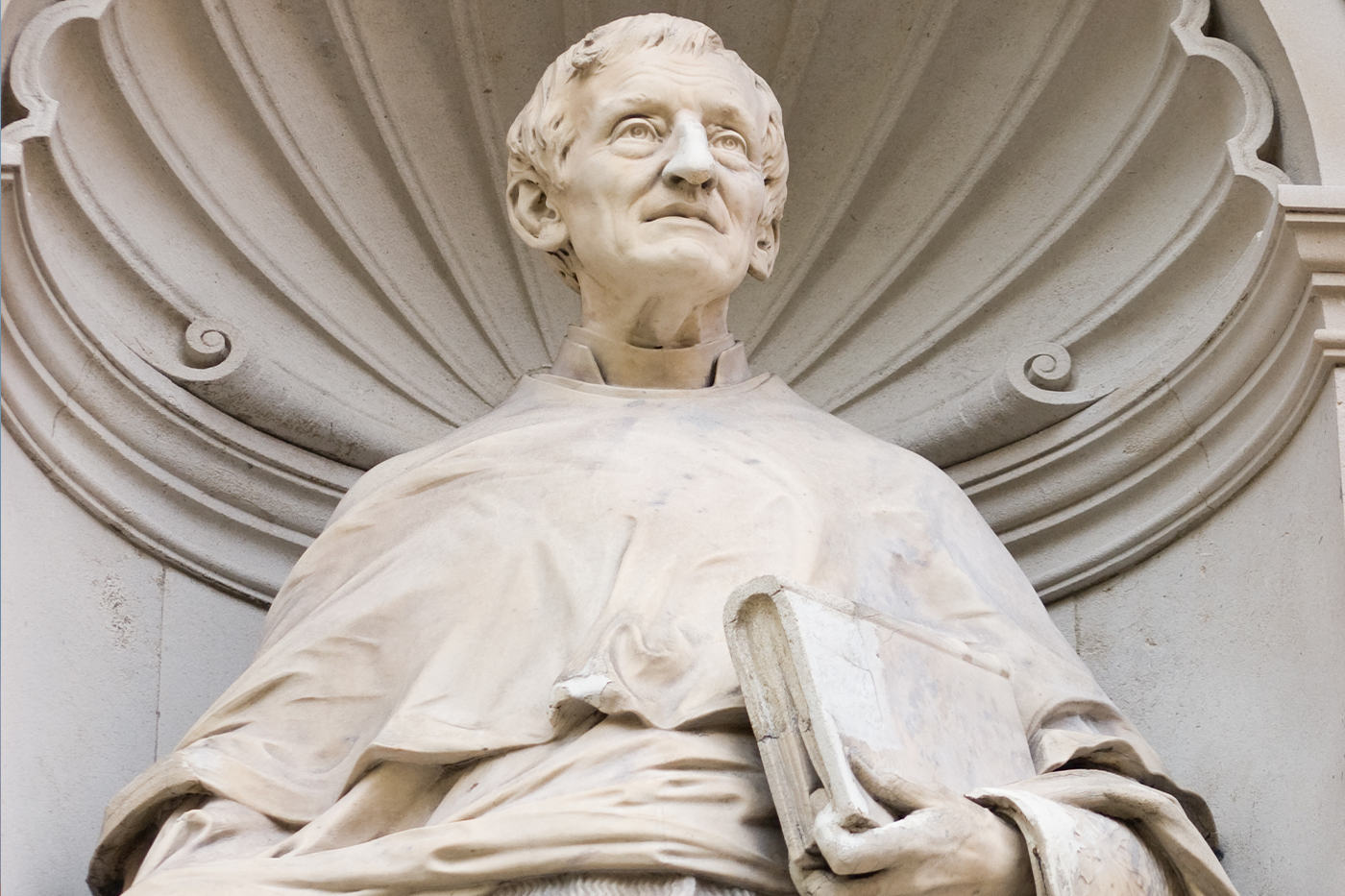

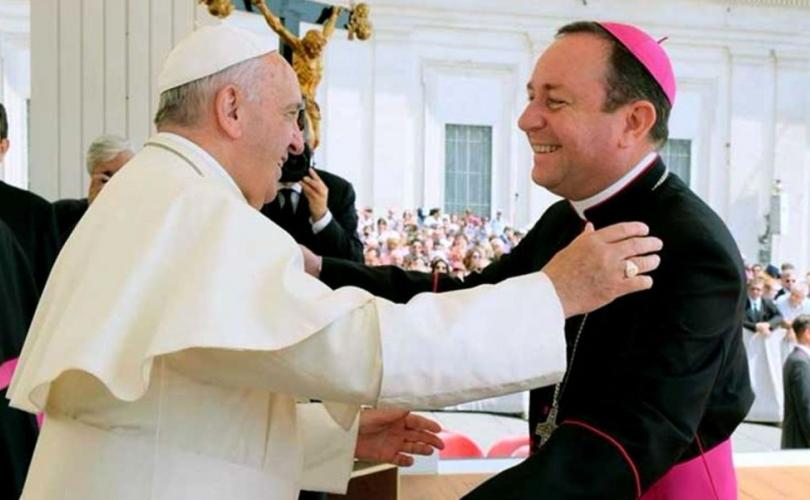

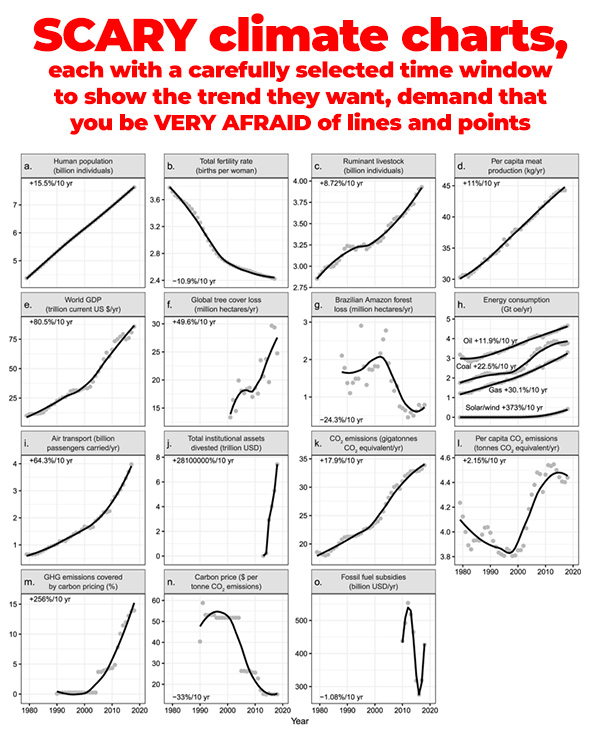

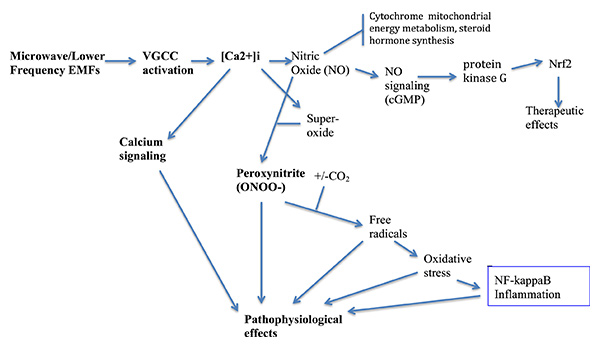



You must be logged in to post a comment.