Fr. Weinandy on ‘internal papal schism’ and the role of laity to save the Church
VATICAN (ChurchMilitant.com) – A renowned American theologian is calling the intensifying schism under the current pontificate “frightening.”
Father Thomas Weinandy, OFM, Cap., former consultant at the International Theological Commission (ITC), said Pope Francis’ recent comments on schism may be more prescient than he knows.
‘Internal Papal Schism’
“Pope Francis recently spoke of a possible schism within the Church, a schism that does not frighten him,” Weinandy writes in a column published Tuesday in The Catholic Thing. “We have had many schisms in the past, he says, and there will be schisms in the future. So, there is nothing to fear in the present.”This unprecedented new schism is frightening.Tweet
“However, it is the nature of the present possible schism that is new, and this unprecedented new schism is frightening,” Weinandy adds.
Weinandy was forced to resign as consultant at the ITC after he published a letter in 2017 seeking clarity from Pope Francis.
“I write this letter with love for the Church and sincere respect for your office,” his letter began.
“Yet, Your Holiness, a chronic confusion seems to mark your pontificate,” he continued. “The light of faith, hope, and love is not absent, but too often it is obscured by the ambiguity of your words and actions.”
After laying out a number of doctrinal concerns, Weinandy noted that bishops are afraid to criticize the pope because “what many have learned from your pontificate is not that you are open to criticism, but that you resent it.”
As a result of this missive, the U.S. Conference of Catholic Bishops removed Weinandy from his post. A number of Catholics were severely critical of the bishops at the time for what they saw as cowardice.
In Weinandy’s Tuesday column, he observes that there is a situation, “ever-growing in intensity,” where a number of orthodox Catholics remain faithful to the pope, although critical of his pontificate, while a faction of liberal Catholics “enthusiastically” support Francis because of the doctrinal ambiguity he fosters.
“What the Church will end up with, then, is a pope who is the pope of the Catholic Church and, simultaneously, the de facto leader, for all practical purposes, of a schismatic church,” Weinandy writes. “Because he is the head of both, the appearance of one church remains, while in fact there are two.”The appearance of one church remains, while in fact there are two.Tweet
Weinandy calls this “internal papal schism,” because Francis is effectively the head of a liberal faction in the Church that is, in practice and belief, schismatic.
“This is the real schism that is in our midst and must be faced,” says Weinandy.
The pontiff does not seem to fear such schism, says Weinandy, but welcomes it as “the new ‘paradigm’ for the future Church.” For this reason, the faithful must implore God to deliver us from the current crisis.
Thus, in fear and trembling, we need to pray that Jesus, as the head of His body, the Church, will deliver us from this trial. Then again, he may want us to endure it, for it may be that only by enduring it can the Church be freed from all the sin and corruption that now lies within her, and be made holy and pure.
American Critics
Weinandy believes that when Francis mentioned schism, he is referring largely to his American critics, who offer “his most theologically challenging and pastorally concerned criticism.”
“Francis thinks that they are unwilling to change, and so refuse to accept the new work of the Spirit in our day,” he continues.
“What Francis does not realize (and his close associates fail to grasp) is that the overwhelming majority of his American critics would never initiate a schism,” Weinandy says. “They recognize that he is the pope and thus the successor of Peter, and that to remain within the Catholic Church is to remain faithful to the pope, even if it entails being critical of the pope in one’s faithfulness to him.”
Instead, Weinandy notes that the German Church is far more likely to go into schism.
“The German bishops are proposing a two-year ‘binding’ synod that, if what is proposed is enacted, would introduce beliefs and practices contrary to the universal tradition of the Church,” he says.
The “synodal path” proposed by the German bishops would challenge clerical celibacy and Church teaching on human sexuality, including homosexuality and use of contraception, and has faced objections from the Vatican. But Cdl. Reinhard Marx, president of the German bishops’ conference, made clear after a recent private meeting with the pontiff that Francis would put up no roadblocks to their plan.
“There is no stop sign,” Marx said. “I cannot see that the synodal path now somehow would be endangered.”I believe it will be the laity who bring about the needed purification.Tweet
While Francis is not allowing them to openly contradict Church teaching, Weinandy clarifies that he is permitting them “to do things that are ambiguously contrary, for such ambiguous teaching and pastoral practice would be in accord with Francis’ own.”
Echoing the words of Abp. Fulton J. Sheen, Weinandy expresses hopes that it will be the laity who will help save the Church.
“I believe it will be the laity who bring about the needed purification,” he says. “Lay people see themselves as helpless, having no ecclesial power. Yet if the laity raise their voices, they will be heard.”
In an article recently published on LifeSiteNews, the learned scholar and church historian, Cardinal Walter Brandmüller, reported the following fact and has thereby especially arrested my attention, in part because of its momentous implications. For, the proposed fact is also what G.K. Chesterton would have called a “Tremendous Trifle,” a seeming trifle, but momentous if one has the proper criterion.
Cardinal Brandmüller wrote the following:
The philosophy of German idealism [Kant and Hegel et al.]—which is fixed on human consciousness—and its connection with evolutionary thought had led to the result that one regarded religion as a product of the depth of the human soul which develops from one stage to the next higher one in the course of evolution and that religion therefore is subject to change. From today’s perspective [sic], one might consider some of the actions on the part of “Rome” in those years to have been rigid, but one cannot put in doubt the danger of these ideas—which one since then summarizes with the name “Modernism”—which were indeed undermining the foundations of the Faith.
That Pius X here pulled the emergency brake in this situation by demanding from theology teachers [and others] that they make the Oath Against Modernism [1910], one should not demean or ridicule it as an expression of “Roman alarmism.” It can, instead, astonish us that, of all people, the German theology professors were excluded from fulfilling this demand. They feared for their freedom in teaching and research, whose loss would have exposed them to some disdain in the academic world.1 [my emphasis added]
However, the German Cardinal does not then additionally present any more specificity or historical clarifications about this momentous German exemption, indeed this mysterious German dispensation and its consequent exclusion from the standard requirement, under obedience, to affirm the contents of that carefully crafted solemn Oath Against Modernism.
Was the Oath also exempted from the vows of the Austrians and others of the German linguistic groups in Europe or in Foreign Missions or as Germanic citizens in diaspora? Did it apply, as well, to ethnic German Catholic teachers dwelling in other cultures? Was the oath not even required of German theological teachers or broadly religious teachers in Rome? Was the German exclusion ever even written down and officially promulgated? If so, when? Where is the official document to be found? Was it in place even from the outset in 1910—or did it come quietly into the public later?
These are the kinds of questions I wanted to ask Cardinal Brandmüller, and my wife Maike Hickson even proceeded, in fairness, to ask him for some his further clarifications, if feasible, about that presented momentous fact.
I would also have some more questions to ask him about a later event: namely, the quiet 17 July 1967 rescinding of the 1910 Oath Against Modernism—which was done by the Congregation for the Doctrine of the Faith under the reign of Paul VI and with his approval.2
Was it the case that Modernism or an even more subtle Neo-Modernism was now to be tolerantly accepted and variously institutionalized within the modern Church? How are we to understand this removal of a grave 57-year-old Oath of honor?
But, did not the prelates and other clergy with their advisors (periti) during the 1962-1965 Second Vatican Council also face the danger of having perjured themselves especially if they had actually and obediently also earlier taken the solemn Oath Against Modernism—although the German delegates might well have had a mitigating dispensation and had thus been exempted from making the vow, even then and even in 1962-1965 Conciliar Rome?
By way of an analogous contrast, it was back in the 1980s that I first read—with Arnaud de Lassus’s indispensable help—Jean Madiran’s reliable analyses of two admittedly secret meetings in France—in Metz and in Strasbourg —conducted just before the October 1962 opening of the Second Vatican Council.3 The Metz meeting was with representatives of Soviet Communism and with the French Cardinal Eugène Tisserant from Rome. In Strasbourg, France, there was a secret meeting with representatives of modern Judaism and with Rome’s official representative, Father Yves Congar, O.P. (a Dominican who was later in 1994, shortly before his 1995 death, made a Cardinal by John Paul II).
Rather than now considering the troubling substance of these compromising agreements—intended to help guide the impending Pastoral Vatican Council as to the political action of both Communist forces and Jewish forces—we only want to raise a few questions: namely, to what extent were the Council Fathers informed about these important secret meetings and binding promises and subversive arrangements? To the extent that these two secret meetings were not disclosed, to what extent was the Pastoral Council playing with a crooked deck of cards, from the outset—even before the original Schemata were diverted and disposed of?
With so much talk afloat about openness and all that, there are many signs of oligarchic secret assemblies, protective censorship, and frightened self-censorship that gradually becomes a withering and atrophying self-censorship.
The intimately exoteric Catholic spirit of vital candor and robust lucidity thus now tends to become a more “occult organization of revolution.” That is to say, comprising both the fast path and the slow path of revolution. The principle of “solve et coagula” also now has more unimpeded scope for its Hegelian Dialectic and Evolutionary Pantheism. The Geist needs us, as it were, to complete Itself. Such “Process Philosophy” even boldly says that “God needs us to complete Himself.” The Church, we dare say, now still has Her work cut out for Her, sub Gratia Divina.
May we be able to face with courage some of those “Tremendous Trifles,” as well: Installed Neo-Modernism, for example. And still, during this pervasive Occupation, to preserve our font of “Battle Joy”!
Posted inUncategorized|Comments Off on The quiet 17 July 1967 rescinding of the 1910 Oath Against Modernism—which was done by the Congregation for the Doctrine of the Faith under the reign of Paul VI and with his approval like a specter rising from a grave returns to haunt the Church now
From Rome, Michael J. Matt reports on Day 1 of the Amazon Synod. After the first press conference in the Vatican press hall, Michael discusses a few of the blatant contradictions involved in the stated reasons for this Synod.
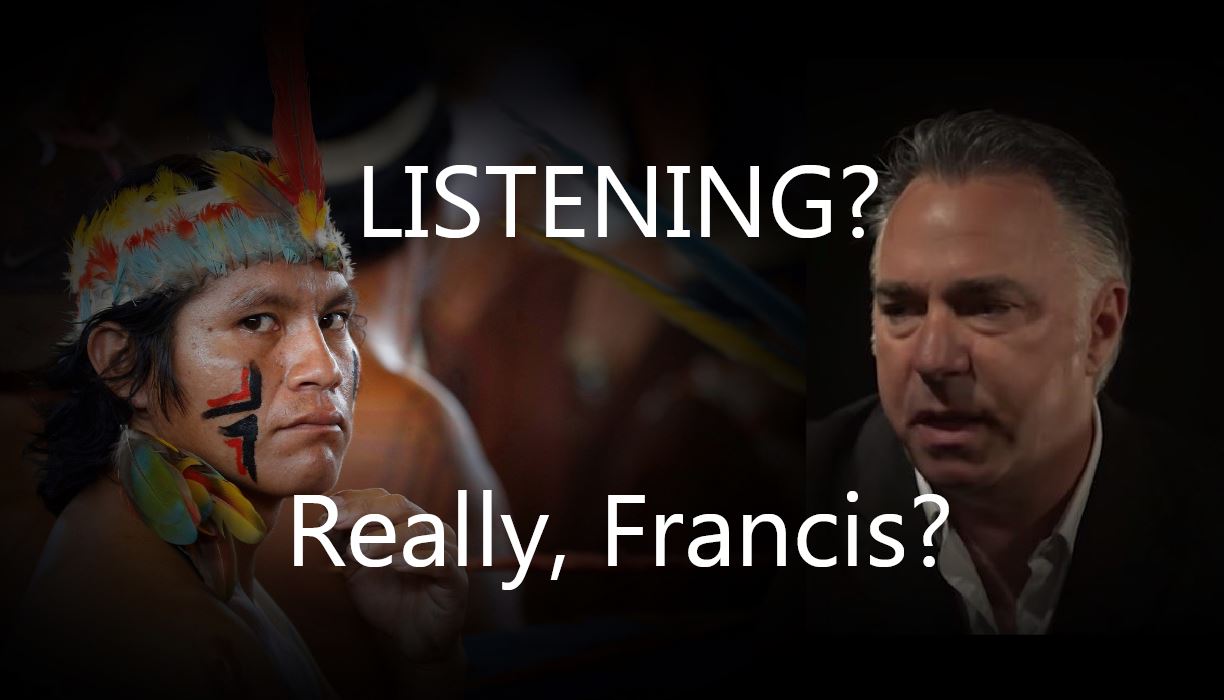
For example, the Vatican keeps insisting that the Synod is all about evangelization based on “synodal listening” to the people of the Amazon. But how does one evangelize people to whom one is supposedly listening and from whom one is learning?
If the wisdom of the Amazon can change the world, why do they need Francis to interfere?
Plus, this eco-theology and listening to the cry of the earth is nothing new. It’s part of the United Nations, Jeffrey Sachs, Sustainable Development coalition to which the pontificate of Francis has been allied for the past five years. So, what’s listening got to do with it?
Does anyone seriously believe the Vatican is “listening” to the indigenous people of Amazon here in Rome in pursuit of new pathways for moving forward? If the indigenous peoples are so advanced that we must listen to them in order for the Church to progress, why does the white pope need to call a Synod to save and protect the Amazon?
And, by the way, what’s with the feathers? Would the Vatican have us believe all or even most of the indigenous peoples of the Amazon in 2019 are still running around in feathers and grass skirts? How is this condescending cultural stereotyping not essentially racist to the core?
And finally, at the press conference today Michael learned that, due to the priest shortage, women in the Amazon are already baptizing babies, conducting marriages, and even hearing confessions.
Is the Amazon being used as a laboratory for developing creative answers to the universal priest shortage in the whole Church? Is that what this is really about?
Posted inUncategorized|Comments Off on IS THE AMAZON SYNOD RACIST ????
The Vatican indigenous ritual appears to have specifically South American superstitious pagan ceremonies.
In the Vatican Amazonian indigenous ritual, one of the most important parts of the ritual, apparently was the rattle ceremony that is explained by the website Ayahuasca.com which is “a multi-disciplinary project devoted to the… Amazon”:
“[R]attles are the most important [indigenous pagan] shamanic tool in the Amazon… anthropologist Jacques Chaumeil says that, among the Yagua, the rattle is held to be voice of the spirits.” (Ayahuasca.com, “The Leaf-Bundle Rattle, July 22, 2016)
The indigenous pagan “Shamanic Drumming” website says:
The shaman’s rattle is used to invoke the assistance of power animals and helping spirits… In South America, the shaman’s rattle is a most sacred instrument… the rattle’s head-gourd, which contains spirits. Joining the head of the rattle to the handle symbolizes the joining of masculine and feminine elements in the universe, an act of fertilization that bestows the sound of instruments creative shamanic power.” (ShamanicDrumming.com “The Shaman’s Rattle,” April 20, 2014)
The meaning of the Vatican ritual was apparently a type of pagan fertility ceremony (the two indigenous pagan statues of naked pregnant women) as well as a ceremony for a witch doctor or shaman “to invoke… [pagan] animal spirits and helping spirits.”
Moreover, according to the Catholic News Agency report published in the Nation Catholic Register, the pagan dance part of the Vatican ritual “resembled the pago a la tierra, a traditional offering to Mother Earth”:
“Participants sang and held hands while dancing in a circle around the images. The dance resembledthepago a la tierra, a traditional offering to Mother Earth common among indigenous peoples in some parts of South America. No explanation was provided by the event organizers as to why the dance was performed for the feast of St. Francis or what it symbolized.” [http://m.ncregister.com/daily-news/ecological-ritual-performed-in-vatican-gardens-for-popes-tree-planting-cere]
The website “Tours to Peru” explains that the Pago a la tierra danceapparently is part of a ceremony to the pagan “Mother Earth” goddessPachamama:
“Paying respect to the [goddess] Pachamama (Mother Earth), has always been a priority for the inhabitants of the Andes…”
“… [T]hey have to first make an offering to the Pachamama. This way Mother Earth is happy, and she will unfold her generosity.”
“These offerings are usually conducted through Pago a la Tierra ceremonies. These translate directly to “payment to the Earth,” and are an important part of Andean culture and cosmology. The Pagos are performed by Shamans who are especially knowledgeable when it comes to speaking with the Pachamama and the Apus, the spirits of the mountains.” [https://www.tourstoperu.info/culture/ceremony-of-pago-a-la-tierra.html]
The South American indigenous pagans appear to use the “Virgin Mary” as a type of mask for the earth goddessPachamama similar to the Latino Santeria pagan religion which uses Catholic saints to mask their pagan gods:
Francis apologist Austen Ivereigh claims the two indigenous pagan statues of naked pregnant women in the Francis Vatican ritual were the Blessed Virgin Mary and St. Elizabeth.
Anyone familiar with Latino culture and with it’s “botanica” occult shops knows that this Francis Vatican ritual appears to be the demonic Santeria in which saint images are used as a mask to worship pagan energies or gods.
Catholic apologist and Santeria expert Jesse Romero said:
“Shout it from the rooftops: ‘Santeria is demonic and Catholicism is the one true religion.’ This hybrid is superstitious and deadly to your soul.” (Jessseromero.com, “Catholicism & Santeria… Can you do Both,” July 11, 2017)
Where did Francis get what appears to be his Vatican version of Santeria?
The editor of a papal biography on Francis Alejandro Bermudez explains that Francis’s theology which apparently is the basis of the Amazon Synod is about a leftist Peronist version of German National Socialist or Nazi [The People or The Folk] “volkgeist” and “pre-Christian [pagan] beliefs, half-baked catechism precepts, and outright superstitions” which comes from Francis mentor Fr. Lucio Gera.
The “biggest impact on Francis’ thought were Jesuit Fr. Juan Carlos Scannone… a professor of young Fr. Bergoglio- as well as Argentinian Fr. Lucio Gera.” (Catholic News Agency, “The theological formation of Pope Francis,” March 17, 2018)
Bermudez explains Francis’s theology of the People:
“In this [Gera and Francis] theology, the People [the volkgeist] are defined in a narrow sense as the poor and the dispossessed…”
“… [the “People’s”] Latin American Catholicism… a suspicious mélange of pre-Christian beliefs, half-baked Catechism precepts, and outright superstitions. Gera… develop[ed]… as key to the spiritual renovation of the Church.” (Medium, “Pope Francis, Peron and God’s People: The Political Religion of Jorge Mario Bergoglio,” by Alejandro Bermudez, September 17, 2017)
Finally, as with all leftist Peronist such as Francis everything finally come down to politics. So, what is the leftist political angle of the Vatican dance ceremony to the earth goddess Pachamama?
Which brings us to four more questions:
Might the earth goddess Pachamama be another name for Gaia who is the deity of the climate change elites who are pushing for a one-world government under their earth goddess: Gaia?
Why are the globalist elite and Francis using youth Greta Thunberg to inspire so-called green youth rallies in the media propaganda spectacular called the “Climate Strike” in over 150 countries?
Why is Francis making a “special invitee” to his Amazon Synod the one-world government advocate Hans Joachim (John) Schellnhuber according to journalist Edward Pentin on Twitter?
Might Francis’s main political agenda at the Amazon Synod be not so much about undermining Catholic doctrine which has already been for the most part accomplished with Amoris Laetitia, but pushing for a one-world government?
Dr. William Briggs, an adjunct professor of statistics at Cornell University, gives us some of the answers to these questions and points to other answers:
“We’ve talked many times about how the child Greta Thunberg from the depths of Europe is ignorant of all atmospheric physics. Ignorant, as in she knows nothing. She couldn’t define CAPE to save her soul. Latent heat is a impenetrable mystery to her. Radiative transfer is to her an alien language. And so on.”
“It’s wrong to blame this poor kid for her ignorance. She doesn’t even know what she doesn’t know. She’s being used by shiftless activists, lying politicians, the evil media, and other well known lowlifes to push an agenda. Few people can see this.”
“… Every bad thing… that actually happened or might happen was and is blamed on climate change, and climate change itself was blamed on whatever the elites said caused it. With global cooling and warming, the cause was fossil fuels. With climate change, it was fossil fuels, capitalism, eating meat, large houses, anything having to do with traditional freedoms. Their proposed solution is to have the rabble live in pods and eat bugs.”
“Propaganda works. It is a cheap and effective way to sway the masses, and in democracies masses must needs be swayed. The oligarchs in the elite were happy to enlist a core group of zealots who believed with all their heart the sky would fall unless a one-world government was instituted. True, some of the zealots’ rhetoric spoke of eliminating the oligarchs (the “rich”), but since they also spread the elite’s propaganda at zero cost to the elites, the risk was outweighed by the benefits.”
“Sometimes propaganda works too well. A small cadre of environmentalists can be contained if they go too far, but what happens when half the population becomes as zealous as the maniacs? Environmentalism is no longer a kind of sober conservation; it is now a full-fledged religion, a fresh interpretation of Mother Earth cults. The elites have resurrected a very angry female goddess, Gaia. She awaits martyrs.”
“In a cosmic non-coincidence, seconds after I wrote that last sentence, the Blonde Bombshell forwarded me this news: ‘My wife just phoned me in tears, a 14 year old lad at the school where she works, has committed suicide because of climate change. Wtf is going on !!!!’”
“Guessing the form this religion will take is not easy. Gaia is only a goddess, not the God. She can work with God. There was a group subjected at a Catholic mass to a video lecture by little Greta, after which they had ‘oil placed on hands as sign of commitment to environment.’”
Aqua9:23 PMOne thing I’ve noticed in Catholic “ecumenism” – only one side is willing to change their Creeds and core beliefs. The Jews don’t. The Muslims don’t. Protestants don’t. Bhuddists and Hindus could care less. Pagan demon worshippers don’t. They’re all certain and satisfied in their beliefs.
Catholics? It’s all up for sale. We believe …. nothing. Take it. It’s all yours. For the cause of unity (in chaos).
Whooda thunk a “Pope” would invite devils, shamans and spell casters into the heart of our Faith. But, there he is, in our peaceful Vatican gardens, getting his own magic spell cast on his venerable hands by a shaman witch.
The Hierarchy appears comfortable with it. Just another day of surrender.
In a column a few weeks ago, I called upon the USCCB to drive a stake through the undead heart of the dreadful New American Bible – and the lectionary based upon it. I said that I would discuss several categories of their blunders. The first was the NAB’s drab preference for the abstract over the visible and palpable. The second category is this: ideological tendentiousness, unhelpful either for understanding the Bible or for inspiring or strengthening faith.
The good translator or editor ought to burn into his soul the words of the Baptist: He must increase, and I must decrease. Nothing and no one should obtrude between the reader and the text. That doesn’t mean you will not profit from commentary. But the commentary should always aim to elucidate, not to confuse, and never to thrust upon the reader the vague authority of “scholars,” who are often only a little club of like-minded people.
The NAB violates that directive at every pass.
Consider the very beginning of Genesis: “In the beginning, God created the heavens and the earth.” It’s bad already that you can’t get there without a “title,” “The Story of Creation,” which will be followed by other titles and subtitles, and separation of the text into blocks, not for visual ease, but for editorial decisions regarding presentation – what goes with what, and what doesn’t. The mighty first sentence I have cited doesn’t exist in the NAB. It is in the Septuagint, and in Jerome’s Vulgate. It is in every other modern version of Scripture that I can find, in English, German, Spanish, French, Portuguese, Italian, Welsh, Swedish, and Icelandic. It is not in the NAB. What is there? A grammatical train-wreck:
In the beginning, when God created the heavens and the earth – and the earth was without form and shape, with darkness over the abyss and a mighty wind sweeping over the waters – Then God said, Let there be light, and there was light.
What is this business about when and then? The editors explain: “Until modern times the first line was always translated, ‘In the beginning God created the heavens and the earth.’ Several comparable ancient cosmogonies, discovered in recent times, have a ‘when…then’ construction, confirming the translation ‘when…then’ here as well. ‘When’ introduces the pre-creation state and ‘then’ introduces the creative act affecting that state. The traditional translation, ‘In the beginning,’ does not reflect the Hebrew syntax of the clause.”
Strange, that the Hebrew speakers who composed the Septuagint did not see it that way, nor did Saint Jerome. The most we can say is that you might read it the way the editors do, but there is no call for it; the traditional reading is the literal one, rendering the plain sense of the text. Why then would you not follow it?
The editors give themselves away when they bring up the “comparable ancient cosmogonies,” recently discovered, while neglecting to mention that those were pagan cosmogonies: the Babylonian Enuma Elish, most obviously. The whole point of Genesis is that there are no comparable ancient cosmogonies. That is its glory.
*
Everywhere else, cosmogony is preceded by theogony, the birth of the gods. Not here. Everywhere else, the myth-making mind of man focuses upon the origin of the stuff out of which the world would be made; for instance, the dismembered limbs of the malignant Babylonian mother-goddess Tiamat. Not here.
Here, the earth, made by God but not yet lent any character, is tohu w’vohu, an excellent rhyming pair in the Hebrew. These words do not just describe something shapeless, like jelly. They are more powerful than that, morally and ontologically: formlessness, confusion, unreality, emptiness, says the primary Hebrew lexicon, translating tohu, and showing how that meaning extends to what is empty, unreal, worthless; such as moral unreality or falsehood.
Luther’s wuest und leer gets the point across, as does the Douay void and empty, following Jerome’s inanis et vacua. The sacred author did not have a metaphysical vocabulary; we have here his most potent way of asserting that without the creative will of God, we have what is somehow worse than mere absence.
It seems, then, that the editors want to sap the faith. They say, slyly, “And hath the Church said that God made the world from nothing? Perhaps so, but we cannot find it in the text.”
We see the same motive in their uncharacteristic turn toward the physical later in the sentence, where they say that a “mighty wind” was “sweeping over the waters.” Aware that they are jiggering the text, they relegate the literal meaning to a footnote: A mighty wind: literally, “spirit or breath [ruah] of God”; cf. Gn. 8:1. The reference to 8:1 is not pertinent, because the Hebrew there does not read ruah Elohim, spirit of God. There, ruah simply means wind, as it often does; God is raising a wind to settle the seas after the flood. But ruah in general means breath, wind, spirit, with reference to one’s principle of life, or one’s will, desire, temper.It is an extraordinary image, then, that the spirit, the breath, the power of God should be moving or hovering or brooding above the waters.
That’s the action, but the NAB squad, having decided to elbow God from his place, giving us that “mighty wind,” could not then translate the verb as having to do with gentle movement, or with cherishing and brooding, as the Hebrew lexicon would have it. So we have sweeping instead. Instead of God intimately involving himself in what is otherwise without meaning, we have Him as an interested spectator, looking upon a hurricane or something, and then deciding to do something about it.
In other words, they have blunted the earth-shaking newness of the sacred text, muffling the profound theological insights, and reducing it to a fairy-tale. They have made it less poetic, but more ordinary, everyday, and dull. They use every schoolish excuse they can to offend against the straightforward tenets of the faith.
*Image:Scenes from Genesis by Wiligelmo, c. 1110 [Cathedral of San Geminiano, Modena, Italy]
I write you because I know you in the past have shown yourself to be Catholic and to speak the truth, which few do these days.
I also write you because you have indicated that you know what transpired in the Vatican Gardens on Friday, October 4, 2019, when many Catholic Bishops and Clergy and religious attended a Pachamama ritual of adoration.
Something about myself: I hold a B. A. in Cultural Anthropology from the University of Florida (Class of 1986), where I studied the cultures of the native peoples of the Americas intensely. I graduated with honors and was nominated to Phi Beta Kappa. I am familiar with the rituals of the pagans of Latin America from academic study. I have read the Theologia Moralis of Saint Alphonsus dei Liguori in Latin. I am the translator of St Bonaventure’s Scholastic Treatise on the One and Triune God, published by The Franciscan Archive in 2014.
In regard to what happened, I have never seen such an outcry on social media about Bergoglio’s scandals like this one. The Laity are right, this was a pagan ceremony.
Bergoglio invited, participated, approved and attended. He was not just a witness.
There was employed an idol of Pachamama, the Andean Earth Mother Goddess.
The Idol received the veneration of latria, when all those in the circle bowed down to it.
Bergoglio showed respect for the ceremony by inclining his head on occasion.
When one recalls that during the Decian persecution Bishops were considered apostates, with loss of all office and right to communion, for merely procuring a document which said they had sacrificed to Mars, even though they had not, this goes way beyond that.
A lot of laity, myself included, think that the Faith needs to be protected by the Bishops by a formal act.
I am only a brother. But if I were a Bishop, I would think like this:
I am a successor to the Apostles, whom Our Lord rebuked when He said, “When I return, will I find Faith on earth?”
By “faith”, Our Lord always mean, faith in Himself, the true God.
As a Bishop it is my duty to prevent public scandal which arises from the sins of the faithful. This duty is more incumbent upon me, when the sin is by a fellow Bishop. Because if the Bishops remain silent when another publicly sins, the faithful and general public conclude that no Bishop has the Faith, and that the Catholic Church is merely a farce.
To avert such a scandal and to put things in true light, I therefore must make a public statement.
Canon 1364 already declares excommunication latae sententiae. Therefore, I do not need jurisdiction or office to publicly declare that this man, Bergoglio, has incurred excommunication for formal and material participation in the ritual of adoration of a false God, on sacred soil, participated in by priests and religious consecrated to Christ, into which ceremony there was mixed in, by the perpetrator, Bergoglio, the Our Father.
The Public Scandal is notorious. The actions are undeniable. The sin and crime are committed by the person not the office he holds. Therefore action can be taken by anyone who has grave moral responsibility, whether he holds jurisdiction of office or has a grave duty as a successor of the Apostles.
Apostasy by means of a pagan ritual of this kind is not a canonical crime which requires a trial or court to declare. Because apostasy of this kid is principally in the external act, consent to which is presumed. Unlike the canonical crime of heresy, which exists formally not only out of public expression but manifestation of pertinacity of the mind, the pertinacity must be investigated because the state of the mind, which is hidden, must be made manifest. Therefore in a public act of false worship, no investigation need be made. The Divine Faith requires that we do not attend such ceremonies and as soon as we detect that we are present at one, we must get up and leave. Moreover, we cannot invite priestesses or priests of pagan religions to our homes or properties to perform an act of false worship of an idol. Nor can we receive, as Bergoglio did, the idol as a gift after the pagan ritual. Therefore, the consent to the act is indisputable. This is a clear case of a canonical crime running contrary to the entire obligations of the Faith (Thou shalt not have strange gods before Me), against Hope (There is no other Name by which men are to be saved) and against Charity (Thou shalt love Me with all thy heart, and mind and soul).
Therefore, Bergoglio has incurred the excommunication in the canonical sense..
Therefore, I as a successor to the Apostles have the right and duty to publicly declare it.
Having read the book by Saint Alphonsus dei Liguori, Dignity and Duties of the Priest, and knowing that the failure to speak out for Bishops and priests is a mortal sin and the chief reason for their damnation, considering my state of life in the Church as a Bishop, I must act if I do not wish to be damned and share in giving scandal about this horror.
Therefore, I will declare that Bergoglio has incurred latae sententiae excommunication for his formal and material participation and cooperation in an act of false latria rendered to the idol of Pachamama in the Vatican Gardens.
These would be my thoughts, if I were a bishop.
I humbly petition, in virtue of Canon 212, that you think similarly and take action to stem the grave scandal and put to end once and for all the pretense of this man to be called a member of the Catholic Church.
Watch online for free as lay Catholics from across the world address critical Amazon Synod issues THIS Friday. Click here to join.
October 1, 2019 (LifeSiteNews) – A German cardinal is warning Catholics in his country that proceeding down a so-called synodal path — one that aims at questioning the Church’s teaching on celibacy, an all-male priesthood, homosexuality, etc. — could lead to a “national church” without “nearly any ties to Rome,” stating that this would be “certainly be the surest path into the final decline.”
Cardinal Walter Brandmüller – the former President of the Pontifical Committee for Historical Sciences and one of the two remaining dubia cardinals – made this comment in a statement in light of the developments in Germany where the German bishops have decided to enter into the controversial “synodal path.” He published his statement today on the Austrian Catholic news website Kath.net. LifeSiteNews has published an English translation of it (read full statement below).
“It cannot be overlooked anymore: the phantom of a German national church shows itself more and more,” writes the Cardinal, adding that “national isolation of the remnant of German Catholicism into a national church without nearly any ties to Rome would certainly be the surest path into the final decline.”
Cardinal Brandmüller noted that Jesus “speaks of His Church in the singular” and called it “absurd” for the Catholic Church in Germany to be pursuing a “self-destructive, national particularism.”
The Cardinal’s warning is similar to that of Cardinal Rainer Woelki, the archbishop of Cologne, who earlier this month warned of a “schism within the Church in Germany” that would lead to a “German national church.”
Cardinal Brandmüller in his statement today traced the history of German ideas of a “national church” and of anti-Roman resentments. The anti-Roman resentments have come to a fuller development in the second half of the 20th century, when the German bishops increasingly disobeyed decisions from Rome.
Cardinal Brandmüller explained: “One is tempted to think that, with the announcement of the Council, John XXIII opened the German ‘Pandora’s Box.’ What had continued to smolder under the blanket since the unresolved Modernism crisis [in the early 20th century], now broke out visibly, loudly, with new vehemence.”
As an example, Cardinal Brandmüller mentioned that the German bishops “relativized” Pope Paul VI’s encyclical Humanae Vitae‘s ban on artificial contraception and that they never revised their position.
“Thus it came to the ‘Königstein Declaration,’ which left it up to the decision of conscience of the spouses whether they use contraceptive means or practices, or not. None of the subsequent Popes succeeded with their demand that the decisions of the time would be revised,” he wrote. Piercingly, he added that “the German episcopacy remained in resistance against the Papal Magisterium.”
The cardinal mentioned the 1971-75 German Synod of Würzburg, which, he noted, has some similarities to today’s “synodal path.” For example, he pointed out, this earlier synod “clearly broke with the synodal tradition of the Church, both with its statutes and with its agenda, because it gave equal voting rights to lay people who had the same number of members at the synod as the bishops and priests.” This same problem exists now also with regard to the “synodal path.”
Furthermore, showing the intensity of the conflict at the time, Brandmüller explained that “Professor Joseph Ratzinger [the later Pope Benedict XVI] and Prelate Karl Forster – who at the time was the secretary of the Bishops’ Conference – left the synod under protest.” Today, it is Professor Marianne Schlosser – a member of the synodal path’s discussion forum on women – who announced that she has leftthe discussion forum, and Bishop Rudolf Voderholzer of Regensburg has announcedthat he might at some point leave the synodal path altogether.
Cardinal Brandmüller, in his historical overview, also touched upon the German bishops’ resistance against Pope John Paul II.
“John Paul II received an even stronger resistance when he forbade the Church’s counseling centers for pregnant women from giving out the ‘counseling certificate’ which was by law a precondition for a legal abortion, which was de facto a death sentence of the unborn children,” he wrote. Here, again “there arose such strong and insistent resistance on the part of most of the German bishops, especially of Cardinal Lehmann and Bishop Kamphaus,” he added.
The Cardinal’s history lesson sheds light on why the German bishops are once again trying to go their own way in what appears to be an attempt to form their own “national church” that is separate from Rome. Brandmüller also points out that the German bishops seemingly have taken it upon themselves to be the “school masters” of the Universal Church as they export their ideas to other nations. The Cardinal noted how the German Bishop’s attempt at “influencing” the Universal Church is supported by the fact that “the abundant money” now “flows from German Church tax desks into poorer regions,” thus strengthening German influence in the world. The German influence on the Amazon Synod, for instance, has been well established.
But in light of the fact that the numbers of Catholics in Germany decrease in dramatic numbers, Cardinal Brandmüller mentioned what he called an “embarrassing arrogance” in the German Bishops’ Conference. Here, he quoted the well-known question as to whether “the world may not once be healed by the German being?” The German Cardinal noted that there is a resemblance to this idea in the recent letter from Cardinal Reinhard Marx to Cardinal Marc Ouellet, the Prefect of the Congregation for Bishops: “One may compare the answering letter of the President of the German Bishops’ Conference to Cardinal Ouellet from 12 September 2019,” Brandmüller stated.
According to a CNA report, Cardinal Marx had written to Cardinal Ouellet that he hoped the German synodal path will also be of benefit for the Universal Church: “We hope that the results of forming an opinion [on these matters] in our country will also be helpful for the guidance of the universal Church and for other episcopal conferences on a case-by-case basis. In any case, I cannot see why questions about which the magisterium has made determinations should be withdrawn from any debate, as your writings suggest.”
In conclusion, Brandmüller warned the German Catholics not to go the way of building their own church.
***
Statement by Cardinal Walter Cardinal Brandmüller on the Catholic Church in Germany
October 1, 2019
“Without Judah, without Rome, we shall build Germany’s Dome [Cathedral]”
“Without Judah, without Rome, we shall build Germany’s Dom [Cathedral]” – this slogan from Hitler’s early inspirer, Georg von Schönerer (1842-1921), gives expression to a German resentment, which – ultimately – had its expression in the Battle of the Teutoburg Forest. The defeat of Rome in that 9 AD “Hermann Battle” [the Arminius Battle] has been at least for the last two hundred years an essential part of the “Teutonic” culture of remembrance.
It is then no surprise that from thence there falls a strange light upon the relationship of the German Catholics to “Rome” – from the “Gravamina Nationis Germanicae” against the “Rome” of the early 16th century up until today.
If we follow this aspect, we shall find traces of it at the turn of the 19th century. Some people accused Rome of having been guilty for the decline of the “Imperial Church” because it did not move at all in order to save the old prince-bishoprics and imperial abbeys when the Holy Roman Empire collapsed – a stab-in-the-back myth avant le mot [before the word was created].
In this very context – the Congress of Vienna was in full swing – the diocesan administrator Ignaz Henrich von Wessenberg (Constance) developed the idea of a German National Church. A rebuilding out of the rubble then was meant also to overcome the confessional split and to achieve peace between State and Church.
Upon this foundation, then, the political unity of the nation was also to be built. It was, of course, very far away from reality when he [von Wessenberg] thought that such a national church would still be Catholic. In any event, he demanded a concordat with the Holy See – Napoleon’s example might have inspired him here. Wassenberg’s idea was that a German primate would thereby head a German church with loose connections with the Roman center… However, these ideas remained as mere ideas.
Admittedly, these ideas still occupied the minds, when they were revived during the emergence of a new German sense of nationality around the revolutionary year of 1848 when the Frankfurt National Assembly took place [“Paulskirchenjahr”].
It was Professor Ignaz von Döllinger – who was already highly respected at the age of 50 – who, with a tinge of awareness of the problem – said: “The largest part of the Catholics who, in their appreciation of German nationality, have wished for a national church, did not enter into any contradiction to the Catholic Church.” However, this Church historian from Munich overlooked here the meteor-like phenomenon of “German Catholicism” – or perhaps he intentionally ignored it? – which at the time troubled the religious landscape.
There were two chaplains – Ronge and Gersky – who were separated in matters of faith and with regard to celibacy and who went ahead and founded, in protest against the “Holy Shroud Pilgrimage” in Trier in the year 1844, their “German-Catholic church.” It found considerable approval in the north and in the west of the Empire.
“Ha! I am trembling in that we are already so close! But now it is over. The great success has come, the progress of this century has been secured. The genius of Germany is already reaching for the laurel wreath, and Rome has to fall!” Thus spoke Johannes Ronge.
Well, it was not Rome that fell. Around 1860, no one spoke of him anymore. That he indeed had some success with his ideas was not only due to the continued influence of the Enlightenment. It was the national sentiment that was emerging in the Romantic Era and with its admiration of the Middles Ages, which also highlighted the broken religious unity in Germany. To regain that unity seemed then to be a worthy goal: one German nation, one German national church.
These were ideas which remained alive here and there, until Bismarck’s Kulturkampf created a completely new situation. The state according to Hegel’s understanding could not incorporate the “alien element, the Catholic Church” and therefore it made use of force. In this situation that was life-threatening for German Catholicism – bishops were imprisoned or expelled, hundreds of priests were removed from their offices and also imprisoned – the German Catholics rallied unanimously around Rome, around the Pope – those Catholics who were too loyal to the state soon found their “church” to be in the [schismatic] Old Catholic Church.
Now Ultramontanism – whose forerunners always stressed the universality of the Church and her loyalty toward the state, while at the same time clearly rejecting every form of nationalism, and especially the Prussian militarism – bore its fruits: an impressive revival of popular piety, a loyalty toward the Catholic Faith, to the bishops, and to the much-cherished Pope – it was Pius IX.
To put it briefly: the consciousness of being part of the Church of Jesus Christ that spanned the whole world did not give any scope for national-ecclesial thinking.
However, there took place one relapse – with serious consequences for German theology – that can be seen in the conduct of some German bishops and Catholic intellectuals in the Modernism crisis at the turn to the 20th century. The philosophy of German Idealism – which is fixed on human consciousness – and its connection with evolutionary thought had led to the result that one regarded religion as a product of the depth of the human soul which develops from one stage to the next higher one in the course of evolution and that religion therefore is subject to change. From today’s perspective, one might consider some of the actions on the part of “Rome” in those years to have been rigid, but one cannot put into doubt the danger of these ideas – which one since then summarizes with the name of “Modernism” – which were indeed undermining the foundations of the Faith
That Pius X here pulled the emergency brake in this situation by demanding from theology teachers that they make the Oath Against Modernism, one should not demean or ridicule it as an expression of “Roman alarmism.” It can, instead, astonish us that, of all people, the German theology professors were excluded from fulfilling this demand. They feared for their freedom in teaching and research, whose loss would have exposed them to some disdain in the academic world.
Well, it is a German Sonderweg [separate path]. It was in a large part due to the outbreak of the First World War and, in its wake, due to the “Third Reich” and the victory of National Socialism that a fundamental debate about Modernism within German theology never took place. After the catastrophe and the recovery of Germany, and in the run-up to the Second Vatican Council, however, the Modernism problem re-emerged with a new intensity.
One is tempted to think that, with the announcement of the Council, John XXIII opened the German “Pandora’s Box.” What had continued to smolder under the blanket since the unresolved Modernism crisis, now broke out visibly, loudly, and with new vehemence. The German Catholic Convention of the consequential year of 1968 became the stage for angry, vulgar protests against Paul VI’s encyclical Humanae Vitae, whose prophetic character is more and more being recognized today.
In the same year, the German Bishops’ Conference tried to calm the waves by relativizing the encyclical’s ban on artificial contraception. This had some superficial success; Cardinal Döpfner, the President of the West-German Bishops’ Conference, did not pass on to the addressees – and thus misappropriated – some letters from Cardinal Bengsch who, in the name of the bishops of the GDR [German Democratic Republic, Eastern Germany], called for support of the encyclical. An unbelievable event!
Thus it came to the “Königstein Declaration,” which left it up to the decision of conscience of the spouses whether they use contraceptive means or practices, or not. None of the subsequent Popes succeeded with their demand that the decisions [of the German bishops] of the time would be corrected. The German episcopacy remained in resistance against the Papal Magisterium.
In this anti-Roman atmosphere, soon there emerged the “Common Synod of the German Dioceses” in the years 1971-1975. It clearly broke with the synodal tradition of the Church, both with its statutes and with its agenda, because it gave equal voting rights to lay people who had the same number of members at the synod as the bishops and priests. With this decision, conflicts became unavoidable. Here, we may recall only the debates concerning the lay homily. Professor Joseph Ratzinger and Prelate Karl Forster – who was at the time the secretary of the Bishops’ Conference – left the synod under protest.
Finally, we might also recall the Cologne Declaration of the year 1989, “Against the Deprivation of the Right to Decide [“Entmündigung] – for an open Catholicity,” which was signed by 200 theologians. First, it was a protest against the appointment of Cardinal Meisner as archbishop of Cologne, but then it turned against “Rome’s” Magisterium as such.
John Paul II received an even stronger resistance when he forbade the Church’s counseling centers for pregnant women from giving out the “counseling certificate” which was by law a precondition for a legal abortion, which was de facto a death sentence for the unborn children.
One cannot anymore understand today that there arose such strong and insistent resistance on the part of most of the German bishops, especially of Cardinal Lehmann and Bishop Kamphaus. Only from the year 2000 on, one decided to obey the Pope. Nevertheless, there was still resistance which led to the creation of the association Donum Vitae – a truly cynical name – which continued to give out the counseling certificates.
If one then adds the Church Referendum and the formation of protest groups such as We Are Church, as well as the degeneration of the formerly loyal Catholic organizations – not to forget the Marxist infiltration of the Association of the German Catholic Youth – then one can see the extent of the centrifugal dynamic, with the help of which the “National Catholicism” (what a “contradictio in terminis”) has distanced itself after World War II from the Rome of Pius XII. That Rome was in 1945 the only international authority that had reached out its hand to the destroyed Germany when it re-entered the community of free nations.
Today, however, the “German Church” – the German Bishops’ Conference – tries to influence the Universal Church. Are not Emanuel Geibel’s stanzas of the poem “Germany’s Vocation” (from the year 1861) once more here of interest: “… then the fisher from Rome in vain casts out his nets … and the world may not once be healed by the German being?” One may compare the answering letter of the President of the German Bishops’ Conference to Cardinal Ouellet from 12 September 2019.
Such a claim of course has for a long time not been any more justified by special achievements of German theology. There are lacking today – except for a few remarkable exceptions – great names, as they existed around the time of the Second Vatican Council and they then were the foundation for the international reputation of German theology. Much less is German Catholicism characterized today by religious aliveness, since the Church statistics show a constant decline what pertains to Church attendance, use of the Sacraments, priestly vocations and so on.
In the meantime, it is rather the abundant money that flows from German Church tax desks into poorer regions of the Universal Church which lays the foundation for the German influence. That makes the arrogance even more embarrassing, with which the representatives of German Catholicism present themselves as school masters to the Universal Church.
It cannot be overlooked anymore: the phantom of a German national church shows itself more and more. Already in the middle of the 19th century, some people dreamed of a national council, which – that was already then the thought – would establish the unity of the nation on the religious level. But even if such ideas remained mere dreams: national isolation of the remnant of German Catholicism into a national church without nearly any ties to Rome would certainly be the surest path into the final decline.
One may only ask what, then, is left at all of “church,” where the nation, the state, is the true element of structuring, and the point of reference for the church.
In Scandinavia now, there are state churches which have abandoned for a long time the Apostolic Creed. In the Church of England, the Queen is the head of the church and the “Prime Minister” names the bishops. One cultivates a highly aesthetic ritual, and everybody believes whatever he wants. A similarly close connection with the state can be seen in the “autocephalous” churches in the areas of the Byzantine culture.
However, in light of these or similar models of “churches,” one has to present the simple fact that Jesus Christ speaks of His Church in the singular. His Apostle Paul, who calls the Church the – of course unique – Body of Christ, did the same.
It is therefore nearly absurd when, at a time where the whole world speaks of globalism, there takes place within the Church a self-destructive, national particularism. The attempt to have a German Sonderweg has now also to be seen in light of such reflections.
Translation by LifeSiteNews’ Dr. Maike Hickson
Posted inUncategorized|Comments Off on THE Catholic Church IN GERMANY IS ON THE VERGE OF SCHISM
BOOM: Nancy Pelosi’s son Paul Pelosi Jr. (who went to Ukraine in 2017) was a board member of Viscoil and executive at its related company NRGLab, which DID ENERGY Business in UKRAINE!
And, Speaker Nancy Pelosi is featured prominently in the Viscoil video ad!
Flashback: Pelosi Neck Deep In Ukraine – Female Ukrainian Party Girl Connected To Military And Government Is Her Legislative Aide
Nancy Pelosi is neck deep in Ukraine politics. Her legislative aide, Ivanna Voronovych, is from the Ukraine and is connected to the Ukrainian Embassy, the Ukrainian military, the Ukrainian government and Ukrainian party life.
Young Ivanna Voronovych was a party girl in the Ukraine and somehow managed to make her way into a position as a Legislative Aide to Nancy Pelosi –
Young Voronovych started her career working at the US Embassy in the Ukraine in Kiev. She worked for Roman Woronowycz, the Kiev Bureau Chief, who is connected to Nancy Pelosi. As a matter of fact, he is a fan of Pelosi’s. Woronowycz is well connected with with the US Congress as can be seen from the picture below where he was given a tour of the Capital by Voronovych before reportedly meeting up with Pelosi, Schumer and others. He once posted, “Tell Nancy to keep up the good work!” (What is he referring to here?)
Voronovych’s parents are well connected. Her mom worked with the Ukrainian Army, and even received the Ukraine Order of Merit for military and political activity. Yoronovych’s father worked in the Ukrainian Foreign Service and he’s also connected to the Ukrainian government.
Voronovych is no friend of President Trump – distributing anti-Trump propaganda about the Trump balloon in London –
Why is this girl on Pelosi’s staff? Why does Pelosi have a Ukrainian party girl whose parents are connected to the Ukrainian military and government on her staff?




You must be logged in to post a comment.