In a highly publicized case, charged with an anti-Catholic sentiment, Weinberg put justice before public opinion
“Having had regard to the whole of the evidence led at trial, and having deliberated long and hard over this matter, I find myself in the position of having genuine doubt as to [Pell’s] guilt.” Those words were not written by a Catholic, or a conservative, nor were they written by a man inured to the pain of survivors of sexual abuse which cries out to heaven. Those words were written by the brilliant and brave Justice Mark Weinberg who wrote the historic dissent in the recent decision of the Victorian Court of Appeals to uphold a sexual abuse conviction against Cardinal George Pell.
Justice Weinberg is the closest we have right now to an Émile Zola, the man who led the charge to exonerate a Jewish military officer named Alfred Dreyfus who had been charged with treason on scant evidence amidst a poisonous culture of anti-semitic frenzy at the end of the nineteenth century. While Dreyfus was unjustly imprisoned for five years under the harsh conditions of the French Guianan penal colony, Zola wrote “J’accuse!” in 1898, a public letter to the French President Felix Faure defending the innocence of Dreyfus, documenting the numerous judicial errors and the lack of any corroborating evidence, accusing officials of obstructing justice and anti-semitic bias, fully aware that it would be costly to himself. And it was. He was charged with libel, and his enemies maligned him until his death. Yet Zola’s persuasive defense of Alfred Dreyfus was crucial in helping an innocent man. The Supreme Court eventually exonerated Dreyfus in 1906.
The analogy is deeply imperfect. Weinberg is not an influential bystander of cultural import, but a public servant of the rule of law. He is one of the most accomplished jurists in Australia with an impressive career as a scholar, publishing extensively in legal academic journals. He studied Civil Law at Oxford, spent his early career as dean of several law schools before being appointed Queen’s Counsel in 1986. He served as Commonwealth Director of Prosecutions in 1988 before being appointed to the Federal Court of Australia in 1998. Since 2008 he has served as a Justice on the Victorian Court of Appeals. And it is here in this capacity that his name will enter into the historical record as the man who was willing to serve the law rather than cultural sentiment.
Chief Justice Anne Ferguson and Justice Chris Maxwell, also accomplished jurists, wrote a little more than a third of the 325 page opinion of the court — nearly two-thirds of which was drafted by Justice Weinberg who found the prosecution utterly wanting for any corroborating evidence that would normally be required for allegations as serious as sexual abuse. Where Ferguson and Maxwell found Pell “guilty beyond a reasonable doubt,” Weinberg replied “I respectfully dissent.” It is not quite a Zola-like “J’accuse!” But it might be just as crucial in deciding whether the High Court will hear a challenge from Pell’s lawyers.
Ferguson and Maxwell were simply persuaded by the prosecution’s presentation of the alleged victim as a “witness of truth.” Justice Weinberg, the former Director of Prosecutions, was “quite unconvinced.” Since when do we convict people of crimes because their accusers sound earnest?
Justice Weinberg understood that it was his duty to determine whether the second jury which had reversed an earlier hung jury (rumored to favor acquittal 10-2) should have had any reasonable doubts as to Pell’s guilt. In Australia law, this works as a kind of judicial test on the kind of bias that can insert itself into a jury of one’s peers.
In a highly publicized case, charged with an anti-Catholic sentiment akin to the anti-semitism once faced by Dreyfus, the Justices had a duty to carefully examine the evidence again and determine whether the jury should have had any reasonable doubts. That is, the job of the appellate justice is not to crush any and all obstacles which the defense may present, as Ferguson and Maxwell did, but actively look for where reasonable doubts should have occurred to a jury. This is exactly what Justice Weinberg did. He concluded, “my doubt is a doubt which the jury should have had.”
Weinberg’s dissent fits the pattern of the first hung jury. It also sits contrary to the fundamental error of law that has been made in which the uncorroborated, if earnest, testimony of one man was heard above all counter-evidence and obstacles. This is a common approach in the court of public opinion in which the mere whiff of any allegation is sufficient to tarnish someone’s reputation. But a court of law must be held to a higher standard. The High Court has a duty to accept Pell’s challenge if it is brought.
The integrity of a nation stands in the balance much as it stood in the balance for France more than a century ago.
Posted inUncategorized|Comments Off on I RESPECTFULLY DISSENT
Amidst our unfortunate and time-bound divisions as regards partisan politics, I wonder whether it is possible to come up with a set of fundamentals that all Catholics can agree upon. Here is my attempt:
1. All the tenets of the Nicene Creed are true, without reservation or equivocation. The Father is the Father, from whom all fatherhood derives as from its originating fountain. It is no mere customary name. Human fatherhood is merely analogical by comparison. The Son is the co-eternal Word “through whom all things were made.” The Holy Spirit proceeds co-eternally from the Father and the Son. The Word was incarnate of the Virgin Mary, and made man, to suffer and die for us, and for our sins, and he rose again, as all flesh will rise again.
2. The words of Jesus are prescriptive forever. They are never to be made merely relative to his place and time. When it comes to God, faith, good and evil, and man and his destiny, we are never to suppose that we know better than the Lord. For He is Our Lord. He is not to be patronized or demoted to historical greatness. He alone has “the words of everlasting life.”
3. It is not impossible that Christ, who has flocks we may not know of, will save those who do not know they are being saved through the agency of His Church. It is not, however, to be presumed in the case of individuals or peoples. Evangelizing is imperative. “Go forth,” says the Lord, “and make disciples of all nations.”
4. The Lord has willed that we come to knowledge of Him by means of other human beings in general, and by the Church specifically. Therefore we must resist all temptations to place the words and example of the Lord on one side, and the teachings of the apostles and of the Church on the other, as if in opposition, or as if the letters of Saint Paul or the other apostolic writers might be denigrated or ignored.
5. The Church’s teachings regarding sex, marriage, and family life are true, salutary, and liberating. They are discoverable by natural reason and by an unconstrained reading of Scripture and of the words of the Lord Himself. Sins against them are destructive of the person, the family, and the common good, and cause especially serious harm, material, social, and spiritual, to children and to the poor. Separation of husband from wife may in some cases be a necessary evil, as the amputation of a gangrenous limb may be, but it is nevertheless a great social evil even when it is morally permissible.
6. The command to assist the poor is absolute and personal. Every Catholic must be engaged in it. Material poverty may be first in the order of urgency, as a man dying of thirst needs a drink of water before he needs a sermon. But as the soul is greater than the body, so also moral, intellectual, and spiritual poverty is more dreadful than material poverty, and these too we are commanded to alleviate or remedy.
*
7. Human life is sacred. Innocent human life must never be taken intentionally. That includes our own lives. We are made in the image of God, and therefore, when we encounter any human life, we are on holy ground: we stand in the light of one for whom God made the world. Nor may we stand idly by while the sick and the hungry need our care, for what we do to “the least of these,” the sick, the dying, the homeless, the unborn child, we do to Christ Himself.
8. All that we possess comes from God and is meant to serve and glorify Him. Our bodies are not our own to dispense with as we please. Our material wealth is not our own to dispense with as we please. That is a fact of our existence: we are creatures. Such sinners as we are must never forget it, for we have been “purchased at a price.”
9. As the Sabbath is the crown of the week, so all of our work should be oriented toward the Sabbath, its joy and its rest, the glory we give to God, and our coming together with other human beings for the common good on earth and for a foretaste of the eternal good to come. Work for work’s sake is a form of that spiritual sluggishness known as acedia.
10. The world of remunerative labor should be organized so as to provide gainful employment to able-bodied or able-minded men, with wages sufficient to support their wives and children in a becoming way. This does not mean that women do not work. It does mean that the first aim of a just social policy regarding work and wages is the health of the household, for that is what the very word economy implies.
11. As the yeast leavens the whole of the dough, so the Catholic faith should leaven every feature of the Catholic school: as to what is taught, how it is taught, and who teaches it. Catholic teachers must in their public lives be witnesses to the truths of the faith.
12. Worship is the solemn and joyful duty we owe to God. All features of the Mass must be oriented ad Deum: Patrem et Filium et Spiritum Sanctum. Worship that turns a congregation inward upon itself is deficient at least, even when undertaken with good intent. Mass must not be demoted to a social. “Seek first the kingdom of God,” says the Lord. If we do not, we will be like those who have little, “and even the little they have will be taken away.” For man is that sort of creature who is united only from above: our brotherhood depends upon our acknowledging the Fatherhood of God.
What about it, my fellow Catholics? Can we agree at least to these?
*Image:The Communion of the Apostles (La communion des apôtres) by James J. Tissot, c. 1890 [Brooklyn Museum]
Time is like a river. You cannot touch the water twice, because the flow that has passed will never pass again. Franklin Graham was speaking at the First Baptist Church in Jacksonville , Florida , when he said America will not come back. He wrote:“The American dream ended on November 6th, 2012. The second term of Barack Obama has been the final nail in the coffin for the legacy of the white Christian males who discovered, explored, pioneered, settled and developed the greatest republic in the history of mankind.A coalition of blacks, Latinos, feminists, gays, government workers, union members, environmental extremists, the media, Hollywood , uninformed young people, the “forever needy,” the chronically unemployed, illegal aliens and other “fellow travelers” have ended Norman Rockwell’s America .You will never again out-vote these people. It will take individual acts of defiance and massive displays of civil disobedience to get back the rights we have allowed them to take away. It will take zealots, not moderates and shy, not reach-across-the-aisle RINOs (Republicans In Name Only) to right this ship and restore our beloved country to its former status.People like me are completely politically irrelevant, and I will probably never again be able to legally comment on or concern myself with the aforementioned coalition which has surrendered our culture, our heritage and our traditions without a shot being fired.The Cocker spaniel is off the front porch, the pit bull is in the back yard, the American Constitution has been replaced with Saul Alinsky’s “Rules for Radicals” and the likes of Chicago shyster David Axelrod along with international socialist George Soros have been pulling the strings on their beige puppet and have brought us Act 2 of the New World Order.The curtain will come down but the damage has been done, the story has been told.Those who come after us will once again have to risk their lives, their fortunes and their sacred honor to bring back the Republic that this generation has timidly frittered away due to white guilt and political correctness..”Got the guts to pass it on? You bet I do and just did….IN GOD WE TRUST
Pope Benedict XVI waves to the faithful as he arrives at the St. Peter’s Basilica for a mass with newly appointed cardinals on November 25, 2012 in Vatican City, Vatican. Franco Origlia/Getty Images
August 22, 2019 (LifeSiteNews) – In 2007 during his visit to Aparecida, Brazil, Pope Benedict XVI clearly rejected certain aspects of Liberation Theology, especially its claim that the colonization of South American was a time of injustice that needs to be undone and that it is more important to serve the poor than to convert them to the Catholic Faith. On his flight to Brazil, Pope Benedict also referred back to his own 1984 Instruction concerning Liberation Theology that was a detailed critique of this theory.
In light of the fact that the upcoming October 6-27 Pan-Amazon Synod is heavily influenced by aspects of Liberation Theology and also refers back to the Fifth General Conference of Bishops of Latin America and the Carribean in Aparecida that took place in 2007, it might be well worthwhile to recall here the words spoken by Pope Benedict XVI during his 2007 visit in Brazil.
At the time, there were the same ideas from Liberation Theology circulated – namely that the Church should make the defense of the poor and of the indigenous people a priority, at the expense of conversion and catechism – which then influenced the discussions at the Aparecida gathering. As a matter of fact, the Latin American bishops had even invited some of the representatives of Liberation Theology – who had organized themselves in the group Amerindia – to send in contributions for the Aparecida conference. This General Conference had as its theme: “Disciples and Missionaries of Jesus Christ, so that our peoples may have life in him.”
Pope Benedict, most prominently, tried to influence the discussions of the Latin American bishops by his speech to the assembly of bishops in Aparecida on May 13, 2007. Unlike the Liberation Theologians who sharply criticize the colonization of the Americas by Catholic countries and who mostly point out the corruptions that went along with that process of evangelization of a whole continent, Pope Benedict paints in his speech a positive picture of this overall historical process.
He states that “Faith in God has animated the life and culture of these nations for more than five centuries,” and he then adds that, from this “encounter between that faith and the indigenous peoples,” there has “emerged the rich Christian culture of this Continent, expressed in art, music, literature, and above all, in the religious traditions and in the peoples’ whole way of being, united as they are by a shared history and a shared creed that give rise to a great underlying harmony, despite the diversity of cultures and languages.”
The nations of Latin America, explains the Pope, accepted the Catholic Faith, which meant “knowing and welcoming Christ, the unknown God whom their ancestors were seeking, without realizing it, in their rich religious traditions. Christ is the Saviour for whom they were silently longing.” Through Baptism, he continues, these peoples received “the divine life that made them children of God by adoption”; with the help of the Holy Spirit, they made their cultures “fruitful” and “purified” them.
It is clear here that Pope Benedict stresses the supernatural aspect of the Catholic Faith, not its social or political dimensions. And he goes further by insisting that this conversion to the Faith did not mean “an alienation of the pre-Columbian cultures, nor was it the imposition of a foreign culture.”
With these words, he strongly distances himself from the major views of the Liberation theologians.
Pope Benedict goes on to say that “it is only the truth that can bring unity, and the proof of this is love. That is why Christ, being in truth the incarnate Logos, ‘love to the end’, is not alien to any culture, nor to any person.” “On the contrary,” he adds, “the response that he seeks in the heart of cultures is what gives them their ultimate identity, uniting humanity and at the same time respecting the wealth of diversity.”
Further distancing himself from ideas stemming from Liberation Theology, the pope states that “the Utopia of going back to breathe life into the pre-Columbian religions, separating them from Christ and from the universal Church, would not be a step forward: indeed, it would be a step back. In reality, it would be a retreat towards a stage in history anchored in the past.”
This sentence in itself would be a good response today to the authors of the Amazon Synod’s working document. Moreover, Pope Benedict regrets that there is to be found in the Latin American countries “a certain weakening of Christian life,” which is due to “secularism, hedonism, indifferentism and proselytism by numerous sects, animist religions and new pseudo-religious phenomena.” Thus, the idea to welcome the religions of indigenous tribes, as it is now being proposed in the Amazon Synod’s working document, is also alien to the understanding of Pope Benedict.
On the contrary, for Benedict “the Church has the great task of guarding and nourishing the faith of the People of God, and reminding the faithful of this Continent that, by virtue of their Baptism, they are called to be disciples and missionaries of Jesus Christ. This implies following him, living in intimacy with him, imitating his example and bearing witness.” Benedict calls upon the Catholics of this region to be missionaries of Christ.
The supernatural life of faith has to come first.
Benedict asks: “What is real? Are only material goods, social, economic and political problems ‘reality’? This was precisely the great error of the dominant tendencies of the last century, a most destructive error, as we can see from the results of both Marxist and capitalist systems. They falsify the notion of reality by detaching it from the foundational and decisive reality which is God. Anyone who excludes God from his horizons falsifies the notion of ‘reality’ and, in consequence, can only end up in blind alleys or with recipes for destruction.”
As is likely still known, in the mid-1980s, the Vatican admonished Liberation Theology for its pro-Marxist tendencies and for its neglect of Catholic doctrine. Then-Cardinal Ratzinger had signed that document. During the Aparecida conference itself, Amerindia put much pressure on the conference debates and distributed pamphlets to the bishops of that meeting calling for basic communities, female priests, the abolishment of priestly celibacy, and the democratic election of bishops, among other things. Additionally, the texts distributed by Amerindia called for support for Fidel Castro.
Distancing himself from such secular-political initiatives, Pope Benedict reminds the Latin American bishops in his speech in Aparecida that “only those who recognize God know reality and are able to respond to it adequately and in a truly human manner. The truth of this thesis becomes evident in the face of the collapse of all the systems that marginalize God.” He insists upon the “unique and irreplaceable importance of Christ for us, for humanity.” Without knowing God in Christ, he continues, “there is neither life nor truth.”
If a person knows God who “loves even to the Cross,” the Pope explains, that person “cannot fail to respond to this love with a similar love: ‘I will follow you wherever you go’ (Lk 9:57).” When following Christ, we also will meet our brothers and sisters and grow in moral “responsibility towards the other and towards others.” “In this sense,” Benedict goes on to say, “the preferential option for the poor is implicit in the Christological faith in the God who became poor for us, so as to enrich us with his poverty (cf. 2 Cor 8:9).”
It is clear here that Pope Benedict sees the work for the poor as a consequence of a deep love for Christ. The work for the poor, then, must flow out of a deep Catholic Faith and has to be guided by it. (Let us note here, however, that some Liberation Theologians at the time saw it as an encouraging sign that the Pope mentioned the “preferential option for the poor” in his speech.)
It is in this context that the German Pope urges the Church of Latin America and the Carribean to foster a “profound knowledge of the word of God,” through which “Christ makes his person, his life and his teaching known to us.” Here, he also reminds the Catholic shepherds that it is necessary “to intensify the catechesis and the faith formation not only of children but also of young people and adults.”
Also, this point can be seen as a counterweight against ideas of a Liberation Theology which often neglects catechism and Catholic doctrine for the sake of social and political issues. But Pope Benedict makes it also clear that “evangelization has always developed alongside the promotion of the human person and authentic Christian liberation. ‘Love of God and love of neighbour have become one; in the least of the brethren we find Jesus himself, and in Jesus we find God’ (Encyclical Letter Deus Caritas Est, 15).” It is here that the Pope also recommends the fostering of “social catechesis and a sufficient formation in the social teaching of the Church.” “The Christian life is not expressed solely in personal virtues, but also in social and political virtues.”
Rejecting any idea of a missionary work that omits attempting to convert people to Jesus Christ, the Pope states: “Discipleship and mission are like the two sides of a single coin: when the disciple is in love with Christ, he cannot stop proclaiming to the world that only in him do we find salvation (cf. Acts 4:12). In effect, the disciple knows that without Christ there is no light, no hope, no love, no future.”
In discussing the underlying political concepts of Marxism and capitalism, the pontiff explains that both models “promised to point out the path for the creation of just structures, and they declared that these, once established, would function by themselves; they declared that, not only would they have no need of any prior individual morality, but that they would promote a communal morality. And this ideological promise has been proved false.” About Marxism, Benedict adds that “the Marxist system, where it found its way into government, not only left a sad heritage of economic and ecological destruction, but also a painful oppression of souls.” But also in the West, there is to be seen a growing distance between rich and poor and also “a worrying degradation of personal dignity through drugs, alcohol and deceptive illusions of happiness.”
Pope Benedict thereby reminds us that any reasonable political idea must have a Christian foundation.
Although Pope Benedict did not mention Liberation Theology by its name, he clearly had some of its tenets in mind when delivering his May 13 speech.
However, in his earlier press conference on his flight to Brazil on May 9, the Pope explicitly touched upon the topic after being asked what his message would be to the exponents of liberation theology. For, he points out that Liberation Theology was now faced with political changes, saying that “it is now obvious that these facile millenarianisms – which as a consequence of the revolution promised the full conditions for a just life immediately – were mistaken.”
He then refers back to the Congregation for the Doctrine of the Faith’s 1984 Instruction on Certain Aspects of the “Theology of Liberation” with the help of which “we sought to carry out a task of discernment. In other words, we tried to rid ourselves of false millenarianisms and of an erroneous combination of Church and politics, of faith and politics; and to show that the Church’s specific mission is precisely to come up with a response to the thirst for God and therefore also to teach the personal and social virtues that are the necessary conditions for the development of a sense of lawfulness.”
The Vatican at the time tried to “identify guidelines for just policies, political measures,” he continues, adding that there is “room for a difficult but legitimate debate on how to achieve this and on how best to make the Church’s social doctrine effective. In this regard, certain liberation theologians are also attempting to advance, keeping to this path; others are taking other positions.” The Magisterium’s intervention was thus meant “to guide it [the commitment to justice] on the right paths and also with respect for the proper difference between political responsibility and ecclesiastical responsibility.”
Important to know is also that earlier in 2007, on February 17, when meeting with the papal representatives of Latin America in preparation for the Aparecida conference, Pope Benedict had also indirectly referred to some of the claims of Liberation Theology when he first speaks of the “fortunate blending of the old and rich sensitivity of the indigenous peoples with Christianity and the modern culture. Some sectors, as we know, point to the contrast between the wealth and depth of the pre-Colombian cultures and the Christian faith that is presented as imposed externally from outside or as alienating for the peoples of Latin America.”
Pope Benedict once more contradicts this critical assessment of the colonization of Latin America when he states: “In fact, the encounter between these indigenous cultures and faith in Christ was a response inwardly expected by these cultures. This encounter, therefore, is not to be denied but deepened, and has created the true identity of the peoples of Latin America.” Benedict goes further and adds that “indeed, the Catholic Church is the institution which is the most respected by the Latin American population.”
Finally, the Pope also once more reminds those working in the field of social justice to remain loyal to the Catholic Faith when he stresses: “Giving Ecclesial movements certainly constitute a valid resource for the apostolate, but they should be helped to stay in line with the Gospel and the Church’s teaching, also when they work in the social and political realms.”
Posted inUncategorized|Comments Off on POPE BENEDICT SAW THE SYNOD ON THE AMAZON COMING YEARS AGO
Friends: Today’s column by Father Gerald Murray will be the subject of a special Papal Posse segment tonight at 8:00 E.D.T. on EWTN’s “The World Over.” Host Raymond Arroyo, Father Murray, and Robert Royal will discuss the Vatican’s continued silence on the predations of Theodore McCarrick, as outlined a year ago by Archbishop Viganò. EWTN shows are also available shortly after broadcast on the EWTN YouTube channel.
The first anniversary of the Testimony of Archbishop Carlo Maria Viganò is upon us today. That document, and the events that followed this bombshell, say a great deal about the crisis now facing the Church.
It’s a crisis of truth, of grave immorality and cowardice, of unaccountability by Church hierarchs, of powerful clerics resisting revelation of facts known to them, but hidden from the faithful. It’s a crisis of the ongoing refusal to come clean about what was known about Theodore McCarrick and others, and why decisions were made that protected men who were known to have done great evil, and yet continued to enjoy favor and protection.
On August 22, 2018 Viganò wrote: “Bishops and priests, abusing their authority, have committed horrendous crimes to the detriment of their faithful, minors, innocent victims, and young men eager to offer their lives to the Church, or by their silence have not prevented that such crimes continue to be perpetrated.”
These words are not unlike what Pope Francis himself had written two days earlier in his Letter to the People of God (August 20th): “With shame and repentance, we acknowledge as an ecclesial community that we were not where we should have been, that we did not act in a timely manner, realizing the magnitude and the gravity of the damage done to so many lives. We showed no care for the little ones; we abandoned them.”
He went on to endorse the zero tolerance and accountability measures being implemented, too slowly, around the world: “We have delayed in applying these actions and sanctions that are so necessary, yet I am confident that they will help to guarantee a greater culture of care in the present and future.”
The remedy Viganò proposed in his Testimony is this: “We must tear down the conspiracy of silence with which bishops and priests have protected themselves at the expense of their faithful, a conspiracy of silence that in the eyes of the world risks making the Church look like a sect, a conspiracy of silence not so dissimilar from the one that prevails in the mafia.”
Viganò also wrote that, at a June 23, 2013 private audience, Pope Francis asked him “What is McCarrick like?” He told the pope about the McCarrick’s history of homosexual predations against seminarians and priests. Viganò says Francis showed no shock or surprise at hearing this and changed the subject.
*
Pope Francis has spoken publicly twice about Viganò’s claims. On the airplane back from Ireland (the day of the publication of the Testimony), he said:
I read it and sincerely I must tell you, and all those who are interested: read it yourselves carefully and make your own judgment. I will not say a single word on this. I believe the memo speaks for itself, and you are capable enough as journalists to draw your own conclusions. This is an act of trust: when some time has passed and you have drawn conclusions, perhaps I will speak. But I ask that you use your professional maturity in doing this: it will do you good, really. That is enough for now.
To which Viganò replied on September 29, 2018: “But how can journalists discover and know the truth if those directly involved with a matter refuse to answer any questions or to release any documents? The pope’s unwillingness to respond to my charges and his deafness to the appeals by the faithful for accountability are hardly consistent with his calls for transparency and bridge building.”
The only substantive papal response to Viganò’s claims came in a May 2019 interview with the Mexican journalist Valentina Alzaraki. Crux reported: “In his first direct comments about the case of former Cardinal Theodore McCarrick, Pope Francis said that ‘about McCarrick I knew nothing, obviously, nothing, nothing. I said it many times, I knew nothing, no idea.’”
He said in the same interview: “I don’t remember if he [Viganò] told me about this. If it’s true or not. No idea! But you know that about McCarrick, I knew nothing. If not, I wouldn’t have remained quiet, right?”
This was, in fact, his first public denial of Viganò’s claims, and it contains the confusing statement that he cannot remember if Viganò told him something about McCarrick’s evil acts, while at the same time affirming vehemently he knew nothing about the acts.
The Holy See Press Office issued a Communiqué (dated October 6) about the McCarrick matter: “Information gathered during the preliminary investigation will be combined with a further thorough study of the entire documentation present in the Archives of the Dicasteries and Offices of the Holy See regarding the former Cardinal McCarrick, in order to ascertain all the relevant facts, to place them in their historical context and to evaluate them objectively.”
It promised: “The Holy See will, in due course, make known the conclusions of the matter regarding Archbishop McCarrick. From the examination of the facts and of the circumstances, it may emerge that choices were taken that would not be consonant with a contemporary approach to such issues. However, as Pope Francis has said: ‘We will follow the path of truth wherever it may lead’ (Philadelphia, 27 September 2015). Both abuse and its cover-up can no longer be tolerated and a different treatment for Bishops who have committed or covered up abuse, in fact, represents a form of clericalism that is no longer acceptable.”
The Communique suggested that the investigation may reveal that “choices” in the past will not look so good today, indicating that embarrassing information is in the Holy See’s possession, just as Viganò has claimed repeatedly.
It is almost eleven months since the communiqué was issued. This obvious delaying tactic is detrimental to the good of the Church. Grave offenses by men in authority have been ignored and covered up by those responsible for the good of the community. Truth alone will lead to justice and some resolution. The Viganò Testimony is one-year-old, but a transparent and thorough response has yet to come.
Image:The Decretals of Pope Boniface VIII by an unknown artist, c. 1328 [British Library, London]. The illuminated book in which the image appears contained the pope’s decrees or litterae decretales.
The Rev. Gerald E. Murray, J.C.D. is a canon lawyer and the pastor of Holy Family Church in New York City.
Posted inUncategorized|Comments Off on ONE OF THE MORE OFFENSIVE ASPECTS OF THE REIGN OF FRANCIS THE MERCIFUL IS THE PASSIVE SILENCE OF FRANCIS TO ANY AND ALL EVIDENCE OF WRONGDOING BY HIM. IF HE PUBLICLY MAINTAINS HIS INNOCENCE BY IMITATING THE PASSIVE SILENCE OF CHRIST BEFORE PILATE HE IS GUILTY OF SIN BY THE ASSUMPTION OF SUCH SELF-IDENTIFICATION WITH THE LORD.
The boiling frog never marks that first millisecond, when the water in his pot becomes just a half-degree warmer. And so, Catholics living in America circa 2019 couldn’t possibly appreciate the magnitude of what happened this week in Australia. Yet I have no doubt my grandsons will.
Here are the facts. In December of 2018, Cardinal George Pell, the former Archbishop of Melbourne and Prefect of the Vatican’s Secretariat for the Economy, was found guilty of sexually abusing two choir boys in the 1990s. He appealed his conviction; on August 21st, a panel of judges voted 2 to 1 to uphold the sentence.
Beyond any shadow of a doubt, His Eminence is innocent. I mean, it is literally impossible that Cardinal Pell is guilty of the crime he’s accused of committing. The acts of abuse described by the prosecution are not only ridiculous, they’re physically impossible for any man to perform. There were no third-party witnesses to the assault, and not a shred of forensic evidence to prove his guilt. Every priest, altar boy, and chorister at St. Patrick’s Cathedral in Melbourne testified that Pell was celebrating Mass at the time of the alleged attack.
But don’t take my word for it. Read the court documents. Read contemporary news reports. Hell, read any of the hundreds of anti-Pell screeds published over the last few years. Start with Louise Milligan’s book-length hitjobCardinal. Notice how quickly you realize that things you’re reading just don’t seem to add up. You’ll find yourself going over the same paragraphs twice, three times. Your brain will start to itch. “I’m missing something,” you’ll say to yourself; “This doesn’t make any sense.”
In fact, you’re not missing anything. It doesn’t make sense. And that’s because Cardinal Pell is innocent. The allegations are bogus. Yet the Australian justice system, the Australian press, and most of the Australian public refuse to admit it. An innocent man—a holy, gentle, honest, compassionate man—will spend the next six years in prison. Then, he’ll spend the rest of his days on earth known as a violent pedophile.
Every fair-minded American, whatever their creed, should be outraged at the gross injustice that transpired in our sister-nation across the Pacific.
❧
How is it that so many institutions—all of them designed specifically to safeguard individual rights and ensure due process—could fail simultaneously, and so disastrously? The answer is anti-clericalism, plain and simple.
The corrupt, the decadent, and the depraved have always hated Christ’s holy priesthood. That was true in the case of St. Telemachus, the fifth-century hermit who threw himself between two gladiators—and was promptly stoned to death by the crowd. It’s still true today in the case of Cardinal Pell, the most outspoken defender of the unborn in Australia, who has long suffered ridicule for his efforts to protect families by repealing Australia’s no-fault divorce laws.
Anti-clericalism has become more widespread, however, since the Boston Globe’s “Spotlight” investigation of the early 2000s. Countries with large Catholic minorities (like the United States and Australia) have grown weary of men in Roman collars. In our culture, Catholic priests are held to be guilty unless proven innocent. This was quite literally the case with Cardinal Pell, since there was no evidence to condemn him—only the implausible accusations of a troubled young man. He was condemned because he couldn’t provide real evidence that he didn’t molest those boys 20-odd years ago. Unless he’d installed CCTV in the cathedral’s sacristy back in the Nineties, there was really no chance that court would have allowed His Eminence to walk.
Besides, even if the two judges who upheld the conviction aren’t themselves anti-clericalists, what choice did they have? Cardinal Pell was convicted in the court of public opinion long ago. His life is already ruined. Why should they go down in history as the guys who let a child-molesting bishop off scot-free? Because it’s just? That’s a quaint notion, though not one you’ll find has much truck with the modern legal class.
❧
Were such malicious stereotypes aimed at any other religion, they would, of course, be decried by all right-thinking people as shamelessly bigoted. For instance, back in April, The New York Times ran a grotesque cartoon in its international edition showing a dog with the face of Benjamin Netanyahu leading a blind Donald Trump. The dog is wearing a Star of David on his collar; his owner sports a yarmulke. The Times was castigated and was forced to apologize—quite rightly, too.
Yet I doubt there will be any backlash against The Australian, the country’s leading center-right newspaper, for the equally vile cartoon it published on the day Cardinal Pell’s appeal was rejected. It shows a priest with horns and a goatee hiding in a confessional, which is covered with a massive zipper, as on a pair of men’s trousers. It’s true: anti-Catholicism really is the last acceptable prejudice.
Why is that? Because, in places like Boston and Melbourne, the nominally Catholic population is largely that: nominal. Leftists who pay lip service to the Faith will nonetheless argue that the Church needs to “get with the times” on gay marriage, women’s ordination, and the like. These pseudo-Catholics give their comrades on the Left permission to criticize “their” religion in a way that would otherwise be dismissed as Islamophobic, anti-Semitic, etc.
These token Catholics always recall a sainted grandmother whose memory still gives them a kind of nostalgic affection for the Church. Invariably, she’s some illiterate Polish peasant woman, forever clutching her rosary and pleading with St. Joseph to get her good-for-nothing brother off the bottle. Because they don’t hate Babcia (even though she was a superstitious, homophobic tool of the international patriarchy) they feel they can hate Catholic dogma, Catholic ritual, the Catholic clergy, and virtually all practicing Catholics—all without thinking of themselves as anti-Catholic bigots. Besides, they like Joe Biden. He’s a Catholic, isn’t he?
Louise Milligan, Cardinal Pell’s principal tormentor in the Aussie media, fits this “Catholic anti-Catholic” bill like a glove. Take these excerpts from an April interviewwith the Financial Times:
She comes from an Irish family so Catholic that her grandmother refused to attend the wedding of one of her 11 children because it wasn’t held in a church. When Milligan meets women her own age who were assaulted by nuns or priests, she thinks “that could have been me”…
Milligan doesn’t pretend to be dispassionate. She carries the anger of the church’s victims like a war wound. “I was brought up a really strict Catholic and I did communion at the same time as [abuse victim] Julie Stewart,” she says. “Her first communion photograph looked like my first communion photograph. There but for the grace of a deity that I no longer follow any more go I.”
Nothing to see here, folks. Just a perfectly normal Catholic schoolgirl.
❧
A certain portion of the blame must also fall on us: faithful Catholics in the media. Too often, in our rush to identify wicked priests, we forget our duty to defend the good ones. This became obvious as lists of “credibly accused priests” came to be accepted as incontrovertible proof of guilt. Today, many well-meaning and devout Catholic reporters contribute to the culture of mistrust that’s causing serious harm to the priesthood. Even if we reject the pedophile-priest stereotype, we don’t do enough to refute it.
Yet we have as much a duty to protect the George Pells as we do to condemn the Theodore McCarricks. The former may even take on a special significance, precisely because no secular outlet will risk their own hides demanding a fair trial for an elderly Catholic priest who stands wrongly accused of heinous crimes against children. Going forward, Catholic journalists must do much more to protect our reverend fathers from these malign stereotypes. We must ensure that due process is observed and their innocence presumed. We owe them that much.
We also owe it to our own friends and families, whose own faith in the holy priesthood itself may be corrupted by anti-clericalist rhetoric. We owe it to our sons—some of whom will become priests themselves, and who will suffer grievously at the hands of the priest-hunters. We owe it to all the young men who refuse to accept their vocation to the priesthood, fearing legal and systemic persecution—not wrongly, either.
Last but not least, we must do it for ourselves. Australia is using the Pell scandal to force our clergy to violate the Seal of the Confessional if, while hearing the confession of a fellow priest, the priest confessing admits to assaulting children. Remember that Catholics in California barely dodged a similar piece of legislation just last June.
They’ve come for the bishops, and now they’re coming for the priests. Who comes after the priests? Why, the laity, of course—me. You.
Editor’s note: the dates in this article have been corrected.
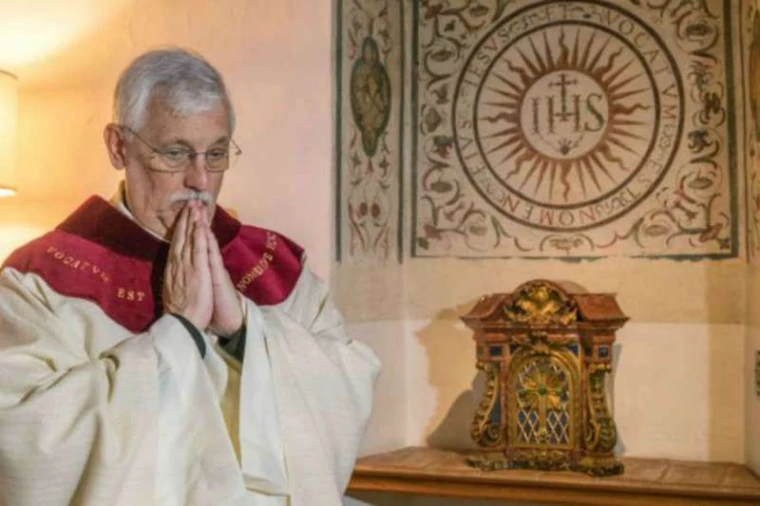
Fr. Arturo Sosa, Superior General of the Society of Jesus, prepares to say Mass at the Gesu in Rome, Oct. 15, 2016. Credit: GC36 via Flickr.
Vatican City, Aug 21, 2019 / 01:44 pm (CNA).- The superior general of the Society of Jesus said Aug. 21 that the devil is a symbol, but not a person.
The devil, “exists as the personification of evil in different structures, but not in persons, because is not a person, is a way of acting evil. He is not a person like a human person. It is a way of evil to be present in human life,” Fr. Arturo Sosa, SJ, said Wednesday in an interview with Italian magazine Tempi.
“Good and evil are in a permanent war in the human conscience and we have ways to point them out. We recognize God as good, fully good. Symbols are part of reality, and the devil exists as a symbolic reality, not as a personal reality,” he added.
Sosa’s remarks came after he participated in a panel discussion at a Catholic gathering in Rimini, Italy, organized by the Communion and Liberation ecclesial movement.
The Catechism of the Catholic teaches that “Satan was at first a good angel, made by God: ‘The devil and the other demons were indeed created naturally good by God, but they became evil by their own doing.’”
“They are personal and immortal creatures,” it adds, who “have intelligence and will.”
Sosa, 70, was elected the Jesuits’ superior general in 2016. A Venezuelan, he has a pontifical licentiate in philosophy and a doctorate in political science. He served as a Jesuit provincial superior in Venezuela from 1996 to 2004, and in 2014 began an administrative role at the general curia of the Jesuits in Rome.
Sosa has offered controversial comments about Satan in the past. In 2017, he told El Mundo that “we have formed symbolic figures such as the Devil to express evil.”
After his 2017 remark generated controversy, a spokesman for Sosa told the Catholic Herald that “like all Catholics, Father Sosa professes and teaches what the Church professes and teaches. He does not hold a set of beliefs separate from what is contained in the doctrine of the Catholic Church.”
Rev. Sosa’s remarks on the devil warrant official response
August 22, 2019
The existence of the devil as a personal reality, and not merely as a symbol of evil, is an article of faith (Ott, Fundamentals 126-131; CCC 395, 2851). Denial of an article of faith is an element of the canonical crime of heresy (1983 CIC 751), an act punishable by measures up to and including excommunication, dismissal from the clerical state, and/or loss of ecclesiastical office (1983 CIC 1364, 194).
Rev. Arturo Sosa, sj, superior general of the Society of Jesus, denies the personal reality of the devil, describes him instead as a symbol of evil, and has expressed such views before (CNA article here, Catholic Herald article here). Protestations of Sosa’s orthodoxy by Jesuit spokesmen notwithstanding, Sosa speaks for himself, and clearly. I think his remarks warrant response, not just from bloggers and scholars, but from those placed in authority over such matters.
There are, I grant, some practical problems: the term “heresy” has been thrown around too loosely for some decades (perhaps for some centuries), the sanctions of excommunication and removal from office are themselves very weighty, and the latae sententiae (automatic) procedures by which such consequences are supposedly visited upon offenders are controversial in theory and practice, such that few in ecclesiastical leadership (including most orthodox members thereof!) wish to “pull the trigger” in such cases and, as a result, utterances such as Sosa’s provoke little, usually no, response from Church leaders with inevitable harm to the faithful.
What to do?
The Pio-Benedictine Code, perhaps alert to the dilemma that all-or-nothing penal canons posed for authority, had an interesting provision that allowed bishops and superiors to take action in likely heresy cases without invoking the full rigors of an excommunication process: 1917 CIC 2315 (see below) established the distinct criminal category of “suspicion of heresy” (my emphasis) that allowed Church authorities to demand formal clarifications and/or retractions from those whose utterances smacked of heresy without immediately requiring them to move to a full prosecution for heresy. If these formal requests for amendment were not heeded, of course, a full heresy case could then be undertaken. There are good discussions of “suspicion of heresy” in the standard commentators. Unfortunately, Canon 2315 of the 1917 Code did not survive into the 1983 Code. Pity, it would have been useful, I think, in a case like Sosa’s.
Even so, the elimination of “suspicion of heresy” as a penal category does not absolve today’s bishops of their duty “to propose and explain to the faithful the truths of the faith which are to be believed” and “to protect the integrity and unity of the faith to be believed” (1983 CIC 386). Indeed bishops are “to exercise vigilance so that abuses do not creep into ecclesiastical discipline, especially regarding the ministry of the word” (1983 CIC 392). It is commonly recognized that the phrase “ministry of the word” is code, if you will, for Church teaching,including her teaching of the personal existence of angels good and bad. An authoritative, direct contradiction of Sosa’s personal, direct errors is warranted, nay, I think required, from those principally responsible for the ministry of the word in their jurisdictions. They are two.
The bishop of the Diocese of Rimini (where Sosa’s made his latest remarks) should by now have “knowledge, which at least seems true, of a delict” namely, heresy, whereupon “he is carefully to inquire personally or though another suitable person about the facts” (1983 CIC 1412, 1717). Failure to act on such information as is available in the public forum would constitute, in my view, a dereliction of governing duty (see 1983 CIC 392, 1389). In addition, the bishop of Sosa’s place of residence is also competent to inquire into the Jesuit’s remarks denying the personal existence of the devil and, for that matter, on some other other topics (1983 CIC 1408). My understanding is that Sosa’s place of residence is Rome.
+ + +
1917 CIC 2315. One suspected of heresy, who, having been warned, does not remove the cause of suspicion, is prohibited from legitimate acts, if he is a cleric, moreover, the warning having been repeated without effect, he is suspended from things divine; but if within six months from contracting the penalty, the one suspected of heresy does not completely amend himself, let him be considered as a heretic, and liable to the penalties for heretics. (My trans.)
You are not signed in as a Premium user; we rely on Premium users to support our news reporting. Sign in or Sign up today!
Anger is rising in western New York, as the embattled Catholics of Buffalo learned that just days ago, their bishops may have denied them an avenue of grace by refusing to investigate a possible eucharistic miracle.
On Friday, Church Militant spoke with one disaffected Catholic of the diocese, Mary Ellen Sanfilippo, about extraordinary events that began unfolding in late November at St. Vincent de Paul Catholic Church in Springbrook, New York.
Sanfilippo said that a consecrated host was accidentally dropped on the floor of the church during Mass. Retrieving the host, a deacon submerged it in an ablution cup and placed it inside the tabernacle for later disposal. On November 30, the host, still inside the water-filled receptacle, was discovered exuding a deep red substance that appeared to be blood. They ordered Fr. Loeb to dispose of the host, and though extremely reluctant to do so, the priest, bound by his oath of obedience, complied.Tweet
Once photographs of the host were taken, Fr. Karl Loeb, pastor at the parish, immediately notified Bp. Richard Malone and his auxiliary, Bp. Edward Grosz, about the incident. Instead of ordering an investigation into the phenomenon — as is proper — the two bishops claimed the host had already dissolved and that therefore “Christ was no longer present.”
Across the United States, diocese after diocese is staggering under the weight of moral corruption and the legacy of sex abuse cover-up. But Buffalo, careening from scandal to scandal, has distinguished itself as an especially troubled case. Sanfilippo belongs to a group of concerned Catholics who meet regularly to pray and discuss how to combat the crisis engulfing their diocese. She explained that the collective, numbering roughly 100 faithful from various parishes, is trying to fight the rot in Buffalo by “making our voices heard.” Among the group’s members are parishioners from St. Vincent de Paul, and it was from them that she learned what Malone and Grosz had done.This was yet another case of abuse — eucharistic abuse.Tweet
“They lost no time whatsoever in throwing the host away,” she said. “This was yet another case of abuse — eucharistic abuse.”
Side view of St. Vincent de Paul host
Sanfilippo acknowledged that the red material seeping from the consecrated host may have been a purely natural substance. But she is dismayed that the Catholics of Buffalo were denied the opportunity to determine its origin by order of their bishops.
“I am absolutely outraged by what has happened in our diocese,” she said. “The Eucharist is the center of the Catholic belief system, something of great importance that you don’t throw away.”
Sanfilippo was so upset, in fact, that she contacted the chancery for answers.
“Bishop Malone doesn’t talk to anyone,” she said. “He hides from people.”
But Sanfilippo has known Grosz for two decades, so she contacted him to demand why he had refused to preserve the sacred host for investigation.
Grosz attributed the final decision to Malone. Grosz told Sanfilippo he was “very reluctant” to give his personal opinion on the possibility of a miracle, and said he was compelled to back Malone’s decision.
Sanfilippo pressed him as to why he wouldn’t push for an inquiry, why he wouldn’t even entertain the possibility that a miracle may have occurred.
“Why would you take that chance?” she asked.
“Christ was no longer present,” Grosz claimed, saying the host had already dissolved. Photos show, however, that the sacred host had not dissolved.
Grosz refused to even look at the photographs.Grosz attributed the final decision to Malone.Tweet
Sanfilippo hopes other Catholics will contact the Buffalo chancery, as she did, to call Malone and Grosz to account for depriving their flock of what may have been a tremendous, sorely needed grace. In the meantime, she and others in her group are working to spread word of the events of the past two weeks.
“All Catholics in the diocese need to know this happened,” she said.
Top view of St. Vincent de Paul host
As news of the bishops’ order spreads, more and more diocesan faithful are expressing dismay.
On Thursday’s edition of The World Over, EWTN’s Raymond Arroyo interviewed two Buffalo Catholics about the incident: Lisa Benzer, director of religious education at St. Vincent de Paul; and former parishioner Mike Denz, director of catechesis and evangelization at the Sacred Heart of Jesus Shrine in Bowmansville, New York.
Benzer saw the scarlet-stained host up close before the bishops ordered it to be destroyed, and recounted its profound effect on her.
“I kneeled [sic] down to the ground and I was in awe,” she recalled. “It was absolutely fantastic to me. It was so simple but so majestic at the same time.”
Denz testified to the spiritual impact of the phenomenon. “It has had an effect on people,” he said, noting that “there are several people from St. Vincent’s that are affected just by seeing the pictures.”
“And all the people that I’ve talked to in person and on social media were affected … and were very disappointed that [the host] was disposed of instead of looked into,” he added.
“A bishop is responsible for investigating things like this in his diocese … that’s what bishops normally do,” he noted. “They will look into anything that looks like it might be a credible miracle. So, it was surprising to see that they didn’t even want to see it.”
Denz called the premature disposal of the host “a missed opportunity.”
“Something like this obviously is done by Christ to draw people closer to Him, to help to solidify peoples’ faith,” he explained. “And if this indeed was a eucharistic miracle, this is a missed opportunity, and I have no idea why it wasn’t investigated.”By revealing the Real Presence — the Body, Blood, Soul and Divinity of Jesus Christ — God is bringing attention to His Presence, here.Tweet
Sanfilippo accused Malone and Grosz of lacking “spiritual faith” for refusing even to entertain the possibility of a miracle. If an investigation had determined that the phenomenon were of supernatural origin, Sanfilippo argued that an affirmation of the Real Presence amid scandal and loss of faith in Buffalo be an indictment against the bishops themselves.
Since the eighth century, the Church has recognized more than 130 eucharistic miracles — the most recent occurring in Poland in 2013. According to Dr. Pawel Skibinski, director of the John Paul II Museum in Warsaw, most cases manifested when a consecrated host was stolen, discarded or abandoned and forgotten — or during periods when doubts about the Real Presence were on the rise.
Faithful observers are suggesting it seems apt, therefore, that a eucharistic miracle may have occurred in one of the most troubled dioceses in the country. As a swelling stream of Catholics leave the Church in Buffalo, those that remain see the hand of God in the phenomenon at St. Vincent de Paul.
Benzer told EWTN’s Arroyo:
I do believe that Jesus had a message for all of us. And that message is of hope, of love. And I believe that He presented Himself in a way that was tangible for all people, so that people would come to Him. And I believe He was saying on the Feast of St. Andrew … “Come and see. Come and see what I have in store for all of My people.” In a time now where people are disgruntled with the Catholic faith, there’s many people who have left the Church. However, Jesus is saying, “I am your leader. I am your master. Come to Me and I will give you rest.”
Sanfilippo agreed. “Many people are losing faith,” she told Church Militant. “By revealing the Real Presence — the Body, Blood, Soul and Divinity of Jesus Christ — God is bringing attention to His Presence, here.”
“He is present, not only in the Eucharist, but He is with us every day,” she added. “And He is with us still, even now, here in Buffalo.”
About one in three US Catholics understand and believe that this is the Body and Blood of Christ, as their Church teaches (Word On Fire video screengrab)
Let’s remind ourselves of the tenets of Moralistic Therapeutic Deism, which Notre Dame sociologist of religion Christian Smith says is the de facto religion of American youth. He said that in 2005, but I think now we can say (and probably could have said back then) that it is the de facto religion of the American people:
+ A God exists who created and ordered the world and watches over human life on earth. + God wants people to be good, nice, and fair to each other, as taught in the Bible and by most world religions. + The central goal of life is to be happy and to feel good about oneself. + God does not need to be particularly involved in one’s life except when God is needed to resolve a problem. + Good people go to heaven when they die.
Transubstantiation – the idea that during Mass, the bread and wine used for Communion become the body and blood of Jesus Christ – is central to the Catholic faith. Indeed, the Catholic Church teaches that “the Eucharist is ‘the source and summit of the Christian life.’”
But a new Pew Research Center survey finds that most self-described Catholics don’t believe this core teaching. In fact, nearly seven-in-ten Catholics (69%) say they personally believe that during Catholic Mass, the bread and wine used in Communion “are symbols of the body and blood of Jesus Christ.” Just one-third of U.S. Catholics (31%) say they believe that “during Catholic Mass, the bread and wine actually become the body and blood of Jesus.”
Get this: only 50 percent of those surveyed even know that the Catholic Church teaches transubstantiation! Of that number, 28 percent believe the church’s teaching, but 22 percent reject it. That means slightly more than one in four American Catholics both know and accept the teaching of the Catholic Church on one of its most important, fundamental teachings.
Read the whole thing. For people outside the sacramental churches, especially the Catholic and Orthodox churches, it is impossible to emphasize strongly enough how devastating this finding is. Eucharistic theology is at the core of our understanding of reality.
FAIRFIELD, Pennsylvania, August 13, 2019 (LifeSiteNews) – In an age where religious professions are in decline, especially in the United States, one order is looking back in time to buck the trend. The Discalced Carmelites have turned from the modern Church’s reforms of the 1960s and embraced ancient traditions – particularly the traditional Latin Mass. Now their order is booming, with multiple at-capacity monasteries dotting the eastern U.S.
Since 2000, the Carmelites have been faced with the sort of challenge many religious orders pine for: a boom in vocations. In that year, the nuns moved into the monastery at Elysburg, Pennsylvania from their original home in Nebraska, which they soon outgrew. They were thus granted permission to take over another declining Carmelite monastery, the Carmel of St. Joseph and St. Anne, in Philadelphia — and filled that one with vocations as well. So finally, with the community having overflowed its lodgings twice, the Carmelites received permission last summer from His Excellency Ronald Gainer, bishop of the Diocese of Harrisburg, to expand operations again, this time constructing a new monastery from the ground up.
That’s how the Carmel at Fairfield, still under construction but already in operation, was born.
Women interested in a life with the cloistered Carmelites must meet a number of qualifications. Postulants need a high school education and to be in good health, coming in at an age range of 17 to their late twenties — though Mother Stella-Marie of Jesus, who heads the Fairfield monastery, told LifeSiteNews that inquirers tend to be between 17 and 24.
Currently, the monastery at Fairfield has ten professed members, with more on the way from around the globe, including as far as Sweden.
The cloistered nuns at the Carmel in Fairfield close themselves off from the world and devote the rest of their lives to strict silence, arduous labor, and prayer. Once they profess their vows, their faces may not be seen in photographs until after they die. When LifeSiteNews traveled to Pennsylvania to profile the monastery, Mother Stella gave her interview from behind a heavy grate – the same grate through which the Carmelites are permitted to speak to their family members a single time per year.
“I think the young women are drawn to beauty in the liturgy. They know that if God exists, if God is on our altars, if God is within the Holy Sacrifice of the Mass, then He needs to be worshiped as He deserves: with beauty and reverence,” she said of what she thinks draws young women to the Carmelites in particular. “They see that we have that here in our monastery, and they want to be a part of that. They also want something that is authentic, that goes back to the time of our holy mother, St. Teresa.”
St. Teresa of Avila (1515–1582), whom the Carmelites revere as their patroness, is one of the order’s most distinguished saints. A famous mystic and foundress of many Carmelite houses, she also wrote the famous works The Way of Perfection and The Interior Castle. Pope Gregory XV canonized her in 1622, and Pope Paul VI declared her a doctor of the Church in 1970.
“One of the unique aspects of our monastery,” Mother Stella elaborated, “is that we do have the extraordinary form of the Mass. We also have the traditional Divine Office. We pray the Office in Latin. We have permission also to pray the traditional form of the Carmelite Office, and young women are very much drawn to that.”
The Carmelites had always had the Latin Mass up until the Second Vatican Council, Mother Stella told LifeSiteNews, so the transition back to form was “like hand in glove.” She said, “As soon as we took on the extraordinary form of the Mass and we returned to the traditional Carmelite rite, just everything made sense. All of our customs — we understood why we had them, because they all flowed from the liturgy, whereas before that, there had been a disconnect there.”
Re-embracing the traditional Mass, Mother Stella explained, effected a “complete explosion of grace and joy for the sisters.” The nuns switched from the Novus Ordo in 2000, “and ever since then, we’ve had a great increase in vocations, and the spirit of the community has been one of joy and growth in the spiritual life.”
With the Church’s ancient liturgy and traditions now firmly ensconced in the order, “young women are writing, are knocking at the door to enter,” said Mother Stella. “The growth is very clear and very palpable.”
Nor should the Latin Mass remain confined to the monasteries, Mother Stella insisted. On the contrary, “it should flow out into the world. And it starts with the monasteries, and then it will flow out to families, and even to the parish life also.”
Per their website, the Fairfield Carmelites “are building a monastery to last the ages.” The project comprises only “authentic materials” — “stone masonry, timber framing, slate, plaster, and reclaimed wood for flooring.” Justin Money, a skilled stonemason and the project’s supervisor, explained to LifeSiteNews that the techniques involved in the monastery’s construction are meant to last centuries. They also take a long time.
“There are very few modern innovations that are able to speed up our work here,” Money said. “Every stone has to be individually selected, shaped, and placed on the wall. That essential act of choosing the next stone, dressing it, and fitting it in — we’re doing the exact same thing that people did when they were building Notre Dame.”
The painstaking nature of the construction makes for a good parallel to the ancient liturgies and customs that will fill the monastery when it’s finished. The buildings’ endurance speaks to the rootedness of Catholics and their traditions in the land, spanning generations of continuous, unbroken worship.
“This is the first of hundreds of thousands, perhaps millions of stones,” Money explained, “that stonemasons will lay on this monastery long after I’m dead. What a privilege to be there at the start, to be part of a vision that is going to continue well past my lifetime. I hope that my grandchildren, my great-great-grandchildren will come to this monastery long after I’m gone and say, you know, ‘Our great-grandpa played a part in this.’”
Mother Stella did not mince words regarding the importance of the contemplative orders. She told LifeSiteNews that the Carmelites follow the example set forth by Christ in chasing a demon from a possessed child whom His disciples could not cure. In Matthew 17:21, Christ admonishes his followers, saying, “[T]his kind is not cast out but by prayer and fasting.”
“Here our Lord was extolling the monastic life,” Mother Stella explained. “Young women know that there are certain evils out in the world that can only be healed in this way — just through prayer and through fasting.”
In the Body of Christ, Mother Stella declared, “the missionaries are the hands and the feet, and they do all the very hard manual labor — but they could never do what they do without the heart. And the heart of the Church is the contemplative life.”
What, LifeSite asked, would happen if the contemplative orders were to vanish, as, indeed, many orders today are? Mother Stella responded from behind the grate: “I think that there would be a complete collapse of the faith throughout the whole world if there wouldn’t be the contemplative monasteries to be praying for those out in the world who are striving to convert souls to Christ. It would be absolutely impossible.”
Posted inUncategorized|Comments Off on THE LATIN MASS PRODUCES VOCATIONS TO THE PRIESTHOOD AND RELIGIOUS LIFE





You must be logged in to post a comment.