
-
Join 1,475 other subscribers
Archives
- April 2025
- March 2025
- February 2025
- January 2025
- December 2024
- October 2024
- September 2024
- August 2024
- July 2024
- June 2024
- May 2024
- April 2024
- March 2024
- February 2024
- January 2024
- December 2023
- November 2023
- October 2023
- September 2023
- August 2023
- July 2023
- June 2023
- May 2023
- April 2023
- March 2023
- February 2023
- January 2023
- December 2022
- November 2022
- October 2022
- September 2022
- August 2022
- July 2022
- June 2022
- May 2022
- April 2022
- March 2022
- February 2022
- January 2022
- December 2021
- November 2021
- October 2021
- September 2021
- August 2021
- July 2021
- June 2021
- May 2021
- April 2021
- March 2021
- February 2021
- January 2021
- December 2020
- November 2020
- October 2020
- September 2020
- August 2020
- July 2020
- June 2020
- May 2020
- April 2020
- March 2020
- February 2020
- January 2020
- December 2019
- November 2019
- October 2019
- September 2019
- August 2019
- July 2019
- June 2019
- May 2019
- April 2019
- March 2019
- February 2019
- January 2019
- December 2018
- November 2018
- October 2018
- September 2018
- July 2018
- June 2018
- May 2018
- April 2018
- March 2018
- February 2018
- January 2018
- December 2017
- November 2017
- October 2017
- September 2017
- August 2017
- July 2017
- June 2017
- May 2017
- April 2017
- March 2017
- February 2017
- January 2017
- December 2016
- November 2016
- October 2016
- September 2016
- August 2016
- July 2016
- June 2016
- May 2016
- April 2016
- March 2016
- February 2016
- January 2016
- December 2015
- November 2015
- October 2015
- September 2015
- August 2015
- July 2015
- June 2015
- May 2015
- April 2015
- March 2015
- February 2015
- January 2015
- December 2014
- November 2014
- October 2014
- September 2014
- August 2014
- July 2014
- June 2014
- May 2014
- April 2014
- March 2014
- February 2014
- January 2014
- December 2013
- November 2013
- October 2013
- September 2013
- August 2013
- July 2013
- June 2013
- May 2013
- April 2013
- March 2013
- February 2013
- January 2013
- December 2012
- November 2012
- October 2012
- September 2012
- August 2012
- July 2012
- June 2012
- May 2012
- April 2012
- March 2012
- February 2012
- January 2012
- December 2011
- November 2011
- October 2011
- September 2011
- August 2011
- July 2011
- June 2011
- May 2011
- April 2011
- March 2011
- February 2011
- January 2011
- December 2010
- November 2010
- October 2010
- September 2010
- August 2010
- July 2010
- June 2010
- May 2010
- April 2010
- March 2010
- February 2010
- January 2010
- December 2009
- November 2009
- October 2009
- September 2009
- August 2009
- July 2009
- June 2009
- May 2009
-
Recent Posts
- REFLECTIONS BY VICTOR DAVIS HANSON ON THE COUNTER-REVOLUTION
- The Church’s conscience must always be clear in examining any conflict between the Divine and natural law when justifying the acceptance of government aid and largesse.
- THE PATRIOT POST SCORES AGAIN
- THIS IS TOO IMPORTANT FOR YOU TO NOT READ IT
- MY LAST COMMENT ON THIS!!!
Top Posts & Pages
- AN OPEN LETTER TO THE CARDINALS OF THE HOLY ROMAN CATHOLIC CHURCH AND OTHER CATHOLIC CHRISTIAN FAITHFUL IN COMMUNION WITH THE APOSTOLIC SEE
- STAY STRONG IN THE FAITH EVEN IN THE FACE OF PERSECUTION FROM THE 'SHEPHERDS' OF THE CHURCH
- BY THEIR WORKS YOU SHALL KNOW THEM
- ARCHBISHOP VIGANO ADDRESSES A LETTER TO THE CITIZENS OF THE United States
- WATCH
- NARCISSISTS NEED PEOPLE
- HOMILY FOR THE FIFTH SUNDAY OF EASTER - cycle A
- DHS Secretary Kirsten Nielsen: ""10,000 of the 12,000 [ children "in the care of HHS right now"] were sent here alone by their parents." SNATCHING, WHAT SNATCHING ???
- SIMONE ARIANNE BILES, A CATHOLIC HOME-SCHOOLER WE CAN ALL BE PROUD OF !!!
- WHY DO INTELLIGENT MEN PURSUE THE APPLICATION OF AN OBSOLETE CONCEPT "UNIVERSAL ACCEPTANCE" TO THE PROBLEM OF THE INVALIDITY OF THE PAPACY OF FRANCIS THE MERCIFUL IN THIS DAY AND AGE OF INSTANT ELECTRONIC COMMUNICATION AROUND THE WORLD
Top Clicks
SEEDS OF H0PE THAT THE INSTITUTIONAL CHURCH WILL SURVIVE THE COMING WINTER
Posted in Uncategorized
2 Comments
senator cruz rocks
Cruz Rocks the House

| Inbox | x |
| Susan Kruger | Aug 6, 2019, 8:31 PM (20 hours ago) | ||
| to Susan |
Cruz Rocks The House: Universities ‘Trying Really Hard To Raise A Generation Of Pansies’
By Hank Berrien
August 6, 2019
Sen. Ted Cruz (R-TX) rocked the room at the Young America’s Foundation National Conservative Student Conference last week, ripping universities and colleges for “trying really hard to raise a generation of pansies.”
Cruz’s biting remarks were triggered by the first question after his speech, when he conducted a Q&A. A student from Binghamton University got the ball rolling. He stated:
Hi, Senator Cruz. It’s a pleasure to meet you. … I compete in parliamentary debates. However, in tournaments, well-intentioned but misguided policies about political correctness have been quashing freedom of speech and our free expression of ideas. It is incredibly frustrating, but it seems to be a microcosm of what’s going on in our national dialogue. Do you have any prescription of how we can improve our level of discourse at the local and national level to restore the meaningful and important conversations that have been combining to make our democracy as great as it is?
Cruz replied, “Elaborate a little bit on how political correctness is impacting college debate.”
The student answered, “I’d love to. So at the beginning of every round, for us to write our gender pronouns on the board. It gets a little bit worse; if our cases are a little bit edgy, we have to ‘trigger-warn’ before each round; if we say something —”
At this point Cruz bent over and put his head in his hands, eliciting laughter.
The student continued, “If we say something a little bit too offensive, we can get equity-called and then kicked out of the tournament and shunned by the league. And then also, they have ‘gender-minority’ tournaments, where men are just banned from competing entirely.”
Cruz then provoked hilarity, shaking his head sadly and intoning, “We’re all gonna die.” After the laughter and applause subsided, he continued, “One of the saddest things we’re seeing is our colleges and universities are trying really hard to raise a generation of pansies. What is this sense that you have a right not to be offended? You have a right not to hear ideas that are scary? Look, the entire purpose of university is to hear ideas that are scary.”
That prompted another ovation.
Cruz continued, “I talked about being a happy warrior, not a daisy-wearing daffodil priest. It really is not that frightening; when I went to college, when I went to law school I was surrounded by leftists; I took classes from Marxists, and by the way, I don’t find Marxism just sort of cute and chic. A guy down the hall from me sophomore year in college had a poster of Che Guevara; I remember going into his dorm room and saying, “Hey man, that’s really cool; that’s so awesome. Have you thought about maybe putting a Hitler next to it? Maybe Mao? Stalin? Listen, if you’re gonna celebrate evil torturing murdering, sons-of –bitches, really, Che was an amateur. There are much worse guys to pick from.”
That brought the house down.
https://www.dailywire.com/news/50293/cruz-rocks-house-universities-trying-really-hard-hank-berrien
Posted in Uncategorized
1 Comment
CORRUPTIO OPTIMI PESSIMI. THE FALL FROM THE STATE OF GRACE BY THE ‘BEST’ AMONG US IS THE WORST THING THAT CAN HAPPY IN THE MINDS OF YOUNG IDEALISTIC MEN (AND WOMEN) IN OUR SOCIETY. HERO ‘WORSHIP’ TAKES MANY FORMS FOR SOCIETY’S YOUTH. THE FALL FROM GRACE OF MANY ADULTS PREVIOUSLY HELD IN HIGH ESTEEM BY THE NATIONS YOUTH IS HAVING A DISASTROUS EFFECT ON MANY OF OUR YOUTH WHO LOOK WITH GROWING UNEASE AT A WORLD THEY WILL INHERIT FROM A GENERATION THEY ARE DISCOVERING IS CORRUPT AND IS PAYING ONLY TOKEN RESPECT TO THE VALUES IT PREACHES TO THEM.
Readers sound off on why young American men are so angry
July 31, 2019 | 10:56pm | Updated Enlarge Image

Shutterstock
MORE FROM:
MAUREEN CALLAHAN

Angry young men continue to be America’s greatest threat
Don’t let The New Yorker get away with its brazen Al Franken hypocrisy
In the #MeToo era, it’s time to revisit Ted Kennedy’s legacy
Prince Andrew’s ties to Jeffrey Epstein could become the most sordid royal scandal yet
How a Vermont couple ended up in a serial killer’s gruesome chain of carnage
On Tuesday, in the aftermath of the Gilroy Garlic Festival mass shooting — committed, as such carnage overwhelmingly is, by a young man — I ran a column asking one question: Why are young American men so angry?
Emails came pouring in from all over the country, men (and some women) of all ages, offering their thoughts as to what’s behind this epidemic.
What almost all have in common is a belief that the root causes go beyond gun control or violence in the media or first-person shooter games or easy access to hard-core pornography or virtual social lives that allow like-minded youth to interact only with those who stoke and reinforce resentment and anger.
In fact, most of these readers believe that what we’re seeing today, with alarming regularity, is a result of a decades-long erosion — in education, in popular culture, in the family and the workplace and society at large — in the way we now raise and regard boys and young men. Many pointed to the relatively new buzz phrase “toxic masculinity” as emblematic of the liberal and media elite’s reflexive contempt, one with real-world, trickle-down consequences.
This most recent shooter, in a since-deleted Instagram post, identified himself as Italian and Iranian, and had also encouraged others to read “Might is Right,” a 1890 tract popular with white supremacists. This has, tragically, become far too common: disenfranchised young men flocking to white supremacy, or the Proud Boys or other racist or radical groups; finding strength in numbers, an outlet (for a time), and groups of others — be they women or minorities — to blame.
To that point, some readers blamed women: feminists, women who choose work over devoting themselves as wives and mothers, single mothers for not providing male role models. This is not far afield from the warped perception of the so-called incel community, those young men who blame the other sex for their involuntary celibate status. 00:30 / 00:30TOP ARTICLES3/5READ MORE‘CHASING THE CURE’ LETS PATIENTS CROWDSOURCE A DIAGNOSIS
I initially wrote that what we’re living with, as a nation, is now treated more as a chronic illness to be tolerated rather than solved and eradicated. That our greatest threat isn’t Islamic terrorism or Russian hacking or immigration but our own angry young men, who now unleash their rage on unsuspecting civilians with terrifying regularity.
What have we done to cause this? What can we do to stop it? Consider a few of these impassioned replies.
I am 58 years old, farm born and raised, a US Air Force veteran.
In your column, you say the moon landing 50 years ago was one of the great triumphs of humanity — unless you also recall the opinions expressed by the media last week.
For example, The Washington Post tweeted, “The culture that put men on the moon was intense, fun, family-unfriendly, and mostly white and male.”
They weren’t alone, as The New York Times and the UK Guardian echoed the same sentiment.
The moon landing was, to paraphrase, racist.
SEE ALSO
Angry young men continue to be America’s greatest threat
And then you write an opinion piece asking why young white men are so angry? Where do young men get a chance to do something they can be proud of? The DNA of men is to do stuff, to build things, to put themselves to the test.
These days, the majority of students in college are women and the men who do attend are subject to crap classes such as women’s studies. Other courses are designed to kill their souls and re-educate their brains to default to a sense of guilt because everything done by white men (Columbus, Washington, R.E. Lee, for example) was evil.
Activities that used to be common to young boys while growing up (playing “cowboys and Indians,” learning how to change a tire on a car, hunting game in the outdoors) are now harshly discouraged.
Today’s cure for letting boys be boys is to medicate them instead of redirecting their energies.
This culture and society made boys and young men the enemy. This does not excuse the actions of those who fall prey to evil thoughts and act on them; but asking why young men perform heinous acts?
They don’t know how to grow up to be men of honor.
— Tom Geistkemper, Blairstown, Iowa
I’m scared for our society.
I’m a 61-year-old PhD social scientist, a third-generation teacher, a teacher who works with BD — behavioral development Special Ed students. I don’t have all the answers. This isn’t a bumper sticker solution.
I’ve served as a union steward protecting females and people of color. I have witnessed individuals from both minority groups being bullied, harassed, mistreated and subject to #MeToo-type sexual harassment. We have programs and official action to combat these injustices.
MORE ON:
MASS SHOOTINGS
Former classmate says Dayton shooter was pro-gun control, ‘definitely leaned to the left’
Dayton shooter Connor Betts held gun to friend’s head 5 months ago: report
Trump calls for mental-health laws, not gun control
Obama condemns white nationalism in response to mass shootings
I’ve spent my career in service to providing equal opportunity for people, but I can see and feel resentment now from men. There’s a pushback. 99.9% are simply expressing frustration. But a small percent will lash out.
I can’t speak further to the Garlic Festival murders, yet as a professional social scientist, I can’t reject this hypothesis:
If white males feel excluded from society, would they seek out groups that historically defend or champion the supremacy of white males?
This shooter hadn’t demonstrated any childhood behavior to suggest a violent nature. He seems relatively calm and decent. Something changed. All of a sudden, this young man is searching White supremacist literature and groups on the Internet.
What has “broken” in him? Is he feeling alienated? Is he feeling pushed to the margins?
If so, who protects him? White Supremacists groups could fill his psychological emptiness.
This scares me. The shooter hit a soft target. Nobody is safe and we have millions of guns in America. A Japanese man recently sprayed a room of people with gasoline. There are too many ways to harm.
We might be lighting fuses everywhere.
— Scott Goold, Honolulu, Hawaii
Why are we angry?
Let me share my story.
I work a corporate job that routinely demands 70-plus hours a week. I barely have time to think, much less take care of myself mentally and physically. I am so burned out I can barely handle life anymore. I am 43.
I am constantly told how I am wrong at work.
I am seeing on the Internet that white men are toxic. It’s in the popular culture.
I’m a Democrat, and frankly the anti-white rhetoric has gotten ME angry.
I’ve been passed up for several promotions for applicants who were less qualified but met race and gender preference criteria — also known as, not a white male.
It’s not a good time to be one. I can only imagine what a young man who hasn’t established himself yet is going through.
Let me be clear … I do NOT advocate what any of these idiots have done, when they commit acts of violence. I just understand the anger. They feel that society rejects them and that they have no use, purpose or reason to exist. Add in some mental health issues and it’s a recipe for disaster. Men do not know how to deal with their emotions. White men in particular cannot handle situations where they feel helpless for very long. If these situations are real or imagined, they have very real feelings that society has backed them into a corner.
— Jason Reynolds, Orlando, Fla.
I wonder if an element stoking that anger is how poorly, in general terms, men are portrayed on television. From sitcoms to the majority of commercials, men, both black and white, are often portrayed as bumbling and not-too-bright. Beer and pickup truck commercials generally notwithstanding.
— Ben Carlson, Lexington, Ky.
I am a 48-year-old male. I am a counselor for, mostly, males in their late teens. I have been for years. Every one of them is angry. Each and every one.
Their biggest gripe: They do not feel like anyone notices them. Hears them.
The men and boys I work with regularly communicate to me that they feel disconnected from, and unimportant to, their parents. They do not feel seen or heard; their parents are off in their own worlds.
I cannot adequately articulate to you the relief they experience simply from my listening to them talk. I ask basic questions they’re not accustomed to answering, because they’ve not been asked:
“What do you think of school?”
“What is your experience at home like?”
SEE ALSO
Garlic festival shooter said he attacked ‘because I’m very angry’: witness
“What do you look forward to in life?”
One might assume that by the time a man is in his early 20s, someone in his family has asked him these kinds of things.
There are no positive male role models. Countless clients have told me, for example, that they believe all men cheat on their wives because their fathers cheated. That men lie. Are not loyal, etc. Our current culture offers little aid.
When I was a boy, we watched “Little House on the Prairie” and our president (Jimmy Carter) was mocked for being horny for his own wife. Today it’s “Game of Thrones” and a president with, at least the perception of, a reputation that is vastly different from that. It is not political. It is spiritual.
Moreover, if you asked young children which they would prefer — a parent looking at them or a parent on a cellphone —what do you think they would pick?
No wonder young men don’t feel seen. They’re not.
If I were a teenage boy today, I would be furious. Anyone want to tell me what we’ve given them to look forward to? Who we’ve given them to look up to?
Are we all too selfish to see this?
— Thornhill Loomis, Thousand Oaks, Calif.
Are you serious? You don’t know why white males are angry?
They are passed over for college admissions, even though they have the highest scores. They are the enemy of every equality/equity program. They work the hardest and get the least in order to promote females and every other race. They are the bottom of the barrel in college entrance and job applications, and it is okay to mock and deny them equality.
My 28-year-old son is moving next week to Japan and has no plans to return to the US. Two nephews and one neighbor at the top of their classes are going to Europe for medical school.
Leftists have done this to America’s young men — it is open season on white males.
— Deborah Adams, Mukilteo, Wash.
Billy Joel put words to this phenomenon in the 1970s, but maybe times were different then: “There’s a place in the world for the angry young man, with his working class ties and his radical plans.”
Maybe the young men of today are more violent because of first-person shooter video games and online porn; maybe the keyboard warriors find that anger manifesting itself into action.
But maybe today there isn’t a place in the world for them. Not that this excuses these horrific actions, but maybe it helps explain them?
You take away one’s right to exist or place and some don’t go down without a fight, or a slaughter, in these cases.
I’m a father of three very young boys, a combat veteran, a former “angry young man” and I’m concerned about where this goes from here.
One thing that really just struck me as I’m composing this e-mail is this isn’t manly behavior at all. I’m 46, and in Iraq I saw 18-year-old paratroopers, men, do things that would make our forefathers proud.
At the same time, these “angry young men” don’t deserve the title of man at all. Punks. Call them punks.
This isn’t a gender/race problem. It’s societal.
— Stephen Kraft, Raleigh, NC
Posted in Uncategorized
Comments Off on CORRUPTIO OPTIMI PESSIMI. THE FALL FROM THE STATE OF GRACE BY THE ‘BEST’ AMONG US IS THE WORST THING THAT CAN HAPPY IN THE MINDS OF YOUNG IDEALISTIC MEN (AND WOMEN) IN OUR SOCIETY. HERO ‘WORSHIP’ TAKES MANY FORMS FOR SOCIETY’S YOUTH. THE FALL FROM GRACE OF MANY ADULTS PREVIOUSLY HELD IN HIGH ESTEEM BY THE NATIONS YOUTH IS HAVING A DISASTROUS EFFECT ON MANY OF OUR YOUTH WHO LOOK WITH GROWING UNEASE AT A WORLD THEY WILL INHERIT FROM A GENERATION THEY ARE DISCOVERING IS CORRUPT AND IS PAYING ONLY TOKEN RESPECT TO THE VALUES IT PREACHES TO THEM.
PERHAPS THERE IS REALITY TO THE APPEARANCE THAT Jesus Christ HAS ABANDONED HIS CHURCH IN THE PRESENT MOMENT OF CRISIS IN THE CHURCH IF IT IS TRUE THAT JUST ONE-THIRD OF U.S. CATHOLICS BELIEVE THAT THE BREAD AND WINE CONSECRATED BY THE PRIEST AT MASS REALLY BECOMES HIS BODY AND BLOOD. PERHAPS THAT IS ONE OF THE FACTORS WHICH EXPLAINS WHY JESUS HAS PERMITTED SO MANY BAD MEN TO ASSUME THE ROLE OF SHEPHERD IN THE CHURCH. THE BLIND NOW LEAD THE BLIND. WE KNOW WHERE THAT WILL END. MAYBE IT WOULD HELP YOU IF YOU SPENT SOME TIME IN ADORATION OF JESUS IN THE TABERNACLE TOMORROW AND THE NEXT DAY AND THE NEXT DAY………
AUGUST 5, 2019
Just one-third of U.S. Catholics agree with their church that Eucharist is body, blood of Christ
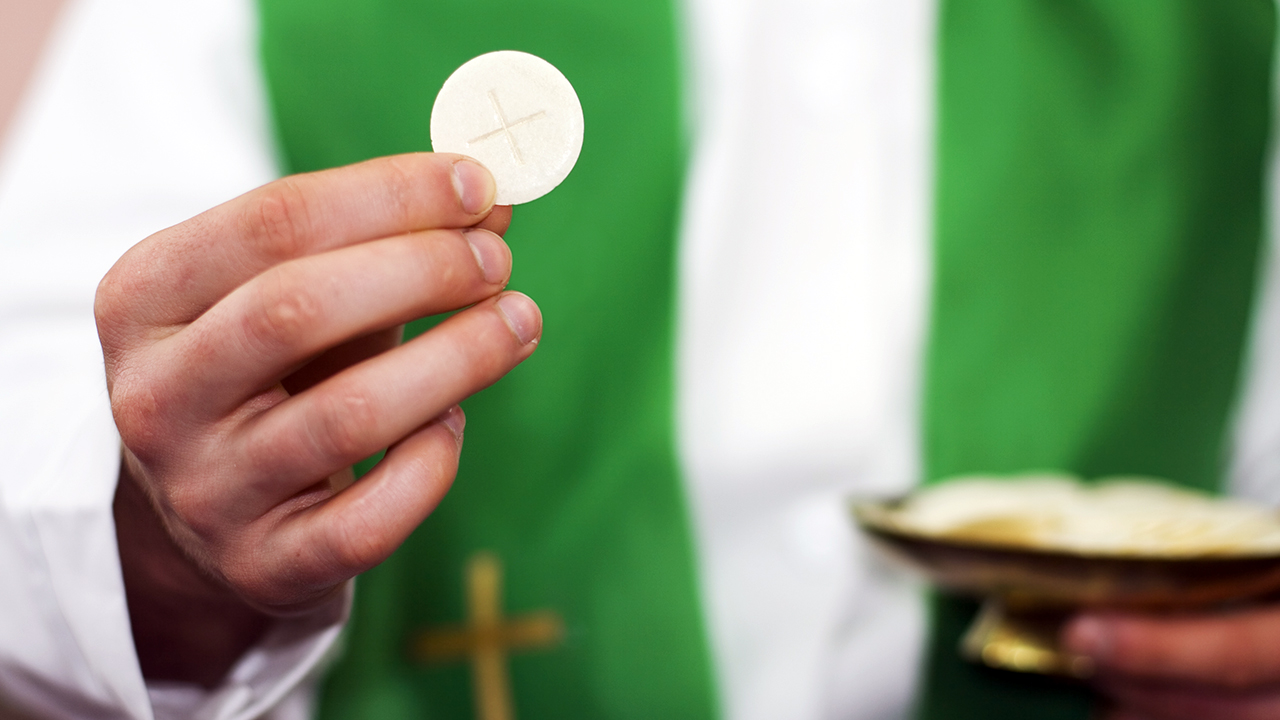
Transubstantiation – the idea that during Mass, the bread and wine used for Communion become the body and blood of Jesus Christ – is central to the Catholic faith. Indeed, the Catholic Church teaches that “the Eucharist is ‘the source and summit of the Christian life.’”
But a new Pew Research Center survey finds that most self-described Catholics don’t believe this core teaching. In fact, nearly seven-in-ten Catholics (69%) say they personally believe that during Catholic Mass, the bread and wine used in Communion “are symbols of the body and blood of Jesus Christ.” Just one-third of U.S. Catholics (31%) say they believe that “during Catholic Mass, the bread and wine actually become the body and blood of Jesus.” In addition to asking Catholics what
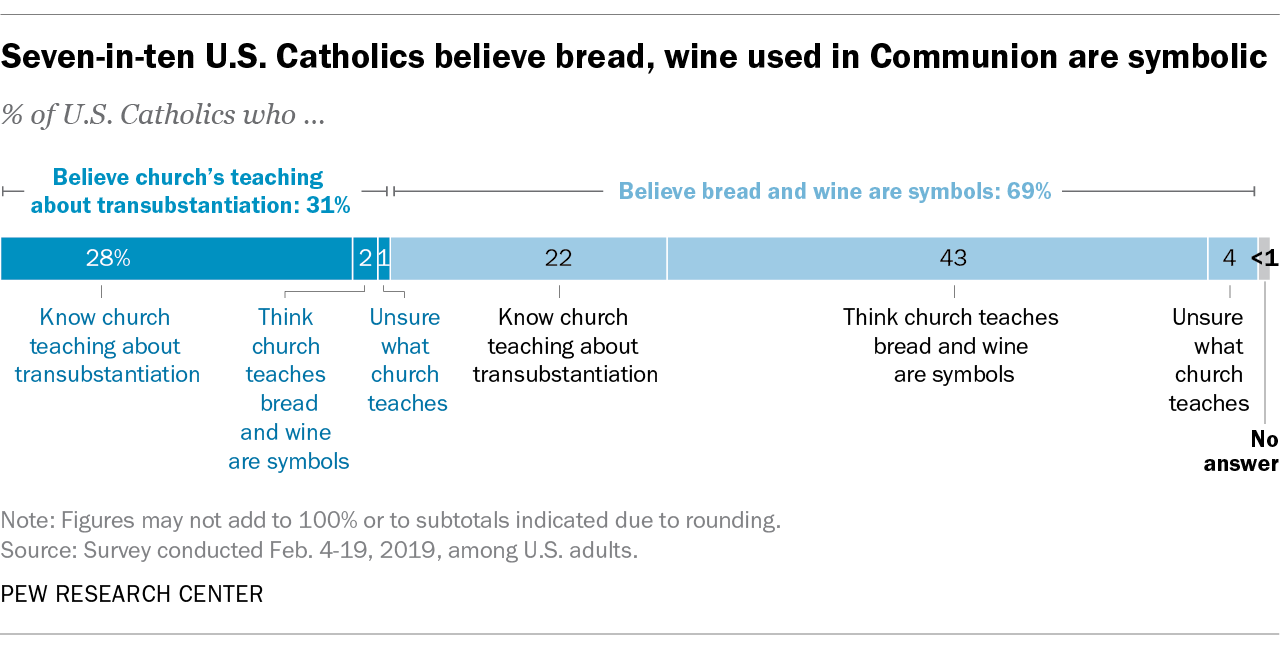
In addition to asking Catholics what they believe about the Eucharist, the new survey also included a question that tested whether Catholics know what the church teaches on the subject. Most Catholics who believe that the bread and wine are symbolic do not know that the church holds that transubstantiation occurs. Overall, 43% of Catholics believe that the bread and wine are symbolic and also that this reflects the position of the church. Still, one-in-five Catholics (22%) reject the idea of transubstantiation, even though they know about the church’s teaching.
The vast majority of those who believe that the bread and wine actually become the body and blood of Christ – 28% of all Catholics – do know that this is what the church teaches. A small share of Catholics (3%) profess to believe in the real presence of Christ in the Eucharist despite not knowing the church’s teaching on transubstantiation.
About six-in-ten (63%) of the most observant Catholics — those who attend Mass at least once a week — accept the church’s teaching about transubstantiation. Still, even among this most observant group of Catholics, roughly one-third (37%) don’t believe that the Communion bread and wine actually become the body and blood of Christ (including 23% who don’t know the church’s teaching and 14% who know the church’s teaching but don’t believe it). And among Catholics who do not attend Mass weekly, large majorities say they believe the bread and wine are symbolic and do not actually become the body and blood of Jesus.
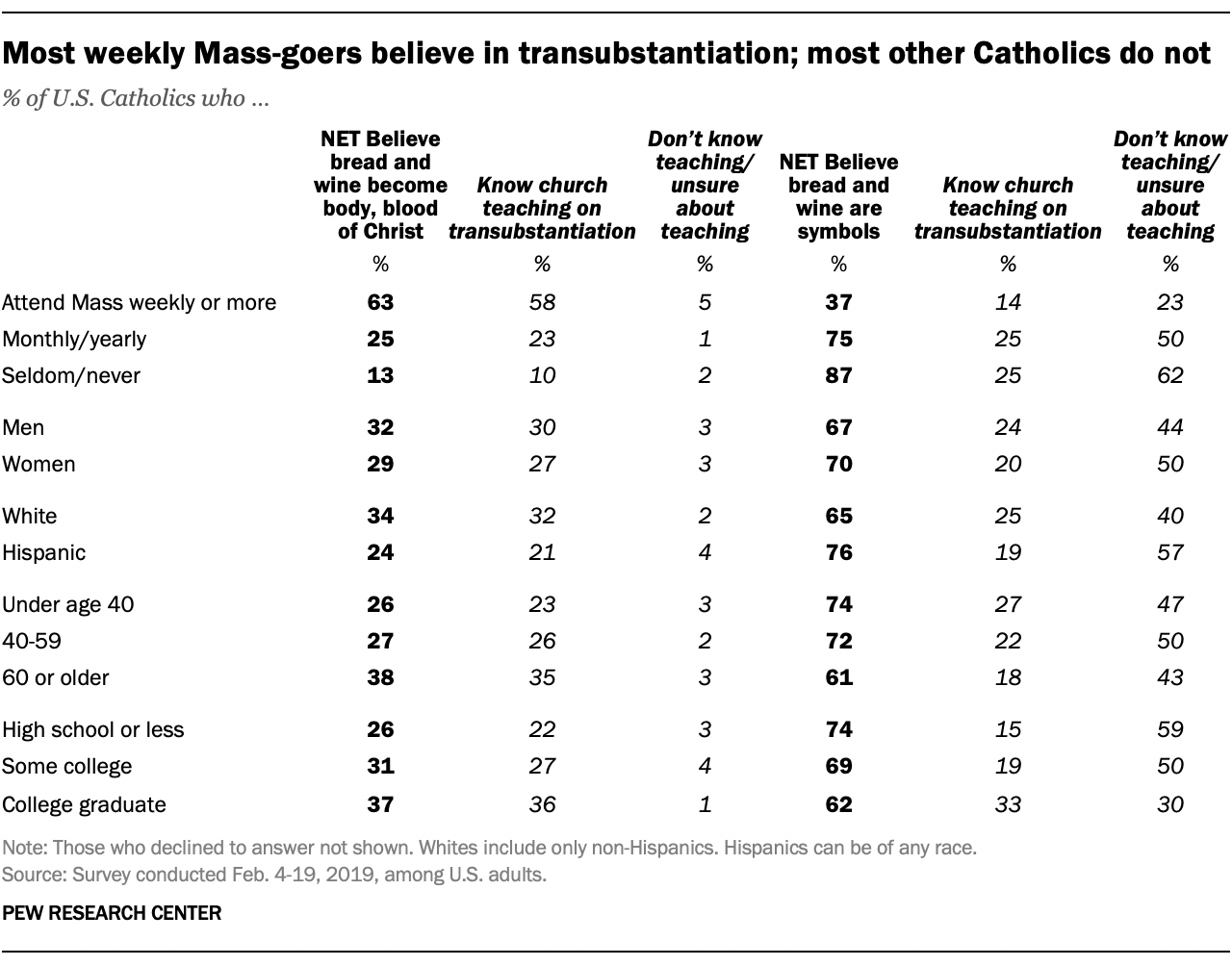
The survey also finds that belief in the real presence of Christ in the Eucharist is most common among older Catholics, though majorities in every age group (including 61% of those age 60 and over) believe that the bread and wine are symbols, not the actual body and blood of Christ.
Note: See full topline results and methodology. Topics:Catholics and CatholicismChristians and ChristianityReligious AffiliationReligious Beliefs and PracticesSHARE THIS LINK:
Gregory A. Smithis an associate director of research at Pew Research Center.POSTSBIOTWITTEREMAIL
Posted in Uncategorized
1 Comment
RANDY ENGEL IS PROVIDING A GREAT SERVICE TO THE CHURCH THROUGH THE LEAGUE OF SAINT PETER DAMIAN, CHECK IT OUT
July & August 2019
Dear Brothers and Sisters in Christ,
Welcome, once again, to the League of Saint Peter Damian.
Two-thousand nineteen anno Domini is the year of the League’s formation.
Catholics who register with the League during 2019 are considered founding members.
This summer’s edition of the League of Saint Peter Damian Study Guide #5 and #6
highlights Peter Damian’s Letter 40 on the heresy of SIMONY.
In his famous Liber Gomorrhianus (Book of Gomorrah) written in 1049 A.D., Saint Peter Damian attacked the grave crime of sodomy.
In his Liber Gratissimus (The Most Gratuitous Book), written in 1052 A.D., the holy
monk attacks, with equal vigor, the grave ecclesiastical crime of simony.
Once again, I believe the reader will be very surprised by the freshness and audacity
of the holy monk’s treatise and its relevance for our own time.
Randy Engel

STUDY GUIDE # 5 & # 6
“Let Your Life Always Serve as a Witness”
Saint Peter Damian on the Crime of Simony
Acts of the Apostles Chapter 8
Douay Rheims Version
[1] And at that time there was raised a great persecution against the church which was at Jerusalem; and they were all dispersed through the countries of Judea, and Samaria, except the apostles. [2] And devout men took order for Stephen’s funeral, and made great mourning over him. [3] But Saul made havock of the church, entering in from house to house, and dragging away men and women, committed them to prison. [4] They therefore that were dispersed, went about preaching the word of God. [5] And Philip going down to the city of Samaria, preached Christ unto them.
[6] And the people with one accord were attentive to those things which were said by Philip, hearing, and seeing the miracles which he did. [7] For many of them who had unclean spirits, crying with a loud voice, went out. [8] And many, taken with the palsy, and that were lame, were healed. [9] There was therefore great joy in that city. Now there was a certain man named Simon, who before had been a magician in that city, seducing the people of Samaria, giving out that he was some great one: [10] To whom they all gave ear, from the least to the greatest, saying: This man is the power of God, which is called great.
[11] And they were attentive to him, because, for a long time, he had bewitched them with his magical practices. [12] But when they had believed Philip preaching of the kingdom of God, in the name of Jesus Christ, they were baptized, both men and women. [13] Then Simon himself believed also; and being baptized, he adhered to Philip. And being astonished, wondered to see the signs and exceeding great miracles which were done. [14] Now when the apostles, who were in Jerusalem, had heard that Samaria had received the word of God, they sent unto them Peter and John. [15] Who, when they were come, prayed for them, that they might receive the Holy Ghost.
[16] For he was not as yet come upon any of them; but they were only baptized in the name of the Lord Jesus. [17] Then they laid their hands upon them, and they received the Holy Ghost. [18] And when Simon saw, that by the imposition of the hands of the apostles, the Holy Ghost was given, he offered them money, [19] Saying: Give me also this power, that on whomsoever I shall lay my hands, he may receive the Holy Ghost. But Peter said to him: [20] Keep thy money to thyself, to perish with thee, because thou hast thought that the gift of God may be purchased with money.
[21] Thou hast no part nor lot in this matter. For thy heart is not right in the sight of God. [22] Do penance therefore for this thy wickedness; and pray to God, that perhaps this thought of thy heart may be forgiven thee. [23] For I see thou art in the gall of bitterness, and in the bonds of iniquity. [24] Then Simon answering, said: Pray you for me to the Lord, that none of these things which you have spoken may come upon me.
Simony – The Offspring of Avarice
According to New Advent, simony, in general terms, is defined as “a deliberate intention of selling for a temporal price such things as are spiritual or annexed unto spirituals including ecclesiastical offices and privileges. While this definition only speaks of purchase and sale, any exchange of spiritual for temporal things is simoniacal. Nor is the giving of the temporal as the price of the spiritual required for the existence of simony. It suffices that the determining motive of the action of one party be the obtaining of compensation from the other.”
New Advent lists the following temporal advantages which may be offered for a spiritual favor according to Pope Saint Gregory the Great (590 – 604 A. D.):
- Material advantage including money, all property, and all rights appreciable in pecuniary value.
- Oral advantage which includes oral commendation, public expressions of approval, and moral support in high places.
- And homage, which consists in subserviency, the rendering of undue services, etc.
While according to the natural and Divine laws, simony is applicable only to the exchange of supernatural treasures for temporal advantages, its meaning has been further extended through ecclesiastical legislation.
However, it should be noted that while any transgression of the law of God related to simony is, objectively speaking, grievous in every instance and constitutes a sacrilegious depreciation of Divine treasures, ecclesiastical prohibitions do not all and under all circumstances impose a grave obligation. [The source for this introduction is http://newadvent.org/cathen/14001a.htm].
Saint Peter Damian’s Treatise on Simony
Saint Peter Damian’s Letter 40 titled Liber Gratissimus (The Most Gratuitous Book) written in 1052 A.D. It was addressed to Sir Henry, the Bishop of Ravenna (a center of clerical reform), but was actually written for Pope Leo IX, who held three Roman synods in 1049, 1050, and 1051 (attended by Peter Damian) at which time the issue of the validity of simoniacal orders was hotly debated.
According to translator Owen J. Blum, Pope Leo IX initially ruled that all holy orders carried out by simoniacal bishops were invalid , but was forced to reconsider his decision when the Synod fathers pointed out the wide-sweeping disastrous repercussions of that decision on the sacramental life of the Church, and the chaos and disbelief it would create far and wide.
Leo took the warning to heart.
The pope asked Peter Damian, not yet a bishop, to render his opinion on the crisis besieging the Church. As noted above, the holy monk first sent his Letter 40 to the Bishop of Ravenna, but after getting no response, he sent his work on to the Holy See where it had an immediate and long-term impact.
Please note that Peter Damian supported the canonical penalties against simony, whereby “whoever had obtained his sacred office by payment of money, both he and his ordaining prelate should be deposed.” What he opposed was the growing impious teaching and heresy that priests who received holy orders at the hands of a simoniacal bishop, but were innocent of all simoniacal connections, were not true and valid priests and had to be “reordained.” Thus the burning question: ARE HOLY ORDERS IMPOSED BY A SIMONIACAL BISHOP VALID?
Peter Damian answered in the affirmative. In doing so he contributed to the establishment of the universal principals upon which the validity of the seven sacraments of the Church are upheld despite the unworthiness of the minister – be he, pope, cardinal, bishop, priest or deacon. Note that paragraph numbers are in parenthesis.
God Is the Author of All Graces
Peter Damian begins his treatise with the admonition that the Triune God – Father, Son and Holy Ghost – is the author and ultimate dispenser of all gifts of divine grace. He states that all sacraments including Baptism and Holy Orders are from God, and not from man. Therefore, … no matter who may exercise the ministry of the sacrament, he is only the servant and steward of the mysteries of God. It is God who produces the sacrament with its profound effect. (6)
Unworthy Ministers Do Not Hinder God
Repeating a theme present throughout his treatise, Peter Damian weighs in against the “reordination” of priests ordained by bishops who had bought their office:
It is therefore a statement of pure and perfect faith that like baptism, priestly ordination is in no way contaminated by the defect of sordid ministers, nor damaged by another’s crime. No matter how scandalous or involved in countless crimes the consecrator might be, the one ordained suffers no loss to his sacred office on this account, nor is he deprived of any heavenly grace. For it is not because of the quality of the bishop, but by reason of the office in which he functions that the mystery of ordination is transmitted to another, nor is it necessary to inquire into the consecrator’s manner of life but only into the ministry he received. … (7)
With this is mind, since one who is baptized even by a heretic is not to be rebaptized, I see no reason why one who is promoted by a so-called simonist should be either deposed or reordained. For if baptism administered by a murderer or by an adulterer or even by a heretic must be considered valid, and that, by reason of the Gospel statement, “The man on whom you see the Spirit come down and rest is the one who baptizes,” (John 1.33), there is no reason at all why in ordinations we should not refer to the identical author of both sacraments, and with equal force be able to say he is the one who ordains. (10)
Ordination, If Catholic, Is Also Valid
Citing two simonists from Holy Scripture– Gehazi, the covetous and devious young servant of the prophet Elisha who is mentioned three times in the Old Testament and Simon Magnus cited in the introduction to this commentary – Peter Damian describes the simonists of his own day who having “no hope of being famous for their miracles, do not desire the Holy Spirit nor his gifts, but inflamed by their ambition of procuring a bishopric, strive only for a place in the sun.” (11)
Yet, Peter Damian continues:
… if their ordination is properly Catholic, even though they approach unworthily, they fully receive the holy office of the priesthood. For the power of the Holy Spirit is the same, both when his grace is sold and when it is given freely. Nor does the power of God lose its proper effectiveness because of transactions that flow from human perverseness. (11)
In the same way also we are compelled to believe of the Holy Spirit, that he possesses the same power, both when it appears, as it were, that he is the victim of venality and when he is bestowed through the gratuitous imposition of hands. And thus, just as our Redeemer, when he was sold and when he suffered, could not be weakened in his majesty, so also the Holy Spirit, even though the same sad specter of venality creeps in, in no way suffers a loss of the power that is his. Even though to all appearances the priest seems to be functioning, it is Christ himself, the true priest and supreme pontiff, who grants the gifts to those who approach him with varying results. For some, indeed, his gifts lead to salvation, for others to damnation (bold added). … All of us surely know that the mystery of the Eucharist, which we receive from the sacred altar, is indeed good, whether we be just or sinners. Neither does the good man received something better, nor the bad man something worse. And still the Apostle says that, “the unworthy recipient eats and drinks his own condemnation without recognizing the Body of the Lord.” (Cor 11.29).
… Therefore, one must believe without a doubt that if ordination to any rank is granted within the Catholic Church, namely, within the unity of orthodox belief, and where both possess the true faith, whatever is given by a good minister to a good recipient is also effectively tendered by an evil minister to an evil recipient, because this sacrament does not depend upon the merits of the minister or the recipient, but upon the rite ordained within the Church and on the invocation of the name of God. (13)
The Holy Spirit Breathes Where He Wills
In a rather breath-taking statement, Peter Damian addresses the question as to whether or not the Holy Spirit breathes only on the deserving:
It should not, therefore, appear incredible that in the Holy Church which undoubtedly is the throne of God, the sanctuary of the Holy Spirit, and the repository of all heavenly gifts, an unworthy person should receive sacramental grace with which he fails to conform by intent or by a worthy life. This is true precisely because it is not deserved by the grantor or the recipient but is a gift of the supreme Benefactor. One does not read that the spirit breathes where he is deserved, but rather it is said, “He breathes wherever he wishes,” (John 3.8), so that actually spiritual grace, which flows from the liturgical practices of the Church, derives from the will of God rather than from the deserts of men [bold added]. (17)
Early Church Fathers Upheld Teaching
Peter Damian notes that while there was no question among the early Church Fathers that the Sacraments of Baptism or the Eucharist of the Lord’s Body, whether confected by thieves, or adulterers, or even murderers, differed in no way from the sacraments which holy priests produce, the question of the validity of ordination of clerics by simoniacal bishops had not been a topic of major discussion or debate for them. He said this was because the two prior sacraments were explained in such clear terms that no doubt or hesitation remained about the third.
However, Peter Damian laments that by the mid-1040s, things had changed:
Now… by acting immoderately, human curiosity propounds a new question before the world, and by closer scrutiny that results in lesser vision, tries to impose darkness onto the clear light. How, they ask, is the grace of the Holy Spirit given through evil men or received by them? They are not aware that it is by the grace of the Holy Spirit that orders of ecclesiastical dignity themselves are received, which indeed, the Holy Spirit who disposes the rights of the Church, renders valid, whether an unworthy person bestows or receives them. For as the blessed Jerome says, “Bishop, priest, and deacon are not titles of merit, but of office.” (19)
Bad Intentions Do Not Block the Gifts of God
Peter Damian’s knowledge and use of Scripture in his treatise is phenomenal. For example, when complaints reached the holy monk’s ears that certain simoniacal bishops did not act with the right intentions when carrying out ordinations, the holy monk referred back to Saint Paul’s Epistle to the Philippians:
The Apostle complained that certain false brethren because of jealousy and competition, were not preaching Christ with the right intention. But what is the point? Did he decide to stop them? Then listen to what follows: “What does it matter,” he said, “so long as, one way or another, either from pretense or from love, Christ is proclaimed, and for that I rejoice, and shall continue to rejoice .” (Phil 1.18). Christ, moreover, has ministers of the word and ministers also of the sacrament; in both ministries, surely, some are good and faithful, while others are false and wicked, but one receives neither something better from the good, nor something worse from the wicked. The ministers in fact are quite different, but that which is given is obviously one and the same. For the originator of the gifts is certainly good and that which he gives is in no way marred by the service of the ministers. (30)
Evil Doers Receive Their Just Punishment
Noting that even unrepented heretics and other betrayers of the Catholic faith are permitted by God, at times, to work miracles, Peter Damian states that this does mean they escape God’s wrath:
Now these wonderous signs which divine providence works, either through heretics or through unworthy priests of the true faith, since they are granted not because of the worthiness of any of them but by reason of their office, will in no way free them from the punishment they deserve, or excuse them of the crimes they have committed when they come before the bench of the severe judge. For in that from which they seek glory they fall into ignominious confusion, and the more they are praised by the applause of flatterers , the more liable they are to plunge into the depths of eternal damnation. And often such men, as they are struck down by a terrible death, clearly show how truly worthy they were of damnation, who to all appearances seemed so admirable. (50)
Bishops Advised to Caution the Holy See
Saint Peter Damian, who was not yet a bishop himself, felt compelled to urge the bishops to warn the Holy See against “this impious teaching” and to take unanimous action to resist this new heresy which would “shake the foundations of the apostolic faith.” (104)
As noted earlier, while Peter Damian did not oppose the canonical decree against simony, that “whoever had obtained his sacred office by payment of money, both he and his ordaining prelate should be deposed,” he held that the limits of justice did not extend to the punishment of innocent candidates who had received holy orders from a bishop guilty of simony.
Not surprisingly, Peter Damian used his treatise to deliver a crippling blow to the practitioners of this crime labeling them worse than Judas:
I lodge complaint against you simonists, who have caused me this grave inconvenience of burning the midnight oil. I have defended your interests, but only that I might condemn you. Thus I admit the things that were done by you and show my judgment of how abominable you are and how worthy of the supreme punishment that befits the incorrigible. Judas , to be sure, believing the Lord to be mere man, sold him; but at once he threw away the blood money as he prepared to pay the penalty that was his due. But you, with no doubt of the divinity of the Holy Spirit, ascribe to him the venal transaction and hold on to the benefits of this sacrilegious deed, and you , who should have been subject to punishment, profit by the crime that you commit. To whom should I rightly compare you, who hold the gifts of God not for yourselves, but for others? That which amasses salvation for them is turned for you into judgment and eternal damnation. (115)
Although Sir Henry, the bishop of Ravenna never issued a formal response to Peter Damian regarding the contents of his treatise, Liber Gratissimus made its wayinto the hands of Pope Leo IX and his successors who looked favorably upon the holy monk’s work.
Peter Damian Adds an Addendum to His Work
In 1061, Peter Damian, now Cardinal Bishop of Ostia, added an addendum to Liber Gratissimus, in which he stated that at the close of the Lateran ecclesiastical council (synod) convened on Easter 1059 by Pope Nicholas II and closed in April 1061, the matter of the validity of simoniacal ordinations was finally settled. Liber Gratissimus had carried the day.
The judicial conclusion was:
… Those who were hitherto ordained freely by simonists should remain in the dignity of the office, but that those not yet promoted by them would not in the future be permitted advancement; but with the proviso that as a result of the severity of the sentence neither the ecclesiastical order should be destroyed, nor that in view of its leniency, the plague of simony should acquire, by some lawful provision, the power of conferring the grades of ordination, all with a view that what in past ordinations had been valid, should for future ones be totally forbidden. (122)
A Commentary on Liber Gratissimus
According to Saint Peter Damian:
The unity of the Church is established on this principle, that Christ retained as his own power of ordaining and did not transfer his title to any of the ministers of ordination. For if ordination were to proceed from the worthiness or the power of the bishops, it would obviously not belong to Christ at all. Even though the bishop imposes hands and by the ministry committed to him recites the words of the blessing, it is certainly Christ who ordains and consecrates by the hidden power of his majesty. (29)
Hence, whether he dispenses doctrine by his words, or confers the orders of the Church, the priest in no way uses his own resources but merely carries out the office and the ministerial functions with which he was endowed. Otherwise, if these effects were to flow from the worthiness of the priest, they would indeed nullify all faith in God’s grace. (31)
While Saint Peter Damian’s Liber Gratissimus was directed at the crime of simony, its lessons are applicable to the current crime of clerical sodomy.
One could well ask, “Could it be otherwise?”
If the validity of the sacraments including Baptism, Holy Communion and Holy Orders were based on the worthiness or unworthiness of sodomite priests and bishops, the entire foundation of the Church – past, present and future – would be negated or destroyed.
Thanks to our Triune God, and to the great Fathers and Doctors of the Church like Saint Peter Damian, this is not the case.
The reader may also want to ponder how the two crimes of simony and sodomy are intertwined in the recent cases of two notorious clerical sodomites and simonists – the now laicized Cardinal Theodore McCarrick, former Archbishop of Washington, D.C., and Bishop Michael Bransfield, former Ordinary of the Diocese of Wheeling-Charleston, West Virginia.
While simony has traditionally been associated with the purchase of ecclesiastic office, McCarrick and Bransfield used their millions (collected from sheeple in the pews and wealthy Catholics) not merely as a form of influence peddling, but more to the point, as an effective measure to insure the silence of the recipients of their filthy lucre as to their unnatural and predatory passions.
McCarrick was first famous, and later infamous, for his financial largesse to Vatican officials and the Papal Office, directly through his Archbishop’s Fund and indirectly through the Papal Foundation, and for the long list of bishoprics he acquired for his fellow sodomite clerics.
Bransfield, once President of the Papal Foundation and treasurer of the United States Conference of Catholic Bishop, wrote out hundreds of “gift” checks totaling more than $350,000 to a large number of American and Vatican prelates, U.S. papal nuncios, senior Vatican officials and members of the Curia; and lastly, young seminarians and priests whom he sexually molested.
Truly, if we ever needed the wisdom, assistance and prayers of Saint Peter Damian, we need them now.
The End
Posted in Uncategorized
Comments Off on RANDY ENGEL IS PROVIDING A GREAT SERVICE TO THE CHURCH THROUGH THE LEAGUE OF SAINT PETER DAMIAN, CHECK IT OUT
PRESIDENT TRUMP CONTINUES TO DRAIN THE SWAMP
NEC Director Larry Kudlow -vs- U.S. CoC President Tom Dohonue…
Posted on August 2, 2019by sundance
With President Trump announcing an additional ten percent tariff on $300 billion of Chinese products, the Chamber of Commerce worm, Tom Donohue, comes out to oppose.
An interesting juxtaposition between two interviews. The first with National Economic Council Director Larry Kudlow, and the counter point by CoC President Dohohue:
.
In the next interview Donohue surfaces… he has no choice. Tom Donohue is paid tens of millions by the Wall Street multinationals to retain the current exploitative system of global trade. Donohue has no influence over President Trump.
In the Clinton/Clinton, Bush/Bush, Obama/Obama terms, Tom Donohue was allowed to purchase control, and write the trade language that perpetuated the benefit to those who paid him for trade policy. Three administration’s sub-contracted the work to the CoC.
As a consequence, over the past 25 years the Chamber of Commerce actually wrote the rules, regulations, language and details within the trade deals. That language was written by the CoC to the benefit of those who paid for the terms (Wall Street Corporations) regardless of impact to the U.S. economy or worker.
President Trump stopped this process.
President Trump’s economic team (USTR and Commerce) took back control over the trade negotiation process, and only the U.S. economic team writes the trade language. Wall Street has been cut out of the process. This is the reason for so much of the anger directed toward President Trump and the global trade reset.
.


Posted in Uncategorized
Comments Off on PRESIDENT TRUMP CONTINUES TO DRAIN THE SWAMP
DAVID WARREN GIVES US A SPLENDID TOUR OF ENGLISH CATHEDRALS AND CHURCH HISTORY
Rochester Cathedral
THE CATHOLIC THING
FRIDAY, AUGUST 2, 2019
Even before I became a Christian, I was a cathedral junkie and was for a while living in England, which had a plentiful supply. I shan’t say the cathedrals brought me to Jesus. Rather, they were pit stops along the way.
I considered them great works of art, as I considered the Bible to be among the great works of literature. Neither point was deniable. I did not then, however, “believe in God.”
Too, I loved medieval parish churches, though I had to be careful. A “service” might happen at any moment; one risked being pounced upon by a friendly “greeter.” My fine privacy might be disturbed; my focus upon architecture and artifacts might be deflected.
Once I was trapped and had to sit politely through an interminable homily by a reverend gentleman, who struck me as a jackass. In big cities, however, I could be accepted as an anonymous tourist; at worst, a potential customer to be siphoned through the gift shop. Today, I gather, there may be an admission charge.
This I heard in a delightful anecdote from a correspondent the other day. It was of a certain Catholic priest, touring St Alban’s. He breezed his way past the ticket sellers, saying, “I don’t pay to enter stolen property.”
Having walked a Greek girlfriend past the Elgin Marbles in the British Museum once, I’m a veteran of such contretemps. This one was forty-four years ago. My impassioned friend accused a museum guard of having stolen her national treasure. The guard smiled: “No, ma’am, it was Lord Elgin who took ’em. I’m just guarding his loot.”
Some day, I imagine the glorious West Portal of Chartres will be detached, then housed “permanently” in a faraway museum – together with long sections of frieze and pilasters.
And let us imagine some person who calls himself a Catholic – in the political thaw of the 38th century – berating a museum guard. And the guard makes a joke, in the same way.
Rochester Cathedral was among my favorites. I called by in 1977, on my pedestrian way to Canterbury: a noble edifice, with a glorious history, dating back centuries before the Normans; the second English church after Augustine’s at Canterbury.
The nave remains much as Gundulf designed in the 11th century. His tower, considerably shortened I think, but still visible from a distance, was repaired by the Freemasons in the 1920s.

*
Anyone visiting this summer will find that the nave is now filled with a mini-golf course. It is a shrieking obscenity, which I will not further describe. To call it a sacrilege seems almost an understatement; and a waste of breath – for sacrilege, once a very grave charge, is to most of our contemporaries a form of light humor.
Similar abominations have been mounted in other English cathedrals. For instance, the funfair helter-skelter erected in the nave at Norwich. Many are planned through the coming years.
At Derby last year, a slight rise was got out of parishioners by showing films with full female nudity and fornication, a pagan sacrifice, and a “satire” on the Life of Christ. How edgy and progressive! If criticized, the sponsors of such shows declare themselves to be victims – counting on the general public to be as maliciously stupid as they are.
The various Anglican public relations spokespersons – such as the priestess who dresses up as “Canon for Mission and Growth” at Rochester, beam happy-face gestures about the latest desecrations while smearing anyone who objects. They are scandalized, only by objections.
Saint John Fisher was Bishop of Rochester for more than three decades. He was, as gentle reader should already know from his missal, the only English bishop who refused to recognize the coup of Henry Tudor against the Catholic Church in England. Fisher, alone in that collegium, was willing to stake his life on upholding the Catholic sacrament of marriage, as well as the doctrine of papal supremacy.
Dutifully, he went to his martyrdom, sentenced by a kangaroo court to be hanged, drawn, and quartered at Tyburn. At the last moment, in a hurry to get him executed before the Vigil of Saint John Baptist, King Henry “commuted” this sentence, and had him sent up Tower Hill, to be beheaded instead. This was intended to avoid “bad optics.”
It backfired marvelously, for it completed the parallel to Fisher’s patronal namesake. For John the Baptist was also beheaded, at the order of Herod Antipas, for having challenged the validity of the marriage of the divorced Herod to that ancient tart, Herodias – perfect forerunner to that modern tart, Anne Boleyn. In that Catholic age, this “irony” was fully understood – throughout educated Europe, and across England. Henry Tudor was the new Herod Antipas.
I have noticed many such “ironies” myself, in my little life and through history. God has ways to make an extraordinary and consequential evil, absolutely unambiguous to those with ears or eyes. He leaves those who have also the brains to discern, with no excuse for their failure to act. The best they can argue is abject cowardice, but ego prevents them from confessing even that.
“Yes, I deserted the Church in her hour of need.” This would be the beginning of a reasonable confession. “And yes, I sought to profit from the evil.”
For note: every attempt at justification will be false, and can be shown to be false. The road to Hell has been clearly chosen.
What to do about acts of sacrilege? Jesus himself gave us an example in the Cleansing of the Temple at Jerusalem, where He confronts the merchants on sacred ground, overturning their tables and scattering their wares.
Lest there be any quibble, let me mention there are accounts in all four Gospels: “And making a whip of cords, He drove them all out.”
Within a week of that bold transaction, Christ himself was dead.
But note: He is Risen, and has the keys of Hell and of Death.
*Image: Portrait of John Fisher, Bishop of Rochester “after” Hans Holbein the Younger [St. John’s College, Cambridge]

The off-course course
Posted in Uncategorized
2 Comments
YOU MAY BE FACED WITH DIFFICULT CHOICES IN THE PRESENT CRISIS OF THE CHURCH BUT YOU MUST CHOOSE, YOU CANNOT JUST GIVE UP AND DRIFT AWAY, YOU MUST KEEP YOUR FAITH, HOPE AND CHARITY ALIVE AND THRIVING AND THAT MEANS THAT YOU MUST CHOOSE !!!!
The Okie Traditionalist
| Inbox | x |
| The Okie Traditionalist | 3:51 AM (11 hours ago) | ||
| The Okie Traditionalist |
| What is the Difference between a Diocesan Latin Mass and say an FSSP Mass? Posted: 31 Jul 2019 09:44 PM PDT Say you’ve got two choices in your area, a Diocesan Latin Mass, offered under the auspices of the motu proprio Summorum Pontificum or one offered offered under the auspices of a Priestly Society of Apostolic Life like the FSSP, ICK, or SSPX. What differences can you expect, both when first attending one vs the other, and if making a more long term commitment? What philosophical or theological differences would exist between those two approaches or sub-movements of the wider Latin Mass Movement? Which is the more ideal choice? Or more prudent one? Such will be the examination in tonight’s latest installment of The Okie Tradituonalist. After all, here in Tulsa, OK we have two TLMs within city limits. (The TLM Movement began here in 1970 when the Bishop refused a group’s request for the Traditional Mass; that group formed an Independent Chapel which eventually was served for 40 years by the SSPX). Factors to consider: the Liturgy, the liturgical-devotional-catechetical environmrnt, quality of community life, overall fidelity to Sacred Tradition, not compromising to the New Religion. But also, how are you personally treated? Do you fit into the temperament or dynamic of the community? Are the religious and communal needs of your family being met? Is there a proper cry room, wheel chair ramp, sufficient temperature control? The list goes on. Is the pastor actually pastoral? Is the community have an open, welcoming, and public orientation, or does it tend towards the insular, elitist, or privatized? In my experience many or most Trads weigh all such factors, not just on one hand purity of religious doctrine and practice, but how well said parish community meets their very real personal needs. In my own case, that once meant going to the FSSP for 7 years, then the SSPX fir 10 years. But I digress. Even the SSPX commonly advises the traditional faithful to make a prudential decision as to which Mass to attend, with at least a half dozen cases coming to mind, just off the top of my head, of SSPX priests actually advising laity due to very particular circumstances to go to the FSSP. Yet, to illustrate the paradox of the question of which TLM to attend, the Society itself also officially advises as an ideal to only attend their Mass centers or chapels if in driving distance. To frame the topic of this post, I think we need to consider the topographical layout of the current Latin Church, the Traditional Movement itself in its endeavor to help restore Tradition, the noble ideals revealed by that Tradition, and the practical way at present we can promote said restoration of Tradition. Novus Ordo Land is the 99.999% mainstream. Traddom the 0.00001% Catholic Remnant. Excluding the formally schismatic theory that rejects as an Anti-Church the Hierarchy that accepts the validity of Vatican II (aka sedevacantism, which if wrong [its is] according to classical logic means formal separation from Church), Traddom began largely with the vast works of Traditional Restoration put in place by the saintly bishop Archbishop Lefebvre, especially but not only the Society. What the Society has proven by its own persecuted history is that in general we cannot trust the conciliar bishops or popes, that the diocesan structure and Vatican structure cannot be trusted. To uphold Tradition, protect the rights of faithful Catholics, or protect the moral legitimacy of today’s clergy. But consider this. The same SSPX is largely responsible for the motu proprio. It was the main organization asking the Pope to make it clear the ancient Roman Mass is a public right of every Roman rite priest and lay faithful. The FSSP never asked for that. The FSSP as an organization above the level of some of its individual members, has never made the preservation of Tradition abs and Traditional Mass a moral obligation, a moral imperative, challenging the Authorities to make it universal again throughout the entire structure of the Latin Church. It was and is the Society that most supports the motu proprio movement, providing materials and liturgical training for diocesan clergy. Praising individual priests and parishes for turning back once again to the timeless, perennial, and sacred. My point of view shared by some Trads is to support both the SSPX or FSSP, but also the Motu Proprio side of the movement, both on the level of the theoretical ideal, but also on the level of practical circumstances both for the indivdual/family structure, but also for keeping alive this Catholic Remnant. Going deeper, the commitment to Tradition goes beyond various trad circles or ideologies. It involves the whole Church in all Her divinely instituted levels. Not just the level of the Domestic Church of the family, but also that of the Parish Church, the Local Church under a singular Bishop, the Latin Church, and the universal Catholic Church. This commitment is to seeing Tradition spread and restores everywhere, including in the Eastern Catholic Churches truth be told which are somewhat affected by Modernism. Would we Tulsabs for example not want a Traditional Mass to start at Holy Family cathedral, or at any of the parishes of the diocese. Would we not celebrate and support in some way all these young priests and seminarians who privately (or not so privately) are learning the 1962 missal and reconnecting to the entire spiritual heritage that goes with the Trafitionsl Liturgy? I have heard of many such examples recently just here in the Tulsa Diocese. Consider this. The Motu Proprio movement itself, of TLMs popping up exponentially from diocese to diocese, has made the Latin Mass much more widely known and available. By Providence, God is not only preserving Tradition within trad enclaves served by Society’s of Apostolic Life “outside the mainstream” but by heroic, good, and faithful priests and laity “in the mainstream.” On one hand, the exclusive, complete adherence to Tradition in the FSSP or SSPX is a guiding light for everyone else to turn towards Tradition. On the other hand, with motu proprio Masses spreading throughout a diocese, or better put our “local Church,” over time there is created a kind of almost geographical flow of Tradition-minded Catholics across the diocese in the eventual direction for many of them of joining the FSSP parish or SSPX chapel. The philosophical difference then between both the noble ideal of the Diocesan Latin Mass, and a generally fully traditional parish, is in the approach to restoring Tradition. And I don’t think that makes the philosophies in binary opposition to one another, unless they become ossified ideologies enforced by the groupthink of said trad community. Philosophy means the “love of wisdom,” with wisdom being both about theoretical ideals and prudence. Unfortunately ideologies do often ossify and clash. Fellow trads even in a singular parish can form imaginary lines of division over how hard-line traditionalist one should be, with the Remnant or SSPX supporters vs the Michael Voris or Fr. Nicholson (recall his vitriol towards the Society?) type supporters, etc, etc. Throw in a JP2-We-Love-You Neoconservative gadfly at odds with the Trafitionslist frame of mind, and things get even more dicey. Taking all this into account, in summation, my opinion is that overall we should support in theory and in practice both the noble ideal of the fully traditional, active, communal, vibrantly devotional and liturgical trad parish/chapel, and of the mainstream movement throughout our local Churches of restoring Tradition given legal and moral force by means of Pope Benedict XVI (responding to talks with the SSPX). At the same time we have to weigh the ideal with the practical needs of ourselves and families. If said Trad parish in your own personal experience is too insular and toxic, going to and supporting a Diocesan Latin Mass would be most helpful to your spiritual life while supporting that side of Traditional Restoration. But if in your estimation the trad parish provides a healthy atmosphere, then it is, again in my opinion, the better choice, for the integrity of the doctrine of the Faith and the Liturgy. The bottom line is for all of us, it boils down to making a prudential choice for what is best. The Pope unfortunately has not settled this Crisis, so the laity are forced to figure things out with the limited advise of faithful priests. That decision comes down to balancing discernibly objective truths and facts with many different subjective, real-to-life variables. Either way, thank a God for the wider availability of the Traditional Latin Mass. And for all those faithful, orthodox priests, both in Priestly Societies and Dioceses (not to mention the Religious Orders), who are courageously stepping up to the plate. Or rather the altar of the sacrifice of Our Lord Jesus Christ. |
Posted in Uncategorized
Comments Off on YOU MAY BE FACED WITH DIFFICULT CHOICES IN THE PRESENT CRISIS OF THE CHURCH BUT YOU MUST CHOOSE, YOU CANNOT JUST GIVE UP AND DRIFT AWAY, YOU MUST KEEP YOUR FAITH, HOPE AND CHARITY ALIVE AND THRIVING AND THAT MEANS THAT YOU MUST CHOOSE !!!!
WHEN CARDINALS DO NOT BELIEVE IN THE SANCTITY OF THE OATH THEY TAKE AT THE BEGINNING OF A CONCLAVE UNDER UDG, IT IS REASONABLE TO SUSPECT THAT THEY DO NOT BELIEVE IN ANYTHING
| New post on Roma Locuta Est |
| 2013 Conclave: Was there a violation of Universi Dominici Gregis 12?by Steven O’ReillyJuly 31, 2019 (Steven O’Reilly) – A few weeks back, I posted a few articles on Roma Locuta Est dealing with the mysterious figure of the “influential Italian gentleman.” This “influential Italian gentleman” visited McCarrick (see video here) in early March before the General Congregations (began March 4) and asked him to ‘talk up Bergoglio.’I had wondered for sometime who he might be, but I hit upon what I believe to be the likely answer when I was updating an article I had written on Cardinal Jorge Bergoglio, S.J., and issues involving his acceptance of his election to the papacy (see Curiouser and Curiouser: Who Dispensed Jorge Bergoglio SJ from his vows?). In the course of researching that update, I coincidentally hit on other information that led me to develop the theory on the “influential Italian gentleman,” i.e., who he was, and who sent him, and why he was sent to McCarrick. If this theory is correct, then it becomes clearer why Pope Francis & company would not and do not want a deeper investigation into McCarrick, as it might reveal his importance in helping Cardinal Bergoglio win the papacy (again, is all discussed in The “Influential Italian Gentleman”).But, as I began to research and develop a theory on McCarrick’s Italian, I then came upon evidence that strongly suggested — to my admittedly amateur eyes (i.e., not being a canonist) — that one or more cardinals possibly violated Universi Dominici Gregis (UDG), specifically UDG 12 by conveying information related to deliberations regarding the election of the Roman Pontiff to a non-cardinal. The evidence for what appears to me to be a violation of UDG 12 comes from Gerard O’Connell’s book, The Election of Pope Francis. I will lay out the evidence below.The Two Secrecy Oaths of Universi Domenici GregisPer Universi Domenici Gregis (UDG), the Cardinal-electors took an oath of secrecy upon entering the 2013 conclave. This oath in UDG 53 (see Note 1) pertains to secrecy regarding the actual conclave. In addition to the oath of UDG 53, there is yet a separate oath (UDG 12) that both the Cardinal electors and all other Cardinal (i.e., those ineligible to vote in the conclave) took a week before the conclave in March of 2013.This oath, per UDG 12, is to be taken at the outset of the General Congregations, or preparatory meetings for the conclave. Following the resignation of Pope Benedict XVI in 2013, these preparatory meetings began on the morning of March 4, 2013. This oath was taken by all cardinals present on this day, a full week before the conclave. This first oath is similar to the one taken on entrance into the conclave (i.e., UDG 53). UDG 12 and its oath reads as follows [emphasis added]:12. In the first General Congregations provision is to be made for each Cardinal to have available a copy of this Constitution and at the same time to have an opportunity to raise questions about the meaning and the implementation of its norms. The part of the present Constitution regarding the vacancy of the Apostolic See should also be read aloud. At the same time the Cardinals present are to swear an oath to observe the prescriptions contained herein and to maintain secrecy. This oath, which shall also be taken by Cardinals who arrive late and subsequently take part in these Congregations, is to be read aloud by the Cardinal Dean or by whoever else presides over the College by virtue of No. 9 of this Constitution, in the presence of the other Cardinals and according to the following formula:We, the Cardinals of Holy Roman Church, of the Order of Bishops, of Priests and of Deacons, promise, pledge and swear, as a body and individually, to observe exactly and faithfully all the norms contained in the Apostolic Constitution Universi Dominici Gregis of the Supreme Pontiff John Paul II, and to maintain rigorous secrecy with regard to all matters in any way related to the election of the Roman Pontiff or those which, by their very nature, during the vacancy of the Apostolic See, call for the same secrecy.Next, each Cardinal shall add: And I, N. Cardinal N., so promise, pledge and swear. And, placing his hand on the Gospels, he will add: So help me God and these Holy Gospels which I now touch with my hand.While the oath of UDG 12 taken by all Cardinals is a little different from the one taken by the cardinal-electors only (UDG 53) in some respects, it is explicitly stated each Cardinal from the outset of the General Congregations (March 4, 2013) swore they would (emphasis added): “maintain rigorous secrecy with regard to all matters in any way related to the election of the Roman Pontiff or those which, by their very nature, during the vacancy of the Apostolic See, call for the same secrecy.”The scope of the oath is quite broad, covering any matter “in any way related” to the election of the Roman Pontiff.St. Gallen and other Cardinals meet on the eve of the conclaveWe know from O’Connell’s book that Cardinals who supported the candidacy of Bergoglio met together on the eve of the conclave (March 11, 2013) at Cardinal Nicora’s apartment in the Vatican to discuss the election.According to O’Connell, there were “around 15 or more cardinals.” The participants included Italian Cardinals (Nicora, Antonelli, Bertello, Coccopalmerio, and Poletto), other European Cardinals (Brady, Kasper, Tauran and Murphy-O’Connor (“the only non-elector” per O’Connell in attendance), also “key figures from Latin America, Africa and Asia,” Cardinals Maradiaga, Turkson and Gracias.One key thing to remember, as it will be important later, Cardinal O’Connell, due to his age, was “the only non-elector” in attendance at this meeting. O’Connell writes, in part, of this gathering (emphasis added):”When they had all given their input, Coccopalmerio, who was keeping a tally of what was being declared, added up the numbers. The result showed that Bergoglio had at least twenty-five votes. They concluded the evening knowing that Bergoglio would enter the conclave with between twenty and thirty votes. “It was crucial that he had the support in the first ballot,” the English cardinal told me later; he understood this after his experience at the 2005 conclave.”A mistaken hypothesis — But only in Part!In a prior article, I had hypothesized that Andrea Tornielli had obtained knowledge of this vote count above either directly from one of the attending cardinals or perhaps from Bergoglio himself. This hypothesis was based on two premises, (1) that Tornielli had had dinner with Bergoglio on the eve of the conclave (March 11), and (2) that Tornielli’s remarkable prescience as to the outcome of the conclave–seemed to suggest (I speculated) he had received such intelligence re the meeting. I previously wrote and also quoted an article by Fr. Mark Drew who first observed the odd fact:But did Andrea Tornielli actually learn this vote tally? I certainly don’t know. Certainly it is a fair and reasonable question to ask. However, there is this curious post-conclave analysis by Fr. Mark Drew of the Catholic Herald entitled “Did the pundits get this year’s conclave spectacularly wrong?” Fr. Drew comments in part (emphasis added):“In fact, some of the best-informed Italian journalists had noticed that his name (NB: Bergoglio’s) was recurring in the talk during the final days of the build-up. Andrea Tornielli, that oracle among vaticanologists, not only mentioned him on the morning the conclave began, but later the same day brazenly offered his own version of the state of the deliberations still under way among the sequestered cardinals.As all know, the participants in a conclave are vowed to the strictest secrecy. Nonetheless, once it is over the details usually come out in dribs and drabs until something like a clear picture can be formed. It is now known that Bergoglio was the only other serious contended to rival Ratzinger in 2005. Tornielli, however, seemed to have inside information even as the voting proceeded. Perhaps this was merely a priori calculation on the basis of information obtained beforehand, but in any case, Tornielli’s analysis proved remarkable prescient. He averred confidently that there was a deadlock in the conclave, but he mentioned Bergoglio, along with Scola and Ouellet, as one of the three front-runners.” (Source: Catholic Herald. “Did the pundits get this year’s conclave spectacularly wrong?” by Fr. Mark Drew, March 25, 2013).Was it prescience or did Tornielli, who met Bergoglio the day he arrived in Rome (February 27), and was with him on the eve of the conclave know something of what was going on? For example, did Tornielli have inside knowledge of the Cardinal Coccopalmerio vote tally from the eve of the conclave?I was mistaken with regard to my first of my two premises. Now having my own copy of O’Connell’s book, and going by his timeline, Cardinal Bergoglio dined alone on March 11, and thus would not have been dining with Tornielli as I had originally supposed (see here). However, while that premise was erroneous, O’Connell’s book does demonstrate that Tornielli’s prescience was in fact based in part on intelligence obtained from the meeting at Cardinal Nicora’s apartment. I shall explain.In his book O’Connell reports that it was he himself who gave the information and his analysis based on it to Tornielli on March 12, the first night of the conclave. Where, pray tell, did O’Connell get this information on March 12 re the meeting in Cardinal Nicora’s apartment that occurred the night before (March 11). O’Connell tells us in his book. He writes (emphasis added):”It was that Tuesday evening, after finishing my analysis of the papal election for CTV, that I happened to meet a source who shared a crucial piece of information with me on condition that I not publish it until long after the papal election. He confided the story I have previously described, that on the previous evening, March 11 the eve of the conclave, Cardinal Attilio Nicora had hosted a meeting in his Vatican apartment attended by more than a dozen cardinals from different countries and four continents, all of whom had declared their intention to support Bergoglio, and had mentioned the names of others they knew were thinking along the same lines.”Who is Mr. O’Connell’s unnamed source? Well, Mr. O’Connell had already reported, as I quoted earlier, that the meeting in Cardinal Nicora’s apartment was attended by cardinals. Thus, obviously, the ultimate source of the information had to have been a cardinal. But, one might wonder, how is this possible? After all, Mr. O’Connell received this information from his source on March 12 when all the cardinal-electors would have been locked away in the conclave.The answer, I think, is pretty clear as to whom O’Connell’s source was in all likelihood. Mr. O’Connell, as I noted earlier, tells us explicitly that at the conclave eve meeting at Nicora’s apartment Cardinal Murphy-O’Connor was “the only non-elector” present. As the only non-elector present, obviously, Murphy-O’Connor would not have been locked away in the conclave the following evening, and thus was the only attending cardinal from that meeting available to be the “source.” Therefore, Cardinal Murphy-O’Connor who contributed much to O’Connell’s book elsewhere as a named source, is in all probability, if not certainly, the unnamed source about the meeting in Cardinal Nicora’s apartment.Even if, somehow, Murphy-O’Connor is not the source (which is still conceivable), some Cardinal from that meeting provided that information to O’Connell, or to someone known to O’Connell. This raises a number of questions. Again, to be clear, I am in no way a canonist—but it appears to my admittedly amateur eyes, that the information obtained by O’Connell certainly fell within the scope of “all matters in any way related to the election of the Roman Pontiff or those which, by their very nature, during the vacancy of the Apostolic See, call for the same secrecy” (cf UDG 12). (NB: I welcome a canonist to comment on whether such an action, if it occurred, would constitute a violation of UDG 12, and, if so, what implications might follow).Mr. O’Connell’s source seemed to have cognizance of guilt in breaking this oath, as the source per O’Connell “shared a crucial piece of information with me on condition that I not publish it until long after the papal election.” If the source was Murphy-O’Connor, the thing I find very interesting is that while he didn’t care about breaking the oath, he did seem to care enough that no one would know the information “until long after the papal election.” Why would that be?All the above said, even if a cardinal attending the conclave eve meeting at Cardinal Nicora’s apartment violated UDG 12 by talking about it to a non-cardinal before the conclave, it is not clear to me what – if any – canonical/UDG penalties would apply. However, there is something else to consider. If Murphy-O’Connor was the source of O’Connell’s information and if the provision of this information constituted a violation of UDG 12; should it impact our view of Murphy-O’Connor’s credibility when assessing his denials of other potential or supposed violations of UDG involving himself or others in the St. Gallen mafia? For one, Murphy-O’Connor (along with Cardinals Kaspar, Daneels, Lehmann) quickly denied accounts in Austen Ivereigh’s book that the four cardinals “first secured Bergoglio’s assent” for an election campaign. Personally, I find it hard to accept at face value Murphy-O’Connor’s denials of having first secured Bergoglio’s assent or of there not being a Bergoglian campaign (NB: And that was before it seemed to me he was O’Connell’s earliest source for the conclave eve meeting at Nicora’s apartment). I outlined in my article (The “Influential Italian Gentleman”) why I believe it more likely than not there was such a campaign. And, as stated earlier, in that same article I outlined my theory on the “influential Italian gentleman,” that is, who he was, who sent him, and why he was sent to McCarrick.Steven O’Reilly is a graduate of the University of Dallas and the Georgia Institute of Technology. A former Intelligence Officer, he and his wife, Margaret, live near Atlanta with their family. He has written apologetic articles and is working on a historical-adventure trilogy, entitled Pia Fidelis, set during the time of the Arian crisis. The first book of the Pia Fidelis trilogy. The Two Kingdoms, should be out later this summer or by early fall 2019 (Follow on twitter at @fidelispia for updates). He asks for your prayers for his intentions. He can be contacted at StevenOReilly@AOL.com (or follow on Twitter: @S_OReilly_USA).NotesNote 1: In the case of the 2013 conclave, the following oath would have been taken by all Cardinal-electors on March 12 per UDG 53 (emphasis added):53. In conformity with the provisions of No. 52, the Cardinal Dean or the Cardinal who has precedence by order and seniority, will read aloud the following formula of the oath:We, the Cardinal electors present in this election of the Supreme Pontiff promise, pledge and swear, as individuals and as a group, to observe faithfully and scrupulously the prescriptions contained in the Apostolic Constitution of the Supreme Pontiff John Paul II, Universi Dominici Gregis, published on 22 February 1996. We likewise promise, pledge and swear that whichever of us by divine disposition is elected Roman Pontiff will commit himself faithfully to carrying out the munus Petrinum of Pastor of the Universal Church and will not fail to affirm and defend strenuously the spiritual and temporal rights and the liberty of the Holy See. In a particular way, we promise and swear to observe with the greatest fidelity and with all persons, clerical or lay, secrecy regarding everything that in any way relates to the election of the Roman Pontiff and regarding what occurs in the place of the election, directly or indirectly related to the results of the voting; we promise and swear not to break this secret in any way, either during or after the election of the new Pontiff, unless explicit authorization is granted by the same Pontiff; and never to lend support or favour to any interference, opposition or any other form of intervention, whereby secular authorities of whatever order and degree or any group of people or individuals might wish to intervene in the election of the Roman Pontiff.Each of the Cardinal electors, according to the order of precedence, will then take the oath according to the following formula:And I, N. Cardinal N., do so promise, pledge and swear. Placing his hand on the Gospels, he will add: So help me God and these Holy Gospels which I touch with my hand.Note 2: In a LifeSiteNews article, by Peter Baklinski (see here), observed that Cardinal Murphy-O’Connor had used this line as well with writer Paul Vallely (see here). Vallely in his article wrote: “”Four years of Bergoglio would be enough to change things,” Cardinal Cormac Murphy O’Connor, and an old friend of Francis, told me.”” Steven O’Reilly | July 31, 2019 at 6:52 am | Categories: andrea tornielli, Influential italian gentleman, McCarrick, Pope Francis, Uncategorized | URL: https://wp.me/p7YMML-5Wp +++++++++++++++++++++++++++++++++++++++++++++++++++++++ TWELVE VALID CARDINALS, i.e. CARDINALS APPOINTED BY POPES BENEDICT XVI AND SAINT JOHN PAUL II, MUST ACT SOON TO REMOVE FRANCIS THE MERCIFUL FROM THE THRONE OF SAINT PETER BEFORE HE DAMAGES THE INSTITUTIONAL CHURCH EVEN MORE THAN HE HAS ALREADY DAMAGED IT. ++++++++++++++++++++++++++++++ ++++++++++++++++++++++++++++++ ++++++++++++++++++++++++++++++ ++++++++++++++++++++++++AN OPEN LETTER TO THE CARDINALS OF THE HOLY ROMAN CATHOLIC CHURCH AND OTHER CATHOLIC CHRISTIAN FAITHFUL IN COMMUNION WITH THE APOSTOLIC SEE Recently many educated Catholic observers, including bishops and priests, have decried the confusion in doctrinal statements about faith or morals made from the Apostolic See at Rome and by the putative Bishop of Rome, Pope Francis. Some devout, faithful and thoughtful Catholics have even suggested that he be set aside as a heretic, a dangerous purveyor of error, as recently mentioned in a number of reports. Claiming heresy on the part of a man who is a supposed Pope, charging material error in statements about faith or morals by a putative Roman Pontiff, suggests and presents an intervening prior question about his authenticity in that August office of Successor of Peter as Chief of The Apostles, i.e., was this man the subject of a valid election by an authentic Conclave of The Holy Roman Church? This is so because each Successor of Saint Peter enjoys the Gift of Infallibility. So, before one even begins to talk about excommunicating such a prelate, one must logically examine whether this person exhibits the uniformly good and safe fruit of Infallibility. If he seems repeatedly to engage in material error, that first raises the question of the validity of his election because one expects an authentically-elected Roman Pontiff miraculously and uniformly to be entirely incapable of stating error in matters of faith or morals. So to what do we look to discern the invalidity of such an election? His Holiness, Pope John Paul II, within His massive legacy to the Church and to the World, left us with the answer to this question. The Catholic faithful must look back for an answer to a point from where we have come—to what occurred in and around the Sistine Chapel in March 2013 and how the fruits of those events have generated such widespread concern among those people of magisterial orthodoxy about confusing and, or, erroneous doctrinal statements which emanate from The Holy See. His Apostolic Constitution (Universi Dominici Gregis) which governed the supposed Conclave in March 2013 contains quite clear and specific language about the invalidating effect of departures from its norms. For example, Paragraph 76 states: “Should the election take place in a way other than that prescribed in the present Constitution, or should the conditions laid down here not be observed, the election is for this very reason null and void, without any need for a declaration on the matter; consequently, it confers no right on the one elected.” From this, many believe that there is probable cause to believe that Monsignor Jorge Mario Bergoglio was never validly elected as the Bishop of Rome and Successor of Saint Peter—he never rightly took over the office of Supreme Pontiff of the Holy Roman Catholic Church and therefore he does not enjoy the charism of Infallibility. If this is true, then the situation is dire because supposed papal acts may not be valid or such acts are clearly invalid, including supposed appointments to the college of electors itself. Only valid cardinals can rectify our critical situation through privately (secretly) recognizing the reality of an ongoing interregnum and preparing for an opportunity to put the process aright by obedience to the legislation of His Holiness, Pope John Paul II, in that Apostolic Constitution, Universi Dominici Gregis. While thousands of the Catholic faithful do understand that only the cardinals who participated in the events of March 2013 within the Sistine Chapel have all the information necessary to evaluate the issue of election validity, there was public evidence sufficient for astute lay faithful to surmise with moral certainty that the March 2013 action by the College was an invalid conclave, an utter nullity. What makes this understanding of Universi Dominici Gregisparticularly cogent and plausible is the clear Promulgation Clause at the end of this Apostolic Constitution and its usage of the word “scienter” (“knowingly”). The Papal Constitution Universi Dominici Gregis thus concludes definitively with these words: “. . . knowingly or unknowingly, in any way contrary to this Constitution.” (“. . . scienter vel inscienter contra hanc Constitutionem fuerint excogitata.”) [Note that His Holiness, Pope Paul VI, had a somewhat similar promulgation clause at the end of his corresponding, now abrogated, Apostolic Constitution, Romano Pontifici Eligendo, but his does not use “scienter”, but rather uses “sciens” instead. This similar term of sciens in the earlier abrogated Constitution has an entirely different legal significance than scienter.] This word, “scienter”, is a legal term of art in Roman law, and in canon law, and in Anglo-American common law, and in each system, scienter has substantially the same significance, i.e., “guilty knowledge” or willfully knowing, criminal intent. Thus, it clearly appears that Pope John Paul II anticipated the possibility of criminal activity in the nature of a sacrilege against a process which He intended to be purely pious, private, sacramental, secret and deeply spiritual, if not miraculous, in its nature. This contextual reality reinforced in the Promulgation Clause, combined with: (1) the tenor of the whole document; (2) some other provisions of the document, e.g., Paragraph 76; (3) general provisions of canon law relating to interpretation, e.g., Canons 10 & 17; and, (4) the obvious manifest intention of the Legislator, His Holiness, Pope John Paul II, tends to establish beyond a reasonable doubt the legal conclusion that Monsignor Bergoglio was never validly elected Roman Pontiff. This is so because:1. Communication of any kind with the outside world, e.g., communication did occur between the inside of the Sistine Chapel and anyone outside, including a television audience, before, during or even immediately after the Conclave;2. Any political commitment to “a candidate” and any “course of action” planned for The Church or a future pontificate, such as the extensive decade-long “pastoral” plans conceived by the Sankt Gallen hierarchs; and,3. Any departure from the required procedures of the conclave voting process as prescribed and known by a cardinal to have occurred:each was made an invalidating act, and if scienter (guilty knowledge) was present, also even a crime on the part of any cardinal or other actor, but, whether criminal or not, any such act or conduct violating the norms operated absolutely, definitively and entirely against the validity of all of the supposed Conclave proceedings. Quite apart from the apparent notorious violations of the prohibition on a cardinal promising his vote, e.g., commitments given and obtained by cardinals associated with the so-called “Sankt Gallen Mafia,” other acts destructive of conclave validity occurred. Keeping in mind that Pope John Paul II specifically focused Universi Dominici Gregis on “the seclusion and resulting concentration which an act so vital to the whole Church requires of the electors” such that “the electors can more easily dispose themselves to accept the interior movements of the Holy Spirit,” even certain openly public media broadcasting breached this seclusion by electronic broadcasts outlawed by Universi Dominici Gregis. These prohibitions include direct declarative statements outlawing any use of television before, during or after a conclave in any area associated with the proceedings, e.g.: “I further confirm, by my apostolic authority, the duty of maintaining the strictest secrecy with regard to everything that directly or indirectly concerns the election process itself.” Viewed in light of this introductory preambulary language of Universi Dominici Gregis and in light of the legislative text itself, even the EWTN camera situated far inside the Sistine Chapel was an immediately obvious non-compliant act which became an open and notorious invalidating violation by the time when this audio-visual equipment was used to broadcast to the world the preaching after the “Extra Omnes”. While these blatant public violations of Chapter IV of Universi Dominici Gregis actuate the invalidity and nullity of the proceedings themselves, nonetheless in His great wisdom, the Legislator did not disqualify automatically those cardinals who failed to recognize these particular offenses against sacred secrecy, or even those who, with scienter, having recognized the offenses and having had some power or voice in these matters, failed or refused to act or to object against them: “Should any infraction whatsoever of this norm occur and be discovered, those responsible should know that they will be subject to grave penalties according to the judgment of the future Pope.” [Universi Dominici Gregis, ¶55] No Pope apparently having been produced in March 2013, those otherwise valid cardinals who failed with scienter to act on violations of Chapter IV, on that account alone would nonetheless remain voting members of the College unless and until a new real Pope is elected and adjudges them. Thus, those otherwise valid cardinals who may have been compromised by violations of secrecy can still participate validly in the “clean-up of the mess” while addressing any such secrecy violations with an eventual new Pontiff. In contrast, the automatic excommunication of those who politicized the sacred conclave process, by obtaining illegally, commitments from cardinals to vote for a particular man, or to follow a certain course of action (even long before the vacancy of the Chair of Peter as Vicar of Christ), is established not only by the word, “scienter,” in the final enacting clause, but by a specific exception, in this case, to the general statement of invalidity which therefore reinforces the clarity of intention by Legislator that those who apply the law must interpret the general rule as truly binding. Derived directly from Roman law, canonical jurisprudence provides this principle for construing or interpreting legislation such as this Constitution, Universi Dominici Gregis. Expressed in Latin, this canon of interpretation is: “Exceptio probat regulam in casibus non exceptis.” (The exception proves the rule in cases not excepted.) In this case, an exception from invalidity for acts of simony reinforces the binding force of the general principle of nullity in cases of other violations. Therefore, by exclusion from nullity and invalidity legislated in the case of simony: “If — God forbid — in the election of the Roman Pontiff the crime of simony were to be perpetrated, I decree and declare that all those guilty thereof shall incur excommunication latae sententiae. At the same time I remove the nullity or invalidity of the same simoniacal provision, in order that — as was already established by my Predecessors — the validity of the election of the Roman Pontiff may not for this reason be challenged.” His Holiness made an exception for simony. Exceptio probat regulam in casibus non exceptis. The clear exception from nullity and invalidity for simony proves the general rule that other violations of the sacred process certainly do and did result in the nullity and invalidity of the entire conclave. Comparing what Pope John Paul II wrote in His Constitution on conclaves with the Constitution which His replaced, you can see that, with the exception of simony, invalidity became universal. In the corresponding paragraph of what Pope Paul VI wrote, he specifically confined the provision declaring conclave invalidity to three (3) circumstances described in previous paragraphs within His constitution, Romano Pontfici Eligendo. No such limitation exists in Universi Dominici Gregis. See the comparison both in English and Latin below:Romano Pontfici Eligendo, 77. Should the election be conducted in a manner different from the three procedures described above (cf. no. 63 ff.) or without the conditions laid down for each of the same, it is for this very reason null and void (cf. no. 62), without the need for any declaration, and gives no right to him who has been thus elected. [Romano Pontfici Eligendo, 77: “Quodsi electio aliter celebrata fuerit, quam uno e tribus modis, qui supra sunt dicti (cfr. nn. 63 sqq.), aut non servatis condicionibus pro unoquoque illorum praescriptis, electio eo ipso est nulla et invalida (cfr. n. 62) absque ulla declaratione, et ita electo nullum ius tribuit .”] as compared with:Universi Dominici Gregis, 76: “Should the election take place in a way other than that prescribed in the present Constitution, or should the conditions laid down here not be observed, the election is for this very reason null and void, without any need for a declaration on the matter; consequently, it confers no right on the one elected.” [Universi Dominici Gregis, 76: “Quodsi electio aliter celebrata fuerit, quam haec Constitutio statuit, aut non servatis condicionibus pariter hic praescriptis, electio eo ipso est nulla et invalida absque ulla declaratione, ideoque electo nullum ius tribuit.”]Of course, this is not the only feature of the Constitution or aspect of the matter which tends to establish the breadth of invalidity. Faithful must hope and pray that only those cardinals whose status as a valid member of the College remains intact will ascertain the identity of each other and move with the utmost charity and discretion in order to effectuate The Divine Will in these matters. The valid cardinals, then, must act according to that clear, manifest, obvious and unambiguous mind and intention of His Holiness, Pope John Paul II, so evident in Universi Dominici Gregis, a law which finally established binding and self-actuating conditions of validity on the College for any papal conclave, a reality now made so apparent by the bad fruit of doctrinal confusion and plain error. It would seem then that praying and working in a discreet and prudent manner to encourage only those true cardinals inclined to accept a reality of conclave invalidity, would be a most charitable and logical course of action in the light of Universi Dominici Gregis, and out of our high personal regard for the clear and obvious intention of its Legislator, His Holiness, Pope John Paul II. Even a relatively small number of valid cardinals could act decisively and work to restore a functioning Apostolic See through the declaration of an interregnum government. The need is clear for the College to convene a General Congregation in order to declare, to administer, and soon to end the Interregnum which has persisted since March 2013. Finally, it is important to understand that the sheer number of putative counterfeit cardinals will eventually, sooner or later, result in a situation in which The Church will have no normal means validly ever again to elect a Vicar of Christ. After that time, it will become even more difficult, if not humanly impossible, for the College of Cardinals to rectify the current disastrous situation and conduct a proper and valid Conclave such that The Church may once again both have the benefit of a real Supreme Pontiff, and enjoy the great gift of a truly infallible Vicar of Christ. It seems that some good cardinals know that the conclave was invalid, but really cannot envision what to do about it; we must pray, if it is the Will of God, that they see declaring the invalidity and administering an Interregnum through a new valid conclave is what they must do. Without such action or without a great miracle, The Church is in a perilous situation. Once the last validly appointed cardinal reaches age 80, or before that age, dies, the process for electing a real Pope ends with no apparent legal means to replace it. Absent a miracle then, The Church would no longer have an infallible Successor of Peter and Vicar of Christ. Roman Catholics would be no different that Orthodox Christians. In this regard, all of the true cardinals may wish to consider what Holy Mother Church teaches in the Catechism of the Catholic Church, ¶675, ¶676 and ¶677 about “The Church’s Ultimate Trial”. But, the fact that “The Church . . . will follow her Lord in his death and Resurrection” does not justify inaction by the good cardinals, even if there are only a minimal number sufficient to carry out Chapter II of Universi Dominici Gregis and operate the Interregnum. This Apostolic Constitution, Universi Dominici Gregis, which was clearly applicable to the acts and conduct of the College of Cardinals in March 2013, is manifestly and obviously among those “invalidating” laws “which expressly establish that an act is null or that a person is effected” as stated in Canon 10 of the 1983 Code of Canon Law. And, there is nothing remotely “doubtful or obscure” (Canon 17) about this Apostolic Constitution as clearly promulgated by Pope John Paul II. The tenor of the whole document expressly establishes that the issue of invalidity was always at stake. This Apostolic Constitution conclusively establishes, through its Promulgation Clause [which makes “anything done (i.e., any act or conduct) by any person . . . in any way contrary to this Constitution,”] the invalidity of the entire supposed Conclave, rendering it “completely null and void”. So, what happens if a group of Cardinals who undoubtedly did not knowingly and wilfully initiate or intentionally participate in any acts of disobedience against Universi Dominici Gregis were to meet, confer and declare that, pursuant to Universi Dominici Gregis, Monsignor Bergoglio is most certainly not a valid Roman Pontiff. Like any action on this matter, including the initial finding of invalidity, that would be left to the valid members of the college of cardinals. They could declare the Chair of Peter vacant and proceed to a new and proper conclave. They could meet with His Holiness, Benedict XVI, and discern whether His resignation and retirement was made under duress, or based on some mistake or fraud, or otherwise not done in a legally effective manner, which could invalidate that resignation. Given the demeanor of His Holiness, Benedict XVI, and the tenor of His few public statements since his departure from the Chair of Peter, this recognition of validity in Benedict XVI seems unlikely. In fact, even before a righteous group of good and authentic cardinals might decide on the validity of the March 2013 supposed conclave, they must face what may be an even more complicated discernment and decide which men are most likely not valid cardinals. If a man was made a cardinal by the supposed Pope who is, in fact, not a Pope (but merely Monsignor Bergoglio), no such man is in reality a true member of the College of Cardinals. In addition, those men appointed by Pope John Paul II or by Pope Benedict XVI as cardinals, but who openly violated Universi Dominici Gregis by illegal acts or conduct causing the invalidation of the last attempted conclave, would no longer have voting rights in the College of Cardinals either. (Thus, the actual valid members in the College of Cardinals may be quite smaller in number than those on the current official Vatican list of supposed cardinals.) In any event, the entire problem is above the level of anyone else in Holy Mother Church who is below the rank of Cardinal. So, we must pray that The Divine Will of The Most Holy Trinity, through the intercession of Our Lady as Mediatrix of All Graces and Saint Michael, Prince of Mercy, very soon rectifies the confusion in Holy Mother Church through action by those valid Cardinals who still comprise an authentic College of Electors. Only certainly valid Cardinals can address the open and notorious evidence which points to the probable invalidity of the last supposed conclave and only those cardinals can definitively answer the questions posed here. May only the good Cardinals unite and if they recognize an ongoing Interregnum, albeit dormant, may they end this Interregnum by activating perfectly a functioning Interregnum government of The Holy See and a renewed process for a true Conclave, one which is purely pious, private, sacramental, secret and deeply spiritual. If we do not have a real Pontiff, then may the good Cardinals, doing their appointed work “in view of the sacredness of the act of election” “accept the interior movements of the Holy Spirit” and provide Holy Mother Church with a real Vicar of Christ as the Successor of Saint Peter. May these thoughts comport with the synderetic considerations of those who read them and may their presentation here please both Our Immaculate Virgin Mother, Mary, Queen of the Apostles, and The Most Holy Trinity, Father, Son and Holy Spirit.N. de Plume Un ami des Papes __________________________________________ |
Posted in Uncategorized
1 Comment
If conservatives allow the term “autonomy” to be identified with the meaning attached by the Left, they will be falling into the same moral fallacy – and they will be striking at premises that run to the heart of our laws.
A Word in Defense of “Autonomy”
TUESDAY, JULY 30, 2019
Winston Churchill remarked of a colleague in the House of Commons that he was “a disgrace to sodomy.” That word has faded from public settings along with the moral judgment it contained. And now, I’m afraid, the word “autonomy” has taken on a bad name in the halls of conservatives.
“Autonomy” has been the war cry for sexual liberation, and it was given a decisive stamp by Justice Anthony Kennedy as he went about the task of striking down the laws on natural marriage and installing same-sex marriage. “A first premise of the Court’s relevant precedents,” he wrote, “is that the right to personal choice regarding marriage is inherent in the concept of individual autonomy.”
He went on to link that autonomy to “dignity”: “There is dignity in the bond between two men or two women who seek to marry and in their autonomy to make such profound choices.”
That word “autonomy” now elicits a cringe from conservatives, as they recoil from those inversions in our laws that seem invariably to come along when that word is heard in the land. For Justice Kennedy and the Left, people find their “dignity” and “autonomy” as they detach themselves from any moral truth, or moral code, that is not of their own making.
But if the conservatives allow that term “autonomy” to be identified with the meaning attached by the Left, they will be falling into the same moral fallacy – and they will be striking at premises that run to the heart of our laws.
Leo XIII touched the core of the matter with his 1885 encyclical Libertas (on “The Nature of Human Liberty”): “Liberty, the highest of natural endowments, being the portion only of intellectual or rational creatures, confers on man this dignity,” that he is the bearer of rights.
We don’t impute “autonomy” or freedom to cows and horses, creatures without reason, for they cannot direct their powers to rational ends, with a sense of things rightful or wrongful. Chesterton once remarked that animals have no religious reflexes: when was the last time, he asked, that you heard of a cow giving up grass on Fridays?
He might as well have asked, when was the last time you heard of a horse or cow accepting a commitment, or an obligation, when it no longer accorded with its interests or inclinations?
The only beings who can claim “dignity” and “autonomy” are creatures we call “moral agents,” beings who can indeed reflect about the rightful and wrongful ends of their acts.
But a paradox: As beings who can reason about right and wrong, they may come to grasp, as Lincoln and Aquinas taught, that we cannot coherently claim a “right to do a wrong.”
If we say, for example, that it’s morally wrong for some men to own others as slaves, it means that it’s wrong for any man to own any other man. It becomes incoherent then to say, that “it would be wrong for anyone to own a slave, but I am pro-choice: people should be free to buy a slave if it suits their interests.”

If X is truly “wrong,” no one is rightfully free to be “pro-choice” on the matter.
The irony is that “autonomy,” or the freedom to choose, can belong only to a “moral agent,” but one who can reason over right and wrong may indeed come to see that he has no “right to do a wrong.” And so he begins with the recognition of things he cannot claim a right to do, even in the name of his autonomy and dignity.
What Justice Kennedy and many lawyers and judges reveal these days is the precise inverse of this elementary logic, taught by Lincoln and Aquinas.
Kennedy struck down the familiar laws on marriage because they didn’t honor the “autonomous” choice of people who wished to marry a person of the same sex. But people could not be demeaned in their dignity if they were obliged to respect laws that were thoroughly defensible.
If it was wrong to deny gays and lesbians their choice of spouses, it could be so only if there were something wrong in laws that barred that choice. The task fell, then, to Justice Kennedy to show, first, what was wrong with laws that cast, around marriage, a structure of commitment to envelop the begetting and nurturing of children.
Instead, he invoked an understanding of autonomy and dignity, detached from any sense of rightful and wrongful uses of freedom. And with that magical term, stripped of its moral meaning, he brought about a result of high moral celebration, without the substance of moral reasoning.
Chicago and other cities have suffered a wave of homicides committed for the most part by young males, black and Hispanic, between the ages of 14 and 24. By brute utilitarian calculus, scores of lives could be saved by putting young males of that description under the restraint of preventive detention and close surveillance. That idea is never spoken because it is “unthinkable.”
But what makes it unthinkable? Can it be anything other than this: that there are youngsters, fatherless and poor, engulfed by a local culture of crime and violence, and yet they summon the moral sense not to make victims of the people around them. That moral sense, on the part of ordinary folk, is at the core of what we mean by “moral autonomy.”
“Autonomy” is not a term, then, to be disparaged or abandoned by conservatives. It should be invoked rather to remind people that we impute autonomy to them because we impute to them the moral competence to reason about their rightful ends.
Instead of liberating them from moral restraints, we are inviting them to think anew about those moral limits that command their respect. And the cardinal “dignity” that anchors this autonomy is the dignity of recognizing that, as the authors of their own decisions, they bear the responsibility for their own acts.
*Image: Joseph Sold into Slavery by His Brothers by Alexander Maximilian Seitz, 1859 [John Paul Getty Museum, ]
Share this:
© 2019 The Catholic Thing. All rights reserved. For reprint rights, write to: info@frinstitute.orgThe Catholic Thing is a forum for intelligent Catholic commentary. Opinions expressed by writers are solely their own.

Hadley Arkes
Hadley Arkes is the Ney Professor of Jurisprudence Emeritus at Amherst College and the Founder/Director of the James Wilson Institute on Natural Rights & the American Founding. His most recent book is Constitutional Illusions & Anchoring Truths: The Touchstone of the Natural Law. Volume II of his audio lectures from The Modern Scholar, First Principles and Natural Law is now available for download.
Posted in Uncategorized
Comments Off on If conservatives allow the term “autonomy” to be identified with the meaning attached by the Left, they will be falling into the same moral fallacy – and they will be striking at premises that run to the heart of our laws.


You must be logged in to post a comment.