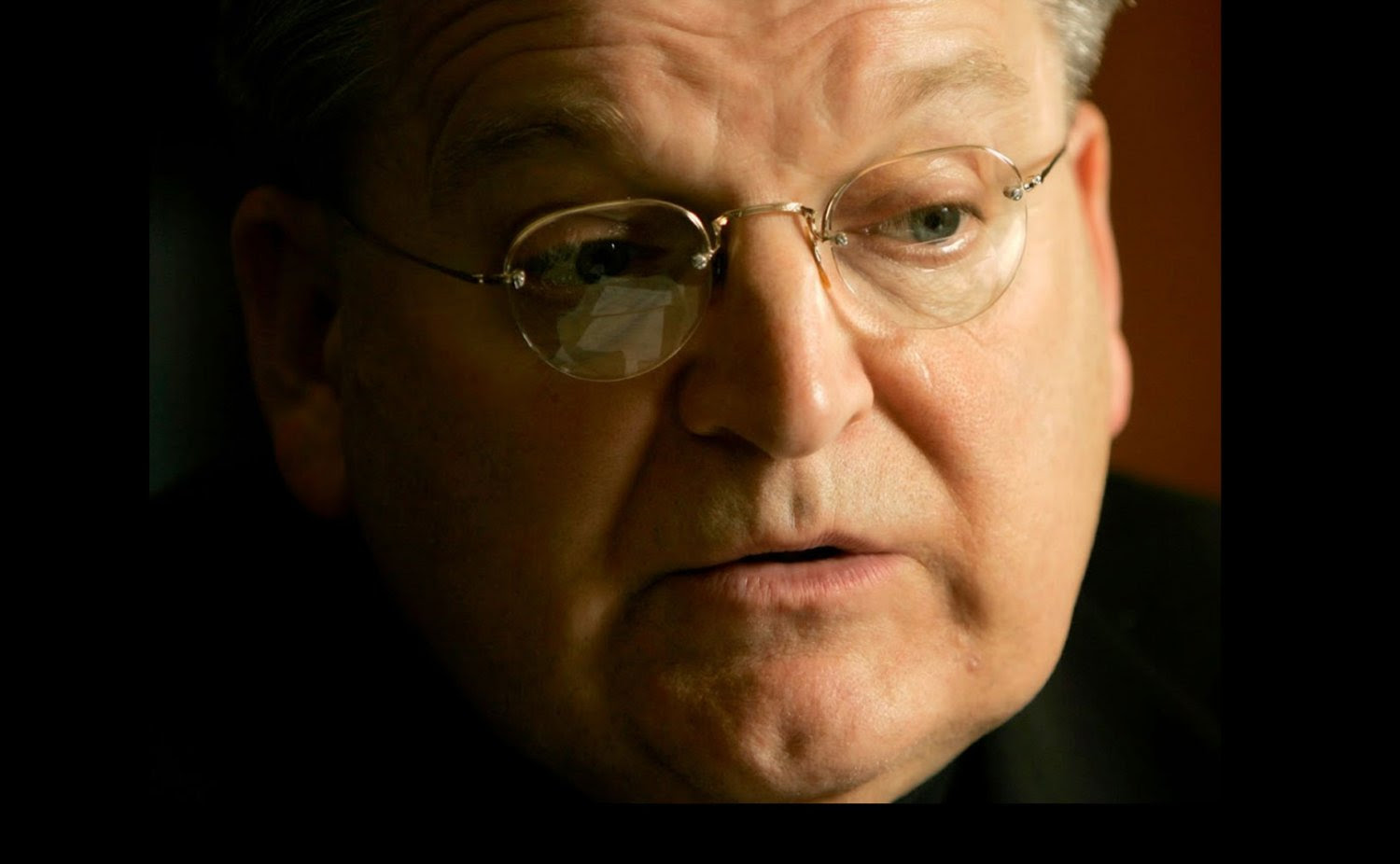
INTERVIEW GIVEN BY CARDINAL RAYMOND BURKE ON THE TALK HE GAVE AT THE SYMPOSIUM HELD IN ROME ON 07 APRIL 18

Featured Image
Diane Montagna / LifeSiteNews
Diane MontagnaDiane Montagna

NEWS,

Cardinal Burke: Pope Francis is ‘increasing the confusion’ (FULL INTERVIEW)

ROME, April 5, 2018 (LifeSiteNews) — Pope Francis is “increasing the confusion” in the Church, and the College of Cardinals constitutes a de facto check against papal error, Cardinal Raymond Burke has said in a new interview.

Speaking to the Italian Catholic news agency La Nuova Bussola Quotidiana on Thursday, Cardinal Burke said last week’s alleged ‘interview’ on hell with Pope Francis, reported by his 94-year-old atheist friend, Eugenio Scalfari, “went beyond what is tolerable.”

Burke also called the Vatican’s response to the “scandalized reactions” from across the globe “highly inadequate,” because it failed to reassert the Church’s teaching on the immortality of the soul and the existence of hell. He said it also failed to state that Pope Francis repudiates the “erroneous and even heretical ideas” attributed to him.

“It has been a source of profound scandal not only for many Catholics but also for many people in the secular world who have respect for the Catholic Church and its teachings, even if they do not share them,” he said.

“This playing around with faith and doctrine, at the highest level of the Church, rightly leaves pastors and faithful scandalized,” he added.

Cardinal Burke said the situation is further aggravated by the silence of so many bishops and cardinals, some of whom “pretend there is nothing serious going on.”

Here below we publish a LifeSiteNews translation of the full interview with Cardinal Burke. It comes just two days before an April 7 conference in Rome under the title: “Catholic Church: Where are you heading?”

***

Your Eminence, you will be one of the main speakers at the conference in Rome on April 7, which in the name of Cardinal Caffarra will ask questions about the direction of the Church. The title of the conference indicates concern over the direction being taken in the Church. What are the reasons for this concern?

The confusion and division in the Church on the most fundamental and important issues — marriage and the family, the Sacraments and the right disposition to receive them, intrinsically evil acts, eternal life and the Last Things — are becoming increasingly widespread. And the Pope not only refuses to clarify things by proclaiming the constant doctrine and sound discipline of the Church — a responsibility inherent in his ministry as the Successor of St. Peter, but he is also increasing the confusion.

Are you referring to the increase in the number of private statements that are being reported by those who meet with him?

What happened with the last interview given to Eugenio Scalfari during Holy Week and published on Holy Thursday went beyond what is tolerable. That a well-known atheist claims to announce a revolution in the teaching of the Catholic Church, believing that he speaks on behalf of the Pope, denying the immortality of the human soul and the existence of Hell, has been a source of profound scandal not only for many Catholics but also for many people in the secular world who have respect for the Catholic Church and its teachings, even if they do not share them.

Moreover, Holy Thursday is one of the holiest days of the year, the day on which the Lord instituted the Most Holy Sacrament of the Eucharist and the Priesthood, so that He might always offer us the fruit of His redemptive Passion and Death for our eternal salvation. Furthermore, the Holy See’s response to the scandalized reactions from all over the world was highly inadequate. Instead of clearly reasserting the truth about the immortality of the human soul and Hell, the denial only states that some of the words quoted are not the Pope’s. It does not say that the erroneous and even heretical ideas expressed by these words are not shared by the Pope, and that the Pope repudiates these ideas as contrary to the Catholic Faith. This playing around with the faith and doctrine, at the highest level of the Church, rightly leaves pastors and faithful scandalized.

If things are so serious, and a source of embarrassment, it is astonishing that so many of the Church’s pastors remain silent.

Certainly, the situation is further aggravated by the silence of so many bishops and cardinals who share with the Roman Pontiff a sollicitude for the universal Church. Some  simply stay silent. Others pretend that there is nothing serious going on. Still others spread fantasies of a new Church, of a Church that takes a totally different direction from the past, imagining for example a “new paradigm” for the Church, or a radical conversion in the Church’s pastoral praxis, making it completely new. Then there are those who are enthusiastic promoters of the so-called revolution in the Catholic Church. For the faithful who understand the gravity of the situation, the lack of doctrinal and disciplinary direction on the part of their pastors leaves them feeling lost. For the faithful who do not understand the gravity of the situation, this lack of direction leaves them in confusion, and eventually victims of errors that endanger their souls. Many people who were baptized in a Protestant ecclesial communion, but then entered into the full communion of the Catholic Church because their original ecclesial communities abandoned the Apostolic Faith, are suffering intensely at this situation — they perceive that the Catholic Church is going down the same road of abandoning the faith.

What you are describing is an apocalyptic situation…

This whole situation leads me to reflect more and more on the message of Our Lady of Fatima who warns us about the evil — even more serious than the very grave evils suffered because of the spread of atheistic communism — which is apostasy from the faith within the Church. Number 675 of the Catechism of the Catholic Churchteaches us that “before Christ’s second coming the Church must pass through a final trial that will shake the faith of many believers” and that “the persecution that accompanies her pilgrimage on earth will unveil the ‘mystery of iniquity’ in the form of a religious deception offering men an apparent solution to their problems at the price of apostasy from the truth.”

In such a situation the bishops and cardinals have the duty to proclaim true doctrine. At the same time, they must lead the faithful to make reparation for the offenses against Christ and the wounds inflicted on His Mystical Body, the Church, when faith and discipline are not rightly safeguarded and promoted by pastors. The great canonist of the thirteenth century, Henry of Segusio, also known as Hostiensis, facing the difficult question of how to correct a Roman Pontiff who acts in a way contrary to his office, states that the College of Cardinals constitutes a de facto check against papal error.

Without a doubt, the figure of Pope Francis is much discussed today. The discussion ranges from the uncritical exaltation of whatever he does to the ruthless criticism for every ambiguous gesture. But somehow the problem of how to relate to the Pope applies to every pontiff. And so some things need to be clarified. What does the Pope represent for the Church?

According to the constant teaching of the Church, the Pope, through the express will of Christ, is “the perpetual and visible principle and foundation of unity of both the bishops and of the faithful” (Dogmatic Constitution on the Church of the Second  Vatican Council, Lumen Gentium, 23). It is the essential service of the Pope to safeguard and promote the deposit of faith, true doctrine and sound discipline consistent with the truths believed.

In the interview with Eugenio Scalfari quoted above, the Pope is referred to as “revolutionary.” But the Petrine Office has nothing, absolutely nothing, to do with revolution. On the contrary, it exists exclusively for the preservation and propagation of the immutable Catholic faith, which leads souls to conversion of heart and leads all humanity to the unity founded on the order inscribed by God in His creation and especially in the heart of man, the only earthly creature made in the image of God. It is the order that Christ restored through the Paschal Mystery that we are celebrating in these [Easter] days. The grace of the Redemption that emanates from His glorious pierced Heart in the Church, in the hearts of His members, gives the strength to live according to this order, that is, in communion with God and with one’s neighbor.

Surely the Pope is not an absolute sovereign, yet today he is widely seen as such. “If the Pope says so….” is the common way of cutting off any question or doubt about various statements. There is a sort of papolatry. How would you respond to this?

The notion of the plenitude of power of the Roman Pontiff has already been enunciated clearly by Pope St. Leo the Great. The Canonists of the Middle Ages contributed greatly to the deepening of the power inherent in the Petrine Office. Their contribution remains valid and important. The notion is very simple. The Pope, through the divine will, enjoys all the power necessary to safeguard and promote the true faith, true divine worship, and the sound discipline required.

This power belongs not to his person but to his office as Successor of St. Peter. In the past, for the most part, the popes did not make public their personal acts or their opinions precisely so as not to risk the faithful being confused about what the successor of St.Peter does and thinks. At present there is a risky and even harmful confusion between the person of the Pope and his office, that results in the obscuring of the Petrine Office and in a worldly and political idea of the service of the Roman Pontiff in the Church.

The Church exists for the salvation of souls. Any act of a Pope that undermines the salvific mission of Christ in the Church, whether it be a heretical act or a sinful act in itself, is simply void from the point of view of the Petrine Office. Therefore, even if it clearly causes very serious damage to souls, it does not command the obedience of pastors and faithful. We must always distinguish the body of the man who is the Roman Pontiff from the body of the Roman Pontiff, that is, from the man who exercises the office of St. Peter in the Church. Not to make this distinction means papolatry and ends up in the loss of faith in the Divinely Founded and Sustained Petrine Office.

What should a Catholic hold most dear in his relationship with the Pope?

A Catholic must always respect, in an absolute way, the Petrine Office as an essential part of the institution of the Church by Christ. When a Catholic no longer respects the office of the Pope, he is disposed either to schism or to an apostasy from the Faith. At the same time, Catholics must respect the man charged with the office, which means attention to his teaching and pastoral direction.

This respect also includes the duty to express the judgment of a rightly formed conscience to the Pope, when he deviates or seems to deviate from true doctrine and sound discipline, or to abandon the responsibilities inherent in his office. Through natural law, the Gospels, and the Church’s constant disciplinary tradition, the faithful are bound to express to their pastors their concern for the state of the Church. They have this duty, which is matched by the right to receive a response from their pastors.

And so is it possible to criticize the Pope? And under what conditions?

If the Pope does not fulfill his office for the good of all souls, it is not only possible but also necessary to criticize the Pope. This criticism ought to follow Christ’s teaching on fraternal correction in the Gospel (Mt 18:15-18). First, the lay faithful or pastor ought to express his criticism privately, which will allow the Pope to correct himself. But if the Pope refuses to correct a way of teaching or acting that is gravely lacking, the criticism ought to be made public, because it has to do with the common good in the Church and in the world. Some have criticized those who have publicly expressed criticism of the Pope, saying it is a manifestation of rebellion or disobedience, but to ask — with due respect for his office — for the correction of confusion or error is not an act of disobedience, but an act of obedience to Christ and thus to His Vicar on earth.

Translation by Diane Montagna. Reprinted with the kind permission of Riccardo Cascioli of La Nuova Bussola Quotidiana. 


Posted in Uncategorized | Comments Off on INTERVIEW GIVEN BY CARDINAL RAYMOND BURKE ON THE TALK HE GAVE AT THE SYMPOSIUM HELD IN ROME ON 07 APRIL 18

CARDINAL BRANDMUELLER’S SPEECH BEFORE THE SYMPOSIUM “CATHOLIC CHURCH, WHERE ARE WE HEADED?” HELD IN ROME ON 07 APRIL 18

Featured Image
Diane MontagnaDiane Montagna

NEWS,

Cardinal Brandmüller warns Catholics not to heed ‘majority’ but ‘minority who truly live the faith’

ROME, April 7, 2018 (LifeSiteNews) — The history of the Church teaches us that “truth is not necessarily found with the majority,” but rather in the “minority which has truly lived and witnessed to the faith,” Cardinal Walter Brandmüller, one of the four ‘dubia’ cardinal, said today in Rome.

Speaking at the symposium ‘Catholic Church: Where are you heading?,’ Cardinal Brandmüller said “when Catholics en masse consider it legitimate to remarry after divorce or use contraception … this is not a mass witness to the faith, but a mass departure from it.”

In his reflection, Brandmüller, president emeritus of the Pontifical Committee for Historical Sciences, Blessed John Henry Newman’s 1859 essay On Consulting the Faithful in Matters of Doctrine.  emphasized the laity’s role in matters of doctrine, and sought to distinguish what is a true sensus fidei (sense of the faith) of believers and what is not.

“In the history of the people of God, it has often been not the majority but rather a minority which has truly lived and witnessed to the faith,” he said. “The experience of the Church shows that sometimes the truth of the faith has been conserved not by the efforts of theologians or the teaching of the majority of bishops but in the hearts of believers.”

The sensus fidei fidelium, Brandmüller continued, is expressed much more authentically initiatives like the “Manif pour tous” mass demonstrations in France, the one million faithful who petitioned Pope Francis to clarify the confusion that arose after the publication of Amoris Laetitia, the March for Life in the United States, and the human Rosary chain in Poland and other places around the world.

“It is time that the Magisterium paid due attention to this witness of faith,” he said.

Here below we offer our readers an English translation of Cardinal Walter Brandmüller’s talk in Rome.


On Consulting the Faithful in Matters of Doctrine

Cardinal Walter Brandmüller

April 7, 2018 – Rome

On Consulting the Faithful in Matters of Doctrine. This is the title of the famous essay written by Blessed John Henry Newman in 1859 that I will be commenting on today. I will consider what space and weight ought to be given to the voice of the faithful in matters of doctrine. And I will pose this question amid the crisis of faith that today is shaking the Church to its depths.

When speaking of the laity, some might suppose that we intend to contrast experts with “laity,” where the latter are less “afflicted” by informed consent and more easily make their voices heard even in the most complex issues. Just think of the problem of climate change. But that is not what we are dealing with here and now.

In the present context, “layman” does not designate a non-expert in matters of theology, but rather a baptized and confirmed Christian who has not received the sacrament of Orders. I will therefore examine what role the laity have in the interpretation, explanation, proclamation and formulation of the doctrine of the faith; and, not lastly, I will pose this question against the background of the current situation. The International Theological Commission, then headed by Cardinal Müller, in 2014 also published an important document in this regard, which will be taken into consideration.

I

First, however, let us take a look at history. There are, in fact, many testimonies of the important role of the laity’s witness of faith. Cardinal Newman turns our gaze to the Arian crisis in the fourth century. In that situation, which dealt with the equal nature of the divinity of Jesus with the Father, and whose stakes were a matter of belonging or not belonging to the Church, the bishops failed in abundance. “They spoke variously, one against another; there was nothing, after Nicaea, of firm, unvarying, consistent testimony, for nearly sixty years.”

While the episcopate was shaken and divided, “in that very day the divine tradition committed to the infallible Church was proclaimed and maintained far more by the faithful than by the Episcopate.” Newman states: “In that time of immense confusion the divine dogma of our Lord’s divinity was proclaimed, enforced, maintained, and (humanly speaking) preserved, far more by the ‘Ecclesia docta’ than by the ‘Ecclesia docens’; that the body of the episcopate was unfaithful to its commission, while the body of the laity was faithful to its baptism.”

Let us skip over the analogous testimonies in the Middle Ages and at the beginning of the modern era, where preference is given to the witness of faith of the whole Church, without distinguishing between titles of holders of the magisterium and the faithful. There one finds the infallibilitas in credendo spoken of, i.e. the passive infallibility of the Church, which cannot, in its totality, fall into heresy.

The sensus fidei of believers, however, does not act only when dealing with the rejecting error, but also in the witness to truth.

Very significant examples of the importance that  several popes attributed to the laity’s witness of faith can be found in the last two centuries; more precisely, in the context of the Marian dogmas of 1854 and 1950.

In both cases, before they were defined all the bishops were invited to verify and report where they themselves, together with the clergy and the faithful, stood in regard to this intention. In this way, both Pius IX and Pius XII ascertained the conviction of faith alive in the Church regarding the two Marian truths. The approval of the two dogmas was general, with a few rare exceptions. “Securus iudicat orbis terrarum.” Augustine had already contrasted this conviction with the heresies of his time. Clearly both Pius IX and Pius XII were aware of the weight that the witness of the faithful has also in relation to the supreme master of faith, making express reference to it in their respective bulls defining the dogmas.

II

It is therefore the sensus, the consensus fidei, by virtue of which the witness of the faithful has its own weight in the preservation, deepening and proclamation of the truth of revealed faith.

When Cardinal Newman says that it is a matter, on the part of the Magisterium, of consulting the faithful, one might get the impression that he intends a sort of poll, even a plebiscite. Of course this is impossible. The Church is not a democratically constituted society, but the Corpus mysticum of the risen and glorified Christ, with whom and in whom the faithful are united as the members of a body, forming as it were a supernatural organism. Clearly, therefore, laws different from sociological and political ones apply; what emerges here is the reality of grace.

As the faith teaches, through the Sacrament of baptism a person is infused with sanctifying grace, which is a supernatural ontological reality that renders man holy, just and pleasing to God. Through sanctifying grace — one could also say justifying grace — the three theological virtues of faith, hope and charity are also infused. Faith, hope and charity are a habitus, a predisposition of the soul that make the latter capable of acting, of behaving accordingly.

One way the theological virtue of faith becomes efficacious, among other things, is through the sensus fidei of the faithful. This effectiveness can, positively, enable a deeper vision of revealed truth, a clearer understanding and a stronger profession. Negatively, however, the sensus fidei acts as a sort of spiritual immune system, which enables the faithful instinctively to recognize and reject any error. Leaving aside the divine promise, the passive infallibility of the Church, i.e. the certainty that the Church in its totality can never slip into heresy, also rests therefore on this sensus fidei.

In fact, in number 12 of the constitution Lumen gentium, the Second Vatican Council teaches: “The entire body of the faithful, anointed as they are by the Holy One (cf. 1 Jn 2:20 and 27), cannot err in matters of belief. They manifest this special property by means of the whole peoples’ supernatural discernment in matters of faith when ‘from the Bishops down to the last of the lay faithful’ they show universal agreement in matters of faith and morals. That discernment in matters of faith is aroused and sustained by the Spirit of truth. […] Through it, the people of God adheres unwaveringly to the faith given once and for all to the saints, penetrates it more deeply with right thinking, and applies it more fully in its life.”

Therefore, the consensus of the faithful and manifestation of the same have a significant importance.

III

Now, undoubtedly in the history of the Church there have been cases of this kind. Such was the case, for example, with the so-called Pataria movement in Northern Italy, which, approaching attempts at roman reform, in the second half of the twelfth century forcefully rose up against the investiture of the laity, simony and priestly concubinage. Then there were the masses of faithful who in 1300s set out to reach the tombs of the apostles, leading Pope Boniface VIII to establish the Holy Year and to articulate the doctrine on indulgences with the Bull Antiquorum habet fida relatio. It should not be forgotten how important the ultramontanism of the nineteenth century was for the dogmas of Vatican Council I.

But history also teaches us that truth is not necessarily found with the majority, or in large numbers. Indeed, what should have be said when, for example, the apostolic nuncio Girolamo Aleandro reported from the Reichstag of Worms of 1521 that nine tenths of the Germans had shouted “Luther” and “down with the Roman Curia”? What should be said when today our parish communities loudly applaud a priest who has announced his imminent wedding during his homily? What happened when the German Katholikentag of 1968 reacted with excessive protests, even with hatred, to the encyclical Humanae vitae?

Truly, in such cases was — and is — the sensus fidei, the consensus fidelium at work, nourished by the theological virtue? It seems clear, in these and other similar cases, that the consensus fidei fidelium cannot be compared to the volonté generale of Rousseau.

Therefore, when Catholics en masse consider it legitimate to remarry after divorce, to use contraception or other similar things, this is not a mass witness to the faith, but a mass departure from it. The sensus fidei is not an entity that can be determined democratically,  through opinion polls. The only question is how mass testimony differs from mass estrangement.

St. John Paul II therefore had already stressed the need to distinguish carefully between “public opinion” and the sensus fidei fidelium.

In this regard, the International Theological Commission also says with great clarity: “It is clear that there can be no simple identification between the sensus fidei and public or majority opinion. These are by no means the same thing.” (The sensus fidei in the life of the Church, n. 118). This also applies to public or majority opinion within the Church. “In the history of the people of God, it has often been not the majority but rather a minority which has truly lived and witnessed to the faith. […]. It is therefore particularly important to discern and listen to the voices of the ‘little ones who believe’ (Mk 9:42)” (ibid.).

What follows [in the text] is extraordinary: “The experience of the Church shows that sometimes the truth of the faith has been conserved not by the efforts of theologians or the teaching of the majority of bishops but in the hearts of believers” (ibid. n. 119).

One particular example of this is given by the arian confusion surrounding the Council of Nicaea already mentioned by Newman, where even the synods of bishops either supported heresy or were spreading it. The same could be observed when one thinks of the opinions sustained today by the diocesan, pastoral and other councils established in the post-conciliar period. It is perhaps a little far from reality when the above-mentioned document “Sensus fidei” defines them in general as “institutional instruments” for evaluating the sensus fidelium (ibid., n. 125).

Indeed, as the example of the post-Nicaea synods already shows, they can fall into error. Discernment therefore becomes even more essential. This need is highlighted by the document ‘The sensus fidei in the life of the Church published’ published in 2014: “It is necessary now to consider how to discern and identify authentic manifestations of the sensus fidei. Such a discernment is particularly required in situations of tension when the authentic sensus fidei needs to be distinguished from expressions simply of popular opinion, particular interests or the spirit of the age” (n. 87).

Once again, reference can be made to J. H. Newman, who in his Essay on the Development of Christian Doctrine proposes a list of criteria which make it possible to distinguish the legitimate organic development of doctrine from error. Here it suffices to recall the indispensable lack of contradiction with regard to authentic tradition.

And so this document [The sensus fidei in the life of the Church published] also develops criteria, or “dispositions required for authentic participation in the sensus fidei(ibid., n. 73). This means that not all those who call themselves Catholic can claim they should be taken seriously as a organ of this sensus fidei.

In short: “Authentic participation in the sensus fidei requires holiness. […] To be holy fundamentally means […] to be baptized and to live the faith in the power of the Holy Spirit.” (ibid. n. 99). This defines a very high requirement then.

*

Once these premises have been laid down, it is necessary to take into account what the Second Vatican Council teaches in number 12 of Lumen Gentium: “Catholics should be fully aware of the real freedom to speak their minds which stems from a “feeling for the faith” [i.e. the sensus fidei] and from love (Lumen gentium, 12). (The sensus fidei in the life of the Church, n. 24). That is why canon 212 §3 also establishes: “According to the knowledge, competence, and prestige which they possess, they have the right and even at times the duty to manifest to the sacred pastors their opinion on matters which pertain to the good of the Church and to make their opinion known to the rest of the Christian faithful, without prejudice to the integrity of faith and morals.”

*

Now, however, the question arises as to how to discern the authentic, and therefore theologically relevant, sensus fidelium. In the preparatory phase of the synods of bishops, for example, questionnaires were distributed for this purpose. I cannot judge to what extent these actions were carried out in a professional manner, that is, taking into account the methods developed by modern public opinion research. It is clear, however, that these questionnaires reached the halls of Catholic organizations much more easily than the normal community of the faithful. It was therefore to be expected that the results of the consultation would be influenced by the thinking promoted by the individual associations, etc., rather than reflecting the true public opinion of the people of the faithful. Another problem is the choice, that is to say the formulation of the proposed questions. This made it easy to manipulate the results. It is doubtful whether this [method] will allow the real sensus fidei fidelium to be experienced.

The sensus fidei fidelium, I believe, is expressed much more authentically through spontaneous declarations. One very clear example of this is offered by the “Manif pour tous” mass demonstrations in France. It is also worth noting the participation of hundreds of thousands of people in the Marches for Life. Almost one million Catholics have petitioned the Holy Father about the issues that arose over Amoris laetitia, followed by more than 200 eminent scholars from all over the world. And there are human chains praying the Rosary around the world. These are the forms in which the sensus fidei, the instinct of faith of believing people, is manifested today. It is time that the Magisterium paid due attention to this witness of faith.

In the work cited at the beginning of this talk, On Consulting the Faithful in Matters of Doctrine, J. H. Newman writes: “…I am not supposing that such times as the Arian will ever come again…”. Today we would all be better off if he were right.

Translation by Diane Montagna of LifeSiteNews (All rights reserved).


Posted in Uncategorized | 1 Comment

I TESTIFY AND CONFESS THAT I SUBSCRIBE TO AND BELIEVE THE TRUTHS SET FORTH IN THE FINAL DECLARATION OF THE CONFERENCE “CATHOLIC CHURCH, WHERE ARE YOU GOING” HELD IN ROME ON APRIL 7 2018 To read a more complete profession of faith and belief by me read the page “I Believe” on my home page.

TitoloEN

Final declaration of the conference “Catholic Church, where are you going?”
Rome, April 7, 2018

Due to contradictory interpretations of the Apostolic Exhortation “Amoris laetitia,” growing discontent and confusion are spreading among the faithful throughout the world.

The urgent request for a clarification submitted to the Holy Father by approximately one million faithful, more than 250 scholars and several cardinals, has received no response.

Amidst the grave danger to the faith and unity of the Church that has arisen, we baptized and confirmed members of the People of God are called to reaffirm our Catholic faith.

The Second Vatican Council authorizes us and encourages us to do so, stating in “Lumen Gentium,” n. 33: “Thus every layman, in virtue of the very gifts bestowed upon him, is at the same time a witness and a living instrument of the mission of the Church itself ‘according to the measure of Christ’s bestowal’ (Eph. 4:7).”

Blessed John Henry Newman also encourages us to do so. In his prophetic essay “On Consulting the Faithful in Matters of Doctrine” (1859), he spoke of the importance of the laity bearing witness to the faith.

Therefore, in accordance with the authentic tradition of the Church, we testify and confess that:

1) A ratified and consummated marriage between two baptized persons can be dissolved only by death.

2) Therefore, Christians united by a valid marriage who join themselves to another person while their spouse is still alive commit the grave sin of adultery.

3) We are convinced that there exist absolute moral commandments which oblige always and without exception.

4) We are also convinced that no subjective judgment of conscience can make an intrinsically evil act good and licit.

5) We are convinced that judgment about the possibility of administering sacramental absolution is not based on the imputability of the sin committed, but on the penitent’s intention to abandon a way of life that is contrary to the divine commandments.

6) We are convinced that persons who are divorced and civilly remarried, and who are unwilling to live in continence, are living in a situation that is objectively contrary to the law of God, and therefore cannot receive Eucharistic Communion.

Our Lord Jesus Christ says: “If you continue in my word, you are truly my disciples, and you will know the truth, and the truth will make you free” (Jn 8: 31-32).

With this confidence we confess our faith before the supreme pastor and teacher of the Church and before the bishops, and we ask them to confirm us in the faith.

Posted in Uncategorized | 3 Comments

THE TIDE OF THE LIFE OF THE CHURCH IS CHANGING. WHETHER IT IS RISING OR FALLING DEPENDS ON ONE’S POINT OF VIEW. FROM WHERE I STAND IT IS RISING, AS THIS POST GIVES EVIDENCE THAT IT IS.

Settimo Cielodi Sandro Magister

In a Church With No Leader, Two New Protests From Bishops and Faithful

Newman


An anxious Easter, at the top of the Catholic Church. Over the span of a few days, two of the most revolutionary turning points of the pontificate of Pope Francis have been contested with as many public declarations on the part of cardinals, bishops, and members of the Christian people.

They are the two watersheds that admit to Eucharistic communion both the divorced and remarried, and Protestants.

*

With regard to communion for the divorced and remarried, already in 2016 four cardinals had spoken out against the “openness” of Francis, submitting to him their “dubia” and then asking him by letterto be received. Without ever getting any response from him.

But now two of those cardinals, the German Walter Brandmüller and the American Raymond L. Burke, have again come forward and together with all the participants in a conference held in Rome today, Saturday April 7, have published a “Declaratio,” a profession of faith, which reaffirms the key points of Church doctrine brought into doubt by the onslaught of innovation begun by the current pontificate.

The text of the “Declaratio,” in multiple languages, is presented on this same page, further below.

*

As for communion for Protestants at Catholic Masses, seven bishops of Germany, including the cardinal of Cologne, Rainer Maria Voelki, have made an appeal to the Holy See against the decision to allow it, made by the German episcopal conference.

This decision – which is presented in the form of an “orientational aid” – went into effect on March 22 at the end of a meeting of the episcopal conference, where it had been approved by a majority vote after a lively discussion.

The bishops who contested this decision maintain that it touches on a question that is too significant, one that endangers the doctrine and unity of the Catholic Church, to be left to the judgment of individual national Churches or individual bishops or priests. And precisely for this reason they have made an appeal to Rome, asking for a clarification from the congregation for the doctrine of the faith, which has as its prefect the Jesuit archbishop Luis Ladaria, and from the pontifical council for Christian unity, which has as its president Cardinal Kurt Koch.

Their initiative was covered in the April 4 edition of the German newspaper “Kölner Stadt-Anzeiger.” The seven signers of the appeal, in addition to Cardinal Woelki, are Ludwig Schick, archbishop of Bamberg, Konrad Zdarsa, bishop of Augsburg, Gregor Maria Hanke, bishop of Eichstätt, Stefan Oster, bishop of Passau, Rudolf Voderholzer, bishop of Regensburg, and Wolfgang Ipolt, bishop of Görlitz.

Whether the Holy See will respond or not, and how, will naturally depend on what Pope Francis will decide.

Who, when he was questioned once by a Protestant woman who asked him if she could receive communion at Mass together with her Catholic husband, answered with a whirligig of yes, no, I don’t know, you figure it out, precisely in this manner opening the way to a great variety of decisions, all of which he has depicted as possible. As Cardinal Walter Kasper afterward confirmed, confidently attributing to the pope the idea that “if two spouses, one Catholic and one Protestant, share the same Eucharistic faith and are inwardly disposed, they can decide in their conscience to receive communion.”

But if a response comes from Rome on this question, it will appear even less justifiable that the pope has kept such a stubborn silence concerning the “dubia” on the other crucial question of communion for the divorced and remarried, this too concerning the Catholic doctrine of the Eucharist, “source and summit” of the Church’s life.

*

Getting back to the “Declaratio” published by the participants in the conference in Rome on April 7, it must be noted that this is not formulated as a request for clarification – although it incorporates some of the questions raised in the “dubia” – but as a testimony of faith that rises from the Christian people at a moment perceived as being of “grave danger to the faith and unity of the Church,” because of “contradictory interpretations” of the apostolic exhortation “Amoris Laetitia.”

It is no coincidence that the conference was entitled “Catholic Church, where are you going?” And its subtitle was this statement from Cardinal Carlo Caffarra: “Only a blind man can deny that in the Church there is great confusion.”

The speakers were cardinals Brandmüller, Burke, and, from Hong Kong, Joseph Zen Zekiun, Bishop Athanasius Schneider, the philosopher and former president of the Italian senate Marcello Pera, the canonist Valerio Gigliotti, the bioethicist Renzo Puccetti. There was a replay of a talk given by Cardinal Caffarra in defense of the encyclical of Paul VI “Humanae Vitae,” now under reconsideration. And Cardinal Burke also raised his critical voice in an extensive interview published just before the conference on La Nuova Bussola Quotidiana and in English on LifeSite News.

But perhaps the most original element of the conference, developed by Cardinal Brandmüller and incorporated in the “Declaratio,” was the reference to a text by Blessed Cardinal John Henry Newman (1801-1890) on the key role of the faithful in bearing witness to the true doctrine of the Church: “On Consulting the Faithful in Matters of Doctrine.”

Newman published this text anonymously in the English Catholic magazine “The Rambler,” of which he had been the editor. At the time it raised heated controversy. It was republished in 1961 just before Vatican Council II and since then has become a classic.

In it Newman reviews the moments of the Church’s history in which the orthodoxy of the faith was lost by many of the bishops and saved instead by many of the ordinary baptized. And he gathers from this that on matters of doctrine listening to the voice of the faithful  – not to be confused with public opinion, but to be verified in its fidelity to the tradition of the Church – is not only desirable, but a duty.

A lesson of history more valid now than ever, and one to which the “Declaratio” gives voice. In the hope that it may be heeded even by him who sits on the chair of Peter.

In addition to Italian, English, Spanish, and French, the text of the “Declaratio” is available on “Settimo Cielo” in German, Portuguese, and Polish:

> “So also bezeugen und bekennen wir…”

> “Por isso, testemunhamos e confessamos…”

> “Dajemy świadectwo i wyznajemy…”

While on theese other pages one can read, in Italian and in English, the talk given at the conference by Cardinal Walter Brandmüller:

> “On consulting…”. Sulla consultazione dei fedeli in materia di dottrina
> “On Consulting the Faithful in Matters of Doctrine”

On this other, that of Cardinal  Raymond L. Burke:

> La “plenitudo potestatis” del Romano Pontefice nel servizio dell’unità della Chiesa

And again on this other, that of Bishop Athanasius Schneider:

> The Apostolic See as the cathedra of truth

*

TitoloEN

Final declaration of the conference “Catholic Church, where are you going?”
Rome, April 7, 2018

Due to contradictory interpretations of the Apostolic Exhortation “Amoris laetitia,” growing discontent and confusion are spreading among the faithful throughout the world.

The urgent request for a clarification submitted to the Holy Father by approximately one million faithful, more than 250 scholars and several cardinals, has received no response.

Amidst the grave danger to the faith and unity of the Church that has arisen, we baptized and confirmed members of the People of God are called to reaffirm our Catholic faith.

The Second Vatican Council authorizes us and encourages us to do so, stating in “Lumen Gentium,” n. 33: “Thus every layman, in virtue of the very gifts bestowed upon him, is at the same time a witness and a living instrument of the mission of the Church itself ‘according to the measure of Christ’s bestowal’ (Eph. 4:7).”

Blessed John Henry Newman also encourages us to do so. In his prophetic essay “On Consulting the Faithful in Matters of Doctrine” (1859), he spoke of the importance of the laity bearing witness to the faith.

Therefore, in accordance with the authentic tradition of the Church, we testify and confess that:

1) A ratified and consummated marriage between two baptized persons can be dissolved only by death.

2) Therefore, Christians united by a valid marriage who join themselves to another person while their spouse is still alive commit the grave sin of adultery.

3) We are convinced that there exist absolute moral commandments which oblige always and without exception.

4) We are also convinced that no subjective judgment of conscience can make an intrinsically evil act good and licit.

5) We are convinced that judgment about the possibility of administering sacramental absolution is not based on the imputability of the sin committed, but on the penitent’s intention to abandon a way of life that is contrary to the divine commandments.

6) We are convinced that persons who are divorced and civilly remarried, and who are unwilling to live in continence, are living in a situation that is objectively contrary to the law of God, and therefore cannot receive Eucharistic Communion.

Our Lord Jesus Christ says: “If you continue in my word, you are truly my disciples, and you will know the truth, and the truth will make you free” (Jn 8: 31-32).

With this confidence we confess our faith before the supreme pastor and teacher of the Church and before the bishops, and we ask them to confirm us in the faith.

(English translation by Matthew Sherry, Ballwin, Missouri, U.S.A.)

Condividi:
  • Facebook
  • Twitter
  • Google Bookmarks
  • FriendFeed
  • LinkedIn
Posted in Uncategorized | 1 Comment

WHOSE PHOTO DO YOU THINK THIS IS ?? SOMEONE YOU KNOW ??


LB47

+

+

+

+

+

+

+

+

+

+

Mother Teresa, known in the Catholic Church as Saint Teresa of Calcutta was an Albanian-Indian Roman Catholic nun and missionary. She was born in Skopje ( now the capital of the Republic of Macedonia), then part of the Kosovo Vilayet of the Ottoman Empire. 

Feast‎: ‎5 September
Attributes‎: ‎Nun’s habit‎; ‎Rosary
Canonized‎: ‎4 September 2016, ‎Saint Peter’s S…
Beatified‎: ‎19 October 2003, ‎Saint Peter’s Squa…


Posted in Uncategorized | 2 Comments

TRY TO IMAGINE AMERICA WITH “NO-GO ZONES” IN DETROIT, DALLAS, AND ELSEWHERE WHERE AMERICAN CITIZENS WOULD NOT BE ALLOWED TO ENTER


notre_dame_paris


from: Richard Stokes <richardstokes@yahoo.com.au>
to: Australian Catholic Bishops Conference <comms@catholic.org.au>
date: Fri, Apr 6, 2018 at 5:30 PM
subject: Australian No-Go Zones
mailed-by: yahoo.com.au
signed-by: yahoo.com.au
Dear Australian Bishops
 
Bishops are naturally concerned at the appalling attacks on Christians in the Middle East, where Muslims have made known their intention of destroying Christianity.
 
However, we still have bishops in Western countries whose efforts seem to be directed instead at the ‘rights’ of illegal immigrants.


The followers of Islam, left to themselves, would have little influence on world affairs.  In wars with Israel, Muslim armies which greatly outnumbered that of Israel were so soundly defeated that they appealed to the UN to save them.
 
The real problem is the political Left, which joins and supports Islam in opposing Christianity, even though Islam and the Left are natural enemies.  The Left needs the Muslim vote, without which it would have a real fight to be elected to anything.
 
The Left of politics supports abortion, contraception, sodomy, and anything else similarly harmful for Christian society.  It is not the kind of movement which Catholics would hope to see defended or promoted by bishops.
 
If we could render the Left harmless, Islam would disappear as a problem.  We could then look forward to the homogeneous society we once enjoyed.  Much like the societies of Japan and South Korea today, who don’t seem to have any problems with terrorism or no-go zones.  
 
The hour is late.  Sweden, France, Germany and Britain have no-go zones, where no one except a Muslim can safely enter.
 
This menace has started to rear its ugly head in Australia.  It seems that we already have no-go zones in Dandenong, Victoria.  Zones where ordinary Australians are not permitted.
 
 
Ambos Given No-Go Zones in Victoria
 
Dandenong Now a No-Go Zone for Sex Workers
 
Is it time for bishops to speak out?
 
To announce that the persecution of Christians anywhere is an act of great evil?
 
To declare that Islam is a religion founded by the forces of darkness? 
 
To initiate an urgent programme to invite conversion of Muslims to the security and peace of the Church founded by Christ?
 
To expose the hypocrisy of the political Left in this country, and to direct Catholics against voting for any group which espouses immoral behaviour?
 
Would the saving of souls of Muslims not please God?
Posted in Uncategorized | 3 Comments

BRAVO ARCHBISHOP CHARLES CHAPUT FOR YOUR EXCELLENT DEFENCE OF HUMANAE VITAE IN PREPARATION FOR THE 50TH ANNIVERSARY OF ITS PROMULGATION

Archbishop Chaput: the truth of Humanae Vitae makes us free

THE CATHOLIC HERALD, UK
{ABYSSUM}

The archbishop also warned that there is still opposition within the Church to the encyclical

The Catholic Church’s teaching on marriage, abortion, human sexuality and contraception is rooted in the same respect for human dignity that guides its work for social justice and care for poor people, Philadelphia Archbishop Charles Chaput told a Catholic University of America audience.

It is imperative that the church make known why it upholds its teaching, as reiterated in Blessed Paul VI’s 1968 encyclical “Humanae Vitae” (“Of Human Life”), so that Catholics and the world understand God’s plan for humanity, the archbishop said during the April 4 opening session of a symposium marking the 50th anniversary of the papal teaching.

The encyclical is notably known for upholding church renouncement of contraception. It followed by eight years the 1960 U.S. Food and Drug Administration approval of the first birth control pill.

Blessed Paul convened a commission to examine whether the historic Christian rejection of contraceptives would apply to the new technology. Most commission members advised the pope that it would not, but Blessed Paul eventually disagreed, saying in the encyclical that the new technology was prohibited birth control.

Blessed Paul’s decision has been widely criticized, Archbishop Chaput acknowledged, with some Catholic clergy, theologians and laypeople refusing to accept it. “That resistance continues in our own day,” said the archbishop, {who prudently refrained from adding that not “resistance” but active opposition comes today from the Friends of Francis who are seeking to abrogate the provisions of Humanae Vitae] who chairs the U.S. Conference of Catholic Bishops’ Committee on Laity, Marriage, Family Life and Youth. He made the comments in a 35-minute presentation to about 200 people.

“‘Humanae Vitae’ revealed deep wounds in the church about our understanding of the human person, the nature of sexuality and marriage as God created it,” he explained. “We still seek the cure for those wounds. But thanks to the witness of St. John Paul II, Pope Benedict, Pope Francis and many other faithful shepherds {sic}, the church has continued to preach the truth of Jesus Christ about who we are and what God desires for us.

“People willing to open their eyes and their hearts to the truth will see the hope that Catholic teaching represents and the power that comes when that truth makes us free,” he said.

The archbishop challenged widespread denunciation of the teaching on contraception by those who say church leaders spend too much time on “pelvic issues,” thus obscuring, they argue, the Gospel message of caring for poor people.

“As a bishop for 30 years in the dioceses where I served, that’s three of them, the church has put far more money, time and personnel into the care and education of the underprivileged than into programs related to sex,” he said.

“And it’s not that the critics don’t know this. Many don’t want to know it because facts interfere with their story line of a sexually repressed, body-denying institution locked in the past.”

Church teaching on contraception can be traced to the early days of Christianity, particularly in ancient Rome, where Christians emphasized upholding human dignity, he said.

Citing the work of Kyle Harper, provost at the University of Oklahoma and an expert in Roman history, the archbishop said the Romans “presumed that sex was just sex, one instinctual need among others” and that prostitutes and slaves were “safety valves” to satisfy such needs. But it was the early Christians who “welcomed all new life as something holy and a blessing,” teaching that each person was created in the image and likeness of God, he explained.

Christians also preached that God gave all people free will to act in accordance with God’s commands or against them, he said, continuing to cite Harper.

“Christianity embedded that notion of free will in human culture for the first time. Christian sexual morality was a key part of this understanding of free will. The body was a ‘consecrated space’ in which we could choose or reject God,” he said.

As a result, Christians began demanding “care for vulnerable bodies,” speaking out against slavery and supporting the needs of poor people, and that concern included opposition to contraception, he said.

Archbishop Chaput noted that Christian opposition to contraception continued until the 1930 Lambeth Conference of Anglican bishops, which determined that while the preferred method of avoiding birth should be sexual abstinence, other methods may be used to prevent pregnancy as long as they fell in line with Christian principles {sic}.

“Their minor tweak gradually turned into a full reversal on the issue of contraception. Other Christian leaders followed suit,” he said.

“Today this leaves the Catholic Church almost alone as a body of Christian believers whose leaders still maintain the historic Christian teaching on contraception,” he continued. “The church can thus look stubborn and out of touch for not adjusting her beliefs to the prevailing culture. But she’s simply remaining true to the faith she received from the apostles and can’t barter away.” {As opposed to the process of discernment proposed by the Friends of Francis that would vitiate completely the essence of Humanae Vitae.}

Since then, Archbishop Chaput said, “developed society has moved sharply away from Christian faith and morals, without shedding them completely.”

He echoed author G.K. Chesterton, who asserted that society is surrounded by “fragments of Christian ideas removed from their original framework and used in strange new ways. Human dignity and rights are still popular concepts, just don’t ask what their foundation is or whether human rights have any solid content beyond sentiment or personal preference.”

“Our culture isn’t reverting to the paganism of the past. It’s creating a new religion to replace Christianity. It’s that we understand that today’s new sexual mores are part of this larger change.”

The moral conflicts society faces, such as broken families, social unraveling and “gender confusion” stems “from our disordered attitudes toward creation and our appetite to master, reshape and even deform nature to our wills. We want the freedom to decide what reality is. And we insist on the power to make it so,” he said.

Such thinking is manifest in efforts to master the limitations of the human body and “attack the heart of our humanity,” the archbishop added.

Blessed Paul {VI}explains that “marriage is not just a social convention we’ve inherited, but the design of God himself. Christian couples are called to welcome the sacrifices that God’s design requires so they can enter into the joy it offers. This means that while husbands and wives may take advantage of periods of natural infertility to regulate the birth of their children, they can’t actively intervene to stamp out the fertility that’s natural to sexual love,” he said.

Because the church’s teaching often was not being followed prior to the encyclical, Archbishop Chaput said Blessed Paul offered four predictions if that trend continued: widespread infidelity and the general lowering of morality; loss of respect for women as they become viewed as instruments of selfish enjoyment rather than as beloved companions; public policies that advocate and implement birth control as a form of population policy; and humans thinking they had unlimited dominion over their own bodies, turning the person into the object of his or her own intrusive power.

“Half a century after ‘Humanae Vitae’ the church in the United States is at a very difficult but also very promising moment,” the archbishop said. “Difficult because the language of Catholic moral wisdom is alien to many young people, who often leave the church without every really encountering her. Promising because the most awake of those same young people want something better and more enduring than the emptiness and noise they now have.

“Our mission now, as always, is not to surrender to the world as it is, but to feed an ennoble the deepest yearnings of the world and thereby to lead it to Jesus Christ and his true freedom and joy.”

Posted in Uncategorized | 4 Comments

FRANCIS EXCOMMUNICATED ???


It was bound to happen, sooner or later.  A Declaration of Excommunication has been promulgated by a Patriarch of the Catholic Church against Francis (Jorge Maria Bergoglio) and his accomplices.

I have no idea of how valid this is canonically, but I believe that it is of tremendous importance in many other ways in the gathering storm which could possibly lead to the removal of Francis by a special conclave of some if  not all of the cardinals.


Patriarch’s video:

https://www.youtube.com/watch?v=QOAeFYX5eds

From Wikipedia

Michael Cerularius was born in Constantinople around 1000 AD, being ordained at a young age. He is noted for disputing with Pope Leo IX over church practices in respect of which the Roman Church differed from Constantinople, especially the use of unleavened bread in the Eucharist.[1] Notable disagreements were also exchanged over other theological and cultural issues, ranging from the issue of papal supremacy in the Church to the filioque clause and other disagreements between the Patriarchates.

Pope Leo IX sent a letter to the Patriarch in 1054, that cited a large portion of the Donation of Constantine believing it genuine.[2]

“The first pope who used it [the Donation] in an official act and relied upon it, was Leo IX; in a letter of 1054 to Michael Cærularius, Patriarch of Constantinople, he cites the “Donatio” to show that the Holy See possessed both an earthly and a heavenly imperium, the royal priesthood.”

Some scholars say that this letter of September 1053, the text of which is available in Migne, Patrologia Latina, vol. 143, coll. 744-769, was never actually despatched, but was set aside, and that the papal reply actually sent was the softer but still harsh letter Scripta tuae of January 1054.[3]

Leo IX assured the Patriarch that the donation was completely genuine, not a fable or old wives’ tale,[citation needed] arguing that only the apostolic successor to Peter possessed primacy in the Church.

This letter of Pope Leo IX was addressed both to Michael Cerularius, Patriarch of Constantinople, and Leo of Ohrid, Archbishop of Bulgaria, and was in response to a letter sent by Leo, Metropolitan of Achrida to John, Bishop of Trani (in Apulia), that categorically attacked the customs of the Latin Church that differed from those of the Greeks. Especially criticized were the Roman traditions of fasting on the Saturday Sabbath and consecration of unleavened bread. Leo IX in his letter accused Constantinople of historically being the source of heresy and claimed in emphatic terms the primacy of the Bishop of Rome over even the Patriarch of Constantinople, who would have none of it.

It can be argued that in 1054, the Patriarch’s letter to Pope Leo IX initiated the events which followed, because it claimed the title “ecumenical patriarch” and addressed Pope Leo as “brother” rather than “father.” Pope Leo IX sent Cardinal Humbert of Silva Candida on a legatine mission to treat with the Patriarch. Cerularius refused to meet with Cardinal Humbert and kept him waiting with no audience for months. {This resembles the treatment of the Dubia Cardinals by Jorge Maria Bergolio aka Francis.}

Thus, Cardinal Humbert of Silva Candida delivered a notice of excommunication {by Pope Leo IX} against Patriarch Michael on July 16, 1054, despite the death of Pope Leo three months {which Cardinal Humbert may or may not have been aware of due to poor means of communication in those days and the relative isolation experienced by Cardinal Humbert while he waited or Patriarch Michael’s response to Pope Leo’s letter to the Patriarch, the Cardinal was in the same situation as the Dubia Cardinals of today.} prior and thus the invalidity of the excommunication. Michael in turn excommunicated the cardinal and the Pope and subsequently removed the pope’s name from the diptychs, starting the East-West Schism.

++++++++++++++++++++++++++++++++++++++++++++++++++++++++++++++++++++++++++++

Patriarch Elijah OSBMr, born 1946, Czech Republic, ordained 1972. He joined the Order of St. Basil the Great in 1991. He took his doctor’s degree in theology at Charles University in Prague. He made public his secret episcopal consecration on 3 March 2008.

Bishop Methodius OSBMr, Secretary of the Byzantine Patriarchate, born 1968, Czech Republic. He joined the Order of St. Basil the Great in 1991, was ordained priest in 1996. He took his doctor’s degree in theology at Charles University in Prague. He made public his secret episcopal consecration on 3 March 2008.

Bishop Timothy OSBMr, Secretary of the Byzantine Patriarchate, born 1973, Slovak Republic. He joined the Order of St. Basil the Great in 2008, was ordained priest in 2004, obtained a licentiate in canon law in Rome. Episcopal consecration: July 2008, Pidhirci.

Note: OSBMr stands for Reformed Order of St. Basil the Great

Date, place and consecrators of Patriarch Elijah and Bishop Methodius are not published for the sake of protection against the intrigues of Card. Husar and his collaborators.
Episcopal succession is linked to Archbishop A. Sheptytskyi, OSBM. At the time of dissolution of the Greek Catholic Church by the communist government, secret episcopal consecration was received by: Bishop S. Dmyterko OSBM (theological studies in the Czech Republic), I. Bilyk OSBM, P. Vasylyk, V. Sternyuk CSsR, J. Kavatsiv OSBM….

The Byzantine Patriarchate is presently in exile (Prague – Donetsk)


Posted in Uncategorized | 9 Comments

DO NOT GROW TIRED OF KNOCKING ON THE BISHOP’S ‘DOOR’ WITH YOUR LETTERS, THE BISHOP WHO TAKES THE PLACE OF GOD IN YOUR CHURCH WILL HAVE TO ANSWER, EITHER TO YOU OR TO GOD FOR HIS NEGLECT OF YOU

 Asking in Faith (Matthew 7:7-12)

by Ralph F. Wilson

.

7 “Ask and it will be given to you; seek and you will find; knock and the door will be opened to you. 8 For everyone who asks receives; he who seeks finds; and to him who knocks, the door will be opened.

9 “Which of you, if his son asks for bread, will give him a stone? 10 Or if he asks for a fish, will give him a snake? 11 If you, then, though you are evil, know how to give good gifts to your children, how much more will your Father in heaven give good gifts to those who ask him! 12 So in everything, do to others what you would have them do to you, for this sums up the Law and the Prophets.” (7:7-12)

Earlier in the Sermon on the Mount, Jesus warned his disciples against formal, hypocritical prayer, and gave them a model prayer to start them on their prayer journey. Now he takes the lesson a step further by teaching them to ask in faith. The teaching seems to be simple — and at one level it is. Meditate with me on these words.

Jesus introduces three words that indicate desire that would be met: ask, seek, and knock.

Ask (7:7-8)

Ask seems to refer to simple petition, with the promise “it will be given to you.” The verb is aiteō, “to ask for, with a claim on receipt of an answer, ask, ask for, demand.”1 Many of our prayers are of this kind. Finding that parents are the key to getting many things, our children commonly ask for what they want: “Mom, can I have some cookies.” Or “Dad, can I drive the car tonight?”

The answer, though, is not so simple. It could be, “Yes, I’ll bring some to you on a plate.” Or, “No, they’ll spoil your dinner.” Or, “Not now, but after you finish your math homework you can take a break and have three cookies — no more.”

Jesus illustrates this type of prayer in verses 9-11: “Which of you, if his son asks for bread, will give him a stone?” The son asks for bread, and he is given bread.

But the answer is not always what we want to hear. No child wants to hear “No” or “Not now,” even though those may be the only “good gift” options, and answering the child with the exact thing that he asked may prove to be not a “good gift” at all. Children have such narrow perspectives and frames of reference — don’t we!

But Jesus tells us to ask, expecting an answer. James amplifies this for us:

“You want something but don’t get it…. You do not have, because you do not ask God. When you ask, you do not receive, because you ask with wrong motives, that you may spend what you get on your pleasures.” (James 4:2-3)

One of the lessons Jesus is teaching us is to ask for the things we desire, rather than just trying to seize them on our own. One thing we eventually learn as children is that for some things the answer is always, “No.” We learn not to ask any further. We also learn that in some areas if we ask, and conditions are right, we will receive. As we listen to our parents, we are educated in what to ask for and how to ask.

We don’t learn these things by never asking. We learn by continuing to ask, and gradually learning our parents’ mind, and asking according to what we perceive to be their mind. The Apostle John wrote,

“This is the confidence we have in approaching God: that if we ask anything according to his will, he hears us. And if we know that he hears us — whatever we ask — we know that we have what we asked of him.” (1 John 5:14-15)

We are told to ask.

Seek (7:7-8)

“Ask” indicates a petition. “Seek,” however, indicates a search for something that is either lost or has not yet been found or discovered. The verb is zēteō, “try to find something, seek, look for,” with the possible additional sense of “devote serious effort to realize one’s desire or objective, strive for, aim (at), try to obtain, desire, wish (for).”2

“Seek, and you will find,” Jesus says.

Just previously in the Sermon on the Mount, he had instructed his disciples, “Seek first the kingdom of God and his righteousness, and all these things will be given to you as well” (6:33). It is as if Jesus calls his disciples to a Quest for a kingdom and righteousness that are not immediately obvious.

One of the traditions at our house after church on Easter morning is for all the children — and the Daddy — to search for Easter baskets filled with candy that the Mommy has hidden. My children have bright eyes, I guess. Because they inevitably find theirs before I find mine. The children will spot mine. “Dad, why can’t you see it. It’s right in front of you.” I look high and low, but it usually takes a clue, or the “You’re-Getting-Warmer” Game for me to find it.

Seeking can be frustrating, but we must not give up. Jesus has told us to seek his kingdom and his righteousness. I also recall verses from the Prophets where God says,

“The lions may grow weak and hungry,
but those who seek the Lord lack no good thing.” (Psalm 34:10)

“You will seek me and find me
when you seek me with all your heart.” (Jeremiah 29:13)

“Then I will go back to my place
until they admit their guilt.
And they will seek my face;
in their misery they will earnestly seek me.” (Hosea 5:15)

Seek me and live;
do not seek Bethel,
do not go to Gilgal,
do not journey to Beersheba….
Seek the Lord and live….” (Amos 5:4-6)

Seek the Lord while he may be found;
call on him while he is near.
Let the wicked forsake his way
and the evil man his thoughts.
Let him turn to the Lord, and he will have mercy on him,
and to our God, for he will freely pardon.
For my thoughts are not your thoughts,
neither are your ways my ways,”
declares the Lord.
As the heavens are higher than the earth,
so are my ways higher than your ways
and my thoughts than your thoughts.” (Isaiah 55:6-9)

The seeking process is a maturing process, a sifting process, and — if we continue and don’t give up — becomes a single-minded Quest to know God. “Seek, and you will find.” There is a promise here that if we will seek to know the Lord, and seek after his presence and blessing, we will find it. There is a looking that can be frustrating, but we are not to give up because we will find Him if we seek him with all our heart.

Knock (7:7-8)

The third command is “Knock,3 and the door will be opened to you.” Basically, knocking is confined to closed doors, not open ones. You’ve faced closed doors in your life, ones you sought desperately to open or reopen. Some of them you have banged on again and again. But then you learn to try other doors to see which one God will open.

In the New Testament, an “open door” seems to denote an “opportunity”:

“On arriving there, they gathered the church together and reported all that God had done through them and how he had opened the door of faith to the Gentiles.” (Acts 14:27)

“But I will stay on at Ephesus until Pentecost, because a great door for effective work has opened to me, and there are many who oppose me.” (1 Corinthians 16:8-9)

“Now when I went to Troas to preach the gospel of Christ and found that the Lord had opened a door for me….” (2 Corinthians 2:12)

“And pray for us, too, that God may open a door for our message, so that we may proclaim the mystery of Christ, for which I am in chains.” (Colossians 4:3)

“Knock,” says Jesus, “and the door will be opened to you.” We are to continue to knock on doors until God opens to us the opportunity he has in mind.

Continuous Action (7:7)

Jesus’ teaching in verse 7 is in the form of a command. Grammatically, this is known as the Imperative Mood. In Greek, commands can be given in two tenses: Aorist tense commands indicate an immediate and single action (“Shut the door!”). Present tense commands, on the other hand, carry the idea of continuous and habitual action (“Always shut the door!” or “Keep on shutting the door!”). Each of the commands in verse 7 are in present tense imperative, and therefore stress continued, persistent action. William Barclay translates verse 7:

“Keep on asking, and it will be given you;
Keep on seeking, and you will find;
Keep on knocking, and it will be opened to you.”4


Parables of Persistence (Luke 11:5-10 and 18:1-6)

It’s pretty clear that this emphasis on continuous action in prayer is part of what Jesus intended, since in Luke’s Gospel a parable of persistence immediately precedes his saying “Ask and it will be given to you.”

In Luke 11:5-10 Jesus tells a humorous story of a man who is bedded down with his wife and children. They’ve finally settled down, stopped crying and talking, and are all asleep. His neighbor has a guest arrive at midnight and doesn’t have anything to feed him. Hosts in the Middle East are required to serve guests when they arrive. It is a necessity. But this neighbor host was out of bread. So he went next door and began knocking on the door. The man inside tells him to go away. But because he continues to knock and won’t give up, and the racket threatens to wake up his children, the man gets up, finds a loaf of bread, and gives him what he wants.

The neighbor’s boldness (KJV “importunity”) is highlighted. This word in Greek is anaideia, “a lack of sensitivity to what is proper, careless about the good opinion of others, shamelessness, impertinence, impudence, ignoring of convention.”5

Jesus tells a similar parable in Luke 18:1-6. A widow has been cheated out of her rights by a crooked judge, but she wouldn’t quit. She keeps coming to him with her plea day after day, week after week. The judge is finally exhausted by it.

“… Because this widow keeps bothering me (literally, “causes me trouble”), I will see that she gets justice, so that she won’t eventually wear me out with her coming!'” (Luke 18:5)

The point of this parable, Luke tells us plainly, is “to show them that they should always pray and not give up” (Luke 18:1).

Jesus tells two parables, both with some humor. We are not to learn that God will only act if we harass him, or that he is unjust and will only give us what we ask if we pester him. The point is that we are to continue to pray and not give up.

There have been many times in Israel’s history when conditions were bad. Where people were discouraged. Where they were ready to quit. But a prophet would come along who encouraged them to continue to seek God, and eventually the answer would come. In our lives, too, there are conditions that we want changed. Our instruction as Christians is to continue to pray, and not to give up. Ask! Seek! Knock!


Persistence and Faith

On occasion I have heard a teaching, a very spiritual teaching I am sure, that goes like this: “If you really have faith, all you have to do is ask once and then trust God. To ask again is a sign of unbelief, that God didn’t hear you the first time.” While this sounds very pious, it is diametrically opposed to Jesus’ clear teaching. We are to ask, and to go on asking, until we receive. This is not a sign of unbelief, Jesus tells us, but of faith. Indeed, if we don’t continue to ask, Jesus asks, “When the Son of Man comes will he find faith on the earth?” (Luke 18:8). Faith consists of asking until we get the answer, since we believe strongly that God will give us what we seek.

Faith in God’s Goodness (7:9-11)

Coming back to our passage in the Sermon on the Mount, next Jesus tells another silly parable:

9 “Which of you, if his son asks for bread, will give him a stone? 10 Or if he asks for a fish, will give him a snake? 11 If you, then, though you are evil, know how to give good gifts to your children, how much more will your Father in heaven give good gifts to those who ask him!” (7:9-11)

What do a bread and a stone have in common? They are both approximately the same shape. And a fish and a snake? They both have scales. Jesus is saying that we can trust God to give us good gifts, and not instead slip us something useless, or even dangerous. Like a good Father, we can trust him. Even normal parents — “evil” in comparison to God — give good gifts to their children, he argues. How much more God himself.

Why does Jesus say this?

Sometimes we are afraid to pray. We are afraid to pray for God’s will for our lives in fear that God might send us to darkest Africa where there are bugs and mosquitoes. So we don’t pray. We are afraid to pray for patience, because we’ve heard that when you ask for patience God will send all sorts of hardships upon you. And so on.

Sometimes we’re afraid to pray because we really don’t know how to pray. We don’t know exactly what to pray for. What if I ask for the wrong thing, and God, literalist that he is, gives it to me? I am afraid.

Don’t be afraid, Jesus says. Your fear is an impediment to your faith. Just ask your Father for what you want and trust him to answer wisely with what is good for you. Trust him. Trust him and ask in faith in his goodness.

In this section of the Sermon on the Mount Jesus teaches his disciples about trusting in God’s goodness by continuing to ask, and then by living out that goodness towards those around us. What an uplifting, freeing teaching! And when Pentecost Sunday rolls around, it is good to recall that especially good gift the Father has given to us — his Holy Spirit to dwell within us and empower us with the very life of God. Thank you.

Prayer

Teach us to ask, to seek, to knock — continually. In Jesus’ name, we pray. Amen

Posted in Uncategorized | 2 Comments

By natural law, by the Gospels, and by the constant disciplinary tradition of the Church, the faithful are required to express to their pastors their concern for the state of the Church. They have this duty, to which there is a corresponding right to receive a response from their pastors.

Burke: Correct the Pope in order to Obey Christ

There are those who accuse as disobedient those who have expressed doubts, questions, and criticisms of the action of the Pope, but “the correction of confusion or error is not an act of disobedience, but rather an act of obedience to Christ and thus to His Vicar on earth.” So says Cardinal Raymond Leo Burke in this interview with La Nuova BQ, just before an important symposium which will be held in Rome on Saturday, April 7, on the theme “Where Is The Church Going,” at which Burke will be one of the speakers. The symposium will take place in memory of Cardinal Carlo Caffarra, who passed away last September, one of the signers of the Dubia. These were five questions directed to Pope Francis seeking a clear declaration of continuity with the preceding Magisterium, following the confusion created by the differing and at times directly opposed interpretations of the Post-Synodal Apostolic Exhortation Amoris Laetitia. There was never any response given to these Dubia, which were also signed by Cardinal Burke, nor did Pope Francis ever respond to the repeated request for an audience made to him by the cardinals who signed it.


Your Eminence, you will be one of the principal speakers at the symposium on April 7, which in the name of Cardinal Caffarra will ask about the direction of the Church. The title of the symposium indicates a concern with the direction taken by the Church. What are the reasons for this concern?

The confusion and division in the Church, on the most fundamental and important questions — marriage and the family, the Sacraments and the proper dispositions to receive them, intrinsically evil actions, eternal life and the Last Things — is becoming ever more widespread. And the Pope not only refuses to clarify things by proclaiming the constant doctrine and sound discipline of the Church — a responsibility which is inherent to his ministry as Successor of Saint Peter, but he is also increasing the confusion.

Are you referring to the multiplication of private declarations by the Pope which have been reported by those whom he has spoken to?

What happened with the last interview given to Eugenio Scalfari during Holy Week and published on Holy Thursday went beyond what is tolerable. That a well-known atheist could pretend to announce a revolution in the teaching of the Catholic Church, claiming to speak in the name of the Pope, denying the immortality of the human soul and the existence of Hell, was a source of profound scandal, not only for Catholics but also for many others who respect the Catholic Church and her teachings, even if they do not agree with them. Furthermore, Holy Thursday is one of the most sacred days of the year, the day on which Our Lord instituted the Blessed Sacrament of the Eucharist and also the Priesthood, so that He could always offer us the fruit of His redemptive Passion and Death for our eternal salvation. The response of the Holy See to the scandalized reactions which came in from all over the world was also greatly inadequate. Instead of clearly restating the truth about the immortality of the human soul and Hell, the Holy See’s statement said only that some of the quoted words were not those of the Pope. It did not say that the erroneous, even heretical, ideas expressed by these words are not shared by the Pope and that the Pope repudiates these ideas, which are contrary to the Catholic faith. This game-playing with the faith and doctrine, at the highest level of the Church, leaves pastors and the faithful feeling scandalized, and rightly so.

If these statements are very seriously wrong, and a source of embarrassment for the Church, it is astonishing how many Pastors are remaining silent about it.

Certainly the situation is only made worse by the silence of many bishops and cardinals who share with the Roman Pontiff a solicitude for the universal Church. Some simply say nothing. Others pretend that there is nothing serious going on. Still others spread fantasies of a “new Church”, a Church which takes a totally different direction from the past, fantasizing, for example, about a “new paradigm” for the Church or about a radical conversion of the pastoral praxis of the Church, making it completely new. Then there are those who are enthusiastic promoters of the so-called revolution of the Catholic Church. For the faithful who understand the gravity of the situation, the lack of doctrinal and disciplinary direction on the part of their pastors leaves them feeling lost. For the faithful who do not understand the gravity of the situation, this lack of direction leaves them in confusion and eventually victims of errors which endanger their souls. Many people who were baptized in a Protestant ecclesial communion, but then entered into the full communion of the Catholic Church because their original ecclesial communities abandoned the Apostolic Faith, are suffering intensely at this situation — they perceive that the Catholic Church is going down the same road of abandoning the faith.

What you are describing is an apocalyptic situation…

This whole situation seems to me to reflect ever more accurately the message of Our Lady of Fatima who warned about the evil —even more serious than the grave evils suffered as a result of the spread of atheistic communism — which is apostasy from the faith within the Church. Paragraph 675 of the Catechism of the Catholic Church teaches us that “[b]efore Christ’s second coming the Church must pass through a final trial that will shake the faith of many believers,” and that “[t]he persecution that accompanies her pilgrimage on earth will unveil the “mystery of iniquity” in the form of a religious deception offering men an apparent solution to their problems at the price of apostasy from the truth.”

In such a situation, the bishops and cardinals have a duty to proclaim the true doctrine of the Church. At the same time, they ought to lead the faithful to make reparations for the offenses given to Christ and for the wounds inflicted on His Mystical Body, the Church, when her faith and discipline are not rightly safeguarded and promoted by her pastors. The great canonist of the 13th century, Enrico da Susa (or of Ostia), addressing the difficult question of how to correct a Roman Pontiff who would act in a manner contrary to his office, affirms that the College of Cardinals constitutes a de facto control against papal error.

Without a doubt, today the figure of Pope Francis is greatly discussed. It ranges from the uncritical exaltation of every little thing he does to ruthless criticism for each one of his ambiguous gestures. But in some manner the problem of how the Church must relate to the Pope holds true for every pontificate. Certain things need to be clarified. What does the the Pope represent for the Church?

According to the constant teaching of the Church, the Pope, by the express will of Christ himself, is “the perpetual and visible principle and foundation of unity of both the bishops and of the faithful” (Dogmatic Constitution on the Church of the Second Vatican Council, paragraph 23). It is the essential service of the Pope to safeguard and promote the deposit of the faith, true doctrine, and sound discipline coherent with the truths that are believed. In the already mentioned interview with Eugenio Scalfari, the Pope is praised as a “revolutionary”. But the Petrine Office has nothing, absolutely nothing, to do with revolution. On the contrary, it exists exclusively for the conservation and propagation of the immutable Catholic faith which leads souls to conversion of heart and which leads all humanity to unity based on the order inscribed by God in His creation and above all in the heart of man, the only creature on earth made in the Image of God. It is the order which Christ restored through the Paschal Mystery which we are celebrating in these days of Easter. The grace of Redemption which emanates from His Glorious Pierced Heart into the Church, into the hearts of his members, giving them the strength to live according to this order, that is, in communion with God and with one’s neighbor.

Surely the Pope is not an absolute sovereign, yet today he is widely seen to be so. “If the Pope said it… “ is the common way of cutting off every question or doubt on any affirmation the Pope has made. It is a sort of papolatry. How would you respond to this?

The notion of the fullness of power of the Roman Pontiff was clearly laid out by Pope St. Leo the Great [in the fifth century]. The medieval canonists greatly contributed to a deepening understanding of the power inherent in the Petrine Office. Their contribution remains perennially valid and important. The notion is simple enough. The Pope, by divine will, enjoys all the power necessary to be able to safeguard and promote the true faith, true divine worship, and necessary sound discipline. This power does not pertain to his person but to his office as Successor or Saint Peter. In the past, for the most part, the popes have not made public their personal acts and opinions, so as to not risk that the faithful could be confused by what they personally do and think as Successor of Saint Peter. Presently, there is a dangerous and even harmful confusion between the person of the Pope and his office, which results in the obscuring of the Petrine Office and in a worldly and political concept of the service of the Roman Pontiff in the Church. The Church exists for the salvation of souls. Any action of the Pope which undermines the salvific mission of the Christ in the Church, whether it is a heretical action or an action that is in itself sinful, is simply empty from the point of view of the Petrine Office. Thus also if any action of the Pope causes grave harm to souls, it does not call for the obedience of pastors and the faithful. We ought to always distinguish the body of the man who is the Roman Pontiff from the body of the Roman Pontiff, that is, of the man who exercises the office of Saint Peter in the Church. To not make this distinction signifies papolatry, and it leads to a loss of faith in the Petrine Office, which is divinely instituted and sustained.

What things should Catholics hold as most important in their relation to the Pope?

A Catholic must always respect, in an absolute way, the Petrine Office, which is an essential part of the institution of the Church founded by Christ. As soon as a Catholic no longer respects the office of the Pope, he or she is disposed towards schism or to apostasy from the faith. At the same time, a Catholic must respect the man charged with the office of Pope, which means paying attention to his teaching and pastoral direction. This respect also includes the duty to express to the Pope the judgment of a conscience rightly formed, when he deviates or seems to deviate from true doctrine and sound discipline or when he abandons the responsibilities inherent in his office. By natural law, by the Gospels, and by the constant disciplinary tradition of the Church, the faithful are required to express to their pastors their concern for the state of the Church. They have this duty, to which there is a corresponding right to receive a response from their pastors.

Thus, is it possible to criticize the Pope? And under what conditions?

If the Pope does not fulfill his office for the good of all souls, it is not only possible but also necessary to criticize the Pope. This criticism ought to follow the teaching of Christ on fraternal correction in the Gospel (Matthew 18:15-18). First, the faithful or the pastor ought to express his criticism in a private way, which will permit the Pope to correct himself. But if the Pope refuses to correct his gravely deficient manner of teaching or acting, the criticism must be made public, because it has to do with the common good in the Church and in the world. Some have criticized those who have publicly expressed criticism of the Pope as if it was a manifestation of rebellion or of disobedience, but to ask — with the respect due to his office — for the correction of confusion or error is not an act of disobedience, but an act of obedience to Christ and thus to His Vicar on earth.

Originally published at La Nuova Bussola Quotidiana. Translated by Giuseppe Pellegrino  and reprinted with permission.

Posted in Uncategorized | 4 Comments