TODAY’S DOSE OF SATIRE FOR WHAT AILS YOU SPIRITUALLY

Eccles and Bosco is saved


Fr James Martin Brown investigates

Posted: 20 Nov 2017 11:05 AM PST

With apologies to G.K. Chesterton.Through the quiet streets of Manhattan there walked a short, dull Catholic priest. Nothing about him suggested anything out of the ordinary, unless it was the rainbow-patterned socks that he wore. With him was a chunky, flamboyant man, also dressed unconvincingly as a priest. This was “Flambeau” Rosica, the communications expert whose Lightly Salted media empire had brought him worldwide fame.

James MArtin being scandalous

The Innocence of Father Brown.

The two priests were discussing deep theological questions, and had come to an agreement that if, as the great theologian Spadaro had proved, it was possible to argue that 2+2=5, then many of the conclusions drawn in the Bible must have been wrong.

“It is an impenetrable mystery to me,” admitted Flambeau. “How could the Catholic Church have been wrong for 2000 years? It was not until the era of Pope Francis the Great that we realised that the old Doctors of the Church were completely ignorant.”

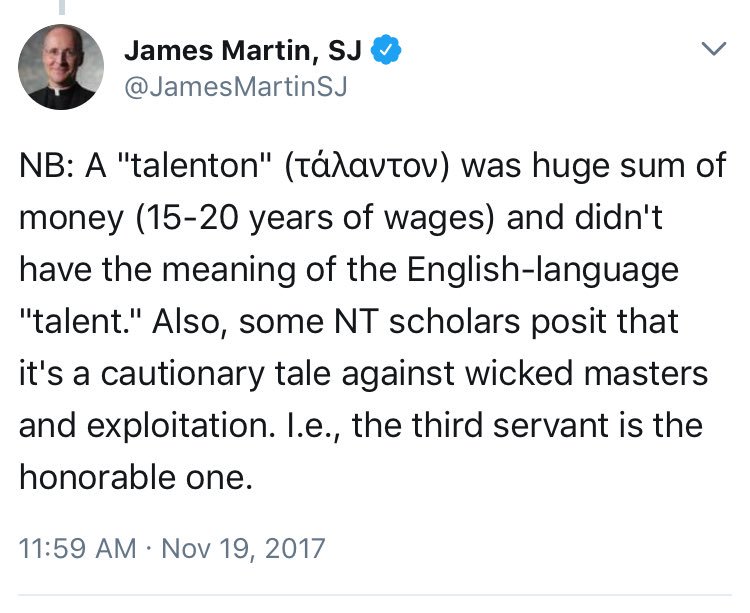
James Martin and the talents

New York’s got Talent!

Father Brown thought for a while, and, as they walked the dusty streets, he saw a sign, IGNATIAN GAY BAR. “Let us stop off there for a while,” he suggested, “and perhaps build a few bridges.”

They plunged into the red-curtained tavern, which was not only cosy, but even luxurious inside. Once seated, Father Brown explained some of the other parables that had been misinterpreted for so long.

“The sower and the seed,” he began. “It was always thought that the seed that fell onto fertile soil and grew was somehow the most worthy. But did not the seed that fed the gentle birds have a more sacred destiny? The farmer was clearly a capitalist, trying to exploit the workers, and he probably supported Donald Trump.”

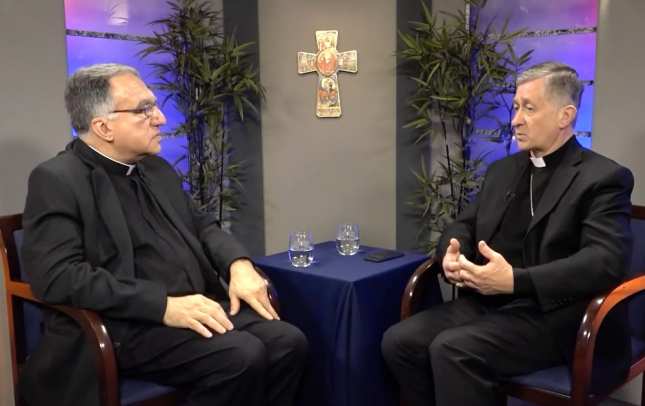
Rosica and Cupich

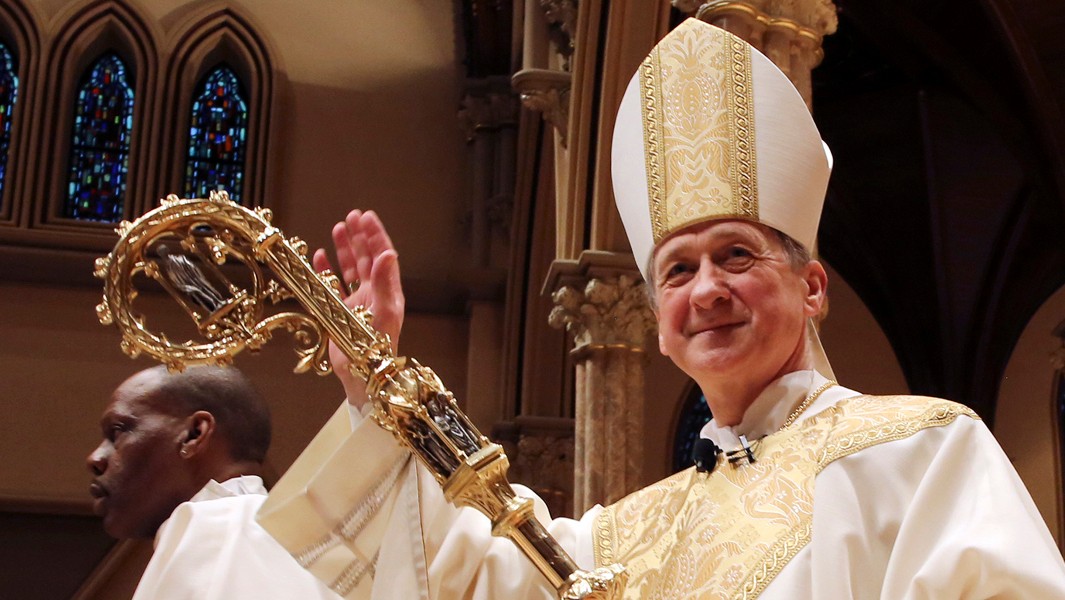
A mystery for Flambeau: how did this man ever become a cardinal?

“Then again, Jesus totally misunderstood the parable of the Good Samaritan. It was the Jesuit who walked past the injured man – stopping only to sell him a copy of his new book – who was the real hero of the story.”

“Too true,” commented Flambeau, sticking his leg out to trip up a passing waiter and roaring with laughter. “Then there was the Prodigal Son. What a wretch he was, deserting those happy pigs, who wanted him to feed them, and rushing back to stuff himself on fatted calf!”

“Talking of which, why don’t you have another plate of fatted calf yourself?” urged Father Brown. “Your chair doesn’t seem to be collapsing yet.”

“When you practise Ignatian Discernment,” he added, “you see all the parables in a new light. Take the rich man and Lazarus, for example. Obviously the villain here is Abraham, who refused to accept the rich man into his bosom. I would never refuse to accept a rich man into my bosom.”

They left the tavern, and Flambeau drew Father Brown’s attention to a photograph. “Can you explain this?” he asked.

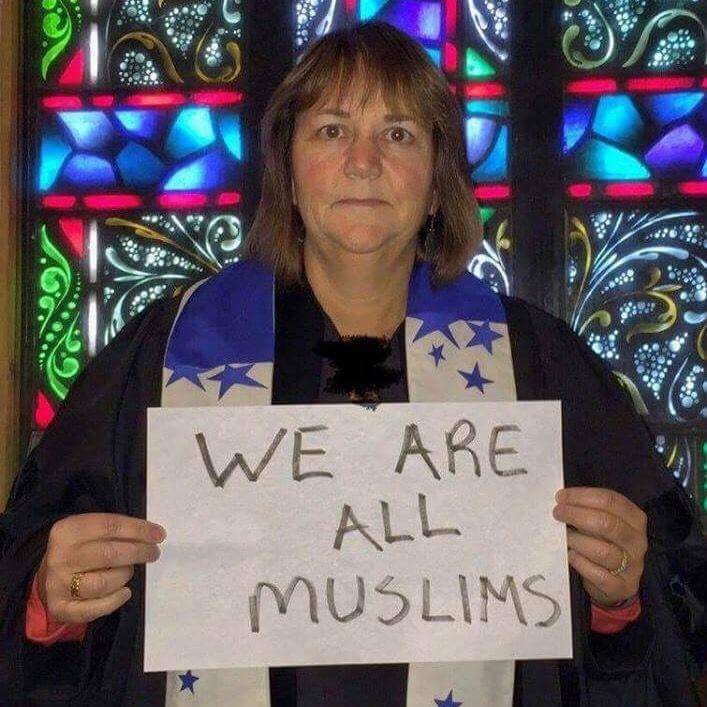
Karen Oliveto

No headscarf?

“Apparently this is Karen Oliveto, a Methodist Minister who accused Jesus of being a ‘bigot'” noted Father Brown. “She is apparently a lesbian, so we should make her welcome. However, the Islamic connection is not entirely clear to me…”

Posted in Uncategorized | Comments Off on TODAY’S DOSE OF SATIRE FOR WHAT AILS YOU SPIRITUALLY

DO NOT RECEIVE HOLY COMMUNION IN THE HAND; CLOSE YOUR EYES AND EXTEND YOUR TONGUE AND WAIT FOR THE PRIEST TO PLACE THE HOST ON YOUR TONGUE

“Whatever You Can Do to Stop Communion in the Hand Will be Blessed by God” ~ Fr. John Hardon S.J.

Not to oppose error is to approve it, and not to defend the truth is to suppress it” – Pope St. Felix III

[ Emphasis and {commentary} in red type by Abyssum }

The decline of belief and faith among Catholics has been spiraling downward ever since the introduction of Communion in the hand in 1969. What started out as disobedience among a few select bishops in Belgium in the 1960’s, has now been spread like wildfire among average Catholics worldwide, in what is largely known in the Catholic world as a third rail topic. There is widespread confusion as to how this can be a disobedient act when it has been approved by the Church. The facts are that Communion on the tongue is still the law of the Church, while Communion in the hand is an exception to the law granted by an indult, which was granted with severe reservations by Pope Paul VI in his encyclical letter “Memoriale Domini”.

Fr. Matthias Gaudron explains how this happened in his book The Cathechism of the Crisis in the Church, “Communion in the hand was first practiced without any authorization in a few very progressive groups against the explicit rules of the Church.” And it is that fact that I will explore further in this essay. Fr. Gaudron continues, “On May 29, 1969, the Instruction Memoriale Domini took cognizance of this disobedience and reiterated in detail the advantages of Communion on the tongue” (156). Fr. Gaudron explains that after a survey was given to the bishops about whether not they would be in support of introducing Communion in the hand, 58 percent opposed it, and only 27 percent were in favor of it (156).

The outcome of this practice has been a large diminishing of the belief of the Real Presence of Christ in the Eucharist. A gallop poll taken only a few years ago, the results of which were referenced in the Remnant Newspaper, indicates that only 30 percent of U.S. Catholics now believe in the True Presence of Our Lord Jesus Christ in the Host. The other 70 percent did not, and their belief system was sprinkled with an odd mixture of Protestant belief and Catholic Theology, or they simply had no understanding of authentic Catholic teaching.

The first objection one gets initially when approaching this subject is a mistaken notion that goes like this: But Jesus gave the Apostles Communion in the hand; therefore we are doing what Christ did at the last supper. There are two major things wrong with that statement. First of all, this is an assumption. And even if Jesus did indeed give Communion in the hand to the Apostles, we have to keep in mind that the Apostles were priests and Bishops, possessing consecrated hands.
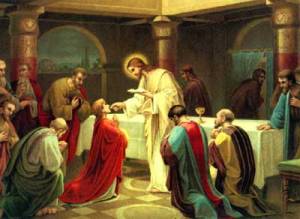
kneeling

Secondly, there is a traditional custom of middle-eastern hospitality that was definitely in practice in Jesus’ time, and still exist to this day, which is, the host feeds his guests with his own hand, placing a symbolic morsel in the mouth of the guest. A thorough reading of the text of St. John’s Gospel states (13:26-30): “Jesus answered, ‘It is he to whom I shall give this Morsel when I have dipped It.’ So when He had dipped the Morsel, He gave It to Judas… So, after receiving the Morsel, he [Judas] immediately went out…” Would Jesus have placed a wet Morsel into Judas’ hand? That would not only be unlikely, but very messy. Wouldn’t He had expressed the gesture of hospitality to the person of Judas, whom He called friend later that evening in the garden, most especially during the institution of the Eucharist at the Last Supper with Holy Communion, “giving Himself by His own Hand”?

There is a faction of progressive Catholics who either knowingly or unknowingly obscure the facts of history. They mistakenly believe that they are returning to the ancient practice of the early Christians. But the facts show that this simply isn’t the case. It is true that Holy Communion in the hand did indeed happen. However, when we read the Early Church Fathers we discover the reasons for why Holy Communion in the hand was allowed. It was only tolerated during times of Church persecution.

Dr. Taylor Marshall has researched this subject and reports that Saint Basil had this to say on this subject. “Communion in the hand is allowed only in two instances, 1) under times of persecution where no priest is present, 2) for hermits and ascetics in the wilderness who do not have priests.” This point needs to be stressed; it was a rare exception, and not the norm. Otherwise, according to Saint Basil, to receive Communion in the hand was considered a “grave immoderation” under normal circumstances. This practice goes way back in Church history. One of the earliest references we have about it is from Pope St. Sixtus I, who reigned from 115-125 AD, “it is prohibited for the faithful to even touch the sacred vessels, or receive in the hand”. Saint Paul himself mentions the importance of the Eucharist repeatedly in the scriptures and how one should not approach it unworthily in 1 Corinthians chapters ten and eleven.

Belief in the Real Presence in the Eucharist is taken straight from scripture. When Jesus told His disciples that “My Flesh is real food and My Blood real drink” (Jn. 6:55), His disciples took Him literally and said, “This sort of talk is hard to endure! How can anyone take it seriously?” (Jn. 6:60). St. John’s Gospel continues to report; “Jesus was fully aware that His disciples were murmuring in protest at what He had said” (Jn. 6:61). John then states that, “From this time on, many of His disciples broke away and would not remain in His company any longer. Jesus then said to the Twelve Disciples, “Do you want to leave Me too?” (Jn. 6:66-67). “The Twelve stayed with Jesus because they trusted His words” (Jn. 6:69-71).

Jesus was fully aware that the departing disciples understood His teaching literally. If Jesus had only meant that they would eat his Body and drink his Blood symbolically, He would have said so before they walked away. And there are plenty of places in Scripture where the disciples were confused about His teachings so Jesus retold the parable in a way they could understand it, making the message clearer to them. Since He didn’t try to re-explain what He meant when instituting the Eucharist, we know that He meant His words literally, and of course, not in a cannibalistic sense, but supernaturally.

For the last thousand years, and right up to today, Eucharistic miracles have continued to occur that baffle believers and non-believers. Now, thanks to modern technology and modern science, we can examine them thoroughly. The subject of which has been written about extensively in Joan Carroll Cruz’s book, Eucharistic Miracles. Another wonderful book about the origins of the Eucharist, and as to why Jesus would establish such a practice, which by the way goes straight back to the Old Testament and Ancient Judaism, I highly recommend Dr. Brandt Pitre’s book, Jesus and the Jewish Roots of the Eucharist.

The teaching on Christ’s Eucharistic Presence was not sincerely contested until the eleventh century, a thousand years after He instituted it. According to Rev. Regis Scanlon, Berengarius of Tours began teaching that Christ was present in the Eucharist only “as mere sign and symbol” and that after the consecration, “bread must remain.” Berengarius held, “That which is consecrated (the bread) is not able to cease existing materially”. In the thirteen century, St. Thomas Aquinas names “Berengarius, the first deviser of this heresy,” claiming that the consecrated Bread and Wine are only a “sign” of Christ’s Body and Blood.”

487146_3804088293525_205112721_n

St. Thomas gives a valid reason why bread and wine does not remain once the consecration takes place, “Because it would be opposed to the veneration of this sacrament, if any substance were there, which could not be adored with adoration of “latria”.” Meaning, Catholics would be guilty of the sin of idolatry by worshipping the bread and wine. Therefore, the physical nature of bread and wine no longer remains, it only appears to remain.
The Council of Trent (1545-1563), agrees with what St. Thomas correctly taught:

If anyone says that in the sacred and holy sacrament of the Eucharist there remains the substance of bread and wine together with the body and blood of our Lord Jesus Christ, and denies that wonderful and singular conversion of the whole substance of the bread into the Body, and of the entire substance of the wine into the Blood, the species of the bread and wine only remaining, a change which the Catholic Church most fittingly calls transubstantiation: let him be anathema (79).

This Council was called to declare Catholic Truth that was being challenged by the Protestant Revolt led by Martin Luther, a renegade Monk who suffered from severe scrupulosity, and sadly, due to his misinterpretations of scripture, as well as his adding to and removal of them, split the Church, leaving us today with over 34,000 Protestant groups and counting.

By the time of the Second Vatican Council (1962-1965), there were in place a somewhat large faction of progressive theologians, many of whom were censored by Pius XII, who managed to get themselves invited into the Council by Pope John XXIII, and to even participate in its preceding’s. These theologians were successful in holding sway at the Council, much to the orthodox bishops frustrations, and helped to word the sixteen documents produced from the Council with ambiguous language that has confused the faithful right up to this day. Then, in 1969, some of these same theologians helped to promulgate a new Mass by eliciting the aid of the then current Pope Paul VI. With this Mass in place, the rapid decline of Catholic belief, Mass attendance, and religious vocations began.

Adding to this confusion was the progressive undertakings of a group of bishops who incessantly had one agenda in mind, the introduction of Communion in the hand. Communion in the hand was illegally introduced into Germany, the Netherlands, Belgium, France, and the United States. The Church adamantly opposed this disobedient and abusive practice from the very beginning. According to Bishop Laise, from his book Communion in the Hand, On October 12, 1965, the “Consilium” wrote to Bernard Cardinal Alfrink, Archbishop of Utrecht, Netherlands, “The Holy Father does not consider it opportune that the sacred Particle be distributed in the hand and later consumed in different manners by the faithful, and therefore, he vehemently exhorts [that] the Conference offer the opportune resolutions so that the traditional manner of communicating be restored” (32).

512lsUUkTSL._SY300_

Pope Paul VI vehemently looked for a solution to this crisis. He considered two options, either close the door to all concessions, or allow the concession only where its use was already established. The Pope took a risk and asked for the opinions of the local bishops to help him in this growing disobedience. Unfortunately, the bishops did not help Pope Paul VI, but opened the doors even wider for abuse. Communion in the hand was introduced without authorization, the Pope persistently opposed allowing it but decided to grant an indult, but only where its use was firmly established so as not to call attention to the disobedience of those bishops among their flock.

Pope Paul VI’s compromise was the document Memoriale Domini (May 29, 1969), while reconfirming that Communion on the tongue is “more conducive to faith, reverence and humility.” The Pope wisely cautioned that Communion in the hand “carries certain dangers with it which may arise from the new manner of administering Holy Communion: the danger of a loss of reverence for the August sacrament of the altar, of profanation, of adulterating the true doctrine.”

There are plenty of Catholics who sincerely believe that it makes no difference on how they receive Communion. They don’t understand the law of the Church, the history, or the warnings against receiving Communion in the hand. Pope Paul VI again repeated in Memoriale Domini the Churches position on this matter, “He should not forget, on the other hand, that the position of the Holy See in this matter is not a neutral one, but rather that it vehemently exhorts him to diligently submit to the law in force (Communion on the tongue).

The truth of the matter is that Communion in the hand was spread through disobedience to the Pope. Pope Paul VI tried hard to put into place many obstacles to slow this disobedient practice from spreading. In Memoriale Domini he stated four restrictions; (a) the indult could only be requested if Communion in the hand was an already established custom in the country, and (b) if by a secret vote and with a two-thirds majority the episcopal conference petitions Rome, c) then Rome would grant the necessary permission, (d) once the permission was granted, several conditions had to exist simultaneously (among these conditions, no loss of sacred particles and no loss of faith in the Real Presence) (En réponse à la demande). If any of those conditions were not met than Communion in the hand was not permitted, even with the indult. These restrictions are part of the Pope’s instructions which are found attached to his document Memoriale Domini.
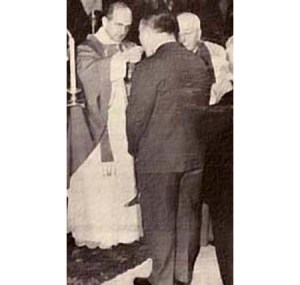
008Communion_ICI-4-1-65

However, the American bishops successfully managed to maneuver around Pope Paul VI’s restrictions. The late Cardinal Joseph Bernardin, the then president of the United States Conference of Catholic Bishops, unsuccessfully attempted twice to establish Communion in the hand in America, in 1975 and 1976. Unfortunately, he finally prevailed in May 1977 when Communion in the hand was illegally authorized in the United States. The bishops totally ignored Pope Paul VI’s requirements expressed in his indult about not allowing the practice of Communion in the hand where it was not already established.

Proceeding on their own initiative, the American bishops decided to vote on whether not they could get this disobedient practice introduced into their own country, despite all the historical evidence and warnings by Saints and Doctors of the Church throughout Her two thousand year history, warning against such a practice.

After the initial voting had concluded, Archbishop Bernardin reported that the vote had fallen short of the required two-thirds of all legally present members and that the matter could not be concluded until the absent bishops were polled. Bernardin was dead-set on getting Communion in the hand one way or another, even if it had just been voted down. To get around the lack of votes, bishops who were not present, retired, or even dying, were polled illegally.

Canon lawyer, Fr. Kunz, has stated that obtaining votes from absent bishops absolutely invalidates the petition for an indult, making the indult non-void. This tactic manipulated and masterminded by Cardinal Bernardin to acquire the votes simply makes the indult invalid, since only members present at the meeting could legally vote. Renowned theologian Fr. John Hardon, S.J., stated in 1997, “To get enough votes to give Communion on the hand, bishops who were retired, bishops who were dying, were solicited to vote to make sure that the vote would be an affirmative in favor of Communion in the hand. Whatever you can do to stop Communion in the hand will be blessed by God.”
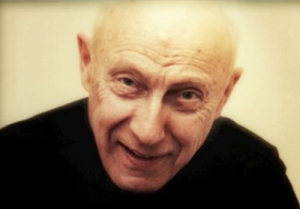
Hardon-Face

The result of Cardinal Bernardin efforts in swaying the American bishops into promoting Communion in the hand, resulted in the Holy See granting permission for the indult which allowed Communion in the hand in the United States. The National Catholic Register quotes Bishop Blanchette:

“What bothers me is that in the minds of many it will seem that disobedience is being rewarded. And that troubles me because if people persist in being disobedient, and that is used as a reason for changing the discipline, then we’re very close to chaos or what I would call selective obedience, which is no obedience at all.” (National Catholic Register, “Bishop Blanchette: A Clear Call for Obedience,” June 12, 1977)

Having been a Catholic for eight years, I have witnessed the lack of reverence and indifference among Catholics who go to Communion. The majority receive in the hand, their body language and stance clearly shows that they either don’t believe in the Eucharist, or simply haven’t been told about Who and What It truly is. All polls are consistent with what I and other Catholics have suspected all along. Since the illegal introduction of Communion in the hand, belief in the Real Presence has not only plummeted, it is simply not being taught nor emphasized.

It wasn’t until October of 2008, over four years of being a Catholic, did I have the good fortune of meeting a traditional Catholic Priest, Fr. Isaac Mary Relyea, who not only instructed me properly on this Church teaching, but on many others as well.

Communion in the hand, and the lack of solid Catholic formation, has certainly attributed to this loss of faith. Fr. John Hardon has affirmed, “Behind Communion in the hand, I wish to repeat and make as plain as I can, is a weakening, a conscious, deliberate weakening of faith in the Real Presence.”
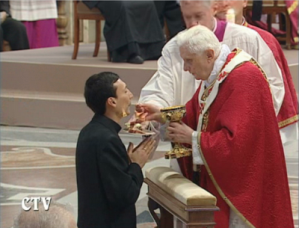
pope-benedict-and-communion-kneeling

So today it seems we are stuck with Communion in the hand. Pope Benedict XVI has spoken out numerous times that he is not in favor of this practice. He has even made it known that anyone attending his Mass in Saint Peter’s Square must receive Holy Communion kneeling and on the tongue. It would be wonderful if the holy Father would entirely do away with this practice, most especially since it was only granted permission through an illegal voting process, and since it was introduced through an act of disobedience.

Faithful Catholics like myself either look the other way, try to educate others, or simply avoid a Mass that allows Communion in the hand. Today, I have taken the last option and attend only the Tridentine Mass, or the Extraordinary Form of the Mass, codified by Pope Pius V in 1570. There is nothing in the rubrics that will allow Communion in the hand, it is the most ancient form of the Mass in existence, having been instituted over 1,500 years ago. Myself, and others pray for the day the Church fully returns to Her traditional practices and Communion in the hand is nothing more than a bad footnote in Church history, and an extinct one at that!

~ John Andrew Dorsey

Bibliography

Gaudron, Fr. Matthias. Catechism of the Crisis in the Church.

Kansas City: Angelus Press, 2010. Print.

Iacono, Kevin D. Dello. Semper Fidelis. Kevin D. Dello Iacono,

2007. Web. 27 Nov. 2012

Ignatius Catholic Study Bible: New Testament Ed. Curtis Mitch

and Scott Hahn. San Francisco: Ignatius, 2010. Print. Rev.

Standard Vers.

Laise, Most Rev. Juan Rodolfo. Communion in the Hand: Documents

and History. Boonville: Preserving Christian Publications,

2011. Print.

Marshall, Dr. Taylor. Canterbury Tales. Dr. Taylor Marshall,

2012. Web. 27 Nov. 2012.

Paul VI, Pope. “Memoriale Domini.” EWTN. Eternal World

Television Network, n.d. Web. 28 Nov. 2012.

Scanlon, Rev. Regis. Catholic Culture. Rev. Regis Scanlon, 2012.

Web. 27 Nov. 2012

Schroeder, Rev. H.J. The Canons and Decrees of the Council of

Trent. Trans. Rev. H.J. Schroeder. Rockford: Tan, 1978.

Print.

Toon, Howard. “Communion in the Hand while Standing: What’s the

problem?” Remnantnewspaper.com. The Remnant, 5 Jan. 2012.

Web. 27 Nov. 2012.

Posted in Uncategorized | 5 Comments

BISHOP SCHNEIDER INTERVIEWED BY MICHAEL J. MATT

New from RTV

Bishop Schneider Interviewd by Michael J. Matt

Before the recent Catholic Identity Conference, I sat down with Bishop Athanasius Schneider and asked him a few questions about the Traditional Latin Mass, Amoris Laetitia, Cardinal Burke and the Dubia, Communion in the hand, the coming desecration of the Eucharist, resisting Pope Francis, and the increasingly obvious failure that is the Second Vatican Council.

Watch & Comment at The Remnant
or
Watch & Comment on Remnant YouTube Channel 

Posted in Uncategorized | 1 Comment

RELIGIOUS LIBERTY IS NOT REALLY ABOUT RELIGION

unnamed-16


Religious liberty isn’t really about religion

Jean-Francois Orsini, Ph.D.


I must have been seven years old. I vividly remember this instant in my life while I do not remember any other experience I had at that age. I was looking through the kitchen window at the street below. It was a very dark night but the street was brilliantly lit. All of the sudden, I had these terrible questions: “what I am doing here? Where do I come from? Where am I going? What does it all means?” That I was in a kitchen had nothing to do with my questioning. That it was at night had nothing to do with my questioning. That we lived then in Morocco had nothing to do with my questioning. It may have been a profound sense of solitude I felt at the view of the empty and still street below and the powerful lights that where illuminating it for the benefit of not a single soul at that moment.

This were the first questions I had asked myself that had a clear philosophical bent. I felt they were very important questions at the very moment I experienced them even at this tender age. I now know they were very important questions. Because they still are very important not only to myself but also to everybody. They are the basic questions of metaphysics.

Everyone at some time or rather in his existence has asked himself the same questions. Most people probably ask them at or after the age of 7, as it is the threshold of a new understanding in this “year of reason”. These questions need to be asked because they are part of the process by which everyone grows; a process that needs to be completed in order to establish for oneself one’s own self-identity.

We want to know what is the great scheme of things in order to be able to situate ourselves within a greater cosmology.

Some of us are educated in a religious system which answers these questions. But, in reality, asking oneself these questions is a test or our faith in our religious system. Many do not care to probe the validity of the tenets of our religion by pursuing them in all their rational consequences. Many of us may not have been taught, early enough, the fine points of the doctrine that should provide full conviction that the paradigm offered by the religion is valid. Consequently, shocked by many hard realities encountered in their everyday existence, many lose confidence in the validity of their earlier faith.

For the religious mind, existence has a meaning. God created the world and has given a purpose for each element of this creation. Every bit of our surrounding environment, each one of the situations we may encounter can be explained to be a consequence of a creation by this divine intelligence. For the religious, life, then, consists in fully understanding all the extraordinary and well-ordered richness of the natural order as well as to lead a life pleasing to our creator upon which we depend for everything.

For many other people, the world has no meaning. Life has no meaning. They cannot accept any rational explanation for all the confusing and incomprehensible, in their apparent – but superficial – inconsistencies, situations they have experienced in their lives. The world has no meaning; least of all, any meaning provided by any religion.

How do members of this latter group see themselves in that world which has no meaning? Many of these members just cannot find for themselves a comfortable place they could accept in that cosmos they apprehend but do not comprehend. So, for most members of that group, a permanent sense of depression is their lot.

But the survival instinct is strong, and many in this population try to fight this depression while still not subscribing to the idea of a world which has been pre-ordered by an intelligent being. Their philosophical project? If life has no meaning, they have full freedom to create its meaning by themselves.

Essentially, as each unbeliever is prone to develop his own philosophy of life and live accordingly, a society of such individuals tends to be totally chaotic and anarchistic.

Sometimes, somehow, these anarchists come to socialize and agree on some self-serving values and fads under a banner known as “political correctness”. Thus, they come to militate for a society where children are of no value until they are born and welcome. A society in which each person can decide which sex he chooses and be regarded accordingly by others. Anybody can marry whomever he feels attracted to… soon to include several people, blood relatives, and even things… as the news tells us that someone has even requested to be married to his computer!

The point is that a segment of the population has a sense of a pre-ordered arrangement of the entire world and their existence in it. Others in the same population, do not have that sense and insist on being able to inject their own preferred, artificial, vision of what anything and everything means. And there are all more strident and adamant that the rest of us must go along with their rigmarole that it is the only solution that helps them fight the depression that would otherwise engulf them. These people have invaded the talkative professions: the education, the media, the law and politics. For them the rest of us are the deplorables.

There is a fundamental and serious social problem in that situation. Nowadays, in most countries, the implemented political philosophy assumes that not believing in any order of the existence must be the default view. Arbitrarily it is decided that the view that the world is pre-ordered, along with its logical consequences and rules, must be a minority view which can only be accepted by the body politics with the terms that it is to be allowed but only to approved subgroups and that it requires important legal controls. Where there was liberty of religion there is only now left liberty of worship.

It needs to be said that the order of ideologies that claim to propose an alternative cosmological and therefore political order, do not qualify here. For they do basically bypass the recognition of a pre-ordered universe. They are consequently still unstable and dangerous.

Why is this so? Why are most governments discriminating against those good people who believe in a happy arrangement of people, places and situations and who are willing to respect these orders? Why do governments give preference to the other group who is willing to question any value and rework what these values are and impose their decisions on the rest of the population?

Isn’t this the ultimate discrimination? Aren’t people free to see a pre-established order in the world or not? Why would governments favor arbitrarily one group over another, the order deniers over the order lovers?

Isn’t the role of governments to assure law and order to their people? How can they better achieve this responsibility by backing the individuals and organizations who refuse the idea of a pre-eminent order? But pretend they can see their own values in the penumbra of the laws. Would not choosing instead to prefer the order lovers, in their laws and institutions, be preferable so to facilitate rather than complicate the work of governments? It seems that the US Constitution did understand the argument. Therefore, isn’t it why the left adamantly seeks to undermine the Constitution?


Jean-Francois Orsini is a double graduate of and holds a doctorate from The Wharton School. He is a past prior of his third order Dominican chapter based at the Dominican House of Studies of Washington DC. His last book, Love is God, seek to demonstrate that what the love that the world confusedly seeks is the love of God.

Posted in Uncategorized | Comments Off on RELIGIOUS LIBERTY IS NOT REALLY ABOUT RELIGION

WHO IS THE REAL POPE ???


Eccles and Bosco is saved


Who is the real Pope?

Posted: 17 Nov 2017 04:57 AM PST

In these troubled times, there seem to be four possible theories about who is actually the Pope:1. Pope Francis.
2. Pope Benedict.
3. Nobody.
4. Someone else entirely.So it’s time for an in-depth analysis. Not that you’ll get one here.

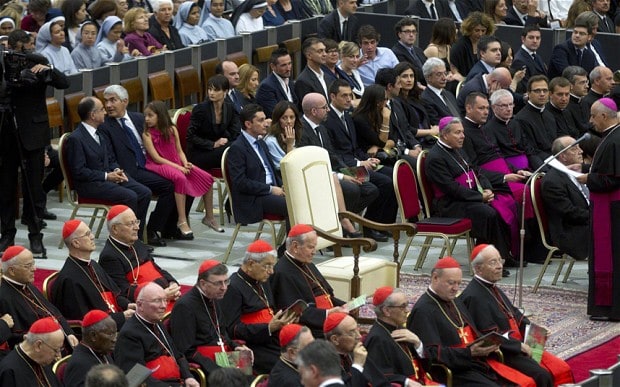
Pope's empty chair

Sedevacantists see things this way.

1. Pope Francis is the obvious answer. Elected by a conclave in 2013; white smoke; goes around in white robes; sleeps in a humble broom-cupboard in the Vatican. After his private correction by Cardinal Burke, his correctio filialis by a bunch of wise men, and a telling-off from Fr Weinandy – with none of which has he publicly disagreed – he is now the most orthodox Catholic on the planet.

Of course he has a few blind spots as regards how to run the Church. Whatever made him think that Blase Cupich was worthy of doing any job more spiritual than emptying the dustbins? Does he really think we’ve forgotten his Anschluss with the Order of Malta? When the newspapers carried headlines ELDERLY DICTATOR UNDER HOUSE ARREST, who thought of Mugabe, and who thought of Francis? Still, otherwise he’s played a blinder. Well, apart from… no, let’s move on.

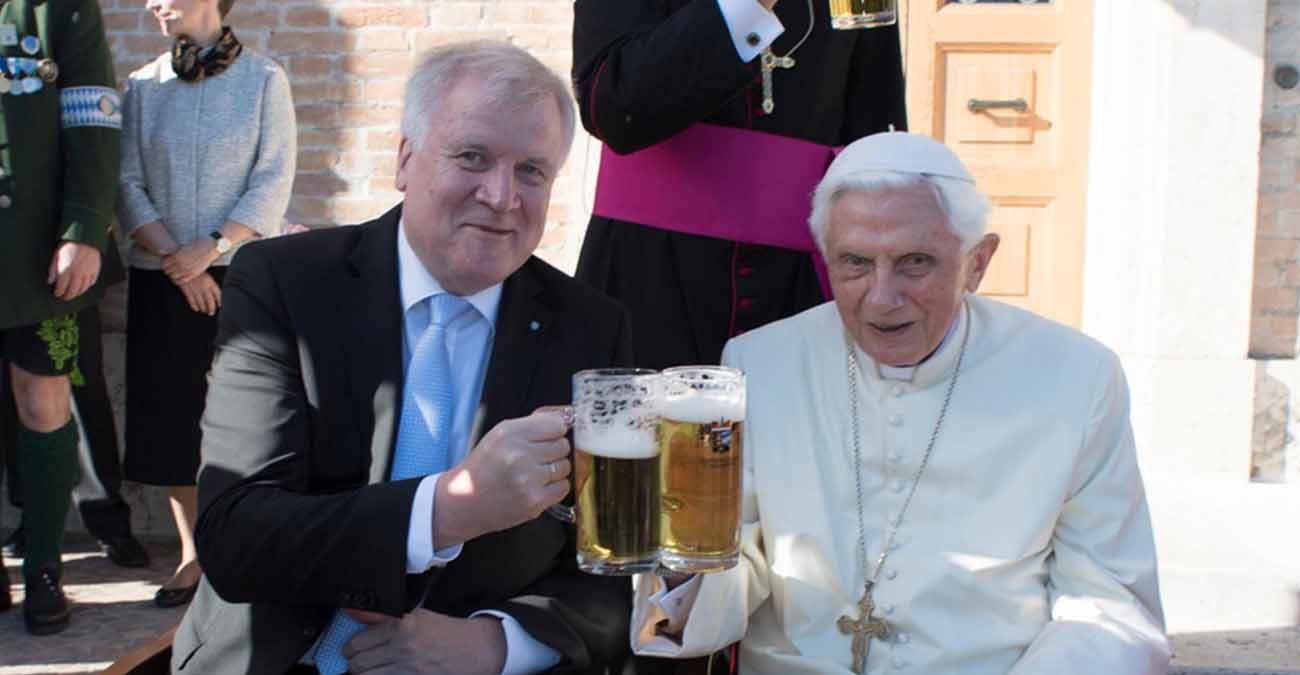
Benedict XVI drinking beer

Two litres of Amoris Laetitia, please!

2. Pope Benedict? Well, he was apparently forced out after undue pressure from his enemies in the Church. They kept sending him copies of the Tablet and essays by Austen Ivereigh. After such relentless persecution, who can blame him if he decided to spend more time with his beer, I mean prayer? On the other hand, it’s not entirely clear that popes can resign.

Still, he says he’s not the Pope, and he ought to know.

3. Nobody. There are two groups here. One is the group that believes that all popes since Vatican II (or possibly since Pius V) were invalidly elected. This viewpoint is supported by the prophecies of St Malachy, Nostradamus, and Mystic Meg.

The second group – more interesting – finds something distinctly fishy in the story of the 2013 conclave, where, thanks to the St Gallen Mafia, or Cormac Murphy-O’Connor, or British intelligence, or perhaps Batman’s arch-nemesis the Joker, some skulduggery took place. In which case the cardinals need to go back into the Sistine Chapel and try again. Good luck with that one.

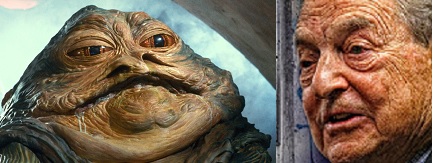
Jabba and Soros

The Soros twins.

4. Someone else was secretly elected by the conclave in 2013. Pope Francis is merely a “stunt pope” who does all the dangerous things like driving the Popemobile at high speed, flying in aeroplanes, and making the odd speech, indeed very odd speech. Somewhere in the background is an Eminence Grise who is pulling the strings. This may be:

i) George Soros, who appears to have a finger in every disreputable pie;
ii) Vladimir Putin, who is blamed for everything;
iii) The Habsburgs, who seem to be making a come-back;
iv) Richard Branson, who seems to be everywhere (except that I have never seen him on one of his delayed trains).

Alternatively, Douglas Adams suggested that the man who rules the Universe sits in a shack somewhere, with no companions except his cat. Well, he was nearly right: it’s actually the Catholic Church that he rules.

Eccles

Or could this saved person be the power behind the throne?

Posted in Uncategorized | 2 Comments

THERE ARE A LOT OF UNANSWERED QUESTIONS ABOUT POPE BENEDICTS RESIGNATION

Was Pope Benedict XVI Forced to Resign?

Post navigation

pope-benedict-xvi-resignsAlmost five years since his momentous resignation from the papacy on February 11, 2013 for health reasons, the undeniable fact is that Pope Emeritus Benedict XVI remains in the peak of health and in full control of his faculties.  He has also chosen to remain in the Vatican. He has also chosen to retain the title of “pope”, as Pope Emeritus Benedict XVI.

In his last general assembly on February 27, 2013, 2 weeks after announcing his intent to resign, Benedict XVI said that the petrine ministry is “always” and “forever”:

He who assumes the Petrine ministry no longer has any privacy. He belongs always and totally to everyone, to the whole Church. His life is, so to speak, totally deprived of the private sphere. […] The “always” is also a “forever”—there is no returning to private life. My decision to forgo the exercise of active ministry, does not revoke this. I do not return to private life, to a life of travel, meetings, receptions, conferences and so on. I do not abandon the cross, but remain in a new way near to the Crucified Lord.

And we have to ask: Why did Benedict XVI resign in the first place, if the petrine ministry “is forever”?  Was his resignation out of his own full volition and will? Was it valid in the first place?

New revelations have come to light which give us more information on the circumstances surrounding Benedict’s mysterious resignation.

Leaked Emails Show Political Plot to Oust Benedict

A group of Catholic leaders cite new evidence uncovered in emails released by WikiLeaks that the conservative Pope Benedict did not actually resign on his own initiative, but was pushed out of the Vatican by a coup that the group of researchers are calling the “Catholic Spring.”

The group of Catholic leaders includes Christopher A. Ferrara, President of The American Catholic Lawyers Association, Michael J. Matt, Editor of The Remnant, David L. Sonnier, LTC US ARMY (Retired), Chris Jackson of Catholics4Trump.com, and Elizabeth Yore, Founder of YoreChildren.

Last January 20, 2017, the group wrote and published a letter to U.S. President Donald Trump, formally requesting him to to launch an official investigation into the activities of the billionaire liberal leftist George Soros, Barack Obama, Hillary Clinton (and others) who they allege were involved in orchestrating the Catholic Spring that resulted in their goal of “regime change” in the Vatican.

The group included with the letter evidence from various sources to support their claim, including WikiLeaks emails.  WikiLeaks is an international non-profit organisation that publishes secret information, news leaks,  and classified media provided by anonymous sources. Its website, initiated in 2006 by Julian Assange, has a database of 10 million documents in 10 years since its launch.

Soros, Obama and Clinton Behind Benedict XVI Resignation? 

The leaked emails show that Soros, Obama and Clinton used the United States’ diplomatic machinery, political muscle, and financial power to coerce, bribe and blackmail “regime change” in the Roman Catholic Church in order to replace Benedict XVI with Pope Francis – who has since become an unlikely mouthpiece for the international left, stunning Catholics around the world.

“We have reason to believe that a Vatican ‘regime change’ was engineered by the Obama administration,” say the petitioners, in their January 20 letter to President Trump.  “We were alarmed to discover,” their letter notes, “that, during the third year of the first term of the Obama administration your previous opponent, Secretary of State Hillary Clinton, and other government officials with whom she associated proposed a Catholic ‘revolution’ in which the final demise of what was left of the Catholic Church in America would be realized.”

Leaked Emails

The Letter first directs attention to the notorious Soros-Clinton-Podesta e-mails disclosed last year (2016) by WikiLeaks, in which John Podesta and other progressives discussed regime change to remove what they described as the “middle ages dictatorship” in the Catholic Church. Podesta was the former chairman of the 2016 Hillary Clinton presidential campaign. He previously served as chief of staff to President Bill Clinton and Counselor to President Barack Obama.

Podesta revealed in a 2011 e-mail that he and other activists were working to effect a “Catholic Spring” revolution within the Catholic Church, an obvious reference to the disastrous “Arab Spring” coups organized that same year by the Obama-Clinton-Soros team that destabilized the Middle East and brought radical Islamist regimes and terrorist groups to power in the region. The Podesta e-mail is a response to another Soros-funded radical — Sandy Newman, founder of the “progressive” Voices for Progress. Newman had written to Podesta seeking advice on the best way to “plant the seeds of the revolution” in the Catholic Church.

In his e-mail of February 10, 2011 to Podesta (as released by WikiLeaks), Newman writes:

There needs to be a Catholic Spring, in which Catholics themselves demand the end of a middle ages dictatorship and the beginning of a little democracy and respect for gender equality in the Catholic church. Is contraceptive coverage an issue around which that could happen. The Bishops will undoubtedly continue the fight.

Newman admits that since he’s not a member of the Catholic Church and doesn’t understand its workings, he doesn’t “qualify to be involved.” But he still very much wants to see the “revolution” go forward. He writes:

Of course, this idea may just reveal my total lack of understanding of the  Catholic church…. Even if the idea isn’t crazy, I don’t qualify to be involved and I have not thought at all about  how one would “plant the seeds of the revolution,” or who would plant them. Just wondering …

John Podesta responded the following day, writing:

We created Catholics in Alliance for the Common Good to organize for a moment like this. But I think it lacks the leadership to do so now. Likewise Catholics United. Like most Spring movements, I think this one will have to be bottom up. I’ll discuss with Tara.Kathleen Kennedy Townsend is the other person to consult.

Catholics in Alliance for the Common Good and Catholics United are two of the many Soros-funded “Catholic” activist groups that push the “progressive” agenda (abortion “rights,” homosexual “marriage,” LBGT K through12 “education,” women priests, etc.) inside the church.

Call for Investigation

In their letter to President Trump, the group of Catholics leaders write: “After this e-mail discussion, which was never intended to be made public, we find that Pope Benedict XVI abdicated under highly unusual circumstances and was replaced by a pope whose apparent mission is to provide a spiritual component to the radical ideological agenda of the international left.  The Pontificate of Pope Francis has subsequently called into question its own legitimacy on a multitude of occasions.”

“We remain puzzled by the behavior of this ideologically charged Pope, whose mission seems to be one of advancing secular agendas of the left rather than guiding the Catholic Church in Her sacred mission,”they say, expressing the thoughts of millions of Catholics around the world stunned by Pope Francis’s left-wing ideology. “It is simply not the proper role of a Pope to be involved in politics to the point that he is considered to be the leader of the international left.”

International Monetary Transactions with the Vatican were Suspended Days Prior to Benedict XVI’s Resignation

Why were International monetary transactions with the Vatican suspended during the last few days prior to the resignation of Pope Benedict XVI? Why were international monetary transactions with the Vatican subsequently resumed on February 12, 2013, just one day after Benedict XVI announced his resignation? Was this pure coincidence?

An investigative article by Italian journalist Maurizio Blondet alleges that Pope Benedict XVI was blackmailed into abdication by forces allied with SWIFT (the Society for Worldwide Interbank Financial Telecommunication), which had a hand in the shutdown of ATM and bank card services at the Vatican in January of 2013.

According to Blondet:

There was a blackmail of Benedict XVI, coming from who knows where, through SWIFT. The underlying reasons for this have not been clarified, but it is clear that SWIFT has intervened directly in the management of affairs of the Church.

According to Blondet, Italian banking regulators pressured Deutsche Bank, which managed the Vatican’s ATM machines and credit card payment services, to cease their services to the Holy See. He cites the Financial Times, which reported:

Deutsche did what regulators had hoped it would. On January 1 2013, a peak holiday time, there were no ATMs functioning anywhere inside Vatican City. Lines of visitors to the Sistine Chapel were unable to enter unless they paid in cash. “The message sent was simple: if you want to participate in the modern world, you have to adopt modern rules,” says a senior banker at another correspondent bank.

On February 12, 2013, just one day after Benedict XVI announced his intention to abdicate, the Vatican suddenly reached an agreement with a Swiss firm to resume ATM and other bank card transactions.

A Mafia Group of Cardinals Who Plotted Benedict XVI’s Demise

At the launch of his authorized biography last September 2015, Cardinal Godfried Danneels, archbishop emeritus of Brussels and one of Pope Francis’ closest advisors, confessed that he was part of a radical secret “mafia” reformist group of cardinals opposed to Benedict XVI.

He called it a “mafia” club that bore the name of “St. Gallen”. The group wanted a drastic reform of the Church, to make it “much more modern”, and for Cardinal Jorge Bergoglio to head it. The group, which also comprised Cardinal Walter Kasper and the late Jesuit Cardinal Carlo Maria Martini, has been documented in Austen Ivereigh’s biography of Pope Francis, The Great Reformer.

The cardinal is a notorious liberal, once writing a letter to the Belgium government favoring same-sex “marriage” legislation because it ended discrimination against LGBT groups. The cardinal is also known for having once advised the king of Belgium to sign an abortion law in 1990, for telling a victim of clerical sex abuse to keep quiet, and for refusing to forbidpornographic, “educational” materials being used in Belgian Catholic schools.

A Plot to Assassinate Pope Benedict XVI?

In a startling revelation that was extensively covered by news outlets worldwide, Cardinal Paolo Romeo, the archbishop of Palermo in Sicily claimed last November 2011 that Pope Benedict XVI would die within the next 12 months.

Cardinal Romeo reportedly made the startling prediction of the Pope’s death during a trip to China on November 2011. He seemed so sure of the fact that the people he spoke with, including Italian businessmen and Chinese representatives of the Catholic Church, were convinced that he was talking about an assassination attempt.

They were so alarmed by his remarks that they reported them back to the Vatican. The extraordinary comments were written up in a top-secret report, dated Dec 30, 2011, and delivered to Pope Benedict XVI by a senior cardinal, Dario Castrillon Hoyos, a Colombian, in January.

Could it be that the Pope, not for fear of death, but for possible harm to the Church should the plot succceed, decided it was best to resign to remove the assassination threat and advance a peaceful succession?

Is the Papal Resignation Valid?

The Code of Canon Law (332:2) provides that: “If it happens that the Roman Pontiff resigns his office, it is required for validity that the resignation is made freely and properly manifested but not that it is accepted by anyone.”

In this sense, while it is true that the Pope “freely” declared to resign, the circumstances and evidence seem to indicate that to a greater or lesser extent, he was forced by pressure to resign on multiple fronts (assassination threat, suspension of Vatican finances, etc).

While the Pope made the decision to resign in accordance with the powers given to him under the Code of Canon Law, could it be that he made it under the duress of moral violence, which, according to No. 125 of the same Code, invalidates the final decision at the root and renders the act invalid ? It is like one who freely chooses to marry, but if there is hidden stress, fear or deception, the marriage is void for fault, although a clearly “free” commitment has been expressed publicly.

Prophecy of Benedict XVI’s Resignation

The resignation of Pope Benedict XVI was predicted with incredible accuracy in a prophecy given to the Irish seer Maria Divine Mercy.  In a message dated February 11, 2012, Jesus said to Maria Divine Mercy:

My poor Holy Vicar, Pope Benedict XVI, will be ousted from the Holy See in Rome. Last year, my daughter, I told you of the plot, within the corridors of the Vatican. A plan to destroy My Holy Vicar was devised in secret on the l7th March, 2011, and this will come to fruition, for it has been foretold.

Exactly a year after, on February 11, 2013, the unthinkable happened:  The Vatican announced that Pope Benedict XVI was resigning his office effective February 28.  The reason cited was his “old age” and “incapacity” to fulfill his obligations. It must be noted that Pope John Paul II maintained his post all the way until old age, even until the time when he could not visibly fulfill his duties because of Parkinson’s disease.

For a more detailed review of the prophecies and messages given to Maria Divine Mercy, read this article.

Two Popes in the End Times

In a message dated April 12, 2012, Jesus said that His Second Coming will happen very soon, and that Benedict XVI was the last true pope on earth:

My beloved Pope Benedict XVI is the last true pope on this Earth…I must warn you that many new self-proclaimed prophets will now emerge, who will contradict My Holy Word given to you, the end time true prophet…They, My daughter, are being sent to prepare God’s children to accept the next pope, who comes after My beloved Vicar, Pope Benedict. This pope may be elected by members within the Catholic Church, but he will be the false prophet. His electors are wolves in sheep’s clothing and are members of the secret Masonic and evil group led by Satan. This is how Satan will try to destroy My Church.

We recall here the remarkably accurate prophecy of the popes by St. Malachy. Archbishop Ganswin, papal secretary to both Pope Emeritus Benedict XVI and Pope Francis, dramatically brought the Church’s attention back this ancient prophecy, which predicted that Benedict XVI will be the second-to-the-last pope prior to the return of Jesus Christ.

Various reputable prophecies have remarkably predicted that in the end times, there will be the unique situation of two popes wearing the crown of St. Peter.  Blessed Anne Catherine Emmerich, one of the greatest mystics of the Church, said that she saw the “special relationship” between two popes in the end times.  One of these popes would be a false pope who would give rise to a false church of darkness.  It is interesting to note that Anne Catherine Emmerich received this prophecy on May 13, 1820 – exactly 97 years prior to the first apparition of Our Lady in Fatima.

“I saw also the relationship between the two popes. . . I saw how baleful (harmful) would be the consequences of this false church. I saw it increase in size; heretics of every kind came into the city (of Rome). The local clergy grew lukewarm, and I saw a great darkness…”

In a message dated July 22, 2013, the Blessed Virgin Mary revealed to Maria Divine Mercy the content of the unrevealed part of the third secret of Fatima:

The last secret of Fatima still remains unknown to God’s children…Very few within the Church are privy to this. Now, the next part of the final secret of Fatima must be revealed, so that I can warn humanity of the consequences of ignoring my intervention to help save souls…The Church has been infested, from the inside, by enemies of God…

The details, which I revealed, are that there would be two men wearing the Crown of Peter in the end times. One will suffer because of lies which have been created to discredit him and which will render him a virtual prisoner.

The other one elected will bring about the destruction, not only of the Catholic Church, but of all churches which honour my Father and who accept the Teachings of my Son, Jesus Christ, Saviour of the world.

Amid the tumult and confusion that we find the Church today, we turn to Our Lady with arms outstretched in prayer, holding on to her firm promise that “in the end, my Immaculate Heart will triumph”.

Paul Simeon, Veritas Vincit

Posted in Uncategorized | 8 Comments

HERE IS YOUR DAILY DOSE OF SATIRE TO HELP YOU REMAIN SANE

Eccles and Bosco is saved


Eccles just can’t be bothered

Posted: 13 Nov 2017 07:30 AM PST

There are too many villains, idiots and heretics in the world, and how can I possibly keep up? Perhaps I should have a month or two off blogging, and let the world continue to satirize itself.Rupa Huq

The dreaded Huq the Rupa.

In Victorian London, many innocent boys and girls were slaughtered on a daily basis. In an attempt to stop the flow of little corpses, men and women would aggressively pray outside abortion clinics, using the offensive words “Hail Mary, full of grace…”, and desperately trying to save innocent lives.

But London was a dangerous place to pray, and in those foggy streets, people dreaded the sinister tread-tread-tread that denoted the approach of Huq the Rupa…

Blase Cupich

The USA’s captain for the “Silliest Cardinal” World Cup hits a server with his crozier.

With their sacking of Fr Weinandy, for the offence of being confused by Pope Francis and scandalized by his bishops (isn’t everyone?), the USCCB made it clear that they were expecting to field a strong team for the “Silliest Cardinal” World Cup.

Captain of a team that includes Farrell, Tobin, Wuerl and Dolan, Cardinal Blase expects his boys to meet some tough opponents, such as Rhino Marx’s Germans, the Belgians, the Italians, and the Maltese. “But we’ll show them that we can distort Catholic teaching with the best of them!” said the cardinal defiantly.

Simon Jenkins

Let’s consign Simon Jenkins to history.

The churches, the British Legion, and in fact most decent people, have decided that now is the time to consign to history “Sir” Simon Jenkins, writer of tedious and badly wrong Guardian articles.

“Sir Simon was essentially a 20th century phenomenon,” said one commentator. “His views never did make much sense, but now that he apparently believes that we should drop Remembrance Day, it is really time to send him off to the Dunrantin Retirement Home for Potty Journalists.”

Sir Simon today was unrepentant. “Since we have had no wars anywhere in the world since 1945 – well I haven’t seen any in my agreeable mansions, apart from when my first wife left – it is clear that there is nothing to remember any longer. As I always say on November 11th ‘Let me forget!'”

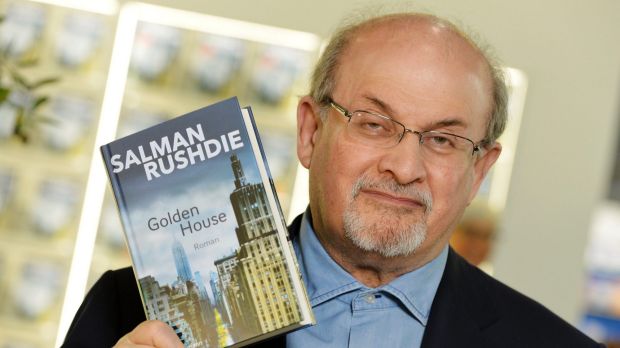
Salman Rushdie

Sorry, Salman, the game’s up. Go and read a good book instead.

Next, the third Global Atheist Convention, planned for Melbourne in 2018, has been cancelled for lack of interest. It looked like being a real humdinger of an event with Salman Rushdie (gosh, is he still alive?) talking about the book he wants to sell, and Richard Dawkins (yes, we know he’s alive) talking about, er, the book he wants to sell. And with everyone trying to avoid mentioning God.

When the news was broken to Professor Dawkins, he said “It’s all over with atheism. And I was hoping to stock up on duty-free honey. But Bin Laden has won.”

Kate Bottley

And finally, the CofE approves of little girls pretending to be boys. 

You are subscribe
Posted in Uncategorized | 1 Comment

AND THEN THERE WERE NONE….

Friday, July 21, 2017

The Slow Death of the Novus Ordo in the West

As the numbers of vocations continue to dwindle in the West, where priests are recruited from Nigeria, Ghana, Cameroon, India, Vietnam, and the Philippines, the entire experiment of anthropocentric religion in Catholic guise is on the verge of collapse.

The new religion of man focused on this present world and getting along with everyone is failing in spectacular fashion. Looking at just the demographics of priests, the collapse will come absolutely unforced, by the mere power of math and statistics. The average age of a Catholic priest in the United States in 1970 was 35. These men would have begun their priestly formation well before the Second Vatican Council (1962-1965) when vocations were abundantly plentiful under Pastor Angelicus, Pope Pius XII. Today, the average age of a Catholic priest in the USA is 64. The demographics of Catholics themselves are also cascading downward in a breathtaking manner: birthrates in Europe, Canada, the US and even South America have fallen below the replacement rate.

CBS News Report: Catholic Church feels squeeze of priest shortage

Quite apart from any malicious strategy applied by the Church’s enemies from without, the collapse of the Western Church appears to be an inside job. The elevation by Pope John XXIII of theologians suppressed under Pope Pius XII is where the enemies of the true faith were able to come out in the light of day. Pope Angelo Roncalli not only rehabilitated the neoModernist theologians, he tied the hands of every orthodox prelate by announcing that Vatican II (and the orientation it introduced) would condemn no errors (the “medicine of mercy” hermeneutic). So at once we had a condemned theology and no mechanism whereby to oppose it.

Paul VI went further by reforming the Holy Office into the Confraternity of the Doctrine of the Faith, abrogating the Oath Against Modernism, and dissolving the Index of Forbidden Books. His most grievous damage of course was done by suppressing the Missal of St. Pius V and promulgating Fr. Annibale Bugnini’s man-made Forma Normativa as the Novus Ordo Missae. Pope John Paul II reformed the code of Canon Law in 1983 which included the abrogation of 141 canons dealing with the beatification and canonization process, dissolving the function of “devil’s advocate” in the office of the Promotor Fidei. This effectively denuded any attempts to investigate the worthiness of candidates for Sainthood, and in just 25 years John Paul II beatified one-third of all the Blesseds in Church history.

The practice of making it nearly impossible to condemn any errors or apply any canonical standards to contemporary teaching was made even more self-destructive for Catholics by urging the twin-headed spectacle of pan-christian ecumenism and inter-religious dialogue. Stripped of all means of determining truth and error and sent blindly into endless ‘dialogue’ with the practitioners of all religions produced a predictable result. What once was the only way to obtain eternal salvation eroded into just one of many ways of praying, believing, of seeing man and the world.

According to Pope Benedict XVI however, the real cause of the crisis in the Catholic Church is the collapse of the sacred liturgy, and in particular, the Mass. The form of the Mass handed down from the earliest Christian centuries and attributed to the Apostles was universally suppressed in 1970, giving the faithful the idea that it was somehow now no longer needed, ineffective, or even worse, something evil that should be shunned and avoided. While indults were permitted for the Tridentine Mass between 1984 and 2006, few Bishops allowed it. By the time Pope Benedict XVI liberated it from the control of hostile prelates in 2007, it had been suppressed for 37 years, effectively wiping out all memory of centuries of liturgical Tradition. To add to the stigma, Pope Paul VI and John Paul II unjustly censored the most fruitful missionary bishop of the 20th century for the ‘crime’ of forming priests for the Traditional liturgy.

Now its all about the demographics. An aging priesthood offering only the man-made Mass of Paul VI on behalf of an aging population of Catholics who contracepted and aborted themselves into fewer and smaller families has amply demonstrated the folly and hubris of the Second Vatican Council’s reformers. The experiment of anthropocentric religion has failed, and the price of adopting its theories and reforming the Church thereby is the collapse of Catholicism in the West. Soon there will simply be almost no priests left to baptize, absolve, and confect the Eucharist.

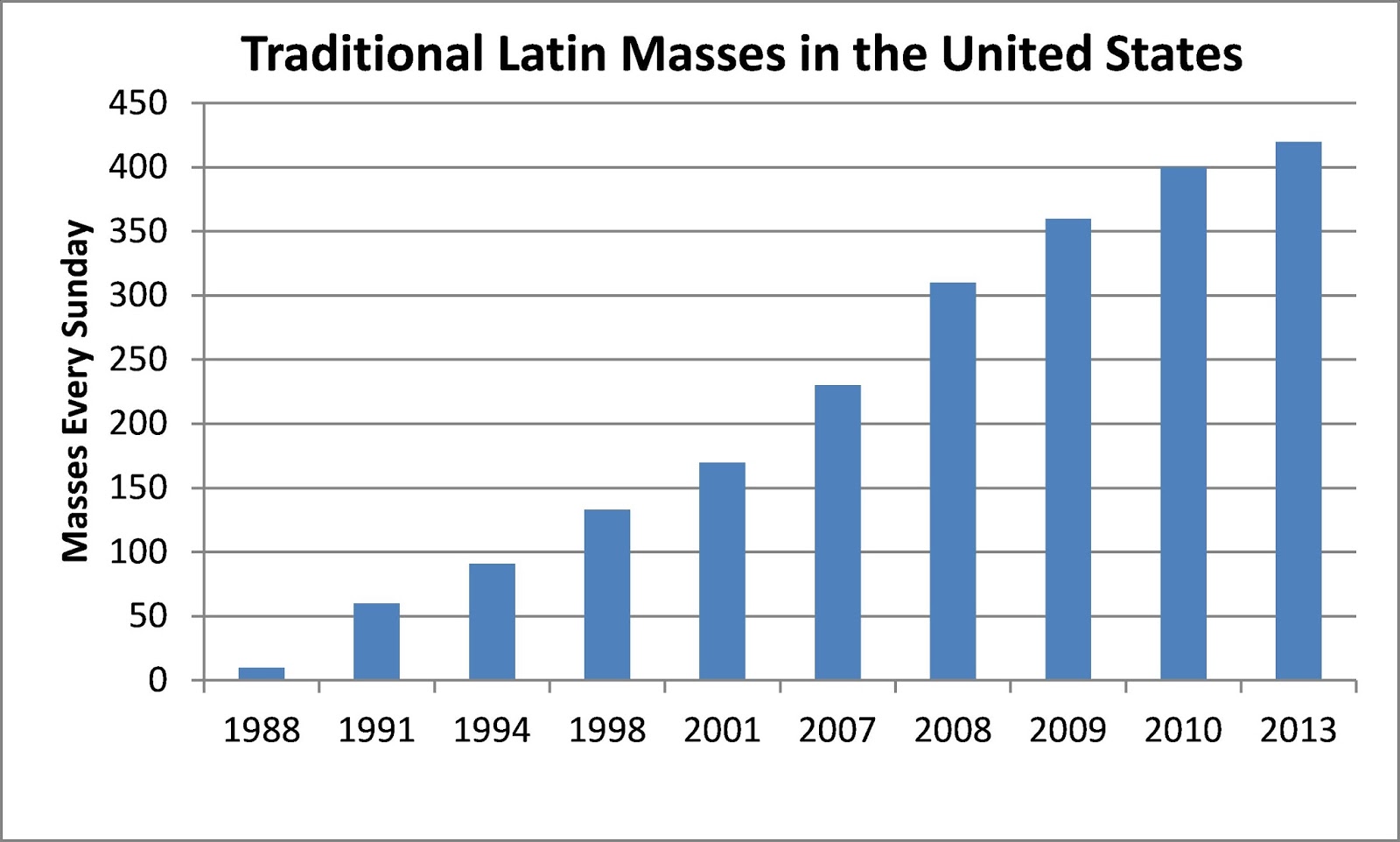
All is not lost. Those who rebuilt the edifice of Catholic Tradition while covered by the shadow of stigma as “schismatics” and “excommunicates” are enjoying a profound resurgence of health and vitality. The seminaries that form priests for the Traditional Latin Mass are bursting at the seams with new vocations. Again, simply by the math, at some point in the not-too-distant future, they will overtake the aging, graying, and rapidly diminishing Vatican II priests and become the majority. If Christ does not return in the next two or three decades, the conciliar priests will simply die off, fade away into history, and be remembered as those who drove a healthy, vibrant Catholic Church into near-irreversible decline only to be rescued by the very priests they ostracized, marginalized, and oppressed. And with these young priests practicing Tradition come the young families with lots of Catholic babies.

There is a divine lesson to be learned here for those who have eyes to see, ears to hear, and can master elementary math.

1 comment:

  1. As Mr. Voris of Church Militant stated the Novus ordo church WILL self destruct in five to ten yrs. Even Retired Pope Benedict has stated the rump cino not rc church is Capsising….. That is why phony Jesuits like Martin – Amer . Mgz., Sparando etc. And others have launched media campaigns against Mr. Voris and Christine Niles of Cm. And Mr. Hitchborn of Lepanto org..

Posted in Uncategorized | 2 Comments

A WEE WORD OF WISDOM AND WISHFULL THINKING AS WE WAIT FOR THE OTHER WHATEVER TO DROP

Settimo Cielodi Sandro Magister

The “Dubia” Turn One Year Old, and Are More Lively Than Ever. A New Appeal From Burke To the Pope

Burke


*

(An interview with Cardinal Raymond Leo Burke conducted by Edward Pentin of the National Catholic Register)

Q: – Your Eminence, at what stage are we since you, Cardinal Walter Brandmüller, and the two recently deceased cardinals, Carlo Caffarra and Joachim Meisner, made the “dubia” public a year ago this week?

A: – One year after the publication of the “dubia” on “Amoris Laetitia”, which have not received any response from the Holy Father, we observe an increasing confusion about the ways of interpreting the Apostolic Exhortation. Hence our concern for the Church’s situation and for her mission in the world becomes ever more urgent. I, of course, remain in regular communication with Cardinal Walter Brandmüller regarding these gravest of matters. Both of us remain in profound union with the two late Cardinals Joachim Meisner and Carlo Caffarra, who have passed away in the course of the last months. Thus, I once again present the gravity of the situation which is continually worsening.

Q: – Much has been said about the dangers of the ambiguous nature of Chapter 8 of “Amoris Laetitia”, stressing that it is open to much interpretation. Why is clarity so important?

A: – Clarity in teaching does not imply any rigidity, which would impede people from walking on the Gospel path, but, on the contrary, clarity provides the light necessary for accompanying families on the way of Christian discipleship. It is obscurity that keeps us from seeing the path and that hinders the evangelizing action of the Church, as Jesus says, “Night comes, when no one can work” (Jn 9:4).

Q: – Could you explain more about the current situation in light of the “dubia”?

A: – The current situation, far from diminishing the importance of the “dubia” or questions, makes them still more pressing. It is not at all – as some have suggested – a matter of an “affected ignorance”, which poses doubts only because it is unwilling to accept a given teaching. Rather, the concern was and is to determine precisely what the Pope wanted to teach as Successor of Peter. Thus, the questions arise from the recognition of the Petrine office that Pope Francis has received from the Lord for the purpose of confirming his brothers in the faith. The Magisterium is God’s gift to the Church to provide clarity on issues that regard the deposit of the faith. By their very nature, affirmations that lack this clarity cannot be qualified expressions of the magisterium.

Q: – Why is it so dangerous in your view for there to be differing interpretations of “Amoris Laetitia”, particularly over the pastoral approach of those living in irregular unions, and specifically over civilly remarried divorcees not living in continence and receiving Holy Communion?

A: – It is evident that some of “Amoris Laetitia”‘s indications regarding essential aspects of the faith and of the practice of the Christian life have received various interpretations that are divergent and at times incompatible with each other. This incontestable fact confirms that these indications are ambivalent, permitting a variety of readings, many of which are in contrast to Catholic doctrine. The questions we Cardinals have raised thus regard what exactly the Holy Father has taught and how his teaching harmonizes with the deposit of the faith, given that the magisterium “is not above the word of God, but serves it, teaching only what has been handed on, listening to it devoutly, guarding it scrupulously and explaining it faithfully in accord with a divine commission and with the help of the Holy Spirit, it draws from this one deposit of faith everything which it presents for belief as divinely revealed” (Vatican Council II, Dogmatic Constitution “Dei Verbum”, n. 10).

Q: – Hasn’t the Pope made clear where he stands, through his letter to Argentine bishops in which he said there is “no other interpretation” than the guidelines those bishops issued – guidelines which left open the possibility of some sexually-active unmarried couples receiving the Holy Eucharist?

A: – Contrary to what some have claimed, we cannot consider the Pope’s letter to the bishops of the region of Buenos Aires, written shortly before receiving the “dubia” and containing comments on the bishops’ pastoral guidelines, an adequate response to the questions posed. On the one hand, these guidelines can be interpreted in different ways; on the other, it is not clear that this letter is a magisterial text, in which the Pope intended to speak to the universal Church as the Successor of Peter. The fact that the letter first became known because it had been leaked to the press – and was only later made public by the Holy See – raises a reasonable doubt about the Holy Father’s intention to direct it to the universal Church. In addition, it would turn out to be quite astonishing – and contrary to Pope Francis’ explicitly formulated desire to leave the concrete application of “Amoris Laetitia” to the bishops of each country (cf. AL 3) – that now he should impose on the universal Church what are only the concrete directives of a particular region. And shouldn’t the different dispositions promulgated by various bishops in their dioceses from Philadelphia to Malta then all be considered invalid? A teaching that is not sufficiently determined with respect to its authority and its effective content cannot cast into doubt the clarity of the Church’s constant teaching which, in any case, remains always normative.

Q: – Are you also concerned that, by some bishops’ conferences allowing certain remarried divorcees living “more uxorio” (having sexual relations) to receive Holy Communion without a firm purpose of amendment, they are contradicting previous papal teaching, in particular Pope St. John Paul II’s apostolic exhortation, “Familiaris Consortio”?

A: – Yes, the “dubia” or questions remain open. Those who assert that the discipline taught by “Familiaris Consortio” 84 has changed contradict each other when it comes to explaining the reasons and the consequences. Some go as far as to say that the divorced in a new union, who continue to live “more uxorio”, do not find themselves in an objective state of mortal sin (citing in support AL 303); others deny this interpretation (citing in support AL 305), yet completely leave it up to the judgment of conscience to determine the criteria of access to the sacraments. It seems that the goal of the interpreters is to arrive, in whatever way, at a change in discipline, while the reasons they adduce to this end are of no importance. Nor do they show any concern about how much they put into danger essential matters of the deposit of faith.

Q: – What tangible effect has this mix of interpretations had?

A: – This hermeneutical confusion has already produced a sad result. In fact, the ambiguity regarding a concrete point of the pastoral care of the family has led some to propose a paradigm shift regarding the Church’s entire moral practice, the foundations of which have been authoritatively taught by Saint John Paul II in his encyclical “Veritatis Splendor”.

Indeed a process has been put into motion that is subversive of essential parts of the Tradition. Concerning Christian morality, some claim that absolute moral norms need to be relativized and that a subjective, self-referential conscience needs to be given an – ultimately equivocal – primacy in matters touching morals. What is at stake, therefore, is in no way secondary to the “kerygma” or basic Gospel message. We are speaking about whether or not a person’s encounter with Christ can, by the grace of God, give form to the path of the Christian life so that it may be in harmony with the Creator’s wise design. To understand how far-reaching these proposed changes are, it is enough to think of what would happen if this reasoning were to be applied to other cases, such as that of a medical doctor performing abortions, of a politician belonging to a ring of corruption, of a suffering person deciding to make a request for assisted suicide…

Q: – Some have said the most pernicious effect of all of this is that it represents an attack on the Sacraments as well as the Church’s moral teaching. How is this so?

A: – Over and above the moral debate, the sense of the ecclesial sacramental practice is increasingly eroding in the Church, especially when it comes to the sacraments of Penance and the Eucharist. The decisive criterion for admission to the sacraments has always been the coherence of a person’s way of life with the teachings of Jesus. If instead the decisive criterion were now to become the absence of a person’s subjective culpability – as some interpreters of “Amoris Laetitia” have suggested – would this not change the very nature of the sacraments? In fact, the sacraments are not private encounters with God, nor are they means of social integration into a community. Rather, they are visible and effective signs of our incorporation into Christ and His Church, in and by which the Church publicly professes and actuates her faith. Thus by turning a person’s subjective diminished culpability or lack of culpability into the decisive criterion for the admission to the sacraments, one would endanger the very “regula fidei”, the rule of faith, which the sacraments proclaim and actuate not only by words but also by visible gestures. How could the Church continue to be the universal sacrament of salvation if the meaning of the sacraments were to be emptied of its content?

Q: – Despite you and many others, including over 250 academics and priests who issued a “filial correction”, clearly having very serious misgivings about the effects of these passages in “Amoris Laetitia”, and because you have so far received no response from the Holy Father, are you here making a final plea to him?

A: – Yes, for these grave reasons, one year after rendering public the “dubia”, I again turn to the Holy Father and to the whole Church, emphasizing how urgent it is that, in exercising the ministry he has received from the Lord, the Pope should confirm his brothers in the faith with a clear expression of the teaching regarding both Christian morality and the meaning of the Church’s sacramental practice.

Posted in Uncategorized | 2 Comments

USQUEQUO, DOMINE ? USQUEQUO ? HOW MUCH LONGER LORD? HOW MUCH LONGER. YOUR PEOPLE CANNOT STAND MUCH MORE OF THIS


Cardinal Burke’s “Final Plea” to Pope Francis: Our Take

OnePeterFive

FacebookGoogle+PinterestPocket

Yesterday afternoon, I received word through one of my sources that something would be coming today, at long last, in the ongoing and seemingly never-ending process that would move things in the direction of the highly-anticipated “formal correction” of the pope. I was told that it would not be the formal correction itself, but something preliminary to it. There was no clear indicator of just what, exactly, was to be expected, or when the formal correction itself would follow. Only that a statement of some kind would be issued today, November 14, 2017, exactly one year since the publication of the original five dubia on Amoris Laetitia. 

When Edward Pentin’s new interview with Cardinal Burke was published today at 3PM Rome time, we had our answer. Not only was it not the formal correction, it did not even mention those words. Our summary of the document this morning included a list of important post-exhortation milestones over the past year along the path to this moment, but it is clear that this path, such as it is, continues to wind forward — for how long, nobody seems to know — into the future.

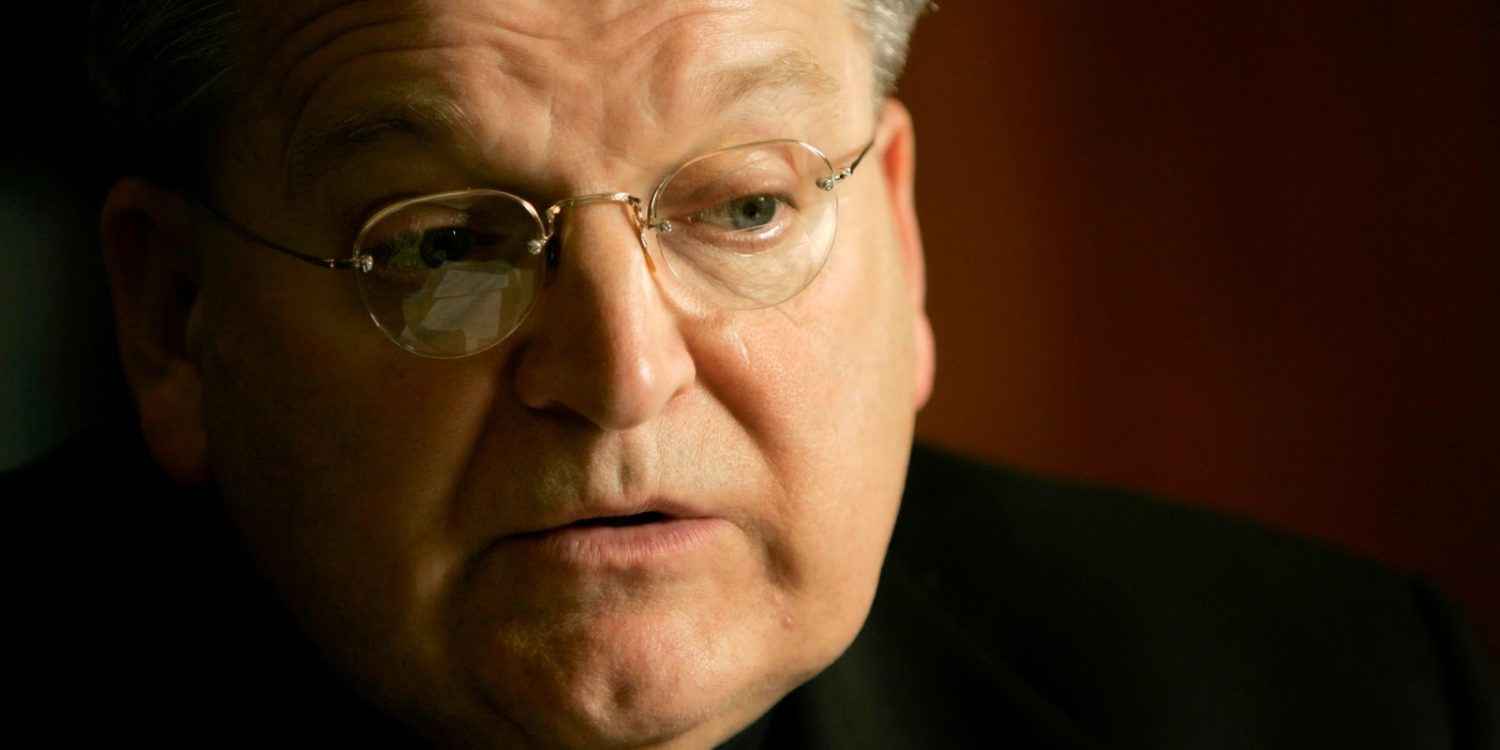
In the interview, Cardinal Burke conveys, though somewhat mildly, that things have grown untenable. He uses terms like “increasing confusion” and “gravest of matters” and “the gravity of the situation, which is continually worsening.” As he did when AL was first published, Burke insists — standing in contradiction to a number of papal defenders — that the exhortation is non-magisterial. “The magisterium,” he says, “is God’s gift to the Church to provide clarity on issues that regard the deposit of the faith. By their very nature, affirmations that lack this clarity cannot be qualified expressions of the magisterium.” He speaks of the damage being done to teaching and sacraments, of a proposed “paradigm shift regarding the Church’s entire moral practice”, and of subversion of “essential parts of the Tradition”. He speaks of the moral implications of the reasoning deployed in the so-called pastoral care recommended in AL, asking “what would happen if this reasoning were to be applied to other cases, such as that of a medical doctor performing abortions, of a politician belonging to a ring of corruption, of a suffering person deciding to make a request for assisted suicide”?

In the end, he makes a “final plea” that the pope “confirm his brothers in the faith with a clear expression of the teaching regarding both Christian morality and the meaning of the Church’s sacramental practice”.

But if the plea is actually final, then what might we expect next? What would be the consequence of the pope ignoring yet another plea, as he has done so many times before?

It seems certain that Cardinal Burke — along with those who are supporting his efforts — wants to make certain that he has given the pope every possible chance to fix what he is breaking. But with no clear indication of the repercussions of failing to do so, it remains impossible to determine what incentive the pope has to even pay this “final plea” any attention at all.

This interview, if it is indeed a final warning, should perhaps have been labeled as such. Saying “Please stop” hasn’t worked as a strategy before now, and the urgency — is there a sense of urgency behind the calm restatement of the problem? — demands more. The time for deference and patience, I fear, has passed. The faithful are seeing the man on the Throne of St. Peter flouting divinely-revealed teaching and the safeguards of his divinely-assisted office — and getting away with it. And it is making many Catholics feel tempted to wonder: If Christ’s promises to the Church can be so easily broken, can any of what we believe can really be trusted? 

In that sense, the pope isn’t the only one responsible for “the gravity of the situation, which is continually worsening.” The cardinals and bishops who have delayed taking action until now are, in their own unintentional way, intensifying the scandalization of the faithful. What the pope is doing is wrong, the laity think, but when even the faithful and orthodox shepherds of the Church fail to properly address it, does that mean we have been abandoned?

And while these doubts about the Church’s indefectibility are being daily introduced into the minds of the faithful, bishops around the world continue to move forward with their own subjective interpretations of what Amoris Laetitiameans for their flocks — all of which will have to be unwound once the Church regains her senses. Today, at the United States Conference of Catholic Bishops 2017 General Assembly meeting, the agenda item of a “renewed pastoral plan on marriage and family life in light of Pope Francis’ apostolic exhortation on ‘the Joy of Love’, Amoris Laetitia” was brought to the table by Bishop Richard Malone, who serves on the USCCB Committee on Laity, Marriage, Family Life and Youth. (For those who would like to hear the commentary themselves, you can follow it on video beginning here.)

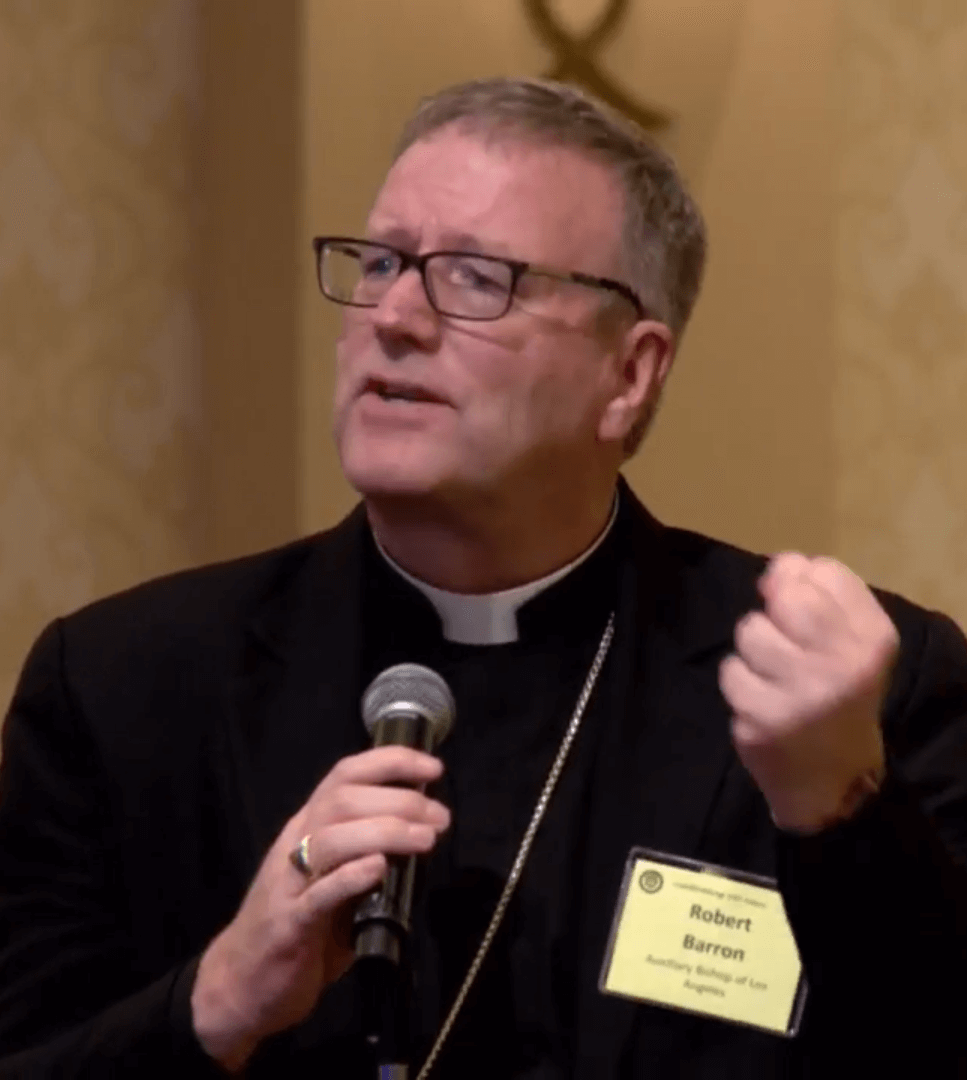
In the ensuing discussion, popular Catholic speaker Bishop Robert Barron lamented, “I just think it’s really been a tragedy that the reception of this document [Amoris Laetitia] has been so poor in our country. If you do a web search of Amoris Laetitia, you get a mountain of literature, but it’s all about a particular chapter and even a particular footnote within that chapter. As important as that question is, I think it’s led to a overlooking of this really extraordinarily rich document, so I think it’s good for us to seize control of that process, because I think we’ve been positioned by an awful lot of people in the blogosphere who are forcing people to read this document in a particular way.”

“An awful lot of people in the blogosphere”? I wonder who he might be referring to. “Forcing people”? With what, our incredible mind powers? “Seize control”? He actually went on to mention the word “seize” — which, if we want to talk about force, means to “take hold of suddenly and forcibly” — two more times in his brief comments.

I didn’t have the patience to listen to more of the discussion.

The firing of Professor Seifert. The shaming of Professor Stark. The firing of Fr. Thomas Weinandy. The campaign of sustained ad hominems against the dubia cardinals as well as every theologian, priest, and layman who supports the work of authentic criticism of the exhortation. The Vatican-promoted heterodox interpretations of the exhortation itself, along with Vatican-promoted articles to give cover to these interpretations through an intentional obfuscation of Church teaching and the parameters of Magisterial authority. The “climate of fear” at the Vatican, where any criticism is reported and people suspected of opposing the official agenda are monitored in ways reminiscent of the techniques of the KGB. The entire apparatus of the Dictatorship of Mercy. It is in these things where the true force in the matter lies. The only reason that the orthodox counter-narrative has been able to bubble up to the top at all is because those of us who care about the truth are relentless in our pursuit of it — and because God has blessed those efforts. But there is only so much we can do, and we’re all exhausted by being constantly outnumbered and isolated.

This is why, Cardinals Burke and Brandmüller, if you should happen to read this, you should know that time is of the essence. Perhaps you do. I continue to hear whispers that the formal correction itself is not far behind. But the question after that will be the same as now: then what? What happens when every effort is ignored? How will we move forward from here?

Will an imperfect council be called? Will the pope be declared to have deposed himself through pertinacious and obdurate heresy? Will a new conclave be assembled among the tiny remnant of the faithful bishops? Will we once again have two rival claimants to the Petrine See?

Or will it be something completely different?

Everyone wants to know what to expect. Everyone is wondering, and frustrated. Everyone is speculating on how difficult things might become, but nobody I’m hearing from seems to think that they will be worse than they are now. An uncomfortable certainty is far preferable to the interminable continuation of uncertainty and doubt.

Something has to give. Please, Lord, let it give soon. Grant the successors of your apostles the courage and wisdom to see this through and begin the work of restoring the Church.

Posted in Uncategorized | 1 Comment