THE FILIAL CORRECTION IS HAVING A WORLDWIDE IMPACT


Featured Image
Shutterstock
Roberto de Mattei

OPINION

The worldwide impact and significance of the ‘filial correction’

September 27, 2017 (Rorate Caeli) — The “filial correction” addressed to Pope Francis by more than 60 priests and scholars of the Church, has had an extraordinary impact all over the world. There was no lack of those who tried to minimize the initiative, declaring  the number of signatories “to be limited and marginal.” Yet if the initiative is irrelevant, why have its repercussions been so widespread in all the media outlets of the five continents, including countries like Russia and China? Steve Skojec on OnePeterFive reports that research on Google News resulted in more than 5,000 news articles, while there were 100,000 visits on the site www.correctiofilialis.org in a space of 48 hours. The adhesion on this site is still open, even if only some signatures will be made visible. It is essential to acknowledge that the reason for this world-wide echo is one only: the truth can be ignored or repressed, but when it is made manifest with clarity it has its own intrinsic power and is destined to spread by itself.  The main enemy of truth is not error, but ambiguity. The cause of the diffusion of errors and heresies in the Church is not due to the strength of these errors, but the culpable silence of those who should openly defend the truth of the Gospel.

The truth asserted by the “filial correction” is that Pope Francis, through a long series of words, acts and omissions “has upheld, by direct or indirect means (whether being aware or not, we do not know, neither do we want to judge him ) at least “seven false and heretical propositions, propagated in the Church through his public office as well as through private action.” The signatories insist respectfully that the Pope “condemn these propositions publically, thus carrying out the mandate of Our Lord Jesus Christ given to Peter and through him to all his successors until the end of time:  “I have prayed for thee, that thy faith fail not: and thou, being once converted, confirm thy brethren”.

No reply regarding the correction has yet arrived; only clumsy attempts at disqualifying or singling out the signatories, with particular aim at some of the most well-known, like the former President of the Vatican Bank, Ettore Gotti Tedeschi.  In reality, as Gotti Tedeschi himself said in an interview to Marco Tosatti on September 24, the authors of the Correctio, have acted out of love for the Church and the Papacy. Gotti Tedeschi and another well-known signatory, the German writer, Martin Mosebach, were both applauded last September 14 at the Angelicum by a public of over 400 priests and laypeople, comprising three cardinals and several bishops, on the occasion of the convention celebrating the 10th anniversary of the Motu proprio, Summorum Pontificum.

Other two signatories, Professors Claudio Pierantoni and Anna Silva, expressed the same ideas in the Correctio at a meeting on the theme “Let’s Clarify”, organized on April 23 of this year by the Nuova Bussola Quotidiana, supported by other prelates, among whom was the late Cardinal Carlo Caffara. Many other signatories of the document occupy or have occupied, prominent positions in ecclesiastic institutions. Others again are distinguished university professors. If the authors of the Correctiowere isolated in the Catholic world, their document would not have had the resonance it attained.

A Filial Appeal to Pope Francis in 2015 was signed by around 900,000 people from all over the world and a Declaration of fidelity to the unchangeable teaching of the Church on matrimony, presented in 2015 by 80 Catholic personalities, gathered 35,000 signatures. A year ago, four Cardinals formulated their Dubia on the Exhortation Amoris laetitia. In the meantime, scandals of an economic and moral nature are undermining Pope Francis’ pontificate. The American vaticanist, John Allen, certainly not of a traditional bent, revealed on Crux of September 25, how difficult his position has become these days.

Among the most ridiculous accusations that are being made about the signatories of the document, is that of being “Lefebvrians”  on account of Bishop Bernard Fellay’s signature, the Superior of the Fraternity of St. Pius X.  Monsignor Fellay’s adhesion to a document of this type is a historical act, which clarifies without the shadow of a doubt, the Fraternity’s position in regard to the new pontificate. However, “Lefebvrianism” is a verbal locution which has for the progressives the same role the word “fascism” had for the Communists in the 1970s: discredit the adversary, without discussing the reasons. The presence of Monsignor Fellay is moreover, reassuring for all the signatories of the Correctio. How can the Pope not have the same comprehension and benevolence regarding them, that he has shown over the last two years towards the Fraternity of St. Pius X?

The Archbishop of Chieti, Bruno Forte, previously special secretary to the Bishops’ Synod on the Family, declared that the Correctio represents “a prejudicially closed stance towards the spirit of the Second Vatican Council which Pope Francis is incarnating so profoundly” (Avvenire, September 26, 2015). The spirit of Vatican II, incarnated by Pope Francis, writes Monsignor Lorizio, in turn, in the same Italian Bishops’ newspaper, consists in the primacy of the pastoral over theology; in other words, in the subordination of the natural law to life experience, since, as he explains, “the pastoral comprises and includes theology” and not vice-versa. Monsignor Lorizio teaches theology at the same Faculty of the Lateran University in which the Dean used to be Monsignor Brunero Gherardini, who died on September 22, on the eve of the Correctio  he was unable to sign because of his precarious health conditions.

The great exponent of the Roman Theological School demonstrated in his most recent books what a deplorable landing-place we have been brought to by the primacy of the pastoral announced at  Vatican II and propagated by its ultra-progressive hermeneuts, among whom the same Forte and the makeshift theologian Massimo Faggioli, along with Alberto Melloni, who are all distinguishing themselves with their flimsy attacks on the Correctio.

Monsignor Forte in Avvenire added that the document is an operation which cannot be shared by “those  who are faithful to the successor of Peter in whom they recognize as the Pastor the Lord has given to the Church as the guide of universal communion. Fidelity should always be directed to the living God, Who speaks to the Church today through the Pope.”

Now then, we have come to the point of defining Pope Francis a “living God”, forgetting that the Church is founded on Jesus Christ, for Whom the Pope is representative on earth, not the divine owner.  As Antonio Socci correctly wrote, the Pope is not  a “second Jesus” (Libero, September 24, 2017) but the 266th successor to Peter. His mandate is not that of changing or “improving” the words of Our Lord, but of guarding and transmitting them in the most faithful manner. If this doesn’t happen, Catholics have the duty to reprove him in a filial way, following the example of St. Paul in regard to the Prince of the Apostles, Peter. (Gal. II, 11).

Lastly, there are those surprised that Cardinals Walter Brandmüller and Raymomd Leo Burke didn’t sign the document, ignoring, as Rorate Caeli underlined, that the Correctio of the Sixty is of a purely theological nature, whereas the one of the Cardinals, when it comes, will have much more authority and importance, also on the canonical level. The correction of a fellowman, foreseen by the Gospel and current Canon Law, in art. 212, par. 3, can have different forms. “This principle of fraternal correction inside the Church – declared Monsignor Athanasius Schneider in a recent interview to Maike Hickson – has been valid for all time, even with regard to the Pope, and so it should be valid also in our times. Unfortunately, these days anyone who dares speak the truth – even if he does so respectfully with regard to the Shepherds of the Church – is classified as an enemy of unity, as happened to St. Paul; when he declared:Am I then become your enemy , because I tell you the truth?’” (Gal. 4, 16).

​Reprinted with permission from Rorate Caeli.

Posted in Uncategorized | Comments Off on THE FILIAL CORRECTION IS HAVING A WORLDWIDE IMPACT

BELIEVE ME, FATHER, YOU ARE NOT ALONE IN FEELNG LIKE THIS

image003-3


This is how I feel in the church nowadays.


                                    ~     Fr. John Stone


Posted in Uncategorized | 1 Comment

BRAIN DEATH VULTURES CIRCLE A 27 YEAR-OLD WOMAN IN ONTARIO

notre_dame_paris


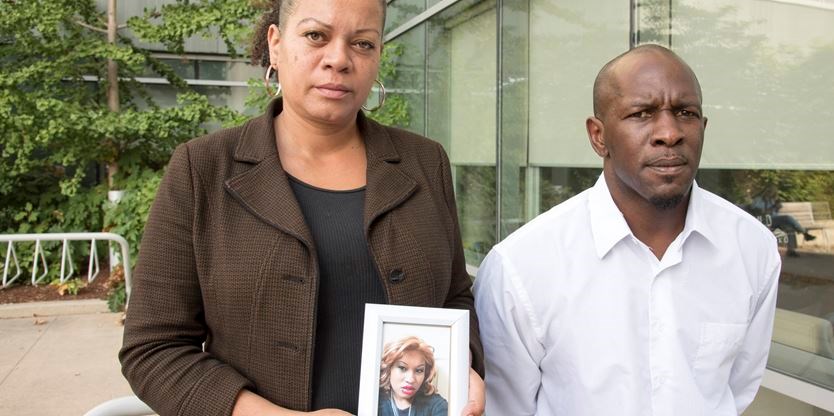
Dr. Paul Byrne is granted by the court to be an “expert witness” on behalf of 27 year-old Taquisha McKitty and her family to protect and preserve her life:


If he is granted expert status, he will be able to advise a physician licensed in Ontario to provide McKitty with treatment.”


Taquisha was admitted into the Brampton Civic Hospital, Ontario, Canada on September 14, 2017 having suffered a drug overdose.  While although Taquisha was breathing on her own and moving in response to her family, Taquisha was recognized as a registered organ donor and medical treatment to protect and preserve her life were circumvented.  Two apnea tests were performed, she was declared “brain dead” by two physicians in accordance to Ontario law and to this effect, a death certificate was issued September 20, 2017.  Her family hopes to have Taquisha’s death certificate canceled in pursuit of medical therapy her wellbeing, to protect and preserve her life, not that of another(s) as an organ donor.


Current status: “A Brampton judge has granted a two-week injunction that will prevent doctors from taking a woman who was declared brain dead on September 20 off life support.”  This time allotted is to seek  “proper reports and medical opinions from different sides.”


For a full understand regarding the fallacy of “brain death,”  please refer to the article link below, Brain Death” is Not Death!


Judge grants two-week injunction that keeps Brampton woman on life support | Toronto Star

https://www.thestar.com/news/gta/2017/09/28/judge-grants-two-week-injunction-to-allow-brampton-woman-to-stay-on-life-support.html


Judge grants injunction to keep woman declared brain dead on life support | CP24.com

http://www.cp24.com/news/judge-grants-injunction-to-keep-woman-declared-brain-dead-on-life-support-1.3611494


“Brain Death” is not Death!

http://www.lifeguardianfoundation.org/action=bd_not_death.html

++++++++++++++++++++++++++++++++++++++++++++++++++++++++++++++++++++++++++++

Brain Death Conflict – Taquisha McKitty,

Taquisha McKitty is being physiologically sustained at Brampton Civic Hospital (Ontario), even though her attending physician (Omar Hayani) issued a death certificate declaring her brain dead over a week ago (on September 20).

McKitty’s parents believe the hospital acted too quickly in declaring their daughter dead, and doctors are ignoring what the family believes are responses to “stimulus” including squeezing their hands and moving her thumb when asked to do so.

The family went to court last week and won an emergency injunction temporarily preventing the hospital from removing the respirator that is keeping her alive. That injunction expires today (Thursday, 9/28) when the matter will be back before Superior Court Justice M.J. Lucille Shaw.


Posted in Uncategorized | Comments Off on BRAIN DEATH VULTURES CIRCLE A 27 YEAR-OLD WOMAN IN ONTARIO

THE VATICAN CURIA IS A DANGEROUS WORKPLACE THESE DAYS

Cardinal Müller: “People Working in the Curia Are Living in Great Fear”

Cardinal Gerhard Müller, the former Prefect of the Congregation for the Doctrine of the Faith, just gave a wide-ranging interview to Edward Pentin, the Rome Correspondent of the National Catholic Register. Among other important aspects of this report, Cardinal Müller for the first time admits publicly that the Congregation for the Faith did not itself edit the final version of the papal document Amoris Laetitia, and that he does not even know who actually did the final editing of that document. In this 29 September interview, Cardinal Müller for the first time revealed how fear-filled the atmosphere in Rome now is. He also calls for a further discussion of the dubia, and he defends Cardinal Carlo Caffarra in his expertise as a moral theologian. In the following, we shall present the most crucial section of that lengthy interview in which he explicitly speaks about people who are being spied upon in and about the Vatican:

Careerists and opportunists should not be promoted, and other people who are competent collaborators not excluded without any reason or expelled from the Curia. It’s not good. I heard it from some houses here, that people working in the Curia are living in great fear: If they say one small or harmless critical word, some spies will pass the comments directly to the Holy Father, and the falsely accused people don’t have any chance to defend themselves. These people, who are speaking bad words and lies against other persons, are disturbing and disrupting the good faith, the good name of others whom they are calling their brothers.

The Gospel and the words of Jesus are very strong against those who denounce their brothers and who are creating this bad atmosphere of suspicion. I’ve heard that nobody speaks; everyone is a little afraid because they can be snitched on. It’s not the behavior of adult people, but that of a boarding school.

[Edward Pentin:] One senior Church figure, speaking to me on condition of anonymity, called it a “reign of terror.”

[Cardinal Müller:] It’s the same in some theological faculties — if anybody has any remarks or questions about Amoris Laetitia, they will be expelled, and so on. That is not maturity. A certain interpretation of the document’s Footnote 351 cannot be criteria for becoming a bishop. A future bishop must be a witness to the Gospel, a successor of the apostles, and not only someone who repeats some words of a single pastoral document of the Pope without a mature theological understanding. […]

[Edward Pentin:] Regarding Amoris Laetitia and the fear of criticizing it, and the lack of response to the dubia, isn’t the irony that it goes against the Pope’s wish for parrhesia (to speak boldly and frankly) and dialogue?

[Cardinal Müller:] Everyone who becomes bishop, cardinal or pope must learn to distinguish between the critics who are against the person and critics against the mission you have. The Holy Father, Francis, must know that it is important one accepts his intention: to help those people who are distant from the Church, from the belief of the Church, from Jesus Christ, who wanted to help them. … This discussion is not against him, it is not against his intentions, but there is need of more clarification. Also, in the past, we had discussions about the faith and the pastoral application of it. It’s not the first time this has happened in the Church, and so why not learn from our long experiences as Church, to have a good, profound discussion in promoting the faith, the life of the Church and not to personalize and polarize? It’s not a personal criticism of him, and everybody must learn it and respect his high responsibility. It is a very big danger for the Church that some ideological groups present themselves as the exclusive guardians of the only true interpretation of Amoris Laetitia. They feel they have the right to condemn all people of another standpoint as stupid, rigid, old-fashioned, medieval, etc.

Nobody can, for example, say Cardinal Caffarra didn’t understand anything of moral theology. Sometimes the un-Christian behavior is printed in L’Osservatore Romano, the semi-official Vatican newspaper, or given in official organs of the media, to make polemics and rhetoric. This cannot help us in this situation — only a profound theological discussion will. [emphasis added]

These observations and comments have some grave implications with regard to the papacy of Pope Francis, inasmuch as he is, finally, responsible for this atmosphere of fear and distrust in Rome; and even for the suppression of some of the orthodox clergy and laymen (such as the highly respected Professor Josef Seifert).

In another section of his interview, however, Cardinal Müller insists, with regard to the confusion concerning Amoris Laetitia, that it is somehow not the pope’s fault: “I think the Pope should not be blamed for this confusion, but he is authorized by Jesus Christ to overcome it [the confusion].”

Cardinal Müller is at least to be commended for his courage to speak much truth in this new interview, and he likely will suffer for it. However, one may politely challenge him as to why he still does not call that man to come forth who is actually responsible, in the end, for this current state of affairs within the Catholic Church: Pope Francis himself. Do we not all have a duty loyally to resist him for creating such an atmosphere of fear and distrust and for suppressing the truly orthodox teaching? For, is it not finally about Christ’s own truth that we reverently speak?

Posted in Uncategorized | 1 Comment

CLAUDIO PIERANTONI CLARIFIES THE IMPORTANCE OF THE FILIAL CORRECTION

Featured Image
Diane MontagnaDiane Montagna

LIFESITENEWS

‘Apocalyptic’: Filial Correction organizer warns of schism if errors aren’t corrected

Support the filial correction of Pope Francis for ‘propagating heresies’. Sign the petition!

SANTIAGO, Chile, September 29, 2017 (LifeSiteNews) — The recent “filial correction” charging Pope Francis with permitting the spread of seven heresies, at least by omission, has provoked admiration and consternation among Catholics and drawn considerable attention in the secular media. But what led those who authored or contributed to the Correction to take such a rare and serious step?

We travelled to Santiago, Chile, where we had the opportunity for an in-depth interview with Professor Claudio Pierantoni, who is one of the lay scholars who helped shape the “filial correction.” Prof. Pierantoni, who was born in Rome, is currently a professor of Medieval Philosophy in the Philosophy Faculty of the University of Chile (Santiago). He has two PhDs: in the History of Christianity and in Philosophy.

In this extensive interview, we discuss the immediate trigger for the correction, namely the chaos following the apostolic exhortation Amoris Laetitia, the philosophical roots of the crisis, and why Professor Pierantoni describes the present situation as “apocalyptic.”

Professor Pierantoni, what personally led you to be part of the Filial Correction initiative?

I started thinking about this [matter] as soon as the document Amoris Laetitia came out. Immediately it attracted my attention, when I read the article of Professor de Mattei (“Prime impressioni su un document catastrofico,” Corrispondenza Romana), and the first open letter to the Pope by Bishop Schneider, which were among the first and strongest reactions that appeared. I continued to investigate and read the many articles that continued to be published, so I have thought about it in an uninterrupted way ever since. Of course, up to that point, I was accustomed to thinking that this is not a matter for lay people to be involved with, because there are bishops and cardinals. But then I started to see that bishops and cardinals were not doing much, apart from Bishop Schneider, or afterwards, Cardinals Burke, Caffarra, Brandmüller and Meisner. So I felt something had to be done.

In September I wrote my first article on the subject, drawing a parallel between the present situation and the Arian controversy, a parallel that had been suggested by Bishop Schneider. Since then, the thought has never left me. In April 2017, I was invited to participate in the international conference in Rome that featured lay speakers from five continents and called for clarity about Amoris Laetitia. There I spoke about the necessary link between Magisterium and Tradition, and about the case of the heresy of Popes Liberius and Honorius. This was important in order that people might properly understand the doctrine of papal infallibility in the light of the history of the Church.

I felt very strongly that this contribution was a very important thing to do, because one of the main problems in this controversy has been the tendency of many Catholics to interpret the Pope’s personal ideas or accidental declarations as if they were necessarily a part of the Magisterium of the Church.

Some people said: what can you achieve with the “filial correction”? But I always thought that, by telling the truth, by stating it in a scholarly and well-founded way, you can achieve many things — just because you are telling the truth. It’s not a question of human power, really. Of course, the truth must be spoken in a respectful way, the Pope must be respected as the Pope. And I think it should be clear that we consider him to be the Pope, because some people might confuse this, suspecting that it is a sede vacantist position.  That must be very clear, that we consider Francis to be the Pope. That is precisely why we are insisting that he condemn these errors.

Why has this step been taken if the cardinals, who are the Pope’s counsellors, are going to issue a formal correction?

The formal correction, as you remember, was already promised for January. But in April, when we had the Rome conference, there still was no hint that Cardinal Burke was going to issue a correction. So, in a little group, we started to think about a lay correction. Then, in July, when our correction was taking its final shape and had gained a certain number of signatures, we heard with great pleasure that Cardinal Burke was again thinking of a correction on his part. I also thought that although the impact of a formal correction made by the cardinals would of course have a much greater impact, because to counsel the Pope is their specific mission, there is not necessarily a juridical difference. We are inferior to the Pope, but the cardinals are inferior as well. Some opponents of the ‘filial correction’ argue that this is not a juridical act, that it has no juridical value. And I think they are right: properly speaking, it has no juridical value. The Pope is above any juridical form of correction from a superior (as we state in our letter), because he has no superior on earth. But both in the case of the cardinals and of the scholars, a correction has great moral value. So the moral value is common to both.

You are right to say that that the job of the cardinals is to counsel the pope, but the duty of a correction belongs to anyone who has the knowledge to do it.

And I think, in this case, the cardinals need the support of scholars, because, in the first place they are so few. If there were 60 cardinals that were also scholars, of course it would be useless. But given that they are now only two, I think they need lay and scholarly support.

Perhaps people outside the Church think this is a political matter. But it is a theological, philosophical, historical matter that entails much scholarly work and needs much expertise. The kind of problems this entails is wide-ranging. You need to have philosophers, historians, theologians.

It would be very easy for Pope Francis to answer your concerns and clarify matters, wouldn’t it?

Yes, of course in terms of practical action. But it would mean contradicting his main line of action and thought over many years — I believe not only during his years as pope but also previous years as well. It would be contradictory to a whole way of thinking, rather than just an error in part of the journey of life. I think that is why the reference to Modernism in our letter was especially important, for this current of thought has a long tradition in the 20th century and has produced a very influential school and a way of thinking.

Do you think that Modernism is the root of the seven heretical propositions you have addressed in the Correctio?

Yes, I think that Modernism is the basic root, even more than Lutheranism. Because Modernism is a more philosophically coherent system with definite presuppositions, whereas Lutheranism has different elements that are not always coherent with one another. For example, the basic presupposition of Modernism, which in the end is a derivation of German idealism, is that all being is history, so truth cannot be immutable, but must evolve. The basic presupposition is that there is not a really immutable God (an error condemned by the First Vatican Council), and therefore an immutable substance of truth, but somehow God identifies himself with creation (another error condemned by Vatican I) and so evolves with history. In that sense, something can be true in the fourth century and false in the twenty-first. According to this view, today’s magisterium doesn’t need to be logically coherent with previous magisterium: it is enough to state that the same universal “Substance” — God, Reality, or Life — is speaking today as it speaks through the present magisterium, and there’s no point in contrasting it with previous magisterium. That is the philosophical foundation of maxims such as “Reality is superior to ideas” (cf. Evangelii gaudium, 233). But, in the end, it is clear that this leads to abandoning the principle of non-contradiction: that’s why you hear nowadays in Rome statements like Fr. Spadaro’s already (in)famous one: “two and two are five.” Now I think this contradiction leads not only to heresy, but still more, to mental illness. It is no exaggeration what Cardinal Sarah stated during one of the Vatican synods of 2014 – 2015 that “the divorce between doctrine and practice is a dangerous schizophrenic pathology.”

Could you tell our readers more about what Modernism is?

I think that in Modernism there is a deep philosophical problem about the idea of God himself. In Modernism, God is conceived as changeable. Somehow the substance of God is immanent in the world in such a way that you cannot metaphysically distinguish being from becoming, being from change. If God is changing with reality, then you have a problem with the very notion of God, and nowadays this is a very strong school of thought. It is Hegelian in origin. I think it’s much more ancient as a doctrine (you can trace it back to ancient Gnosticism) but Hegel is its most famous modern representative. And it’s very strong in modern faculties of theology. So it’s a very deep problem.

I think the immediate intention of the Pope and his counsellors was to give an answer to the question of Communion for divorced and civilly remarried Catholics. But then, in order to give a theological and philosophical justification, they had to make explicit their own presuppositions, which are mistaken in a much more profound way. So the general view you get is very frightening and apocalyptic. Modernism, as Pope Pius X famously stated, is not just “one heresy,” but the root and consummation of all heresies.

If the Correction were not issued, what did you fear might happen?

I think that if an error is not somehow corrected, then humanly speaking, the obvious prediction is that error will continue to spread. At least, with a correction, many people may come to realize that there is a problem. I think to state clearly that what we have here is material heresy, and that it is directly contrary to the Faith, challenges anyone and obliges people to think.

You are also a Church historian. In what respect is the 1333 example (the correction of Pope John XXII) different from the present case?

I think the main difference is the sheer “volume” of heresy. One can make a mistake on one point, but I think one important characteristic of the statement we signed is that it provides a historical background, explaining how this kind of thought relates to Modernism and to Lutheranism. So you can see that it’s not just one point on which a mistake has been made, but it’s a whole school of thought that then comes out in heretical propositions. The situation today is much more complex and much more grave.

At the conference held in Rome last April, you described the current situation as “apocalyptic”…

Yes, and I still think it’s apocalyptic, because you don’t get the impression that the Pope is making only one mistake. For example, during Pope John Paul II’s pontificate there was a question about a ‘just war.’ He said, during the first war in Iraq, that all war was unjust. A friend of mine, Father Robert Dodaro OSA, who later was director of the Augustinianum, published an article saying that tradition says there can be a just war. St. Augustine teaches this; St. Thomas Aquinas teaches this, based of course on Scripture. So, this doesn’t seem orthodox. But no one thought John Paul II was a heretic. He made one mistake and one could correct him. But it’s a very different situation when you have a completely different world vision that, theologically and philosophically, risks being opposed to the Catholic view, that has a modernist view and says that doctrine is basically changeable, so that something which is Scripture means one thing in the first century, but another thing in the eleventh century, and another thing in the twenty-first century. One could ask, then, what’s the use of having a Bible, or of having Tradition (the two sources of Divine Revelation)?

The Correction has been presented in the media and elsewhere in terms of what Amoris Laetitia said about Communion for the divorced and remarried, but from what I understand you to be saying, other broader and deeper issues have emerged …

And I think this is providential. Although it’s frightening, I think it’s providential that mistakes come out with their theological and philosophical presuppositions. Because otherwise, one could just say, ‘Do it. Give communion with no justification,’ as many priests have done before. But if you start trying to justify — rationally, theologically — the problem grows, because you show what the presuppositions are. So this exposure creates bigger problems in one sense, but it’s also providential because one can see where the mistake really lies, what the basic mistake is that leads you to a certain conclusion. Conservative popes like Pope Benedict and Pope John Paul II tried to stop it, but this somehow obliged “progressive” theologians to hide their presuppositions and wait in secret. But now they have freedom to express themselves and so their train of thought is much clearer. You can know what they think, so it’s much easier to understand how grave the situation is.

Is there a concern among the signatories — either priests or lay scholars — that they might suffer reprisals?

Yes, there is a concern about that. I have heard from many people in Catholic institutions (here in Santiago and elsewhere) who have been directly threatened with this, and therefore they didn’t sign. For example, I have heard from some people who signed the document of the 45 and they were told not to sign anything else or they would lose their position. Of course, one is more at risk depending on the kind of institution. I have heard of people being threatened, not directly from Rome but by the local institution, sometimes striving to be “more Roman than the Pope.”

Are you personally concerned?

In my case, I work for a state university, so they are not so concerned. I also work for a Catholic institution, but there they mainly share the orthodox position, so they don’t persecute people who hold an orthodox position. Of course, one always needs a certain degree of prudence in this, trying not to scandalize persons who are not prepared.

Is the group of signatories you have gathered representative of a much larger group then?

Oh yes, definitely. I sent it to 10 people, for example, and 7 out of 10 told me they didn’t want to sign it out of fear of reprisals. A few did not think they were prepared to make a direct correction of the pope, although they agreed on the content. I can tell you that many, many people basically agreed on the content, many more than those who signed. So I think it is an error to claim, as some have in the media, that this is a “marginal” or a “traditionalist” initiative. “Traditionalist” in the strict sense means someone who only goes to the Mass in the extraordinary form, (i.e. the traditional Latin Mass), or who has a strong objection to Vatican II. But the positions contained in the document are very widely shared positions. In fact, some commentators said: “they have been very good about mentioning only seven heresies, because there are many more,” and these commentators were not traditionalists.

Of course one reason why they are calling it “ultra-traditionalist” is because of the presence of Bishop Fellay’s signature.

Yes well, it is true that there are a number of people among the signatories who come from a traditionalist way of thinking, but that does not mean that the position in itself is traditionalist. It’s not a traditionalist position to mention these errors. I think many normal Catholics, when they start thinking, understand that there are grave errors.

One could define the correction as “conservative,” provided that one understands that ‘conservative,’ in the Church, is not the same as ‘conservative’ in the British parliament. Conserving in politics can be discussed because one is dealing with human law, not absolute truth. But in the Church, conservative means to conserve what has been handed down from Christ himself, through the Apostolic tradition. In this sense, it is essential to a Catholic to be conservative.

It has been suggested that the correction might tear down the papacy, that the devil could be using this as a trick?

On the contrary, I think that in this enterprise that the Pope and his counsellors have undertaken with Amoris Laetitia really lies the trick to tear down the papacy. The papacy came out immensely discredited after Amoris Laetitia. I have no doubts in saying that it is by far the worst document that has ever come out with a papal signature in the whole history of the Church. This explains why many people have now seriously started to doubt if Francis really is the Pope. Many people, who rightly think the Pope must be the defender of the tradition, thought: well, this can’t be the Pope. It has also led some people to doubt papal infallibility or the meaning of the papacy. My friend Prof. Josef Seifert was also accused by his archbishop in Granada of discrediting the papacy by pointing to one of the biggest problems in AL. But who is really discrediting the papacy? First we should decide if the problem he pointed out was real and serious. (see my defense of Seifert in:  http://aemaet.de/index.php/aemaet/article/view/46/pdf).

Finally, I think it’s very evident that the Pope is putting a lot of confidence in just one group of people, who are all of one school, theologically and politically; and that is not good for a Pope. He should really try to listen to different people. In Italy, for example, but also in America and in many other places, he looks more and more every day like someone who is standing for a party (see the book “The Political Pope”). That is what discredits the papacy.

What do you think Leo XIII meant when he wrote, in the exorcism prayer he composed after his alleged vision of St. Michael: “In the Holy Place itself, where has been set up the See of the most holy Peter and the Chair of Truth for the light of the world, they have raised the throne of their abominable impiety, with the iniquitous design that when the Pastor has been struck, the sheep may be scattered”? Are you familiar with this passage?

Yes, I discovered it right after Amoris Laetitia came out, and it surprised me very much because, frightening as it was, it seemed to be a perfect picture of the situation. I think no fictional writer could have imagined this and it’s a true prophecy which is unfolding now. No one could have imagined that this prophecy would really come true (at some moment that paragraph was thought so incredible that it was even deleted from the St. Michael Prayer in official texts), but I think what Leo XIII was describing is coming true.

It is important to add that this is not a moral judgment about the Pope. I think the Pope and his counsellors — for example Fr. Spadaro, whom I got to know when I was a young student in Rome — are in fact good people. I believe they are well intentioned. Pope Francis is charismatic and has many human and Christian virtues, so of course many people tend to believe him. But this is precisely what creates more confusion and so behind all of this there is a truly diabolical trick.

What do you think will happen now that the Correction has been made public?

I think that now Cardinal Burke must proceed to issue his long promised correction.  If I were him, I would call it a “fraternal correction” (better than “formal”). He has in fact given us hints that he approves of our “filial” initiative and feels supported by it, and so I’m sure he now knows that very soon is his time to act. Perhaps two or three more cardinals, or half a dozen bishops, will join. Maybe more, maybe less. But even if he were the only one, I think he must soon issue a correction.

Are we therefore in a time similar to the Arian heresy and St. Athanasius?

Yes, very similar, because we have two schools of thought that are difficult to reconcile, and there is a sufficiently wide consensus among learned theologians in very influential academic institutions (above all in Germany) that what we consider the heretical school is in fact orthodox. So I think there is also in this case, just like in ancient learned bishops of the Origenian school, a superiority complex among heretical (or semi-heretical) thinkers: they tend to look on others as inferior, or stuck in the past, as happened during the Arian controversy with the attitude towards Occidental bishops. Sometimes a more modest academic training can be a better ally to orthodoxy, because usually clever people, who are raised in a famous or prestigious school can be more easily misled, as they frequently judge theology on human academic standards, and tend to follow the trend of their time and their school (for example Karl Rahner’s school, that had in recent times a huge influence) more than Tradition and the Bible.

If a fraternal correction were made, what do you think the next step might be?

It’s very difficult to say, but I believe they haven’t issued it yet because they fear a schism. But I think the opposite is true: that if they don’t do it, there will be a schism. To not speak of the true doctrine, to not correct errors, for fear of schism is a contradiction. Only truth can unite. If error spreads it will cause a split, from parish church to parish church, from bishop to bishop, from country to country. It would be a practical schism, which in fact already exists, but if the correction doesn’t take place, it will get much worse.

Although the defenders of the Pope may mock the initiative, and say the signatories are very few in number and ultra-conservative, or traditionalists, in the end what’s important is not who is saying it, but if what is being said is true, no matter whether it is said by famous or obscure people, whether it’s Bishop Fellay or the president of the IOR. The news of the day passes, but the truth remains.

I don’t think it’s the number that’s important. St. Athanasius in his time was only one. There were some people supporting him, but they were very few. But what was maintained as orthodoxy remained.

What can the lay faithful do?

I think the lay people have a very important role, because they are freer. I think this document may help some people to reflect in a more comprehensive way. But I think there is much work still to be done. The laity need more formation. Many people can’t react to this because they don’t have basic formation. Scholars should try to take the occasion to teach what perhaps we suppose people know, but they don’t know: about the nature of the Church, about the role of the pope, about infallibility, about moral doctrine.

Cardinal Müller has suggested holding a theological disputation. What do you think of his proposal?

I consider Cardinal Müller’s proposal to be an excellent idea, and a wonderful occasion for dialogue and for the genuine pursuit of truth within the Church. It is vital for us, both as Catholics and as rational beings, that we concentrate on the intrinsic truth of the fundamental doctrines that are at stake in this controversy, and that we don’t fall into the temptation of focusing on external arguments, based on the rank, prestige or number of the counterpart. Rank, fame, or numbers are contingent realities that pass away: but the truth is that which IS (cf. Ex 3:14). The truth is God himself.

NOTE: For those readers who want to understand the meaning and dangers of Modernism in more detail, LifeSiteNews recommends Pope Pius X’s encyclical on the modernists, Pascendi Dominici Gregis, which is available here on the Vatican website.

RELATED

Over 60 scholars correct Pope Francis for ‘propagating heresies’

Here’s why no Cardinals signed the ‘filial correction’ to Pope Francis

Signatories more than double on filial correction to Pope Francis

Critics attack ‘filial correction’ to Pope with mud-slinging at signers

Organizers denounce use of ‘fraud’ to undermine filial correction of Pope

Vatican Cardinal wants to ‘dialogue’ with signers of Filial Correction to Pope

Posted in Uncategorized | Comments Off on CLAUDIO PIERANTONI CLARIFIES THE IMPORTANCE OF THE FILIAL CORRECTION

WHY WE SIGNED THE FILIAL CORRECTION

Two signatories explain why they took the unusual step of ‘correcting’ the Pope


Bishop Gracida and Fr Andrew Pinsent: Why we signed the filial correction

Since the filial correction was published on Sunday, more than 80 signatories have added their names to the original 62. Here two of those new signatories, a bishop and a priest-academic, explain their reasons:

Bishop René Henry Gracida

A number of friends have asked me why I chose, last Sunday, to sign the filial correction. Frankly I am surprised that anyone would need to ask, because the answer is so simple and, I hope, self-evident: I love the Church.

I love the Church as the mystical body of Christ. I love the Church as the community of faithful men and women, young and old, liberal and conservative. It pains me to see people suffer, even as I personally suffer, in the present crisis that afflicts the Church.

The filial correction is so well-written, so respectful, so comprehensive, so detailed in explaining the basis for objecting to the seven areas of heterodoxy bordering on heresy, that I would expect many of my brother bishops to be happy to sign it. Perhaps naively, I thought that my signature might encourage more bishops to make their views public, and perhaps some will, but many are timid and fearful of retaliation by Rome.

As I have said before, I take hope from the precedent of the fourth century, when – according to Blessed John Henry Cardinal Newman – the majority of bishops were either Arian or Semi-Arian. It was the laity that supported the Pope and St Athanasius and helped them win the condemnation of Arianism. The laity of our time, who are suffering so greatly as a result of bad leadership, or no leadership, deserve to see more bishops announce their support of the correction.

I have also been asked what I believe will happen if no answer is given to the correction or the dubia. I regret that I must respond that I do not believe that there is anything then that men can do; a resolution of the crisis depends entirely on Our Lord Jesus Christ.

Bishop Gracida, now retired, has been an auxiliary bishop in the Archdiocese of Miami, Bishop of Pensacola-Tallahassee and of Corpus Christi

Fr Andrew Pinsent

I signed the filial correction not due to a lack of filial respect for the Holy Father, but because of the gravity of the situation.

The correction is a next step, consistent with the teaching of Jesus Christ (Matt 18:15-17) and St Paul confronting St Peter (Gal 2:11), that follows a series of unanswered petitions since 2015. These have included one with nearly 800,000 signatures from 178 countries and including 202 prelates prior to the ludicrously manipulated family synod; the appeal of the 45 scholars and clergy to the College of Cardinals to repudiate possible heretical readings of Amoris Laetitia; the dubia of the four cardinals, whom the Pope did not even have the courtesy to meet; and the statement of the confraternities representing thousands of priests worldwide.

As Prof Josef Seifert warned recently, before being sacked for making this warning, we are facing the risk of the total destruction of the moral teachings of the Catholic Church. I would add that the contradictions now being introduced deny reason itself and are catastrophic for the Church’s mission of offering salvation to souls. Since I have given my own life to the priesthood exclusively for the salvation of souls, I had to add my name to the correction.

Fr Pinsent is Research Director of the Ian Ramsey Centre for Science and Religion at Oxford University

Posted in Uncategorized | 2 Comments

NOW IS THE TIME FOR THE CARDINALS TO DO THEIR FORMAL CORRECTION OF FRANCIS

OnePeterFive

FacebookGoogle+PinterestPocket

“The Great Firewall of China,” says Wikipedia, “is the combination of legislative actions and technologies enforced by the People’s Republic of China to regulate the Internet domestically. Its role in the Internet censorship in China is to block access to selected foreign websites and to slow down cross-border internet traffic.”

Information is power, and in a totalitarian communist regime like China’s, one must be very careful about allowing the proletariat a chance to have too much to think. Among the common websites blocked by China’s nationwide internet filter are Facebook, Google, and Twitter.

Among the websites not blocked by the Great Firewall is correctiofilialis.org — the website erected by the authors of the Filial Correction to provide access to their documentation and provide an opportunity for others to sign on.

And yet that same website has already been blocked by the Vatican. According to Italian news website Ansa.it,

The Secretariat for the Holy See’s communication has blocked access to the web page … to the initiative accusing the Pope of seven heresies, linked to what he writes in “Amoris laetitia “.

You can no longer access the page in the Vatican computers in any language. Outside the Vatican, however, the page is reachable.

“Access to the webpage you are trying to visit has been blocked in accordance with institutional security policies,” is the warning that appears. No Vatican computer, therefore, could join the petition.

While the Vatican has chosen to ignore the correction in the hopes it will go away,, the usual papal defenders in the media have closed ranks, issuing haughty and dismissive criticisms of those who issued the correction, not its substance.

Fr. James Martin lamented how “some of the same people who said under John Paul II and Benedict that any disagreement with a pope was dissent, disagree with Francis.” (One would be hard pressed not to take note of the irony here.)

Massimo Faggioli, a progressive theologian and historian at Villanova, went after the Filial Correction in a series of Tweets. “This ‘correction’ to Francis,” he wrote, “is actually very useful because it shows … the very limited number and marginality of this [sic] theologians…”  In a followup article at the National Catholic Reporter, Faggioli pointed out that the list of signatories includes “no cardinal and no bishop, in a Catholic Church that has more than 200 cardinals and more than 5000 bishops.” He discounted the presence of Bishop Fellay — characterized as “schismatic” — and apparently did not know that the Bishop Emeritus of Corpus Christi, Henry Gracida, has also signed on. (Nor did he seem to realize that a correction from bishops would be “fraternal” and not “filial”, which is likely the reason they were not asked to sign.)

Austen Ivereigh, the papal biographer, took a stab at a class warfare attack: “Like the petitions contra Humanae Vitae or pro women priests, this will be ignored. The magisterium doesn’t bow to middle-class lobbies.”

Stephen Walford — the papacy’s newest useful sycophant — also made a cameo in the NCR piece, claiming that the correctio “is based around claims the Holy Father has never made — lies essentially — and a massive dose of hypocrisy.” As in his other recent essays attacking those asking for theological clarity from the pope, Walford completely avoids addressing the specific and documented claims made in the correction, which cite chapter and verse from papal writings and actions and those portions of Scripture and Magisterial teaching they contradict. Instead, he contents himself with disparaging the authors, saying: “their own judging of what is acceptable for a pope to teach is nothing short of Protestantism”.

Get that? A document that asks a pope to adhere to Divinely-revealed truth and decries the clear influence of Martin Luther on his thought and work is Protestantism. 

Meanwhile, coverage of the Filial Correction continues to spread around the globe, with stories not just in the Catholic media, but the mainstream as well. A Google News search this morning pulled over 5,000 results for “filial correction”. Here is just a sampling of the headlines from major outlets:

“Catholic Clergy and Scholars Publish ‘Filial Correction’ of Pope Francis for ‘Seven Heresies’” (Breitbart)

“Group accuses Pope Francis of heresy” (USA Today)

“Pope Francis accused of ‘upholding heresies’ about marriage & moral life” (RT)

“Conservative Theologians Accuse Pope of Spreading Heresy” (New York Times/AP)

The Associated Press picked up by the New York Times showed up elsewhere as well. The copy that appeared in the Chicago Tribune quickly became one of Facebook’s top trending stories on Saturday.

After publishing our own report on the Filial Correction, we received a number of requests from individuals asking how they could sign. Since the original intent of the correction was that it be a work of pastors and qualified Catholic scholars, there wasn’t really an option for the average pewsitter to attach their name. On Saturday evening, I drafted a Change.org petition in support of the Filial Correction with language I thought might make it work as an “unofficial” show of support for the formal effort. I stuck it on my Facebook page in a non-public post asking for feedback. I considered it a draft.

When I got back from Mass on Sunday, however, I was astonished to see that it had been shared. In less than 24 hours, and without any real attempt at promotion, it had garnered over 1600 signatures. After putting the word out, even more began pouring in. The petition now has 4300 signatures and counting. (You can sign it here.) It seems that something Pope Francis wrote in Evangelii Gaudium is now manifesting itself in an unexpected way: 

“In all the baptized, from first to last, the sanctifying power of the Spirit is at work, impelling us to evangelization. The people of God is holy thanks to this anointing, which makes it infallible in credendo. This means that it does not err in faith, even though it may not find words to explain that faith. The Spirit guides it in truth and leads it to salvation.[96] As part of his mysterious love for humanity, God furnishes the totality of the faithful with an instinct of faith – sensus fidei – which helps them to discern what is truly of God. The presence of the Spirit gives Christians a certain connaturality with divine realities, and a wisdom which enables them to grasp those realities intuitively, even when they lack the wherewithal to give them precise expression.”

In an essay published by 1P5 this morning, William Briggs made a critical examination of those who are complaining most loudly about the Filial Correction:

If the naysayers thought the supernatural element the most important, and not politics, there would have been immediate and lively discussion of the seven points of the Correction. Are they really heresies? All of them? Why? Why not? “Let’s dig into this most important matter,” they would have said. “The salvation of souls is paramount, and heresy cannot be countenanced. Here is where we agree, and here where we disagree on the theological points.”

Only after we figure out, really investigate, and agree on each the points are the motives of the writers and signers of the Correction up for grabs. To focus on personalities first is an inversion—and very telling.

It is very telling, and what it tells us is that they are squarely on the defensive. After ten months of weathering scrutiny over the dubia, the changes made at various Vatican congregations, academies, and institutes, the sordid behavior of clergy in Vatican-owned apartments, and more, the Filial Correction appears to have touched a nerve that is driving the point home: things are very much not as they should be in Rome.

If the remaining dubia Cardinals — and those other members of the curia and the episcopacy who have the courage to support them — have been waiting for the right tactical time to make their move, this is it.

The world is watching – and waiting.

Posted in Uncategorized | Comments Off on NOW IS THE TIME FOR THE CARDINALS TO DO THEIR FORMAL CORRECTION OF FRANCIS

THE NECESSITY OF THE UNNECESSARY IN LIFE

40bc5-card2bsarah

The fact is that human culture consists in the production of unnecessary things; but at the same time we could say that these unnecessary things are most necessary to express human dignity. In the field of art and literature—and formulated prayers constitute a category within literature—the question of what is necessary and what is unnecessary resists all attempts at a thoroughgoing answer. It is not that poetry is unacquainted with the “unnecessary” (to make things even more complicated) but that a decision as to what is necessary and what is unnecessary in a poem can ignite bitter disputes that result in different answers in any given century—or that may never be resolved at all.

In the traditional liturgy, the “Kyrie eleison” is sung three times, followed by a similar threefold “Christe eleison,” leading to another threefold “Kyrie eleison.” The Reform deleted one petition in each block, doubtless in order to follow the Council Fathers’ instruction to avoid “unnecessary repetition.” But did it go far enough? In what sense is a twofold repetition less unnecessary than a threefold repetition? Surely one could easily make a more radical change here? “Kyrios” and “Christus” could surely be combined in a meaningful way since both words refer to the same Person; wouldn’t a single “Kyrie Christus eleison” suffice?

Things could also be tidied up somewhat in the “Gloria,” a prayer that unites the Song of the Angels and the improvisations made by St. Augustine and St. Ambrose; the two saints were clearly a little distracted by the enthusiasm their task inspired! Jesus is twice called “Son”—surely once would be enough? We find the phrase “qui tollis peccata mundi” twice, and “miserere nobis” twice also, quite apart from other redundancies in the text. Surely it would be possible to produce a slimmed-down version without losing any of the content? And what of the priest’s greeting, “Dominus vobiscum”: Does it make so little impression on the forgetful congregation that it is necessary to repeat it constantly during the Mass?—to say nothing of the “unnecessary” repetitions in the “Agnus Dei” and the “Sanctus,” which contribute nothing substantial to the whole.

If we approach the many repetitions in the Roman Missal with a discerning eye, we naturally begin to surmise that what we have here are not rank proliferations and distortions, but highly intentional elements that follow a stylistic principle. We would have similar thoughts on examining the practice of prayer in the most ancient times, even outside Christianity. As Jesus has taught us, the heavenly Father knows what we need; so public prayer is not a matter of giving information, nor should it be weighed down with ideas. The same was true of the civilizations that preceded Christianity and that contributed certain elements to its forms of worship. The meditative prayers of India, with their endless repetition of a single syllable, are doubtless precursors of the most important prayer of all. Greek Orthodoxy expanded this in the “Prayer of the Heart”; this consists of the constant repetition of the words “Jesus Christ, Son of God, have mercy on me” until this prayer becomes established in the person praying, uniting itself to his or her breathing and heartbeat and so becoming a never-ending accompaniment of his or her conscious speaking and acting.

While it may not have the same power, perhaps, as the Prayer of the Heart to re-fashion the whole human being, the rosary goes in the same direction. The Church’s great Litanies, like the Litany of All Saints, that have come to form an element of particular liturgies such as the Easter Vigil and that of priestly ordination, explicitly celebrate repetition. Like folksong, they consist of an alternation of acclamation and refrain: the worshipper, caught up in this repetition, wishes it would go on for ever.

Here St. Paul’s injunction “Pray without ceasing” has found the only response possible; how could a prayer be “without ceasing” in any other way than by repetition? It is as clear as day: Contrary to the authors of the Constitution on the Liturgy with their over-intellectual approach, there is no opposition between “noble simplicity” and repetition. The opposite is true: Simplicity demands repetition—in poetry as in prayer. Today we are still amazed that the highly educated Council Fathers were not aware of this aesthetic law, which is also a spiritual law.

It is clear that, in their zeal for the abolition of unnecessary repetition, liturgists have produced features that do not make sense. For instance, the priest’s confession of sins at the beginning of the Mass, where the priest asks the congregation to pray for him, presupposes that the congregation should be silent and listen to him, so that it can answer his prayer by reciting the “misereatur.” Similarly, the priest must listen to the congregations’ confession of sins so that he may respond with his prayer of absolution. If priest and congregation speak at the same time, they cannot both be recipients of the pertinent prayer of forgiveness. To be consistent, the Reform should have cut out the phrase “et vos fratres”—but that would have vitiated the desired democratic accent.

We must examine the real motivation that lies behind the deliberate incorporation of repetition as a feature of the Church’s public prayer. It was not lack of imagination or complacency that motivated the author of the Book of Revelation to attribute the “Sanctus, Sanctus, Sanctus” to the four winged creatures before the throne of God. In all probability, the rhetorical technique of repetition, representing the song of praise that resounds outside and beyond the historical sphere, is intentional. Music, in few words and in fewer minutes, opens our minds to this understanding of repetition. I think of Claudio Monteverdi’s Vespers of the Blessed Virgin and its madrigal for two tenors: “Due seraphim clamabant alter ad alterum: Sanctus, Sanctus, Sanctus” (Two seraphim called to each other: Holy, Holy, Holy). This piece was composed for St. Mark’s Church in Venice, which has choir chancels on opposite sides of the central altar; the two choirs answer one another like mountain shepherds calling from one side of a deep valley to the other. In Monteverdi’s music, the Sanctus seems to dissolve into pure echo. If we may use an optical analogy: It is like a single Sanctus that is multiplied in a hall of mirrors, creating countless facets, yet all drawn from one origin. The threefold Sanctus seeks nothing other than to express eternity using temporal means.  

{It was for this reason that when in 1954 I designed and remodeled the sanctuary of Saint Vincent Archabbey Basilica in Latrobe, Pennsylvania I also designed and  built the tester that for some years hung above the new main altar and I placed an unending succession of raised aluminum letters around the edge of the tester saying: SANCTUSANCTUSANCTUSANCTUSANCTUS ETC.  For some reason unknown to me it was decided after I was forced out of the Order of Saint Benedict to remove the tester and now the main altar lacks not only the vertical accent which identifies the altar as the raison d’être for the existence of the Basilica itself but also that visual hymn of praise of God: SANCTUSANCTUSANTUSANCTUSANCTUS……………+Rene Henry Gracida}

Eternity is unimaginable, yet we are continually inclined to think of it as an endlessly long time—which it isn’t. It is not extended, stretched out, for then it would be measurable, whereas fundamentally it cannot be measured. It is a Now without motion, a Now without either past or future. Visionaries seem to have a grasp of it when they speak of a “falling that lacks all direction” or of a fire that embraces them totally yet has no spatial limits.

Language, by nature, must move forward, and so it uses repetition to imitate the stasis, the no-development that is an attribute of eternity, where a single Sanctus never fades away, as if it were the endless resounding of a struck bell. Recalling Wagner’s opera Parsifal—“Here, Space becomes Time”—we could (paradoxically) describe eternity as a limitless space in which everything that has happened is present at the same time and in the same place. So the threefold Kyrie stands for its endless repetition: In some ways it is the only prayer, since it contains the essence of our entire faith. In Greek Orthodoxy the Kyrie is the veritable backbone of the liturgy: The whole liturgy is held together—in a Now that wants to go on forever—by constantly reiterated Kyrie-catenas. The Roman liturgy has not forgotten this: Its three-times-three is a monument, as it were, to this endlessness that symbolizes the eternal unicity. Similarly, the threefold invocation of the Agnus Dei is linked to the eternity of the “marriage of the Lamb” that is celebrated as a never-ending Now in the heavenly Jerusalem, and with which our liturgies, celebrated in time, are one.

It seems then as if the aversion to “unnecessary repetition” that was written into the Constitution on the Liturgy is ultimately nothing less than a turning-away from the liturgy’s eschatological aspect. No doubt not all the Fathers had this inevitable conclusion in mind; nonetheless the reality of it, willy-nilly, has affected many liturgies celebrated according to the Novus Ordo.

In all fairness we should not omit to mention one possible interpretation of the prohibition of “unnecessary repetition”—although it seems too special to have found a place in such a basic document. The Tridentine reform of the Mass prescribed that the celebrant should pray all the prayers of the Mass he was celebrating even if a schola was singing the proper and ordinary, and even if a deacon and subdeacon were reading the lessons. This rule, at a time when in many places in the wake of the Reformation the liturgy had got out of control, was to make sure that the entire text of the Mass was actually read. In many places this resulted in the chant being regarded as having less significance. Since it was now guaranteed that the priest would perform the Mass in its integrity, it was only too easy for the texts of the proper and even of the ordinary to be replaced by hymns—which happened, for instance, in the whole German-speaking area. This parallel rendering of parts of the Mass, allowed or even encouraged for pastoral reasons, has inflicted grave damage on the liturgy and the way it is understood by the faithful. No wonder that people deeply attached to the liturgy become anxious whenever they hear the word “pastoral.”

Many monasteries understood the Council Fathers’ instruction to avoid “unnecessary repetition” in the liturgy as a signal to renew the role of Gregorian chant and to give added weight to the schola. The schola was not to be a decorative addition for special feasts—sometimes providing “concert” items that interrupted the liturgy; its singers were to be regarded as liturgical actors in a strict sense, clothed in appropriate liturgical garb and, according to the principle of subsidiarity, executing those parts of the liturgy that pertained to them. Their rendering of parts of the proper and ordinary of the Mass was carried out so fully and validly that the priest’s whispered repetition of these portions could be dropped, since the latter was “unnecessary,” contributing nothing to the completeness of the Mass. I have been privileged to attend monastic liturgies that were celebrated in this way, in beautiful and austere surroundings, and have observed that the priest did not pray all the prayers of the proper and ordinary—indeed, his celebrant’s sacramentary (mass-book) did not contain them, since, in the overall liturgical apportioning of roles, it did not pertain to him to pray the “Sanctus” and the “Agnus Dei,” just as he did not read the lessons read by the deacon and subdeacon. One cannot deny the logic of this severely liturgical approach. Its effect, in restoring the singers’ role as full liturgical agents, is undeniable. The great festive liturgy is seen even more to be a theurgicwork (a work of God) in which, in imitation of the heavenly order, all degrees of the priesthood participate and the role of the actual celebrant is precisely circumscribed.

All the same, I find this radical consistency a little alienating when the priest is excluded from speaking the “Sanctus” only because it would be “unnecessary,” in a liturgical sense, for him to speak it while the schola is singing it. On the other hand, these serious and deliberate monks deserve praise for having found a way to understand and implement the Conciliar Constitution’s instruction.

In speaking, on this joyful occasion of the tenth anniversary of Summorum pontificum, about repetition in the context of liturgy, and in particular about “unnecessary repetition,” we must also consider the question of necessary repetition. This is particularly apt since it is precisely due to this motu proprio of Pope Benedict XVI that such repetition is finally possible again. I am referring here not to repetitions within the Rite, but rather to the repetition, the never-ending repetition—throughout the whole span of a human life—of the entire Rite itself. Rite (ritual) means repetition; the words are practically tautologous. The art of the spiritual life consists in continually discovering rite anew, in discovering its unicity in its ceaseless repetitions, in realizing again and again the uniqueness of the one, historical sacrifice of Christ that it re-presents. It consists in celebrating each Mass—as a famous rule enjoins us—as if it were the first, the last, and the only Mass. That is one side of it; but the other side is equally important: We are to let ourselves be carried by the Mass in its ceaseless repetitions, to let our desire for independent thought and feeling come to rest and repose in it, to discover—in the routine—the happiness of being-at-home. We are to forget our own self-will; we must no longer feel that our mind’s distractedness constitutes a spiritual failing, since it takes place within something great and total and is thereby in safe keeping. We can surrender the self-consciousness of doing something and having to do something. The most important thing the repeated Rite manifests to those who engage in it, is that it is stronger than they are; they gain by surrendering to it, and on the other hand they are sapping nothing of its power if perchance they are not up to such a surrender. After all, who can say he is always conscious of being at the Rite’s lofty level?

Those who were pledged with all their heart to the traditional Rite while not being willing to give up their connection with the official Church, have for too long had to put up with a constant alternation of hot and cold baths in their spiritual lives. Those who were devoted to the traditional Mass—and those alone—were required to cope with “bi-ritualism.” (A German poet said that “language is a deceitful maidservant,” and this technical, hateful expression brings out the whole dubious character of the requirement.) Since, in many places, permission to celebrate the old Mass was granted only sporadically and by way of exception, most of those attached to the usus antiquior had to accustom themselves to changing back and forth between the rites. Today, as a result of the motu proprio Summorum pontificum, we know that the traditional Rite could never be forbidden, because there is no institution in the Church, neither pope nor Council, that has the power to forbid it. Had there been clarity on this point, much grief, suffering, and dispute, much ecclesial quarrelling, could have been avoided. For while it is doubtless possible at a technical and intellectual level to pray in two rites with the same devotion, at the level of the soul and spirituality it is impossible in the long run.

The many rubrics that characterize the old Rite must of course be mastered and understood; but then they must also be forgotten again, having been transformed into flesh and blood. As is the case with music, a gigantic edifice of prescriptions gives way to an effortless entering-in to what is being presented, with the celebrant as the trusted and familiar guide, himself borne along by it all. The ideal is that he should celebrate Mass as if asleep, for only then can the Rite be experienced not as hisaction, but as the action of the Savior. How can this be achieved if he has to find his way between rites that differ profoundly from one another? Even having to think, “What do I do now?” is enough to destroy the ritual context. It was doubtless part of Pope Benedict’s plan, in issuing the two legislative acts whose anniversary we are celebrating, finally to provide greater access to a holy routine, precisely because he himself is convinced of the value of repetition in the Rite. This is something he knows from personal experience, and it may be this that prevented him from returning personally to the old Rite—in spite of his being aware, more than anyone, of its value. And although no doubt it will be a long time until all the priests and faithful who yearn for a life in the old Rite can enjoy the priceless familiarity that repetition brings with it without having to negotiate obstacles, we now have the legislative acts that open up this path and render illegal and illegitimate all limitations on such access.

Those attached to the old Rite have had enough to complain about in recent decades, but one should not be too quick to accuse them of being gloomy by nature. If there is reason for complaint, they complain. But if there is a cause for joy, they are able to rejoice in a very special way. For them there is no greater joy than to discover that the path opened by Summorum pontificum has produced real possibilities, facilitating a “holy routine” such as we have described, and that this routine has borne the very fruit that—as they had always insisted—can only thrive in repetition and familiarity. As yet there are not many such places in Europe and America, but all the same there are more than one could realistically have hoped. Summorum pontificum granted the possibility of a personal prelature for the old Rite, but as yet it has not been greatly implemented in the rest of the world. So it is all the more important that Rome itself should be the location of an international congregation that shows by example how the traditional Rite can develop once no obstacles are allowed to impede its daily celebration. Now, in a church that had been closed for decades, Santissima Trinità Dei Pellegrini (an auspicious location, since it was originally founded by St. Philip Neri), one can experience every day how Catholic worship (cult) can unfold into the world of the visible and give an idea of what Catholic culture is. It is not by chance that the word “culture” comes from the world of agriculture: Culture is an activity that has to be cultivated and repeated incessantly, like ploughing and harrowing, sowing and harvesting. This is something the modern intellectual just will not understand, i.e., that a spiritual act does not exhaust itself in a single insight, but in its incarnate form: In this meaningful form it constantly strives for repetition. Pope Benedict, as papal legislator, was aware of this; it only remains for Catholics throughout the world to take up his legislation and act upon it.

{The above is an excerpt from the talk given by Martin Mosebach at the Fifth Colloquium on Summorum Pontfifcum recently held in Rome.}

Martin Mosebach, a German writer, is the recipient of the Kleist Prize and Georg Büchner Prize. This essay was translated from the German by Graham Harrison.

Posted in Uncategorized | Comments Off on THE NECESSITY OF THE UNNECESSARY IN LIFE

REPORT ON THE FIFTH COLLOQUIUM SUMMORUM PONTIFICUM IN ROME

Summorum Pontificum Congress Report

OnePeterFive

FacebookGoogle+PinterestPocket

Summorum Pontificum: ten years later. The Fifth Colloquium in Rome, which marks the tenth anniversary of Pope Benedict XVI’s motu proprio, sustained the importance of an appropriate liturgy to the spiritual aggrandizement of man

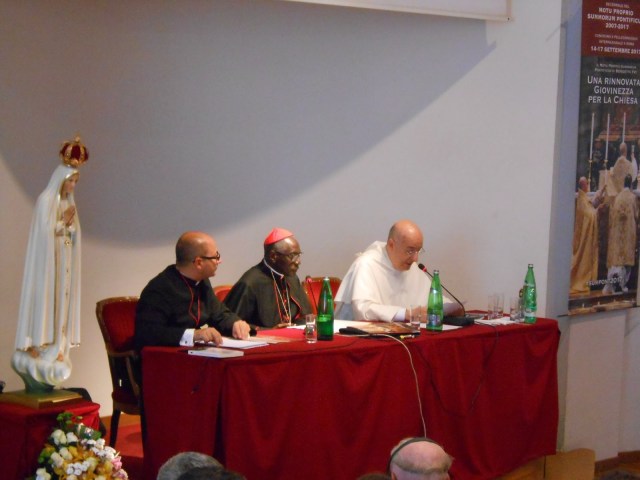
Ten years after the promulgation of motu proprio whereby Pope Benedict XVI allowed the Church to celebrate the Mass according to the 1962 Roman Missal, in the form known as the Tridentine Mass, the ‘frontmen’ of what some call “the traditionalist fringe” (but whom I would simply call “good Catholics”) met up for a conference about Summorum Pontificum. The conference took place on September 14th, in Rome, at the Pontifical University of Saint Thomas Aquinas, also known as the Angelicum. Among the speakers were Friar Vincenzo M. Nuara, acting as chairman; His Excellence The Most Reverend Bishop Guido Pozzo, Secretary of the Pontifical Commission Ecclesia Dei; His Eminence The Most Reverend Cardinal Gerhard Ludwig Müller, Friar Marino Neri, Secretary of Amicizia Sacerdotale Summorum Pontificum; Right Reverend Dom Jean Pateau, Abbot of the Benedectine Abbey of Fontgombault; Dr. Martin Mosebach, writer and essayist (you can find his entire talk here); His Eminence The Most Reverend Cardinal Robert Sarah, Prefect of the Congregation for Divine Worship and the Discipline of Sacraments; Monsignor Markus Graulich, Under Secretary of the Pontifical Council for Legislative Texts; and Dr. Ettore Gotti Tedeschi, former President of IOR (Istituto per le Opere di Religione, the Vatican Bank).

Before I present to our readers a brief summary of the arguments debated by the most prominent lecturers, let me make note of three details that may give us hope in these hard times for the Holy Church. First, the fact that the event was explicitly consecrated to Our Lady of Fatima: a beautiful statute of the Virgin Mary stood next to the podium from whence the speakers gave their talks. Do not forget that Mother Mary is the enemy of all heresies, and we are confident that She will sustain those who struggle to preserve true faith in this epoch of theological darkness. Second, the fact that, in a period in which Pope Francis’s audiences are often deserted by the faithful, in spite of the fact that the media describe him as a popular Pope, the wide room inside Angelicum’s building was ‘sold-out’. Third, that among the people attending the conference there were many clergymen from traditionalist orders, like the Franciscan Friars of the Immaculate, but also many lay people, and often very young. To remark this circumstance is not mere rhetoric; it means that despite the hostility of modernists, who mock the Tridentine Mass as a boring celebration, ill-suited to attracting people, the traditional rite summons young generations within and without the clergy. And it could not be otherwise, for, as Cardinal Sarah clearly affirmed in his lecture, the purpose of liturgy is to transform the faithful from a spiritual point of view. The liturgy, in all its different moments (listening, praying, kneeling, remaining silent), is the means to establish true communion with God the Father, the Son, and the Holy Spirit.

Cardinal Robert Sarah’s talk was focused precisely on the importance of silence as the way to re-establish the primacy of God in the liturgy. His Eminence deplored the man-centered liturgy that often characterizes celebrations of the Mass nowadays. What these mundane approaches (so well exemplified by those rites full of noisy electric instruments, out-of-tune choirs, and anchor-man-priest) end up losing is the awareness that the true subject of the liturgy is God. To the contrary, silence and awe are the appropriate response to the solemnity of the moment when what is only temporal and passing meets the Eternal:

When we encounter the sacred, when we come face to face with God, we naturally fall silent and kneel in adoration. We kneel in humble awe and in submission to our creator. We await His Word, His saving action, in awe and anticipation. These are fundamental dispositions for how we approach the Sacred Liturgy. If I am so full of myself and of the noise of the world that there is no space for silence within me, if human pride reigns in my heart so that it is only myself of whom I am in awe, then it is almost impossible for me to worship Almighty God, to hear His Word or to allow it space to take root in my life.

Along the same lines, Cardinal Sarah emphasized the significance of details too often neglected: for instance, letting not our sacristies become “a place of chatter”, or restoring the ad orientem orientation of the priest and the people during celebrations. This last observation helps us stress one interesting, though perhaps hazardous, element of His Eminence’s speech: the idea that, in the spirit of Pope Benedict’s motu proprio, we should devote our energies to find points of contact between the traditional Latin Mass and the Mass of Paul VI. Cardinal Sarah insists that the ad orientem orientation “is not restricted to the usus antiquor. This venerable practice is permitted, is perfectly appropriate and […] pastorally advantageous in celebrations of the usus recentior“. But one might legitimately ask whether the corruption of liturgy we experience today is precisely the logical consequence of the reforms enacted after the Second Vatican Council.

In his own lecture, Cardinal Gerhard Müller showed awareness of the fact that some distortions are by nature connected to a certain disregard of the importance to preserve continuity and discipline in the liturgy. And although he did not explicitly mention the Pope, some passages of his talk gave the impression that he was criticizing some of Francis’s initiatives, like Magnum Principium, the motu proprio that increased the freedom of national episcopal conferences in the translation of liturgical texts.

According to His Eminence, the sacred liturgy “cannot be interpreted in an historical sense”, for “it is through the continuity of the liturgical celebration that the Church, as the community of believers, remains identical to its origins and its realization in the different historical periods, and in its diffusion across all peoples around the world”. Cardinal Müller concedes that the liturgy, “as to its linguistic form and its rituals, is subject to a natural and progressive development”, which however ought to be “always consistent with the Church’s Tradition’. The liturgy, therefore, has both a form and a content to transmit, and its purpose is to actualize the history of the Church as “Christ’s self-mediation through the Church, and to display the life of the Church throughout history”. As His Eminence notes, this means that Tradition is not a fruitless or selfish veneration of antiquities, but “the unity of life coming true through the Divine worship, [the unity] of the community of believers, with God as the source and principle of human existence in Jesus Christ, which reveals itself, through the gift of the Holy Spirit, as a dynamic force” in history.

It is not hard to infer from these arguments that if the linguistic form is manipulated, or if the liturgy itself becomes disordered and undisciplined, then even the content that the liturgical form is called to convey shall be altered. This is the kernel of the axiom ‘lex orandi – lex credendi’ that Cardinal Müller firmly established in his lecture: if liturgy is the “objective comprehensive expression of the life of the Church“, the way we pray, the way we try to make, in Cardinal Sarah’s words, a perpetual form of adoration out of our life, shall eventually condition what we believe as well.

Therefore, the sacred liturgy is so important that its corruption might have dramatic consequences on the community of the faithful. The liturgy, in fact, is not only form; as Cardinal Sarah remarked, within liturgy form and substance are the very same thing. And perhaps, as Dr. Ettore Gotti Tedeschi provocatively argued, the enemies of the Church understood this point even better than Catholics themselves.

Dr. Gotti Tedeschi’s talk was probably the most energetic and the most inventive one, all woven around a stimulating comparison with the economy. According to Tedeschi, the purpose of liturgy is to trigger a thorough transformation into the human soul; that is why corrupting the sacred liturgy amounts to corrupt man. And since the economy, which represents an important dimension of our worldly existence, is a neutral tool, whose results are contingent on the moral status of the agent that uses it, a corrupted man will generate a corrupted economic system. This is why Dr. Tedeschi thinks that the present crisis, which is dooming Europe to stagnation, is first and foremost and moral crisis, and cannot be resolved by technical adjustments; the moral dismay we see in the world is not the effect, but the cause of the economic crisis.

But the most provocative aspect of Dr. Gotti Tedeschi’s speech was surely his denunciation of the masonic, or as he calls it, the ‘gnostic’ involvement in the efforts to degrade traditional liturgy. As he noted, there is a striking correspondence between the two acronyms that stand for ‘New World Order’ (in Italian: ‘Nuovo Ordine Mondiale’, NOM) and ‘Novus Ordo Missae’(the Missal promulgated by Pope Paul VI). According to Dr. Tedeschi, the masonic/gnostic milieu that attempted to impose the New World Order (starting from former Secretary of State Henry Kissinger) aimed at making the world more easily governable. Doing this implied that all cultures had to be assimilated and melted; for religions like Catholicism, this meant that the entire dogmatic apparatus had to be overturned. The Novus Ordo Missae was, according to Dr. Gotti Tedeschi, the picklock whereby the corruption of theology and, eventually, dogmas, had to be brought about. In their endeavour to accomplish their design of world governance, which entailed the weakening of the strongest dogmatic religion in the West, the masonic creators of the New World Order understood that the primary point on which they had to insist was the perversion of liturgy.

No doubt Dr. Gotti Tedeschi’s thesis is daring; furthermore, the symbolic coincidence between the two ‘NOMs’ works only in languages like Italian, French, Spanish, and Portuguese, but not in English. Regardless of this detail, the former President of IOR surely has a point: he rightly emphasizes that the sacred liturgy is not only a neutral container, but the form whereby a theological substance operates to transform man from the inside. So, if today Catholicism is infected until the highest ecclesiastical hierarchies by heresies and errors, and if many progressive leaders like Hillary Clinton and her former chief of the electoral campaign John Podesta are rallying so as to spread modernism within the Catholic Church, it is reasonable to suspect that the corruption of liturgy has a prominent role.

Let us pray for good clergymen and devout faithful to uphold such an important achievement as the Summorum Pontificum, to promote participation to the Tridentine Mass as much as possible, to resist all efforts to prevent the proper implementation of Pope Benedict’s motu proprio, to contribute to make these yearly pilgrimages successful and spiritually fruitful, and to foster in themselves the kind of conversion of the heart, nurtured by good liturgy, which only will be capable of attracting as many wandering souls as possible to the only Divine harbour where they can be safe.


Posted in Uncategorized | Comments Off on REPORT ON THE FIFTH COLLOQUIUM SUMMORUM PONTIFICUM IN ROME

CORRUPTION IN THE VATICAN


Amid avalanche, real questions about the papacy risk being obscured

Amid avalanche, real questions about the papacy risk being obscured

Pope Francis delivers his blessing during the Angelus noon prayer from the window of his studio overlooking St. Peter’s Square, at the Vatican, Sunday, Sept. 24, 2017. (Credit: AP Photo/Alessandra Tarantino.)

In the last few days, Pope Francis has faced three remarkable accusations — one of suffering from narcissistic personality disorder, another of heresy, and a third of dropping the ball on financial reform of the Vatican. In trying to sort through it all, one towering problem is that in an environment defined by hysteria, separating legitimate criticism from the same-old, same-old is increasingly difficult.

News Analysis

ROME – In the last six days, Pope Francis has been subject to three extraordinary accusations, each coming from disparate sources and covering different ground. In a nutshell, here they are:

  • On Sept. 17, a right-wing Italian blogger and writer named Maurizio Blondet, drawing on a report by an Argentine journalist, accused Francis of suffering from narcissistic personality disorder, which Blondet claims was manifest during the future pope’s time as a Jesuit provincial in the 1970s and which Blondet says has defined his career ever since, including in the papacy.
  • On Saturday, a group of 62 theologians, other academics and clergy – though only one bishop, and that was Bishop Bernard Fellay of the breakaway traditionalist Society of St. Pius X – accused Francis of propagating heresy in his document Amoris Laetitia, and its cautious opening to Communion for divorced and civilly remarried Catholics.
  • Also on Saturday, the Vatican’s former Auditor General, Italian businessman Libero Milone, charged the pope with essentially giving up on financial reform, saying he “started with the best of intentions” but has been blocked by an old guard willing to use frame-jobs and character assassination to destroy anyone threatening their grip on power.

Here’s the main problem with such an avalanche of accusations: It becomes difficult to distinguish what genuinely merits closer examination from matters which are, in essence, either same-old, same-old, or dubious on the face of it.

Specifically, there’s a risk that the very serious suggestions being made by Milone about the state of Francis’s much-ballyhooed financial reform will be drowned out by the noise generated by everything else.

Before moving on, here’s a brief summary of each point.

Blondet’s assertion draws on the work of an Argentinian journalist named Alejandro Brittos, who published a reconstruction of the pope’s past in early July titled, “How the ‘humble’ Bergoglio prepared his climb to the top of the Church.”

Among other things, Brittos cites a letter from two former Jesuit novices under the future pope, who assert that he was self-promotional about his virtues of humility and simplicity, and that he sought complete submission and loyalty from his disciples – both indicators, according to Blondet, of a narcissistic personality. He goes on to cite clinical descriptions of the disorder, which he claims also characterize Francis’s leadership style as pope.

As for the charge of heresy, it comes from a group of thinkers, writers and clergy, many of whom are close to the traditionalist Society of St. Pius X founded by the late French Archbishop Marcel Lefebvre.

The 25-page letter accuses Francis of propagating seven heretical positions concerning marriage, the moral life and the sacraments with his 2016 document on the family Amoris Laetitia and subsequent “acts, words and omissions,” asserting that taken together, these errors create a “great and imminent danger of souls.” Signatories call on Francis to “publicly reject these propositions.”

Organizers of the letter, who believe Francis has succumbed to the errors of Modernism condemned by previous popes, claim this is the first time since 1333 that a pope has been formally and publicly “corrected” in such a fashion.

Finally, Milone, who resigned as the Vatican’s Auditor General in June without explanation, broke his three-month silence on Saturday to charge that he had been the victim of character assassination and a frame-job by old guard forces in the Vatican hostile to reform. He also suggested the pope has basically capitulated to forces hostile to change.

“I believe the pope is a great person, and he began with the best of intentions,” Milone said. “But I’m afraid he was blocked by the old guard that’s still entirely there, which felt threatened when it understood that I could tell the pope and Parolin what I’d seen with my own eyes in the accounts.”

(The reference there is to Italian Cardinal Pietro Parolin, the Vatican’s Secretary of State and effectively the top aide to Pope Francis.)

So, what’s a reasonable person to think?

First, the suggestion that Francis has some sort of psychological disorder is not new. It’s been floating around in the traditionalist-deeply conservative Catholic world for a while, although it may have been given a new lease on life by a recent book-length conversation between the pontiff and French sociologist Dominique Wolton, in which Francis said that when he was 42 and a Jesuit provincial, he consulted a psychotherapist over an arc of six months “to clarify a few things.”

Second, the charge of heresy is also not really new, since it’s been in circulation ever since Amoris Laetitia appeared. The claim that such a correction hasn’t been issued for almost 700 years is also overblown, since this is hardly the first time since 1333 someone’s written to a pope to accuse him of betraying the faith.

Third, Milone is making a substantive charge that risks being obscured or minimized amid the frenzy about everything else.

His account is probably the least tainted by ideological motives, since Milone is basically a businessman and accountant, not a political or theological activist. If what he’s saying is true, Francis essentially has given up on financial reform and is content to allow business as usual in the Vatican to reassert itself while he pursues other objectives.

On the face of it, it does seem puzzling how an auditor whose position was designed to be accountable only to the pope could have been frozen out of contact with Francis for more than a year, and, when the time came to tell Milone he’d lost the pope’s confidence, the message was delivered by a subordinate backed by the threat of arrest rather than the pontiff himself.

Moreover, there’s sufficient independent evidence, including a Vatican trial for financial misappropriation going on right now in which the Italian cardinal at the heart of the affair has been carefully insulated from liability, to indicate it’s at least worth taking Milone’s suggestion of a rollback seriously.

In the present climate, the problem is that some of those most eager to jump on the idea that Francis has dropped the ball on financial reform have strong ideological incentives to do so, hoping to style it as an indictment of the pontificate tout court. Others who, under different circumstances, might be inclined to look at things objectively, likely will see any such suggestion as yet another element in a Machiavellian plot to destroy the pope.

If truth is the first casualty of war, in other words, then perhaps it could equally be said that perspective is the first casualty of hysteria. Those still able to maintain a level head, however, may want to pay special attention to the Milone story and how it plays out.

Posted in Uncategorized | 2 Comments