INCREASINGLY THE SAYING THAT NO NEWS IS GOOD NEWS IS BEING VERIFIED

4d7bf-new-eccles-biretta

This week, the news is taking center stage so far, revealing confusion within the Church, which affects virtually every aspect of ecclesiastical governance:

Of course, some other Christian groups have it worse: Archbishop of Canterbury: ‘I can’t give a straight answer’ on morality of homosexual acts.

It is probably a good thing that we cannot so easily laugh at the Anglicans any longer. Avoiding mockery is good. Indeed, caution in such matters is good. But the motive—I mean, Catholic embarrassment—is not good at all.

Posted in Uncategorized | 1 Comment

“Criticism of papal pronouncements will be possible and even necessary, to the extent that they lack support in Scripture and the Creed”

Joseph Ratzinger/Pope Benedict XVI

In 1969, the future Pope Benedict XVI, then Fr. Joseph Ratzinger, wrote that criticizing papal statements was not only possible, but even necessary, to the extent that the pope might deviate from the Deposit of Faith and the Apostolic Tradition. Pope Benedict XVI included these remarks in his 2009 anthology of his writings, Fede, ragione, verità e amoreThese remarks, which we now publish below in English translation, are particularly relevant in light of the filial correction of Pope Francis last week:

“One should especially avoid the impression that the pope (or the office in general) can only gather and express from time to time the statistical average of the living faith, for which a decision is not possible contrary to these average statistical values (which, besides, are problematic in their verifiability).
The faith is based on the objective data of Scripture and of dogma, which in dark times can also frighteningly disappear from the consciousness of the greater part of Christianity (statistically), without losing in any way, however, their obligatory and binding character.
In this case, the word of the pope can and should certainly go against statistics and against the power of an opinion, which strongly pretends to be the only valid one; and this will have to be done as decisively as the testimony of tradition is clear (like in the given case).
On the contrary, criticism of papal pronouncements will be possible and even necessary, to the extent that they lack support in Scripture and the Creed, that is, in the faith of the whole Church.
When neither the consensus of the whole Church is had, nor clear evidence from the sources is available, an ultimate binding decision is not possible. Were one formally to take place, the conditions for such an act would be lacking, and hence the question would have to be raised concerning its legitimacy.”
Das neue Volk Gottes: Entwürfe zur Ekklesiologie(Düsseldorf : Patmos, 1972) p. 144.
Fede, ragione, verità e amore, (Lindau 2009), p. 400.
Ratzinger continued his reflections on the limits of the power of the Roman Pontiff to contradict immutable doctrine as Prefect of the Congregation for the Doctrine of the Faith and later as Pope Benedict XVI.
“The Roman Pontiff – like all the faithful – is subject to the Word of God, to the Catholic faith, and is the guarantor of the Church’s obedience; in this sense he is servus servorum Dei. He does not make arbitrary decisions, but is spokesman for the will of the Lord, who speaks to man in the Scriptures lived and interpreted by Tradition; in other words, the episkope of the primacy has limits set by divine law and by the Church’s divine, inviolable constitution found in Revelation. The Successor of Peter is the rock which guarantees a rigorous fidelity to the Word of God against arbitrariness and conformism: hence the martyrological nature of his primacy.”
“The power that Christ conferred upon Peter and his Successors is, in an absolute sense, a mandate to serve. The power of teaching in the Church involves a commitment to the service of obedience to the faith. The Pope is not an absolute monarch whose thoughts and desires are law. On the contrary: the Pope’s ministry is a guarantee of obedience to Christ and to his Word. He must not proclaim his own ideas, but rather constantly bind himself and the Church to obedience to God’s Word, in the face of every attempt to adapt it or water it down, and every form of opportunism.”
Posted in Uncategorized | Comments Off on “Criticism of papal pronouncements will be possible and even necessary, to the extent that they lack support in Scripture and the Creed”

CHILD PORNOGRAPHY AND THE VATICAN


October 3, 2017, Tuesday
The forces that drive the technical and economic development of the world seem unstoppable and, as we know, are perhaps often determined and driven by economic and even very powerful political interests, which we must not allow ourselves to be dominated by.

“The power of sexual desire that dwells in the depth of the human mind and heart is great and wonderful when it advances the path of humanity; but it can also be corrupted and perverted, to become a source of suffering and unspeakable abuse: and so it must be elevated and directed. ” — Cardinal Pietro Parolin, Vatican Secretary of State, in an opening address today in Rome to a world convention on the protection of minors from sexual abuse in the digital age


===============


The Millstone Warning


“But whoso shall offend one of these little ones which believe in me, it were better for him that a millstone were hanged about his neck, and that he were drowned in the depth of the sea.” —Matthew 18:6


And whosoever shall offend one of these little ones that believe in me, it is better for him that a millstone were hanged about his neck, and he were cast into the sea.” —Mark 9:42


“It were better for him that a millstone were hanged about his neck, and he cast into the sea, than that he should offend one of these little ones.” —Luke 17:2


====================


The Anger of Jesus


A day of irony in Rome.


Today in Rome a conference opened at the Gregorian University entitled “The Dignity of the Child in the Digital World.” For three days, through October 5, “experts,” academics, executives, civilian leaders, politicians and religious representatives “from all over the world” will “explore the issue” of “child protection on the internet.” On October 6, participants will be received by Pope Francis, and present to him the final statement of the congress.


At the same time, a Vatican diplomat, accused by Canadian authorities of downloading child pornography in Canada, is being housed inside Vatican City, protected by the Vatican’s sovereign diplomatic immunity from arrest by Canadian police, reportedly receiving friends and strolling in the same Vatican Gardens where Emeritus Pope Benedict takes his daily walk.


Franca Giansoldati wrote in Il Messaggero: “By the irony of the fate, while today at the Gregorian University, in the presence of Cardinal Pietro Parolin, an international summit was opened to discuss how to protect children from the predators who every day exchange millions of images of abused minors, the Pope in Santa Martha for several days has been faced with a case as embarrassing as it is troubling: an Italian monsignor sought by the authorities in Canada for the exchange of pedo-pornographic material but at the moment safe in the Vatican thanks to diplomatic immunity. Needless to say, nobody wants to talk about this case.”


As the New York Times reported on September 15: “The Vatican has recalled a high-ranking priest working as a diplomat in the Holy See’s embassy in Washington after American authorities sought to strip his immunity and potentially charge him with possession of child pornography… In a statement, the Vatican said that it had been notified by the State Department on Aug. 21of ‘a possible violation of laws relating to child pornography images’ by a member of its diplomatic corps. The Vatican said the priest would face an investigation and potential trial in Vatican City. But some critics saw in the Vatican’s move a reflexive step to protect its own by whisking a priest away from a justice system in a foreign land… Italian news media reports and an American official familiar with the investigation said it was Msgr. Carlo Alberto Capella, who was ordained in Milan in 1993 and entered the diplomatic corps in 2004. He has also worked as a diplomat in Hong Kong and as the Holy See’s liaison to Italy.”


Pope Francis met yesterday, October 2, with his nuncio to the United States, Archbishop Christoph Pierre. Many Vatican-watchers believe Pope Francis summoned Pierre to Rome to gain first-hand insight into the facts of this case and its implications.


“This is a very embarrassing situation for the Pope, who now has to decide what to do,” Giansoldati wrote.


This is not to pre-judge the guilt or innocence of anyone.


It is merely to note the irony of Church sponsorship for a conference on global child pornography while charges of breaking child pornography laws are outstanding against a monsignor who works for the Vatican and who is enjoying immunity due to his diplomatic status and living in the Vatican.


Scripture recalls only two occasions when Jesus became filled with righteous anger. One was when he picked up a whip to cast the moneychangers from the Temple area. The other was when he warned all who might harm or abuse children of the terrible evil of such acts, of the terrible evil that is abuse of children.


Also today, a new item on a new law proposed in Greece which will allow children at the age of 15 to “choose their gender” even if the gender they choose is not the one they were born with. (link)


The archbishop of Athens has denounced this proposed law, saying it is not in keeping with the traditions of the Greek people, or of the Christian faith.


Humanity has got to re-think this wild, almost unregulated growth and spread of the internet, filled with pornography, spreading ideas and models of living  which do not “elevate” human passions but debase them.


The true “Benedict option” needed today might involve what Cardinal Robert Sarah has suggested: Silence.


Turn the internet off. Block much of it from reaching your family, your children. Speak face to face with people. Halt exploitation of children not only on the internet, but in every way, creating a true cuture of life.


===============


The Holy See and Its Commitment to Combatting Sex Abuse Online


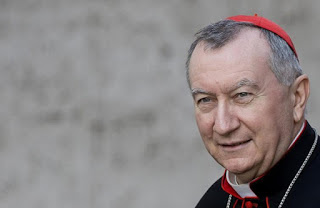
By Cardinal Pietro Parolin (photo)


Tuesday, October 3, 2017


Gregorian University, Rome
Dear President of the Senate,
Your Eminences, Excellencies,

Dear Father General, Ambassadors, Father Rector, Academic Authorities and Professors,
Dear Friends,
I thank you for inviting me to speak at the opening of this important Congress, thus allowing me to convey the greetings and appreciation of His Holiness Pope Francis and of the Holy See for this initiative.


It is an event that is hosted and organized, along with other laudable events, by a prestigious Pontifical University. I greet the distinguished persons and institutions who are participating in this initiative, and I express my gratitude to all those who have contributed concretely to the organization and planning of this Congress.
Above all, I wish to express my appreciation for having chosen the topic that will be discussed: the dignity of the child in the digital world.
The majority of you, who have worked for a long time in this field, are well aware that the sexual abuse of minors constitutes a vast and widespread phenomenon.


Over the past few decades, this tragic reality has come powerfully to the fore in the Catholic Church and extremely grave facts have emerged.


The Church has become increasingly aware of the harm experienced by the victims, of their suffering and of the need to listen to them, in order to work on various fronts; these include: a wide range of interventions which must be carried out in order to heal wounds, restore justice, prevent crimes and form educators and persons who deal with minors, with a view to spreading and consolidating a new culture of child protection – a real safeguarding – that effectively guarantees they can grow up in a healthy and safe environment.


This is a task requiring deep human care, competence and tenacity; experience tells us that where this commitment is consistent and continuous, the fruits that will come of it are positive and encouraging.


The Church’s effort in this sense, even when society in general has not yet developed the necessary awareness, must continue, must be expanded and deepened, with clarity and firmness, so that the dignity and rights of minors may be protected and defended with much greater attentiveness and effectiveness than was done in the past.


In this venue, we want to share the experience we have acquired, so that it may prove useful for an ever greater good, thanks to collaboration with all of you.
The world into which human persons are today born and raised is characterized, ever more deeply and pervasively, by the development and ubiquity of new communications technologies and new instruments for their use.


Handheld phones and tablets and other devices have come to be part of the daily life of an ever greater number of people; these users are ever younger, so much so that we can speak of the young generations as “digital natives.”


This has spread to every part of the world, reaching even areas where economic and social development are as yet inadequate and uneven.


The phenomenon is now global and so we speak of a “digital world.”
We now realize that, supported by ever greater evidence, the scourge of offenses against the dignity of minors, as with so many other dramatic problems in today’s world, spreads through and aligns itself within the new parameters of the digital world.


This plague meanders and infiltrates along a labyrinth of paths and through deep, hidden layers of reality.


The digital world is not, in fact, a separate part of the world: it is an integral part of the unique reality of the world.


Minors who grow up in it are exposed to new risks, or rather, to old risks manifested in new ways; and the culture of the protection of minors that we want to spread must be sufficiently able to address today’s problems.
Looking at our contemporary world, Pope Francis continually reminds us that the forms of abuse and violence against minors proliferate in an interwoven manner: the traffic of minors and of human persons generally, the phenomenon of child soldiers, the absence of even the most elementary education, the fact that small children are the first victims of hunger and extreme poverty.


On the day dedicated by the Church to the memory of the Holy Innocents, Pope Francis wrote: “We need the courage to respond to this reality, to arise and take it firmly in hand (cf. Mt 2:20)… [We need] the courage to guard this joy from the new Herods of our time, who devour the innocence of our children. An innocence stolen from them by the oppression of illegal slave labour, prostitution and exploitation. An innocence shattered by wars and forced migration, with the great loss that this entails. Thousands of our children have fallen into the hands of gangs, criminal organizations and merchants of death, who only devour and exploit their neediness” (Letter to Bishops, 28 December 2016).


In all these situations, the horrendous reality of sexual abuse is nearly always present, as a common aspect and consequence of multifaceted and widespread violence that ignores all respect, not only for the body, but more so for the soul, for the profound vulnerability and dignity of every child, of every young boy and girl of whatever nation.
And so we recognize the challenges, but realize too that even though we have learned a great deal with respect to this phenomenon, it remains important to understand it ever better, and, more than anything, to continue to make our understanding of the phenomenon accessible to all those who promote the protection of the rights of minors.


Only in this way can we effectively fight the battle to protect minors in our digitalized world.


The phenomena we observe reach levels of shocking gravity; their dimensions and the speed with which they spread surpass our imagination.
Here then is the second reason for my appreciation of the method employed by this Congress: calling together representatives from the various fields of scientific research as well as those who are actively committed to the protection of minors; representatives of leading companies in technological development and communications characteristic of the digital world; those responsible for the common good of human society; legislators, politicians, and law enforcement agencies called upon to combat crimes and abuses; religious leaders and leaders of civil society organizations committed to working for minors.
Like some of the other speakers, I too want to insist on a distinguishing characteristic of this assembly, one that makes it new and even unique, namely: establishing a dialogue between the many competent and meritorious people who have made their own the cause of defending the dignity of minors in the digital world.


They are doing this by channelling their energies towards a shared commitment in order to overcome the sense of disorientation and powerlessness when faced with such a markedly difficult challenge, and to help us to intervene creatively.


Once this basic strategic territory has been identified, we must work to regain control of the development of the digital world, so that it may be at the service of the dignity of minors, and thus of the whole human race of tomorrow.


For the minors of today are the entirety of tomorrow’s human race.
Following the research and understanding of these problems there must come a commitment and a far-seeing, courageous endeavour on the part of all of us here present; there must also be an appeal for the cooperation of every person in a position of responsibility, in the various countries and sectors of society.
Perhaps I may be permitted to offer some further reflections, which I propose for your consideration.
The demographic development of humanity is particularly rapid in many countries where economic and social progress is still lacking or uneven.


Hundreds of millions of children and young people are growing up in a digital world within a context that is still largely undeveloped.


Their parents and teachers may not, perhaps, be culturally equipped to accompany them and help them to grow up in this world, whereas their political leaders will often not know where to begin in order to protect them.
We have a responsibility to these children too, as do the companies that promote and drive the development of the digital world.


With its international, global and interdisciplinary perspective, this Congress must take responsibility for those minors at the world’s “peripheries”, of which Pope Francis continually speaks: peripheries that are in geographic areas of greater economic poverty, but that are also found within wealthy societies where there is considerable human and spiritual poverty, loneliness and a loss of the meaning of life.


It is not by chance that it is minors in all these peripheries who are the preferred target of networks of exploitation and of organized online violence on a global scale.
Both in society and in the Church, there has always been insistence on the primary responsibility of the family and of the school in guaranteeing minors a sound education so essential to the protection and promotion of their dignity.


This still very much applies today and every effort must be made so that parents and educators may be increasingly able to undertake their duties, even in the face of risks and challenges from the digital world.


There is, however, no doubt that in the modern context their ability to influence the formation of young generations is proportionately far less than in the past, and is often frustrated and overtaken by the continual wave of messages and images that come to even the smallest children through countless open avenues provided by the new media.


For this reason too, responsibility towards young generations must be shared fully by all the sectors of society that you represent.
Finally, we find ourselves hosted here by an institution which depends on the Catholic Church and which is thus particularly attentive to the moral and religious dimensions of the life and development of the human person.


I hope that your work may be able also to integrate these perspectives into the shared work of reflection and commitment, and that from them you may draw vigour, inspiration and motivation.
For the rest, all of us surely agree on what is affirmed in the second principle of the Universal Declaration of the Rights of the Child, namely, that every child should have the means “to develop physically, mentally, morally, spiritually and socially in a healthy and normal manner and in conditions of freedom and dignity”.


Moreover, as John Paul II affirmed in 1990, on the occasion of the World Summit for Children, we stress “the need to do much more to safeguard the well-being of the world’s children, to enunciate the rights of the child and to protect those rights through cultural and legislative actions imbued with respect for human life as a value in itself, independently of sex, ethnic origin, social or cultural status, or political or religious conviction” (Letter to J. Pérez de Cuellar, 22 September 1990. The Holy See adhered to the Convention on the Rights of the Child in 1990).
The minors of whom we speak and whose dignity we wish to defend and promote are human persons, and the value of each of them is unique and unrepeatable.


Each of them must be taken seriously and protected in this ever more digitalized world, so that they may be able to fulfil the purpose of their life, their destiny, their coming into the world.


The destiny and the life of each of them is supremely important, precious in the sight of human beings and in the sight of God. According to Scripture, every human being is created “in the image and likeness” of God.


According to the New Testament, the Son of God came among us as a vulnerable child, and in needy circumstances, assuming both the fragility and the hope for a future that are intrinsic to an infant.


To disparage infancy and to abuse children is for the Christian, therefore, not only a crime, but also – as Pope Francis has stated – sacrilege, a profanation of that which is sacred, of the presence of God in every human being.
The forces that drive the technical and economic development of the world seem unstoppable and, as we know, are perhaps often determined and driven by economic and even very powerful political interests, which we must not allow ourselves to be dominated by.


The power of sexual desire that dwells in the depth of the human mind and heart is great and wonderful when it advances the path of humanity; but it can also be corrupted and perverted, to become a source of suffering and unspeakable abuse: and so it must be elevated and directed.


The sense of moral responsibility in the sight of humanity and in the sight of God, the reflection on the correct use of freedom in the building and orientation of a new world and in learning how to live in it, are thus absolutely necessary and fundamental for our common future.
You have come together here to address one of today’s most important and urgent issues for the journey of humanity.


I hope that the living sense of the beauty and the mystery of human persons, of the greatness of their vocation to life, and thus of the duty to protect them in their dignity and their growth, may inspire your work and bear concrete and effective fruit.


=============================


Posted in Uncategorized | Comments Off on CHILD PORNOGRAPHY AND THE VATICAN

THE WAGES OF SIN. Although they know God’s righteous decree that those who do such things are worthy of death, they not only continue to do these things, but also approve of those who practice them. Romans 1:32

iStockphoto


Sexually Transmitted Diseases Increased to Record High: CDC

And with no signs of slowing

By WILLIAM M BRIGGS Published on October 2, 2017

About 1 out of every 3 Americans, or roughly 34%, have an STD. This is according to the Centers for Disease Control’s new 2016 Sexually Transmitted Diseases Surveillance report.

“More than two million cases of chlamydia, gonorrhea and syphilis were reported in the United States in 2016, the highest number ever,” according to the report. The CDC announces this as a “record high.”

Chlamydia is up about 5% over 2015. Gonorrhea rates increased about 19%, early syphilis about 18%, and congenital syphilis was up nearly 28%.

The New York Times reports, “At any given time, there are an estimated 110 million sexually transmitted infections in the United States.” There were about 321 million people in the USA in 2015. Hence about 1 out of 3 had some sort of STD. This includes people of all ages. That implies the rate among the sexually active will be higher.

Jonathan Mermin is the director of CDC’s National Center for HIV/AIDS, Viral Hepatitis, STD, and TB Prevention. He said, “Increases in STDs are a clear warning of a growing threat. STDs are a persistent enemy, growing in number, and outpacing our ability to respond.”

Perhaps the most shocking statistics is the increase of newborns with syphilis. That number has risen from 461 in 2014 to 628 new cases in 2016.

Syphilis rates increased by nearly 18 percent overall from 2015 to 2016. The majority of these cases occur among men — especially gay, bisexual and other men who have sex with men (MSM) — however, there was a 36 percent increase in rates of syphilis among women, and a 28 percent increase in syphilis among newborns (congenital syphilis) during this period.

HIV/AIDS

HIV and AIDS (the late stage of HIV) are tracked separately and not listed as STDs in the report. That’s because HIV can be transmitted by means other than sex. Other sexually associated diseases, such as anal cancer, are also not included in the report.

HIV rates are separately tracked by the CDC, however, and as of this writing only the 2015 numbers are available.

The number of new HIV (any stage) cases has been holding fairly steady, and is even down slightly from 2010. About 32,000 new cases among men, 7,420 new cases among women, and 120 new cases among children (of both sex) were reported in 2015. Some 27,600 of the cases among men, or 86%, were due to men who have sex with men (MSM). Among women, 87% of new cases were contracted heterosexually (MSW). Injection drug use for both sexes accounted for nearly all of the other remaining cases.

MSM – HIV/AIDS

According to a study of sexual orientation by the CDC, about 1.8% of men report being “gay” and about 0.4% report being “bisexual,” which gives about 2.2% of MSM. Since about 49.1% of the United States population are males, there were in 2015 roughly 3.5 million MSM. This includes men of all ages, and is on the high side as an estimate of actual sexual activity.

The number of new cases of HIV was therefore around 1% of MSM.

There were in 2014 (the latest year available) about 722,000 total males living with HIV/AIDS, of which about 77% were associated with MSM. The rate of total HIV/AIDS infection among all MSM is thus about 17%. The actual rate among the sexually active will likely be higher since this calculation includes males of all ages.

Anal Cancer

According to the American Cancer Society, there will be about “8,200 new anal cancer cases in 2017.” Most of these cases will be among HIV-positive MSM. Such men are “are 100 times more likely to have anal cancer than HIV-negative men who exclusively have sex with women.”

By far the majority of anal cancers, among both men and women, are caused by inserting objects in the anus. This includes objects associated with sexual activity.

MSM versus MSW

The CDC emphasizes that “the incidence of many STDs in gay, bisexual, and other men who have sex with men (collectively referred to as MSM) — including primary and secondary (P&S) syphilis and antimicrobial-resistant gonorrhea — is greater than that reported in women and men who have sex with women only (MSW).”

They say “the relatively high incidence of STD infection among MSM may be related to multiple factors, including individual behaviors and sexual network characteristics” such as “number of lifetime or recent sex partners, rate of partner exchange, and frequency of condomless sex.”

The rates of STDs among MSM are much higher than for MSW. “MSM accounted for 80.6% of male [primary and secondary] syphilis cases.” Also, “Estimated gonorrhea incidence among MSM increased 151.0% across the study period from 1,368.6 cases per 100,000 MSM in 2010 to 3,434.7 cases per 100,000 MSM in 2015.” The rate of gonorrhea infection for MSM is well over 3,000 times higher than the rate of men who have sex with women. Higher rates are found for chlamydia, too.

Posted in Uncategorized | Comments Off on THE WAGES OF SIN. Although they know God’s righteous decree that those who do such things are worthy of death, they not only continue to do these things, but also approve of those who practice them. Romans 1:32

GLORY TO THE FATHER AND TO THE SON AND TO THE HOLY SPIRIT !!! ANOTHER EUCHARISTIC MIRACLE

The Eucharistic miracle of Sokolka: The host is tissue from heart of a dying man

sokolka.archibial.pl

Laboratory analyses confirm that the structure of the cardiac muscle fibers and the structure of the bread are intertwined in a way impossible to reproduce by human means.

Every day, on the altars of Catholic churches around the world, the greatest miracle possible takes place: the transformation of bread and wine into the true Body and Blood of Christ.

Nonetheless, when we receive Communion, we can only touch its true nature with our faith, because our senses only perceive bread and wine, physically unaltered by the consecration.

What are the implications, then, of the Eucharistic event in Sokolka, Poland?

It took place on Sunday, October 12, 2008, two weeks after the beatification of Servant of God Fr. Michael Sopocko.

During the Holy Mass celebrated at the parish church of St. Anthony in Sokolka, at 8:30 a.m., a consecrated host fell from the hands of one of the priests during the distribution of Communion, next to the altar. The priest interrupted the distribution of Communion and picked up the host, and, in accordance with liturgical norms, placed it in a small container of water—in this case, one found in some churches beside the tabernacle, where the priest may wash his fingers after distributing Communion. The host was expected to dissolve in the water, which would later be disposed of properly.

Sister Julia Dubowska, of the Congregation of the Eucharistic Sisters, was the parish sacristan. At the end of the Mass, at the request of the pastor, Fr. Stanislaw Gniedziejko, she poured the water and the host into another container. Knowing that the consecrated host would take some time to dissolve, she placed the new container in the safe located in the parish sacristy. Only she and the pastor had the keys to the safe.

A week later, on October 19, Mission Sunday, when the pastor asked her about the condition of the host, Sister Julia went to the safe. When she opened the door, she noticed a delicate aroma of unleavened bread. When she opened the container, she saw, in the middle of the host—which was still largely intact—a curved, bright red stain, like a blood stain: a living particle of a body. The water was untainted by the color.

The sister immediately informed the priest, who brought in the other priests at the parish and the visiting missionary, Fr. Ryszard Gorowski. They were all amazed and left speechless by what they saw.

They kept a discreet and prudent silence about the event, considering its importance; this was a consecrated host which, by the power of the words of Christ at the Last Supper, was truly His Body. From a human point of view, it was difficult at that point to define if the altered form of the remainder of the host was the result of an organic growth, a chemical reaction, or some other cause.

They immediately notified the metropolitan archbishop of Bialystok, Edward Ozorowski, who went to Sokolka with the chancellor of the Curia and other diocesan officials. They were all deeply moved by what they saw. The archbishop ordered that the host be protected while they waited to see what would happen.

On October 29, the container with the host was transferred to the Divine Mercy Chapel in the rectory, and placed in the tabernacle. The next day, by decision of the archbishop, the stained host was taken out of the water and placed on a small corporal, which was then put back in the tabernacle. The host was kept this way for three years, until it was solemnly brought to the church on October 2, 2011. During the first year, it was kept secret. During that time, the Church authorities reflected on what to do, since they were dealing with a sign from God which needed to be interpreted.

By mid-January of 2009, the altered fragment of the host had dried out naturally, and remained like a blood stain or clot; since then, its appearance has not changed.

That same month, the archbishop requested histopathological studies be done on the host. On March 30, he created an ecclesial commission to study the phenomenon.

A piece of the altered host was taken and analyzed independently by two experts, Prof. Maria Sobaniec-Lotowska, MD, and Prof. Stanislaw Sulkowski, MD, in order to ensure the credibility of the results. Both are histopathologists at the Medical University of Bialystok. The studies were carried out at the university’s Department of Pathomorphology.

The specialists’ work was governed by the scientific norms and obligations for analyzing any scientific problem in accordance with the directives of the Scientific Ethics Committee of the Polish Academy of Sciences. The studies were exhaustively described and photographed. The complete documentation was given to the Metropolitan Curia of Bialystok.

When the samples were taken for analysis, the undissolved part of the consecrated host had become embedded in the cloth. However, the red blood clot was as clear as ever. This transformed part of the host was dry and fragile, inextricably interwoven with the rest of the fragment, which had kept the form of bread. The sample that was taken was large enough to carry out all the necessary studies.

The results of both independent studies were in perfect agreement. They concluded that the structure of the transformed fragment of the host is identical to the myocardial (heart) tissue of a living person who is nearing death. The structure of the heart muscle fibers is deeply intertwined with that of the bread, in a way impossible to achieve with human means, according to the declaration of Prof. Maria Sobaniec-Lotowska.

The studies proved that no foreign substance was added to the consecrated host; rather, part of the host took the form of heart muscle of a person near death. This kind of phenomenon is inexplicable by the natural sciences. At the same time, the Church teaches us that the consecrated host becomes the Body of Christ, by the power of His own words at the Last Supper, repeated by priests during the consecration of the Mass.

The results of the histopathological studies, dated January 21, 2009, were included in the dossier given to the Metropolitan Curia of Bialystok.

In its official communiqué, the Metropolitan Curia of Bialystok stated:

“The Sokolka event is not opposed to the faith of the Church; rather, it confirms it. The Church professes that, after the words of consecration, by the power of the Holy Spirit, the bread is transformed into the Body of Christ, and the wine into His Blood. Additionally, this is an invitation for all ministers of the Eucharist to distribute the Body of the Lord with faith and care, and for the faithful to receive Him with adoration.”

This article first appeared in Aleteia’s Portuguese edition.

Posted in Uncategorized | 3 Comments

FATHER MARTIN’S BRIDGE OVER THE RIVER KWAI

Image result for photos of jesuit father james martin

Further remarks re Fr. Martin

October 2, 2017
Edward Peters, J.D.
IN THE LIGHT OF THE LAW

Two important essays, one by Janet Smith at Catholic World Report (29 sep 2017) and the other by Dan Hitchens at First Things (2 oct 2017), along with their links to and quotes from Fr James Martin’s own words (and sometimes, as Smith and Hitchens note, to Martin’s refusal to say certain words), occasion these comments on Martin’s recent complaints (21 sep 2017) that he has “been accused of heresy, ridiculously, by some critics (I’m not contradicting any revealed truths).” There are several issues to sort out here.

First, yes, I am very sure that some of the accusations of heresy made against Martin are, indeed, ridiculous. As are some of Martin’s accusations that, for example, among his critics: “Heresy” is a word they use as frequently as “and” and “the.” Apparently there is plenty of ridiculousness floating around out there. All purveyors of the ridiculous should cease spouting it.

To my canonical observations.

Martin’s rebuff of heresy accusations above (“I’m not contradicting any revealed truths”) suggests that either he does not know or does not wish to acknowledge that “heresy” is not limited to the actual contradiction of revealed truths. Canon 751 defines heresy as “the obstinate denial or obstinate doubt” of certain truths (my emphasis). Thus one’s “obstinate doubt” concerning revealed truths, and not just one’s outright contradiction of such truths, can, upon proof, result in a finding of heresy.

Next, when speaking to a male questioner recently, Martin expressed the “hope [that] in 10 years you will be able to kiss your partner or, you know, soon to be your husband”. Any reasonable listener will conclude that Martin not only hopes that a man may someday marry a man with the Church’s blessing, but that Martin believes “same-sex marriage” to be radically possible under Church teaching and that it is a matter of regret that such Church recognition is not yet available.

Here, I suggest, Martin effectively denies infallible Church doctrine that marriage can exist only between a man and a woman. I see only two canonical issues in the wake of his statement:

(A) Whether the infallible Church teaching on the absolute impossibility of marriage between two persons of the same sex is itself a “revealed truth” (in which case the issue is indeed one of heresy) or whether it is a “proposition to be held definitely” (in which case the issue is opposition to the doctrine of the Catholic Church, but not heresy strictly speaking), with the weight of scholarly opinion, however, favoring the view that Church teaching on the male-female aspect of marriage is divinely revealed, meaning that one’s “obstinate denial or obstinate doubt” concerning that teaching would be heresy; and,

(B) Whether Martin’s comment, coming as it did during a public Q-and-A session, accurately reflects his actual position on marriage—an important point because both heresy (per cc. 751, 1364, etc.) and opposition to definitive Church teaching (per c. 1371, etc.) require a demonstration of one’s deliberateness in so holding before any penal consequences could be levied.

Either way, Martin’s shocking (as coming from a priest) comment, uttered against the backdrop of his frequent refusal to state his own positions directly (as opposed to his practice of characterizing his positions as sound, etc.) make the pursuit of clarity here very important.

Scholion on Pio-Benedictine law and the Eastern Code.

Martin’s frequent, often seemingly studied, ambiguities regarding Church teaching on various doctrinal and moral issues would have been more directly cognizable under the Pio-Benedictine Code of 1917 than they are under the Johanno-Pauline Code of 1983, notwithstanding 1983 CIC 209. The old Code squarely stated: “The faithful of Christ are bound to profess their faith whenever their silence, evasiveness, or manner of acting encompasses an implied denial of the faith, contempt for religion, injury to God, or scandal for a neighbor.” 1917 CIC 1325 § 1. Of course, giving scandal (CCC 2284-2287) to one’s neighbor, even if not directly scored in the new Code, is still a grave evil against all should be on guard. Similarly, Canon 10 of the Code of Canon Law of the Eastern Churches (1990) makes ‘adherence to the authentic living magisterium of the Church’ and the ‘open profession of the Faith’ matters of law. Interesting, eh?

Posted in Uncategorized | Comments Off on FATHER MARTIN’S BRIDGE OVER THE RIVER KWAI

EVEN DISTINGUISHED CANONISTS CAN GET IT WRONG WHEN THEY COMMENT ON PAPAL LEGISLATION GOVERNING CONCLAVES

3e271-th2b252822529

“STOP”

Recent commentaries by blogger Steve Skojec (A Brief Note on The Question of a Legally Valid Papal Election) and canon lawyer Edward Peters (Francis was never pope? Call me unpersuaded.) are very misleading regarding their interpretation of Universi Dominici Gregis, paragraph 76.  Skojec does not acknowledge or reference Universi Dominici Gregis, paragraph 5 in his commentary, while Peters casually references paragraph 5 but goes on to makes it sound like canon lawyers have a role in the interpretation of Universi Dominici Gregis.


Neither canon lawyers, nor bishops, nor priests, nor laity have standing with regard to the official interpretation of Universi Dominici Gregis


“Should doubts arise concerning the prescriptions contained in this Constitution, or concerning the manner of putting them into effect, I (Pope John Paul II) decree that all power of issuing a judgment in this regard belongs to the College of Cardinals, to which I grant the faculty of interpreting doubtful or controverted points. I also establish that should it be necessary to discuss these or other similar questions, except the act of election, it suffices that the majority of the Cardinals present should concur in the same opinion.”  [Universi Dominici Gregis, paragraph 5] 


That being said, neither paragraph 5, nor anything else in Universi Dominici Gregis limits or espouses interpretation before, during, or after the papal conclave – and we do not know what the cardinals may or may not have discussed inside the conclave. 


John Arechiga’s commentary on the Election of Pope Francis Pursuant to Universi Dominici Gregis clearly addresses and quotes paragraph 5 in his section on the Powers of the College of Cardinals during the Vacancy of the Apostolic See


His interpretation of Universi Dominici Gregis is a personal opinion – to which he is   entitled.  Universi Dominici Gregis is essentially the Church’s “regulation”  that governs the election of the Roman Pontiff.  More importantly, his personal opinion is predicated on more than 30 years of federal service – auditing and investigating compliance with federal civilian and military “regulations”. 


It is my personal opinion that Universi Dominici Gregis, paragraph 76, established the criteria (“…or should the conditions laid down here not be observed “) for determining whether the papal election is or was valid; that “laid down here” refers to Universi Dominici Gregis in its entirety; that Chapter 5 (Matters To Be Observed or Avoided in the Election of the Roman Pontiff), paragraphs 78-86, are part of the referenced (“laid down here”) conditions to be observed; and that paragraphs 78-86 include additional penalties for failure to observe or avoid the enunciated conditions. 


Skojec and Peters have a myopic personal interpretation of paragraph 76 – consistent with what one would expect of a defense attorney floundering for a defense. 


Peters’ commentary (Francis was never pope? Call me unpersuaded.) again reminds John Arechiga of the time he called an old lawyer friend and asked what he was doing. He replied that he was working on “Aqua-thermal treatment of ceramics, aluminum and steel under a constrained environment.” John was impressed. However, upon further inquiry, John learned that his friend was washing dishes with hot water – under his wife’s supervision. 


It is essential that my commentary (Election of Pope Francis Pursuant to Universi Dominici Gregis) be widely disseminated.  Why?  Neither fraternal (i.e., Dubia) nor filial correction will dismantle the modernist infrastructure put in place by Jorge Mario Bergoglio (Pope Francis) – but a finding that the election of Bergoglio (Pope Francis) was invalid will invalidate his selection of modernist bishops and cardinals.  Compared to fraternal/filial correction, all concerned Catholics need to understand the significance of my argument – reference modernist infrastructure – that the election of Jorge Mario Bergoglio (Pope Francis) was not valid. 


Posted in Uncategorized | 9 Comments

I HAVE JUST CANCELLED MY DVD MEMBERSHIP IN NETFLIX AND SO SHOULD EVERYONE WHO CARES ABOUT THE MORAL WELLBEING OF YOUNG AMERICANS

notre_dame_paris

TV

Big Mouth teasers unleash puberty monsters in Nick Kroll Netflix comedy

The animated series premieres Sept. 29

POSTED ON

Nick Kroll’s new Netflix animated series is trying to find the fun in arguably the most horrific time in a person’s life: puberty. As the streaming platform announced the September premiere date for Big Mouth, the first two teasers have arrived to reveal the monsters lurking behind a teenager’s transition into adulthood.

Meet Hormone Monster and Hormone Monstress, the personifications of puberty.

In the first clip (shown above), “a perfectly normal gross little dirt bag” named Andrew, voiced by John Mulaney, is visited in the middle of the night by the Hormone Monster, who encourages him to do something that should not be done while his best friend is sleeping right beside him. In addition to voicing the lead character of Nick, Kroll also lends his pipes to various other characters, including the Hormone Monster.

Maya Rudolph, meanwhile, gives life to the female equivalent, Hormone Monstress. Jessi (Jessi Klein) welcomes this nighttime visitor in the second teaser (shown below), where the creature teaches the young girl to “listen to Lana Del Rey on repeat while you cut up all your t-shirts,” “scream at your mother and then laugh at her tears.”

That’s the nightmare…sorry, beauty of adolescence.

Season 1 of Big Mouth, premiering this Sept. 29 on Netflix, consists of 10 half-hour episodes from Kroll and his real-life best bud Andrew Goldberg. Among the voice cast are Jason Mantzoukas, Jordan Peele, Fred Armisen, and Jenny Slate.

Kroll and Goldberg, both serving as executive producers, created Big Mouthwith screenwriters-directors Mark Levin and Jennifer Flackett.

NETFLIX

Posted in Uncategorized | Comments Off on I HAVE JUST CANCELLED MY DVD MEMBERSHIP IN NETFLIX AND SO SHOULD EVERYONE WHO CARES ABOUT THE MORAL WELLBEING OF YOUNG AMERICANS

CRITICS OF THE FILIAL CORRECTION RESORT TO AD HOMINEM ATTACKS TO DRAW ATTENTION AWAY FROM THE CONTENT OF THE FILIAL CORRECTION

news-header-image

Rene H. Gracida, Bishop Emeritus of Corpus Christi

An American Bishop and WWII Veteran Signs the Filial Correction

SEPTEMBER 29, 2017
BY FSSPX.NEWS

World War II veteran Bishop Gracida has signed the Filial Correction in which many clerics and laymen implore the Holy Father to clarify Amoris Laetitia.


Bishop René Henry Gracida is 94 years old. He served as auxiliary bishop of the archdiocese of Miami then as bishop of Pensacola-Tallahassee before becoming bishop of Corpus Christi until he retired in 1997.

Before his priestly ordination, Bishop Gracida served in the Air Force during World War II, during which he went on no less than 32 missions in the European skies to fight the German Luftwaffe.

His signature makes Nicolas Senèze’s analysis of the Filial Correction null and void. The journalist wrote a bit hastily in the columns of La Croix on September 24 that the number of signatures on the “petition” was “very limited and marginal”, with “only one bishop who does not have a post in the Church, Bishop Fellay”, and added that the signatures do not go beyond the “circle of traditionalists” and “anti-Francis bloggers”.

Not a “Rigid” Bishop

Bishop Gracida was a close friend of John Paul II and Mother Angelica, whom he encouraged to found the channel EWTN, and he certainly does not fit into the narrow profile the La Croix chronicler tried to impose on the signatories of this filial letter (and not “petition”) to the Holy Father.

On his blog – for the bishop is very up-to-date on technology despite his years – the prelate says he wrote his “congratulations and gratitude” to the organizers of the Filial Correction.

He also told Catholic Herald that he hopes “other bishops will sign on to this lay initiative” in order to prompt the Pope to respond.

Bishop Gracida referred to Blessed John Henry Newman’s history of the Arian crisis, which describes:

it was the overwhelming resistance of the laity to the Arian heresy which eventually persuaded the majority of bishops ‘who were either Arian or semi-Arian’ to support the efforts of St Athanasius.

The retired bishop concluded by saying:

At this critical moment in the life of the institutional Church, I do not see how it is possible for anyone who is well-informed regarding the issues that are involved in the controversies surrounding the present pontificate to remain silent.

Posted in Uncategorized | 5 Comments

THE POLES SAVED EUROPE AT THE WALLS OF VIENNA; MAY THEIR PRAYERS HELP SAVE EUROPE NOW

news-header-imageYoung Polish Catholics during a Marian procession, early 2017

One Million Polish Catholics Set to Gather on their Border for Rosary Crusade

SEPTEMBER 27, 2017
BY FSSPX.NEWS

As many as one million Poles are expected to take part in “The Rosary On the Borders,” commemorating the Battle of Lepanto.

Polish Bishops have endorsed and encouraged the attendance of their congregations in this event, which takes place on the feast of Our Lady of the Rosary. The organizers of this event hope to attract a few thousand Catholics, but as the publicity and enthusiasm has grown, so have the numbers.

The crusade was organized independently of the Catholic Church in Poland, for the purposes of honoring Mary as Queen of Poland, asking for her protection and intercession, and begging forgiveness for blasphemies. The organizers describe their effort on their website:

On this day we will go to the borders of Poland and we will pray on [sic] the rosary. Through this unprecedented prayer of the rosary, we want to show the faithfulness and obedience of Mary, who tirelessly calls us to recite the rosary. We also want to apologize and pay for all blasphemy, insults against the Immaculate Heart of Mary. We wish to implore by the intercession of the Mother of God to save Poland and the world.

We believe that if the Rosary is prayed by about a million Poles along the borders of the country, it may not only change the course of events, but open hearts of our compatriots to the grace of God.

A Significant Date

The Feast of Our Lady of the Rosary is a date of significance for this event, particularly for Europeans. On October 7, 1571, one of the most important sea battles in history was fought near the mouth of what is today called the Gulf of Patras, then the Gulf of Lepanto. On one side were the war galleys of the Holy League and, on the other, those of the Ottoman Turks, vying for ultimate control of the Mediterranean. Pope St. Pius V urged the Christian world to pray the Rosary, and ordered churches to be left open day and night.

Following the Christian victory in this battle, and with it, the spiritual, cultural, and political future of Europe, the Holy Father commemorated this date as the feast of “Our Lady of Victory”.  His successor, Gregory XIII, would later change the title of the feast to its current form: “Our Lady of the Rosary.

The Event in 2017

While the event takes place on the feast of Our Lady of the Rosary, the participants note that it is also on a First Saturday as well as three anniversaries of note: 140 years since the apparitions of Our Lady in Gietrzwald (the only recognized Polish Marian apparition), 100 years following the apparitions of Fatima, and the eve of Poland’s 100th year of independence.

The organizers and bishops are encouraging participation at the physical border of Poland, hoping to encircle the country with faithful Catholics reciting the rosary. Yet they welcome joining spiritually on the date and time (12:00 GMT) for those who are unable to travel.

Following the Society of Saint Pius X’s Rosary Crusade, which ended just over one month ago, this event is an opportunity for faithful who attend SSPX chapels to join with the Polish people in prayer during this historic and grace-laden feast.

Posted in Uncategorized | Comments Off on THE POLES SAVED EUROPE AT THE WALLS OF VIENNA; MAY THEIR PRAYERS HELP SAVE EUROPE NOW