A LEXICON OF DEATH


image002-2

WHAT IS DEATH ?


+++++++++++++

A LEXICON OF WORDS AND PHRASES TO BE USED BY THE MEDICAL AND LEGAL PROFESSIONS IN DEFINING AND DISCUSSING DEATH

DEATH is the total permanent loss of circulation of blood leading to the cessation of vital functions dependent on such circulation such as pulsation, respiration, brain activity leading in turn to the destruction of these vital systems and organs necessary for the preservation of human life.  Death is not an instantaneous phenomenon, it is a process.
PROCESS means the successive occurrence in time of the physiological changes named above in parts of the human body.
CHANGES described above causing death can be measured in nano-seconds, seconds, minutes, hours, days, weeks or longer. 

+++++++++++++

Imagine two deaf persons trying to communicate with each other each one using a different system of signs they learned in different schools for the deaf where they teach different systems of sign language.  That is crazy you would say, it is impossible for them to communicate since the signs each of them would be making with their hands would be meaningless to the other.

The same problem exists for all of us who are not deaf and who communicate verbally with words.  Words are signs.  Words communicate meaning given to them by common agreement by persons who belong to the same language group.  But even in the same language group there can be problems when idiomatic speech peculiar to one country is used in another country of the same language group, e.g. England and the United States.

The problem gets worse when people deliberately apply different meanings to words in order to advance a political or social agenda.  Abortion is a good example.  For most people the child-in-utero is a person, that displays all the attributes of personhood but cannot yet speak.  To those persons who promote abortion the child-in-utero is not a person because he cannot speak,to another he is not a person until he is born, to another he is not a person until he can reason at around seven years of age, and to reduce it to the absurd, to some he is probably not a person until he is 21 years old.

Words are signs to which society, by common consent, assigns meaning.  When people are consumed with a desire to promote some political, social or economic agenda they assign meaning to words that the great majority of other persons in the same society reject.

Such is the case with death.

To persons with a Malthusian or racist obsession, death is no longer a word describing a natural event.  It is a political or social or economic means to an end and natural death becomes irrelevant if hastening or causing the death of another person promotes some arbitrary good such as alleviating suffering, reducing world population, eliminating undesirable individuals or groups from society.

Since Doctor Christiaan Barnard in 1967 first successfully transplanted a human heart, the medical profession has ceased to be a profession and has become an industry.  The transplantation of organs from the human body of one person to the body of another person has become BIG BUSINESS.

The problem faced by the medical industry was the problem of death.  It is not possible to successsfully transplant human organs from a cadaver to a living person.  In order to transplant organs successfully they must be taken from the body of a living  person and transferred to the body of another living person and that procedure was illegal in practically every country in the western world up until the 21st Century.

How to solve that problem if the medical business was to reap the potential huge financial rewards of organ transplantation.  Simple.  Change the definition of death in the law.

A group of doctors met at Harvard University in 1968 and came up with the idea of defining death solely on the basis of the activity in the human brain.  Their proposal has come to be known as brain death.  Subsequent to the Harvard meeting the law was changed in all 50 states of the United States.  Now, the absence of the signs of brain activity in certain parts of the brain allows doctors to declare a patient “brain dead” and they can leglly proceed to extract all the organs of the patient for transplantation into another person even though blood is still coursing through the veins and arteries of the patient and with the aid of a ventilator pushing air into the lungs of the patient (the body of the patient will reflexively push the air out of the lungs) while the other organs are being removed.

Voila, the medical business now can remove the organs of everyone who enters a hospital as a patient.  All that is necessary is that the doctors induce coma.

How big is the organ transplantation business?  The Milliman Corporation does an actuarial study of all medical billings in the United States once every three years.  They have identified every organ transplantation that occurred in the United States in 2014.  They have identified every billing from the preparation for the operation for removal of an organ to the transportation to the donor to the placing of the organ in the recipient and the compensation of everyone involved until the recipient is declared well months after the transplantation.  How much money was involved in all of the transplantations in 2014?  Brace yourself !!!  The total amount of money changing hands in the medical business of organ transplantation in the United States in 2014 was:   $28,761,129,500.00.

Words are symbols with meaning.  We must fight to have the law in every state redefine death using the words I have written at the beginning of this post.

The Catholic Church is not opposed to organ transplantation, but insists that persons must not be harmed, much less killed, in order to procure organs for transplantation.  Here are some magisterial statements on the subject.

Pope John Paul II to the Participants of the 1989 Pontifical Academy of Sciences stated:

“The problem of the moment of death has serious implications at the practical level, and this aspect is also of great interest to the Church. In practice, there seems to arise a tragic dilemma. On the one hand there is the urgent need to find replacement organs for sick people who would otherwise die or at least would not recover. In other words, it is conceivable that in order to escape certain and imminent death a patient may need to receive an organ which could be provided by another patient, who may be lying next to him in hospital, but about whose death there still remains some doubt. Consequently, in the process there arises the danger of terminating a human life, of definitively disrupting the psychosomatic unity of a person. More precisely, there is a real possibility that the life whose continuation is made unsustainable by the removal of a vital organ may be that of a living person, whereas the respect due to human life absolutely prohibits the direct and positive sacrifice of that life, even though it may be for the benefit of another human being who might be felt to be entitled to preference.”9

In the same Address Pope John Paul II stated:

“Death can mean decomposition, disintegration, a separation (cf. Salvifici Doloris, n. 15; Gaudium et Spes, n. 18). It occurs when the spiritual principle which ensures the unity of the individual can no longer exercise its functions in and upon the organism, whose elements left to themselves, disintegrate.”10

Pope John Paul II in Evangelium Vitae, (n. 15), stated:

“Nor can we remain silent in the face of other more furtive, but no less serious and real, forms of euthanasia. These could occur for example when, in order to increase the availability of organs for transplants, organs are removed without respecting objective and adequate criteria which verify the death of the donor.”11

Incredibly, some jurisdictions are moving to make the donation of organs automatic, that is, there is a presumption in law that a person is willing to have his organs removed for transplantation.  Truly, we are rapidly moving into a dystopian future.

About abyssum

I am a retired Roman Catholic Bishop, Bishop Emeritus of Corpus Christi, Texas

This entry was posted in Uncategorized. Bookmark the permalink. Edit
Posted in Uncategorized | Comments Off on A LEXICON OF DEATH

HUMPTY DUMPTY HAD IT RIGHT; WORDS MEAN WHAT THEIR USER WANTS THEM TO MEAN, IF HE CAN CONVINCE EVERYONE ELSE

c28e4-islamic-state-beheads-copts-0215

A LEXICON OF WORDS AND PHRASES TO BE USED BY THE MEDICAL AND LEGAL PROFESSIONS IN DEFINING AND DISCUSSING DEATH

DEATH is the total permanent loss of circulation of blood leading to the cessation of vital functions dependent on such circulation such as pulsation, respiration, brain activity leading in turn to the destruction of these vital systems and organs necessary for the preservation of human life.  Death is not an instantaneous phenomenon, it is a process.
PROCESS means the successive occurrence in time of the physiological changes named above in parts of the human body.
CHANGES described above causing death can be measured in nano-seconds, seconds, minutes, hours, days, weeks or longer. 

+++++++++++++

Imagine two deaf persons trying to communicate with each other each one using a different system of signs they learned in different schools for the deaf where they teach different systems of sign language.  That is crazy you would say, it is impossible for them to communicate since the signs each of them would be making with their hands would be meaningless to the other.

The same problem exists for all of us who are not deaf and who communicate verbally with words.  Words are signs.  Words communicate meaning given to them by common agreement by persons who belong to the same language group.  But even in the same language group there can be problems when idiomatic speech peculiar to one country is used in another country of the same language group, e.g. England and the United States.

The problem gets worse when people deliberately apply different meanings to words in order to advance a political or social agenda.  Abortion is a good example.  For most people the child-in-utero is a person, that displays all the attributes of personhood but cannot yet speak.  To those persons who promote abortion the child-in-utero is not a person because he cannot speak,to another he is not a person until he is born, to another he is not a person until he can reason at around seven years of age, and to reduce it to the absurd, to some he is probably not a person until he is 21 years old.

Words are signs to which society, by common consent, assigns meaning.  When people are consumed with a desire to promote some political, social or economic agenda they assign meaning to words that the great majority of other persons in the same society reject.

Such is the case with death.

To persons with a Malthusian or racist obsession, death is not longer a word describing a natural event.  It is a political or social or economic means to an end and natural death becomes irrelevant if hastening or causing the death of another person promotes some arbitrary good such as alleviating suffering, reducing world population, eliminating undesirable individuals or groups from society.

Since Doctor Christiaan Barnard in 1967 first successfully transplanted a human heart, the medical profession has ceased to be a profession and has become an industry.  The transplantation of organs from the human body of one person to the body of another person has become BIG BUSINESS.

The problem faced by the medical industry was the problem of death.  It is not possible to successsfully transplant human organs from a cadaver to a living person.  In order to transplant organs successfully they must be taken from the body of a living  person and transferred to the body of another living person and that procedure was illegal in practically every country in the western world up until the 21st Century.

How to solve that problem if the medical business was to reap the potential huge financial rewards of organ transplantation.  Simple.  Change the definition of death in the law.

A group of doctors met at Harvard University in 1972 and came up with the idea of defining death solely on the basis of the activity in the human brain.  Their proposal has come to be known as brain death.  Subsequent to the Harvard meeting the law was changed in all 50 states of the United States.  Now, the absence of the signs of brain activity in certain parts of the brain allows doctors to declare a patient “brain dead” and they can leglly proceed to extract all the organs of the patient for transplantation into another person even though blood is still coursing through the veins and arteries of the patient and with the aid of a ventilator pushing air into the lungs of the patient (the body of the patient will reflexively push the air out of the lungs) while the other organs are being removed.

Voila, the medical business now can remove the organs of everyone who enters a hospital as a patient.  All that is necessary is that the doctors induce coma.

How big is the organ transplantation business?  The Milliman Corporation does an actuarial study of all medical billings in the United States once every three years.  They have identified every organ transplantation that occurred in the United States in 2014.  They have identified every billing from the preparation for the operation for removal of an organ to the transportation to the donor to the placing of the organ in the recipient and the compensation of everyone involved until the recipient is declared well months after the transplantation.  How much money was involved in all of the transplantations in 2014?  Brace yourself !!!  The total amount of money changing hands in the medical business of organ transplantation in the United States in 2014 was:   $28,761,129,500.00.

Words are symbols with meaning.  We must fight to have the law in every state redefine death using the words I have written at the beginning of this post.

The Catholic Church is not opposed to organ transplantation, but insists that persons must not be harmed, much less killed, in order to procure organs for transplantation.  Here are some magisterial statements on the subject.

Pope John Paul II to the Participants of the 1989 Pontifical Academy of Sciences stated:

“The problem of the moment of death has serious implications at the practical level, and this aspect is also of great interest to the Church. In practice, there seems to arise a tragic dilemma. On the one hand there is the urgent need to find replacement organs for sick people who would otherwise die or at least would not recover. In other words, it is conceivable that in order to escape certain and imminent death a patient may need to receive an organ which could be provided by another patient, who may be lying next to him in hospital, but about whose death there still remains some doubt. Consequently, in the process there arises the danger of terminating a human life, of definitively disrupting the psychosomatic unity of a person. More precisely, there is a real possibility that the life whose continuation is made unsustainable by the removal of a vital organ may be that of a living person, whereas the respect due to human life absolutely prohibits the direct and positive sacrifice of that life, even though it may be for the benefit of another human being who might be felt to be entitled to preference.”9

In the same Address Pope John Paul II stated:

“Death can mean decomposition, disintegration, a separation (cf. Salvifici Doloris, n. 15; Gaudium et Spes, n. 18). It occurs when the spiritual principle which ensures the unity of the individual can no longer exercise its functions in and upon the organism, whose elements left to themselves, disintegrate.”10

Pope John Paul II in Evangelium Vitae, (n. 15), stated:

“Nor can we remain silent in the face of other more furtive, but no less serious and real, forms of euthanasia. These could occur for example when, in order to increase the availability of organs for transplants, organs are removed without respecting objective and adequate criteria which verify the death of the donor.”11

Incredibly, some jurisdictions are moving to make the donation of organs automatic, that is, there is a presumption in law that a person is willing to have his organs removed for transplantation.  Truly, we are rapidly moving into a dystopian future.

About abyssum

I am a retired Roman Catholic Bishop, Bishop Emeritus of Corpus Christi, Texas

This entry was posted in Uncategorized. Bookmark the permalink. Edit
Posted in Uncategorized | Comments Off on HUMPTY DUMPTY HAD IT RIGHT; WORDS MEAN WHAT THEIR USER WANTS THEM TO MEAN, IF HE CAN CONVINCE EVERYONE ELSE

WORDS ARE SYMBOLS SYMBOLIZING WHAT THEIR INVENTOR CHOOSES OR WHAT THEIR USER CHOOSES TO ASSIGN TO WORDS: TAKE THE WORD DEATH FOR EXAMPLE

WHAT IS DEATH ?


d440d-00000000_ja_3773_e2eeca4e77d4cf6dc2464d19ad614223

+++++++++++++

A LEXICON OF WORDS AND PHRASES TO BE USED BY THE MEDICAL AND LEGAL PROFESSIONS IN DEFINING AND DISCUSSING DEATH

DEATH is the total permanent loss of circulation of blood leading to the cessation of vital functions dependent on such circulation such as pulsation, respiration, brain activity leading in turn to the destruction of these vital systems and organs necessary for the preservation of human life.  Death is not an instantaneous phenomenon, it is a process.
PROCESS means the successive occurrence in time of the physiological changes named above in parts of the human body.
CHANGES described above causing death can be measured in nano-seconds, seconds, minutes, hours, days, weeks or longer. 

+++++++++++++

Imagine two deaf persons trying to communicate with each other each one using a different system of signs they learned in different schools for the deaf where they teach different systems of sign language.  That is crazy you would say, it is impossible for them to communicate since the signs each of them would be making with their hands would be meaningless to the other.

The same problem exists for all of us who are not deaf and who communicate verbally with words.  Words are signs.  Words communicate meaning given to them by common agreement by persons who belong to the same language group.  But even in the same language group there can be problems when idiomatic speech peculiar to one country is used in another country of the same language group, e.g. England and the United States.

The problem gets worse when people deliberately apply different meanings to words in order to advance a political or social agenda.  Abortion is a good example.  For most people the child-in-utero is a person, that displays all the attributes of personhood but cannot yet speak.  To those persons who promote abortion the child-in-utero is not a person because he cannot speak,to another he is not a person until he is born, to another he is not a person until he can reason at around seven years of age, and to reduce it to the absurd, to some he is probably not a person until he is 21 years old.

Words are signs to which society, by common consent, assigns meaning.  When people are consumed with a desire to promote some political, social or economic agenda they assign meaning to words that the great majority of other persons in the same society reject.

Such is the case with death.

To persons with a Malthusian or racist obsession, death is not longer a word describing a natural event.  It is a political or social or economic means to an end and natural death becomes irrelevant if hastening or causing the death of another person promotes some arbitrary good such as alleviating suffering, reducing world population, eliminating undesirable individuals or groups from society.

Since Doctor Christiaan Barnard in 1967 first successfully transplanted a human heart, the medical profession has ceased to be a profession and has become an industry.  The transplantation of organs from the human body of one person to the body of another person has become BIG BUSINESS.

The problem faced by the medical industry was the problem of death.  It is not possible to successsfully transplant human organs from a cadaver to a living person.  In order to transplant organs successfully they must be taken from the body of a living  person and transferred to the body of another living person and that procedure was illegal in practically every country in the western world up until the 21st Century.

How to solve that problem if the medical business was to reap the potential huge financial rewards of organ transplantation.  Simple.  Change the definition of death in the law.

A group of doctors met at Harvard University in 1972 and came up with the idea of defining death solely on the basis of the activity in the human brain.  Their proposal has come to be known as brain death.  Subsequent to the Harvard meeting the law was changed in all 50 states of the United States.  Now, the absence of the signs of brain activity in certain parts of the brain allows doctors to declare a patient “brain dead” and they can leglly proceed to extract all the organs of the patient for transplantation into another person even though blood is still coursing through the veins and arteries of the patient and with the aid of a ventilator pushing air into the lungs of the patient (the body of the patient will reflexively push the air out of the lungs) while the other organs are being removed.

Voila, the medical business now can remove the organs of everyone who enters a hospital as a patient.  All that is necessary is that the doctors induce coma.

How big is the organ transplantation business?  The Milliman Corporation does an actuarial study of all medical billings in the United States once every three years.  They have identified every organ transplantation that occurred in the United States in 2014.  They have identified every billing from the preparation for the operation for removal of an organ to the transportation to the donor to the placing of the organ in the recipient and the compensation of everyone involved until the recipient is declared well months after the transplantation.  How much money was involved in all of the transplantations in 2014?  Brace yourself !!!  The total amount of money changing hands in the medical business of organ transplantation in the United States in 2014 was:   $28,761,129,500.00.

Words are symbols with meaning.  We must fight to have the law in every state redefine death using the words I have written at the beginning of this post.

The Catholic Church is not opposed to organ transplantation, but insists that persons must not be harmed, much less killed, in order to procure organs for transplantation.  Here are some magisterial statements on the subject.

Pope John Paul II to the Participants of the 1989 Pontifical Academy of Sciences stated:

“The problem of the moment of death has serious implications at the practical level, and this aspect is also of great interest to the Church. In practice, there seems to arise a tragic dilemma. On the one hand there is the urgent need to find replacement organs for sick people who would otherwise die or at least would not recover. In other words, it is conceivable that in order to escape certain and imminent death a patient may need to receive an organ which could be provided by another patient, who may be lying next to him in hospital, but about whose death there still remains some doubt. Consequently, in the process there arises the danger of terminating a human life, of definitively disrupting the psychosomatic unity of a person. More precisely, there is a real possibility that the life whose continuation is made unsustainable by the removal of a vital organ may be that of a living person, whereas the respect due to human life absolutely prohibits the direct and positive sacrifice of that life, even though it may be for the benefit of another human being who might be felt to be entitled to preference.”9

In the same Address Pope John Paul II stated:

“Death can mean decomposition, disintegration, a separation (cf. Salvifici Doloris, n. 15; Gaudium et Spes, n. 18). It occurs when the spiritual principle which ensures the unity of the individual can no longer exercise its functions in and upon the organism, whose elements left to themselves, disintegrate.”10

Pope John Paul II in Evangelium Vitae, (n. 15), stated:

“Nor can we remain silent in the face of other more furtive, but no less serious and real, forms of euthanasia. These could occur for example when, in order to increase the availability of organs for transplants, organs are removed without respecting objective and adequate criteria which verify the death of the donor.”11

Incredibly, some jurisdictions are moving to make the donation of organs automatic, that is, there is a presumption in law that a person is willing to have his organs removed for transplantation.  Truly, we are rapidly moving into a dystopian future.

About abyssum

I am a retired Roman Catholic Bishop, Bishop Emeritus of Corpus Christi, Texas

This entry was posted in Uncategorized. Bookmark the permalink. Edit
Posted in Uncategorized | 1 Comment

YOU CANNOT TALK ABOUT DEATH IF YOU CANNOT DEFINE IT. WORDS HAVE DIFFERENT MEANINGS SOMETIMES DEPENDING ON WHO USES THEM

WHAT IS DEATH ?

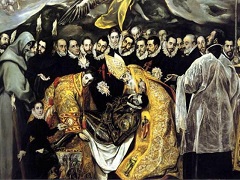
the-burial-of-the-count-of-orgaz

Detail from the Burial of the Count of Orgaz by El Greco

+++++++++++++

A LEXICON OF WORDS AND PHRASES TO BE USED BY THE MEDICAL AND LEGAL PROFESSIONS IN DEFINING AND DISCUSSING DEATH

DEATH is the total permanent loss of circulation of blood leading to the cessation of vital functions dependent on such circulation such as pulsation, respiration, brain activity leading in turn to the destruction of these vital systems and organs necessary for the preservation of human life.  Death is not an instantaneous phenomenon, it is a process.
PROCESS means the successive occurrence in time of the physiological changes named above in parts of the human body.
CHANGES described above causing death can be measured in nano-seconds, seconds, minutes, hours, days, weeks or longer. 

+++++++++++++

Imagine two deaf persons trying to communicate with each other each one using a different system of signs they learned in different schools for the deaf where they teach different systems of sign language.  That is crazy you would say, it is impossible for them to communicate since the signs each of them would be making with their hands would be meaningless to the other.

The same problem exists for all of us who are not deaf and who communicate verbally with words.  Words are signs.  Words communicate meaning given to them by common agreement by persons who belong to the same language group.  But even in the same language group there can be problems when idiomatic speech peculiar to one country is used in another country of the same language group, e.g. England and the United States.

The problem gets worse when people deliberately apply different meanings to words in order to advance a political or social agenda.  Abortion is a good example.  For most people the child-in-utero is a person, that displays all the attributes of personhood but cannot yet speak.  To those persons who promote abortion the child-in-utero is not a person because he cannot speak,to another he is not a person until he is born, to another he is not a person until he can reason at around seven years of age, and to reduce it to the absurd, to some he is probably not a person until he is 21 years old.

Words are signs to which society, by common consent, assigns meaning.  When people are consumed with a desire to promote some political, social or economic agenda they assign meaning to words that the great majority of other persons in the same society reject.

Such is the case with death.

To persons with a Malthusian or racist obsession, death is not longer a word describing a natural event.  It is a political or social or economic means to an end and natural death becomes irrelevant if hastening or causing the death of another person promotes some arbitrary good such as alleviating suffering, reducing world population, eliminating undesirable individuals or groups from society.

Since Doctor Christiaan Barnard in 1967 first successfully transplanted a human heart, the medical profession has ceased to be a profession and has become an industry.  The transplantation of organs from the human body of one person to the body of another person has become BIG BUSINESS.

The problem faced by the medical industry was the problem of death.  It is not possible to successsfully transplant human organs from a cadaver to a living person.  In order to transplant organs successfully they must be taken from the body of a living  person and transferred to the body of another living person and that procedure was illegal in practically every country in the western world up until the 21st Century.

How to solve that problem if the medical business was to reap the potential huge financial rewards of organ transplantation.  Simple.  Change the definition of death in the law.

A group of doctors met at Harvard University in 1972 and came up with the idea of defining death solely on the basis of the activity in the human brain.  Their proposal has come to be known as brain death.  Subsequent to the Harvard meeting the law was changed in all 50 states of the United States.  Now, the absence of the signs of brain activity in certain parts of the brain allows doctors to declare a patient “brain dead” and they can leglly proceed to extract all the organs of the patient for transplantation into another person even though blood is still coursing through the veins and arteries of the patient and with the aid of a ventilator pushing air into the lungs of the patient (the body of the patient will reflexively push the air out of the lungs) while the other organs are being removed.

Voila, the medical business now can remove the organs of everyone who enters a hospital as a patient.  All that is necessary is that the doctors induce coma.

How big is the organ transplantation business?  The Milliman Corporation does an actuarial study of all medical billings in the United States once every three years.  They have identified every organ transplantation that occurred in the United States in 2014.  They have identified every billing from the preparation for the operation for removal of an organ to the transportation to the donor to the placing of the organ in the recipient and the compensation of everyone involved until the recipient is declared well months after the transplantation.  How much money was involved in all of the transplantations in 2014?  Brace yourself !!!  The total amount of money changing hands in the medical business of organ transplantation in the United States in 2014 was:   $28,761,129,500.00.

Words are symbols with meaning.  We must fight to have the law in every state redefine death using the words I have written at the beginning of this post.

The Catholic Church is not opposed to organ transplantation, but insists that persons must not be harmed, much less killed, in order to procure organs for transplantation.  Here are some magisterial statements on the subject.

Pope John Paul II to the Participants of the 1989 Pontifical Academy of Sciences stated:

“The problem of the moment of death has serious implications at the practical level, and this aspect is also of great interest to the Church. In practice, there seems to arise a tragic dilemma. On the one hand there is the urgent need to find replacement organs for sick people who would otherwise die or at least would not recover. In other words, it is conceivable that in order to escape certain and imminent death a patient may need to receive an organ which could be provided by another patient, who may be lying next to him in hospital, but about whose death there still remains some doubt. Consequently, in the process there arises the danger of terminating a human life, of definitively disrupting the psychosomatic unity of a person. More precisely, there is a real possibility that the life whose continuation is made unsustainable by the removal of a vital organ may be that of a living person, whereas the respect due to human life absolutely prohibits the direct and positive sacrifice of that life, even though it may be for the benefit of another human being who might be felt to be entitled to preference.”9

In the same Address Pope John Paul II stated:

“Death can mean decomposition, disintegration, a separation (cf. Salvifici Doloris, n. 15; Gaudium et Spes, n. 18). It occurs when the spiritual principle which ensures the unity of the individual can no longer exercise its functions in and upon the organism, whose elements left to themselves, disintegrate.”10

Pope John Paul II in Evangelium Vitae, (n. 15), stated:

“Nor can we remain silent in the face of other more furtive, but no less serious and real, forms of euthanasia. These could occur for example when, in order to increase the availability of organs for transplants, organs are removed without respecting objective and adequate criteria which verify the death of the donor.”11

Incredibly, some jurisdictions are moving to make the donation of organs automatic, that is, there is a presumption in law that a person is willing to have his organs removed for transplantation.  Truly, we are rapidly moving into a dystopian future.

About abyssum

I am a retired Roman Catholic Bishop, Bishop Emeritus of Corpus Christi, Texas

This entry was posted in Uncategorized. Bookmark the permalink. Edit
Posted in Uncategorized | Comments Off on YOU CANNOT TALK ABOUT DEATH IF YOU CANNOT DEFINE IT. WORDS HAVE DIFFERENT MEANINGS SOMETIMES DEPENDING ON WHO USES THEM

WHAT IS DEATH? HOW DO YOU DEFINE IT ? HOW CAN YOU BE SURE ????

WHAT IS DEATH ?

the-burial-of-the-count-of-orgaz

Detail from the Burial of the Count of Orgaz by El Greco

+++++++++++++

A LEXICON OF WORDS AND PHRASES TO BE USED BY THE MEDICAL AND LEGAL PROFESSIONS IN DEFINING AND DISCUSSING DEATH

DEATH is the total permanent loss of circulation of blood leading to the cessation of vital functions dependent on such circulation such as pulsation, respiration, brain activity leading in turn to the destruction of these vital systems and organs necessary for the preservation of human life.  Death is not an instantaneous phenomenon, it is a process.
PROCESS means the successive occurrence in time of the physiological changes named above in parts of the human body.
CHANGES described above causing death can be measured in nano-seconds, seconds, minutes, hours, days, weeks or longer. 

+++++++++++++

Imagine two deaf persons trying to communicate with each other each one using a different system of signs they learned in different schools for the deaf where they teach different systems of sign language.  That is crazy you would say, it is impossible for them to communicate since the signs each of them would be making with their hands would be meaningless to the other.

The same problem exists for all of us who are not deaf and who communicate verbally with words.  Words are signs.  Words communicate meaning given to them by common agreement by persons who belong to the same language group.  But even in the same language group there can be problems when idiomatic speech peculiar to one country is used in another country of the same language group, e.g. England and the United States.

The problem gets worse when people deliberately apply different meanings to words in order to advance a political or social agenda.  Abortion is a good example.  For most people the child-in-utero is a person, that displays all the attributes of personhood but cannot yet speak.  To those persons who promote abortion the child-in-utero is not a person because he cannot speak,to another he is not a person until he is born, to another he is not a person until he can reason at around seven years of age, and to reduce it to the absurd, to some he is probably not a person until he is 21 years old.

Words are signs to which society, by common consent, assigns meaning.  When people are consumed with a desire to promote some political, social or economic agenda they assign meaning to words that the great majority of other persons in the same society reject.

Such is the case with death.

To persons with a Malthusian or racist obsession, death is not longer a word describing a natural event.  It is a political or social or economic means to an end and natural death becomes irrelevant if hastening or causing the death of another person promotes some arbitrary good such as alleviating suffering, reducing world population, eliminating undesirable individuals or groups from society.

Since Doctor Christiaan Barnard in 1967 first successfully transplanted a human heart, the medical profession has ceased to be a profession and has become an industry.  The transplantation of organs from the human body of one person to the body of another person has become BIG BUSINESS.

The problem faced by the medical industry was the problem of death.  It is not possible to successsfully transplant human organs from a cadaver to a living person.  In order to transplant organs successfully they must be taken from the body of a living  person and transferred to the body of another living person and that procedure was illegal in practically every country in the western world up until the 21st Century.

How to solve that problem if the medical business was to reap the potential huge financial rewards of organ transplantation.  Simple.  Change the definition of death in the law.

A group of doctors met at Harvard University in 1972 and came up with the idea of defining death solely on the basis of the activity in the human brain.  Their proposal has come to be known as brain death.  Subsequent to the Harvard meeting the law was changed in all 50 states of the United States.  Now, the absence of the signs of brain activity in certain parts of the brain allows doctors to declare a patient “brain dead” and they can leglly proceed to extract all the organs of the patient for transplantation into another person even though blood is still coursing through the veins and arteries of the patient and with the aid of a ventilator pushing air into the lungs of the patient (the body of the patient will reflexively push the air out of the lungs) while the other organs are being removed.

Voila, the medical business now can remove the organs of everyone who enters a hospital as a patient.  All that is necessary is that the doctors induce coma.

How big is the organ transplantation business?  The Milliman Corporation does an actuarial study of all medical billings in the United States once every three years.  They have identified every organ transplantation that occurred in the United States in 2014.  They have identified every billing from the preparation for the operation for removal of an organ to the transportation to the donor to the placing of the organ in the recipient and the compensation of everyone involved until the recipient is declared well months after the transplantation.  How much money was involved in all of the transplantations in 2014?  Brace yourself !!!  The total amount of money changing hands in the medical business of organ transplantation in the United States in 2014 was:   $28,761,129,500.00.

Words are symbols with meaning.  We must fight to have the law in every state redefine death using the words I have written at the beginning of this post.

The Catholic Church is not opposed to organ transplantation, but insists that persons must not be harmed, much less killed, in order to procure organs for transplantation.  Here are some magisterial statements on the subject.

Pope John Paul II to the Participants of the 1989 Pontifical Academy of Sciences stated:

“The problem of the moment of death has serious implications at the practical level, and this aspect is also of great interest to the Church. In practice, there seems to arise a tragic dilemma. On the one hand there is the urgent need to find replacement organs for sick people who would otherwise die or at least would not recover. In other words, it is conceivable that in order to escape certain and imminent death a patient may need to receive an organ which could be provided by another patient, who may be lying next to him in hospital, but about whose death there still remains some doubt. Consequently, in the process there arises the danger of terminating a human life, of definitively disrupting the psychosomatic unity of a person. More precisely, there is a real possibility that the life whose continuation is made unsustainable by the removal of a vital organ may be that of a living person, whereas the respect due to human life absolutely prohibits the direct and positive sacrifice of that life, even though it may be for the benefit of another human being who might be felt to be entitled to preference.”9


In the same Address Pope John Paul II stated:

“Death can mean decomposition, disintegration, a separation (cf. Salvifici Doloris, n. 15; Gaudium et Spes, n. 18). It occurs when the spiritual principle which ensures the unity of the individual can no longer exercise its functions in and upon the organism, whose elements left to themselves, disintegrate.”10

Pope John Paul II in Evangelium Vitae, (n. 15), stated:


“Nor can we remain silent in the face of other more furtive, but no less serious and real, forms of euthanasia. These could occur for example when, in order to increase the availability of organs for transplants, organs are removed without respecting objective and adequate criteria which verify the death of the donor.”11

Incredibly, some jurisdictions are moving to make the donation of organs automatic, that is, there is a presumption in law that a person is willing to have his organs removed for transplantation.  Truly, we are rapidly moving into a dystopian future.

About abyssum

I am a retired Roman Catholic Bishop, Bishop Emeritus of Corpus Christi, Texas

This entry was posted in Uncategorized. Bookmark the permalink. Edit
Posted in Uncategorized | Comments Off on WHAT IS DEATH? HOW DO YOU DEFINE IT ? HOW CAN YOU BE SURE ????

THE CONTRADICTIONS IN PASTORAL PRACTICE CANNOT BE ALLOWED TO CONTINUE

news-header-image

Dubia on Amoris Laetitia: “We Must go Further”

MAY 02, 2017
BY FSSPX.NEWS
[Emphasis and {commentary} in red type by Abyssum]

In an editorial published on April 24, 2017, in La Nuova Bussola Quotidiana, journalist Riccardo Cascioli gives his straightforward thoughts on the work session he organized in Rome on April 22 at the Columbus Hotel on the Via della Conciliazione – a session that drew Catholic scholars from all around the world with the objective of conducting a rigorous theological analysis of the Apostolic Exhortation Amoris Laetitia.

“There is no doubt that the international conference ‘Bringing Clarity One Year after Amoris Laetitia‘ that was held in Rome on April 22, and organized by the Nuova Bussola Quotidiana and Il Timone was an exceptional event. Not only was it the first meeting at which all the controversial points of the Apostolic Exhortation Amoris Laetitia were systematically covered, but – as I was able to observe when the session opened – everything was thought out, willed, and put into play by laymen. The speakers were laymen as well, from all four corners of the earth, and they came thoroughly prepared.

“An exceptional event, indeed, but it is far from a flash in the pan. It is the fruit of several years’ worth of work with our journalists whose love of Christ and the Church is part of who they are, and who wish to judge all of reality in the light of the Magisterium. This event is a result of the disorientation and confusion that reign in the Church today and of which many Catholics are aware. The task certainly cannot stop with this series of conferences.

“This meeting, that was meant to act as a sounding board for the Dubia of the four cardinals – Brandmüller, Burke, Caffarra, and Meisner – to which the pope still has not responded, certainly helped clarify the problems presented by Amoris Laetitia and its common interpretation.

“I think I can say with certainty that, by the end of last Saturday’s meeting, we were all aware of a very serious crisis in the Church, a crisis that resembles other delicate moments in the history of the Church, but that is also unprecedented in some of its aspects.

“Of course, this crisis was not directly caused by Amoris Laetitia or the different Synods on the Family that are its principal sources, but there is no doubt that this apostolic exhortation opened the doors and allowed ideas and practices that are foreign to dogma to circulate freely in the Church. The stakes are enormous: the very foundation of the Catholic Church has been touched.

“The problem is not principally in the text of Amoris Laetitia itself, whose contradictions were clearly pointed out, but above all in the present context. On the one hand there are Pope Francis’s actions and statements that give credit to the more ‘progressive’ interpretations, for example, as regards Communion for the ‘divorced and remarried’; and on the other hand, there is the concrete situation of the Church in which this document was drawn up. We know that in many dioceses the notion of ‘discernment’ has now become a synonym of ‘communion for all’.

“At this point, we are led to believe that the time for debating which interpretation of the exhortation is correct is over.

“If the principle of interpreting an ambiguous proposition in the sense of continuity withthe previous Magisterium remains valid – according to the guidelines given by John Paul II, for example, in several of his teachings on the family – the present situation obliges us to go further.

“If priests are being punished by their bishops because they judge in conscience that they cannot give communion to the ‘divorced and remarried’; if a large number of bishops translate ‘the discernment required for personal situations’ as ‘free access to Communion’ – when it is not the bishops themselves demanding it -; if homosexuality has now been justified and promoted to the rank of a ‘positive value’; and if all of this is happening everywhere in the world, it is clear to us that we have to go further.

“These past months, there has been much talk of a ‘fraternal correction’ from the four cardinals, and this theme was also touched upon at our meeting on April 22; but it is not hard to understand that this is a scenario we naturally seek to avoid. However, the contradictions cannot continue, and in order to keep error from spreading even more, we must ask the pope to intervene strongly and set things clear.”

Sources: La Nuova Bussola Quotidiana / FSSPX.News – 5/3/17

++++++++++++++++++++++++++++++++++++++++++++++++++++++++++++++++++++++


Making Clarity about Amoris Laetitia

49
Shares

Facebook48Google+1TwitterPinterestPocket

Image courtesy of Edward Pentin.

At the Congress of April 22, at the Hotel Columbus, Rome, just one block from Vatican City, six lay scholars gathered in order to “make clarity one year after Amoris Laetitia” (“fare chiarezza a un anno da AL”), the papal apostolic exhortation about love and marriage, with particular reference to its indirectly stated permission for access to sacramental Communion for divorced and civilly  remarried couples, as well as for couples living in other irregular situations. The Congress was organized by two Italian Catholic apologetics publications, La Nuova Bussola Quotidianaand Il Timone.

Clarity is especially needed, as it is widely known, because of confusion arising from different interpretations of the text of Amoris Laetitia. A number of lay academics, since the document was issued in April 2016, have published articles and letters and given critical interviews, such as Roberto de Mattei, Christian Brugger, Josef Seifert, Robert Spaemann, John Finnis, Germain Grisez, and the group of the “45 theologians,” among many others. Together with them, only one bishop, Athanasius Schneider of Kazakhstan, has dared to express open criticism and a strong demand for clarification. Some other prelates, like the prefect of the Congregation for the Doctrine of Faith, Card. Müller, have preferred indirect resistance, somehow in accordance with the indirectness of the disciplinary and doctrinal changes put forward in the document. While these changes are left indirect in Amoris Laetitia itself, they have since been sustained and made perfectly clear by a series of declarations issued and actions taken by the pope and his closest counselors, like Card. Kasper, Card. Schönborn, Card. Coccopalmerio, Card. Maradiaga, and Fr. Spadaro, among others.

In the light of this grave situation, last September, a group of four cardinals (Burke, Caffarra, Brandmüller, and Meisner) presented the CDF with five dubia, asking essentially whether previous magisterial teaching about marriage and adultery and more in general about the absolute binding force of negative commandments is still in vigor. These dubia went unanswered, so the cardinals made them public, opening them to general debate, and so encouraging a discussion among the laity as well. And the debate has been growing, although only a few bishops and a group of 23 scholars have openly supported these dubia.

Since then, three ways of action have been taken by the world episcopacy. In one camp sit those faithful to traditional teaching who have issued “lines of interpretation” in accordance with Amoris Laetitia and have not been censored by the pope. In the second camp, those who favor the change have made more explicit the permission to sacramental Communion and have openly been approved and thanked by the pope. Finally, in the third camp, the vast majority of bishops have chosen silence, in this way not contradicting traditional teaching and at the same time avoiding a possible clash with the pope. It is not an exaggeration to say that so confused a situation has never been recorded inside the Catholic Church in 2,000 years.

Among the six contributions given on April 22, we focus on four – namely, those who present the main doctrinal points, in relation to the plea of clarity being urgently presented to the pope. In order to have a synthetic view and avoid repetition, I will take Prof. Farrow’s conference as a guideline, because it seems to me that it contains the most complete overview of the doctrinal problems posed by Amoris Laetitia, put into a historical perspective and in relation to previous heresies in the history of Christianity. Then I shall add relevant contributions to particular aspects, taken from the other conferences.

Prof. Douglas Farrow: A Divided God

Douglas Farrow, in fact, went directly to the main doctrinal problems posed by Amoris Laetitia, tracing their remote origin as far as the Marcionite heresy in the second century A.D.

Marcion, an original thinker among the wider stream of Gnostic interpretations of Christianity, directly opposed the God of the Old Testament, just but not good, inferior to the God of the New Testament, the Father of Jesus, good and merciful, but not just. To coherently achieve such an ambitious goal, Marcion had to put “Scripture against Scripture,” and he didn’t refrain from cutting away as “spurious” large parts of the New Testament, because, of course, many passages from the N.T. bear testimony to the identity of the supposed “two Gods.” In a similar vein, many passages of the O.T. had to be arbitrarily set aside in order to make this proposal coherent – namely, all those that speak of God’s goodness and mercy.

Now, as St. Irenaeus correctly noted, this way of thinking introduces a contradiction in the very notion of God, because it sees in opposition two perfections that are really interdependent and that cannot be rationally thought of as separate from each other.

Quoting directly St. Irenaeus:

That they might remove the rebuking and judicial power from the Father, reckoning that as unworthy of God, and thinking that they had found out a God without anger and merely kind or good, they have alleged that one God judges but that another saves. (Adversus Haereses III.25)

By thus dividing God, the Marcionites unwittingly deny “the intelligence and justice of both deities,” putting an end to deity altogether:

For, if the judicial one is not also good enough to bestow favors upon the deserving and to direct reproofs against those requiring them, he will appear neither a just nor a wise judge. On the other hand, the good God, if he is merely good and not one who tests those upon whom he shall send his goodness, will be beyond both goodness and justice; his goodness will seem imperfect, as not saving all who deserve it, if it be not accompanied with judgment.

Prof. Farrow comments:

Today, our neo-Marcionites are more subtle. They do not speak of two gods, but they do speak of the one God, as if he lacked judgment or could be known only by way of his mercy. They say they are serving this one God when they accompany non-judgmentally all who desire their accompaniment. “Judge not, that you be not judged” – here is a Scripture – indeed, a dominical saying – of which they are quite certain. Very good. But they forget to speak to those whom they accompany of the judgment of God, which is a very different matter than the judgment of mere men. They forget to speak to them of the holiness without which no one will see God. They think that to speak thus is intrusive, insensitive, rigid, or at all events unrealistic. Who would willingly listen to such a thing? Who wants to hear of the judgment of God?

So, in reality, this strange and contradictory doctrine is due to “a persistent moral problem, for it is a feature of fallen man that he projects his own disorder into the heavens, imagining strife in God as the real source of his own strife.”

Fallen man, left to his own forces, we may add, doesn’t really want sanctification, but nevertheless, he fears the consequences of his sin, so he turns to a doctrine that says that “justification is possible without sanctification” – that is, mercy without justice. So, Prof. Farrow concludes, connecting Marcion with Luther, “[the Council of] Trent has been undone.”

Prof. Farrow goes on to emphasize that, in order to attack such a central doctrine as the Catholic doctrine of sanctification and justification, the whole Tradition must be put on the bench of the accused:

Now, to divide God, it is necessary to divide his Revelation: not just Scripture from Scripture, but Scripture from Tradition. Tradition itself is regarded with suspicion as that which confines us in error rather than that which maintains us in the truth. So they do it violence. And their violence extends, as Cardinal Sarah (The Catholic World Report, 31 March 2017) recently observed, as far as the Gospel itself. In his remarks to a colloquium on the tenth anniversary of Summorum Pontificum, he speaks of “a horrible, outrageous thing that seems like the desire for … a complete break with the Church’s past” – as if “the apostolic Church and the Christian communities in the early centuries of Christianity understood nothing of the Gospel,” as if the Gospel has remained all but unrecognized until our own time, as if it were “only in our era that the plan of salvation brought by Jesus has been understood”!

To better understand the historical connection that links the Lutheran tenet of the destruction of Tradition with the present situation, Prof. Farrow briefly mentions the Modernist doctrine defended by Fr. Ernesto Buonaiuti at the beginning of the twentieth century, “whose handling of Scripture and Tradition is thoroughly Protestant in spirit even where it is Catholic in form. The outright rejection of [Pope St. Pius X’s landmark anti-Modernist encyclical] Pascendi dominici gregis marks a turning point of sorts in Catholicism,” which explains how “we should eventually be presented with a puzzle like Amoris Laetitia.”

Although the Second Vatican Council made a strong mention of Tradition (Prof. Farrow quotes Dei Verbum 7-10), it’s not difficult to see that a Protestant view of Scripture thoroughly penetrated Catholic theology and exegesis. “The function of the Magisterium,” Prof. Farrow explains, “is therefore in doubt. The new voice of authority is that of the conscience.”

Finally, the destruction of Tradition leads to the misconstruction of conscience itself:

Our present problem – and a major component of the current crisis – is that conscience is being misconstrued as a source of moral authority alongside natural and divine law: a source capable of overriding not merely the ius canonicum and sacramental discipline, but dominical teaching and the lex credendi, on which such discipline is based.

In reference to the dubia, Prof. Farrow rightly points out that the heart of the doctrinal problem we face can be synthesized in the fifth dubium:

After asking for clarification, in the first dubium, regarding a single type of situation – sexual relations that, because of Jesus’s own words, have always been regarded as adulterous: are they adulterous or are they not? – the burden of the others comes to rest in the fifth, regarding the role of conscience in relation to Scripture and Tradition:

After Amoris Laetitia (n. 303) does one still need to regard as valid the teaching of St. John Paul II’s encyclical Veritatis Splendor 56, based on Sacred Scripture and on the Tradition of the Church, which excludes a creative interpretation of the role of conscience and emphasizes that conscience can never be authorized to legitimate exceptions to absolute moral norms that prohibit intrinsically evil acts by virtue of their object?

Finally, Prof. Farrow expounds on the practical consequences of this change:

Where the conscience is excused from reckoning with the intrinsic nature of an act, and set directly to wrestling with the subjective and circumstantial and consequential dimensions of the act, the requisite contrition, penance, and absolution will be quite different. And this will have implications for the external forum also. What was once regarded as adultery, and hence as a disqualification for Communion, will now be regarded as a new form of fidelity, and hence as a qualification – in which case, the Eucharist itself will be made witness to this fidelity that was once an infidelity.

I said earlier that the dubia, having been deemed necessary, are necessarily in need of an answer. But it is not so simple as that. Considered substantively, and not merely procedurally, the dubia are indeed necessary, but the fifth, at least, cannot be answered – or rather, the only possible answer would be to withdraw the offending section of Amoris Laetitia and to correct or clarify the premises, appearing elsewhere, which support that section.

This last remark is especially important: many voices, in the last months, have expressed the desire that the dubia be answered, of course in a way coherent with traditional teaching. But here Prof. Farrow correctly points out that this would not be enough, because, if one regards VS 56 as still valid, based as it is in Scripture and Tradition, then a positive answer to the fifth dubium cannot coherently coexist with Amoris Laetitia’s Chapter 8 and also with the premises to it that appear elsewhere in the document. On reflection, the same reasoning must be applied to the other four dubia as well, for the very reason that they ultimately depend on the fifth. So, really, the presentation of the dubialogically amounts to a petition of withdrawing AL’s Chapter 8 and supporting passages (which should be precisely identified). Until this is done, a lethal contradiction will remain between the present Magisterium and Tradition and continue to be a source of persistent infection and schism within the Church.

Prof. Claudio Pierantoni: Heretical Popes and the Four Levels of Danger

Prof. Pierantoni’s conference also puts the present controversy into a historical perspective, but from a different point of view: he tries to compare the examples of “heretical popes” of the ancient Church – namely, Liberius and Honorius I – with the present case. The case of Honorius is especially interesting for our purpose, because he was formally condemned by the Third Council of Constantinople (A.D. 681), the sixth ecumenical council in Church history, for his affirmation of the doctrine of the “one will” in Christ, whereas the Council solemnly proclaimed the doctrine of the “two wills,” divine and human, which follows logically from the doctrine, previously established in the Council of Chalcedon (A.D. 451), of the “two natures” united in the one Person of Christ. Then Pope Leo II confirmed Honorius’s condemnation by the Council, adding a formal censure to the negligence of Honorius, which permitted the spreading of the heresy. So we can here observe that the condemnation of a pope may be based not only on a formal heresy, but also on practical conduct on a pope’s part that tolerates heresy or, in the present case of Francis, even favors it openly.

Synthesizing the comparison between the ancient popes and the present case, Prof. Pierantoni states:

However, despite their differences, taken in a general way, the two cases of Liberius and Honorius have an important point in common, and that is the fact that both their interventions took place while the process of formulating the respective dogmas was still in progress, the Trinitarian one in the case of Liberius and the Christological one in the case of Honorius. … Now, this point that unites the doctrinal deviation of the two popes of antiquity is undoubtedly their extenuating circumstance, but unfortunately this same thing is the point that contrasts them to the doctrinal deviation that is occurring during the current pontificate, which instead has a strong aggravating factor in [Pope Francis’s] setting himself [not] against doctrines not yet [clear], or in the process of being formulated, but against doctrines that, in addition to being firmly anchored in Tradition, have also already been exhaustively debated in recent decades and clarified in detail by the recent Magisterium. So this is not only a deviation of the Magisterium from Tradition taken in general, but also a direct contradiction of the pronouncements of the very recent Magisterium.

After that, analyzing in more detail the case of Francis, Prof. Pierantoni highlights four levels of doctrinal error contained in Amoris Laetitia, showing how the accumulation of arguments, supposedly in favor of his proposal, leads the pope to put in grave danger fundamental elements of Christian doctrine.

On the first level, the indissolubility of marriage, although verbally stated, is put in doubt practically if someone cohabiting is admitted to Communion.

Since that appears to be highly problematic, on a second level, an emphasis is made in the document about the subjective situation of ignorance or unconsciousness that may exculpate what, objectively speaking, is adultery – but this, Prof. Pierantoni observes, contrasts sharply with the emphasis the document puts on discernment and accompaniment. In fact, what appears to be directly contradictory is how a person in the process of accurate discernment may still be supposed to be “ignorant” or  “unconscious.”

Trying (more or less consciously) to escape this contradiction, AL sinks into a third level of doctrinal deformation, supposing that through discernment, one may discover that one’s situation, which objectively contradicts the Commandments, and therefore the Natural Law, may be something that is not only permitted, but actually asked by God in that situation. That, Prof. Pierantoni stresses, is contradictory with the very essence of Natural Law, which is not an extrinsic or merely positive law, but reflects the very nature of the human being:

To serve as a simple comparison for us: the positive law that governs the movement of a car in a certain country is one thing; the instruction booklet written by the vehicle manufacturer is another thing. If I exceed a speed limit for a vital emergency, let us suppose, I can also be morally justified, because the rule, while just in itself, however, is not absolute, because it is not intrinsically linked to the essence of the vehicle. If, on the other hand, I contravene the directive of the manufacturer, who tells me that the car was designed to run on gasoline, no emergency or exception, certainly no discernment, will serve to ensure that the car could run with diesel. To use diesel is therefore a bad thing not because it is “forbidden” by some external law, but because it is intrinsically irrational, because it contradicts the very nature of the vehicle.

Therefore, to suppose that the Natural Law may admit exceptions is a true and proper contradiction. It is a supposition that does not understand its true essence and therefore confuses it with positive law.

This confusion between Natural Law and positive law clearly accounts for AL’s violent (and justly resented) attacks on “legalists.” In fact, in Jesus’s idea, the Pharisees are often wrong because they rigidly stick to “precepts of men” (positive laws), putting aside fundamental divine laws, whereas there certainly is no hint in the Gospel that Jesus criticizes someone for sticking to the Ten Commandments!

And now we get to the fourth level of doctrinal deformation, because Natural Law is of course the very Law that the Author of Nature has given. The Divine Person of Christ, namely the Logos, the Word who was in the beginning (John 1:1), is precisely He through whom all things came to exist (John 1:3). In short, to speak of the Natural Law as if it were a mere positive and fallible law, a humanly conceived general rule that may have exceptions, is to misconstrue the divine nature of the Person of Christ, God’s Word – so it is tantamount to doing away with the very essence of the Gospel and the whole of Revelation, which is of course the direct expression of God’s personal Word and the manifestation of the Father Himself: “the only begotten Son who is in the bosom of the Father, he hath declared him” (John 1:18).

In conclusion:

What … leaps to the attention in the current situation is precisely the underlying doctrinal deformation that, as skillful as it may be in evading directly heterodox formulations, still maneuvers, in a coherent way, to carry forward an attack not only against particular dogmas like the indissolubility of marriage and the objectivity of the moral law, but even against the very concept of right doctrine, and with it, of the very person of Christ as Logos. The first victim of this doctrinal deformation is precisely the pope, who I hazard to conjecture is hardly aware of this, a victim of a generalized epochal alienation from Tradition in large segments of theological teaching. After him, there are innumerable victims who fall into deception. …

In the light of all this, it therefore becomes more necessary than ever, as initially provided for at least by Cardinal Burke, to make a further act of courage, truth, and charity, on the part of the cardinals, but also of the bishops and then of all the qualified laity who would like to adhere to it. In such a serious situation of danger for the faith and of generalized scandal, it is not only licit, but even obligatory for an inferior to fraternally correct his superior, always done in charity. Even the hierarchical or religious obedience must not be used, in this case of general danger, as an excuse to silence the truth.

So Prof. Pierantoni stresses the importance and urgency of fraternal correction, which would neither be “an act of hostility nor a lack of respect nor an act of disobedience.” Much less would it provoke a schism, since “there is no record … that any of the cardinals would want to hold that Francis is not the pope, and even less that someone wants to get himself elected anti-pope. The true schism, which is increasing every day, is rather a de facto one that only a fraternal correction may restrain.”

A fraternal correction would be “nothing other than a declaration of truth: caritas in veritate. The pope, even before being pope, is our brother, and this is therefore a primordial duty of charity toward him. We will be called to account for his destiny, as well as that of all those who rely on his guidance.”

Now, complementing Douglas Farrow’s proposal with my own, I add that a correction, to be really decisive, should ask that AL, Chapter 8 be withdrawn, along with passages that are meant to prepare it.

Prof. Thibaud Collin: Conscience above Christ

Thirdly, we shall take into account Prof. Thibaud Collin, who focused on the problem of conscience and its misconstruction in Amoris Laetitia. Prof. Collin too puts AL into a historical perspective, this time reminding us of the resistance against Pope Paul VI’s Humanae Vitae, which restated the Church’s complete opposition to contraception.

Compared to Humanae Vitae, the situation with Amoris Laetitia involves an inversion of roles: Prof. Collin sees a striking similarity between HV’s critics and the present papal document. In fact, both propose to treat the objective requirements of the moral law as an ideal, an “optional choice” that may fit some privileged people in ideal situations but is not binding for all Catholics. He mentions the “pastoral note on HV of French Bishops of November 1968, §16,” which practically left the observance of HV to subjective and situational judgment, with a reference to “conflict of duties,” an argument very similar to the one proposed in AL.

Collin observes:

This reception was practically a liquidation. Moral normativity was transformed into a mere suggestion, reserved to the most zealous among the faithful, to those who live in optimal conditions to live it.

In short, Prof. Collin concludes, “it was a pastoral fiasco.”

In practice, out of fear of proposing true change of a sinful situation, many shepherds preferred a kind of indefinite “accompaniment.” “Toward what?” Prof. Collin asks.

A pastoral “bougisme” [movement for the sake of movement] can exist, a kind of ”infinite progress,” of which the finality is hidden, because it is identified with the end of an almost endless path, in any case a distant one, and lost in a mist. But the finality of Christian life is not in the future; it’s in the present: the loving union with God, who offers with generosity the grace for us to consent freely to it. That never goes without the Cross, but Jesus waits there for us.

Complementing Profs. Farrow’s and Pierantoni’s remarks, Prof. Collin rightly points out that what we observe in AL’s proposal is a “shifting from erroneous conscience to an objectivation of error”: “The Law of God is here nothing more than an element that must be weighed among other elements, concrete and particular.” The Divine Law is perceived as “abstract,” and “the concrete possibilities of the faithful are invoked as criteria in order to determine God’s will.” In this way, the author asks, “How can we avoid that divine mercy is turned into worldly tolerance?”

In fact, this perception of Divine Law as “abstract” is much “more Kantian than Christian”; it is “a legalist and worldly conception of [Divine] Law.”

On the contrary, the author stresses:

God’s Law is also eminently personal and concrete, because it is a Law written in every person’s heart. God, for example, tells me: “If you want to adore me and be happy, love your spouse and be faithful to her.”

AL’s “sociologism” and “pedagogism” are “contrary to God’s design, revealed and entrusted to the Church. It’s contrary to the good that everybody can realize with God’s omnipotent grace.” Because “nothing is impossible to God.”

Prof. Collin aptly concludes with words from the Council of Trent:

But no one, however much justified, should consider himself exempt from the observance of the commandments; no one should make use of that rash statement forbidden under an anathema by the Fathers, that the commandments of God are impossible to observe for a man who is justified. For God does not command impossibilities, but by commanding admonishes you both to do what you can do, and to pray for what you cannot do, and assists you that you may be able” (St. Augustine, De Natura et Gratia 43), “whose commandments are not heavy” (1 John 5:3), “whose yoke is sweet and whose burden is light” (Matt. 11:30). (Council of Trent, Sess. VI, Cum hoc tempore, cap. 11, Denzinger 1536)

Prof. Anna Silvas: No Orthodox Interpretation

Finally, we shall now turn to Prof. Anna Silvas’s contribution, which, in a sharp synthesis, relentlessly unmasks our Church’s tragic situation. She starts with a brief mention of the “spirit of modernity” and the critical situation the Church lived in the immediate aftermath of Vatican II. After that, she says:

Under St. John Paul II, we seemed to have something of a “push-back” for a while, at least in some areas, especially his intense explication of the nuptial mystery of our first creation, in support of Humanae Vitae. This continued under Benedict XVI, with some attempt to address liturgical decay and the moral “filth” of clerical sexual abuse. We had hoped that some remediation at least was in train. Now, in the few short years of Pope Francis’s pontificate, the stale and musty spirit of the seventies has resurged, bringing with it seven other demons. And if we were in any doubt about this before, Amoris Laetitia and its aftermath in the past year make it perfectly clear that this is our crisis. That this alien spirit appears to have finally swallowed up the See of Peter, dragging ever widening cohorts of compliant higher Church leadership into its net, is its most dismaying, and indeed shocking, aspect to many of us, the Catholic lay faithful.

Prof. Silvas goes on to confront the issue of different interpretations, and particularly of the attempt to interpret the text in an orthodox way. This she finds “very strange”:

There is one group, however, whose approach I find very strange: the intentionally orthodox among higher prelates and theologians who treat the turmoil arising from Amoris Laetitia as a matter of “misinterpretations.” They will focus on the text alone, abstracted from any of the known antecedents in the words and acts of Pope Francis himself or its wider historical context. It is as if they interpose a chasm that cannot be crossed between the person of the pope on the one hand, over whose signature this document was published, and the “text” of the document on the other hand. With the Holy Father safely quarantined out of all consideration, they are free to address the problem, which they identify as “misuse” of the text. They then express the pious plea that the Holy Father “correct” these errors.

No doubt the perceived constraints of piety to the successor of Peter account for these contorted maneuvers. I know, I know! We have been facing down that conundrum for a year or longer. But to any sane and thoughtful reader, who, in the words of the 45 Theologians’ Censures, is “not trying to twist the words of the document in any direction, but … take the natural or the immediate impression of the meaning of the words to be correct,” this smacks of a highly wrought artificiality.

Pope Francis’s “intent” in this text is perfectly recoverable from the text itself, reading normally and naturally and without filters.

It clearly appears, we may add, that even isolating the text, without analyzing the general context, is not sufficient to exculpate AL; the intention behind it is very clear. Prof. Silvas’s analysis, and the examples that follow, complement here what we saw in Prof. Pierantoni’s conference about doctrines that are clearly implied, although not directly and formally stated. Just one example among the various she gives:

The first of the cardinals’ five dubia concludes: “Can the expression ‘in certain cases’ found in Note 351 of the exhortation Amoris Laetitia be applied to divorced persons who are in a new union and who continue to live more uxorio [as husband and wife]?” Without doubt, a papal clarification of the intent in this footnote is of urgent importance to the Church. Nevertheless, what the pope intended is clear from the beginning of this current section, number 301. His topic is “those living in ‘irregular situations.’” All that is said a few lines later about those in situations of objective sin growing in grace and charity and sanctification, maybe with the help of the sacraments … is posted under this heading of “irregular situations.”

So what the dubium asks is not really so dubious; it is unambiguously conveyed by the text of AL, Chapter 8, although not directly formulated.

Prof. Silvas concludes this section as follows:

And there are many other instances like this. As early as the preface, he alerts us that “everyone should feel challenged by Chapter Eight” and then late in that chapter (308) admits obliquely that his approach may leave room for confusion. Let us believe him: this is his intent, which is not all that difficult to grasp.

Then Prof. Silvas cites a few well known episodes that confirm the pope’s intentions – whereupon she stunningly concludes:

Pope Francis, I am sure, is very well aware of the doctrine of papal infallibility, knows how high are its provisos – and is astute enough never to trigger its mechanism. The unique prestige of the papacy in the Catholic Church, together with the practical affective papalism of many Catholics, however, is a useful asset, and all of these he will exploit to the full. For to Francis, and we have to grasp this, infallibility doesn’t matter, it doesn’t matter at all, if he can continue to be the sort of change agent in the Church he wants to be. That this is his spirit we learn in AL 3, where he says: “Unity of teaching and practice is certainly necessary in the Church, but this does not preclude various ways of interpreting some aspects of that teaching or drawing certain consequences from it. This will always be the case as the Spirit guides us towards the entire truth (cf. John 16:13), until he leads us fully into the mystery of Christ and enables us to see all things as he does.”

But I think “the spirit” to which Francis so soothingly alludes has more to do with Hegel’s Geist than with the Holy Spirit of whom our blessed Lord speaks, the Spirit of Truth whom the world cannot receive, because it neither sees him nor knows him (cf. John 14:17). The Hegelian Geist, on the other hand, manifests itself in the midst of contradictions and oppositions, surmounting them in a new synthesis, without eliminating the polarities or reducing one to the other. This is the Gnostic spirit of the cult of modernity.

So Francis will pursue his agenda without papal infallibility, and without fussing about magisterial pronouncements. He tells us so in the third paragraph of AL: “since ‘time is greater than space,’ I would make it clear that not all discussions of doctrinal, moral or pastoral issues need to be settled by interventions of the magisterium.” We are in a world of dynamic fluidity here, of starting open-ended processes, of sowing seeds of desired change that will triumph over time. Other theorists – you have here, in Italy, Gramsci and his manifesto of cultural Marxism – teach how to achieve revolution by stealth. So within the Church, Francis and his collaborators deal with the matter of doctrine, not by confronting theory head on, because if they did so, they would be defeated, but by an incremental change of praxis, played to the siren song of plausible persuasions, until the praxis is sufficiently built up over time[.]

So, Prof. Silvas concludes, it is unjust to blame supposedly bad interpretations of this text:

I think it an injustice to blame these bishops for “misuse” of AL. No, they have drawn the conclusions patent to any thoughtful, unblinkered reader of this papal document. The blame, however, and the tragedy for the Church, lies in the intent embedded and articulated well enough in Amoris Laetitia itself, and in the naïve papalism on the part of bishops, that has so poor a purchase on the Church’s imperishable obedience of faith, that it cannot perceive when it is under most dangerous attack, even from that most lofty quarter.

In this game of subterfuge and incremental intent, the elaborate talk of painstaking “discernment” and “accompaniment” of difficult moral situations has a definite function – as a temporary blind for the ultimate goal. Have we not seen how the dark arts of the “hard case” work in secular politicking, used to pivot the next tranche of social re-engineering? So now in the politics of the Church. The final result will be precisely in accord with Archbishop Bergoglio’s tacit practice for years in Buenos Aires. Make no mistake: the endgame is a more or less indifferent permission for any who presents for Holy Communion. And so we attain the longed for haven of all-inclusiveness and “mercy”: the terminal trivialization of the Eucharist, of sin and repentance, of the sacrament of Matrimony, of any belief in objective and transcendent truth, the evisceration of language, and of any stance of compunction before the living God, the God of Holiness and Truth. If I may adapt here a saying of St. Thomas Aquinas: “Mercy without truth is the mother of dissolution” (Super Matthaeum, V, l.2). [The original statement is “Mercy without justice is the mother of dissolution.”]

In this gloomy situation, Prof. Silvas, too, reminds our cardinals of the promised correction:

Is it still a possibility – the cardinals’ proposed fraternal correction of the pope? We heard of this last November, and it surely lifted our beleaguered spirits. But now it is the end of April, and nothing has come of it. I cannot help but think of that passage from Shakespeare – There is a tide in the affairs of men… – and wonder if the tide has come and gone, and we the lay faithful are left stranded again.

Although striking here a note of skepticism regarding what result could really come out of it, still Prof. Silvas pleads:

Well, I hope so, dear cardinals, I hope so. We, the faithful, beg you: forget about calculating prudent outcomes. Real prudence should tell you when it is the right time for courageous witness, whose other name is martyrdom.

In the final part of her conference, Anna Silvas also struck a contemplative note of hope, talking especially to laity and the ability we have to resist the false spirit even without enjoying institutional power, either in the Church or in the world. She made reference to Rob Dreher’s recent book, The Benedict Option, that indicates the necessity of concentrating in our families or small communities, where silent work, profound prayer, and the practice of virtues in a hidden, apparently insignificant existence (like that of J.R.R. Tolkien’s Hobbits in The Lord of the Rings) can be the most “politically effective” action, just like the silent work and prayer of medieval monks during the fall of the Roman Empire and the chaos that followed.

This final exhortation to a contemplative and hidden action makes even more profound sense if we put it in relation with the previous remark Prof. Silvas made about Card. Newman’s famous “notes” that distinguish true doctrinal development from corruption:

The seventh note is “chronic vigor.” Over time, a corruption shows itself to be exceedingly vigorous – but only at the beginning of the “infection,” since it does not possess the life to sustain itself in the long term. It will run its course and die out. The Life of Grace, however, possesses in itself the Divine Life and will therefore throw off in the course of time all that militates against it. Truth perdures. There will be moments of high drama, but, eventually, it must necessarily prevail.

But certainly, it may be noted, this exhortation to contemplation does not exclude the exhortation to martyrdom. On the contrary, we may correctly say that it prepares martyrdom and makes it possible.

* * *

So, in a final summary and conclusion of these four conferences, we can say the following.

  1. A deep doctrinal crisis is showing itself in the Catholic Church, of which the access to Communion is only the tip of the iceberg, a sample of a profound doctrinal deformation that reaches to the most fundamental truths about God and Christ.
  2. This crisis is now infecting the highest ranking people in the Church, including the papacy itself, although a strong resistance is manifested by a minority of the clergy and the laity, showing the sane reaction of a vital body to an infection.
  3. In this spiritual fight, we must certainly rediscover the coherence and depth of our doctrine, but also deepen our prayer and contemplative dimension, which can nourish our charity and our faith in the ultimate triumph of Truth.
  4. In light of all this, a clear and definite testimony – martyrdom – is now urgently needed, on the part of all cardinals, bishops, clergy, and laity who are aware of this tragedy – a fraternal correction that speaks frankly to the pope and his counselors, that states the truth beyond all human calculation and false prudence.
  5. This correction must necessarily include not only the plea for a clarification, but also the plea for an outright withdrawal (or at least a thorough rewording) of AL, Chapter 8 and all passages that prepare the heretical doctrines that are clearly there implied.
Posted in Uncategorized | 1 Comment

BAPTISTS OPTING FOR THE BENEDICT OPTION ??? YOU HAVE TO BE KIDDING, BUT YOU ARE NOT !!!

Evangelicals Being A Creative Minority

FWIW, the Christ-following Evangelicals in our neck of the woods [the South], likely more right than left, do think the The Benedict Option is relevant, valid, and important.  So important that our thoughtful pastoral leadership, mostly comprised of gentlemen in their mid-30s, are convening a Ben-Op discussion group with a small cadre of Evangelical professors  to discuss what this means for us — personally and collectively — as a community of faith.

This is a Southern Baptist church–a Southern Baptist church that incorporates the reading of OT, NT, and the Epistles–as well as Corporate Confession of Sin–into its weekly Sunday liturgy.  (You might not know this, but that is not the usual MO for traditional Southern Baptist churches).

I know of several other Ben-Op discussion groups that have or will be sprouting up in our area.

Do know that despite the many ostriches with their heads in the sand, people are listening.  And discussing.  And praying.  And, prayerfully, taking action.

Thank you so very much for this news, friend. A journalist asked me in an interview the other day what led me to write this book. I told him that more than anything else, I wanted to do my part in making it possible for my children, and my grandchildren, and their descendants, to hold on to the faith through the very difficult times we’re in now, and that are to come. And I want to help make it possible for other Christians to do the same.

What’s more, I am convinced that this is a project that is going to require the friendship and cooperation of all faithful small-o orthodox Christians. It cheers me up immensely to hear from readers like this one, and to know that the book I’ve written has planted a seed. We are going to have to be a “creative minority” in this post-Christian nation, and it sounds like the Bible-believing Evangelicals in that part of the world are well on their way to figuring out what that means for them in their own place, coming out of their own particular tradition.

Thank you, friends. Let us help each other, in prayer and otherwise. Please write to let me know what you’re thinking about all this after you’ve met. There are a lot of us who are eager to learn from you.

Posted in , . Tagged , .

 comments

 Responses to Evangelicals Being A Creative Minority

  1. pitchfork says:

    Rod, in case you haven’t seen this…

    “Opting for Benedict”
    https://irishrover.net/2017/05/opting-for-benedict/

    Not a review, exactly, but certainly an affirmation of your central thesis.

  2. Donny says:

    Rod,

    I don’t think the Ben Op is catching on in my Eastern Orthodox parish. There is much to agree with in your book, and most of what I disagree with others view as quibbling. But at least in our parish we don’t view ourselves missing much of what you describe as essential. Community? We spent some fourteen services together during Holy Week and have at least one communal meal weekly throughout the year, and sometimes two. Church discipline? Just try approaching the Chalice if you haven’t been to confession in a long time or if you’ve sinned publicly. Counterculture and identity? Alethos Anesti! Is that cake vegan?

    I guess what I’m saying is that those with strong, observant parishes with strong traditions probably don’t view themselves as needing the Benedict Option as much as others you write for. Because to a great extent, we already have it.

    Now what you have to say about education, we’d all have to be crazy to disagree with. I quibble with your exclusive focus on a subtype of Christian homeschooling. But what we have is priceless, and passing that down should be an encompassing life goal.

    But those with strong traditional parishes–we are the very fortunate.

    [NFR: You are very fortunate indeed! Seems to me that everybody is on a spectrum of some sort. There are always ways to strengthen our spiritual discipline. — RD]


Posted in Uncategorized | 1 Comment

RUNNING TOWARDS HEAVEN, AWAY FROM HELL

Anthony Esolen (Saint Joseph/Flickr)
.

Running Towards Something Good

.

Prof. Anthony Esolen announced this morning that he is leaving Providence College to teach at Thomas More College in New Hampshire.  You may recall that the noted author and translator of Dante had been going through hell at, um, P.C. after he criticized the way “diversity” was treated on campus. Well, they finally ran him off — but as he tells it, he is not so much running away from something bad but running towards something very good. Excerpts:

Sometimes a single encounter with what is healthy and ordinary—I use the word advisedly, with its suggestion that things are in the order that God by means of his handmaid Nature has ordained—is enough to shake you out of the bad dreams of disease and confusion. If it isn’t quite yet like meeting Saint Francis on the road, it is like meeting a bluff and jovial fellow who has just come from a conversation with that great little man of God.

I’ve had such an encounter, at Thomas More College, in New Hampshire.

He then writes about a visit to the orthodox Catholic college’s campus, and seeing what college life — and his life as a college professor — could be like. More:

When we came back from the altar at Communion, a young bearded fellow stood up to the side, with another lad and four lasses, directing them in a sung prayer to Saint Michael, singing the verse at first in unison, then in harmony, then in harmony while two of the sopranos sang a descant. It was elegant and beautiful and devout, without the least trace of the “show”; all subordinated to the Mass and to prayer. I was later told that the director is a freshman, that he himself composed the music, and that one of the first things he did at Thomas More College was to establish that small chorus.

Now, I have been teaching college students for more than thirty years, and have never been near to such an act of devotion. But then—in ordinary times, people who have the talent compose music, plenty of them, and people, both men and women, sing. “Singing is what the lover does,” said Saint Augustine, so you shouldn’t expect much singing from young people who have been scalded and scorched by the Lonely Revolution; but from blessedly bright and cheerful boys and girls who have retained their innocence, you would be foolish not to expect singing. And not to expect other ordinary things, too.

I sat at table for lunch, with three or four students, among whom was the young lady I have known since she was a little girl with curly hair. One of them smiled as she put before me a copy of Dante—would I sign it for her? We all talked and laughed for about an hour. A young man whose people come from South America talked with me about Portuguese, and the conversation then ranged all over the place, as happens when somebody with real intellectual objects of devotion, and their little brothers called hobbies, meets somebody else of the same sort. Good Lord! I enjoyed that conversation as well as the best of such that I’ve ever had with college professors. Among them you must often hedge and keep your thoughts to yourself, lest you be accused of breaking The Unwritten Law and having your head nailed to the floor.

He goes on to write about what it was like to teach classes with students who actually loved the material — Virgil, in this case — and who wanted to learn it. Life is short; why waste it teaching sullen, haughty children in the company of professors who would see you hang for having violated some politically correct orthodoxy? And so, Prof. Esolen made his decision to shake the dust off his feet and head for New Hampshire. He writes:

I have countless memories of fine students at Providence College, some of whom are now my close friends; and to my colleagues in Western Civilization—of whom many have retired and some have passed away—I owe a debt I can never repay, for their friendship and support and instruction. But I am too old to want to spend the evening of my career trying to shore up a crumbling wall, when those who are in authority at the college are unwilling to listen to our pleas, or even to meet with us so that we can make the pleas in person, but instead pass out lemonade to the professors with the sledge hammers.

No, I’d prefer to be in on building something exciting for the Church and for sheer ordinary humanity: The Center for Cultural Renewal, at Thomas More College. More on that to come.

This is great news on a number of levels, but if you read Tony’s terrific recent book, Out Of The Ashes — and you really should if you haven’t — you will understand what a spectacular event it is that he is going to have the opportunity to realize his vision. To me, this is the Benedict Option in action: when faithful Christians stop trying to shore up the dead and dying order, and instead focus on building new forms of community within which the life of faith and virtue might survive the coming Dark Age.

Congratulations too to the leadership of Thomas More College for having the vision to hire Prof. Esolen.

Posted in , , , , . Tagged , , , .


 comments

  1. Bernie says:

    Great! Thomas More College is one of the approximately 30 truly faithful and orthodox Catholic colleges and universities in the U.S. recommended by the Cardinal Newman Society. I view each of them as the epitome of what’s best with a Ben Op model.

  2. G Harvey says:

    Yes, Mr. Dreher, what Dr. Anthony Esolen is doing is the Benedict Option is action.

    And here is what I must stress because many readers may pass right by it: Esolen is leaving a ‘church related’ college. Some, I would assert firmly most, churches are long dead in every way. They need to be left behind. The same with church run schools and other institutions.

    Every Jesuit college in America, for example, serves the belly of Modernism at least as awfully as does Providence College – and most Jesuit colleges clearly are worse than Providence College.

    People need to stop sending money to such wolves in sheep’s clothing.

  3. Larry in NC says:

    What a great development! I am happy for Dr. Esolen.
    There are still places of beauty and hope in the world.

  4. Khater M says:

    I’m a senior at a Catholic private school in Virginia. I think Dr. Esolen is absolutely right. There’s no reason to stay and keep teaching at an institution where a large number of students and faculty members are so hostile to you. He got all that grief just for expressing his opinion. During my college search last year, I visited many colleges, and most of them are addicted to the fad of “diversity.” I don’t have any issue with natural diversity, but ethnic diversity in itself doesn’t mean anything. Diversity of THOUGHT is what matters. If I could be in a room with 100 people of the same race (who all had radically different views and opinions) or 100 people who came from many different racial backgrounds but thought the same way, I’d go with the former every time. The modern Left on most college campusus does not tolerate diversity of thought. I looked at Thomas Moore and Thomas Aquinas College, but as a Reformed Protestant, I don’t think I’d be comfortable at schools that are so Catholic. That being said, I certainly respect these places. We need more colleges that provide a serious classical education and promote freedom of thought. I’ll be headed to St. John’s College in Annapolis this fall. It’s one of the few places left in America where one can still get a pretty strong classical education. The other thing I love about St. John’s is that it’s not really political at all. You won’t see rallies for “social justice” or “diversity” there. Best of luck to Dr. Esolen at Thomas Moore!

  5. Andrew Benson says:

    I had the very good fortune to visit St. Thomas More last Friday with my daughter in conjunction with the Catholic Literary Conference. It is a remarkable institution. They are indeed lucky to have Professor Esolen, and he is fortunate to be able to go there. A wonderful match.

  6. Susan Citizen says:

    This news makes me very happy for Professor Esolen and for those who will profit from his wisdom. I take comfort in the great promise of Romans 8:28, “And we know that for those who love God all things work together for good, for those who are called according to his purpose.”

  7. mrscracker says:

    Two of my children attended Catholic colleges like this. Both met their spouse indirectly through contacts made at school & they made life long friends there.
    They complained a little about some of the kids at college who wore their faith like a very uncomfortable suit of clothes. And each school had some eccentricities, but overall it was a wonderful life changing experience for them.

  8. heteropatriarch says:

    From the Crisis article:

    “Teaching, for me, has always retained much of that happy boyish enthusiasm; it’s why I find it hard to understand people who turn teaching into politics by other means. Why would you do that? Wouldn’t it be like sitting on a Rembrandt while holding forth about Donald Trump and Hillary Clinton?”

    But Hillary Clinton’s pants are totally more interesting and intersectional than western, racist, and patriarchal notions of “beauty.” Rembrandt: a dead white cis-male who probably (1) owned slaves and (2) was a closeted neurodivergent. Love wins!

    Kidding aside, I’ve been reading Esolen for years and I’m delighted for him and his prospective students.

  9. “… this is the Benedict Option in action: when faithful Christians stop trying to shore up the dead and dying order.”

    A program that ought to be a “slam dunk” in contrast to the worldly establishment’s many false incitements.

  10. Thomas Hobbes says:

    That’s great for Prof. Esolen, probably not great for Providence College, but perhaps something good will come of it.

    He just couldn’t resist putting in the snark for modern church music could he?

  11. Dominic says:

    This is beautifully written, and Prof. Esolen’s joy and relief are palpable. A caveat though: These are the words of a man in the throes of a starry-eyed honeymoon period. Reality will set in before too long, a different reality than the one he left, but also with its own crosses and contradictions and absurdities.

    I speak from my own experience as a professor who left a quite secular environment a number of years ago for a much less secular one. I am joyful and relieved in my new place, but Original Sin and the human condition are present here too, at full ferocious strength.

  12. The Other Side says:

    When I first started reading Esolen I thought he could come off as kind of bitter and annoying at times even if I mostly agreed with him. He seems different in person. I HIGHLY recommend you look up and watch a lecture or two of his on youtube. It’s almost impossible to not get completely caught up in the love of his subjects with him as he talks. If you ever hated Shakespeare in school then listen to Esolen talk about him. Or Dante. Or being Catholic. You can’t help but get a glimpse of the kind of beauty he sees in these things. It makes reading his books better.

  13. Erin says:

    Wow! Thank you so much for recommending Out of the Ashes… I got it on Kindle after reading your blog today, and it’s wonderful! Makes me want to look at cathedrals and read classic lit and poetry.

  14. Jeremy Hickerson says:

    good post, Rod.

  15. Grant says:

    I love Esolen and his writings. However, it’s hard to share in the excitement for a prayer to “Saint Michael”. 500 years later and the Reformation is just as needed as ever! Ad Fontes! Somebody nail 95 Theses to the door of Thomas More!

    [NFR: Do you know what the prayer to St. Michael is? It says: “Saint Michael Archangel, defend us in battle, be our protection against the wickedness and snares of the devil; may God rebuke him, we humbly pray; and do thou, O Prince of the heavenly host, by the power of God, cast into hell Satan and all the evil spirits who prowl through the world seeking the ruin of souls. Amen.” All it is is a petition to the Archangel to help us in spiritual warfare “by the power of God.” What’s wrong with that? — RD]

  16. I am very happy for Prof. Esolen. I hope that all will go very well for him and for the students who are lucky enough to take his classes!

    It has been a couple of decades since I attended Thomas More College as a freshman. I did not end up choosing to stay and got my degree elsewhere, but I imagine the drawbacks that led to my decision are not so greatly in force twenty years later. At the time, the school was extremely small (fewer than 50 students) and very remote and isolated. We had to carpool to Sunday Mass as there was no Sunday Mass on campus at the time, for instance. (Other issues may or may not still exist so it would be unfair to bring them up at this point.)

    Both Thomas More College and the university I did graduate from (Franciscan University of Steubenville) are today in the $30,000 price tag range. Both schools can promote that as a “bargain” which, if you compare them to other private colleges and universities, is somewhat true. I always remind my fellow Catholics who live like I do (single income,struggling middle class, homeschooling for many years, etc.) that they should clearly and carefully weigh the benefits of the “small Catholic college/university” education with the costs. For students who have a family business to step into, or a skill or trade they have already learned, or who plan to go immediately to grad school and can afford to do so, getting a liberal arts degree from a small Catholic school may be a blessing and benefit. For students who will struggle to come up with enough money to return each semester and may have to take semesters or even years off to work, who need to work part-time while in school, who can’t afford an extra thousand dollars or so for books and materials each semester, who have no choice but to work in a secular career field as immediately after graduation as soon as possible, and who will be unable to make more than the minimum student loan payment for the full ten years of the student loan repayment period if they do not get a good, decently-paying job fairly soon after graduation, the cost of attending a small Catholic college or university may be too great (especially if you major in philosophy, literature, history or political science, or something of the kind).

    And this is one of those perpetual Benedict Option issues: how do we make it possible for kids who can’t afford 30K a year, or who can’t afford to graduate with somewhere between $30,000 and $100,000 in student loans, to study Western Civilization and the liberal arts? Right now there is such a divide between those who optimistically say that the liberal arts are worth any hardship and deprivation (but who forget that their own kids can graduate debt-free thanks to the college fund Grandma started when the kids were born) and those who shrug and say that their own kids will be better off getting nursing or accounting degrees at the local state university (but who are assuming that somewhere along the 12 years of elementary and high school the kids read at least some Shakespeare or something, when that may not be true, or so minimally true as to be irrelevant to the children’s education and formation thus far).

    How do we find balance?

  17. Just in case that wasn’t clear, a degree from Thomas more or FUS will cost you thirty thousand dollars EACH YEAR, or $120,000 for a bachelor’s degree assuming you can finish in four years. When I reread my comment it seemed like I was complaining about 30K for the full for years, which would indeed be a quite extraordinary bargain, but which does not exist at any small Catholic school I’m aware of.

  18. White says:

    I hope your devoted readers may consider making even a humble donation to Thomas More College of Liberal Arts for this; certainly, Esolen is a fellow who knows how to put the “move” in “movement”…. and I hope he makes the shift easily.

    And his remark about the “Center for Cultural Renewal” is very encouraging, too.
    I have wondered where indeed the purposeful Remnant should coalesce in intellectual and moral and aesthetic fellowship, to try to go about restoring the classical Christian habitat, or, if you will, the “Catholic-Town”. Merrimack and nearby Nashua N.H. seem like good places to begin, because of Thomas More College, the general beauty and livability of the area, historic downtowns, etc. There’s even a chapter of the G.K. Chesterton Society there! Does anyone care to talk up the idea? Since it’s New Hampshire, we could call it the “Free *Soul* Project”(!)

    Truly, some resource like a discussion forum would be helpful for those considering getting themselves to a place worth fortifying– a practical Ben Op site where folks could chime in about the virtues and potential of a town they live in or know about that could use the reinforcements.

    Cheers!

  19. CAPT S says:

    In the span of 6 weeks I’ve read The Benedict Option, Out of the Ashes, Strangers in a Strange Land. The books complement each other wonderfully. Unfortunately I read electronic versions so will be getting hardbacks for ready access on the bookshelf. My sense is that these books will be driving Christian conversation for some time to come.

    Kudos to Esolen on his move, and thanks for highlighting it.

    Not to oversimplify, but the BenOp strikes me as the biblical version of “going Galt.” Why Christians continue to kick against the goads is beyond me. The “salt & light” mandate exists alongside our Lord’s commandment to recognize when to “shake the dust” from our sandals.

  20. Tim F. says:

    If Benedict option style communities take off, that area probably is ideal. It is the perfect area for those who wish to withdraw but still be in the middle of everything. It provides a small town environment, but commuting distance to Boston and surrounding towns. A least a couple of very high tech firms in the immediate neighborhood. It is also very close to St Anselm, a Benedictine College.

    That particular area (Manchester-Nashua) is also one of the most secular areas of the country, though more of a libertarianish secularism than a left wing hostile secularism. My personal impression is that sort of environment can actually lead to a very dynamic Christian culture.

  21. Heidi says:

    “Among them you must often hedge and keep your thoughts to yourself, lest you be accused of breaking The Unwritten Law and having your head nailed to the floor.”
    Yes. Don’t we *all* feel this way, now?

  22. Heidi says:

    Erin Manning, I completely understand what you are saying! It’s incredibly frustrating. My oldest went to a small Catholic college after homeschooling their way through high school and my second is about to go to a different small Catholic college after doing the same, but we live in an extraordinary area. We have so many college options right here which enables us to keep our young adults in the home for as long as possible, that I can’t believe our luck. (And regular mass attendance is a family rule. Mass for Food. JK. Sort of. :)) HOWEVER. And this is a big one…the first of those small Catholic colleges (which offer big scholarships and make going there affordable if you live at home) turned out to be NOT SO CATHOLIC AFTER ALL. Particularly when Kid Numero Uno said something to the registrar about being a Catholic school and Madame Registrar snorted and said, “this is not a Catholic school.” Excuse me? Brothers teaching classes and swirling around campus in robes? A grotto dedicated to a saint? Required religion classes each semester? An ACTUAL church on campus…with mass several times a day? Including the 7pm jammie mass (don’t get me started..) Not CATHOLIC?? Well, yes. Not. At least it is only on the surface. Ish. Kid Numero Uno transferred to a less expensive alternative because, “I can get the same crap for less money.” Huge sigh. We’re going to see how Catholic College Number Two does for Kid Numero Duo. I’ll report back.

  23. Will Harrington says:

    Erin Manning wrote
    “And this is one of those perpetual Benedict Option issues: how do we make it possible for kids who can’t afford 30K a year, or who can’t afford to graduate with somewhere between $30,000 and $100,000 in student loans, to study Western Civilization and the liberal arts? Right now there is such a divide between those who optimistically say that the liberal arts are worth any hardship and deprivation (but who forget that their own kids can graduate debt-free thanks to the college fund Grandma started when the kids were born) and those who shrug and say that their own kids will be better off getting nursing or accounting degrees at the local state university (but who are assuming that somewhere along the 12 years of elementary and high school the kids read at least some Shakespeare or something, when that may not be true, or so minimally true as to be irrelevant to the children’s education and formation thus far).

    How do we find balance?”

    I am probably going to sound snarky here, but what are you parents doing that your kids are not exposed to a decent education outside of school? Haven’t you sat down and read or watched Shakespeare with them? If you don’t engage in educating yourself, then there is no way, no matter what school you send them to, that education is going to matter to them (ok, there are always a few exceptions). You know what, the truth is that degrees and certifications cost money, but education is free! Just ask Louis Lamour, or go to your local public (and free) library. They will even bring in books that they don’t have on their shelves just so you can read them, for free! Humanities education, the degree isn’t worth the vellum its printed on, but the actual education is priceless, because…FREE!!! Just do it!
    If you can’t afford a degree or a certification, remember there is nobility and value in work, even if you have to start at the bottom. You can’t do the Ben Op, or even be a Christian really, if your going to put the wage you make first. Of course, if you were wanting a humanities degree, you weren’t worrying about money to begin with.
    I keep looking for a way to end this, but I could go on and on. Lets try this, issues of education are not a real barrier to the Ben Op unless there is something that you are valuing more than Christ, like status or a certain income. It can be done, especially if we start building our networks. Then two, why are you worrying about balance? If the Christian life is a continuum with not following Christ on one end and following Christ whole heartedly on the other, then run away from balance and toward Christ as fast as you can.

  24. James Kabala says:

    Mary Russell: Providence College has no football team and had to cut three men’s teams (baseball, tennis, and golf) because of Title IX. (It seems like yesterday but was actually almost twenty years ago by now.) I concede that Dr. Esolen rambled a bit in that section and maybe needed a fact-checker at some points, but your statement is not completely accurate either.

    +++++++++++++++++++++++++++++++++++++++++++++++++++++++++++++++++++++

    Why I Left Providence College

    wallpaper-raphael-the-school-of-athens

    Sometimes a single encounter with what is healthy and ordinary—I use the word advisedly, with its suggestion that things are in the order that God by means of his handmaid Nature has ordained—is enough to shake you out of the bad dreams of disease and confusion. If it isn’t quite yet like meeting Saint Francis on the road, it is like meeting a bluff and jovial fellow who has just come from a conversation with that great little man of God.

    I’ve had such an encounter, at Thomas More College, in New Hampshire.

    Where shall I begin? I was at the noon Mass in the college chapel. You must know that everybody except for the couple of students who happen to be helping out in the cafeteria that day can attend Mass, because there are no classes scheduled for that period. Call it a Sabbath rest, right in the middle of work, so that the work will savor of the Sabbath, when the usual practice in our lives is to begrudge God a little bit of our precious time and turn the Sabbath into a vigil for Monday. Cheerful faces, and plenty of them—and I waved to the daughter of dear friends of ours, who was sitting on the other side of the chapel. It’s always moving for me to see professors and students together at Mass, but here they really were together in a way that I’ve never otherwise seen; not separated by five rows of empty pews, but next to one another, male and female, tall and small, of all ages.

    When we came back from the altar at Communion, a young bearded fellow stood up to the side, with another lad and four lasses, directing them in a sung prayer to Saint Michael, singing the verse at first in unison, then in harmony, then in harmony while two of the sopranos sang a descant. It was elegant and beautiful and devout, without the least trace of the “show”; all subordinated to the Mass and to prayer. I was later told that the director is a freshman, that he himself composed the music, and that one of the first things he did at Thomas More College was to establish that small chorus.

    Now, I have been teaching college students for more than thirty years, and have never been near to such an act of devotion. But then—in ordinary times, people who have the talent compose music, plenty of them, and people, both men and women, sing. “Singing is what the lover does,” said Saint Augustine, so you shouldn’t expect much singing from young people who have been scalded and scorched by the Lonely Revolution; but from blessedly bright and cheerful boys and girls who have retained their innocence, you would be foolish not to expect singing. And not to expect other ordinary things, too.

    I sat at table for lunch, with three or four students, among whom was the young lady I have known since she was a little girl with curly hair. One of them smiled as she put before me a copy of Dante—would I sign it for her? We all talked and laughed for about an hour. A young man whose people come from South America talked with me about Portuguese, and the conversation then ranged all over the place, as happens when somebody with real intellectual objects of devotion, and their little brothers called hobbies, meets somebody else of the same sort. Good Lord! I enjoyed that conversation as well as the best of such that I’ve ever had with college professors. Among them you must often hedge and keep your thoughts to yourself, lest you be accused of breaking The Unwritten Law and having your head nailed to the floor.

    Then came the joy of teaching. I’m a born teacher. I don’t mean to say that I am great at it—I’m quite aware of my flaws, which I’d rather not enumerate. I mean that even when I was a little boy I wanted to show people things, just because I liked them and wanted to share them. Teaching, for me, has always retained much of that happy boyish enthusiasm; it’s why I find it hard to understand people who turn teaching into politics by other means. Why would you do that? Wouldn’t it be like sitting on a Rembrandt while holding forth about Donald Trump and Hillary Clinton? And what finally is the tremendous utility of giving yourself over to the study of those may-flies, those shadows passing on the wall of the cave?

    You will say that anyone can experience that joy, anywhere. True in a way; you can experience it in a dank cave, but I wouldn’t recommend the attempt. But when people are not in college to have their souls be born in wonder, and when professors themselves scoff at truth and beauty, believing the former to apply only to what can be quantified, and the latter to be a pleasant fiction at best, what assistance can you expect from the surroundings? And we are not gods.

    I sat for an hour with happy and talkative students, combing through the allusions and the strange repetitions of Eliot’s “The Hollow Men”—not the most auspicious text for cheerful and enthusiastic conversation, and yet that is what we enjoyed. Nobody had a cell phone in his lap. Nobody gave me the sense that reading Eliot took time away from the really important things in life, whatever they are. I sat for another hour with a different group of happy students (including a lad and lass who will be married in a couple of weeks; they have been an “item” since they were sophomores, God bless them), reading a passage from the ninth book of Virgil’s Aeneid, in Latin, and feeling out its intricate contours by recalling other passages in the text, or other instances of the use of this or that important word. Class was supposed to last for an hour also, but there was no clock in that comfortable room in the library, and I did not know what time it was. When I finally asked, the students laughed and said that it was already past six o’clock, well into the supper hour.

    They were not eager to leave, because they were having too much fun. They were having too much fun—repeat this sentence three times carefully—reading Virgil in the Latin, with a gray-haired fellow they had never met before. I drove home almost in tears.

    I have countless memories of fine students at Providence College, some of whom are now my close friends; and to my colleagues in Western Civilization—of whom many have retired and some have passed away—I owe a debt I can never repay, for their friendship and support and instruction. But I am too old to want to spend the evening of my career trying to shore up a crumbling wall, when those who are in authority at the college are unwilling to listen to our pleas, or even to meet with us so that we can make the pleas in person, but instead pass out lemonade to the professors with the sledge hammers.

    No, I’d prefer to be in on building something exciting for the Church and for sheer ordinary humanity: The Center for Cultural Renewal, at Thomas More College. More on that to come.

    Meanwhile, my family and I wish to extend our warmest thanks to President William Fahey and the good men and women of Thomas More. A window shuts, and a door opens—or rather the very roof is blown off, and I see again, in their silent and ordinary beauty, the stars.

    Editor’s note: Pictured above is a detail from Raphael’s “School of Athens.”

    Anthony Esolen

    By 

    Professor Esolen taught Renaissance English Literature and the Development of Western Civilization at Providence College for two decades. He will begin teaching at Thomas More College in the fall of 2017. Prof. Esolen is a regular contributor to Crisis Magazine and the author of many books, including The Politically Incorrect Guide to Western Civilization (Regnery Press, 2008); Ten Ways to Destroy the Imagination of Your Child (ISI Books, 2010) and Reflections on the Christian Life (Sophia Institute Press, 2013). His most recent books are Reclaiming Catholic Social Teaching (Sophia Institute Press, 2014); Defending Marriage (Tan Books, 2014); Life Under Compulsion (ISI Books, 2015); and Out of the Ashes (Regnery, 2017).

Posted in Uncategorized | Comments Off on RUNNING TOWARDS HEAVEN, AWAY FROM HELL

FOR SALE: THE ROMAN CATHOLIC CHURCH

May 3, 2017, 9:34 am

Posted in Uncategorized | Comments Off on FOR SALE: THE ROMAN CATHOLIC CHURCH

AMORIS LAETITIA IS DELIBERATELY AMBIGUOUS AND CONFUSING

Amoris Laetitia, Life Site News, Schism Watch

Rome conference: Amoris Laetitia is Deliberately Ambiguous and Confusing

Rome conference: Amoris Laetitia is Deliberately Ambiguous and Confusing

We’ve known that all along.

ROME, Italy, April 25, 2017 (LifeSiteNews) — “Only a blind man can deny that there is great confusion in the Church.”

With this comment from Cardinal Carlo Caffarra, one of the four cardinals who signed the dubia regarding Amoris laetitia, Riccardo Cascioli of La Bussola Quotidiana opened a convention last Saturday at the foot of the Vatican, just a few hundred meters down the Via della Conciliazione.

Some would call it provocative. But in calling for “clarity” regarding the Apostolic Exhortation one year later, the organizers created an occasion where learned lay people could voice the grave concerns of many ordinary Catholics.

It was a case of begging for bread from the highest authority in the Church and of explaining why. The “bread,” or clarification, is not forthcoming. But many points were made. The voice of reason and thoughtful analysis cannot be a provocation. The absence of a response is all the more disturbing.

One main impression was made: Amoris laetitia is ambiguous and confusing, deliberately so, and it urgently needs to be clarified before more damage is done.

More than 100 lay people from many countries came to two conference rooms at the Hotel Columbus at the invitation of La Bussola Quotidiana, but few priests were there. It was clearly an event for the laity, but this is perhaps an indication the public questioning of Amoris laetitia and therefore of the precise authority that Pope Francis has brought to the text is seen as risky by the clergy.

Entry was free and many media were present, including Italian national TV broadcaster RAI 3, making clear that in Italy at least a meeting of Catholics who claim fidelity to Rome and the traditional teachings of the Church is big news.

“Our objective is to recall our pastors to their duty,” Cascioli said. “Ours is not an act of rebellion, nor an ultimatum, nor a threat of schism. We are only asking for clarity to be made and manifest. We have never called the Pope’s authority into question.”

On the contrary, it is indeed the Pope who can ultimately resolve the crisis caused by Amoris laetitia.

In the same way, French Catholic lay thinker Jean Madiran in 1972 addressed a public “Appeal to the Holy Father” – then Paul VI – respectfully beseeching him to “Give us back the Catechism, Sacred Scripture and the Mass.” In 2007, Pope Benedict did just that with the Motu Proprio Summorum Pontificum.

Madiran lived to see his plea fulfilled, after 35 years of grassroots action to save the traditional liturgy in the Latin rite. He saw Pope Benedict’s rehabilitation of the traditional Mass as the indispensable act to restore order in the Church. The Church’s time is not our time, but lay people have their role to play.

Six speakers came to Rome last Saturday from every corner of the world to make clear ordinary Catholics’ love of the Church, the truth she must teach and the responsibility it has toward the sacraments that Our Lord entrusted to her.

German philosopher and sociologist Jurgen Liminski spoke from a naturalistic point of view to make clear that indissoluble marriage conforms to man’s nature and to human beings’ own good. That is the first step: to show that “in all human societies since the time of Herodotus, the conjugal principle constitutes the axis of communal life,” a principle that “Christianity has inflamed and insufflates with a soul,” because “marriage was in a way co-created with Man” (Pope Benedict XVI).

Since recorded history began, and it involves 4,000 to 5,000 societies about which we have at least some to a great deal of information, Liminski insisted, the conjugal family, as characterized by monogamous marriage where the young newlyweds live apart from their respective parents, is the most frequent model.

Christianity was to add the equal dignity of spouses in marriage, and to fully develop the understanding of “conjugal friendship” where the spouse is “in a way the sacrament personified.” Taken in conjunction with duties to the children of the marriage and the good of the children, all things that are so beneficial to society as a whole, one understands that undermining this institution is tragic for human society as a whole.

Liminski left his audience with this fascinating statistic: According to an American study, “Among couples who are religiously married and who also pray together, only one marriage out of 1,429 breaks down.”

This is the good that should not be neglected or minimized. It is also an answer to the crisis of divorce.

Claudio Pierantoni, a doctor of philosophy and professor of Church history and patristics of Roman origin who teaches mediaeval philosophy in Chile, followed with a reminder that in the history of the Popes, there have been examples of favoring heresy or even of professing heresy.

In the case of Honorius in the first half of the 7th century, he insufficiently clarified the position of the Church as to the two wills of Jesus Christ corresponding to his dual divine and human nature in one Person. Pope Leo II was to condemn Pope Honorius’ answer to the outright heretical letter on the matter of the Patriarch of Constantinople Sergius in 681, accusing his predecessor of not having “illuminated that apostolic Church with the doctrine of the apostolic Tradition, instead trying to subvert the immaculate faith with profane treachery.”

This shows that Popes are obliged with regard to the unity and the coherence of Church teachings to respect the Tradition as received from the Apostles, the definitions of the Councils and the witness of the Fathers, all of which can and must be taken into account to value the pronouncements of Pope Honorius in this case and of popes in general. This clearly indicates that a Pope is not certainly infallible in his ordinary teachings, one might add, and that his negligence in professing the true faith can be condemned.

Dr. Pierantoni also evoked the case of Pope Liberius, elected in 352, and the well-known Arian heresy, which he resisted courageously before caving in to deadly threats by the Oriental Emperor Constantine. At that point, only three bishops openly opposed the heresy concerning Christ’s divine nature as Son of God, “consubstantial” to the Father; and they were exiled.

Interestingly, Liberius was to reaffirm the true faith shortly before his death when Julian the Apostate’s opposition to the Church as such put an end to the Oriental emperor’s attempts to modify her doctrine. The affair shows that the Pope can err – dare we add, even with the approval of the “synodality” of so many of his bishops?

Pierantoni added, however, that their case was different from today’s because their heresy or favoring of heresy came at a time when the doctrine was being disputed and subsequently fixed and defined. Having shown that the question of allowing the divorced and civilly remarried to receive Communion is not a simple point of sacramental discipline but affects the “whole edifice of Church doctrine.” Introducing one “incoherent or erroneous element” because it exists as a whole in which all elements are interconnected.

He called the present process one of “destruction.” First, because creating an exception to the rule of refusing Communion to the validly married who enter into a new union cannot be done without negating the very “nature of the sacrament of matrimony which is not a simple promise before God but an action of grace that acts at an ontological level.” “The action that makes out of two, one flesh, therefore has a definitive character and cannot be cancelled,” the more so because it symbolizes the union of Christ the Bridegroom with His Church, as “a sign but also a reality.”

Second, Amoris laetitia uses a “subjective” approach that suggests that the divorced and remarried can remain ignorant of the gravity of their situation, as if proper “discernment” would not lift this subjective and excusing ignorance. The Exhortation uses this element that can in fact diminish responsibility to arrive to an absurd conclusion: “That the subject would be able to firmly establish that God wants from him a behavior that is objectively contrary to His own law, that law that emanated from His eternal and infallible Wisdom.”

Third – to the amusement of the audience – Pierantoni showed that the very notion of Divine Law is contradicted by creating exceptions. You can break a speed limit because of an emergency because that rule is just, but not absolute, but you cannot put diesel in a benzene car because “no emergency or exception, nor any discernment will make that the car designed to run on benzene can function with diesel.” Filling it with diesel is not bad because it is “prohibited by some external law but because it is intrinsically irrational, because it contradicts the very nature of the car,” he said.

It is that sort of “grave confusion” that resides in Amoris laetitia’s eighth chapter, confirmed by “repeated attacks against the Pharisees and the hypocrites who invoke the law,” where Christ Himself distinguished between “positive,” manmade laws and precepts and “the fundamental Commandments.”

Finally, Pierantoni showed that “subjectivism” is the most profound point at issue, insofar as it resides in a “subjectivist or immanentist gnoseology.”

“If the object of the human mind is not based, ultimately, on the transcendent Truth that illuminates it, (…) then the mind cannot truly know things and its concepts are an empty form that cannot reflect reality,” he said.

“Pope Francis likes to say that ‘reality is superior to ideas’ – this is only meaningful in a vision where true ideas cannot exist, ideas that not only faithfully reflect reality but can judge and guide it.” If the Verb of God is eternal wisdom, then that wisdom is “a model that is superior to historical reality” and can give it its law. “The Gospel, taken in its whole, supposes a metaphysical and gnoseological structure where Truth is in the first place the adjustment of things to the intellect, and where intellect is in the first place the divine one: precisely, the Divine Word.”

In this light, the dubia of the cardinals are above all affirmations of a Truth that is already known, explained Pr Pierantoni. They put Pope Francis in a very difficult position. Either he must respond by contradicting them and thus “denying the Tradition and the Magisterium of his predecessors, becoming formally a heretic, and that he cannot do,” or “if he responded in harmony with the preceding Magisterium, he would contradict a large part of the relevant doctrinal actions of his pontificate, and that would be a very difficult choice,” said Pierantoni.

“He therefore chose silence because, humanly speaking, the situation can appear to have no way out. But meanwhile, confusion and a de facto schism are extending within the Church,” he added, concluding his conference with a passionate appeal for a formal “correction” of the Pope to be made.

In the afternoon, the participants at the Rome convention heard the crystal clear critiques of Amoris laetitia by French philosophy professor Thibaud Collin and Australian patristics university professor Anna M. Silvas.

Read the full article at Life Site News

Posted in Uncategorized | 1 Comment