POPES MAY COME AND POPES MAY GO, BUT JESUS CHRIST REMAINS THE RAISON D’ETRE FOR THE EXISTENCE OF THE CHURCH AND HE REMAINS, PERIOD.

Featured Image
giulio napolitano / Shutterstock.com
.
.
Jeanne Smits, Paris correspondent

NEWS

Pope Francis’ teaching on marriage is not ‘in the Spirit of Christ’: scholar

May 1, 2017 (LifeSiteNews) — Pope Francis’ teachings on marriage do not “breathe the Spirit of Christ” since they offer an “accommodation to human weakness,” said one of the world’s top Catholic experts on the Church Fathers in an exclusive interview with LifeSiteNews.

Dr. Anna M. Silvas, a professor at the University of New England, said there has been a “fierce war” going on within the Church over the nature of marriage. On one side is the teaching of the Church on the matter as developed by the Fathers of the early Church. On the other side are those who seek to undermine and change that teaching.

“There’s a fierce war that’s been going on on this issue for some decades. And currently, Pope Francis thinks he’s winning. But he’s not doing things in the Spirit of Christ. Whatever it is, it does not breathe the Spirit of Christ,” she said.

Silvas said that Catholics seeking to be faithful to the Church must “cleave” to Christ more than ever.

“And we have to center on Him absolutely. Popes come and go, but Jesus Christ is the real Lord and Master, and the Bridegroom of the Church, absolutely. The same yesterday, today and forever. Getting a good, strict purchase on that will be the one remedy, at least in our own pained situations, individually, that we can look for,” she said.

Image
Anna Silvas (L) and LSN reporter Jeanne Smits in Rome. 

The interview was conducted in Rome last week while Silvas was attending an international conference titled “Bringing Clarity One Year after Amoris Laetitia.” The conference examined the problems that have arisen in the Church after Francis’ publication of his exhortation.

***

LifeSiteNews: Anna Silvas, your talk gave the impression that you think that everything that is happening is intentional. How can we as Catholics live with a Pope who is doing intentionally bad things?

I did try to not disguise the stark conundrum we find ourselves in, and I don’t quite know what the solutions are. The Lord is obviously allowing this to happen for some very good purpose. I think it’s the culmination of decades of malaise in the Church. How on earth is the Lord going to purify the Church of this crisis, I don’t know.

But the fact is that the current Pope of Rome is a serious paradox. I don’t think, for example, “synodality” or “conciliarism” is any sort of solution to balance the papacy. I do think the papacy itself probably needs to be looked at, but how on earth the Lord will allow this to happen…

There have been other times in the Church when the vast majority of bishops went the way of heresy, or soft-pedaling heresy as in the Arian crisis. The Lord has handled that. Pope Francis is moving, bit by bit with his choices of cardinals, to get his sort there in the Vatican so that he can retire. He thinks this is the way he can achieve his agenda.

All of that actually makes me glad in a way, because it’s obvious that it’s so very much not of the Spirit of God. It’s so very much not of the Spirit of Christ. It’s paradoxical, but I think it’s clear that the Lord Himself is going to bring about something different.

LifeSiteNews: That was the gist of your talk: Christ will not abandon His Church.

He will not. And we have to center on Him absolutely. Popes come and go, but Jesus Christ is the real Lord and Master, and the Bridegroom of the Church, absolutely. The same yesterday, today and forever. Getting a good, strict purchase on that will be the one remedy, at least in our own pained situations, individually, that we can look for.

I’m not one of the minimizers of the deep distress of the Church, but it is so varied, in so many different ways. This moral, sacramental crisis is just like a widespread corruption – the cult of modernity. You can think of your own descriptions. We’re all thinking and have been thinking for years to try and understand what has brought society, in general, and our Church, in particular, to this point. But how we’ll get out of this hole, I don’t know, except by definitely cleaving to Our Lord Jesus Christ, with faith.

LifeSiteNews: In the Oriental orthodox Churches, there is the “oikonomia,” as you remarked, of remarriage and communion. Has their theology evolved because of this or at the same time as this? Has it moved away from the true faith?

Definitely! They’ve abandoned the Greek Fathers! They have abandoned the original tradition of the Fathers of the Church – I refer to their breech with Holy Tradition. In the 3rd century, there were people like Athanagoras of Athens. The early tradition of the Church was you did not marry a second time after the death of your first spouse. They’ve traveled a fair distance since the time of Justinian.

It took about 500 years, I’d say, when Rome and civil law began to infiltrate into the practice of the Church and a bad example began to be set for “dynastic reasons,” of course, by the emperors and empresses. And then it filters down … It takes some centuries. You get some saints, like saint Theodore the Studite, who fought a rearguard action against this devolution in the Church of Constantinople, but they very definitely abandoned the Greek Fathers. You can still find some very powerful statements from Saint John Chrysostom or Gregory the Theologian, but it’s a fair-seeming theology, beguiling language that actually cloaks a serious abandonment of the Tradition.

People like Kasper and Häring are listening to all this, and they haven’t actually done the work on the early Fathers. They’re listening to their line, and thinking of course the Russian Orthodox Church must know about the Fathers of the Church. Actually, this is one of the most significant areas where the Catholic Church maintained the Tradition and the Eastern Orthodox didn’t.

LifeSiteNews: Has the notion of sin been changed by this breaking away from tradition in the Russian Orthodox Church?

No, I think they just suspend judgment, mostly. Marriages break down, they don’t investigate whether it was valid or not, it’s just a sort of accommodation to human weakness, and they call it kindness. Which is more or less what we’re hearing from Pope Francis, it’s exactly the sort of thing.

Of course, all this has decades of back history in the recent history of the Catholic Church. Kasper fought this one out with the head of the Congregation for the Doctrine of the Faith in 1993 – who happened to be Ratzinger. All of this was going on for some years and we’re supposed to pretend that none of it happened.

There’s a fierce war that’s been going on on this issue for some decades. And currently, Pope Francis thinks he’s winning. But he’s not doing things in the Spirit of Christ. Whatever it is, it does not breathe the Spirit of Christ, so I think the Lord will paint something else.

I’ll finish with this; I read this wonderful little saying from a Russian saint, a monk, the Elder Paisos. He said something like this: “The things I see going on around me wouldrive me insane if I did not remember that the Lord will have the last word.”

Related:

Lay Catholics warn of ‘great confusion’ in Church at Rome conference 


Posted in Uncategorized | Comments Off on POPES MAY COME AND POPES MAY GO, BUT JESUS CHRIST REMAINS THE RAISON D’ETRE FOR THE EXISTENCE OF THE CHURCH AND HE REMAINS, PERIOD.

THE LAW OF PHYSICS THAT FOR EVERY ACTION THERE IS AN EQUAL AND OPPOSITE REACTION FREQUENTLY APPLIES TO HUMAN AFFAIRS

Sully’s Sympathy For Neoreaction

Andrew Sullivan has really been on fire lately. I think his leaving blogging and returning to long-form essays has been great for him. In his latest piece for New York, Sullivan writes about why everyone needs to take reactionaries seriously. Excerpts, with my comments interspersed:

Reactionism is not the same thing as conservatism. It’s far more potent a brew. Reactionary thought begins, usually, with acute despair at the present moment and a memory of a previous golden age. It then posits a moment in the past when everything went to hell and proposes to turn things back to what they once were. It is not simply a conservative preference for things as they are, with a few nudges back, but a passionate loathing of the status quo and a desire to return to the past in one emotionally cathartic revolt. If conservatives are pessimistic, reactionaries are apocalyptic. If conservatives value elites, reactionaries seethe with contempt for them. If conservatives believe in institutions, reactionaries want to blow them up. If conservatives tend to resist too radical a change, reactionaries want a revolution. Though it took some time to reveal itself, today’s Republican Party — from Newt Gingrich’s Republican Revolution to today’s Age of Trump — is not a conservative party. It is a reactionary party that is now at the peak of its political power.

He’s right about reaction not being the same thing as conservatism. I don’t agree that the GOP is a reactionary party, though I can see why one might think so. Maybe the Republicans are headed that way, but whatever the GOP is, powerful is not a word I would use to describe them. True, they hold the White House and Congress, and ought to be powerful. But they can’t seem to get much of anything done. Our Big Reactionary President is an administrative incompetent of no particular political or philosophical conviction. That doesn’t necessarily spare him from the “reactionary” label, and certainly true reactionaries were enthusiastic about his candidacy. But Trump? Not really.

That said, I believe Andrew is onto something. Right-of-center politics is going to be more reactionary in the future. The problem with reactionaries right now is they are not politically organized. Trump is turning into a more or less normal Republican because he doesn’t know what else to do, and it’s a role that a lot of DC Republicans are willing to help him learn. What’s going to be interesting is to see if and how reaction rises from the grass roots right. I don’t sense a lot of enthusiasm for the standard Republican positions. (Similarly, on the left, I don’t think we’re going to see any more Hillary Clinton types, though this is going to take a lot of time to sort out.)

More Sully:

You can almost feel the g-force today. What are this generation’s reactionaries reacting to? They’re reacting, as they have always done, to modernity. But their current reaction is proportional to the bewildering pace of change in the world today. They are responding, at some deep, visceral level, to the sense that they are no longer in control of their own lives. They see the relentless tides of globalization, free trade, multiculturalism, and mass immigration eroding their sense of national identity. They believe that the profound shifts in the global economy reward highly educated, multicultural enclaves and punish more racially and culturally homogeneous working-class populations. And they rebel against the entrenched power of elites who, in their view, reflexively sustain all of the above.

I know why many want to dismiss all of this as mere hate, as some of it certainly is. I also recognize that engaging with the ideas of this movement is a tricky exercise in our current political climate. Among many liberals, there is an understandable impulse to raise the drawbridge, to deny certain ideas access to respectable conversation, to prevent certain concepts from being “normalized.” But the normalization has already occurred — thanks, largely, to voters across the West — and willfully blinding ourselves to the most potent political movement of the moment will not make it go away. Indeed, the more I read today’s more serious reactionary writers, the more I’m convinced they are much more in tune with the current global mood than today’s conservatives, liberals, and progressives. I find myself repelled by many of their themes — and yet, at the same time, drawn in by their unmistakable relevance. I’m even tempted, at times, to share George Orwell’s view of the neo-reactionaries of his age: that, although they can sometimes spew dangerous nonsense, they’re smarter and more influential than we tend to think, and that “up to a point, they are right.”

This is true. In France, nobody really believes that Emmanuel Macron is the future. He will probably win the French presidency this weekend because most French voters fear a National Front future. But the issues that drive the National Front are at the core of France’s politics. As my colleague Scott McConnell writes, quoting an unnamed National Front activist, if Marine Le Pen had a different last name, she might be winning this thing. Anyway, if you were betting on French politics over the next 20 years, would you really bet on the cosmopolitan centrists, or the reactionary right? This may not be the National Front’s year, but the forces that have carried the party toward the center of France’s politics are only going to grow stronger. Do you doubt it?

Sully offers short profiles of three reaction-oriented contemporary thinkers — Claremont’s Charles Kesler, Michael Anton, and Curtis Yarvin (Mencius Moldbug) — some of whose ideas sound great to me, but others (Yarvin’s “Receiver”) are nuts. The point to take from this is that there is real variation among the reactionary right. And then he writes:

Reaction is a mood before it is anything else, and I know its psychological temptations intimately. Growing up steeped in traditional religion, in a household where patriotism seemed as natural as breathing, I became infatuated with a past that no longer existed. I loved the countryside that was quickly being decimated by development, a Christianity that was being overwhelmed by secularism, and an idea of England, whose glories — so evident in the literature I read, the history I had absorbed, and the architecture I admired — had self-evidently crumbled into dust. Loss was my youthful preoccupation. The mockery I received because of this — from most of my peers, through high school and college — turned me inward and radicalized me still further. I began to revel in my estrangement, sharpening my intellectual rebellion with every book I devoured and every class I took. Politically I was ferociously anti-Establishment, grew to suspect and even despise much of the liberal elite, and rejoiced at Margaret Thatcher’s election victories.

So a sympathy for writers and thinkers who define themselves by a sense of loss comes naturally to me. I’ve grown out of it in many ways — and the depression and loneliness that often lie at the core of the reactionary mind slowly lifted as I grew more comfortable in the only place I could actually live: the present. But I never doubted the cogency of many reactionary insights — and I still admire minds that have not succumbed to the comfortable assumption that the future is always brighter. I read the Christian traditionalist Rod Dreher with affection. His evocation of Christian life and thought over the centuries and his panic at its disappearance from our world are poignant. We are losing a vast civilization that honed answers to the deepest questions that human beings can ask, replacing it with vapid pseudo-religions, pills, therapy, and reality TV. I’ve become entranced by the novels of Michel Houellebecq, by his regret at the spiritual emptiness of modernity, the numbness that comes with fully realized sexual freedom, the yearning for the sacred again. Maybe this was why as I read more and more of today’s neo-reactionary thought, I became nostalgic for aspects of my own past, and that of the West’s.

Because in some key respects, reactionaries are right. Great leaps forward in history are often, in fact, giant leaps back. The Reformation did initiate brutal sectarian warfare. The French Revolution did degenerate into barbarous tyranny. Communist utopias — allegedly the wave of an Elysian future — turned into murderous nightmares. Modern neoliberalism has, for its part, created a global capitalist machine that is seemingly beyond anyone’s control, fast destroying the planet’s climate, wiping out vast tracts of life on Earth while consigning millions of Americans to economic stagnation and cultural despair.

I was surprised to read my name in this piece, though Andrew and I are friends. I catch hell from actual reactionaries for failing to be sufficiently reactionary. In fact, I have never identified as a reactionary precisely because the people who do see me as “cucked.” Though I hate the term, they’re not wrong, in that I recoil from the hard edges of their point of view, especially the racialism that motivates so many of them. I suppose for me, I’m much less interested in political reaction than I am in cultural reaction. And unlike Yarvin, I fear a strong state, much preferring a weaker state with strong mediating institutions.

Unlike many reactionaries, I do not believe there was a Golden Age in the past to which we should return, unless you consider the vastness and complexity of the Christian era of the West a “Golden Age.” I don’t consider it a Golden Age in the sense that there were no problems, but it was a better time than we have today because we held religious truth in common, and whatever conflicts arose from that, we had a commonly-held source of moral truth and authority with which to solve them. More than politics, though — and I need to stress this — we lived within a civilization that, however imperfectly, understood itself as peoples of the Bible. The loss of this fundamental truth entails the loss of many others. It is seemingly impossible to convey to moderns — many Christians among them — why the rise in material living standards in the post-Christian era cannot begin to compensate for that loss.

I question too Andrew’s characterizing his moving away from reactionary views a matter of growing in maturity. Perhaps it was with him, but couldn’t it be that for some people, moving towards reaction is growing in maturity, if by “maturity” we mean wisdom? I can think of a couple of reactionaries I know who strike me as deeply immature men. But I can think of many more progressives I know whose progressivism derives from not being able or willing to face the more challenging realities in life. I think we need to be careful about this kind of thing. My guess is that what most people believe politically from age 18 to 25 has more to do with their inward emotional state than with a serious consideration of ideas.

Sullivan:

And is it any wonder that reactionaries are gaining strength? Within the space of 50 years, America has gone from segregation to dizzying multiculturalism; from traditional family structures to widespread divorce, cohabitation, and sexual liberty; from a few respected sources of information to an endless stream of peer-to-peer media; from careers in one company for life to an ever-accelerating need to retrain and regroup; from a patriarchy to (incomplete) gender equality; from homosexuality as a sin to homophobia as a taboo; from Christianity being the common culture to a secularism no society has ever sustained before ours.

I give Sullivan a lot of credit here. It hardly needs to be pointed out that he, as a gay man, has been one of the great beneficiaries of these changes. Yet he recognizes the staggering revolutionary nature of these changes — and, because he doesn’t believe that his homosexuality is the only relevant part of his identity, he also feels the loss of the old world, to a certain extent. He grasps the self-serving delusion embraced by so many Westerners today: that progress is not only inevitable, but always a good thing. Indeed, that’s why they call it “progress.”

But what if the changes are not progress at all, but rather regress? To call it “progress” is to have a fixed goal in mind, and to believe that we are steadily moving in that inevitable direction. The British political philosopher John Gray has powerfully criticized the modern view of progress, calling it (rightly) a secularization of the Christian belief that history is headed toward a fixed conclusion. Marxism adopted this worldview, and reframed the End of History as the realization of Full Communism, and the withering of the State. Progressives today, both of the liberal and conservative variety, accept unthinkingly that history is moving towards a global paradise of free markets and free individuals all exercising maximal Choice. In this sense, there is less difference between Ronald Reagan and Hillary Clinton than between Ronald Reagan and a contemporary reactionary.

Sully is not, however, a neoreactionary:

This, of course, is not to defend the neo-reactionary response. Their veiled racism is disturbing, and their pessimism a solipsistic pathology. When Anton finds nothing in modernity to celebrate but, as he put it to me, “nice restaurants, good wine, a high standard of living,” it comes off as a kind of pose, deliberately blind to all the constant renewals of life and culture around us. When Houellebecq has one of his characters sigh, “For a man to bring a child into the world now is meaningless,” I chortle. When Dreher hyperventilates that today’s youngsters “could be one of the last generations of this thing called Western civilization” and that American Christians today must “live lives prepared to suffer severe hardship, even death, for our faith,” I take my dogs for a walk. When Yarvin insists that “if the 20th century does not go down in history as the golden age of awful government, it is only because the future holds some fresher hell for us,” I check my Instagram account. There is something hysterical here, too manically certain, bleaker than any human being can bear for long.

Well, to be clear, I don’t at all agree with Yarvin or Houellebecq, and I don’t think I agree with Anton either. Only a few years before I was born, in my Southern town apartheid was legal, and black citizens lived under a reign of terror. I’m serious: read this 1964 magazine article describing events in my own town.  A few years back, I met three Freedom Riders who had been part of those events. It really happened. Thank God those days are over.

Yet we cannot easily dismiss the words that a melancholy older black man, a taxi driver, said to me in 1993 as he drove me down a decimated avenue of Washington, DC, which was then at the peak of its murder epidemic. He told me about what it was like for him growing up in segregated DC. He pointed to storefronts and buildings that were now vacant and decaying. “That was a bakery, and that was a drugstore,” he said. “Black-owned. We had something back then.” On and on he went, describing the way this blasted-out part of town looked in his youth, and cursing the young black men who do nothing but sell drugs and shoot each other. I squirmed in the back seat listening to this older black man tell these stories to me, a young white man, but he didn’t hold back. I got the feeling that he wasn’t even paying attention to me, but was rather just musing aloud. He ended by telling me that he wasn’t sure at all that there had been progress. Yes, segregation was gone, but look around you, son, at what we black folks in DC have lost in the last thirty years.

That is a reactionary sentiment. And it’s important. I did not experience that old black taxi driver calling for the return of segregation, or lamenting its passing. I experienced him as a man aware of  human tragedy. The progressive narrative requires that the old man’s views be suppressed. But he knew what he saw all around him.

In The Benedict Option, I write of a conversation between two women I know personally:

On a warm evening in the late autumn, a recently retired woman sits on the front porch of her neighbor’s house, talking about the ways of the world. It is two weeks before the Trump-Clinton election, and everything seems to be going to pieces, the neighbors agree. How did our country get to this place? they wonder. Both of the women are working class by culture, born into poverty but thanks to economic and cultural changes in the mid-twentieth century, they are now entering their golden years as members of a modest middle class. America has been very good to them and their families.

Yet neither woman is confident about the future for their grandchildren. One tells the other that in the past year, she has gone to six baby showers for young women in her family and social circles. None of the expectant mothers had husbands. Some had more than one child out of wedlock. The gray-haired women know what poverty and insecurity are like, and they can’t believe that these young women would bring children into the world without fathers in the home, given how much more likely children in those situations are to be poor. And where are the fathers, anyway? What is wrong with young men these days?

These women are pro-life Christian conservatives who would never countenance abortion. They would rather see babies born than exterminated in the womb, no matter what the cost. Still, the normalization of having children outside of marriage is hard for them to take. In the 1940s, when they were born, the out-of-wedlock birth rate among whites was 2 percent. It is now nearly 30 percent (the overall birth rate to unwed mothers is 41 percent). “It’s like the whole world is coming apart,” sighed one of the women.

“I’m glad I’m not going to be around to see it,” said the other.

The world of today is more kind to babies born outside of wedlock and to their mothers in one respect. Yet it is harsher in another one, in the sense that the relaxation of the taboo against unwed childbearing has brought about a hell of a lot more of it — and with it, more poverty and more social unraveling. These two old women have high school educations and could not analyze what happened and why with much historical or sociological awareness. But they feel the impact of the change, and they don’t know how the future is going to play out, because they have never lived in a world in which the traditional family has collapsed. They can barely comprehend such a thing. But they see it every day, and grieve over it. I know these women, and know they both have very kind hearts. Their grief is not out of anger, but out of pity and concern for those children, and the hard lives they know those kids will have.

I bet they and that old black DC cab driver would have a lot to say to each other about progress.

Anyway, on Sullivan’s piece, read the whole thing.  He talked about how unworkable reactionary political programs are, and my guess is that he’s right. In my own case, I don’t see the Benedict Option as any kind of political program. I see it as an orientation towards the modern world, and a set of practices that will prevent Christians from being torn apart by the forces reshaping our culture. It is a strategy of resistance and resilience — indeed, of resistance through resilience. Whether our country remains on the liberal democratic, consumerist, globalist track, or whether it convulses in reaction, the Christian faith faces immense challenges, now and in the future. We had better be ready.

Posted in , , , . Tagged , , .
Posted in Uncategorized | Comments Off on THE LAW OF PHYSICS THAT FOR EVERY ACTION THERE IS AN EQUAL AND OPPOSITE REACTION FREQUENTLY APPLIES TO HUMAN AFFAIRS

POPE BENEDICT BREAKS HIS SILENCE ON THE OCCASION OF HIS 90TH BIRTHDAY

In this 2015 file photo, Pope Emeritus Benedict XVI meets with seminarians from the Diocese of Faensa-Modigliana, Italy, in the Vatican Gardens.
In this 2015 file photo, Pope Emeritus Benedict XVI meets with seminarians from the Diocese of Faensa-Modigliana, Italy, in the Vatican Gardens. (Diocese of Faenza-Modigliana)
.
.
THE NATIONAL CATHOLIC REGISTER
 MAY. 1, 2017
.
.
Benedict XVI Warns of ‘Dangerous Situation’ With Radical Atheism and Radical Islam
In a new message addressed to a conference sponsored by Poland’s president, Benedict warns this contrast ‘creates a dangerous situation for our age.’

Pope Emeritus Benedict discussed the joint perils posed by radical Islam and radical atheistic secularism in a message he sent to a conference held April 19 in Warsaw, Poland, on the topic of his thinking about the concept of the state, held to coincide with his 90th birthday. Benedict’s comments were delivered to the conference by Archbishop Salvatore Pennacchio, papal nuncio to Poland.

Here is the text of the pope emeritus’ comments, which were made in Polish and translated for the Register:

I was greatly moved, grateful and happy to learn that an academic conference on the topic of “The Concept of the State From the Perspective of the Teachings of Cardinal Joseph Ratzinger/Pope Benedict XVI” (Pojęcie Państwa w perspektywie nauczania Kardynała Józefa Ratzingera/Benedykta XVI), attended by the representatives of Poland’s government and Church and organized under the patronage of the president of the Republic of Poland, was held to coincide with my 90th birthday.

The topic of the conference brings government and Church officials into common dialogue on a topic that is of key significance to the future of our [European] continent. The contrast between the concepts of the radically atheistic state and the creation of the radically theocratic state by Muslim movements creates a dangerous situation for our age, one whose effects we experience each day. These radical ideologies require us to urgently develop a convincing concept of the state that will stand up to the confrontation between these challenges and help to overcome it.

During the agony of the previous half-century, Poland gave the world two great figures — Cardinal Stefan Wyszyński and Pope St. John Paul II — who not only reflected upon these issues, but also carried within themselves suffering and vivid experiences; thus they continue to give us guidelines for the future.

I give my blessing to all of you and would like to express my sincere gratitude for the work that you do in these circumstances.

Benedict XVI
Vatican, April 15, 2017

Translated for the Register by Filip Mazurczak

Posted in Uncategorized | Comments Off on POPE BENEDICT BREAKS HIS SILENCE ON THE OCCASION OF HIS 90TH BIRTHDAY

DOES “LOW-INTENSITY” MEAN “NOT DESERVING OF DEFENSE?” OR WHAT?


Settimo Cielodi Sandro Magister 

30 apr 17

A “Low-Intensity” Pope, As the Times Demand

cuda


The most updated diagnoses of the religious phenomenon in the West converge in defining it as “low-intensity.” Fluid, with no more dogmas, without binding authorities. Highly visible, but irrelevant in the public arena.

Even Catholicism is reshaping itself this way. And the pontificate of Francis is adapting in a spectacular way to this new phenomenology, in its successes and in its limitations.

As a good Jesuit, Jorge Mario Bergoglio instinctively goes along with the signs of the times. He is not even trying to stem the growing diversification within the Church. On the contrary, he is encouraging it.

He is not responding to the cardinals who submit “doubts” to him and ask him to bring clarity.

He is giving free rein to even the most reckless opinions, like those of the new general of the Jesuits, the Venezuelan Arturo Sosa Abascal, according to whom it is not possible to know what Jesus really said “because there were no recorders.”

And he himself has been telling some whoppers, without any fear of toppling the fundamental articles of the Creed.

Last March 17, during an audience at the Apostolic Palace, to explain what he means by “unity in difference” he even said that “inside the Holy Trinity they’re all arguing behind closed doors, but on the outside they give the picture of unity.”

On April 19, in a general audience Saint Peter’s Square, he said that the death of Jesus is a historical fact but his resurrection is not, it is only an act of faith.

On April 4, in a homily at Santa Marta, he said that on the Cross “Jesus made himself devil, serpent.”

And these are only the latest of a not-small collection of reckless statements, which however glide away like water on marble, without effect on public opinion both Catholic and not, for which this pope continues to be popular in part because he will say anything, with tranquility.

Luca Diotallevi, one of the most observant sociologists of religion, has identified a number of similarities between the pontificate of Francis and the Donald Trump phenomenon, among which is a shared resentment against the establishment.

The price has been paid by the Vatican curia, but above all by the congregation for the doctrine of the faith, which today is a shadow of its former self, when it watched over even the slightest word that came from the pen and mouth of a pope. Francis ignores it altogether.

The national episcopates have also disappeared from the news, starting with the Italian episcopal conference, once powerful, now annihilated.

The metamorphosis of this “low-intensity” Catholicism is glaringly evident in the political arena. The United States and Italy are two examples.

In both countries, Catholics are present in large numbers and at the highest levels, more than in the past. In the United States  Trump’s “chief political strategist” Steve Bannon is Catholic. Five of the nine supreme court justices and 38 percent of governors are Catholic. 31.4 percent of congressmen are Catholic, ten percent more than among the adult citizens of the country as a whole.

And yet, in spite of this solid presence of Catholics in politics, it is not the case that the inalienable principles of the Church on the matters of divorce, abortion, euthanasia, homosexuality have a proportional influence on the laws. On the contrary, they are ever more removed.

In Italy it is the same way. All of the recent heads of state, from Mario Monti to Enrico Letta to Matteo Renzi to Paolo Gentiloni, have been practicing Catholics, as is the current president of the republic, Sergio Mattarella. A large number of cabinet members and parliamentarians of all the parties are Catholics.

But the Church’s influence in the political sphere is almost nil, as proven by the laws on homosexual unions and the end of life.

A “political Catholicism” on the level of a Sturzo or a De Gasperi is long gone. But there is also a pope whose deliberate intention is to hold himself and the Church back from any high-intensity engagement in political issues that divide consciences. And this is another reason why he is so popular.

———-

This commentary was published in “L’Espresso” no. 17 of 2017, on newsstands April 30, on the opinion page entitled “Settimo Cielo” entrusted to Sandro Magister.

Here is the index of all the previous commentaries:

> “L’Espresso” in seventh heaven

———-

In the photo below the title, the first person on the right is the Argentine theologian Emilce Cuda, a professor at the Pontificia Universidad Católica of Buenos Aires, very close to Archbishop Víctor Manuel Fernández, rector of the same university and a prominent advisor and ghostwriter for Pope Francis.

She is the one who reported the words of the pope on the Most Holy Trinity, within which “they’re all arguing behind closed doors, but on the outside they give the picture of unity,” spoken on March 17 during an audience with the group Catholic Theological Ethics in The World Church, to which she belongs. They were made public by the English vaticanista Austen Ivereigh, the trusted biographer of Jorge Mario Bergoglio.

———-

For the category of “low-intensity religion” as applied to the new forms of the religious phenomenon, see the essays by Bryan S. Turner, “Religion and Modern Society,” Cambridge University Press, 2011, and by Luca Diotallevi: “Fine corsa. La crisi del cristianesimo come religione confessionale,” Edizioni Dehoniane, Bologna, 2017,  this latter with a chapter on “Italian Catholicism at the time of Francis.”

(English translation by Matthew Sherry, Ballwin, Missouri, U.S.A.)

Posted in Uncategorized | 2 Comments

SO YOU DO NOT LIKE YOUR PRIEST ??? WHAT IF YOU WOULD NEVER HAVE A PRIEST ???

Lay liturgy: ‘You miss Communion. You have to have a slice of bread’

Apart from that reservation, the laity who went priest-less in Limerick were enthused

Lay ministers at St. John’s Cathedral offered a liturgy of the Word and public morning prayers for regular mass-goers in the city as no mass was available on Tuesday morning in the entire diocese of Limerick. Video: Brian Gavin/Press 22

About 150 lay people replaced priests on altars on Tuesday morning across the Catholic diocese of Limerick for the first time in its 900-year history.

The entirely lay-led Liturgy of the Word morning church events took place in the diocese’s 60 parishes, as every serving priest in the diocese attended a clergy conference with Bishop of Limerick Brendan Leahy, to discuss, among other things, a more inclusive church fractured by abuse scandals.

Masses took place later, on Tuesday evening, in three parishes.

The practice of lay-led liturgy ceremonies are commonplace in other European countries, but Tuesday marked the first time it involved an entire diocese in Ireland.

Each service saw lay ministers lead congregations in 20-25 minutes of prayer and hymns. The sacrament of Communion was not permitted, as no priest was present.

The seeds of change in the church began at 10am at the 158-year-old St John’s Cathedral in Limerick city. As the church bell sounded, the 200-strong congregation stood up from their seats. But, instead of a male priest presiding from the altar, as has been the norm for more than a century and a half, three local women appeared in front of the marble and alabaster table to lead the congregation.

It was a “proud” moment for all three.

“I love every block, and brick, and blade of grass here,” said Caroline McDonagh (55), who was now helping to lead her congregation in their faith from the same altar where she was baptised.

It was an honour to be asked to do it . . . and the reaction we got from the congregation, with a round of applause at the end, I think, said it all

Along with her fellow lay leaders and Eucharistic ministers, Sharon Collopyand Trish Kennedy, she returned the applause the three women received from their fellow parishioners afterwards.

“It was an honour to be asked to do it . . . and the reaction we got from the congregation, with a round of applause at the end, I think, said it all,” said McDonagh.

They were “nervous” ahead of their task, but “pleased” their roles were “met with such approval”.

Time for female priests?

No one in the all-female trilogy would go so far as to give their blessing for female priests.

“I’d rather not get into that one at the moment, to be honest. I’m just very happy that, as a lay minister, I’m fulfilling what I need to do at the moment,” McDonagh said.

Could she see a day when lay people would fill the entire role of priests, saying Mass, serving Communion and hearing Confessions? “I don’t. But, again, you never know. The day might come, but I don’t think it will in my lifetime.”

Whatever we can do to support the priests, we are very happy to do it

For Collopy, it was “a privilege to be part of it”. She felt no pressure to perform the role of a priest but also said “it is important for us to be here to support the priests, and for me being a woman, being part of this morning’s liturgy, isn’t it wonderful I can be here within my own role – as a woman, as a layperson – who is here to support the priest and support the community?”

Ms Kennedy (52), a Eucharistic minister of 25 years, agreed. “Whatever we can do to support the priests, we are very happy to do it.”

However, Kennedy believed the congregation missed receiving the Eucharist.

“They are so used to coming to their daily Mass and having Communion every day, [so] it would have been very strange for them. But, I’m sure that, going forward, there will be a case where you could have a daily liturgy where we won’t have Communion, so unfortunately it’s something that is going to happen down the line.”

Missing Communion

The majority of the congregation, a mix of middle-aged and older people, did indeed miss holy Communion. One of the longest-serving parishioners, Mary Reale, who also performed a Gospel reading, felt the liturgy was “beautiful . . . but there’s nothing on earth that would replace the holy Mass”.

She described the downturn in priest numbers as a “wake-up call” for the church. We need more vocations; we’ll have to pray hard.”

Jonny Brennan, Ger Cowhey and Salvador Slattery after the service. Photograph: Brian Gavin/Press 22
Jonny Brennan, Ger Cowhey and Salvador Slattery after the service. Photograph: Brian Gavin/Press 22 

Dominick Lipper (81) was in agreement: “It was lovely, but you miss the Mass, in particular going up to get holy Communion.”

John Brennan (67) didn’t miss the presence of a priest. “It was excellent, a change from the ordinary Mass . . . We still prayed. You miss holy Communion all right; you have to have a slice of bread.”

Often the priest goes on too long too. I prefer the short sermon, about 10 minutes

Ger Cowhey, (85), favoured a “traditionalist” Mass format. “I liked that, but I’d rather have the priest. There was no men there preaching . . . What does that say?” However, he was still impressed with Tuesday’s format, and quipped: “I’ll come again. It might not be my thing, but I’ll go along with it.”

Salvador Slattery (78) was undecided on the “strange” in-service. “Yes I liked it, it was strange . . . but, I suppose it’s going to be [the] thing down the line. You miss the Communion, the body and blood of Christ, and the priest. Often the priest goes on too long too. I prefer the short sermon, about 10 minutes.”

A diocesan spokesperson said “there are 108 Limerick diocesan priests; 73 are in active ministry, 65 of those in parishes (eight in non-parish roles) and 35 are retired”.

Speaking on Limerick’s Live 95FM, Bishop Leahy acknowledged Catholics “will feel the pain of not having the Mass”, but he said he expected more lay-led services becoming the norm into the future.

“This is a step that we know we have to start moving into. It’s a first step and a small step; it’s not going to happen every week. It’s a first step to training for the future.”

Posted in Uncategorized | 4 Comments

HOMILY FOR THE THIRD SUNDAY OF EASTER – CYCLE A

47400b6822f5090564c584418c42951c

HOMILY FOR THE THIRD SUNDAY OF EASTER

Cycle A

Bishop Rene Henry Gracida

A Reading from the Holy Gospel

according to Saint Luke

24:13-35

That very day, the first day of the week,

two of Jesus’ disciples were going

to a village seven miles from Jerusalem called Emmaus,

and they were conversing about all the things that had occurred.

And it happened that while they were conversing and debating,

Jesus himself drew near and walked with them,

but their eyes were prevented from recognizing him.

He asked them,

“What are you discussing as you walk along?”

They stopped, looking downcast.

One of them, named Cleopas, said to him in reply,

“Are you the only visitor to Jerusalem

who does not know of the things

that have taken place there in these days?”

And he replied to them, “What sort of things?”

They said to him,

“The things that happened to Jesus the Nazarene,

who was a prophet mighty in deed and word

before God and all the people,

how our chief priests and rulers both handed him over

to a sentence of death and crucified him.

But we were hoping that he would be the one to redeem Israel;

and besides all this,

it is now the third day since this took place.

Some women from our group, however, have astounded us:

they were at the tomb early in the morning

and did not find his body;

they came back and reported

that they had indeed seen a vision of angels

who announced that he was alive.

Then some of those with us went to the tomb

and found things just as the women had described,

but him they did not see.”

And he said to them, “Oh, how foolish you are!

How slow of heart to believe all that the prophets spoke!

Was it not necessary that the Christ should suffer these things

and enter into his glory?”

Then beginning with Moses and all the prophets,

he interpreted to them what referred to him

in all the Scriptures.

As they approached the village to which they were going,

he gave the impression that he was going on farther.

But they urged him, “Stay with us,

for it is nearly evening and the day is almost over.”

So he went in to stay with them.

And it happened that, while he was with them at table,

he took bread, said the blessing,

broke it, and gave it to them.

With that their eyes were opened and they recognized him,

but he vanished from their sight.

Then they said to each other,

“Were not our hearts burning within us

while he spoke to us on the way and opened the Scriptures to us?”

So they set out at once and returned to Jerusalem

where they found gathered together

the eleven and those with them who were saying,

“The Lord has truly been raised and has appeared to Simon!”

Then the two recounted what had taken place on the way and how he was made known to them in the breaking of bread.

(The Gospel of the Lord)

May your people exult for ever,

O God,

in renewed youthfulness of spirit,

so that,

rejoicing now in the restored glory of our adoption,

we may look forward in confident hope

to the rejoicing of the day of resurrection.

Through our Lord Jesus Christ,

Your Son,

who lives and reigns with you in the unity

of the Holy Spirit,

One God, 

for ever and ever.

Amen

(The Collect)

“sperabamus”

That Latin word is the word Saint Jerome chose to translate from the Greek manuscript the response of one of the two disciples Jesus approached on the road to Emmaus.

He asked them what they were talking about while looking so sad and that one Latin word perfectly catches the essence of their lamentations:

“sperabamus”

“we used to hope”

All of us have encountered situations in life where we said “I (we) used to hope.”

Maybe it was when, after accompanying a sick friend or relative who was terminally ill we finally are told by the doctors that the end is near.  “We used to hope” for a miracle, either supernatural or scientific, that would have spared the life of our loved one, but now no more; “sperabamus,” we used to hope.

Or maybe it was when we hoped to get a job only to be told that someone else had been hired; “sperabamus” we used to hope for that employment.  Or maybe it was after a long courtship we finally proposed marriage to the one we loved, only to be told “no”; sperabamus we used to hope.

All situations like that can cause sadness, despondency, depression.

In most cases it is possible to recover from the sadness, the depression.  But if you had been one of those following Jesus Christ for all or most of his public ministry and had heard his promises of eternal life, what could possibly alleviate the shock, the pain, the despair that his Passion, Death and Burial would inflict on you?

Truly you would say: “sperabamus” we used to hope!

I imagine that something similar had happened earlier on the occasion when Jesus had performed the miracle of the multiplication of the loaves and fishes and fed the five thousand people.

The people were elated with the miracle and followed him across the lake.

On the other side of the lake he drew upon the miracle to instruct the people about the need receive Holy Communion, only he did not call it that, he told them to “eat his flesh and drink his blood.”  Many people were shocked by such talk and they walked away, even some of his own disciples.

They probably said to themselves, “we used to hope “sperabamus” but this talk of eating his flesh and drinking his blood is too much.  And they went away sad !

Jesus said to his remaining disciples:

“Will you also go away?” Simon Peter answered him “Lord, to whom shall we go?

You have the words of eternal life, and have come to know that you are the Holy One of God!”

We cannot imagine the surprise and relief from their deep depression that occurred    when Jesus sat down with the two disciples in the inn on the road to Emmaus “… it happened that, while he was with them at table,he took bread, said the blessing,

broke it, and gave it to them.

With that their eyes were opened and they recognized him…”

The Eucharist has the power to do that.

It has the power to take away the suffering that comes from despair.

I remember the shock I had when I read in the book “Letters between Jacques Maritain and Jean Cocteau that on hearing Coceau complain of depression Maritain advised him to receive Holy Communion.

Cocteau objected “What, are you prescribing Holy Communion as you would an aspirin?”  To which Maritain replied “Yes, like a aspirin! Take it for what ails you spiritually!”

That is good advice !!!

Almighty God, Eternal Father,

may your ‘Easter People” exult for ever,

O God,

in a youthfulness of spirit you have renewed us in our Easter Liturgy

so that,

rejoicing now in the restored glory of our adoption as your sons and daughters

we may receive your Body and Blood in the Eucharist and thus look forward in confident hope

to the rejoicing of the day of resurrection.

We ask this t hrough our Lord Jesus Christ,

Your Son,

who lives and reigns with you in the unity

of the Holy Spirit,

One God, 

for ever and ever.

Amen

Posted in Uncategorized | 4 Comments

WHY DO THE FREEMASONS LOVE FRANCIS ??? PART 2 OF 3

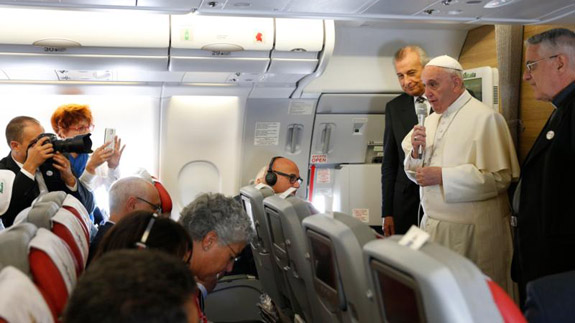
Pope Francis speaks to journalists aboard his flight from Rome to Havana Sept. 19. (CNS photo/Paul Haring) See POPE-CUBA-ARRIVE Sept. 19, 2015.

Why do the Freemasons Love Pope Francis? Part II
OnePeterFive OnePeterFive April 28, 2017

Editor’s Note: This is the second part of a longer three-part study of how the Freemasons in the world have responded to Pope Francis and his papacy. Without further introduction, we continue herewith the collection of quotes and varied evidence to show just how much Masonry approves of Pope Francis.

Part Two of Three Parts: Part I | Part 2 | Part 3 (not yet available)

Continuation of the collection of quotes:

18) On Saturday, March 2, 2013, Mario Rolleri 33° (thirty-third degree) published on the Spanish-language Masonic news site, Fenixnews, a couple of sentences in defense of human rights, as they were made by the then-Cardinal Bergoglio, in 2009 and 2012. The title of the article is “Bergoglio: The Pope in 02 Phrases” (“Bergoglio: el Papa en 02 frases”).[1] And you see the photo of Pope Francis. But what is strange: the article is dated March 2, 2013 — while on the other hand Bergoglio was elected Pope only 11 days later, i.e., on March 13, 2013! Is it the wrong date on which the article was posted (02 March 2013), or was the name of the future pope already known before his official election? In this regard it is impressive what our colleague Sandro Magister noted in his recent article which is entitled “The Man Who Had to Be Elected Pope.”[2]

19) In days not specified, but in the early days after the election of Pope Francis in March of 2013, the Mason Oscar Bartoli wrote an open letter to the pope rejoicing at his election, and he thus concludes:

But as a half-practicing [sic] Catholic in constant trouble for the inner conflict with my culture of doubt, I want to tell you that I hope, together with the billion and two hundred million other Catholics throughout the world, that his election to the papal throne can really be a moment of genuine revitalization of our faith, battered by the plagues that are surfacing in the life of the Vatican for so long.

They need his example for the believers, the just believers, the quasi believers, the agnostics and atheists. And those who, disgusted with the good behavior of the ”bureaucracy” in clerical garb, have at times fled into a personal dialogue with God, overturning dogmas and teachings. Good work, Dear Francis I, and may the Lord protect it, along with his clergy.

Oscar.[3]

Oscar Bartoli is an Italian Freemason of the Grand Orient of Italy — Palazzo Giustiniani[4] — a resident of Washington, D.C., member of the Rotary Club of Washington D.C.,[5] and founder of the Italia Lodge 2001 in Washington (in obedience to the Grand Lodge of Washington).[6]

20) The Peruvian Mason Mario Rolleri 33° must have been so excited about the election of Papa Bergoglio that, on March 15, 2013, he posted on Fenixnews the first words of the new Pope. The article ends with the words of the crowd “Long Live the Pope!”[7]

21) Mario Rolleri, 33rd degree and Grand Master of the Grand Orient of Peru [at least in 2017], executive director of Fenixnews, offered interesting public praise of Papa Bergoglio on Sunday, March 17, 2013. Rolleri 33° praised Pope Francis for his humility, humanity, and firmness. Rolleri felt that many things would change in the Church and that “His Holiness Francis” must appoint a new Secretary of State. Rolleri 33° greeted Pope Francis fondly, wishing him an extended and fruitful pontificate.[8] It does not appear that Rolleri ever made a similar greeting to Pope Benedict XVI.

22) On Friday, March 20, 2013, on Fenixnews, Mario Rolleri 33°, in another laudatory article on the new Pope, stated his belief that with Pope Francis Freemasonry could begin a fruitful dialogue.[9]

23) On Friday, March 29, 2013, on Fenixnews, Mario Rolleri 33° reported the long positive testimony about Pope Francis by the Venezuelan Jesuit Luis Ugalde, director of the “Centro de Reflexion y Planificación Educativa” in Caracas. Fr. Ugalde had met Bergoglio in 1983. Father Bergoglio had, he said, saved the lives of many victims of political persecution. Father Ugalde affirmed that Pope Francis would have to change many things in the Church.[10] (Obviously, the Mason Rolleri 33° was content with this idea!)

24) On Sunday, March 31, 2013, in another article appreciative of Pope Francis, Mario Rolleri 33° already [so soon after his election] announced that with the new Pope, there will be news of changes and unexpected decisions.[11]

25) On Thursday, April 11, 2013, the Mason Mario Rolleri 33° was still praising Francis on the Fenixnews website, and this time he even called upon the Hebrew Kabbalah for help! In fact, Rolleri compared Pope Francis with the number 13, since he was elected on March 13. Rolleri explained that for the Hebrew Kabbalah, 13 is not a number of “bad luck” but draws the purpose of creation. For the Kabbalists, there is neither good luck nor bad luck. Rolleri wrote that Cardinal Bergoglio did not have the luck to be elected Pope, but rather that he constructed this reality by his own actions.[12] Rolleri invoked the Light of the Creator upon Pope Francis and upon his message of love and care for all human beings.[13]

26) On Saturday, May 11, 2013, again on the Masonic website Fenixnews, Juan Orrego wrote that the Argentine Freemasons, the “Gran Logia de la Argentina de Libres y Aceptados Masones”, welcomed the election of Pope Francis. Orrego notes that the relations between the Church and Masonry in Argentina had improved in recent decades. In the late 1990s, the Masons met with the episcopacy. Today, the relations are very cordial, although the Vatican maintains that the positions of Freemasonry are incompatible with those of the Church. The election of Pope Francis had effected an improvement of the relations between Church and Freemasonry.[14]

27) On 12 June 2014, at the presentation of the book by Ignazio Ingrao The Secret Council (Il concilio segreto — Piemme Publisher, 2013), the Grand Master of the Grand Orient of Italy, Stefano Bisi, stated among other things (about the relations between Church and Freemasonry) that the opening of the Church to the world “seems to find new momentum with Pope Francis. There are many premises for a new season of the Church, in dialogue with the world. Now we need to see whether the expected reforms will follow from them.”[15]

The event was also attended by Marco Politi (Vatican correspondent of Il Fatto Quotidiano) and Alberto Melloni (historian of the “Bologna school”) who also stressed the “new and strong innovative drive” of the Pontificate of Francis who wants “a remodeling of the Church in its appearance” and “a review of the pastoral care of interpersonal relationships.”[16]

Still on the subject of the Pope Francis pontificate, we read in the Masonic Bulletin:

And this “leap forward of the Church in modern society” then and now pleases Freemasonry, which today just as during those hot years has again taken to follow with interest the changes that are outlined Oltretevere [in the Vatican]. […] Politi said that several prelates and scholars in recent years have proposed to hold a Vatican [Council] III, but perhaps, noted the journalist, there is not even a need for it. The season of the Church reforms is, in fact, now already open. [emphasis added][17]

28) To the journalist Andrea Scanzi of the newspaper Il Fatto Quotidiano, in 2014, Michela Scolari (the sole custodian of the memories of the Mason Licio Gelli), declared that 6-7 years ago, Pope Francis (then Cardinal Bergoglio) visited Licio Gelli at the Villa Wanda in Arezzo. Gelli, head of the famous P2 Lodge, was a Mason with excellent connections with Freemasonry and the Argentine political class in the 1970s and 1980s. To Scolari, Gelli revealed that he knew Bergoglio since 1973, when Gelli was the Argentinean Plenipotentiary Minister and great friend of Peron.[18]

29) On the website of the Grand Lodge of the Italian Symbolic Rite (made up of Master Masons of the Grand Orient of Italy), we read a speech of March 13, 2014, by the Mason “M: .A :. Dominic P.” who praises Pope Francis and sees in him an opening for reconciliation between Freemasonry and Church.”[19]

30) In the issue of March 2014 of Alpina, the Swiss Masonic magazine, the Mason Pierre-Alexandre Joye writes that Church and Freemasonry are based on different traditions, but with Pope Francis’ election, the South American Jesuit, one can relaunch the Masonic-Catholic dialogue. The spiritualist forces should not be divided, but united for the sake of social justice, human rights, freedom. Church and Freemasonry must not stop at what divides but must aim at what unites.[20]

31) Once more, in the Masonic journal Alpina, in March 2014, in the article “Towards a possible constructive cohabitation?” (in the paragraph “An era more conciliatory”), the Mason Daniele Bui makes it clear that while the incompatibility between the Church and the Lodge remains, however, with Pope Francis many Masons hope precisely for a “more conciliatory” attitude on the side of the Holy See.[21] Bui believes that the grounds of incompatibility does not prevent a joint collaboration between Catholics and Masons for the promotion of human rights.

32) In his last speech as Grand Master of the Grand Orient of Italy (in April of 2014), the lawyer Gustavo Raffi said, according to a report:

“The world is changing at a speed which, a few years ago, would have been completely unimaginable. This ‘liquid’ world — to use the term coined by Zigmunt Baumann — is radically transforming all the ‘rigid’ structures which the sea of the past has deposited on the shores of the present,” said Raffi. “Just look back inside those walls that separate Italy from the Vatican to understand — he added — that something is changing. We observe with care and respect as this Pope is accelerating the timing of an epochal change within the horizon of structures traditionally reluctant to welcome the innovative ferment. And the reflections of his influence echo far beyond the borders of the sacristy. But it’s also up to us. It’s up to us to make the crossing of this liquid reality happen. It is also up to us to deal with the changing contemporary world. With the claim — never betrayed — to be always contemporary to posterity.” “That is what calls us to make our identity as Italians and Freemasons — he observed — and to set sail and navigate with confidence into the future, whatever it has in store for us.”[22]

33) In the May-June 2014 issue of The Wayfarer, Bulletin of the MN-River Valley Lodge # 6 (Grand Lodge AF & A.M. of Minnesota), the “Chaplain” of the Lodge, Dan Ploenzke, in his column “Words of Wisdom,” also quoted an excerpt from the book [sic – a mistake by The Wayfarer] by Pope Francis “Let Us Be Lights of Hope,” which speaks about hope, an openness to the surprises of God and about living in joy. The Mason Ploenzke really liked what the Pope writes about being open to be surprised by God: “Everyone who is a man or a woman of hope — great hope that gives us faith — knows that even in the midst of difficulties God acts and surprises us.”[23] Moving.

34) On August 25, 2014, on the website of the Brazilian Freemasonry, Grand Orient do Brasil, the Mason Barbosa Nunes praises Pope Francis because he is building a new church:[24]

Jorge Mario Bergoglio, “Pope Francis,” formerly called “Cardinal of the Argentine Poor” for his social role. He continues to assume the greater representation of the Catholic Church and of head of state. He has not stopped, he is taking safe steps to build a new church. A new style in the Vatican, an image of a personality which knows and faces challenges ahead. [emphasis added]

The Mason Nunes praises the divine wisdom (“sabedoria divina“) of Pope Francis and hopes that the words of the Pope are the subject of meditation in the days of study of the Masonic Lodges.[25]

35) In 2014, on the occasion of the reunion of the Grand Lodge of Free & Accepted Masons of Florida (USA), the Grand Orator of the Grand Lodge, Gilbert Weisman, not only quoted enthusiastically the work “Morals & Dogma” by the Mason Albert Pike 33rd degree (an esoteric and occultist Mason), but also mentioned some words from the homily held by Pope Francis on 1 January 2014, in which the Pontiff stated that we are all children of the Heavenly Father, that we all belong to the same human family, and that we share the same common destiny; and that we thus all have to work to create a Community of Brothers. Weisman stated that Pope Francis could have addressed such a great speech to a body of Masons.[26]

36) In April 2015, before the visit of Pope Francis in July to Latin America, Grand Master Edgar Sanchez Caballero and his Gran Logia Symbolica del Paraguay wanted to meet the Argentinean Pope. The Paraguayan Masons declared that they admired Pope Francis for his leadership of the Church and that they hoped that he could influence the ecclesiastical hierarchy of Paraguay by changing the way of thinking of the Bishops and thus promoting a greater fraternity and a greater openness of the Catholic Church. The Grand Master Caballero expressed his hope in the renewal of the Bishops:

The change of the head of the Catholic Church and the message of the opening given by the current pope – says the Grand Master – was not yet “digested” in the Paraguayan ecclesiastical hierarchy, whose mentality will change as the bishops renew.[27]

37) On April 9, 2015, Mario Rolleri reported on Fenixnews about an interview with Nicolas Orlando Breglia, Grand Master of the Grand Lodge of Argentina. Breglia was also convinced that, with Pope Bergoglio, the Church was revising its position towards Freemasonry. According to Grand Master Breglia, Pope Francis was raising the banners of Freemasonry.[28]

38) On April 11, 2015, at the Grand Lodge of the Grande Orient of Italy, held in Rimini, Mason Claudio Bonvecchio presented his book The Hour of Dialogue. The Pope, the Church, Freemasonry – interview by Sabatino Alfonso Annecchiarico [L’ora del dialogo. Il Papa, la Chiesa, la Libera Muratoria – intervista di Sabatino Alfonso Annecchiarico] (Mimesis Editrice). A brief summary of the book, which is a new “sweet talk” for Pope Francis:

Faith, reason, humanism, spirituality, pairs of concepts, values – they have diverged in the history of the Christian Church and secular culture. Especially now, with Pope Francis’ impulse, the time of this misunderstanding seems to have ended. The Church of the people’s pope returns to talking about feelings, but also about the rational confrontation with society and history. This book builds a bridge for the most delicate, but most profitable, confrontation. It is a possible document for a new alliance that has man as its object [a “cult of man”]. An initiative of a dialogue without discount on the side of a free, mature rationalism of the Masonic culture, but without foreclosure.[29]

39) In the May 2015 issue of the Bulletin of the York Lodge No. 22 A.F. & A.M. (Kennenbunk-Maine USA), the Mason Donald Beane wrote that the Masons must learn from Pope Francis who speaks of all peoples as part of the Human Family, with one Father for all:

As Masons, we tend to follow the example of Pope Francis who talks of all people as the Human Family. It is a family with one Father for all, who seeks to help us find our way to him through faith and understanding.[30]

40) On June 25, 2015, a Press Release of the Grand Lodge of Italy Obedience of the Piazza del Gesù Palazzo Vitelleschi claimed that the Sovereign Grand Commander Grand Master Antonio Binni had received with homage a copy of the Kabbalistic text “Zohar,” coming from the international organization “Zohar Project.” The GLDI statement specified that the same gift was given to Italian institutions and also to Pope Francis.[31] In this sense, the GLDI seemed to render some oblique or indirect praise to the Roman Pontiff or, in any case, to convey the idea of a certain convergence, tuning, or affinity between the Grand Master Binni and Pope Francis.

41) On August 24, 2015, Oscar Bartoli, Italian Mason of the Grande Oriente d’Italia,[32] resident in Washington, D.C. and a member of the Rotary Club of Washington D.C.,[33] founder of the Italia Lodge 2001 in Washington (at the obedience of the Grand Lodge of Washington),[34] published on his website an article by Rosario Amico Roxas which is all a form of praise for Pope Francis.[35]

42) On September 4, 2015, the same Oscar Bartoli reported in the article, “This communist and anti-Catholic Pope (according to some),” that some of his own acquaintances (one of his friends, his former pastor, and an intimate friend of cardinals and curial members) see in Pope Francis a danger to the Catholic Faith and to society (e.g., too much “easiness” or “laxity” in the practice of the declaration of nullity of marriage, excessive openings toward the divorced and remarried and toward homosexuals, confusion among believers, a forced and indiscreet welcome of immigrants, too much sympathy shown to Fidel Castro, too much hostility shown to Trump and the Republicans, a philo-U.S. democratic attitude). At the end of the article, Mason Bartoli then commented as follows: “Pope Francis follows the example of the divine Poet: ‘Do not look back after them, but see and go on.’”[36]

43) Oscar Bartoli also cared for an esoteric periodical, Stenterello, which, in October 2015, praised Pope Francis as “a Pope with a prophetic and revolutionary language,” and as “a bridge maker among the peoples.”[37]

44) From 15 to 19 January 2015, Pope Francis was in the Philippines. In those days, a photo appeared in the Internet of a poster – or of a supposed page of a Philippine journal (Philippine Daily Inquirer) – with a welcome to the pontiff (“Welcome to Pope Francis, the Pope of Mercy and Compassion”), a welcome given on the part of the Grand Lodge of the Philippines.[38] Someone said that this piece of news is false[39] (“fake news”), but it does not seem very convincing in the light of the following points.

45) In fact, in the official journal of the Philippine Grand Lodge, The Cabletow (vol. 92, n. 1, May-June 2015), Grand Master Thomas Rentoy III candidly states that, after having observed the liberal views of Pope Francis (“after the elevation of Pope Francis to the Holy See and noting the pontificate’s liberal views”) up to the end of 2014, his predecessor Grand Master Alan Purisima, in a letter to Pope Francis, then asked that the Holy See declare that the Freemasonry of the Philippines is compatible with the Catholic Church and that its members are not any longer subject to excommunication. Moreover, the Philippine Masonry recently requested from the Filipino Bishops a chaplain so as to celebrate Mass every Sunday at the Grand Lodge.[40] We do not yet know the Pope’s response to this request from the Philippine Freemasonry. We do know, however, the answer of the Philippine Bishops (CBCP). We shall see it in the next section.

46) In the issue 4 (November-December 2015) of the magazine The Cabletow, the Mason Jesse D. Alto announced that the Grand Master in charge, Thomas Rentoy, had managed to obtain permission from the Philippine Catholic Church that a Catholic priest may celebrate Mass every Sunday at the headquarters of the Grand Lodge of the Philippines. Alto also wrote that, with this permitted event, centuries of erroneous beliefs, finally, were to be eradicated which had taught that the teachings of Freemasonry were contrary to those of the Catholic Church. Even more so, Alto further “perfumed with incense” Pope Francis himself by enthusiastically citing some passages from the pope’s Christmas homily. The Mason Alto thereby apparently wants to convince us that both Masons and Catholics together teach that man is a spiritual being.[41]

[1] http://www.fenixnews.com/2013/03/02/bergoglio-el-papa-en-02-frases/

[2] http://www.onepeterfive.com/man-elected-pope/

[3] http://oscarb1.blogspot.it/2013/03/lettera-aperta-francesco-i.html

[4] http://www.grandeoriente.it/conferenza-mondiale-delle-logge-garibaldi/

[5] http://stenterellonewsletter.blogspot.it/: “Oscar Bartoli, lawyer, journalist, collaborates with many Italian media. He resides in the United States since 1994 and lives in Washington, D.C., Los Angeles and Bangalore (India). Being a Rotarian for a long time, he is now part of the Washington Rotary Club.”

[6] S. Bisi (Gran Maestro GOI), L’abbraccio telematico con i fratelli americani ha inaugurato una nuova via di comunicazione massonica, in Stenterello – Periodico di Approfondimento Esoterico, Newsletter, Anno II, Ottobre 2014, p. 4.

[7] “‘Hermanos y hermanas de la noche buena, ya sabes que el deber del cónclave era dar un obispo en Roma y parece que mis hermanos cardenales le han recogido en el fin del mundo … pero estamos aquí.’ Estas son las primeras palabras del primer Papa Francisco de la Iglesia Católica. Jorge Mario Bergoglio, argentino, de 76 años, un jesuita, 266 º Papa, es también la primera en Sudamérica. El humo blanco que anunció al mundo su elección se produjo en la quinta votación, el segundo día del cónclave. Una encuesta realizada en más de lo necesario, hace ocho años, para la elección de Benedicto XVI. La chimenea de la Capilla Sixtina comenzó a fumar a 19.06, la plaza de San Pedro repleta de fieles desde la mañana estalló en un rugido: ‘¡Viva el Papa! ¡Viva el Papa‘” http://www.fenixnews.com/2013/03/15/el-argentino-bergoglio-es-papa-francesco/

[8] “We see an important and key task that His Holiness Francis must still resolve: it is that of the Vatican Secretary of State. Knowing Bergoglio’s thinking, he will surely choose a firm follower of his ideas.
One thing is certain: with Francisco, you can be kind; one can be different and he will accept it. One can be a sinner and he will know how to forgive. But the Argentine government must keep in mind that the new Pope is not the person with whom to maneuver politically, nor to play.
We therefore offer a warm welcome to His Holiness Francis and wish him a long and fruitful pontificate. It may be anticipated that, for those of us who are Roman Catholic, surely many things will change. Besides the name, [there is] the face and the style.” http://www.fenixnews.com/2013/03/17/francisco-bergoglio-de-origen-humilde-es-nuevo-papa/

[9] “To Freemasonry itself, the election of a pope matters little or nothing, since it has been persecuted in a permanent way, without valid arguments and with the aggravating [fact] that the Pope who condemned Masonry, for two years was blind and depended upon his advisors. In light of the questionable conduct which the members of the Roman Curia fell into, is it valid to sustain such conduct? Is it valid that we keep quiet? Is it time for the Masons to get down to work through dialogue in depth about this topic? I believe that a sincere, respectful, profound dialogue, leaving aside historical antagonisms, between Church and Masonry can be very beneficial for both institutions and schools of thought and life. I believe that this pope, because of his formation and of the charism of his [Jesuit] Order, may be willing to initiate a kind of dialogue which, with the passing of time, can yield more than interesting fruits. If they knock on our door, are we able to open it?” http://www.fenixnews.com/2013/03/20/el-papa-argentino/

[10] “He adds that Pope Francis has the task of changing many things in the Church: ‘Some things have accumulated over thousand years, from a court palace in the external style, which does not always allow the Gospel to be seen and translated, for which the symbol of St. Francis is very important.’” http://www.fenixnews.com/2013/03/29/algunos-perseguidos-de-venezuela-y-paraguay-lo-pueden-contar-gracias-a-bergoglio/

[11] “The reign of Francis will be marked by the news of changes, by the unexpected decisions in a court that had become stagnant and by the irrevocable commitment of the Pope to the most dispossessed of the world.” http://www.fenixnews.com/2013/03/31/francisco-viajo-a-roma-convencido-de-que-no-seria-elegido/

[12] “Cardinal Bergoglio had no ‘luck’ to be elected Pope, Pope Francisco created that reality with his actions, and they have not been few.” http://www.fenixnews.com/2013/04/11/cual-es-la-relacion-del-nuevo-sumo-pontifice-y-el-numero-13/

[13] “Que la Luz del Creador ilumine a Francisco y su Fuerte mensaje de Amor y Cuidado por todos los seres humanos.” http://www.fenixnews.com/2013/04/11/cual-es-la-relacion-del-nuevo-sumo-pontifice-y-el-numero-13/

[14] Here is the final part of the article: “Las relaciones entre la Iglesia en la argentina y los masones mejoraron en las últimas décadas. Incluso, a fines de los ‘90 los masones se reunieron oficialmente con el Episcopado. De hecho, hoy los vínculos son muy cordiales. Pero el Vaticano sigue considerando incompatibles sus posiciones. Por tanto, afirma que un católico no puede ser masón. La elección de Francisco obró como una mejora de la relación.” http://www.fenixnews.com/2013/05/11/la-masoneria-argentina-expreso-su-reconocimiento-por-el-papa-francisco/

[15] Massoneria e Chiesa, in Erasmo notizie, Bollettino d’informazione del Grande Oriente d’Italia, Anno XV, N° 11-12, 30 June 2014, Rome, p. 6.

[16] Ibid., p. 7. Emphasis added.

[17] Ibid.

[18] Cf. A. Scanzi, In un film racconterò segreti e verità di Gelli, in Il fatto quotidiano, 6 settembre 2014, p. 13.

[19] M:. A:. Domenico P., Massoneria e Chiesa: Papa Francesco, Or:. Ravenna, 13.3.2014, in http://www.ritosimbolico.it/rsi/2015/05/massoneria-e-chiesa-papa-francesco/. Reported are some words of the Mason Dominic P.: “One glimmer of light for the mutual understanding and conciliation comes, in my opinion, from the interview that the Pope gave last year to Eugenio Scalfari, the director of the newspaper La Repubblica. A conversation which I would call ‘disturbing’ but in a good way. […] When the pope is asked the question: ‘Your Holiness, is there a single vision of the Good? And who decides what it is?’ he replies surprisingly that ‘Each of us has a vision of good and of evil. We have to encourage people to move towards what they think is Good […] Everyone has his own idea of good and evil and must choose to follow the good and fight evil as he conceives them. That would be enough to make the world a better place.’ These are words by which one is authorized to call into question one of the motives which, historically, the Catholic Church accused Freemasonry of, namely: ‘the Masonic method is […] incompatible […] because it is based on a symbolic and relativistic concept of the whole which is completely unacceptable for a Christian […]’ He remembered a recent speech of C: M mo :. TO:. [“Dearest Master Architect”]. The age-old question of relativism; it seems to me, in fact, anxiously boring and captious; and rightly so, the mentioned speech of M: .A :. concluded that “the true nature of modern relativism […] conjugates with dogmatism.” Nothing could be further from Freemasonry, but it would seem even far from the mind of Francis for His reference to good and evil and the value that each of us can give to the good and to evil is equivalent to an admission of relativism, which would seem unthinkable in a pope. In this sense the pope’s expressions provides a glimpse into an unexpected widening of the Catholic conscience that explains his often repeated call to Mercy. […] In this announced process, if it is confirmed, it is highly likely that the Pope — and with him the Catholic Church — will meet with Freemasonry; and it will be inevitable just to honor the principles we believe in, sit down to a consultation table and to strip down the heavy trappings that men — and not the institutions — have put up as a separation fence between what is inside (the just way) and what it is outside (the unjust, the different, the other way).” [emphasis added]

[20] Cf. Alpina, Magazine maçonnique suisse – Grande Loge Suisse Alpina, Nr. 3/2014, p. 3.

[21] “However, many have suggested that behind the latest and most revolutionary events coming from the Vatican since Pope Benedict XVI’s resignation there is a Masonic design. It is rumored that even the election of the new Pope is the work of the Lodges. After a closed-in papacy like the one of Ratzinger, it is likely that there are many of the affiliates to hope in the advent of a more conciliatory era thanks to the Jesuit Bergoglio. This is at least the idea of Giacomo Galeazzi, Vatican correspondent of La Stampa, and Ferruccio Pinotti, journalist and writer (who is long since interested in Freemasonry) in their recent book The Masonic Vatican. Lodges, Money, and Occult Powers: the secret of the Chrch of Pope Francis [Vaticano Massone. Logge, denaro e poteri occulti: il segreto della Chiesa di Papa Francesco].” D. Bui, Verso una coabitazione costruttiva?, in Alpina, Nr. 3/2014, pp. 8-9 [emphasis added]. See also http://www.freimaurerei.ch/i/alpina/artikel/artikel-2014-03-01.php

[22] Raffi, il “mondo liquido” e la missione della massoneria, in Erasmo notizie, bollettino del Grande Oriente d’Italia, anno XV, numero 7-8, 30 April 2014, Rome, p. 6, our boldening.

[23] http://www.mn-rivervalley.org/wayfarer/2014/may_june_2014.pdf

[24] Barbosa Nunes, A verdade no Papa Francisco, in https://www.gob.org.br/a-verdade-no-papa-francisco-artigo-de-barbosa-nunes-para-o-diario-da-manha/

[25] See ibid.

[26] “As Pope Francis pointed out in his New Year’s Day Service on January 1, 2014: ‘We are all children of one Heavenly Father, we belong to the same Human Family, and we share a common destiny. This brings a responsibility for each to work, so that the world becomes a Community of Brothers who respect each other, accept each other in one’s diversity, and take care of one another.’ He could just as well be speaking to a body of Freemasons.” http://grandlodgefl.com/archive_2014/grand_oration_2014.html

[27] http://m.ultimahora.com/masones-quieren-saludar-al-papa-y-poner-fin-al-conflicto-la-iglesia-n886764.html

[28] “Do you see a change in the Catholic Church since Jorge Bergoglio was appointed as Pope? ‘We have no confrontation with Bergoglio. On the contrary, the Pope appears raising our flags. When he comes in, he says that he is republican, secular, democratic and anticlerical. For all that we were sanctioned and excommunicated. If he raises our flags, after having fought us for so long, I realize that the Church is revising her position.’” http://www.fenixnews.com/2015/04/09/masoneria-el-resurgir-de-una-sociedad-que-ha-hecho-historia/

[29] http://www.agenparl.com/gran-loggia-2015-servizio-biblioteca-gli-appuntamenti/

[30] http://www.masonsinmaine.org/york22/TB052015.pdf

[31] http://www.granloggia.it/ufficiostampa/zohar-il-libro-dello-splendore ; https://giving.kabbalah.com/the-zohar-project/

[32] http://www.grandeoriente.it/conferenza-mondiale-delle-logge-garibaldi/

[33] http://stenterellonewsletter.blogspot.it/:“Oscar Bartoli Avvocato, giornalista pubblicista, collabora con molti media italiani. Risiede negli Stati Uniti dal 1994 e vive tra Washington D.C., Los Angeles e Bangalore (India). Rotariano di lunga data, attualmente fa parte del Washington Rotary Club.”

[34] S. Bisi (Gran Maestro GOI), L’abbraccio telematico con i fratelli americani ha inaugurato una nuova via di comunicazione massonica, in Stenterello – Periodico di Approfondimento Esoterico, Newsletter, Anno II, Ottobre 2014, p. 4.

[35] R. Amico Roxas, Papa Francesco ultima spiaggia del cattolicesimo cristiano, in http://oscarb1.blogspot.it/2015/08/papa-francesco-ultima-spiaggia-del.html

[36] http://oscarb1.blogspot.it/2015/09/questo-papa-comunista-e-anticattolico.html

[37] Cf. Editoriale – Creare ponti per una migliore e reciproca comprensione, in Stenterello – Periodico di Approfondimento Esoterico, Newsletter, Anno II, October 2015, pp. 1-2.

[38] https://veritas-vincit-international.org/2015/01/17/grand-lodge-of-masons-buy-full-page-newspaper-ad-to-welcome-pope-francis/

[39] http://www.traditioninaction.org/ProgressivistDoc/Snap/A_176_Philippines_1.jpg

[40] Cf. MW Thomas G. Rentoy III, A Revitalized, Relevant and Revered Philippine Freemasonry: Our Committment, Our Covenant, in The Cabletow, The official organ of the M.W. Grand Lodge of Free and Accepted Masons of the Philippines, Vol. 92, n. 1 – May-June 2015, Manila, pp. 22-23 (14-23).

[41] VW Jesse D. Alto, Realisation in Oneness, in The Cabletow, The official organ of the M.W. Grand Lodge of Free and Accepted Masons of the Philippines, Vol. 92, n. 4 – November-December 2015, Manila, pp. 11-12.

Note: this article has been edited for style and content. Other versions that may appear online may therefore differ slightly.

Print Friendly

Posted in Uncategorized | Comments Off on WHY DO THE FREEMASONS LOVE FRANCIS ??? PART 2 OF 3

Ah! Sweet mystery of life At last I’ve found thee !!! Ah! I know at last the secret of it all; All the longing, seeking, striving, waiting, yearning !!!

APRIL 26, 2017
Obergefell and the Apotheosis of Judicial Will
SCOTT P. RICHERT
CRISIS MAGAZINE
New Supreme Court Justice Neil Gorsuch, left, stands with his mentor, Supreme Court Justice Anthony Kennedy in the Rose Garden of the White House, Monday, April 10, 2017, during Gorsuch’s public swearing ceremony. (AP Photo/Evan Vucci)
With the confirmation of Neil Gorsuch to the U.S. Supreme Court, many social conservatives breathed a sigh of relief. From what we know of his record, Justice Gorsuch does seem to be a worthy successor to Justice Antonin Scalia. Even if Gorsuch is somewhat less distinguished as a legal mind than Scalia, he is clearly politically astute. He ably navigated the minefield that has faced all Republican appointees to the Supreme Court since the nomination of Judge Robert Bork; unlike previous nominees who made the disingenuous argument that they had never considered what they would do if presented with a case that provided an opportunity to reconsider Roe v. Wade (1973), Gorsuch argued—and rightly so—that he could not consider how he would vote on any possible future case without knowing the details of the case, and of course he would not know those until the case was argued before the Court. Gorsuch had obviously studied the hearings of previous nominees and learned appropriate lessons from them; future Republican nominees would do well to learn this particular lesson from Gorsuch.

Still, other social conservatives continue to hold their breath, and not without reason. Justice Gorsuch’s discussion in his nomination hearings of the weight he places on judicial precedent offered no clear signal as to whether he would regard Roe as a precedent to be upheld or as a case to be removed from the chain of precedent because it was wrongly decided. And his seeming acceptance of homosexual “marriage” in his personal and religious life would, at the very least, be at odds with any future vote to overturn the Court’s decision in Obergefell v. Hodges (2015). Add to that the odd signals sent by the man who appointed Gorsuch to the Supreme Court—after his election, Donald Trump declared in an interview with 60 Minutes that the two-year-old Obergefell is “settled” law, while the 44-year-old Roe is not—and it’s clear that this opera won’t be over until Justice Gorsuch sings.

The preoccupation with reading the tea leaves regarding Gorsuch’s potential future votes, however, has kept the eyes of both those who trust the new justice to do the right thing and those who are more skeptical that he will do so off of the elephant in the courtroom. With the Obergefell decision, the dynamic of the Court changed dramatically for the foreseeable future. Indeed, future historians (assuming there still are historians in the future) might well say that, with Obergefell, the United States passed into a new constitution, in the way that both the British and the French would understand that term. Judicial supremacy is no longer a threat to the separation of powers enshrined in the Constitution of the United States; it is the foundation of a new form of government—at least as regards anything touching upon what has come to be known as “gender,” including all matters sexual and the social institutions that flow from them.

The seeds of this new constitution were planted almost two decades ago by Justice Anthony Kennedy, the author of the Obergefell decision, in his much-derided “Mystery Passage” in Planned Parenthood v. Casey (1997):

Our law affords constitutional protection to personal decisions relating to marriage, procreation, contraception, family relationships, child rearing, and education. Our cases recognize “the right of the individual, married or single, to be free from unwarranted intrusion into matters so fundamentally affecting a person as the decision whether to bear or beget a child.” Our precedents “have respected the private realm of family life which the state cannot enter.” These matters, involving the most intimate and personal choices a person may make in a lifetime, choices central to personal dignity and autonomy, are central to the liberty protected by the Fourteenth Amendment. At the heart of liberty is the right to define one’s own concept of existence, of meaning, of the universe, and of the mystery of human life. Belief about these matters could not define the attributes of personhood were they formed under the compulsion of the state.

When people refer to the Mystery Passage, they mean the italicized line in the quotation above. It’s easy to reduce that line to an object of ridicule; it reads like the précis for a term paper in a freshman philosophy class. But read in the context of the entire paragraph, the Mystery Passage is no laughing matter. The “right to define” is also the right to redefine; and right there, in 1997, long before any of these United States had attempted to declare that the sky is green and the grass is blue and a man could be wife to another man, Justice Kennedy placed the right to (re)define reality regarding “marriage, procreation, contraception, family relationships, child rearing, and education” at the “heart of liberty,” which the 14th Amendment declares no “State can deprive any person of … without due process of law.”

Because the Mystery Passage was written in the service of the status quo—upholding Roe v. Wade—it was easy to dismiss at the time as sheer pettifoggery; and, conversely, it was easy to deride as Chicken Littles those who, like Justice Scalia, saw where the Mystery Passage would one day lead. Yet Justice Scalia lived long enough to be proved correct.

At no point in his Obergefell decision does Justice Kennedy cite either the Mystery Passage specifically or Casey in general (only Justice Thomas makes reference to Casey, in his dissent, in which he was joined by Justice Scalia); but Obergefell would not exist were it not for the groundwork that Kennedy laid in Casey. The argument that Kennedy advances in Obergefell is the same as that in Casey. The “liberty” protected by the 14th Amendment guarantees every American the right to redefine marriage and all other matters relating to sexual identity as he/she/zhe desires at any given moment. Those who criticized the Mystery Passage 20 years ago argued that this would lead to an untenable situation—the fostering of a relativism or nihilism regarding the most essential aspects of human life that would undermine the very foundation of human society.

Were this to play out solely in a social sense—that is, were everyone simply to hold his or her or zir own definition of, say, marriage and family—that would be true. But Obergefell revealed how the Mystery Passage would truly play out—not in empowering the individual to construct his own reality in his own image, but by empowering judges to reconstruct reality in theirs.

Casey‘s judicial creation of an individual right to redefine marriage and all other matters relating to sexual identity means that any accepted definition can stand only so long as it is left unchallenged legally. Once it is challenged, the accepted definition becomes a matter for judicial review. But at that point, it no longer matters what you or I or Jim Obergefell thinks marriage means; all that matters is what the judge who hears the case thinks it means. And since such cases will ultimately make their way to the U.S. Supreme Court, all that really matters is what those nine justices think it means.

Just as a demagogue claims to speak for “the people” in order to advance his own interests and agenda, Justice Kennedy’s ruling in Obergefell had less to do with the rightness of the plaintiff’s claims than with Justice Kennedy’s conception of what lies at “the heart of liberty.” Thus, in Obergefell, we see the future of jurisprudence, at least as regards all matters even remotely touching on “gender.” The only limits on what the Mystery Passage can be used to justify—either by citing it directly or simply assuming it as foundational, as in Obergefell—are a federal judge’s imagination and his sense of propriety.

In other words, in Obergefell, Anthony Kennedy completed the transformation of constitutional law in this country that he began in Casey, at least with regard to matters sexual and the social institutions that flow from them. The elephant in the courtroom that most people have yet to notice is that this transformation, at heart, frees judges from the requirement to hew to established law and precedent, let alone broader tradition, since these are based on accepted definitions. Whether any particular judge will choose to follow established law and precedent in any particular case in which the plaintiff desires the redefinition of anything “relating to marriage, procreation, contraception, family relationships, child rearing, and education” is now entirely up to the judge hearing the case.

In the past, a particular judge could choose to disregard established law and precedent and attempt to redefine fundamental reality. But if he did so, there were checks on his will—chiefly, the possibility of being overruled by a higher court. But the elevation of the Mystery Passage to the overriding principle of justice in Obergefell, for all intents and purposes, removes those external checks, making the judge’s will supreme.

That some, or even most, judges might continue to follow established law and precedent for the foreseeable future (perhaps out of the same type of cultural inertia that prevented Barack Obama and Hillary Clinton from embracing homosexual “marriage” earlier than they did) does not change that reality. They do so now not because external structure of American jurisprudence requires them to do so but because they choose to do so.

As I wrote on the day that the decision was handed down, Obergefell proved that the Constitution is a living document, and its name is Anthony Kennedy. Or its name may be Neil Gorsuch. It hardly matters which justice becomes the deciding vote in the future: Unless and until a future Supreme Court drives a stake through the heart of both the Mystery Passage and Obergefell, we live in a judicial dictatorship. The best we can hope for now is that our dictators are benevolent.

Editor’s note: In the photo above, new Supreme Court justice Neil Gorsuch, left, stands with his mentor, Supreme Court justice Anthony Kennedy in the Rose Garden of the White House, Monday, April 10, 2017, during Gorsuch’s public swearing ceremony. (Photo credit: AP Photo/Evan Vucci)

Tagged as judicial activism, Justice Anthony Kennedy, Justice Gorsuch, Obergefell v. Hodges, Planned Parenthood v. Casey, U.S. Supreme Court

15
Scott P. Richert
By Scott P. Richert
Scott P. Richert is the Catholicism Expert for ThoughtCo (formerly About.com) and Editor at Large for Chronicles: A Magazine of American Culture.

Posted in Uncategorized | Comments Off on Ah! Sweet mystery of life At last I’ve found thee !!! Ah! I know at last the secret of it all; All the longing, seeking, striving, waiting, yearning !!!

IT IS OFFICIAL: YOU CANNOT BE A CATHOLIC AND BELONG TO THE DEMOCRAT PARTY. IT WILL NOT HAVE YOU AS A MEMBER. YOU CAN VOTE FOR DEMOCRATS BUT CANNOT BELONG TO THE PARTY.

catholicvote email logo
banner

The Democratic Party charade on abortion is finally over.

Newly-elected Democratic National Committee Chairman Tom Perez has declared that every Democrat must be 100% pro-abortion. And according to an official statement: “that is not negotiable.”

What does this mean?

Tolerance, diversity, and ‘choice’ be damned. Every Democrat must now support the party platform which includes abortion on demand, for any reason, during any month of pregnancy, up to and including partial-birth abortion. And of course, taxpayers must pay for it.

The game is up: Fall in line, or get out.

The Democratic Party has told Catholics who believe in the sanctity of life that they are no longer welcome inside their party. Sure, they’ll take your votes. But when it comes to Catholics and our belief in the dignity of unborn children and the rights of mothers — get lost!

But did you know that 23% of Democrats are pro-life?

Democratic candidates that claim to be pro-life now face a dilemma. Will they challenge their own party leadership? Or will they wimp out, and continue to take millions of dollars from Planned Parenthood and the DNC, and hope to fool voters once again?

Senators Bob Casey Jr. (D-PA), Joe Manchin (D-WV), and Joe Donnelly (D-IN), all face re-election next year. All three ran as ‘pro-life Democrats’ despite their mixed records.

Will they campaign with their party’s chairman?

Will they use DNC staff, and take campaign money from the national party?

And if so, what will they owe Chairman Perez?

If you are a Democrat, you can disagree with your party on health care, religious liberty, taxes, climate change… you name it. But if you are not 100% on board with abortion, then you are dead to them. 

It’s tragic. And I wish it wasn’t so.

In some ways the clarity is refreshing. We’ve endured the phony double-speak long enough.

Now it’s up to us to call them out. Shame them for their intolerance.

And make sure every Catholic voter knows the truth.

 
Brian
Posted in Uncategorized | 2 Comments

TWO DIOCESES, TWO OPPOSING ANSWERS. BOTH CANNOT BE RIGHT. PITY THE POOR FAITHFUL.

Inside the synod hall during the meeting of bishops and cardinals on Oct. 14, 2015.
Inside the synod hall during the meeting of bishops and cardinals on Oct. 14, 2015. (Daniel Ibanez/CNA)
.
COMMENTARY  |  APR. 25, 2017
NATIONAL CATHOLIC REGISTER
A Tale of Two Interpretations of ‘Amoris Laetitia’
COMMENTARY: Guidelines issued by two dioceses offer opposing answers. The Church now faces a crisis of doctrinal and evangelical credibility.

The post-synodal apostolic exhortation Amoris Laetitia  (The Joy of Love) was published one year ago on the solemnity of St. Joseph. Since then, two competing interpretations, or, rather, pastoral applications of Chapter 8 (on divorce, remarriage and the sacraments) have emerged. They are epitomized in two sets of diocesan guidelines, each of which is meant to apply the teaching of the document to respective dioceses.

The first, entitled, “Pastoral Guidelines for Implementing Amoris Laetitia,” was published by the Archdiocese of Philadelphia (hereafter Philadelphia) in July 2016. The second, entitled, “Criteria for the Application of Chapter VIII of Amoris Laetitia,” was published by the archbishop of Malta (hereafter Malta) and his assistant bishop in the neighboring Diocese of Gozo.

Both address the disputed question of whether married persons living in sexually active second unions while their first spouses still live, who have not received a public judgment from the Church declaring the invalidity of the first marriage, may return to the holy Eucharist without resolving to live sexually continent with the second partner (hereafter disputed question). The two guidelines offer opposing answers.

This essay compares and contrasts the two replies. (Philadelphia also offers guidelines on the questions of cohabitation before marriage and pastoral care for persons with same-sex attraction. But this essay only considers the disputed question.) It ends with advice for Catholics who feel confused over the disharmony between the bishops’ pastoral directions.

To orient readers, Malta is a small Mediterranean island 50 miles south of Sicily, with around 380,000 Catholics (out of a total population of 420,000) and 600 priests. Christianity there dates back to St. Paul, who, finding himself shipwrecked on the island on his way to Rome, spent three months ministering to the Maltese (see Acts 28). Catholicism today is the official religion, and Malta’s most famous inhabitants historically are the knights who took the island’s name.

Thirteen miles to the west lies the Diocese of Gozo, with 28,000 Catholics and 169 priests. Archbishop Charles Scicluna of Malta was appointed auxiliary by Pope Benedict in 2012 and made archbishop of Malta by Pope Francis in 2015. Gozo’s bishop, Mario Grech, was appointed by St. John Paul II in 2006. Archbishop Scicluna and Bishop Grech are Malta’s only signatories.


Philadelphia and Malta

Both applications of Amoris Laetitia acknowledge the pastoral challenges of persons living in second unions. And both state that their respective guidelines are meant to assist pastors to accompany such persons. Accompany them where?

To answer, we might look at the direction each points to as it prepares to answer the disputed question.
Philadelphia points to truth and fidelity to the Church’s moral teaching. It says accompaniment must take the route of the Gospel, which is always a way of “truth and charity.”

Accompaniment should assist persons to know the truth that will make them free (John 8:32) and must solicitously avoid the dual errors of relativism, which “ignores the truth,” and rigorism, which “lacks mercy.” And the guidelines promise to “faithfully reflect Catholic belief.”

Malta points to what it refers to as the “new routes” that accompaniment should open up for estranged members. It likens remarried divorcees to the three Magi, “who took adifferent route home after meeting Jesus” (see Matthew 2:12). It says divorcees might have to take a “different route” back to the Church and says God is “able to open up new routes for these persons.” Malta insists its guidelines are “in line with the directions given by Pope Francis.”


Points of Agreement

The two agree on a number of preliminary points. Both acknowledge that the first unions of these persons may in fact not have been valid sacramental marriages; and both admonish those with reasonable doubts to seek the counsel of a marriage tribunal to help to resolve the question.

Both recognize that those who are unable to receive annulments may feel estranged from the Church and alone in their faith journeys. Both say the Catholic community should welcome them and help them feel part of the Church, encourage them to pray with the community, and incorporate them into some parish activities. Both enjoin a process of discernment — Philadelphia, in order to help them “come to an awareness of their situation before God”; Malta, in order to help them become aware “of their life situation in the light of Jesus.”


Examination of Conscience

Because Amoris Laetitia spends considerable time on the notion of conscience, both Philadelphia and Malta quote the following paragraph on elements of an examination:

“Useful in this process is an examination of conscience through moments of reflection and penance. The divorced and remarried should ask themselves: how they have acted toward their children when the conjugal union entered into crisis; if they made attempts at reconciliation; what has become of the abandoned party; what consequences does the new relationship have on the rest of the family and the community of the faithful; and what example is being set for young people who are preparing for marriage” (300).

Philadelphia immediately adds that the pastoral work of discernment aims at finding the truth so as to guide all decision-making in accordance with it. Malta, on the other hand, enters a discussion of the problem of diminished responsibility in evil doing, reflecting on factors that can mitigate free choice. Malta then quotes the curious passage from Amoris Laetitia, 301:

“It can no longer simply be said that all those in any ‘irregular’ situation are living in a state of mortal sin and are deprived of sanctifying grace.”

I say curious because, to my knowledge, the Catholic Church has never said, neither in her theology nor official pastoral practice, “simply” that all those in second unions are living in a state of mortal sin and deprived of sanctifying grace.

Moral theology has always insisted that mortal sin occurs when and only when grave matter is chosen with sufficient reflection and full consent of the will.

Malta’s discussion of mitigating factors obscures the fact that even if a person chooses some object of grave matter — in the case at hand, adultery — with mitigated culpability, the actions are still harmful to them and bad for the unity of the Church.


Disputed Question

Both then turn to the disputed question of the relationship of the divorced and civilly remarried to the sacraments.

Philadelphia says that in order to bear perspicuous witness to the true nature of the Eucharist and of the Church, the following norms must be upheld.

  • To receive holy Communion, one must not be aware of any unconfessed serious sin.
  • If one is aware of such sin, one must confess it with a firm purpose of amendment.
  • It follows that to receive holy Communion, remarried divorcees must confess extramarital sexual intimacy, if such intimacy has taken place, and firmly resolve to live in perfect continence (refraining from any and all sexual acts).
  • Some who do this might continue to cohabit for the sake of their children.
  • To avoid scandal, pastors who administer the sacraments to these couples must be solicitous to avoid giving the impression they support divorce and remarriage, or that Church teaching on this issue may be set aside.
  • For the same reason, continent remarried divorcees should not be given certain important public duties in the parish (e.g., membership on parish council), including liturgical duties (e.g., lector, extraordinary minister of holy Communion).

Malta says something quite different. It asserts that some remarried divorcees may be capable of practicing the virtue of conjugal continence without “putting at risk” elements of their life together. For others, however, living “this ideal” may be “humanly impossible and gives rise to greater harm” (reference to AL, Note 329). Such persons should undertake a process of discernment that includes humility, a love for the Church and a sincere desire for God’s will.

Malta then says that if such discernment leads these people to the belief that they are “at peace with God,” then pastors may not exclude them from the sacrament of the Eucharist. Such persons should be considered for various public duties within the parish, including within “the liturgical, pastoral, educational and institutional frameworks.” They also should be considered “suitable to be godparents.”


Navigating Opposing Interpretations

After the final report of the Synod on the Family was published 16 months ago, I wrote in these pages the following:

If the “way of accompaniment and discernment” is approved, both the progressive and the traditional interpretations would be officially sanctioned. But since the progressive interpretation is in clear opposition to the unambiguous teaching of the Church, repeated continually by the hierarchy in the past four decades, its authorization would badly undermine the Church’s evangelical credibility.

This is exactly what we see in the conflicting interpretations of Philadelphia and Malta. Chapter 8 of Amoris Laetitia lends itself to two opposing interpretations, one of which is fully consistent with the settled and perennial position of the Catholic Church and the teachings of John Paul II and Benedict XVI; the other of which is not. The Church now faces a crisis of doctrinal and evangelical credibility.

And it also faces a crisis of trust among its own faithful members who endeavor to know what’s right and good to do. How can Malta’s interpretation be excluded if it is apparently consistent with papal teaching? This is a good and urgent question that every faithful pastor should be ready to answer.

The norm for Catholic belief and practice is the deposit of faith, the revealed word of God made manifest in the life and teachings of Jesus Christ. That deposit was and is committed to the Church as a kind of sacred trust to be guarded and handed on until Jesus comes again.

The deposit is made known not only in the writings of sacred Scripture but in the definitive teachings of ecumenical councils, the infallible proclamations of popes (which Amoris Laetitia does not constitute, as Pope Francis makes clear in Paragraph No. 3) and in the prayer and worship of the Church’s sacred liturgy.

The singular purpose of ordinary papal teaching (which Amoris Laetitia does constitute) is to assist both those within and outside the Church to understand, receive and live more fully and fruitfully the truths of the deposit of faith. (If some text in ordinary magisterial teaching lends itself to a conclusion that seems inconsistent with some truth or truths of that sacred deposit, then the conclusion cannot be legitimately taken to be a licit interpretation of that text.)

I have argued elsewhere that the divinely revealed doctrines of the intrinsic wrongfulness of adultery and the absolute indissolubility of Christian marriage cannot both be true and at the same time it be true that anyone — including a civilly-remarried divorcee — who is sexually active with someone other than his or her valid spouse while that spouse still lives is not objectively committing adultery.

Malta prescribes that if these people believe they are “at peace with God” (i.e., not committing adultery), that belief, held sincerely and humbly, is a sufficient basis for the Church’s pastors to sanction their return to the sacraments.

This is an egregious pastoral error.

Their belief may suggest they are invincibly ignorant of the objective wrongness of their actions and so not guilty of mortal sin, and if not guilty of mortal sin then not guilty of sacrilege when they receive the holy Eucharist. But this does not imply that pastors may free such persons to receive the holy Eucharist.

Why? Because pastors cannot know that these persons are free from mortal guilt.

As Pope Francis insists, pastors should not be judging sinners’ souls at all. No one can know with certitude the state of another’s soul. Thus, they should focus their energy on helping these people to come to know the truth that will set them free.

To be sure, a blunt assertion of the Church’s exclusionary teaching is unlikely to help many people. But the assertion that they are in full communion with Jesus and his Church and so free to return to the sacraments without reforming their lives is far worse.

So what should pastors do?


Mater et Magister

They should always at once be mater et magister (mother and teacher). As magister they should form consciences. To form consciences they must teach the truth on the indissolubility of marriage and the wrongfulness of adultery. A spurious compassion that hides the truth from those who need it the most is contrary to the true care that a spiritual shepherd should give his flock (Jeremiah 23:1-4).

Pastors should simultaneously be mater. Mothers respect their children and neither overestimate nor underestimate them. A pastor should not act as if the ordering of their lives in the light of the Gospel is an easy thing, as if it poses no great obstacles. He should help them identify the obstacles. He should especially address frankly and sensitively the challenge of living sexually continent with their second partners.

But he shouldn’t underestimate them either. God’s grace can assist them to do what may be impossible by natural strength unaided by grace.

Our pastoral approach, even in the most difficult circumstances, must never fail to insist that because of the death, resurrection and ascension of Jesus, we live in a grace-filled universe, where it is possible for men and women to respond to the high call of Jesus to “follow me” (Matthew 4:19).

Mothers also morally support their children. Pastors shouldn’t inform consciences only. They also should help people to follow their consciences. People in second unions, especially if they have children from the second union, may see no way out. Pastors should help them to see a way out. Offer them hope: Good mothers always offer hope. Help them see that a morally ordered life — not an easy life, but an ordered and upright life — is good and possible: “You can do this.”

And help them see how faithfully responding to the difficult teachings of Jesus on marriage and sexuality is essential for the spiritual well-being not only of themselves, but of their children. Parents who forgo sexual intimacy out of faithfulness to Jesus’ teaching are luminous witnesses to the purity of the Gospel and the integrity of the Church’s teaching.

But the credibility of the Gospel and the Church is jeopardized by those who treat the teachings of Jesus as if they are “humanly impossible.” Jesus’ message on marriage and chastity is a merciful message. It is not bad news; it is Good News.

Moreover, sanctioning the reception of the holy Eucharist while they are still in a situation of objective serious and public wrongdoing is an occasion for scandal. By authorizing their return to the sacraments, the pastors themselves would be occasioning scandal among the faithful and so placing the souls of their parishioners in peril. They also risk giving the impression that the Church’s irreformable teachings on the indissolubility of marriage and the requisites for chastity may be set aside.

This the Church must never do, but especially at the present time, when the truths about marriage and sexuality urgently need to be perspicuously articulated and persuasively defended. Every possible counter-witness to this articulation and defense must be avoided.

Malta’s notion of discernment is flawed. It suggests that true spiritual discernment might lead these persons to conclude that their lifestyle is licit and so they are free to return to the sacraments. But because Jesus never wills us to adopt morally illicit alternatives, discernment, properly speaking, only ever concerns the question of which among a number of morally licit alternatives Jesus wants us to adopt.

So the question of whether or not remarried divorcees should return to the sacraments without ceasing their nonmarital sexual activity is not a matter to be discerned. It is a matter of a straightforward moral judgment that the alternative under consideration is incompatible with the good of marriage and the dignity of the sacrament.

Catholic teaching holds that no one who is sexually active with someone other than his or her living valid spouse may without confessing the activity and resolving to live chastely receive the holy Eucharist. This is not a teaching for the few, for the perfect. It is for every Christian. The fact that some who approach the sacrament under such circumstances are — because of invincible ignorance — in good faith does not justify Catholic pastors in telling those same persons that they are free to approach the holy Sacrament. As Philadelphiastates (quoting Amoris Laetitia): “Discernment can never prescind from the Gospel demands of truth and clarity as proposed by the Church.”

In my opinion, Philadelphia’s guidelines beautifully fulfill the aims of applying Chapter 8 to the concrete circumstances of Catholics who are divorced and civilly remarried in a way that respects truth, expresses charity and remains faithful to the Gospel and the Church’s moral teaching. Its guidelines will help pastors accompany married couples to salutary Christian solutions in the face of marital crises, and do so in a way that guards the spiritual well-being of those being accompanied, their children and the rest of the Christian community.

Philadelphia offers no assembly-line solution. Its guidelines won’t undo overnight the seemingly intractable problems that have arisen over nearly seven decades of largely failed ministry to families.

Each couple, indeed each person in marital crisis, needs to be cared for according to what is spiritually best for him and for her. Among the possible alternatives for responding to the present crisis, Philadelphia offers a good and faithful Christian guide. Malta does not: Its guidelines will leave Catholics stuck in disorderly lifestyles, encourage them to receive holy Communion when they are not spiritually prepared, compromise the Church’s witness to the integrity of Christian marriage and Catholic sexual teaching, and incentivize divorce and “remarriage” for other vulnerable couples who are struggling in troubled marriages.

Pray for the unity of the episcopate.

E. Christian Brugger is professor and dean 

in the school of philosophy and theology 

at The University of Notre Dame in Sydney, Australia.

Posted in Uncategorized | 3 Comments