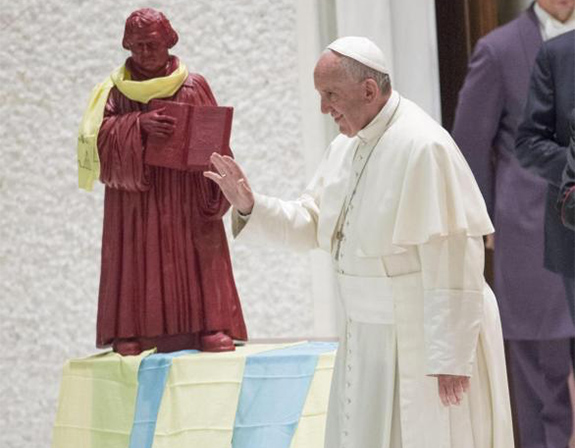
THE LAITY, NOT THE HIERARCHY, WILL SAVE THE CHURCH FROM FORMAL SCHISM

A Short Summary of the 22 April Lay Conference on Amoris Laetitia

FacebookTwitterGoogle+PinterestPocket

Yesterday, 22 April, there took place the important lay conference in Rome which was organized by the Italian publications La Nuova Bussola Quotidiana and Il Timone and which was dedicated to a public critique of the post-synodal exhortation Amoris Laetitia. Already today, there have been several articles about this event published, among them by Dr. Sandro Magister, America Magazine, and La Stampa. Mr. Andrew Guernsey already posted Professor Claudio Pierantoni’s own speech in English translation, as well as a film on youtube of Professor Douglas Farrow’s presentation.

Professor Claudio Pierantoni, who was one of the six speakers at this Rome conference, kindly accepted our invitation to send to OnePeterFive a more thorough and detailed report about the event in a few days which we will post as soon as it is available. So that our readers receive already now a little impression of the event, we herewith present a translation of an article which was published today by La Nuova Bussola Quotidiana itself. The translation has been kindly provided by Mr. Andrew Guernsey.

——————————————————————————————————————————————————————————————————

Lay People, Free and in Love With the Church: as “Hobbits” Call for Truth on the Sacraments, not Revolts

Lorenzo Bertocchi

23/04/2017 “We’re not here for an ideological battle,” said the director Riccardo Cascioli, “but because we feel that we are called to a responsibility.” With this statement the conference yesterday was closed: “Seeking Clarity: One year after Amoris laetitia,” held in a Columbus Hotel room around the corner from St. Peter’s Square organized and promoted by La Nuova BQ and Il Timone.

A conference convened by lay people, with lay speakers from around the world. Many journalists were present, we only remember some big names of Italian vaticanistas like Sandro Magister, Luigi Accattoli, Giuseppe Rusconi and Aldo Maria Valli. Among the foreigner ones were Edward Pentin of the National Catholic Register. There were around 200 people who followed the proceedings of the busy day.

The most important emphasis of the event at the hotel Columbus is precisely the role of the laity, as Valli rightly noted in his article before the conference and published on his blog.

“All too seldom,” he wrote, “are Catholic lay people seen gathered on their own, without the guidance of a cardinal, a bishop, a monsignor or at least a simple priest, to discuss issues that concern first of all the fundamental contents of faith. It is even rarer to see lay people who decide to come out in the open to appeal to the pastors with an admonishment that sounds like so: “Excuse us, but look at what, according to us, you all have produced, that is, something which does not work, and which can become dangerous not only and not so much in an abstract sense, but precisely for the salvation of souls.”

The speaker, Anna Silvas , an Australian university professor, in her intervention brought up the great saga of Tolkien to remember that the laity are like the hobbits of Middle Earth. “Not powerful, but with a fundamental role in the battle for the triumph of good.” The very director Cascioli recalled in his introduction what are the issues of concern that sparked the organization of the conference. “In the dispute over Amoris Laetitia the meaning of three sacraments is implicated: marriage, penance and especially the Eucharist. We have bishops’ conferences, individual bishops, priests, who on the most sensitive issues also give even opposing interpretations and directives. We have such absurdity that, just as an example, the directives to the faithful on access to the Sacraments change not only from country to country but also from diocese to diocese and parish to parish.” Hence the request for clarification that builds on the five dubia that four cardinals have handed over to the Pope so that he may untie the knots on fundamental issues that concern the Catholic moral doctrine and the pastoral practice that follows it.

These prominent speakers, Cascioli said , “come from different cultures, from different ecclesial experiences, they also express different sensibilities and also the way to address the current situation is not identical. But in common we all have the perception of the seriousness of the crisis of the Church and the desire to carry out our personal responsibility fully in order to contribute to the good of the Church itself, in order to call the pastors to their duty.”

The proceedings opened with the intervention of Jürgen Liminski , director of the Institute for Demography, Welfare and Family (Germany), who stressed the social value of the indissolubility of marriage. “A long-lasting marriage,” he said, “guarantees a climate of trust in the bonds of affection and trust is the cement of society. For this reason, stable and non-liquid relationships are a cultural capital useful to society and also to the economy.”

The very articulate speech of Douglas Farrow, professor of Christian philosophy in Montreal. He recalled a certain “Gnostic risk that there is in dividing a judgmental God from a merciful God. And the challenge for the Church today is to raise his eyes to a God who does not need to mitigate justice to give mercy. “ If tradition “cannot contradict itself, paragraph 303 of Amoris laetitia raises the question of how conscience is understood compared to what paragraph No. 56 of the encyclical of St. John Paul II, Veritatis Splendor, teaches.”

The speech of the Parisian philosopher Thibaud Collin noted that the issue of the relationship between natural law and conscience, between the objective order and subjective responsibility, is at the heart of the five dubia that the Cardinals have addressed to the pontiff. “The law of God,” Collin said, “cannot become one element among others, to be weighted on the basis of situations.” Collin’s speech, very profound, will be published in full in Italian in the coming days, along with those of all the other speakers. The Frenchman has also confronted the question of the possible development that Amoris laetitia would bring about in the continuity of Familiaris Consortio and Veritatis Splendor, noting a number of inconsistencies far from being resolved.

Dr. Silvas had also alluded to a certain spirit of modernity that seems to be pursued by many pastors, like through ‘getting easy approvals », it seems, she said that “one Hegelian spirit is hovering around, the deep spirit of modernity.” She ended her speech by saying that as long as the dubia the four cardinal will not find an answer, “it will be difficult to avoid the confusion of interpretations, because the text of Amoris laetitia, objectively, leaves obvious openings.” Among other things, she recalled the strange case of footnote 329 to the text of Amoris laetitia, which “recalls Gaudium et Spes in a passage that concerns spouses, but applies it to couples who are not spouses. Why?”

Professor Claudio Pierantoni, Chile, specified that, in a sense, the dubia are new, because “they ask something on which the magisterium had already clearly expressed itself several times.” In Amoris laetitia, according Pierantoni, “the indissolubility of marriage is affirmed, then there are innovations in practices that contradict it.”

The contribution of Jean Paul Messina, a Cameroonian professor, focused mainly on the issue of polygamy which, in Africa, is a true and proper risk to the Gospel of the family and Christian marriage.

“This conference,” Cascioli reiterated, “is not an act of rebellion against the Pope, nor does it intend to put an ultimatum nor does it have schismatic intentions. Criticism of certain passages – especially contained in chapter eight  of Amoris laetitia, as well as of certain interpretations by bishops’ conferences such as the German and Maltese ones, and of individual cardinals, bishops, religious, are simply a testimony of clarity.”

This article has been updated.


{This meeting in Rome is a beautiful example of what is referred to as the SENSUS FIDELIUM.  It is the spontaneous action of the laity rising up in protest to doctrinal and pastoral errors being introduced in the life of the Church by other laity, priests, bishops and cardinals. Abyssum}

Posted in Uncategorized | 1 Comment

WHAT ABOUT DIVORCE AND COHABITATION ? ARE THEY PASSE SUBJECTS FOR CONVERSATION?

A Hard Case: Divorce and Cohabitation 

Desiring to Live a Virtuous Life

Fr. Gerald E. Murray, The Catholic Thing:
Ready for some casuistry? Should the Catholic Church allow a man and a woman to receive the sacraments in the following case? A woman living with a married but divorced man tells him that she no longer wants to live in sin; the man threatens to kill himself, and she, following her confessor’s advice, stays with him?
In an interview with Edward Pentin, Cardinal Francesco Coccopalmerio offers this example and says: yes. He refers to his recent book on Chapter 8 of Amoris Laetitia in which he speaks of this case:
Think of a woman who lives with a married man. She has three little children. She has already been with this man for ten years. Now the children think of her as a mother. He, the partner, is very much anchored to this woman, as a lover, as a woman. If this woman were to say: “I am leaving this mistaken union because I want to correct my life, but if I did this, I would harm the children and the partner,” then she might say: “I would like to, but I cannot.” In precisely these cases, based on one’s intention to change and the impossibility of changing, I can give that person the sacraments, in the expectation that the situation is definitively clarified.
What’s the harm to the partner in her departure? “But how can she leave the union? He [her civilly married spouse] will kill himself. The children, who will take care of them? They will be without a mother. Therefore, she has to stay there.”
He even states that the woman who desires to end the adulterous relationship would be guilty of killing her partner by leaving: “But if someone says: ‘I want to change, but in this moment I cannot, because if I do it, I will kill people,’ I can say to them, ‘Stop there. When you can, I will give you absolution and Communion.’”
The argument posed here is a quintessential “hard case” being used to establish a premise in favor of treating publicly known adultery as no longer an obstacle to the lawful reception of Holy Communion. But this premise sanctions emotionally manipulative coercion and victimizes the woman further by treating her desire to live a virtuous life as the cause of harm to another.
How can that be? Obedience to God’s law is the cause of good in the life of the woman in question and that good radiates out to those around her. Her departure might shock the man into realizing how abusive his behavior has been toward her. His children are his responsibility, along with their mother, assuming she is still alive and involved in their lives. Her decision to follow God’s law will bring the children sadness, but more importantly gives a living witness of the Christian duty always to obey God’s law.
Cardinal Coccopalmerio
The man in question uses the threat of suicide to coerce this woman, not simply to remain in his household to raise his children, as would be the case if he agreed to live in a chaste, brother and sister relationship for the sake of the children; he is coercing her into committing acts of adultery. He is sinning gravely on two counts. She is conscious of her objectively sinful behavior and wants to conform her life to the demands of the Gospel.
Her culpability is mitigated by the force and fear imposed upon her by this man’s threat. Nonetheless, when grace moves a person to reject sin, the Church must never tell that believer that she need not worry about her sinful situation because the man she is civilly married to is somehow entitled to adulterous relations, lest he kill himself.
Is it an authentically Christian pastoral approach to allow a deadly threat by the man to go unchallenged? Could the threat of suicide likewise be invoked to allow other gravely sinful situations to continue? If he were sexually abusing his children, and threatened to kill himself if they were removed from the house, would anyone think they should be left there? Why should his demand to continue in adulterous acts with a reluctant woman be treated differently?
An underlying assumption here may be that once the woman agreed to live with this man moreuxorio, she somehow lost her right to refuse pseudo-conjugal rights, and that such a refusal would harm him, if not kill him. This is a backwards way of looking at the plight of a woman who, moved by God’s grace, wants to live faithful to the Sixth Commandment.
By allowing this “suicide exception,” the Church would be tolerating the woman’s exploitation and reinforcing the man’s mistaken notion that he can, without any consequences, manipulate another person, until such time “that the situation is definitively clarified” (whatever that means).
The role of the priest confessor in this case is to help this man and woman to live virtuous lives, which means abandoning threats to commit suicide and giving good example to the children by living a chaste life together. If that is not possible, the priest should advise the repentant woman to live in accordance with her upright conscience by departing.
Sad to say, Cardinal Coccopalmerio believes it is impossible (emphasis added) for some Christians to change their situation: “I say in the book, it’s necessary to instruct the faithful that when they see two divorced and remarried that go to the Eucharist, they ought not to say the Church now says that condition is good, therefore marriage is no longer indissoluble. They ought to say these people will have reasons examined by the ecclesial authorities on account of which they cannot change their condition, and in the expectation that they change, the Church has placed importance on their desire, their intention to change with the impossibility of doing so.”
Sed contra: “With God all things are possible.” Mt 19:26
“This column first appeared on the website The Catholic Thing (www.thecatholicthing.org). Copyright 2017. All rights reserved. Reprinted with permission.”
Discover More
  1. Stop Resorting To Abortion, Birth Control, In Vitro Fertilization and Divorce 
  2. Catholic Divorce, What Went Wrong? 
  3. Pope John Paul – One Cannot Give Into the Divorce Mentality 
Fr. Gerald E. Murray  • 2017-04-05  • John Quinn
Posted in Uncategorized | Comments Off on WHAT ABOUT DIVORCE AND COHABITATION ? ARE THEY PASSE SUBJECTS FOR CONVERSATION?

CATHOLICS CAN LEARN A LOT FROM FORMER MUSLIMS

ayaan hirsi ali

What Catholics Can Learn About Islam from a Former Muslim

CRISIS MAGAZINE

Many Catholics look upon Islam as an ally in the struggle against militant secularism. Since Muslims are opposed to permissiveness, pornography, same-sex “marriage,” and other aspects of the secularist agenda, many Catholics assume that they must share similar values about marriage and sexuality.

But this is not the case. The Islamic emphasis on modesty and chastity shouldn’t be confused with the Christian standard. Christian sexual ethics are based on respect for women, whereas Islamic sexual ethics are motivated in large part by a disparagement of women.

Islamic family values are not about honoring women, but about protecting a man’s honor. And, in Islam, a man’s honor is bound up with his ability to control the women in his life. If a wife, daughter, or sister does anything to jeopardize the honor of her husband, father, or brother, she risks severe punishments and even death. In the West, a disobedient Muslim daughter may have her head shaved; in the Muslim world she may be killed.

The Muslim male’s control over women and girls is manifested in many ways, but one of the most disturbing is the widespread practice of female genital mutilation (FGM). According to the Population Reference Bureau, approximately half a million women and girls in the United States have undergone the procedure or are at risk of the procedure. In a recent interview with Tucker Carlson, Ayaan Hirsi Ali pushed for laws that would ban the procedure, which she said is designed to “kill the sexual libido … and ensure virginity” before marriage.

Who is Ayaan Hirsi Ali? Born and raised in Somalia, where genital mutilation and forced marriages are common, Ali eventually left her tribe and family and escaped to Holland. There she began a public campaign to bring attention to the mistreatment of Muslim women. In the course of time, Ali was elected to the Dutch Parliament and—partly as a result of her bad experience with Islam, and partly from her study of the Enlightenment—she became an atheist. She also became a target of radical Islamists, and, under increasing pressure from the Dutch government (which considered her to be too provocative), she left Holland for America.

The author of several books, Ali is currently a Research Fellow at the Hoover Institution. In addition, she heads a foundation which defends the rights of Muslim women. The AHA Foundation is dedicated to protecting girls and women from forced marriages, honor violence, genital mutilation, and from oppressive sharia laws.

What might Catholics learn from Ayaan Hirsi Ali? Two important lessons come to mind. The first is that Islamic values are quite different from Catholic values. Many Catholics, including those in leadership positions, have been content to get by with a multicultural lite view of Islam. In other words, they believe that while Muslims may have different foods and customs, they’re just like us when it comes to basics.

But as Ali and other former Muslims have pointed out, there is a world of difference. The central family value in Islam is not mutual love, but family honor. This is not to say that Muslim families are devoid of love for one another; it’s to recognize that they are under enormous cultural and religious pressure to put other things first. Nonie Darwish, a Muslim convert to Christianity, makes the case that Muhammad viewed a normal family—one in which a man’s first love and loyalty is to his family—as an impediment to jihad. “It is not uncommon,” she observes, “for a man who is loyal to one wife and treats her with love and respect to suffer ridicule for not being man enough.”

Catholics seem largely unaware of the extent to which the code of honor suffuses Muslim life. Practices such as genital mutilation, forced marriage, child marriage, polygamy, wife-beating, and easy divorce (for men) are not cultural outliers, they are part of the warp and woof of Islamic societies. But the Catholic leadership has been so focused on proclaiming its respect for Islam that it has largely ignored these matters.

However intended, these proclamations of respect and even esteem for Islam are likely to be interpreted by Muslims as an endorsement of the status quo and also of Islam’s all-male leadership. When Catholics declare their solidarity with Islam, what they usually mean is solidarity against “Islamophobia,” or against restrictions on Muslim immigration, or similar fashionable causes. But, too often, these solidarity statements come across as blanket endorsements.

Muslim leaders can elicit these endorsements by the simple expedient of playing the victim card. They understand Catholic psychology far better than Catholics understand the psyche of Muslims, and they know that Catholic leaders reflexively side with those who claim victim status. By constantly portraying Islam as a victim of bias, bigotry, and “Islamophobia,” Muslim leaders know that they can win the support of Catholics for whatever agenda they wish to pursue.

Yet Islam is much more victimizer than victim. And among its chief victims are Muslim women and children. Who speaks for them? Well, Ayaan Hirsi Ali does and so does Nonie Darwish. But I don’t recall any prominent Church leaders speaking out about the oppression of Muslim women. Indeed, the Church’s current policy of avoiding any criticism of Islam can easily be mistaken for an endorsement of Islam’s misogynistic practices. Church authorities speak often about their concern for the most helpless and vulnerable in society, but that concern does not seem to extend to Muslim women and children, who are among the most vulnerable people in the world.

By consistently standing with institutional Islam and its representatives, the Church is, in effect, turning its back on the Muslim victims of the Islamic power structure. The Church’s respect-Islam policy will, unfortunately, only increase the sense of hopelessness that many Muslims already have. Islam is an oppressive religious and social system, and many Muslims feel trapped in it. When Christian leaders won’t acknowledge the oppression, it reinforces the “trapped” Muslim’s belief that she has nowhere to turn.

There is a second lesson to be learned from the work of Hirsi Ali. Catholic leaders, along with many secular leaders, seem to think that the only threat from Islam comes from militant extremists. Moreover, they contend that these violent jihadists have nothing to do with Islam. According to Ali, however, the threat is much larger, and it most assuredly does have something to do with Islam. She writes:

In focusing only on acts of violence, we have ignored the ideology that justifies, promotes, celebrates, and encourages those acts. By not fighting a war of ideas against political Islam (or “Islamism”) as an ideology and against those who spread that ideology, we have made a grave error.

Ali refers to the method by which the Islamist ideology is spread as “dawa.” In its narrow sense, “dawa” means proselytizing, but in the sense that Ali uses it, it is roughly equivalent to the term “cultural jihad.” It is similar to what twentieth-century communists called the “long march through the institutions.” Islamic cultural jihad is an attempt to infiltrate and influence institutions such as media, schools, courts, and government bureaucracies with the aim of advancing sharia law.

Armed jihad is one way of spreading Islamic law and doctrine, but it is not the most common way, and it is not always effective. Cultural jihad, on the other hand, is very effective because it’s hard to detect and harder still to resist. Cultural jihad is difficult to counter because it takes advantage both of Constitutional protections and of the Western abhorrence of discrimination. Thus, the special rights that Muslim leaders demand are always presented as the civil rights of a victimized minority.

One of the institutions that cultural jihadists aim to influence is the Catholic Church. And, indeed, they seem to have been quite successful in their attempts to manipulate Church leaders into supporting their various agendas. European bishops have enabled the spread of Islam through their endorsement of open-borders policies. The United States Conference of Catholic Bishops has been one of the key players in the resettlement of Muslim refugees of the unvetted variety. Through Muslim-Catholic dialogue programs, the same bishops have lent legitimacy and respectability to Muslim Brotherhood-linked groups such as the Islamic Society of North America (ISNA) and the Islamic Circle of North America (ICNA), thereby facilitating their stealth jihad activities.

Whichever direction Islam’s long march through the institutions takes, Catholic leaders seem anxious to fall in line. They have joined forces with CAIR’s hate-crime campaign and with its Islamophobia campaign—even though the latter is essentially an anti-free speech movement. Like trained seals, the bishops can be relied on to perform in the expected ways. Every time non-Muslims are blown up in the name of Allah, some bishop or other is sure to voice his concern about backlash against the Muslim community, and to make yet another plea for solidarity.

It’s not just the bishops, of course. Catholic schools have raised a generation of students to believe that “Islam” means “peace,” and that “jihad” is an “interior spiritual struggle.” Catholic colleges, in the meantime, can be counted on to fight “Islamophobia” while keeping quiet about anything that puts Islam in a bad light, such as FGM and wife-beating.

Not to put too fine a point on it, Catholic leaders have been facilitating an Islamist agenda—an agenda which is inimical to the kind of family values Catholics wish for themselves. Presumably, they do so with the best of intentions. But that’s small comfort to the child who is mutilated for life or to the woman whose life is held hostage to her husband’s sense of honor. A large part of the problem is that Catholic leaders have been overly reliant on Muslim Brotherhood masters of dawa for their understanding of Islam. That’s like getting your information on the Nazis from Goebbels’ Ministry of Propaganda. It’s time that Church leaders paid some attention to Muslims who are not part of the institutional Islamic apparatus—even if they are ex-Muslims such as Ayaan Hirsi Ali.

I don’t agree with all of Hirsi Ali’s views. For instance, her hope that Muslims can be encouraged to accept a reformed—but diluted—version of Islam seems overly optimistic. Nevertheless, that view is preferable to the opinion that Islam doesn’t need reform. Unfortunately, many Catholic leaders seem to think that Islam is just fine the way it is. They see no problem beyond a handful of extremists who pervert a “great faith.” That assumption is built on sand, and it is being washed away daily by the tides of cultural jihad.

William Kilpatrick

By 

William Kilpatrick taught for many years at Boston College. He is the author of several books about cultural and religious issues, including Why Johnny Can’t Tell Right From Wrong; and Christianity, Islam and Atheism: The Struggle for the Soul of the West and The Politically Incorrect Guide to Jihad. His articles have appeared in numerous publications, including Catholic World Report, National Catholic Register, Aleteia, Saint Austin Review, Investor’s Business Daily,and First Things. His work is supported in part by the Shillman Foundation. For more on his work and writings, visit his website, turningpointproject.com

Posted in Uncategorized | Comments Off on CATHOLICS CAN LEARN A LOT FROM FORMER MUSLIMS

OREGON, CALIFORNIA AND WASHINGTON STATE ARE PROBABLY THE MOST PRO-DEATH STATES IN THE UNION

Providence Health & Services: Oral testimony Senate Bill 494

Sister Lynda Thompson, March 23, 2017

Good morning, Chair Prozanski and members of the {OREGON LEGISLATURE}committee – for the record my name is Sister Lynda Thompson – thank you for the opportunity to speak about the importance of Senate Bill 494.

I’m a Sister of the Holy Names of Jesus and Mary, and currently serve as the director of Mission integration at Providence St. Vincent Medical Center in Portland. I have worked in the ministry of Catholic Health Care for over 25 years and appreciate its witness to patient centered, compassion care for patients and families at every stage of their life journey. I have had the privilege during these many years of sitting with families, married couples, parents and children in a variety of settings – Parish halls, living rooms, hospital gathering areas— to facilitate and witness those powerful and grace filled conversations that all of us will, hopefully, someday have – considering how we will choose to live our later years and final days with the greatest possible peace, comfort and support.

I’ve used the existing Advance Directive as a tool to guide these conversations – to help families and loved ones really talk to each other about what deeply matters to them. The Form could often prove confusing and difficult to navigate.

As a Catholic health care ministry established in the Northwest over 160 years ago, Providence Health & Services’ Mission, to reveal God’s love for all through our compassionate service, is rooted in the arts and science of medicine, centuries old Catholic tradition and practices of care for the dying, and a profound commitment to walking one another through this journey of life as a community. This Mission speaks to the importance of embracing those who are suffering and honoring the dignity of every person.

Every day, at Providence, we commit ourselves to practice those caring behaviors that nurture the spiritual, physical and emotional well-being of those we serve. This is never more important than when patients become most vulnerable ,are unable to express their wishes, and health care representatives and family are faced with impending grief and loss, while struggling to make extremely difficult decisions. An earlier conversation resulting in an Advance Directive to guide medical treatment based on a patient’s wishes is truly a God send at this time. I have seen it so often ease the anxiety and stress—I’ve heard, as perhaps you have as well, “ We know what mom wanted”

At these times I’m reminded that, like an iceberg, nine-tenths of who we are is below the surface – made up of those often unspoken and unconscious values that shape each of us and provide the richness of our personal story. A story, a narrative, we must be encouraged to reflect on and tell often to those who care for us and about us.

Oregon’s current, binary checklist Advance Directive form, however, does not encourage this full personal reflection or discussion with loved ones – a component that U.S. Catholic bishops recognize, noting in their pastoral message, the Blessings of Age that “You may worry about being unable to communicate your desires regarding such serious matters as life support systems. Advance directives can help your loved ones know your wishes.”

To that end Senate Bill 494 does two important things:

Ensures a clear, concise process for appointment of a health care representative; and
Provides a thoughtful framework for a more inclusive form that, in addition to a checklist of medical interventions, will promote and encourage discussion about how an individual wishes to be treated and cared for when they become seriously ill.

Catholic teaching recognizes that death is an inevitable part of life, but, as best we can, it need not be a lonely or terrifying event. We believe , from within our experience as a Catholic health care ministry, that an individual’s health care preferences and desires and wishes are most likely to be carried out when they are captured in an Advance Directive that is the finest and most effective tool we can offer them.

{What does all the above mean? It can mean simply that “if we can help them end their life we will be happy to do all we can to cooperate with them in having their wishes fulfilled” !!!
BEWARE of signing an medical form that contains boxes to be checked. Why? Because ANYONE including a doctor, a nurse, a janitor who has access to the form, can check a box that may give the hospital the right to terminate your life !!! – Abyssum}

Posted in Uncategorized | 1 Comment

HOMILY FOR THE SECOND SUNDAY OF EASTER / DIVINE MERCY SUNDAY – CYCLE A

HOMILY FOR THE SECOND SUNDAY OF EASTER / DIVINE MERCY SUNDAY
Cycle A

Bishop Rene Henry Gracida

God of everlasting mercy,
who in the very recurrence of the paschal feast (1) kindle the faith of the people you have made your own, (2) increase, we pray, the grace you have bestowed,
that (3) all may grasp and rightly understand
(4) in what font they have been washed,
(5) by whose Spirit they have been reborn,
(6) by whose Blood they have been redeemed.
Through our Lord Jesus Christ, your Son,
who lives and reigns with you and
the Holy Spirit, one God,
forever and ever.
Amen !!!

That prayer, the opening prayer of today’s celebration of the Holy Sacrifice of the Mass, is one of the most perfect Collects in the entire missal of the Church. That Collect truly “collects” in one prayer what our Mass today is all about.

The petitions expressed in the prayer cover the Preaching of the Good News, the Last Supper, the Passion, the Crucifixion and Death, and the Resurrection of Our Lord Jesus Christ. They sum up what our journey through the forty days of lent were all about.

That is what the Sacred Liturgy is all about: expressing and realizing the essential elements of the Catholic Faith.

Here is the metaphysical definition of Liturgy:

The sacred Liturgy is the complexus of sacred signs instituted by Jesus Christ or his Church which both signify and confer sanctifying grace.

The Second Vatican Council in one of its most important declarations said:
… the liturgy is the summit toward which the activity of the Church is directed; at the same time it is the font from which all her power flows. For the aim and object of apostolic works is that all who are made sons of God by faith and baptism should come together to praise God in the midst of His Church, to take part in the sacrifice, and to eat the Lord’s supper. (Sacrosanctum Concilium, No. 10)

Let me illustrate this important truth by recounting one of the most important experiences of my life.

I began my studies in Architectural Engineering at Rice University in 1942 one year after I graduated from Central High School in Texas City, Texas.

As happens at many colleges and universities, I soon encountered the hostility of professors who were either agnostics or perhaps even atheists. Somehow they came to learn that I was a Catholic.

I was then indirectly subjected to a lot of ridicule of the Catholic faith. At nineteen years of age I was not experienced enough in defending my faith and, along with all of the other pressures of college life, especially the pressures of college social life, I began to drift away from the practice of my faith.

In 1943 I was called to active duty with the United States Army Air Corps Reserve (the United States Air Force did not come into existence until 1946, after the Second World War). With the erosion of my faith that had started at Rice combined with the difficulties of going to Mass in the armed services, I stopped going to Mass.

In April, 1944 I was temporarily assigned to Kearns Air Force Base near Salt Lake City, Utah, awaiting reassignment to the aerial gunnery school at Kingman Air Force Base in Arizona.

On Sunday morning, April 9, I woke up and realized that that day was Easter Sunday.
Even though I had not been to Mass in over a year I suddenly felt an irresistible desire to go to Mass and to do so in Salt Lake City, which was just half an hour away.
So I obtained a pass, caught a bus and got off in the middle of Salt Lake City, the home of the Church of the Latter Day Saints, the Mormons, and started looking for a Catholic Church.

I had only walked a few blocks when I came upon the Catholic Cathedral of the Madeleine. I entered and after genuflecting I took a seat in the last pew in the back of the cathedral.

Soon the cathedral filled up and much to my surprise a Bishop processed up the main aisle and began celebrating the Mass for Easter Sunday.

The Liturgy was, of course, in 1944, the Latin liturgy of the missal of the Council of Trent.
That missal was not changed until 1962 (which is the missal I am using for this Mass).

The Bishop was Bishop Duane Hunt, Bishop of the Diocese of Salt Lake City. He preached a moving and thought-provoking homily and I hung on to his every word.

I did not know it at the time, but the choir of the Cathedral of the Madeleine was world famous and the music of that day’s Mass made a profound impression on me.

Years later I read what Pope Benedict XVI wrote in his book The Spirit of the Liturgy.

“The importance of music in biblical religion is shown very simply by the fact that the verb ‘to sing’ (with related words such as ‘song’, and so forth) is one of the most commonly used words in the Bible. It occurs 309 times in the Old Testament and 36 in the New. When man comes into
contact with God, mere speech is not enough. Areas of his existence are awakened that spontaneously turn into song. Indeed, man’s own being is insufficient for what he has to express, and so he invites the whole of creation to become a song with him”

The Liturgy I experienced in the Cathedral of the Madeleine on that Easter Sunday had all the essential elements for a truly great Liturgy: a good celebrant, a great homilist, great music, and a great ambience/ambiente. Consequently I was moved by the experience like I had never been moved by the Liturgy before.

I realized what a fool I had been. I was the proverbial prodigal son who had returned to his father’s house to a welcome that reduced him to tears. And I was reduced to tears. I stayed in the Cathedral for about an hour after the Mass had ended reflecting on my life during the past eighteen months.

Again, here are the essential elements of a great celebration of the Liturgy:

God enkindles in his people the faith he has revealed
God increases the faith he has given
God enables his people to understand
that they have been washed clean in the font of baptism
that they have been washed clean by the power of the Holy Spirit
through the Blood of Our Lord Jesus Christ.

In that Easter Liturgy God kindled anew that faith that had previously been strong but had grown weak (1).

There is no doubt in my mind that that Easter Liturgy renewed in me and gave me a great increase in the grace God had previously bestowed on me (2).

With that infusion of actual grace I clearly grasped and rightly understood (3) that like those who had just been washed in the waters of the baptismal font at the Easter Vigil the night before and were now
celebrating their rebirth (4) I also had experienced a rebirth through grace that
renewed in me my own baptism and that now my relationship with the Holy Spirit was made secure (5) through the Passion, Death and blood of my Lord Jesus Christ.

Such is the power of the Liturgy of the Eucharist in which the whole meaning of the Passion, Death and Resurrection of Jesus Christ is made clear to those who enter into the celebration of the Eucharist with total commitment of body and soul.

Almighty God,
Eternal Father,
grant that through our participation in Holy Sacrifice of the Mass today you will
(1) kindle the faith in us, the people you have made your own, (2) and increase the grace you have bestowed on us, so
that (3) we may grasp and rightly understand
(4) in what font we have been washed,
(5) by whose Spirit we have been reborn, and
(6) by whose Blood we have been redeemed.
We ask this through our Lord Jesus Christ, your Son,
who lives and reigns with you and
the Holy Spirit, one God,
forever and ever. Amen !!!

Posted in Uncategorized | 4 Comments

POPE BENEDICT: A MAN-CENTERED LITURGY LEADS TO FORGETTING THE PRESENCE OF GOD

Benedict XVI: Erasing God from liturgy has put Church ‘in danger’

Benedict Xvi , Crisis In The Catholic Church , Liturgy , Summorum Pontificum , Vatican Ii

ROME, April 19, 2017 (LifeSiteNews) — A mistaken liturgical reform following Vatican II that emphasized human “activity and creativity” in place of giving “priority” to God has jeopardized the very existence of the Catholic Church, according to Pope Emeritus Benedict XVI.

“In such a situation, it becomes ever clearer that the existence of the Church lives on the just celebration of the liturgy, and that the Church is in danger when the primacy of God does not appear anymore in the liturgy, and therefore in life,” he wrote in the preface to the newly released Russian edition of the Opera Omnia (complete works) of Benedict XVI / Ratzinger.

“The deepest cause of the crisis that has subverted the Church is located in the effacing of the priority of God in the liturgy,” he added, according to a translation provided by Rorate Caeli.

Benedict, who just turned 90, said that the “absolute priority” that Catholics should give to attending mass over and above any other consideration has been lost.

“In the conscience of the men of today, the things of God — and with this the liturgy — do not appear urgent, in fact,” he said.

“There is urgency for every possible thing. The things of God do not ever seem urgent. […] If God is no longer important, the criteria to establish what is important are changed. Man, by setting God aside, submits his own self to constraints that render him a slave to material forces and that are therefore opposed to his dignity,” he added.

The Pope Emeritus said that he dedicated himself to the theme of the liturgy after witnessing after the Vatican II Council how a man-centered liturgy “led almost to forgetting of the presence of God.”

“I knew that the true renewal of the liturgy is a fundamental condition for the renewal of the Church,” he said.

It has now been 10 years since Benedict issued his motu proprio Summorum Pontificum, an edict that restored the use of the Traditional Latin Mass, allowing priests to use the ancient form without having to request permission from their bishop.

Cardinal Robert Sarah, prefect of the Congregation for Divine Worship, said in a March 31 address that Pope Benedict showed a path forward to rediscovering authentic liturgy by opening the door to the “extraordinary” form of the mass which he said the pope hoped would help “enrich” the ordinary form of the mass.

“Now, it is enough to pick up [Vatican II’s] Constitution on the Sacred Liturgy again and to read it honestly, without betraying its meaning, to see that the true purpose of the Second Vatican Council was not to start a reform that could become the occasion for a break with Tradition, but quite the contrary, to rediscover and to confirm Tradition in its deepest meaning,” Sarah said at that time.

“It must be reaffirmed that Vatican Council II never asked to make tabula rasa (blank slate) of the past and therefore to abandon the Missal said to be of Saint Pius V,” he added.

Sarah said that the liturgy called for by Vatican II has yet to be realized and many places in the world.

Following the lead provided by Pope Benedict in his Summorum Pontificum, Sarah said he would like to see the relaunch of a “liturgical movement.” Not one that is based on what he called the “ravings of some theologians who long for ‘novelties,’ but one based on a disposition towards discovering God in silence, adoration, and though a proper liturgical formation based on the teachings of the Church.

RELATED

Cardinal Sarah: Many Church leaders ‘underestimate the serious crisis that the Church is going through’​

Posted in Uncategorized | Comments Off on POPE BENEDICT: A MAN-CENTERED LITURGY LEADS TO FORGETTING THE PRESENCE OF GOD

SAINT JOHN PAUL II DID NOT DO IT AND JORGE MARIO BERGOGLIO CANNOT DO IT AND SHOULD NOT PRETEND TO DO IT !!!

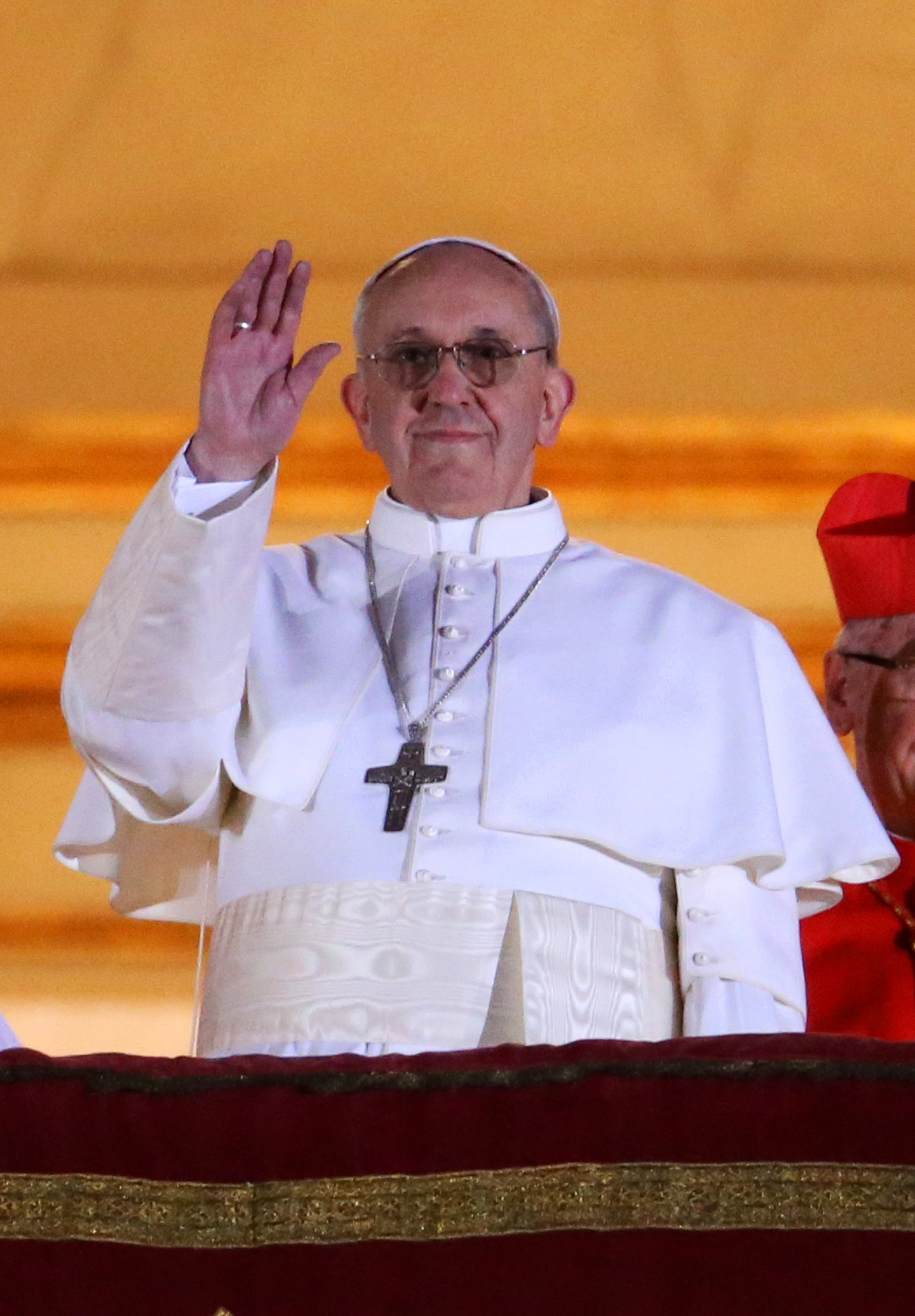
VATICAN CITY, VATICAN – MARCH 13: Newly elected Pope Francis I appears on the central balcony of St Peter’s Basilica on March 13, 2013 in Vatican City, Vatican. Argentinian Cardinal Jorge Mario Bergoglio was elected as the 266th Pontiff and will lead the world’s 1.2 billion Catholics. (Photo by Peter Macdiarmid/Getty Images)

Fake canon law goes on goin’ on
by Dr. Edward Peeters
April 22, 2017
Fr. James Keenan writing in Crux this week makes his own a question raised (last July, it seems) by Rocco Buttiglione in L’Osservatore Romano: “Is there any contradiction between the popes who excommunicated divorced and remarried persons and Saint John Paul II who lifted that excommunication?”

That’s fake canon law. John Paul II never lifted any excommunication against divorced and remarried Catholics because, quite simply, there was no excommunication against divorced and remarried Catholics for him to lift. Shall we talk about it?

Buttiglione writes in the L’OR piece upon which Keenan draws: “Once upon a time, divorced and remarried persons were excommunicated and excluded from the life of the Church. That kind of excommunication disappears from the new Code of Canon Law and Familiaris Consortio, and divorced and remarried persons are now encouraged to participate in the life of the Church and to give their children a Christian upbringing. This was an extraordinarily courageous decision that broke from an age-old tradition. But Familiaris Consortio tells us that the divorced and remarried cannot receive the sacraments.”

Gracious! however far back in Church history Buttiglione needs to search for an excommunication of divorced-and-remarried Catholics, he apparently thinks that the 1917 Code itself excommunicated divorced and remarried Catholics and that, only by making a “courageous decision that broke from an age-old tradition”, could John Paul II ‘disappear’ that “excommunication” from the new (1983) Code of Canon Law.

There is just one problem with Buttiglione’s and Keenan’s canonical narrative of a pope kicking down a penal door locked against divorced-and-remarried Catholics—and thus with their broader ‘if-John-Paul-could-then-Francis-can’ claim, namely: the 1917 Code did not excommunicate divorced and remarried Catholics.

Oops.

Neither Buttiglione nor Keenan provide a citation for their claim about what canon law allegedly did up to the time of John Paul II (nor, come to think of it, did Abp. Scicluna who was, it now seems, uncritically repeating Buttiglione’s claim and extending it to embrace adulterers!), so one is left to guess at what they had in mind. But a couple of ideas occur to me, some of which I have addressed before.

Maybe Keenan and Buttiglione had in mind the Pio-Benedictine excommunication levied against Catholics who attempted marriage in violation of canonical form; problem is, this sanction was applicable to all Roman Catholics (not just to divorced-and-civilly-remarried ones) and, more importantly, it had already been abrogated by Paul VI in 1970, a dozen years before the 1983 Code went into force!

Or maybe Keenan the American (if not Buttiglione, an Italian) recalled when American Catholics who divorced and civilly remarried were indeed excommunicated for that offense; problem is, that rule was peculiar to American (not universal) canon law, it dated back only to 1884 (hardly ‘age-old’), and, most importantly, it too had already been abrogated in 1977—again by Paul VI, not John Paul II—several years before the 1983 Code was promulgated.

Or maybe by “new” Code of Canon Law, Buttiglione and Keenan meant the 1917 Code which, in its day, was certainly new; problem is, I can’t find an excommunication for divorced and civilly remarried Catholics in the main, pre-Code, penal document of the 19th century, Pius IX’s Apostolicae Sedis moderatione (1869). Do Buttiglione and Keenan know of one? Of course, even if one were found lurking somewhere, it had obviously ‘disappeared’ from codified canon law some 65 years before John Paul II arrived on the scene.

Or maybe Buttiglione and Keenan understand by the term “excommunication” a much older usage that sometimes blurred the distinctions between “excommunication” (as a canonical penalty, c. 1331) and “denial of holy Communion” (as a sacramental disciplinary norm, c. 915); problem is, their claim about what John Paul II supposedly did demands that they use canonical terms as he and the Church understand them today—and as Buttiglione himself recognizes when he notes above that, despite the (alleged) lifting of a (non-existent) excommunication, divorced-and-remarried Catholics are still prohibited the sacraments (a statement wrong in some respects, but right enough in this regard).

So much contextualizing and back-storying, just to address one more fake canon law claim. But at least such research allows one to argue better not ‘if-John-Paul-could-then-Francis-can’, but rather ‘John-Paul-didn’t-and-Francis-shouldn’t’.

Posted in Uncategorized | Comments Off on SAINT JOHN PAUL II DID NOT DO IT AND JORGE MARIO BERGOGLIO CANNOT DO IT AND SHOULD NOT PRETEND TO DO IT !!!

WHY DO THEY KEEP COMING ???

Clockwise from top left: Cardinal Francis Arinze, Dorothy Day, Gary Cooper, Robert Bork, St. Teresa Benedicta of the Cross (Edith Stein) and John Wayne
Clockwise from top left: Cardinal Francis Arinze, Dorothy Day, Gary Cooper, Robert Bork, St. Teresa Benedicta of the Cross (Edith Stein) and John Wayne (Wikipedia images)

COMMENTARY | APR. 15, 2017
50 Catholic Converts: Notable Churchgoers of the Last Century

Matthew Bunson
THE NATIONAL CATHOLIC REGISTER
The Church around the world welcomes thousands of new Catholics at the Easter vigil.

On average, more than 100,000 adults enter the Church in the United States every year. They come from every walk of life and every age group. Some arrive in the Church after many years of personal struggle, and some come at the very end of their lives. Others are moved to become Catholic because of the examples of saints, priests, religious, and exemplary laypeople and family members who give witness to Christ Jesus.

In the end, of course, they reach the same conclusion as another famous convert, Blessed Cardinal John Henry Newman: “Regarding Christianity, 10,000 difficulties do not make one doubt.”

And to be sure, many converts are encouraged in their own journeys to Catholicism by the models of more famous converts.

Movie stars, poets, novelists, musicians, philosophers, scientists and even queens were convinced in their consciences that they must become Catholic.

They were sinners (as are we all), and, as with such a diverse and interesting group, they have very different temperaments, personalities and foibles.

The dazzling variety is itself a microcosm of the many different people who enter the Church every year — and also a helpful reminder that everyone is called by Christ and that no past, however dark and troubled, makes us unwelcome to God’s loving embrace of mercy and forgiveness.

Here are a few of the most notable converts over the last century:

Mortimer Adler (1902-2001): American philosopher and educator, he discovered St. Thomas Aquinas in his 20s and became a figure in the Neo-Thomist Movement.

Cardinal Francis Arinze (b. 1932): Nigerian convert baptized at the age of 9 by Blessed Cyprian Tansi. He became the youngest bishop in the world at the age of 32 and was later named a cardinal and prefect of the Congregation for Divine Worship and the Discipline of the Sacraments.

Francis Beckwith (b. 1960): A philosopher and theologian, he was elected president of the Evangelical Theological Society but converted to Catholicism in 2007.

Tony Blair (b. 1953): British Labour Party leader and prime minister from 1997 to 2007, he was the youngest prime minister since 1812. His wife, Cherie, is also Catholic.

Cherry Boone (b. 1954): Daughter of the famous evangelical singer Pat Boone. Married in 1975 to the writer Dan O’Neill, she and her husband both converted to Catholicism.

Robert Bork (1927-2012): Conservative American judge and jurist best known for the vicious political fight that blocked his nomination to the U.S. Supreme Court in 1987. He and his wife converted to Catholicism in 2003.

Louis Bouyer (1913-2004): French theologian and one of the founding members of both the International Theological Commission and the international theological review Communio.

Dave Brubeck (1920-2012): One of the most renowned American jazz musicians. He converted in 1980 and was commissioned to compose the Mass to Hope.

Tim Conway (b. 1933): American comedian best known for his role on the television programs McHale’s Navy and The Carol Burnett Show.

Gary Cooper (1901-1961): American actor who earned three Academy Awards, including “Best Actor” for Sergeant York and High Noon. He had a powerful meeting with Pope Pius XII in 1953 and formally entered the Church in 1959.

Frederick Copleston (1907-1994): English Jesuit and historian of philosophy, he converted to the Church at the age of 18 and entered the Society of Jesus in 1930.

Dorothy Day (1897-1980): Writer, social activist and co-founder of the Catholic Worker movement with Peter Maurin. Her cause for canonization was opened in New York in 2000.

Catherine de Hueck Doherty (1896-1985): A Canadian social-justice leader and founder of the Madonna House apostolate. A convert from the Russian Orthodox Church, her cause for canonization was opened in 2000.

Diana Dors (1931-1984): English actress considered a classic “blonde bombshell” in movies.

Cardinal Avery Dulles (1918-2008): American Jesuit, theologian and cardinal, the son of former Secretary of State John Foster Dulles.

Newt Gingrich (b. 1943): Speaker of the U.S. House of Representatives from 1995 to 1999 as well as an author, presidential candidate and historian.

Rumer Godden (1907-1998): English novelist best known as the author of the novels Black Narcissus and In This House of Brede.

Graham Greene (1904-1991): British writer best known in Catholic circles for his novels Brighton Rock, The Power and the Glory, The Heart of the Matter and The End of the Affair.

Sir Alec Guinness (1914-2000): Academy Award-winning British actor who won the Oscar for “Best Actor” in 1957 for The Bridge on the River Kwai.

Scott Hahn (b. 1957): Biblical theologian, apologist and prolific writer and speaker. His wife, Kimberly, is also a convert.

Susan Hayward (1917-1975): Academy Award-winning actress who won the Oscar for her portrayal of death-row inmate Barbara Graham in I Want to Live! (1958).

Elisabeth Hesselblad (1870-1957): A Swedish convert from Lutheranism and founder of the Bridgettine Sisters, she was canonized by Pope Francis in 2015.

Dietrich von Hildebrand (1889-1977): A German philosopher and theologian honored by numerous popes for his immense contributions to Catholic thought.

Katharine, Duchess of Kent (b. 1933): The wife of Prince Edward, Duke of Kent (a grandson of King George V and Queen Mary and first cousin of Queen Elizabeth II), the first member of the royal family to convert since 1701.

Joyce Kilmer (1886-1918): American poet, journalist and editor, best known for his short poem Trees (1913). He was killed in 1918 at the end of World War I.

Russell Kirk (1918-1994): American political theorist and one of the most influential figures in the American conservative movement.

Dean Koontz (b. 1945): Prolific novelist who has sold more than 450 million copies of his books.

Clare Boothe Luce (1903-1987): The first American woman appointed to a major ambassadorial post abroad, a member of the U.S. House of Representatives from 1943 to 1947, writer and playwright.

Cardinal Jean-Marie Lustiger (1926-2007): Archbishop of Paris from 1981 to 2005, a cardinal from 1983 and a promoter of Catholic-Jewish dialogue. He converted from Judaism.

Gabriel Marcel (1889-1973): French philosopher, playwright and Christian existentialist best known for his work The Mystery of Being.

Jacques Maritain (1882-1973): French philosopher, author of more than 60 books and one of the key figures in the revival of Thomism in modern times. He and his wife, Raïssa, converted to Catholicism in 1906.

Norma McCorvey (1947-2017): The plaintiff in the infamous 1973 lawsuit Roe v. Wade that legalized abortion who subsequently became pro-life.

Marshall McLuhan (1911-1980): Canadian professor, philosopher and media theorist best known for coining the expressions “the medium is the message” and “global village.”

Thomas Merton (1915-1968): American Trappist monk and priest as well as a poet, social activist and one of the most famous and controversial Catholic converts of the 20th century.

Vittorio Messori (b. 1941): Italian journalist best known for his book-length interviews The Ratzinger Report: An Exclusive Interview on the State of the Church (1985) and Crossing the Threshold of Hope by Pope John Paul II (1994).

Malcolm Muggeridge (1903-1990): British journalist, satirist and author. He became a Catholic in 1982 with his wife, Kitty, largely through the influence of St. Teresa of Calcutta.

Bernard Nathanson (1926-2011): American medical doctor and a founding member of NARAL Pro-Choice America who joined the pro-life movement in the 1970s.

Queen Nazli (1894-1978): Queen of Egypt from 1919 to 1936 as the second wife of King Fuad and mother of King Farouk of Egypt. She and her daughter, Fathia, converted from Islam in 1950.

Patricia Neal (1926-2010): Academy Award-winning actress for her performance in Hud (1963). She converted to Catholicism a few months before her death.

Richard John Neuhaus (1936-2009): Former Lutheran pastor, writer, theologian and founder and editor of the journal First Things.

Robert Novak (1931-2009): American journalist, columnist and conservative political commentator.

Joseph Pearce (b. 1961): English writer and literary biographer.

Walker Percy (1916 -1990): American writer beloved for his novels that confront man’s struggle with modernity.

Knute Rockne (1888-1931): Norwegian-born coach of the Notre Dame football team from 1918 to 1930 and considered one of the greatest coaches in sports history.

Adrienne von Speyr (1902-1967): Swiss physician, spiritual writer and mystic who authored more than 60 books of spirituality and theology.

St. Teresa Benedicta of the Cross (Edith Stein) (1891-1942): German-Jewish philosopher and Discalced Carmelite nun who died at Auschwitz. She was canonized by St. John Paul II in 1998.

Sigrid Undset (1882-1949): Norwegian novelist who was awarded the Nobel Prize for Literature in 1928.

Evelyn Waugh (1903-1966): English writer famed for his novel Brideshead Revisited (1945).

John Wayne (1907-1979): Academy Award-winning actor beloved for his roles in westerns and war movies.

Israel Zolli (1881-1956): Italian Jewish scholar and the chief rabbi in Rome from 1940 to 1945. A friend of Pope Pius XII, he converted from Judaism to Catholicism in 1945.

Matthew Bunson is a senior editor with the Register

and senior contributor to EWTN News.

Posted in Uncategorized | Comments Off on WHY DO THEY KEEP COMING ???

HOW MANY WILL HAVE TO SPEAK THE TRUTH TO FRANCIS BEFORE HE LISTENS ???

Settimo Cielo
di Sandro Magister
22 apr After Four Cardinals, Six Laymen Speak. Who Knows If the Pope May At Least Listen To Them
papa

*

The four cardinals have never been alone with their “dubia.” Proof of this comes from what happened in Rome on April 22 in an auditorium of the Hotel Columbus, a short walk from Saint Peter’s Square, where six renowned lay scholars came together from as many countries of the world to give voice to an appeal that is being raised from a large part of the “people of God” so that clarity may be brought to the confusion raised by “Amoris Laetitia.”

Anna M. Silvas came from Australia, Claudio Pierantoni from Chile, Jürgen Liminski from Germany, Douglas Farrow from Canada, Jean Paul Messina from Cameroon, Thibaud Collin from France. And one after the other, over the span of one day took stock of the crisis that the document of Pope Francis has produced in the Church, one year after its publication.

Settimo Cielo offers its readers the complete texts of the six presentations, in the languages in which they were delivered. But it calls special attention to the one by Claudio Pierantoni, a scholar of patristics and professor of medieval philosophy at the Universidad de Chile, in Santiago, an abridgment of which is provided below.

Pierantoni brings up again the cases of two popes who fell into error during the first Christian centuries, the one condemned “post mortem” by an ecumenical council and the other induced to correct himself during his lifetime.

But also today – he argues – there is a pope who is “victim,” although “hardly aware of it,” of a widespread tendency to error that undermines the foundations of the Church’s faith. And he too is in need of a charitable correction that may bring splendor back to the truth.

Pierantoni is not the only one among the six to have recalled the lessons of the past, ancient and recent.

Thibaud Collin, a professor of moral philosophy and politics at the Collège Stanislas in Paris, recalled for example the opposition of numerous theologians and entire episcopates to the encyclical of Paul VI “Humanae Vitae,” which was downgraded to purely “ideal” and thereby made inoperative. And he showed how this deleterious “pastoral” logic has come back into vogue with “Amoris Laetitia,” concerning indissoluble marriage and soon also concerning homosexual amours.

Anna M. Silvas, an Australian of the Eastern rite, a scholar of the Fathers of the Church, and a professor at the University of New England, instead emphasized the danger that the Catholic Church might also go down the road already traveled centuries ago by the Protestants and Orthodox toward divorce and remarriage: just when – she surprisingly added – the Coptic Church is returning to the indissolubility of Christian marriage, without exception.

    On a response from Pope Francis to the “dubia,” as also on the possibility of a “correction” from him, Anna M. Silvas expressed skepticism. She instead proposes a “Benedict option” for the current post-Christian era, inspired by the monasticism at the collapse of the ancient era, a humble and communal “dwelling” with Jesus and the Father “Jn 14:23) in the faithful expectation, made up of prayer and work, that the tempest shaking the world and the Church today may cease.

{Emphasis by Abyssum}

Six voices, six different interpretations. All profound and nourished by “caritas in veritate.” Who knows if Pope Francis may at least listen to them.

———-

THE NECESSARY CONSISTENCY OF THE MAGISTERIUM WITH TRADITION. THE EXAMPLES OF HISTORY

by Claudio Pierantoni

In this presentation we will first briefly examine the incidents of two popes of antiquity, Liberius and Honorius, who for different reasons were accused of deviating from the Tradition of the Church, during the long Trinitarian and Christological controversy that occupied the Church from the 4th to the 7th century.

In the light of the reactions of the ecclesial body in the face of these doctrinal deviations, we will then examine the current debate that has developed around the proposals of Pope Francis in the apostolic exhortation “Amoris Laetitia” and the five “dubia” raised by the four cardinals.

1. The case of Honorius

Honorius I was the only pope to have been formally condemned for heresy. We are in the early decades of the 7th century, in the context of the controversy over the two wills of Christ. Honorius upheld the doctrine of the one will in Christ, or “monothelitism”, which was however later declared to be in contrast with the dogma of the two natures, divine and human, a doctrine solidly founded on biblical revelation and solemnly decreed by the Council of Chalcedon in 451.

Here is the text with which, in 681, after his death, the third ecumenical Council of Constantinople, the sixth ecumenical council, condemned him together with Patriarch Sergius:

“Having examined the dogmatic letters written by Sergius, in his time the patriarch of this imperial city. . . and the letter with which Honorius responded to Sergius, and having seen that they are not in keeping with the apostolic teachings and with the definitions of the holy councils and of all the illustrious holy Fathers, and that on the contrary they follow the false doctrines of the heretics, we reject them and execrate them as corruptive.”

2. The case of Liberius

Liberius was instead pope at one of the most delicate moments of the Arian controversy, halfway through the 4th century. His predecessor, Julius I, had tenaciously defended the faith established by the Council of Nicaea in 325, which declared the Son to be consubstantial with the Father. But Constantius, the emperor of the East, supported the majority position of the eastern bishops, contrary to Nicaea, which according to them did not leave room for the personal difference between the Father and the Son. He had the pope abducted, deposed, and sent into exile in Thrace, where after about a year he gave in.

Lberius thus renounced the faith of Nicaea and excommunicated Athanasius, who was its most significant defender. Now docile to the emperor, Liberius obtained permission to come back to Rome, where he was reinstalled as bishop. In the months that followed, all the pro-Arian prelates who had established their careers through the favor of Constantius consolidated their power in the main episcopal sees. This is the moment at which, according to the famous expression of Saint Jerome, “the world lamented that it had become Arian.” Of the more than one thousand bishops that Christendom numbered, only three stalwarts held firm in exile: Athanasius of Alexandria, Hilary of Poitiers, and Lucifer of Cagliari.

    {Emphasis by Abyssum}

    But Constantius died suddenly, in 361, and the emperor Julian, later called “the Apostate,” rose to the throne. He imposed the return of the Roman state to paganism, eliminated the whole ecclesiastical policy of Constantius at a stroke, and allowed the exiled bishops to go back to their jurisdictions. Free from threats, Pope Liberius sent an encyclical that declared invalid the formula he had previously approved, and required the bishops of Italy to accept the creed of Nicaea. In 366, in a synod celebrated in Rome shortly before he died, he even had the joy of obtaining the signature of the creed of Nicaea by a delegation of eastern bishops. As soon as he died he was venerated as a confessor of the faith, but devotion to him was soon interrupted because of the memory of his {earlier} concession.

    In spite of their differences, the two cases of Liberius and Honorius have in common an attenuating circumstance, and that is the fact that their respective doctrinal deviations took place when the respective doctrines were still being determined, that of the Trinity in the case of Liberius and the Christological one in the case of Honorius.

    3. The case of Francis

    However, the doctrinal deviation that is taking place during the current pontificate instead has an aggravating circumstance, because it is not countering doctrines that are still unclear, or still being determined, but doctrines that, in addition to being solidly anchored in Tradition, have also been exhaustively debated in recent decades and clarified in detail by the recent magisterium.

{Emphasis by Abyssum}

Of course, the doctrinal deviation in question was already present in recent decades and with it therefore was also the underground schism that this signified. But when one passes from an abuse at the practical level to its justification at the doctrinal level through a text of the pontifical magisterium like “Amoris Laetitia” and through positive statements and actions of the pontiff himself, the situation changes radically.

    {Emphasis by Abyssum}

    Let us see, in four points, the progress of this destruction of the deposit of the faith.

    First

    If marriage is indissoluble, and yet in some cases communion can be given to the divorced and remarried, it seems evident that this indissolubility is no longer considered absolute, but only a general rule that can admit exceptions.

    Now this, as Cardinal Carlo Caffarra has explained well, contradicts the nature of the sacrament of marriage, which is not a simple promise, as solemn as it may be, made before God, but an action of grace that works at the genuinely ontological level. Therefore, when it is said that marriage is indissoluble, what is stated is not simply a general rule, but what is said is that ontologically marriage cannot be dissolved, because in it is contained the sign and the reality of the indissoluble marriage between God and his People, between Christ and his Church. And this mystical marriage is precisely the end of the whole divine plan of creation and redemption.

    Second

    The author of “Amoris Laetitia” has instead chosen to insist, in his argumentation, on the subjective side of moral action. The subject, he says, may not be in mortal sin because, for various reasons, he is not fully aware that his situation constitutes adultery.

    Now this, which in general terms can certtainly happen, in the utilization that “Amoris Laetitia” makes of it instead involves an evident contradiction. In fact, it is clear that the much-recommended discernment and accompaniment of individual situations directly contrast with the supposition that the subject remains, for an indefinite time, unaware of his situation.

    But the author of “Amoris Laetitia,” far from perceiving this contradiction, pushes it to the further absurdity of affirming that an in-depth discernment can lead the subject to have the certainty that his situation, objectively contrary to the divine law, is precisely what God wants from him.

    Third

    Recourse to the previous argument, in turn, betrays a dangerous confusion that in addition to the doctrine of the sacraments goes so far as to undermine the very notion of divine law, understood as the source of the natural law, reflected in the Ten Commandments: a law given to man because it is suited to regulating his fundamental behaviors, not limited to particular historical circumstances, but founded on his very nature, the author of which is none other than God.

{Emphasis by Abyssum}

Therefore, to suppose that the natural law may admit exceptions is a real and proper contradiction, it is a supposition that does not understand its true essence and therefore confuses it with positive law. The presence of this grave confusion is confirmed by the repeated attack, present in “Amoris Laetitia,” against the quibblers, the presumed “pharisees” who are hypocrites and hard of heart. This attack, in fact, betrays a complete misunderstanding of the position of Jesus toward the divine law, because his criticism of pharisaic behavior is based precisely on a clear distinction between positive law – the “precepts of men” – to which the pharisees are so attached, and the fundamental Commandments, which are instead the first requirement, indispensable, that he himself asks of the aspiring disciple. On the basis of this misunderstanding one understands the real reason why, after having so greatly insulted the pharisees, the pope ends up in de facto alignment with their own position in favor of divorce, against that of Jesus.

    {Emphasis by Abyssum}

    But, even more deeply, it is important to observe that this confusion profoundly distorts the very essence of the Gospel and its necessary grounding in the person of Christ.

    Fourth

    Christ in fact, according to the Gospel, is not simply a good man who came into the world to preach a message of peace and justice. He is, first of all, the Logos, the Word who was in the beginning and who, in the fullness of time, becomes incarnate. It is significant that Benedict XVI, right from his homily “Pro eligendo romano pontifice,” made precisely the Logos the linchpin of his teaching, not by coincidence fought to the death by the subjectivism of the modern theories.

    Now, in the realm of this subjectivist philosophy there is the justification of one of the postulates most dear to Pope Francis, according to which “realities are more important than ideas.” A maxim like this, in fact, makes sense only in a vision in which there cannot exist true ideas that not only faithfully reflect reality but can even judge and direct it. The Gospel, taken as a whole, presupposes this metaphysical and epistemological structure, where truth is in the first place the conforming of things to the intellect, and the intellect is in the first place that which is divine: indeed, the divine Word.

{Emphasis by Abyssum}

In this atmosphere it can be understood how it is possible that the editor of “La Civiltà Cattolica” could state that it is pastoral practice that must guide doctrine, and not the other way around, and that in theology “two plus two can equal five.” It explains why a Lutheran lady can receive communion together with her Catholic husband: the practice, in fact, the action, is that of the Lord’s Supper, which they have in common, while that in which they differ is only “the interpretations, the explanations,” mere concepts after all. But it also explains how, according to the superior general of the Society of Jesus, the incarnate Word is not capable of coming into contact with his creatures through the means that he himself chose, the apostolic Tradition: in fact, it would be necessary to know what Jesus truly said, but we cannot, he says, “since there was no recorder.”

Even more thoroughly in this atmosphere, finally, it is explained how the pope cannot answer “yes” or “no” to the “dubia.” If in fact “realities are more important than ideas,” then man does not even need to think with the principle of non-contradiction, he has no need of principles that say “this yes and this no” and must not even obey a transcendent natural law, which is not identified with reality itself. In short, man does not need a doctrine, because the historical reality suffices for itself. It is the “Weltgeist,” the Spirit of the World.

4. Conclusion

What leaps to the attention in the current situation is precisely the underlying doctrinal deformation that, as skillful as it may be in evading directly heterodox formulations, still maneuvers in a coherent way to carry forward an attack not only against particular dogmas like the indissolubility of marriage and the objectivity of the moral law, but even against the very concept of right doctrine, and with it, of the very person of Christ as Logos. The first victim of this doctrinal deformation is precisely the pope, who I hazard to conjecture is hardly aware of this, victim of a generalized epochal alienation from Tradition, in large segments of theological teaching.

In this situation, the “dubia,” these five questions presented by the four cardinals, have put the pope into a situation of stalemate. If he were to respond by denying Tradition and the magisterium of his predecessors, he would also be heretic formally, so he cannot do it. But if he were to respond in harmony with the previous magisterium, he would contradict many of the doctrinally significant actions carried out during his pontificate, so it would be a very difficult choice. He has therefore chosen silence because, humanly, the situation can seem to have no way out. But meanwhile, the confusion and the “de facto” schism are spreading in the Church.

In the light of all this, it therefore becomes more necessary than ever to make a further act of courage, truth, and charity, on the part of the cardinals but also of the bishops and then of all the qualified laity who would like to adhere to it. In such a serious situation of danger for the faith and of generalized scandal, it is not only licit but even obligatory to frankly address a fraternal correction to Peter, for his good and that of the whole Church.

    {Emphasis by Abyssum}

    A fraternal correction is neither an act of hostility, nor a lack of respect, nor an act of disobedience. It is nothing other than a declaration of truth: “caritas in veritate.” The pope, even before being pope, is our brother.

    ———-

    The complete text of the presentation by Claudio Pierantoni:

    > La necessaria coerenza del magistero con la Tradizione. Gli esempi della storia

    And that of Anna M. Silvas:

    > A Year After “Amoris Laetitia”. A Timely Word

    Of Douglas Farrow:

    > The Roots of the Present Crisis

    Of Thibaud Collin:

    > Discerner en conscience?

    Of Jürgen Liminski:

    > “Co-créé avec l’Homme”. Pourquoi l’indissolubilité du mariage est une bonne chose pour la société

    Of Jean Paul Messina:

    > Lecture d’”Amoris Laetitia” pour l’Afrique et les Églises d’Afrique

    (English translation by Matthew Sherry, Ballwin, Missouri, U.S.A.)

Posted in Uncategorized | 1 Comment

THUS SPAKE THE RAVEN:

Image result for photo of a raven

CATHOLIC LIFEFEATURED
Ravens and Saints
Hilary White Hilary White April 21, 2017 0 Comments
38
SharesFacebook38TwitterGoogle+PinterestPocket
I seem to be developing a particular love and admiration for our corvid friends lately, with a pair of clever and beautiful magpies visiting my garden in Norcia quite regularly and huge numbers of crows and ravens in that ancient valley. It struck me a while ago just how frequently they appear in Christian history – all the way back to the Old Testament – as our friends and helpers, and as messengers of God.

Ravens are perhaps among the world’s most successful predator/omnivore/scavenger species, found pretty much all around the top half of the planet, all the way through Europe, Siberia, Asia and North America, with a range from North Africa to the ice fields of Scandinavia, from Mexico to the furthest reaches of the Canadian arctic. We humans have had ravens and crows – corvids – around our camp sites as long as we’ve had dogs helping with the hunt. And they appear in our folk tales almost as often.

Throughout human history we’ve had a chance to observe these creatures in action, and our collective nouns for them indicate our opinion: a “murder” of crows; an “unkindness” or a “conspiracy” of ravens. (The term “building of rooks” might refer to the fact that these small, social corvids are the only species that create large colonies of nests where they live closely together, like a kind of rook city.) Native Americans have raven gods and totemic spirits that are a little more positive, focusing on their extraordinary cleverness but also as devious “trickster” types as ready to deceive and lead astray as to aid an unwary human. Pagan gods and fairies are always turning themselves into ravens to spy on human beings.

I have my own story, in fact. When I was a teenager, my parents kept sled dogs during my family’s brief stay in the Canadian sub-arctic. We had a couple of dogs who lived pretty handsomely on the cull fish that my parents caught in their ice fishing nets. But the ravens loved the leftovers from the lake too, and came up with ingenious methods of getting the food away from the comparatively dumb dogs.

They worked in pairs, with one flapping above and squawking just out of the dogs’ range, while the other one helped himself to the contents of their dish under cover of the commotion. After the first one had eaten they would switch roles, with the poor dogs going mad to try to catch at least one of the interlopers. When they were done, they would flap away and sit in a tree watching to see when the next meal was coming.

While folklorists and cultural anthropologists collect similar stories and fairy tales from around the world, it struck me the other day just what a gulf there is in European cultures between the popular, folktale version of the raven as a preternatural harbinger of doom, and the bird’s frequent appearances in Christian hagiography. Crows and ravens in fairy tales are almost never the “good guy” bird. But every time they appear in Christian “mythology”, it’s almost always to bring food or a message to a human servant of God down on his luck.

The 19th century “Smith’s Bible Dictionary” gives a not very flattering description:

There is something weird and shrewd in the expression of the raven’s countenance, a union of cunning and malignity which may have contributed to give it among widely-revered nations a reputation for preternatural knowledge…The smell of death is so grateful to them that when in passing over sheep a tainted smell is perceptible, they cry and croak vehemently. It may be that in passing over a human habitation, if a sickly or cadaverous smell arises, they should make it known by their cries, and so has arisen the idea that the croaking of a raven is the premonition of death.

But even with their macabre cultural reputation, ravens are nearly always depicted positively in the Bible itself. In Genesis, a raven was one of only two animals named specifically on the ark, and it was a raven that was first sent by Noah to look for dry land.

In 1 Kings, the prophet Elijah is cared for by ravens who are sent by God during a drought that was a punishment to the wicked idolaters in the reign of King Ahab:

And the word of the Lord came unto him, saying, Get thee hence, and turn thee eastward, and hide thyself by the brook Cherith, that is before the Jordan. And it shall be, that thou shalt drink of the brook; and I have commanded the ravens to feed thee there. So he went and did according unto the word of Jehovah; for he went and dwelt by the brook Cherith, that is before the Jordan. And the ravens brought him bread and flesh in the morning, and bread and flesh in the evening; and he drank of the brook.

One commentator notes that this passage is a lesson not to rely upon our own powers, storing up food and wealth, but to get on with the task sent by God: “If Providence calls us to solitude and retirement, it becomes us to go: when we cannot be useful, we must be patient; and when we cannot work for God, we must sit still quietly for him.

The ravens were appointed to bring him meat, and did so. Let those who have but from hand to mouth, learn to live upon Providence, and trust it for the bread of the day, in the day. God could have sent angels to minister to him; but he chose to show that he can serve his own purposes by the meanest creatures, as effectually as by the mightiest.

Elijah Fed by Ravens – Jan Saenredam; 1604
One good 18th century Protestant divine wrote, “You may be sure that God did not forget his servant; but you would hardly believe, if it was not in the Bible, that he would send the ravens to carry food to him.”

The image of the raven bringing food and assistance to the holy men and women of God continues through the Christian era. When the greatest of all the desert fathers, St. Anthony, was sent by God to meet St. Paul the Hermit of Thebes, the raven that brought Paul his daily half loaf of bread showed up that day with a whole loaf, to accommodate the illustrious guest.

Again in the early eremitical monastic life of St. Benedict, when he had retreated from the world to a cave, he was provided with food by a local monk, but always shared with a friendly crow. Later, in the story that comes to us from the Dialogues of St. Gregory the Great, we learn that Benedict was the intended victim of an envious priest, Florentius. “Possessed with diabolical malice,” Florentius “began to envy the holy man’s virtues, to back-bite his manner of living, and to withdraw as many as he could from going to visit him.”

One day Florentius decided to rid himself of the vexing presence and poison a loaf of bread and send it to the saint as a present.

The man of God received it with great thanks, yet not ignorant of that which was hidden within. At dinner time, a crow daily used to come to him from the next wood, which took bread at his hands; coming that day after his manner, the man of God threw him the loaf which the Priest had sent him, giving him this charge: ‘In the name of Jesus Christ our Lord, take up that loaf, and leave it in some such place where no man may find it.’ Then the crow, opening his mouth, and lifting up his wings, began to hop up and down about the loaf, and after his manner to cry out, as though he would have said that he was willing to obey, and yet could not do what he was commanded.

The man of God again and again bide him, saying: ‘Take it up without fear, and throw it where no man may find it.’ At length, with much ado, the crow took it up, and flew away, and after three hours, having dispatched the loaf, he returned again, and received his usual allowance from the man of God.

To this day, St. Benedict is commonly depicted with a raven or a crow somewhere nearby.

According to the Vita S. Meginrati in the 9th century, one of St. Benedict’s saintly monastic sons, the hermit St. Meinrad, was murdered by some would-be thieves:

Now there were some ravens who used to come regularly to the servant of God when he was alive and take what was offered from his hands. And as if wishing to avenge the dead man, the ravens followed the thieves while they were fleeing from the hermitage, and filled the woods with loud cawing. And flying as close to the murderers’ heads as they could, they published the crime that had been committed.

At other times, the ravens have to have their natural tendencies towards mischief curtailed and corrected by a good abbot, like any high-spirited, unruly monk. The Vita Sancti Cuthberti tells the story of the great Northumbrian bishop and abbot Cuthbert’s correction of the two naughty ravens of Lindisfarne who, despite having been warned, disturb the roof of the shelter built for the monastery’s servants. St. Cuthbert banishes them from the island for this misbehaviour. Three days later, having repented, the ravens return seeking pardon. After being forgiven by Cuthbert the ravens bring enough pig fat to grease the boots of the whole monastery for a year.

Of course, Catholics are not credulous biblical literalists, but we have more reason in our own times to believe it possible that these birds could have been used by God so often. We are coming to learn that the corvids, and ravens in particular, are a good deal smarter than we ever imagined. In fact, they are regarded by researchers as among the most intelligent of all animals.

First, did you know they could talk? Not quite on the level of a parrot, but pretty good for a bird.

Even more amazing, did you know crows and ravens make and use tools? And can figure out how to perform complex sets of tasks to get at a bit of food?

And did you know they recognise faces and give each other warnings about particular people?

The documentary, “A Murder of Crows,” made the rounds of the internet a few years ago and remains popular on YouTube.

I suppose there’s not much theological ground to be gained by speculating whether these stories are literally true; this isn’t really one of the questions theologians are asking. But given what we know about these animals, I see no reason not to believe them.

And perhaps it’s worth thinking about it in the context of our interactions with nature in general. I wrote recently that I was disappointed – though not surprised – when Pope Francis’ encyclical Laudato Si turned out to be just another leftist political screed, repeating the dogmas of the anti-population ideologues. What a sadly wasted opportunity.

I’ve had time in the last couple of years to think about the relationship between human beings and the natural world. One of the great joys of my life in Norcia was all the time I was able to spend stomping about the countryside in wellies, with a knapsack of jam jars, binoculars, magnifying glass, identification guides, and a flask of green tea, cataloguing and collecting samples of local plants and watching the birds. There are a great many of the large and beautiful grey and black species, Corvus cornix, or hooded crows, about Norcia, as well as magpies, sparrowhawks, owls, doves and herons, song birds and even the beautiful, flamboyant hoopoes. I saw them every day and always thought of St. Benedict and his sister Scolastica, living in the same valley, seeing every day the same mountains and the same wild things, substantially unchanged from 1600 years ago.

I was raised in an environment very close to nature – spending most of my childhood, instructed by my mother, a biologist, poking around rock pools at the beach, learning to identify plants and bugs, trees and mushrooms. I maintain there were some things the hippies were right about, and their condemnation of the post-protestant, Enlightenment, utilitarian view of nature was among them. I hoped, and still do, that the Church will some day give us more authentic moral guidance on how we are to think of and treat the natural world.

Perhaps when we do, we could take the examples of these saints, and think of ourselves as caretakers, friends, and protectors of the natural world. Maybe it sounds naïve, but could we perhaps consider a different sort of life, more integrated? And perhaps then develop an ethic of careful stewardship instead of exploitation, while avoiding the idolatry and anti-human materialism of the current environmentalist movement? More Tolkien: Tom Bombadil, Ents and elves and gardening Gamgees; more Elijah, St. Paul, St. Benedict and Cuthbert, with their pet crows and ravens — and less Adam Smith?

Posted in Uncategorized | Comments Off on THUS SPAKE THE RAVEN: