BISHOPS MARX AND LENIN CALL US TO REVOLUTION; THE LIBERALS IN THE CHURCH MOVE FURTHER TO THE LEFT


170972339

The Disruptive Church Now Has a Spokesman

In 1970, I took part in an early anti-abortion protest in Washington D.C. at George Washington University Hospital. It was intended to be a sit-in at the offices where hospital employees interviewed women seeking abortions. The hospital was violating the laws of the District of Columbia, which back then still prohibited abortion. But abortions were being performed at the hospital nonetheless.

Our purpose was simply to demand that the hospital comply with the laws of the District of Columbia. Protesters never got beyond the entrance to the office building and were hit with pepper spray to force them from the entrance. Several of us were arrested (I was not) for trying to prevent ourselves from being sprayed, another example of the victims being arrested while the perpetrators went free. The case against the protesters was extremely weak and eventually was dropped.

What was notable about this incident was the way the Catholic bishops responded at the time. Most took no notice at all, but the bishops who did respond were obviously embarrassed that Catholics would be involved in such disruptive behavior. It was one thing to resist abortion by words, but quite another to actually engage in actions that disrupted public order.

Since this was a peaceful protest, they were not criticizing violent attacks, but nonviolent actions that would shut down a public institution, even if that institution was engaging in taking the lives of the unborn. Not only did we get no financial help with fines and legal fees resulting from the arrests, but we were clearly designated the black sheep of the Catholic Church.

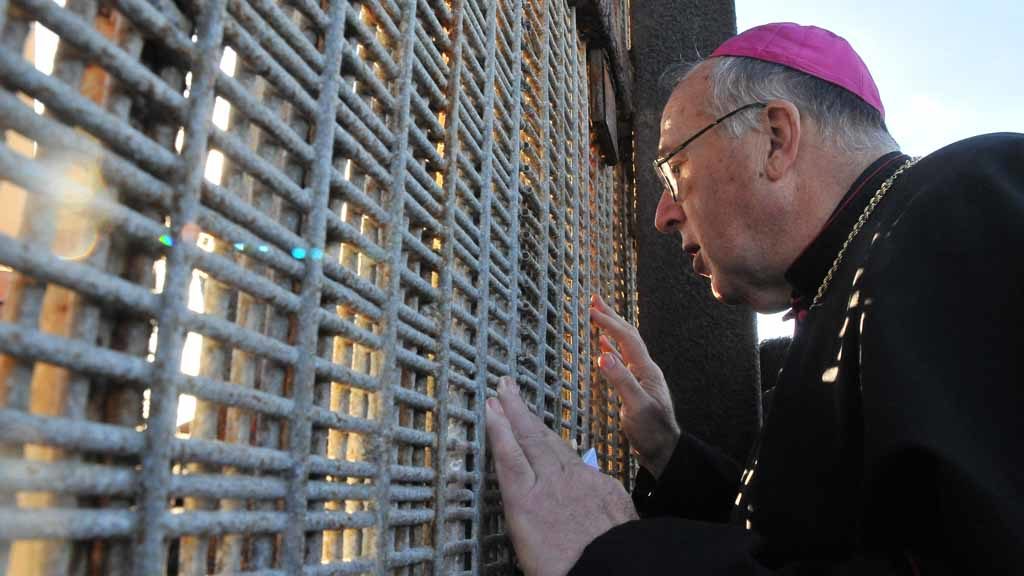
How things have changed. Now we have San Diego Bishop Robert McElroy advocating “disruptive” actions to accomplish his favored political goals. So far as I know, he has never suggested we should take disruptive action to end the slaughter of the unborn in places like Planned Parenthood, nor to check a government that supports this mass murder. But in his address to the U.S. regional gathering for the World Meeting of Popular Movements in California, this activist bishop said that with the election of President Trump, “Well now, we must all become disruptors.”

McElroy photo-op at the Mexican border [photo by Chris Stone]

He then went on to give a series of misleading accusations against the new administration, which included the following, “We must disrupt those who would seek to send troops into our streets to deport the undocumented, to rip mothers and fathers from their families. . . .who portray refugees as enemies rather than our brothers and sisters in terrible need. . . .who train us to see Muslim men, women and children as forces of fear rather than as children of God. . . .who seek to rob our medical care, especially from the poor, who would take even food stamps and nutrition assistance from the mouths of children.”

These are the kinds of “fake” accusations that we have seen from leftist activists and their media supporters who quite literally want to overthrow a validly elected government.

Words often take their meanings from context, and the word “disrupt” in today’s political context means “bring down’ and “overthrow.” It’s a buzzword widely used by people like Michael Moore and other left-wing revolutionaries, Saul Alinsky types who want to see the present government overthrown. Bishop McElroy may argue that this is not his intention. But when he adopts the language of revolution, he cannot avoid the implication that he approves of such aims.

If we had used such language back in 1970, it would have been clear that we were implicit revolutionaries. And it would’ve been quite appropriate for the bishops to call us out and warn Catholics that overthrowing the government was not the position of the Church. I’m waiting for some such rebuff to Bishop McElroy, but I won’t hold my breath.

The Modesto meeting was co-sponsored by the Vatican’s Dicastery for Integral Human Development and the U.S. Bishops’ Conference. Indeed, the annual World Meeting of Popular Movements is the result of an initiative of Pope Francis himself according to their web site. But such movements, though well-intentioned and professing noble goals, have sometimes been turned into a movement that co-opts the Church.

For instance, Don Luigi Giussani, who had worked closely with the Italian movement Gioventù Studentesca for years, was faced with a problem in 1968. The majority of this student organization had taken what the Italians call a “volta alla sinistra” (“turn to the left”), and joined the Italian Student Movement, a Marxist group in Italian universities and schools. His solution was to lead the minority in a new undertaking, Communion and Liberation, which would be faithful to the Christian ideals and practices that he had set forth in his writings over his years.

The problem we face today is that we cannot replace the Church with a new movement. If Church leaders embrace this kind of politically driven radicalism, distorting the truth while calling for disrupting a legitimate government, we are in deep trouble.

Truth makes strict demands, and distorting the truth by distorting the facts is equivalent to lying. Politicians and the press do it all the time, but it cannot be tolerated in the Church, especially not among Church leaders. Trump may not be your ideal president, but it’s simply calumny to suggest that he is in favor of, or has a plan to “send troops into our streets to deport the undocumented, to rip mothers and fathers from their families. . . .portray refugees as enemies. . . .train us to see Muslim men, women and children as forces of fear rather than as children of God. . . .rob our medical care, especially from the poor. . . .take even food stamps and nutrition assistance from the mouths of children.”

This is raw, dishonest, political rhetoric – the most dangerous disruption of all, the suppression of truth for political ends, which can easily lead to violence, regardless of the intentions of those who use such language.

Fr. Mark A. Pilon

Fr. Mark A. Pilon

Fr. Mark A. Pilon, a priest of the Diocese of Arlington, Virginia, received a Doctorate in Sacred Theology from Santa Croce University in Rome. He is a former Chair of Systematic Theology at Mount St. Mary Seminary, a former contributing editor of Triumph magazine, and a retired and visiting professor at the Notre Dame Graduate School of Christendom College. He writes regularly at littlemoretracts.wordpress.com.

Posted in Uncategorized | Comments Off on BISHOPS MARX AND LENIN CALL US TO REVOLUTION; THE LIBERALS IN THE CHURCH MOVE FURTHER TO THE LEFT

ARE YOU TOO PROUD TO KNEEL DURING THE CELEBRATION OF THE HOLY SACRIFICE OF THE MASS ???

Image result for PHOTO OF CHURCH PEWS WITH KNEELERS

THE VIEW FROM WAY DOWN IN THE PEW
Turning Catholics into a Stiff-Kneed People

March 2017
By J.A. Gray

THE NEW OXFORD REVIEW

In July-August 1999, J.A. Gray was Deputy Editor of the NOR. 

Ed. Note: Throughout 2017, in commemoration of our fortieth year of publication, we are featuring one article per issue from past eras of the NOR. This article originally appeared in our July-August 1999 issue (volume LXVI, number 7) and is presented here unabridged. Copyright © 1999.

The Lord told Moses, “I will send an angel before you to the land flowing with milk and honey. But I myself will not go up in your company, because you are a stiff-kneed people; otherwise I might exterminate you on the way. When the people heard this bad news, they went into mourning.” — after Exodus 33:1-4

There are many perceived divisions among Catholics in America. And there is one division that has not, so far as I know, been perceived at all. Whether it warrants attention, you may judge for yourself. I refer to the split between Pedalists and Manualists. Picture an ordinary Catholic who comes into church, enters a pew, and prepares to kneel. If the kneeler in the pew has been swung up off the floor, it must be brought down into the ready position. Some worshipers achieve this manually, by reaching down, grasping the kneeler in one hand, and lowering it to the floor. Others proceed pedally: They stand straight up, place one foot beneath the kneeler, lift, and swing the kneeler gently down.

I’ve seen no editorials in the conservative Catholic press praising Pedalism, no articles in liberal Catholic magazines maligning Manualism. The lack of Catholic punditry on the matter is understandable, for it’s not clear where the usual labels or libels (Traditionalist, Modernist, Liberal, Restorationist) would apply. Both Pedalism and Manualism can be observed in practice within a single parish community — in fact, within a single family in a single pew — with no signs of friction, or even of awareness.

My impression is that among American Catholics, Pedalists outnumber Manualists, but this is just a guess, and without data from Fr. Andrew Greeley I wouldn’t dare to engage in further quantitative speculation. Personally, I practice Pedalism. I mean no offense to Manualists, but I have tried Manualism and it has its drawbacks. Manualism requires bending forward, which could mean clunking your head on the pew in front of you. It also involves grasping the kneeler with the bare hand, which means a chance of touching some child’s old chewing gum or a smear of unmentionable matter deposited by someone’s shoes. Therefore I am Pedalist by preference, though I can worship in Manual mode if necessary.

It’s probably safe to conclude provisionally that the split between Pedalist and Manualist is just a charming difference in customs — akin to the way Catholics are divided, without recrimination, over the sainted bishop of old Hippo, with some calling him UhGUStin and others AWEgusteen; or the way some Catholics end the Sign of the Cross by bringing the thumbnail to their lips, while others end it at the shoulder. In any case, I’ve grown used to the piquant diversity of worshiping with both Manualists and Pedalists, and I have privately added this minor division to the major divisions (Jew/Greek, slave/free, man/woman) that St. Paul says the One Body of Christ holds, heals, and overcomes in Baptism.

+++

So imagine my shock when I was vouchsafed a vision of the Church of Our Possible Future in which neither Pedalism nor Manualism would exist. It was a Sunday morning not long ago, in the parish of which I had just become a member. The parish’s little stucco church had been under renovation for months, and now at last it was open again. A few minutes before Mass, I walked through the doors into a remodeled interior that smelled of fresh paint and gleamed with new varnish. I was relieved to see that the basic layout had been kept, with the sanctuary at one end and the pews in straight rows before it. The modest rectangular structure had not been forced to become a pocket amphitheater or a mini-multipurpose gathering space. Still, the makeover was thorough, with earth-toned paint and terra-cotta tile, a baptismal font in pinkish stone, dark hardwood floors, and new arched windows. Where the old sanctuary and altar had been, there was a thrust-forward platform holding a massive table and chair of some gorgeous, glowing wood. I found an empty pew and genuflected as usual — though I had to shift my aim when I registered that the tabernacle had been moved off into an alcove. (I don’t like that architectural fad, but in response to it I have developed genuflections of wall-penetrating power, and surely this one reached its target.)

Gazing around at the candles flickering in new sconces and the golden light bathing everything, I entered the pew. Preparing to kneel, I performed the usual Pedalist maneuver, stiffening one foot and sending it upward. It kept going up, meeting nothing but air. I bent slightly and looked down, preparing to switch to Manual mode. There was no kneeler. I bent further and looked up under the pew for maybe a sleek new kneeler on hydraulic lifts, with a push-button to send it purring downward — a kneeler for the third millennium. Nothing. I straightened up and looked about me. No kneeler in my pew, none in the next pew, no kneeler in any pew in view.

And no people kneeling. In the rapidly filling church, no one was kneeling; everyone was sitting. I hesitated a long moment, stunned. Then I knelt, sinking down, way down, to the cold hard floor. The pew in front of me came up to my throat, and the people in it were sitting back with their collars in my eyeballs. A solid row of Catholics shoulder to shoulder in front of you can be a good thing, I guess. If you were playing quarterback for Notre Dame, it would be highly desirable. But all I wanted was to fold my hands in prayer without rearranging somebody’s hair. And I wanted to see the new altar — I mean, table — while I knelt. I tried peeping between shoulders, but the gaps would close without warning as the people turned to one another chatting, and I had to lean far back to keep my nose from being pinched.

No kneelers. Is this what they call a paradigm shift? As I moved my weight from knee to aching knee, I found myself searching for analogies to the weirdness I felt. What if you were a long-time baseball fan and you went to the first game after they’d put in the designated-hitter rule — and you hadn’t heard about it? Imagine the pitcher not batting for himself! Imagine Catholics not kneeling in church! No, that didn’t catch the quality of this dislocation. It was more intimate. It was as if I had sat down for dinner in my own dining room and found that ten inches or so had been cut off the legs of my dining room chairs.

The strangest part was that I felt so ostentatious. As the only person kneeling in the kneelerless church, I had become, precisely, egregious. In the corporeal lexicon taught me by the Church, kneeling had always meant self-abnegation and self-forgetfulness: To kneel in church was to blend in utterly, to be one more duck in a pond of ducks. Now I felt as if I were showing off. Had my bended knees changed their meaning from one week to the next? Was I now a pious prig of the sort that Jesus pointed out to His disciples? What did He say, something like: When you pray, don’t kneel as the hypocrites do; they’ve had their reward, which is to be seen by men; lounge back in your pew and chat, for your Father in Heaven wants you to relax.

I knelt there, waiting for Mass to start, feeling that this brought home to me the controversy over kneeling during the Eucharistic Prayer, of which I had been only vaguely aware. I knew that cool, cutting-edge Catholics have been making a point of standing during the Eucharistic Prayer, even during the Consecration itself, for a while now. I had heard the slogan “Stand Up for Your Rites” and had grasped that the latest idea was that we should never go to our knees during Mass. I knew I didn’t like the idea, but I didn’t know exactly why. I’m no liturgist, and I like to go along with the community. I had heard reassurances that while kneeling is not right for the Eucharistic Prayer, it remains appropriate for private devotions of all kinds. But already now, on Day One A.K. (After Kneelers), it was clear that there might never again be any kneeling in this church.

When and where would you kneel? You can’t kneel on returning from Communion to the pew, since the people in front of you will be sitting back in your face, just as they do before Mass starts. Unless you’re a spiritual athlete with patellae of iron, you can’t kneel painlessly on the hard floor when you drop in to pray, or while waiting your turn for Confession, or during a Rosary, or at a wedding or funeral or at Benediction or Exposition. What about the parishioners who are most frequently in the church, the older ladies and men who open the doors and lock the doors, who dress the altar, arrange the flowers, and act as sacristans and lectors, who come for daily Mass, pray before the Blessed Sacrament, stay after Mass to say the Rosary, and carry Communion to the sick: Are they prepared to sit before the Sacrament and recline for the Rosary?

Such were the thoughts that distracted me as the Mass began and crawled along. I conformed to the new deportment — standing, sitting, standing, sitting. The true oddity of it came to me finally: The odd thing was that we were doing nothing odd. We were using only standard secular body language, the language our bodies speak at the office, at home, at the movies, at the ball game. The Church was now offering me only the same postures that the world offers. Standing and sitting are workaday. Kneeling is a holiday — in the root sense of holyday.

I began to think resentfully of other liturgical body language that had been taken away. They took away beating of the breast at Mea culpa and Agnus Dei. They took away bending of the knee at Homo factus est. They took away kneeling to receive Communion. They’ve moved the tabernacle out of genuflection-range. Now they’re taking away kneeling not only during the Consecration but perforce at all times and seasons. For reasons that escape me, they (who?) want me to sit easefully before God most of the time, and at the most solemn moment of the Mass they want me to stand boldly upright. This makes me uneasy. I seem to recall that the believers whom Jesus lectured most severely were the upright believers. Didn’t He say more than once, You upright people don’t need me; it’s the others I’ve come for?

The Mass rolled along. The Consecration arrived. The celebrant stood. We all stood. I opened my heart to the mystery. I didn’t kneel, because no one around me was kneeling. This is, after all, the People of God, the community of which I wish to be a co-operative member. I stood before the Lord among His upright followers. I felt very uncomfortable.

But there’s a happy ending. Or at least there’s a reassuring middle.

+++

Next day I phoned the parish office. I said I was new in the parish and I had seen that the renovated church had no kneelers. Were they gone forever? No, said the secretary, they’ll go back in when they’re finished. Finished? She said there was a team of volunteers working on them. I got the number, called the man in charge, and was told I could show up on Saturday to help. On Saturday I went to the parish hall, where a couple of cafeteria tables were set up on the linoleum floor and kneelers were stacked up in a corner. Tom, Ted, George, nice to meet you. We put the kneelers on the tables one by one and worked them over. Two of us stretched upholstery fabric over the old pads and stapled it, one guy trimmed and finished the ends, one worked on the hardware.

A little group quietly working without recompense in the church hall on a Saturday: This felt like the Catholic Church I was used to. After that surreal Mass-sans-kneelers, I was soothed. My stapling partner had been on the renovation committee. He told me, yes, there had been a small anti-kneeler faction that made known its wish to jettison the things, but the campaign had never gathered steam. If the kneelers had been another job for the contractor, thus adding mightily to the cost of the renovation, they might have become a target for elimination. But the labor of fixing up the kneelers, it was decided, would be done by volunteers. And here we were.

Weeks passed, and there were more Saturday work parties, and the refurbished kneelers were put back into the church, a few at a time. By this writing almost the entire church has been re-kneelered. And that’s where the reassuring middle of the story stops. Who knows how it will end? The fact is that not many people kneel on the renovated kneelers during the Eucharistic Prayer. It’s said that old habits die hard, but the Catholic knee-joint seems to have learned quite rapidly to stay stiff throughout the Mass. The long months without kneelers — with Masses in the parish hall and then in the kneelerless church — seem to have had an effect. I haven’t heard any priest pronounce on the matter or offer instruction from the altar — or, table. I notice that the new missalettes no longer say “Kneel” in the margin at the beginning of the Eucharistic Prayer. In short, congregational uprightness during the Eucharistic Prayer seems to be not only accepted but fast becoming customary.

And yet I see no sign that the congregation is boldly asserting the priesthood of the faithful, or whatever the theory is. They aren’t asserting much of anything. They don’t bounce to their feet with alacrity at the Preface. They rise sluggishly, glancing around to see what others are doing, waiting for cues that don’t come. They seem to be a bewildered audience. But most manage to struggle to their feet and stay there, so when I kneel after the Sanctus, I can no longer see the celebrant for all the Catholics towering over me. With nothing to look at but backs and legs, I am able to observe that some of the knees around me wobble uncertainly for a moment or two, vibrating in sympathy as knee-joint calleth unto knee-joint. But few knees bend and few worshipers descend. At this rate, the renovated kneelers will last forever. (And I’ll never know if my stapling was competent, because it will never be put to the test.)

Out of curiosity, I phoned the diocese and spoke to a woman who is a liturgy specialist. She was very pleasant. I asked if many parishes were getting rid of kneelers. She said she knows of no parishes that don’t have kneelers, but said some are not using them during Mass. So I’ve noticed, I said, and why is kneeling unpopular? She told me that the Vatican says the congregation is to stand during the whole Communion rite, from the Preface on, though kneeling is customary during the Consecration itself. That’s the universal rite. But when the American bishops composed the Sacramentary in English in 1969 they let Americans keep kneeling from the Sanctus through the Great Amen, so Americans are really doing more kneeling than Rome recommends. Wow, I said, so is kneeling on its way out? She said there’s a place for kneeling in penitence and in adoration, but the Mass is something else, so why kneel during Mass?

+++

I leave it to liturgists and historians to argue the particulars. My unschooled contribution to the debate is simply this: I need to kneel. Jesus makes me weak in the knees, as weak as St. Peter felt when that awesome catch of fish nearly swamped the boats. “When Simon Peter saw it, he fell down at Jesus’ knees, saying, ‘Depart from me, for I am a sinful man, O Lord’” (Lk. 5:8). I’m not sure that Peter at that moment was capable of sorting out penitence, adoration, and the rest with the aplomb of a diocesan liturgy specialist. But what Peter felt there is what I feel at Mass. Peter had only the dank bottom of a fishing boat on which to fling himself down; we have upholstered kneelers. Our kneelers make our gesture of worship an obeisance without making it a physical punishment. That seems legitimate. If Jesus’ yoke is easy and His burden light, I suppose His kneelers can be padded. If we kneel at Mass, symbolically and in moderate comfort imitating Peter’s transport of humility, we may begin to share something of Peter’s insight.

Going to our knees together at Mass, we might also feel something of what St. Paul felt. As he told the Ephesians (3:14-19): “For this reason I kneel before the Father,…that he may grant you in accord with the riches of his glory to be strengthened with power through his Spirit in the inner self, and that Christ may dwell in your hearts through faith; that you, rooted and grounded in love, may have strength to comprehend with all the holy ones what is the breadth and length and height and depth, and to know the love of Christ that surpasses all knowledge, so that you may be filled with all the fullness of God.” If Paul got all that when he knelt, I want to kneel too.

Is kneeling inadvisable for a congregation at Mass? I would like to hear a liturgist make that case to the Psalmist who exclaimed, “O come, let us worship and bow down, let us kneel before the Lord, our Maker! For he is our God, and we are the people of His pasture…” (Psalm 95). I know little about rubrics and canons and less about liturgical theory. But I can’t help recalling Jesus’ description of the two worshipers in the temple (Lk. 18:10-14). The publican, Jesus said, hung back and beat his breast and hardly dared to raise his eyes to God. When I kneel at Mass I feel I am following the publican — frankly begging, abashed but determined, awed at the privilege of being in God’s presence, utterly at His mercy. The self-confident Pharisee, Jesus said, stood forthrightly before God, sure of his own righteousness, claiming his due place in God’s house, not overawed a bit. To take away from us American Catholics our kneeling and our kneelers is to encourage us to act like the Pharisee, not like the publican. I don’t think that’s what Jesus had in mind.

To what can I liken this generation of liturgical innovators? They are like children from the marketplace now playing in the sanctuary and calling to me: We told you kneeling is uncool, and you knelt anyway; we took the kneelers away, and you would not proudly stand.

 

Posted in Uncategorized | Comments Off on ARE YOU TOO PROUD TO KNEEL DURING THE CELEBRATION OF THE HOLY SACRIFICE OF THE MASS ???

UNDER FRANCIS THE UNITY OF THE CHURCH (ONE OF IT’S MARKS) IS NOW A THING OF THE PAST

Cardinal Marx: Pope Francis Was Joyful that the German Bishops Wrote Guidelines about Amoris Laetitia

Today, on 6 March 2017, the German Bishops’ Conference began its own spring General Assembly in Bensberg (Bergisch Gladbach), Germany. Sixty-six German bishops are now coming together for four days in order to discuss such themes as migration, the priesthood, and ecumenism. At today’s opening press conference, the President of the German Bishops’ Conference, Cardinal Reinhard Marx, presented the topics to be discussed at this episcopal meeting. He also mentioned that he had recently met with Pope Francis and that he gave to him personally the new pastoral guidelines for Germany in light of the Apostolic Exhortation Amoris Laetitia, first published by the German Bishops on 1 February 2017. As we have already reported, the German pastoral guidelines now allow access to the Sacraments for the “remarried” divorcees in certain individual cases and after a somewhat unclear period of discernment.

Cardinal Marx said the following at today’s press conference, in the context of his 6 February visit to Pope Francis in Rome, together ecumenically with the Chairman of the Evangelical Church in Germany, Bishop Heinrich Bedford-Strohm:

I gave to the pope the text which we have made with regard to Amoris Laetitia, and he has received it with joy; I was able to speak with him about it, and he considers it to be right that the local churches make their own statements once more, and that they therein draw their own pastoral conclusions; and [he] is very positive about this and he received it very positively that we as the German Bishops’ Conference have written such a text.

At the time of this meeting with Pope Francis in Rome on 6 February, the Vatican’s own newspaper, L’Osservatore Romano, had already three days earlier supportively published an article about the German pastoral guidelines, on 3 February. As we then reported, the pope’s newspaper, however, did not explicitly mention the quite liberalizing words of those German guidelines, according to which “one also must respect a [individual] decision in favor of the reception of the Sacraments.”

As Edward Pentin reported on 7 February, Cardinal Marx said to him in Rome at the time of his visit with the pope that “he ‘cannot understand’ why there should be different interpretations of Amoris Laetitia to the one favored by the German bishops [inasmuch] as he believes that the line taken by the pope in the apostolic exhortation is ‘very clear.’” Pentin continues, saying:

In brief comments to the Register February 6 in Rome after accompanying an ecumenical delegation to the apostolic palace to mark the 500th anniversary of the Reformation, the Archbishop of Munich dismissed concerns about lack of clarity in the Pope’s apostolic exhortation on the family.

“I think, in our conference, there was unanimity,” he said. “Some bishops were asking [questions], but I think there is a clear position and the line of the Pope is very clear.” […]

German Church sources, however, say there wasn’t strict unanimity, and possibly the cardinal meant something else by the word “unanimity” as German has the two similar words for it: einhellig and einstimmig. They say that, on good authority, several bishops had “serious reservations” about the guidelines.

One of the German bishops raising questions about the new German guidelines is Bishop Konrad Zdarsa of Augsburg. Right after the publication of the new pastoral guidelines, he gave an interview. As we then reported:

This bishop [Bishop Zdarsa] is unmistakably and openly confused himself, and cannot publicly even clearly answer the question as to whether the “remarried” divorcees may now receive Holy Communion in Germany. He insists that now, one might even need a further clarification of that German document! “Here we are now again in such a need that someone else has to come and interpret for us the [German episcopal] document,” [my emphasis] the bishop himself says, after being asked specifically about the question of the “remarried” divorcees and whether “everybody can now do things as he wishes.”

Zdarsa sees, moreover, that there is now even more of a need for an “attentive pastoral care” for those with marriage troubles. He sees that “we [bishops] now have given such an immense responsibility [to the local pastors] that not everybody can handle it and endure it in the same measure.” The German prelate then asks a piercing question: if a pastor does not even have the time for a thorough preparation of the youth and of future married couples, “how much less time, strength and patience” will that same priest have in order to enter into this desirably thorough process of discernment, “as the pope now demands it”? In this context, Bishop Zdarsa fears that thus there will be “premature decisions” (“Schnellschüsse”), “or that there will be other [grave] causes of conflict which cannot yet be adequately foreseen.” [my emphasis]

In order to be able to find out whether all of the German bishops do indeed support these new pastoral guidelines, I contacted the Bishop of Passau, Stefan Oster a few days ago. I explicitly asked him, whether he himself voted in favor of the document. As of now, I have not received his answer.

It will be important to see whether there will now be a further discussion about this new German document concerning marriage during the current assembly of the German bishops, because there are several important questions and answers that are still unclear. For example, it seems now that even laymen can be officially responsible for the “path of discernment” with regard to the “remarried” divorcees. The German guidelines also seem to indicate that the individual conscience of the faithful has to be decisive finally with regard to the possible and permitted access to the Sacraments. This kind of liberalizing and laxer approach would also further foster subjectivism in the realm of Catholic morality.

In the larger context of the pope’s support of those episcopal documents which favor access to the Sacraments for the “remarried” divorcees, it is important to remember Pope Francis’s supportive letter to the Argentine Bishops of the region of Buenos Aires; the new pastoral guidelines coming out of his own Diocese of Rome; as well as the Maltese episcopal guidelines which have been published by L’Osservatore Romano itself. It seems that, now, we can even more clearly add the German pastoral guidelines to the list of those tendentiously heterodox documents that have effectively received the pope’s support.

As a counterpoint to these discouraging developments, the German theologian, Dr. Markus Büning, now reports on the German website Katholisches.info that the Archbishop of Vaduz in Liechtenstein, Wolfgang Haas, has published his own 11 February Pastoral Letter in which he defends the traditional Catholic teaching on marriage. In his own Letter, Archbishop Haas quotes Pope John Paul II’s Apostolic Exhortation, Familiaris Consortio (84):

The Church affirms, however, her praxis which is based on Holy Scripture, not to admit the remarried divorcees to the Eucharistic Meal. They may not be admitted, because their state in life and their conditions of life are in an objective contradiction to the bond of love between Christ and the Church which the Eucharist makes visible and present to us.

Archbishop Haas re-affirms this teaching, also with that pope’s own words that “the reconciliation in the Sacrament of Penance which opens up the way to the Sacrament of the Eucharist” can only be given to those who repent and who have the firm intention to live a life “which is not any more in contradiction to the indissolubility of marriage.” The prelate adds to these quotes from Familiaris Consortio: “We all are bound by this Church teaching and order.” Archbishop Haas goes even so far as to say that when now “the indissolubility of marriage is being put into doubt” and “when adultery is now supposed to be not any more in each case a grave [mortal] sin, then such an approach is directed directly against the Salvific Will of God.” [my emphasis]

Moreover, as is the case now with Rigoberto Corredor Bermúdez, the Latin American Bishop of Pereira (in Colombia), who just issued, on 1 March, a clear confirmation of the Church’s traditional teaching on marriage, it is to be hoped that more and more bishops will now come forth into the public with similarly bolstering statements, thereby affirming Christ’s teaching and showing that they are not willing to follow Pope Francis’ indirect methods and his often ambiguously promoted new pastoral approach.

Posted in Uncategorized | 2 Comments

HOMILY FOR THE FIRST SUNDAY OF LENT – CYCLE A

47400b6822f5090564c584418c42951c

HOMILY FOR THE FIRST SUNDAY OF LENT

Cycle A

Bishop Rene Henry Gracida

Grant, almighty God,

that through the yearly observances          of holy Lent,

 we may grow in understanding 

of the riches hidden in Christ

and by worthy conduct pursue their effects.

Through our Lord Jesus Christ, your Son,

who lives and reigns with you in the unity 

of the Holy Spirit,

one God, for ever and ever.

Amen!

Sometime before June, it is anticipated that the United States Senate will vote to confirm or reject the nomination by President Donald Trump

of Judge Neil Gorsuch as a Justice of the United States Supreme Court

replacing the late Justice Antonin Scalia.

That vote in the United States Senate will rank in importance, in the writings of future historians on our time, with the vote in the election of November 8, 2016 that elected

Donald Trump as President of the United States of America.

The reason for its importance is that in our Republic our Constitution provides for a balance between three branches of government:  Executive, Legislative and Judicial.

When one of those branches assumes too much power the nation enters into a crisis.

During the years of the Obama Administration Congress was so divided between the two political parties that it could accomplish very little and so, in the vacuum,  President Obama assumed dictatorial powers ruling by Executive Orders.

At the same time the Judiciary of the United States with the majority of its judges having been appointed by Liberal President Clinton and even more Liberal President Obama usurped the powers of Congress and legislated from the bench.

That breakdown in the constitutional imposed balance between the three branches of government is what has brought on the crisis in which our Nation now finds itself.

The role of the United States Supreme Court is to keep the presidency and Congress in check so that the balance of power is not disturbed.

With a Court that has been, and is now completely dominated by liberal justices appointed by Presidents Clinton, Bush and Obama, the confirmation of conservative Judge Neil Gorsuch is critical for the future of our Nation.

The confirmation of Judge Neil Gorsuch will require, under the present rules of the Senate, 60 affirmative votes.  There are 60 Republican Senators and so it would seem that the confirmation of Judge Neil Gorsuch is a sure thing.  But, several Republican Senators have indicated that they will probably vote against the confirmation of Judge Neil Gorsuch.

If that looks as though it will happen, the Republican majority will probably vote to restore the traditional rule of the Senate regarding Supreme Court nominee confirmations which only requires fifty-one votes for confirmation, which is a sure thing for the confirmation of Judge Neil Gorsuch.

If the Republican majority in the Senate vote to change the rule to allow only a majority vote for confirmation, they will be said to have exercised

THE NUCLEAR OPTION.

The “Nuclear Option” has come to mean in our everyday conversation choosing an option with regard to some big decision which will have ‘earth shattering’ consequences similar to the effects produced by a nuclear bomb.

The first reading of todays Mass, the reading from the Book of Genesis tells us about the first exercise of the Nuclear Option in the field of morality.  In the poetic style of the author of the Book of Genesis we are told of the decision of our first parents to exercise the Nuclear Option and to decide for themselves in some matter of great importance.  We know of it only through the poetic narrative of Genesis as involving the fruit of the apple tree.

But what the poetry of Genesis is really saying is that in some very important matter  which God had declared that doing it was participating in evil and which Satan was declaring that on the contrary by doing it Adam and Eve would be acting as Gods in determining for themselves what is good and evil.

Their decision to do as Satan urged them to do truly produced earth shattering results.  It was the world’s first

Nuclear Option of Morality.

Ever since then men and women, having inherited the free will given to the by the Creator, have  the ability to choose the Nuclear Option; that is, are free to decide for themselves something that God has revealed by natural or positive law to be evil, is for them, in these circumstances, good.

Now we can understand a little better what the temptations of our Lord in the desert were all about.

Satan is tempting Jesus in his humanity  to abandon his passion on the cross and to engage his divine nature and do as Satan was urging him to do, to choose the Nuclear Option of not following the Father’s plan for the redemption of mankind.

And so it has been with us.

How many times have we exercised the Nuclear Option and chosen to do, or not do, something serious that our conscience tells us God commands or forbids?

That is what Lent is all about.

As we prepare, forty days from now, to celebrate the Resurrection of Jesus Christ from the Dead on Easter Sunday,

we will be better prepared if we have reflected on the times we have exercised the Nuclear Option and sinned and through prayer and penance, strengthen our resolve to avoid the Nuclear Option in moral matters.

Almighty God,

Eternal Father,

the society in which we live daily 

presents us with temptation to sin.

Grant that our Lenten Observance

may be successful in resisting the temptation to exercise 

the Nuclear Option 

and judge something you have revealed 

as being truly evil

is good for me!

I ask this through Jesus Christ, your Son, 

who lives and reigns with you

in the unity of the Holy Spirit,

one God,

forever and ever.

Amen!

Posted in Uncategorized | 2 Comments

BRAVO, ARCHBISHOP ALEXANDER SAMPLE, MAY YOUR TRIBE INCREASE !!!


Featured Image
Archbishop Alexander Sample youtube screenshot
LifeSiteNews staff

NEWS, , 

Archbishop awarded for defending Catholic teaching on marriage against ‘misuses’ of Amoris Laetitia

February 28, 2017 (LifeSiteNews) – The Ruth Institute has sent a letter of commendation and 24 white roses to Archbishop Alexander Sample of Portland, Oregon, congratulating and thanking him for his defense of Catholic teaching on marriage.

In his Pastoral Letter, “A True and Living Icon,” Archbishop Sample had stated, “The indissolubility of marriage is a precious and essential teaching of the Church, revealed by Jesus and cherished in our unbroken Tradition… The marriage bond is indissoluble because the Gospel covenant is indissoluble, for the sacrament signifies Christ’s permanent union with his Church.”

The Ruth Institute is a global non-profit organization dedicated to finding Christ-like solutions to the problems of family breakdown. Founded by world renowned author, speaker and academic, Dr. Jennifer Roback Morse, the Ruth Institute has accumulated decades of research to support individuals and families harmed by divorce, the hook-up culture, and other forms of family breakdown.

Dr. Morse stated, “We are particularly encouraged that Archbishop Sample addressed three possible misuses of Amoris Laetitia. Misuse One: Conscience Legitimizes Actions Contravening Divine Commandments. Misuse Two: Under Certain Conditions Divine Prohibitions Admit of Exceptions. And Misuse Three: Human Frailty Exempts from Divine Command. Time has shown the Archbishop’s foresight in this area, as many people, including people who ought to know better, are making these very mistakes.”

Jennifer Johnson, Director of the Ruth Institute’s Children of Divorce project stated, “We are so grateful for Archbishop Sample’s clear teaching on the indissolubility of marriage. We hear from people who have been harmed by family breakdown, literally every day. Straying from Jesus’s teaching on the permanence of marriage has devastated millions of children and deserted spouses. We want the Archbishop to know these wounded souls deeply appreciate his words.”

++++++++++++++++++++++++++++++++++++++++++++++++++++++++++++++++++++++++


PASTORAL LETTER ON THE

READING OF AMORIS LAETITIA IN LIGHT OF CHURCH TEACHING

“A TRUE AND LIVING ICON”

OF THE ARCHBISHOP OF PORTLAND, OREGON MOST REVEREND ALEXANDER K. SAMPLE

TO THE PRIESTS, DEACONS, RELIGIOUS AND FAITHFUL OF THE ARCHDIOCESE

“The couple that loves and begets life is a true, living icon … capable of revealing God the Creator and Savior.”1 With these words our Holy Father, Pope Francis, reminds us that married love is “a symbol of God’s inner life,” for the “triune God is a communion of love, and the family is its living reflection.”2

Of its very nature, marriage exists for the communion of life and love between spouses, ordered to the procreation and care of children, in an exclusive and permanent bond between one man and one woman. In this natural bond, existing even between unbaptized spouses, we are given “an image for understanding and describing the mystery of God himself….”3

Christ our Lord elevated the natural bond of marriage to the dignity of a sacrament whereby the union of man and woman signifies the “union of Christ and the Church.”4 God, who is eternal and unchanging, gives marriage as a natural icon of himself; Christ elevates marriage into a sacrament signifying the permanent, indissoluble covenant with his people.

Because the family is essential to the well-being of the world, the Church, and the spread of the Gospel, the world’s bishops gathered in the Synods of 2014 and 2015 to identify the real situation of marriages and families in the world today and to seek pastoral solutions for these challenges. Having listened to the bishops, Pope Francis presented his Post-Synodal Apostolic Exhortation, Amoris Laetitia, in

1 Pope Francis, Amoris Laetitia [The Joy of Love], 11. 2 Ibid.
3 Ibid.
4 Ibid.

1

order to invigorate the Church’s pastoral care, particularly for those in difficult and wounded situations.

Patiently reminding us that the Church must often function like a field hospital for the wounded, Pope Francis honestly faces the pain and brokenness of many lives. For those who suffer, “the Church must accompany with attention and care the weakest of her children, who show signs of a wounded and troubled love, by restoring in them hope and confidence, like the beacon of a lighthouse in a port or a torch carried among the people to enlighten those who have lost their way or who are in the midst of a storm.”5 Only a patient love accompanying those who suffer can fully “bear witness, in a credible way, to the beauty of marriage as indissoluble and perpetually faithful.”6 The Exhortation should move us to mercy.

While the Exhortation does not contain any change in Church doctrine regarding marriage and family life, some have used Amoris Laetitia in ways that do not correspond with the Church’s teaching tradition.

At the invitation of Pope Francis, we must read the document “patiently and carefully” and in keeping with the teaching of the Church.7 This pastoral letter is not intended to be the only and final word on Amoris Laetitia in the Archdiocese of Portland. Further pastoral guidelines will be forthcoming which will help us apply the Exhortation in pastoral support of marriage and family life. The current text before us articulates the principles with which to approach Amoris Laetitia, and addresses and clarifies several troublesome misuses of the text which have received attention from the media and elsewhere. Only with this foundational understanding in place can we make practical application of these principles in our local Church.

TEACHING IN CONTINUITY

Since the truth of God is necessary for salvation, in “His gracious goodness, God has seen to it that what He had revealed for the salvation of all nations would abide perpetually in its full integrity and be handed on to all generations.”8 The Sacred deposit of the faith is given to the apostles and authentically interpreted by the teaching office of the Church.9

5 Ibid., 291; citing Relatio Synodi 2014, 28.
6 Ibid., 86.
7 Ibid., 7.
8 Dei Verbum, Dogmatic Constitution on Divine Revelation, Second Vatican Council, 7. 9 Catechism of the Catholic Church, 84–85.

2

So constant is the deposit of faith, that the Magisterium itself “is not superior to the Word of God, but is its servant. It teaches only what has been handed on to it.”10 The Gospel remains always whole and alive, “preserved by an unending succession of preachers until the end of time,” who “handing on what they themselves have received, warn the faithful to hold fast to the traditions which they have learned….”11

Therefore, doctrine does not change, but it can develop. In the 5th century, St. Vincent of Lérins provided a beautiful account of the development of doctrine, one occasionally appealed to by Pope Francis himself. Doctrine will develop, St. Vincent suggests, for our understanding of it grows, not unlike the growth of a child into adulthood. Yet development must not be alteration, for “development means that each thing expands to be itself, while alteration means that a thing is changed from one thing into another.”12 Authentic development admits of no essential change, no variation in the essential shape and limits.

Much later, Blessed John Henry Newman, who became a Cardinal of the Church, used St. Vincent in his own influential account of development.13 As Newman explains, at times the external expression or formulation of a doctrine develops or is clarified, particularly in response to new circumstances and contexts, even though the central idea or truth expressed does not change. Further, all genuine development exists in continuity with the past, both in the sense of following logically or organically from what was prior, but also in the sense of preserving the past, maintaining and securing what has been believed.

When discerning genuine development, we read parts in light of the whole, formulae in light of the essence, and the newer in light of the older. Under the guidance of the Holy Spirit, Tradition does develop, but Tradition develops only in continuity, never in rupture. Pastoral practice and sacramental discipline develop as well, but practice and discipline must be completely consistent with the teachings of Jesus and the Church.

So also the Church’s moral teaching. As historical and social contexts change, issues addressed and ways of addressing them change. But fundamental moral truths—grounded in the eternal nature of God, revealed through his Word, and

10 Ibid., 86; citing Dei Verbum, 10.
11 Dei Verbum, 8.
12 Vincent of Lérins, Commonitorium, 23.
13 John Henry Newman, An Essay on the Development of Christian Doctrine, 1845, II. 5.

3

corresponding to unchanging human nature and the flourishing of that nature—do not change. Social contexts do not cause human nature or the human good; indeed, only an invariant human good allows us to understand the idea of moral development within human history.

The indissolubility of marriage is a precious and essential teaching of the Church, revealed by Jesus and cherished in our unbroken Tradition. Our Lord proclaims the eternal wisdom of God as expressed in creation: “from the beginning the Creator ‘made them male and female’ and said, ‘For this reason a man shall leave his father and mother and be joined to his wife, and the two shall become one flesh’. So they are no longer two, but one flesh. Therefore, what God has joined together, no human being must separate … whoever divorces his wife (unless the marriage is unlawful) and marries another commits adultery” (Matthew 19:4-9).

What our Lord teaches, establishes, and commands is articulated by canon law and the Catechism alike: “From a valid marriage there arises between the spouses a bond which by its nature is perpetual and exclusive” (c. 1134), and the “essential properties of marriage are unity and indissolubility” (c. 1056). So firm is this indissoluble bond, that a valid and consummated marriage “can be dissolved by no human power and by no cause, except death” (c. 1141). The consent of the spouses is established and sealed by God himself, and the ensuing bond “is a reality, henceforth irrevocable…. The Church does not have the power to contravene this disposition of divine wisdom.”14

The indissolubility of the marriage bond is not merely a legal or ethical rule. It is a beautiful, sacramental, and spiritual reality. In created nature, the bond expresses something of the eternal nature of God, and in the sacrament of marriage between baptized persons it is “integrated into God’s covenant with man,” a “covenant guaranteed by God’s fidelity.”15 The marriage bond is indissoluble because the Gospel covenant is indissoluble, for the sacrament signifies Christ’s permanent union with his Church.

Accepting the teaching on indissolubility corresponds with sound reason, Scripture, unbroken Tradition, and the clear teaching of our Lord. It also affirms the Gospel by acknowledging that the sign and promise of God’s covenantal fidelity is trustworthy, that God is who he is and has promised himself to be. Accepting indissolubility affirms the very essence and purpose of the Church,

14 Catechism of the Catholic Church, 1640. 15 Ibid., 1639, 1640.

4

which is to proclaim and hand on the Gospel as it was given to us. The supreme law of the Church is the salvation of souls, and that which furthers this law should be embraced by the faithful. If mercy is to achieve its goal, it must include the proclamation of all that is necessary for salvation. To fail to proclaim all that is necessary for salvation is unmerciful.

MISUSES OF AMORIS LAETITIA

Despite the clear teaching of the Church, some have misused elements of Amoris Laetitia to support positions that are not compatible with Church teaching. This has created some confusion and consternation amongst the faithful. Given the nature of doctrinal and moral development, certain positions are incompatible with genuine doctrine, pastoral practice, and sacramental discipline. Since such positions are illicit, Amoris Laetitia cannot be legitimately used to offer support for them. The text cannot and ought not be misused in support of the following three errors.

Misuse One: Conscience Legitimizes Actions Contravening Divine Commandments

“Deep within his conscience man discovers a law which he has not laid upon himself but which he must obey…. His conscience is man’s most secret core and his sanctuary. There he is alone with God whose voice echoes in his depths.”16 Conscience enjoins us to do good and refrain from evil, and listening to and following conscience is a mark of human dignity and awesome responsibility. When we act, we shape not only the world around us but also our own character, even, at times, affecting our eternal well-being. Given the seriousness of this responsibility, each person has the right and obligation to obey their conscience.

Amoris Laetitia affirms the magnificence of this freedom, for “human dignity itself demands that each of us ‘act out of conscious and free choice, as moved and drawn in a personal way from within.’”17 Given the difficulty and complexity of various situations, as well as the level of formation, knowledge, and virtue of the person, the Exhortation notes that a person “can also recognize with sincerity and honesty what for now is the most generous response which can be given to God, and come to see with a certain moral security that it is what God himself is asking amid the concrete complexity of one’s limits, while not yet fully the objective ideal.”18

16 Ibid., 1776; citing Gaudium et Spes, 16.
17 Amoris Laetitia, 267; citing Gaudium et Spes, 17. 18 Ibid., 303.

5

This does not support the claim that conscience supersedes an objective moral law. Ignorance, enslavement to passions, an incorrect understanding of moral autonomy, or the absence of virtue may reduce a person’s subjective culpability when sincerely following erroneous conscience, and in some instances “the evil committed by the person cannot be imputed to him.”19 But in no way does this diminish or negate the objectivity of the evil, or privation, or disorder committed.

Conscience is not a law unto itself, nor may conscience rightly disregard or supplant the commands of God as taught by the Church. St. John Paul II explicitly rejected the possibility that private judgments of conscience could “legitimize so- called ‘pastoral’ solutions contrary to the teaching of the Magisterium” or allow individuals to violate exceptionless moral norms.20

The Church never desires to “replace” or circumvent conscience, knowing that persons are “capable of carrying out their own discernment in complex situations.”21 But conscience can err, and “freedom of conscience is never freedom ‘from’ the truth but always and only freedom ‘in’ the truth.”22 Thus, the Church, parents, and lawful authority are called always “to form consciences.”23 A person sincerely responding with as much generosity to God’s commandment as they can, is nonetheless called to “remain ever open to new stages of growth and to new decisions which can enable the ideal to be more fully realized.”24

Because persons are free, conscience can develop and mature. No one is trapped within a permanently erroneous conscience, and by God’s grace and moral education can cooperate in attaining a well-formed conscience. Pope Francis notes, for instance, the serious responsibility of parents in “shaping the will of their children, fostering good habits and a natural inclination to goodness,” and of moral education for “cultivating freedom” to “help develop those stable interior principles that lead us spontaneously to do good.”25 Human dignity, he reminds us, calls us to act in a personal way, from within, and it is precisely formation in the virtuous life which “builds, strengthens, and shapes freedom.”26

19 Catechism of the Catholic Church, 1792, 1793. 20 John Paul II, Veritatis Splendor, 56.
21 Amoris Laetitia, 37.
22 John Paul II, Veritatis Splendor, 64.

23 Amoris Laetitia, 37. 24 Ibid., 303.
25 Ibid., 264, 267.
26 Ibid., 267.

6

Conscience as an inner law inscribed by God “bears witness to the authority of truth in reference to the supreme Good to which the human person is drawn, and it welcomes the commandments.”27 Conscience is internal, but conscience is given by God in such a way that the moral commandments, and the authoritative interpretation of those commandments by the Church, are not external impositions on a person. Moral teaching forms conscience, enlightening a person so they can recognize, love, and willingly follow the objective moral truth, however incorrect their previous judgments may have been. This is particularly true for the baptized, who are united with Christ and have Christ’s own mind and life in them through grace (1 Corinthians 2:16). Let us not forget the hope of divine filiation, that in baptism we have become new creatures, born anew from within.

There is a grave obligation to assist in the formation of conscience. As St. John Paul II reminded, in full conformity with the Catholic tradition, when people approach the Church with the questions and challenges of their conscience, “the Church’s reply contains the voice of Jesus Christ, the voice of the truth about good and evil. In the words spoken by the Church there resounds, in people’s inmost being, the voice of God….”28 Elsewhere, he links moral formation to the charity of the Gospel itself: “the concrete pedagogy of the Church must always remain linked with her doctrine and never be separated from it. With the same conviction as my predecessor, I therefore repeat: ‘To diminish in no way the saving teaching of Christ constitutes an eminent form of charity for souls.’”29

Encouraging or silently accepting an erroneous judgment of conscience is neither mercy nor charity. Proclaiming the Good News, including the moral demands entailed by the nature of marriage, is a work of mercy, and all parents, schools, Catholic institutions, teachers, theologians, pastors, religious, and bishops have “the ‘grave obligation’ to be personally vigilant that the ‘sound doctrine’ (1 Tim 1:10) of faith and morals is taught” for the proper formation of conscience.30

Misuse Two: Under Certain Conditions Divine Prohibitions Admit of Exceptions

Mitigating factors can mean that a “negative judgment about an objective situation does not imply a judgment about the imputability or culpability of the person involved.”31 Consequently, the Exhortation notes that it would be “reductive simply

27 Catechism of the Catholic Church, 1777.
28 John Paul II, Veritatis Splendor, 117.
29 John Paul II, Familiaris Consortio, 33; citing Humanae Vitae, 29. 30 John Paul II, Veritatis Splendor, 116.
31 Amoris Laetitia, 302.

7

to consider whether or not an individual’s actions correspond to a general law or rule, because that is not enough to discern and ensure full fidelity to God in the concrete life of a human being…. It is true that general rules set forth a good which can never be disregarded or neglected, but in their formulation they cannot provide absolutely for all particular situations.”32 As the Holy Father reminds us, the moral law is not a cudgel: “a pastor cannot feel that it is enough simply to apply moral laws to those living in ‘irregular’ situations, as if they were stones to throw at people’s lives.”33

Some have improperly used these considerations to claim that absolute prohibitions admit of exceptions, particularly when weakness of will or the complexity of a situation makes living up to the rule extremely difficult. This is incorrect.

It is true that keeping the objective law is not sufficient to demonstrate full fidelity to God, neither are moral laws empty formulae which are kept even when one’s intentions and character are indifferent or hostile to their purposes. As St. Paul reminds us, Christian perfection is not mere rule keeping, but the fullness of virtue: “If I speak in human and angelic tongues but do not have love, I am a resounding gong or a clashing cymbal…. If I give away everything I own, and if I hand my body over so that I may boast but do not have love, I gain nothing” (1 Corinthians 13:1, 3). As St. Thomas Aquinas explains, a person’s right external behavior does not necessarily entail that they have chosen the good act for its own sake or from a firm disposition of virtue, let alone that they have fulfilled the law with the perfection of charity.34

But it remains the case that certain actions are absolutely prohibited, for in no instance is it possible to choose them with a good will. As St. John Paul II explains, certain positive commandments, while unchanging and universal, admit of widely varying means to accomplish them. Moreover, at times external circumstances can impede a person’s ability to perform such good acts. There are negative commandments, or prohibitions, on the other hand, which are universally binding in each and every circumstance. They admit of no exceptions whatsoever and can never be chosen, in any way or for any reason, in “conformity with the dignity of the person” or with the “goodness of the will.”35 Further, unlike positive commandments, external circumstances can never hinder a person “from not doing

32 Ibid., 304.
33 Ibid., 305.
34 Thomas Aquinas, Summa Theologica I-II 100. 9, 10; cf. Catechism of the Catholic Church, 1826, 1827. 35 John Paul II, Veritatis Splendor, 52.

8

certain actions,” especially if one is prepared “to die rather than to do evil.”36 Doing good, thus, admits of more flexibility and context than avoiding evil, which is why the “Church has always taught that one may never choose kinds of behavior prohibited by the moral commandments expressed in negative form in the Old and New Testaments…. Jesus himself reaffirms that these prohibitions allow no exceptions: ‘If you wish to enter into life, keep the commandments…. You shall not murder, You shall not commit adultery….’”37

Further, consciously choosing actions in violation of exceptionless moral prohibitions remains impermissible even if one has made a general or overarching commitment to the good—the so-called fundamental option.38 That is, it is not enough to have a general intention to do and be good even when choosing actions morally illicit in themselves. Some actions ought never be chosen, and the “negative moral precepts, which oblige without exception” are to be accepted by the faithful as obligations “declared and taught by the Church in the name of God, the Creator and Lord.”39

Still, as described throughout Amoris Laetitia, the real situation in many societies is such that general values, laws, economic conditions, and changing social mores means that many people find themselves in “irregular” situations and unions. The Church, following the example and teaching of the Lord, offers mercy. With the Samaritan woman, Jesus “addressed her desire for true love, in order to free her from the darkness in her life and to bring her to the full joy of the Gospel.”40 Confronted with her need, her thirst for love, He offers himself, the living water (John 4:10).

Accompanying the weak in their weakness, Jesus offers his own life to and for them—the Church does the same. Like a caring Mother, “the Church is close” to those who find the moral teachings on marriage and sexuality difficult, those in situations which are “often very arduous and at times truly tormented by difficulties of every kind.”41 Grace and mercy and accompaniment are the way of the Church as she cares for all, for Jesus is the Good Shepherd who does not will that any should be lost.

At the very same time, the Church which is Mother is also a Teacher who “never

36 Ibid.
37 Ibid.
38 Ibid., 65–68.
39 Ibid., 76.
40 Amoris Laetitia, 294.
41 John Paul II, Familiaris Consortio, 33.

9

tires of proclaiming the moral norm that must guide the responsible transmission of life. The Church is in no way the author or the arbiter of this norm. In obedience to the truth which is Christ, whose image is reflected in the nature and dignity of the human person, the Church interprets the moral norm and proposes it to all people of good will, without concealing its demands of radicalness and perfection.”42

As Teacher and Mother, “the Church never ceases to exhort and encourage all to resolve whatever conjugal difficulties may arise without ever falsifying or compromising the truth…. Accordingly, the concrete pedagogy of the Church must always remain linked with her doctrine and never be separated from it.”43 In her patient instruction, the Church follows the “law of gradualness,” knowing that persons grow in stages in their ability to know, love, and enact the moral good.44 However, with respect to exceptionless prohibitions, the law of gradualness is “not a ‘gradualness of law’ … [f]or the law is itself a gift of God which points out the way, a gift for everyone without exception; it can be followed with the help of grace, even though each human being ‘advances gradually with the progressive integration of the gifts of God….’”45 That which is prohibited is prohibited for all, in every circumstance.

Misuse Three: Human Frailty Exempts from Divine Command

With genuine compassion, the Holy Father exhorts us to “proclaim the mercy of God, the beating heart of the Gospel, which in its own way must penetrate the mind and heart of every person.”46 We cannot forget the frailty and weakness of God’s children, or as the Synod Fathers realistically describe, “[u]nder certain circumstances people find it very difficult to act differently. Therefore, while upholding a general rule, it is necessary to recognize that responsibility with respect to certain actions or decisions is not the same in all cases.”47

While authentic pastoral care always accompanies people in their suffering and frailty, some have misused the Exhortation’s rightful insistence on the logic of mercy to claim that objectively wrong acts can be accepted, even perhaps sanctified, if a person judges he or she cannot do differently. Not only does this misapply mitigating factors for subjective responsibility with determinations of objective rightness, but it empties the cross of its power. Claiming that individuals

42 Ibid.
43 Ibid.
44 Amoris Laetitia, 295; citing Familiaris Consortio, 34. 45 Ibid., 295; citing Familiaris Consortio, 9.
46 Ibid., 309; citing Misericordiae Vultus, 12.
47 Ibid., 302.

10

cannot change their ways is tantamount to denying the efficacy and power of grace, of denying that God can do what he promises.

The moral law is neither alien nor hostile to human well-being and capabilities. The natural moral law is an internal law, the law of our own nature, and its demands, however challenging, are in keeping with our natural capacities and tends toward the fulfillment of our deepest desires: “Since the moral order reveals and sets forth the plan of God the Creator, for this very reason it cannot be something that harms man, something impersonal. On the contrary, by responding to the deepest demands of the human being created by God, it places itself at the service of that person’s full humanity with the delicate and binding love whereby God Himself inspires, sustains and guides every creature towards its happiness.”48

Further, not only by nature but also by grace is family and marriage life sustained and strengthened. For the baptized, marriage is a sacrament and brings with it sacramental grace and the grace of state to aid and assist, strengthen and convert: “By taking up the human reality of the love between husband and wife in all its implications, the sacrament [of marriage] gives to Christian couples and parents a power and a commitment to live their vocation … and they receive both a command which they cannot ignore and a grace which sustains and stimulates them.”49

In his abundant kindness, God does not issue commands from afar, but accompanies us always, offering his gracious assistance to all those in need. Christ is the great physician, the good shepherd, and our brother who has been tempted as we have, and his merits can become our own. Because of this, the law is “a gift for everyone without exception … [and] can be followed with the help of grace.”50

Only because God’s gracious assistance is available does the Church teach the law of gradualness and carefully identify mitigating factors in personal culpability. If a person could not grow, either by nature and grace, we could not speak of gradualness as they develop in responsibility, knowledge, and love. If grace were not able to assist them, they would be mired in sin, unable to do otherwise, without the freedom to convert. They would not be free and neither grace nor mercy nor forgiveness would be available to them, for they would not be the sort of beings to whom such are offered. Those beings operating only by instinct or natural compulsion are incapable of voluntary actions which can be forgiven or graciously assisted— such beings are not in need of redemptive mercy. If one could never

48 John Paul II, Familiaris Consortio, 34. 49 Ibid., 47.
50 Amoris Laetitia, 295.

11

convert, grace would be impotent, unnecessary, and irrelevant. The human being, created in the image of God, “is capable of self-knowledge, of self-possession and of freely giving himself and entering into communion with other persons. And he is called by grace to a covenant with his Creator, to offer him a response of faith and love that no other creature can give in his stead.”51

Consequently, while the Church follows the logic of mercy for all who struggle with frailty, consigning anyone to the inevitability of frailty and the impossibility of doing otherwise negates the logic of mercy: “In every situation, when dealing with those who have difficulties in living God’s law to the full, the invitation to pursue the via caritatis must be clearly heard.”52 Not only is the invitation to live in the perfection of love offered to every person in every situation, but it is offered fully: “in no way must the Church desist from proposing the full ideal of marriage, God’s plan in all its grandeur…. A lukewarm attitude, any kind of relativism, or an undue reticence in proposing that ideal, would be a lack of fidelity to the Gospel and also of love on the part of the Church….”53

Amoris Laetitia honestly and boldly describes the serious difficulties facing families and marriages in our time, never papering over the challenges or offering a false optimism. The Good News is never unrealistic, for it depends always on the initiative and action of God, through whom we are capable of doing all things. Christian hope, unlike mere optimism, places “our trust in Christ’s promises and relying not our own strength, but on the help of the grace of the Holy Spirit.”54 Relying on this hope, we know that the “Lord’s presence dwells in real and concrete families, with all their daily troubles and struggles, joys and hopes.”55 Grace is always available, as is the freedom of our own natures, and it is always merciful to look for God’s assistance even in the most troubled of situations, for nothing can separate us from the love of God (Romans 8:38-39).

CONCLUSION: TRUE AND LIVING ICONS

Too often, and perhaps especially in the media furor surrounding the Synods of 2014 and 2015 and the release of Amoris Laetitia, the moral teaching of the Church regarding marriage, family, and sexuality has been described in the language of policies and rules. While there is something to this, it must be remembered that the Church’s teaching, in the end, is always about the Good News of salvation found

51 Catechism of the Catholic Church, 357. 52 Amoris Laetitia, 306.
53 Ibid., 307.
54 Catechism of the Catholic Church, 1817. 55 Amoris Laetitia, 315.

12

in Jesus Christ. The beauty and dignity of marriage as it comes to us from the hand of our Creator and revealed in Sacred Scripture and the Tradition of the Church is “a Gospel in itself, a Good News for the world of today, especially the dechristianized world.”56

Because the truth about marriage is rooted in human nature as created by God, and because the sacrament of marriage is elevated by Christ into a sacrament signifying his love for the Church, married and family life is most properly understood through the Gospel, through the holy life, death, and resurrection of our Lord, and his invitation to participate in that same life. “If a family is centered on Christ, he will unify and illuminate its entire life. Moments of pain and difficulty will be experienced in union with the Lord’s cross, and his closeness will make it possible to surmount them.”57 The family is a true and living icon of God’s own communion and graciousness, a beautiful proclamation and witness for all to see.

Misusing Amoris Laetitia to support the erroneous claims identified above does more than violate reason, the natural moral law, Scripture, the teaching of our Lord, and the unbroken teaching and Tradition of the Church—it also forgoes the Gospel.

The woman caught in adultery is not condemned by Jesus (John 8:1-11). If she were condemned, we all would be condemned. But there would be no hope had Jesus done no more than refrain from condemning her, for she would then be mired in her adultery and sin, lost in unhappiness and unfulfilled desire. Jesus does more. His powerful gesture of mercy opens the door of her heart to conversion. It opens her ears to hear his admonition: “Go, and from now on, do not sin anymore.” What Jesus commands her to do is possible. It is a command to turn away from a life of sin and to live in a way that honors the mercy he has extended to her. Because of his command, there is hope, and mercy can attain its goal of salvation in her. Mercy opens the door to truth, and the truth of a new life in Christ will set her free. In emulating Jesus, the Church strives to offer the same mercy, the same truth, and the same hope to all.

56 Pope Benedict XVI, Homily for the Opening of the Synod of Bishops on the New Evangelization, October 7, 2012. 57 Amoris Laetitia, 317.

13

Given on the 7th day of October in the year of our Lord, 2016, the Memorial of Our Lady of the Rosary.

Most Reverend Alexander K. Sample Archbishop of Portland in Oregon


To read the Ruth Institute’s full Commendation, go here.

Posted in Uncategorized | 2 Comments

THE SUBJECTIVISM OF FRANCIS AND FRIENDS WILL PROBABLY PROVE TO BE CATASTROPHIC IF NOT STOPPED SOON

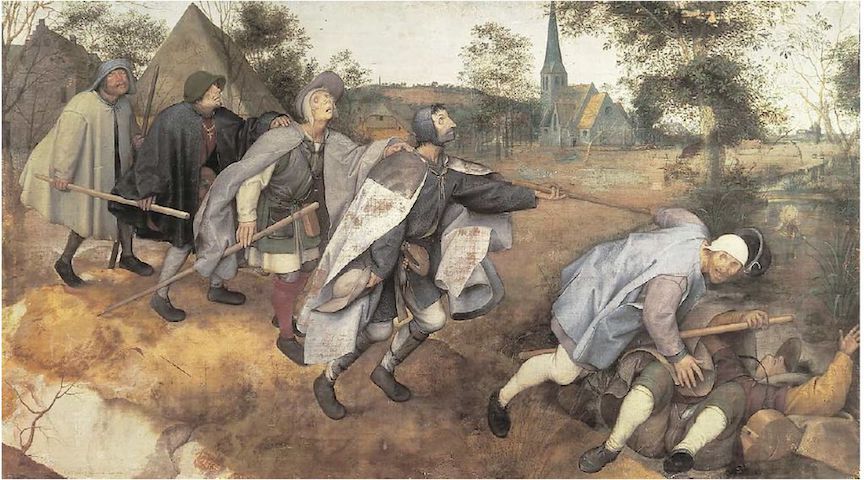
The Blind Leading the Blind by Peter Bruegel the Elder, 1568 [Museo di Capodimonte, Naples]

What’s Happening – and Where We’re Headed

Determining the precise meaning of the pastoral guidance in Amoris laetitia (AL) for the reception of Holy Communion is not the real crisis facing the Church. AL is tangled up in a centuries-long struggle with Subjectivism, which seeks to establish the primacy of private judgment as the effective norm for Christian life {emphasis by Abyssum}. No response to the Cardinals’ dubia can resolve this crisis, therefore, because AL did not start it. And besides, the controversy has now reached the stage that the question facing us is the authentic interpretation of the ordinary Magisterium of the Church, not the meaning of prudential guidance found in lesser pastoral letters of individual popes or bishops {emphasis by Abyssum}.

Subjectivism’s attack on the Gospel is rooted not only in the Reformation’s “private interpretation” of Scripture, but in the subsequent individualism and relativism that has characterized the Modern and Post-Modern West. It’s the same error that Cardinal Newman opposed in the 19th century. Although Newman famously defended conscience, he insisted that its only private judgment was the act of accepting the Church as teacher, after which it was bound to be docile to the Church’s normative proclamation of the Gospel.

He was affirming the apostolic truth that in conscience, as in life, we stand before God with Christ and the Church, not alone. In the 20th century, Subjectivism metastasized among Catholics and other Christians, stripping many mainline Protestant denominations of their witness and membership, and giving rise to the disastrous misinterpretation of Vatican II (the so-called “Hermeneutic of Discontinuity”). Humanae Vitae (HV) was a watershed, of course, and false moral theologies gained popularity from that time forward.

Popes John Paul II and Benedict XVI labored throughout their ministries to address the errors of Subjectivism with minimal denunciation, preferring careful, clear, and consistent affirmations of the Faith that presented the authentic spirit of Vatican II. In retrospect, they seem to have been attempting patiently to reunite the Church and calmly to guide us out of confusion.

They made significant headway among the younger generation of committed Catholics and, at least in America, younger clergy. They did not, however, win over many of the older adherents of Subjectivism among the theologians, clergy, and bishops. Thus the 21st century found the Church stronger, but with the controversy unresolved. This is the overarching context of Pope Francis, the two synods, and Amoris laetitia.

The pre-existing struggle over Subjectivism explains how a few inconclusive passages in a simple papal exhortation have been taken as justifying fundamental changes in Church belief and practice. Otherwise, the passages would have been interpreted and the pastoral issues resolved in continuity with all that came before.

Instead, we see an effort to promote practices regarding marriage and morality that – regardless of the interpreters’ intentions – accord with the subjectivism of the already-refuted moral theologies of the past fifty years. Particularly at risk are the truths that:

1) the Gospel taught by the Church is a realistic norm of behavior rather than merely a guide or an ideal;

2) in every circumstance God gives the grace to live the Gospel norm;

3) a valid marriage is permanent, and

4) marriage, conscience, and reception of Holy Communion are Christological and ecclesial rather than strictly private.

We know from the Humanae Vitae crisis what happens next. Once false beliefs and practices are publicly allowed or mandated, it will become almost impossible to call the misled bishops, priests, theologians and faithful back to fidelity even through determined pastoral efforts lasting decades.

By definition, the priests and bishops affirming the truth will be undercut because they will be unable to point to uniform belief and practice. There will be efforts to assert that inaccurate or false interpretations of the Gospel are consistent with the authentic Magisterium, representing the true “development,” “renewal,” or “spirit” of the Catholic faith. To be successful, these efforts will need to marginalize critics, stooping to name-calling (e.g., “Pharisee,” “nostalgic,” and “rigid”) or labeling them a disloyal minority.

The Maltese bishops and others have already independently gone beyond the text of AL to assert that the established teaching of the Church mandates that those “at peace” in conscience (a situation not limited to the “remarried”) be admitted to Holy Communion. Thus, they claim to speak for the pope’s “real” intentions in AL and to offer the only authentic interpretation of the Catholic faith. The implication, sometimes stated explicitly, is that those who disagree are not acting “in communion” with the pope.

Thus, in a single year the issue has gone from considering Holy Communion in rare cases for the “remarried” to entrusting local bishops with determining policy, to mandating Holy Communion for everyone in “good” conscience, to claiming this innovation is integral to being in communion with Rome. If this latter position stands, there will be no room for the consciences of priests or the authority of bishops who disagree {emphasis by Abyssum}.

To be clear: what is now being promoted – sometimes in the Vatican’s own newspaper – are theologies and practices that heretofore were rejected as contrary to the Faith. Recall the aftermath of Humanae Vitae and consider where we will be in a few years if the teachings on conscience, marriage, and Holy Communion are abused and abandoned by laity, clergy, and bishops at the same rate. Only prompt action would prevent grave damage to souls and to the life of the Church.

The question is not AL. The question is whether the new approach reflects the ordinary Magisterium of the Church in communion with Rome as claimed and, if not, what is to be done.

After Humanae Vitae  the Church engaged in a Cold War against Subjectivism without complete success. That strategy will not work today when the mere passage of time could prove catastrophic as misinterpretations of the Magisterium spread. With the meaning of the Gospel at stake, the faithful need from the pope and the bishops more than ambiguous guidance, silence, or dueling policy statements. We need the clarity and authority of a witness worthy of the Apostles {emphasis by Abyssum}.

Fr. Timothy V. Vaverek

Fr. Timothy V. Vaverek

Fr. Timothy V. Vaverek, STD has been a priest of the Diocese of Austin since 1985 and is currently pastor of parishes in Gatesville and Hamilton. His doctoral studies were in Dogmatics with a focus on Ecclesiology, Apostolic Ministry, Newman, and Ecumenism.

Posted in Uncategorized | Comments Off on THE SUBJECTIVISM OF FRANCIS AND FRIENDS WILL PROBABLY PROVE TO BE CATASTROPHIC IF NOT STOPPED SOON

IT IS NOT ISLAMOPHOBIC TO GIVE PRIORITY TO CHRISTIAN REFUGEES COMING FROM THE SEVEN MUSLIM COUNTRIES

Image result for photos of syrian refugees

Ghana accepts over 90 Christian refugees from Syria

A Two-Part Series on Leftism and the Media: A Response the Rachel Maddow’s “Breaking News”   Part One was posted yesterday.

By Peter Amos Cohen

05 March 17


Part 2: The Leftist’s Cocktail Is Equal Parts Of “Expertise” And Gnosticism


In the last installment, we saw how leftism is absolutist because it holds that perception causes being. This installment shows that Maddow has no story in the document itself.

First, an unbiased person would admit that an “expert” or “academic case” can be made both for or against the travel ban, based on which factors one weighs more heavily. An unbiased person would also admit that all sides of the issue must be considered. There are probably 30 reports dealing with this issue, none of which have the same conclusion, because each one follows out one side of the issue be weighing certain factors more heavily. While such abstract studies may be helpful, they can never replace prudential judgment in political matters for the same reason that politicians ought not to be merely the puppets of the political consultant class.  

Second, those who support the travel ban agree that citizenship is not an indicator of terrorism, one way or the other. If citizenship indicated terrorism, these individuals would be arrested, not banned. “Banning” does not connote knowledge of terrorism, but lack of knowledge in that category. Hence, the travel ban presupposes that citizenship is, exactly as the title of the paper claims, not an indicator of terrorism. Just because someone comes from one country or another does not mean he is a terrorist. Precisely.


Given that citizenship is not an indicator (one way or the other) of terrorism, the problem is that it is difficult to find indicators (one way or the other) in these countries due to their lack of pertinent records. There is no indication whether someone coming from these countries is a terrorist. Combine this with the facts that there are a high number of terrorists in these countries and that terrorists use guerrilla warfare techniques to disguise themselves as civilians. One concludes that citizenship from these countries does not indicate terrorism, but only the need for further screening; one also concludes that temporarily halting immigration is responsible until the administration knows that people immigrating are not terrorists. Whereas people from other countries may start with a presumption of not being terrorists, it is irresponsible to extend that presumption in blanket fashion to people from these seven countries given their high terrorist occupancy. There is nothing racist or xenophobic or uncharitable about it. Morally, the protection of the people entrusted to his care is a grave (the matter for mortal sin) duty for the father of a family or the president of a nation (CCC #2265).    


Nor is it Islamophobic to allow immigration of Christians from these countries. The reason is that, regardless of the question of whether terrorists are faithful Muslims or not, the terrorists are all Muslims, who have a fanatical dedication to Allah. Consequently, while they have no problem posing as a non-terrorist civilian, they do have difficulty posing as Christians. Religious fanatics have difficulty professing the faith, even symbolically, of other religions. It is blasphemous. So one must further conclude that, while profession of the Muslim faith, like citizenship, IS NOT an indicator one way or the other regarding terrorism (because both terrorists and non-terrorists profess it), profession of the Christian faith IS an indicator that someone is not a terrorist. Christians, therefore, should be cleared for entry. These conclusions are both obvious and commonsensical. It does not need an intelligence expert to confirm it. The policy may need to be revised in terrorists begin to pose as Christians, but so far that has not been an issue.


Yet, the third point and tie in to this essay’s first part, is that many people, like Rachel Maddow, embrace and anti-democratic, anti-republican gnosticism. It stems from her (possibly unconscious and uncritical) adoption of the position that, for the powerful, perception causes being. She holds that what appears to the common sense person does not exist. Because she does not will it, Maddow does not perceive it within her dream and so, for her, it does not exist. Not common sense or reason, but “expert knowledge” from leaked intelligence confirm her in her dream. According to Leftists like Maddow, in other words, people who think in terms of general reason, liberal arts, etc. are not experts and are not qualified to know matters like immigration, or whatever. Ultimately, Leftism claims that people are not qualified to govern themselves and, therefore, that representative government is impossible. This is the key presupposition of the administrative state (for more on why this is so, see: https://tinyurl.com/j58ntzh). It is by constant reference to and equivocation between expertise and gnosticism that the Left inflicts reality with its willed perception. The fact that so much of reality is not accounted for within the Leftist’s dreamy perception explains why the media is so dumbfounded by the Trump movement. Reality has exploded into their ideological perception. Those, like Maddow, who are uncritical stooges, have been shocked that reality is not reducible to media perception or, more precisely, to media-controlled public perception. They are shocked that they do not have the control, the power, they think they do. But, lacking in self-knowledge, the media doubles down on its efforts to create its willed-perception. Just watch Julian Assange’s, whoops, I mean Rachel Maddow’s “exclusive” (found here: https://tinyurl.com/z9qrnrl).         


Posted in Uncategorized | 1 Comment

NIETZSCHE WOULD BE PROUD OF RACHEL MADDOW

Image result for photo of rachel maddow

Rachel Maddow

A Two-Part Series on Leftism and the Media: A Response the Rachel Maddow’s “Breaking News”  Here is Part One

By Peter Amos Cohen

04 March 17

Part 1: If A Tree Falls In The Woods And Nobody Hears It, Does The Sound Exist?

Media Matters recently wrote a story about another leak from within the intelligence communities that supposedly undermines the “travel ban” because it concludes that citizenship is not a reliable indicator of terrorism: This story can be found here: https://tinyurl.com/hec5ygm.  

Maybe there is no news in this story since it is now so commonplace for the government and the mainstream, corporate media to degrade themselves and act according to fake standards or virtually no standards. But if anything is newsworthy, it would be these two points:

1) the political absolutism (popularly known as fascism) involved in the leftist union between the media and the intelligence community through “leaks” (For more on the intelligence community and the media see: https://tinyurl.com/jz8g33k).

2) the reporter’s lack of comprehension. Maddow’s story and the {intelligence community} document itself mean nothing. I will demonstrate this in my next post. In this post, I want to address why Maddow’s bias leads her to “find” (really insert) something that is not there.


Why does Maddow jump to conclusions? The answer is she is a leftist and leftism has no rational or social standards, but only pure will. Leftism is based on the notion that “to be is to be perceived.” If a tree falls in the woods and nobody hears it, is there any sound? If nobody perceives it, does it exist? Is existence merely human perception? The leftist would say “yes.”  The leftist’s affirmative answer means two things, practically:

1) reality ought to be whatever you will it to be;

2) the part of reality you do not will ought to be either suppressed or forced to conform. Leftism is an absolutist ideology that is both political and metaphysical. (For a good understanding of the difference between ideology and principles, see the essay by Randall Smith published yesterday on Public Discourse: http://www.thepublicdiscourse.com/2017/03/18571/ )

Leftism will justify anything and stop at nothing to get its agenda accomplished. Things like the democratic process, discussion or dialogue with one’s opponents, standards for the intelligence community or media, any form of political tolerance; all are signs of weakness. There is no debate or discussion, only “the good” (those who agree) and “the bad” (those who disagree).

Because whoever disagrees is “bad,” they must be demonized. Practically, those who disagree must be racist, xenophobic, bigoted, stupid, not worthy of being included in a “democratic” process, not worthy of being treated as a human being, etc. Even if you agree with leftist positions but oppose their absolutism, you will face their fury. Just look at the example of those who, like Lady Gaga during the Super Bowl, moderate their political agenda for a moment of unity, remembering that we are all Americans, despite our political disagreements. The leftist will not allow it because such a moment says that their agenda is not absolute, but secondary to things like being American or following the democratic, constitutional process. It requires one to stop grinding his axe for a moment and bond with his neighbor, no matter who he is or what he believes, simply because he is a human being. Those who allow for unity are heavily criticized by the left for not using the opportunity to make a political statement {against those whom they consider the enemy. – Abyssum}

Leftism is metaphysical: everything not leftist must be denied and subjected to the leftist agenda. Perception causes being… just keep on imagining, keep on dreaming, keep on threatening, keep on brutalizing, keep on oppressing, and eventually all will conform. Reality will be what you imagine it to be. This is the leftist’s metaphysical two-step.

First, give the agenda sole consideration. Dream. Assert your will. Do not think of ethics, propriety, political processes, social conventions, manners, intelligence, common sense, what other people mean, etc.

Second, after denying these things, then create new versions of them within your dream, as auxiliaries to its agenda. So the left is first entirely unethical, then it proclaims a new ethics and acts as if it is ethical. It is entirely illegal, then it uses the law as its auxiliary. It will pass things through courts, denying the constitution and the democratic process, then it will adhere to new version of these by applying them to non-citizens, as newly understood according to the “living constitution.” Etc.

By this method, the left is denying the deep foundations of our social compact and our political order — political equality and freedom — found in classical liberalism (e.g. Declaration of Independence). Then it is replacing them with a new foundation — radically autonomous self expressing pure will — found in Nietzsche, et alia. After being denied, all other considerations are revived and replaced on the new foundation, which gives them new meaning. In replacing the deepest cause and reformulating a new synthesis of “the one and the many,” leftism is the metaphysical version of the new (not classical) liberalism, the sexual libertinism of the 60’s. I do not claim that Rachel Maddow knows this, but only that she is biased by her training (indoctrination)  and, at this point in her life, is virtually incapable of critical thought.

{To be continued in a post tomorrow}


Posted in Uncategorized | Comments Off on NIETZSCHE WOULD BE PROUD OF RACHEL MADDOW

BRAVO BISHOP RIGOBERTO CORREDOR BERMUDEZ, MAY YOUR TRIBE INCREASE !!!

Colombian Bishop of Reinstated Priest Now Defends Traditional Teaching on Marriage

OnePeterFive

FacebookPinterestPocket

In the midst of detecting and reporting many discouraging events, we at OnePeterFive are always grateful to report encouraging developments. One such good development comes to us now from Colombia, Southern America. As we have reported, Rigoberto Corredor Bermúdez, the Bishop of Pereira, on 16 January 2017, had suspended of his priests — Father Luis Carlos Uribe Medina — for having had “expressed publicly and privately his rejection of the doctrinal and pastoral teachings of the Holy Father Francis, mainly regarding Marriage and the Eucharist [in the bishop’s words].”

Then, however, on 1 February, we were able to publish a decree which shows that Father Uribe was surprisingly reinstated as a priest, after signing a document in which he says: “I wish to remain under the obedience and in respect toward the Holy Father Francis and to my diocesan bishop, within the the Doctrine and Apostolic Tradition of the Church.” At the time, Steve Skojec reported the following so as to give the background of this surprising development:

The Spanish-language website Secretum Meum Mihi (SMM) also reports that Radio Rosa Mistica Colombia, a Catholic broadcaster, has aired a story stating that Uribe’s bishop, Rigoberto Bermúdez, has not only corrected this situation, but “now seems to have rejected Cardinal Christoph Schönborn’s interpretation of Amoris Laetitia in favor of the orthodox view on Marriage and the Eucharist.” SMM says that this information, inasmuch as it is based on the interpretation of an anonymous witness, is not verifiable.

SMM includes an update to their story based on correspondence with Radio Rosa Mistica, in which the broadcaster has stated that the information “is true.” Further:

“We receive it from a source who is part of the group in which Father Luis Carlos spoke after the meeting with the bishop of Pereira. Although there is still no document on the orthodox position of the bishop, Father Luis Carlos informed these people in private that the prelate recognized his mistake, accepted the arguments of the priest whom he reinstitutes into his priestly magisterium and announced that he forbids in his diocese to give communion to the divorced and remarried in civil or free unions. Also the bishop said to be obedient, first of all, to the Sacred Catholic Doctrine…” [my emphasis]

We have now received from Father Uribe himself that official document (links to PDF original in Spanish) which, at the time, was still missing, in order to confirm the various reports from these different sources according to which the Bishop of Pereira himself has shown a change of heart. Father Uribe has now kindly sent to us the Pastoral Letter for Lent 2017, as it was published by Bishop Bermúdez, which shows that he now intends to preserve the traditional Catholic teaching on marriage. Dated 1 March 2017, the 11-page-long document deals with fundamental questions of the Catholic life in our world today. Bishop Bermúdez now conveys the importance of protecting human life and of carefully considering that God has given to us human beings a responsible free will. The Colombian bishop shows how men abuse this free will at times, and thus conduct themselves in a way which “distances us from God,” such as drug abuse, alcohol abuse, homocide and suicide, as well as “abortion which removes the innocent little children who have a right to live from their mother’s wombs.” The prelate regrets — also in the face of so much corruption — that many faithful today “are ignorant and negligent of all that which Christ offers us though His Church so that we may grow in our greater imitation of Christ.” Bermúdez also describes how all too many Catholics do not attend Sunday Masses any more after they received their First Holy Communion.

It is here, on page 10 of his Pastoral Letter, that the Bishop of Pereira invites all Catholics to return to the practice of the Catholic Faith and to return to the Sacraments, to the life of the Church, her prayers and works of charity and apostolic works. It is here that he makes it clear that not everybody may have access to the Holy Eucharist:

Although the impediments of certain states in life (adultery, cohabitation and civil union), do not allow the reception of the sacramental communion, this does not therefore say that these people can not still participate in other acts of the ecclesial life that we have pointed out. The Lord will give grace to return to full communion, through conversion. [my emphasis]

In the current context of indifferentism, materialism, and the “dictatorship of egoistical individualism (self-adoration),” Bishop Bermúdez also reminds his readers  of Our Lord’s words “Neither do I condemn you. Go and sin no more.” (John 8:11) He calls upon the faithful contritely to approach Jesus Christ and to seek His forgiveness. The Colombian prelate ends his instruction with a beautiful reference to Our Lady: “The Virgin Mary, Our Lady of Sorrows, awaits us on Golgotha, to help us heal the wounds of sin.”

Thus we have here the example of a bishop who — perhaps in humbly listening to one of his own candidly loyal priests — was able to change his former position and to distance himself from some of the troubling and confusing changes in the Church’s moral teaching that have come to us during the pontificate of Pope Francis.

Posted in Uncategorized | Comments Off on BRAVO BISHOP RIGOBERTO CORREDOR BERMUDEZ, MAY YOUR TRIBE INCREASE !!!

PRIEST, DON’T TURN YOUR BACK ON GOD WHILE YOU ARE TALKING TO HIM


Friday, 3 March 2017

The Priest and the Tabernacle: not to face God while addressing Him is blasphemy

How would you feel if someone spoke to you like this? 
Fr. Thomasz Jochemczyk, of the Diocese of Albenga-Imperia, Italy, in a lecture at the International Congress for the Reign of Christ the King, presented in dramatic fashion the spiritual/theological and psychological consequences of the priest saying Mass with his back to Our Lord in the Tabernacle. 
 
 
Is this not insulting?
 
Fr. Jochemczyk asks: how would you feel if someone addressed you with their back to you? Is it not an insult? And what are we to make of such a stance – literally – when the priest address Our Lord, turned away from Him? Remember, Jesus Christ is God, He is our King. He is truly and substantially Present in the Tabernacle. 
 
This is how you address someone 
 
Indeed every picture does tell a story!
Posted in Uncategorized | 2 Comments