IS FRANCIS A FORMAL HERETIC ???


Dr. Lamont: It is More Likely Than Not That Francis is a Formal Heretic

OnePeterFive

All sorts of rumors are now swirling about current events in the Church:

  • Cardinal Burke has been cancelling engagements. Why?
  • Cardinal Muller has resigned from the Congregation for the Doctrine of the Faith. Was he forced or was it voluntary?
  • A formal correction of the Pope has already been made in private and is about to become public.
  • The Pope and his allies are intending to radically revamp the Novus Ordo Mass to make it even more amenable to Protestants and others.

And these come against the background of significant public events and incidents:

  • The official and public endorsement of a heretical understanding of communion by various groups of bishops in Argentina, Malta and now Germany, based (they claim) on the Pope’s recent apostolic exhortation Amoris Laetitia. The Pope has either confirmed their endorsements or maintained a favorable-seeming silence.
  • The “annexation” of the Sovereign Order of Malta by the Vatican.
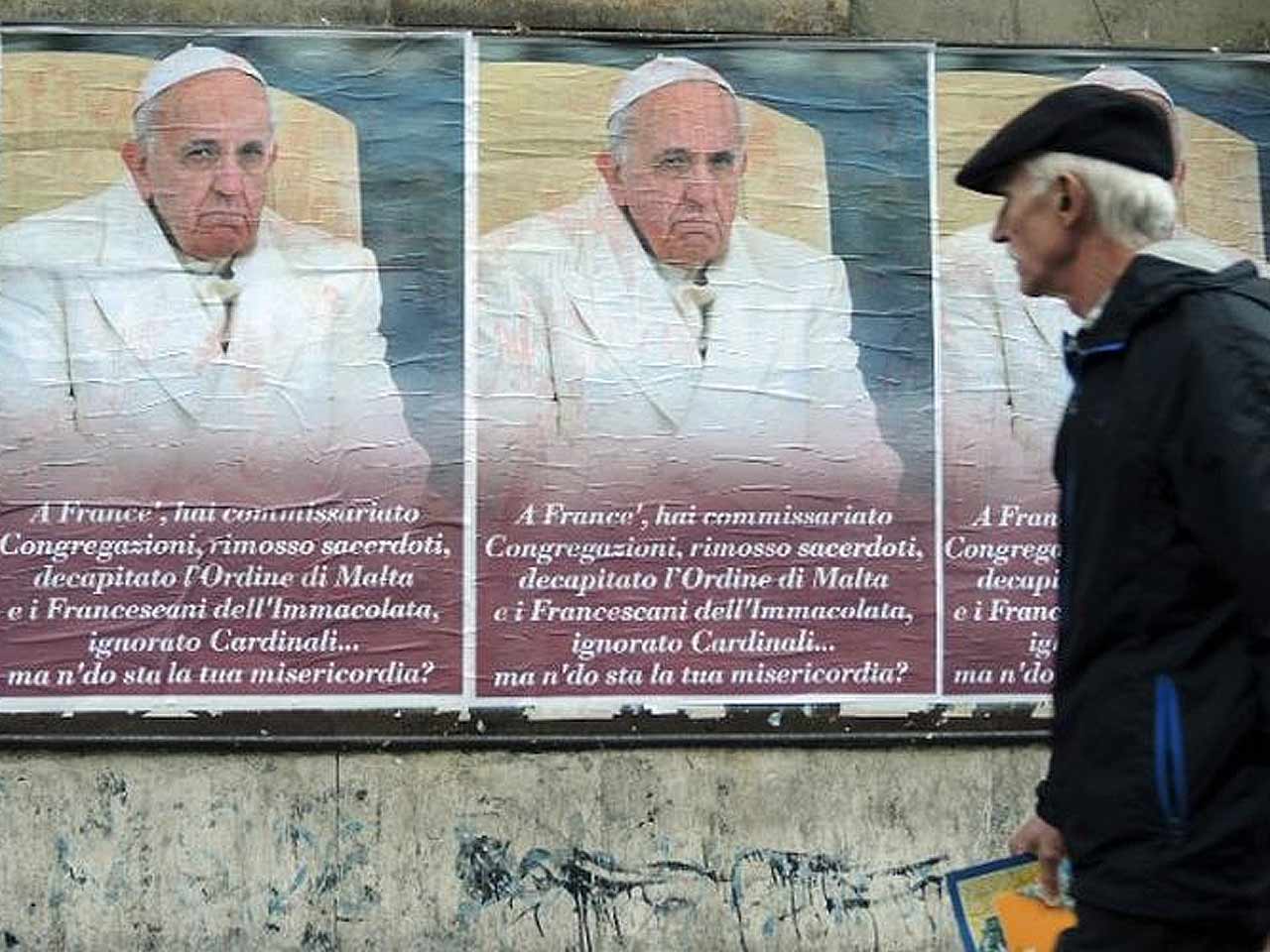
  • The overnight appearance in Rome of posters critical of a sitting pope – something not seen since the era of the Papal States.
  • A parody “attack” on the pope sent via email to Vatican officials.
  • A seemingly coordinated attack on Cardinal Burke – now the Pope’s most identifiable “opponent” – accusing him of being a right-wing extremist in league with the Trump administration and neo-Fascist Italian politicians. The attack has involved Pope Francis himself and various Vatican allies but has also bled over into the American secular press.

A friend reminded me of this motto:
Motus in fine velocior

“Motion accelerates when the end is near”

But what is the “end” in this case?

The unprecedented (in modern times) suppression of four (or more) cardinals and thus a tightening of the grip of the Church of Mercy?

Open schism?

Or is it that the “end” will include the removal of a pope?

As unthinkable as the last possibility may seem, more and more people, many inside the Church hierarchy and bureaucracy, are now privately talking about it. Even if it is mere wishful thinking, this has enormous significance.

Yesterday, Rorate Caeli, one of the leading traditionalist Catholic websites, published a long essay by Canadian-born philosopher John R.T. Lamont, addressing certain questions surrounding the meaning of “formal correction.” While the positions taken in he article were not explicitly endorsed by the site, the post was not preceded by any disclaimers either, unlike other “controversial” articles they have published.

Among other things, Lamont claims:

In the light of the fact that Pope Francis has openly endorsed heretical understandings of Amoris laetitia in his letter to the bishops of the Buenos Aires region of Sept. 5th 2016, it is more likely than not that he is in fact a formal heretic.

Why then have so few cardinals and bishops publicly lined up with the four “dubia cardinals” on this? Lamont argues that much of the reason stems from an absolutist understanding of “obedience,” with roots in the philosophy of St. Ignatius Loyola and other 16th and 17th century Jesuits. But this understanding is erroneous and dangerous:

The question of how anyone, even a cardinal, can correct the Pope is an important one. It is a basic principle of the divinely established constitution of the Church that the Pope judges all other Catholics on earth and is judged by none of them. But this constitution does not establish the Pope as an autocrat with tyrannical authority, who is answerable to no-one. The Pope’s authority is a legal one, and as with all legal authority it involves duties to his subjects as well as rights over them. The duty to confess the Catholic faith is a fundamental duty of the papal office. His subjects may thus formally request and even require him to carry out this duty. The right to make such a formal request belongs to any Catholic, but the cardinals, whose office is to advise the Pope, have a strict duty as well as a right to make this request. The cardinals who have failed to do this are guilty of a grave dereliction of duty. This failure is a catastrophe that threatens to lead to the disintegration of most of the Church.

Read the full article here.

It should be noted that the anonymous Rorate author who introduces the piece strongly rejects the truth of the rumor that the Pope has already been formally corrected. However, he does not explain why he believes this.

We’ll find out soon enough.

Originally published at Mahound’s Paradise. Reprinted with permission. This post has been modified for republication.

Posted in Uncategorized | Comments Off on IS FRANCIS A FORMAL HERETIC ???

IF ONLY HUMANS COULD GET ALONG TOGETHER LIKE ANIMALS SOMETIMES DO

 Meet Bob and his friends

1

An unusual family of animals is winning hearts on Instagram.  This has attracted over 77,000 viewers so far by regularly sharing
snapshots from the life of one man’s pets: an eccentric but tight-knit group that consists of 1 golden retriever, 1 hamster, and 8 birds.

31-year-old Luiz Higa Junior of São Paulo, Brazil, says that his golden retriever, Bob, is a little less than 2 years old.


In the beginning, he just had Bob, a cockatiel and a parakeet.

“Since the beginning I put them together to see their behavior,” he tells us. “It was nice, so I decided to have them play together sometimes during my free time.”;


He then added more birds and a hamster to the group.

His photos show the group posing, playing, exploring, & resting together.

11351047_1566105150318465_2084895153_n

11246933_342089639333991_681902925_n

10957708_961516857222275_1968372740_n

11184649_1590754694474866_1365316936_n

11055856_1566870023596436_1174423341_n

10919088_344695472386159_2090856953_n

11258853_662983490501702_920107774_n

11236098_1416928295294833_1907966994_n

11049411_401330850027442_2032461956_n

10832028_309042745961209_558029939_n

11261239_1750848558475416_486751977_n

11376524_1582366442016179_334900785_n

11258868_490527574436891_843090700_n

10808631_359582097535393_1341987318_n

11357730_1605166339727539_1647623060_n

Why can’t humans learn to get along together like this? 


Posted in Uncategorized | 1 Comment

BEWARE OF THEOLOGIANS WHO ARE WOLVES IN SHEEP’S CLOTHING

Featured Image
John-Henry WestenJohn-Henry Westen


(Emphasis and {commentary} in red type by Abyssum)

Major player at Vatican II confesses to concealing homosexual sex life

February 17, 2017 (LifeSiteNews) — 93-year-old Gregory Baum, a famed Canadian Catholic ex-priest, has in his latest book revealed that he secretly led an active homosexual life for decades.

Baum, who was a peritus or expert at the Second Vatican Council, reportedly composed the first draft of the conciliar document Nostra aetate, the Declaration on the Relation of the Church with Non-Christian Religions. Baum advocated for the elimination of the Church’s efforts to encourage Jews to recognize Christ as the Messiah and has since pushed social justice and liberation theology.

The influential cleric reveals candidly in The Oil Has Not Run Dry: The Story of My Theological Pathway, “I did not profess my own homosexuality in public because such an act of honesty would have reduced my influence as a critical theologian.” “I was eager to be heard as a theologian trusting in God as salvator mundi and committed to social justice, liberation theology, and global solidarity.”

Baum was also influential in the Catholic Church in Canada despite his openly heretical positions on sexuality, which he published in various journals. His public dissent from the 1968 declaration of the Church maintaining the ban on contraception — Humanae Vitae — was instrumental in the Canadian bishops’ own dissent from the encyclical of Pope Paul VI. As the foremost expert on the Canadian bishops’ dissent, Monsignor Vincent Foy has written, “If it had not been for the black shadow of Baum over Winnipeg, his influence over some Bishops, the Canadian theological establishment and pressure groups, the Winnipeg Statement of the Canadian Bishops on Humanae Vitae would not have refused to endorse the teaching of the encyclical as it did.”

In his new book, Baum writes, “I was 40 years old when I had my first sexual encounter with a man. I met him in a restaurant in London. This was exciting and at the same time disappointing, for I knew what love was and what I really wanted was to share my life with a partner.”

He says he considered resigning from the priesthood but didn’t go through with the formality, rather choosing to announce it in the national newspaper. He later married a divorced ex-nun who he says “did not mind that, when we moved to Montreal in 1986, I met Normand, a former priest, with whom I fell in love.” Normand, he explains, “is gay and welcomed my sexual embrace.”

Dr. Michael Higgins, the vice president for Mission and Catholic Identity at Sacred Heart University in Fairfield, Connecticut, in a tribute to Baum published in Commonweal in 2011 noted his key role during Vatican Council II. “The council was the making of Gregory Baum,” he wrote. “He served in various capacities on the commissions charged with preparing documents. … Beginning his work in November 1960, he concluded it with the council’s end in December 1965, an apprenticeship that culminated in his writing the first draft of Nostra aetate.”

Noted Toronto Catholic priest, and now Vatican consultant, Fr. Thomas Rosica, hosted a controversial appearance by Baum at the Catholic Newman Centre of the University of Toronto in 1996 and in 2012 made him a featured guest on his Canadian Catholic TV station Salt and Light Television.

Fr. Rosica, during the fawning interview with Baum, professed to having known Baum for a long time. “I’ve certainly admired very much your theology, your writings but also your love of the Church, your love of Christ, and you helped to keep alive not only the spirit of the Second Vatican Council but also the authentic teaching of the Council,” Fr. Rosica said of Baum.

“You remain a faithful, deeply devoted Catholic, love Jesus, the Church, the Eucharist,” he added.

Monsignor Foy, on the other hand, considers Baum as having “done more than any person to harm the Church in Canada.” {emphasis by Abyssum}BEWARE 

 
Posted in Uncategorized | 2 Comments

RUINI REJECTS RECOGNITION OF RIGHT OF REMARRIED TO RECEIVE HOLY COMMUNION

Italian Cardinal Defends Traditional Catholic Teaching on Marriage


On 15 February, the Italian journal Il Timone published an article written by Cardinal Camillo Ruini – former Vicar General of the Diocese of Rome – in which he defends the traditional Catholic teaching on marriage according to which the “remarried” divorcees may not receive the Sacraments if they do not live as brother and sister. This article had been first published in 2014 (as Dr. Sandro Magister kindly pointed out to me), but the fact that it has been now re-published again demonstrates its significance in the current context.

Ruini’s statement is important inasmuch as he has weight within the Roman Curia. He is the former President of the Italian Bishops’ Conference and was a close collaborator of Pope John Paul II. In the past, Cardinal Ruini had publicly spoken against so-called “same-sex marriages.” In 2007, he said: “It must be said that (homosexual unions) are at odds with basic anthropological facts, in particular with the nonexistence of the blessing of generating children, which is the specific reason for the social recognition of marriage.” Ruini also contributed in 2015 to the Eleven Cardinals’ Book in defense of marriage.

This statement still will be of help for those prelates in the Church who work to preserve the Catholic doctrine on marriage. It is to be hoped that Ruini’s statement now will encourage more cardinals to come forth into the public and then politely to reject the moral relativism and heterodox episcopal guidelines which are now spreading within the Catholic Church.

In the following, we present some important excerpts of Cardinal Ruini’s article. Mr. Andrew Guernsey, once again, was so kind to provide the translation from the Italian original text.


Il Timone, 15 February 2017

Ruini: Communion for the Remarried Divorcees is Impossible. The Magisterium is Clear and Not Modifiable

Cardinal Camillo Ruini

[…]

Other questions, even those already repeatedly addressed by the Magisterium, continue to be brought before us and seem to be becoming more and more acute – among which is that of the divorced and remarried.

“Familiaris Consortio“, n. 84, has already indicated the attitude to assume: not abandoning those who are in this situation, but on the contrary having special care for them, by undertaking to make the Church’s means of salvation available to them—helping them, then, who are not to be considered at all separated from the Church, and participating instead in their lives, discerning situations well, moreover, especially those of spouses unjustly abandoned compared to those who did rather culpably destroyed their marriages.

The same “Familiaris Consortio,” however, reaffirms the practice of the Church, “founded on Sacred Scripture, of not admitting the divorced and remarried to Eucharistic Communion.” The fundamental reason is that “their state and their condition of life objectively contradict that union of love between Christ and the Church signified and effected by the Eucharist.”

Their personal fault is, therefore, not in question, but rather the state in which they objectively find themselves. For this reason, the man and woman who, for serious reasons, such as the upbringing of children, cannot satisfy the obligation to separate, in order to receive sacramental absolution and approach the Eucharist must take up “the commitment to live in complete continence, that is, by abstinence from those acts proper to spouses”.

It is undoubtedly a very difficult task, which, in fact, is taken on by very few couples while there is unfortunately a growing number of divorced and remarried persons.

Other solutions are being attempted for some time. One of them, while firmly maintaining the indissolubility of a ratified and consummated marriage, believes one can allow the divorced and remarried to receive sacramental absolution and to approach the Eucharist, under specific conditions but without having to abstain from the acts proper to married spouses. This would be a second plank of salvation, offered according to the criterion of “epikeia,” to unite mercy to the truth.

This path, however, does not seem viable, mainly because it involves the exercise of sexuality outside of marriage, despite the endurance of a ratified and consummated first marriage. In other words, the original marriage bond would continue to exist but one could act as if it did not exist in the behavior of the faithful and in liturgical life. We are therefore faced with a question of consistency between the practice and the doctrine, and not only a disciplinary problem.

As for the “epikeia” and canonical “aequitas“, they are very important criteria in human and purely ecclesiastical norms but they cannot be applied to the norms of divine law, over which the Church has no power of discretion.

To support the above-mentioned hypothesis, pastoral solutions can certainly be cited which are analogous to those proposed by some Fathers of the Church and go to some extent in practice, but these never attained the consensus of the Fathers, and were in no way common doctrine or discipline of Church (cfr. the letter of the congregation for the doctrine of the faith to the bishops of the Catholic Church concerning the reception of Holy communion by divorced and remarried faithful, 14 November 1994, n. 4). In our time, when, by the introduction of civil marriage and divorce, the problem has arisen in its present form, there is, instead, beginning with the encyclical “Casti connubii” of Pius XI, a clear and consistent position on the part of the Magisterium, which goes in the opposite sense and that does not appear to be changeable.

One might object that the Second Vatican Council, without violating the dogmatic tradition, proceeded to new developments on matters, such as religious freedom, on which there were encyclicals and decisions of the Holy Office that seemed to preclude them.

But the comparison is not convincing because the right to religious freedom has resulted in an authentic conceptual deepening, by tracing back this right to the person as such and to his intrinsic dignity, and not to the abstractly conceived truth, as was done previously.

The proposed solution for the divorced and remarried, however, is not based on a similar deepening. The problems of the family and marriage, moreover, affect people’s daily lives in an incomparably larger and concrete way than those of the foundation of religious freedom, the exercise of which was largely assured in countries of a Christian tradition already before Vatican II.

We must therefore be very cautious in modifying the positions that the Magisterium proposes for a long time and in such an authoritative manner, concerning marriage and the family: otherwise, there would be very grave effects on the credibility of the Church.

This does not mean that every possibility of development is precluded. A road that seems feasible is the review of the processes for matrimonial nullity- which are norms of ecclesial, not divine, law.

[…]

The article has been slightly updated after a kind e-mail from Dr. Sandro Magister.

Posted in Uncategorized | Comments Off on RUINI REJECTS RECOGNITION OF RIGHT OF REMARRIED TO RECEIVE HOLY COMMUNION

FREEMASONS AND FATIMA

Freemason Service at England’s Mother Church on Same Day as Consecration to Our Lady

Canterbury cathedral was the Mother-Church of All England from 597 till the death of the last Catholic Archbishop, Cardinal Pole, in 1558. It was the heart of the Catholic Church in England and one of the major shrines of Christendom because it housed the shrine of St Thomas a Becket.

The Masonic service in Canterbury cathedral marks the 300th anniversary of the foundation of Freemasonry with the establishment of the first Grand Lodge in London. It is reported that the Masonic service will last three hours, but the published order of service appears much shorter. It remains unclear whether Justin Welby has given his permission for the Masons to participate in full regalia in Canterbury cathedral.  The Dean of Canterbury Cathedral, the Very Reverend Robert Willis, will preside at the Masonic Service. The Duke of Kent, who is the Grand Master of the Freemasons, will also be in attendance along with other High Rulers in the Craft.

Virtue online: The Voice for Global Orthodox Anglicanism reports that Justin Welby made his controversial decision to allow the Masonic service in Canterbury cathedral because of a large donation, “Canterbury Cathedral agreed to hold the service of thanksgiving to celebrate 300 years of Freemasonry after receiving a donation of £300,000 ($374,520) from the Masons for the restoration of the North-West Transept in the Cathedral.”  {Money rules, both in the Vatican and in Canterbury!!! Abyssum}

Justin Welby’s and Canterbury Cathedrals decision to allow a Masonic service is controversial among certain groups of Anglicans in light of the 1987 summary of the  deliberations by the General Synod of the Church of England, Freemasonry and Christianity: Are they compatible?:

It was “clear that some Christians have found the impact of Masonic rituals disturbing and a few perceive them as positively evil.” Some believed that Masonic rituals were “blasphemous” because God’s name “must not be taken in vain, nor can it be replaced by an amalgam of the names of pagan deities.” It noted that Christians had withdrawn from Masonic lodges “precisely because they perceive their membership of it as being in conflict with their Christian witness and belief. The Synod’s primary theological objection centred upon Freemasonry’s use of the word “Jahbulon,” which is the name used for the Supreme Being in Masonic rituals, and is an amalgamation of Semitic, Hebrew and Egyptian titles for God.”

Comment

Cardinal Nichols’ reconsecration of England and Wales to the Immaculate Heart of Mary in Westminster cathedral on the 18th of February 2017 inaugurates the celebrations of the centenary of the apparitions of Our Lady of Fatima. The Mass at Westminster cathedral includes the crowning of a specially commissioned statue of Our Lady of Fatima.

There is a violent history of Masonic hostility to Our Lady of Fatima since the original apparitions in 1917 in Portugal. Father John de Marchi’s account of the miraculous events at Fatima, personally verified by Sr. Lucia, recounts the hostility of local freemasons towards Our Lady and the three visionaries at Fatima. Arthur Santos, the mayor of Vila Nova de Ourem who persecuted and psychologically tortured the three children, was a member of the Masonic Lodge of Leiria, and founded a new lodge in his native Vila Nova de Ourem. The Masonic Lodge at Santarem, a neighbouring town to Fatima, became the rallying point to atheistic opposition to Our Lady of Fatima. In September 1917, men from Santarem joined up with men from Vila Nova de Ourem to attack the makeshift shrine at the site of the apparitions.

In view of this history of masonic anti-Catholicism, is it more than an unhappy coincidence that a  major Masonic service is being conducted in the ancient mother Church of the Catholic faith in these lands on the very same day that England is reconsecrated to the Immaculate Heart of Mary in honour of Our Lady of Fatima? Even if it is coincidence, it is a conjunction of events that is profoundly significant and meaningful.

Originally published at EWTN Great Britain. Reprinted with permission.

Posted in Uncategorized | 1 Comment

THE DELIBERATE CONFUSING OF SEX BETWEEN MARRIED AND UNMARRIED COUPLES IS GAINING MOMENTUM

47400b6822f5090564c584418c42951c


‘Sexual relations’ and ‘conjugal relations’ differ categorically

by Edward A. Peters, J.D.
February 16, 2017
IN THE LIGHT OF THE LAW
.

Among the fault lines revealed by the ecclesiastical earthquakes erupting after Pope Francis’ Amoris laetitia, we can see, I suggest, how some high-ranking ecclesiastics seem inadequately to understand the differences between “sexual relations” and “conjugal relations”.

Most any man and any woman can have sexual relations, of course, but only spouses can have conjugal relations. While physically the actions are the same, the differences between a non-married couple engaging in sexual relations and a married couple engaging in conjugal relations are numerous in the natural order (emotionally, psychologically, even legally); if engaged in between Christians, those differences become categorical (sacramentally, spiritually, and even canonically).

I flagged this confusing of “sexual relations” with “conjugal relations” in my comments on the Maltese Disaster noting that Bps. Scicluna & Grech had carelessly spoken of non-married couples exercising a conjugal virtue (Criteria, # 9). But they were not the first, nor are they the only, prelates to disregard the crucial distinctions applicable here.

Amoris itself confuses “sexual relations” and “conjugal relations” by invoking, in its controversial footnote 329, the Second Vatican Council’s reminder to married persons not to “separate” for too long a time (see Gaudium et spes 51, which speaks exclusively in terms of spouses and conjugal relations) as if it were a warning against non-married couples discontinuing their sexual relations!  From a purely scholarly point of view, Amoris’ invocation of advice to married couples about safeguarding their rights as if it were a disincentive to non-married couples to cease usurping rights that are not theirs, is inexcusable, but—and this is crucial—footnote 329 is, as far I have seen, the only time that Amoris makes this fundamental error in categories. As such, and notwithstanding that footnote 329 should be repudiated, it could be excused as a one-time misstatement in an otherwise very lengthy document.

That is, until others, the Maltese in a document published in L’Ossevatore Romano as above, and now Cdl. Coccopalmerio in a book published by Libreria Editrice Vaticana consciously repeat that confusion by saying about Amoris fn 329 that it presents “a suggestion given by the Council for matrimonial situations, in other words for legitimate unions, but was applied by [Amoris] to the case of unions that are, at least objectively, not legitimate. I believe, however, that such a difference is not relevant for the correctness of the aforesaid application” (Coccopalmerio, p. 24, my trans.).

Dare I say “obviously”—the categorical confusion between mere “sexual relations” and spousal “conjugal relations”  made in Amoris fn 329 when it misapplied Conciliar advice for married persons to non-married persons, by taking advantage of a wider disinterest in and/or ineptitude for theo-canonical precision among many ecclesiastical figures, is now spreading from the debate over admitting divorced-and-remarried Catholics to holy Communion, as important as that is, to questions of the moral liceity of sexual acts between married vs. non-married persons, the basic ability of all the faithful to resist sinful temptations, and one’s eligibility for valid reception of Penance, among various other things.

Dare I say “obviously”—this confusion must cease.

Posted in Uncategorized | Comments Off on THE DELIBERATE CONFUSING OF SEX BETWEEN MARRIED AND UNMARRIED COUPLES IS GAINING MOMENTUM

BRAVO BISHOP EDWARD SCHARFENBERGER, MAY YOUR TRIBE INCREASE !!!


Bishop admonishes Catholic politicians

Picture
Picture

John Carl d’Annibale / times union Bishop edward Scharfenberger has rebuked three Catholic politicians who took part Saturday in a rally in support of Planned Parenthood.

Picture

robert downen / times union rep. Paul tonko, d-Amsterdam, stands with Albany mayor Kathy Sheehan during a rally Saturday supporting Planned Parenthood at its Central Avenue location in Albany.

Albany

The words from Bishop Edward Scharfenberger were startling. They were unlike anything we’ve heard from him during his three years here.

The head of the Roman Catholic Diocese of Albany didn’t just hit Planned Parenthood with tough language in a newly released statement. He rebuked three Catholic politicians — Kathy Sheehan, Paul Tonko and Patricia Fahy — for participating in Saturday’s rally in support of the organization.

The rally emphasized Planned Parenthood services that aren’t controversial, like pregnancy testing and cancer screening.

But Scharfenberger said focusing on Planned Parenthood’s unobjectionable health services is like “saying that a man who beats his wife sometimes gives her flowers.”

That line raised some eyebrows, I can assure you.

The issue here, of course, is abortion. Planned Parenthood is the nation’s largest abortion provider. The church considers it one of the great evils of our time.

“It is the intentional killing of a unique human person in his or her mother’s womb,” Scharfenberger said in his 406-word statement. “This is a scientific fact that has nothing at all to do with religion or religious belief.”

With Republicans in control of Congress and the White House, a hot debate of the moment is whether Planned Parenthood should continue to receive federal money, or whether funding should be redirected to clinics that don’t provide abortion.

The defunding threat is largely what led hundreds of supporters to rally at the Planned Parenthood clinic on Central Avenue. Mayor Kathy Sheehan, U.S. Rep. Paul Tonko and Assemblywoman Patricia Fahy each spoke at the rally.

Scharfenberger didn’t call them out by name, but noted that “three Catholic politicians” spoke passionately on behalf of federal funding. The bishop said “it is inappropriate and confusing to the faithful to hold yourself out as a Catholic while also promoting abortion.”

A few eyebrows shot up at that one, too.

To be sure, Scharfenberger’s statement was met with cheers by Catholics and others who have urged him to more aggressively counter elected officials who think abortion should be legal. Comments on the bishop’s Facebook page were largely supportive.

Sheehan and Fahy were not, which is no surprise. I spoke to both by phone and each sounded startled, if not hurt, by the punch in Scharfenberger’s words.

“It was unfortunate,” Fahy told me. “I was a little taken aback by the comments and the tone.”

Sheehan responded more aggressively. She said comparing Planned Parenthood to an abusive husband is “profoundly flawed and deeply offensive.” She considered the rally to be primarily about health care and the need for Planned Parenthood’s services.

“I didn’t use the word abortion,” she said. “I didn’t use the term pro-choice.”

But to Scharfenberger that’s not the point. He said those “who gloss over the core issue of whether or not taxpayers should be funding the world’s largest abortion business … are engaging in obfuscation that is, at best, confused and, at worst, dishonest.”

This is probably a good time to mention, as Sheehan did, that it is illegal for federal taxpayer money to be used for abortion.

Planned Parenthood’s opponents, though, argue that money is fungible — the notion being that if someone gives you $500 to spend on groceries and nothing else, the money is certainly going to benefit the overall household budget.

Planned Parenthood receives $450 million a year in federal funding, largely from Medicaid reimbursements. The organization’s political arm said it would spend $30 million on federal elections in 2016, almost entirely in support of Democrats — which may explain why the debate over its funding is so politicized.

Scharfenberger has occasionally criticized Planned Parenthood in recent years, and he has frequently spoken out against abortion. But the bishop has largely avoided direct political confrontation since succeeding Bishop Howard Hubbard in 2014.

Scharfenberger was unavailable for comment, so it isn’t clear why Saturday’s rally, in particular, led him to speak out.

The abortion debate has certainly provided other opportunities. Just last month at another Planned Parenthood rally in Albany, Gov. Andrew Cuomo called for an amendment to the state constitution that would codify the right to abortion in the state.

Cuomo is an important surname in the political debate over religion and abortion. In 1984, the governor’s father gave a speech at Notre Dame that remains a touchstone for Catholic Democrats. Mario Cuomo argued that Catholic politicians who try to ban abortion would be “seeking to force our beliefs on others.”

Thirty-three years later, the debate marches on.

I’ve posted Scharfenberger’s full statement, along with written responses from Sheehan and Tonko, to my Facebook page.

• cchurchill@timesunion.com • 518-454-5442 • @ chris_churchill


{The best solution to this problem is the solution I chose in 1993 in the case of a Catholic member of the Texas Legislature from the Diocese of Corpus Christi who repeatedly stated in press interviews that “the Catholic Church allows individual Catholics to make up their own minds as to the morality of abortion.”  After several attempts to persuade the Legislator to retract that statement, and failing, I placed the Legislator under INTERDICT forbidding the Legislator from receiving Holy Communion until a retraction was made public. +Rene Henry Gracida}

Posted in Uncategorized | Comments Off on BRAVO BISHOP EDWARD SCHARFENBERGER, MAY YOUR TRIBE INCREASE !!!

ARCHDIOCESE OF DENVER RELEASES A STATEMENT ON CHARLIE JOHNSTON

47400b6822f5090564c584418c42951c

Statement on false claim regarding Charlie Johnston’s messages

PRESS RELEASE:
Feb. 15, 2017
Contact: Karna Swanson
Executive Director of Communications

ARCHDIOCESE OF DENVER
303-945-9136
Karna.Swanson@ArchDen.org

Mrs. Beckie Hesse, using the online profile “Beckita,” stated in a Feb. 7, 2017 blog post titled “The RESCUE Has Begun” that the messages of the alleged visionary Mr. Charlie Johnston, who resides in the Archdiocese of Denver, “have been fully approved by the Church.”  In order to ensure that the faithful are correctly informed, it is necessary to publicly state that Mrs. Hesse’s claim is false.

In fact, Mr. Johnston’s alleged messages were reviewed by an archdiocesan theological commission and Archbishop Samuel J. Aquila determined that the faithful should be warned to be prudent and cautious about Mr. Johnston’s predictions. In addition, Mr. Johnston is not permitted to speak in Church-owned venues in the Archdiocese of Denver. Read Archbishop Aquila’s message here.

The events of 2016/17 have shown that Mr. Johnston’s alleged visions were not accurate and the Archdiocese urges the faithful not to condone or support further attempts to reinterpret them as valid.

Read: Statement on the alleged visionary Charlie Johnston 

Posted in Uncategorized | Comments Off on ARCHDIOCESE OF DENVER RELEASES A STATEMENT ON CHARLIE JOHNSTON

THAT NOISE YOU HEAR IS THE SOUND OF CARDINALS CLASHING IN ROME

unnamed-2

When Cardinals Clash


It was easily predictable that the Amoris Laetitia (particularly footnote 351), would lead to jarring assaults on the Church’s doctrinal unity – even by some of the Church’s own shepherds. Cardinal Francesco Coccopalmerio, President of the Pontifical Council for Legislative Texts, has just joined the ranks of prelates who say that Pope Francis has authorized giving Holy Communion to those in adulterous second “marriages.” Coccopalmerio even extends this permission to others living in sexual relationships apart from marriage in his newly published booklet, The Eighth Chapter of the Post-Synodal Apostolic Exhortation Amoris Laetitia (which some think authoritative since it was issued by the Vatican’s own publishing house, the Libreria Editrice Vaticana).

Coccopalmerio writes:

The divorced and remarried, de facto couples, those cohabiting, are certainly not models of unions in sync with Catholic Doctrine, but the Church cannot look the other way. Therefore, the sacraments of Reconciliation and of Communion must be given even to those so-called wounded families and to however many who, despite living in situations not in line with traditional matrimonial canons, express the sincere desire to approach the sacraments after an appropriate period of discernment. . . .it is a gesture of openness and profound mercy on the part of Mother Church, who does not leave behind any of her children, aware that absolute perfection is a precious gift, but one which cannot be reached by everyone.

What do we find here? Slogans and euphemisms. A slogan is meant to stop discussion. Euphemisms intentionally steer the reader away from precise and accurate descriptions of reality. A seminary professor of mine once noted that verbal engineering always precedes social engineering. In this case, it’s doctrinal engineering

Slogans such as “look the other way” and “not leave behind any of her children,” and euphemisms such as “so-called wounded families” and “situations not in line with traditional matrimonial canons” show a decision not to present a carefully reasoned and precise defense of what is being endorsed. Rather, Coccopalmerio tries to sweep the reader along with emotional appeals and misdirection.

“Not looking the other way,” means that the Church should simply ignore the sinfulness of certain behaviors. In the case of unions involving adultery and fornication, the question is not about healing “so-called wounded families” but warning sinners that their behavior gravely offends God.

When he says that the Church should “not leave behind any of her children,” he means that the refusal to give Communion to those publicly living a seriously sinful life would be an unjust abandonment. Adulterous unions are now simply “situations not in line with traditional matrimonial canons.” God’s law on the indissolubility of marriage and the immorality of adultery is now a mere “tradition” embodied in a canon. Violating that law is only a “situation not in line” with that canon, which was written down somewhere, at some time, by someone. How important is a canon compared to actual people who “express the sincere desire to approach the sacraments after an appropriate period of discernment”?

Cardinal Francesco Coccopalmerio

Coccopalmerio describes observing the Sixth Commandment as “absolute perfection [that] is a precious gift, but one which cannot be reached by everyone.” But the Church has never taught that observing the Sixth Commandment is a state of “absolute perfection,” beyond the capability of any of her sons and daughters. It’s an error to consider marital fidelity as an ideal not reachable by many Christians. The grace of the sacrament of marriage is given by God to strengthen married persons in fulfilling their obligation to marital fidelity. Infidelity is a choice against one’s obligations to God and one’s spouse. It is not an authorized alternative for those who “cannot” reach “absolute perfection.”

Coccopalmerio further states: ““The Church could admit to the Penitence and Eucharist the faithful who find themselves in illegitimate unions [who] want to change that situation, but can’t act on their desire.”

God does not permit, let alone oblige, anyone to commit a mortal sin. And He does not authorize anyone to publicly enter a union that contradicts His law on marriage. A person who has placed himself is an adulterous union must for the good of his soul get himself out of that situation. The Church has the duty to uphold the sanctity of the Holy Eucharist. Those who publicly reject the Sixth Commandment, in various ways, cannot be admitted to the reception of Holy Communion until they have put an end to their sinful acts.

In contrast to all this, Cardinal Robert Sarah has published a second book-length interview with French journalist Nicholas Diat, which will soon appear in English: The Power of Silence, Against the Dictatorship of Noise. In this profound dialogue about the need for believers to recover a love for silence in our agitated world, Cardinal Sarah addresses the burning questions raised by chapter eight of Amoris Laetitia:

Christ is certainly afflicted in seeing and hearing priests and bishops who should protect the integrity of the teaching of the Gospel and of doctrine multiplying words and writings that dilute the rigor of the Gospel by their deliberately ambiguous and confused affirmations. To these priests and these prelates who give the impression of taking up the exact opposite of the traditional teaching of the Church in matters of doctrine and morality, it is not out of place to recall the severe words of Christ: “Therefore I tell you, every sin and blasphemy will be forgiven men, but the blasphemy against the Spirit will not be forgiven. And whoever says a word against the Son of man will be forgiven; but whoever speaks against the Holy Spirit will not be forgiven, either in this age or in the age to come.” “He is guilty of an eternal sin”, Mark adds. (My translation)

The rigor of the Gospel is what will save souls. The dilution of that rigor by anyone in the name of false compassion does great harm by reworking the Gospel into something it is not.

Fr. Gerald E. Murray

Fr. Gerald E. Murray

The Rev. Gerald E. Murray, J.C.D. is pastor of Holy Family Church, New York, NY, and a canon lawyer.

Posted in Uncategorized | Comments Off on THAT NOISE YOU HEAR IS THE SOUND OF CARDINALS CLASHING IN ROME

OH TO BE COUTH IN AN UNCOUTH WORLD

Classical Virtues

Dignitas: The Manners of Humility

.CRISIS MAGAZINE
.

Accounts vary, and a few say that the story about our civil Founders is apocryphal, but it would seem that the story is true. As one of the more jovial national patriarchs, Gouverneur Morris, a native of New York City, but representing Pennsylvania, willingly accepted a challenge from Alexander Hamilton during the Constitutional Convention in 1787 to pat George Washington on his left shoulder and say “My dear General, how happy I am to see you look so well!” Having vowed, he did exactly that in front of surprised onlookers. The General was a formal man, even austere in manners, and had already assumed a sense of presence that would befit him two years later when he became president of the United States. Washington froze, and then removed Morris’s hand, casting an icy stare at him. The room fell silent save for the sound of the offender’s wooden leg as he withdrew in confusion. Hamilton rewarded him with the promised dinner with wine for a dozen friends, but Morris said: “I have won the bet, but paid dearly for it, and nothing could induce me to repeat it.”

Washington’s grace and tact was capable of eliciting deep affection along with admiration, but he had no patience for what he considered boorishness.

At the age of sixteen, he had laboriously copied out in his fine script a long list of “Rules of Civility and Decent Behaviour” compiled by French Jesuits in 1595 and translated around 1640 in London by a twelve-year old boy named Francis Hawkins. Rule 47 said: “Mock not nor Jest at any thing of Importance … and if you Deliver any thing witty and Pleasant abstain from Laughing thereat yourself.” Similarly, Rule 64: “Break not a Jest where none take pleasure in mirth. Laugh not aloud, nor at all without Occasion…” Washington wrote this out in the same year that Lord Chesterfield in one of his famous letters to his teenage son, albeit disparaged by Dr. Johnson, advised:  “Many people, at first, from awkwardness and mauvaise honte, have got a very disagreeable and silly trick of laughing whenever they speak.”

None of this was a formula for pomposity. The rules were gentle protocols for avoiding the sort of self-conscious exuberance that masks pride as affability. From Plato and Aristotle to Seneca the Stoic, the virtuous man was one of piety, dignity, courage, and gravity. A man does not soar to moral heights by being a lightweight. Saint Benedict (480-547) raised this up a notch by associating these virtues with true humility, which was an undeveloped concept in pagan times. He writes in his Rule for monks: “The tenth degree of humility is, when a monk is not easily moved and quick for laughter, for it is written, ‘The fool exalteth his voice in laughter.’ ” Then: “The eleventh degree of humility is, that, when a monk speaketh, he speak gently and without laughter, humbly and with gravity, with few and sensible words, and that he be not loud of voice, as it is written: ‘The wise man is known by the fewness of his words.’ ”

Saint Benedict was a happy man and his monasteries were beacons of joy in a darkening society. Not in spite of that but because of it, he carefully carved the difference between serenity and giddiness. In the same vein, no one today would want to buy a used car from a man who is constantly giggling. Slapping a man on the back may be fraternal, but it also may be a subtle form of domination. And clownish behavior can scream insecurity. In the days of vaudeville, if the audience started booing, an actor’s last defense was to hold a baby and wave the American flag. When institutions are failing, false sentiment distracts from the rot, and pantomimes virtue.

Sometimes, affectation of simplicity can be an innocent, if not naïve, indulgence, like Marie Antoinette playing the part of a dairymaid with scented cows in her rustic retreat of Le Hameau. But it was a costly reverie and an expensive pretense. The singer Dolly Parton dressed as a tinseled cowgirl said: “You wouldn’t believe how much it costs to look this cheap.”

On the other hand, the heroically humble John Henry Newman regretted that a photograph of him showing a frayed cuff “advertised poverty.” When he returned from Rome having been made a cardinal, he arrived at the London Oratory where a crowd had gathered to see the new prince of the Church. Advanced in years, and much discomfited, he struggled to don the cassock and ferraiuolo in his carriage before alighting so as not to disappoint those who had come to see some scarlet.

A few days after the battle of the Allia River on July 18, 390 BC, the Senones tribesman of the Celtic Gauls sacked Rome, this being the first of the six notorious pillagings over more than a millennium. While most of the citizens fled by way of the Janiculum Hill where the North American College now stands, patricians sat on ivory chairs outside their houses in their senatorial robes to await death. One of Livy’s most moving passages described the scene:

The houses of the plebeians were barricaded, the halls of the patricians stood open, but they felt greater hesitation about entering the open houses than those which were closed. They gazed with feelings of real veneration upon the men who were seated in the porticoes of their mansions, not only because of the superhuman magnificence of their apparel and their whole bearing and demeanour, but also because of the majestic expression of their countenances, wearing the very aspect of gods. So they stood, gazing at them as if they were statues, till, as it is asserted, one of the patricians, M. Papirius, roused the passion of a Gaul, who began to stroke his beard—which in those days was universally worn long—by smiting him on the head with his ivory staff. He was the first to be killed, the others were butchered in their chairs. After this slaughter of the magnates, no living being was thenceforth spared; the houses were rifled, and then set on fire.

In our reduced culture when wealthy celebrities go about unshaven, neckties are considered an imposition, form letters from the bank address customers by their first names, and no thought is given to how to dress for church, attention to the gravity of one’s office may seem archaic and indeed affected. But the opposite is the case. The amiably eccentric Queen Christina of Sweden, having abdicated her throne to become a Catholic, wrote to a friend: “Dignity does not consist in possessing honors, but in deserving them.” Customs and outward forms signal that one’s duty is greater than one’s self, and neglect of them is an exercise in egotism. The man who says, “Call me brother, call me pal,” would not have to sloganize that way if he really were a brother and a pal.

The irony is this: those who are silly on the outside can be sly on the inside, and the comic can be cruel to those who see through the charade. Chesterton was a genuine wit and champion of the common man, which is precisely why he was skeptical of sham self-deprecation, and warned against the “easy speeches that comfort cruel men.” Cruel men dressed Jesus as a clown on the way to the Cross, but he never abandoned his dignity. His humility made Pontius Pilate so anxious that with deliberate ambiguity the governor hung a sign over his head calling him a king.

Fr. George W. Rutler

By 

Fr. George W. Rutler is pastor of St. Michael’s church in New York City. He is the author of many books including Principalities and Powers: Spiritual Combat 1942-1943 (South Bend, IN: St. Augustine’s Press) and Hints of Heaven (Sophia Institute Press). His latest book is He Spoke To Us (Ignatius, 2016).

Posted in Uncategorized | Comments Off on OH TO BE COUTH IN AN UNCOUTH WORLD