KASPER KAN NOT KEEP KUIET KONTRADICTING JESUS

Kasper

Settimo Cielodi Sandro Magister 

16 feb 17

Communion For All, Catholics and Protestants. Words of Kasper, Or Rather of the Pope


The obscurity with which Pope Francis loves to speak and write on the most controversial questions is one of the constants of his magisterium, an obscurity that reached its summit in the response that he gave on November 15, 2015 to a Lutheran woman married to a Catholic, who was asking him if she too could receive communion at Mass:

> Sì, no, non so, fate voi. Le linee guida di Francesco per l’intercomunione con i luterani

But the doubts over his real thought are promptly dispelled by the personalities and interpreters closest to him, cardinals, bishops, theologians, Jesuits, journalists.

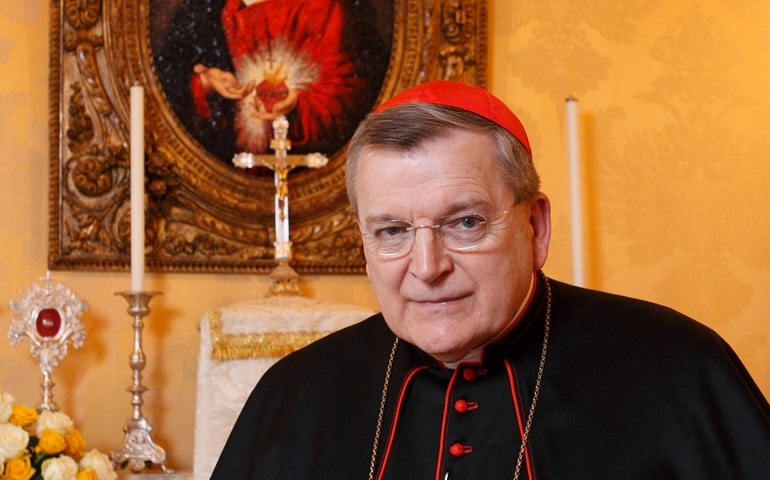
Here, in fact, is what was said a few days ago, with regard to intercommunion between Catholics and Protestants, by the pope’s favorite cardinal, the German Walter Kasper, in an interview broadcast on Italian state television:

A: Today we are no longer enemies, we are friends, we are brothers and sisters. We have begun this ecumenical way and we have taken many steps in the meantime. We have good hope that one day we will even reach full communion. Even now we already have a great deal of communion among us.

Q: A communion at the Eucharistic table as well?

A: Yes, shared communion in certain cases, I think so. If [two spouses, one Catholic and one Protestant] share the same Eucharistic faith – this is the presupposition – and if they are interiorly disposed, they can decide in their conscience to receive communion. And this is also the position, I think, of the current pope, because there is a process of coming together; and a couple, a family, cannot be divided in front of the altar.

These comments from Kasper can be heard from the 8:08 to 9:32 minute mark of the broadcast “Protestantesimo” of January 31, 2017, on Rai2.

*

Meanwhile there continue the unending efforts aimed at reiterating in the name of the pope that yes, in spite of the obscurities and doubts that it raises, the apostolic exhortation “Amoris Laetitia” is “clear” in admitting the divorced and remarried to communion, even if they continue to live “more uxorio.”

To summarize, the first one Francis publicly assigned the task of interpreting his thought in this way was Cardinal Christoph Schönborn, in the official presentation of “Amoris Laetitia” on April 8, 2016.

Then, on September 5, it was the pope himself who wrote to the bishops of the region of Buenos Aires a letter of approval for their permissive stance.

A few days later, on September 19, it was Cardinal Agostino Vallini, the pope’s vicar for the diocese of Rome, who laid down for his priests, at the Cathedral of Saint John Lateran, analogous instructions previously approved by his direct superior.

It was then “L’Osservatore Romano,” on January 14 of this year, that published with an evident impulse from on high the go-ahead to communion for the divorced and remarried given by the bishops of Malta.

On February 2, again “L’Osservatore Romano” gave extensive coverage to the even more “liberal” guidelines published by the bishops of Germany.

On February 10, once more the newspaper of the Holy See published the presentation made by Cardinal Lluís Martínez Sistach, archbishop emeritus of Barcelona, of a book of his entitled “Cômo aplicar Amoris laetitia,” written in “thanksgiving” to the pope for how he “is bringing up to the present time the teaching of the Church.”

And most recently, on February 15, “L’Osservatore Romano” reproduced the praise bestowed by the theologian Maurizio Gronchi on a booklet by Cardinal Francesco Coccopalmerio on the “innovations” of the eighth chapter of “Amoris Laetitia,” a booklet presented as agreeable to the pope if not in fact requested by him.

So much, until now, for the “pars construens,” which as can be noted has seen an acceleration in recent days in conjunction with “recent events” (a manifesto and a fake front page of “L’Osservatore Romano” in ironic denunciation of papal inconsistencies) that have led the nine cardinals of the council that assists Francis in governing the Church to manifest their “adherence and support” to him on January 13.

But in the communication of strategy of Francis there is also the “pars destruens,” meaning the persistent and disdainful refusal to respond to the doubts submitted to him by four cardinals on the obscure points of “Amoris Laetitia,” as well as the ostracism that has fallen on Cardinal Gerhard L. Müller, prefect of the congregation for the doctrine of the faith and himself the bearer of interpretations distasteful to the pope simply because they are firm on the previous magisterium of the Church.

(English translation by Matthew Sherry, Ballwin, Missouri, U.S.A.)

Posted in Uncategorized | Comments Off on KASPER KAN NOT KEEP KUIET KONTRADICTING JESUS

WHAT WE DO WITH OUR SUFFERING, AS A REFLECTION OF WHAT JESUS DID WITH HIS, IS ALL THAT IS IMPORTANT

47400b6822f5090564c584418c42951c

The craft of suffering

The most common reasons given for assisted suicide have to do with pain: the need to get rid of it. There are political justifications, to be sure, mostly dealing with the demands of autonomy, the right each of us should have to control our own bodies. Still, the more pressing, more passionate motive for assisted suicide is the anguished burden felt by those who have watched persons they loved suffer excruciatingly, to the point that justice and compassion both seem to demand simply that pain be ended. Destroy the pain, even if it means destroying a life.

I have never suffered the physical pain these passionate exponents of euthanasia have had to accompany. I have, however, probably suffered mental anguish — as well as watched it — of a kind that today’s laws are pressing to permit as the requisite pain that could demand a death. We have only to recall the now notorious case of “Laura,” as she was known, a 24-year old woman in Belgium whose unremitting depression was considered as legal grounds for her lethal injection. Having been granted her death wish by the required panel of three medical doctors, at the last moment she changed her mind, and a documentary set of interviews is now available online. (She still thinks that the permissive law is good: it gave her freedom to think through options.) Laura, though, was only a window onto a burgeoning scene: 56 persons were killed in the Netherlands last year based on the suffering of mental illness. I can only say, in any case, that I agree: pain can indeed feel unbearable. But we should be clear that this is what we are talking about: pain.

And here’s the funny thing: “pain” has a history. It is a history in which Christian faith has a special place, which is all I want to stress. It was only 40 years ago that the maverick anti-institutionalist priest Ivan Illich wrote his socio-philosophical tract against the health industry, Medical Nemesis: The Expropriation of Health (Pantheon/Random House, 1976). Illich had quickly become a countercultural celebrity, having taken aim at universal schooling, industrial production, and social space. Soon after his book on modern medicine, though, he was dropped by the Left, as his writings on gender and common life were recognized as having too much of a religious whiff, and his later works on medieval texts, reading, and more seemed culturally retrograde.

His book on medicine was perhaps the hinge here. Illich had much to say about the economic order of the medical establishment. But his deepest interest was in how our medical regimen has changed our cultural expectations of value. In his chapter on “the killing of pain,” Illich brilliantly, and with wide-ranging learning, exposes the obvious (if now occluded) reality that “pain” is far more than a simple physical phenomenon. Its experience is shaped by at least four “functional factors”: culture, anxiety, attention, and interpretation.

The pain “felt” by a Buddhist monk in Thailand is not the same as the pain felt by a high-school athlete in America. Even the same individual feels pain differently depending on goals and contexts (the dentist’s office vs. the battlefield). It is possible to trace these differences across cultures and histories. In doing so, we realize that the “pain” our technologically medicalized culture seeks to “treat” via quantitative diminishment and extirpation is actually a radically dehumanized experience — naked, material, without character. As such, Christian pain is not the same as medicalized pain.

Thus, Illich, not quite in passing but at least without fanfare, notes the alternatives, particularly the Christian alternatives, that found their epitome in the expansive and rich discipline of what he calls “the craft of suffering.” It is a marvelous phrase, and comes from one of the most popular of the first books printed in English at Caxton’s Press in 1491, the Art and Craft to know ye well to die, a version of the many artes moriendi or “art of dying” devotionals that had sprung up in the Middle Ages and continued well into the 19th century. Suffering, and hence dying, is a “craft,” an “art” in the sense of something we make through creative training, struggling, and formation. Within such a “craft,” pain finds a special home and meaning.

One dismissive critic said that Illich was arguing for pain as adding to the “quality of life.” He was right. Illich writes: “The well being of men and women increases with their ability to assume personal responsibility for pain, impairment, and in their attitude to death.” The flowering of such personal responsibility lies in ordering our pain, somehow, toward and on behalf of the deepest thing that grounds our being.

Illich knew what he was doing here: he was arguing for the essential place of God — God in Christ — in understanding pain’s meaning for a human life, simply because a human life is God’s altogether, as given in Christ. Hence, the need for a Christian view of what a human being is. Nothing so illustrates the anti-Christian, and ultimately atheistical character of our culture —our culture’s fundamentally blasphemous soul — than legalized euthanasia.

Pain without God is intolerable. Everything in our culture flows from this “without God”; and, in this case, pain therefore sweeps everything before itself. But with God — whom we know in Jesus Christ most fully — pain is something else, indeed, many things, but all things that ultimately find their rest in the Lord who came down from Heaven, became man, died, and rose again.

Forty years before Illich’s book, the greatest reflections on pain that I know of were written by an Irish Dominican, Vincent McNabb — surely one of the finest spiritual and theological writers of the early 20th century. McNabb’s slim volume, The Craft of Suffering, was published in 1936 from a verbatim transcript of retreat talks he had given. The book followed an earlier volume on The Craft of Prayer, and the connection between the two is close. What McNabb does — obviously quite independently of Illich’s worries, but nonetheless already attuned to cultural shifts taking place (he mentions “aeroplanes” and telephones) — is to demonstrate concretely, simply, and profoundly what it means to feel pain as a believing Christian. In a sense, he writes here a small history, the personal history, of Christian pain, laid out as a discipline of attitude, prayer, and always struggling hope, driven by and drawn to grace.

McNabb was a learned and sophisticated Thomist. But he speaks here with a disentangling directness that can somehow carry with it the deepest theological markers. The book’s contents are too varied to summarize. This is not a “theodicy” or an apologetics; it has no single argument to “explain” pain or resolve its difficulties, let alone lessen its intolerable burdens. That is the point: his reflections are not meant to be an “answer” to anything, but rather to point to a “craft” that is learned and experienced as deriving simply from the truth of the world that is God’s and the truth of God’s self. In every way, however, his book is so antithetical to anything we hear today, even (perhaps most notably!) in our churches, that to read McNabb’s book is to be shocked over and over, before finally acquiring the grammar or skills of his insight. Pain, in its truth and being most purely, is about Jesus Christ. It cannot be “done away with.”

The opening talks are difficult. McNabb initially links our pain to faith itself. Faith lives through pain; genuine faith finds itself by living through pain; faith is, one might even say, perfected in pain. Pain here is not the goal, but rather faith is. Yet unless our faith can turn to God, and rely on God, receiving God’s strength alone, then its actual reality remains only vague. It is in pain where faith is shown to be true faith. “Only under opposition,” he writes, is the true “power” of our lives “brought out.”

This is a simple “fact” of this world’s existence — neither eternal in its arrangement, nor something to be conjured: We are truer when we are tried; we go “further” when we are denied; we hear God more fully, when we are assaulted by the silencers. We discover certainty when we can finally say, in the most painful place we find ourselves, “Thy will be done.” “We should beware of trying to prepare a state where we are free from all anxieties,” for such a state would prove a spiritual stagnation of the bitterest sort. This, of course, is as much a cultural judgment as a theological one, because it is bound up to a “craft.”

This discussion on faith is only a kind of attitude-adjuster. What does it mean, more concretely, to “suffer well”? McNabb fills his talks with small vignettes — persons he has visited in the hospitals, prisoners he has ministered to, relatives who have struggled in agony, his own quiet life. He remembers as a child — this was another era — having his mother take him along to visit an old woman who had done some work for them. The woman was now dying, and his mother wanted to share some love and comfort.

I can remember, thank God, how the old dying charwoman slowly undid some wrapping and bandages and showed the mother and her little child the great yawning festering wound that cancer had made in her breast!”

It was strange gift, but a real one, because it positioned the woman’s suffering in the midst of a set of relationships of love, hope, and witness that ultimately reflect the presence of God. In this case, part of the craft of suffering is generational, familial, relational. Again, a cultural judgment, not only a theological one.

The generational life of faith draws us to one place. To “suffer well” seems, in McNabb’s vision, to be the same as coming to know Jesus himself. Jesus is not only the one who suffers, but as God he is the one who suffers and thus transfigures that which otherwise would be a deadened sterility simply awaiting its destruction. Over and over again, as he describes some illness or burden of emotional distress, McNabb shifts his view to Jesus and his life in the body of his incarnate presence.

The titles of the short talks follow, mostly, this constantly refocused vision: “God’s Attitude Toward Suffering” (that is, in God’s own engagement with it), “Tears,” “Mourning and Joy,” “The Lesson of Suffering” (here tied to Jesus “teaching” the disciples that he “must suffer”), “Suffering and Sin,” “Joy and Suffering” (there is a good deal about joy in this book, in a paradoxical way), “The Cross,” “Thanksgiving,” “Apprehension,” “Shrinking,” “Dereliction,” “Standing at the Cross,” “Pruning,” “Perfection.” This is “all Jesus,” in the end. McNabb will constantly remind his listeners that we must not desire faith, but desire God; we must not desire joy (and certainly not suffering), but desire God, and so on. But in desiring God in Christ, we are turned to the very things that touch our pain, because they are more deeply yet God’s own pain in Christ; and hence we can turn back to our own pain, having come to know Christ, as a place of divine encounter.

There is nothing sentimental in any of this. McNabb knows that everything about suffering is deadening, in itself. Hence, even in speaking about Jesus, he must assume that the Lord’s own suffering is itself a tearing down, which, in its own terms, must demand an utter rejection. Yet because such suffering is the Lord’s, taken by God out of divine love for us, just this actual pain is a bridge to God, offered in grace. He speaks to this, among many places, in a wonderful talk on “shrinking,” that is, on the agony of the Garden, where Jesus himself shrinks from death.

McNabb points out, using a Thomistic distinction between the sensitive appetite and the intellectual appetite, that Jesus’ shrinking from suffering and death was indeed his human appetite appropriately at work — “seeing” pain before him, and drawing away from it. Even the application of human reason would only increase his terror by leading him beyond his present experience to calculate more pain and hence multiply the fears, the distaste, the shrinking. Only after the senses and the intellect do their frustrated work does “faith” come, which McNabb rightly notes is actually “dark,” un-luminous, without the contours of sensitive and straightforward predictive intellectual apprehension. Such faith is “heroic,” truly, and it leads Jesus to accept the “cup” of his Father; but it is a faith nonetheless clothed in a fog almost, at least in human terms. Jesus simply presses through the agony. There is no sign that he “feels” something besides his pain.

Yet this faith triumphs. It is a strange triumph in our experience because we have been trained to see accurately its utter uselessness according to our cultural standards. It is “folly,” in the sense that it is instrumentally pointless — as is every pain we feel. Yet, until such pointless pain is reset within the Son’s own life, we shall never attain the truth.

Humanly speaking, what could His reason find to make Him accept death at the hands of those by whom He was to die? What human reason was in that? Alas! this is human folly. Rightly they blind-folded him and mocked Him as a fool. Until we can do some great thing, in the eyes of the world reputed folly, we shall never have the Wisdom of the Cross.

That “wisdom” is bound up with pain. Thus pain, of the most extended (because divinely grasped) kind, cannot be bypassed by the Christian, for the very sake of his or her own soul.

The “craft of suffering,” in McNabb’s vision, is the straightforward, steady learning to live with Jesus. Such a life will be filled with pain, for all kinds of reasons that require other forms of inquiry to parse. At root, though, living just this inevitably painful life with this Jesus is to fashion a good life, ultimately a beautiful life. Yes: a painful life lived with Jesus is indeed “beautiful”; it is, after all, God’s life. Ultimately, it is all about knowing Christ: being taken to him, living with him, learning from him, dwelling within him, and being transformed by the gift of his self. Suffering and Christ — that is entry into God.

One can see here how the Christian view of pain has little to do with the disputes of our era. It has everything to do with the truth bound up in these disputes, but unless Jesus is a part of this discussion, that truth will be fundamentally obscured. That should tell us something about our vocation in the midst of a culture that, feeling the pain everyone feels, can only seek to destroy it, even if it means destroying the life that bears it. This is an evangelistic vocation at its root, a vocation of witness in its breadth and purpose, a creative vocation, where craft and discipline of life are everything, not just head work and word work; and even more than that, it is a vocation of the deepest form of life with Christ Jesus that one might imagine. To be distracted from such a vocation is to be overwhelmed, as so many are, by the simple burden of existence.

All of us will suffer, some far more than others, but suffer we will. We need not seek it or pray for it. What we do with our suffering, as a reflection of what Christ Jesus has done with it, is all that is important. Tears of pain and tears of love are indistinguishable in themselves. The former is but matter, the latter a craft that transforms it into the image of God.


Ephraim Radner is a  priest in the Episcopal Church (Diocese of Colorado) and Professor of Historical Theology at Wycliffe College, an Anglican seminary affiliated with the University of Toronto.
Posted in Uncategorized | Comments Off on WHAT WE DO WITH OUR SUFFERING, AS A REFLECTION OF WHAT JESUS DID WITH HIS, IS ALL THAT IS IMPORTANT

THE CULTURAL VIRUS OF PROPORTIONALISM

unnamed-2

THIS IS THE TEXT OF A TALK THAT I GAVE IN RALEIGH, NORTH CAROLINA IN 2015

THE

CULTURAL VIRUS OF PROPORTIONALISM

BY

RENE HENRY GRACIDA

BISHOP EMERITUS

OF CORPUS CHRISTI

2015

(1)

This talk is about a virus, a particular kind of virus.

[DIMITRY IVANOVSKY]

In 1892, the Russian biologist, Dimitry Ivanovsky (1864-1920) was puzzled by plants that remained infectious after he had filtrated crushed leaf extracts.  He did not know it at the time but the toxin he had discovered was produced by a virus.

[MARTINUS BEIJERINCK]

Eight years later, a Dutch microbiologist, Martinus Beijerinck (1851-1931) identified Ivanovsky’s toxin as a product of a virus.  The science of biology has not been the same since then.

The world-wide physical suffering and death that is due to viral infection cannot be measured and as medical science copes with one type of viral infection viruses mutate and medical science is challenged anew.  One of the worst examples of this phenomenon was the HIV virus that brought the AIDS plague in the second half of the Twentieth Century.

Western Culture has been undergoing radical changes since the mid-Twentieth Century and one of the most insidious developments in this change has been the growth of the Culture of Death, not death brought on by biological viruses, by biological disease, but death promoted through the infection of societies by ideas, philosophical theories, systems of belief that can function in the social body as cultural viruses in a manner not unlike biological viruses.  Such a virus is the system of proportional morality about which this talk will be focused.

2

“Most social scientists today view culture as consisting primarily of the symbolic, ideational, and intangible aspects of human societies.  The essence of a culture is not its artifacts, tools or other tangible cultural elements but how the members of the group interpret, use, and perceive them.  It is the values, symbols, interpretations, and perspectives that distinguish one people from another in modernized societies; it is not material objects and other tangible aspects of human societies.  People within a culture usually interpret the meaning of symbols, artifacts, and behaviors in the same or in similar ways.” (1)

The core of a culture is its system of values.  Chief among such values are good-evil, right-wrong, natural-unnatural, life-death, experiencing well-being or suffering.

Most values are not usually the subject of discussion, they are implicit in various forms of entertainment and recreation, they are not the subject of casual observation, especially by strangers.

It must be obvious to anyone who has lived in the Twentieth Century that human society is seriously affected by a values system and beliefs that have a virulent character.  I am thinking of the slogans, battle-cries, rallying cries of the Twentieth Century that revealed certain negative values that brought death and suffering to millions of people.  I am thinking of the purification of the German people that National Socialism sought to achieve through it program of genetics and extermination camps like Dachau and Auschwitz.  I am thinking of the current cry of jihad that is causing the death of hundreds of thousands of Christians in the Near East and Africa.

If we describe biological viruses as organisms that infiltrate living cells and produce toxins that are frequently deadly, it seems reasonable that we can speak of cultural viruses the infiltrate the social body and produce toxins that are deadly.

3

Racism, for example should be classified as a cultural virus that produces death, as its history in the South in the days of Jim Crow testifies.  Similarly we can legitimately describe anti-semitism or anti-Catholicism as cultural viruses that have produced death in the past and do so even in the present day.

In the middle of the Twentieth Century there began to develop in the social body of the United States a complexus of social values that can only be described as the result of infection by a cultural virus in view of the deadly effect it has had on our society.  All viruses, whether biological or cultural, need the right conditions, an ambiente, a milieu, in which to develop.  The mid-Twentieth Century provided the right conditions for the development of the cultural virus that is the subject of our concern today.

Throughout human history dramatic cultural changes, changes in social values, usually have occurred because of the disproportionate influence some individuals who have exerted on the moral thinking of a large portion of society.  That is what happened in the United States in the second half of the Twentieth Century.  Three men exerted tremendous influence.  They were:  Alfred Charles Kinsey, Father Theodore Hesburgh and Father Richard McCormick.  I will treat of each of these men in this talk.  First, Alfred Charles Kinsey.

[ALFRED CHARLES KINSEY]

In 1947, just two years after the end of the Second World War, Alfred Charles Kinsey, a biologist at Indiana University began to work on human sexuality and through his subsequent publications can truly be considered the FATHER OF THE SEXUAL REVOLUTION in the United States.

4

Kinsey’s specialty was the study of bugs, yet he founded the Institute for Research in Sex , Gender and Reproduction, not the study of sex, gender and reproduction of bugs but of people,   human beings.  Anyone would surely be justified in questioning Kinsey’s qualifications to establish that Institute.  In the following year, 1948, Kinsey published his book, Sexual Behavior in the Human Male and he followed it up five years later with Sexual Behavior in the Human Female.  With the publication of those books Kinsey gave the Sexual Revolution its Manifesto.

The general impression left by Kinsey’s books, as reported in the media, was that Americans were sexually active in a wider variety of ways than anyone could have possibly suspected. That knowledge fostered a new public fascination with all kinds of sexual activity and emboldened  people to start experimenting with their own sexuality.   By revealing the extent of sexual activity, both normal and abnormal activity,  Kinsey had opened the flood gates on promiscuous sexual behavior in American society.

Promiscuous sexual behavior had many disastrous effects in the lives of Americans.  One of the effects was the sudden increase in genital disease which led to the AIDS epidemic.  But not the least effect was that sexual promiscuity soon produced a huge increase in unplanned and unwanted pregnancies both within and outside of marriage.  Those unwanted pregnancies increased the public pressure for contraception, sterilization and abortion-on-demand.

By this time the Culture of Death had reached the huge Catholic hospital system across the land.  First the doctors, then the hospital chaplains, then the hospital administration then the local bishops were involved in controversies over the sterilization procedures.  Finally, Rome became involved and by mandating the end of such procedures in Catholic hospitals accelerated the transformation of the Catholic hospital system to the predominately secular system that it is today.

5

What was occurring was the great increase in the need for people to feel free to chose, to be free to make choices between good and what up until then was considered evil.  Was it good to have unlimited pregnancies or was it bad to undergo sterilization; was it good to have a specific unwanted pregnancy or was it bad have an abortion.  Could homosexual relationships and activity be justified in terms of love or were they always bad.

Catholic moral theology had, over the centuries, provided answers to these types of questions and the magisterium of the Church had proclaimed what was permissible and what was not in many cases, but new situations were arising constantly and some people sought new answers that conflicted with the magisterial teaching of the Church.

Moral theology began to give way to Moral Philsophy to Bioethics.

People demanded new ways of thinking about these problems, new ways of thinking that would free them from “victorian” or “old-fashoned” ways of thinking.

After Alfred Kinsey had provided the need for a moral or ethical system that permitted individuals to choose what was formerly taboo other men contributed to a new way of thinking with regard to all these subjects.  One was Father Theodore Hesburgh of the Congregation of the Cross.

[FATHER THEODORE HESBURGH]

I believe that it is impossible to exaggerate the damage done to the Catholic Church, and to all of society by Father  Theodore Hesburgh. While Father Hesburgh did not focus on life and death issues as such, he fostered the intellectual climate that encouraged others to focus on those issues.

6

Theodore Hesburgh was born in 1917 and in 1952 he became President of Notre Dame University.  He remained President of Notre Dame for a long time, 35 years.  During his tenure at Notre Dame he served in many influential positions in public life.  He was a member and later President of the U.S. Civil Rights Commission from 1957 until  1972.  He was appointed by President Eisenhower to a science commission.  He was a contributor to the 1958 analysis of the U.S. education system, commissioned by the Rockefeller Brothers Fund.

From our standpoint of tracing the flow of the Culture of Death, perhaps Father Theodore Hesburgh’s  most damaging action was organizing the 1957 Land of Lakes Conference at the Notre Dame facility in Wisconsin.

The Land of Lakes Conference brought together 26 men,  all priests and educators to study the role of a university in the 20th Century.  A statement was issued at the end of the conference, it was really more in the nature of a manifesto than a simple statement.  The Statement contained these remarkable words:  “To reform its teaching and research functions effectively, every Catholic university must have a true autonomy and academic freedom in the face of authority of whatsoever kind, lay or clerical, external to the academic community itself.”


[PROFESSOR CHARLES E. RICE]

In the words of  Charles E. Rice, distinguished professor of law at

Notre Dame University,  Hesburgh reason for pushing that idea was this:

“…in order for Catholic institutions to achieve the identity of academic institutions with an emphasis on research rather than teaching, and to qualify for federal and state money, Catholic universities must cease to be Catholic.  And so it is today, with 90 percent of these universities being Catholic in name only.”

7

The significance of the changes wrought in Catholic universities by the Land of Lakes Statement is that it cut the universities loose from their moorings in the magisterium of the Roman Catholic Church, and so a climate conducive to dissent was fostered.  The effects were immediately seen in the writings of Catholic bishops, priests and laymen on the subject moral theology/bioethics.

[JOSEPH CARDINAL BERNARDIN]

One of the most significant of the bishops influenced by Father Hesburgh was Joseph Cardinal Bernardin who developed his consistent ethic of life, or “seamless garment” doctrine of political action.  In one of the first speeches given on the topic at Fordham University, Bernardin said: “The spectrum of life cuts across the issues of genetics, abortion, capital punishment, modern warfare and the care of the terminally ill.”[4] Bernardin said that although each of the issues was distinct (euthanasia, for example, was not the same as abortion), nevertheless the issues were linked since the valuing and defending of (human) life (according to the Catholic definition) were, he believed, at the center of both issues. Cardinal Bernardin told an audience in Portland, Oregon: “When human life is considered ‘cheap’ or easily expendable in one area, eventually nothing is held as sacred and all lives are in jeopardy.”[4]

The Seamless Garment Doctrine was developed by Cardinal Bernardin by applying the thinking of the new group of moral theologians and ethecists who had embraced the the new theory of proportionalism .   The Seamless Garment Doctrine, by accepting implicitly that there are no intrinsically evil actions as taught by proportional moralists made it possible for Catholics to vote with a clear conscience for pro-abortion political candidates.

(Gerhard Cardinal Mueller)

We are all familiar with the image of the “seamless garment” which is used to illustrate how Catholic moral teaching is a consistent whole – uniting ethical, religious, and political threads in a unified moral vision. Attributed to Cardinal Bernardin, the “seamless garment” image was used to great effect to root the Church’s response to various moral issues – from nuclear proliferation to poverty – within the overarching teaching on the sanctity of human life, from natural conception to natural death. Unfortunately, however, it is also true that the image of the “seamless garment” has been used by some theologians and Catholic politicians, in an intellectually dishonest manner, to allow or at least to justify turning a blind eye to instances of abortion, contraception, or public funding for embryonic stem cell research, as long as these were simultaneously accompanied by opposition to the death penalty or promotion of economic development for the poor – issues which are also part of the fabric of Catholic moral teaching.

Often this abuse of the “seamless garment” theory stems from a natural tendency on the part of some in the Church to look for “common ground” with the surrounding culture; that is to say, to emphasize in their teaching and preaching those elements of Catholic doctrine that are acceptable to the non-Catholic ambient culture; for example, social justice, human rights, and other similar issues. This is understandable and sometimes it is an appropriate pastoral strategy. But what also must be taken into account is the difference which exists between those elements of Catholic teaching that may be attractive to the surrounding culture and those elements which are profoundly counter-cultural and which Catholics themselves need to hear proclaimed by their pastors.

There is a beautiful coherence to the Church’s moral teaching, but that coherence can only be demonstrated, and its truth apprehended, when the moral teaching of the Church is taught in its entirety and lived out integrally. As the fundamental moral criteria articulated in Dignitas personae indicate, the separation of the sexual act from its proper context is at the very core of many of the bioethical problems which confront us today. The prophetic teaching of Humanae vitae both on human dignity and on the intrinsic meaning of the sexual act is so important that without it we cannot engage our faithful—to say nothing of the larger society—in a coherent discussion of the problems and moral evil presented by techniques of artificial fertilization, preimplantation diagnosis, cryogenic freezing of embryos and “embryo reduction”, human cloning and the therapeutic use of stem cells. Our teaching is based in an inspired vision of the meaning of love wherein the sexual act finds its proper place as an expression of nuptial intimacy and openness to the live- giving creativity of God. In marriage, sex is an expression of love with a particular and intrinsic meaning. Once the sexual act is removed from this defining context – the “seamless garment” begins to unravel.

……………..

At the same time, if Catholic theologians and medical professionals are to begin to combat the secular vision of life dominant in the world of contemporary heath care, they must acknowledge the normative role of Magisterial teaching.

Finally, the image of the “seamless garment” reminds us that faith, worship, and life are interwoven. We know that the Church’s moral teaching must be lived by fallen human beings prone to sin. But where sin abounds, God’s grace abounds all the more! And so our teaching is supported by frequent reference to the sanctifying power of the sacraments of the Church. It is no small task to which we have been called, and it must be said that this hopeful vision of human life in God, a vision captured by Gaudium et spes and Dignitas personae, has found expression in the renewal and resurgence of ecclesial life in many parts of the world. I hope and pray that the Pontifical Academy of Life continues to play a vital role in this renewal and in the promotion of the Gospel of Life. Thank you.

– Gerhard Cardinal Mueller, Prefect CDF, Pontificia Academia Pro Vita, “Human Life in some Documents of the Magisterium” 22 February 13

While commerce in the remains of defenseless children is particularly repulsive, we should be no less appalled by the indifference toward the thousands of people who die daily for lack of decent medical care; who are denied rights by a broken immigration system and by racism; who suffer in hunger, joblessness and want; who pay the price of violence in gun-saturated neighborhoods; or who are executed by the state in the name of justice.                 – Archbishop Blaise Cupich

[FATHER RICHARD A. McCORMICK, S.J.]

Another of the most influential men in creating the environment in which the Proportional Virus was to flourish was Father Richard McCormick, S.J.  Richard McCormick (born in 1922, died in 2000). He reshaped Catholic moral thought in the United States. He wrote many journal articles on Catholic social teachings and moral theory. He was an expert in Catholic medical ethics and for many years wrote the “Notes on Moral Theology” column in the journal, Theological Studies.  During his career, he served as a professor of Christian ethics at the University of Notre Dame and Georgetown University.

8

[JULES DUPUIT]

Father Richard McCormick took the theory of Cost Benefit Analysis originally proposed by Jules Dupuit a French civil engineer and economist (born 1804, died 1866) who supervised the construction of the famous immense sewer system of the City of Paris.  Father McCormick’s contribution to the flow of the Culture of Death was to take Dupuit’s theory of cost benefit analysis and apply it to human life.  The treatment of patients at the end of their lives should be governed by the application of cost/benefit analysis he asserted.

Obviously if the analysis showed negative benefits, euthanasia was implied.  Father McCormick was not foolish enough to publish his ideas under the title of cost/benefit analysis which originated with sewer design and construction and other engineering projects, so he published them under the moral theory of Proportionalism.

It is important to distinguish between moral theology and moral philosophy or ethics.

“Moral theology is the scientific exposition of human conduct so far as it is directed by reason and faith to the attainment of a supernatural final end.  In contradistinction to moral theology is ethics or moral philosophy which is based on human reason alone and recognizes only a natural end (or purpose).”

“Catholic moral theology is a major category of doctrine in the Roman Catholic church, equivalent to a religious ethics. Moral theology encompasses Roman Catholic social teaching, Catholic medical ethics, sexual ethics, and various doctrines on individual moral virtue and moral theory. It can be distinguished as dealing with “how one is to act,” in contrast to dogmatic theology which proposes “what one is to believe.” Sources of Catholic moral theology include both the Old Testament and the New Testament, and philosophical ethics such as natural law that are seen as compatible with Catholic doctrine.

9

Moral theology was mostly undifferentiated from theology in general during the patristic era, and is found in the homilies, letters and commentaries on Scripture of the early Church fathers. During the Middle Ages, moral theology developed in precision and scope through scholasticism.”

“Contemporary Catholic moral theology is developed by acts of the Magisterium, by the Pope, other bishops, and by the works of lay Catholic moral theologians, which include magisterial teachings, as well as (in some matters) theological opinions.

[SAINT ALPHONSUS LIGUORI, GERMAIN GRISEZ, JOHN FINNIS]

Examples of Catholic moral theologians include St. Alphonsus Liguori, Germain Grisez (author of The Way of the Lord Jesus) and John Finnis (author of Natural Law and Natural Rights). Moral theology tends to be advanced most authoritatively through official statements of doctrine, such as papal encyclicals, which are based on the dogmatic pronouncements of Ecumenical Councils (e.g., Vatican II), Sacred Scriptures, and Sacred Tradition. In addition, moral theologians publish their own works and write in a variety of journals devoted in whole, or in part to moral theology. These scholarly journals are helpful in making the theology of the Church more clear and accessible to others, and serve as a forum in which scholarly discussion of understanding and application of issues occurs. However, these journals per se do not add or remove anything from Catholic teaching.”

Proportionalism as a moral theory, is a form of ethical reasoning developed from an earlier theory known as Consequentialism.

10

A moral theory is Proportionalist (or Consequentialist) to the extent that it appeals to a comparative evaluation of relative benefits (“goods” or “values”) to be gained by a contemplated course of action against the corresponding harms (“evils”) being threatened.  If good outweighs evil, the act is judged morally right despite the fact that evil may have been done.  Proportionalist moral theologians took the principle of double effect examined by Aristotle and Saint Thomas Aquinus and distorted it.

The moral theory of proportionalism advanced by Father McCormick was soon embraced by many other moral theologians, especially the Dominican priests belonging to the Dominican Province of Saint Albert the Great in Illinois.

[FATHER KEVIN O’ROURKE, O.P.]

One of those Dominican priests was Father Kevin O’Rourke, who was the ethicist for the Catholic Hospital Association for many years.

[FATHER ALBERT MORACZEWSKI, O.P.]

Another was Father Albert Moraczewski, O.P, who founded the National Catholic Center for Bioethics.

[FATHER DONALD GOERGEN, O.P.]

11

And another was Father Donald Goergen, O.P.   Father Goergen  published a book entitled, The Sexual Celibate,  that had a devastating effect on religious, seminarians and secular clergy in the United States.  Father Goergen argued that sensual, but non-genital activity, was not only possible but even  necessary for the full personal development of men and women religious.

The principal flaw in Father Goergen’s theory was that the human body, governed to such a large extent by hormonal activity responded to the sensual activity by causing sexual/genital activity.

Many women religious left their convents and began living by twos and threes in apartments.  The departure of many from relgious life had a disastrous effect on the Catholic parochial school system in the United States.  Father Goergen was elected Provincial of the Province of Saint Albert the Great and wielded great influence on several generations of Dominican priests of that Province.

Many seminarians and priests were also affected by Father Goergen’s book.  Many priests began to seek sensual friendship and many of those sensual friendships soon degenerated into homosexual activity and even pedophilia.

[FATHER CHARLES CURRAN]

Another Proportionalist moral theology professor was Father Charles Curran at the Catholic University of America.  Many future priests and bishops studied moral theology under these PROPORTIONALISTS and were forever tainted with Proportionalist thinking about moral questions.

12

The ambiguity created by the opinion Pope Pius XII expressed on the subject of Dr. Rock’s contraceptive hormonal pill had by this time created a lot of confusion and so members of Pope Pius XII’s special Pontifical Commission studying the question of its use in controlling pregnancy began to leak out reports that the Commission was leaning in the direction of recommending approval of hormonal pills for controlling pregnancies.  Tensions were building in the Church fostered by the growing number of priests, bishops and theologians who were tainted by the virus of Proportionalism.

So now we finally need to take a closer look at Proportionalism  as a theory governing moral choices.

[PROFESSOR E. CHRISTIAN BRUGGER]

Is Proportionalism Reasonable?

In 2011, Zenit.org put the question to Christian Brugger, E. Christian Brugger is a Senior Fellow of Ethics and director of the Fellows Program at the Culture of Life Foundation; and the J. Francis Cardinal Stafford Chair of Moral Theology at St. John Vianney Theological Seminary in Denver, Colorado.

The question was:

“Prior to “Humanae Vitae,” was the idea of “proportional morality” ever discussed (e.g., in the work of the papal birth control commission)? By proportional morality, that is, the ranking of moral issues such that one issue trumps another. For example, if overpopulation threatens to destroy everything, would this trump the prohibition against birth control and abortion? “

13

Christian Brugger offered the following response:

The question concerns a moral theory known as Proportionalism, widely held by Catholic academic theologians in the U.S. and Europe. It is a form of ethical reasoning known as Consequentialism.

A moral theory is Proportionalist (or Consequentialist) to the extent that it appeals to a comparative evaluation of benefits and harms to determine the morality of acts. An act’s morality is assessed by weighing the relative benefits (“goods” or “values”) to be gained by a contemplated course of action against the corresponding harms (“evils”) being threatened. If good outweighs evil, the act is judged morally right despite the fact that evil may have been done.

In Catholic thinking, the turn toward Proportionalist reasoning post-dates the work of the Papal Birth Control Commission, but not by much. The commission finished its work in the summer of 1966. European theologians were flirting with Proportionalist reasoning at the time, but the idea had not yet come to prominence.

As late as 1971, U.S. theologians were still wary of Consequentialist morality. The late Rev. Richard A. McCormick S.J., father of U.S. Proportionalism and celebrated theologian at Notre Dame, seems to have assented to the Proportionalist premise around 1972. Before that time, he expressed concern that if the moral theory was applied right down the line, it would destroy the concept of intrinsece malum, that is, that some acts are “intrinsically evil” ex objecto (i.e., by virtue of the kind of acts they are, notwithstanding the benefits to be gained from performing them). (See his “Notes on Moral Theology” in Theological Studies from 1971.)

McCormick was prescient. The method did dispense with intrinsically evil acts and so with the Catholic tradition that defended their existence. He believed that the so-called preference principle was central to moral reasoning; it was self-evident, for it holds that one ought always to prefer the alternative of choice that promises the greater good or the lesser evil, and it would be absurd to choose an alternative promising lesser good or greater evil.

14

This method leads to the denial that there are any actions, described in non-morally evaluative terms, that are intrinsically evil and can never be rightly chosen. He admitted that some norms are “practical absolutes” insofar as it is unlikely that violating them would yield the “greater good” or “lesser evil” (e.g. rape). But the principle still holds and there might be very unusual situations when doing a deed of this kind might be the lesser evil.

Why isn’t McCormick’s “preference principle” sound? Why can’t a calculus of “greater good” and “lesser evil” be an adequate way to proceed? The problem lies in the idea that we can maximize good, that human good can be quantified in any rationally meaningful way. This is both erroneous and presupposes a superficial view of human good and the moral life.

The human goods at stake in moral choosing are simply not commensurable. How can one measure the value of human life compared to friendship or knowledge of the truth, or how can one measure the value of my life compared to yours? Human good is not simply “out there” waiting to be maximized. It resides in the heart of a person who has committed himself to authentic human goods prior to their external manifestation, and it endures even if one’s commitment to them fails to produce good results. For example, the commitment of a mother to the well-being of her child has a reality in her heart quite apart from the success of her endeavors to promote her child’s welfare. Her commitment to the good of her daughter does not merely hinge on the possibility of “well-being” which may be realized if all goes according to plan. Or the commitment of a husband to his irreversibly comatose wife. Leaving her for another might very well promise greater benefit. What then justifies remaining faithful to her, perhaps for many years? Certainly no quantitative measure of greater good and lesser evil. Rather, the reverence he has for their marital covenant — his love for his wife and for the reality of their enduring one-flesh relationship; and for the goodness of her life right now, disabled, unresponsive, supine, and yet really and objectively good.

15

A Proportionalist ethic is also superficial. Morality is not simply concerned with “doing good,” in the sense of maximizing beneficial states of affairs in the world, but about being good. And being good requires committing oneself to reverencing human good as it exists in the integral and full being of individuals and communities (instantiated in bodily life, friendship, marriage, harmony with God, knowledge of truth, etc.).

Thus the basic requirement of morality is that all elements of human good be respected in all our choices, even if acting contrary promises some measurable benefit. If we act in this way, we shape our wills and ourselves in a way that reverences the good. John Paul II writes: “human acts are moral acts because they express and determine the goodness or evil of the individual who performs them. They do not produce a change merely in the state of affairs outside of man but, to the extent that they are deliberate choices, they give moral definition to the very person who performs them, determining his profound spiritual traits” (“Veritatis Splendor,” no. 71).

A final fatal flaw of Proportionalism is its claim that we can make in advance a comparative evaluation of net good and bad promised by a particular course of action. But to do this one would need to be able to see into the future, to have access to the providential realm. Such an aspiration is no less illusory than the search for the fountain of youth. The apparently objective moral analysis of Proportionalism will necessarily favor certain projected consequences over others, especially those pressing most acutely on the emotions of the chooser, effectively reducing the outcome to subjective preference. Ironically, Father McCormick made this argument very early on, better than I can make it: “But who can confidently make such a judgment? An individual? Hardly. It seems to demand a clairvoyance not granted to many mortals and would paralyze decision in most cases. For example, what individual can say whether this present abortion will, in the long haul, undermine or promote the value of maternal and fetal life? This is especially true if the individual in question has a great stake in the abortion and presumably, therefore is more focused on the immediate impasse than on the long-term stakes” (Notes On Moral Theology 1965 Through 1980, Washington, D.C.: University Press of America, 1981, p. 319; see also John Paul II in Veritatis Splendor, no. 77).

16

If a type of action always destroys, damages or impedes some basic element of human good, then no ranking of proportional outcomes can make that action consistent with integral human flourishing. To deliberately choose that action makes us bad. This is why John Paul II taught in “Veritatis Splendor” that Proportionalism is both unsound and unfit for use in Catholic moral reasoning (nos. 76, 79).

[SAINT JOHN PAUL II, POPE]

Here let us leave Christian Brugger  and listen to the words of Saint John Paul II in his Encyclical Veritatis Splendor:

“78. The morality of the human act depends primarily and fundamentally on the “object” rationally chosen by the deliberate will, as is borne out by the insightful analysis, still valid today, made by Saint Thomas.126 In order to be able to grasp the object of an act which specifies that act morally, it is therefore necessary to place oneself in the perspective of the acting person. The object of the act of willing is in fact a freely chosen kind of behaviour. To the extent that it is in conformity with the order of reason, it is the cause of the goodness of the will; it perfects us morally, and disposes us to recognize our ultimate end in the perfect good, primordial love. By the object of a given moral act, then, one cannot mean a process or an event of the merely physical order, to be assessed on the basis of its ability to bring about a given state of affairs in the outside world. Rather, that object is the proximate

17

end of a deliberate decision which determines the act of willing on the part of the acting person. Consequently, as the Catechism of the Catholic Church teaches, “there are certain specific kinds of behaviour that are always wrong to choose, because choosing them involves a disorder of the will, that is, a moral evil”.127 And Saint Thomas observes that “it often happens that man acts with a good intention, but without spiritual gain, because he lacks a good will. Let us say that someone robs in order to feed the poor: in this case, even though the intention is good, the uprightness of the will is lacking. Consequently, no evil done with a good intention can be excused. ‘There are those who say: And why not do evil that good may come? Their condemnation is just’ (Rom 3:8)”.128

The reason why a good intention is not itself sufficient, but a correct choice of actions is also needed, is that the human act depends on its object, whether that object is capable or not of being ordered to God, to the One who “alone is good”, and thus brings about the perfection of the person. An act is therefore good if its object is in conformity with the good of the person with respect for the goods morally relevant for him. Christian ethics, which pays particular attention to the moral object, does not refuse to consider the inner “teleology” of acting, inasmuch as it is directed to promoting the true good of the person; but it recognizes that it is really pursued only when the essential elements of human nature are respected. The human act, good according to its object, is also capable of being ordered to its ultimate end. That same act then attains its ultimate and decisive perfection when the will actually does order it to God through charity. As the Patron of moral theologians and confessors teaches: “It is not enough to do good works; they need to be done well. For our works to be good and perfect, they must be done for the sole purpose of pleasing God”.129

18

“Intrinsic evil”: it is not licit to do evil that good may come of it (cf. Rom 3:8) 

79. One must therefore reject the thesis, characteristic of teleological and proportionalist theories, which holds that it is impossible to qualify as morally evil according to its species — its “object” — the deliberate choice of certain kinds of behaviour or specific acts, apart from a consideration of the intention for which the choice is made or the totality of the foreseeable consequences of that act for all persons concerned.

The primary and decisive element for moral judgment is the object of the human act, which establishes whether it is capable of being ordered to the good and to the ultimate end, which is God. This capability is grasped by reason in the very being of man, considered in his integral truth, and therefore in his natural inclinations, his motivations and his finalities, which always have a spiritual dimension as well. It is precisely these which are the contents of the natural law and hence that ordered complex of “personal goods” which serve the “good of the person”: the good which is the person himself and his perfection. These are the goods safeguarded by the commandments, which, according to Saint Thomas, contain the whole natural law.130

80. Reason attests that there are objects of the human act which are by their nature “incapable of being ordered” to God, because they radically contradict the good of the person made in his image. These are the acts which, in the Church’s moral tradition, have been termed “intrinsically evil” (intrinsece malum): they are such always and per se, in other words, on account of their very object, and quite apart from the ulterior intentions of the one acting and the circumstances. Consequently, without in the least denying the influence on morality exercised by circumstances and especially by intentions, the Church teaches that “there exist acts which per se and in themselves, independently of circumstances, are always seriously wrong by reason of their object”.131 The Second Vatican Council itself, in discussing the respect due to the human person, gives a number of examples of such acts: “Whatever is hostile to life itself, such as any kind of homicide, genocide, abortion, euthanasia and voluntary suicide; whatever violates the integrity of the human person, such as mutilation, physical and mental torture and attempts to coerce the spirit; whatever is offensive to human dignity, such as subhuman living conditions, arbitrary imprisonment, deportation, slavery, prostitution and trafficking in women and children;

19

degrading conditions of work which treat labourers as mere instruments of profit, and not as free responsible persons: all these and the like are a disgrace, and so long as they infect human civilization they contaminate those who inflict them more than those who suffer injustice, and they are a negation of the honour due to the Creator”.132

With regard to intrinsically evil acts, and in reference to contraceptive practices whereby the conjugal act is intentionally rendered infertile, Pope Paul VI teaches: “Though it is true that sometimes it is lawful to tolerate a lesser moral evil in order to avoid a greater evil or in order to promote a greater good, it is never lawful, even for the gravest reasons, to do evil that good may come of it (cf. Rom 3:8) — in other words, to intend directly something which of its very nature contradicts the moral order, and which must therefore be judged unworthy of man, even though the intention is to protect or promote the welfare of an individual, of a family or of society in general”.133   Those were the words of Saint John Paul II, Pope.

POPE BENEDICT XVI

The teaching of Saint John Paul II were echoed in the teaching of his successor, Pope Benedict XVI.  In his address to the cardinals at the beginning of the conclave that would shortly elect him pope, Cardinal Ratzinger said of western society:

“We are building a dictatorship of relativism that does not recognize anything as definitive and whose ultimate goal consists of one’s own ego and desires.”

Those words can be understood as revealing the basic foundation of proportionalist morality in which the good that is chosen is usually the good that suits one’s own ego and desires.

20

UNITED STATES SUPREME COURT ANTHONY KENNEDY

And in a very real way, the words of Cardinal Ratzinger find a strange echo in the words written by Justice Anthony Kennedy in his majority opinion in the recent Obergefell same-sex marriage decision:

“At the heart of liberty is the right to define one’s own concept of existence, of meaning, of the universe, and of the mystery of human life.”

“In spite of the fact that Saint John Paul II taught in  his Encylical, “Veritas Splendor”, that Proportionalism is both unsound and unfit for use in Catholiic Moral  reasoning, it is now ingrained in the thinking of many Americans, regardless of race, religion or creed;  and as we witnessed last month, in that majority opinion written by Justice Anthony Kennedy in the same-sex marriage case decided by the U.S. Supreme Court.

1965 The Supreme Court (in Griswold v. Connecticut) gave married couples the right to use birth control, ruling that it was protected in the Constitution as a right to privacy.

The rejection by Pope Pius VI of the reformed Papal Commissions report on Birth Control in his publication of his Encyclical “Humanae Vitae”, in 1968 produced a firestorm of dissent by all of those infected with the virus of Proportionalism who saw the ‘good’ of birth control as surpassing the ‘evil’ of unwanted pregnancies.

22

Fathers Richard McCormick, S.J., Kevin O’Rourke, O.P (bioethicist for the Catholic Hospital Association) and Father Charles Curran of The Catholic University were the inspiration for bishops, priests and laity who were unhappy with the magisterial teaching of Humanae Vitae and consequently either actively or passively dissented.

In just a few years the publishing of Humanae Vitae in 1968, in 1973 the U.S. Supreme Court delivered it infamous flawed decision in the case Roe v Wade.  Propotionalist thinking was now pervasive throughout all of society.  Even the justices of the U.S. Supreme Court were examining social and moral problems, not within the context of the U.S. Constitution but within the broader context of proportionalist moral thinking.

Beginning with the Supreme Court’s decision in Planned Parenthood v Casey making abortion at any stage of the child’s development legal, the Court has been motivated by proportional thinking constantly defining the greater good to be served as whatever it designated it to be, regardless of the U.S. Constitution.

Since the culture of death, of which palliative care is now such an important part relies on proportionalism morality or ethics for its justification I seems obvious that to fight palliative care and the other modalities of the culture of death flowing from infection by the virus of proportionalism is such a daunting task that we will require Divine intervention to assist us.

Proportionalism is more deadly than HIV, Ebola and all the other viruses combined.

I pray that we receive such assistance.

*********

Posted in Uncategorized | Comments Off on THE CULTURAL VIRUS OF PROPORTIONALISM

IF YOU ARE SHOCKED BY EVENTS IN ROME CAN YOU TAKE COMFORT AT EVENTS IN CANTERBURY ???


Welby’s Masonic Service at Canterbury Cathedral at Odds with the Christian Faith

Welby’s Masonic Service at Canterbury Cathedral at Odds with the Christian Faith

By David W. Virtue, DD
www.virtueonline.org
January 10, 2017

The Archbishop of Canterbury is following the example of President Donald Trump’s thumbing his nose at the US judicial system.

In blatant defiance of a recent ruling against Freemasonry by an ecclesiastical judge of the Church of England, Justin Welby is opening his archiepiscopal cathedral at Canterbury to a full-scale Masonic service on February 18, 2017.

Canterbury Cathedral agreed to hold the service of thanksgiving to celebrate 300 years of Freemasonry after receiving a donation of £300,000 ($374,520) from the Masons for the restoration of the North-West Transept in the Cathedral.

This is in complete violation of the spirit of the ruling by Chancellor Geoffrey Tattersall (Queen’s Counsel) who as the judge in the Consistory Court of the Diocese of Carlisle banned a family from having the Freemasons square and compass emblem engraved on the gravestone of a Freemason who died after devoting much of his life to the organization.

The set square and compass is a Masonic symbol and can be found on a number of large wooden tables at Liverpool Cathedral where Justin Welby was Dean before becoming Bishop of Durham and Archbishop of Canterbury.

While Welby was Dean of Liverpool he accepted a gift of £69,000 ($86,139) by the West Lancashire Freemasons’ Charity, which was used to install a new elevator in the Lady Chapel in Liverpool Cathedral despite the uneasiness many felt about Welby’s and the Cathedral’s close association with Freemasonry.

The service at Canterbury Cathedral is expected to last about three hours and it is not clear whether Archbishop Welby has given his permission for the Masons to participate in full regalia.

Judge Tattersall’s ruling delivered on 8 September 2016 was met with an angry response from the Masonic community. In his ruling, the judge stated that epitaphs on the gravestone “must be entirely compatible with the Christian faith.”

Though Provincial Grand Master Keith Hodgson had argued that the Masonic symbol “can be seen in most cemeteries in this area,” Judge Tattersall ruled that “no evidence has been produced to me that such symbol appears in any Church of England churchyards in the Diocese.”

Tattersall’s judgement was also questioned as he failed to disclose the symbols in prominent sections of Liverpool Cathedral and other cathedrals and did not disclose how he had arrived at the judgement that no such symbol has been used on any other gravestone. Liverpool Cathedral under Welby had permitted the symbol to be engraved on the elevator being donated.

Tattersall’s ruling quoted at length from the report Freemasonry and Christianity: Are they compatible? — a summary of the deliberations by the General Synod of the Church of England in July 1987.

In his ruling Mr Tattersall quoted the Synod report which stated that “it was “clear that some Christians have found the impact of Masonic rituals disturbing and a few perceive them as positively evil.” Some believed that Masonic rituals were “blasphemous” because God’s name “must not be taken in vain, nor can it be replaced by an amalgam of the names of pagan deities.” It noted that Christians had withdrawn from Masonic lodges “precisely because they perceive their membership of it as being in conflict with their Christian witness and belief.”

“The Synod’s primary theological objection centred upon Freemasonry’s use of the word “Jahbulon,” which is the name used for the Supreme Being in Masonic rituals, and is an amalgamation of Semitic, Hebrew and Egyptian titles for God.”

Conservative Christians are angered by Welby’s willingness to “accept large bribes both at Liverpool and at Canterbury Cathedrals and compromise the very essence of the Christian faith when even the Roman Catholic church bans Freemasonry in its Canon Law,” as a senior clergyman told VOL. “How can Welby expect his clergy to follow the law of the Church and accept discipline when he himself so dismissively treats such a significant issue when both General Synod and an ecclesiastical court have so clearly ruled on the issue,” he said.

Welby’s predecessor Dr Rowan Williams took a much firmer doctrinal position against freemasonry. However, in April 2003, Williams was forced to apologise to Britain’s 330,000 Freemasons after he said that their beliefs were incompatible with Christianity and that he had rejected them from senior posts in his diocese.

The Dean of Canterbury Cathedral, the Very Reverend Robert Willis, has agreed to preside personally at this Service. The Cathedral has agreed that a special plaque will be placed in the Cathedral building to show the support given by the Freemasons, as well as a permanent engraving in the Stonework within the Tower.

{So, should Catholics be upset that Francis has put a statue of Martin Luther in the Vatican ???? by Abyssum, it seems to be a trend !!!}

END

Posted in Uncategorized | Comments Off on IF YOU ARE SHOCKED BY EVENTS IN ROME CAN YOU TAKE COMFORT AT EVENTS IN CANTERBURY ???

BRING ON THE MARRIAGE CATECHUMENATE – THE SOONER THE BETTER !!!


(Shutterstock)
CULTURE OF LIFE
FEB. 14, 2017
THE NATIONAL CATHOLIC REGISTER
By Peter Jesserer Smith
.
Is Marriage Catechumenate the Church’s Missing ‘Antidote’ for the Marriage Crisis?
Talked about by two synods on the family, marriage preparation is finally making headway in the Church, with a boost from Pope Francis.

ROME — Pope Francis has signaled his support for the Church to reform its marriage-preparation process in favor of a new “catechumenate for marriage” — an idea more than 35 years in the making — that would build healthy, holy unions and provide an “antidote” to the contemporary crisis in Catholic marriage.

Two different synods on the family have seen the Catholic Church’s bishops propose a new model of marriage formation based on the catechumenate conception, where couples would be formed for marriage within the context of the parish community, with their pastor and mentor couples working together, guiding them before the wedding and after, when they take their first steps as a new family.

And Pope Francis made explicit in his Jan. 21 address to the Roman Rota, the Church’s top jurists, that it was “urgent” for the Church to “implement practically” St. John Paul II’s plan for modeling marriage preparation on the catechumenate in Familiaris Consortio (66).

“I must repeat the need for a ‘new catechumenate’ in preparation for marriage,” he said, emphasizing that the synod fathers hoped for this change. He said the Church needed to “find valid remedies” for the crisis in marriage that would help future spouses “grasp and savor the grace, beauty and joy of true love, saved and redeemed by Jesus.”

Francis explained, “Just as for the baptism of adults the catechumenate is part of the sacramental process, also the preparation for marriage should become an integral part of all the sacramental procedure of marriage as an antidote that prevents the proliferation of null or inconsistent marriage celebrations.”

He said the Christian community “is called to announce cordially the Gospel to [engaged couples], so that their experience of love may become a sacrament,” and then help newlyweds “follow the path of faith and in the Church also after the celebration of marriage.”


Marriage Catechumenate in Action

The Catholic Church has been coming to grips with the fact that Catholic marriage and family outcomes have fared only marginally better compared to the rest of the culture.

In the U.S., Catholic marriages end in divorce at a lower rate than the general population. Still, close to one out of three (28%) of Catholic marriages end in divorce, according to Georgetown University’s Center for Applied Research in the Apostolate (CARA).

CARA’s surveys also show that weekly Mass attendance and church involvement correlate strongly with better family life. But only one out of five Catholic parents with children at home go to Mass weekly, and just under half of Catholic parents go to Mass once a month or more. The other half of parents go rarely or not at all.

A number of bishops at the 2015 Synod on the Family voiced their support for moving to a marriage catechumenate model as the way to form couples (and their families) in the Church’s teaching.

Some U.S. dioceses have begun, on their own, to move away from having centralized pre-Cana programs at diocesan-based sites toward a parish-based marriage-ministry model, so couples can get a catechumenal formation at the parish with the diocese providing support.

Steve Patton, associate director of Family and Respect Life Ministries at the Diocese of Sacramento, California, told the Register in an email that the diocese shut down its pre-Cana program in 2012 and embraced the catechumenal approach by shifting entirely to having parishes as the locus of marriage preparation.

“Our rationale for this move was that optimal marriage prep needs to be ‘local, relational and gradual’ — and the one-day, pack ’em in, large class at the chancery was accomplishing none of the above,” he said. “Now the principal diocesan role is forming and supporting the parish marriage-prep teams so they can do the best job at both evangelization and catechesis.”

The Archdiocese of Chicago, which is known as the birthplace of pre-Cana and still has centralized marriage ministry, is exploring with parishes and pastors how they can together reinvigorate marriage formation.

Clarissa Aljentera, senior coordinator of family ministries for the Archdiocese of Chicago, told the Register she was encouraged by Pope Francis’ remarks.

“We are looking to Pope Francis as our guide to better accompany engaged couples and newlyweds in their faith journeys,” she said. Marriage catechumenate, she added, captures the “theology of accompaniment” that Pope Francis calls for. The archdiocese, she said, wants parishes and pastors to be “really involved with the engaged and newlyweds.”

Part of the challenge, she explained, is taking all of the excellent programming and tools the archdiocese has developed over the years and training parish facilitators, pastors and communities to unpack that in a practical way. Archdiocesan officials are also looking to integrate Chapters 4, 5 and 6 of Amoris Laetitia (The Joy of Love) into their marriage materials and for guidance on how to build the marriage catechumenate, particularly where the Pope calls for “couples walking with other couples.” They also intend to gather parish best practices to share with other parishes.


Parish Relationships Are Key

Marriage catechumenate, by its nature, has to involve the whole parish community, explained Mary-Rose Verret, who with her husband, Ryan, founded the “Witness to Love: Marriage Prep Renewal Ministry,” which trains parishes in their catechumenal model for marriage formation. She told the Register that they started working on developing a framework for “marriage catechumenate” with Witness to Love approximately six years ago.

Verret said the key to Witness to Love, and the marriage catechumenate, is personal relationships and integrating the couple into the life of the parish, so that newlyweds (marriage neophytes) have a trusted mentor couple (marriage sponsors) and a supportive community (their parish) they can turn to as they take those first steps living together the Church’s vision for marriage.

Otherwise, Verret said, the best diocesan conferences, mandatory natural family planning courses and parish workshops will not achieve the evangelization couples need and can become one more “hoop” for a couple that may likely disappear after the wedding.

“If books and programs alone did the trick, everyone would be amazing Catholics living out their faith,” she said. “We need relationships” to support the Church’s plan for love and marriage.


Essential for Convalidating Couples

Marriage catechumenate is also vital for civilly married couples seeking to obtain the sacrament of matrimony through a process called “convalidation,” where both spouses exchange their consent to marry each other in the presence of an authorized priest or deacon and two witnesses.

Verret said too often convalidating couples are not given marriage preparation. They are given a “quick fix” to rectify their irregular status in the Church, but this sends the message to such couples that they have a “second-class sacrament” and they do “not feel more invited into the parish.”

Such an approach also means the Church is not evangelizing a vast number of Catholics, or assisting these couples in having the best opportunity for a happy marriage by resolving any serious issues before they attempt the sacrament.

Patrick and Courtney Pourciau, who told the Register their civil marriage was convalidated in 2004, agreed.

“We really didn’t have any marriage prep,” Patrick said, noting that it was not required at the time. Both Pourciaus are Witness to Love coordinators at St. Bernard’s parish in Breaux Bridge, Louisiana, and they say they would have appreciated marriage catechumenate with mentor couples, which they believe could have helped them deal with some emotional wounds and better understand the “intimacy and vulnerability required for marriage.”

However, they both have benefited from their involvement in their parish’s Witness to Love ministry, where they serve as liaisons, helping couples choose mentor couples and arranging the pre-wedding retreats and the post-wedding dinners between classes of newlyweds and mentor couples. Patrick said honestly sharing their own marriage with a couple seeking the sacrament of matrimony taught them a lot about themselves and their own marriage.

“The mentor couples really get to see the growth,” said Courtney, who said she has seen “a lot of grace” at work through this sacramental process for marriage. And they are looking at the possibility of making Witness to Love a form of marriage enrichment for sacramentally married couples who never went through a catechumenal process for marriage.
A Catechumenal Rite for Marriage?

The discussion on “marriage catechumenate” has its origins in the first synod on the family held by St. John Paul II in 1980, according to Father Paul Holmes, a moral and sacramental theologian at Seton Hall University. Father Holmes told the Register that he switched his doctoral focus to dedicate his scholarship to exploring the marriage catechumenate upon reading about the idea in the reports coming out of that synod.

“The synod fathers actually looked at each phase of preparation, and when they got to the immediate preparation, they said what is needed is not just a lot of words spoken like pre-Cana — they didn’t actually condemn pre-Cana in any way — but they said what is really needed is what we have for the sacrament of baptism,” he said, “that we need to prepare couples for the sacrament of marriage in a ritual way, the way we do for baptism.”

Father Holmes said matrimony as a sacrament is rooted in a Christian’s baptism, so having a marriage catechumenate would highlight the connection between those two sacraments. The engaged could be brought to the parish church, surrounded by the ecclesial community, a number of times during the period of their engagement, to receive anointing, a blessing over them or other ritual actions that would signify their catechetical journey toward receiving the sacrament on their wedding day. And then, as newlyweds, they would have the parish helping them to deepen their growth in the sacrament.

“It lets the couple know that they are surrounded by the Church, that they are upheld by the Church and supported by the Church, rather than going for three evenings where people talk about marriage and then they have a rehearsal, and then they have a wedding, and that’s it,” Father Holmes said. In a new catechumenate for marriage, “we would have preparation for the sacrament in a ritual way, then we have the sacrament itself, and then we would have a mystagogial period, the post-sacramental period,” where the couple would have sustained guidance and support from the Christian community.

He suggested that the Latin Church should look at reviving the “Rite of Betrothal,” which went by the wayside after the Council of Trent, and try to examine also how it used to ritualize the various stages of engagement leading to the wedding. He said that the Latin Church could draw ideas from the Eastern Churches about how to revive the imagery needed for these rituals. One Eastern practice, he said, involves bringing the couple to church to have their wedding garments blessed in a ritual before the community.

Father Holmes said if Pope Francis wants marriage catechumenate to become a reality, he should direct the Congregation for Divine Worship, currently led by Cardinal Robert Sarah, to begin the process of developing a ritual for marriage catechumenate, which will take both hard work and imagination.

As a priest who marries 10-15 couples a year, he said he would greatly appreciate having the intended bride and groom go through a marriage catechumenate, rather than leaving all of the catechesis in the sacrament up to him.

“I do my best, but I send them off to pre-Cana, they come back, we fill out forms, and I can only hope and pray that they’re going to become the living symbols of Christ’s love for his Church and Christ’s unity with his Church,” Father Holmes said. “I can only pray that that’s going to happen. I would feel a lot stronger about that if there were a marriage catechumenate.”


Peter Jesserer Smith is a Register staff reporter.

Posted in Uncategorized | Comments Off on BRING ON THE MARRIAGE CATECHUMENATE – THE SOONER THE BETTER !!!

FOR FRANCIS, CONVERSION TO THE CATHOLIC CHURCH IS THE RESULT OF PROSELYTISM, WHICH HE CONSIDERS A MORTAL SIN


Settimo Cielodi Sandro Magister 

14 feb  17 

The Ex-Anglicans of America Say No To Communion for the Divorced and Remarried

Lettera


[Emphasis and {commentary} in red type by Abyssum}

Pope Francis has never liked the Anglicans who become Catholic. He prefers that they stay where they are, and has said so. Meanwhile, however, he has received as a legacy from his predecessor, Benedict XVI, a special ordinariate set up in 2012, which takes care of none other than the faithful of the Unites States and Canada who have converted from Anglicanism.

This ordinariate goes by the name of the Chair of Saint Peter and operates as an immense diocese headquartered in Houston, Texas. It is in charge of more than forty parishes. Its liturgies enshrine the Anglican tradition, which is not much different from the traditional Catholic form. Its bishop is Steven J. Lopes, 42, born in California to a Portuguese father and Polish mother, who for ten years, since 2005, has been an official of the Vatican congregation for the doctrine of the faith, and was promoted to his present role by Pope Francis on November 24, 2015.

So then, in January Bishop Lopes offered his priests and faithful a pastoral letter with instructions on how to intepret and put into practice “Amoris Laetitia.”

> A Pledged Troth

And naturally everyone immediately rushed to read what it said on the controversial question of communion for the divoced and remarried.

Finding this response:

“A civilly remarried couple, if committed to complete continence, could have the Eucharist available to them, after proper discernment with their pastor and making recourse to the sacrament of reconciliation.”

A response perfectly in line both with the title given to the pastoral letter – “A Pledged Troth” – and above all with the magisterium of the Church of all time, from Saint Paul to the Council of Trent to the last popes before the current one.

Here in more depth is the passage concerning communion for the divorced and remarried.

*

A PLEDGED TROTH

by Steven J. Lopes

{Bravo, Bishop Lopes, for this excellent pastoral letter}

[…] The formation of conscience “can include the help of the sacraments,” including reconciliation and, under certain conditions, the Eucharist (Amoris Laetitia, no. 351, no. 336). As the Church teaches, and has always and firmly maintained, because reception of the Eucharist is the reception of Christ himself, “anyone conscious of a grave sin must receive the sacrament of Reconciliation before coming to communion” (Catechism of the Catholic Church, 1385).  St. Paul cautioned that “anyone who eats and drinks unworthily, without discerning the body of the Lord, eats and drinks judgment upon himself” (1 Cor. 11:29), as Pope St. John Paul II reaffirmed: “in the Church there remains in force, now and in the future, the rule by which the Council of Trent gave concrete expression to the Apostle Paul’s stern warning when it affirmed that, in order to receive the Eucharist in a worthy manner, one must first confess one’s sins, when one is aware of mortal sin” (Ecclesia de Eucharistia, 36).

Under the guidance of their pastor, avoiding occasions of confusion or scandal, divorced and civilly remarried persons may receive the Eucharist, on the condition that when “for serious reasons, such as for example the children’s upbringing, a man and woman cannot satisfy the obligation to separate, they “take on themselves the duty to live in complete continence, that is, by abstinence from the acts proper to married couples” (Familiaris Consortio, 84). A civilly remarried couple, if committed to complete continence, could have the Eucharist available to them, after proper discernment with their pastor and making recourse to the sacrament of reconciliation. Such a couple may experience continence as difficult, and they may sometimes fail, in which case they are, like any Christian, to repent, confess their sins, and begin anew.

Reconciliation requires contrition, the “sorrow of the soul and detestation for the sin committed, together with the resolution not to sin again” (Catechism of the Catholic Church, 1451). A civilly remarried couple firmly resolving complete chastity thus resolves not to sin again, which differs in kind from a civilly remarried couple who do not firmly intend to live chastely, however much they may feel sorrow for the failure of their first marriage. In this situation, they either do not acknowledge that their unchastity, which is adultery, is gravely wrong, or they do not firmly intend to avoid sin. In either case, the disposition required for reconciliation is not satisfied, and they would receive the Eucharist in a condition of grave sin. Unless and until the civilly remarried honestly intend to refrain from sexual relations entirely, sacramental discipline does not allow for the reception of the Eucharist.

The firm intention for a chaste life is difficult, but chastity is possible, and it “can be followed with the help of grace” (Amoris Laetitia, 295)…  God commands only what is for our goodness, and he never abandons us in our weakness and need. […]

_______

In the meantime, Pope Francis continues not to respond to the requests – addressed to him in primis by four cardinals – to “bring clarity” on the doubtsraised by some passages of his post-synodal exhortation “Amoris Laetitia.”

He has spoken out, so far, with only a few allusive, resentful words. Or by approving what has been said and written in a lenient vein by the Argentine bishops of the region of Buenos Aires and by his vicar for the diocese of Rome.

The pope has chosen to remain silent even when by force of circumstance he has run up against liturgical texts that could have constrained him to speak out.

For example, on October 4, 2015 Francis was careful not to cite or comment on the passage from the Gospel of Mark (10:2-12) that was read in all the Catholic churches of the world at Mass on that Sunday that marked the beginning of the 2015 synod on the family, the passage in which Jesus strictly rules out the divorce allowed by the law of Moses.

And the same thing happened last Sunday, with the parallel passage of the Gospel of Matthew (5:17-37) read at Mass in all the churches. At the Angelus, Francis steered clear of citing both that passage and the other a few lines further on in which Jesus says: “Let your speech be yes, yes, no, no.”

*

Returning to the Anglicans who have switched to Catholicism, there is one thriving parish in San Antonio, Texas, born in the 1980’s from a first wave of conversions, that is now asking to join the ordinariate of the Chair of Saint Peter.

But the bishop of San Antonio, Gustavo Garcia-Siller, not only is not allowing it to do so, but has suspended from his role the pastor and founder of the parish, Fr. Christopher Phillips.

The bishop’s fear is that the whole parish, including its numerous faithful of the Latin rite, would slip out of his control and emigrate toward Anglo-Catholic shores, which for him is too old-fashioned both in liturgical terms and in terms of doctrine and pastoral practice, to judge by the letter from its ordinary in commentary on “Amoris Laetitia.”

(English translation by Matthew Sherry, Ballwin, Missouri, U.S.A.)

Posted in Uncategorized | Comments Off on FOR FRANCIS, CONVERSION TO THE CATHOLIC CHURCH IS THE RESULT OF PROSELYTISM, WHICH HE CONSIDERS A MORTAL SIN

THIS DIVISION CANNOT STAND !!!

Image result for photo of cardinal coccopalmerio

Cardinal Coccopalmiero


A blow upon a bruise

by Edward A. Peters, J.D.

In The Light of the Law.com

February 14, 2017
[Emphasis and {commentary} in red type by Abyssum]

Evelyn Waugh’s character Charles Ryder described his friend Sebastian’s protracted acts of self-destruction as “a blow, expected, repeated, falling upon a bruise, with no smart or shock of surprise, only a dull and sickening pain and the doubt whether another like it could be borne” (Brideshead Revisited, 1945) . I thought of Waugh’s words as I read, in the wake of the Maltese Disaster and the German bishops’ slightly more nuanced program to the same effect, some excerpts translated from Francesco Cdl. Coccopalmerio’s new, short book on Pope Francis’ Amoris laetitia.

If the excerpts I read are accurate, the President of the Pontifical Council of Legislative Texts (the body charged with issuing binding interpretations of ecclesiastical legal texts, notably the Code of Canon Law), comes down squarely on the side of the Maltese and Germans in holding that Catholics living in open contradiction to Church teaching on the permanence of marriage and in disregard of Church teaching that marriage is the only proper setting for sexual intercourse, may and should, after “an appropriate period of discernment”, be admitted to the sacraments of Reconciliation and holy Communion.

Per Rorate Caeli, Coccopalmerio holds: “The divorced and remarried, de facto couples, those cohabiting, are certainly not models of unions in sync with Catholic Doctrine, but the Church cannot look the other way. Therefore, the sacraments of Reconciliation and of Communion must be given even to those so-called wounded families and to however many who, despite living in situations not in line with traditional matrimonial canons, express the sincere desire to approach the sacraments after an appropriate period of discernment . . .Yes, therefore, to admission to the sacraments for those who, despite living in irregular situations, sincerely ask for admission into the fullness of ecclesial life, it is a gesture of openness and profound mercy on the part of Mother Church, who does not leave behind any of her children, aware that absolute perfection is a precious gift, but one which cannot be reached by everyone.” Fr. Z’s red-line translation reads similarly.

These words, assuming they accurately reflect the cardinal’s position, are more blows upon a swollen bruise.

It is important to recall that, despite being published by the Vatican’s publishing house and to be rolled out in a Vatican press conference {which it seems the cardinal suddenly backed-out of attending of this morning}, Coccopalmerio’s book does not suffice as a vehicle for “authentic interpretation” of canon law itself, let alone is it a response by the Holy See to the Four Cardinals’ dubia—important, I say, because Coccoplamerio apparently stakes out, along with the Maltese and the Germans, an extreme position on reception of sacraments by divorced-and-remarried Catholics—a position not actually taken, {Peters here seems to forget that Francis, in a letter to the Bishops of his former Archdiocese in Argentina wrote that the interpretation of Amoris Laetitia by the Argentine bishops, which was similar to the interpretation of the German bishops, “was the only correct interpretation” of what Francis wrote.} whatever might be his personal predictions, by Pope Francis in Amoris {true, not in Amoris Laetitia, but in the letter to the Argentine bishops} —one that effectively endorses the absolution of those who do not, at the time of their Confession, intend to amend their conduct (contrary to the canonical and ecclesial values behind Canons 959 and 980) and which places confessors in proximate danger of committing the crime of solicitation in Confession. Further, by urging ministers of holy Communion to distribute the sacrament to those who “obstinately persevere in manifest grave sin” (contrary to the canonical and ecclesial values behind Canon 915), Coccopalmerio’s advice not only facilitates the irreverent reception of holy Communion, it tends toward giving what the Church has always recognized as classical scandal. Of course, those undeterred by my arguments offered on these points elsewhere are unlikely to be persuaded by my repeating them here, so I simply note them and move on, except to make one observation.

A few weeks ago, Cdl Muller of the Congregation for the Doctrine of the Faith gave an interview that upheld the traditional practice of withholding holy Communion from divorced-and-remarried Catholics. Now, Cdl Coccopalmeria has published a booklet in which he apparently says that, subject only to the toothless requirement of ‘discerning their situation’, such Catholics may and should be admitted to holy Communion. In other words, the Church’s arguably two highest-ranking cardinals in the areas of canonical interpretation and the protection of doctrine and morals are in public, plain, and diametric opposition with each other concerning a crucial canonico-sacramental practice.

This division cannot stand.

Posted in Uncategorized | 1 Comment

THIS IS SERIOUS STUFF, MAN!


The Slandering of Cardinal Burke

One of the more colorful figures along the route of this year’s March for Life was a passionate eccentric of some sort – probably a fundamentalist or pentecostal – who was carrying a large anti-Catholic sign and shouting through a bullhorn. I only caught a bit of it – the usual stuff about the pope being the anti-Christ and Catholics “worshipping Mary as a goddess.” Poor man. But give him this much: beneath the craziness, he really believes that the forms of Christian leadership and the contents of faith matter. I heard him say to another marcher: “This is serious stuff, man!”

Indeed.

On Friday, in Washington, we got something not very serious from The Washington Post: a silly smear of Cardinal Raymond Burke under the heading “How Pope Francis Can Cleanse the Far-Right Rot from the Catholic Church.” It was written by a journalist, Emma-Kate Symons, with about as much sense of fact and context in the Church as the guy with the bullhorn. Here’s the opening sentence: “Pope Francis needs to take tougher action against the United States’ most influential Catholic in Rome, Cardinal Raymond ‘Breitbart’ Burke.”

Breitbart once interviewed Burke – on Islam no less – you see. So now Breitbart is his middle name.

People disturbed by orthodox Catholicism exist, and always will. But this “journalist” wasn’t ranting on some street corner or alt-left blog, but at the once-moderate Post. There’s been a hard turn to port since Amazon’s Jeff Bezos bought it. But any editor, whatever his ideological leanings, should have taken one look at this op-ed and known it was nonsense. Nonsense on stilts.

But the Post is not alone in letting political passion get the best of professionalism. Earlier last week, The New York Times carried a front page “news” story – actually an ill-sourced hatchet job – by Jason Horowitz along much the same lines: “Steve Bannon Carries Battle to Another Influential Hub: The Vatican.”

This whole nutty thing hinges on a meeting that took place in 2014 between Cardinal Burke and Steve Bannon, the White House brawler. In its hysteria over President Trump, the media loves to portray Bannon as some kind of storm trooper. I’m not a fan of Bannon or of Breitbart, which he used to run. (I once turned down an appearance on Breitbart radio to talk with Bannon about Catholics critical of Trump because I knew he would simply trash me. He promised not to. But then did precisely that to the person who went on: Robbie George.) Still, the truth is the truth. Bannon’s MO is sometimes self-defeating, in my view, but the media are simply discrediting themselves with McCarthyite tactics about him, and the whole Trump cabinet, for that matter.

But back to Burke. The Post story goes on from mentioning that 2014 meeting to weaving together a truly insane narrative: that Burke is part of a global anti-Muslim, anti-woman, pro-nationalist, pro-everything-bad movement that came to power with the victory of The Donald and is being masterminded by Bannon. But as our astute friend Phil Lawler has noted, the meeting took place in 2014, which is to say nearly two years before Trump began his run. And long before anyone thought Bannon might work for Trump. So how exactly did that one meeting, years ago, so mark Burke that Francis now needs to clean out “the far-right rot from the Catholic Church.

Cardinal Burke

Well, Bannon also spoke at a 2014 conference sponsored by the Dignitatis Humanae Foundation in Rome. Burke is on DH’s board. Ergo, the thrice-divorced politico and the doughty defender of marital indissolubility must be interchangeable. No?

And, not incidentally, our intrepid op-ed writer has discovered that another Cardinal on the DH board signed the dubia on Amoris laetitia as well. The implication, of course, is that opposition to Communion for the divorced and remarried is of a piece with “far-right rot.”

Like much in the mainstream media, there’s a fictional line between the two being drawn here, as anyone who really knows anything about the situation would discount. Bannon, as noted, is a brawler – the world sometimes needs the right kind of brawler. Burke, by contrast, is the mildest of men – the world needs them, too. If you don’t know that, you don’t know Burke. Bannon has spoken about the threats of Islam and cultural Marxism to the West and how they need to be combated politically. Burke, too – as have many of us – but as might be expected for somewhat different reasons, and with a very different tone.

Burke has long mostly concerned himself with doctrinal matters in the Church and – let’s not forget – served as the prefect of the Supreme Tribunal of the Apostolic Signatura. Brainy technical stuff; not partisan or populist politics. In fact, he often speaks – something that, at least to me, expresses his deepest passion – of how the failure of Catholic education for a half-century has wounded the Church and obscured the teachings entrusted to Her by Jesus for our salvation. He’s said little that could, in any normal sense of the word, be called political.

But link Bannon and Burke in guilt by association and you have an alt-left, two-birds-with-one-stone bonanza. The Cardinal was already on the outs with Francis over the firing and rehiring of the Grand Chancellor of the Order of Malta. That incident, too, was confusion worse confounded. But the upshot is that Pope Francis has now appointed a personal delegate to Malta and the Cardinal Patron (Burke) now seems without portfolio. The Post story won’t help.

And then, of course, there’s that matter of Burke and three other Cardinals publishing the dubia about Amoris laetitia – questions not only about whether now, contradicting previous Catholic history, it permits Communion for the divorced and remarried, but also whether it’s shifted moral theology itself about conscience, exceptionless norms, intrinsic evils, and the very theology of the Holy Eucharist.

You may believe that Burke et al. were wrong in publishing their dubia (they’d earlier presented them to the pope privately). Or you may think that Burke himself has been wrongly treated (as have others in the Curia) by being dismissed from office without explanation. But you have to be barking mad to equate a mild-mannered prince of the Church with everything the mainstream media finds repugnant – and worse – about our new administration.

Just one more sign of how unhinged things in the Church and the world have become.

One of the moral categories that has disappeared, along with much else in Western culture, is slander. It’s worse than lying. It’s lying to harm. Look it up. And, please, recognize it when you see it.

Robert Royal

Robert Royal

Robert Royal is editor-in-chief of The Catholic Thing, and president of the Faith & Reason Institute in Washington, D.C. His most recent book is A Deeper Vision: The Catholic Intellectual Tradition in the Twentieth Century, published by Ignatius Press.  The God That Did Not Fail: How Religion Built and Sustains the West, is now available in paperback from Encounter Books.


Posted in Uncategorized | Comments Off on THIS IS SERIOUS STUFF, MAN!

IT APPEARS THAT THE ‘SHOOTOUT’ AT THE OK CORRAL IN ROME WILL SOON TAKE PLACE


Vatican Mounts Unofficial “Official” Response to Dubia

Cardinal Francesco Coccopalmerio, president of the Pontifical Council for Legislative Texts, has written a new book, released just a few days ago on February 8. The short, 30-page text is entitled, The Eighth Chapter of the Post-Synodal Apostolic Exhortation Amoris Laetitia. Two facts — that it was printed by the Libreria Editrice Vaticana and that a press conference on its release has been scheduled tomorrow at the Vatican — gives the unmistakable impression, similar to the L’Osservatorio Romanopublication of the Maltese bishops’ exhortation guidelines before it, that the text has implicit papal approval. It is unclear if any intended significance has been placed on the presser taking place on Valentine’s day — no longer an appropriate commemoration of the Roman priest and martyr, but an international celebration of all activities, moral or immoral, carried out in the name of “love.” If not, the coincidence seems fitting.

Like the Maltese bishops’ guidelines, Coccopalmerio’s book appears to embrace the most liberal possible interpretation of Amoris Laetitia. In a report from journalist Orazio La Rocca on the Italian website Panorama.it, we are treated to an important excerpt* from the text:

“The divorced and remarried, de facto couples, those cohabitating, are certainly not models of unions in sync with Catholic Doctrine, but the Church cannot look the other way. Therefore, the sacraments of Reconciliation and Communion should be given even to those so-called wounded families and to however many who, despite living in situations not in line with traditional matrimonial canons, express the sincere desire to approach the sacraments after an appropriate period of discernment.” [Emphasis added]

Lacking any qualifiers, it is bracing to read that “the sacraments of Reconciliation and Communion should be given” to the divorced and remarried. The addition of cohabitating couples to this inclusion indicates that the bastions against all forms of sexual immorality are also being razed — from within the Church. Following this logic, it can only be a matter of time before others engaging in acts such as homosexual sodomy will be explicitly added to the group of those who “must” be given access to the sacraments as a means of “pastoral care”.

La Rocca — who is, incidentally, listed as a co-presenter at tomorrow’s presser — continues with some observations:

It is an answer, however indirect, [to the dubia], but the result of a thorough canonical and ecclesiological study done at the request of the Pope himself, by one of his closest and most listened to collaborators, Cardinal Francesco Coccopalmerio, president of the Pontifical Council for Legislative Texts (the “Minister”of Justice of the Holy See).

…An initiative, they explain in the Vatican, aiming to “clarify” all “concerns” raised by the more traditional quarters related to their defense to the bitter end of the Church’s doctrine regarding marriage and access to the sacraments…

… Yes, therefore, to admission to the sacraments for those who, despite living in irregular situations, sincerely ask for admission into the fullness of ecclesial life, it is a gesture of openness and profound mercy – it is written in the ministerial note – on the part of Mother Church, who does not leave behind any of her children, aware that absolute perfection is a precious gift but one which cannot be reached by everyone.

Cardinal Coppopalmerio, who formerly served as the auxiliary bishop of the late, Cardinal Carlo Maria Martini — himself a well-known progressive and a member of the “Sankt Gallen Mafia” that plotted against Ratzinger and in favor of Bergoglio for control of the papacy — recently made headlines in another Roman scandal. In a January 3 report at The Week, Michael Brendan Dougherty reported on a proposed shift in Vatican policy on the handling of sexual abuse cases – a move to take jurisdiction on these matters away from the Congregation for the Doctrine of the Faith and return it to the Congregation for the Clergy and the Roman Rota. When the Vatican Secretary of State, Cardinal Pietro Parolin, made this request, according to Dougherty, “Coccopalmerio’s office responded with a positive answer.” Dougherty continues:

Francis was elected in part to reform a dysfunctional curia. So shifting responsibilities is not troubling in itself. And it is hard not to credit the sincerity of his jeremiads against child abusers. But the CDF’s performance on this issue is miles better than the situation before 2001.

So why revert?

Perhaps because the CDF has taken a tough, rules-based approach to the issue of child abuse, which clashes with the more personal autocratic style of this pope. Or perhaps because reforming the reform would reward his allies, and humiliate an antagonist.

Rumors of this reform have been circulating in Rome for months. And not happily. Pope Francis and his cardinal allies have been known to interfere with CDF’s judgments on abuse cases. This intervention has become so endemic to the system that cases of priestly abuse in Rome are now known to have two sets of distinctions. The first is guilty or innocent. The second is “with cardinal friends” or “without cardinal friends.” [emphasis added]

Dougherty goes on to describe a more specific instance of this cronyism in the matter of clerical sexual abuse:  {Here follows the most scandalous of the Francis scandals.  That a pedophile defrocked by Pope Benedict would be reinstated in the priesthood of Jesus Christ by Francis is simply beyond the possibility of acceptance; it is evil !!!}

Consider the case of Fr. Mauro Inzoli. Inzoli lived in a flamboyant fashion and had such a taste for flashy cars that he earned the nickname “Don Mercedes.” He was also accused of molesting children. He allegedly abused minors in the confessional. He even went so far as to teach children that sexual contact with him was legitimated by scripture and their faith. When his case reached CDF, he was found guilty. And in 2012, under the papacy of Pope Benedict, Inzoli was defrocked.

But Don Mercedes was “with cardinal friends,” we have learned. Cardinal Coccopalmerio and Monsignor Pio Vito Pinto, now dean of the Roman Rota, both intervened on behalf of Inzoli, and Pope Francis returned him to the priestly state in 2014, inviting him to a “a life of humility and prayer.” These strictures seem not to have troubled Inzoli too much. In January 2015, Don Mercedes participated in a conference on the family in Lombardy.

This summer, civil authorities finished their own trial of Inzoli, convicting him of eight offenses. Another 15 lay beyond the statute of limitations. The Italian press hammered the Vatican, specifically the CDF, for not sharing the information they had found in their canonical trial with civil authorities. Of course, the pope himself could have allowed the CDF to share this information with civil authorities if he so desired.

Note well the names of the players intervening here. Coccopalmerio, whose new book on Chapter 8 of Amoris Laetitia is being given the red-carpet treatment by the Vatican even though it is an open door to the complete degradation of sacramental discipline and the observance of the 6th Commandment, and Msgr. Pio Vito Pinto, the prelate who attacked the Four Cardinals and their dubia at the alleged request of Pope Francis, and whose name appears on one of the oldest lists of suspected Freemasons in the Vatican. The same collaborators of the papal cabal seem to come up again and again in news stories as intriguants, if only in different contexts. The same pattern can be observed with other names, including but not limited to Cardinals Baldisseri and Maradiaga, the ever-present Archbishop Victor “Tucho” Fernández, who is alleged to have ghostwritten portions of virtually every papal document since Francis was elected, and media figures and pundits like La Civiltà Cattolica editor Fr. Antonio Spadaro, Crux contributing editor Austen Ivereigh, and Vatican Insider journalist Andrea Tornielli.

OnePeterFive has extensively covered this Vatican’s use of surrogates and disinformation to accomplish ends that would be untoward to come directly from the pope or the Holy See. We see this in repeated interviews with Eugenio Scalfari in which the pope can air his wildest ideas to a journalist of deeply questionable integrity. We see it in the years-long farce that the “Kasper Proposal” was not, in fact, the Francis Proposal (despite Kasper clearly saying so). It became evident in the Vatican’s intentionally confusing communications strategy, and their penchant — in conjunction with those media outlets closest to the Vatican Press Office — for changing the text of what the pope has said after the fact in an Orwellian fashion. Add to this the pope’s clear manipulation at the synods, his letter to the Argentine bishops, the army of papal friends attacking the Four Cardinals in the media, the aforementioned publication of the Maltese bishops’ guidelines in the official Vatican paper (and that publication’s later publication and obfuscation of the similarly troubling guidelines from the German bishops), and we’re left with a pretty clear picture.

Cardinal Coccopalmerio’s book appears to be the latest such effort from the Vatican, an officially-held position being pushed out through unofficial means. It’s disappointing at this point that Francis and his cohort lack the courage to be forthright about their purpose. They’ve made their position unmistakably clear. Why continue to pretend otherwise?

Meanwhile, as I was writing this, news has broken that an odd press statement has been released by the pope’s Council of Cardinals — the group of ten prelates chosen to work with him on his program of “reform”. In a translation provided by LifeSiteNews, the statement reads:

In relation to recent events, the Council of Cardinals pledges its full support for the Pope’s work, assuring him at the same time of its adhesion and loyalty to the figure of the Pope and to his Magisterium.

Slight pockets of resistance have sprung up in the last week, including posters that popped up overnight in Rome, taking Francis to task for his lack of mercy, and a fake edition of L’Osservatorio Romano making fun of Francis and his friends — both of which have been treated, to some degree, as criminal activities. In fact, a Vatican Gendarmerie investigation has been launched to discover the origins of the fake paper.

But despite this, the reference to “recent events” seems far more likely to refer to one thing — the dubia, and the possibility of a formal correction of the pope. It appears that the collaborators in the aggressive push for the new “mercy” of sacraments for those in objective grave sin are closing ranks.

* Translations of Italian texts used in this article provided by Andrew Guernsey.

Print Friendly
Posted in Uncategorized | 1 Comment

SNL TRASHES CATHOLIC KELLYANNE CONWAY – RELIGIOUS LIBERTY THREATENED

Image result for photo of kellyanne conway family

KELLYANNE CONWAY WITH HER FAMILY

LACK OF EMPATHY IS NOT A GOOD POLITICAL STRATEGY:

Over the weekend, Saturday Night Live aired a Kellyanne Conway sketch that turned out to be very controversial, even for journalists who are generally very anti-Trump in their signaling. http://vlt.tc/2pzm   The depiction of Conway as a Fatal Attraction sex fiend obsessed with the limelight and furious at being closed off from CNN isn’t funny, it’s just disturbing – even if you don’t know her or her family. But the real indication here is in how quickly SNL moved from a depiction of Conway that was considered empathetic and showed a harried family woman who couldn’t escape the crazy demands of working for Donald Trump to a crazed lunatic obsessed with getting in front of a camera. It’s a total inversion of their earlier sketches, and it shows what happens when partisanship totally skews the perspective comedians have on the characters they’re mocking.

The saddest part about this moment is how revealing it is of the illiberalism of some pockets of American society. There was no mass breakdown in feelings of neighborhood in the past several elections. Republicans did not like losing in 2012 or 2008, Democrats did not like losing in 2004 or 2000, but it would be hard to find reports of the losing side being so petty and vindictive toward supporters of the victor. See instead the scene today, where Washington, D.C. leftists are screening out Trump supporters in ads for roommates, housing laws be damned. http://vlt.tc/2pze   “In one recent ad, a couple in the area who identified themselves as “open-minded” and liberal advertised a 500 dollar room in their home: “If you’re racist, sexist, homophobic or a Trump supporter please don’t respond. We won’t get along.”

“In another, two women in their 20s were searching for a roommate to take over a lavender-colored room in their Columbia Heights apartment for 550. The women detailed their love of happy hours, a “good Netflix sesh,” pho and tacos. “We’re open to any age/gender identity/non-identity,” they added, “so long as you didn’t vote for Trump.”

Stella Morabito explains that what this is really about is years of historical revisionism in our education system. http://vlt.tc/2q07  “We need to ask ourselves: What brought us to this place where the losing side has so utterly and violently rejected the peaceful transfer of power from one president to another, and previously agreed-upon electoral process and rules? It’s past time to ponder the quote from Thomas Jefferson: “If a nation expects to be ignorant and free in a state of civilization, it expects what never was and never will be.”

“Let’s face it. Today’s street theater is the culmination of decades of radical education revision. The radical Left’s systematic attack on the study of Western Civilization has essentially been an attack against the study of any and all civil societies. It is an attack on the features that make a society civil and free. Those features include freedom of expression, civil discourse, the Socratic method of figuring out truth, value of the individual, and a common knowledge of the classics of history and literature that help us understand what’s universal in the human experience. All of that had to go.

“Now, as we see students marching to demonize as “fascists” proponents of free speech, their ignorance is in full view. This is really a full frontal attack on the rule of law, the Constitution, and a system of checks and balances that guards against the consolidation of centralized power.”

The irony of a situation where the left has no empathy for those who disagree with them is that this act of #resistance against Republicans and conservatives will only turn off those people who might otherwise be won over by a competing message. If your only political message is grievance, it does little to move others who do not share your grievance. If the only message is be like us or you’re a racist homophobe, then the conversation stops early. {Emphasis by Abyssum} It’s only by being more open that you have the capacity to win others to your side. Leftists should be doing the opposite – they should be inviting Trump supporters as roommates and endeavoring to convince them of the rightness of progressive views. Instead, by slamming the door in their face, it just convinces Trump supporters that the modern left is illiberal, intolerant, and only interested in associating with their own kind.

–

Posted in Uncategorized | Comments Off on SNL TRASHES CATHOLIC KELLYANNE CONWAY – RELIGIOUS LIBERTY THREATENED