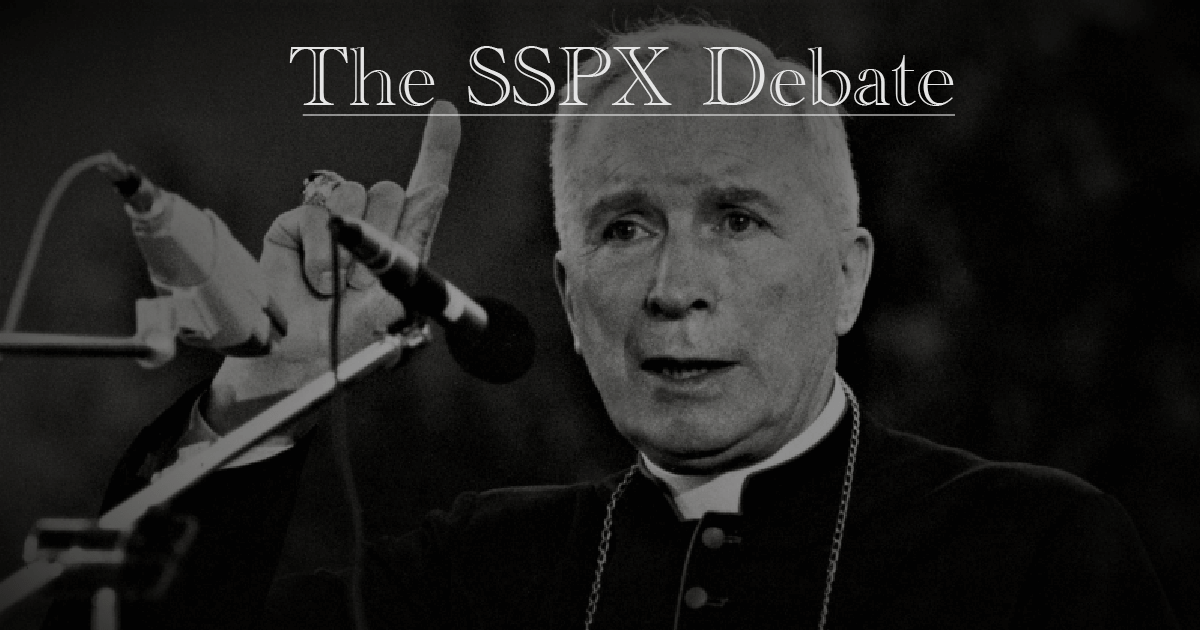
I wanted to give everyone an update on the SSPX debate series. The debate so far has been primarily about the contentions of Mr. John Salza regarding canonical mission, and Mr. Salza was gracious enough to field a number of answers to his critique which we published here.
Mr. Salza and his co-author Mr. Robert Siscoe plan to publish their critiques of the SSPX at their website, Trueorfalsepope.com. We will plan to continue publishing pieces on both sides of the SSPX question as a means to promote charitable but frank discussion on the matter.
However, I felt the need to write this in order to clarify where OnePeterFive stands on the issue. Here we must make the distinction between Communion at the SSPX and every other issue that goes with the SSPX. Because there is much that can be debated. But Mr. Salza’s assertions about canonical mission have a direct bearing on whether one can fulfill one’s Sunday obligation at an SSPX chapel.
This is ultimately the most important bottom line, as many faithful are faced with difficult decisions as their Latin Mass is shut down in various places. Ultimately the editorial board at OnePeterFive remains unconvinced by Mr. Salza’s arguments, and considers the stance of the formerly-named Ecclesia Dei commission to give authoritative answer in this regard. Namely, any Catholic can commune at an SSPX chapel with no sin whatsoever.[1]
Advertisement – Continue Reading Below
Mr. Salza has said on this matter that moral theology dictates that one always take the more cautious of two options. Fr. Z makes reference to another principle on this matter:
The anomalous and slowly evolving SSPX situation is complicated. When things are really complicated in the Church, we are charity bound to cut people some slack and interpret restrictive laws as strictly as possible so as to give people maximum latitude.
Thus the complicated canonical situation should be interpreted in a way that allows the faithful more freedom to act as best they can to fulfill their Christian duties. In this case we cannot find grounds to dissuading any soul from communing at the SSPX, according to the competent authorities in this matter.
Other SSPX Matters
Now as we said we have a distinction between communing at the SSPX and everything else related to the fraternal society. Trads have disagreements on all sorts of matters and the SSPX has opinions in this like we all do. From here, we wish to make it clear that although we will not publish further debate on the question of canonical mission, we do consider all other topics open for debate on these issues.
To that end, we will be publishing pieces on both sides, but not necessarily all together. This gives us the freedom to publish pieces as they arise and not wait for contrary opinions to be provided. Let this post serve as clarity that we do not intend to exclude any opinion, simply because it has not appeared yet. We consider the SSPX to be allies, but this does not mean that we officially agree on every matter. If you think something is not well represented, send us a submission! Anyone who enters the debate may submit a critique of another’s views, and we ask that all participants keep a gentlemanly attitude toward each other as we seek to foster a spirit of rational and charitable discourse.
Advertisement – Continue Reading Below
As always, please contact me with anything.
T. S. Flanders Editor Ss. Faustini et Iovitae, Martyrs
Timothy Flanders is the editor of OnePeterFive. He is the author of City of God versus City of Man: The Battles of the Church from Antiquity to the Present and Introduction to the Holy Bible for Traditional Catholics. His writings have appeared at OnePeterFive and Crisis, as well as in Catholic Family News. In 2019 he founded The Meaning of Catholic, a lay apostolate dedicated to uniting Catholics against the enemies of Holy Church. He holds a degree in classical languages from Grand Valley State University and has done graduate work with the Catholic University of Ukraine. He lives in the Midwest with his wife and four children.
Unless I attended some as an infant or toddler that I don’t recall (I was born in 1967), I’ve only been to one Traditional Latin Mass in my life, as I described here. I wish I could attend the Latin Mass regularly as well as introduce my wife to it. She converted to Catholicism about 20 years ago in a Japanese diocese that probably hasn’t had a Latin Mass in decades, so the Novus Ordo is all she knows.
We live in the northern Japanese city of Hakodate, though, which means the nearest Latin Mass for us is in Tokyo, more than 500 miles away. That Mass is offered by the Society of St. Pius X, which has been active in Japan for nearly 30 years and opened its first priory in the country just over one year ago.
Advertisement – Continue Reading Below
Until rather recently, I didn’t know much about the SSPX. I’d heard of them, of course, but only in bits and pieces, and the little that I’d read about them didn’t sound good. They don’t have “regular canonical status” or exercise legitimate ministry; their founder was excommunicated for grossly disobeying the Pope; they’re just a bunch of schismatics or even sedevacantists. Perhaps basically good and well-meaning people, I figured, but too far “out there” for the average faithful Catholic.
That’s what I thought, but not anymore. I’m starting to wonder if the SSPX is what the Church needs, given the entrance of the “Smoke of Satan” into the Church since Vatican II and the all-out ramping-up since last year of the decades-long assault on traditional Catholicism.
What has gotten me thinking more positively about the SSPX recently? I’ve begun to hear them out. I’ve started taking the time, especially against the backdrop of a Church clearly in ongoing and even worsening modernist crisis, to see what they have to offer. I’d already heard the entire anti-SSPX narrative – now, I finally thought, it was time to hear their side of the story.
So I began reading the SSPX’s website entries; watching their podcasts; and learning about the life and theological views of SSPX founder Archbishop Marcel Lefebvre, whom I now know was anything but an off-the-rails Pope-defying schismatic.
That mattered a great deal to me. The SSPX wasn’t treating the faithful like lepers or health hazards, as most of the “mainstream Church” was – even in countries where the government (as here in Japan) didn’t order houses-of-worship closures. Fear of COVID has almost become on a societal level a mandatory emotion, one that gained force via government mandates, and yet in at least many places the SSPX seemed to be prioritizing the work of God over the dictates of man.
The biggest sticking point people seem to have with the SSPX, of course, is the consecration of four bishops by Archbishop Lefebvre in 1988 without the approval of Pope John Paul II. In carrying out the Écône consecrations, as this event is commonly known, Archbishop Lefebvre was acting as a wild man, making up his own rules while thumbing his nose at a now-canonized pope and deliberately engaging in a schismatic act. Thus, he and the four men he named as bishops were declared excommunicated latae sententiae, or by the very act – and justifiably so. Or were they?
Advertisement – Continue Reading Below
The more I read about the Écône consecrations and give a fair hearing to the SSPX’s side of the story – explained here by one of the four bishops consecrated that day, Bernard Fellay – the more I’m at least beginning to understand why Lefebvre carried them out. Far from being an ecclesiastical renegade, he seems to me now a man of deep faith who did what he felt he had to do for the survival of traditional Catholicism and, fulfilling the highest law of the Church (Code of Canon Law, Can. 1752), for the salvation of souls.
At least in a way, Lefebvre sort of reminds me (a long-time resident of Japan) of 19th-century samurai leader Saigo Takamori, who saw his 1877 Satsuma Rebellion against the new Japanese government not as an uprising against the Emperor Meiji but actually in service to him – given the harmful direction in which Saigo and others believed the country was being taken by “new ideas” at the expense of its traditional culture. (Sound familiar?)
While canon law prohibits the consecration of bishops without papal approval (Can. 1013), it also states that no penalties apply to one who is acting (Can. 1323.4) or who even genuinely thinks he is acting (Can. 1323.7) out of necessity – and Lefebvre saw the survival of his Society, which required bishops to ordain priests after Lefebvre’s death, as necessary.
When seen in this light and in conjunction with Can. 1752, I can understand the argument that Archbishop Lefebvre and the four bishops he consecrated did not commit an act warranting excommunication – a view seemingly affirmed by the Church in 2009 when Pope Benedict XVI lifted the excommunications against all four bishops. It stands to reason that Lefebvre, who died in 1991, would have had his sanction lifted as well, given that it involved the commission of the same act.
Advertisement – Continue Reading Below
One striking aspect about the lifting of the SSPX excommunications is the language used in the Vatican decree announcing it. Authored by Cardinal Giovanni Battista Re in Pope Benedict XVI’s name, this document formalized the remission of the excommunications “incurred by BishopsBernard Fellay, Bernard Tissier de Mallerais, Richard Williamson and Alfonso de Galarreta” (emphasis added). This seems to imply, if not outright state, that not only were the excommunications lifted, but that the episcopal consecrations were being legitimized. It’s hard to still regard the Écône consecrations, therefore, as illegitimate and certainly not as schismatic.
As such, there seem to be “no weighty reasons,” in the words of Bishop Athanasius Schneider, to see the SSPX as anything less than a society of “full-on” Catholic priests. All of them can trace their priesthoods back, at least indirectly if not directly, to one of the four men identified as “bishops” in Cardinal Re’s 2009 decree – if not to Marcel Lefebvre himself, who was undoubtedly a bishop.
What’s more, are the SSPX’s clergymen “real priests” only in the confessional, per Pope Francis’ Year of Mercy decree, but then cease being so when they step outside of it? It’s an “absurdity” to think so, at least according to Bishop Schneider, and how can one logically dismiss his point?
Truth be told, if an SSPX chapel or priory – the Society doesn’t call them “parishes,” I’ve come to learn, as they respect the authority of local bishops and would not use that designation without their say-so – were to be opened near where I live, I would seriously consider attending Masses there. “Regular canonical status” to me smacks of not much more than petty Church politics, something with which man and not Christ has corrupted the Church. My “job,” so to speak, as a Catholic layman is not to sink myself too deeply into such politics, but to effect the salvation of my soul and help whoever else I can (starting with my wife) to do the same.
Advertisement – Continue Reading Below
So why wouldn’t I give the SSPX a look? After all, they must be doing something right; their seminaries are brimming with a healthy number of future priests, and they’re growing by leaps and bounds in at least a few places, such as the traditionally heavily Catholic land of Poland.
Also, consider the commitment to Catholic teaching by the SSPX faithful compared to their Novus Ordo counterparts. SSPX priest Fr. John McFarland explains beginning at the 5:30 mark in this video: the list of Catholic beliefs and teachings rejected by large numbers within the latter group is a mile long. In contrast, almost no one who attends Traditional Latin Masses denies any of these fundamental aspects of Catholicism.
As for Vatican II, who is really more unfaithful to it – the SSPX, or Novus Ordo communities? The SSPX, if I were to put a positive pro-Society spin on it, seems tolerantly silent on most of the Council’s statements while taking exception (albeit quite vociferously) to but a few of them.
The Novus Ordo communities, however, have wreaked all sorts of havoc and damage on the Church – liturgically, doctrinally, and even morally – by appealing to a bogus “spirit of Vatican II” to enact numerous “reforms” that the Council never permitted or ordered.
Advertisement – Continue Reading Below
Which is worse – the SSPX’s treatment of Vatican II, which can arguably be seen as polite disregard, or the “canonically regular” Church’s hijacking and misapplication of it? I’d say the latter is, and much more so.
So, when it comes to all that’s wrong in the Church today, the “canonically irregular” SSPX is not the problem – so why are they treated as if they are?
Why are the likes of Fr. Michael Pfleger, who held this sorry excuse for a Christmas Eve “Mass”in Chicago, seen as “priests in good standing” while SSPX priests are not? Why is a good and holy SSPX priest such as Fr. Thomas Onoda here in Japan considered an ecclesiastical outcast, while Fr. James Martin is allowed to prance around advancing homosexuality and Fr. Pat Conroy cheerleads for legalized abortion without being sanctioned by their Jesuit superiors (surprise, surprise) or anyone else in the Church?
And let’s not get started on what “Catholics in good standing” are up to in Germany – people who are still seen as “exercising legitimate ministry” in the Church while the SSPX, the “bureaucracy” tells us, are not.
Advertisement – Continue Reading Below
Why am I supposed to think that attending SSPX Masses would be detrimental to my soul – when going to “regular Masses” runs every risk of exposing us to a doctrinal and moral train wreck?
What happens when a regular SSPX Mass-goer dies and stands before the judgment of God? I wonder if He says this to him or her:
“You chose to attend solemn, sacred, completely reverent Masses at an SSPX chapel instead of the ‘faith community’ down the road with their ‘liturgical dancing,’ comedy-show homilies, flimsy catechesis, and high percentages of people who blatantly deny major Church teachings. But because the SSPX priests don’t have ‘formal canonical status’ while the ‘faith community’ priests do, I’m not sure that I should let you into Heaven.”
I’m not one to speak for God, of course, but I seriously doubt He would say that.
Again, I live nowhere near any Latin Mass community, including an SSPX one. So barring the unlikely event of my relocating to Tokyo, or to an area in the States where a Latin Mass is offered, I’ll have to settle for admiring the Society – and for “attending” the Latin Mass at least in spirit if not physically – from afar.
If God wants me to live near an existing SSPX chapel, or to have a new one opened near me, it will happen. His will be done.
Ken Foye is an American Catholic living abroad, teaching English writing, reading, presentation, discussion, and conversation classes at a four-year university in northern Japan. He is an Oblate of St. Benedict and is married to a Japanese convert to Catholicism. Among his academic research interests is the inclusion of faith and religion discussions in the English language classroom.
Posted inUncategorized|Comments Off on FOOD FOR THOUGHT IN PERILOUS AND CONFUSING TIMES
The triggering of an official invocation of the Canadian Emergency Measures Act to eliminate protests is stunning. Using the Emergency Act to target individual citizens in Canada, and their bank accounts, is yet again another level of astonishing. RESOURCES:
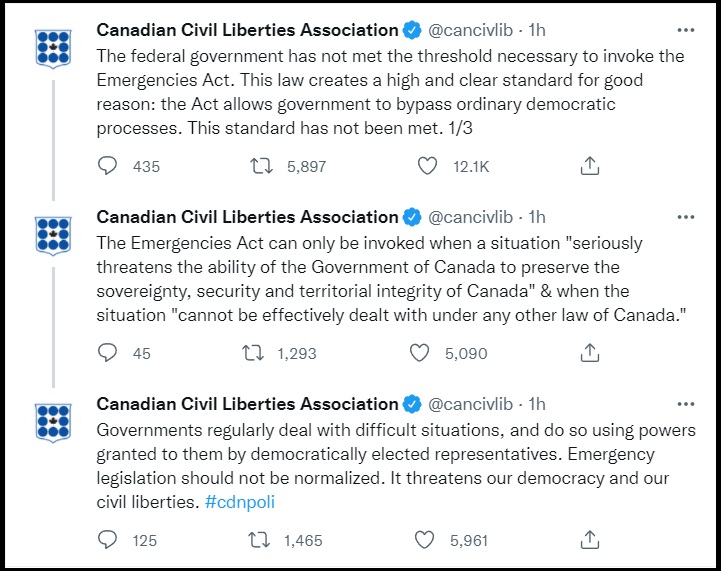
The Canadian Civil Liberties Association has announced their opposition to the government declaration:
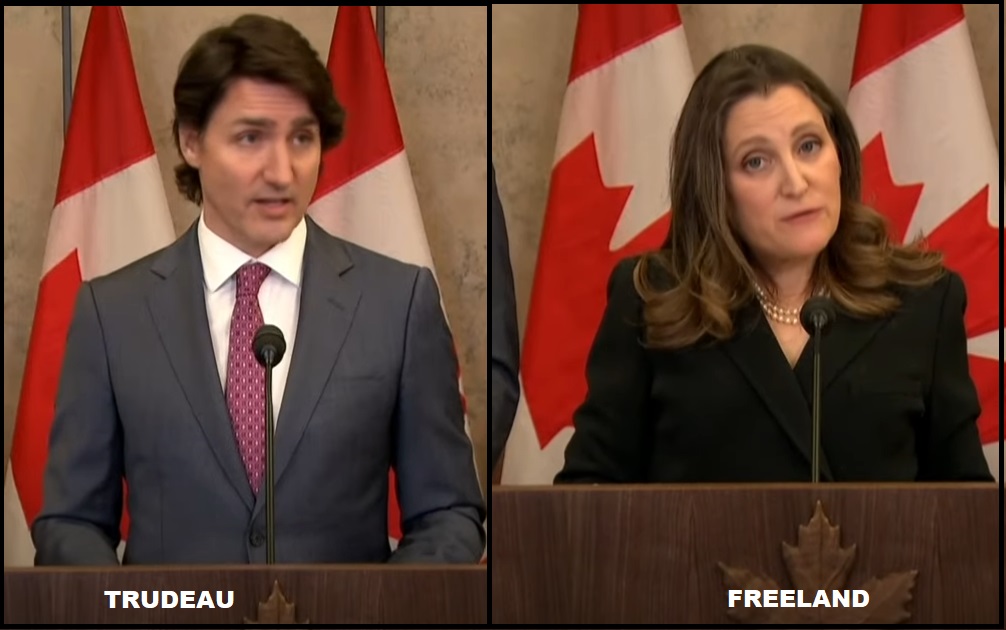
I am carefully reviewing the details of the authorization because according to the public statements by Prime Minister Justin Trudeau and Finance Minister Chrystia Freeland, they have authorized banks, financial institutions and insurance carriers to suspend the accounts of Canadian citizens based on their social media postings.
Yes, you read that correctly. Support of “blockades and/or occupations” are specifically noted.
Anyone in Canada (individual or business) who supports or “furthers” the Freedom Convoy or Freedom Protest on Facebook, Instagram, Twitter or any other social media platform, is a target to have their bank accounts frozen and insurance policies nullified.
But wait, it gets worse.
Not only are people subject to get their bank accounts frozen, but the decision also to freeze the accounts is entirely up to the reviewer, and the reviewer is protected by the government from civil liability for their decision.
“Support” and “affiliated with” are loosely defined, and as a result a guy delivering pizzas to an Ottawa “occupation” truckdriver is also running the risk of seeing his bank account frozen simply for providing the food. I can see why the Canadian Civil Liberties Assocation would take issue with this declaration.
A banking employee who does not like the politics of a customer as revealed by a review of their social media postings, and merely “suspects” the account holder of supporting or furthering the action, can -without any liability- block the bank accounts of any customer or account holder; and they do not need to provide an explanation.
Freeland …”the government is issuing an order with immediate effect, under the Emergencies Act, authorizing Canadian financial institutions to temporarily cease providing financial services where the institution suspects that an account is being used to further the illegal blockades and occupations. This order covers both personal and corporate accounts.
Third: we are directing Canadian financial institutions to review their relationships with anyone involved in the illegal blockades and report to the RCMP or CSIS.
As of today, a bank or other financial service provider will be able to immediately freeze or suspend an account of an individual or business affiliated with these illegal blockades without a court order. In doing so, they will be protected against civil liability.
Federal government institutions will have a new broad authority to share relevant information with banks and other financial service providers to ensure that we can all work together to put a stop to the funding of these illegal blockades.
This is about following the money. This is about stopping the financing of these illegal blockades. We are today serving notice: if your truck is being used in these protests, your corporate accounts will be frozen. The insurance on your vehicle will be suspended. Send your semi-trailers home. The Canadian economy needs them to be doing legitimate work, not to be illegally making us all poorer.
We are announcing these measures after careful reflection. I spoke directly with the heads of Canadian banks and I would like to commend them for doing their part to uphold Canadian laws and Canadian democracy, and to protect our economy.” (more)
As you consider the term “illegal” in the paragraphs above, it is important to remember that the people who were hiding Anne Frank were breaking the law; and the people who killed Anne Frank were followingthe law. As history tells us, laws in/of themselves are not always moral or correct.
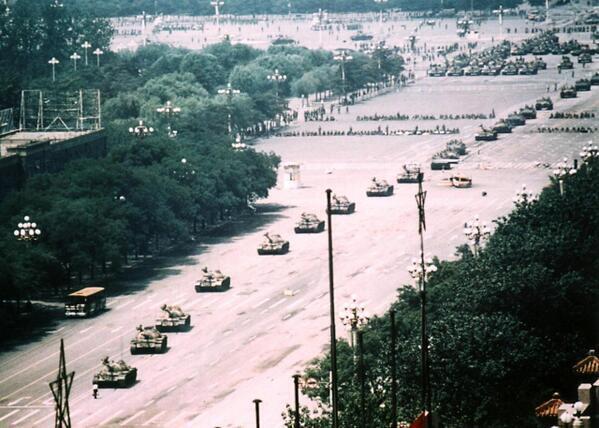
Americans really need to pay attention to this example. The Canadian government can force their citizens to take a medical procedure (Vaccination) in order to work, and if you protest that demand your bank accounts can be confiscated by the state. How is communist China worse?
Today, the Canadian government became the tanks in this famous image:
Posted inUncategorized|Comments Off on PRAY THAT THE MADNESS WHICH THE CANADIANS HAVE CONTRACTED FROM THE Biden Administration DOES NOT COME SOUTH ACROSS THE BORDER TO AFFECT US.
German traditional Catholic author says Vatican II at the root of sexual abuse crisis in the Church
‘Anyone who seriously asks about the causes of this catastrophe, which was growing at the time, will also have to take into account its ‘When’ – the years that followed the ‘New Pentecost’ of the Second Vatican Council,’ writes Martin Mosebach.
FRANKFURT AM MAIN, Germany (LifeSiteNews) —Martin Mosebach, a German traditional Catholic and renowned book author, has written one of the best analyses of the current clerical sex abuse crisis (see full text below). Instead of using indignation about the abuse of children within the Church as an excuse to promote yet another reform program of further decline, Mosebach draws our attention to the fact that the abuse crisis was fostered by a loosening doctrine and discipline in the first place.
Writing for the Swiss newspaper Neue Zürcher Zeitung, the author points out that even Pope Benedict, in his own critique of the sexual revolution of the 1960s and its effects on the Catholic priesthood, “did not dare to discuss the role that the post-conciliar developments had contributed to it [the sexual abuse crisis].”
“What he did not mention,” Mosebach continues, “was the condition in which the clergy found itself as a result of the disintegrating developments after the Council, when the influence of the political revolt began to have an effect on it.”
The condition of the priests, according to Mosebach, had been strongly weakened by the softening of the traditional discipline imposed upon priests. Before the Council, they had been obliged to offer the Sacrifice of the Holy Mass on a daily basis, and they had other supportive measures in their lives, as well. States the author:
Literally overnight, the order that until then had characterized the daily life of a priest was overturned. The cassock and priest’s collar disappeared – the priest became invisible in public. The obligation to celebrate daily Holy Mass was dropped – only those familiar with Catholic Tradition can appreciate the disciplinary support that this daily practice, combined with the obligation to make frequent confessions, is capable of providing.
Thanks to this lack of structure and discipline, a priest could more easily fall into temptations. LifeSiteNews has learned in conversations with older priests that the obligation to pray the breviary daily was an old discipline also very helpful for priests, as was the usual rule that they had to live in community if possible and come home in the evenings at a certain time—albeit with exceptions, of course. One priest stressed how much these rules helped priests to steer away from temptations.
Mosebach also rightly points out that the post-conciliar popes, while upholding the sacredness of the priesthood in theory, did not sufficiently intervene to protect the priesthood in practice.
“None of the last popes,” he explains, “has resisted this erosion of the Catholic priesthood, even if they proclaimed otherwise ex cathedra. It is not to be said that a priest in the classical tradition cannot become a perpetrator of a sexual offense – there have been such at all times, even under strict observance – but one can very well say that it is easier for a priest embedded in the traditional discipline to master his temptations.”
In addition to the aspect of discipline, the author also highlights that many seminaries have questioned the Church’s doctrines: so much so that the Church herself seems to have lost her way – and certainly also her claim to teach truth.
Here again, the problem seems to be that the Popes do not wish to implement discipline to protect the Church’s doctrine. Says the author: “Today Rome can still publish a catechism of Catholic doctrine that is pretty much in line with the tradition of two millennia, but it can no longer ensure that this catechism would be even considered in official academic theology, let alone in seminaries and religious education. For the history of the Church, sixty years is a very short period of time: in it, with unstoppable steadiness, the Church, which until then had survived the most severe shocks, virtually crumbled in many places.”
It would need a deeper discussion to reflect upon the weakening of the Church’s own teachings that has taken place during these last few decades, some of which has also entered the Church’s catechism, as LifeSite journalist Michael Haynes only recently more fully analyzed in his book A Catechism of Errors. Haynes shows, for example, how the new Catechism of the Catholic Church of 1994 contributed to the weakening of the priesthood by stressing the common priesthood of the faithful and by describing the Holy Mass as a “banquet.” But this discussion could be developed at another point.
SUBSCRIBE TO OUR DAILY HEADLINES US Canada Catholic
Martin Mosebach, with his concise and strong critique of the Church’s failing to foster and protect her clergy, lays out a way of true reform, a reform that is a return to former disciplines and traditions, as the Church has always sought to do over the centuries. It is to be hoped that this essay will be studied intensely and prayerfully by the Church’s hierarchy, since it shows the only way out of a deadly cycle of continuous reforms and dilutions which only further the current crisis.
Please see here the full text by Martin Mosebach:
The reform disaster of the Church: nobody wants to see the causes of the abuse scandal. But they can be clearly identified
by Martin Mosebach
In the course of the ongoing abuse crisis in the Catholic Church, there are constant questions about the causes: Pope Francis wants to identify a fatal “clericalism” as a trigger, some bishops are convinced that the abuses of children and adolescents by priests are favored by the “system” of the Church, others specifically want to make celibacy responsible for them.
The Church as a whole must be completely renewed. “No stone must be left unturned” is what is heard, which seems somewhat exaggerated in view of the fact that the delinquents of the last sixty years are no more than three percent of the priests who were active during this period. It is apparently forgotten that the Church of the present is by no means the encrusted and fossilized monster she appears to be in these statements. Rather, the Church has undergone a revolution that is unparalleled in her entire history.
While the Second Vatican Council, which ended sixty years ago, confirmed the external form of the hierarchy, the leadership of the Church by the Pope and the bishops, and the traditional faith of the Church, it also set in motion a development that in fact “left no stone unturned” – the face of the Church has changed beyond recognition in these sixty years. And these changes have not been completed – the truth is that this process has long since become unmanageable, since the structures of obedience in the post-conciliar Church have largely collapsed.
The years after the ‘New Pentecost’
Today Rome can still publish a catechism of Catholic doctrine that is pretty much in line with the tradition of two millennia, but it can no longer ensure that this catechism would be even considered in official academic theology, let alone in seminaries and religious education. For the history of the Church, sixty years is a very short period of time: in it, with unstoppable steadiness, the Church, which until then had survived the most severe shocks, virtually crumbled in many places.
If not everything is deceptive, however, a high proportion of the cases of abuse occurred precisely in the decades following the Council. Anyone who seriously asks about the causes of this catastrophe, which was growing at the time, will also have to take into account its “When” – the years that followed the “New Pentecost” of the Second Vatican Council.
One cannot expect such a scrutiny from the hierarchy – the Council itself has only recently been canonized by the canonization of the two Council Popes John XXIII and Paul VI. Even Benedict XVI, who spoke about the abuse scandals from his retirement home, did not dare to discuss the role that the post-conciliar developments contributed to them.
Benedict merely recalled that this period had coincided with the ’68 revolt – with what was called “sexual liberation,” when it was debated by intellectuals who are still highly respected today whether or not pedophilia should continue to be considered a crime. What he did not mention was the condition in which the clergy found itself as a result of the disintegrating developments after the Council, when the influence of the political revolt began to have an effect on it.
The priest becomes invisible
In retrospect, however, here lay exactly the disaster. The undermining of all authority and the sexual revolution met with a clergy that had been deprived of all the elements to maintain its discipline. Literally overnight, the order that until then had characterized the daily life of a priest was overturned.
The cassock and priest’s collar disappeared – the priest became invisible in public. The obligation to celebrate daily Holy Mass was dropped – only those familiar with Catholic Tradition can appreciate the disciplinary support that this daily practice, combined with the obligation to make frequent confessions, is capable of providing. In theology and in priestly formation, the sacramental character of the priesthood was questioned, if not outright denied. The “Depositum Fidei,” the actual deposit of the faith, was tattered anyway. Anything reliable and binding was considered obsolete.
The Christian religion’s claim to truth was now suspected of being totalitarian, violent, and intolerant – by theologians, mind you, who interpreted the ominous Council motto of “aggiornamento” as a call to constantly subject church doctrine to the prevailing mood at the given time. The notion of the sacredness of the priesthood was particularly denounced. According to the traditional Catholic view, the priest acts at the altar “in persona Christi” – he embodies Christ during the rite, so he is by no means the “chairman” [i.e., presider—ed.] of a celebration of Mass, as it is called today, as if it were a party assembly.
Discipline and temptation
Whoever would represent the Catholic and orthodox conception of the priesthood in a seminary today might, at best, expect to be ridiculed. The liturgy of the Mass, which had been handed down from young Christianity for more than 1500 years, was replaced by a Mass ordowritten in subversive haste, which reduced the sacredness of the rite as far as possible and in such a way that a Protestant could hardly take offense at it. To this day, one can hear in the seminaries that celibacy will soon fall. A theologian who holds the teaching, even of the most recent Popes, that it is impossible for the Church to ordain women, has no prospect of a theological chair today.
Not one of the most recent Popes has resisted this erosion of the Catholic priesthood, even if he proclaimed otherwise ex cathedra. It is not to be said that a priest in the classical tradition cannot become a perpetrator of a sexual offense – there have been such at all times, even under strict observance – but one can very well say that it is easier for a priest embedded in the traditional discipline to master his temptations.
In this context, the Roman assumption that pedophile crimes are a consequence of “clericalism” is downright grotesque – the opposite is the case. It is a post-conciliar anticlericalism within the Church that denies the sacramental special position of the priesthood, which has stripped priests of important aids that help them to remain faithful to their vows.
The episcopal handling of the post-conciliar abuse scandal is incomprehensible if one sees only an evil corporate spirit at work that does not want to cast a shadow on the Church’s works. Good will is also involved in many disasters. In this case, the good will sprang from a change in mentality that had gripped the entire Western world – a very general unease with the word “punishment”.
The mercy trap
Modern society no longer feels legitimized to punish – with some justification because nowadays a generally binding moral code is at least marked with a question mark. In today’s view, punishment is diametrically opposed to mercy. And the Church is merciful, what else?
For centuries, however, mercy, this indisputable quality of the Church, had been understood differently. Punishment and mercy were an inseparable pair. Punishment was an important instrument of mercy. It opened the way to repentance and atonement for the sinner – and this only cleared the way for mercy, which culminated in the forgiveness of guilt – in heaven, mind you, not on earth.
In the post-conciliar period, the Church slipped out of such a way of thinking very quickly. Canonical criminal law was toned down; the Church’s own jurisdiction, which had been its pride for centuries – there are even martyrs for her jurisdiction, such as St. Thomas Beckett – went to sleep.
The bishops, seeing before them the lamentable malefactor who sat weeping before them, wanted to be human – merciful, that is, although Christian mercy remains incomplete without the struggle for the endangered soul. Those who are indignant today about this certainly mistaken practice complain that mercy was shown to the perpetrators, but not to the victims. They forget that the victims do not need mercy; they can demand the opposite: justice.
What reform should look like
It is not surprising that in the face of the increasing number of abuse cases, there is a call for reform of the Church. But it must not be forgotten what the term “reform,” well anchored in Church history, meant until Vatican II: namely, a restoration of discipline, a tightening of the reins, an end to profligacy, and a return to the traditional order.
The “reforms” of the Second Vatican Council are the first in the entire history of the Church to depart from this conception; they no longer trusted Tradition to reach the people of the present, and therefore relied on a general softening of practice and doctrine, although without succeeding, with this pastoral relativism, to keep people in the Church.
It is not a Church that is frozen in its rites and fossilized in its doctrines that has been losing the faithful in a steadily increasing stream since Vatican II, but a Church that has softened in doctrine and become liturgically formless. It is not priests who have broken under the yoke of a rule foreign to life and become abusers, but those who have now been freed for decades from clear spiritual supervision.
Now that the “reform” disaster of sixty post-conciliar years is before everyone’s eyes in all its shameful proportions, the Pope and many bishops, especially the German ones, can think of nothing else to say than that one has just not gone far enough in the radical dismantling of the Catholic proprium – this reminds one of the short-sighted tailor who looks at a pair of mismatched trousers, cocks his head and wonders: “Cut off three times and still too short.”
Dr. Maike Hickson was born and raised in Germany. She holds a PhD from the University of Hannover, Germany, after having written in Switzerland her doctoral dissertation on the history of Swiss intellectuals before and during World War II. She now lives in the U.S. and is married to Dr. Robert Hickson, and they have been blessed with two beautiful children. She is a happy housewife who likes to write articles when time permits.
Dr. Hickson published in 2014 a Festschrift, a collection of some thirty essays written by thoughtful authors in honor of her husband upon his 70th birthday, which is entitled A Catholic Witness in Our Time.
Hickson has closely followed the papacy of Pope Francis and the developments in the Catholic Church in Germany, and she has been writing articles on religion and politics for U.S. and European publications and websites such as LifeSiteNews, OnePeterFive, The Wanderer, Rorate Caeli, Catholicism.org, Catholic Family News, Christian Order, Notizie Pro-Vita, Corrispondenza Romana, Katholisches.info, Der Dreizehnte, Zeit-Fragen, and Westfalen-Blatt.
Posted inUncategorized|Comments Off on ‘Anyone who seriously asks about the causes of our present catastrophe, which was growing at the time, will also have to take into account its ‘When’ – the years that followed the ‘New Pentecost’ of the Second Vatican Council,’ writes Martin Mosebach.
Hillary Clinton’s treasonous plot against Donald Trump is even worse than you thought
February 15, 2022
Hillary Clinton clearly had a hand in the bogus Russiagate investigation.
She also had a lot of help from the Democrat Media Complex.
But Clinton’s treasonous plot against Donald Trump is even worse than you thought.
The Russiagate hoax undermined the first two years of Donald Trump’s presidency.
Special counsel Robert Mueller’s investigation dragged on for 22 months, which hung like a cloud over the Trump administration.
It turns out that Mueller found zero evidence of Russian collusion, which ultimately led to Trump Attorney General William Barr appointing John Durham as special counsel to get to the bottom of Russiagate’s origins.
And thus far, all roads lead back to Hillary Clinton.
Not only did Clinton pay for the discredited Steele dossier, but one of her lawyers, Michael Sussmann, pumped a false collusion story to the FBI and lied about his connection to Clinton.
Now, Durham filed in a court document that Clinton lawyers paid a tech company to “infiltrate” Trump campaign servers—and later Trump White House servers—in order to establish a fake connection between Trump and Russia.
Durham wrote in a filing that Sussmann, “had assembled and conveyed the allegations to the FBI on behalf of at least two specific clients, including a technology executive (Tech Executive 1) at a U.S.-based internet company (Internet Company 1) and the Clinton campaign.”
The filing added that Sussman’s “billing records reflect” that he “repeatedly billed the Clinton Campaign for his work on the Russian Bank-1 allegations.”
Sussmann told the FBI he was not working for the Clinton campaign, but he clearly was.
“Tech Executive-1 tasked these researchers to mine Internet data to establish ‘an inference’ and ‘narrative’ tying then-candidate Trump to Russia…In doing so, Tech Executive-1 indicated that he was seeking to please certain ‘VIPs,’ referring to individuals at Law Firm-1 and the Clinton campaign.”
If the details in Durham’s filings are true, what Clinton did is far worse than Watergate.
She helped fabricate treasonous information against a presidential candidate and eventually the sitting president of the United States.
It’s the biggest political scandal in American history, and the layers are still being peeled back.
In addition to Sussmann, Durham already indicted FBI lawyer Kevin Clinesmith, who lied to the FISA court about the veracity of the Steele dossier in order to maintain surveillance on Trump.
Durham also indicted Democratic operative Igor Danchenko for lying about the source of information in the Steele Dossier.
The Russiagate hoax is expanding in scope, and when it finally bursts, some people should be wearing handcuffs.
Stay tuned to Right News Wire for more updates to this ongoing story.
Posted inUncategorized|Comments Off on IF Nancy Pelosi IS THE WICKED WITCH OF THE WEST, THEN SURELY Hillary Clinton QUALIFIES FOR THE TITLE OF WICKED WITCH OF THE EAST
He stated the veracity of his statements but did not seek excuses for the plague of abuses in the Church. On the contrary, he asked for forgiveness. He looked at the issue of abuses in the Church in a broader way, as he generally does.
In that letter, the whole thought of Benedict XVI is condensed. Benedict XVI, in that letter, behaved like a pope. He stated the veracity of his statements but did not seek excuses for the plague of abuses in the Church. On the contrary, he asked for forgiveness. He looked at the issue of abuses in the Church in a broader way, as he generally does.
like a pope. He stated the veracity of his statements but did not seek excuses for the plague of abuses in the Church. On the contrary, he asked for forgiveness. He looked at the issue of abuses in the Church in a broader way, as he generally does.
In that letter, the whole thought of Benedict XVI is condensed. Benedict XVI, in that letter, behaved like a pope. He stated the veracity of his statements but did not seek excuses for the plague of abuses in the Church. On the contrary, he asked for forgiveness. He looked at the issue of abuses in the Church in a broader way, as he generally does.
The anniversary of Benedict XVI’s historic resignation was overshadowed by accusations of not having handled well the cases of abuse in the archdiocese of Munich and Freising, of which he had been archbishop from 1977 to 1983. And so, Benedict XVI, after having already given an 82-page answer with the assistance of some lawyers, had his lawyers giving further clarifications, and – above all – wanted to write a personal letter to those clarifications.
In that letter, the whole thought of Benedict XVI is condensed. Benedict XVI, in that letter, behaved like a pope. He stated the veracity of his statements but did not seek excuses for the plague of abuses in the Church. On the contrary, he asked for forgiveness. He looked at the issue of abuses in the Church in a broader way, as he generally does.
Benedict XVI writes: “Let us pray to the living God publicly to forgive our fault, our great and very great fault. It is clear that the word ‘very large’ does not refer in the same way to every day, to every single day. But every day, he asks me if I shouldn’t talk about very great guilt, even today. And he consolingly tells me that no matter how great my guilt might be today, the Lord forgives me if I sincerely let myself be scrutinized by him and am willing to change myself. ”
These are the words of those who do not seek easy self-justification. But, above all, these are words with which Benedict XVI demonstrates the courage to assume all responsibilities, to be part of the community of the Church even by suffering for the sin of its members. We believe together, we suffer together, we redeem ourselves together, says Benedict XVI. In his words, the Church truly becomes a community of believers.
There is no personalism in Benedict XVI. Not that he was a Pope who didn’t make decisions. But all the decisions he made started first of all from prayer, from the analysis of God’s will. Nothing had to be separated from the Gospel. Nothing should make his personal thoughts to take precedence.
Nine years after his resignation, we realize that Benedict XVI’s thinking was genuinely revolutionary. In an era of personalism and individualism, Benedict XVItried to teach that the Church does not exist thanks to individuals but thanks to Christ. When strong government seemed inevitable, Benedict XVI managed a pontificate during which he governed lightly, always looking first at people and then at choices.
Benedict XVI’s radicalism can be read precisely in his being a priest, first of all, and therefore a father. He is a free man because he is not a man of power. And it is through these lenses the renunciation of nine years ago must be read.
A renunciation that testifies that Benedict XVI is genuinely a new man. There is much talk of modernity and making the Church more modern, closer to popular sentiment. But the point is that the new man is already here and was born with Jesus Christ. Any secular thrust does not look forward but looks back to the old man. To a man, after all, who has not been liberated by Christ.
For this reason, Benedict XVI is genuinely the Pope of modernity. In the biography of Peter Seewald, Benedict XVI responds to those who said that the Pope had been led to give up because of Vatileaks or external pressure.
Benedict XVI explains that “the range of perception that a Pope can fear is very small,” and that “the real threat to the Church and therefore to the Petrine service does not lie in these things, but in the world dictatorship of apparently humanistic ideologies, where opposing them leads to exclusion from ultimate social consensus. ”
And he added: “A hundred years ago, someone would have thought it absurd to talk about same-sex marriage. Today those who oppose this are socially excommunicated. The same goes for abortion and the production of people in the laboratory. Modern society is about to formulate an anti-Christian creed, and if one opposes it, one is struck by ex-communication.”
Benedict XVI concluded: “The fear of this spiritual power of the Antichrist is therefore all too natural, and it takes the help of the universal Church’s prayer to resist.”
The challenges that Benedict XVI is thinking about are significant and profound and go beyond the views of the world. It is a very relevant thought. And so we return to the letter that accompanied his response to the abuse case in Munich: if it takes the prayer of the universal Church to resist, then we are all responsible for the sins of the other. It is a universal thought.
In a period of pressure to change the doctrine that also comes from the bishops themselves (think of the Synod of the Church of Germany), in which the coming of the Great Humanist foretold by Fulton Sheen seems concrete (think of the debates on the Church), this thinking, so free, so Christian, so advanced, is disruptive. So Benedict XVI becomes a target. But, in his response, he proved once again that he is a “father.” And he will be recognized, one day, among the fathers of the Church.
Joe Biden is SO UNPOPULAR; even CNN can’t hide it. The extreme Left-wing “news organization” just released a poll that shows over 58% of Americans DISAPPROVE of Joe Biden. You know it’s bad for Democrats when CNN can’t even cover for them… Honestly, we’re shocked only 58% of Americans disapprove of Biden after he has…
CREATED HISTORIC INFLATION LEFT OUR SOUTHERN BORDER OPEN FOR INVASION DESTROYED OUR ENERGY INDEPENDENCE AND WORSE
Joe Biden is a DISASTER stand with him and the Democrat Party, vote for him and learn to live with the consequences of your vote for America!!!
Posted inUncategorized|Comments Off on TRUTH OR CONSEQUENCES
“Stripped of Both Wings” (link) A Former Anglican chaplain to the Queen of England talks about his entry into the Catholic Church — and the crisis facing Anglicanism Dr. Gavin Ashenden is a former Anglican Archbishop and Honorary Chaplain to Queen Elizabeth of England, now a Catholic convert and layman. After a distinguished academic and clerical career, he was appointed Chaplain to the Queen in 2008; he resigned in 2017. In December 2019, Dr. Ashenden was received into the Catholic Church by the Bishop of Shrewsbury, England. By Dr. Gavin Ashenden From Inside the Vatican, January-February, 2022 A moment sometimes comes when we suddenly see things entirely differently. Philosophers often call this “the moment of disclosure.” More popularly we talk about the moment that the penny drops. One of those moments came for me when, after a vote in the Church of England’s General Synod, the progressives refused to make any space for those who wanted to practice the faith as it had been received, as my Bishop expostulated with despair as we left the assembly: “That,” he said, “is the end of the 500-year ecumenical experiment that was Anglicanism.” I thought he was perhaps a bit overwrought, but as I thought it through I began to realise the force of his observation. What he meant was that in the civil war between puritans, Anglo-Catholics and progressives, the progressives had just landed a knockout blow that would reconfigure the Church forever. The Church of England is a confusing entity. It looks like one Church, but it isn’t; it was a conceptual compromise from its inception. To put it simplest, the Church inherited Catholic buildings and ecclesial structures but dressed and prayed as Protestants. Over the years the pendulum of power swung backwards and forwards between Puritans and Sacramentalists, but in the 20th century, the Church began to buckle under the assault of secular culture, led first by Darwin, Durkheim, Marx and Freud, and secondly, it crumpled under the assault of 19th-century German theological revisionism. But it was the feminism of the second half of the 20th century that did more harm. (continued below)
Gavin Ashenden, a former Anglican bishop, is blessed by Bishop Mark Davies of Shrewsbury, England, during Ashenden’s reception into the Catholic faith on December 19, 2019. Ashenden, a former chaplain to Queen Elizabeth II, said Prince Philip, who died April 9, 2021, was a man deeply interested in God. (CNS photo/Simon Caldwell) (continued from above) A state Church is particularly vulnerable to cultural change. If the society it serves begins to reject Christian values or culture, it is faced with a dreadful dilemma. Either it has to go along with the repudiation, sprinkling putative blessing on the sub- or anti-Christian direction in which society goes; or else it has to take a moral stand and call society to return to Christian values; in other words, to repent. There have been moments when repentance was tried. Wesley called for it over personal sin and corporate disbelief in the 18th century; Wilberforce and the Clapham Sect, over slavery in the 19th century; Bishop George Bell, over the carpet-bombing of German cities and the slaughter of civilians in the 20th century. But the feminism of the second half of the 20th century brought not only women priests, but acted as a Trojan horse for a variety of secular utopian values: relativism, equality of outcome, the triumph of the subjective over the objective, the campaign to cleanse the womb of unwanted infants, repudiation of patriarchy and “toxic masculinity.” Though attractive in secular terms, they all undermined aspects of the integrity of Divine Revelation. And so began an increasing process of preferencing a spiritual agenda for fixing things on earth rather than carrying souls to heaven; the Gaia of ecological apocalypticism and the prioritising of anti-racism became greater priorities than personal repentance and the rebirth of the soul. But the two connected but distinctive movements that set out to change the apostolic DNA of the Church of England were the ordinations of women to the priesthood and episcopate, and then the ratification of homosexual relationships and marriage. Both the ordination of women and the affirmation of gay identities and relationships were prominent secular goals. But neither the feminism that lay behind the first, nor the disordered sexual turmoil that lay behind the second, were consistent with Scripture or tradition. So either this was a new revelation that the Church and world had been waiting for… or it was something else. Ashenden meeting with Pope Francis in Rome Feminism began to express itself in an ever louder antipathy to masculinity. The war of the sexes became more aggressive. The promotion of greater sympathy for homosexuality turned into a strident and aggressive threat to silence voices that questioned its legitimacy. Where was the Church of England in these culture wars? Like so many Protestant groups, it was heavily invested in the values of progress and personal, social and political self-improvement. Two old heresies reappeared to give a platform to this new thinking. Arianism emerged as feminists complimented Jesus on his restricted but worthy acceptance of women, but castigated him for being a man of his time, blind to the improvements that it took the 21st century to discover. This was not the Logos that stood on the threshold of time and space as the Pauline cosmic Christ, but a historical figure limited by his particular culture. And Pelagianism laid the foundation for an unrealisable ambition to improve the lot of people by a renewed political and social energy for removing injustice and inequality. As the Church shifted the weight of its energies from evangelism and the Bible to social justice and activism, the more traditional faithful at either end of the Puritan and Catholic spectrum began to leave. It was a vote in General Synod, where both these constituencies asked to have their theological and spiritual integrities recognised and protected, that caused the colleague I mentioned earlier such dismay. Evangelicals and Anglo-Catholics had begged their fellow Anglicans to respect their beliefs and not impose women priests and bishops on them. The liberal majority refused, and refused with a jubilant satisfaction. As I left that particular Synod I had an experience which acted as an interpretative lens for so much of what was happening in the wider Church. I found myself waiting at a bus stop, where next to me there appeared a well-known feminist activist priest. (She was soon to become a bishop herself, and was distinctive for two things: a love and promotion of nudism, and her discreet lesbian housemate.) I said something about what a terrible and bruising time we had in Synod. “Well, you know why we did what we did, of course?” she almost spat back at me. “No, I don’t think I do,” I replied. “We took revenge on you all. We punished you for every slight and disrespect any of you have ever shown to a woman.” I was astonished, both by her vehemence and by what she had said. Without stopping to argue about her assumption of widespread misogyny, I replied, “But you have invoked a spirit of revenge. That is a spirit that is deeply opposed to the Holy Spirit. Have you any idea of the havoc that the invocation of such a spirit will wreak in the Church?” Women priests, now quite common in the Anglican Church, were first ordained in the Church of England in 1994, 28 years ago (although the first woman priest in the Anglican Communion was actually ordained 50 years earlier, in 1944: Hong Kong native Florence Li (link) She looked at me blankly. We were talking two different languages, and living in two different worlds. So yes, the 500-year ecumenical experiment that had been the Church of England had ended. The awkward and precarious balance between Puritans, Anglo-Catholics and the devotees of the zeitgeist, was over. The power grab had been effective and the internecine struggle had ended with the purge of the Puritans and the Anglo-Catholics. The Puritans had provided a vigorous and evangelistic congregationalism to the Anglican mix; and the Sacramentalists had injected a degree of Catholic piety and spirituality, borrowed from the Mother Church — an inclination for holiness and the Eucharist. It was they who had brought both depth of prayer and the width of new blood by conversion. Stripped of both wings of the Church, what was left was a shallow, politicised and de-energised centre, incapable of either spiritual renewal, repentance or conversion. The Puritans fled into the wider evangelical world, and the Anglo-Catholics took a grateful refuge in the Catholic Church’s Ordinariate of the Chair of St. Peter, erected for those faithful coming from Anglicanism. Over 10 percent of the Roman Catholic parish clergy are now ex-Anglicans. Meanwhile, the victory for the progressives looks increasingly pyrrhic. The demographics look bad. Only 1.9% attend church. Between 2009 and 2019, baptisms, weddings and funerals fell by between 30-40%. And 33% of the Anglican faithful are over 70. As conservative Anglicans mobilize across the world, the lack of anything equivalent to the Catholic Magisterium leaves them prey to schism and sectarian conflict. Those many of us who have turned to the Catholic Church have done so because the turbulence of our day has caused us to look at the claims of the Reformation afresh — and found them wanting. On re-examination, many of us re-read the Fathers of the first five centuries and found there not Luther, Calvin, Zwingli or Erastian settlements, but instead the Catholic Church and the Magisterium. The promise of Jesus to Peter in Matthew 16:18, “You are Peter and upon this rock I will build my Church, and the gates of hell shall not prevail against it,” rings with a new and urgent resonance. [End] This article appeared in the January/February 2022 issue of Inside the Vatican magazine. You can subscribe to Inside the Vatican magazine here.
Posted inUncategorized|Comments Off on Dr. Gavin Ashenden is a former Anglican Archbishop and Honorary Chaplain to Queen Elizabeth of England, now a Catholic convert and layman. After a distinguished academic and clerical career, he was appointed Chaplain to the Queen in 2008; he resigned in 2017. In December 2019, Dr. Ashenden was received into the Catholic Church by the Bishop of Shrewsbury, England.
Fr. Giacomo Capoverdi is a priest of the Diocese of Providence, Rhode Island with nearly 5,000 friends and followers on social media. To my knowledgeFr. Capoverdi does not publicly offer the Traditional Latin Mass, which makes the following guest post all the more impactful. It is shared here from his Facebook page with Father’s permission.
I know there are going to be some who disagree with me. That’s your right. But In my opinion and experience of 25 years of priesthood we are sinking fast as a Church and are in big trouble. Most of our problems are internal.
The only way out of this mess, I believe, is to go back to doing what the Church did when She was successful. We need to go back to the Mass of St. Pope John XXIII, the Extraordinary Form, in every parish and start running seminarians like we used to before the mid sixties.
Some say the church has to become more, “With the times,” and even more Liberal. That the church needs to change Her moral positions on Homosexuality and Abortion, then more people will come to Mass. This could not be furthered from the truth.
Protestants tried this, changing their moral theology and understanding of the Bible, and they have been failing miserably. Mainline Liberal Protestant churches are disappearing from the face of the earth. So are Liberal Religious Nuns and Brothers. Many of these Liberal groups have not had a vocation in decades.
The Catholic Church shifted our belief on Salvation and the way we celebrate Holy Mass. That’s when our problems began. Priests bad behavior since the sixties is a consequence of this, bad fruit from bad decisions. If we don’t make major changes soon, and go back to the way things were before the last 55 years, we will continue to hemorrhage and lose 75% of the population that is practicing today, over the next 50 years.
For example, there are 5 parishes in Westerly, Rhode Island right now. If we don’t go back to the TLM, my prediction is 50 years from now there will just be 1 parish in Westerly that only needs to celebrate 3 Masses on the weekend.
Trying to become more Protestant in our Liturgy and Theology over the past 55 years has had disastrous consequences. We can’t blame the mess we’re in on, “Cultural changes.” The sad changes we made helped shape the cultural changes that tragically happened.
We baptized bad moral behavior, by watering down our beliefs. I know I won’t be around to see the total collapse, but it’s coming if we don’t go back to our Traditional Mass and Traditional moral beliefs.
Share this:
Posted inUncategorized|Comments Off on THIS POST IS WELL WORTH READING AND TAKING THE TIME TO REFLECT ON IT
This is what my doctor told me tonight after I emailed you.
He said a lot. I tried to take notes:
He believes the abnormal result is a false reading.
They wanted me to perform at 85% on the treadmill. I made 89%. I didn’t have shortness of breath or chest pain while doing it and I could have kept going.
EKG and echocardiogram all normal.
The nuclear scan mentioned scarring which would have implied that I had a heart attack.
But 18 months ago I had nuclear scans that didn’t show that. It showed trivial plaque which he said everybody at my age has.
He would have been more concerned if I had not had that test 18 months ago.
He finds it hard to believe it could have gone down hill that fast.
To verify what he thinks, he wants me to take another nuclear cat scan. He does not want to put me through a catheterization. Although if the nuclear scan confirms the abnormality then that would be next. Or if there is substantially more plaque then he would have to consider a stent.
He says he sees this all the time. He doesn’t want me to worry. He’s very sure it’s a false reading.
So I have to have the nuclear scan when I get back from Florida next week.
Thanks for your prayers. But keep them coming til I know after the next test.
My dad had bypass surgery at 52. I am 46. But- he ate red meat 350 days a year and had other bad diet habits that I don’t have.





 Martin Mosebach


 Gavin Ashenden, a former Anglican bishop, is blessed by Bishop Mark Davies of Shrewsbury, England, during Ashenden’s reception into the Catholic faith on December 19, 2019. Ashenden, a former chaplain to Queen Elizabeth II, said Prince Philip, who died April 9, 2021, was a man deeply interested in God. (CNS photo/Simon Caldwell) (continued from above) A state Church is particularly vulnerable to cultural change. If the society it serves begins to reject Christian values or culture, it is faced with a dreadful dilemma. Either it has to go along with the repudiation, sprinkling putative blessing on the sub- or anti-Christian direction in which society goes; or else it has to take a moral stand and call society to return to Christian values; in other words, to repent. There have been moments when repentance was tried. Wesley called for it over personal sin and corporate disbelief in the 18th century; Wilberforce and the Clapham Sect, over slavery in the 19th century; Bishop George Bell, over the carpet-bombing of German cities and the slaughter of civilians in the 20th century. But the feminism of the second half of the 20th century brought not only women priests, but acted as a Trojan horse for a variety of secular utopian values: relativism, equality of outcome, the triumph of the subjective over the objective, the campaign to cleanse the womb of unwanted infants, repudiation of patriarchy and “toxic masculinity.” Though attractive in secular terms, they all undermined aspects of the integrity of Divine Revelation. And so began an increasing process of preferencing a spiritual agenda for fixing things on earth rather than carrying souls to heaven; the Gaia of ecological apocalypticism and the prioritising of anti-racism became greater priorities than personal repentance and the rebirth of the soul. But the two connected but distinctive movements that set out to change the apostolic DNA of the Church of England were the ordinations of women to the priesthood and episcopate, and then the ratification of homosexual relationships and marriage. Both the ordination of women and the affirmation of gay identities and relationships were prominent secular goals. But neither the feminism that lay behind the first, nor the disordered sexual turmoil that lay behind the second, were consistent with Scripture or tradition. So either this was a new revelation that the Church and world had been waiting for… or it was something else.
 Ashenden meeting with Pope Francis in Rome Feminism began to express itself in an ever louder antipathy to masculinity. The war of the sexes became more aggressive. The promotion of greater sympathy for homosexuality turned into a strident and aggressive threat to silence voices that questioned its legitimacy. Where was the Church of England in these culture wars? Like so many Protestant groups, it was heavily invested in the values of progress and personal, social and political self-improvement. Two old heresies reappeared to give a platform to this new thinking. Arianism emerged as feminists complimented Jesus on his restricted but worthy acceptance of women, but castigated him for being a man of his time, blind to the improvements that it took the 21st century to discover. This was not the Logos that stood on the threshold of time and space as the Pauline cosmic Christ, but a historical figure limited by his particular culture. And Pelagianism laid the foundation for an unrealisable ambition to improve the lot of people by a renewed political and social energy for removing injustice and inequality. As the Church shifted the weight of its energies from evangelism and the Bible to social justice and activism, the more traditional faithful at either end of the Puritan and Catholic spectrum began to leave. It was a vote in General Synod, where both these constituencies asked to have their theological and spiritual integrities recognised and protected, that caused the colleague I mentioned earlier such dismay. Evangelicals and Anglo-Catholics had begged their fellow Anglicans to respect their beliefs and not impose women priests and bishops on them. The liberal majority refused, and refused with a jubilant satisfaction. As I left that particular Synod I had an experience which acted as an interpretative lens for so much of what was happening in the wider Church. I found myself waiting at a bus stop, where next to me there appeared a well-known feminist activist priest. (She was soon to become a bishop herself, and was distinctive for two things: a love and promotion of nudism, and her discreet lesbian housemate.) I said something about what a terrible and bruising time we had in Synod. “Well, you know why we did what we did, of course?” she almost spat back at me. “No, I don’t think I do,” I replied. “We took revenge on you all. We punished you for every slight and disrespect any of you have ever shown to a woman.” I was astonished, both by her vehemence and by what she had said. Without stopping to argue about her assumption of widespread misogyny, I replied, “But you have invoked a spirit of revenge. That is a spirit that is deeply opposed to the Holy Spirit. Have you any idea of the havoc that the invocation of such a spirit will wreak in the Church?”
 Women priests, now quite common in the Anglican Church, were first ordained in the Church of England in 1994, 28 years ago (although the first woman priest in the Anglican Communion was actually ordained 50 years earlier, in 1944: Hong Kong native Florence Li (

 ABYSSUS ABYSSUM INVOCAT / DEEP CALLS TO DEEP
You must be logged in to post a comment.