I hear great news out of Australia, where Cardinal George Pell’s appeal on his child abuse conviction was heard by a court tribunal today. Daily Telegraph journalist Miranda Devine writes that the government’s cast collapsed. Her column is behind a paywall, but here is an excerpt:
Cardinal George Pell and his supporters were relieved that his appeal of his child sexual assault conviction was live-streamed on Wednesday.
The intense seven-hour courtroom argument was the first time the public has heard first-hand the flimsiness of the evidence against him.
Three judges of the Victorian Appeals Court are reviewing the jury’s verdict in which Cardinal Pell was convicted of sexually assaulting two choir boys after Sunday Mass at St Patrick’s Cathedral in Melbourne in December 1996. One of the boys has since died and told his mother he never was molested.
So that leaves the conviction to be based on the word of one man against Cardinal Pell’s, with no corroborating evidence, no forensic evidence, no witnesses, and against a mountain of contrary evidence which showed that the allegations were highly improbable, if not impossible.
The jury verdict has troubled legal experts and lay people around the world ever since. The evidence seen so far leads to the conclusion that an innocent man was jailed to atone for the sins of others in a church plagued by sexual abuse scandals.
From what I’m told, the state’s case was routed, though we won’t know the verdict for months. Meanwhile, Cardinal Pell remains jailed in Melbourne.
In 2014, Pell was given by Pope Francis responsibility for cleaning up the infamously corrupt Vatican Bank. When that news broke, I thought, “They’ll find some way to take him out. They won’t let him do it.” When the child abuse charges were brought against Pell in 2017, I thought, “So that’s how they did it.” But I didn’t go further, because how would I prove that Pell was set up? It was just a hunch.
When I was in Australia last month, I found myself in a conversation one evening with someone about all this. (I had a lot of Pell conversations, as you might imagine.) I shared with my interlocutor my suspicion that Pell was set up to take him off the Vatican Bank case. The man across the table said, “That’s interesting. You may not know it, but the ‘Ndrangheta is quite well established in Australia, especially in Victoria. That’s where the cardinal was charged.”
Senior Calabrian Mafia investigator Nicola Gratteri, whose investigative zeal has forced him to live with police protection since 1989, has said the pope’s plans to reform Vatican structures, including the Vatican bank, the IOR, could prove a problem for the ’Ndrangheta, Italy’s most powerful Mafia.
He said that while Pope John Paul II called on the “military” mafiosi to “repent” in 1993, Pope Francis has gone further, perhaps hitting the ’Ndrangheta where it hurts.
“He has named his G8 [council of cardinals] to overhaul the entire structure of the Vatican, including a review of the Vatican’s economic affairs and in particular, the IOR,” Gratteri says.
“For those with real economic power it is obvious this could be a huge disadvantage . . . Given that in the past we’ve had collusion at the highest level between church and Mafia, this exposes the pope.”
Months after this report, Cardinal George Pell was named by Francis to reform the IOR. In 2014, Pell said his team found nearly two billion euros hidden away in various Vatican accounts, off the balance sheets. In November 2015, with the Pope’s approval, Pell issued new guidelines for running all Vatican offices, to bring them up to international standards for financial transparency.
In April 2016, without consulting Pell, the Vatican Secretary of State suspends an external audit of Vatican finances. The National Catholic Register quotes an unnamed source as saying that officials are afraid of what the audit will find, and want to get rid of Pell. A year later, Pell was charged in Melbourne with sexual abuse. And that was the end of the Pell threat to the Vatican Bank insiders.
This mafia thing, it could all be a coincidence, and in any case, there are other factors in play in the persecution of George Pell, who was widely hated by Australian anti-clericalists. But it’s curious all the same. George Pell was the No. 1 enemy of the ‘Ndrangheta in the Vatican, and he showed early on in his tenure, when he uncovered all the hidden euros, that he meant business. Now George Pell sits in solitary confinement in a prison cell in Melbourne, convicted on pathetically shabby charges. The old guard in the Vatican won. The world is as it always was.
UPDATE: I have been told by someone very much in a position to know that the current head of the Vatican Bank is from Calabria. For what it’s worth…
Here are five really short and easy to answer dubia questions which hopefully aren’t too complicated for Steve Skojec, publisher of the One Peter Five website, to answer.
To make it really easy for the publisher of One Peter Five it has been formatted so that he only has to answer: yes or no.
1. Doctor of the Church St. Francis de Sales said ” The Pope… when he is explicitly a heretic… the Church must either deprive him or as some say declare him deprived of his Apostolic See.” Was St. Francis de Sales a Sedevacantist or a Benevacantist? Answer: yes or no.
2. “Universal Acceptance” theologian John of St. Thomas said “This man in particular lawfully elected and accepted by the Church is the supreme pontiff.” Was John of St. Thomas for saying “the supreme pontiff” must be BOTH “lawfully elected and accepted by the Church” a Sedevacantist or a Benevacantist? Answer: yes or no.
3. Do you think that a “supreme pontiff” if “universally accepted” is still Pope if, to quote papal validity expert Arnaldo Xavier de Silveira on “dubious election[s]”, that he is “a woman… a child… a demented person… a heretic… a apostate… [which] would [thus] be invalid[ed] by divine law”? Answer: yes or no.
4. Renowned Catholic historian Warren Carroll agreed with Bishop René Gracida on the determining factor for discerning a valid conclave for a valid papal election besides divine law. Carroll pronounced:
“But each Pope, having unlimited sovereign power as head of the Church, can prescribe any method for the election of his successor(s) that he chooses… A papal claimant not following these methods is also an Antipope.”
Are renowned historian Carroll and Bishop Gracida for saying this Sedevacantists or Benevacantists? Answer: yes or no.
5. Is Bishop Gracida really only a pawn of the legendary and notorious “Sedevacantist and Benevacantist” mastermind Ann Barnhardt for convincingly demonstrating that there is valid evidence that Pope John Paul II’s conclave constitution “Universi Dominici Gregis” which “prescribe[d].. [the] method for the election of his successor(s)” was violated and must be investigated by Cardinals? Answer: yes or no.
Please feel free to answer these dubia questions in any manner you decide, Mr. Skojec, except for the following ways:
1. Do not answer the dubia questions by posting a comment in the Catholic Monitor comment section because you are banned until you allow a free forum for debate on these dubia questions on the One Peter Five comment section.
If you attempt to post on the Catholic Monitor comment section before you allow a free forum at your website your post will be deleted.
2. Do not answer the dubia questions by emailing the publisher of the Catholic Monitor until you allow a free forum for debate on these dubia questions on the One Peter Five comment section.
If you attempt to email me before allowing a free forum at your website your email will be deleted and unread.
Pray an Our Father now for the restoration of the Church.
SPRINGFIELD, Illinois, June 6, 2019 (LifeSiteNews) ― The bishop of Springfield in Illinois has barred pro-abortion legislators from receiving the sacrament of Holy Communion.
Bishop Thomas John Paprocki has ruled that state legislators who are working to pass Illinois’s new abortion bill may not present themselves for communion in his diocese and that priests are expressly forbidden from giving the Eucharist to both the Senate president and the speaker of the House.
“In accord with canon 915 of the Code of Canon Law … Illinois Senate President John Cullerton and Speaker of the House Michael J. Madigan, who facilitated the passage of the Act Concerning Abortion of 2017 (House Bill 40) as well as the Reproductive Health Act of 2019 (Senate Bill 25), are not to be admitted to Holy Communion in the Diocese of Springfield in Illinois because they have obstinately persisted in promoting the abominable crime and very grave sin of abortion as evidenced by the influence they exerted in their leadership roles and their repeated votes and obdurate public support for abortion rights over an extended period of time,” Paprocki wrote in a statement dated June 2, 2019.
“These persons may be readmitted to Holy Communion only after they have truly repented these grave sins and furthermore have made suitable reparation for damages and scandal, or at least have seriously promised to do so, as determined in my judgment or in the judgment of their diocesan bishop in consultation with me or my successor,” he continued.
Although they are not named, Paprocki included other pro-abortion state politicians in his interdict, saying, “I declare that Catholic legislators of the Illinois General Assembly who have cooperated in evil and committed grave sin by voting for any legislation that promotes abortion are not to present themselves to receive Holy Communion without first being reconciled to Christ and the Church in accord with canon 916 of the Code of Canon Law.”
Learn more about Bishop Paprocki’s views and past actions by visiting FaithfulShepherds.com.Click here.
Last Friday, the Illinois legislature sent Senate Bill 25, known as the Reproductive Health Act, to the governor for approval. Blatantly pro-abortion, Senate Bill 25 seeks to protect the “fundamental rights of individuals to make autonomous decisions about one’s own reproductive health.” It passed in the Senate by a 34-20 vote.
Democrat Gov. J.B. Pritzker has vowed to sign the bill, which asserts that the “fertilized egg, embryo, or fetus does not have independent rights.” The new law will go into effect immediately upon signature.
According to the Thomas More Society, the new Illinois Reproductive Health Act will allow abortions for any reason throughout all nine months of pregnancy; eliminate restrictions regarding where abortions may be performed; allow non-physicians to perform abortions; undermine and threaten institutional and individual rights of conscience; jeopardize any meaningful regulation of abortion facilities; require private health insurance policies to include coverage for all abortions, with no exemptions, even for churches and other religious organizations; eliminate any requirement to investigate fetal deaths or maternal deaths resulting from abortion; repeal a law prohibiting “kickbacks” for abortion referrals; repeal the Parental Notice of Abortion Act of 1995, which has been responsible for a more than 55-percent reduction in abortions among Illinois minors since 2012; and force parents to pay for their minor children’s abortions.
Paprocki issued a press release on May 28 in which he asserted that the proposed legislation is evil.
“I condemn the gravely immoral action of the Illinois House of Representatives in passing Senate Bill 25, labeled with a highly misleading title as the ‘Reproductive Health Act,’ purporting to declare abortion a fundamental right,” he wrote.
The bishop released a subsequent press release, dated June 6, justifying his decision:
The Eucharist is the most sacred aspect of our Catholic faith. As sacred Scripture warns, “Whoever eats unworthily of the bread and drinks from the Lord’s cup makes himself guilty of profaning the body and of the blood of the Lord.” To support legislation that treats babies in the womb like property, allowing for their destruction for any reason at any time, is evil. It’s my hope and prayer these lawmakers reconcile themselves to the Church so they can receive Communion.
Paprocki, himself a canon lawyer, consulted with other canon lawyers throughout North America before issuing his decree, according to the June 6 press release.
“In issuing this decree, I anticipate that some will point out the Church’s own failings with regard to the abuse of children,” Paprocki said. “The same justifiable anger we feel toward the abuse of innocent children, however, should prompt an outcry of resistance against legalizing the murder of innocent children.”
In 2018, Bishop Paprocki barred Illinois senator Dick Durbin from Holy Communion because of Durbin’s vote against legislation that would have protected children from abortion after 20 weeks gestation.
The real cost of illegal immigration, and it’s not avocados
Americans pay $200 billion annually in illegal immigration costs, and that doesn’t include the cost of the drug crisis
By Kelly Sadler
Last week, more than 1,000 immigrants surged through the U.S. southern border near El Paso, Texas — the largest number ever encountered by U.S. Border Control and Protection, with the previous record being set in the month of April, which was 424.
This unprecedented invasion spurred President Donald J. Trump to slap a 5 percent tariff on goods from Mexico in an effort to get the Mexican government to take seriously the problem of undocumented immigrants crossing the U.S.-Mexico border.
The mainstream media, predictably, started lamenting on how the price of avocados for American consumers may potentially increase a few cents, and completely ignored the $200 billion American taxpayers pay each year in illegal immigration costs. Not to mention the cost of illegal drugs on our youth, and the cost to education and health care on American taxpayers.
So, let’s take a look at these dollars and cents.
According to a recent analysis done by Chris Conover, an American Enterprise Institute adjunct scholar, “all told, Americans cross-subsidize health care for unauthorized immigrants to the tune of $18.5 billion a year.”
Although current federal policy prohibits federal tax funding of health care to unauthorized immigrants through Medicaid or Obamacare, “rough estimates suggest that the nation’s 3.9 million uninsured immigrants who are unauthorized likely receive about $4.6 billion in health services paid for by federal taxes, $2.8 billion in health services financed by state and local taxpayers and another $3 billion bankrolled through ‘cost-shifting,’ i.e. higher payments by insured patients to cover hospital uncompensated care losses, and roughly $1.5 billion in physician charity care,” Mr. Conover wrote in Forbes.
Public education of illegal immigrants’ children is also hemorrhaging the American taxpayer, as under federal law, all students are eligible to receive schooling regardless of their immigration status.
“Public education is where the real big cost comes in,” Randy Capps, the director for research for U.S. programs at the nonpartisan Migration Policy Institute told NBC News this year. “The amount of taxes that the parents pay on their earnings, that they pay through property taxes — passed through on their rent — it’s not going to be as much as is spent on public education for their kids and food stamps for their kids.”
The Federation for American Immigration Reform (FAIR) estimated it cost public schools $59.8 billionto educate the children of illegal immigrants, and almost the entirety of this cost, 98.9 percent, is borne by taxpayers at the local and state
ILLUSTRATION BY GREG GROESCH
level, through property taxes, according to a 2016 study.
At the time, the number of unaccompanied minors crossing the border from Mexico, Guatemala, Honduras and El Salvador were driving increased funding programs for students with Limited English Proficiency (LEP) — causing a major drain on school budgets. That was when 118,929 unaccompanied minors were crossing the border during the fiscal year. Already this year, 44,779 unaccompanied alien minors have crossed the border and 248,197 family units, according to the U.S. Customs and Border Protection (CBP). More people have been apprehended illegally crossing the U.S.-Mexico border this fiscal year than in any year since 2009, according to the CBP.
Then there’s the human cost of the drug crisis. In fiscal 2018, the U.S. border patrol seized 480,000 pounds of drugs, including fentanyl, marijuana and meth, on the U.S.-Mexico border. In January, the CBP saw the largest seizure of fentanyl in the agency’s history — seizing nearly $4.6 million, or 650 pounds, of fentanyl and meth from a Mexican national when he attempted to cross the border.
Drug overdoses, fueled by opioids killed more than 70,000 people in the U.S. in 2017, with fentanyl overdose deaths doubling each and every year.
Can Mexico do more? Absolutely. Mexico needs to do a better job securing its own southern border — which runs only 150 miles across. It also can do a better job cracking down on its domestic terror organizations — both the coyotes smuggling young children across the border and the drug kingpins. Lastly, Mexico could grant asylum to migrants within its own homeland. According to international law, if you leave a country seeking asylum, you are to seek asylum in the first safe country you arrive. Mexico is safe, and the Mexican government can address this.
That’s perhaps why Mexican officials were so quick to speak with U.S. officials after the president threatened his 5 percent tariff. Sometimes, a stick is better than a carrot.
And as for the price of an avocado? I for one can afford to pass on an extra side of guacamole.
Kelly Sadler is the communications director of America First, the official super PAC for President Donald J. Trump´s 2020 re-election bid.
The U.S.-Mexico border continues to break records, and they’re all bad.
Authorities reported another record in May for the number of migrant families nabbed at the border, with more than 100,000 parents and children either apprehended by the Border Patrol or encountered trying to enter through border crossings without permission.
Those grim numbers have fueled what is already a record number of illegal immigrants held in custody and a record number of people who have been released into American communities with little hope of rousting them for deportation later.
“We are in a full-blown emergency, and I cannot say this stronger: The system is broken,” John Sanders, acting commissioner of Customs and Border Protection, said as he detailed the depths of the border crisis for reporters.
Armed with those numbers, Vice President Mike Pence met with Mexico’s foreign minister to demand that his country do a better job of stopping migrants from reaching the U.S. border in the first place.
At stake is President Trump’s threat to slap a 5% tariff on Mexican imports next
week and to increase the rate monthly until it reaches 25%.
Mr. Trump, traveling in Europe, said in a Twitter post that the discussions were going well but there was “not nearly enough” progress from Mexico.
“Talks with Mexico will resume tomorrow with the understanding that, if no agreement is reached, Tariffs at the 5% level will begin on Monday, with monthly increases as per schedule,” the president said. “The higher the Tariffs go, the higher the number of companies that will move back to the USA!”
Marcelo Ebrard went into the meeting with optimism. He posted a Twitter message that said he believed there was an “80/20” chance of reaching a deal. He didn’t say what he would be offering, but news reports out of Mexico said he would suggest stepped-up patrols on Mexico’s southern border, which Central American migrants generally pass through en route to the U.S.
American officials say that is not likely to be good enough for Mr. Trump, who wants concrete improvements. Even though Mexico has increased its apprehensions at its own border, the ratio is still only about 1 in 5 people. With a flow of perhaps 5,000 a day crossing, that leaves thousands who are making the journey.
CBP said Monday, the latest day for which the government had statistics, that 4,100 unauthorized migrants had reached the U.S.-Mexico border.
The numbers were worse 20 years ago, when the border could average 7,000 migrants a day. But authorities said the current flow is much worse because of the demographics. Almost all of the migrants 20 years ago were single adults from Mexico, and they could be sent back in a matter of hours.
Now, the flow consists mostly of children and families from Central America, who under current laws and policy are released into the U.S.
CBP said that over the past 2½ months it has released some 75,000 people into communities. That’s in addition to nearly 200,000 family members released by ICE so far this fiscal year.
Even at that rate, border authorities say, they are overwhelmed and simply cannot process people fast enough to make space for new arrivals.
As of Wednesday, CBP had 19,293 in custody. The agency said it considers 6,000 people, less than one-third of that number, a “crisis” in capacity.
The Department of Homeland Security said it will run out of money soon at the rate things are
A group of Hondurans crossed a bridge from Guatemala into Mexico on Tuesday. Vice President Mike Pence is pressuring Mexico to stop migrants from reaching the U.S. border. ASSOCIATED PRESS
going. The Health and Human Services Department, which under the law is required to take custody of the unaccompanied migrant children, has already hit that point.
The Washington Post reported that the agency is cutting back on paying for English classes, soccer playing time and legal assistance for the children, who are housed at government-contracted shelters that operate somewhat like summer camps.
Those shelters are at capacity, leaving children stacked up at CBP facilities that were never designed for them.
Border Patrol agents now spend up to 60% of their time babysitting migrant children and families, providing food, transporting them between facilities or doing hospital watch for medical care.
Meanwhile, officers have been taken from the border crossings to help out, leading to longer lines for those trying to enter the U.S. Lines at peak times are 40 minutes longer for regular traffic and 25 minutes longer for commercial traffic, CBP said.
All told, border authorities found 144,278 unauthorized migrants at the border last month — either arrested by Border Patrol agents or encountered by officers at the legal crossings. That is up from about 52,000 the same month in 2018 and up from fewer than 20,000 in May 2017.
Of those caught, more than 55,000 were children — including nearly 12,000 who came without parents.
The Trump administration has pleaded with Congress for $4.5 billion in emergency funding, most of it intended to go to better care for the children and families. Republicans said they tried to approve the money as part of a disaster relief bill that cleared Congress on Monday. Democrats refused, they said.
But a top Democrat on Wednesday blamed Republicans.
“Congressional Republicans need to stop holding up the emergency supplemental negotiations and agree to necessary and reasonable protections to ensure the health and safety of the thousands of unaccompanied children,” said Rep. Rosa L. DeLauro of Connecticut, chair of the House subcommittee that oversees HHS funding.
Democrats also blamed Mr. Trump for the record illegal immigration in May.
“These numbers are yet another sign that the Trump administration’s border security and immigration policies are abject failures,” said Rep. Bennie G. Thompson of Mississippi, chair of the House Homeland Security Committee. He said it’s up to Mr. Trump to offer “workable solutions.”
The administration says it has done that.
Border Patrol agents say the chief factor fueling the surge of families is a court-imposed policy that requires families to be released from custody after 20 days — less than half the time it takes to complete their cases.
Once released, they go to the back of the line, meaning it could be three years or more before they have their court hearings. In one recent pilot program, 90% didn’t bother to show up for their hearings, making them absconders from their deportations.
Of the unauthorized immigrant families who arrived in 2017, 98% of them are still here, Homeland Security says.
Posted inUncategorized|Comments Off on THE WASHINGTON TIMES REPORTS ON THE WORSENING CRISIS ON OUR SOUTHERN BORDER
“His Most Egregiously Ambiguous Statement.” A Theologian of the Congregation for the Doctrine of the Faith Flunks the Pope
*
Never would that sentence have gotten through untouched under the scrutiny of the congregation for the doctrine of the faith, if only Pope Francis had gotten it checked there.
But that didn’t happen. And in fact, since February 4, in the solemn document on human brotherhood signed jointly in Abu Dhabi by Francis and by the Grand Imam of Al-Azhar, Ahmad Al-Tayyeb, there appears the following statement:
“The pluralism and the diversity of religions, colour, sex, race and language are willed by God in His wisdom, through which He created human beings.”
Nothing objectionable when it comes to color, sex, race, and language. But that the diversity of religion is also intended by the Creator is a new and reckless notion for the Catholic faith. Because that would invalidate what the apostle Peter, the first pope, preached when full of the Holy Spirit after Pentecost, which is that “in no other is there salvation” except in Jesus, seeing how his current successor puts every religion on an equal footing with the others.
One month later, at the general audience on April 3, back from another journey on Muslim soil in Morocco, Pope Francis tried to adjust his aim: “We should not be afraid of difference” among the religions, he said. “God willed to permit this reality,” with the “voluntas permissiva” of which “the theologians of Scholasticism” spoke. If anything, “we should be afraid if we do not act in brotherhood, in order to walk together in life.”
But once again, if the text of this general audience had first been submitted for the inspection of the congregation for the doctrine of the faith, this patch-up job would not have been approved either.
There is no counting, by now, the times in which Pope Francis has refused to ask for or accept the view of the congregation whose task it is to ensure compliance with dogma.
If he had done this with, for example, “Amoris Laetitia,” that exhortation on marriage and divorce would have come out written in a much less imprudent manner, without eliciting those “dubia” – endorsed and made public by four cardinals – to which Francis then refused to respond, also imposing silence on the congregation led at the time by Cardinal Gerhard L. Müller.
And now that the launch of the new arrangement of the Vatican curia is drawing near, what has already leaked out is that the one most heavily penalized will be precisely the congregation for the doctrine of the faith, the organizational structure of which includes, among others, the international theological commission, the crème de la crème of theologians all over the world.
One of the thirty theologians who make up the commission has not, however, agreed to give in and keep quiet. And on June 2 he published an extensive statement of protest against the assertion of the document of Abu Dhabi that attributes to the creative will of God the diversity of religions.
The theologian is Thomas G. Weinandy, a 72-year-old Franciscan from the United States, already known to the readers of Settimo Cielo for his heartfelt and deeply pondered letter addressed to Pope Francis in 2017, which has also gone without a reply:
Here is a link to the full text of his new contribution, this time in the form of a full-fledged theological essay, published in the “Catholic World Report,” the online magazine of Ignatius Press, the publishing house founded and headed by the Jesuit Joseph Fessio, a longtime disciple of Joseph Ratzinger and a member of his “Schulerkreis”:
Fr. Weinandy takes very seriously the gravity of the question, which he introduces as follows:
“Pope Francis is noted for his ambiguous statements, but I find the indeterminate meaning contained in the Abu Dhabi statement the most egregious. By implication, it not only devalues the person of Jesus, but it also, and more so, strikes at the very heart of God the Father’s eternal will. Thus, such studied ambiguity undermines the very Gospel itself. Such implicit doctrinal subversion of so foundational a mystery of the faith on the part of Peter’s successor is for me and for many in the Church, particularly the laity, not simply inexcusable, but it most of all evokes profound sadness, for it imperils the supreme love that Jesus rightly deserves and merits.”
Back in 2000 the congregation for the doctrine of the faith, whose prefect was Ratzinger, had warned about the urgency of dispelling misunderstandings and errors concerning Jesus as the sole savior of the world. It had done so with the declaration “Dominus Iesus,” which according to its author and with the complete agreement of Pope John Paul II, intended to reaffirm precisely this “indispensable element of Christian doctrine,” with respect to any other religion.
But in spite of this, or perhaps precisely for this reason, “Dominus Iesus” was met with a barrage of criticism, not only from outside of but also from within the Church, even on the part of famous theologians and cardinals, from Walter Kasper to Carlo Maria Martini.
And those criticisms are the very ones that today are found welcomed and condensed in the passage of the document of Abu Dhabi to which Fr. Weinandy objects.
But there’s more. After referring to “Dominus Iesus” and recognizing its merit, Fr. Weinandy writes that not even that declaration was able to really get to the bottom of the question:
“Because of this inadequacy, missing is the full truth and beauty of who Jesus is; and so, what is not fully appreciated is the manner in which he is the universal Savior and definitive Lord. I want in this essay to make evident what is lacking in ‘Dominus Iesus,’ and in so doing, further nullify any interpretation of the Abu Dhabi document which could affirm, or even suggest , that Jesus and other religious founders are of equal salvific value, and thus that God willed all religions in the same manner as he willed Christianity.”
Nothing remains at this point but to read the essay by Fr. Weinandy. Which concludes as follows:
“What I have articulated here may be obvious to all faithful Christians. Nonetheless, given the ambiguity contained within the Abu Dhabi statement that Pope Francis signed, a strong reaffirmation is now necessary. One would like to think (the forever giving him the benefit of the doubt) that Pope Francis unwittingly, and so not consciously aware of the doctrinal implications of his signature, did not intend what the document seems to declare.
“Regardless, no one, not even a pontiff, can undo or override the will of God the Father concerning Jesus his Son. It is God the Father who ‘has highly exalted him and bestowed upon him the name which is above ever name.’ The Father has eternally decreed that at the name of Jesus, and not at the name of Buddha, Mohammed, or the name of any other past, present, or future religious founder, that ‘every knee should bow, in heaven and on earth and under the earth, and every tongue confess that Jesus Christ is Lord.’ To do so is not simply to glorify Jesus, but also ‘to the glory of God the Father’ (Phil. 2:9-11). In his love the Father has given the world Jesus his Son (Jn. 3:16), and ‘there is no other name under heaven given among men by which we must be saved’ (Acts 4:12). In this supreme truth we are to rejoice in gratitude and praise.”Condividi:
Over a century before the St. Gallen mafiaplotted to seize the papacy, a Freemasonic document dreamed of “a pope according to our heart.” He would be sprung from a generation won over to Freemasonic dogmas from its youth, via the corruption of families, books, and education. He would be elected by a corrupted clergy and would be similarly “imbued with the Italian and humanitarian principles which we are about to put into circulation.”
“Let the clergy march under your banner, while they naively believe they are marching under the banner of the Apostolic Keys,” said The Permanent Instruction of the Alta Vendita, ultimately acquired by the Church and published with the encouragement of multiple popes. “You will have preached revolution in tiara and cope … a revolution that will need only a little help to set the corners of the world on fire.”
Today, as the fire of revolution burns in the Church, Dr. Taylor Marshall’s bracing, important new book Infiltration offers an illuminating “historical diagnosis” for our present ecclesial malaise. Adroitly weaving together papal documents, Marian apparitions, historical data, and original research into the mysterious center of gravity known as St. Gallen, Switzerland, Marshall convincingly shows that the sparks of Church crisis far predate both Pope Francis and Vatican II.
As his sprawling connect-the-dots narrative puts it:
For over a century, the organizers of Freemasonry, Liberalism, and Modernism infiltrated the Catholic Church in order to change her doctrine, her liturgy, and her mission from something supernatural to something secular… It is an agenda to replace the supernatural religion of the crucified and resurrected Jesus Christ with the natural religion of humanism and globalism.
In his foreword to Marshall’s book, Bishop Athanasius Schneider calls Infiltration a “significant contribution” to the work of raising awareness of the “historical roots and perpetrators” of today’s crisis. Against those who would scoff at any mention of a Freemasonic threat, Bishop Schneider speaks specifically of an infiltration of the Church “by an unbelieving world, and especially by Freemasons.” He has previously stated that “some bishops and cardinals speak clearly with a Masonic spirit,” even if they are not formal members.
As Marshall explains, the splintered post-Reformation landscape nurtured the Freemasonic dream of a “new universal ‘catholic church’ instituted to unite man in naturalism, rationalism, and the universal brotherhood of man.” Hence the plot to “subvert the current (Catholic) order and replace it with an enlightened order in which all religions are approximations of the truth.”
Infiltration admirably elucidates the theological errors at play, explaining in detail the heresy of naturalism: “manipulating nature to produce something above nature—just as Satan attempted to transcend his nature in order to be God.” Describing how Freemasonic naturalism was smuggled into the Church under various disguises, Marshall’s historical survey registers a veritable ideological infiltration.
In 1886 Pope Leo XIII published Quod Multum, decrying the “bold obstinacy of secret societies” and their domination by way of “conspiracies” and “corruptions.” Leo wrote four encyclicals against Freemasonry and doggedly fought Liberalism, which promoted rationalism and a Protestant critical approach to Scripture. As Marshall explains, Pope St. Pius X later “identified this internal Freemasonic attack as ‘Modernism,’ the naturalism of Freemasonry with a Catholic veneer that justifies itself by appealing to the ‘evolution of dogma.’”
Here Marshall lays out an incisive tripartite analysis of Modernism’s main pillars: the “demythologizing” of Scripture, the embrace of secularism and universal fraternity, and the rejection of Catholic morals, doctrine, and aesthetics. This section is crucial for understanding the errors thriving under the current pontificate, particularly the insidious axiom that “doctrine must always be ‘pastoral,’ not ‘true.’”
Marshall’s treatment of “crypto-Modernism” and la nouvelle théologieis likewise illuminating, explaining how Pope Pius XII’s Humani Generis launched a “direct criticism” of the movement’s theologians. Emboldened by the relaxing of prior policies against Modernism, such theologians “began to push the limits of rationalism and naturalism through dissimulation.” According to Marshall:
They sought to make everything grace and, by doing so, they, in fact, reduced everything to the natural, so that the natural longings of every human became the means of salvation. Hence, all human nature itself is ‘open’ to attaining salvation. This means that the liturgy should be less supernatural and that other religions are ‘open’ as means of salvation. This theology necessitated a new liturgy, a new ecumenism, and a new form of Catholicism. It was Freemasonic naturalism cloaked with quotations of the Church Fathers.
In his foreword, Bishop Schneider states: “As Pope Leo XIII noted when he opened the secret Vatican Archives, in researching and exposing historical facts—even if they are compromising and troubling—the Church has nothing to fear.” Marshall’s book thus grapples with many disconcerting pieces of information: testimony alleging that the main architect of the Novus Ordo Missae, Archbishop Annibale Bugnini, was a secret Freemason; evidence that the liturgy under his leadership was Protestantized; proof that the controversial Vatican II document Nostra Aetate was masterminded by a man who ultimately left the priesthood and lived as an openly homosexual crusader for “gay rights”; and evidence that numerous other theological engineers of Vatican II were suspected of Modernism under Pius XII.
Given Marshall’s willingness to confront such thorny material, his book is not without controversy. One reviewer (in highly unfortunate, derisive language) caricaturesMarshall’s book as a “conspiracy theory” similar to that of a “mad relative”—both seriously misrepresenting the level of Marshall’s scholarship and ignoring the numerous preconciliar popes who have spoken with utter seriousness against the same subversive forces discussed by Marshall. When the reviewer lists specific criticisms, it becomes apparent that his real objection is to Marshall’s failure to endorse a rosy picture of la nouvelle théologie, the Novus Ordo Missae, and Vatican II.
However, Marshall is not “abysmally ignorant” of la nouvelle théologie but rather, as we have seen, very well-informed, pointing out that the great Fr. Reginald Garrigou-Lagrange (the rumored ghostwriter of Humani Generis) warned that the movement was leading to Modernism and unbelief. Likewise, Marshall’s criticism of Vatican II’s understanding of “active participation” in the liturgy is backed up with strong textual analysis, while an important new biography of Bugnini confirms Marshall’s thesis on his subversive liturgical influence. Finally, Marshall is right to highlight the insidious influence of theologians like Karl Rahner at Vatican II—especially since a new Italian book compellingly shows that Pope Francis is building up a radical “new Church of Karl Rahner.” It is good, not lamentable, that Marshall’s book challenges us to scrutinize more carefully the proximate and remote historical causes of the Francis pontificate.
Regarding another reviewer’s charge that the book offers too much speculation, it is true that, as Bishop Schneider explains, “because of the lack of sufficient source material and since the relevant Vatican Archives are still closed to researchers, some issues considered in this book … must remain as hypotheses” for the present moment. However, it is incorrect to suggest that Infiltration’s thesis hinges on proving whether certain Churchmen are formal Freemasons. As Marshall specifically reiterates, the Alta Vendita did not seek to elect a professed Freemason as pope. Instead, says Marshall, it sought to create “a climate among youth, seminarians, and young priests who grew up breathing the air of ecumenism, indifference to religious disagreements, and a mission for world brotherhood.” It sought to cultivate a milieu so imbued with the ideals of the French Revolution that it would organically produce a like-minded pope and clergy.
As historian Roberto de Mattei argues, the St. Gallen mafia’s leader, Cardinal Carlo Martini, called the Church “200 years behind” precisely because “this is the distance which separates us from the era of the French Revolution.” Martini’s mafia of cardinals plotted to elect a pope who would gradually “update” the Church with revolutionary ideals—exactly as the Alta Vendita had dreamed. According to Bishop Schneider, such worldly principles include “the absolute freedom of man from any divine revelation or commandment” and “a brotherhood of man so uncritical that it even eliminates any distinction on the basis of religion.”
Recalling Pope Francis’s subversive statements on conscience and an allegedly God-willed “diversity of religions,” Marshall says the revolutionaries finally have a pope whose philosophy “is essentially that of a nineteenth century member of the Freemasonic Carbonari.” Under Infiltration’s capacious gaze, the Francis pontificate thus emerges as the unsurprising outcome of a long history of corrupting ideas. Surveying that historical genealogy equips us to better recognize the errors flourishing under this pontificate—and to vigorously resist them.
Does the sexual depravity of Martin Luther King, Jr. negate his work and witness in the cause of racial justice?
About the Author
Like many Americans, we have long admired the work and witness of Martin Luther King, Jr. His leadership and courage in a supremely just cause have inspired our own work. What, then, are we to make of recent revelations that he exploited his fame and status to have affairs with countless women, treating them as mere sex objects, and perhaps even stood by laughing as a colleague committed a rape in his hotel room?
We will not hide the fact that we have been devastated by these revelations. Nor will we pretend that they have not lowered King in our estimation. Having said that, we have never been under the illusion that he was faultless or sinless. It has long been known that he was sometimes unfaithful to his wife Coretta. While we have not excused his adulteries, we believed that they represented the succumbing to human weakness of a man who was frequently on the road away from his wife and family and who was, for a variety of reasons, attractive to young women. We also believed that when he sinned he knew he was sinning, did not approve of his own conduct or recommend it to others, and was genuinely—if, alas, only temporarily—remorseful about having veered from the path of virtue.
On these latter points, it now seems clear that we were wrong. As he traveled the country, he sought out women to use for nothing more than sexual pleasure; he took advantage of his stature and fame to seduce them; he participated in orgies; and, as we’ve noted, there is evidence that he allowed a colleague to force himself on an unwilling woman—indeed, a woman who objected to being asked to perform an immoral act.
All of this is to be condemned. It is to be condemned unequivocally—no ifs, ands, or buts. It was against the biblical Christian faith that King presented himself as holding and in whose name he spoke against racial injustice. It was against the natural moral law, which he rightly invoked in denouncing segregation and Jim Crow. It was against the Gospel proclaimed then and now by faithful Christians of all traditions and, with special force, by those of the Black church tradition which King inherited from his father, the Rev. Martin Luther King, Sr.
As was pointed out by the late historian Eugene D. Genovese, the principal philosophical difference between King, Jr. and King, Sr. was the former’s embracing of theological liberalism—especially the denial of the historicity and literal meaning of Christian doctrines such as the Resurrection of Christ. Were King Jr.’s personal moral delinquencies underwritten in part by this theological liberalism? It is, of course, impossible to say with certainty. Yet, if we look at the Christian denominations that over the past several decades have abandoned traditional Christian moral teachings—especially on questions of marriage, sexual morality, and the sanctity of human life—they are the traditions into which theological liberalism made the biggest inroads decades before.
By contrast, Christian traditions that have resisted theological liberalism have remained faithful to traditional Christian moral teachings, including the belief that marriage is the conjugal union of husband and wife and that sex outside the bond of marriage is morally impermissible, and the teaching that the life of the child in the womb and that of the frail elderly person must be protected against the crimes of abortion and euthanasia.
If a self-identified Christian believes that the Resurrection was a purely “spiritual” experience, not a physical, historical (“photographable”) reality, it is statistically more likely than not that the individual will also hold views about marriage and sexuality that are far closer to those of secular progressives than they are to those of traditional Christian believers—such as the Rev. Martin Luther King, Sr. That does not mean that the individual will behave in the debauched manner in which we now have reason to believe Martin Luther King, Jr. behaved; nor does it mean that he or she cannot or will not condemn King’s conduct. It does, however, mean that the individual will have trouble explaining what, if anything, is wrong with any type of sexual conduct so long as there is no coercion or deception. It goes without saying, alas, that being a member, or even a member of the clergy, of a faith that has remained loyal to traditional teachings about marriage, sexuality morality, and human dignity is no guarantee that one will actually believe or consistently practice what one’s faith preaches. Clerical sex scandals such as those in the Catholic Church and Southern Baptist Convention make this all too apparent.
Recent revelations about the frequency and seriousness of Martin Luther King, Jr.’s sexual misconduct were brought to the public’s attention by the left-wing scholar David Garrow, a noted biographer of King and historian of the civil rights movement. Garrow is an admirer of King, and he is certainly not a racist. His source of information about King’s wrongdoing was information in FBI files that had been gathered at a time when King was being wrongfully surveilled and harassed by the Bureau under the direction of J. Edgar Hoover. There is no question that racism was among the motives for that surveillance and harassment. It never should have happened. And yet, as Garrow has observed, the truth is the truth, even if it was brought to light for bad reasons and by immoral means. Perhaps one could be forgiven in a case like this for wishing that one didn’t know the truth. But once known, there is no pretending one doesn’t know it.
Does knowing the truth about King, however much it diminishes our esteem for him, negate his work and witness in the cause of racial justice? This is the crucial question, and the answer is “No.”
As we’ve noted, the truth is the truth. It doesn’t cease being the truth because of who spoke it or for what reasons. What King said about racism and segregation was true: they are contrary to the biblical teaching that each and every human being is made in the image and likeness of God and is, as such, the bearer of inherent and equal dignity; they violate the natural law—the law “written on the hearts of even the Gentiles who have not the law of Moses,” but who, by the light of reason, can know the difference between good and bad, right and wrong, justice and injustice; and they contradict our nation’s foundational commitments, as articulated in the Declaration of Independence and enshrined in the Constitution of the United States. At a time when these truths were ignored, and even denied, King proclaimed them boldly.
And this brings us to a point very much in King’s favor, a point that must not be forgotten, even in our sorrow and anger. In proclaiming these truths, he exercised and modeled for Americans of all races tremendous courage—moral and physical. His safety and very life were constantly under threat. He knew he would likely be murdered—indeed, he predicted his assassination. That he had a dark side—a very dark side—does not make him less than a martyr, someone who was targeted and killed for speaking truth and fighting for justice even in the face of intimidation and threats.
Shocked by what has recently come to light, some may call for monuments to King to be taken down and for boulevards, schools, and the like that are named in his honor to be renamed. We ask our fellow citizens not to go down this road. The monuments and honors are obviously not for King’s objectification and exploitation of women, but for his leadership and courage in the fight for racial justice. Everyone understands that. Future generations will understand it too. Just as we ought not to strip the slaveholding George Washington of honors but continue to recognize his courage and leadership in the American Revolution and the crucial role he played in establishing an enduring democratic republic, we should not strip King of honors for his wrongdoing. While acknowledging his faults and their gravity, we should continue to recognize and celebrate all he did to make our nation a truly democratic republic—one in which the principles and promise of the American founding are much more fully realized.
About the Author
REV. EUGENE F. RIVERS
Rev. Eugene F. Rivers is Director of the Seymour Institute for Black Church and Policy Studies.
ROBERT GEORGE
Robert P. George is McCormick Professor of Jurisprudence and Director of the James Madison Program in American Ideals and Institutions at Princeton University. He has served as Chairman of the U.S. Commission on International Religious Freedom
Monitor: “[B]e a Man… [A]dmit that your Theory about “Universal Aceptance” is a Fraud or Counter” vs. Skojec: “[C]all him a Liar. At least be a Man about it.”
The Catholic Monitor received this request in the comment section from Steve Skojec, publisher of the website One Peter Five, to “feel free to post our entire correspondence” on our give-and take:
I, also, received a request from a new Catholic Monitor reader to give the whole background of the “tit for tat” between Skojec and the Monitor. I will post the latest correspondence between the One Peter Five publisher and the Monitor after the whole story is told about the give-and take which started in the beginning of this year:
The Catholic Monitor received a third comment from the former public relations and (apparent) semantics expert OnePeterFive publisher Steve Skojec that was puzzling.
But before I respond to it I want to say I pray for him. I am praying because I am worried about him and I am worried specifically about his increasing and multiplying of disparagements for what someone is calling the “Skojec Little Book of Insults.”
Before I respond to his first and third comments (the second one isn’t pertinent) it is important to look at the phenomena that has started to be called the “Skojec Little Book of Insults.”
In 2016, the website AKA Catholic was the first to notice the phenomena:
“This morning, a friend called my attention to a post over at One Peter Five wherein Steve Skojec took the opportunity to denigrate the Remnant and Catholic Family News for what he condescendingly called ‘excessive snark and polemics.’”
“’It’s unfortunate that trads can always be counted on to warm up the circular firing squad,’ he wrote. ‘It’s time for us to drop the snark and the sharp elbows and actually gather people in from this storm.’”
“… The reason Skojec decided to take a poke at two of Catholicism’s finest publications isn’t a mystery; he made his motives entirely plain when he immediately went on to say:
“There are probably any number of reasons why 1P5 has, in just two years, become one of the top three mainstream traditional Catholic publications online (in terms of audience size), but I suspect our attempt to find balance in our approach and not treat those who don’t yet see the point we’re making as the enemy are a part of that.”
“If there is anything amazing here, it’s the shamelessness and ease with which Skojec can engage in cringeworthy acts of self-promotion, and it’s nothing new.”
“Neither is his willingness to exploit an opportunity to bash what he clearly sees as competition (not their ideas) for almighty “audience size” and the benefits presumably derived therefrom; even if it means launching a calculated attack against those who are clearly on the side of the true Faith and have always treated him with every kindness.” [https://akacatholic.com/proud-and-puffed-up-skojec-exposed/]
At the time, Chris Ferrara called the as yet unnamed “Skojec Little Book of Insults” a “circular firing squad”:
Reply Chris FerraraSteve Skojec • 3 years ago “Oh, I see. You get to belittle the Remnant for its excessive snark and polemics and boast of your own popularity because 1P5 is just so much more respectable, you see, and when I defend the newspaper I write for against your snide put-down this proves your point?”
Before I get to the first and third comments I believe I owe the Remnant a apology for the headline “Remnant & Skojec are Wrong in saying Francis is same as Benedict & John Paul II” because for the most part only two of its writers appear to take the extreme positions of the OnePeterFive publisher: Hilary White and Robert Siscoe.
Skojec’s first comment at the Catholic Monitor puzzled me because he wrote “You know, Fred, research isn’t that hard. I’m not claiming it as infallible. That would be absurd.”
Here is what he wrote in the pertinent part of the post:
“This is why the Church teaches that it is infallibly certain that a pope universally accepted is the pope. Francis was universally accepted — as Robert Siscoe said, this isn’t mathematical unanimity, but practical universality. John of St. Thomas explains what universal acceptance consists of:
‘All that remains to be determined, then, is the exact moment when the acceptance of the Church becomes sufficient to render the proposition de fide. Is it as soon as the cardinals propose the elect to the faithful who are in the immediate locality, or only when knowledge of the election has sufficiently spread through the whole world, wherever the Church is to be found? I REPLY that (as we have said above) the unanimous election of the cardinals and their declaration is similar to a definition given by the bishops of a Council legitimately gathered. Moreover, the acceptance of the Church is, for us, like a confirmation of this declaration. Now, the acceptance of the Church is realized both negatively, by the fact that the Church does not contradict the news of the election wherever it becomes known, and positively, by the gradual acceptance of the prelates of the Church, beginning with the place of the election, and spreading throughout the rest of the world. As soon as men see or hear that a Pope has been elected, and that the election is not contested, they are obliged to believe that that man is the Pope, and to accept him.'”
The problem is that Steve says “if the explanation of John of St. Thomas is correct” and he assumes it is correct thus infallible, but the only proof he gives is the John of St. Thomas quote.
Skojec in his post writes:
“This is why the Church teaches that it is infallibly certain that a pope universally accepted is the pope.” But then tells me at the Catholic Monitor: “I’m not claiming it as infallible.” Why is he saying “the Church teaches that it is infallible” then saying “I’m not claiming it as infallible”?[http://catholicmonitor.blogspot.com/2019/03/why-are-siscoe-and-skojec-apparently-so.html?m=1]
Now let go to the third Skojec comment where he says “Fred, this thing where you misread and misrepresent me is starting to be a pattern. I didn’t say they were the same.” But on Twitter he said in answer to the question “You think he [Pope Benedict XVI] agreed with ANYTHING Francis has done?” Skojec said “Everything”:
Skojec thinks Benedict “agreed” with “everything” that “Francis has done,” but apparently for the sake of semantics thinks he has to say “Fred, this thing where you misread and misrepresent me is starting to be a pattern. I didn’t say they were the same.”
Remember what semantics is:
“An argument, or a type of guarantee that the outcome of your statement can be taken in two or more ways which will benefit you in either way it’s perceived. The *careful* use of semantics can be applied to situations which allow you to be right in any reverse query.”
Here is the semantically phrased comment of the OnePeterFive publisher:
“Fred, this thing where you misread and misrepresent me is starting to be a pattern. I didn’t say they were the same. I said we don’t arrive at Francis without JPII, and that their differences are more of degree than of kind.”
“There are certainly incongruities between their teachings, but these are not irreconcilable. As I read somewhere last year, it’s a Mensheviks/Bolsheviks situation. JPII, Benedict, and Francis are all revolutionaries, but the former two were significantly more moderate than the latter.”
“As Benedict wrote in his manipulated, but later fully-published letter about the work of Pope Francis, ‘The small volumes show, rightly, that Pope Francis is a man of profound philosophical and theological formation, and they therefore help to see the inner continuity between the two pontificates, despite all the differences of style and temperament.'”
Sorry, Steve, but if Benedict “agreed” with “everything” that “Francis has done” then they are the same. Skojec sounds like Francis who said that diversity of religions is only God’s permitted will to Bishop Athanasius Schneider, but on paper says it is God’s positive will. That is why he is called the public relations pope because he know how to use semantics like a public relations expert.
Steve and his close collaborator Hilary White need to know that words are not semantic games we can play with without disaster such as the following:
Did White’s 2017 Twit bring about this Skojec Twit: “I don’t care what that meansfor papal infallibility” which means that he doesn’t care if “Bergoglio lacks the grace of office…[because of] perhaps some violation of conclave rule, or perhaps some deficiency in Bergoglio’s acceptance of the election.”
The Roma Loluta Est website agrees with much that Steve says about Benedict not still being pope, but it admits that it is possible “granting arguendo that it is evident Bergoglio lacks the grace of office, etc., it does not necessarily follow that Benedict is still pope. That is to say, there might be other reasons that Bergoglio is not a valid pope, without assuming Benedict is still pope (e.g., perhaps some violation of conclave rule, or perhaps some deficiency in Bergoglio’s acceptance of the election”:
“6. As Msgr. Henry Gracida argues on his blog, abyssum.org: If Christ did not accept the resignation of Benedict as valid, because the act itself was not canonically valid per canon 188, then Christ would be obliged in justice to deprive Bergoglio of grace, so that his lack of being pope be MOST EVIDENT to all with Faith, Hope and Charity. But it is MOST EVIDENT to everyone, even non Catholics, that he has NOT the grace of God in him or in his actions. Ergo, either Christ is unjust, or Christ is just. He cannot be unjust. Ergo, Bergoglio is not pope!”
“O’Reilly replies: The argument is fallacious. While it may be valid in logic to say that if we accept the premise (i.e., Christ did not accept Benedict’s resignation) as true, then it necessarily follows Christ would deprive Bergoglio of the grace of office, etc. However, the argument in reverse does not necessarily follow. That is to say. granting arguendo that it is evident Bergoglio lacks the grace of office, etc., it does not necessarily follow that Benedict is still pope. That is to say, there might be other reasons that Bergoglio is not a valid pope, without assuming Benedict is still pope (e.g., perhaps some violation of conclave rule, or perhaps some deficiency in Bergoglio’s acceptance of the election (see Curiouser and Curiouser: Who Dispensed Jorge Bergoglio SJ from his vows?, etc).”[https://www.google.com/amp/s/romalocutaest.com/2018/11/25/against-the-arguments-] In the post “Curiouser and Curiouser: Who Dispensed Jorge Bergoglio SJ from his vows? (See: Curiouser and Curiouser: Who Dispensed Jorge Bergoglio SJ from his vows?)” the Roma Loluta Est website makes the strong case that Bergoglio possibly might not be pope because it appears no one dispensed him of his Jesuit vows.This gets us to the second point of my article in which Steve claims with Robert Sisceo that it is a “infallible certain[ty]” that despite much evidence of a unlawful conclave election that Francis is a 100% for sure a valid pope the SAME as Benedict and Pope John Paul II. Why didn’t he bring this up in his third comment?
The problem apparently is Siscoe, who is Skojec’s mentor in the “universal acceptance” claim, is possibly either a poor scholar or possibly a bit disingenuous in his leaving out the second part of a quote by a Doctor of the Church.
He says “peaceful and universal acceptance of a Pope who was not legitimately elected… nevertheless becomes a true Pope… [by] universal acceptance… curing any defects that may have existed in the election… Here is what [Doctor of the Church] St. Alphonsus taught”:
‘It is of no importance that in the past centuries some Pontiff was illegitimately elected or took possession of the Pontificate by fraud; it is enough that he was accepted afterward by the whole Church as Pope, since by such acceptance he would become the true Pontiff.'” (TrueorFalsePope.com, “Peaceful and Universal Acceptance of a Pope,” 2-28-19 & 3-20-19) [read this whole article here]
The problem with Siscoe’s quote is he leaves out the very next sentence:
“‘But if for a certain time, he was not accepted universally and truly by the Church, during that time then, the pontifical see would be vacant, as it is vacant at the death of a Pope.’ ‘Verita Della Fede’, vol. VIII, p. 720.'” (CathInfo.com, “Contra Cekadam by Fr. Francois Chazal,” December 2, 2017)
Did Siscoe leave it out because he is a poor scholar or for some other reason or because it said “for a certain time”?What does “for a certain time” mean?
Is that “certain time” immediately at the conclave or is it a few years after the conclave?
Does this possibly mean that since Francis “afterwards… for a certain time… was not accepted universally… then, the pontifical see would be vacant”?
Francis is not “accepted universally.”
I am honored to know a successor of the Apostles, Bishop Rene Gracida, who questions the validity of Francis and is calling for the cardinals to investigate if he was “lawfully elected.”
Moreover, Siscoe can’t have it both ways in his quotes when they apparently contradict each other.
In the above same article he quotes John of St. Thomas saying:
“[T]his man in particular lawfully elected and accepted by the Church, is the supreme pontiff.”(TrueorFalsePope.com, “Peaceful and Universal Acceptance of a Pope,” 2-28-19 & 3-20-19) [read this whole article here]
This quote of John of St. Thomas agrees with renowned Catholic historian Warren Carroll’s declaration about valid popes having to be “lawfully elected”:
Carroll explicitly says that what matters in a valid papal election is not what some theologians say, canon law or how many cardinals claim a person is the pope. What is essential for determining if someone is pope or antipope is the “election procedures… [as] governed by the prescription of the last Pope”:
“Papal election procedures are governed by the prescription of the last Pope who provided for them (that is, any Pope can change them, but they remain in effect until they are changed by a duly elected Pope).”
“During the first thousand years of the history of the Papacy the electors were the clergy of Rome (priests and deacons); during the second thousand years we have had the College of Cardinals.”
“But each Pope, having unlimited sovereign power as head of the Church, can prescribe any method for the election of his successor(s) that he chooses. These methods must then be followed in the next election after the death of the Pope who prescribed it, and thereafter until they are changed. A Papal claimant not following these methods is also an Antipope.”
“Since Antipopes by definition base their claims on defiance of proper Church authority, all have been harmful to the Church, though a few have later reformed after giving up their claims.” [http://www.ewtn.com/library/homelibr/antipope.txt]
But getting back to Siscoe’s selective quote of St. Alphonsus, a good place to go to find out what the Doctor of the Church really meant is to go to a scholar who quotes him in full.
This is Arnaldo Xavier de Silveira who Siscoe respects as shown by his website:
There is good reason to respect de Silveira’s scholarship has he himself explained:
“In the 1970 Brazilian edition of my study of the heretical Pope, in the French edition of 1975 and in the Italian in 2016, I stated that on the grounds of the intrinsic theological reasons underpinning the Fifth Opinion I considered it not merely probable but certain. I chose not to insist on the qualification ‘theologically certain’ for an extrinsic reason, namely, that certain authors of weight do not adopt it.43 This was also the opinion of the then Bishop of Campos, Bishop Antonio de Castro Mayer, as expressed in a letter of 25th January 1974, when he sent my work to Paul VI, asking him to point out any possible errors (which never took place), expressly stating that he referred to the study ‘written by lawyer Arnaldo Vidigal Xavier da Silveira, with the contents of which I associate myself .’”[https://www.scribd.com/document/374434852/Arnaldo-Vidigal-Xavier-Da-Silveira-Replies-to-Fr-Gleize-on-Heretical-Pope]Here is what de Silveira say in his book “Implications Of New Missae And Heretic Popes”:
“On this same sanatio in raclice by virtue of the acceptance of the Pope by the whole Church, Saint Alphonse of Liguori writes, in less heated but perhaps even more incisive terms:
“It is of no importance that in past centuries some Pontiff was illegitimately elected or took possession of the Pontificate by fraud; it is enough that he was accepted afterwards by the whole Church as Pope, since by such acceptance he would have become the true Pontiff. But if during a certain time he had not been truly and universally accepted by the Church, during that time the Pontifical See would have been vacant, as it is vacant on the death of a Pontiff’ (2).
“4. The Election of a Person who Cannot Be Pope
“The designation, as Pope, of a person who cannot occupy the charge, would constitute a special case of dubious election. For it is a common opinion (3) that the election of a woman, of a child, of a demented person and of someone who were not a member of the Church (a person not baptized, a heretic, an apostate, a schismatic) would be invalid by divine law.
“Among these causes of invalidity it seems to us that it would be necessary to distinguish those which would admit of a “sanatio in radice” from those which would not. A woman could not become Pope under any hypothesis. But the same thing would not apply with a demented person, who could be cured; with a child, who could grow; with a non-baptized person, who could be converted.
“This being laid down, we ask: in the hypotheses of invalidity which admits of sanatio in radice , would the eventual acceptation by the whole Church of the invalidly elected Pope remedy the vices of the election?
“A complete answer to this question would require a detailed analysis of each of the cases of invalidity. And this would exceed the objectives which we have set for ourselves.
“Such being the case, we shall only consider the hypothesis which is most relevant to the perspective in which we place ourselves: The election of a heretic to the Papacy. What would happen if a notorious heretic were elected and assumed the Pontificate without anyone having contested his election?
(1) Billot , Tract de Eccl. Christi, tom. I, pp. 612-613.
(2) Saint Alphonse de Liquori , Verita della Fede, in “Opera…”, vol. VIII. P. 720, n. 9.
(3) See: Ferreres , Inst. Canonicae, tom. I, p. 132; Coronata , Inst, luris Canonici, vol. I, p. 360; Schmalzqrueber , lus Eccl. Univ., tom. I, pars II, p. 376, n. 99; Caietan , De Auctoriatate…, cap. XXVI, n. 382, pp. 167-168.
187
“At first sight, the answer to this question is, in theory , very simple: since God cannot permit that the whole Church err about who is her chief, the Pope peacefully accepted by the whole Church is the true Pope (1). It would be the duty of the theologians, on the basis of this clear theoretical principle, to resolve the concrete question which would then be put: either proving that in reality the Pope had not been a formal and notorious heretic at the moment of election; or showing that afterwards he had been converted; or verifying that the acceptation by the Church had not been pacific and universal; or presenting any other plausible explanation.
“A more attentive examination of the question would reveal, nevertheless, that even on purely theoretical grounds, an important difficulty arises, which would consist in determining precisely what is the concept of pacific and universal acceptation by the Church. For such acceptation to have been pacific and universal would it be enough that no Cardinal had contested the election?Would it be enough that in a Council, for example, almost the totality of the Bishops had signed the acts, recognizing in this way, at least implicitly, that the Pope be the true one?Would it be enough that no voice, or practically no voice had publicly given the cry of alert?Or, on the contrary, would a certain very generalized though not always well defined distrust be sufficient to destroy the apparently pacific and universal character of the acceptance of the Pope?And if this distrust became a suspicion in numerous spirits, a positive doubt in many, a certainty in some, would the aforementioned pacific and universal acceptance subsist?And if such distrusts, suspicions, doubts and certainties cropped out with some frequency in conversations or private papers, or now and again in published writings, could one still classify as pacific and universal the acceptance of a Pope who was already a heretic on the occasion of his election by the Sacred College?” [https://archive.org/stream/ SilveiraImplicationsOfNewMissa eAndHereticPopes/Silveira% 20Implications%20of%20New% 20Missae%20and%20Heretic% 20Popes_djvu.txt]
It is obvious that the renowned theologian de Silveira does not think that St. Alphonsus taught what Siscoe claims he taught that “peaceful and universal acceptance of a Pope who was not legitimately elected… nevertheless becomes a true Pope… [by] universal acceptance… curing any defects that may have existed in the election… Here is what [Doctor of the Church] St. Alphonsus taught”:’It is of no importance that in the past centuries some Pontiff was illegitimately elected or took possession of the Pontificate by fraud; it is enough that he was accepted afterward by the whole Church as Pope, since by such acceptance he would become the true Pontiff. [The rest of the quote of St. Alphonsus is left out.]'” (TrueorFalsePope.com, “Peaceful and Universal Acceptance of a Pope,” 2-28-19 & 3-20-19) [read this whole article here]
Does Siscoe think that “peaceful and universal acceptance of a Pope who was not legitimately elected… nevertheless becomes a true Pope… [by] universal acceptance… curing any defects that may have existed in the election” includes “curing” such “defects” as:
– “a special case of dubious [unlawful] election. For it is a common opinion (3) that the election of a woman, of a child, of a demented person and of someone who were not a member of the Church (a person not baptized, a heretic, an apostate, a schismatic) would be invalid by divine law.” – Renowned Catholic historian Carroll explicitly says that what matters in a valid papal election is not what some theologians say, canon law or how many cardinals claim a person is the pope. What is essential for determining if someone is pope or antipope is the “election procedures… [as] governed by the prescription of the last Pope.” “… But each Pope, having unlimited sovereign power as head of the Church, can prescribe any method for the election of his successor(s) that he chooses. These methods must then be followed in the next election after the death of the Pope who prescribed it, and thereafter until they are changed. A Papal claimant not following these methods is also an Antipope.”[http://www.ewtn.com/library/homelibr/antipope.txt]
On top of all the evidence above even if in a parallel universe “universal acceptance” was infallible or certain then it still doesn’t work. Francis is not “accepted universally.”
I am honored to know a successor of the Apostles, Bishop Gracida, who denies the “universal acceptance” of Francis, questions the idea of “universal acceptance” and is calling for the cardinals to investigate if he was “lawfully elected.” Bishop Gracida declared:
“I am in receipt of an email from Steve Skojec, publisher of the website OnePeterFive in which he defends his posts in which he argues for the validity of the election of Francis the Merciful on the basis of the ‘universal acceptance’ of Francis’ election by the world’s Catholic population.”
“The idea of “universal acceptance” of the election of popes of the past may have had it’s origin in the first centuries of the Church when popes were chosen by acclamation of the assembled citizens of Rome, and perhaps later when the princes and kings of Europe decided on the legitimacy of papal contestants in the time of the Avignon captivity of the papacy.”
“But the idea of “universal acceptance” as the principle determining the validity of Francis’ claim to the Chair of Peter is absurd in this day of instant electronic communication. There is not a world-wide Pew or Gallup poll that can determine the degree of “acceptance” of the Bergolian regime as valid by the world’s Catholic population.”
“From the moment that Francis appeared on the balcony of St. Peter’s Basilica improperly dressed and accompanied by men of known or suspected homosexual orientation many Catholics besides myself were shocked and dismayed.”
“Almost immediately almost every word publicly uttered by Francis shocked Catholic sensibilities, such as telling the woman with several children to “stop breeding like rabbits.” Many Catholics withheld their “acceptance” and adopted a wait-and-see attitude.”
Francis is not “accepted universally.” But, even more important, it is obvious that besides “acceptance” a valid pope needs to be “lawfully elected.”
Finally, I ask Siscoe and Steve to specifically answer if Francis was not “lawfully elected” then does a “peaceful and universal acceptance” overturn a unlawful election?
More importantly, why are Siscoe and Skojec apparently so afraid of a investigation by cardinals since they continually ignore or avoid addressing the subject by the “universal acceptance” mantra?
Now, finally, for the latest correspondence which started because of this article “How many Dr. Kwasniewskis does it take to Change a Light Bulb?’: How many Dr. Kwasniewskis does it take to change a light bulb?
Two: One to change the light bulb and one to change it back.
How many thought polices does it take to screw a light bulb?
None: There never was any light bulb.
In the serious side, please pray for Dr. Peter Kwasniewski. I consider him to be a man of great learning and courage especially for signing the Open Letter.
One can only imagine the culture of fear that surrounds him which caused him to change a short Amazon review at least three times on Antonio Socci’s book which just presents evidence that Pope Francis may be a Antipope. [http://catholicmonitor.blogspot.com/2019/05/how-many-dr-kwasnieskis-does-it-take-to.html?m=1] After this piece was posted began the recent email correspondence between Skojec and myself:
On Jun 1, 2019 7:03 AM, Steve Skojec wrote: Culture of fear, eh?
Has it occurred to you, Fred, that perhaps Dr. Kwasniewski is simply concerned about expressing his mind clearly? As someone who publishes him on a regular basis, I can tell you he makes iterative revisions to many of his pieces, sometimes even after they’re published. He’s a very particular thinker, and wants to get things right. On a topic this important, I think that’s an admirable trait. Steve SkojecPublisher & Executive Director On Sun, Jun 2, 2019, 5:33 PM Fred Martinez wrote:Steve,I agree. Dr. Kwasniewskis expressed himself very clearly in his revision from “who have proved in detail” to “who argue” and from “persuaded me otherwise” to “gave me much to think about.”Best,Fred On Jun 2, 2019 7:17 PM, Steve Skojec wrote: You should just come right out and call him a liar. At least be a man about it.
Steve Skojec Publisher & Executive Director OnePeterFive.com Fred Martinez To:Steve Skojec Details
You are the one calling him a liar. You need to be a man.You need to come out about it and admit that your theory about “universal acceptance” is a fraud or counter what we have thrown in your face.Be a man about it and don’t run away hiding from everything Bishop Gracida and I presented to you. I dare you to do a piece countering us point by point on IP5.PS- It appears you didn’t get the sarcasm in the reply I send you on your email to me on Dr. Kwasniewski. On Jun 3, 2019 11:38 AM, Steve Skojec wrote:Wait until you find out how Taylor Marshall really feels about Benevacantism.
Steve SkojecPublisher & Executive DirectorOnePeterFive.com Fred Martinez To:Steve Skojec Details
Steve Skojec10:49 PMI invited you to publish the whole correspondence we had TODAY. This is one of the most convoluted and excessively discursive things I’ve seen from you, Fred.
And with all of that, you left off my last email, which makes the point you’ve demonstrated here: brevity eludes you.
That last email, for the record, says this:
———- Forwarded message ——— From: Steve Skojec Date: Mon, Jun 3, 2019 at 11:08 AM Subject: Re: How many Dr. Kwasniewskis does it take to Change a Light Bulb? To: Fred Martinez
I’m not calling him a liar. I’m saying he recognized he wasn’t sufficiently clear. He told me from the outset he wasn’t 100% convinced, even though he thought Socci made a persuasive case. He realized after I asked him about it that he hadn’t been as clear as he meant to be. But now everyone in Benevacantism land is accusing him of dishonesty driven by fear. Peter doesn’t just work with me, he’s a friend. I don’t take kindly to these attacks on my friends.
Universal Acceptance is a long-established understanding of the Church that enjoys a consensus of theologians. It’s not “my theory”. And it’s certainly not a fraud.
You mistake the fact that your arguments don’t merit as much attention as you want them to have for fear. I have no fear of an investigation, I have no fear that your theory will ever be proven correct. You’re on the wrong side of history, and I have faith that this will be proven in time.
As for daring me, what are you, a child? How about instead of making dares, you find a way to write a succinct, point-by-point iteration of your thesis, along with documentary evidence. Make an attempt to prove your case in less than a thousand words. Use bullet points or numbers. Give your critics an opportunity to respond to something less meandering than post after post of conjecture, or two-hour long rants from Ann, etc. Can you actually make the case? If you did, I’d consider a refutation. I’m not going to do the work of tidying up a bunch of sloppy thinking to offer a rebuttal that you’ll only dismiss out of pure confirmation bias. Let’s deal in facts instead.
Can any of you actually make an elevator pitch for your thesis that is compelling? I highly doubt it.ReplyReplies
P.M.LADUCA9:18 AMYou have no room to critique, Steve. You’ve painted yourself into this corner.
I suspect what you highly doubt is your ability to counter the actual argument so you blow smoke — maybe that’s why you’re so hot on the cigar pics. But it’s clear as day that you’re projecting your own issues/shortcomings — AGAIN.
LoL.
Steve Skojec10:51 PMAlso, this should put to rest any ridiculous notion that I was trying to physically intimidate you, or invite you to a stabbing contest, or whatever else it was you were implying in your bravado-laden post.
My “be a man” was in direct reference to your passive aggressive statements about Peter K. Don’t beat around the bush if you’re going to call a man a liar. Come right out and say it.
As I said before, misrepresentation seems to be a habit of yours. Reply
Fred Martinez12:37 AMSorry, I have a real job. I didn’t see your last email. Thanks for adding it. It proves my point. You are all semantics. You’re just like Francis in that you says alot of words and beat around the bush, but don’t answer the questions.
Everyone can see that you didn’t or can’t answer the problems with your theory.
If you can’t follow the arguments made in this post I honestly feel sorry for you.
I feel sorry for you, also, because you have Ann in the brain. It seems like she is haunting your brain. You have lost your mind if you think Bishop Gracida and I are following the mastermind Ann’s talking points.
Anyone with half a brain can see the difference.
In the streets I grew up in what you did was called “disrespecting.”
It got my old bad instincts up and I apologize for overreacting.
I hate to say this to you, but you don’t have the ability to physically intimidate me.
You remind me of punks that I knew growing up who had big mouths and no backbone that sometimes needed to be taught a lesson.
My “be a man” was in direct reference to the “disrespect” you have shown to a Successor of the Apostles Bishop Gracida in refusing to answer him. I am nothing. I am only representing him. If he told me to stop writing. I would stop in a second.
As I said before, semantics and refusing to answer the numerous problems in your theory is a habit of your.
Your other habit is being a coward unless you don’t have the mental ability to understand the questions.
If you can’t understand the post above then find find someone to slowly walk you through it and stop being like Francis who, also, is afraid to answer the 5 questions or Dubias.
You either can’t make a “refutation” of the questions because you don’t have the mental ability or you’re afraid to answer the questions.
Lazarus Gethsemane7:33 AMSkojec said: “Truth is a matter of semantics, Fred. That’s one of the first things they teach you in theology class.”
Now this is the SAME Skojec who keeps fapping the axiom of: Truth = Simplicity:
“If it can’t be explained simply in this space, then the theory is too complex to be of any use. Truths don’t take long exposition to state. They’re usually able to be expressed in straightforward propositions.” ~ Steve Skojec (Twitter 5:18 AM – 19 Feb 2019)
So now Skojec has gone from simple spoken “Truthines” to his current complex convoluted pedantic semantics. So now ole Salesman Stevie (theology expert extraordinaire) has gone from the simplicity of a few words in a simple phrase – to the complexity of parsing out a selective (distorted) meaning to each word. In other words – Skojec is all about the “elevator pitch” of marketing his version of “truthiness” and within that simplistic short pitch – lies the devil in the details of the words themselves. So Skojec simply vacillates between the simplistic and pedantically complex of convoluted BS according to whichever corner he’s painted himself into. And THIS my friends is a what PR bullshit artist does. They sell their version of “truth”.
Ah to be so learned and wise after “theology” classes at Franciscan University in Stupidville…. Skojec is all things to all suckers.
Lazarus Gethsemane7:56 AMBTW – The Skojec of Short Simple Truthiness completely obliterated his own axiom on this very website last March 21 2019 when he was forced to defend his not so simple or concise premise “that a Pope Universally Accepted *IS* Infallibly Certain”
Behold his longwinded two-part screed in the comments section as he twists himself into knots with his analysis paralysis of his pedantic semantics of sloppy convoluted bullshit- and all it amounts to is his reluctance to admit that his premise was wrong: there is no “formal definition” from the Church that a pope universally accepted *IS* infallibly certain. To which Stevie then restates – that it most certainly IS an absolute infallible certainty – even though no one in the Church has ever defined the *SEMANTICS* of the terms of that baseless assertions – much less the accuracy of its basic premise. LOL
Semantic Stevie – Marketing “Truthiness” by baffling with bullshit. Because the Devil is in the details of every sales that begins with an elevator pitch.
Who Covered Up McCarrick’s Offenses. The Silences and Words of the Pope
*
In recent days there has come back with a vengeance the case of Theodore E. McCarrick, the American cardinal first stripped of the scarlet and finally expelled from the clerical state last February, after having been found guiltyby the congregation for the doctrine of the faith of “solicitation in the Sacrament of Confession, and sins against the Sixth Commandment with minors and with adults, with the aggravating factor of the abuse of power.”
Reigniting attention over his case were two concomitant facts: a few statements by Pope Francis during an interview with Valentina Alazraki of the Mexican TV network “Televisa” previewed by “Vatican News” on May 28 and, on the same day, the publication of a “Report” on the relations between McCarrick and senior Church authorities written by a former secretary and confidant of his, the priest Anthony J. Figuereido.
Both of these elements, far from moving the case toward a solution, are making it more serious than ever, elevating it as the highest emblem not so much of the scourge of sexual abuse committed by sacred ministers – abuse that for McCarrick has been verified and condemned – but of the cover-up granted to some of the abusers by Church authorities, up to the highest levels. Cover-ups that in McCarrick’s case appear very extensive and far from being clarified.
*
Figuereido bolstered the ten pages of his report with citations from letters, e-mails, and documents never seen until now and upheld as authentic by experts consulted for the occasion.
Once again there is above all the news that the restrictions imposed on McCarrick during the pontificate of Benedict XVI were transmitted to him not only verbally, but were put down in writing in a 2008 letter from Cardinal Giovanni Battista Re, at the time the prefect of the congregation for bishops, a letter that McCarrick himself wrote he had immediately “shared” with the archbishop of Washington at the time, Cardinal Donald Wuerl.
Wuerl has always denied that he knew anything at all about the abuse committed by McCarrick or the restrictions imposed on him, in practice the obligation to retire to private life. And besides, McCarrick always avoided obeying such restrictions, both during the pontificate of Benedict XVI and afterward, when on the contrary he intensified his trips all over the world, including to China, in accord with the Vatican secretariat of state and Cardinal Pietro Parolin.
Another bit of news from the report is the defense of himself that McCarrick made with respect to the accusations of sexual abuse, in a 2008 letter to then-secretary of state Tarcisio Bertone. He admitted that he had imprudently “shared a bed” with priests and seminarians “when the Diocesan Summer House was overcrowded,” but without ever having or attempting sexual relations with them, because he considered them “as part of my family,” just as he had often done with his “cousins and uncles and other relatives,” going to bed with them too but always innocently.
As is well known, this defense of himself by McCarrick – who still to this day is not known to have expressed any remorse in public – was invalidated eleven years after the guilty verdict of the congregation for the doctrine of the faith.
But what remains to be clarified is precisely the responsibility of many senior Church authorities who knew about his offenses and did not do what they were supposed to.
The position, for example, of Cardinal Wuerl is today more difficult than before, seeing the revelations of Figuereido’s report.
But above all there has been no clarification of the behavior of Pope Francis. Who in the interview with “Televisa” sought to justify his conduct, while however leaving open many, too many questions.
*
The one who accused Pope Francis of having covered up for McCarrick was the former nuncio in the United States Carlo Maria Viganò, in his “Testimony” made public on the night between last August 25 and 26.
That night Francis was in Dublin, to close the world meeting of families. With the result that a few hours later, at the press conference on the flight back to Rome, he was asked about it by NBC journalist Anna Matranga.
Viganò had reported that on June 23 2013, in a brief face to face meeting, Pope Francis had asked for his judgment on Cardinal McCarrick, and he had replied that “at the congregation for bishops there is a file this big on him. He has corrupted generations of seminarians and priests, and Pope Benedict required that he retire to a life of prayer and penance.” Adding: “The pope did not make the slightest comment on those very serious words of mine, and did not show on his face any expression of surprise, as if he had already known about the matter for some time, and he immediately changed the subject.”
When Anna Matranga asked him “if this were true,” Francis replied: “I will not say one word on this.” The pope instead invited the journalists to “study” for themselves the credibility of Viganò’s accusation. And he added: “When a bit of time has gone by and you have drawn your conclusions, perhaps I will speak.” Finally, asked once again to respond, he promised, without the “perhaps” this time: “You study, and then I will speak.”
A few weeks later, in a statement on October 6, Francis made it known that he had ordered “a careful further study of the entire documentation present in the archives of the dicasteries and offices of the Holy See” concerning McCarrick. And he pledged that “the Holy See will not fail, in due time, to make known the conclusions of the case.”
But more than nine months have gone by since the case erupted, and nothing of that has yet been published.
On May 29, Cardinal Parolin said that the investigation is still underway and “once this work is concluded, there will be a statement,” without however giving a sense that this will take place soon.
But there was no clarification at all in the words Francis had to say about this in the interview with Valentina Alazraki a few days ago, the first he has said in public after the promise made on the plane on August 26.
*
To the questions of Valentina Alazraki, the pope replied first of all by justifying his silence and his initial decision to invite journalists to “study” for themselves the indictment by Viganò.
This because – he said – “I had not read the whole letter, I took a quick look at it and I already knew what it is.”
Actually, on the plane on August 26, Francis had said that he had read the whole thing. But now he has intimated that his negative prejudice on Viganò’s indictment concerned the person of the ex-nuncio, in his view a lowlife, seeing that “three or four months later a judge in Milan found him guilty,” seeing that “some have even written that he had been paid,” and above all seeing his “doggedness,” in the face of which the only response to make was silence, as Jesus did “on Good Friday.”
Properly speaking, that of Milan was not a “guilty verdict” on Viganò, but the settlement in civil court of a dispute among brothers concerning the distribution of a substantial inheritance. An age-old family dispute that the pope said he had known about for some time but had always kept quiet about in public so as not to “sling mud” at the ex-nuncio. And as for the suspicion of a secret pay-off, Francis immediately added: “I don’t know, not as far as I know.” The fact is, however, that he has now said both things in public, and badly, completely contradicting himself.
To the crucial question of whether he knew about McCarrick’s misdeeds or not, Francis replied as follows in the interview with “Televisa”:
“About McCarrick I didn’t know anything, of course, nothing, nothing. I have said a number of times that I didn’t know anything, I had no idea. And when [Viganò] says that he spoke to me that day, that he came… I don’t recall if he spoke to me about this, if it is true or not. I have no idea! You know that I knew nothing about McCarrick, otherwise I would not have remained silent, right?”
In a man with an uncommon memory like Jorge Mario Bergoglio, this lapse appears anomalous. And Viganò replied immediately, from the secret place where he is in hiding, accusing the pope of lying.
Whom to believe, at this point? Viganò or Francis? The answer can be given only by the documents kept at the Vatican, the nunciature, and the dioceses in which McCarrick served: New York, Metuchen, Newark, Washington.
Because, if it were true that Francis never knew a thing about McCarrick’s bad behavior, it remains to be explained how this could have happened, when at the Vatican and in the United States there were so many senior churchmen who were aware of it, for many years.
If by-the-book canonical proceedings had gone forward against McCarrick last year, this whole cover-up would have inexorably come to light.
Instead the shortcut of an administrative decree was chosen, concentrated only on the person of the reprobate.
All that remains is to wait for the publication of the results of the documentary investigation announced last October 6 and confirmed in recent days by Cardinal Parolin.


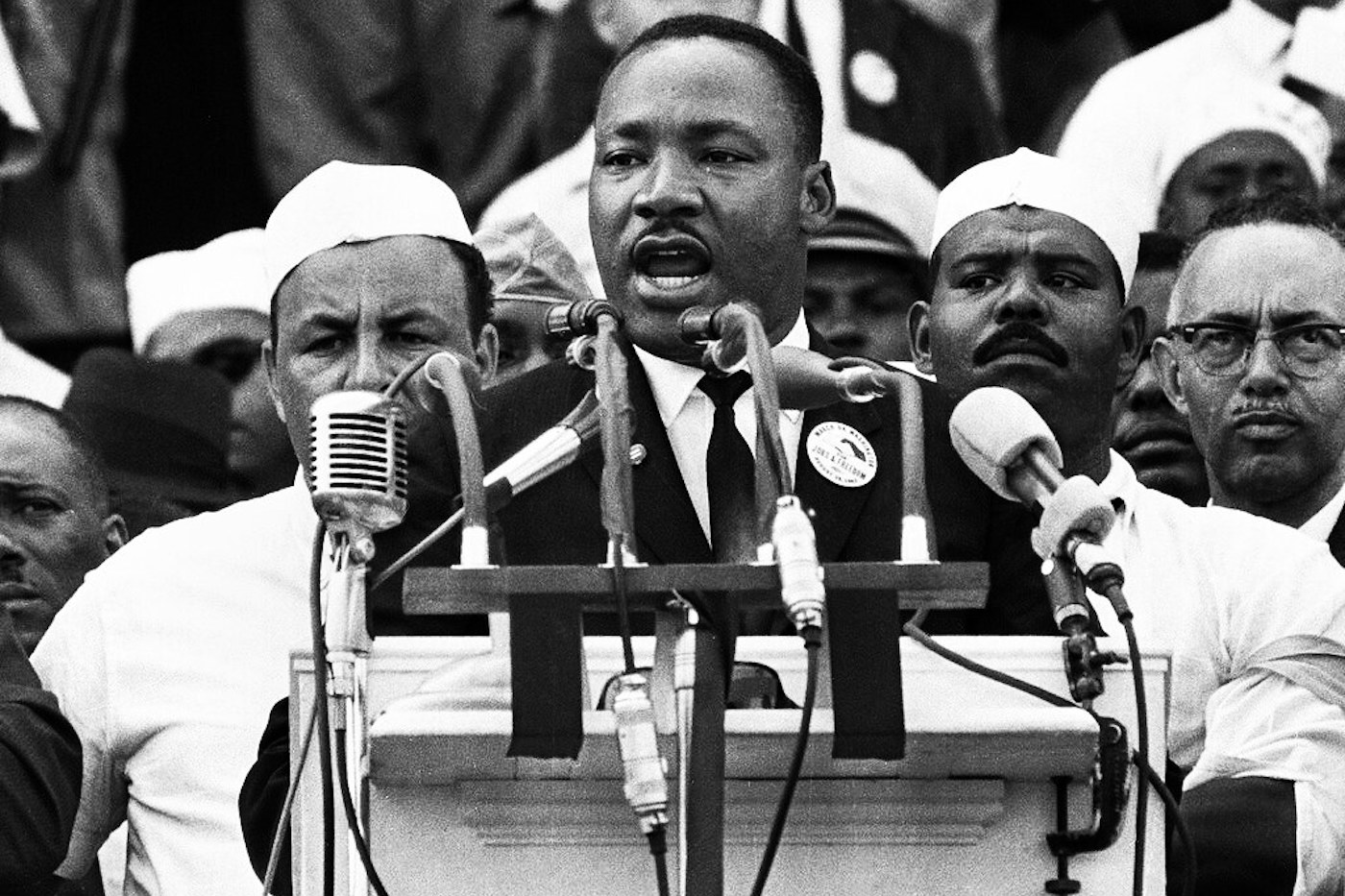


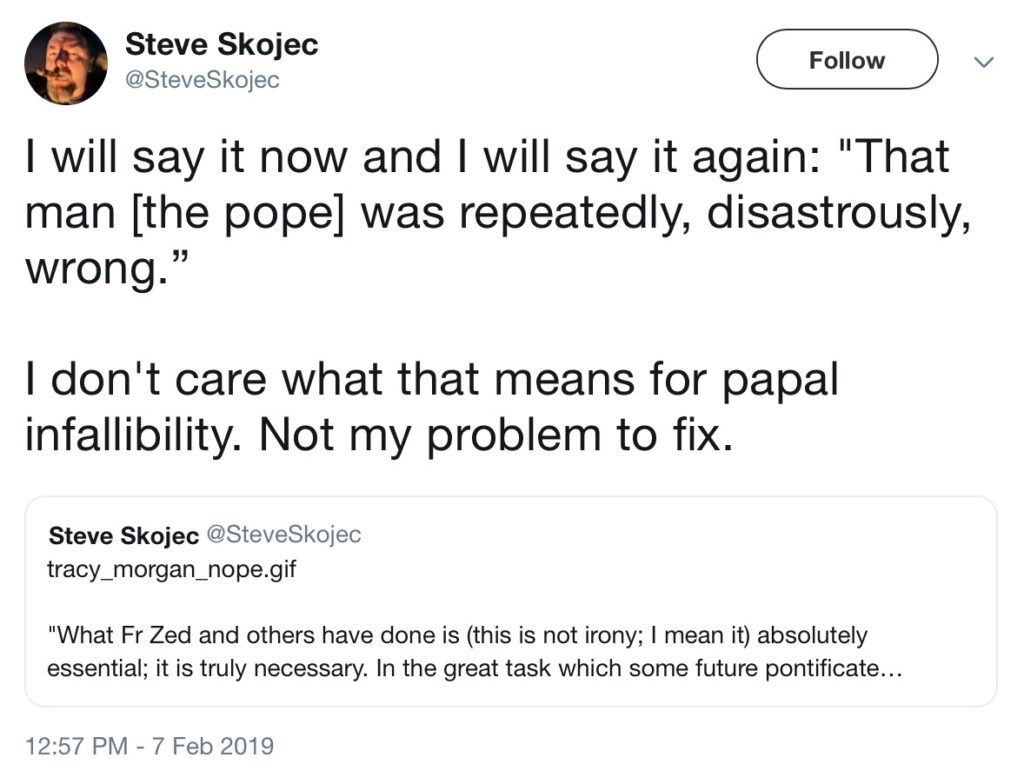
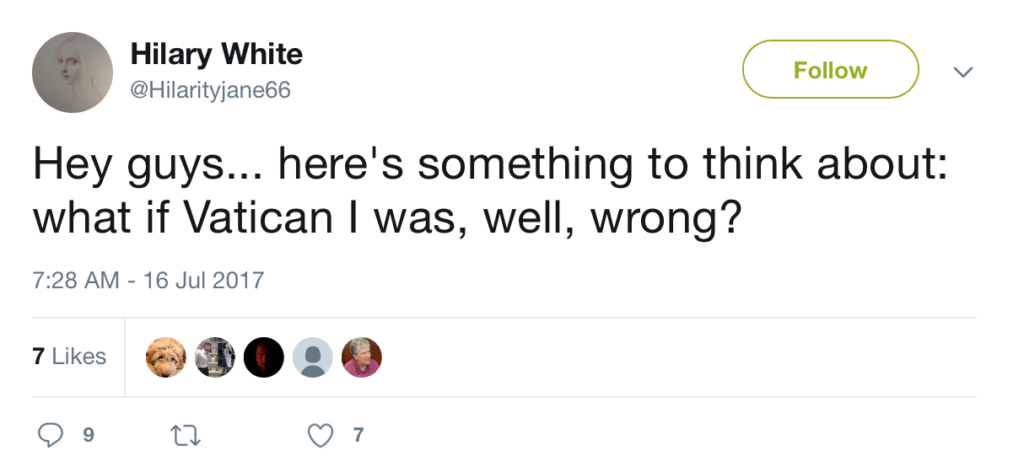


You must be logged in to post a comment.