DID YOU KNOW THAT YOU ARE FREE TO MAKE YOUR OPINIONS KNOWN TO YOUR PRIEST AND BISHOP?

b5cea-img_2659
Canon Law no. 212 says (LINK):

The Christian faithful are free to make known to the pastors of the Church their needs, especially spiritual ones, and their desires3. According to the knowledge, competence, and prestige which they possess, they have the right and even at times the duty to manifest to the sacred pastors their opinionon matters which pertain to the good of the Church and to make their opinion known to the rest of the Christian faithful

Posted in Uncategorized | 4 Comments

DO YOU KNOW HIM? I MEAN REALLY KNOW HIM?

47400b6822f5090564c584418c42951c

“Do You Know Him?”

That’s the question, asked repeatedly with rising emotional intensity, by African-American Baptist pastor Dr. S.M. Lockridge in the famous Protestant sermon, “That’s My King.” The question can be interpreted either as an altar call for the unconverted, or a reminder for the saved – an affirmation of the doctrine of “once saved, always saved,” also known as the “perseverance of the saints.”

How should Catholics respond to the question “do you know Him?”

Many Protestants pray that people, including their own children, would “know the Lord.” By this, they usually mean that they want loved ones to have a religious experience that will result in their conversion and eternal salvation. As I’ve argued elsewhere, Catholics don’t need to pray this prayer for their children, at least not in the sense Protestants mean, because of what is accomplished by the sacrament of baptism, which should be administered to Catholic infants.

The Catechism teaches baptism “actually brings about the birth of water and the Spirit without which no one “can enter the kingdom of God.” (CCC 1215) Furthermore, “the baptized have ‘put on Christ.’ Through the Holy Spirit, Baptism is a bath that purifies, justifies, and sanctifies.” (1227)

Through baptism, rightly administered, every Christian is cleansed of his or her sins, and receives the Holy Spirit, a powerful work of grace in the light of every recipient of this holy sacrament. If that doesn’t constitute knowing the Lord, I don’t know what does! Consider, too, the words of Christ Himself, who, when encountering the youth praising Him as “Son of David,” declares: “Let the children come to me, and do not hinder them; for to such belongs the kingdom of heaven.” (Matthew 19:14)

Yet neither baptism nor some later conversion experience ensure that someone will always remain saved. In perhaps the most alarming section of the Sermon on the Mount, Jesus tells the crowd:

Not every one who says to me, “Lord, Lord,” shall enter the kingdom of heaven, but he who does the will of my Father who is in heaven. On that day many will say to me, “Lord, Lord, did we not prophesy in your name, and cast out demons in your name, and do many mighty works in your name?” And then will I declare to them, “I never knew you; depart from me, you evildoers.” (Matthew 7:21-23)

This warning presents a problem for both Protestants and Catholics. In the Calvinist tradition from which the “perseverance of the saints” originates, interpreters of this passage have argued that if one falls away from the faith, that must mean that the individual never really believed. For non-Calvinist Protestants, usually called Arminians, the passage means that even Christians accomplishing great acts of faith can stray from their Lord and lose their salvation.

The Catechism of the Catholic Church reminds us of the possibility of losing our salvation:

Mortal sin destroys charity in the heart of man by a grave violation of God’s law; it turns man away from God, who is his ultimate end and his beatitude, by preferring an inferior good to him. . . .anyone who deliberately refuses to accept his mercy by repenting, rejects the forgiveness of his sins and salvation offered by the Holy Spirit. Such hardness of heart can lead to final impenitence and eternal loss. (CCC 1856, 1864)

*

This teaching originates in Scripture, such as the warning that “there is sin which is deadly. . . .All wrongdoing is sin, but there is sin which is not deadly.” (1 John 5:16-17)

Yet there are even less dramatic means by which we can impede or terminate our knowing God. The LORD, speaking through the Psalmist, often censures His people for offering sacrifices with no heart, without thanksgiving or praiseThese things you have done and I have been silent;

These things you have done and I have been silent;
You thought that I was one like yourself.
But now I rebuke you, and lay the charge before you. (Psalms 50:21)

This is the slower, more subtle loss of contact with God, one bred by familiarity, a familiarity not with the person of Christ, but with the rituals and daily routines of Christian life. Even the Catholic who attends Mass, prays his rosary, goes to confession, and reads religious literature can find himself simply “going through the motions.” He may like the regular diciplines, or intellectually recognizes the truth of Christianity. But his heart is gone.

Perhaps Pope Francis has such Christians in mind in his latest apostolic exhortation when he writes of “Gnostics” who over-intellectualize their faith to such a degree that it obscures or nullifies that “personal encounter with Christ” of which Benedict XVI so often spoke. Our Holy Father rebukes those who “reduce Jesus’ teaching to a cold and harsh logic that seeks to dominate everything.” (Gaudete et Exsultate 40)

Comparing Catholic definitions of “knowing the Lord” to those most dominant in Protestantism, this is where the rubber hits the road. While many Protestants presume the Christian is forever saved because of a profession of faith or some internal conviction, we Catholics place our trust in Christ’s redemptive work applied to us through the grace of the sacraments. Yet even so, we live in a tension between hope and presumption. We seek to live as children of a gracious and loving Father, but we are mindful that we may, through immoral acts or a slower spiritual rot, sever ourselves from God.

We must live with this tension, wary both of our immorality and our indifference. Yet we should not do so in fear, but in a humility that reminds us that even those who cast out demons may fail to reach heaven if they forget that the true end of man is happiness in God.

“Do you know Him?” Yes, by His grace, we Catholics do, but mindful that any loving relationship is a dance that requires two partners, even if One does the leading.


*Image: Christ Surrounded by Musician Angels by Hans Memling, c. 1485 (Royal Museum of Arts, Antwerp)

Casey Chalk

Casey Chalk

Casey Chalk is an editor for the ecumenical website Called to Communion and a graduate student at the Notre Dame Graduate School of Theology at Christendom College.

Posted in Uncategorized | 2 Comments

A LETTER FROM YOUR CONGRESSMAN

77406-004-D385837A

Letter to My Boss (YOU, the American voters)
I have enjoyed working here these past several years.  You have paid me very well and given me benefits beyond belief.  Have 3-4 months off per year and a pension plan that will pay my salary till the day I die and then pay my estate one year salary death bonus and then continue to pay my spouse my salary with increases until he (or she) dies  and a health plan that most people can only dream of having i.e. no deductible whatsoever.
 
Despite this, I plan to take the next 12-18 months to find a new position.  During this time I will show up for work when it is convenient for me.  In addition, I fully expect to draw my full salary and all the other perks associated with my current job.
 
Oh yes, if my search for this new job proves fruitless, I will be coming back with no loss in pay or status.  Before you say anything, remember that you have no choice in this matter.  I can, and I will do this.
Sincerely,
Every Senator or Congressman running for re-election
Are we stupid or what?
Posted in Uncategorized | 2 Comments

THE OCTOBER SYNOD OF BISHOPS CAN BE PREVIEWED IN THE CONFERENCE ON THE FAMILY SOON TO HELD IN ‘CATHOLIC’ DUBLIN – GUARD YOUR CHILDREN

Ecstasy_of_Saint_Teresa_September_2015-2a

Although the upcoming Synod on the Youth May have some good material, it will be filled with heresy. There are heretical things it may or may not promote, directly or indirectly by some participants, speakers, and even more confusing statements from Francis Whether said directly by him; and or twisted in the secular and fake media. The courage apostolate was designed to reach out to lgbt in a way that Ministers to them puts Christ, not feelings first; it is widely successful. However Father James Martin will be both at the World Meeting of families and the Synod. His material “building a bridge” is not sanctioned by Church teaching up to and including Pope Benedict XVI. All promulgation by the Vatican that changes church teaching or openly goes against divinely revealed truths is to be ignored, even if a Pope says it. Only in the sacrament of marriage is a family fully able to receive the graces necessary for eternal salvation and earthly well being.

In regards to the USCCB allowing politicians who promote evils (including euthanasia or abortion of babies with Down syndrome) to receive communion, funding must be withheld by Laity who shall instead contribute to their local parishes or in other ways such as helping the poor and charities directly. One must not break with the church during these times even if some elements of it including the hiarchy are straying from the Faith at times. One must be allowed to support the police including our brave ICE officers. If being in Other countries is the cause for religious persecution, Bishops should be putting pressure on the hostile government rather than attacking the civil and church rule of law which calls for orderly lawful immigration where they learn our way. Some of that is in the catechism.

Catholics Must not live in a bubble and they must look out for the safety and well being of others; but they must avoid putting the secular world first. Faith and family comes first before anything else. We do indeed worship God and the civil rule of law is the way of life.

“Religious freedom, not freedom of religion, is found in the constitution.” This is something that Tricia Flanagan, candidate for US Senate told me. This is different than the state favoring a religion or condemning  those who aren’t religious.

In closing, people must always be kind to all. For example one may encounter someone at work or school who might be a democrat or who might be gay. As long as you don’t compromise your faith, or openly encourage bad behavior, your soul is safe as you build normal positive conversations with the person in the hopes they will see you as a positive light.

Sheepdog

Posted in Uncategorized | Comments Off on THE OCTOBER SYNOD OF BISHOPS CAN BE PREVIEWED IN THE CONFERENCE ON THE FAMILY SOON TO HELD IN ‘CATHOLIC’ DUBLIN – GUARD YOUR CHILDREN

BISHOPS WHO RETIRE IN LUXURY SHOULD BE HELD ACCOUNTABLE FOR MISUSE OF CHURCH FUNDS.

NJ BISHOP PROTECTS PREDATOR PRIESTS, RETIRES IN LUXURY

NEWS: US NEWS

by Christine Niles, M.St. (Oxon.), J.D.  •  ChurchMilitant.com  •  July 28, 2018   21 Comments

Abp. John Myers of Newark paid off sex abuse settlements on behalf of Cdl. Theodore McCarrick and others

When New Jersey Abp. John J. Myers retired in 2017 — with a career scarred by sex abuse settlements and protection of predator priests — he went to live in a lavish estate in upscale Hunterdon County — a 4,500-square-foot home on 8.2 wooded acres, with five bedrooms, two elevators, a swimming pool, whirlpool, three-car garage, three fireplaces, and a gallery that took up the whole of the third floor — all of it funded by Church money.

Myers paid out two sex abuse settlements on behalf of Cdl. Theodore McCarrick in 2004 and 2006 based on claims that McCarrick had sexually assaulted seminarians while bishop in New Jersey. The settlements were kept from the public, McCarrick’s rise to power left to continue unhindered in Washington, D.C.

Following these and other reports that McCarrick was a serial sex abuser, and amid growing calls for the Vatican to act, Rome announced Saturday he had resigned from the College of Cardinals and the pope had imposed a life of prayer and penance until the canonical process was complete.

A Lavish Retirement

Image
The Hunterdon estate, with build-out under construction

After Myers announced a $500,000 renovation in 2013, two years before his retirement — adding a 3,000-square-foot, three-story building to the existing mansion — Catholics were so outraged they led a boycott of the bishop’s annual fundraising appeal.

“I’m disgusted,” said Newark Catholic Joe Ferri at the time. “The archdiocese is not going to get another penny out of me.”

“This is extreme,” said Charles Zech, “way beyond what you’d expect to happen. I can’t believe the parishioners of Newark are going to allow this to happen.”

“To ask people to make sacrifices and then to live in a sumptuous residence, it makes me very annoyed,” said Joan Rubino. “In plain English, I feel like people are getting screwed.”

But a tone-deaf archdiocese justified the expense. Spokesman Jim Goodness claimed the expansion was necessary because Myers would continue to work in retirement and needed more “office space” — office space that would include an indoor pool, three fireplaces, a hot tub, elevator and a library, among others.

In a piece titled “A Church So Poor It Has to Close Schools, Yet So Rich It Can Build a Palace,” The New York Times called out the archdiocese for shuttering Mater Dei Academy in Kearny while spending half a million dollars for the bishop’s renovations. The archdiocese at the time cited declining enrollment and “unstable finances” for its reasons to close the school.

The faithful delivered a petition with 17,000 signatures in April 2014 to the bishop demanding that he stop using Church funds to build out his mansion and set an example by choosing more modest retirement quarters. Myers ignored their pleas.

A Troubling Track Record

His comfortable retirement followed tenures in New Jersey and Illinois, where he left a troubling track record of reinstating and even advancing credibly accused priests.

Newark, New Jersey

In 2013, laity demanded that the Church launch an investigation into Myers for allowing a convicted sex abuser access to children, in violation of an agreement with the prosecutor’s office as well as the U.S. Bishops’ Dallas Charter for the Protection of Children and Young People.

Image
Fr. Michael Fugee, convicted for fondling a 14-year-old boy

Father Michael Fugee, a self-admitted homosexual, was convicted in 2003 of criminal sexual contact, admitting to police he had fondled a 14-year-old boy’s genitals twice, and that the contact had sexually excited him. He was found guilty by a jury and sentenced to five years probation.

An appeals court overturned the verdict in 2006 over concerns that admitting evidence of Fugee’s homosexuality might have drawn “an unfounded association between homosexuality and pedophilia.” The rest of the evidence, including Fugee’s confession, was not contested.

Instead of retrying him, the Bergen County Prosecutor’s Office in 2007 entered into an agreement with the archdiocese, which allowed Fugee to attend a rehabilitation program under the strict condiction that he would never be permitted to work “in any position involving children.”

But in 2013, it was discovered Fugee had had frequent access to children for years through an informal association with St. Mary’s Parish in Colts Neck, where he attended youth retreats on Lake Hopatcong in Mount Arlington, joined adolescents and teens in their annual pilgrimage to Canada, and heard minor’s confessions in private — all with the knowledge and approval of Abp. Myers.

After public outcry, the archdiocese rejected any wrongdoing, the diocesan spokesman saying that Fugee had been under supervision throughout his time spent with minors.

“We believe that the archdiocese and Father Fugee have adhered to the stipulations in all of his activities, and will continue to do so,” said Jim Goodness. “The fact is, he has done nothing wrong.”

Worse, it came to light that Myers had appointed Fugee in 2009 to be chaplain at St. Michael’s Medical Center in Newark without telling hospital officials about his criminal past. As soon as the hospital learned, he was removed as chaplain.

And in 2012, Myers drew heat for making Fugee co-director of the Office of Continuing Education and Ongoing Formation of Priests.

Parishioners at St. Mary’s in Colts Neck were furious when they discovered the news of Fugee’s criminal record.

Image
Fr. Michael Fugee posing with two teens

at St. Mary’s youth group in Colts Neck

“Finding this out later has left me completely flabbergasted,” said Deacon Paul Franklin at the time, whose children were part of the youth group attended by Fugee. “If I had known, I would have objected immediately.”

“It’s complete craziness that the church can let this happen,” said John Santulli, who went to St. Mary’s with his children. “I’m a softball coach, and I need a background check just to get on the field. Every single person I spoke to today said, ‘Oh my God. I didn’t know about this.’ It’s incomprehensible.”

Both the dioceses of Trenton and Paterson, where the retreats and parish activity took place, insisted Fugee participated without their knowledge or permission, the bishop of Trenton barring the priest from further activities at St. Mary’s.

The pastor of St. Mary’s along with two youth ministers — close friends with Fugee, who knew about his past and never informed parishioners — were removed from the parish.

The Newark archdiocese, however, remained unapologetic.

“Father Fugee remains a priest who is allowed to be in ministry,” said spokesman Jim Goodness. “There is no change in his status at this point.”


Father John Bambrick, a priest in the Trenton diocese and himself a survivor of clerical sex abuse, had sharp words for Myers.

“Essentially, Abp. Myers has erased 10 years of hard work by the church in the United States to ensure people are safe,” he said. “He has called into question the integrity of all of us who work so hard to ensure the safety of children, and it’s really disheartening.”

Noting the “body count” of those forced to step away from public ministry, Bambrick asked why Myers was not being held accountable.

“The person who caused all this upset is Abp. Myers, and he’s still in office,” said Bambrick. “It seems like the archbishop needs to take responsibility for his own actions, as everyone else has in this crisis.”

After a victims’ advocacy group petitioned the Vatican to force Myers to resign, Pope Francis appointed Co-Adjutor Bp. Bernard Hebda to the archdiocese, but allowed Myers to serve out his remaining tenure until the mandatory retirement age of 75. Instead, Msgr. John Doran, Myers’ second-in-command, and the one who had signed the 2007 agreement with Bergen County, took the fall, forced to resign.

Fugee was eventually laicized in 2014, but only after Bergen County decided to drop criminal charges in exchange for his laicization and on agreement that the County — not the diocese — would supervise Fugee’s whereabouts, as it no longer trusted Myers to be vigilant over the priest’s movements. The Vatican acted with uncustomary speed — four months — in completing the process.

Peoria, Illinois

Before Newark, Myers was head of the diocese of Peoria, Illinois from 1990–2001, where he placed at least one priest accused of sex abuse in a position of power.

Image
Bp. Daniel Jenky of Peoria, IL., who suspended seven priests

in 2002, some who had been previously suspended, then reinstated

and promoted by his predecessor, Bp. John Myers.

Father John Anderson was removed from ministry in 1993 after an accusation of abuse. Not only did Myers reinstate him years later, he made him director of the diocese’s Office for the Propagation of the Faith.

When his successor, Bp. Daniel Jenky, was installed in 2002, among his first actions was removing Anderson from ministry, along with six other credibly accused priests.

Myers was soon afterwards dumped from the U.S. Bishops’ Committee on the Protection of Minors, having only served five months. His spokesman claimed at the time it was because his work on the committee was complete, but critics claim it was because of the mess he’d left in Peoria.

Among the priests removed by Jenky was Fr. Francis Engels, who had resigned in 1993 after several allegations of sex abuse. As bishop, Myers later tried to reinstate him, but reversed course after victims threatened to go to the media.

“I didn’t realize they would be so upset,” the archbishop said.

In 2013, the diocese settled a $1.35 million lawsuit brought by Andrew Ward, who claimed that a priest friend of Myers, Fr. Thomas Maloney, had abused him when he was in second grade, when Myers was bishop of Peoria. In a 2010 deposition, Myers was shown evidence that his diocese had received complaints of Maloney’s sex abuse from at least five others. Myers — who had received multiple gifts of cash, coins and other items from Maloney, with whom he had attended seminary — denied knowledge throughout.

#CatholicMeToo

Revelations that men in power in the Church have abused their authority and experience virtually no accountability, while the laity are left to foot the bill, have spurred a growing movement to boycott the bishops’ fundraising appeals and demand their resignations. Much like the 2014 boycott of Myers’ fundraising campaign in light of his extravagant spending and checkered clerical career, Catholics are hoping the boycott goes national, and that bishops — funded and supported by a laity they have too often failed — are finally called to account.


Posted in Uncategorized | 2 Comments

McCARRICK RESIGNS FROM COLLEGE OF CARDINALS, THE FIRST TO RESIGN IN HISTORY FOR SEXUAL ABUSE

Cardinal Theodore McCarrick Resigns Amid Sexual Abuse Scandal

Image
An investigation found credible evidence that Cardinal Theodore McCarrick had sexually abused a teenager 47 years ago while serving as a priest in New York.CreditMax Rossi/Reuters

ROME — Pope Francis has accepted the resignation of Cardinal Theodore E. McCarrick, the former archbishop of Washington, from the College of Cardinals, ordering him to a “life of prayer and penance” after allegations that the cardinal sexually abused minors and adult seminarians over the course of decades, the Vatican announced on Saturday.

Acting swiftly to contain a widening sex abuse scandal at the highest levels of the Roman Catholic Church, the pope officially suspended the cardinal from the exercise of any public ministry after receiving his resignation letter Friday evening. Pope Francis also demanded in a statement that the prelate remain in seclusion “until the accusations made against him are examined in a regular canonical trial.”

Cardinal McCarrick appears to be the first cardinal in history to step down from the College of Cardinals because of sexual abuse allegations. While he remains a priest pending the outcome of a Vatican trial, he has been stripped of his highest honor and will no longer be called upon to advise the pope and travel on his behalf.

A prominent Roman Catholic voice in international and public policy, Cardinal McCarrick was first removed from public ministry on June 20, after a church panel substantiated allegations that he had sexually abused a teenage altar boy 47 years ago while serving as a priest in New York.

Posted in Uncategorized | 6 Comments

Here is your little dose of satire to help you cope with the amount of covering up for Cardinal McCarrick that some bishops have done.

Eccles and Bosco is saved


English bishops to relax the dress code

Posted: 27 Jul 2018 06:53 AM PDT

In view of the extreme temperatures in London – “nearly as high as the last time it was this hot” – the Catholic Bishops of England and Wales have agreed that priests may relax their dress code – cassocks, chasubles, socks, whatever – for Mass this weekend.rainbow leotard

A Jesuit priest models a rainbow leotard.

“If the Marylebone Cricket Club can do it, then why not us?” explained Cardinal Vincent Nichols, as he rummaged through his wardrobe for a scarlet mankini. “We take our faith nearly as seriously as those cricket fans.”

However, there are limits on what priests will be allowed to wear on “Scorcher Sunday.” A request from the archbishop of Great Tobin that he could wear a see-through nighty-nighty was turned down.

dancing priest

Maintaining standards. This priest insists on wearing full dress when he dances.

To get a wider view of the issue, we asked the American bishops their views on stripping off in hot weather. Farrell, Wuerl, Tobin and Cupich were unanimous: “We prefer to cover things up.” What can they mean?

Posted in Uncategorized | 4 Comments

The Devil has indeed infiltrated the Church and has recruited many useful idiots and fellow-travelers. Souls are being lost every day because they are led astray by worldly shepherds wearing purple garments, wolves in sheeps’ clothing.

PETER KWASNIEWSKI

Featured Image

BLOGS

Our own bishops are leading an apostasy, but we must remain steadfast


{ABYSSUM}

July 27, 2018 (LifeSiteNews) – The heart of the current apostasy unfolding in the Catholic Church may be stated thus: the Bride of Christ has forsaken her Bridegroom for another lover, the World. Of course, the Bride of Christ in her perfection, the Church Triumphant in heaven, can never be unfaithful, nor can the souls already saved but in need of purification, the Church Suffering in purgatory. We are speaking of the Church Militant on earth—and not, obviously, all Catholics, but far too many, especially in the hierarchy. We can see this in an unrelenting flood of bad news that hovers around bishops and cardinals.

We see the abandonment of Christ for the World in the sex abuse scandal surrounding Cardinal McCarrick, predator extraordinaire, and in the ranks of senior clergy who knew about his sinful behavior but refused to do anything about it, even joining in with his hypocrisy. The reaction to the stunning disclosures has been underwhelming, which supports the inference that the McCarrick problem is just the tip of the iceberg.

We see it in the episcopal non-reaction to the 15 “Catholic” senators who refused to vote against late-term abortions that inflict horrible pain on babies before depriving them of life. Senator Schumer of New York high-fived the “Catholic” senator from North Dakota, rejoicing that the slaughter will continue. Satan smiled on that one. Silence from the bishops. You can bet that if those 15 senators voted against a “comprehensive immigration reform” bill, the bishops would have immediately called them on the carpet for their cruelty towards the poor.

We see it in Cardinal Cupich’s warm welcome to Fr. James Martin, bridge-builder for sins that cry out to heaven for vengeance, and his cold war against Fr C. Frank Phillips, founder of the Canons Regular of St John Cantius.

We see it in the support given by the same Cupich, together with Archbishop Gregory, Bishop McElroy, and Bishop Wester, to the openly heretical “Association of United States Catholic Priests” (AUSCP), based in Cleveland, Ohio—a clerical version of Call to Action. In any normal situation, all the members of this association and its patrons would have been excommunicated and told to do penance on bread and water until reconciliation might be possible.

We see it in the utter lack of seriousness with which the bishops and clergy of Ireland prepared their people for the fateful referendum on abortion, as a result of which, for the first time ever, a nation democratically turned against the unborn and declared open hunting season on its own children. Efforts to speak the truth in love and unmask the abortionist propaganda were almost solely the work of laity supported with private funds.

We see it in the Vatican “deal” with Communist China, by which the persecuted faithful children of the Church have been betrayed. (Interesting how nobody who lives under Communism ever favors such rapprochements—just the Communist agents in the clergy, like Bishop Sorondo, who said “Right now, those who are best implementing the social doctrine of the Church are the Chinese.”)

We see it in Cardinal Marx and his allies, who receive no rebuke when they violate all that is most sacred, giving the Holy Eucharist to adulterers and non-Catholics, and plundering monasteries for their property. Meanwhile, the good and faithful servant Cardinal Sarah is swiftly rebuked if he dares to recommend the celebration of Mass ad orientem—a practice all Catholics had followed for nearly 2,000 years, and one that has, in any case, always been permissible with the new liturgical books.

One could, alas, go on and on. The deafening silence of many among our shepherds, their complicity with evil, their outright espousal of errors, is the great burden we are being asked to bear today in the Church. It is quite like the situation in Henry VIII’s England, when most of the bishops were cowards who went along with the status quo and the holders of power. St. John Fisher stood out, almost alone, for his unyielding fidelity.

As Pope Paul VI recognized in his famous homily on June 29, 1972, “from some fissure the smoke of Satan has entered the temple of God.” The Devil has indeed infiltrated the Church and has recruited many useful idiots and fellow-travelers. Souls are being lost every day because they are led astray by worldly shepherds, wolves in sheeps’ clothing.

In the sixteenth century, a nun in Quito, Ecuador, Mariana Francisca de Jesus Torres y Berriochoa, received visions of Our Lady of Good Success, subsequently approved by the Church, in which the Holy Mother of God spoke many prophesies of future times. This one in particular stands out:

During this unfortunate epoch, injustice will even enter here [into the Church], my closed garden. Disguised under the name of false charity, it will wreak havoc in souls. The spiteful demon will try to sow discord, making use of putrid members, who, masked by the appearance of virtue, will be like decaying sepulchers emanating the pestilence of putrefaction, causing moral deaths in some and lukewarmness in others. … How the Church will suffer on that occasion the dark night of the lack of a Prelate and Father to watch over them with paternal love, gentleness, strength, and prudence!


Can any honest Catholic deny that we are living through the exact times of which Our Lady of Good Success warned us? Yet we know, when everything looks its bleakest and all human solutions have fallen away, that her Immaculate Heart will triumph.

We are living through a great purification. To St. Augustine is attributed the remark that the saints of the end times will have no further purging to endure after their life, since they will have already gone through it in this world. We must remain steadfast, weathering the storm, for Christ is still in the boat, silent though He may be, and it will never sink as long as He is near us and we are near Him.

===========================================================================
Peter Kwasniewski

Peter Kwasniewski holds a B.A. in Liberal Arts from Thomas Aquinas College in California and an M.A. and Ph.D. in Philosophy from The Catholic University of America in Washington, D.C. After teaching at the International Theological Institute in Austria and for the Franciscan University of Steubenville’s Austrian Program, he joined the founding team of Wyoming Catholic College in Lander, Wyoming, where he taught theology, philosophy, music, and art history, and directed the Choir and Schola. He now works as a freelance author, public speaker, editor, publisher, and composer.

Dr. Kwasniewski has published five books: Wisdom’s Apprentice (CUA Press, 2007)On Love and Charity (CUA Press, 2008)Sacred Choral Works (Corpus Christi Watershed, 2014); Resurgent in the Midst of Crisis: Sacred Liturgy, the Traditional Latin Mass, and Renewal in the Church (Angelico Press, 2014); and most recently, Noble Beauty, Transcendent Holiness: Why the Modern Age Needs the Mass of Ages (Angelico Press, 2017)Resurgent in the Midst of Crisis has also been published in Czech, Polish, German, and Portuguese, and will soon appear in Spanish and Belarusian.

Kwasniewski is a board member and scholar of The Aquinas Institute for the Study of Sacred Doctrine, which is publishing the Opera Omnia of the Angelic Doctor, a Fellow of the Albertus Magnus Center for Scholastic Studies, and a Senior Fellow of the St. Paul Center. He has published over 750 articles on Thomistic thought, sacramental and liturgical theology, the history and aesthetics of music, and the social doctrine of the Church.

Posted in Uncategorized | 4 Comments

THE CLERICAL SEWER CONTINUES TO BACK UP AND THE STENCH IS BECOMING OVERPOWERING, IS GOD THE ONLY ‘PLUMBER’ WHO CAN CLEAN IT OUT OR ARE THERE IN THE CHURCH COURAGEOUS PRELATES WHO CAN DO WHAT MUST BE DONE?

OnePeterFive

By now, Catholics the world over are sick of hearing about the not-so-secret life of Cardinal Theodore McCarrick. Stories that involve unwanted touching of minors and seminarians, strange costumes, familial nicknames, and the Cardinal demanding that young men share his bed. Stories that involve “gay sex parties at the bishop’s residence”, and other things we’d rather not contemplate.

The sordid details of these cases have been made known, and will, unfortunately, probably continue to come to light as this so-called “MeToo moment for the Church” continues to unravel. But McCarrick is only the tip of an iceberg, and what lies beneath must be brought to light.

Who Knew, And Why Didn’t They Act?

Even as the moral corruption of McCarrick becomes undeniable, the question of the networks that supported and covered his actions have taken on a pressing urgency. Those responsible for keeping silence are men who continue to serve in the Church. Men who knew what kind of a monster McCarrick was when he was being raised to the rank of cardinal – and either did nothing to stop it, or refused to come forward when those they reported it to turned a blind eye.

The impact of this silence was explained by one of McCarrick’s victims, a man named James, who says that McCarrick — then a priest and a friend of the boy’s family — started molesting him at least as early as age 11. In an interview with Rod Dreher of The American Conservative, James answered the question of what he would like to say “to the people – bishops, priests, and laymen – who know who Theodore McCarrick is and what he did to people, but who are to this day keeping the old man’s secrets”:

“I would say, ‘What is so important that you are afraid to lose? Why do you believe that you are more important than so many other lives? Why can’t you just let us all know what you know? Otherwise, all his cronies that he brought on to replace him will continue his abuse in the church. They believe that if they speak out, the Catholic Church will no longer be. They piss me off because they don’t have the guts to step up and say something.”

Later in that interview, Dreher points out that men like Cardinal Kevin Farrell — who was also in a position of stature in the Legionaries of Christ under the horrifyingly perverse founder of that order, Fr. Marcial Maciel — claim they did not know about McCarrick’s sexual corruption. Michael Brendan Dougherty of National Review says of this claim:

What a life! To have been twice put in the best place to know what, at that level, “everyone knows,” and yet to have known nothing. Why should such a clueless man be elevated to the office of cardinal and given a curial position? Why should a prelate whose sense of the Church is so deficient that he resoundingly declared of the abuse crisis in 2002 that it was “over” be in charge of the World Meeting of Families in Dublin this year? If anyone comes forward with credible evidence that Cardinal Farrell did in fact know about McCarrick’s relationships with seminarians, will he resign his offices?

Abuse victim James’s response to the denial of knowledge is even more visceral:

“They lie,” he growls. “They lie through their teeth and hoping that everything will go away, because the great Oz behind the curtain, Cardinal McCarrick, is going to fix things again.

Earlier in the interview, James explains why McCarrick got away with it for so long:

“He lives in his own little private world,” says James, his voice rising in anger. “He believes most of the shit that he says for himself. His ego is bigger than yours and mine and 300 people put together. He believes that he is untouchable, and that there’s nobody else in the world who can put him aside.”

But as more and more Catholics are realizing, the heat of righteous anger rising within them, that can’t be allowed to happen. Not for McCarrick, and not for those who covered for him.

Follow the Money

An intricate pattern of dominoes are lined up on edge across the ecclesiastical table, and McCarrick has crashed right into it. They are teetering precariously. Which will be the first to fall?

Perhaps the best place to look would be the most obvious. In the initial statement about credible accusations of abuse against McCarrick from a minor back in June, the Newark Archdiocese made a stunning concession:

“In the past, there have been allegations that he engaged in sexual behavior with adults. This Archdiocese and the Diocese of Metuchen received three allegations of sexual misconduct with adults decades ago; two of these allegations resulted in settlements.

When were these settlements? Who knew about them? Was the Vatican consulted? Why was this kept secret from the faithful?

According to the New York Times, the Dioceses of Trenton, Metuchen, and Newark, New Jersey — two of which (Metuchen and Newark) McCarrick headed as bishop — paid an $80,000 settlement in 2005 to Mr. Richard Ciolek, a former Catholic priest and victim of McCarrick’s bizarre sexual proclivities. (According to the Times, Ciolek — who left the priesthood and got married in 1999 — was asked by McCarrick’s former secretary if he was planning to sue the Diocese of Metuchen, meaning that at some level, the awareness of McCarrick’s activities there long-predated the settlements.)

A year earlier, according to the Times, another unnamed former priest of the Metuchen diocese was forced to resign under the Church’s “zero tolerance policy” on sexual abuse. The reason? A decade earlier he had come forward, claiming that “Archbishop McCarrick had inappropriately touched him and other seminarians” during the 1980s – another incident that should have been in the diocesan files long before McCarrick was ever made a cardinal or given one of the most important diocesan sees in America. The unnamed priest alleged that McCarrick had asked him on one occasion (when he was still a seminarian) “to change into a striped sailor shirt and a pair of shorts he [McCarrick] had on hand” and join him in bed.” “He put his arms around me and wrapped his legs between mine,” the former priest said. “He also wrote that he once saw Archbishop McCarrick having sex with a young priest in a cabin at the Eldred fishing camp, and that the archbishop invited him to be ‘next.’”

When this priest wrote to his new bishop (the late Edward T. Hughes) in 1994 to divulge the abuse, he made a stunning confession; he said that he himself had gone on to inappropriately touch two 15-year-old boys, which he believed he did because of “the sexual and emotional abuse he endured” at the hands of McCarrick. He said this abuse had “left him so traumatized that it triggered” his own predatory behavior. In 2007, that former priest received a $100,000 settlement from Metuchen for his own abuse. (No indication was made in the article that the two boys had ever come forward or received any settlement)

Does anyone believe that five and six figure settlement checks from dioceses are not cleared by their bishops, if not signed directly by them? Does anyone believe the bishops of Metuchen, Trenton, and Newark were not aware of what McCarrick was accused of? Does anyone think they shouldn’t have said anything? So who were they?

Who was the bishop of Metuchen in 2004 and 2007 when the two settlements were issued? Bishop Paul Gregory Bootkoski, who also served as auxiliary bishop and vicar general of Newark under McCarrick. Bootkoski made headlines in 2015 when he defended the suspension of a teacher in one of his Catholic schools for a Facebook post decrying the gay agenda. The teacher was later reinstated after significant public backlash.

Who was the bishop of Trenton in 2004? Bishop John Mortimer Fourette Smith. In 2002, according to Wikipedia, “Smith removed a priest accused of molesting a young boy from an administrative position in the diocese.The diocese had reported the allegation to the Monmouth County prosecutor’s office when it was first made in 1990, but prosecutors had decided not to file criminal charges because of insufficient evidence. Smith relieved the priest of his duties following a review of personnel files to ensure the public’s confidence in the clergy.”

Who was the bishop of Newark, the Archdiocesan See for all three of the dioceses in the 2004 settlement and thus arguably the key player of the three? Archbishop John J. Myers. It is with Myers in particular that the questions grow deeper. In 2002, Myers was featured on a list published by the Dallas Morning News of American bishops who had “allowed priests accused of sexual abuse to keep working.” According to that report:

During his time as leader of the Diocese of Peoria, Ill. – which he left last year – at least one priest was accused of sexual abuse and reassigned. A Peoria diocesan spokeswoman said the Rev. John Anderson was first accused of abuse in 1993 and removed from a parish. The archbishop, who was recently appointed to the U.S. Conference of Catholic Bishops abuse committee, said he had no knowledge of the matter. Father Anderson, who served until recently as director of the diocesan office for Propagation of the Faith, has not commented publicly. He was among seven priests suspended in May by the Peoria Diocese. After those suspensions, accusers of a previously suspended Peoria priest said that Archbishop Myers had not responded to their complaints in the early 1990s until, after months of frustration, they talked to a local newspaper. And then-Bishop Myers later moved to reinstate the Rev. Francis Engels, then backed off when alleged victims complained. “I didn’t realize they would be so upset,” the archbishop recently said.

In a NJ.com article from 2017 entitled, “The Dark Legacy of Archbishop John Myers”, writer Tom Moran tells the story of Newark priest Fr. Kevin Gugliotta — who infamously told his probation officers that he “uploaded child porn to get back at God” because he wasn’t winning poker tournaments. At the time of his arrest, Archbishop Myers claimed (official statement) that there were “no allegations that he may have engaged in similar activities in New Jersey”.

Except that there were.

Writes Moran:

In 2003, a father of two children came forward to report that Gugliotta had fondled him 15 years earlier, just before Gugliotta became a priest. The alleged victim testified to both police and the archdiocese, and Gugliotta was suspended.

So wasn’t that fondling a “similar activity”? No, says the archdiocese: Child pornography is different than child abuse.

I asked if that word-parsing might have tricked some people into believing this priest’s history was clean: “It’s always possible people will interpret things the way they want to interpret them,” says the archdiocese spokesman, Jim Goodness.

The story gets worse, and more infuriating.

It turns out that because this alleged abuse occurred before Gugliotta became a priest, Vatican canon law forbids the archdiocese from imposing punishment — even if the charges are true. So in 2004, Gugliotta was reinstated as a priest.

Here’s where Myers’ sin becomes unforgiveable to me: He assigned Gugliotta to jobs where he had easy contact with children. For eight years Gugliotta worked with a youth group in Scotch Plains at St. Bartholomew the Apostle Parish.

“I had no idea,” his supervisor, the Rev. John Paladino, told Mark Mueller of NJ Advance Media. “As a pastor, I would want to know something like that.”

Eight years. How many kids in Scotch Plains were abused? How about kids in other parishes where he served – in Short Hills, Wyckoff, West Orange and Mahwah?

Why didn’t Myers at least keep Gugliotta away from children?

“I can’t answer that question,” says Goodness, the spokesman. “He has the discretion to assign priests…He could have assigned him to something else.”

Mueller has written about several cases like this over the years, cases where Myers’ behavior makes you want to scream.

“I don’t want his resignation,” the mother of one victim told me during a protest in Newark four years ago. “I want Bishop Myers to go to jail.”

Based on the above-mentioned cases, if Myers knew about McCarrick, is there any reason to believe would he have done anything about his activities? Why aren’t more questions being asked of him? A Google search on Myers turns up not a single news result more recent than 2017.

A Papal Protector? 

The moment the settlements were issued for abuse by McCarrick, the bishops involved had a moral obligation to take action on McCarrick, who in addition to his continued public ministry, would go on to participate in the 2005 conclave that elected Benedict XVI, and would be actively involved in the outcome of the conclave of 2013.

Which raises another important question: Although McCarrick was too old to participate in the 2013 papal election, he was involved in influencing it. In February 2013, McCarrick talked up the possibility of a Third World Pope in an interview with John Allen of the National Catholic Reporter. Throughout the interview, McCarrick referenced the Third World three different times; he mentioned Latin America seven times. “I think it would be so great for the focus to be on areas like Latin America.” He said. “If we could have a Latin American [pope], that would be great too.”

It was only when asked specifically if he was referring to Cardinal Bergoglio at one point in the interview that he demurred somewhat in what was — in hindsight — some pretty blatant signaling.

Later, in a talk given at Villanova University in Philadelphia in October, 2013, McCarrick revealed just how hard he was pushing that message, and why. He said that a “very interesting and influential Italian gentlemen” came to see him in Rome and asked him to campaign for Bergoglio:

We sat down. This is a very brilliant man, a very influential man in Rome. We talked about a number of things. He had a favor to ask me for [when I returned] back home in the United States.

But then [the influential Italian] said, ‘What about Bergoglio?’

And I was surprised at the question.

I said, ‘What about him?’

He said, ‘Does he have a chance?’

I said, ‘I don’t think so, because no one has mentioned his name. He hasn’t been in anyone’s mind. I don’t think it’s on anybody’s mind to vote for him.”

He said, ‘He could do it, you know.’

I said, ‘What could he do?’

He said, ‘[Bergoglio] could reform the Church. If we gave him five years, he could put us back on target.’

I said, ‘But, he’s 76.’

He said, ‘Yeah, five years. If we had five years, the Lord working through Bergoglio in five years could make the Church over again.’

I said, ‘That’s an interesting thing.’

He said, ‘I know you’re his friend.’

I said, ‘I hope I am.’

He said, ‘Talk him up.’

I said, ‘Well, we’ll see what happens. This is God’s work.’

That was the first that I heard that there were people who thought Bergoglio would be a possibility in this election.

According to Pete Baklinksi of LifeSiteNews, “McCarrick went on to say in his talk that when his time came to speak to all the cardinals prior to the vote, he urged them to elect someone from ‘Latin America’ who could identify with the poor.”

Just like he had in the NCR interview.

It has by now been well-documented that Pope Francis is loyal to those whom he considers friends – even when their moral turpitude is on full display. Can we expect that McCarrick fare any worse under Pope Francis than Cardinal Godfried Danneels, who among various other anti-Catholic behaviors during his tenure was caught on tape trying to dissuade a clerical abuse victim from going public? As Henry Sire writes in his seminal work, The Dictator Pope, Danneels had his home and offices raided by police, who seized computers and abuse allegation documentation. “For reasons that remain unclear,” wrote Sire, “the seized evidence was declared to have been inadmissible, the documents returned to the archdiocese and the investigation was abruptly closed. This despite the fact that individuals had come forward with almost five hundred separate complaints, including many that alleged Danneels had used his power and connections to shield clerical sex abusers.”

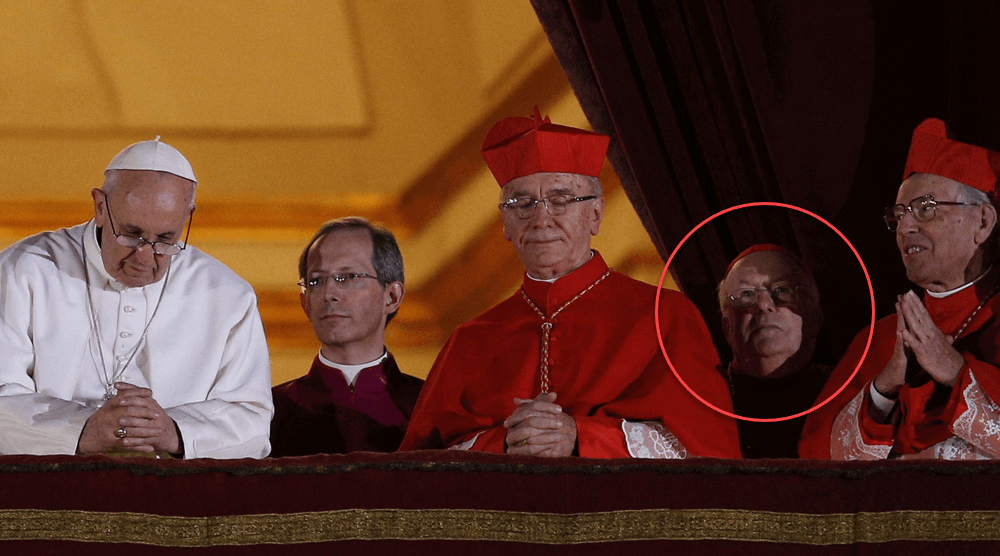
And yet Danneels was part of the so-called “Sankt Gallen Mafia” that helped elect Bergoglio to the papacy. His involvement as a popemaker led Danneels to enjoy the 2013 conclave as — in his words — “a personal resurrection experience.” And as we’ve reported before, if one looks at the loggia, where the newly minted Pope Francis stands before the crowd, who is standing in the shadows? One Cardinal Godfried Danneels, looking rather proud of his achievement:
Time after time, complaint after complaint, those closest to the pope, or who helped him obtain power, escape justice – at least until public pressure becomes too great, as it did with Bishop Juan Barros. Four of the pope’s C9 council of cardinal advisers — including its head, Bishop Oscar Rodriguez Maradiaga — have been implicated in neglect in dealing with or direct cover-ups of clerical sexual abuse. In addition to Maradiaga, whose scandal involves his recently-resigned auxiliary bishop, Juan José Pineda Fasquelle, CMF — as well as a new open letter claiming egregious homosexual activity at Maradiaga’s major seminary — Cardinals Marx and Errazuriz have both been implicated in mishandling abuse cases, and Marx even admitted his negligence. The outlier of the four is Cardinal George Pell of Australia, who found himself facing 40-year-old abuse charges — charges he has vigorously denied — after he uncovered significant financial irregularities at the Vatican Bank.

Also of note is the fact that the pope’s hand-picked liaison to the now-stalled Vatican Bank Reform, Msgr. Battista Ricca, was claimed to have outraged church figures in Uruguay during a diplomatic posting in 1999, when he moved “his lover, Patrick Haari, a Swiss army captain, in with him”, only to later have Haari forced out by apostolic nuncio Janusz Bolonek in 2001. Ricca was caught later that year in an elevator, where he was “trapped with a youth known by local police” after being attacked at a “cruising ground” – a meeting place for area homosexuals. There is no indication that Ricca has been removed of his position as Prelate the Vatican Bank, despite indications that his past was hidden from the pope and reports of his offered resignation as long ago as 2013. Less well known is the fact that it was in reference to a specific question about Msgr. Ricca that Pope Francis infamously responded, “Who am I to Judge?”

What confidence can any Catholic have, then, that McCarrick, whose abuse thus far appears to fall outside civil statues of limitations, will face any justice for his crimes? What hope have we that he will be defrocked and laicized, as other, less significant clerics have been for far less? What chance is there that any action will be initiated by Rome? Will Bishops Bootkoski, Smith, and Myers be thoroughly questioned and exposed and disciplined if complicity is discovered? Or Tobin and Farrell for that matter? Will the pope’s 2016 motu proprio on episcopal enablers of clerical sex abuse, As a Loving Motheractually be put to use? That instruction states that, “In the case of the abuse of minors and vulnerable adults it is enough that the lack of diligence be grave,” and that a bishop “can be legitimately removed from this office if he has through negligence committed or through omission facilitated acts that have caused grave harm to others, either to physical persons or to the community as a whole. The harm may be physical, moral, spiritual or through the use of patrimony.”

Of course, experience gives us the answer. We can expect no such thing from Rome, which routinely turns a blind eye to moral corruption in the ranks of our bishops. We can expect nothing from the fellow bishops who may have information, or may in fact be complicit in some way, or concerned about the revelation of their own sins. We can almost certainly expect more silence from priests afraid of retribution.

It seems imperative, then, that the push come from the laity. From normal pewsitters. From journalists. From those who know what has happened, and want it to stop.

With McCarrick’s documented involvement in promoting the election of one Cardinal Bergoglio, it’s not outside the realm of possibility that once the dominoes start falling, the last one in this network of corruption that is protecting clerical abusers will fall at the feet of Pope Francis.

Wherever it leads us, let them fall.

Posted in Uncategorized | Comments Off on THE CLERICAL SEWER CONTINUES TO BACK UP AND THE STENCH IS BECOMING OVERPOWERING, IS GOD THE ONLY ‘PLUMBER’ WHO CAN CLEAN IT OUT OR ARE THERE IN THE CHURCH COURAGEOUS PRELATES WHO CAN DO WHAT MUST BE DONE?

WHAT ARE WE TO THINK WHEN ANOTHER CARDINAL ADVISOR OF FRANCIS THE MERCIFUL IS NOW UNDER THE CLOUD OF SUSPICION OF PROMOTING A HOMOSEXUAL CLERGY

__________________________________________________________________________________________________

BLOGSCATHOLIC CHURCHHOMOSEXUALITY Thu Jul 26, 2018 – 6:16 pm EST

Pope Francis’ top ‘reform’ cardinal slams seminarians for exposing homosexuality inside seminary

  CatholicClergy Sexual AbuseGay MafiaOscar Andres Rodrigues MaradiagaPope Francis

TEGUCIGALPA, Honduras, July 26, 2018, (LifeSiteNews) – One of the Vatican’s most influential cardinals, already suspected of looking the other way while gay relationships were conducted in his personal residence, has now admonished fifty seminarians for speaking out against their seminary’s rampant homosexual subculture.  

“Instead of praising the seminarians,” tweeted Ed Pentin, the National Catholic Reporter (NCR) who broke the story, Cardinal Óscar Rodríguez Maradiaga “accused them of being “gossipers” who wish to portray their fellow seminarians in a bad light.”

“When their letter was read out to bishops, the cardinal “immediately started attacking the letter’s authors,” he added.

Edward Pentin@EdwardPentin

Instead of praising the seminarians ++Maradiaga accused them of being “gossipers” who wish to portray their fellow seminarians in a bad light. When their letter was read out to bishops, the cardinal “immediately started attacking the letter’s authors” http://www.ncregister.com/daily-news/honduran-seminarians-allege-widespread-homosexual-misconduct 

Honduran Seminarians Allege Widespread Homosexual Misconduct

But to date, Cardinal Maradiaga has not responded publicly to the allegations regarding his archdiocesan seminary.

ncregister.com

Maradiaga is the leader of Pope Francis’ Council of Nine cardinals and was entrusted with the Pope’s Vatican reforms.

The concerned seminarians said in their joint letter that they could not “hide any more the magnitude of this problem in the seminary,” according to NCR, which obtained a copy of the letter.  

“We are living and experiencing a time of tension in our house because of gravely immoral situations, above all of an active homosexuality inside the seminary that has been a taboo all this time,” continued the young men’s letter, “and by covering up and penalizing this situation the problem has grown in strength, turning into, as one priest said not so long ago, an ‘epidemic in the seminary.’”

Their letter seeks systemic changes for the seminary, including demanding that the school’s formators follow magisterial teaching on homosexuality and that their seminarians who engage in gay romantic or sexual behavior be ousted.  

“Not everyone who wants to can be a priest!” they said. “The ministry is a gift that should be lived and received from the conviction of the Gospel and radical and jealous love.”

The NCR report offers other stunning glimpses inside the troubled Honduran seminary:

“Heterosexual seminarians are scandalized and really depressed,” one of the seminarians who drafted the letter told the Register.

“Many are thinking about leaving the seminary,” the seminarian said, speaking on condition of anonymity because of a fear of reprisals. “I fear that many will leave.”

The report continues:

Part of the impetus for the letter to bishops was that a seminarian from the Honduran Diocese of Santa Rosa de Copán tried but failed to take his own life in April, after he had discovered his male lover in the seminary was in another relationship.

The Register has obtained a copy of the seminarian’s suicide note. “I am going to my Father’s house,” the handwritten letter reads. “I never believed that my friend, my brother, the one that I trusted everything and which I gave too many things,” would have “betrayed me that way.”

The Register also obtained graphic photographic evidence of homosexual pornography, exchanged on WhatsApp between seminarians who did not sign the letter, as well as other obscene messages. The exchanges have been verified as authentic by computer specialists at the Catholic University of Honduras who searched computer memory and handed the exchanges to the country’s bishops.

Upon hearing the contents of the letter, both Cardinal Maradiaga and Honduran bishops’ conference president, Bishop Angel Garachana Pérez, reportedly lashed out against the letter’s authors.  

Cardinal Maradiaga “looks out for the guilty but doesn’t realize that over half the seminarians are homosexuals,” according to a source who spoke to NCR.

The developing archdiocesan seminary scandal comes on the heels of another homosexual scandal concerning one of Cardinal Maradiaga’s close colleagues, Auxiliary Bishop Juan José Pineda Fasquelle, which came to light last year.

Pineda was known to have a “string of intimate male friends” on whom he lavished gifts, going so far as to give his first assistant, a Mexican named Erick Cravioto Fajardo, a downtown apartment.

But for years, Cravioto lived in a room adjacent to the Cardinal’s quarters at the archbishop’s residence, Villa Iris, where Bishop Pineda also had living quarters.

“Cravioto’s room was ‘right next to the cardinal,’ who knew ‘perfectly well that Pineda spent hours and hours with him and never said anything, never did anything,’” according to an earlier Register report.

The cardinal reportedly dismissed Bishop Pineda’s relationship with Cravioto and “made excuses for it all,”  according to the Register’s Honduran source.

Pope Francis accepted Bishop Pineda’s resignation last week.  

Polish priest Fr. Dariusz Oko exposed in 2012 what he called a “huge homosexual underground in the Church” where actively homosexual seminarians, priests, and bishops “shield one another by offering mutual support.”

“They build informal relationships reminding of a clique or even mafia, aim at holding particularly those positions which offer power and money,” he wrote.

“When they achieve a decision-making position, they try to promote and advance mostly those whose nature is similar to theirs, or at least who are known to be too weak to oppose them. This way, leading positions in the Church may be held by people suffering from deep internal wounds,” he added.

Posted in Uncategorized | 4 Comments