WHY THE STEEP DECLINE IN PRIESTLY VOCATIONS AFTER 1990? THERE ARE FEW YOUNG MEN WHO ARE WILLING TO OFFER THEMSELVES TO JUDICIAL MARTYRDOM AFTER A FALSE ACCUSATION OF SEXUAL MISCONDUCT. I BLAME THE DALLAS CHARTER FOR PROVIDING COVER FOR THE ABUSE BY BISHOPS OF THEIR PRIESTS

Our Sad Decline in Priestly Vocations: Most Priests will Retire in 2015-2025

Irecently learned from Deacon Greg Kandra that Our Lady of Providence Seminary of of the Diocese of Providence Rhode Island has zero new seminarians:

Over the past five years, between two and six men have entered the seminary every fall but that’s not the case this year.

“Entering the fall we don’t have any new seminarians applying for the Diocese of Providence, which is rare,” Fr. Chris Murphy, the Catholic Diocese of Providence’s assistant vocation director, said Tuesday.

“I cannot remember in recent memory when the last time was,” he added.
A look back at the numbers shows a declining trend. Five men entered the seminary in 2012 and six entered in 2013, then the numbers drop to three, two and four in the years that followed.

Over the years, whenever the “priestly shortage” comes up in conversation, someone is quick to reply with some encouragement like this: “Oh yes, but we have so many young orthodox vocations! Things will change in a few years!”

I agree with this encouraging fact: We have some great seminarians! I’ve personally taught Catholic seminarians in America and in Rome and I can confirm that there are some dynamic, orthodox, and impressive seminarians moving into the sacerdotal pipeline.

But I am also aware of a gaping problem that hardly anyone mentions. The seminarian numbers are not there. We are about to fall off a demographic cliff of priestly vocations.

  • Yes, an impressive seminarian or deacon-seminarian visits your parish during the summer and does fantastic work.
  • Yes, you see lots of faces on the “Meet our Seminarians” color poster in the narthex after Mass.
  • Yes, you’re bishop announces yet another round of ordinations this year.

Praise God! I rejoice in all of it…but still…the numbers are lacking. Let’s take a look at priestly demographics:

For priests, we need to pray for quality and quantity:

Here is table of the number of priests in the USA from 1930 to 2015:

The number of priests exploded in 1950 (partly through migration) {I dispute the assertion that the explosion of 1950 was “partly through migration”.  I discerned my vocation to the priesthood in 1950 and I was one of the many veterans of World War II who after resuming their college/university education after the War felt the call of Jesus Christ to serve as a priest.  The horrors of World War II caused many veterans to ask God for help in discerning what to do with life now that they had completed their education that had been delayed by the War.  Not coincidentally the immense popularity of Thomas Merton’s books, especially THE SEVEN STORY MOUNTAIN, caused men to think and pray about the purpose of life.} and peaked out in 1970. After 1975, you see a slow but steady decrease in the number of priests until the decline becomes steep around 1990.


More troubling is the fact that the tsunami of priests ordained from 1970-1980, will be reaching retirement age between the years 2015-2025 (age 25 + 45 years of service = retirement age 70).

Discovering the 1 Priest to every Catholic Ratio:

We have already begun to feel the scarcity of priests and you’ll understand why when you examine the numbers in light of the ratio of priest per Catholics. Check out these numbers:

  • In 1950, there was 1 priest to every 652 Catholics in the United States.
  • In 2010, there was 1 priest to every 1,653 Catholics in the United States.
  • In 2016, there was 1 priest to every 1,843 Catholics in the United States.

A numeric study shows that the tipping point in the USA happened around the year 1983. This is when our priest/Catholics ratio began to tank:

When it comes to priest/Catholics ratio, our priestly manpower is 33% of what it was 1950. Meanwhile there millions more lay Catholics in the pews.

And depending on the city, the ratio can be much worse. Chicago, New York, and Los Angeles have pretty discouraging ratios, but none are hurting as badly as my neighboring diocese of Dallas:

  • Diocese of Dallas: 1 priest to every 6,229 Catholics.
  • Diocese of Los Angeles: 1 priest to every 3,931 Catholics.
  • Diocese of New York: 1 priest to every 2,055 Catholics.
  • Diocese of Chicago: 1 priest to every 1,624 Catholics.

Meanwhile there are model dioceses that have wonderful ratios that beat even the 1950 national ratio:

  • Diocese of Lincoln: 1 priest to every 598 Catholics.

{What is different about the Diocese of Lincoln, Nebraska?  It has had beginning with Bishop Fabian Bruskewitz and every bishop that has succeeded him, a loving, compassionate bishop who was/is more like a father than a cold, impersonal, distant autocrat dealing unjustly with his priests.}


And the Priestly Fraternity of Saint Peter (FSSP), which offers the Latin Mass from the 1962 Missale Romanum currently has this ratio in its parishes:

  • FSSP: 1 priest to every 250 Catholics.

Vocation Decrease among the Jesuits

Compare the growth of the FSSP to that of the global membership of the Society of Jesus:

  • In 1977, the Jesuits had 28,038 members.
  • In 2016, the Jesuits had 16,378 members.

The Jesuits have declined 41.5% since 1977. The average age of a Jesuit priest in 2018 is 63.4 years old. Considering that mandatory priestly retirement is age 70, this does not look good for the Jesuits. They will decline by more than 50% in the coming decade. If things don’t change, there will be less than 10,000 Jesuits on earth in the next few years.

{After the reign of Francis the Merciful ends I doubt that there will be any Catholic anywhere on earth that will regret the total disappearance of the Society of Jesus from the face of the earth.}

[For reference, there are 6,058 (male and female) Dominicans on planet earth in 2018. That’s the size of three Texas high schools.]

Sad but True (plus some Hope):

It is true that we have many great young men in formation to be holy Catholic priests. I’ve spent hours talking with them after class and I know that we will have an excellent crop. The sad news is that it is small crop. A priest is only one man and if you spread him over 3 parishes, he will be less effective.

My prediction is that we will see a great Catholic migration over the next three decades. As that surge of vocations from 1970-1980 begins to retire and depart to their reward, we will see massive parish closings and consolidations. Priests will be rare. It is already obvious that bishops and dioceses like Lincoln Nebraska attract vocations to the holy priesthood. These bishops and their dioceses will thrive. Meanwhile, dioceses like Providence will shrink while they try to import priests from other parts of the world.

The solution is to pray for vocations, but also beg the question:

Why does Lincoln, Nebraska have a plethora of vocations (1 priest to every 598 Catholics!) while others are not only short on vocations but losing priests year after year?

  1. Is it liturgical?
  2. Is it ethnic or based somehow on immigration?
  3. Is it doctrinal?
  4. What leads young men to inquire about a priestly vocation?
  5. How do they organize their altar server programs?
  6. Does youth ministry play a role or not?
  7. How do pastors play a role?
  8. To which seminaries does each diocese send seminarians?
  9. How does seminarian retention rate differ from diocese to diocese?
  10. How is the bishop involved in the vocation process?

If “coffee is for closers,” Bishop Conley of Lincoln, Nebraska is drinking Roman double espressos.1 priest to every 598 Catholics. Someone should study the vocations process in place under Bishop Conley of Lincoln.

My personal acquaintance with Bishop Conley (he helped guide me into the Catholic Church in 2006) is that he is orthodox, Thomistic, dignified, fatherly, and favors the template of Ratzinger’s “Spirit of the Liturgy.” And if I’m honest, every single impressive seminarian that I meet…is shaped from the same mold. Like begets like. Like father, like son.

And even if you aren’t on board with the template of “orthodox, Thomistic, dignified, fatherly, Spirit of the Liturgy,” the numbers don’t lie.

Pray for holy bishops, holy priests, and holy seminarians!

Question: How is your part of the world doing with priestly vocations? What makes for a good seminarian?

++++++++++++++++++++++++++++++++++++++++++++++++++++++++++++++++++++++++++++

 

RECONSIDERING THE DALLAS CHARTER

/RECONSIDERING THE DALLAS CHARTER

RECONSIDERING THE DALLAS CHARTER

Fr. Michael P. Orsi

The following recounts what happened to an innocent priest from New Jersey in the wake of the bishops’ conference that took place in 2002. Just a few months after it was exposed that the Boston Archdiocese was deeply involved in a cover-up of priestly sexual abuse, the bishops assembled in Dallas. The June meeting was held in a hostile environment: calls for quick and lasting reforms were made from many quarters, and the media had a field day with it. While much good came out of the meeting, it is clear now that on some very important matters, there was a rush to judgment. Nothing was more hastily considered than the due process rights of accused priests. One of those victims was Msgr. Bill McCarthy.

Justice demands that the guilty pay, but it also demands that the innocent not suffer. On June 15-18, the bishops will meet in Seattle, and one of the items they are expected to address is the issue of accused priests and fairness in dealing with them. It is only fitting that the documented case of Msgr. McCarthy be given due consideration. Sadly, he is not alone.

Bill Donohue

Monsignor William McCarthy is a retired priest from the Diocese of Paterson, New Jersey. After a stellar, four-decade pastoral career, he is a priest in good standing. However, for almost five years he wasn’t. In The Conspiracy: An Innocent Priest, A True Story, McCarthy recounts the ordeal that resulted from a false accusation that he abused two young girls.

A 2003 complaint—made anonymously some 23 years after the incidents were alleged to have occurred—subjected McCarthy to the provisions of the Dallas Charter for the Protection of Children and Young People, enacted by the United States bishops in 2002 to address the highly publicized and damaging reports of child abuse. He is straightforward in his negative assessment of this draconian measure. He also criticizes the ineptitude of some bishops, the unchecked bureaucracy of diocesan chancery offices, the vendettas carried on by some of the laity against priests, the corruption of some law enforcement officers, and the arduous process and long wait faced by priests seeking justice from the Church.hop to laicize him immediately. Instead, the future pope ordered a canonical trial at which McCarthy was completely exonerated.

Some of the situations addressed in this book are chilling. About the vindictive nature of some people who have a gripe (real or imagined) against a priest, McCarthy writes:

“Leaders of even simple ordinary positions such as pastors of local churches are not without their adversaries who will go to any extent to hurt them. During the ‘pedophile’ eruption in the USA, the media was inundated with countless accusations of priests. People were bombarded with this phenomena, it was in the ‘air’ as it were. Consequently, anyone with a grudge against a priest was motivated to seize the opportunity to make a hit.”

The motive of an accuser (or a purported witness) should be thoroughly investigated as part of the inquiry process whenever an allegation arises. Yet, this is rarely considered a top priority. Instead, ever since the Boston debacle caused by Cardinal Bernard Law’s mismanagement put the issue of recidivist abusers in the nation’s headlines, accused priests are automatically presumed guilty by their bishops, with very little scrutiny of those making the accusations.

The judgment of guilt is generally affirmed in the court of public opinion, since the priest has already been removed from his ministry. Out-of-court payoffs to plaintiffs, which have become a common practice, exacerbate the problem. People assume that the exchange of money automatically proves there was something wrong, creating a no-win situation even for a priest who is ultimately found to be innocent.

Therefore, unless incontrovertible evidence can be shown that abuse occurred, each case should be litigated aggressively by the priest’s diocese (this is as true in the case of dead priests). The system, as it stands now, encourages false accusations, has led to bankruptcy in many dioceses, and left the Church, its bishops and priests more vulnerable than ever.

McCarthy paints a dreary portrait of his former bishop and chancery staff that is, unfortunately, all too common. Instead of an organization guided by Christian principle, we see a group of confused and desperate people whose behavior illustrates such key insights from business management as, “Personnel is policy,” and “Like brings on like.” Concerned only with self-protection, they are only too willing to throw a priest “under the bus.” As McCarthy explains:

“In my case, my former bishop writes an official letter to the Pope demanding my immediate laicization, ex officio; this time not even a trial or personal discussion of any kind. No recourse of any sort was allowed me. No communication was possible—I was shunned by the diocese and my brother priests. My name erased from the official records. My life was essentially evaporated.”

Infuriating as it may be, Canon Law enables bishops to act as little potentates in their dioceses. Inadequate bishops, fearful of public opinion, tend to isolate themselves from those who think differently than they do, and confront issues in a dictatorial manner. Bishops who allowed known serial pedophiles to continue in the priesthood should have been removed. So too those who sacrificed innocent priests for expediency, hiding behind the non-binding Dallas Charter. But the Vatican has no mechanism for removing them (even for evaluating them), unless immoral behavior, heresy, or financial mismanagement can be proven. And so, many of them continue to exercise their office in good standing. No wonder the outrage!

It seems to be part of our psychological make-up to trust law enforcement personnel and think of them as good people. We also tend to believe that telling the truth will clear us of an allegation. McCarthy jarringly demonstrates that this trust is misplaced. He chronicles the emotional abuse suffered at the hands of a police detective, and discusses the use of such dubious investigative practices as a rigged lie detector test and proposing “suppressed memories” to alleged victims. He recounts the testimony given by a police detective at his canonical trial:

“Then

[the detective] testified—the one who began this whole shamble. The one who convinced the girls that ‘Father McCarthy molested you when you were children,’ even though they denied having any memories whatsoever of such a thing happening. He invoked the technique prevalent in the seventies called ‘suppressed memory.’ He had said to them, ‘You don’t remember it because it was so painful and awful that you just buried it…but he did molest you.’ After several intense barrages at them, they allowed themselves to become convinced those awful things actually happened to them.”McCarthy rightly advises any priest facing a sexual abuse charge to get a civil and canon lawyer before answering any questions, either from the bishop or from the police—especially the police. He notes how the conviction of an abusive priest is viewed as a feather in a police officer’s cap—career-wise.

So much is said about abuse victims—and rightly so—but little is said about the priests falsely accused, either those living or those who have died. Least discussed of all is the truth that, in some cases, Satan is acting on the minds and imaginations of those people who lend themselves to the task of destroying an innocent priest. The Evil One knows that to cripple the priesthood is to strike at the heart of the Church. That’s why every effort must be made to protect the innocent, for their good and for the good of the Body of Christ.

McCarthy shows his readers the entire process, civil and canonical, which he endured. His story is an invaluable education for those not familiar with the usual course of events involved in these cases. He says:

“Unquestionably there needs to be positive meaningful change to the ecclesiastical tribunal system. They have never been truly challenged. It is time for priests around the world to speak out for major reform. It needs to change so that innocent priests like me can get a fair shake—and I’m going to keep fighting until it is done. If I don’t keep up the struggle, my life’s work will be in vain.”

McCarthy acknowledges the importance of his lay friends and brother priests who supported him during his long ordeal. They were, he says, essential to his survival. He praises his new bishop for treating him with dignity and respect, and reports a reconciliation with his now-retired bishop and the Vicar-General who processed the case against him. McCarthy says he has forgiven all those involved in his crucifixion but, he says, he will never forget. Nor will anyone who reads McCarthy’s account.

The Conspiracy is a combination diary, spiritual journal, and exercise in self-analysis, and it includes a bibliography of other books McCarthy found helpful during his ordeal. It is self-published, and so doesn’t have all the polish of a work edited and produced by a major publishing house. In a sense, that enhances its effectiveness. This is a raw account of one man’s ordeal, capturing both the torment inflicted on an innocent priest and the joy of his vindication.

Despite the successful outcome of his case, the physical and psychological wounds McCarthy sustained have left permanent scars. Yet the depth of spiritual growth which he reports has enabled him to identify with the innocently crucified Lord. Perhaps that’s the most important point the book makes.

This story should be read by every priest and every lay person, because the priest scandal is a sad episode in the history of the Church which effects everyone. McCarthy has performed an invaluable service by giving us his story in the form of an insightful memoir. His account puts the sensationalism surrounding the crisis in a different light, bringing into focus those priests who are being abused by an unjust system. And he offers words of hope to any of his fellows who may be experiencing the pain he endured:

“Finally, may I dare say, if there is one message I want to leave from this journal, it is if there is a priest out there who is falsely accused, I want you to know, that you are not alone, and with perseverance and hopefully with patient endurance, you can make it to the other side of darkness.”

Fr. Michael P. Orsi is Chaplain and Research Fellow in Law and Religion, Ave Maria Law School.


Posted in Uncategorized | Comments Off on WHY THE STEEP DECLINE IN PRIESTLY VOCATIONS AFTER 1990? THERE ARE FEW YOUNG MEN WHO ARE WILLING TO OFFER THEMSELVES TO JUDICIAL MARTYRDOM AFTER A FALSE ACCUSATION OF SEXUAL MISCONDUCT. I BLAME THE DALLAS CHARTER FOR PROVIDING COVER FOR THE ABUSE BY BISHOPS OF THEIR PRIESTS

If the spirit of religious liberty isn’t given a statutory voice by Congress soon and very soon, not only Catholic hospitals but also Christian schools and businesses of every sort owned by Christians will find themselves in the bullseye of an ever-expanding circle of hostility.

The Witherspoon Institute
Public Discourse


Whose Conscience? What Protections? Conscience Provisions in Healthcare and Elsewhere
by E. Christian Brugger
within Conscience Protection, Healthcare
May 30, 2018 08:04 pm http://www.thepublicdiscourse.com/2018/05/21432/
The Trump administration has launched several encouraging initiatives to strengthen conscience protection for healthcare workers. But the bills that would enshrine these protections into law are moving at a snail’s pace through the House and Senate.


Nurse Cathy Cenzon-DeCarlo had worked for five years at Mount Sinai Hospital in New York City when the demand came one morning in 2009 for her to assist at a late-term abortion. She balked. Cathy was pro-life. She became a nurse to save lives, not take them. She immediately reminded her superior of the conscience claim she asserted at hire: “I don’t do abortions.” Ignoring her tearful plea, her superior claimed the woman’s life was in danger, accused Cathy of insubordination and abandoning her patient, and threatened her with dismissal if she refused the demand.

Cathy was stuck in an impossible situation. She believed abortion was wrongful killing and that it would be wrong to assist in such killing. But as a Filipina immigrant, she couldn’t afford to lose her job. Reluctantly complying with the coercive threat, she watched as the healthy twenty-two-week old fetus was dismembered. She was then required to reassemble the mangled body to ensure all the parts were accounted for: “It was like something out of a horror film.”

Cathy’s case reminds us of why conscience protections are important.

In this essay, I do three things. First, I review the recent history of conscience laws protecting healthcare workers in the United States. Second, I explain encouraging initiatives of the Trump administration to strengthen both those laws and strengthen religious liberty. Third and finally, I comment on recent legislative attempts to widen their scope and make them permanent.

The Recent History of Conscience Laws Protecting Healthcare Workers

In 2007, the “Committee on Ethics” of the American College of Obstetricians and Gynecologists (ACOG) formally went on record opposing the rights of healthcare workers to conscientiously object to participating in abortions. After reducing an appeal to conscience to a self-referential “sentiment” that delivers messages no more substantial than “If I were to do ‘x,’ I could not live with myself / I would hate myself / I wouldn’t be able to sleep at night,” the committee asserted that a provider’s “primary duty” is to respect “the pregnant woman’s autonomous decisions,” then recommending as policy that in emergencies, practitioners should be compelled to provide elective abortions “regardless of the provider’s personal moral objections.”

At the end of his second term, aware of the growing threats to conscience, President George W. Bush proposed federal regulations that would more effectively implement existing federal laws protecting the rights of conscience in healthcare. These laws, collectively known as the Federal Health Care Conscience Protection Statutes, include the Church Amendments (enacted throughout the 1970s in response to Roe), the Coats/Snowe Amendment of the Public Health Service Act § 245 (PHSA) (signed by President Bill Clinton in 1996), and the Hyde-Weldon Amendment (attached to Labor/Health and Human Services [HHS] appropriations bills since 2004). Together, they prohibit:

1) the federal government from requiring recipients of federal funds to participate in abortions or sterilizations;

2) any recipient of federal funds from discriminating against individuals or institutions on account of their conscientious refusal to participate in abortions or sterilizations;

3) penalizing any participant in research funded by the Department of HHS for conscientiously refusing to participate in any part of the research; and

4) federal agencies (and all state and local authorities that receive federal funds) from penalizing individuals or institutions that refuse to do any or all of the following: perform abor­tions; undergo, require, or provide training in the performance of abor­tions; refer for abortions; provide coverage for abortions; or make arrangements for any of these activities.

Surprisingly, existing provisions do not afford victims of discrimination the right to take legal action against violators. Instead, enforcement of conscience laws in healthcare is left to HHS.

If these wide-ranging laws were already on the books, why did the Bush administration propose new guidelines? The administration claimed HHS had received multiple allegations that, despite the generous protections guaranteed by these conscience statutes, individuals and institutions were still being coerced to participate in abortions (see the Cenzon-DeCarlo case). An HHS investigation found widespread intolerance toward conscience in the field of healthcare and an atmosphere of dismissiveness toward certain religious beliefs, cultural traditions, and moral convictions, despite the apparently robust laws on the books. Thus, the new guidelines were necessary to ensure the federal government enforced the existing laws.

In December 2008, the Bush conscience regulations were issued. Two months later, the new Obama administration published a proposal to rescind the regulations. It insisted that upholding conscience in healthcare was not a problem, denied the need for new regulations, inveighed against the harm that would be done to women who might be prevented from having wanted abortions, and recommended non-regula­tory means (“outreach and education”) for upholding conscience laws.

During the long Obama winter, the federal government mounted additional attacks against conscience, in healthcare and elsewhere. The most prominent, of course, was the introduction of the HHS contraception mandate as a regulation under the Affordable Care Act. Donald Trump campaigned on a promise to “religious” and “conservative” voters to protect conscience rights in healthcare and other areas of public life.

The Trump Administration’s Encouraging Initiatives

In May 2017, President Trump issued an executive order stating his administration’s intent to make good on his campaign promise. He vowed to enforce existing federal protections for religious liberty, to ensure that individuals and entities were not penalized for speech about “moral or political issues from a religious perspective” (speech of a similar sort had ordinarily not been considered a violation of the prohibition against tax exempt organizations’ participating in political campaigns), and to amend federal regulations to address conscience-based objections to the HHS mandate.

In October 2017, Trump directed Attorney General Jeff Sessions to issue new guidelines for interpreting, implementing, and enforcing conscience protections in federal law. The extraordinary set of guidelines is framed in terms of protections for “religious liberty,” a strategic maneuver used in earnest since around 2009 when HHS Secretary Kathleen Sebelius first began talking of “essential services” to be covered by government-sponsored healthcare. But the guidelines are certainly meant to extend to the protections guarded by the Federal Health Care Conscience Protection Statutes.

The text presents twenty principles that it says should guide the federal government in reasonably accommodating “to the greatest extent practicable” religious belief and practice “in all government activity.” The principles assert that the free exercise of religion includes the right to act or abstain from action in accordance with one’s religious beliefs. This extends both to individuals and to organizations (not only to churches, but to schools, private associations, and businesses). It also extends to those who provide or receive social services, education, or healthcare and to those who receive government grants or contracts.

The principles likewise assert that the government may not exclude religious organizations from receiving federal aid when the aid is not used for explicitly religious activities. Nor may government prevent religious schools from participating in voucher programs, so long as the aid reaches the schools through the independent decisions of parents. The IRS may not prohibit religious nonprofits from intervening in political campaigns on behalf of a candidate under circumstances in which it would not prohibit a secular nonprofit organization.

Principles ten to fifteen pertain to the 1993 Religious Freedom Restoration Act (RFRA), which “prohibits the federal government from substantially burdening any aspect of religious observance or practice, unless imposition of that burden on a particular religious adherent satisfies strict scrutiny.” They say this applies not just to individuals, but also to organizations and at least some “for-profit corporations, such as Hobby Lobby.” They prohibit the government from “second guessing” “the reasonableness of a religious belief,” and, as an example, refer to “the determination of a religious employer that providing contraceptive coverage to its employees would make the employer complicit in wrongdoing in violation of the organization’s religious precepts.”

As examples of “substantial burdens” the principles include banning acts of religious observance, compelling acts inconsistent with observance, or imposing substantial pressure on adherents to alter their observance, such as that “a Department of Health and Human Services regulation requiring employers to provide insurance coverage for contraceptive drugs in violation of their religious beliefs or face significant fines substantially burdens their religious practice.” They state that RFRA’s “strict scrutiny” standard is “exceptionally demanding”:

Only those interests of the highest order can outweigh legitimate claims to the free exercise of religion, and such interests must be evaluated not in broad generalities but as applied to the particular adherent. Even if the federal government could show the necessary interest, it would also have to show that its chosen restriction on free exercise is the least restrictive means of achieving that interest.

RFRA’s protections even apply, we are told, when a religious exemption deprives some third party of a “benefit” otherwise protected under law.

The guidelines end by directing federal agencies engaged in rulemaking and enforcement to pay keen attention—“in everything they do”— to these itemized rules.

The 2008 Bush conscience regulations were well-intentioned but last-minute. As a result, the initiative didn’t allow for the institutionalization of the processes it guaranteed. The guidelines had hardly taken effect when the new president took office. Consequently, their dismantling received relatively little public notice.

Resolute to avoid this outcome, the Trump administration in January 2018 established in the HHS Office for Civil Rights (OCR) a new government agency called the Conscience and Religious Freedom Division. Its purpose is to “vigorously and effectively” enforce existing laws protecting conscience and religious freedom in general, and especially in healthcare. On its website, the agency lists the Church Amendments, the PHSA, and the Hyde-Weldon Amendment as among the statutes the new division aims to protect.

As erected by a presidential order, the new division’s continued existence—like that of the Bush regulations—is subject to the good will of future presidents. Nevertheless, the new office, with its proceduresfor filing complaints against violations of conscience and religious freedom, will have time to take institutional root during the remainder of Trump’s first (and possibly second) term, which will make it more difficult for future presidents to dismantle.

The Trump administration has also proposed new conscience regulations to invest OCR with the authority “to initiate compliance reviews, conduct investigations, supervise and coordinate compliance by the Department and its components, and use enforcement tools otherwise available in civil rights law to address violations and resolve complaints.” The teeth that the 2008 Bush regulations intended to give to the nation’s conscience laws will be sharper than ever before.

Looking Forward

Ultimately Congress needs to pass permanent laws protecting the conscience claims that are now secured by presidential initiatives or by statutes on a year-by-year basis. Unfortunately, the Conscience Protection Act (CPA), which would make permanent the Hyde-Weldon protections and guarantee to victims of discrimination the right to take legal action against violators, has been held up in committee for over a year in both the House and Senate. There was some hope that Congress would tie the CPA to the congressional funding bill for fiscal year 2018, but the CPA was excluded, despite support from the House Speaker, while Planned Parenthood again won the jackpot.

We also badly need legal protections for citizens committed to traditional marriage. Unfortunately, Trump’s Executive Order was largely silent on this issue, and the First Amendment Defense Act, originally introduced in 2015, has also experienced slow going in Congress. It has been vociferously opposed by LGBT groups on the grounds that it is “anti-gay.” It protects individuals who act “in accordance with a religious belief or moral conviction” that marriage is a union of one man and one woman or that sex belongs in such a marriage. It prohibits the federal government from penalizing such individuals through the imposition of taxes, the revocation of tax exemptions, the denial of federal grants or contracts, or the withholding of government benefits to which they’d otherwise be due. It also, like the CPA, grants victims of discrimination the right to go to court and claim relief from the federal government if it doesn’t abide by the law.

Although the snail’s pace of these bills is disappointing, the news for conscience is still very good. The number of institutions—hospitals, health clinics, pharmacies, ambulance services—that will come under the new HHS conscience regulations is very large (“as many as 750,000”). These will be subject to the increased emphasis on compliance with existing laws and subject to complaints and legal liability facilitated through the new Office of Conscience Protection.

As we have seen, the protections for conscience and religious liberty have been intertwined. It may be the case that the new initiatives will extend wide enough to protect those in healthcare who wish to conscientiously object for reasons of “religious belief or moral conviction” from services related to patients’ sexual identity, especially from participating in sex reassignment procedures. The new provisions do not specifically address this question, but they are sure to be put to the test before long.

Conclusion

The claims of conscientious Americans to refuse to carry out what they reasonably judge to be evil actions without grave repercussions are not yet secure in the US—better off than under Obama, to be sure, but far from comprehensively protected. This is most especially the case with conscience claims against participating in the brave new world ushered in by Obergefell and the previous president.

Legislation protecting citizens from being forced to cooperate in the LGBT culture must be passed by this Congress. Few expect the GOP to gain seats in the House or Senate in next fall’s midterms. What happens if it loses control of one or the other? When will an all-conservative government again control Washington?

Although the genie of same-sex marriage is not going to go back into the bottle, the spirit of religious liberty still has a fighting chance. But make no mistake. If that spirit isn’t given a statutory voice soon and very soon, not only Catholic hospitals but also Christian schools and businesses of every sort owned by Christians will find themselves in the bullseye of an ever-expanding circle of hostility.

E. Christian Brugger is Senior Research Fellow of Ethics and the Culture of Life Foundation in Washington, DC

Posted in Uncategorized | Comments Off on If the spirit of religious liberty isn’t given a statutory voice by Congress soon and very soon, not only Catholic hospitals but also Christian schools and businesses of every sort owned by Christians will find themselves in the bullseye of an ever-expanding circle of hostility.

There is a very simple course to more vocations. Be friendly to the Traditional Latin Mass parishes. If you don’t want to promote it, at the very least, stop blocking it!

 9F01E119-3307-4E28-AF90-13CAF3FC26B5

The Priest Shortage Revisited


Posted in Uncategorized | 3 Comments

“Foreign money, a monolithically anti-Catholic media, and the pernicious influence of globalist elites in the EU and the UN had a significant impact on the outcome of the Irish vote on abortion, one must, squarely, place much of the blame on a corrupt, ineffectual, and disproportionately homosexual Irish clergy, which discredited itself by tolerating predators in its ranks, and which offered only tepid resistance to the moral revolution which has now overtaken Ireland.”

EmailPinterestPocketGoogle+

Ireland Chooses Death

Editor’s note: it is not our usual policy to print an entire press release in full, but rarely have we seen one so expertly hit the mark. Our thanks to the Catholic Action League of Massachusetts and their executive director C.J. Doyle for this devastating analysis of the Irish vote to legalize abortion.


On Friday, May 25th, the citizens of the Republic of Ireland, in a national referendum, voted by a two to one majority to repeal the Eighth Amendment to the Irish Constitution, which guaranteed the right to life of unborn children in that country. The referendum only removed the constitutional protection for pre-natal life. Statutory enabling legislation will still be required to actually legalize abortion in Ireland.

The government of Prime Minister—An Taoiseach—Leo Varadkar proposes the unrestricted procurement of abortion, (abortion on demand), for the first twelve weeks of pregnancy, and effectively unrestricted abortion, with the usual loopholes for the health of the mother, for up to twenty-four weeks. If passed, it would be the one of the most permissive abortion regimes in the European Union.

As the Taoiseach, the government, and all four major political parties in the Republic—Fine Gael, Fianna Fail, Labour and Sinn Fein—support legalization, it is expected to pass in Dail Eireann, and the Seanad, by substantial majorities.

With a referendum turnout of 64.1%, 1,489,981 voters cast ballots in favor of repeal, while 723,632 voted to retain the amendment. The margin was 66.4% to 33.6%.

All four provinces and 25 out of 26 counties—Donegal was the exception—voted for repeal. In the nation’s capital city, Dublin, the repeal majority was in excess of 77%.

The Catholic Action League characterized the vote as “a portentous event, effecting civilizational change, and completing Ireland’s transition to a post-Christian society.” The League went on to say that it would result in “the killing of hundreds of thousands of innocent, pre-born children, and the persecution of those who refuse to collaborate in this monstrous evil.”

Catholic Action League Executive Director C. J. Doyle made the following comment: “On Bloody Friday, in what was both a tragedy and a crime, the people of Ireland, lead by their first homosexual prime minister, voted overwhelmingly to reject the Author of Life and embrace the Father of Lies.”

“After 16 centuries, and more than 60 generations, of Catholic Faith, Christian culture, and civilized morals, the Irish people have repudiated their religion, betrayed their heritage, scorned their ancestors, and abandoned their historic identity, only to descend into barbarism.”

“One notes with irony that 96 years after the independence of the country, the Irish have, once again, conformed  to the values of their former colonial masters. With the Abortion Act of 1967, the United Kingdom—with the exception of the six counties of Northern Ireland—became one of the first western European countries to legalize abortion.”

“No court or parliament is responsible for this. Ireland’s decision is unprecedented. Even in Nazi Germany, a majority never voted for mass murder. Now, nearly one and half million people will have innocent blood on their hands.”

“While foreign money, a monolithically anti-Catholic media, and the pernicious influence of globalist elites in the EU and the UN had a significant impact on the outcome, one must, squarely, place much of the blame on a corrupt, ineffectual, and disproportionately homosexual Irish clergy, which discredited itself by tolerating predators in its ranks, and which offered only tepid resistance to the moral revolution which has now overtaken Ireland.”

“This vote marks the final end of Latin Christendom in the homeland of the Faith, Europe. The toxic mixture of the Sexual Revolution and Vatican II era Catholicism has now deconstructed, in a little over fifty years, a civilization it took nearly two millenia to create.”

“Irish Americans need to reevaluate their traditional support for the unity of Ireland. Northern Ireland is now the only part of the British Isles where human life is fully protected. The pro-life Protestants of the North should be defended from the apostate Catholics of the Republic.”

Posted in Uncategorized | Comments Off on “Foreign money, a monolithically anti-Catholic media, and the pernicious influence of globalist elites in the EU and the UN had a significant impact on the outcome of the Irish vote on abortion, one must, squarely, place much of the blame on a corrupt, ineffectual, and disproportionately homosexual Irish clergy, which discredited itself by tolerating predators in its ranks, and which offered only tepid resistance to the moral revolution which has now overtaken Ireland.”

WILL MRS. TICONA AND THE CHILDREN BE PRESENT WHEN FRANCIS PRESENTS THE RED HAT TO CARDINAL TICONA ON JUNE 29? ONE WOULD EXPECT ‘FRANCIS THE MERCIFUL’ TO ALLOW THAT

PocketGoogle+

UPDATED | Report: “Married” Bolivian Bishop Will Be Made Cardinal by Pope Francis

OnePeterFive

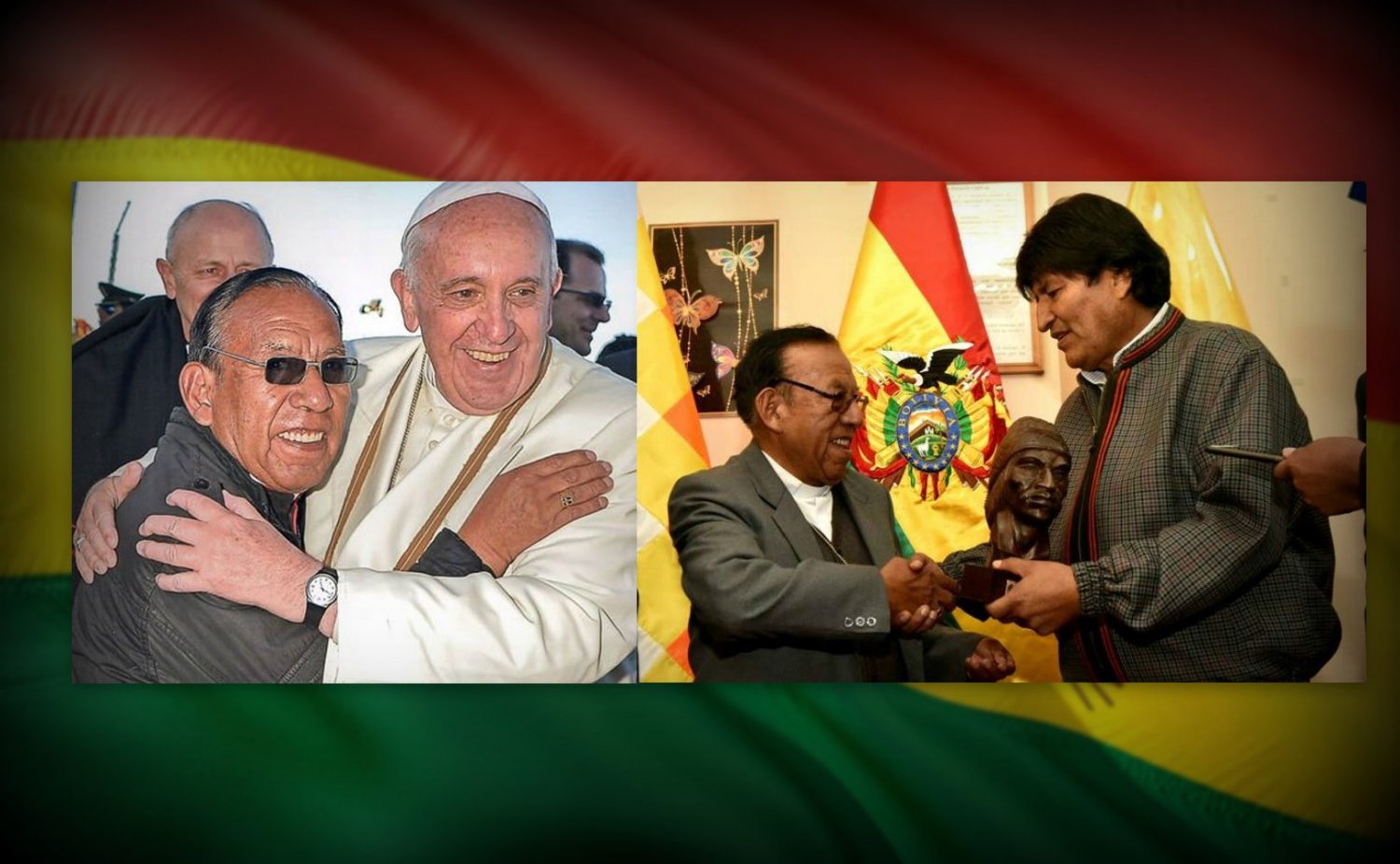
In a news report that comes to us from our Spanish-language partners Adelante la Fe, OnePeterFive has learned that Bishop Toribio Ticona — an 81-year-old Bolivian prelate who is alleged to be living with a woman as husband and wife with two children — will be raised to the status of cardinal by Pope Francis. The report, provided in English by our friends at Adelante, is as follows:


Scandal: A Bishop “Married” with Children Will Be Created Cardinal by Francis

On May 2nd, 2018, Pope Francis announced that in the consistory to be celebrated on June 29th this year, Feast of the Holy Apostles Peter and Paul, he will raise to the cardinalate monsignor Toribio Ticona, titular bishop of Timici and prelate emeritus of Corocoro, Bolivia. The 81-year-old bishop was born on April 25, 1937. He was ordained a priest in 1967 and consecrated as Timici’s bishop and axiliary bishop of Potosí, Bolivia, on May 31st, 1986. In 1992 he was appointed prelate of Corocoro, retiring in 2012.

During his frequent visits to Oruro at the beginning of his office, the then bishop of Oruro and future Third World ideologist cardinal, Julio Terrazas Sandoval, CSsR, boasted visiting Oruro’s bishop and called him his “padrino” or sponsor, since he said he had been promoted to the bishopric thanks to Terrazas, who on several occasions as president of the Bolivian Conference of Bishops was obviously very influential on the other bishops and the Apostolic Nunciature.

Ticona participated in two ad limina visits, in 2008 and 2017. He served as alcalde, according to the local traditional customs of a 12-person community in Bolivia. During his ten year tenure in the Corocoro prelature, the Catholic  flock went from 94.6% down to 87.6%, while the Protestant sects’ following grew. It is a well-known fact that while he was serving his office in Corocoro, he was living more uxorio with a lady in Oruro’s bishopric. She and her children are proud to be called wife and children of the Patacamaya bishop, as Bishop Toribio Ticona is also known.

The family of Monsignor Toribio Ticona, Patacamaya’s bishop, lived in up to three different places of residence in Oruro.

Since the 9th and 10th centuries, known as the Iron Century of Papacy, there has been no sure, reliable news of a concubinarian bishop being rewarded with the title of cardinal. Being a Prince of the Church entails an important responsibility for the office holder, since he directly serves the Petrine ministry. Therefore, a concubinarian cardinal’s promotion sends two messages: one, the Pope’s wish to eliminate priestly celibacy, and the other and more serious, that he has a “scapegoat” with which he can break the hierarchy of the Bolivian bishops. Two bishoprics and three other church circumscriptions are to be renewed this year. We can be sure that Bishop Barros’ case will be repeated in Bolivia, thanks to which Pope Francis would have, with [Bolivian president] Evo Morales’ backing, control over Bolivia’s Church, which would then have a marked leftist imprint.

Adelante la Fe

P.S. We have used the term, married, because his co-habitant partner properly speaks of “her husband”.


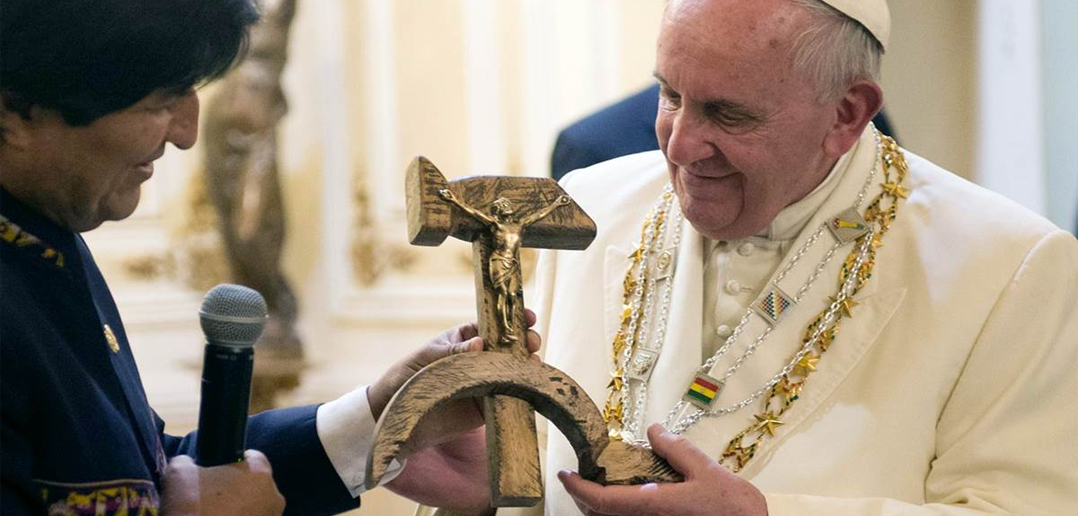
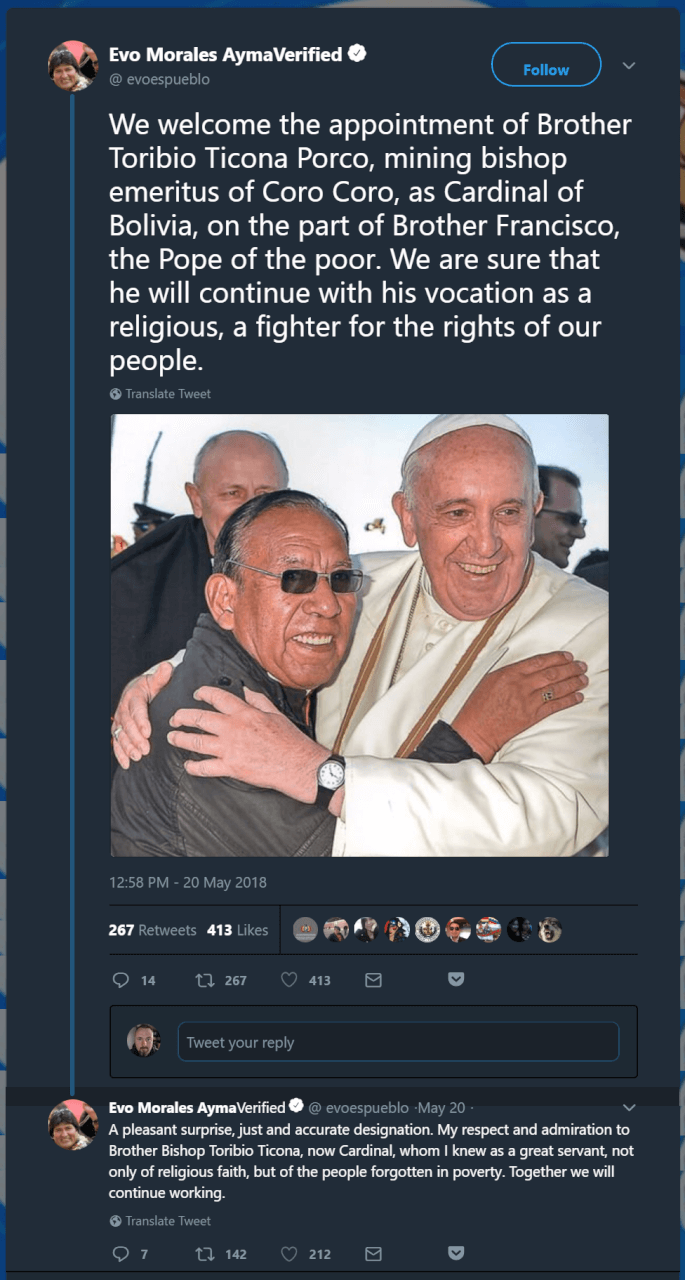
It is noteworthy, when trying to ascertain what other ideological characteristics Ticona might bring to the position, that the socialist president of Bolivia, Evo Morales — who famously gifted pope Francis a communist-themed “crucifix” in 2015 — is thrilled at the news that his friend, a “fighter for the rights of our people,” will be raised to cardinal.

On May 20th, Morales made clear his enthusiasm for the announcement in a set of tweets:

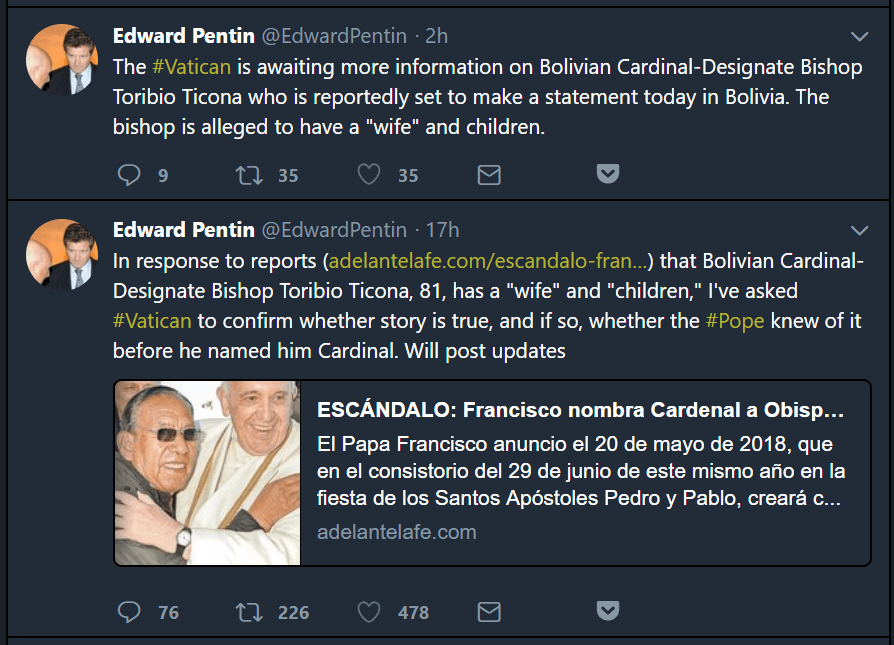
The National Catholic Register’s Rome Correspondent, Edward Pentin, has been attempting to get answers from the Vatican on the allegations about Ticona’s personal life, and though no statement has yet come from Rome, it appearsthat Ticona may be making a statement of some kind later today:


We will update this story if and when we learn more.

UPDATE – 5-29-2018 @ 10:55PM EST: Bishop Ticona has issued a statement denying the reports that he has a wife and children:

“As a result of the false accusation which is being spread in the media regarding my private life, it is my duty to declare and emphatically make clear that its content does not correspond to the truth,” Bishop Ticona said in a statement released by the Bolivian Bishops’ Conference.

The bishop said he interprets the rumors as an attack not only against himself, but against Pope Francis, who recently chose him to be elevated to the position of cardinal.

“If these accusations persist, I will have no problem filing a libel lawsuit against those promoting or propagating this,” he said.

Ticona said that similar rumors surfaced in 2011, but “ended up being simple calumny.”

“Personally, I am happy that these accusations should come out at this time, in order to definitively close the case,” he added.

In turn, Adelante la Fe has offered their own brief rebuttal of his denial (we do not yet have an official translation of their report, so here is the Google version for the time being):

The Bolivian episcopal conference has divulged a more than predictable letter from Mon. Ticona trying to deny the information published on this website, in which it was reported that he had a relationship with children.

Given this, we need the following points:

  • The information is completely true and, incidentally, is public domain at all levels in the diocese of Oruro for many years.
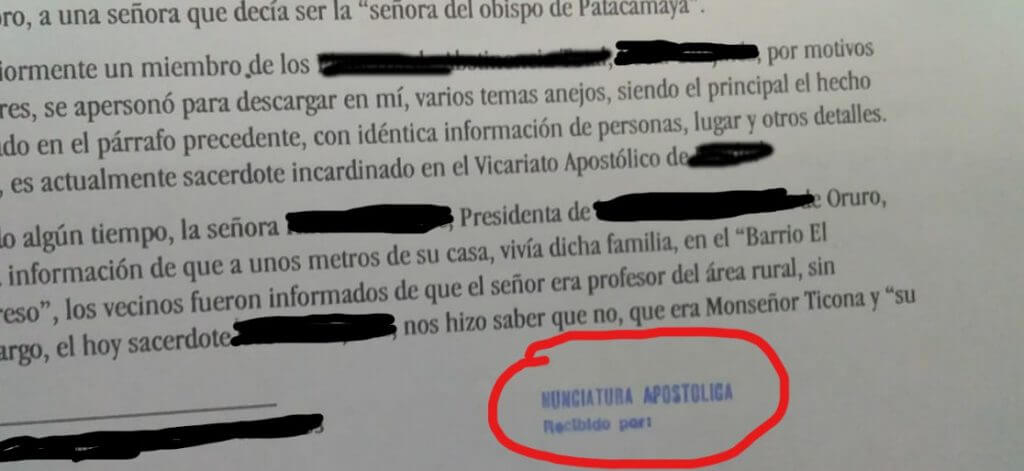
  • The Nunciature in Bolivia has for several days a detailed denunciation under oath of two pages detailing all types of witnesses names, addresses where the couple lived and even the children’s school. It is not about gossip, but witnesses first hand, including neighbors. To give only some details of this report: the children of Ticona studied at the La Salle School in Oruro, for a time the “family” lived in the house n ° 6 of the El Progreso neighborhood, 6 de Octubre streets and Santa Cruz de Oruro , owned by the then Vicar General of the Diocese of Oruro, Father Tomás Valencia Tellería. Mrs. RR (for confidentiality does not name) -pharmaceutical-testified as the “wife” often bought at the pharmacy, billing on behalf of the Corocoro Prelature, and she said herself to be the “lady of the bishop of Patacamaya”. Do you want more information Mons. Ticona?
  • From the moment that this information has been made public, all kinds of shadow movements are being produced to silence the witnesses and stop the news, so that their intimate friend Evo Morales does not run out of his cardinal “of the people”. We ignore the path they can follow to fabricate denials and counter-news, we will not go into it anymore. What is said here is the truth and the only truth, regardless of who may be.

As of yet, we have seen no statement from the Vatican indicating a definitive answer on this dispute, nor on the matter of the complaint to the apostolic nunciature made under oath as pictured above.

Print Friendly, PDF & Email
Posted in Uncategorized | 1 Comment

“I disapprove of what you say, but I will defend to the death your right to say it” Evelyn Beatrice Hall

The Witherspoon Institute
Public Discourse

Free Speech and the American Experiment
 

by Robert T. Miller
within American Founding, First Amendment
May 28, 2018 08:03 pm http://www.thepublicdiscourse.com/2018/05/21502/
The noble impulse to purge the public square of offensive and insulting language quickly degenerates into censorship of unpopular viewpoints. By contrast, the American experiment is founded on the view that a people capable of governing themselves are worthy of the trust that the First Amendment places in them.

{Emphasis  by Abyssum in red type}

Last year, in Matal v. Tam, the Supreme Court considered a constitutional challenge to provisions of the Lanham Act that prohibit the Patent and Trademark Office (PTO) from registering any trademarks that may “disparage … or bring into contempt or disrepute” any “persons, living or dead.” Tam, the leader of an Asian rock band called “The Slants,” wanted to register that name as a trademark. “Slants,” however, is a derogatory term for Asians (Tam wants to appropriate the term and so drain it of pejorative force), and so the PTO refused to register the mark. Tam sued, claiming that the relevant provisions of the act violated the First Amendment. A unanimous Supreme Court agreed, holding that giving offense is a particular viewpoint, and a law restricting expression on the basis of viewpoint violates the First Amendment.

The Supreme Court has often held that the government may not ban speech merely because it is offensive, and so the result in Matal was not surprising. Nevertheless, the case is important because, it makes clear that, although many European nations ban “hate speech” and other forms of speech deemed offensive, the United States will continue its long tradition of protecting more speech than other nations do.

Now, most Americans think this is a good thing, but my friend Professor Hadley Arkes, writing in the Claremont Review of Books, disagrees. Like the Europeans, he thinks that offensive speech shouldnot be protected. On his view, the First Amendment should protect arguments but not epithets, reasoned discourse but not insults. As to Matal, he thinks that the Court’s opinion can be explained only by supposing that the justices are falling into moral relativism.

I have the greatest respect for Professor Arkes. I also agree completely with the position with which he is universally identified and for which he is rightly regarded as a hero of modern conservative jurisprudence—that almost all legal reasoning inevitably involves some natural-law reasoning. I cannot, however, follow him down this road about Matal. I think there is a simpler explanation of Matal and the Supreme Court’s other free speech cases. In my view, the Court is not saying, or even implying, that there is no objective standard about which speech is offensive and which is not. Like other people, the justices can recognize the difference between an argument and an epithet. Rather, the justices are saying that, although there is an objective standard about which speech is offensive, the government cannot be trusted to apply this standard in particular cases, regardless of whether the application is done by the legislature, the courts, jurors, or any other government actor. To see why, it helps to consider some other legal problems that may at first seem rather different but that in fact involve quite similar principles.

The Murder Statute and the Twenty-Sixth Amendment

Consider the murder statute. If anything is wrong, certainly murder is, and so we make it illegal. When it comes to enforcing this law, however, we do not punish everyone who commits a murder. On the contrary, we punish only those people whom the state can prove beyond a reasonable doubt committed a murder. Undoubtedly, some people who violate the law escape punishment because the state cannot prove their guilt.

Why do we have such a system? Because we recognize that, in applying the rule against murder, we fallible human beings will make mistakes—both acquitting the guilty (false negatives) and convicting the innocent (false positives). Since we believe, as Blackstone said long ago, that “it is better that ten guilty persons escape than one innocent suffer,” we create a rule of enforcement that greatly reduces the number of false positives at the expense of increasing the number of false negatives.

Or consider the Twenty-Sixth Amendment, which gives eighteen-year-olds the right to vote. The idea behind a minimum voting age is the eminently sensible one that, before someone be allowed to vote, he or she must have a certain level of maturity. But does everyone younger than eighteen lack this level of maturity and everyone over eighteen have it? Of course not. The reality is that the rule is both under-inclusive and over-inclusive: it excludes some people mature in mind but young in years, and it includes some people old in years but immature in mind.

We could have a rule that provides that only people mentally mature enough to vote be allowed to do so. That rule would admit to the franchise precisely the right group of people, if it were perfectly enforced. We know, however, that the enforcement would be very far from perfect. Some government agency or court would have to decide whether a person was mature enough to vote. Even if the officials charged with making this determination had the best of intentions, they would have to conduct extensive factual investigations about the applicant, and they would inevitably make a great many mistakes. Indeed, they might well make more mistakes than would result from applying the bright-line rule based on mere chronological age.

Moreover, the rule would be an invitation to mischief. For, the officials charged with administering the rule would of course belong to one political party or another, and they would thus have a strong partisan incentive to find against applicants who seem likely to vote for the other party. In Democratic strongholds, young would-be Trump voters would often be found too immature to vote, while in Republican strongholds the same treatment would be meted out to likely liberal voters. Given all this, it is easy to see that we are much better off with a bright-line rule based on chronological age, even though that rule will result in a large number of errors.

The lesson is that, in framing a rule of law, we need to take account not only of the content of the rule but also of the likely problems involved in its enforcement. Some rules that would be just the thing if they could be enforced perfectly will be terrible in practice precisely because, when administered and enforced by fallible human beings, they generate huge problems. In such cases, we are often better off with other rules that, while imperfect by their terms, present fewer problems of enforcement and so produce better results overall.

Why Do We Need Constitutional Protections for Speech?

And this turns out to be the case with protections for speech. Let us begin from first principles. Why do we need constitutional limits on the power of the legislature to regulate speech? Why not trust the legislature to apply the objective standard about which speech is offensive and which is inoffensive, banning the latter and permitting the former?

The answer, of course, is that history shows that legislatures tends to make an especially large number of mistakes in regulating speech. Moreover, these mistakes tend to run all in the same direction: they tend to be false positives (which ban speech that is not objectively offensive) rather than false negatives (which fail to ban objectively offensive speech). Even worse, these false negatives are not randomly distributed across intellectual or ideological viewpoints but tend to be concentrated on viewpoints with which the majority faction in society disagrees. In a system in which there were no constitutional limits on the legislature’s power to regulate speech, the majority’s views would always be permitted by law, but many minority views would be systematically suppressed—not because those views are objectively offensive but because the majority mistakenly believes them so.

What kind of constitutional limit on the legislature’s power will curb this tendency? One possibility would be a constitutional provision stating that only objectively offensive speech may be prohibited. That would be an improvement over a system that included no constitutional protection for speech, but only a very modest one. In this system, we get two levels of protection: first, the honesty and wisdom of the legislators, and then the honesty and wisdom of the judges, each applying the same standard.

But legislators and the judges tend to be similar people, with similar educational and socioeconomic backgrounds and holding similar values. Ultimately, they all owe their positions to democratic majorities. Their biases and prejudices in determining which speech is objectively offensive and which is not will thus tend to coincide. Hence, judges are likely to make the very same mistakes as legislators in applying the objective standard to determining which speech should be banned and which should not, and this seriously undermines the value of the proposed constitutional limit on the power of the legislature.

To get a system that meaningfully reduces the legislative error rate, we need a constitutional limit on the power of the legislature that, when applied by the courts, strikes down more laws and leaves legal more speech. We thus get doctrines like those relied upon in Matal: the government may not discriminate among viewpoints in regulating speech and may not ban speech merely because it is offensive. In this way, we get a system that almost never suppresses good speech, even though it lets through a great deal of bad speech.

How It Really Works Out

But is it really true that, if we allowed government to ban just the speech that is objectively offensive, we would end up suppressing inoffensive minority viewpoints? Professor Arkes thinks not. In my terms, he thinks that the error rate, while not zero, will not be very high. Indeed, he argues that average people have no trouble sorting out insulting from non-insulting terms. His examples of the latter include urologist, meter maid, and saint, and his examples of the former include kike and wop. Even these examples are not as clear as Professor Arkes thinks (some women would find meter maid offensive), but the real problem is that Professor Arkes has not considered the harder cases that will inevitably crop up.

Take the term homophobe. Some people will say that, while homophobia is offensive, the word homophobe is not; it merely refers to people who hate or fear homosexuals. But the case is not so simple. Professor Arkes himself says—truly, to be sure—that sometimes people making arguments against same-sex marriage are “branded as ‘homophobes,’ as though they were carriers of disease rather than bearers of arguments that deserve to be respected and addresses as arguments.” In other words, homophobe, like a great many other words (racist, Communist, traitor), can be used as an argument-ending insult. Or again, is Holocaust-denier an insult, or a factually correct description of some people with certain odious beliefs? What about climate-change denier? Before we can figure out whether that term is an insult, we would need to settle a bunch of empirical questions about the environment and the likely future effects of certain current trends. Suddenly, figuring out which terms are insults is not so easy.

For that matter, we should remember that insults actually have a legitimate place in rational discourse. When Winston Churchill said of Clement Atlee, “He was a modest man with much to be modest about,” he was making a serious point. So too was Theodore Roosevelt, when, after Justice Holmes voted against the government in the Northern Securities antitrust case, Roosevelt said of him, “I could carve out of a banana a judge with more backbone than that.” The Apostle Paul called the Galatians stupid, and Our Blessed Lord called the Pharisees, “You brood of vipers!” It is just not true, in my view, that insults are always worthless and offensive speech that we can do without. Will courts be able reliably to distinguish the insults that make a serious point from the ones that merely insult?

But, quite apart from all that, we need not speculate about what is likely to happen if we start allowing the government to ban offensive speech. We need look at what is actually happening in those jurisdictions that already have such bans. Floyd Abrams, the prominent First Amendment lawyer, collects examples:

In Belgium, a member of Parliament and leader of a right-wing political party was convicted in 2009 for distributing leaflets calling for a “Belgians and Europeans First” policy and that said, “Stop the sham integration policy,” “Send non-European job-seekers home,” and “Stand up against the Islamification of Belgium.” He was convicted of incitement to racial discrimination, disqualified from holding office for ten years, and sentenced to community service. His conviction was upheld by the European Court of Human Rights on the ground that such literature “sought to make fun of the immigrants,” leading to hatred of foreigners, particularly by “less knowledgeable members of the public.” In England, an individual was tried and convicted for displaying a poster that showed the World Trade Center ablaze with the caption “Islam out of Britain—Protect the British People.” The European Court of Human Rights permitted that conviction, as well, to stand, concluding that the poster constituted a “public expression of attack on all Muslims in the United Kingdom.”

Similarly, in France, legendary actress Brigitte Bardot has been convicted five times for hate speech against Muslims, most recently for saying that Muslims in France “lead us around by the nose” and “destroy our country.” In Switzerland, a judge issued an arrest warrant for Italian author Oriana Falacci for allegedly racist passages in her book The Rage and the Pride (Italy refused to extradite her). In the Netherlands, when politician Geert Wilder asked a crowd of his supporters whether they wanted “more or fewer Moroccans” in the country, the crowd shouted, “Fewer!” Wilders replied, “Well, we’ll take care of that.” For that, he was later convicted of hate speech. Germany has recently enacted a new law banning hate speech on the internet and used it to take down tweets from members of parliament when these were deemed offensive to Muslims.

There are hundreds and hundreds of more examples. If we allowed the government to ban offensive speech, exactly the same thing would happen in the United States.

The American Experiment

These examples show how quickly the noble impulse to purge the public square of offensive and insulting language degenerates into censorship of unpopular viewpoints. But if we want to protect such viewpoints, we need rules severely limiting the power of government to regulate speech. Such rules come at a cost, which is that they allow more objectively offensive speech to go about in society, and that speech, we must admit, does real damage.

But all solutions have costs as well as benefits, and in the area of speech we have available basically two solutions. We can have weak protections for speech, in which case much offensive speech will be suppressed, but so will many minority viewpoints that are not objectively offensive. Or we can have strong protections for speech, in which case there will be more offensive speech in society, but the minority viewpoints that are not objectively offensive will be heard too. The one solution that is not available to fallible human beings in the real world is to suppress all the offensive speech and none of the inoffensive speech. No group of human beings can apply the relevant standard, objective though it be, without making a very large number of errors.

Faced with this dilemma, the characteristically American solution is to err on the side of liberty, which means trusting in the wisdom and virtue of the American people. That is, by allowing virtually all speech, we are trusting that the great majority of the American people will not abuse their freedom to engage in bad speech. We trust that, when a small minority does abuse that freedom, the great majority will not be deceived by their lies, corrupted by their seductions, or provoked to violence by their incitements. It is no accident that the European nations, which have never believed in the ability of their people to govern themselves as we Americans have, think they need more restrictions on free speech. The American experiment is founded on the opposite view: the view that a people capable of governing themselves are worthy of the trust that First Amendment places in them.

Robert T. Miller is a Professor of Law and the F. Arnold Daum Fellow in Corporate Law at the University of Iowa College of Law and a Fellow and Program Affiliated Scholar at the Classical Liberal Institute at the New York University School of Law.

Posted in Uncategorized | Comments Off on “I disapprove of what you say, but I will defend to the death your right to say it” Evelyn Beatrice Hall

HERE IS A LITTLE DOSE OF SATIRE TO HELP YOU AS YOU WATCH IRELAND DEVOUR ITS CHILDREN

mp,550x550,gloss,ffffff,t.3

SATURN DEVOURING HIS SON by Francisco Goya


Theresa May and Vincent Nichols

scandalous tweet

Theresa and Philip May


Theresa May and Vincent Nichols

scandalous tweet

Theresa and Philip May

Eccles and Bosco is saved


St Theresa of Downing Street

Posted: 28 May 2018 01:07 PM PDT

Catholic priests are not normally allowed to marry (although there are exceptions such as Bishop Toribio Ticona, whom Pope Francis has just put on his “Raise this guy to the cardinalate” list, in error for his “Throw this guy to the dogs” list).Thus there are very few of the rare breed known as “clergymen’s daughters” in the Catholic Church; of course the Anglicans have plenty, and even some rare fish known as “clergywomen’s daughters”, who call their mother “father”.

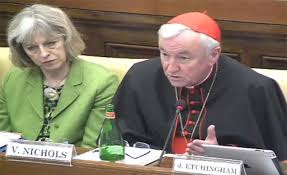
Theresa May and Vincent Nichols

St Theresa (alias V. Nichols) shares a bottle of ketchup with a cleric (J. Etchingham).

Clergymen’s daughters are often saintly creatures, and today we pay tribute to St Theresa of Downing Street. Her father would have been so proud of her, when she showed her support for same-sex “marriage”. Those embarrassing bits in the Bible about homosexual acts being sinful, and marriage being an institution for a man and a woman, were long since discarded by the Church of England, which strives always to keep up with the latest fashions in morality. But there was more…

scandalous tweet

St Theresa expresses her support for King Herod.

As a clergyman’s daughter, St Theresa is familiar with many Biblical characters, and she has always had a weakness for King Herod. “A real man,” she drools, “who knew how to deal with children!” Thus she was delighted when Ireland decided to vote for mass infanticide, and she felt obliged to send her support. Good luck with explaining that to the DUP, her partners in government.

Of course, St Theresa is not the only party leader with this point of view. St Jeremy of Corbyn and St Vince of Cable would doubtless agree with her, if anyone cared for five minutes what they thought on any issue. How wonderful to see a Government of National Unity!

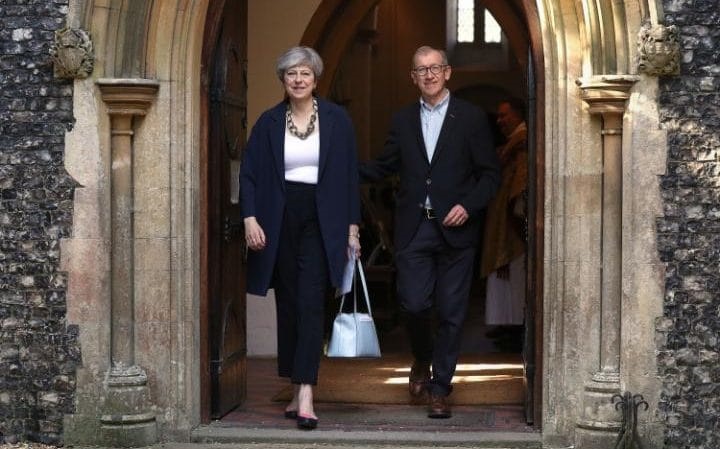
Let’s finish with a happy picture of the Mays leaving a church.

Theresa and Philip May

An everyday Anglican scene: that awkward moment when nobody else turned up.

Posted in Uncategorized | Comments Off on HERE IS A LITTLE DOSE OF SATIRE TO HELP YOU AS YOU WATCH IRELAND DEVOUR ITS CHILDREN

Ireland has chosen between life and death. Death it shall have. The fallacy that a liberal abortion regime solves anything will soon become apparent to Irish citizens. The mother’s pain and suffering from abortion shall still remain. The shame and trauma of having delivered an aborted child are not erased as easily as the pro-abortion campaigners make out when they blithely talk of a “medical procedure,” one seemingly as slight as having an ingrown toenail removed. Above all, in the coming days and years, what will haunt that land is the memory of the missing generations denied life by the stroke of a pen that in the hand of some became a scalpel.

Blood Pool


Ireland Elects to Annihilate Its Future

Things fall apart; the centre cannot hold;
Mere anarchy is loosed upon the world,
The blood-dimmed tide is loosed, and everywhere
The ceremony of innocence is drowned…

Almost one hundred years ago the Irish poet W.B. Yeats wrote The Second Coming. It is a strange nightmarish poem. It tells of events that are both seen and unseen, of an ominous elemental horror that is imminent, one that “slouches” from its centuries-old hibernation towards Bethlehem to be “born.”

Last Friday, May 25, 2018, the citizens of the Irish Republic voted to remove the Eighth Amendment of the Irish Constitution, Article 40.3.3. On a turnout of just over 64 percent of the electorate, 66.4 per cent voted for repeal of the Eight Amendment while 33.6 percent opposed it. This voting pattern, with minor variations, was consistent across the country.

In a moment of insight, following a referendum in 1983, the Eighth Amendment had been inserted into the constitution to safeguard the rights of the unborn. Through it, Ireland had effectively banned abortion. The decision to remove this constitutional safeguard now opens the door to legislation, which many suspect will usher in one of the most permissive abortion regimes in the world. News of the speed with which the current Irish government wishes to enact the necessary legislation in favor of abortion is as telling as it is alarming.

The result of the referendum comes as no surprise. The political establishment—all the leaders of the various political parties, plus many within these parties, especially the opportunistic and the ambitious—mouthed platitudes about “doing the right thing.”

The media seemed especially in favor of repealing the Eighth Amendment. The State broadcaster, Raidió Teilifís Éireann, like so many media outlets, went through the pretense of being a neutral forum for both sides to debate and put forward their arguments. The underlying hostility to the pro-life side could not be hidden though. The Irish Times, Ireland’s newspaper of record, also attempted to give column space to both sides, but it, too, seemed half-hearted in this. It was not just the paper’s editorial stance, which, given its liberal credentials, was always going to be pro-abortion, but rather the ways in which the pro-life case was portrayed in the newspaper’s pages. That portrayal was endlessly associated with religious imagery even though the pro-life campaign was a secular movement. Instead, a certain impression of Irish pro-lifers was deliberately constructed and then conveyed—of fanatically religious men telling women what to do with their bodies. It was a deliberate ploy. In reality, the pro-life campaign was fronted by women who were just as professional, independent, and articulate—perhaps more so—than their counterparts calling for repeal of the Eighth Amendment. This fact was, however, conveniently overlooked in media reports.

Of course, it was never going to be a fair fight. The intervention of Google and Facebook at a decisive moment in the referendum debate proved that. Since the Irish media effectively prevented the pro-life campaign from putting its argument across to voters, the pro-life message was heavily dependent on new media to reach that constituency. The crucial period for the intensification of its campaign was two weeks away from polling day. This was the very moment when Google and Facebook pulled the plug—banning in various ways advertising on the forthcoming referendum. The move came at a time when the pro-abortion side had been complaining hysterically of being out-gunned and out-witted on social media by pro-lifers, no doubt sensing their “Yes” campaign was faltering as the polls began to narrow. Momentum was now with the pro-life campaign. A pro-abortion source openly admitted that it was at this point that “pressure” was applied to the tech giants. In any event the “pulling of the plug” on pro-life Internet advertising was a devastating blow to the “No” campaign, thereby crippling its ability to reach voters directly.

Yet, the final polls, the weekend before the vote, showed the gap between “Yes” and “No” was still narrowing, but now not as fast to affect the result. Effectively, the momentum for life was lost. By then, the media blitz turned to the Irish voters living abroad who were considering returning home. This prompt from various quarters was not an impartial act to encourage the Irish democratic process but rather part of a strategic move by the “Yes” side that was banking on the Irish returning to vote for abortion. Virtually every story covered by Irish and international media outlets seemed to tell of a young female professional intent on flying home to Ireland to vote “Yes” so that she could be “proud” of her country, before doubtless turning round and getting on the first flight back to wherever she had flown in from.

Sometimes, during the last weeks, it seemed that the people of Ireland—some at least—had entered an alternate universe. An example of this was expressed in The Irish Times final editorial about the referendum:

The Eighth Amendment describes a world that never existed—a place of moral absolutism, religious certainty, good and evil, black and white—and locks us into that illusion in perpetuity. To remove it is merely to reflect the world we live in.

Perhaps it would be more accurate to say that this is a “world” in which some now choose to live: where the death of a child is something to be “celebrated,” a sign of “progress,” a mark of “compassion.” In these past weeks, one looked on in dismay as this ancient Catholic nation exchanged its present for a future where a mother’s joy was transformed into a tormented look of guilt, a child’s smile into a funeral veil, a truth for a lie.

So let it be.

Ireland has chosen between life and death. Death it shall have. The fallacy that a liberal abortion regime solves anything will soon become apparent to Irish citizens. The mother’s pain and suffering from abortion shall still remain. The shame and trauma of having delivered an aborted child are not erased as easily as the pro-abortion campaigners make out when they blithely talk of a “medical procedure,” one seemingly as slight as having an ingrown toenail removed. Above all, in the coming days and years, what will haunt that land is the memory of the missing generations denied life by the stroke of a pen that in the hand of some became a scalpel.

Those who campaigned for abortion have got what they wanted: the advent of Irish abortion facilities. Ireland shall soon commence the same sad slide into the abyss as that of her neighbor Britain. The public money funnelled away from medicine in order to provide the tools and the means to administer death will not be insignificant. In spite of what politicians say, medical staff will be pressured into taking part in procedures contrary to the Hippocratic Oath. The idea of conscience, like the idea of the sanctity of life, will be yet another casualty at the hands of Irish abortionists and their fellow travelers. Eventually for some, abortion will become a convenience, despite all we have heard about “hard cases.” In particular, Down syndrome children and their families must view with dismay this vote for “compassion”: knowing that in Britain 90 percent of unborn children with Down syndrome never make it beyond the womb. And behind it all, the global industrial complex of abortion providers sit sharpening their implements with glee, as yet another market is opened to them by their friends in the Irish political establishment who no doubt will be rewarded with campaign contributions and appointments to positions in boardrooms of these multi-nationals.

Two years ago, the Irish state made great play of the 1916 Easter Rising. That Rising was a rebellion by a group of revolutionaries who tried to overthrow British rule in Ireland. At various state-sponsored commemorations, contemporary politicians talked of how these rebels had won for today’s Irish citizens the freedoms they enjoy, as well as the other things politicians say when trying to cover themselves in the mantle of past glories to offset their present deficiencies.

In 1916, hopelessly outnumbered, the Irish rebels hoisted a new flag as they proclaimed the Irish Republic. They also read out a proclamation, one that is framed on walls of Irish homes up and down the land. It says the following:

IRISHMEN AND IRISHWOMEN:
In the name of God …We hereby proclaim the Irish Republic …

The Republic guarantees religious and civil liberty, equal rights and equal opportunities to all its citizens, and declares its resolve to pursue the happiness and prosperity of the whole nation and of all its parts, cherishing all the children of the nation equally… 

The recent vote for the death of untold numbers of Irish children, who should be “cherished” not annihilated, was not only an attack upon Ireland’s Catholic past but also upon the Republican ideals that founded the modern Irish state.

Having negated her past, both religious and civic, now Ireland enters into the “brave new world” she seems to so ardently desire.

And so, in the distance, coming to meet her from a desert waste is a Spiritus Mundi. “This rough beast,” with its gaze as blank and pitiless as the sun, slouches towards Ireland to be born, with its hour come at last.

K. V. Turley

By

K. V. Turley is a London-based freelance writer and filmmaker.

Posted in Uncategorized | 1 Comment

IT WOULD TAKE MORE THAN SATIRE TO MAKE SENSE OF THE INSANITY THAT HAS TAKEN OVER PROVIDENCE COLLEGE, LIKE THE SNOWBALL IN HELL IT JUST KEEPS GROWING AND GROWING CONTRARY TO THE LAWS OF PHYSICS, MORALITY, AND WORST OF ALL, THE CATHOLIC FAITH.

Threats of Murder Go Unpunished at Providence College

CRISIS MAGAZINE

This article is a continuation of the previous, written on behalf of Michael Smalanskas, the brave student at Providence College who posted a sign affirming reality: because the Catholic teaching that only a man and a woman can feasibly marry is but a plain recognition of what is biologically, physically, and anthropologically the case. We do not need special revelation to tell us that the sun rises in the east, that two and two are four, and that the congress of the sexes requires the sexes. But we live in a time of political madness.

So after Michael was threatened with rape, and had for several nights to walk a gauntlet just to go to the bathroom and brush his teeth, and after the president, Father Brian Shanley, refused to meet with him or his father, and he became a marked man on campus, what could possibly be worse?

A murder threat is worse.

Let us recall that, in the fall of 2016, the entire campus was in an uproar over allegations that racist epithets were cast at some women who were trying to enter a private residence where a party was going on, that it was a whites-only party, and that bottles were thrown at them. Eight students forthwith occupied Father Shanley’s office for thirteen hours, presenting him with a list of demands (called, in fact, “The Demands”) regarding courses, student life, hiring, and tenure. But as it turned out, it was not a whites-only party, there were no racist epithets, the leader of the girls was drunk, and the only bottle thrown was a plastic water bottle, half empty, nor could anybody determine who threw it from the balcony or whether it was tossed with any intent. The investigation ruined the whole next semester for the accused. When the associate vice president for student affairs, Kristine Goodwin, who conducted the trial, was asked whether the boys could be forgiven the offense of having a party, she refused. The girls who had disturbed the peace, who in the most charitable interpretation of events had been mistaken or had exaggerated, and who had wanted to take part in that same offense, were not reprimanded.

The professors who leapt to judgment against the boys never apologized. Goodwin did not apologize.

Now to the present, Thursday, May 17.

Michael and his fiancee are at Foxwoods Casino for the senior dance. The event is not cheap. He is seated at table with people he does not know, but who know him, because, after what the college allowed and subtly encouraged, everybody knows him. A young man at the table, Alec Manfre, demands that Michael and his fiancee leave. Others at the table say they want him gone too. Michael, who has paid for his and his fiancee’s dinners, declines the invitation. Manfre begins to grow obnoxious, and invites Michael to step into another room, where they have words, and he calls Michael things I will not repeat. Michael says he is just there to enjoy himself, and the whole controversy need not come up.

Meanwhile, a young man named Harry Verenis approaches them and says, “What’s your address? I want your address, because I want to come get you. I want to comestab you, because that’s what you deserve. You deserve to be stabbed for being so ignorant.” The language was more colorful than that, of course. Manfre then joined in, and Michael finally had to tell them to do something right there and get it over with, after which they backed off.

Michael Smalanskas was threatened with murder—for being normal, and for not wanting to hide under a bushel or a mountain the Church’s understanding that the sun rises in the east, two and two make four, and it takes a man and a woman to make a marriage.

He went immediately to one of the Dominicans in attendance, then to the Connecticut police, and the security at Providence College.

The next morning he sent a message to Goodwin, Father Shanley, Father Sicard (the executive vice-president), and Steve Sears (Dean of Students), informing them of what had happened at the casino. “I told them,” he writes, “they were each personally responsible for this occurring, given that they [had] created an environment where this [was] tolerated and encouraged.” A hostile environment in the proper sense of the word: violent assault. Michael demanded, reasonably, that Manfre and Verenis be forbidden to march at graduation, “seeing as others have been given this sentence for much less.”

Did the campus move into action? It is to laugh. Says Michael, “I received a cold, careless e-mail back from Kristine Goodwin on behalf of the group, saying they had been made aware of the situation. A no-contact order was placed on [Verenis]. She said [the complaint] would go to Community Standards from there, and to let her know if she could be of any assistance.”

Would that be assistance before or after the student made good on his threat?

That evening, Friday, May 18, Michael received an e-mail from Sears and from Public Safety, essentially saying that everything was fine. The complaint would be processed after graduation on May 20. The message was written by the college’s legal counsel. In Michael’s opinion, the campus security were taking the threat seriously, “but the college wanted nothing to do with it.”

We come to Saturday morning, May 19, some 36 hours or more after the threat. It’s the awards ceremony, and Michael is to receive the prize for top student in theology, and another for excellence in philosophy. After the ceremony he is standing outside and Goodwin passes by. He calls her name, but she ignores him. Then he says, “You should be ashamed of yourself. I was threatened with murder and you did nothing about it. You can live with that for the rest of your life.”

That is all. He said this in public. Witnesses can vouch for it.

Later, he is informed that unless he apologizes to Goodwin for “threatening” her, he will not be allowed to march at graduation. So he has to leave the celebration to go to the safety office, where he declines the honor of apologizing for something he did not do. At 10 PM he is informed that he will be permitted to walk, but only because Goodwin had acquired a bodyguard for the day, to sit with her on the stage. There would also be plain-clothes policemen all around, ready to haul him out of there if he so much as flinched. No guards, apparently, on the lookout for Manfre and Verenis.

This restraining order continues in force, and that Michael will be barred from the college for making Goodwin feel “threatened.” It is a classic case of bad conscience and projection. I must pause to untangle the contradictions. Goodwin was pleased to monitor (and encourage) a large and unprecedented protest against a single faculty member (me), and it never occurred to her then that protesters can grow violent even after a protest is over, or that somebody might feel threatened by being so targeted. I didn’t—but my wife did, very much so, on my behalf. Goodwin never wrote to Michael to offer him support when he was threatened with rape. She never moved to discipline the students who congregated in his hall after hours. She did not forbid the assaulter to march at graduation. Of course not. When you give your heart and soul to politics, you lose your sense of decency, proportion, plain dealing, and human kindness. It does not matter what the politics is.

Michael did nothing wrong. His championing of the truth of marriage is only what Father Shanley and Father Sicard themselves should be doing, frankly and simply. That should not be left to a lone student, and when he does their job, he should not be treated as a criminal.

Let’s go over this again. A student is made the object of universal loathing, at a supposedly Catholic college, for a poster that did nothing but affirm that the sun rises in the east, two and two are four, and it takes a man and a woman to make a marriage. These are my words: his poster was entirely affirmative, condemned nobody, and employed not one satirical word or glance. He is harassed in his dormitory and threatened with rape. The president will not meet with him or his father. Then at the senior dance he is harassed and threatened with murder. The college does a big nothing. When, forty hours later, he accuses the dean of student affairs of being indifferent to the threat, she accuses him instead and threatens to bar him from graduation, the same graduation where all of the offending students, including Manfre and Verenis, would be marching without consequence.

There is only one explanation for all of this. The people in charge of Providence College do not actually believe that it takes a man and a woman to make a marriage. So anybody who upholds the truth publicly ought to pay. That is why I am told they are backing, to be the new Dean of Diversity and Inclusion, a woman who boasts that she left her husband, whom she says she loved, to carry on sexual affairs with other women. She is now “married” as a lesbian. Meanwhile marriage is sinking like a ball of lead in the deep blue sea, and they do not care. They are on the right side of history, they suppose. I cannot find that right side in Scripture.

It is as if the whole misery-making Sexual Revolution had passed overhead like a little white cloud, leaving behind nothing but good cheer and solid families and children born within the strong haven of marriage, and the culture roundabout were full of wholesomeness, and—and to hell with it. It was the most calamitous mistake of my lifetime, and I and everyone who grew up in its midst have been harmed by it. To hell with it. And as for Catholic schools that capitulate to it—let God judge. He is just, and is not to be fooled by our slogans.

(Photo credit: Michael Smalanskas)

Posted in Uncategorized | 2 Comments

PRESIDENT TRUMP: PLEASE DO NOT GIVE THEM ANY OF MY FORM 1040 TAXES


http://the-american-catholic.com/2018/05/27/dear-president-trump/

Dear President Trump

Guy McClung   May 27,  2018

Dear President Trump,

I have now begun my eighth decade on God’s good earth. I am a lifelong Catholic.

Please do not give any more of my money to catholic bishops who defy the law. Please do not give any more of my money to catholic bishops who break the law.    Please do not give any more of my money, or any other citizen’s money, to these bishops’ dioceses, organizations, so-called “ministries,” so-called “charities,” or conferences which defy and/or break the law.

I diligently avoid giving my money anymore, at any level, to such bishops, including at the parish level where they usually receive a diocesan “tax” amount from such donations. I will not support their illegal actions.

Please be aware that these defiant, outlaw bishops and their supporters are  ignoring Church teaching (e.g., see below). These law-breaking bishops, their priests, and their employees in concert with them are also acting contrary to Jesus’s commands, contrary to the inspired words of God, and in opposition to Church tradition.

My money, and the money of other taxpayers – which as President you have a sacred role to use in accord with law –  is not being used by them for “religious purposes.” It is being used to violate the law. Not only is this illegal, it is a scandal to the faithful.

Please, please, be a good steward of our money and stop, immediately, giving any more of it to these un-american, un-catholic, law-defying, law-breaking bishops.

Very truly yours,

Guy McClung, Texas

Church teaching:

Immigration

“Political authorities, for the sake of the common good for which they are responsible, may make the exercise of the right to immigrate subject to various juridical conditions, especially with regard to the immigrants’ duties toward their country of adoption. Immigrants are obliged to respect with gratitude the material and spiritual heritage of the country that receives them, to obey its laws and to assist in carrying civic burdens.” (#2241;  Catechism of the Catholic Church).

“Man’s relations with foreigners are twofold: peaceful, and hostile: and in directing both kinds of relation the Law contained suitable precepts. . . . . With regard to these [who wished to enter another country and be admitted into its society] a certain order was observed. For they were not at once admitted to citizenship: just as it was law with some nations that no one was deemed a citizen except after two or three generations, as the Philosopher says (Polit. iii, 1). The reason for this was that if foreigners were allowed to meddle with the affairs of a nation as soon as they settled down in its midst, many dangers might occur, since the foreigners not yet having the common good firmly at heart might attempt something hurtful to the people. Hence it was that the Law prescribed in respect of certain nations  . . . that they should be admitted to the fellowship of the people after the third generation; whereas others (with whom their relations had been hostile, . . .) were never to be admitted to citizenship; while [others], who were yet more hostile to them, and had no fellowship of kindred with them, were to be held as foes in perpetuity . . .”  (St. Thomas Aquinas).

Justice

“The Church has rejected the totalitarian and atheistic ideologies associated in modem times with “communism” or “socialism.” She has likewise refused to accept, in the practice of “capitalism,” individualism and the absolute primacy of the law of the marketplace over human labor. Regulating the economy solely by centralized planning perverts the basis of social bonds; regulating it solely by the law of the marketplace fails social justice, for “there are many human needs which cannot be satisfied by the market.” Reasonable regulation of the marketplace and economic initiatives, in keeping with a just hierarchy of values and a view to the common good, is to be commended. “ (# 2425; Catechism of the Catholic Church.)

“Human work proceeds directly from persons created in the image of God and called to prolong the work of creation by subduing the earth, both with and for one another. [Cf. Gen 1:28; GS 34; CA 31] Hence work is a duty: “If any one will not work, let him not eat.” (# 2427; Catechism of the Catholic Church).

“The responsibility of the state. Economic activity, especially the activity of a market economy, cannot be conducted in an institutional, juridical, or political vacuum. On the contrary, it presupposes sure guarantees of individual freedom and private property, as well as a stable currency and efficient public services. Hence the principal task of the state is to guarantee this security, so that those who work and produce can enjoy the fruits of their labors and thus feel encouraged to work efficiently and honestly…. Another task of the state is that of overseeing and directing the exercise of human rights in the economic sector. However, primary responsibility in this area belongs not to the state but to individuals and to the various groups and associations which make up society.” (# 2431;  Catechism of the Catholic Church).

Posted in Uncategorized | 6 Comments