SHAME IS NOT SOMETHING THE PEOPLE IN THE VATICAN CURIA HAVE EVER HEARD OF OR ARE INTERESTED IN; THE RESULT, SCANDAL

Just When You Thought You’d Heard Every Lame Excuse in the Vatican Book…

OnePeterFive

FacebookEmailPinterestPocketGoogle+

I’m pretty sure most of us are fed up with hearing about Lilianne Ploumen  and her award from the Vatican. I know I am. But there’s been a development that is just too amazing not to share.

And I’ll get to it, but I’m going to leave you hanging for just a minute because first I want to share some additional background from my colleague in Rome, Marco Tosatti. We’ve translated one of his reports from last week — before the latest development — and he brings some details and considerations (and amusing commentary) to bear that will help set the stage for what happened after. 

I’m only going to cite a portion of his article here, because some of it you’ll have already heard in our other reports. But permit me to share the majority of his piece, because it’s worth reading.


The following is a translated excerpt of a post on Stilum Curiae, the blog at MarcoTosatti.com. It has been translated by Giuseppe Pellegrino. 

The Pontifical Equestrian Order of Saint Gregory the Great is a chivalric order of the Holy See instituted by Pope Gregory XVI on September 1, 1831. In the official directions for the conferral of pontifical ecclesiastical and lay honors issued on May 13, 2001, it is foreseen that the large cross of the Order of Saint Gregory the Great will be conferred on “candidates distinguished for their service to the Church at the national and international level, at least 55 years old, and at least 10 years after the conferral of an honor of a lower degree.”

The list of those who have received this award includes the names of G.K. Chesterton, the writer Louis de Wohl, the economist Stefano Zamagni, and the musician Riccardo Muti.

The same document spells out the procedure for the conferral of the honors: “Diocesan Bishops may propose the conferral of a pontifical honor on both clergy and laity, as a sign of appreciation and recognition for the service they have rendered. A Vicar General may likewise request such an award, but he must explicitly declare that he is acting with the express authorization of his Bishop. The request, accompanied by the curriculum vitae of the candidate (age, profession, family and social condition, along with an accurate description of their merits with regard to their service to the Church), ought to be sent to the Apostolic Nunciature, which will in turn send it to the Secretary of State after giving it the required nulla osta. Those requests coming from territories subject to the oversight of the Congregations for the Oriental Churches and for the Evangelization of Peoples should first be sent to the competent Dicastery which will in turn see to its transmission to the Secretary of State.”

In the First section of the Secretary of State, which deals with General Affairs, there is an office, to tell the truth not a very important one, which deals with these types of matters of “merits”. There has been discussion many times in the past about the value of maintaining this office, which seems a bit antiquated. If I am not mistaken – correct me if I am – this office is occupied by the Egyptian secretary of the Pope and Monsignor Burgazzi.

The reactions to the news were very diverse and interesting. A few – including some among those commenting on Stilum Curiae – decried it as a hoax, as fakenews, and so on. The same reaction was seen on social media by those who are Bergoglio’s fans. And not just the “little people” as we used to say. Among those who sought to demonstrate – and verify – the hypothesis that the medal was bought for a few euros on the Internet there was also a friend of mine who holds an important role in communications at Pontifical university which specializes in communication… such is the power of love.

Strangely, the hordes of my Vaticanist colleagues showed no interest in the news.  And that, if you will permit me to say it, is strange. It would be as if the Chief Rabbinate of Jerusalem, or the University of Al Azhar, gave an honor to Citterio [Salami] or to San Daniele Prosciutto. But perhaps my colleagues wanted, and want, not to annoy the institutional Church. So I had to smile when on the plane a colleague asked the Pope whether he was afraid to speak with journalists. And why should he be afraid of anything – perhaps, I don’t know, of an embarrassing question?

I thought, erroneously, that surely some agency colleague in the Vatican Press Office, as is standard procedure in such cases, would ask for a clarification. But this did not happen, and so I thought it would be appropriate for me to write personally [asking for a clarification]. The following day a response was sent to me from the Holy See Press Office through the mouth of the Assistant Directress, the journalist Paloma Garcia Ovejero, whom I thank. Also because I know that other colleagues – Steve Skojec of OnePeterFive, for sure – did not receive any reply to their question.

“The honor of the Pontifical Order of St. Gregory the Great received by Ms. Lilianne Ploumen, former Minister of Development, in June 2017, during the visit of the Dutch royalty to the Holy Father, responds to the diplomatic practice of exchanging honors between delegations on the occasion of official visits of Heads of State or Government to the Vatican. Therefore it was not in the least a placet to the political action in favor of abortion and birth control which Ms. Ploumen has promoted,” wrote Paloma, thus confirming the news.

In the meantime Cardinal Eijk had issued a statement, saying that he did not know anything about the matter, and that he had not been consulted. Apparently the President of the Dutch Bishops’ Conference was not consulted either. But in order to have a complete clarification a few items are still lacking. Could it be that Lilianne Ploumen’s profile was effectively vetted without – incredibly – any objection? Was any bishop or cardinal of the Dutch Bishops’ Conference consulted or asked to give an opinion? From the response of the Holy See it would seem that a few of these honors, as standard procedure, are put on a little tray to be handed out during the course of the visit to anyone who is a part of the delegation. As one of my friends noted: “If that were the case, one could not exclude the possibility that any one of Dr. Mengele’s imitators received at the Vatican could find himself receiving one of these honors, without any expectation that such an action would be interpreted as an endorsement of experimentation on prisoners.”

Certainly, at least in theory, these medals are given out because of merits…if so, what sense would there be in showering them out like rain for the sake of diplomatic practice, without any verification of who is receiving them?

My friend asks himself: “Was it necessary and diplomatically unavoidable?” When Hitler was received in Italy on May 2, 1938 he was the Chancellor of Germany. Certainly his ideas were known, but he had not yet revealed himself to be the monster that he was; Kristallnacht would not occur until November 9 of that year and the deportations to the extermination camps would follow in due course, but already Pius XI was most firm: he would not receive the Chancellor of the Reich, he opposed decorating the Via della Conciliazione, he openly deplored the fact that the Celtic cross was displayed in place of the Cross of Christ in the decoration of the city of Rome, showing through all of his objections his pastoral zeal for the people. “But today,” my friend continues, “can diplomatic etiquette really take the place of the [Lord’s] commandment not to give scandal? What is more abject than the support for policies of exterminating innocent children? Is abortion no longer an ‘abominable delict’?”

These are important questions, especially important for millions of persons throughout the world, both Catholic and non-Catholic, who fight against abortion, even to the point of being imprisoned, such as the Canadian activist Mary Wagner. People who are pro-life and pro-family remain shocked by this fact; and my opinion is that the Holy See needed to give a much more profound and articulate response as to how and why such a colossal gaffe could have been possible. And do you not find it astounding that, out of seventy of my colleagues who greeted the Pope during his flight to Chile, not one thought to ask him a simple, simple question, like: “Your Holiness, why did you give a medal to an abortionist?”


When Marco wrote all this last Friday, of course, he did not know that the Vatican had one more clarification coming. Yesterday, the National Catholic Register‘s Rome correspondent, Edward Pentin, reported what he was told:

The Vatican currently has no plans to change the procedure of exchanging honors during historic official visits of heads of state to the Vatican, and believes that the responsibility for any subsequent abuse of such decorations rests with the visiting delegation.

Despite the outcry over giving militant pro-abortion Dutch politician Lilianne Ploumen a medal of Commander in the Pontifical Equestrian Order of St. Gregory the Great last summer, Vatican officials believe the statement issued about the honor last week by deputy spokeswoman Paloma Garcia-Ovejero was enough, and that Ploumen’s award was actually meant as a snub. [emphasis added]

I’m going to stop there for a second so you can finish laughing, maybe clean the coffee (or whiskey, not judging) off your keyboard and screen.

Everyone OK?

Good. Let’s continue:

In answer to a Register enquiry on Monday, an official would not say whether better vetting procedures would be implemented in the future to prevent it happening again, insisting instead this was “a very traditional procedure” for such an “historic occasion” and was really meant as a way of “honoring the king.” It is something that “has been done many times in the past for other visiting heads of state,” he said.

The source added the honor was no different to someone “going to visit someone else’s house as a guest, and who comes with companions: one shows a minimum amount of respect to whom he brings.”

The Commander in the Pontifical Equestrian Order of St. Gregory the Great medal is normally given in recognition of “personal service to the Holy See and to the Roman Catholic Church, through [the recipient’s] unusual labors, their support of the Holy See, and their excellent examples set forth in their communities and their countries.”

Ploumen will not be installed as a Dame of the Order, and in fact by giving her such a medal, the source said the honor was meant as a “slight” because a government minister normally receives a more distinguished decoration. The king, for instance, received “the Grand Collar,” an ornate chain worn about the neck to symobolize membership of a chivalric order.

Can you just imagine some Vatican bureaucrat rubbing his hands together manically or twirling his mustaches, saying, “I know how we’ll stick it to that militant abortion promoter! We’ll GIVE HER A PAPAL AWARD DESIGNATED FOR MERITORIOUS SERVICE TO THE CHURCH!! MUAHAHAHAHAHAHAHA!!!! SHE’LL BE SO INSULTED!!!!”

Give. Me. A. Break.

I know the Vatican thinks we’re all indescribably stupid, but if there’s ever been a case of “don’t pee on my leg and tell me it’s raining,” it’s this.

And while their ridiculous excuse here is good for a laugh, or raging bellow at your screen, or both — at their expense — what’s tragic and inexcusable is the dishonor these disrespectful children in Rome are showing to those who have received the Order of St. Gregory in the past. They — and they alone — are the recipients of a “slight” or a “snub” from the Vatican here. As Marco Tosatti wrote, in a section of his post not included in the above excerpt, this pontifical decoration “signifies something more than an adhesive souvenir to attach to the refrigerator.”

I’ve heard from some of the offended — recipients of the Order of St. Gregory and their family members alike — since the story first broke. Individuals for whom their receipt of the award, or the award given to a family member, was a singular moment of honor in their lives. These decorations, far from being disposable trinkets, were handed down as precious heirlooms to descendants as reminders of the faithfulness of parents or grandparents who had gone before them.

One person who wrote to me about their Grandfather receiving the medal half a century ago said that the title that came with it was engraved on his tombstone: “Knight of the Order of St. Gregory the Great.”

“I feel like I’ve been kicked in the stomach,” the person told me. “This award has lost its special significance with its bestowal on this pro-abortion advocate.”

As if giving the award to an abortion extremist wasn’t enough, they have cast disgrace upon all previous recipients of the award over the better part of two centuries. The Vatican should be utterly ashamed.
Posted in Uncategorized | Comments Off on SHAME IS NOT SOMETHING THE PEOPLE IN THE VATICAN CURIA HAVE EVER HEARD OF OR ARE INTERESTED IN; THE RESULT, SCANDAL

PRAY FOR POPE BENEDICT XVI

IMG_1292


We may never know why he resigned.  I personally believe that the San Gallo Conspirators who did everything they could to prevent him from being elected in the Conclave of 2005, and failed, succeeded in 2013 in threatening the Church with such a financial disaster that Benedict, out of love for the Church and on those countless men and women around the world who depend on the Church for their very sustenance and living, sacrificed himself and resigned the exercise of the power of jurisdiction (governing) that belongs to whoever occupies the Chair of Peter, but not the power of orders.  Jorge Maria Bergolio, who was elected to succeed Benedict to the Chair of Peter in 2013 has chosen, rightly or wrongly, to exercise ALL of the powers of the papacy with the resulting chaos that we are now experiencing.

If Archbishop Ganswein was correct in saying in his speech in the Gregorianum that the Church now has a “shared papacy”, and I believe that he could only have said it if, as the personal secretary of Benedict XVI he knew that Benedict had received a sign from the Lord that what he contemplated doing was acceptable to the Lord, then Jorge Maria Bergolio has usurped powers he was not given.

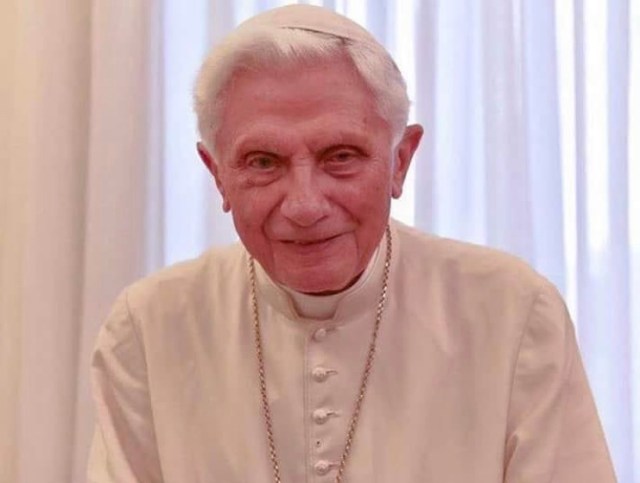
One has only to look upon this photo of Pope Benedict XVI to see how much he has aged physically since the election of 2013.  My heart aches for him.  I can only begin to imagine the suffering he has experienced and continues to experience as he asks the Lord over and over again, “Did I do the right thing?”

Regardless of your own opinion, pray for him!  Joseph Ratzinger was/is a great priest, Archbishop, Cardinal, and Pope.  Pray for him!

+Rene Henry Gracida

++++++++++++++++++++++++++++++++++++++++++++++++++++++++++++++++++++++++++++

image3.png

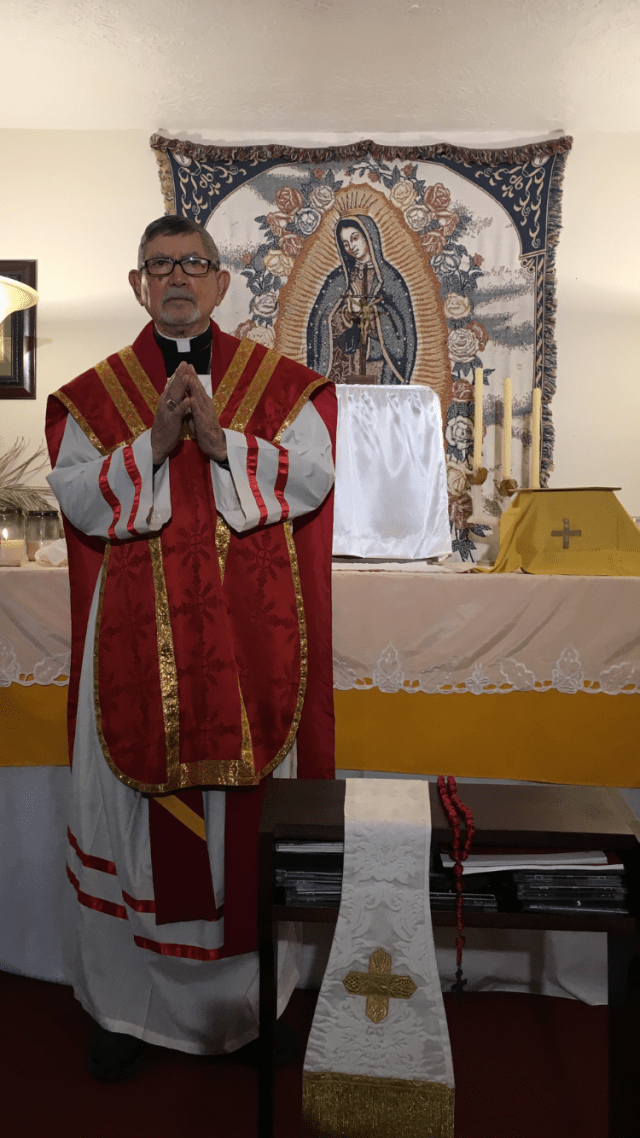
Today, January 25, 2018, I celebrated Mass in my private chapel in Honor of the Conversion of Sant Paul, my confirmation Saint.   On this day, his feast day, forty-six years ago I was ordained/consecrated a bishop in Saint Mary Cathedral in Miami by Cardinal John Dearden, with Archbishop Coleman F. Carroll and Bishop Paul Tanner as co-consecrators.  I prayed especially in this Mass for Pope Benedict XVI.


Posted in Uncategorized | 26 Comments

THE ONLY THING WORSE THAN MEN WITH EARRINGS IS CONGRESS WITH EARMARKS


PAUL RYAN SHOULD REALIZE THAT FEDERAL EARMARKS ARE THE CURRENCY OF CRONYISM

COMMENTARY
TEXAS PUBLIC POLICY FORUM

This commentary was originally featured in The Hill on January 19, 2018. 

When asked if earmarks are making a comeback at a press conference last week, Speaker Paul Ryan (R-Wis.) responded, “conversations are making a comeback.” But if Congress is serious about improving the lives of Americans by limiting the power of Washington and ensuring faith in our system, then this is a conversation that needs to end as quickly as it begins.

Earmarks are little more than taxpayer-funded favors for particular constituencies. Before they were finally banned in 2010, these favors, usually negotiated in backroom deals and closed-door settings, were used to buy off members to pass massive spending bills with “bipartisan” support. Representatives and senators would then brag about “bringing home the bacon” to their constituents — even though that bacon was jeopardizing the prosperity and diminishing the freedoms of those very constituents.

Whether it was the infamous bridge to nowhere in Alaska, the $3.4 million turtle tunnel in Lake Jackson, Florida, or the teapot museum in rural Sparta, North Carolina, there was no shortage of examples of Congress doling out our money for wasteful projects.

It was all to buy votes on larger pork-filled legislation that accelerated government spending, cemented federal power, and expanded the administrative state.

Today, America is currently staring down an incomprehensible $21 trillion debt — a number that does not include unfunded liabilities from entitlements like Social Security and Medicare. The very last thing the American people need is for Congress to make spending our hard-earned tax dollars easier and less transparent by undoing one of the very few process reforms Congress has enacted in our lifetimes.

Former Sens. Jim DeMint (R-S.C.) and Tom Coburn (R-Okla.) helped spearhead the effort to ban earmarks by enlisting the support of grassroots activists and everyday Americans rightly appalled at the cronyism that was pervading the halls of Congress. When the earmark ban was finally implemented, it was lauded as a monumental process reform for how Congress conducts its business.

What Congress is discussing, and what the administration seems to be flirting with, is a return to Washington’s favorite currency: cronyism.

Instead of finding ways to grease the skids to grow government and expand their power, Congress should focus on building off recent successes in rolling back excessive government regulations. Thus far, Congress has successfully rescinded fifteen onerous Obama-era rules through the Congressional Review Act. They should continue that effort and focus on cutting spending, reducing the burden on American families by repealing ObamaCare, and abolishing rogue agencies like the Consumer Financial Protection Bureau that make life harder on Americans struggling to make ends meet.

Indeed, many members of Congress are rightly concerned with the usurpation of their Article I power by the administrative state. Restoring balance back to the legislative branch is critical, but that cannot come from returning to an opaque and publicly derided process like earmarks.

Congress should use the Congressional Review Act more aggressively, implement sunset legislation requiring affirmative congressional approval for reauthorizing regulations, and constrain federal agencies on the front end of legislation from ignoring congressional intent when promulgating their rules.

This is the proper policy solution to the problem of executive overreach.

A return to the earmark era is not what the American people have been clamoring to see. Such a move, even under the guise of a “conversation,’ will undermine every facet of the administration’s stated agenda to drain the swamp.

Indeed, this move would put the swamp firmly — and permanently — in charge.

This is not a vision that most Americans, regardless of ideology or partisan leanings, want to see their elected leaders embrace.

Congress should be working every day to make their actions less consequential in our daily lives. They should be focused on returning power back to the states, back to the American people, and out of the hands of the K Street cartel.

Anything less is an abdication of their responsibilities, a betrayal of their promises, and a harbinger that Washington’s interests are not the same as the people it is supposed to govern.

Posted in Uncategorized | Comments Off on THE ONLY THING WORSE THAN MEN WITH EARRINGS IS CONGRESS WITH EARMARKS

APOLOGY ACCEPTED AND A PROMISE OF PRAYERS FOR THE HARM YOU HAVE INNOCENTLY INFLICTED ON FAMILIES

The inventor of the smartphone apologizes

ALETEIA

“I’m sorry! I apologize for the terrible harm my curiosity has inflicted on humanity.”

I’d like to say a few words – two in fact — about my new book. Some of you may think it is about The Coming Technology Tsunami, but that is my old book. The new one will be called Apolgia pro mea curiositos(Apology for my curiosity).

And here are the two words: I’m sorry! I apologize for the terrible harm my curiosity has inflicted on humanity.

First:  My curiosity has created addicts out of all of your children in the use of smartphones. They cannot live without their smartphones. They cannot have a meal without their smartphone by their side. Thank God their teachers are smart enough to prohibit smartphones from coming to the classroom — perhaps maybe we should have our pastors do that for church. Personally, I would like to see them prohibited from coming to the dinner table. But then again, I keep my own smartphone near my plate just as you do, and we are both often interrupted by messages and urgent emails we just have to read and answer. So perhaps we have to be very careful, if we ban our children from bringing their smartphones to the table, lest we realize we need that discipline, ourselves.

Second:  I apologize for the fact that my invention has destroyed conversation between people. You and I have often seen couples and whole groups of youngsters walking down the street texting each other rather than talking. As they sit in the living room, they often text each other rather than carry on a spirited discussion. For this I abjectly ask your pardon. On bended knee, I ask your pardon.

Third:  I beg your pardon for the fact that I have destroyed the health of your children, if not your own. Not all that long ago, if you needed to research information, you needed a ride to the library. If you couldn’t “thumb a ride,” you’d have to walk miles to get there, and spend hours hunting down your answers. Now you merely “thumb it” into your smartphone and allow Google to do all the work for you. So, Google is very healthy but you are rapidly becoming a couch potato.

I am also sorry that your children no longer turn to you with their curious questions, because they are turning to Google. That’s a precious loss.

Fourth: I must apologize for the fact that the index finger on our children and ourselves is becoming ossified pointed in order to better manipulate the touch screen.

Fifth: On the same token I must apologize for the fact that your right arm, if you’re right-handed, or your left arm if you are left-handed, is becoming elongated so that you can hold your cellphone in that hand while you take selfies. And, too, I must apologize for the artificial grin which is always implanted on your face so that you are ready at all times for a selfie.

Yes,  all of this requires your pardon, and more is coming. In 1952, by chance, I discovered something called plasma in shockwaves; at that time I suggested to some German rocket scientists that instead of building something 65 stories high, filling it with explosives, and putting a match to it, we might be more elegant to employ plasma propulsion tied in with the ability to have a rocket ship take off like an airplane and then accelerate into outer space using first turbo jets, then ram jets, and then plasma propulsion. They told me in no uncertain terms that I was a child who didn’t know what he was talking about.

Now, it is going to happen. There is extensive examination of plasma propulsion for extraterrestrial rocketry. The moon excursion trips, and later the Mars colonization trips, that will occur somewhere in the next decades will most certainly use plasma instead of rockets.

The next 10 years are going to be sort of dramatic as I’ve discussed in my old book. In the United States, every home will have a robot. We might even have a robot run for president. As I write, there is an ongoing effort in New Zealand to build a robot meant to run for political office.

Sometime in the next two or three years we’re going to see a series of satellites added to those already in orbit, so that everyone in the world will now be in touch. Can you imagine the disruption to the dinner table when messages can come from any part in the world from at any hour of the day or night? Dinner table? What’s a dinner table?

It is going to happen. The second renaissance is upon us and – please forgive me – there is no stopping it.

And so I ask that you pardon my curiosity — and that you pardon me for exercising that curiosity and creating the smartphone and new aspects of space flight.

And for those of you who will not forgive me, I’m going to announce the start of a new organization dedicated to returning to the old days: Snail mail and smoke signals, foot-travel, and horse-drawn buggies with free manure for the flower beds — all you can use. The club’s first requirement will be the relinquishing of your mobile phone. Ready to sign up?


Posted in Uncategorized | Comments Off on APOLOGY ACCEPTED AND A PROMISE OF PRAYERS FOR THE HARM YOU HAVE INNOCENTLY INFLICTED ON FAMILIES

TRUTH? WHAT IS TRUTH? IN THE CASE OF THE CHILEAN VISIT IT IS HARD TO RECOGNIZE THE TRUTH, WHICH IS CHRIST.

Settimo Cielodi Sandro Magister

Why Francis Married Two Unknowns, But Refuses To Listen To Inconvenient Witnesses

papa

{ ABYSSUM }


Like clockwork, Pope Francis’s words spoken at high altitude, this time during his flight back from Peru to Rome on the night between January 21 and 22, have produced the umpteenth great confusion:

> Video of the press conference with Pope Francis

There were two explosive subjects of the press conference, both localized in Chile: the fate of the bishop of Osorno, Juan de la Cruz Barros Madrid, and the lightning wedding celebrated by the pope between a hostess and a steward, during the flight from Santiago to Iquique.

In this second case, Francis said that he had judged at once that “all the conditions were clear” for the validity of the sacrament, and therefore it could be celebrated right away. To come to this certainty he explained that the words of the two spouses were enough for him.  {Incredible !!!  I have had people lie to me under oath that they were free to marry when they were already married but separated from their wives.}

Concerning the bishop of Osorno, the opposite took place. The pope said that he “studied and restudied” the case for a long time, but there was no “evidence” for his guilt. And because of this he is keeping the bishop at the head of the diocese, in spite of the accusations that continue to be brought against him, accusations that for the pope are in reality “calumnies.”

In Chile, responding curtly to a question from a journalist, Francis had spoken not of missing “evidence,” but of “proofs.” And for the use of this latter word – in reality little or not at all different from the former – he apologized on the airplane. He held firm, however, to the correctness of the word “calumny” as he applied it to those who say they are victims of sexual abuse that the pope maintains never happened.

He also said, however, that he had never listened to the “victims” because they neither “came to” nor “were presented to” him. When in reality they asked over and over again, publicly, for the pope to listen to them so that he could verify on the basis of their testimony precisely that “evidence” which he continues to say is missing.

During the flight back from Rome, Francis also furnished a new exegesis of the letter he wrote to the Chilean bishops on January 31, 2015, made public by the “Associated Press” just before this journey to Chile.

From how the letter was written, in fact, it seemed to be clear that Pope Francis himself thought it was right, until the end of 2014, to remove this bishop, only to change his view and promote him, on January 10 of 2015, to the see of Osorno.

But now it seems that this was not the case. From what Francis said on the airplane it should be gathered that he always maintained that this bishop was “good and capable,” even when “a few people of the episcopal conference” of Chile wanted him to resign. And in fact, not once but twice the pope said that he had turned down his resignation, both before and after the appointment to Osorno, because to accept it would have meant “admitting his guilt,” when instead, he stated categorically: “I am convinced that he is innocent.”

In this tangle of contradictions, it remains unexplained why the victims of the spiritual guide of the bishop of Osorno, the priest Antonio Karadima, should have been given the greatest credence, arriving rapidly at the canonical sentence of condemnation, while some of these same victims are instead not given credence and not even listened to when they accuse the bishop.

During the inflight press conference, Francis also said that he had “thanked” Cardinal Sean O’Malley, head of the pontifical commission for the protection of minors, for the words he had spoken on the question.

In reality, the statement that the cardinal published on January 20 on the website of his archdiocese of Boston is anything but in harmony with the pope.

O’Malley said that “it is understandable that Pope Francis’ statements  were a source of great pain for survivors of sexual abuse,” because “words that convey the message ‘if you cannot prove your claims then you will not be believed’ abandon those who have suffered reprehensible criminal violations of their human dignity and relegate survivors to discredited exile”:

> Cardinal O’Malley: Pope caused “great pain” for abuse survivors in Chile

Returning to the lightning wedding blessed by Francis on the flight between Santiago and Iquique, it must be noted that this outcome had been foreshadowed by the spouses themselves a month before, in an interview with the Chilean newspaper “El Mercurio” of December 19:

> Con emoción y nerviosismo: Tripulación del avión que trasladará al Papa en Chile cuenta cómo recibieron la noticia

On the airplane, however, everything seemed to happen by surprise, to judge by the video of the “breaking news” given immediately afterward by the spouses themselves to the journalists on the flight with them:

> The pope: “I’ll marry you, come on, let’s do it!”

And even Francis – according to what he said during the flight to Rome – seems to have been taken  by surprise by the idea of marrying the hostess and the steward, but decided to proceed on the spot, giving immediate credence to the two.

And to the journalist at the press conference who asked him “what would you say to the priests who find before them fiancés who intend to get married on an airplane or on a ship,” he replied calmly:

“It must be said to the priests that the pope questioned them well, it was a regular situation.”

(English translation by Matthew Sherry, Ballwin, Missouri, U.S.A.)

Posted in Uncategorized | Comments Off on TRUTH? WHAT IS TRUTH? IN THE CASE OF THE CHILEAN VISIT IT IS HARD TO RECOGNIZE THE TRUTH, WHICH IS CHRIST.

THE CATHOLIC CHURCH IN FRANCE HAS JOINED THE CATHOLIC CHURCH IN GERMANY AND THE REST OF WESTERN EUROPE IN SLIDING DOWN THE SLIPPERY SLOPE TO SODOM AND GOMORRAH.

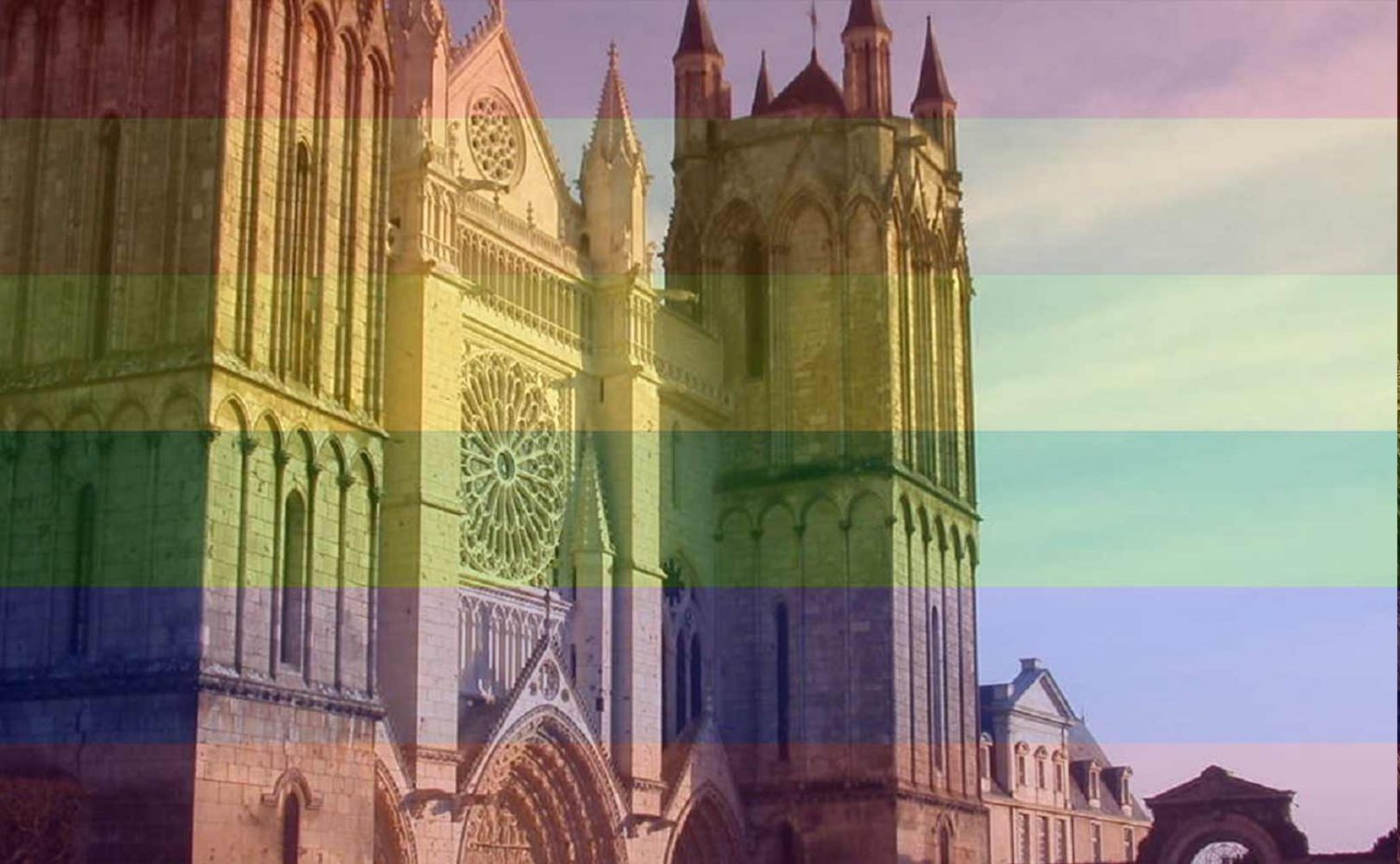
Photo of an empty tomb in Poitiers, France

Diocese of Poitiers, France: The European Sodomy Sweep Continues

{ ABYSSUM }

FacebookEmailPinterestPocketGoogle+

The Diocese of Poitiers, France has published a pro-LGBT article in the latest issue of its diocesan journal. The article, entitled “Parents of Children who are ‘Different’, Homosexual” was written by “parents of homosexual children.”

They write:

We are trying to love our children, by not judging them, by trying to understand them and accept them as they are. Thanks to them, we have changed our attitude. They have taught us tolerance {of what? of sin?}, how to come out of our conformism, to be in the truth. They have opened us to the Spirit of the Word of Christ, “Love one another,” by accepting their differences. Our children have the right to live an ordinary life {is the gay lifestyle, which includes sodomy, part of an ordinary lifestyle?}. Just because they are different one must not imagine that they are to be treated differently {we must not judge the state of their soul, but we must judge their lifestyle}. Pope Francis shows the way, he who says, “Who am I to judge?” What matters most to us … is the happiness of our children.

The article continues by declaring categorically that the Church has not supported them:

Unhappily, the Church has not helped us, since its positions, especially its position on the law regarding marriage for all, has revolted us. Society has just taken a big step forward, and, yet again, many Christians are lagging behind this evolution. It is difficult to be comfortable in a Church which does not recognize one part of its members. Will she ever be able to recognize her past errors? { WOW! What a Syllabus of Errors!}

They say they are waiting for the day when other Christians will ask them to share their experiences and acknowledge how they have suffered because of the intolerance of other Christians.

When priests will remember that our children are loved by God, and that God is with us, as they proclaim in the Liturgy, ‘The Lord be with you!’ Less [sic] long sermons and more concrete steps!

The signatories invoke the oft repeated words of Pope John Paul II, “Do not be afraid!,” and ask that the Church become a place where every person will be welcome “without distinction, without judgment. We wish for our homosexual children what Jesus always did, he who welcomed Zaccheus, Mary Magdalene, the Good Samaritan, the lepers whom he held in his arms.” In order to accomplish this change, “it is enough to return to the sources of the Gospel, getting rid of the straitjacket of fear which gave birth to a rigid morality, petrified over the course of history. May our local communities not reproduce this schema of guilt and judgment, but instead, may their priority be openness, respect, listening, compassion – in brief, welcoming all.”

The article concludes by thanking the local bishop for having dared to open the door and “explode the straitjacket” (of traditional Catholic moral teaching).

The French website Riposte-catholique comments on this article, saying:

It seems unacceptable to read such an article in an official Catholic journal denigrating the actions of its brothers who mobilized themselves against the Taubira law [purporting to redefine marriage to include sodomitical pairs in France in 2013]; the LMPT movement [against same] had nothing scornful to say against homosexuals. The author of the article (“12 parents of  homosexual children”) voluntarily employs a rebel tone and considers himself, just like the action of the diocese, to be in rupture with the doctrine of the Holy Catholic Church … and he is probably right.

There is manifest secularization in the Diocese of Poitiers that drifts toward a humanist conception of the Church adoring an impersonal god and relativized in a religion without any requirements, therefore without any sin. This diocese of Poitiers has been taken over by the left and is always living out the legacy of [former bishop] Joseph Rozier [1975-1994]; the last archbishops pursued the same politics.

The diocese now has almost no vocations. The few remaining candidates for the priesthood have for a long time preferred to go elsewhere for their formation, in order to receive a better quality of teaching.

Editor’s note: The material quoted herein was translated by Giuseppe Pellegrino.

Posted in Uncategorized | 4 Comments

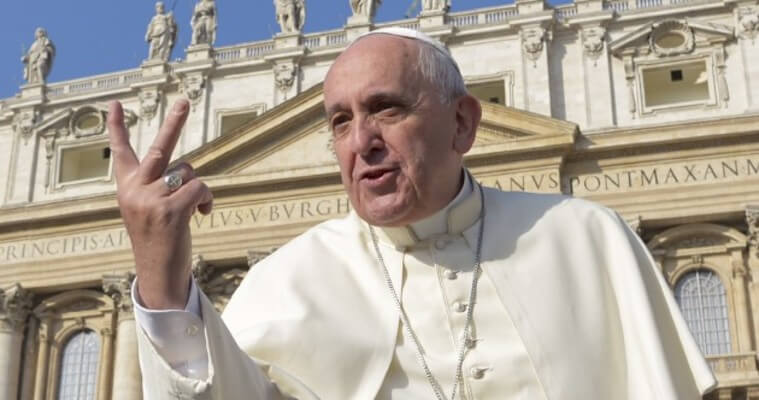
HE IS HOLDING UP TOO MANY FINGERS TO INDICATE WHAT HE REALLY MEANS TO THE SAY TO THE CHILEAN SEX ABUSE VICTIMS

Pope Doubles Down With “Apology”, Insists Abuse Victims Lack Proof

{ ABYSSUM }

FacebookEmailPinterestPocketGoogle+

It was arguably his most stunning statement to date as pontiff.

As I reported last week, while in Chile, the pope accused victims of clerical sexual abuse perpetrated by Fr. Fernando Karadima of “calumny” for alleging that his protege, papal appointee to the Diocese of Osorno, Bishop Juan Barros, of having either known of or even observed the abuse being performed.  “There is not one shred of proof against him.” Francis said.. “It’s all calumny. Is that clear?”

The most vocal accuser, Juan Carlos Cruz, offered a stinging rebuttal, saying, “As if one could have taken a selfie or a photo while Karadima abused me and others and Juan Barros standing next to him watching everything.”

Barros maintains his innocence, but Karadima, despite his crimes falling outside the legal statute of limitations, was ordered by the Vatican, following an investigation, to retirement and “a life of prayer and penance” and a “lifelong prohibition from the public exercise of any ministerial act, particularly confession and the spiritual guidance of any category of persons”. A judge in Chile also said that while she could not legally move the case forward, proof of Karadima’s crimes “wasn’t lacking.”

So, in a situation where both the state and ecclesiastical courts have found evidence of guilt, the pope effectively called one of the victims a liar because he cannot bring “proof” that his hand-picked bishop stood by and watched while the young man was abused.

There has been more pickup in the secular media than the last time Francis lashed out at the victims in Chile, calling them “dumb” or “stupid” (depending on the translation), but why isn’t every media outlet everywhere running this story? If pope Benedict had said this, they would have been digging up the most hideous pictures of him they could find and splashing them across front pages everywhere.

Meanwhile, the pope hasn’t learned his lesson. He was chastised in the most pusillanimous {almost apologetic} way by Cardinal Sean O’Malley of Boston over the weekend. O’Malley — who chairs the Pontifical Commission for the Protection of Minors (PCPM) — said in a statement that “It is understandable that Pope Francis’ statements yesterday in Santiago, Chile were a source of great pain for survivors of sexual abuse by clergy or any other perpetrator”.

A good start, right? But O’Malley didn’t stop there:

What I do know, however, is that Pope Francis fully recognizes the egregious failures of the Church and it’s clergy who abused children and the devastating impact those crimes have had on survivors and their loved ones.

Accompanying the Holy Father at numerous meetings with survivors I have witnessed his pain of knowing the depth and breadth of the wounds inflicted on those who were abused and that the process of recovery can take a lifetime. The Pope’s statements that there is no place in the life of the Church for those who would abuse children and that we must adhere to zero tolerance for these crimes are genuine and they are his commitment.

Having sufficiently ameliorated {apologizing to the Francis for} his criticism, “Cardinal Sean” was allowed to remain a useful minion of the papacy, and the pope decided to use his comments as a teachable moment. A moment in which he could say he was sorry – and then double down on what he did wrong in the first place.

During today’s plane presser, the pope explained (full text link) how he had had the case of Bishop Barros “studied” and “investigated.” He went on:

I had it worked on a lot. And truly there is no evidence. I use the word evidence. Then I will speak about proof. There is no evidence of culpability, it seems that it will not be found.

He said he would follow the maxim of “no one is guilty until it is proven.” But he also admitted that

When the scandal with Karadima was discovered, we all know this scandal, we began to see many priests who were formed by Karadima who were either abused or who were abusers.

He then discussed how Barros had tried to resign more than once, but Francis had turned him down, saying it would make him look like an admission of guilt. He then continued:

I will pass to a third point, that of the letter I explained clearly: what those who have been abused feel. With this I have to ask forgiveness because the word “proof” wounded, it wounded many people who were abused, but I must go to look for the certificate, I have to do that — a word on translation, in the legal jargon, I wounded them. I ask them for forgiveness because I wounded them without realizing it, but it was an unintended wound. And this horrified me a lot, because I had received them. (But) in Chile I received two [abuse victims] as you know, I met others that I kept hidden. In every trip, there is always some possibility. The ones in Philadelphia were published, three (meetings) were published, then the other cases no… And I know how much they suffer, to feel that the Pope says in their face ‘bring me a letter, a proof.’ It’s a slap. And I agree that my expression was not apt, because I didn’t think, and I understand how the Apostle Peter, in one of his letters, says that the fire has been raised. This is what I can say with sincerity. Barros will remain there if I don’t find a way to condemn him. I cannot condemn him if I don’t have — I don’t say proof — but evidence. And there are many ways to get evidence. Is that clear? [emphasis added]

Note that he is not apologizing for accusing them of “calumny” (or “slander”, depending on the translation) but for insisting on “proof” instead of “evidence.” And note that he is only apologizing for the offense, not for the belief he still holds that caused it.

So we have a known victim of sexual abuse by a Chilean cleric — a cleric whose abuse, the pope admits, produced subsequent abusers, as is often the case — and that victim also accuses one of that abuser’s proteges of standing and watching while the crime takes place. And the pope accuses the man of making it all up to slander a man.

It is certainly a possibility that the pope is right. In the absence of evidence, accusations like these have been used to destroy reputations before.

But if it is true, what proof can possibly be brought forward? What evidence? What does the man have to gain by saying it? And what benefit did the pope derive from appointing such a controversial figure in the first place over the protest of his would-be diocese — protests that have made him unable to effectively lead his flock? Why would the pope continue to leave him in place after all of this?

Marie Collins, the abuse survivor who quit the PCPM in 2017 over obstacles to its mandate that included limitation of resources and curial interference, said at the time of her resignation that she believed “the pope does at heart understand the horror of abuse and the need for those who would hurt minors to be stopped.”

She tweeted some quite different messages this morning:

The Pope is reported as unconcerned by the month long delay in member appointments to PCPM, the proposed names are being vetted by the Roman Curia. These facts says all that is needed to be said about the priority being given to this Commission and this issue in the Vatican

[…]

I have been asked by media to comment on the words of the Pope today on the Commission for Protection of Minors and Barros “evidence”. Why comment? It’s a pointless waste of effort. Sorry for such a negative non comment it’s just the way I feel right now.

Even though this story isn’t showing up as broadly or in as damning terms as one might expect were Francis an orthodox Catholic, for some, his papacy has more than lost its luster.

Notice the editorializing language in the Reuters piece I cited above. It shows how serious a stumble this has been for a man who has been a non-stop media rock star:

“the pope replied in a snippy tone”

“in an extremely rare act of self-criticism”

“an unusually contrite pope”

These are not complimentary phrases.

In another piece entitled, “Pope Francis, Company Man“, Kevin Cullen of the Boston Globe takes an even bigger swing at the pontiff:

Let the record show that the promise of Pope Francis died in Santiago, Chile, on Jan. 18, in the year of our Lord 2018.

When Pope Francis slandered victims of sexual abuse, ironically by accusing those very victims of slandering a Chilean bishop who was complicit in that abuse, he confirmed what some critics have said all along, what I have always resisted embracing: Pope Francis is a company man, no better than his predecessors when it comes to siding with the institutional Roman Catholic Church against any who would criticize it or those, even children, who have been victimized by it.

I offer my hearty congratulations to His Holiness, His Eminence, or whatever self-regarding, officious title that his legion of coat holders, admirers, apologists, and enablers insist we, the great unwashed, call him. Because he has revealed himself like no one else could.

By saying he needs to see proof that Bishop Juan Barros was complicit in covering up the abuse perpetrated by the Rev. Fernando Karadima, Francis has shown himself to be the Vatican’s newest Doubting Thomas. And it’s not a good look.

“He has revealed himself like no one else could.” Indeed he has. And now the narrative is beginning to fall apart.

Posted in Uncategorized | 2 Comments

WHAT A DIFFERENCE A RITE MAKES; NOT A LITTLE DIFFERENCE, BUT A BIG DIFFERENCE

——-

MONDAY, JANUARY 22, 2018

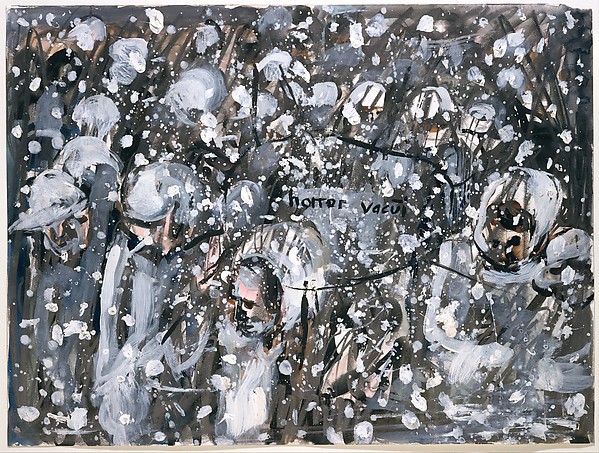
“Where Has God Gone?”: The Pressure of Horror Vacui

Horror Vacui (1980) by Anselm Kiefer (b. 1945)

In a famous passage in Joyous Wisdom, “the parable of the madman,” Friedrich Nietzsche writes:

“Where has God gone?” he cried. “I shall tell you. We have killed him — you and I. All of us are his murderers. But how have we done this? How were we able to drink up the sea? Who gave us the sponge to wipe away the entire horizon? What did we do when we unchained this earth from its sun? Whither is it moving now? Whither are we moving now? Away from all suns? Are we not perpetually falling? Backward, sideward, forward, in all directions? Is there any up or down left? … Do we not hear anything yet of the noise of the gravediggers who are burying God? … God is dead. God remains dead. And we have killed him. How shall we, murderers of all murderers, console ourselves?[1]

I was corresponding with a gentleman recently who wrote the following to me (and I reproduce it here with his permission):

Maybe I’m a babe in the woods, but last night I had the shock of my life. I went on YouTube and looked up an Orthodox monastery in Romania that I visited during communism. Some man had apparently been there and taken some pictures, and now he’s posted a slide show to YouTube. He wrote in the description that he’d used “Gregorian music” in the background, and as my dad used to say, I pretty near dropped my teeth. Someone had apparently had people sing Gregorian chant in a studio, added a drum track and a little bit of synthesizer, and had a woman’s voice intruding whispering little slogans about peace and other things. The biggest shock to me, though, was that the man who posted this — who was no spring chicken — actually thought this was Gregorian chant. There are probably lots of Catholics who think the same thing, but it’s Gregorian chant distorted for New Age purposes. I’d never heard anything like that before!
It comes close to one of my universal laws about food: Anything that is beautiful and subtle will eventually have fruit flavoring or corn syrup added. People always feel a compulsion to add something. But they never take anything away.
Recently I had to attend Mass at my neighborhood parish, and I discovered that what is really wrong — besides all the other things that are wrong — is what in art school we were taught to call horror vacui, fear of empty space. A typical amateur artist wants to fill every millimeter of space on a canvas with some kind of image, so the whole painting fights with itself. Good artists know how to use empty space. At this parish there’s not a second of silence from a half hour before Mass starts until after the crowd leaves. If you want quiet time to prepare for Mass, you have to arrive about two hours early. About ten minutes before Mass starts, the chatter has swelled to the volume of a pavilion at the state fair, and then once Mass starts, the musicians will not leave a second of quiet without twanging. Not even after communion. When I was a kid, the very same church was solemn and tranquil before Mass. No one breathed a word. Now people confuse church with a meetin’ hall and Mass with a TV show. Just the simple fact that the musicians don’t see the importance of receding at certain points during the liturgy is bothersome to me as someone with a visual arts background.

This colorful and all-too-true catalog of horrors, of the horror vacui sort, is one more indication of the unfathomable level of cultural regression and religious ignorance at this time in Western history. Apart from particular causes of regression and ignorance, there is a general cause, laid over all like a stifling blanket, that prevents us from recognizing our situation for the abysmal prodigy it is: the arrogance of modern man, who is supposed to be so “advanced” and to have progressed beyond all other ages. In reality, as Pope Pius XII once said, “the technical age will accomplish its monstrous masterpiece of transforming man into a giant of the physical world at the expense of his spirit, which is reduced to that of a pygmy in the supernatural and eternal world.”[2]

Pope Francis recently spoke in a general audience about the importance of observing moments of silence in the Mass, but he failed to show any awareness of two obvious facts.

First, silence in the new rite is artificial and barren of ritual significance. It does not arise because the priest is busy doing something else quietly, so that a natural span of silence results for everyone else, nor does it arise from the schola cantorum’s chanting of the Gradual and Alleluia. Inasmuch as this novum silentium is at the beck and call of the celebrant, it becomes a subtle mechanism for enhancing his “presidential status,” since he decides when to start and stop it. In that way, it is more like yoga meditation under the direction of a guru than it is Christian liturgical prayer.

Second, silence before, during, and after Mass has been killed, and its assassin is the liturgical reform in every decade of its implementation. For decades, the GIRM has been practically a dead letter when it comes to the actual liturgical life of most parishes. The progressives have been only too happy to push along countless practices that go explicitly against the GIRM, using the sponge of their hegemony to ——wipe away the entire horizon and unchain the earth from its sun, and no one has seriously attempted to correct them, even after Redemptionis Sacramentum, which did little or nothing to reverse the perpetual falling of liturgy “backward, sideward, forward, in all directions.” Pardon me, therefore, if I cough like Jeeves whenever someone with a Bertie Wooster grasp of liturgy invokes the GIRM as a reference point.

Before his humiliation by Pope Francis and his (voluntary or involuntary?) radio silence, Cardinal Sarah was constantly reminding people, like a voice crying in the wilderness, that nothing is more urgent than the serious protection and promotion of silence in our lives — not just in our liturgical worship, but in our personal prayer, even in our leisure and recreation. Without this empty space, there can be no interiority, no contemplation, no actual worship as opposed to “busy work,” the sort that substitute teachers give their fidgeting pupils while the real teachers are absent. We seem to be crushed by horror vacui,and it is only getting worse with the rapid inundation of all manner of pocketable or wearble devices, which fill every waking moment of our lives with the noise of information and entertainment . . . “the noise of the gravediggers who are burying God.”

At this strange moment in history, the new liturgical movement is also going to have to be a movement for natural, normal, face-to-face human interaction, sans distracting digital demons; for time spent making and repairing things with one’s own hands; for the stabilitas loci that comes from being quiet in a chair, at a table, in a room, by a window, with a book and nothing else. Such things are the natural analogues of the intimate contact with intangible beauty that comes from singing or hearing plainchant at Mass, smelling the incense, seeing the glittering gold on cope and chalice, becoming aware of one’s breathing or heartbeart in the silent Canon.

Some questions we must ask: What are the cultural preconditions — the personal prerequisites — for being able to respond from the depths of one’s soul to the needs and demands of the liturgy; for recognizing that in liturgy we walk fearfully on holy ground, as we enter a charged space filled with angels; for awakening to the sense of divine presence that would infallibly guide us back to our traditional modes of worship, abandoning with a sigh of relief all the modern claptrap that burdens us?

Photo by Fr. Lawrence Lew, O.P.

NOTES

[1] Cf. The Portable Nietzsche, ed. Walter Kaufmann (n.p.: Viking Press, 1968), 95.
[2] “…l’era tecnica compirà il suo mostruoso capolavoro di trasformare l’uomo in un gigante del mondo fisico a spese del suo spirito ridotto a pigmeo del mondo soprannaturale ed eterno.” Retrieved here.

Posted in Uncategorized | 2 Comments

Increasing Vocations isn’t Rocket Science

Increasing Vocations isn’t Rocket Science

IMG_0555


By Brian Williams on his Blog: The Liturgy Guy

A recent column by Bishop Thomas J. Tobin of Providence, Rhode Island highlighted the ongoing vocations crisis in his diocese.  Bishop Tobin noted:

Some clergy numbers in the Diocese of Providence to think about: Since the beginning of this decade we’ve lost 58 priests from active ministry in the Diocese, due mostly to retirement, and we’ve ordained just 18. That’s a net loss of 40 priests from active ministry in the Diocese. The median age of active priests is 59; the median age of all priests, including retirees is 67. There are just 21 priests under the age of 40.

Of course the dire conditions facing faithful Catholics in Providence isn’t unique to them alone. Priest shortages, anemic ordination classes, and underwhelming statistics for seminary enrollment do not bode well for the coming years. In response to these bleak conditions, much of the Church hierarchy looks for the latest program, initiative, or marketing scheme to solve their vocations crisis.

Increasing vocations isn’t rocket science. We already know the answer: wherever traditional Catholicism blooms, vocations boom.

In the past I have written of the blueprint provided by the Dioceses of Lincoln, Nebraska and Charlotte, North Carolina. Despite their modest size (less than 100,000 registered Catholics in Lincoln and 200,000 in Charlotte), both dioceses are experiencing vocational success stories:

  • In a recent 24 month span Lincoln ordained 17 men to the priesthood.
  • Lincoln is the only diocese in the United States to place in the Top 20 for the ratio of ordinands to population in every survey conducted from 1993-2012, often ranking #1.
  • Last year Charlotte opened St. Joseph’s College Seminary for those young men discerning a priestly vocation. They immediately filled up with 8 seminarians.
  • While the Charlotte diocese ordained 5 men to the priesthood this year, they have also had to expand St. Joseph’s in only its second year due to an additional 9 college seminarians enrolling.

Both dioceses are known for their orthodoxy and embracing of tradition. The Diocese of Lincoln has never permitted girls to serve at the altar, and an increasing number of parishes in Charlotte have done the same. This has helped to emphasize the male only sanctuary (with the possible exception of readers), increasing the liturgical participation of young men.

Both dioceses also embrace our liturgical tradition. The Priestly Fraternity of Saint Peter (FSSP) has their North American seminary in Denton, NE, having been invited into the Lincoln diocese by (then) Bishop Fabian Bruskewitz in the 1990’s. The Fraternity offers the Mass and other sacraments using the 1962 liturgical books.

The diocese also has many Masses offered ad orientem (facing the east), including those offered by Bishop James Conley at the cathedral each of the last two years during Advent.

The Diocese of Charlotte has seen a steady increase in Traditional Latin Masses offered over the past several years, including a Sunday High Mass offered weekly at St. Ann’s. It’s interesting to note that 48% of Charlotte’s seminarians in 2016-2017 were from parishes that are most closely viewed with the reform of the reform and tradition friendly pastors.

It’s also worth noting here the success of the previously mentioned Fraternity of Saint Peter. While dioceses like Providence bemoan their immediate future, the Fraternity is experiencing the opposite. 2017 has been a record year for the Fraternity, having just ordained 19 men to the priesthood. To provide some perspective for this success, the FSSP currently has a presence in only 45 North American diocese (35 in the United States and 7 in Canada).

An addition to the liturgy , however, there is also another traditional component present wherever vocations boom: an authentically Catholic education.

As I’ve written about before, Lincoln has spent decades making a Catholic education affordable and orthodox. With habited religious sisters teaching (many having fled other dioceses in the Seventies and Eighties) and priests often serving as theology teachers and principals, the students enrolled in Lincoln parish schools are 96% Catholic. This continues through high school and onto an orthodox and thriving Newman Center at the University of Nebraska.

Think about that. Young men are attending orthodox Catholic schools for K-12, all the while many continue altar serving in a male only sanctuary, then they head off to university, where they are met by a vibrant (and authentic) Newman Center. At the same time, the diocese is home to two solidly orthodox seminaries: St. Gregory the Great (diocesan) and Our Lady of Guadalupe (FSSP).

It’s important to also highlight the Diocese of Wichita, Kansas as well. Much like Lincoln, an affordable and authentic Catholic school system is helping to increase vocations.

In 2017 Wichita ordained 10 men to the priesthood, one of the top ordination classes in the entire country. Next year they are set to ordain another 10. This means that in just two years they will have increased their number of diocesan priests by 20%. The role of (authentic) Catholic schools in this boom can’t be overstated.

In their 2008 publication “Who Will Save America’s Urban Catholic Schools?”, the Fordham Foundation noted:

Wichita might be home to one of the strongest
Catholic school systems in the nation . . .

As explained at Wichita’s diocesan website:

…Catholic schools are parochial; they belong to the parish. They are not private schools that are owned and operated by those who use them. Therefore, every school family is encouraged to be an active parish steward.

Because the entire Diocese is committed to Stewardship, parishes make every effort to make a Catholic education, from kindergarten thru high school, available to active parish stewards without charging tuition. As far as we know, the Diocese of Wichita is the only diocese in the United States where every child of active parish stewards can attend Catholic grade and high school without paying tuition.

Wichita’s diocesan newspaper recently identified the prominent role Catholic schools have played in their vocations boom. Unlike the rest of the country, which has seen decline and closures, Wichita has seen enrollment increase since 1985, including at the kindergarten level where they also exceed the national average.

Prior to this year ordinations, the diocese had 58 seminarians, or one for every 1,845 registered Catholics, far exceeding the ratios of archdioceses like Los Angeles or New York.

And yet, too many dioceses still behave as if they are searching for a way out of their vocational desert, as if the path eludes them.

Simply put, tradition and orthodoxy are not optional. Reverent liturgies, incorporating traditional disciplines such as ad orientem Masses and altar boys serving, aren’t merely a preference. They are foundational.

Successful diocese also promote and encourage the Traditional Latin Mass instead of simply tolerating it, or worse, discouraging it. Traditional orders, as example, are booming while struggling dioceses are seeing retirements far outpace ordinations.

Further, we cannot afford to lose our Catholic children to the culture. As was always our belief, a Catholic child needs a Catholic education. Orthodox and affordable Catholic schools, such as we find in Lincoln and Wichita, as well as tradition friendly minor seminaries like St. Joseph’s in Charlotte, help to keep our Catholic kids Catholic.

Of course, there must always be prayer. Pray for vocations. Parishioners praying from the pews. Young men spending time before the Blessed Sacrament in prayer, listening and discerning. We must humbly ask God for priests.

But that prayer, and this is key, must be in conjunction with traditional liturgies and orthodox schools. To pray for priests while rejecting that which forms our young men and assists them to discern, is nothing less than tempting God. We are guilty of presumption.

Let us hope that more dioceses look to imitate Lincoln, Charlotte, and Wichita in the coming years so that all of the faithful might again witness an increase in priestly vocations.


liturgy guy

IMG_0555

A recent column by Bishop Thomas J. Tobin of Providence, Rhode Island highlighted the ongoing vocations crisis in his diocese.  Bishop Tobin noted:

Some clergy numbers in the Diocese of Providence to think about: Since the beginning of this decade we’ve lost 58 priests from active ministry in the Diocese, due mostly to retirement, and we’ve ordained just 18. That’s a net loss of 40 priests from active ministry in the Diocese. The median age of active priests is 59; the median age of all priests, including retirees is 67. There are just 21 priests under the age of 40.

Of course the dire conditions facing faithful Catholics in Providence isn’t unique to them alone. Priest shortages, anemic ordination classes, and underwhelming statistics for seminary enrollment do not bode well for the coming years. In response to these bleak conditions, much of the Church hierarchy looks for the latest program…

View original post 1,148 more words

Posted in Uncategorized | 4 Comments

THE VIRUS OF SODOM AND GOMORRAH IS SPREADING RAPIDLY IN THE CHURCH UNDER FRANCIS

Featured Image
giulio napolitano / Shutterstock.com
Joseph Sciambra

OPINION,

Theologians use Pope Francis’ teaching to argue gay sex no longer ‘grave sin’

January 17, 2018 (Joseph Sciambra) – In a January 16, 2018 “Commentary” for “The National Catholic Reporter,” Creighton University Professor Todd A. Salzman, chair of the Department of Theology at Creighton, and Michael G. Lawler, professor emeritus, disagreed with the decision by certain US Bishops to possibly deny a Catholic funeral for someone who died while in a same-sex “married” relationship. They single out Bishop Thomas Paprocki of the Diocese of Springfield for specific criticism.

From of a “Decree” issued by Paprocki, Salzman and Lawler are especially troubled with the following directive:

Unless they have given some signs of repentance before their death, deceased persons who have lived openly in a same-sex marriage giving public scandal to the faithful are to be deprived of ecclesiastical funeral rites. In the case of doubt, the proper pastor or parochial administrator is to consult the local ordinary, whose judgment is to be followed.

Concerning those individuals in a same-sex “marriage,” the “Decree” also included the following instructions, which Salzman and Lawler do not mention:

Pastors aware of such situations should address their concerns privately with the person in such circumstances, calling them to conversion…

Also:

In danger of death, a person living publicly in a same-sex marriage may be given Holy Communion in the form of Viaticum if he or she expresses repentance for his or her sins.

Lastly, Bishop Paprocki added:

…I remind all those who exercise a ministry within the Church that while being clear and direct about what the Church teaches, our pastoral ministry must always be respectful, compassionate and sensitive to all our brothers and sisters in the faith, as was the ministry of Jesus Christ, the Good Shepard and our everlasting model for ministry.

Although Bishop Paprocki offers the possibility of redemption and salvation through the Sacraments of the Church for those involved in a same-sex relationship, Salzman and Lawler contend that there is nevertheless something deeply flawed with the entire Catholic approach to homosexuality:

The language of the church describing homosexuality as an “objective disorder” and the specious language from the U.S. Conference of Catholic Bishops about “not unjust discrimination” of homosexuals in opposition to the Employment Non-Discrimination Act have caused infinitely more scandal than any church funeral for a deceased same-sex spouse has done or is likely to do.

But this is not the first time these two professors have openly criticized Catholic teaching with regards to homosexuality.

In 2007, their radical theories caught the attention of Archbishop Elden Curtiss, then Archbishop of Omaha, where Creighton University is located. He stated that Salzman and Lawler proposed a sort of “new natural law theory” and “argue for the moral legitimacy of some homosexual acts.” Following the publication of their 2008 book “The Sexual Person: Toward a Renewed Catholic Anthropology,” from Georgetown University Press, the USCCB issued a lengthy and scathing condemnation of the book; according to the 2010 document from the “Committee on Doctrine:”

…the authors insist that the moral theology of the Catholic tradition dealing with sexual matters is now as a whole obsolete and inadequate and that it must be re-founded on a different basis.

They explained further:

For the authors of The Sexual Person, the scriptural condemnations of homosexual behavior are nothing more than expressions of the sociohistorical assumptions of the writers. In their view, this is evident from the fact that the scriptural writers condemn homosexual behavior “specifically as a perversion of the heterosexual condition they assume to be the natural condition of every person.” The basis of the condemnation is thus taken to reveal the scriptural writers’ assumption about the naturalness of heterosexuality, an assumption that has supposedly been disproven in the modern world. For the authors, there can be no perversion of the heterosexual condition by homosexuals since their natural orientation is not heterosexual, but homosexual. “In its modern meaning, homosexuality is not and cannot be a perversion of the heterosexual condition because homosexuals, by natural orientation, do not share that condition.”

Finally, stating:

The Committee on Doctrine wishes to make it clear that neither the methodology of The Sexual Person nor the conclusions that depart from authoritative Church teaching constitute authentic expressions of Catholic theology. Moreover, such conclusions, clearly in contradiction to the authentic teaching of the Church, cannot provide a true norm for moral action and in fact are harmful to one’s moral and spiritual life.

Despite these protestations, Salzman and Lawler continue to advocate for a revolutionary reinterpretation of Catholic teaching; from their 2018 piece for “The National Catholic Reporter:”

In the established Catholic moral tradition, any behavioral decision must discern not only the objective moral truth proposed to it but also any and every relevant subjective circumstance in which moral action takes place.

It is no surprise, therefore, to see [Pope] Francis clearly teach this doctrine in Amoris Laetitia, his 2016 apostolic exhortation on family life known in English as “The Joy of the Gospel,” in several different ways, without in any way abandoning or diminishing Catholic moral doctrine or behavioral norms.

The church, he argues, “possesses a solid body of reflection concerning mitigating factors and situations. Hence it can no longer simply be said that all those in any ‘irregular’ situation are living in a state of mortal sin and are deprived of sanctifying grace.”

Even though the behavior is wrong in the church’s eyes, “deliberate consent” may be mitigated on the part of the agent and, if deliberate consent is lacking, there cannot be grave sin.

They conclude:

Francis limits his consideration of irregular situations to couples who are divorced and remarried without an annulment and couples who are cohabiting, but his analysis applies also to other situations considered gravely sinful, such as a same-sex union. Factors may exist in all irregular situations which limit “deliberate consent” and the ability to make a fully informed moral decision (Amoris Laetitia, 301).

In 2014, several months before the Obergefell decision legalizing gay marriage, Creighton allowed same-sex spouses of employees to join the University’s health plan. According to the “Student Counseling Services” at Creighton, in a section of the official University website, which attempts to correct certain “myths” about homosexuality:

Myth #1:  Homosexuality is “Unnatural”

THE TRUTH: From a scientific point of view, it is “natural”. Any animal, including humans, is capable of responding to homosexual stimuli. Research suggests that homosexuality is almost universal among all animals and is especially frequent among highly developed species. There has been evidence of homosexuality in all human cultures throughout history. In fact, one anthropological study of non-Western cultures found that 64% of their sample considered homosexuality “normal and socially acceptable” for certain members in society.

The University also maintains a “Gender and Sexuality Alliance” (CUGSA). On their website, the GSU states as part of their “mission:”

The Alliance will uphold the spirit of Catholic teaching regarding the confrontation of fears about homosexuality and the need for the Christian acceptance of all persons. In promoting equality and justice for all students, the Alliance will exemplify Catholic teaching by fostering acceptance of homosexual persons with respect, compassion, and sensitivity.

A number of the claims made by Salzman and Lawler have been recently repeated by Jesuit author James Martin during the promotional tour for his book “Building a Bridge: How the Catholic Church and the LGBT Community Can Enter into a Relationship of Respect, Compassion, and Sensitivity.” In terms of the language used in the Catechism, specifically the term “objectively disordered,” Martin wrote:

The phrase relates to the orientation, not the person, but it is still needlessly hurtful. Saying that one of the deepest parts of a person—the part that gives and receives love—is “disordered” in itself is needlessly cruel.

He since said:

God made you this way. You are wonderfully made, just like Psalm 139 says. You were knit together in your mother’s womb this way, you know, it’s a mystery why you were made this way, but this is part of your identity.

Martin has gone on to say that perhaps not just the language is problematic, but the teaching itself:

I’m no theologian, but I would say that some of the language used in the catechism on that topic needs to be updated, given what we know now about homosexuality. Earlier, for example, the catechism says that the homosexual orientation is itself “objectively disordered.” But, as I say in the book, saying that one of the deepest parts of a person — the part that gives and receives love — is disordered is needlessly hurtful. A few weeks ago, I met an Italian theologian who suggested the phrase “differently ordered” might convey that idea more pastorally.

As a justification for this departure from tradition, during a June 8, 2017 Facebook Live Q & A session, Martin contended that:

All these Bible passages people throw at you…Leviticus, Deuteronomy, and even the stuff in the New Testament where Paul talks about it once or twice, has to be understood in their historical context. The Bible is written in a particular time; it’s the inspired Word of God, but it is written, certainly, in a particular time and in a particular historical context. Certainly, in Old Testament times, they didn’t understand the phenomena of homosexuality, and bisexuality I would say, as we do today. I’d also like to say that there’s a lot of other stuff in Leviticus that we sort of understand in its historical context, like what kind of slaves can we have, whether or not we can wear certain kinds of clothes, whether or not our crops can be next to one another. We don’t look at those passages in an a-historical way, so why should we look at passages on homosexuality that way?

In 2016, Martin delivered the commencement speech at Creighton.

On January 16, 2018, Martin posted a link to Salzman and Lawler’s “Commentary” to his official Twitter account.

Notwithstanding a blunt critique from Cardinal Robert Sarah, so far there has not been any official rebuke of James Martin’s statements. Instead, he continues to offer addresses and lectures at prestigious Catholic universities and at the upcoming 2018 LA Religious Education Congress.

Editor’s note: This article first appeared at josephsciambra.com. It has been reprinted here by permission of the author. 

Posted in Uncategorized | 1 Comment