POPE PIUS IX AND THE DISCOVERY OF THE HIDDEN TRIDENTINE CATHOLICS OF JAPAN

Popepiusix-2

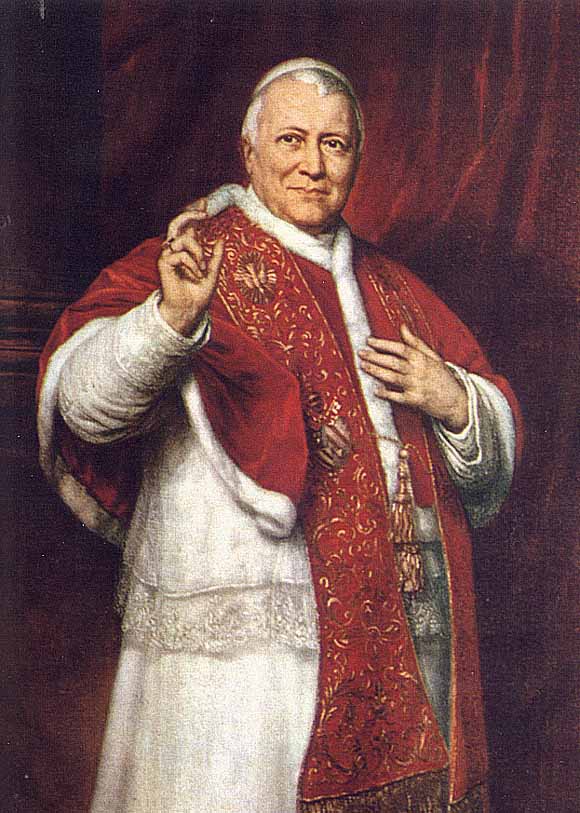
POPE PIUS IX

Settimo Cielodi Sandro Magister

Pope Pius IX and Japan. The History of an Oriental Miracle

by Shinzo Kawamura, S.J., Sophia University, Tokyo

October 12, 2017, Rome, Pontifical Gregorian University
Symposium in the 75.th Anniversary of Diplomatic Relations between Japan and the Holy See

martiri

Foreword

On January 8, 1867, His Holiness Pope Pius IX dispatched a special message to Fr. Bernard Petitjean of the Paris Foreign Mission Society, who at the time was involved in missionary work in the city of Nagasaki. The purpose of His Holiness was to personally bless an event, which he exuberantly described as a “Miracle of the Orient.”

What he referred to as a “Miracle of the Orient,” was the fact that three years before this message was dispatched, that is, on March 17, 1865, an incident had occurred within one of Japan’s oldest churches, namely the “Oura Tenshudo of Nagasaki,” which is also known as the Basilica of the Twenty-Six Holy Martyrs of Japan. This was the discovery of the so-called Hidden Christians, and to Catholics all over the world, this incident was indeed a miracle.

That is to say, a community of Christians whose ancestors could be traced back to the seventeenth century, and who had experienced excessive persecution due to the ban on Christianity imposed in Japan, had yet managed to survive for a period transcending 250 years, even though they had no priests who could minister to them.

These Hidden Christians did not consist solely of those who had been discovered. We have verified the fact that the Christians whom people like Fr. Petitjean had encountered, were of the same faith as the Christians who had populated the nation of Japan four hundred years earlier. Accordingly, they are people who after being discovered, returned to the Roman Catholic Church.

In other words, this incident was a twofold miracle, namely a miracle of discovery, and a miracle of resurrection.

In the latter half of the nineteenth century, Japan began to follow the path taken by the advanced nations of the West, and it attempted to rebuild itself as a modern state. The Tokugawa government in the city of Edo, which at that time constituted the central authority, had for an extended period of nearly 250 years, reduced all contact with foreign powers to a bare minimum.

However, in 1854, on the basis of the Kanagawa Convention that had been framed between the USA and the Tokugawa government, Japan eventually realized that there was a need to terminate this sort of an exclusive policy, and so the country was once again declared open to foreigners.

Even so however, regardless of this new orientation on their part, the Tokugawa government decided to continue enforcing upon the common man the prohibitions they had hitherto imposed upon Christianity.

On the other hand though, as western settlements began to make their appearance in steady succession within the major port cities of Japan, such as Yokohama and Nagasaki, the people also started to make demands for freedom of worship, and consequently, Catholic churches also in course of time began to be built, within the nation’s townships and settlements.

Despite such limitations however a revival seemed to occur within the Catholic Church of Japan, and this in turn evoked feelings of hope within the heart of His Holiness Pope Pius IX. Hence, he decided to canonize the twenty-six martyrs of Nagasaki. These twenty-six individuals had suffered martyrdom approximately 400 years ago, and they were later beatified in the early seventeenth century.

Japan thereupon was transformed immediately into the spotlight of the world, and people worldwide started to evince an interest in the nation’s new Catholic Church, a Church whose history had, so to say, just begun.

It was in such an ambience of serenity and composure that the renaissance of the Catholic Church commenced in Japan, but in 1865 this renaissance received an added boost, due to the sudden discovery of the Hidden Christians. This discovery of the Hidden Christians was an event that captivated Christians worldwide, and it is this that I referred to earlier as a “Miracle of the Orient.”

These Hidden Christians constituted a group of approximately 15 people, and they happened to be descendants of the Hidden Christians of Nagasaki Urakami. They visited the Oura Tenshudo that had just been built, and engaged in a dialogue with Fr. Petitjean.

They spoke to Fr. Petitjean saying: “We are of the same faith as you. Where can we find the image of Saint Mary?”

Fr. Petitjean was profoundly moved, and his heart filled with joy on hearing their words.

No sooner had these Hidden Christians ascertained the fact that Catholic priests had entered Japan, more and more of them began to come out of hiding in places such as Nagasaki and its surrounding vicinity, and also in areas such as Goto, and their numbers in course of time exceeded ten thousand.

After having duly confirmed the fact that the faith of these priests was the same as that which had been adhered to by their ancestors 400 years ago, these Hidden Christians returned to the Catholic Church.

Certain Fundamental Issues and three Keywords

On the occasion of this symposium I wish to speak about this Miracle of the Orient. I intend to present certain fundamental issues concerning this topic, and I shall attempt also to answer them.

First, these Hidden Christians had endured about 250 years of persecution, due to the prohibitions imposed upon them by the Tokugawa government. Even so, they faithfully continued to preserve their faith, and when they eventually felt that the time was appropriate to do so, they rejoined the Catholic Church. This was indeed a miracle, but my question is, what was it that made this miracle possible?

What was it that made possible the “hidden” life that these Christian communities had followed, for so many years?

Why was it that they never rejected their Catholic Faith?

Concretely speaking, what was it that enabled them to protect and preserve their faith?

I now wish to present three keywords that I consider most vital, with regard to the possibility of this Oriental Miracle.

The first keyword is ‘confraternity’ or ‘confraria.’ It was this that enabled them to discover a systematic means of preserving their faith during this lengthy period.

The second keyword comprises the expression, ‘Catechist Bastian’s Prophecies.’

Bastian was the name of a catechist who suffered martyrdom during the period of persecution around 200 years ago, and we have a work of his entitled “Future Resurrection Prophecies of the Church of Christ.” This work served as a source of hope for the Hidden Christians, and hence it was accepted and transmitted by them to the later generations.

For the Hidden Christians, it was a message for the future.

The third keyword refers to a booklet entitled, ‘Book of Contrition and Prayer.’

This booklet consisted of the memories or recollections of their ancestors. These memories were lovingly cherished by those Hidden Christians, and it served as a motive force for them.

The booklet also served to authenticate their knowledge, regarding the sacraments that were used during the Christian period.

I shall hereafter provide in turn a simple explanation for each of these keywords, and by this means I hope to gain a glimpse of the genesis of this drama, a drama concerning miracles of discovery and resurgence.

The Structure of their Steady Faith: The Way of Thought revealed in the ‘Confraria’ that enabled the Members to lead Christian lives, despite an absence of Priests

The first issue we need to deal with concerns the Confraria or Lay Communities.

Despite the fact that they had neither priests nor missionaries, yet the communities of Hidden Christians managed to survive for a period surpassing 250 years. During this period, their communities were managed by the laity alone.

This is a point of crucial value.

This was due to the fact that since the time of St. Francis Xavier, communities that were governed and supervised by the laity alone existed as territorial organizations, in diverse regions of the country.

These communities of Hidden Christians were not groups that were formed in a hurry. They were not formed because of any abrupt negative reaction, such as feelings of panic that might have suddenly arisen among the Christians, because of the prohibitions and persecution initiated by the Tokugawa government.

Rather, we need to bear in mind the fact that these communities had pre-existed earlier, and that they had originated half a century prior to the onset of the persecution.

They were formed in imitation of the Confraria system in Europe, where, in every region, there existed communities constituted of lay people alone. These were autonomous organizations, and hence when the persecution began in real earnest and the missionaries began to disappear, they were able to continue on their own, because of the links that existed between the lay leaders and community members.

In 1550, that is, just after the missionary activity of St. Francis Xavier, there were many regions that were served by just four missionaries.

These were mission stations, and they could not be ranked either as parishes or church organizations.

It was half a century later that Episcopates or Bishoprics appeared in Japan, and during that period, it was only the Jesuits who had missions that included churches or parishes.

Here, the Jesuits even began to operate hospitals, and they did this on the basis of western concepts of medical science.

The Christian communities that helped in the administration of these hospitals, are ranked among Japan’s earliest church communities.

Japan’s earliest church community was constituted of lay Christians, who adopted as their model the Confraria da Misericordia of Portugal.

This confraria began in the 13th century in Italy, and in the 16th century, a period when vast numbers of lay Catholic groups pervaded diverse sections of Europe, the Confraria da Misericordia, which tended to concentrate almost exclusively on charitable works, developed largely in Portugal. When Europe began to spread out during the period of the great navigations, this confraria too expanded to diverse sections of the globe, and in course of time it even entered Japan, where among other activities it focused chiefly on the running of hospitals.

It was a widely known fact that the confraria was administered solely by the laity.

On principle, priests and individuals associated with the clergy were not directly concerned with the management.

Even at a later period when regional communities were formed in different areas, they were modeled upon the same organizational system.

In every area, aside from periodic visits made by missionaries, the maintenance and government of the community was carried out by the lay leaders and the group members.

The leaders were elected, and they had fixed terms of office, and we have reason to believe also that the communities had rules and regulations to abide by.

According to statistics of the 1590s, the total number of Christian believers was 220,000, and the priests constituted merely forty Jesuit missionaries.

Even on occasions when the two hundred and odd Christian communities scattered nationwide had no priests, they had administrative organizations comprised solely of lay people, who were able to carry out the tasks of government and supervision.

The reason for this was the fact, that these communities were in essence based on the concept of the confraria.

In 1587, Hideyoshi promulgated the ‘Bateren tsuihō-rei,’ which was an ordinance expelling the missionaries. This initiated the first persecution.

It was a measure intended to banish all the Jesuits missionaries from the country.

Obviously, the Japanese Christians too were greatly disturbed by this situation.

Yet, as far as the structure of their society was concerned, in every region it was taken for granted that even if priests were absent, the lay leaders could function on their own and carry out the tasks of supervision and governance. Hence, the impact of this expulsion ordinance upon their community was not all that severe.

The reason for this weakening of the impact of the ordinance, was the fact that in each region these community leaders aptly fulfilled their responsibilities towards their people, by duly carrying out the tasks assigned to them.

An outcome of this expulsion ordinance was the fact that these lay communities, which hitherto had been bound together through to their involvement in charitable activities in diverse regions, now began active preparations to face this persecution, and their structure consequently underwent a change. They were now transformed into communities of mutual support and aid.

This in due course gave rise to confrarias that were unique to the nation of Japan.

In other words, they were reborn as communities of Hidden Christians, who were prepared to face the ongoing persecution.

Starting from Nagasaki, in manifold areas of the nation, such germinal confraria communities began to be formed, and they continued to survive.

Also, these lay leaders continued with their hidden lives, all the while carrying out the tasks assigned to them. They conducted baptismal ceremonies and conveyed the teachings of Christ to the members of their communities, using water, booklets, and so on.

That is to say, these communities of Hidden Christians, which were totally devoid of priests, constituted a secret that remained unrevealed to the authorities, a secret that persisted for a period of 250 years. The primary reason for this is the fact that throughout the Christian period, these communities, whose structure was modeled upon the confraria, were groups that were deeply rooted within the soil of Japan.

A Transmission of Hope: The Prophecy of Catechist Bastian

A second factor related to the endurance of these Christian communities, was the fact that the lay Catholics who were linked to them, were able to obtain the spirit of perseverance and hope that they needed for their continued survival.

There existed an oral tradition entitled the ‘Prophecy of Catechist Bastian,’ and this tradition provided these Christian communities with hope, regarding a future resurrection.

In certain areas, these Hidden Christians received and transmitted this tradition for 250 years.

The individual referred to as Bastian, was a catechist. He suffered martyrdom at Omura in the vicinity of Nagasaki around the middle of the seventeenth century, during the closing days of the persecution.

He is said to have served as the disciple of a certain Joāo. In 1657, he was captured by agents of the Nagasaki Magistrate’s Office, and was beheaded after three years and three months of incarceration.

On that occasion, he was believed to have left behind a prophecy, which served as a source of encouragement for the members of the Christian communities.

The most crucial component of that prophecy was the following: “After seven generations have passed a black ship will arrive, in which there will be some confessors. People then would be able to make their confessions, even on a weekly basis.”

In other words, if the people were able to wait in patience for seven generations, the current religious prohibitions would without fail be lifted, and the persecutions also would cease. This would usher in an era of peace. By means of this prophecy Bastian sought to console the members of the Christian communities, who found themselves plunged into a state of utter despair.

This prophecy eventually attained fulfillment, after the passage of 250 years.

On examining the Bible carefully, we notice that it was customary to consider a single generation as comprising 30 years.

Hence, seven generations would work out to 210 years. In other words, what the prophecy intended to reveal was the fact, that 210 years after the death of Bastian who was martyred in 1657, the persecutions would cease.

When we compute the whole thing mathematically, we find that this works out to the year 1865, which incidentally, happens to be the very year in which the Hidden Christians were first discovered.

In Nagasaki and its neighboring villages alongside the open sea, as well as in Goto, that prophecy of Bastian was found to have existed as an oral transmission. This is a truth that was verified by Historians of the Meiji period, when they carried out field research in those areas.

The fact that Bastian prophesied that the confessors would return, is also an issue of critical value.

On examining the wording of the oral transmission, we find that it did not merely state that missionaries would return, or that priests would return. Rather, it stated that ‘confessors’ would return.

I personally am of the view that this constitutes the most vital point in this Miracle of the Orient.

Those Hidden Christians were not just Christian clerics or church workers. Rather, they were people who were obsessed with the idea of having the authority to forgive sins.

We notice here that the wisdom of Bastian is both revealed and concealed.

In other words, for those Hidden Christians, it was absolutely crucial that those people who returned to Japan at a future time, should be Catholic clerics or church workers.

In order to ascertain whether those confessors who returned were really priests, Bastian told the members of the Christian community to ask them three questions, and to see if they could provide answers for them. The questions are as follows:

The first question was: “Are you single?”

The second question was: What is the name of your leader in Rome?”

The third question was: Do you venerate the Blessed Virgin Mary?”

These were the very questions that Bastian recommended that they ask.

On the occasion when the Hidden Christians were first discovered, the question they posed to Fr. Petitjean was, “Where is the statue of Saint Mary?” This question, which was addressed to Fr. Petitjean within the Oura Tenshudo, has now become virtually a legend, and thanks to the oral transmission, this is the first time in the history of Japanese Christianity, that we have been able to grasp its meaning.

Initially the Hidden Christians of Urakami entered a Protestant church in Nagasaki.

On doing so however, when the wife of the Pastor received them and offered them some English tea, they promptly withdrew from the place.

They had been taught to ascertain clearly whether or not the faith was the same as their own, for this was an issue that was included within the prophecy of Bastian.

Why did those Hidden Christians wait for the arrival of the confessors?

What sort of a mystery lies behind all this?

It has been speculated that the key to resolving this enigma, was published in 1608. Yet, what remains of that publication now are merely certain manuscripts, namely a pamphlet entitled ‘Konchirisanoriyaku,’ and a summary of this very same work entitled ‘Orasho.’ The key to this mystery perhaps may be found in them.

Memories of Love Signs: The Role of the ‘Konchirisanoriyaku,’ which transmitted the Memories of the Sacraments

On speaking with groups of Hidden Christians, I found that the principal question that dominated my mind was the following: In the course of these 250 years of their history, how did they deal with issues such as the celebration of Holy Mass and the conferring of the Sacraments, when they had no priests?

This same question may perhaps be posed as follows: Holy Mass and Penance are two Sacraments that needed to be conferred by an ordained priest. Aside from this issue, how did these Hidden Christians manage to continue the conveyance of their Catholic faith over a period extending to 250 years?

Assuming that the memories of the Sacraments had indeed vanished entirely from the minds of those Hidden Christians, then, 250 years later, even if they were to once again meet missionaries who had by now returned to Japan, those Christians would never have been able to verify whether those missionaries and themselves had both been once rooted in the same Catholic faith. This is certainly a possibility.

Yet, the fact is that Historical research reveals the exact opposite. That is to say, those Hidden Christians were clearly able to verify the fact that sometime in the past, they and the missionaries were undeniably rooted in the same Catholic faith.

This points to a historical truth that has close links to the ‘Konchirisanoriyaku.’

In 1590, the year when the persecution of the Catholic faith began in Japan, Catholic priests were either expelled from Japan or refused entry into the country, and the community of believers, who by then numbered around 300,000, found themselves suddenly faced with a crisis of massive proportions.

What proved particularly problematic was the fact that the number of priests who could administer the Sacraments to the believers, had dwindled greatly.

The Council of Trent, which concluded in 1563, declared that at least once a year all believers should receive the Sacrament of Penance, (that is, Confession), for to die in the state of mortal sin would mean that the individual would go to hell.

In particular, people who were bed-ridden and on the verge of death, were in great fear of dying without having received forgiveness for their sins.

In response to this crisis faced by the Christian believers, the Jesuit missionaries of that time began to contemplate measures aimed at alleviating their woes.

In cases where priests were not available, they permitted the following exceptional procedures for the Christian community: If the sinner experienced true contrition, that is to say, if he or she had genuinely repented of their sin, then the actual confession of the sin could be deferred until the time when a priest was available.

This was something that groups such as the ‘contritionists’ had stressed since the middle ages, and besides, it was also a broad interpretation of the following words that are found in a decree promulgated during the Council of Trent, namely, “reconciliation between the individual and God can be attained by true contrition.”

In other words, it meant that if a person on his deathbed experienced true contrition of the heart, that contrition could serve as a substitute for the Sacrament of Penance or Confession. However, this was only an exceptional measure, which was resorted to because of the persecution that had broken out.

The Jesuit missionaries were perhaps aware of the fact that this ‘true contrition of the heart’ and ‘postponement of confession,’ were means that would not be widely welcomed by the Roman Catholic Church. Hence, they were resorted to merely as exceptional measures.

Accordingly, they even experienced a little anxiety over their implementation.

Eventually, in 1593, on the occasion of a meeting of Jesuit Representatives in Rome, the Jesuit missionary who was dispatched to Rome as the representative of Japan was provided with a list of exceptions to the general rule, in view of the unnatural circumstances that pervaded the country.

When this Jesuit missionary who served as representative of Japan reached Europe, he addressed certain questions to Gabriel Vasquez, who at that time happened to be a highly respected and qualified expert in Ethical Theology. His questions dealt with these same issues, that is, the postponement of confession, and the vital need to adopt special measures in the case of Japan. Vazquez on hearing him responded by affirming that if the contrition on the part of the penitent was sufficient, then his confession could indeed be temporarily postponed.

On receiving this information, the Konchirisanoriyaku was published and printed out as a booklet in Japan. The word ‘Konchirisan’ is the same as the Portuguese word contrição, when pronounced in the Japanese language.

The Konchirisanoriyaku describes the critical significance of ‘true contrition.’ It also states that when embarking upon lengthy voyages, or when we find ourselves in situations of war, conflict and so on, if there happens to be no priest available, then we should reconcile ourselves to the fact that we shall have to make our confession at a later date.

For use on such occasions the members of the Christian communities composed a prayer known as the Orasho, and arrangements were also made for the Christian believers to recite this prayer on a daily basis.

This prayer known as Orasho served to greatly console the members of the Christian communities, who due to the persecution were unable to get into contact with the Catholic priests.

For instance, on occasions when officials of the Tokugawa government compelled the Christians to step on the Fumie, there were certain believers who stepped on it with no qualms whatsoever. Yet, these same believers, on returning to their place of residence, recited the Orasho over and over again, and by this means they tried to atone for what they had done. They did this with the awareness that sometime in the future a priest would appear, to whom they could confess their sin.

It is said that this Orasho was perhaps recited by the Christians hundreds or even thousands of times.

This rule, which enabled the Hidden Christians to make their confessions at some later period in the future when priests were available, also served to instill within their hearts the firm conviction, that the Church at some future time would revive again. It was a hope that arose within their hearts, owing to the memories they had carefully sustained regarding the Sacraments.

The statement of Bastian that I mentioned earlier, namely his prophecy regarding the return of the confessors after seven generations, is something we would not have been able to understand without this Konchirisanoriyaku transmission.

For a period of 210 years, those Christians had been repeatedly and clandestinely chanting the Orasho of Konchirisan, but their hopes eventually attained fulfillment, when they were finally able to meet a priest.

I am of the opinion that the reason why the faith of those Christians of the sixteenth and seventeenth centuries was so meticulously transmitted over these many years, was because the memory of the Sacraments had been carefully preserved within their hearts. It was for this very same reason that this faith of theirs was also promptly resurrected after the lapse of 250 years, and once it was resurrected, they lost no time at all in rejoining the Catholic Church.

The Sacraments are visible signs of the salvific work of Jesus Christ. They are signs that have been, so to say, seared within the core of our hearts, and hence those Hidden Christians yearned for the day when the Catholic Church, the agency that conferred those Sacraments upon the believers, would rise again.

In other words, we may perhaps assert that it was largely due to the memories they had preserved of the Sacraments, that those Hidden Christians were able to survive so long as a community of Faith.

Alternately, we may also perhaps say, that the ‘miracle’ of the Hidden Christians attained fruition, due to those memories they had vigilantly preserved regarding the Sacraments of the Catholic Church.

One must admit that this entire episode is exceedingly ‘Catholic,’ for if Protestant Churches had existed in Japan during the Christian period 400 years ago, one wonders whether such a miracle could have really occurred.

Conclusion

The Prophecy of Bastian and the Orasho of Konchirisanoriyaku, were transmitted within the vicinity of Nagasaki, in areas facing the open sea, and in the Goto region.

They functioned as a means to awaken within us a clear awareness, of the links that we possess with the Catholic faith of those Hidden Christians.

Hence, it is said that after the Meiji Restoration, the fact that the Catholic Church in that section of the country revived again with no resistance whatever, was due to these two transmissions that were widespread in those areas, namely the Prophecy of Bastian and the Orasho of Konchirisanoriyaku.

Another point to note is that in Hirado and the Ikitsuki region, both of which were known for the existence of Hidden Christians, these transmissions did not survive. Hence, even though the people in those areas came across priests of the Paris Foreign Mission Society, they found no reason to return to the Catholic Church.

This is due to the fact that although their faith had been rooted in the Catholicism of 400 years ago, yet, during the Edo Period it became progressively indigenized, and it was eventually transformed into a folk religion.

It was thus that the ‘Miracle of the Orient’ came to be realized, and this realization was brought about through the orderly transmission of the faith, hope, and love of those Hidden Christians.

More than anything else, what brought about the realization of this miracle are certain objects that are of supreme importance to the Catholic Church, namely the memories of those Hidden Christians. They are memories relating to the Church’s Sacraments that those Hidden Christians had meticulously preserved, and with this endorsement, I wish to conclude my address today.

Posted in Uncategorized | 1 Comment

TRIDENTINE CATHOLICISM KEPT THE FAITH ALIVE IN JAPAN FOR FOUR CENTURIES WITHOUT PRIESTS AND BISHOPS

Settimo Cielodi Sandro Magister

The “Hidden Christians” of Japan. Too Inconvenient for This Pontificate

martiri

*

Pope Francis has repeatedly expressed his admiration for the “hidden Christians” of Japan, who miraculously reappeared with their faith intact in the second half of the nineteenth century, after two and a half centuries of centuries of ferocious annihilation of Christianity in that country.

But few know the real story of this miracle on the brink of the incredible. It was reconstructed on Thursday, October 12 in a fascinating conference in the aula magna of the Pontifical Gregorian University, by the Japanese Jesuit Shinzo Kawamura, professor of Church history at Sophia University in Tokyo and an author of the most up-to-date studies on the issue.

The complete text of his conference, given at the 75th anniversary of diplomatic relations between Japan and the Holy See, is reproduced on this other page of Settimo Cielo:

> Pope Pius IX and Japan. The History of an Oriental Miracle

An extensive extract from this is published below. From reading this – which is a must – it can be gathered that what allowed the intact transmission of the Catholic faith, from generation to generation, among those Christians devoid of priests and entirely cut off from the world was essentially an oral tradition made up of a few decisive truths concerning the sacraments and in the first place confession, according to what was taught by the Council of Trent.

It is “Tridentine” Catholicism, therefore, that nourished the miracle of those “hidden Christians.” With its doctrine of sin and of sacramental forgiveness, anticipated in them by repeated acts of perfect contrition, in the absence of a confessor but also in the prophetic vision that one day he would finally arrive.

These were acts of contrition that followed, at times, the sin of apostasy, which involved publicly trampling on the “Fumie,” the image of Jesus, as they were forced to do by their persecutors in order to prove that they abjured the Christian faith, on pain of death.

Sin and forgiveness. Curiously, however, at that same academic presentation on December 12 at the Gregorian, Kawamura’s conference was followed by that of another scholar of the subject, Adelino Ascenso, a Portuguese missionary in Japan, who approached the question of apostasy from an opposite perspective.

In fact, right from the title of his conference Ascenso spoke of “conflict and reconciliation” instead of sin and forgiveness.

He took as a paradigm the story of the Jesuit Rodrigo in the famous novel by Shusaku Endo “Silence,” recently made into a film by Martin Scorsese.

Rodrigo too – Ascenso explained – abjured by treading on the “Fumie,” but reconciled himself with that action of his by interpreting it as identification with a “weak” and “fragile” Jesus, entirely different from and more true to life than the “heroic” Jesus brought in by the first missionaries in Japan in deference to the “stereotypes” of Western Catholicism.

It is no mystery that this change of paradigm – under the banner of so-called “inculturation” – is today upheld by large sectors of the Church and by Pope Francis himself, as seen in the discussion that accompanied the release of the film by Martin Scorsese:

> Enough Proselytism, It’s Time for “Silence.” Even for the Catholic Missions

But it is all too easy to intuit that such a paradigm – much less Protestantism, as Kawamura pointed out – could ever have had the power to generate an “exceedingly Catholic” miracle like that of the “hidden Christians.”

*

“HIDDEN CHRISTIANS” IN JAPAN. THE HISTORY OF AN ORIENTAL MIRACLE

by Shinzo Kawamura, S.J.

On January 8, 1867, His Holiness Pope Pius IX dispatched a special message to Fr. Bernard Petitjean of the Paris Foreign Mission Society, who at the time was involved in missionary work in the city of Nagasaki. The purpose of His Holiness was to personally bless an event, which he exuberantly described as a “Miracle of the Orient.”

What he referred to as a “Miracle of the Orient,” was the fact that three years before this message was dispatched, that is, on March 17, 1865, an incident had occurred within one of Japan’s oldest churches, namely the “Oura Tenshudo” of Nagasaki, which is also known as the Basilica of the Twenty-Six Holy Martyrs of Japan.

A group of approximately 15 people, descendants of the Hidden Christians of Nagasaki Urakami, visited the Oura Tenshudo that had just been built, and engaged in a dialogue with Fr. Petitjean.

They spoke to Fr. Petitjean saying: “We are of the same faith as you. Where can we find the image of Saint Mary?”.

No sooner had these Hidden Christians ascertained the fact that Catholic priests had entered Japan, more and more of them began to come out of hiding, and their numbers in course of time exceeded ten thousand.

After having duly confirmed the fact that the faith of these priests was the same as that which had been adhered to by their ancestors 400 years ago, these Hidden Christians returned to the Catholic Church.

Three keywords

These Hidden Christians had endured about 250 years of persecution, due to the prohibitions imposed upon them by the Tokugawa government. Even so, they faithfully continued to preserve their faith, and when they eventually felt that the time was appropriate to do so, they rejoined the Catholic Church. This was indeed a miracle, but my question is, what was it that made this miracle possible?

I now wish to present three keywords that I consider most vital, with regard to the possibility of this Oriental Miracle.

The first keyword is “confraternity” or “confraria.” It was this that enabled them to discover a systematic means of preserving their faith during this lengthy period.

The second keyword comprises the expression, “Catechist Bastian’s Prophecy.” Bastian was the name of a catechist who suffered martyrdom during the period of persecution around 200 years ago, and we have a work of his entitled “Future Resurrection Prophecies of the Church of Christ.” This work served as a source of hope for the Hidden Christians, and hence it was accepted and transmitted by them to the later generations. For the Hidden Christians, it was a message for the future.

The third keyword refers to a booklet entitled, “Book of Contrition and Prayer.” This booklet consisted of the memories or recollections of their ancestors. These memories were lovingly cherished by those Hidden Christians, and it served as a motive force for them. The booklet also served to authenticate their knowledge, regarding the sacraments that were used during the Christian period.

I shall hereafter provide in turn a simple explanation for each of these keywords.

1. The “Confraria” or Lay Communities

Since the time of St. Francis Xavier, communities that were governed and supervised by the laity alone existed as territorial organizations, in diverse regions of the country.

Japan’s earliest Church community was constituted of lay Christians, who adopted as their model the “Confraria da Misericordia” of Portugal. When Europe began to spread out during the period of the great navigations, this “Confraria” too expanded to diverse sections of the globe, and in course of time it even entered Japan, where among other activities it focused chiefly on the running of hospitals.

In every area, aside from periodic visits made by missionaries, the maintenance and government of the community was carried out by the lay leaders and the group members.

According to statistics of the 1590s, the total number of Christian believers was 220,000, and the priests constituted merely forty Jesuit missionaries.

In 1587, Hideyoshi promulgated the “Bateren tsuihō-rei,” which was an ordinance expelling the missionaries. This initiated the first persecution.

An outcome of this expulsion ordinance was the fact that these lay communities, which hitherto had been bound together through to their involvement in charitable activities in diverse regions, now began active preparations to face this persecution, and their structure consequently underwent a change. They were now transformed into communities of mutual support and aid.

In other words, they were reborn as communities of Hidden Christians, who were prepared to face the ongoing persecution. Their lay leaders conducted baptismal ceremonies and conveyed the teachings of Christ to the members of their communities.

That is to say, these communities of Hidden Christians, which were totally devoid of priests, constituted a secret that remained unrevealed to the authorities, a secret that persisted for a period of 250 years. The primary reason for this is the fact that throughout the Christian period, these communities, whose structure was modeled upon the “Confraria”, were groups that were deeply rooted within the soil of Japan.

2. The “Prophecy of Catechist Bastian”

There existed an oral tradition entitled the “Prophecy of Catechist Bastian,” and this tradition provided these Christian communities with hope, regarding a future resurrection.

The individual referred to as Bastian, was a catechist. He is said to have served as the disciple of a certain Joāo. In 1657, he was captured by agents of the Nagasaki Magistrate’s Office, and was beheaded after three years and three months of incarceration.

On that occasion, he was believed to have left behind a prophecy. The most crucial component of that prophecy was the following: “After seven generations have passed a black ship will arrive, in which there will be some confessors. People then would be able to make their confessions, even on a weekly basis.”

The fact that Bastian prophesied that the “confessors” would return, is an issue of critical value.

Those Hidden Christians were people who were obsessed with the idea of having the authority to forgive sins.

In other words, for those Hidden Christians, it was absolutely crucial that those people who returned to Japan at a future time, should be Catholic clerics or Church workers.

In order to ascertain whether those confessors who returned were really priests, Bastian told the members of the Christian community to ask them three questions, and to see if they could provide answers for them. The questions are as follows:

The first question was: “Are you single?”
The second question was: “What is the name of your leader in Rome?”
The third question was: “Do you venerate the Blessed Virgin Mary?”

On the occasion when the Hidden Christians were first discovered, the question they posed to Fr. Petitjean was, “Where is the statue of Saint Mary?” This question has now become virtually a legend, and thanks to the oral transmission of “Catechist Bastian’s Prophecy”, we have been able to grasp its meaning.

Initially the Hidden Christians of Urakami entered a Protestant church in Nagasaki. On doing so however, when the wife of the Pastor received them and offered them some English tea, they promptly withdrew from the place.

3. The role of the “Konchirisanoriyaku” and the “Orasho”

The Council of Trent, which concluded in 1563, declared that at least once a year all believers should receive the sacrament of Penance, that is, Confession, for to die in the state of mortal sin would mean that the individual would go to hell.

In particular, people who were bed-ridden and on the verge of death, were in great fear of dying without having received forgiveness for their sins.

In response to this crisis faced by the Christian believers, the Jesuit missionaries of that time began to contemplate measures aimed at alleviating their woes, by a broad interpretation of the following words of the Council of Trent, namely, “reconciliation between the individual and God can be attained by true contrition.”

In cases where priests were not available, they permitted the following exceptional procedures for the Christian community: If the sinner experienced true contrition, that is to say, if he or she had genuinely repented of their sin, then the actual confession of the sin could be deferred until the time when a priest was available.

On this basis, a booklet entitled “Konchirisanoriyaku” was published and printed out in Japan. The word “Konchirisan” is the same as the Portuguese word “contrição”, when pronounced in the Japanese language.

The “Konchirisanoriyaku” describes the critical significance of “true contrition.” It also states that when embarking upon lengthy voyages, or when we find ourselves in situations of war, conflict and so on, if there happens to be no priest available, then we should reconcile ourselves to the fact that we shall have to make our confession at a later date.

For use on such occasions the members of the Christian communities composed a prayer known as the “Orasho”, and arrangements were also made for the Christian believers to recite this prayer on a daily basis.

This prayer known as “Orasho” served to greatly console the members of the Christian communities, who due to the persecution were unable to get into contact with the Catholic priests.

For instance, on occasions when officials of the Tokugawa government compelled the Christians to step on the “Fumie,” that is, an image of Jesus, there were certain believers who stepped on it with no qualms whatsoever. Yet, these same believers, on returning to their place of residence, recited the “Orasho” over and over again, and by this means they tried to atone for what they had done. They did this with the awareness that sometime in the future a priest would appear, to whom they could confess their sin.

This rule, which enabled the Hidden Christians to make their confessions at some later period in the future when priests were available, also served to instill within their hearts the firm conviction, that the Church at some future time would revive again. It was a hope that arose within their hearts, owing to the memories they had carefully sustained regarding the sacraments.

In other words, we may perhaps assert that it was largely due to the memories they had preserved of the sacraments, that those Hidden Christians were able to survive so long as a community of faith.

One must admit that this entire episode is exceedingly “Catholic,” for if Protestant Churches had existed in Japan during the Christian period 400 years ago, one wonders whether such a miracle could have really occurred.

Posted in Uncategorized | Comments Off on TRIDENTINE CATHOLICISM KEPT THE FAITH ALIVE IN JAPAN FOR FOUR CENTURIES WITHOUT PRIESTS AND BISHOPS

THE MORALITY/IMMORALITY OF IDENTITY POLITICS AND THE BONUM COMMUNE

notre_dame_paris
FROM THE MAGAZINE

The Identity-Politics Death Grip

Democrats’ abandonment of their traditional blue-collar constituency is bad for their party—and for the country.

Autumn 2017

Politics and law

Last June, despite being outspent by nearly $10 million, Republican Karen Handel won Georgia’s sixth congressional district in a special election to fill the vacancy left when Tom Price became secretary of Health and Human Services (a position from which he has since resigned). Democratic supporters of Jon Ossoff believed that the election would serve as a referendum on Donald Trump’s presidency; instead, it proved to be a verdict on their own party. After Handel’s relatively easy win, White House counselor Kellyanne Conway tweeted, “Laughing my #Ossoff.”

If these were normal times, the Democrats’ continued setbacks in such races—to say nothing of their demoralizing loss in November 2016—would have provided an opportunity for rethinking. But these are not normal times. The most remarkable fact about the postelection months has been the absolute certainty of Democrats that they have a right to rule in America, that Donald Trump is not a legitimate president, and that there is a need for resistance (now dubbed “the Resistance”) of the sort unseen in America since the 1960s.

Normal politics—liberal politics, classically understood—involves speech, argument, and persuasion, followed by voting on ideas or proposals that can be overturned in the next election cycle. Normal politics presumes that we can rise far enough above our small-group attributes—our race, class, gender, ethnicity, religion—and that we can arrive at a political arrangement that works well enough for us to live together as part of a larger polity until the next election, when we commence the process again. But for the Democrats, absolute certainty has prevailed over normal politics—and the certainty, at bottom, rests on a single idea: identity politics.

Identity politics rejects the model of traditional give-and-take politics, presupposing instead that the most important thing about us is that we are white, black, male, female, straight, gay, and so on. Within the identity-politics world, we do not need to give reasons—identity is its own reason and justification. Because identity politics supposes that we are our identities, politics does not consist in the speech, argument, and persuasion of normal politics but instead, in the calculation of resource redistribution based on identity—what in Democratic parlance is called “social justice.” The irony of identity politics is that it does not see itself as political; it supposes that we live in a post-political age, that social justice can be managed by the state, and that those who oppose identity politics are the ones “being political.” What speech does attend this post-political age consists in shaming those who do not accept the idea of identity politics—as on our college campuses. In the 1960s, college students across the country fought so that repressed ideas would receive a fair hearing. These days, college students fight to repress all ideas except one: identity politics.

Thoughtful Democrats see that identity politics is a dead end, but fear to speak up. The militants are hunkered down, and the party leadership hasn’t changed its outlook. The patient refuses help; the party carries on with exhausted ideas and destructive habits. Hence, the paradox: the Democratic Party is on life support, and yet it is more animated than ever, in top-to-bottom resistance to Trump. To return to full strength, many seem to believe, the Democratic Party need only recommit to its embrace of identity politics.

When identity politics provides the lens through which one sees the world, changing the perspective is regarded as self-blinding. The suggestion that this outlook might be harming the Democratic Party is thus denounced as racist, as insensitive to gender issues, and as inattentive to the purported needs of various identity groups. Identity politics can’t self-correct; it can only double-down. Here is the strangeness of our current moment. Untreated, diseases don’t heal; they metastasize.

One key problem with identity politics is that it is blind to the nature of class in America. Since the beginning, the United States has had the poor, the rich, and everyone between. But those occupying each stratum in America are not classes in the way other countries have understood class, that is, in terms of patronage and reciprocal obligations (noblesse oblige), however poorly honored or disregarded, which have been authorized by law and by mores. In his great unfinished work, The Old Regime and the French Revolution (1851), Alexis de Tocqueville noted that one cause of the hatred of the hereditary aristocracy at the outset of the French Revolution was that the state had for some time stripped French society of the reciprocal obligations that characterized aristocratic patronage. When those obligations disappeared, the hereditary aristocracy had social standing but no relevance. It was against this irrelevant privilege that a revolution in the name of the Universal Rights of Man erupted. Money largely supplanted the older view of class, as Tocqueville (and then Marx) noted. Nowadays, money is increasingly becoming the single measure of standing in society nearly everywhere, though the older understanding of wealth and its obligations endures in some measure—but not in America, where class based on patronage is essentially unknown. We don’t have “class” in America; we have stratifications based on money. It is in this sense that Americans use the term “class.”

During the 2016 campaign, no group brayed louder about identity politics than the baby boomers.

When people are stratified by money and not patronage, something new emerges: middle-class anxiety. In a patronage system, you have some assurance that you will not fall too far. You may have a host of fears, but you will not have class anxiety. When patronage disappears, though, this assurance disappears with it. In the early 1830s, Tocqueville had already foreseen the emergence of this new middle-class anxiety and described it in Democracy in America. Because nearly everyone in America would taste enough of the goods of life to know what it meant to enjoy them, but almost no one would be secure enough not to fear losing them, anxiety would be the great disease of the democratic age. This prescient observation also explains why Tocqueville thought that there would be far more mental disorder in America than in Europe.

A political party seeking power in an America haunted by middle-class anxiety must be attentive to it. The party must, in fact, be devoted to ameliorating it. The Democratic Party has not provided this service for some time. Instead, Democrats have favored everyone but the middle class, granting privileges, for example, to the wealthy in the form of crony capitalism, in which large companies often benefit from trade agreements and regulations at the expense of smaller competitors, which cannot absorb the compliance burdens; and by guaranteeing government assistance to the poor not only in the form of generous benefits but also through identity-politics rhetoric and what I’ll call “debt points.”

Identity pertains not simply to the kind of person that we are. People have been sorted (and self-sorted) into kinds throughout history. Identity is different. First, it carries a determination about guilt or innocence that nothing can appreciably alter. Its guilt is guilt without atonement; its innocence is innocence without fault. No redemption is possible, but only a schema of never-ending debts and payments. Second, this schema is made possible because identity politics is, tacitly or expressly, a relationship—something quite different from sorting (and self-sorting) by kinds. In the identity-politics world, the further your distance from the epicenter of guilt, the more debt points you receive. What is the epicenter of guilt? Being a white male heterosexual. (Throw in “Christian,” and the already-unpayable debt mounts still higher.) The debt points are not real currency, but they offer something that mere money cannot: a sense of moral superiority. “Join us,” says the Democratic Party, “and though your actual wounds cannot be healed, or even eased, by our policies and programs, they can be covered with the cloak of righteousness.” This is the stuff of religion, not normal politics.

Thus, the strange drama of the 2016 presidential campaign: a progressive white woman candidate who promises to double-down on identity politics and who calls those who would chart another course “deplorables.” The righteous white woman gives; nonwhite people and other injured groups, made pure by entering the revival tent of identity politics, receive. Anyone not in on this debt-point dispensation and reception is the wrong kind of white person—Donald Trump and those who voted for him, for instance. They are to be regarded not as mere political opponents but as defendants awaiting the judgment of a religious tribunal.

During the 2016 campaign, no group brayed louder about identity politics than the baby boomers. College radicals of the 1960s, on the forward cusp of the baby-boomer generation, made a fortune on their homes and in the stock market because the larger demographic group that followed them drove up the price of each asset when it bought in. Unable to imagine themselves as anything other than radical but embarrassed that on the metric of class, they are now among the oppressors rather than the oppressed, the boomers embrace identity politics as the fig leaf that obscures their upper-middle-class comfort. The cultural and economic bubble within which they live renders them oblivious to the anxiety that surrounds them. The voting map of the 2016 election, with its vast expanse of Trump-supporting counties, suggests how pervasive this anxiety is.

Once, the Democrats were the party of the middle class, attentive to how it might be lifted up—or at least, kept from falling. But during the 2016 election, the Democrats offered the middle class nothing—Americans counted only insofar as they belonged to this or that identity group. And when the Democrats lost, they blamed white members of the middle class who voted for Trump and who had had enough of identity politics. Among Democrats, only the defeated Bernie Sanders stayed focused on the middle-class crisis, refusing the bait of identity politics.

As for the poor, a half-century of federal payouts, introduced with Lyndon B. Johnson’s Great Society, has not eased their burden. These government programs proved so unsuccessful, in fact, that Democrats have needed to create new narratives to explain their failure: perhaps the real reason for poverty in America, they came to conclude, has nothing to do with money, which politics can presumably fix, but with fault and guilt. The poor are poor because of their identity, the Democrats now say: they are innocent, finding themselves in adverse circumstances because of the irredeemable fault and guilt of others. The Democrats will champion the faultless and guiltless, calling out white privilege, male privilege, heterosexual privilege. With the new economy of identity-politics debt points, conjoined with massive federal spending, the Democrats position themselves as the vanguard of the innocent.

This new symbiosis has been a catastrophe for both the Democrats and for the poor. What began in the 1960s as an earnest hope that the national government could do great things—like fulfill the age-old longing of men to go to the moon and heal the deep historical wound of slavery—has become malignant. Americans are not citizens, engaged in fulfilling a national covenant, in this corrupted worldview, but righteous or irredeemably damned bearers of identity. They can never be reconciled because of the chasm that separates those who deserve salvation and those who deserve perdition—namely, the deplorables.

If one key problem with identity politics is its blindness to the nature of class in America, the other problem is that it misrepresents the long arc of history, which may not bend in the direction of identity-politics justice after all. After the election, many stunned Democrats started to wonder about this. How, they ask, can the party that represents African-Americans, women, Hispanics, homosexuals, and transsexuals—and other identity groups yet to be named—not prevail? Is history itself not on our side?

To answer this question, we need to return to the twentieth-century locus for the idea that the arc of history bends toward justice—to Martin Luther King, Jr. and, before him, to Reinhold Niebuhr, the mid-century Protestant theologian whom King greatly admired. President Obama cited both men during his terms in office, with a view to declaring where the arc of history tends.

Yet between King and Niebuhr, on the one hand, and the Democratic Party of President Obama, on the other, the arc of history has been stripped of awe, of religious mystery, of its power to offer hope and to counsel patience. King and Niebuhr were Christian theologians who spoke to the never fully healed wound of human suffering in history. They grasped, as Democrats at their best do, that the problem of suffering operates on a different plane, in which the central issue is the broken human condition and its sorrowful reverberations in history. Suffering cannot be fully understood, in other words, without reference to human fault and guilt. That is the important insight of the Democratic Party—now gone horribly astray.

Identity politics shares with King the insight that fault and guilt must be addressed, but it rips them from their Christian theological context, and instead conceives them in worldly terms alone: as a relationship between the source of fault and guilt (white male heterosexuals) and those (women, gays, Hispanics, Muslims, and so on) whose innocence is measured by their distance from that source. In this framework, there is one original sinner: white male heterosexuals—either alive or haunting us from the grave in the form of the Dead White Men studied in old Western civilization courses. Everyone else gets to sigh with relief; whatever their guilt may be, at least they are not that.

King knew, of course, that sin has worldly consequences and that groups often sinned against other groups. But he would not have rested there, satisfied with a permanent debt that could never be repaid. God did not place man in the world so that he would dwell forever on his faults, but rather so that he would respond to them with repentance and forgiveness. Within the identity-politics world, there is only the permanence of debt. Within King’s Christian view, the worldly impossibility of paying back debt is superseded by the Christian possibility of repentance and forgiveness. Only through these can debts be canceled and life be renewed; only in this way can the balance sheet be zeroed. That such a rebalancing is possible, for King, was evidence of an awesome religious mystery, which gave hope and counseled patience.

Identity politics is only quasi-Christian. It begins from the observation that there is worldly fault and debt. That, every Christian sees. But identity politics stops there, content that we need go no further than call out fault and debt and use political power—worldly power—to settle the score. I doubt that this quasi-Christian viewpoint, which refuses reconciliation, is a stable one. Without straining our imagination, we can discern that we are either going to return to some variant of King’s Christian account, in which fault and debt are overcome through repentance and forgiveness, or we are going to move to a truly post-Christian world in which we no longer care about fault and debt. In such a world, the terms “oppressor” and “oppressed” will cease to have any meaning, and historical wounds—American slavery in the seventeenth, eighteenth, and nineteenth centuries, European colonialism in the eighteenth and nineteenth centuries, German aggression in the first half of the twentieth century—will be met with the cruel words: “and we would do it again, for the world is nothing but force and fraud and the will to power.” That is the world that Nietzsche staked out in the late nineteenth century, in the hope that we would find the courage to move beyond Christian guilt. It is no small irony that today’s political Left, which owes more to Nietzsche than to Marx, has so badly understood him: the fault-and-debt points that identity politics tallies are precisely what Nietzsche wanted post-Christian man to repudiate. Our post-Christian Left, however, wants it both ways: it wishes to destroy Christianity by using the battering ram of (white male heterosexual) fault and debt.

We should shudder to think what the world will look like if our post-Christian Left is successful, for it will be a world in which those who have been the object of its derision fully agree to Nietzsche’s terms, throw off Christian guilt altogether, and chant “blood and soil,” as white-nationalist demonstrators did recently in Charlottesville. Christianity has battled pagan movements, of the sort that Nazism is, since before the Roman Empire fell. When it loses, fault and guilt are replaced by pagan vitalism, the cruelty of which knows no bounds.

But return to the question: In what direction does the arc of history bend? For King, America is a covenantal community, whose mission can be fulfilled only when blacks and whites work together to heal the wound of slavery. For King, that was the direction toward which the long arc of history bent. In the identity-politics world, however, the wound of slavery is not simply a malignancy to be healed. It is a template to be used to identify and catalog an infinitely proliferating array of wounds and grievances, tallied—indeed, fomented—by the Democratic Party, with a view to gathering power and votes. There is no watchful yet merciful God, who calls us to repent and to forgive; there is only ever-expanding grievance, over which righteous, largely white, progressives preside. Identity politics depends on the wound of slavery to provide its initial coherence—but it does not stop there. Instead, it ceaselessly seeks to expand its mandate.

We should shudder to think what the world will look like if our post-Christian Left is successful.

That is why the community most harmed by identity politics is the African-American community. Because identity politics combines all nonwhite, heterosexual males, the African-American wound is seen as just one wound among many, different in degree but not in kind from any other wound that a nonwhite heterosexual male might claim. Yet that is not true. The African-American wound is different in kind, not in degree. Sustained legalized slavery in America, over more than two centuries, sets African-Americans apart from all others who are now here in our country. African-Americans are not one “identity” among others. My father’s family, one example among millions in America today, came from Lebanon in the 1890s. His immigrant family was not treated particularly well, nor was he. (He nevertheless lied about his age, joined the Marines after graduating high school, and served in the Pacific theater during World War II.) Toleration and acceptance are hard-won and do not happen in a generation. In the identity-politics world, my father’s immigrant family would have been granted the fault-and-guilt debt points to which his immigrant identity entitled him. To which every immigrant family with a long history in America should say, “Nonsense.” And to other immigrants today, who, by Democratic Party logic, are granted fault and guilt debt points, those same now-assimilated immigrants should say: “Stand in line; it will take you and your family several generations to adjust. It won’t be easy, but it’s an amazing country if you work hard for your family, for yourself, your community, and your nation.” Every immigrant group that has entered America for the last 300 years can offer some variant of that lesson.

The African-American wound, by contrast, still festers. If fault and debt were only a worldly matter, as identity politics stipulates, then the never-ending fault and debt of white America would require that it eternally repay the African-American community with money transfers orchestrated by Washington—overseen by the Democratic Party, needless to say. But trillions of dollars have been spent, while the African-American wound remains unhealed. Does this not prove that fault and debt cannot be resolved on the worldly field where politics plays out? If the wound reaches beyond the world to divine things, to repentance and forgiveness, then it is not through politics but rather through our houses of worship that it will be healed. Political action can supplement the work of these societal institutions, but it cannot be a substitute for them, as it increasingly has been over the past half-century.

However unlikely, one can imagine a Democratic Party addressing the middle-class anxiety symptomatic of U.S. democracy while also working to heal the particular wound of slavery. King’s vision of spiritual reconciliation ultimately served both ends because he saw a future for blacks in which they enjoyed the fruits of American prosperity, which invariably would put them in the anxiety-ridden middle class. It may be that the only way that the Democratic Party can rise, Lazarus-like, from its deathbed is if African-Americans call out identity politics as the disaster that it has been—for them and for the country. If the party cannot find a cure for its confusion, it will expire in the paroxysm that identity politics produces.

The Democratic Party has rejected the vision of Martin Luther King, Jr., who argued that blacks and whites must work together to heal the wounds of slavery.

Posted in Uncategorized | Comments Off on THE MORALITY/IMMORALITY OF IDENTITY POLITICS AND THE BONUM COMMUNE

A MASONIC PAPER REPORTED THE MIRACLE OF THE SUN

Image may contain: 1 person, indoor


Carlos Evaristo holding the front page of the Lisbon daily O Seculo of 15 October 1917, which revealed the miracle of the sun in Fatima to the rest of the world.

A masonic, anti clerical government was in power in Portugal at this time (which less than a decade previously had toppled the monarchy) and broadsheets reflected government policy. Not surprisingly then, as the year 1917 unfolded, the journal derided the events of Fatima as the work of morons, as interest in it increased with growing crowds coming there en masse, on the thirteenth of the month, when the apparitions took place.

Yet on the cover of the newspaper, was an eyewitness report of the miracle by one of their sub-editors Avelino d’Almeida, whose previous articles mocked the phenomena.

 I ask Fatima sceptics, with the background spectre of an anti Catholic journal, what explains the radical change in their editorial policy regarding the reported apparitions, when in the months leading up to the proclaimed miracle, all they did was to make fun of this?

The miracle of the spinning sun in Fatima witnessed by between seventy to one hundred thousand persons (of all ages, classes & beliefs).  This miracle was the first approved miracle in the history of the Catholic Church. The proclaimers of the prophecy, three illiterate children! And as the O Seculo article illustrates, (while there have been some very interesting explanations given by others as to what actually happened), nobody denies that it occurred, even though there were a small minority of people who claimed they saw nothing {perhaps they were both physically and spiritually blind}.

H/T  A.R.

Posted in Uncategorized | 4 Comments

WHAT? THE CATHOLIC CHURCH IS OPPOSED TO CAPITAL PUNISHMENT? NONSENSE! WHAT THE CATHOLIC CHURCH IS OPPOSED TO IS THE UNJUST IMPOSITION OF THE PENALTY OF CAPITAL PUNISHMENT.

TX-execution-chamber.w710.h473

TEXAS’ EXECUTION CHAMBER


 FATHER GEORGE W. RUTLER’S WEEKLY COLUMN
October 22nd, 2017
“Use your brain” is a maxim often heard, but often resented. Such was the case when our Lord confronted professional debaters. At the age of twelve his rhetorical skill astonished the rabbis, who presumably thought that he was just a child prodigy. But later on, the legal experts were not amused when he challenged their logical fallacies; yet he came into the world to win souls and not to win debates. Those experts did not think their souls needed saving, so they cynically used syllogisms to “entrap him in speech” (Matthew 22:15). They posed a trick question about paying taxes, to which Christ responded that they should use their brains: “Render to Caesar the things that are Caesar’s and to God the things that are God’s” (Matthew 22:21).

Using the brain to figure out things of Caesar and of God does not easily answer the question, but it does establish some solid principles. Take for instance the neuralgic challenges to capital punishment. Well-used brains have understood that the death penalty belongs to the just domain of the government. The Catechism affirms this (CCC #2267).

This principle belongs to natural law, which in classical philosophy, is “. . . the universal, practical obligatory judgments of reason, knowable by all men as binding them to do good and avoid evil.” Saint Paul appealed to natural law: “Ever since the creation of the world, [God’s] invisible attributes of eternal power and divinity have been able to be understood and perceived in what he has made” (Romans 1:20).

Governments exist to maintain “the tranquility of order.” When popes governed the Papal States, they measured out punishments including death. One papal executioner, Giovanni Battista Bugatti, served six popes, including Blessed Pius IX, and personally executed 516 felons.

That was the civil side of ruling; the spiritual side did everything possible to bring the guilty to confession and a state of grace before meeting God, because happiness is the realization of the purpose of life and is not mere pleasure; and unhappiness is the contradiction of that purpose, and not mere pain. Without that perspective, the death penalty seems an arrogant violation of life, and that is why today opposition to the death penalty increases as religious faith decreases. That dangerous alchemy substitutes emotion for truth and platitudes for reason. Such lax use of the brain is to theology what Barney the Dinosaur is to paleontology.

Two professors, Edward Feser and Joseph Bessette, have published an excellent book: By Man Shall His Blood Be Shed. Such right use of the brain explains that abuses of punishment are intolerable, and the application of mercy is a permissible use of prudential opinion. But to posit the death penalty as intrinsically evil contradicts laws natural and divine, and no authorities, be they of the State or the Church, have the right to deny what is right by asserting that.

In 1976, while I was Bishop of the Diocese of Pensacola-Tallahassee a man named John Spenkelink was accused of murder in Tallahassee, was arrested, tried and sentenced to death.  The United States Supreme Court had recently ended a twelve-year moratorium on capital punishment and I was moved to rethink my stand on the use of capital punishment by Florida since there was strong doubt that it was Spenkelink who had actually committed the murder; he was convicted largely on the basis of circumstantial evidence, not hard evidence.

I was, and still am, a strong believer in the right of the state to impose the penalty in cases of particularly heinous crime and so I had to resolve my conflicted feelings over the impending execution of John Spenkelink.  I spent a lot of time researching the subject of the morality in the 20th Century of the state employing capital punishment as means not only of punishing an individual but also as a means of deterring crime.

My research convinced me that while I should still uphold the right of the state to execute criminals guilty of heinous crime, I had to acknowledge my discovery that the system of justice throughout the 50 states was so flawed that the poor and colored minorities were more likely to be executed because they could not afford expensive legal council while wealthy criminals were likely to not only avoid execution but even stood a good chance of avoiding a prison sentence because they could afford to hire the best lawyers to defend themselves.

Worst of all,  I discovered that through the use of modern forensic medical procedures, e.g. DNA analysis, the number of persons who had been executed and who later were proven to have been innocent of the crime for which they had been convicted was shockingly high.

So I published the Pastoral Letter shown below for my Diocese.

In press interviews I shared with the public the findings of my research and I also pointed out that as far as justifying capital punishment as a deterrent to crime, in the week following John Spenkelink’s execution Florida had a sharp increase in its murder rate.

+Rene Henry Gracida


A Florida Bishop Speaks Against Capital Punishment

Bishop Gracida of Pensacola-Tallahassee: June, 1976

In the first Christian century, St. Clement of Rome wrote to his people that even “to witness a man’s execution, regardless of the justice of his prosecution, is forbidden by the moral law of Christ, for to assist at the killing of a man is almost the same as killing him.”

As a bishop of the 20th Christian century, I feel compelled to restate for my people the same warning of St. Clement of the first century, for we are once again “witnesses” to executions. In a nation such as ours, however, founded as it is on democratic processes, we are more than witnesses. Whenever the state acts in our name and with our consent we share a moral responsibility for the acts of the state. If even witnessing executions was a moral problem for Christians in the first century, it is reasonable to suggest that the use of capital punishment as an instrument of public policy poses a moral problem for 20th century Christians.

Each year in Holy Week the Passion according to St. John is proclaimed in our churches; do we not cringe when we hear the words: “We have our law, and according to that law he must die…” (Jn. 19:7). We can never forget that our Lord, Jesus Christ, was executed. God has revealed to us why he chose to redeem us. God has also revealed to us why he chose to redeem us by sending as redeemer his only begotten Son. What God has not explicitly revealed to us is why, among the countless ways in which the innocent Lamb of God could have been offered up for our sins, the Father chose to have his Son be found guilty of a law which demanded the death penalty. And so Jesus, who was sinless and guilty of no crime, was adjudged to be guilty I and was executed. Perhaps by planning our redemption through such a miscarriage of justice, God has revealed to us that the deliberate act by which society takes a human life in the name of “law and order” is a heinous perversion of justice.

We Christians must seek to conform our lives not only to the letter of the teachings of Jesus, but also to the spirit of his life and I teachings. The manner of his death speaks eloquently to us more eloquently even than some of the fragments of his verbal teachings which the evangelists recorded for us in the Gospels. The death of Jesus must serve to illuminate our minds as we examine the relationship between Christians and civil law, especially law which imposes the death penalty.

Our time is filled with paradoxes. We were long the most affluent society on earth, yet there is great poverty in our midst. We are a peace-loving nation on the international scene, yet at home violence is almost a way of life for many of us. Violence abounds in our cities and towns, on our streets and in our homes. Good people are filled with anxiety, and in their search for relief they increasingly look to the state for solutions, solutions of law.

In America, law has been used to achieve all kinds of worthy objectives: protection from arbitrary use of uncontrolled power, actual or potential injustice to person or property and many other examples of encouragement of restraint for individuals, groups or the whole body politic. But law has been sometimes misused also in some instances, with disastrous results. One has only to recall laws implementing the 8th Amendment to the Constitution of the United States, “Jim Crow” laws which legalized racial discrimination, laws which have infringed on our constitutionally guaranteed freedoms and which have subsequently been struck down by the courts; all such examples serve to remind us that the force of law can be, and has been misused. The force of law has been most frequently misused, it would seem, when, in an effort to protect the rights of one group of our society, the rights of another group are seriously curtailed or violated. Such a situation is bad enough when it involves property rights, but is intolerable when it directly affects persons physically and especially when it affects the very life of a person.

In his book We Hold These Truths, Father John Courtney Murray has written of our American tendency to solve all problems with laws. “There ought to be a law” is a familiar American refrain. This trait breeds another, namely, the tendency to believe that what is “legal” is by that very fact also “right.” Christians have a moral responsibility to review continually in the light of our conscience laws which are enacted in the name of the people of the state and nation. The separation of church and state in no way limits a Christian’s moral responsibility to evaluate laws from the perspective of Christian moral and ethical principles.

If laws are not subjected to a thorough and critical evaluation in the light of Christ’s life, teaching and death, an evaluation which has a fundamental reference to the God who is the creator of all men and women, then there is a tendency for society to make law an end in itself. If what is right ought by that fact to be legal, it seems to follow that what is legal is also right; if it is not against the law, it is all right. Here the chaos becomes complete. Father Murray says that in that situation, “law is deprived of all true sanction from the order of morals and morality is invoked to sanction any sort of law.” As a result, both law and morality lose all true meaning. Jesus Christ said it best, when he said: “A time will come when anyone who puts you to death will claim to be serving God!” (Jn. 16:2)

Slavery was abolished, and racial discrimination has been diminished because the consciences of religious men and women became aroused, leading many to spend themselves in the struggle to obtain abolition and repeal as well as to promote equal opportunity, regardless of race or color. The simple truth is that with the passage of time, and with a growth in understanding on the part of people that a particular law or system of laws contains a basic moral flaw, it becomes the responsibility of those people to change the law or even to repeal it. So it was with the law which promoted slavery it must be now with laws that impose the death penalty.

The attachment of the death penalty to a law would seem to stem usually from one or both of two motives: vengeance and deterrence. With regard to the former, the law of the talion (“An eye for an eye and a tooth for a tooth”) surely ought to be abhorrent to the secular humanists in our society and it is completely ruled out for the those who propose capital punishment is to make it serve as a deterrent to future acts Christian by Jesus Christ (cf. Mt 5:38). Besides vengeance, the other motive usually advanced by those whoo propose capital punishment is to make it serve as a deterrent to future acts of violent crime. But the fact is, in our society, the violent crimes to which the death penalty is most often attached are committed in moments of passion-induced blindness. The human passions of anger, lust, avarice, hatred and others, more often than not “blind” a person in terms of seeing clearly the consequences of his or her acts. All that counts, all that matters at the moment is that one’s passions be satisfied. Only in retrospect is one able to “see” that the act carried within it the possibility of one’s own destruction; by then is too late, there is a victim.

Only the well-read, the well-educated members of our society are likely to be able to understand and to weigh in advance the consequences of a premeditated act of violent crime, but statistically they are the least likely to be executed and they know it. How many “professional persons” are on death row? It is simply and sadly true that those with money and power can indeed influence our imperfect system of justice. It is the poor person, the illiterate person, the person who lives a marginal existence in our sophisticated and complex society who is least likely to “see” beyond his or her act of passion to the jeopardy it brings to his or her own life. The death penalty is no deterrent to the types of violent crimes committed by the types of persons who presently occupy death row in our prisons.

I echo the expressed belief of the founding fathers of our great nation when I assert that the state exists to “establish justice, ensure domestic tranquility, promote the general welfare, and secure the blessings of liberty” for all. But I would go further and assert that, while it may indeed be necessary for the state to take human life while in the very act of resisting aggression or stopping a violent crime, it is counterproductive for the state to deliberately take the life of anyone. When the state does so it contributes to the never-ending spiral of violence in our society.

A society which vicariously pushes the button, pulls the switch or administers the lethal injection is brutalized thereby to the point of accepting deliberate, premeditated killing as a means of accomplishing an end which is construed as good. “A time will come when anyone who puts you to death will claim to be serving God!” (Jn. 16:2)

If we believe in the sanctity of human life and if we believe that God is the creator and source of human life, then we must ask ourselves whether the deliberate taking of human life, especially when it is the formal act of the state, acting in the name of all of the people of the state, is not the greatest sin of all.

While all persons of good will abhor crimes of violence and sympathize with the victims of violence, their families and their friends, it is legitimate to ask whether a greater evil is made real when the state undertakes the deliberate execution of a human being. The execution of a person has, by the very nature of the act, such an aspect of finality that, once accomplished, there is no further appeal should another form of punishment, or even acquittal and release, come to be seen as having been more desirable in the light of new evidence. The history of capital punishment in the United States sadly contains the names of innocent executed persons, whose lives the state could not restore once the error of judgment was discovered.

I call upon the Catholics of the Diocese of Pensacola-Tallahassee, and on all of their fellow Christians in northwest Florida, and on all men and women of good will, to assume responsibility for what is done in their name, to refrain from echoing the shout heard almost 2,000 years ago: “Let (their) blood be on us and on our children” (Mt. 27:25).

I urge all of these to call upon the governor to refrain from signing any more death warrants and I urge all of these to request their legislators to remove the death penalty from our laws. I urge Catholics to become actively involved in those movements which seek to abolish capital punishment as an instrument of public policy. It will be to the everlasting credit of Protestant Americans that they led the struggle to abolish human slavery from the face of America. I urge Catholics to unite with their Protestant brothers and sisters, and all men and women of good will, in the struggle to abolish capital punishment from the face of our land.

Asking God to bless all your efforts, whether in homes, schools, churches or businesses to foster those values which promote a general atmosphere wherein human life, at all stages of development, is respected and preserved, remain sincerely yours in Christ.


Posted in Uncategorized | 2 Comments

WHOSE FAULT IS IT ????????

L.. Todd Wood

L. Todd Wood, a graduate of the U.S. Air Force Academy, flew special operations helicopters supporting SEAL Team 6, Delta Force and others. After leaving the military, he pursued his other passion, finance, spending 18 years on Wall Street trading emerging market debt, and later, writing. The first of his many thrillers is “Currency.” Todd is a contributor to Fox Business, Newsmax TV, Moscow Times, the New York Post, the National Review, Zero Hedge and others. For more information about L. Todd Wood, visit LToddWood.com
By L. Todd Wood – – Tuesday, September 26, 2017
ANALYSIS/OPINION:
I know of no white person alive today in the United States who has ever legally owned a black slave, or any slave for that matter. Almost 700,000 mostly white men died 160 years ago to end slavery. Jim Crow ended generations ago. Yet black America, for the most part, is still locked in inner-city gang violence and economic hardship. Why?

Is it because America is racist?  Is it because of some overhanging white privilege supremacy?  Is it because of the Illuminati?

No, unfortunately, it is because of black culture and LBJ’s War On Poverty in January 1964, and the adoption of the Progressive Democratic Party’s BIG government dependency. 

We have just had eight years of the first black president.  Black athletes, and entertainers, routinely earn multi-million dollar incomes.  I can easily name several black billionaires without even trying too hard. A large percentage of black America is very successful. But, it is not enough. Too many black youth are being left behind.

And it is no one but black America’s fault. 

No one can solve this problem but black America.  No one can throw enough money at it.  We’ve been doing that since 1964, to the tune of $22,000,000,000,000 (that’s trillion with a T). Black America needs to look in the mirror and stop blaming others, especially white people.

I am obviously white and conservative, and I served in the military, which, during my time, was as color blind as you could be. I can also honestly say I don’t give a damn what color your skin is, neither do any of my friends.  I do care about your actions. 

Blacks are around 15 percent of the population. Depending on what study you look at, they commit around 40 percent to 50 percent of violent crimes in America (mostly against each other). Of course, there is going to be a problem with police.  And, of course, there are some bad policemen. However, those bad apples do not kill black people statistically anymore than they kill white people.  Even Harvard University research said that recently. If you were a cop, and you had to work in a neighborhood infested with crime and murder, wouldn’t you act differently than in a neighborhood where there was little to no crime? The most effective thing black America could do to improve its relationship with police is to significantly reduce violent crime where they live.  Yes, that means change the culture of where you live and your community. 

I for one am tired of being blamed.  I am tired of dealing with people who only want something from others  I don’t oppress anyone.  I don’t hold anyone down.  I’m tired of getting on the D.C. metro and seeing white people being harassed by roaming gangs of black youth with their pants around their knees.  Yes, you want a white person uncomfortable?  That makes me uncomfortable.  It’s our nation’s capital and it’s embarrassing. 

Blacks have nothing but opportunity in America.  Try finding the same opportunity anywhere else in the world.  If you are born in America, you’ve won life’s economic lottery. Take advantage of it. 

The problem is this generation has been taught an agenda of social justice and cultural Marxism by our public education system.  They’ve been taught to be a victim, and it’s still going on.  All you have to do is watch the young black, female student at Yale screaming at the college president to understand that.  Blacks in America don’t even know how good they got it. 

Don’t kneel when my anthem is played.  Too many people died for that flag.  You are free to protest but not then.  I am free to not watch, or pay to watch you play if you do that.  The NFL should make it a rule that you stand for the national anthem.  There is no free speech to disobey a private employer on private property.  This would solve the problem immediately.

The NFL has deeply offended most of America.  They will pay an economic and reputational price, as they should.

We have a real cultural problem in this country, the result of the Progressive Democratic-Socialist- Communist-Leftist multicultural agenda.  Multi-ethnicity is perfect and should be encouraged.  Having more than one American culture is destroying the country.  But then again, that is exactly what the Progressive Democratic Party Leftists want and encourage.
Posted in Uncategorized | Comments Off on WHOSE FAULT IS IT ????????

THERE IS NOTHING FOR CATHOLICS TO CELEBRATE ON THE 500TH ANNIVERSARY OF THE PROTESTANT MOVEMENT ON OCTOBER 31ST

Chaos in Christianity: an interview

Bishop Bruskewitz reflects on the Reformation, need for prayer

By S.L. Hansen

(SNR) – With the 500th anniversary of the Protestant movement coming at the end of this October, it is important for Catholic Christians to understand some of the facts behind that movement.

It is also a good idea to prepare for the inevitable conversations that might result as Protestant friends and family members mark the occasion. Related item: Coffee House series to focus on Reformation

In a recent conversation with the Southern Nebraska Register, Bishop Fabian Bruskewitz, the emeritus Bishop of Lincoln, spoke about some of the effects of Protestantism on Christianity and offered some advice for Catholics who may have an opportunity to correct misunderstandings and perhaps help to rebuild unity in Christianity.
Q. How would you describe the Reformation itself?

A. I would first say that the very word seems to be flawed and inaccurate, since nothing was “reformed.” Basically what happened was that large numbers of people left the Catholic Church and formed and invented numerous new man-made churches, denominations, religions, sects, and cults, which continue even to this day to multiply in number, making chaos of what had been once a generally traditionally unified Christianity.

Q. What is the effect of that chaos?

A. In the Western World, religion in general has fallen out of favor in large part because of the divisions in Christianity, which are viewed as appalling and embarrassing. Christianity is often held in disdain by the wider secular world. Also, centuries of scandalous Christian disunity, with the accompanied history of quarrels and wars, frequently form a serious impediment to the ability to present to our modern world the truth of the Gospel of Jesus Christ. Meanwhile non-Christian religions are currently advancing.

Q. What were the conditions that enabled the Protestant movement to take hold?

A. There are many factors that made this happen. There are library shelves filled with books about the origins of the so-called Protestant Reformation. Some secular matters were involved, such as the rise of nationalism in 16th century Europe, economic injustice and turmoil, the evolution of modern European languages. etc.  Although the Catholic Church was guaranteed to maintain divine revelation perfectly intact in her doctrines by Jesus Himself (Matthew 28:20; John 14:16-17; 26; 16:7-30; etc.), the sins, faults, and many human failings on the part of some Catholics at that era provided the tinder for the flames of the religious revolt to make some headway. However, as someone pointed out, when one has a cinder in his eye, it really does not cure the problem by pulling out the eye

Q. How was Christianity shattered?

A. There is a current estimate, which I think is a good one, which claims that there are more than 30,000 various Protestant religions, churches, denominations, sects, and cults in our world today. They are in disagreement with each other, and basically agree only on one thing, namely, that they are not Catholic. Lutheranism itself now is divided into various churches and denominations, which seriously disagree among themselves and contradict each other. In Wittenberg, the German city where Martin Luther had invented his new religion, starting in October of 1517, the overwhelming majority of the people now living there are atheists. Lutherans are only a tiny minority there.

Q. Don’t Protestant Churches also agree on “sola Scriptura”?

A. That slogan (“The Bible alone”), a sort of battle-cry of Luther and some of his first followers did not work out, since there were (and are) almost as many contradictory interpretations of the Bible as there were (and are) Protestant leaders and preachers (Zwingli, Calvin, Mary Baker Eddy, Jimmy Swaggert, Billy Graham, etc.).  Also, the words found in the Bible itself clearly and plainly contradict and refute that slogan. Then too, today many modern Protestants simply reject the Bible as nothing but a collection of myths, fictional tales, and ancient falsehoods.

Q. Why is Luther’s “sola Scriptura” a mistake?

A. When our Savior founded His Catholic Church (Matthew 16:13-20) as the “pillar and ground of truth” (1 Timothy 3:15), He left no instructions to distribute Bibles. His command was to teach (Matthew 28:20), to make disciples, and to baptize. It would have made no sense to have the Apostles passing out Bibles for many reasons: First, at that time there were no Bibles. The New Testament writings had not yet been compiled and authenticated. This was done for the first time in the 4th century by the Bishops of the Catholic Church. Second, the majority of the human race was (and still is) illiterate. Third, until paper came into common usage in the 13th century and until Gutenberg, (a Catholic, by the way), invented printing with moveable type in the 15th century, books were very rare and very expensive and only accessible to a few people.

Q. Are modern Protestants really that far removed from the Reformation?

A. Many are. The religious controversies and bitter polemics over the centuries, along with human prejudices, misinformation, historical misrepresentations, and normal human bigotry have contributed to many never having the opportunity to obtain an objective and true understanding of the rupture of Christianity that occurred in Europe 500 years ago.

Q. Is there any truth in Protestantism?

A. First, let me repeat that there actually is no such thing as “Protestantism.” What is called Protestantism is only a collection of thousands of churches, denominations, religions, sects, and cults. which are contradicting each other. Second, yes certainly, there is some truth in nearly all of these groupings. However, this is like asserting that rat poison has a great deal of nourishing food in it, without saying that there are other seriously negative elements there too.

Q. Did anything good come from the Protestant Reformation?

A. The Catholic Counter-Reformation, especially the Ecumenical Council of Trent, enabled the Catholic Church to adjust her discipline for the better and to proclaim the truths of the true faith with greater clarity and precision. Many new religious orders and some great saints arose in the Church also at that time by the arrangement of God’s loving Providence.

Q. Can Christianity ever be united once more in one body of believers?

A. Humanly speaking this seems nearly impossible. However, the almighty power of God makes all things possible (Matthew 19:26).

Q. How should Catholics observe the 500th anniversary of the beginning of Protestantism?

A. Prayer is most important. We should pray as Jesus did the night before He died. “….that they all may be one, even as You, Father, are one in Me and I in You, that they also may be one in Us, that the world may believe that You sent Me” (John 17:21). We should study our Catholic Faith regularly and read and meditate on the words of Sacred Scripture, as well as being extremely familiar with such books as “The Catechism of the Catholic Church.”

Posted in Uncategorized | 1 Comment

FATHERHOOD REQUIRES HEROIC VIRTUE, UNFORTUNATELY NOT ALL MEN ARE CAPABLE OF HEROIC VIRTUE


2015-05-07-12-30-54

Posted in Uncategorized | Comments Off on FATHERHOOD REQUIRES HEROIC VIRTUE, UNFORTUNATELY NOT ALL MEN ARE CAPABLE OF HEROIC VIRTUE

WITH THE INSANITY OF LIBERAL LAWS IT WAS BOUND TO HAPPEN AND IT WILL SURELY CONTINUE TO HAPPEN UNTIL SOCIETY REGAINS SOME SEMBLANCE OF SANITY

Screenshot: Billings Gazette

Transgender Charged With Raping 10-Year-Old Girl In Bathroom

THE DAILY WIRE

The trial for a Wyoming transsexual accused of raping a 10-year-old girl in a bathroom began on Monday, reports the Billings Gazette.

Miguel Martinez, a biological male who identifies as a woman and goes by the name Michelle, allegedly “invited” the 10-year-old into a bathroom on March 23, where he proceeded to grope her breasts and genitals and penetrate her.

After the alleged assault, the victim reportedly told police officials that “it hurt inside” before breaking down in tears.

As noted by the Gazette, “Nurses at the Wyoming Medical Center completed a sexual assault exam and found redness and abrasions on the girl’s genitalia.”

According to court documents, Martinez was found “extremely intoxicated” by police and accused the 10-year-old of “talking crap” and making up accusations as a “publicity stunt.” The Casper Star Tribune reports:

Police officers found Martinez passed out on a couch in a home in Evansville. Martinez was extremely intoxicated and hard to wake up, according to the documents. Officers drove Martinez to the Casper Police Department for an interview.

Martinez became “noticeably hostile and defensive” when a detective began asking about the girl’s allegations. Martinez said that the girl had been “talking crap” earlier that day and denied being a child molester. Martinez said the accusations were a “publicity stunt” before refusing to speak further with the detective.

The perp was reportedly a “family friend.”

Martinez was charged with one count each of first-degree and second-degree sexual abuse of a minor and faces up to 70 years in the slammer. He’s entered a plea of not guilty.

H/T Peter Hasson

Posted in Uncategorized | Comments Off on WITH THE INSANITY OF LIBERAL LAWS IT WAS BOUND TO HAPPEN AND IT WILL SURELY CONTINUE TO HAPPEN UNTIL SOCIETY REGAINS SOME SEMBLANCE OF SANITY

FRANCIS’ DISLIKE OF LAW, ALL LAW, CAUSES HIM TO DISLIKE, DISTORT, AND DISPARAGE ALL LAW, CANON LAW AND EVEN DIVINE POSITIVE LAW, IN HIS PROMOTION OF RELATIVISM

Pope Celebrates Baptism Of Children At The Sistine Chapel

Pope Benedict Baptizing a Child


Good stories tell the whole story

October 20, 2017
by Edward A. Peters, J.D.
IN THE LIGHT OF THE LAW BLOG
[ Emphasis and {commentary} in red type by Abyssum ]

Pope Francis is a story teller who uses stories to make his points. A time-honored method of teaching, of course, but it comes with a risk: omitting parts of a story can leave listeners with a distorted sense of the reality behind the story.

Complaining yesterday for the umpteenth time about Pharisees in the Church—apparently Francis has discounted complaints from Jews that his unrelenting portrayal of Pharisees-qua-boogeymen is lending comfort to anti-Semites—the pope told a story about a pastoral travesty committed in regard to baptism. And it was a travesty.

Per Francis: Three months ago, in a country, in a city, a mother wanted to baptize her newly born son, but she was married civilly with a divorced man. The priest said, ‘Yes, yes. Baptize the baby. But your husband is divorced. So he cannot be present at the ceremony.’ This is happening today. The Pharisees, doctors of the law are not people of the past, even today, there are many of them {meaning: that anyone who cites law, even divine positive law such as Christ’s condemnation of adultery by the divorced and ‘remarried’ is a Pharisee, even Jesus Christ.}

First, let’s us be clear: No canon of the 1983 Code bans parents from sacramental celebrations involving their children and no canon authorizes priests to exclude parents from such sacred events.

In fact quite the opposite approach is taken by canon law: e.g., Canon 226 upholds parental primacy over the raising of their children, Canon 835 § 4 defends this right and duty in the midst of the sacramental-liturgical life of the Church, Canons 867-868 impose parental obligations to seek baptism for children promptly, and Canon 1136 recognizes that parents have “the most grave duty and the primary right to take care as best they can for the physical, social, cultural, moral, and religious education of their offspring.”

So, here, a priest illegally bans a parent from his child’s baptism and yet canon law gets blamed for it. See what happens when key aspects of a story are left out?

But here’s another part of the story, one that the priest who attracted the pope’s ire might have been stumbling toward but which, perhaps being the product of the shabby canonical training that so many seminarians “in a country, in a city” seemed to have received over the last fifty years, he did not understand correctly: canon law (reflecting doctrinal mandates and centuries of disciplinary wisdom) requires for the licit baptism of a child “a founded hope that the infant will be brought up in the Catholic religion” per Canon 868 § 1 n. 1.

Ahhh. A “founded hope” of being raised Catholic. Might some vague awareness of that requirement have been behind the priest’s hesitation to treat this baptismal request the same as he would treat a baptismal request from a couple married in the Church and active in the practice of their faith? Or, are all baptismal requests owed an automatic “Sure!” from pastors now?

However illegal was the priest’s decision to ban a father from his son’s baptism (and it was illegal), might the priest’s common sense intuited that Catholic parents who live in contradiction to the teachings of Christ and his Church on marriage diminish the chances that their children will be brought up in an environment conducive to learning and living the requirements of the Catholic faith?  If so, he might have been recognizing exactly what countless of his brothers have recognized in the course of their ministry and, if advised and not ridiculed, he might have been led to spot signs of a “founded hope” for a Catholic upbringing that he overlooked before or, if that were not possible, he might have (as many priests I know have done) used the good desire of the parents to see their child baptized as an occasion to invite those parents into regularizing their own status in the Church both for their good and their child’s.

Either way, though, what the priest would not have done, one hopes, is exactly what canon law seeks to prevent: imposing the burdens of Catholic life on a child unable, through no fault of his own, to fulfill those burdens—perhaps with the pious hope that baptism will somehow just make everything turn out alright.

In any case, none of these, I suggest, highly relevant concerns comes across in the pope’s story. Instead, canon law once again gets blamed for supporting something (here, the banning of a parent from a baptism) that in fact it repudiates, and the possibility that a canonical norm meant to protect children (the “founded hope” requirement) might also have been at issue, is ignored.

+ + +

Postscript. Last fall I commented on Francis’ modification of Canon 868 in regard to the baptism of the children of non-Catholics. The questions I asked then are, to my knowledge, still unresolved.

Posted in Uncategorized | Comments Off on FRANCIS’ DISLIKE OF LAW, ALL LAW, CAUSES HIM TO DISLIKE, DISTORT, AND DISPARAGE ALL LAW, CANON LAW AND EVEN DIVINE POSITIVE LAW, IN HIS PROMOTION OF RELATIVISM