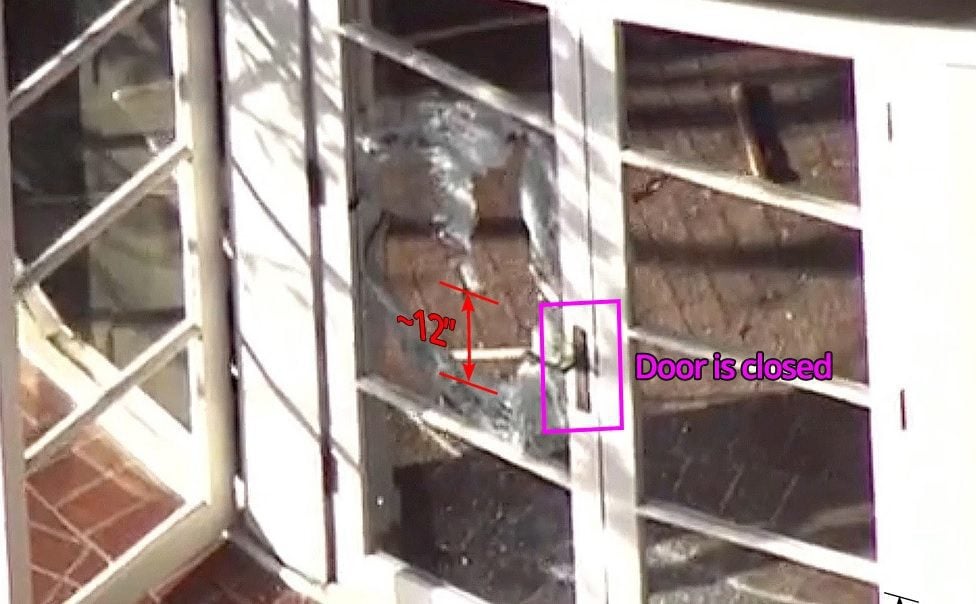
New evidence shows that there is no way that David DePape could have broken into the Pelosi house through the door in the back.
David DePape was identified by the police at the Pelosi home on early Friday morning at around 2:30 am. The police claim that he broke into the house. [https://www.thegatewaypundit.com/2022/10/breaking-exclusive-evidence-shows-david-depape-never-fit-hole-broken-window-rear-pelosi-home/]
The Mainstream media is trying to claim that David DePape is a conservative who broke into the Pelosi home in San Francisco in an attempt to assault the Speaker of the House, Nancy Pelosi. Nothing could be further from the truth.
As you now know, David DePape was found with Paul Pelosi early Friday morning at the Pelosi home by police in San Francisco. The mainstream media immediately tried to cover for the Pelosi family. They then attempted to align the man found with Paul Pelosi as a conservative. But it was all a lie…
… The site Godisloving.wordpress.com was shut down on Saturday. The other site listed, www.frenlyfrens.com/blog is no longer active as well. It too was shut down on Saturday. The only activity reported on the Wayback Machine on this site was on Friday and Saturday as well.
The Godisloving.wordpress.com website is registered via the same company DomainsByProxy that is listed on the CityVisions.com website at 1822 Shasta Street which is the address listed on FrenlyFrens website.
Advertisement – story continues below
Suffering from Yellow Teeth? This Good Bacteria Whiten Your Teeth (Watch)
Dental Health News
New Heated Vest is Going Viral in Us – Now 70% off
Sursell
One of the accounts mandated that you become a member but this functionality was not working on Friday morning per one of our sources.
It is unreasonable to believe that David DePape, who lived on the streets, was able to put together a website that mandates users create an account before they could enter his site.
So who created these websites? More shocking connections coming.
Nick Depape was not Paul Pelosi’s lover They were not in ‘just their underwear’ or ‘having sex’ when police arrived The right spreads vile conspiracy theories to distract from the fact that it incited a MAGA terrorist to try to assassinate the Speaker of the House #PelosiGate
Happens all the time, a guy in his tightie whities shows up, brings a hammer and runs into another guy with a hammer sporting his tightie whities. Clearly, your average MAGA attack. #Pelosigate
Funny how the actual 911 call stated Paul Pelosi said the attacker was named “David” and he was a “friend” – and now the police have suddenly changed the story to say they didn’t know each other. The actual 911 call doesn’t lie and can’t spin. How did Paul know his name?
If Paul Pelosi called the cops when his attacker let him use the bathroom, why didn’t he lock himself in there until the cops came? [https://twitter.com/hashtag/pelosigate]
Pray an Our Father now for reparation for the sins committed because of Francis’s Amoris Laetitia.
Pray an Our Father now for the restoration of the Church as well as the Triumph of the Kingdom of the Sacred Heart and the Immaculate Heart of Mary.
Stop for a moment of silence, ask Jesus Christ what He wants you to do now and next. In this silence remember God, Father, Son and Holy Ghost – Three Divine Persons yet One God, has an ordered universe where you can know truth and falsehood as well as never forget that He wants you to have eternal happiness with Him as his son or daughter by grace. Make this a practice. By doing this you are doing more good than reading anything here or anywhere else on the Internet.
Francis Notes:
– Doctor of the Church St. Francis de Sales totally confirmed beyond any doubt the possibility of a heretical pope and what must be done by the Church in such a situation:
“[T]he Pope… WHEN he is EXPLICITLY a heretic, he falls ipso facto from his dignity and out of the Church, and the Church MUST either deprive him, or, as some say, declare him deprived, of his Apostolic See.” (The Catholic Controversy, by St. Francis de Sales, Pages 305-306)
– LifeSiteNews, “Confusion explodes as Pope Francis throws magisterial weight behind communion for adulterers,” December 4, 2017:
The AAS guidelines explicitly allows “sexually active adulterous couples facing ‘complex circumstances’ to ‘access the sacraments of Reconciliation and the Eucharist.'”
– On February 2018, in Rorate Caeli, Catholic theologian Dr. John Lamont:
“The AAS statement… establishes that Pope Francis in Amoris Laetitia has affirmed propositions that are heretical in the strict sense.”
– On December 2, 2017, Bishop Rene Gracida:
“Francis’ heterodoxy is now official. He has published his letter to the Argentina bishops in Acta Apostlica Series making those letters magisterial documents.”
Pray an Our Father now for the restoration of the Church by the bishops by the grace of God.
What is needed right now to save America from those who would destroy our God given rights is to pray at home or in church and if called to even go to outdoor prayer rallies in every town and city across the United States for God to pour out His grace on our country to save us from those who would use a Reichstag Fire-like incident to destroy our civil liberties. [Is the DC Capitol Incident Comparable to the Nazi Reichstag Fire Incident where the German People Lost their Civil Liberties?: http://catholicmonitor.blogspot.com/2021/01/is-dc-capital-incident-comparable-to.html?m=1 and Epoch Times Show Crossroads on Capitol Incident: “Anitfa ‘Agent Provocateurs‘”: http://catholicmonitor.blogspot.com/2021/01/epoch-times-show-crossroads-on-capital.html?m=1]
Pray an Our Father now for the grace to know God’s Will and to do it.
Pray an Our Father now for America.
Pray an Our Father now for the restoration of the Church as well as the Triumph of the Kingdom of the Sacred Heart and the Immaculate Heart of Mary.SHARE
Posted inUncategorized|Comments Off on WILL WE EVER KNOW THE TRUTH; THE PLOT THICKENS?????????????????????????????????????
Nestled in West Virginia’s Shenandoah Valley, the town of Middleway boasts a ghost story that rivals the most famous haunted tales. What makes this haunting stand out is that it is a Catholic story—a tale of sacraments denied, vengeful spirits, a saintly Catholic priest, and the power of the Holy Sacrifice of the Mass. And the story of the “Wizard Clip” is not just a legend, for the evidence supporting its veracity led Cardinal Gibbons’ own private secretary, then the editor of the Catholic Review, to proclaim it the “truest ghost story ever told.”
Our story begins in 1794, when a stranger knocked on the farmhouse door of Mr. Adam Livingston, a Lutheran farmer, and asked for shelter. Late that night, the man took ill and begged for a priest. Livingston, deeply prejudiced against “papists,” declined the request, and the man died without the Last Rites and was buried in unconsecrated ground.
What followed next was attested to by dozens of Livingston’s neighbors, who kept physical records for the rest of their lives. The Livingston family was tormented night and day by horrifying sounds in the house as well as the frequent flinging of rocks and breaking of dishes and furniture. Their beds regularly caught fire in daytime. But what gives this haunting its unique name is the fact that invisible hands would regularly clip crescent-shaped holes into their clothes, saddles, and shoes. The clippings were small and regular. They looked as if they were done by machine, though those in the house could watch the clipping happen.
Fr. Demetrius Augustine Gallitzin, the “Apostle to the Alleghenies,” offered a firsthand account of the Wizard Clip. Fr. Gallitzin was no country bumpkin or easily impressed naïf: once he had been Prince Demetrius, a Russian aristocrat whose pedigree rivaled that of the Czar. His father, the Russian ambassador to Holland, was the close friend of Enlightenment thinkers Diderot and Voltaire. Prince Demetrius had future kings as playmates, and his tutors were elite European intellectuals.
But at age seventeen, Demetrius rejected rationalist atheism and embraced his mother’s Catholicism, taking the confirmation name of Augustine. Sent by his parents to travel the world as a prince, Demetrius horrified his father by obtaining permission from Bishop John Carroll to enter the new St. Mary’s Seminary in Baltimore.
ADVERTISEMENT – CONTINUE READING BELOW
By the time of the Wizard Clip, Fr. Gallitzin was serving as a missionary priest in Loretto, Pennsylvania, bringing with him his former tutor, Fr. Brosius, an accomplished scientist. Hearing of the haunting, Gallitzin traveled to Middleway to investigate. In a letter he wrote years later, Gallitzin noted, “I could not prevail upon myself to believe [the stories]; but I was soon converted to a full belief in them. No lawyer in a court of justice did ever examine or cross examine witnesses more strictly than I did all those I could procure.”
Writing a version of the story in his book A Letter to a Protestant Friend on the Holy Scriptures, Fr. Gallitzin recounted what happened next. At his wits’ end, Livingston sought divine aid:
The good old man reading in his Bible that Christ had given to his ministers power over evil spirits…with tears in his eyes, related to his minister the history of his distress, losses, and sufferings, [and] begged him to come to his house, and to exercise in his favor the power he had received from Jesus Christ. The parson candidly confessed that he had no such power. The good old man insisted that he must have that power, for he found it in his Bible. The parson replied that that power existed only in old times but was done away now.
ADVERTISEMENT – CONTINUE READING BELOW
Undeterred, Livingston searched for someone who did have such power. After many ministers failed to relieve him, he even turned to conjurors and those who claimed power over the devil. All failed. In despair, he determined that “Christ had no longer any true ministers on earth and those who pretended to be such were a set of imposters.”
It was then that Livingston received a dream. In it, he found himself toiling up a steep mountain. At the top, there was a magnificent church, and, standing in front of it, was a minister in strange robes. A voice spoke to him: “This is the man who will relieve you.”
An Italian neighbor, upon hearing the dream, told Livingston that only priests wore such robes. Livingston thus presented himself at Fr. Denis Cahill’s Mass, held in a nearby farmhouse. As the priest approached the altar, Livingston broke down weeping, recognizing the man from his dream. But when he begged the priest to come and exorcise the spirit from his home, Fr. Cahill laughed and said that it must be a neighbor playing tricks on him. However, he finally agreed to come and sprinkle Holy Water around the farmhouse.
ADVERTISEMENT – CONTINUE READING BELOW
Dozens of neighbors attested that, when Fr. Cahill was leaving the house, an invisible hand placed at his feet a purse of money that had gone missing from a locked drawer weeks before. For a time, the hauntings ceased. But then they returned with a vengeance. When Livingston begged Fr. Cahill to return, the Irishman wrote to Fr. Gallitzin to ask him to accompany him. The priests came and said Mass in Livingston’s home, praying for the soul of the departed stranger who had been denied the Last Rites. All destruction ceased from that point on.
But that is not the end of the story. Father Joseph Finotti assembled every witness account he could find in a book entitled The Wizard Clip in 1878, including testimony from neighbors and family members who had been children during the occurrences or who had heard the story from their parents. All attested to the fact that while the tormented haunting had ceased, it was replaced by the Voice—a beautiful voice that spoke to the family and certain neighbors for over seventeen years. The Voice, often accompanied by blinding, heavenly lights, instructed the Livingstons in the Catholic Faith and led them in daily Rosaries for the souls in Purgatory, waking them three times each night for prayer. The Jesuit brother Joseph Mobberly, writing an account in the 1820s, believed that Livingston had been examined by no less than Bishop Carroll himself, who was amazed at the knowledge this barely literate farmer had of the Faith.
There were physical manifestations from the Voice as well. For instance, at one point, a daughter was grumpily wondering why she had to pray for the souls in Purgatory because, she decided, it must not be too bad to be in Purgatory. Suddenly, a nearby towel bore a burnt but perfectly outlined handprint, the fabric in between each finger intact. The Voice told her that this was how the souls in Purgatory suffered. At another point, Livingston was out plowing when the Voice let him hear the wailing of the suffering souls longing for Heaven.
Livingston moved his family to Loretto to become Fr. Gallitzin’s parishioners, and he donated the Middleway farm to the use of the Church. The Voice had foretold that “before the end of time, that would be a great place for Prayer and Fasting.” For almost two centuries, it stood fallow, known as the “priest’s field,” until the diocese built a retreat center on the spot.
Continuing his account of the Wizard Clip in his letter to his protestant friend, Fr. Gallitzin commented that,
your minister would laugh very heartily if you should relate to him the above facts; for with the wise men of this enlightened age, he has peremptorily decided that miracles, etc., etc., are no longer necessary, and of course have ceased,—since when I did not learn; nor did I ever find any passage in Scripture which authorizes the belief that miracles should ever cease altogether, or that Evil Spirits should never have it any more in their power to molest the bodies, and the property of men, as they used to do during the lifetime of our Saviour, and after His Resurrection.
And what became of Fr. Gallitzin? This saintly priest wore himself out in the service of the Alleghenies and left behind a strong community of Catholics all throughout western Pennsylvania. He died May 6, 1840, and was buried in Loretto, Pennsylvania, where a basilica now stands over his grave. In 2005, Pope Benedict XVI bestowed upon him the title “Servant of God.”
Mary Cuff is an independent scholar, wife, and homeschooling mother. She holds a PhD in American literature from the Catholic University of America and has published in the Southern Literary Journal, Five Points, Mississippi Quarterly, and Modern Age.
Posted inUncategorized|Comments Off on DURING MY YEARS AS A MONK OF SAINT VINCENT ARCHABBEY IN LATROBE PENNSYLVANIA I BECAME AWARE OF THE IMPACT OF THE LIFE AND WITNESS OF FATHER (PRINCE) GALLITZIN ON CATHOLIC LIFE IN WESTERN PENNSYLVANIA WHICH CONTINUES EVEN TO THIS DAY
The General Secretariat of the Synod of Bishops issued the Working Document (WD) for the Continental Stage of the Synod for a Synodal Church last week. It unapologetically calls into question various Catholic doctrines under the guise of listening to the Holy Spirit who, remarkably, is somehow speaking through the complaints and criticisms of those who reject what the Church teaches and has always taught.
Contributions from around the world that contradict Catholic doctrine are cited or summarized with approval because “they express in a particularly powerful, beautiful or precise way sentiments expressed more generally in many reports.” (¶6) Those sentiments enjoy the presumption of Spirit-inspired truth while doctrines cause alienation and sorrow.
Remarks from an American parish group are emblematic: “The vision of a Church capable of radical inclusion, shared belonging, and deep hospitality according to the teachings of Jesus is at the heart of the synodal process: ‘Instead of behaving like gatekeepers trying to exclude others from the table, we need to do more to make sure that people know that everyone can find a place and a home here.’” (¶31) The WD further explains that “[t]he synodal experience can be read as a path of recognition for those who do not feel sufficiently recognized in the Church.” (¶32)
So who feels excluded? “Among those who ask for a more meaningful dialogue and a more welcoming space we also find those who, for various reasons, feel a tension between belonging to the Church and their own loving relationships, such as: remarried divorcees, single parents, people living in a polygamous marriage, LGBTQ people, etc.” (¶39) This even gets a second mention: “Many summaries also give voice to the pain of not being able to access the Sacraments experienced by remarried divorcees and those who have entered into polygamous marriages. There is no unanimity on how to deal with these situations” (¶94)
Who else is complaining? “After careful listening, many reports ask that the Church continue its discernment in relation to a range of specific questions: the active role of women in the governing structures of Church bodies, the possibility for women with adequate training to preach in parish settings, and a female diaconate. Much greater diversity of opinion was expressed on the subject of priestly ordination for women, which some reports call for, while others consider a closed issue.” (¶64)
The solution? “[The] conversion of the Church’s culture, for the salvation of the world, is linked in concrete terms to the possibility of establishing a new culture, with new practices and structures.” (¶60)
So how do we get there? “[W]alking together as the People of God requires us to recognize the need for continual conversion, individual and communal. On the institutional and pastoral level, this conversion translates into an equally continuous reform of the Church, its structures and style, in the wake of the drive for continuous ‘aggiornamento’…” (¶101)
The teaching of the Church, given to her by Christ, is the problem. The Church is being asked to seriously discuss discarding teachings that contradict the beliefs and desires of :
– those living in adulterous second “marriages,” – men who have two or three or more wives, – homosexuals and bisexuals – people who believe they are not the sex they were born as – women who want to be ordained deacons and priests, – lay people who want the authority given by God to bishops and priests.
Does anything here strengthen or promote fidelity to Christ’s teachings? Of course not. It’s about changing the Church.
*
Someone from the UK made the most pertinent comment in the entire document: “I distrust the Synod. I think it has been called to bring about further change to Christ’s teachings and wound his Church further.” (¶18)
In the next phase of this self-destructive social process – the Continental Assemblies scheduled for early 2023 – the world’s bishops are instructed that :
all Assemblies be ecclesial and not merely episcopal, ensuring that their composition adequately represents the variety of the People of God: bishops, presbyters, deacons, consecrated women and men, laymen and women. . . .it is important to pay special attention to the presence of women and young people (laymen and laywomen, consecrated men and women in formation, seminarians); people living in conditions of poverty or marginalization, and those who have direct contact with these groups and persons; fraternal delegates from other Christian denominations; representatives of other religions and faith traditions; and some people with no religious affiliation. (¶108)
Given this list, the bishops will be a minority.
And their role? “[T]hey are asked to identify appropriate ways to carry out their task of validating and approving the Final Document, ensuring that it is the fruit of an authentically synodal journey, respectful of the process that has taken place and faithful to the diverse voices of the People of God in each continent.” (¶108) (Emphasis added)
In other words, bishops are to function as recording secretaries. They’re not advised to ensure the fidelity of the assembly to Church teaching.
The WD calls for the Church to operate with “transparency.” (¶79) A good place to begin would be for the Synod Secretariat to publish all the written submissions received. Did any, for instance, lament: the loss of faith in the Real Presence of Christ in the Eucharist; the lack of priestly vocations in the developed world; the steep decline in Mass attendance, baptisms, and church weddings; the scandal of bishops and cardinals repeatedly contradicting Church teaching in public; the loss of Catholic faithful to evangelical churches; the collapse of the Catholic school system in the developed world; the widespread phenomenon of liturgical abuses while the celebration of the Traditional Latin Mass is harshly curtailed or even forbidden; the collapse of religious orders due to secularization and the rejection of doctrinal fidelity and ascetical living.
There is plainly an open revolution going on in the Church today, an attempt to convince us that an embrace of heresy and immorality is not sinful, but rather a response to the voice of the Holy Spirit speaking through people who feel marginalized by a Church that has, up to now, been unfaithful to its mission.
The WD states: “To use a biblical image, one could say that the synodal journey marked the first steps of the return from an experience of collective exile, the consequences of which affect the entire People of God: if the Church is not synodal, no one can really feel fully at home.” (¶24)
Let’s pray that the Synod Fathers, and all the bishops, will stand up and defend the Church’s teaching and practice against this Vatican-sponsored exercise in self-destructive behavior. Souls are at stake.
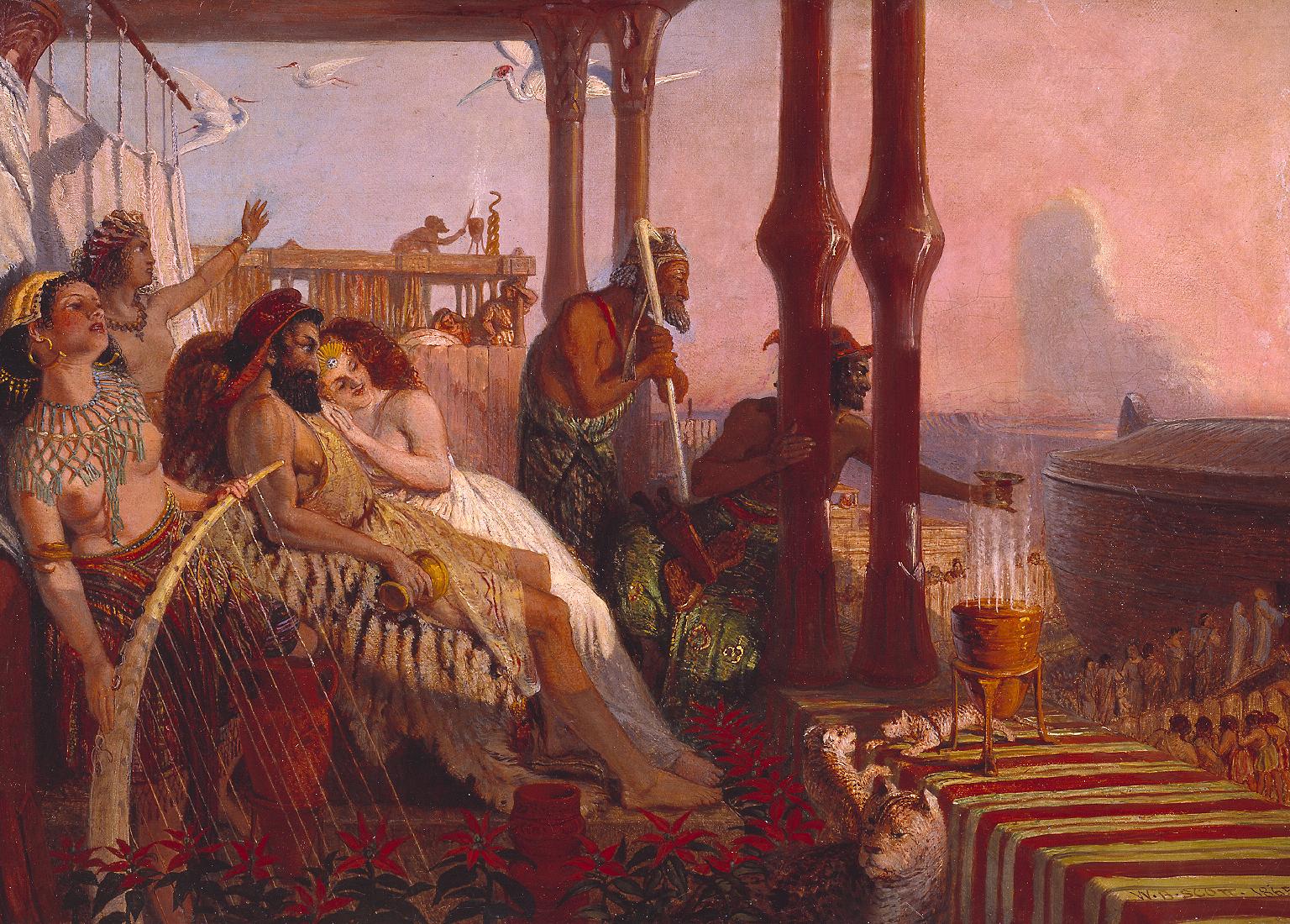
*Image:The Eve of the Deluge by William Bell Scott, 1865 [The Tate, London]. A “debauched eastern prince and his court with Noah and his family who, only too aware of the significance of the ominous cloud in the sky, are entering the Ark.”
As of October 21, Italy has a new government: the best possible government at the worst historical moment since the birth of the Italian Republic in 1946.
What does it mean, the best possible government? It means that since politics is the art of the possible, those who govern cannot constitute an ideal government, but only that which reality permits. Giorgia Meloni has had to take into account the international and European context, which leaves very little autonomy to our country, because nation-states, after Maastricht, have been stripped of much of their sovereignty.
The premier must also keep in mind the media firepower of the so-called strong powers and the driving forces within a center-right coalition made up of different political souls. Like any man of politics, she can do what is concretely possible, while not forsaking a few basic principles that guide her.
And this appears to be the best government among those possible, because it is the first right-wing and conservative government of the Italian Republic since its foundation.
Silvio Berlusconi, who deserves a great deal of credit for having stopped the rise of communism in Italy in 1994, was and is a liberal in the European sense of the term, but he has always defined himself as a man of the center, rather than a conservative.
Giorgia Meloni is a woman of the right, in 2020 she was made president of the European Conservatives, a group whose cornerstones are the defense of the sovereignty of nation-states, the control of illegal immigration, freedom from arbitrary and oppressive taxation, the rejection of ideologies such as that of gender.
This grouping includes the Law and Justice party (PiS) that governs Poland. And everything leads one to think that Giorgia Meloni will follow, in terms of international policy, the approach of Polish Prime Minister Mateusz Morawiecki rather than that of Hungarian Prime Minister Viktor Orbán. “We will not give in to Putin’s blackmail,” she said amid applause in the October 25 speech with which she won the confidence vote in the Chamber of Deputies.
In her first speech as premier, Giorgia Meloni condemned Nazism, fascism, and racial laws, and presented a vision of society founded on the values of the Western and European tradition: “We are the heirs of St. Benedict, an Italian, the principal patron of the whole of Europe.”
Businesses and families are at the center of Giorgia Meloni’s platform/manifesto. Businesses will get more help through tax cuts and support for investments aimed at the country’s economic development.
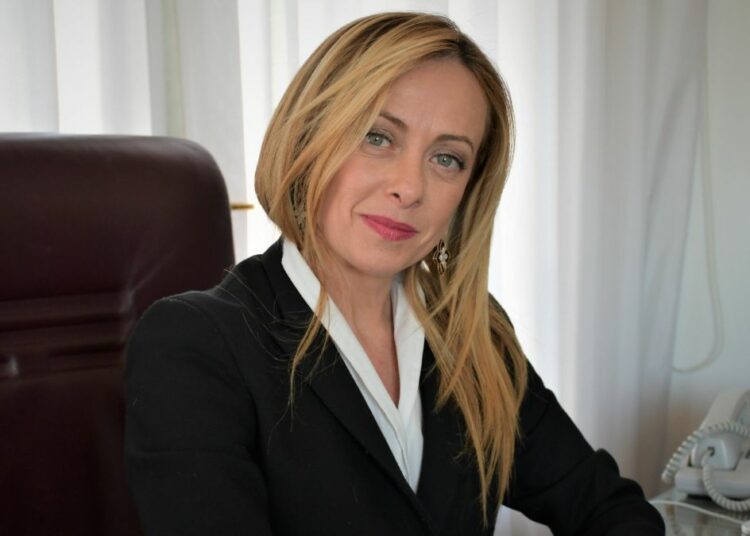
Prime Minister Giorgia Meloni
The family, she says, represents the “core of our societies, the cradle of the affections and the place where the identity of each one of us is formed. Therefore, we intend to support and protect it and, with this, to support childbearing, which in 2021 recorded the lowest birth rate from the unification of Italy until today, in order to emerge from the population freeze.”
On immigration, she stated that the government wants to stop illegal departures and break the chain of human trafficking in the Mediterranean.
On the environment, she maintained that “there is no more convinced ecologist than a conservative; but what distinguishes us from a certain ideological environmentalism is that we want to defend the nature that has man in it.”
Giorgia Meloni quoted a phrase of Roger Scruton’s, “one of the greatest masters of European conservative thought,” according to whom “ecology is the most vivid example of the alliance between those who are here, those who have been here, and those who will come after us.” “Protecting our natural heritage,” she added, “is no less a duty for us than is the safeguarding of our heritage of culture, traditions, and spirituality, which we have inherited from our fathers in order that we might pass it on to our children.”
The new Italian premier concluded her speech with these words:
The day our government took its oath before the head of state was the liturgical memorial of John Paul II, a pontiff, a statesman, a saint whom I had the honor of knowing personally. He taught me something fundamental that I have always treasured. ‘Freedom,’ he used to say, “does not consist in doing what we please, but in having the right to do what must be done.” I have always been a free person, I will always be a free person, and for this reason I intend to do precisely what I must do.
This government, however, finds itself facing a dramatic situation. Italy and the West have been at war since February 24, 2022. A hybrid war, but a real one, which has not yet reached its peak, and which could have serious repercussions not only in the military theater but also within individual nations, threatening the social fabric that ensures their survival and setting off phenomena of protest, even violence.
But the political and economic catastrophe that is threatening Europe as a result of the Russian invasion of Ukraine, even before the geopolitical reasons, has its ultimate roots in the abandonment of the natural and Christian order on the part the West. The conflagration of war appears to be only the latest outcome of a historical process with cultural and moral origins.
It must be said that without special help from God a change of course appears humanly impossible. This help is obtained with prayer, which allows us to obtain the grace to follow the natural law.
The mission of the Church and of the Vicar of Christ on earth is this and no other: to recall the saving truths that the world ignores or despises. Paraphrasing Saint Alphonsus Maria de Liguori, who said “he who prays is saved, he who does not pray is damned,” it’s worth repeating that when a nation returns to the natural and Christian order, it rises again. When it moves away from this, it plunges into chaos.
This is the fundamental crossroads before which the new Italian government finds itself, to which we extend our best wishes, assuring it of our prayers.
In Part 3 of John-Henry Westen’s interview with Bishop Athanasius Schneider, the bishop encouraged traditional faithful to stay strong in the faith, even under conditions of persecution since the publication of the apostolic letter Traditionis Custodes.
(LifeSiteNews) — In Part 3 of John-Henry Westen’s interview with Bishop Athanasius Schneider, the bishop encouraged traditional faithful to stay strong in the faith, even under conditions of persecution since the publication of the apostolic letter Traditionis Custodes. He trusts that the fidelity of these Catholics will “bring many fruits” to the Church.
John-Henry Westen asked the auxiliary bishop of Kazakhstan what a life in the underground of the Church might look like. Here Bishop Schneider referred back to the fourth century, where there was once a situation where “the majority [of bishops] persecuted true Catholics who kept the tradition of faith in the divinity of Jesus Christ, the Son of God.” These Catholics, he went on to say, “were expelled” and had to go to “open air Masses.”
The Kazakh bishop drew then a parallel to today, “where people are cast out literally from the parish churches where they had, for several years, the traditional Latin Mass approved by Pope Benedict XVI and by the local bishops.”
These traditional Catholics of today are now “forced to seek new places of worship, gyms, schools or halls and so on,” he explained, comparing this situation with “a kind of catacomb situation,” even though so far these Catholics are still able to have public Masses outside of official church structures.
For Bishop Schneider, these new measures in the wake of Traditionis Custodesrepresent an “unjust treatment of these Catholics in our day by the Vatican, by the Pope Francis orders, and by the bishops.”
But at the same time, such a persecution has “in the history of the Church brought many blessings and strengthened more the faith of these people,” the bishop of German descent is convinced. The “fidelity of these faithful,” he added, is “bringing many fruits for the entire Church.”
The prelate then touched upon the important question of obedience, which he just recently elaborated in a text published by LifeSite: There exists, according to Saint Thomas Aquinas, a “limited obedience.” That is to say, “when the pope or the bishops are commanding something which will evidently undermine the fullness of the Catholic faith and the fullness of the Catholic liturgy … we are harming the entire Church. We are decreasing the good of the Church, the spiritual good of the Church. We are decreasing the good of our souls. And here we cannot collaborate.”
In such cases where the faith is at stake, “we are even obliged — not only we can, in some occasions, we must — to say to the Holy Father, to the bishop: ‘With all due respect and love for you, we cannot execute these orders which you are giving because they are harming the good of our Holy Mother Church.’”
In such a case, the prelate explained, we have to “be in some way formally disobedient, but in fact we will be obedient to our Holy Mother Church, which is greater than a singular pope.”
“We are obedient to the popes of all ages who promoted, defended, protected the purity of Catholic faith, unconditionally, uncompromisingly, and who defended also the sacredness and the unchanging liturgy of the holy Mass through the centuries,” he said. Later in the discussion, Bishop Schneider added that the traditional Sacraments are part of this good to be defended.
In a similar vein, when speaking about the current promotion of the LGBT agenda within the Catholic Church, Cardinal Gerhard Müller, the former Prefect of the Congregation for the Doctrine of the Faith, has also declared that “one does not have to obey an obviously heretical bishop just for reasons of formal fidelity,” adding that disobedience can be justified when related “strictly to the revealed truth.”
SUBSCRIBE TO OUR DAILY HEADLINES US Canada Catholic
John-Henry Westen inquired how priests who adhere to the traditional Roman rite of the Mass and of the sacraments are to act, since they are even more bound to their bishops by the law of obedience than lay faithful.
Calling it a “delicate question,” the prelate explained that it “touches the conscience of these priests. It could be a different answer for every priest.” Some might obey and abandon the traditional Mass, for the sake of remaining in the official structures of the Church. But another option, according to Schneider, “which would be also legitimate,” would be to disobey the bishop and “continue to celebrate the traditional Mass and the sacraments … in a clandestine way or in an official, maybe non-approved way.”
Bishop Schneider insisted that this would only be “a temporary solution.” These priests, moreover, would “have to keep nevertheless their love for their bishop who persecutes them” and pray both for the bishop and the pope in Rome.
Asked by John-Henry Westen as to whether this emergency situation would soon be solved by the election of a good pope, the bishop answered that we do not know God’s time, that “God knows already when He will give again to His Church a strong, hundred percent traditional Catholic Pope.” He insisted that, except for a few popes, all popes, beginning with Saint Peter, were 100% traditional, since “this is inherent to the nature of the papal office to be really 100% a traditional defender of the faith and the sacredness of the holy liturgy.”
Bishop Schneider encouraged the faithful to pray, even in the form of a “world-wide chain of prayers, of rosaries,” to implore God quickly “to grant the Church a true, strong, courageous Catholic pope.”
In case you missed them, watch Part I and Part II of Bishop Schneider’s powerful and important interview on The John-Henry Westen Show.
Dr. Maike Hickson was born and raised in Germany. She holds a PhD from the University of Hannover, Germany, after having written in Switzerland her doctoral dissertation on the history of Swiss intellectuals before and during World War II. She now lives in the U.S. and is married to Dr. Robert Hickson, and they have been blessed with two beautiful children. She is a happy housewife who likes to write articles when time permits.
Dr. Hickson published in 2014 a Festschrift, a collection of some thirty essays written by thoughtful authors in honor of her husband upon his 70th birthday, which is entitled A Catholic Witness in Our Time.
Hickson has closely followed the papacy of Pope Francis and the developments in the Catholic Church in Germany, and she has been writing articles on religion and politics for U.S. and European publications and websites such as LifeSiteNews, OnePeterFive, The Wanderer, Rorate Caeli, Catholicism.org, Catholic Family News, Christian Order, Notizie Pro-Vita, Corrispondenza Romana, Katholisches.info, Der Dreizehnte, Zeit-Fragen, and Westfalen-Blatt.
TOPICS
Posted inUncategorized|Comments Off on Bp. Schneider: ‘Fidelity’ of persecuted Latin Mass Catholics will bring ‘many fruits to the entire Church’
Bp. Schneider: ‘Fidelity’ of persecuted Latin Mass Catholics will bring ‘many fruits to the entire Church’
In Part 3 of John-Henry Westen’s interview with Bishop Athanasius Schneider, the bishop encouraged traditional faithful to stay strong in the faith, even under conditions of persecution since the publication of the apostolic letter Traditionis Custodes.
(LifeSiteNews) — In Part 3 of John-Henry Westen’s interview with Bishop Athanasius Schneider, the bishop encouraged traditional faithful to stay strong in the faith, even under conditions of persecution since the publication of the apostolic letter Traditionis Custodes. He trusts that the fidelity of these Catholics will “bring many fruits” to the Church.
John-Henry Westen asked the auxiliary bishop of Kazakhstan what a life in the underground of the Church might look like. Here Bishop Schneider referred back to the fourth century, where there was once a situation where “the majority [of bishops] persecuted true Catholics who kept the tradition of faith in the divinity of Jesus Christ, the Son of God.” These Catholics, he went on to say, “were expelled” and had to go to “open air Masses.”
The Kazakh bishop drew then a parallel to today, “where people are cast out literally from the parish churches where they had, for several years, the traditional Latin Mass approved by Pope Benedict XVI and by the local bishops.”
These traditional Catholics of today are now “forced to seek new places of worship, gyms, schools or halls and so on,” he explained, comparing this situation with “a kind of catacomb situation,” even though so far these Catholics are still able to have public Masses outside of official church structures.
For Bishop Schneider, these new measures in the wake of Traditionis Custodesrepresent an “unjust treatment of these Catholics in our day by the Vatican, by the Pope Francis orders, and by the bishops.”
But at the same time, such a persecution has “in the history of the Church brought many blessings and strengthened more the faith of these people,” the bishop of German descent is convinced. The “fidelity of these faithful,” he added, is “bringing many fruits for the entire Church.”
The prelate then touched upon the important question of obedience, which he just recently elaborated in a text published by LifeSite: There exists, according to Saint Thomas Aquinas, a “limited obedience.” That is to say, “when the pope or the bishops are commanding something which will evidently undermine the fullness of the Catholic faith and the fullness of the Catholic liturgy … we are harming the entire Church. We are decreasing the good of the Church, the spiritual good of the Church. We are decreasing the good of our souls. And here we cannot collaborate.”
In such cases where the faith is at stake, “we are even obliged — not only we can, in some occasions, we must — to say to the Holy Father, to the bishop: ‘With all due respect and love for you, we cannot execute these orders which you are giving because they are harming the good of our Holy Mother Church.’”
In such a case, the prelate explained, we have to “be in some way formally disobedient, but in fact we will be obedient to our Holy Mother Church, which is greater than a singular pope.”
“We are obedient to the popes of all ages who promoted, defended, protected the purity of Catholic faith, unconditionally, uncompromisingly, and who defended also the sacredness and the unchanging liturgy of the holy Mass through the centuries,” he said. Later in the discussion, Bishop Schneider added that the traditional Sacraments are part of this good to be defended.
In a similar vein, when speaking about the current promotion of the LGBT agenda within the Catholic Church, Cardinal Gerhard Müller, the former Prefect of the Congregation for the Doctrine of the Faith, has also declared that “one does not have to obey an obviously heretical bishop just for reasons of formal fidelity,” adding that disobedience can be justified when related “strictly to the revealed truth.”
SUBSCRIBE TO OUR DAILY HEADLINES US Canada Catholic
John-Henry Westen inquired how priests who adhere to the traditional Roman rite of the Mass and of the sacraments are to act, since they are even more bound to their bishops by the law of obedience than lay faithful.
Calling it a “delicate question,” the prelate explained that it “touches the conscience of these priests. It could be a different answer for every priest.” Some might obey and abandon the traditional Mass, for the sake of remaining in the official structures of the Church. But another option, according to Schneider, “which would be also legitimate,” would be to disobey the bishop and “continue to celebrate the traditional Mass and the sacraments … in a clandestine way or in an official, maybe non-approved way.”
Bishop Schneider insisted that this would only be “a temporary solution.” These priests, moreover, would “have to keep nevertheless their love for their bishop who persecutes them” and pray both for the bishop and the pope in Rome.
Asked by John-Henry Westen as to whether this emergency situation would soon be solved by the election of a good pope, the bishop answered that we do not know God’s time, that “God knows already when He will give again to His Church a strong, hundred percent traditional Catholic Pope.” He insisted that, except for a few popes, all popes, beginning with Saint Peter, were 100% traditional, since “this is inherent to the nature of the papal office to be really 100% a traditional defender of the faith and the sacredness of the holy liturgy.”
Bishop Schneider encouraged the faithful to pray, even in the form of a “world-wide chain of prayers, of rosaries,” to implore God quickly “to grant the Church a true, strong, courageous Catholic pope.”
In case you missed them, watch Part I and Part II of Bishop Schneider’s powerful and important interview on The John-Henry Westen Show.
Dr. Maike Hickson was born and raised in Germany. She holds a PhD from the University of Hannover, Germany, after having written in Switzerland her doctoral dissertation on the history of Swiss intellectuals before and during World War II. She now lives in the U.S. and is married to Dr. Robert Hickson, and they have been blessed with two beautiful children. She is a happy housewife who likes to write articles when time permits.
Dr. Hickson published in 2014 a Festschrift, a collection of some thirty essays written by thoughtful authors in honor of her husband upon his 70th birthday, which is entitled A Catholic Witness in Our Time.
Hickson has closely followed the papacy of Pope Francis and the developments in the Catholic Church in Germany, and she has been writing articles on religion and politics for U.S. and European publications and websites such as LifeSiteNews, OnePeterFive, The Wanderer, Rorate Caeli, Catholicism.org, Catholic Family News, Christian Order, Notizie Pro-Vita, Corrispondenza Romana, Katholisches.info, Der Dreizehnte, Zeit-Fragen, and Westfalen-Blatt.
Posted inUncategorized|Comments Off on STAY STRONG IN THE FAITH EVEN IN THE FACE OF PERSECUTION FROM THE ‘SHEPHERDS’ OF THE CHURCH
Twenty years ago, a week before the fortieth anniversary of the opening of Vatican II, Mr George Weigel, a great admirer of that assembly, wrote an assessment of it for, of all publications, the National Catholic Reporter. The basic thrust of his column is simple: a reading of Vatican II as a power struggle within the Church is incorrect. He does not deny that the Church has collectively “got(ten) Vatican II wrong” in many ways, and did so “by thinking of it chiefly in terms of church politics.” But in “the council’s masterwork,” Lumen Gentium, we see that “(t)he universal call to holiness, not the struggle for ecclesiastical power, was the central motif of Vatican II.” This is both true and a good thing to say, especially in a publication so deeply invested in reading Vatican II and its aftermath as a series of power struggles: of bishops against an overcentralized papacy and curia; of heretical theologians against bishops; and ultimately, of Modern Man™ against the Faith once delivered to the Saints.
But twenty years ago, Mr Weigel was still able to entertain some doubts as to the ultimate fate of Vatican II in the Church’s life, and he goes on to say:
I’ve been much struck recently by the question of whether, in the mid-third millennium, Vatican II will be remembered as another Lateran V or another Trent. Lateran V was a reforming council that failed; Trent was a reforming council whose success defined Catholic life for almost four centuries. Lateran V’s failure was one cause of the fracture of Western Christianity in the Reformation – and thus of the wars of religion, the rise of the modern state, and the gradual erosion of Christian culture in Europe. Getting it wrong, in this business of conciliar reform, can carry high costs.
With all due respect, this question was put incorrectly. By its 40th anniversary, Vatican II was already neither another Lateran V nor another Trent.
Trent began in 1545, which puts its fortieth anniversary in 1585. By that point, the Church had already made huge strides in implementing the reforms which it had ordered, and the movement to continue doing so was gaining strength every day, with the strong leadership and support of the Papacy. The spread of Protestantism had been checked in much of Europe, and reversed in some places; the evangelization of the New World was proceeding apace. New religious orders such as the Jesuits and Oratorians were thriving and spreading, and inspiring the older ones to highly successful reforms. The model of Counter-Reformation bishops, St Charles Borromeo, was still alive, and a leading figure in the implementation of the Council’s decrees.
It hardly needs saying that forty years out from Vatican II, the Church was not thriving as it was in 1585.
On the other hand, the fortieth anniversary of Lateran V occurred in 1552… smack in the middle of the Council of Trent. Forty years after Lateran V had failed so spectacularly to bring about any of the reform that the Church so desperately needed (and by so failing, had helped to trigger the Reformation), the Church did not content itself with monomaniacal repetition of the catchphrase, “You have to accept Lateran V!”, while ignoring the fact that everything was burning down around it. Rather, it recognized that its previous feint at reform had failed catastrophically, and set about at Trent to do well what it had done badly at Lateran V.
It hardly needs saying that forty years out from Vatican II, the Church wasn’t doing this either.
The truest parallel with Vatican II to be found among the ecumenical councils is that of Constance (1414-18), the highwater mark of the Conciliarist movement, which taught that the ecumenical council as an institution is superior in authority to the Pope. (i.e., a power-struggle: so ironic…) A wave of enthusiasm for something new, something which everyone hopes will bring great benefit to the Church, is quickly followed by a sudden and almost inexplicable dissipation of that enthusiasm. Just as the bishops who attended Constance did not bother to attend the next council which they themselves had called for, the bishops who wrote (with their periti) and approved the documents of Vatican II seemed afterwards to care little or nothing for what they had written.
Weigel himself acknowledges as much in the same column.
I never seriously read the texts of Vatican II until the mid-1970s, despite eight years in high school and college seminary and two years of graduate studies in theology. I don’t think I was alone in this. [No, he most certainly wasn’t.] In those days, one read about the council … (but) one didn’t wrestle with the texts of the council itself.
I have yet to see a convincing explanation of why I or anyone else should show an enthusiasm for the texts of Vatican II which their own authors never showed, but Mr Weigel’s enthusiasm for them, at any rate, knows no abatement.
When Vatican II Turned Fifty
Ten years after the aforementioned column, it was time to commemorate the council’s golden anniversary; the venue changed to an incommensurably more Catholic publication, First Things, and so did the tack. In a very brief article, he notes (how could one not?) that “Vatican II is sometimes imagined to be an example of ecclesiastical parthenogenesis: the Council just happened, absent significant antecedents, in a decisive rupture with the past.” But this imagining is incorrect: Popes since Leo XIII, he tells us, had been coming to grips with modernity, and Vatican II was, or was supposed to be, the culmination of this engagement.
However, the future reception of Vatican II is no longer to be understood by looking at any previous council.
[It] was like no other ecumenical Council in history, in that it did not provide authoritative keys for its own interpretation: the Council Fathers wrote no creed, condemned no heresy, legislated no new canons, defined no dogmas. Thus the decade and a half after the Council ended on December 8, 1965, was a bit of a free-for-all, as varying interpretations of the Council (including appeals to an amorphous ‘spirit of Vatican II’ that seems to have more in common with low-church Protestantism than with Catholicism) contended with each other in what amounted to an ecclesiastical civil war.
Just “a bit of a free-for-all,” he writes, like a British general of a sang particularly froid describing the Second World War. (Fifty years from the opening of Lateran V, by the way, brings us to the opening of the third and final session of Trent; fifty years from the opening of Trent, and Rome is getting ready to celebrate its second Jubilee of the Counter-Reformation.) Why the free-for-all? Because the Council “did not provide authoritative keys for its own interpretation.” Is it cynical to ask whether this was really a wise procedure for a body whose very raison-d’être is to bring much needed clarity to the Church?
Never fear. The free-for-all is over, because
Providence raised up two men of genius, John Paul II and Benedict XVI… to give Vatican II an authoritative interpretation (and) the truth about the Council. … Vatican II did not displace the Church’s tradition. Vatican II did not create do-it-yourself-Catholicism.
What a relief.
When Vatican II Turned Sixty
Now, another ten years have passed, and any doubts Mr Weigel might once have entertained about the place of Vatican II in the Church’s future life have evaporated as thoroughly as… well, as thoroughly as the enthusiasm of the world’s bishops for Vatican II did after December 8, 1965. In a recent column for the Wall Street Journal, he brands it “the most important Catholic event in half a millennium.” From the Council’s own starting date, that brings us back to 1462, fifty years before Lateran V began; from our present year, back to 1522, five years after Lateran V ended and the Protestant Reformation began. Were it not for the previous assurance that Vatican II is like no other council, and historical parallelism thus dismissed, some might find this worrisome.
It is no longer a question of whether Vatican II will be seen in the future as a successful council like Trent or a failed one like Lateran V. The title of the column, published in advance of a book on the subject released one week before the anniversary, is simply “What Vatican II Accomplished.” As in “Mission Accomplished”?
What a relief.
The sub-header, however, does not briefly summarize these achievements, but like the column itself, brings in the boogeymen, assuring us that “progressives and nostalgic traditionalists” have misunderstood the Council. Vatican II turns out to be as singularly unlucky in its application as socialism, communism, and the other disgusting -isms of the 20th century which it so conspicuously failed to condemn. “If only we had REAL socialism…”
If the job of a sub-header is to summarize a column, John Daniel Davidson of the Federalistwrote this sentence about this column that would have served the purpose far better. “Every positive development in Catholicism since 1965 is because of Vatican II; every distortion or pathology is a misapplication of Vatican II.”
For we are assured by Weigel that
From his historical studies and pastoral experience, John XXIII knew that the defensive Catholicism of the Counter-Reformation, however successful a salvage operation, had run its course. It was time to raze the bastions that Catholicism had erected and turn its robust institutions into platforms for evangelization and mission in order to engage a deeply troubled modern world.
And in brief, despite whatever difficulties the Church may be undergoing right now, or may have been undergoing for the last several decades, this is what the Council has purportedly achieved.
The Pope of the Council
This is one of 19 mentions of Pope John by name, in a column of just under 2100 words, which is an average of about one every 110 words. The unknowing reader might be forgiven for getting the impression that the Council itself was actually his work and faithful to his intentions. But Weigel himself knows this to be untrue, and carefully describes those intentions in the conditional mood:
In his opening address to Vatican II, John XXIII suggested how ecclesiastical renewal would take place. … the Church would develop the means to express ancient and enduring truths in ways that modernity could hear. … his hope that Vatican II would be a ‘new Pentecost.’
By this sleight of hand, the Pope who called Vatican II becomes something like a large, disembodied head, floating above the floor and loudly proclaiming, “I! AM!! JOHN!!! The great and powerful!” Wicked, nostalgic traditionalists, get away from that curtain…
Missing from this and so many other discourses about the reception of the Council and its purported achievements is Paul VI, the Pope in whose reign all of the Council’s documents were promulgated, and who, by his action and inaction over the years that followed it, “implemented” it in ways that thoroughly betrayed those documents, and the intentions of Pope John. Even twenty years ago, when the future reception of Vatican II was still a matter of uncertainty, he merited from Weigel no more than a passing mention in reference to his 1965 visit to the U.N., (an institution which constitutes one of the most conspicuous among Modern Man™’s great and ghastly political failures). By the fiftieth anniversary, he had been thrown down the memory hole. Did the decade and a half which Mr Weigel describes as a “bit of a free-for-all” after the end of Vatican II happen to coincide with anything in particular?
Get away from that curtain!
Now, at the sixtieth anniversary, in telling us “What Vatican II Accomplished,” Mr Weigel gives us not a hint of who specifically steered it towards its accomplishments. We must not think of Vatican II as an instance of “ecclesiastical parthenogenesis,” but we are left free to think of its documents as products of spontaneous generation, without father, without mother, and without genealogy.
To rehearse these “achievements” in detail would be as unbearably tedious for you to read as it would be for me to write. I will therefore limit myself to commenting on the first which Mr Weigel enumerates, one which happily coincides with my own area of interest and, such as it is, expertise.
He tells us that “After Vatican II, Catholics worshiped in their own languages, rather than in Latin.” But he does not tell us that the general post-Conciliar abandonment of Latin happened in direct contradiction of the Apostolic Constitution Veterum Sapientia, which John XXIII promulgated eight months before Vatican II: an “achievement,”in Weigel’s presentation, “without father.”
He does not tell us that the all-vernacular liturgy was brought about in direct contradiction to Sacrosanctum Concilium, the Council’s Constitution on the Sacred Liturgy, which states that the use of Latin was to be preserved in the liturgy.
“Without mother.”
He does not tell us that when a Sicilian bishop urged the Council Fathers to be cautious about accepting liturgical use of the vernacular, lest a partial permission turn into a Mass with no Latin at all, there was a brief pause, followed by an explosion of laughter, so absurd did the very idea seem to them.
He does not tell us that the Council’s other fifteen documents contain only one brief mention of Latin, precisely because it was taken for granted that Veterum Sapientia had fully dealt with the subject, and there was no need to say any more. Nor indeed could any of them have imagined that any Pope would so cavalierly ignore such an act of his predecessor.
On November 26, 1969, at the last general audience before the promulgation of the Novus Ordo, Paul VI informed the Church that although Latin would no longer be the principal language of the Mass, it would “remain as the means of teaching in ecclesiastical studies and as the key to the patrimony of our religious, historical and human culture. If possible, it will reflourish in splendor.” Mr Weigel does not tell us that that is exactly what John XXIII ordered in Veterum Sapientia, or that none of that happened either.
“Without genealogy.”
As a segue, he tells us that the Council “urg(ed) Catholics to become more biblically literate.” He does not tell us that the Holy See under Paul VI stayed mostly silent as Catholic Biblical scholars introduced all the most fatuous excesses of modern Biblical scholarship into Catholic seminaries and schools, from which they slithered down into sermons and catechism classes. Nor are we told that the revised lectionary of the post-Conciliar Mass routinely censors and violently misrepresents the word of God. Vatican II’s Dogmatic Constitution on Divine Revelation Dei Verbum says that “with maternal concern, the Church sees to it that suitable and correct translations are made into different languages,” but we are not told that the official translation used for the Biblical readings at Mass in the United States is the “colorless, odorless, gaseous paraphrase” known as the New American Bible, nor that it is full of the most gruesome errors.
Sad tales of this sort can and have been told repeatedly about every aspect of the Church’s life over the last 60 years, and they all amount to pretty much the same thing.
The Church lives as it lives now very largely because Paul VI rejected and did not fulfill the will of the Second Vatican Council.
Twenty years ago, Weigel’s rhetorical combination of suppressio veri and suggestio falsi did perhaps serve a legitimate function, not as history or theology, but as propaganda.[1] It encouraged us to believe in one possible understanding of Vatican II, of how it ought to have been implemented, and the prior implementation of it corrected. Whatever the flaws of this understanding may have been, it was certainly better than Paul VI’s. As a priest friend of mine put it to me in mid-2013, “the background radiation (in the Church) was dying down.” St John Paul II and Benedict XVI unquestionably deserve a great deal of the credit for that. Ten years ago, the last full year of Benedict’s reign, it was fully plausible that their far healthier version of Vatican II might prevail, and the worst excesses of the Paul VI years would simply fade into the past and be gently, deservedly forgotten.
Revolution Reborn
But this was before the election of Francis, a man of a very different spirit, who has canonized John XXIII, Paul VI, and John Paul II, but revived the ghost of only one of them. The first Pope to never serve as a priest in the Church as it was before the Montinian revolution is committed to that revolution as Papa Montini himself never was. That brings with it a commitment to a violent, revolutionary interpretation of Vatican II, and all that goes with it: the power struggles which Weigel rejected twenty years ago, the “ecclesiastical parthenogenesis” which he rejected ten years ago, and many other interpretations of Vatican II which he deems inauthentic.
I would be utterly remiss were I not to say that Catholics ought to be sincerely grateful to Mr Weigel for speaking out against this as he has in recent times. Despite no evident fondness for the traditional Roman liturgy, he rightly decried the “Liberal Authoritarianism” of Traditionis Custodes, and rightly branded it “theologically incoherent, pastorally divisive, unnecessary, cruel – and a sorry example of the liberal bullying that has become all too familiar in Rome recently.” When the responses to the so-called dubia about TC followed, he pointed out the absurdity of “Undercutting Vatican II to Defend Vatican II” by issuing orders to the bishops wholly contrary to the spirit of Lumen Gentium. He has repeatedly denounced the de facto revival of Paul VI’s Ostpolitik in the Vatican’s current dealings with the single most murderous organization in human history, the Chinese Communist Party. He has called the recent developments in the Pontifical Academy for Life a second assassination attempt against John Paul II.
And this is all to the good.
As important as these matters are, however, they do not lie at the heart of the Vatican II problem.
Ten years ago, Mr Weigel told us that “Providence raised up John Paul II and Benedict XVI… to give Vatican II an authoritative interpretation.” “Authoritative” according to whom? According to Mr Weigel himself? By all means. But according to Francis, who has set out to destroy some of their crucial achievements: John Paul’s in the field of sexual ethics, Benedict’s in liturgy, and of both of them on the question of moral relativism? Not by any means, and in this dispute, it is Francis, not Weigel, who counts.
And there is simply no reason why Vatican II should not always be plagued with this problem, pushed aside by acts of papal power, and “interpreted” to mean whatever that power wants it to mean, just as Paul VI did. It is being so plagued at this very moment.
The Third Vatican Council
In his 1999 biography of St John Paul II, Witness to Hope, Weigel writes that
Twenty years after (Vatican II) had closed… (a) ‘progressive’ party in the Church, thinking Vatican II rather old hat, was busy imagining a Vatican III that would complete the rout of traditional Catholicism which it somehow thought to be John XXIII’s intention in summoning the Council.
That party is no longer “busy imagining”; it is busy putting its imaginings into practice. Cardinal Mario Grech, secretary general of the Synod of Bishops, and stage manager of the current Pope’s pet project, the Synod on Synodultery, somehow managed to be very frank about the matter during a recent lecture of almost Teilhardian unintelligibility.
The current synodal process is a ‘mature fruit of Vatican II’ and shows how ‘a correct reception of the Council’s ecclesiology is activating such fruitful processes as to open up scenarios that not even the Council had imagined and in which the action of the Spirit that guides the Church is made manifest.’
Earlier today (as I write), a Mass was celebrated to commemorate the beginning of the most recent ecumenical council in the very place where it began 60 years ago. Sitting just a few steps away from St Peter’s tomb, the Holy Father who is always ready with an unkind word for his children once again trotted out his new favorite insult for traditionalists. This is an Italian word of his own devising, “indietristi,” which is as clumsy in the mouth as it is in the mind, but easier to say in English, “backwardists.”
Both progressivism, which lines up behind the world, and traditionalism, or ‘backwardism,’ that longs for a bygone world, are not evidence of love, but of faithlessness.
Wonder no longer if the Listening Church will ever extend its listening to “backwardists.” Wonder instead how many progressives heard that and said to themselves, “Wait, aren’t we in charge now? Didn’t he PUT us in charge?” As another papal biographer, Henry Sire, explained a few years ago, this is the very essence of Peronism, and Peronism is the essence of Francis. You may not be interested in power, but power is extremely interested in you.
But alas, alas for the backwardists, those who are always looking backwards to the 1970s, when the bastions of the Counter-reformation had indeed been razed, and the world flooded into the Church, bringing chaos and destruction with it, and the words of the most recent ecumenical council lay safely buried and undigested in the stomach of its spirit. Alas also for the nostalgic, those who are always looking back to the aughts of this century, when the bastions of John Paul and Benedict had not yet been razed, and it was still possible to imagine, at least sometimes, a Church in which Paul VI did not exist.
[1] I would not, of course, say this on the basis of a single column, or three columns. Omitting mention of Paul VI or downplaying him has been a leitmotif of Mr Weigel’s writings about Vatican II and its reception for some time. We have this assertion that St John XXIII was ideologically hijacked, in which we are told that “it took the Church more than 20 years to grasp the full meaning of Gaudet Mater Ecclesia,” the opening speech which he delivered at Vatican II, without mentioning who was Pope for most of those twenty years, and responsible for obscuring its meaning. (Is it cynical to ask if the Pope should be making speeches that take more than 20 years to understand?) We have this assertion that the Berlin Wall fell because once John Paul II became Pope, Eastern Europeans knew “that ‘Rome’ now had their backs (as it hadn’t in the 1970s),” without mentioning who was Pope during the 1970s, when it didn’t have their backs. (Mr Weigel usually assigns most of blame for the obscene moral failure of Ostpolitik to Paul VI’s Secretary of State, Card. Agostino Casaroli.) We are told that “The War of the Conciliar Succession” has been going on since the ’60s, without being told whose failure to rein in the heresies festering in every corner of the Church made such a war first possible, and then necessary. In his 2019 book The Irony of Modern Catholic History, “Vatican II” is mentioned over 300 times by name, and over 250 times as “the Council”; Paul VI, who promulgated all of its documents, is mentioned just over 80 times; John XXIII, who promulgated none of them, over 100 times, John Paul II nearly 280. In Evangelical Catholicism (2013), “Vatican II” is mentioned over 250 times by name, and 145 times as “the Council”; Paul VI 15 times; John XXIII, only 9 times, John Paul II, over 200. And in this recent podcast about his new book on Vatican II, we learn from Mr Weigel that “a lot of mistakes were made in implementing the Council” (6:40), in the passive-voice-of-unattributed-responsibility. Probably not by anybody in particular…
Gregory DiPippo, a native of Providence, Rhode Island, has studied Latin, Greek, and several other languages, as well as classics and patristics. He has been a regular contributor to the New Liturgical Movementwebsite since 2009, and the editor since 2013. His writings cover a very wide variety of topics, but his first specialty was the study of the reforms of the Roman liturgy before the Second Vatican Council, on which he has written several series of articles.
1Shares
1
Posted inUncategorized|Comments Off on When a Sicilian bishop urged the Vatican II Council Fathers to be cautious about accepting liturgical use of the vernacular, lest a partial permission turn into a Mass with no Latin at all, there was a brief pause, followed by an explosion of laughter, so absurd did the very idea seem to the Council Fathers. The question arises, who will have the last laugh?
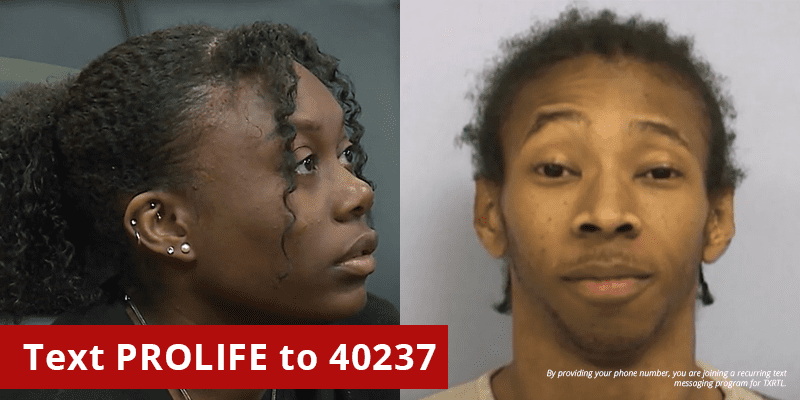
Johnny Charles Ebbs V, an Austin man charged for regularly beating his pregnant girlfriend and ultimately killing their unborn baby, was let off on a plea agreement after striking a deal with pro-abortion Travis County District Attorney Jose Garza.
A radical leftist and extreme abortion supporter, Travis County’s DA has been causing increasing outrage for being soft on crime. The Travis County DA’s office offered Ebbs a plea agreement which will release him from custody with very few conditions and will most likely result in all charges being dismissed.
According to the court testimony of Ebbs’ girlfriend, LaShonda Lemons, he started regularly beating her when she became pregnant and the violence escalated when she reached 32 weeks.
An arrest warrant details that during one argument Ebbs punched his pregnant girlfriend in the stomach while screaming, “F**k you and this baby! You aren’t going anywhere!”
Lemons was eventually admitted to a hospital where she was told that her placenta had detached from the womb, a condition called “placenta abruption” often caused by blunt force trauma. As a result, Lemons’ baby died.
In court, Lemons shared more details of her regular abuse at Ebbs’ hands. “You were the first person to hold me at gunpoint, the first person to strangle me,” she said addressing Ebbs.
Despite Lemons’ heartbreaking testimony, Ebbs will be let off due to his deal with the Travis County DA.
The only restrictions on Ebbs’ release were that he must forfeit his guns, something he has reportedly still not done, and wear a GPS monitor.
Lemons’ attorney shared that the Travis County DA’s actions are not surprising. “While we’re disappointed with the ultimate outcome, it was expected,” Lemons’ attorney stated.
Tragically, as grievous as these crimes are, Travis County DA Garza has a long established record of looking the other way when it comes to violent crime, especially when that violence involves innocent preborn children.
Along with several other abortion extremist DAs, Garza publicly vowed to neglect his duty to enforce life-saving Pro-Life laws. Siding with the abortion industry over Texas women and children, Garza vowed to ignore Texas law and look the other way when abortionists illegally kill babies in Texas.
Explaining his vow to allow abortionists to illegally kill babies, Garza stated, “Enforcing this law will not only fail to promote or protect public safety but will also lead to more harm. Our office will continue to fight for and protect women’s rights and use our discretion to avoid tragedy and preventable harm in our community.”
Though he claims to “protect women’s rights” and prevent harm and “avoid tragedy,” his decision to release a dangerous domestic abuser back onto the streets clearly disprove all his high-minded talk.
Garza clearly does not stand for LaShonda Lemons’ right to not be brutally beaten to the point that her unborn baby dies inside her. Garza clearly does not stand for the rights of any women who may suffer at the hands of the violent, abusive criminals he lets back onto the streets.
And yet, despite this obvious and egregious abuse of justice, the media largely ignores Garza’s hypocrisy. It would seem that any amount of corruption and abuse is allowable so long as you’re a politician who supports abortion and radical leftist policies.
In spite of the media’s overall disinterest in the case, Garza’s decision to let a dangerous domestic abuser, who murdered an unborn baby, off the hook with nearly no repercussions has understandably caused significant outrage.
Many tweeted their anger over the lack of justice. “Sounds like the DA failed again to deliver justice,” “Another criminal is walking the street as after murdering a baby,” and “Women don’t matter. Unborn babies don’t matter. So sick of these plea deals,” were just some of the responses to Garza’s decision to let Ebbs go free.
Texas Right to Life stands firmly opposed to any and all efforts to allow violent abusers and abortionists to continue killing babies and hurting women.
Texans who care about the dignity and value of ALL human Life, unborn and born, must be sure to vote out corrupt abortion politicians and elect leaders who will protect Life.
Posted inUncategorized|Comments Off on THE HORROR !!!
Our two parties have both changed, and that explains why one will win, and one lose in the midterm elections.
The old Democrats have faded away after being overwhelmed by radicals and socialists.
Moderates who once embraced Bill Clinton’s opportunistic “third way” are now either irrelevant or nonexistent.
Once considered too wacky and socialist to be taken seriously, Senator Bernie Sanders (I-Vt.), the performance-art “squad,” the radicals of the Congressional Black Caucus, and Senator Elizabeth Warren (D-Mass.) and her hard progressive wing are today’s Democratic Party kingpins.
The alienating radicals of Antifa and Black Lives Matter often serve as the new party’s shock troops on the streets. They opportunistically appear to push the party to embrace no-bail laws, defunding the police, and the destruction of the fossil fuel industry.
Since none of those positions poll even close to 50 percent with the public, the Democrats routinely either slur their opponents as racists, nativists, and climate denialists or obsess on another Trump psychodrama distraction from the Russia collusion hoax to the Mar-a-Lago raid.
What “blue dog” centrists are left in the Democratic Party either keep mum or, like Tulsi Gabbard, flee in disgust.
Donald Trump also recalibrated the Republican Party and helped to turn it into a nationalist-populist movement that would rather win rudely than lose politely. The MAGA agenda pushed Jacksonian deterrence rather than unpopular nation-building abroad. It finally focused on fair rather than just free trade. Republicans now unite in demanding only legal immigration and promoting domestic investment rather than globalist outsourcing and offshoring.
In response, many of the old Bush-Romney country club wing left in disgust. Others licked their wounds as fanatical NeverTrump something or others.
Both parties have also been radically changed by additional issues of class, race, and wealth.
Compare the income profiles of voters, whether by ZIP codes or congressional districts. A once lunch-bucket-carrying, union-member Democratic Party has become the enclave of three key constituencies.
First, there is the subsidized and often inner-city poor.
Second, the meat of the party is the upscale, bicoastal professional and suburban credentialed classes.
Third, the real rulers of the party are the hyper-rich of Big Tech, Wall Street, Hollywood, the corporate boardroom, the administrative state, the media, and the legal world. Almost all these institutions have lost public confidence and poll miserably. Their cocooned leaders are never subject to the ramifications of their own often unworkable policies.
In contrast, Republicans in this election cycle concerned themselves mostly with material issues of the battered middle classes—inflation, the price of fuel and energy, a secure border, crime, parental control of schools, and realist foreign policy.
Reforming social security, reducing capital gains taxes, and pruning back regulations are still doctrinaire Republican agendas. But they are not iconic of the middle-class dominated party as they once were in the age of Ronald Reagan.
Democrats, as the champions of the well-off, remain redistributionist and seek to tax the middle class to fund ever more government programs.
Joe Biden canceled some student loans. He printed lots of money. And he expanded entitlements. But even these calcified Great Society issues are drowned out by the real concerns of the professional leftist elites who run the Democratic Party.
After all, they do not worry much about the price of diesel fuel, or whether border communities are swarmed by illegal immigration. They are indifferent to whether it is unsafe to take a late-night subway ride. And they are not too worried about being mugged or whether they can splurge for a weekend steak.
Instead, condescending Democratic movers and shakers are obsessed with climate change and sermonize about ending fossil fuels. Diversity, equity, and inclusion—all mandated equality-of-result agendas—are their cultural religion, along with transgender advocacy, and abortion on demand in all 50 states.
The net result of these radical shifts is that Republicans began bonding with the neglected working classes and those without college degrees. That way they drowned out left-wing racial obsessions with ecumenical class concerns.
In the process, the new Republican Party in 2022 is poised to win 45-50 percent of Hispanic voters and a near-record number of African-American men.
In our changed political landscape, poorer Republican candidates are routinely outspent in most of their races. Conservatives are more likely to be canceled by left-wing anti-free-expression institutions like Facebook and Twitter. Their access to online knowledge and communication is often warped by monopolies and cartels like Google and Apple.
The Democrats claim Republicans are racists. But they cannot explain why record numbers of minorities are now deserting the Democrats, and the blue-state urban areas they run, to join the new Republicans.
As Republicans diminished the role of race, the Democrats grew ever more obsessed about it—and ignored class. The Oprahs, Meghan Markles, and MSNBC anchors of the world fixate over skin color in direct proportion to their own affluence, status, and privilege—as their hypocrisy turns off the middle classes of all races.
In sum, the party of old left-wing progressives has become one of rich regressives. And once country-club Republicans are becoming a party of middle-class populists. And the election will reflect both those changes.
Posted inUncategorized|Comments Off on The old Democrats have faded away after being overwhelmed by radicals and socialists.








 ABYSSUS ABYSSUM INVOCAT / DEEP CALLS TO DEEP
You must be logged in to post a comment.