In this column, I will prove that Democrats: 1) Don’t care about “Russians,” (Ukrainians?) or anyone else interfering with our democracy; and 2) they also don’t give a crap about guns.
Let’s begin by looking at the Democrats’ Platonic ideal of a democracy: California!
California is wholly controlled by the Democratic Party. The governor is a Democrat. The lieutenant governor is a Democrat. The attorney general, secretary of state and treasurer are Democrats. All these positions have been held by Democrats since the governorship of Arnold Schwarzenegger (who was a Democrat). The state Senate is just under two-thirds Democratic, while the assembly is more than two-thirds Democratic. Both U.S. senators are Democrats, as are 46 of 53 members of Congress.
And what a paradise they’ve created! For the last several years, with a direct pipeline to the fifth-largest treasury on the planet, California has been waging war on decent people in favor of drug addicts, the mentally ill, criminals, the homeless and transgenders.
In the last century, every great thing started in California: surfing, jeans, Disneyland, tax revolts, McDonald’s, movies, car culture, the Grateful Dead, right on red turns, Merle Haggard, skateboarding, Apple computer and the last two elected Republican presidents not named “Bush.”
Big political movements used to begin in California. Proposition 13’s cap on property taxes led to President Ronald Reagan and a nationwide tax revolt. Proposition 209’s ban on affirmative action was followed by Supreme Court rulings restricting the government’s ability to discriminate on the basis of race. California’s anti-crime rebellion, including a massive prison expansion and the voters’ removal of liberal lunatic Rose Bird from the state’s highest court, foreshadowed an anti-crime pushback across the country.
These days, the only California-originated idea to sweep the nation is: banning plastic straws. The state is a calamity. Its optimism and vigor are gone. Instead of “The Golden State,” California is now “The Human Excrement State.”
Let’s just pray that California is no longer a window into our future.
People are leaving the state in droves — and more than half of those who remain say they’d like to leave, according to a survey published in The San Francisco Gate earlier this year.“Liberals don’t care about guns in the hands of violent criminals.”
In every census but one, since California has been a state — from 1850 right up to 2010 — its population grew so much that the state added congressional seats. The only exception was in 1920, when the congressional delegation remained static, but then the state added nine new seats in 1930.
After the last census in 2010, California’s congressional delegation was unchanged. With the 2020 census, it’s expected to lose at least one seat and possibly two, according to Public Policy Institute of California. (If the federal government followed the Constitution and counted only citizens, it would lose a lot more than that.)
It takes single-minded fanaticism to wreck California. Within the borders of a single state, you can visit Yosemite, the Pacific Ocean, Death Valley, redwood forests, the snow-capped Sierras and the pastoral vineyards of Napa and Sonoma, and go to the beach on Christmas Day.
But starting with Gray Davis’ refusal in 1999 to appeal an activist judge’s announcement that it was “unconstitutional” for taxpayers not to give welfare to illegal immigrants — an initiative that had passed overwhelmingly just a few years earlier — California’s elected officials began an all-out war on its own citizens.
Democrats are worried about “Russians” interfering with our elections? California Democrats simply ignore elections.
The most clear-cut evidence that Democrats do not care about democracy is Gov. Gavin Newsom’s recent decision to halt the death penalty (unless administered by an illegal alien, as in the case of Kate Steinle).
I doubt any other state’s voters have been more emphatic about their support for the death penalty than Californians, voting for it in statewide initiatives in 1972, 1978, 2012 and again in 2016 — just three years ago.
But earlier this year, Gov. Newsom flagrantly disregarded the voters’ repeated endorsement of capital sentences and single-handedly imposed a moratorium on the death penalty.
Forget Facebook ads. Who cares if Russians hack into our voting machines and change the vote totals? Democrats are going to ignore the results anyway.
Their vaunted concern for the sanctity of our elections is so much horse crap.
It’s the same with guns. This September, during a fiery debate on guns, the left demanded “red-flag laws” to take guns away from citizens after having their politics, their writings, their previous exercise of free speech examined on a granular level by bureaucrats empowered to revise the Bill of Rights. In the middle of that debate, Gov. Newsom commuted the sentences of 21 convicted felons — almost all of whom were serving lengthy terms for murder or attempted murder with a gun.
And get this: Newsom specifically cited the unfairness of enhancing a criminal’s sentence merely because he used a gun when committing a crime.
Innocent people walking the street right now — playing basketball, eating at vegan restaurants, going bowling — better enjoy themselves. Some number of them will soon have their lives snuffed out because of the governor’s willful decision to begin the process of releasing people who have already committed violence with guns.
Liberals don’t care about guns in the hands of violent criminals. They’re coming after the guns of conservatives.
We’re horrified by people who commit violence with firearms. They’re horrified by people who haven’t committed any violence and never will — but who engage in speech displeasing to Democrats.
Like a magician revealing his trick, the governor of California provided the proof, making it absolutely clear that Democrats don’t give a fig for democracy and aren’t disturbed in the slightest by gun violence.
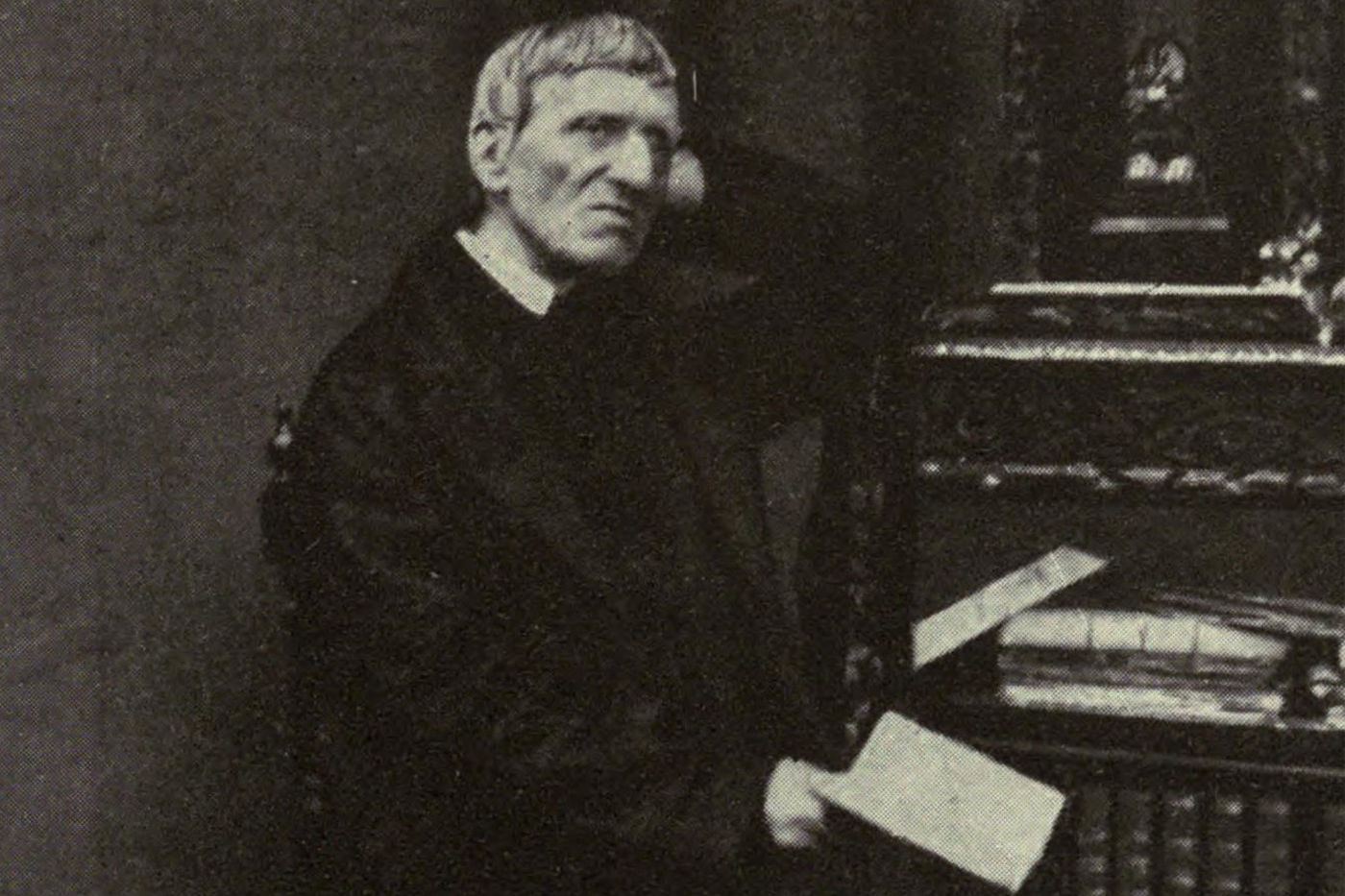
Saint John Henry Newman and Freedom of Conscience: Countering a Modern Apostasy
NOVEMBER 7, 2019BY THOMAS F. FARRIn the 130 years since John Henry Newman’s death, few concepts have been more misunderstood and distorted than “conscience.” The danger is greater today than when the great saint wrote. The distorted view of conscience that Newman described as oriented to self and not to God has penetrated Western culture and religion. For many, the obligation to follow one’s conscience has been embraced, but fidelity to truth has been set aside. This untethered and counterfeit “freedom of conscience” has led to a widespread subjectivism that Newman saw emerging within modern European society, even in his own day.
John Henry Newman’s teachings provide a proper grounding for freedom of conscience and for the Catholic Church’s duty to defend the truth, both to its members and to society in general. In both of these ways, Newman prefigured the Church’s 1965 Declaration on Religious Freedom, Dignitatis Humanae. Together, Newman and Dignitatis can help us resist the erroneous notion of the free conscience pointed inward to self and isolated from God and nature. Instead, they teach that a truly free conscience is oriented toward God, who, more intimate to self and nature than anyone or anything, is the only guarantor of true freedom. Since Newman’s time, this error has damaged free societies and entered the Church itself. Following Newman and Dignitatis will permit us to defend true freedom of conscience, both within the Church, and for everyone, everywhere.
Newman writes that conscience is the voice of God: “[It] is a messenger from Him, who, both in nature and in grace, speaks to us behind a veil, and teaches and rules us by His representatives.” These are the Magisterium and the fundamental teachings of the Church on faith and morals as the path to true freedom and happiness in this life and the next.
DignitatisHumanae declares the right of every person to religious freedom, defined as an immunity from coercion in matters of conscience by any human agent, including the state and the Church. “God calls men to serve Him in spirit and in truth,” declares Dignitatis, “hence they are bound in conscience but they stand under no compulsion. God has regard for the dignity of the human person whom He Himself created and man is to be guided by his own judgment and he is to enjoy freedom” (emphasis added).
Dignitatis is here affirming the ancient teaching of the Church that a man must obey God but that he must also follow his conscience, even if it errs. Newman puts it this way: “if a man is culpable in being in error, which he might have escaped had he been more in earnest, for that error he is answerable to God, but still he must act according to that error. . . because he in full sincerity thinks the error to be truth” (emphasis added).
Note the dilemma. You and I must act in accord with our consciences. God has given us that freedom, and no one can licitly employ coercion to restrict it. But we are also bound in conscience to obey God. An erring conscience that results from our failure to ensure that it is ordered to the truth leads to moral culpability. Willful pursuit of the wrong could lead one into grave sin. A man could follow an ill-formed conscience straight into hell.
In short, our freedom does not give us a moral right to do what is wrong. To the contrary, it merely increases the importance of ordering our judgments of conscience to the truth. Dignitatis puts it this way: “Religious freedom . . . has to do with immunity from coercion in civil society. Therefore it leaves untouched traditional Catholic doctrine on the moral duty of men and societies toward the true religion and toward the one Church of Christ.” This helps us to understand why the Church must have the liberty to makes its claims about true freedom and justice within civil society, and why it must have the courage to perform that duty.
Newman’s explanation of conscience and freedom drives this point home. He rejected the false and dangerous view of conscience emerging in the nineteenth century: “[I]n this age . . . the very right and freedom of conscience [is seen as the right] to dispense with conscience, to ignore a Lawgiver and Judge, to be independent of unseen obligations. Conscience is a stern monitor, but in this century it has been superseded by a counterfeit . . . [that is,] the right of self-will.” “Conscience,” he famously wrote, “has rights”—that is, freedom—“because it has duties.” Those duties consist in the individual’s vigilance in ordering conscience to the truths given by God to the Church, and the Church’s clarity and effectiveness in teaching those truths.
In this, as in so much else, Newman was prophetic. In the 130 years since his death, few concepts have been more misunderstood and distorted than “conscience.” The danger is greater today than when the great saint wrote. He blamed the error on science and philosophy but insisted that in his day most Protestants and Catholics still believed that conscience was “the voice of God in the nature and heart of man . . . the internal witness of both the existence and the law of God.”
That is no longer the case. The distorted view of conscience that Newman described as oriented to self and not to God has penetrated Western culture and religion. For many, the obligation to follow one’s conscience has been embraced, but fidelity to truth has been set aside. This untethered and counterfeit “freedom of conscience” has led to a widespread subjectivism that Newman saw emerging within modern European society, even in his own day.
In the years since, this counterfeit view of conscience has contributed to growing disbelief in God and the radical assertion of human autonomy from nature and physical realities. Today Western nations are characterized by ever deepening cultural and political chasms between those who believe that ethical norms are grounded in nature and nature’s God, and those who believe that freedom itself establishes the norms of social ethics. This counterfeit view has encouraged, within the Church and without, deep confusion regarding the nature of man and woman as created by God; the beautiful truths about marriage, the family, and human sexuality; and the necessity of religious freedom for all persons and all societies.
It is for these reasons that Dignitatis demands not only an immunity from coercion, but also libertas ecclesiae, the Church’s right—protected in law and culture—to make public its claims about true freedom, justice, and the power of God’s love. Newman exhorts the Church to justify the right by performing the duty, that is, by professing the profound connection between the individual conscience and the Church’s public witness to the truth about nature and about Jesus Christ.
The errors of our age, far more pervasive than in the age of Newman, place a greater responsibility on the faithful, clergy and lay, to teach and witness these truths. We desperately need the clarity and winsomeness of truth itself, which is a man, Jesus Christ, and Him crucified. In his final sermon as an Anglican before entering the Roman Catholic Church, entitled “The Parting of Friends,” Newman asked his congregation to “remember such a one in time to come, though you hear him not, and pray for him, that in all things he may know God’s will, and at all times he may be ready to fulfill it.” Let us, with the great saint at our side, go forth to defend these truths anew, with hope, joy, courage, and true freedom of conscience.
This essay is adapted from remarks delivered at a conference at The Pontifical University of St. Thomas Aquinas (Angelicum) in Rome during the canonization events for Saint John Henry Newman.
Thomas Farr is President of the Religious Freedom Institute. A leading authority on international religious freedom, Dr. Farr served for 28 years in the U.S. Army and the U.S. Foreign Service. In 1999 he became the founding director of the State Department’s Office of Internation… READ MORE
A blog about the life & times of Jorge Bergoglio (aka Francis)
Friday, February 24, 2017
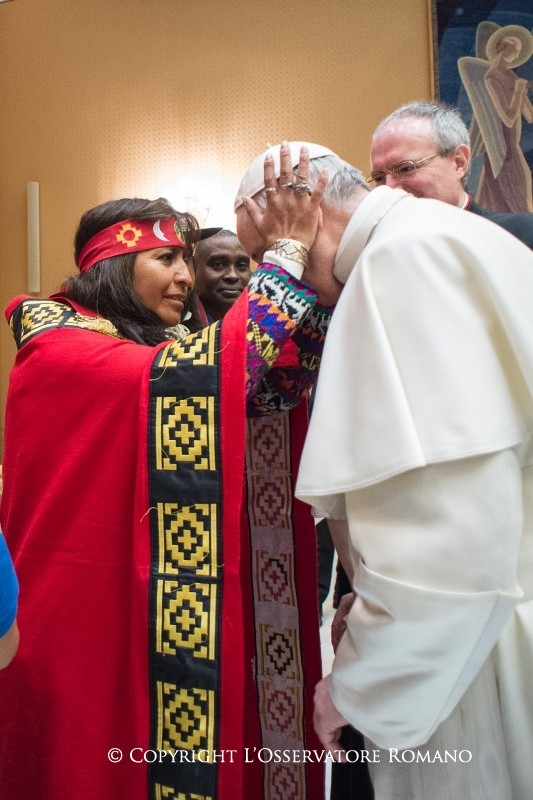
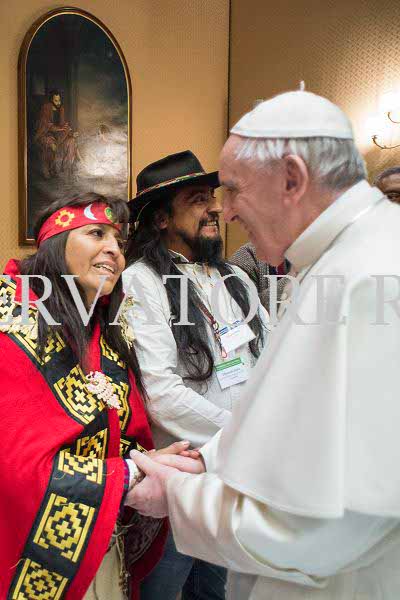
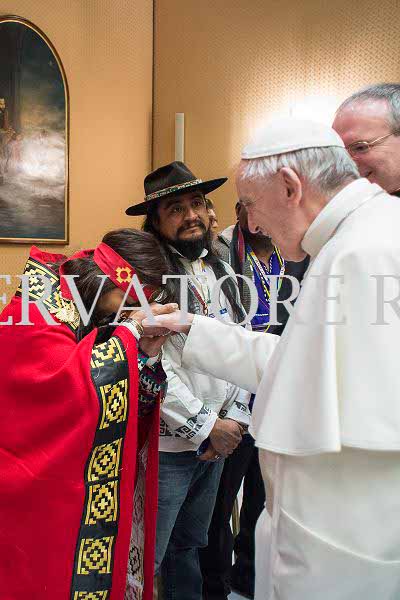
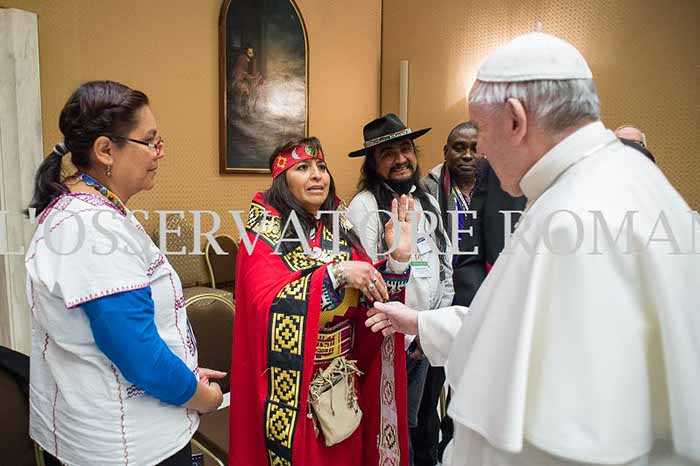
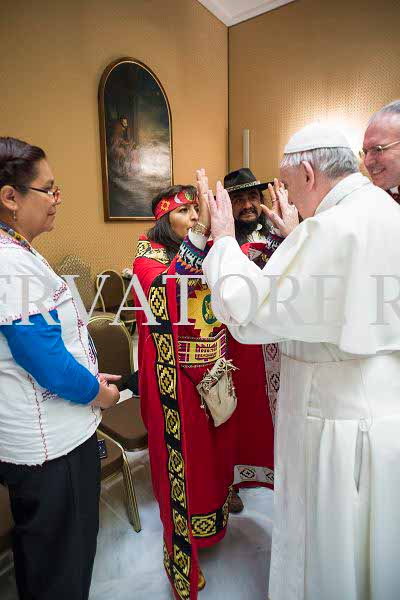
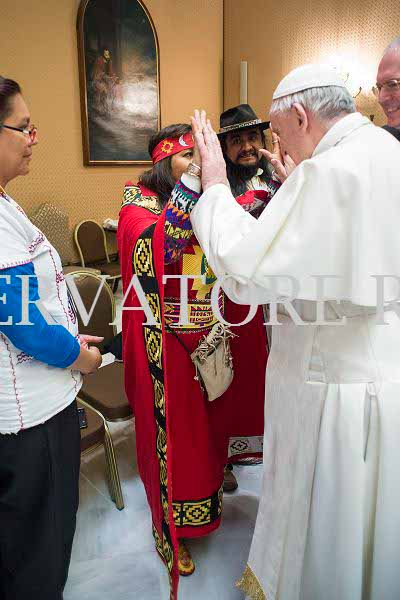
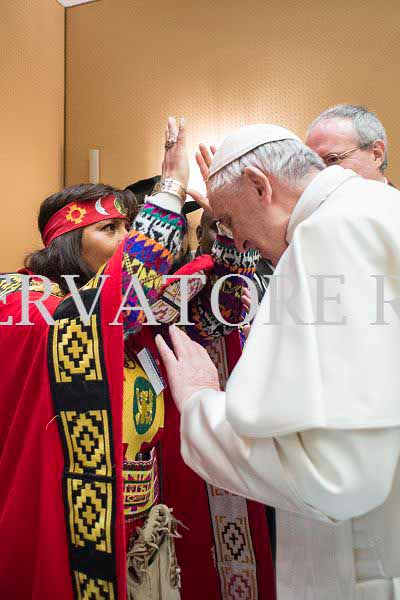
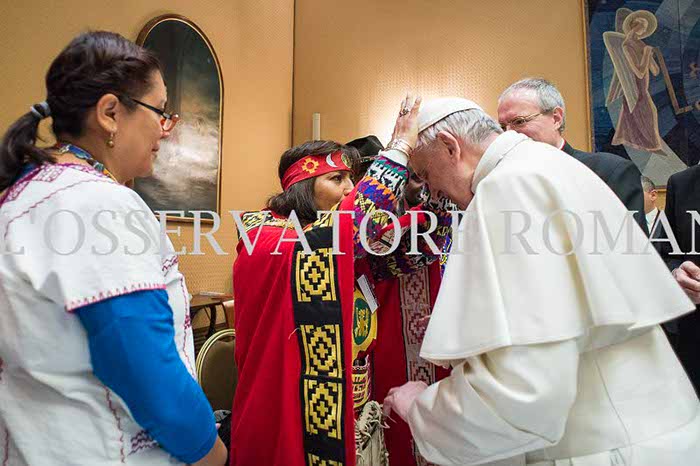
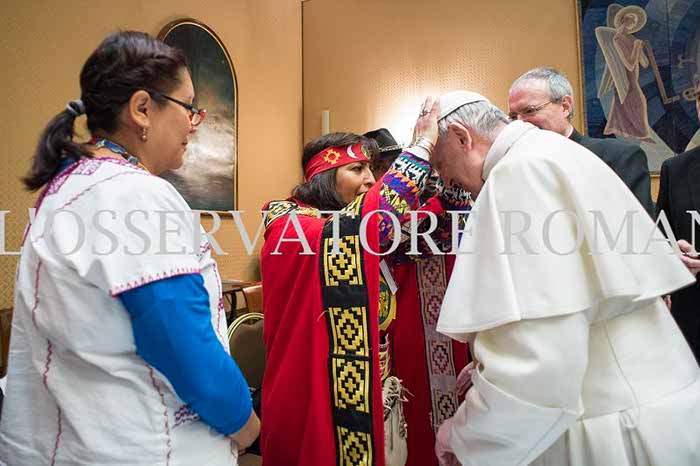
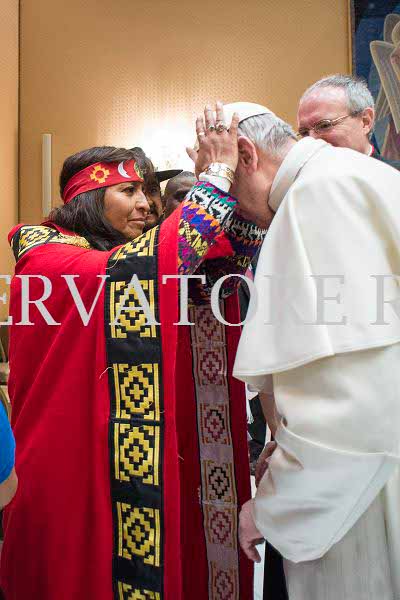
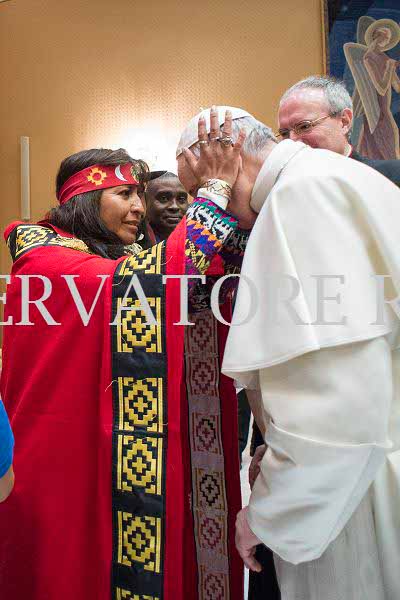
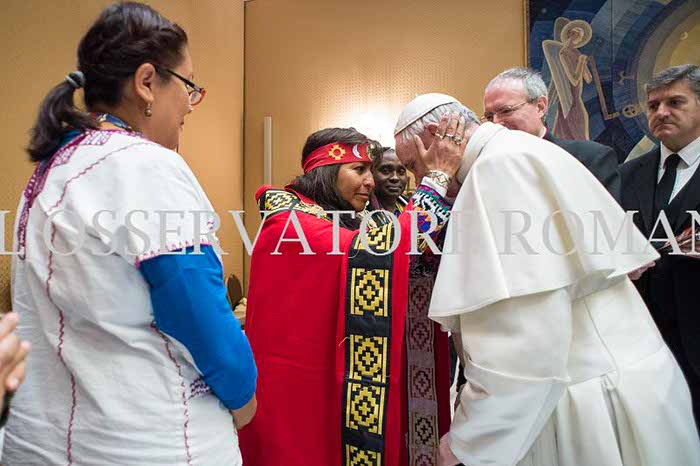
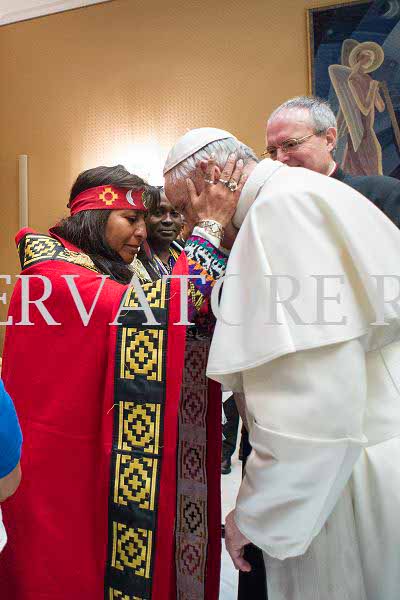
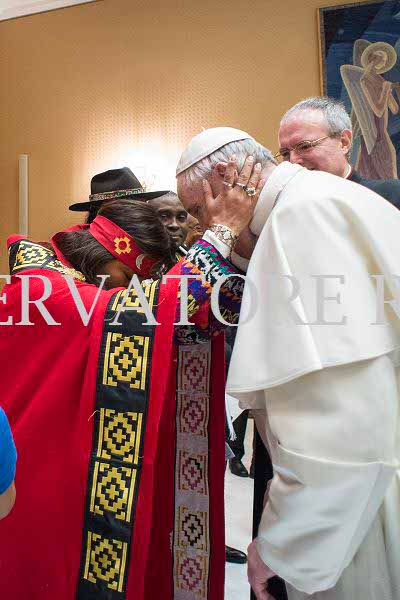
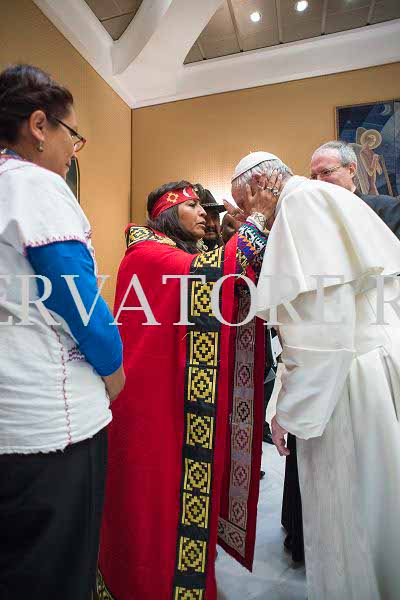
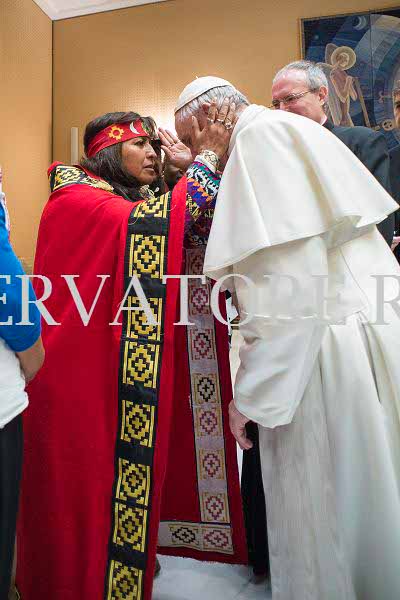
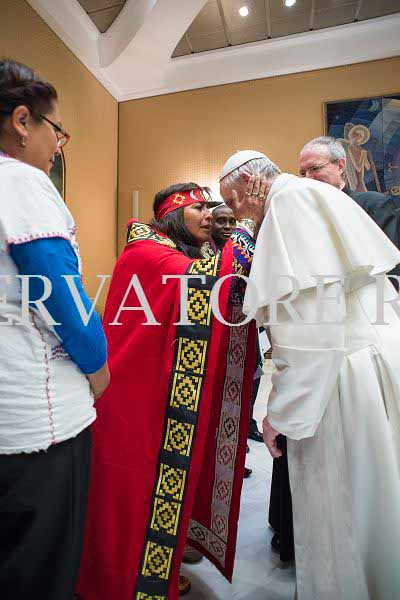
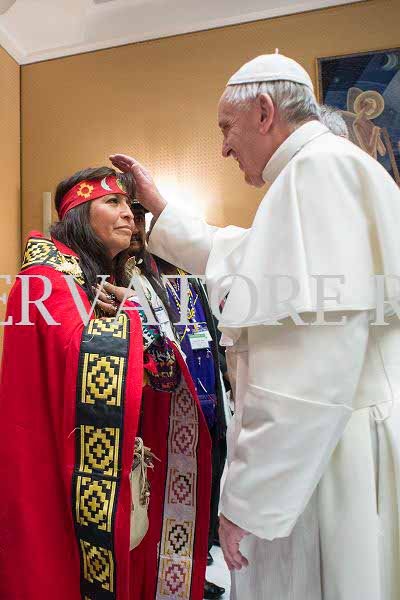
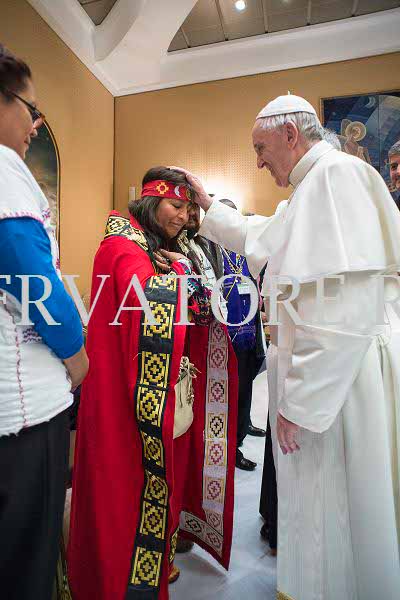
A shaman visits Francis at the Vatican and works her sorcery during a private audience
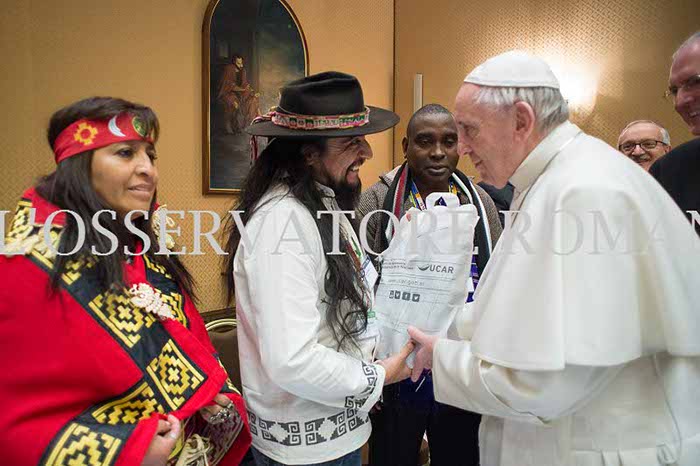
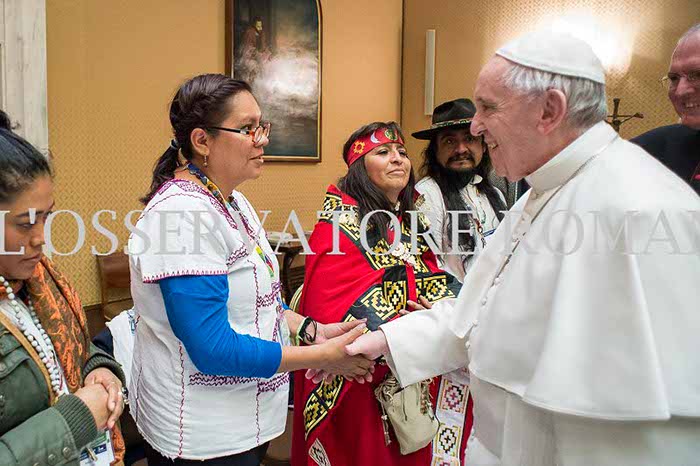
Earlier last week at the Vatican, Francis had a private audience with ‘indigenous peoples’ who were attending the United Nations’ Third Global Meeting of the Indigenous Peoples’ Forum for Investing in Rural People organized by the International Fund Agricultural Development (IFAD) in Rome, Italy. When they were assembled for this private audience, Francis delivered a speech, then went around the room and personally greeted each attendee. As would be expected with ‘Indigenous Peoples’, and we are using that term very loosely, they practiced a hodgepodge of pagan religions. One encounter Francis had caught our attention. It is shown below.
What is the heck is happening?
Who is this woman and what is she doing? To us at Call Me Jorge… she appears to be a shaman working some sort of sorcery. Well, we did a bit of digging around and found out that she is a member of the Amaicha del Valle settlement in Valles Calchaquíes, Tucumán, Argentina.
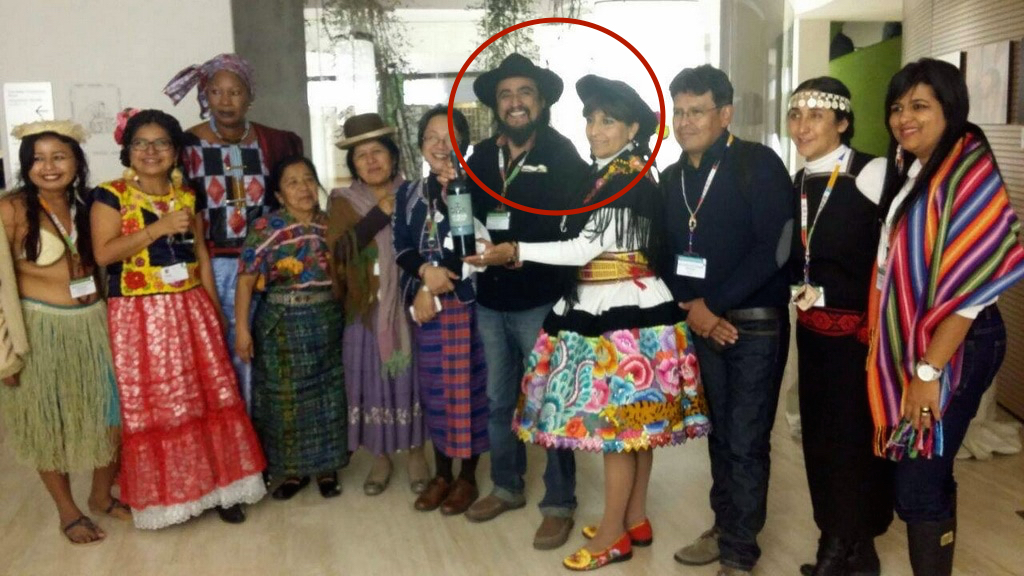
A photo from the United Nations’ Third Global Meeting of the Indigenous Peoples’ Forum for Investing in Rural People organized by the International Fund Agricultural Development (IFAD) in Rome, Italy.
The two circled people, in the picture above, are from the Amaicha del Valle settlement. The man is Dr. Eduardo Alfredo Nieva and the woman is the one who performed the incantation on Francis. Dr. Eduardo Alfredo Nieva is the commissioner of the Amaicha del Valle settlement. They are holding a bottle of wine because Dr. Nieva runs a community winery (Sumak Kawsay means ‘good living’ in the Quechua tongue and is precept of the Pachamama religion) which he started with the help of one of Francis’ favorite pet causes, micro-usury. During this trip to Rome, Dr. Nieva helped secure an additional 50 million dollar loan to the people in rural Argentina. He also gave a bottle of Sumak Kawsay to Francis when they met (see video below, It’s pagan day at the Vatican!).
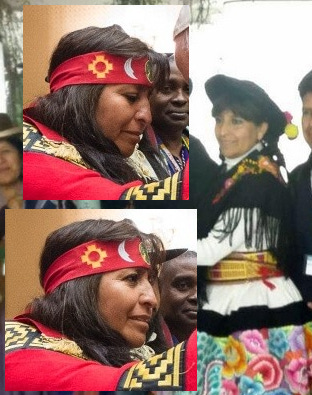
As you can see, it’s the same woman.
The people of the Amaicha del Valle settlement are pagans as they believe in a multitude of gods. The four gods of primary importance are the husband and wife tandem — Pacha Kamaq (creator of the world) & Pachamama (mother earth) — and their two children — Inti (the sun) & Mama Killa (the moon). Every year in the Amaicha del Valle settlement they hold a six day festival for Pachamama the mother earth goddess.
Dr. Nieva participating in the pagan Pachamama ritual.
So here we have Francis having a private audience with a United Nations’ group. This same United Nations which pushes all sorts of anti-Catholic causes is also selling the belief in pagan deities in their children publications by equating belief in Pachamama as environmentalism. So what do others in the Novus Ordo church think of Pachamama?
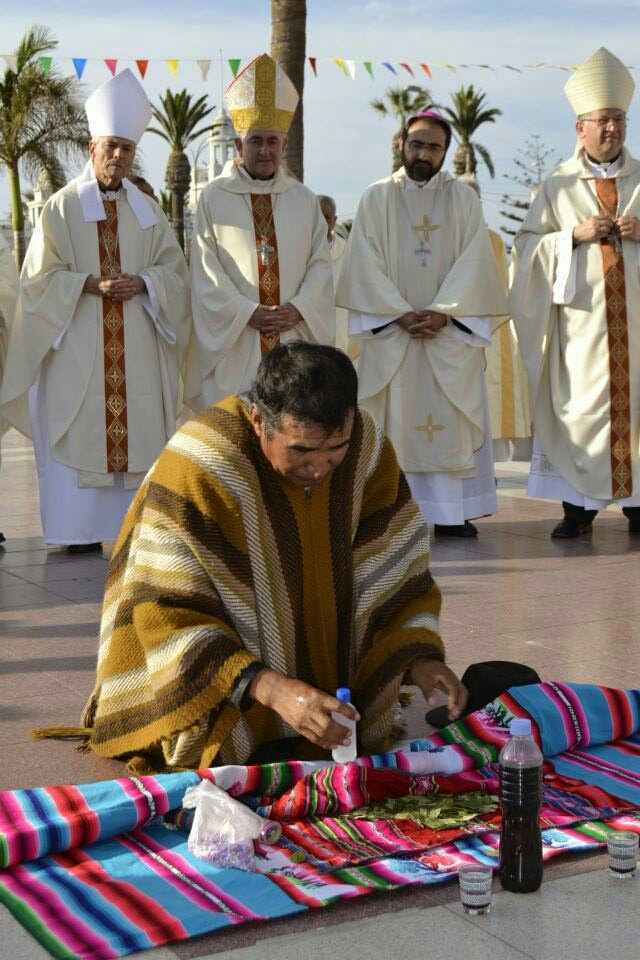
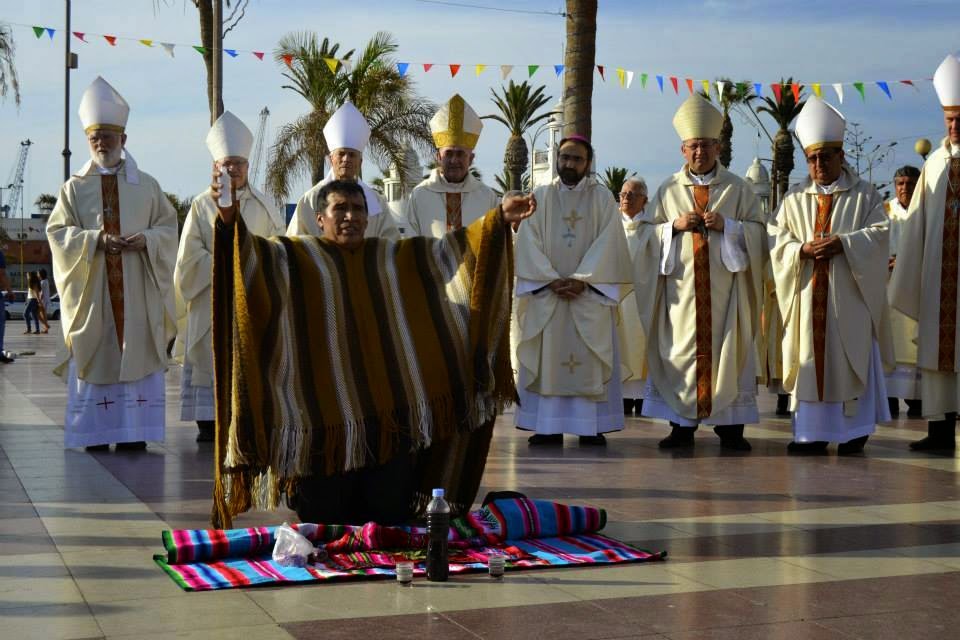
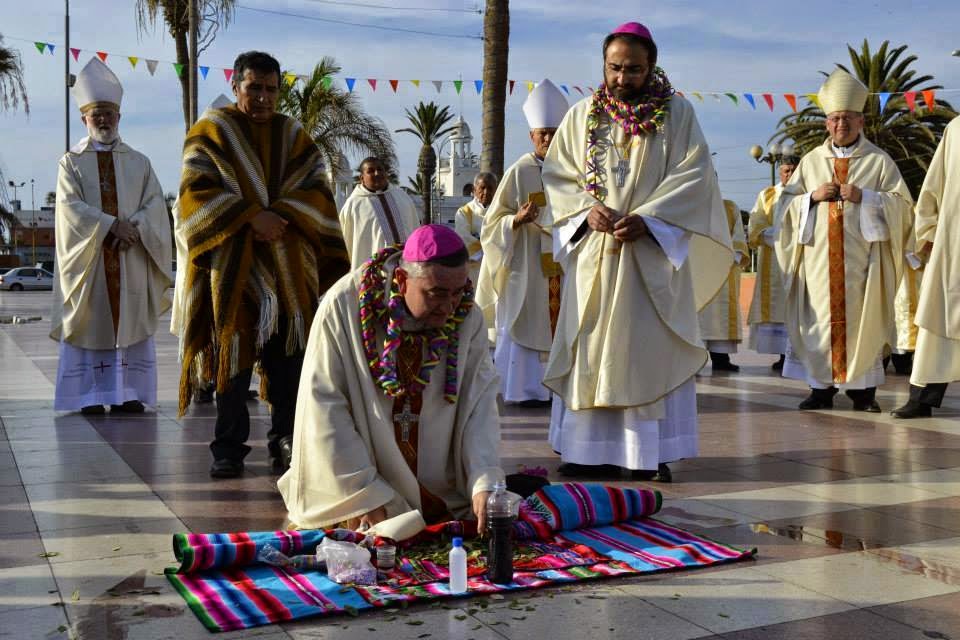
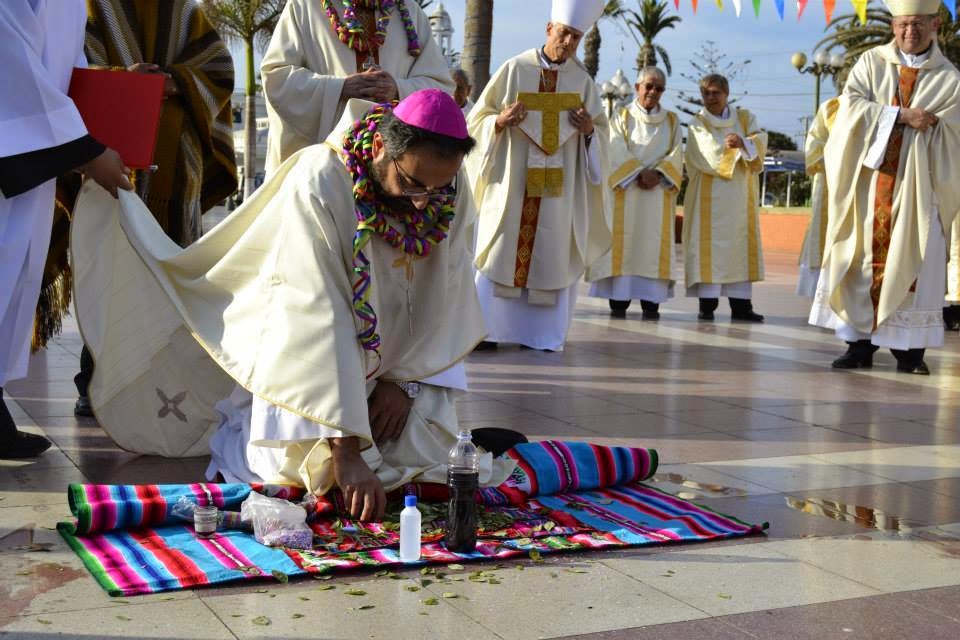
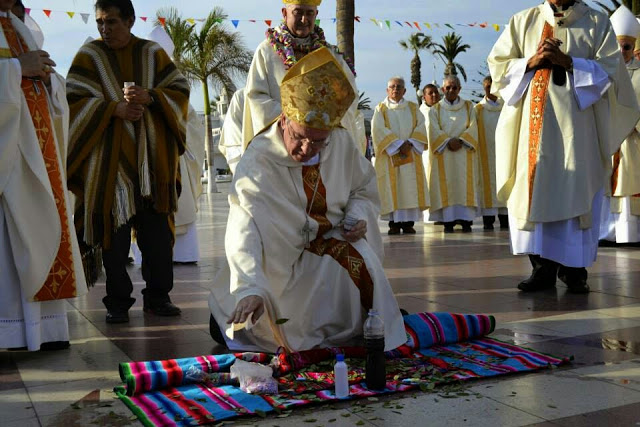
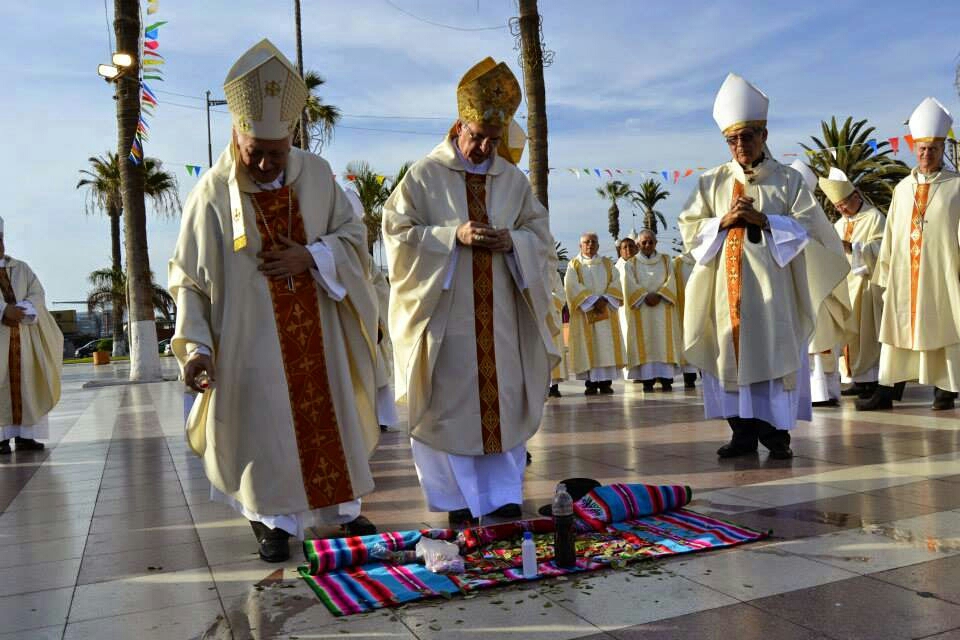
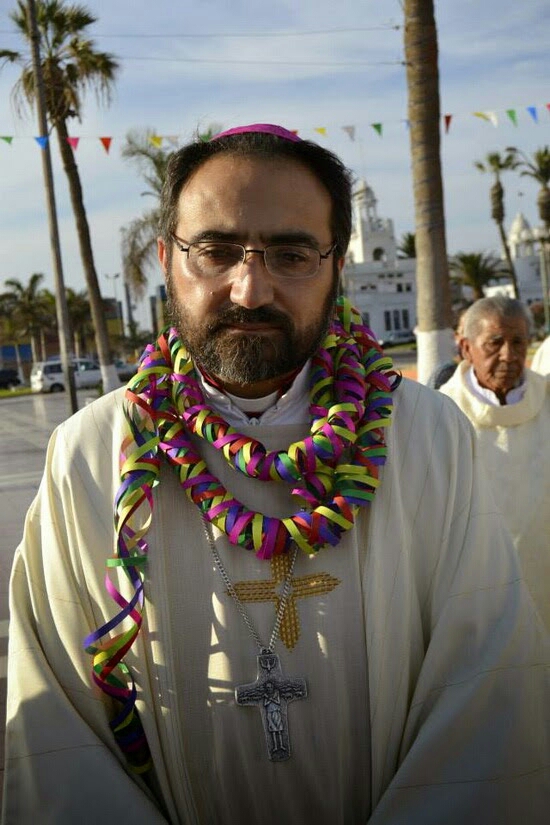
On 17 January 2015 in Chile on the occasion of the consecration of the new diocesan bishop of Arica, Bishop Moisés Atisha, after the service in the cathedral finished, all the bishops assisting including the Apostolic Nuncio and the Cardinal archbishop of Santiago poured outside into the area directly in front of the cathedral and participated in Pachamama worship. The Pachamama shaman placed a rug on the ground and proceeded to offer coca leaves, seeds, water and fermented chicha (corn alcohol). These items were being offered to the deities Pachamama (mother earth), Inti (the sun) and the Malkus (mountain spirits). As can be seen from the photos below, the assembled bishops participated in this offering. After the offering was complete the witch then placed multi-colored necklaces onto the bishops.
“What then? Do I say, that what is offered in sacrifice to idols, is any thing? Or, that the idol is any thing? But the things which the heathens sacrifice, they sacrifice to devils, and not to God. And I would not that you should be made partakers with devils. You cannot drink the chalice of the Lord, and the chalice of devils: you cannot be partakers of the table of the Lord, and of the table of devils.”— First Epistle Of Saint Paul To The Corinthians 10, 19-21 —
The witch doctor prepares his offering.
The witch begins his sorcery.
Bishop Cristian Contreras, bishop of Melipilla (Chile), participates in the rituals.
Bishop Atisha, the new bishop of Arica does as well.
Bishop Ivo Scapolo, the Apostolic Nuncio in Chile gets in on the worship.
Offering fermented chicha (corn alcohol) to the pagan gods.
Bishop Atisha gets his noahide colored necklace. If one is interested in more photos from this event (click here).
Cardinal Ravasi participating in Pachamama ritual in 2015
Did these prelates tell Francis of their participation in the pagan Pachamama rituals and rave over them? Or maybe Francis has a deeper connection to this pantheistic gnostic religion back to when he was Jorge Mario Bergoglio in Argentina?
In his address to Representatives of Indigenous Peoples, (15 February 2017) at the private audience he said, “I believe that the central issue is how to reconcile the right to development, both social and cultural, with the protection of the particular characteristics of indigenous peoples and their territories. This is especially clear when planning economic activities which may interfere with indigenous cultures and their ancestral relationship to the earth.” Is this not a clear endorsement of non-Christian religions?
Francis continued later, “A second aspect concerns the development of guidelines and projects which take into account indigenous identity, with particular attention to young people and women; not only considering them, but including them!” Francis then proceeded to put his money where his mouth was by having the female shaman work her ‘magic’ on himself.
Regardless it’s obvious, when one looks at the photos below, that not only does Francis have a deep respect for the pagan Pachamama religion, he like his bishops is an enthusiastic believer in “sitting at the table of devils.”
Below are some and we stress this is only a small sampling of the photos available from the L’Osservatore Romano’s photographic service database for this pagan sorcery ritual. (To see all the photos, click here.) (click photos to enlarge)
The wine hand off goes down.
Nice to meet you can I work some ‘magic’ on you?
This is amusing.
She’s feeling a spirit.
That’s not “patty-cake, patty-cake, baker’s man” being played!
She’s communing with the spirit of Vatican II.
Francis is really getting into this sorcery thing, look at the concentration on his face!
She’s channeling another spirit into his head.
It’s crowded in that fat body.
The possession is almost complete!
Uh oh, the spirit is trying to escape through his ears.
She’ll hold this pose for some time.
Whatever she’s doing it’s serious.
She’s using all her shaman abilities now!
More incantations…
Final instructions to the spirit.
Waking Francis from his trance.
The spirit says thanks for the new body.
The sorcery is complete.
Francis the rabbinical traditionalist goes onto the next pagan.
New post on Roma Locuta EstWhy blame Scalfari?by Steven O’ReillyNovember 7, 2019 (Steven O’Reilly) – The Amazon Synod is over. It’s been a couple weeks since my last article (see Time for an imperfect council to consider the case of an imperfect pope), as I remain occupied with readying Pia Fidelis for publication. The month of October and the first week of November have been eventful.The Pachamama idols were heroically removed from a Roman Church and tossed into the Tiber. But, then, during closing mass of the synod, Pope Francis placed a bowl of earth and plants — apparently symbolic of the false goddess and idol, Pachamama – upon the altar above St. Peter’s tomb. If Pachamama was indeed symbolized by this bowl, earth and plants — as appears to be the case (see Fr. Z’s article here) — one can not help but think of the “abomination of desolation” spoken of in scripture: “When therefore you shall see the abomination of desolation, which was spoken of by Daniel the prophet, standing in the holy place: he that readeth let him understand” (see Matthew 24:15).Though the events above are incredible in and of themselves, also in October, Catholics were treated to the suggestion, reported by the Italian journalist Eugenio Scalfari, that Pope Francis does not believe in the Divinity of Christ. Many outlets reported this news, of course (e.g., here). The Tablet reported:Scalfari wrote in La Repubblica: “Anyone who has had the good fortune to meet with him and speak with him in utmost confidence – as I have done several times – knows that Pope Francis conceives of Christ as Jesus of Nazareth: a man, not an incarnate god. Once incarnate, Jesus ceases to be a god and become a man, until his death on the cross.”Scalfari claims that when he put this idea to Francis, he replied: “Jesus of Nazareth, once he became a man, although he was a man of exceptional virtue, was not a god at all.”(Source: The Tablet. “Scalfari claims Pope does not believe Jesus ‘the man’ was divine” by James Roberts. October 10, 2019; emphasis added by Roma Locuta Est)While the Vatican press office on occasion has provided limp-wristed explanations and ‘denials’ regarding Scalfari’s reporting of his conversations with Pope Francis, these are insufficient (e.g., here). Pope Francis has never personally and directly denied any of Scalfari’s past representations (e.g., regarding the damned being annihilated). Now, within the last couple days, there is yet another controversy arising from Scalfari’s alleged conversations with Francis.The latest from the last 48 hours or so is this. The Italian journalist Eugenio Scalfari – who earlier in October reported Francis denied the divinity of Christ – now reports that Francis has also denied other dogmas of the Catholic Faith, for example, the bodily resurrection of Jesus Christ (see LifeSiteNews: Francis’ go-to interviewer claims Pope denies Jesus’ bodily resurrection). Citing his new book (Il Dio unico e la società moderna: Incontri con papa Francesco e il cardinale Carlo Maria Martini), Scalfari wrote in the Italian newspaper, La Republicca (November 5, 2019):“He was a man until he was placed in the tomb by the women who recomposed his body. That night, in the tomb, the man disappeared and came forth from the grotto in the semblance of a spirit that met the women and the Apostles while still preserving the shadow of the person, and then he definitely disappeared.” (Source: As quoted by Martin Barillas in LifeSiteNews, November 7, 2019; emphasis added by Roma Locuta Est)One reaction to Scalfari’s recent claims comes from Bishop J. Strickland of Tyler, Texas:As a Catholic Bishop I must denounce the so called journalist Scalfari. He attributes statements to Pope Francis that mock our faith, the Church & Christ Himself.. I presume Scalfari is deluded but I can’t remain silent even if he is insane. I must speak in defense of Faith.— Bishop J. Strickland (@Bishopoftyler) November 7, 2019In response to Bishop J. Strickland, and with all due respect to him, I suggest he defend the faith —but let Francis defend himself. Don’t get me wrong. I believe that Bishop J. Strickland is one of the “good guy” bishops. One of the few of them, in fact. However, as so many commentators and Catholics following the news have observed by now, and I did again in my recent article (see here); if Scalfari habitually misinterprets Francis, why has Pope Francis continued to speak with Scalfari over the years? They are, by all reports, on friendly terms. There is no reason to think that Scalfari is trying to undermine Pope Francis.So, there is every reason to believe Scalfari is reporting his honest recollections of the words and meaning of Pope Francis. Granted, Scalfari is a very old man (in his 90s I believe), and he is notoriously known for not taking notes during his interviews. It is indeed quite possible he has incorrectly remembered the Pope’s words or that he has misunderstood them. However, Pope Francis has given him credibility by his repeated discussions with him over the years. As noted above, they are on friendly terms and there is no reason to think Scalfari wishes to undermine Francis by putting heresies into his mouth which he never uttered. But think…what person would grant continued access and interviews to reporter who repeatedly fails to get your words and meaning down correctly — especially on theological matters, and when that person is the Vicar of Christ? Given the gravity of Scalfari’s several claims — made now in both articles and books, Pope Francis should publicly deny and correct Scalfari’s recollections. Furthermore, Pope Francis should make a public profession of Faith which specifically addresses each and every heretical assertion that was wrongly put into his mouth by Scalfari. This seems to me so obvious, but I don’t believe I have yet to hear a single cardinal or bishop request this of Pope Francis.Again, I am a fan of Bishop Strickland. We need him. I wish we had more bishops like him. However, as said, I believe the bishop’s anger in this case is misplaced. It should not be directed toward Scalfari. Rather, it should be directed against Pope Francis, who has not — after all these years — personally and publicly addressed Scalfari’s past claims (e.g., that the Pope believe the souls of the damned are annihilated) or publicly addressed Scalfari’s more recent claims (e.g., that the Pope rejects the Divinity of Christ, and his bodily resurrection). I’d like to think that the US bishops visiting Rome would challenge Pope Francis on these questions, and so many others (e.g., Dubia, Death Penalty, Abu Dhabi statement, and so on, and so on). At least, a few bishops? Maybe one?
Steven O’Reilly is a graduate of the University of Dallas and the Georgia Institute of Technology. A former intelligence officer, he and his wife, Margaret, live near Atlanta with their family. He has written apologetic articles and is working on a historical-adventure trilogy, entitled Pia Fidelis, set during the time of the Arian crisis. The first book of the Pia Fidelis trilogy. The Two Kingdoms, should be out later this summer or by early fall (Follow on twitter at @fidelispia for updates). He asks for your prayers for his intentions. He can be contacted at StevenOReilly@AOL.com (or follow on Twitter: @S_OReilly_USA).Steven O’Reilly | November 8, 2019 at 1:38 am | Categories: Uncategorized | URL: https://wp.me/p7YMML-62G
by Jules Gomes • ChurchMilitant.com • November 7, 2019
Italian journalist doubles down on Francis’ alleged denial of Jesus’ divinity
ROME (ChurchMilitant.com) – In a new series of troubling revelations, Italian journalist Eugenio Scalfari has quoted Pope Francis as denying the bodily resurrection of Jesus in stating that the crucified Christ emerged from the tomb as a spirit rather than as a body.
In a front-page article in Tuesday’s La Repubblica, Scalfari expands on his earlier quote from Pope Francis, where the Holy Father is interpreted as rejecting the divinity of Jesus while on earth, and dovetails that statement with Francis’ alleged denial of Christ’s bodily resurrection.
According to Scalfari, Pope Francis said, “He [Jesus] was a man until he was put in the sepulchre by the women who restored his corpse. That night in the sepulchre the man disappeared and from that cave came out in the form of a spirit that met the women and the Apostles, still preserving the shadow of the person, and then definitively disappeared.”That night in the sepulchre the man disappeared and from that cave came out in the form of a spirit that met the women and the Apostles.Tweet
Church Militant contacted the Holy See Press Office for comment, which was caught by surprise and was unaware of the new allegations. Matteo Bruni, director of the Holy See Press Office, told Church Militant:
As already stated on other occasions, the words that Dr. Eugenio Scalfari attributes in quotation marks to the Holy Father during the interviews he had cannot be considered as a faithful account of what was actually said, but rather represent a personal and free interpretation of those who listened, as appears completely evident from what is written today regarding the divinity of Jesus Christ.
“The Scalfari claims about Francis’ heretical beliefs are so shocking, and the Pope’s adamant silence so incomprehensible, we have to assume that this is an accurate account of their conversations, U.K. Deacon Nick Donnelly told Church Militant.
“The claim that Francis denies the bodily resurrection of Jesus takes us into the area of de fide doctrine,” he added. “Every time we recite the Nicene and Apostles’ Creed we proclaim the bodily resurrection of Jesus. In the past, an ecumenical council would have been convened to condemn Christological heresies.”
“Scalfari’s claim that Bergoglio is a Docetist — someone who holds that Jesus only appeared as a phantasm or spirit — takes us into the territory of needing an Ecumenical Council to condemn him and uphold the Catholic doctrine of the Resurrection,” he said.
Scalfari’s La Repubblica article is a reproduction of his introduction in his book.
The journalist, who admits to being an unbeliever, insists that he is nevertheless “very much interested in the history of the Church that began when Paul fell from his horse while going from Jerusalem to Damascus.”
Drawing a wedge between Pauline Christianity as a radical innovation compared to the Jewish Christianity of Jesus’ first apostles, including Peter, Scalfari identifies Jesus’ recognition of His divine Sonship at the age of 30.
“Until he was 30 he had remained in the family but it is at that moment that he discovers in himself the Son of God descended to earth for the redemption of men from all over the world,” Scalfari writes.
Because Saint Paul interpreted Christianity as totally different from Judaism, Christianity now saw itself as unique “without being confused with other religions.” This gave rise to a number of controversies, chief of which was the relationship of Jesus to the Father.
“The Son had the same powers as the Father but there was a substantial difference between them: the Father had created the Son, after which the powers were the same but the Son was Creature while the Father was Creator,” he remarks.
It is in this context Scalfari elaborates on his meeting with Pope Francis.
“I was personally responsible for speaking with Pope Francis in our first meeting four years ago, and His Holiness, who is very prepared in these matters,” told him that “God, who is Unique to all the people of the whole world, decided on his incarnation to help humanity to believe in the hereafter and to behave appropriately in thinking and acting.”
Then, Pope Francis reportedly told Scalfari: “That is, he is a man: true and total, and he shows it in the last week spent in Jerusalem, at the last supper, in the Garden of Gethsemane where he prays to God to exempt him from being crucified, but God does not answer him.”
“Also on the cross he is a man who turns to what he calls the Father and almost reproaches him by saying: ‘Father, Father, you have abandoned me,'” Francis reportedly said.
Italian social media has erupted in shock at the new revelations.Italian social media has erupted in shock at the new revelations.Tweet
“Scalfari continues to attribute to Bergoglio quotes that contain unheard-of theological enormities and no one from the Vatican cares in the least of denying, nor do they tell Scalfari to stop. Catholics think: those who keep silent agree,” tweeted noted Italian journalist Antonio Socci.
“Pure heresy: the risen Jesus was not a Spirit but was alive in flesh and blood. Thomas put his finger in his wounds,” an Italian Catholic tweeted back.
Scalfari commends Francis for preaching this interpretation “with the strength that no one else has employed,” as it “corresponds to a reality that our mind can only judge perfectly logical for those who believe in a deity.”
Pope Francis has solved the problem of religious plurality because he is not thinking of a God monopolized by only one group, Scalfari explains.
“There cannot be a supreme deity generated only by a group of faithful while other groups have different deities,” and “these are differences that must be overcome.”
“Thinking of a God owned by a people and not others is meaningless, and the Pope is denying it day by day, and not only with words but with facts: He embraces Muslims, obviously embraces Jews and Protestants,” he adds.
Explaining why he treats both Pope Francis and Cdl. Martini in one book, Scalfari notes that “both priests addressed issues of the highest cultural, religious and even political level in the sense in which politics has a positive or negative influence on the life of men.”
Moreover, Martini was a great friend of Pope Francis in Argentina and, like Francis, had tried to modernize the Church. “Martini knew that the Church needed profound changes,” writes Scalfari.
A companion piece in La Repubblica written by Italian philosopher Roberto Esposito suggests that Martini also supports the idea of Jesus’ spiritual rather than bodily resurrection.
“The Resurrection of the spirit — states the cardinal in one of the highest moments of the dialogue with Scalfari — it is the flame that drives the wheel of the world,” Esposito writes.
Esposito relativizes the Resurrection: “The resurrection is not only the dead, in the unfathomable mystery of faith. It can also involve the living, whenever the love of neighbour wins over self-love. In this second sense we rise again, we can rise again, with respect to the hell of egoism, at every moment, on the part of each, even of the worst of sinners.”
Esposito praises Scalfari’s book for examining Francis’ “relationship with politics and therefore with power” as “the other front on which all the novelty of the pontificate of Francis is measured.”
This position of Francis is “revolutionary” and “an exercise that looks like a real battle outside and inside the Church.”
“Outside, in defense of those who are abandoned, discriminated against, rejected by the protected areas of the world. Inside the Church, against the powers that, putting the interests of the ecclesiastical institution in front of her and remove her from her pastoral mission,” Esposito observes.
Martini, a biblical scholar and Jesuit who died in 2012 as the archbishop of Milan, was suspected of being a member of the Italian Freemasonry.
ROME, November 6, 2019 (LifeSiteNews) — Archbishop Carlo Maria Viganò is urging the re-consecration of St. Peter’s Basilica, in light of what he calls “the appalling idolatrous profanations” that have been committed in its walls through the veneration of the Pachamama statue.
In a new interview on the Amazon Synod with LifeSiteNews, Archbishop Viganò has said: “The abomination of idolatrous rites has entered the sanctuary of God and has given rise to a new form of apostasy whose seeds, which have been active for a long time, are growing with renewed vigor and effectiveness.”
He continues: “The process of the internal mutation of the faith, which has been taking place in the Catholic Church for several decades, has seen with this Synod a dramatic acceleration towards the foundation of a new creed, summed up in a new kind of worship [cultus]. In the name of inculturation, pagan elements are infesting divine worship so as to transform it into an idolatrous cult.”
Clergy and laity alike “cannot remain indifferent to the idolatrous acts that we witnessed,” the archbishop insists. “It is urgent that we rediscover the meaning of prayer, reparation and penance, of fasting, of ‘little sacrifices, of the little flowers, and above all of silent and prolonged adoration before the Blessed Sacrament.”
In this in-depth interview (see full text below), we discuss with Archbishop Viganò what the “Pachamama saga” reveals about the state of the Church and how it is the logical consequence of other “aberrant” declarations made under the current pontificate. We also talk about the synod’s final document, which he calls a “head-on strike against the divine edifice” of the Church; what the Amazon Synod reveals about “synodality”; and what its organizers have accomplished.
According to Archbishop Viganò, the “Amazon paradigm” is aimed at fundamentally “transforming” the Catholic Church, is aligned with a “globalist” agenda, and “serves as a catwalk to ferry what remains of the Catholic edifice towards an indistinct universal religion.”
“For all of us Catholics, the landscape in the Holy Church is becoming darker by the day,” he says. “If this satanic plan is successful, Catholics who adhere to it will in fact change religion, and the immense flock of Our Lord Jesus Christ will be reduced to a minority.”
“This minority will likely have much to suffer … but with him it will conquer,” he says, concluding his remarks with the provocative, prophetic and timely words of the 14thcentury mystic and saint, Bridget of Sweden.
Here below is our interview on the Amazon Synod with Archbishop Carlo Maria Viganò.
LifeSiteNews: Your Excellency, how would you characterize the arc of the synod narrative? Is there an image that aptly summarizes it?
Archbishop Viganò: The barque of the Church is in the grip of a raging storm. To quell the tempest, those Successors of the Apostles who have tried to leave Jesus on the shore, and who no longer perceive His presence, have begun to invoke the Pachamama!
Jesus prophesied: “When you see the desecrating sacrilege … there will be a great tribulation, such as has not been from the beginning of the world until now, no, and never will be” (Mt 24:15;21).
The abomination of idolatrous rites has entered the sanctuary of God and has given rise to a new form of apostasy, whose seeds — which have been active for a long time — are growing with renewed vigor and effectiveness. The process of the internal mutation of the faith, which has been taking place in the Catholic Church for several decades, has seen with this Synod a dramatic acceleration towards the foundation of a new creed, summed up in a new kind of worship [cultus]. In the name of inculturation, pagan elements are infesting divine worship in order to transform it into an idolatrous cult.
What do you think is the most concerning or problematic part of the Amazon Synod’s final document?
The strategy of the entire Amazon Synod operation is deception, the preferred weapon of the devil: telling half-truths to achieve a perverse end. A lack of priests: they therefore say it is necessary to open up to married priests and to a women’s diaconate in order to destroy celibacy, first in the Amazon and then in the entire Church. On what continent was the Catholic Church’s first evangelization ever carried out by married priests? The missions in Africa, Asia, and Latin America were carried out primarily by the Latin Church, and only to a very small extent by the Eastern Churches with married clergy.
The final document of this shamefully manipulated assembly, whose agenda and results have been planned for a long time, is a head-on strike against the divine edifice of the Church, attacking the sanctity of the Catholic priesthood, and pushing for the abolition of ecclesiastical celibacy and a female diaconate.
What did the Pachamama saga reveal? And what ought to be done in response?
In Abu Dhabi, Pope Francis stated in writing that God “wills” all religions. Despite the fraternal correction offered to him in person and in writing by Bishop Athanasius Schneider, Pope Francis has ordered that his heretical declaration be taught in pontifical universities and that a special Commission be created to spread this grave doctrinal error.
Consistent with this aberrant doctrine, it’s not surprising that paganism and idolatry should also be included among the religions willed by God. The Pope has shown us this and has implemented it personally, profaning the Vatican gardens and the Church of Santa Maria in Traspontina, and desecrating St. Peter’s Basilica and the synod’s closing Mass by placing on the altar of the Confession that idolatrous “plant” that is closely connected with the Pachamama.
According to the tradition of the Church, the Church of Santa Maria in Traspontina and St. Peter’s Basilica must be re-consecrated in light of the appalling idolatrous profanations that have been committed in them.
The Pachamama saga revealed a blatant and very serious violation of the First Commandment, as well as the drift towards idolatry in a “Church with an Amazonian face.” That rite, which took place in the heart of Christianity, and which Bergoglio attended, assumes the value of an initiatory rite of the new religion. Veneration of the Pachamama is the poisonous fruit of “inculturation” at any price, and a fanatical expression of “Indian Theology.” The Synod offered a launching pad for this new syncretistic, neo-pagan church, which is dedicated to the cult of Mother Earth, to the naturalist myth of the “good savage,” and to the rejection of the Western model and lifestyle of advanced societies.
Idolatry seals apostasy. It is the fruit of the denial of the true faith. It is born of mistrust in God and degenerates into protest and rebellion. Fr. Serafino Lanzetta recently said:
To worship an idol is to worship oneself in place of God… it is to worship the anti-god who seduces and separates us from God, i.e. the devil, as can clearly be seen from the words of Jesus to the tempter in the desert (cf. Mt 4:8-10). Man cannot but adore, but he must choose whom he will adore. In tolerating the presence of idols— the Pachamama in our present context — alongside faith, it is said that religion is basically what satisfies man’s desires. Idols are always enticing because one adores what one wants and, above all, one doesn’t have to endure many moral headaches. On the contrary, idols for the most part are the sublimation of all human instincts. The real headache, however, comes when moral corruption spreads and infests the Church. An “abandonment of God” for impurity, to become prostitutes to other gods by exchanging God’s truth with lies, and by worshipping and serving creatures instead of the Creator (cf. Rom 1:24-25). It seems that St. Paul is speaking to us today. The root of this sad and tragic story is dogmatic and moral collapse.
We cannot remain indifferent to the idolatrous acts that we have witnessed and left us dumbfounded. These assaults against the holiness of our Mother Church demand from us a just and generous reparation. It is urgent that we rediscover the meaning of prayer, reparation and penance, of fasting, of the “little sacrifices, of the little flowers,” and above all of silent and prolonged adoration before the Blessed Sacrament.
Let us beg the Lord to return and speak to the heart of his Beloved Bride, drawing her back to Himself in the grace of her first and irrevocable love, after making the mistake of surrendering herself to the world and its prostitution.
What has the Amazon Synod shown us about the nature of “synodality”?
The Church is not a democracy. The Synod of Bishops, since Paul VI established it with the Motu Proprio Apostolica Sollicitudo on September 15, 1965, has always dealt with problems concerning the universal Church, and has granted bishops representing all episcopal conferences wordwide the right to participate. The Synod for the Amazon did not respect this criterion.
The Church in the Amazon certainly has major problems of its own, which therefore need to be addressed at the local level. To resolve them it would have been sufficient for the Latin American bishops to have followed the recommendations that Pope Benedict XVI made to them on the occasion of his visit to Aparecida in 2007. They did not do so. Indeed, for decades many of them have allowed if not encouraged adherents of liberation theology and ideologies of largely Germanic origin, with the Jesuits on the front line, to continue to refuse to proclaim Christ as the only Savior.
“Beware of false prophets, who come to you in sheep’s clothing, but inwardly are ravenous wolves” (Mt 7:15). The situation in part of the Church in the Amazon has been a failure, partly because of the apostolic nuncios in Brazil, such as the current Secretary General of the Synod of Bishops, who proposed candidates for the episcopate such as those we saw at the Amazon Synod. By holding a Synod in Rome, instead of holding a local synod, and by inviting bishops selected from among the blindest ones to guide other blind men, was there an attempt to export and spread the disease to the universal Church?
Pope Francis uses “synodality” in a highly contradictory and minimally synodal way! “Synodality” is one of the “mantras” of the current pontificate, the magical solution to all the problems affecting the life of the Church. The much acclaimed “synodal conversion” has supplanted conversion to Christ. This is precisely why “synodality” is not the solution but the problem.
Moreover, Pope Francis seems to conceive of synodality as a one-way street: the actors, content and results are planned and directed in a targeted and unambiguous way. As a result, the synodal institution is seriously de-legitimized, and the faithful’s adherence to it is undermined.
One also has the impression that synodality is being seized and used as an instrument to break free from Tradition and from what the Church has always taught. How can true synodality exist where absolute fidelity to doctrine is absent?
Speaking at the Angelus about the recently concluded assembly, Francis said: “We walked looking into each other’s eyes and listening to one another with sincerity, without hiding the difficulties.” These words speak of a synodality exercised from below, not from Christ the Lord nor from listening to his eternal Truth. They reflect a sociological and worldly synodality that serves a merely human, ideological project.
Do you have any thoughts on how the Vatican media apparatus handled the synod? Critics say it has lost all credibility.
During the Synod we witnessed a Soviet-style communication management, with the imposition of an “official version” that almost never coincided with reality. When the evidence of lies or ambiguity was brought to light by so many courageous journalists, they denied it or denounced conspiracy.
Garments were rent, to the point of filing an official complaint, over the goddess mothers Pachamama being thrown into the miry Tiber! Then there were the usual epithets: conservative and fanatical Catholics, retrogrades who don’t believe in dialogue, people who ignore the history of the Church, according to an editorial published in Vatican News, complete with a quotation from St. John-Henry Cardinal Newman, and was favorable to the statues. Yet the Newman quote, according to which the elements of pagan origin are sanctified by their adoption into the Church, not only testifies to the bad faith of the person who used it but also backfires against him.
The Newman quote in fact highlights the substantial difference between the wise practice of Christ’s Church and the methods of the modernist apostasy. Indeed, the Roman Church, which destroyed the tyranny of demonic idols (think of the demolition of the temples of Apollo by St. Benedict or the sacred oak by St. Boniface) and established the kingdom of Christ, adopts forms of ancient pagan religion and baptizes them. The new modernists, on the other hand, who believe that God positively wills the diversity of religions, happily surrender themselves to syncretism and idolatry.
What specifically about the Church and her Faith has been put at risk or threatened by the Amazon Synod?
The Amazon Synod is part of a process that aims at nothing less than changing the Church. The pontificate of Pope Francis is studded with sensational acts aimed at undermining doctrines, practices and structures that until now have been considered consubstantial with the Catholic Church. He himself has defined this process as a “paradigm shift,” i.e., a clear break with the Church that preceded him.
With the Amazonian Synod, the utopia of a new tribalist and ecologist church has emerged on the horizon. It is the old project of that Latin American progressivism that was already confronted by John Paul II and then-Cardinal Ratzinger but never really eradicated — and now it is being promoted by the top of the Catholic hierarchy. The aim of this Synod is to move towards the definitive consecration of liberation theology in its “green” and “tribal” version.
With this Synod, as on other occasions, the Catholic Church appears to be aligned with the strategies that dominate the globalist scene and are supported by powerful forces and finance. These strategies are radically anti-human and intrinsically anti-Christian. The agenda even includes the promotion of abortion, gender ideology, and homosexualism, and it dogmatizes the theory of anthropogenic global warming.
For all of us Catholics, the landscape in the Holy Church is becoming darker by the day. The ongoing progressive offensive portends a real revolution, not only in the way the Church is understood, but also in the apocalyptic images it gives to the whole world order. With deep sadness, we see the present pontificate marked by unusual facts, disconcerting behavior and statements that contradict traditional doctrine, and which sow a general doubt in souls about what the Catholic Church is and what her true and immutable principles are. It feels as though we are in the grip of a religious chaos of gigantic proportion. If this satanic plan is successful, Catholics who adhere to it will in fact change religion, and the immense flock of Our Lord Jesus Christ will be reduced to a minority. This minority will likely have much to suffer. But it will be sustained by Our Lord’s promise that the gates of hell will not prevail against the Church, and with Him it will conquer in the Triumph of the Immaculate Heart of Mary promised by Our Lady at Fatima.
What do you think synod organizers have accomplished from their point of view? What advances have they made in their agenda?
The organizers and protagonists of the Synod have certainly achieved one of their objectives: to make the Church more Amazonian and the Amazon less Catholic. The Amazonian paradigm is therefore not the end of the transformation process at which the “pastoral-revolution” promoted by the current papal magisterium aims. It serves as a catwalk to ferry what remains of the Catholic edifice towards an indistinct Universal Religion.
The Amazonian paradigm, with its pantheistic veneration of Mother Earth and utopian interconnection between all the elements of nature, should enable (according to the theological speculations developed in the Germanic regions) the overcoming of the traditional Catholic religion through a Worldwide and Stateless Pantheon. The recent Synod has been successful in the sense of creating an Amazonian church constituted by a set of beliefs, worship, pagan-sacramental practices, liturgies that are inculturated in communion with Nature, and many married Indian clergy, with a view towards ordaining women. It is an aberrant and truly significant step in the agenda of an “out-going Church” that is busy in the process of the Great Substitution of Catholicism with Another Religion, that which glorifies Man in the place of God.
You are the former apostolic nuncio to the United States. What would you think of the laity flooding the Vatican and Apostolic Nunciatures with letters?
“The kingdom of heaven has suffered violence and men of violence take it by force.” (Mt 11:12). As Professor Roberto De Mattei invites us: “We must militarize our hearts and transform them into an Acies Ordinata. The Church is not afraid of her enemies and always wins when Christians fight. Our adversaries are united by their hatred of the good, we must unite in love for good and truth. This is not an ordinary battle but a war! It is urgent that the Catholic resistance be strongly united and visible in the face of the ongoing process of the Church’s self-demolition, also by overcoming “the many misunderstandings that often divide the field of the good and seek among these forces a unity of purpose and action, while maintaining their different legitimate identities” (De Mattei).
In this gravest of hours, the laity are certainly the spearhead of the resistance. By their courage, they must appeal to us shepherds and encourage us to come forward, with more courage and determination, to defend the Bride of Christ. The warning of Saint Catherine of Siena is addressed to us shepherds: “Open your eyes and look at the perversity of death that has come into the world, and especially into the Body of the Holy Church. Alas, may your hearts and souls burst at seeing so many offenses against God! Alas, enough silence! shout with a hundred thousand tongues. I see that, through silence, the world is dead, the Bride of Christ is pale.”
Is there anything you wish you add?
Let us give the last word to St. Bridget of Sweden, co-patroness of Europe:
The Father spoke, while the whole host of heaven was listening, and he said:
“Before you I state my complaint that I gave my daughter to a man who torments her terribly and binds her feet to a wooden stake so that the marrow has all gone out of her feet.”
The Son answered him: “Father, I redeemed her with my blood and betrothed her to myself, but now she has been seized by force.”
The Father exclaimed: “My son, I share your lament, your word is mine, your works are mine. You are in me and I in you. May your will be done.”
Then the Mother spoke, saying: “You are my God and my Lord. My body bore the limbs of your blessed Son, who is your true Son and my true Son. I refused him nothing on earth. For the sake of my prayers, have mercy on your daughter, the Church!”
The Father replied: “Since you refused me nothing on earth, I do not want to refuse you anything in heaven. May your will be done.”
After this, the angels spoke, saying: “You are our Lord, In you we possess every good thing, and we need nothing but you. When you chose this Bride, we all rejoiced; by now we have reason to be sad, because she has been given over into the hands of the worst of men who offends her with all kinds of insults and abuse. So have mercy on her according to your great mercy, and there is no one to console and free her but you, Lord, God Almighty.”
Then he said to the angels: “You are my friends and the flame of your love burns in my heart. I will have mercy on my daughter, my Church, for love of your prayers.” (Revelations, Book I, Chapter 24).
Again, let us allow St. Bridget to speak:
“Know that if any pope grants priests the permission to contract carnal matrimony, he will be spiritually condemned by God … God would completely deprive that same pope of spiritual vision and hearing as well as of spiritual words and deeds. All his spiritual wisdom would become altogether frozen. Then, after his death, his soul would be thrown into hell to be tormented forever, there to become the food of demons eternally and without end. Yes, even if Pope St. Gregory himself had decreed this, he would never have obtained God’s pardon from that sentence, unless he had humbly revoked it before death” (Revelations, Book VII, 10).
Lord, have mercy on your Church, for love of our prayers and afflictions!
Is Francis Excommunicated according to Canon 1364?
Does the present Catholic Church Code of Canon Law excommunicate Francis for his explicit heresy of allowing Communion for adulterers?
The Vatican.va website states:
“Can. 1364 §1. Without prejudice to the prescript of can. 194, §1 , n. 2 an apostate from the faith, a heretic, or a schismatic incurs a latae sententiae excommunication; in addition, a cleric can be punished with the penalties mentioned in can. 1336, §1, nn. 1, 2, and 3.” (www. vatican.va, Code of Canon Law – Book VI – Sanctions in the Church (Cann. 1364-1399))
Canon law expert Br. Alexis Bugnolo tipped the Catholic Monitor to canon 1364 in the comment section and stated:
“I do not know why it is that since 2013 no one wants to cite Canon Law, have we all become anomians [lawless ones].”
Pray an Our Father now for the restoration of the Church.Posted by Fre
The killing of Islamic State head Abu Bakr al-Baghdadi does not by any means allow the letting down of one’s guard on the aggressiveness of the countless armed units that take their inspiration from Islamist fundamentalism.
Aid to the Church in Need, the foundation of pontifical right engaged in supporting persecuted Christians all over the world, published a few days ago an update on the twenty countries in which religious persecution today is the most severe.
They are the countries colored red on the map reproduced above. In sixteen out of twenty, what is raging is terrorism of Muslim origin. And in eight of these sixteen countries, the aggression against Christians has over the past year become even more relentless.
These eight countries are Burkina Faso, Niger, Nigeria, Cameroon, Central African Republic, Eritrea, Sri Lanka, Philippines.
It is not in the Middle East, therefore, that Islamist terrorism is most rampant today, but in Asia and even more so in sub-Saharan Africa. Exactly as preached by Abu Bakr al-Baghdadi in his last video this past April 29, in which he claimed that the Islamic State was responsible for the massacre in Sri Lanka a few days before, with 258 dead and 500 wounded in three Christian churches on the morning of Easter.
More detailed news on each of the twenty countries can be found in the dossier put online by Aid to the Church in Need:
The bitter development of this map of terror is indeed presented by its expansion in Africa, as also proven by this other report from the director of “Analisi Difesa,” the web magazine that specializes in theaters of war and military questions:
And among African countries, the latest to be invaded by armed jihadists is Burkina Faso, with a crescendo of aggression this year, almost all of it aimed at Christian communities.
But now let’s hear from a direct witness of this martyrdom unknown to most, Roger Kologo, a priest of the diocese of Dori, typical mission territory, with an overwhelming Muslim majority and a tiny minority of Catholics.
Roger Kologo gave this touching testimony last October 24 at a meeting organized by Aid to the Church in Need, at the Roman basilica of St. Bartholomew on the Island, dedicated to today’s Christian martyrs.
+ “It was Good Friday. And they mingled their blood with that of the Crucified”
by Roger Kologo
The diocese of Dori is one of the fifteen dioceses of Burkina Faso. Because of its geographical placement on the border with Mali and Niger, and of endogenous factors, beginning in November of 2015 it was the first to be hit by Islamist terrorism, and the one that has suffered the largest number of attacks.
In 2018, several Christians were killed in the village of Tabramba and it was clear immediately that their murder had been motivated by their leadership role in the local community.
There followed the abduction of a catechist couple – Matthew Sawadogo and his wife – as well as of an evangelical pastor who was kidnapped with his whole family on the day of Pentecost, May 20 2018, in the village of Basneere. They would be released four months later, with the exception of two young sons who were kept to be turned into fighters for the jihad.
From then on the incursions of armed men into the villages, with the imposition of observing a rigorous Islam, became more frequent. On January 1 2019 a violent inter-community conflict broke out that marked the shift that led to the current situation.
Subjected to threats and attacks, some villages of the province of Soum were emptied of their inhabitants. In these villages lived the main rural communities of the diocese. The bishop, at the end of January, had to close the parish of Arbinda, while in the parishes of Gorom-Gorom and Djibo pastoral outreach had to be reduced to a few locations.
With courage, nonetheless, the pastor of Djibo, Fr. Joël Yougbare, continued to go to some villages to visit the communities of the faithful. He realized that he had been followed more than once by terrorists. And unfortunately on March 17 2019 around 5 pm, while he was coming back from one of these visits, he was caught and taken to a secret location. I too had arrived in his parish the evening before, on March 16, for a Caritas meeting, and I was worried when at dinner he told me that the following day he would travel to meet with another community of the faithful. Fr. Yougbare was a “Fidei Donum” priest, vowed to missionary work. The growth of the Christian communities was his first concern (2 Cor 11:28). We continue to pray to the Lord that we may find him again, alive.
The persecution of Christians has become even more evident since last April 19, Good Friday. In the village of Djika the community had gathered at 4 pm to celebrate the Passion of the Lord. A quarter of an hour later the chapel was surrounded by armed men who interrupted the celebration and burned the altar decorations and the song books. Then they made the faithful leave, separated the adult men from the women and from the elderly before opening fire on the group of adult men, killing four of them and thus mingling their blood with that of the Crucified. The community buried its dead before abandoning the village in search of a safer place.
Ten days later, on Sunday April 28, in Silgagji, another attack hit a Protestant church. The terrorists followed the same procedure, killing the pastor and five of the faithful. Two weeks later, on Sunday May 12, there was an attack on the parish church of Dablo, in the diocese of Kaya. The priest who was celebrating Mass was murdered together with five of his faithful. The next day in the nearby city of Zimtanga, in the diocese of Ouahigouya, a procession was stopped, four Christians were killed, and a statue of the Virgin was destroyed. All of this in 24 hours and within a radius of 25 miles. The same scenario was then repeated in Toulfe, also in the diocese of Ouahigouya, sixty miles away, where four persons lost their lives on May 26.
Unfortunately, we have reached a stage where Christians have become hunting targets, and the faithful are even taken in their homes and executed. In the diocese of Dori, the delegate of the community of Essakane was killed in precisely this way: one evening some men asked why he had not fasted and prayed like them during the month of Ramadan. Then they went to his house and killed him. In the diocese of Ouahigouya these kinds of executions are even more numerous. In the villages that have now fallen into the most complete insecurity, our brothers in faith are clearly identified targets, and are killed simply because they are Christian. Since the beginning of the year more than sixty of the faithul, in Burkina Faso, have been killed on account of their faith.
I cannot finish without remembering Fr. César Fernandez, a Salesian missionary from Spain, who was killed on February 15 on the border with Togo. And together with him it is also right to remember all of those, not baptized, who have been killed because they belonged to the local leadership or because they opposed terrorist violence, like the 16 Muslims killed in their mosque on October 11.Condividi:
Posted inUncategorized|Comments Off on IT IS NOT BEING RACIST TO STATE THAT MUSLIMS ARE KILLING CHRISTIANS AROUND THE WORLD AT AN ALARMING RATE. THERE MAY BE PEACEFUL MUSLIMS BUT THEY MUST SURELY BE INTIMIDATED INTO SILENCE BY THEIR JIHADIST FELLOW MUSLIMS
In the 130 years since John Henry Newman’s death, few concepts have been more misunderstood and distorted than “conscience.” The danger is greater today than when the great saint wrote. The distorted view of conscience that Newman described as oriented to self and not to God has penetrated Western culture and religion. For many, the obligation to follow one’s conscience has been embraced, but fidelity to truth has been set aside. This untethered and counterfeit “freedom of conscience” has led to a widespread subjectivism that Newman saw emerging within modern European society, even in his own day.
John Henry Newman’s teachings provide a proper grounding for freedom of conscience and for the Catholic Church’s duty to defend the truth, both to its members and to society in general. In both of these ways, Newman prefigured the Church’s 1965 Declaration on Religious Freedom, Dignitatis Humanae. Together, Newman and Dignitatis can help us resist the erroneous notion of the free conscience pointed inward to self and isolated from God and nature. Instead, they teach that a truly free conscience is oriented toward God, who, more intimate to self and nature than anyone or anything, is the only guarantor of true freedom. Since Newman’s time, this error has damaged free societies and entered the Church itself. Following Newman and Dignitatis will permit us to defend true freedom of conscience, both within the Church, and for everyone, everywhere.
Newman writes that conscience is the voice of God: “[It] is a messenger from Him, who, both in nature and in grace, speaks to us behind a veil, and teaches and rules us by His representatives.” These are the Magisterium and the fundamental teachings of the Church on faith and morals as the path to true freedom and happiness in this life and the next.
DignitatisHumanae declares the right of every person to religious freedom, defined as an immunity from coercion in matters of conscience by any human agent, including the state and the Church. “God calls men to serve Him in spirit and in truth,” declares Dignitatis, “hence they are bound in conscience but they stand under no compulsion. God has regard for the dignity of the human person whom He Himself created and man is to be guided by his own judgment and he is to enjoy freedom” (emphasis added).
Dignitatis is here affirming the ancient teaching of the Church that a man must obey God but that he must also follow his conscience, even if it errs. Newman puts it this way: “if a man is culpable in being in error, which he might have escaped had he been more in earnest, for that error he is answerable to God, but still he must act according to that error. . . because he in full sincerity thinks the error to be truth” (emphasis added).
Note the dilemma. You and I must act in accord with our consciences. God has given us that freedom, and no one can licitly employ coercion to restrict it. But we are also bound in conscience to obey God. An erring conscience that results from our failure to ensure that it is ordered to the truth leads to moral culpability. Willful pursuit of the wrong could lead one into grave sin. A man could follow an ill-formed conscience straight into hell.
In short, our freedom does not give us a moral right to do what is wrong. To the contrary, it merely increases the importance of ordering our judgments of conscience to the truth. Dignitatis puts it this way: “Religious freedom . . . has to do with immunity from coercion in civil society. Therefore it leaves untouched traditional Catholic doctrine on the moral duty of men and societies toward the true religion and toward the one Church of Christ.” This helps us to understand why the Church must have the liberty to makes its claims about true freedom and justice within civil society, and why it must have the courage to perform that duty.
Newman’s explanation of conscience and freedom drives this point home. He rejected the false and dangerous view of conscience emerging in the nineteenth century: “[I]n this age . . . the very right and freedom of conscience [is seen as the right] to dispense with conscience, to ignore a Lawgiver and Judge, to be independent of unseen obligations. Conscience is a stern monitor, but in this century it has been superseded by a counterfeit . . . [that is,] the right of self-will.” “Conscience,” he famously wrote, “has rights”—that is, freedom—“because it has duties.” Those duties consist in the individual’s vigilance in ordering conscience to the truths given by God to the Church, and the Church’s clarity and effectiveness in teaching those truths.
In this, as in so much else, Newman was prophetic. In the 130 years since his death, few concepts have been more misunderstood and distorted than “conscience.” The danger is greater today than when the great saint wrote. He blamed the error on science and philosophy but insisted that in his day most Protestants and Catholics still believed that conscience was “the voice of God in the nature and heart of man . . . the internal witness of both the existence and the law of God.”
That is no longer the case. The distorted view of conscience that Newman described as oriented to self and not to God has penetrated Western culture and religion. For many, the obligation to follow one’s conscience has been embraced, but fidelity to truth has been set aside. This untethered and counterfeit “freedom of conscience” has led to a widespread subjectivism that Newman saw emerging within modern European society, even in his own day.
In the years since, this counterfeit view of conscience has contributed to growing disbelief in God and the radical assertion of human autonomy from nature and physical realities. Today Western nations are characterized by ever deepening cultural and political chasms between those who believe that ethical norms are grounded in nature and nature’s God, and those who believe that freedom itself establishes the norms of social ethics. This counterfeit view has encouraged, within the Church and without, deep confusion regarding the nature of man and woman as created by God; the beautiful truths about marriage, the family, and human sexuality; and the necessity of religious freedom for all persons and all societies.
It is for these reasons that Dignitatis demands not only an immunity from coercion, but also libertas ecclesiae, the Church’s right—protected in law and culture—to make public its claims about true freedom, justice, and the power of God’s love. Newman exhorts the Church to justify the right by performing the duty, that is, by professing the profound connection between the individual conscience and the Church’s public witness to the truth about nature and about Jesus Christ.
The errors of our age, far more pervasive than in the age of Newman, place a greater responsibility on the faithful, clergy and lay, to teach and witness these truths. We desperately need the clarity and winsomeness of truth itself, which is a man, Jesus Christ, and Him crucified. In his final sermon as an Anglican before entering the Roman Catholic Church, entitled “The Parting of Friends,” Newman asked his congregation to “remember such a one in time to come, though you hear him not, and pray for him, that in all things he may know God’s will, and at all times he may be ready to fulfill it.” Let us, with the great saint at our side, go forth to defend these truths anew, with hope, joy, courage, and true freedom of conscience.
This essay is adapted from remarks delivered at a conference at The Pontifical University of St. Thomas Aquinas (Angelicum) in Rome during the canonization events for Saint John Henry Newman.
Thomas Farr is President of the Religious Freedom Institute. A leading authority on international religious freedom, Dr. Farr served for 28 years in the U.S. Army and the U.S. Foreign Service. In 1999 he became the founding director of the State Department’s Office of Internation… READ MORE
Posted inUncategorized|Comments Off on You and I must act in accord with our consciences. God has given us that freedom, and no one can licitly employ coercion to restrict it. But we are also bound in conscience to obey God. An erring conscience that results from our failure to ensure that it is ordered to the truth leads to moral culpability. Willful pursuit of the wrong could lead one into grave sin. A man could follow an ill-formed conscience straight into hell.
St. Jerome Agrees with St. Bellermine against Bp. Schneider & Condemns Francis’s Amoris Laetitia
Bishop Athanasius Schneider claims “that a heretical pope can… lose office was alien to the first millennium.”
Doctor of the Church St. Robert Bellarmine says:
“The manifest heretical pope ceases per se to be pope… This is the opinion of all the ancient Fathers.” (Mahound Paradise Blog, “Who is Right, Athanasius Schneider or Robert Bellarmine?” October 30, 2019)
Ancient Church Father St. Jerome agrees with Bellermine (that all Catholics who are manifest heretics be they laymen or popes “exclud[e] themselves from the Church spontaneously”) against Schneider’s opinion; and Jerome, also, condemns Francis’s Amoris Laetitia:
“Therefore it is said that the heretic has condemned himself; for the fornicator, the adulterer, the murderer and other sinners are expelled from the Church by the priests; but the heretics pronounce sentence against themselves, excluding themselves from the Church spontaneously.” (TFR.org, “The Heretic Excludes Himself from the Church, ‘Being Condemned by his own Judgement,'” July 3, 2019)
Of course, this must be done by the Church as Doctor of the Church St. Francis de Sales says:
“The Pope… when he is explicitly a heretic… the Church must either deprive him or as some say declare him deprived of his Apostlic See.” (The Catholic Controversy by St Francis de Sales, Pages 305-306)
Pray an Our Father now for the restoration of the Church.








You must be logged in to post a comment.